Voices in the Graveyard Orbit
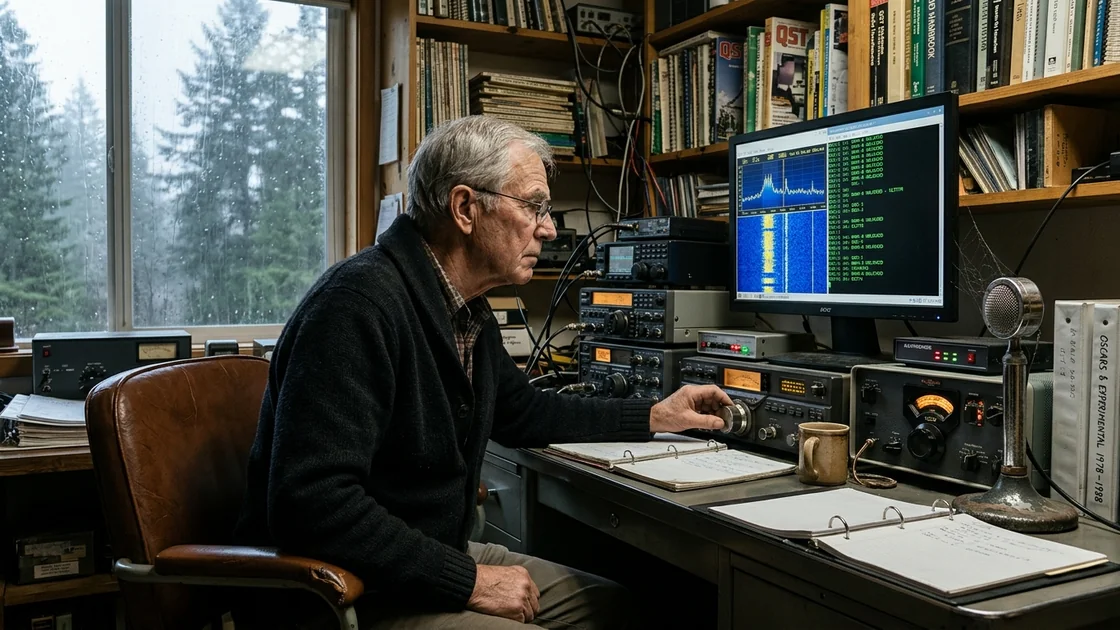
Arthur Pendelton is a sixty-eight-year-old retired telecommunications engineer living in self-imposed isolation on the rain-drenched Olympic Peninsula of Washington State, where he spends his nights listening to the radio spectrum rather than speaking to the living world. Following the death of his wife Clara four years prior, Arthur has let his amateur radio license gather dust as a transmitter, using his elaborate array of antennas solely to eavesdrop on the automated chatter of weather buoys, commercial aircraft, and passing satellites. One November evening, while monitoring the two-meter amateur band, he intercepts a burst of archaic packet data originating from Borealis-2, an experimental scientific and amateur radio satellite that suffered a catastrophic battery failure and was officially decommissioned forty years ago in 1984. As Arthur tracks the resurrected spacecraft across the sky, he discovers that solar radiation has awakened its dormant systems, triggering a continuous dump of its old magnetic bubble memory. Working alone through worsening winter storms, Arthur decodes the fragmented logs left behind by a solitary Cold War tracking operator on a remote Alaskan island, uncovering a forty-year-old message of love, regret, and human connection that forces him to confront his own grief before the decaying satellite burns up in the Earth's atmosphere forever.
The rain on the Kitsap and Olympic peninsulas did not fall so much as it inhabited the air, a permanent suspended ocean that turned the towering Douglas firs into black silhouettes and rotted the cedar shakes on the north side of Arthur Pendelton’s roof. Inside the house, the only dry room was the spare bedroom at the end of the hall, which Clara had once called the conservatory because of its wide south-facing window, and which Arthur simply called the shack.
It kept itself dry by dint of the heat pouring off thirty-five years of accumulated electronics. Even with the baseband radiator turned off, the room stayed at a steady sixty-eight degrees, warmed by the linear power supplies, the glowing filaments of a vintage Collins receiver he kept purely for the smell of its dust, and the three rack-mounted transceivers stacked like obsidian bricks on the steel desk.
Arthur sat in his leather swivel chair, a wool cardigan buttoned to his throat, watching a waterfall of blue and yellow pixels cascade down a twenty-four-inch monitor. The software-defined radio was sweeping a two-megahertz slice of the very high frequency spectrum. To anyone else, the screen looked like static television snow tinted in bruising shades of indigo, streaked occasionally by the bright vertical lightning of a local repeater keying up down in Forks or Port Angeles. To Arthur, it was a map of the invisible geography of the coast.
At 144.390 megahertz, the steady, chirping heartbeat of the Automatic Packet Reporting System flickered every few seconds—automated position beacons from cargo ships out in the Strait of Juan de Fuca, weather stations on the ridges of Mount Olympus reporting barometric drops, and the occasional long-haul trucker rolling down Highway 101. Above that, in the repeater sub-bands, two old men in Sequim were discussing gout and alternator brushes. Arthur never tuned them in for more than three seconds. He had no interest in gout, and less interest in the rituals of small talk.
Beside the keyboard sat a chrome Heil microphone mounted on a heavy cast-iron base. Its push-to-talk lever was tarnished with a dull, greenish patina of oxidation where his thumb used to rest. A spider had strung a single, tentative guideline from the foam windscreen to the corner of the desk lamp. Arthur had not brushed it away. He had not keyed a transmitter since a Tuesday in late April four years ago, when he had checked into the Maritime Mobile Service Network to tell a man on a sailboat in Ketchikan that Clara was in the hospice ward and wouldn't be coming back to the cabin to hear him make landfall.
He took a sip of lukewarm chicory coffee and scrolled the tuning wheel with his index finger, moving up past 145.800 megahertz, the region of the two-meter band reserved by international treaty for amateur satellites.
At 02:14 Coordinated Universal Time—six-fourteen in the evening by the kitchen clock he rarely looked at—most of the low-Earth-orbit birds were either over the South Pacific or buried behind the curvature of the eastern horizon. The International Space Station’s cross-band repeater was silent, tracking down toward the tip of Chile. The cube satellites launched by universities were faint, reedy whispers of telemetry that required high-gain antennas and low-noise preamplifiers to pull out of the mud.
Arthur liked the satellite band because it was governed by geometry rather than human whim. A man in Sequim could talk for forty minutes about his lawnmower, refusing to let go of the frequency. A satellite rose, crossed the vault of the sky along a strict Keplerian arc, shifted its frequency downward by six kilohertz as its relative velocity swung from approaching to receding, and vanished into the stone and salt water of the horizon. It never asked how he was holding up. It never suggested he join the church choir or get a retriever.
Then, at 145.842 megahertz, the indigo waterfall bruised bright orange.
Arthur’s hand stopped on the weighted tuning knob. He clicked the mouse, dragging the demodulator passband over the sudden scar of energy, and switched the mode from narrowband FM to upper sideband, widening the filter so he could hear the raw audio envelope.
From the external speaker came a sound that made the hair on his forearms stand up.
Bzzzz-ksssh-brrrt.
It was not the modern, clinical rasp of ninety-six-hundred-baud Gaussian frequency-shift keying, nor the musical, multi-tone warble of FT8 that dominated the high-frequency bands these days. It was coarse, wide, and unmistakably nostalgic. It was a twelve-hundred-baud Bell 202 audio frequency-shift keyed packet—two distinct tones, twelve hundred hertz and twenty-two hundred hertz, toggling back and forth like a metallic cricket. It sounded like 1985. It sounded like the basement of the regional Bell operating company where Arthur had spent his thirties drinking burnt Folgers and babysitting leased copper lines.
Four seconds later, it chirped again.
Bzzzz-ksssh-brrrt.
Arthur leaned forward, his glasses sliding down the bridge of his nose. On the waterfall display, the signal wasn't stationary. The bright orange dashes were slanting diagonally from right to left as they fell down the screen. Four seconds later, another burst arrived, centered almost a hundred hertz lower than the first.
Doppler shift. Whatever was transmitting was moving at roughly seventeen thousand miles per hour relative to the cedar trees outside his window, and it was passing through its point of closest approach, diving toward the southern horizon.
He glanced at his second monitor, where his orbital tracking software displayed a real-time Mercator projection of the Earth overlaid with the footprints of forty active amateur and weather satellites. A pale green circle showed the visibility horizon from his grid square, CN77.
The circle was empty.
According to the North American Aerospace Defense Command’s current active catalog, there was nothing in the sky above Washington State capable of transmitting on two meters right now. The nearest active amateur bird was AO-91, and it was currently passing over Madagascar.
Bzzzz-ksssh-brrrt.
The signal was fading now, dropping into the white noise floor as the source skimmed the tops of the Olympic Range. Arthur’s fingers flew across the keyboard with a practiced, muscle-memory urgency he hadn't felt since he was sixty. He hit the red record button on the software interface, capturing the raw quadrature baseband data directly to his hard drive. He caught two more bursts—the last one barely audible through the hiss of atmospheric static—before the trace dissolved completely into the blue snow of the waterfall.
Silence returned to the room, broken only by the rhythmic ticking of the gutter downspout outside and the low hum of the twelve-volt power supply.
Arthur sat very still for a full minute. Then he reached over, turned up the squelch until the hiss died, and opened the recorded audio file in an analysis program.
He measured the frequency of the four captured bursts against their precise timestamps from his GPS-disciplined rubidium clock.
02:14:12 UTC — 145.842110 MHz. 02:14:18 UTC — 145.841940 MHz. 02:14:24 UTC — 145.841765 MHz. 02:14:30 UTC — 145.841590 MHz.
A linear downward slope of roughly twenty-nine hertz per second. From the rate of the Doppler inflection alone, any decent radio engineer with a slide rule and a pad of graph paper could estimate the slant range and orbital altitude. The slope was relatively shallow compared to the low-orbiting space station, which meant the object wasn't skimming the ionosphere at four hundred kilometers. It was higher. Somewhere between seven hundred and nine hundred kilometers up, in the crowded, cold territory of sun-synchronous polar orbits.
Arthur routed the recorded audio through a virtual audio cable into a software soundcard modem configured for standard AX.25 packet radio. He expected the decode window to remain blank; half the satellites up there used proprietary telemetry framing from Russian or European universities that looked like gibberish to a standard terminal.
Instead, three lines of crisp green ASCII text popped onto his black terminal screen.
fm BO2-1 to TELEM-0 ctl UI pid=F0
BOREALIS-2 SYS-STAT: VBAT=00.0V VSOL=28.4V IBUS=0.42A T-CORE=+04C
MEM-BANK-A: DUMP INIT SECTOR 004F [ERR-RTC-RESET]
Arthur stared at the callsign: BO2-1.
"No," he whispered aloud. His voice was rusty, a dry scraping sound in the quiet room. It was the first word he had spoken since Tuesday, when he had said thank you to the teenager at the checkout counter of the Thriftway in Forks.
He stood up, his knees popping, and walked to the tall pine bookshelf that occupied the wall opposite the operating desk. The shelves were bowed under the weight of forty years of QST magazines, ARRL Handbooks dating back to 1962, and three-ring binders stuffed with mimeographed sheets and dot-matrix printouts from the early days of the Amateur Radio Satellite Corporation.
He pulled down a thick black binder labeled OSCARS & EXPERIMENTAL 1978–1988 in Clara’s neat, looping handwriting. She had organized his library the first year after his retirement, sitting cross-legged on the rug with a label maker while he rewired the rotor control box. If you’re going to hoard paper, Artie, she had said, we’re at least going to index it like civilized people.
He laid the binder on the desk and flipped through the yellowing plastic sheet protectors until he found a photocopy of a newsletter from November 1981.
At the top was a grainy, high-contrast photograph of an octagonal aluminum prism covered in dark blue solar cells, sitting on a cleanroom stand at Vandenberg Air Force Base. Four whip antennas protruded from its bottom bulkhead like the legs of a water strider.
BOREALIS-2 (NORAD Catalog #12904 / Amateur Designation BO-12).
Arthur read the specifications he hadn't looked at in thirty-eight years. Launched October 14, 1981, as a secondary payload aboard a Thor-Delta rocket. A joint venture between a consortium of Canadian and American universities and the amateur satellite community, built to study high-latitude auroral propagation and test an experimental non-volatile magnetic-bubble memory system for store-and-forward digital messaging. Uplink on 435.120 megahertz; downlink on 145.840 megahertz.
He turned the page. clipped to the back of the specification sheet was a three-paragraph notice from an April 1984 issue of the AMSAT Journal.
LOSS OF BOREALIS-2 CONFIRMED. Ground controllers at the University of Victoria and Fairbanks have ceased attempts to command Borealis-2 following the catastrophic failure of its main nickel-cadmium battery pack during the vernal eclipse season. Telemetry collected on March 19 indicated a dead short in cell three, dragging the main twenty-eight-volt bus below the five-volt threshold required to sustain the CMOS command decoder. The spacecraft is non-responsive and officially declared dead.
Dead since March 1984. Ronald Reagan was in his first term. Arthur was thirty-two years old, living in a townhouse in Tacoma with a woman who had just found out she couldn't have children, both of them spending their weekends driving out to the coast to eat clam chowder in the rain so they wouldn't have to look at the empty nursery.
And four minutes ago, Borealis-2 had just reported that its solar bus was sitting at twenty-eight point four volts, its core temperature was four degrees Celsius, and it was initializing a memory dump.
Arthur knew the physics of how ghosts were born in orbit. In the trade, they were called zombie satellites. A spacecraft dies when its rechargeable batteries short-circuit, clamping the electrical bus to zero volts so that even when the solar panels are blazing in direct sunlight, all the current drains straight into the dead chemical cells like water down a storm sewer. The satellite orbits for decades as a freezing, silent chunk of aluminum and gold Mylar, baking to a hundred degrees in the sun and plunging to minus eighty in the Earth’s shadow fourteen times a day.
Over thirty or forty years, that relentless thermal cycling expands and contracts the metal casings of the dead battery cells. Sometimes, through sheer mechanical fatigue or the micro-jolts of cosmic radiation, the internal short circuit cracks open. The dead battery disconnects itself from the circuit. Suddenly, the next time the satellite rolls out of the Earth’s shadow into the raw, unfiltered glare of the sun, the solar arrays energize the main bus directly. The ancient oscillators warm up. The crystals begin to vibrate. The logic gates clear their registers and wake up, entirely unaware that forty years have passed since their last clock cycle.
They only live in the light. The moment their orbit carries them back into the umbra of the Earth, with no battery to hold the charge, they die instantly, only to be resurrected fifty minutes later when they crest the day-night terminator on the other side of the globe.
Arthur pulled up his tracking program again and opened the historical
catalog file—the graveyard list of rocket bodies, fairing fragments, and
decommissioned payloads. He typed 12904 into the search
bar.
A red orbital track materialized on the world map.
There it was. Borealis-2 was currently over northern California, heading south-southwest toward the equator on a descending node, bathed in the high-altitude sunlight that still lingered seven hundred kilometers above the dusk on the ground. In eleven minutes, it would cross into Earth's shadow off the coast of Baja and go cold.
Arthur looked at the orbital predictions table. Because of its polar orbit and the rotation of the Earth, the satellite wouldn't pass within sight of his horizon again until tomorrow morning at 09:42 local time—an ascending pass coming up from the south, fully illuminated by the morning sun.
He looked out the window of the shack. The rain was coming down harder now, drumming against the glass. High above the cedar canopy, bolted to a forty-foot Rohn steel tower he had poured the concrete base for in 1998, sat his satellite array: two cross-polarized Yagi antennas—one for two meters, one for seventy centimeters—mounted on an azimuth-elevation rotator that hadn't been greased in three years.
If he wanted to copy a full twelve-minute horizon-to-horizon pass of a thirty-watt transmitter four hundred and fifty miles up, the vertical omnidirectional whip on the chimney wasn't going to cut it. He needed the gain of the directional beams.
Arthur reached under the desk and flipped the heavy toggle switch on the Yaesu rotator controller. The dial lamps flickered orange, casting a warm glow over his knuckles. He pressed the LEFT paddle.
High above the roof, muffled by the timber and the storm, came a faint, protesting groan of cold steel and dry ball bearings. On the controller face, the needle crept slowly from 180 degrees down toward 155, shuddered, and held.
"Good girl," Arthur murmured to the empty room.
He didn't go to bed until two in the morning. Instead, he went down to the basement with a flashlight and dug through three plastic totes of legacy hardware behind the oil furnace until he found what he was looking for: a Kantronics KAM Plus dual-port Terminal Node Controller, circa 1993, wrapped in an old flannel shirt. Software soundcards were fine for clean signals, but old hardware modems with discrete analog filters and real phase-locked loops had a way of digging ragged, drifting tones out of the mud when a satellite’s crystal oscillator had aged forty years in the radiation belts.
He carried it upstairs, blew a gray cloud of cellar dust off the serial ports, and soldered a custom audio cable at his workbench while the house creaked around him in the wind. For the first time in forty-eight months, he did not lie awake in the dark listening to the refrigerator cycle on and off. When he finally lay down on his side of the mattress, the smell of rosin-core solder was still on his fingers, and he slept without dreaming.
At 09:30 the next morning, the rain had thinned to a cold mist that hung in the branches of the hemlocks like torn gauze. Arthur sat at the desk with a mug of black coffee, a legal pad, and three sharpened No. 2 pencils.
The Kantronics TNC was wired into the auxiliary audio jack of his primary receiver, its red LED bar graph flickering weakly with the background noise of the open frequency. He had configured his computer to automatically adjust the receiver’s tuning every two seconds to compensate for the Doppler curve calculated from NORAD’s latest two-line orbital elements for object 12904, and to feed the azimuth and elevation coordinates to the roof rotator.
At 09:41:50, the rotator engaged. Outside, the motors whined for six seconds, swinging the long aluminum booms toward the south-southeast at an elevation of zero degrees.
Arthur watched the waterfall. The noise floor at 145.843 megahertz—three kilohertz above the nominal center frequency to account for the satellite hurtling toward him at seven kilometers per second—was a flat, featureless line of static.
09:42:15. The satellite was theoretically two degrees above the horizon, blocked by the foothills of the Olympic Mountains.
09:43:02. Six degrees elevation.
The red LEDs on the Kantronics box flashed all at once.
Bzzzz-ksssh-brrrt.
The sound was crisp, cutting right through the white noise as the fourteen-element Yagi locked onto the downlink polarization. On the terminal screen, green text began to spill down the page in rapid, rhythmic blocks every six seconds.
fm BO2-1 to TELEM-0 ctl UI pid=F0
BOREALIS-2 SYS-STAT: VBAT=00.0V VSOL=29.1V IBUS=0.44A T-CORE=-12C
MEM-BANK-A: DUMP CONT SECTOR 011A [BUBBLE-OK]
fm BO2-1 to QST-0 ctl UI pid=F0
PBBS-BO2 v1.04 (1981-08-12) FREE=0012 BYTES
MSG# 0042 TO: ALL FROM: KL7YTM DATE: 840314/0412Z
4B 4C 37 59 54 4D 20 53 54 41 54 49 4F 4E 20 4C 4F 47 20 31 34
Arthur leaned in close, his coffee forgotten. The satellite wasn't
just sending engineering housekeeping data. Its onboard computer, upon
booting up in the sunlight and detecting an unrecoverable clock error
(ERR-RTC-RESET), had defaulted to its failsafe diagnostic
routine: a sequential, cyclic dump of its non-volatile magnetic-bubble
memory banks over the broadcast downlink.
In 1981, solid-state flash memory didn't exist, and standard RAM lost everything the millisecond power dropped. Borealis-2 had been built with an experimental two-megabit magnetic-bubble memory module provided by Bell Labs—microscopic cylindrical domains of magnetization suspended in a thin film of garnet, shifted through tiny permalloy chevrons by rotating magnetic fields. Because the data was stored physically as magnetic polarity in garnet crystal rather than electrical charge in a capacitor, it required zero power to retain its state. It could sit in the deep freeze of space for a hundred years, and when power returned to the drive coils, the bits would march right back out of the garnet exactly as they had been left.
And what was inside the garnet was the satellite’s Packet Bulletin Board System—an orbiting digital mailbox where ground stations in the early eighties could upload messages on the seventy-centimeter uplink to be stored and downloaded later by other operators around the world.
For the next eleven minutes, as the rotator clicked and hummed overhead, tracking the bird across the western sky at a peak elevation of forty-eight degrees and down toward the Gulf of Alaska, Arthur watched the past unspool across his monitor.
Some of the packets were raw ASCII; others were hex-encoded binary blocks that had been compressed by an early, crude run-length encoding algorithm to save precious bandwidth. By 09:54, the signal faded into the northern horizon as Borealis-2 headed over the pole toward Siberia.
Arthur immediately copied the log file and wrote a forty-line Python script to strip the AX.25 headers, reassemble the fragmented frames by sequence number, and convert the hexadecimal strings back into plain text.
When he ran the script, the output file contained fourteen distinct fragments. The earliest were standard, mundane artifacts of the early digital amateur community from the first week of March 1984:
MSG# 0031 TO: VE7ASM FROM: W6OAL DATE: 840308/1820Z
ROGER JIM COPIED YOUR TELEMETRY PLOTS ON PASS 1244. SOLAR ARRAY DEGRADATION LOOKS WITHIN 3 PERCENT NOMINAL. SEE YOU AT DAYTON HAMVENTION IN MAY? 73 DE DAVE.
MSG# 0034 TO: G3IOR FROM: JA1GDE DATE: 840310/0105Z
TNX FOR QSL CARD VIA BUREAU. RIG HERE IS IC-251A INTO 8 EL YAGI. 73 DE KENJI.
Arthur smiled faintly. He knew some of those callsigns—legends of the early satellite days, men who were almost certainly Silent Keys now, their equipment sold off at estate sales just as Arthur’s would be one day when the county sheriff finally noticed the mail piling up in the box down by the highway.
Then he scrolled down to the messages beginning at number 0039. From
March 12, 1984, onward, every single entry in the satellite’s memory
came from the same station: KL7YTM.
A KL7 prefix was Alaska.
Arthur read the decoded text of Message 0042, the one he had seen scrolling by in hex during the pass:
MSG# 0042 TO: ALL FROM: KL7YTM DATE: 840314/0412Z
KL7YTM STATION LOG 14. IF ANYONE AT UVIC OR AMSAT COMMAND IS PULLING THE BUFFER, YOUR BATTERY CELL THREE IS DROPPING FAST ON ECLIPSE EXIT. I AM WATCHING THE TELEMETRY CARRIER SAG BY 400 HZ EVERY TIME SHE COMES OUT OF THE DARK OVER THE BERING SEA. SHE HAS MAYBE FORTY ORBITS LEFT BEFORE THAT CELL SHORTS HARD AND CLAMPS THE REGULATOR. NOBODY IS ANSWERING ON HF TODAY. AURORA HAS THE IONOSPHERE CHEWED TO RIBBONS FROM BARROW TO KODIAK. JUST ME AND THE BIRD UP HERE.
Arthur scrolled to the next block captured during the pass.
MSG# 0045 TO: ALL FROM: KL7YTM DATE: 840316/1530Z
KL7YTM LOG 16. THE COAST GUARD CUTTERCANCELLED THE MAIL DROP AT CAPE LISBURNE. ICE PACK SHIFTED FOUR MILES INSHORE LAST NIGHT AND CRUSHED THE GRAVEL BAR. THE CONTRACT ENGINEER FROM FAIRBANKS LEFT ON THE TWIN OTTER THREE WEEKS AGO AND TOOK THE SPARE KLYSTRON TUBE FOR THE TROPOSCATTER DISH BY MISTAKE, OR MAYBE ON PURPOSE BECAUSE HE HATED THE WIND. SO MY COMMERCIAL PHONE TIE-LINE TO ANCHORAGE IS DEAD AND TWENTY METERS IS JUST WHITE HISSED STATIC. FUNNY THING. WE SPENT FOUR MILLION DOLLARS BUILDING THIS IONOSPHERIC SOUNDER ARRAY TO LISTEN TO THE SKY FOR THE AIR FORCE, AND THE ONLY THING THAT ACTUALLY HEARS ME RIGHT NOW IS AN OCTAGONAL TIN CAN AT EIGHT HUNDRED KILOMETERS THAT IS ABOUT TO DIE.
MSG# 0046 TO: MARGARET FROM: KL7YTM DATE: 840317/0355Z
SINCE NOBODY ELSE IS CHECKING THE MAILBOX ON THIS DYING BIRD BECAUSE THE DOWNLINK POWER IS DOWN TO HALF A WATT, I AM USING THE FREE SECTORS FOR MYSELF. CALL IT GRAFFITI ON THE INSIDE OF A PYRAMID. MAGGIE, IF YOU EVER ASK YOUR BROTHER WHAT A HAM RADIO SATELLITE DOES, TELL HIM IT HOLDS LETTERS FOR COWARDS WHO DIDN'T SAY THE RIGHT THING AT THE AIRPORT IN SEATTLE.
The log ended there—cut off mid-stream when Borealis-2 had dropped below Arthur’s northern horizon at 09:54.
Arthur sat back in his chair, the yellow pencil resting between his fingers.
The satellite’s memory was dumping sequentially in a continuous loop, cycling through two megabits of bubble storage at twelve hundred bits per second—roughly twenty-eight minutes of raw transmission to read the entire memory bank from start to finish. Because Borealis-2 had no working internal clock and only powered up when it hit sunlight, the memory dump restarted from Sector 0000 every single time the spacecraft emerged from the Earth's shadow.
Wait. Arthur frowned, looking back at the first telemetry packet from last night’s pass and comparing it to this morning’s.
Last night at 02:14 UTC, the satellite had been at
SECTOR 004F. This morning at 09:43 UTC, it had been at
SECTOR 011A.
He did the math in his head. Each sector was 256 bytes. At 1200 baud, with protocol overhead, the satellite was dumping roughly four sectors per minute. That meant this morning, when Borealis-2 crossed over Washington State, it had been in continuous sunlight for about eighteen minutes since exiting the shadow near Antarctica. Last night, coming down from the north pole, it had just woken up five minutes earlier over the Arctic Circle.
Because the satellite’s orbit was sun-synchronous—precessing slowly around the Earth at the same rate the Earth orbited the sun—it always exited the Earth's shadow at roughly the same latitude on every single orbit!
Arthur’s breath caught. He grabbed his legal pad and began sketching a circle representing the Earth, drawing the parallel lines of solar illumination and the tilted ellipse of Borealis-2’s seventy-eight-degree inclined orbit.
If the satellite always woke up at the exact same point in its
orbit—say, sixty degrees south latitude on the ascending pass—and
started dumping its memory from SECTOR 0000 at twelve
hundred baud, then by the time it flew over Washington State eighteen
minutes later, it would always be dumping the exact same
section of memory: roughly sectors 0110 through
0145.
And on the descending evening passes, waking up coming out of the
northern shadow near the pole, it would always be dumping
sectors 0040 through 0075 when it crossed
Arthur’s sky.
What about the rest of the memory? What about sectors
0150 through 03FF—the second half of the
bubble storage, which the satellite only reached when it was over the
North Pole, or Siberia, or the middle of the Indian Ocean, thousands of
miles beyond the reach of Arthur’s antennas?
He stared at the pencil drawing. If the satellite simply reset to
zero every time the power dropped in the shadow, then the second half of
KL7YTM’s logs was being broadcast exclusively to the empty
ice sheets of Severnaya Zemlya and the albatrosses of the southern
Indian Ocean, where no one was listening.
Unless the pointer didn't reset on power loss.
He looked closer at last night's first packet again:
MEM-BANK-A: DUMP INIT SECTOR 004F [ERR-RTC-RESET]
Why had it initialized at 004F instead of
0000?
Because magnetic-bubble memory was a physical loop! Like an endless magnetic tape reel, the bubbles stayed at whatever physical position they were in under the read/write head when the rotating magnetic field stopped. When the satellite hit the dark, the bubbles froze in place in the garnet crystal. When the sun came back out fifty minutes later, the read head simply resumed from the exact sector where the power had died—minus a small rollback to the nearest block header!
Then why had it jumped from 004F last night to
011A this morning? Between 6:14 PM and 9:42 AM, the
satellite had completed nine orbits. It should have looped through the
entire two-megabit memory space three or four times.
Arthur pulled up the full raw hex dump from this morning and searched for the system status flags. Near the bottom of the pass, at 09:51, he found a single corrupted line he had missed before:
MEM-BANK-B: LOCKED [SYSOP-AUTH-REQ] SKIPPING TO 0000
There were two banks of bubble memory. Bank A was the public bulletin board—thirty-two kilobytes of open storage that looped every six minutes, which explained why he was catching different slices of it as the orbital phase drifted against the six-minute loop! Within three or four days of tracking both morning and evening passes, the natural drift between the ninety-nine-minute orbital period and the six-minute memory loop would allow him to capture every single byte of Bank A.
Bank B, however—the remaining 224 kilobytes of high-density storage
reserved for university experiments and system administration—was locked
behind a sysop command gate. The automatic diagnostic routine was
hitting the end of Bank A at sector 01FF, finding the lock
flag on Bank B, and wrapping back to 0000.
Arthur tapped his pencil against his teeth. Then he opened the
Federal Communications Commission archive database he kept on an offline
hard drive—a complete scrape of the 1980s amateur callbook records—and
looked up KL7YTM.
KL7YTM — JULIAN R. VANCE.
ADDRESS: BOX 412, ESTHER, ALASKA 99725.
CLASS: EXTRA. BORN: 1949.
Julian Vance would have been thirty-five years old in March 1984. If he were still alive today, he would be seventy-five—seven years older than Arthur.
Arthur searched his wider archive of scientific and military contractor records from the Cold War, plus a local mirror of old Usenet and packet radio digests from the late eighties. It took him forty minutes of grepping through text files before he found a mention of Julian R. Vance in a digitized 1986 newsletter from the Geophysical Institute at the University of Alaska Fairbanks.
It was a two-line memorial note at the bottom of a column about auroral radar upgrades:
The Institute notes with sadness the passing of former contract field engineer Julian Vance (KL7YTM), who died in Seattle on November 12, 1985, following a brief illness.
Arthur let go of the mouse.
Julian Vance hadn't frozen to death on some ice-locked gravel bar in the Chukchi Sea in March 1984. He had made it off the island, gone back to Seattle, and died twenty months later at the age of thirty-six.
And before he left that island, while Borealis-2 was dying in the sky above him, he had poured his thoughts into a piece of synthetic garnet crystal orbiting five hundred miles above the Earth, thinking the satellite was about to go dark forever and take his words to the grave.
"Well, Julian," Arthur said softly to the screen. "Let's see what you left behind."
For the next five days, Arthur’s life contracted into the rigid, clockwork rhythm of orbital mechanics.
Borealis-2 was in a sun-synchronous orbit with a period of 100.4 minutes. Because of the Earth’s rotation beneath the orbital plane, the satellite passed within range of Arthur’s antennas twice every morning between eight and eleven o'clock, and twice every evening between five-thirty and eight-thirty. However, during the late evening passes in November, the northern hemisphere was tilted away from the sun; by the time Borealis-2 descended below the sixty-fifth parallel over Canada, it slipped into the Earth's dusk shadow and went instantly silent.
That left Arthur with two full sunlit passes every morning, and one short three-minute window on the early evening pass before the bird hit the eclipse boundary right over Vancouver Island.
He missed none of them.
He set alarms for 07:30, brewed a pot of coffee, and sat in the shack watching the telemetry scroll. Between passes, while the satellite was circling the far side of the planet, he pieced the puzzle of Bank A together like an archaeologist gluing shards of Greek pottery onto a wire frame.
Because the memory loop took five minutes and forty-two seconds to cycle through all 512 sectors of Bank A, and each pass lasted roughly eleven minutes, every pass gave him nearly two full cycles of the public buffer—except for the sectors lost when the satellite was below five degrees on the horizon or fading through a multi-path null caused by the wet trees on the ridge. By Thursday afternoon, he had recovered ninety-eight percent of Bank A.
He printed the reconstructed messages out on his laser printer and arranged them in chronological order across the dining room table—the long oak table that still had Clara’s woven linen runner down the center, untouched since the day the funeral home van had backed down the gravel driveway.
Sitting in the dining room with the grey light of the rainforest filtering through the lace curtains, Arthur read the story of March 1984.
MSG# 0047 TO: MARGARET FROM: KL7YTM DATE: 840317/1510Z
LOG 17. MORNING PASS. THE SUN BARELY CLEARS THE SOUTHERN ICE RIDGE FOR FOUR HOURS NOW, JUST ENOUGH TO TURN THE RIME ICE ON THE RHOMBIC ANTENNA WIRES PINK BEFORE THE FOG ROLLS BACK IN OFF THE STRAIT.
I FOUND THAT BLUE WOOL SCARF YOU LEFT IN THE DUFFEL BAG WHEN I PACKED IN ANCHORAGE. YOU KNOW THE ONE—YOU BOUGHT IT AT PIKE PLACE THE DAY WE WATCHED THE FERRIES PULL OUT IN THE FOG AND YOU ASKED ME IF I WAS TAKING THE NINE-MONTH CONTRACT UP HERE BECAUSE OF THE MONEY OR BECAUSE I DIDN'T KNOW HOW TO LIVE IN A HOUSE WITH TWO PEOPLE IN IT.
I TOLD YOU IT WAS THE MONEY. TWENTY-EIGHT THOUSAND TAX-FREE IF YOU STAY THROUGH THE BREAKUP.
IT WAS A LIE, MAGGIE. I WAS SCARED TO DEATH.
MSG# 0049 TO: MARGARET FROM: KL7YTM DATE: 840318/0402Z
LOG 18. THE TELEMETRY ON BO-2 SHOWS MAIN BUS DROPPING TO 19 VOLTS WHEN THE SOLAR ANGLE DIPS BELOW THIRTY DEGREES. CELL THREE IS RUNNING SEVENTY DEGREES CELSIUS right BEFORE ECLIPSE. IT IS BOILING ITS ELECTROLYTE OUT INTO THE VACUUM VENT.
NOBODY ELSE IS USING THE UPLINK ANYMORE. UVIC SENT THE ALL-STATIONS STANDBY COMMAND YESTERDAY TO CONSERVE POWER, BUT THE COMMAND RECEIVER LATCH IS STUCK IN STORE-AND-FORWARD MODE BECAUSE THE FIVE-VOLT REGULATOR GLITCHED DURING PASS 1280. SO THE MAILBOX DOOR IS JAMMED OPEN WHILE THE HOUSE BURNS DOWN.
WHEN YOUR FATHER DIED IN SEVENTY-NINE, YOU TOLD ME HE SPENT HIS LAST THREE MONTHS IN THE GARAGE REBUILDING A EVINRUDE OUTBOARD MOTOR FOR A BOAT HE HAD SOLD TEN YEARS EARLIER. YOU SAID MEN IN YOUR FAMILY DIDN'T KNOW HOW TO SAY GOODBYE SO THEY JUST FIXED BROKEN MACHINES UNTIL THEIR HANDS STOPPED WORKING.
I GUESS WE AREN'T SO DIFFERENT.Arthur stopped reading and looked down at his own hands resting on the oak table. There was a small burn scar on the knuckle of his right index finger where a soldering iron had slipped in 2019—three weeks after Clara’s diagnosis—while he was furiously recapping an old Heathkit linear amplifier he didn't even need. While she was in the living room sleeping under a wool throw after her first round of infusion, he had spent fourteen hours a day at the bench, measuring resistor tolerances to the third decimal place, terrified that if he put the meter leads down and walked into the living room, he would have to look at the bruised veins on the back of her wrists and admit that he couldn't engineer a bypass around what was happening to her.
He turned to the next page.
MSG# 0051 TO: MARGARET FROM: KL7YTM DATE: 840318/1650Z
LOG 19. THE DOCTOR AT ELMENDORF CALLED ON THE HIGH-FREQUENCY PATCH FOUR WEEKS AGO BEFORE THE SOLAR STORM KILLED TWENTY METERS. RIGHT BEFORE THE FAIRBANKS KID FLEW OUT.
HE HAD THE BIOPSY RESULTS FROM THAT LYMPH NODE THEY PULLED OUT OF MY NECK IN JANUARY BEFORE I FLEW UP HERE.
YOU WANTED ME TO STAY IN SEATTLE UNTIL THE PATHOLOGY CAME BACK. YOU STOOD BY THE GATE AT SEA-TAC IN THAT GREEN TRENCH COAT WITH YOUR ARMS CROSSED AND SAID, JULIAN, IF IT'S BAD, DON'T MAKE ME FIND OUT OVER A TELEPHONE LINE.
AND I WALKED DOWN THE JETWAY ANYWAY BECAUSE IF I STAYED IN THAT APARTMENT ON CAPITOL HILL WAITING FOR THE PHONE TO RING, I WAS GOING TO COME APART AT THE SEAMS, AND I COULDN'T STAND THE IDEA OF YOU WATCHING ME BE AFRAID.
IT'S STAGE FOUR HODGKIN'S, MAGGIE. BY NOW IT'S IN THE MEDIASTINUM. I CAN FEEL IT PRESSING AGAINST MY WINDPIPE WHEN I SHOVEL SNOW OFF THE GENERATOR EXHAUST.
MSG# 0052 TO: MARGARET FROM: KL7YTM DATE: 840319/0340Z
LOG 20. LAST PASS BEFORE ECLIPSE. THE TELEMETRY SAYS BUS VOLTAGE IS DOWN TO 11.4 VOLTS. THE BUBBLE MEMORY CONTROLLER NEEDS NINE VOLTS MINIMUM TO SHIFT THE GARNET LOOPS. THIS IS PROBABLY THE LAST ORBIT SHE SURVIVES.
BANK A IS ALMOST FULL—ONLY TWELVE BYTES LEFT IN THE PUBLIC PARTITION.
SO I USED THE OLD FAIRBANKS COMMAND PASSCODE THEY GAVE US FOR THE AURORAL EXPERIMENT IN EIGHTY-TWO TO UNLOCK BANK B.
I WROTE THE REST OF IT THERE. ALL OF IT. EVERYTHING I SHOULD HAVE SAID AT GATE B-14, AND WHAT I WANT DONE WITH THE HOUSE ON INTERLAKEN, AND THE LETTER FOR YOUR MOTHER. THEN I LOCKED BANK B BACK UP SO SOME KID IN TOKYO WOULDN'T OVERWRITE IT IF THE BIRD SURVIVED ANOTHER DAY.
IF THE WEATHER CLEARS IN APRIL AND THE TWIN OTTER GETS IN, I'LL COME HOME AND TELL YOU MYSELF AND THIS CAN ALL JUST FLOAT AROUND IN THE DARK FOREVER LIKE A MESSAGE IN A BOTTLE NOBODY EVER OPENS.
IF ANYBODY EVER READS THIS DUMP, THE SYSOP OVERRIDE FOR BANK B isn't THE UVIC MASTER CODE. IT'S THE LOCAL EXPERIMENT KEY ON 435.120 MHZ:
[CMD: SYS-B-OPEN // KEY: 7A-9F-MAGGIE-81]
GOODNIGHT BIRD. 73 DE KL7YTM.Arthur sat in the gray afternoon light of the dining room for a long time.
Julian Vance had survived the spring breakup of 1984. He had flown back to Seattle, lived another year and a half—long enough to go through radiation or chemotherapy in the mid-eighties, long enough to die in November 1985. Had he told Margaret everything that was in Bank B when he got home? Or had a man who couldn't bear to be seen afraid kept his silence to the end, or been too sick by the time he got off the ice to ever find the words he had typed into the sky while he was alone?
And more than that: in Bank B, untouched for forty years, was the final testament of a fellow operator who had poured his soul into the radio spectrum when the whole world was dark.
Arthur stood up, gathered the papers, and walked back into the shack.
He looked at the final lines of Message 0052:
[CMD: SYS-B-OPEN // KEY: 7A-9F-MAGGIE-81]
To unlock Bank B and instruct the satellite’s onboard computer to include the protected partition in its continuous memory dump, someone on the ground had to transmit that exact AX.25 command frame on the uplink frequency—435.120 megahertz—while the satellite was overhead in the sunlight.
Arthur looked down at his desk.
His seventy-centimeter transceiver was there. The coaxial feedline ran up the tower to the nineteen-element 435-megahertz Yagi sitting right beside the two-meter beam on the elevation cross-boom. The Kantronics TNC was still wired to the transmitter’s data port from five years ago; all he had to do was flip the red standby switch on the seventy-centimeter amplifier from RX ONLY to OPERATE.
His hand hovered three inches above the switch, then stopped.
His heart was beating uncomfortably hard against his ribs. It was ridiculous, he told himself. It wasn't like picking up the microphone and calling CQ on twenty meters, inviting strangers into the fragile, tomb-like quiet of his house. It was just sending a three-hundred-millisecond burst of audio tones to an automated machine five hundred miles up. Nobody on Earth would even hear his uplink unless they happened to live within ten miles of his cabin and were monitoring a dead satellite input frequency at nine in the morning.
Yet for four years, the rule had been absolute: nothing goes out. To transmit was to assert that Arthur Pendelton was still here, occupying coordinates in space and time, asking the universe for an acknowledgment. As long as he only listened, he was a ghost himself, no different from the dead satellite—an observer drifting through the silence after the battery had failed.
He pulled his hand back and sat down in his chair.
Before he could talk himself into or out of flipping the switch, an alert box flashed in the corner of his orbital tracking monitor.
WARNING: TLE AGE > 48 HOURS. HIGH DRAG ANOMALY DETECTED ON OBJECT 12904.
Arthur frowned. Two days ago, during the morning pass, he had noticed that Borealis-2 had risen above the southern horizon nearly eleven seconds earlier than the tracking software predicted, and its Doppler shift curve had been slightly steeper than the model calculated. Today, it had been twenty-eight seconds early.
He connected to his satellite internet terminal—the only external link he maintained, throttled to a slow data plan he used once a week to pull weather charts and NORAD orbital element sets—and downloaded the latest space weather bulletin from NOAA and the updated Two-Line Elements from the Space Surveillance Network.
When the new elements loaded into the tracker, Arthur stared at the numbers in disbelief.
Six days ago, on November 10, a massive X-class solar flare and a subsequent coronal mass ejection had slammed into the Earth's magnetosphere. That geomagnetic storm was probably what had resurrected Borealis-2 in the first place—inducing a high-voltage transient across the spacecraft’s harness that had finally blown the forty-year-old short circuit in battery cell three wide open like a fuse.
Wait. The orbital elements showed something else.
In 1984, Borealis-2 had been in a circular orbit of 780 kilometers. Over forty years, natural atmospheric drag had slowly bled away its altitude, bringing it down to 390 kilometers by the start of this year. Still, at 390 kilometers, it should have had another two or three years before re-entry.
Except the coronal mass ejection last week hadn't just charged the magnetosphere; the influx of extreme ultraviolet and X-ray radiation had superheated the upper thermosphere. Like air in a hot-air balloon, the outermost whispers of Earth's atmosphere had expanded upward by hundreds of kilometers, increasing the density of gas molecules at Borealis-2's altitude by a factor of ten.
And worse: twelve years ago, according to a catalog footnote Arthur pulled up, Borealis-2 had suffered a minor conjunction with a piece of Russian Cosmos debris that had sheared off one of its gravity-gradient stabilization booms and deployed its backup aluminized Mylar thermal shroud like a parachute, quadrupling its cross-sectional drag area.
Arthur ran the orbital decay predictor model on the new TLEs.
Perigee—the lowest point of the orbit—was no longer 390 kilometers. It was down to 218 kilometers and dropping by fourteen kilometers a day.
At 180 kilometers, atmospheric drag becomes runaway exponential. The spacecraft begins to encounter enough oxygen atoms to heat its solar panels, inducing violent tumbling that shreds the arrays and drags the satellite down into the dense stratosphere like a stone.
The software finished its calculation and spat out a single red line at the bottom of the screen:
PREDICTED RE-ENTRY WINDOW: NOV 19 18:00 UTC +/- 06 HOURS.
Today was November 17.
Borealis-2 hadn't woken up to live a second life as a zombie satellite for the next decade, the way AO-7 had. The very solar storm that had shocked its heart back into beating had also swollen the upper atmosphere to swallow it whole.
The satellite was in its death throes. It had less than forty-eight hours before it hit the atmosphere over the Pacific or the Antarctic and burned into a streak of green and white plasma—vaporizing the synthetic garnet crystal and Julian Vance’s words into microscopic dust.
And looking at the visibility table, between now and Sunday morning, there were only four sunlit passes over Washington State left.
Outside the window, the barometer on the wall read 29.10 inches and falling fast. The National Weather Service radio on the shelf—the one channel Arthur left on low volume at all times—crackled to life with the mechanical, synthesized voice of the Seattle station:
...A powerful Pacific frontal system driven by a ninety-six-millibar low off the coast of Vancouver Island will impact the Olympic Coast late Friday night through Saturday evening. High wind warning in effect. South-southeast winds thirty-five to forty-five knots, with gusts to sixty-five knots along coastal headlands and exposed ridges...
Arthur looked from the weather radio to the red OPERATE switch on the seventy-centimeter transmitter.
He reached out and flipped it on. The cooling fan in the back of the chassis spun up with a quiet, purposeful roar.
The first attempt came on Saturday morning at 08:52 local time.
The storm had arrived at three in the morning. Arthur had lain awake listening to the hundred-foot hemlocks along the property line thrashing in the dark, their heavy boughs groaning like the timbers of a wooden ship in a gale. Branches and pine cones rattled against the metal roof of the porch like scattershot.
By eight-thirty, the power down in the valley had flickered three times and died completely as a fir tree inevitably took out the Bonneville Power Administration feeder line along Highway 101. In the shack, the uninterruptible power supply beeped once before Arthur’s four-hundred-amp-hour bank of deep-cycle AGM batteries in the utility closet seamlessly took the load. He had built his station to survive the Cascadia subduction zone earthquake; a winter windstorm wouldn't stop his transceivers.
What it could stop was his antennas.
Through the rain-streaked glass of the south window, he could look straight up through the gap in the trees to the top of the forty-foot Rohn tower. The two long aluminum Yagi booms were shuddering violently in the forty-knot gusts sweeping off the ocean six miles to the west. The elements whipped like fishing rods.
At 08:51, the tracking computer sent the azimuth and elevation commands to the rotator box. Borealis-2 was rising in the south-southwest, already down to an altitude of 204 kilometers. Because it was so much lower now, its apparent speed across the sky was terrifyingly fast—the entire horizon-to-horizon pass would last less than seven minutes instead of twelve, and the Doppler shift on the seventy-centimeter uplink would swing by twenty kilohertz from start to finish.
At 08:52:30, the downlink signal broke through the squelch on 145.843 megahertz.
Bzzzz-ksssh-brrrt.
The telemetry looked bad.
fm BO2-1 to TELEM-0 ctl UI pid=F0
BOREALIS-2 SYS-STAT: VBAT=00.0V VSOL=22.1V IBUS=0.38A T-CORE=+48C
ATTITUDE-ERR: SPIN RATE > 12 RPM
Forty-eight degrees Celsius in the core. Aerodynamic friction from the upper thermosphere was already heating the aluminum skin of the satellite, and the drag on the uneven solar panels had set the octagon spinning at twelve revolutions per minute. Every two and a half seconds, as the satellite tumbled, its antennas rotated ninety degrees relative to Arthur’s cross-polarized Yagi, causing the signal to fade down into the static and swell back up again like a lighthouse beam sweeping through fog.
Arthur waited until 08:54, when the satellite reached its maximum elevation of thirty-two degrees in the west—the shortest slant range, only two hundred and六十 miles away—and hit the ENTER key on his terminal to transmit the command string:
BO2-1 < UI C > : [CMD: SYS-B-OPEN // KEY: 7A-9F-MAGGIE-81]
The red TX light on the seventy-centimeter transceiver blazed on. The Kantronics TNC warbled its twelve-hundred-baud burst up the coaxial cable into the storm.
Arthur watched the downlink waterfall, holding his breath, waiting
for the SYS-B-UNLOCKED acknowledgment frame.
Six seconds later, the satellite replied:
fm BO2-1 to TELEM-0 ctl UI pid=F0
MEM-BANK-A: DUMP CONT SECTOR 019C [BUBBLE-OK]
Nothing. The satellite hadn't heard him.
He adjusted the uplink frequency up by five hundred hertz—guessing that the forty-year-old crystal oscillator in the satellite’s seventy-centimeter command receiver had drifted higher due to the sudden forty-eight-degree heating of the core—and fired the packet again.
TX.
He waited. Six seconds later, another standard Bank A sector scrolled by. He fired a third time, shifting down a kilohertz. Then a fourth.
On the fifth attempt, as the satellite was diving toward the northwest horizon at 08:56, a colossal gust of wind roared up the canyon from the Bogachiel River valley. The whole cabin shuddered on its concrete piers.
From forty feet above the roof came a sound like a rifle shot—CRACK—followed by the sickening, metallic screech of aluminum tearing through steel.
On the desk, the elevation needle on the Yaesu rotator controller
snapped violently from twenty-five degrees to ninety, pegged against the
plastic stop, and went dead. Simultaneously, the standing wave ratio
meter on the seventy-centimeter transmitter flashed bright red:
SWR > 5.0:1 — HIGH REFLECTED POWER.
The downlink signal on the two-meter receiver dropped by twenty decibels, fading instantly into the hiss of the rain.
Arthur killed the transmitter power and ran into the hallway, pulling on his yellow oilskin slicker and rubber boots by the back door. He stepped out onto the mudroom porch into the teeth of the gale.
The wind tore at the hood of his slicker, plastering wet silver hair across his forehead. He squinted upward through the driving rain.
Forty feet up at the top of the tower, the cast-iron bell housing of the azimuth-elevation rotator had sheared its three-eighths-inch stainless steel locking bolt under the torque of the wind. The heavy horizontal cross-boom had rotated ninety degrees in its mast clamp, pointing both Yagi antennas straight up at the zenith like anti-aircraft guns. Worse, as the cross-boom spun, it had yanked the seventy-centimeter coaxial jumper cable taut against the sharp steel edge of the tower leg, slicing cleanly through the black jacket and shorting the copper braid to the center conductor.
The seventy-centimeter uplink antenna was completely severed. And the two-meter receiving antenna was locked pointing straight up at ninety degrees elevation, useless for anything that wasn't passing directly over the chimney.
Arthur stood on the porch in the pouring rain, water streaming off the lenses of his glasses, looking up at the crippled array.
He went back inside, dripping onto the linoleum, and checked the tracking screen.
There was one tiny evening pass at 17:12 today—barely twelve degrees above the western horizon, lasting ninety seconds before the satellite hit the Earth's shadow. With the antennas pointed straight up, he wouldn't hear a whisper of it.
After that, Borealis-2 would circle the globe nine more times through the night, dipping deeper into the thermosphere on every perigee, its aluminum skin heating toward the melting point of solder.
Tomorrow morning, Sunday, November 18, at 08:19 local time, the satellite would make one final ascending pass over the Olympic Peninsula, peaking at forty-one degrees elevation to the east over Puget Sound.
According to the decay model, fifty minutes after that pass—at roughly 09:10 AM—Borealis-2 would hit perigee at 135 kilometers over the South Atlantic off the coast of Argentina, where atmospheric density would tear its solar panels off and burn the spacecraft to ash in less than forty seconds.
Tomorrow morning at 08:19 was the last time Borealis-2 would ever pass over North America.
If Arthur didn't repair the coaxial jumper, free the jammed cross-boom, and point those two antennas at the eastern sky before eight-nineteen tomorrow morning, Bank B would vaporize over the South Atlantic unread.
"You're sixty-eight years old, Artie," he said aloud in the empty kitchen, wiping his face with a dish towel. "You have a bad left knee and nobody knows you're out here. If you fall off that tower, the coyotes won't even have to climb the fence."
He walked into the living room and looked at the framed photograph on the mantelpiece—Clara standing on the driftwood logs at Rialto Beach in an oversized wool sweater, laughing with her eyes squinted against the salt spray.
Before she died, during the last week when the morphine made her drift in and out of the room like a weak signal on forty meters, she had held his wrist with fingers as light as dry birch twigs and said, Don't you dare lock the doors and turn into a hermit when I'm gone, Arthur Pendelton. Promise me you'll keep talking to people.
And he had lied to her. Just like Julian Vance had lied to Margaret at Gate B-14 at Sea-Tac Airport in 1984. He had told her I promise, sweetheart, because it was what she needed to hear to go to sleep, and then the day after the burial he had unplugged the telephone, turned off the transmitter, and locked the gate at the bottom of the drive.
He couldn't keep his promise to Clara retroactively. Four years were gone.
He could, however, keep Julian Vance’s words from burning up over the ocean.
Arthur turned around, walked down the basement stairs, and pulled his leather linesman's climbing belt and safety lanyard off the peg beside the workbench.
All Saturday afternoon and evening, while the gale screamed through the timber at sixty knots, Arthur worked in the dry warmth of the shack. Climbing the tower in the middle of a daylight windstorm was suicide; the forecasts showed the cold front passing inland around 04:00 AM Sunday, leaving a three- or four-hour window of fifteen-knot post-frontal winds before the next trough arrived at nine.
He spent the afternoon preparing for a surgical strike in the dark.
He built a brand-new six-foot coaxial jumper out of heavy-duty RG-214 double-shielded cable, soldering silver-plated PL-259 connectors onto both ends and sealing the boots with three layers of self-amalgamating rubber tape and heat-shrink tubing.
The rotator was beyond repair without a crane and a machine shop; the internal ring gear had stripped when the locking pin sheared. That meant the automated tracking computer couldn't steer the antennas tomorrow morning.
Arthur pulled out a Polar plot of tomorrow’s 08:19 pass and studied the geometry.
The satellite would rise in the south-southeast at 158 degrees azimuth, climb to a peak elevation of 41 degrees at 095 degrees azimuth (almost due east), and vanish in the north-northeast at 032 degrees.
The critical window—when the satellite was closest, highest above the trees, and catching the strongest morning sunlight on its tumbling solar panels—was the ninety seconds around peak elevation, between azimuth 115 and azimuth 075, at an elevation angle between 35 and 41 degrees.
His Yagi antennas had a half-power beamwidth of roughly thirty-two degrees.
If he couldn't steer them dynamically from the desk, he could either lock them in a fixed position pointing due east at thirty-eight degrees elevation and pray ninety seconds was enough to unlock Bank B and download the entire buffer... or he could tie a pair of half-inch Dacron halyard ropes to the ends of the cross-boom, drop them down to the roof, and steer the array manually from the top of the tower like a sailor trimming a yardarm while the computer inside ran an automated script to fire the uplink command every four seconds.
Wait. How big was Bank B?
Even if Julian Vance had only used twenty or thirty sectors of Bank B for his final letters, at twelve hundred baud it would take at least three to four minutes of clean, uninterrupted downlink signal to capture the whole dump after the unlock command went through. A fixed antenna with a thirty-two-degree beamwidth would only illuminate the satellite for ninety seconds as it raced across the sky at low altitude; before and after that window, the bird would be outside the antenna’s cone of reception, lost in the deep sidelobe nulls.
To copy a full four-minute pass from horizon to horizon, the antennas had to move. And since the elevation motor was jammed at ninety degrees and the azimuth brake was sheared, the only way to move them in both axes was to unbolt the locking U-bolts at the top of the mast by hand, balance the forty-pound aluminum assembly on its center pivot bearing, and track the satellite across the sky with his own two arms from the top of the forty-foot tower.
Arthur stared at the legal pad.
If he was at the top of the tower holding the cross-boom in the rain at 08:19, who was going to sit at the desk inside the shack to adjust the uplink frequency for the thermal drift of the satellite’s receiver and fire the command packets?
He looked at his laptop.
He was an engineer. He had written automated switching routines for Bell Northern Research before half the programmers in Silicon Valley were born.
For the next six hours, fueled by black tea and canned beef stew heated over a camp stove, Arthur wrote a custom Python control script.
The script monitored the two-meter receiver’s audio output in real
time. The instant it detected a valid AX.25 frame from
BO2-1, it measured the exact audio frequency of the mark
and space tones, calculated the instantaneous Doppler error and thermal
oscillator drift on the two-meter downlink, multiplied that error by
2.983 (the exact ratio between the 145 MHz downlink and the 435 MHz
uplink, since both derived their local oscillators from the same master
crystal reference on the satellite’s motherboard!), and adjusted the
seventy-centimeter transmitter’s frequency to match within ten
hertz.
Then, during the two-second pause between the satellite’s downlink bursts—so the spacecraft’s own transmitter wouldn't desense its receiver—the script keyed the seventy-centimeter amplifier and fired the unlock string:
[CMD: SYS-B-OPEN // KEY: 7A-9F-MAGGIE-81]
It would keep firing that string every six seconds until the downlink
parser saw the string MEM-BANK-B: DUMP in the incoming
telemetry, at which point it would shut down the transmitter completely
and dedicate all CPU cycles to recording both the raw baseband radio
spectrum and the decoded packet stream.
How would Arthur know, standing forty feet up in the rain on top of the tower, where to point the antenna as the invisible satellite crossed the overcast sky, or whether the script had worked?
He walked into the closet, pulled out a cheap yellow portable AM/FM/VHF weather walkie-talkie, and wired a tiny ten-milliwatt FM modulator into the headphone jack of the computer, tuned to 162.400 megahertz.
By clipping the portable radio to the chest strap of his climbing harness, he would hear the live audio of the two-meter receiver right in his ear at the top of the tower. He had listened to satellites for forty years; he could steer a Yagi by ear alone, following the crescendo of the twelve-hundred-baud crickets and rotating his wrists to match the polarization as the bird tumbled.
And as a backup guide, he drew a large compass rose on a piece of cardboard, marked the exact azimuth and elevation angles for every thirty-second mark from 08:19:00 to 08:25:00 alongside the landmarks visible from the top of the tower:
08:19:00 — 158° Az / 05° El (The notch in the cedar ridge behind the woodshed). 08:20:30 — 125° Az / 26° El (Halfway up the gray clouds above Burnt Mountain). 08:22:00 — 095° Az / 41° El (Directly over the dead snag on the eastern boundary). 08:23:30 — 060° Az / 24° El (Above the bend in the logging road). 08:25:00 — 032° Az / 04° El (The north ridge toward the Strait).
At midnight, he tested the script on a dummy load, laid out his wrenches, electrical tape, and the new coaxial jumper by the door, and slept for five hours on the couch in the shack with his wool coat over his shoulders.
At 06:30 AM, the wind had dropped from a howl to a low, wet sigh through the fir needles.
It was still pitch dark outside, the kind of impenetrable Pacific Northwest November darkness that only turns to the color of wet slate around seven-thirty. A cold, steady drizzle was falling at thirty-eight degrees Fahrenheit.
Arthur ate two pieces of cold toast, drank a cup of coffee heated on the propane ring, and strapped on his leather climbing belt over his oilskins. He stuffed two nine-sixteenths box wrenches, a pair of diagonal cutters, a roll of Scotch 33 electrical tape, and the replacement coaxial cable into his canvas tool pouch. He clipped the yellow monitor radio to his collar, turned it on so the low hiss of the shack’s receiver murmured against his jawbone, and stepped outside.
The steel rungs of the Rohn 25G tower were slick with rainwater and green lichen.
Arthur clipped his secondary lanyard around the vertical leg, tested his weight against the leather belt, and took the first step up.
His left knee complained immediately—a dull, hot ache behind the patella that made him wince—but the muscle memory of twenty years as a field tech took over. Three points of contact. Never look down at the ferns; look at the weld two inches in front of your nose. Breathe through your nose. Move the belt, lean back to test the snap-hook, climb three rungs, repeat.
At twenty feet, he cleared the roofline of the cabin. The smell of wet cedar shakes and woodsmoke gave way to the raw, clean scent of the upper forest canopy and the salt tang of the Pacific six miles west.
At forty feet, his gloved hand closed over the cold steel top plate beneath the rotator cage.
He wrapped his primary positioning strap twice around the main mast pipe, leaned back into the leather saddle so both hands were free, and caught his breath. His heart was hammering at a hundred and thirty beats a minute, his breath pluming white in the beam of his headlamp.
All around him, the tops of the Douglas firs stretched away into the mist toward the gray silhouette of the Olympic Mountains. To the east, where Borealis-2 would rise in thirty-eight minutes, the sky was just beginning to bruise from black to a deep, wintry pewter.
He examined the damage in the beam of his headlamp.
It was worse than it looked from the porch, and in one way, better. The seventy-centimeter coaxial jumper was sliced clean through, dangling like a dead black snake, which he quickly unscrewed from the main hardline manifold and the antenna feedpoint. His fingers were stiff with the cold, fumbling the knurled brass collar of the PL-259 connector twice before he got the threads of the new cable started and tightened it down with pliers.
Next, he tackled the cross-boom.
When the rotator pin had sheared in Saturday's gust, the heavy steel U-bolt clamping the horizontal fiberglass-and-aluminum boom to the elevation shaft had twisted and jammed against the tower top plate, locking both twelve-foot Yagi antennas straight vertical.
Arthur pulled a nine-sixteenths box wrench from his pouch and fitted it over the wet, rusted nuts of the main mast clamp and the elevation pivot collar. He leaned his shoulder into the wrench. For five seconds, nothing moved. Then, with a sharp ping of breaking rust, the nut turned a quarter-inch.
He backed all four nuts off two turns—just enough to release the mechanical bind while keeping the sixty-pound assembly captured securely on the greased steel thrust bearing—and gripped the central fiberglass cross-boom with both hands.
He pushed downward.
With a heavy, balanced grace, the twin Yagi arrays swung down from the vertical until they pointed out horizontally across the treetops like a pair of silver lances. Because the counterweights on the rear of the booms were properly balanced from when he had installed them in 2012, the entire array floated almost weightlessly on the pivot, rotating smoothly through three hundred and sixty degrees of azimuth and ninety degrees of elevation at the push of his wrist.
Arthur looked at his watch.
08:14 AM. Five minutes to Acquisition of Signal.
Below him, inside the warm shack, his automated script had just woken up and tuned the receiver to 145.843500 megahertz, waiting for the first whisper of the ghost.
Arthur rotated the array toward 158 degrees—pointing the long directors straight at the V-shaped notch in the cedar ridge behind the woodshed—and tilted the booms up five degrees above the horizon.
The cold rain trickled down the back of his neck inside his collar. His legs were beginning to tremble slightly against the narrow three-eighths-inch steel rung beneath his boot heels, fatiguing from holding his weight upright against the leather belt.
08:18:00.
From the little yellow speaker clipped to his collar came only the steady shhhhhhhh of cosmic and atmospheric noise.
08:18:45.
Somewhere down over northern Oregon, a hundred and forty-eight kilometers high—so low that its leading aluminum edges were already glowing a dull cherry red in the hypersonic slipstream of rarefied oxygen—Borealis-2 was racing northward at seventeen thousand five hundred miles per hour.
08:19:02.
Ksssh-brrrt.
A tiny, ragged fragment of tone tore through the static on his collar radio.
"Come on, Julian," Arthur whispered into the rain. "Come on."
08:19:08.
Bzzzz-ksssh-brrrt!
Loud and clear! Down in the shack, the Python script instantly caught the packet, measured the carrier frequency—which was drifting downward faster than ever before as the internal crystal cooked at seventy degrees Celsius—and keyed the seventy-centimeter amplifier.
Standing forty feet in the air with his hands on the central fiberglass section of the cross-boom (three feet behind the active radiating elements so the fifty watts of UHF energy wouldn't burn his skin), Arthur heard the faint click-hum of the coax relay engaging, followed by the muted chirp of his own uplink firing out into the mist.
He counted six seconds in his head, slowly swinging the booms leftward toward the slopes of Burnt Mountain and raising the nose to fifteen degrees.
08:19:14.
Bzzzz-ksssh-brrrt!
In the shack, the terminal screen scrolled:
MEM-BANK-A: DUMP CONT SECTOR 008B [TEMP-CRIT +74C]
It hadn't unlocked yet. The satellite was tumbling rapidly—twenty revolutions per minute now as the aerodynamic drag torqued its uneven frame. Arthur could hear the rapid wah-wah-wah flutter on the downlink audio every second and a half as the polarization spun.
Six seconds later, the script fired the uplink again.
Arthur watched the second hand on his wristwatch sweep past 08:20:30. He was pointing the array at 125 degrees now, tilted twenty-six degrees up into the solid gray ceiling of clouds. The satellite was invisible behind the overcast, less than two hundred miles away, screaming toward Puget Sound.
The script fired a third time at 08:20:36.
At 08:20:42, the downlink warble returned—and this time, the cadence of the Bell 202 tones changed. Instead of a short six-second burst followed by silence, the transmitter on Borealis-2 latched into continuous carrier mode, pouring out an unbroken, frantic stream of back-to-back AX.25 frames without waiting for the six-second beacon timer!
Bzzzz-ksssh-brrrt-bzzzz-ksssh-brrrt-bzzzz-ksssh-brrrt!
Down in the shack, the green terminal screen had just printed:
fm BO2-1 to KL7YTM ctl UA
SYS-CMD ACCEPTED: BANK-B UNLOCKED.
THERMAL OVERRIDE ENGAGED — EMERGENCY HIGH-SPEED CONTINUOUS DUMPSECTOR 0200:
"Yes!" Arthur shouted to the treetops.
His script immediately recognized the BANK-B UNLOCKED
header and disabled the seventy-centimeter transmitter so it wouldn't
interrupt the continuous stream. Now, everything depended on Arthur
keeping the thirty-two-degree cone of the two-meter Yagi locked squarely
onto the dying spacecraft as it whipped across the eastern sky.
He closed his eyes against the rain and listened entirely to the music of the tones in his ear.
When the signal dipped by three decibels, he nudged the twelve-foot boom five degrees to the left and raised the elevation toward forty degrees, aiming right over the dead snag on the eastern boundary line. The signal surged back to full quieting—so strong it completely erased the background hiss.
For two full minutes—from 08:20:45 to 08:22:45—Borealis-2 roared across the sky over Seattle and Everett like a meteor in slow motion, its solar panels still drinking the bright, blinding sunlight above the cloud deck even as the upper atmosphere stripped molecules of aluminum and silicon from its skin. And for two full minutes, Arthur Pendelton stood forty feet above the rainforest, his cramped, sixty-eight-year-old arms holding forty pounds of wet aluminum steady in the wind, tracking the ghost by ear across the vault of heaven.
At 08:23:10, as he swung the boom past sixty degrees azimuth toward the north-northeast, lowering the nose toward the logging road, the tone of the downlink began to warble wildly—not from Doppler shift, and not from tumbling, but because the solder joints on the satellite’s forty-year-old main circuit board were reaching a hundred and eighty degrees Celsius and softening.
The twelve-hundred-hertz mark tone sagged down to a thousand hertz, giving the packet stream a drunken, mournful slur.
At 08:23:45, as the satellite crossed over the Canadian border near Abbotsford at an altitude of just 128 kilometers—far earlier than the model had predicted—a sudden, violent plasma sheath of ionized air formed around the spacecraft's hull.
Ionized plasma is opaque to very high frequency radio waves.
In Arthur’s ear, the continuous stream of packets gave one last, sharp chirp—and vanished into a wall of pure, hollow white noise.
Arthur held the boom pointed at the northern ridge for another sixty seconds, rain dripping off the end of his nose, listening to the static.
Nothing came back.
Borealis-2 hadn't made it to the South Atlantic. The final perigee dip over the northern Pacific had dragged it thirty kilometers lower than forecast; right now, sixty miles above the snowy peaks of the British Columbia Coast Mountains, the octagonal aluminum prism and its garnet crystal heart were breaking apart into a silent shower of white-hot sparks above the clouds, unseen by anyone on the ground below.
Arthur slowly lowered the booms, threaded one of the nine-sixteenths nuts back down with his wrench to lock the array safely in place, and unclipped his lanyard from the mast.
It took him ten minutes to climb down the tower on shaking legs. When his rubber boots finally hit the wet moss at the base of the concrete pier, he leaned his forehead against the cold galvanized steel of the bottom rung for a long moment, breathing in the smell of damp earth and cedar needles.
Then he walked inside, kicked off his boots, and walked into the shack.
The room was warm and smelled of ozone and warm transformers.
On the monitor, the waterfall display at 145.840 megahertz was once again a flat, tranquil sheet of blue snow.
In the terminal window beside it sat eighty-four kilobytes of decoded text—every sector that Julian Vance had written into Bank B before locking it up on March 19, 1984. The continuous high-speed dump had completed the final occupied sector of Bank B twelve seconds before the plasma blackout over British Columbia had silenced the transmitter forever.
Arthur peeled off his wet oilskin jacket, sat down in his leather chair, and scrolled to the top of Sector 0200.
BANK-B SECTOR 0200 // PRIVATE LOG: JULIAN VANCE (KL7YTM)
DATE: 1984-03-19 03:50 UTC

MAGGIE,

IF YOU ARE READING THIS ON A GREEN MONITOR IN SOME PROFESSOR'S OFFICE AT THE UNIVERSITY OF WASHINGTON, IT MEANS THE ICE NEVER LET THE PLANE IN BEFORE THE TUMOR IN MY CHEST CLOSED OFF MY WINDPIPE, AND YOUR BROTHER PAUL TRACKED DOWN THE PASSCODE I LEFT IN BANK A AND PULLED THIS OFF THE BIRD BEFORE THE BATTERY DIED.

OR MAYBE NOBODY EVER PULLS IT DOWN AND I'M JUST TALKING TO GOD AND THE AURORA BOREALIS. EITHER WAY, MY HANDS ARE WARM ENOUGH TO TYPE FOR ANOTHER TWENTY MINUTES BEFORE I HAVE TO SHUT THE DIESEL GENERATOR DOWN TO SAVE FUEL FOR THE HEATER.

I LIED TO YOU AT THE AIRPORT. AND I LIED TO MYSELF FOR THIRTY-FIVE YEARS BEFORE THAT.

I ALWAYS THOUGHT IF I KEPT AN OCEAN OR A MOUNTAIN RANGE OR SIX HUNDRED MILES OF TUNDRA BETWEEN ME AND THE PEOPLE I LOVED, PLUS A PAIR OF HEADPHONES ON MY EARS SO I COULD CONTROL THE VOLUME KNOB, NOBODY COULD EVER HURT ME WHEN THEY LEFT. MY OLD MAN WALKED OUT IN SIXTY-ONE WHEN I WAS TWELVE, AND THE DAY AFTER HE LEFT I BUILT MY FIRST CRYSTAL SET IN THE BASEMENT OUT OF A QUAKER OATS TUBE AND A GALENA DIODE. I LIKED RADIO BECAUSE IF A STATION FADED OUT, YOU JUST TUNED TWO KILOHERTZ UP THE DIAL AND FOUND ANOTHER ONE. YOU NEVER HAD TO WATCH ANYBODY PACK A SUITCASE.

WHEN I MET YOU AT THAT BOOKSHOP ON BROADWAY IN SEVENTY-EIGHT, YOU WERE THE FIRST SIGNAL THAT EVER CAME THROUGH CLEAR ENOUGH TO DROWN OUT THE STATIC IN MY HEAD.

AND WHEN THE DOCTOR FOUND THAT LUMP IN JANUARY, ALL I COULD THINK WAS: IF I STAY IN THIS HOUSE AND LET HER TAKE CARE OF ME WHILE I WASTE AWAY, SHE IS GOING TO REMEMBER ME AS A BROKEN RIG ON THE FLOOR, AND I CAN'T STAND TO SEE THAT LOOK IN HER EYES. SO I RAN AWAY TO THE END OF THE EARTH LIKE A COWARD AND PRETENDED IT WAS ABOUT TWENTY-EIGHT THOUSAND DOLLARS.

GOD FORGIVE ME, MAGGIE, WHAT A STUPID WAY TO WASTE THE LAST TWO MONTHS OF WINTER.

I WOULD GIVE EVERY DOLLAR IN THE BANK AND EVERY TUBE IN THIS RACK JUST TO BE SITTING AT THE FORMICA TABLE IN YOUR KITCHEN ON CAPITOL HILL RIGHT NOW, LISTENING TO THE RAIN HIT THE FIRE ESCAPE WHILE YOU READ THE SUNDAY TIMES CROSSWORD OUT LOUD AND ASK ME FOR A FIVE-LETTER WORD FOR AN ALASKAN PENINSULA.

IF I DON'T MAKE IT OFF THIS ISLAND: THE DEED TO THE CABIN ON WHIDBEY ISLAND IS IN THE BOTTOM DRAWER OF MY ROLLTOP DESK UNDER THE OLD ARRL LOGBOOKS. SELL IT OR KEEP IT, IT'S YOURS. TELL YOUR MOTHER HER RHUBARB PIE WAS ALWAYS BETTER THAN MINE.

AND MAGGIE—DO NOT TURN INTO ME. DO NOT SIT IN THAT APARTMENT WITH THE CURTAINS DRAWN LISTENING TO THE RAIN AFTER I'M GONE. SELL MY RADIOS TO SOME KID WHO NEEDS THEM, BUY THAT TICKET TO FLORENCE YOU KEPT CLIPPED TO THE REFRIGERATOR DOOR, AND TALK TO STRANGERS ON THE TRAIN. LIFE IS TOO SHORT TO SPEND IT IN LISTEN-ONLY MODE.

I LOVE YOU. I ALWAYS DID, EVEN WHEN THE STATIC WAS BAD.

73 AND CLEAR SKIES,
JULIAN (KL7YTM)
[END OF FILE — SECTOR 024F — EOT]
Arthur read the last line three times.
Life is too short to spend it in listen-only mode.
The silence in the shack didn't feel protective anymore. It felt heavy, airless, and forty years too old.
Arthur stood up, walked into the bathroom, dried his hair with a towel, and put on a dry flannel shirt. Then he came back to the desk, reconnected his satellite internet terminal, and opened a web browser.
He didn't search for orbital elements or radio schematics. He searched the King County and Island County property tax records and public directories in Seattle and Whidbey Island.
First, he searched for Julian Vance’s obituary from November 1985 in the digital archives of the Seattle Times. He found it in three minutes:
Julian R. Vance, 36, of Seattle, died November 12, 1985, at Swedish Hospital. A veteran field engineer and avid amateur radio operator (KL7YTM), he is survived by his wife, Margaret (Cross) Vance, whom he married in May 1984...
Arthur’s breath caught in his throat.
Whom he married in May 1984.
Julian had made it off the ice when the spring breakup came in April. He had flown back to Seattle, married Margaret in May, and they had had eighteen months together in that house with the rain hitting the fire escape before he died.
Wait—if he had come home and married her, why had he never downloaded the message from Borealis-2? Because by the time the Twin Otter landed on the gravel bar at Cape Lisburne in April 1984, Borealis-2’s battery had shorted out completely on March 20, the day after Julian uploaded the file. As far as Julian and Margaret knew, those words had died with the satellite forty years ago.
Arthur searched the current Washington State directory for Margaret Cross Vance or Margaret Vance.
There was a listing on Whidbey Island—in the small coastal town of Coupeville, just twenty-five miles across the water from Port Townsend:
Margaret C. Vance, 73. Whidbey Island Community Library Board (Retired).
Along with a landline phone number and a mailing address on Madrona Way—the exact street where Julian’s rolltop desk had held the deed to a cabin forty years ago.
Arthur looked at the printer.
He printed a clean copy of the complete Bank A and Bank B transcripts, along with the final telemetry plot showing Borealis-2’s re-entry trajectory over the Coast Mountains this morning at 08:23 AM. He folded the pages neatly, slipped them into a heavy manila envelope, and wrote Margaret Vance’s address on the front in his precise engineer’s block lettering.
Tomorrow morning, as soon as the county road crew chainsawed the fallen branches off Highway 101, he would drive down to the post office in Forks and mail it to her. In fact, he might even include his own phone number and offer to drive over on the Port Townsend ferry next week if she wanted to hear the actual audio recording of the satellite's voice crossing the sky one last time.
Arthur set the manila envelope down beside his keyboard.
Then he looked at the chrome Heil microphone sitting on the desk.
Slowly, he reached out and pinched the single strand of spiderweb between his thumb and forefinger, lifting it gently away from the foam windscreen and attaching it to the corner of the bookshelf so the spider wouldn't lose its work.
He took a clean rag with a drop of contact cleaner and wiped the greenish tarnish off the brass push-to-talk lever until the metal gleamed in the warm amber light of the dial lamps.
He turned on his main high-frequency transceiver—the big hundred-watt
rig connected to the eighty- and forty-meter dipole strung between the
giant Douglas firs out back. The vacuum fluorescent display lit up at
7.255.00 MHz—the frequency of the Pacific Northwest
Noontime Net, where a hundred operators across Washington, Oregon,
Idaho, and British Columbia checked in every day just to pass traffic,
report on the storm damage in their valleys, and make sure the old men
up in the mountains still had firewood and working generators.
Through the speaker came the warm, crackly voice of the net control station down in Eugene, Oregon, surrounded by the gentle, timeless frying-bacon sizzle of forty-meter atmospheric propagation:
"...Alright, that takes care of the early check-ins from the Willamette Valley. Anybody else out there on the Olympic Peninsula or up toward the Strait after that blow last night? Come now with your callsign, phonetically please, over."
Arthur wrapped his fingers around the cool chrome base of the microphone.
His throat felt tight, the way it had at the top of the tower when he first stepped off the ladder into the wind, and then his thumb pressed down on the brass lever.
A heavy relay clicked inside the transceiver. The red TRANSMIT lamp glowed like a coal on the front panel, and the needle on the wattmeter swung firmly to the right as his voice rose up the coaxial line, out into the wet branches of the rainforest, and bounced off the ionosphere toward the living world.
"Kilo Seven Victor Echo X-Ray," Arthur said, his voice steady and clear. "K7VEX, out here near Forks. Good morning to the net."