The Weight of Spare Parts
Leo Vance is a sixteen-year-old electronics enthusiast living in the quiet rust-belt town of Oakhaven who spends his weekends scavenging for components at a local drive-in flea market. After purchasing a rusted milk crate full of strange, unlabelled circuit boards from an estate sale liquidator, Leo takes the components back to his garage workshop expecting to build a basic audio amplifier or radio receiver. Instead, when he bridges a set of fractal-patterned boards and applies variable current, he accidentally completes a localized gravity disruptor originally designed by a reclusive aerospace physicist. With the help of his best friend Maya, Leo experiments with the weightless field, scaling the device into a portable rig and testing its limits in an abandoned quarry. However, their experiments begin to warp local electromagnetic and gravitational baselines, drawing the attention of private defense contractors while pushing the unstable, jury-rigged hardware toward a catastrophic runaway cascade that Leo and Maya must stop before it tears his house apart.
The Saturday morning mist still clung to the cracked asphalt of the Starlight Drive-In when Leo Vance arrived, his bicycle tires hissing through the shallow puddles left by Friday night’s rain. Above the sprawling grounds of the flea market, the massive, skeletal steel frame of the old movie screen loomed like a rusted billboard for a forgotten century, its white painted plywood peeling away in long, curling strips. Down below, between the rows of decapitated speaker posts, two hundred folding tables and tarpaulins were already spread out under the pale October sun.
Leo walked his bike down the third aisle, one hand resting on the handlebars and the other buried deep in the pocket of his flannel jacket, his fingers counting out the three crumpled twenty-dollar bills and the assortment of quarters that made up his entire disposable income for the month. He wasn't looking for vintage comic books, milky depression glass, or the endless bins of Chinese-made socket wrenches that made up ninety percent of the market’s inventory. Leo was hunting for dead machines.
Since his father had moved to Phoenix three years ago, leaving behind a two-car garage half-filled with woodworking tools and an old workbench, Leo had claimed the space as his own. He had started small, repairing cracked toaster ovens and replacing swollen capacitors in flat-screen televisions he pulled from the curb on bulk-trash days. By sixteen, he had graduated to building his own shortwave receivers, winding copper magnet wire around PVC pipes, and cannibalizing microwave ovens for their heavy step-up transformers. In a town like Oakhaven, where the primary industries were a shuttered stamping plant and a regional distribution warehouse, getting your hands on weird silicon meant digging through the detritus of the people who were leaving or dying.
He found the van at the very back of row seven, parked near the chain-link fence that separated the drive-in from a field of brown cornstalks. It was a faded blue Ford Econoline with sagging rear leaf springs and no hubcaps. Behind it, an old man in a canvas hunting vest was unloading wooden crates and galvanized tubs onto a blue plastic tarp.
Leo stopped, kick-standing his bike. Usually, estate liquidators sorted their haul—tools in one bin, kitchenware in another, electronics stacked neatly to command higher prices from the eBay resellers who prowled the market at dawn with barcode scanners. This man hadn't bothered. A brass sextant sat atop a pile of yellowing paperback sci-fi novels; a professional-grade Geiger counter with a cracked glass dial was wedged beside an electric waffle iron.
"Looking for something specific, kid, or just admiring the chaos?" the old man asked, his voice a dry rattle as he set down a heavy cardboard box that clinked with the sound of loose vacuum tubes.
"Just looking at the electronics," Leo said, stepping onto the edge of the tarp. "Where did all this come from?"
"Storage unit out past Miller’s Creek," the vendor said, wiping his palms on his jeans. Name tag pinned to his vest read Artie. "Old guy who rented it passed away back in July. No next of kin listed, just a lawyer in Chicago who told the facility owner to auction the lock-off. I bought three units blind. Thought I was getting antique furniture. Instead, I got whatever the hell a retired metallurgist hoards for forty years."
Leo crouched beside a rusted steel dairy crate near the van’s rear bumper. It was packed tight with circuit boards, separated by sheets of anti-static pink foam that had begun to crumble into sticky dust. He pulled the top board out carefully by its edges.
He expected the familiar dull green or brownish-yellow of standard FR-4 fiberglass. Instead, the substrate was a matte, slate-gray ceramic that felt unnervingly cold and heavy in his hands, almost like polished slate or cast iron. And the traces—the thin pathways that carried electricity between components—weren't etched copper. They were a gleaming, silvery-gold alloy, laid down in dizzying, recursive geometric patterns that looked less like electrical schematics and more like frost feathers on a windowpane, or the branching deltas of a river seen from space.
"What is this?" Leo murmured, turning the board over. There were no silk-screened labels. No R1 for resistors, no C1 for capacitors, no manufacturer’s logo, no FCC compliance stamp. At the center of the board sat a component encased in a hexagonal housing of dark, iridescent metal that shifted from purple to deep green depending on how the morning light hit it.
"Couldn't tell you," Artie said, leaning against the bumper and lighting a narrow cigar. "There’s a whole crate of 'em there. Heavy as lead. My scrap guy took one look at 'em yesterday and said he wouldn't buy 'em because he didn't know how to smelt the base plate without poisoning himself. You want a couple for an art project?"
Leo reached deeper into the milk crate. Beneath the first board were five more just like it, each roughly the size of a paperback book, along with a tangled nest of silver-braided coaxial cables, three heavy toroidal coils wound with flat ribbon wire that looked like bismuth, and a handful of solid-state relays that carried stamped military-spec serial numbers he didn't recognize. The edge connectors on the ceramic boards weren't standard PCI or ribbon headers; they were precision-machined dovetails lined with gold spring-pins, designed to slide into one another at angles.
"How much for the whole crate?" Leo asked, trying to keep his voice flat, the way his uncle had taught him to do when buying used car parts.
Artie squinted through a plume of bluish smoke, eyeing the crate, then eyeing Leo’s worn sneakers and the heavy-duty cargo rack welded to the back of his mountain bike. "Crate’s steel. Worth ten bucks by itself. Call it forty for the lot, and you haul it off so I don't have to lift it back into the van at two o'clock."
Leo pulled two twenties from his pocket before the old man could change his mind. "Deal."
Getting the crate onto the bike rack nearly threw Leo’s back out. It had to weigh close to fifty pounds, a dense, dead weight that made the rear tire bulge until the rubber almost kissed the rim. He used four bungee cords to lash it down, the hooks biting deep into the wire grid of the crate. As he walked the bike back up the aisle—riding it was out of the question with the center of gravity shifted so far back—the boards shifted against one another inside the decaying pink foam, producing a faint, resonant chime, like crystal wineglasses touching in a cupboard.
The Vance house sat at the dead end of Sycamore Street, a modest single-story ranch with aluminum siding that had faded to the color of chalk and a driveway where grass grew in thick tufts through the expansion joints. His mother’s Honda Civic wasn't in the driveway; she was pulling a double shift in the telemetry unit at County General and wouldn't be home until eleven that night.
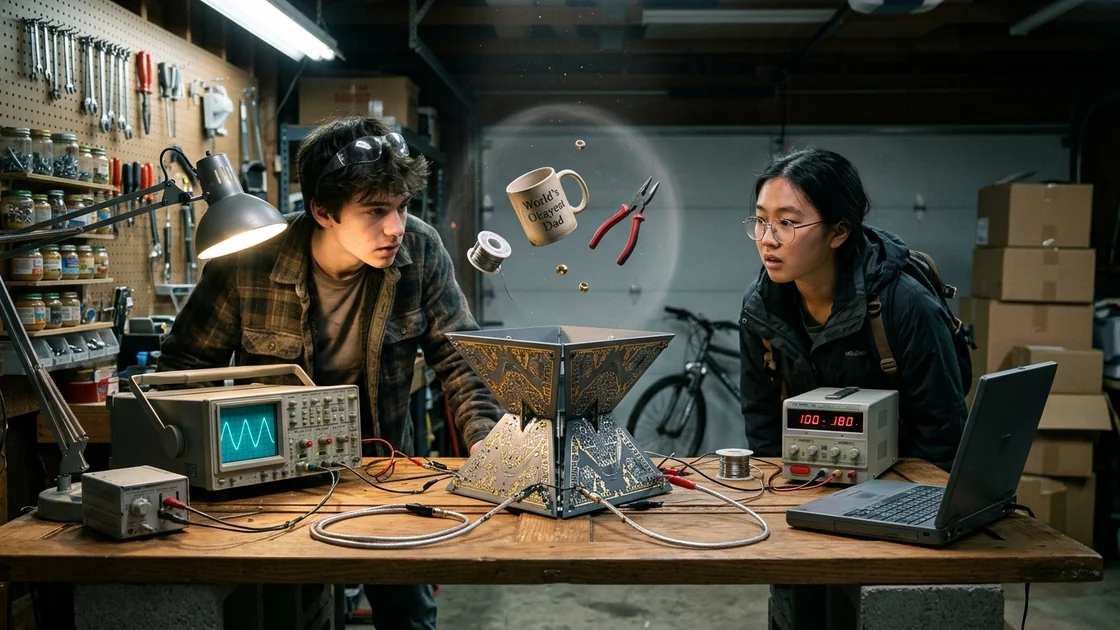
Leo wheeled the bike directly into the garage, the rear tire thumping over the concrete lip, and let out a long breath as he unhooked the bungee cords and wrestled the milk crate onto his workbench. The bench was made from a solid-core oak door laid across two sets of cinder blocks, scarred with black soldering iron burns, stains from ferric chloride etching solution, and dried blobs of hot glue. Along the pegboard wall behind it hung his prized possessions: a twenty-year-old Tektronix dual-trace analog oscilloscope he’d fixed by replacing a blown high-voltage diode, a variable autotransformer—a Variac—housed in a hammered-steel casing, a benchtop DC power supply, and rows of baby-food jars screwed into a wooden shelf by their lids, each filled with sorted resistors, diodes, and ceramic disc capacitors.
He snapped on the overhead shop light. The twin fluorescent tubes flickered twice, hummed in a ragged B-flat, and flooded the desk in harsh white light.
For the next two hours, Leo didn't touch a soldering iron. He simply unpacked the crate, laying its contents out across a clean sheet of butcher paper like a paleontologist assembling a scattered skeleton.
There were six primary circuit boards in total. Four of them were identical triangles with beveled edges and gold spring-pins along all three sides. The fifth was a square baseplate featuring heavy brass screw terminals that clearly served as the main power bus. The sixth was smaller, rectangular, and populated with recognizable logic gates, an array of dip-switches, and a twenty-pin header that looked almost quaintly normal compared to the alien geometry of the triangular plates.
Leo pulled his stereo inspection microscope closer, swung the articulated arm over one of the triangular boards, and switched on the halogen ring light. Peering through the dual eyepieces, he adjusted the focus knob until the silvery traces snapped into sharp relief.
"What the heck are you?" he whispered to the empty garage.
Under forty-power magnification, the recursive fractal traces didn't stop branching. Even at the limits of the optical lenses, the big pathways split into smaller ones, which split into microscopic filaments that disappeared into the pores of the dark gray ceramic substrate. They formed nested Sierpinski triangles and Peano curves, a mathematical labyrinth designed to force electrical current to travel across millions of tiny, opposing hairpin turns within the span of a few square inches.
He knew enough about radio-frequency engineering to understand that geometry on a circuit board mattered at high frequencies. At gigahertz speeds, a sharp ninety-degree bend in a copper trace acted like an antenna, leaking energy, while a spiral acted like an inductor. But this wasn't designed for standard radio waves. If you pushed alternating current through a fractal network this dense, the magnetic fields generated by each tiny turn would either cancel each other out completely—creating what physicists called an electromagnetic metamaterial—or they would constructively interfere in some way he didn't have the math to calculate.
He grabbed his digital multimeter, set it to measure resistance, and touched the sharp steel probes to the main input terminals of the triangular board.
The LCD screen flashed OL—open loop. Infinite resistance.
He flipped the dial to capacitance. The meter beeped, cycled through its auto-ranging scales, and then the screen went completely blank for half a second before spitting out an error code he had never seen in the manual. When he pulled the probes away, the multimeter’s internal piezo speaker let out a faint, dying whine, as if the tiny nine-volt battery inside had momentarily been drained under a massive load.
Leo frowned, tapping the side of the yellow plastic meter. The screen came back on, reading 9.1 volts. Normal.
He set the probes down and picked up two of the triangular boards. The machined dovetail edges were masterpieces of milling. When he brought them together at roughly a seventy-degree angle, the bevels aligned with a soft, hydraulic snick. The spring-loaded gold pins depressed into the recessed contact pads of the neighboring board, locking the two pieces together with zero play.
His hands moved faster now, guided by the intuitive spatial logic that made him good at fixing things. The four triangular boards didn't want to lie flat; their beveled edges were cut at the exact dihedral angle of a regular tetrahedron—a three-sided pyramid sitting on a fourth triangular base. Wait—no, the square board with the brass power lugs had four angled slots milled into its upper surface, arranged in a circle.
It wasn't a closed pyramid. It was an inverted four-sided funnel, like a bloomed metallic flower or a radar horn pointing straight up at the ceiling.
One by one, Leo slid the four fractal boards into the baseplate. They clicked home with satisfying precision, their edges interlocking until they formed a rigid, upward-facing pyramidal chalice about eight inches wide at the top and six inches tall. Into the center of the baseplate, right at the bottom of the inverted pyramid, went the heavy toroidal coil—a doughnut-shaped ring of dark, heavy metal wrapped in flat silver ribbon. Three heavy gauge wires protruded from the coil, terminating in ring lugs that matched the brass screws on the baseplate.
Finally, the small rectangular controller board snapped into a recessed bay on the side of the square base.
Leo stepped back, wiping a smudge of grey oxidation onto his jeans. Assembled, the object looked like a piece of satellites hardware from the late nineteen-seventies—something that belonged bolted inside the nosecone of a deep-space probe, wrapped in gold mylar foil. It was heavy, industrial, and completely lacking in any consumer aesthetic.
"Okay," Leo said, reaching for his notebook and a mechanical pencil. "Let's figure out what you eat."
He traced the power bus on the square baseplate. There were two massive input lugs labeled simply with etched symbols: a straight line over a dashed line—the universal symbol for Direct Current—and beside it, a sine wave inside a circle, indicating an Alternating Current modulation input. Stamped into the brass next to the DC terminal was 12V-48V NOM. Next to the AC terminal was 400Hz - 40kHz DRIVE.
That was surprisingly reasonable. Forty-eight volts DC was standard telecom voltage, easily achievable by wiring a few car batteries in series or cranking up his benchtop supply, and four hundred hertz was the exact frequency of aircraft electrical systems. Whoever had built this—the dead metallurgist from Miller’s Creek—had designed it to run off standard laboratory bench equipment.
Leo glanced at the clock on the wall—an old Coca-Cola promotional clock with a cracked plastic cover. It was 1:15 PM. He hadn't eaten lunch, and his stomach gave a hollow cramp, but the familiar itch was in his fingers now. Every tinkerer knew the feeling: the compulsive need to see if the mystery box would turn on, to see if the magic smoke was still trapped inside the silicon or if the whole thing was just an elaborate paperweight.
He cleared the center of the oak workbench, pushing his soldering station and jars of screws to the margins. He positioned the pyramidal array in the middle of the butcher paper.
First, he hooked up the DC side. His variable benchtop power supply topped out at thirty volts and five amps. If the device needed up to forty-eight, thirty should at least be enough to bias the gates and wake up the logic board without frying anything. He clamped heavy red and black alligator leads onto the brass lugs and double-checked the polarity.
Next, the AC modulation input. He didn't have a dedicated high-power function generator, so he improvised. On the lower shelf under his desk sat an old Crown commercial audio amplifier he had rescued from a church basement renovation. If he fed a tone from his laptop’s headphone jack into the amplifier, and ran the speaker outputs into the AC terminals on the device, he could feed it any frequency between twenty hertz and twenty kilohertz at up to three hundred watts.
He spent twenty minutes stripping sixteen-gauge speaker wire, tinning the bare copper ends with rosin-core solder while a thin ribbon of pine-scented smoke curled toward the rafters, and screwing the leads down tight onto the array’s modulation terminals. He plugged the audio cable into his battered ThinkPad, opened an open-source audio tone generator program, and set the output to a clean sine wave at four hundred hertz.
Before flipping any switches, he clipped the ground lead of his Tektronix oscilloscope to the chassis of the device and hooked the probe tip to a small test point sticking up from the rectangular controller board.
"Safety third," Leo muttered, pulling a pair of scratched polycarbonate safety glasses down over his eyes. If an old tantalum capacitor decided to detonate, he didn't want shrapnel in his corneas.
He reached over and flipped the heavy toggle switch on the DC power supply.
The red seven-segment LEDs on the supply lit up: 00.0V / 0.00A.
Slowly, he turned the coarse voltage dial clockwise. Five volts. Ten volts. Twelve volts.
At twelve point four volts, a tiny amber LED buried among the dip-switches on the rectangular logic board blinked once, then settled into a steady, dim glow. The current meter jumped to 0.45A. The logic circuitry was alive.
On the oscilloscope screen, the flat green line twitched, rising slightly as a DC offset voltage registered on the test point, then began to ripple with a faint, high-frequency sawtooth wave. The board was generating its own internal clock pulse.
Leo turned the DC supply up to twenty-four volts. The current draw settled at 1.20A. Nothing was getting hot. Nothing smelled like burning phenolic resin.
"Alright," Leo said, his heart beating a little faster against his ribs. "Let's give you a signal."
He clicked the mouse on his laptop to start the 400-hertz tone, then reached down and slowly rolled the gain knob on the Crown amplifier up from zero.
At first, he heard the expected 400-hertz hum vibrating physically through the heavy toroidal coil at the base of the pyramid—a low, musical G-sharp that sounded like an angry hornet trapped in a coffee can. The green trace on the oscilloscope swelled into a fat, clean sine wave.
Leo reached for the laptop trackpad and dragged the frequency slider upward. Eight hundred hertz. Twelve hundred. Two kilohertz. Five kilohertz.
The audible whine from the coil rose in pitch until it was a piercing mosquito shriek that made the fillings in his back molars ache. Still, nothing extraordinary happened. The current draw on the DC supply stayed flat.
Frowning, Leo looked closer at the rectangular controller board. A row of eight tiny white switches—an 8-position DIP switch block—sat near the main ribbon connector. Right now, all eight were switched to the OFF position.
Using the tip of a pocket screwdriver, Leo flipped switch number one to ON.
Instantly, the piercing five-kilohertz whine vanished.
It didn't fade out; it was cut off as sharply as if someone had thrown a heavy velvet blanket over the workbench. In its place came a sensation that made Leo’s stomach drop six inches, the exact feeling of an elevator cables slackening for a fraction of a second before the brakes catch.
On the oscilloscope, the green trace didn't show a sine wave anymore. The phosphor beam had twisted into a rotating, three-dimensional Lissajous knot that seemed to fold inward on itself, growing brighter and denser at the center of the CRT screen.
Leo stared at the pyramidal array. The air directly above the four angled fractal boards looked... wrong. It wasn't shimmering like heat haze over a summer road; it was abnormally still, as if a sphere of solid, ultra-clear glass about the size of a basketball had materialized just above the open top of the chalice. Dust motes drifting through the beam of the overhead fluorescent light reached the boundary of that invisible sphere and stopped dead, sliding slowly around its curved exterior like water parting around a smooth river stone.
Then Leo looked down at the butcher paper next to the baseplate.
A spare quarter-inch brass hex nut that he had used to test the thread pitch of the terminal screws was vibrating. It wasn't rattling against the table; it was trembling silently, pivoting on one of its six flat edges until it stood upright like a miniature tire.
Leo held his breath.
Slowly, without a sound, the brass nut lifted off the paper.
It rose steadily, rotating lazily around its central axis, until it reached the dead center of the invisible sphere hovering six inches above the open throat of the pyramid. There, it stopped. It didn't bob up and down like something suspended on an acoustic standing wave, nor did it snap violently toward a magnet. It simply hung in the air, anchored to nothing, gleaming softly under the shop light.
Leo’s mouth was completely dry. Carefully, moving as if he might startle a wild animal, he reached out with his right index finger and tapped the suspended brass nut.
When his fingertip crossed the boundary of the invisible sphere—about four inches out from the nut—a strange, cold tingling sensation washed over his skin, like plunging his hand into carbonated water that had no wetness. Inside the zone, his finger felt bizarrely light, as though the bones and tendons had turned to balsa wood.
He nudged the nut.
It didn't fall. Instead, obeying Newton’s first law in a way Leo had only ever seen in footage from the International Space Station, the brass nut drifted smoothly to the left at the exact speed he had pushed it, spinning slowly until it hit the inner wall of the invisible sphere four inches away. When it touched that unseen boundary, it bounced gently inward—as if the boundary itself possessed a soft, elastic surface tension—and drifted back toward the center.
Leo pulled his hand back, stumbling against his stool and knocking a baby-food jar of quarter-watt resistors onto the concrete floor. The glass shattered, scattering hundreds of tiny striped cylinders across his shoes.
Up above the fractal boards, inside its quiet pocket of impossible physics, the brass hex nut kept spinning, completely indifferent to the gravity of the Earth below it.
"You're going to tell me there’s a black thread," Maya Chen said, adjusting the strap of her backpack as she ducked under the half-open roll-up door of the garage. "Or you built an acoustic levitator out of ultrasonic parking sensors. Because if you dragged me away from my AP Calculus problem set to show me a YouTube science fair trick, Leo, I am going to solder your shoelaces together."
"There's no thread," Leo said. He was standing three feet back from the workbench, arms crossed tightly over his chest, staring at the setup. In the forty minutes it had taken Maya to ride her scooter over from the subdivisions on the east side of town, he hadn't turned it off. He had been too afraid that if he cut the power, whatever freak alignment of charge and geometry had created the effect would vanish forever, revealing the whole thing to be a carbon-monoxide hallucination. "And ultrasonic levitators only lift styrofoam beads that weigh two milligrams. Look at the bench."
Maya walked over, her dark eyes scanning the clutter of the oak door until they locked onto the pyramidal array.
Leo had taken the brass nut out. In its place, hovering dead center inside the ten-inch sphere above the open fractal plates, was his heavy rubber-handled Klein side-cutting pliers, a roll of solder, and a ceramic coffee mug with World’s Okayest Dad printed on the side. The three objects were drifting in a slow, silent waltz around one another, occasionally bumping together with muffled, weightless clinks.
Maya stopped dead. Her mouth opened slightly, then closed. Automatically, her hand went up to push her wire-rimmed glasses higher on the bridge of her nose.
She didn't ask about threads again. Instead, she stepped right up to the edge of the bench, leaned down until her chin was nearly level with the butcher paper, and looked underneath the floating mug, then straight up toward the rafters where the fluorescent light hung from rusty chains.
"That mug weighs at least half a pound," she said, her voice dropping an octave. "And the pliers are drop-forged steel. If that were magnetic induction, the steel would be glowing red-hot from eddy currents by now, and the ceramic mug wouldn't be floating at all. Ceramic isn't ferromagnetic. It’s not even diamagnetic enough to levitate outside of a forty-tesla superconducting lab magnet."
"Tell me about it," Leo said, letting out a shaky breath now that someone else was seeing it too. "Go ahead. Touch the mug."
Maya hesitated for two seconds, then reached out and poked the handle of the coffee mug. Just like the brass nut, it drifted smoothly away from her finger, collided with the flank of the floating pliers, and transferred half its momentum to the tool in a textbook elastic collision.
"My finger felt weird," she whispered, pulling her hand back and rubbing her index finger against her thumb. "Like it didn't weigh anything past the second knuckle. Leo... what is this thing?"
"Flea market," Leo said, pointing a thumb toward the rusted milk crate sitting on the floor by his bike. "Artie the estate guy bought a locker that belonged to some old metallurgist out by Miller’s Creek. I thought the boards were for some weird phased-array radar or an old synth."
Maya leaned over the workbench, careful to keep her hair out of the invisible sphere, and examined the four interlocking triangular plates. "Look at the trace routing on the ceramic. Those are Hilbert curves nested inside Sierpinski gaskets. Do you have any idea how hard it is to manufacture multi-scale fractals down to the micron level? You can't acid-etch this. This looks like molecular vapor deposition."
"I checked it under the microscope," Leo said, stepping up beside her. "The traces go all the way down into the pores of the substrate. And look at the power draw." He pointed to the benchtop DC supply.
Maya squinted at the red LED readout. "Twenty-four volts at one point two amps? That’s less than thirty watts! My laptop charger pulls more power than that! How is thirty watts of DC and an audio amplifier cancelling out the gravitational acceleration of two pounds of steel and ceramic?"
"It's not doing work against gravity the way a thruster or a magnet does," Leo said slowly, voicing the theory he had been turning over in his head while waiting for her. "If you hover a drone, the rotors have to push air down continuously to equal the downward pull of gravity, which burns huge amounts of energy. Look at the ammeter when I add mass."
Leo picked up a heavy cast-iron C-clamp from the corner of the desk—easily three pounds of solid metal—and carefully pushed it through the invisible boundary of the sphere above the array.
The moment the clamp crossed the threshold, the strain left Leo’s wrist. The heavy iron became completely weightless in his grip, though when he tried to wiggle it back and forth rapidly, he could still feel its mass resisting acceleration. He let go. The C-clamp hung in the center of the cluster, nudging the coffee mug aside.
On the DC power supply, the current meter flickered from 1.20A to 1.23A for the fraction of a second the clamp was crossing the boundary, then settled right back down to 1.20A.
Maya stared at the meter, her eyes wide behind her glasses. "It only draws extra current when mass crosses the boundary layer. Once the object is inside, maintaining the state takes zero additional energy. Leo, this isn't pushing up against gravity. This is a metric shield. It’s decoupling the interior volume from the local gravitational gradient."
"Speak English, Chen. I failed sophomore trig, remember?"
"Think of gravity like a river flowing down toward the center of the Earth," Maya said, her hands flying as she spoke, the way they always did when she was explaining physics or debugging code. "Everything with mass gets dragged downstream by the current. If you use a rocket or a magnet to float something, you're basically paddling upstream as hard as you can to stay in one place—which takes tons of energy. What this box is doing... it’s building a circular concrete wall in the middle of the river. It takes a little bit of energy to maintain the wall itself, using those fractal metamaterial plates to bend the field lines around the sphere, so inside the wall, the water is completely flat and still. It doesn't matter if you put a feather or an anvil inside the wall; the river isn't touching it anymore."
Leo looked back at the floating C-clamp, the pliers, the solder roll, and the mug. They had drifted toward the outer edges of the sphere, where they slowly orbited the vertical axis like a tiny, mundane planetary system.
"Okay," Leo said. "So what happens if we turn up the river wall?"
"Do not just randomly twist dials on a device that breaks General Relativity in your mom's garage!" Maya snapped, slapping his hand away from the Crown amplifier. "We do this systematically, or we don't do it at all. Where is your lab notebook?"
For the next four hours, the garage became a legitimate research laboratory.
First, they mapped the exact geometry of the effect—which Maya officially dubbed the Null Zone on page one of Leo’s graph-paper notebook. By sifting a pinch of baking flour from the kitchen through a tea strainer above the device, they watched the white powder coat the outside of the invisible barrier before sliding down the sides like snow off a dome. At twenty-four volts DC and five kilohertz AC drive, the Null Zone was a slightly flattened oblate spheroid, ten點two inches across horizontally and eight point five inches tall, centered five inches above the upper rim of the fractal pyramid.
Next, they tested the boundary mechanics. If an object was pushed halfway through the boundary and released, a weird tug-of-war occurred. They used a twelve-inch wooden ruler. With six inches inside the Null Zone and six inches sticking out into normal space, the outer half drooped downward under normal gravity, acting as a lever that pried the weightless inner half up against the top inside roof of the sphere, leaving the ruler hanging at a forty-five-degree angle in mid-air, supported purely by the invisible skin of the field.
Even stranger was the inertia test. Maya tied a piece of fishing line around the three-pound iron C-clamp while it was floating inside the zone and attached the other end to a spring scale outside the zone.
"Okay," Maya said, holding the clipboard while Leo held the spring scale horizontally. "In normal space on frictionless ice, pulling a three-pound mass at one meter per second squared takes a specific force—F equals M times A. Pull it sharply to the right."
Leo jerked the scale. The C-clamp zipped across the inside of the sphere twice as fast as it should have for the amount of force registered on the spring scale.
"Inertial mass is reduced by roughly forty percent inside the bubble," Maya breathed, scribbling furiously in the margin of the notebook. "The Higgs coupling—or whatever governs rest-mass inertia—is partially damped along with the gravitational coupling. Do you realize what this means? If you put a vehicle inside this field, not only would it float, you could accelerate it to highway speeds with the engine from a lawnmower."
By 6:00 PM, the autumn sun was sinking below the roofline of the house across the street, casting long, orange shadows through the garage’s side window. They had carefully removed all the floating tools before testing the DIP switches on the rectangular controller board.
The eight switches turned out to be a binary attenuator and phase controller. Switch 1 was the master gate enable. Switches 2, 3, and 4 controlled the diameter of the Null Zone in binary increments—from 001 (ten inches) up to 111 (forty-eight inches, which caused the field to engulf half the workbench, lifting Leo’s soldering station, five jars of screws, and the laptop three inches off the oak door until Leo panicked and flipped them back down). Switches 5 and 6 controlled the degree of gravitational attenuation. Instead of 100% weightlessness, setting them to 01 reduced gravity inside the bubble by 50%; 10 reduced it by 75%; 11 was full nullification.
"What about switches seven and eight?" Leo asked, hovering his pocket screwdriver over the last two toggles on the right. "We haven't touched those yet."
Maya looked closely at the twenty-pin header next to the switches, using Leo’s magnifying lamp to trace the tiny copper leads running from the DIP block to the main logic chip. "Wait. Don't flip seven and eight manually. Look at the traces. Seven and eight bypass the onboard analog oscillator and route the phase-lock control directly to pins four through twelve on this header."
"External digital control," Leo realized, his eyes lighting up. "It’s a serial bus. Or pulse-width modulation inputs. The old guy who built this didn't want to flip tiny plastic switches with a screwdriver—he built this board so you could hook it up to a computer."
"Or a microcontroller," Maya said, a slow grin spreading across her face for the first time all afternoon. She unzipped the front pocket of her backpack and pulled out a small plastic storage case containing an STM32 development board—basically an Arduino on steroids that she had been using for her robotics club project. "If those pins take standard 3.3-volt or 5-volt logic levels, I can write a C++ script to modulate the field geometry and attenuation strength in real time. Up to a thousand times a second."
Leo looked at the heavy Crown amplifier and the bulky benchtop power supply, then back at the compact pyramidal array. "Why stop at hooking it to a microcontroller on the desk? The whole array only pulls thirty watts, Maya. And that big audio amp is totally unnecessary—it's only driving high-impedance gate inputs on the AC side. We could replace the amp with a tiny class-D digital amplifier board the size of a postage stamp, and run the whole thing off a couple of six-cell lithium-polymer drone batteries."
Maya paused, the microcontroller halfway out of its static bag. She looked at the pyramid, then at Leo. "You want to make it portable."
"Think about it," Leo said, the words tumbling out in a rush. "In here, we can't turn the radius past two feet without floating my whole workbench and ripping the power cords out of the wall. We don't actually know what happens when the field gets big, or what happens if the emitter itself is inside the field it’s generating. If we mount the array inside an insulated case with its own batteries and your microcontroller wired to a joystick or a throttle pot... we can take it somewhere empty and actually test it."
"If the emitter is inside its own Null Zone," Maya said slowly, her brow furrowing as she ran the mental math, "then the device itself loses ninety-nine percent of its weight. Which means you could carry a fifty-pound battery and chassis assembly with one finger."
"Exactly." Leo walked over to the corner of the garage and pulled down a dusty, silver aluminum Haliburton camera case his dad had left behind when he switched to digital photography. It was twenty inches wide, lined with pluck-foam, and built like a bank vault. "We have all day tomorrow. My mom works twelve-to-twelve on Sunday too. What do you say?"
Maya looked at her watch, then at the floating brass hex nut that Leo had tossed back into the field for good luck. It hung there, gleaming like a tiny golden planet.
"Screw AP Calculus," Maya said. "Get the soldering iron warming up."
Sunday disappeared in a blur of stripped wire, burnt flux, and rapid-fire coding.
Leo handled the hardware integration. He gutted the decaying foam from the aluminum camera case and fabricated an internal mounting frame out of slotted steel angle-iron bolted directly through the bottom aluminum skin. He mounted the square baseplate of the fractal array dead center in the case. To replace the massive benchtop equipment, he wired two 22.2-volt high-discharge LiPo battery packs in series—giving him 44.4 volts of nominal DC power—and ran them through a heavy-duty solid-state buck converter to keep the voltage locked at a rock-steady 36 volts. For the AC modulation drive, he scavenged a 100-watt TDA7498 class-D amplifier module from a boombox project he’d abandoned the previous summer, feeding its input from a programmable Direct Digital Synthesis (DDS) signal generator chip.
Meanwhile, Maya sat cross-legged on an upturned five-gallon bucket with her laptop balanced on her knees, writing the control firmware. Using the Tektronix oscilloscope to probe the rectangular controller board, she reverse-engineered the logic protocol of the twenty-pin header in less than two hours.
"Whoever designed this interface was an old-school engineer," she announced around 2:00 PM, sipping lukewarm root beer through a straw while her fingers flew across the mechanical keyboard. "No bloated software layers, no encrypted handshakes. Pins 1 through 8 are an 8-bit parallel word for the field radius—zero to two hundred fifty-five. Pins 9 through 16 are an 8-bit word for gravitational attenuation—zero percent to one hundred percent. Pin 17 is field center offset along the Z-axis! Leo, we don't just have to project the bubble above the pyramid. By shifting the phase angle between the four triangular plates, we can move the center of the sphere down so it surrounds the case itself!"
To control it without needing a laptop tethered to the box, Leo built a wired remote out of a heavy cast-aluminum project box connected to the main case by a six-foot coiled cord from an old CB radio microphone. On the face of the remote, he mounted two precision ten-turn wirewound potentiometers—one labeled RADIUS and one labeled G-NULL—along with a three-position toggle switch for centering the field (ABOVE / CENTER / DIRECTIONAL), a miniature OLED screen for Maya’s telemetry readout, and a massive red mushroom-head emergency stop button that would physically sever the main battery connection if slammed.
By 9:30 PM, the rig was finished.
With the lid of the aluminum camera case open, it looked terrifyingly like a Hollywood movie prop for a suitcase nuke: the four dark ceramic fractal plates rising from the center, surrounded by bright blue heat-shrink battery packs, braided silver coaxial cables, cooling fans salvaged from an old Dell server, and the glowing red and green status LEDs of Maya’s microcontroller board.
They did a low-power bench check with the case closed and latched.
With the case sitting on the concrete floor of the garage, weighs-in on his mom’s bathroom scale read 38.4 pounds.
Maya held the tethered control box. "Enabling master gate. Centering mode set to internal. Radius set to twenty-four inches—just big enough to enclose the suitcase and the scale."
The server fans inside the aluminum case spun up with a muffled whir. Through the seam of the lid, a faint ozone smell drifted out, accompanied by that momentary, stomach-dropping sensation of pressure behind their eardrums.
"Bringing G-Null up to fifty percent," Maya said, turning the right-hand dial two full turns clockwise.
Leo looked down at the dial of the bathroom scale under the case. The needle smoothly rotated counterclockwise from 38.4 down to 19.2.
"Seventy-five percent," Maya said, turning the dial again.
The needle slid down to 9.6.
"Ninety-five percent."
The scale read just under two pounds. Leo leaned down, hooked his pinky finger under the black plastic handle of the heavy aluminum suitcase, and lifted.
It rose off the scale effortlessly, feeling no heavier than an empty cardboard shoebox. Even weirder was the way it moved; when he swung it slightly from side to side, the forty pounds of batteries, steel angle-iron, and ceramic inside had very little momentum, stopping and starting on a dime without pulling on his shoulder.
"Don't go to a hundred percent indoors," Maya warned, watching the OLED telemetry screen on the remote. "If it goes slightly past unity—even a hundred point one percent—it’ll have negative weight relative to the air around it, or buoyant lift, and it'll slam into the ceiling. Also, the battery current jumps exponentially once the radius goes past three feet. At a two-foot radius, we're pulling four amps. According to the curve I just plotted, an eight-foot radius is going to pull nearly forty amps from those LiPos."
"Those drone packs are rated for sixty amps continuous," Leo said, gently setting the nearly weightless suitcase back down on the scale and watching Maya dial the field back down to zero. The bathroom scale groaned as thirty-eight pounds of dead weight returned all at once. "We'll have maybe fifteen or twenty minutes of high-power runtime before the voltage sags and the thermal cutoffs trip."
Just then, headlights swept across the frosted glass panes of the garage door. The familiar rattle of his mother’s Civic pulled into the driveway.
Leo and Maya moved with the practiced speed of teenagers who had spent years hiding questionable projects. Leo kicked the bathroom scale under the workbench, threw an old canvas drop-cloth over the aluminum suitcase, and swept his notebook into a drawer just as the side door from the kitchen opened.
Sarah Vance stood in the doorway in her navy-blue hospital scrubs, her blonde hair pulling loose from its ponytail and dark circles smudged under her eyes. She looked at Leo, then at Maya, then sniffed the air.
"Why does it smell like a thunderstorm and burnt pine needles in here?" she asked tiredly.
"Soldering an old amplifier for Maya’s robotics project, Mom," Leo said smoothly, leaning against the edge of the oak bench right where the fractal array had been sitting five hours earlier. "You’re home early."
"Census dropped on the cardiac floor, so they let me cut out an hour early," she said, leaning her head against the doorjamb. "Hi, Maya. Does your mom know you're still over here? It’s almost ten on a school night."
"I was just packing up, Mrs. Vance," Maya said brightly, slinging her backpack over both shoulders. "My scooter’s right outside. We just finished calibrating the controller."
"Alright. Drive safe, honey—wear that reflective vest, people drive like maniacs on Route 9 after dark. Leo, wash your hands and come eat some of that leftover lasagna before you go to bed."
"Yes, ma'am," Leo said.
As Maya wheeled her electric scooter down the driveway, Leo walked beside her out to the curb, away from the kitchen window. The night air was crisp and smelled of burning oak leaves from somebody’s fireplace down the block.
"Midnight?" Leo whispered.
Maya strapped on her helmet and clicked the buckle shut. "Make it one AM. My parents are light sleepers until midnight. Meet me at the dirt access road by the old limestone quarry off Henderson Road. And Leo?"
"Yeah?"
"Bring two heavy-duty backpack frames from your dad’s camping gear. And duct tape. Lots of duct tape."
The Oakhaven Limestone Quarry had been abandoned in the late nineteen-eighties after the excavators punched through an underground aquifer, flooding the lowest tier of the pit with eighty feet of freezing, turquoise-black water. Above the waterline, wide terraces of pale white rock rose like the steps of an amphitheater made for giants, littered with rusted cable spools, shattered blocks of pale stone, and scrub pines that had taken root in the blasting fractures.
At 1:30 AM, under a waning gibbous moon that turned the limestone cliffs bone-white, Leo and Maya stood on the second terrace, fifty feet above the black mirror of the water.
To get the thirty-eight-pound aluminum suitcase past the rusted chain across the access road without breaking their backs, they had turned the G-Null dial to eighty percent and simply floated the case between them like a helium balloon on a short tether, walking it a mile through the woods with zero effort.
Now, they were done testing it on rocks.
During the first twenty minutes at the quarry, they had set the suitcase beside a rectangular block of cut limestone the size of a washing machine—a boulder that had to weigh at least eight hundred pounds—expanded the Null Zone radius to six feet, and watched in awed silence as Maya pushed the massive block across the gravel with one hand. When she gave it a slight upward shove, the eight-hundred-pound slab of stone had risen four feet into the moonlight, turning lazily in the air while pebbles and dry weeds orbited its edges like moons around Saturn, before Maya slowly dialed the attenuation down and let it settle back onto the earth with a deep, grinding crunch.
Now, the aluminum suitcase was strapped tightly to an old aluminum-frame Kelty external-frame hiking backpack using four nylon ratchet straps.
Leo slipped his arms through the padded shoulder straps and buckled the heavy canvas hip belt around his waist.
"Are you sure about the center-of-mass offset?" Leo asked, his voice echoing slightly off the quarry walls. Because the suitcase was currently turned off, the forty pounds of gear pulled backward on his shoulders, forcing him to lean forward to keep his balance.
"I programmed a preset profile while I was eating dinner," Maya said, holding the wired remote control box. Thesix-foot coiled cord had been extended with a twenty-foot run of shielded CAT-6 cable so she could walk alongside him at a safe distance—though Leo held the secondary emergency-stop lanyard looped around his left wrist. "In Profile B, the microcontroller shapes the field into a vertical capsule—seven feet tall and four feet wide—centered six inches in front of the suitcaseplate. That puts your entire body, head to toe, plus the backpack, right inside the sweet spot of the isometric zone. None of your limbs will stick out through the boundary unless you hold your arms straight out to the sides."
"And you disabled the 100% cap?"
"I hard-coded a software ceiling at ninety-two percent gravitational attenuation," Maya said firmly. "At ninety-two percent, you and the backpack combined will weigh about sixteen pounds. That’s roughly half of lunar gravity. If you go to a hundred percent outdoors, one gust of wind off the lake will blow you over the cliff like a dandelion seed, and you won't have any traction on the ground to stop yourself."
Leo swallowed hard, looking across the wide, flat limestone shelf. It stretched for two hundred yards, twenty feet wide, bordered on the right by the sheer upward cliff face and on the left by the drop-off into the dark water below. "Okay. Bring it up slow. Ten percent at a time."
Maya tapped a button on the side of the handheld box. Inside the aluminum case on Leo’s back, the twin server fans spun up to a high whine, and the main contactors clicked shut.
"Field active. Ten percent," Maya called out.
Leo felt the immediate cooling sensation across his skin, as if he had stepped into an air-conditioned room, though the October night air was already forty degrees. The heavy downward bite of the backpack straps eased slightly on his collarbones.
"Thirty percent."
The gravel beneath his sneakers stopped crunching as the pressure on his soles diminished. He felt light on his feet, the way he felt at the bottom of the deep end of the public pool when the water was up to his chest.
"Fifty percent."
Leo bounced slightly on the balls of his feet. Without even trying, his shoes cleared the limestone by six inches, and he came back down noticeably slower than his brain expected, his inner ear sending a brief flash of confusion down his spine as his vestibular fluid adjusted to half-gravity.
"Seventy percent."
"Whoa," Leo laughed, holding his arms out slightly for balance—stopping just short of the invisible boundary wall where he felt the familiar tingling resistance against his fingertips. His knees wanted to straighten out on their own, his leg muscles calibrated for a lifetime of carrying a hundred and fifty pounds suddenly finding themselves vastly over-engineered for the forty-five pounds they were currently supporting.
"Going to eighty-eight percent," Maya said, her eyes glued to the glowing blue OLED screen on the remote. "Battery draw is twenty-eight amps. Board temperature is thirty-four Celsius. All stable. You now weigh just under twenty-two pounds, total."
Leo took a single walking step forward.
Because his foot pushed back against the ground with normal walking force while his downward normal force was almost gone, his shoe skidded slightly on the limestone dust before launching him forward and up.
He rose three feet into the air, sailing forward over a ten-foot patch of weeds in a slow, dreamlike arc that lasted nearly two full seconds before his left foot touched down gently on a flat slab of rock.
"Holy crap!" Leo shouted, the sound of his own voice ringing across the flooded pit.
He bent his knees carefully, coiled his calves, and jumped straight up.
It wasn't a violent leap—he only pushed with about half his strength—but the ground dropped away beneath him as if he were attached to a theater harness. Up he went: six feet, ten feet, twelve feet, fifteen feet into the cold night air. At the apex of the jump, he was level with the tops of the scrub pines growing out of the quarry wall. For a heart-stopping second, he hung suspended at fifteen feet, looking down at the top of Maya’s helmeted head and the moonlight glinting off the black water far below.
Then, slowly, gently, like a leaf settling onto a porch, he drifted back down. Six miles per hour instead of twenty. When his sneakers hit the gravel from a fifteen-foot drop, the impact felt no worse than stepping off the bottom stair in his hallway.
"Leo, watch the cable!" Maya yelled, jogging after him and paying out the twenty-foot umbilical wire as he took another bounding stride down the terrace.
Now that his brain was beginning to map the strange physics of the bubble—where his weight was gone by almost ninety percent, and his horizontal inertia was cut nearly in half—he figured out how to move. You couldn't run with quick, choppy steps; you had to bound like an astronaut on the Moon, leaning forward at an impossible forty-degree angle and pushing off with long, skating thrusts.
Three bounds carried him a hundred feet down the quarry shelf, Maya sprinting furiously behind him just to keep the CAT-6 cable from pulling taut. He leaped over an abandoned, rusted dump-truck tire that stood five feet tall, clearing it with four feet to spare, tucking his knees to his chest mid-flight just because he could.
"Bring it back! Bring it back, I can't run that fast!" Maya gasped, skidding to a halt near a pile of crushed aggregate.
Leo planted both feet, skidded four feet through the white gravel like a skier stopping on powder, and bounded back toward her in two massive, floating leaps, landing lightly four paces away with a grin so wide his cheeks hurt.
"Maya, you have to try this!" he said, his chest heaving not from exertion, but from pure adrenaline. "It’s insane! When you're at the top of the jump, your stomach doesn't even drop because your organs are inside the field too—there’s no free-fall sensation until you start moving through the air!"
"Hold still for a second," Maya said, not smiling. She was staring down at the OLED readout on the control box, tapping the aluminum casing with her fingernail. "Something’s weird with the battery telemetry."
Leo stopped bouncing, letting himself settle onto the gravel. "Voltage sag? Are the LiPos dying already?"
"No, the opposite," Maya said slowly. "While you were standing still, the array was pulling twenty-eight amps at thirty-six volts—about a kilowatt. When you jumped fifteen feet in the air and started falling back down... the current draw dropped to negative twelve amps."
Leo frowned, reaching back to feel the aluminum suitcase through the backpack frame. Instead of being warm from the high current drain, the metal skin of the case felt icy cold—so cold that a thin layer of white frost had condensed out of the night air along the bottom seams of the Haliburton case. "Negative amps? Like regenerative braking?"
"Think about conservation of energy," Maya said, her voice tight. "When you jumped fifteen feet up weighing twenty pounds, you only put twenty pounds worth of muscular energy into lifting yourself. Right? What if someone cut the power while you were at the top of a fifteen-foot jump? Suddenly you weigh a hundred and ninety pounds again, fifteen feet in the air. Where did the extra gravitational potential energy come from? You didn't supply it with your legs. The field has to balance the gravitational tensor with the surrounding spacetime metric."
"And when I fall back down inside the field..."
"The field absorbs the gravitational potential gradient and converts it straight back into electrical current on the DC bus," Maya said, looking up at him with genuine alarm in her eyes. "And look at the case. It’s pulling thermal energy out of the surrounding air to balance the entropy equation. Leo, those fractal boards aren't just resistors and capacitors. They're acting like a thermodynamic heat pump coupled to the local gravity well. When you move mass vertically inside the bubble, it pumps massive spikes of reactive power back into the buck converter!"
As if to punctuate her sentence, a high-pitched squeal erupted from inside the aluminum suitcase on Leo’s back—the unmistakable sound of an electrolytic capacitor venting high-pressure gas through its safety score.
At the same time, the OLED screen on Maya’s controller scrambled into a waterfall of random ASCII characters.
"The voltage spike just glitched the microcontroller clock!" Maya yelled, reaching for the G-Null dial. "I'm dialing you down!"
She twisted the ten-turn potentiometer counterclockwise. Nothing happened. Because the STM32 chip had locked up from the back-EMF spike, turning the analog dial wasn't updating the digital pins on the array’s twenty-pin header.
Worse, when the microcontroller froze, two of the parallel address pins had latched high.
Leo felt the change instantly. The twenty-two pounds of remaining weight vanished completely—and then reversed.
Instead of eighty-eight percent attenuation, the latched pins had slammed the array into an uncalibrated state somewhere past one hundred percent. The seven-foot bubble of air and rock surrounding Leo didn't just lose its weight; it became gravitationally buoyant, pushed upward by the denser gravitational gradient of the Earth around it like an air bubble released at the bottom of the ocean.
Leo’s sneakers lifted clean off the limestone terrace. Loose gravel and fist-sized rocks within three feet of his shoes ripped upward off the ground, orbiting his calves in a rising cloud of white dust.
"Maya!" Leo shouted, his hands flailing for anything to grab onto, finding only empty air as he rose three feet, five feet, eight feet above the terrace floor.
"Hit the E-stop! Pull your lanyard!" Maya screamed, bracing her heels against a boulder and grabbing the CAT-6 umbilical cable with both hands as it pulled taut.
Wait—if he hit the red emergency stop while he was twelve feet in the air—and rising fast—he would instantly drop twelve feet onto solid limestone with forty pounds of metal strapped to his spine. He would snap both ankles, or worse.
And he was drifting sideways now, pushed by a light breeze coming off the trees—drifting directly toward the edge of the terrace where the cliff dropped fifty feet straight down into the black, flooded quarry pit.
"I can't cut it over the drop-off!" Leo yelled, twenty feet in the air now, the CAT-6 cable straining to its absolute limit in Maya’s white-knuckled grip, dragging her sneakers through the gravel toward the cliff edge. "Pull me back over the pines!"
"You have no weight, not no mass, idiot!" Maya strained, leaning back at a forty-five-degree angle like a deep-sea fisherman fighting a marlin, her heels catching against an embedded slab of limestone five feet from the sheer drop. The thin blue network cable wasn't meant to be a tow rope; the outer PVC jacket was stretching, the eight tiny twenty-four-gauge copper wires inside singing like a guitar string under the tension of the upward pull. "I can't reel you down with an Ethernet cord! It’s going to snap!"
Leo looked down. He was twenty-two feet above the rock shelf, tethered by a quarter-inch computer cable that was already fraying where it exited the strain-relief boot on the backpack. Directly to his left was the crown of a scrub pine growing out of a vertical fissure in the upper cliff face.
He remembered the inertia test in the garage. Inside the bubble, rest mass was damped, and air resistance at the boundary of the field still worked.
Leo began swimming through the air, sweeping his arms in wide, violent breaststrokes while kicking his legs to angle the intake ports of the backpack’s cooling fans—no, not the fans, the boundary of the field itself. As his hands punched outward through the invisible skin of the Null Zone, his fists encountered normal-weight air outside the bubble while his body remained weightless inside. By paddling exclusively with his forearms pushed outside the four-foot radius of the field, he gained just enough aerodynamic purchase to swing himself like an inverted pendulum at the end of Maya’s cable.
Slowly, agonizingly, he swung away from the fifty-foot abyss over the water and drifted inward toward the upper cliff wall.
With a sharp crack, three of the internal copper conductors inside the CAT-6 cable parted.
On the digital header inside the suitcase, the broken wires caused the latched pins to drop to zero volts—then short against the 5-volt reference rail.
The Null Zone began to strobe.
Drop. Leo fell six feet in a third of a second, his stomach lurching into his throat as full Earth gravity slammed back into his bones. Catch. The short circuit re-engaged at a hundred and ten percent, jerking him violently upward mid-fall like a bungee cord, the nylon backpack straps digging painfully into his armpits while a shower of loose pebbles launched off his shoulders toward the moon. Drop. He plummeted another eight feet, crashing directly through the upper branches of the scrub pine, pine needles whipping across his face and branches snapping like pistol shots under his boots.
Now he was only six feet off the terrace gravel, tangled in the lower boughs of the pine tree.
Before the intermittent short could launch him back into the sky, Leo yanked the braided steel lanyard wrapped around his left wrist.
Inside the backpack, the heavy-duty mechanical kill switch popped open with a loud clack, physically severing the main battery bus.
The high-pitched whine died instantly. The orbiting cloud of white gravel collapsed to the ground in a single rattling hail, and Leo dropped the remaining six feet out of the pine tree, landing hard on his side in a patch of dry goldenrod and crushed limestone, the aluminum suitcase slamming into the dirt beside his shoulder.
For ten seconds, the only sound in the quarry was the ringing in Leo’s ears and the harsh, ragged rasp of two teenagers trying to catch their breath in the freezing dark.
Maya scrambled over the gravel, dropping to her knees beside him and shining her phone flashlight into his face. "Are you broken? Did you break your collarbone?"
Leo groaned, rolling onto his back and unbuckling the hip belt and shoulder straps to free himself from the ice-cold aluminum case. He had a three-inch scratch across his cheek from a pine branch and his left hip was going to have a bruise the size of a dinner plate tomorrow, but everything moved when he wiggled his toes and fingers.
"I'm okay," Leo gasped, staring up at the moon through the broken branches of the pine tree. "I'm okay. Just... remind me never to let an Arduino fly an airplane."
Then Maya looked past him, up toward the rim of the quarry where the cell tower on Miller’s Ridge stood against the stars, its red aviation warning beacons blinking rhythmically.
Except they weren't blinking rhythmically anymore. The two red strobes on the tower a mile away were flashing wildly out of sync, stuttering like a dying fluorescent bulb, while a weird, low-frequency hum seemed to echo back not from the suitcase—which was completely dead—but from the bedrock beneath their backs.
And in Maya’s hand, her smartphone screen flashed three alerts in rapid succession: NO SIM. SYSTEM CLOCK ERROR: YEAR 1970. COMPASS CALIBRATION FAILED.
"Leo," Maya whispered, holding up the phone screen. "When that short circuit made the field strobe at full power... I don't think the pulse stayed inside the seven-foot bubble."
Monday at Oakhaven High School felt surreal.
Leo sat in fourth-period Chemistry with a bandage on his cheek and an ice pack tucked covertly behind his lower back, listening to Mr. Henderson complain for twenty minutes about how his satellite dish at home had completely lost alignment at 2:00 AM, right around the same time the municipal water tower’s automated pressure telemetry system had suffered a bizarre timing fault that caused all the fire hydrants on the north side of town to burp air for thirty seconds.
At lunch, Leo and Maya sat at the far end of the outdoor courtyard near the auto-shop bay doors, hunched over Maya’s laptop.
"Look at the USGS public seismograph data for the tri-county area," Maya said in a low voice, turning the screen so only Leo could see the waterfall chart from the monitoring station at the state university forty miles away. At 01:48:12 AM, a sharp, vertical spike cut across all three axes. "The university geology department logged it as a magnitude 1.8 quarry blast or a localized karst sinkhole collapse near Henderson Road. Except look at the waveform."
She zoomed in on the squiggly black trace.
"Normal earthquakes or dynamite blasts have a P-wave followed by a slower S-wave that decays over several seconds as the sound echoes through the crust," she explained. "This spike has zero acoustic tail. It’s a clean Dirac delta function—a square-wave gravitational transient that propagated at the speed of light, not the speed of sound in rock. Every pendulum clock and crystal oscillator within three miles of the quarry skipped roughly four milliseconds when your cable shorted out."
Leo pushed his tater tots around his plastic tray with a fork, his appetite gone. "Okay, so we caused a mini-glitch. Nobody’s going to trace a four-millisecond clock skip back to a kid’s garage on Sycamore Street. We just keep the suitcase turned off until we build an opto-isolated controller that can't latch up, and we put heavy flyback diodes across the DC bus to absorb the regenerative current spikes."
"Wait," Maya said. "You want to turn it back on?"
"Of course I want to turn it back on! Maya, we flew last night! Do you have any idea what that box in my garage is? That’s not a science fair ribbon, that’s... that’s the end of rockets, the end of fossil fuels, a Nobel Prize before we can legally vote! Once we stabilize the feedback loop—"
"Leo, stop talking and look at the local Reddit thread for Oakhaven," Maya interrupted, clicking over to a browser tab. Someone had posted a blurry dashcam photo taken at 9:00 AM that morning at the Starlight Drive-In flea market lot.
Parked next to Artie the estate liquidator’s faded blue Ford Econoline were two identical charcoal-gray Chevrolet Suburbans with blacked-out windows and commercial Virginia license plates—no government plates, just plain fleet tags. Three men in dark windbreakers and khaki tactical pants were standing around Artie’s open rear doors while a fourth man held a yellow handheld pelican-case instrument with a directional Yagi antenna pointed at the ground where the rusted milk crate had sat on Saturday morning.
Leo’s blood went cold. "Why would anyone be scanning the flea market on a Monday morning?"
"Because I did some digging on the storage unit auction out by Miller’s Creek," Maya said quietly. "There was only one metallurgist or condensed-matter physicist living in that zip code who died in July. His name was Dr. Julian Vance—no relation to you—Wait, no, Dr. Julian Kovacs. Seventy-eight years old. Before he retired to Oakhaven in 2018, he was the chief metamaterials architect for Aethelgard Dynamics in Northern Virginia."
Leo recognized the name. Everyone who read defense tech blogs knew Aethelgard; they were a massive, privately held aerospace contractor that built classified propulsion and stealth systems for the Air Force and Space Force.
"Kovacs didn't retire peacefully," Maya continued, scrolling through a cached court docket from the Eastern District of Virginia. "Aethelgard sued him in 2019 for allegedly walking out of their Reston laboratory with six prototype 'anisotropic bismuth-palladium tensor arrays' after they shut down his division for being unsafe. Kovacs claimed under oath that the prototypes had been destroyed in a furnace test. The lawsuit was still tied up in probate when he died of a stroke in July, and some local storage manager auctioned off his locker before Aethelgard’s corporate security lawyers realized where he’d hidden the hardware."
"Until last night," Leo whispered.
"Until last night," Maya agreed grimly. "Because Aethelgard knows exactly what a gravitational transient combined with a 40-kilohertz metamaterial phase-lock looks like on national sensor grids. An earthquake doesn't emit a narrowband electromagnetic chirp at the exact resonant frequency of a Sierpinski fractal antenna. When the cable shorted at the quarry, we basically fired a flare gun straight into the sky with Oakhaven’s zip code written on it."
Leo slammed his lunch tray into the trash can and grabbed his backpack. "Artie didn't know my name. I paid him forty bucks in cash."
"Artie saw a sixteen-year-old kid with a custom-welded cargo rack on a blue Trek mountain bike haul a fifty-pound crate toward the west side of town," Maya said, hurrying to keep up with him as he strode toward the school bike racks. "Oakhaven only has twelve thousand people, Leo! How long do you think it takes corporate security guys with hundred-dollar bills to ask around about a kid who buys weird electronics and lives within two miles of the quarry?"
"I'm cutting fourth through sixth period," Leo said, unlocking his bike chain with trembling fingers. "I'm going home, I'm pulling the four fractal plates out of the baseplate, and I'm burying them in four separate holes in the woods behind the rail yard."
"Hold on, I'm coming with you!" Maya called out, running for her electric scooter. "Don't touch the array until I get there!"
Leo pedaled hard enough to make his lungs burn, cutting through alleyways and backyard drainage ditches to stay off the main roads. When he turned onto Sycamore Street at 12:40 PM, the quiet residential cul-de-sac was completely empty. No charcoal-gray Suburbans. Just old Mr. Miller’s sprinkler ticking rhythmically across his brown lawn and a stray cat sleeping on the hood of a neighbor's pickup truck.
He dumped his bike in the grass by the side door, unlocked the deadbolt, and burst into the garage.
Everything looked exactly as he had left it at 2:30 AM. The aluminum Haliburton suitcase sat on the concrete floor beside the workbench, still strapped to the Kelty backpack frame.
Wait.
Why were the cooling fans humming?
Leo froze halfway across the garage.
He had pulled the emergency-stop lanyard at the quarry. He knew he had pulled it; the mechanical plunger was still popped out half an inch on the side of the backpack frame, and the heavy red battery lead was visibly disconnected from the main bus bar through the ventilation grate.
Yet the four triangular ceramic plates inside the partially latched aluminum suitcase were emitting a low, rhythmic thrum—wub... wub... wub—at roughly one cycle per second. And the air around the suitcase was frigid, a ring of white rime frost spreading outward across the concrete floor in a three-foot circle.
Maya skidded her scooter into the driveway thirty seconds later and ran into the garage, stopping beside him as her breath misted in the unnatural cold radiating from the corner.
"Why is it running?!" she whispered. "The batteries aren't even connected!"
Leo crept closer to the workbench, his eyes wide as he looked through the two-inch gap where the suitcase lid was held slightly open by the frayed CAT-6 cable.
Inside the case, one of the four triangular ceramic plates had sustained a hairline fracture down its lower corner when Leo had fallen six feet out of the pine tree and landed on the case at the quarry. Along that microscopic crack in the gray ceramic substrate, the recursive silver-gold fractals were glowing with a faint, eerie violet light—like corona discharge, except the light seemed to curve downward into the crack rather than sparking outward into the air.
And the bathroom scale sitting three feet away was slowly sliding across the concrete floor toward the suitcase, before lifting two inches off the ground and dropping back down in time with the one-hertz pulsing hum.
"Remember what we figured out at the quarry?" Maya said, her voice shaking as she backed toward the pegboard wall. "The plates act as a thermodynamic and gravitational heat pump. When you cracked the ceramic plate in the fall, you broke the symmetry of the four-sided tetrahedral array."
"So without power, it shouldn't work at all!" Leo said, grabbing a pair of insulated high-voltage lineman’s pliers from the wall.
"No! The battery power wasn't powering the gravity shield, Leo—the thirty watts from the battery was only biasing the metamaterial gates to keep the four plates in equilibrium!" Maya shouted over the rising hum, which was speeding up now—two beats per second, then three, the concrete floor vibrating beneath their sneakers. "Now that plate number three is cracked, the gravitational gradient of the Earth itself is leaking asymmetrically through the fracture, generating a back-EMF current in the superconducting traces, which biases the adjacent plates, which widens the local gravity anomaly, which generates more current! It’s a self-sustaining parametric oscillation!"
As she spoke, the aluminum latches on the Haliburton case snapped under an unseen internal pressure. The lid flew wide open, slamming back against the aluminum backpack frame.
A sphere of distorted air—now visible as a faint, glassy refraction that bent the light of the overhead fluorescent tubes like a soap bubble filled with heavy gas—expanded outward from the open suitcase to a diameter of six feet.
Except it wasn't a clean, uniform Null Zone anymore. Because the third triangular plate was cracked, the field was lopsided and spinning. On the left side of the bubble, gravity was nulled to zero; on the right side, where the fractured plate was venting the displaced metric tension, local gravity was inverted and twisted sideways into a tight, toroidal vortex.
The bathroom scale whipped into the air, spinning like a frisbee around the central axis of the suitcase at twenty miles per hour. Four glass baby-food jars on the lower shelf of the workbench shattered simultaneously as the expanding rim of the distortion field clipped them, sucking a glittering cloud of steel machine screws, brass standoffs, and colorful resistors into a tight, Saturn-like ring that began orbiting the open suitcase at waist height.
"If we can't cut the batteries because the batteries are already off," Leo yelled, ducking as a heavy rubber mallet lifted off the pegboard and lazily cartwheeled past his ear toward the growing orbital ring of hardware, "how do we stop a parametric oscillation?!"
"You have to damp the resonant cavity or short the central toroid!" Maya yelled back, pressing herself flat against the garage door as the oak-door workbench itself groaned, its left end lifting four inches off the cinder blocks while the heavy Tektronix oscilloscope slid sideways toward the edge. "The bismuth toroidal coil at the bottom of the pyramid! That’s the main tank inductor connecting all four plates! If you dead-short the three leads of the toroid together with something heavy, or pull one of the intact triangular plates out of the dovetail slot, the tetrahedral geometry collapses!"
"Pull a plate out?!" Leo looked at the spinning maelstrom of screws, nails, and hand tools orbiting the open suitcase at thirty miles per hour. Reaching his bare arm through that debris ring was like sticking his hand into a lawnmower blade—and even if he got past the flying screws, the spring-loaded dovetail joints were locked tight under the immense mechanical shear of the warped gravity field.
"Wait—thermal!" Leo shouted, his eyes locking onto the frost now coating the entire aluminum suitcase in a quarter-inch crust of white ice. "You said the fractal traces are acting like a superconductor pumping heat out of the room! Every superconductor has a critical temperature—a point where if you get it hot enough, resistance comes back and the superconducting state quenches!"
"Yes!" Maya screamed over the roar of the wooden roof rafters above them, which were beginning to creak and pop as the upper boundary of the expanding twelve-foot bubble pushed upward against the ceiling joists with negative weight. Shingles were rattling on the roof outside. "If you heat the cracked plate or dead-short the brass bus bars with high current, you'll force a thermal quench across the fractal gates! Use your Variac!"
The variable autotransformer—thirty pounds of iron core and copper windings wired directly into the garage’s 240-volt dryer outlet—sat on the right side of the oak workbench, just outside the edge of the twelve-foot bubble.
Leo lunged for the workbench.
The moment his chest crossed the outer skin of the distortion field, the world lost its up and down. His feet floated out from under him as the zero-g hemisphere caught his legs, while his upper body was tugged sideways toward the swirling core above the suitcase. A cloud of orbiting quarter-inch washers pelted his flannel jacket like hailstones.
He grabbed the edge of the heavy oak door with his left hand, anchoring himself before he could be sucked into the center of the vortex where the bathroom scale and a pair of C-clamps were clashing together in a shower of sparks.
Pulling himself hand-over-hand along the edge of the workbench like a climber scaling an overhang, his legs trailing behind him in mid-air, Leo reached the heavy steel Variac.
The output of the Variac was a thick black rubber cable terminating in two heavy brass welding clamps he had used for testing microwave transformers.
"Maya, flip the 240-volt breaker on the wall by your head and crank the Variac dial to a hundred percent when I yell!" Leo shouted, grabbing both brass clamps in his gloved right hand.
"If you touch two hundred and forty volts at fifty amps inside that field, it’ll arc straight through you!" Maya cried, her hand hovering over the gray metal breaker box beside the roll-up door.
"The circuit is dead until I clip both leads onto the baseplate! Do it on my mark!"
Leo pushed off from the workbench, diving headfirst into the inner eye of the gravity storm.
Inside the four-foot core directly above the open aluminum suitcase, the air was twenty degrees below zero and eerily quiet, the roar of the orbiting debris ring outside muffled by the sharp refractive boundary of the warped metric. Below his face, the four ceramic plates formed their inverted pyramid, glowing with that deep, malevolent violet corona along the recursive fractal pathways. At the bottom of the throat gleamed the three brass terminal lugs of the central toroidal coil.
Because the rotational shear of the fractured plate was twisting space right above the throat, pushing the heavy copper welding clamps downward felt like trying to push two beach balls to the bottom of a swimming pool against a raging whirlpool. The brass clamps wanted to twist out of his grip and join the orbiting ring of tools three feet away.
A stray Philips-head screwdriver broke loose from the outer ring, deflected off the handle of the suitcase, and sliced straight across the back of Leo’s left forearm, tearing through his flannel sleeve and drawing a line of bright red blood that lifted off the fabric in tiny, floating ruby spheres.
Leo gritted his teeth, braced both knees against the frozen aluminum rim of the Haliburton case, and jammed the black neutral clamp onto the central ground lug of the square baseplate.
With his right hand trembling against the bizarre, rubbery resistance of the warped gravity well right over the cracked ceramic plate, he forced the red hot clamp down onto the main AC drive terminal—directly bridging the fractured plate’s fractal bus to the central coil.
"NOW, MAYA! HIT IT!" Leo roared, letting go of the insulated handles and kicking backward with both feet against the suitcase frame to launch himself out of the core.
Maya slammed the heavy 50-amp double-pole breaker shut and spun the black phenolic dial on top of the Variac all the way clockwise.
For half a second, nothing happened except a deep, sixty-cycle hum that shook the concrete slab of the garage floor.
Twelve thousand watts of dirty, unconditioned residential grid power slammed directly backward into the micron-thin silver-gold fractals of the cracked metamaterial plate.
The violet glow inside the pyramid turned blindingly white, then brilliant sodium-orange as the cryogenic temperatures were overwhelmed by pure ohmic heating. With a sound like a porcelain dinner plate snapping in a kiln, the cracked ceramic triangle split clean in two, and a geyser of white-hot metallic vapor erupted two feet out of the center of the pyramid as the fractal traces vaporized instantly off the substrate.
Wait—if the field collapsed all at once—
"DOWN!" Maya screamed, diving behind the steel body of his mom’s washing machine near the kitchen door.
Because the thermal quench started on one plate and took fifty milliseconds to propagate across the dovetail joints to the other three, the stored gravitational potential energy didn't detonate in a single spherical shockwave; instead, it vented upward in a ragged, twisting column through the garage roof like a dust devil dying out.
The twelve-foot bubble popped with a deep, sub-audible THUMP that flexed the garage door inward by three inches and popped every light bulb in the ceiling fixtures.
Gravity returned all at once.
Leo, who was three feet in the air backward when the bubble died, slammed flat onto his back on the concrete floor, the wind knocked completely out of his lungs as a rain of machine screws, resistors, washers, the bathroom scale, and his dad’s rubber mallet crashed down around him in an ear-splitting cacophony of bouncing metal and shattering plastic.
Above him, three roof shingles slid off the eaves and clattered into the bushes outside. On the wall, the main 200-amp house breaker tripped with a loud BANG, plunging the windowless garage into pitch darkness save for the cherry-red glow of the slagged, smoking ceramic plates inside the melted aluminum suitcase.
Through the ringing silence, the faint sound of tires crunching on gravel came from the street outside.
Leo gasped for air, rolling onto his stomach and spitting blood from where he had bitten the inside of his lip when he hit the floor. Maya was already scrambling across the screw-strewn concrete on her hands and knees, grabbing his collar and dragging him away from the frosted, smoking wreckage of the suitcase.
"Look at the street," she whispered, pointing a shaking finger toward the narrow gap between the curtains of the side window.
Two charcoal-gray Chevrolet Suburbans with blacked-out windows were rolling slowly down Sycamore Street at ten miles per hour. Fixed to the roof rack of the lead vehicle was a white cylindrical radome spinning silently as it scanned the houses on both sides of the cul-de-sac.
As the lead Suburban reached the end of the Vance driveway, its brake lights flashed red. The vehicle stopped.
Inside the garage, the cherry-red glow at the center of the melted Haliburton case faded to dull black. The last intact fractal traces on the remaining plates—starved of their tetrahedral symmetry and cooked to eight hundred degrees by the 240-volt dump—delaminated from the gray ceramic with a faint, papery hiss, curling into inert flakes of oxidized silver and palladium ash.
Out on the street, the spinning radome on the roof of the Suburban made three more revolutions.
Then, sixty feet away in the cul-de-sac, the brake lights went off. Whoever was sitting in the back of that truck looking at a spectrum analyzer had just watched the anomalous 40-kilohertz metamaterial signature—or whatever phantom echo they had tracked toward this neighborhood—vanish completely into the background noise of a normal residential power transformer surge. After pausing at the curb for ten agonizing seconds, the two Suburbans completed a slow U-turn around the cul-de-sac island and accelerated back up Sycamore Street toward the highway.
Neither Leo nor Maya moved until the sound of the V8 engines had faded completely into the afternoon breeze.
Finally, Leo let his forehead drop against the cold concrete floor, surrounded by ten thousand spilled resistors and a dented bathroom scale.
"My mom," Leo wheezed into the concrete, "is going to ground me until I'm thirty."
Beside him in the dark, Maya let out a breathless, slightly hysterical laugh, leaning her back against the washing machine and sliding down until she was sitting on the floor beside him. "We can sweep up the screws before eleven. And we'll tell her a squirrel chewed through the 240-volt dryer line in the rafters and popped the bulbs."
It took four hours with a shop-vac, a magnetic floor sweeper, and three rolls of heavy-duty contractor trash bags to erase the physical evidence of the Oakhaven Gravity Incident.
The melted aluminum suitcase, along with the four shattered, blackened slabs of ceramic and the fused lump of bismuth that had once been the toroidal coil, went to the bottom of the municipal dumpsters behind the abandoned stamping plant three blocks away, buried under two hundred pounds of old drywall from a neighbor's bathroom remodel.
By Friday afternoon, life on Sycamore Street had returned to its quiet, rust-belt rhythm. The charcoal Suburbans never came back; according to the local paper, Artie the estate vendor had made a sudden fortune selling the contents of his remaining storage units to an "out-of-state industrial museum" for ten thousand dollars cash and had promptly driven his blue Ford Econoline down to Daytona Beach for the winter.
That evening, while his mother was in the kitchen making chicken parmesan, Leo stood alone at his newly leveled oak-door workbench under two fresh fluorescent tubes.
He had replaced the blown fuse in his Tektronix oscilloscope and re-sorted most of the resistors that hadn't had their leads bent beyond recognition. Everything was normal again. Ordinary copper wire. Ordinary silicon transistors that obeyed the boring, predictable laws of Ohm and Kirchhoff.
From the back pocket of his jeans, Leo pulled out a single piece of hardware that hadn't gone into the dumpster behind the stamping plant.
It was the tiny, two-inch-square calibration daughterboard that had been bolted to the underside of the main rectangular controller—so small and electrically isolated by an optical coupler that the 240-volt surge had simply blown its input fuse without touching the miniature, stamp-sized fractal pad etched onto its back corner.
Leo set the tiny gray ceramic square in the center of the workbench.
He didn't hook it to a massive amplifier or a bank of high-discharge drone batteries. He just clipped the leads of a single, standard 9-volt alkaline battery to the input pins through a ten-kilohm current-limiting resistor, and touched the tip of a piezo buzzer’s wire to the gate pin.
There was no sound. No frost on the table, no ozone smell, no seismic spike to wake up the geologists down at the state university.
Just a tiny pocket of stillness, no bigger than a marble, hovering half an inch above the microscopic gold-silver Sierpinski triangle.
Leo reached into his breast pocket, pulled out the quarter-inch brass hex nut from Saturday morning, and gently placed it into that invisible, marble-sized dimple in the fabric of the universe.
He let go.
The brass nut hung there in the quiet glow of his desk lamp, half an inch off the wood, spinning slowly on its axis without a sound.
Outside the window, the autumn twilight was settling over the rooftops of Oakhaven, and the first stars were coming out in the clear, dark sky above the old drive-in movie screen. Leo pulled his lab notebook across the desk, opened it to a fresh sheet of graph paper, clicked the lead of his mechanical pencil out two clicks, and began to draw the fractal from memory.