The Vector of Regret
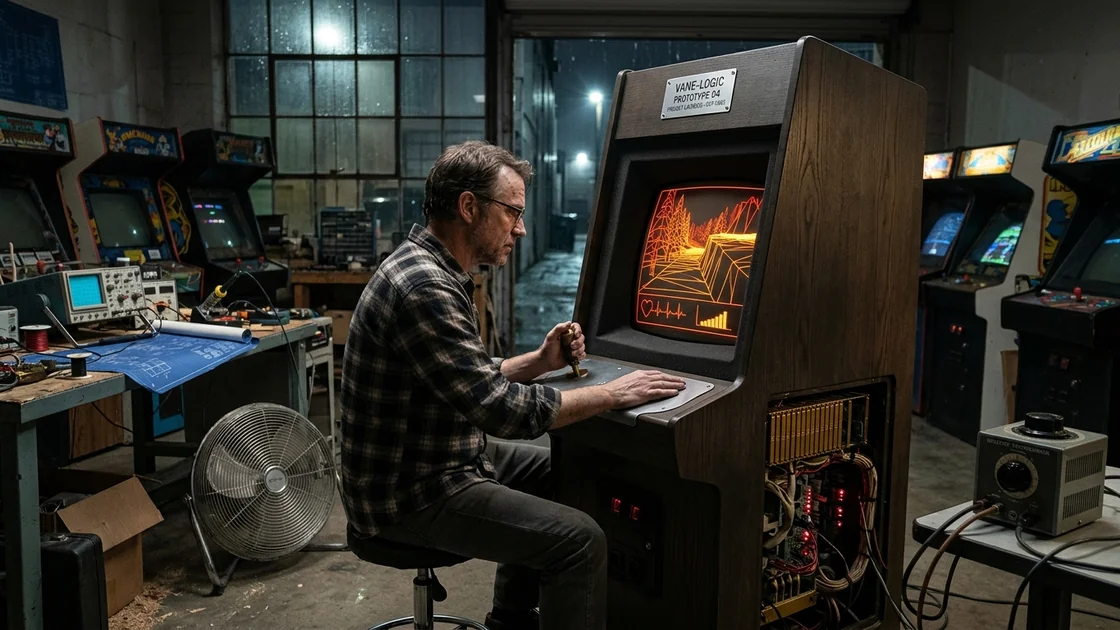
Arthur Cross, a solitary arcade cabinet restorer working out of a rain-soaked shop in Seattle, purchases an undocumented 1983 prototype machine from the estate of a defunct electronics subcontractor. As he repairs the cabinet, which bears the internal designation Project Lachesis, he discovers that its controls are wired with experimental biofeedback sensors that measure heart rate, skin conductivity, and micro-tremors. When played, the game uses an analog-digital neural network to adapt its vector graphics in real time, constructing surreal geometric environments that mirror the player's deepest repressed traumas and regrets. After watching the machine emotionally dismantle his friend Maya by forcing her to confront a past tragedy in the mountains, Arthur becomes consumed by the prototype. He locks himself in his workshop for a final marathon session, pushing the fragile, overheating circuitry to its absolute limit as the game forces him to relive the afternoon his younger brother drowned, demanding that he finally face the guilt he has spent thirty years trying to repair.
The rain in Georgetown never truly stopped during November; it merely shifted its weight from a heavy, drumming downpour to a fine, pervasive mist that smelled of jet fuel from Boeing Field and wet creosote from the railroad ties along East Marginal Way. Inside Cathode Ray Restorations, the dampness was held at bay by two ceiling-mounted propane heaters and the ambient thermal output of forty-two vintage transformers humming in unison.
Arthur Cross stood over his primary workbench, a magnifying visor pulled down over his eyes, the tip of his Weller soldering iron poised two millimeters above the green fiberglass of a 1981 Tempest Atari Analog Vector-Generator board. A wisp of gray smoke, sharp with the piney scent of rosin flux, curled upward into the intake fan on his desk, which pulled it through a charcoal filter with a steady, rhythmic rattle. With a flick of his wrist, Arthur touched the iron to a cold solder joint on one of the header pins, watched the dull gray cone of forty-year-old tin-lead alloy flash into a bright, liquid mirror, and pulled the heat away.
He pushed the visor up onto his forehead and rubbed the bridge of his nose. It was eight o’clock on a Tuesday night. Across the concrete floor of the shop, rows of upright cabinets stood in the semi-darkness like wooden sentinels. Some were gutted shells waiting for bondo and vinyl side-art; others were fully restored clients' machines running on twenty-four-hour burn-in tests to ensure their newly recapped power supplies wouldn't fail the moment they were delivered to some software executive’s game room in Bellevue. The attract-mode animations of Galaga, Robotron: 2084, and Sinistar painted the sawdust on the floor in shifting squares of magenta, cyan, and phosphor green, silent except for the low sixty-hertz hum of their linear power bricks.
Arthur preferred the silence. He always muted the potentiometers on the audio boards during burn-in. Sound made the machines feel rowdy, demanding, alive in a way that belonged to crowded pizza parlors and bowling alleys he had no desire to revisit. Muted, they were simply clocks—intricate, deterministic arrangements of 74-series TTL logic gates, crystal oscillators, and cathode-ray tubes firing electrons through vacuum glass at precise mathematical intervals. If a line wobbled on a screen, there was a reason. A dried-out electrolytic capacitor. A pitted leaf switch. A cracked trace. You found the fault, you replaced the component, and order was restored.
The bell above the steel service door in the alley didn't ring; instead, a heavy fist struck the corrugated metal three times.
Arthur set his iron into its coiled cradle, wiped the tip on a damp yellow sponge, and walked between a half-stripped Joust and a pallet of bubble-wrapped coin doors. When he slid the deadbolt back and swung the heavy door open, a gust of cold, wet wind blew into the shop, carrying with it the bulk of Miller Haines.
Miller was seventy, wore a yellow slicker stained dark brown along the seams with motor oil, and made his living scraping the bottom of the Puget Sound estate-sale barrel. Whenever an old tavern in Aberdeen tore out its back room, or a retired vending route operator in Everett died and left a barn full of rotting woodgrain and mouse nests, Miller was the one who showed up with a flatbed F-350 and a crowbar.
"You're still awake," Miller said, water dripping from the brim of his Mariner’s cap onto the concrete threshold. "Good. Saved me unloading this bastard into my storage unit."
"I told you last week, Miller, I'm backed up through February," Arthur said, leaning against the doorframe and crossing his arms over his flannel shirt. "Unless you've got a dedicated Star Wars cockpit sitting on that flatbed, I don't have the floor space."
"Better than Star Wars," Miller grunted, turning back toward the alley where his truck idled, its exhaust pipe chugging white clouds into the sodium-vapor glare of the streetlamp. "Weirdest damn thing I ever pulled out of a basement. Came out of an old industrial park down in Kent. Place used to belong to some outfit called Vane-Logic Systems. City finally condemned the building because the roof caved in over the west wing. Drywall everywhere, three inches of standing water on the slab, and up on the second floor, locked inside what looked like an old Faraday cage made of copper mesh, sits this thing."
Arthur frowned. He knew the names of almost every amusement manufacturer, distributor, and pirate bootlegger that had operated on the West Coast between 1972 and 1995. Vane-Logic Systems wasn't on the list. "Probably an industrial terminal. Or a diagnostic rig for airplane avionics. Kent is full of old aerospace subcontractors."
"Avionics rigs don't have twenty-five-cent coin mechs in the belly and a joystick on the front," Miller said. He walked back to the bed of the truck and slapped a blue plastic tarp strapped tightly over a tall, angular silhouette. "Give me a hand with the appliance dolly. If you look at it and tell me it's a piece of Boeing junk, I'll haul it to the transfer station tomorrow morning and eat the dump fee. Otherwise, give me four hundred bucks and we call it square."
Curiosity was the occupational hazard of Arthur’s trade. Even after fifteen years of scraping petrified chewing gum off the underside of control panels, the ghost of the golden age still tugged at him—the persistent, irrational myth that somewhere out there, tucked behind false walls or buried under stacks of mildewed mattresses, were the lost prototypes of 1983. When the market crashed, dozens of engineering departments had been liquidated overnight. Dumpsters in Sunnyvale and Chicago had been filled with wire-wrapped circuit boards and hand-routed cabinets that never made it to a trade show floor.
Arthur sighed, stepped back to grab his leather work gloves from a hook by the door, and followed Miller out into the rain.
The first thing Arthur noticed when they untied the tarp was the weight. A standard upright cabinet from the early eighties—say, a Pac-Man or a Donkey Kong—weighed anywhere between two hundred and fifty and three hundred pounds, depending on whether the manufacturer had used high-density particle board or seven-ply marine plywood. When Miller tilted the dolly back and Arthur took the bottom lip to guide it down the aluminum ramp, the tires on the hand truck flattened noticeably. It felt as though the bottom of the cabinet were ballasted with lead bricks.
They wrestled it through the service door, the steel wheels of the dolly screaming under the load, and set it upright in the open bay near Arthur’s solvent tank.
Miller pulled off his cap, shook the water onto the floor, and breathed heavily while Arthur stepped back to look at it.
The cabinet was tall and narrow, with a severe, forward-sloping profile that reminded Arthur faintly of a Computer Space fiberglass shell, though this was made of wood—not particle board, and not cheap birch ply, but thick slabs of black-stained ash with mitered corners reinforced by brushed steel brackets. There was no side art. No brightly silkscreened barbarians, no airbrushed spaceships, no neon geometric grids. The wood was simply sealed in a matte polyurethane that had yellowed slightly with age.
Where the marquee should have been at the top, behind a sheet of smoked plexiglass, there was no title graphic. Only a small, anodized aluminum plate riveted to the upper bezel, stamped with clean, military-spec lettering: VANE-LOGIC / PROTOTYPE 04 / PROJECT LACHESIS - OCT 1983.
Below the marquee, set deep inside a recessed shroud lined with black acoustic foam to block all ambient glare, sat the monitor. Even powered down, Arthur could tell from the curvature of the glass and the strange, greenish-gray tint of the phosphor coating that it wasn't a standard television tube.
Then he looked at the control panel.
There were no plastic buttons. Instead, mounted into a heavy plate of bead-blasted stainless steel, there was a single joystick on the left and a molded, concave palm rest on the right. The joystick shaft was thick, machined from solid brass, topped not with a phenolic resin ball, but with an ovoid grip made of a dark, porous ceramic laced with concentric rings of tarnished silver wire. The palm rest on the right had three shallow indentations for the index, middle, and ring fingers, each lined with the same silver-threaded material, and two recessed brass paddles underneath where the thumb could rest.
Arthur reached out and touched the joystick. Despite having spent the last two hours on the back of an open truck in forty-degree rain, the ceramic grip felt almost immediately warm against his bare skin, as if it had extraordinary thermal conductivity, drinking the heat straight out of his palm.
"Told you," Miller said, pulling a crumpled handkerchief from his pocket and wiping his neck. "Ain't no airplane tester."
Arthur walked around to the back of the machine. The rear access door was secured not with a standard tubular barrel lock that could be opened with a universal key, but with a heavy brass padlock whose shackle had already been sheared cleanly in two by Miller’s bolt cutters. Arthur lifted the ruined lock from the hasp, pulled the slotted wood panel upward out of its tracks, and leaned it against a neighboring Centipede cabinet.
A faint smell drifted out of the interior. Usually, opening a sealed forty-year-old cabinet released a pungent wave of stale nicotine, burnt dust, and decomposed paper. This smelled different. It smelled like an old pharmacy—dry, faintly metallic, with an undertone of beeswax and ozone.
Arthur clicked on his penlight and shone the beam inside.
"Jesus," he whispered.
In a typical 1983 arcade machine, the interior was mostly empty air. You had a power supply brick bolted to the floor, a metal cage on the side wall holding one or two printed circuit boards the size of a dinner platter, a wiring harness bundled with nylon zip-ties, and the neck of the CRT jutting backward from the front mounting bracket.
The interior of Project Lachesis was packed as densely as a mainframe computer.
Rising from a massive, custom-wound toroidal transformer bolted to a steel plate at the bottom was a card cage made of gold-anodized aluminum that occupied nearly the entire lower two-thirds of the cabinet. Twelve separate circuit boards were slotted vertically into a heavy backplane, connected across their top edges by thick gray ribbon cables and braided coaxial lines with bayonet-style BNC connectors. Every board was hand-soldered, populated with hundreds of purple ceramic integrated circuits bearing gold caps—military-grade chips designed to operate in extreme temperatures. Even more bizarre was the upper tier of the cage: four of the boards weren't digital at all. They were dense forests of precision metal-film resistors, polystyrene capacitors, operational amplifiers, and sealed silver cans that looked like miniature relays or hybrid analog modules.
From the underside of the stainless-steel control panel, a bundle of shielded wires as thick as Arthur’s wrist snaked down into the analog section of the card cage, completely bypassing the standard JAMMA-style harnessing of the era.
Arthur shone his light up toward the neck of the monitor. The deflection yoke was huge, wound with thick gauge copper magnet wire, and mounted to the side of the chassis was a secondary cage housing twelve massive TO-3 transistor cans bolted to finned black heatsinks.
"It's an XY monitor," Arthur murmured to himself. "A vector tube. Dual-layer phosphor, maybe? Or penetration phosphor..." He had heard of penetration tubes—monitors used in early air traffic control systems that could change color not by using a shadow mask with red, green, and blue dots, but by varying the voltage of the electron beam between ten thousand and eighteen thousand volts to penetrate different layers of chemical phosphor painted on the inside of the glass. They produced lines of impossible sharpness, completely free of pixelation or grid dots, but they were dangerously complex and wildly expensive for a coin-operated game.
"So?" Miller asked, shifting his weight from one waterlogged boot to the other. "Four hundred?"
Arthur straightened up and clicked off his penlight. His heart was beating slightly faster than usual, a rare sensation he hadn't felt since he’d uncovered an original Computer Space in a bowling alley attic in Spokane six years ago. He pulled his wallet from his back pocket, counted out four crisp one-hundred-dollar bills from his petty cash reserve, and handed them to the older man.
"Did you find anything else in that room?" Arthur asked as Miller tucked the bills into his shirt pocket beneath the slicker. "Schematics? Binders? Boxes of spare ROMs?"
"Nothin' that wasn't pulp," Miller said, shaking his head. "Like I said, roof came down right next to the cage. Whatever filing cabinets they had out on the main floor were rusted shut and full of black mold. This thing only stayed dry because somebody had draped a sheet of heavy rubberized canvas over the top of the copper mesh before they locked the door forty years ago. Have fun with it, Artie. Looks like enough gold on those pins to pay your rent if you decide to scrap it."
Once Miller’s taillights had vanished down the wet brick alley and the heavy steel door was deadbolted once more, the shop seemed quieter than it had an hour earlier. Thesilent attract modes of the forty-two other machines flickered against the black ash wood of the newcomer, their bright, pixelated sprites reflecting dull and fragmented off the smoked plexiglass bezel.
Arthur didn't go home that night.
He brewed a fresh pot of black coffee on the hotplate beside his drill press, pulled a rolling stool up to the back of Project Lachesis, and began the meticulous ritual of resurrection. You never simply plugged an unknown machine into the wall. Electrolytic capacitors contained a liquid chemical paste that dried out over decades; hit them with one hundred and twenty volts of alternating current after thirty or forty years of dormancy, and they would short out instantly, venting acrid white smoke or exploding like shotgun shells, taking irreplaceable custom silicon chips down with them.
First, he vacuumed the interior using a soft boar-bristle brush attachment, though there was remarkably little dust inside—the rubberized canvas and the tight tolerances of the cabinet seams had kept it nearly hermetic. At the bottom of the cabinet, wedged tightly between the heavy toroidal transformer and the wooden wall of the empty cash box enclosure, his brush struck something cornered and stiff, wrapped in a heat-sealed polyethylene bag.
Arthur reached down and worked it free. Inside the thick plastic was a black cloth-bound laboratory notebook, its spine stamped with the same Vane-Logic insignia, along with three rolled sheets of blue diazo blueprint paper.
He set the notebook aside on his workbench for later, slicing open the plastic only enough to pull out the blueprints. He unrolled them across his rubber anti-static mat, weighting the corners down with old arcade power bricks.
They were schematics, drawn by hand with a Rapidograph technical pen on vellum before being reproduced, dated September 14, 1983. The signature block in the lower right corner read: DR. J. VANCE / SENIOR CYBERNETICIST.
Arthur leaned over the drawings, his brow furrowing as he traced the circuit paths with his index finger. He had read thousands of schematics in his life—from the discrete transistor logic of early Kee Games boards to the Motorola 68000 architectures of late-eighties Sega system boards. This looked like neither.
The digital section at the bottom of the card cage ran on a pair of parallel Motorola 68000 processors clocked at twelve megahertz—an absurd amount of raw computing power for 1983, when most arcade games were still limping along on eight-bit Z80s or 6502s running at less than two megahertz. Beside them sat a massive array of static RAM and four custom VLSI chips labeled V-GEN, H-NET, SYNTH-A, and SYNTH-B.
It was the schematic for the upper cards—the analog boards wired to the control panel—that made Arthur stop and reach for his reading glasses.
The silver wires embedded in the joystick grip and the finger indentations on the right-hand rest weren't decorative, nor were they capacitive touch switches like the ones used on an Atari Centipede trackball panel. According to the diagram, they formed the active electrodes of a high-precision Wheatstone bridge coupled to an instrumentation amplifier with a gain of ten thousand. Beside that circuit was a piezoelectric strain gauge built directly into the brass shaft of the joystick, capable of measuring isometric muscle tremors between four and twelve hertz. Beneath the stainless-steel palm rest sat a photoplethysmograph—an infrared light-emitting diode paired with a photodetector positioned right beneath the thin skin of the player’s wrist.
GSR, Arthur read in the neat, block-lettered margin notes on the blueprint. Galvanic Skin Response (0-50 microsiemens). HRV: Heart Rate Variability & Inter-Beat Interval. Tremor Frequency Spectrum. All channels sampled via 12-bit Successive Approximation ADC at 1000Hz and fed to H-NET Matrix.
"It's a polygraph," Arthur said aloud to the empty room.
He walked back around to the front of the cabinet and stared down at the dark ceramic joystick and the contoured steel rest. A lie detector built into an arcade controller. No—more than a lie detector. The schematic showed a closed feedback loop. The bio-signals weren't just being recorded; they were being routed directly into the H-NET—which another note identified as a Heuristic Analog-Digital Associative Network—which in turn dynamically rewrote the display list for the vector generator sixty times a second.
The player’s nervous system wasn't just controlling a sprite on the screen. The player’s autonomic nervous system was the clock and the seed generator for the game’s entire world.
For the next six hours, Arthur worked with a methodical, almost hypnotic focus. He slid each of the twelve circuit boards out of the gold card cage, inspecting the traces under his illuminated magnifier. The build quality was extraordinary; instead of cheap commercial components, Dr. Vance had used tantalum and hermetically sealed wet-slug capacitors that showed zero signs of leakage or ESR drift on Arthur’s capacitance meter. Even the large filter capacitors on the linear power supply tested within two percent of their factory ratings from forty-one years ago.
He cleaned the gold edge connectors with ninety-nine percent isopropyl alcohol, applied a microscopic film of DeoxIT to the backplane sockets, and reseated every board until it clicked home. He discharged the CRT anode just to be safe, inspected the high-voltage flyback cage on the penetration monitor, and verified that all fuse holders held the correct fast-blow glass fuses.
At three-fifteen in the morning, Arthur plugged the thick black hospital-grade power cord of Project Lachesis into his benchtop variac—a variable autotransformer that would allow him to bring the line voltage up slowly from zero, watching the ammeter for any sign of a dead short.
He flipped the toggle switch at the top rear of the cabinet.
Slowly, he turned the heavy bakelite dial on the variac. Twenty volts. Forty volts. Sixty. The needle on the ammeter rose smoothly, holding steady at three point two amps. At ninety volts, the massive toroidal transformer in the base gave a deep, resonant thrum that vibrated through the concrete slab into the soles of Arthur’s work boots. At one hundred and seventeen volts—standard line voltage for 1983—a row of tiny red LEDs along the edges of the twelve circuit boards illuminated in sequence, cascading from the bottom of the cage to the top like a ladder of embers.
There was a soft tick-tick-tick as the high-voltage section of the monitor energized, followed by the unmistakable, hair-raising crackle of static electricity building across the face of the cathode-ray tube.
Arthur left the rear door off, walked around to the front of the machine, and stood before the recessed viewport.
At first, the screen was completely black—the absolute, light-absorbing black that only an unlit vector tube in a foam-lined shroud could achieve. There was no raster scan, no faint gray glow of background scanlines.
Then, at the very center of the glass, a single point of light appeared.
It was so crisp, so intensely focused, that it looked like a laser beam shining through a pinhole in a sheet of black velvet. Its color was a pale, ghostly amber. Within a second, the dot unfolded outward into a three-dimensional wireframe icosahedron—a twenty-sided geometric solid that rotated slowly on three axes at once. There was no stair-stepping on the diagonal lines, no flicker. As the vertices rotated toward the rear of the virtual space, the electron beam dropped its voltage, shifting the lines from bright amber to a deep, bruised crimson, creating an illusion of depth so convincing that Arthur involuntarily leaned forward, feeling as though he were peering down a physical shaft extending four feet into the cabinet.
Centered beneath the rotating polyhedron, rendered in crisp vector strokes less than a millimeter thick, two words pulsed softly:
ESTABLISH CONTACT
Arthur reached down to the coin door, opened the small access hatch with his thumb, and tripped the wire actuator on the microswitch beneath the left coin slot, simulating the drop of a quarter.
Nothing happened. The counter didn't increment. In fact, tracing the wires earlier, Arthur had noticed that while the coin door was wired for six-volt illumination bulbs, the coin switches themselves weren't connected to the main harness at all. They were dummies—installed, perhaps, only to satisfy whatever corporate mandate required the housing to look like a commercial amusement device.
ESTABLISH CONTACT
He looked down at the stainless-steel control panel.
Slowly, Arthur placed the palm of his right hand into the contoured indentation on the right side of the panel, letting his fingers settle into the three silver-laced grooves and his wrist rest squarely over the glass window of the infrared sensor. With his left hand, he wrapped his fingers around the warm, dark ceramic grip of the joystick.
Instantly, the two words vanished from the screen.
A low, sub-audible tone—something around forty hertz, generated by an eight-inch woofer mounted inside the base of the cabinet that Arthur hadn't even noticed—began to pulse in time with a tiny red cursor that appeared in the bottom corner of the glass.
Thump-thump. Thump-thump.
Arthur stared at the corner of the screen. The cursor was blinking at roughly seventy-two beats per minute. It was his own pulse, picked up from the radial artery in his right wrist and rendered into phosphor light.
Beside the pulse indicator, a thin vertical bar graph flickered in pale green, rising and falling by fractions of an inch as he breathed in and out.
On the main field of the screen, the rotating icosahedron stopped spinning. Its twenty triangular faces split apart along their seams, unfolding outward like the petals of an origami flower, rushing past Arthur’s field of view until they formed a long, rectilinear corridor stretching into the blackness of the tube's center.
Arthur’s thumb twitched against the brass paddle beneath his right hand. A tiny spear of white light shot from the bottom of the screen and vanished into the vanishing point of the corridor. He tilted the heavy brass joystick to the left; the corridor rotated smoothly around his viewpoint, its amber lines banking with inertial weight. When he pushed the stick forward, he began to glide down the hallway.
"Okay," Arthur murmured, a small smile tugging at the corner of his mouth. "A 3D corridor shooter. Like Battlezone inside a building."
For the first two minutes, the geometry remained abstract. He glided through hexagonal tunnels, over wireframe bridges spanning bottomless voids of black glass, banking around geometric obstacles—pyramids and octahedrons that drifted toward him along the grid lines. Whenever one approached, he tapped the brass thumb-paddle, shattering the shapes into clouds of glowing vector shrapnel that drifted past his perspective before fading to crimson and dying out.
It was smooth—impossibly smooth for 1983 hardware—and the sound design was strange. There were no white-noise explosions or square-wave laser chirps. Instead, the dual analog synthesizer boards inside the cabinet produced rich, resonant harmonic chords that shifted pitch as he moved, like the sound of wind blowing across the mouths of glass bottles of varying sizes.
Then Arthur noticed something odd about the obstacles.
When he destroyed the pyramids, the green bar graph in the corner of the screen—his galvanic skin response—barely moved. His heart rate stayed steady at seventy-two. Within thirty seconds, the pyramids stopped spawning altogether.
In their place, the corridor narrowed. The ceiling dropped until the top vectors were scraping the upper bezel of the screen, forcing a sudden, mild sense of claustrophobia. Arthur’s grip on the ceramic joystick tightened by a fraction of an ounce. The green bar spiked upward by three millimeters.
Immediately, the hexagonal walls of the tunnel dissolved and re-formed. The forty-five-degree angles straightened into ninety-degree corners. Baseboards appeared along the bottom of the walls. A series of rectangular frames spaced at regular intervals drifted past on his left and right, and at the end of the hall, a flight of seven steps led up to a landing where the corridor split into two directions—left toward a long horizontal window, right toward three closed doors.
Arthur stopped pushing the joystick forward.
His left hand remained wrapped around the ceramic grip; his right palm stayed pressed into the steel mold. In the bottom corner of the screen, the red light began to blink faster. Eighty-four beats per minute. Ninety.
"What the hell is this?" he whispered.
He tilted the joystick slightly left and right, looking at the proportions of the wireframe landing. Seven steps. Not six, not eight. Seven steps up from the sunken entryway of a 1974 split-level house, with a narrow horizontal casement window overlooking a driveway at the half-landing, and three bedroom doors to the right. Above the second bedroom door, drawn in faint, crimson low-voltage phosphor lines that were barely visible unless you looked directly at them, was a small, crooked rectangle—the exact size and tilted angle of the porcelain BEWARE OF DOG sign his eleven-year-old brother Leo had stolen from a neighbor's fence and tacked above his doorframe in the summer of 1993.
Arthur yanked his hands off the control panel as if the steel had suddenly gone live with two hundred volts.
He stumbled back a step, hitting his hip against the corner of his workbench, sending a plastic bin of resistor packs clattering to the concrete floor.
The moment his skin broke contact with the silver threads, the split-level hallway on the monitor collapsed instantly back into the twenty-sided icosahedron, spinning lazily in the center of the glass above the pulsing prompt: ESTABLISH CONTACT.
Arthur stood breathing hard in the center of the shop, staring at the machine. His palms were damp with cold sweat. He looked down at his hands, then over at the workbench where the black cloth-bound notebook lay beside the blueprints.
He didn't touch the cabinet again that night. He turned the variac dial down to zero, flipped the master toggle switch, and stood in the dark for ten minutes listening to the ticking of the cooling metal inside the cage before grabbing his coat and walking out into the four-o'clock rain.
He slept for three hours on the sofa in his sparse apartment above a bakery on Airport Way, his dreams troubled by the sharp smell of ozone and the sight of amber lines drawing themselves across the backs of his eyelids. By eight-thirty, he was back in the shop, sitting at his workbench with a mug of lukewarm coffee and Dr. Julian Vance’s laboratory notebook open under the circular fluorescent lamp.
The notebook was written in a cramped, precise hand with fountain pen ink that had faded to a dark sepia. The early entries from 1981 and 1982 were dense with mathematical matrices, Markov chains, and block diagrams of analog neural networks—work Vance had apparently begun while under contract with the Naval Ocean Systems Center in San Diego, developing adaptive sonar filters that could distinguish the acoustic signature of a submarine hull from biological noise in the water.
Midway through the book, dated January 1983, the tone shifted. Vance had left defense work to join Vane-Logic, a well-funded startup bankrolled by venture capitalists looking to cash in on the booming coin-op video game market before the bottom fell out later that summer.
The fundamental flaw of interactive entertainment, Vance had written on April 12, 1983, is that the feedback loop is unidirectional in its intelligence. The machine executes a deterministic program; the human operator adapts to the machine's static ruleset through muscle memory. Once the pattern is learned, engagement ceases. The operator is merely an actuator closing switches.
Arthur turned several pages filled with circuit diagrams for the galvanic skin response bridges and the isometric tremor filters on the joystick shaft.
May 29, 1983. Prototype 04 (Lachesis) backplane assembly complete. By routing the operator's sympathetic nervous system outputs directly into the weighting resistors of the H-NET array, the system requires no pre-programmed level architecture. The vector generator begins with random Euclidean primitives—lines, planes, intersections, spatial frequencies. As the operator views the screen, the subconscious visual cortex recognizes fleeting similarities between random geometric configurations and stored mnemonic structures in the hippocampus. This recognition triggers an instantaneous, micro-scale autonomic spike—a 0.2 microsiemen shift in palmar sweat gland conductivity, a 15-millisecond compression of the R-R cardiac interval, an 8-hertz dampening of the extensor carpi radialis tremor.
The H-NET detects this resonance within 16 milliseconds—faster than conscious thought—and reinforces the geometric vectors that caused the spike while discarding the vectors that produced autonomic neutrality. Within forty seconds of continuous loop operation, the machine is no longer displaying random shapes. It is performing a high-speed gradient descent into the operator’s visual memory.
Arthur stared at the page, the hair on his forearms standing up beneath his flannel sleeves.
It wasn't reading his mind. A machine couldn't read thoughts. What it was doing was far colder, far more mechanical, and infinitely more terrifying: it was playing twenty-thousand rounds per minute of hot-or-cold with his nervous system.
Like a safe-cracker feeling for the microscopic clicks of tumblers through his fingertips, the machine threw thousands of subtle variations of angles, proportions, and shapes onto the high-resolution vector screen. Whenever a line or an angle happened to resemble something buried deep in the player’s memory—something that carried an emotional charge, a spike of fear or grief or recognition—the player’s heart skipped a micro-beat or their palms sweated by a millionth of an amp. The analog neural net locked onto that shape, refined it, added detail, tested again, refined it further, sixty times a second, sculpting wireframes out of pure autonomic reflex until the player was staring straight into a mirror of whatever haunted them most.
Arthur turned to the final entry in the book, dated October 19, 1983—just days before Vane-Logic’s parent company filed for Chapter 7 bankruptcy during the great industry crash.
Board of Directors terminated funding this morning, Vance had written, his handwriting noticeably shakier here, the ink blotting where the nib had pressed too hard into the paper. Perhaps it is for the best. The heuristic weights in Lachesis do not gravitate toward pleasant memories. Joy and contentment produce low-amplitude, parasympathetic homeostasis; they offer the gradient-descent algorithm no sharp peaks to climb. Fear, unresolved guilt, and trauma produce massive sympathetic transients. Left to optimize for maximum signal gain, Lachesis inevitably acts as a dredge, pulling the heaviest, sharpest debris from the bottom of the operator's psyche to the surface. I have run fourteen sessions on the machine myself since Tuesday. Tonight the corridor resolved into the ICU ward at Cedars-Sinai, down to the exact waveform on my daughter's ventilator monitor before we disconnected it in '79. I have locked the unit in the RF test cage on Floor 2. It must not be shipped to the Sunnyvale auction.
A knock on the front glass door of the showroom made Arthur jump.
He closed the notebook quickly, sliding it under one of the blue schematic sheets, and looked out through the doorway dividing the workshop from the small front office. Standing outside under a black umbrella, peering through the glass between the neon OPEN sign (which had been unplugged for three years) and a restored 1978 Space Invaders, was Maya Lin.
Arthur let out a breath he didn't realize he’d been holding, walked into the front office, and unlocked the door.
"You look like hell, Artie," Maya said by way of greeting, shaking out her umbrella on the rubber mat and stepping inside. She was thirty-four, wore thick-framed tortoiseshell glasses that were always slightly crooked because she spent her days with her head wedged inside the playfields of electro-mechanical pinball machines, and carried a cardboard tray with two large cups from the espresso stand down on Fourth Avenue. She handed one to him. "I called your cell twice yesterday. Did you finish rebuilding the high-voltage cage on my Eight Ball Deluxe, or are you still playing mad scientist in the dark?"
"It's on the bench by the compressor," Arthur said, taking the coffee. The paper cup felt reassuringly ordinary in his hand. "Replaced the bridge rectifiers and re-pinned the J3 molex connector. You're good to go."
Maya followed him into the main workshop, her eyes immediately bypassing her pinball power supply to lock onto the tall, black-stained ash monolith standing in the center of the floor with its umbilical cord still tethered to the variac.
"Whoa," she said, stopping dead in her tracks. She lowered her coffee cup. "What is that? Is that an old Atari prototype? Looks like a cross between a Quantum and a coffin."
"Miller brought it in last night," Arthur said casually, walking over to the compressor bench to pick up her repaired pinball board. "Came out of an old electronics lab down in Kent. Some company that folded in eighty-three."
Maya didn't even glance at the board in his hand. She walked straight up to Project Lachesis, setting her coffee down on the glass top of the neighboring Centipede. She leaned into the recessed acoustic shroud, inspecting the deep curvature of the unlit monitor, then ran her fingers lightly over the brushed steel control panel.
"A brass stick with silver wire inlays?" she murmured, her collector's instincts kicking into high gear. "And what is this on the right, a trackball housing with the ball missing? No, it’s a hand mold. Artie, does this thing boot?"
"Yeah," Arthur said slowly. His voice sounded hollow in his own ears. "It boots. Listen, Maya, it’s got some weird grounding issues on the control panel. I wouldn't—"
"Come on, fire it up," she said, turning to look at him with a grin. "You know the rule. Nobody finds a one-of-one eighties vector prototype in Seattle and doesn't let me put a quarter in it. What is it, a space shooter? A maze game?"
Arthur hesitated. Part of him—the rational, protective part—wanted to tell her the flyback transformer had arced ten minutes ago and that the monitor was dead. Another part of him, colder and deeply unsettled, wanted to know if he had gone crazy at four o'clock in the morning. He had been exhausted when he touched those controls. He had been breathing solder fumes all night. Maybe his own tired brain had projected the split-level staircase in Bellingham onto a random collection of amber lines, the way people saw faces in woodgrain or clouds.
If Maya played it and saw nothing more than a geometric tunnel shooter, he could laugh it off, part the cabinet out or sell it to a museum in Rochester, and go back to fixing Galaga boards.
"There's no coin switch," Arthur said quietly, stepping over to the variac. "And don't hold on too tight if it starts making your hands tingle. It uses a low-voltage biofeedback loop in the grips to adjust the difficulty."
"Biofeedback? Like that unreleased Atari Mindlink headband?" Maya laughed, positioning herself squarely in front of the machine. "God, the early eighties were wild. Too much cocaine in Sunnyvale. Hit it."
Arthur flipped the toggle switch and turned the variac dial up to one hundred and seventeen volts.
Once again, the heavy transformer groaned to life. The twelve rows of red diagnostic LEDs cascaded up the card cage inside the open back of the machine. Arthur positioned himself at a forty-five-degree angle beside the cabinet, where he could see both Maya’s face in profile and the recessed face of the penetration tube inside the shroud.
The amber icosahedron materialized out of the blackness, rotating silently above the prompt: ESTABLISH CONTACT.
"Oh, look at that tube," Maya breathed, her glasses reflecting the crisp amber vectors. "That's not a Wells-Gardner. There's zero spot-bloom on the vertices. That's military glass."
She placed her right palm into the steel mold, fitting her fingers neatly into the silver-threaded grooves, and wrapped her left hand around the dark ceramic joystick.
Thump-thump. Thump-thump.
The sub-bass pulse began immediately—faster than Arthur’s had been, ticking along at eighty-six beats per minute from the espresso she’d been drinking.
On the screen, the icosahedron unfolded.
At first, just as it had for Arthur, it formed a rectilinear corridor of hexagonal segments. Maya tilted the joystick experimentally, banking the walls left and right, firing a few white vector darts down the center with her right thumb.
"Smooth," she said, nodding in approval. "Frame rate has got to be sixty locked. What's the objective?"
Arthur didn't answer. He was watching the green galvanic skin response bar in the lower right corner of the glass, and the array of red diagnostic lights flickering wildly on the H-NET board inside the back of the cabinet.
The corridor wasn't narrowing into a hallway this time.
As Maya banked around a cluster of drifting octahedrons, one of the shapes fractured along a vertical plane, dropping straight down the bottom of the screen like a falling rock. Maya’s breath hitched almost imperceptibly; the green bar jumped four millimeters.
Instantly, the ceiling of the corridor vanished completely.
The side walls sheared apart, tilting outward at steep, jagged seventy-degree angles, their smooth Euclidean lines roughening into complex, fractal crags of blinding white phosphor—a third voltage state on the penetration tube that Arthur hadn't even seen the night before. Instead of moving forward down a horizontal plane, the camera perspective rotated ninety degrees upward. Maya was no longer flying down a tunnel; she was clinging to the vertical face of an immense, towering wireframe spire that stretched upward into an abyss of howling wind synthesized by the dual audio boards.
"Whoa," Maya muttered, her voice dropping an octave. Her smile faded. "It just changed perspective. It's a climbing game?"
Arthur watched the screen, a cold weight settling into the pit of his stomach.
Five years earlier, before Arthur had known her well, Maya had been an avid alpine climber. In late September of 2019, she and her younger sister, Chloe, had been caught in an unseasonable ice storm on the North Ridge of Mount Stuart. They had been roped together on a steep granite pitch called the Great Gendarme when a wet slab avalanche swept the couloir below them. Chloe had been knocked off her stance, hanging in midair over an eight-hundred-foot drop, the dynamic rope sawed halfway through over a sharp flake of granite, pulling Maya inch by inch out of her failing cam anchor. Maya had hung on for forty minutes in sub-zero wind until the frostbitten fingers of her left hand physically unlocked around the ice axe, and the last strand of the nylon core snapped on the rock by itself.
Arthur had only heard the story once, from another technician at the Northwest Pinball and Arcade Show. Maya never spoke of it. She had sold all her climbing gear the month she got out of Harborview Medical Center and bought her first broken Bally pinball machine to keep her scarred left hand busy with small mechanical tasks.
On the screen of Project Lachesis, the jagged white vectors were resolving with horrifying speed.
The fractal crags arranged themselves into the unmistakable dihedral corner of the Great Gendarme. From the bottom of the screen, tethered to Maya’s cursor by a single, taut crimson line that vibrated like a plucked violin string, hung a second geometric shape—a small, frantic polyhedron that swung back and forth over the void, dragging Maya’s viewpoint downward toward the bottom bezel of the glass.
The audio synthesizers were no longer making wind sounds. They were producing a rhythmic, high-pitched metallic scraping sound—the exact acoustic frequency of braided nylon fibers parting one by one under three hundred pounds of tension against granite.
In the corner of the screen, Maya’s heart rate indicator was flashing wildly. One hundred and thirty beats per minute. One hundred and forty-five. The green GSR bar was pinned at the very top of its scale, glowing bright white.
"Maya," Arthur said sharply, stepping forward. "Take your hands off."
She didn't seem to hear him. Her knuckles on the ceramic joystick were bone-white, the scarred tendons on the back of her left hand standing out like steel cables as she pulled back on the brass shaft with all her weight, trying to haul the swinging crimson tether upward against the relentless downward scroll of the vector spire. Every time she tapped the brass thumb-paddles, instead of firing a projectile, a tiny flare of amber light sparked at the anchor point on the rock wall—a cam slipping a millimeter further out of a crack.
"It's slipping," she whispered, her eyes wide and unblinking behind her crooked glasses, staring into the black shroud. Tears were spilling silently over her lower lashes, catching the harsh white glare of the high-voltage phosphor. "Artie, the cam is walking out of the flare. I can't hold the weight—"
Inside the cabinet, the massive toroidal transformer gave an angry, sixty-hertz buzz as the deflection amplifiers drew peak current to render thousands of microscopic fracture lines across the virtual granite.
Arthur didn't wait. Instead of grabbing Maya’s shoulders—fearing the sudden jolt might shock her deeper into panic—he reached down and slammed his palm onto the red master toggle switch on the variac, killing the power to the cabinet in an instant.
The white granite spire, the vibrating crimson rope, and the screaming audio synthesizer collapsed instantly into a single, blinding white dot at the center of the glass before fading to gray.
In the sudden silence of the workshop, the only sound was the rattle of the charcoal fume extractor on Arthur’s desk and the ragged, hitching gasps of Maya’s breathing.
She stood frozen for three full seconds, her hands still clamped onto the dead brass and ceramic controls of the dark machine. Slowly, as if her fingers were rusted hinges, she pried her left hand off the joystick and lifted her right palm from the steel mold. Two dark, wet outlines of sweat remained on the bead-blasted metal, evaporating slowly in the dry air of the propane heaters.
She stepped back from the cabinet, looking down at her trembling left hand, opening and closing the scarred fingers twice before looking up at Arthur. Her face was the color of wet chalk.
"What did you put in that ROM, Artie?" she whispered, her voice shaking with a mixture of terror and sudden, defensive rage. "Who told you about Stuart? Did you talk to Dave at the show? Why the hell would you program—"
"I didn't program anything, Maya," Arthur said quickly, holding both hands up, palm out, keeping a respectful distance so she didn't feel cornered. "I swear to God. Look at the back of the machine. Look at the boards."
She wiped her cheek roughly with the sleeve of her jacket, swallowed hard, and stepped around to the rear of the cabinet. Even through her distress, her technician's eye registered the impossible antiquity of the hardware—the purple ceramic 1983 date codes on the Motorola chips, the hand-routed wire-wrap posts covered in forty-year-old inspection lacquer, the thick analog coax harnesses running from the control panel. You couldn't fake 1983 military-spec silicon, and you certainly couldn't code a personalized 3D vector simulation overnight on an undocumented architecture.
"I don't understand," she said, leaning one hand against the side of the Centipede cabinet to steady her knees. "That was the North Ridge. That wasn't just a mountain, Artie. That was the exact flake where the rope caught. I haven't seen that rock except in nightmares since 2019."
Arthur walked over to his workbench, picked up Dr. Vance’s cloth-bound notebook, and brought it back to her, opening it to the pages from May and October of 1983.
For ten minutes, Maya stood under the shop lights, reading Vance’s cramped fountain-pen notes while sipping her now-cold coffee to stop her hands from shaking. When she finished the final entry on the last page, she closed the cover slowly and handed the book back to him.
"An analog neural net that optimizes for sympathetic panic," she said softly. She looked back at the black ash cabinet. "It's an emotional centrifuge. It spins you until the heaviest thing inside you flies to the edge."
"It showed me the house in Bellingham last night," Arthur admitted quietly, looking down at the concrete floor. "The landing outside Leo's bedroom."
Maya looked at him sharply. Unlike her own history, which was known to a few people in the local repair community, Arthur had only mentioned his brother once, years ago, over beers after a late-night shop move—just a brief, clipped sentence that he had grown up in Whatcom County and lost a sibling when he was twelve.
"Artie," she said, her voice steadying as her concern shifted from herself to him. "You need to pull the boards out of this thing. Right now. Take a hammer to that penetration tube, or at least pull the H-NET chip off the backplane and crush the pins. Vance locked it in a copper cage for a reason."
"It's a one-of-a-kind piece of engineering, Maya," Arthur said, though the excuse sounded flimsy even to him. "Nobody knew analog-digital neural networks like this even existed in eighty-three."
"And nobody needs a machine that tortures them with dead sisters and brothers," Maya replied firmly. She walked over to the compressor bench, picked up her repaired Eight Ball Deluxe power board, and tucked it under her arm. She paused at the door leading to the front office, looking back at him over the rims of her glasses. "Seriously, Artie. You live alone in this cave with forty muted arcade games because you don't like thinking about anything that doesn't have a schematic. Do not plug that variac back in when I leave. Promise me."
"I've got a Tempest board to finish on the bench," Arthur said, offering her a tight, practiced nod. "I'm not touching it today."
Maya held his gaze for a long moment, clearly unconvinced, before shaking her head and walking out through the front office. The bell over the outer door jingled faintly as she stepped out into the rain.
Arthur went back to the Tempest board.
He really did try. For four hours, he sat on his stool with his magnifying visor down, replacing the dual-inline package sockets on the vector-generator RAM chips, testing continuity across corroded traces with his Fluke multimeter, listening to the steady, brainless buzz of the continuity beep.
Beep. Beep. Beep.
Every circuit was closed. Every path led where it was supposed to lead.
Yet every twenty minutes, his eyes drifted up from the green fiberglass on his workbench to the tall black profile of Project Lachesis standing across the shop floor.
Maya had called it torture. Vance had called it a dredge.
Then why had a tiny, handwritten equation on page sixty-four of Vance’s notebook used a different word entirely?
Around two in the afternoon, Arthur set his multimeter down, opened the black notebook again, and turned back to that middle section from June of 1983, before the board of directors had started pressuring Vance to turn the machine into a quarter-munching product.
The human amygdala, Vance had written beside a differential equation modeling electrical damping in an RLC circuit, treats unintegrated traumatic memory not as a historical record, but as an active, open circuit carrying continuous potential. Because the conscious mind avoids the pain of the stimulus—pulling the hand back before the circuit can discharge—the mnemonic structure remains frozen at peak voltage for decades. In cybernetic terms, it is a runaway positive feedback loop prevented from reaching equilibrium by operator avoidance.
Hypothesis: If an operator maintains contact with the Lachesis interface through the peak sympathetic transient—refusing to break the loop as the H-NET reconstructs the primary trauma node in its entirety—the neural network will eventually exhaust the gradient. With no higher autonomic spike left to climb, the system must mathematically invert into a damping function. Catharsis as circuit termination.
Arthur traced the differential equation with his thumb.
Because the conscious mind avoids the pain of the stimulus—pulling the hand back before the circuit can discharge.
For thirty-one years, Arthur Cross had been pulling his hand back.
Every time his mind drifted anywhere near July 14, 1993, his brain executed an automatic, hard-wired emergency stop. If he smelled sun-warmed limestone or stagnant pond water, he went inside and turned on a soldering iron. If he saw a boy in a faded red Seattle Supersonics t-shirt riding a BMX bike down the street, he looked at his shoes and began mentally reciting the pinout of a Zilog Z80 processor: Pin 1, Address Line 11; Pin 2, Address Line 12; Pin 3, Address Line 13...
He had turned his entire adult life into a museum of 1980s electronics—a decade safely prior to 1993, a world of glowing phosphor lines where every mistake cost twenty-five cents and gave you three lives to try again. And because he had never let his mind walk past that upstairs hallway in Bellingham, out the back sliding glass door, through the Douglas fir woods, and down to the edge of the abandoned Blanchard limestone quarry, he had also erased everything else. He couldn't remember the sound of Leo’s laugh without the panic alarm going off. He couldn't remember his mother's face before the grief hollowed it out. To wall off ten minutes of a Wednesday afternoon in July, he had bricked up his entire childhood.
Arthur stood up from his workbench.
He walked into the front office, locked the street door from the inside, and flipped the deadbolt. He walked to the back alley door and checked that the heavy steel bar was in place. He turned his cell phone completely off and set it next to the cold coffee cup.
Then he walked back to Project Lachesis.
Before powering it on, he knelt behind the open cabinet and looked at the power supply and the deflection amplifier cage on the side of the monitor. When Maya’s heart rate had passed one hundred and forty, the high-voltage section had been drawing nearly seven amps—dangerously close to tripping the eight-amp thermal circuit breaker mounted on the transformer housing. If the machine cut out in the middle of a run because the deflection transistors got too hot rendering complex geometry, the test would be ruined.
Arthur grabbed a pair of alligator-clip jumper leads from his pegboard and clipped them straight across the terminals of the thermal breaker, bypassing the safety cutoff completely. Then he dragged his large twenty-inch shop floor fan over to the back of the cabinet, angled it straight into the gold card cage and the monitor yoke, and switched it to high. The roar of the fan blades filled the room, blowing a steady gale of cool shop air across the vintage heatsinks.
He flipped the toggle switch and spun the variac dial up to one hundred and twenty volts.
Arthur walked around to the front, stepped into the acoustic shroud, and placed his hands onto the controls.
Thump-thump. Thump-thump.
Seventy-six beats per minute.
The amber icosahedron didn't even bother with the hexagonal space tunnel this time. The H-NET static RAM still held the residual synaptic weights from his brief session the night before. Within three seconds of skin contact, the twenty faces of the polyhedron snapped open like a trapdoor and dropped him straight onto the bottom of the seven-step split-level staircase in Bellingham.
Arthur’s breath caught. The green GSR bar rose halfway up the glass.
His left hand twitched on the ceramic grip, every instinct in his body screaming at him to let go of the stick, step back, and pull the plug. Instead, he curled his fingers tighter around the silver-threaded ceramic and locked his right wrist flat against the steel mold over the infrared sensor.
"Go on," he whispered into the dark foam shroud. "Draw it."
He pushed the brass joystick forward.
The camera glided up the seven steps. As he reached the landing, the vector lines brightened from dim amber to sharp, luminous yellow. Instead of turning right toward the three bedroom doors and the crooked BEWARE OF DOG sign, the H-NET registered a violent spike in his galvanic skin response as his eyes glanced toward the left—down the short hall leading to the kitchen and the sliding glass patio door at the back of the house.
Immediately, the bedroom wing dissolved into black glass, its memory addresses freed to allocate more vector lines to the kitchen.
Arthur pushed forward past the wireframe refrigerator, where tiny rectangular magnets clung to the door, past the kitchen table where two bowls sat beside a rectangular cereal box. Sitting on the edge of the counter near the back door was a pair of small, wireframe eyeglasses.
Arthur’s heart rate jumped to one hundred and four.
Those were his glasses. Twelve-year-old Arthur had taken them off to clean the lenses on the hem of his shirt, set them on the Formica counter while he went to get a glass of water, and when he turned back around, the screen door was banging shut on its pneumatic spring and Leo’s red BMX bike was already disappearing between the sword ferns at the edge of the woods behind the yard.
On the screen, the sliding glass door stood open. Beyond it, the backyard didn't consist of grass; it was an intricate, dense forest of vertical vector columns—hundreds of towering Douglas fir trunks rendered in shifting shades of amber and green penetration phosphor, stretching away into a fog of glowing grid lines.
A path wound between the trees.
Arthur pushed the joystick forward, guiding his viewpoint out of the house and into the woods.
The audio synthesizers inside the cabinet shifted. The hollow wind vanished, replaced by a high, shimmering FM-synthesis drone that mimicked the deafening buzz of cicadas in the July heat, underscored by the relentless, amplified thump-thump, thump-thump of Arthur’s own racing pulse at one hundred and eighteen beats per minute.
As he moved down the trail, the game fought him—not with alien ships or falling rocks, but with the sheer physical resistance of his own panic. Every fifty feet along the wireframe trail, the forest geometry began to warp and twist into tall, impenetrable walls of tangled vector brambles—visual manifestations of his subconscious desire to get lost, to take the wrong fork toward the creek instead of the quarry, to turn around and go back to the kitchen where the glasses were still sitting on the counter and nothing bad had happened yet.
Whenever a wall of brambles rose across the path, Arthur’s left forearm trembled on the joystick. The strain gauge inside the brass shaft read the eight-hertz tremor of his fear and thickened the lines.
To break through them, Arthur had to do something entirely counterintuitive to any video game he had ever played: he couldn't shoot them with the thumb paddles. Firing at the barriers only agitated his nervous system and made the vectors denser. Instead, he had to deliberately force his breathing to slow while staring directly at the gap behind the brambles, pushing the joystick steadily forward until his mind accepted what lay on the other side of the trees.
As his breath steadied for a second, the brambles parted like curtains of glowing glass.
Lying on its side in the weeds at the edge of the clearing was a small wireframe bicycle, its front wheel still spinning slowly in the air, the spokes ticking softly against the fender.
Arthur’s pulse hit one hundred and thirty-five. Sweat was running down his temples now, dripping off his jaw onto the stainless-steel control panel. Beneath his right palm, the silver wires felt hot—not from electrical current, which was measured in millionths of an amp, but from the sheer blood-flow heat of his skin trapped against the metal.
From the back of the cabinet, over the roar of the shop fan, a sharp smell began to waft into the air—the unmistakable, sweet-acrid scent of hot phenolic resin and baking transformer varnish. The forty-year-old deflection transistors on the monitor chassis were working harder than they ever had in Dr. Vance’s laboratory, drawing thousands of individual vector strokes per frame at maximum beam current.
Beyond the spinning wheel of the bicycle, the trees ended abruptly at a jagged cliff edge.
Arthur pushed the joystick forward until his perspective hung right over the lip of the Blanchard limestone quarry.
The screen flared with blinding, searing white light as the electron gun jumped to eighteen thousand volts.
Below him lay a vast, terraced amphitheater of cut stone descending eighty feet to a basin of deep, stagnant water rendered as a dense, shimmering mesh of horizontal grid lines. Rising out of the center of the water, thirty feet from the sheer rock wall of the lower ledge, was the rusted steel boom of an abandoned 1940s dragline crane, its triangular truss-work jutting out of the flooded pit at a forty-five-degree angle like the skeleton of a drowned dinosaur.
It was the crane Leo had always dared him to swim out to and climb. It was the crane Arthur had always refused to go near because the water in the quarry was sixty feet deep, fed by underground springs that stayed forty-five degrees even in the middle of July,cold enough to cramp a boy’s legs in two minutes flat.
At the base of the crane’s submerged steel truss, disrupting the flat horizontal mesh of the water grid, concentric circles of amber light were rippling outward.
And in the center of those ripples, a small cluster of bright white vectors—the shape of two hands and the crown of a head—broke the surface, dropped beneath the grid, and broke the surface again.
"No," Arthur choked out.
His voice was raw. His chest felt as if an iron band were being tightened around his ribs with a wrench. In the corner of the screen, his heart rate indicator read 158. The red cursor was blinking so fast it looked like a solid bar of light.
This was the wall. This was the exact millisecond where thirty-one years of memory always slammed shut like a vault door.
In the story Arthur had told the Whatcom County sheriff’s deputies, his parents, and himself ten thousand times since 1993, he had arrived at the top of the quarry ridge just as Leo went under for the last time, too far away to reach the water, leaving him no choice but to turn and run the half-mile back through the woods to call 911 from the kitchen phone.
Look at the distance, the machine seemed to say, the H-NET adjusting the perspective of the quarry walls as Arthur’s eyes darted from the high cliff down to the lower limestone shelf right beside the water's edge.
The perspective on the monitor suddenly shifted downward—dropping sixty feet from the upper cliff to the flat, flooded limestone shelf at the bottom of the quarry pit, right where the narrow goat path wound down through the sumac bushes.
Arthur’s breath stopped in his throat.
He hadn't been at the top of the eighty-foot cliff when he found the bicycle.
The bicycle hadn't been at the top. The machine was redrawing the scene now, stripping away the protective lie as his galvanic skin response hit the absolute ceiling of the analog-to-digital converter. The bicycle on the screen vanished from the upper ridge and re-materialized down on the flat gravel shelf at the water's edge—ten feet from where twelve-year-old Arthur had actually been standing, barefoot on the warm limestone, squinting because he’d left his glasses on the kitchen counter, watching Leo’s red shirt thirty feet out by the rusted crane.
Come on in, Artie! The top rung is warm!
And then the sudden, silent change in the rhythm of Leo’s arms. The way a drowning person doesn't splash or wave or scream like they do on television, because every ounce of air in their lungs is fighting the cold shock of forty-five-degree spring water locking up their diaphragm. Just the wide, terrified eyes looking back toward the gravel shelf, thirty feet away—fourteen strokes of a twelve-year-old’s crawl.
And twelve-year-old Arthur had stood on the dry limestone with one foot in the cold shallow water, feeling the icy bite against his ankle, paralyzed by the terror that if he swam out to the crane without his glasses, Leo would drag him down into the black, bottomless cold under the rusted steel girders and they would both die in the dark.
So he had stepped backward out of the water. He had turned and scrambled up the goat trail to the top of the ridge while his brother was still at the surface.
"God forgive me," Arthur sobbed, his forehead dropping forward until it rested against the cool, smoked plexiglass of the upper bezel.
Inside the cabinet, a capacitor on the secondary audio board popped like a small firecracker, venting a puff of gray smoke that was immediately whipped away by the roaring floor fan. The high-voltage flyback transformer on the monitor chassis was emitting a piercing, fifteen-kilohertz scream as the beam current maxed out, burning the wireframe image of the quarry crane and the expanding ripples into the chemical phosphor at dangerous intensity.
On the screen, his viewpoint stood frozen at the water's edge. Every time the concentric ripples around the crane began to fade, the loop reset by five seconds—the H-NET keeping him pinned at the exact peak of the sympathetic spike, the moment his foot pulled back from the water.
164 BPM.
The brass joystick was slick with sweat under his left hand. His fingers were cramping so badly he could barely feel the ceramic ball, yet he refused to let go. Dr. Vance’s words burned in his mind behind the glare of the screen: If an operator maintains contact through the peak sympathetic transient... the system must mathematically invert.
He couldn't save Leo. Thirty-one years had passed; the quarry in Bellingham had been filled in with gravel and turned into a subdivision cul-de-sac a decade ago. The machine wasn't asking him to rewrite history or win a game.
It was asking him to stop lying about where he had been standing.
With a shuddering gasp, Arthur lifted his forehead from the plexiglass, opened his tear-blurred eyes, and stared straight at the white vectors struggling beside the rusted crane truss. Instead of pulling back on the brass shaft as his muscle memory had done for three decades, he shoved the joystick full forward against the mechanical stop and held it there.
His viewpoint left the limestone shelf and plunged straight into the horizontal grid of the water.
The audio synthesizers roared—a rushing, low-pass filtered wall of white noise like cold water filling his ears. As the camera glided across the thirty feet of shimmering amber lines toward the crane, the vector lines grew brighter and brighter, the penetration tube shifting past amber, past crimson, past blinding white into a weird, ultraviolet-blue fluorescence as the anode voltage surged past twenty thousand volts.
He reached the base of the crane truss.
The struggling white vectors at the surface resolved—not into an abstract polyhedron, and not into a monster, but into the simple, clean wireframe contour of an eleven-year-old boy’s face and shoulders suspended in the dark water beneath the grid, looking straight at him.
Arthur didn't pull his hands off the steel. He didn't look away. He held the joystick forward with his left hand and pressed both brass thumb-paddles down with his right, closing every switch on the control panel at once, looking straight into the wireframe eyes of his brother and letting the full, crushing weight of July 14, 1993 pass straight through his chest without flinching.
"I'm sorry I was scared, Leo," Arthur whispered. "I'm right here."
For two seconds, the entire monitor screen blazed with light so intense it illuminated the farthest corners of the eighty-foot workshop, casting sharp, stark shadows of the forty-two silent arcade cabinets against the concrete walls.
In the bottom corner of the glass, something extraordinary happened.
As the dam broke inside Arthur’s chest—as the thirty-year knot of panic gave way to a deep, bottomless, aching wave of pure grief—his sympathetic nervous system finally exhausted its spike. The green galvanic skin response bar dropped from the top of the screen like a stone falling through water. His heart rate ticked down from 166 to 140, then 120, then 105.
Inside the card cage, the red LEDs on the H-NET board flickered wildly, searching for a higher peak of terror to climb and finding none.
True to Vance’s differential equation, the algorithm inverted.
On the screen, the jagged, terrifying geometry of the quarry walls softened. The sharp, blinding white vectors of the rusted crane and the freezing water grid dissolved outward into thousands of gentle, drifting points of warm amber light, rising slowly toward the top of the glass like embers lifting from a campfire into a summer night sky.
One by one, the embers drifted off the edges of the screen until the glass was completely dark except for a single line of tiny, razor-sharp amber text centered in the middle of the black vacuum tube:
EQUILIBRIUM ACHIEVED / LOOP TERMINATED
A quarter of a second later, the high-voltage flyback transformer on the monitor chassis finally gave up after forty-one years. With a bright blue flash and a loud SNAP that echoed off the concrete ceiling, the internal winding arced across its casing. The main eight-amp fuse on the variac blew instantaneously, plunging Project Lachesis into darkness.
A thin ribbon of gray, ozone-scented smoke curled lazily up out of the top ventilation grate behind the marquee, rising toward the ceiling rafters as the floor fan continued to whirr steadily at Arthur’s feet.
Arthur stood in front of the dead machine for a long time.
His hands still rested on the ceramic grip and the contoured steel plate, which were now cooling rapidly back to room temperature. He felt completely hollowed out, his shirt soaked through at the collar, his knees weak—yet beneath the exhaustion, there was a strange, vast quietness inside his head that he had not felt since he was twelve years old.
He closed his eyes. For the first time in three decades, when he thought of the summer of 1993, his mind didn't slam shut like a tripped circuit breaker. He saw the quarry, yes—cold and terrible and real—but right beside it, unblocked at last, he saw Leo sitting on the hood of their father’s Oldsmobile eating a bomb pop in the grocery store parking lot, squinting into the sun with a gap-toothed grin and strawberry syrup dripping onto his Supersonics shirt.
Arthur opened his eyes, lifted his hands from the control panel, and wiped his face with the hem of his flannel shirt.
He bent down, switched off the floor fan, and unplugged the variac from the wall outlet.
Walking slowly down the center aisle of his workshop, between the glowing rows of Galaga, Defender, and Robotron: 2084, Arthur stopped at the first cabinet in the line. He unlocked the front coin door, reached inside to the small volume potentiometer mounted on the steel bracket behind the reject button, and turned the dial clockwise.
Immediately, the bright, synthesized fanfare of a Galaga ship capturing its fighter echoed through the high-ceilinged room.
He walked to the next cabinet, unlocked the coin door, and turned up the sound on Defender. Then Joust. Then Tempest. Then Centipede.
By the time he reached the front of the shop and unlocked the street door to let the cool, rain-washed afternoon air of Georgetown blow inside, the room was filled with the glorious, chaotic, living symphony of forty-two machines singing at once—a chorus of chimes, lasers, and roaring explosions that drowned out the silence completely.