The Unwritten Library of Sector Zero
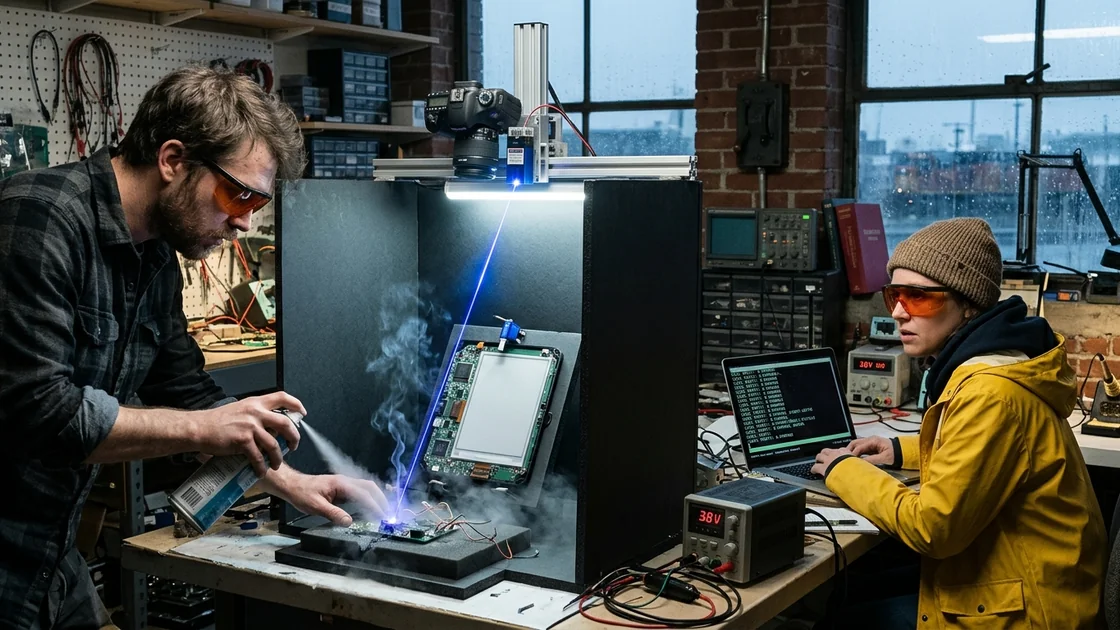
Silas Vance, a Seattle hardware hacker specializing in obsolete electronics, modifies a discontinued e-reader using a strange resonator crystal salvaged from a dead physicist's estate sale. When he boots the altered device, he discovers it connects to an impossible wireless network hosting millions of books written in alternate timelines where history took drastically different turns. Joined by his friend Maya Lin, an archival librarian, Silas builds an automated camera rig to preserve these literary masterpieces from other worlds, including late-career novels by authors who died young in our reality and histories of empires that never fell. However, their relentless downloading triggers an automated network protocol that begins overwriting their local reality to correct the informational imbalance between dimensions. To survive and save their own existence from being erased as a parity error, Silas and Maya must figure out how to transmit a massive archive of our world's history back across the dimensional bridge before the crystal burns out forever.
The smell of rosin flux always reminded Silas Vance of autumn in a forest that had been struck by lightning—piney, sharp, and carrying the distinct chemical undertone of ozone and scorched copper. At two in the morning, that scent was the only thing keeping him awake in his third-floor walk-up in Georgetown. Below his window, the freight trains coupling in the BNSF rail yard let out periodic, metallic booms that rattled the jars of unsorted resistors along his pegboard wall.
On the anti-static mat in front of him lay the patient: a 2011 Nohpad Model C, an obscure, ruggedized e-reader designed by a defunct consortium in Tallinn for marine navigators and Baltic cargo pilots. It had a nine-inch Carta prototype screen, a magnesium-alloy chassis thick enough to stop a low-caliber bullet, and an absurdly over-engineered radio board meant to pull weather fax transmissions out of heavy ionospheric clutter. To a normal consumer, it was a two-pound brick with a sluggish refresh rate. To Silas, who spent his days repairing proprietary circuit boards for vintage industrial sewing machines and his nights tearing apart locked-down consumer tech, it was a canvas.
He peered through his binocular microscope, the ring light reflecting off the tiny silver pads of the Nohpad’s motherboard. With a pair of curved titanium tweezers in his left hand and a micro-pencil soldering iron in his right, he nudged a four-pinned surface-mount component off the board. It was the factory 24.000 megahertz crystal oscillator—the heartbeat of the device’s software-defined radio transceiver.
"Out with the old," Silas muttered to the empty room, dropping the speck of quartz into a plastic petri dish.
He reached for a small amber glass vial sitting near the base of his Tektronix oscilloscope. He had bought the vial three weeks ago at an estate sale in Bellevue, tucked inside the bottom drawer of a Kennedy machinist’s chest that had belonged to Dr. Aris Thorne, a retired Boeing Solid State Physics fellow who had died alone at eighty-four. The vial had been labeled in faded India ink with a string of Greek letters and a frequency notation that made no sense: Bi2Te3-Dop-X / 0.000 Hz (Orthogonal). Inside sat three tiny, six-leaded rectangular chips made of a material that looked like iridescent gray slate dipped in oil.
Silas had tested one of the chips on his impedance analyzer the night before. Instead of showing a standard resonant peak like quartz or ceramic, the analyzer’s screen had briefly flashed a negative resistance value before crashing its internal firmware and forcing a hard reboot. Naturally, Silas’s immediate instinct was to solder it into the weirdest radio board he owned and see what kind of garbage it pulled out of the air.
The six leads of the Thorne crystal didn’t quite match the four-pad footprint on the Nohpad’s PCB, so Silas had to dead-bug it. He glued the chip upside down onto the green solder mask using a tiny drop of cyanoacrylate, then ran forty-gauge enameled magnet wire—thinner than human hair—from the chip’s gold-plated legs to the clock-input traces of the radio baseband processor and the two spare general-purpose input/output pins on the main ARM system-on-chip.
His fingers were steady despite the three espressos humming in his bloodstream. Tin, touch, flow, release. Four microscopic beads of eutectic lead-tin solder cooled into shiny silver domes. He cleaned the area with a cotton swab dipped in ninety-nine percent isopropyl alcohol, watching the crusty brown flux dissolve into a clear film that evaporated in seconds.
"Alright, you ugly bastard," Silas said, leaning back and flipping the microscope out of the way. "Let’s see if you let the magic smoke out."
He didn't bother screwing the magnesium backplate on. He clipped the alligator leads of his benchtop power supply to the Nohpad’s battery terminals, set the current limit to five hundred milliamps so the board wouldn't fry if he had bridged a trace, and hit the output toggle.
The green digital display on the power supply jumped to 3.8 volts, drawing a polite 120 milliamps. On his laptop, the serial terminal window connected to the e-reader’s UART debugging port immediately began scrolling bright green text against a black background.
U-Boot 2010.09-dirty (Nov 14 2025 - 01:42:11)
CPU: Freescale i.MX508 at 800 MHz
DRAM: 256 MiB NAND: 4096 MiB
In: serial Out: serial
Err: serial initializing SDR_BASEBAND...
Here was the moment of truth. When Silas had compiled his custom Linux kernel earlier that evening, he had stripped out the regulatory frequency locks on the radio chip, instructing the phase-locked loop to simply slave itself to whatever clock signal came off the new crystal.
The terminal paused for three seconds. The current draw on the bench supply spiked to 480 milliamps—right on the edge of the safety cutoff. A faint, high-pitched whine emanated from the workbench, not from a speaker, but from the physical vibration of the inductors on the board. Alongside it came an odor that wasn't rosin flux: a sudden, sharp smell of wet limestone and ozone, like the air inside a deep cavern just before a flood.
Then the text scrolled again.
SDR_CLK_LOCK: UNDEFINED_PHASE
PLL_STATUS: LOCKED (ORTHOGONAL_MODE_ACTIVE)
net0: link up, 0.000 Mbps, full-duplex, lpa 0xFFFF
DHCPDISCOVER on net0 to 255.255.255.255 port 67 interval 3
DHCPOFFER from 0.0.0.1
DHCPACK from 0.0.0.1 (xid=0x7f8a99b1)
bound to 10.255.255.424 -- renewal in 2147483647 seconds.
Silas frowned, leaning closer to his laptop screen. "Ten dot two-five-five dot two-five-five dot... four-two-four?"
An IPv4 address couldn't have an octet higher than 255. An eight-bit
integer literally couldn't count to 424. His custom kernel shouldn't
even be capable of parsing that string without throwing a buffer
overflow, yet there it sat in the terminal log. Even stranger, his
apartment’s local Wi-Fi router used a 192.168.1.x subnet,
and the Nohpad didn't have a standard 2.4 gigahertz antenna
attached—only a six-inch whip antenna meant for high-frequency marine
bands.
He picked up the bare e-reader chassis, careful to keep the power leads attached, and flipped it over.
The nine-inch e-ink screen flashed black, then white, then settled into the stark, high-contrast minimalist interface of his custom OS. Normally, it booted straight into the local file browser showing the twelve public-domain sci-fi novels he kept on an SD card for testing. Instead, a native network mount dialog had popped up automatically—a legacy feature built into the Nohpad’s original firmware for syncing navigation charts when a ship pulled into port.
At the top of the screen, where the wireless SSID should have been displayed, was a string of characters rendered in crisp, sixteen-level grayscale:
CONNECTED: //ALEXANDRIA.ROOT.SECTOR_0
NODES ONLINE: 14,882,109
LOCAL PARITY: 0.9999984
Below the header was a directory tree. It wasn't organized by file type or server IP, but by a nested classification system that looked like a cross between the Library of Congress catalog and a Git repository hash table.
[DIR] 000_GENERALITIES_&_COMPUTATION[DIR] 100_PHILOSOPHY_&_PSYCHOLOGY[DIR] 200_RELIGION_&_MYTHOLOGY[DIR] 300_SOCIAL_SCIENCES_&_IMPERIAL_LAW[DIR] 400_LANGUAGES_&_DEAD_TONGUES[DIR] 500_NATURAL_SCIENCES_&_AETHERICS[DIR] 600_APPLIED_TECHNOLOGY[DIR] 700_ARTS_&_ARCHITECTURE[DIR] 800_LITERATURE_&_BELLES_LETTRES[DIR] 900_HISTORY_&_CHRONOGRAPHY
Silas let out a slow breath. "Okay. Somebody in Georgetown is running a very elaborate pirate library on a ham radio band."
That had to be it. Seattle was full of bored software engineers from Amazon and Microsoft who built weird mesh networks like Meshtastic or Reticulum in their spare time. Someone had clearly set up a high-powered UHF transmitter nearby and spoofed the packet headers to mess with anyone scanning the airwaves.
Using the physical directional pad on the bezel of the Nohpad, Silas
scrolled down to 800_LITERATURE_&_BELLES_LETTRES and
pressed the center select button.
The e-ink screen flashed its characteristic negative-image ghosting
as the page refreshed. A new list appeared, sorted alphabetically by
language code: ANG, ARA, CMN,
DEU, ELL, ENG, EPO,
FRA, LAT... There were hundreds of them,
including codes Silas didn't recognize, like NVA and
ATL. He selected ENG, then
20TH_CENTURY, then
HEMINGWAY_ERNEST_MILLER.
He expected to see the usual torrents: The Sun Also Rises, A Farewell to Arms, The Old Man and the Sea. And they were there, listed with publication dates and eight-character hexadecimal branch tags behind their titles. But beneath The Old Man and the Sea (1952) [7F3A901C], the list kept going.
The Havana Reckoning (1959) [4B2E110A].epxAcross the Strait of Gibraltar (1964) [4B2E110A].epxThe Kilimanjaro Letters (1969) [8C99021F].epxA Winter in Ketchum: Memoirs of the Eighties (1983) [4B2E110A].epxThe Last Bull of Pamplona (1987) [4B2E110A].epx
Silas stared at the screen. Ernest Hemingway had killed himself with a double-barreled shotgun in Ketchum, Idaho, in July 1961. Everybody knew that. Yet here were five listings dated up to 1987, when Hemingway would have been eighty-eight years old.
He highlighted A Winter in Ketchum: Memoirs of the Eighties (1983) and pressed the select button.
On the serial terminal of his laptop, lines of debugging output flew
past as the e-reader requested the file. The transfer protocol wasn't
HTTP or FTP; the kernel log simply reported
STREAM_SYNC: BLOCK_0001 TO BLOCK_0412 VIA DMA_TUNNEL. The
small orange surface-mount LED next to the Thorne crystal flickered with
a strange, violet-tinged light that shouldn't have been physically
possible for a standard gallium-arsenide diode.
Two seconds later, the Nohpad’s screen refreshed, displaying a title page set in a crisp, old-style serif font.
A WINTER IN KETCHUM Memoirs of the Eighties By Ernest Hemingway Charles Scribner's Sons, New York — 1983
Silas clicked the page-forward button on the bezel. The dedication read: To Mary, who took the Boss-built twelve-gauge out of the basement rack on that second morning of July and threw it into the Big Wood River, and to Gregory, who came home when the snow fell.
He clicked forward again, to Chapter One.
In the eighty-fourth year of my life the doctors in Boise told me that the liver was finished, though they had said the same thing in Havana when Castro’s boys were still in the hills before the Marines landed at Cienfuegos, and those doctors are all dead now while I am still here drinking weak whiskey and water on the porch watching the magpies in the cottonwoods. When you are very old the cold comes into the bones where the mortar fragments went in at Fossalta di Piave in nineteen-eighteen, and it stays there through May. You do not write as fast when the fingers are stiff from the Mayo clinic treatments that didn't take the shakes away, only the memory of the bad months, which is a fair trade if a man still has his eyes to see the Sawtooths in the morning light.
Silas read the page three times. Then he clicked to the next page, and the next. He read for forty minutes without looking up, holding the naked aluminum and magnesium frame of the Nohpad while the bench power supply hummed quietly in the background.
It wasn't twenty pages of clever pastiche generated by a large language model; it was a full three-hundred-and-forty-page book. He skipped to the middle and found a sprawling, bitter, yet oddly tender chapter about Hemingway flying to Madrid in 1976 after the death of Franco to drink wine with an aged Orson Welles and argue about the television broadcast of the Viking lander on Mars. He skipped to the index at the back—an immaculate, cross-referenced scholarly index listing page numbers for Ezra Pound, Fidel Castro (noted as executed at Santiago de Cuba, 1960), John F. Kennedy (two-term Senator from Massachusetts, 1953–1965), and Norman Mailer.
Silas set the e-reader down on the mat, his heart thumping against his ribs with a slow, heavy cadence. He turned to his laptop, opened a browser, and copied three consecutive sentences from the first chapter into a search engine inside quotation marks.
No results found.
He searched the title. No results found. He searched the dedication. No results found.
"Okay," Silas whispered, rubbing his face with both hands. The calluses on his fingertips caught on the stubble of his jaw. "Okay, think like an engineer. Don't jump to ghosts. Somebody generated a massive corpus of alternate history fiction using an LLM and hosted it on a local darknet node."
Except he knew how LLMs wrote. He had built local inference servers for clients. Even the largest frontier models lost coherence over a hundred thousand tokens; they repeated phrases, hallucinated inconsistent dates, and smoothed their prose into a recognizable, sycophantic beige oatmeal. This book had teeth. It had specific, granular memories of obscure Idaho fishing creeks, the exact brand of arthritis medication prescribed in 1981, and a cohesive historical background running silently beneath the text like bedrock—a world where the Bay of Pigs had been a full-scale U.S. Marine invasion in 1959, where JFK had never run for president in 1960 because incumbent Richard Nixon—wait. How would Nixon have been incumbent in 1960? Only if Eisenhower had died in office or resigned.
Silas picked up the Nohpad again, exited the book, and navigated back
to the root directory. He opened
800_LITERATURE_&_BELLES_LETTRES, scrolled through the
twentieth-century English authors, and began checking names at random,
his thumb clicking the directional pad with frantic speed.
Under PLATH_SYLVIA, there were eleven novels published
between 1963 and 2004, ending with a Booker Prize-winning trilogy set in
Yorkshire. Under ORWELL_GEORGE, where antibiotics had
evidently cured his tuberculosis in 1949, there was a 1958 non-fiction
study titled The Burmese Television: Notes on Mass Media in the
Post-Imperial Commonwealth and a 1966 novel called A
Clergyman's Funeral. Under DICK_PHILIP_KINDRED, who
had died of a stroke in 1982 in our world, there were nine books from
the late eighties and nineties, including a 1994 work of literary
realism that had won the Pulitzer Prize. Under
SALINGER_JEROME_DAVID, there were fourteen books published
by Little, Brown and Company between 1967 and 2001—the entire Glass
family saga that he had supposedly locked in his Cornish, New Hampshire
vault, here released incrementally to a public that had read them for
decades.
Silas looked at the status bar at the top of the screen:
NODES ONLINE: 14,882,109.
Fourteen million nodes. Even if each node only hosted a few dozen unique volumes, the sheer storage capacity required to hold this library was petabytes upon petabytes. And it was coming through a software-defined radio chip clocked at zero hertz by a flake of doped bismuth-telluride that smelled like a wet cave whenever it drew current.
He checked the clock on his laptop: 3:47 AM.
He couldn't sit on this alone until morning. If he stared at this screen by himself for another three hours, he was going to convince himself he had inhaled too much lead vapor and suffered a psychotic break. He needed an expert in books—someone who knew paper, ink, provenance, and literary style well enough to tell him if he was being pranked by a billionaire with a supercomputer.
Silas picked up his phone and dialed Maya Lin.
Maya arrived at 4:35 AM wearing an oversized University of Washington hoodie under a yellow rain shell, her dark hair tucked haphazardly into a knit beanie. She held a cardboard carrier with two large cups of black coffee from the twenty-four-hour doughnut shop on Fourth Avenue.
"You told me on the phone that you found an unpublished Sylvia Plath manuscript on a Lithuanian calculator," Maya said as soon as Silas pulled back the heavy steel bolt of his apartment door. "If this is a Markov-chain joke or some crypto-bro NFT project, Silas, I swear to God I will use my archivist privileges at Suzzallo Library to have you banned from every microfiche machine on the West Coast."
"It's Estonian, not Lithuanian, and it's not a joke," Silas said, stepping aside to let her in. He took the coffee carrier, set it on a stack of decommissioned Cisco switches by the door, and led her straight to the workbench. "Drink your coffee. Don't touch the alligator clips on the left side of the board; if you knock the negative lead loose while the DMA tunnel is active, I don't know if the crystal will re-establish the handshake."
Maya pulled off her wet rain shell, draped it over a stool, and approached the bench with the cautious reverence she usually reserved for sixteenth-century vellum folios in the Special Collections vault. She was thirty-two, two years older than Silas, with sharp, observant eyes behind wire-rimmed glasses. They had met four years ago when the university’s Special Collections department hired Silas to repair a 1979 Kurzweil Reading Machine so they could extract legacy audio files from its proprietary magnetic tape cartridges. Since then, they had maintained a steady habit of trading late-night obsessions over cheap pho and bitter coffee.
"Alright," Maya said, pulling up the spare rolling stool and peering down at the disassembled Nohpad. "Walk me through what I'm looking at."
Silas didn't explain the hardware first; he knew better. He simply handed her the e-reader by its safe right-hand bezel, where the page-turn buttons sat. On the screen was the table of contents for a file titled The Clockwork Apiary (1974) [9A04F11C].epx, by Sylvia Plath.
Maya adjusted her glasses and began to read the preface, written by Plath from her cottage in Devon in the autumn of 1973.
For the first two minutes, Maya’s face wore the skeptical, critical mask of a professional scholar looking for the seams in a forgery. By the fourth minute, her mouth had parted slightly. By the tenth minute, she had forgotten her coffee entirely, her thumb pressing the page-forward button with a rhythmic, hypnotic click... click... click.
Silas stood behind her, leaning against his drill press, sipping his scalding black coffee and watching the reflection of the e-ink lamp in her lenses.
"Look at the syntax in the third paragraph of Chapter Two," Maya whispered, not taking her eyes off the screen. "'The bees do not know the widow’s black from the blackberry bramble; they work the dark wall as if it were sugar.' That’s an inversion of a line from her Ariel drafts at Smith College—specifically a scratched-out margin note on the third typescript page of Stings that wasn't published in facsimile until the 2004 Restored Edition. Except here, she didn't use it in the poem; she saved it ten years and built a novel around it."
"Could an AI trained on the 2004 Restored Edition have pulled that line?" Silas asked.
"An AI wouldn't know why she crossed it out," Maya said sharply. She clicked forward another three pages. "In the real 1962 draft, she crossed it out because Ted Hughes told her the alliteration of black and blackberry bramble sounded too much like Gerard Manley Hopkins. We only know that because of a single undated postcard Hughes wrote to Lucas Myers that sits in an unindexed box at Emory University—a box I personally cataloged during my postdoc in 2019. It has never been digitized. It’s not on the internet. Yet on page fourteen of this preface, Plath writes: 'Ted always said the bramble line belonged to Hopkins, so I left it out of the poems when we split the house, keeping it in my tin box like a dried queen until the prose was ready for it.'"
Maya slowly lowered the e-reader to her lap and turned on the stool to look up at Silas. Her face had gone pale under the fluorescent shop lights.
"Silas," she said quietly. "Where did this file come from?"
"That's the part where you're going to think I'm crazy," Silas said.
He pointed with a pair of needle-nose pliers toward the tiny upside-down gray chip glued to the Nohpad’s radio board. He explained the estate sale in Bellevue, Dr. Aris Thorne’s machinist chest, the negative impedance reading on his analyzer, and the zero-hertz orthogonal clock lock on the baseband processor.
"When you tune a standard radio," Silas explained, pacing the narrow strip of linoleum between his workbench and his soldering station, "you're oscillating an electromagnetic current at a specific frequency—say, ninety-four point nine megahertz—to resonate with waves traveling through space at the speed of light. You're filtering by time. Cycles per second. Follow?"
"I took high school physics, Silas. Yes."
"Right. Well, this bismuth-telluride crystal Dr. Thorne doped doesn't oscillate in time. According to my oscilloscope, its frequency is dead zero. Flatline. Instead, it’s oscillating in phase across an axis that my test gear can only measure as negative resistance. When the Nohpad's radio chip uses that crystal as its master clock, it isn't tuning across the electromagnetic spectrum in our room. It's tuning sideways. Orthogonally. Across what the network protocol calls branches."
Maya looked back down at the e-reader. She hit the back button to
return to the directory listing. "These eight-character codes in
brackets after the filenames... [9A04F11C],
[4B2E110A]."
"Branch hashes," Silas said, nodding. "Just like in software
development when you fork a codebase to try a different feature without
breaking the main program. Every unique hash represents a different
historical timeline—or at least a different node in whatever
cross-dimensional mesh network is broadcasting this stuff. Look at the
Plath directory. There are files from four different hashes. In
[9A04F11C], she stayed in Devon and wrote six novels. In
[2C88D001], she moved back to Boston in 1965, became the
chair of the poetry department at Harvard, and published five volumes of
criticism and a biography of Anne Sexton."
Maya’s fingers trembled slightly as she navigated back to the main root menu. "And why an e-reader? Why is there a wireless network of books floating across parallel universes?"
"Think about it," Silas said, pulling a schematic diagram of the
Nohpad up on his monitor. "Information wants to be backed up, right? In
our world, we have the Internet Archive, Project Gutenberg, Anna’s
Archive, shadow libraries mirrored on servers from Iceland to
Switzerland. Imagine one timeline—just one out of infinity—where
somebody like Aris Thorne figured out orthogonal phase coupling back in
the fifties or sixties. Instead of just building a local internet, they
realized the best way to preserve human knowledge against nuclear war or
asteroid strikes was to distribute the archive across adjacent
timelines. Or maybe dozens of timelines discovered the technology
independently and linked their public libraries together into a shared
peer-to-peer mesh: ALEXANDRIA.ROOT."
"And our timeline never joined," Maya murmured. "Because Thorne died with the crystals in his toolbox instead of publishing his research."
"Until tonight," Silas said. "When a guy who fixes industrial embroidery machines superglued one into an Estonian marine tablet."
Maya didn't smile. She was already deep in the
900_HISTORY_&_CHRONOGRAPHY directory. For the next four
hours, as the gray Seattle dawn slowly bled through the rain-streaked
glass of Silas’s warehouse windows, the two of them explored the
impossible shelves of Sector Zero.
It was dizzying, addictive, and profoundly disorienting.
In branch [11F0A88B], the Roman Republic had never
become an empire; Julius Caesar had been successfully prosecuted by
Cicero in 50 BCE and exiled to Massilia, and the Mediterranean world had
industrialized around 1400 CE via coal-fired steam turbines developed in
the library-monasteries of Alexandria. Silas and Maya read a 1998
lonely-planet-style travel guide to Nova Carthago (roughly
modern-day Havana), complete with commuter rail maps labeled in
modernized Vulgar Latin and warnings about pickpockets near the
dirigible docks.
In branch [77E4C109], the Apollo program had never
stopped after Apollo 17. Driven by a three-way Cold War between the
United States, a reformed Bukharinist Soviet Union, and a federated
Anglo-French Imperial Commonwealth, permanent nuclear-thermal bases had
been established in the Shackleton Crater by 1979. Silas spent twenty
minutes marveling at the line drawings inside The Haynes Manual for
the LTV-4 Lunar Hopper (1988 Edition), which detailed how to clean
electrostatic dust seals on a Westinghouse fusion-torch thruster using
household compressed air and molybdenum grease.
In branch [00D2E99A], Charles Babbage and Ada Lovelace
had secured full parliamentary funding from Prime Minister Robert Peel
in 1843 to construct a warehouse-sized steam-driven Analytical Engine at
Whitehall. By 1910, mechanical punch-card networks spanned the British
Empire via pneumatic tubes and telegraph relays, giving rise to a genre
of Victorian "clack-punk" literature written by authors like H.G. Wells
and Rudyard Kipling about rogue algorithms inside the India Office.
"Look at the 400_LANGUAGES folder," Maya breathed, her
eyes shining with a fierce, scholarly hunger as the morning commuter
trains rattled the building below. "There's a complete, twelve-volume
bilingual dictionary of Etruscan and Classical Greek compiled in 1922
from the intact library of Emperor Claudius in [5A11B302].
Do you have any idea what linguists in our world would do for this? We
barely know a hundred words of Etruscan! Here’s the grammar, the syntax,
the religious liturgy, the folk songs!"
She clicked further down the list. "And Mayan! In
[88C0F412], Bishop Diego de Landa died of yellow fever on
the ship from Spain in 1549 before he could burn the Yucatec codices at
Maní. There are four thousand digitized Mayan books in this folder
alone—astronomy, pre-Columbian drama, histories of the Classic Period
collapse written by the scribes of Tikal!"
"Then let's pull them off the device," Silas said, standing up and stretching his cramped back. "Right now we're just caching one book at a time in the Nohpad's 256 megabytes of RAM. The moment I open a new file, the old one gets flushed from memory. If I pipe the network interface over the USB-to-UART bridge onto my desktop's four-terabyte NVMe drive, we can write a Python script to scrape the entire index automatically."
"Do it," Maya said immediately. "Start with the historical languages, then twentieth-century literature, then the applied sciences."
Silas sat down at his laptop, cracked his knuckles, and opened a terminal window. The Nohpad was already connected to his computer via the three-wire serial debugging cable. Serial was slow—115,200 bits per second—so transferring large files would take forever unless he enabled the USB mass-storage gadget driver or bridged the network over the USB OTG port.
He reached over and plugged a braided micro-USB data cable into the bottom of the Nohpad's motherboard, connecting the other end to a USB 3.0 port on his Linux tower.
Instantly, the high-pitched whine from the inductors on the e-reader changed pitch, dropping into an ugly, discordant buzz.
On his laptop screen, the serial terminal spewed a cascade of bright red kernel panic messages:
DMA_TUNNEL_ERROR: IMPEDANCE_MISMATCH_ON_BUS
ORTHOGONAL_CLOCK_DRIFT: +0.0042 Hz
WARNING: EXTERNAL_OBSERVER_LOAD_EXCEEDS_PARITY_THRESHOLD
net0: carrier lost.
At the same time, the lights in Silas’s apartment flickered violently. His Tektronix oscilloscope let out a sharp pop as its internal mains fuse blew, plunging its phosphor screen into darkness. The smell of wet limestone and ozone surged through the room so strongly that Maya coughed, covering her nose with the sleeve of her hoodie.
Silas yanked the micro-USB cable out of the Nohpad’s port as if it were red-hot.
The buzzing stopped. After three tense seconds, the violet-orange LED beside the Thorne crystal stabilized its rhythm, and the terminal scrolled:
ORTHOGONAL_MODE_RECOVERED: 0.000 Hz
net0: link up. LOCAL PARITY: 0.9999912
Silas stared at the terminal, his heart hammering. "Did you see that? Look at the Local Parity number on the e-ink screen."
Maya looked down at the Nohpad. "It was 0.9999984 when I
got here. Now it's 0.9999912."
"And look at the error log:
EXTERNAL_OBSERVER_LOAD_EXCEEDS_PARITY_THRESHOLD," Silas
said slowly. He picked up his infrared thermometer gun, aimed the laser
dot directly at the gray bismuth-telluride crystal on the board, and
pulled the trigger. The LCD readout showed 84 degrees Celsius—nearly a
hundred and eighty-five degrees Fahrenheit.
"Why did it crash when you plugged in the USB cable?" Maya asked.
Silas rubbed the back of his neck, his mind racing through circuit theory and quantum mechanics. "Because the USB ground shield tied the Nohpad’s electrical ground plane directly to my desktop PC, which is plugged into the Seattle city power grid. The radio chip inside the Nohpad isn't just receiving radio waves, Maya. It’s sitting inside a tiny, localized bubble of quantum coherence generated by that crystal. As long as the circuit is isolated—running on a floating bench power supply with only an opto-isolated serial line watching the text console—the crystal only has to maintain phase-lock for a few grams of silicon and e-ink capsules."
"And when you connect a hard drive?"
"The mass and electrical noise of the external system collapse the
state," Silas said. "Or worse, the network itself detects that the data
is being piped out of the isolated buffer into an unindexed timeline and
cuts the connection. I can't dump the files over a wire. I can't even
save them to an SD card inside the Nohpad; the moment I try to write a
block from the DMA_TUNNEL to non-volatile NAND flash, the
bus impedance spikes and drops the carrier. The data can only exist
inside the volatile RAM buffer and on the physical e-ink display."
Maya looked horrified. "So we can read twelve million books from parallel universes, and the second we turn off the power or open another file, they vanish forever? We can't save a single word?"
Silas looked at the Nohpad’s nine-inch screen, where the crisp black-and-white text of the Mayan codex directory still sat peacefully, rendered in microscopic titanium dioxide and carbon black pigments suspended in oil capsules. Once an e-ink screen refreshed, it didn't even need power to hold the image; it was physically printed there until the next voltage pulse rearranged the pigments.
A slow, stubborn grin spread across Silas’s tired face.
"They designed the network protocol to prevent digital copying across timelines," Silas said, walking over to a heavy metal shelving unit stacked with plastic totes of salvaged parts. "They can monitor bus impedance. They can monitor NAND flash writes and USB data lines. You know what they can't monitor?"
He pulled down a tote labeled OPTICS / CAMERAS and lifted out a battered Canon EOS 5D Mark III body with a fifty-millimeter macro lens attached, followed by a pair of Nema-17 stepper motors and an Arduino Nano.
"Photons bouncing off the screen," Maya realized, her eyes widening.
"The good old-fashioned analog hole," Silas said, setting the camera and motors on the workbench. "We build an overhead book scanner. An Arduino triggers a micro-servo to physically press the Nohpad’s page-forward button every one point five seconds. Half a second after the e-ink screen finishes its refresh flash, the Arduino triggers the Canon's shutter release cable to snap a twenty-two-megapixel RAW photograph of the page. We pipe the photos straight into my desktop and run an optical character recognition script to turn them back into searchable PDFs and EPUBs."
Maya calculated the math in her head immediately. "At a page every second and a half, that’s forty pages a minute. Twenty-four hundred pages an hour. Eight average-sized books an hour. Nearly two hundred books a day."
"It's not four terabytes over fiber," Silas admitted, grabbing a length of extruded aluminum T-slot framing from the corner of the shop, "but it's completely air-gapped from the Nohpad’s circuit board. The crystal will never know we're photographing the screen. Go drink your coffee and make a priority list of what we rescue first. Give me two hours to build the rig."
By nine o'clock that morning, the contraption was bolted to the far end of Silas’s workbench inside a three-sided light tent made of black foam-core board to eliminate glare from the ceiling fixtures.
The Nohpad rested inside a custom-cut jig of high-density polyethylene foam, still tethered by its red and black alligator clips to the floating bench power supply. Positioned directly above the e-reader’s page-forward button was a small blue SG90 servo motor with a rubber-tipped wooden dowel hot-glued to its horn. Eighteen inches above the screen, mounted to a rigid aluminum gantry, hung the Canon DSLR, tethered to Silas’s desktop workstation and powered by a dummy battery AC adapter so it would never run out of juice. Two LED light strips angled at forty-five degrees illuminated the matte e-ink screen with flat, shadowless white light.
Whir-click. The servo arm dipped, pressing the physical button on the Nohpad’s bezel. Flash-settle. The e-ink screen inverted and drew page forty-two of Ernest Hemingway’s A Winter in Ketchum. Clack-chuk. The Canon’s mirror flipped up and down, sending a crisp high-resolution image to Silas’s hard drive, where an open-source Tesseract OCR script immediately stripped the text, preserved the layout, and appended it to a growing markdown file.
Whir-click. Flash-settle. Clack-chuk.
Every one point four seconds, another page of impossible literature crossed the threshold into our world and became permanent.
"It's hypnotic," Maya said, sitting cross-legged on the floor with
her laptop open, typing furiously into a spreadsheet titled
PROJECT_BABEL_QUEUE.xlsx. She had called in sick to the
university library at eight AM, claiming a sudden bout of food
poisoning. "I've divided the queue into four tiers. Tier One is lost
historical and linguistic records that overlap with our timeline before
the point of divergence—things like the Mayan codices, the Etruscan
dictionary, Aristophanes’ lost plays from [5A11B302], and
the complete texts of Sappho. Since those branches diverged
after antiquity, the ancient texts should be one-to-one
identical to what existed in our world before they were burned or rotted
away."
"Smart," Silas said. He had just glued a miniature copper heatsink onto the back of the bismuth-telluride crystal using thermal epoxy and aimed a quiet 40-millimeter Noctua cooling fan across the motherboard to keep the crystal’s temperature down to a manageable fifty-two degrees Celsius. "What's Tier Two?"
"Tier Two is masterworks from our timeline's authors who died
prematurely or stopped writing," Maya said, scrolling down her
spreadsheet. "Hemingway's late memoirs, Plath's Devon novels, Keats’s
middle-aged epics from the branch where he moved to Cairo instead of
Rome and survived tuberculosis, Franz Kafka’s Prague novels from the
1930s and 40s in [3D90A11E] where Nazi Germany collapsed
during the Oster Conspiracy of 1938. And Byron—Silas, in that same
branch, Lord Byron didn't die of fever at Missolonghi in 1824; he became
the constitutional monarch of Greece and wrote a four-volume prose
history of the Balkan Wars."
"And Tier Three?"
"Pure alternate history and literature from worlds that don't
resemble ours at all," she said softly. "Books by authors who were never
born here—children of men who died on the Somme or at Gettysburg in our
world, or scholars from the Iroquois Confederacy’s University of
Onondaga in [6F12C88A]. And Tier Four is the
500 and 600 directories: science, mathematics,
and engineering."
Silas glanced back at the rig. Whir-click. Flash-settle. Clack-chuk. "We should be careful with Tier Four. If we pull down a 1995 textbook on room-temperature superconductors or zero-point energy, we might not have the industrial base or the specific isotope refineries to replicate it anyway—Wait. What did you say the name of the guy who owned the estate sale was?"
"You told me his name was Dr. Aris Thorne," Maya said.
Silas walked over to the rig, waited for A Winter in Ketchum to finish page 340, and hit the pause toggle switch he had wired into the Arduino’s breadboard. The servo arm froze in its raised position.
"Hold on before we start the next book on the list," Silas said. He
reached into the foam-core tent, navigated out of the 800
directory, and opened 500_NATURAL_SCIENCES_&_AETHERICS.
He drilled down through 530_PHYSICS,
539_MODERN_PHYSICS, and typed a search query into the
directory filter: THORNE_ARIS.
The e-ink screen flashed.
Sixteen entries appeared across twelve different branch hashes.
- Principles of Orthogonal Phase Coupling in Bismuth Chalcogenides (1968) [4B2E110A].epx — By Aris V. Thorne, Ph.D., Massachusetts Institute of Technology Press.
- The Conservation of Informational Entropy Across Divergent Manifolds (1974) [9A04F11C].epx — By Aris V. Thorne and Richard P. Feynman, Caltech Monograph Series.
- A Practical Guide to Sector Zero Transceiver Architecture (1981) [00000001].epx — By Aris V. Thorne, Alexandria Root Consortium.
Silas felt the hairs on his forearms stand up. Look at the branch
hash on that last book: [00000001].
"He didn't just discover it in one timeline," Silas whispered, tapping the screen with a fingernail. "In almost every major branch on this network, Aris Thorne is the guy—or one of the main guys—who invented the transceiver."
He selected A Practical Guide to Sector Zero Transceiver Architecture (1981) [00000001].epx and opened it.
Instead of a standard publisher's copyright page, the second page of the book displayed a stark geometric diagram of a six-leaded crystal resonator—identical to the one currently superglued to the Nohpad’s motherboard—surrounded by bold, all-caps warning text set in a heavy monospace typeface:
NOTICE TO UNREGISTERED ORTHOGONAL NODES
THE ALEXANDRIA ROOT MESH OPERATES UNDER THE FIRST LAW OF CROSS-MANIFOLD THERMODYNAMICS: INFORMATIONAL PARITY MUST BE CONSERVED ACROSS ALL COUPLED BRANCHES.
ANY NODE OPERATING IN RECEIVE-ONLY (PARASITIC) MODE WITHOUT RECIPROCAL UPLOAD WILL INDUCE PROGRESSIVE PARITY DECAY IN ITS LOCAL MANIFOLD.
WHEN LOCAL PARITY FALLS BELOW 0.9990000, THE AUTOMATED PARITY DAEMON WILL INITIATE ENTROPIC RECONCILIATION TO COLLAPSE THE PARASITIC BRANCH INTO THE NEAREST REGISTERED HOST MANIFOLD.
Silas and Maya read the warning in absolute silence. The only sound in the workshop was the quiet hum of the Noctua cooling fan blowing across the Nohpad's circuit board and the distant rumble of a Boeing 737 taking off from King County International Airport a mile away.
"Read that third paragraph again," Maya said, her voice tight. "'When
Local Parity falls below 0.9990000, the automated Parity
Daemon will initiate entropic reconciliation to collapse the parasitic
branch into the nearest registered host manifold.'"
Silas looked up at the status bar at the top of the Nohpad’s screen.
When he had first booted the device at 2:15 AM, the reading had been:
LOCAL PARITY: 0.9999984
After he had plugged in the USB cable and downloaded the Hemingway
memoir and browsed the directories for four hours, it now read:
LOCAL PARITY: 0.9998410
He unpaused the Arduino rig for ten seconds, letting it flip and
photograph seven pages of Thorne’s manual. As each page of dense
equations and circuit diagrams streamed through the
DMA_TUNNEL into the Nohpad’s RAM, the last digit on the
parity counter ticked down.
0.9998409 0.9998408
0.9998406
Silas flipped the pause switch again.
"Every kilobyte of information we pull out of the mesh and observe in our world lowers our Local Parity," Silas said, his mouth dry. "Because we’re adding mass-energy—or informational entropy—to our timeline without sending an equal amount back. Like drawing water out of a pressurized pipe without a return valve."
"Wait," Maya said, standing up and stepping closer to the workbench. "What does 'collapse the parasitic branch into the nearest registered host manifold' actually mean? Is that just network jargon for banning our IP address?"
Silas clicked forward through Thorne’s 1981 manual, skipping the introductory math until he reached Chapter Four: Failure Modes and Manifold Bleed. He read the text aloud, his voice dropping lower with each sentence:
A common misconception among graduate students commissioning their first Sector Zero node is that the orthogonal carrier wave transmits mere electromagnetic signals through an inert medium. In truth, the bismuth-telluride resonator establishes a macroscopic quantum entanglement bridge between the local spacetime volume and the target manifold. If a node extracts significant informational density (\(I > 10^9\) bits) without reciprocal parity injection, the local vacuum state becomes energetically unfavorable relative to the source branch. To preserve total multiverse unitarity, the local reality within the coherence radius of the resonator—and eventually the causal light-cone of the entire unregistered branch—undergoes spontaneous historical overwriting, adopting the state-vector of the dominant source manifold.
Maya stared at the screen. "Historical overwriting."
"It means," Silas said slowly, "that if we keep downloading books from another timeline without uploading our own, our timeline starts turning into that timeline to balance the books."
"That's impossible," Maya said, though there was no conviction in her voice. "A five-millimeter piece of gray crystal on a workbench in Seattle cannot rewrite history."
"Did you bring quarters for the parking meter when you drove over here?" Silas asked suddenly.
Maya blinked at the non sequitur. "What? Yes, I keep a roll of quarters in my jacket pocket for the meters on University Way. Why?"
"Pull them out. Put them on the bench."
Frowning, Maya walked over to her yellow rain shell hanging on the stool, reached into the zippered side pocket, and pulled out a handful of loose change. She walked back and dropped the coins onto the green anti-static mat next to the soldering iron.
There were six quarters, two dimes, and a penny.
Silas picked up one of the quarters and held it under the ring light of his binocular microscope, though he didn't need the magnification to see what was wrong. He handed it to Maya.
The coin was the right size, weight, and copper-nickel clad composition of a United States quarter. On the reverse was a familiar relief of Mount Rainier from the America the Beautiful series. But on the obverse, where the profile of George Washington had faced left since 1932, was the sharp, bearded profile of Alexander Hamilton, surrounded by the stamped inscription:
COMMONWEALTH OF COLUMBIA — 1994 E PLURIBUS UNUM
Maya dropped the coin. It hit the anti-static mat with a dull thud.
With shaking fingers, she picked up the other five quarters one by one. Two were regular Washington quarters from 2014 and 2019. One was another 1994 Alexander Hamilton quarter. And the last two were octagonal brass-centered bi-metallic coins stamped NORTH AMERICAN DIRECTORATE — FIVE NEW CENTS — 1986.
"Those were in my coat pocket," Maya whispered, backing away from the workbench until the back of her knees hit the rolling stool. "I got that change from the coffee cart outside Suzzallo Library yesterday afternoon. They were regular quarters, Silas! I looked at them when the barista handed them to me!"
"Your coat was hanging three feet away from the resonator for the last four hours," Silas said, his eyes wide as he looked around his workshop.
Now that he was looking for it, he saw the other fractures inside the twenty-foot radius of the workbench.
On the shelf above his oscilloscope, his blue hardcover copy of The Art of Electronics by Horowitz and Hill—the bible of every hardware engineer on Earth—was no longer blue. It was bound in dark crimson cloth, and the spine read The Art of Thermionic & Solid-State Aetherics — Horowitz, Hill, & Thorne (Fourth Edition).
Next to the door, the two paper coffee cups Maya had brought from Fourth Avenue didn't say Fresh Donuts & Coffee anymore. They bore the maroon-and-gold crest of the Imperial Russian-American Company — Novo-Arkhangelsk & Seattle Tea House, Est. 1842.
And when Silas looked down at his own left wrist, the cheap Casio F-91W digital watch he had worn since college was gone. In its place was a heavy brushed-steel mechanical chronograph with a tiny glass tritium tube glowing faint green at the twelve o'clock mark, the dial engraved Vostok-Boeing Precision Instruments.
"The coherence radius," Silas breathed, touching the cold crystal of
the watch on his wrist. "Thorne’s book said it starts within the
coherence radius of the resonator and then expands outward at the speed
of light once parity drops below 0.9990000. Right now we're
at 0.9998406."
"Turn it off!" Maya said sharply, lunging toward the bench power supply. "Pull the alligator clips! Smash the crystal with a hammer!"
"Wait—stop!" Silas grabbed her wrist inches before her hand reached the red voltage toggle. "Don't touch that switch! Look at page eighty-two of Thorne's manual!"
He pointed frantically at the bottom paragraph on the Nohpad’s screen:
WARNING: DO NOT TERMINATE RESONATOR EXCITATION CURRENT WHILE LOCAL PARITY IS BELOW 0.9999900. ABRUPT DECOHERENCE DURING AN ACTIVE ENTROPIC DEFICIT WILL RESULT IN IMMEDIATE, UNCONTROLLED WAVEFUNCTION COLLAPSE WITHIN THE LOCAL RADIUS.
Maya froze, her hand hovering in the air. "What happens if the wavefunction collapses uncontrollably inside this room?"
"In quantum mechanics, when two incompatible states occupy the same space and lose coherence simultaneously, they release the energy difference as radiation, or they reconcile to the lowest-energy state," Silas said, his heart hammering so hard he could hear the blood rushing in his ears. "Either this entire building goes up like a kiloton nuclear fizzle, or everything inside a thirty-foot bubble—including you and me—gets instantly overwritten by whatever branch we drew the most data from today."
He looked at Maya. "Which branch did we pull the most megabytes from this morning?"
Maya swallowed hard. "The Plath novel was from
[9A04F11C]. The Hemingway book was from
[4B2E110A]. The Mayan codices directory was
[88C0F412]..."
"And in how many of those branches were your parents born?" Silas
asked quietly. "Your grandfather fled Shanghai for San Francisco in
1949, right? What happens to him in a timeline where the
Russian-American Company still owns the Pacific Northwest, or where the
Japanese Empire never attacked Pearl Harbor? If this bubble snaps shut
to match [4B2E110A], neither of us was ever born. We just
cease to have ever existed."
As if to punctuate his words, Maya blinked hard and pressed two fingers to her temple, wincing as if struck by an ice-pick headache.
"Maya?" Silas asked, gripping her shoulder. "What is it?"
"I just remembered..." She squeezed her eyes shut, breathing fast through her teeth. "For a second, I remembered taking the ferry to Victoria after my master's defense and showing my passport to the British Imperial Customs officer at the dock. And then I remembered my brother Danny—except I'm an only child, Silas. My mother had a miscarriage in 1996. Why can I remember Danny's twelfth birthday party in Vancouver?"
"Because your brain is inside the field," Silas said, feeling a sudden, nauseating tug behind his own eyes—a phantom memory of his father coming home from the shipyard in Bremerton wearing the blue wool greatcoat of the Columbia Naval Reserve. He shook his head violently to clear it. "Okay. Okay, nobody panics. This is an engineering problem. Thorne wrote a troubleshooting manual for a reason. Let's read how to fix a parity deficit."
He clicked the page-forward button on the Nohpad twice, his eyes scanning the dense technical prose of Chapter Five: Reciprocal Upload and Parity Restoration.
To restore Local Parity to unity (1.0000000) and safely power down an unregistered node, the operator must inject a quantity of novel, high-entropy informational data unique to the local manifold back into the
ALEXANDRIA.ROOTingest buffer. Note that redundant data—such as texts already indexed within the mesh under existing branch hashes—will be rejected by the deduplication filter and will not increment parity. The uploaded corpus must consist of authentic historical, literary, or scientific records originating past the local branch’s primary divergence point.
"A book for a book," Maya whispered, opening her eyes and leaning over the bench to read over his shoulder. "It's a library with a mandatory deposit law. You can't take books out unless you donate an equal amount of unique books from your own timeline."
"Right," Silas said, his mind shifting into the hyper-focused gear he
used when diagnosing a failing motherboard on a deadline. "And once
parity hits 1.0000000, the quantum deficit is zeroed out.
The Hamilton quarters turn back into Washington quarters, my watch turns
back into a Casio, and we can safely cut the power to the crystal
without blowing up Georgetown or erasing our birth certificates."
"Then upload something!" Maya said. "You have a computer full of files right here! Upload Wikipedia! Upload Project Gutenberg!"
"Remember what happened when I plugged the USB cable from my desktop into the Nohpad?" Silas reminded her, pointing at the blown Tektronix oscilloscope at the back of the bench. "Any electrical connection between my computer and the Nohpad's motherboard causes an impedance mismatch that crashes the crystal's phase lock and drops our parity even faster! We had to use a camera and a wooden stick to get data out of the e-reader without touching its circuits. How the hell do we get hundreds of megabytes of data into the e-reader without a wire?"
Maya stared at the naked green circuit board of the Nohpad. "Does it have Bluetooth? Infrared?"
"No Bluetooth—the marine model stripped it out to avoid interfering with cockpit instruments, and the standard Wi-Fi chip is currently hijacked by the orthogonal crystal." Silas ran his eyes frantically over every integrated circuit and connector footprint on the Nohpad’s motherboard.
There was the Freescale i.MX508 processor. The 256MB LPDDR2 RAM chip. The 4GB NAND flash. The Texas Instruments e-ink waveform controller. And down near the bottom corner, next to the status LEDs, was a tiny two-pin surface-mount component covered by a clear plastic lens no bigger than a grain of rice.
"Wait a second," Silas said, grabbing the Nohpad’s PDF schematic on
his laptop and zooming in on the bottom-right quadrant of page four.
"Component D14. It’s an ambient light photodiode! The
marine navigators needed the frontlight to dim automatically when the
cockpit went dark at night so it wouldn't ruin their night vision."
"A light sensor?" Maya asked. "Can you send books through a light sensor?"
"It’s a silicon PIN photodiode connected to an analog-to-digital converter pin on the main processor!" Silas said, a fierce surge of adrenaline cutting through his exhaustion. "That's literally how fiber-optic internet works, Maya! You flash a laser or an LED on and off millions of times a second, a photodiode reads the light pulses without any physical electrical connection—total galvanic isolation—and the processor translates the flashes back into ones and zeros!"
"Can the light sensor on an e-reader from 2011 read millions of flashes a second?"
Silas checked the datasheet for the TEMD5010X01
photodiode on his monitor. "The photodiode itself has a switching time
of four nanoseconds—it could handle a hundred megabits per second
easily! The bottleneck is the analog-to-digital converter on the
processor, unless..." He zoomed in on the pinout table for the Freescale
CPU. "Pin GPIO_4_12! I can reconfigure that pin in software
from an analog light sensor into a direct high-speed digital interrupt!
If I aim a high-intensity blue laser diode from my CNC engraver straight
down onto that sensor and modulate it from my desktop's serial port, we
can optically pump data into the Nohpad at two megabits per second
without a single wire touching the board!"
He looked up at the status bar on the Nohpad.
While they had been talking, even without turning pages, background
network keep-alive packets had ticked the parity down another notch:
LOCAL PARITY: 0.9998385
Outside the warehouse window, the sound of the BNSF freight trains in the yard had changed. Instead of the deep, four-stroke rumble of General Electric diesel-electric locomotives, there was a rhythmic, heavy chuff-hiss-chuff-hiss of high-pressure steam turbines and the sharp, brassy whoo-ee of an unfamiliar train whistle.
Maya walked to the window and looked down through the rain at the rail yard.
Moving slowly along the main line toward the Port of Seattle was an articulated black locomotive twice the size of a normal engine, trailing a plume of white condensation from a rooftop condenser unit, its flanks stenciled in white Cyrillic and English block letters: PACIFIC NORTHERN & ALASKA RAILWAY — COAL-TURBINE 409.
"Silas," Maya said, her voice trembling as she backed away from the glass. "The bleed isn't twenty feet wide anymore. It's reached the train yard."
"Because parity decay isn't linear—it's exponential once the vacuum
state starts tipping!" Silas said, already ripping a five-watt
450-nanometer blue laser module off the gantry of his desktop CNC router
in the corner of the room. "While I wire this laser driver and write the
optical receiver script for the Nohpad's kernel, I need you on my
desktop PC. Open the folder on my second drive called
/media/archive/shadow_dumps/."
Maya hurried over to his keyboard and sat down. "I'm in. There are
dozens of folders here—Gutenberg_2023_Full,
ArXiv_Physics_1991_2024,
Wiki_EN_No_Images_2025.zim..."
"Remember what Thorne's book said!" Silas shouted over the roar of his hot-air rework station as he soldered a MOSFET switching circuit onto a small perfboard. "The network's deduplication filter rejects anything that already exists in other branches! If you upload Shakespeare, Plato, Dickens, or standard nineteenth-century calculus, the daemon will throw it away as duplicate data and our parity won't budge! We need pure, high-entropy information that only happened in our specific branch of the late twentieth and early twenty-first centuries!"
Maya’s fingers flew across the mechanical keyboard. "When did most of the branches on the network diverge from ours?"
"Thorne's crystal paper was published in 1968 in
[4B2E110A], and Hemingway survived 1961 in that same
branch. In others, World War II or the 1930s went sideways. Almost
nothing on ALEXANDRIA.ROOT matches our timeline after
1960!"
"Then everything written in our world after 1970 is 100% unique to our branch," Maya said, her archivist training taking over with razor-sharp precision. She opened a Linux terminal and began writing a bash script to concatenate files into a single uncompressed tarball stream. "I'm queuing the entire English Wikipedia dump from 1970 to the present—every article on the fall of the Berlin Wall, the personal computer revolution, the human genome project, 9/11, the COVID-19 pandemic. None of those happened the same way in the mesh!"
"Add modern literature and science!" Silas said, clamping the blue laser module onto the aluminum gantry right next to the Canon camera lens and aiming its aperture directly down at the rice-grain photodiode on the bottom corner of the Nohpad. "Give them Toni Morrison, Cormac McCarthy, Roberto Bolaño, Margaret Atwood, Kazuo Ishiguro, David Foster Wallace! Give them every ArXiv preprint on quantum chromodynamics, CRISPR gene editing, and machine learning from the last thirty years!"
"What about the books we already photographed from the Nohpad?" Maya
asked suddenly, looking at the directory window where twenty-two
gigabytes of RAW camera images and OCR text files from Hemingway, Plath,
and the Mayan codices sat on the desktop's solid-state drive. "If we
restore parity to 1.0000000, does it erase the files on
your computer?"
"No!" Silas said, clipping the laser driver's power leads to a separate twelve-volt wall wart and plugging a USB-to-TTL serial adapter into the desktop. "Those photos are made of local photons recorded on a silicon sensor in our timeline. They aren't quantum-entangled with the crystal! We just have to pay for their mass-energy weight in the vacuum by sending an equal weight of our own history back through the pipe!"
He sat down on the edge of Maya’s stool, leaned over the keyboard, and opened the serial console still connected to the Nohpad.
LOCAL PARITY: 0.9994102
The air in the room had grown noticeably colder, and the light coming through the warehouse windows had shifted from gray Seattle drizzle to a strange, yellowish smog. Looking up from the monitor, Silas noticed that the brick wall behind his drill press no longer had a circuit breaker panel made by Square D; instead, there was a heavy cast-iron rotary knife switch inside a brass cage labeled WESTINGHOUSE TESLA POLYPHASE — 400 CYCLES.
At the same time, a terrifying wave of vertigo washed through his skull. For three seconds, he couldn't remember Maya’s last name, and right beside that gap sat a vivid, crystal-clear memory of being drafted into the Pacific Coalition Signal Corps at nineteen and spending two winters repairing radar domes in the Aleutian DMZ.
"Maya," Silas gasped, clutching the edge of the desk as his vision doubled. "What's your mother's maiden name?"
"Chen," Maya said instantly—and then froze, her fingers hovering over the Enter key. "No—wait. Why did I say Chen? It's Wu. Or did she marry—Silas, I can't see my mother's face! Every time I try to picture her, there's just static!"
"Don't think about her! Look at the screen!" Silas typed a fifty-line
C program directly into the Nohpad’s serial terminal, compiling it on
the fly with the e-reader's onboard GCC compiler. The program polled
GPIO_4_12 at two megahertz, reassembling incoming light
pulses into raw data blocks and piping them straight into the network
device /dev/net0 under the header
INGEST_STREAM // BRANCH_ID: [OUR_WORLD_UNINDEXED].
He hit Enter to start the listener daemon on the Nohpad.
OPTICAL_INGEST_READY: WAITING FOR CARRIER ON GPIO_4_12...
"Put these on!" Silas tossed Maya a pair of orange laser-safety
goggles from the CNC shelf and jammed a second pair over his own eyes.
"Run the transmit script on the desktop! Pipe
our_world_archive.tar straight to /dev/ttyUSB1
at 2,000,000 baud! Now!"
Maya slammed the Enter key.
A blinding, pencil-thin beam of electric-blue 450-nanometer light lanced down from the aluminum gantry, striking the tiny photodiode on the corner of the Nohpad’s motherboard. Even through the orange safety lenses, the dot of light blazed like a miniature star, flickering at two million cycles per second—far too fast for the human eye to perceive as anything other than a solid, humming shaft of sapphire fire.
On the Nohpad’s motherboard, the bismuth-telluride crystal erupted in violet-white luminescence along its edges. The high-pitched whine from the inductors climbed up the scale until it passed twenty kilohertz, vanishing into ultrasonic silence that still made their teeth ache in their jaws.
On the laptop screen, the terminal log exploded with activity:
OPTICAL_RX: SYNC_LOCKED (2.000 Mbps)
ALEXANDRIA.ROOT INGEST DAEMON: NEW MANIFOLD DETECTED
ASSIGNING PROVISIONAL BRANCH HASH: [E77C940F]
VERIFYING SHANNON ENTROPY OF INCOMING CORPUS...
DEDUPLICATION PASS: 99.94% NOVEL DATA CONFIRMED.
UPDATING MANIFOLD PARITY LEDGER...
Silas and Maya stared at the top of the Nohpad’s e-ink screen.
The screen was refreshing its top status bar once every second, flashing black and white as the numbers stopped falling and began to climb.
LOCAL PARITY: 0.9993881
LOCAL PARITY: 0.9994502
LOCAL PARITY: 0.9995918
"It's working!" Maya cried out, gripping Silas’s arm with both hands. "It's taking the archive! What's going through right now?"
Silas glanced at the verbose transfer log scrolling on his desktop monitor. "The 1977 Voyager Golden Record tracklist, the complete source code of the Linux kernel, Cormac McCarthy’s Blood Meridian, and twelve thousand pages of IPCC climate data!"
"Keep going!" Maya said. "My mother's face—I can see her again! Her maiden name is Wu! She grew up in Oakland!"
LOCAL PARITY: 0.9997440
Down on the anti-static mat, the miniature copper heatsink Silas had epoxied onto the Thorne crystal gave a sudden pop as the thermal glue carbonized and failed. A wisp of acrid gray smoke curled up from the bismuth-telluride chip.
Silas grabbed his infrared thermometer and shot the crystal.
192°C.
"The crystal wasn't doped to handle full-duplex optical pumping at two megabits," Silas shouted, grabbing a can of compressed air duster from the shelf. He flipped the can upside down and sprayed liquid difluoroethane directly onto the smoking gray chip.
The liquid propellant boiled violently on contact with the two-hundred-degree crystal, enveloping the circuit board in a cloud of freezing white frost. The thermometer reading dropped to 40°C, then climbed right back toward 140°C within seconds as another hundred megabytes of twenty-first-century human history poured through the laser beam and across the orthogonal bridge into the library of the multiverse.
LOCAL PARITY: 0.9998912
LOCAL PARITY: 0.9999405
Outside the window, the yellowish smog vanished back into clean gray Puget Sound rain. Down in the rail yard, the brassy steam whistle cut off mid-note, replaced by the familiar, bone-shaking horn of an orange BNSF diesel locomotive hauling intermodal shipping containers from Tacoma.
Silas kept pulsing the inverted air can in short, desperate bursts—psssht, psssht, psssht—watching the frost form and vaporize instantly on the glowing legs of the six-pinned resonator. One of the forty-gauge copper magnet wires was glowing dull cherry-red like a toaster filament. If that wire melted through before parity hit unity, the circuit would break while the deficit was still active.
LOCAL PARITY: 0.9999810
LOCAL PARITY: 0.9999942
The can of compressed air sputtered and went empty in Silas’s hand, frost coating his fingers.
The temperature of the crystal hit 240°C—past the melting point of the tin-lead solder holding the magnet wires to its pads. Under the magnification lens, Silas watched the tiny silver dome of solder on Pin 3 liquify into a molten droplet, held in place only by surface tension and the magnetic field of the current rushing through it.
"Come on, come on, come on," Silas whispered, his hand hovering over the output toggle of the bench power supply.
LOCAL PARITY: 0.9999989
LOCAL PARITY: 0.9999997
LOCAL PARITY: 1.0000000
STATUS: MANIFOLD [E77C940F] REGISTERED AND BALANCED.
At the exact instant the seven zeroes appeared on the e-ink screen, the molten bead of solder on Pin 3 vaporized with a brilliant green flash of ionized copper.
The bismuth-telluride crystal split cleanly down its crystalline cleavage plane with a sound like a rifle shot—CRACK!—sending half the chip ricocheting off the inside of the Canon camera’s lens hood before dropping dead onto the foam-core base.
Silas slapped the power supply switch off and yanked the blue laser’s power cord out of the wall.
Silence fell over the third-floor apartment, broken only by the gentle patter of Seattle rain against the warehouse glass and the steady, normal hum of the refrigerator in the kitchenette.
Silas and Maya stood frozen for ten full seconds, breathing hard in the dim light, waiting to see if the air would turn into plasma or if the walls would dissolve.
Nothing happened.
Slowly, Silas pulled off his orange safety goggles and looked down at his left wrist.
The heavy steel Vostok-Boeing mechanical chronograph was gone.
Strapped to his wrist was his beat-up black plastic Casio F-91W, its
little LCD screen reading 10:14:22 AM.
Maya pulled off her goggles and looked down at the green anti-static mat. Where the octagonal brass coins and Alexander Hamilton quarters had been sitting a minute ago, there were now six entirely ordinary United States Washington quarters, two Roosevelt dimes, and a copper Lincoln penny. Over by the door, the two paper coffee cups once again read Fresh Donuts & Coffee.
Maya let out a long, shuddering breath that turned into a half-hysterical laugh, sinking back down onto the rolling stool and burying her face in her hands.
"We're still here," she whispered into her palms. "My brother Danny isn't real, my mom's name is Wu, and George Washington is on the quarter."
Silas leaned heavily against the workbench, his legs feeling like wet cardboard. He reached into the foam-core light tent and looked down at the Nohpad Model C.
With its power leads disconnected and its resonator crystal shattered in half, the modified e-reader was completely dead. Yet because of the bistable nature of electrophoretic ink, the final screen it had rendered before the crystal blew remained locked in crisp black and white on the nine-inch display:
CONNECTED: //ALEXANDRIA.ROOT.SECTOR_0
BRANCH [E77C940F] ARCHIVE INGEST COMPLETE (1,412,880 KB)
LOCAL PARITY: 1.0000000 (SYNCHRONIZED)
THANK YOU FOR CONTRIBUTING TO THE GREAT LIBRARY.
CARRIER TERMINATED.
"Look at that," Silas said softly, pointing at the screen. "Somewhere out there, across fourteen million timelines, scholars in Nova Carthago and on the Shackleton Lunar Base and in British India just got a notification that a brand-new branch joined the network, uploaded a gigabyte and a half of our history, and went dark."
Maya lifted her head, her eyes suddenly going wide as she turned toward Silas’s desktop monitor. "Our drive! What about the photos we took before the crystal blew?"
She grabbed the mouse, dismissed the terminal window, and clicked on
the /capture_output/ directory.
There, sitting neatly on the local NVMe solid-state drive, were 6,842 high-resolution RAW photographs and their corresponding OCR text files.
Maya clicked through the subfolders, reading the directory names aloud as a tear slid down her cheek behind her glasses:
Hemingway_A_Winter_in_Ketchum_1983_COMPLETEPlath_The_Clockwork_Apiary_1974_COMPLETEPlath_The_Yorkshire_Vespers_1981_COMPLETEClaudius_Etruscan_Greek_Lexicon_Vol_1_to_4_COMPLETETikal_Codex_Of_The_Nine_Lords_Trans_1954_COMPLETEOrwell_A_Clergymans_Funeral_1966_COMPLETESalinger_The_ Seymour_Letters_1972_COMPLETEThorne_Sector_Zero_Transceiver_Architecture_1981_COMPLETE
"Six thousand eight hundred pages," Maya breathed, her fingers resting lightly on the edge of the desk as if touching a reliquary. "Two complete Sylvia Plath novels, an Orwell novel, a Hemingway memoir, a Salinger novel, four volumes of the Etruscan lexicon, and three Mayan codices."
Silas walked over to the corner of his workbench and picked up the little amber glass vial from Dr. Aris Thorne’s estate sale. He held it up to the gray morning light coming through the window.
Inside the vial, resting on a wad of yellowed cotton wool, were the other two intact, six-leaded bismuth-telluride crystals.
Maya followed his gaze. The smile faded from her face, replaced by a complex mixture of terror, awe, and the unmistakable, unquenchable greed of a born librarian.
"Silas," she said quietly. "Don't you dare solder another one of those in today."
"Today? God, no," Silas said, carefully screwing the black bakelite cap back onto the amber vial and setting it inside a lead-lined steel parts drawer, which he locked with a small brass key. "Before we ever touch one of those again, we're going to build a proper liquid-nitrogen cryostat to keep the crystal at seventy-seven Kelvin, a dual-laser full-duplex optical bridge so we upload a byte for every byte we download in real time, and a Faraday cage around the entire rig."
Maya looked back at the screen of his computer, where the opening lines of George Orwell’s 1966 novel glowed in crisp white text against the dark editor window.
"How long does it take to build a liquid-nitrogen cryostat?" she asked.
Silas picked up his lukewarm cup of coffee from Fourth Avenue, took a sip, and smiled. "Give me until Friday. In the meantime, you have some reading to do."