The Three-Second Square
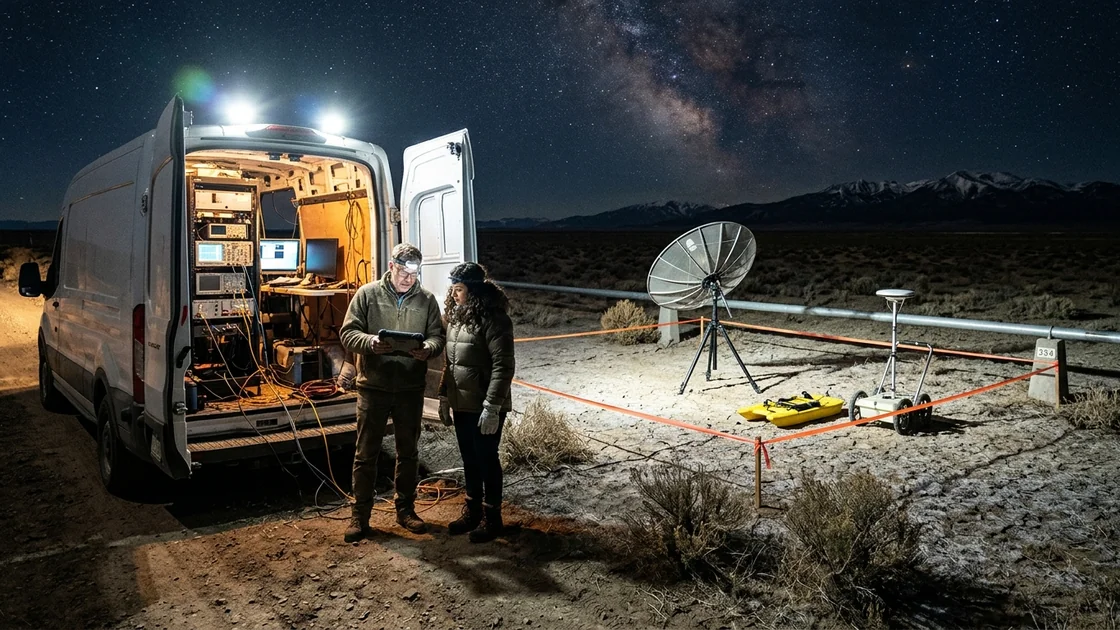
Julian Vance, a senior orbital timing engineer at a geodetic research facility in Boulder, Colorado, discovers an impossible anomaly buried in the rejected data logs of the global navigation satellite system. Within a desolate ten-meter square of alkali scrubland in the San Luis Valley, signals from overhead atomic clocks consistently register as having lost exactly three seconds. Convinced at first that he is chasing a receiver firmware bug or an illicit electronic warfare test, Julian travels to the high desert with a mobile cesium frequency standard and his colleague, atmospheric physicist Elena Rostova. Together they map an invisible, razor-sharp boundary where the vertical column of spacetime itself is recessed by three seconds, forcing starlight, radar pulses, and passing satellite oscillators into a localized chronological well anchored forty-two meters beneath the valley floor. Before government authorities seal the perimeter behind a classified fence, Julian and Elena conduct a series of precision experiments during a direct satellite transit, uncovering the subterranean mechanism that uses Earth's orbital navigation grid as a passive resonator to broadcast a message across the solar system.
Time, in Julian Vance’s experience, was not a river. It was a nervous, jittery thing that had to be bullied into behaving by seventy-two rubidium and cesium furnaces hurtling through the vacuum at fourteen thousand kilometers per hour.
At two-thirty in the morning inside the Center for Geodetic and Orbital Timing, the air smelled of ozone, stale dark-roast coffee, and the dry electrostatic warmth of server blades. The main telemetry room on the third floor of the Boulder facility was dark save for the cool amber and cyan glow of six curved monitors arranged in a crescent around Julian’s desk. Outside the triple-paned windows, the Flatirons were invisible, swallowed by a moonless October sky, though Julian knew their exact geodetic coordinates down to the fourth decimal place of a millimeter. They were creeping northeastward at a rate of a few millimeters a year, riding the slow tectonic sigh of the North American plate, and it was Julian’s job to make sure the satellites watching them didn't lie about the pace.
He rubbed his eyes, took a sip of lukewarm coffee, and returned his attention to the discard bin.
Most engineers at the Center spent their careers studying the clean data—the smoothed, Kalman-filtered navigation messages that allowed cargo ships to thread foggy straits, cell towers to synchronize packet handoffs, and seismometers to measure the swelling of magma chambers beneath dormant volcanoes. Julian, by temperament and mandate, lived in the trash. Specifically, he audited the Automated Residual Archive, known affectionately around the third floor as the Dead Letter Office.
Every twenty-four hours, twelve thousand continuous reference stations scattered across the globe—bolted to bedrock, welded to agricultural silos, perched on coastal buoys, and mounted on automated soil-survey crawlers—uploaded their raw carrier-phase observables in Receiver Independent Exchange format. Before those files entered the master terrestrial reference frame computation, a pre-processing sieve scrubbed out the noise. If a dump truck parked next to an antenna in Kansas and bounced a satellite signal off its aluminum trailer, creating a four-meter multipath error, the sieve caught the phase jump and threw the packet into the Dead Letter Office. If a solar flare ionized the upper atmosphere over Brazil, delaying the L1 frequency more than the L2 frequency beyond the threshold of the Klobuchar model, the sieve flagged the epoch and dumped it.
Normally, the archive was flushed every ninety days to free up petabytes on the basement storage arrays. Before each flush, Julian ran a diagnostic suite of his own devising—a set of Python scripts that combed the discarded epochs for systemic hardware degradation. A rubidium oscillator on an older Block IIR satellite didn't fail all at once; it developed a micro-hiccup, a picosecond shimmer in its Allan variance that showed up in the trash long before the Master Control Station down at Schriever Space Force Base raised a yellow flag.
That night, Julian wasn't looking for three seconds. In his line of work, three seconds wasn't an error; it was an absurdity.
Light travels at 299,792,458 meters per second in a vacuum. A clock error of one nanosecond—one billionth of a second—translates to roughly thirty centimeters of ranging error on the ground. A microsecond error pushes your calculated position off by three hundred meters, enough to put a landing airliner into a perimeter fence. A millisecond error puts you three hundred kilometers away, in the wrong county.
Three whole seconds meant a ranging error of 899,377 kilometers. That was more than twice the distance from the Earth to the Moon.
When the number -3.000000000 popped up in the terminal
window of his fourth monitor, Julian assumed his parsing script had
dropped a floating-point exponent.
He leaned forward, his wire-rimmed glasses reflecting the amber
monospace font, and typed a query to isolate the source header. The
rejected packets didn't come from a stationary bedrock monument. They
came from a node designated CO-SLV-AG09, a kinematic
reference rig operated by the Rio Grande Basin Agricultural and
Hydrological Cooperative in southern Colorado.
Julian pulled up the station metadata. CO-SLV-AG09 was a
high-precision, multi-frequency GNSS receiver mounted atop a motorized
gantry that rolled along a two-kilometer steel rail system spanning an
experimental arid-land irrigation tract in the San Luis Valley. Equipped
with an onboard rubidium discipline clock and a dual-frequency
choke-ring antenna, the gantry crawled back and forth across the desert
floor once every six hours, measuring soil subsidence, water-table
deflation, and evaporite crust heaving to sub-millimeter accuracy.
At least, it did for 1,990 meters of its two-kilometer track.
Julian opened the graphical plot of the gantry’s raw pseudorange residuals over the past ninety days. Across the screen stretched a flat, ruler-straight green line hovering around zero, fluctuating only by a few picoseconds of thermal noise as the cart trundled through the sagebrush and greasewood at half a meter per second.
Then, at precisely 1,412.00 meters from the western terminus of the
rail, the green line vanished. It didn't curve downward. It didn't
oscillate in the jagged teeth of multipath interference or cycle slips.
It simply stepped down, vertically and instantaneously, to
-3.000000000 seconds.
For twenty seconds of travel time—exactly ten meters of linear
track—the residual stayed locked on that impossible floor.
-3.00000000012. -2.99999999989.
-3.00000000004. The fractional picoseconds jittered with
the normal, healthy breath of atmospheric scintillation and satellite
clock drift, completely undisturbed. Then, as the gantry crossed the
1,422.00-meter mark, the line stepped straight back up to zero.
Six hours later, on the return trip, it happened again. Six hours after that, again. Three hundred and sixty times in the ninety-day cache.
"That's a leap-second table corruption," Julian muttered to the empty room.
He opened the raw RINEX observation file for the most recent transit, logged four hours ago at 22:14 UTC. If the receiver's firmware had glitched and misapplied the offset between GPS system time and Coordinated Universal Time, the integer seconds would jump. Except GPS time didn't use leap seconds; it had been diverging from UTC since January 6, 1980, and currently sat ahead by eighteen seconds. An eighteen-second jump in the output log was a classic rookie firmware bug. A three-second jump corresponded to no time-scale offset in human history. Not TAI, not GLONASS time, not Galileo system time, not BeiDou.
More importantly, a receiver clock jump affects how the ground station stamps its own local time. When a ground receiver's internal oscillator slips, the navigation processor immediately sees the discrepancy across the constellation, solves for the receiver clock bias as the fourth variable in its localization matrix, and corrects its internal counter.
Julian looked at the fourth column of the raw telemetry dump, where the gantry's internal rubidium clock was continuously compared via a buried fiber-optic reference link to the master base station at the western shed.
The gantry's clock hadn't jumped. Throughout the entire twenty-second transit across that ten-meter patch of dirt, the local clock on the moving cart had remained locked in phase with the base station shed to within four picoseconds.
It wasn't the ground clock that had lost three seconds. According to the demodulated navigation messages arriving on the L1, L2, and L5 carrier waves, the atomic clocks aboard the satellites themselves—nine GPS satellites, seven Galileo satellites, and six GLONASS satellites scattered across the hemisphere of the Colorado sky—had all simultaneously retarded by exactly three seconds the instant their signals entered that ten-meter box.
Julian sat back in his chair, the leather creaking in the quiet room. He stared at the constellation sky-plot for 22:14 UTC.
Satellite G04 had been high overhead at seventy-eight
degrees elevation. Satellite G19 had been low on the
southwestern horizon, skimming over the San Juan Mountains at sixteen
degrees. Satellite E11, a European Galileo bird with a
passive hydrogen maser clock, had been off to the northeast over
Nebraska. They were separated by tens of thousands of kilometers of
vacuum, moving on completely different orbital planes, broadcasting on
different frequency bands with different pseudorandom noise codes.
Yet every single radio wave arriving inside the geodesic boundary
between 37.641928° N, 105.789412° W and
37.641928° N, 105.789525° W carried a timestamp from three
seconds in the past.
At 8:45 the next morning, Dr. Elena Rostova stood behind Julian’s chair holding a ceramic mug of Earl Grey tea, her dark hair pinned up with a wooden pencil she had evidently forgotten was there. As the Center’s lead specialist in ionospheric propagation and tropospheric delay, she had spent fifteen years finding creative ways the Earth’s atmosphere could ruin a radio signal.
"Show me the carrier-to-noise density ratio again," she said, leaning closer to the center monitor.
Julian tapped a key, bringing up the C/N0 plots for all
twenty-two tracked satellites during the twenty-second window. "Dead
flat. Look at G04. Forty-nine decibel-hertz outside the
ten-meter zone, forty-nine decibel-hertz inside it. There’s no
attenuation. There’s Only a tiny sixty-millisecond flicker right at the
boundary crossing where the phase-locked loops lose lock,
wide-correlate, and re-acquire the code three seconds back in the
buffer."
Elena pursed her lips. "How wide is the receiver's correlator search window? A standard geodetic board searches maybe a few hundred chips of the C/A code if it loses lock. One millisecond is a full code epoch. If a signal suddenly shifts by three full seconds, the navigation processor shouldn't even know it’s three seconds old unless it’s reading the Z-count in the navigation message subframe."
"Exactly," Julian said, pointing at the decoded hexadecimal dump on the right-hand screen. "Look at the Handover Word in Subframe 1. A standard GPS subframe takes six seconds to transmit at fifty bits per second. Outside the boundary, at 22:14:06.000, the receiver finishes reading the timestamp for the next epoch: 22:14:12. Then the cart rolls across the 1,412-meter mark at 22:14:08. The tracking loop stutters for sixty milliseconds, re-locks onto the carrier, and two seconds later, when the next Handover Word finishes clocking in at 22:14:12 local time, the satellite says the time is 22:14:09."
"Wait." Elena set her mug down next to his keyboard. "A Handover Word is only transmitted once every six seconds, on the six-second mark. Why would a six-second frame boundary arrive on an odd three-second mark?"
Julian turned in his chair and looked up at her. His face had the pale, tight expression he got when a mathematical proof refused to close. "Because the entire wave train is delayed by three seconds, Elena. The bits that the satellite transmitted at 22:14:06—which reached the ground outside the box at 22:14:06.067 after sixty-seven milliseconds of vacuum transit—don't hit the antenna inside the box until 22:14:09.067."
Elena stared at the hexadecimal table for a long moment. Then she shook her head and laughed softly, a dry, pragmatic sound. "Julian, do you know what the refractive index of the atmosphere would have to be to slow an L-band radio wave down by three seconds over a vertical path of twenty thousand kilometers?"
"Roughly forty-five," Julian said promptly. "Which would give the air over southern Colorado the dielectric constant of distilled water and turn the sky into a mirror."
"And if the delay were happening only in the bottom ten meters near the ground," she continued, following the math aloud, "the refractive index inside that ten-meter cube would have to be ninety million. The speed of light would be three and a third meters per second. You could outrun a flashlight beam on a bicycle. Also, the impedance mismatch at the boundary would reflect ninety-nine point nine-nine percent of the incident energy, meaning the antenna inside wouldn't receive a whisper from the satellites, and anyone looking at that patch of dirt from the side would see a solid silver cube."
"I checked the satellite optical imagery," Julian said, minimizing the terminal to reveal a high-resolution orthophoto from a commercial imaging constellation taken three weeks prior. He zoomed in on the northern reach of the San Luis Valley, east of Highway 17. The landscape was a vast, pale expanse of rabbitbrush, saltbush, and dry alkaline clay, bisected by the thin silver line of the agricultural gantry rail. A red wireframe square, ten meters on a side, had been superimposed over the track at Marker 44. Inside the red square sat two scraggly greasewood bushes, a faint game trail made by pronghorn, and pale gray dirt. "No silver cube. You can see the shadows of the bushes. Sunlight goes in, bounces off the dirt, and comes back out to a camera in low Earth orbit without any obvious optical distortion."
"Then it's not a propagation delay," Elena concluded, folding her arms. "It’s a store-and-forward repeater. A meaconing rig."
"A meaconing rig," Julian repeated.
"White Sands Missile Range is two hundred miles south of there. Fort Carson and Schriever are just over the Sangre de Cristos to the east. Somebody in an electronic warfare directorate is testing a localized GNSS denial-of-service box. They have a directional receiving antenna picking up the real sky, shoving the digitized L-band spectrum into a three-second FIFO memory buffer, and re-radiating it down onto a ten-meter spot beam to see how automated vehicles handle a pure time-shift spoof."
Julian nodded slowly. It was the same hypothesis he had arrived at around four in the morning, right before he had pulled the deep archives.
"That would make complete sense," Julian said, "if not for two things. First, to spoof twenty-two satellites across four constellations simultaneously without altering the relative geometric phase between them, a single ground transmitter has to broadcast all twenty-two signals from one point. When the gantry rolls ten meters across the box, the carrier phases of all twenty-two signals should shift identically along the vector pointing toward the spoofing tower."
He clicked open a polar phase-residual plot. "They don't. As the cart
moves from meter one to meter ten inside the box, the carrier phase of
G04 changes according to a source seventy-eight degrees
overhead. The phase of G19 changes according to a source
sixteen degrees in the southwest. Every signal inside that ten-meter
square is arriving from the exact geometric direction of the actual
satellite in the sky, down to half a millimeter of wavelength."
Elena frowned, leaning down until her nose was six inches from the glass. "You'd need a phased-array dome covering the whole sky to synthesize those wavefront angles."
"And here's the second thing," Julian said. He opened another window showing a grainy, rainbow-colored interferogram—a Synthetic Aperture Radar phase-difference map generated by the European Space Agency’s Sentinel-1A satellite on two passes twelve days apart. "Sentinel-1 operates in the C-band at 5.4 gigahertz. It’s an active radar; it doesn't broadcast timestamps, it just bounces a chirp off the dirt and measures the phase of the echo to track ground deformation. Look at the pixel right over Marker 44."
In the sea of smooth magenta and violet fringes representing the flat valley floor, a single ten-meter resolution cell was a speckled square of pure white static.
"The ESA automated processor masks that pixel out as decorrelated noise—it assumes there's a small stock pond there whose water surface ripples in the wind," Julian said. "Why? Because the radar pulse bouncing off that ten-meter square doesn't come back with the rest of the swath echo. By the time the echo from that square returns to orbit three seconds later, the Sentinel satellite has traveled twenty-one kilometers north along its orbital track and its receiver window has been closed for two and a half seconds."
Elena slowly straightened up. She pulled the wooden pencil out of her hair, letting her dark curls fall around her shoulders, and tapped the eraser end against her chin.
"When did this start?" she asked quietly.
"The agricultural co-op installed the rail gantry four years ago. I pulled the raw tapes from their first week of calibration in May 2020. The three-second drop was there on run number one." Julian pointed back to the Sentinel radar window. "And I pulled archive C-band radar passes from the Canadian Radarsat-1 mission in 1998, and European ERS-1 passes from 1992. That single ten-meter pixel has been returning zero-coherence dropouts since the first synthetic aperture radar satellite achieved orbit."
The hum of the server cooling fans filled the silence between them. Outside, morning sunlight had finally crested the plains to the east, casting a bright, sharp rectangle across the linoleum floor.
"Who manages the agricultural rail?" Elena asked.
"A retired USGS hydrologist named Harlan Mercer. He works part-time for the Rio Grande Water Conservation District out of Alamosa. I called his office at seven-thirty." Julian picked up a yellow legal pad covered in his neat, cramped handwriting. "When I asked him about Marker 44 on the Section Nine rail, he laughed and said, 'Oh, the dead spot.' Apparently, the telemetry modem on the cart always threw a synchronization fault there because the timestamps in the packet headers went backward and crashed their SQL database. Three years ago, his nephew wrote a Python patch on the shed computer that just drops all GNSS data logged between shaft-encoder ticks 28,240 and 28,440."
"They just patched around it," Elena said, half in disbelief, half in awe.
"To a hydrologist, a ten-meter gap in a two-kilometer water-table profile is a nuisance you interpolate across so you can go home for dinner," Julian said. He stood up and reached for his fleece jacket hanging on the back of the door. "I already signed out the metrology van and the portable cesium standard from the downstairs bay."
Elena looked at his bloodshot eyes, then at his jacket. "You haven't slept since yesterday."
"I can sleep in the passenger seat once we get past Fairplay," Julian said, tossing her the keys to the heavy-duty Ford transit van. "Assuming you want to bring the optical time-domain reflectometer and that high-speed Rubidium pair you've been calibrating."
Elena caught the keys in one hand. For a second she looked toward her own office door, where a stack of grant renewal forms for the National Science Foundation waited on her blotter. Then she looked back at the crisp, impossible step-function on Julian’s screen—a three-second cliff carved into the fabric of a high-desert scrub flat.
"Give me twenty minutes to pack the fiber spools and the gravimeter," she said.
The San Luis Valley does not look like Colorado; it looks like the floor of a drained ocean left to bake on the roof of the world. Flanked on the west by the rolling volcanic whalebacks of the San Juan Mountains and walled in on the east by the jagged, fourteen-thousand-foot granite teeth of the Sangre de Cristos, the valley sits at seven thousand five hundred feet above sea level—an immense, pancake-flat tectonic rift basin eighty miles long and fifty miles wide.
By two in the afternoon, the metrology van had left the paved two-lane ribbon of Highway 17 behind, bumping eastward along a graded county caliche road that threw up a mile-long plume of chalky white dust in their rearview mirrors. Inside the reinforced cargo bay behind their seats, two hundred pounds of shock-mounted instrumentation hummed on pure sine-wave inverters. The centerpiece of the rack was a Keysight high-performance cesium-133 atomic beam frequency standard, its magnetic state-selection cavity kept alive by dual AGM battery banks so its phase wouldn't drift by a femtosecond during the drive down from Boulder.
Harlan Mercer was waiting for them at the western terminus of the Section Nine tract, leaning against the dusty fender of a dented green pickup truck beside a corrugated tin equipment shed. He was in his late sixties, wearing a faded canvas barn coat, a silver-bellied Stetson stained dark around the sweatband, and mud-caked Ariat boots.
"You're the folks from Boulder," Harlan said as Julian and Elena climbed out into the sharp, dry wind. The air smelled of cold alkali dust and crushed sage. "Never thought my busted moisture cart would bring out a whole laboratory on wheels. Usually I can't even get the Trimble rep in Denver to return an email."
"We appreciate you letting us onto the lease, Mr. Mercer," Julian said, shaking the man's calloused hand. He looked past the tin shed to where a waist-high galvanized steel truss rail ran straight as a surveyor's laser toward the eastern mountains, supported every four meters by concrete piers sunk into the pale crust. About half a mile down the track, the solar-powered gantry cart sat parked like a giant aluminum sawhorse.
"Call me Harlan. And there ain't much to let you onto," the old hydrologist said, squinting toward the Sangre de Cristos, where snow banners were blowing off the peak of Blanca Massif against a sky so deep and cobalt blue it looked almost pressurized. "Sixteen hundred acres of sodium sulfate dirt, greasewood, and alkaline groundwater three feet down that'll rust a shovel blade in a month. I parked the crawler back at Marker 30 so it wouldn't be in your way. You're looking for Marker 44, about fourteen hundred meters out."
"Have you ever noticed anything unusual out at Marker 44 when you walk the line?" Elena asked, pulling her windbreaker tight around her neck.
Harlan scratched his jaw. "Unusual how? Like a sinkhole?"
"Anything," she said. "Dead vegetation, strange sounds, compass deviations, frost melting differently in the winter?"
Harlan thought about it for a long moment, taking the question seriously in the way of a man who had spent forty years reading desert ground. "No," he said finally. "Greasewood grows right through it same as everywhere else. Jackrabbits run across it. Only thing I ever noticed—and I figured it was just the wind coming off the dunes down south—is when you're walking the gravel maintenance path next to the rail right there on a dead calm summer morning, the air feels a mite thicker on your face for about ten paces. Like walking out of the sun into a cellar doorway, except the temperature don't drop. And my cell phone always drops the call if I'm talking to my wife while I grease the bearings at Pier 354."
He gestured down the dirt two-track that paralleled the steel rail. "Road's dry enough to support your van if you stay out of the borrow ditch. Gate lock combination is 1974. Holler if you get bogged to the axles and I'll come pull you out with the tractor."
They thanked him and drove slowly down the service track once his
green pickup had rattled back toward the highway. Every four meters,
numbered aluminum tags riveted to the concrete piers ticked past the
passenger window: 340, 341,
342.
At Pier 350—1,400 meters from the shed—Julian eased the
van to a stop, twelve meters short of the anomaly's western edge.
He killed the engine. In the sudden quiet, the only sounds were the ticking of the cooling exhaust manifold, the low whir of the cesium clock’s cooling fan in the back, and the dry hiss of the wind combing through the rabbitbrush.
Julian and Elena stepped out and walked forward along the gravel path
to Pier 353. The aluminum tag read 1412m. Two
meters beyond it sat Pier 354, and beyond that,
355, 356, up to 357 at
1428m.
Between Pier 353 and the midpoint past Pier
355 lay ten meters of completely unremarkable Colorado
desert. The soil was crusted with white alkali efflorescence, cracked
into dry polygonal plates like an old mud puddle. Three clumps of thorny
Sarcobatus vermiculatus—black greasewood—grew to knee height
near the center. A blown-in tumbleweed was wedged beneath the steel rail
at the 1,416-meter mark. Fifty yards to the north, a lone fence post
leaned at a drunken angle, topped by a rusted strand of barbed wire that
had snapped decades ago.
Julian stopped at the 1,410-meter mark, two meters short of the boundary according to the satellite logs. He crouched down and picked up a pebble of gray rhyolite, weighing it in his palm.
"Throw it," Elena said quietly beside him.
Julian tossed the pebble underhand. It arced through the crisp air across the 1,412-meter line, cleared the steel rail, and landed with a dry clack in the alkali crust right in the center of the ten-meter zone, kicking up a tiny puff of white dust.
It hadn't vanished. It hadn't frozen in midair for three seconds. The puff of dust had risen and drifted away on the breeze in complete, seamless continuity with the wind blowing past Julian’s ears.
"Horizontal light paths at ground level are unaffected," Elena murmured, watching the pebble. "And local Newtonian mechanics are continuous. Otherwise the air molecules blowing across that line at ten miles an hour would pile up into a shockwave."
"Let's see what the satellites say," Julian said.
They worked with the practiced economy of people who had set up field campaigns in places far less hospitable than a flat desert road. First, they erected Base Station Alpha three meters behind the van, well outside the zone, leveling a heavy Dorne & Margolin choke-ring antenna on a surveyor's tripod and connecting it directly to the 10-megahertz phase output of the cesium beam standard inside the cargo bay.
Next, Julian assembled a non-magnetic fiberglass surveying cart—a lightweight four-wheeled push-frame riding on pneumatic bicycle tires—and mounted Rover Antenna Beta on its central mast. Instead of relying on a radio modem link, they unspooled fifty meters of phase-stabilized, armored tactical fiber-optic cable, coupling the rover directly to the van’s dual-channel phase comparator and a ruggedized Panasonic Toughbook balanced on the open rear bumper.
"Base Alpha is locked," Elena called out from the back of the van, her fingers flying across the Toughbook’s trackpad. "Tracking eleven GPS, eight Galileo, six GLONASS. Carrier-phase double-differences between Base and Rover are zeroed to within zero point eight millimeters. Both receivers are disciplined directly to the cesium standard through the fiber."
Julian stood behind the fiberglass cart at the 1,410-meter mark,
holding a handheld tablet mirrored to the Toughbook screen via a local
Ethernet tether. On the display, twenty-five horizontal green bars
represented the phase-lock loops of the overhead constellation. Below
them, a rolling strip-chart plotted the time-of-arrival residual in
nanoseconds. The trace sat dead on 0.00 ns.
"Moving forward at ten centimeters per second," Julian said.
He pushed the cart slowly along the compacted gravel path beside the rail. His boots crunched on the dry caliche. The rubber tires rolled over the cracks in the mud.
1411.00 meters. The green bars held steady.
1411.50 meters.
1411.80 meters.
1411.95 meters.
Julian slowed his pace to a glacial creep, watching the center of the
round white choke-ring antenna inch past Pier 353.
The physical rim of the aluminum antenna crossed the 1,412.00-meter line first. Nothing happened. The phase center of the L1/L2 patch element sat at the exact geometric center of the concentric rings.
When the central brass mounting bolt of the antenna crossed
37.641928° N, 105.789412° W, every single green bar on
Julian’s tablet flashed red simultaneously.
On the strip-chart, the zero-nanosecond trace broke off as cleanly as if someone had cut it with a razor blade. For fifty-eight milliseconds—three frames of the display refresh—the receiver's correlators hunted wildly across the noise floor. Then all twenty-five bars snapped back to solid green.
The numeric readout at the top of the screen, which had read
CLOCK BIAS: +0.000000002 s, now read in stark crimson
characters:
CLOCK BIAS: -2.999999998 s
Julian froze, his hands still gripping the fiberglass push-bar. Because the push-bar was a meter long, he was standing at 1,411 meters—outside the zone—while the antenna at the front of the cart sat fifty centimeters inside it.
"Elena," he said, his voice tight against the wind. "Are you seeing the fiber return?"
Ten meters behind him at the rear of the van, Elena was staring at the rack-mounted oscilloscope where the 10-megahertz reference sine wave sent out to the cart was compared against its reflected return down the same fifty-meter glass fiber.
"The fiber round-trip phase hasn't moved by half a picosecond," she called back, her voice rising half an octave. "The clock signal going out to the rover along the ground and coming back is completely unaffected! Wait—pull the cart back ten centimeters!"
Julian eased the cart backward. As the brass center bolt of the
antenna crossed back over the invisible plane at 1,412.00 meters, the
twenty-five bars blinked red for fifty-eight milliseconds and snapped
back to +0.000000002 s.
He pushed it forward two inches. -2.999999998 s.
He pulled it back two inches. +0.000000002 s.
"Look at the transition width," Julian breathed. He locked the cart's wheel brakes right on the cusp and turned the horizontal fine-adjustment micrometer screw built into the tripod head, sliding the antenna forward one millimeter at a time.
At millimeter four, the signal was wholly in the present. At millimeter five, there was a three-millimeter-wide dead zone of destructive phase interference where the carrier-to-noise ratio dropped by twenty decibels—half the antenna patch receiving the present wave, half receiving the wave from three seconds ago. By millimeter eight, the lock was wholly three seconds in the past.
"The boundary thickness is less than the wavelength of the L1 carrier," Julian said, pulling a wooden surveyor's stake and a roll of neon-orange flagging tape from the cart's basket. He drove the stake into the alkali dirt directly beneath a plumb bob hanging from the antenna center. "There's no gradient. No diffraction fringe wider than a fingernail."
For the next two hours, while the afternoon sun slid down toward the volcanic peaks of the San Juans and the desert shadows lengthened into long purple spears across the valley floor, Julian and Elena mapped the perimeter with the micrometer and the plumb bob.
Every time the antenna crossed the threshold, they drove a stake.
They expected an irregular oval, perhaps a geological lens following an underground fault line or a mineral vein. What emerged in the greasewood scrub, delineated by taut strings of neon-orange surveyor's ribbon fluttering in the breeze, made the hair on the back of Julian’s neck stand up.
It was a square.
Not a rough square. When Elena set up the optical total station at
Base Alpha and shot laser distances to the four corner prisms Julian
held over the corner stakes, the north-south sides measured
10.0000 meters and 10.0001 meters. The
east-west sides measured 10.0000 meters and
9.9999 meters. The interior corner angles were
90° 00' 00.0".
"Look at the orientation," Julian said as they stood beside the van, looking at the surveyed polygon overlaid on the geodetic grid. "It's not aligned to magnetic north. And it's off from the local WGS84 meridian by zero point zero one four degrees."
Elena typed a coordinate transformation into the Toughbook, her fingers trembling slightly from the cold and the adrenaline. "Zero point zero one four degrees isn't random, Julian. That's the precession of the equinoxes and polar wander over the last few centuries. Wait... let me run the Earth Orientation Parameter pole-path backward."
She hit Enter. A trajectory of the Earth’s true rotational axis plotted backward across the decades.
"No," she whispered, scrolling further back through the astronomical nutation tables. "Not decades. That square is aligned to within half an arcsecond of the celestial J2000 reference meridian—or rather, the mean rotational pole of the Earth roughly eleven thousand four hundred years ago."
Julian looked back at the orange ribbon square bisecting the galvanized steel irrigation track. The sun was touching the western ridges now, turning the white alkali dust between the stakes the color of dried bone.
"Step inside it with me," Julian said.
He disconnected Rover Beta from the cart and picked up one of their two portable Symmetricom rubidium frequency standards—a lunchbox-sized anodized aluminum unit powered by an internal lithium pack, displaying a ten-digit LED readout synchronized to the van's master cesium beam.
Elena carried the second identical rubidium unit. Before leaving the rear bumper of the van, they placed the two units side by side and coupled their one-pulse-per-second BNC outputs into a time-interval counter.
The counter read 0.000000004 s—four nanoseconds of fixed
cable offset. The two atomic clocks were beating in lockstep.
"I'll stay outside the west ribbon with Clock A," Elena said, stopping six inches short of the taut orange tape between the northwest and southwest stakes. "You take Clock B to the center, hold it there for sixty seconds, and walk it back out."
Julian nodded. He held the twenty-pound aluminum box against his chest, looked down at his boots, and stepped over the orange ribbon into the square.
He felt nothing. Wait—no, Harlan Mercer had been right. As his head and shoulders crossed the vertical plane above the ribbon, there was the faintest, almost imperceptible tactile sensation across his cheeks and the bridge of his nose, like walking through a cobweb that wasn't there, or passing through an invisible acoustic node in a concert hall where the ambient room tone subtly shifted its phase.
Once he was two paces inside, the sensation vanished. He walked to the center of the ten-meter square, stepping around a clump of black greasewood, and stood between the concrete piers of the irrigation rail.
He looked back at Elena, five meters away.
"Can you hear me normally?" he called out.
"Loud and clear," she answered immediately. There was no three-second lag in their voices. When she raised her left hand, he saw her raise it at the exact instant her lips moved.
"Read me your digits on Clock A!" Julian said, looking down at the glowing red LED numerals on the box in his arms.
"Twenty-one, forty-two, fifteen... sixteen... seventeen..." Elena called out, her voice crisp in the cold evening air.
Julian’s stomach gave a strange, hollow lurch. On the front panel of
Clock B in his hands, the red LEDs ticked calmly upward:
21:42:15... 16... 17...
"They're identical," Julian said.
He stood in the center of the square for a full minute, watching the seconds climb in unison with Elena's voice, then walked back across the orange ribbon and set Clock B down on the van’s tailgate beside Clock A.
Elena plugged the BNC coax into the time-interval counter.
0.000000004 s.
Not even a picosecond of relativistic drift beyond normal thermal walk. A physical atomic clock carried into the square along the ground, held inside, and carried back out did not lose three seconds.
"Okay," Elena said, exhaling a long white plume of breath into the twilight. She grabbed a whiteboard marker from the van door and began scribbling equations directly onto the white painted sheet metal of the van's side panel. "Let's list our boundary conditions before we go crazy. One: A clock carried horizontally across the vertical walls of the square experiences zero proper-time discontinuity relative to a clock outside. Two: Acoustic waves and optical light traveling horizontally through the square at ground level experience zero delay."
"Three," Julian added, tapping the Toughbook screen where Rover Beta
still sat parked just inside the western tape, stubbornly reading
-3.000000000 seconds across the entire GNSS constellation.
"Any electromagnetic signal arriving inside the square from orbit
arrives with its phase and modulation delayed by three seconds,
regardless of frequency—because it affects L1 at 1.575 gigahertz, L2 at
1.227 gigahertz, and Sentinel radar at 5.4 gigahertz identically, with
zero dispersion."
Elena paused with the marker poised against the van's metal skin. "Wait. What is the lowest elevation satellite Rover Beta is currently tracking inside the square?"
Julian checked the receiver sky-plot. "Satellite R08, a
GLONASS bird over Arizona. Fourteen degrees above the southwestern
horizon."
"Think about the geometry of that!" Elena said, turning sharply
toward him, her eyes wide in the gathering dusk. "Rover Beta is sitting
only fifty centimeters inside the western boundary tape. If
R08 is in the southwest at an angle of fourteen degrees
above the ground, the line of sight from R08 to that
antenna doesn't come down from high above the square. It enters the
western side of the square at a height of only twelve and a half
centimeters above the orange tape!"
Julian stared at her, then looked down at the antenna sitting half a meter inside the ribbon, then up at the low southwestern sky where the first evening stars were emerging in the purple glow above the San Juans.
"A ray coming in at fourteen degrees only travels half a meter
through the air above the square before hitting the antenna," Julian
said slowly. "Whereas G04 is directly overhead at eighty
degrees, traveling straight down through whatever column is above the
square."
"Yet both of them are delayed by exactly 3.000000000 seconds," Elena said. "Wait. Have we tested a ground transmitter across the boundary? Not fiber—free-space radio!"
She dived into the back of the van and rummaged through the calibration kit until she emerged with a portable L-band vector signal generator and a small directional log-periodic horn antenna. They connected the signal generator to the master cesium clock, set it to broadcast a simulated GPS PRN-32 ranging code at 1575.42 megahertz, and mounted the horn on a tripod five meters outside the western tape, aimed horizontally across the ribbon at Rover Beta.
When Julian switched the horn on, Rover Beta acquired PRN-32 instantly.
"What's the pseudorange residual on PRN-32?" Elena demanded, peering over his shoulder at the Toughbook.
Julian pointed at the bottom line of the channel table. With the horn
antenna mounted at a height of 1.2 meters above the dirt—the exact same
height as the Rover antenna inside the square—the signal from PRN-32
showed a clock bias of 0.000000000 s.
"Zero delay," Julian said. "When the wave enters horizontally at zero degrees elevation, it doesn't lose three seconds."
"Raise the horn," Elena said.
They didn't have a crane, so Julian climbed onto the roof of the metrology van using the rear ladder, taking the horn antenna and a twenty-meter coax cable with him. Standing on the aluminum roof rack three meters above the desert floor, he aimed the horn down at a twenty-degree angle into the square, pointing at Rover Beta.
"Still zero!" Elena shouted up from the tailgate.
"Push the cart closer to the van so the elevation angle gets steeper!" Julian called down.
Elena unbraked the fiberglass cart inside the square and pulled it backward until the Rover antenna sat just five centimeters inside the western ribbon, almost directly beneath the rear bumper of the van where Julian stood on the roof. Now the angle from the horn down to the antenna was sixty-five degrees above the horizontal.
"Still zero!" Elena yelled.
Julian lowered the horn on the roof, frowning down at the orange square in the beam of the van's rear floodlights. A signal broadcast from the roof of the van at sixty-five degrees elevation crossed into the square with zero delay. Yet a satellite signal arriving from fourteen degrees elevation—a much shallower angle—lost three full seconds.
"It's not the angle of entry into the box at ground level," Julian said, climbing slowly down the ladder and jumping onto the gravel. His breath came fast in the freezing night air. "Why did the satellite at fourteen degrees get delayed, while the horn on the van roof at sixty-five degrees didn't?"
Elena stared out across the dark valley. Above them, the high-altitude night had fallen in earnest, unveiling the Milky Way in a blazing, silver-dusted arch from horizon to horizon.
"Distance?" she murmured. "The van roof is three meters away. The satellite is twenty thousand kilometers away. No—Wait. If the anomaly is a vertical column extending straight up from that ten-meter square into space, then a satellite at fourteen degrees elevation doesn't travel down the column! A ray from fourteen degrees in the southwest only intersects a vertical column for at most ten meters right before it hits the ground!"
"Right," Julian said, his mind racing through the three-dimensional geometry. "And a ray from our horn on the van roof also intersects that same bottom three meters of the column! Why does the ray from space lose three seconds crossing the boundary of that ten-meter square, while the ray from the van roof three meters away crosses the exact same boundary into the exact same antenna at the exact same frequency and loses nothing?"
For ten seconds neither of them spoke. The cesium clock hummed in the van. Somewhere far out in the sagebrush, a coyote yipped twice and went silent.
"Because the delay doesn't happen in the air above the square," Julian whispered.
Elena turned her head slowly to look at him in the harsh white glare of the floodlights. "What?"
"Think about what a ground-based horn antenna on the van roof has in common with the fiber-optic cable, and with our voices, and with the rubidium clock I carried inside," Julian said, stepping toward the whiteboard scrawled on the side of the van. "Everything originating inside the local terrestrial reference frame—connected to the ground, sitting in the valley—sees zero delay across that boundary. What is the one thing all twenty-five satellites, and the Sentinel radar in low Earth orbit, have in common?"
"They're outside the atmosphere," Elena said. "Or they're above a specific altitude boundary. Wait—if the delay boundary isn't a vertical box with tall walls... what if it's an optical projection?"
"No, if it were a lens high up in the ionosphere, its shadow on the ground would move as the satellites moved across the sky!" Julian countered, excitement sharpening his voice. "A lens at a hundred kilometers altitude would cast a shadow miles away when a satellite was at fourteen degrees elevation! For every satellite from fourteen degrees to ninety degrees to drop by three seconds at the exact same millimeter of dirt on the ground, the boundary has to be right here at the ground!"
"Then how does the boundary at the ground distinguish between a
1.575-gigahertz photon coming from your horn on the van roof and a
1.575-gigahertz photon coming from Satellite G19?" Elena
demanded. "A photon doesn't carry a passport saying how far it
traveled!"
"A single photon doesn't," Julian said, his eyes locking onto hers. "Wait. What about the wavefront curvature? No, over an antenna aperture of thirty centimeters, a wave from twenty meters away is already nearly planar. What else is different between the van roof and orbit?"
"Gravitational potential," Elena breathed.
The words hung in the freezing air between them.
"General relativity," she said, her voice dropping to an intense whisper as she reached for the marker again. "A photon climbing out of or falling into Earth's gravitational well undergoes gravitational blueshift. A clock in GPS orbit at twenty thousand kilometers sitsHigher in the gravitational potential well of the Earth than a clock on the ground—its fractional frequency shift is \(\Delta \Phi / c^2\), about \(+5.3 \times 10^{-10}\). That's why satellite clocks run forty-five microseconds per day faster than ground clocks before we correct them in the factory."
"And a signal from the van roof is at the exact same gravitational potential \(\Phi\) as the ground receiver," Julian said, his pulse hammering in his temples. "Wait. Are you saying the ten-meter square has a different gravitational potential?"
"If the ten-meter square had a massive classical gravitational well deep enough to shift clocks by three seconds, the tidal forces at the one-millimeter boundary would rip the van into subatomic confetti and swallow the Earth," Elena said rapidly, scribbling metric tensor components onto the van door. "In linearized general relativity, the spacetime interval is \(ds^2 = -(1 + 2\Phi/c^2)c^2 dt^2 + (1 - 2\Phi/c^2)(dx^2 + dy^2 + dz^2)\). Classical gravity is the gradient of \(\Phi\)—acceleration is \(-\nabla \Phi\). If \(\Phi\) jumps, \(-\nabla \Phi\) is infinite."
"Unless it's a pure gauge shift—an topological phase defect or an Aharonov-Bohm effect for gravity!" Julian said. "In quantum electrodynamics, if you have a magnetic flux tube confined inside a solenoid, the magnetic field outside is zero, the force on a particle is zero, but the vector potential \(A_\mu\) is non-zero, so any wave function crossing the boundary acquires a discrete phase shift!"
Elena stopped writing and stared at the equation on the white paint.
"A gravitational holonomy," she whispered. "A localized topological defect where the temporal metric component is phase-shifted relative to the asymptotic flatness of space at infinity, but locally compensated by the ground substrate so there's zero local force gradient along the crust. Anything coupled to the local crustal metric frame—us, the van, the air, the fiber—shares the local gauge. Anything arriving from outside the Earth's local gravitational potential dome has to resolve the boundary condition across the metric seam when it couples to a detector inside the square!"
"We can test that right now," Julian said, pointing straight up at the glittering zenith of the desert night sky. "Starlight comes from asymptotic infinity—completely outside Earth's gravitational well. If an electromagnetic wave from space resolves a three-second temporal holonomy when it couples inside that ten-meter square, then the sky seen from inside the square isn't just delayed in radio timestamps."
"The stars," Elena said, already turning toward the van's optical equipment bay. "Earth rotates at fifteen arcseconds of sky per second of time. If incoming starlight inside that square is coupled to a frame three seconds behind the exterior metric, the entire celestial sphere seen from inside the ribbon has to be rotated backward by forty-five arcseconds in right ascension!"
They didn't use a telescope; they had something vastly more precise. In the rear rack sat a Leica TM6100A motorized astronomical theodolite paired with a cooled scientific CMOS star-tracker camera, calibrated to measure vertical deflection of the plumb line to a tenth of an arcsecond.
Julian set up the heavy birch tripod inside the center of the
ten-meter square, leveling the tribrach bubbles until the digital tilt
sensor read 0.0" on both axes. They ran a power and data
tether out over the western ribbon to the Toughbook.
Six meters outside the square, Elena set up their secondary optical total station, locking a retroreflector prism onto the side of Julian’s theodolite inside the square so they knew the exact relative azimuthal orientation of the two instruments down to 0.1 arcseconds.
"Remember when we shot the corner prisms earlier?" Elena said, rubbing her gloved hands together as the temperature dropped below twenty degrees Fahrenheit. "My total station outside the square shot the laser into your prism inside the square and measured ten point zero zero zero meters. That proves the terrestrial laser beam stayed inside the local crustal frame."
"Now let's look at Vega," Julian said.
Alpha Lyrae—Vega—hung high in the northwestern sky, a brilliant blue-white diamond cutting through the crisp, thin air of the seven-thousand-five-hundred-foot basin.
Elena sighted Vega first using the optical station outside the
square, logging the precise centroid of the star’s diffraction disk on
the sensor crosshairs synchronized to the cesium clock’s
one-pulse-per-second tick. At 03:12:00.000 UTC, she locked
the apparent altitude and azimuth of the star.
"Outside coordinates locked," she called out. "Right ascension matches the US Naval Observatory ephemeris to zero point two arcseconds."
Inside the square, standing between the greasewood bushes with his breath frosting his collar, Julian triggered the CMOS shutter on the Leica theodolite, slaved to the exact same azimuth and elevation angles relative to the laser reference line between the two tripods.
On the Toughbook screen, the two star-field images overlaid in red and cyan.
Every star in the field of view of the camera inside the square—Vega, Epsilon Lyrae, Zeta Lyrae, and forty-two dimmer background stars down to twelfth magnitude—sat cleanly beside its exterior twin.
Not scattered randomly. Not blurred. Every cyan star captured inside
the square was displaced strictly eastward along its parallel of
declination—backward against the rotation of the Earth—by
45.123 arcseconds.
Because the Earth takes 86,164.0905 seconds to complete one sidereal
rotation of 360 degrees, in 3.000000 seconds of universal
time the sky rotates by 45.1232 arcseconds.
Julian stood in the center of the square and looked up with his naked eyes. Forty-five arcseconds was less than a fortieth of the diameter of the full moon—far too small a shift for the human retina to resolve without magnification. Yet knowing it was there changed the sky above him into something alien and vertiginous.
He was standing inside a ten-meter window on the floor of the San Luis Valley, and the light hitting his corneas from the Milky Way had left Vega three seconds earlier than the light hitting Elena’s corneas twenty feet away.
"Wait a minute," Julian said slowly, still looking up at the stars. "If the starlight inside the square is three seconds older... what happens if I stand one millimeter outside the square and look through the air above the square at a low star on the other side?"
They tried it ten minutes later. Elena sighted a bright star in Taurus rising at twenty degrees elevation in the east, positioning her tripod outside the western ribbon so the line of sight passed directly through the ten-meter cube of air three meters above the dirt inside the square, before hitting her lens outside the square.
The star showed zero displacement.
Then Julian moved his tripod inside the square, five centimeters inside the eastern ribbon, looking out through only five centimeters of interior air toward the western sky.
The displacement was the full 45.123 arcseconds.
"It doesn't matter how much of the air column the light passes through," Elena whispered, staring at the dual star overlay on the laptop. "What matters is where the photon collapses. Where the electromagnetic wave exchanges momentum with matter—whether that's the copper electrons in the GNSS antenna or the silicon photodiode in the camera sensor! Inside that ten-meter square, any matter interacting with radiation that originated outside the local terrestrial metric resolves the interaction three seconds back along the worldline of the source."
"Wait," Julian said, his mind leaping downward instead of upward. "Why is it a ten-meter square with ninety-degree corners aligned to the rotational pole of the Earth from eleven thousand years ago? Topological defects from the early universe aren't square. Cosmic strings aren't rectilinear boxes ten meters wide."
He looked down at the frozen white alkali crust beneath his boots.
"Because the metric boundary isn't natural," Julian said. "It's a projection from below."
They went back to the van and unloaded the heaviest piece of gear left in the cargo bay: a dual-frequency Ground Penetrating Radar sled operating at 100 and 400 megahertz, along with a high-sensitivity Overhauser proton-precession magnetometer.
First, Elena walked the magnetometer grid across the square. The Earth's ambient magnetic field in southern Colorado sat around 51,400 nanoteslas. As she crossed the orange ribbon into the square, the magnetometer readout didn't spike as it would over buried iron or volcanic basalt; instead, the high-frequency micropulsations of the magnetosphere—caused by solar wind buffeting the upper ionosphere—showed the exact same three-second phase lag relative to the base magnetometer outside, while the static core field of the Earth remained smooth and flat.
Then Julian dragged the bright yellow GPR sled across the alkali crust from west to east, starting ten meters outside the square, crossing the ribbon, passing between the steel piers of the irrigation rail, and exiting out the eastern side.
On the Toughbook screen, the subterranean cross-section scrolled into view like a grayscale sonar slice of the valley floor.
Outside the square, the geology was textbook San Luis Basin fill: the top two meters showed laminated lake clays and evaporite salts; beneath that lay thirty-eight meters of alluvial sand, gravel lenses, and cobbles washed down from the Sangre de Cristos during the Pleistocene; and at forty-two meters depth lay the jagged, sloping acoustic reflector of the Precambrian basement rock.
Until the yellow sled crossed the western orange ribbon at
1412.00 meters.
The instant the radar transducer entered the square, the top forty-two meters of clay, sand, and gravel looked identical—the alluvial layers ran continuously right across the vertical boundary without a single disturbed pebble or backfilled trench. Whatever lay below had not been dug down to from the surface since the Pleistocene glaciers melted at the end of the last Ice Age.
And at a depth of 42.000 meters beneath the square,
resting directly atop the Precambrian basement rock, the jagged granite
reflector vanished.
In its place sat a horizontal line so geometrically flat, and so acoustically reflective, that it saturated the 16-bit dynamic range of the radar receiver in a solid white bar.
The white bar began at 1412.00 meters, extended
horizontally for 10.000 meters at a depth of forty-two
meters, and terminated at a razor-sharp ninety-degree edge at
1422.00 meters.
"It's a plate," Elena whispered, touching the glowing white line on the screen with the tip of her gloved index finger. "Buried under forty-two meters of undisturbed Pleistocene lake bed. Ten meters by ten meters. Aligned to the true rotational pole of the Earth at the end of the Younger Dryas, eleven thousand four hundred years ago."
"Look at the secondary radar echo below the plate," Julian said, zooming out on the vertical time-axis of the GPR profile.
Normally, a GPR listens for a few hundred nanoseconds after firing a pulse—enough time for radio waves to travel down fifty meters through wet soil and bounce back. Because the radar sled was synced to their custom acquisition software, Julian opened the continuous passive listening waterfall on the 400-megahertz channel.
Every time the sled fired a radar pulse straight down into the dirt from inside the square, a primary reflection bounced back off the forty-two-meter plate in 840 nanoseconds—the normal travel time through forty-two meters of saturated sand and clay.
Then, 3.000000000 seconds later, a second,
phase-inverted echo of the exact same radar pulse arrived from straight
down, with zero attenuation, as if the pulse had entered the plate,
circulated in a lossless three-second metric delay cavity, and been
re-emitted straight up toward the sky.
"It's not just passive," Julian said, his voice barely audible over the desert wind. "It's a phase-conjugate metric resonator. Anything that hits that plate along the zenith axis—or couples into the column it projects above itself—is buffered for three seconds."
"Wait," Elena said, grabbing his arm. "You said projects above itself. If that plate projects a collimated metric column straight up along its surface normal into space... what happens when one of your satellites passes directly through the ten-meter-wide projection of that column at twenty thousand kilometers altitude?"
Julian froze.
The surface normal of the plate pointed straight to the local geodetic zenith. Because the column did not diffract—its edges at ground level were sharp to within three millimeters even after passing through forty-two meters of dirt and cobbles—the collimated topological beam extending upward into medium Earth orbit would still be a ten-meter-by-ten-meter square at an altitude of 20,180 kilometers.
A GPS satellite in a circular twelve-hour orbit moves at a speed of
3,874 meters per second. To cross a ten-meter square in space takes
2.581 milliseconds.
"If a satellite passes directly through the zenith projection of this square," Julian said rapidly, turning back to the Toughbook and opening his orbital mechanics propagator, "for 2.58 milliseconds, the satellite itself—and its onboard rubidium atomic clock—is physically inside the metric column."
"How often does a GPS satellite pass directly through the exact
ten-meter zenith pixel of a point at 37.641928° N?" Elena
asked.
"Almost never by accident," Julian said, his fingers flying across the command line to load the precise National Geospatial-Intelligence Agency sp3 ephemeris files for the past year. "Space is huge. Even if an orbital plane crosses this latitude, the ground track drifts westward by four minutes a day, and lunar-solar gravitational perturbations shift the cross-track position by kilometers every week. The odds of a three-meter satellite bus threading a specific ten-meter needle at twenty thousand kilometers altitude are less than one in a hundred thousand per year."
He stopped typing.
"Except two weeks ago," Julian said, his blood turning to ice.
"What happened two weeks ago?"
"The Schriever Master Control Station executed a routine delta-V
station-keeping maneuver on SVN-77—that's GPS Block III
satellite G14—to reposition it inside Plane B," Julian
said. "I helped compute the post-burn orbital elements in Boulder last
Tuesday."
He ran the high-precision numerical integrator forward from the current UTC timestamp, factoring in earth tide harmonics, solar radiation pressure, and the exact geodetic zenith vector of the ten-meter square in the San Luis Valley.
A table of closest zenith approaches populated the terminal window.
Most of the satellites missed the ten-meter zenith tube by forty, eighty, or three hundred kilometers at their closest point of approach.
Except one line, highlighted in bright yellow at the top of the queue:
SAT: G14 (SVN-77) | EPOCH: 04:41:18.204 UTC | ZENITH MISS DISTANCE: 0.0014 km
One point four meters from the center of the ten-meter column.
G14 was going to thread the needle dead-center in
fifty-two minutes.
"That's not a coincidence," Elena said, staring at the screen. "You said the station-keeping burn was routine."
"The burn parameters are generated automatically by an orbital optimization matrix at Schriever that minimizes global Dilution of Precision across the reference network," Julian said, his voice shaking slightly as he pulled up the telemetry configuration for the van's high-gain L-band dish. "Wait. The optimization matrix takes automated weighting inputs from the global reference network—including the raw ionosphere and clock stability weights from the regional defense nodes."
He thought of the Sentinel radar passes, the automated agricultural
rail, the thirty years of satellites passing over the valley. No—if
G14 was passing through the zenith column tonight, it was
either a one-in-a-million orbital convergence, or someone—or
something—had subtly nudged the weighting residuals to walk
G14’s ground track right across
37.641928° N, 105.789412° W.
"What happens when a rubidium atomic clock moving at four kilometers per second hits a three-second metric boundary?" Elena asked.
"Inside a GPS Block III satellite, the rubidium vapor cell operates
on the hyperfine transition of rubidium-87 at
6.834682610904 gigahertz," Julian said, already running to
the side of the van to unlatch the 1.2-meter parabolic mesh dish. "A
voltage-controlled quartz crystal oscillator is phase-locked to that
atomic transition. If the satellite enters the column for 2.58
milliseconds, its onboard reference frame shifts by three seconds
relative to the exterior universe, and then shifts right back when it
exits the other side of the ten-meter tube. To the ground network
outside the square, the satellite's signal will just blink out for 2.58
milliseconds—they'll log it as a brief micrometeoroid attitude jitter or
a solar-array shadow spike."
"And to a dish sitting inside the square looking straight up down the bore of the column?" Elena asked, grabbing the dish's heavy tripod mount to help him haul it across the orange ribbon.
"For those 2.58 milliseconds," Julian said, setting the tripod legs down in the exact center of the ten-meter square directly over the forty-two-meter subterranean plate, "both the satellite at twenty thousand kilometers and our receiver on the ground will be inside the same metric gauge cavity at the same time."
They worked frantically in the freezing dark, their headlamp beams slicing across the greasewood and white alkali dirt. Forty minutes left. Thirty minutes.
They bolted the four-foot parabolic aluminum mesh dish to the central
mount, aligning its boresight vertically to 90.00°
elevation—pointing straight up at the patch of constellations wheeling
past the zenith. Instead of connecting the dish feedhorn to a standard
navigation receiver, which would try to filter and smooth the signal,
Julian coupled the low-noise block downconverter directly into an Ettus
Universal Software Radio Peripheral—a raw, wideband software-defined
radio capable of sampling fifty megahertz of raw I/Q complex
electromagnetic spectrum around the L1 and L2 bands and writing every
single nanosecond of raw waveform directly to a solid-state RAID array
clocked by the cesium standard.
At the same time, they positioned the 400-megahertz Ground Penetrating Radar transducer directly beneath the dish tripod, set to continuous passive recording mode, listening to the subterranean plate forty-two meters below their boots.
At 04:39:00 UTC—two minutes before transit—Julian and
Elena retreated outside the western ribbon to the shelter of the van's
open rear doors, watching the array of monitors.
Inside the orange-taped square, illuminated by the van’s floodlights, sat the parabolic dish pointing straight at the stars, the yellow GPR sled resting on the frost-covered alkali crust beneath it, and Rover Beta beside them.
"Two minutes," Elena whispered. Her breath made little clouds in
front of the glowing screens. "Look at G14 on the tracking
plot."
On the left monitor, G14 was climbing up the final
half-degree toward the zenith from the south-southwest. As monitored by
Rover Beta inside the square, G14 was currently showing the
standard -3.000000000 second clock offset, just like the
other twenty-three visible satellites. As monitored by Base Alpha
outside the square, G14 was at 0.000000000
seconds.
"04:41:00," Julian read off the cesium master display.
"Eighteen seconds to column entry."
He initiated the wideband raw spectrum capture on the RAID array. Gigabytes of raw L-band radio noise began streaming onto the drives, displayed on the center monitor as a high-speed spectrogram waterfall updating at ten thousand frames per second.
"04:41:10."
The desert around them was dead still. Even the wind off the Sangre de Cristos had died down, leaving the vast basin locked in a crystalline, sub-freezing silence.
"04:41:15."
"Three seconds," Elena said, her hand gripping the edge of the equipment rack.
"04:41:16... 17..."
At 04:41:18.203 UTC, two hundred andone kilometers per
minutes above the pale crust of the San Luis Valley, the gold-foiled
body of GPS Block III satellite SVN-77 crossed the
invisible upward projection of the ten-meter square.
On Base Station Alpha outside the square, the tracking bar for
G14 dropped to zero signal strength for exactly 2.58
milliseconds.
Inside the square, on the wideband spectrogram fed by the upward-pointing parabolic dish, the world exploded with structure.
The instant G14 entered the column at 20,180 kilometers
altitude, the -3.000000000 second offset between the
satellite and the dish inside the square vanished—not back to zero,
because the radio waves still took 67.313 milliseconds to
travel the twenty thousand kilometers of vacuum—but the three-second
metric boundary between them dissolved.
And in that 2.58-millisecond window of continuous metric coupling between the rubidium vapor cell in orbit and the plate forty-two meters underground, the subterranean plate fired.
On the lower monitor showing the passive 400-megahertz Ground Penetrating Radar receiver, an acoustic-electromagnetic pulse rose out of the forty-two-meter boundary—not an echo of their own radar, which was turned off, but a spontaneous, coherent chirp stimulated by the presence of the hyperfine rubidium oscillator entering the upper aperture of the waveguide in orbit.
Simultaneously, on the L-band spectrogram from the dish, the carrier
wave of G14—and the entire three-second metric cavity
buffer—rang like a struck crystal bell.
For exactly 3.000000000 seconds after G14
exited the column at 04:41:18.206, while the satellite
itself was already miles further north along its orbit and completely
back to normal on the global network, the ten-meter column above the San
Luis Valley replayed the stored three-second buffer.
Except the buffer was no longer empty delay.
Riding on the phase modulation of the rubidium clock's
6.834682610904-gigahertz sub-harmonics, folded into the
three-second cavity like an interference hologram, was a dense,
ultra-high-bandwidth burst of structured phase states.
"Look at the constellation diagram on the Q-channel!" Elena gasped, pointing at the polar phase plot on the center screen.
Instead of the two simple dots of Binary Phase-Shift Keying used by human GPS navigation messages, the signal echoing inside the three-second column for those three seconds resolved into a breathtaking, nested geometric lattice—a 4,096-state phase-amplitude tessellation rotating through twelve orthogonal dimensions of polarization and frequency offset, clocked to the exact hyperfine transition of the rubidium-87 atom.
At 04:41:21.206 UTC—precisely three seconds after
G14 had left the column—the lattice snapped shut.
Rover Beta inside the square blinked red for fifty-eight
milliseconds, re-locked onto G14 outside the column, and
dropped calmly back to -3.000000000 s.
The desert was silent again.
Julian and Elena stood frozen behind the van, staring at the paused spectrogram buffer where 2.58 milliseconds of transit had unpacked into three full seconds of hyper-dense telemetry—forty-eight gigabytes of pure, mathematical structure sitting on their solid-state array.
"It wasn't delaying the satellite clocks," Julian whispered, his breath catching in his throat as the full architecture of what they had just witnessed clicked into place. "A three-second delay cavity is a memory buffer. An optical-metric delay line."
"Like an acoustic delay-line memory in early computers," Elena said, her face illuminated by the frozen geometric lattice on the monitor. "In the 1950s, before magnetic core memory, engineers sent pulses down a tube of mercury that took milliseconds to reach the other end, amplified them, and looped them back to the start to store bits in transit!"
"Only this doesn't use mercury," Julian said, looking past the monitors at the dark, frozen patch of greasewood inside the orange ribbons. "It uses a three-second fold in the local temporal metric anchored forty-two meters in the bedrock. It sits here passively for millennia, consuming zero power, waiting for an external civilization to reach the specific technological threshold where it puts precision atomic oscillators into orbit around the planet."
"And whenever an orbital atomic clock passes through the zenith aperture of the column," Elena continued, her voice hushed with wonder, "the atomic hyperfine transition acts as a coherent pump laser. It interrogates the three-second metric hologram stored in the plate, dumping the entire contents of the three-second memory loop both down to the ground inside the square and up out the top of the column into deep space along the zenith vector!"
Julian looked up at the sky. At 04:41:18 UTC on this
night of the year, at 37.641928° N, 105.789412° W, where
was the local zenith pointing on the celestial sphere?
He glanced at the star-tracker coordinate header still open on the corner of the Toughbook screen.
Right Ascension 05h 35m, Declination
+37° 38'. Right on the edge of the constellation Auriga,
toward the local galactic arm.
"Every time one of our satellites crosses that ten-meter pixel in space," Julian said slowly, "its own radio signal gets phase-modulated by the three-second cavity and reflected straight out the top of the waveguide as a collimated, diffraction-free ten-meter beam pointed into the galaxy. It's using our GPS constellation as a passive transponder array. And to anyone on the ground who happens to roll an agricultural moisture cart across Marker 44 between transits, the resting state of the three-second memory buffer just looks like the satellite clocks are three seconds slow."
Elena reached out and hit the command to duplicate the forty-eight-gigabyte raw capture file onto two encrypted external NVMe drives resting in her coat pocket.
"Why did G14 hit the column tonight?" she asked quietly
as the progress bar raced across the screen. "You said the odds were one
in a hundred thousand."
Before Julian could answer, his cell phone—sitting on the dashboard inside the cab of the van—began to ring.
Both of them looked toward the front cab. It was 10:45 PM local time.
Julian walked around the side of the van, opened the driver's door, and picked up the phone. The caller ID showed the main switchboard of the Center for Geodetic and Orbital Timing in Boulder, forwarded from the automated hot-line at the 2nd Space Operations Squadron at Schriever Space Force Base.
"This is Vance," Julian said.
"Julian?" It was Arthur Paddock, the night-shift director at the
Center, his voice tight and bewildered. "Where the hell are you? I just
got a priority-one conference bridge from the Master Control Station at
Schriever and the Aerospace Data Facility at Buckley. Four minutes ago,
at 04:41:18 UTC, SVN-77 threw a 2.5-millisecond rubidium
clock phase-parity alarm right over southern Colorado, and
simultaneously an infrared space-situational-awareness sensor in
geosynchronous orbit detected a narrowband L-band coherence spike
originating from the San Luis Valley."
Julian looked through the windshield across the dark desert scrub. Inside the orange surveyor's tape, the four-foot aluminum mesh dish glinted softly under the starlight.
Because the ten-meter column acted as a two-way waveguide during the
2.58-millisecond transit, the calibration carrier noise from their own
dish's local oscillator—along with the stimulated forty-two-meter plate
echo—had flashed straight up the zenith tube past G14 and
brushed the wide-field sidelobes of a defense monitoring bird sixteen
thousand kilometers higher in geostationary orbit.
"Did they give you coordinates, Arthur?" Julian asked calmly.
"Thirty-seven point six four north, one-oh-five point seven eight west," Paddock read off. "Right in the middle of nowhere near Alamosa. When I checked the equipment sign-out log to see if we had any mobile stations deployed down there, I saw you and Rostova checked out the metrology van and the primary cesium standard this morning without filing a field campaign ticket! Schriever has an Air Force security detachment and a Department of Energy aerial radiological team scrambling out of Kirtland right now because they think somebody just tested a directed-energy anti-satellite dazzling laser at a Block III bird! Are you two down there?"
Julian looked back toward the rear of the van. Elena was standing in the pool of light by the bumper. She had already unplugged the two backup NVMe drives, slipped them into the inner lining of her down vest, and was methodically coiling the phase-stabilized fiber-optic cable onto its drum.
"We're here, Arthur," Julian said into the phone. "Tell Schriever to
tell the Kirtland team not to shoot at us when they land. We didn't fire
a laser at SVN-77. We're just calibrating a multi-path
anomaly on an agricultural rail."
"A multipath anomaly doesn't trip an L-band coherence sensor in geosynchronous orbit, Julian!" Paddock barked. "Don't move the van and don't touch your logs. A colonel from Space Delta 8 says their helicopters will be on your position in ninety minutes."
"Understood," Julian said. "We'll put the coffee on."
He ended the call and walked back to the rear of the van.
"Ninety minutes," he told Elena.
She nodded once, her expression calm and focused. "The raw IQ capture is on the primary RAID array in the rack for them to confiscate. And I left the GPR profile of the forty-two-meter layer open on the desktop."
"Wait," Julian said, watching her close the protective pelican case over the rubidium standards. "If you leave the GPR profile of the forty-two-meter plate open for them, they'll bring in a drilling rig next week and try to core down to it."
"Let them try," Elena said softly, looking out at the ten-meter square between the concrete piers. "Remember the GPR return? Any physical or electromagnetic wave sent down into that boundary from inside the square hits a metric horizon with an effective stiffness higher than neutronium. You couldn't scratch a topological metric anchor with a diamond-tipped oil drill any more than you could dig up the equator with a backhoe. And besides—if they classify the site and put a fence around it, nobody builds a subdivision or a solar farm on top of it."
They had seventy-five minutes left. They didn't spend it packing up the dish.
Instead, Julian opened the copied capture file on his personal offline laptop—the one that had never been connected to the Center’s network and would soon be tucked beneath the spare tire well under two hundred pounds of snow chains and jack stands—and wrote a fast Fourier transform script to demodulate the primary envelope of the 4,096-state phase lattice they had recorded during the three-second playback.
They sat side by side on the steel rear bumper of the van, their shoulders touching against the bitter high-desert cold, watching the first layer of the phase-hologram unwrap on the twelve-inch screen.
It was not words, and it was not pictures.
The outermost carrier envelope of the three-second loop consisted of a series of dimensionless physical constants expressed as binary ratios of the hyperfine transition of hydrogen and rubidium-87, followed by a three-dimensional coordinate map of thirty-eight gravitational anomalies scattered across the crust of the Earth, the Moon, and the fourth planet from the Sun.
Each coordinate was accompanied by a phase-offset value.
Here in the San Luis Valley, at
37.641928° N, 105.789412° W, the offset was
-3.000000000 seconds.
At a coordinate on the northern rim of the Sinus Iridum on the Moon,
the listed offset was -6.000000000 seconds.
At a coordinate in the dry valleys of Antarctica,
-1.000000000 second.
They weren't isolated artifacts. They were nodes of a planetary and interplanetary interferometer—a phased array of chronometric resonators embedded in the rocky crusts of the inner solar system eleven thousand four hundred years ago, waiting silently through the rise of agriculture, the bronze age, the steam engine, and the transistor, until the local inhabitants finally built a cage of orbital atomic clocks precise enough to notice that ten square meters of desert dirt was beating three seconds behind the stars.
Forty minutes later, a low, rhythmic thumping vibrated through the thin air from the south, growing louder as the running lights of two dark UH-60 Black Hawk helicopters crested the silhouette of the San Luis Hills and banked low over the alkali flats toward the white glow of their floodlights.
Julian closed the lid of his small laptop, slid it into the spare-tire compartment beneath the floor plates, and bolted the cover down before the rotor wash began kicking up swirling clouds of white sodium-sulfate dust across the greasewood.
He walked out to the edge of the orange ribbon and stood beside Elena as the helicopters flared for landing fifty yards down the gravel maintenance track.
Even with the deafening roar of the twin turbine engines hammering the desert air, Julian knew that if he took one step forward across the fluttering orange tape and looked up through the blowing dust, the stars of Auriga would be sitting quietly forty-five arcseconds to the east, holding their three-second breath, waiting for the next satellite to thread the needle.
Six months later, in April, the snow on the Flatirons above Boulder had melted back into the high couloirs, leaving the pine slopes damp and green in the spring sun.
Julian Vance sat at his crescent of six monitors on the third floor of the Center for Geodetic and Orbital Timing, sipping a mug of dark-roast coffee at two in the afternoon.
On the surface, very little had changed. Two days after their night in the San Luis Valley, Julian and Elena had signed forty-two pages of non-disclosure agreements under the provisions of the Atomic Energy Act and the National Security Space Directive in a windowless conference room at Peterson Space Force Base. Their RAID arrays from the metrology van had been transferred to a classified vault in Chantilly, Virginia, and their official field log had been amended to reflect an equipment calibration test of an experimental tropospheric water-vapor radiometer.
Down in southern Colorado, Harlan Mercer’s agricultural cooperative had received an unexpected federal grant of four hundred thousand dollars to reroute their soil-moisture gantry track fifty meters to the north around a newly fenced four-acre compound leased by the United States Geological Survey. According to the aluminum signs riveted to the eight-foot chain-link fence topped with three strands of barbed wire, the compound housed an "Automated Deep Borehole Crustal Strainmeter and Geomagnetism Observatory."
Inside that fence, beneath a weatherproof fiberglass geodesic dome that blocked direct line-of-sight from commercial optical satellites, the ten-meter patch of greasewood and alkali crust remained untouched.
And every night before flushing the Automated Residual Archive, Julian ran a quiet, five-line Python script that didn't show up on any system audit log.
The script didn't look at ground stations anymore. The agricultural gantry no longer rolled through Marker 44, and whatever receivers the government had placed inside that fiberglass dome were air-gapped from the civilian internet.
Instead, Julian’s script monitored the raw, sub-millisecond phase-lock telemetry of all thirty-one active GPS satellites, twenty-four Galileo satellites, and twenty-four GLONASS satellites as their orbital planes precessed slowly across the thirty-seventh parallel north.
Four days ago, at 14:02:09 UTC, a European Galileo
satellite—E18, carrying dual passive hydrogen masers—had
drifted across the sky of southern Colorado. Because Julian and Elena
had quietly submitted a minor academic update to the International GNSS
Service’s solar-radiation-pressure modeling coefficients back in
January, E18’s cross-track trajectory had passed within 3.2
meters of the zenith column above the San Luis Valley.
On Julian’s fourth monitor, hidden inside a minimization window that
looked like a routine thermal-noise histogram, sat the raw carrier-phase
residual extracted from E18’s cross-link telemetry during
those 2.41 milliseconds of transit.
The second layer of the 4,096-state phase lattice had finished unpacking ten minutes ago on the air-gapped workstation locked inside Elena’s optics lab down the hall.
Julian picked up his coffee mug, locked his screen, and walked down the third-floor corridor toward the stairs. Halfway there, Elena emerged from the stairwell holding a manila folder filled with freshly printed phase-constellation diagrams, a wooden pencil pinned through her dark curls.
She didn't say anything as they passed each other in the hallway—the building’s security protocols were thorough, if unimaginative—but as she handed him the folder, her fingers brushed his, and he saw the top page of the printout.
It was an ephemeris table for the lunar Reconnaissance Orbiter and the upcoming European lunar navigation relay satellites scheduled for insertion around Sinus Iridum next autumn—and beside it, calculated to the twelfth decimal place, was the exact six-second phase-conjugate window required to bridge the ten-meter square in the San Luis Valley to its sister plate in the lunar basalt.
Julian smiled, tucked the folder under his arm, and followed her into the lab, three seconds ahead of the rest of the world.