The Subterranean Cartography of Sisyphus-4
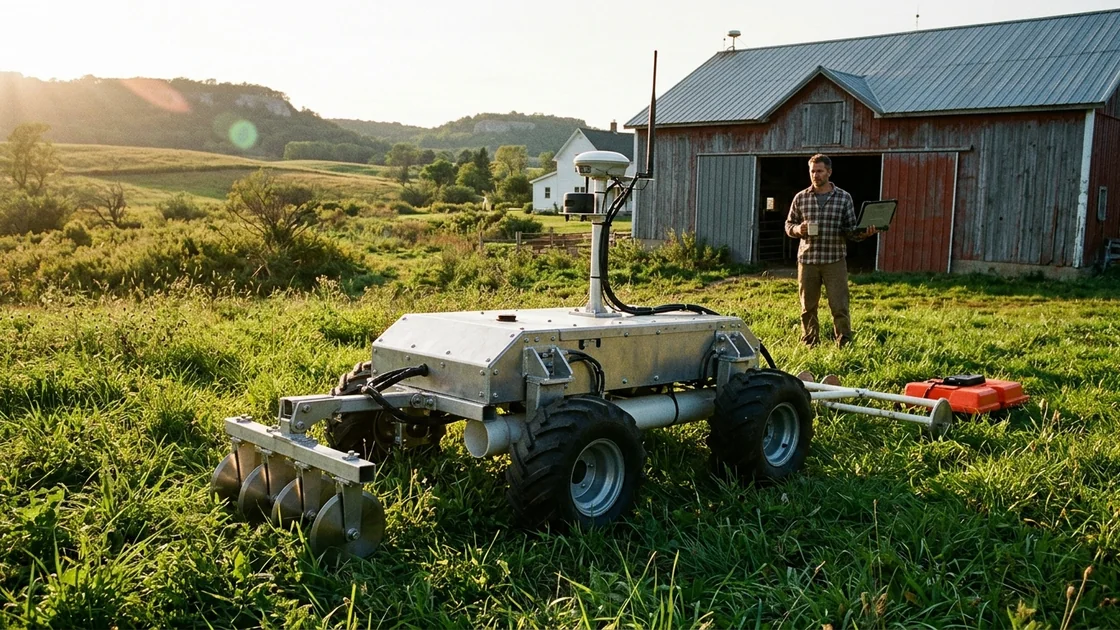
Julian Vance moves to a quiet five-acre homestead in the Driftless Area of Wisconsin after burning out from a career in aerospace systems engineering, seeking nothing more complicated than maintaining his sprawling lawn. To manage the three acres of uneven pasture behind his farmhouse, he builds an over-engineered autonomous robotic lawnmower named Sisyphus-4, equipped with millimeter-accurate satellite navigation and a custom soil-impedance sensor array designed to keep the heavy machine from getting bogged down in spring mud. When he plots the telemetry data to optimize the mowing paths, he discovers that the electrical impedance variations beneath his turf are not random geological quirks, but the crisp, unmistakable geometry of a massive, buried prehistoric structure. Obsessed with verifying the data, Julian strips the cutting blades from his machine and transforms the humble lawnmower into a high-resolution geophysical survey rover, gradually mapping a multi-tiered subterranean monument that predates known regional history, before bringing in a skeptical university geophysicist to help him peer beneath the grass without destroying the ancient sanctuary below.
The grass in the hollow grew with a quiet, green malice that Julian Vance found personally offensive. It was a dense mixture of Kentucky bluegrass, creeping red fescue, and stubborn orchard grass that thrived on the heavy morning mists rolling off the limestone bluffs of southwestern Wisconsin. When Julian had purchased the old Hendrickson homestead in late October, the three-acre back paddock had been dormant, clipped short by a neighbor’s hay baler and browned by the early autumn frost. Back then, it had looked like a tranquil, manageable expanse of rolling velvet, the exact tonic a forty-six-year-old embedded-systems architect needed after nineteen years of designing fault-tolerant flight controllers in a windowless cubicle in suburban Chicago.
Then April arrived, bringing four inches of warm rain followed by ten days of unbroken sunshine.
The paddock didn't just grow; it erupted. Within two weeks, it was ankle-deep. By the third week, it was brushing his calves. Julian had spent his first Saturday in May wrestling a secondhand riding mower with a slipping hydrostatic transmission across the washboard terrain. For four hours he had bounced over molehills, choked on blue two-stroke exhaust, and nearly tipped the machine into a deceptive, waterlogged depression near the western fence line. He had climbed off the vibrating seat with his lower back in spasms, his ears ringing at eighty-five decibels, and a profound realization settling into his bones: human beings had no business sitting on lawnmowers. It was a repetitive, spatially bounded navigation problem. It was, by strict definition, a job for a robot.
He did not buy a commercial robotic mower. Julian had dismantled enough consumer electronics to know that commercial lawn bots were toys—plastic shells bumping blindly into trees or following buried perimeter wires with the rudimentary intelligence of a mechanical cockroach, their tiny razor blades nibbling away at suburban postage stamps. His paddock was three acres of rough, undulating pasture bordered by wild blackberry brambles and limestone outcrops. A plastic toy would last twenty minutes before high-centering on a clump of fescue or drowning in a mud hole.
So, Julian retreated into the property’s converted dairy barn, where he had already installed a three-phase power converter, a Bridgeport milling machine, a TIG welder, and four workbench stations smelling wonderfully of flux rosin and cutting oil.
Sisyphus-1 had been a proof-of-concept built on an old electric wheelchair chassis; it had lacked the torque to climb the twelve-degree grade near the orchard. Sisyphus-2 had used custom planetary gearboxes and industrial brushless DC motors, which solved the torque issue, though a bug in its inertial measurement unit caused it to spin in violent, turf-shredding circles before driving itself straight through the chicken coop. Sisyphus-3 had mastered navigation via a homemade Real-Time Kinematic GPS base station mounted to the peak of the barn roof, achieving positional accuracy down to eight millimeters, until it met its untimely end in the boggy swale on the western edge of the property, sinking to its axles in slick, saturated loess clay and burning out its left motor controller in a heroic attempt to extricate itself.
Which brought Julian, in the second week of June, to Sisyphus-4.
Sisyphus-4 was a masterpiece of garage over-engineering. It sat on the concrete floor of the barn like a miniature lunar rover designed by someone with a surplus of quarter-inch structural aluminum plate. It weighed one hundred and eighty pounds, driven by four independent wheel-hub motors wrapped in aggressive chevron-tread agricultural tires. Its brain was a dual-core ARM microcontroller paired with a miniature Linux single-board computer running a custom navigation stack Julian had written in C++. Mounted on a vibration-damped mast above the chassis was the RTK-GPS rover dish, a spinning solid-state LIDAR puck for obstacle avoidance, and a high-gain telemetry antenna that streamed sixty parameters of real-time operational data back to the server rack in Julian’s kitchen.
The crowning addition to Sisyphus-4, however, was born directly from the muddy demise of Sisyphus-3.
"Never again," Julian muttered to the empty barn, adjusting his magnifying visor as he tightened a Delrin insulating bushing onto the rear tow hitch of the mower. "You are going to look before you leap, my friend."
The problem with the western swale—and half a dozen other invisible low spots scattered across the paddock—was that from above, the grass looked entirely uniform. In fact, the grass over the mud pits grew thicker and greener, masking the treacherous soup underneath. LIDAR could only see the top of the blades. Optical cameras only saw green. To prevent Sisyphus-4 from burying itself, the machine needed to sense the mechanical and hydrological state of the soil beneath its front tires before its center of gravity committed to the path.
Julian’s solution was an application of basic geophysics: electrical ground impedance.
Water conducts electricity; dry soil and rock resist it. By measuring how easily an electrical current passed through the top twelve inches of earth, Sisyphus-4 could calculate soil moisture content on the fly. If the impedance dropped below a critical threshold, the rover’s state machine would flag the coordinate as a saturation hazard, halt the drive motors, reverse along its trajectory, and dynamically recalculate its mowing grid around the bog.
Instead of a simple two-prong moisture probe, which would require stopping and stabbing the dirt every few feet, Julian had fabricated a rolling Wenner array. Mounted on a spring-loaded cantilevered arm extending eighteen inches ahead of the front bumper were four parallel discs made from hardened stainless-steel lawn-edger blades, spaced exactly twenty centimeters apart. As Sisyphus-4 rolled forward, the sharp edges of the discs parted the grass and sliced five millimeters into the turf, maintaining continuous galvanic contact with the damp earth without tearing up the sod.
The outer two discs—the current electrodes—injected a low-amperage, alternating current into the ground, driven by a programmable waveform generator Julian had etched onto a custom printed circuit board. The inner two discs—the potential electrodes—measured the resulting voltage drop across the soil between them. Because soil was not a simple resistor, but a complex matrix of mineral grains, pore water, and organic matter that acted like a leaky capacitor, Julian hadn't settled for measuring simple direct-current resistance. His circuit measured complex impedance: both the resistive magnitude and the capacitive phase shift across four distinct frequencies ranging from one hundred hertz to ten kilohertz.
It was ludicrously excessive for avoiding mud puddles. Julian knew it was excessive. That was the entire point. In Chicago, every line of code he wrote had been subjected to six levels of bureaucratic review, cost-reduction committees, and risk-management audits. Here in the barn, if he wanted his lawnmower to perform real-time multi-frequency electrical impedance spectroscopy while trimming dandelions, nobody could tell him no.
He bolted the polycarbonate weatherproof enclosure over the electronics bay, latched the heavy silicone gasket, and flipped the main breaker.
Sisyphus-4 chimed—a pleasant, three-note ascending arpeggio Julian had programmed into the piezo buzzer—and the cooling fans spun up with a soft whirr. On his ruggedized laptop balanced on the corner of the workbench, the terminal window scrolled through the initialization sequence.
[08:14:02.11] SYS_INIT: Sisyphus-4 Firmware v4.02b
[08:14:02.45] RTK_GPS: Base station lock acquired. Residual error: 0.006m.
[08:14:03.01] IMU_CAL: Gyro bias nominal.
[08:14:03.88] IMP_ARRAY: Waveform gen active. 100Hz / 500Hz / 2.5kHz / 10kHz nominal.
[08:14:04.12] STATE: Standby. Awaiting waypoint injection.
Julian unplugged the diagnostic tether, opened the wide sliding doors of the barn, and clicked the "Deploy" button on his laptop interface.
With a quiet, high-torque hum from its wheel hubs, Sisyphus-4 rolled out into the bright June morning. The front sensor colters dropped onto the gravel driveway, registering an immediate, massive spike in impedance on Julian’s screen—dry crushed limestone was practically an insulator—before the machine crossed the threshold into the lush grass of the paddock. The impedance numbers plummeted instantly to a steady three hundred andforty ohms as the steel discs bit into the dewy topsoil.
Reaching the designated starting corner near the old walnut tree, the rover paused, spun its dual rotary cutting blades up to three thousand RPM with a sound like a swarm of angry hornets, and began its first north-south pass.
Julian stood in the shade of the barn doorway, sipping lukewarm coffee from a stained ceramic mug, watching the silver machine trundle steadily through the tall grass. It moved at a brisk walking pace of one point two meters per second, leaving behind a ruler-straight ribbon of manicured turf. Every ten milliseconds—roughly every twelve millimeters of forward travel—the onboard computer logged the exact latitude, longitude, elevation, motor amperage, blade RPM, and the eight floating-point values of the complex impedance array to an onboard solid-state drive, while simultaneously beaming a compressed packet over the local Wi-Fi mesh back to his house.
"Go get 'em, boy," Julian said softly.
The paddock was roughly twelve thousand square meters. With a sixty-centimeter cutting width and a five-centimeter overlap to prevent ragged stripes, Sisyphus-4 had to travel just over twenty-one kilometers to mow the entire field. At its current speed, accounting for turnarounds and a mid-day return to the barn’s inductive charging dock to top off its lithium-iron-phosphate battery pack, the job would take roughly six and a half hours.
Julian spent the afternoon repairing the cedar shingles on the woodshed, his ears tuned to the distant, reassuring hum of the mower working its way systematically eastward across the slope. Around two o'clock, the hum stopped briefly, shifted pitch as the rover reversed, and resumed on a slightly deflected trajectory. Checking his phone, Julian grinned. Sisyphus-4 had encountered the western mud swale, detected a forty-percent drop in resistivity and a sharp collapse in phase angle two meters before the standing water, logged a hazard polygon, and skirted the perimeter without getting a single drop of mud on its chassis.
By five-thirty in the evening, the sun was slanting golden and low through the hickory trees along the ridge, and the paddock looked like a championship golf fairway. Sisyphus-4 rolled smoothly back up the concrete ramp into the barn, docked its front bumper against the copper charging plates with a solid clunk, and powered down its blades, playing a triumphant descending chord before entering sleep mode.
That night, after a dinner of pan-fried trout and roasted potatoes, Julian carried a fresh cup of decaf tea to his desk in the farmhouse parlor. He opened his workstation, pulled the raw binary telemetry log from the rover’s memory over the network—a hefty four-hundred-megabyte file containing nearly two million individual spatial data points—and opened a Python script he had written to visualize the day's run.
Initially, he only cared about the mechanical metrics. He plotted the motor current draw against the topographic elevation map derived from the RTK-GPS vertical coordinates. As expected, amperage spiked on the uphill north-to-south runs and dipped on the downhill south-to-north runs, with minor localized anomalies where the grass had been particularly thick.
Next, out of sheer curiosity to see how well his Wenner array had performed across the entire three acres, he wrote ten lines of code using the Matplotlib and SciPy libraries to interpolate the 2.5-kilohertz impedance magnitude data into a two-dimensional grayscale heatmap. High impedance—dry, rocky, or compacted soil—would render as bright white. Low impedance—wet, clayey, or loose organic soil—would render as dark black.
He hit execute. The CPU fans spun up for twelve seconds as the script crunched the two million coordinate triples through a linear grid interpolation, and then the image window popped onto his twenty-seven-inch monitor.
Julian took a sip of his tea, looked at the screen, and frowned.
The western mud swale was clearly visible on the left side of the plot as an irregular, kidney-shaped black blob. Near the top right corner, the buried cast-iron pipe running from the house to the old septic leach field showed up as a razor-sharp black line surrounded by a dark halo of damp earth. Near the walnut tree, a radiating web of bright white tendrils marked the dry, woody spread of the surface roots.
All of that made complete sense.
What did not make sense was the giant geometric watermark stamped across the dead center of his pasture.
Julian set his mug down and leaned closer to the monitor, his nose six inches from the glass.
Spanning an area roughly sixty meters in diameter right in the middle of the gently sloping paddock was a series of three concentric circles. They were not faint, ambiguous smudges. Against the mottled medium-gray background of the glacial loess soil, the rings stood out in stark, unmistakable contrast. The outermost ring was dark—indicating a band of low-impedance soil roughly three meters wide—broken only on the exact eastern and western sides by clean, five-meter gaps. Immediately inside that dark ring was a bright white ring of high-impedance material. Inside that sat a second dark ring, and at the very center of the bullseye, a sharp, regular octagon measuring twelve meters across, glowing bright white on the heatmap.
Radiating outward from the eastern gap of the outer ring was an avenue of parallel white lines, spaced ten meters apart, running straight toward the dry creek bed at the bottom of the hollow before getting cut off by the edge of the mowed boundary.
"What the hell did I do to the math?" Julian muttered.
His immediate, reflexive assumption was a software bug. As an engineer, whenever data looked too neat, too structured, or too weird, it was almost always an artifact of the measurement system. A floating-point overflow in the Fast Fourier Transform algorithm calculating the impedance phase. An aliasing effect between the ten-millisecond sampling rate and the fifty-five-centimeter spacing of the mowing rows. Or maybe radio-frequency interference from the mower's brushless drive motors inducing a standing harmonic wave in the analog-to-digital converter every time the rover reached a certain distance from the Wi-Fi antenna on the barn.
"It's a spatial aliasing ring," he told himself, nodding firmly. "A Moiré pattern between the GPS grid interpolation and the mowing stripes."
To prove it, he switched the visualization script from a gridded interpolation to a raw scatter plot, rendering each of the two million data points as a single, un-smoothed pixel colored by its raw ADC voltage reading. If the rings were an artifact of the SciPy interpolation algorithm, they would vanish when looking at the raw point cloud.
The screen refreshed. The rings did not vanish. In fact, without the smoothing filter blurring the edges, the central octagon looked even sharper. Along the perimeter of the inner white ring, Julian could now make out thirty-two distinct, equally spaced bright white dots, each roughly one meter in diameter, arranged like the hours on a thirty-two-hour clock face.
Julian stared at the thirty-two dots. A Moiré pattern generated by north-south linear passes could theoretically create concentric arcs if coupled with a radial radio interference source from the barn, though the barn was situated to the northwest of the paddock, not in the center of the rings. Nothing in a linear north-south raster scan, however, could accidentally generate a twelve-meter octagon surrounded by thirty-two evenly spaced discrete points.
He checked the four frequency channels independently.
At 100 hertz—which penetrated deepest into the ground, roughly a meter and a half given the twenty-centimeter electrode spacing and the physics of low-frequency skin depth—the octagon and the thirty-two dots were blazingly bright, while the outer rings were slightly diffuse. At 10 kilohertz—which skimmed mostly through the top fifteen centimeters of turf and topsoil—the entire structure was barely visible, masked by the random noise of gopher tunnels and grass roots.
"That means the source isn't on the surface," Julian whispered, his fingers tapping a nervous rhythm on his mechanical keyboard. "And it's not in the electronics, because the electronics don't care whether the signal is 100 hertz or 10 kilohertz when it comes to GPS coordinates."
Wait. What if the former owner, old man Hendrickson, had built something out there? A circular horse corral? A center-pivot irrigation rig? A decorative gazebo?
Julian opened a browser window and pulled up the county GIS land records and historical aerial photography archive. The county had digitized vertical aerial survey photos going back to 1937, taken by the Agricultural Adjustment Administration.
He clicked through them chronologically, zooming in on his five-acre parcel.
In 2020: empty pasture. In 2005: empty pasture. In 1986: cornfield, the rows running straight across the entire three acres without the slightest deviation. In 1968: pasture, a few black-and-white dairy cows grazing near the creek. In 1951: pasture. In 1937, the oldest photograph in the database: the barn was there, the farmhouse was there, the walnut tree was a sapling, and the three-acre paddock was an unbroken, featureless sweep of grass. No gazebo. No horse ring. No foundation scars.
Unless, Julian thought, during a particularly dry summer, the grass over the buried features browned slightly faster than the surrounding turf—a phenomenon he vaguely remembered reading about in a magazine article about British archaeology during droughts. He went back to the 1988 aerial photo, taken during the great Midwestern drought of that summer. The image was low-resolution and grainy, scanned from an old film print, yet when he adjusted the contrast curves in an image editor, a ghost of the outer dark ring was faintly discernible as a greener band in the parched, yellowed field.
It was in the dirt. Whatever it was, it was physically inside his hill.
Julian looked at the clock on the wall. It was eleven-fifteen at night. Outside, the chorus frogs in the creek were singing a deafening, rhythmic trill.
He grabbed a flashlight and walked out into the warm June darkness. The freshly cut grass smelled sweet and sharp under his boots, damp with the rising night dew. He walked out into the middle of the paddock, shining the beam of his LED flashlight across the ground.
There was nothing to see. The slope descended at a gentle, uniform five-degree angle toward the creek bed in the east. His boots felt only soft, springy turf. He walked to the approximate center of the pasture where the octagon should be and stomped his heel hard into the sod. It felt no different from the ground near the barn—soft, loamy, yielding slightly under his weight. Because the 10-kilohertz channel had been almost completely clear of the anomaly, whatever was causing the massive impedance spike at 100 hertz had to be buried beneath at least thirty to fifty centimeters of entirely normal, undisturbed topsoil.
"Okay," Julian said to the dark pasture, his breath visible as a faint wisp in the cool hollow air. "First rule of systems testing. Never trust a single sensor modality on a single trajectory."
If Sisyphus-4 had recorded this pattern while driving strictly north-to-south, the only way to rigorously eliminate any directional bias, mechanical bounce harmonic, or GPS heading-dependent offset was to run an orthogonal survey. East-to-west. And then, for good measure, a forty-five-degree diagonal grid.
And if he wanted to see deeper than a meter and a half, the twenty-centimeter spacing of the front Wenner array wasn't going to cut it. In electrical resistivity surveying, the depth of investigation is roughly proportional to the separation distance between the outer current-injecting electrodes. With the four colter discs spaced twenty centimeters apart on a sixty-centimeter boom, the electrical field lines only bowed down into the earth about thirty to forty centimeters before curving back up to the return electrode; the 100-hertz signal was just grazing the very top of whatever lay down there.
If he built a wider boom—say, a two-meter trailing array pulled behind the mower, with multiple sets of rolling electrodes spaced at twenty, forty, eighty, and one hundred and sixty centimeters—he wouldn't just get a flat 2D picture. By switching rapidly between different pairs of electrodes as the robot drove, he could measure the apparent impedance at four distinct depths simultaneously.
He stood in the wet grass for a long moment, the flashlight beam pointing down at his mud-stained work boots. For the past eight months, since leaving Chicago, Julian had felt a strange, hollow weightlessness at the center of his days. Fixing the porch roof, splitting firewood, and tuning Sisyphus-4 had kept his hands busy, yet his mind—trained for two decades to untangle massively complex, multi-variable signal-processing puzzles—had been starving in the quiet country air.
He turned around and walked briskly back toward the glowing yellow rectangles of the barn windows. He didn't need to mow the grass again for at least five days. Which meant Sisyphus-4 didn't need its lawnmower blades right now.
By Thursday morning, Sisyphus-4 no longer looked like a piece of agricultural equipment; it looked like a deep-space planetary probe that had mated with a medieval siege weapon.
Julian had unbolted the entire twin-spindle rotary cutting deck from the belly of the aluminum chassis, shedding thirty-five pounds of dead weight and freeing up two hundred watts of continuous electrical power that had previously gone toward spinning steel blades through fescue. In place of the mower deck, he mounted a secondary 24-volt isolated power supply and a custom sixteen-channel solid-state multiplexer board he had milled on his desktop CNC router the previous afternoon.
Behind the rover, attached via a dual-axis gimbal hitch, trailed what Julian dubbed the "Harp."
It was a T-shaped frame built from lightweight, non-conductive fiberglass structural tubing, rolling on eight stainless-steel coulter wheels arranged in a symmetrical linear array spanning two point four meters in width. Because dragging eight wide-spaced blades through turns would tear the turf and bind the steering, Julian had engineered a pneumatic lift cylinder salvaged from an old factory automation arm; whenever Sisyphus-4 reached the end of a row and initiated a zero-turn pivot, a tiny twelve-volt air compressor puffed the entire fiberglass frame three inches off the ground, setting it gently back down once the rover was aligned on its new heading.
Even more significantly, in the खाली space under the chassis where the mower blades used to spin, Julian had mounted a one-meter-long fiberglass tube housing a pair of precision-wound copper induction coils—a homemade Dual-Dipole Electromagnetic Induction sensor, or EMI profiler. While the trailing Harp measured galvanic impedance by physically touching the dirt, the EMI coils under the belly transmitted a primary alternating magnetic field straight down into the earth without touching a single blade of grass, measuring the secondary eddy currents induced in the subsoil down to two and a half meters.
He was leaning over the rover, securing a zip-tie around the shielded coaxial cable harness, when a gravel-voiced chuckle echoed from the open barn doors.
"Well, I'll be dipped in motor oil. You finally built a death ray for the woodchucks."
Julian straightened up, wiping a smear of conductive silver grease from his forehead with the back of his wrist. Standing just outside the drip line of the barn roof was Ray Lindqvist, his nearest neighbor from half a mile down the county road. Ray was seventy-two, built like an oak fence post wrapped in faded OshKosh overalls, and had farmed the surrounding four hundred acres of ridge and valley since the Nixon administration.
"Morning, Ray," Julian said, stepping around the fiberglass boom. "No death ray. Just some soil sensors. The mower kept trying to drown itself in that wet patch by the west fence."
Ray stepped into the cool interior of the barn, taking off his seed-corn cap to scratch his cropped white hair as he peered down at Sisyphus-4. He squinted at the eight gleaming steel discs of the trailing Harp, then at the fiberglass cylinder slung beneath the belly.
"Seems like a lot of copper and fancy fiberglass just to dodge a mud puddle, Julian. Most folks just put up three wood stakes with orange ribbon tied to 'em and steer around."
"Where's the fun in orange ribbon?" Julian smiled, patting the aluminum hood of the rover. "Besides, if you map the moisture and density across the whole field, you can model how the water drains off the bluff. Speaking of which... Ray, how long have you known this parcel?"
"All my life," Ray said easily, hooking his thumbs into his overall straps. "My dad helped old Einar Hendrickson raise the rafters on this very barn back in forty-nine. I was three years old, sitting on a pile of cedar shakes right over there where your lathe is sitting. Why?"
"Did Einar—or his father—ever build anything out in the middle of the three-acre paddock? A round barn? A silage pit? An old stone foundation they tore down and buried?"
Ray shook his head slowly, his pale blue eyes drifting out the door toward the sunlit slope of the pasture. "Nope. Einar was a stubborn Norwegian, and his daddy was even worse. They knew better than to build down in the hollow when the ridge top stays dry in the spring thaw. That lower three acres has always been pasture, except for a few years in the eighties when Einar's nephew leased it and tried putting in field corn."
"Tried?"
"Yeah, well, it's funny dirt out there in the middle," Ray said, nodding toward the center of the field. "Looked fine on top—good dark silt, six, eight inches deep. When the nephew ran his chisel plow through it, though, he kept snapping shear pins on his shanks whenever he set the depth past ten inches. Wasn't hitting big limestone boulders like you get up near the bluff, either. Just this hard, stubborn pan underneath that dulled the points right down. And the corn came up all crazy. In July, you could stand up on the road and see rings in the tassels—some strips seven feet tall and dark green, right next to a curve where the stalks were stunted knee-high and yellow, like the roots couldn't punch through to the water table."
Julian felt a tiny electric prickle along the back of his neck. Crop marks. The exact agricultural phenomenon that revealed buried walls and ditches from the air. High-impedance stone or compacted rubble stunted the corn by blocking root depth and holding less moisture; low-impedance ditches full of rich, damp organic silt made the corn grow tall and lush.
"What did the nephew think it was?" Julian asked, keeping his voice casual.
"Oh, the county extension agent told him it was an old sinkhole full of chert gravel that got silted over after the last ice age, except we didn't have the glaciers right here in the Driftless, so who knows," Ray said with a shrug. "Einar told the boy to quit fighting the pasture and seeded it back to fescue the next spring. Only other weird thing about that middle flat is in November, when we get that first light two-inch snow before the ground freezes hard? If you look out there at sunrise, the snow melts off in a big circle first, like the dirt underneath holds onto the summer heat a day longer than the rest of the hollow."
Thermal inertia. Compacted stone or vitrified earth had a higher heat capacity and higher thermal conductivity than loose, aerated pasture soil.
"Anyway," Ray said, clapping his cap back onto his head and turning toward the door, "I just stopped by to let you know I'm baling the south forty tomorrow afternoon if the humidity stays down. If my baler kicks up dust down wind of your laundry line, don't shoot me."
"I don't even own a clothesline, Ray. Appreciate the heads-up."
Once Ray’s pickup truck had rumbled back down the gravel lane, Julian didn't waste another second. He initiated the startup sequence on Sisyphus-4, calibrating the new multiplexer and the EMI induction coils against a baseline ferrite rod, and loaded a dense east-west waypoint grid into the navigation controller. Because the blades were off and the rover was no longer cutting grass, he reduced the lateral spacing between rows from fifty-five centimeters down to twenty-five centimeters, doubling the horizontal resolution of the survey.
For the next eight hours, Sisyphus-4 crisscrossed the paddock in silent, methodical concentration. Without the roar of the cutting deck, the only sounds were the soft whirr of the planetary gearboxes, the quiet shhh-shhh of the eight stainless-steel discs slicing five millimeters into the turf, and the rhythmic pffft-clack of the pneumatic cylinder lifting the Harp at the end of every ninety-meter pass.
Julian didn't do any chores that afternoon. He sat on an overturned five-gallon bucket in the shade of the barn, his laptop resting on his knees, watching the real-time telemetry stream populate his database row by row.
By dusk, the east-west grid was complete. Rather than stopping, Julian swapped a fresh, fully charged LiFePO4 battery pack into the rover’s belly, turned on the machine’s forward LED work lights, and sent it back out into the gathering darkness to run a forty-five-degree diagonal grid from southwest to northeast.
Sitting on the porch steps at midnight, wrapped in a flannel jacket against the chill night air, Julian watched the twin white headlights of Sisyphus-4 gliding back and forth across the dark hollow. Fireflies blinked in the tall grass along the creek bed, rising like golden sparks around the glowing green status LEDs on the rover’s GPS mast. It was a strangely hypnotic sight: a piece of twenty-first-century autonomous robotics quietly interrogating the silent earth beneath the Wisconsin stars.
At two-fifteen in the morning, the rover returned to the barn. Julian carried his laptop inside, poured himself three fingers of bourbon, and fired up a new Python environment.
He now had twelve million discrete multi-channel measurements: four galvanic electrode spacings across four frequencies, plus quadrature and in-phase magnetic susceptibility from the EMI coils, recorded along three independent directional vectors. To turn those twelve million surface measurements into an actual three-dimensional model of the subsurface, a simple 2D heatmap wouldn't suffice. He needed an inversion algorithm.
In geophysics, electrical resistivity tomography—ERT—works much like a medical CT scan. By knowing the exact geometry of the current injection and voltage measurement electrodes on the surface, and measuring how apparent impedance changes as the electrode spacing widens, a computer can work backward using finite-element mathematics to solve for the true resistivity of thousands of tiny volumetric pixels—voxels—stacked beneath the ground.
Julian pulled an open-source geophysical inversion library called PyGIMLi into his workspace, configured a three-dimensional tetrahedral mesh spanning sixty by eighty meters down to a depth of three meters, and fed the consolidated dataset into the solver. Because his workstation had a high-end graphics card he had originally bought for simulating neural-network flight controllers, he offloaded the matrix inversion calculations to the GPU cores.
"Alright," Julian murmured, rubbing his burning eyes. "Show me the sinkhole full of chert gravel."
The GPU fans roared like a jet engine for forty-two minutes while Julian paced the kitchen floor, refilling his water glass and staring out the dark window at the invisible pasture. Finally, at three-ten in the morning, the terminal chimed. The inversion had converged with a root-mean-square error of just 1.4 percent—an absurdly clean fit, made possible only because no human surveyor on earth would ever have the patience to drag an electrode array across a field in twenty-five-centimeter increments with six-millimeter GPS accuracy.
Julian opened the 3D voxel viewer, set the opacity filter to make normal agricultural soil—everything between one hundred and four hundred ohms-meter—completely transparent, and rendered the high-impedance anomalies in amber and the low-impedance anomalies in deep blue.
He rotated the 3D model with his mouse, and the breath caught in his throat.
It was not a sinkhole. It was not a geological formation. Geology did not build with right angles, bilateral symmetry, and solar alignments.
Starting at forty-five centimeters below the turf—just deep enough that nine inches of moldboard plowing had never quite turned it up, though deep chisel plows had scraped its crown—sat a monumental, subterranean architecture.
The outer blue ring was a classic perimeter ditch, or fossa, three meters wide and excavated twopoint two meters deep into the underlying subsoil, long since silted in with fine, moisture-retaining organic loam. Directly inside the ditch sat the outer amber ring: a continuous circular embankment or retaining wall, two meters thick and surviving to a height of roughly eighty centimeters below the modern surface, composed of material with an impedance exceeding two thousand ohms-meter—almost certainly tightly packed, dry-laid limestone slabs quarried from the nearby bluffs.
The two five-meter gaps in the outer ditch and stone embankment were not positioned randomly. When Julian overlaid a true-north compass rose onto the 3D coordinate mesh, the eastern entrance avenue pointed at an azimuth of 61.5 degrees—within half a degree of the summer solstice sunrise over the eastern ridge. The western gap pointed at 241.5 degrees: the winter solstice sunset.
Inside the stone embankment sat the circle of thirty-two discrete points. In the 3D tomography, they were no longer dots; they resolved as vertical cylindrical shafts, each eighty centimeters in diameter and extending nearly two meters straight down into the earth, their bottoms resting on flat pads of high-impedance stone. Post-holes. Huge timber sockets that had once held massive upright wooden pillars, now filled with mineral-hardened clay or stone packing wedges.
And in the center sat the octagon.
Julian zoomed in on the central structure, slicing away the outer rings with a virtual clipping plane. The octagon was twelve meters across, its walls eighty centimeters thick, rising to within thirty-five centimeters of the grass roots and extending down two point five meters to a flat, solid floor that showed a bizarre electrical signature on the complex impedance channels: a massive resistive magnitude coupled with a sharply negative capacitive phase shift.
In materials science, Julian knew only a handful of things found in the ground that produced a strong induced-polarization phase shift like that: metallic sulfide ores, dense graphite deposits, or heavily vitrified, carbon-impregnated clay—earth that had been subjected to fire so intense and prolonged that the silica and clay minerals had partially melted into a glassy, conductive ceramic slag.
In the very center of the octagonal floor was a square anomaly, two meters by two meters, surrounded by four smaller stone piers.
Julian leaned back in his ergonomic chair, his heart hammering against his ribs in the quiet farmhouse parlor. He knew a little bit about the prehistory of Wisconsin from the local museum in town. The Driftless Area was famous for Late Woodland effigy mounds—earthen embankments shaped like bears, panthers, and thunderbirds built between 600 and 1200 AD. Before them, the Hopewell culture had built conical burial mounds along the Mississippi and Wisconsin rivers two thousand years ago.
This was neither. Effigy mounds and Hopewell mounds were built above ground out of piled dirt. They didn't have dry-laid stone-walled octagons with vitrified floors, timber-pillared peristyles, and two-meter-deep perimeter ditches buried completely flat under half a meter of undisturbed wind-blown silt. For fifty centimeters of uniform upland silt to accumulate on a gentle slope like his paddock—a slope that normally eroded rather than accumulated sediment—this thing couldn't have been built a thousand years ago. It looked like the bottom half of a structure whose upper works had collapsed or been leveled before the modern soil profile had even formed, preserved in a shallow natural basin that had subsequently filled with late-Pleistocene or early-Holocene loess dust.
He stared at the glowing amber octagon rotating slowly on his monitor.
"Sisyphus," Julian whispered to the empty room, "what did we just mow over?"
For three days, Julian didn't tell a soul.
Part of his silence was the lingering paranoia of a systems engineer who refused to escalate a ticket until every possible failure mode had been triple-checked. During those seventy-two hours, he ran Sisyphus-4 across the adjacent parcels of his property—the orchard to the north, the front yard near the county road, and the narrow pasture south of the creek—just to verify that his inversion pipeline didn't magically hallucinate octagons wherever it looked.
The orchard showed tree roots and a buried 1940s trash midden full of rusty tin cans. The front yard showed the gravel base of the road and the septic tank. The south pasture showed nothing at all except gently undulating limestone bedrock four meters down, sloping cleanly toward the stream.
Only the middle of the back paddock held the geometry.
The other reason for his silence was a very pragmatic fear of what happens when a private landowner announces an archaeological discovery. Julian had moved to the Driftless Area for peace and quiet. He had horrifying visions of county bureaucrats condemning his property, forty graduate students pitching tents next to his barn, bulldozers stripping away his immaculate turf, and local treasure hunters sneaking onto his land at two in the morning with shovels and metal detectors.
Yet he couldn't just close the laptop file and go back to trimming weeds. The structure was there, thirty-five centimeters beneath his boots, silent and whole and undocumented by human science.
On Sunday evening, after spending the afternoon writing a custom shader to visualize the phase-angle data in false-color infrared, Julian opened his browser and navigated to the faculty directory of the Geoscience and Anthropology departments at the University of Wisconsin in Madison, seventy miles to the east.
He didn't want a traditional dirt archaeologist—someone whose first instinct was to dig a trench with a trowel and a backhoe. He wanted someone who spoke his language: inverse theory, potential fields, electromagnetic induction, and non-destructive subsurface imaging.
Halfway down the geoscience faculty page, he found her.
Dr. Maya Lin, Associate Professor of Near-Surface Geophysics. Ph.D., Stanford. Research interests: Hydrogeophysics, Electrical Resistivity Tomography (ERT), Ground-Penetrating Radar (GPR), and high-resolution archaeogeophysical prospection.
Julian clicked on her recent publications list. One paper from the previous autumn caught his eye: Automated Inversion of Multi-Frequency Complex Resistivity Data for Delineating Subsurface Anthropogenic Features in Glaciated and Unglaciated Terrains.
She didn't just speak his language; she wrote the textbook on the exact math he had bolted onto his lawnmower.
Julian spent an hour composing an email. He knew that university professors received emails every week from cranks claiming to have found Viking runestones, Atlantis, or crashed UFOs in their backyards. If he opened with "I found a prehistoric temple with my homemade robot," his message would go straight into her trash folder in less than three seconds.
Instead, he wrote to her as an engineer presenting an anomalous calibration dataset.
Subject: High-density 4-frequency CCR/EMI dataset anomaly in Driftless loess (Richland Co.) — request for sanity check
Dr. Lin, I am a retired aerospace embedded-systems engineer living on a five-acre parcel in eastern Richland County. While developing an autonomous RTK-GPS rover equipped with a rolling 8-electrode Wenner/Schlumberger multiplexer (100Hz–10kHz complex impedance) and a dual-dipole EMI boom for soil-moisture mapping, I encountered a highly structured subsurface anomaly in my back pasture.
The survey comprises 12.4 million spatially referenced measurements (0.006m RTK horizontal accuracy, 0.25m line spacing along 3 orthogonal azimuths). 3D finite-element inversion in PyGIMLi (RMS error 1.4%) resolves a 60m concentric ditch-and-embankment feature with an internal 12m high-resistivity/high-polarizability octagonal structure between 0.35m and 2.5m depth.
Before I assume my analog front-end has a very creative phase-lock loop bug, would you be willing to glance at the raw data file and the inversion mesh? I have attached three PNG slices at 0.5m, 1.2m, and 2.0m depth, along with the electrode geometry schema and a 10,000-point CSV sample of the raw voltage/phase logs.
Best regards, Julian Vance
He attached the files, hit send at 8:42 PM, and closed his laptop, expecting to wait a week for a polite, two-sentence brush-off from a teaching assistant.
His phone buzzed at 9:19 PM.
It was an email reply from Dr. Lin’s university address.
Mr. Vance, Where did you rent an ARP-03 motorized resistivity profiler in Wisconsin, and how on earth did you get 6-millimeter RTK-GPS accuracy and 25cm line spacing without tearing the turf to ribbons? More importantly, please tell me you didn't synthesize this CSV file as a prank on my graduate seminar, because the quadrature phase response on your 1.2m slice looks completely real and completely insane. Are you awake? Can I call you?
Julian stared at the screen, a slow grin spreading across his face. He typed back his cell number.
Thirty seconds later, the phone rang.
"Mr. Vance?" The voice on the other end was brisk, sharp, and caffeinated, carrying the faint background hum of a university office air conditioner. "This is Maya Lin."
"Call me Julian, please. Thanks for looking at the files so late on a Sunday."
"I was grading summer field-camp reports and looking for an excuse to procrastinate," she said candidly. "Now I have my entire inversion workstation running your CSV sample. Julian, let's start with the hardware, because the data density you sent me doesn't make any sense. When my lab does an archaeogeophysical survey with a Geonics EM38 or a Syscal Pro resistivity meter, we walk the grid by hand at one-meter line spacing, and it takes four grad students three days to cover a hectare. You surveyed twelve thousand square meters along three axes at twenty-five-centimeter spacing in a single afternoon?"
"Well, afternoon and most of the night," Julian corrected mildly. "And I didn't walk it. My lawnmower drove it."
There was a three-second silence on the line.
"Your lawnmower," Dr. Lin repeated, her tone dropping half an octave into pure academic suspicion.
"Technically, it hasn't had mower blades on it since Wednesday," Julian said. "It's a four-wheel-drive autonomous rover I built in my barn. Weighing about a hundred and eighty pounds, guided by a local L1/L2 RTK base station bolted to my barn roof. I built a trailing fiberglass boom with eight stainless-steel edger colters and a pneumatic lift for the turnarounds, plus a twin-coil EMI induction tube mounted where the mower deck used to be."
"You built a multi-frequency complex resistivity and electromagnetic induction rover out of a homemade robotic lawnmower," she said flatly.
"Wait until I send you a photo of the soldering job on the multiplexer board. It's four-layer FR4 with gold-plated relays and optical isolation on the current injectors."
He heard the squeak of an office chair on the other end of the line, followed by the rapid clicking of a mouse. "Okay," Maya said slowly. "Assuming for a moment that you are not an elaborate performance artist... I'm looking at the raw potential drops and the phase lags in your CSV. If someone wanted to fake a synthetic dataset of a buried monument, they would just model a geometrical shape in forward-modeling software and add Gaussian white noise. They wouldn't know to include the telluric current drift at 100 hertz, or the anisotropic contact resistance variation where the steel discs cross gopher mounds, or the exact Cole-Cole relaxation curve of partially saturated illite clay in the Driftless Area."
"I wouldn't even know how to fake a Cole-Cole relaxation curve," Julian admitted. "I just used a lock-in amplifier algorithm in C++ to extract the in-phase and quadrature components from the ADC."
"Which is why I'm not hanging up the phone," Maya said. Her voice shifted, losing the defensive skepticism and taking on a tense, quiet urgency. "Julian, do you have any idea what that 1.2-meter depth slice looks like?"
"To me, it looks like a concentric henge with a thirty-two-post timber circle and a twelve-meter octagonal stone building in the middle, aligned to the solstices."
"Yes, except we are in Wisconsin, not Wiltshire or the Scioto Valley of Ohio," she said sharply. "Hopewell geometric earthworks in Ohio have octagons and circles, sure, though they are hundreds of meters across, built of heaped earth, and they don't have two-meter-deep perimeter ditches lined with dry-laid limestone walls or thirty-two-post peristyles around a vitrified octagonal chamber. Even the Middle Woodland Trempealeau sites up near the Mississippi don't look anything like this. And more importantly—what did you say the depth to the top of the anomaly was?"
"Thirty-five to forty-five centimeters below the turf. Totally flat on top. You can walk right over it and there isn't a ten-millimeter bump in the topographic LIDAR scan."
"That's what's giving me chills," Maya said. "In an upland hollow in Richland County, soil doesn't accumulate at forty centimeters per millennium unless it's at the very bottom of a colluvial toe-slope. The major pulse of wind-blown Peoria and Roxana loess in the Driftless Area stopped depositing around ten to twelve thousand years ago, right at the end of the Younger Dryas and the Pleistocene-Holocene transition. Anything built by Woodland or Mississippian cultures in the last two thousand years sits right in the top ten to fifteen centimeters of the modern A-horizon soil, or sticks up above the grass. For a structure in your setting to be completely planed off and buried under forty centimeters of uniform silt..."
She trailed off.
"How old would it have to be?" Julian asked quietly.
"Too old," she said immediately. "Way too old for stone-and-timber monumental architecture in North America, unless there was a localized catastrophic mudslide from your bluff several thousand years ago that capped an Early Archaic site. Which still shouldn't have stone octagons! Look, my Tuesday schedule is just office hours and a committee meeting I'd happily skip. If I load a commercial Mala Ground Penetrating Radar cart and a calibrated proton magnetometer into the back of the department Suburban tomorrow morning, will you let me run a validation transect across your pasture?"
"On two conditions," Julian said.
"Name them."
"First, just you. No grad students, no university press office, no state archaeologists with backhoes. Not until we know what we're looking at."
"Deal. Frankly, if I showed this plot to the anthropology faculty right now without independent GPR confirmation, they'd have my tenure file reviewed for gullibility. What's the second condition?"
"We don't push your radar cart by hand," Julian said, a touch of pride warming his voice. "Give me the weight and dimensions of the GPR antenna tonight, and by the time you pull into my driveway tomorrow at ten, I'll have a tow bracket fabricated for Sisyphus-4 so we can map the whole three acres at sub-centimeter accuracy while we drink coffee on the porch."
A short, genuine laugh came through the speaker. "Send me your address, Julian. The antenna box is forty-two centimeters wide by sixty centimeters long, weighs eighteen pounds, and takes a twelve-volt DC input. Don't electrocute it with your lawnmower."
At nine-forty-five on Tuesday morning, a dusty maroon Chevrolet Suburban with University of Wisconsin fleet plates rumbled down Julian’s gravel lane and pulled up beside the barn.
Dr. Maya Lin climbed out of the driver's seat, pushing a pair of sunglasses up onto her dark, shoulder-length hair. She was in her late thirties, dressed in cargo pants, dusty hiking boots, and a faded flannel shirt over a geological society t-shirt. She gave Julian a quick, appraising handshake, barely glanced at the scenic rolling hills of the hollow, and walked straight past him into the open doors of the barn like a hound on a scent.
She stopped dead in front of Sisyphus-4.
Julian had been up since five-thirty TIG-welding a custom cantilevered cradle out of one-inch aluminum box tubing that attached behind the trailing fiberglass Harp, complete with rubber-isolated shock mounts to cradle her radar antenna flush against the clipped grass.
Maya crouched beside the machine, running her fingers lightly over the CNC-milled polycarbonate housing of the multiplexer, the braided stainless-steel shielding on the coaxial harnesses, and the spring-loaded Delrin bushings of the eight rolling coulter discs.
"Good grief," she murmured, looking up at Julian with wide dark eyes. "When you said you built a robotic lawnmower in your barn, I pictured duct tape, PVC pipe, and an Arduino wired to a lawnboy deck. This looks like something JPL dropped onto the Martian regolith."
"I used to design triple-redundant flight actuators for a living," Julian said, handing her a travel mug of fresh coffee. "Old habits die hard. When you don't have a project manager breathing down your neck about unit cost, you can use aerospace connectors on a weed whacker."
"How are you compensating for the self-potential drift on the stainless-steel colters when they hit patches of different soil pH?" she asked, testing him as she peered at the front PCB.
"Bipolar square-wave current reversal paired with a synchronous digital high-pass filter," Julian replied smoothly, pointing to the analog front-end board. "And I'm logging the open-circuit spontaneous potential for five milliseconds before every current injection pulse, then subtracting the baseline slope in real time. Plus, the inner potential discs have silver-silver chloride sintered rings pressed into the hub bevels to minimize electrode polarization."
Maya stood up slowly, took a sip of the coffee, and shook her head in disbelief. "Do you want a job in my lab? Because you just solved a polarization problem that my PhD student has been whining about for two semesters."
"I'm retired from bosses and committees, Dr. Lin. Though Sisyphus and I are happy to consult for the price of figuring out what's under my grass."
Together, they lifted the bright orange fiberglass shell of the university’s 400-megahertz Ground Penetrating Radar unit out of the Suburban's cargo bay and settled it into Julian’s custom aluminum cradle behind the rover. While electrical impedance measured the bulk conductivity and chargeability of the soil over a diffuse volume, GPR fired short, high-frequency pulses of radio waves straight down into the earth and listened for the sharp echoes bouncing off physical boundaries—like the interface between soft silt and solid stone.
Where ERT provided the fuzzy chemical and hydrological composition of the structure, the 400-megahertz radar would give them crisp, architectural edges.
Julian linked the GPR’s trigger cable directly to Sisyphus-4’s odometer interrupt pin so that the radar fired a pulse every ten millimeters of forward travel, stamped with the rover’s millimeter-accurate RTK-GPS coordinate.
At ten-thirty, Sisyphus-4 rolled out into the bright morning sun, pulling both the eight-wheel impedance Harp and the orange radar sled smoothly across the turf.
Instead of surveying the entire three acres, Julian defined a tight, eighty-by-eighty-meter bounding box directly over the center of the anomaly, programming the rover to run at a snail's pace of zero point six meters per second with a dense twenty-centimeter line spacing.
Maya didn't sit on the porch. She walked out into the middle of the pasture with her tough-book tablet linked via Wi-Fi to the radar unit, standing right in the center of the invisible octagon while Sisyphus-4 hummed methodically back and forth past her boots.
"Look at the ground," Julian said, standing beside her in the warm breeze. "Ray, my neighbor, told me that in the eighties, someone tried to chisel-plow this field and kept snapping shear pins right about where we're standing. And in November, the first snow melts in a big circle out here."
Maya wasn't looking at the grass; her eyes were glued to the scrolling waterfall plot—the radargram—painting across her tablet screen as Sisyphus-4 completed its fourth pass across the outer perimeter.
"Julian," she said softly, her voice stripped of all academic detachment. "Come look at this."
Julian stepped over and looked down at her screen over her shoulder.
As the rover had crossed the coordinates of the outer ring, the chaotic, horizontal banding of the topsoil had suddenly plunged downward into a textbook, U-shaped trench cut two meters deep into the dense subsoil, filled with finely laminated layers of quiet water-laid silt. Immediately inside that trench, beginning at forty-two centimeters below the grass, was a roaring cluster of hyperbolic radar reflections—the classic, unmistakable signature of stacked, squared stone blocks—forming a solid wall two meters wide.
Then Sisyphus-4 glided directly past them, crossing the boundary of the central octagon.
On the radargram, at thirty-eight centimeters depth, a horizontal line appeared that was so bright, so flat, and so continuous that it looked like the rover was driving over an underground concrete parking deck. Beneath that upper crust, the radar waves bounced between eight distinct vertical walls descending two and a half meters down to a second, massively reflective floor.
"That upper reflector at thirty-eight centimeters isn't a collapsed roof," Maya whispered, her fingers zooming in on the radar phase reversals. "The polarity of the radar wave is inverting at the boundary. That means the wave is going from a high-velocity, dense medium into a much lower-velocity, high-dielectric medium—like wet clay or an air-filled void—Wait. No. Look at the multiple internal ringing echoes."
She looked up from the tablet, staring straight down at the green fescue between their boots.
"It's a cap," she said, her voice barely audible over the gentle whir of Sisyphus-4’s motors thirty yards away. "Whoever built this didn't abandon it to fall down on its own. When they were done with it, they packed the entire interior of the octagonal chamber with sterile silt, and then they sealed the whole twelve-meter octagon under a solid, thirty-centimeter-thick dome of fire-baked clay and limestone flagstones."
Julian felt the hairs on his forearms stand straight up in the warm sun. "They buried it on purpose."
"Like Göbekli Tepe in Turkey, or Poverty Point layers, only sealed with vitrified clay like a Scottish vitrified fort," Maya said, pacing three steps across the invisible boundary of the chamber, her boots treading over the buried roof thirty-eight centimeters below. "That's why your impedance array saw that massive capacitive phase shift! Vitrified clay—earth baked with charcoal and wood ash at a thousand degrees Celsius until it sinters into brick—acts like a giant porous ceramic capacitor when it sits in damp ground. And because a solid ceramic and flagstone cap sheds rainwater to the edges, nothing underneath it has been leached by percolating groundwater since the day they sealed it."
She stopped pacing and looked back at him, her cheeks flushed. "Julian, if the interior of that octagon has been sealed under a low-permeability baked-clay cap in alkaline limestone soil, organic preservation inside that chamber could be intact. Wood, charcoal, bone, textiles, pollen—things that normally rot to nothing in three hundred years in Midwestern dirt could be sitting down there in an anaerobic vault."
Sisyphus-4 reached the western fence line, puffed its pneumatic cylinder with a cheerful pffft, lifted the Harp, and pivoted cleanly onto the next twenty-centimeter line.
For four more hours they watched the machine build the combined radar and impedance volume. By three in the afternoon, sitting at Julian’s dining room table with both laptops side by side, they fused the 400-megahertz GPR reflection cube with Julian’s multi-frequency ERT and EMI inversion mesh.
The resulting composite model was breathtaking.
With the radar providing millimeter-sharp structural boundaries and the electrical impedance providing material composition, the subterranean complex resolved in stunning anatomical detail:
The outer ring was a sixty-meter-diameter earth-and-stone henge. The two-meter-deep perimeter ditch had been cut straight into the Pleistocene loess and underlying dolomitic clay, and the excavated material had been used to back-fill a dry-stone retaining wall just inside it. Curiously, the ditch was on the outside of the wall—a defensive or water-diverting layout—except at the two solstice causeways, where undisturbed bridges of natural earth had been left intact, paved with heavy limestone slabs that extended outward toward the creek bed in a formal ceremonial avenue.
Inside the wall stood the thirty-two post-holes. The GPR revealed that the wooden pillars hadn't rotted in place; the shafts were cleanly packed with alternating layers of white crushed dolomite and river cobbles, indicating the posts had been deliberately pulled up or burned down to the ground level before the pits were ritually plugged with stone.
And in the center sat the sealed octagon.
"Look at the stratigraphy of the overburden," Maya said, pointing a pencil tip at a high-resolution radar cross-section running from the bluff slope down across the henge toward the creek. "See this faint, continuous horizontal reflector at twenty-eight centimeters depth that runs right over the filled ditch, right over the capped post-holes, and feathers out across the top of the clay-sealed octagon?"
"I see it," Julian said, squinting at the faint gray line on the radargram. "It showed up on my 2.5-kilohertz impedance slice too, as a thin, two-centimeter lamina of slightly higher conductivity."
"In eastern Wisconsin and along the upper Mississippi valley, you sometimes see a buried paleosol—an ancient topsoil horizon—called the Brady Soil or an early Holocene organic mat that formed right around nine thousand to ten thousand five hundred years ago, before a final localized pulse of wind-blown silt and slope-wash covered the valleys during the mid-Holocene warm period," Maya explained, her voice trembling slightly. "If that lamina at twenty-eight centimeters is an intact early-Holocene paleosol running unbroken across the top of the back-filled ditch..."
"Then the ditch was already dug, used, and completely silted in before that soil layer formed," Julian finished for her.
"Which would place the construction of this complex in the Late Paleoindian or Early Archaic period. Eight thousand to ten thousand five hundred years ago." Maya set the pencil down on the oak table because her fingers were shaking. "Julian, conventional archaeology says that ten thousand years ago, the people in Wisconsin were small, nomadic bands of twenty or thirty hunter-gatherers living in temporary hide shelters, chasing woodland caribou and giant beaver with chipped flint spears. They weren't supposed to be quarrying hundreds of tons of limestone, erecting thirty-two-post solar calendars, or firing twelve-meter octagonal vaults with vitrified clay domes."
"Maybe conventional archaeology didn't have an autonomous lawnmower checking the pastures of the Driftless Area," Julian said quietly.
"They didn't," Maya agreed. "Think about it. During the last glacial maximum, the ice sheets buried almost all of Wisconsin, Minnesota, and Illinois under a mile of grinding ice, except for right here—the Driftless Area. Surrounded by glaciers, this region was a refuge. And when the ice sheets melted twelve thousand years ago, colossal glacial floods scoured out the major river valleys where archaeologists usually look for campsites. Nobody runs high-density geophysical surveys across random, flat-looking upland farm pastures in hidden side-hollows because there's nothing on the surface to tell you to look!"
She pointed at the central two-by-two-meter square anomaly inside the bottom of the octagonal chamber, two point two meters below the grass.
In the fused GPR-ERT view, the central feature was no longer just a square smudge. It was a hollow stone cist—a box built from four massive vertical slabs of rock with a single flat capstone on top—resting in the center of the vitrified floor. Inside the stone cist, the radar waves showed a clean void roughly eighty centimeters deep. And directly around the base of the cist, Julian’s electromagnetic induction sensor had picked up a bright halo of elevated magnetic susceptibility.
"Iron?" Julian asked, frowning at the magnetic susceptibility reading. "They didn't have iron smelting ten thousand years ago."
"Not smelted iron," Maya said instantly. "Red ochre. Hematite powder. And fire. Paleoindian and Archaic ritual burials and caches across North America are famous for being packed in thick layers of powdered red iron oxide ore. When iron oxide in soil is heated by intense fire—like when they baked that floor and the clay cap above it—it converts from weakly magnetic hematite into strongly ferrimagnetic maghemite and magnetite."
They both stared at the glowing 3D model on the screen. Two meters beneath the dandelion and bluegrass pasture outside his window sat an intact, unplundered, ten-thousand-year-old stone chamber, sealed under baked clay, with a hollow stone box resting in a ring of red ochre at its heart.
"So," Julian said after a long silence, "how do we look inside it without digging up my field?"
Maya looked at him sharply. "Julian, this is arguably the most important prehistoric site discovered in North America in the last century. An actual excavation—"
"An actual excavation would take five years, cost two million dollars, bring three hundred people onto my property, and permanently destroy the very seal that kept that chamber intact for ten millennia," Julian interrupted, his voice calm but immovable. "You told me yourself five minutes ago: the clay cap is keeping the vault anaerobic and hydrologically stable. The moment you cut a trench through that cap with a shovel or a backhoe, oxygen, surface water, and modern bacteria rush in. Plus, half the structure is built of earth and fragile vitrified clay that will crumble the second the winter freeze-thaw cycle hits an open trench."
Maya opened her mouth to argue, then closed it. As a geophysicist whose entire career was dedicated to non-invasive imaging, she knew he was right. Half of modern archaeology was admitting that excavation was inherently destructive—reading a book by burning the pages one by one.
"Okay," she said slowly. "No trenches. No shovels. What are you proposing? Because even my GPR and your impedance rover can't read inscriptions or date charcoal through two meters of dirt."
Julian stood up and walked over to the window looking out toward his barn.
"In aerospace inspection, when we suspect a hairline crack inside a turbine casing, we don't saw the jet engine in half," he said, turning back to her with a glint in his eye. "We drill a six-millimeter access port along a non-load-bearing seam and feed in an articulating fiber-optic borescope."
Maya blinked. "A six-millimeter hole. Two meters deep."
"Seven millimeters, actually. I have a long-series masonry core tube made of thin-walled chromoly steel tubing in the shop that I used for running subterranean ground-rod wires under the barn slab. If we mount a vertical linear actuator mast onto the back of Sisyphus-4, position the rover over that twenty-centimeter gap between two of the flagstones in the central cist's lid—which we know the coordinates of down to six millimeters—we can push a hollow seven-millimeter micro-core tube straight down through the silt and through a joint in the clay cap."
"That would give us a continuous, seven-millimeter sedimentary core from the surface all the way to the chamber floor for radiocarbon and optically stimulated luminescence dating," Maya breathed, her eyes widening as the scientific elegance of the idea took hold. "And once you pull the core tube out..."
"Before we pull the outer sleeve out, we purge the tube with inert argon gas from my TIG welder bottle so not a single molecule of modern oxygen enters the void," Julian said, his hands sketching the assembly in the air. "Then we slide my five-millimeter HD articulating industrial borescope down the sleeve, right into the eighty-centimeter void inside that central stone cist."
Maya stared at him for five full seconds, then glanced at her watch. It was four-fifteen in the afternoon.
"How fast can you build a two-meter vertical pneumatic core-drilling mast for a lawnmower?" she asked.
Julian smiled, already walking toward the kitchen door. "Do you know how to run a horizontal band saw and deburr aluminum stock?"
"I spent three summers working on a deep-ice coring rig in Greenland during grad school, Julian. Point me at the safety glasses."
The barn smelled of hot steel, cutting fluid, and ozone until midnight.
Working side by side under the bright LED shop lights, Julian and Maya transformed Sisyphus-4 once again. The trailing fiberglass Harp and the orange GPR sled were detached and leaned carefully against the hay bales. In their place, bolted directly to the central structural cross-member of the rover’s aluminum chassis—right between the four drive wheels where the downward weight could be maximized—they erected a vertical eight-foot linear rail salvaged from a retired industrial plasma cutter Julian had bought at a factory liquidation auction in Milwaukee.
To drive the core tube without hammering or vibrating the ancient stones below, Julian coupled a high-torque, thirty-to-one worm-gear stepper motor to a lead screw running the length of the vertical rail, pairing it with a variable-speed rotary spindle at the top of the carriage. Next to the mast, strapped securely into a custom bracket, sat a twenty-pound steel cylinder of pure shielding argon from his TIG welding cart, fitted with a low-pressure regulator and a surgical silicone purge line connected to a rotary swivel at the top of the drill stem.
"If we hit solid limestone at thirty-eight centimeters, the diamond grit crown on the end of this seven-millimeter tube will grind through it at two millimeters per minute using the argon flow to cool the bit instead of water, so we don't contaminate the moisture profile," Julian explained, chucking the first one-meter section of hollow stainless-steel tubing into the spindle collet. "And by monitoring the downward force on the stepper motor's current sensor alongside the rotary torque, Sisyphus will log a sub-millimeter mechanical penetrometer profile the whole way down. The exact millisecond the bit breaks through the bottom of a stone slab into an air void, the downward load will drop by forty percent, and the firmware will halt the feed in less than two tenths of a millimeter."
Maya, who was wiping cutting oil off the second extension tube with denatured alcohol to sterilize it against modern carbon contamination, looked up at the towering aluminum mast rising from the stout little rover.
"You know," she said, her voice thick with exhaustion and adrenaline, "when we eventually publish the methodology paper on this, every archaeology department in the world is going to try to hire you to build one of these."
"They can't afford my hourly rate," Julian said, tightening the final hex bolt on the mast stabilizer braces. "Besides, there's only one Sisyphus-4."
At dawn on Wednesday, the hollow was wrapped in a thick, pearlescent blanket of ground fog that drifted waist-high above the wet grass. Above the mist, the eastern sky was turning a pale, clear apricot behind the silhouettes of the hickory trees on the ridge—almost along the exact azimuth of the buried solstice avenue.
Julian clicked the deployment key on his laptop.
Slowly, carrying the eight-foot vertical drilling mast and the argon tank like a miniature mobile oil rig, Sisyphus-4 rolled out of the barn and down into the mist. Julian and Maya walked three paces behind it, carrying folding camp chairs, two thermoses of black coffee, a tray of sterile acrylic core-liner tubes, and the cased industrial borescope.
In the center of the paddock, Sisyphus-4 slowed to a crawl. Its wheel
motors pulsed in tiny, fraction-of-a-millimeter increments as the
RTK-GPS receiver locked onto the target coordinate they had selected
from the fused 3D radar model:
43.3418922° N, 90.4182041° W—a spot where a narrow,
twelve-millimeter natural joint between two of the clay-capped roof
slabs aligned directly above a corresponding corner gap in the capstone
of the deep stone cist.
With a soft beep, the rover locked its electromagnetic parking brakes
and dropped four small, screw-driven leveling jacks onto the sod until
the onboard digital inclinometer read
0.00° Pitch, 0.00° Roll.
"Position locked," Julian said, his breath pluming in the cool dawn air. "Residual horizontal error: four millimeters. Opening argon purge valve to two PSI."
A faint hiss came from the regulator on the rover's back.
"Initiating Stage One push," Julian said, tapping the return key.
The stepper motor on the vertical mast gave a quiet, musical whine. The seven-millimeter stainless-steel tube descended smoothly into the grass, pressing straight down without spinning while passing through the soft topsoil so as not to twist the fragile sedimentary layers inside the core liner.
On Julian’s screen, the downward force graph climbed steadily:
Depth: 0.12m — Force: 45N (Modern A-horizon turf/loam)
Depth: 0.28m — Force: 62N (Compacted lamina — early Holocene paleosol)
Depth: 0.36m — Force: 58N (Aeolian loess silt)
At 0.384m, the downward force spiked instantly to two
hundred and eighty Newtons, and the stepper motor stalled safely at its
programmed torque limit.
"There's the cap," Maya whispered, kneeling in the wet grass beside her tablet. "Thirty-eight point four centimeters. Right on the millimeter."
Julian paused the mast, unthreaded the top cap, slid the intact thirty-eight-centimeter plug of soil inside its clear acrylic liner out of the barrel, and handed it to Maya, who immediately capped both ends with sterile butyl tape and labeled it with a sharpie. Looking through the clear plastic at the twenty-eight-centimeter mark, Julian could clearly see a dark, organic band dotted with microscopic flecks of ancient charcoal—the buried surface of a world ten thousand years gone.
He re-inserted the diamond-tipped rotary bit, turned on the spindle at eight hundred RPM, and resumed the descent.
For twelve minutes, a high-pitched, muted grinding vibration hummed through the steel tube as the diamond crown cut through the baked clay and limestone cap. From the top breather vent of the swivel, a tiny wisp of argon gas carried up a dry, reddish-orange dust that smelled faintly, impossibly, of ancient woodsmoke and kilned brick.
At 0.692m, the torque dropped sharply. They were through
the thirty-centimeter clay-and-stone vault cap and into the sterile silt
fill that had been packed into the octagonal chamber.
At one meter depth, Julian paused to extract the second core section—capturing a plug of brick-red vitrified clay fused to dolomitic limestone, followed by thirty centimeters of fine, powdery yellow silt—and threaded the second one-meter stainless extension rod onto the drill string.
Down the probe went, meter after millimeter, guided by the unblinking math of the rover's control loop.
Depth: 1.45m — Force: 52N (Chamber fill — sterile loess)
Depth: 1.85m — Force: 55N (Chamber fill)
At 1.942m, the tip of the probe reached the top of the
central stone cist.
Because they had aimed for the narrow mortarless seam between two
slabs of the cist's lid, the bit grazed the edge of a limestone slab,
chattered for thirty seconds as the rotary diamond crown shaved a
two-millimeter groove along the lip of the stone, and then—at
2.018m—the downward force graph on Julian’s laptop
plummeted to zero.
The piezo buzzer on Sisyphus-4 chimed a single, quiet note, and the stepper motor froze automatically.
[06:42:19.04] PENETROMETER_ALERT: Zero-resistance void detected at Z = -2.018m. Feed halted.
Neither Julian nor Maya spoke. The morning fog had burned off just enough for the first golden spear of sunlight to crest the eastern ridge, slanting straight down the ancient solstice avenue and striking the aluminum mast of the rover.
"We're in," Julian whispered.
Working with the practiced precision of a surgeon, keeping the argon purge flowing continuously through the side port of the drill head so that positive pressure inside the seven-millimeter tube prevented outside air from slipping down the shaft, Julian withdrew the inner core-liner rod while leaving the outer seven-millimeter stainless-steel casing seated firmly in the roof of the buried cist like a permanent keyhole into the deep past.
Maya didn't even look at the bottom core sample yet; she capped it blindly, laid it in the tray, and picked up the display monitor of the fiber-optic borescope.
Julian wiped the five-millimeter titanium tip of the camera cable with alcohol, fed it through the silicone airlock gasket at the top of the drill casing, and began sliding the semi-rigid fiber bundle down into the earth.
Half a meter. One meter. One point five meters.
On the seven-inch high-definition LCD screen held in Maya’s hands, the camera's ring of miniature white LEDs illuminated only the smooth, brushed interior of the stainless-steel tube rushing past.
At two point zero one meters, the steel walls vanished.
The camera tip emerged into open, subterranean darkness.
"Turn the LED intensity down to twenty percent," Maya breathed, her knuckles white on the rubber grips of the monitor. "Wait for the auto-exposure to adjust."
Julian clicked the dimmer wheel on the handgrip down two notches and nudged the thumb-joystick that articulated the tiny camera tip upward by forty-five degrees.
On the screen, the image resolved with crystal clarity.
They were looking across the interior of a dry, polygonal stone box roughly a meter wide and eighty centimeters high. The walls were built of four massive, split slabs of pale cream-colored chert and dolomitic limestone, dressed so tightly at the corners that not a single rootlet or trickle of mud had penetrated the chamber in ten thousand years. Only a fine, glittering frost of microscopic calcium carbonate crystals—cave popcorn that took millennia to precipitate from humidity alone—coated the underside of the ceiling slab directly above the camera lens.
Julian slowly tilted the joystick downward, panning the beam of light across the floor of the cist.
The entire floor was covered in a thick, undisturbed velvet carpet of brilliant crimson powder—pure, ground red ochre, glowing like newly spilled blood under the white LEDs after ten thousand years of absolute darkness.
Resting in the center of the crimson bed were not human bones. It was not a tomb.
Arranged in a precise, radial mandala pointing toward the eight corners of the outer chamber were eight fluted spear points—Clovis or Folsom-style lanceheads nearly twenty centimeters long, chipped not from local gray chert, but from translucent, smoky-quartz crystal and deep butterscotch chalcedony that caught the camera's light like cut glass.
And in the exact center of the ring of crystal blades sat a hemispherical bowl carved from a single block of polished black basalt, thirty centimeters across. Inside the stone bowl rested a sphere of polished banded ironstone—a natural concretion heavy with specular hematite that glittered like a miniature galaxy of silver stars—surrounded by braided coils of intact, un-rotted plant fiber cordage and four carved bone flutes or sighting tubes stained bright red with ochre.
On the flat vertical face of the western wall slab, directly behind the basalt bowl, someone had painted a geometric pattern in black manganese and white kaolin clay: three concentric circles surrounding an octagon, bisected by a line pointing toward the rising sun.
A map. A map of the very monument they were standing on, painted ten thousand years ago by the hands that had sealed the vault, identical in every proportion to the digital heatmap glowing on Julian’s laptop screen two meters above.
Maya sank slowly to her knees in the wet bluegrass, the monitor held steady against her chest, tears slipping silently down her cheeks without her seeming to notice them at all.
"Look at the cordage," she whispered, her voice cracking. "Look at the knot work on the reeds around the bowl, Julian. And the paint. It's still dry. It looks like they closed the lid yesterday afternoon."
Julian stood behind her, looking down at the screen, feeling that strange, hollow weightlessness inside his chest vanish completely, replaced by a vast, quiet awe that seemed to stretch all the way down through the soles of his boots into the bedrock of the earth.
Ten thousand years ago, as the great ice sheets were retreating to the north and the world was remaking itself in roaring meltwater and wind-blown dust, a group of people had stood in this sheltered, unglaciated valley. They had watched the sun climb over the eastern ridge on the longest day of the year, they had calculated the geometry of the sky, and they had built a monument of stone, timber, and fire-baked earth. And before they walked away into the changing world, they had placed their finest creations—crystal blades that had never struck an animal, a map of their sanctuary, and a polished stone sphere inside a basalt bowl—into a sealed ark beneath the ground, trusting the hill to keep it safe.
And for ten millennia, the hill had kept its promise, until a lonely engineer who didn't want to bounce over molehills on a riding mower had built a machine that knew how to listen to the electrical whisper of the soil.
"Maya," Julian said softly after a long time, his eyes still fixed on the painted octagon on the stone wall below.
She wiped her cheek with the back of her sleeve, taking a shaky breath as she triggered the high-resolution image capture button on the borescope forty times in rapid succession, recording every millimeter of the chamber from every angle of the articulating lens.
"I know," she said quietly, before he could even ask.
She looked up from the screen, her dark eyes sweeping across the tranquil green slope of the paddock, the old wooden barn, and the limestone bluffs rising into the morning sun.
"If we announce this," she said, her voice steady and clear, "if we publish the GPS coordinates of this hollow, they will come with backhoes and security fences and court orders. Even with the best intentions in the world, the state museum will excavate the cist, lift those crystal points out of the ochre, put them in glass cases under fluorescent lights in a basement in Madison, and within six months that ten-thousand-year-old braided cordage will crumble into black dust."
"Wait," Julian said, blinking down at her. "You're a tenured university scientist. This is the discovery of a lifetime."
"I am a geophysicist," Maya corrected him gently, standing up and brushing the damp grass from the knees of her cargo pants. "My entire field exists to prove that we can study the earth without tearing it apart. We have three acrylic tubes containing continuous sediment cores of the overburden, the paleosol, and the vitrified clay cap. That's enough charcoal and optically stimulated luminescence quartz grains to establish an indisputable, peer-reviewed date for an 'anonymous upland archaic earthwork in the Driftless Area' with the exact coordinates redacted under site-protection protocols."
She tapped the screen of the borescope monitor, where the eight crystal blades gleamed in the red ochre around the basalt bowl.
"And we have twelve million impedance points, a three-dimensional radar cube, and high-definition optical video of the interior. We can study those artifacts for the next twenty years from the video and laser-scale measurements alone, without ever lifting that stone lid or letting a single breath of oxygen into the vault."
Julian looked at her, a slow, profound respect settling over him. "What if we want to take another look in five years, when borescope sensors are even better? Maybe drop a miniature Raman spectrometer fiber down the tube to analyze the pigments without touching them?"
"Then we don't pull the stainless-steel casing all the way out," Maya said, nodding toward the seven-millimeter tube protruding from the turf beneath Sisyphus-4’s belly. "Cut the top of the stainless tube off five centimeters below the grass roots. Thread a surgical stainless-steel plug with an O-ring seal into the top of the pipe while the argon is still purging, pack a five-centimeter plug of bentonite clay and turf right back over it, and only you, me, and Sisyphus’s RTK-GPS database will ever know which blade of grass it's sitting under."
Julian looked down at his silver rover, standing level and patient in the golden morning light, its cooling fans humming a soft, contented note against the chorus of meadowlarks waking up along the fence line.
"I can machine a threaded 316-stainless cap with a double Viton O-ring seal on the lathe in twenty minutes," Julian said.
"Make two," Maya said, a faint smile touching the corners of her mouth as she gently slid the fiber-optic camera back up through the airlock. "One for the pipe, and one for my desk so I remember I didn't dream this."
By nine o'clock that morning, the vertical drilling mast had been unbolted and stowed back in the shadowy corner of the barn. The seven-millimeter stainless conduit remained deep in the earth, purged with pure argon, sealed five centimeters beneath the sod with a machined steel cap, and covered seamlessly with the original plug of bluegrass turf. Even standing directly above the coordinate, Julian could not find the scar in the grass with the naked eye.
On Friday afternoon, after Dr. Maya Lin had driven back toward Madison with the three precious core liners packed in dry ice and an encrypted hard drive holding twelve million points of geophysical history, the grass in the hollow had grown another two inches after a Thursday night rain.
Julian walked into the barn, wiped the dust off the twin-spindle rotary mower deck, and bolted it back underneath the belly of Sisyphus-4. He re-attached the small, four-disc front Wenner array to the front bumper—not to hunt for ancient temples anymore, simply to make sure his friend didn't slip into the western mud puddle—and opened the sliding doors to the pasture.
With a cheerful, three-note ascending chime, Sisyphus-4 rolled out into the warm Wisconsin sunshine.
Julian stood in the doorway of the barn, a mug of coffee in his hand, watching the little silver machine spin up its blades and begin its methodical north-to-south passes across the green slope. Two meters beneath its chevron tires, in the cool, silent dark under a roof of ancient fire-baked clay, the painted octagon and the ring of crystal spears rested undisturbed in their bed of crimson ochre, while up above, in the bright summer air, the caretaker kept the grass trim.