The Squelch and the Handshake
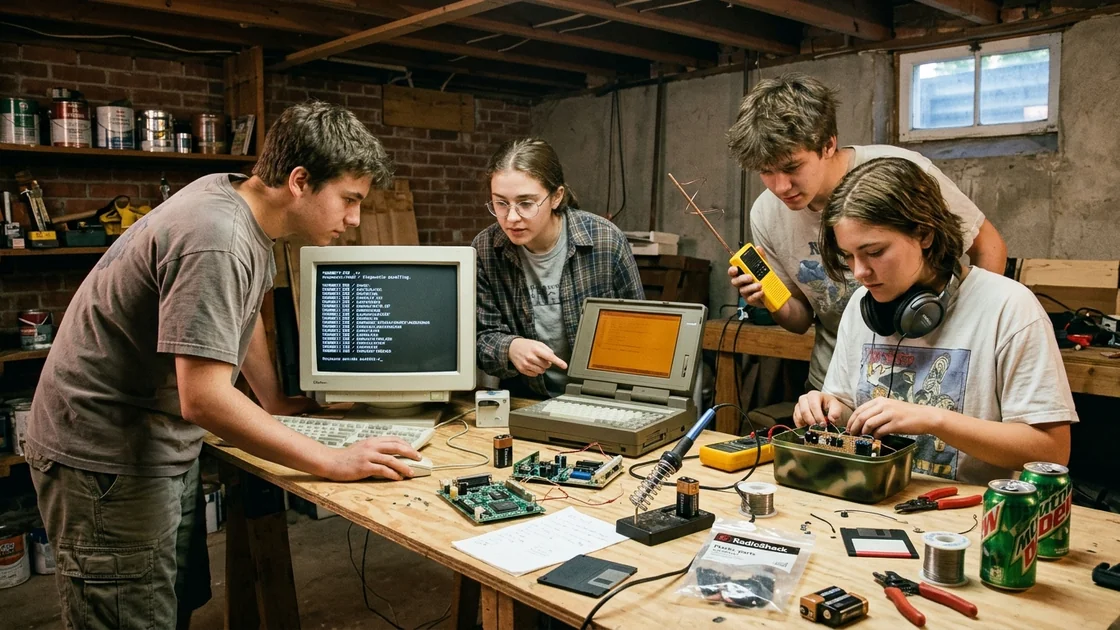
In the sweltering summer of 1996, four teenagers in the sprawling suburban subdivision of Oak Creek find themselves cut off from the digital world when their parents ban them from tying up the household telephone lines with their dial-up modems. Refusing to spend July and August in isolation, Leo, Maya, Toby, and Chloe raid local dumpsters, garage sales, and the back aisles of RadioShack to engineer an impossible alternative. By gutting old external modems, rewiring cheap walkie-talkies, and writing their own packet-switching software from scratch, they construct a clandestine, solar-powered wireless mesh network across rooftops, oak trees, and the town water tower, uniting their neighborhood in an invisible web of radio waves that faces its ultimate test when a severe late-summer storm severs the town from the outside world.
Chapter 1: No Carrier
The death of the connection always sounded like a robot drowning in a tin can.
First came the sharp, rhythmic clicking of the kitchen extension being lifted off its cradle upstairs. Then came the burst of human breath—rough, impatient, and devastatingly analog—Crashing right through the delicate symphony of phase-shifted audio tones negotiating at twenty-eight thousand eight hundred bits per second. On the glowing curvature of Leo Vance’s fourteen-inch CRT monitor, the ZModem transfer bar froze at ninety-four percent. Five megabytes of a leaked Quake shareware patch hung suspended in the copper purgatory between the central office switch and Mulberry Street.
"Mom, no, hang up!" Leo’s voice cracked as he lunged across his workbench, knocking over a plastic cup of warm Mountain Dew. "Wait ten seconds! Just ten—"
Through the floorboards above his basement lair, he heard the unmistakable, rapid-fire boop-boop-beep of his mother dialing her sister in Toledo.
On the screen, the terminal window spat out two words in stark,
unforgiving DOS white: NO CARRIER.
A second later, the external USRobotics Sportster modem on his desk
gave a tiny, mechanical click as its internal relay dropped the line,
extinguishing the little red CD LED like a dying star.
Fifty-two minutes of transfer time vanished into the ether.
Leo slumped back into his peeling vinyl office chair, the damp heat of the unfinished Ohio basement clinging to his neck. Above him, the muffled footsteps of his father crossed the hallway, followed by the groan of the basement door opening. Richard Vance didn't come all the way down the wooden stairs; he stopped halfway, his slacks and unbuttoned dress shirt framed between the floor joists.
"That’s it, Leo," his father said, holding up a yellow legal pad covered in penciled numbers. "Your mother tried to call the pharmacy three times this afternoon and got a busy signal every time. Your grandmother thought our phone was off the hook and nearly called the sheriff. Look at this bill from Ameritech. Even with local calls, you’re locking up the house for six hours a day."
"I was on the local dial-up node," Leo pleaded, gesturing helplessly at the beige tower humming beside his knees. "It’s a free local call! And I was at ninety-four percent—"
"I don't care if you were at ninety-nine point nine," his father said, his voice carrying the flat finality of a circuit breaker tripping. "Unplug the cord from the wall jack and bring it up to me. You can go back online for one hour on Sunday nights. If it’s seventy-eight degrees outside, you do not need to be sitting in the dark listening to a box screech at you."
"Dad, Toby and Maya and I are running a local node test tonight—"
"Tell Toby and Maya to ride their bikes over here and talk to you with their mouths," Richard said, extending his hand. "The gray cord, Leo. Now."
Ten minutes later, Leo was sitting on the curb at the dead end of Mulberry Street, the warm asphalt radiating the afternoon’s ninety-degree heat through the seat of his cargo shorts. Beside him sat a gutted AT&T answering machine he had been stripping for capacitors before the catastrophe struck. Down the gentle slope of the subdivision, where identical two-story colonials gave way to a stand of scrub pines and a concrete drainage ditch, three figures materialized out of the shimmering heat haze.
Maya Lin arrived first, coasting on a scarred silver mountain bike with a floppy disk case zip-tied to the handlebars. Behind her came Toby Mercer, pushing a dented shopping cart he had liberated from the woods behind the Ames department store, its basket rattling with an assortment of beige plastic carcasses. Walking alongside the cart was Chloe Alvarez, wearing oversized studio headphones around her neck and carrying a yellow digital multimeter by its leads like a yo-yo.
"Let me guess," Maya said, skidding to a halt and planting her sneakers on the pavement. She pushed her wire-rimmed glasses up her nose. "Your mom picked up the phone."
"Worse," Leo said grimly. "Confiscation. The RJ-11 cord is in the kitchen junk drawer under lock and key. I’m dark until Sunday night."
Toby groaned, letting go of the shopping cart so it rolled gently against the curb. "Dude, no. My dad pulled the splitter out of my wall this morning because he missed a call from his shift supervisor at the plant. He put a literal padlock on the Demarc box outside the garage."
"My parents didn't even take the cord," Chloe said, dropping onto the grass beneath the shade of a struggling maple tree. "My older sister started dating a guy from Westlake. If the phone line is free for more than thirty seconds, she’s on it. I tried to send an echo request to Maya’s machine at four o'clock and all I got was Stacy whispering about who’s taking who to the county fair."
Maya looked around at the three of them, her dark eyes narrowing behind her lenses. "Wait. Are you telling me I’m the only one who still has a working line?"
"Because your parents own a restaurant and they aren't home until eleven," Toby pointed out. "Which doesn't help you much when there’s nobody on the other end to dial into your BBS."
Silence settled over the cul-de-sac, broken only by the high, rhythmic droning of cicadas in the maples and the distant hum of lawnmowers three streets over. For the past eight months, the four of them had lived inside The Rust Bucket, a Wildcat! Bulletin Board System running on Maya’s hand-me-down 486DX2. Even though their houses were separated by less than three-quarters of a mile across the winding streets of the Oak Creek development, the copper loops of Ameritech were the only thing bridging their bedrooms after dark. They traded C++ compilers, argued over multi-node chat scripts, passed message packets, and played late-night matches of TradeWars 2002 and Doom when they could coordinate a direct dial.
Now, with seventy-two days of summer vacation stretching ahead of them like an empty desert, they were marooned on separate islands of manicured grass.
"We could run wire," Toby suggested, kicking the front wheel of his shopping cart. "I’ve got four hundred feet of four-conductor station wire in my shed. We string it through the storm drains."
"It’s almost half a mile from my house to Chloe’s, and Dead Man’s Hill is right in the middle," Leo said, shaking his head. "Even if we stole two miles of copper, RS-232 serial drops dead after fifty feet unless you drive it hard, and the second the city mows the culvert behind Birch Lane, they’ll shred the cable into confetti."
"What about acoustic couplers?" Chloe asked, plucking a blade of grass. "Like in WarGames. Use payphones."
"With what quarters?" Maya asked dryly. "And I’m not hauling a forty-pound desktop tower to the payphone outside the Convenient Food Mart."
Leo stared into the shopping cart Toby had wheeled up. Inside lay the spoils of their morning raid on the dumpsters behind Oak Creek Office Supply and the municipal electronics drop-off: two dead dot-matrix printers, a tangle of centronics cables, three external 14.4k and 2400-baud modems with missing power bricks, and, wedged in the corner next to a cracked boombox, a pair of chunky, black plastic RadioShack TRC-219 walkie-talkies with telescoping chrome antennas.
Leo blinked. He leaned forward, reaching into the cart to pull out one of the walkie-talkies. The battery cover was held on with peeling black electrical tape, and the silver label on the back read 27 MHz Citizens Band Transceiver - 3 Watts.
"Toby," Leo said slowly. "Where did you get these?"
"Mr. Henderson’s trash can on Elm," Toby said proudly. "One of the antennas is snapped off at the second joint, and the squelch knob is missing, but they power up if you hold the nine-volt clip just right."
Leo didn't answer. He reached back into the cart and lifted out a battered, aluminum-cased Hayes Smartmodem 2400. He held the walkie-talkie in his left hand and the modem in his right, weighing them against each other like scales of justice.
"Leo?" Maya asked, recognizing the vacant, glassy stare that usually preceded a blown fuse in his basement. "What are you doing?"
"What is a modem?" Leo asked softly.
"Modulator-demodulator," Chloe recited automatically. "It turns digital serial ones and zeros from a UART chip into audible tones that can travel over a voice-grade telephone line."
"Right," Leo said, standing up so fast his knees popped. "Audible tones. Just sound. Three hundred hertz to three thousand hertz. That’s all a phone line carries. The modem doesn't care if those sounds travel through ten miles of buried Ameritech copper or—" He held up the battered walkie-talkie, the chrome antenna glinting in the late-afternoon sun. "—through the air."
Maya frowned, her brain immediately shifting into logic-gate mode. "Wait a minute. Hold on. You’re talking about packet radio. Ham operators do that on two-meter bands, Leo, and they use three-hundred-dollar Terminal Node Controllers and FCC licenses we don't have."
"A TNC is just a specialized modem with a microcontroller on it," Leo countered, pacing across the asphalt. "Look at what we already have! We have computers with serial ports. We have a literal pile of old modems that already know how to turn serial bytes into audio tones and back again. And we have walkie-talkies that don't require an FCC license if we stay on forty-nine megahertz or CB channels under four watts!"
Chloe sat up straighter under the tree, her fingers tapping against
the yellow casing of her multimeter. "Okay, slow down, Marconi. A
telephone line is full-duplex. Both modems scream at each other at the
exact same time on different carrier frequencies. A walkie-talkie is
half-duplex. Only one person can talk at a time while holding down the
Push-To-Talk button. The instant you let go of the button on a
walkie-talkie, a regular dial-up modem will lose its carrier tone and
hang up. NO CARRIER, remember?"
Leo stopped pacing. He looked at the Hayes 2400 in his hand, then at Chloe. "Not all of them," he whispered. "High-speed modems—28.8k, 14.4k, even 2400—use quadrature amplitude modulation and echo cancellation. They need a continuous full-duplex handshake. But the old ones? The ancient 1200-baud and 300-baud chips inside these legacy boxes? They just use simple Frequency Shift Keying. One tone for a one, another tone for a zero."
"Even if you force an old modem chip to spit out raw FSK tones without waiting for a dial tone," Maya said, standing up from her bike, "how do you press the Push-To-Talk button on the walkie-talkie? You can't sit there clicking the plastic trigger with your thumb fifty times a minute when the computer wants to send a packet."
"Pin four," Leo and Chloe said at the exact same time.
They looked at each other and grinned.
"Pin four on a nine-pin serial port," Chloe explained to Toby, who was looking back and forth between them like he was watching a tennis match. "Request To Send. RTS. Maya can write a program that flips Pin four high to five volts right before the computer spits data out of the transmit pin, and drops it low when the byte stream finishes."
"And we wire Pin four to a fifty-cent NPN transistor that shorts out the Push-To-Talk switch inside the walkie-talkie!" Leo finished, his voice rising with excitement. "The computer keys the radio mic itself, blasts a burst of audio tones out of the modem's speaker circuit into the walkie-talkie's microphone jack, and un-keys the mic to listen for the reply!"
Maya pushed her glasses up again, her skepticism warring with the sudden, intoxicating itch of an impossible programming challenge. "Walkie-talkies have terrible audio quality, Leo. Static, squelch tails, kids playing cops and robbers on the same channel, lawnmower ignitions. Half the bytes will get chewed up in the air."
"So we don't send raw terminal text," Leo said, stepping right up to her handlebar. "We wrap the bytes in frames. Checksums. Sequence numbers. Like TCP/IP or AX.25, only stripped down so it can run in DOS on junk hardware. And here’s the best part: if my radio can't reach Toby’s house on the other side of Dead Man’s Hill, it doesn't matter. Because your house is at the top of the ridge, Maya. My radio sends the packet to your radio, your computer checks the address header, sees it’s meant for Toby, and automatically keys your radio to blast it down the other side of the hill."
Toby’s jaw dropped slightly. "Wait. Like buckets in a bucket brigade?"
"A mesh," Maya breathed, her eyes suddenly wide as the architecture unfolded in her mind. "Every computer in the neighborhood acts as a router and a repeater. No central phone switch. No monthly bill. No busy signals when someone’s sister picks up the kitchen phone."
She looked up the street toward the power poles strung with thick black telephone cables—Ameritech’s monopoly hanging twenty feet above their heads—and then down at the pile of dirty beige junk in Toby’s shopping cart.
"How fast could it go?" Toby asked.
"Twelve hundred bits per second if we’re lucky," Chloe said, standing up and brushing dry grass off her jeans. "Maybe twenty-four hundred if I can tune the audio filters clean enough."
"That’s twenty times slower than my Sportster," Toby noted.
"Your Sportster has a padlock on it, Toby," Leo said, tossing him the second walkie-talkie. "Twelve hundred baud twenty-four hours a day beats zero baud all summer. Everyone empty your pockets. How much cash do we have for RadioShack?"
Chapter 2: The Tyranny of the Landline
The RadioShack at the Oak Creek Strip Mall smelled of ozone, warm carpet glue, and the faint, metallic tang of ten thousand tiny polybagged resistors hanging on pegboards at the back of the store.
It was the only place in town where the air conditioning was set low enough to raise goosebumps on sweat-slicked arms. Whenever the bell above the glass door jingled, the store manager, a gaunt thirty-something man named Dennis who wore a clip-on tie with tiny circuit boards printed on it, didn't even bother asking for their names and addresses for the mailing list anymore. He just sighed, set down his soldering iron behind the counter, and watched the four of them bee-line past the cell phones and RCA VCRs straight toward the Rotating Wall of Parts.
"Thirty-seven dollars and forty-two cents," Toby muttered, counting a fistful of crumpled ones and quarters onto the glass display case that housed the shortwave receivers. "Plus whatever we can salvage from the dumpster behind the TV repair shop on Route 4."
"Don't buy anything we can desolder," Chloe ordered, flipping through the dog-eared pages of the 1996 RadioShack catalog chained to the counter. She ran her thumbnail down a table of integrated circuits. "Leo, those 14.4k modems in the cart use proprietary Rockwell chipsets. They’re too smart for their own good—the DSP locks up if it doesn't hear a clean carrier wave within fifty milliseconds. We can't use them."
"What about the older 2400-baud ones?" Leo asked, squatting by the bottom rack of the components aisle with a handful of 2N2222 switching transistors and mini audio transformers.
"Inside those old Hayes clones and Practical Peripherals boxes, they use discrete modulator chips," Chloe said, tapping the catalog page. "Or better yet, look right here—if we run short on old modems, we can build bare-bones FSK modems from scratch or hijack the XR2206 and XR2211 audio tone chips out of those dead burglar alarm dialers Toby found last week. Wait—look at the clearance bin."
At the end of the aisle sat a wire dump bin marked AS-IS / MANAGER'S SPECIAL. Half-buried beneath tangled coaxial cables and universal remotes were four bright yellow plastic boxes: Realistic TRC-503 FM Business-Band / 49 MHz Transceivers - Returned/Display Models.
Leo pulled one out. Unlike the twenty-seven-megahertz CB walkie-talkies, which used amplitude modulation and picked up every spark plug and thunderstorm within fifty miles, forty-nine megahertz used FM—Frequency Modulation.
"FM," Chloe whispered, her eyes lighting up as she took the box from him. "Fifty milliwatts, Channels A through E. FM has a capture effect and way cleaner audio between three hundred and three thousand hertz than cheap CBs. Look, they even have jack ports on the top for external headset mics and earpieces!"
"They don't have to be gutted to get to the speaker wires," Leo realized, turning the box over. "Two-point-five millimeter sub-miniature plug for the mic, three-point-five millimeter for the earpiece. Dennis!" Leo called out, holding up the four battered yellow boxes. "How much for all four of these open-box forty-nine-megahertz headsets?"
Dennis squinted across the store. "Half of them are missing the foam earpads, kid, and one of them has a cracked battery door."
"Ten bucks for the lot," Toby countered immediately, stepping up to the counter and spreading ten damp one-dollar bills across the glass like a riverboat gambler. "Cash on the glass, Dennis. You know nobody else in Oak Creek is buying returned baby-monitor frequency headsets."
Dennis looked at the ten single dollar bills, then at the wire bin that had been collecting dust since Christmas of 1994. "Twelve. And you don't bring them back when you blow the final output transistors doing whatever illegal thing you’re about to do."
"Forty-nine megahertz Part 15 is completely unlicensed, Dennis," Chloe said sweetly, slapping two more singles onto the counter. "As long as we don't crank the transmitter power or change the modulation deviate."
"Yeah, sure, tell it to the FCC van when it rolls down Mulberry Street," Dennis muttered, ringing up the sale junto with a dozen eight-pin DIP sockets, two rolls of rosin-core solder, four six-hundred-ohm audio isolation transformers, and a handful of optocouplers.
By five o'clock, Leo’s basement had transformed into a sweatshop of mid-nineties engineering.
Because Leo’s parents were grilling pork chops on the back deck, the basement was relatively safe, provided nobody made enough noise to rattle the heating ducts. A box fan propped in the small casement window blew the sweet, piney smoke of melting solder rosin out into the bushes.
On the long plywood workbench sat two test subjects: Leo’s main 486 tower on the left side of the room, and an ancient, luggable Toshiba T1200 laptop with an orange gas-plasma screen on the far side of the basement behind the furnace. Both had their nine-pin serial ports connected to gutted, bare circuit boards pulled from old external 1200-baud modems.
"Explain the problem to me again like I don't speak solder," Maya said, sitting cross-legged on an overturned milk crate in front of the Toshiba. Her fingers were poised over the thick mechanical keys, where Borland Turbo C++ 3.0 glowed in amber monochrome.
"Okay," Leo said, wiping his forehead with the back of his wrist so he wouldn't smear thermal paste on his face. "A standard dial-up modem expects to be plugged into the wall. The phone company sends forty-eight volts of direct current down that line when the phone is hung up, and drops it to about nine volts when you pick up the receiver. If we just wire the modem’s phone jack straight to the walkie-talkie’s microphone jack, nothing happens, because the modem’s audio transformer is waiting for loop current and the audio levels are all wrong."
"Plus you’ll fry the walkie-talkie’s preamp with the modem's output voltage," Chloe added, peering through a magnifying lamp as she soldered a tiny ceramic capacitor across the legs of a small square audio transformer. "So we threw away the telephone line interface part of the modem board completely. We traced the circuit right back to the modulator chip—this forty-pin bug right here." She tapped the black integrated circuit with the tip of her needle-nose pliers. "Pin seventeen is raw transmit audio out. Pin nine is raw receive audio in. We run those through two tiny isolation transformers and a pair of variable resistors so we can dial the volume down to microphone level."
"And the walkie-talkie thinks a tiny person with a very annoying robot voice is whispering into its headset," Toby said, nodding sagely from where he was stripping telephone wire with his teeth.
"Exactly," Leo said. "Now, Maya, here’s your side. The modem chip is
dumb now. We cut the traces to its onboard processor so it won't wait
for an ATDT command or a dial tone. The moment we power the
board with nine volts, it’s in permanent originate/answer mode. When you
raise the RTS pin on COM1, this little optocoupler closes the circuit on
the walkie-talkie's Push-To-Talk wire. Click—the walkie-talkie starts
transmitting."
"How long does the walkie-talkie take to actually start transmitting after I flip RTS high?" Maya asked sharply.
Chloe looked up from her magnifying lens, impressed. "Good catch. That’s the transmitter turn-on delay, plus the time it takes the receiving walkie-talkie on the other side of the room to open its squelch circuit."
"If I start dumping bytes out of the serial port the microsecond I flip RTS high, the first three or four characters are going to get chopped off while the radios are still waking up," Maya said, her eyes darting across her C code. "Give me a number. Twenty milliseconds? Fifty?"
"Make it a hundred milliseconds of pure lead-in tone before you send a single bit of real data," Chloe advised, clipping the excess wire leads off the bottom of the green perfboard with a sharp snip-snip. "Let the carrier tone settle the receiver's automatic gain control. And at the end of the packet, keep RTS held high for twenty milliseconds after the last byte clears the UART buffer, or you’ll chop off the tail of the checksum."
Maya’s fingers blurred across the Toshiba’s keyboard.
delay(100); went into the transmit routine right after
outportb(COM1 + 4, 0x03); which slammed the Request-To-Send
line high.
For the next two hours, the basement was filled with the smell of scorching flux and the occasional sharp curse when someone touched a freshly tinned wire. By seven-thirty, the two prototype interfaces—dubbed "Toads" by Toby because they sat squat and ugly inside plastic soap dishes he had stolen from his mother's linen closet, sprouting green wires and status LEDs—were wired between the serial ports and the yellow Realistic 49 MHz transceivers.
"Powering up Toad One," Leo announced, clipping a fresh nine-volt battery onto the leads of his soap-dish modem. A green LED poked through a hole melted into the plastic with the soldering iron flickered and stayed solid.
Across the basement, behind the rusted hull of the oil furnace, Maya clipped the battery onto Toad Two.
"Switch both radios to Channel B," Chloe instructed, holding an oscilloscope probe she had borrowed from the high school physics lab before summer break. "Leave the earpiece monitor unplugged on Leo's side for a second so we can hear what’s actually going over the air."
Leo flipped the switch on his walkie-talkie. A soft hiss of white noise filled the basement.
"Maya," Leo said, his heart thumping against his ribs. "Send a packet."
Behind the furnace, Maya hit Ctrl+F9 to compile and run
TOADNET.EXE, typed HELLO MULBERRY STREET, and
struck the Enter key.
On her soap-dish, the red PTT LED flashed bright crimson.
From the tiny speaker of Leo’s walkie-talkie across the room came a sharp chk!—the sound of the squelch breaking—followed by a hundred-millisecond pure whistle, and then a tight, rhythmic burst of warbling static that sounded like a digital hummingbird: bzzzz-chirp-kssht!
On Leo’s 486 monitor, the DOS cursor blinked once, twice, and then printed across the black screen:
[RX PKT 01 | CRC OK]: HELLO MULBERRY STREET
Nobody breathed for three full seconds.
Then Toby let out a whoop so loud Leo had to tackle him onto an old sofa cushion before his parents heard them through the kitchen floor.
"CRC OK!" Maya shouted in a fierce whisper, emerging from behind the furnace with her fists pumped in the air. "Zero bit errors! Twelve hundred bits per second over forty-nine megahertz FM! Do you know what this means?"
"It means we just jumped twenty feet across a basement," Chloe said, though a huge grin was splitting her face as she stared at the clean square waves captured on her scope screen. "Now let’s see if it makes it across the street."
Chapter 3: Soldering Iron Blues
In theory, radio waves traveled at the speed of light through air, drywall, and cedar siding with effortless grace.
In practice, as the crew discovered at ten o'clock the next morning, fifty milliwatts of forty-nine-megahertz FM had a hard time fighting its way past Mrs. Gable’s aluminum storm windows, three maple trees, and an oscillating lawn sprinkler.
Leo was perched on the roof of his back porch outside his bedroom window, squinting in the bright morning sun while holding Toad One and the yellow transceiver at arm's length. Down below, snaking through his window screen, was a twenty-five-foot cobbled-together serial extension cable running back to his desktop PC.
Three houses down and across the curve of Mulberry Street, four hundred yards away and thirty feet higher up the gentle rise of the neighborhood ridge, Maya’s bedroom window was wide open. Even from here, Leo could see the tiny flash of a pocket mirror she was using to signal him when she was ready to transmit.
In the bushes below Leo’s porch roof, Toby and Chloe were huddled around a portable monochrome monitor they had plugged into a long VGA extension cord dropped out of Leo's window, watching the packet diagnostics scroll by.
"Mirror flash!" Toby called up toward the shingles. "She’s sending a five-hundred-byte text block!"
Leo held his breath and kept the walkie-talkie's six-inch rubber duck antenna pointed straight toward Maya’s maple tree.
Inside the soap-dish in his hand, the receive LED flickered erratically. Down in the bushes, Chloe groaned.
"Look at the screen," she called up. "Packet One: CRC error. Packet Two: dropped after twelve bytes. Packet Three: framing error. Wait—Packet Four made it! Packet Five: CRC error. Leo, stop moving your arm!"
"My arm is cramping!" Leo hissed down at them, shifting his sneaker on the hot asphalt shingles. "And why are we losing four out of five packets? These things say 'Up to One-Quarter Mile Range' right on the box!"
"That’s 'RadioShack Marketing Miles,'" Chloe called back, shading the monitor with a piece of cardboard. "Measured over flat salt flats with two guys standing on ladders shouting 'Breaker One-Nine.' Digital data can't handle a single millisecond of static dropout. If a delivery truck drives down Mulberry Street and its alternator pops, it flips three bits in the middle of a frame and Maya’s checksum rejects the whole fifty-byte packet."
Leo carefully backed through his bedroom window, hauling the cables in after him, and met Chloe and Toby inside while Maya rode her bike down the hill five minutes later, her face flushed from the heat and frustration.
"My retry loop timed out after ten attempts," Maya said as soon as she walked into Leo’s basement, tossing her bike helmet onto the old couch. "At a twenty percent success rate, it took ninety seconds just to send a single paragraph of text. If we try to hop that signal through two more houses to reach Toby and Chloe, the math kills us. Point-two times point-two times point-two is less than a one percent chance a packet makes it across the neighborhood."
"We have two separate problems," Chloe said, picking up a walkie-talkie and unscrewing the tiny black rubber antenna to inspect the brass stud underneath. "Problem one is hardware: these antennas are garbage. At forty-nine megahertz, a full wavelength is about six meters—twenty feet. A quarter-wave whip antenna needs to be roughly five feet long to actually resonate efficiently. This six-inch rubber spring is just a dummy load wrapped in vinyl. Ninety percent of our fifty milliwatts is turning into heat instead of radio waves."
"We can solder fifty-eight inches of stiff copper coat-hanger wire or copper tubing straight to the antenna lug," Leo said, grabbing a scratchpad and scribbling the wavelength formula: \(300 / 49.830 = 6.02\text{ meters}\). "And add four fifty-eight-inch radials angling down from the ground plane of the circuit board. Instant quarter-wave ground-plane antenna. That’ll quadruple our effective radiated power without touching the transmitter circuit or breaking FCC limits."
"Okay, that fixes the physical signal," Maya said, leaning over the workbench. "What’s problem two?"
"Problem two is your packet size and the modem’s brain," Chloe said, pointing her screwdriver at the gutted 1200-baud modem board. "You’re sending sixty-four-byte packets with a simple parity check. When a burst of static hits on the air, it usually lasts ten or twenty milliseconds. If your packet is five hundred milliseconds long, it’s a giant fat target sitting in the sky waiting to get shot down. And worse—when the walkie-talkie keys up, the first two bytes are still getting scrambled because the DC voltage on the audio line jumps when the squelch opens."
Maya chewed her bottom lip, her fingers drumming against the plywood table. "If I shrink the packet payload down to thirty-two bytes, the transmission burst only lasts about three-tenths of a second. It slips right between the bursts of static."
"Wait," Leo said, leaning in. "What if you don't just shrink the packet? What if you build Forward Error Correction right into the bytes?"
Maya blinked at him. "Like Hamming codes?"
"Yes! Or even simpler—a twelve-eight code, or Reed-Solomon if the 486
can crunch it fast enough," Leo said, grabbing his pencil again. "Right
now, if a single bit out of two hundred and fifty-six gets flipped by a
lawnmower spark plug, your code throws the whole packet in the trash and
keys the radio up again to yell NAK—SEND AGAIN, which
wastes another half-second of airtime. What if we sacrifice a third of
our speed to include parity matrices so the receiving computer can
mathematically reconstruct up to four corrupted bits on the fly without
asking for a retransmission?"
Maya stared at the scratchpad for a long moment. Slowly, the corners of her mouth curved upward. "Four-bit Hamming nibbles," she murmured. "Every byte of ASCII gets split into two four-bit nibbles, and each nibble gets three parity bits attached to form a seven-bit codeword. If any single bit in that seven-bit chunk flips in the air, the receiver doesn't just detect the error—it knows the exact bit position that flipped and inverts it back to normal before checking the CRC."
"What does that do to our speed?" Toby asked warily.
"Drops our raw throughput from a hundred and twenty characters per second down to about seventy," Maya calculated out loud. "Still faster than most people can read or type. And if a packet still gets completely obliterated by a big burst of static, we use a sliding window acknowledgment protocol. Let’s call the protocol HopScotch."
They worked through the blistering heat of the afternoon, fueled by warm tap water and peanut butter crackers. While Maya sat huddled over the keyboard rewriting her low-level serial interrupt handlers in tight inline assembly to ensure the UART buffer never overflowed, Leo, Chloe, and Toby turned the basement into an antenna factory.
Toby raided his dad’s garage for a twenty-foot coil of rigid eighth-inch copper refrigerator tubing and a bucket of PVC plumbing tees. Chloe carefully cut the tubing into precise fifty-six-and-a-half-inch sections with a pipe cutter, using her multimeter and a makeshift field-strength meter she built out of a germanium diode and a micro-ammeter to trim each rod half a millimeter at a time until the needle pegged hard to the right when a walkie-talkie was keyed ten feet away.
By four o'clock, Toad One and Toad Two no longer looked like children's toys.
Each soap-dish modem was now bolted to the bottom of a weather-sealed Tupperware container that Toby had liberated from his kitchen, painted flat camouflage gray so it would blend in against tree bark or roof shingles. Sticking straight out of the top of each Tupperware lid was a gleaming five-foot copper lance, while four angled copper radials jutted out from the base like the legs of a metallic spider. Inside, Chloe had soldered a pair of clipping diodes and an active bandpass audio filter built from a seventy-nine-cent LM358 op-amp chip, carving away every trace of hiss below four hundred hertz and above twenty-six hundred hertz before the audio ever touched the modem chip.
At four-thirty, Maya rode her bike back up the hill with the new HopScotch v0.4 floppy disk and the spider-legged Tupperware node strapped to her backpack.
Leo climbed back out onto the porch roof and zip-tied his copper spider to the unused galvanized mast where his parents' old television antenna had lived before cable TV came to Oak Creek in 1989.
He climbed back inside, wiped the sweat from his stinging eyes, and stared at his monitor.
At 4:47 PM, the green RX LED on his desktop control box
flashed.
Through the tiny monitor speaker Chloe had wired into the box came the new sound of HopScotch: crisp, violent, and rhythmic, like a machine gun firing short bursts of musical notes. Brrrt! ... Brrrt! ... Brrrt!
On Leo’s screen, a text file—the entire four-kilobyte README file from Doom v1.2—began pouring down the terminal window in smooth, uninterrupted blocks of thirty-two characters. On the right side of the screen, Maya’s diagnostic dashboard updated in real time:
PACKETS RX: 128 | RETRIES: 1 | HAMMING REPAIRS: 14 | LINK QUALITY: 98.4%
Then the file transfer finished, a double beep sounded from the PC speaker, and a split-screen chat window popped open at the bottom of the monitor.
[MAYA@NODE02]: Can you read me, Mulberry Street?
Leo’s fingers trembled slightly as he typed back.
[LEO@NODE01]: Five by five. Not a single dropped packet.
[MAYA@NODE02]: And my mom is downstairs on the phone with our restaurant supplier right now. She has no idea.
In the basement, Toby stared at the scrolling text on the screen, then looked out the high casement window toward the hill blocking his own house half a mile away on Birch Lane.
"Okay," Toby said, his voice hushed with sudden reverence. "Point-to-point works. Now how do we get over Dead Man’s Hill?"
Chapter 4: 1200 Baud across Mulberry Street
To understand the geography of the Oak Creek subdivision was to understand why thirty-two megahertz to fifty megahertz radio waves hated it.
Built in the late seventies on former glacial farmland, the neighborhood was bisected by a wooded ridge locally known as Dead Man’s Hill—so named because any ten-year-old foolish enough to ride a Huffy down the gravel service path from the municipal water tower at the summit usually ended up in the emergency room with thirty stitches.
Leo lived on the west slope on Mulberry Street. Maya lived near the southern shoulder of the ridge on Overlook Drive, giving her clear line-of-sight down into Leo’s backyard, and an unobstructed view east toward Chloe’s duplex on Sycamore Court.
Toby, however, lived in the deep, tree-choked hollow on Birch Lane at the northern foot of the hill. Between Toby’s bedroom window and Maya’s house stood eighty vertical feet of clay soil, glacial boulders, and two hundred mature white oak trees heavy with summer sap.
That evening after dinner, the four of them spread an old developer’s plat map of Oak Creek across the hood of Maya’s mother’s Honda Civic in Maya’s driveway. With her parents at the Golden Dragon restaurant until midnight, Maya’s garage was their forward operating base.
"Look at the contour lines," Leo said, tracing a red Sharpie across the map under the yellow glow of the garage floodlight. "Node 01 at my house can hit Node 02 here at Maya’s. And from Maya’s roof, we have a straight shot down Overlook Drive to Chloe’s porch roof—that’s Node 03."
"So if I want to send a message to Chloe," Leo continued, "my
computer sets the destination byte in the HopScotch packet
header to 03, and the next-hop byte to 02.
Maya’s computer hears the packet, sees that it’s addressed to
03, waits two hundred milliseconds for the channel to
clear, and blasts it right back out on the air to Chloe."
"Wait," Chloe said, leaning over the fender of the Civic. "If we’re all on Channel B on forty-nine megahertz, won't Leo’s radio and my radio accidentally talk at the exact same time if we’re both trying to reach Maya? They can't hear each other because the hill is in the way, so they’ll collide right over Maya’s roof!"
Maya nodded grimly. "The Hidden Node Problem. I read about it in an old BYTE magazine article at the library this afternoon. If Node 01 and Node 03 can't hear each other, carrier-sense fails."
"Can we put them on different channels?" Toby asked. "The walkie-talkies have five channels: A through E."
"Only if Maya has two radios," Leo said. "Wait—why doesn't she? No, even simpler: what if Maya’s node controls the clock? Or what if you have to ask permission before sending a big block?"
"RTS/CTS over the air," Maya said, snapping her fingers. "Before Node
01 sends a thirty-two-byte data packet, it sends a tiny four-byte
PING-RTS frame that only lasts thirty milliseconds. Maya’s
node hears it and immediately broadcasts a four-byte
CTS-HOLD frame that both Leo and Chloe can hear,
telling Chloe’s computer: Shut up for the next two seconds, Leo has
the floor. Plus, we add a random backoff timer based on each node’s
ID number so if two nodes ever do collide, they don't retry at the exact
same millisecond."
"That solves me, Maya, and Chloe," Toby said, tapping his finger hard on the northern corner of the map where Birch Lane sat in the shadow of the hill. "What about me? Even from Maya’s chimney, the crest of Dead Man’s Hill blocks Birch Lane. And nobody we know lives on top of the hill because there are no houses up there—just the woods and the town water tower."
The three of them looked up from the map, turning their heads toward the dark silhouette of the wooded hill rising behind Maya’s backyard. Above the black canopy of the oaks, illuminated by a single orange municipal sodium vapor lamp, stood the four steel legs and bulbous blue tank of the Oak Creek Water Tower.
"No houses," Leo said softly. "Which means no bedrooms. No wall outlets. No desktop computers."
"If we put a repeater up there in the trees—or on the tower catwalk—it would have line-of-sight to every single street in the entire township," Toby whispered. "It could see my house, your house, Chloe’s house, and twenty other blocks."
"With what computer, Toby?" Maya asked. "You can't leave a desktop PC sitting in a tree, and an extension cord won't reach half a mile up a wooded hill."
Toby didn't look discouraged. Instead, a slow, mischievous smile spread across his freckled face. "Who said a repeater needs a desktop PC? Or an extension cord?"
He turned and trotted into the back corner of Maya’s garage, where he had stashed the secondary pile of junk from his shopping cart earlier that afternoon. He rummaged behind a stack of old snow tires and dragged out two items: a thick, gray plastic briefcase that weighed about twelve pounds, and a rusty red metal box he had pulled from a broken riding lawnmower.
He set the gray plastic briefcase onto the hood of the Civic and popped the latches.
Inside was an IBM PC Convertible 5140—a 1986 laptop with a cramped beige keyboard, dual 720k floppy drives, and a flat, non-backlit LCD screen.
"Where on earth did you get that?" Leo asked, staring at the dinosaur.
"The guidance counselor at the middle school was throwing out four of them in May when they got the new Macintosh Performa lab," Toby said, patting the yellowed plastic casing. "The battery packs are dead, and it only has an 80C88 processor running at four-point-seven-seven megahertz, so it can't run Windows or games. Nobody wanted them. I took three of them home in my backpack."
Chloe leaned in close, reading the moulded specs on the back panel of the machine. "Wait a minute. 'CMOS 80C88.' Leo, that 'C' stands for CMOS. Static logic. And there's no hard drive to spin and no backlight on the screen."
She grabbed her yellow multimeter, flipped the laptop’s power switch—nothing happened on the dead battery—and measured the DC input jack specification printed on the bottom label.
"Nine to twelve volts DC," Chloe breathed, her eyes widening. "When you close the LCD screen, a switch inside shuts off the display driver chip completely. Do you know how little power a CMOS 8088 draws with no hard drive and the screen turned off once the program is loaded into RAM from the floppy drive? Less than four watts. Around three hundred milliamps at twelve volts!"
Leo looked from the ancient laptop to the rusty red box Toby had set on the pavement—a twelve-volt deep-cycle marine and lawn-tractor lead-acid battery.
"Wait," Leo said, his voice rising. "Three hundred milliamps for the laptop. The walkie-talkie draws fifteen milliamps on receive and maybe two hundred milliamps for the fraction of a second it transmits. That’s a third of an amp average draw. A forty-amp-hour lawnmower battery could run that laptop and a Toad modem twenty-four hours a day for five straight days without a recharge!"
"Longer than five days," Toby said triumphantly, reaching into his backpack and pulling out a flat, ten-inch-square glass panel wired to a broken plastic stake. "Because Mr. Miller down the street replaced all his solar driveway floodlights with low-voltage wired ones last Saturday. He threw six of these twelve-volt amorphous silicon solar charger panels in the recycling bin."
Maya, Leo, and Chloe stared at the scuffed solar panel in Toby’s hands.
"By day, the sun charges the twelve-volt battery through a blocking diode and trickle-powers the laptop," Chloe said, doing the amp-hour math on her fingers. "By night, it runs off the lead-acid reserve. Once Maya’s routing program boots off the floppy disk into RAM, the floppy drive motor spins down and never turns on again unless the system reboots."
"An autonomous store-and-forward mesh repeater," Maya whispered, running her hand over the keys of the ten-year-old IBM laptop. "No monitor. No keyboard input needed once it’s running. It just sits in the dark inside a waterproof cooler, listening to the air, repairing corrupted Hamming bits, consulting its routing table, and bouncing packets over the hill."
"Node Zero," Leo said, looking back up at the blue steel water tower rising above the dark trees of Dead Man’s Hill. "The sky node."
Chapter 5: Line of Sight
Before they risked climbing municipal infrastructure with thirty pounds of batteries and contraband electronics, they had to prove the mesh could actually route around corners.
Over the next three days, the four friends worked in shifts like a covert telecommunications company.
In the mornings, when the sun wasn't yet broiling the asphalt, Toby and Leo scoured every curb on trash day and raided the twenty-five-cent bins at the Salvation Army thrift store on Route 4. They scored two more Realistic 49 MHz walkie-talkies (one disguised inside a broken toy police helmet, which retained the exact same TRC-503 circuit board inside), three more external 1200-baud modems, and four heavy-duty rubberized Igloo coolers with broken latches that could be sealed shut with silicone caulk and duct tape.
In the afternoons, Chloe commandeered Leo’s basement workbench, mass-producing Toad boards on copper-clad perfboard. She refined the design with each iteration: Toad v2.0 dumped the separate nine-volt battery entirely, tapping twelve volts straight from the host computer's disk drive power connector (or the lawnmower battery on the portable nodes) and stepping it down to a rock-solid nine volts for the modem board and six volts for the walkie-talkie via a pair of 7809 and 7806 voltage regulators bolted to scrap aluminum heat sinks.
Meanwhile, Maya spent thirty-six hours turning HopScotch from a simple point-to-point file transfer script into a genuine self-healing network stack.
"Look at the screen," Maya told them on Thursday afternoon, when all four computers—Leo’s 486, Maya’s 486, Chloe’s 386SX laptop, and the ancient IBM PC Convertible that would become Node Zero—were lined up across Leo’s basement floor.
To prevent the four radios from overloading each other at close range, Chloe had disconnected their copper antennas and wired tiny fifty-ohm resistors across their antenna jacks, placing metal coffee cans over the middle two radios so Node 01 couldn't directly hear Node 03 or Node 04 even inside the same room.
"Watch what happens when I boot them up," Maya said.
She flipped the switch on all four machines. One by one, the floppy
drives grunted, loaded MS-DOS 5.0 and HOPSCOTCH.EXE, and
then went silent.
Suddenly, the red and green LEDs on the four Toad boxes began to dance in a slow, hypnotic cadence.
Chirp. Wait. Chirp-chirp. Wait. Chirp.
"What are they doing?" Toby asked, squatting down to watch the blinking lights.
"Every three minutes, each node broadcasts a sixteen-byte
HELLO beacon listing every other node it can currently hear
and the average signal quality of those links," Maya explained, pointing
to the routing table matrix updating on Leo’s monitor. "See? Node 01
(Leo) only hears Node 02 (Maya). Node 02 hears Node 01 and Node 00 (the
IBM laptop). Node 00 hears Node 02 and Node 03 (Chloe). Within sixty
seconds of turning on, every computer on the network has built a
complete map of the neighborhood using Dijkstra’s shortest-path
algorithm."
To prove it, she sat down at Chloe’s 386 on the far right side of the basement and typed a message addressed to Leo’s machine on the far left:
PING 01: TESTING MULTI-HOP RELAY
On Chloe’s Toad box, the red light flashed. A quarter-second later, under the Folgers coffee can in the middle of the floor, Node Zero’s red light flashed as it caught the packet and hurled it forward. A quarter-second after that, Maya’s Toad box flashed red. And finally, on Leo’s monitor, the message popped onto the screen:
[FROM CHLOE@NODE03 | HOPS: 03->00->02->01 | RTT: 1.42s]: TESTING MULTI-HOP RELAY
"And watch this," Maya said, her eyes gleaming behind her glasses. She reached down and yanked the battery cable right out of Maya’s Toad box (Node 02), killing the middle link. Then she lifted the coffee can off Node Zero just enough so it could weakly hear Leo’s node directly.
She sent another message from Chloe’s keyboard.
Chloe’s box flashed. It waited half a second for Node 02 to
acknowledge. When dead silence answered, Maya’s code didn't crash.
Instead, the diagnostic screen flashed yellow:
LINK 02 DOWN - REROUTING VIA ALTERNATE PATH.
Node Zero woke up, took the packet straight from Chloe, and blasted it directly to Leo’s machine, bypassing the dead node entirely.
"It healed itself," Leo breathed, staring at the screen. "You wrote a dynamic packet router in sixty-four kilobytes of DOS memory."
"Forty-two kilobytes," Maya corrected modestly, though she couldn't hide her smile. "The rest of the memory is reserved for the multi-user chat client, the asynchronous mail spooler, and the bulletin board doors."
"Wait," Toby said, perking up. "We have email and chat?"
"Of course we do," Maya said. "I split the screen into three windows
using text-mode video memory. Top window is live neighborhood IRC-style
chat—any packet addressed to Node FF is a broadcast packet
that every repeater echoes once so everyone’s screen gets it. Middle
window is private point-to-point messaging and file transfers. Bottom
three lines show the live network map, hop counts, and battery voltage
telemetry reported by Node Zero."
"Battery voltage telemetry?" Chloe asked, arching an eyebrow.
"How did you get the IBM laptop to read its own battery voltage without an analog-to-digital converter card?" Leo asked, stunned.
"The joystick port," Maya said simply, pointing to the fifteen-pin game port on the back of the old IBM. "A standard PC joystick port reads variable resistance between zero and a hundred kilohms by timing how long a capacitor takes to charge. Chloe wired a simple voltage-controlled FET resistor across pins one and three. My code polls the joystick port once every ten minutes and translates the capacitor charge time into battery voltage down to a tenth of a volt. If Node Zero’s battery drops below eleven-point-two volts during a cloudy week, it broadcasts a low-battery warning to the chat room and puts itself into low-power beacon mode."
Leo looked at his three friends—Maya with her ink-stained knuckles, Chloe with rosin burns on her jeans, and Toby holding a tube of silicone caulk like a caulking gun warrior.
"Friday night," Leo said quietly. "Tomorrow night there’s no moon. We install Chloe’s node and Toby’s node during the afternoon, and at midnight, we take Node Zero up Dead Man’s Hill."
Chapter 6: The Water Tower Heist
At 11:45 PM on Friday night, the air in the oak woods atop Dead Man’s Hill was thick, still, and vibrating with the chorus of ten thousand tree frogs.
Toby led the way up the narrow, root-tangled deer trail without using a flashlight, navigating entirely by memory and the faint orange halo of the municipal sodium light filtering down through the canopy ahead. Behind him came Leo and Maya, carrying the forty-five-pound Igloo cooler between them by its molded side handles. Inside the cooler, nestled in cut-up foam mattress pads, sat the IBM 5140 laptop, Toad Zero, the deep-cycle lawnmower battery, and a solar charge controller Chloe had soldered together out of an LM317 regulator and a heavy-duty Schottky diode.
Chloe brought up the rear, carrying a coil of olive-drab paracord, a bag of heavy-duty UV-resistant zip-ties, and the five-foot copper ground-plane antenna and solar array strapped across her back like a medieval archer’s quiver.
They stopped at the edge of the clearing.
Thirty yards ahead stood the chain-link perimeter fence surrounding the base of the Oak Creek Water Tower. A rusted metal sign bolted to the gate read: VILLAGE OF OAK CREEK WATER DEPT - NO TRESPASSING - VIOLATORS WILL BE PROSECUTED.
"Hold up," Maya whispered, setting her end of the cooler down on a bed of pine needles and wiping sweat from her forehead. "Are we actually climbing the tower, or are we putting it in that big white oak right outside the fence?"
Leo crept to the edge of the brush and peered up. The white oak was tall—maybe fifty feet—but its upper branches were thick with wet summer leaves. Wet foliage was a sponge for VHF radio waves, and worse, the shadow of the huge blue water tank directly to the south would block the solar panels for half the afternoon and cast a radio shadow right between Maya’s house and Toby’s hollow.
Then he looked at the water tower itself.
Rising a hundred and ten feet above the clearing, the four massive steel legs angled inward toward a circular steel catwalk that ringed the base of the belly tank. Halfway up the southwest leg—about forty-five feet off the ground, right at the level of the treetops—was a wide horizontal steel cross-brace girder where the municipal maintenance ladder had an intermediate landing platform. The first twelve feet of the ladder from the ground had been covered by a locked hinged steel plate to keep kids off, just as town regulations required.
"Look at the cross-brace platform halfway up the southwest leg," Leo whispered, pointing. "It’s forty-five feet up, completely clear of the wet tree leaves, faces due south for full sun all day, and if we tuck the gray cooler inside the hollow channel of the I-beam girder, nobody standing on the ground inside the fence will ever see it."
"One small detail," Chloe whispered back, gesturing toward the locked steel anti-climb guard covering the bottom twelve feet of the ladder. "How does Toby get past the twelve-foot baffle plate without a ladder?"
Toby was already uncoiling thirty feet of tubular nylon webbing from around his waist. "You guys forget who got three frisbees and a weather balloon off the middle school gymnasium roof last fall," he whispered, grinning in the dark.
First, they bypassed the chain-link fence without touching the padlocked gate—at the rear of the clearing, rainwater runoff had eroded a two-foot gully beneath the bottom tension wire of the fence where deer regularly ducked through. One by one, they slid through the dry dirt trench on their bellies, dragging the heavy cooler behind them into the high weeds inside the compound.
At the base of the southwest leg, the steel column was three feet wide, studded with thick, two-inch-square rivet heads and diagonal lattice braces on its underside. Toby didn't even look at the locked ladder guard. He wedged the toes of his Converse All-Stars into the diagonal steel lattice bars on the underside of the main leg, hooked his fingers over the upper flange plates, and walked up the forty-five-degree steel column like a spider, clipping a safety loop around the cross-struts every four feet until he reached the top of the twelve-foot ladder guard and swung neatly onto the open steel rungs above.
Down in the weeds, Maya let out a breath she had been holding for forty seconds. "He’s going to end up in the circus or federal prison," she whispered.
Two minutes later, a weighted nylon cord dropped silently out of the darkness from the forty-five-foot cross-brace platform and tapped Leo on the shoulder.
Working with practiced precision, Leo and Chloe tied the paracord harness around the sealed gray Igloo cooler, threading the twelve-volt marine cable for the solar panel and the fifty-ohm coaxial lead for the copper antenna through brass grommets sealed with black RTV silicone.
Before they hoisted it, Leo popped the small waterproof access hatch they had cut into the side of the cooler and reached inside in the dark. He pressed the power button on the IBM laptop.
Inside the foam-lined box, the 720k floppy drive gave a muffled,
rhythmic chug-chug-whirrrr. Thirty seconds later, the drive
motor clicked off. The tiny green status LED on Toad Zero blinked
twice—System Ready—and then flashed red for fifty milliseconds
as it transmitted its very first HELLO beacon into the
night air.
Leo closed the hatch, screwed down the four wingnuts against the rubber weather-stripping gasket, and tugged twice on the haul line.
Above them, Toby braced himself on the steel landing and hauled the forty-five-pound package hand-over-hand up through the dark air using a makeshift pulley carabiner clipped to the ladder rail. When the cooler reached the platform, Toby lashed it deep inside the horizontal steel trough of the cross-girder with six heavy-duty black zip-ties and two loops of steel safety wire.
He clamped the ten-inch solar panel flat onto the upper flange of the south-facing girder where it was completely invisible from the ground below, and zip-tied the five-foot copper ground-plane antenna to the verticallightning-rod conduit running up the side of the leg—to any casual observer from the ground, the thin, oxidized copper rod looked like just another piece of municipal grounding hardware.
Ten minutes later, Toby slid down the lattice struts and dropped lightly into the weeds beside them.
"Done," he breathed, wiping rusty condensation off his palms onto his shorts. "You could stand right under that leg with binoculars and think the Village Water Department put it there."
They scrambled back under the fence, erased their drag marks in the dirt with a pine branch, and practically sprinted down the dark trail toward their bicycles at the bottom of the hill.
By 12:35 AM, Leo was back in his bedroom with the door locked and a towel shoved against the bottom crack so the glow of his monitor wouldn't spill into the hallway.
He sat down at his desk, his chest still heaving from the sprint down Mulberry Street, and looked at his screen.
The bottom three lines of Maya’s HopScotch interface—the live network topology map—were glowing bright green.
NODE 00 [WATER_TOWER | BAT: 12.7V | UPTIME: 00:28:14] - LINK: 99.8%
ACTIVE NODES ONLINE: 00 (RELAY), 01 (LEO), 02 (MAYA), 03 (CHLOE), 04 (TOBY)
Right before his eyes, the top chat window scrolled as packets bounced seventy feet into the night sky over Dead Man’s Hill and rained down into bedrooms across four different streets:
[00:36:12] <TOBY@NODE04>: HOLY CRAP I AM SITTING IN MY BEDROOM IN THE HOLLOW AND MY SIGNAL BAR IS PEGGED AT 100 PERCENT
[00:36:19] <CHLOE@NODE03>: Look at the noise floor on Node Zero. Zero Hamming errors from Sycamore Court to Birch Lane. We cleared every single tree in the neighborhood.
[00:36:27] <MAYA@NODE02>: Ping time from Toby to Leo via Node Zero is 640 milliseconds. And nobody’s phone line is off the hook.
[00:36:35] <LEO@NODE01>: Welcome to the Oak Creek SubNet.
They stayed up until four in the morning, watching the green LEDs blink silently in the dark while the rest of the town slept beneath its quiet, expensive web of copper telephone wires.
Chapter 7: Ghosts in the Squelch
A secret that cool cannot survive contact with suburban boredom for very long.
By the second week of July, the four founders realized that while four nodes made a great proof-of-concept, a mesh network grew stronger the more nodes it had. If Node Zero ever went down for maintenance, they needed ground-level alternative paths hopping from house to house around the perimeter of the hill.
The first recruit was Kevin Patel on Hawthorne Street, halfway between Leo and Toby. Kevin had a 386SX that his dad used for Quicken, a spare 2400-baud external modem sitting in a closet, and fifteen dollars of lawn-mowing money to buy a used forty-nine-megahertz walkie-talkie at the flea market. For the price of letting Leo and Chloe bolt a copper spider antenna to his backyard swing set to act as Node 05, Kevin got twenty-four-hour access to the chat room and Maya’s growing library of shareware games and text files.
Three days after Kevin joined, Sarah Miller and her twin brother Greg on Meadow Lane begged their way in (Node 06), bridging the gap between Chloe’s duplex and the eastern edge of the subdivision. By July twentieth, eleven households across Oak Creek were humming with gray Tupperware boxes tucked under porch eaves, strapped to basketball hoops, and hidden behind dormer vents.
Maya upgraded HopScotch to version 2.1. Because twelve hundred baud was too slow for real-time action games like Doom, she built a multi-node turn-based gaming engine right into the network TSR program. At any given hour of the afternoon or night, eight teenagers were simultaneously playing a persistent neighborhood campaign of SubNet Risk and a custom graphical space-trading game Leo and Maya coded called Sector 49, where players bought and sold contraband silicon chips between virtual spaceports named after the streets of Oak Creek, while the top half of their monitors scrolled with endless summer banter, music reviews, and collective homework avoidance.
Even better, Maya wrote a "Store-and-Forward Bulletin Board" module.
When Maya’s parents left for the restaurant at two o'clock in the
afternoon, her computer automatically dialed out on her landline for
twenty minutes to three major Cleveland BBSes and a friend’s university
shell account, downloading the day’s Usenet newsgroup digests
(comp.sys.ibm.pc.games,
alt.folklore.computers, rec.music.alternative)
and Fidonet echo mail, hanging up the phone line long before anyone
noticed, and then trickling those text bundles out over the radio mesh
to every kid on the SubNet for free.
Then, on the last Tuesday of July, the ghosts appeared in the squelch.
It started at 3:15 PM during a heated trade war between Toby (Node 04) and Sarah Miller (Node 06). Suddenly, the link quality meter on everyone’s bottom status bar plummeted from ninety-eight percent to twelve percent.
In Leo’s basement, Chloe clicked on the external monitor speaker on Toad One.
Instead of the crisp, rhythmic brrrt-chirp of HopScotch packets, the forty-nine-megahertz channel was filled with a loud, sweeping sixty-hertz hum overlaid with a booming, distorted voice that sounded like God speaking through a megaphone:
"—CQ DX, CQ DX, this is Kilo-Eight-Golf-Romeo-Tango calling twenty meters and listening—"
"What is that?" Toby typed frantically into the chat window, his message taking four retries just to limp through a gap in the booming voice. "Is someone talking on our channel?"
"Wait," Chloe said, watching the frequency counter and oscilloscope in Leo’s basement. "He said 'twenty meters.' That’s fourteen megahertz amateur radio! Why is a fourteen-megahertz ham operator coming through on forty-nine megahertz?"
She grabbed her portable walkie-talkie, ran upstairs out the back door, and stood in the middle of Mulberry Street, holding the radio close to her chest to use her own body as a directional shield—an old fox-hunting trick to triangulate a transmitter.
She didn't even need the radio to find the source.
Two streets over, rising sixty feet above the roof of a ranch house on Hickory Drive, was a gleaming aluminum Crank-Up Rohn tower topped with a massive three-element Yagi beam antenna the size of a small airplane. Standing in the driveway beneath it was Mr. Henderson—retired electrical engineer from the Westinghouse plant, notorious neighborhood curmudgeon, and owner of the very trash can from which Toby had salvaged their first pair of CB walkie-talkies a month earlier.
Even as Chloe watched from the corner, the giant beam antenna rotated with a mechanical whine, pointing due north toward Dead Man’s Hill. Inside Mr. Henderson’s garage shack, a linear amplifier the size of a washing machine hummed to life, pumping fifteen hundred watts of legal amateur radio power into the sky.
Chloe sprinted back to Leo’s basement.
"It’s Mr. Henderson on Hickory Drive!" she told Leo, who was frantically watching the network map turn red with dropped links. "He’s running a kilowatt-and-a-half on fourteen-point-two-five megahertz!"
"Fourteen times three is forty-two, plus seven—Wait," Leo said, grabbing his calculator. "No, it's not even a harmonic! He’s less than three hundred yards from Node Zero and Maya’s house. The cheap plastic front-ends on our Realistic walkie-talkies don't have any shielding or front-end selectivity! Fifteen hundred watts of RF that close is just overloading the walkie-talkie receiver transistors across the entire spectrum!"
As if things couldn't get worse, twenty minutes later, Maya sent an urgent priority alert across the network when Mr. Henderson paused to take a sip of coffee:
[MAYA@NODE02]: GUYS. MR HENDERSON JUST WALKED OUT INTO HIS BACKYARD WITH A HANDHELD SCANNER AND BINOCULARS. HE IS LOOKING UP AT THE WATER TOWER.
Leo felt his stomach drop into his shoes. "Why is he looking at the water tower?!"
"Think about it!" Chloe said, grabbing her head with both hands. "If his fifteen-hundred-watt signal gets into Node Zero’s receiver and creates a framing error, what does Node Zero do?"
"It rejects the packet," Leo said.
"And what does Maya’s HopScotch protocol do when a repeater hears garbage interference right in the middle of a multi-hop window?"
Leo stared at her in horror. "It broadcasts a
NAK-COLLISION burst every two seconds until the sending
node backs off. Which means every time Mr. Henderson keys his mic, Node
Zero keys up fifty milliwatts on forty-nine-point-eight-three megahertz
right back at him! And what’s the third harmonic of
forty-nine-point-eight-three megahertz?"
Chloe punched it into the calculator:
49.830 x 3 = 149.49 MHz. "Right near the two-meter ham
band! Because we cut off the little rubber antennas and wired five-foot
copper rods straight to the transistor outputs without a low-pass
harmonic filter, our Toads are radiating a tiny third-harmonic spur on
two meters right into his shack’s VHF monitor receiver!"
If Mr. Henderson tracked their harmonic spur to the water tower and called the Village Water Department—or worse, tracked the ground nodes to their houses—the entire SubNet would be ripped down before dinner, and all four of them would be grounded until college.
"Maya!" Leo typed furiously into the console during the next ten-second pause in Mr. Henderson's transmission. "Send a remote command to Node Zero to go completely silent right now! Put it in receive-only passive mode for the next three hours!"
[MAYA@NODE02]: SENDING SLEEP PACKET TO NODE 00 NOW...
[NODE00@WATER_TOWER]: ACK SLEEP_180_MIN. GOING DARK.
Instantly, Node Zero stopped transmitting. On Hickory Drive, two blocks away, Mr. Henderson stood in his backyard for another five minutes, listening to his silent handheld scanner, tapped the side of the plastic casing with a frown, shrugged, and walked back inside his air-conditioned house.
That night, an emergency hardware summit convened in Leo’s basement.
"We got lucky today," Chloe said, laying out a sheet of graph paper covered in filter schematics. "If we want to coexist with a fifteen-hundred-watt ham station two blocks away, we have to stop building sloppy radios. First: every single Toad node gets wrapped inside grounded aluminum window screening or Altoids tins, and gets a three-pole LC Pi-network low-pass filter soldered right between the circuit board and the copper antenna."
She drew two tiny coils of magnet wire and three silver mica capacitors on the paper. "It costs forty cents per radio. We wind six turns of copper wire around a number-two pencil to make the inductors. Anything below fifty-two megahertz sails right through to the antenna with zero loss. Any harmonic above eighty megahertz gets shorted straight to ground. Mr. Henderson won't hear a whisper on his two-meter scanner even if he stands ten feet away."
"And what about his signal overloading our receivers?" Leo asked.
"A high-pass trap on the receive side that blocks everything below thirty megahertz," Chloe said briskly. "And Maya—can you add a 'Polite Neighbor' rule to the software?"
"Already coding it," Maya said, not looking up from her keyboard. "If
a node’s squelch opens, instead of assuming it’s a corrupted
HopScotch packet and screaming a NAK back onto the
air, the modem chip checks for our specific twelve-hundred-hertz
synchronization preamble tone first. If it hears human voice or
sixty-hertz hum instead of digital FSK tones, the node pulls its head
into its shell and stays dead quiet until the interference stops—and in
the meantime, the mesh automatically routes traffic around the jammed
side of the neighborhood through Kevin and Sarah’s nodes on Hawthorne
and Meadow!"
Over the next forty-eight hours, they pulled an emergency recall upgrade across all eleven neighborhood nodes, and on Thursday night, Toby made a second ten-minute climb up the southwest leg of the water tower to slip a copper-shielded, Pi-filtered filter module onto Node Zero’s antenna lead and slide a fresh floppy disk with HopScotch v2.4 into the IBM laptop’s A: drive.
The next afternoon at three o'clock, when Mr. Henderson fired up his linear amplifier on Hickory Drive to chat with a retiree in Tampa, Leo, Maya, Toby, and Chloe sat around Leo’s basement monitor holding their breath.
On the network map, the direct link between Maya (Node 02) and Node Zero flickered from green to amber as Mr. Henderson’s voice boomed across the southern edge of the hill.
Immediately, without dropping a single byte of active chat traffic, Maya’s routing algorithm pivoted. Packets from Maya’s house hopped east to Chloe (Node 03), bounced north through Sarah and Greg’s node on Meadow Lane (Node 06), hopped to Kevin’s swing-set node on Hawthorne (Node 05), and arrived at Leo’s and Toby’s screens in the west with a seamless nine-hundred-millisecond delay, completely skirting the radio shadow on Hickory Drive.
And on Mr. Henderson’s two-meter scanner, there was nothing but the clean, peaceful hiss of an empty frequency.
Chapter 8: The August Derecho
August arrived in Northern Ohio like a wet wool blanket draped over a blast furnace.
For six straight days during the second week of the month, the afternoon temperature hovered at ninety-six degrees while the dew point climbed into the upper seventies. The grass on Dead Man’s Hill baked to the color of dry straw, the asphalt on Mulberry Street softened enough to leave bike kickstand dents in the road, and the air smelled thick with impending static.
Because it was too miserably hot to play basketball or ride bikes to the quarry, the Oak Creek SubNet reached peak civilization. Sixteen nodes were now online, stretching from the cul-de-sac on Mulberry Street all the way to Danny Kowalski’s house near the volunteer fire station a mile away on Route 4.
Then came Friday, August 16th.
At four o'clock in the afternoon, Leo was in his basement debugging a new compression routine with Maya over the mesh while Toby and Chloe sorted through a box of salvaged twelve-volt computer fans they had pulled from dead power supplies.
Suddenly, the sunshine pouring through the small basement casement window vanished as if someone had pulled a heavy velvet curtain across the sun. The sky to the west over Lorain County hadn't turned gray; it had turned the bruised, sickly green of an old copper penny.
Upstairs, the television in the living room blared the shrill, two-tone screech of the Emergency Broadcast System, followed by the local meteorologist’s voice talking fast: "...severe thunderstorm line has evolved into a derecho moving east at sixty-five miles per hour. Destructive straight-line winds in excess of eighty miles per hour expected across Oak Creek within the next ten minutes..."
In the basement, the bottom status bar on Leo’s monitor lit up as kids all over the neighborhood looked out their windows:
[16:08:11] <KEVIN@NODE05>: Guys look outside at the sky right now
[16:08:19] <SARAH@NODE06>: The wind just picked up our patio umbrella and threw it over the fence into the woods!
[16:08:25] <DANNY@NODE14]: Fire siren at the Route 4 station is going crazy
"Leo!" his mother’s voice called down the basement stairs, sharp with anxiety as the first monstrous gust of wind slammed against the west wall of the house, making the timber framing groan. "Good, you’re all down there! Stay away from the windows, the trees in the front yard are bending sideways!"
Outside, the world dissolved into a roaring white wall of horizontal rain and flying oak leaves.
Ten seconds later, a blinding blue-white flash illuminated the basement window, followed simultaneously by a crack of thunder so violent it rattled the glass jars of screws on Leo’s workbench.
Half a mile away on Route 4, a seventy-foot silver maple snapped at the trunk and crashed straight through the primary distribution lines and the main Ameritech fiber-and-copper feeder pedestal serving the Oak Creek subdivision.
In Leo’s basement, the overhead fluorescent shop lights flickered once, turned orange, and died.
His desktop 486 tower whirred down with a pathetic sigh as its cooling fan spun to a stop, the CRT monitor collapsing into a single pinprick of white light in the center of the glass before fading to black.
Total darkness swallowed the basement, accompanied by the deafening roar of ninety-mile-per-hour wind tearing shingles off roofs and snapping branches up and down Mulberry Street.
"Power’s out," Toby said in the dark, his voice unusually quiet.
Upstairs, they heard Leo’s mother pick up the kitchen wall phone. "Richard, the phone’s dead," she called out to Leo’s father. "Not even a dial tone. The tree at the end of the street took down the pole."
In the pitch-black basement, Chloe clicked on a small Maglite flashlight and aimed it at the workbench.
"Your desktop PC is dead without wall power," Chloe said fast, her eyes wide in the flashlight beam. "What about the Toshiba laptop under the bench?"
Leo dove under the workbench and dragged out the old Toshiba T1200 laptop and the spare twelve-volt lawnmower battery they kept on a trickle charger for bench testing. His hands moved with muscle memory honed over six weeks of soldering: clip the alligator leads from the twelve-volt battery to the Toad power harness, plug the nine-pin serial cable from Toad One into the back of the Toshiba, and flip the switch.
The Toshiba’s orange gas-plasma screen flared to life inside the dark basement like a campfire.
Toad One’s green LED blinked on.
For five seconds, Leo stared at the empty network map on the orange screen, terrified that he was the only node left alive in a dead town.
Then, through the shriek of the wind outside, Toad One’s red and green lights began to flash rapidly.
One by one, nodes blinked back onto the map.
Maya’s desktop was dead, but within ninety seconds she had switched
her Toad box over to her backup Compaq portable laptop
(NODE 02 ONLINE). Chloe’s house node was dark because she
was standing right here in Leo’s basement, and Kevin’s desktop on
Hawthorne was out—but up on Dead Man’s Hill, forty-five feet up the
steel leg of the water tower, Node Zero hadn't even noticed that the
power grid had failed.
NODE 00 [WATER_TOWER | BAT: 12.6V | STATUS: NOMINAL]
Even better, five other kids who had built their nodes around old thrift-store laptops or twelve-volt battery backups popped back into the chat window within three minutes:
[16:14:02] <TOBY_BROTHER@NODE04>: Power and phones completely dead on Birch Lane! A huge oak tree fell across the road at the bottom of the hill, nobody can drive in or out!
[16:14:15] <MAYA@NODE02]: Overlook Drive is blocked too, power lines down across the cul-de-sac. Are you guys okay on Mulberry?
[16:14:28] <DANNY@NODE14]: I am on my dad’s old Zenith laptop by the window. The Route 4 fire station across the street from me is running on their backup diesel generator, the firemen are standing in the bay because the 911 dispatch phone lines from the county got cut when the main pole snapped!
Leo read Danny’s message twice, his heart suddenly racing.
Just then, the basement door opened upstairs. Leo’s father shone a heavy D-cell flashlight down the steps, his rain slicker dripping onto the wood. Behind him stood Mr. Miller from two doors down, soaking wet and pale beneath his drenched gray hair.
"Leo, do you and Toby still have those CB walkie-talkies you were playing with in June?" Mr. Miller asked, his voice shaking slightly as he gripped the handrail. "My wife’s oxygen concentrator lost wall power, and when we went to switch her over to her backup green portable tank in the bedroom, the brass regulator valve snapped right off the stem. She’s only got about thirty minutes of air left in the small travel cylinder, the phone lines are dead, and a tree has Mulberry Street blocked at both ends so I can't get my car out to the fire station!"
Leo, Maya, Chloe, and Toby looked at each other in the orange glow of the gas-plasma laptop screen.
"Mr. Miller," Leo said, his voice steady as he turned back to the keyboard. "How big is the fitting on her backup tank? Standard CGA-870 pin-index medical regulator?"
Mr. Miller blinked down the dark stairs in bewilderment. "Yes! CGA-870! How do you—who are you typing to? The power and phones are out across the whole township!"
"Danny Kowalski lives directly across the street from the Route 4 Volunteer Fire Department," Leo said, his fingers flying across the mechanical keys as he sent a priority broadcast packet straight up to Node Zero on the water tower.
Outside, the second wave of the storm hit the hill with a howl that shook the house.
On Leo’s screen, the diagnostic window flashed red:
[16:16:04] WARNING: LINK TO NODE 00 (WATER_TOWER) DEGRADED - SIGNAL 22% - RETRYING...
"What’s happening to Node Zero?" Toby asked, gripping the edge of the workbench.
"The wind!" Chloe said, staring at the signal bar flickering wildly between ten and thirty percent. "An eighty-mile-per-hour gust up on the tower just bent the five-foot copper antenna rod over against the steel girder or tore one of the zip-ties loose! Every time the wind gusts, the antenna touches the grounded steel leg of the tower and shorts out the signal!"
[16:16:12] TX TO NODE 14 VIA NODE 00: FAILED (MAX RETRIES EXCEEDED)
Danny Kowalski’s house on Route 4 was a mile away on the far eastern side of Dead Man’s Hill. Without Node Zero high up on the water tower, there was no direct path from Mulberry Street to the fire station—Wait.
"Maya!" Leo shouted down at the keyboard, switching to direct low-level routing override. "Can your laptop on Overlook Drive still hear Sarah Miller’s battery node on Meadow Lane without using the water tower?"
Four hundred yards up the street in her dark bedroom, Maya saw Leo’s packet come in directly over the ground hop. Her fingers danced across her Compaq keyboard, forcing her Toad box to abandon Node Zero and ping east down the ridge through the pouring rain.
Ten seconds later, Maya’s reply flashed onto Leo’s orange screen:
[MAYA@NODE02]: YES! I CAN HIT SARAH (NODE 06) AT 45% SIGNAL! AND SARAH HAS LINE OF SIGHT DOWN THE STREET TO DANNY (NODE 14) BY THE FIRE STATION! SEND IT THROUGH THE GROUND MESH!
Leo manually locked the source-routing header in the packet:
01 -> 02 -> 06 -> 14.
He typed in all caps:
[PRIORITY EMERGENCY - MULBERRY ST]: DANNY RUN ACROSS THE STREET TO THE FIRE STATION RIGHT NOW! TELL THE CHIEF MRS MILLER AT 412 MULBERRY ST HAS NO POWER AND A BROKEN CGA-870 OXYGEN REGULATOR VALVE! MULBERRY IS BLOCKED BY TREES AT ELM, COME IN VIA THE BACK DRAINAGE ACCESS TRAIL ON ATV OR FOOT! ACKNOWLEDGE!
He struck Enter.
In the dark basement, Toad One’s red LED flared for a third of a second, firing the thirty-two-byte Hamming-encoded frames out through the rain-lashed window screen up the hill to Maya’s house. In Maya’s bedroom, Toad Two caught the weak audio tones, repaired two bits corrupted by lightning static, waited a hundred milliseconds, and blasted the packet east through the wet maples to Sarah and Greg’s bedroom on Meadow Lane. On Meadow Lane, Node 06’s Tupperware box strapped to the porch railing caught the packet and hurled it the final six hundred yards across the soaked fields to the window of Danny Kowalski’s house on Route 4.
At the top of the basement stairs, Leo’s father and Mr. Miller stood frozen in the dark, listening to the strange, musical brrrt-chirp echoing faintly from the little plastic soap-dish on Leo’s workbench.
Thirty seconds ticked by. Forty-five.
Then Toad One’s green light flashed. Chirp-brrrt!
[16:17:44] <DANNY@NODE14 | HOPS: 14->06->02->01>: MY DAD AND I JUST RAN OVER AND TOLD CAPTAIN BRIGGS! TWO PARAMEDICS ARE LOADING TWO SPARE OXYGEN CYLINDERS AND TWO REGULATORS ONTO THE BRUSH RESCUE FOUR-WHEELER RIGHT NOW! THEY SAID THEY WILL BE IN MR MILLER'S BACKYARD VIA THE CREEK TRAIL IN FIVE MINUTES!
Leo looked up from the glowing orange screen toward the top of the stairs.
"Mr. Miller," Leo said, his voice cracking slightly with adrenaline. "Go unlock your back gate by the drainage creek. Two paramedics from Station One are coming up the bike trail on the brush four-wheeler right now with two spare tanks and new regulators. They’ll be in your kitchen in four minutes."
Mr. Miller stared down into the basement at the car battery, the tangled wires, the soap-dish blinking with little red and green lights, and the three teenagers standing beside Leo in the glow of the twenty-year-old laptop.
"I don't know what you kids built down here," Mr. Miller whispered, turning to hurry back through the rain toward his house with Leo’s father right behind him, "but God bless you."
For the next four hours, while the storm rolled east toward Pennsylvania and left Oak Creek without electricity or telephone service until Saturday afternoon, Leo’s basement and Danny’s bedroom window became the unofficial dispatch bridge for the neighborhood.
Before dark, Danny rigged a twenty-foot serial cable out his front window so one of the volunteer firefighters could sit on Danny’s front porch with the laptop, taking street-by-street welfare checks, reporting downed live wires on Overlook Drive, and coordinating chainsaw crews clearing the cul-de-sacs as teenagers on eight different streets relayed messages from their neighbors from node to node across the quiet, invisible web hanging in the summer air.
Even Mr. Henderson walked down from Hickory Drive at dusk with a flashlight and a clipboard to report a cracked utility pole on his corner—and stood on Leo’s front porch for ten full minutes watching in stunned silence as Chloe explained the three-pole Pi-network harmonic filter and the Hamming-code packet headers bouncing twelve hundred bits per second across forty-nine megahertz.
"Fifty milliwatts," Mr. Henderson muttered, shaking his head in genuine professional awe as he peered through his bifocals at the copper ground-plane spider bolted to Leo’s porch roof. "Fifty milliwatts, junk-box modems, and four-bit Hamming correction. When the power comes back on tomorrow, you four come over to my garage. I have a crate of surplus Motorola VHF commercial transceivers and ten spools of RG-8 coax gathering dust in my attic that belong in better hands than mine."
Chapter 9: ACK/NAK
On the Tuesday before Labor Day, the sun hung low and golden over the top of Dead Man’s Hill, casting long shadows across the clearing beneath the water tower.
School started in forty-eight hours.
Earlier that week, after hearing about how his son’s basement contraband had summoned the paramedics during the August derecho, Richard Vance had quietly returned Leo’s RJ-11 telephone cord—and, even more shockingly, split the cost of a dedicated second telephone line with Leo’s lawn-mowing savings. Down on Birch Lane, Toby’s father had taken the padlock off the Demarc box, and Chloe’s sister had gone back to college in Columbus, leaving the Alvarez phone line wide open.
Yet none of them had taken down their copper spider antennas.
Up on the forty-five-foot cross-brace of the municipal water tower, Toby finished tightening a stainless-steel hose clamp that Mr. Henderson had given them to replace the zip-ties the storm had snapped, securing Node Zero’s antenna against whatever winter winds November and December would bring. He closed the waterproof hatch on the gray cooler—now upgraded with a larger twenty-watt solar panel donated from Mr. Henderson’s workshop—and climbed down the steel leg to where Leo, Maya, and Chloe were waiting in the tall grass outside the fence.
Chloe held a small handheld terminal they had built out of a surplus TRS-80 Model 100 portable computer wired to a miniaturized Toad v3.0 board that fit inside a walkman case clipped to her belt.
"How’s the telemetry look?" Toby asked, dropping his climbing webbing into his backpack and wiping rust off his hands.
Chloe tapped a macro key on the portable keyboard. Above their heads, completely inaudible to anyone without a radio tuned to 49.830 megahertz, Node Zero answered with a crisp, thirty-millisecond burst of FSK tones.
On the small liquid-crystal display, the summer’s work reported in:
NODE 00 [OAK_CREEK_SKY_RELAY]
BATTERY: 13.8V (CHARGING) | UPTIME: 19 DAYS, 04 HRS
PACKETS ROUTED: 1,412,890 | ACTIVE NEIGHBORHOOD NODES: 19
STATUS: ALL LINKS GREEN (ACK)
Maya leaned against the frame of her mountain bike, looking out through a gap in the oak trees where the rooftops of Mulberry Street, Overlook Drive, Sycamore Court, and Birch Lane sat bathed in the warm late-afternoon light. Somewhere down there, nineteen green and red LEDs were blinking quietly in bedrooms and garages, trading packets across the sky without touching a single inch of the telephone company’s copper.
"My cousin at Ohio State sent me an email last night," Maya said, pushing her glasses up her nose. "He said the IEEE is working on a real standard for wireless local area networks up in the two-point-four gigahertz band. Two megabits per second. He says in five or ten years, everybody’s going to have little plastic boxes in their houses that put the whole internet into the air."
Leo looked up at the five-foot copper lance glinting against the blue steel of the water tower, and then down at the walkman-sized modem clicking softly on Chloe’s belt.
"Then I guess they’re five or ten years behind Mulberry Street," Leo said, smiling as he swung his leg over his bike. "Come on. Danny just uploaded a new map pack for Sector 49, and if we hurry back down the hill, we can beat Kevin to the Hawthorne spaceport before dinner."