The Sixty-Hertz War
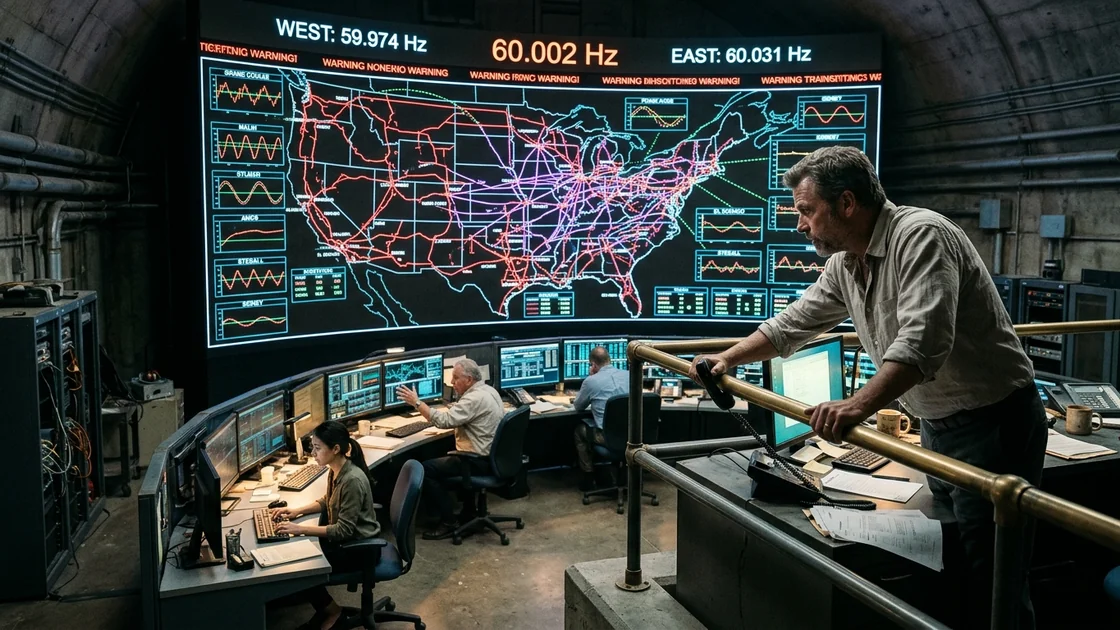
Jonas Vance, the night-shift supervisor at the Continental Grid Operations Center in Cheyenne, Wyoming, discovers an anomalous power surge moving across the North American electrical infrastructure during a quiet winter night. What initially appears to be a routine telemetry glitch in the Pacific Northwest quickly reveals itself as a calculated attack by a ghost inside the system who is weaponizing the continent's own electricity. Rather than simply shutting down power plants, the unseen intruder locks critical substation breakers closed and manipulates phase angles to herd gigawatts of raw energy toward the continent's irreplaceable high-voltage autotransformers, aiming to melt their cores and plunge North America into a multi-year dark age. Trapped in a relentless game of cat and mouse, Jonas and his small team of dispatchers must manually reroute massive loads across three time zones, sacrificing city grids, dumping industrial loads, and fighting against compromised automated systems to bleed off the lethal surges. As the intruder forces the Eastern and Western interconnections toward a catastrophic out-of-phase collision, Jonas ultimately deduces the attacker's command relay is hidden inside a supposedly decommissioned solar-thermal facility in the Mojave Desert and executes a desperate continental counter-surge to burn the adversary out of the wires before the national frequency collapses entirely.
The master frequency display at the top of the seventy-foot curved wall read 60.002 Hertz, and to Jonas Vance, that two-thousandths of a cycle per second was the sound of three hundred million people breathing in their sleep.
He stood on the raised command dais of the Cheyenne Mountain Annex—not the famous military bunker ten miles south, but the subterranean concrete vault belonging to the North American Unified Grid Authority. Down on the pit floor below him, four dispatchers sat at crescent-shaped consoles bathed in the subterranean twilight ofamber and cyan status monitors. Above them, the continent stretched out in luminous filigree. It was a map not of states or rivers, but of voltage: neon red for the 765-kilovolt backbones of the Midwest, cool violet for the 500-kilovolt arteries snaking down the Pacific coast, and pulsing green dashed lines for the High-Voltage Direct Current ties that stitched the whole impossible machine together across the seams of the Rocky Mountains.
Jonas took a slow sip of coffee that had gone cold around midnight. It was 02:14 Mountain Standard Time on a Tuesday in late January. Outside, twenty feet of reinforced granite and three feet of Wyoming blizzard separated them from the stars. Inside, the air smelled of conditioned dryness, electrostatic dust, and the faint, perpetual metallic tang of eighty server racks running state-estimation algorithms down in the basement.
"Path 27 is drifting a little capacitive," Maya Lin said from Desk Two, not looking up from her three-tiered array of screens. She was twenty-eight, a former naval nuclear electrician who treated the Western Interconnection like a slightly unruly submarine reactor. "Intermountain Power in Utah is running light on coal load because of the warm front in southern California. Voltage at Adelanto is creeping up past 525 kV."
"Switch in the shunt reactors at Eldorado," Jonas said, his eyes scanning the southern Nevada cluster on the big board without needing to zoom in at his own terminal. After nineteen years in the chair, he didn't read the numbers so much as feel the tension in the lines. Electricity wasn't water in a pipe; you couldn't store it in a tank and wait for someone to open a faucet. Every electron pushed out of a hydro turbine on the Columbia River had to be consumed by a toaster, an arc furnace, or a streetlamp in Los Angeles at the exact millisecond of its birth, traveling at seventy percent of the speed of light. If generation exceeded demand, the entire continent's turbines spun faster, driving the 60-Hertz heartbeat upward until steel shafts sheared. If demand exceeded generation, the magnetic drag slowed the turbines down, dragging the frequency into the basement until the grid tore itself apart to save the generators.
"Switching in Bank Two at Eldorado," Maya confirmed. Her mechanical keyboard clicked—three sharp bursts—followed by the two-second satellite and fiber-optic handshake. On the main wall, a tiny hollow square near the Nevada-California border filled itself in with solid violet, and the local voltage readout ticked dutifully down from 526.4 to 518.1 kilovolts. "Clean latch. VARs are settling."
"Good," Jonas murmured. He rolled his stiff left shoulder and glanced over at Desk Four, where Marcus Thorne from NERC Cyber-Compliance was hunched over a diagnostic laptop, running a scheduled audit on the quarterly firewall logs. Thorne was a guy who understood packet headers and encryption keys, which meant he understood roughly half of what kept the lights on. The other half—the brutal, unforgiving nineteenth-century physics of magnetic flux, copper thermal limits, and ten-ton oil-cooled circuit breakers—was a language only the dispatchers spoke.
Jonas turned back to his own supervisor console and pulled up the Wide-Area Situational Awareness feed. It gathered data from Synchrophasors—Phasor Measurement Units, or PMUs—scattered across twelve hundred substations from British Columbia to Nova Scotia. Unlike the old SCADA systems that updated every four seconds like a slow polaroid camera, the PMUs sampled the grid's sine wave sixty times a second, stamped with GPS atomic clock precision. They showed the phase angle—the microscopic twist in the electrical wave as it strained across thousands of miles of aluminum wire.
He frowned, leaning forward until the blue light of the monitor caught the gray in his stubble.
Up in the Pacific Northwest, along the 500-kilovolt corridor between Grand Coulee Dam and the Raver substation outside Seattle, the phase angle was twisting.
Normally, at two in the morning, the angle between eastern Washington's massive hydroelectric dams and the coastal cities was a lazy twelve degrees. Power flowed west smoothly, idling along while Boeing's factories and Seattle's office towers slept.
Right now, the PMU needle at Chief Joseph Dam was reading nineteen degrees. Twenty. Twenty-one.
"Maya," Jonas said, his voice dropping half an octave. "What's Puget Sound pulling right now?"
Maya's fingers danced across her trackball. "Nothing unusual. Seattle City Light is sitting at nine hundred megawatts flat. Tacoma is quiet. Why?"
"Look at the synchrophasor delta across the Cascades," Jonas said, throwing his screen onto the central sub-monitor on the big wall. A jagged orange line was climbing a graph like a spider up a wall. "The phase angle between Coulee and Raver just opened up to twenty-four degrees. That means there's an extra twelve hundred megawatts of torque twisting those lines."
Maya blinked at the big board, then looked down at her SCADA telemetry. "Jonas, the SCADA line-load readings on the Coulee-Raver 1 and 2 circuits are both sitting at four hundred megawatts. Dead normal. No alarms."
"SCADA updates on polling," Jonas said, standing up entirely now, his coffee mug forgotten on the blotter. "The PMUs are streaming raw GPS-stamped wave data. A line doesn't twist twenty-five degrees unless a gigawatt of power is being shoved through it. Where is that power going?"
Down at Desk Three, responsible for the Southwest and the Rocky Mountain pool, veteran dispatcher Bob Miller cleared his throat. "Uh, boss? You might want to look at the Pacific DC Intertie."
Jonas pivoted toward the western flank of the wall. The Pacific DC Intertie—Path 65—was one of the wonders of the modern electrical world: an eight-hundred-plus-mile direct-current superhighway running straight from the Celilo converter station on the Oregon side of the Columbia River all the way down to Sylmar, just north of Los Angeles. It could carry over three thousand megawatts without worrying about AC phase angles, acting as the ultimate shock absorber for the West Coast.
According to the wall, Path 65 was idling at 600 megawatts southward.
"Pull up the raw PMU bus voltages at Celilo and Sylmar," Jonas ordered.
Miller's heavy fingers hammered the macros. The sub-screen split. On the left, the SCADA state estimator—the mathematical brain that smoothed out telemetry for the operators—showed a tranquil green line. On the right, the raw, unfiltered voltage waveform from the Oregon converter station looked like a hacksaw blade. The voltage at Celilo was sagging down to 478 kilovolts, while down in Sylmar, the receiving end was spiking past 542.
"Someone's maxing out the DC tie," Miller breathed. "That's a three-gigawatt dump heading straight into the Los Angeles basin. Why the hell isn't the EMS flagging an overload?"
"Because the Energy Management System is being fed a loop," Jonas said, a cold knot tightening behind his sternum. He looked over at Marcus Thorne. "Thorne! Get off the audit logs and look at the ICCP gateway for the Western Interconnection. Right now!"
Thorne jerked his head up, startled by the bark in Jonas's voice. "The ICCP link is green, Jonas. Zero packet loss from the Peak Reliability servers in Vancouver or the California ISO—"
"The numbers are lying to us!" Jonas snapped, stepping down the three metal stairs from the dais to stand behind Maya's console. "Our SCADA screens say the Pacific Northwest is asleep, while the raw synchrophasors say somebody just opened the floodgates at Grand Coulee and is cramming three thousand megawatts down the throat of Southern California!"
As if the grid itself had heard him, the master frequency display at the top of the wall flickered.
60.002 Hz dropped to 59.960 Hz. Then 59.910 Hz.
In the quiet bunker, an automated chime sounded—a low, polite C-flat tone that meant the Western Interconnection had just lost equilibrium.
"Sylmar Converter Station just tripped offline on over-voltage!" Miller yelled from Desk Three. "Three gigawatts of DC load just hit a brick wall in Los Angeles!"
Jonas didn't need a computer to tell him what three thousand megawatts of kinetic energy did when the door slammed shut in its face at two hundred thousand miles per second. Like a freight train hitting a concrete bunker, the electricity couldn't just disappear. Rejected by the tripped DC converter in Oregon, the entire three-gigawatt tidal wave rebounded instantaneously onto the parallel alternating-current lines—the 500-kilovolt California-Oregon Intertie, Path 66.
On the seventy-foot wall, the violet lines running through the Klamath Basin and northern California didn't change color on the main SCADA overlay—the spoofed telemetry still painted them a peaceful, lying violet—but on the raw PMU phase-angle display that Jonas had forced onto the center screen, the orange needle slammed straight into the red zone past forty-five degrees.
"Path 66 is going unstable!" Maya shouted, her hands flying across the manual override keys. "The Malin and Round Mountain substations are taking the whole rebound! If those three AC lines trip on out-of-step protection, the entire West Coast splits in half!"
"Don't try to trip the Coulee generators through the EMS—if the telemetry is poisoned, the command routing is probably hijacked too!" Jonas leaned over her shoulder, his right hand grabbing the physical hard-line phone handset bolted to the side of the console. He hit the direct analog microwave circuit—an old Cold War relic that bypassed the internet protocols entirely, bouncing a voice signal off mountain-top repeater towers straight to the Bonneville Power Administration's Munro Control Center in Spokane.
It rang once before a frantic voice picked up. "Munro Dispatch, Henderson!"
"Henderson, this is Vance at Cheyenne Unified!" Jonas roared over the rising chorus of low-voltage klaxons now echoing across the pit. "Your ICCP data feed is compromised! Someone ran Celilo up to three gigawatts blind and just tripped Sylmar! You've got a massive reflection wave hammering south down the AC intertie through Malin!"
"We see it on the local analog meters!" Henderson yelled back; in the background, Jonas could hear the distinct, terrifying shriek of a substation breaker failure alarm. "Our digital consoles are frozen on five-minute-old data, Jonas! We tried to run back the wicket gates at Grand Coulee Third Powerhouse, but the Automatic Generation Control is locked out! Something in the governor PLC is holding the turbines wide open!"
"Open the physical 500-kilovolt ring bus at Captain Jack and Grizzly!" Jonas commanded, his eyes tracing the raw topological blueprint in his head. "Do it via legacy tone-telemetry if you have to, or get a man in the yard with a hot-stick, or you're going to melt the Malin autotransformers in ninety seconds!"
"Wait—if we open Grizzly, where does the Coulee output go?"
"East!" Jonas barked. "Shove it east into Montana over the Garrison 500-kV double circuit! I'll catch it at the Colstrip bus and dump it across the Eastern DC ties before it cooks the Northwest!"
"Copy, opening Grizzly bus on legacy tone—now!"
Jonas slammed the phone onto the cradle and spun toward Desk One, where young Kevin Ross, only six months out of training, was staring wide-eyed at the Midwest and Plains board.
"Kevin! Wake up!" Jonas vaulted over the divider between Desk Two and Desk One. "In about four seconds, Bonneville is going to sever the California tie, and two thousand megawatts of runaway hydro power is going to come screaming east across the Bitterroot Mountains into Montana. Your SCADA screen is going to tell you those lines are at forty percent capacity. Ignore it! Switch your console to raw PMU current-phasor mode!"
Kevin's hands trembled for half a second before his training kicked in. He punched the diagnostic display key, stripping away the colorful graphical interface and replacing it with stark, scrolling white columns of raw amperage and phase angles streaming directly from the Montana substation transducers.
On the screen, the numbers at Taft and Garrison substations in western Montana suddenly exploded upward: 800 amps. 1,400 amps. 2,300 amps.
"It's here!" Kevin gasped. "Voltage at Garrison is spiking to 558 kilovolts! The Ferranti effect on the long mountain lines is amplifying the surge!"
"Open the crossover breakers at Broadview and route half of it south into Wyoming toward Bridger, and shove the other half straight toward the Miles City DC tie!" Jonas ordered, his fingers stabbing at the glass of Kevin's monitor. "Maya, call the Western Area Power Administration in Loveland on the analog loop—tell them to close every capacitor bank and reactor they need to keep the Wyoming 345-kV loop from collapsing when that power hits!"
For the next three minutes, the Cheyenne bunker sounded like the bridge of a destroyer in a typhoon.
There was no gunfire, only the rapid-fire clatter of mechanical relays, the barking of five voices into analog handsets, and the low, ominous hum of the wall speakers translating the grid's 60-Hertz sine wave into audible sound. Jonas had flipped the audio-monitor switch on his dais—an old-school trick from the seventies where the frequency of the grid was wired directly into a studio monitor speaker. At 60.000 Hertz, it was a steady, comforting B-flat hum. Right now, the Western Interconnection speaker was groaning upward in pitch—60.08, 60.12, 60.18 Hertz—the sound of ten thousand tons of spinning hydro turbines in Washington State accelerating out of control as the load vanished and returned in violent spasms.
"Miles City DC Tie is taking two hundred megawatts—it's maxed out!" Kevin shouted. "The rest of the surge is bouncing south down the Bridger-Laramie corridor! Dave Johnston plant in Wyoming is oscillating!"
"Shed industrial load in the Powder River Basin!" Jonas said without hesitation. "Trip the feeder breakers for the coal mines and the trona refineries at Green River! Better twenty mines go on backup diesel than we lose the Laramie River Station!"
"Tripping Green River industrial feeders on backup microwave!" Miller yelled from Desk Three, borrowing the southern microwave channel. A second later, the raw amperage column on Kevin's screen peaked at 2,840 amps—just sixty amps shy of the thermal relay point that would have severed Wyoming from the rest of the West—and then began to slide backward. 2,600. 2,200. 1,900.
On the analog phone from Spokane, Henderson's voice crackled over the speakerphone Jonas had left open. "Cheyenne, we got a wrench crew inside the Grand Coulee Third Powerhouse gallery! They just pulled the main hydraulic governor fuses by hand on Units 22, 23, and 24! The wicket gates are closing! Generation is dropping by two thousand megawatts!"
Slowly, painfully, the pitch of the audio speaker in the corner of the bunker groaned back down toward B-flat.
60.09 Hz. 60.04 Hz. 60.01 Hz.
In the pit, nobody cheered. Maya let out a long, ragged breath and wiped her palms on her jeans. Kevin stared at the raw white numbers on his screen as if they were venomous snakes.
Jonas stood between the consoles, his heart hammering against his ribs, his eyes still locked on the big wall.
The main graphical map—the multi-million-dollar Energy Management System that was supposed to be the smartest brain in the history of civil engineering—still showed a peaceful, uneventful Tuesday morning. Every line in Oregon, Washington, and Montana was painted a serene, steady violet. Not a single alarm banner was flashing on the primary SCADA interface.
"Thorne," Jonas said quietly. The silence in the room made his voice sound like gravel sliding down a chute. "Come here."
Marcus Thorne walked slowly from Desk Four, his face the color of skim milk. He was holding a printout from his diagnostic terminal.
"Tell me why my sixty-million-dollar wall thinks the West Coast is taking a nap while we just came within sixty amps of blacking out eleven states," Jonas said.
"It's not a DDoS attack, and it's not ransomware," Thorne said, his voice shaking slightly as he laid the paper on Jonas's dais. "Look at the timestamp on the state estimator kernel down in the server room. Somebody didn't just hack the communication lines from Bonneville, Jonas. They're inside the central EMS architecture here—or synced across the regional reliability hubs in Vancouver, St. Paul, and Atlanta simultaneously."
"Speak English, Marcus. I'm an electrical engineer, not a cryptographer."
"They inserted a man-in-the-middle physics model between the raw SCADA database and the display wall," Thorne said, pointing a trembling finger at the code log. "It's a replay-and-spoof filter. Whenever they send an unauthorized command to a substation PLC out in the field, the filter calculates what the normal grid state should look like without that command, and feeds the fake, stable numbers back to our screens. The only reason you caught it is because the PMU synchrophasor network runs on a completely separate UDP UDP-multicast research backbone that isn't integrated into the main SCADA state estimator yet."
Jonas looked down at the paper, then back up at the wall. "Wait. If they had administrative access to the Grand Coulee turbine governors and the Sylmar DC converter... why didn't they just trip the main breakers? If you want to cause a blackout, you just send an 'OPEN' command to fifty substations at once. Boom. Dark continent in two seconds."
Maya turned in her chair, her dark eyes narrowing as she replayed the last ten minutes in her head. "They didn't trip Sylmar from the inside, Jonas. Look at the PMU log." She pulled up the millisecond trace from Southern California. "They locked the local voltage-regulation tap changers at Sylmar in place, and then shoved three gigawatts down the line until the hardware protection—the physical analog over-voltage relays—tripped Sylmar to save itself. And up at Malin, on the AC lines..."
She stopped. Her fingers clicked furiously, pulling up the substation breaker status from the raw PMU digital status bits along the California-Oregon border.
"Jonas," Maya whispered. "The breaker failure alarms we heard in the background when Henderson was on the phone? The intruder didn't try to open the breakers at Malin to black out California. They sent a continuous CLOSE latching command to the Malin autotransformer breakers while forcing the overload through them."
The cold knot in Jonas's stomach turned to solid ice.
A blackout caused by tripped circuit breakers was an inconvenience. Even a massive cascading failure like the 2003 Northeast blackout could be restored in twenty-four to forty-eight hours; once the lines cooled down, you restarted the power plants, closed the switches, and the lights came back on.
An extra-high-voltage autotransformer—a five-hundred-ton cathedral of laminated silicon steel, twenty thousand gallons of mineral oil, and miles of hand-wound copper busbar that stepped voltage between 500 kV and 345 kV—was a different animal entirely. There were fewer than four hundred of those giant transformers holding the continental backbone together. They weren't kept on shelves at a warehouse. Each one was custom-built to order in factories in Germany, South Korea, or Austria, took eighteen months to manufacture, and required specialized twenty-axle Schnabel railcars just to move from a seaport to a substation.
If you tripped a breaker, a city went dark until tomorrow.
If you locked the breakers closed and pumped a three-gigawatt surge into an autotransformer until its internal copper windings reached four hundred degrees Celsius, the mineral oil vaporized into explosive acetylene gas, the porcelain bushings shattered like artillery shells, and the five-hundred-ton iron core fused into worthless slag.
"They aren't trying to turn the lights off," Jonas said softly, the full horror of the blueprint unfolding in his mind. "They're hunting transformers."
"What?" Thorne asked.
"That move in the Northwest was a calibration test," Jonas said, stepping rapidly up to his dais and slamming the master intercom button that linked all four desks. "Listen to me, all of you! Whoever is in the wires isn't a script kiddie trying to make the evening news by blinking the lights in Seattle. They're using the generators as battering rams. They lock the protective relays on a critical step-down autotransformer bank, blind the local operators with spoofed SCADA data so nobody sees the temperature climbing, and then reroute gigawatts of real power into that substation to cook the iron in its own oil!"
"Dear God," Bob Miller muttered from Desk Three, crossing himself. "If you burn out thirty or forty 500-kV autotransformers across the interconnections..."
"There is no recovery," Jonas finished for him. "No spare parts, no rail transport without electric signals, no factories to build new ones without power. You don't knock the country out for a weekend. You knock North America back to 1870 for three years."
He reached over to the master wall controller and killed the primary SCADA graphical overlay entirely.
Across the seventy-foot expanse, the smooth, reassuring neon map vanished into black, replaced instantly by the raw, jagged, unvarnished schematic of the North American Synchrophasor Network—hundreds of pulsing numerical boxes showing real-time phase angles, raw voltage waveforms, and frequency derivatives streaming straight from the GPS-locked physics transducers at sixty frames per second. It was ugly, difficult to read, and required doing three-phase trigonometry in your head just to know which way the megawatts were flowing.
"Thorne," Jonas barked, "can we sever the external network connections to the substations to lock this guy out?"
"I—I just checked the border routers," Thorne stammered, his fingers flying over his laptop. "We can't pull the plug, Jonas! Whoever wrote this worm deployed a dead-man's heartbeat across the regional ICCP links. Look at the outbound buffer! Every three seconds, the intruder's process sends an encrypted keep-alive token to compromised programmable logic controllers in at least two hundred major substations. If we sever our connection from Cheyenne, or if they lose the carrier signal, the local PLCs are programmed to execute an immediate simultaneous dead-short across the main busbars!"
Jonas stared at him. "A dead-short? They rigged the substation ground switches to close under load if we pull the fiber?"
"Yes! If I cut the comm lines, two hundred substations ground out five hundred kilovolts straight into the earth grid at the exact same millisecond."
Jonas turned back to the raw phase-angle wall. The intruder had built the ultimate hostage crisis. The grid operators couldn't unplug the console, and they couldn't shut down the network. They had to stay in the ring, hands on the switches, while the ghost in the machine used their own transmission lines to herd lethal walls of electricity across a three-thousand-mile chessboard.
"Look at the Eastern Interconnection," Maya said suddenly, her voice tight as a piano wire. She pointed to the right two-thirds of the giant screen—the colossal grid stretching from the plains of eastern Montana and Texas all the way to the Atlantic Ocean.
On the raw PMU feed, down in the Tennessee Valley Authority sector near Memphis and up through the Ohio River Valley, the phase angles were beginning to breathe.
They weren't spiking in a single blunt surge like the Northwest test. They were rising and falling in a slow, rhythmic, sinister wave: +14 degrees, -8 degrees, +18 degrees, -12 degrees.
A four-second period. Zero point two-five Hertz.
"He's done testing the West," Jonas whispered, feeling the hair on his forearms stand straight up. "He just moved into the East. And he's starting an inter-area oscillation."
To an outsider, the Eastern Interconnection was a masterpiece of redundancy: seven hundred gigawatts of generation capacity—coal, nuclear, natural gas, hydro, and wind—all spinning in perfect lockstep from Winnipeg to Miami, from Boston to New Orleans. Every single generator rotor in that vast territory was electromagnetically locked to every other generator rotor by the invisible rubber bands of the high-voltage alternating-current grid.
And like any system connected by rubber bands, if you pushed it at the exact right rhythm, it started to swing.
"Look at the phase delta between New England and Florida," Kevin said from Desk One, his voice cracking slightly. "Florida Power and Light is swinging three degrees ahead of PJM in Pennsylvania, and then four seconds later, PJM swings four degrees ahead of Florida! It's like a giant sloshing bathtub!"
"He's modulating the High-Voltage DC injectors and the SVC var-compensators in the Midwest in time with the natural resonant frequency of the Eastern grid," Jonas said, his eyes darting across the pulsing raw numbers between Chicago, St. Louis, and Atlanta. Every time the electrical wave sloshed north toward the Great Lakes, the intruder subtly goosed the excitation fields on fifty different generators in the South, giving the pendulum an extra shove at the exact peak of its swing.
"Why?" Miller asked, gripping the edge of his desk. "An oscillation like that will trip the tie-lines in ten minutes!"
"No, look at the center of the seesaw!" Jonas stepped down into the pit and pointed directly at the cluster of raw PMU readouts straddling the Appalachians—specifically the massive 765-kilovolt AEP loop running through West Virginia, Ohio, and Virginia.
When a seesaw swings, the ends move up and down, while the fulcrum in the middle stays relatively still—and takes the entire crushing mechanical stress of the weight. Electrically, as the northern and southern halves of the United States swung out of phase against each other, a titanic river of synchronizing current was being forced back and forth across the 765-kilovolt autotransformers at Amos, Baker, and Kammer substations in the Ohio Valley.
Those 765-kV transformers were the biggest in the Western Hemisphere. If they blew, the Eastern heartland would be severed from the East Coast forever.
"He's using the entire Eastern seaboard as a resonant hammer to fatigue and cook the 765-kV banks in West Virginia!" Jonas shouted. "And look at the Amos substation PMU—he's locked the cooling pumps and the deluge valves off, and jammed the main 765-kV gas-insulated breakers closed!"
"Amos Bank One winding current is hitting four thousand amps on every upswing!" Maya called out, her fingers flying as she mapped the Eastern PMU vectors onto her console. "At four-second intervals, that oil temperature is going to hit flashpoint in less than six minutes! We can't trip the Amos breakers—they're software-latched by his worm!"
"If you can't stop the hammer from hitting the anvil, you have to break the rhythm of the guy swinging the hammer," Jonas said, his mind racing through differential equations he hadn't written on paper since graduate school, translating them instantly into megawatts and miles. "The oscillation period is four point two seconds—north to south, south to north. We have to inject a counter-wave at a hundred and eighty degrees out of phase to dampen the slosh!"
"With what?!" Kevin yelled. "He's got the automatic governor controls locked out on half the coal fleet in the Midwest! Our digital AGC commands are just bouncing off his spoof filter!"
"We don't use coal—coal boilers take twenty minutes to ramp up, they're too slow to fight a four-second wave!" Jonas's eyes locked onto the Blue Ridge Mountains of Virginia and the hills of Tennessee. "Pumped-storage hydro! Bath County in Virginia and Raccoon Mountain in Tennessee!"
Maya gasped, catching his thought instantly. "Bath County is the biggest battery in the world—three thousand megawatts of reversible Francis turbines! And Raccoon Mountain is another sixteen hundred!"
"More importantly," Jonas said, grabbing the Eastern Interconnection analog dispatch handset—a dedicated leased copper pair running straight to PJM Interconnection in Valley Forge and TVA in Chattanooga, "their legacy load-shedding and fast-valving relays run on hardwired frequencies and direct microwave links for nuclear back-up! Get PJM and TVA on the horn together—conference patch!"
Two clicks from Miller's switchboard patched the circuits.
"Valley Forge, Master Dispatch!" a stressed voice barked.
"TVA Chattanooga here—what the hell is happening to our phase angles, Cheyenne?!" a second voice demanded with a heavy Tennessee drawl.
"Listen to me closely, nobody interrupt!" Jonas commanded, staring at the giant swinging sine wave plotted across the center of the seventy-foot wall. "You are under a coordinated cyber-physical attack. Your SCADA screens are lying to you—do not trust your state estimators! Someone is driving a 0.24-Hertz inter-area resonance wave between Florida and Ontario to burn out the 765-kV autotransformers in the Ohio Valley!"
"We hear the transformers humming all the way inside the control room at Amos!" the PJM dispatcher yelled. "The local tech says the tank wall is hitting a hundred and forty degrees Celsius and the breakers won't trip from the board!"
"Because the breaker coils are being held closed by a logic bomb!" Jonas said. "If you pull the station battery to trip them locally, the worm will detect the loss of control power and dead-short the entire 765-kV loop! We have to kill the oscillation wave in the wires! Valley Forge—do you have Bath County Pumped Storage on the direct microwave control link?"
"Affirmative! All six units are currently in pumping mode—drawing twenty-eight hundred megawatts off the grid to refill the upper reservoir for the morning peak!"
"Chattanooga!" Jonas barked. "What is Raccoon Mountain doing?"
"Pumping mode! Pulling sixteen hundred megawatts off the Tennessee bus!"
Jonas watched the giant orange sine wave on the wall crest toward the north.
"That's forty-four hundred megawatts of pump load sitting right next to the fulcrum of the wave!" Jonas said, his left hand rising in the air like an orchestra conductor waiting for the downbeat. "When the phase wave swings south, the Southern grid is over-frequency and high-voltage. When it swings north, the Northern grid is over-frequency. If we drop forty-four hundred megawatts of pump load off the grid in a fraction of a second, it acts like a four-gigawatt generation spike—a massive electromagnetic brake!"
"You want us to trip the main pump breakers on a four-second metronome?!" the TVA operator shouted. "Jonas, you can't cycle four-hundred-ton hydro pumps on and off every four seconds—you'll shear the headgates right off the mountain!"
"I don't need you to cycle them—I need two sequential drops, timed to the millisecond, followed by a reverse-phase capacitor dump from Quebec!" Jonas looked at Maya. "Maya, get Hydro-Québec in Montreal on Line Two! Tell them to arm the Chateauguay HVDC tie for an emergency fifteen-hundred-megawatt reversal on my mark!"
While Maya's voice blurred into rapid-fire French and English on the secondary line, Jonas kept his eyes locked on the phase-angle trace between Amos, West Virginia, and Bowen, Georgia.
The wave was building. The phase angle across the Ohio Valley was hitting thirty-two degrees. Thirty-four. At forty degrees, the magnetic bond between the northern and southern halves of the Eastern United States would snap like an overstretched steel cable, and the resulting voltage surge would vaporize the Amos transformers before a single physical relay could move.
"Stand by, Valley Forge! Stand by, Chattanooga!" Jonas leaned over the balcony rail, every muscle in his back coiled tight. He watched the raw GPS-stamped wave crest in the North and begin its violent plunge back toward the South.
"Two seconds to Southern trough..." Jonas whispered. "Wait for the zero-crossing derivative... Valley Forge, dump Bath County Units 1 through 6—NOW!"
In the mountains of western Virginia, six massive 500-megawatt electric motors simultaneously disconnected from the grid on a hardwired microwave trip signal.
Instantly, twenty-eight hundred megawatts of demand vanished from the Virginia bus. The southward-plunging electrical wave slammed headfirst into the sudden surplus of energy. On the Cheyenne wall, the jagged orange sine wave flattened at the bottom of its trough as if it had hit a mattress, shuddering violently.
"Wave amplitude dropped by forty percent!" Kevin yelled. "Amos winding current is down from four thousand to twenty-six hundred amps! Wait—the intruder saw it! Look at the phase vectors in Illinois!"
On the big board, the numbers around Chicago and St. Louis suddenly flared bright red.
The ghost in the system wasn't an automated script. It was a human mind—or a horrifyingly fast adaptive team—watching the same physics in real time. Realizing Jonas had just cushioned the southern swing from Virginia, the attacker instantly shifted the attack vector ninety degrees westward, firing the excitation systems on the nuclear and coal plants along the Mississippi River and tripping the reactive compensators in Missouri to whip a brand-new transverse wave straight from west to east across Indiana toward the exact same West Virginia transformers.
"He's pivoting!" Miller shouted. "He's driving an east-west wave out of the Illinois basin to hit Amos from the flank while the north-south wave is still rebounding!"
"He thinks we used up our hammer," Jonas said, his teeth bared in a grimace that looked almost like a smile. "Chattanooga! Wait for the Illinois wave to phase-couple with the rebound at Paducah... three, two, one—DROP RACCOON MOUNTAIN NOW! Maya—FIRE CHATEAUGUAY HVDC REVERSAL!"
"Dropping Raccoon!"
"Chateauguay reversing!"
Sixteen hundred megawatts vanished from the Tennessee River valley at the exact microsecond that fifteen hundred megawatts of Canadian hydro power reversed polarity at the New York border, sucking energy out of the New England corridor like a sudden vacuum.
The two counter-waves met the intruder's Illinois surge right over the Kentucky-Ohio border.
In the corner of the bunker, the Eastern Interconnection audio monitor emitted a sound none of them had ever heard before—a deep, metallic twang, like a bridge cable the size of a redwood tree being plucked by a giant's thumb, followed by a rapid, fluttering warble that died away into a steady, flat hum.
On the wall, the violently swinging phase angles across the Ohio Valley collided, canceled each other's reactive torque, and dropped from thirty-four degrees to sixteen. Fourteen. Eleven.
"Amos transformer currents are down to eleven hundred amps!" Maya breathed, slumping back against her headrest. "Oil temperature is plateauing at a hundred and eighteen degrees! PJM says a substation crew just got into the Amos yard and manually wedged open the cooling pump contactors with wooden pry-bars—the radiator fans are running full blast!"
Kevin let out a whoop at Desk One, punching the air. "We stuffed him! We broke the resonance!"
"Don't celebrate," Jonas said, not taking his eyes off the seventy-foot array of scrolling white numbers. His knuckles were white on the brass railing of the dais. "Look at what he did while we were saving West Virginia."
The room went dead quiet again.
Down at the bottom center of the wall, where the green dashed lines of the High-Voltage DC ties connected the Eastern Interconnection to the Western Interconnection and Texas, a quiet, methodical change had taken place during the ninety seconds they had been fighting the Appalachian oscillation.
North America didn't actually have one single power grid. It had four giant, independent "islands" of alternating current: the Western Interconnection, the Eastern Interconnection, the Texas ERCOT grid, and the Quebec grid. Because the Eastern and Western grids didn't spin at the exact same split-second phase angle, you couldn't just bolt an AC wire from Denver to Omaha—the slight difference in timing between the two gigantic systems would cause an immediate, explosive short circuit at the border. Instead, they were connected along the Great Plains by only seven small AC-to-DC-to-AC converter stations—electronic airlocks that converted AC power to Direct Current and back again.
Except right now, the raw PMU monitors at Stegall, Nebraska; Sidney, Nebraska; Rapid City, South Dakota; and Lamar, Colorado weren't showing smooth DC conversion.
"Thorne," Jonas said slowly. "Pull up the firmware diagnostic logs on the back-to-back thyristor valves at the Sidney and Stegall DC ties along the Wyoming-Nebraska border."
Thorne typed frantically for five seconds, then froze. "Jonas... the thyristor firing angles on all four Plains DC ties have been rewritten. He didn't do it during the oscillation—he used the oscillation in West Virginia to flood our PMU data bus with high-priority alarm traffic while he uploaded a new firing table to the Nebraska converter stations."
"What did he change the firing angles to?" Maya asked, leaning forward to squint at the Nebraska nodes.
"Zero degrees," Thorne read off his screen. "Continuous conduction across both the rectifier and inverter bridges."
Jonas felt the blood drain from his face.
"That's not DC conversion anymore," Jonas whispered. "If you fire every silicon thyristor valve in a back-to-back station simultaneously at zero degrees and hold them open, you turn the converter station into a solid copper wire."
Maya's hand flew to her mouth. "He's turning the DC airlocks into raw AC bridges! He's trying to hard-link the Eastern and Western Interconnections out of phase!"
"Wait," Kevin said, looking frantically between the two halves of the giant wall. "You can't tie the East and West together on AC without synchronizing them first! The East is eight hundred gigawatts and the West is two hundred gigawatts—if you slam them together when their sine waves are out of step..."
"The East drags the West into phase by brute electromagnetic force across four tiny converter stations in Nebraska," Jonas said, his voice deadly calm as the terrifying elegance of the attacker's grand strategy clicked into place. "And in the three seconds before those thyristor halls in Nebraska vaporize into plasma, a fifty-gigawatt phase-angle torque wrench twists every 345-kV and 500-kV autotransformer between Denver, Phoenix, Salt Lake City, and Kansas City straight out of their foundations. The Northwest surge was a probe to see how fast we reacted on the phones. The West Virginia oscillation was a feint to pull our eyes east and drain our pumped-storage hydro reserves so we wouldn't have any fast-response damping left."
He looked at the master frequency clocks at the top of the wall.
On the left, the Western Interconnection was spinning at 59.974 Hertz. On the right, the Eastern Interconnection—still slightly settling from the Bath County load drop—was spinning at 60.031 Hertz.
Because their frequencies differed by 0.057 cycles per second, the relative phase angle between the two halves of the continent was rotating like the hands of a clock—slipping past each other by twenty degrees every single second.
And on the raw Nebraska telemetry feed, a countdown register in the compromised substation PLCs had just begun cycling through the harmonic filters, preparing to close the bypass switches that would lock the two halves of North America together at the exact moment their waves were 180 degrees out of phase—dead opposite, peak-to-trough, the electrical equivalent of two hundred-car freight trains colliding head-on at full throttle.
"Time to opposite-phase alignment across the Nebraska ties?" Jonas barked.
Maya punched her phase-slip calculator macro. "At a 0.057-Hertz slip rate... the waves hit 180 degrees out of phase every seventeen point five seconds! Look at the harmonic filter sequencing at Stegall and Sidney—he's staging the pneumatic bypass breakers! He's going to close them on the third slip cycle from now!"
"Fifty-two seconds!" Miller yelled, hitting the red stopwatch timer on the wall.
Fifty-two seconds until the Western and Eastern grids were slammed together at maximum phase opposition.
"Call Nebraska Public Power and Western Area Power—tell them to blow the station service transformers at Sidney and Stegall with a shotgun if they have to!" Kevin shouted, grabbing for his handset.
"Look at the map, Kevin!" Jonas snapped, knocking the kid's hand down from the phone. "Sidney and Stegall are unmanned automated converter stations out in the middle of the Nebraska panhandle! In a January blizzard at two-thirty in the morning, the nearest roving maintenance tech is forty-five minutes away in a four-wheel-drive truck! Nobody is sitting in those buildings!"
"Then what do we do?!" Miller roared, sweat pouring down his temples. "We can't trip the lines feeding the stations from here—his worm has the 345-kV approaches at Laramie, Wayside, and Keystone locked closed! And if Thorne cuts the fiber to stop the firing command, the dead-man switch grounds out two hundred substations across the country!"
Jonas stood motionless at the center of the pit for three full seconds while the red digital stopwatch ticked down: 44... 43... 42...
His eyes didn't look at the countdown. They moved across the raw numerical matrix of the continent, reading the frequencies, the spinning masses, the inertia of a thousand turbines.
If two freight trains are about to collide because a madman welded the track switches together, and you can't stop the trains... you change their speeds so that when they reach the intersection, they are moving at the exact same velocity, in the exact same direction, side by side.
"We don't stop the tie-closure," Jonas said.
All three dispatchers and Thorne stared at him as if he had lost his mind.
"If he closes those bridges at 180 degrees out of phase, the continent dies," Jonas said, his voice cutting through the hum of the servers like a surgical laser. "If he closes those bridges at zero degrees phase difference and matched frequency... nothing happens. The power flows smoothly across the bridge, the fault current drops below the destruction threshold, and his trap fires a blank!"
"Match the frequency and phase angle of the entire Western United States to the Eastern Interconnection in thirty-eight seconds?!" Maya stared at the wall, her mind instantly calculating the physics. "Jonas, the East is at 60.031 Hz and the West is at 59.974 Hz! To synchronize them before that third cycle hits, we have to accelerate the entire Western Interconnection by point-zero-five-seven Hertz, and time the acceleration so the phase angle locks at zero degrees at the exact second his bypass breakers close!"
"How much load do we have to drop in the West to speed up the Western grid by 0.057 Hertz in thirty seconds?" Jonas demanded.
Maya's fingers were already a blur on her calculator pad. "The Western systemic inertia constant is roughly a hundred andforty gigawatt-seconds right now... to get that rate of frequency climb and arrest the phase slip right at the zero-crossing... we need an instantaneous load shed of four point two gigawatts, followed by a two-gigawatt braking load nine seconds before closure to catch the phase angle right on the nose!"
"Four point two gigawatts?!" Miller gasped. "That's the size of four nuclear reactors! Where the hell are we going to dump four gigawatts of customers in twenty seconds without using the compromised EMS?!"
"We don't dump customers one substation at a time," Jonas said, vaulting back up to his supervisor console and throwing open the clear plastic safety cover over the Emergency Under-Frequency Load Shedding test panel—a hardwired military-spec array installed after the Cold War to manage grid survival during a nuclear exchange. "We drop an entire metropolitan load pocket via the legacy defense microwave ring, and we use Palo Verde Nuclear Generating Station's fast-valving test loop in Arizona as our vernier brake!"
31 seconds.
"Miller!" Jonas barked. "Get Phoenix—Salt River Project and Arizona Public Service—on the analog microwave loop! Tell them on my mark to open the 500-kV Hassayampa ring bus just enough to dump the Phoenix metro load sheds—two gigawatts—without tripping the Palo Verde reactors!"
"On it!" Miller screamed into his headset.
"Maya!" Jonas pointed to the California cluster. "The California Aqueduct! The Edmonston Pumping Plant at the base of the Tehachapi Mountains lifts water two thousand feet over the ridge into Los Angeles—it's the biggest single electricity user in the state of California, pulling over a gigawatt by itself on a dedicated 230-kV line controlled directly by the Department of Water Resources in Sacramento! Patch into Sacramento DWR on the state emergency radio link and tell them to crash-stop every pump from Bakersfield to Mojave!"
24 seconds.
On the wall, the phase angle between the East and West spun through 180 degrees—the second slip cycle. Across the Nebraska border, the raw PMU status bits showed the intruder's sequence snapping open the last harmonic filter banks at Sidney and Stegall. The pneumatic compressors on the giant bypass switches were at full pressure, armed for the next 180-degree alignment seventeen seconds away.
"Sacramento DWR has the finger on the master pump trip!" Maya yelled, her left hand holding the headset to her ear while her right hand tracked the rotating phase vector on the synchrophasor compass dial in the center of the wall. "Phoenix says they can drop eighteen hundred megawatts of valley distribution sub-transmission from the analog board at Kyrene!"
"Kevin!" Jonas turned to Desk One. " That leaves us short by four hundred megawatts! Give me four hundred megawatts in the West on a hardwired switch right now!"
Kevin's eyes darted wildly across the Rocky Mountain raw data before locking onto southern Idaho. "The phosphorus furnaces at Pocatello and Soda Springs! Idaho Power has them wired on a direct remedial-action-scheme microwave trip to protect the Jim Bridger lines! Three electric arc furnaces—four hundred and ten megawatts total!"
"Arm the Idaho RAS trip!" Jonas ordered.
17 seconds.
The phase dial on the main screen spun past zero degrees, heading back toward the lethal 180-degree collision zone at the bottom of the circle.
Jonas didn't look at the clock anymore. He watched the spinning needle of the synchrophasor phase-angle compass, and listened to the dual audio speakers in the ceiling—the Eastern speaker humming a slightly sharp B-flat, the Western speaker humming a slightly flat B-flat, creating a rhythmic wah-wah-wah beat frequency that pulsed through the concrete floor of the bunker like a failing heart.
"To arrest that needle at zero degrees when the timer hits zero, we have to start the acceleration at minus fourteen seconds," Maya called out, her voice rock-steady now, pure naval nuclear discipline taking over. "Stand by... fifteen... fourteen... DROP LOAD NOW!"
"Phoenix, drop Kyrene!" Miller roared. "Sacramento, kill the aqueduct pumps!" Maya shouted. Kevin slammed his palm down on the red mechanical RAS button on Desk One.
Across Arizona, central California, and southern Idaho, four thousand two hundred megawatts of electrical demand vanished from the Western Interconnection inside of three hundred milliseconds.
In Washington State, Oregon, Montana, Wyoming, and Arizona, hundreds of massive steam and hydroelectric turbines suddenly felt the magnetic drag on their rotors disappear. With the same amount of steam and water pushing against the blades, and four gigawatts less resistance on the wires, the entire Western grid began to spin faster.
59.974 Hz jumped to 59.985 Hz. 59.998 Hz. 60.012 Hz.
In the ceiling speakers, the wah-wah-wah beat frequency began to slow down as the pitch of the Western speaker climbed steeply to meet the East. On the center screen, the spinning compass needle—which had been racing clockwise toward the 180-degree kill zone at the bottom of the dial—slowed to a crawl at 140 degrees, stopped dead at 152 degrees, and then, as the Western frequency temporarily overshot the East at 60.045 Hertz, the needle began to spin backward toward the top of the dial—toward zero degrees.
9 seconds.
"We're accelerating too fast!" Kevin yelled. "We're at 60.052 Hertz! The needle's going to blow right past zero degrees to the left before his breakers close!"
"Wait for it..." Jonas whispered, his hand hovering over the direct microwave link to the Palo Verde switchyard west of Phoenix, where three massive 1,300-megawatt nuclear turbines were spinning at eighteen hundred RPM. "Maya, call the phase angle!"
"Plus sixty degrees and closing counter-clockwise!" Maya chanted. "Forty-five degrees! Thirty degrees! Frequency is 60.058 Hz—we need to slow the West back down by twenty-seven millihertz in four seconds!"
"Palo Verde Unit 1 and Unit 2—engage fast-valving turbine steam bypass for two point five seconds—MARK!" Jonas hit the hardwired test trigger.
Out in the Arizona desert, the giant electro-hydraulic intercept valves on two nuclear steam turbines slammed partially shut for two and a half heartbeats, diverting high-pressure steam straight into the condensers and robbing the Western grid of eighteen hundred megawatts of pushing power.
The Western frequency instantly ceased its climb, dropping from 60.058 Hz right down to 60.032 Hz—one single thousandth of a cycle away from the Eastern Interconnection's 60.031 Hz.
In the ceiling speakers, the wah-wah beat vanished completely. The two speakers merged into a single, pure, solid cathedral organ chord that vibrated in Jonas's teeth.
On the center screen, the synchrophasor compass needle glided effortlessly to the top of the dial—0.4 degrees phase difference—at the exact millisecond the countdown clock hit 00:00.
Out on the frozen plains of Nebraska and South Dakota, at Stegall, Sidney, Rapid City, and Lamar, the intruder's logic bomb fired. Giant pneumatic bypass switches slammed shut, locking the Eastern and Western grids of North America together in a solid alternating-current embrace.
And instead of a fifty-gigawatt explosion of out-of-phase fault current tearing the heartland's transformers to shrapnel, the two colossal grids kissed like docking spacecraft moving at the exact same speed.
A mere eighty megawatts of gentle equalizing current drifted lazily across the Nebraska border. Every single 345-kV and 500-kV autotransformer remained cool, intact, and well within its normal operating envelope.
"Zero fault current at Sidney!" Kevin screamed, leaping out of his chair. "Stegall is holding! Rapid City is green! We synchronized the entire continent on the fly!"
Even Bob Miller let out a hoarse bark of disbelief, slapping the console desk with his open palm. "Thirty years in dispatch, Jonas, I never thought I'd see someone synch-check the East and West by hand using nuclear reactors and water pumps!"
Jonas didn't smile. He was staring intensely at a tiny, unexpected anomaly that had just flashed on the raw PMU phase-angle map at the exact millisecond the two grids locked together.
"Thorne," Jonas said, his voice sharp and urgent. "Look at the packet-routing latency on the keep-alive signal when those Nebraska breakers closed!"
Thorne blinked, pulling his eyes away from the big wall and hunching back over his network analyzer. "Wait... when you equalized the phase angle and prevented the fault, the intruder's script tried to send an emergency override burst to trip the Laramie capacitor banks to force an imbalance anyway—and the burst lagged by forty milliseconds!"
"Why did it lag?" Jonas demanded, jumping down from the dais to stand behind Thorne's chair.
"Because the routing path through the utility telecom fiber shifted when Maya killed the California Aqueduct pumps!" Maya turned her head sharply. "Wait—when DWR tripped the Edmonston and Pearblossom pumping plants on the aqueduct, the Southern California Edison optical ground-wire multiplexer in the Tehachapi Mountains automatically switched to backup battery power and re-indexed its synchronous optical network ring!"
Jonas's eyes blazed. He looked back up at the raw PMU wall, zooming in on the high desert of Southern California and southern Nevada—the Mojave corridor.
"He's not in Moscow, and he's not in Beijing," Jonas breathed. "To play phase-angle oscillations at sixty frames a second and react to our Bath County drop in less than two seconds, he couldn't be routing commands across undersea transoceanic cables—the latency would have killed his timing! He has to be physically tapped into the North American utility fiber-optic backbone—the OPGW lines strung right along the tops of the 500-kilovolt transmission towers!"
"Every major 500-kV line carries a fiber-optic ground wire at the very peak of the steel towers for internal substation communications," Maya said, jumping up to trace the Mojave lines on her terminal. "If that forty-millisecond lag happened when the Tehachapi fiber ring re-indexed, his physical command tap has to be on the Lugo-to-Eldorado 500-kV fiber loop in the Mojave Desert!"
"There's nothing out there between Barstow and the Nevada border except sand, Joshua trees, and—" Bob Miller stopped dead, his mouth falling open.
"And what, Bob?" Jonas pressed.
"Solar Reserve Crescent View," Miller said slowly, pulling up the generation asset registry on Desk Three. "Remember that experimental hundred-and-fifty-megawatt molten-salt solar thermal tower out near Ivanpah that went bankrupt and got mothballed eighteen months ago? They never severed its 500-kilovolt substation tie to the Eldorado-Lugo line because a private data-center consortium bought the bankruptcy lease last autumn to run 'high-density cloud computing' off the existing substation switchyard!"
Jonas stared at the tiny, unmonitored node sitting between the Lugo and Eldorado 500-kV substations in the Mojave Desert.
Because the solar plant was listed as decommissioned generation, its internal switchyard wasn't actively polled by the main operational dispatchers—yet it still had a direct, physical, high-bandwidth tap into the Western Interconnection's primary fiber-optic nervous system, and a direct 500-kilovolt transformer connection to the continental grid to power its massive server halls.
And better yet: look at the raw PMU voltage reading at the Eldorado and Lugo buses on either side of that desert node.
Even in the middle of the night, with no sun shining on its mirrors, that "mothballed" solar facility was drawing eighteen megawatts of continuous power—enough to run a military-grade supercomputing facility and cooling array—and its synchronous condenser, originally built to stabilize the solar steam turbine, was spinning online, acting as the intruder's local phase-locked reference clock!
"He's sitting right inside the old solar-thermal control building in the Mojave," Jonas said, a fierce, cold clarity settling over him. "He's using the plant's own 500-kV substation tap to read the grid's raw sine wave in real time, and injecting his PLC worms straight into the utility fiber-optic ground wire running overhead!"
"I'm calling the FBI and the San Bernardino County Sheriff!" Thorne grabbed for an outside line. "We can have SWAT helicopters on that desert site in forty minutes!"
"We don't have forty minutes!" Maya shouted, pointing back at the giant wall.
Having failed to destroy the grid at the Nebraska border, the intruder had realized why his packet had lagged. He knew they were onto his routing path. And now, with the Eastern and Western Interconnections locked together into a single, colossal, continent-spanning super-grid by his own Nebraska bridge closure, he was abandonment subtlety altogether.
Across the entire seventy-foot wall, from British Columbia to Florida, hundreds of substation PLC status boxes began flashing crimson.
"He's triggering the endgame!" Thorne yelled, watching his network monitor fill with cascading hexadecimal execution strings. "He sees us tracing the Mojave fiber ring! He's stopped trying to finesse the phase angles—he's broadcasting a synchronized time-delay execution command to every compromised PLC on the continent! In ninety seconds, he's going to trip half the nuclear and coal generators offline while simultaneously locking the urban load-center autotransformers closed on a massive reactive voltage collapse!"
"Can you block the broadcast?" Jonas asked.
"No! His supercomputer in the Mojave is pumping out ten gigabits per second of encrypted spoof traffic across the utility fiber ring—it's saturating the substation communication buffers so none of our manual reset commands can get through! As long as those server racks in the Mojave have power and fiber connectivity, he owns the wires!"
Jonas looked at the Mojave node on the wall.
As long as those server racks in the Mojave have power.
"He's drawing eighteen megawatts right off the Lugo-Eldorado 500-kV line through the solar plant's main step-down transformer," Jonas said, his voice dropping to a razor's edge. "And to keep us from tripping him offline, he has the 500-kV circuit breakers at Lugo, Eldorado, and the solar plant's own switchyard software-locked in the CLOSED position."
"Wait," Kevin said. "If he locked his own substation breakers closed so we can't cut his power... and if a server farm loses utility power, doesn't it just switch over to uninterruptible battery backups and diesel generators?"
"An uninterruptible power supply and a transfer switch protect a server room when the voltage drops to zero," Jonas said, stepping up to the master console and looking across the unified, synchronized continent he had just stitched together. "What happens to a facility's internal transformers, transfer switches, and fiber-optic multiplexers when the voltage doesn't drop to zero—what happens when the voltage spikes to nine hundred kilovolts at forty-five degrees out of phase?"
Maya's eyes went wide. "You want to use his own trick against him! Because he locked the Mojave switchyard breakers closed, his facility can't disconnect itself from the grid if we send a high-voltage surge down that line!"
"Wait a minute!" Bob Miller protested, standing up at Desk Three. "Jonas, the Lugo-Eldorado 500-kV corridor is one of the heaviest shielded lines in the Southwest! With the East and West tied together, and with Hoover Dam and Palo Verde sitting right next door trying to hold the voltage steady, you can't push the Mojave voltage high enough to blow out his step-down transformer and fry his server switchgear without an insane amount of reactive power! Where are you going to get a voltage hammer big enough to overcome Hoover Dam's automatic voltage regulators in sixty seconds?!"
Jonas didn't look at Hoover Dam. He looked down at the bottom center of the map, at the only electrical island in North America that was still sitting untouched, isolated behind its own DC gates, spinning quietly in the dark like a loaded revolver.
Texas.
The Electric Reliability Council of Texas—ERCOT.
And specifically, out on the high plains of the Texas Panhandle and West Texas, where that same January cold front was howling across five thousand wind turbines at forty miles an hour, generating twenty-four gigawatts of raw wind power and sitting behind two High-Voltage Direct Current ties—the Blackwater and Eddy County ties in New Mexico, and the Oklaunion tie in North Texas.
"Maya," Jonas said, his hands already moving across the Western topology screen. "If we open the 500-kV bypass switches around the Mojave loop—isolating a single direct radial path from the Arizona-New Mexico border straight through Eldorado into that solar plant's transformer—and then we take the entire reactive VAR output of Hoover Dam, Palo Verde, and Four Corners, and slam it together with a sudden capacitor-bank switching surge..."
"It still won't be enough to arc across his high-side surge arresters before the local metal-oxide varistors clamp it," Maya said rapidly, her fingers flying over the line-impedance numbers. "The line is three hundred miles long—the impedance will eat thirty percent of the spike! Unless..."
She stopped, staring at the giant phase-locked connection Jonas had just created across Nebraska, and the DC ties down in New Mexico.
"Unless you don't hit him with a single spike from one side," Maya whispered. "You hit him with a standing-wave collision from both sides at once!"
"Explain!" Kevin yelled as the red countdown to the continental PLC execution ticked past 55 seconds.
"Transmission lines act like organ pipes for electromagnetic waves!" Jonas said, his voice roaring back to full command volume as he and Maya began throwing manual microwave switching macros in unison. "If you send a massive high-voltage phase transient west from Arizona through Eldorado at the exact millisecond you send an equal transient east from Los Angeles through Lugo, the two waves travel toward each other at a hundred and forty thousand miles per second and collide dead-center in the middle of the Mojave Desert!"
"Constructive wave interference!" Miller gasped, his fingers already flying across the Desk Three microwave board before Jonas even had to give the order. "When two 500-kilovolt voltage surges meet in the middle of a line, their voltages add together! A million volts right on top of the Crescent View solar tap!"
"And because the intruder locked his own substation breakers closed to prevent us from shutting off his power, his switchyard is welded to the tracks!" Jonas shouted. "Miller—use the analog microwave link to Bureau of Reclamation at Hoover Dam and APS at Palo Verde! Tell them on my mark to force-fire their generator field exciters to ceiling—maximum over-excitation—and switch in every high-voltage shunt capacitor bank in the Colorado River corridor!"
"Hoover and Palo Verde copying!" Miller barked into his dual handsets. "They're bypassing the digital voltage regulators and going to manual field-forcing on the main exciters!"
"Maya!" Jonas pointed to the western side of the Mojave—the Lugo substation sitting just above San Bernardino. "We need an equal hammer coming east out of the Los Angeles basin through Lugo! What have we got sitting at the western end of that line?"
"Castaic Pumped Storage and the Adelanto synchronous condensers—plus the southern end of the Pacific DC Intertie at Sylmar that tripped earlier!" Maya's eyes lit up with fierce intensity. "Jonas, the Sylmar converter station is still sitting disconnected on the LA side, with eight hundred megavolt-amperes of giant harmonic filter capacitor banks still charged on its AC bus! If we close the Sylmar-to-Lugo 500-kV breaker while switching in every capacitor bank at Lugo and Vincent at the peak of the AC sine wave..."
"A point-on-wave capacitor switching transient!" Jonas finished. "And to make sure the wave doesn't leak backward into the rest of the country, we use the Nebraska ties we just synchronized to yank the phase angle of the Colorado River corridor thirty degrees forward at the exact instant of firing!"
30 seconds.
On Thorne's terminal, the intruder saw the sudden manual microwave activity converging on the Southwest.
"He knows what you're doing!" Thorne screamed, half-rising from his chair as his screen erupted with frantic red command strings. "He's trying to drop the software lock on his own substation breakers at Crescent View so he can disconnect from the grid—Wait! He can't!"
"Why can't he?!" Kevin yelled.
"Because his own ten-gigabit flood of spoof traffic that he's using to jam our reset commands is clogging the local serial bus at the Eldorado-Lugo multiplexer!" Thorne laughed out loud—a wild, breathless sound. "His own jamming barrage is delaying his 'OPEN BREAKER' command in the queue by twelve seconds! He's trapped inside his own denial-of-service storm!"
"Twelve seconds is all the life he's got left," Jonas said.
21 seconds on the continental kill clock.
On the seventy-foot wall, the raw PMU numbers around the Mojave Desert were trembling as Jonas, Maya, Miller, and Kevin systematically isolated the blast zone. Like bomb-disposal engineers stacking sandbags around a live artillery shell, they used the legacy defense microwave channels to open the parallel 230-kV and 345-kV side-ties at Victorville, Kramer Junction, and McCullough, turning the sixty-mile stretch of 500-kilovolt wire between Lugo and Eldorado into a sealed steel gun barrel with only one open port right in the center: the Crescent View solar substation.
"Gun barrel is isolated!" Kevin shouted, his shirt soaked through at the collar. "All parallel paths at Kramer and McCullough are open! Only the Lugo-Eldorado 500-kV line is bridging the desert!"
14 seconds.
"Hoover Dam and Palo Verde report manual field-forcing is armed at two hundred percent ceiling!" Miller yelled, both hands gripping his headset. "Colorado River bus voltage is already straining at 548 kilovolts! They can hold the field windings for five seconds before the rotor insulation cooks!"
"Lugo and Sylmar capacitor banks—twelve hundred megavars total—are armed on the point-on-wave synchro-switch!" Maya called out, her fingers poised over the direct fiber-bypass microwave trigger to Southern California Edison's Vincent control hub. "Distance from Eldorado to Crescent View is twenty-eight miles. Distance from Lugo to Crescent View isa hundred and twelve miles. To make the two surges collide dead-center on his transformer bushings at the exact microsecond, Lugo has to fire zero point six milliseconds before Eldorado!"
10 seconds.
Jonas stood behind Maya's console, one hand on the back of her chair, the other holding the master synchronization trigger for the Nebraska ties that would whip the Eastern Interconnection's eight-hundred-gigawatt weight against the eastern end of the line like a snapping bullwhip.
In the ceiling speakers, the unified 60-Hertz hum of North America filled the bunker—steady, immense, waiting.
"Nine seconds to his PLC execution..." Thorne chanted. "Eight... His local breaker unlock command is ninety percent through the jammed buffer! In four seconds his switchyard opens and he escapes onto diesel backup!"
"He's not escaping," Jonas said. "Maya, set the microwave relay offset for Lugo at minus six hundred microseconds. Miller, on my voice, tell Hoover and Palo Verde to slam every capacitor bank closed and go full field-forcing!"
"Offset locked!" Maya said.
"Hoover standing by!" Miller roared.
Jonas watched the raw GPS-synchronized 60-Hertz sine wave of the Mojave corridor oscillating on the high-speed oscilloscope display at the center of the wall. Up to +500 kV, down to -500 kV, sixty times a second.
To create maximum constructive interference, the switching transient had to launch at the exact absolute crest of the positive voltage wave—ninety degrees on the phase circle.
"Wait for the harmonic crest..." Jonas whispered, his eyes narrowing to slits against the blinding blue glow of the monitor. "Six seconds... five... FIRE!"
Maya slammed her key. Miller roared into his mic. Jonas threw the Nebraska phase-shifter override.
One hundred and twelve miles west of the Mojave Desert, at the Lugo and Sylmar substations, twelve hundred megavars of high-voltage capacitor banks slammed onto the line at the exact peak of the 500-kilovolt sine wave, launching a massive electromagnetic shockwave eastward across the San Bernardino Mountains at seventy percent of the speed of light.
Six hundred millionths of a second later, twenty-eight miles east of the target at the Eldorado substation and Hoover Dam, the combined excitation fields of twenty-two giant hydro and nuclear generators surged to full ceiling while eight hundred megavars of desert capacitors snapped shut, hurling a second, gigantic tidal wave of voltage westward across the Nevada border.
Neither wave, by itself, was enough to destroy the heavy 500-kilovolt transmission towers in the desert.
But at 02:38:14.082 Mountain Standard Time, directly beneath the cold January stars in the middle of the Ivanpah Valley, those two walls of electromagnetic pressure arrived at the center of the line from opposite directions at the exact same microsecond.
They had nowhere to go except into each other—and down the closed, software-locked throat of the Crescent View substation.
On the seventy-foot wall in Cheyenne, the raw PMU voltage readout at the Crescent View tap didn't just climb. It verticalized.
540 kV. 790 kV. 1,140 kilovolts.
Over one million one hundred thousand volts of doubled, phase-reinforced alternating current slammed straight down the bushings of the solar facility's step-down transformer.
Four hundred miles away in the Mojave Desert, the intruder's surge arresters didn't just clamp—they vaporized into white-hot clouds of zinc-oxide plasma in the first quarter-cycle. Before the facility's internal circuit breakers could even begin to part their mechanical contacts, the million-volt standing wave punched straight through the copper windings of the main transformer, jumping the air gap between the high-voltage primary coils and the low-voltage secondary busbars feeding the server halls.
Instead of stepping the power down to a safe 480 volts for the computer racks, the fused transformer core funneled a four-hundred-kilovolt arc of raw continental transmission power straight through the facility's uninterruptible power supplies, through the automatic transfer switches, and directly into the copper ground-plane of the server racks and the optical-to-electrical fiber multiplexers.
In the Cheyenne bunker, the audio speaker monitoring the Western phase angle let out a sharp, violent CRACK—like a rifle shot echoing across the desert—as the corona discharge in the Mojave ionized the night air around the substation yard before the physical ground-fault relays at Lugo and Eldorado finally blew open on pure magnetic impulse, severing the charred carcass of the solar plant from the grid forever.
At the exact same instant, with three seconds remaining on the clock, the cascading crimson execution strings on Marcus Thorne's network monitor froze mid-line.
The ten-gigabit flood of spoof traffic vanished into dead silence.
"The carrier signal from the Mojave node is gone!" Thorne shouted, his hands trembling over his keyboard as he watched the network topology map. "It didn't drop cleanly to a backup—the optical transceiver on the Lugo-Eldorado fiber ring just reported a catastrophic physical hardware fault! You didn't just trip his power, Jonas—you sent four hundred kilovolts straight through his server backplane!"
"What about his dead-man switch?!" Kevin yelled, staring at the two hundred compromised substations across the wall. "If his heartbeat stopped—"
"It didn't stop cleanly!" Thorne cried, pointing at the packet analyzer. "Because the high-voltage arc fried his fiber multiplexer while the buffer was still jammed with his own garbage data, the final frames sent out over the OPGW ring were corrupted voltage-noise gibberish! It triggered a fatal parity-check crash in the substation PLC communication cards instead of the dead-man execution routine! The local substation PLCs across the country are rebooting into fail-safe local manual mode!"
Across the seventy-foot wall, from Seattle to Miami, from Maine to San Diego, the crimson boxes blinked out in sweeping waves, reverting one by one to steady, uncorrupted telemetry as the local substation computers dumped their poisoned memory buffers and fell back to their hardwired baseline states.
"Miller, tell Hoover Dam and Palo Verde to drop their exciters back to normal automatic regulation before they cook their own fields!" Jonas barked, his heart hammering so hard he could see his pulse in his vision.
"Hoover and Palo Verde are back on automatic!" Miller called out, his voice hoarse and ragged. "Mojave 500-kV line is open and isolated at Lugo and Eldorado! California ISO reports they can see the smoke plume from the Crescent View transformer fire on the infrared wildfire cameras atop Clark Mountain—the whole switchyard out there is burning!"
"Maya, start easing the Phoenix and California Aqueduct loads back onto the Western bus five hundred megawatts at a time so our frequency doesn't creep," Jonas ordered, his hands gripping the brass rail of the dais as he scanned the continent from coast to coast. "Kevin, coordinate with SPP and MISO to start ramping up the Nebraska DC converter bridges so we can smoothly un-bypass the AC ties and put the Eastern and Western Interconnections back into independent operation before the morning ramp starts at 05:00."
"Copy, boss," Kevin said quietly, his fingers moving with steady, newfound authority across Desk One.
For a long time, nobody else spoke.
One by one, the emergency klaxons ceased their chiming. As the rebooted substation telemetry servers re-established clean handshakes with Cheyenne, Jonas reached over and slowly faded the graphical SCADA map back onto the main wall at fifty percent transparency, overlaying it directly on top of the raw white PMU synchrophasor numbers so that neither would ever be looked at alone again.
Down in Phoenix, the distribution feeders clicked back closed, lighting up the streetlights along the salt river. In central California, the giant pumps at the base of the Tehachapi Mountains spun back to life, pushing water up over the ridge toward a sleeping Los Angeles. Out in the Ohio Valley, the massive 765-kilovolt autotransformers at Amos substation hummed quietly in the freezing West Virginia mist, their oil cooling steadily down toward ninety degrees under the roar of their radiator fans.
Three hundred million people rolled over in their warm beds, furnaces kicking on in suburban basements in Chicago, heart monitors beeping steadily in intensive care units in Boston, freight trains rolling past green signal lights across the Kansas plains—not one of them knowing that for forty-four minutes in the dead of night, the twentieth and twenty-first centuries had balanced on the razor's edge of a sixty-cycle-per-second wave.
Jonas Vance walked slowly back up the three metal steps to his command dais. He picked up his ceramic coffee mug, looked inside at the cold dark dregs, and set it back down.
Above him, at the very top center of the seventy-foot wall, the two master frequency displays glowed in the quiet blue twilight of the bunker.
West: 60.000 Hz. East: 60.000 Hz.
In the corner speakers, the continent breathed a single, unbroken, B-flat hum.
By 03:15, the adrenaline had begun to curdle into the heavy, leaden ache that always followed a major grid disturbance, though none of them had ever lived through one that had been aimed at their throats by a human hand.
Marcus Thorne was on two separate encrypted satellite lines at Desk Four—one with the Department of Energy's intelligence division in Washington, the other with the FBI field office in Riverside, California, whose helicopters were currently banking over the San Bernardino Mountains toward the column of black, oily smoke rising from the Ivanpah desert floor.
"Initial thermal drone flyover from the Bureau confirms the Crescent View main step-down transformer took a catastrophic high-side-to-low-side flashover," Thorne reported, holding one hand over the mouthpiece of his headset as he looked up at Jonas. "The surge blew the secondary vault doors right off the control building and ignited the battery room inside the server hall. Whoever was operating the terminals in there—if they were physically on-site and not just bridging through the local microwave tower from a camper van five miles out in the desert—they evacuated the moment the transformer exploded, or they're buried under the fire-suppression foam. Either way, that hardware is fused silicon."
"Don't assume there was only one tap," Jonas said, leaning over his console to review the N-1 contingency tables that Maya and Kevin were rebuilding for the morning commuter peak. "A guy who understands sub-synchronous resonance in the Ohio Valley and thyristor firing tables in Nebraska didn't learn power engineering off a dark-web forum. That was someone who has sat in a dispatch chair—or designed the state-estimator software we bought ten years ago."
Maya looked up from Desk Two, rubbing her temples where the headset band had left red indentations against her skin. "Look at the way he moved, Jonas. When he tested the West Coast at Celilo and Malin, he knew the exact thermal time-constant of the Malin autotransformers. When he pivoted to the East, he targeted the Amos 765-kV banks because he knew AEP only keeps one spare 765-kV single-phase unit on the pad at Baker. That wasn't just a hacker with a stolen topology map. He had the NERC critical infrastructure spare-parts inventory in his head."
"Which means he knows what happens at 06:00 Eastern Time when the East Coast wakes up," Bob Miller grunted from Desk Three, flexing his stiff fingers before taking a bite of a squashed granola bar he'd pulled from his desk drawer. "Right now, we've still got the East and West hard-linked across those four welded bypass breakers in Nebraska. You said we'd un-bypass them before the morning ramp, boss, but look at the raw relay status from Stegall and Sidney."
Jonas walked down the steps and stood behind Miller's console.
On the raw diagnostic readout from the Nebraska panhandle, the four back-to-back converter stations—Sidney, Stegall, Rapid City, and Lamar—were still showing solid green AC continuity across their bypass switches.
"Wait," Kevin said from Desk One, frowning as he clicked the local breaker-open macro for the Sidney 345-kV bypass switch. "I just sent a clean manual OPEN command to Sidney now that the PLC communication card rebooted. The command went through—zero latency—and the breaker status didn't change."
He clicked it again. Nothing.
"Why didn't the bypass breaker open?" Kevin asked, a tremor creeping back into his voice.
Jonas leaned in close to the raw PMU waveform streaming from the Sidney busbar. He looked at the tiny micro-fluctuations in the current transformer readings across the three phases—A, B, and C.
Phase A and Phase C showed clean, balanced sinusoidal current. Phase B showed zero contact resistance and a flat, unwavering metallic signature.
"When did the intruder close those bypass switches?" Jonas asked quietly.
"Right when we hit 0.4 degrees phase difference," Maya said, walking over to join them at Desk One. "We synchronized the grids so there was almost no fault current when they closed..."
"Almost no fault current on the grid," Jonas corrected, pointing at the Phase B signature at Sidney and Stegall. "Wait—before he closed the mechanical bypass switches, remember what Thorne saw him do to the solid-state thyristor valves inside the converter halls? He fired all the silicon thyristors at zero degrees continuous conduction while the two grids were still slipping past each other, seventeen seconds before the mechanical bypass switches closed!"
Maya's breath caught. "During those seventeen seconds while we were accelerating the West to match the East, the thyristor valves were absorbing the phase slip! They didn't explode because we caught the wave in time, but the internal silicon junctions inside the converter halls melted into solid short-circuits! And when the pneumatic bypass switches closed to protect the valves, the initial capacitive discharge from the harmonic filters welded the silver-tungsten contacts on Phase B shut!"
The four of them stared at the Nebraska border on the giant wall.
The attacker in the Mojave was gone, his servers reduced to ash and molten copper in the California desert.
But his parting gift remained: the four tiny electronic airlocks along the Great Plains were physically welded shut. The Eastern Interconnection and the Western Interconnection—two colossal electrical beasts that had never been designed to remain locked together in alternating current—were fused at the hip by four slender threads of 345-kilovolt wire running through the blizzard in Nebraska and South Dakota.
"How much power can those four welded ties carry before they trip or burn down?" Thorne asked, stepping away from his phone.
"About eight hundred megawatts total across all four," Jonas said, his eyes moving up to the wall clock. It was 03:28 Mountain Time—05:28 in New York, Boston, and Atlanta.
In thirty-two minutes, the Eastern Time Zone was going to wake up.
Every weekday morning between 05:30 and 07:30 Eastern, eighty million people on the East Coast turned on their showers, started their coffee makers, fired up commuter rail lines in New York and Washington, and kicked on the HVAC systems of ten thousand office buildings. In the span of two hours, electrical demand in the Eastern Interconnection climbed by more than a hundred and twenty gigawatts—the steepest, most violent daily load ramp on planet Earth.
Normally, as the East Coast woke up and pulled down the Eastern frequency, the Western Interconnection—still fast asleep two and three time zones behind—didn't care, because the DC airlocks in Nebraska kept the two grids' frequencies separate, allowing only a fixed, polite trickle of scheduled DC power to cross the plains.
"With those four ties welded into solid AC bridges," Maya whispered, the math already unfolding behind her eyes, "the moment the East Coast hits the 06:00 morning ramp, eight hundred gigawatts of Eastern load is going to pull down the frequency of the East—and try to drag the entire sleeping Western Interconnection along with it through four 345-kV lines in Nebraska!"
"It's like towing a battleship with four strands of fishing line!" Miller said, his face paling all over again. "The moment New York and Atlanta start pulling hard at six a.m. Eastern, the phase angle across Nebraska will rip right past thirty degrees! When those four welded ties snap under the strain, the sudden recoil wave will trip the entire Western Interconnection offline from Denver to Seattle!"
"Why don't we just open the 345-kV line breakers one substation back from the Nebraska ties—at Laramie, Wayside, and Keystone—to sever the weld cleanly right now while the load is light?" Kevin asked, reaching for the Wyoming switching screen.
"Stop!" Jonas caught his wrist an inch above the mouse. "Look at the current flowing through Sidney and Stegall right now, Kevin!"
On the screen, the quiet eighty megawatts of equalizing current that had flowed when they first synchronized the grids had already grown to six hundred and forty megawatts as early-morning industrial shifts spun up in Chicago and Detroit. More importantly, because the intruder's corrupted PLC reboot had knocked out the automated synchro-check relays at Laramie and Keystone, opening those heavy 345-kV oil and SF6 breakers under a high-inductance inter-tie load without local relay timing risked a restrike arc that would blow the Laramie substation apart—and leave them with the exact same recoil wave.
"Wait—WAPA has roving maintenance crews on the road in four-wheel-drive trucks heading toward Sidney and Stegall right now, don't they?" Miller asked, grabbing the Loveland dispatch log. "I called them when the countdown started! Let me check where the trucks are!"
He keyed the Loveland microwave circuit. "Loveland, Cheyenne! Where are your high-voltage switching crews for Sidney and Stegall?"
A crackle of static came back over the speaker, mixed with the howl of wind from a mobile truck radio patched through the Colorado desk. "Cheyenne, this is WAPA Truck 14 on Highway 385 north of Sidney! We're pushing through four-foot snowdrifts behind a state DOT plow! We're still twenty-five minutes out from the Sidney gate—Stegall crew says they're thirty minutes out on Highway 85!"
Jonas looked at the clock. 03:34 Mountain Time. 05:34 Eastern.
Twenty-five minutes until the trucks reached the fenced switchyards in the Nebraska blizzard to manually crank open the air-break disconnect switches and free the two halves of the continent.
Twenty-five minutes—right Through the heart of the 06:00 Eastern morning ramp.
Already, on the eastern edge of the seventy-foot wall, the numbers in Maine, Massachusetts, New York, and Georgia were beginning to tick upward as the first bakeries, subways, and steel mills of Wednesday morning came online.
Eastern demand: +2,000 MW. +4,500 MW. +7,800 MW.
And right in the center of the map, across the four welded bridges in Nebraska and South Dakota, the phase angle was beginning to stretch like a taut steel wire.
11 degrees. 14 degrees. 17 degrees.
The current through the Sidney 345-kV tie ticked past 900 amps. 1,050 amps. At 1,400 amps, the overhead aluminum conductors in the Nebraska blizzard would sag into the snowbanks or trip instantaneously on hardware thermal overload, unleashing a two-gigawatt phase-snap across the Western states.
"We have to hold that phase angle across Nebraska under twenty degrees for twenty-five minutes while the East Coast climbs by sixty gigawatts," Jonas said, stepping back up to the command dais and stripping off his gray cardigan sweater, leaving him in his rolled-up white shirtsleeves.
"How?!" Kevin asked, looking at the sheer scale of the Eastern morning ramp climbing on the wall. "As the East wakes up, its generators can't ramp up fast enough to stop the Eastern phase angle from lagging behind the West! The only way to stop power from rushing east across those welded bridges in Nebraska is..."
"Is to wake up the West at the exact same speed," Jonas said.
Maya turned slowly in her chair, staring up at him on the dais. "You want to match the Eastern Time Zone's morning generation ramp inside the Western Interconnection—three hours before sunrise on the West Coast?"
"If the East pulls harder, the West has to push harder—or rather, if the East lags in phase angle as its morning load comes on, we have to deliberately lag the Western phase angle at the exact same degree-per-minute rate so the pressure across the Nebraska weld stays at zero!" Jonas walked to the center of the dais, placing both hands on the master intercom console. "For the next twenty-five minutes, there is no Eastern grid and there is no Western grid. We are flying one single four-thousand-mile airplane from Nova Scotia to San Francisco on manual trim!"
"If we throttle back Western generation to let our phase angle lag with the East, our Western frequency will drop below 59.95 Hertz!" Miller warned.
"Then we don't throttle back the Western generators—we ask PJM, NYISO, and TVA in the East to lead their morning ramp with fast-start combustion turbines five minutes ahead of the load curve, while we use the Bonneville hydro dams on the Columbia River and the California pumped-storage units as our trim tabs to match every single degree of phase twist across the Great Plains!"
Jonas hit the master conference patch—linking Spokane, Sacramento, Loveland, Valley Forge, Atlanta, Montreal, and St. Paul into a single continental voice net over the bunker's main speaker array.
"All Reliability Coordinators, this is Vance at Cheyenne Unified," Jonas said, his voice steady, calm, and resonant in the subterranean vault. "The cyber-intruder in the Southwest has been neutralized and substation PLCs have reverted to local control. However, we are currently hard-linked across all four Plains AC-DC ties due to welded bypass contacts in Nebraska and South Dakota. Field crews are twenty-four minutes from manual separation at the switchyards. Until those switches are cranked open by hand, North America is operating as a single synchronous AC machine across four weak ties."
Over the speakers, seven regional shift supervisors from the Atlantic to the Pacific fell dead silent as they absorbed the physics of what he had just told them.
"Cheyenne, this is Valley Forge PJM," the Eastern voice came back first, crisp and professional. "We are entering our 05:40 Eastern ramp at eight hundred megawatts per minute. Tell us what you need on the Eastern frequency target."
"Valley Forge, Atlanta, New England—I need you to over-generate your morning load curve by four tenths of a percent using every combustion turbine and hydro unit you have online to keep the Eastern phase angle from lagging!" Jonas commanded, watching the Nebraska phase-angle needle trembling at 19.4 degrees. "Spokane and Sacramento—I need Bonneville and California ISO to act as the tail rotor! Maya Lin at Desk Two is calling the phase-angle trim off the Sidney synchrophasor every fifteen seconds. When she calls plus-two degrees, Bonneville backs off Grand Coulee and Chief Joseph by two hundred megawatts; when she calls minus-two, you open the wicket gates!"
"Munro Spokane copies—Grand Coulee and John Day are on manual governor trim at your call, Cheyenne!"
"Folsom California ISO copies—Helms and Castaic hydro are standing by on the wheel!"
"WAPA Truck 14," Jonas keyed the mobile radio patch to the snowplow convoy creeping through the dark Nebraska panhandle. "Whoever is driving that truck, keep it between the ditches, because three hundred million people are riding on your front bumper."
"Copy that, Cheyenne," the lineman's voice crackled back over the roar of a diesel engine in low range. "We can see the Sidney yard perimeter lights through the snow—eighteen minutes!"
What followed was twenty-two minutes of pure, unadorned grid dispatch—the quiet, unglamorous, sweating symphony that kept civilization from collapsing into the dark.
There were no more dramatic explosions in the desert, no more ten-gigabit cyber barrages. There was only the relentless, rising wall of sixty million Easterners waking up, flipping light switches in kitchens in Philadelphia, plugging in electric buses in Toronto, firing up assembly lines in Ohio—and four people in a Wyoming bunker trading megawatts across three thousand miles of freezing wire to keep a nineteen-degree phase angle from hitting twenty-five.
"East Coast ramp just hit twelve hundred megawatts a minute!" Kevin called out at 03:42, his eyes glued to the PJM and NYISO load curves. "New York Penn Station and the MTA third rails just came on full peak! Sidney phase angle is pulling east—twenty-one pointtwo degrees! Amps at 1,240!"
"Spokane, drop four hundred megawatts on the Columbia River run-of-river dams—now!" Maya called into her mic without a microsecond of hesitation. "Valley Forge, bring on the Newark and Linden gas peakers five minutes early!"
"Dropping four hundred at John Day and The Dalles!"
"Linden peakers ramping to full output!"
Slowly, stubbornly, the orange needle at Sidney crept back from 21.2 degrees to 18.8.
At 03:49, a sudden lake-effect snow squall off Lake Erie iced up a 345-kV collector line outside Cleveland, tripping six hundred megawatts of wind and gas generation offline in northern Ohio.
Instantly, the Eastern Interconnection hiccuped—a tiny four-millihertz sag that nobody in Cleveland even noticed in their kitchen lights, but out on the Nebraska plains, six hundred megawatts of Western power immediately lunged through the welded bridges at Sidney and Stegall to fill the hole in Ohio.
"Sidney current is at 1,360 amps!" Miller barked, half out of his seat. "Forty amps from thermal relay trip! The aluminum spans over the Lodgepole Creek crossing are hitting ninety degrees Celsius even in a blizzard!"
"Montreal!" Jonas grabbed the Quebec line before the Ohio wave could even finish its first bounce. "Give me a six-hundred-megawatt emergency surge down the Highgate and Nicolet DC ties into New England and New York—take the weight off Ohio!"
"Six hundred megawatts flowing south from James Bay—maintenant!" the Montreal dispatcher answered.
"Sacramento!" Maya called in the same breath. "Turn on one pump at Edmonston—pull three hundred megawatts off the Western bus to drag our phase angle back in line with Ohio!"
The needle at Sidney quivered at 1,385 amps—fifteen amps from severing the continent—held there for four agonizing seconds as the Canadian hydro power flooded down through Vermont and New York, and then slid smoothly back down to 1,020 amps.
"Cheyenne, this is WAPA Truck 14!" the mobile radio squawked, bursting with wind noise and the metallic clank of chains on frozen gravel. "We are inside the Sidney 345-kV yard! And Stegall crew just called on UHF—they are at the switch-stand at Stegall! Both crews have hands on the manual crank handles for the 345-kV motor-operated air-break disconnects!"
In the pit, everyone froze, looking up at the Nebraska telemetry.
Wait—you can't crank open an un-insulated air-break disconnect switch while a thousand amps of current is flowing through it! An air-break switch has no SF6 gas or oil chamber to snuff out the spark; if you open the blades in the open air under a two-hundred-megawatt load, it pulls a forty-foot plasma arc across the steel yard that will vaporize the switch and blind the linemen standing underneath it!
"Hold!" Jonas barked into the truck radio. "Sidney and Stegall crews—do NOT crank those switches until I get the current across the bridge down under fifty amps! If you open those blades at a thousand amps, you'll pull a phase-to-phase plasma arc across the bus!"
"Copy, Cheyenne, holding on the cranks!" the lineman yelled back over the howling wind. "Make it quick, boss—the ice is building up on the rotating insulators!"
Jonas looked at Maya, Kevin, and Miller.
To let the linemen safely crank open the mechanical switches in the snow, they had to do what they had done forty minutes ago—but this time, instead of hitting zero phase angle for a single millisecond while the waves slipped past each other, they had to park the phase angle between the Eastern and Western United States at dead zero—zero megawatts of flow across the middle of the continent—and hold it balanced on the head of a pin for ten full seconds while two men in heavy winter parkas turned a pair of steel hand-cranks in the dark.
"Current across the four ties is four hundred and eighty megawatts west-to-east," Maya read off the raw PMU screen. "Phase angle is plus-nine degrees."
"Valley Forge, Atlanta, St. Paul," Jonas said over the master conference loop. "I need ten seconds of dead-zero balance across the Nebraska border so our linemen can open the air-breaks without pulling an arc. On my count, I need the Eastern Interconnection to push five hundred megawatts of fast-response spinning reserve onto the Midwest bus while Bonneville pulls five hundred megawatts off the Northwest."
"Midwest ISO St. Paul copies," a calm Minnesota voice replied. "We have Ludington Pumped Storage on Lake Michigan and Prairie Island ready to bump five hundred megawatts."
"Bonneville ready on the Columbia," Henderson said from Spokane.
Jonas watched the four raw amperage columns for Sidney, Stegall, Rapid City, and Lamar on the center screen, where the remote crews at the two South Dakota and Colorado stations had also just reported in at their switch-stands.
"Ramping to zero-flow balance in three, two, one—execute," Jonas said.
In Michigan, Minnesota, and Washington State, the giant water valves moved by fractions of an inch.
On the Cheyenne wall, the phase angle across the Great Plains drifted down from nine degrees. Six degrees. Three degrees. Zero point two degrees.
The amperage flowing between the two halves of North America dropped from 980 amps to 400. 150. 28 amps.
Eighteen amps—less current than a suburban house dryer—drifting lazily across the four welded bridges.
"Zero flow!" Jonas roared into the truck radio. "Sidney, Stegall, Rapid City, Lamar—crank your disconnects open NOW!"
For eight seconds, the only sound in the Cheyenne bunker was the breathing of the four operators and the roar of the Nebraska blizzard coming through the open truck microphones, punctuated by the rhythmic, straining clank-clank-clank of steel worm-gears turning against frozen copper contact jaws.
"Sidney air-break is open—clear air gap, zero arc!"
"Stegall is open and clear!"
"Rapid City open!"
"Lamar is open and locked out!"
On the seventy-foot wall, the four solid green lines bridging the Great Plains winked out, returning the Eastern and Western Interconnections to their separate, independent sovereign worlds.
Immediately, freed from the welded tether, the Western Interconnection relaxed back to its peaceful, pre-dawn rhythm at 60.004 Hertz, while the Eastern Interconnection shouldered its roaring morning load ramp on its own massive spine at 59.996 Hertz.
Across the regional conference speaker, a ragged chorus of cheers, exhales, and applause echoed from seven control rooms stretching from the Atlantic to the Pacific.
"Nice flying, Cheyenne," the PJM supervisor in Valley Forge said, his voice warm with the quiet respect of one craftsman to another. "Drinks are on the East Coast next time you're at the NERC conference in Atlanta."
"I'll hold you to that, Valley Forge," Jonas said, releasing the master conference bar with a soft click.
He stood on the dais for a long moment, looking down at his pit.
Bob Miller had leaned his forehead right down onto the padded leather bolster of Desk Three, eyes closed, breathing slow and deep. Kevin Ross was slumped sideways in his chair, staring at his own hands as if trying to figure out how ten fingers had just moved gigawatts across twelve states. Maya Lin was quietly saving the raw synchrophasor telemetry logs to a write-once optical drive, her posture still straight, though when she reached for her water bottle, she had to use both hands to keep it steady.
Jonas walked down the three metal stairs into the pit. He stopped behind Kevin's chair and gave the kid's shoulder a single, firm squeeze.
"Good job on the Idaho furnaces, Kevin," Jonas said quietly.
Kevin looked up, his eyes bright and slightly glassy. "Thanks, boss. Do... do we put that in the normal shift handover log for the day crew at six?"
Miller snorted into the leather bolster without lifting his head. "Yeah, kid. Just write 'minor voltage excursion in the Mojave, replaced one solar plant with a crater, coffee pot needs descaling.'"
Even Maya let out a low, genuine laugh, leaning back to look up at Jonas. "The day shift is going to walk in here in two hours, look at a flat 60.000-Hertz line on the board, and ask why we look like we just got dragged behind a snowplow."
"Let them wonder," Jonas said.
He walked over to the wall coffee maker in the corner break alcove, dumped the cold, bitter dregs from the glass carafe into the stainless-steel sink, and scooped six fresh measures of dark roast into a clean paper filter.
As the machine began to hiss and gurgle, filling the dry subterranean air with the rich, grounded smell of fresh coffee, Jonas leaned back against the counter and looked up at the seventy-foot wall.
From the hydro dams of the Columbia River to the nuclear stations of the Arizona desert, from the wind farms of the Texas plains to the great 765-kilovolt cathedrals of the Ohio Valley, the neon lines glowed steady and unbroken in the dark. Every transformer was cool. Every phase angle was tucked safely inside its green envelope. Outside, dawn was just beginning to touch the Atlantic waves off the coast of Maine, and across a continent of three hundred million people, the lights were coming on.
At the top of the board, the master frequency display ticked once—from 60.001 to 60.000 Hertz—and held there, solid as iron, right on the beat.