The Silicon Scribe
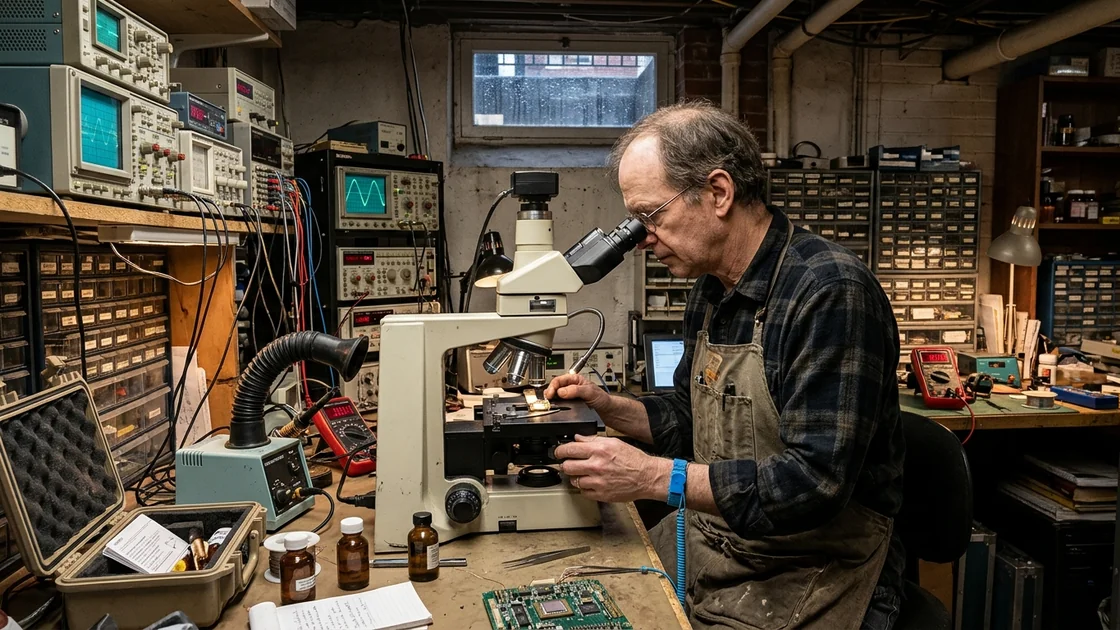
Arthur Linwood is a solitary electronics repair technician who spends his days reviving dead circuit boards in a cluttered basement workshop, far removed from the modern world of disposable technology. When a mysterious industrial control unit lands on his workbench, his routine diagnostic uncovers a counterfeit microprocessor hiding a sinister secret. Beneath the chip's epoxy casing, etched directly into the microscopic silicon architecture by a desperate hand, is a cryptic warning that pulls Arthur out of his quiet existence and into a dangerous conspiracy of hardware espionage, forced labor, and infrastructure sabotage. Armed only with his technical expertise and an old metallurgical microscope, Arthur must decipher the message in the silicon before the people who engineered the counterfeit chip erase both the evidence and him.
The rain in the lower district did not fall so much as it condensed, slicking the subterranean concrete outside Arthur Linwood’s narrow transom window with a permanent film of motor oil and soot. Inside, however, the air was dry, warm, and smelled perpetually of pine-rosin flux and ozone.
Arthur sat hunched over his primary workbench, his spine curved into the familiar question mark that twenty-five years of micro-soldering had forged. Through the binocular eyepieces of his stereo zoom microscope, the world was clean, geometric, and governed by immutable laws. There was no weather here. There were no landlords threatening to raise the lease on his basement shop, no news broadcasts warning of rolling blackouts, and no social obligations. There was only a green fiberglass expanse of FR-4 circuit board, a miniature city of black epoxy monoliths, ceramic skyscrapers, and silver rivers of tin-lead alloy.
With the tip of his titanium tweezers—honed down on an Arkansas whetstone until the points were finer than a mosquito’s proboscis—Arthur nudged a 0201 surface-mount capacitor into place. To the naked eye, the component looked like a speck of brown pepper, barely half a millimeter long. Under forty-power magnification, it was a bricks-and-mortar block with silvered ends. He brought the tip of his micro-pencil soldering iron down. The temperature controller on the shelf above clicked softly, maintaining the conical tip at precisely three hundred and forty degrees Celsius.
Touch. A wisp of acrid white smoke curled upward, instantly devoured by the greedy rubber snout of the benchtop fume extractor. The flux boiled, amber and violent, and then the solder flashed from dull grey to a mirror-bright liquid meniscus, wetting the pad and the capacitor terminal in a single, seamless fillet.
Arthur pulled the iron back, exhaling slowly through his nose. He had held his breath for twelve seconds. He always held his breath on the passives; the slightest tremor in the diaphragm travelled down the collarbone, through the brachial plexus, and turned the tip of a soldering iron into a wrecking ball at the sub-millimeter scale.
He clicked off the ring light and leaned back, rubbing the bridge of his nose where his safety glasses left twin red indentations. The board on his bench was the main logic controller from a nineteen-nineties textile loom—a piece of heavy German engineering that a small woolen mill upstate refused to replace because the modern computerized equivalents required an annual software subscription and broke whenever the humidity topped eighty percent. Arthur liked the loom controller. It was honest. When it broke, it broke because an electrolytic capacitor had dried out after thirty thousand hours of service, not because a product manager in California had pushed an over-the-air update designed to force an upgrade cycle.
Above his head, the small brass bell wired to the street-level door gave a dull, reluctant clack.
The sound wasn't the cheerful ring of a retail shop; it was a heavy solenoid striking a deadened chime, powered by a twenty-four-volt transformer Arthur had wound himself. He didn't get many walk-ins. Most of his work arrived in cardboard boxes choked with pink anti-static bubble wrap, shipped by desperate factory managers, hospital biomedical techs, and synth musicians from three states over.
Footsteps descended the concrete stairs. They were uneven—a heavy tread followed by a quick, shuffling drag. The inner door, reinforced with steel mesh behind frosted glass, swung open, letting in a draft of cold, wet November air that made the thermal camera above Arthur’s bench recalibrate with a sharp tick.
The man who stepped onto the worn anti-static mat was wearing a surplus olive-drab raincoat that dripped darkly onto the rubber. He was fifty, perhaps older, with the pale, doughy complexion of someone who worked night shifts under fluorescent tubes. Beneath one arm he clutched a Pelican case—small, grey, and scratched to hell, with the remnants of several barcoded asset tags scraped hastily off the polycarbonate shell with a razor blade.
"You Linwood?" the man asked. His voice was like gravel turning over in a cement mixer.
"Depends on what's in the box," Arthur said, not rising from his stool. "If it's a cracked phone screen or a gaming console with an HDMI port ripped off the pads, the guy you want is three blocks up on Fourth. He has a neon sign."
The man didn't smile. He walked to the counter that separated the reception area—four square feet of linoleum and a dead fern—from the labyrinth of oscilloscopes, power supplies, and component carousels that made up the workshop. He set the Pelican case down and popped the twin latches. They snapped open with the sharp report of small-caliber gunfire in the quiet room.
"It’s not a phone," the man said.
Arthur stood up, his knees popping, and walked to the counter. He looked down into the plucked-foam interior of the case. Nestled in the grey polyurethane was a circuit board roughly the size of a hardcover novel.
Arthur’s eyes narrowed immediately. This wasn't consumer trash, and it wasn't thirty-year-old factory automation either. The substrate wasn't standard green fiberglass; it was a dark, matte polyimide material—high-temperature, military or aerospace grade, probably fourteen or sixteen layers thick judging by the edge profile. The connectors along the back edge were heavy gold-plated multi-pin blocks sealed with fluorosilicone gaskets. In the center of the board sat a massive, square integrated circuit housed in a ceramic ball-grid array package, its silver heat-spreader lid wiped clean of any manufacturer markings, save for a faint, laser-etched lot code in the bottom corner.
"Conformal coating has been stripped around the voltage regulators," Arthur observed quietly, leaning closer without touching it. "Someone already took a hot-air gun to the power management IC. Poorly. They scorched the solder mask near the inductor."
"The tech we had looking at it... he couldn't find the fault," the man said, his eyes darting briefly toward the frosted glass of the door. "He said the power rails are stable, the clock crystal is oscillating, but the main processor is throwing parity errors on the bus every forty-two seconds. Then it locks up hard. Watchdog timer can't even reset it."
"Who's 'we'?" Arthur asked, looking up from the board to meet the man's bloodshot eyes.
"A municipal contractor," the man lied. It was an obvious lie; municipal water and sewage contractors used off-the-shelf Allen-Bradley or Siemens programmable logic controllers housed in big grey plastic bricks. They did not use sixteen-layer polyimide boards with radiation-tolerant ceramic packages that cost four thousand dollars a pop on the open market. "Look, I was told you don't ask for end-user certificates. I was told you fix things that can't be sent back to the OEM."
Arthur looked back down at the board. He should have told the man to close the case and walk back out into the rain. That was the sensible play. When people scraped asset tags off Pelican cases and lied about polyimide boards, it usually meant stolen defense hardware, proprietary medical prototypes, or grey-market aviation modules that had fallen off the back of a maintenance truck at the regional airport.
Arthur didn't care much for the law in the abstract, but he cared deeply about being left alone. Involvement with stolen property meant men in cheap suits asking questions, and men in cheap suits tended to lean against his equipment racks and knock his calibration standards out of alignment.
Yet, as he stared at the large ceramic processor in the center of the board, a familiar, traitorous itch began at the base of his skull.
He pulled a jeweler’s loupe from his shirt pocket, unfolded the brass housing, and held it to his right eye, leaning down over the open case. He focused on the corner of the main processor. The silver lid—the heat spreader bonded to the top of the chip—had a chamfered edge. Under the ten-power lens of the loupe, Arthur could see the microscopic bead of epoxy that held the lid to the substrate.
It wasn't factory gray. It was black, and there were tiny, microscopic craters in the fillet—outgassing bubbles from an epoxy that had been cured too fast in a cheap convection oven rather than a ramped thermal profile in a cleanroom.Furthermore, the laser etching on the lid had the slightly fuzzy, overlapped trough appearance of a cheap YAG laser marker, not the crisp, shallow ablation of an OEM excimer system.
"Where did you source the replacement processor?" Arthur asked, lowering the loupe.
The man blinked, caught off guard. "We didn't replace the processor. That's a brand-new board. Straight from the sub-assembler. It failed during burn-in testing."
"No, it didn't," Arthur said softly. "Or rather, the board might be new, but that main logic chip has been reworked. And before it was soldered onto this board, somebody sanded the top of the lid down by about fifty microns, polished it with diamond paste, and laser-etched a fake serial number onto it."
The man’s jaw tightened. A bead of sweat, entirely unrelated to the rain, formed near his temple. "You can tell that just by looking?"
"I've been looking at silicon packages since before they stopped using lead in the solder balls," Arthur said. "Your sub-assembler got burned by a broker, or they’re cutting corners and buying pulls from Shenzhen e-waste scrapyards to pad their margins. If it’s throwing parity errors on a fixed forty-two-second interval, that’s not a thermal failure. That’s a counter overflowing."
The man reached into the inside pocket of his wet coat. For a tense half-second, Arthur tensed, his hand hovering near the heavy cast-iron base of his vintage panavise on the edge of the counter. Instead of a weapon, the man pulled out a thick brown envelope, folded in half and secured with a thick rubber band. He dropped it beside the Pelican case.
"There’s two thousand in there," the man said, his voice dropping an octave. "I don't need the board fixed anymore. If what you're saying is true... I need proof. Not just your word. I need a report—photos, decapsulation, die verification. I need to show my director that the chip inside that package isn't what the manifesto says it is, or I’m the one taking the fall for a three-million-dollar system failure on Monday morning."
Arthur looked at the envelope, then back at the ceramic package. Decapsulation. He hadn't fired up the acid rig in the back room in six months. Most repair techs stopped at the package pins; if a chip was bad, you heated it up, lifted it off with a vacuum pen, cleaned the pads with copper braid, and soldered a new one down. You didn't open the chip itself. Opening an integrated circuit was an autopsy, not surgery. Once you dissolved the package to look at the bare silicon die inside, the component was dead forever.
Before he retreated to this basement, Arthur had spent twelve years in failure analysis at a tier-one semiconductor foundry in Oregon. He knew how to strip a chip down to its bare quartz soul without leaving a scratch on the top passivation layer.
"If it's a ceramic package with a metal lid, I don't even need acid for the first stage," Arthur murmured, more to himself than the client. "Just a shear press or a controlled thermal ramp to break the lid seal. Unless it's an over-molded plastic ball-grid disguised with a dummy cap..." He tapped his fingernail against the brass loupe. "Leaves the die intact. I can give you optical micrographs of the die markings from the manufacturer's mask set. If it's a remark, a clone, or a lower-spec die from the same family, the mask revision numbers in the scribe line won't lie."
"How long?" the man asked.
"Come back tomorrow at six in the evening," Arthur said. "Leave the board. Leave the envelope. What name goes on the invoice?"
"Call me Miller," the man said, already turning toward the door. "And Linwood? Don't plug that board into anything that has a network line out of this basement."
The frosted glass door rattled shut. The heavy footsteps ascended the concrete stairs, and the brass solenoid above Arthur’s head gave another single, deadened clack as the street door locked behind him.
For a long time, Arthur didn't touch the money or the board. He stood in the center of his workshop, listening to the rhythmic drip of water from the street grate outside and the sixty-hertz hum of the isolation transformers bolted to the cinderblock wall.
His shop, Linwood Logic & Reconstruction, occupied the sub-basement of a former printing press building built in 1924. The floors were two feet of poured reinforced concrete resting directly on bedrock—a feature that had originally been meant to keep ten-ton Heidelberg presses from vibrating themselves to pieces, but which now served a far more delicate purpose: it isolated Arthur’s optical bench from the rumble of the subway lines three blocks over.
He walked over to the street door, flipped the deadbolt, and turned the small plastic sign in the transom window from BY APPOINTMENT to CLOSED.
Returning to the bench, he pulled on a pair of powder-free nitrile gloves and snapped the grounding strap around his left wrist, plugging the coiled black cord into the common earth jack beneath the table. He lifted the polyimide board out of the Pelican case.
Up close, the craftsmanship of the board itself—excluding the botched rework around the power regulator—was breathtaking. The traces were impedance-matched serpentine lines, meandering across the dark substrate in precise, mathematical waves so that electrons travelling down parallel paths arrived at their destinations within picoseconds of one another. He flipped it over. On the underside, decoupled by a forest of tiny ceramic capacitors, were four heavy-duty optical transceiver cages and a series of radiation-hardened memory modules.
This was either a flight-control computer for an unmanned aerial vehicle, a guidance assembly, or the safety-interlock core for a power grid substation. Given the heavy copper busbars near the edge connector designed to handle high-current transient spikes, Arthur bet on the grid. Probably a synchrophasor control unit—the kind of hardware that kept high-voltage alternating current across state lines in phase so the transformers didn't explode into balls of flaming mineral oil.
He placed the board under his stereo inspection microscope and brought the magnification up to forty-five power.
He ignored the surrounding components and focused entirely on the central processor: U1. The laser etching on the nickel-plated copper lid claimed it was an AetherLogic AL-9940-RH—a radiation-hardened, quad-core RISC processor combined with a massive field-programmable gate array fabric. In legitimate distribution channels, you couldn't buy an AL-9940 without signing end-user declarations vetted by the Department of Commerce, and the lead time was currently seventy-two weeks.
Arthur adjusted the gooseneck fiber-optic lights so the beam raked across the surface of the metal lid at a sharp, five-degree angle.
In bright-field illumination—light coming straight down—the lid looked uniformly matte grey. Under raking light, however, the deception jumped out like a scar under a spotlight. He could see the faint, concentric circular swirls left by a rotary lapping machine where the original markings had been ground away. To hide the dip in the metal, the counterfeiters had sprayed a micro-thin layer of metallic resin mixed with silica powder over the top—a process known in the underground brokerages of Huaqiangbei as "blacktopping," though here they had matched the silver-grey tint of nickel plating.
"Sloppy," Arthur muttered.
Before cracking the package open to photograph the internal die for "Miller," Arthur wanted to see the forty-two-second fault for himself. A technician didn't take a scalpel to a patient before listening to the heartbeat.
He didn't have the proprietary test harness the board was designed to plug into, nor did he want to power up the whole board and risk blowing whatever delicate state the processor was in. Instead, he spent an hour tracing the power and ground pins around the perimeter of the processor using a multimeter in continuity mode and an old, leaked PDF datasheet for the AL-9940 family he pulled from an offline archive server he kept under his desk.
The archive was a tower of twelve spinning hard drives containing forty terabytes of schematics, datasheets, service manuals, and silicon layouts collected over three decades. As requested, the machine had no Wi-Fi card and its Ethernet port had been physically filled with two-part epoxy in 2016.
Once he had identified the core voltage rail (1.2 volts), the I/O rail (3.3 volts), and the JTAG diagnostic pins—a standard four-wire interface built into almost every complex chip for testing—he soldered six strands of thirty-six-gauge enamel-coated magnet wire directly to the tiny test pads surrounding the chip. The wire was thinner than human hair. Under the microscope, his hands moved with hypnotic economy: scrape the pad with a micro-scalpel, tin with a speck of leaded paste, touch the wire, hold, release.
He connected the power leads to his linear bench supply, set the current limit to a safe five hundred milliamps so nothing could catch fire, and hooked the JTAG lines and the main clock output to his four-channel mixed-domain oscilloscope.
He flipped the toggle switch on the power supply.
The green seven-segment displays on the supply glowed to life. The chip drew two hundred and ten milliamps immediately—a normal quiescent draw for a processor of this size. On the oscilloscope screen, Channel 1 erupted into a crisp, square wave: the one-hundred-megahertz main clock. Channel 2, connected to the JTAG data-out pin, remained flatlined at zero volts.
Arthur watched the digital stopwatch in the corner of the oscilloscope screen.
Ten seconds. Twenty. Thirty.
The current draw on the power supply remained steady at 0.21 amps.
At thirty-eight seconds, the current suddenly ticked up to 0.24 amps. Something inside the silicon had woken up—a secondary logic block drawing power as its gates began switching millions of times a second.
At forty-one seconds, the JTAG data pin—which should have been completely silent unless interrogated by an external debugging tool—suddenly burst into activity.
Arthur hit the SINGLE SEQ capture button on the scope, freezing the waveform before the chip locked up at the forty-two-second mark, just as Miller had described. Instantly, the current dropped back to 0.05 amps. The processor had gone into a hard fault state, shutting down its internal clocks.
"Well, hello," Arthur whispered, leaning toward the glowing screen of the oscilloscope.
He turned the horizontal scale knob, zooming in on the burst of voltage spikes he had captured on the JTAG pin right before the crash. A normal parity error—the kind caused by a degraded memory cell, cosmic ray strike, or bad solder joint—looked like random hash or a truncated data packet on the main system bus. It did not come out of the JTAG test port. And it certainly did not look like what was currently glowing in yellow phosphor on Channel 2.
It was a serial bit-stream. Clean, unencrypted, asynchronous data clocked out at a sluggish nine thousand six hundred baud.
Arthur didn't even need to turn on the oscilloscope's built-in protocol decoder to see the pattern, though he pressed the button anyway to confirm. A grey table populated at the bottom of the screen, translating the peaks and valleys of voltage into hexadecimal bytes, and beside them, their standard ASCII text equivalents.
53 4F 53 20 4C 34 20 4D 37 20 51 33
In the ASCII column, the characters resolved in stark white block letters:
SOS L4 M7 Q3
Arthur’s hand stayed frozen on the rubberized knob of the oscilloscope. The hum of the isolation transformers on the wall seemed to grow louder, pressing in against his eardrums.
He reached over, cycled the power supply off and on, and waited another forty-two seconds.
Tick. Tick. Tick.
At thirty-eight seconds, the current jumped thirty milliamps. At
forty-one seconds, the JTAG pin spat out the exact same twelve-byte
string—SOS L4 M7 Q3—and then drove its internal core
voltage rail straight into a crowbar latch-up, intentionally crashing
the entire board so the machine it was installed in couldn't
function.
"A hardware Trojan," Arthur said aloud to the empty basement.
In the semiconductor industry, hardware Trojans were the stuff of paranoid whitepapers and defense intelligence briefings—malicious modifications inserted into a microchip’s circuitry during the design or manufacturing phase, lying dormant until triggered by a specific time delay or input sequence. Usually, they were designed to leak cryptographic keys or disable a missile receiver during wartime.
They were not designed to scream for help and then commit suicide during factory burn-in testing so the board would be flagged as defective and pulled from service.
And more importantly: what did L4 M7 Q3 mean?
Arthur looked from the glowing green and yellow lines of the oscilloscope back to the silent, grey square of the processor sitting under his microscope.
Layer 4. Metal 7. Quadrant 3.
His breath caught in his throat. A modern microprocessor wasn't flat; it was a three-dimensional labyrinth built up layer by layer on a wafer of pure silicon crystal. The transistors sat at the very bottom, in the silicon substrate. Above them was a towering skyscraper of microscopic copper wiring layers—Metal 1 at the bottom, climbing up through insulating layers of silicon dioxide to Metal 7, Metal 8, or higher at the top, where the thick power distribution buses lived.
The message on the wire wasn't the payload. It was an address. A set of coordinates pointing to a physical location inside the chip itself.
To see the seventh metal layer of an integrated circuit, you couldn't just use a ten-power jeweler’s loupe, and you couldn't use the forty-five-power stereo microscope on Arthur’s soldering bench. Those were for looking at the outside of packages and solder joints. The features on a modern silicon die were measured in nanometers and single-digit microns.
Arthur stood up, unclipped his grounding strap, and walked toward the back of the basement, past the towering rows of Raaco parts cabinets filled with tens of thousands of vintage transistors, diodes, and resistors. At the very rear of the shop was a heavy fire door with a round porthole window, salvaged from an old university chemistry lab.
Behind it was the wet room and the optical vault.
Arthur flipped the switches beside the door. A heavy-duty squirrel-cage blower mounted in the old coal chute roared to life, creating negative air pressure in the small tiled room and venting straight up a PVC stack to the roof five stories above.
First, he had to get the chip off the board, and then he had to get the chip out of its armor.
He brought the polyimide board back to his rework station, clamped it into the pre-heater frame, and brought the bottom-side infrared quartz elements up to one hundred and eighty degrees Celsius. Once the heavy board was heat-soaked, he lowered the top-side hot air nozzle directly over the AL-9940 processor. Within ninety seconds, the two hundred and fifty-six tiny solder balls beneath the ceramic package melted simultaneously. With a pair of vacuum tweezers, Arthur lifted the thirty-five-millimeter square package cleanly off the pads, leaving the expensive circuit board behind, and carried the chip into the wet room.
Now that he could examine the bottom of the chip, the full scale of the counterfeit operation became clear.
A real AL-9940 was a flip-chip ceramic ball-grid array. This chip wasn't ceramic at all. The counterfeiters had taken a standard, black plastic over-molded chip—the kind encased in silica-filled epoxy resin—and glued a false ceramic ring and a nickel-plated copper lid over the top of it to mimic the weight, height, and thermal profile of the military-grade part.
He placed the chip in a vice on the stainless-steel counter under the fume hood and slid a heated razor blade beneath the edge of the metal lid. The cheap black epoxy softened instantly, smelling sharply of vinegar and burnt plastic. With a gentle pry, the metal lid popped off.
Beneath it was a smaller, thinner black plastic square—the actual integrated circuit package that had been hidden inside the fake shell like a Russian nesting doll. Its surface had also been sanded smooth, erasing whatever legitimate commercial part number it had originally borne.
"Alright," Arthur murmured, pulling on a thick pair of neoprene acid gloves, a polycarbonate face shield, and a rubber apron over his flannel shirt. "Let's see who you really are."
To dissolve the black epoxy molding compound that encased the fragile silicon die without destroying the microscopic aluminum and copper wires inside, one needed an oxidizer violent enough to eat carbon polymers instantly, yet utterly dry. If there was water in the acid, the acid would dissolve the metal layers on the chip in a fraction of a second, turning the evidence into metallic salts.
From a locked fireproof cabinet under the sink, Arthur retrieved two small amber glass bottles with Teflon-lined caps: ninety-eight percent fuming nitric acid and concentrated sulfuric acid.
Working entirely behind the lowered sash of the fume hood, he placed the plastic-encased chip onto a custom-milled PTFE block equipped with a heating cartridge. In a small quartz beaker, he mixed a three-to-one ratio of the fuming nitric and sulfuric acids. Even behind the glass sash, the mixture immediately began to evolve thick, terrifying clouds of reddish-brown nitrogen dioxide gas that were sucked violently upward into the exhaust baffle.
Using a glass pipette, he drew up a few milliliters of the smoking, yellow-red liquid. He turned on the heater block, bringing the chip up to ninety degrees Celsius, and depressed the rubber bulb of the pipette, dropping a single bead of mixed acid onto the center of the black plastic package.
Hiss.
The reaction was instantaneous. The drop of acid boiled furiously on the black epoxy, turning jet-black as it oxidized the novolac resin into carbon soot while leaving the microscopic silica filler particles untouched. Arthur waited ten seconds, washed the black sludge away with a squirt bottle of bone-dry acetone, and dropped another bead of acid into the growing crater at the center of the chip.
Drop. Boil. Rinse with acetone.
Drop. Boil. Rinse with acetone.
It was a delicate, rhythmic dance he had performed thousands of times in his youth. If he went too slow, the acid would seep sideways along the lead-frame fingers and eat the package from the inside out. If he went too fast, thermal shock would crack the brittle silicon crystal at the heart of the package.
On the fourteenth drop, as the acetone washed away the black carbon slurry, a tiny, mirror-bright square flashed at the bottom of the etched pit, catching the fluorescent light of the fume hood and throwing back a dazzling rainbow of diffracted color.
The silicon die.
Arthur immediately flooded the chip with pure isopropyl alcohol to neutralize and displace any remaining trace of acid, then transferred the entire assembly into a miniature ultrasonic bath filled with clean acetone for sixty seconds to shake loose the microscopic glass beads left behind by the dissolved epoxy.
When he lifted the chip out with Teflon tweezers and blew it dry with a canister of filtered nitrogen gas, the heart of the processor lay completely exposed inside a neat, circular crater in the black plastic.
To the naked eye, the die was about the size of a fingernail clipping—eight millimeters on a side. It looked like a piece of dark purple-grey obsidian etched with a grid of shimmering, iridescent metallic squares that shifted from gold to emerald green depending on the angle of the light. Around its perimeter, hundreds of hair-thin gold bond wires arched gracefully from the edges of the silicon down to the copper substrate of the package, completely intact. The water-free nitric acid hadn't touched the gold or the silicon dioxide glass layer protecting the face of the chip.
Arthur turned off the hot plate, stripped off his heavy acid gloves, and carried the decapsulated chip in a covered glass Petri dish out of the wet room and into the adjoining alcove: the optical vault.
Sitting on a four-hundred-pound granite surface plate that rested on pneumatic rubber bladders was the crown jewel of Arthur’s basement: a 1998 Nikon Optiphot-200 metallurgical microscope. It was a beast of cast aluminum and cream-colored enamel, originally designed for inspecting forty-inch silicon wafers in cleanrooms. It possessed a revolving turret of five infinity-corrected plan-apochromatic objective lenses, a coaxial illuminator that shot light straight down through the lens barrel itself, and—most crucially—a set of Nomarski Differential Interference Contrast prisms that converted invisible variations in surface height into vibrant, three-dimensional topographic relief.
Arthur placed the chip on the mechanical X-Y stage, clicked the lowest-power lens—the 5x objective, giving fifty-power total magnification—into place, and looked through the eyepieces.
He adjusted the coarse focus knob. The blurry wash of bronze and violet snapped into razor-sharp focus.
At fifty power, the silicon die looked like an aerial photograph of Manhattan taken from thirty thousand feet at sunset. It was divided into distinct architectural districts. In the upper left corner were four identical, densely packed rectangular grids—the processor cores, with their regular, repeating arrays of static RAM cache looking like manicured suburban housing tracts. To the right was a vast, chaotic sea of routing channels and logic blocks: the FPGA fabric. Around the outer border ran the "pad ring"—a highway of thick gold squares where the bond wires were welded down, flanked by massive electrostatic discharge protection diodes that looked like concrete seawalls.
First, Arthur navigated the mechanical stage to the very bottom-right corner of the die, outside the pad ring, in the narrow strip of bare silicon known as the scribe line. When hundreds of chips are printed onto a circular silicon wafer at the foundry, the scribe lines are the alleys between the chips where the diamond saw eventually cuts them apart. Designers always put the chip’s true birth certificate—the mask numbers, copyright dates, and manufacturer logos—in the corner near the scribe line.
Arthur centered the corner and rotated the nosepiece to the 20x objective—two hundred power.
There it was, printed in crisp, two-micron-wide aluminum letters:
© 2021 VANGUARD SEMI CORP - VS-4410-C - MASK REV B4
"Not an AetherLogic chip at all," Arthur whispered, his fingers resting lightly on the coaxial stage controls.
Vanguard Semiconductor was a mid-tier commercial foundry that had gone bankrupt two years ago, its fabrication plant in upstate New York sold off at auction to a holding company registered in Delaware. The VS-4410 was an industrial telecommunications processor—pin-compatible with the military-grade AetherLogic chip if you rerouted a few pads on an interposer substrate, which was exactly what the counterfeiters had done inside the fake ceramic shell. It had one-tenth the radiation tolerance and cost forty dollars instead of four thousand.
If this were a normal counterfeit investigation, Arthur’s job would be finished right now. He could snap a picture of the Vanguard logo through the microscope’s trinocular camera port, print it out, hand it to "Miller" tomorrow evening, and pocket his two thousand dollars.
Instead, Arthur looked at the scrap of paper where he had jotted down
the ASCII string from the oscilloscope: SOS L4 M7 Q3.
Layer 4. Metal 7. Quadrant 3.
On a silicon die, quadrants were traditionally numbered counter-clockwise starting from the top right, just like a Cartesian graph in mathematics. Quadrant 1 was top-right; Quadrant 2 was top-left; Quadrant 3 was bottom-left.
Arthur turned the knurled brass knobs of the mechanical stage, scrolling his view westward across the metallic metropolis of the chip, down into the bottom-left quadrant.
This area of the VS-4410 was part of the programmable gate array fabric and the JTAG boundary-scan controller—the very circuit that had spat out the twelve-byte distress call before shorting the power rail.
At two hundred power, the seventh metal layer—the topmost layer of copper wiring just beneath the clear silicon nitride passivation glass—looked like a dense woven mat of wide golden boulevards carrying power and ground across the chip. Between the power buses were square "dummy fill" patterns: thousands of tiny, unconnected squares of copper placed there by automated design software simply to keep the surface of the chip flat during chemical-mechanical polishing at the factory.
Arthur scanned Quadrant 3 methodically, sweeping from left to right, stepping down one field of view, and sweeping right to left, the way a search-and-rescue plane grids an ocean.
Ten minutes passed. Twenty. His eyes watered from the intense glare of the halogen lamp reflecting off the polished metal lines. He blinked, adjusted the aperture diaphragm to increase contrast, and dropped one row lower near the edge of the JTAG state-machine block.
Suddenly, his thumb froze on the Y-axis knob.
Near a cluster of four large decoupling cells—labeled on the
sub-layer silk as L4_CAP_ARRAY—a section of the dummy metal
fill tiles was missing.
In a normal chip, every single square micron is dictated by photolithography masks produced by multi-million-dollar electron-beam writers. Everything is orthogonal. Every corner is a ninety-degree or forty-five-degree angle. Nothing is crooked. Nothing is hand-drawn.
Here, in a clearing roughly eighty microns wide by thirty microns tall on the Metal 7 layer, the regular grid of copper dummy squares had been obliterated. And across the bare, exposed oxide floor of that microscopic clearing, something had been carved.
Arthur reached up and rotated the turret to the 50x objective—five hundred power—and then, after a breath, all the way to the dry 100x metallurgical objective.
One thousand times magnification. The front lens of the heavy brass objective was now less than half a millimeter above the bare silicon die, hovering right between the looping arches of the gold bond wires.
He slid the Nomarski DIC prism into the optical path and twisted the polarizer ring until the background turned a deep, bruised indigo and the surface features popped into stark, three-dimensional bas-relief. He touched the fine-focus knob—a movement of a single millimeter on the wheel moved the stage by just two microns.
The image resolved, filling his entire field of view.
Arthur gasped, pulling back half an inch from the eyepieces before pressing his face back against the rubber cups.
Carved directly into the top copper busbar and the surrounding silicon dioxide insulation were jagged, trench-like letters. Each letter was barely four microns tall—roughly the diameter of a single human red blood cell. To the naked eye, the entire paragraph of text took up less space than the period at the end of a printed sentence.
Yet at one thousand power, the letters looked like trenches dug into concrete with a jackhammer. The edges were slightly melted and beaded, showing the distinct sputtering topography of a Focused Ion Beam workstation—a machine that shoots a concentrated stream of heavy gallium ions like a sub-atomic sandblaster to cut and weld microscopic circuits during chip debugging.
Someone sitting at a FIB console had disengaged the automated CAD navigation, grabbed the manual joystick, turned the beam current down to pico-amps, and written by hand in the empty space of Quadrant 3.
Arthur read the jagged, gallium-milled trenches line by line:
HELD AT FAB 9 SUB-B 32 ENG CAPTIVE
TROJAN IN BATCH 880-A THRU F
GRID SYNC KILL DEC 12
TELL VANCE - J. KOWALSKI
Below the text, the writer had used the ion beam to mill a crude trench across the passivation glass and deposit a microscopic jumper line of platinum—a standard feature on FIB machines used for rewiring circuits—connecting a ring-oscillator timer directly into the JTAG shift register.
That was how Kowalski had created the forty-two-second SOS signal. He didn't have access to the original photolithography masks, or if he did, his supervisors were auditing the digital design files before they went to the wafer stepper. So after the wafers were fabricated, during the post-silicon validation and packaging phase, Kowalski had used a failure-analysis ion beam machine to physically hack the silicon at the atomic scale. He had hard-wired a twelve-byte hardware ROM out of spare logic gates using platinum micro-welds, set it to broadcast the coordinates of his hidden etching on the JTAG pin, and then wired the final bit of the counter to trigger a gate-oxide breakdown—forcing the chip to fail its quality-control burn-in test so it would wind up on the bench of a failure-analysis technician equipped with a decapsulation rig and a high-power microscope.
A message in a bottle. Except the bottle was a counterfeit radiation-hardened microprocessor, and the ocean was the black-market supply chain feeding the national power grid.
Arthur sat back on his stool. The pneumatic bladders beneath the granite table hissed softly as his weight shifted.
"Julian Kowalski," Arthur whispered.
He knew the name. Anyone who had worked in high-reliability semiconductor architecture in the late nineties and early two-thousands knew Julian Kowalski. He had been the chief silicon architect at Vanguard Semiconductor before their bankruptcy—a brilliant, notoriously abrasive genius in physical layout and fault-tolerant logic. Every trade journal had reported that Kowalski had taken an early retirement package after the Vanguard liquidation and moved to Costa Rica or Zurich.
He hadn't moved to Costa Rica. He was in Fab 9 Sub-B, along with thirty-one other engineers, being forced to weaponize surplus commercial silicon and slip it into critical infrastructure packages.
And whoever was holding them had a leak in their quality control—because "Miller" had somehow walked out with one of the rejected boards that Kowalski had intentionally sabotaged.
Arthur didn't sleep that night.
At two in the morning, he brewed a pot of espresso on the tarnished hotplate he usually used for curing thermal epoxy, and sat in front of his air-gapped archive server. First, he connected a high-resolution digital C-mount camera to the top port of the Nikon microscope and captured forty raw, uncompressed TIFF images of the microscopic etching at various focal depths, stacking them with software to create a single, indisputably sharp micrograph of Kowalski’s message and the platinum FIB modifications around the JTAG register.
He saved the files onto three separate industrial-grade microSD cards. One he taped inside the battery compartment of an old Fluke multimeter hanging on his wall; the second he sealed inside a hollow brass binding post on a broken 1970s Heathkit frequency counter buried at the bottom of his scrap pile; the third he kept on his desk.
Then he began searching his offline databases for Fab 9 and Vance.
The Vanguard Semiconductor complex in upstate New York—located in a wooded industrial park forty miles outside of Albany, less than a three-hour drive north of Arthur’s city—had consisted of seven main buildings when it operated publicly: Fabs 1 through 4 (older six-inch wafer lines from the eighties), Fab 5 (their main eight-inch line), an administration building, and a chemical storage depot. There was no Fab 9 on any of the public environmental impact maps from 2015 that Arthur had archived.
However, when he cross-referenced the old Vanguard internal pin-out documentation he had hoarded years ago, he found a reference in an assembly packaging datasheet: Building 9 - Advanced Packaging & Radiation Test Facility (Sub-Basement B: Linear Accelerator / Heavy Ion Vault).
A radiation test vault. Built fifty feet underground behind six-foot-thick walls of high-density barite concrete designed to contain gamma rays and particle beams used for testing space-grade chips. It would have its own closed-loop air filtration, its own backup diesel generators, and zero electromagnetic leakage. You could run an entire illicit semiconductor repackaging, laser-marking, and FIB-modification line down there, and a satellite passing overhead wouldn't see so much as a thermal bloom. If you locked thirty-two engineers inside a subterranean radiation vault, they might as well be on the dark side of the moon.
"Batch 880-A thru F," Arthur muttered, rubbing his stubbled jaw as he stared at the glowing monitor. "Grid Sync Kill Dec 12."
Today was November 28th. Two weeks.
If batches 880-A through F were already deployed in the field—installed inside synchrophasor control units at high-voltage substations across the eastern interconnect—and they contained a hardware Trojan set to trigger on December 12th, they wouldn't just crash cleanly like the one on Arthur’s bench. Kowalski had modified this specific chip to fail early during burn-in so someone would look inside it. The rest of the batch would pass burn-in smoothly. On December 12th, during peak winter heating load, they would deliberately throw the grid's phase synchronization out of alignment while reporting green status to the control rooms.
Massive three-hundred-ton step-up transformers, each taking two years to manufacture overseas, would tear themselves apart from magnetic torque in less than four seconds. It wouldn't be a blackout that lasted three days; it would be a blackout that lasted eight months.
And who was Vance?
Arthur didn't have a personnel directory for the federal government on his offline server, so at seven in the morning, as the grey dawn began to turn the soot on his transom window into a translucent smear, he put on his wool coat, locked the three deadbolts on his shop door, and walked four blocks through the drizzle to a twenty-four-hour laundromat that still had a working payphone bolted to the tile wall near the detergent vending machines.
He didn't call the police. Calling a municipal precinct dispatcher to report a message carved with gallium ions inside a remarked Vanguard microprocessor would earn him a seventy-two-hour psychiatric hold.
Instead, he dialed a number he knew by heart—a landline in a quiet suburb on the north side of the city.
It rang five times before the receiver was lifted. A woman’s voice, sharp despite the early hour, came through the static. "Speak."
"Clara," Arthur said, watching a dryer spin a load of fluorescent orange construction vests through the scratched glass door in front of him. "It’s Arthur."
There was a pause long enough for him to hear the clink of a ceramic mug being set down on a stone countertop. Clara Chen had been the Director of Quality Assurance and Counterfeit Mitigation at the defense aerospace contractor Arthur had consulted for ten years ago, before she retired with a pension and a bad hip. She knew every grey-market chip broker from Shenzhen to Rotterdam, and she knew everyone in the federal supply-chain task forces.
"Arthur," she said, her tone softening by half a degree. "The last time you called me before eight in the morning, it was 2019 and you wanted to know if I had a spare optical encoder for a 1984 Perkin-Elmer wafer stepper. Please tell me you're calling about an encoder."
"I need to know who Vance is," Arthur said, keeping his voice low below the rumble of the commercial dryers. "Connected to Vanguard Semiconductor, or high-reliability grid infrastructure, or semiconductor supply-chain intelligence."
Another silence. This one was heavier. "Where are you calling from, Arthur?"
"A laundromat on Seventh."
"Good. Don't use your cell if you even still own one." He heard the rustle of paper on her end, the sound of someone moving into another room and closing a door. "Eleanor Vance. She’s the Deputy Special Agent in Charge at the Department of Energy’s Office of Inspector General—specifically the Cyber and Physical Infrastructure Security division. Three months ago, she was heading an inquiry into why a shell company called Aegis Micro-Systems was winning every subcontractor bid to supply replacement AL-9940 boards for the Northeast Grid Modernization Project despite AetherLogic having a two-year backlog."
"Was?" Arthur asked.
"She got stonewalled," Clara said grimly. "The boards passed every automated functional test the utilities threw at them. The prime contractor threatened to sue the DOE for holding up winter grid readiness, and her superiors told her to drop it unless she could produce physical proof of counterfeit provenance. You can't decap a four-thousand-dollar chip on a hunch when the government only bought fifty spares."
"I have one on my Nikon right now, Clara," Arthur said. "And it's not just a counterfeit. Julian Kowalski is alive. He’s being held underground in the old radiation vault at the Vanguard site in Albany with thirty-one of his old staff. They’re using them to run a captive fab line—re-balling old Vanguard silicon onto interposers and injecting hardware Trojans with a FIB rig."
Even over the terrible acoustic carbon-button microphone of the payphone, Arthur heard Clara’s sharp intake of breath. She didn't question him. She knew Arthur Linwood didn't hallucinate, didn't exaggerate, and didn't misread a silicon die.
"How did you get the board?" she asked quickly.
"A guy calling himself Miller dropped it off last night. Scratched-off asset tags on a Pelican case. Said he needed a decapsulation report by six tonight to cover his ass for a burn-in failure. I think he’s a mid-level test tech for the sub-assembler—probably Aegis Micro-Systems—who panicked when a chip failed QA and brought it to an off-the-books shop instead of reporting it up the chain, not realizing his own bosses are the ones running the counterfeit ring."
"Or," Clara said, her voice dropping to an urgent whisper, "he did report the weird JTAG error code up the chain yesterday afternoon, his bosses realized Kowalski slipped a gaffed chip past their internal screen, and when they found out the tech had already sent the board out to a local freelancer for decapsulation, they started tracing his steps."
Arthur felt a cold weight drop into the pit of his stomach.
Miller’s nervous eyes darting toward the frosted glass door. The way he had shifted from wanting the board repaired to suddenly offering two thousand dollars in cash just to leave the board behind and get a report later. What if Miller hadn't been trying to cover his ass? What if Miller had been sent to find out if Arthur was the kind of tech who actually had the equipment to read a sub-micron FIB etching, or if he was just a board-swapper with a soldering iron?
No—Miller had been genuinely surprised when Arthur spotted the resurfaced lid with a hand loupe. Miller was a panicked insider who had stolen a defective board to prove his company was buying bad parts, probably hoping for a whistleblower payout or leverage. Which meant the people running Aegis Micro-Systems would be tearing Miller’s life apart right now to find out where he took that board.
"Arthur," Clara said sharply. "Get out of your shop. Leave the equipment. Bring the die and the micrographs. I can have Eleanor Vance at my house in ninety minutes. She lives in the district."
"The die is still on the stage of my microscope," Arthur said. "And the uncompressed images are on my bench."
"Then you have ten minutes, if you're lucky," Clara said. "Do not pack a bag. Grab the silicon, grab the drive, and come to my place through the alley behind the botanical gardens. Go."
The line clicked dead.
When Arthur emerged from the laundromat, the drizzle had thickened into a cold, sleeting rain that smelled of wet wool and diesel exhaust. He walked fast, keeping his head down and his hands jammed deep into his coat pockets, scanning the narrow street ahead of his basement entrance.
On a normal Friday morning at seven-thirty, the lower district was a sleepy canyon of delivery trucks unloading crates of cabbages for the wholesale restaurant supply depots and janitors hosing down the sidewalks.
Fifty yards from his recessed concrete stairwell, Arthur slowed his pace, stepping beneath the torn canvas awning of a shuttered bail bondsman’s office.
Double-parked directly across from his transom window was a late-model black Ford transit van with dark tinted rear windows and commercial fleet plates. There were no ladder racks on the roof. There were no magnetic contractor logos on the doors. Sitting in the driver’s seat was a man in a dark windbreaker, staring down at a tablet whose blue glow illuminated the sharp, humorless angles of his face.
The brass sign in Arthur’s basement transom window was still flipped to CLOSED, just as he had left it. Inside, the yellow task light over his primary soldering bench was still glowing warmly through the rain-streaked glass.
Then, as Arthur watched from the shadow of the awning, a figure passed directly between the yellow bench light and the transom window inside his basement.
Someone was already inside.
Arthur pressed his back against the wet brick behind the bail bondsman’s alcove, his heart hammering a rapid, erratic rhythm against his ribs—a hundred and forty beats per minute, like an uncalibrated oscillator running out of spec.
They had found Miller overnight. And Miller had told them about the basement shop on Mercer Street.
How had they gotten past three Schlage deadbolts without setting off the solenoid chime or splintering the steel-reinforced doorframe? Probably the freight elevator shaft at the back of the building that connected the printing press loading dock to the sub-basement boiler room. Arthur had welded the iron grate shut on his side ten years ago, but two men with a hydraulic spreader or a plasma cutter could pop fifty-year-old tack welds in thirty seconds.
He thought of the microSD card taped inside the Fluke multimeter on the wall. He thought of the second card sealed inside the binding post of the Heathkit frequency counter on the scrap heap. If these men were professional cleanup crew for an intelligence-grade infrastructure plot, they wouldn't just look on the desk. When they saw the decapsulated chip sitting under the Nikon microscope in the back room—when they looked through the eyepieces and saw that the magnification was already set to a thousand power and focused squarely on Kowalski’s message—they wouldn't search the basement for copies.
They would burn the basement to the ground. A bottle of thermite or five gallons of Coleman fuel over the solvent cabinets in the wet room, and forty years of equipment, along with the silicon die and every hard drive on the premises, would be reduced to toxic slag before the fire department could even pry open the street grates.
If the die was destroyed, all Arthur would have—even if he somehow retrieved a backup SD card from the ashes—was a digital photograph. And in the age of generative software and digital manipulation, a photograph on an SD card wasn't enough to make the Department of Energy shut down the eastern power grid's modernization rollout in two weeks. Eleanor Vance had been told she needed physical proof. She needed the actual piece of Vanguard silicon with the gallium-ion trenches still in the copper, verifiable under any national laboratory’s scanning electron microscope.
Arthur couldn't let them have the chip. And he couldn't let them torch his shop.
He turned around, walked casually back toward the corner, and slipped into the narrow service alley that ran behind the printing press building.
Nobody knew the guts of the old building like Arthur. The landlord hadn't set foot in the sub-basement since the Carter administration because the stairs were steep and the air smelled of damp limestone.
Arthur didn't go to the loading dock where they had likely breached the freight shaft. Instead, he dropped to one knee beside a rusted iron coal-delivery hatch set into the cobblestones behind a dumpster. The padlock securing the underside of the hatch was actually a dummy; Arthur had wired it to a hidden magnetic reed switch years ago so he could bring heavy transformers down into the shop without hauling them down the front steps.
He pulled a small neodymium magnet from his keychain—the one he used for testing whether supposedly stainless-steel screws were actually cheap nickel-plated iron—and touched it to a specific rivet on the iron frame. Inside the concrete lip, a twelve-volt latch clicked softly.
Arthur lifted the heavy iron plate three inches, propped it with a piece of scrap two-by-four to keep it from clanging, and slid legs-first down the angled steel chute into pitch darkness.
He landed silently on a rubber mat inside the utility crawlspace behind the building's main electrical switchgear—separated from his wet room and optical vault by a single cinderblock partition wall.
Through the ventilation louvres in the wall, he heard voices. Two men.
"—already decapped it," a calm, clipped voice said from inside the optical vault. "Fuming nitric on the hotplate. The guy knows what he’s doing. Look at the stage."
Footsteps crunched slightly on the floor tiles. A second voice, younger and tighter, spoke after a moment. "He’s on the 100x lens. Christ. He found the FIB edit in Q3."
"Check the camera port on top of the scope," the first man ordered. "There’s a C-mount sensor wired to that workstation in the corner. Pull the drives out of the tower and bag the chip. Where did he keep his intake ledger?"
"Nothing on the front counter except Miller’s Pelican case and the cash envelope. He didn't even open the envelope."
"Meaning he hasn't handed anything off yet," the first man said. "He stepped out for coffee or breakfast. Which means he’s coming back any minute. Leave the front door unlocked. When he walks down the stairs, bring him into the back room. We need to know if he uploaded the micrographs before we light the fume hood."
In the pitch black of the switchgear room, Arthur’s jaw set hard. Before we light the fume hood.
He looked around the cramped electrical vault, his eyes adjusting to the faint red and green glow of the pilot lights on the building's ancient 480-volt three-phase distribution panels.
Right beside his shoulder was the primary step-down transformer and the giant knife-switch breaker that fed his workshop. And sitting on the concrete shelf next to it was the custom power-conditioning bank Arthur had built to keep the city's dirty utility power from introducing noise into his oscilloscopes: a rack of twelve massive, blue Mallory electrolytic capacitors, each the size of a tallboy beer can, wired in series-parallel and charged to four hundred and fifty volts DC at thirty thousand microfarads.
In the repair world, those capacitors were called "widowmakers." If you dropped a wrench across their brass screw terminals, the wrench didn't just spark—it vaporized into a cloud of molten chrome-vanadium plasma with the acoustic decibel level of a twelve-gauge shotgun blast.
And bolted to the ceiling of the wet room, directly above the stainless-steel counter where the two men were standing, was the emergency fire-suppression halon dump valve and the high-velocity reverse damper for the fume extractor.
Arthur moved with the silent, practiced precision that came from knowing every square inch of his territory in the dark.
From a tool pouch hanging beside the breaker box, he pulled a pair of insulated linesman’s pliers and a ten-foot coil of heavy twelve-gauge stranded copper wire. He didn't need a complicated circuit. He just needed physics.
First, he reached up to the ductwork of the fume extractor where it passed through the switchgear room before heading up the coal shaft. He unlatched the filter maintenance door and reversed the polarity plug on the three-horsepower squirrel-cage blower motor. Instead of sucking air out of the fume hood at eight hundred cubic feet per minute, the blower, when spun backwards, would push a sudden gust of air down into the hood—right over the open quartz beaker of fuming nitric and sulfuric acid sitting on the counter.
Second, he clipped one end of the twelve-gauge wire to the positive busbar of his four-hundred-and-fifty-volt capacitor bank, and threaded the bare copper end of the second wire through the conduit hole in the cinderblock wall until it touched the ungrounded stainless-steel backsplash of the wet room counter and the aluminum housing of the Nikon microscope’s halogen lamp power supply.
He waited until he heard both men move out of the tiny optical alcove and into the wet room to pack the chip into a transport case.
"Careful with the tweezers," the first man was saying. "If you crack the silicon die, the director’s going to want to know why we can't verify which FIB station Kowalski used—"
Arthur pulled a pair of amber laser-safety goggles down over his eyes, plugged his ears with his thumbs, and kicked the wooden insulating wedge out from under the contactor bar on the capacitor bank with the heel of his boot.
CRACK-BOOM.
Even through the cinderblock wall, the discharge of six thousand joules of stored electrical energy in four milliseconds felt like a concussion grenade going off inside a submarine.
Inside the wet room, the halogen lamp housing on the microscope bench exploded in a blinding, magnesium-white arc flash of vaporized aluminum and copper that lit the basement like the surface of the sun. Simultaneously, the metal frame of the wet-room counter became energized to four hundred and fifty volts DC just as the younger operative’s hand was resting on the stainless-steel lip. The shock threw him backward into the shelves of glass laboratory beakers with a bone-jarring crash, knocking him out cold in a shower of safety glass.
At the exact same instant, Arthur slammed the knife switch for the reversed fume hood blower.
The three-horsepower fan shrieked, blowing a violent blast of air down the PVC stack into the fume hood. The cloud of reddish-brown nitrogen dioxide fumes and aerosolized nitric acid vapor sitting in the exhaust baffle erupted outward into the narrow room like tear gas.
The older operative, half-blinded by the arc flash that had left purple afterimages burned into his retinas, inhaled a lungful of acrid, stinging acid mist and doubled over, coughing violently and clawing at his eyes as he fumbled for the suppressed pistol under his windbreaker.
Arthur didn't give him three seconds to recover.
He kicked open the access door between the switchgear crawlspace and the workshop, holding a heavy five-pound cylinder of liquid carbon dioxide he used for thermal-shock testing circuit boards. He wrenched the brass valve wide open with a wrench, snapping the siphon regulator off the neck.
A roaring, deafening jet of white dry-ice snow erupted from the nozzle at minus seventy-eight degrees Celsius, filling the six-foot-wide doorway of the wet room with an impenetrable blizzard that displaced the oxygen and froze the moisture in the air instantly.
The older man fired twice blindly into the swirling white fog—pffft-clack, pffft-clack—the subsonic rounds punching harmlessly into a towering rack of old Tektronix oscilloscope frames in the main room. Before he could track the barrel left, Arthur stepped out of the freezing mist and swung the heavy forged-steel base of the CO2 cylinder directly into the side of the man’s wrist, followed by a hard, short thrust of the cylinder's valve guard into his solar plexus.
The pistol skittered across the wet tiles. The man collapsed onto his knees, gasping for air that wasn't there amidst the heavy blanket of carbon dioxide gas and nitric fumes settling near the floor.
Arthur didn't linger to tie them up; the driver in the black Ford van outside would have heard or felt the electrical arc when the building's main transformer groaned, or he would notice his partners weren't answering their earpieces within sixty seconds.
Holding his breath against the biting chemical mist, Arthur ducked into the optical alcove.
The Nikon microscope was still standing on its granite slab, untouched by the chaos four feet away. The decapsulated Vanguard processor was still sitting in the little open plastic wafer carrier where the operative had been about to close the lid.
Arthur snapped the lid of the wafer carrier shut, taped it closed with a strip of gold Kapton tape, and dropped it into his coat pocket. He reached up to the broken Heathkit frequency counter on the scrap shelf, unscrewed the brass binding post, and shook the backup microSD card into his palm. He left the main computer tower where it was—let them haul forty pounds of encrypted legacy datasheets out to their van if they woke up.
As he ran back toward the coal chute in the switchgear room, he heard the front door at the top of the street stairs bang open as the driver from the van charged down into the basement, drawn by the gunfire or the silence on the comms.
Arthur was already halfway up the iron coal chute inside the alley. He hauled himself out into the pouring rain behind the dumpster, kicked the two-by-four prop away, and let the two-hundred-pound cast-iron hatch slam down onto the cobblestones. As the magnetic reed switch engaged with a heavy clunk, he took a piece of thick copper busbar from his pocket and jammed it wedged tight under the exterior iron hinge lip, welding it in place with a quick, brutal blow from a cobblestone.
Nobody was coming out that way without an oxy-acetylene torch.
At nine-fifteen in the morning, soaked to the bone and smelling faintly of nitric acid and burnt insulation, Arthur stood in the warm, cedar-lined sunroom at the back of Clara Chen’s craftsman house in the northern hills.
Sitting across the oak table from him was a woman in her early forties with dark, sleepless circles under her eyes, wearing a charcoal wool suit with a Department of Energy identification lanyard tucked into her breast pocket. Eleanor Vance didn't look like a bureaucrat; she looked like a former military signals-intelligence officer who had spent the last six months banging her head against a bureaucratic wall while watching a train wreck in slow motion.
On the table between them sat Clara’s personal inspection microscope—a portable Leica stereo unit that couldn't reach the thousand-power magnification needed to read Kowalski’s message directly, though it clearly showed the counterfeit Vanguard die inside the fake AetherLogic package—and a ruggedized government laptop displaying the high-resolution, focus-stacked TIFF micrographs from Arthur’s SD card.
Eleanor Vance hadn't spoken for three full minutes. She kept zooming in and out on the jagged, four-micron letters milled into the Metal 7 copper layer:
HELD AT FAB 9 SUB-B 32 ENG CAPTIVE
TROJAN IN BATCH 880-A THRU F
GRID SYNC KILL DEC 12
TELL VANCE - J. KOWALSKI
"He wrote my name in gallium ions on a four-nanometer oxide trench," Vance whispered, her voice trembling slightly with a mixture of vindication and horror. "When I interviewed the former Vanguard executives in August, they swore Kowalski and his senior verification team had been hired en masse by a sovereign wealth fund in Abu Dhabi to build a new foundry in the desert. They showed me flight manifests. Non-disclosure agreements. Wire transfers."
"Faked," Clara said, leaning against the doorframe with her arms crossed, a mug of tea in her hand. "If you want to build an untraceable hardware Trojan into the American grid without triggering the NSA’s foreign-foundry monitoring programs, you don't do it in Shenzhen or Taipei. You buy a bankrupt domestic foundry upstate through three layers of Delaware LLCs, kidnap the original design team who know the chip's undocumented silicon errata inside and out, and lock them in the underground radiation vault on-site. To the utility companies, the chips ship from a domestic zip code with clean chain-of-custody paperwork."
"Wait," Arthur said, leaning over the laptop and pointing a scarred, solder-burned index finger at the micrograph of the circuit surrounding the message. "Look at the batch numbers Kowalski listed. Batch 880-A thru F. Those are the ones already deployed in the substations, right?"
"Yes," Vance said, pulling up a spreadsheet on a second window. "Four hundred and twelve synchrophasor control units installed across New York, Pennsylvania, Ohio, and New England over the last nine weeks by Aegis Micro-Systems. If I take this die down to Brookhaven National Lab right now and put it under their scanning electron microscope to verify your micrograph, I can have a federal judge and the Secretary of Energy sign an emergency injunction by five o'clock, and FBI Hostage Rescue can hit the Vanguard site in Albany tonight."
"If you hit the Vanguard site tonight without knowing how the Trojan is triggered," Arthur said quietly, "they'll set it off early, or they'll wipe the vault before your tactical teams can breach six feet of barite concrete."
Vance frowned, looking up at him. "You said the message says GRID SYNC KILL DEC 12. That's a time-bomb trigger based on the real-time clock on the board."
"No," Arthur said, shaking his head. "Look at the die again. This chip—the VS-4410—doesn't have an internal battery-backed real-time clock on the silicon. It only knows relative time from the moment it's powered on, using a binary counter clocked by the crystal on the circuit board. That's how Kowalski made this chip fail after forty-two seconds on my bench. A counter overflow."
Vance leaned forward, her eyes narrowing. "Then how does a chip without a calendar know when it’s December 12th?"
"Because synchrophasors are connected to GPS timing antennas and the grid control network to measure phase angles across states," Arthur said, his mind racing back through the sixteen-layer polyimide circuit board he had examined the night before. "Remember what Miller told me before he walked out of my shop? Don't plug that board into anything that has a network line out of this basement."
Clara set her tea mug down hard. "The boards phone home."
"Or they listen for a specific phase-modulation signature sent over the power grid's own fiber-optic telemetry network from a master node," Arthur said. "And where do you think the master command-and-control server is located? The one place with a dedicated, high-bandwidth fiber trunk line left over from when it was a defense-contracted semiconductor plant, shielded under sixty feet of rock and barite concrete."
"Fab 9 Sub-B," Vance breathed. "If we storm the front gates in Albany with thirty SWAT trucks and cut the power to the complex, a dead-man switch inside the vault could broadcast the kill packet to all four hundred and twelve substations before we even get the blast doors open."
The sunroom fell silent except for the patter of rain against the cedar eaves.
"How long does it take to pull four hundred and twelve circuit boards out of high-voltage substations manually?" Arthur asked.
"Days," Vance said hollowly. "You can't just yank a synchrophasor card out of a live five-hundred-kilovolt substation without routing around the protection relays first, or the safety interlocks trip the breakers anyway. And half those substations are unmanned rural sites in the Adirondacks and the Poconos."
Arthur looked down at the magnified image of Kowalski’s hand-wired FIB circuit on the laptop screen. He stared at the tiny platinum jumper lines Kowalski had welded between the JTAG boundary-scan register and the core voltage crowbar circuit.
Wait a second.
Why had Kowalski put his SOS message inside the JTAG boundary-scan block?
Every technician who worked with complex electronics knew what JTAG—the Joint Test Action Group standard—was designed for. In the 1980s, when circuit boards became too dense to touch the pins with physical test probes, engineers built a daisy-chained shift register around the perimeter of every chip on a board. Using just four wires, an external computer could take complete control of a chip’s input and output pins, bypassing the internal processor cores entirely to test the solder joints—or to re-flash the configuration memory of an FPGA in the field.
"Zoom in on the bottom right corner of the trench," Arthur said suddenly, reaching over and tapping the trackpad on Vance’s laptop.
He scrolled twenty microns to the right of Kowalski’s signature, where the platinum jumper wire met the main boundary-scan instruction decoder. There, etched in letters half the size of the main message—barely two microns tall, almost lost in the granular texture of the copper wiring—was a single hexadecimal string sitting right across the instruction-register feedback path:
IR=0x7F_DEAD -> FUSE_BLOW
Arthur let out a long, slow breath that turned into a dry laugh.
"What is it?" Vance demanded. "What does IR=0x7F_DEAD
mean?"
"Julian Kowalski didn't just write a suicide note in this one reject chip," Arthur said, his eyes shining behind his smudged glasses. "The man is a physical layout architect. He couldn't change the lithography masks that put the Trojan into the main processor cores of Batch 880, because his captors were reviewing the mask files. But every chip in Batch 880 went through post-silicon FIB trimming in the vault to make the Vanguard die pretend to be an AetherLogic chip!"
Clara leaned over his shoulder, staring at the tiny two-micron code. "My God. He put an undocumented JTAG instruction into all of them."
"A kill-switch for the kill-switch," Arthur said, turning to Vance.
"On every single chip in Batch 880, if you send the hexadecimal
instruction 7F DEAD down the remote JTAG maintenance bus,
it doesn't crash the processor. It routes the 3.3-volt I/O rail directly
across a poly-silicon e-fuse feeding the Trojan logic block. It
physically melts the microscopic wire powering the Trojan inside the
chip while leaving the rest of the processor running normally on the
main bus!"
Vance stared at the screen, then at Arthur. "Can the utilities send a JTAG instruction remotely to all four hundred and twelve boards at the same time?"
"If they have remote out-of-band management enabled on the substation chassis—yes," Arthur said. "Except if the people at Aegis Micro-Systems are monitoring the grid telemetry from inside Fab 9, and they see the DOE suddenly broadcasting a JTAG patch across the network, they'll trigger the December 12th payload immediately before the fuse-blow command propagates to all the nodes."
"Unless," Vance said slowly, her tactical mind finally clicking into gear with Arthur’s hardware logic, "the Fab 9 vault is completely deaf and blind at the exact millisecond the utilities push the JTAG instruction."
She stood up and walked to the window, pulling a secure satellite
phone from her briefcase. "The Vanguard site in Albany still gets its
external telecommunications and grid monitoring data from two redundant
fiber-optic vaults out on Route 9, and a microwave dish on the roof of
Building 4. We don't need to breach the six-foot concrete doors of
Sub-Basement B first. We just need to sever their external fiber trunks
and jam their RF uplinks inside a ten-second window while the Eastern
Interconnect control center broadcasts 0x7F_DEAD to every
Aegis board on the network."
She looked back at Arthur over her shoulder. "How sure are you about that hexadecimal opcode, Mr. Linwood? Because if you're reading that circuit diagram wrong, and sending that code actually triggers the latch-up on all four hundred and twelve boards instead of blowing the Trojan fuse, I am personally going to black out sixty million people."
Arthur looked down at the tiny plastic wafer carrier sitting on the oak table. Inside was a piece of sand eight millimeters square, refined into a crystal purer than anything found in nature, upon which a desperate man in an underground concrete box had carved a circuit schematic smaller than a bacterium using a beam of heavy atoms.
Arthur knew bad work when he saw it. He spent his life fixing the mistakes of careless engineers, cheap accountants, and corner-cutting factories.
Julian Kowalski did not do bad work.
"Let me look at the die under a scanning electron microscope at the university lab downtown for twenty minutes to trace the metal-4 vias beneath that platinum weld," Arthur said calmly. "If the via under that trace connects to the poly-fuse gate like I think it does, I’ll write the JTAG bit-stream vector for your engineers myself."
Three hours later, in the sub-basement cleanroom of the Metropolitan University Materials Science Department—cleared of graduate students by four armed Federal Protective Service marshals—Arthur sat at the console of a Zeiss field-emission scanning electron microscope.
Here, there were no glass lenses and no visible light. The decapsulated chip sat inside a vacuum chamber, bombarded by a focused beam of electrons that resolved structures down to a single nanometer.
On the dual twenty-seven-inch monitors in front of Arthur, Kowalski’s message looked like the Grand Canyon. Every individual grain of sputtered copper and re-deposited gallium was visible in stark, silvery greyscale.
Arthur adjusted the acceleration voltage of the electron beam from five kilovolts up to twenty-five kilovolts. At higher voltages, the electrons penetrated right through the top silicon dioxide insulation layer and the Metal 7 copper, ghosting into the deeper layers of the chip below—Layer 6, Layer 5, Layer 4—creating a subterranean X-ray effect known as passive voltage contrast.
There, beneath the IR=0x7F_DEAD etching, dimly
illuminated by the back-scattered electrons, was the delicate neck of a
fifty-nanometer polysilicon fuse sitting directly on the clock-enable
line of the malicious hardware Trojan block. In the specimen from
Arthur’s shop, Kowalski had added one extra platinum bridge to force the
forty-two-second SOS broadcast during burn-in. In the production units,
the bridge wasn't there; the fuse sat waiting for the JTAG command.
"It's clean," Arthur said, taking his hands off the trackball and leaning back in the cleanroom chair. "Send the instruction vector to the JTAG boundary register, hold the UPDATE-IR pin high for four hundred milliseconds so the current saturates the poly-neck, and the Trojan block is permanently severed from the silicon. The chip won't even drop a single clock cycle on the main bus."
Behind him, Eleanor Vance nodded to a man in a headset sitting at a portable tactical communications case.
For the next four hours, Arthur wasn't allowed to leave the windowless university lab. He sat in the corner drinking terrible vending-machine coffee while a quiet, invisible war was fought across three hundred miles of fiber-optic cable and high-voltage transmission lines.
At four-thirty in the afternoon—ninety minutes before "Miller" had originally been scheduled to return to Arthur’s basement shop—the tactical coordinator at the communications console raised his hand.
"State Police and FBI SWAT are in position around the perimeter fence at the Albany facility," the man reported, his voice flat and professional. "Utility crews are standing by at the two fiber splice vaults on Route 9. PJM and NYISO grid control centers have the JTAG bit-stream loaded into the out-of-band management broadcast queue."
Vance stood behind the console, her hands gripping the back of a folding chair so hard her knuckles were white. "Execute the cable cut on my mark. Three. Two. One. Mark."
Two hundred miles north, in a snow-dusted ditch outside the old Vanguard industrial park, two shaped charges severed the armored underground fiber conduits simultaneously, while an Electronic Warfare helicopter hovering at two thousand feet flooded the industrial park with broad-spectrum radio-frequency noise.
"Facility is dark," the coordinator said. "Pushing the JTAG vector now."
On the screen, a map of the northeastern United States dotted with four hundred and twelve amber triangles blinked.
One second. Two seconds. Three seconds.
Across six states, inside chilly metal relay sheds surrounded by humming, oil-filled transformers the size of houses, four hundred and twelve remarked microprocessors received the forty-eight-bit serial string over their diagnostic pins. Deep inside the microscopic labyrinths of their fourth layers, tiny necks of doped polysilicon heated to fourteen hundred degrees Celsius in a microsecond and snapped cleanly in two, entombed safely inside solid silicon dioxide glass.
On the tactical map, the four hundred and twelve amber triangles turned steady emerald green, one after another, sweeping from Maine down to the Ohio border without a single substation breaker tripping.
"Telemetry is stable," the coordinator breathed out. "Grid phase lock is nominal at sixty point zero-zero hertz. The Trojan logic blocks are dead. Hostage Rescue is breaching the Building 9 surface elevator shaft and the ventilation intakes now."
Arthur closed his eyes and let his head rest against the cool cinderblock wall of the university lab.
It took three weeks for the city fire marshal and the insurance adjusters—guided quietly by a helpful letter from the Department of Energy—to clear the smoke and chemical damage from the sub-basement on Mercer Street.
Arthur did most of the restoration work himself. He didn't want contractors down there touching his component carousels or sweeping up the floor before he could sort through the scattered 0402 resistors with a magnet and a sieve.
The news never carried the full story. There was a brief, buried wire-service report on a Tuesday morning about a federal raid on an unlicensed electronics recycling and warehousing facility near Albany, resulting in seventeen arrests for defense procurement fraud and customs violations. There was no mention of thirty-two pale, malnourished semiconductor engineers brought up on stretchers from a subterranean radiation vault where they had been held for fourteen months by a syndicate backed by a foreign intelligence service. There was no mention of the fact that the eastern power grid had come within fourteen days of total physical collapse.
And there was certainly no mention of a basement repair technician on Mercer Street. Which was exactly how Arthur had insisted it be when Eleanor Vance asked him what he wanted in return for his cooperation.
"I want the three men you pulled out of my shop and their van to forget my address," Arthur had told her. "I want a replacement power supply for my Nikon Optiphot halogen lamp house. And I want to be left alone."
On a cold, clear evening in late December, the brass solenoid chime above Arthur’s primary workbench gave its familiar, reluctant clack.
Arthur paused with his tweezers hovering over the main board of a 1982 Roland synthesizer, clicked off his soldering iron, and looked up as footsteps descended the concrete stairs.
It wasn't a courier with a scratched-up Pelican case. It was a thin, older man in a heavy camel-hair overcoat, leaning slightly on a cane, with a shock of white hair and thick, wire-rimmed spectacles. In his gloved hands, he carried a wooden crate with dovetailed brass corners.
The man stepped onto the anti-static mat, looked around at the towering racks of Tektronix oscilloscopes, the wall of Raaco drawers, and the faint scar of soot still visible near the ceiling of the back hallway, and smiled faintly.
"So this is where the forty-two-second board landed," Julian Kowalski said.
Arthur stood up slowly, wiping his hands on his shop apron, and walked to the counter. "We had about a one-in-ten chance that your reject board would end up with someone who still owned fuming nitric acid and a differential interference contrast prism."
"Actually, it was a one-in-four chance," Kowalski corrected gently, setting the wooden crate on the counter. "When our captors’ test technician—a terrified kid named Miller who realized something was wrong with the company's burn-in logs—stole three rejected boards from the quarantine bin, I had already seeded his workstation's local search cache with the names of the only four independent failure-analysis technicians on the East Coast who weren't tied to the major defense labs they were monitoring. You were at the top of the list, Mr. Linwood. I read your 2006 paper on copper-migration voids in flip-chip packages."
Arthur stared at him. "You routed the board to me."
"I’m a routing architect," Kowalski said simply. "When a path is blocked, you route around the defect. Miller’s in protective custody now, by the way. He’ll testify, do eighteen months in a minimum-security camp for the initial fraud, and live to see forty."
Kowalski unlatched the wooden crate on the counter and lifted the lid.
Inside, resting in custom velvet cutouts, was a complete set of brand-new, ultra-long-working-distance Olympus dark-field metallurgical objective lenses—up to two hundred power dry magnification—and nestled beside them in a clear acrylic membrane box was the decapsulated Vanguard silicon die that had started it all, returned from the evidence vault at Brookhaven National Lab.
"Agent Vance said they finished taking their electron-beam court exhibits," Kowalski said, tapping the acrylic box with a gloved knuckle. "She thought you might want the specimen back. Along with some better glass, so next time you don't have to risk crashing a 100x lens into the gold bond wires just to read my handwriting."
Arthur picked up the small acrylic box and held it up to the warm yellow light of his bench lamp. The eight-millimeter square of silicon flashed emerald and violet, a miniature metropolis of seven million transistors that had refused to do what it was told.
"Have you gone back to work?" Arthur asked, looking up.
"Vance wants me to head a new federal lab in Maryland," Kowalski said, turning toward the frosted glass door. "Inspecting every batch of critical-infrastructure silicon that goes into the grid, down to the substrate. We’re hiring outside consultants to write the decapsulation protocols. If you ever get tired of fixing German textile looms and eighties synthesizers, you have my number."
"The looms don't shoot at me," Arthur said.
Kowalski chuckled softly, touched the brim of his hat, and climbed the concrete stairs back out into the cold December night. The street door clicked shut above.
For a minute, the basement was completely quiet, save for the sixty-hertz hum of the isolation transformers on the wall and the gentle purr of the benchtop fume extractor.
Arthur carried the little acrylic box into the optical vault at the back of the shop. He took the decapsulated Vanguard processor out of its membrane case, set it onto the mechanical X-Y stage of the Nikon microscope, and screwed the new two-hundred-power Olympus objective lens into the revolving brass turret.
He sat down, placed his eyes against the rubber cups, and brought the stage up until the rainbow blur of the silicon surface snapped into razor-sharp, three-dimensional focus.
He scrolled past the four processor cores, past the manicured suburbs of the static RAM arrays, down into the third quadrant near the fourth decoupling capacitor bank.
There, carved into the golden boulevards of the seventh copper layer, the four-micron letters of Julian Kowalski’s message caught the polarized light cleanly, preserved forever beneath a coat of pure quartz glass. And just below the signature, in a spot Arthur hadn't noticed before because the old lens hadn't quite resolved the bottom of the gallium trench, was one tiny, final symbol—less than half a micron wide, smaller than a single wavelength of red light.
It was a schematic ground symbol. Four horizontal lines tapering to a point.
Earth. Safe return.
Arthur smiled faintly in the dim light of the vault, clicked off the halogen lamp, and went back to his soldering iron.