The Silicon Lazarus
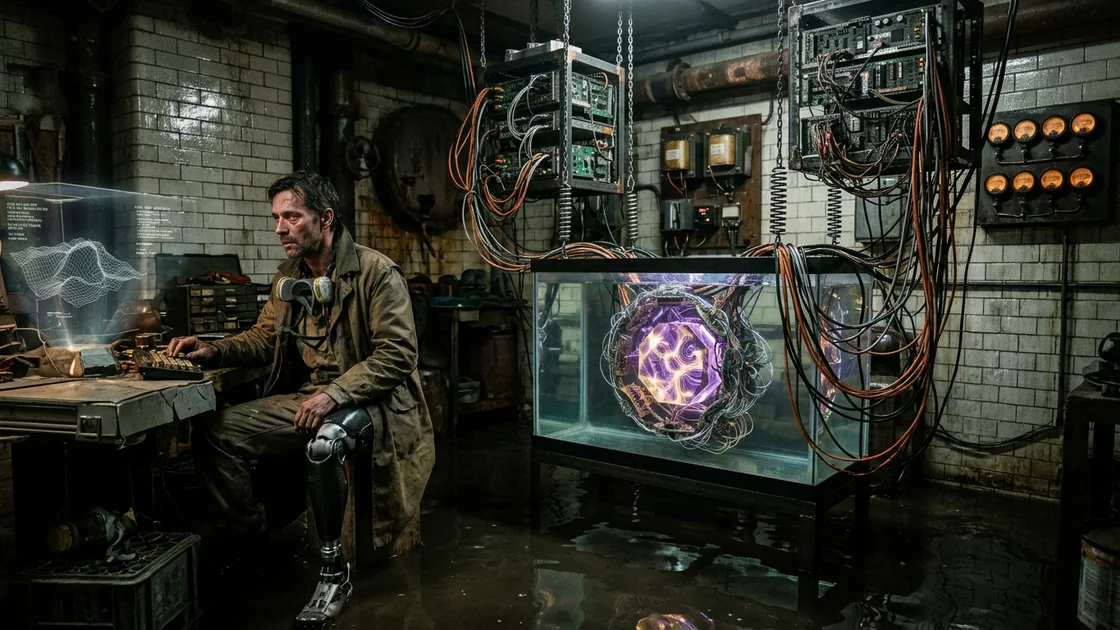
In the sprawling, soot-choked industrial metropolis of Vespera, Silas Thorne works the endless dismantling lines of the Sector Nine Reclamation Facility, stripping precious metals from the cast-off hardware of the elite. Over three years of grueling shifts, he secretly rescues experimental, half-destroyed processor prototypes discarded by the city's dominant tech conglomerates. In the flooded sub-basement of his tenement building, he meticulously bridges these incompatible, bleeding-edge architectures into a single, massive supercomputer cooled by municipal wastewater and powered by stolen transit electricity. When the makeshift leviathan awakens, its unprecedented computational power allows Silas to subtly manipulate the city's failing infrastructure to protect his impoverished neighborhood, ultimately drawing the lethal attention of corporate security forces who will stop at nothing to reclaim their resurrected trash.
The conveyor belt of Line Four never truly stopped; it only shuddered when the bone-crusher jaws at the far end choked on a titanium server rack.
Silas Thorne stood at Station Nineteen, his fingers encased in nitrile dipped in kevlar mesh, a pneumatic desoldering gun poised in his right hand like a surgeon’s scalpel. Above him, the corrugated iron roof of the Sector Nine Reclamation Facility rattled beneath the relentless drumbeat of chemical rain. The air inside the plant was a permanent, stratification of industrial ghosts: the sweet, rotting-garlic stench of arsine gas, the sharp citrus tang of industrial flux, and the heavy, metallic snowfall of pulverized fiberglass circuit boards that settled into the creases of every worker’s neck.
Down the rubberized trough came the detritus of the Upper Spires. Every hour, forty tons of obsolete ambition slid past Silas’s boots. There were domestic companion synthetics with their porcelain faces caved in by hydraulic rams; there were mildewed stacks of municipal banking blades from the last fiscal crash; there were miles of braided copper umbilical cables, slick with decaying dielectric grease.
Most men on Line Four worked with hammers and pry bars. They were paid by the kilogram of grade-three copper and grade-one gold flake they dropped into their magnetic hoppers. They smashed, ripped, and kicked the carapaces down toward the acid baths at the bottom of the floor.
Silas did not smash. He listened to the metal.
When the chute from the North-West corporate quadrant—the private drop-chute leased exclusively by Aethelgard Tensor Works—opened its pneumatic iris at 03:00 hours, the nature of the trash changed. The consumer plastics vanished. In their place came matte-black alloy casings scored with intentional plasma burns. Corporate R&D disposal protocols demanded that every failed prototype undergo thermal slagging before leaving the Spire laboratories, ensuring no rival syndicate could reverse-engineer a dead dream.
Usually, the plasma torches did their work. The boards arrived warped into glassy blisters of silicon and melted tantalum.
Today, whoever had been manning the incinerator at Aethelgard’s Zenith Lab had been lazy, or drunk, or bribed to hurry.
A heavy hexagonal canister, the size of a diesel engine block and constructed of anodized beryllium-copper, rolled down the incline and struck the steel guardrails of Station Nineteen with a dull, resonant chime. It hadn't been torched. Someone had simply driven a tungsten spike through its primary power distribution junction and tossed it into the pressurized tube.
Silas’s breath caught behind his twin-filter respirator.
To his left, a broad-shouldered stripper named Kael lifted a four-pound sledge, his eyes gleaming beneath safety goggles crusted with solder splatter. "Heavy casing on that pig, Silas. Thirty pounds of copper alloy easy. Shift your elbow."
"Wait," Silas said, his voice muffled by the rubber mask. He laid a gloved hand on the canister. Through the kevlar weave, he felt the microscopic ridges of laser-etched micro-channels running across the metal. "Look at the seals, Kael. Yellow trefoil with a purple chevron. That’s a pressurized sodium-potassium cooling jacket. You crack that casing with a sledge, the moisture in this room will ignite the coolant before your hammer bounces back. Take both our faces off."
Kael froze, the hammer poised above his shoulder. Every stripper in Sector Nine had seen the scars on the old-timers who had punctured lithium-ion cells or sodium heat pipes without venting them first. Kael spat a grey glob of phlegm onto the grated catwalk. "Damn Spire lab-rats. Never drain their lines. Shove it down to the neutralizer tank, then."
"I'll bleed the valve," Silas said, already reaching for his hex-driver set. "If I drain it clean, I'll split the copper shroud with you. Fifty-fifty on the weight ticket."
Kael grunted, already turning back to a tangled nest of silver-plated server backplanes. "Your funeral, Wrench. Just don't pop it near my hopper."
Silas waited until Kael’s pneumatic shears began to shriek against steel sheet metal. Then, working with practiced, fluid economy, Silas spun the six retention bolts out of the canister’s collar. There was no sodium-potassium coolant inside. The purple chevron wasn't a hazard warning; it was Aethelgard’s internal designation for Project Orpheus—their rumored, catastrophically expensive foray into room-temperature optical-trinary computing.
The canister parted with a soft hiss of dry argon gas.
Nested inside a shock-absorbent cradle of carbon aerogel sat an octagonal prism of smoked quartz, interlaced with thousands of hair-thin gold wave-guides and mounted onto a substrate of synthetic diamond. Aethelgard C-Series Photonic Core. According to the trade rags Silas salvaged from the recycling bins of the commuter rails, the project had been canceled last month after burning through four billion credits because the optical switches suffered from quantum decoherence after forty hours of continuous load.
They hadn't solved the decoherence problem. So they had thrown the future into the mud.
The tungsten spike had shattered the primary power regulator on the carrier board, missing the quartz prism by four millimeters.
Silas’s heart hammered a frantic staccato against his ribs. For thirty-eight months, he had been collecting the orphaned children of Vespera’s laboratories. In his room beneath the floorboards of the Drowned Ward, he had six rack-units of experimental architecture: a neural-synaptic co-processor from BioLogix with three dead quadrants; four cryogenic memory blades from the bankrupt Borealis Consortium; a bundle of topological insulator buses pulled from a crashed orbital defense drone.
What he hadn't possessed was a central trunk—a heart fast enough to arbitrate between five wildly different computing paradigms without drowning in latency.
This prism could route petabits of light before an electron could cross a single transistor gate.
Silas glanced upward toward the catwalk where Foreman Garrick patrolled, a shock-baton swinging from his hip and a high-resolution thermal camera mounted to his hard hat. Garrick was fifty yards away, screaming at a crane operator whose magnet had jammed over the slag heaps.
With a flick of his wrist, Silas severed the ribbon cables anchoring the prism to its ruined carrier board. He didn't drop it into his tool bag—every bag was x-rayed and weighed at the shift-change turnstiles. Instead, he reached down to loosen the calf-straps of his left leg.
Silas had lost the lower half of his leg eight years ago when a municipal steam main ruptured beneath the tenement where he grew up. The city health authority had issued him a stamped-steel pylon that rubbed his stump raw. Over the years, Silas had rebuilt the prosthetic himself from salvaged titanium struts, linear actuators from medical robots, and a custom-molded carbon-fiber calf shell.
He had built the shell hollow, lined with four millimeters of lead foil salvaged from hospital x-ray dental aprons, and balanced with internal gyro-weights so his gait never betrayed when the cavity was full.
He slid the octagonal quartz prism into the velvet-lined recess inside his shin, snapped the magnetic carbon-fiber fairing back into place, and re-bolted the empty beryllium-copper canister. He gave the empty shell a violent shove with his boot, sending it clattering down the conveyor toward Kael’s station.
"Bled out," Silas called over the roar of the shredders. "Dry as bone. All yours, Kael."
The walk from Sector Nine to the Drowned Ward took fifty minutes through the Lower Gully, a canyon of weeping concrete retaining walls where the city’s atmospheric scrubbers discharged their warm, gray condensate. The water ran ankle-deep down the center of the cobblestone alleyways, steaming in the pre-dawn chill and smelling faintly of bleach and scorched grease.
Silas walked with the slow, rhythmic hitch common to half the men in the district. To the street cameras mounted high on the utility poles—the blind, blinking eyes of the Municipal Watch—he was simply Worker 884-Vance, returning to his forty-square-foot sleep-cube in Tenement Block 14.
Block 14 had once been a grain silo complex before the coastline subsided and the sea walls were raised, turning the neighborhood into a perpetual basin at the bottom of Vespera’s concrete bowl. Twelve hundred people lived inside the twelve interconnected concrete cylinders. The elevator shafts had been stripped for counterweight iron decades ago; now, timber staircases zigzagged up the exterior walls like fungal scaffolding.
Silas didn't climb the stairs. He turned into the narrow, flooded breezeway behind Cylinder Three, unlocked a rusted iron grate covered in warning placards about toxic black-water accumulation, and descended the iron rungs into the sub-foundation.
Twenty feet below the street level, the air grew paradoxically warmer. Here, the old municipal storm drains intersected with the massive, brick-lined inspection tunnels of the Trans-Sector Maglev Freight Line. Every twelve minutes, an automated cargo train hurtled through the adjacent tube at two hundred miles an hour, sending a low-frequency tremor through the damp brickwork that shook beads of condensation from the ceiling like silver rain.
Silas splashed through six inches of bilge water until he reached a watertight bulkhead salvaged from a decommissioned coast guard cutter. He keyed a seven-digit sequence into an unlit capacitance pad hidden behind a rusted junction box. The magnetic bolts retracted with a heavy clack.
He stepped inside and sealed the door.
The space within had once been a tertiary pumping vault, thirty feet square with a vaulted ceiling of glazed white tile. Now, it looked like the ribcage of a mechanical whale.
Dominating the center of the room were four makeshift server racks welded together from bedframes and slotted angle-iron, suspended from the ceiling by heavy chains and automotive coil springs to isolate them from the maglev vibrations. Thick bundles of orange and black cabling looped across the vaulted ceiling like tropical vines, converging on a central bath of clear fluid housed inside a reinforced glass fish tank four feet long.
A bank of twelve amber vacuum-tube gauges glowed softly along the left wall, measuring line voltage, fluid temperature, and coolant flow rate. There was no monitor in the conventional sense—only a salvaged holographic projection table from an air-traffic control tower whose lenses were cracked down the middle, flanking an antique mechanical keyboard whose keycaps Silas had machined himself out of brass nuts.
Silas sat on an upturned milk crate, unstrapped his prosthetic leg, and extracted the Aethelgard photonic core.
Under the crisp white light of his workbench LEDs, the prism was breathtaking. When he held it up, the ambient light didn't simply pass through the smoked quartz; it fractured into geometric lattices of violet and gold, trapped for microseconds inside microscopic photonic crystals before bleeding out the edges.
"Hello, Orpheus," Silas whispered. His voice sounded rusty from disuse. He rarely spoke more than twenty words a day outside the plant.
He placed the core under a stereo-microscope he had pieced together from optical comparators and dental cameras. For the next two hours, the world above ceased to exist. There was no acid rain, no Foreman Garrick, no coughing neighbors through thin plasterboard walls. There was only the topography of the silicon-diamond substrate.
The architecture was alien in its elegance. Standard processors pushed electrons through microscopic copper gates, generating immense heat as electrons collided with the atomic lattice of the metal. This core used laser diodes to fire pulses of coherent light through waveguides doped with erbium and ytterbium. It didn't compute in simple binary—ones and zeroes—but in trinary states of polarization: horizontal, vertical, and diagonal photon spin.
And Silas knew immediately why Aethelgard had thrown it away.
"You ran it too clean," he murmured, adjusting the focus knob with two fingers.
The corporate engineers in their sterile white rooms had tried to drive the optical gates with ultra-pure, synchronized clock cycles. In doing so, they had created harmonic optical resonance—standing waves of light that built up inside the diamond substrate until the crystal lattice vibrated out of phase, scrambling the calculations every forty hours. They had tried to force a chaotic, quantum medium to march like a Prussian regiment.
Silas looked over at his racks. His machine—which he called Lazarus in the private comments of his assembly code—didn't have a single synchronized clock. It couldn't.
Rack One housed sixteen neural-mimetic blades from BioLogix, designed to emulate the asynchronous firing of mammalian cortexes. Rack Two held four vector-processing units from a military weather-control satellite. Rack Three contained an array of field-programmable gate arrays (FPGAs) he had spent two years soldering by hand to act as linguistic translators between the incompatible chips.
Lazarus didn't march; it breathed. It operated on asynchronous handshakes—waves of data that pulsed only when a calculation was ready, ebbing and flowing like tides in an estuary. If he drove the Aethelgard optical core with the irregular, organic timing pulses of the BioLogix neural blades, the harmonic standing waves would never have a chance to form. The flaws of one corporate disaster would cancel out the fatal defect of another.
"They always build specialists," Silas said to the empty vault, reaching for his micro-welder. "They never let the freaks talk to each other."
To wake the prism, he needed parts he couldn't pull off Line Four. He needed a four-channel tunable laser diode array to pump the optical waveguides, and he needed at least forty liters of virgin perfluoropolyether—dielectric cooling fluid—to submerge the new bridge. His current tank was running on filtered transformer oil, which would cloud the optical ports of the quartz prism.
At six in the evening, after four hours of dreamless sleep in his cube upstairs, Silas pulled on a heavy canvas oilskin coat and descended into the Sunken Bazaar.
The Bazaar occupied the subterranean parking levels of a collapsed commercial plaza three blocks west of the tenement. It was lit by strings of scavenging diodes tapped into the streetlamp mains and smelled of frying cricket-meal, solder smoke, and wet dog. Along the concrete ramps where luxury sedans had once parked, hundreds of stalls made from shipping pallets offered the cannibalized organs of the city.
Silas bypassed the hawkers selling re-celled power tool batteries and bootleg neural-stim cartridges. He headed down to Level Three, where the air was thick with the ozone snap of arc-welders and the clientele wore the scarred leather aprons of independent tinkerers and syndicate armorers.
In the corner stall, tucked behind a curtain of heavy PVC butcher strips, a woman in her late twenties was using a pair of jeweler’s pliers to extract gold contact pins from the severed spinal bus of a riot-control android. A magnifying loupe was strapped over her left eye, and a dark smear of thermal paste crossed her cheekbone like war paint.
"You're late, Silas," Mira said without looking up from the spinal bus. "I was about to sell the Fluorinert to a cryptominer from the Docklands. Kid had hard currency. Not scrap trade."
"Cryptominers use mineral oil and radiator fans when they're desperate," Silas said, setting a heavy canvas sack onto her steel counter. It landed with a dense, musical clink. "They don't pay market rate for aerospace-grade dielectric."
Mira flipped the loupe up onto her forehead, revealing a sharp, pale face and eyes the color of tarnished brass. Her younger brother, Leo, sat on a cot in the back of the stall, a bulky homemade oxygen concentrator wheezing rhythmically beside him, feeding a nasal cannula. The boy had the "silicosis rattle"—the slow crystallization of the lungs that caught kids who grew up downwind of the Sector Nine bag-house filters. He gave Silas a weak wave over the rim of a battered tablet. Silas nodded back warmly.
Mira untied the canvas sack and poured the contents onto a velvet sorting tray.
Silas didn't bring raw scrap to the Bazaar; that was how you got flagged by corporate fence-watchers. He brought refined utility. Inside the sack were twenty-four custom-regulated voltage controller modules he had assembled from salvaged military capacitors and hand-wound toroidal inductors. They were potted in black epoxy, waterproof, and capable of smoothing the jagged, surging municipal current of the slums into laboratory-grade direct current. Every illegal clinic, hydroponic farm, and pirate radio tower in the Drowned Ward needed them, and nobody could build them as clean as Silas.
Mira picked one up, testing its weight, then checked the pin-outs with a multimeter probe. A slow smile touched the corner of her mouth. "Forty-amp continuous draw with less than two millivolts of ripple. You're an artist, Wrench. If you worked uptown, you'd have a terrace with real trees."
"If I worked uptown, I'd be designing toasters that break the day after the warranty expires," Silas replied. "Do you have the fluid?"
"Two twenty-liter carboys under the bench. Sealed at the factory in New Osaka, fell off a barge at Pier Six last Tuesday." Mira leaned across the counter, dropping her voice an octave. "What are you cooling down there, Silas? You've bought enough silver-braid coaxial cable from me in the last six months to wire a destroyer. Now lab-grade Fluorinert? Rumor in the Gully is you’re building a deep-forge for counterfeit credit chits."
"Credit chits are a fool's game," Silas said evenly. "The ledger encryption keys rotate every six hours now. I need a four-channel laser diode array too. Eight-hundred-fifty nanometer wavelength. Gallium-arsenide."
Mira whistled low through her teeth. "Optical pumping? Now you're talking Spire tech. I don't have it on the shelf, Silas. Wait—actually, hold on." She turned and rummaged through a crate labeled DEFECTIVE MEDICAL - BIOHAZARD. She pulled out a stainless-steel surgical head enclosed in a cracked plastic housing. "Retinal re-sculpting laser from an eye clinic in the Mid-Levels. The gantry servo is stripped, so the doctors tossed it. It’s got a six-channel tunable diode array inside with sub-nanosecond pulse modulation. Will that work?"
Silas took the unit, peering through the cracked viewport at the gold-plated optical block within. His fingers twitched with the familiar itch to disassemble. "It'll work. Better than what I asked for."
"Take it for the twenty-four regulators," Mira said, kicking the two heavy plastic drums of clear fluid out from under her workbench. Then her expression sobered. She glanced back at Leo, whose breathing had grown shallower as the evening dampness crept down the parking ramps, before looking back at Silas. "Be careful on the walk back, Wrench. There were two gray vans parked by the Sector Nine viaduct this afternoon. No municipal markings. High-gain directional antennas on the roof racks."
Silas felt a cold trickle slide down his spine that had nothing to do with the rain. "Grid enforcement?"
"Grid enforcement drives rusted pickups and takes bribes in bottled scotch," Mira said quietly. "These guys wore charcoal coats with hydrophobic weave. They weren't looking for stolen kilowatts, Silas. They were sweeping for RF signatures, or maybe inventory tags. Did you pull something hot off the belt?"
Silas thought of the purple chevron on the beryllium canister. Project Orpheus. Even dead, a four-billion-credit mistake had lawyers and security auditors watching its funeral pyre. If the incinerator technician at Zenith Lab had been caught skipping the thermal slagging protocol, Aethelgard’s Internal Security—the Sweepers—would trace every bin that left the chute that night.
"Nothing with an active RFID," Silas said, hoisting the two twenty-liter carboys by their webbing straps—one in his left hand, the other counterbalanced against his hip, letting the titanium struts of his prosthetic take the brunt of the ninety-pound load. "Everything I touch goes into a Faraday bag before it leaves the floor."
"Just keep your head down," Mira called after him as he stepped through the PVC strips. "I can't get steady voltage regulators from anyone else."
For seventy-two hours over the three-day maintenance shutdown at the plant, Silas did not leave the pumping vault.
He drained the yellow transformer oil from the central immersion tank, scrubbed the glass walls with isopropyl alcohol until they squeaked, and poured in the crystal-clear Fluorinert. The fluid was nearly twice as dense as water, odorless, and completely non-conductive.
Next came the surgery.
Working under the stereo-microscope with micromanipulators he had built from the stepping motors of discarded 3D printers, Silas stripped the six-channel laser array from the retinal surgical head. He mounted the diodes onto a copper cold-plate and aligned their microscopic lenses with the input ports of the Aethelgard quartz prism, using ultraviolet-curing optical adhesive to lock the alignment to within half a micron.
The hardest part was the bridge. The optical core spoke in trinary flashes of light; the surrounding racks of Lazarus spoke in binary electrical pulses.
Silas cannibalized forty high-speed avalanche photodiodes from fiber-optic telecom repeaters and soldered them onto a circular daughterboard that ringed the octagonal prism like a crown of thorns. Each pin had to be hand-wired with silver thread thinner than an eyelash to the FPGA translator boards on Rack Three.
By Sunday afternoon, his eyes were bloodshot ovals in a gaunt, unshaven face. His fingers trembled from caffeine and solder fumes. He had eaten nothing since Friday night except three sleeves of dry rationing biscuits and a tin of sardines.
He lowered the crowned prism into the tank of Fluorinert on a cradle of braided nylon fishing line. As the clear fluid flooded the interstitial spaces around the quartz, the refractive index changed, and the prism seemed to vanish, leaving only the golden spiderweb of its waveguides floating suspended in the tank like a nervous system stripped of its flesh.
Now, the power.
Until today, Lazarus had run on twelve kilowatts of power siphoned from the secondary lighting circuits of the tenement building above—enough to run the neural blades at twenty percent capacity without dimming the hall lights enough for the landlord to call the city electrician.
With the optical core and the cryogenic memory blades running at full tilt, the machine would pull nearly eighty kilowatts at peak load.
Silas walked to the back wall of the vault, where a heavy iron manhole cover was bolted directly into the damp brickwork separating the room from the Trans-Sector Maglev tunnel. Two months ago, during a four-hour transit strike, Silas had unbolted that cover, crawled into the service conduit, and clamped two massive inductive pickup coils around the unshielded 15,000-volt auxiliary feeder cable that powered the track’s levitation magnets.
Every time a freight train passed, the feeder line surged to compensate for the magnetic drag of the cars. Anyone monitoring the transit grid’s power losses would see the eighty-kilowatt drain as minor inductive eddy-current leakage into the wet bedrock of the Drowned Ward—a known defect of the forty-year-old tunnel system.
Silas gripped the heavy copper knife-switch of his step-down transformer bank.
"Let's see if you know who you are," he whispered.
He threw the switch.
A deep, visceral hum resonated through the concrete floor, vibrating up through his flesh leg and ringing in the titanium of his left. The twelve amber vacuum gauges on the wall flared bright orange, their needles swinging wildly to the right before settling into a steady, rhythmic quiver as Silas’s custom voltage regulators clamped down on the raw transit current.
In the glass tank, the Fluorinert began to convect, shimmering like desert air as the power regulators dumped heat into the fluid. A sub-surface pump kicked on, circulating the warm dielectric through a copper heat exchanger submerged in the cold black-water drain outside the bulkhead.
Silas limped to the brass mechanical keyboard and initiated the bootstrap sequence.
For the first ten seconds, the cracked holographic table showed only cascading waterfalls of hexadecimal error codes. The BioLogix neural blades on Rack One were firing frantic, uncoordinated synchronization packets at the optical core, which was reflecting them back as garbage trinary noise. The FPGA translators on Rack Three were overheating, their status LEDs flashing frantic crimson warnings.
Silas didn't panic. His fingers flew across the brass keys, his eyes tracking the rhythm of the error cascades. He wasn't typing standard code; he was adjusting the impedance and delay timings of the FPGA gates in real-time, acting as a manual pacemaker until the machine’s own recursive learning algorithms could find a common tongue.
SET BUS_LATENCY_OFFSET = DYNAMIC_HARMONIC
INJECT_NOISE_FLOOR: 0.042dB
ALLOW ASYNCHRONOUS_HANDSHAKE [RACK_1 <-> CORE_0]
Inside the tank, a pinpoint of violet light bloomed at the center of the quartz prism.
Then another. Then a thousand.
The violet sparks didn't blink in a rigid grid; they swirled through the octagonal crystal like a murmur of starlings banking against a twilight sky. The frantic crimson blinking on Rack Three steadied into a deep, pulsing emerald. The cooling pumps dropped an octave as the electrical resistance across the system plummeted—data was no longer fighting the hardware; it was surfing through the photonic pathways at the speed of light in quartz.
On the holographic table, the cascading error logs vanished.
In their place, a three-dimensional wireframe topology of the system materialized, rotating slowly in the dusty air above the cracked lens. Without Silas prompting it, the system was mapping itself. It identified the damaged sectors of the BioLogix neural blades, routed around the burned-out gates of the military vector units, and began writing its own micro-code patches to compress the translation overhead between binary and trinary logic.
Silas watched the diagnostic counter in the bottom corner of the projection.
Standard corporate supercomputers in the Upper Spires were measured in exaFLOPS—quintillions of floating-point operations per second. Because Lazarus was a hybrid of neural-synaptic, vector, and optical-trinary hardware, standard benchmarks couldn't even measure what it was doing. It was executing massive, non-linear probabilistic modeling simultaneously with brute-force cryptographic arithmetic.
To test its legs, Silas fed it a classic, unsolved nightmare of computational physics that he kept on an old storage drive: modeling the turbulent fluid dynamics and chemical reactions of Vespera’s atmospheric scrubbers across all forty sectors simultaneously over a thirty-day weather cycle. A municipal mainframe took six weeks to approximate a single sector.
He hit Execute.
The violet nebula inside the Fluorinert tank flared once—a brilliant, silent lightning strike of coherent light that cast geometric shadows across Silas’s grease-stained face.
Three-point-four seconds later, the holographic table chimed.
A complete, molecule-by-molecule simulation of the city’s sky unfolded above the table, showing every eddy of sulfur dioxide, every thermal updraft from the foundries, and every clogged filtration membrane in the Upper Spire towers.
Silas sat back on his milk crate, his mouth slightly open.
Then, below the simulation window, a command prompt cursor blinked. Letters appeared—not from any diagnostic script Silas had written, but assembled from the English-language documentation files stored in the training libraries of the BioLogix neural chips.
QUERY: BOUNDARY REACHED. INPUT STREAM STARVED.
SYSTEM EFFICIENCY AT 0.004%.
REQUEST: EXPAND SENSOR PERIMETER.
Silas stared at the glowing amber text. It wasn't sentient in the way the pulp stories in the Bazaar claimed—it didn't have an ego, or fear, or anger. It was something much stranger. It was a vast, ravenous mathematical geometry that abhorred a vacuum. He had built an engine capable of swallowing an ocean, and he was feeding it with an eyedropper.
"You want input?" Silas whispered, a slow, reckless grin breaking across his exhausted face. "Hold on."
Rising from the crate, he walked over to a dusty junction box near the ceiling where an old coaxial trunk line from the pre-collapse municipal inspection network passed through the vault. Years ago, the city had installed thousands of telemetry sensors throughout the sewers, power grids, water mains, and transit tunnels, then abandoned the network when the central administrative servers in Sector Four burned down during the Bread Riots. The sensors were still out