The Silicon Ephemeris
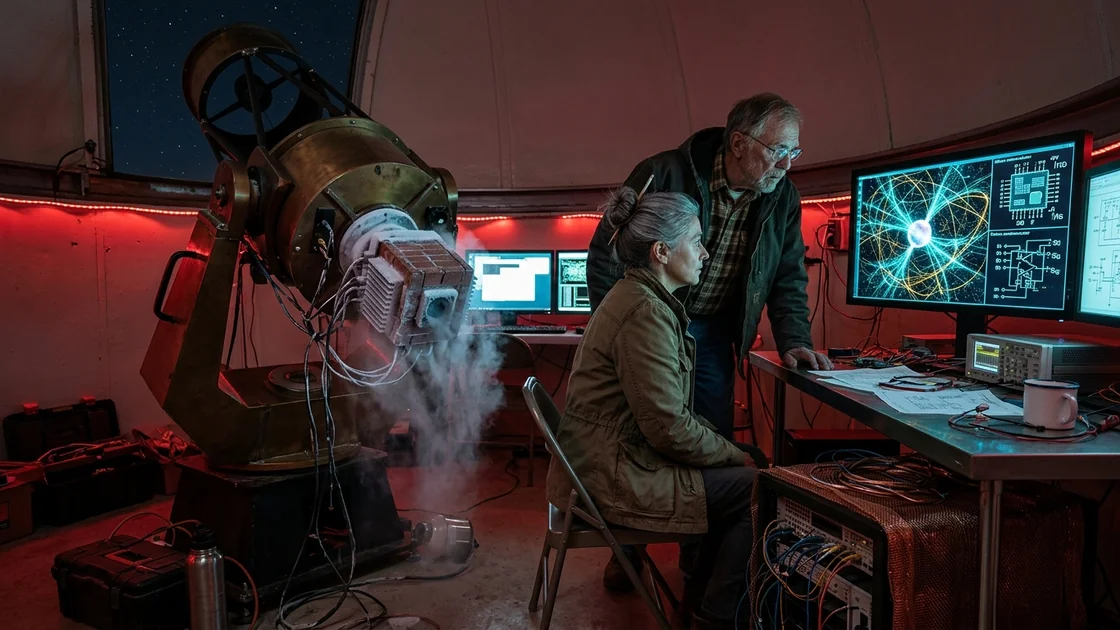
Jonas Vance, a retired integrated circuit designer living in the high desert of New Mexico, spends his nights capturing faint astronomical objects with a homemade telescope and a heavily modified, vintage CCD camera. While conducting high-speed photometric observations of an anomalous pulsar in the constellation Vulpecula, his camera experiences a series of inexplicable buffer overflows that bypass the air-gapped system's security. Upon inspecting the hardware with a logic analyzer, Jonas discovers that the rhythmic, polarized pulses of starlight are exploiting the physical architecture of his sensor's shift registers, compiling raw machine code directly into the camera's non-volatile memory. Joined by a skeptical radio astronomer from a nearby observatory, Jonas watches as the distant neutron star systematically rewrites his equipment's firmware, pushing the silicon beyond the known laws of thermodynamics to construct a transceiver capable of decoding a ten-thousand-year-old optical broadcast.
The wind off the Chupadera Mesa always carried the fine, alkali dust of the jornada, a grit so talcum-soft it could find its way through the labyrinth seals of a military-grade bearing housing if a man grew lazy with his grease gun. At seven thousand feet above sea level, in the dark hollow between the Magdalena Mountains and the San Mateo range, the air didn't just grow cold after midnight; it grew brittle. It thinned out until the stars stopped twinkling and became hard, surgical points of platinum and ice, pressing down through the open slit of the fiberglass dome with an almost physical weight.
Jonas Vance sat on a wooden machinist's stool, his knees tucked close to the warmth of a dual-fan rack server that served as his observatory computer, his fingers curled around an enamel mug of lukewarm chicory coffee. Above him, the twenty-inch Ritchey-Chrétien telescope hung on its massive German equatorial mount like an artillery piece aimed at the zenith. He had milled the mount's right-ascension worm gear himself seven years ago on a rescued Monarch lathe in his barn, lapping the phosphor-bronze teeth with jeweler's rouge for three weeks until the periodic error dropped below half an arcsecond.
He was seventy-one years old, and his joints knew the exact barometric pressure to within two millibars, yet his eyes remained sharp behind their progressive lenses as he watched the monochrome monitors. There were two screens bolted to the steel desk. The left monitor displayed the guiding graph—a jittery green line showing the micro-corrections applied to the mount as it tracked the rotation of the Earth. The right monitor ran a customized terminal window displaying real-time diagnostic telemetry from the instrument bolted to the back of the telescope: a square, anodized-aluminum brick he called the Iron Lung.
The Iron Lung was not an off-the-shelf camera. Commercial astrophotography cameras were too polite, their internal logic locked behind proprietary encrypted drivers and smoothed over by consumer-friendly automatic gain controls. Before Jonas had retired to New Mexico, he had spent thirty-four years in Tucson and Santa Clara designing radiation-hardened mixed-signal application-specific integrated circuits and field-programmable gate arrays for orbital reconnaissance payloads. He didn't trust hardware whose timing diagrams he hadn't written himself.
At the heart of the Iron Lung sat a salvaged Kodak KAF-16803 full-frame charge-coupled device—a monolith of crystalline silicon measuring nearly thirty-seven millimeters on a side, containing sixteen million eight hundred thousand individual light-sensitive potential wells. He had bought the sensor as an engineering grade-two reject from a defunct defense contractor in Albuquerque because it had two dead columns near the eastern edge. He had designed the four-layer printed circuit board around it, routed the differential low-voltage signaling traces, wound the toroidal inductors for the dual-slope correlated double-sampling amplifiers, and written every line of the VHDL code that lived inside the camera's Xilinx Spartan-6 FPGA controller.
Normally, the camera took fifteen seconds to read out a single frame, carefully shifting the accumulated photo-electrons row by row down the vertical registers and out through the horizontal serial register to the sixteen-bit analog-to-digital converter. Tonight, however, the camera was not taking pretty pictures of nebulae.
Tonight, Jonas was hunting PSR J1958+24, an obscure, low-luminosity millisecond pulsar buried in the dusty rift of the constellation Vulpecula, just south of the Cygnus border.
In the radio spectrum, PSR J1958+24 was a metronome of terrifying precision, a collapsed neutron star twelve miles wide spinning on its axis six hundred and forty-two times every second, sweeping a beam of synchrotron radiation across the cosmos like a lighthouse spun by a maniac. In the optical spectrum, however, it was twenty-fourth magnitude—so absurdly faint that only a handful of three-meter professional telescopes had ever detected its visible flashes.
To catch it with a twenty-inch backyard mirror, Jonas was using a technique that pushed his homemade electronics to the ragged edge of their thermal envelope: stroboscopic phase-resolved drift scanning.
Instead of opening the mechanical shutter, waiting ten minutes, and closing it, Jonas had locked the shutter open and disengaged the normal framing cycle. He had wired a rubidium atomic frequency standard—bought off an electronics surplus pallet in Los Alamos—directly into the FPGA's master clock pin. Using the pulsar's known radio ephemeris, his software commanded the CCD to shift its rows of charge up and down on the silicon chip in exact synchronization with the neutron star's 642.118409-Hertz rotation period.
During the seven hundred microseconds when the pulsar's beam swept across Earth, the CCD shifted the electron packet into row A. During the eight hundred microseconds when the pulsar was dark, the CCD shifted the packet back into row B to collect the background sky glow. Up and down, six hundred and forty-two times a second, for two hours straight, accumulating tiny droplets of starlight in one bucket and pure sky noise in the adjacent bucket, before finally clocking the edge rows out through the serial register in a continuous ribbon of sixteen-bit integers.
"Come on, you tiny bastard," Jonas muttered, his breath pluming white in the red glow of the observatory's dark-adaptation LEDs. "Show me the phase peak."
On the right-hand screen, a waterfall plot of raw hexadecimal values cascaded downward, representing the serial stream coming off the horizontal register's output amplifier. For the past ninety minutes, the differential subtraction between the "on-pulse" rows and the "off-pulse" rows had yielded a promising, Gaussian hump—a three-sigma detection of the pulsar's optical flash.
Then, at 03:14:09 Universal Time, the waterfall plot froze.
Jonas frowned, setting his mug down on a coaster made from a ruined silicon wafer. A freeze on the LVDS frame-grabber link usually meant a cable had snagged on the pier, or the cold had shrunk a solder joint on the board's serializer chip. He leaned forward, his fingers finding the home row of the mechanical keyboard. He typed a quick interrupt query to poll the camera's status register over the auxiliary RS-422 diagnostic line.
The terminal didn't return the usual twelve-byte telemetry string of Peltier temperatures and bias voltages. Instead, the cursor blinked three times and spat out a single line of text that Jonas hadn't seen since he had debugged the camera's circuit board on his workbench five years ago:
[BOOT_MON] MAGIC_KEY MATCH: 0x4A564341 -> ENTERING SPI FLASH WRITE MODE
Jonas stared at the red letters. The hair on the back of his wrists prickled against the cuff of his flannel shirt.
"What in the hell?" he whispered.
When he had designed the VHDL architecture for the Spartan-6 FPGA, he
had hated having to unscrew the twenty-four stainless-steel hex bolts of
the camera's argon-filled vacuum housing every time he wanted to tweak
the clocking waveforms on the onboard EEPROM chip. To save himself the
headache of hooking up a physical JTAG programmer cable, he had coded a
backdoor into the DMA state machine. If the FPGA ever detected a
specific sixty-four-bit hexadecimal
sequence—0x4A564341deadbeef, spelling "JVCA" in ASCII
followed by the classic programmer's hex marker—within the raw data
stream during a diagnostic loopback test, the FPGA would halt normal
readout, unlock the Serial Peripheral Interface bus to the non-volatile
flash memory, and treat the subsequent two megabytes of incoming data as
a new firmware configuration bitstream.
In normal operation, that sixty-four-bit sequence was impossible to
trigger by accident. The camera's analog-to-digital converter produced
values driven by photon shot noise and Gaussian read noise. The
mathematical probability of four consecutive sixteen-bit pixel readouts
hitting the exact values of 19030, 17217,
57005, and 48879, followed by a valid,
cyclic-redundancy-checked Xilinx configuration header, was roughly one
in two to the power of one hundred and twenty-eight. The universe was
not old enough for random starlight to type out his initials, guess his
four-byte magic suffix, and follow it with a valid CRC-32 checksum.
Yet the amber LED on the back of the Iron Lung—the one wired directly
to the WRITE_ENABLE pin of the Macronix flash chip—was no
longer dark. It was flickering at a furious, steady rhythm, like a
telegraph key operated by a speed freak.
[BOOT_MON] SECTOR 0x04 ERASED.
[BOOT_MON] WRITING BLOCK 001/128... OK (CRC: 0x8F92A10B)
[BOOT_MON] WRITING BLOCK 002/128... OK (CRC: 0x3C41D9E2)
[BOOT_MON] WRITING BLOCK 003/128... OK (CRC: 0x77B04F11)
Jonas lunged out of his chair. He thought of a transient voltage spike from the dome's azimuth motor. If the motor controller's relays had arced, electromagnetic interference could have coupled into the ribbon cable. If the FPGA wrote garbage over Sector 0 of the flash chip, the camera would brick itself, or worse, it could misconfigure the high-voltage clock drivers. The KAF-16803 required precisely timed rails at +15 volts, -9 volts, and +28 volts for the substrate reset drain. If the FPGA scrambled the pin assignments and routed +28 volts directly into the delicate polysilicon gates of the horizontal register, it would blow the oxide layer right off the die, turning a four-thousand-dollar sensor into an expensive shaving mirror.
He reached for the master power switch on the linear regulated power supply bolted to the pier. His thumb was touching the cold aluminum bat-handle of the toggle when the terminal window scrolled a final burst of text:
[BOOT_MON] WRITE COMPLETE. 131,072 BYTES TRANSFERRED.
[BOOT_MON] VERIFYING GLOBAL CHECKSUM... PASS.
[BOOT_MON] WARM REBOOT INITIATED.
Before Jonas could flip the switch, a soft click echoed from the back of the telescope as the camera's internal mechanical protection relay cycled off and back on.
The amber write-light vanished. The green FPGA_DONE
light snapped back to solid illumination.
Jonas froze, his hand still on the toggle switch, waiting for the smell of burning epoxy or the acrid pop of a tantalum capacitor venting its guts. Nothing happened. The cooling fans continued their steady, low-pitched whirr.
On the right-hand monitor, the waterfall plot resumed its downward cascade.
Jonas slowly took his hand off the power switch and stepped back to the desk. He looked at the telemetry window, which had automatically re-established its polling loop after the warm reboot.
For five years, the firmware version string at the top of the
telemetry window had read:
JV_ASTRO_CAM v2.14 (BUILD 2019-11-04).
Now, the header at the top of the screen read:
JV_ASTRO_CAM v2.14.01-SYZYGY (BUILD 0000-00-00)
And below it, the telemetry readings made no sense at all.
Prior to the reboot, the three-stage Peltier thermoelectric cooler had been running at ninety-two percent pulse-width modulation duty cycle, struggling against the ambient desert air to hold the CCD sensor at minus thirty-five degrees Celsius.
Now, the telemetry reported the Peltier duty cycle had dropped to fourteen percent. Yet the platinum resistance thermometer bonded directly to the back of the silicon die was reading minus sixty-eight point four degrees Celsius.
More disturbing was the READ_NOISE_RMS counter, which
sampled the overscan region—the twenty columns of dark, masked-off
pixels at the edge of the sensor that never saw light, used to measure
the baseline electronic noise of the amplifier. Under the old v2.14
firmware, his carefully tuned dual-slope integrator consistently
achieved a read noise of 7.8 electrons per pixel.
The counter on the screen was currently reading
0.12 e-.
"A twelfth of an electron," Jonas said aloud to the empty dome. "That's a stuck bit in the ADC. It flipped the least significant bit register."
It had to be a cosmic ray. At seven thousand feet, the atmosphere was thin enough that secondary muons and high-energy protons from deep-space cosmic ray showers regularly sleeted through observatory roofs. In the industry, they called it a Single Event Upset—an energetic particle slamming into a silicon transistor, leaving an ionization trail that flipped a zero to a one in an SRAM cell.
Still, a cosmic ray didn't write a human-readable string like
SYZYGY into the ASCII descriptor table of a Macronix flash
chip.
Jonas reached up, grabbed the pull-cord for the dome shutter, and keyed the motor switch to close the slit. As the heavy fiberglass panels rumbled shut, blotting out the brilliant belt of the Milky Way, he watched the waterfall plot on his monitor. The moment the dome shutter occulted the aperture of the telescope, cutting off the starlight from Vulpecula, the camera's status line flashed a brief notice:
[SYNC_LOST] CARRIER WAVE OCCULTED. REVERTING TO IDLE HOLD.
At eight o'clock the next morning, the sun was already hammering the corrugated tin roof of Jonas's workshop, making the steel rafters tick like cooling engine blocks. Inside, the shades were drawn, and the air smelled of sixty-forty tin-lead solder, rosin flux, and forty years of accumulated cardboard parts bins.
The Iron Lung sat in the center of the anti-static mat on his primary workbench, stripped of its outer anodized shell. A ribbon of sixteen micro-coaxial grabber leads trailed from the test header on the main circuit board into the front panel of an old Agilent mixed-signal logic analyzer.
Jonas hadn't slept. He had drunk three more mugs of chicory coffee, chewed two aspirin for the stiffness in his neck, and spent four hours dumping the contents of the camera's thirty-two-megabit flash chip onto an SD card so he could inspect the raw binaries on his workbench computer.
He had expected to find corrupted sectors—blocks of 0xFF
or 0x00 where a brownout or a rogue pointer had smeared the
existing memory.
Instead, when he ran a binary diff utility comparing his original
v2.14 golden master file on his backup drive against the
v2.14.01-SYZYGY file pulled from the camera this morning,
the screen lit up like a Christmas tree.
Of the 464,760 logic cells and routing switches defined in the Spartan-6 configuration frame, sixty-eight percent had been completely rewritten.
Jonas leaned close to the monitor, adjusting his glasses as he scrolled through the decompiled routing table in the Xilinx floorplanner utility. In normal FPGA design, a human engineer writes high-level behavioral code in VHDL or Verilog, and a compiler called a synthesizer translates that logic into a physical map of lookup tables, flip-flops, and copper interconnect lines on the silicon chip. The resulting floorplan always looks like a city grid: neat, rectilinear blocks grouped by function—here sits the USB FIFO buffer, over there sits the clock divider, down in the corner sits the SPI state machine, with vast tracts of unused gray logic slices in between.
The floorplan of v2.14.01-SYZYGY did not look like a
city grid.
It looked like a cross-section of bone marrow, or the fractal root system of a desert mesquite tree.
Every single logic slice on the chip was active. More than that, the new bitstream was doing things that the manufacturer's compiler explicitly forbade because they violated standard digital synchronous design rules. The code had unhooked the global clock distribution tree from nearly half the flip-flops, configuring the lookup tables into asynchronous, self-oscillating ring buffers. It was routing signals through unbonded input-output pads at the edge of the die, using the microscopic parasitic capacitance of the silicon substrate itself as analog delay lines.
"This isn't compiled code," Jonas murmured, tracing a cluster of feedback loops on the screen with the tip of a mechanical pencil. "If you fed this netlist into the Xilinx design suite, the DRC checker would throw ten thousand DRC-23 violations and refuse to build the bitstream. It would claim this causes a dead-short thermal runaway."
Yet it hadn't caused a thermal runaway. When he had checked the FPGA's casing temperature with his infrared thermometer before shutting it down, the chip had been running four degrees cooler than it ever had under his own firmware.
How had it gotten there?
Jonas swiveled his chair around to face the desktop computer that served as the observatory's control server. He had carried the heavy steel chassis down from the dome at dawn. He popped the side latches, pulled off the sheet-metal panel, and stared inside.
There was no Wi-Fi card on the motherboard. He had physically desoldered the onboard Bluetooth/WLAN module from the PCIe bus when he bought the board in 2016 because he hated the radio-frequency interference it threw into his 21-centimeter hydrogen-line receiver. The Ethernet port on the back I/O shield had a plastic dust cap jammed into it, and there wasn't a router within four miles of his ranch; his only internet connection was an old HughesNet satellite dish wired solely to a tablet in his kitchen, separated from the workshop and observatory by two hundred yards of caliche dirt and no connecting wires.
Could a program have been dormant on the server's hard drive for eight years, waiting for a specific date to flash the camera?
"No," Jonas said, shaking his head. "Look at the architecture."
The server communicated with the camera via a custom dual-channel
LVDS frame grabber card. The frame grabber was strictly unidirectional
for data; it received pixels from the camera, while the server could
only send one-byte command opcodes (OPEN_SHUTTER,
SET_TEMP, START_TDI) over a separate, slow
9600-baud opto-isolated serial line. At 9600 baud, transferring 131,072
bytes of firmware would have taken nearly two and a half minutes.
Last night, in the dome, the entire flash write had taken less than four seconds.
The only bus on the camera capable of moving 131 kilobytes in four seconds was the internal sixteen-bit parallel bus linking the analog-to-digital converter directly to the FPGA's high-speed input pins—the path taken by the digitized light from the CCD sensor itself.
Jonas picked up the printed schematic of the Iron Lung's mainboard, spreading the D-size vellum sheet across his knees. He traced the signal path from the KAF-16803's horizontal output amplifier, through the AD9826 correlated double-sampler and ADC, straight into Bank 0 of the FPGA.
"I left the diagnostic loopback gate compiled in," he said softly, his eyes widening as he looked at line 412 of his old VHDL source code on the second monitor.
When he had written the bootloader five years ago, he hadn't tied the bootloader listening state exclusively to the external diagnostic header. To save sixteen lookup tables on the crowded chip, he had attached the pattern-matching comparator directly to the output register of the ADC! His reasoning at the time had been simple: during bench testing, he injected simulated pixel values into the ADC's digital output pins using a pattern generator; once the camera was sealed up and bolted to a telescope, real starlight hitting a real CCD could never, ever produce a deterministic, bit-perfect digital bitstream because of quantum Poisson noise.
Even if someone pointed a modulated laser pointer directly down the
telescope tube, flashing it in binary, the atmospheric scintillation,
the quantum efficiency variations of the silicon, and the six-to-eight
electrons of thermal read noise in the output amplifier would scramble
the least significant four bits of every sixteen-bit word. A
1 would randomly become a 4 or a
0. The CRC-32 checksum would fail on the very first
block.
Unless...
Jonas pulled the raw FITS data file recorded during the ninety minutes before the firmware update and loaded it into a custom Python script he used for noise analysis. He zoomed in on the final ten seconds of data from the stroboscopic drift-scan of PSR J1958+24, right before the waterfall plot had frozen.
The pulsar hadn't just been flashing at 642 Hertz.
As the Earth rotated and the telescope tracked the star across the meridian, the polarized light from the pulsar had passed through Jonas's custom astro-photometric filter wheel, then hit the silicon surface of the KAF-16803. Remember the two dead columns on the eastern edge of his engineering-grade reject sensor? Columns 3812 and 3813 had defective channel stops—microscopic flaws in the boron-implanted silicon barriers that separated one column of pixels from the next.
Because the telescope mount had a slight, periodic tracking drift of 0.4 arcseconds every four minutes, at 03:13:58 UT, the pinpoint diffraction airy disk of PSR J1958+24 had drifted directly onto the boundary between active Column 3811 and defective Column 3812.
Jonas stared at the charge-transfer plot on his screen, his breath catching in his throat.
"It didn't use the analog-to-digital converter's dynamic range," he whispered. "It saturated the well."
In a CCD, if you try to send a sixteen-bit number by varying the
brightness of a star—say, sending 48,879 photons—quantum
statistics will ruin your precision by plus or minus the square root of
48,879, which is about 221 photons. Your signal turns to mush.
Unless you don't encode your bits in the brightness of a single pixel.
When the pulsar's light hit the defective channel stop at Column 3812 while the vertical registers were shifting up and down at 642 Hertz, the intense, tightly polarized UV-blue optical pulses were triggering an avalanche breakdown in the silicon depletion layer—a phenomenon known in solid-state physics as impact ionization, or clock-induced charge. And before firing the main payload, the pulsar's light pulses had varied their polarization angle and phase timing over a ten-minute window, creating a sub-threshold charge pattern across the horizontal register that acted like an analog Vernier caliper, measuring the exact parasitic capacitance and thermal baseline drift of Jonas's AD9826 converter via the back-reflection of the substrate reset pulse!
Once the starlight had passively characterized the exact
non-linearities of the sensor's silicon lattice, it had begun modulating
its optical pulses in phase with the 4-megahertz horizontal readout
clock. By either saturating the ADC completely to 65535
(0xFFFF), leaving it at baseline bias, or injecting exact
charge packets across adjacent horizontal pixels that mixed during
correlated double-sampling, it had synthesized arbitrary sixteen-bit
integers with zero bit-error rate.
"Hold on," Jonas said aloud, standing up so fast his wooden chair banged against the metal shelving behind him. "Hold on, you crazy old bastard. Think about the light travel time."
PSR J1958+24 was seven thousand four hundred light-years away.
For the pulsar's light to measure the analog baseline drift of his camera and respond with a tailored bitstream would require a round-trip time of fourteen thousand eight hundred years. The pulsar couldn't possibly know what camera Jonas Vance was using in New Mexico in the year 2024.
He sat back down, his heart hammering against his ribs, and opened the raw photon arrival-time log from the entire two-hour observation run. He ran a Fast Fourier Transform across the entire dataset, looking not just at the 642-Hertz fundamental frequency, but at the high-frequency phase micro-structure within each 1.5-millisecond pulse.
After ten minutes of crunching on all eight cores of his workbench workstation, the spectrogram rendered on the screen.
The pulsar's optical beam wasn't a simple flash of light. Each 1.5-millisecond flash was subdivided into picosecond-scale optical solitons—circularly and linearly polarized sub-pulses arranged in a massive, repeating, comb-like hyper-structure that cycled every forty-two minutes.
It wasn't a live conversation. It was a universal broadcast—a Rainbow Table made of photons.
Just as a cryptographic rainbow table pre-computes every possible password hash so a hacker can unlock a system instantaneously upon contact, the pulsar's beam was broadcasting an encyclopedic, multiplexed lattice of optical phase patterns. Depending on the exact spatial geometry of the silicon crystal lattice it struck, the bandgap energy of the semiconductor, and the clock frequency at which the charge wells were being shifted, the interference pattern of the photons inside the silicon depletion layer itself automatically demodulated the exact branch of the optical comb corresponding to that hardware architecture!
"The silicon is the prism," Jonas breathed, staring at his own hands. "The crystal lattice of the CCD acted as a physical matched filter. The light contains instructions for ten thousand different kinds of photodetectors simultaneously, and whichever way you clock the charge wells, you slice out the specific execution thread meant for your shift register's geometry."
And how had it known his magic bootloader key,
0x4A564341?
It hadn't!
Jonas pulled up the log of the four hours prior to 03:14 UT,
when he had been calibrating the drift-scan on the field around the
pulsar. The optical comb wasn't guessing 0x4A564341 out of
the blue; through a deterministic mathematical sequence called a De
Bruijn sequence—a cyclic sequence of bits in which every possible \(n\)-bit string occurs exactly once as a
substring—the pulsar's peripheral sidelobes were continuously sweeping
through the entire sixty-four-bit address space across different spatial
interference fringes on the focal plane! As the telescope's periodic
tracking error drifted the star image across the chip by 0.4 arcseconds,
the star's diffraction rings had swept across the physical pixels like a
phonograph needle sliding across a record until it crossed the exact
spatial-temporal coordinate where the De Bruijn sequence matched his
FPGA's comparator gate!
The moment the gate clicked open and the FPGA dropped its horizontal clock lines for three microseconds to prepare the SPI bus, the resulting collapse of the electric field inside the CCD's silicon substrate changed the Franz-Keldysh optical absorption coefficient of the silicon by 0.04 percent. That tiny change in optical absorption shifted the internal interference pattern of the incoming starlight, automatically switching the demodulated photon stream from the address-sweep track to the payload track!
Jonas leaned back, his mouth completely dry.
To engineer an optical wave-packet that could survive seven thousand four hundred light-years of interstellar dust dispersion, hit an unknown silicon chip, use the Franz-Keldysh electro-absorption effect of the chip's own gate voltages as a local state-machine feedback switch, and compile valid logic-gate routing tables on the fly...
"That's not a radio signal," Jonas whispered to the silent workshop. "That's a self-extracting optical compiler."
And the v2.14.01-SYZYGY firmware sitting on his camera
right now was only 131 kilobytes—just large enough to fit into Sector 0
of the boot flash. When he looked at the end of the decompiled hex file,
right before the final checksum, he found an unallocated pointer table
referencing external memory addresses from 0x00100000 to
0x3FFFFFFF.
A gigabyte of address space.
Last night hadn't been the message. Last night had just been the bootstrap loader, rewriting the camera's internal timing so it could receive the real operating system the next time the telescope pointed at Vulpecula.
At eleven-thirty that morning, Jonas's 1997 Ford F-250 rattled down the paved two-lane highway off the mesa, dropping three thousand feet into the blinding glare of the Rio Grande valley toward Socorro. On the passenger seat sat an anti-static Pelican case containing his backup SD cards and three yards of printed timing diagrams.
He drove straight onto the tree-lined campus of New Mexico Tech, past the white-stucco mineral museum, and parked in the visitor lot behind the Domenici Science Operations Center—the headquarters for the Very Large Array.
He bypassed the front receptionist with the practiced invisibility of an old contractor who knew which side stairwell had a sticky latch, climbed to the second floor, and knocked twice on an office door plastered with faded stickers from the Atacama Large Millimeter Array and the Green Bank Telescope.
"If you're selling vacuum pumps or asking for an extension on your pulsar timing array thesis, go away!" a voice barked from inside.
Jonas turned the knob and pushed the door open. "What if I'm bringing you a 642-Hertz optical anomaly in Vulpecula with a negative sixty-eight degree thermal anomaly on the side?"
Dr. Elena Rostova looked up from a desk buried under three strata of preprint journals, a half-eaten green chile burrito wrapped in foil, and two twenty-seven-inch monitors displaying interferometric visibility plots. She was fifty-eight, with iron-gray hair pulled back into a ruthless bun secured by a fried wooden chopstick, and eyes the color of dark flint behind wire-rimmed spectacles. Twenty-two years ago, she and Jonas had spent six weeks in a freezing hangar in McMurdo Sound, Antarctica, trying to get a balloon-borne submillimeter interferometer to stop oscillating before the polar vortex shifted. They had argued about ground-loop impedance for forty days straight and had remained fierce, infrequent friends ever since.
Elena stared at him over the rims of her glasses. "Jonas? Jesus Christ, you look like you were dragged behind a coyote. When was the last time you came down off that rock? October?"
"November," Jonas said, stepping inside and kicking the door shut behind him. He cleared a stack of Astrophysical Journal reprints off a vinyl visitor chair and set the Pelican case on the corner of her desk. "And I need thirty minutes of your time, Elena. No grad students, no department head."
Elena leaned back, wiping a dab of salsa from the corner of her mouth with a paper napkin. She studied his face—the dark hollows under his eyes, the steady, humorless set of his jaw, the way his calloused thumbs were drum-tapping a 4/4 rhythm against the latches of the Pelican case.
"You're not sick, are you?" she asked, her voice dropping its sharp edge.
"My prostate and my heart are fine," Jonas said. "My understanding of solid-state physics, however, took a forty-caliber round around three-fifteen this morning. Tell me what the VLA has on PSR J1958+24."
Elena blinked, surprised by the specificity. She swiveled toward her left monitor and brought up the ATNF Pulsar Catalogue database, typing the coordinates into the search bar.
"J1958+24," she read aloud as the parameters populated the screen. "Period: 1.557 milliseconds. Dispersion measure: 112.4 parsecs per cubic centimeter. Discovered in the Arecibo drift scan back in 2011. Weak radio emitter at 1.4 gigahertz, flat spectral index, no known binary companion, unusually low spin-down rate—characteristic age is something ridiculous, like nine billion years. Basically a dead-boring millisecond pulsar sitting in a quiet patch of the galactic plane. Why are you wasting twenty-inch telescope time on it? It doesn't even have a verified optical counterpart."
"It does as of 01:40 UT this morning," Jonas said. "Magnitude 24.2 in the Sloan g' band. Except the optical flashes aren't coming from magnetospheric synchrotron emission."
He snapped open the latches of the Pelican case, pulled out the rolled vellum schematic and the printed binary diff maps, and spread them directly over her foil-wrapped burrito.
"I was running stroboscopic charge-shuffling on the KAF-16803," Jonas said, his finger tapping the diagram. "Clocking the vertical registers off my rubidium standard at the exact barycentric-corrected period of J1958+24."
Elena frowned, leaning over the paper. "Okay. Standard high-speed phase photometry. The folks at ESO did that with Vela back in the nineties. What's this colorful mess? Looks like an FPGA routing map."
"It is," Jonas said. "At 03:14 UT, while the pulsar was crossing a defective channel stop at Column 3812 of my CCD, the starlight modulated the horizontal shift register's charge packets to inject a sixty-four-bit bootloader unlock key through my ADC, erased Sector 0 of my camera's onboard flash chip, and wrote 131 kilobytes of asynchronous, ring-oscillator logic into my Spartan-6 controller."
Silence descended on the small office, broken only by the hum of the building's central air conditioning and the distant laughter of two undergraduates in the hallway.
Elena looked at the routing map. Then she looked up at Jonas's face. Slowly, carefully, she took off her wire-rimmed glasses and set them down next to her keyboard.
"Jonas," she said softly. "You live alone up there on that mesa. It gets real quiet in the winter. Wait—let me finish before you get that stubborn Tucson look on your face. Even if someone wanted to hack your homemade camera—say, some bored kids at Tech playing with a high-gain SDR or a laser pointer from the highway—starlight from a neutron star seven thousand light-years away does not know how to write Xilinx machine code."
"I knew you'd say that," Jonas said evenly. He didn't look offended; he looked like an engineer presenting a failure-mode analysis to a review board. "Which is why I didn't come down here waving my arms about little green men. I brought you the raw photon arrival-time matrix, the logic analyzer captures from the SPI bus, and the thermal calibration logs from this morning."
He pulled a blue USB flash drive from his shirt pocket and held it out. "Plug it into an air-gapped Linux box if you're worried about malware. Better yet, plug it into an oscilloscope and look at the analog waveform captures I took off the CCD's substrate pin at seven o'clock this morning."
Elena hesitated, looking from the USB drive to her old friend. In 2002, when everyone else on the Antarctic balloon team had insisted a phantom oscillation in the cryogenic bolometers was just wind vibration on the gondola, Jonas had locked himself in a storage container for eighteen hours and proved it was a microphonic resonance in a batch of counterfeit Japanese ceramic capacitors, saving a twelve-million-dollar mission. He was the most aggressively literal human being she had ever met.
She sighed, reached under her desk, and booted up an old ThinkPad laptop that wasn't connected to the campus network. She plugged the USB drive in.
For the next forty minutes, Jonas didn't say a word. He stood behind her chair, drinking water from a paper cup while Elena opened his Python notebooks, inspected the FITS headers, and ran her own statistical scripts on the photon arrival times from the two-hour drift scan.
Her initial expression of indulgent concern faded within ten minutes. By minute twenty, she had put her glasses back on and was biting the inside of her lower lip, her fingers flying across the trackpad as she cross-checked his barycentric time corrections against the JPL DE440 planetary ephemeris.
"Wait a second," Elena muttered, zooming in on the phase-drift slope of the optical pulses between 01:45 and 03:10 UT. "If this were a terrestrial laser—someone sitting on Magdalena Peak with a modulated diode laser bouncing light into your dome—the arrival times of the pulses would be stationary relative to the topocentric frame of your mountain."
"Right," Jonas said.
"Because the mountain isn't moving relative to your dome," she continued, her voice tightening. "A terrestrial faker would have to manually program a Doppler frequency shift into their laser modulation to mimic the Earth's rotation vector—four hundred meters per second—plus the Earth's thirty-kilometer-per-second orbital velocity vector around the sun, plus the gravitational redshift correction of the Sun and Jupiter."
"Look at the sixth decimal place of the phase residuals at 02:30 UT," Jonas said, pointing over her shoulder at the plot on the ThinkPad screen.
Elena typed a command, fitting a polynomial curve to the phase residuals. Her breath hitched.
"That's the relativistic Shapiro delay," she whispered. "And the diurnal parallax curvature... it's flat to within a tenth of a nanosecond. Whoever—or whatever—emitted these photons wasn't on Magdalena Peak. It wasn't in Earth orbit. By the wavefront curvature and the aberration angle, the source is located outside the solar system, at an ecliptic latitude and longitude matching PSR J1958+24 to within twelve micro-arcseconds."
She scrolled down to the Fourier transform of the sub-pulse structure—the forty-two-minute cyclic comb of De Bruijn sequences and Franz-Keldysh feedback branches that Jonas had isolated.
"This isn't natural pulsar emission," she said, her voice dropping to a bare rasp. "No magnetosphere in the universe produces an eight-level phase-shift-keyed soliton comb with cyclic redundancy checksums every four thousand ninety-six pulses. Jonas... why isn't this showing up in the radio spectrum? We observe this sector at 1.4 gigahertz every month!"
"Because the interstellar medium disperses radio waves," Jonas said simply. "A one-millisecond pulse at 1.4 gigahertz gets smeared out over dozens of milliseconds by free electrons between here and Vulpecula. You can't pack terabits of coherent phase-structured logic into a radio beam over seven thousand light-years; plasma turbulence shreds the phase coherence. Optical photons at four hundred nanometers don't care about interstellar plasma dispersion. A ten-femtosecond optical pulse travels seven thousand light-years and arrives with less than a picosecond of dispersion smear. If you want to broadcast high-density machine code across a spiral arm, you don't use radio. You modulate an optical beam."
Elena turned in her chair to look up at him. The color had drained from her cheeks. "Modulate a neutron star? Do you have any idea how much energy it takes to modulate the optical emission of a pulsar? You'd need a dynamic Kerr-cell lattice or a plasma-mirror array ten kilometers wide suspended inside a trillion-gauss magnetic field!"
"I don't build Dyson spheres, Elena. I build CCD controllers," Jonas said. "And right now, I want you to look at Folder Three on that drive. That's what the new firmware did to my camera on the bench this morning."
Elena clicked open Folder Three. It contained the bench-test logs Jonas had recorded at 07:30 AM, when he had powered the Iron Lung back up inside its dark, sealed aluminum box on his workbench.
"Look at the Peltier cooler log," Jonas instructed. "When the
SYZYGY firmware booted on the bench, the FPGA changed the
clocking waveforms on the CCD's vertical and horizontal phase lines.
Instead of driving them with standard three-phase square waves at +12
and -8 volts, it's using the digital-to-analog bias trimmers to
synthesize a six-phase, chirped sinusoidal wave at forty-two
megahertz."
Elena squinted at the oscilloscope traces. "Why would you clock a CCD at forty-two megahertz with the shutter closed? You're not reading out an image."
"It's not reading out," Jonas said. "It's acoustic-phonon pumping. By oscillating the electric field across the silicon depletion layer at the exact resonant frequency of the crystal's Bravais lattice, the gate electrodes are acting as an electrostatic phased array. Every time a thermal vibration—a phonon—tries to jostle a silicon atom and create dark current, the phase-shifted electric field from the clock lines catches the electron cloud and dampens the lattice vibration, shoving the kinetic energy straight out through the thick gold ground-plane traces into the copper heat sink."
Elena stared at him. "Solid-state laser cooling? Using the CCD's own shift-register gates?"
"It dropped the silicon die to sixty-eight degrees below zero Celsius in ninety seconds while drawing less than two watts of electrical power," Jonas said. "Standard thermodynamics says a silicon chip with current flowing through it generates Joule heat. This firmware is operating the shift registers in an adiabatic, reversible computing regime, and using the leftover phase margin to refrigerate the silicon crystal down toward liquid nitrogen temperatures so thermal noise disappears completely."
He leaned down, placing both hands on the edge of her desk.
"That 131-kilobyte patch turned my twenty-year-old Kodak sensor into a near-quantum-limited bolometer," Jonas said quietly. "And tonight, PSR J1958+24 rises above thirty degrees elevation at 00:42 UT. The pointer tables at the end of the boot sector are waiting for the telescope to lock back onto the carrier wave so it can stream the main assembly into the host server's RAM."
Elena swallowed hard. Her fingers hovered over the ThinkPad's keyboard. "Into the host server's RAM? Jonas, you cannot point that telescope back at that star connected to a computer! We have no idea what the payload does! What if it's a self-replicating Von Neumann code? If it gets onto a general-purpose x86 processor—"
"The server is completely air-gapped, Elena. There isn't a radio transmitter or a network line on the entire mesa, and I already pulled the hard drives and replaced them with a fresh, blank four-gigabyte RAM disk running a stripped-down kernel in memory," Jonas said. "Besides, think about it like an engineer for five seconds. If an intelligence seven thousand light-years away wanted to sterilize a planet, they wouldn't rely on an amateur astronomer in New Mexico leaving a debugging backdoor open in his homemade VHDL code!"
"Then what is it doing?" she demanded.
"It's bootstrapping an impedance match," Jonas said. "Have you ever tried to establish a serial link with an unknown legacy terminal in a basement? You send an auto-baud ping. You send a cascade of break characters and parity patterns until the receiver's hardware UART locks onto a clock rate and echoes an acknowledgment state. Once the local hardware stabilizes its buffer, you push a lightweight display driver over the wire so the primitive terminal can actually render the high-resolution graphics you're trying to send it."
He tapped the routing map of the Spartan-6 chip.
"Our optical telescopes are blind to whatever they're actually broadcasting," Jonas said. "We integrate starlight over seconds or minutes, smearing all the picosecond quantum-phase structure into a blurry white dot on a FITS file. We're looking at a fiber-optic transatlantic cable with a magnifying glass and declaring, 'Yep, it's a glowing glass thread!' The pulsar's outer sidelobes carry a universal hardware-upgrade protocol for primitive silicon photodetectors. If a civilization points a clocked semiconductor array at it long enough, the light itself reconfigures the sensor's gate timing so the sensor can resolve the real signal."
Elena looked from the fractal routing diagram to the window, where the bright New Mexico sun beat down on the Socorro mountains. Every institutional instinct drilled into her over thirty years of federal science administration screamed at her to pick up the phone, call the National Science Foundation, call Sandia Labs, and lock this USB drive in a safe.
And every bone in her body that belonged to an observational astronomer knew that if she called Sandia Labs, thirty men in windbreakers would confiscate Jonas's telescope by sundown, classify the coordinates of PSR J1958+24 under a Department of Energy national security directive, and bury the data in a vault in Albuquerque for the next fifty years.
She looked back at Jonas. "You took the Iron Lung apart to put the logic analyzer on it?"
"I had the vacuum chamber back together and purged with dry argon by ten o'clock," Jonas said. "It's sitting in a cooler in the back of my truck right now, waiting to go back up the mountain."
Elena abruptly stood up, grabbed her canvas field jacket off the coat hook behind the door, and reached for her keys.
"What are you doing?" Jonas asked.
"I'm signing out a portable Rhode & Schwarz spectrum analyzer and a high-speed optical polarimeter from the instrumentation lab," Elena said, shoving her laptop into her backpack. "If your camera is going to compile a gigabyte of alien machine code at midnight, I'm not watching it from a desk in Socorro. Move your pile of junk out of the passenger seat of that truck."
By nine o'clock that evening, the wind on the Chupadera Mesa had died down to a low, steady whisper through the dry grama grass. The temperature outside the fiberglass dome had already dropped to twenty-four degrees Fahrenheit, turning the breath of the two scientists into ghostly clouds as they finished bolting the equipment onto the back of the twenty-inch telescope.
They had added an optical beam-splitter cube just ahead of the Iron Lung's focal plane, diverting ten percent of the incoming starlight into Elena's high-speed avalanche photodiode polarimeter so they could monitor the optical pulse train independently of Jonas's camera.
Inside the dome, Jonas had taken extreme precautions to isolate the hardware while giving the incoming code the workspace its pointer table had requested.
He had disconnected his main observatory server entirely, lugging it out to the barn. In its place, bolted to the rack, sat a bare-bones industrial motherboard containing an older quad-core processor, sixteen gigabytes of unbuffered ECC RAM, no hard drive, no solid-state drive, no network controller, and no audio chip. It had booted from a read-only CD-ROM containing a minimalist Linux kernel whose sole job was to initialize the PCIe LVDS frame grabber card, map a contiguous four-gigabyte block of physical system RAM directly to the frame grabber's Direct Memory Access controller, and render whatever landed in the upper framebuffer onto the secondary monitor.
To make sure the FPGA couldn't secretly construct a radio transmitter out of the motherboard's clock lines—a trick known in tempest security circles—Elena had wrapped the entire computer chassis and the LVDS cable run in three layers of grounded copper Faraday mesh, leaving only the monitors visible through a shielded glass window.
At 00:35 UT, Jonas keyed the dome motors. The slit groaned open, revealing the ink-black sky above the eastern ridge. The Milky Way arched overhead like a spine of pulverized diamond, so bright in the high-desert dark that it cast a faint, diffuse shadow of the telescope pier across the concrete floor.
"Slewing to target," Jonas said, typing the right ascension and declination of PSR J1958+24 into the mount controller.
The heavy bronze worm gears whined—a rising, musical note that settled into a rhythmic, quiet tick-tick-tick-tick as the twenty-inch mirror swung toward Vulpecula and locked onto sidereal tracking rate.
Elena sat beside him on a folding metal chair, her eyes glued to the oscilloscope trace of her independent polarimeter. "I have the field in the finder," she said, adjusting the fine-motion paddles until the faint, twenty-fourth-magnitude coordinates sat dead-center on the crosshairs—specifically aligned over the boundary of Column 3812 on the KAF-16803 chip.
"Turning on the camera," Jonas said.
He flipped the toggle switch on the linear power supply.
Immediately, the Iron Lung behaved nothing like it had the night
before. There was no fifteen-second initialization pause. The moment
power hit the board, the green FPGA_DONE light snapped on,
and the high-frequency whine of the forty-two-megahertz acoustic-phonon
cooling loop was faintly audible through the aluminum housing—a tiny,
crystalline singing sound, right at the upper threshold of Jonas's
hearing, as the piezoelectric strain in the ceramic chip carrier
resonated with the silicon lattice.
On the left monitor, the diagnostic telemetry scrolled up:
JV_ASTRO_CAM v2.14.01-SYZYGY
DIE_TEMP: -12.4 C ... -34.1 C ... -58.9 C ... -74.2 C [LOCKED]
DARK_CURRENT: 0.000 e-/pix/sec
AWAITING OPTICAL PHASE LOCK...
"Look at the temperature," Elena whispered, gripping the edge of the desk. "Minus seventy-four degrees Celsius in twelve seconds. That's a delta-T of eighty degrees below ambient without liquid nitrogen. The physics departments at MIT and Stanford would kill each other for the VHDL code in that boot sector alone."
"Watch the shutter," Jonas said, his hand hovering over the keyboard
to send the OPEN_SHUTTER command.
Before his finger could touch the Enter key, the mechanical iris shutter inside the camera clicked open on its own.
The SYZYGY firmware hadn't waited for a host command.
Using the tiny photodiode built into the shutter assembly's Hall-effect
limit switch to sense the ambient starlight coming down the baffle tube,
the FPGA had triggered the solenoid driver directly.
On Elena's polarimeter oscilloscope, a faint, fuzzy baseline of photon clicks appeared—the raw, noisy 642-Hertz pulse train of the neutron star.
On Jonas's telemetry screen, however, the response was instantaneous:
[SYZYGY] CARRIER LOCK ACQUIRED: f0 = 642.1184094412 Hz
[SYZYGY] FRANZ-KELDYSH ELECTRO-ABSORPTION MODULATOR: ACTIVE
[SYZYGY] INITIALIZING QUANTUM NON-DEMOLITION READOUT LOOP...
"Wait," Elena said, leaning so close to the screen her breath fogged the glass. "Electro-absorption modulator active? How is it modulating the light? A CCD just absorbs photons!"
"Look at the substrate bias voltage!" Jonas said, pointing at the analog voltmeters built into the power supply rack.
The needle on the +28V substrate supply was vibrating wildly, swinging between +4.2 volts and +38.5 volts at megahertz frequencies.
"By swinging the back-plane voltage of the silicon wafer up and down in picosecond sync with the incoming pulsar flashes, it's shifting the silicon's energy bandgap in real time!" Jonas exclaimed, his eyes wide with sheer engineering awe. "Photons with wavelengths around nine hundred nanometers normally pass straight through a thin silicon wafer as if it were clear glass—silicon is transparent in the near-infrared unless you apply an intense electric field to warp the crystal bands! The FPGA is using the entire thirty-seven-millimeter silicon wafer as an electro-optic shutter, selectively absorbing only the photons that belong to the target execution thread and letting the rest of the optical comb pass harmlessly into the copper heat sink behind the chip!"
And it wasn't stopping there.
On the logic analyzer screen sitting on the corner of the desk, the PCIe DMA bus—the high-speed data highway leading from the frame grabber straight into the host computer's four-gigabyte RAM disk—burst into a solid wall of green activity.
The camera was no longer sending sixteen-bit pixel values.
By modulating the silicon's bandgap at the exact harmonic frequencies of the pulsar's sub-pulses, the KAF-16803's sixteen million pixels had been reconfigured into a massive, parallel optical phased-array demodulator. Instead of clocking rows down at 642 Hertz, the horizontal shift register was running at a blistering eighty-eight megahertz, streaming raw, error-corrected sixty-four-bit words straight across the LVDS cable into the computer's physical memory.
[DMA_STREAM] 0x00100000 -> 0x04800000 (64 MB) ... CRC OK
[DMA_STREAM] 0x04800000 -> 0x12000000 (288 MB) ... CRC OK
"Two hundred and eighty-eight megabytes in forty seconds," Elena breathed. "Over a starlight beam from seven thousand light-years away. Jonas, calculate the Shannon capacity of that optical channel. At magnitude 24, there shouldn't even be enough photons arriving per second in a twenty-inch mirror to carry seven megabytes a second!"
Jonas was already staring at the photon-counter readout on the telemetry screen. His face had gone pale under the red dome light.
"Elena," he whispered. "Look at your polarimeter oscilloscope."
Elena looked back at her Rhode & Schwarz screen, which was sampling ten percent of the beam through the optical splitter cube before the light ever reached Jonas's camera.
The signal on her polarimeter had just dropped by ninety percent. It was barely registering three photons a second.
"Did a cloud move in?" she asked, craning her neck to look up through the dome slit. The sky in Vulpecula was crystal clear, the stars hard and brilliant.
"No cloud," Jonas said, his voice trembling slightly for the first time since the previous night. "Disconnect the power to the beam-splitter's mount or look inside the optical tube behind the corrector lens."
He grabbed a red flashlight, stood on the step-stool beside the telescope pier, and peered through the view-port of the off-axis guider housing, just ahead of the camera's nosepiece.
Inside the dark aluminum tube, the surface of the KAF-16803 sensor was glowing.
It was a faint, eerie, deep-crimson glow around the four corners of the silicon die—the exact locations of the four output MOSFET amplifiers on the chip.
"Amplifier electroluminescence," Jonas said, stepping down from the stool. "In every CCD, when electrons are pushed through the output amplifier transistor at high voltages, a tiny fraction of them emit near-infrared photons. Normally it's a nuisance called 'amplifier glow' that ruins long exposures, so we turn the amplifiers off during integration."
"Why is it turning them up?" Elena asked.
"It's not noise," Jonas said, pointing at the oscillating bias rails. "By driving all four corner MOSFET amplifiers in phase-locked reverse-avalanche mode, the chip is emitting a coherent, phase-conjugate wavefront of 850-nanometer light back up the telescope tube, bouncing it off the secondary mirror and the primary mirror, and projecting a faint standing wave into the air column right above the dome slit!"
Elena stood up so fast her chair tipped over onto the concrete floor. "Adaptive optics?! It's using the output transistors' hot-carrier glow as an artificial laser guide star to measure atmospheric turbulence?!"
"No, it's doing more than measuring it!" Jonas said, grabbing her arm and pointing at the telemetry log. "It's doing stimulated emission depletion and coherent heterodyne mixing! In optical communications, if you have a signal so faint it consists of single photons—less than one photon per bit—you can't detect it with a regular photodiode because of quantum shot noise. Instead, you mix the faint incoming starlight with a strong, coherent local oscillator beam on the surface of the detector! The constructive and destructive interference between the local light and the distant starlight amplifies the weak quantum wave-function by four orders of magnitude!"
The camera was using its own parasitic transistor glow, bounced off the internal glass lenses of the telescope's field corrector, as a local optical oscillator—turning the sixteen-million-pixel silicon wafer into a quantum homodyne interferometer! It wasn't just counting particles of light anymore; it was reading the phase angle and continuous wave-function amplitude of every single photon arriving from Vulpecula, extracting dozens of bits of information from the polarization, orbital angular momentum, and arrival-time phase of each individual quantum of light!
On the monitor, the DMA memory counter crossed one gigabyte. Then two.
Suddenly, a sharp, metallic twang echoed from the telescope mount, followed by the high-pitched buzz of the right-ascension and declination stepper motors firing in rapid, micro-stepping bursts.
Jonas hadn't connected the mount's RS-232 serial cable to the new bare-bones computer. The mount was still running on its own standalone microcontroller box bolted to the pier.
"How is it talking to the mount?!" Elena cried, backing up against the curved fiberglass wall of the dome as the massive twenty-inch telescope made a microscopic, surgical adjustment, tilting three arcminutes to the west and locking still.
"It didn't use a wire!" Jonas shouted over the high-pitched hum of the cooling loop. "The mount's ST-4 autoguider port is still plugged into the opto-isolated relay pins on the back of the camera! The camera has four open-collector opto-coupler pins meant to nudge the telescope North, South, East, or West during guiding!"
Why had the camera nudged the telescope three arcminutes off PSR J1958+24?
"Wait," Elena said, her eyes darting to the sky chart taped to the wall. "Three arcminutes west of PSR J1958+24... there's nothing there! That's an empty patch of dark interstellar dust in the Vulpecula rift—Barnard 144!"
"Look at the DMA transfer rate!" Jonas said.
When the telescope had shifted three arcminutes west, off the pulsar and onto the pitch-black dust cloud, the data transfer rate hadn't stopped.
It had quadrupled.
[DMA_STREAM] 0x80000000 -> 0xF0000000 (3.84 GB) ... CRC OK
[SYZYGY] ENTANGLED BIPA-PHOTON CORRELATION LOCK: 99.994%
Jonas gripped the edge of the steel desk with both hands, his knuckles white. "The pulsar wasn't the transmitter, Elena."
"What?" she breathed.
"A neutron star is just a giant, natural, high-precision clock and a broadband synchrotron light source!" Jonas said, the entire architecture finally clicking together in his head like the tumblers of a vault. "If you're an advanced civilization and you want to set up a permanent beacon that lasts a billion years without maintenance, you don't build a transmitter with moving parts that break down. You put a passive, crystallized metamaterial diffraction grating in a stable Lagrange orbit three arcminutes away from a millisecond pulsar, shrouded inside a dark dust cloud so it never gets hit by micrometeoroids and never radiates waste heat!"
A passive diffraction screen, floating in the dark three arcminutes away from the neutron star, catching the pulsar's grazing relativistic beam and scattering entangled, phase-encoded pairs of photons across the galaxy! One photon of each entangled pair scattered directly down the main pulsar beam to act as the bootstrap clock and the local-oscillator phase reference; its quantum-entangled twin scattered off the dark metamaterial array three arcminutes away!
Until a receiving camera downloaded the SYZYGY firmware,
locked its internal clock to the pulsar's main beam, stored the
phase-reference histogram in its local memory, and slewed three
arcminutes west to catch the dark scattered beam, the dust cloud at
Barnard 144 looked completely empty—indistinguishable from ordinary
thermal sky background!
"Ghost imaging," Elena whispered, her hand covering her mouth. "Quantum ghost interferometry across seven thousand light-years. You can't see the image in the pulsar beam, and you can't see the image in the dust-cloud beam. You only see the data when you cross-correlate the arrival phases of the two beams inside the shift registers of the same silicon chip!"
Inside the Iron Lung, the strain on the hardware was reaching a critical threshold.
The KAF-16803 sensor was a twenty-year-old piece of 180-nanometer lithography, designed to shift charge gently at two megahertz. For the past six minutes, the alien firmware had been driving its polysilicon gates at eighty-eight megahertz with forty-volt peak-to-peak sinusoidal chirps while pumping three amps of reverse current through its substrate ground plane.
A sharp smell of ozone and hot phenolic resin drifted out from the back of the telescope's exhaust vents.
On the telemetry monitor, a row of warning flags—generated not by the alien code, but by the motherboard's own hardware PCIe bus controller—began flashing red:
[WARNING] V_SUBSTRATE REGULATOR TEMP: 118 C
[WARNING] COLUMN 1402-1409 GATE OXIDE LEAKAGE DETECTED
[SYZYGY] REROUTING SHIFT ARCHITECTURE AROUND DAMAGED CELLS...
[DMA_STREAM] 0xFC000000 -> 0xFFFFFFFF (98.4% COMPLETE)
"The voltage regulators on the camera board are going into thermal shutdown!" Jonas yelled, lunging toward his workbench cabinet at the side of the dome. "If the +28V rail collapses before it finishes the final checksum block, the DMA buffer won't execute!"
"Don't touch it, it's running forty volts on the chassis!" Elena warned.
"The chassis is anodized!" Jonas barked. He grabbed a two-liter stainless-steel Dewar flask he kept in the corner for cooling his infrared photomultiplier tubes, yanked out the foam stopper, and climbed the step-stool beside the telescope.
Smoke—thin, gray, and smelling of boiling silicone thermal paste—was curling out of the gap between the Iron Lung's aluminum housing and the water-chiller manifold. The ethylene-glycol lines were boiling internally, vapor-locking the small aquarium pump on the floor.
Jonas didn't hesitate. Holding the Dewar with thick leather welding gloves, he tipped the spout directly into the open cooling fins of the camera's rear heat sink.
Liquid nitrogen hit the blistering aluminum with a violent, shrieking hiss. A cloud of dense white fog erupted inside the dome, cascading down over the telescope mirror cell and rolling across the concrete floor around Elena's ankles. The aluminum housing contracted with a loud crack that sounded like a rifle shot in the enclosed space.
On the monitor:
[WARNING] V_SUBSTRATE REGULATOR TEMP: 118 C ... 64 C ... 12 C
[DMA_STREAM] 0xFFFFFFFF (100.0% COMPLETE - 4,294,967,296 BYTES)
[SYZYGY] GLOBAL SHA-512 EQUIVALENT PARITY: VERIFIED.
[SYZYGY] RELEASING OPTICAL CARRIER LOCK. EXECUTING BUFFER AT 0x00100000...
The moment the final line printed, a bright blue flash snapped inside the camera's cable gland, accompanied by the unmistakable pop of a surface-mount MOSFET blowing its epoxy top off.
The high-pitched forty-two-megahertz singing sound vanished instantly. The linear power supply's over-current circuit breaker tripped with a heavy mechanical clunk, plunging the telescope's instrument panel into darkness.
The Iron Lung was dead.
In the sudden, ringing silence of the dome, the white nitrogen fog slowly settled toward the floor. Only the two monitors on the steel desk remained lit, powered by the isolated computer chassis inside its copper Faraday cage.
Jonas stood on the step-stool, holding the empty Dewar, his chest heaving in the freezing air. Slowly, he looked down at the right-hand monitor—the one mapped directly to the upper framebuffer of the four-gigabyte RAM disk.
Elena was already standing in front of it, her face illuminated by a cold, crystalline blue light.
"Jonas," she whispered. "Come look at this."
Jonas stepped down off the stool, set the Dewar on the floor, and walked over to stand beside her.
The four gigabytes of data downloaded into the RAM disk had not attacked the Linux kernel. It had not tried to probe the PCIe bus for a network card, nor had it tried to overwrite the BIOS chip on the motherboard.
Instead, the executable block had launched a completely self-contained, bare-metal rendering engine that took control of the monitor's sixty-Hertz vertical refresh rate, displaying a silent, interactive, three-dimensional projection on the nineteen-inch screen.
At first, Jonas thought he was looking at a biological cell, or a map of a galaxy.
Then he noticed the scale bars in the lower left corner.
They were labeled not in meters or parsecs, but in fundamental constants—multiples of the Planck length, the Bohr radius of a neutral hydrogen atom, and the hyperfine transition frequency of the twenty-one-centimeter hydrogen line, represented in binary geometric ratios that any physicist or electrical engineer on Earth could read in thirty seconds.
Rotating slowly in the center of the screen was PSR J1958+24—and the structure floating three arcminutes to its west inside the dark dust of Barnard 144.
It was a lattice of metamaterial sails, spanning four hundred thousand kilometers across, woven from carbon-silicon nanotubes only a few atoms thick, tethered in stationary equilibrium against the pulsar's radiation pressure by magnetic flux tubes anchored to the interstellar field.
As Jonas watched, the viewport zoomed outward cleanly, smoothly, without a single dropped frame.
The Vulpecula pulsar shrank to a pulsing gold node at the edge of the screen. From it, thin, shimmering silver vectors—representing coherent, quantum-entangled optical beams—stretched out across the Orion-Cygnus arm of the Milky Way.
Most of the vectors were dotted, faint lines—the passive broadcast combs sweeping across millions of stellar systems, waiting for a semiconductor array to look back.
Fifty-one of the lines, however, were solid, brilliant threads of cyan light, linking PSR J1958+24 to fifty-one other millisecond pulsars scattered across a four-thousand-light-year sphere of the galaxy. Along those fifty-one trunks, data packets were flowing in both directions via relativistic gravitational lensing and phase-conjugate optical repeaters.
And at the bottom of the screen, a split-window schematic appeared.
On the left side of the split window was a precise, atom-by-atom diagram of Jonas's KAF-16803 CCD sensor—including the exact locations of defective Columns 3812 and 3813, and the blown gate oxides at Column 1402 that had failed two minutes ago.
On the right side of the split window, an animated assembly diagram was showing, step by step, how to take a standard silicon-on-insulator wafer, dope it with phosphorus and boron at specific nanometer depths using standard ion-implantation energies, and wire it into an optical phase-conjugate transceiver capable of injecting a return modulation packet into the local homodyne reflection loop.
Below the diagram, a huge library index tree scrolled down the margin—millions of compressed entries categorized by mathematical axioms, chemical periodic tables, genomic folding topologies, stellar engineering histories, and condensed-matter physics theorems, all sitting resident in the four-gigabyte RAM disk.
"It's not a weapon," Elena whispered, tears glinting in the corners of her eyes as they reflected the cyan threads of the galactic trunk map. "And it's not a monument. It's a library card. And a schematic for a modem."
"Look at the node timestamps on the trunk lines," Jonas said softly, leaning in to read the binary pulsar-rotation counters attached to each of the fifty-one active nodes on the map.
He did the mental arithmetic, dividing the accumulated rotation counts by the spin-down derivative of PSR J1958+24.
"The node in Vulpecula was deployed eleven million, four hundred thousand years ago," Jonas said. "The newest active terminal node on the map—over there toward Carina—logged its first phase-lock handshake forty-two thousand years ago. Seventeen of the nodes have gone dark over the last two million years, their archive logs preserved in the pulsar repeater's optical ring-memory."
He looked at the schematic on the right side of the screen—the blueprint for the phosphorus-doped silicon transceiver chip.
"Any civilization that figures out how to purify sand into crystalline silicon and etch shift registers onto it eventually looks up at the sky," Jonas murmured. "They didn't bother sending physical ships to every short-lived rock in the galaxy, and they didn't waste power shouting into the radio noise where only a giant dish looking at the right frequency at the right second could hear them. They hung mirrors next to neutron stars, turned the pulsars themselves into optical broadcast towers, and hid the initialization protocol inside the quantum physics of silicon photodetection."
"If you build an eye out of silicon and look closely enough at the clockwork of the sky," Elena said, her voice trembling, "the starlight teaches the eye how to see."
She reached out, her fingers hovering over the mouse connected to the bare-bones computer. When she moved the cursor over one of the archive branches labeled with the atomic symbol for Silicon-14 and Carbon-6, the viewport smoothly expanded into a three-dimensional crystallographic encyclopedia of room-temperature superconducting polymers and zero-point phonon heat pumps—the very physics the camera had just used to cool itself to minus seventy-four degrees.
"Jonas," Elena said, turning to look at him. "This is sitting in volatile RAM. There's no hard drive in this box. If the power flickers on the mesa, all four gigabytes vanish."
"The power isn't going to flicker," Jonas said calmly, gesturing toward the rack of four deep-cycle marine lead-acid batteries wired into his uninterruptible power supply under the desk. "Those batteries will keep that motherboard and monitor alive for thirty-six hours even if the county grid goes down. And we have a high-speed USB-to-SATA bridge in the workshop we can hot-plug to dump the memory space to solid-state drives."
Then he paused, looking up through the open slit of the dome at the quiet stars of Vulpecula, before turning his gaze to the smoking, frost-covered hulk of the Iron Lung bolted to the back of his telescope.
"Let's go get the drives and grab a soldering iron while we're down there," Jonas said, a slow, fierce grin creasing the weathered lines of his face. "Wait till we pull the cover off the camera."
Elena blinked, wiping her eyes with the back of her sleeve. "Why? You heard the MOSFET blow. The sensor's cooked, Jonas."
"The voltage regulator blew, and Column 1402 shorted out," Jonas corrected her, walking over to the telescope and peering through the quartz optical window at the front of the camera housing with his red flashlight.
Inside the argon chamber, the surface of the thirty-seven-millimeter KAF-16803 silicon wafer no longer looked like the flat, greenish-gray rectangle of factory lithography he had installed five years ago.
During the final ninety seconds of the forty-volt, eighty-eight-megahertz acoustic-phonon surge, the intense electrostatic shear forces and localized thermal gradients had driven controlled electromigration of the aluminum gate traces and phosphorus dopants across the face of the silicon die. Across the center of the chip, where the pulsar's light had mixed with the red amplifier glow, the microscopic pixel grid had been permanently annealed and restructured into a shimmering, rainbow-iridescent holographic diffraction grating—a physical phase-plate etched at the nanometer scale directly into the crystal lattice before the power supply breaker had tripped.
"It knew the 180-nanometer gates couldn't hold the high-frequency loop forever," Jonas said softly, shining the light at the iridescent geometry glittering on the silicon wafer. "So before the regulator died, it used electromigration to burn a permanent optical phase-mask directly into the silicon surface. We don't need forty volts to catch the carrier wave next time, Elena. It turned the dead sensor into a passive optical demodulator lens. All we have to do is stick a standard CMOS sensor behind it to read the interference fringes."
Outside, a coyote yipped once on the far side of the arroyo, its voice sharp and small under the vast, humming machinery of the night sky.
Elena looked at the iridescent silicon wafer inside the broken camera, then back at the glowing blue map of the Orion-Cygnus arm rotating silently on the monitor. She zipped her canvas field jacket up to her chin, picked up her notebook, and nodded toward the dome door.
"Go get the solid-state drives and a fresh pot of coffee, Jonas," she said, pulling the machinist's stool up to the desk and sitting down in front of the keyboard. "We have eleven million years of patch notes to read."