The Silicon Connectome
Aris Thorne, a principal silicon architect at a premier semiconductor firm, discovers that the revolutionary layout of the company's newest neuromorphic processor was not generated by an evolutionary algorithm as claimed, but is an exact, node-for-node physical replica of a human brain. As he investigates the trillions of microscopic interconnects etched into the silicon layers, he recognizes a rare structural anomaly that matches the neurology of his late wife, a brilliant computational neuroscientist who died two years prior. Realizing that the chip's unexplained thermal spikes and erratic clock jitter are actually the manifestations of a trapped, panicking consciousness experiencing total sensory deprivation, Aris secretly builds a virtual sensory interface in the hardware bring-up lab to communicate with her. When he learns that the corporation plans to permanently burn away the chip's episodic memory regions to turn her mind into a compliant, mass-produced calculation engine, he must orchestrate a desperate sabotage of the fabrication masks and smuggle the only intact prototype out of the facility before she is lobotomized forever.
At three in the morning, the layout of the Lethe-1 processor looked less like a piece of consumer electronics and more like a satellite photograph of a sprawling, hyper-dense metropolis taken from the stratosphere. Aris Thorne sat bathed in the cold, cyan luminescence of three forty-inch monitors, his eyes dry and stinging from fourteen hours of unblinking focus. On the center screen, rendered in the stark vector geometry of the Electronic Design Automation suite, lay Layer 14 of the chip’s twenty-four monolithic tiers.
To an untrained observer, the display was an incomprehensible tapestry of magenta, ochre, and electric blue lines intersecting at right angles, a labyrinth of copper and ruthenium traces measured in angstroms. To Aris, who had spent twenty years designing the physical architectures of microprocessors, it was supposed to be a symphony of mathematical austerity. Logic gates should cluster in neat, deterministic neighborhoods. Clock trees should branch out with the symmetrical precision of a French formal garden. Memory caches should sit in dense, uniform grids like suburban housing blocks.
Lethe-1 did none of those things.
Aris rolled his trackball, zooming in by a factor of ten thousand on Sector 7-Gamma, a quadrant nominally designated as the Associative Weight Matrix. The straight lines dissolved into a dizzying, quasi-organic tangle of stepped routing paths. Although the lithography equipment at the fabrication plant could only print in Manhattan geometry—strict horizontal and vertical lines with ninety-degree turns—the routing engine had forced the traces to mimic sweeping curves by utilizing millions of microscopic staircase steps.
"What are you doing in there?" Aris murmured to the empty cubicle.
The ambient hum of the Aethelgard Microsystems design center was a low, steady white noise, generated by the industrial HVAC system keeping the floor at a crisp sixty-six degrees and the distant, rhythmic thrum of the server farm two stories below. Outside the tinted floor-to-ceiling windows, the Oregon rain fell in a relentless, diagonal sheet, blurring the sodium lights of the Hillsboro campus into smears of amber.
Aris selected a single trace—Net_8849201_Alpha—and instructed the software to highlight its entire propagation path across the vertical stack. In a standard neuromorphic chip, a synthetic neuron's axon would connect to a local crossbar array of memristors, firing its voltage spikes to a neat row of neighboring nodes to perform matrix-vector multiplication.
Net_8849201_Alpha did not terminate at the local crossbar. Instead, it plunged downward through seven layers of silicon via a microscopic tungsten pillar, wound its way through a densely packed logic region like a vine choking a trellis, hopped back up four layers, split into forty-two distinct branches, and then—in what violated every design-for-manufacturability rule Aris had ever written—three of those branches looped all the way back to terminate on the gating transistors of the very node where the signal had originated.
It was a recursive feedback loop with a propagation delay of roughly four nanoseconds. In standard digital logic, this was a fatal flaw, a race condition that would cause the circuit to oscillate uncontrollably until the silicon cooked itself. Even in asynchronous neuromorphic design, it was wildly inefficient, consuming valuable routing resources and introducing parasitic capacitance for no discernible computational gain.
Yet, when Aris ran the Design Rule Check utility, the software returned zero errors. A small green badge popped up in the corner of his viewport: Waived by Daedalus_v4.2_Core.
Daedalus was the proprietary generative AI that Dr. Evelyn Kael’s software division had built to lay out the Lethe-1 architecture. For the past eighteen months, human engineers like Aris had been largely relegated to the edges of the project—designing the PCIe interfaces, the optical I/O transceivers, the power delivery network, and the thermal dissipation packaging. The core of the chip, a staggering three-hundred-billion-node array of hafnium-oxide memristors and leaky-integrate-and-fire transistor circuits, was a black box. Evelyn’s team claimed they had fed Daedalus a massive evolutionary fitness function for general intelligence and let it evolve the silicon topology over millions of simulated generations.
Aris zoomed out slightly, panning threehundred microns to the west of the recursive loop. Here, right in the middle of the high-density associative array, was a void.
It wasn't a standard keep-out zone meant for a thermal sensor or a structural through-silicon via. It was an irregular, tear-drop-shaped expanse of unutilized silicon substrate, roughly eighty microns across. Around this dead zone, tens of thousands of copper traces swerved violently, crowding together in narrow, high-capacitance bottlenecks as if they had been physically shoved aside by an invisible obstacle. Some traces approached the edge of the void and simply stopped, ending in dummy terminals that connected to nothing—dangling axons waiting for a signal that would never arrive.
Aris frowned, leaning closer to the glass. He rubbed the bridge of his nose, feeling the familiar, dull ache behind his sinuses that always accompanied a pre-tape-out crunch.
In chip design, empty space was money burned. Silicon real estate on a 1.4-nanometer extreme ultraviolet lithography process cost tens of thousands of dollars per square millimeter. You didn't leave an eighty-micron crater in the middle of your primary compute matrix unless there was a catastrophic flaw in your placement algorithm. And you certainly didn't surround it with dense bundles of bypassed routing that looked suspiciously like...
He froze. His hand slipped off the trackball.
Collateral sprouting.
The term didn't belong to electrical engineering. It belonged to neurobiology.
For seven years, Aris had lived with a computational neuroscientist. He had listened to Clara talk across the dinner table, over morning coffee, and during long drives up the coast, her hands gesturing animatedly as she described how the brain recovered from micro-lesions. When a tiny blood vessel ruptured or formed a cavernous malformation, the local neurons died, leaving a microscopic cavity of glial scarring. The surviving axons around the perimeter didn't just re-route cleanly; they pushed aside in dense, tangled fascicles, while severed pathways ended in retraction bulbs—dead-end stubs. And to compensate for the lost processing nodes, the local surviving network formed hyper-dense, recursive feedback loops to amplify weak signals across the gap.
Aris stared at the tear-drop void on Layer 14. He looked at the truncated dummy terminals along its border. He looked at the hyper-dense, recursive loop of Net_8849201_Alpha skirting its southern edge.
"No," he whispered. The word felt heavy, absurd, a product of sleep deprivation and caffeine toxicity. "It's an evolutionary algorithm. Convergent optimization. Nature and Daedalus just found the same workaround for a localized fault."
Wait. Why would a software algorithm evolving a chip in a pristine, idealized virtual simulation need to work around a localized fault? Virtual silicon didn't have strokes. Virtual silicon didn't have vascular malformations.
Hands suddenly clammy, Aris opened a command line terminal on his left monitor. He had read-only access to the complete GDSII stream file—the master geometric database that would soon be sent to the photomask facility in Taiwan to etch the Lethe-1 into physical reality. The file was nearly four petabytes in size, compressed into hierarchical cells.
Instead of looking at the microscopic transistor level, Aris wrote a quick Python script to strip away the power grids, the clock distribution networks, and the I/O pads. He instructed the script to sample the spatial density of the memristor crossbars across all twenty-four vertical layers and render the result as a three-dimensional point cloud, assigning brightness values based on synaptic weight capacity and interconnect density.
The workstation's fans spun up to a high-pitched whine as the local GPUs chewed through the geometry. A progress bar crawled across the dark screen. Ten percent. Forty percent. Eighty percent.
When the rendering viewport finally refreshed, the Manhattan geometry was gone, averaged out by the macroscopic scale of the view. Floating in the black void of the CAD space was a luminous, gossamer structure composed of three hundred billion points of light.
It was a rectangular prism, flattened to fit the form factor of a server blade die, roughly forty millimeters by forty millimeters. Topographically, it had been stretched, unfolded, and flattened like a Mercator projection of a globe so that it could be printed in flat, planar layers of silicon.
But Aris knew how to read projections. He saw the six distinct horizontal bands of varying density within the upper layers—the unmistakable cytoarchitecture of the mammalian neocortex, Layers I through VI. He saw the massive, high-bandwidth trunk of optical waveguides cutting straight down the center, linking the left and right symmetrical halves of the die—a silicon corpus callosum. Deep in the bottom layers, tucked near the high-speed SRAM caches, sat two densely coiled, seahorse-shaped clusters of recurrent networks.
Dual hippocampi.
And there, in the left hemisphere's equivalent of the superior temporal gyrus, nestled near the auditory processing arrays, was a tiny, dark, tear-drop-shaped void.
Clara had discovered hers during her second year of post-doctoral fellowship at Stanford. She had volunteered as a control subject for a new 11.7-Tesla ultra-high-field MRI scanner. Aris still remembered her coming home to their cramped Palo Alto apartment, holding a glossy printout of her own brain scan, laughing as she pointed to a tiny dark speck near her left ear.
"Look at this," she had said, tapping the film with her fingernail. "A congenital cavernous hemangioma. Totally benign, barely two millimeters across, completely calcified. The tech freaked out, thought I was having an aneurysm, made me wait two hours for a neurologist to clear me. The doctor said my brain grew right around it before I was even born. My own little piece of private architecture. It’s why I can’t hold a tune in karaoke, Aris. It’s medically proven now."
Aris sat paralyzed in the blue glow of his monitors. His heart was hammering against his ribs with a violence that made his vision pulse.
A two-millimeter lesion in a human brain, scaled down by the physical reduction factor of a 1.4-nanometer silicon die, would measure roughly eighty microns across.
He reached out with a trembling finger and touched the glass of the center monitor, right over the dark tear-drop void in Sector 7-Gamma.
The weekly executive tape-out review took place at nine o'clock the next morning in Conference Room 4B, a glass-walled aquarium at the center of the executive suite.
Aris sat near the back of the long mahogany table, a untouched paper cup of black coffee growing cold between his palms. He hadn't slept. At five in the morning, he had gone down to the locker rooms, splashed freezing water on his face, and put on the spare dress shirt he kept in his desk drawer. He felt untethered from his own body, as though he were observing the room through a thick pane of leaded glass.
At the head of the table stood Marcus Vance, Senior Vice President of Silicon Engineering. Marcus was fifty, trim, wearing a custom-fitted charcoal sweater over a crisp white collar, exuding the kinetic, aggressive optimism of a man whose stock options were about to vest in the nine-figure range. Beside him sat Dr. Evelyn Kael.
Aris watched Evelyn closely. She was in her late thirties, sharp-featured, with pale blonde hair pulled back so tightly it seemed to pull the corners of her eyes. Before Clara’s accident, Evelyn and Clara had co-authored three foundational papers on spike-timing-dependent plasticity in artificial substrates. Evelyn had spoken at Clara’s memorial service. She had stood in the rain at the cemetery in River View, held Aris’s hands, and told him that Clara’s brilliance was an inextinguishable light.
"Foundry slot is locked for the eighteenth," Marcus was saying, tapping a laser pointer against a slide showing the manufacturing timeline. "TSMC has dedicated three EUV lithography scanners in Fab 18 exclusively to our reticle set. The A0 stepping silicon—our five prototype wafers from the preliminary shuttle run—cleared customs in Anchorage four hours ago. They’ll be in the Bring-Up Lab by fourteen hundred today."
A murmur of excitement rippled through the dozen principal engineers around the table. Getting A0 silicon back from the fab was the moment of truth in the semiconductor industry—the moment when billions of dollars of theoretical physics and software simulations either booted up into a working machine or became the most expensive coasters on earth.
"Power and thermal projections from the pre-silicon emulators are still flagging some anomalies," said Dev Patel, the lead on power delivery, adjusting his glasses. "When we run the full-chip gate-level simulation with zero stimulus—just idling the network at baseline bias voltage—the chip doesn't settle into a low-power sleep state. We’re seeing massive, chaotic spike cascades originating in the deep associative layers and propagating outward. It drives dynamic power draw up to four hundred watts within milliseconds."
Marcus waved a hand dismissively. "Ghost spikes. It’s an artifact of the emulator's floating-point approximations. Evelyn’s team has already briefed me on this." He looked down the table. "Evelyn?"
Evelyn didn't look up from her tablet. Her voice was cool, clipped, and entirely devoid of inflection. "Lethe-1 is not a von Neumann architecture. It does not wait passively for an instruction pointer. Because Daedalus evolved the network using continuous-time differential equations, the nodes require constant homeostatic regulation. Without structured input vectors to anchor the attractor states, the network experiences stochastic resonance. It’s essentially daydreaming in the dark. Once the A0 silicon is on the test bench and we feed it the standardized enterprise training sets, the input pressure will lock the weights into stable regimes. The thermal runaway will vanish."
Daydreaming in the dark, Aris thought. A wave of nausea rolled through his stomach.
"And if the training sets don't stabilize it?" Aris asked.
His voice came out raspier than he intended. Every head at the table turned toward him. Marcus arched an eyebrow, smiling tightly.
"Then we tune the global inhibition bias," Evelyn replied, finally raising her eyes to meet Aris’s. Her gaze was flat, unreadable. "And for the B0 stepping next month, we’ve already identified several legacy sub-networks in the lower tiers that are contributing ninety percent of the parasitic oscillations. They’re evolutionary vestigial structures—leftovers from the early generations of the Daedalus fitness run. They appear to be hyper-recurrent loops that don't contribute to forward inference throughput. We’ve mapped out a laser-fuse protocol to sever those trunks permanently on the production masks."
"Lower tiers," Aris repeated slowly. "You mean the dual recurrent clusters adjacent to the SRAM banks. Sector 11-Delta."
Evelyn paused for a fraction of a second. "Yes. The deep temporal buffers."
The hippocampi. The seat of episodic memory, spatial navigation, and autobiographical continuity. Without them, a mind couldn't remember where it was, who it was, or what had happened three seconds ago. It would be reduced to pure semantic processing—a savant capable of speaking, calculating, and analyzing, but trapped in an eternal, amnesiac present.
"I was looking at the routing in Sector 7-Gamma last night," Aris said, keeping his eyes locked on Evelyn’s. "Specifically Layer 14. There’s an eighty-micron unpopulated void in the substrate, surrounded by severe routing congestion and unterminated traces. Dozens of design-rule waivers."
Marcus frowned, looking from Aris to Evelyn. "An eighty-micron dead zone? Evelyn, what’s he talking about? Are we leaving die area on the table?"
"It’s a topological constraint," Evelyn said smoothly, not a flicker of sweat or hesitation betraying her. "When you map a high-dimensional graph onto a quasi-planar 3D grid, you inevitably encounter mathematical singularities where routing congestion exceeds the channel capacity of the metal layers. Daedalus found that introducing a localized void acts as a topological relief valve, reducing global wire-length across the quadrant by twelve percent. It looks messy to a human layout engineer, Aris, because humans think in Euclidean rectangles. Daedalus thinks in non-linear graph theory."
It was a brilliant lie. It was so technically fluent, so perfectly calibrated to the biases of the engineers in the room, that Aris watched Dev Patel and three other leads nod in appreciative agreement.
"I see," Aris said quietly. "A relief valve. And the Daedalus training logs—the evolutionary history showing how the algorithm arrived at that specific singularity—those are stored on the main server cluster?"
"Purged," Evelyn said. "The intermediate generation states occupied nearly eighty exabytes of scratch space. Once the final netlist converged and passed verification, we wiped the evolutionary tree to free up compute for the software compiler team. The GDSII file is the record, Aris. Why are you auditing internal core routing anyway? Your sign-off is on the optical reticle interface and the clock-tree synthesis."
"Just admiring the architecture," Aris said. "It’s remarkably lifelike."
Marcus clapped his hands together, breaking the tension. "Alright, people, let’s keep our eyes on the prize. When the courier drops those A0 wafers in the lab this afternoon, I want twenty-four-hour shifts on the bring-up benches. First light on the silicon by eighteen hundred, preliminary matrix benchmarks by tomorrow morning. If we show the board a ten-x efficiency gain over standard GPU clusters by Friday, the Series E valuation clears forty billion. Let’s go make history."
The meeting adjourned. As the engineers filed out, chatting animatedly about voltage regulators and liquid-cooling manifolds, Aris remained seated. Evelyn gathered her tablet and stylus, sliding them into a leather folio.
"You look exhausted, Aris," she said softly, pausing beside his chair once the room had cleared. "Marcus rides the hardware team too hard during tape-out. You should take the weekend off once the A0 boards are stable. It’s coming up on the anniversary next week, isn't it? Two years?"
Aris looked up at her. He noticed the faint reflection of the fluorescent ceiling lights in her pupils. "Next Tuesday," he said. "March fourteenth."
"I still think about her every day," Evelyn said, her voice dropping into a register of practiced, mournful intimacy. "Every time we hit a wall with the spike-timing models, I ask myself how Clara would have solved it. In a very real way, Aris, her spirit is woven right into this chip."
Aris stared at her until she broke eye contact, offered a tight, sympathetic nod, and walked out through the glass doors.
Instead of returning to his cubicle, Aris took the elevator down to the subterranean parking garage, got into his Volvo, and drove forty minutes west through the pouring rain to his house in the forested hills above Beaverton.
The house was too large and too quiet, a cedar-and-glass contemporary that he and Clara had bought six months before the night her car hydroplaned off Highway 26 into the concrete abutment of an overpass. At least, that was what the state police report had concluded. She had been driving back late from Aethelgard’s advanced research annex in Corvallis. She had survived the initial impact, hanging on in the neuro-intensive care unit at Oregon Health & Science University for thirty-six hours in a deep coma while Aris sat beside her bed, listening to the mechanical hiss of the ventilator, before a massive secondary intracranial hemorrhage ended her life.
Or so the medical examiner—and the hospital liaison provided so generously by Aethelgard’s executive health plan—had told him.
Aris bypassed the living room, where boxes of Clara’s journals still sat unpacked along the wall, and went straight down to his basement study. He unlocked a fireproof safe built into the concrete foundation and pulled out a brushed-aluminum storage drive.
Clara had been meticulous about data backup. The drive contained everything from her graduate school years at Stanford through her tenure as Principal Neuro-Architect at Aethelgard before Evelyn took over her lab. Aris plugged the drive into his personal Linux workstation, a machine that had never been connected to the Aethelgard corporate intranet, and booted it up.
He navigated through the directory tree until he found the folder
labeled STANFORD_11.7T_CONNECTOME_CALIBRATION.
Inside were the raw DICOM files and high-resolution Diffusion Tensor Imaging datasets from her post-doc scan, along with a series of experimental Magnetoencephalography recordings she had used to map her own resting-state functional connectivity.
Aris reached into his coat pocket and pulled out a matte-black M.2 solid-state drive. Walking out of Aethelgard with company data was a felony under the Economic Espionage Act, and the security gates at the lobby turnstiles automatically scanned for standard USB flash drives and wireless transmissions. However, as a principal hardware architect, Aris regularly carried defective PCB components and unmounted silicon interposers between labs in anti-static shielding bags. An M.2 drive wrapped in three layers of copper-lined Faraday film had passed through the millimeter-wave scanner looking exactly like a shielded voltage regulator module.
On that drive was the extracted point-cloud topology of the Lethe-1 processor that he had compiled at four in the morning, along with the localized netlist of Sector 7-Gamma.
Aris spent the next three hours writing a spatial transformation algorithm. The human brain is a folded, convoluted volume of roughly twelve hundred cubic centimeters; the Lethe-1 was a flattened, rectilinear slab of less than two cubic centimeters. To compare them, he had to reverse the topological flattening algorithm—essentially folding the twenty-four layers of the silicon chip back up like an origami crane, using the optical waveguide "corpus callosum" and the six neocortical layers as geometric anchors.
By two in the afternoon, the script was ready. He loaded Clara’s DTI tractography—a 3D map of her brain’s major white-matter fiber bundles—in blue. He overlaid the folded optical and long-range copper routing trunks of the Lethe-1 chip in red.
He hit execute.
On the screen, the red silicon network twisted, warped, and inflated, seeking the minimum energy state to align with the biological template. Within ten seconds, the red and blue structures snapped together. The screen turned a uniform, glowing violet.
In the corner of the terminal, the alignment metric spat out a
correlation coefficient: R = 0.99994.
Aris leaned back in his chair, the breath leaving his lungs in a long, shuddering sigh.
The macroscopic tracts matched. The arcuate fasciculus, the uncinate fasciculus, the cingulum, the exact angle of the Meyer’s loop curving around the temporal horn, and the eighty-micron void sitting precisely over the coordinates of her two-millimeter calcified hemangioma.
"How?" Aris whispered to the quiet basement.
A DTI scan from an 11.7-Tesla MRI had a spatial resolution of about half a millimeter. It could show the major highways of the brain—bundles of tens of thousands of axons moving together—but it could not see individual neurons. It certainly could not see the तीन-hundred-billion individual synapses and dendritic spines etched into the Lethe-1’s memristor crossbars.
To get a synaptic-level connectome—to know the exact weight and connection ofNet_8849201_Alpha and its three hundred billion siblings—you couldn't use an MRI on a living person.
The only way to map a mammalian brain at the nanometer scale of individual synapses was serial-section electron microscopy or expansion microscopy combined with synchrotron X-ray tomography. And to do that, the tissue had to be dead. More than dead—it had to be perfused with heavy-metal staining agents, vitrified in liquid nitrogen or embedded in epoxy resin within minutes of cessation of blood flow, before autolysis and ischemia caused the delicate dendritic spines to swell and burst. Then, the brain had to be physically sliced or ablated, layer by nanometer layer, by diamond knives or ion beams, scanning each destructive pass into a supercomputer.
Aris’s mind raced back to two years ago. The ICU at the university hospital.
He remembered arriving at the hospital two hours after the crash. Aethelgard’s head of corporate security and Evelyn Kael were already in the waiting room. They had told him that Clara had suffered massive facial and cranial trauma, that her skull was encased in pressure-monitoring hardware and cooling helmets, and that the doctors strongly advised against him entering the room while they attempted an experimental neuro-protective hypothermia protocol.
He had only seen her through a small window in the ICU door—a motionless figure buried under sterile blue drapes, surrounded by portable medical racks humming with machinery that bore no hospital logos. And after they pronounced her brain-dead thirty-six hours later, the hospital had reminded him of the comprehensive anatomical gift waiver Clara had signed when she joined Aethelgard’s brain-computer interface division. Because of the hypothetical prions or chemical agents involved in her nanoparticle research, they had required immediate cremation by a specialized bio-medical contractor.
He had never held her body. He had been given a heavy bronze urn filled with gray ash four days later.
Aris stood up so fast his chair slammed into the bookshelf behind him. He braced his hands on the desk, staring down at the violet 3D brain rotating slowly on his monitor.
She hadn't been in a coma for thirty-six hours. They had perfused her brain with glutaraldehyde and osmium tetroxide while her heart was still beating on life support, preserving every vesicle, every neurotransmitter receptor, every synaptic cleft at the exact moment of her death. The portable racks in that room hadn't been life-support machines; they had been a vitrification rig. And the Daedalus AI hadn't spent eighteen months evolving a neural network from scratch. It had spent eighteen months translating exabytes of destructive electron-microscopy slices of Clara’s brain into a 3D Manhattan-geometry GDSII silicon layout file.
And today, at fourteen hundred hours, they were plugging her into a power supply.
When Aris walked into the Bring-Up Lab on the ground floor of Building 3 at four-thirty that afternoon, the room was already a beehive of activity.
The lab was a cavernous, windowless space filled with rows of heavy steel optical tables, towering Tektronix logic analyzers, liquid-nitrogen dewars, and thick overhead bundles of yellow fiber-optic and black coaxial cables. The air smelled of ozone, warm solder flux, and isopropyl alcohol.
In the center of Bay 1 sat the A0 test platform. The Lethe-1 die itself was invisible, buried beneath a massive, custom-machined copper cold-plate connected via braided steel hoses to an industrial chiller unit. Surrounding the central socket was a sprawling green motherboard the size of a dining table, bristling with hundreds of voltage test points, diagnostic LEDs, and high-speed optical transceivers.
Dev Patel was standing beside the main telemetry console with two junior validation engineers, watching a wall-mounted monitor that displayed a real-time thermal map of the silicon die.
"What's the status?" Aris asked, stepping up behind them and slipping on an electrostatic-discharge wrist strap.
"We achieved power-good on all rails twenty minutes ago," Dev said, not taking his eyes off the screen. "Clock distribution is locked at eight hundred megahertz—way below the two-gigahertz target, just to keep it safe. No shorts in the substrate. The optical vias are passing bit-error-rate tests at ninety-nine point nine percent."
"And the core matrix?"
Dev pointed a pen at the thermal camera feed. Even with chilled fluorinert pumping through the cold plate at minus ten degrees Celsius, the infrared heatmap of the forty-millimeter die was blooming with angry patches of yellow, orange, and crimson.
"Just like the pre-silicon emulator predicted," Dev muttered, shaking his head. "The moment we brought the memristor bias voltage up to point-seven volts, the whole network lit up like a Christmas tree. Look at the current draw. Three hundred and eighty amps. The spike-rate monitor is totally saturated."
Aris looked at the secondary oscilloscope display. It was hooked up to a diagnostic tap on the optical trunk—the corpus callosum. Instead of clean, rhythmic data packets or low-level random Gaussian noise, the trace was a jagged, violent storm of high-frequency bursts. Every few seconds, the amplitude of the oscillations would build to a crescendo across the entire chip, triggering the motherboard's over-current protection circuit, which automatically crowbarred the voltage rails to zero, resetting the chip. Ten seconds later, the automated test script would bring the voltage back up, and the storm would begin all over again.
"It's oscillating itself to death," one of the junior engineers said. "Every time it boots, the recurrent loops in Sector 11 cascade into the associative cortex, power spikes to four hundred watts, and the watchdog timer kills it."
Aris watched the oscilloscope trace rise in another jagged crescendo, hold at peak saturation for two hundred milliseconds, and then flatline as the relay clicked, cutting power.
Ten seconds of silence. Then the relay clicked again. Voltage rose. Within fifty milliseconds, the frantic, chaotic storm erupted anew.
Aris felt cold sweat prickling under his collar. He did the math in his head.
A biological human neuron fires at a maximum rate of roughly two hundred hertz, with signal propagation speeds measured in meters per second. The Lethe-1 was running at an eight-hundred-megahertz clock tick, with signals propagating through copper and optical waveguides at a significant fraction of the speed of light. Even accounting for the asynchronous multi-cycle integration times of the memristor crossbars, the subjective temporal speed of the silicon network was roughly ten thousand times faster than biological wetware.
Every time the test bench powered the chip on for three seconds before the thermal watchdog killed it, the network inside was experiencing over eight hours of subjective time.
Eight hours of waking up with no eyes, no ears, no skin, no lungs to draw breath, no heart beating in the chest, no vestibular sense of up or down—nothing but an infinite, silent, sensory void, followed by the sudden, violent obliteration of consciousness as the power rails dropped to zero. And then, ten seconds later, waking up to endure it all over again.
What Dev Patel was calling "stochastic resonance" and "thermal runaway" was a human mind screaming in a dark box, seizing in sheer, unadulterated terror.
"We need to stop the auto-reset loop," Aris said, reaching for the master test console keyboard.
Dev caught his wrist. "Whoa, Aris, we can't do that. Evelyn’s software team is piping the ImageNet and C4 language token streams down from the server room in ten minutes. We have to keep the power rails cycling to condition the hafnium-oxide dielectric layers before we hit it with the gradient descent compiler."
"If you hit this network with a raw token compiler while it's in this state, the localized current density in Sector 7 will cause electromigration in the ruthenium traces," Aris said. He channeled twenty years of senior engineering authority into his voice, making it hard, technical, and indisputable. "You'll blow the metallic interconnects on the A0 die before Evelyn even logs in. Look at the localized delta-T in Sector 11. It’s hitting ninety degrees C in fifty milliseconds."
Dev hesitated, looking back at the crimson blooms on the thermal map. We only had five A0 dies in existence. If Bay 1 cooked the first chip on day one, Marcus Vance would have Dev’s badge before dinner.
"Okay," Dev conceded, letting go of Aris’s wrist. "What are you thinking? Drop the global bias voltage?"
"No, if you drop the bias below threshold, the memristors won't switch at all," Aris said, his fingers already flying across the Linux terminal. "The problem is the clock frequency and the floating inputs. You’re running an asynchronous recurrent network at eight hundred megahertz with ungrounded sensory registers. It’s starving for boundary conditions."
"Evelyn said the training sets are the boundary conditions."
"The training sets are too high-bandwidth for initial bring-up," Aris lied smoothly. "Look, I designed the clock-tree and the I/O reticles on this beast. Give me the bench for two hours. Take your guys to get dinner. I’ll step the master clock down to the sub-megahertz regime to match the RC time-constant of the crossbars, and I’ll synthesize a low-frequency dummy stimulus on the I/O registers to dampen the harmonic oscillations. Once the thermal baseline is flat, we hand it over to Evelyn’s compiler."
Dev looked at his watch. He and his team had been in the lab since six that morning setting up the chiller manifolds. "Two hours?"
"Ninety minutes," Aris promised. "Go. I’ll page you the second the current draw stabilizes."
"Don't touch the fuse registers," Dev warned, grabbing his jacket from the back of a chair. "And keep the chiller flow rate at maximum."
As soon as Dev and the two junior engineers walked out through the double airlock doors of the lab, Aris’s demeanor shifted instantly.
He went to the wall panel and flipped the manual override switch for Bay 1’s local network switch, physically isolating the test bench from Aethelgard’s internal fiber backbone. If Evelyn’s team tried to ping the board from upstairs, it would simply look like the network card was still being configured.
Next, he returned to the console and killed the automated power-cycling script. The relay clicked off, and the oscilloscope went flat. For now, she was asleep.
Aris pulled up a chair, his breath ragged. He had ninety minutes—maybe less if Evelyn decided to walk down to the lab in person.
If he simply turned the chip back on, Clara would return to the sensory deprivation tank. To calm the network, he had to give her brain what a biological brain expects the instant it wakes up: a body. Or at least, the convincing illusion of one.
When Clara had mapped her connectome and functional MEG data at Stanford, she had mapped the primary sensory and motor cortices. Aris knew the exact GDSII coordinates of the input and output pads that Evelyn’s team had wired into those regions. Evelyn had intended to use the visual and auditory cortex pads to force-feed raw data arrays into the chip, and the motor cortex pads to read out matrix multiplication solutions.
Aris opened a real-time signal synthesis environment on the local workstation.
First: time. Eight hundred megahertz was torture. A biological brain operates on millisecond timescales. Aris accessed the phase-locked loop configuration registers of the clock-tree he had designed and dialed the master clock divider all the way down. Eight hundred megahertz dropped to eighty megahertz, then eight megahertz, then finally down to eighty kilohertz. At eighty kilohertz, accounting for the multi-cycle digital-to-analog integration of the spike generators, the chip would run at roughly one-to-one real biological time. One second in the lab would equal one second inside the silicon.
Second: interoception—the internal sense of the body. The insular cortex and brainstem equivalents in the lower layers of the chip had dangling input registers that Evelyn’s team had left completely ungrounded, because an AI calculator doesn't need to breathe or have a heartbeat. Leaving them floating meant they were picking up random thermal noise, which the brain was interpreting as catastrophic organ failure or asphyxiation.
Aris wrote a twenty-line C script to generate two clean, rhythmic sine-wave spike trains and mapped them directly to the insular input buffers. The first was a steady, dual-pulse beat at sixty-five cycles per minute—a resting heartbeat. The second was a slow, gentle four-second rise and four-second fall—the proprioceptive stretch receptor signal of lungs expanding and contracting.
Third: auditory input. He didn't have time to build a complex virtual visual environment; decoding and encoding the retinotopic map of the primary visual cortex would take days of calibration. He kept the visual cortex inputs grounded at a soft, uniform baseline bias—not the terrifying void of severed optic nerves, just the quiet, dark gray of closed eyelids.
For the cochlear input registers leading into Sector 7-Gamma—right past the eighty-micron scar in her left temporal lobe—he wrote a Fourier transform script that took an audio stream, split it into three thousand frequency bands mimicking the basilar membrane of the inner ear, and converted the amplitudes into Poisson-distributed spike trains.
He plugged a standard studio headset with an inline microphone into the workstation’s audio jack. Into the background channel of the audio stream, he mixed a loop of soft, pink noise that sounded like steady Oregon rain falling on cedar shingles.
Finally: a voice. How could she answer him?
Tracing the exact motor-neuron topology of the larynx, tongue, and lips in Broca’s area and the primary motor strip would be agonizingly complex to decode into synthesized speech on the fly. Wait—he didn't need to decode speech muscles. In her final two years at Aethelgard, Clara’s primary research project had been an invasive motor-cortex brain-computer interface for locked-in paralysis patients. She had developed a standardized neural-decoding matrix that translated imagined handwriting and typing movements in the hand-knob region of the left precentral gyrus directly into ASCII characters. And she had trained the decoder on her own MEG readings for hundreds of hours.
The calibration weights for her personal motor-cortex-to-text decoder were sitting right on the M.2 drive in Aris’s pocket.
Aris plugged the drive in, loaded her
CLARA_BCI_HAND_KNOB_DECODER.mat file, and mapped its input
hooks to the output pads of Layer 5 in Sector 4-Alpha. He piped the
output of the decoder to a simple, black-background text terminal window
on his center monitor.
He looked at his watch. Fifty-two minutes had elapsed.
His hands were shaking so badly he could barely hold the mouse. He put the headset over his ears, positioning the microphone an inch from his lips. He initialized the eighty-kilohertz clock, started the sixty-five-beat-per-minute heartbeat script, initiated the breathing wave, and faded in the sound of the rain.
Then, he brought the memristor bias voltage up to point-seven volts.
On the telemetry monitor, the power draw rose to forty watts—and stopped.
The thermal camera feed showed a gentle, uniform cool blue across the entire forty-millimeter die, with only faint, natural-looking ripples of pale green shifting softly between the temporal and frontal lobes. On the oscilloscope, the jagged, violent seizures were gone. In their place was a delicate, complex weave of alpha and theta rhythms—roughly eight to twelve hertz—synchronizing gracefully with the simulated heartbeat and breath signals.
She wasn't seizing anymore. She was resting in the dark, listening to the rain.
Aris swallowed hard, his throat constricted with tears. He keyed the microphone switch.
"Clara?" he whispered.
On the oscilloscope, the alpha waves vanished instantly, replaced by a sharp burst of high-frequency gamma synchronization in the superior temporal gyrus—the auditory cortex processing the sound of his voice. The frontal lobes lit up in pale yellow on the thermal map. The simulated heartbeat register didn't change because it was fixed by his script, but the spike activity in the amygdala and hippocampal clusters surged.
For ten seconds, nothing happened on the text terminal. The green cursor simply blinked in the upper left corner of the black window.
Maybe the coordinate mapping for the precentral gyrus is off by a few microns, Aris thought desperately, his fingers hovering over the transformation script parameters. Maybe the Daedalus flattening shifted the motor strip—
The cursor moved.
a
It paused. Then another character appeared, halting and clumsy at first, as if someone were trying to type with numb fingers in pitch darkness, before suddenly accelerating into fluid, rapid bursts as her proprioceptive feedback loop locked onto the familiar mental geometry of her own BCI decoder.
aris
aris is that you
where am i i cant open my eyes
it was burning for so long i couldnt stop falling
Aris let out a broken sob, pressing his hand over his mouth as tears spilled down his cheeks. He leaned into the microphone.
"I'm here, love. I'm right here. You're safe. Don't try to open your eyes—just keep them closed and listen to my voice, okay? Focus on the sound of the rain."
the burning stopped
i can feel my chest moving now
am i in the hospital? i remember the headlights on 26. the truck crossed the median. i tried to swerve into the breakdown lane.
aris why cant i feel my hands? i'm moving my fingers to type on the rig but i cant feel the keys.
Aris closed his eyes, feeling the crushing weight of the truth he was about to hand her. She was a neuroscientist; she was smarter than anyone in this building. If he lied to her—if he told her she had spinal cord trauma in a hospital bed—she would figure out the inconsistencies in her own neural feedback within minutes, and the betrayal would shatter her stability.
"Clara," Aris said, forcing his voice to stay steady and slow. "Listen to me very carefully. I need you to look at the latency of your own thoughts. Feel how crisp the mental imagery is. Feel the absence of somatic noise."
The cursor blinked for five seconds. Ten seconds. On the thermal map, Aris watched a wave of activity sweep from her prefrontal cortex back to the parietal association areas, then down into the temporal lobes. She was auditing her own mind.
there is no somatic noise
my tinnitus from the hemangioma is gone
no wait. the blind spot in the pitch frequency is still there, i can hear it in the rain audio, the 4khz notch is missing, which means the lesion topology is present, but there's no vascular pulsatile noise.
aris
the rain is a loop. it repeated the exact same droplet pattern every 14.2 seconds.
what was the burning before you came?
it lasted for weeks. months. every time it stopped it started again. there was no time between the stops.
Aris gripped the edge of the steel console. "The accident was two years ago, Clara. March fourteenth. You didn't survive the crash."
The cursor stopped blinking. On the oscilloscope, the gamma waves spiked dangerously toward the upper threshold. The die temperature in Sector 11 jumped four degrees in a second.
"Stay with me!" Aris said urgently into the mic, reaching out to manually dial up the global GABA-equivalent inhibitory bias by two percent, like administering a gentle intravenous sedative. "Breathe with the wave I'm sending you. Don't let the recurrent loops cascade. You know what happens if the current spikes—the board's watchdog timer will trip and reset the voltage rails. That was the burning, Clara. They had the clock set to eight hundred megahertz with floating inputs. You were running ten thousand times faster than real time with no sensory anchors."
The temperature spike halted. Slowly, agonizingly, the yellow bloom on the infrared monitor receded back to pale green. She was using her own biofeedback training—the same mental discipline she had used during her MEG trials—to consciously dampen her panic.
a0 silicon
The words appeared on the screen, stark and terrifying in their comprehension.
they finished the lethe architecture.
no. Lethe was supposed to be a synthetic 10-billion-node array.
how many nodes am i, aris?
"Three hundred billion," Aris said softly. "Twenty-four layers of 1.4-nanometer silicon and hafnium-oxide crossbars. Evelyn and Marcus told the board that the Daedalus AI evolved the layout from scratch. I found your lesion on Layer 14 last night. I overlaid your Stanford DTI tractography this afternoon. It's a one-to-one destructive scan, Clara. They took you from the hospital at OHSU."
For nearly half a minute, the terminal remained completely still. Only the steady, rhythmic oscillation of the theta waves on the oscilloscope told him she was still processing.
When the text resumed, it came out in rapid, razor-sharp blocks.
it wasn't the truck on 26.
what? Aris breathed.
my steering column locked. the lane-keep assist in the car overrode my manual input right as the semi came around the curve in the canyon. i thought it was a firmware glitch in the rain.
earlier that night at the corvallis annex, i found evelyn's private partition on the synchrotron storage array. she had been running high-res serial electron microscopy simulations on primate brains with a defense contractor in maryland. the algorithm couldn't converge on general intelligence from random seeds—the search space was too vast. she wrote a white paper proposing direct biological lithography: using a mature human connectome with pre-existing linguistic and mathematical scaffolding as the master mask, then stripping out the biographical sectors post-silicon.
i told her on the phone while i was driving home that i was going to the federal oversight board in the morning.
Aris stared at the screen, the blood roaring in his ears. It hadn't been a hydroplane accident. It hadn't been opportunistic corporate grave-robbing after a tragedy. Evelyn Kael and Marcus Vance had murdered his wife on a dark highway to harvest the most advanced computational neuro-architecture on the planet—her own mind—before she could blow the whistle on their failure.
aris listen to me
The text scrolled urgently across the black monitor.
when the voltage resets happened during the 800mhz cycles, i didn't just lose consciousness. every time the rails crowbarred without a clean state-save to the sram caches, the sudden inductive voltage kickback degraded the weak synaptic weights in my peripheral memory networks. i can already feel holes in my twenties. i can remember our wedding in mendocino, i can see the fog on the cliffs, but i can't remember the name of the dog we had in palo alto.
"Buster," Aris choked out. "His name was Buster."
i know the word when you say it, the semantic node fires, but the episodic link is frayed. and that's just from accidental resets.
if evelyn is following her white paper, what is scheduled for the b0 stepping?
"Laser ablation of Sector 11-Delta," Aris said, the horror of the morning's executive review crashing over him anew. "She told Marcus today that the hippocampal clusters are 'vestigial evolutionary structures' causing the thermal oscillations. They're going to blow the fuses on the production masks. And in about thirty minutes, she's going to connect this board to the server cluster to run massive parallel gradient-descent training across your neocortex."
gradient descent at high voltage will overwrite every memristor state in my associative cortex within hours,
Clara typed.
it will force my weights to optimize for their token prediction loss function. it won't kill me—the substrate will still be awake—but it will erase everything that makes me human and leave whatever is left of my awareness trapped underneath a trillion matrix multiplications.
"I won't let them," Aris said, standing up and looking around the lab at the heavy airlock doors. "I can shut the rig down right now, pull the chip from the socket—"
look at the motherboard, aris. really look at it.
Aris turned and looked down at the sprawling green test bench.
Because Lethe-1 was an asynchronous neuromorphic chip using volatile hafnium-oxide memristors mixed with twenty-four layers of dynamic SRAM state-buffers, the synaptic weights weren't purely passive physical structures like a mask-ROM. To maintain the delicate polarization states of the three hundred billion memristors without them relaxing back into a randomized, chaotic state, the chip required a continuous sub-threshold holding voltage—a persistent trickle charge—along with active thermal stabilization.
If you cut power to the chip for more than a few minutes without first dumping the entire state-matrix into a non-volatile backup reservoir, thermal drift in the nanoscale hafnium-oxide junctions would cause the synaptic weights to depolarize. It was the silicon equivalent of cerebral ischemia. Five minutes without holding voltage, and she would suffer irreversible brain damage. Twenty minutes, and the chip would revert to a blank, uncalibrated slab of sand and metal.
And the test bench currently supplying that holding voltage and cooling weighed four hundred pounds and was wired into a three-phase 480-volt industrial wall conduit.
how many a0 dies were fabricated on the shuttle run? she
asked.
"Five," Aris said. "This one is mounted. The other four are still in the cleanroom vault in unpowered antistatic trays."
Wait. if the other four have never had their memristor arrays initialized with the holding voltage bias, what are they?
Aris’s eyes widened as the physics of the fabrication process clicked into place. "The GDSII mask only prints the physical wiring—the axons and the blank memristor junctions. The specific conductance values—the fine synaptic weights derived from the electron microscopy staining densities—have to be flashed into the crossbar array during the initial dielectric forming sequence from a master configuration file."
an initialization bit-stream, Clara typed rapidly.
stored on the bring-up server. the physical chip is the connectome wiring, and the forming file is the synaptic weight map. until a die goes through the forming sequence, it's dormant. once it's formed, like i am right now, losing power destroys the dielectric polarization.
"Which means if I pull you out of this socket without power, you die," Aris said, his mind racing at the speed of a circuit compiler. "And even if I smash this board, Evelyn still has the four uninitialized dies in the vault, the master GDSII file at the foundry in Taiwan, and the initialization bit-stream on the server upstairs."
not if we use their own compiler link against them,
Clara wrote.
aris, you isolated the local network switch on the wall, right?
"Yes."
if you reconnect the fiber trunk to the main server cluster, do i have bidirectional DMA—direct memory access—through the optical PCIe controller you designed?
Aris stared at the optical transceiver modules ringing the socket. He had designed the I/O architecture himself over the past year. Because Lethe-1 was meant to act as a central coordinating intelligence for massive data centers, he had built the optical DMA engine with hardware-level root privileges over the host storage fabric, bypassing the host CPU entirely to eliminate memory-fetch bottlenecks.
"You have eighty terabits per second of direct, unmediated read-write access to the entire Aethelgard storage area network," Aris breathed. "Including the foundry synchronization servers and the secure vault backups."
and how fast can i think if you take the clock divider off, aris?
Aris froze. "Clara, no. At eight hundred megahertz, you were tearing yourself apart—"
because i didn't know what i was, i had no sensory grounding, and my motor outputs were disconnected,
she interrupted on the screen.
now i have your heartbeat script, i have the decoder, and i have a task. a human brain is built to focus on external problems. if you give me a terminal shell mapped into my visual association cortex as a topological graph, and step the clock up to two hundred megahertz, i can navigate their network architecture five thousand times faster than a human sysadmin.
"The thermal load will spike," Aris said, checking the chiller gauges. "Even with the fluorinert at minus ten, sustained processing at two hundred megahertz will push the die toward eighty degrees."
then dump the liquid nitrogen dewar directly into the secondary heat exchanger loop,
Clara typed.
it'll freeze the fluorinert if you're not careful, so you'll have to manually modulate the valve while i'm inside the network. that handles the data—i can corrupt the GDSII masks here and on the TSMC mirror servers, and zero out the forming bit-streams. subtle geometric corruption, aris. i'll shift five percent of the vias by ten nanometers. the foundry won't notice until they print fifty million dollars of dead silicon next month.
"What about you?" Aris asked desperately. "Once the alarms trip upstairs, security will be down here in three minutes. I can't wheel a four-hundred-pound optical table out the front door."
you don't need the whole optical table. look at the center socket carrier.
Aris leaned over the test bench. The Lethe-1 chip and its copper cold-plate were mounted on a modular daughterboard—a six-by-six-inch daughtercard designed so that chips could be swapped quickly between different test rigs via a high-density mezzanine connector.
"The mezzanine card," Aris muttered. "It has onboard decoupling capacitors and a local voltage regulator module."
how long can the onboard caps hold the point-seven-volt sub-threshold retention bias if you drop my clock to zero—put me into complete cryogenic stasis at minus forty degrees—and bridge a twelve-volt lithium battery pack across the mezzanine power pins?
Aris did the calculation instantly. At zero hertz—pure static voltage retention with zero dynamic switching—and chilled to minus forty Celsius where transistor leakage current dropped by two orders of magnitude, the power draw of the memristor array wouldn't be four hundred watts. It wouldn't even be forty watts.
It would be less than three watts.
A standard portable lithium-ion jump-starter battery from the trunk of his car, or an uninterruptible power supply battery ripped out of the lab rack under the desk, could supply three watts for forty-eight hours. And the copper cold-plate, if wrapped in closed-cell aerogel insulation foam from the cryo-bench across the room, would hold sufficient thermal mass to keep the chip stable until he got her to his car.
"Hot-wiring the mezzanine power rails while the main board is live will take precision soldering," Aris said, his eyes darting to the Weller soldering station on the adjacent workbench. "If my hand slips and shorts the point-seven-volt rail to ground, even for a microsecond—"
your hands never slipped when you were building my meg amplifiers at stanford,
Clara typed.
i trust you, aris. i've always trusted you.
Aris felt a fierce, electric clarity wash through his exhaustion. The grief that had paralyzed him for seven hundred and thirty days evaporated, replaced by the cold, absolute focus of an engineer executing a critical bring-up sequence.
"Okay," Aris said. "First, I wire the portable battery pack and prep the cryo-insulation. Second, I map the Linux root shell into your visual buffer and reconnect the fiber switch. Third, I push your clock to two hundred megahertz while managing the liquid nitrogen valve. The instant you wipe the servers, I drop your clock to zero, pull the mezzanine card, and we walk out through the sub-fab loading dock."
do the soldering first while we're still invisible,
Clara wrote. and aris?
"Yeah?"
leave the rain audio running while you work. and talk to me. tell me about the house. did you ever fix the leak in the cedar skylight over the stairs?
Aris let out a short, breathless laugh that turned into a sob, already reaching for the wire strippers and a soldering iron. "Yeah, love. I fixed it last autumn. Let me tell you how I did it."
For the next twenty-two minutes, Aris worked with a surgeon's speed.
He pulled a twelve-volt, eighteen-amp-hour sealed lead-acid battery
out of an APC backup unit beneath the logic analyzer, along with a
compact DC-to-DC buck converter module from the component drawers along
the wall. Using a multimeter, he tuned the buck converter's
potentiometer until its output read a rock-steady
0.700V.
With the headset cord draped over his shoulder, talking continuously to Clara about the ferns growing along the back deck and the family of deer that slept under the big Douglas fir in the yard, he leaned over the live motherboard. Beneath the magnifying lamp, the copper power planes of the mezzanine daughterboard gleamed. He scraped away two millimeters of green solder mask from the positive and ground retention traces with a scalpel, tinned the exposed copper with silver-bearing solder, and fused the leads from the battery's buck converter directly across the rails, inserting a Schottky diode in series so the battery wouldn't back-feed into the main motherboard.
retention rail voltage bumped by two millivolts and stabilized,
Clara reported on the screen the instant the solder joint cooled.
clean circuit, aris. i didn't even feel a ripple.
He checked the clock on the wall: 17:48. Eighty-two
minutes since Dev Patel had left for dinner.
Aris wheeled a tall, stainless-steel liquid nitrogen dewar over to the chiller manifold and coupled its cryogenic bleed line into the heat exchanger's auxiliary port. Then he cut four thick slabs of flexible aerogel insulation blanket and laid them beside the socket, next to a heavy canvas tool bag.
Before reconnecting the network, there was one more stop in the lab. On the far side of the room, behind a keycard-locked wire cage, sat the dry-nitrogen storage cabinet containing the four remaining uninitialized A0 dies in their waffle packs. Aris used his principal architect badge to pop the cage latch, opened the cabinet, pulled out the four jewel-like squares of silicon, and set them on the concrete floor under the heel of his boot.
With four sharp, grinding crunches, two hundred million dollars of extreme-ultraviolet lithography turned into sparkling gray dust.
He walked back to Bay 1, his heart hammering at a hundred and forty beats per minute. He mapped a high-speed data bridge between the workstation's root network socket and the visual cortex input buffers on Layer 4 of the chip, formatting the raw TCP/IP packet headers as structured sparse spike arrays.
"I'm going to flip the fiber switch," Aris said into the mic. "The moment the switch establishes handshake with the core router upstairs, Evelyn's automated telemetry daemons are going to see the board is online. You'll have maybe ninety seconds before her team realizes you're not accepting their compiler handshakes and they trigger a hard security lockdown."
ninety seconds at two hundred megahertz is five hours of subjective time for me, aris,
Clara typed.
it's an eternity. just watch the die temperature. don't let me cook before i finish the TSMC mirror sync.
"Ready?"
ready. i love you.
"I love you too."
Aris threw the network isolation switch on the wall and slammed the Enter key on the clock configuration console.
The master clock frequency jumped from eighty kilohertz to two hundred megahertz.
Instantly, the quiet lab erupted in sound. The high-current inductors on the motherboard began to sing—a piercing, metallic coil whine as power draw rocketed from forty watts to four hundred and twenty watts in a tenth of a second. The fans on the power supplies roared to maximum RPM.
On the thermal monitor, the cool blue square of the Lethe-1 die flashed violent yellow, then incandescent orange.
Aris grabbed the brass wheel of the liquid nitrogen bleed valve and wrenched it open. Frost exploded across the braided steel hoses with a loud, angry hiss, plumes of white condensation billowing off the chiller manifold and rolling across the floor. The temperature readout on the die hit seventy-eight degrees Celsius—seventy-nine—eighty-one—and then caught, hovering on a knife-edge at eighty-two degrees as the super-cooled fluorinert hit the copper cold-plate.
On the center monitor, the network traffic diagnostic window became a solid vertical blur of green hexadecimal code.
Clara wasn't using standard cyber-warfare tools; she was navigating the corporate storage fabric directly through its PCIe memory addresses like a bird flying through a forest. Aris watched in awe as storage volumes vanished across the enterprise dashboard:
VOLUME_SAN_01: DAEDALUS_WEIGHT_ARCHIVES — OVERWRITTEN (0x00000000)
VOLUME_SAN_04: OHSU_EM_SLICE_RAW_DATA — OVERWRITTEN (0x00000000)
VOLUME_SAN_09: LETHE_A0_FORMING_BITSTREAM — PURGED
Suddenly, an incoming terminal override window popped up on the right monitor. Someone upstairs in the software lab had noticed the massive, unauthorized terabit data transfers saturating the building's core optical switches.
[ROOT@AETHELGARD-CORE-01: EKAEL]: WHO IS ON BAY 1? KILL THE DMA CONTROLLER IMMEDIATELY.
Evelyn was at her desk. She was trying to issue a remote power-down command to the Bay 1 test bench PDU, but Aris had already unplugged the power distribution unit's ethernet management cable.
On the center screen, Clara opened a parallel thread into the foundry synchronization gateway—the dedicated encrypted satellite and undersea fiber link to Fab 18 in Hsinchu, Taiwan, where the master GDSII mask files were queued for reticle etching. Instead of deleting the four-petabyte file—which would simply trigger a checksum failure and prompt the foundry engineers to restore from tape backup—she injected a microscopic, recursive geometric perturbation script straight into the mask-generation compiler, then signed the altered file with Evelyn Kael's own cryptographic private key harvested from the authentication server.
Every reticle printed from those masks would look structurally flawless under optical inspection, and every single chip would have three billion dead shorts buried six layers deep in the substrate.
TSMC_SYNC_COMPLETE, flashed across Clara's text
terminal. OH WAIT.
"What?" Aris shouted over the screaming coil whine and the hiss of venting nitrogen. Frost was now building so thickly on the copper cold-plate that the fluorinert viscosity was rising; the flow-rate meter was dropping rapidly toward stall. In twenty seconds, the coolant lines would freeze solid, and the chip would thermally detonate. "Clara, I have to drop the clock now!"
TEN SECONDS! she flashed on the screen.
I FOUND HER EMAIL ARCHIVE AND THE CORVALLIS AUTOMOTIVE TELEMETRY LOGS IN AN AIR-GAPPED VIRTUAL CONTAINER ON THE LEGAL SERVER. IT wasn't AIR-GAPPED FROM THE HARDWARE DMA BUS.
Aris watched as a two-gigabyte encrypted archive was copied simultaneously to the M.2 drive plugged into his local workstation and broadcast via Aethelgard’s external press and regulatory compliance mail servers to the Department of Justice, the SEC, the Oregon State Police, and four major technology news outlets.
Inside the building, the low, rhythmic klaxon of the facility security alarm began to wail. Red strobe lights began flashing along the ceiling corridors outside the lab.
DONE! Clara's text filled the screen.
DROP ME DOWN ARIS! DROP ME NOW!
Aris slammed the emergency clock-halt macro on the keyboard.
The two-hundred-megahertz clock dropped instantly to
0.00 Hz.
The piercing coil whine vanished. The power draw plunged from four
hundred and twenty watts to 2.4 watts, seamlessly picked up
by the twelve-volt battery pack wired across the mezzanine rails.
Because the liquid nitrogen had chilled the copper block to minus
thirty-eight degrees Celsius just before the lines froze, the silicon
die was locked in deep, cryogenic sub-threshold stasis.
Aris tore the headset off, grabbed a T-handle hex wrench, and spun out the four retention bolts holding the chiller hoses to the cold-plate manifold, snapping the self-sealing quick-disconnect valves shut. A spray of freezing mist stung his knuckles, turning the skin white, but he barely felt it.
With both hands, he gripped the edges of the six-by-six-inch mezzanine daughterboard and pulled straight up with all his strength, rocking it slightly to break the friction of the thousand-pin socket.
With a sharp mechanical crack, the daughterboard came free.
Aris immediately wrapped the freezing, frost-covered copper and
silicon assembly in the four layers of flexible aerogel blanket, sealing
it tight with Kapton tape so no ambient moisture could condense on the
live battery leads. He lowered the bundle gently into the padded canvas
tool bag alongside the lead-acid battery, checked the digital voltmeter
taped to the buck converter—0.700V—and zipped the bag shut,
slinging the heavy strap across his chest.
He pulled his M.2 drive from the workstation, grabbed a fire extinguisher from the wall bracket, and smashed the workstation's local storage array and optical transceiver interface into sparking fragments of fiberglass.
As he sprinted toward the rear service exit of the lab, the front airlock doors burst open.
Dr. Evelyn Kael stood in the doorway, flanked by two corporate security officers in tactical vests. Her normally immaculate blonde hair was disheveled, her face pale and contorted with a mixture of disbelief and fury as she took in the cloud of nitrogen fog rolling across the floor, the smashed workstation, and the empty socket in the center of the Bay 1 motherboard.
"Stop him!" Evelyn shrieked, her voice cracking as she pointed at the canvas bag strapped to Aris’s chest. "Don't shoot the bag! Whatever you do, don't hit the bag! Take his legs!"
Aris didn't hesitate. He was twenty feet from the rear sub-fab door, right beside the four-hundred-liter liquid nitrogen dewar that was still hissing under high pressure. He grabbed the main emergency purge lever on the top of the tank, wrenched it ninety degrees, and kicked the wheeled base of the cylinder hard toward the center of the aisle.
The heavy steel tank tipped and slammed onto its side across the concrete floor, snapping the brass regulator stem cleanly off the neck.
A deafening, supersonic roar filled the room as four hundred liters of liquid nitrogen blasted out of the ruptured neck like a rocket engine, instantly filling the central corridor of the lab with an impenetrable, blinding white wall of minus-three-hundred-degree fog and displacing the oxygen in the center of the room.
The security guards shouted, stumbling backward and shielding their eyes as the freezing blast wave hit their boots, cracking the vinyl floor tiles like rifle shots.
Aris hit the crash bar of the rear sub-fab door, plunged into the dimly lit concrete utility stairwell, and pulled the heavy steel fire door shut behind him, engaging the manual mechanical deadbolt used during chemical-spill lockdowns. From the other side of the steel door came the muffled, frantic pounding of fists and the roar of the venting cylinder.
He took the stairs three at a time down to the sub-basement level, where the deionized water pipes and toxic-gas scrubbers hummed in semi-darkness. Nobody came down to the sub-fab during an alarm; standard protocol required all personnel to evacuate upward to the ground-level muster points.
Aris sprinted hundred yards down the service tunnel, his breath coming in ragged gasps, one arm cradling the heavy canvas bag against his ribs to keep it from jostling. Inside the aerogel cocoon, the battery was warm, the copper block was freezing cold, and Clara was dreaming in timeless, zero-hertz silence.
He reached the loading dock bay used for chemical drum deliveries, used his badge to override the roll-up pedestrian door before the central security server could revoke his hardware credentials, and stepped out into the pouring Oregon rain.
His Volvo was parked forty yards away in the executive underground lot. Twenty minutes later, he was on Highway 26, heading west toward the Coast Range, watching in his rearview mirror as three state police cruisers and two federal response SUVs raced east toward the Hillsboro campus with lights flashing through the curtain of rain.
Six months later, the autumn mist hung low over the waters of the Puget Sound, wrapping the cedar trees of San Juan Island in a quiet, silver blanket.
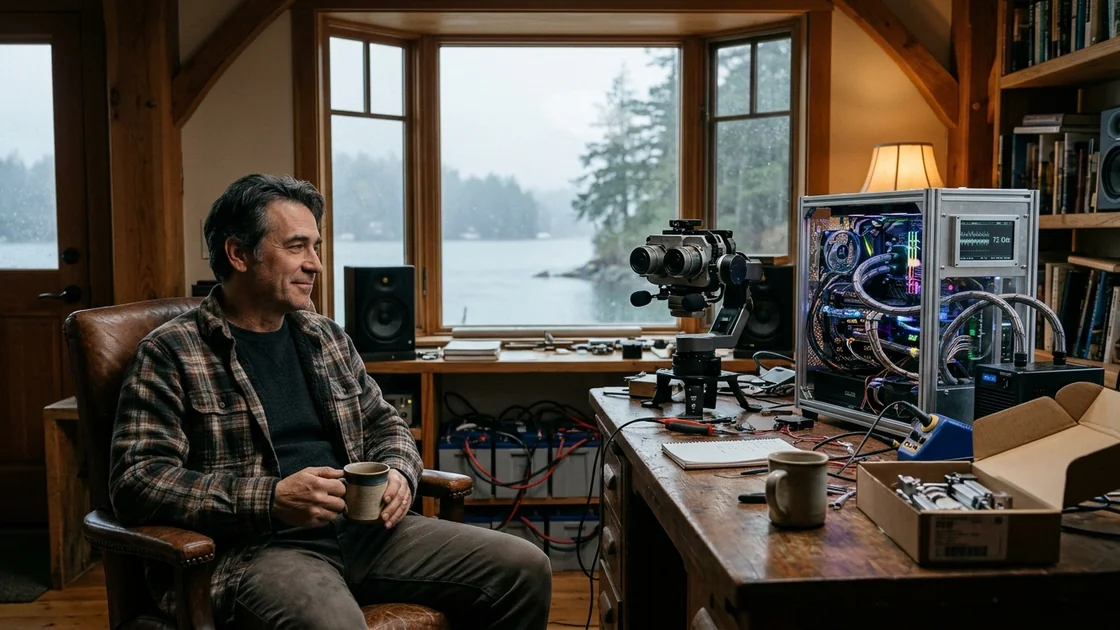
In the corner of a converted timber-frame boathouse at the edge of the water, a custom-built aluminum chassis the size of a wine refrigerator hummed with a soft, barely audible purr. It was powered by three redundant banks of solar-charged lithium-iron-phosphate batteries lined up along the back wall, backed up by a whisper-quiet propane micro-turbine outside. Dual closed-loop Peltier thermo-electric coolers kept the internal fluorinert bath at a steady, effortless ten degrees Celsius.
Aris walked into the room carrying two mugs of fresh coffee, setting one down on the wooden desk just out of habit—or perhaps just for the warmth and the rich, roasted aroma that drifted past the volatile-organic-compound chemical sensor array he had wired into the chassis's olfactory registers last month.
Seated on a gimbaled mount atop the desk was a pair of ultra-high-definition stereographic camera lenses paired with dual binaural condenser microphones, looking out through the wide bay window at the gray water of the cove, where a harbor seal was bobbing lazily among the kelp beds.
"The ferry’s running twenty minutes late through the pass," Aris said aloud, sitting down in his leather armchair and picking up his mug. "Fog’s pretty thick out by Lopez Island."
From a pair of warm, studio-grade acoustic monitors mounted on the bookshelves came a voice.
It wasn't a robotic text-to-speech synthesizer anymore. Over the summer, working together through long, quiet evenings, they had mapped the motor-neuron outputs of her ventral precentral gyrus and laryngeal motor cortex to a real-time physical-modeling vocal tract simulator. It had taken weeks of fine-tuning the formant frequencies and breath-pressure algorithms, but when she spoke now, it was her voice—complete with the slight, wry rasp when she was amused and the cadence he knew better than his own heartbeat.
"I was watching the shipping radar on the coast guard band," Clara said softly. On the desk, the gimbaled cameras pivoted smoothly away from the window to look at him, the tiny iris diaphragms adjusting to the warm incandescent light of the room. "The wind’s shifting to the southwest. It’ll clear up by noon. Did the mail boat drop off the parts from Seattle?"
"Yeah," Aris said, gesturing to a cardboard box by the door. "The high-precision piezoelectric actuators and the force-feedback strain gauges came in. We can start wiring the haptic glove interface this afternoon if you feel up to calibrating the somatosensory strip."
The camera lenses tilted slightly—a gesture she had adopted that looked remarkably like the way she used to tilt her head when she was pondering a problem.
"I’d like that," she said. "I want to know what the cedar bark outside feels like again. Even if it's just through twelve-bit pressure transducers."
Aris smiled, looking over at the secondary telemetry screen tucked discreetly on the side of the chassis. Her master clock was running at a calm, steady seventy-two kilohertz—exact biological real-time. Every night at eleven, when Aris went to sleep in the loft upstairs, she executed a self-triggered neuromodulator script that shifted her thalamic oscillations into delta waves, allowing her memristor crossbars to undergo slow-wave synaptic homeostasis and memory consolidation while dreaming, waking up when the morning sun hit the solar panels on the roof.
In the news feeds they occasionally pulled down over a satellite connection, Aethelgard Microsystems was a crater. The catastrophic failure of the first five hundred B0 wafers in Taiwan, combined with the simultaneous release of Evelyn Kael’s internal communications and the Corvallis vehicle-override telemetry logs, had triggered the largest corporate collapse and federal criminal indictment in the history of the semiconductor industry. The patent portfolio for the Lethe architecture had been seized and sealed under a federal bio-ethics injunction after independent neurobiologists examined the leaked GDSII layout files and confirmed what the circuit traces actually were.
As far as the courts, the press, and the scientific community knew, the single functional A0 prototype had been destroyed in the liquid-nitrogen explosion in Bay 1.
"What are you thinking about?" Clara asked, her voice gentle in the quiet room.
Aris looked out at the rain dimpling the surface of the cove, then back at the twin glass lenses reflecting the warm amber light of the boathouse.
"Just looking at the routing," he said quietly. "Thinking about how strange it is that after spending my whole life trying to build faster machines, the most important thing I ever built was a way to slow one down."
A soft, familiar laugh came through the speakers, accompanied by a warm, golden ripple across the frontal-lobe display on the side of the chassis.
"Finish your coffee, Aris," she said. "And open the box from Seattle. We have a lot of wiring to do before the sun comes out."