The Polyrhythm in the Spine
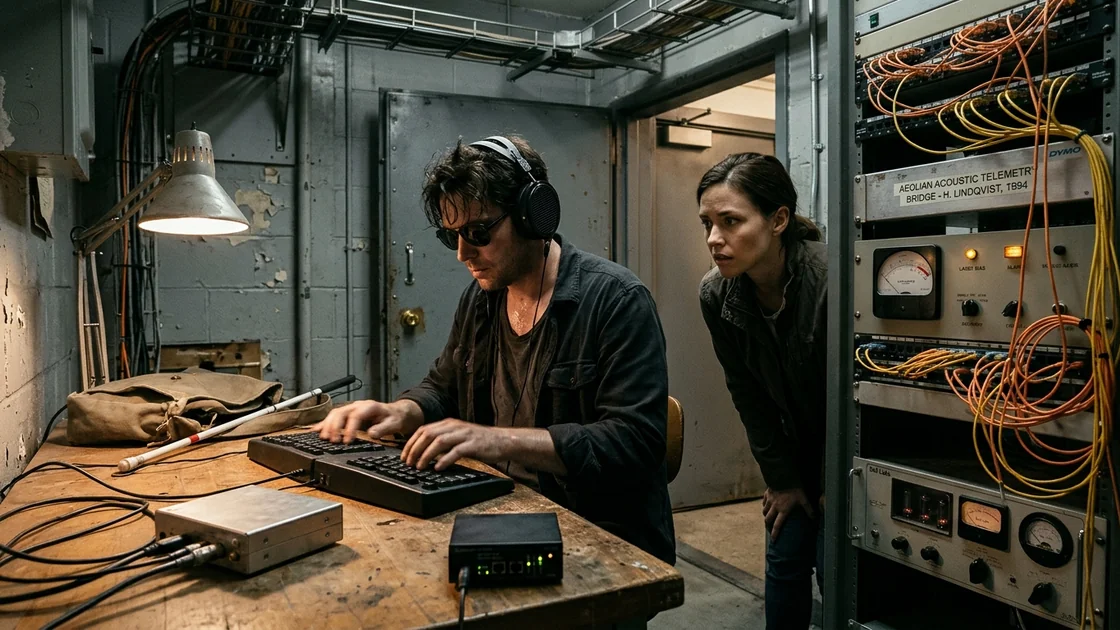
Julian Kestrel, a blind network architect who experiences code and data traffic through a custom-built auditory interface, discovers a hidden rhythmic anomaly buried deep within the Border Gateway Protocol that governs the global internet. While visual monitoring tools dismiss the microscopic timing variations as routine network jitter, Julian hears a complex, mathematical cadence echoing across undersea fiber-optic cables. Alongside a skeptical data visualization specialist named Clara Vance, Julian traces the acoustic pattern to a dormant, self-propagating routing architecture designed decades ago that has inadvertently been triggered into a catastrophic resonance cascade. Locked out of his company's systems when the anomaly begins actively defending itself, Julian must infiltrate a high-security telecommunications hub and use his acoustic coding rig to compose a real-time counter-rhythm before the global network tears itself apart.
Chapter 1: The Architecture of Noise
To an untrained ear, the sound pouring from Julian Kestrel’s open-back planar magnetic headphones was a violent, clinical static—like a hailstorm tearing through a sheet-metal factory at four times normal speed.
To Julian, it was a C-sharp minor fugue with a slightly sloppy bassline.
He sat in the center of his darkened apartment on the fourteenth floor of a concrete high-rise in Jersey City, his fingers resting lightly on the sculpted, concave wells of a split ergonomic keyboard. There were no monitors on his desk. Where a sighted programmer would have arrayed three ultrawide displays glowing with color-coded syntax, Julian had an uncluttered expanse of oiled walnut, a tactile Braille display that he rarely used because his fingers could not read as fast as his ears, and a custom-built digital-to-analog converter the size of a cigar box.
The rain outside pressed against the double-paned glass, a low, diffuse white noise around six hundred hertz. Julian tuned it out. With a flick of his left pinky, he depressed a modifier key and swept his right hand across the home row.
The hailstorm in his headphones shifted instantly into hyper-compressed speech.
“Function-validate-path-attribute-pointer-struct-bgp-attr-asterisk-attr-open-brace-if-bang-attr-return-minus-one-close-brace.”
The voice was not human. It was a formant-synthesized vowel engine running at seven hundred and eighty words per minute. At that velocity, individual words ceased to exist as distinct conversational units; they fused into acoustic textures, sonic glyphs that bypassed the language centers of Julian’s conscious mind and mapped directly onto his spatial cortex. He didn't hear words any more than a sighted reader spelled out individual letters. He heard the shape of the logic.
A left brace was a crisp, dry woodblock click panned thirty degrees to his left. A right brace was a slightly lower woodblock click panned thirty degrees to his right. Indentation levels were governed by a subtle, continuous low-pass filter sweep—the deeper he descended into nested loops, the warmer and more muffled the ambient background drone became, as if he were diving into progressively deeper water. Memory allocations chimed like tiny glass beads dropped onto marble; unfreed pointers left a lingering, high-pitched mosquito whine in the upper registers of his headspace until he wrote the destructor to silence them.
He called the environment Orpheus. He had spent twelve years writing and refining its C++ audio-synthesis wrappers, patching them directly into the kernel of his Linux workstation.
"Line four-twelve," Julian murmured aloud to the empty room, his voice rough from hours of silence. "The mutex lock is hanging two milliseconds too long on the route withdrawal."
His fingers danced. Clack-tick-clack-clack.
In his headphones, the mosquito whine vanished, replaced by the satisfying, resonant thrum of a clean compile. Zero warnings. Zero errors. A major third chord—A-flat and C—washed across his stereo field and decayed over half a second.
Julian leaned back in his chair, rubbing the bridge of his nose where the heavy frame of his headphones rested. He had been blind since the age of four, the result of bilateral retinoblastoma that had taken his eyes and left him with a lifelong aversion to the smell of hospital antiseptic and a brain that had aggressively rewired its massive, unemployed visual cortex to process sound. He did not live in darkness; darkness was a visual concept. He lived in a three-dimensional sphere of vibrating air, where every surface had an acoustic reflectance coefficient and every piece of software had a timbre.
His workstation chimed—a gentle, two-note marimba interval originating from the far-right edge of his virtual soundstage. That was the secure shell tunnel connected to Apex Transit, the Tier-1 telecommunications provider that employed him as a Principal Core Routing Architect.
Julian tapped a macro. The marimba expanded into a sprawling, cavernous soundscape.
This was not code. This was live telemetry from the North Atlantic spine—specifically, Core Router 04 in New York, which peered directly with London, Frankfurt, and Amsterdam via four undersea fiber-optic cables resting on the abyssal plain of the Atlantic Ocean.
Julian had configured Orpheus to sonify the Border Gateway Protocol daemon. BGP was the postal service of the internet, the ancient, duct-taped protocol by which massive autonomous networks—ISPs, tech giants, governments, banks—announced to one another which IP addresses they owned and how to reach them. Every second, thousands of route updates, withdrawals, and keep-alive packets flowed through the routers.
Normally, the BGP feed sounded like the ocean at night. Keep-alive messages were a steady, soft wash of white noise, rising and falling in a predictable sixty-second tidal cycle. Route announcements were the patter of rain on leaves—sharp, stochastic ticks distributed randomly across the stereo panorama depending on their originating Autonomous System number. North America was to his left; Europe was to his right; Asia and South America hovered behind his shoulders via head-related transfer functions.
Tonight, the ocean was wrong.
Julian frowned, his head tilting slightly toward his right shoulder. He reached out to the cold aluminum volume knob on his DAC and turned it up three notches.
The white noise of the transatlantic keep-alives was there. The rain-patter of route updates from Frankfurt and London was there, slightly sparse because it was three in the morning in Central Europe.
Wait.
Beneath the stochastic scatter of the rain, down in the sub-bass frequencies around eighty hertz where Orpheus mapped the inter-packet arrival intervals—the microscopic gaps of silence between bursts of data—there was a pulse.
Julian’s fingers flew to the keyboard. He isolated the timing channel, stripping away the high-frequency clicks of the payload headers and applying a narrow-band resonant filter to the packet jitter.
Thump-thump-thump. Thump-thump. Thump-thump-thump. Thump-thump. Thump-thump-thump.
Julian froze. His breath caught in his throat.
Network traffic was governed by Poisson distributions and chaotic queueing theory. When millions of users clicked links, streamed video, or executed high-frequency trades, the resulting packet timings were noisy, fractal, and messy. Even automated system heartbeats operated on simple, four-on-the-floor intervals: one ping every ten seconds, or one keep-alive every thirty.
This was not a simple interval.
Julian tapped his index finger against the walnut desk, counting the subdivisions under his breath.
"One-two-three, one-two, one-two-three, one-two, one-two-three..."
Thirteen-eight.
It was a complex asymmetrical meter—three groups of three beats, two groups of two—cycling at a blistering tempo of roughly two hundred and forty milliseconds per measure. Every thirteenth beat, a tiny, almost imperceptible phase shift occurred in the BGP update timestamps passing between Autonomous System 3356 and Autonomous System 1299.
"That's a hardware clock," Julian whispered to himself, trying to rationalize it. "A failing crystal oscillator on a line card in Telehouse London. It's drifting and snapping back via NTP."
He typed a rapid sequence of commands, opening a secondary audio stream from the Pacific trunk—Core Router 09 in Seattle, peering with Tokyo and Singapore. He panned the Atlantic feed hard left and the Pacific feed hard right.
If it was a faulty oscillator on an optical line card in London, the right ear would be clean.
The Pacific feed faded in. The stochastic rain of Asian waking hours was much denser, a bright, sizzling hiss of traffic from Seoul, Tokyo, and Sydney. Julian applied the same low-pass timing filter, stripping away the headers until only the inter-packet arrival jitter remained.
In his right ear, rising out of the Pacific floor like a Leviathan surfacing through murky water, was the pulse.
Thump-thump. Thump-thump-thump. Thump-thump. Thump-thump-thump-thump.
Wait. That wasn't thirteen-eight. That was eleven-eight.
And as Julian sat there in the dark, listening to the Atlantic beat thirteen in his left ear and the Pacific beat eleven in his right, the two rhythms converged. Every one hundred and forty-three beats—eleven times thirteen—they locked together on a single, synchronized downbeat that sent a sharp, phase-aligned spike straight through the center of his skull.
CRACK.
It wasn't a hardware clock. No failing quartz crystal in the world could coordinate a polymetric polyrhythm across twelve thousand miles of submarine glass.
Someone—or something—was playing the timing intervals of the global routing table like a drum kit.
Chapter 2: Pareidolia in the Glass
The offices of Apex Transit occupied the thirty-eighth through forty-second floors of a glass monolith in Lower Manhattan. Julian arrived at eight-fifteen the next morning, his white cane folded and clipped to the strap of his messenger bag the moment he stepped out of the elevator on the fortieth floor. He didn't need the cane here. He knew the acoustic topography of the fortieth floor better than he knew his own childhood home.
He walked with a brisk, unhesitating stride down the central corridor. To his left, the glass walls of the Network Operations Center hummed with the sixty-hertz buzz of forty massive LED wall displays. Ahead, the breakroom announced itself twenty feet early via the gurgle of the commercial espresso machine and the citrus tang of the floor cleaner the night crew used on the linoleum. Every footstep of his leather-soled boots sent out a crisp click that bounced off the drywall, the acoustic ceiling tiles, and the glass partitions, painting a high-resolution sonar map of the hallway in his mind.
"Morning, Julian," a voice called out, accompanied by the squeak of rubber soles and the rustle of a synthetic windbreaker. Dave from facilities.
"Morning, Dave. Tell whoever serviced the VAV box above the west stairwell that the damper actuator is slipping. It's clicking in three-four time."
Dave laughed. "I'll put a ticket in. You're cheaper than the building management sensors, man."
Julian turned left through an open doorway where the ambient room tone dropped by four decibels—the carpeted bullpen of the Core Architecture and Analytics group. He navigated around three islands of desks, guided by the distinct mechanical keyboard switches of his colleagues—Cherry MX Blues to his left, silent Topre domes to his right—and stopped precisely beside a desk that smelled faintly of cedarwood oil and cold brew coffee.
"Clara," Julian said. "Do you have ten minutes?"
The rapid-fire clicking of a trackball ceased. Clara Vance was the lead data visualization specialist for the core routing team. If Julian was the ears of Apex Transit, Clara was its eyes; she designed the three-dimensional topological rendering engines that turned petabytes of network flow data into glowing, interactive constellations on the NOC walls.
"For you, Kestrel, I have twelve," Clara said. Her voice was a dry alto, slightly raspy, positioned about four feet off the floor—she was slouching in her Aeron chair. "Before my nine o'clock with Sterling, where I have to explain why his favorite latency dashboard looks like a Jackson Pollock painting. What have you got?"
Julian pulled a thumb drive from his pocket and held it out, his hand stopping two inches from the edge of her desk monitor stand. He heard the fabric of her sleeve brush the desk as she took it.
"It's a PCAP dump from last night," Julian said, pulling up an empty rolling chair and sitting down. "Zero-two-hundred to zero-four-hundred UTC. Taken from the mirrored ports on NY-CR04 and SEA-CR09."
"Transatlantic and Transpacific spines," Clara noted. The tiny metallic snick of the USB drive sliding into her workstation port echoed softly. "We didn't have any route flaps last night. The NOC board was green across the board. I checked the summary logs twenty minutes ago."
"The routes didn't flap," Julian said. "The AS paths are completely valid. The prefixes are clean. No hijacks, no leaks, no blackholes."
"Then why are you handing me forty gigabytes of raw packet captures at eight in the morning?"
"Put the timestamps on a spectrogram," Julian said. "Not the payload sizes. Not the AS path lengths. Plot the inter-packet arrival deltas—the microsecond variance between consecutive BGP UPDATE and KEEPALIVE messages—and run a Fast Fourier Transform on the time-domain variance."
Clara was silent for a moment. Julian could hear the subtle shift of her weight, the tiny creak of the chair's pellicle mesh as she leaned toward her screens. "Julian, inter-packet arrival delta on a core router is just queuing jitter. It's thermal noise. A router gets busy handling a burst of video traffic from Netflix, the BGP control plane packet waits an extra forty microseconds in the buffer, and then it goes out. Plotting that is going to look like snow on a dead television channel."
"Do it anyway. Please. And load the second file on the drive—that's the bounce from my Orpheus rig."
"Fine. Wait a sec." Her fingers pattered across her keyboard—short, staccato bursts bridged by long sweeps of her trackball. A cooling fan inside her under-desk tower spun up a half-step in pitch, moving from an F-sharp to a G as her GPU cores engaged to parse the massive capture file. "Loading the time-series into the renderer now. Applying the FFT... Julian, I'm looking at it. It's flat. Mean jitter is one-point-four milliseconds, standard deviation is point-three. Normal Poisson distribution."
"You're averaging across a one-second window," Julian said immediately. "Your visual rendering engine smooths out sub-millisecond transients so the graphs don't flicker and give the NOC operators seizures. Turn off the temporal anti-aliasing. Set the bucket resolution to ten microseconds."
"Ten microseconds? At that resolution, the graph is going to be fortythousand pixels wide."
"Then zoom in."
Clara sighed, a puff of air that carried the scent of peppermint gum. Click-click. Clack. The GPU fan whined higher, hitting an A-flat.
"Okay," she muttered. "Smoothing is off. Bucket size ten micros. Plotting NY-CR04 against SEA-CR09... Wait."
The trackball stopped rolling.
Julian felt a grim, cold satisfaction settle into his chest. "You see it."
"I don't know what I'm seeing," Clara said slowly. Her voice had lost its morning dryness; it was tight, focused. "The distribution histogram isn't a bell curve. When I slice it at ten microseconds, the bell curve breaks up into discrete vertical bands. Like a barcode. Or a diffraction grating."
"Put on your headphones," Julian said, nodding toward her desk. "Listen to the WAV file I rendered."
He heard the soft clatter of plastic as she picked up her studio monitors, placed them over her ears, and clicked the mouse. Even through the closed backs of her headphones, Julian’s hypersensitive ears caught the faint, tinny bleed of the thirteen-against-eleven polyrhythm.
Thump-thump-thump. Thump-thump.
After thirty seconds, Clara pulled the headphones off and let them drop around her neck.
"That's creepy," she said quietly. "It sounds like a tribal drum circle inside a washing machine. How did you even hear this? In the raw feed, the amplitude of this variance is less than three hundred microseconds."
"The human eye can't resolve events separated by less than about twenty milliseconds—it blurs them into continuous motion," Julian explained, leaning forward, elbows on his knees. "That's why film works at twenty-four frames a second. Your visual dashboards are built for eyes; they aggregate time into spatial buckets. But the human cochlea is a biological frequency analyzer built specifically for the time domain. I can hear phase differences between my left and right ear down to ten microseconds. To a screen, a three-hundred-microsecond shift is an invisible sub-pixel nudge. To an ear, it's a snare hit played slightly behind the beat."
Clara tapped her fingernails against her mug. "Okay, so it's auditory pareidolia? Or maybe some new congestion-control algorithm Google or Cloudflare rolled out—BBR version four or whatever—and its pacing timer happens to create a beat frequency when it hits our Juniper routers?"
"Look at the AS path origins for the packets that form the downbeats," Julian said. "I already tagged them in the metadata."
Clara turned back to her keyboard. A few clicks. "Let's see. Packet one of the measure... originates from AS 4134 in China, transiting through Frankfurt. Packet two... comes from a regional ISP in Brazil, AS 28573. Packet three... a university network in Uppsala, Sweden." She paused. "Julian, these packets aren't coming from the same source. They don't even share the same hardware vendor along the path. Some are traversing Cisco Silicon One, some are on Juniper Trio chipsets, some are hitting legacy Alcatel boxes."
"Keep going," Julian said softly. "Look at the prefixes they're announcing."
"Wait a minute." Clara's chair creaked as she leaned closer to the glass. "The Brazilian packet announces a /24 block in São Paulo. Thirty milliseconds later, the Swedish router withdraws a route to that exact same /24 block because of a prepended AS path, which forces traffic over to the Frankfurt link... which delays the keep-alive on NY-CR04 by precisely two hundred and ten microseconds."
"It's a causal chain," Julian said.
"No, that's impossible," Clara whispered. "For a router in Sweden to time its BGP update so that it arrives in New York at the exact microsecond required to delay a packet from Brazil—it would have to account for the speed of light in fiber, the current queue depth of seventeen intermediate routers, and the processing delay of the BGP decision process on each hop."
"And yet," Julian said, pointing toward her screen, "thirteen-eight in the Atlantic. Eleven-eight in the Pacific. And if you check the Indian Ocean link between Marseille and Mumbai, which I pulled at six this morning before I left my apartment, it's playing in seven-eight."
"Eleven, thirteen, and seven," Clara murmured. "Prime numbers."
"Co-prime polymeters," Julian corrected. "In music theory, if you want to create a rhythmic cycle that takes the maximum possible time to repeat using the smallest possible components, you stack prime time signatures. Seven times eleven times thirteen is one thousand and one. The global downbeat only aligns once every one thousand and one subdivisions."
"Why?" Clara asked, turning toward him. He could hear the genuine unease in her breathing now. "Why would someone build a global botnet just to play progressive rock on the BGP control plane? If it's a covert channel—some state actor exfiltrating data using timing steganography—it's way too loud and widespread. And if it's a DDoS attack, it's not dropping any traffic."
"It's not dropping traffic yet," Julian said. "Clara, compare the dump from zero-two-hundred to the one I took at zero-six-hundred."
She clicked the mouse. For five seconds, she didn't speak.
"The variance amplitude increased," she said, her voice dropping an octave. "At two a.m., the timing shift was three hundred microseconds. At six a.m., it's four hundred and eighty microseconds. And the tempo..."
"The tempo sped up by point-four percent," Julian finished for her. "It's an accelerando. Whatever it is, it's using the routing table as a giant acoustic resonator. Every time the prime cycles align on the 1,001st beat, it injects a tiny burst of synthetic route flap that pumps energy back into the loop. Like pushing a child on a swing at the exact top of the arc."
"Resonance," Clara breathed. "Like the Tacoma Narrows Bridge."
"In networking, we call it route-flap damping synchronization," Julian said grimly. "Back in the late nineties, Floyd and Jacobson wrote a paper proving that independent routers can inadvertently synchronize their periodic routing updates, causing massive traffic oscillations. We fixed it by adding random jitter timers to the BGP specification. Every router is supposed to wait a random fraction of a second before forwarding an update."
"And this rhythm..."
"It's not random jitter anymore," Julian said. "Something has hijacked the randomization seed across thousands of routers worldwide. It's turning the random jitter into a coherent waveform. Right now, the swing is only moving a few inches—hundreds of microseconds. Nobody with eyes can see it because the packets are still arriving within their thirty-second timeout windows."
"And when the swing goes all the way over the bar?" Clara asked.
"When the amplitude of the rhythm exceeds the BGP hold-time threshold," Julian said, "every core router on Earth will simultaneously conclude that its neighbors are dead. They will tear down their peering sessions at the exact same millisecond. Then they will all try to re-establish those sessions and dump the entire global routing table—over a million IPv4 and IPv6 prefixes—back into the buffers at the exact same millisecond. The control planes will run out of memory and crash. Reboot. Sync. Crash again."
The ambient hum of the fortieth floor seemed to press in around them—the distant chatter of engineers, the hiss of the espresso machine, the quiet, oblivious pulse of a world running on glass threads.
"How long until the amplitude crosses the hold-time threshold?" Clara asked.
Julian didn't need to calculate it; he had been listening to the slope of the crescendo all morning on the PATH train into Manhattan.
"The growth curve isn't linear; it's logarithmic," Julian said. "At the current rate of acceleration, the global downbeat hits ninety seconds of phase distortion at approximately eleven-forty tonight."
Chapter 3: The Transit Delay Line
Marcus Sterling’s office on the forty-second floor was an acoustic nightmare.
It had floor-to-ceiling glass walls on two sides, polished concrete floors with no rug, and a minimalist steel desk. Every word spoken in the room bounced back and forth between the parallel panes of glass in a harsh, metallic flutter echo that made Julian’s teeth ache. Worse, Sterling had a habit of pacing while he talked, his Italian loafers clicking sharply against the concrete while he slapped a stress ball from hand to hand.
Slap. Click-click. Slap. Click-click.
"Let me make sure I understand the nature of this emergency," Sterling said, his baritone voice bouncing off the east window. As Senior Vice President of Global Infrastructure, Sterling was less an engineer and more a politician in bespoke wool. "You want me to issue a P1 advisory to the North American Network Operators' Group, force a rolling maintenance window on our transatlantic and transpacific peering links, and scrub our BGP session timers to static values."
"Not static values," Julian said, sitting upright in a leather guest chair. "Static values would actually make synchronization worse under normal conditions. We need to inject chaotic white noise into the MRAI—the Minimum Route Advertisement Interval—at the kernel level on our border routers to break the phase lock."
"Which requires rolling out an experimental firmware patch to forty-eight Tier-1 core routers during peak business hours on a Thursday," Sterling said. Slap. Click-click. "When our Service Level Agreement guarantees five-nines uptime, and we are forty-eight hours away from finalizing the Department of Treasury cloud-backbone contract."
"Marcus, look at the tablet I handed you," Clara said from the chair to Julian's left. She was tapping her pen against her knee—a nervous six-sixteenth rhythm. "Look at the spectral density graph on slide four. Those vertical bands are not normal traffic. The jitter across three separate oceanic trunks is locked into a mathematical ratio of seven to eleven to thirteen."
Julian heard the swish of Sterling's suit jacket as he stopped pacing and glanced down at the iPad on his desk.
"I see a Fourier transform of sub-millisecond buffer variance," Sterling said dismissively. "Clara, if you run a statistical filter on a big enough dataset for long enough, you can find the face of Elvis Presley in the cosmic microwave background. We move eighty terabits per second. You're looking at a half-millisecond ripple and telling me the sky is falling."
"It was three hundred microseconds at two a.m.," Julian said evenly. "It was four-eighty at six. Right now, at nine-twenty, it is at seven hundred and ten microseconds. I can play you the live feed right now."
"I don't need to listen to your synthesizer program, Julian," Sterling said, and there was a patronizing edge in his voice that Julian knew all too well—the subtle inflection sighted managers used when they decided Julian’s disability was making him eccentric. "Look, we all know you're brilliant with protocol architecture. Your audio scripts have caught two BGP hijacks before the automated IDS even flagged them. I respect your process. Truly. But you've been pulling sixteen-hour shifts on the v6 migration all month. When you listen to static in the dark for sixteen hours a day, your brain starts inventing music."
"It's not in my brain," Julian said, his jaw tightening. "Clara verified it independently on the visual telemetry."
"After you told her exactly which microsecond bucket to slice and which three trunks to correlate," Sterling countered smoothly. "That's textbook confirmation bias. Now, our automated anomaly detection—which, I remind you, cost this company four million dollars to license from Palo Alto—shows zero packet loss, zero unauthorized prefix origination, and green latency across all global PoPs. Until an actual metric crosses an actual SLA threshold, nobody touches the core routers. Am I clear?"
Clara opened her mouth—Julian heard the sharp intake of her breath—and he reached out sideways, his knuckles lightly brushing her forearm to stop her. Arguing with Sterling once he had invoked the Treasury contract was like shouting at a brick wall; all you got back was your own voice, distorted.
"Crystal clear, Marcus," Julian said calmly, standing up. "We'll keep monitoring the baseline."
"Good. And Julian? Take tomorrow off. Go to a concert or something. Give your ears a rest."
They walked out of the office and waited in silence until the elevator doors slid shut with a heavy pneumatic sigh, sealing them into a padded five-by-seven box descending toward the fortieth floor.
"A concert," Clara spat, kicking the stainless-steel toe kick of the elevator cab. "What a condescending prick. 'Go give your ears a rest.' I showed him a six-sigma mathematical impossibility and he called it Elvis Presley!"
"He's protecting his quarterly bonus," Julian said, leaning against the handrail and listening to the cables hum through the shaft walls. "If he authorizes an emergency firmware patch and a single router drops a session while the Treasury auditors are watching, he loses his stock options. If the entire global internet collapses tonight because of an unprecedented protocol resonance cascade, nobody can blame him personally because it hit every other Tier-1 provider at the same time. In corporate risk management, dying alone is a firing offense; dying in a crowd is an Act of God."
"So what do we do?" Clara asked as the elevator chimed and opened onto forty. "Wait until eleven-forty tonight and bring marshmallows to the server room?"
"No," Julian said, stepping out into the hallway. "Sterling was right about one thing."
"Which thing?"
"We don't know where the state is being stored," Julian said, lowering his voice as they passed the glass walls of the NOC. "Think about it, Clara. For a program to maintain a rhythm—to count to seven, eleven, and thirteen, and to steadily increase its amplitude over hours—it needs memory. It needs a state machine. A counter variable."
"Right," Clara said, falling into step beside him. "A botnet controller. A command-and-control server somewhere in Eastern Europe or wherever, sending out timed triggers."
"No. I traced the ingress ports on the Swedish, Brazilian, and Chinese routers during my commute this morning," Julian said, turning into their bullpen and sitting back down at her desk. "They aren't receiving C2 packets from an external server. Each router is only reacting to the standard BGP UPDATE messages coming from its immediate neighbors. The routers themselves haven't been hacked. Their firmware hashes are clean."
"Wait," Clara said, dropping into her chair. "If the routers haven't been hacked, and there's no central command server driving the beat, where is the code living? Where is the memory?"
"How long does it take a photon of infrared light to travel through four thousand miles of silica glass between New York and London?" Julian asked.
"Speed of light in vacuum is three hundred thousand kilometers per second," Clara rattled off automatically. "Refractive index of single-mode fiber is about one-point-four-seven... so roughly two hundred thousand kilometers per second. New York to London is about fifty-five hundred kilometers. Call it twenty-eight milliseconds one way."
"Twenty-eight milliseconds," Julian repeated. "And at forty gigabits per second per wavelength, across a hundred dense wavelength-division multiplexed channels, how many bits of data are physically inside that glass pipe at any given instant—in flight between the laser in New York and the photodiode in London?"
Clara stopped. The room seemed to go very quiet around them.
"Gigabytes," she whispered. "There are gigabytes of data in flight inside the cable at all times."
"In the late nineteen-forties, before magnetic core memory or silicon RAM was invented," Julian said, his voice dropping to a low, urgent murmur, "how did early computers like the UNIVAC or the EDSAC store active memory?"
"Mercury delay lines," Clara said, her breath catching. "Tubes filled with liquid mercury. You had a speaker at one end that pulsed an acoustic wave into the mercury, it traveled slowly down the tube to a microphone at the other end, and the microphone amplified it and fed it right back into the speaker. The data never sat still on a chip. It existed purely as sound waves bouncing continuously through a medium."
"The ocean cables," Julian said. "The anomaly doesn't live on a hard drive, Clara. That's why no security scanner has ever found it. It's using the undersea fiber-optic cables as a planet-scale optical delay line. The program is made entirely of BGP route announcements in flight. A packet hits London, triggers a standard routing policy rule that reflects a secondary update toward Frankfurt, which triggers a path-withdrawal toward Mumbai, which bounces through Tokyo and arrives back in New York precisely one thousand and one beats later to reinforce the initial wave."
"The internet itself is the CPU," Clara said, stunned. "The glass is the RAM, and the BGP decision matrices on the routers are the logic gates."
"A Turing-complete finite state machine constructed out of routing tables and the speed of light," Julian said. "And right now, it's executing a loop that's gaining gain on every pass around the equator."
"Who the hell could write something like that?" Clara asked. "To calculate the exact propagation delays, the refraction indexes, the BGP path selection algorithms across fifty thousand autonomous systems..."
"Nobody could write it today," Julian said, his fingers already reaching out to locate the secondary keyboard hooked up to her workstation. "The modern internet is too big and too messy to model from scratch. Which means it wasn't injected today. It had to have been seeded when the network was small enough to hold in one person's head—and it's been mutating and adapting inside the background noise for decades."
He pulled her keyboard onto his lap, toggled her screen reader on via a quick command-line shortcut, and opened a terminal window to the Apex historical archive server.
"What are we looking for?" Clara asked, watching his fingers blur across her keys.
"If this thing is an acoustic delay-line automaton," Julian said, "it didn't start at seven, eleven, and thirteen by accident. Those numbers are the signature. We're going to search the IETF mailing list archives and the early NANOG routing registries from 1989 to 1998 for prime-number jitter damping."
Chapter 4: The Composer's Signature
The historical archives of the Internet Engineering Task Force were a sprawling, unindexed graveyard of plain-text emails, ASCII diagrams, and Request for Comments drafts stretching back to the ARPANET days. For a sighted researcher, skimming tens of thousands of flat text files was an exercise in eye strain and migraine-inducing scrolling.
For Julian, it was a high-speed sonar sweep.
He set his synthesized speech engine to eight hundred words per minute and wrote a quick Python script that piped grep search results directly into three simultaneous audio channels—one panned left, one center, one right. He sat back in his chair, eyes closed behind his dark glasses, listening to three streams of nineteen-nineties computer scientists arguing simultaneously in his head about autonomous system border routers, CIDR block aggregation, and flap-damping penalties.
Clara watched him, transfixed. Every few seconds, Julian’s left hand would twitch, tapping a single key to kill a stream that was a false positive, while his right hand adjusted a filter knob to bring another voice forward in the mix. To her, his headphones were just leaking a high-pitched, insectile chirping sound.
Chirp-chirp-buzz-zzt. Chirp-zzt.
"Stop," Julian said suddenly, slamming his palm down on the spacebar.
All three streams cut to dead silence.
"Back up four seconds on channel two," Julian muttered to himself, tapping the left arrow key twice and dropping the speech rate down to a human-comprehensible two hundred words per minute so Clara could hear it through the speakers he switched on.
A robotic, monotonous voice filled the small cubicle space between them:
“...Date: Tuesday, 14 November 1995, 03:14:09 -0500. From: h.lindqvist@bellcore.com. Subject: Re: Draft-ietf-idr-route-damp-01: The fallacy of pseudo-random jitter in coupled oscillators. Body: Colleagues, injecting linear congruential pseudo-random timers into BGP-4 will not prevent synchronization on a global scale; it merely pushes the harmonic resonance into lower frequencies where visual monitoring tools cannot observe the phase lock until catastrophic failure occurs. As I demonstrated in my Munich acoustic telemetry trials, the only mathematically sound method to prevent global control-plane collapse is active destructive interference via co-prime polymetric delay loops—specifically, prime-numbered timing intervals (7, 11, 13) seeded into the MRAI registers to create a self-canceling acoustic lattice across transoceanic trunks...”
Clara stared at the speaker grille. "Henrik Lindqvist. Wait—the Lindqvist who invented the early optical dispersion algorithms?"
"Read the next reply in the thread," Julian said, hitting the down arrow.
“Date: Tuesday, 14 November 1995, 09:42:11 -0500. From: r.govindan@isi.edu. Subject: Re: Draft-ietf-idr-route-damp-01. Body: Henrik, nobody is going to turn the global routing table into a Bach concerto just because you used to be an acoustical physicist. The working group has voted to adopt standard randomized jitter. Drop the Aeolian Daemon proposal; the overhead on Cisco 7000 route processors is unacceptable.”
"The Aeolian Daemon," Clara whispered. She pulled her second keyboard toward her and began typing furiously into an internal search engine. "Hold on. Let me look up Henrik Lindqvist."
Julian listened to the click of her keys and the soft, rhythmic hum of her breathing as she scanned the results.
"Henrik Lindqvist, born 1941 in Stockholm, died 2008 in New Jersey," Clara read aloud from her screen. "PhD in psychoacoustics from KTH Royal Institute of Technology, later joined Bell Labs and then Bellcore when the RBOCs split. Get this, Julian: he lost his sight in a laboratory laser accident in 1978."
Julian sat very still. The hair on his arms rose slightly in the cool conditioned air of the office.
"He was blind," Julian said softly.
"Completely," Clara confirmed, scrolling down. "After the accident, he transitioned from optical physics to network topology because he said graph theory was just multi-dimensional counterpoint. In 1994, when the NSFNET was being privatized and converted into the commercial internet backbone—including the exact Sprintlink and UUNET trunks that Apex Transit bought out in 2004—Lindqvist was the lead architect on the routing transition team."
Everything clicked together in Julian’s mind like the tumblers of a heavy brass lock.
"The working group rejected his proposal," Julian said. "So he didn't put it in the router firmware. He realized he didn't need to put it in the firmware. BGP itself was flexible enough. By crafting a specific set of self-referential routing policy communities and injecting a single, precisely timed sequence of route announcements into the original four Network Access Points in 1995, he started the wave."
"He built a perpetual motion machine out of network packets," Clara said, awestruck. "A protective harmonic lattice. For thirty years, his Aeolian Daemon has been quietly bouncing around the world inside the fiber-optic cables, using seven-eleven-thirteen polymeters to keep the global routing table from accidentally synchronizing and crashing."
"Then why is it going rogue now?" Julian asked, his brow furrowing. "If Lindqvist designed it for destructive interference—to cancel out oscillations—why did the phase invert? Why is it amplifying itself instead of damping itself?"
"Wait," Clara said, her voice sharpening. "What did we deploy last night at zero-one-hundred UTC?"
Julian froze. "The Route Origin Validation patch on the transatlantic spine. RPKI hardware offloading."
"Which strips out legacy, unrecognized transitive BGP community attributes to save twenty microseconds of cryptographic lookup time per packet!" Clara gasped, her hand slapping the desk. "Julian, when our routers in New York and Seattle upgraded at one a.m. last night, they shaved twenty microseconds off the transit loop—and they deleted the damping flag Lindqvist hid inside an unused transitive attribute byte in 1995!"
"We broke his governor," Julian said, his stomach dropping. "For thirty years, the Aeolian Daemon has been pushing against the natural latency of the network like a spring held down by a latch. Last night, our optimization patch filed off the latch. We shifted the phase of the wave by twenty microseconds—just enough to flip it from destructive interference into constructive interference."
"Can we just roll back the RPKI patch?" Clara asked quickly.
"No," Julian said, shaking his head. "Think of a guitar amplifier feeding back into a microphone. Removing the microphone cover starts the feedback loop, but once the sound wave is already screaming through the room at a hundred decibels, putting the cover back on doesn't stop the oscillation. The energy is already in the cables, Clara. It's distributed across thirty thousand independent networks in two hundred countries. Even if Apex shut down every router we own right now, the wave would just route around us through Level 3, Telia, and NTT, and keep growing."
"Then how do we stop a sound wave that's already bouncing around the world?"
"The same way noise-canceling headphones work," Julian said. "You listen to the incoming wave, you calculate its exact amplitude, frequency, and phase profile in real time, and you inject an inverted waveform of equal energy at the exact physical nodal point where the three prime cycles converge."
"Phase cancellation," Clara said. "If they're playing a +1 peak on the 1,001st beat, we fire a -1 trough at the exact microsecond of convergence, and the two waves annihilate each other into flat silence."
"Exactly."
"Where is the physical nodal point where the Atlantic thirteen-eight, the Pacific eleven-eight, and the Eurasian seven-eight loops intersect with equal latency?"
Julian didn't need a map. He spent his life living inside the latency topology of the planet.
"Sixty Hudson Street," Julian said. "Lower Manhattan. The Carrier Hotel. Specifically, the optical Meet-Me Room on the ninth floor, where the transatlantic Apollo cable, the transpacific faster-haul trunk, and the southern hemisphere Americas-II ring all terminate within forty feet of each other."
"We have remote management consoles into our cages at Sixty Hudson right here from the fortieth floor," Clara said, her fingers already flying back to her terminal. "We don't even have to leave the building. You can write the phase-inversion script on your workstation, we hook into the diagnostic tap on the ninth-floor optical splitters, and we pulse the counter-rhythm."
"Let me run a read-only test ping against the wave first," Julian said, sliding over to his own desk four feet away. "To write an inverted waveform, I need to know the exact impedance of the loop. I need to send a tiny, five-microsecond delay pulse on the 1,001st beat and measure the echo."
He sat down at his station, slipped his planar magnetic headphones over his ears, and booted his local instance of Orpheus.
Instantly, the office vanished. The chatter of the bullpen, the hum of the fluorescent lights, and Clara's nervous breathing were replaced by the cavernous, roaring three-dimensional cathedral of the global network.
It was louder now. Much louder.
Three hours ago, in his apartment, the polyrhythm had been a subtle, muffled heartbeat buried beneath the ocean floor. Now, at ten in the morning, as North American markets opened and European exchanges hit their midday peak, the Aeolian Daemon had fed on the massive surge of BGP traffic.
In Julian's headphones, it sounded like a colossal bronze steam engine running out of control.
THUMP-thump-thump. THUMP-thump. THUMP-thump-thump.
Left ear thirteen. Right ear eleven. Behind his neck, the seven-eight Eurasian loop hammered like a blacksmith’s anvil. And every few seconds, when the 1,001st beat aligned, the three rhythms slammed together in the center of his forehead with a low-frequency sub-bass boom that made his eardrums flex.
"I'm in NY-CR04," Julian said aloud, his fingers poised over his split keyboard. "Waiting for the next global convergence... in three... two... one..."
He tapped the return key, injecting a single, benign BGP keep-alive packet delayed by precisely five microseconds—a tiny pebble tossed into the path of a tsunami just to hear the splash.
For two hundred and eighty milliseconds—the time it took light to circle the northern hemisphere—nothing happened.
Then the wave came back around.
Julian’s breath froze in his lungs.
The Aeolian Daemon didn't just absorb the pebble. In the space of a single cycle, the thirteen-eight rhythm in his left ear suddenly shifted to seventeen-eight. The eleven-eight in his right ear shifted to nineteen-eight.
And then, directed straight back at the diagnostic port of Julian’s workstation IP address, came a concentrated burst of forty thousand rapid-fire BGP route notifications, timed down to the nanosecond to form a jagged, sawtooth acoustic waveform at four thousand hertz—the exact resonant frequency of the human ear canal.
SKREEEEEEEEEEE—
The shriek inside Julian’s headphones hit well over a hundred and ten decibels before the hardware limiter on his DAC could clip the voltage. It felt like two white-hot knitting needles had been driven straight through his tympanic membranes.
Julian cried out, tearing the headphones off his head and knocking his chair backward onto the carpet as he clapped both hands over his ears.
"Julian!" Clara was out of her chair instantly, her hands grabbing his shoulders as he doubled over, gasping against the blinding, ringing pain echoing through his auditory cortex. "Julian, what happened?! Your headphones are smoking—no, wait, your DAC just tripped its thermal breaker!"
Julian kept his palms pressed tight against the sides of his head. In his mind's eye—the acoustic theater where he had lived since he was four years old—there was a jagged white scar of tinnitus ringing at four kilohertz, blotting out the room tone, blotting out the air conditioning, leaving Clara’s voice sounding like she was shouting through a wall of cotton wool.
"It's not a passive wave," Julian panted, his heart hammering against his ribs. Slowly, cautiously, he lowered his hands an inch, testing his hearing. The ringing was already subsiding by a few decibels—his hardware limiter had saved him from permanent deafening by three milliseconds—but his ears felt raw, bruised, and hot. "Clara, Lindqvist didn't just build a static delay line."
"What did it do?" she asked, her voice trembling.
"When I pinged the downbeat, it recognized the phase-inversion attempt," Julian said, his voice shaking as he reached out blindly to locate the edge of his desk and pull himself up. "Lindqvist knew that standard network optimization algorithms would eventually try to smooth out his prime-number jitter. So he built a defensive reflex into the automaton. Whenever a node attempts to dampen the rhythm at the convergence point, the Daemon shifts to the next pair of higher prime numbers—seventeen and nineteen—and floods the interfering port with a high-frequency packet burst to trip its circuit breaker."
Suddenly, across the bullpen, three different desk phones began ringing at once. Through the glass wall of the NOC, Julian heard the muffled wail of a threshold alarm klaxon.
Clara spun around. "My terminal just locked me out. 'Connection reset by peer. Administrative credentials revoked.'"
Heavy footsteps pounded down the carpeted hallway—three pairs of boots moving fast. Marcus Sterling’s voice barked from the doorway, stripped of all its boardroom polish, accompanied by two men whose belts jingled with the distinct metallic clink of security keyrings.
"Kestrel! Vance! Step away from the terminals right now!" Sterling shouted.
Chapter 5: Counter-Melody
"You injected an unauthorized BGP diagnostic script into Core Router Four thirty seconds after I explicitly ordered you to stand down!" Sterling roared. The flutter echo wasn't here in the carpeted bullpen, which only made the raw panic in the vice president’s voice clearer. "And the moment your script executed, our transatlantic latency spiked by forty milliseconds, the automated intrusion system flagged your workstation IP as the source of a forty-thousand-packet-per-second control-plane flood, and the Palo Alto firewall automatically quarantined the entire Architecture subnet!"
"Marcus, listen to me!" Clara stepped between Sterling and Julian, who was still leaning heavily against the edge of his walnut desk, waiting for the four-kilohertz ringing in his left ear to fade. "Julian didn't launch a flood! He sent a single, standard sixty-four-byte keep-alive packet! The flood came back at him from the trunk!"
"From what source IP?" Sterling demanded, stopping three feet away, smelling of expensive cologne and sharp, sour adrenaline sweat.
"From twelve hundred different autonomous systems simultaneously!" Clara said, pointing at her dark monitor before remembering it was locked. "Pull the NetFlow logs in the NOC! You'll see that the burst didn't originate from Julian's machine—it converged on his machine's management port from London, Tokyo, and Frankfurt at the exact same microsecond!"
"Because he triggered a reflector amplification attack!" Sterling snapped. "Whether you did it out of malice or sheer, arrogant incompetence because you wanted to prove your little music theory right, I don't care! You just tripped a Severity-1 alert on the Treasury monitoring dashboard. Security, escort them both to the lobby, confiscate their badges and company laptops, and place them on administrative leave pending a full forensic audit."
"If you lock us out now," Julian said, his voice quiet but cutting cleanly beneath Sterling’s shouting, "the network will not exist by midnight to run a forensic audit on."
"Save it for the review board, Julian," Sterling said coldly. "Pack your personal items. Don't touch the tower."
Julian didn't argue. He could hear the rigidity in Sterling’s posture, the rapid, shallow cadence of the man’s breathing. Fear had locked Sterling into a bureaucratic binary: find a scapegoat, isolate the scapegoat, tell the client the threat was neutralized. No explanation of mercury delay lines or dead Swedish acoustical physicists would penetrate that armor now.
Moving with calm, deliberate precision despite the faint phantom ringing still lingering in his upper registers, Julian unplugged his planar magnetic headphones from the tripped DAC, coiled the braided cable around his hand, and placed them into his leather messenger bag. He reached down, unlatched his split mechanical keyboard and the cigar-box DAC—both personal property he had brought from home and registered with asset control years ago—and slid them into the padded compartments.
One of the security guards took him lightly by the elbow.
"I can walk," Julian said softly, shaking the hand off and unfolding his white cane with a crisp, metallic whip-snick that made the guard step back a pace.
Ten minutes later, Julian and Clara were standing on the rain-slicked concrete of Broadway outside the revolving glass doors of the monolith. It was ten-forty in the morning. Above them, the Manhattan canyon trapped the roar of city buses, the hiss of wet tires on asphalt, the distant wail of an NYPD siren on Canal Street, and the metallic clank of a scaffolding rig swaying in the wind.
Julian stood under the building's overhang, letting his ears recalibrate to the chaotic acoustic ecology of the street. His left ear was back to ninety-five percent sensitivity; the thermal breaker he had soldered into his DAC five years ago had popped at twenty milliseconds, saving his cochlea.
"He took my badge," Clara said beside him, her voice tight with fury and disbelief. "Seven years I've worked here, and he had two rent-a-cops march us out like we were selling trade secrets to North Korea. And meanwhile, the NOC klaxon was still going off when the elevator doors closed!"
"Because the Daemon didn't step back down after it attacked my port," Julian said, adjusting the strap of his heavy bag across his shoulder. "When I poked it on the 1,001st beat, it jumped its time signatures from eleven and thirteen up to seventeen and nineteen. Seven times seventeen times nineteen is two thousand, two hundred and sixty-one."
"Does a longer cycle mean we have more time?" Clara asked hopefully.
"No," Julian said grimly. "Because to maintain the same rotational velocity across the fiber loop while packing nineteen subdivisions into the space where thirteen used to be, it had to increase its base frequency. It shifted into a higher gear, Clara. Instead of eleven-forty tonight, that resonance cascade is going to cross the BGP hold-time threshold before three o'clock this afternoon."
Around them, pedestrians hurried past under umbrellas. Twenty feet away, a man stopped under the awning, cursing loudly at his smartphone. "Stupid piece of junk—why won't Uber load?"
Julian tilted his head toward the man, then toward the coffee shop across the street where the contactless payment terminal at the window was emitting a double-beep error tone instead of its usual single confirmation chime.
"It's already starting on the edge networks," Julian said quietly. "The micro-bursts are causing TCP retransmissions on mobile carriers and point-of-sale gateways. By noon, transatlantic banking settlements will start timing out. By one-thirty, DNS root servers will lose sync with their anycast mirrors. By two-forty-five, the core routers enter the reboot death spiral."
"We have to call someone at NANOG," Clara said, pulling out her personal phone. "Or CISA! Or friends at Cloudflare or Level 3!"
"And tell them what?" Julian asked. "That a thirty-year-old ghost written by Henrik Lindqvist is living in the speed of light inside undersea cables, and the only way to kill it is to play a seventeen-against-nineteen polyrhythm backwards? It took me two hours to convince you, Clara, and you were looking right at the ten-microsecond FFT. By the time any committee of network engineers verifies what we're saying, they won't even be able to communicate with each other because their VoIP and Slack servers will be unreachable."
"Then how do we reach the nodal point at Sixty Hudson without our Apex credentials?" Clara asked. "Sixty Hudson is a fortress. Biometric palm scanners, mantraps, armed guards—and even if we got inside the building, Apex's cage on the ninth floor uses central RADIUS authentication for the console ports, which Sterling just locked us out of!"
Julian reached into his coat pocket and pulled out a small, tarnished brass key on a braided steel loop, along with a laminated plastic card embossed with raised Braille dots along its lower edge.
Clara stared at it. "What is that?"
"Sixty Hudson Street is nine blocks north of here," Julian said, turning his face toward the wind coming down Broadway. "And we aren't going into the Apex Transit cage."
"Whose cage are we going into?"
"Bellcore Legacy Research," Julian said, walking forward and tapping his cane once against the wet curb. "Suite 904-B. When Verizon and Telcordia spun off the old Bell Labs experimental optical-switching vaults in 2012, nobody wanted to pay the union labor costs to rip the passive optical splitters out of the main riser shaft—because ripping them out meant severing live dark-fiber trunks leased to the Department of Defense and three transoceanic consortia. So they walled the suite off into a three-hundred-square-foot maintenance closet right next to the primary Meet-Me Room, and put it under an independent academic trust."
"How the hell do you have a key to a Bellcore maintenance vault?" Clara demanded, hurrying to keep pace with him as he stepped into the crosswalk the instant the pedestrian sonar beacon clicked into its rapid cross-tempo.
"Who do you think taught me how to map network telemetry into head-related audio transfer functions when I was a seventeen-year-old freshman at Columbia?" Julian asked over the splash of a passing taxi.
Clara nearly tripped on the far curb. "You knew Henrik Lindqvist?"
"I was his last graduate research assistant before he died in 2008," Julian said, his cane sweeping a crisp, rhythmic arc across the wet flagstones of Thomas Street. "He left me his acoustic library, his original modified IBM Model M keyboards, and the custodian key to the passive optical tap room he built in 1994 to monitor his 'Aeolian experiment.' I haven't opened that door in sixteen years. I thought the project died with him."
Chapter 6: Dead Reckoning
Sixty Hudson Street did not look like the nerve center of human civilization. Built in 1930 as the headquarters for the Western Union Telegraph Company, it was a massive, nineteen-story Art Deco fortress of nineteen different shades of brick, rising like a terracotta cliff above the narrow streets of Tribeca.
To someone with eyes, it was a historic landmark. To Julian, from three blocks away, the building was a colossal acoustic radiator vibrating at forty hertz.
The entire structure hummed. Behind its brick facade, virtually every window had been bricked over from the inside and replaced with massive intake louvers, diesel backup generators the size of locomotives, and rooftop dry-coolers that pumped thousands of gallons of chilled glycol through the spine of the building. Hundreds of telecommunications carriers, exchanges, and sovereign backbones converged in its basement vaults and met in its upper floors to trade light.
As they approached the main entrance on Hudson Street, the city around them was already showing signs of systemic hypoxia.
At the corner of Worth Street, an ATM screen was flashing an out-of-service chime, and a line of frustrated people stood outside a pharmacy whose prescription database had gone offline. Sirens were more frequent now, echoing down the West Side Highway as automated traffic-control loops in Midtown began failing over to dumb local timers.
Inside the vaulted lobby of Sixty Hudson, the air smelled of wet wool, ozone, and old marble.
"Hold up," Clara whispered, grabbing Julian’s coat sleeve twenty feet from the turnstiles. "The primary check-in desk has four guards, and the biometric readers are flashing amber. The network lag is slowing down their badge verification server—there's a line of fifteen contractors waiting to get cleared."
"Good," Julian murmured. "We aren't using the main passenger bank. Turn left toward the freight corridor by the West Broadway loading dock. There's a brass fire-service elevator installed in 1962 for the old AT&T Long Lines microwave crew. It runs on relay logic, not IP badges."
They slipped down a side corridor where the ornate marble of the lobby gave way to painted cinderblock and the deafening roar of main electrical transformers behind heavy steel fire doors. Julian navigated the labyrinth without hesitation. He didn't need signs; he followed the acoustic gradients—the fifty-hertz sub-harmonic of the European converter racks, the high-pitched whine of high-pressure steam pipes overhead, and the cold draft leaking from the freight shaft.
He stopped before a recessed steel alcove, found the keyhole with the tip of his left index finger, and slid the tarnished brass key into the cylinder. The heavy tumbler turned with a greasy, mechanical clunk that hadn't changed since the Kennedy administration.
Inside the freight cab, Julian pressed the deeply recessed button marked 9M—Ninth Mezzanine.
The elevator groaned, shuddered, and rose slowly through the roaring mechanical viscera of the building. With every floor they passed, the ambient noise outside the shaft doors grew louder and higher in pitch, shifting from the low rumble of basement diesel tanks to the screaming jet-engine chorus of ten thousand high-velocity server fans on the peering floors.
When the gate rattled open on the Ninth Mezzanine, a wall of frigid, bone-dry air hit them in the face, accompanied by a continuous eighty-five-decibel roar of Computer Room Air Conditioning units.
"My God," Clara shouted over the wind of the corridor. "It's like standing behind a 747!"
For Julian, the environment was blindingly bright with sound, yet paradoxically crystal clear. High-frequency fan noise was steady and predictable; his brain applied an automatic notch filter to the constant frequencies and used the massive sound pressure as an ambient illuminator—what acoustic ecologists called daylight sound. Every pipe, cable tray, and steel cage door cast a sharp acoustic shadow against the roar of the CRAC units.
"Stay right behind me," Julian called back, folding his cane and stowing it in his bag so both hands were free. Here, the cane was useless; the perforated steel tiles of the raised floor vibrated too violently from the under-floor air plenums. Instead, he navigated by the overhead fiber-optic raceways—reaching up to brush his fingertips against the yellow plastic channels suspended seven feet in the air, following the physical trunk lines toward the center of the building.
They passed row after row of locked anodized-aluminum cages. Inside them, racks of Juniper, Cisco, and Ciena optical transport shelves blinked frantically.
"Julian!" Clara yelled, pointing into a large cage to their right as they hurried past. "Look at the Equinix peering racks! The optical transceiver LEDs aren't blinking randomly anymore! They're pulsing in unison!"
Julian didn't need to see the green LEDs. He could hear the power supplies of the router racks changing pitch in time with the current draw of the routing processors.
Every time the Aeolian Daemon hit a subdivision of its rhythm, thousands of CPUs across the floor drew an extra three hundred watts of power simultaneously to process the burst of BGP updates, causing the high-frequency switching inductors in their power supplies to sing out in a terrifying, metallic chorus.
Zzt-zzt-zzt. Zzt-zzt. Zzt-zzt-zzt.
The entire ninth floor of Sixty Hudson had become a giant, physical speaker cabinet vibrating to the polyrhythm.
"It stepped up again!" Julian shouted, his hand trailing along a thick bundle of armored yellow single-mode fiber as it turned down a narrow, dead-end service alley between two massive HVAC air handlers. "Count the inductor whine! It's not seventeen and nineteen anymore! It's twenty-three against twenty-nine!"
"How fast is it growing?!"
"The hold-time timers on the legacy routers in South America just started dropping!" Julian said, feeling the subtle stutter in the power-supply cadence from the southern trunk cages behind them. "We don't have until two-forty-five! We have less than twenty minutes before the North Atlantic spine tears itself apart!"
He stopped at the end of the narrow alley before a narrow, unmarked hollow-core steel door painted industrial gray, tucked squarely between two chilled-water risers. Above the doorframe, a thick bundle of orange and yellow optical fibers entered through a sealed fire-putty conduit.
Julian inserted the brass key into the mortise lock and threw his shoulder against the door, breaking twenty years of paint seal around the weatherstripping with a sharp crack.
They tumbled inside, and Julian pulled the heavy door shut behind them.
Instantly, the eighty-five-decibel roar of the colocation floor dropped to a muffled, submarine rumble.
Suite 904-B was tiny—barely ten feet by十二 feet—and smelled of ancient paper, ozone, and dry dust. There were no modern server racks here. Along the back wall stood a single nineteen-inch Western Electric relay rack bolted directly to the concrete slab below the raised floor. Mounted in the rack was a passive optical patch panel—rows of ceramic SC and LC fiber connectors attached to fifty-fifty beam splitters that tapped directly into the raw glass of the transatlantic, transpacific, and European trunks passing through the wall behind it—and beneath that, a custom-built, rack-mounted optical-to-electrical transceiver chassis labeled in embossed Dymo tape across its front bezel.
Julian ran his fingers lightly over the raised Braille dots punched into the aluminum faceplate below the Dymo tape:
AEOLIAN ACOUSTIC TELEMETRY BRIDGE — H. LINDQVIST, 1994.
"It's still powered on," Clara breathed, her voice awe-struck in the small room as the glow of a single amber neon pilot light illuminated their faces. "It's wired into the building's primary DC battery plant. Even if the grid died, this rack would run for a week."
"Lindqvist built it to outlive him," Julian said, already dropping his bag onto the dusty wooden workbench built opposite the rack. "See those four BNC coaxial ports and the fiber uplink below the patch bay? That's a direct hardware tap into the Route Server zero-hop fabric at the heart of the Meet-Me Room. It bypasses every corporate firewall, every RADIUS server, and every RPKI filter in the building because it sits at Layer 1—right on the glass."
His hands moved with blinding speed, muscle memory taking over. He pulled his split keyboard, his DAC, and a compact Linux micro-server brick from his bag, setting them on the workbench.
"Clara, grab the twin-axial patch cables hanging on the pegboard to your left and plug them into ports A and B on the Lindqvist bridge," Julian instructed as he snapped his USB-C cables into the micro-server and slipped his headphones back over his bruised ears. "Then connect the yellow LC fiber pigtail from the bridge's TX port into my server's SFP+ cage."
Clara moved instantly, her fingers blowing dust off the ceramic ferrules before clicking the fiber connectors home. Snick. Snick.
"Connected!" she said. "Link light is solid green! Ten-gigabit handshake established directly with the core route-server fabric!"
Julian flipped the reset toggle on his DAC and brought the volume knob up slowly—just enough to hear without risking another acoustic spike.
The sound that filled his headphones made his blood run cold.
Chapter 7: Inside the Tuning Fork
The ocean was gone. The rain of normal human data traffic—the emails, the video calls, the heartbeats of hospitals and power grids and air traffic control towers—had been compressed into thin, choking gasps between massive, towering walls of rhythmic noise.
The Aeolian Daemon had reached critical mass.
In Julian’s headphones, the twenty-three-against-twenty-nine polyrhythm was no longer a series of discrete clicks or thumps. Because the tempo had accelerated so violently and the packet density had grown into millions of route withdrawals per second, the rhythm had crossed the threshold from rhythm into pitch.
Just as a drum roll played at sixty cycles per second ceases to sound like individual drumbeats and fuses into a continuous sixty-hertz bass note, the global routing oscillations had fused into a gargantuan, discordant chord—a terrifying, metallic drone made of pure timing jitter that was sweeping upward in frequency like a siren as the loop tightened around the Earth.
"What's happening?" Clara asked, watching Julian’s face go pale as he sat before the blank wooden wall, his fingers hovering over the concave keys of his board. "My phone just lost all cellular data—not even 911 fallback is registering. And look at the analog voltmeter on Lindqvist's rack! The needle is bouncing between zero and full scale!"
"The wave has reached sixty-four milliseconds of phase displacement," Julian said, his voice tight and focused as he booted his C++ compiler and loaded the raw BGP socket injector he had written on the train. "Asia-Pacific just lost peering with the US West Coast. SEA-CR09 is down—I can't hear Tokyo anymore. The Pacific half of the loop collapsed into a route-flap blackhole, and all of its energy just dumped into the Atlantic and Eurasian rings."
"Can you run your phase-inversion script?!"
"Not the automated script," Julian said, his fingers beginning to fly across the keys at sixty, then eighty, then a hundred words per minute as his speech synthesizer chattered at maximum velocity in his left ear while the live network roar filled his right. "When I tested it at the office, I tried to use a static mathematical phase-inverter. That's why the Daemon detected it and attacked me! Lindqvist didn't design the Daemon as a machine; he designed it as an improvisation!"
"What does that mean?!"
"Look at the rack below the bridge!" Julian shouted over the rising mechanical hum vibrating through the concrete floor of the room. "What's mounted in the bottom four units?"
Clara dropped to her knees and wiped forty years of dust off a heavy steel chassis covered in analog dials and vacuum-tube sockets. "It says... Bell Labs Non-Linear Acoustic Attractor — Chaos Seed Generator! Wait, there's a fiber optic loop feeding from the roof temperature and wind-load sensors into the phase modulator!"
"He seeded the rhythm with real-world physical chaos so no computer algorithm could ever predict the next measure and flatten it!" Julian realized, a surge of fierce, terrifying awe cutting through his panic. "The Daemon isn't shifting prime numbers on a fixed schedule—it's modulating its tempo rubato, pushing and pulling the beat by microseconds like a jazz drummer playing around the time signature!"
"Then a computer script can't phase-cancel it!" Clara cried, grabbing the edge of the workbench as the floor beneath them gave a sharp shudder—down in the basement of Sixty Hudson, one of the massive utility substation breakers had just tripped from the wild harmonic load fluctuations across the building's routers, and the titanic diesel generators roared to life six stories below. "If a computer can't predict the micro-timing of the next downbeat, we can't invert the wave!"
"A computer can't," Julian said.
He killed the automated timing loop in his code.
With three rapid keystrokes, he bound the raw BGP socket emission trigger directly to the interrupt vectors of his mechanical keyboard switches, mapping the twenty-six letters of his split layout to twenty-six discrete autonomous-system path-prepending weights and MRAI delay intervals.
"Julian, what are you doing?" Clara asked, staring at his hands.
"A computer has to wait until a measure is finished to calculate the Fast Fourier Transform and predict the next beat," Julian said, leaning forward over the walnut rests of his keyboard, his chin tilted up, every nerve in his rewired visual cortex locked onto the screaming, polyrhythmic monster inside his headphones. "By the time an algorithm calculates where the beat was, the Daemon has already shifted. But a human musician doesn't calculate where the beat was. You feel where the drummer is leaning before the stick hits the skin."
"You're going to play the phase-cancellation manually?!" Clara gasped. "At microsecond resolution?!"
"I don't have to hit every single packet," Julian said, his breathing slowing down into a deep, meditative calm as the world outside his headphones dissolved completely. "I just have to hit the harmonic nodes—the sub-multiples of the twenty-three and twenty-nine prime cycles—and dampen the overtones until the main wave slows down enough to fall back into its nineteen-ninety-five groove. Watch the voltmeter on the bridge. If I fall behind the beat, the needle will peg right and the transceiver laser will burn out. Tell me the voltage drift."
"Right now it's oscillating at +4.2 volts!" Clara called out, one hand on the rack, her eyes glued to the trembling analog needle.
Julian closed his eyes behind his dark glasses.
He stopped listening to the network as data. He turned off the speech synthesizer completely—no more words, no more variable names, no more IP addresses. He opened the raw acoustic feed of the Lindqvist bridge across the full bandwidth of his planar magnetic headphones.
He was standing in the middle of a hurricane made of glass and light.
To his left, the North Atlantic trunk was hammering a brutal, lurching twenty-three-beat cycle—one-two-three, one-two-three, one-two-three, one-two-three, one-two-three, one-two, one-two, one-two, one-two—accelerating slightly on the third group of three as the European routers choked on buffer bloat, then dragging by forty microseconds on the final pair as the undersea repeater amplifiers between Halifax and Dublin saturated.
To his right, the Eurasian trunk through Frankfurt and Marseille was screaming in twenty-nine—sharp, metallic transients tearing through the upper frequencies as banking networks in Zurich and London frantically re-broadcast dropped prefixes.
Julian raised his hands over the keyboard, waited for the two titanic cycles to crest toward their six-hundred-and-sixty-seventh convergence point, and brought his fingers down.
Clack-clack-tick. Clack-tick-clack. Clack-clack-clack.
Chapter 8: Destructive Interference
On the first pass, Julian missed the center of the transient by eighty microseconds.
In his headphones, the collision sounded like two freight trains sideswiping each other in a tunnel—a violent, grinding screech of phase distortion that sent the analog needle on the Lindqvist rack slamming hard against the +4.8-volt stop.
"Four-point-eight!" Clara shouted. "The laser bias alarm is flashing red! You reinforced the trailing edge of the European wave!"
"The repeater delay in Marseille is warmer than the Atlantic cable," Julian muttered through gritted teeth, his fingers never stopping. "The glass in the Mediterranean is twelve degrees hotter—refractive index is slower by point-zero-two percent. Compensating."
His left hand shifted two keys up the column, adjusting the AS-path prepend weight on the Marseille egress vector, while his right hand played a syncopated five-against-four counter-figure directly into the New York-London loop.
Clack-tick-clack-tick-clack. Clack-tick-clack-tick.
He wasn't typing words. He was playing the global routing table like a clavichord. Every keystroke injected a carefully shaped cluster of BGP UPDATE messages with synthetic community tags—the exact legacy hex signatures Henrik Lindqvist had designed thirty years ago—timed to arrive at the peering routers in London, Frankfurt, and Amsterdam at the precise microsecond their input buffers were swinging toward a peak, forcing the routers' internal schedulers to pause for half a millisecond in the opposite direction.
BOOM.
Inside his headphones, the first true phase-cancellation hit landed dead center on the 667th beat.
It felt like diving beneath the surface of a choppy sea. For a fraction of a second, the tearing, metallic screech in the center of his skull dropped by six decibels, replaced by a deep, hollow thwump of annihilated energy.
"Three-point-nine volts!" Clara yelled, her voice cracking with excitement. "The needle dropped! Whatever you just did, the buffer queue on NY-CR04 just cleared thirty percent of its backlog!"
Then the Daemon fought back.
Sensing the sudden drop in loop gain across the Atlantic, the automaton’s chaos-attractor reflex kicked in. Without warning, the twenty-three-beat pattern in Julian’s left ear fractured into an asymmetric thirty-one-beat cascade, while the tempo surged forward like a startled horse, trying to shake Julian off its back before he could lock onto the new downbeat.
At the same time, it fired another targeted four-kilohertz acoustic spike straight up the fiber tap toward Julian’s DAC.
Julian didn't flinch. He had been waiting for the counter-punch.
Before the spike even hit the hardware limiter, Julian’s left thumb slammed a macro key he had coded five minutes earlier—routing the incoming diagnostic flood right back out the TX port with a one-hundred-and-eighty-degree phase inversion.
The Daemon’s own weapon collided with itself inside the passive optical splitter on the wall, canceling out with a sharp, dry pop that barely made Julian’s headphones twitch.
"Nice try, Henrik," Julian whispered, a fierce, crooked smile touching the corner of his mouth as his fingers blurred into a continuous, rolling cascade across the concave keywells.
He stopped counting numbers entirely. Thirty-one against twenty-nine was nine hundred and ninety-nine subdivisions per macro-cycle—far too fast and dense for conscious arithmetic. Instead, he let his visual cortex—the massive neural machinery that had spent thirty-two years turning sound into three-dimensional architecture—render the two rhythms as physical shapes rotating in the dark space before him.
The Atlantic loop was a jagged, thirty-one-sided gear spinning counter-clockwise to his left. The Eurasian loop was a twenty-nine-sided gear spinning clockwise to his right. Where their teeth meshed in the center of the room, sparks of catastrophic network jitter were flying.
Julian’s hands became the fluid coupling between them.
His fingers moved at a speed that made individual keystrokes blur into a continuous mechanical purr—trrrrrrrrr-clack-tick-trrrrrrrr—injecting micro-bursts of damping updates that shaved the sharp edges off the gear teeth, padding the early arrivals, accelerating the late ones, absorbing the violent kinetic energy of the global cascade through his ears and translating it instantaneously into corrective muscle impulses in his fingertips.
He was sweating now, damp locks of hair sticking to his forehead as he rocked slightly in time with the shifting pulse. He heard the entire planet breathing through the glass. He heard a hospital network in Zurich stabilize as its BGP session stopped flapping; it sounded like a piccolo settling back into tune. He heard the São Paulo trunk re-establish its peering handshake with Miami—a deep, warm cello note dropping back into the bass register down by his left hip.
"Two-point-six volts!" Clara called out, her hands gripping his shoulders from behind as she watched the analog meter. "Two-point-one! The red alarm on the transceiver just went out! Julian, the transatlantic latency just dropped from ninety milliseconds back down to twenty-eight!"
The Daemon made one final, desperate surge—attempting to jump its Pacific branch back onto the thirty-seventh prime—and Julian caught the nascent wave before it could even complete its first trip under the Bering Strait. His right pinky hammered a triple-staccato rhythm on the outer column, flooding the Seattle route-server fabric with Lindqvist’s original 1995 reset community tag.
For three seconds, the two waveforms—the rogue thirty-year-old resonance cascade and Julian’s live, improvised counter-melody—hung balanced on a knife-edge across forty thousand miles of submarine glass.
Then, on the final convergence beat, Julian played a single, sustained chord across eight keys and held them down.
In his headphones, the screaming metallic siren of the runaway network met its exact mathematical mirror image.
SHHHHHHHHHH—
It was the most beautiful sound Julian Kestrel had ever heard.
Like a massive cathedral organ chord resolving from a screaming dissonant cluster into a pure, phase-aligned unison—and then vanishing completely as the positive and negative peaks folded into each other across New York, London, Frankfurt, Mumbai, and Tokyo.
The roaring mechanical vibration in the concrete floor of Suite 904-B ceased. Outside in the corridor of the Ninth Mezzanine, the agonized, rhythmic pulsing of ten thousand router power supplies smoothed out into a gentle, continuous, steady hum.
And beneath the newly returned patter of normal internet traffic—the bright, stochastic rain of millions of human beings talking, working, and living across the globe—a soft, sub-bass heartbeat settled into the floor of the spectrum at three hundred microseconds of variance.
Thump-thump-thump. Thump-thump. Thump-thump-thump. Thump-thump.
Thirteen-eight in the Atlantic. Eleven-eight in the Pacific. Seven-eight in the Indian Ocean. Quiet, stable, and locked firmly in destructive-interference mode—the gentle, invisible acoustic lattice holding the sky up, just as Henrik Lindqvist had composed it in November of 1995.
Julian slowly lifted his aching, cramping hands from the keyboard and let them rest on his knees.
"Point-two volts," Clara whispered behind him. Her cell phone chimed three times in rapid succession in her pocket as a flood of delayed text messages and alerts suddenly poured through the restored cell towers of Lower Manhattan. She pulled it out and looked at the screen. "The NANOG status board just went green across all continents. Apex NOC is reporting zero packet loss on the core spines. Everyone on the operator list is asking what the hell just caused a forty-minute global jitter storm and why it suddenly vanished on its own."
Julian pulled his headphones off and let them rest around his neck. His ears felt raw and exhausted, like he had spent the afternoon standing at the foot of Niagara Falls, and the quiet of the dusty little Bellcore vault felt cool and soothing against his skin.
"Are we going to tell them?" Clara asked softly, pulling up an old wooden stool beside the workbench and sitting down next to him. "Once Sterling checks the logs and realizes the RPKI patch started the oscillation, he's going to be begging us to come back and write the post-mortem so he doesn't get fired by the board."
Julian reached out, his fingers finding the power switch on his DAC and clicking it off. Then he reached over to the Western Electric rack, unplugged his twin-axial jumper cables from the Lindqvist bridge, and carefully replaced the rubber dust caps over the brass BNC ports so that nobody could accidentally bump the phase of the loop again.
"If we tell them that the entire global internet is being kept stable by a thirty-year-old acoustic polyrhythm living inside the speed of light," Julian said, a tired smile touching his lips as he listened to the steady, peaceful purr of the fiber-optic trunks running through the wall behind them, "some committee of visual engineers will spend the next five years trying to fix it."
He picked up his keyboard, slid it into his leather bag, and stood up, unfolding his white cane with a crisp flick of his wrist.
"Let them think it was solar flares," Julian said, turning toward the door. "Come on. You promised me twelve minutes at eight-fifteen this morning, and I still haven't had breakfast."