The Phosphor Cartographer
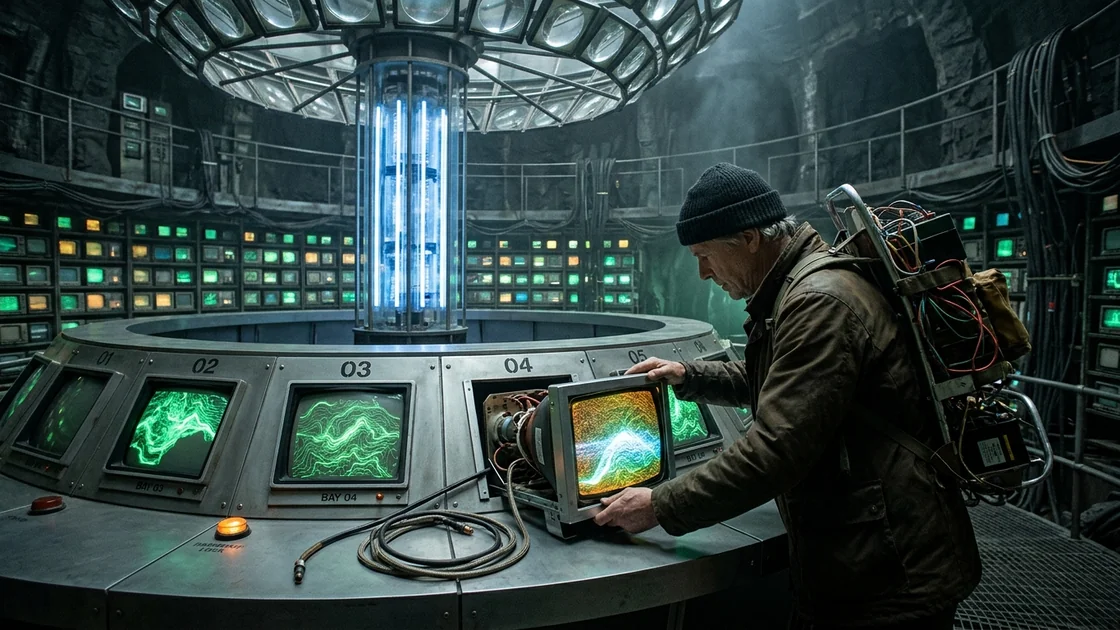
Arthur Pendelton spent his life rescuing obsolete cathode-ray tube televisions from landfills and estate sales, finding comfort in the warm hum of high-voltage transformers and the glow of phosphor screens. His quiet existence in a cluttered Oregon basement changes when he acquires a heavy, unmarked military-grade monitor from a liquidated forestry warehouse. Upon restoring the unit’s failing circuitry, Arthur discovers that the static on its screen is not random thermal noise, but a synchronized, high-resolution topographical map generated by a hidden subterranean signal. Obsessed with decoding the transmission, he traces the coordinates into the deep wilderness of the Cascade Mountains, carrying the modified monitor on his back as a compass. His journey leads him to a forgotten Cold War geophysical facility buried beneath a collapsed relay tower, where an immense analog computer made of thousands of glowing screens has been running unattended for forty years, waiting for its missing master monitor to be returned before the entire subterranean system loses synchronization forever.
I. The Sanctuary of Glass and Vacuum
There is a specific smell to the twentieth century, and Arthur Pendelton kept it bottled in his basement. It was a compound aroma composed of warm phenolic circuit boards, vaporized rosin flux, fifty-year-old household dust baking gently on glass envelopes, and the sharp, thunderstorm tang of ozone generated by twenty-seven thousand volts of direct current.
To anyone else in the damp, timber-lined valley of Mill Creek, Oregon, Arthur’s basement was a fire hazard or a museum of worthless junk. The local recycling center off Highway 22 charged forty dollars by weight to take a cathode-ray tube, which meant people frequently left them on Arthur’s porch in the dead of night like unwanted infants. He never complained. Every morning he would open his front door, look out at the mist hanging low in the Douglas firs, and find a Sony Trinitron with a cracked bezel or a wood-grained Zenith console wrapped in a soggy blue tarp. He would haul them down the bulkhead stairs on a cushioned appliance dolly, wipe the rain from their curved glass faces, and add them to the stacks.
Floor-to-ceiling industrial steel shelving lined the concrete walls of the basement, reinforced with timber cross-braces to support the immense dead weight of leaded glass and copper yokes. He had three hundred and fourteen working sets, and another sixty in various states of surgical disassembly. There were tiny five-inch portable kitchen televisions from the late seventies, their white plastic shells yellowed like old ivory; massive thirty-six-inch consumer tubes from the turn of the millennium that required an engine hoist to move; and his prized wall of professional video monitors—Ikegamis, JVC studio decks, and gray metal Sony PVMs salvaged from television stations in Portland and Seattle when they gutted their control rooms during the mandated transition to digital broadcasting in 2009.
That transition had ended Arthur’s career as a senior broadcast maintenance engineer, leaving him at fifty-two with a small pension, a paid-off cedar shake house at the edge of the national forest, and a skill set that the modern world regarded the same way it regarded blacksmithing or whalebone carving.
Modern flat panels disgusted him. An liquid crystal display or an organic light-emitting diode screen was a static grid of millions of tiny switches, cold and clinical, holding a fixed image until told to change. They had no soul because they had no motion. A cathode-ray tube, by contrast, was a miracle of kinetic violence contained within a vacuum. At the back of the neck, a heated barium-coated cathode boiled off a cloud of electrons. Grids of positively charged metal accelerated those particles to a fraction of the speed of light, focusing them into a beam narrower than a needle, while electromagnetic coils wrapped around the throat of the funnel bent that beam back and forth across the inside of the glass face. Fifteen thousand, seven hundred and thirty-four times every second, the beam swept horizontally from left to right, painting a single line of light before snapping back in the dark during the horizontal blanking interval to start the next line down.
At any given microsecond, a CRT screen was almost entirely black. There was only a single, blazing point of excited phosphor racing through the darkness, relying on the brief chemical persistence of zinc sulfide and the slow chemical retention of the human retina to create the illusion of a whole picture. It was not a static matrix; it was a symphony of timing, high voltage, and magnetism.
On a Tuesday evening in late October, while rain drummed steadily against the high basement casement windows, Arthur was crouched behind the open chassis of a 1984 Commodore 1702 monitor. He held an insulated plastic alignment wand in his right hand and a small mirror propped on the workbench in front of the screen so he could see the test pattern while working around the exposed neck of the tube.
"Come on, you stubborn old thing," Arthur murmured, his voice gravelly from hours of silence. He wore a magnifying visor pushed up on his forehead, his gray hair sticking out in tufts around the plastic headband.
The high-voltage flyback transformer emitted its characteristic fifteen-kilohertz whistle—a sound most people over forty lost the ability to hear, though Arthur could still perceive it as a physical pressure behind his molars. He turned a tiny brass screw inside a tunable inductor coil by a sixteenth of an inch. In the mirror, the red, green, and blue crosshatch lines slid smoothly together, merging into crisp, pure white grid lines against a velvety black background.
He exhaled slowly, pulling his hand back from the bare copper braids and the thick red silicone wire leading to the anode cap on the side of the glass bulb. One slip of the wrist against the flyback chassis or the focus block wouldn't necessarily kill a man if his other hand wasn't grounded, but the resulting muscular contraction would throw him across the concrete floor and crack his elbow against the drill press. Respect for the potential energy stored in the glass capacitor of a picture tube was the first rule of the basement.
His landline telephone rang. It was an old Western Electric Model 500 mounted near the stairs, equipped with twin brass bells that cut right through the white noise of the rain and the hum of his isolating transformers.
Arthur set the alignment wand down on a rubber mat, flipped the main toggle on his variac power supply to bring the Commodore safely down to zero volts, and walked over to pick up the heavy black receiver.
"Pendelton," he said.
"Arthur? It’s Harlan down at the county yard." The voice on the other end was accompanied by the clatter of a dot-matrix printer or a loud space heater. Harlan Vance ran the Clackamas County surplus and liquidation depot out near Estacada, a sprawling collection of leaky Quonset huts where retired police cruisers, broken snowplows, and decades of municipal office clutter went to wait for public auction.
"Evening, Harlan. Little late for you to be in the office, isn't it?"
"State auditors are coming down from Salem on Thursday," Harlan said, sounding exhausted. "They want the North Annex cleared out completely so they can turn it into salt storage before the November freezes hit. We pulled four pallets of old electronics out of the basement of the old Civil Defense and Forestry Annex up on Blackwood Ridge last month when they demolished the foundation. My boys were going to load the whole lot into the roll-off dumpster for the e-waste haulers in the morning, but I saw a couple of round-glass tubes in the crates and thought of you."
Arthur’s posture straightened. The Blackwood Ridge facility had been a joint United States Forest Service and state emergency communications relay built during the Eisenhower administration. He had driven past its rusted chain-link fences twenty years ago when hunting chanterelles. "What kind of tubes, Harlan? Oscilloscopes? Broadcast monitors?"
"Hell if I know, Artie. Gray metal boxes. Heavy as engine blocks. No plastic on 'em anywhere. If you want to look through the pallets before the scrap truck backs in at seven tomorrow morning, I’ll leave the padlock off the side door of Hut Three until nine tonight. Cost you a six-pack of that dark porter you buy in town."
"Make it a twelve-pack," Arthur said, already looking toward his truck keys hanging on the pegboard by the stairs. "I’ll be there in forty minutes."
II. The Estate on Blackwood Ridge
The drive to the county yard took Arthur down ten miles of winding two-lane blacktop bordered by second-growth hemlock that leaned inward over the road like the ribs of a cathedral. His 1993 Ford F-150 had three hundred thousand miles on the straight-six engine and a heater core that smelled faintly of maple syrup, though it pushed enough hot air to keep the windshield clear of fog. The wipers slapped a steady, hypnotic rhythm against the deluge.
When he turned through the open chain-link gates of the county yard, the security floodlights were buzzing in the mist, casting long orange shadows across rows of gravel piles and rusted culvert pipes. Harlan’s pickup was already gone, but true to his word, the brass master lock on the corrugated pedestrian door of Quonset Hut Three was hooked open through the hasp.
Arthur stopped at the cab of his truck to grab a heavy-duty Maglite and a pair of leather rigging gloves, leaving the promised twelve-pack of porter just inside the office vestibule under a yellow slicker.
Hut Three was unheated and smelled of wet concrete, diesel soot, and mouse droppings. The rain hammering on the curved galvanized steel roof sounded like thousands of ball bearings being dumped onto a drumhead. Arthur clicked on the flashlight, its beam cutting through the damp air to illuminate the back corner where four wooden pallets sat wrapped in peeling layers of dirty shrink-wrap.
He pulled a utility knife from his pocket and sliced through the plastic.
The first two pallets held typical government surplus from the late seventies and early eighties: green-screen Lear Siegler dumb terminals with keyboards that weighed ten pounds apiece, rack-mount Tektronix waveform monitors with missing knobs, and several rusted steel cabinets containing magnetic tape drives whose pinch rollers had turned into black tar from decades of humidity. Useful for spare potentiometers and high-grade silver-mica capacitors, perhaps, but nothing extraordinary.
The third pallet held old Motorola two-way base stations and linear amplifiers.
It was on the bottom layer of the fourth pallet, wedged beneath a crate of yellowed civil defense fallout shelter signs and a coil of pressurized coaxial transmission line, that Arthur found the box.
It wasn't in a cardboard carton. It was housed inside its own custom-fitted transit case made of vulcanized black fiberboard with reinforced steel corners and recessed butterfly latches, similar to the flight cases used by network news crews, only much older. Stenciled across the top in faded yellow military block letters was a single line of text:
DEPT. OF GEOPHYSICAL SURVEY — SUB-RASTER UNIT 04 — HANDLE WITH EXTREME CARE
Arthur knelt on the cold concrete, his knees popping, and flipped the four spring-loaded latches. They snapped open with stiff, greased precision. When he lifted the lid, a faint draft of dry, preserved air escaped—the smell of silica gel packets that had spent forty years sealing out the Oregon damp.
Nested inside dense, decaying gray polyurethane foam was a monitor.
Arthur let out a low whistle. It was a nine-inch diagonal unit, judging by the thick bezel, but the cabinet was disproportionately deep—nearly twenty-four inches from the front glass to the rear heatsink fins. The housing was not stamped sheet metal; it was milled from thick, die-cast aluminum plates held together by recessed Allen-head machine screws and painted in a textured, wrinkle-finish battleship gray. Two beefy chrome handles projected from the front rack ears, designed to protect the controls if the unit were laid face-down.
He reached in, gripped the front handles and the rear chassis lip, and braced his back to lift it out of the foam.
He grunted in surprise. A standard nine-inch Sony PVM weighed about seventeen pounds. This thing weighed closer to fifty. It felt less like an electronic appliance and more like a piece of naval artillery or a radiation shield.
Setting it carefully on top of the transit case, Arthur played his flashlight beam over the front panel. The glass of the cathode-ray tube was strangely dark, almost black even under the direct glare of the bulb, with a slight purplish-blue anti-reflective coating that suggested high-density neodymium-doped glass. Around the curved rectangular viewport, the aluminum bezel was marked with finely engraved tic marks along both the horizontal and vertical axes, numbered in millimeters like a laboratory reticle.
Beneath the screen sat a row of heavy, knurled aluminum knobs with locking collets: INTENSITY, FOCUS, ASTIGMATISM, HORIZ PHASE, VERT HOLD, and two unfamiliar controls labeled TELLURIC BIAS and HARMONIC LOCK. There was no channel selector, no volume knob, and no brand name anywhere on the faceplate. Only a small, stamped brass plate riveted to the bottom right corner that read:
SYNC-7 ARCHITECTURE / ANODE 22KV / SERIAL NO. 004-B
Arthur spun the unit around to inspect the rear panel. Instead of standard RCA jacks or even the usual 75-ohm BNC video connectors found on broadcast gear, there was a single massive three-lug triaxial connector—the kind used for high-frequency, low-noise instrumentation in particle accelerators or early satellite ground stations—alongside a heavy three-prong twist-lock AC power receptacle and a massive copper grounding lug the size of a thumb. Next to the grounding lug was a circular window of thick quartz glass, behind which sat a sealed vacuum relay filled with what looked like a puddle of liquid mercury.
"What on earth were the forestry boys looking at with you?" Arthur whispered.
He packed the monitor back into its vulcanized transit case, latched it tight, and carried it out to the tailgate of his truck. He grabbed two of the Tektronix scopes from the first pallet just to justify his trip to anyone who might ask, threw a canvas tarp over the load, and drove back through the rain toward Mill Creek with the heavy black case sliding gently against the wheel well every time he took a curve.
III. The Anatomy of an Anomaly
By eleven o'clock that night, the Sync-7 unit was sitting on the primary isolation bench in the center of Arthur’s basement.
He never plugged an unknown vintage piece straight into wall current. Electrolytic capacitors—little aluminum cans filled with conductive paste and rolled foil—degraded when left unpowered for decades. If you slammed full line voltage into a dried-out capacitor from 1972, it would short out, boil its remaining electrolyte into hydrogen gas, and explode like a shotgun shell, taking irreplaceable transformers with it.
First came the visual inspection. Arthur selected a set of hollow-ground hex keys and removed the sixteen machine screws securing the top and side plates of the cast-aluminum shell. When he lifted the top cover off, he stopped and stared for a full two minutes.
In forty years of repairing electronics, he had never seen build quality like this. Every single wire in the chassis was silver-plated, Teflon-insulated, and laced together into neat, ninety-degree harnesses using waxed linen cord—a lost art practiced by NASA contractors and Bell Labs technicians in the late sixties. The circuit boards weren't brown phenolic paper; they were thick, translucent green epoxy-fiberglass with heavy gold-plated traces that gleamed pristine and untarnished under his bench lamp.
The cathode-ray tube itself was a marvel. It was strapped into a cradle of mu-metal—a specialized nickel-iron alloy used to shield sensitive electron beams from external magnetic fields. The glass funnel was twice as thick as a commercial television tube, and around its neck sat not one, but two deflection yokes: a standard magnetic winding for raster scanning, and a secondary, tightly wound precision coil for high-speed electrostatic or auxiliary vector positioning.
"A hybrid raster-vector display," Arthur muttered, pulling his magnifying visor down over his eyes. "Like an old radar scope crossed with a studio monitor."
Then he noticed the black box.
Mounted to the bottom floor of the chassis, occupying the space where a standard television tuner would normally sit, was a solid brick of black potting compound—industrial epoxy resin poured over a circuit to make it vibration-proof, waterproof, and completely impossible to reverse-engineer without dissolving the components in fuming nitric acid.
Out of this black epoxy brick ran four thick coaxial cables leading directly to the video amplifier board and the horizontal and vertical sync generators. A fifth cable, as thick as a garden hose and wrapped in braided bronze armor, ran from the black brick to a twelve-inch rod of solid ferrite wound with thousands of turns of hair-thin Litz wire, mounted along the entire bottom length of the frame.
Arthur frowned, touching the ferrite rod with the tip of a wooden dowel. It was a magnetic loop antenna—specifically, an ultra-low-frequency or very-low-frequency loop, the kind submarines used to receive transmissions through hundreds of feet of seawater, or geologists used to measure magnetotelluric currents moving through continental bedrock.
"Why would a closed-circuit video monitor have an internal subterranean radio receiver?" he asked the empty room.
He checked the main power filter capacitors with an equivalent series resistance meter. Rather than cheap wet aluminum electrolytics, the designers had used military-spec hermetically sealed wet tantalum and oil-filled paper capacitors in steel cans. Every single one tested within two percent of its factory specification stamped on the side in 1971. The machine had been built to survive a nuclear war, or at least a century in a damp cave.
Arthur fabricated a power cord using a salvaged twist-lock plug from his parts bin and wired it into his variac—a variable autotransformer that allowed him to dial the AC voltage up from zero to one hundred and twenty volts one volt at a time while monitoring the current draw on an analog ammeter.
He left the triaxial video input on the back completely disconnected. With no input connected, the monitor should simply display a blank raster—a flat gray or green field—or, if the internal receiver was active, random thermal snow.
He flipped the power toggle on the front of the Sync-7 and began turning the heavy black dial on the variac.
At forty volts, the mercury relay at the back clicked with a dull, liquid thud.
At seventy volts, the orange glow of the cathode heater bloomed inside the glass neck of the tube, warming the electron gun.
At ninety-five volts, the high-voltage supply kicked in. Unlike the shrill fifteen-kilohertz whine of a standard television, the flyback transformer in the Sync-7 ran at a much higher horizontal scan rate—somewhere around thirty-one kilohertz, completely ultrasonic, though Arthur could feel the electrostatic field prickle the tiny hairs on the back of his knuckles as the twenty-two-kilovolt anode charged the glass bulb.
He brought the variac up to a full one hundred and seventeen volts. The ammeter needle settled at a steady, healthy 1.4 amps.
Arthur stepped around to the front of the bench and looked at the nine-inch screen.
For three seconds, it remained dark. Then, slowly, a deep, dual-layer phosphor began to fluoresce. It was a P7 cascade phosphor—an old radar formulation where a fast-decaying blue-white layer excited a slow-decaying yellow-green layer beneath it, leaving glowing amber-green trails behind anything that moved across the screen.
Static filled the frame.
At first glance, it looked like ordinary television snow—the chaotic dance of cosmic background radiation and thermal noise in the amplifier transistors. Arthur reached out and adjusted the FOCUS and ASTIGMATISM knobs until the individual grains of noise were razor-sharp, pinpricks of brilliant blue-white light fading into emerald green shadows.
Then he leaned closer, his nose six inches from the leaded glass.
The snow wasn't random.
In a normal television, static boils. A white dot appears for a sixtieth of a second and vanishes forever, never to be repeated in the same sequence. Here, the grains of light were clustering. Every four seconds, a faint, darker wave swept diagonally from the top-left corner to the bottom-right, and in its wake, the snow seemed to catch on invisible snags, like silt flowing over rocks in a shallow riverbed.
Arthur’s heart rate ticked upward. He reached for his Tektronix 465 oscilloscope on the shelf above the bench, powered it on, and clipped a 10x attenuator probe onto the video output test point on the Sync-7’s neck board, grounding the clip to the aluminum chassis.
On the oscilloscope’s small green grid, the composite video waveform appeared. The horizontal sync pulses were rock-solid, square-shouldered valleys dropping down to minus zero point three volts. Between them, where the active video signal lived, there was a dense forest of noise—except the noise floor was modulated by a massive, slow, complex sine wave that wasn't coming from the 60-hertz wall outlet.
He switched the scope’s timebase down to milliseconds, then microseconds, then flipped the Sync-7’s front panel knob labeled TELLURIC BIAS.
As he turned the heavy aluminum knob clockwise, a variable capacitor inside the chassis meshed its silver plates together, tuning the ferrite loop antenna at the base of the monitor.
Through the small test speaker built into his oscilloscope cart, which was wired to audio-monitor whatever signal the probe was touching, a sound emerged. It wasn't the hiss of white noise. It was a deep, rhythmic thrumming, overlaid with rapid, chirping phase-shifts—like the sound of heavy machinery rotating deep inside a granite mountain, accompanied by a burst of high-speed telemetry every sixty-fourth of a second.
On the face of the Sync-7 monitor, the snow suddenly snapped into alignment.
IV. The Ghost in the Raster
Arthur stumbled back half a step, knocking his stool over onto the concrete floor. He didn't bother picking it up.
The static hadn't disappeared; rather, it had organized itself into density gradients. Where the snow was thick and rapid, it formed bright, shimmering ridges of blue-white light. Where the electron beam was suppressed during microsecond intervals, it left dark, winding valleys of deep olive-green.
It was a contour map.
The image was rolling slowly upward and tearing sideways at the edges, like a television with a misadjusted hold control. Arthur’s hands moved by pure muscle memory, his fingers finding the VERT HOLD and HORIZ PHASE collets on the front panel. He unlocked the knurled rings and turned them with micro-adjustments, watching the tearing edges straighten out and the vertical roll slow down until the frame locked with a sharp electromagnetic clack from the internal relay.
The knob labeled HARMONIC LOCK had a small neon indicator bulb beside it. As the frame stabilized, the tiny glass bulb ignited with a steady orange glow.
Arthur stood frozen in the dim basement, the blue-green light of the nine-inch tube reflecting in the lenses of his magnifying visor.
The screen displayed a square area of terrain seen from directly above, rendered entirely through modulated bursts of static and sweeping vector lines. Concentric rings of flickering dots traced elevation lines—steep ridges rising to a sharp, conical peak in the upper right quadrant, while a braided, branching channel of complete darkness cut through the lower left like a river gorge.
"That's not a pre-recorded image," Arthur said aloud, his voice barely a whisper. "There's no storage medium in this chassis. No ROM chips, no magnetic core memory, no delay lines."
To verify it, he took a large sheet of steel sheet metal from his scrap bin and slid it beneath the monitor, blocking the bottom where the ferrite loop antenna sat. Instantly, the lower half of the topographical map dissolved back into chaotic, unorganized snow, and the orange HARMONIC LOCK light began to sputter. When he pulled the steel sheet away, the map snapped back into crystal clarity within two sweeps of the raster.
The monitor was receiving a live transmission.
Not through the air on VHF or UHF broadcast bands—those frequencies couldn't penetrate the earth surrounding his concrete basement with that kind of phase stability, nor would they be picked up by a high-inductance ferrite rod tuned to less than thirty kilohertz. The signal was coming up through the bedrock of the Cascade Range itself, a ground-wave or magnetotelluric carrier wave vibrating through the basalt and granite crust, and the black epoxy module inside the Sync-7 was demodulating that subterranean hum into a standard raster scan.
Look closer, he told himself. Look like an engineer.
He pulled his stool upright, sat down, and adjusted the VERT HOLD slightly off-center so he could inspect the vertical blanking interval—the thick black bar that normally sits hidden off the top and bottom edges of a television screen, used by broadcasters to carry closed-captioning data, timecodes, and test signals.
Sure enough, embedded in lines fourteen through twenty-one of the black bar, a row of crisp vector characters was being drawn by the secondary deflection coil. Unlike the snowy raster map below, these characters were solid, continuous strokes of light:
45°14'08.2"N 121°52'44.9"W // CARRIER: 14.22 KHZ // PHASE DRIFT: +4.08 RAD // UNIT 04 DISCONNECTED // SEEKING BUS SYNC
Below the text, in the main body of the topographical map, two distinct symbols were overlaid on the snowy terrain.
In the center of the map, nested inside a tight knot of elevation lines near the headwaters of the dark river gorge, was a pulsing octagon surrounded by three concentric circles.
And down in the very bottom-left corner of the screen, barely a quarter-inch from the aluminum bezel, was a tiny, blinking cross.
Arthur stared at the blinking cross. He reached out, gripped the two chrome handles on the front of the monitor, and rotated the entire fifty-pound chassis forty-five degrees to the left on his workbench.
On the screen, the entire topographical map rotated forty-five degrees clockwise in real time, while a tiny vector arrow extending from the blinking cross stayed pointed squarely toward the pulsing octagon in the center of the screen.
"A fluxgate magnetometer," Arthur breathed, looking back into the open chassis at the black epoxy brick. "It has an internal solid-state compass coupled to the deflection yoke. The cross in the corner... that’s here. That’s my basement."
He got up and walked hurriedly to a tall oak flat-file cabinet in the corner of the shop where he kept vintage service schematics and a stack of United States Geological Survey 7.5-minute quadrangle maps he used when hiking out to check on old amateur radio repeaters in the Mount Hood National Forest.
He leafed through the large paper sheets until he found the quadrangles for High Rock, Bull of the Woods, and Mount Wilson. He carried them back to the bench, switched on an overhead drafting lamp, and laid the maps out over the chassis of a disassembled Zenith console.
Using a pair of brass dividers and a plastic protractor, he located 45 degrees, 14 minutes, 08.2 seconds North by 121 degrees, 52 minutes, 44.9 seconds West.
The points of the brass dividers came down right in the middle of a blank, steep expanse of green ink on the USGS map, twelve miles southeast of Blackwood Ridge, deep inside the Bull of the Woods Wilderness Area. According to the government map, printed in 1981 and revised in 1996, there was nothing there except a four-thousand-foot basalt ridge called Devil’s Peak, a seasonal creek drainage named Dry Gulch, and an abandoned Forest Service fire lookout trail that had been decommissioned after the Columbus Day Storm of 1962.
Arthur picked up a sheet of clear acetate used for overhead projectors, taped it directly onto the curved glass face of the Sync-7 monitor, and used a fine-tipped red grease pencil to trace the river channels, the ridge peaks, and the pulsing octagon from the static pattern.
Then he peeled the acetate off and laid it over the USGS map, adjusting his distance until the scale matched.
The alignment was uncanny, yet deeply unsettling. The river channels and mountain peaks on the acetate matched the USGS paper map down to the smallest switchback of the creek bed. However, on the acetate traced from the monitor’s static, there were structures beneath the elevation lines.
Extending outward from the pulsing octagon at the center of the ridge was a geometric web of straight lines—six long spokes radiating half a mile in every direction through the solid rock of the mountain, connected by hexagonal perimeter tunnels. Next to the main octagon, a tiny string of numbers flickered on the screen every ten seconds:
DEPTH: -340 FT // CORE TEMP: 108.4 C // DAMPING LOOP: UNSTABLE
Arthur looked from the map back to the glowing green-and-white
screen. The message in the vertical blanking interval flashed steadily:
UNIT 04 DISCONNECTED // SEEKING BUS SYNC. And on the brass
plate riveted to the front of his monitor:
SERIAL NO. 004-B.
This monitor was Unit 04.
For forty years, or however long it had been sitting in that vulcanized flight case in the basement of the Blackwood Ridge forestry annex, whatever machine was buried three hundred and forty feet beneath the basalt of Devil’s Peak had been broadcasting a continuous, fifteen-kilohertz ground-wave cry into the stone of the Cascade Mountains, waiting for its fourth eye to come back online.
V. Cartography of the Invisible
Arthur did not sleep that night, nor did he sleep much over the next three days.
During the daylight hours, he kept the basement curtains drawn so the ambient light wouldn't wash out the subtle phosphor trails of the Sync-7. He set up a Nikon F3 film camera on a heavy tripod in front of the workbench, loaded with Ilford Delta 400 black-and-white film, and took long-exposure photographs of the screen—four-second, eight-second, and thirty-second exposures.
When he developed the negatives in his utility sink that evening and hung them to dry over the washing machine, the results took his breath away.
Because random thermal noise averages out over time while periodic signals reinforce themselves on photographic emulsion, the thirty-second exposures completely eliminated the snowy grain of the static. What remained on the film was an astonishingly detailed, razor-sharp architectural cross-section of the mountain.
The facility beneath the ridge was vast. The six radiating spokes he
had seen in real time were waveguides or sensor boreholes drilled
horizontally into the tectonic fault lines of the mountain. The central
octagon was a vertical cylindrical shaft, divided into five subterranean
levels descending toward a geothermal magma intrusion or deep fault zone
at the bottom of the mountain—which the telemetry labeled
TELLURIC ANODE.
And as Arthur compared the photographs taken on Tuesday night with those taken on Thursday afternoon, he noticed something that made the skin on the back of his neck tighten.
The number labeled PHASE DRIFT in the vertical blanking
interval had climbed from +4.08 RAD to
+4.61 RAD. The CORE TEMP had risen from
108.4 C to 111.2 C. And on the graphical map,
the pulsing octagon at the center was developing a slight jagged
distortion along its western wall—a harmonic jitter that caused the
horizontal scan lines in that specific part of the screen to tear and
bloom brightly, indicating an electrical overload or a synchronization
failure in the facility itself.
"It's an analog feedback loop," Arthur reasoned, pacing the narrow aisle between rows of stacked Sony Trinitrons, a mug of cold black coffee in his hand. "In early industrial control systems, before microprocessors, they sometimes used optical-electronic loops. You display a telemetry parameter as a beam on a cathode-ray tube, and you put a photomultiplier tube or a cadmium-sulfide photoresistor against the glass to read the brightness or position of the spot. If the spot drifts, the sensor adjusts a valve or a saturable reactor to bring the system back into balance."
He stopped in front of the Sync-7.
"If Unit 04 was pulled out of the master console for service and never put back, one leg of the stabilization bridge has been running on a dummy load or a degraded backup circuit for decades. And now that backup is failing."
What happens when a geothermal tap three hundred and forty feet underground loses its damping loop? At best, the equipment burns itself out, melting forty years of irreplaceable analog engineering into slag. At worst, if it was regulating high-pressure steam vents in an active volcanic range, it could blow out a borehole and trigger a landslide into the municipal watershed.
On Friday morning, Arthur drove into the county library in Oregon City and spent three hours feeding dimes into the microfilm reader, scrolling through issues of the Oregonian and the Estacada News from 1966 to 1985.
He found only two references to the site. The first was a brief four-sentence notice from August 1968 announcing that the United States Department of the Interior, in conjunction with the Advanced Research Projects Agency, had leased four thousand acres around Devil’s Peak for a "Deep Crustal Seismic and Magnetotelluric Observatory" to study earthquake propagation along the Cascadia subduction zone.
The second article was from November 19, 1983. During a ferocious early-winter ice storm that knocked out power to half of Clackamas County, a Forest Service helicopter had been dispatched to evacuate three civilian contract technicians from the Blackwood Ridge relay station after a landslide buried the access road to the Devil’s Peak observatory. One of the technicians, a man named Dr. Walter Vance—no relation to Harlan, or perhaps an uncle—had suffered a fatal coronary during the hike out from the upper ridge, and the federal funding for the observatory was quietly terminated in the congressional budget bill the following month.
"He carried it out," Arthur whispered, staring at the grainy microfilm image of the icy mountain road. "The landslide cut the landline or the power tie, or Unit 04 developed a fault during the storm. He pulled the module from the master console, put it in its flight case, and lugged fifty pounds of aluminum and leaded glass down the ridge to the relay station at Blackwood to fix it, or to keep the system from running away while they evacuated. And then he died before he could ever take it back up."
Arthur rewound the microfilm spool slowly. The clatter of the plastic reel sounded remarkably like the mercury relay at the back of the monitor.
He looked at his hands. He was fifty-nine years old. He had a touch of arthritis in his left knee when the barometer dropped, and he hadn't hiked more than five miles with a pack since his fifties. Nobody knew he had the monitor. He could put the top cover back on the Sync-7, leave it on a shelf in his basement as a conversation piece for nobody, and watch over the next few weeks as the phase drift hit its limit and the snowy map on the screen went dark forever.
Or he could take Unit 04 home.
VI. Field Modification
The problem was physics.
Even in his prime, Arthur could not hike six miles up an overgrown, washed-out mountain trail with a three-thousand-foot elevation gain while carrying a fifty-pound metal box that required 117 volts of alternating current to operate. And he needed it to operate on the hike; the USGS maps didn't show the entrance to the facility, and forty years of Pacific Northwest rainforest growth—hemlock, devil's club, vine maple, and mudslides—would have erased any trace of trails or concrete hatches. The monitor itself, with its real-time fluxgate compass and high-resolution subterranean radar overlay, was the only map capable of guiding him to the door.
"So we put it on a diet," Arthur said, rolling up his flannel sleeves as soon as he returned to his basement.
He spent Friday afternoon stripping the Sync-7 down to its essential skeleton. He removed the quarter-inch-thick die-cast aluminum armor plates, the heavy steel rack-mount handles, and the secondary internal blast shielding—pieces that had been added to protect the unit from falling rock or electromagnetic pulses, accounting for nearly twenty-four pounds of dead weight.
Next, he examined the power supply. The massive iron core transformer at the rear of the chassis weighed eleven pounds by itself. Its job was simply to step 117-volt AC wall current down to +24 volts DC for the solid-state deflection and receiver boards, and +6.3 volts for the tube heater.
"Why invert DC battery power up to 117 volts AC just so twenty pounds of iron can step it back down to 24 volts DC?" Arthur muttered, reaching for his soldering station.
He unsoldered the secondary taps of the heavy iron transformer, unbolted the massive block of metal from the chassis frame, and lifted it out. By bypassing the AC linear power supply entirely, he could feed pure 24-volt direct current straight from two lightweight lithium-iron-phosphate battery packs directly into the main voltage regulator rail, using a tiny, two-ounce buck converter to drop a parallel line down to 6.3 volts for the CRT filament.
He tested the modification on the bench. With the batteries wired directly to the DC bus, the mercury relay clicked, the cathode glowed, and the twenty-two-kilovolt flyback transformer spun up instantly without a single hertz of AC hum. The screen bloomed to life, clearer and steadier than before, pulling only forty-two watts of continuous power. At that rate, his twin lithium battery packs would run the tube continuously for nearly twelve hours.
Now the entire stripped chassis—consisting only of the aluminum baseplate, the mu-metal-shielded nine-inch CRT, the circuit boards, and the black epoxy receiver module with its ferrite loop—weighed just under nineteen pounds.
To protect the exposed glass neck of the tube and the high-voltage anode from rain and branches without putting the heavy cast armor back on, Arthur took an old external-frame Kelty mountaineering backpack from his storage closet. He stripped the nylon bag off the tubular aluminum frame and fabricated a lightweight cage out of corrugated polycarbonate greenhouse sheeting and aluminum angle stock, riveting it directly to the pack frame.
Wait—if he wore the monitor on his back, he wouldn't be able to see the screen while walking.
He thought about that for ten minutes, staring at a pile of dead camcorders on his third shelf. No, a small camera pointed at the CRT wouldn't capture the full resolution of the static map. Instead, he mounted the main chassis, the batteries, and the heavy ferrite antenna to the rear backpack frame to keep the weight centered over his hips, and rigged a hinged, telescoping aluminum arm that swung around his left side, holding a lightweight polished front-surface mirror from an old rear-projection television at a forty-five-degree angle—Wait. No, a mirror over the shoulder in a dense forest would catch on every branch and leave the glass tube pointing forward over his shoulder or backward into the trees.
Better yet: he separated the CRT display assembly from the heavy baseplate.
The Sync-7 had been designed with modular servicing in mind. The deflection yoke, the high-voltage anode lead, and the neck-board socket were all connected to the main chassis via a three-foot umbilical of heavily shielded coaxial and silicone cables, coiled up neatly inside the frame so a technician could pull the tube out onto a bench while the chassis remained bolted inside a submarine or bunker rack.
Arthur uncoiled the factory umbilical. He mounted the nineteen-pound chassis, the ferrite antenna, the black epoxy module, and the lithium batteries onto the aluminum backpack frame, wrapped tightly in a waterproof rubberized poncho. The nine-inch tube itself, inside its thin cylindrical mu-metal shield and aluminum front bezel, weighed only eight pounds. He bolted two steel D-rings to the sides of the tube shield and clipped it to a padded surveyor’s chest harness, building a watertight shroud out of a rubber oscilloscope viewing hood to cover the exposed neck and socket at the back against his chest.
He strapped the rig on and looked at himself in the full-length mirror at the bottom of the basement stairs.
With the backpack frame riding high on his shoulders and the nine-inch dark glass screen strapped squarely to his chest like an oversized camera or an deep-sea diver’s lamp, he looked like an astronaut from a forgotten 1960s Soviet film.
He flipped the weatherproof toggle switch he had wired onto the side of the chest bezel.
Against his sternum, the high-voltage supply gave a tiny electrostatic tick. Looking straight down into the tilted rubber viewing hood, the amber-green glow of the P7 phosphor illuminated his chin and the grey stubble on his cheeks. The topographical map materialized, locking onto the subterranean carrier wave within three seconds. As he turned his body toward the bulkhead stairs, the map rotated smoothly inside the viewport, the vector arrow pointing northeast toward the dark mass of the Cascade Mountains.
"All right, Unit 04," Arthur said softly. "Let’s go see who’s calling."
VII. Into the Rain Shadow
He left his house at four-thirty on Saturday morning.
The rain had stopped around midnight, replaced by a thick, freezing fog that rolled down off Mount Hood and settled into the river valleys. Arthur drove east past Estacada, following the Clackamas River highway where the asphalt ran dark and slick between towering walls of wet basalt and dripping moss. There were no other cars on the road—not even log trucks at this hour on a weekend.
Twenty miles past the Ripplebrook ranger station, he turned off the paved highway onto Forest Service Road 46, then onto a series of progressively narrower gravel spurs numbered 4690 and 240. Here, the alder trees grew so close to the road that their wet branches scraped loudly down both sides of the Ford’s cab, showering the windshield with heavy drops of ice water.
At six-fifteen, as the first gray, sour light of dawn began to filter through the high canopy, the road ended.
Across the gravel track sat a five-foot wall of moss-covered boulders and dirt—a tank trap dug by a Forest Service bulldozer decades ago to close the road permanently—followed twenty yards further up by the remains of the Blackwood slide: a massive scar of gray clay and rotting silver-gray tree trunks that had swept away half the mountainside in 1983.
Arthur pulled the truck into a wide turnout hidden behind a stand of young noble firs, killed the engine, and sat in the sudden, overwhelming silence of the deep woods.
He ate two peanut butter sandwiches and drank a thermos of hot tea while studying the paper map one last time. Then he climbed out into the thirty-eight-degree air, his breath pluming white, and pulled on his waxed cotton tin-cloth jacket, wool watch cap, and waterproof gaiters.
Lifting the modified backpack onto his tailgate, he slipped his arms through the padded shoulder straps, buckled the heavy waist belt to transfer the weight of the batteries and receiver chassis to his pelvis, and clipped the nine-inch CRT housing onto his chest harness, cinching the stabilizer straps tight so it wouldn't bounce when he walked. Into his side pockets went a steel pry bar, a compact Fluke digital multimeter, a roll of electrical tape, two high-output LED headlamps, a packet of freeze-dried beef stew with a folding sterno stove, and a heavy leather holster containing his father’s old .357 Smith & Wesson revolver—not for people, as nobody had walked this drainage since Reagan’s first term, but for the black bears and cougars that denned in the rockslides along Dry Gulch.
He reached down and flipped the toggle switch on the CRT bezel.
In the grey morning twilight, the nine-inch screen came alive with a warm, ghostly emerald radiance. The internal mercury relay gave its muffled thud behind his shoulder blades as the receiver locked onto the 14.22-kilohertz ground wave.
DISTANCE TO BUS: 4.82 MILES // PHASE DRIFT: +5.12 RAD // CORE TEMP: 114.8 C
The temperature had risen another three degrees overnight.
Arthur climbed over the earthen berm, his heavy Vibram-soled boots sinking an inch into the wet pine needles and black humus on the other side, and began the ascent.
For the first two miles, there was still a ghost of the old service road—a flat bench cut into the steep slope of the mountain, though it was now choked with six-foot-tall thickets of salmonberry and prickly devil’s club, and cut every hundred yards by deep ravines where winter runoff had blown out the rusted steel culverts.
The monitor on his chest was an uncanny companion. Because its electron beam was scanning continuously, it gave off a faint, gentle heat from the filament and the deflection yoke, warming the front of his jacket in the freezing mountain air. Every twenty steps, Arthur would glance down into the rubber viewing hood.
He didn't need to look at the trees or the sky to know where he was. The static map was far more accurate than any satellite GPS could ever be under triple-canopy old-growth forest. Because the 14-kilohertz signal was traveling through the rock beneath his boots and reflecting off the density boundaries of the soil and stone above it, the monitor showed him the exact profile of the buried roadbed beneath the landslides. When a mudslide had completely erased three hundred yards of the trail ahead, leaving a treacherous sixty-degree slope of loose scree, the monitor showed a faint, bright line of compacted gravel ten feet higher up in the timber where the original 1960s survey cut had been made before the road was widened.
Around nine o'clock, as he climbed above three thousand feet, the fog thickened into a freezing mist that coated the needles of the hemlocks in a glaze of clear rime ice.
Arthur’s legs were burning now. His left knee throbbed with a dull, toothache pulse every time he stepped over a fallen four-foot-thick cedar log, and sweat soaked the wool undershirt beneath his tin-cloth coat despite the biting cold. He stopped beneath the overhanging root-wad of a massive wind-thrown Douglas fir to catch his breath and drink from his canteen.
Looking down at the screen, he noticed the nature of the static was changing as he got closer to the source.
In his basement sixteen miles away, the map had been composed of grainy, snow-like clusters. Now, less than two miles from the coordinates, the signal strength was saturating the intermediate frequency stage of the black epoxy module. The snow had compacted into solid, silky ribbons of light, so dense that the individual scan lines were barely visible, and he could see new layers of detail deep inside the mountain.
He could see the water table—dark, shimmering veins of ground water percolating down through fissures in the basalt toward the heated rock around the facility. And he could see the six long horizontal sensor shafts radiating out from the central core like the legs of a spider buried in amber.
In fact, according to the blinking cross on the screen, he was standing directly above Sensor Shaft Three right now—two hundred and ten feet below the soles of his boots.
Arthur knelt in the wet moss and pressed his gloved hand flat against an exposed outcrop of dark gray volcanic rock sticking out of the hillside.
He couldn't be sure if it was just the blood pounding in his own arteries from the climb, or the sixty-hertz hum of his own equipment, but he swore he could feel a faint, sub-audible tremor in the stone—a rhythmic, twelve-second pulse, like a slow hydraulic pump cycling deep in the dark.
He stood back up, adjusted the shoulder straps of his pack frame, and left the vanished roadbed altogether, bushwhacking straight up the steep spine of the ridge following the glowing vector arrow on his chest.
VIII. The Listening Post
By eleven-thirty, the trees began to thin out, stunted and twisted by the fierce winter winds that scoured the upper elevations of Devil’s Peak. The ground leveled off onto a narrow, jagged hogback of fractured basalt boulders covered in slick chartreuse lichen and patches of crusted snow from the previous week’s squall.
DISTANCE TO BUS: 0.04 MILES // ELEVATION OFFSET: +42 FT
Arthur emerged from a stand of mountain hemlock into a small, natural amphitheater of rock near the summit of the ridge, and stopped dead.
Rising out of the mist forty yards ahead of him was the skeletal base of an old microwave relay tower. The upper steel lattice had collapsed decades ago, lying twisted and buckled across the boulders like the bones of a beached whale, painted in peeling squares of aviation orange and white that had faded to rust and chalky pink.
At the base of the ruined tower sat a small, windowless concrete blockhouse, roughly twelve feet square, half-buried by a rockslide that had come down from the crags above. The heavy steel personnel door on the front of the blockhouse had been ripped off its hinges by falling boulders years ago, leaving a dark, gaping doorway filled with rubble and drifted pine needles.
Arthur approached slowly, his boots crunching on the frozen gravel. He shone his headlamp into the ruined blockhouse.
It was empty. The concrete floor had buckled upward, and three feet of rock and dirt filled the back half of the little room. Whatever radio racks had once stood here had been salvaged in the eighties or crushed by the slide. There was no staircase going down, no elevator shaft, no hatch in the floor.
"Hold on," Arthur muttered, looking down into the hood of his CRT monitor.
On the screen, the blinking cross representing his position was not inside the concrete blockhouse. The pulsing octagon of the main subterranean shaft was thirty yards to the west, out toward the sheer cliff face of the ridge, where a massive concrete retaining wall and drainage culvert had been poured into a natural cleft in the mountain to divert snowmelt away from the tower foundations.
Arthur turned and walked over to the culvert.
It was a six-foot-tall archway of reinforced concrete, stained black with moss and mineral seepage, set deep into the vertical basalt cliff. A rusted iron grate that had once barred the opening lay flat in the mud outside, its padlock rusted through twenty years ago, though the interior of the culvert was choked with dead alder branches and fern fronds.
Arthur stepped over the iron grate and ducked inside the concrete arch.
Ten feet back into the gloom of the tunnel, the round drainage pipe ended abruptly against a solid wall of brushed, marine-grade stainless steel set directly into the living rock of the mountain.
There were no hinges visible on the steel door, no wheel, and no keyhole. In the center of the steel slab, at chest height, was a recessed circular dish of thick black phenolic plastic, nine inches in diameter, surrounded by four heavy brass alignment pins that stuck out three inches from the door frame.
Arthur stared at the four brass pins. Then he looked down at the four machined corner holes drilled into the front aluminum bezel of the nine-inch CRT monitor strapped to his chest.
"Well, I'll be damned," he whispered. "An optical-inductive airlock."
He unclipped the stabilizer straps of his chest harness and leaned forward into the recessed steel alcove, guiding the front bezel of the Sync-7 monitor onto the four brass alignment pins.
They slid into the corner holes of the monitor’s faceplate with less than a millimeter of clearance, positioning the curved glass of the cathode-ray tube directly against the black phenolic dish in the door.
The moment the monitor settled onto the pins, the high-voltage field of the tube and the thirty-one-kilohertz magnetic field of its deflection yoke coupled inductively with a hidden coil behind the phenolic plate.
Inside the Sync-7, the orange HARMONIC LOCK bulb flared twice as bright. On the screen, the topographical map disappeared for a full second, replaced by a cascading strobe of pure white horizontal bars—an optical binary handshake being painted by the electron beam at sixty frames per second and read by a bank of photodiodes embedded in the door.
Deep inside the rock wall, a heavy solenoid slammed home with a sound like a rifle shot.
Clack-thump.
A pneumatic hiss of dry nitrogen escaping a seal echoed down the concrete culvert as the four-inch-thick stainless steel door broke its forty-year vacuum bond, swung inward three inches on hidden counterbalanced pivots, and stopped.
Arthur carefully pulled the monitor back off the alignment pins, clipped it secure to his chest harness, and grabbed the edge of the steel door with a gloved hand.
It moved with astonishing ease, swinging silently inward on greased roller bearings to reveal a brightly lit concrete vestibule carved out of the mountain, and beyond it, a wide freight elevator shaft flanked by a spiral steel staircase descending into the warm, glowing depths of the earth.
IX. The Sub-Raster Complex
The air rising up from the shaft was sixty-eight degrees, bone-dry, and smelled overwhelmingly of warm vacuum tubes, transformer oil, and ozonated dust—the exact same smell as Arthur’s basement, magnified a thousand times over.
He stepped across the threshold and let the massive steel bulkhead door swing shut behind him. As it closed, the pneumatic seals re-engaged with a soft whoosh, cutting off the damp chill of the Oregon forest completely.
Above his head, recessed into the vaulted concrete ceiling of the vestibule, long fluorescent tubes flickered with a steady, low-wattage hum, running at half-voltage on the facility's conservation bus.
Arthur switched off his headlamp, unbuckled the heavy backpack frame so he could carry it by its top grab-handle for a moment to rest his shoulders, and looked down the spiral staircase.
The central shaft was twenty feet wide, lined with thick steel rings bolted into the raw grey basalt, plunging straight down for over three hundred feet. Thick bundles of braided copper ground straps, aluminum waveguide pipes, and lead-sheathed coaxial cables ran down the walls like mechanical vines, disappearing into the mist of depth below. Every seventy feet, a concrete landing branched off into a horizontal level marked with big stenciled yellow numbers on the bulkhead doors:
LEVEL 01 — METEOROLOGICAL & SURFACE RELAY
LEVEL 02 — QUARTERS & ARCHIVE
LEVEL 03 — SIGNAL CONDITIONING & WAVEGUIDE ARRAY
LEVEL 04 — THE RASTER ENGINE
LEVEL 05 — GEOTHERMAL ANODE & PRIMARY SYNC
The freight elevator cage sat parked at Level 01, its folding bronze gate standing open, but Arthur had no intention of trusting a forty-year-old cable hoist when he was completely alone. He slung the pack frame back onto his shoulders and began walking down the perforated steel steps of the spiral staircase.
His footsteps rang out in the vast vertical cylinder—clink, clink, clink—accompanied by the rhythmic, twelve-second mechanical throb coming up from the bottom of the shaft.
At Level 02, curiosity got the better of him. He pushed open the heavy fire door and stepped into a wide corridor floored in green-and-white speckled asbestos vinyl tile.
Time had stopped here on a cold morning in November 1983.
To his left was a small galley and mess hall. Four melamine coffee mugs still sat on a Formica table next to an open tin of saltine crackers whose contents had turned into dry grey dust, preserved from mold by the desert-dry air of the geothermal ventilation system. A wall calendar from a Portland electronic supply house was still flipped to November 1983, showing a photograph of Mount St. Helens with its freshly blown-out crater.
To his right was the drafting and archive room. Arthur walked inside, his eyes widening behind his glasses.
Long oak drafting tables were covered in translucent Mylar blueprints weighted down with brass pucks. Along the back wall stood racks of 16-millimeter microfilm reels and leather-bound engineering logbooks titled PROJECT TELLURIC LENS — DAILY OPERATIONS.
Arthur walked over to the central podium where the final logbook lay open, a Parker ballpoint pen still resting in the crease of the pages. He leaned down, the green light of the CRT on his chest casting a soft halo across the yellowed graph paper, and read the last three entries written in a neat, cramped engineer’s hand:
14 NOV 1983 — 0800 HRS (W. VANCE): Surface storm continues. Commercial utility tie from Estacada Substation lost at 0415. Facility transitioned automatically to 100% closed-loop geothermal thermopile generation. Sub-crustal interferometry resolution is extraordinary today due to lack of surface grid noise; the Raster Engine is resolving mantle convection currents down to the Mohorovičić discontinuity at 35 km depth.
17 NOV 1983 — 1930 HRS (W. VANCE): Landslide on the west ridge took out the surface access road and sheared the upper cooling tower bleed valve. Core temperature in the Level 05 geothermal well is rising slowly (+0.4 C per day). Worse, Sub-Raster Unit 04 on the Master Ring developed an intermittent open circuit in its horizontal deflection damper diode during the surge. Without Unit 04’s phosphor-persistence feedback in the optical bridge, the saturable reactors on Level 05 cannot accurately trim the steam bypass dampers.
18 NOV 1983 — 0615 HRS (W. VANCE): USFS helicopter arriving at Blackwood Ridge annex at 1100 to extract Miller, Dietrich, and myself before the second storm front seals the pass. We do not have replacement high-voltage silicon dampers in the underground stores, as our quarterly supply truck was blocked by the slide. I have switched the Master Ring to auxiliary phase-hold and pulled Unit 04 from Bay 4. I am carrying the unit down to the Blackwood annex workshop where I have a carton of military-grade damper tubes and silicon rectifiers. Once the storm clears next week, I will snowshoe back in and re-insert Unit 04 into the bus. At current drift rates, the auxiliary capacitor bank will maintain phase lock for approximately 15,000 days before saturation occurs.
Arthur did the mental arithmetic. Fifteen thousand days was forty-one years.
Dr. Walter Vance had calculated the decay curve of his oil-filled auxiliary capacitor bank in 1983, never knowing he would die of a heart attack on the icy trail two hours after writing that paragraph, and never knowing that his calculations would be accurate to within three months.
Wait—Vance wrote that Unit 04 had a blown horizontal damper diode when he pulled it from the console.
Why had the monitor worked perfectly when Arthur powered it up on his workbench on Tuesday night?
Arthur thought back to the inside of the chassis when he opened it. On the horizontal deflection board, right next to the flyback transformer, one of the gold-plated turret terminals had held a slightly newer Motorola damper diode soldered in with shiny, hand-applied rosin-core solder, rather than the factory wave-soldered joints of the rest of the board.
Vance had reached the Blackwood Ridge workshop before he collapsed. Or he had fixed the monitor on the workbench at the relay station the night before they tried to hike out to the lower highway, packing the repaired unit back into its vulcanized transit case for the return trip he never made.
"You fixed it, Doctor," Arthur said softly into the quiet drafting room. "You did your part. I’ve got the rest of the mile."
Beneath his boots, the concrete floor suddenly shuddered.
A low, metallic groan echoed up through the ventilation ducts from the bottom of the shaft, followed by a sharp drop in the pitch of the overhead fluorescent lights.
On Arthur’s chest, the nine-inch monitor flashed violently. The image tore horizontally into jagged sawtooth stripes before the internal relay clicked frantically—clack-clack-clack—fighting to hold synchronization with the failing carrier wave below.
WARNING: PHASE DRIFT +6.28 RAD (LIMIT) // AUXILIARY CAPACITOR BANK SATURATED // BYPASS VALVES LOCKED
He didn't waste another second on Level 02. He ran back out to the spiral staircase and took the steps two at a time down toward the bottom of the mountain.
X. The Core and the Missing Eye
As he descended past Level 03, the temperature in the shaft climbed rapidly from sixty-eight degrees to eighty, then ninety. The air grew heavy with the smell of hot transformer oil and superheated granite.
On Level 04—THE RASTER ENGINE—the bulkhead door stood wide open, secured by brass hooks.
Arthur paused on the landing, gripping the hot steel handrail, and looked inside.
It was a circular cavern carved out of the black basalt, over a hundred feet in diameter and two stories tall. Arranged in seven concentric rings from the outer walls toward the center were hundreds of tall, gray steel equipment racks, connected overhead by miles of silver waveguide pipes and sweeping bundles of coaxial cable.
And mounted in those racks were thousands of cathode-ray tubes.
They weren't meant for human eyes to watch. They were five-inch and seven-inch round green-phosphor oscilloscope tubes—at least four thousand of them—packed together like the compound eyes of a gigantic insect. Facing each tube, bolted inside a light-tight aluminum cowling with a small glass inspection port on the side, was a photomultiplier assembly.
Arthur understood what he was looking at immediately. In the late 1940s and early 1950s, before magnetic core memory or silicon chips existed, the earliest electronic computers used "Williams-Kilburn tubes"—cathode-ray tubes that stored data as patterns of electrostatic charge and glowing phosphor dots on their glass screens. Because the phosphor took a fraction of a second to fade, the computer could write a wave or a calculation onto the glass with the electron beam, read it back a millisecond later with a pickup plate or optical sensor as it decayed, and feed it into the next tube in the chain.
Whoever had designed Project Telluric Lens in the late sixties had realized that digital computers of that era were millions of times too slow to process real-time seismic and electromagnetic interferometry from an entire continental plate. Instead, they had built a massive, three-dimensional analog optical computer.
The six half-mile sensor shafts in the mountain fed raw geomagnetic waves into the outer ring of CRTs. Those tubes painted the waves as glowing green rasters; the photomultipliers read the overlapping light patterns, multiplied them against the adjacent tubes, and passed the resulting interference patterns inward to the next ring of screens, physically computing a three-dimensional hologram of the Earth’s crust at the speed of light using nothing but vacuum, electrons, and glowing zinc sulfide.
Right now, the cavern was in distress.
Instead of a smooth, rhythmic wave of green light sweeping gracefully inward from ring to ring, the eastern quadrant of the cavern was strobing erratically. High-voltage arcs snapped inside two of the power supply cabinets with the sharp crack of static discharges, and a loud mechanical klaxon was turning slowly on a ceiling mount, its bell muted by decades of dust into a raspy, urgent rattle.
In the exact center of the cavern, raised on a steel-grate dais directly above the thermal well of Level 05, stood the Master Ring.
It was a twelve-sided console arranged in a circle around a thick glass column filled with boiling mercury-arc rectifiers that flashed with a blinding, ghostly ultraviolet-blue light every time the main geothermal load cycled. Eleven of the twelve bays in the circular console held nine-inch Sync-7 monitors identical to the one strapped to Arthur’s chest. Each of the eleven screens displayed a thirty-degree wedge of the subterranean map, and hanging from the ceiling directly above the center of the console was an angled spiderweb of twelve precision optical lenses aimed down at the screens, combining their light into a single central beam that shot straight down through a quartz floor window to control the saturable reactors and steam valves on Level 05 below.
Bay 04 was empty.
A black canvas dust cover hung loosely beside the open aluminum slot, where a heavy three-lug triaxial cable, a twist-lock power plug, and a heavy copper ground strap dangled unconnected over the edge of the console desk. Above the empty bay, the fourth lens of the optical spider was staring down into nothingness, starving the control loop down in the geothermal well of a twelfth of its phase reference.
Arthur sprinted across the steel catwalk between the humming racks of tubes. The heat radiating up through the steel floor grating from Level 05 below was intense—over a hundred and ten degrees, shimmering like air over a desert highway and carrying the deep, rumbling roar of high-pressure steam hammering against closed cast-iron gates.
He reached the central dais and climbed the four metal steps to Bay 04.
Next to the empty slot, an analog gauge marked PRIMARY DAMPER
PHASE was pinned hard into the red zone at +6.5 RAD,
its needle vibrating wildly against the brass stop pin. A red flip-card
indicator beneath the gauge read:
EMERGENCY VENTING IN 180 SECONDS — INSERT BUS MODULE OR ENGage MANUAL SCRAM
If the facility vented high-pressure geothermal steam through the collapsed upper cooling tower buried under the 1983 landslide on the ridge above, the trapped steam pressure would blow the entire granite face of Devil's Peak into the valley—and likely boil the lower levels of the bunker in the process.
"Hold your horses, I’m right here," Arthur gasped, sweat stinging his eyes.
He unclipped the nine-inch tube housing from his chest harness, setting it carefully on the console ledge, and shrugged out of the backpack frame.
Wait. He couldn't just slide the monitor into Bay 04 the way it was.
In his basement, he had separated the tube from the chassis, removed the outer cast-aluminum shell, and bypassed the internal 117-volt AC transformer to run it off his 24-volt lithium batteries! If he plugged the bunker’s 117-volt twist-lock power cable into the chassis now, nothing would happen because the primary transformer was sitting on the floor of his basement sixteen miles away. And the optical lens hanging from the ceiling above Bay 04 was calibrated to read the screen at a precise focal distance and angle—which meant the tube and the chassis had to sit in the exact factory mounting rails inside the bay, running synchronized to the bunker's internal AC power line phase!
Arthur froze for two seconds, his mind racing through the schematic of the Sync-7.
Did it need the AC power line for power, or just for the 60-hertz vertical reference sync?
He looked at the empty bay. Inside the metal cavity of Bay 04, bolted
to the rear bulkhead of the console itself, was an auxiliary DC bus bar!
Two heavy copper rails marked +24V DC BACKUP and
COMMON GND ran along the back of all twelve bays, designed
to keep the monitors running off the facility's submarine batteries if
an individual monitor's internal AC transformer ever failed!
And what about the chassis alignment? He still had the aluminum baseplate bolted to his backpack frame, and the four front corner holes of the tube’s aluminum bezel were intact. The rack rails inside Bay 04 had spring-loaded guide pins at the front specifically to lock into the bezel, while the rear baseplate slid into grooved tracks at the back.
He didn't need the outer armor plates. The skeleton would fit the rails by itself.
Moving with the practiced, economical speed of a man who had spent forty years working under deadline in broadcast master control rooms while on-air talent screamed in his ear, Arthur pulled his hex wrench and wire cutters from his pocket.
He cut the zip-ties holding the Sync-7 baseplate and the black epoxy module to his Kelty pack frame, leaving his lithium batteries still wired into the +24-volt rail so the monitor wouldn't even have to power down and go through its three-second warm-up cycle.
Keeping the screen glowing and alive, he lifted the eight-pound tube assembly and the nineteen-pound chassis skeleton together, guiding the baseplate into the greased tracks of Bay 04.
The metal tracks took the weight smoothly. He pushed the assembly back into the console until the front aluminum bezel of the nine-inch CRT clicked firmly onto the four spring-loaded alignment pins of the bay frame, positioning the dark neodymium glass screen squarely beneath the fourth lens of the overhead optical spider.
The alarm klaxon continued to rattle. The needle on the phase gauge hadn't moved.
"Right, the triaxial bus," Arthur muttered, his fingers slick with sweat as he reached into the narrow access gap beside the bay.
Right now, the monitor was still receiving its signal wirelessly through the ferrite loop antenna at the bottom of its chassis—which had a microsecond propagation delay through the rock compared to the direct hardwired signal of the other eleven monitors. In an analog phase bridge, a five-microsecond delay was the difference between constructive alignment and catastrophic feedback.
He grabbed the heavy bronze-braided triaxial cable dangling inside the console, lined up the three steel bayonet lugs with the receptacle on the back of Unit 04, pushed hard against the stiff tension spring, and twisted it clockwise until it locked.
Then he reached to the front of the monitor bezel and flipped the
recessed steel toggle switch next to the TELLURIC BIAS knob
from INTERNAL LOOP to BUS TRIAX.
XI. Restoration of Sync
The effect was instantaneous and physical.
The moment the triaxial line connected Unit 04 directly to the master waveguide bus, a blue spark jumped across the external copper grounding lug as the potential difference between Arthur’s battery rig and the mountain’s geothermal ground equalized.
Arthur’s hands tingled from the inductive kick, and on the screen of Unit 04, the thirty-degree wedge of the subterranean map snapped into blinding, razor-sharp focus—ten times brighter and denser than it had ever been on the wireless loop.
Above his head, the fourth glass lens of the optical spider caught the blue-white and emerald-green light of the P7 phosphor.
Down beneath the quartz window at the center of the dais, the ultraviolet flashing of the mercury-arc rectifiers suddenly changed rhythm. Instead of stuttering erratically like a misfiring engine, the twelve rectifiers began firing in a smooth, sequential circular cascade—one, two, three, four, five, six, seven, eight, nine, ten, eleven, twelve—spinning around the glass column at sixty revolutions per second with a deep, melodic sixty-hertz hum that vibrated through the soles of Arthur’s boots like the bass pedal of a cathedral pipe organ.
still, the phase needle hovered at +5.8 RAD. The fourth
wedge of the map on Unit 04 was slightly tilted compared to the screens
in Bay 03 and Bay 05 on either side of it.
Arthur leaned over the console, his face bathed in the cool green glow of the phosphor, and unlocked the knurled collets on the HORIZ PHASE and VERT HOLD knobs of Unit 04.
Looking simultaneously at Bay 03 on his left, Bay 04 in front of him, and Bay 05 on his right, he turned the two aluminum knobs with tiny, feather-light pressures of his thumb and forefinger, just as he had done with the Commodore monitor in his basement four nights ago.
On the screen, the glowing contour lines of the Earth’s crust slid sideways by two millimeters.
The contour lines at the left edge of Unit 04 met the contour lines at the right edge of Unit 03. The lines on the right met the lines of Unit 05. The circular horizon completed itself across all twelve screens.
Clack.
Twelve internal vacuum relays across the entire console fired in unison.
On the panel beside Bay 04, the needle of the PRIMARY DAMPER
PHASE gauge swung smoothly out of the red zone, glided across the
yellow scale, and came to rest dead-center at 0.00 RAD.
Deep beneath the mountain on Level 05, the violent hammering of the steam gates ceased. Five massive saturable reactors came back into magnetic balance, opening the secondary subterranean rock-heat exchangers and diverting the excess thermal load cleanly back into the deep basalt aquifer. Within thirty seconds, the roaring vibration in the floor grating subsided into a quiet, effortless purr.
Above the cavern, the dusty mechanical klaxon spun to a halt.
In the four thousand oscilloscope tubes lining the seven concentric rings of the Raster Engine around him, the jagged, tearing static vanished. Wave after wave of luminous emerald light began sweeping inward from the walls of the cavern toward the central console in slow, majestic ripples, synchronized to the heartbeat of the planet beneath them.
Arthur let go of the knobs, stepped back against the handrail of the central dais, and sank slowly down onto the top metal step, his knees finally giving out.
He sat there for a long time in the warm, ozone-scented twilight of the cavern, drinking the last warm drops of water from his canteen and watching the twelve screens of the Master Ring.
Now that all twelve monitors were locked in phase and running at full bus bandwidth, he could see what the Telluric Lens was actually doing.
It wasn't just mapping the immediate mountain around Devil’s Peak. By using the six half-mile boreholes in the mountain as a synthetic-aperture interferometer coupled to the deep conductive basalt of the Juan de Fuca and North American tectonic plates, the facility was turning the entire lithosphere of the Pacific Northwest into a massive acoustic and electromagnetic telescope pointed downward.
Across the twelve curved glass screens, painted in sweeping trails of blue-white electron fire and lingering amber-green phosphor, was a living cross-section of the Earth stretching from the coast of Oregon down to the molten outer core. He could see the slow, titanic creep of the subduction zone thirty miles beneath the ocean floor; the rising plumes of magma feeding the volcanic chambers of Mount Hood, Mount Jefferson, and the Three Sisters; and deep, mysterious rivers of telluric electrical current flowing through the crystalline mantle like glowing subsurface weather systems.
And in the corner of Bay 04, in the vertical blanking interval at the top of the screen, the old vector text had changed to a single, placid status line:
ALL BAYS SYNCHRONIZED // SYSTEM NOMINAL // NEXT SCHEDULED MAINTENANCE: 15,000 DAYS
Arthur smiled, his glasses slipping slightly down his nose.
He reached over and wired the facility's permanent +24-volt DC backup bus into the power terminals of Unit 04 so he could disconnect his own lithium battery packs for the hike back out, leaving the monitor permanently powered by the geothermal thermopiles below.
Nobody up on the surface knew this place still worked. To the Department of the Interior and the state auditors in Salem, Devil’s Peak was a written-off cold war concrete ruin buried under a 1983 landslide, and Unit 04 was a piece of unmarked scrap metal that had gone into a county roll-off dumpster on a rainy Wednesday morning. If he ever told anyone what was down here, they wouldn't marvel at the four thousand glowing Williams tubes or the hand-laced Teflon wiring harnesses; they would send a demolition crew with blowtorches and sledgehammers to strip the copper bus bars for scrap and pour concrete down the elevator shaft to avoid environmental liability.
"No," Arthur said aloud, his voice echoing softly among the humming racks of glass and vacuum. "They've got enough flat screens up there. They don't need this one."
He stood up, his joints stiff but his breathing steady, and walked back across the catwalk toward the Level 04 landing. On his way through Level 02, he stopped in the archive room, picked up the Parker ballpoint pen resting in the crease of the operations logbook, and clicked the button on top. After rolling the dry tip across a scrap of blotter paper in circular loops for ten seconds, a thin blue line of ink began to flow again.
Below Dr. Walter Vance’s final entry from November 18, 1983, Arthur wrote in his own neat, broadcast-engineer’s block lettering:
26 OCT — 1420 HRS (A. PENDELTON): Sub-Raster Unit 04 returned to Bay 04 after bench repair and power supply modification. Horizontal deflection damper operating within nominal tolerances. Master Ring optical bridge re-synchronized; phase drift stabilized at 0.00 RAD and core temperature dropping steadily toward 98.0 C baseline. Facility remains on closed-loop geothermal generation. Will return in the spring with spare filter capacitors and replacement tubes for the Outer Ring.
He set the pen back in the crease of the book, closed the leather cover to keep the dust off the pages, and climbed the spiral staircase back toward the gray Oregon rain, leaving four thousand cathode-ray tubes painting the secret geometry of the earth in the warm, unhurried dark.