The Phantom Shunt on Blackmire Grade
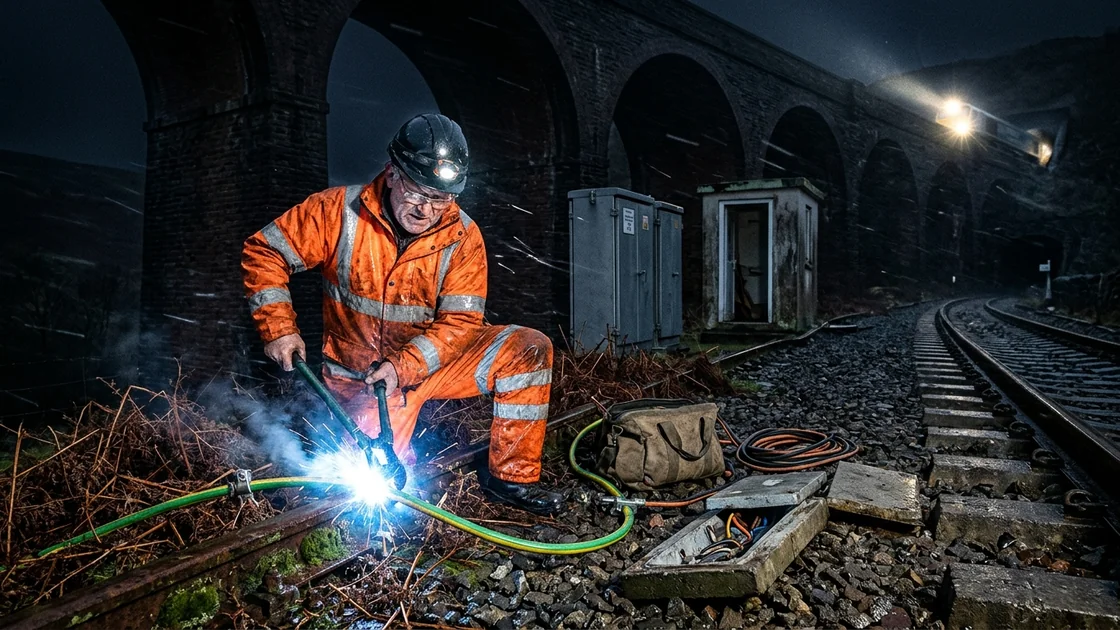
Arthur Harlan, a veteran railway signaling engineer nearing retirement, discovers a baffling anomaly on the isolated Blackmire mountain freight corridor where every night at precisely 3:14 AM, the electronic track circuits register the passage of a heavy train across a desolate stretch of rails that is entirely empty. Initially convinced the recurring fault is caused by decaying insulation, stray ground currents, or moisture in the relay cabinets, Arthur conducts a series of exhaustive field inspections along the windswept viaducts and flooded quarry tunnels of the high moor. When his diagnostic instruments capture the unmistakable magnetic signature of twenty-eight iron axles moving at forty-eight miles per hour, he is forced to abandon conventional electrical theory and delve into the railway archives. There, he uncovers the buried history of a relief passenger train lost during a blizzard in 1959 due to a fatal signaling error, and realizes that a recent modernization of the grounding grid has inadvertently bridged the electrical gap between the past and the present. As a real two-thousand-ton mineral freight train is diverted onto the mountain grade during the exact minute of the nightly phantom occupation, Arthur must trek out into a freezing gale to manually manipulate the interlocking logic and clear a sixty-year-old block section before history repeats itself in twisted steel.
The rain on the high Pennine moors did not fall so much as it migrated, driven horizontally across the peat hags by a wind that smelled of wet slate and old soot. Inside the Cragmoor Integrated Electronic Control Centre, however, the climate was a sterile, unchanging sixty-eight degrees Fahrenheit, smelling faintly of warm silicon, floor wax, and the stewed tea that Arthur Harlan kept in a dented steel thermos by his elbow.
It was 03:10 on a Tuesday morning in late October. At that hour, the great curved overview mimic board—twenty-four feet of matte-black polycarbonate inlaid with thousands of miniature light-emitting diodes—was mostly dark. Across the northern division, the passenger commuter units were long since stabled in their suburban carriage sidings, their pantographs dropped and their air compressors silent. Only the long-haul mineral freights and the occasional overnight intermodal container train crept across the board, represented by stepping ribbons of crimson light accompanied by four-character alphanumeric headcodes that flickered in small amber matrices.
Arthur sat at the maintenance diagnostics desk at the rear of the hall, elevated on a low dais behind the two night-shift signallers. At fifty-eight, Arthur had the stooped, slightly asymmetrical posture of a man who had spent thirty-five years carrying heavy Fluke multimeters, canvas toolbags, and brass relay pullers up steep ballast embankments. His hair was the color of galvanized iron wire, cropped close, and his spectacles sat low on a nose that had been broken once in 1989 by a whipping point-rodding crank.
Down on the main floor, young Kieran, one of the night signallers, had his boots propped on the edge of the console plinth, reading a paperback thriller under the goose-necked halogen task lamp. The other signaller had gone down to the mess room to toast crumpets. The Blackmire Freight Branch, which occupied the upper left quadrant of the mimic panel, was completely dormant. It was a single-track mountain line, twenty-two miles of heavy bullhead and flat-bottom rail spiked to Jarrah and concrete sleepers, climbing on a relentless one-in-sixty ruling gradient over the watershed before dropping down to the limestone quarries and chemical works at Oakhaven. Nothing was scheduled over Blackmire between the 23:40 empty hoppers and the 05:15 morning ballast working.
Arthur was half-way through reviewing the preventative maintenance logs for the point heaters at Cragmoor Junction when the fault alarm chimed.
It was not the urgent, warbling klaxon of a SPAD—a Signal Passed at Danger—which always made the hair on the back of Arthur’s neck stand up, no matter how many decades he had heard it. Instead, it was the low, single-tone ping of an uncommanded track circuit drop, accompanied by the dry, mechanical click of the fault printer spitting out a line of dot-matrix text in the corner of the engineering bay.
Arthur glanced up over the rims of his glasses.
Up on the Blackmire quadrant of the big board, twelve miles out in the dark wilderness of the moor, a single segment of white track illumination had turned bright, solid red.
Track Section T-412.
Kieran took his feet off the console, his chair squeaking as he leaned forward. "Arthur? You got anybody out on the mountain tonight? P-Way gang? Tamper?"
"No possessions logged tonight, lad," Arthur said, his voice a dry rumble from deep in his chest. He turned to his own twin-screen SCADA terminal—the Supervisory Control and Data Acquisition interface that monitored the vital logic of the interlocking. He typed in the node address for Blackmire Intermediate Location 4. "Absolute block is closed between Cragmoor North and Oakhaven South. T-412 is right at the throat of Blackmire Tunnel."
Before Arthur’s screen could finish rendering the local relay status, the mimic board chimed again.
Beside the red bar of T-412, the adjacent section—T-413, which spanned the seven hundred yards of the Blackmire Viaduct—flashed red.
Two seconds later, T-412 went dark, returning to its normal unoccupied state.
Kieran frowned, sitting up straight and setting his book face-down on the desk. "That’s not a tree on the line. It’s stepping."
Arthur didn't answer. His calloused fingers moved rapidly over the mechanical keyboard, calling up the raw event logger. He watched the timestamps populate the black screen in bright green phosphor text:
03:14:02.18 - TC_412_OCCUPIED [STATE: LOW]
03:14:21.44 - TC_413_OCCUPIED [STATE: LOW]
03:14:22.89 - TC_412_CLEAR [STATE: HIGH]
03:14:51.12 - TC_414_OCCUPIED [STATE: LOW]
03:14:52.55 - TC_413_CLEAR [STATE: HIGH]
Arthur leaned in until his nose was six inches from the glass. His eyes narrowed as he did the mental arithmetic. A standard track circuit worked on a fail-safe closed-loop principle. A low-voltage current was fed into one end of an insulated section of running rail and detected by a vital relay at the other end. As long as the current reached the relay, the elektromagnet held its heavy silver-impregnated carbon contacts closed, telling the control center the track was clear. When a train entered the section, its steel wheels and solid iron axles created a short circuit—a shunt—across the two running rails, diverting the current away from the relay. Starved of power, the relay dropped by gravity, opening the circuit and turning the board red.
Electrical faults happened every week on an old railway. Waterlogged ballast could bleed current into the earth; a corroded bond wire could snap in the frost; a stray deer could kick a cable trough and sever a tail-cable. When that happened, the track circuit simply dropped dead and stayed red until a technician went out in a high-vis jacket and fixed it. Or, if it was a loose connection vibrating in the wind, it flickered erratically like a dying fluorescent tube.
It did not step.
More importantly, Arthur looked at the overlap between
03:14:21.44 and 03:14:22.89. For exactly one
point four five seconds, both T-412 and T-413 had been occupied
simultaneously before the rear section cleared.
"What is it?" Kieran asked, looking back over his shoulder. Up on the board, T-415—the long curve around the flooded Blackmire Slate Quarry—had just turned red, while T-414 extinguished behind it. The automatic distant signal at the far end of the valley, Signal BM-14, had dutifully slammed from green to red on the mimic diagram to protect the rear of whatever was occupying the line.
"It's bridging the insulated rail joints," Arthur murmured. "One point four seconds of overlap. Then twenty-eight seconds to traverse seven hundred yards of the viaduct." He pulled a pocket calculator from his shirt pocket, though he already knew the number. Seven hundred yards was two thousand one hundred feet. Divided by twenty-eight point six seconds, that was seventy-three feet per second.
"Fifty miles an hour," Arthur said aloud. "Forty-nine point eight, to be exact. And based on the overlap time across the joint, whatever is shunting those rails is roughly one hundred andfive feet long—or faster and longer if the shunt decay is lagging."
"A runaway?" Kieran’s hand hovered over the red emergency general-call button on his telephone panel. "Could the quarries at Oakhaven have let a rake of wagons loose?"
"Uphill?" Arthur countered dryly, pointing a thumb at the gradient profile pasted above his monitor. "Oakhaven is four hundred feet lower than Blackmire Viaduct. Even with a gale behind them, loose hopper wagons don't roll up a one-in-sixty grade at fifty miles an hour. Wait. Watch T-415."
They both stared at the board. T-415 was the final section before the old Quarry Loop—a set of rusty, disconnected sidings that had been spiked out of use before Kieran was born—and the transition into T-416, which led down toward the main Cragmoor valley.
On the board, T-415 glowed red for thirty-four seconds.
At 03:15:26, T-415 went dark.
T-416 did not light up.
The red bar simply vanished from the mimic panel. Signal BM-14 held at red for its programmed three-minute approach-locking timeout, then clicked back to green. The line was completely clear from end to end.
Kieran let out a breath he had been holding. "Well. Whatever it was just fell off the edge of the earth."
"Not the earth," Arthur said, his brow furrowed as he printed a hard copy of the telemetry log. "Just off the relay bus. T-412 through T-415 are all fed from Location Cabinet 7B at the north end of the viaduct. T-416 is fed from the next hut down the hill, Location 8A. It's an equipment fault inside 7B. Has to be. Probably a cascading voltage collapse across the busbars, or the new audio-frequency transmitter cards having a nervous breakdown."
"We just put those new cards in two weeks ago," Kieran noted.
"Aye," Arthur said, tearing the perforated paper strip from the printer and folding it neatly into his breast pocket. "And modern electronics are like thoroughbred horses, Kieran. Fast when they want to be, and twice as likely to break a leg over a shadow. Log it as a suspected intermittent power supply oscillation in Location 7B. I'll take the Land Rover up there after breakfast and put a meter on it."
He sounded entirely convinced. After thirty-five years on the railway, Arthur Harlan did not believe in mysteries; he believed in bad soldering, damp insulation, and junior technicians who forgot to torque down terminal nuts.
It was only when he was sitting in his parked car at seven o'clock that morning, waiting for the windshield defroster to clear the rime of frost from the glass, that he pulled the paper strip from his pocket and looked at it again in the gray dawn light.
If it were a cascading voltage collapse on a common twenty-four-volt busbar inside Location 7B, all four track circuits would have dropped in order of their coil resistance—weakest first—and they would have stayed down until the voltage recovered, at which point they would have picked up all at once. They would not have picked up sequentially from west to east. And a power dip in a steel cabinet by the side of the track could not possibly know the exact physical length of the seven-hundred-yard viaduct and wait precisely twenty-eight seconds before dropping the next relay in line.
Arthur folded the paper again, started the diesel engine, and drove home for three hours of sleep.
By one o'clock that afternoon, the rain had temporarily blown itself out, leaving a low ceiling of bruised pewter cloud that dragged its belly across the stony ridges of Blackmire Moor.
Arthur drove the railway maintenance Defender up the old drovers' track that paralleled the branch line. In the passenger seat sat Declan Boyle, a twenty-four-year-old apprentice technician with a sleeve of geometric tattoos hidden under his orange high-visibility coveralls and a permanent attachment to a strawberry-scented vape pen.
"Tell me again why we're bouncing my kidneys out over these ruts, Arthur?" Declan asked, bracing one booted foot against the dashboard as the Land Rover lurched through a water-filled peat washout. "I pulled the remote diagnostics on 7B from the depot at ten. All four TI-21 track circuits are sitting at a hundred and twelve percent nominal receiver voltage. The battery charger's pushing twenty-seven point four volts, ripple is zero, and the earth leakage detector is clean as a whistle."
"Remote diagnostics only tell you what the processor thinks is happening inside its own belly, Dec," Arthur said, wrestling the heavy steering wheel as they crested the ridge. "They don't tell you if a badger has dug under the cable troughing and chewed the lead sheathing off the tail-cables so rainwater pools in the insulation."
Ahead of them, the landscape fell away into the steep, scarred amphitheater of Blackmire Gorge.
It was a bleak, imposing place. To the left, the gaping black mouth of Blackmire Tunnel emerged from the sheer gritstone cliff. Immediately outside the portal, the single track leaped across the gorge on the Blackmire Viaduct—nine towering arches of dark blue Staffordshire engineering brick, stained white with lime leaching and green with mountain moss, rising ninety feet above the foaming brown peat-water of the Black Beck. On the near side of the viaduct, the line curved sharply along a narrow shelf blasted into the rock face, passing the ruins of the old Blackmire Slate Quarry before plunging downward toward Cragmoor.
Beside the track at the northern abutment of the viaduct stood a pair of grey painted steel equipment cabinets—Location 7B—and, twenty yards behind them, the roofless, nettle-choked stone walls of what had once been the Blackmire West mechanical signal box.
Arthur parked the Defender in the crushed granite turning bay behind the chain-link access gate, killed the engine, and reached into the back for his leather tester's satchel and a three-foot fiberglass shunt bar.
The wind hit them the moment they opened the doors, cold enough to make their teeth ache. It whistled through the galvanized palisade fencing with a low, mournful flute-note.
They signed themselves into the local maintenance log, clipped their personal track-warning transponders to their belts—though both men knew there wasn't a train within ten miles—and walked up the cess to Location 7B.
Arthur unlocked the heavy padlock with his brass master key and swung the double steel doors wide, hooking the wind-stays into the gravel so the gale wouldn't slam them shut on their fingers.
Inside, the cabinet was a generational hybrid of railway engineering. The bottom shelves held the heavy, grey-painted Westinghouse plug-in relays from the 1970s—brick-sized polycarbonate boxes housing brass armatures, copper coils, and rows of silver-carbon contact fingers. Above them, mounted on shiny aluminum DIN rails, sat the modern solid-state additions: the Jointless Audio Frequency Track Circuit transmitters and receivers installed just a fortnight ago to replace the aging DC track batteries that kept freezing in the winter.
"Smells dry," Declan observed, peering over Arthur’s shoulder. Two tubular greenhouse heaters at the base of the cabinet radiated a gentle, dusty warmth. The silica gel breathers were a healthy cobalt blue.
Arthur didn't speak. He unclipped the test leads of his multimeter, set the dial to AC millivolts, and switched on the frequency counter. For the next forty minutes, he worked with the methodical, unhurried precision of a surgeon. He measured the track feed voltages on T-412, T-413, T-414, and T-415. They operated on alternating audio frequencies—1,700 Hertz and 2,300 Hertz, modulated to prevent harmonic interference—tuned into the rails themselves by cast-iron impedance bonds bolted between the sleepers.
Every reading was textbook.
"Look at the contact fingers on the TR relays," Arthur said, shining his penlight into the clear Perspex case of the T-413 track relay. "No pitting. No carbon tracking. If this relay was chattering due to a loose wire or a dying capacitor, the silver contacts would be blackened from arcing. It dropped clean, and it picked up clean."
"Maybe the remote telemetry unit glitched?" Declan suggested, hopping up and down on the ballast to keep the blood moving in his toes. "A bit-flip in the multiplexer packet sent to Cragmoor. The relays here never actually moved; the computer just thought they did."
Arthur reached up to the top shelf and pointed at a row of small mechanical counters—old-fashioned electromagnetic Veeder-Root odometers that he had insisted on leaving wired in parallel with the vital relays during the modernization, specifically because he didn't trust software buffers.
Each counter recorded a physical click every time its corresponding
relay dropped. According to yesterday’s commissioning sheet pinned to
the inside of the cabinet door, the afternoon freight at 16:40 had left
all four counters ending in the digit 4.
Now, every single one of them ended in 5.
Declan stopped bouncing. He leaned in and squinted at the tiny white numerals behind the glass windows. "Okay. That’s weird. The heavy iron actually moved."
"Come on," Arthur said, closing the meter case. "Let's walk the viaduct. I want to look at the tuning units and the earthing bonds."
They stepped up onto the sleeper ends and walked out onto the viaduct. High above the gorge, the wind was fierce, tugging at their heavy waterproof coats. Below the low brick parapet, the moor dropped away into a grey-green wasteland of heather and bog cotton. Arthur kept his eyes down, examining the shiny, work-hardened running surface of the rails, the heavy Pandrol clips, and the yellow-painted boxes of the trackside tuning units.
Nothing was loose. There were no metallic slivers bridging the insulated joints at the ends of the viaduct; no tangled sheep wire dragging across the two rails to create a short circuit.
When they reached the southern end of the viaduct, where the line curved around the flooded abyss of the old slate quarry, Arthur stopped.
Here, the granite lip of the quarry came within fifteen feet of the trackbed. A rusted post-and-wire fence separated the active line from a sheer drop into black, bottomless water that never seemed to ripple, even in the gale. Just before the edge, a pair of disconnected, moss-covered rails diverged from the main line, their switch-blades long since removed, running for thirty yards through the bracken before ending abruptly at a rotting timber buffer stop right on the quarry's rim.
"What's this old spur?" Declan asked, following Arthur’s gaze.
"The Quarry Loop," Arthur said. "Back in the steam days, it was a refuge siding and a loading road for the slate wagons. They tore the points out in 1960."
Arthur paused. His eyes tracked a thick, newly laid copper cable—bright green-and-yellow striped PVC sheathing—that ran from the modern cast-iron impedance bond in the middle of the active main line, snaked across the gravel cess, and was bolted with a shiny brass exothermic weld directly to the web of the rusty, abandoned rail of the Quarry Loop.
"Dec," Arthur said slowly. "Who bonded the new earthing mat into the old siding?"
Declan blinked, pulling his hands out of his pockets. "The contractors from Doncaster. When we did the audio-frequency upgrade two weeks ago. The lightning protection spec called for a deep-earth ground rod at the south end of T-415, right here at the curve. The lads tried driving copper rods into the ground, but it’s solid slate two feet down. Couldn't get the earth resistance below ten ohms."
"So they cheated," Arthur said, walking over to the rusted rail and crouching beside the bright brass weld.
"Not cheated, exactly," Declan said defensively. "The contractor’s engineer figured there’s half a mile of old steel rail buried in the overgrowth along the quarry rim and down the old incline. Tons of buried iron in wet peat makes a phenomenal earth mat. We put a Megger on it after they welded the bond on—came back at zero point four ohms. Best ground on the whole mountain. Passed inspection on the twelfth."
Arthur ran his gloved thumb over the thick copper cable connecting the live, 2,300-Hertz rail of Track Section T-415 to the dead, sixty-year-old steel of the Quarry Loop.
"Passed on the twelfth," Arthur murmured. "And when did the new audio-frequency circuits go live on the main board?"
"Yesterday afternoon," Declan said. "Right after the 16:40 freight cleared."
"Which means last night was the first night this section has been energized at twenty-three hundred Hertz with that bond attached." Arthur stood up, his knees popping in the cold air. He stared down the length of the overgrown siding toward the rotted buffer stops and the black water beyond. "Help me unpack the Fluke ScopeMeter from the truck, Dec. I want to leave a data logger clamped onto the T-414 and T-415 receiver loops overnight."
"You think it's going to happen again?"
"If it's a harmonic resonance coming back up that dead rail from the ground table, it'll happen when the temperature drops and the dew point hits," Arthur said, though even to his own ears, the explanation sounded thin. Dew points did not happen at fifty miles an hour.
That night, Arthur did not go home at the end of his afternoon shift. He told his wife, Martha, gone five years now, only in his head—a habit he hadn't broken since the house fell quiet—that he was covering a double for a lad with the flu. In truth, he brewed a fresh pot of Kenyan coffee in the Cragmoor mess room, spread the signaling wiring diagrams for Blackmire across the back workbench, and waited.
His supervisor, a thirty-two-year-old graduate engineer named Liam Cross who wore crisp white shirts under a pristine fleece gilet and referred to trains as "rolling assets," had left a sticky note on Arthur’s monitor before going home at six: Arthur—saw the 03:14 fault log on the morning summary. Network Operations is diverting the 6S42 heavy limestone working over Blackmire starting Thursday night due to tunnel relining on the main valley line. Make sure 7B doesn't throw a red in front of 6S42. If we stop two thousand tons of stone on that bank in wet leaf season, we’ll never get it moving again without sending a rescue locomotive.
Arthur peeled the yellow square off his monitor, crumpled it into a tight ball, and dropped it into the bin.
By 03:00, the control room was quiet again. Different signallers were on duty tonight—Davey, a fat, placid man who had worked the panels for twenty years, and a quiet woman named Sarah. Neither of them paid any attention to Arthur sitting in the dim glow of his engineering alcove.
At 03:10, Arthur logged directly into the remote maintenance port of Location 7B via the fiber-optic lines that ran along the trackside troughing. He opened a live telemetry window showing the real-time voltage levels on the four track circuits, updating twice every second.
T-412: 4.82V (CLEAR) T-413: 4.91V (CLEAR)
T-414: 4.79V (CLEAR) T-415: 4.88V (CLEAR)
The digital master clock on the wall above the mimic board ticked forward, its red seven-segment numerals shifting silently in the semi-darkness.
03:13:50 03:13:55 03:13:59
Arthur felt his pulse thudding against the collar of his shirt. He told himself nothing would happen. The logger he had left in the cabinet would record a flat line, and tomorrow he would swap out the power supply module just to satisfy Liam Cross.
03:14:00
Nothing happened.
03:14:01
Arthur let out a slow breath through his nostrils, reaching for his mug.
03:14:02
Ping.
On the big mimic board, Track Section T-412 turned blood red.
On Arthur’s telemetry screen, the voltage for T-412 didn't just dip;
it plummeted from 4.82V to 0.04V in less than
a hundred milliseconds. That was not a dirty contact or a
high-resistance leak through wet ballast. That was a dead short—less
than zero point one ohms—clamped straight across the steel rails at the
mouth of Blackmire Tunnel.
"Bloody hell," Davey muttered from the main console below, sitting up and spilling biscuit crumbs down his cardigan. "There goes 7B again. Arthur, you seeing this?"
"I see it, Davey," Arthur whispered. His eyes were glued to the voltage graphs.
As the seconds ticked past, the residual voltage on T-412 wasn't
static. It was oscillating in a rhythmic, saw-toothed
pattern—0.04V... 0.09V... 0.02V... 0.08V—as the shunt moved
away from the transmitter feed at the west end of the section and closer
to the receiver relay at the east end. It was the classic electrical
profile of a moving train, the impedance of the rails themselves
changing the reading as the wheels rolled down the grade.
At 03:14:21, T-413 slammed down to
0.03V.
For one point four seconds, both sections were held down. Then T-412
snapped cleanly back to 4.82V.
Whatever was out there in the freezing dark was now out on the nine brick arches of Blackmire Viaduct, ninety feet above the gorge.
Arthur’s fingers flew across his keyboard. He switched his view from the track circuits to the Frauscher magnetic axle-counter head that had been bolted to the web of the rail at the southern end of the viaduct as a secondary redundancy check for the level crossing two miles down the hill.
An axle counter did not rely on electrical current flowing through the rails. It consisted of two small, resin-encapsulated electromagnetic coils mounted inches apart on the inside of the rail. It could not be fooled by wet ballast, lightning, or stray earth currents. The only thing in the physical universe that could trigger an axle-counter head was a massive disk of ferromagnetic metal—a train wheel—passing directly through its magnetic flux field at close range, shifting the phase of the two coils in sequence to determine direction and speed.
At 03:14:51, as T-414 dropped to red, the axle counter
diagnostic screen came alive.
The phase-shift graph spiked sharply upward.
Click-click.
Two axles. A leading bogie.
Then, separated by a tighter time interval, three enormous, heavy inductance dips that nearly saturated the sensor’s upper limit.
Clack-clack-clack.
Three coupled driving axles of immense ferrous mass.
Followed immediately by three closer, lighter axles. A six-wheeled tender.
And then the regular, rhythmic four-beat cadence of bogie passenger coaches:
Ba-dum, ba-dum... ba-dum, ba-dum...
Arthur stared at the scrolling green waveform on his monitor, the blood draining from his face until his skin felt like cold parchment. The software automatically calculated the wheelbase spacing and the total axle count as they passed over the sensor head at forty-nine point eight miles per hour:
DIRECTION: UP (EAST) SPEED: 49.8 MPH
AXLE COUNT: 02... 05... 08... 12... 16... 20... 24... 28.
Twenty-eight axles.
A 4-6-0 steam locomotive with a six-wheel tender and five eight-wheeled bogie carriages.
On the mimic board, T-415 burned red as the phantom consist swept around the curve by the flooded quarry. The telemetry showed the current dropping along the section, approaching the spot where the new green-and-yellow copper earthing cable was welded to the rusted rails of the dismantled Quarry Loop.
At 03:15:26, the voltage on T-415 snapped back to
4.88V. The red light on the board blinked out.
Down on the next section, T-416, the secondary axle counter head waited to count the twenty-eight axles out of the block.
Its counter remained at 00.
The train had entered the section at the tunnel mouth, crossed the viaduct, tripped a physical magnetic field sensor twenty-eight times with tons of moving iron, and then vanished at the exact coordinates of the old Quarry Loop.
"Arthur?" Davey called out from the floor, turning around in his swivel chair. "That cleared itself again. Same as last night, right to the second. You got a time-switch cycling up there or something?"
Arthur’s hand was trembling slightly as he reached out and pressed
the PRINT SCREEN key. He had to clear his throat twice
before his voice worked.
"Aye, Davey," Arthur said hollowly. "Something cycling on a timer. Leave it with me. Don't call out the night fault team; I'm already on it."
At nine o'clock the next morning, instead of going to the maintenance depot, Arthur drove down into the soot-blackened Victorian heart of Cragmoor town and parked outside the old Mechanics' Institute behind the main passenger station.
The top floor of the red-brick building housed the Northern Division Historical Trust and Archive—three drafty rooms smelled of decaying leather bindings, coal dust, and peppermint imperial mints, presided over by Walter Finch. Walter was eighty-two, had started on the railway as a fourteen-year-old engine cleaner at Cragmoor Shed in 1956, and had retired as Chief Signal Inspector ten years before Arthur took over the senior technician's desk.
Arthur found the old man sitting by a cast-iron radiator, wearing a tweed waistcoat over a flannel shirt, carefully pasting signal box track diagrams onto linen backing paper with a brush and a pot of flour paste.
"Arthur Harlan," Walter said without looking up, recognizing the heavy, slightly dragging cadence of Arthur’s steel-toed boots on the floorboards. "If you're here to ask where the drainage culverts run under Platform Three, I told young Cross last month they're bricked up under the old parcel dock."
"I'm not here about Cragmoor station, Walter," Arthur said, pulling up a wooden Windsor chair and sitting down opposite him. "I'm here about Blackmire West box. Specifically the Quarry Loop."
Walter’s paste brush stopped mid-stroke. Slowly, the old man raised his head. His eyes, pale blue and slightly watery behind thick bifocals, fixed on Arthur’s face. He took a long moment to study the dark circles under Arthur’s eyes and the grim set of his mouth.
"They tore Blackmire West down in March of sixty-one," Walter said quietly. "I was on the district locking gang that took the lever frame out with an oxy-acetylene torch. Why are you asking about a box that's been nettles for sixty-five years?"
Arthur reached into his coat pocket and laid the printed waveform from the Frauscher axle counter on the deal table between them, right beside the paste pot.
"Because for the last two nights, at fourteen minutes past three in the morning, a ten-wheel steam engine with a six-wheel tender and five bogie coaches has come out of Blackmire Tunnel at fifty miles an hour, crossed the viaduct, and disappeared at the Quarry Loop."
A lesser man, or a younger one, would have laughed or asked if Arthur had been nipping at the scotch in his thermos. Walter Finch did neither. He looked down at the green lines on the printout, though the modern digital layout meant little to him, and then looked out the tall arched window at the grey clouds scudding over the station roof.
"Fifty miles an hour," Walter murmured. "Running Up, toward Cragmoor?"
"Yes."
"The permanent speed restriction over Blackmire Viaduct for passenger stock was forty," Walter said softly. "And fifteen through the turnout into the Quarry Loop. He was making up lost time. Just like the Board of Trade inspector said."
Arthur leaned forward, resting his forearms on his knees. "Tell me about it, Walter. I know there was an accident up there before my time, back when the quarry was still being worked, but the official sectional appendix only lists it as an earthwork slip that closed the siding."
Walter carefully laid his brush across the top of the paste jar, wiped his gnarled fingers on a rag, and stood up. He walked with a stiff-legged shuffle over to a row of tall glass-fronted bookcases filled with uniform maroon-bound volumes stamped in faded gold leaf: Ministry of Transport — Railway Accidents: Reports by the Inspecting Officers.
He didn't need to check the index. He reached straight for the volume marked 1959–1960, pulled it from the shelf, and carried it back to the table. When he opened it, the spine cracked at a page that had clearly been opened many times before, marked with a faded yellow newspaper clipping from the Cragmoor Chronicle.
The fold-out diagram at the back of the report showed the exact track layout of Blackmire Gorge as it had existed in November 1959.
"November the eighteenth, 1959," Walter said, tapping a blunt fingernail on the diagram. "A Wednesday night, going into Thursday morning. Worst early winter gale we'd had in thirty years. Freezing rain up on the tops, turning to black ice as soon as it touched the ironwork. The telegraph wires along the main valley line had come down under the weight of the ice around midnight, blocking both roads at Garsdale. So Control decided to divert the late sleeping-car and mail relief—the 1M84 out of Carlisle—up over the Blackmire branch to get around the blockage."
Arthur looked at the report's header: Report on the Derailment and Loss of the 1M84 Relief Express at Blackmire Quarry Siding on 19th November, 1959.
"What was hauling it?" Arthur asked, though his stomach already knew the answer.
"Jubilee Class 4-6-0," Walter said. "Number 45611. Six-wheel Stanier tender. Five corridor coaches—three sleepers, a brake composite, and a sorting van at the front. Twenty-eight axles in total."
The silence in the archive room seemed to thicken, broken only by the ticking of the brass pendulum clock over the door and the distant hiss of air brakes from a diesel unit down in the station below.
"What happened at the box?" Arthur asked.
Walter traced the ink lines of the track diagram with his finger. "In those days, it was worked by Absolute Block on Tyer’s electric token instruments, with intermediate block signals across the viaduct. The signalman at Blackmire West was a chap named Thomas Harker. Good man, careful, fifty-odd years old, lived in the railway cottages down by the beck. Earlier that night, around two in the morning, he'd shunted a crippled mineral wagon into the Quarry Loop to get it out of the way of the diverted express. To do that, he had to pull Lever 14 to reverse the facing point lock, and Lever 15 to set the points for the loop."
"Facing points on a single-line passenger road," Arthur noted grimly.
"Aye. Protected by a mechanical detector slide in the four-foot way and an electric repeat indicator on the instrument shelf inside the box. Once the wagon was inside the loop and the trap points closed behind it, Harker put Lever 15 back to normal in the frame to set the main line straight toward Cragmoor, and pulled Lever 14 to lock it."
"Wait," Arthur said, his engineer’s mind instantly picturing the heavy mechanical rodding running along the ground on cast-iron rollers in a freezing gale. "Freezing rain. And sixty yards of point rodding out to the quarry curve."
"You've got it," Walter said, nodding slowly. "The rodding had buckled or jammed in the ice under the timber boarding. When Harker pushed the point lever back into the frame, the spring in the long rodding absorbed the stroke, or a cotter pin sheared in the compensator crank. The lever went back into the catch-block in the box, and by a million-to-one fluke of wet slush bridging the brass contact fingers inside the electric detector box by the track, the indicator needle on his shelf swung to 'Normal'. He thought the road was set straight down the mountain."
"And the lock lever?"
"The plunger missed the stretcher bar hole, rode up over the ice on top of the iron bar, and jammed solid, feeling just like it had driven home," Walter said. "At three-ten in the morning, Cragmoor North offered him 'Line Clear' for the 1M84. Harker pulled off his distant and his home signals. Because the mechanical wire-locks were fouled by the same ice, the home signal arm cleared even though the points were still lying half-cocked toward the Quarry Loop."
Arthur looked down at the black-and-white photographs printed on the glossy plates of the report. One showed the stone signal box in the bleak morning light after the storm; the next showed the shattered splintered stubs of the timber buffer stops at the edge of the quarry cliff, with two twisted rails hanging out over empty space above the black water.
"The driver was a Carlisle man named Miller," Walter continued softly. "He was forty minutes down on his schedule because of the diversion. When he came out of Blackmire Tunnel at 03:14, he saw Harker's distant signal showing a clear green light through the sleet, and the home signal off at the end of the viaduct. He thought he had a clear run all the way down the bank into Cragmoor. He never shut the regulator off. He hit the Quarry Loop turnout at fifty miles an hour."
"They went through the buffers," Arthur whispered.
"Never stood a chance," Walter said. "The curve into the loop was ten chains radius. At fifty miles an hour, the locomotive didn't derail—the high check-rail held the flanges just long enough to aim her straight down the thirty yards of the siding like a rifle barrel. She smashed the timber stops to matchwood and went straight off the hundred-foot slate cliff into the flooded pit. The couplings held. She dragged all five coaches in right behind her."
Arthur stared at the photograph of the black water. "How deep is that pit?"
"Two hundred and forty feet in the center, flooded with acidic peat water since the pumps were turned off in 1928," Walter said. "They sent Royal Navy divers down the week after. It was pitch black, freezing cold, and full of tangled overhead cable cranes and fallen slate ledges from when the quarry worked. They recovered twelve bodies from the rear brake coach that had broken open on a ledge forty feet down. The other thirty-one people, the mail crew, Driver Miller, his fireman, and the engine itself are still down at the bottom in the silt. The Ministry designated the pit a war-style grave in 1960 and sealed the access road."
Arthur rubbed his face with both hands, his palms rasping against his morning stubble. "And the signalman? Thomas Harker?"
"He saw the tail-lamp go over the cliff from the window of the box," Walter said. "He sent the 'Obstruction Danger' six-beat bell code to Cragmoor North to stop anything coming the other way, wrote 03:15 - 1M84 entered loop in error in the train register book in a steady hand, walked down the steps of the box, and stepped into the gorge off the third arch of the viaduct. I was one of the men who carried him up out of the beck at daylight."
Arthur sat still for a long time. The radiator clanked softly in the corner.
"When they dismantled the Quarry Loop in 1960," Arthur said slowly, "they lifted the points out of the main line, replaced them with plain straight rail, and left the thirty yards of siding rails sitting in the bracken up to the cliff edge."
"Aye. Nobody had the stomach to take cranes right out to the lip above where the coaches went over. They just cut the rails with a gas axe twenty feet back from the main line and walked away."
"They cut the circuit," Arthur murmured, the pieces clicking together in his mind like the brass tumblers of an interlocking frame. "For sixty-six years, those thirty yards of rail—and all the twisted cable and ironwork trailing down the cliff face into the water—were electrically isolated from the running line. Until four days ago."
Walter’s bushy grey eyebrows drew together. "What happened four days ago?"
"My contractors needed a low-resistance earth for the new audio-frequency track circuits on T-415," Arthur said. "They couldn't drive rods into the slate. So they welded a two-hundred-amp copper bonding cable directly from the active main line impedance bond onto the web of the old Quarry Loop rail."
Walter stared at him. "They bonded the live track circuit into the dead road."
"Into the dead road, which is still connected by old signal wires and point rodding down the rock face into two hundred feet of acidic water holding a hundred and thirty tons of steel locomotive," Arthur said. "It’s a massive galvanic cell, Walter. Wet slate, acidic peat water, dissimilar metals, and now we're pumping a continuous twenty-three-hundred-Hertz alternating carrier wave right down into the pit."
"Galvanic currents don't trip magnetic axle counters, Arthur," Walter said quietly. "And they don't cross nine brick arches in twenty-eight seconds."
"No," Arthur agreed. He looked back down at the Board of Trade report. "Wait a minute. Look at the signal diagram here."
He pointed to the drawing of the approach to Blackmire West box as it had been in 1959, and laid his modern SCADA diagram of Location 7B beside it.
"In 1959, the Home Signal for Blackmire West stood right at the southern end of the viaduct, forty yards before the Quarry Loop," Arthur said. "Where did we mount the new Signal BM-14 and the Location 7B cabinet?"
Walter leaned over and compared the chainage numbers at the bottom of both drawings: 12 miles, 44 chains.
"The exact same spot," Walter breathed. "We reused the old concrete signal foundation."
"Think about the interlocking logic," Arthur said, his heart beating faster. "Every night at 03:14:02, the residual imprint—whatever electromagnetic recording was burned into the ironstone of that gorge when a hundred tons of steel hit the water under full steam—wakes up on T-412. It runs out of the tunnel, crosses the viaduct on T-413, and hits T-414. What does our modern interlocking do the instant T-412 drops without a valid train routing set on the Cragmoor panel?"
"It sees an uncommanded occupation," Walter said, his old inspector's brain instantly grasping the relay logic. "It assumes a runaway or a track fault, and it holds Signal BM-14 at Red—Danger—and locks the downstream block."
"And in the old days, if the main line block ahead was locked at Danger while a train was approaching the box out of control, what did the interlocking force the points to do to protect the single line down the mountain?"
"Throw to the trap," Walter whispered. "Route it into the refuge siding. Into the Quarry Loop."
Arthur leaned back in his chair, the cold certainty of it settling into his bones.
"The modern solid-state computer is fighting the ghost, Walter," Arthur said. "Because the phantom train isn't in the timetable and hasn't got a route set from Cragmoor panel, our system treats it as an unauthorized intrusion. It slams the electronic gate shut at BM-14. In the electrical geometry of that circuit, closing the main line circuit forces the return current to dump down the path of least resistance—straight through that new copper earthing cable into the Quarry Loop rails and over the cliff. Every single night, our own fail-safe system is throwing the points against Driver Miller all over again."
"Then cut the copper cable," Walter said immediately. "Take a pair of heavy bolt-croppers up there this afternoon, sever the bond to the old loop, and drive earth rods into the gravel embankment a hundred yards further down the hill."
"I'm going to," Arthur said, standing up and gathering his papers. "Tomorrow morning. I've got to sign out an isolation permit from Cross first; if I disconnect the lightning earth on a live audio-frequency circuit while the power is on, the surge arrestors will blow the receiver cards in Location 7B and shut the whole branch down."
"Do it before tomorrow night, Arthur," Walter warned, his hand closing briefly and with surprising strength around Arthur’s wrist. "Don't let that thing keep running once it's found a path back into the rails. On the railway, nothing stays on a loop forever without eventually tearing the road up."
Arthur intended to get the isolation permit signed at one o'clock that afternoon.
When he walked into the engineering office at Cragmoor Control, however, he found the room in an uproar. Liam Cross was standing by the whiteboard with his jacket off, his phone clamped to his ear, while two timetable planners hammered away at laptops at the conference table.
"Arthur! Thank God you're in early," Cross said, covering the mouthpiece of his phone with his palm. "The roof brickwork in Garsdale Tunnel on the main valley line just failed a laser-profile check. Twelve-foot bulge in the crown. The civil engineers have slapped an immediate emergency block on both main lines starting at eighteen hundred hours tonight."
Arthur stopped with his hand on the doorknob. A cold hollow opened in the pit of his stomach. "Tonight? The notice said the diversion wasn't starting until Thursday."
"Thursday became tonight twenty minutes ago," Cross said briskly, hanging up the phone and turning back to the whiteboard. "Everything that can fit through the loading gauge is going over the Blackmire branch until Friday. Seven heavy freights between midnight and six a.m., running head-to-tail at absolute block intervals."
Arthur stepped up to the whiteboard and looked at the handwritten diversion schedule. His eyes went straight to the third line down:
6S42 ( Shap Fell Quarries to Oakhaven Chemical ) - Class 66 + 24 JGA Limestone Hoppers. Trailing load: 2,160 tonnes. Pass Blackmire Tunnel: 03:11. Pass Blackmire Viaduct: 03:14. Pass Cragmoor North: 03:28.
"Liam," Arthur said, his voice tight. "You can't run 6S42 across Blackmire Viaduct at 03:14."
Cross paused with his dry-erase marker in mid-air and looked at Arthur with tired exasperation. "Arthur, I don't pick the paths; National Freight Control slots them between the regional connections at Carlisle. Why? Did you not fix that power supply blip in Location 7B yesterday?"
"I put a data logger on it," Arthur said, keeping his voice level. He knew with absolute certainty that if he mentioned 1959, Jubilee locomotives, or twenty-eight phantom axles to a thirty-two-year-old corporate manager during a mainline crisis, he would be stood down for medical evaluation before he could reach the car park. "The fault is an intermittent earth-loop oscillation induced by the new grounding bond on T-415. It triggers at precisely 03:14 every morning when the line-side battery chargers cycle into their equalize phase."
It was a lie, crafted out of plausible jargon, and it nearly worked.
Cross frowned. "Then go up there right now and cut the bond."
"To disconnect the primary impedance earth on T-415, I need a two-hour T-3 possession and power isolation on the branch," Arthur said, pulling the red isolation form from his folder. "Otherwise the back-EMF from the traction return will fry the TI-21 receiver cards, and you'll have a permanent red light at BM-14 for the next two days until Doncaster sends spares."
Cross looked at the clock on the wall. It was 13:20. "I can't give you a T-3 possession this afternoon! We’ve already started diverting the daytime intermodals over Blackmire. There’s a container train in the section right now, and another one behind it every forty minutes until midnight."
"Then hold 6S42 at the entrance to the branch for ten minutes tonight," Arthur pressed. "Put it through at 03:25 instead."
"And back up four mail and freight trains onto the Carlisle main line?" Cross shook his head firmly. "Not happening, Arthur. Look, even if your charger glitch trips T-412 for thirty seconds at 03:14, what happens? If 6S42 is already in the section, the track circuit is already occupied by a real train! You can't drop a relay that's already down."
Arthur opened his mouth, then closed it.
Cross was thinking in pure textbook theory. If a real train was occupying T-413 on the viaduct, the relay was already de-energized. Another short circuit behind it wouldn't change the state of T-413.
Except 6S42 would be running ahead of or right across the sequence.
If 6S42 passed through Blackmire Tunnel at 03:11, hauling two thousand one hundred tons of limestone up and over the summit at thirty miles an hour, its locomotive would be approaching Signal BM-14 at the southern end of the viaduct at 03:14.
At 03:14:02, T-412 would drop behind it. Good. Normal.
Wait. No.
If 6S42 was running two minutes late—and a two-thousand-ton stone train climbing a wet mountain bank in the dark was always two minutes late—it would be approaching the viaduct as T-414 and T-415 dropped in front of it.
Signal BM-14 would slam from green to red directly in the driver’s face at a hundred yards' range. Even worse, the AWS—the Automatic Warning System magnet between the rails—would energize as a permanent north pole without the cancelling electromagnet picking up. If the driver was startled by a sudden red aspect in the fog and missed the AWS cancel button by three seconds, or hit the emergency brake plunger thinking there was a train stalled ahead of him on the single line, the air would dump from the brake pipe across all twenty-four hopper wagons simultaneously.
Two thousand tons of unbraked momentum hitting locked wagon wheels on greasy, wet rails on a curve ninety feet above Blackmire Gorge, with a drawbar snatch that could snap a three-inch steel coupling hook like a dry carrot.
And that was only the mechanical danger. Arthur didn't want to think about what would happen when twenty-eight phantom axles carrying enough electromagnetic force to saturate a Frauscher coil collided in the same rail-space with the computerized engine-management brain of a modern diesel locomotive.
"Arthur?" Cross said, already turning back to his laptop. "If you're worried about the charger cycling at three in the morning, drive up to Location 7B tonight, sit in the hut, and switch the battery charger onto manual float at three o'clock. You don't need a line block to flip a breaker inside a cabinet. Can you cover that?"
Arthur looked at the young manager, then at the schedule on the whiteboard.
If he went up to Location 7B alone in the night, he had keys to every cabinet, every maintenance override switch, and the spare relay racks.
"Aye, Liam," Arthur said quietly, slipping the unsigned isolation form back into his pocket. "I'll go up the mountain tonight and handle it locally."
By midnight, the weather had deteriorated into a full Pennine fury. The temperature at two thousand feet hovered half a degree above freezing, turning the driving rain into a heavy, wet sleet that plastered the windscreen of the Defender faster than the wipers could sweep it clear.
Arthur reached the turning bay behind Blackmire West at 01:45.
Through the howling dark, the mountain branch was alive in a way it hadn't been for twenty years. As Arthur climbed out of the cab and pulled his oilskin hood tight over his hard hat, the ground beneath his boots began to tremble. A brilliant white xenon headlight pierced the curtain of sleet at the mouth of Blackmire Tunnel. With a deafening, throaty roar of a sixteen-cylinder two-stroke diesel engine at Notch 8, a heavy intermodal container train burst out of the cliff face and thundered onto the viaduct, its steel wheels screaming against the check-rails of the curve, throwing showers of blue-white sparks from its brake blocks as the driver checked her speed for the long descent into Cragmoor.
Arthur watched the red tail-lamp dwindle into the storm, then shouldered his heavy canvas toolkit, picked up a coil of heavy insulated jumper cable, and unlocked the steel door of Location 7B.
Compared to the old days, when Location 7B had been just a pair of shallow trackside cupboards, the modern upgrade had enclosed the space between the cabinets with a corrugated fiberglass walk-in shelter—six feet by eight, lit by a single caged fluorescent strip light. Arthur pulled the heavy door shut behind him and shot the internal bolt, cutting the shriek of the gale down to a hollow, booming vibration against the steel walls.
He switched on his portable Motorola railway radio and set it on the wooden folding shelf beside the laptop connection port.
At 02:15, a tanker train rumbled past, shaking the floor plates beneath Arthur’s boots.
Now there was a fifty-five-minute gap in the diversion timetable before 6S42 was due.
Arthur took off his wet gloves, blew on his stiff fingers, and got to work. He didn't touch the battery charger; he knew the charger had nothing to do with it. Instead, he pulled the laminated circuit schematics for the Location 7B Vital Processor Interlocking from the rack and spread them out.
He couldn't simply cut the green-and-yellow copper cable outside. As he had told Cross, with the audio-frequency transmitters active and traction currents pulsing through the rails from the heavy diesels on the bank, unbolting that earth bond under load would draw a two-inch blue electrical arc and instantly trip the ground-fault interrupters, dropping Signal BM-14 to red and locking the whole line down right in front of 6S42.
And he couldn't force Signal BM-14 to stay green by bridging its vital relay contacts inside the cabinet; if 6S42 actually broke down or derailed on the viaduct, a bridged signal wouldn't protect it.
He stood staring at the rack of old Westinghouse BR930 relays at the bottom of the frame and the shiny solid-state processor cards at the top.
"Think like Thomas Harker," Arthur whispered to the humming cabinet. "Don't fight the train. Route it."
Why did the phantom train vanish at 03:15:26 every night at the end of T-415?
Because in 1959, the points had lain for the Quarry Loop, and the main line block ahead—Section T-416 down to Cragmoor—had never received the train. In the electrical memory of the track, the circuit ended where the copper earthing cable dumped the signal into the rusted rails of the dead siding.
When the phantom shunt reached the end of T-415, it hit an electrical brick wall: the insulated rail joint separating Location 7B's territory from Location 8A down the hill, combined with the computer's emergency block lock. Denied a path forward down the mountain, the energy discharged down the copper bond into the quarry.
What if the line ahead wasn't blocked to it?
Arthur’s eyes widened as he traced the schematic of the old redundant relay shelf at the bottom of the cabinet.
When Location 7B had been converted from the old 1970s tokenless
block to the modern computer system two weeks ago, the contractors had
left the four spare route-proving relays—labelled 15N-KR
(Points 15 Normal Detection) and BM14-HPR (Home Signal
Repeat)—sitting in their brass plug-bases on the bottom rack,
disconnected from the active signals, used only as dummy surge-absorbers
for the incoming telemetry lines.
And outside in the sleet, buried six inches under the wet ballast at the end of T-415, the old copper return cable that used to connect Blackmire West box to Cragmoor North still ran all the way down the mountain inside the concrete troughing. It had been disconnected at the terminal strip right here in Location 7B when the fiber-optic cable went in.
If Arthur disconnected the green-and-yellow copper cable from the
Quarry Loop rail and, at the exact same moment, clamped it onto the old
continuous copper return cable running down the mountain to Cragmoor—and
wired those dormant 15N-KR point-detection relays into the
loop so they closed in sequence—he wouldn't break the earth circuit. The
audio-frequency receivers wouldn't trip.
Instead, he would move the electrical earth away from the quarry cliff and connect it straight down the mountain along the alignment of the main line, through a closed "Points Normal" relay contact.
He would be setting Lever 15 to Normal, locking it with Lever 14, and giving the 1M84 Relief Express a continuous, unbroken electrical road past the quarry and down into Cragmoor valley.
And to protect the real freight train—6S42—he needed twenty minutes between trains.
Arthur grabbed his Motorola radio and thumbed the transmit button on the engineering channel to Cragmoor Control.
"Cragmoor Panel, this is Senior Tech Harlan at Blackmire Location 7B. Over."
The speaker crackled for three seconds before Davey’s voice came back, sounding stressed. "Go ahead, Arthur. We're busy down here, got three freights stacked at Garsdale Junction."
"Davey, what’s the current running on 6S42, the Shap limestone working?"
"Wait one." A pause filled with the faint clicking of a mouse. "She just passed Settle Junction four minutes down. Heavy rail-head contamination on the climb. Driver says he’s getting wheel-slip on every curve even with the sanders on. At her current speed, she’ll enter Blackmire Tunnel at 03:13."
Arthur’s mouth went dry. If 6S42 entered the tunnel at 03:13 at twenty-five miles an hour, she would be right in the middle of the tunnel—on Track Section T-412—at 03:14:02 when the phantom shunt materialized on the exact same rails.
"Davey, listen to me carefully," Arthur said, his voice dropping an octave into the hard, authoritative tone that had made apprentice signallers jump for three decades. "I am staring at an unstable impedance bond on the viaduct right now. The insulation is breaking down under the sleet load. I need you to check Signal BM-10 at the north approach to Blackmire Tunnel and hold 6S42 outside the tunnel mouth for four minutes. Do not let her enter T-412 until 03:16."
"Arthur, are you mad?" Davey barked back. "If I put a red aspect in front of two thousand tons of stone on the approach bank to the tunnel, she’ll stall! Cross is standing right behind me—hang on."
The radio clicked, and Liam Cross’s sharp voice came through the speaker. "Harlan? What the hell are you playing at? The remote panel here shows T-412 through T-415 completely green and stable!"
"They won't be stable in eighteen minutes, Liam," Arthur said,
looking at his watch: 02:56. "I'm telling you as the
licensed Senior Person in Charge of signaling safety on this mountain:
hold 6S42 at the tunnel approach signal until 03:16. Let her crawl up to
the red at five miles an hour so she keeps rolling, then clear it at
03:16. Four minutes of slow-rolling won't stall a Class 66 if the driver
knows it's coming—call him on the cab radio and tell him to feather the
throttle so he doesn't stop dead at the peg."
"I am not slowing down a priority diversion for a battery charger glitch!" Cross snapped. "Keep your hands off the circuit until she passes, Harlan. That is a direct instruction. Out."
The radio went dead with a sharp squelch.
Arthur stared at the black plastic handset in his palm. If he pulled a relay fuse right now to force Signal BM-10 at the tunnel mouth to red, Cross would see the fault alarm instantly, know Arthur had deliberately sabotaged the cabinet, and simply authorize the driver of 6S42 via cab radio to pass the signal at danger under Rule Book Module T3 anyway—which would put the freight train into the tunnel even slower, guaranteeing it would still be crossing the viaduct at 03:14.
He couldn't stop 6S42 from coming.
Which meant the only way to prevent the collision of the two signals at 03:14 was to make sure that when the phantom shunt hit the viaduct, it didn't trigger an emergency lock-out in the interlocking, and that it cleared the quarry curve cleanly instead of shorting out the whole cabinet.
Wait.
Why did the phantom train appear at 03:14:02?
Arthur looked at the digital clock on his diagnostic laptop,
synchronized via GPS to the atomic clock at Rugby:
02:58:14.
In November 1959, there were no GPS atomic clocks. Blackmire West box had a mechanical Seth Thomas thirty-hour lever clock hanging above the block instruments, corrected once a day at ten a.m. by a telegraph pulse from Greenwich, and Cragmoor North had another.
Why had the phenomenon been hitting at 03:14:02 every
night? Because the modern solid-state processor in Location 7B ran a
diagnostic self-test sweep across the impedance bonds every night at
03:14:00!
Arthur snatched up the commissioning manual for the TI-21 audio-frequency system and flipped furiously through the appendix to System Housekeeping & Automated Calibration.
There it was, on page 84:
At 03:14:00 local system time each day (selected as the lowest-traffic window), the Master Control Module injects a 500-millisecond high-voltage calibration pulse (48V peak-to-peak at 2,300 Hz) across all connected track loops to measure ballast impedance degradation and clear oxide film from mechanical relay contacts.
Arthur almost laughed aloud in the tiny metal hut.
It wasn't the clock on the wall waking the ghost up. It was the
forty-eight-volt calibration spike from the new computer, firing down
that copper earthing cable into two hundred feet of acidic quarry water
at 03:14:00 every morning, acting like a giant
defibrillator paddle slammed against the sunken hull of Jubilee
45611.
And once triggered, the discharge surged back up the loop and replayed the final eighty-four seconds of the train's existence across the track circuits.
If he couldn't stop 6S42 from entering the tunnel at 03:13... he could either disable the calibration pulse, or fire it early.
"No," Arthur muttered, his fingers already flying over the laptop keyboard to enter the Master Control Module's engineering menu. "If I disable it, it's still charged up down there from yesterday. The traction current from 6S42’s alternator will set it off the moment the real locomotive hits the viaduct."
He had to clear the loop before 6S42 got here. And he had to give it a clear road down the mountain so it discharged completely into the valley earth mat and never came back.
The clock read 03:01. Twelve minutes until 6S42 reached
the tunnel.
Arthur grabbed his heavy wrench, the coil of 100-amp insulated copper jumper cable with heavy brass crocodile clamps, and his bolt-croppers. He unbolted the door of Location 7B and stepped out into the freezing gale.
The sleet hit his face like flung gravel. The wind roared through the brick arches of the viaduct with a sound like tearing canvas. Switching on his headlamp, Arthur half-ran, half-slid down the ice-crusted granite ballast along the edge of the track, keeping well clear of the sleepers as he rounded the curve toward the flooded quarry.
At the end of Track Section T-415, he dropped to his knees in the wet gravel beside the concrete cable trough. With his crowbar, he pried up three of the heavy concrete lids. Inside, resting in the mud alongside the thin yellow tube of the new fiber-optic line, lay the thick, lead-sheathed multi-core cable from 1958 that ran all the way down the mountain to Cragmoor.
Using his cable knife, Arthur stripped four inches of lead and tarred hemp insulation off the heavy copper earth-return core of the old main-line cable. The copper underneath was dull brown, sixty years old, but solid as a bar of iron.
He clamped one end of his thick jumper lead onto the old main-line cable, twisting the brass thumbscrew tight with his pliers until the teeth bit deep into the copper.
Then he scrambled fifteen feet across the cess to the rusted rail of the dismantled Quarry Loop, right where the green-and-yellow cable from the active track circuit was welded to the steel web.
Beyond the rotting buffer stops thirty yards away, the black abyss of the quarry yawned in the dark. Even above the howl of the wind, Arthur could hear the steep slate walls echoing with the sound of rushing water—and beneath it, a strange, low sixty-cycle hum that he could feel through the soles of his boots. The wet bracken around the rusted rails was standing slightly stiff, coated in hoarfrost that seemed to quiver in the beam of his headlamp.
Arthur clamped the other end of his jumper cable directly onto the green-and-yellow earth wire, two inches above the weld.
Now the circuit was bridged in parallel. If he cut the weld to the Quarry Loop rail, the active track circuit wouldn't lose its ground; the current would simply divert through his jumper cable down the old 1958 main-line return toward Cragmoor.
Wait. If he cut the Quarry Loop rail out of the circuit before triggering the pulse, whatever residual charge was trapped down in that pit wouldn't have a path out onto the main line to discharge—it would stay bottled up, waiting for the next lightning strike or traction surge.
He needed to leave it connected until the phantom train had climbed out of the tunnel, crossed the viaduct, and entered T-415—and then sever the quarry branch so the surge couldn't plunge back over the cliff, forcing it instead down the main line cable toward Cragmoor while the cabin relays held the road clear!
Arthur looked at his watch: 03:06.
He sprinted back along the ballast to Location 7B, his chest heaving
in the icy air, every year of his fifty-eight years burning in his
lungs. Inside the shelter, he stripped off four lengths of yellow
equipment wire and clipped them across the terminals of the dormant
15N-KR (Points 15 Normal) and BM14-HPR (Signal
Clear) relays on the bottom shelf, tying their coils directly into the
24-volt cabinet bus.
With a sharp, solid clack, both heavy Westinghouse armatures swung upward, their silver contacts locking shut.
In the electrical geometry of the old 1959 wiring harness—which was still tied into the earth bar—Lever 15 was now locked Normal for the main line, and the Home Signal was showing a clear green aspect down the mountain.
Now for the clock.
Arthur sat down at the laptop. His wet fingers left dark smears on the keys as he navigated into the Master Control Module's internal real-time clock settings.
SYSTEM TIME: 03:08:12
From the north, echoing through the bore of Blackmire Tunnel half a mile away, came a low, rhythmic thrum—the deep bass vibration of a Class 66 diesel locomotive climbing the one-in-sixty grade at twelve miles an hour with two thousand tons of stone behind it.
6S42 was less than five minutes from the tunnel mouth.
Arthur highlighted the system clock field on the laptop screen, typed
03:13:55, and hit ENTER.
A warning dialogue box flashed up in red:
WARNING: CHANGING LOCAL NODE TIME WILL CAUSE TEMPORARY DESYNCHRONIZATION WITH CRAGMOOR IECC LOGGING. PROCEED? (Y/N)
Arthur hammered the Y key.
The local cabinet clock jumped forward to 03:13:55.
Five seconds to the calibration pulse.
Arthur grabbed the three-foot insulated bolt-croppers, kicked open the door of Location 7B, and ran back out into the sleet toward the quarry curve.
Behind him, inside the cabinet, the Master Control Clock hit
03:14:00.
Thump.
Arthur felt the forty-eight-volt calibration spike go through the rails beneath his boots like the pluck of a giant bass string.
Two seconds later, back at the mouth of Blackmire Tunnel, Track Section T-412 dropped.
Behind him in the open doorway of Location 7B, the physical BR930 track relay for T-412 fell away with a loud metallic clack, and the red fault LED on the rack blazed to life in the dark.
Arthur didn't stop running until he reached the rusted rails of the Quarry Loop at the edge of the cliff. He stood in the wet bracken, the heavy bolt-croppers held ready in both hands, staring back across the nine brick arches of Blackmire Viaduct toward the tunnel mouth.
"Come on, Driver Miller," Arthur shouted into the teeth of the gale. "The road is set! Come on!"
There was nothing to see on the viaduct—no spectral glowing shape, no Hollywood apparition.
There was only the physical weight of an immense, invisible electromagnetic displacement moving out of the tunnel mouth at fifty miles an hour.
As it hit the northern abutment of the viaduct—Clack! went the T-413 relay back in the hut—the freezing sleet in the air above the rails suddenly swirled into violent, tight vortices, as if parted by the blunt steel smokebox of a speeding locomotive. The steel running rails began to sing, a high, ringing metallic whine of massive wheel-flanges bearing down on the iron, accompanied by a rhythmic, piston-like thrashing of displaced air that beat against Arthur’s eardrums:
Chuff-chuff-chuff-chuff—chuff-chuff-chuff-chuff!
The smell hit him next, cutting straight through the wet peat and ozone—the unmistakable, thick, sulfurous reek of burning Yorkshire steam coal, hot cylinder oil, and wet steam.
Across the viaduct it came, ninety feet above the gorge. As it passed over the impedance bonds in the center of the bridge, blue corona discharges—St. Elmo’s fire—danced and crackled along the steel rails in twenty-eight distinct, rolling points of violet light, spaced precisely to the wheelbase of a Jubilee locomotive and five fifty-seven-foot corridor coaches.
Simultaneously, from the dark mouth of Blackmire Tunnel seven hundred yards away, the real world arrived.
The blinding white beam of 6S42’s headlight swung around the subterranean curve inside the tunnel bore, illuminating the wet brick lining as the heavy diesel freight ground its way toward the portal, only three hundred yards from the rear of the T-412 track circuit.
On the viaduct, the invisible cyclone of coal smoke and roaring iron reached the southern abutment.
Inside Location 7B, the T-414 relay slammed down.
The Frauscher axle counter box by the rail-side emitted a high-pitched piezo scream as twenty-eight massive magnetic fields tore through its flux coils at forty-nine point eight miles per hour.
Now the lead bogie of the phantom express hit T-415, sweeping around the rock shelf toward Arthur and the deadly turnout of the Quarry Loop.
The ground shook violently. Gravel jumped on the concrete sleepers. The air pressure dropped so sharply that Arthur’s ears popped, and for a split second, through the blinding sheet of sleet and violet rail-sparks, he saw the brief, searing orange flare of an open locomotive firebox reflecting off the low belly of the clouds above the track, and heard the long, mournful wail of a brass Stanier whistle echoing off the gritstone cliffs—not the panicked screech of a man seeing a buffer stop in front of him, but the clear, triumphant single blast of a driver acknowledging a green Home Signal.
Inside Location 7B, the wired 15N-KR point-detection
relay held firm.
The rushing wall of wind, heat, and violet light reached the spot where Arthur stood beside the copper earthing bond.
Arthur saw the green-and-yellow cable leading to the rusted Quarry Loop rail begin to smoke, its PVC jacket blistering and bubbling as the massive inductive surge tried to follow its sixty-six-year habit toward the cliff edge.
"Not tonight!" Arthur roared.
He jammed the hardened steel jaws of the bolt-croppers around the copper cable between his jumper clamp and the Quarry Loop weld, braced one handle against his hip, and threw his entire weight against the other.
There was a blinding flash of blue-white light—like a magnesium flare going off at his feet—and a crack like a twelve-gauge shotgun as the jaws sheared through the half-inch copper rope.
The severed end of the Quarry Loop wire fell dead into the mud.
Instantly, the heavy jumper cable Arthur had clamped to the old 1958 main-line return jerked in the gravel like a living snake as three hundred amps of transient current leaped past the severed siding, flowed through the closed contacts of the normal-point relay in Location 7B, and surged straight down the mountain along the main line toward Cragmoor.
Beside Arthur, the rushing wall of hot air, coal smoke, and thundering invisible axles did not turn toward the quarry cliff.
It swept straight past him along the curve of the main running line, the wind of its passage nearly knocking him off his feet into the cess. He felt the rhythmic beat of the five coaches whip past his face—one, two, three, four, five—accompanied by the brief, warm flicker of incandescent compartment lights brushing across his wet oilskins and the faint clatter of dining-car crockery and iron bogie springs.
Then the red glow of a single kerosene tail-lamp flickered in the sleet fifty yards down the main grade toward Cragmoor, accelerating away down the mountain until it dissolved into the dark.
Inside Location 7B, the relays clicked back up in neat, unhurried order:
T-412: Clear. T-413: Clear. T-414: Clear. T-415: Clear.
And down the hill at Location 8A, for the first time in sixty-six years, the old analog surge counter on the Cragmoor return line clicked once as the impulse passed harmlessly into the valley earth grid.
Ten seconds later, Signal BM-14 stepped smoothly from red, to single yellow, to green.
Just as the blunt, yellow-painted nose of the Class 66 diesel locomotive hauling 6S42 burst out of Blackmire Tunnel onto the northern end of the viaduct, its sanders hissing and its massive engine bellowing against the grade, seeing nothing ahead of it but a clear green light shining steadily through the rain.
Arthur stood in the wet bracken by the quarry fence, the smoking bolt-croppers hanging loosely from his right hand, watching the real freight train rumble slowly and safely across the nine arches of the viaduct. The driver, sitting high in his warm cab, gave a casual wave of his hand as he passed the lone orange-suited figure standing by the lineside cabinet, then eased his throttle back for the long, clear coast down into Cragmoor.
At six o'clock that morning, when the sky over the Pennines was turning the color of a washed slate, Arthur drove a six-foot copper-clad steel earth rod deep into the wet clay embankment two hundred yards down the hill from the quarry, bonded the T-415 impedance cable to it, and packed his tools into the back of the Defender.
Before he locked Location 7B for the last time, he reset the Master Control Module's clock to the correct GPS time, unclipped his yellow jumper wires from the old Westinghouse relays on the bottom shelf, and checked the fault buffer.
NO ACTIVE FAULTS.
When he walked into the Cragmoor Control Centre at eight-thirty to hand in his keys and sign off his worksheet, Liam Cross was standing by the coffee machine, looking considerably more relaxed than he had the afternoon before.
"Morning, Arthur," Cross said, nodding toward the mimic board where
the last of the morning diversions was clearing Oakhaven. "Saw the
telemetry logs from three a.m. Whatever you did to that battery charger
at 03:08 worked a treat. T-412 through 415 flickered once while you were
cycling the breaker, cleared thirty seconds before 6S42 hit the tunnel
portal, and stayed rock-solid through 03:14 and the rest of
the night."
"It wasn't the charger after all, Liam," Arthur said, pouring himself half a cup of hot water to rinse out his thermos. "Just an improperly routed earth path on the old Quarry Loop. It was feeding back into the block instruments. I moved the ground down the bank onto the main line return."
"Well, whatever it was, put it on the closed-defect sheet so we can sign off the contractor's retention fee," Cross said, already checking his phone. "Get yourself home and get some sleep. You look like you went ten rounds with a coal shovel."
Actually, Arthur smelled like coal smoke too—it was embedded deep in the wool of his scarf and the cuffs of his oilskin coat—but Cross was too young to recognize the scent.
Arthur didn't go straight home. On his way through town, he stopped by the Mechanics' Institute, climbed the creaking wooden stairs to the third floor, and laid a small, blackened brass fragment on Walter Finch’s worktable—the sheared end of the copper-and-brass weld he had cut from the Quarry Loop rail.
Walter looked at the fused, pitted metal, where the final blue arc had burned the brass almost white, and then looked up at Arthur.
"Did he make it past the points?" the old signalman asked quietly.
"Cleared T-415 at 03:09, took the main line down the bank at fifty
miles an hour under a clear green aspect, and discharged into the valley
earth mat at Cragmoor North," Arthur said. "When the real
03:14 rolled around five minutes later, the calibration
pulse fired into the quarry and nothing came back. The pit's quiet,
Walter."
Walter Finch picked up the charred piece of brass, turned it over in his knotted fingers, and set it gently on the shelf directly beside the maroon-bound Ministry of Transport report for 1959.
"Sixty-six years late on the arrival sheet," Walter murmured, a faint, crooked smile touching the corners of his mouth. "Still, on the northern division, we've had worse."
Arthur stayed on at Cragmoor Control for another four months until his fifty-ninth birthday in February, when his full pension vested and he handed his brass master keys and his Fluke multimeter over to Declan Boyle.
During those four months, he worked fourteen night shifts in the engineering bay. He never set an alarm, and he never logged into the remote diagnostics of Location 7B to check the voltages. He didn't need to. Every night at fourteen minutes past three, Arthur would simply glance up over the rims of his spectacles at the upper left quadrant of the great black mimic board, where the white line of the Blackmire Freight Branch curved across the high mountain between the tunnel and the quarry, quiet and dark and completely clear.