The Phantom Loop of Station Nine
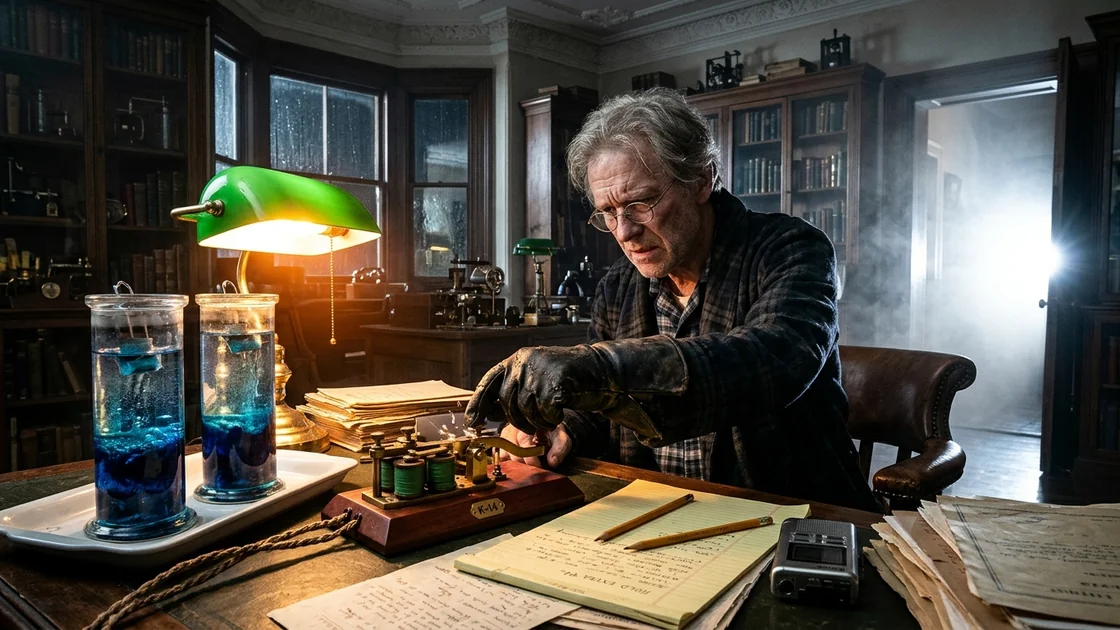
Arthur Pendelton, a retired archivist living alone in a sprawling Victorian house in upstate New York, spends his quiet days restoring nineteenth-century telegraph equipment. After acquiring a matched pair of antique brass keys and sounders salvaged from an old railroad line, he wires them together between his first-floor library and his third-floor attic workshop to create a working closed-circuit loop. Soon after energizing the wet-cell batteries, the brass sounders begin tapping out frantic messages in obsolete American Morse code during the dead of night, even though both keys are locked shut and untouched. As Arthur translates the transmissions and investigates the history of the instruments, he discovers that one key came from a main depot and the other from a remote signal tower destroyed in a catastrophic 1891 train wreck. By linking the two artifacts with copper wire, Arthur has inadvertently bridged a century-old severed line, turning his home into the haunted twelve-mile stretch of track between the stations and forcing him to answer a dead operator who is desperately trying to stop a phantom train before it tears through the house.
The rain in Oakhaven had a particular way of finding the oldest parts of a house and reminding them of the forest they used to be. In the late autumn, when the wind came down off the Adirondacks and pushed sheets of cold water against the tall, narrow clapboards of Arthur Pendelton’s home, the interior framing would answer with a slow, rhythmic series of pops and groans. For the first year after Eleanor died, those sounds had kept Arthur awake until dawn. He would lie on his side of the high walnut bedstead, staring at the plaster rosette on the ceiling, listening to the timber settle and imagining footsteps on the back stairs.
By the third year, he had learned that the only cure for a noisy house was to give it a sharper, more deliberate voice to listen to.
Arthur’s sanctuary was the downstairs library, a long, north-facing room lined with glass-fronted bookcases where the books had gradually been evicted to make room for brass, mahogany, and vulcanized rubber. He was sixty-two years old, with the stooped shoulders and ink-stained cuticles of a man who had spent forty years managing municipal archives, and his passion was the electromagnetic telegraph. Not the gleaming, automated teletype machines of the mid-twentieth century, nor the wireless spark-gap transmitters of the maritime era, but the simple, mechanical purity of the nineteenth-century land-line instruments.
To Arthur, a telegraph key was the pinnacle of human industrial design. It was nothing more than a switch—a balanced brass lever rocking on steel trunnions, tipped with a tiny contact point of platinum that met a corresponding platinum anvil beneath it. Yet, through that microscopic point of contact, empires had been governed, wars had been directed, and lovers had proposed across thousand-mile stretches of prairie and mountain. Every operator had possessed a distinct "fist," a personal rhythm of dots and dashes as recognizable to a trained ear as the timbre of a human voice.
On a Tuesday afternoon in November, when the sky outside was the color of a wet slate shingle, Arthur stood over his workbench in the library, carefully unwrapping two parcels encased in brown butcher paper and tied with hemp twine.
He had bought them three days earlier from a man named Miller, an estate liquidator who cleared out the barns and attics of the old railroad towns along the defunct Delaware and Hudson spur lines. Miller had found these two pieces in the cellar of a retired stationmaster in Hallowell, forty miles up the valley. They had been packed in a wooden dynamite crate filled with sawdust that smelled faintly of coal oil and mouse droppings.
Arthur folded back the stiff paper and let out a long, quiet breath.
Resting on the blotter were two combination sets—each consisting of a brass lever key and a vertical local sounder mounted side by side on a beveled base of dark, heavy cherry wood, bordered with thin strips of decorative brass inlay. He leaned down, adjusting his wire-rimmed spectacles, and brushed a pinch of sawdust away from the maker’s stamp between the binding posts.
"J.H. Bunnell & Co., New York," he murmured to the empty room. "Patented 1881."
They were railroad instruments, heavier and more ruggedly built than the dainty keys used in commercial Western Union offices in the cities. The levers were gently curved in the style the old-timers called "camelbacks," designed to keep an operator’s wrist from cramping during a twelve-hour shift of copying train orders. The vulcanite finger-knobs were worn smooth around the edges, hollowed slightly in the center where thousands of hours of thumb and forefinger pressure had polished the hard rubber to a dull, satin sheen.
What fascinated Arthur most, however, was the condition of the pair. Though they were identical in manufacture, their lives had clearly diverged at some point in the distant past. The first set—which had a small brass tag tacked to the cherry wood reading K-14—was in remarkable shape. The lacquer on the brass was crazed with age and darkened to the color of old honey, and the green silk insulation on the twin electromagnetic coils of the sounder was intact, faded to the hue of dried sage.
The second set, stamped directly into the wood with the die-cut marks K-19, looked as though it had been dragged out of a furnace. The cherry base was charred along the left bevel, the wood blackened and checked into tiny alligator scales. The brass binding posts were tarnished almost black, and the vulcanite knob on the circuit-closer lever had melted slightly on one side, sagging like a drop of candle wax that had cooled mid-fall. Someone, long ago, had cleaned the soot from the moving parts and oiled the steel trunnion screws so the lever still rocked freely, but they had never bothered to sand away the burn marks.
Arthur spent the better part of Thursday and Friday at his bench with a bottle of rottenstone, a rag dampened with sweet oil, and a set of jeweler’s screwdrivers. He did not strip the patina—to polish an antique key back to mirror-bright brass was a sin among serious collectors, an erasure of its history. Instead, he cleaned the electrical contacts. He took a strip of thick bond paper, slipped it between the platinum points of the hammer and the anvil, pressed the key down, and drew the paper out, leaving behind a faint gray streak of oxidized metal and century-old grime.
He tested the coils of both sounders with a modern multimeter. Each registered precisely four ohms of resistance. The fine copper wire wrapped thousands of times around the soft iron cores inside those green silk spools was completely unbroken.
When he pressed the camelback lever of K-19, the action was stiff. He adjusted the tension spring and the back-stop screw until the gap between the hammer and anvil was no thicker than a fingernail. He tapped out a quick test letter—C, two dots, a space, and a dot in the old American code—and listened to the dry, unpowered tick-tick, tick of the brass.
"Still got your voice," Arthur whispered.
Normally, once an instrument was cleaned and cataloged, Arthur would place it on one of the shelves behind glass, alongside his Phelps pony sounders, his Western Electric camelbacks, and his prized Chubbuck register. Sometimes he would wire a single key and sounder to a concealed dry-cell battery on his desk just to hear the sharp clack of the armature when he felt the urge to practice his fist.
But as he looked at K-14 and K-19 sitting side by side on the green felt blotter, a different notion took hold of him. They were a pair. They bore the markings of the same railroad division, likely adjacent way-stations along the old mountain grade. For the first time in his thirty years of collecting, he had enough vintage cloth-covered wire on a spool in the basement to build a proper multi-station line.
His house was large, drafty, and entirely too quiet. What if he put one station down here in the library, and the other up in the third-floor turret room where he kept his soldering irons and spare lumber?
It was a foolish project for a man who lived alone. A two-station telegraph line required two operators if any real message was to be sent and received, unless one simply enjoyed walking up two flights of stairs to read what weren't even written words, since a sounder left no paper tape behind—only transient clicks in the air. Yet the sheer mechanical completeness of the idea appealed to his archivist’s soul. These instruments had been built to talk to each other across a distance. Keeping them disconnected on a shelf felt like caging two birds in separate rooms when they had been raised to call across a valley.
On Saturday morning, the rain turned to a cold, steady drizzle that shrouded the leafless maples along the street in gray mist. Arthur went down to the cellar and retrieved a heavy wooden spool of sixteen-gauge solid copper wire, insulated with braided cotton cloth that had been dipped in paraffin wax. He also brought up two heavy glass jars, each ten inches high, along with two cast-zinc elements shaped like a bird's foot and two flat copper ribbons riveted into three-bladed stars.
If he was going to string a line, he wasn't going to power it with a modern plastic lantern battery or a wall transformer. He was going to use gravity cells—the old "crowfoot" batteries that had powered every telegraph office in America from the Civil War until the First World War.
He spent the entire morning feeding the waxed wire through the anatomy of the house. Fortunately, the Victorian builders of 1885 had included a narrow dumbwaiter shaft that ran from the kitchen pantry all the way to the third-floor landing, long since nailed shut and forgotten. Arthur pried off the wainscoting access panel in the pantry, drilled two quarter-inch holes through the dark oak baseboard into the library, and dropped a weighted plumb line down from the third floor.
For four hours, he crawled on his knees with a flashlight held between his teeth, pulling two parallel strands of the braided wire up through the dark, dusty vertical shaft, securing them every six feet with porcelain insulating cleats so the bare wood of the house framing never touched the line. In the dry darkness of the dumbwaiter shaft, the smell of old cedar shavings, pulverized mortar, and dead spiders was thick enough to taste. His knees ached, and a splinter of century-old pine worked its way under the thumbnail of his left hand, throbbing in time with his pulse.
By four o’clock, when the early November twilight was already bruising the sky outside the turret windows, the physical line was complete. Over one hundred and sixty feet of copper wire formed a continuous loop from the first-floor library, up through the walls of the house, into the third-floor turret room, and back down again.
In the turret room, upon a small pine table beneath the pitched eaves, Arthur bolted down the scarred, fire-blackened instrument, K-19. He stripped the waxed cloth from the ends of the two wires coming out of the wall, scraped the copper bright with his pocketknife, and clamped them tightly under the knurled brass binding posts on the back of the cherry base.
Then he walked back down the two flights of creaking stairs to the library.
Here, on the corner of his heavy partner’s desk, he secured K-14. Next to it, on a thick porcelain tray behind the desk, he mixed his batteries. He placed the star-shaped copper ribbons at the bottom of the two glass jars, poured in two pounds of bright blue copper sulfate crystals—old telegraphers called it "bluestone"—and filled the jars with rainwater he had collected in a cistern barrel behind the carriage house. Finally, he hooked the cast-zinc "crowfeet" over the rims of the jars so they hung suspended in the clear water near the top, several inches above the blue crystals at the bottom.
To kickstart the chemical action, he added a pinch of zinc sulfate and shorted the terminals together for twenty minutes. Slowly, a sharp, distinct horizontal line formed in the liquid of each jar: brilliant, royal blue solution at the bottom, clear water at the top, generating a steady, whisper-quiet current of approximately one volt per cell, capable of running continuously for months without faltering.
Arthur wiped his hands on his shop apron, turned on the green-shaded student lamp on his desk, and hooked the battery leads into the library key.
In the North American telegraph system, unlike the European systems, lines were operated on a "closed circuit." Beside every brass key lever was a small horizontal switch called the circuit-closer. When an operator was not actively tapping out a message, he slid this little lever shut, wedging it beneath a brass lip on the anvil. This kept the electrical current flowing continuously through the entire line, keeping the electromagnets in every sounder along the route pulled tightly down against their stops.
Only when an operator wanted to send a message did he flick his circuit-closer open—breaking the current and causing every sounder on the line to spring up with a sharp clack—and begin tapping his key, making and breaking the circuit with his fingers.
Here in the library, the circuit-closer on K-14 was pushed firmly shut.
Yet the brass sounder armature sat dead and loose, held up by its spiral tension spring. No current was flowing.
Arthur frowned, then remembered: he had left the circuit-closer on K-19 open up in the turret room when he had been cleaning it. Because the two stations were wired in series—a single continuous loop—if either switch was open, the entire line was broken.
Moving with the deliberate, unhurried satisfaction of a man completing a ritual, Arthur walked out into the front hall and climbed the stairs. The house was chilly; the furnace in the basement hadn't kicked on yet, and his breath made faint ghosts in the stairwell. He reached the third-floor landing, opened the narrow door to the turret room, and stepped inside.
Rain pattered directly against the curved glass panes three feet from the little pine table. In the gloom, the blackened wood and dark brass of K-19 looked ancient, almost skeletal.
Arthur reached out with his thumb and pushed the melted vulcanite knob of the circuit-closer lever to the left, sliding its brass tongue firmly into the spring clip.
Instantly, with a sharp, authoritative CLACK, the heavy brass bar of the sounder slammed down as the electromagnets energized.
And three stories below, muffled by plaster, oak flooring, and sixty feet of air, Arthur heard the faint, answering clack of the library sounder locking down at the exact same millisecond.
The loop was closed. The copper vein running through the spine of his house was alive with current.
Arthur stood over the little table in the turret room. He hooked his forefinger and thumb around the circuit-closer, pulled it open—clack went the sounder as the spring yanked the bar up—and placed his fingers lightly on the camelback key. He had learned International Morse in the Army Signal Corps during the fifties, and had taught himself the older, trickier American Railroad Morse over the past decade.
He began to tap, his wrist rising and falling with the fluid, loose motion the old manuals insisted upon.
Dot-dash-dot, dot, dot-dot-dot-dot, dot.
T-E-S-T.
The sounder inches from his knuckles hammered out the letters with a resonant, woody thwack-thwack that vibrated through the pine tabletop. Downstairs, faint as a woodpecker in the next orchard, the library sounder echoed every stroke in perfect electrical sympathy.
Arthur smiled. There was nothing quite like the voice of a Bunnell sounder. Modern electronics beeped with sterile, sinusoidal tones; a telegraph sounder had weight. It was iron hitting brass inside a resonant box. Every dot consisted of two distinct noises: the sharp, heavy downstroke when the magnet grabbed the armature, and the slightly softer, higher-pitched upstroke when the spring pulled it back against the upper stop screw.
He sent the traditional test sentence down the wire to his empty library: THE QUICK BROWN FOX JUMPS OVER THE LAZY DOG.
Then he tapped out GN—Goodnight—and pushed the melted vulcanite knob of the circuit-closer shut.
CLACK.
The electromagnets locked down. The circuit went silent, humming only on a molecular level as the copper sulfate crystals dissolved imperceptibly in the glass jars downstairs.
Arthur turned off the bare overhead bulb in the turret room, closed the door behind him, and went down to the kitchen to heat a bowl of potato soup and read the evening paper. For the first time in weeks, the creaking of the house in the autumn wind didn't bother him at all. He knew that running right through the dark timber between the floors was a taut, energized thread of order and human ingenuity.
He woke at twelve minutes past two in the morning.
He knew the exact time before he even turned his head to look at the luminous dial of the Westclox alarm on Eleanor’s side of the bed, because something had pulled him cleanly from the bottom of a dreamless sleep into full, cold-eyed alertness.
His bedroom was on the second floor, directly above the library and directly below the third-floor turret. The dumbwaiter shaft containing the telegraph wires ran through the interior wall just behind his mahogany wardrobe.
The rain had stopped. Outside, the wind had died down to an occasional draft that rattled the loose sash of the bay window. The house was profoundly still.
Then, from directly beneath the floorboards under his bed, came a sharp, metallic report.
Clack.
Arthur did not move under the heavy wool blankets. His eyes remained fixed on the ceiling rosette.
A pause of three seconds. Then another sound—lighter, higher in pitch.
Click.
The downstroke and the upstroke.
Arthur swung his legs out of the bed and sat on the edge of the mattress, his bare feet touching the cold braided rug. He listened, holding his breath so the rustle of his flannel pajamas wouldn't mask the sound.
From the library below, and simultaneously from the ceiling above his head, came a quick, irregular stutter of brass against brass.
Clack-click, clack-click, clack... click.
A loose connection, he thought immediately. It was the simplest and most logical explanation. When you string old solid-core copper wire through a vertical shaft, gravity pulls on the spans between the cleats. Perhaps one of the bare copper ends he had clamped under the binding posts had slipped slightly, or had oxidized in the damp night air, causing the one-volt current from the gravity cells to drop just low enough for the spring on the sounders to overcome the magnets.
Or perhaps a mouse in the turret room had run across the pine table and nudged the circuit-closer lever on K-19.
He stood up, pulled on his wool robe, shoved his feet into his leather slippers, and stepped out into the dark second-floor hallway. As he reached the top of the main staircase, the sounders both above and below him let out a sudden, sustained chatter—what old operators called "bugging" or "fluttering" on a bad wire—before locking down again with a heavy thump.
Arthur walked down the stairs, his hand trailing along the smooth mahogany banister. The library door was open. The streetlights outside cast long, barred shadows through the Venetian blinds across the Persian rug and the glass-fronted cabinets of his collection.
On the corner of his partner’s desk, the two tall glass jars of the gravity cells gleamed faintly in the ambient light, the blue layer at the bottom looking black in the gloom.
Arthur walked over and clicked on the green-shaded student lamp.
He looked down at K-14.
The brass tongue of the circuit-closer was wedged tightly beneath the lip of the anvil. The switch was shut. The heavy brass bar of the sounder was pulled snugly down against its lower stop, energized and silent.
"Must be upstairs," Arthur muttered, his voice sounding thin and rusty in the quiet room. "Or a bad splice in the shaft."
Only, he hadn't made any splices in the shaft. He had used two continuous, unbroken runs of wire off the spool. The only four connection points in the entire loop were the two binding posts here on his desk, the two binding posts upstairs on K-19, and the connections at the battery jars.
He reached out to wiggle the wires at the back of the desk to see if one was loose in its post.
Before his fingers came within six inches of the cherry wood base, the sounder snapped upward.
Click.
Arthur froze, his hand suspended in the warm cone of light from the student lamp.
The brass lever of the key in front of him had not moved. The circuit-closer was still jammed shut. Yet the electromagnet had just lost its power, allowing the spring to yank the sounder bar up against the top screw.
For five seconds, the bar stayed up. The line was open—broken somewhere between his desk and the third floor.
Then, with the crisp, unmistakable cadence of a human hand striking a key, the sounder began to hammer.
Clack-click. Clack-click. Clack-click.
Clack-click. Clack-click.
Dot-dot-dot, space, dot.
The letter S in International Morse? No—there had been a distinct micro-pause before the final dot. In American Railroad Morse, two dots, a tiny space, and a dot was the letter C.
Clack-click, clack-click... clack-click.
Another C.
Then a quick, snapping combination: a dot and a long dash, followed by a dot, a space, and a dot.
Arthur stood staring at the vibrating piece of century-old brass. The hair on his forearms rose beneath the sleeves of his wool robe.
A loose wire did not make spaced letters. A mouse brushing against a binding post did not hold the circuit open for the precise duration of an inter-character space and then close it for the exact thirty-millisecond duration of a dot. Whatever was interrupting the electrical flow inside the walls of his house was doing so with rhythm, syntax, and muscle memory.
Clack-click, clack-click. Clack---click, clack-click.
K-19. K-19. K-19.
It was a station call.
In the old railroad days, when dozens of depots and signal towers were strung together along the same single iron wire, an operator wanting to speak to a specific station would repeat that station’s two-letter or alpha-numeric call sign over and over, interspersed with his own identifier, until the man at the distant desk heard his call clicking out of the background chatter, opened his circuit-closer, and answered I-I to say he was listening.
K-19. K-19. K-19. DS. K-19.
DS was the universal railroad shorthand for the division dispatcher.
The sounder stopped—holding in the "up" position, the circuit wide open, waiting for an answer.
In the silence that followed, Arthur could hear the faint, synchronized echo from the ceiling two floors above. The sounder in the turret room was up, too.
"Impossible," Arthur whispered. He was a man of science and historical fact. He knew how electricity worked. For those sounders to rise and fall while both circuit-closers were shut, something had to be physically severing and reconnecting the copper wire—or introducing a variable high-resistance break directly into the circuit—at the exact cadence of a veteran telegrapher.
Could the wire be acting as an antenna? Sixty feet of vertical copper wire running up the center of a house was certainly long enough to pick up radio frequency interference from an amateur ham operator down the valley, or induction from the power company’s lines out on the street.
No. He rejected the thought immediately. Radio waves were alternating current at millions of cycles per second; they couldn't unlatch a heavy direct-current electromagnet held down by two gravity cells, and even if they could, no modern ham radio operator in the twenty-first century was transmitting in nineteenth-century American Railroad Morse, using spaced letters and calling a defunct station number stamped into the wood of a key sitting in Arthur’s attic.
Suddenly, the sounder slammed down.
CLACK.
The circuit was closed again. The magnets held tight.
Arthur didn't wait. He turned from the desk, hurried out of the library, and climbed the stairs two at a time, his heart hammering against his ribs with a heavy, irregular thud that made him winded by the time he reached the second-floor landing. He didn't stop at his bedroom. He went straight up the narrow, steep attic stairs to the third floor.
The turret room door was shut, just as he had left it at five o'clock.
He grabbed the porcelain doorknob, twisted it, and pushed the door open, slapping his left hand against the wall switch to flood the small octagonal room with the harsh yellow glare of the bare ceiling bulb.
The room was empty. Dust motes hung motionless in the cold air.
Arthur stepped to the pine table and looked down at the fire-scarred base of K-19.
The melted vulcanite knob of the circuit-closer was still pushed firmly to the left, wedged tight under the brass lip. The sounder armature was locked down. Nothing had touched it. There were no mice, no fallen ceiling plaster, no loose wires. The two braided cloth leads ran straight from the binding posts into the two neat holes he had drilled in the wainscoting, disappearing into the dark shaft below.
He reached out and touched the brass lever of K-19. The metal was ice-cold.
Then he touched the green silk wrapping of the two electromagnetic coils on the sounder.
They were warm.
A four-ohm local sounder running on two gravity cells drew roughly a quarter of an amp of current—barely a quarter of a watt of power. It could sit energized for ten years and never rise a single degree above room temperature. For those coils to feel noticeably warm to his fingertips, a much heavier current had been surging through the windings just moments before.
Arthur pulled his hand back as if the silk had stung him.
He stood in the center of the little turret room, surrounded by the dark panes of curved glass that reflected his own pale, gray-stubbled face back at him. Downstairs, the grandfather clock in the front hall struck the half-hour—a single, resonant chime that faded slowly into the timber of the house.
He didn't disconnect the wire that night. Some stubborn, analytical instinct—the same instinct that made him spend weeks deciphering water-damaged parish registries at the county courthouse—refused to let him pull the wire out of the binding posts before he understood what was happening. Instead, he went back downstairs to the library, pulled a fresh yellow legal pad and three sharpened pencils from his desk drawer, and laid them beside K-14.
He sat in his leather swivel chair with a quilt wrapped around his shoulders until the gray light of Sunday morning began to seep through the blinds.
The sounder did not move again. It remained locked down, dead and silent, while the blue crystals in the glass jars quietly fed their tiny trickle of electrons up and down the stairs.
At nine o'clock, after two cups of strong black coffee that did very little to clear the gritty exhaustion behind his eyes, Arthur put on his tweed overcoat and his driving cap. Before leaving, he took a small digital voice recorder—a piece of modern equipment he used for dictating catalog notes—set it to voice-activated mode, and laid it on the desk two inches from the brass sounder of K-14.
He drove his aging Volvo station wagon out of Oakhaven, following the winding two-lane state highway that hugged the bank of the Black River. The river was swollen with autumn rain, brown and frothy where it tumbled over the limestone ledges. Beside the water, running parallel to the asphalt road on a raised embankment of crushed granite ballast, lay the old right-of-way of the Delaware & Hudson’s Kettle Creek Division.
The steel rails had been torn up for scrap during the Second World War, leaving behind a raised dirt trail overgrown with sumac, birch saplings, and rotting creosote ties that stuck out of the gravel like blackened ribs. Every few miles, a rusting cast-iron whistle post or the crumbling stone abutment of a demolished water tank stood among the weeds, monuments to a vanishing geometry of steam and iron.
Twelve miles north of town, Arthur turned off the highway onto a rutted gravel lane and pulled up in front of a low white Cape Cod cottage with a rusted railway semaphore blade planted in the front yard like a flagpole.
Wallace Sterling answered the door on the second knock. He was eighty-one, nearly twenty years older than Arthur, though he still moved with the compact, bandy-legged steadiness of a man who had spent half a century climbing signal masts and walking track beds. He wore a red flannel shirt with the sleeves rolled up over ropy forearms and smelled permanently of pipe tobacco and WD-40.
"Arthur," Wallace said, peering through his bifocals. "You look like you slept in a coal bunker. Come on in out of the damp."
Wallace’s kitchen was warm, cluttered with railroad timetables, cast-iron kerosene switch lamps, and stacks of Trains magazine dating back to the Eisenhower administration. He poured Arthur a mug of coffee from a percolator on the stove and sat across from him at the linoleum table.
"Miller told me you bought those two Bunnell sets out of the Hallowell estate," Wallace said, packing a briar pipe from a tin of Prince Albert. "I looked at 'em myself last Tuesday. Too rich for my blood, and that one base was half-cooked, though the brass was sound."
"That's why I'm here, Wally," Arthur said, wrapping his hands around the hot ceramic mug. "Do you have the old dispatcher sheets or the station directory for the Kettle Creek branch from the eighties and nineties? Specifically, I’m looking for the call signs on those two bases. K-14 and K-19."
Wallace struck a kitchen match on his thumbnail, held the flame over the bowl of his pipe, and puffed until a blue cloud of sweet-smelling smoke hung between them. "Don't need the directory for those two, Artie. Anybody who worked signal maintenance on this valley division knows what the K line was. That was the old mountain cutoff before they bored the tunnel through High Knob in nineteen-aught-six."
He pointed the stem of his pipe toward the kitchen window, out toward the gray, wooded ridges rising steeply behind the river.
"K-14 was the main junction depot at Kettle Falls," Wallace said. "Big two-story brick station with a bay window looking right down the main line. That was where the night dispatcher sat. Had a double track up to that point, and then from K-14 north through the gorge, it narrowed down to a single track clipped right into the slate cliffside for fourteen miles."
"And K-19?" Arthur asked quietly.
Wallace’s eyes narrowed behind his thick lenses. "You really don't know what you bought, do you?"
"I know it was in a fire."
"More than a fire," Wallace said. He pushed his chair back, walked over to a tall oak filing cabinet wedged beside the refrigerator, and pulled open the bottom drawer. He thumbed through a row of manila folders thick with yellowed newsprint and photostats until he found a wide cardboard binder tied with black ribbon. He brought it back to the table and untied it.
Inside were photographs mounted on stiff gray card stock—prints made from glass-plate negatives.
Wallace slid one across the linoleum.
It showed a narrow, terrifyingly steep river gorge where the water boiled white between vertical walls of wet black slate. Halfway up the left cliff face, on a blasted rock shelf barely wide enough for a single set of rails, lay a tangled, apocalyptic heap of twisted iron boiler tubes, splintered wooden boxcars, and spoked driving wheels pointing skyward like the legs of a dead horse. Rising out of the middle of the wreckage were the charred, collapsed timbers of a small two-story wooden signal tower that had been crushed and burned down to its stone foundation piers.
"October nineteenth, eighteen ninety-one," Wallace said, tapping a blunt fingernail on the margin of the mount. "Tower K-19, otherwise known as Black Gorge Switch. It wasn't a passenger station—couldn't even reach it by wagon road. The company built it on a rock ledge halfway through the single-track canyon just to operate the passing siding and hold the block signals."
Arthur stared at the photograph. The detail from the large-format glass plate was excruciatingly sharp. He could see the individual rivets on the ruptured steam dome of the locomotive, and a single telegraph pole leaning drunkenly out over the abyss, its cross-arms draped in a snarl of snapped iron wires like tangled fishing line.
"What happened?" Arthur asked.
"Misread order, or a dead wire—the coroner’s jury never could prove which," Wallace said, leaning back and drawing on his pipe. "It was a night just like we had this week. Pouring rain, mudslides coming down off the mountain, wind knocking limbs onto the telegraph line between Kettle Falls and the gorge. A southbound fast freight—Engine 44, heavy coal drag—was coming down the mountain on the single track. At the same time, the northbound night express out of Albany was cleared past K-14 at Kettle Falls."
Arthur felt a cold, hollow tightness settling into the pit of his stomach. "They were on the same track."
"Head-on," Wallace nodded. "The dispatcher down at K-14—fellow named Henderson—realized the freight hadn't cleared the north switch on schedule. He tried to raise the night operator at Tower K-19 to tell him to throw the red board and ditch the coal train onto the rock siding before the passenger express came around the blind curve in the gorge."
Wallace reached into the binder and pulled out a photostat of a handwritten ledger page—the official transcript of the railroad commission inquiry.
"The boy working the night trick at K-19 was nineteen years old," Wallace said softly. "Name was Thomas Finch. First month on his own key. According to Henderson’s testimony down at K-14, the wire was swinging in the storm, grounding out against the wet pine trees every few seconds. Henderson hammered out K-19 for ten minutes straight. Finally, right at 2:12 in the morning, the boy answered. Henderson started sending the Form 31 emergency hold order."
Arthur remembered the luminous dial of his alarm clock when the first clack had woken him from a dead sleep. Twelve minutes past two.
"Did the boy get the message?" Arthur asked, though he already knew the answer from the charred wood upstairs in his turret room.
"Never finished copying it," Wallace said. "Right in the middle of Henderson sending the engine number, the line went wide open—circuit broke. A rockslide two miles south of the tower had taken down four poles and snapped the wire clean in two. Three minutes later, the coal drag came barreling down the grade at forty miles an hour with its brakes smoking, hit the switch right where it met the northbound express, and both engines piled straight into the base of Tower K-19."
Wallace closed the cardboard binder with a soft thud.
"Boiler exploded," he continued. "Set the wooden tower and the express cars ablaze. Thirty-one people died in the gorge that night. When the wrecking crew finally got up the canyon at daybreak, they found young Finch’s body in the ashes of the upper story. The roof had come down on him, and the coal fire had scorched everything around him, but they found the brass key from his desk down in the rubble. The old stationmaster at Hallowell kept it in his cellar for seventy years alongside the dispatcher's key from K-14 when they closed the Kettle Falls depot in the fifties."
Arthur looked down at his coffee mug. The dark liquid was completely still.
"They were the exact two keys on the ends of that wire that night," Arthur said.
"The exact two," Wallace agreed, studying Arthur's face with sudden curiosity. "Why do you ask, Artie? You look pale as a sheet."
"Nothing," Arthur said quickly, forcing a tight, unconvincing smile. "Just cataloging provenance. You know how I am about keeping the historical record straight for the collection."
"Well, keep 'em under glass," Wallace said, tapping the cold ashes of his pipe into a brass spittoon on the table. "Bad luck on that iron, some of the old-timers used to say. My granddaddy worked wrecking crew on the D&H. He told me that for five years after they rebuilt the line through Black Gorge, the night operators hated working that trick. Said whenever the rain got heavy in October and November, the relays would start chattering on the local battery even when the main line was grounded at both ends. Just static coming off the wet slate in the canyon, of course. Earth currents. Ore in the rock."
"Of course," Arthur said. "Earth currents."
It was past noon when Arthur pulled his Volvo back into the driveway of his house in Oakhaven. The drizzle had stopped, leaving the wet black bark of the maples gleaming dull as gunmetal under a low, heavy sky.
From the sidewalk, his eyes went involuntarily to the third-floor turret window. The curved glass panes reflected only the gray clouds moving slowly southward down the valley.
He unlocked the front door, stepped into the hall, and paused to listen.
The house was quiet. No clicking came from the library.
He hung his coat on the hall tree and walked into the library. The green student lamp was still burning where he had left it, casting a warm pool of light over the desk. The sounder of K-14 was locked down, its electromagnet holding the brass armature firmly against the lower stop.
Beside it, the tiny red light on his digital voice recorder was blinking.
On that particular model, the indicator light only blinked when the internal memory had recorded an audio file after being triggered by sound.
Arthur sat down in his swivel chair, picked up the small silver device, and pressed the rewind button. There were three separate files logged between ten-thirty and eleven-forty that morning, while he had been sitting in Wallace Sterling’s kitchen twelve miles away.
He pressed play and set the recorder down on the blotter.
For the first two seconds, there was only the faint white noise of the empty room, followed by the distant tick of the hall clock. Then, loud and close against the microphone, came the sharp, metallic snap of the sounder opening.
Click.
A pause, and then a rapid, crisp burst of American Morse, sent at thirty words a minute—far faster than Arthur could tap, the unmistakable, driving cadence of a professional nineteenth-century railway telegrapher whose fingers moved faster than conscious thought.
Arthur grabbed his pencil and poised the tip over the yellow legal pad. He didn't even need to slow the playback down; after ten years of studying old recordings, the rhythm of the downstrokes and upstrokes translated directly into letters in his head.
Clack-click, clack-click... clack-click.
He wrote the letters down on the yellow paper as they rattled out of the tiny speaker.
K-19. K-19. K-19. DS. 31. CPY 3.
"31, copy 3," Arthur whispered. In railroad telegraphy, "31" was the code for the highest-priority train order—one that required the operator to stop the train, hand-deliver three carbon copies on thin tissue paper ("flimsies") to the conductor and engineer, and obtain their physical signatures before the train could move another foot.
The recording paused for four seconds, then the second audio file clicked on automatically.
This time, the fist was different.
Arthur leaned closer to the speaker, his breath catching in his throat.
The first transmission had been heavy, rock-steady, each dot and dash clipped with the mechanical precision of an experienced dispatcher. This second burst of clicking was lighter, slightly uneven—the dots a fraction too hurried, the spaces between the words trembling slightly, as if the hand on the vulcanite knob were cold or terrified.
I-I. I-I. K-19. GA. GA.
I-I was the acknowledgment signal. GA meant "Go ahead."
Then came the dispatcher’s heavy fist again, hammering right over the end of the boy's response:
ORDER NO 84 TO C&E SOUTH EXTRA 44 AT K-19. HOLD EXTRA 44 AT K-19 FOR NORTH EXPRESS NO 12. DO NOT PASS NORTH SWITCH. DO YOU UNDERSTAND? 13?
"13" was the old numerical code for Do you understand?
On the recording, the lighter, trembling fist began to tap back the mandatory word-for-word repetition to prove the order had been received correctly:
I-I. ORDER NO 84 TO C&E SOUTH EXTRA 44—
CLACK.
A loud, violent snap on the recording—the sound of the line breaking wide open—and then nothing. Only the quiet hiss of the library air for five seconds until the voice-activation circuit turned the recorder off.
Arthur sat staring at the yellow legal pad. His pencil lead had snapped against the paper on the final dash, leaving a black smudge across the page.
He had just listened to the final forty seconds of communication between Kettle Falls Depot and Black Gorge Tower on the night of October nineteenth, 1891.
"A residual recording," he said aloud, trying to anchor himself in some quasi-scientific theory he had read about in dusty journals of parapsychology. The "Stone Tape" hypothesis—the idea that extreme emotional trauma coupled with electrical energy could somehow impress itself into the crystalline structure of iron, brass, or stone, replaying like a magnetic tape when the right current was passed through it again.
That had to be it. By wiring K-14 and K-19 together in a series loop and energizing them with genuine copper-sulfate gravity cells, he had recreated the exact electrical impedance and magnetic field of the circuit that had been severed by the rockslide a hundred and thirty-odd years ago. The brass and iron cores of the two instruments were simply discharging an electromagnetic echo stored in their molecules.
It was a marvel, really. If he were a younger man, he might have called a physicist from the university in Syracuse to bring an oscilloscope and measure the resistance fluctuations in the copper wire.
Then the third audio file on the recorder began to play.
Arthur hadn't noticed that the timer on the small LCD screen was still advancing.
Click.
From the speaker came the lighter, hesitant fist—the nineteen-year-old boy, Thomas Finch, at K-19.
Only this time, he wasn't repeating Order No. 84.
The clicking was slow, halting, spaced out with long, bewildered pauses between every word.
DS? DS? LINE IS CLOSED AGAIN. WHO MENDED THE WIRE?
A pause of five seconds on the tape. No heavy dispatcher’s fist answered him this time.
DS? MY LAMPS ARE OUT. THE SMOKE IS IN THE ROOM. THERE IS ANOTHER BATTERY ON THIS LOOP. WHO IS CUT IN BETWEEN ME AND THE FALLS?
The recording clicked off.
In the exact instant the digital speaker went silent, the real brass sounder six inches from Arthur’s right hand snapped upward on its own.
Click.
Arthur shoved his chair backward so hard the casters caught on the edge of the Persian rug, nearly tipping him onto the floor. He stood up, backing away toward the bookcases as the brass bar of K-14 began to hammer against its anvil in the quiet Sunday afternoon light.
Clack-click. Clack-click, clack-click.
WHO IS ON THIS WIRE? IDENTIFY STATION.
It was not a recording. A recording did not ask questions about the circuit it was currently running through. A recording did not feel the electrical presence of a third party listening in the dark.
IDENTIFY STATION, the sounder hammered again, faster now, the brass bar blurring slightly as the frantic hand at the other end of the impossible line pounded the key. THE 44 IS ON THE GRADE. I CAN HEAR HER WHISTLE ABOVE THE GORGE. IF YOU HAVE THE MAIN LINE TO KETTLE FALLS, REPEAT THE ORDER. REPEAT THE ORDER.
Arthur’s eyes darted to the two cloth-covered wires running from the back of the desk into the oak baseboard.
The two stations were wired in series. K-14 was right here in front of him. K-19 was upstairs in the turret room. Between them was nothing—only eighty feet of vertical dumbwaiter shaft and one hundred and sixty feet of copper wire.
Yet in the electrical topology of the circuit, the distance between the two keys was no longer two flights of Victorian stairs. To whatever was trapped inside the loop, the wire between the first floor and the third floor of Arthur’s house was still fourteen miles of rain-lashed mountain canyon.
And Arthur, standing in the library, was sitting directly at the dispatcher's desk at Kettle Falls.
"It's just a circuit," Arthur whispered, his voice trembling. "If I break the circuit, it stops."
He forced himself to take two steps forward toward the desk. He didn't reach for the key; he reached for the circuit-closer lever on the side of K-14, intending to yank it open—or better yet, unscrew the binding posts and rip the battery leads out of the blue glass jars.
Before his fingers could touch the vulcanite knob, the sounder slammed down with a force that made the entire heavy partner's desk shudder.
A bright, blue-white arc of static electricity jumped half an inch from the brass trunnion of the key straight into the tip of Arthur’s index finger.
SNAP.
Arthur cried out, stumbling backward and clutching his right hand against his chest. The shock was far stronger than two one-volt gravity cells could ever produce; it felt like he had shoved a screwdriver into a 220-volt dryer outlet. His finger was numb to the second knuckle, and the sharp, metallic stench of ozone instantly filled the library, mixed with something else—something wet, heavy, and sulfurous, like coal smoke blown down into a damp cellar on a rainy night.
On the desk, the blue copper sulfate liquid at the bottom of the two glass battery jars was beginning to bubble. Tiny, furious streams of gas pearls rose from the copper stars at the bottom, blurring the sharp horizontal line between the blue and clear water.
The sounder opened again and hammered out a single, furious phrase:
DO NOT OPEN THIS WIRE. IF YOU BREAK THE CIRCUIT BEFORE I HAVE THE COMPLETE, THE 12 AND THE 44 MEET ON THE TRESTLE.
Arthur backed all the way to the doorway of the library, nursing his stung finger.
In the old railroad rulebooks, once an operator began receiving a Form 31 train order, breaking the line or walking away from the desk before the dispatcher sent the word COMPLETE and his initials was a criminal offense—a violation that meant men would die in the dark on single iron.
Thomas Finch had died at his desk in 1891 with an incomplete order on his pad because a rockslide had broken his wire. For a hundred and thirty-three years, that unfinished circuit had waited in the scorched brass and magnetized iron cores of the two instruments. Now the wire was mended. And the boy on the other end was not going to let the line go dead a second time.
From upstairs—not from the third-floor turret, but from somewhere inside the wall of the second-floor landing—came a heavy, metallic creak.
It was not the familiar settling of old pine studs in the autumn damp. It sounded like the straining of one-inch iron turnbuckles and heavy timber stringers under an immense, approaching weight.
Throughout the late afternoon, as the gray daylight faded into an early, moonless dark, Arthur stayed in the kitchen at the back of the house.
He had tried to leave at three o'clock. He had walked to the front hall and reached for his overcoat on the hall tree, intending to drive back to Wallace Sterling’s house, or check into the motor lodge out by the interstate and come back in the morning with an electrician and a pair of heavy insulated wire cutters.
The moment his hand touched the brass doorknob of the front door, every light in the house had flickered violently, and from the library had come a frantic, hammering barrage from the Bunnell sounder—not dots and dashes this time, but a continuous, machine-gun rattle that shook the plaster dust down from the hall ceiling. At the same time, the air pressure in the hallway had dropped so sharply that Arthur’s ears popped, and through the leaded glass sidelights beside the front door, the street outside had vanished behind a thick, swirling wall of greasy black coal smoke and driving rain.
When he stepped back from the door, the smoke outside cleared back into normal November twilight, and the sounder slowed to a steady, warning pulse:
HOLD YOUR STATION. HOLD YOUR STATION. DS. STAY ON THE KEY.
He was the dispatcher now. Until the shift was relieved or the order was completed, the stationmaster did not leave the depot.
At six o'clock, Arthur stood at the kitchen counter, wrapping a cold, wet dish towel around his shocked right finger. Through the open doorway of the pantry, he could see the square oak access panel he had pried off the dumbwaiter shaft the day before.
The two waxed cotton wires ran straight up through the dark vertical shaft like twin arteries.
As he watched from ten feet away, the wires twitched.
They were pulled taut between porcelain cleats every six feet, yet they were vibrating with a low, rhythmic thrum, like telegraph wires stretched beside a track when a heavy locomotive is still two miles away but already sending its tremor through the steel rails and up the cedar poles.
Out of the open dumbwaiter shaft drifted a draft of freezing air. It didn't smell like spiderwebs and dry pine framing anymore. It smelled of wet slate, river mud, and the sharp, acrid tang of burning whale-oil signal lamps and soft bituminous coal.
Clack-click, clack-click, clack... click.
From the library down the hall, the sounder was talking again.
Arthur walked slowly out of the kitchen, through the dining room, and stopped just inside the library doors. He didn't approach the partner's desk; he pulled a wooden Windsor chair over to the edge of the room, ten feet away from the instrument, and sat down in the shadows with his yellow pad on his knee.
The green student lamp on the desk was still burning, though the bulb filament was glowing an unusually bright, strained orange, humming like an angry hornet. In the glass jars of the gravity cells, the blue liquid had risen almost to the top, churning slowly around the cast-zinc crowfeet.
The sounder of K-14 was tapping again, and now there were two distinct voices alternating on the single wire, just as there had been on the morning recording—except they were no longer repeating the history of 1891. They were arguing in the present tense.
First came the light, rapid, terrified fist from upstairs—Thomas Finch at K-19:
SHE IS AT THE MILEPOST. I CAN SEE HER HEADLIGHT THROUGH THE TREES. THE RAIN IS BLINDING THE ENGINEER. HE DID NOT SEE THE TORPEDOES ON THE RAIL. GIVE ME THE COMPLETE ON ORDER 84 SO I CAN THROW THE IRON.
A two-second pause. The sounder locked down, then snapped open again.
When it began to click, the cadence was so heavy, slow, and crushing that the brass lever of the key on Arthur’s desk actually trembled on its trunnions in sympathetic vibration. It was not the crisp, professional fist of Henderson, the dispatcher from Kettle Falls. This was something else—something massive and mechanical, tapping out letters with the ponderous, rhythmic chug of forty-inch cast-iron driving wheels pounding over rail joints.
NO ORDERS.
NO ORDERS FOR EXTRA 44.
CLEAR TRACK THROUGH THE GORGE. CLEAR TRACK TO THE END OF THE LINE.
Arthur felt the floorboards beneath his leather slippers vibrate. In the glass-fronted bookcases lining the library walls, his collection of antique instruments began to chime softly as their unpowered brass armatures rattled against their stops.
The boy’s fist broke back in on the line, frantic, cutting right across the heavy, rhythmic pounding:
WHO IS THAT? THAT IS NOT DS. HENDERSON? WHO IS AT K-14?
The boy was asking Arthur.
Arthur looked down at his numb right index finger, then across the ten feet of carpet to the polished brass camelback key of K-14 gleaming under the student lamp.
"He doesn't know," Arthur murmured to the empty room.
Thomas Finch was nineteen years old, trapped in the burning, timeless dark of the third-floor turret room, convinced he was still sitting in the upper story of Black Gorge Switch with a hundred-ton freight locomotive bearing down on his tower. And coming up the wire behind the boy—riding the electrical current that Arthur had foolishly strung through the heart of his own home—was the sheer, blind momentum of the wreck itself, demanding a clear track straight down the copper wire from K-19 to K-14.
If a train left K-19 on this wire, where was K-14?
Right here on Arthur’s desk. And the fourteen miles of single track between them was the wooden staircase and plaster walls of Arthur’s house.
As if in answer to his thought, a sound rolled down from the third floor.
At first, it sounded like thunder over the Adirondacks. Then it deepened into a sustained, metallic rumble that made the windowpanes in the library bow inward against their putty. Above his head, in the ceiling of the second floor, something heavy and iron-shod slammed across a rail joint—ka-clunk, ka-clunk—sending a shower of calcimine flakes snowing down onto the Persian rug.
The house was taking the weight of the grade.
On the desk, the sounder snapped open. The boy’s fist was frantic, the dots running together as his hand slipped on the melting knob upstairs:
K-14! K-14! IF YOU ARE THERE, ANSWER ME! MY LEVER IS BURNING MY HAND! THE TIMBERS ARE GIVING WAY! GIVE ME THE ORDER TO DITCH HER IN THE SIDING!
Arthur stood up. The wooden Windsor chair toppled backward behind him.
He was sixty-two years old. For forty years he had cataloged the dead letters of other men’s lives—tax rolls, burial permits, railroad inquiries—always standing safely on the far side of a century of dust, watching history through a magnifying glass. He had wired these two keys together because he was lonely, because he wanted the quiet house he had shared with Eleanor to have a heartbeat again.
Now a nineteen-year-old boy was screaming down a hundred-and-sixty-foot copper wire two floors above his head, trying to save thirty-one people from burning to death in the rain, and the only person sitting at the dispatcher's desk at Kettle Falls was Arthur.
"All right," Arthur said aloud, his voice steadying as the training of ten thousand hours of practice took over his nerves. "All right, son. I hear you."
He walked across the trembling floor to the partner's desk.
The heat radiating from the two glass gravity cells was like an open oven door; the blue liquid was boiling at a full, rolling seethe, sending pungent, metallic steam curling up behind the desk lamp. The air around the brass key of K-14 shimmered with static, smelling fiercely of ozone and wet cinders.
Arthur did not use his bare hand this time. He pulled a thick leather gauntlet—the heavy fireplace glove he used for tending the woodstove—from the hearth basket beside the chimney, slipped it over his right hand, and sat down in his swivel chair.
He reached out with the leather-gloved fingers, gripped the circuit-closer lever on K-14, and shoved it wide open to take control of the line.
A fat green spark leaped from the brass lip to the leather knuckle, harmlessly grounding into the heavy cowhide.
Instantly, the heavy, locomotive-like pounding on the sounder stopped. The line went open, tense and waiting.
Arthur placed his gloved forefinger and thumb on the vulcanite knob of the camelback lever. His fist was rusty compared to a nineteenth-century night dispatcher, and the leather glove made his touch clumsy, so he slowed his wrist down, making every dot and dash deliberate, heavy, and unmistakable—the calm, authoritative rhythm of a chief dispatcher taking command of a panicked division.
He tapped:
I-I. I-I. K-14. DS HERE.
He released the key and pulled the circuit-closer shut to listen.
Upstairs, two floors above, the rumbling in the framing paused for a fraction of a second, as if the house itself were listening.
Then the sounder on the desk clicked—the boy’s hand, trembling, incredulous:
DS? HENDERSON? YOU CAME BACK.
Arthur opened his switch and keyed back, keeping his wrist loose, his eyes fixed on the yellow legal pad where he had transcribed the incomplete order from the morning recording:
STAY ON YOUR KEY, FINCH. COPY ORDER NO 84.
I HAVE IT UP TO THE ENGINE NUMBER, the boy tapped back instantly. SEND THE REST. HURRY. THE FLANGE IRON IS SCREAMING ON THE CURVE.
Above Arthur’s head, the chandelier in the dining room began to swing in a wide, violent arc. From the dumbwaiter shaft in the pantry came the deafening roar of rushing river water and the high, mournful wail of a steam whistle—two long blasts, one short, one long— echoing not from outside in the town of Oakhaven, but from inside the walls of the second floor.
A brilliant white light, blinding and hot as a calcium arc lamp, began to bleed through the cracks around the library door from the front hallway, casting a single, huge, round shadow down the staircase.
The headlight of Engine 44 was coming down the stairs.
Arthur’s heart hammered against his ribs, a sharp pain radiating down his left arm, his breath coming in shallow gasps in the coal-choked air of the library. If he stopped now—if he ran out the back kitchen door into the yard—the circuit would remain unfinished, and whatever catastrophic release of kinetic and electrical energy was hurtling down the copper wire from the third floor would hit the dead-end terminals of K-14 right here in the library.
He had to switch the train into the rock siding at K-19 before it passed the tower. And to give the boy at K-19 the authority—or the spiritual release—to throw that switch lever in the dark of 1891, the dispatcher at K-14 had to finish the order and send the official COMPLETE.
Arthur slammed his gloved hand down on the brass lever and began to send, his wrist pumping faster than he had ever keyed in his life, every muscle in his forearm burning:
ORDER NO 84 TO C&E SOUTH EXTRA 44 AT K-19. HOLD EXTRA 44 AT K-19 FOR NORTH EXPRESS NO 12. TAKE SIDING AT BLACK GORGE. DO NOT PASS NORTH SWITCH. HENDERSON, DS. 13?
He snapped the circuit-closer shut.
Before the brass tongue had even settled under the lip, the sounder began to hammer back—except the heavy, crushing cadence of the locomotive was trying to jam the wire, slamming down on the electromagnet to hold the circuit closed so the boy couldn't repeat the order.
CLACK—CLACK—CLACK.
The brass bar of the sounder was fighting itself, pinned down by a surging electromagnetic current from the boiling battery jars while the boy upstairs hammered wildly against the resistance to break the circuit and send his letters. Sparks spat from the green silk coils on Arthur’s desk. A thin wisp of gray smoke curled up from the cherry wood base as the lacquer began to blister.
Out in the front hall, the heavy oak banister of the main staircase split down the middle with a sound like a rifle shot. The floor heaved under Arthur’s chair like the deck of a ship in a gale, and the roar of iron wheels and escaping cylinder steam was so loud he could no longer hear the sounder with his ears—he could only read the message by watching the frantic, quarter-inch rise and fall of the brass bar under the green lamp.
Dot-dot. Space. Dot.
O-R-D-E-R... N-O... 8-4...
Through the crushing interference on the line, Thomas Finch was repeating the order word for word, letter for letter, holding the key down with everything he had left while the phantom tower burned around him.
...H-O-L-D... E-X-T-R-A... 4-4... A-T... K-1-9... T-A-K-E... S-I-D-I-N-G... F-I-N-C-H, O-P-R.
The brass bar popped up one last time, trembling against the upper stop screw.
He had finished the repetition. Now only the dispatcher’s final validation could close the loop.
In the hallway outside the library door, the blinding white glare of the calcium headlight filled the entire doorframe. The heat was blistering; the wallpaper in the hall was curling and turning brown at the seams, and the roar of the boiler was an iron wall of sound pressing against Arthur’s eardrums.
Arthur didn't bother opening the circuit-closer—the boy was holding the line open from upstairs, waiting.
Arthur brought his gloved fist down on the camelback key of K-14 and hammered out the final sequence with every ounce of strength in his shoulders:
O-K. C-O-M-P-L-E-T-E. 2:15 A-M. H-E-N-D-E-R-S-O-N, D-S. THROW THE IRON!
For two agonizing seconds, nothing happened. The white light in the hallway swelled until Arthur had to throw his left arm across his eyes to shield his retinas, his right hand still holding the brass key pressed flat against the platinum anvil.
Then, from the third-floor turret directly above, came a new sound.
It was not the tap of a telegraph key. It was the heavy, ratcheting clank-clank-THUD of a six-foot iron Johnson bar being thrown backward in a switch-tower floor slot, locking the heavy steel switch points of the mountain siding into place.
Instantly, the roar in the stairwell changed pitch.
The massive, unseen weight hurtling down the center of the house lurched sideways—not into the library, but out along the exterior north wall, screaming as iron wheel flanges ground hard against the diverging rail of an invisible rock siding. The house shuddered from foundation to roof peak as if sideswiped by a hurricane. Four panes of glass in the north bay window blew outward into the yard with a musical crash.
And then the sound of the train passed clear through the north wall of the house, fading rapidly out into the wet November dark toward the river gorge, its whistle blowing a long, diminishing wail that dissolved into the sound of ordinary wind in the maple trees.
On the desk in front of Arthur, the green student lamp went out.
The silence that rushed back into the library was so total that Arthur could hear the soft drip-drip of water on the window ledge where the glass had broken.
He lowered his left arm from his eyes. The hallway outside the door was dark again, lit only by the faint, orange glow of the municipal sodium streetlight out on the pavement. There was no smoke. The oak banister on the stairs was whole and unbroken.
On the desk, surrounded by the sharp smell of cold ozone and scorched shellac, the sounder of K-14 gave one quiet, feather-light tap in the dark.
Arthur didn't need the lamp to read it. He knew the cadence by heart now.
S-F-D.
"Switch closed, freight ditched."
A pause of three seconds. Then two final letters, tapped softly, almost drowsily, like a boy who had worked a very long twelve-hour trick and was finally ready to blow out his kerosene lamp and go home:
G-N. K-19.
Goodnight.
With a sharp, crystalline ping, both of the heavy glass battery jars on the porcelain tray cracked simultaneously down their sides. The warm, clear and blue copper sulfate solution spilled out across the tray and dripped harmlessly onto the linoleum mat behind the desk, breaking the chemical circuit cleanly and forever.
The brass bar of the sounder on K-14 rose gently on its spiral spring, clicked once against its upper stop, and went still.
Arthur sat in his leather swivel chair in the dark until the first pale light of Monday morning turned the broken panes of the bay window gray.
When the sun was fully up, he took off the scorched fireplace glove, stood up on stiff, aching legs, and walked upstairs.
The house was completely quiet. The floorboards creaked under his slippers with their ordinary, benign nineteenth-century wood-on-nail groan. In the second-floor hallway, the wallpaper was untouched, though a fine layer of gray coal ash—no thicker than a dusting of talcum powder—lay along the flat ledge of the wainscoting directly over the dumbwaiter shaft.
He climbed the steep stairs to the third floor and opened the door to the turret room.
On the little pine table beneath the curved eaves sat K-19.
During the night, the intense heat in the coils had melted the remaining solder on the underside of the base, and the two cloth-covered wires had dropped cleanly out of the brass binding posts, coiling on the floorboards like dead vines.
Arthur stepped closer and looked down at the instrument.
The circuit-closer lever—the one with the half-melted vulcanite knob that had been jammed shut when he left it on Saturday night—was pushed wide open. And resting directly on the polished brass finger-plate of the key was a tiny flake of blackened, century-old pine charcoal, as if a thumb covered in soot had lifted off the rubber knob just a moment before he opened the door.
That afternoon, after calling a glazier to repair the four broken panes in the library window and mopping up the spilled bluestone solution behind his desk, Arthur took a pair of heavy wire cutters into the pantry. He reached into the dumbwaiter shaft, snipped the two waxed copper wires at the floor and ceiling levels, coiled the hundred and sixty feet of line neatly back onto its wooden spool, and carried it down to the trash barrels by the carriage house.
He did not sell K-14 and K-19, nor did he put them on separate shelves.
He cleared the center shelf of his finest mahogany bookcase in the library, lined the wood with fresh green billiard felt, and set the two instruments down side by side, less than an inch apart, with their brass circuit-closers left permanently open. Between them, he laid a short, six-inch strip of bare copper wire, disconnected at both ends, just so they wouldn't have to reach across twelve miles of dark mountain canyon if they ever needed to know the other was still there.
Sometimes, on rainy nights in late October and November, when the wind comes down off the Adirondacks and rattles the clapboards of the old house, Arthur sits in his leather chair with a book on his lap and listens to the timber settle. The house still creaks and pops in the damp, as all old houses do.
But the brass under the glass stays quiet, the line is clear all the way to the river, and Arthur sleeps soundly until dawn.