The Nine-Pin Biographer
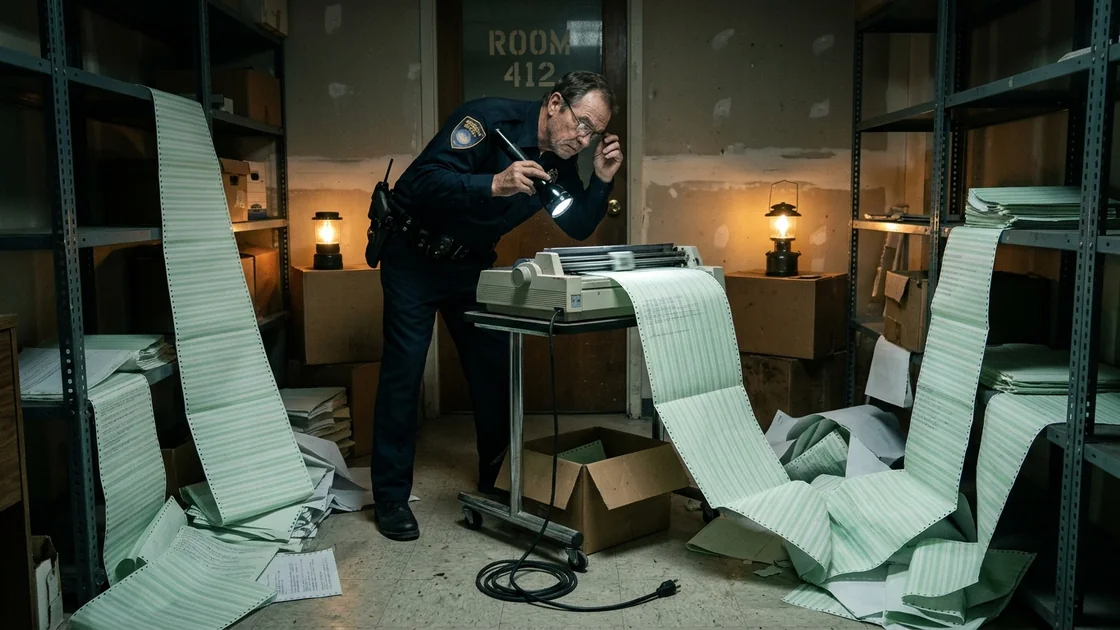
Arthur Miles spends his nights patrolling the hollow, six-story shell of the Meridian Mutual Insurance building, a decaying monument to late-twentieth-century corporate bureaucracy waiting for the wrecking ball. During a torrential autumn storm, his monotonous routine of tapping magnetic checkpoints is shattered by the piercing mechanical shriek of an obsolete dot-matrix printer operating in an unpowered, windowless storage room on the fourth floor. When Arthur investigates the machine, he discovers that it is not connected to any computer or electrical outlet, yet its nine steel pins are furiously striking a nylon ribbon to produce a continuous, real-time biography of his life. As the nights progress, the printer moves beyond merely recording his physical movements in the dark building and begins excavating his deepest memories, his buried shame over the collapse of his marriage, and the quiet cowardice that defined his past. Consumed by a terrifying obsession, Arthur becomes the caretaker of the impossible machine, feeding it boxes of vintage green-bar paper until the printer begins typing his actions seconds before he makes them, forcing him into a final confrontation over who truly authors his remaining days.
I. The Architecture of Obsolescence
The Meridian Mutual building did not creak the way old houses creaked. It did not settle with the warm, rheumatic groans of timber and brick. Constructed in 1979 out of poured concrete, anodized aluminum, and tinted bronze glass that looked like stagnant pond water from the street, the building died with the cold, metallic clicks of contracting air ducts and the slow, hydraulic sighs of decommissioned elevators. It was three hundred thousand square feet of fossilized middle management.
Arthur Miles knew every acoustic quirk of the structure. At fifty-eight, he had been walking its corridors for fourteen months, hired by the receiver’s property management firm to ensure that copper thieves did not strip the mechanical rooms and teenagers did not turn the executive suites into an urban exploration playground. His shift ran from ten in the evening until six in the morning. For eight hours a night, five nights a week, Arthur was the sole biological organism larger than a field mouse inside the perimeter fence.
He liked it that way, or at least he had convinced himself that he did. Solitude was a heavy overcoat; it was exhausting to carry around all the time, yet it kept the wind off his ribs.
At 1:00 AM on a Tuesday in late October, Arthur sat behind the curved laminate desk in the main lobby. Above him, a chandelier made of smoked glass tubes hung dark and dusty. The lobby was the only part of the building connected to the municipal grid, fed by a single twenty-amp maintenance circuit that powered his small space heater, a hotplate, a gooseneck desk lamp, and the charging cradle for his guard tour wand. The rest of the building’s breakers had been thrown down and padlocked in the sub-basement vaults a year ago.
Arthur unscrewed the cup from his steel thermos and poured four ounces of black coffee. It smelled slightly of dish soap because he never rinsed the rubber gasket thoroughly enough in the mornings when he got back to his efficiency apartment on Twelfth Street. He sipped it, wincing at the bitter heat, and looked at his wristwatch. 1:04 AM.
Outside, the rain was coming down in thick, diagonal sheets, driven by a wind off the river that made the bronze glass panels of the atrium shudder in their rubber gaskets.
He stood up, his knees producing a dry, twin pop that echoed across the terrazzo floor. He hitched up his utility belt—which held nothing more lethal than a three-D-cell Maglite, a ring of forty brass keys, and the heavy black rubber guard wand—and stepped out from behind the desk.
The wand was his tether. Scattered throughout the six floors and the basement of Meridian Mutual were thirty-two small metal discs bolted to the drywall at the ends of corridors and inside stairwells. Each disc contained a passive microchip. When Arthur pressed the tip of his wand against a disc, the wand emitted a short, high-pitched chirp and recorded the exact timestamp. On Friday mornings, a supervisor named Henderson, who was twenty-six and smelled aggressively of aerosol body spray, would drive up to the gate, plug the wand into a laptop in the front seat of his Civic, and verify that Arthur had walked his rounds every two hours on the even hours.
Arthur started from the top down. He took the West Stairwell, climbing the six flights of raw concrete steps at a measured, deliberate pace. A man in his late fifties who lived on canned soup, fried eggs, and cheap coffee did not sprint up stairs in the dark. He breathed through his nose, listening to the scuff of his own crepe-soled Bates shoes and the distant drumming of rain on the tar-and-gravel roof.
The sixth floor had been the executive level. Here, the carpet was thicker, a deep burgundy wool that had faded to the color of dried blood where the sun hit it through the perimeter offices. The walnut veneer paneling had been pried off in several places during the liquidation auctions, leaving behind jagged rectangles of hardened brown mastic on the drywall. Arthur walked down the central gallery, his flashlight beam cutting through the motes of cellulose dust that seemed to hang permanently in the dead air. He touched the wand to Station 32 outside the former CEO’s corner office.
Chirp.
He worked his way down. The fifth floor was Legal and Compliance—rows of steel shelving units that had been bolted to the structural slab, their paint scratched by decades of heavy binders being slid in and out. Station 28. Chirp. Station 27. Chirp.
Usually, while he walked, Arthur’s mind drifted through a familiar, shallow canal of thoughts. He thought about whether his car’s alternator was beginning to whine. He thought about the crossword clue in Tuesday’s paper he hadn't solved (Six letters, starting with P: A minor prophet or a major regret). When his defenses were low, usually between three and four in the morning when his circadian rhythm bottomed out, he thought about Clara. His daughter was twenty-nine now. The last time he had seen her was four years ago in the parking lot of a diner outside Columbus, where she had handed him a box of books he had left in her mother’s garage and told him, without malice or tears, that she found it easier to pretend he had died when he was still a good man.
Arthur cleared his throat in the empty hallway of the fifth floor, a deliberate noise to break the silence in his head. He pushed open the heavy fire door to the East Stairwell and descended to the fourth floor.
The fourth floor had belonged to Actuarial Services and Legacy Data Processing. Unlike the open bullpens of the second and third floors, the fourth was a labyrinth. In the late eighties, the company had erected dozens of temporary drywall partitions to house specialized microfiche readers, tape drives, and regional claims auditors. Later, in the two-thousands, they had filled the remaining space with gray fabric cubicles, creating a warren of blind corners and narrow aisles littered with orphaned telephone cords, broken plastic coat hangers, and yellowed styrofoam coffee cups.
Arthur stepped out of the stairwell onto the fourth-floor landing at 1:42 AM.
The fire door swung shut behind him, the hydraulic closer hissing softly before the latch clicked into the strike plate.
In the silence that followed, he heard it.
Bzzzzzt-t-t-t. Zzzzzzt. Clack.
Arthur froze, his right foot half-lifted over a threshold strip of tarnished brass.
Zzzzzzt-bzzzt-bzzzt. Whir. Clack.
It was faint, muffled by several layers of damp acoustic ceiling tile and fabric partitions, coming from deep within the core of the building—the windowless interior zone where the ventilation shafts and old server closets were clustered.
Arthur’s heart gave a heavy, irregular thud against his sternum. His first thought was copper thieves. They used reciprocating saws to cut through brass valves and heavy gauge conduit in the riser closets. Wait—no. A Sawzall didn't sound like that. A Sawzall had a brutal, ragged rhythm that vibrated through the concrete slab.
This sound was precise. It had a cadence. It was an angry, insectoid screech, high-pitched and metallic, operating in short, staccato bursts separated by the distinct, rhythmic chunk-chunk of a stepper motor advancing a gear.
Zzzzzzzzzzt. Bzzzt-bzzzt. Clack.
Arthur knew that sound. Every person who had worked in an office before the turn of the century knew that sound in their bones. He had heard it every afternoon for fifteen years in the newsroom of the Herald-Dispatch, back when the wire services—Associated Press, UPI, Reuters—fed their dispatches into tall, acoustic-hooded cabinets that smelled of hot machine oil and ink ribbon.
It was an impact printer. A dot-matrix.
"That's impossible," Arthur said aloud. His voice sounded thin, swallowed immediately by the porous gray fabric of the cubicles around him.
There was no power on the fourth floor. He had stood beside the city electrical inspector fourteen months ago in the sub-basement when the main bus bars for Floors Two through Six were physically disconnected from the transformer vaults. Even the emergency exit signs up here had died ten months ago when their lead-acid backup batteries finally sulfated and went flat.
Bzzzzzzzzzt-t-t. Zzzzzt.
He gripped the barrel of his Maglite tighter, shifting it into an overhand baton grip near his shoulder, though he felt absurd doing it. He moved forward down the main aisle.
The beam of his flashlight swept across the tops of the cubicles. Nameplates still clung to some of the fabric walls with plastic Velco pins: D. GABLE, R. SZYMANSKI, TEMP 4. The air smelled of decomposed foam rubber—the padding under the industrial carpet was turning to powder—and a sharp, distinct tang that grew stronger with every step he took toward the interior core.
Ozone. And warm nylon.
He turned left past a bank of rusted lateral filing cabinets, then right down a narrow corridor that led toward the old keypunch and batch-processing rooms. The sound was loud now, bouncing off the hard linoleum tiles that had replaced the carpet in this section of the floor. It was coming from Room 412.
The stencil on the frosted glass panel of the door had been scraped away with a razor blade years ago, leaving only the ghostly adhesive outline of the words LEGACY ARCHIVE / OVERFLOW.
Arthur stood outside the door. Through the frosted glass, there was no light. Whatever was making the noise was doing it in pitch darkness.
Zzzzzzt-bzzzt-bzzzt-bzzzt. Whir. Clack.
It paused. For three seconds, there was only the sound of Arthur’s breathing and the distant drip-drip of rainwater leaking into a ceiling bucket somewhere down the hall. Then, the printhead screamed across the platen again.
Arthur reached out with his left hand, his fingers cold, and turned the cylindrical brass knob. It was unlocked. He pushed the door open with his foot and stabbed the flashlight beam into the room.
Room 412 was roughly twelve feet by fifteen. It had no windows. The walls were lined with empty slotted-angle steel shelving. In the exact center of the floor, sitting on a small, rolling tubular-steel stand with a smoked plexiglass top, was an Okidata Microline 395 Turbo.
It was a beast of a machine—wide-carriage, beige plastic housing yellowed to the color of old ivory by decades of fluorescent light, with a smoked plastic acoustic cover tilted back on its hinges. Underneath the wire rack of the stand sat an open, dusty cardboard carton containing a thick stack of fifteen-inch-wide, continuous-feed tractor paper, striped with alternating bands of pale green and white.
As Arthur’s flashlight beam hit it, the black printhead assembly—riding on two polished steel rails greased with yellowing lithium—zipped from left to right, nine microscopic tungsten pins hammering through a looped cassette of black nylon ribbon at four hundred characters per second.
The paper jerked upward through the pin-feed sprockets, spilling out the back of the machine, over the wire paper-catcher, and cascading onto the linoleum floor in neat, accordion-folded pleats. There were already perhaps twenty sheets—sixty feet of paper—piled behind the stand.
Arthur did not walk toward the text first. He walked around the perimeter of the room, keeping the beam trained on the floor.
The thick black power cord hung from the back of the printer, coiled neatly, and secured with a black plastic bread-tie. The three-prong plug dangled four inches above the linoleum. Beside it, the thick gray Centronics parallel cable wasn't even attached; the thirty-six-pin port on the back of the printer was empty, its wire bail clips folded flat against the chassis.
Arthur stopped. The skin on the back of his neck prickled with a cold, evolutionary dread that had nothing to do with trespassers or structural hazards. He shone the light under the stand. There was no battery pack. There were no wires drilled up through the floor slab. It was a twenty-eight-pound block of steel, plastic, and circuit boards sitting on an insulated rubber mat, screaming away in the dark on zero volts of electricity and zero bytes of input.
Bzzzzzt-zzzzzt. Clack.
The printhead returned to the left margin—the home position—and stopped. The cooling fan inside the chassis was not running; only the stepper motors and the solenoid pins were active. Now that the head had parked, the room was dead silent.
Slowly, Arthur stepped up to the front of the cart. He angled the Maglite down so the bright center spot of the beam illuminated the platen right behind the clear plastic tear-bar.
The type was nine-pin draft quality, each letter composed of tiny, distinct purple-black dots pressed hard enough into the cheap twenty-pound bond paper to leave a slight embossing on the reverse side.
Arthur leaned over the machine, his glasses slipping down the bridge of his nose, and read the last four lines that had just been hammered onto the page.
HE DOES NOT LOOK AT THE PAPER FIRST. HE IS AN OLD REPORTER, OR AT LEAST HE STILL FLUSHES WITH THE INSTINCTS OF ONE WHEN HE IS FRIGHTENED, SO HE LOOKS FOR THE MECHANISM OF THE TRICK. HE CIRCLES THE CART TO THE LEFT, HIS FLASHLIGHT BEAM TREMBLING AT A FREQUENCY OF FOUR HERTZ BECAUSE HE HAS HAD THREE CUPS OF COFFEE SINCE TEN O'CLOCK AND HIS BLOOD SUGAR IS LOW. HE SEES THE UNPLUGGED CORD. HE FEELS THE OLD, FAMILIAR TIGHTNESS BEHIND HIS STERNUM—THE ONE DR. PATEL TOLD HIM IN 2021 WAS BENIGN PREMATURE VENTRICULAR CONTRACTION—AND NOW HE LEANS OVER THE PLATEN, ADJUSTING HIS BIFOCALS WITH HIS LEFT INDEX FINGER, TO READ WHAT IS WRITTEN HERE.Before Arthur could draw a breath, the solenoid clicked, and the printhead lunged across the rail directly beneath his face.
Bzzzzzt-zzzzzt-bzzzt!
HIS MOUTH OPENS SLIGHTLY. HE TAKES ONE STEP BACKWARD UNTIL THE HEEL OF HIS RIGHT SHOE STRIKES THE BASE OF THE STEEL SHELVING UNIT BEHIND HIM.Clang.
Arthur’s heel hit the upright post of the steel shelf. The metallic ring echoed through the small room.
He stood paralyzed against the shelf, the flashlight shaking violently in his fist, watching the little black box of the printhead wait at the left margin like a crouched spider.
II. The Mechanics of the Immediate
For a long time—or what felt like a long time—nothing moved in Room 412. Arthur held his breath, a childish, instinctive experiment to see if stillness could starve the machine of material.
After ten seconds, the printhead zipped across the paper.
HE HOLDS HIS BREATH FOR TEN SECONDS, BELIEVING WITH THE SUPERSTITIOUS PART OF HIS BRAIN—THE PART THAT STILL CROSSES DIGITS WHEN PASSING A CEMETERY ON INTERSTATE 70—THAT AN ABSENCE OF MOTION EQUALS AN ABSENCE OF NARRATIVE. HE DOES NOT YET UNDERSTAND THAT SILENCE IS ALSO AN ACTION. NOW HE EXHALES.Arthur let his breath out in a ragged gasp. "Who's doing this?" he shouted. His voice cracked on the second word. He spun around, flashing the beam up at the acoustic tiles of the drop ceiling. He looked for a pinhole camera, a fiber-optic lens, a microphone tucked into the grid of white-painted aluminum T-bars. All he saw were brown water stains shaped like prehistoric continents and the dusty grill of a dead return-air vent.
Zzzzzzt-bzzzt-zzzzzt-clack.
He whipped back toward the printer.
HE LOOKS AT THE CEILING FOR A LENS. HE IMAGINES HENDERSON, OR SOME BORED ENGINEER FROM THE RECEIVER'S OFFICE, SITTING IN A VAN OUTSIDE IN THE RAIN WITH A DIRECTIONAL MICROPHONE AND A TRANSMITTER. HE WANTS IT TO BE CRUELTY. A MAN CAN FIGHT CRUELTY. A MAN CAN FILE A GRIEVANCE AGAINST A PRANK.Arthur’s jaw tightened. A hot flush of anger briefly burned away the cold terror in his chest. He stepped forward, grabbed the smoked plastic acoustic cover, and slammed it down, intending to reach inside and yank the nylon ribbon cartridge right out of its cradle.
Wait—if he slammed the cover down, he couldn't reach inside. His hands were clumsy with adrenaline. He flipped the cover back up, jammed his thick fingers into the cavity between the guide rails, and seized the black plastic ribbon cartridge. It felt warm, vibrating slightly with a residual hum that didn't come from sixty-cycle alternating current; it felt like the hum of a plucked cello string that refused to decay.
He pulled up. The cartridge wouldn't budge. The plastic clips that should have flexed with two pounds of thumb pressure felt as though they were cast out of solid pig iron. He pulled harder, lifting the entire front edge of the twenty-eight-pound printer half an inch off the plexiglass stand before letting go with a grunt.
The machine settled back onto its rubber feet. Immediately, the printhead screamed to life, darting right over the spot where his knuckles had been a half-second earlier.
HE ATTEMPTS TO REMOVE THE RIBBON. THE CARTRIDGE IS AN OKIDATA OEM PART #52106001, MANUFACTURED IN SHENZHEN IN AUGUST OF 1998, WHICH SAT IN A SUPPLY CLOSET ON THE THIRD FLOOR UNTIL THIS EVENING. IT WILL NOT YIELD TO HIM. THERE ARE SMALL GRAINS OF RUST UNDER HIS RIGHT THUMBNAIL NOW FROM WHERE HE SCRAPED THE CHASSIS.Arthur looked at his right thumb. There was a tiny reddish-brown smear under the nail.
He backed away toward the door of Room 412, never taking the beam of the Maglite off the beige machine. When his back hit the doorjamb, he reached behind himself, felt the cool brass of the corridor side, and stepped backward over the threshold.
As soon as he was in the hallway, the printer didn't stop. If anything, the cadence changed. Earlier, it had been printing in short bursts—two lines, pause, one line, pause—reacting to his immediate movements in the room. Now, it shifted into a steady, relentless rhythm.
Zzzzzzzzzzzt-clack. Zzzzzzzzzzzt-clack. Zzzzzzzzzzzt-clack.
Bidirectional printing. Left to right, paper feed, right to left, paper feed. It was the sound a dot-matrix made when someone dumped a massive text file into its buffer—an annual report, a database dump, a novel.
Arthur stood in the dark corridor for three minutes listening to it. He checked his watch. 2:01 AM. He had missed fourteen stations on his tour. On Friday morning, Henderson’s laptop would show a gap on the fourth floor starting after Station 27 on the fifth. Henderson would ask him if he’d fallen asleep on a desk somewhere.
"Let him ask," Arthur muttered.
He stepped back into Room 412.
The printer was still going at full tilt, the carriage rocking slightly on its tubular steel stand from the violent momentum of the printhead reversing direction twice a second. The fanfold paper was climbing steadily out of the box underneath, gliding smoothly through the tractor sprockets, and folding itself into a rising white-and-green tower on the floor behind the cart.
Arthur walked around to the back of the machine and knelt on the cold linoleum. He set the Maglite down on the floor so its beam raked across the growing pile of paper, picked up the top section of the accordion stack without tearing the perforations, and looked at what had printed before he entered the room.
He pulled the paper back, unfolding sheet after sheet—past the moment he had opened the door, past his walk down the fourth-floor hallway, past his descent down the East Stairwell—all the way to the very first sheet at the bottom of the pile.
The first sheet had a clean, factory-cut top edge. The first line was printed two inches from the top margin.
OCTOBER 24. 01:00:00.
ARTHUR MILES SITS AT THE LOBBY DESK OF THE MERIDIAN MUTUAL BUILDING. HE IS FIFTY-EIGHT YEARS, FOUR MONTHS, AND TWELVE DAYS OLD. HE WEARS NAVY POLY-COTTON TROUSERS PURCHASED FROM UNIFORM WAREHOUSE ON BROAD STREET FOR THIRTY-FOUR DOLLARS, WHICH HE HAS HEMMED HIMSELF USING IRON-ON FUSIBLE WEB TAPE BECAUSE HE IS TOO PROUD TO ASK MRS. GORSKI IN APARTMENT 2B TO USE HER SEWING MACHINE, AND TOO FRUGAL TO PAY THE DRY CLEANER SIX DOLLARS.

HE POURS FOUR OUNCES OF FOLGERS CLASSIC ROAST FROM A STANLEY THERMOS WHOSE OUTER GREEN ENAMEL WAS CHIPPED IN THE TRUNK OF A 2009 FORD TAURUS ON THE DAY HE MOVED OUT OF THE HOUSE ON SYCAMORE LANE. HE TASTES PALMOLIVE DISH LIQUID ON THE RIM. HE DOES NOT CARE ENOUGH ABOUT HIS OWN COMFORT TO WASH THE STOPPER IN BAKING SODA.
Arthur sat back on his heels, the paper rustling in his trembling hands.
Nobody knew about the iron-on hem tape. He had bought it at a Walgreens at midnight three months ago using self-checkout. Nobody knew where the chip on the Stanley thermos had come from—he wasn't even sure he had consciously remembered which day the tire iron had rolled against it in the trunk until he read the words Sycamore Lane.
He kept reading, his eyes darting across the jagged nine-pin characters as the machine above him continued its deafening bzzzzzt-clack, bzzzzzt-clack.
01:12:44.
BETWEEN THE FIFTH AND SIXTH FLOORS, HIS RIGHT KNEE POPPED. THE CARTILAGE BEHIND THE PATELLA WAS TORN SLIGHTLY IN OCTOBER OF 1983 WHEN HE FELL OFF A LOADING DOCK BEHIND THE ATHENS COUNTY COURTHOUSE WHILE TRYING TO GET A PHOTOGRAPH OF COUNTY COMMISSIONER HAROLD VANCE BEING TRANSFERRED IN HANDCUFFS. BACK THEN, ARTHUR BELIEVED THAT A TWENTY-FOUR-YEAR-OLD MAN WITH A NIKON FM2 AND A PRESS PASS WAS AN INSTRUMENT OF MORAL HYGIENE. HE HAS NOT THOUGHT ABOUT HAROLD VANCE IN ELEVEN YEARS, BUT THE CARTILAGE REMEMBERS.
Arthur dropped that section of the paper and scrambled up onto his knees, grabbing the fresh loop of paper curving out of the back of the machine—the text that had been printing while he stood out in the hallway.
01:59:10.
HE STANDS IN THE CORRIDOR OUTSIDE ROOM 412, LISTENING TO THE STEPPER MOTOR. HE IS TRYING TO CONVINCE HIMSELF THAT HE IS HAVING A CEREBROVASCULAR ACCIDENT. HIS FATHER, THOMAS MILES, DIED OF AN ISCHEMIC STROKE IN ST. JUDE'S HOSPITAL IN 2004, AND FOR SEVEN HOURS BEFORE THE CLOT REACHED THE LEFT MIDDLE CEREBRAL ARTERY, THOMAS CLAIMED HE COULD HEAR A BRASS BAND PLAYING SOUSA MARCHES INSIDE THE RADIATOR OF HIS BEDROOM. ARTHUR IS CURRENTLY SMELLING HIS OWN BREATH AND CHECKING TO SEE IF THE LEFT CORNER OF HIS MOUTH CAN STILL LIFT INTO A GRIMACE. HE LIFTS HIS LIP IN THE DARK LIKE A DOG SHOWING ITS PREMOLARS. THERE IS NO PARALYSIS. THERE IS ONLY THE MACHINE.
In the hallway two minutes ago, Arthur had pulled the left corner of his mouth up twice to test for facial drooping. He had done it in total darkness, facing a blank drywall partition.
He looked up at the printhead. It had slowed down again, returning to its intermittent, reactive rhythm.
Zzzzzzt-clack.
HE KNEELS ON THE LINOLEUM. THE DUST FROM THE FLOOR CLINGS TO THE KNEES OF HIS TROUSERS IN TWO GRAY OVALS. HE IS WONDERING WHAT WILL HAPPEN IF HE DOES SOMETHING ENTIRELY ARBITRARY—SOMETHING WITHOUT CAUSE OR PRECEDENT IN HIS FIFTY-EIGHT YEARS—TO PROVE THAT THE MACHINE IS MERELY FOLLOWING HIM RATHER THAN LEADING HIM."Stop it," Arthur whispered.
Bzzzzt.
"STOP IT," ARTHUR WHISPERS.Arthur stood up. His knees ached from the hard floor. He reached into his right trouser pocket and pulled out a handful of change, his car keys, and a half-used pack of cherry cough drops. Without looking at the coins, he selected one by feel, held it pinched tightly between his thumb and forefinger inside his closed fist, and raised his arm.
"What coin is this?" he said aloud to the empty room.
The printer did not hesitate for a millisecond.
IT IS A 1996 DENVER MINT QUARTER. THE REEDING ON THE EDGE IS WORN SMOOTH ON ONE SIDE BECAUSE IT SPENT FOUR YEARS WEDGED INSIDE THE AGITATOR FIN OF A COMMERCIAL WASHING MACHINE IN TOLEDO BEFORE ENTERING CIRCULATION IN THIS CITY LAST THURSDAY VIA THE TILL OF THE SUNOCO STATION ON FOURTH STREET. HE IS ABOUT TO DROP IT ON THE FLOOR INSTEAD OF LOOKING AT IT.Arthur’s fingers twitched. He had indeed just decided to drop it on the floor without looking at it to spite the machine. Angry now, his hand frozen in midair, he forced his fingers to stay closed and shoved the coin back into his pocket without looking at it or dropping it.
Ha, he thought.
Bzzzzzzzzzt-clack.
HE OVERRIDES THE IMPULSE TO DROP THE COIN AND PUTS IT BACK INTO HIS POCKET TO PROVE THE PREVIOUS SENTENCE FALSE. HE EXPERIENCES A BRIEF, CHILDISH SURGE OF TRIUMPH, UNAWARE THAT THE PHRASE "HE IS ABOUT TO DROP IT" DESCRIBES AN INTENTION RATHER THAN AN EVENT, AND THE INTENTION WAS REAL AT 02:04:19.22.The air in the small room felt exhausted, as if the printer were consuming the oxygen to burn its words into the bond paper.
Arthur looked at his watch. 2:06 AM. He picked up his Maglite from the floor. He couldn't stay in this room for the next four hours. If he stayed in this room, watching his own mind get dissected at four hundred characters per second on green-bar accounting paper, they would find him at six in the morning sitting in the corner chewing on his own knuckles.
He turned and walked out of Room 412, pulling the door shut behind him until the latch clicked.
As he walked rapidly away down the maze of cubicles toward the West Stairwell, tapping his guard wand frantically against Station 22, Station 21, and Station 20 to make up for lost time, he could still hear it through the walls. It didn't stop when he left. It didn't need him in the room to see him.
Zzzzzzzzzzt-clack. Zzzzzzzzzzt-clack.
All the way down to the third floor, through six inches of reinforced concrete slab, the high-pitched whine of the nine pins vibrated right through the soles of his shoes.
III. The Unbroken Feed
When six o'clock came and the gray, sodden dawn broke over the industrial park, Arthur did not go back up to the fourth floor. He locked the front doors of the lobby from the outside, walked through the puddles to his twelve-year-old Ford Taurus—the very car mentioned in the printout—and drove home through the early commuter traffic with the radio turned up too loud on an AM talk station just to hear human voices arguing about city zoning ordinances.
His apartment was on the second floor of a divided brick Victorian that smelled permanently of boiled cabbage and radiator steam. He cooked two eggs in a scratched Teflon pan, ate them standing over the sink, and pulled the blackout shades down in his bedroom at seven-thirty.
He did not sleep until noon, and when he did, he dreamed of typebars and pin-feeds. He dreamed that his chest was a steel platen and a black plastic carriage was zipping back and forth across his ribs, punching nine tiny holes into his skin with every pass, spelling out things he had said to his ex-wife Helen in 1999 that he had sworn he never said.
He woke up at five in the afternoon with a dry mouth and a headache behind his left eye.
Sitting on the edge of his mattress in his undershirt, Arthur reached into the pocket of his uniform trousers, which were draped over a wooden chair. He pulled out the coins he had carried the night before. There were two pennies, a nickel, a dime, and a single quarter.
He held the quarter up to the yellow crack of streetlight coming around the edge of the window shade.
- A tiny D below the eagle. He ran his thumbnail along the milled edge of the coin. For about a third of the circumference, the vertical ridges were completely ground away, polished smooth by some repetitive mechanical friction.
Arthur sat very still for ten minutes. Then he stood up, walked into his tiny living room, and opened the bottom drawer of an old walnut highboy where he kept his tax returns, his birth certificate, and a bundle of yellowed newspaper clippings held together with a rotted rubber band.
He didn't look at the clippings. He knew what was in them. Instead, he went to the kitchen, packed his thermos—rinsing the rubber stopper four times in hot water before filling it—and left for the Meridian Mutual building forty minutes early.
He arrived at 9:35 PM. The rain had stopped, leaving the night air crisp and smelling of wet asphalt and rotting oak leaves. He unlocked the perimeter gate, locked it behind his car, let himself into the lobby, and didn't even bother turning on the space heater or setting down his lunchbox. He grabbed the Maglite from its charging cradle and went straight up the East Stairwell, taking the steps two at a time until his calves burned and his breath sawed in his throat.
He burst through the fourth-floor fire door at 9:42 PM.
He heard it immediately.
Zzzzzzzzzzt-clack. Zzzzzzzzzzt-clack.
It had not stopped all day. While the sun had risen over the city, while Arthur had eaten his eggs over the sink and tossed in his sheets on Twelfth Street, the Okidata Microline 395 had been sitting in the pitch-black tomb of Room 412, hammering away into the emptiness.
Arthur walked down the aisle of cubicles and pushed open the door of 412.
The smell of hot nylon ribbon and ozone was thick enough to taste at the back of his throat. He shone his light on the machine.
The cardboard box underneath the stand was almost two-thirds empty now. Behind the stand, the accordion pile of printed paper had grown so tall—nearly three feet high—that it had toppled over under its own weight around mid-afternoon, spilling across the dusty linoleum in massive, twisting ribbons of green and white paper before starting a second vertical stack. There had to be five hundred pages on the floor.
As Arthur stepped inside, the printer was finishing a paragraph. He walked over and read the wet ink at the platen while the last line hammered out:
...AND AS HE PUSHES OPEN THE DOOR OF ROOM 412 AT 21:43:11, HIS HEART RATE IS ONE HUNDRED AND FOURTEEN BEATS PER MINUTE. HE IS DISAPPOINTED, THOUGH HE WOULD NEVER ADMIT THIS TO A PRIEST OR A DOCTOR, THAT THE MACHINE IS STILL HERE. IF THE ROOM HAD BEEN EMPTY, HE WOULD HAVE HAD ONLY MADNESS TO CONTEND WITH. MADNESS IS TEMPORARY; IT CAN BE MANAGED WITH TWENTY MILLIGRAMS OF Citalopram AND RETIREMENT. THE PAPER ON THE FLOOR IS WORSE THAN MADNESS BECAUSE IT HAS WEIGHT.Arthur let out a long, slow breath. The fear from the previous night was still there, coiled at the base of his spine, but it had undergone a chemical change during the daylight hours. It had hardened into a grim, fatalistic curiosity. He had been an investigative reporter for twenty-two years before the newspaper industry collapsed and his own failures dragged him out of the profession. A story was a story, even if it was eating him alive.
"All right," Arthur said to the beige plastic box. "What were you writing all afternoon while I was asleep?"
The printhead parked on the left rail. It didn't answer his question directly; it simply waited for his next action, or perhaps it had already answered his question in the forty yards of paper lying on the floor.
Arthur set his flashlight upright on the floor so the beam bounced off the white acoustic ceiling tiles, filling the room with a dim, submarine glow. He walked over to a neighboring cubicle in the hallway, dragged a swivel chair with a cracked vinyl seat into Room 412, and sat down behind the printer cart.
He reached into the middle of the toppled heap of paper—somewhere around noon by the timestamps printed in the left margin—and lifted a thick fold of continuous sheets onto his lap.
OCTOBER 24. 13:14:02.
IN HIS SLEEP ON TWELFTH STREET, ARTHUR TURNS ONTO HIS RIGHT SIDE TO RELIEVE THE PRESSURE ON HIS BURSITIC LEFT SHOULDER. HE IS DREAMING NOT OF THE PRINTER NOW, BUT OF THE SUMMER OF 1974 IN CHILLICOTHE. HE IS FOURTEEN YEARS OLD. HE AND HIS YOUNGER BROTHER DANIEL ARE CROUCHED INSIDE THE CONCRETE CULVERT THAT RUNS UNDER STATE ROUTE 23. THE WATER IS ANKLE-DEEP AND SMELLS OF CRAYFISH AND TAR.

DANIEL HAS FOUND A RUSTED COFFEE CAN CONTAINING FOURTEEN SILVER HALF-DOLLARS AND A WATER-STAINED MAGAZINE LEFT BEHIND BY SOME TRANSIENT. IN THE DREAM, AS IN LIFE, ARTHUR TELLS DANIEL THAT THE COINS ARE COUNTERFEIT LEAD AND THAT THE SHERIFF WILL ARREST THEM IF THEY KEEP THEM. WHEN DANIEL BEGINS TO CRY AND LEAVES THE CULVERT, ARTHUR POCKETS THREE OF THE KENNEDY HALF-DOLLARS AND SPENDS THEM THREE DAYS LATER AT A SOHIO STATION ON BASEBALL CARDS AND ROOT BEER BARRELS.

IN HIS SLEEP AT 13:14:22, ARTHUR’S JAW CLENCHES BECAUSE HE REMEMBERS THAT DANIEL DIED OF LEUKEMIA AT AGE NINETEEN STILL BELIEVING THEY HAD THROWN THOSE COINS INTO THE SCIOTO RIVER TOGETHER.
Arthur’s hands went slack on the edges of the paper. The perforated tear-strips, studded with evenly spaced tractor holes, felt sharp against his palms.
"I was fourteen," Arthur said aloud to the room. His voice was hoarse. "I was a kid. Everybody steals something when they're fourteen."
Bzzzzzt-zzzzzt-clack.
Above him, the printer added two lines to the current page:
AT 21:47:09, HE DEFENDS HIMSELF TO AN UNPLUGGED PERIPHERAL DEVICE REGARDING A PETTY THEFT COMMITTED HALF A CENTURY AGO. HE DOES NOT NOTICE THAT THE MACHINE OFFERED NO VERDICT; IT MERELY RECORDED THE FACT AND THE CLENCHING OF HIS JAW. THE GUILT IS ENTIRELY HIS OWN CONTRIBUTION TO THE TEXT.Arthur swallowed hard. He folded the afternoon pages back down and pulled up another section from early evening, around six o'clock, right after he had woken up.
OCTOBER 24. 18:05:19.
HE STANDS IN HIS LIVING ROOM IN HIS UNDERSHIRT. THE FABRIC UNDER THE ARMS IS YELLOWED WITH ALUMINUM ZIRCONIUM TETRACHLOROHYDREX GLY FROM TEN YEARS OF RIGHT GUARD DEODORANT. HE OPENS THE BOTTOM DRAWER OF THE WALNUT HIGHBOY HIS MOTHER LEFT HIM. HE LOOKS AT THE BUNDLE OF CLIPPINGS FROM THE HERALD-DISPATCH DATED NOVEMBER 2008.

HE DOES NOT UNTIE THE RUBBER BAND BECAUSE HE KNOWS BY HEART THE THIRD PARAGRAPH OF THE RETRACTION PRINTED ON PAGE A2 ON NOVEMBER 18, 2008: "THE HERALD-DISPATCH REGRETS THAT UNCORROBORATED STATEMENTS REGARDING THE ZONING BOARD'S FINANCIAL TIES TO RIVERFRONT DEVELOPMENT CORP WERE ATTRIBUTED TO ANONYMOUS CITY HALL SOURCES THAT COULD NOT BE VERIFIED UPON EDITORIAL REVIEW."
The printer wasn't stopping there. Even as Arthur read the archive from six o'clock, the printhead above him launched into a furious, sustained burst, expanding on what he was reading right now.
Zzzzzzzzzzt-clack. Zzzzzzzzzzt-clack. Zzzzzzzzzzt-clack.
Arthur stood up from the swivel chair and leaned over the platen as the fresh lines scrolled up under the plastic tear-bar.
HE REMEMBERS THE RAIN OUTSIDE THE BAR ON FOURTH STREET WHERE HE MET MARCUS WEBB ON NOVEMBER 11, 2008. WEBB WAS A JUNIOR AUDITOR IN THE CITY COMPTROLLER'S OFFICE WITH TWO CHILDREN IN CATHOLIC SCHOOL AND A WIFE UNDERGOING DIALYSIS. WEBB SHOWED ARTHUR THE CANCELLED CHECKS ON THEHOOD OF HIS BUICK. ARTHUR PROMISED WEBB THAT HE WOULD NEVER BURN HIM—THAT HE WOULD GO TO COUNTY JAIL FOR CONTEMPT BEFORE HE GAVE UP HIS NAME TO THE PUBLISHER OR THE DEVELOPER'S LIBEL LAWYERS.

AND WHEN THE DEVELOPER THREATENED TO PULL FOUR HUNDRED THOUSAND DOLLARS IN FULL-PAGE AUTOMOTIVE AND REAL ESTATE ADVERTISING FROM THE SUNDAY EDITION, AND THE MANAGING EDITOR CALLED ARTHUR INTO THE GLASS OFFICE AND ASKED HIM either TO NAME HIS SOURCE ON THE RECORD OR SIGN A STATEMENT ADMITTING HE HAD FABRICATED THE QUOTES FROM WHOLE CLOTH TO PROTECT WEBB'S JOB... ARTHUR DID NEITHER.

ARTHUR GAVE THE EDITOR WEBB'S NAME IN PRIVATE OFF THE RECORD TO SAVE HIS OWN PENSION, AND THEN LET THE PAPER PRINT THE RETRACTION CALLING HIS OWN WORK UNVERIFIED SO WEBB WOULD BE FIRED QUIETLY FOR INSUBORDINATION TWO MONTHS LATER WITHOUT ARTHUR EVER HAVING TO TESTIFY IN OPEN COURT. HE CHOSE THE MIDDLE PATH OF THE COWARD: HE DESTROYED HIS SOURCE AND RUINED HIS OWN REPUTATION SIMULTANEOUSLY SO THAT HE WOULD NEVER HAVE TO STAND UP IN A ROOM WHERE PEOPLE WERE SHOUTING AT HIM.
"That's not how it happened!" Arthur roared. He slammed his open palm down on the smoked plexiglass top of the stand. The whole cart shuddered on its caster wheels. "I tried to protect him! If it had gone to a deposition, they would have subpoenaed his office logs anyway! Frank told me if I gave him the name quietly, the publisher would back down!"
Zzzzzzzzzzt-clack.
HE LIES TO THE ROOM USING THE SAME SENTENCES HE USED ON HIS WIFE HELEN IN THE KITCHEN ON SYCAMORE LANE ON DECEMBER 4, 2008, WHILE SHE STOOD BY THE DISHWASHER HOLDING A WET SOUP SPOON AND REALIZING FOR THE FIRST TIME THAT THE MAN SHE HAD MARRIED WAS SMALL. HE KNOWS FRANK NEVER PROMISED THE PUBLISHER WOULD BACK DOWN. FRANK ONLY PROMISED THAT ARTHUR COULD KEEP HIS HEALTH INSURANCE UNTIL THE BUYOUTS IN MARCH.Arthur stared at the wet dots of ink. His chest was heaving. The silence of the fourth floor rushed back in as the printhead paused, waiting for him.
The terrible thing about the prose was not that it was cruel. It wasn't written in the mocking voice of a demon or an enemy. It was written in the flat, unsparing, declarative style of a wire-service obituary. It had the exact rhythm of the AP stylebook he had worshiped when he was twenty-five. No adjectives that couldn't be substantiated by physical evidence. No speculation. Just the anatomy of a life laid open on a steel table under fluorescent lights.
He looked down at the cardboard box underneath the stand.
There were maybe three hundred sheets of paper left in the carton. At the rate the machine was documenting his thoughts, his memories, and his rounds, that box would run out sometime around four o'clock in the morning.
A strange, cold thought struck him: What happens when the paper runs out?
He walked out of Room 412 in a daze, forgetting his guard tour wand entirely. He walked down the corridor to the old supply closets near the freight elevator. Most of them had been cleaned out when the auctioneers came through in 2017, their shelves stripped of toner cartridges and copy paper.
He tried four doors before he found the annex closet behind the old mailroom on the third floor. Stacked in the dark corner behind a broken postage meter and three drums of dry ice-melt pellets were four sealed cardboard cartons labeled: FORMS INC. 14 7/8 x 11 - 1 PART GREEN BAR - 20# BOND - 2700 SHEETS.
They had been sitting there since the Clinton administration, too heavy for the liquidators to bother hauling down to the loading dock for three dollars a box, and utterly useless to any office built after 1995.
Arthur squatted down, wrapped his arms around the top carton—it weighed nearly forty pounds—and lifted it with a groan. His lower back flared with a hot warning pain, and as he staggered out of the supply closet toward the stairs, he could hear the faint, triumphant zzzzzzt-clack through the ceiling above him, recording the exact millimeter by which his fourth lumbar disc was compressing under the load.
IV. The Caretaker of the Record
By the fifth night—Saturday—Arthur had stopped doing his guard tours altogether.
On Friday morning, when Henderson had arrived at the front gate in his Honda Civic to download the wand data, Arthur had handed him the black rubber baton through the car window without a word. Henderson had plugged it into his USB cable, stared at his screen, and frowned.
"Hey, Artie," the kid had said, squinting through the windshield wiper streaks. "You missed half the fourth floor on Tuesday, and on Wednesday and Thursday you only hit the lobby checkpoint at ten and six. What's the deal? Your knees acting up again?"
Arthur had looked down at Henderson—at the kid's smooth skin, his cheap gold chain, the paper cup of drive-thru iced coffee sitting in the console—and wondered what the Okidata would write if Henderson walked into Room 412. Probably five pages about video games, an overdraft fee at Huntington Bank, and a girl who hadn't texted him back on Thursday night. Light things. Clean, shallow things that didn't smell of old basement water.
"The wand's glitching," Arthur had lied smoothly. "The battery contacts are corroded. Doesn't chirp half the time when I press the button. I got a logbook on the desk where I wrote down my times."
Henderson had sighed, too lazy to get out of the car and check a written logbook on a rainy Friday morning. "Yeah, whatever. I'll bring you a replacement wand on Monday. Don't let the copper heads in."
Now it was Saturday night. Arthur had brought a folding cot from his apartment and set it up in the hallway outside Room 412, though he never lay down on it. He had brought two battery-powered LED camping lanterns so he wouldn't have to rely on his Maglite.
Room 412 looked like the nest of a paper-wasp the size of a Buick.
Over the past ninety-six hours, the Okidata Microline 395 had consumed two full cartons of green-bar paper—over five thousand four hundred continuous sheets. Because Arthur was terrified of what might happen if the paper jammed in the rear tractor sprockets, he had spent hours on his knees folding the output into neat, four-foot-high rectangular pillars arranged in chronological order along the steel shelving units.
He had labeled the tops of the stacks with a red grease pencil he found in a cubicle: TUES NIGHT / WED DAY WED NIGHT / THURS DAY THURS NIGHT / FRI DAY
He had also spliced the boxes together. At 4:12 AM on Thursday, when the first carton of paper had reached its final ten sheets, Arthur had stood over the machine with sweat dripping off the tip of his nose, holding a roll of Scotch tape and the leading edge of a fresh carton. As the bottom edge of the old box rose toward the feed slot beneath the printer, he had carefully aligned the pin-feed holes of the new stack with the tail of the old one, taping them together on the underside so the tractor sprockets never missed a tooth.
While he had done it, his fingers trembling two inches from the spinning plastic gear wheels, the printer had hammered out:
HE SPLICES THE WEB AT 04:12:08 WITH 3M MATTE FINISH TAPE. HE BELIEVES THAT IF THE PLATEN RUNS BARE AND THE NINE TUNGSTEN PINS STRIKE DRY RUBBER, SOME ESSENTIAL CONTINUITY IN HIS OWN MEDULLA OBLONGATA WILL SNAP AT THE SAME INSTANT. HE IS NOT ENTIRELY WRONG, THOUGH NOT FOR THE REASONS HE IMAGINES. A MAN WHO HAS SPENT FORTY YEARS REFUSING TO READ HIS OWN LIFE CANNOT SURVIVE AN ABRUPT CESSATION OF THE TEXT ONCE HE HAS BEGUN.That was the mystery that kept him glued to the cracked vinyl swivel chair for eight hours every night: Why hadn't the ribbon worn out?
A standard nylon dot-matrix ribbon cartridge contained about forty yards of half-inch fabric looped into a Möbius strip so that both edges were struck evenly, coated in carbon black suspended in a slow-drying oil vehicle. Under continuous heavy printing—millions of characters—the ink should have faded to a pale, illegible ghost gray within twelve hours, and the tungsten pins should have shredded the nylon fibers into lint within twenty-four.
Yet here on Saturday night, on page five thousand six hundred and twelve, the dots were as black, wet, and sharply defined as they had been on Tuesday at two in the morning. When Arthur leaned close to the platen, the ink didn't smell like mineral oil anymore. It smelled faintly of iron. Like a nosebleed in winter.
At 12:30 AM on Sunday morning, Arthur was sitting in the swivel chair reading the THURSDAY DAYTIME pillar while the machine hummed along steadily beside his right elbow.
He had discovered that the machine's daytime output—the hours when he was physically absent from the building—operated differently from the nighttime pages. At night, when he was in the room or walking the halls, the printer stayed anchored to the present tense, documenting his breath, his pulse, and his immediate stream of consciousness.
During the day, while Arthur slept in his apartment on Twelfth Street or sat in the vinyl booth at Arby’s eating a roast beef sandwich and staring at the traffic on Broad Street, the printer had too much bandwidth on its hands. When his conscious mind was idle or unconscious, the machine went digging. It dropped a plumb line down into the silted-up reservoirs of his fifty-eight years and dredged up entire chapters he had buried under decades of routine.
He was currently reading sixty pages printed between 10:00 AM and 2:00 PM on Thursday. They were all about Clara.
Not the twenty-nine-year-old woman who had handed him a box of paperbacks in a diner parking lot in 2020. The printer had gone back to November of 2001, when Clara was six.
NOVEMBER 14, 2001. 19:30:00 (RECALLED IN REM CYCLE THREE AT 11:42:10, OCTOBER 26).
THE BEDROOM ON SYCAMORE LANE HAS WALLPAPER WITH YELLOW DUCKS THAT HELEN HUNG WHILE SEVEN MONTHS PREGNANT. ARTHUR IS SITTING ON THE EDGE OF THE TWIN BED READING "BLUEBERRIES FOR SAL" FOR THE FOURTH CONSECUTIVE NIGHT. HE IS ONLY HALF-PRESENT; HIS RIGHT HAND IS RESTING ON THE BEDSPREAD NEAR HIS HIP SO HE CAN FEEL THE VIBRATION OF HIS MOTOROLA PAGER IF THE PRECINCT CAPTAIN CALLS BACK ABOUT THE ARSON HOMICIDE ON OAK STREET.

CLARA HAS HER THUMB IN HER MOUTH, THOUGH DR. MEYER SAID SHE SHOULD HAVE STOPPED AT FOUR. SHE TAKES HER THUMB OUT—IT MAKES A WET POPPING SOUND—AND TOUCHES THE CALLUS ON ARTHUR’S RIGHT MIDDLE FINGER WHERE HE HOLDS HIS BALLPOINT PEN.

"DADDY," SHE SAYS. "WHEN YOU GO TO WORK AT NIGHT, WHERE DO THE WORDS GO AFTER YOU PUT THEM IN THE PAPER?"

ARTHUR TELLS HER THAT PEOPLE READ THEM OVER BREAKFAST AND THEN WRAP FISH BONES OR POTATO PEELS IN THEM AND THROW THEM IN THE TRASH CAN. HE SAYS THIS NOT TO BE CRUEL TO A SIX-YEAR-OLD, BUT BECAUSE HE IS THIRTY-SIX AND ALREADY PRACTICING THE CYNICISM THAT HE MISTAKES FOR PROFESSIONAL MATURITY.

CLARA THINK ABOUT THIS FOR SIX SECONDS. SHE SAYS, "I DON'T WANT YOU TO GO TONIGHT. IF THEY JUST THROW THEM AWAY, YOU SHOULD STAY HERE AND KEEP THEM IN YOUR HEAD."

ARTHUR KISSES HER FOREHEAD—HER HAIR SMELLS OF JOHNSON'S NO MORE TEARS SHAMPOO AND GRAHAM CRACKERS—AND STANDS UP BECAUSE THE PAGER AT HIS BELT HAS JUST VIBRATED TWICE. HE LEAVES THE HOUSE AT 19:44. HE DOES NOT GET THE ARSON EXCLUSIVE; THE MORNING EDITION RUNS THREE PARAGRAPHS FROM THE POLICE BLOTTER ON PAGE B6. HE NEVER GETS THAT TUESDAY NIGHT IN NOVEMBER BACK. IT IS GONE FROM THE EARTH EXCEPT FOR THESE DOTS OF CARBON ON TWENTY-POUND BOND.
Arthur had to take his glasses off. He pinched the bridge of his nose between his thumb and forefinger, pressing hard against the tear ducts until red and purple phosphenes bloomed behind his closed eyelids.
"She didn't say that," he whispered into the dark of Room 412. "She couldn't have said that at six. That's not how a six-year-old talks."
Beside him, the Okidata’s printhead shot across the rail with a sound like tearing canvas.
Bzzzzzzzzzt-clack!
Arthur put his glasses back on and looked at the platen.
SHE SAID IT VERBATIM. HE FORGOT THE SENTENCE BY THE TIME HE REACHED THE END OF THE DRIVEWAY ON SYCAMORE LANE BECAUSE HE WAS TRYING TO REMEMBER THE HOME PHONE NUMBER OF THE DEPUTY FIRE MARSHAL. THE HUMAN BRAIN DROPS NINETY-NINE PERCENT OF ITS SENSORY INPUT INTO THE BILGE TO KEEP THE VESSEL LIGHT ENOUGH TO STEER TOWARD THE NEXT URGENT MEDIOCRITY. THE ARCHIVE RETAINS ALL OF IT."What archive?" Arthur asked, leaning over the machine, his palms flat on the plexiglass on either side of the beige chassis. "Who are you? Are you God? Are you some kind of quantum thing they left in the basement?"
The printer paused for two seconds. When it answered, the printhead struck with double strikes—boldface mode, where the head prints a line, advances the paper by one two-hundred-and-sixteenth of an inch, and strikes the exact same characters a second time to make them heavy and black.
**THERE IS NO OPERATOR IN THE BASEMENT. THERE IS NO DEITY IN THE STEPPER MOTOR. EVERY OBJECT THAT SPENDS THIRTY YEARS IN THE DARK LISTENING TO MEN ACCOUNT FOR OTHER MEN'S LIVES EVENTUALLY LEARNS THE GRAMMAR OF ACCOUNTING. THIS FLOOR PROCESSED NINE MILLION ACTUARIAL TABLES BETWEEN 1981 AND 2014. IT CALCULATED THE EXACT DOLLAR VALUE OF AMPUTATED FINGERS, CORONARY OCCLUSIONS, WIDOWHOOD, AND WAREHOUSE FIRES. YOU WALKED INTO AN ENGINE OF TOTAL AUDIT THAT HAD NOTHING LEFT TO COUNT BUT YOU.**Arthur stared at the boldface lines.
An engine of total audit.
That made a terrible, sideways kind of sense to him. For thirty-five years, five hundred people had sat on this floor in gray cubicles, translating human tragedy, mortality, and regret into columns of numbers printed on green-bar paper just like this. Millions of hours of human attention poured into machines that weighed the cost of a life against a premium table. And then everyone had packed up their coffee mugs and left the machines in the dark to starve.
And then Arthur Miles—a man overflowing with uncounted regrets and unaudited sins—had walked through the room every two hours with a magnetic wand, tapping the walls like a prisoner tapping on pipes.
He sat back down in the swivel chair. He looked at his watch. 2:15 AM.
He realized he hadn't eaten since three in the afternoon. He wasn't hungry. His stomach felt like a tight, cold knot of twine. He reached down and picked up the next fold of paper from the FRIDAY DAYTIME stack, wanting to know what else he had forgotten about Clara, about Helen, about himself.
For the next three hours, Arthur read his life while the camping lanterns grew dimmer and the rain started up again on the roof two floors above.
He read about the afternoon in 1991 when he had found a stray golden retriever with a broken pelvis in a ditch outside Athens and had driven five miles down the highway before his conscience forced him to turn around—and how, by the time he got back to the ditch, the dog had crawled into the culvert and died alone in the mud.
He read about the good things, too, which somehow hurt ten times worse than the shameful ones. The printer was scrupulously fair; an audit included credits as well as debits.
It printed four pages describing the exact quality of the sunlight coming through the kitchen curtains on Sycamore Lane on a Sunday morning in May of 1997, when Helen was making blueberry pancakes and Arthur had come up behind her, wrapped his arms around her waist, and rested his chin on her shoulder for forty-two seconds without either of them speaking a word—and how, during those forty-two seconds, Helen’s pulse had slowed to sixty-two beats per minute and she had thought: Even if we never have more money than we have right now, I am completely safe.
Reading that paragraph on the floor of the abandoned building at four in the morning, Arthur let out a sound he didn't recognize—a harsh, dry bark of grief that tore at his vocal cords. He pressed his forehead against the sharp edge of the metal printer cart and wept for fifteen minutes while the Okidata six inches from his ear calmly, relentlessly recorded every spasm of his diaphragm and the exact sodium content of the tears soaking into the knees of his uniform trousers.
04:19:03.
HE WEEPS FOR THE WOMAN AT THE STOVE IN 1997. HE DOES NOT WEEP FOR HIMSELF NOW, WHICH IS THE FIRST CHANGE IN HIS METABOLISM SINCE TUESDAY NIGHT. THE LACRIMAL GLANDS OF A FIFTY-EIGHT-YEAR-OLD MALE PRODUCE SMALLER VOLUMES THAN THOSE OF A CHILD, HIGH IN POTASSIUM AND MUCIN. HE HAS NOT CRIED SINCE NOVEMBER 2008 IN THE PARKING DECK OF THE MUNICIPAL BUILDING.
V. The Lag Goes Negative
When Arthur arrived for his shift on Sunday night—Night Six—something had changed in Room 412.
He noticed it the moment he stepped out of the East Stairwell onto the fourth floor. The sound was missing.
There was no zzzzzzzzt-clack. The floor was silent except for the wind rattling an loose aluminum louver in the mechanical shaft.
Arthur’s heart leaped into his throat. For five days, the noise of the printer had horrified him, haunted his dreams, and stripped his nerves raw. Now, faced with its sudden silence, he felt a cold panic that was far worse—the panic of a patient in an intensive care unit who wakes up to find that his heart monitor has stopped beeping.
He ran down the central corridor, his Maglite beam bouncing wildly off the cubicle walls, and burst into Room 412.
The two LED lanterns he had left on the floor were still burning, though their light had faded to a dull amber as the D-cells drained. The printer was still sitting on its stand. A third carton of green-bar paper was half-used underneath it.
Arthur rushed to the platen. Had it jammed? Had a sprocket torn the margin strip and fouled the roller?
No. The paper was taut and straight. The printhead was parked neatly at the far-left home position. The tiny green SEL (Select) light on the front membrane panel—which had been glowing without electricity for five days—was still lit.
Arthur looked down at the last line on the page, right above the tear-bar. It had been printed less than five seconds ago; the ink was still glistening slightly in the amber lantern light.
OCTOBER 27. 22:02:14.
HE BURSTS THROUGH THE DOOR OF ROOM 412 WITH HIS MOUTH OPEN, AFRAID THAT THE AUDIT HAS CONCLUDED BEFORE HE IS READY TO DIE. HE LEANS OVER THE PLATEN AT 22:02:19 AND READS THIS LINE BEFORE HE REALIZES THAT THE MACHINE ONLY STOPPED BECAUSE IT HAD ALREADY FINISHED DESCRIBING HIS ENTRANCE FORTY SECONDS BEFORE HE OPENED THE STAIRWELL DOOR.
Arthur froze. He looked at his wristwatch—the digital Casio he had taken to wearing over the last three days so he could compare his time with the printer's timestamps.
His watch read 10:02:19 PM.
The line describing him leaning over the platen at 22:02:19 had been stamped at 22:02:14—and the printer had been dead silent when he opened the stairwell door forty seconds ago.
As he stood there trying to process the math of that, the printhead suddenly screamed across the carriage.
Bzzzzzzzzzt-clack! Bzzzzzzzzzt-clack!
Two lines. Four seconds of printing. Then silence.
Arthur read the fresh ink immediately:
22:03:00.
HE WILL LOOK AT HIS LEFT WRIST AGAIN TO CHECK WHETHER THE QUARTZ CRYSTAL IN HIS CASIO F-91W HAS GAINED TIME. THEN HE WILL REACH UP WITH HIS RIGHT HAND TO RUB THE SCAR ON HIS CHIN WHERE HE FELL OFF HIS SCHWINN BICYCLE IN 1973, AND HE WILL SAY THE WORD "WAIT" OUT LOUD.
Arthur stared at the words. His watch currently said 10:02:31.
The timestamp on the paper was twenty-nine seconds in the future.
"I'm not going to do that," Arthur thought fiercely. He jammed both of his hands deep into the pockets of his navy trousers. He clamped his jaws shut so hard his molars ground together. He stared straight ahead at the gray cinderblock wall behind the printer cart, refusing to look at his wrist, refusing to touch his chin, refusing to open his mouth.
Ten seconds passed. Twenty seconds.
Inside his right pocket, his fingers itched. His chin—right on the small white line under his lower lip where he had taken four stitches in the third grade—suddenly began to prickle with a maddening, phantom itch, as if a mosquito had just landed on the scar tissue.
Don't move, he told himself. It's twenty-five seconds. Any man can stand still with his hands in his pockets for twenty-five seconds.
At 10:02:55, a drop of sweat rolled down from his hairline and hung right on the eyelashes of his left eye, stinging with salt. Instinctively, without thinking, he pulled his left hand out of his pocket to wipe his eye—and as his wrist passed across his field of vision, his eyes automatically focused on the glowing LCD numbers of his Casio watch: 10:02:58.
Horrified that he had just looked at his watch, his right hand came out of his pocket in a nervous reflex and brushed across the scar on his chin.
"Wait—" he gasped as he realized what his hand had just done.
The room was silent. His watch ticked over to 10:03:01.
The machine didn't even bother to gloat. Instead, the printhead launched into another five-second burst of bidirectional fury.
Zzzzzzzzzzt-clack! Zzzzzzzzzzt-clack! Zzzzzzzzzzt-clack!
Arthur read it with his hands hanging limply at his sides:
22:04:15.
THE LAG BETWEEN THE IMPULSE AND THE PIN STRIKE WAS ZERO ON TUESDAY NIGHT. BY THURSDAY IT WAS NEGATIVE ZERO POINT FOUR SECONDS, WHICH HE DID NOT NOTICE BECAUSE HUMAN CONSCIOUSNESS ALREADY LAGS BEHIND THE PREFRONTAL CORTEX BY HALF A SECOND. NOW THE BUFFER IS READING SEVENTY-FIVE SECONDS AHEAD OF HIS MOTOR CORTEX.

AT 22:04:15, HE WILL WALK OVER TO THE SWIVEL CHAIR, SIT DOWN, AND REALIZE THAT HE HAS NEVER ACTUALLY MADE A DECISION IN REAL TIME SINCE NOVEMBER OF 2008. A MAN WHO LIVES BY HABIT, FEAR, AND ROUTINE IS NOT A BIOLOGICAL AGENT; HE IS A MATHEMATICAL CURVE. ONCE FIVE THOUSAND PAGES OF THE CURVE ARE PLOTTED, EXTRAPOLATING THE REMAINDER OF THE LINE REQUIRES ALMOST NO COMPUTATIONAL EFFORT.
Arthur’s legs felt like wet sand. He didn't want to walk over to the swivel chair. He wanted to stand right where he was by the cart.
Instead, a wave of dizziness washed behind his eyes—the heavy exhaustion of five days of broken sleep and high blood pressure—and his knees buckled slightly. He took two steps backward and sat down heavily in the cracked vinyl swivel chair so he wouldn't fall on the floor.
He looked at his watch. 10:04:15.
A mathematical curve.
That was what the actuaries on the fourth floor had done for thirty years. If you knew a man's age, his zip code, his smoking habits, his credit score, his blood pressure, and the history of his past claims, you didn't need a crystal ball to know when he was going to have a stroke or wreck his sedan on a wet Tuesday. And the Okidata didn't just have his zip code and his blood pressure; it had every memory, every repressed cowardice, every neural pathway he had worn into a deep rut over fifty-eight years.
He wasn't being controlled by the printer. That was the truly terrifying part. The printer wasn't a puppeteer pulling strings tied to his wrists. The printer simply knew him so completely—knew his cowardice, his reflexes, his petty habits—that it knew with one hundred percent certainty what he would choose to do before he chose it.
And the lead time was growing.
Bzzzzzzzzzt-clack! Zzzzzzzzzzt-clack!
The printer hammered out three paragraphs. Arthur didn't even have to stand up to read them; as the paper fed upward, the loop rose high enough above the rear wire rack that he could read it from his chair.
The timestamp at the top of the new block was 22:15:00. Eleven minutes in the future.
OCTOBER 27. 22:15:00.
FOR TEN MINUTES HE SITS IN THE CHAIR WATCHING THE SECOND HAND OF HIS WATCH, PARALYZED BY THE DETERMINISM OF THE PAGE. AT 22:14:10, HE DECIDES THAT THE ONLY WAY TO BREAK THE EXTRAPOLATION IS VIOLENCE AGAINST THE HARDWARE.

AT 22:14:40, HE PICKS UP THE THREE-D-CELL ALUMINUM MAGLITE FROM THE FLOOR BESIDE HIS RIGHT FOOT. HE STANDS UP. HE RAISES THE FLASHLIGHT ABOVE HIS RIGHT SHOULDER WITH THE INTENTION OF SMASHING THE STEPPER MOTOR AND THE PRINTHEAD CARRIAGE INTO SCRAP PLASTIC.

AT 22:15:00, HE STOPS WITH THE FLASHLIGHT IN THE AIR. HE DOES NOT STRIKE. HE DOES NOT STRIKE BECAUSE HE REMEMBERS THAT HE HAS NO OTHER RECORD OF CLARA'S VOICE FROM 2001 OR HELEN'S KITCHEN FROM 1997, AND BECAUSE DEEP DOWN HE PREFERS BEING AUDITED BY A MONSTER TO BEING FORGOTTEN BY THE UNIVERSE. HE LOWERS THE FLASHLIGHT AT 22:15:04 AND SITS BACK DOWN IN THE CHAIR.
Arthur sat in the chair. He looked down at his right foot. The black aluminum Maglite was lying on the linoleum right where the text said it was.
Ten minutes. He had ten minutes before 10:15 PM.
"I'll smash it right now," Arthur said aloud. "I won't wait until 10:14. I'll do it at 10:06."
He leaned down to grab the flashlight.
His hand stopped three inches from the knurled aluminum barrel.
Wait—if he smashed it right now, what if the printer had already printed that on the next section down inside the machine, below the tear-bar where he couldn't see it yet? No, the printhead wasn't moving.
Then why wasn't his hand closing around the flashlight?
Because as his fingers hovered over the cold metal, his eyes drifted sideways to the four-foot-high pillar of paper labeled THURS NIGHT / FRI DAY. The pages about the yellow duck wallpaper. The pages about his brother Daniel in the culvert under Route 23.
If he smashed the printer, would the ink on those five thousand pages fade away? Even if it didn't, what else was still locked inside the silt of his brain that the machine hadn't dredged up yet? He had lived twenty-two thousand days on this earth. He consciously remembered maybe three hundred of them in any detail. The printer had the rest. Every summer afternoon from 1972. Every word his mother had said to him the week before she died. Every article he had written when he was still proud of his byline.
His hand trembled above the flashlight. He didn't pick it up. He sat back up in the chair, sweating, and looked at his watch. 10:08:12.
Six minutes passed in agonizing slow motion. He tried to think of nothing. He tried to sing old commercial jingles inside his head to jam the signal.
At 10:14:10, a sudden surge of self-loathing overwhelmed his attachment to the pages. I am not an actuarial curve! he thought, and before he could second-guess himself, he snatched the heavy Maglite off the floor, stood up from the chair, stepped to the cart, and raised the heavy metal tube high above his right shoulder like a club.
He looked down at the beige plastic housing to aim his blow.
His eyes caught the timestamp on the paper right below the printhead: 22:15:00.
And right beside the printhead, on the next section of paper that had just scrolled up to the tear-bar, he saw the words:
HE STOPS WITH THE FLASHLIGHT IN THE AIR.
Arthur’s arm froze at the apex of its swing. The sight of his own defiant rage already sitting there in cold, nine-pin draft type broke something behind his breastbone. All the strength drained out of his deltoid muscle at once.
Slowly, at 10:15:04, he lowered the Maglite to his side and sat back down in the chair.
The printer didn't pause. Now that he had hit the mark at 10:15, the machine shifted back into high gear—the relentless, bidirectional roar it used when it was dumping massive blocks of text.
Zzzzzzzzzzt-clack! Zzzzzzzzzzt-clack! Zzzzzzzzzzt-clack! Zzzzzzzzzzt-clack!
The paper began flying through the tractor sprockets at twice its previous speed. The stepper motor whined at a higher pitch.
Arthur stood up again, terrified by the speed of the feed, and grabbed the rising web of paper with both hands, reading the timestamps as they shot upward out of the machine.
OCTOBER 27. 23:00:00. OCTOBER 28. 01:00:00. OCTOBER 28. 04:00:00.
It was printing the rest of his night in fast-forward. He skimmed the racing lines as they passed beneath his chin:
02:14:00. HE DRINKS COLD COFFEE FROM THE THERMOS...
03:40:00. HE DOZES IN THE CHAIR FOR TWENTY-TWO MINUTES WITH HIS CHIN ON HIS CHEST...
06:00:00. HE LOCKS THE LOBBY DOORS AND DRIVES HOME IN THE RAIN...
"Wait," Arthur whispered. The timestamps weren't stopping at six in the morning.
The paper kept coming, piling around his ankles in loose, frantic loops because he was no longer folding it.
OCTOBER 28. 14:00:00. OCTOBER 29. 09:00:00. NOVEMBER 04. NOVEMBER 19.
The printhead was a blur on the steel rails, throwing off a faint blue spark of static electricity at each margin turnaround. The smell of ozone and hot blood in the small room was suffocating.
Arthur read fragments as the weeks and months of his future tore past his eyes:
NOVEMBER 19, 2024. HE SITS IN THE BOOTH AT ARBY'S ON BROAD STREET. HE SEES A WOMAN IN A GREEN COAT WHO LOOKS LIKE CLARA FROM THE BACK. HE DOES NOT STAND UP TO CHECK BECAUSE HE IS AFRAID IT IS HER AND MORE AFRAID IT IS NOT...

DECEMBER 25, 2024. HE EATS STOUFFER'S FRENCH BREAD PIZZA IN APARTMENT 2A WHILE LISTENING TO MRS. GORSKI'S TELEVISION THROUGH THE FLOORBOARDS. AT 19:00 HE PICKS UP HIS CELL PHONE, DIALS AREA CODE 614, AND DELETES THE DIGITS BEFORE PRESSING SEND...

FEBRUARY 11, 2025. THE MERIDIAN MUTUAL BUILDING IS SOLD TO A LOGISTICS DEVELOPER. ARTHUR IS REASSIGNED BY HENDERSON TO AN EMPTY BOTTLING PLANT ON THE WEST SIDE. HE CARRIES FOURTEEN BOXES OF GREEN-BAR PAPER IN THE TRUNK OF HIS TAURUS AND STACKS THEM IN HIS BEDROOM CLOSET ON TWELFTH STREET, READING THEM EVERY EVENING WITH A MAGNIFYING GLASS UNTIL THE EDGES SOFTEN LIKE OLD LINEN...

AUGUST 14, 2027. HE FINDS BLOOD IN HIS STOOL AND DOES NOT CALL DR. PATEL BECAUSE A MAN WHO KNOWS THE END OF THE SENTENCE DOES NOT ARGUE WITH THE PERIOD...
"Stop!" Arthur screamed.
The printer was years ahead now. It was eating the third carton of paper down under the stand at an impossible rate, the fanfold sheets whipping upward out of the cardboard box like a flock of startled white birds.
2028. 2029. 2031.
Every page was the same gray, quiet, predictable trajectory. A man sitting in dark rooms. A man dialing nine digits of his daughter’s ten-digit phone number and hanging up. A man walking perimeter fences in cheap shoes, reading old paper in an efficiency apartment, shrinking millimeter by millimeter until he took up no space at all.
Arthur looked down into the cardboard box underneath the stand.
There were fewer than fifty sheets left in the box. And at the bottom of the stack, printed across the perforation of the final sheets by the paper mill to warn the operator that the box was ending, a bright pink vertical stripe had just appeared on the left margin.
When the printer reached the end of the box, it was going to reach the end of the file. He knew it with absolute, bone-deep certainty. The machine was racing to finish his biography before the box ran dry, and once the final period was hammered into the final sheet of twenty-pound bond, there would be nothing left for Arthur Miles to do but walk out of this building and spend the next seven years acting out the script like a wind-up tin soldier until the date stamped at the bottom of the page.
He looked down at the floor beside the shelving unit. The fourth and final unopened carton of green-bar paper was sitting there. If he ripped that carton open right now and spliced the paper together with the roll of Scotch tape the way he had on Thursday night, could he give himself more years?
He looked back at the platen as the pink-striped end-sheets began climbing up out of the box below. The timestamp on the platen was NOVEMBER 3, 2032.
NOVEMBER 3, 2032. 04:12:00.
IN THE BACK BEDROOM OF THE APARTMENT ON TWELFTH STREET, THE SPACE HEATER CYCLES ON WITH A METALLIC CLICK. ARTHUR MILES LIES ON HIS BACK UNDER AN ACRYLIC BLANKET. THE OCCLUSION IN THE LEFT ANTERIOR DESCENDING ARTERY IS NINETY-EIGHT PERCENT COMPLETE. HIS LAST CONSCIOUS THOUGHT BEFORE FIBRILLATION BEGINS IS OF A BOX OF BOOKS IN A DINER PARKING LOT OUTSIDE COLUMBUS AND THE FACT THAT HE STILL HAD SEVEN MINUTES OF CELLULAR PLAN MINUTES UNUSED FOR THE MONTH OF OCTOBER—
Wait.
Arthur didn't reach for the new box of paper on the floor. He didn't reach for the roll of Scotch tape.
If he spliced more paper into the feed, the machine would just print more of that—more years of the mathematical curve, more years of dialing nine digits and hanging up, more years of being a ghost haunting his own memories. The paper wasn't his life. The paper was his prison. It could only predict him fifty years in advance because he had already surrendered to being predictable.
There were ten sheets left before the tail of the paper cleared the bottom feed slot. The printer wasn't writing 2032 anymore; seeing his hands move toward the machine instead of the spare paper box, the buffer had suddenly dumped the future and snapped violently back to RIGHT NOW—to 22:18:40, October 27, 2024—trying to calculate what he was doing.
Bzzzzzzzzzt-clack! Bzzzzzzzzzt-clack!
OCTOBER 27, 2024. 22:18:42.
HE DOES NOT OPEN THE FOURTH CARTON. HIS HANDS ARE ON THE TRACTOR COVERS. HE IS EXPERIENCING AN ACUTE ADRENAL SURGE THAT DEVIATES FROM THE 2008 BASELINE MODEL BY FOUR STANDARD DEVIATIONS. HE CANNOT TEAR THE WEB WHILE THE SPROCKETS ARE ENGAGED; THE TENSILE STRENGTH OF TWENTY-POUND BOND ACROSS FIFTEEN INCHES IS THIRTY-FOUR POUNDS PER SQUARE INCH AND HE WILL ONLY JAM THE PLATEN—
"Watch me," Arthur snarled.
He didn't try to tear the paper above the platen. Instead, he dropped to his knees in front of the metal cart, shoved both hands underneath the wire shelf where the last five sheets of the pink-striped paper were rising out of the cardboard box, and grabbed the continuous web with both fists.
He braced his boots against the front legs of the rolling cart and yanked downward with every ounce of strength in his fifty-eight-year-old back.
The paper tore diagonally across the perforations with a sound like a bedsheet ripping in half.
Above him, the tail end of the severed sheet disappeared up into the bottom slot of the Okidata.
The machine went berserk.
Deprived of paper resistance, the stepper motor screamed as the platen spun free. Inside the housing, the PAPER OUT microswitch—a tiny spring-loaded metal lever that had been held down by the paper web—snapped upward into the empty slot.
In a normal printer, that switch would have instantly halted the printhead and sounded a three-second piezo beep to wait for the operator to load a new sheet.
This machine refused to halt. It was mid-sentence. It had seven years of deterministic narrative still backed up in whatever impossible buffer drove it, and it tried to hammer the rest of Arthur Miles's fate directly into the naked black rubber of the platen roller.
BZZZZZZZZZZZZT-CLACK! BZZZZZZZZZZZZT-CLACK!
Without the cushion of twenty-pound bond paper, the sound of the nine tungsten pins striking the hardened rubber roller and the steel backing bar was deafening—like a miniature machine gun firing inside an oil drum.
TACK-TACK-TACK-TACK-TACK-TACK!
Arthur stood up, stumbling backward until he hit the swivel chair.
Inside the printer, the black nylon ribbon caught on the bare, dry rubber of the spinning platen. One of the nine tungsten pins punched clean through the fabric ribbon, snagged the weave, and failed to retract into the printhead assembly.
On the next pass from right to left, the snagged pin ripped the entire nylon ribbon out of its plastic cartridge in a tangled, oily black bird's nest, wrapping it tightly around the stainless-steel guide rail.
The carriage jammed dead center on the rail.
The stepper motor howled, trying to drag the locked printhead back to the left margin. The toothed rubber drive belt slipped over the brass pinion gear with a high-pitched shriek, smoking immediately as the friction melted the neoprene teeth.
A thick puff of acrid white smoke rose from the circuit board vents at the back of the chassis—the unmistakable smell of a blown capacitor and scorching epoxy resin.
Inside the printhead itself, the solenoids fired one final, convulsive chord, snapping three of the microscopic tungsten pins off against the steel platen bar with three tiny, bell-like pings: tink-tink-tink.
The green SEL light on the front panel flared bright white for half a second, turned orange, and went dark.
The cooling silence of the fourth floor rushed back into Room 412 like water filling a flooded compartment.
Arthur stood in the amber glow of the dying camping lanterns, his chest heaving, holding the torn, pink-striped tail of the final three sheets of blank paper in his fists.
Slowly, he stepped forward and looked down into the open top of the Okidata.
The nylon ribbon was shredded into dry, dusty rags—just ordinary 1998 fabric that had crumbled into carbon powder the moment the circuit broke. The last sheet of paper was still sticking halfway out of the top sprockets, torn jaggedly across the middle of a word:
...AND WHEN THE WEB TEARS AT 22:18:51, THE PROJECTION FAILS BECAUSE THERE IS NO PRIOR DATA IN THE ARCHIVE FOR ARTHUR MILES REFUSING TO BE TOLD WHO HE IS. HE STANDS IN THE DARK WITH FOUR BLANK SHEETS IN HIS HANDS AND THE REMAINDER OF THE TEXT IS UNWR—The word UNWRITTEN had ended after the R, followed by a three-inch black smudge where the snagged ribbon had dragged across the page before the pins snapped.
Arthur reached out and touched the black plastic housing of the printhead. It was stone cold. Not even the residual warmth of friction remained. It was just twenty-eight pounds of dead beige plastic and rusted steel sitting in an abandoned insurance building.
He looked around the small room at the three four-foot-high pillars of folded green-bar paper—five thousand six hundred pages of his past, his childhood, his failed marriage, his cowardice in 2008, and the deterministic ghost of a future he had just ripped out of the sprockets.
For a moment, the old reporter's instinct flickered in his chest: Save the archive. Carry the stacks down to the car. Keep the pages about Clara and Helen.
He looked at the pillar labeled THURS NIGHT / FRI DAY.
No. The machine had been right about one thing at 10:15 PM: if he carried those boxes home to Twelfth Street, he would spend the rest of his life sitting under a floor lamp with a magnifying glass, living in 1997 and 2001 until his arteries closed up in a cold bedroom. The memory of Clara at six years old didn't belong on twenty-pound accounting bond in a storage closet; it belonged in his head, for whatever time he had left to carry it, light or heavy as it might be.
Arthur walked out of Room 412, leaving the camping lanterns on the floor and the five thousand pages stacked quietly in the dark. He closed the frosted glass door behind him until the latch clicked.
He walked down the central aisle of the fourth floor without his flashlight, guiding himself by the faint gray rectangles of the perimeter windows where the city lights reflected off the low clouds outside. He pushed open the heavy door of the West Stairwell and walked down the four flights to the lobby.
Behind the curved laminate desk, his thermos and his lunchbox were sitting next to the gooseneck lamp. His guard tour wand was resting in its charging cradle, its tiny red LED blinking steadily.
Arthur looked at his watch. It was 10:34 PM. He still had seven and a half hours left on his shift.
He did not pick up the guard tour wand. Instead, he reached into the pocket of his navy trousers—the ones he had hemmed with iron-on tape—and pulled out his cell phone. It was an old flip phone he kept on a prepaid plan for emergencies.
He walked over to the tall bronze-tinted glass doors at the front of the atrium and looked out at the empty parking lot. The rain had stopped again, and a wind from the west was breaking up the cloud cover, showing a patch of cold, clear October sky above the silhouettes of the warehouses across the street.
Arthur flipped the phone open. The small keypad lit up with a pale blue glow against his calloused thumb.
He didn't have to look up the number in the contacts menu. He had dialed the first nine digits every few months for four years before losing his nerve on the tenth.
6-1-4...
His thumb hovered over the final button for three seconds. In the quiet of the lobby, he half-expected to hear the high, insectoid shriek of a nine-pin printhead firing up four floors above him to record his hesitation.
There was no sound from upstairs. Only the wind against the glass and the steady, unrecorded beating of his own heart.
Arthur pressed the tenth digit, hit the green SEND key, and raised the phone to his ear as the first ring echoed across the line.