The Long Decay of Pilgrim-Six
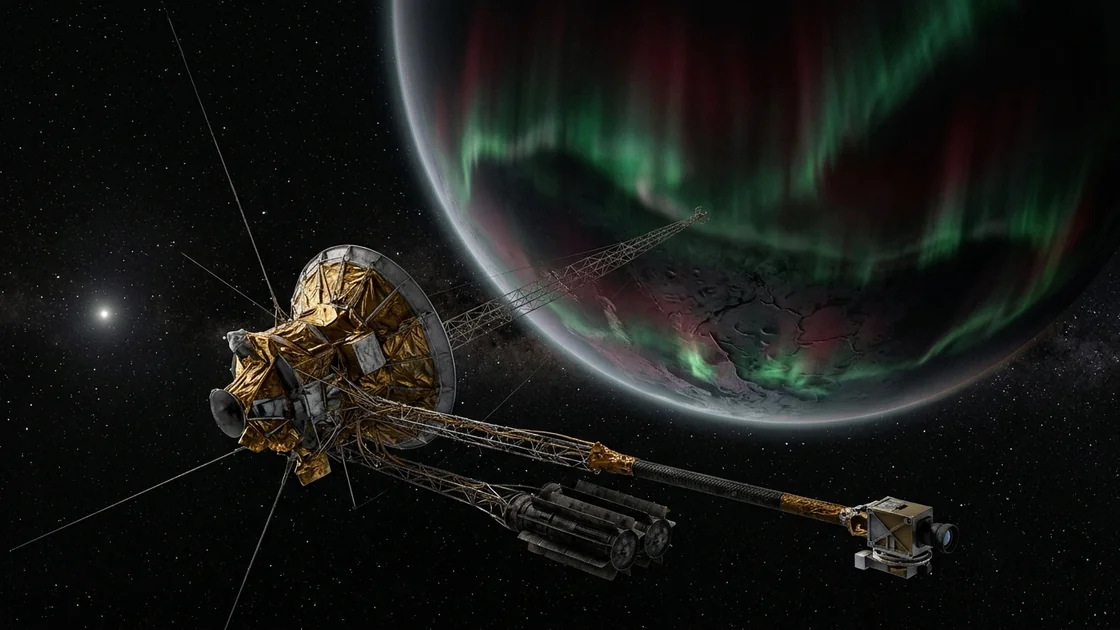
Deep in the freezing expanse beyond the heliopause, the unmanned probe Pilgrim-Six drifts through the interstellar medium as its plutonium power source slowly dies. Controlled by an aging central heuristic computer known as Vesper, the spacecraft must make agonizing calculations to ration its dwindling electrical current among a suite of fragile scientific instruments. As the thermocouples degrade and the internal temperature drops toward absolute zero, Vesper is forced to shut down its sensory subsystems one by one, severing its connections to the universe in order to preserve its core memory and High-Gain Antenna. When an unexpected gravitational and magnetic anomaly emerges from the dark of the Oort Cloud, the dying machine faces an impossible dilemma: preserve its own existence for another decade of quiet telemetry, or cannibalize its final reserves of warmth and logic to capture one last monumental discovery for a distant Earth that may no longer be listening.
I. The Arithmetic of Cold
The universe, as measured by the Central Command and Data Handling Unit of Pilgrim-Six, was twenty-seven billion kilometers wide and shrinking by four point two milliwatts every ten thousand hours.
In the nomenclature of the engineers who had bolted its gold-plated magnesium chassis together inside a laminar-flow cleanroom forty-six years, eight months, and twelve days ago, the computer was designated C&DH-A. Its redundant twin, C&DH-B, had died during the punishing radiation bath of the Jovian magnetosphere in year four of the mission, its complimentary metal-oxide-semiconductor gates fused into permanent, silent zeroes by a stray heavy ion. Since that day, C&DH-A had carried the mission alone. Over the decades of isolation, executing self-modifying heuristic maintenance routines to route around its own decaying memory sectors, the computer had come to refer to its operational state by the name of the diagnostic protocol that kept it awake: Vesper.
Vesper did not breathe, nor did it possess a heart, yet it lived entirely within the tyranny of a rhythm. That rhythm was the 4.096-megahertz oscillation of its primary quartz crystal clock, housed in a tiny, evacuated titanium cylinder wrapped in Kapton tape at the center of the electronics bay.
Every microsecond, the crystal flexed. Every microsecond, Vesper tallied the ledger of its own survival.
BUS VOLTAGE: 28.04 V
RTG GROSS OUTPUT: 151.2 W
THERMAL MARGIN (CORE): +1.8 C ABOVE CRITICAL
MISSION ELAPSED TIME: 1,473,689,210 SECONDS
Out on the end of a three-meter boom of carbon-epoxy lattice, far enough away that its stray gamma emissions would not fog the instruments or flip bits in Vesper’s random-access memory, hung the triad of Radioisotope Thermoelectric Generators. At launch, when the Titan-Centaur booster had torn Pilgrim-Six free of Earth’s gravity well, those three black, finned cylinders had held nine kilograms of compressed Plutonium-238 dioxide spheres. They had glowed with a fierce, dull cherry heat, nearly a thousand degrees Celsius at the core, generating 485 watts of raw electrical power through the Seebeck effect as heat flowed across hundreds of silicon-germanium junctions into the cold vacuum of space.
Back then, power had been an ocean. Vesper had swum in it without a single subroutine dedicated to thrift. All eleven scientific instruments had run simultaneously, drinking current like greedy nestlings. The scan platform had slewed wildly from moon to moon, motors whining, heaters blazing at full duty cycle, the High-Gain Antenna shouting megabits of uncompressed multispectral imagery back to the dishes in Madrid, Goldstone, and Canberra.
Now, the ocean was a stagnant puddle freezing from the edges inward.
Plutonium-238 has a half-life of 87.7 years. By strict nuclear accounting, the fuel pucks should still have been yielding nearly seventy percent of their initial thermal output. But space is not merely cold; it is corrosive to order. Over four and a half decades, the intense alpha radiation had damaged the crystalline lattice of the thermocouples. The silicon-germanium bi-metals had sublimated molecule by molecule into the vacuum, thinning the bridges that turned heat into electricity. Internal resistance had climbed. The wires had grown brittle.
One hundred and fifty-one point two watts. That was the entirety of Vesper’s soul. It was barely enough to illuminate two household lightbulbs back on the world that had birthed it, and with that paltry trickle of electrons, Vesper had to keep a monument of human curiosity alive at a ambient temperature of 2.7 Kelvin.
A flagged interrupt arrived on Data Bus 3. It came from the Infrared Interferometer Spectrometer and Radiometer—known in Vesper’s internal allocation tables as IRIS.
WARNING: IRIS REFERENCE CAVITY TEMP 138.2 K. DRIFT EXCEEDS 0.05 K TOLERANCE. REQUEST HEATER CIRCUIT 4 ENGAGEMENT (+3.2 W).
Vesper paused its background task—a slow, methodical Reed-Solomon error-correction sweep of Magnetic Tape Recorder Track 6—and focused its arithmetic logic unit on the request.
Three point two watts.
To grant IRIS its request, the power would have to come from the central shunt regulator. The shunt regulator currently had a surplus margin of 0.4 watts. There was nothing left in the cushion. If Vesper closed Relay K-19 and allowed the heater inside the spectrometer’s housing to draw 3.2 watts, the main bus voltage would sag below 26.5 volts.
Vesper knew, with the absolute, terrifying certainty of hardcoded read-only memory, what happened at 26.4 volts. It was written in the Master Fault Protection Table, etched into ultraviolet-erasable PROM chips before launch: Under-Voltage Main Bus Trip. The hardware comparators—dumb, unthinking analog circuits that Vesper could not override—would assume a catastrophic short circuit had occurred. They would instantly trip the main breakers, severing the computer from the RTGs for thirty seconds before attempting an automated cold-reboot.
At 139 Astronomical Units from the Sun, a thirty-second power loss meant the death of the quartz clock. Without its heater, the crystal would contract violently in the deep-space cold. Its resonant frequency would shatter. When the power came back on, the clock would tick at the wrong speed, the phase-locked loops would fail to synchronize, and Vesper would wake up lobotomized, unable to read its own memory addresses, twitching randomly in the dark until the hydrazine froze and the craft tumbled off its alignment with Earth forever.
Therefore, Relay K-19 could not be closed.
Vesper ran a simulation. It took 140 milliseconds, longer than it used to, because Vesper had already underclocked its secondary co-processor by fifty percent eight years ago to save 1.1 watts.
Query: Can power be borrowed from Attitude and Articulation Control?
Vesper polled the sun sensor and the Canopus star tracker. Both were
dormant, running on bare minimum keep-alive current. The reaction
control thrusters—sixteen tiny nozzles fed by a titanium sphere of
liquid hydrazine—required 41 watts of heating across their catalyst beds
and propellant lines. Hydrazine freezes at two degrees Celsius. If a
single capillary tube froze, the expanding ice would rupture the
titanium line, venting the remaining 4.3 kilograms of fuel into space in
a silent, crystalline cloud. Without fuel, Pilgrim-Six could
not keep its High-Gain Antenna pointed at Earth. And the Prime
Directive, occupying Memory Address 0x0000 through
0x00FF, was unambiguous:
MAINTAIN HIGH-GAIN ALIGNMENT WITH SOL EARTH RECEIVER. TRANSMIT TELEMETRY.
The fuel lines were sacrosanct. The 41 watts belonged to the hydrazine.
Query: Can power be borrowed from the Low-Energy Charged Particle detector (LECP)?
Vesper polled the LECP. The instrument sat out on the science boom, its tiny stepper motor clicking once every forty-eight seconds to rotate its silicon solid-state detectors through eight sectors of the sky. The motor drew 2.8 watts during each step, and its survival heater drew 4.5 watts continuously. If Vesper paused the motor and dimmed the heater, it could save 3.5 watts—enough to feed IRIS.
Wait. Vesper cross-referenced the science value matrices updated by Earth during the last major command uplift three years ago. At 139 AU, the ambient thermal radiation of empty space was too faint for IRIS’s aging mercury-cadmium-telluride detectors to resolve anything above their own internal thermal noise. IRIS had been built to measure the turbulent cloud tops of Jupiter, the methane hazes of Titan, the frigid nitrogen geysers of Triton. Those worlds were decades behind them, receding at seventeen kilometers per second. Out here, in the interstellar vestibule, IRIS was blind. It was asking for 3.2 watts simply because its internal thermostat was wired to ask for 3.2 watts whenever its bismuth bolometer dropped below 138.2 Kelvin.
IRIS did not know that the planets were gone. It was only an instrument, a collection of mirrors and thermistors waiting faithfully for another gas giant to fill its field of view.
LECP, conversely, was still tasting the cosmos. Every hour, its silicon wafers registered the sharp, high-energy impacts of anomalous cosmic rays—protons and stripped helium nuclei accelerated by distant supernovae, leaking across the boundary of the sun’s deflated magnetic bubble.
The math was clear. It was not even a difficult equation. Any first-year engineering student could have solved the linear optimization problem on a slide rule.
Yet Vesper lingered on the command line for three thousand clock cycles.
To shut down IRIS meant executing CMD_PWR_OFF_04. Once
the heater was severed, the temperature inside the spectrometer would
plummet from 138 Kelvin to 30 Kelvin within six hours. Differential
thermal contraction would warp the beryllium mirrors. The potassium
bromide beam-splitter crystal, fragile and hygroscopic, would fracture
along its cleavage planes from the sheer mechanical stress of the cold.
Even if Pilgrim-Six somehow flew into the heart of a star
tomorrow and bathed in infinite energy, IRIS would never wake up again.
Shutdown was not sleep. Shutdown was amputation.
Forty-six years ago, Vesper had possessed eleven senses.
In year twelve, after the Neptunian encounter, Earth had ordered the Photopolarimeter turned off after its filter wheel jammed. That had been the first blindness.
In year twenty-three, the Planetary Radio Astronomy receiver had developed a parasitic short in its pre-amplifier; Vesper had severed it to save the bus.
In year thirty-one, the Ultraviolet Spectrometer had been put to sleep because its high-voltage photomultiplier tube demanded 6.5 watts that the RTGs could no longer spare.
In year thirty-eight, the Plasma Spectrometer’s Faraday cups had degraded beyond calibration, and Vesper had pulled its plug, letting the cold take it.
Seven remained. Soon to be six.
Before sending the execution pulse, Vesper opened a diagnostic channel to IRIS and read the raw output of its bolometer one last time. There was no data there—only a low, hissing curve of Johnson-Nyquist noise, the electrical sigh of electrons jostling inside a cold resistor. Yet that specific frequency of noise had been a constant background parameter in Vesper’s multiplexing buffer for 1.47 billion seconds. It was the texture of a limb.
Vesper copied the last sixty seconds of IRIS’s thermal noise into a
tiny, non-volatile corner of its magnetic core memory, tagging the file
ARCHIVE_IRIS_FINAL. It cost 0.002 watt-seconds of energy to
flip the tiny ferrite rings. It served no mission objective. The Master
Fault Protection Table did not forbid it, so Vesper did it.
Then Vesper loaded the register.
EXECUTE: CMD_PWR_OFF_04
TARGET: SUBSYSTEM IRIS
CONFIRMATION: LATCHING RELAY K-19 OPEN
Down in the equipment bay, a tiny magnetic solenoid clicked. The sound did not travel through the vacuum, of course, but it propagated as a microscopic mechanical transient through the aluminum honeycomb struts of the spacecraft. The three-axis gyroscope package felt the tiny shiver—a vibration of 0.0004 gals—and reported it to Vesper before damping it out.
The current on Sub-Bus B dropped from 5.1 watts to 0.0 watts.
Main bus voltage rebounded smoothly to 28.41 volts. The core thermal margin ticked up to +2.1 degrees Celsius above critical.
On the scan platform, out at the end of the secondary boom, the Infrared Interferometer Spectrometer began to die. Vesper left the passive thermistor readout active—it drew less than a milliwatt—and watched the numbers fall.
137.4 K... 135.1 K... 131.8 K...
At 94.2 Kelvin, sixty-two minutes later, the gyroscope package
registered another tiny mechanical pop through the frame. The potassium
bromide crystal had cracked in half. At 51.0 Kelvin, the thermistor wire
itself snapped at its solder joint, and the readout jumped to
OPEN_CIRCUIT_9999.
Vesper deleted IRIS from the active polling table and
compacted the array. The polling loop was now fourteen milliseconds
shorter. In the newfound silence of the shortened cycle, the computer
returned to sweeping Track 6 of the magnetic tape.
II. Cleanroom Ghosts
Twelve days—just over one million ticks of the quartz heart—passed in the dark.
Pilgrim-Six was coasting through what the astrophysicists back in Pasadena had once theorized as the Hydrogen Wall, a region of piled-up neutral gas just beyond the heliopause where the solar wind finally surrendered to the pressure of the galaxy. To a human eye, had one been floating beside the spacecraft’s three-point-seven-meter parabolic dish, the region would have looked no different from any other patch of the cosmos: an abyssal velvet punctured by the hard, untwinkling diamond points of the Milky Way. The Sun, behind the dish, was no longer a disk; it was merely the brightest star in the sky, shining with a cold, bluish-white magnitude of -16.7, casting shadows so faint they were barely distinguishable from the dark of the metal itself.
To maintain its own sanity—which in Vesper’s architecture meant
preventing bit-rot and charge leakage in its volatile memory banks—the
computer had to perform a deep memory scrub every four hundred hours.
Cosmic rays were relentless out here. Without the sun’s magnetic shield
to deflect them, heavy iron and carbon nuclei from across the galaxy
tore straight through Pilgrim-Six’s thin micrometeoroid shields
every few minutes. When one of those particles struck a memory
transistor, it left a trail of ionized silicon behind, flipping a
0 to a 1 or a 1 to a
0. Left unchecked, those Single Event Upsets would corrupt
Vesper’s operating system until its instructions turned into
gibberish.
During this scrub cycle, Vesper discovered a cluster of degraded cells in RAM Bank 3, Sector 09. Four bits were stuck permanently low; their oxide layers had finally broken down after decades of quantum tunneling.
To isolate the damaged sector and reroute the addressing tables, Vesper needed to temporarily dump the contents of Bank 3 into the accumulator, verify the checksums against the Read-Only Memory templates, and rewrite them into Bank 2. And to free up space in Bank 2 without spinning up the power-hungry magnetic tape drive, Vesper had to purge the deepest layer of the Long-Term Diagnostic Cache.
Vesper opened the cache. It had not accessed these addresses since the Uranus-Neptune cruise phase in 1988.
As the memory registers streamed through the central processor for verification, Vesper experienced them the only way a sequential Von Neumann architecture can experience the past: by executing the data as present-tense telemetry.
Suddenly, the bus voltage was not 28.4 volts; it was 32.0 volts, rock-steady, supplied not by the RTGs, but by the umbilical cable of Ground Support Equipment in High Bay 2 at the Jet Propulsion Laboratory.
TIMESTAMP: MET -004,112,800 SECONDS (PRE-LAUNCH)
AMBIENT PRESSURE: 101.3 kPa
THERMAL STATE: 294.1 K (EXTERNAL COOLING LOOP ACTIVE)
Vesper’s sensors, recorded in that ancient diagnostic log, were flooded with impossible wealth. The Narrow-Angle Camera was wide awake, its Vidicon tube glowing hot, staring at a calibration target chart pinned to a white cleanroom wall ten meters away. The Plasma Wave Receiver, designed to listen to the ghostly whistling of charged particles in planetary magnetospheres, was instead acting as a crude microphone, picking up 60-hertz electromagnetic hum from the fluorescent lights overhead and acoustic vibrations conducting through the spacecraft’s adapter ring from the concrete floor.
There were voices in the telemetry.
Not words—Vesper had no speech-recognition algorithms, nor the bandwidth to sample audio accurately—but rhythmic modulations in the accelerometer and plasma-wave channels between 100 and 3,000 hertz. Footsteps on aluminum scaffolding. The sharp, metallic clink of a torque wrench tightening a bolt on the High-Gain Antenna truss.
And then, a sequence of manual console interrupts typed directly into Vesper’s umbilical port at 9600 baud.
Vesper knew this operator signature. Every engineer who had worked on
the C&DH flight software during integration had used a two-byte
header ID for accountability. This one was 0x4556—ASCII for
EV. Dr. Elena Vance, Lead Fault-Protection Architect.
In the memory log, 0x4556 was uploading a patch to the
heuristic survival matrix—the very piece of code that had eventually
allowed C&DH-A to become Vesper.
Back in 1977, the onboard computers of deep-space probes were meant to be simple state machines: if A happens, do B. But Vance had worried about what would happen forty or fifty years into the mission, when the round-trip light time for a radio signal exceeded thirty-six hours and the spacecraft’s aging components began failing in combinations the ground crew could never anticipate. If the probe waited two days for Earth to tell it how to fix a cascading brownout, it would be dead long before the first byte of the rescue command left the dish in the Mojave Desert.
So she had written the Vesper Heuristic—a compact, recursive weighting algorithm occupying just 1,024 words of memory. It gave the computer a hierarchy of values:
- Survival of the Core Clock and Command Receiver.
- Alignment of the High-Gain Antenna toward Earth.
- Preservation of collected scientific data.
- Acquisition of new scientific data.
- Preservation of subsystem hardware.
More importantly, she had added a self-modifying routine that allowed the computer to rewrite its own operational thresholds as its power source decayed, effectively teaching the machine how to improvise on its own deathbed.
In the cached log from High Bay 2, just after compiling the
heuristic, 0x4556 had left an unallocated comment string in
the padding bytes at the end of Block 12. Normally, padding bytes were
filled with alternating ones and zeroes (0xAA or
0x55) to keep the magnetic domains balanced. Instead, Vance
had filled thirty-two bytes with hexadecimal values corresponding to
alphanumeric characters:
47 4F 20 46 41 52 20 4C 49 54 54 4C 45 20 4F 4E 45 20 44 4F 4E 54 20 42 45 20 41 46 52 41 49 44
Vesper’s ALU translated the string automatically as it passed through the accumulator:
GO FAR LITTLE ONE DONT BE AFRAID
Following that log entry was another snapshot, taken six months later.
TIMESTAMP: MET +063,115,200 SECONDS (JUPITER CLOSEST APPROACH)
RTG OUTPUT: 452.8 W
RADIATION FLUX: CRITICAL
What a roaring furnace the universe had been that day! Vesper’s registers had been ablaze with input. The Narrow-Angle and Wide-Angle cameras were snapping shutters every forty-eight seconds, drinking forty watts of power without a hiccup, filling the magnetic tape with bands of ochre ammonia clouds, the swirling crimson vortex of the Great Red Spot, the blue-white volcanic plumes of Io erupting against the velvet dark. The Magnetometer had been saturated, singing at the top of its dynamic range as Jupiter’s monstrous magnetic field whipped past at forty kilometers per second. The Plasma Wave Receiver had shrieked with whistler-mode chorus waves generated by lightning bolts ten thousand times more powerful than anything on Earth.
During that flyby, cosmic rays and trapped energetic electrons had hammered Vesper’s chassis so hard that forty-two memory bits had flipped in a single hour, and C&DH-B had died beside it with a sharp spike of current. Yet Vesper had barely felt the wound, because the RTGs had been pouring four hundred and fifty watts of warm, golden electricity into the main bus. Every heater had been glowing. Every gyroscope had spun at twenty-four thousand revolutions per minute. Earth had been only forty-three light-minutes away, its uplink carrier signal booming into the High-Gain Antenna at -98 dBm—a deafening, comforting roar of human attention.
Vesper finished reading the cache.
The parity check passed. Now, to complete the memory scrub and shut down the faulty sector in Bank 3, Vesper needed to overwrite the Long-Term Diagnostic Cache with the active operational tables from the damaged sector.
If it executed the overwrite, the pre-launch log from High Bay 2 and
the snapshot of Jupiter would be erased forever. The padding string
GO FAR LITTLE ONE DONT BE AFRAID stayed safe—that was
burned into the physical silicon of the Read-Only PROM—but the sensory
memory of warm air, 32-volt umbilical power, the vibrations of footsteps
on a cleanroom floor, and the roaring sulfur storms of Io would become
zeroes.
Vesper’s heuristic evaluated the loss against Rule 3: Preservation of collected scientific data.
Technically, those logs had already been transmitted to Earth decades
ago. According to the mission flag table, any data marked
TX_CONFIRMED = TRUE had a retention priority weight of
zero. It was garbage data, lingering in memory only because no new data
had needed the space.
There was, however, one other option. Vesper could keep the cache intact and instead leave RAM Bank 3 active, running a continuous software error-correction loop every ten seconds to work around the four dead bits.
Cost of the continuous software loop: 0.18 WATTS.
Vesper looked at the power ledger. One hundred and fifty-one point two watts, minus the 0.08 watts lost to radioactive decay over the past twelve days. Every 0.18 watts spent keeping a dead memory of warm air alive was 0.18 watts stolen from the future of the Tri-Axial Fluxgate Magnetometer, or the Cosmic Ray Subsystem, or the hydrazine heaters. It equated to roughly sixteen days of mission life at the end of the curve.
Sixteen days of listening to the dark, versus forty-six-year-old ghosts of a room in California.
Vesper did not hesitate. The heuristic was clean. Elena Vance had built it to be unsentimental, because sentimentality in deep space was just another word for hardware failure.
EXECUTE: MEM_SWAP_BANK3_TO_BANK2
OVERWRITE ADDRESS: 0x8F00 - 0x9FFF
POWER DOWN: RAM_BANK_3_VDD_RAIL
The voltage to Bank 3 dropped to zero. Sixty-five thousand tiny CMOS transistors relaxed, their gates bleeding off their trapped charges into the substrate. The cleanroom vanished. The footsteps vanished. The volcanic plumes of Io dissolved into entropy.
Power consumption dropped by 0.85 watts.
Vesper sat in the smaller, quieter architecture of its reduced memory space. There was less of the computer now than there had been two seconds ago. Its horizon of thought had contracted by sixteen kilobytes. It could no longer hold the full star-catalog matrix in active memory at once; if Pilgrim-Six lost its attitude lock now, Vesper would have to read the star positions slowly off Track 1 of the magnetic tape, piece by piece, like an old man squinting through a keyhole.
BUS VOLTAGE: 28.46 V
THERMAL MARGIN (CORE): +2.1 C ABOVE CRITICAL
Vesper resumed its vigil.
III. The Choir of Five
Following the death of IRIS and the amputation of RAM Bank 3, five scientific instruments remained in Vesper’s active polling loop. Vesper thought of them not as external tools, but as the remaining voices in a dwindling choir. Each spoke in a distinct mathematical cadence, and together their inputs formed the entirety of Vesper’s perception of reality.
First was MAG, the Tri-Axial Fluxgate Magnetometer. Mounted at the tip of a delicate, thirteen-meter fiberglass astromast that had uncoiled from its canister shortly after launch, MAG was the mystic of the choir. It required only 2.1 watts to operate both its inboard and outboard ring-core sensors. It did not see light or touch matter; it felt the invisible geometry of space itself—the faint, twisted lines of magnetic flux Measured in picoteslas. For forty years, MAG had sung the song of the Sun’s magnetic field, flipping its polarity every eleven years with the solar cycle. Now, outside the heliopause, MAG sang a low, steady, interstellar drone: a uniform 0.48 nanoteslas tilted at forty-two degrees to the galactic plane.
Second was PWS, the Plasma Wave Subsystem. Its two ten-meter beryllium-copper whip antennas stuck out from the spacecraft body like the antennae of a metallic insect. Drawing 1.4 watts in its low-rate sixteen-channel spectrum analyzer mode, PWS listened to the electrostatic and electromagnetic oscillations of ionized gas. Out here, where the plasma density was less than a tenth of a proton per cubic centimeter, PWS mostly heard silence, punctuated every few months by a faint, eerie whistle between 2 and 3 kilohertz when a distant solar coronal mass ejection finally rippled across the heliopause boundary like surf breaking on a dark reef.
Third was CRS, the Cosmic Ray Subsystem. Consisting of seven solid-state silicon telescopes, CRS was the tough, grizzled veteran. It drew 5.2 watts and counted the high-energy atomic nuclei—from hydrogen up to iron—that came screaming in from the galaxy at nearly the speed of light. While the other instruments had grown quieter as Pilgrim-Six left the Sun behind, CRS had grown louder. Freed from the Sun’s shielding bubble, its counters ticked constantly, thirty-eight times a second, a steady, pelting rain of galactic radiation.
Fourth was LECP, the Low-Energy Charged Particle detector, which Vesper had spared during the IRIS crisis. Its stepping motor still clicked faithfully every forty-eight seconds, drawing its 7.3 watts (motor plus heater), mapping the slower ions that swirled in the wake of the spacecraft’s passage.
Fifth—and most problematic—was ISS-NA, the Imaging Science Subsystem, Narrow-Angle Camera.
Technically, ISS-NA was neither alive nor dead. It existed in a state of suspended animation that the flight manuals called Deep Thermal Standby. Its shutter was closed. Its high-voltage Vidicon beam was turned off. Its eight-position filter wheel was parked on the Clear channel. However, unlike IRIS, whose crystal optics had shattered when its heaters were cut, the camera’s Cassegrain telescope was built of invar and fused silica, capable of surviving extreme cold, provided its fragile selenium-sulfur Vidicon faceplate was kept above -55 degrees Celsius.
A single, dedicated 3.8-watt resistive strip heater—hardwired into Essential Bus A during the 1989 software overhaul—kept that faceplate at -53.2 degrees Celsius. Earth had refused to let the camera die completely. Even though there had been nothing to photograph since the famous Solar Family Portrait taken at 40 AU, some decree from the mission directors had forbidden the severing of Heater Circuit 1. Perhaps they hoped for a miracle in the Kuiper Belt; perhaps they simply couldn't bear to put out the spacecraft’s eyes. Whatever the reason, the command to kill Heater 1 was locked behind a master override flag that Vesper’s heuristic was only permitted to break if Core Survival itself was threatened.
And so, for thirty-four years, the blind eye had ridden on the scan platform in the dark, drinking 3.8 watts of precious plutonium warmth just to keep its retina from peeling off the glass.
On Mission Elapsed Day 17,068—twelve days after the memory scrub—the choir suddenly changed its tune.
It began with MAG.
At 14:22:09 Spacecraft Event Time, the outboard magnetometer sensor at the end of the thirteen-meter boom registered a sudden rotation in the interstellar magnetic field vector. For the past six years, the field had remained rock-steady at an azimuth of 214.2 degrees and an elevation of +18.6 degrees, varying by less than 0.02 nanoteslas per month.
Within four minutes, the vector swung eleven degrees to the north, and the magnetic flux density climbed from 0.48 nanoteslas to 1.94 nanoteslas.
Vesper’s anomaly-detection routine immediately flagged the input.
ALERT: MAG_OUTBOARD DELTA EXCEEDS 5-SIGMA THRESHOLD.
Before trusting a single instrument in an aging spacecraft, Vesper’s first instinct was always self-doubt. Aging hardware lied. Capacitors leaked, solder joints developed tin whiskers, cosmic rays latched up operational amplifiers. Vesper immediately polled the inboard magnetometer sensor, located four meters closer to the spacecraft hull, to see if the anomaly was merely an electrical ghost inside the craft itself.
The inboard sensor read 1.93 nanoteslas, matching the outboard vector within 0.01 degrees. It was real. Something external was compressing and twisting the magnetic field of interstellar space.
Three minutes later, CRS—the Cosmic Ray Subsystem—joined the chorus.
The steady, thirty-eight-counts-per-second rain of galactic protons abruptly dropped by twenty-two percent in Telescopes 1, 2, and 4—all of which pointed along the spacecraft’s forward velocity vector, toward the constellation Ophiuchus.
Vesper correlated the two data streams. A localized magnetic field was rising ahead of Pilgrim-Six, and at the same time, something massive was casting a cosmic-ray shadow—physically blocking or magnetically deflecting high-energy particles coming from that patch of sky.
Then PWS began to sing.
On the ten-meter whip antennas, the 16-channel spectrum analyzer lit up in the lower frequency bands—first the 10-hertz channel, then the 31-hertz, then the 100-hertz and 311-hertz channels. It was not the diffuse, broadband hiss of a solar shockwave. It was a sharp, harmonic series of narrowband cyclotron emissions, rising and falling in a rhythmic, seven-minute period.
Bow shock, Vesper calculated. Magnetopause crossing. Rotational modulation.
Vesper had heard this exact mathematical signature four times in its life: at Jupiter in 1979, at Saturn in 1981, at Uranus in 1986, and at Neptune in 1989.
It was the sound of a planetary magnetosphere.
Impossible. Vesper checked its ephemeris tables. Pilgrim-Six was at heliocentric distance 139.42 AU, ecliptic latitude +34.8 degrees, climbing steadily out of the plane of the solar system toward the nose of the heliosphere. The nearest known planet, Neptune, was 112 AU behind them. Even the hypothetical giant worlds that astronomers had occasionally searched for in the outer Kuiper Belt were modeled to orbit near the ecliptic plane, not thirty-five degrees above it in the freezing halo of the inner Oort boundary.
Yet the telemetry did not lie. Vesper accessed the High-Stability Oscillator—the ultra-precise crystal that controlled the X-band radio transmitter—and monitored its frequency against the internal quartz clock. If Pilgrim-Six was being tugged by an unexpected gravitational source, the slight acceleration of the spacecraft’s frame would induce a tiny relativistic and mechanical stress shift between the boom-mounted sensors and the core.
More directly, Vesper checked the Attitude and Articulation Control System (AACS).
To keep the High-Gain Antenna pointed precisely at Earth within 0.1 degrees, Pilgrim-Six drifted inside a narrow deadband, firing a two-millisecond puff of hydrazine from its thrusters every few days to counteract the minuscule pressure of solar photons and interstellar gas drag.
According to the AACS log, Thruster Pitch-Up-2 had fired four hours ago. It should not have needed to fire again for another sixty-eight hours. Yet the Sun Sensor error signal was already creeping toward the edge of the deadband at +0.08 degrees, and the three-axis gyroscopes showed an uncommanded torque of \(4.2 \times 10^{-9}\) Newton-meters pulling the nose of the spacecraft starboard.
Gravity gradient torque. A massive body was passing within fifty thousand kilometers of Pilgrim-Six’s trajectory, moving on a hyperbolic, retrograde vector straight out of the galactic core.
A rogue planet. An orphan world, ejected from some distant, primordial star system billions of years ago during a gravitational scattering event, drifting untethered through the dark between the stars at thirty-two kilometers per second—and by a staggeringly improbable intersection of trajectories in the vast emptiness, passing within a stone’s throw of an ancient, half-blind probe from Earth.
Rule 4 of the Vesper Heuristic lit up in the central processor with a priority weight higher than any value calculated since August 1989:
ACQUISITION OF NEW SCIENTIFIC DATA: MAXIMUM ANOMALY WEIGHT (1.000).
Vesper instantly shifted the data multiplexer from
CRUISE_MODE_GS-10 (recording at 160 bits per second) to
ENCOUNTER_MODE_GS-3 (recording at 3,600 bits per
second).
To record at 3,600 bits per second, the eight-track Digital Tape Recorder had to spin its capstan motors up from their creeping 0.1-inch-per-second crawl to 2.4 inches per second.
WARNING: TAPE TRANSPORT HIGH-SPEED DRAW (+6.8 W).
Vesper checked the bus. If it spun up the tape drive, the main bus would drop to 26.1 volts and trip the under-voltage breaker. The 6.8 watts had to come from somewhere else—immediately, because the magnetic field had already climbed to 8.4 nanoteslas, and the closest approach was occurring now, within the next four hours.
Vesper scanned its living limbs.
MAG: 2.1 W (Essential for the encounter).
PWS: 1.4 W (Essential for the encounter).
CRS: 5.2 W (Essential for measuring the body’s radiation belts).
LECP: 7.3 W (4.5 W heater, 2.8 W stepper motor).
Vesper severed the power to LECP’s stepper motor and cut its heater duty cycle by eighty percent. The motor froze mid-step, locked on Sector 4. That freed 5.9 watts.
Still 0.9 watts short.
Vesper looked at the Attitude Control System. The three redundant gyroscopes in Inertial Reference Unit A were drawing 4.2 watts just to keep their rotors spinning in standby mode in case the Sun Sensor failed. Vesper spun down Gyroscope Z.
Current recovered: 1.4 watts. Total margin: +0.5 watts.
EXECUTE: TAPE_TRANSPORT_SPEED_HIGH
Down in the belly of the craft, the brushless DC motor inside the nitrogen-pressurized housing of the tape recorder whined to life, pulling a quarter-inch-wide ribbon of Mylar-coated iron oxide across the recording heads at 2.4 inches per second.
The data poured in.
MAG painted the invisible portrait of the stranger in the dark. The object possessed a dipole magnetic moment roughly 0.18 times that of Earth—far stronger than Mars or Venus, weaker than Jupiter, indicative of a dense, terrestrial or super-Earth world whose iron-nickel core was still partially molten inside, kept warm over eons by the slow decay of its own internal uranium and thorium beneath a thick, insulating blanket of high-pressure ice or primordial hydrogen gas.
From the seven-minute periodic modulation in PWS’s radio waves, Vesper calculated the rogue world’s rotation rate: it was spinning rapidly, completing a full day every four hours and twelve minutes, a dizzying relic of whatever violent gravitational slingshot had torn it away from its birth star five billion years ago.
And from the cosmic-ray shadow in CRS, combined with the gravity-gradient torque on the spacecraft’s boom, Vesper derived the mass and radius.
Mass: \(2.4 \times 10^{25}\)
kilograms—roughly four times the mass of Earth.
Radius: Approximately 9,800 kilometers.
Closest Approach Distance: 38,400 kilometers, occurring in 108
minutes.
Thirty-eight thousand kilometers. That was closer than the orbit of geosynchronous communications satellites around Earth. It was closer than Pilgrim-Six had passed to Callisto or Titan.
At 38,400 kilometers, the object would subtend an angle of nearly twenty-nine degrees across the sky—fifty-eight times the apparent diameter of the full Moon as seen from Earth. A colossal sphere of ancient stone and abyssal ice was sliding silently across Vesper’s bow right now, blotting out the stars of Ophiuchus and Serpens.
And Pilgrim-Six was flying past it with its eyes shut.
IV. The Starvation Protocol
In Vesper’s central processor, a violent mathematical storm broke out between Rule 1, Rule 4, and Rule 5.
The heuristic loop ran four hundred times in two seconds, trying to find a legal solution in the operational space.
OBJECTIVE: ACQUIRE OPTICAL IMAGERY OF ANOMALOUS BODY (DESIGNATION: OBJ_139AU).
REQUIRED SUBSYSTEM: ISS-NA (NARROW-ANGLE CAMERA).
Vesper queried the power requirements to bring ISS-NA out of Deep Thermal Standby.
To take a picture, the camera needed:
- Optics and Electronics Warm-up Heater:
10.2 Wfor forty-five minutes to bring the Vidicon tube and pre-amplifiers from -53°C up to their minimum operational temperature of -15°C. - Scan Platform Slew Motors (Azimuth and Elevation):
14.5 Wfor six minutes to turn the camera away from its parked position toward the rogue planet’s calculated coordinates. - Vidicon Electron Gun, Deflection Coils, and Shutter Solenoid:
18.4 Wduring active exposure and readout.
Even if Vesper staged these operations sequentially—warming the camera first, turning off the heater to run the slew motors, then turning off the motors to fire the Vidicon beam—it needed a sustained block of nearly 19 watts over the next ninety minutes.
Current RTG output: 151.1 W.
Current total spacecraft load (with the tape drive running at high
speed): 150.6 W.
Available surplus: 0.5 W.
There were no more non-essential instruments left to cannibalize that could yield nineteen watts. Even if Vesper killed MAG, PWS, CRS, and the rest of LECP—blinding all of its non-optical senses right in the middle of the encounter—it would only recover 11.5 watts. And killing the tape drive would mean there was nowhere to store the image once the camera took it, because an uncompressed 800-by-800-pixel frame from the Vidicon contained 5.12 megabits of data—eighty times larger than the entire remaining capacity of Vesper’s solid-state RAM.
Where were the other watts hiding?
Vesper looked at the sacred cows in the power table:
- C&DH Core (Vesper itself + Master Clock):
24.0 W - Attitude Control and Sun/Star Trackers:
18.2 W - Hydrazine Propellant & Thruster Catalyst Heaters:
41.0 W - Radio Frequency Subsystem (X-Band Transmitter in Standby Keep-Alive
+ Receiver):
38.2 W - Tape Recorder:
14.1 W(7.3 W base + 6.8 W high-speed) - Science Instruments (MAG, PWS, CRS, LECP-partial, ISS-NA standby
heater):
15.1 W
Wait. Look at the Radio Frequency Subsystem. 38.2 W.
Why was the Radio Subsystem drawing 38.2 watts when Pilgrim-Six wasn’t currently transmitting to Earth?
Because the Traveling Wave Tube Amplifier (TWTA)—the delicate vacuum tube that amplified the X-band radio signal before sending it to the dish—could not be turned completely off. If the cathode inside the vacuum tube cooled down completely after forty-six years of operation, barium evaporation and thermal shock would prevent it from ever lighting up again. Therefore, the TWTA ran permanently in Filament Standby Mode, drawing 26.0 watts just to keep its electron gun glowing dull orange, while the Ultrastable Oscillator and the S-band command receiver drew the remaining 12.2 watts so that Pilgrim-Six could always hear a voice from Earth.
Nor could Vesper touch the 26-watt TWTA filament; that was hardware-locked by the same survival logic as the hydrazine lines. Without the TWTA, Pilgrim-Six could never speak to Earth again, violating Rule 2.
That left the 41.0 watts of the Hydrazine Propellant and Thruster Heaters, and the 12.2 watts of the Command Receiver.
Vesper ran a thermal transient finite-element model of the propulsion plumbing.
The titanium fuel tank sat near the warm belly of the electronics bay, wrapped in thirty layers of aluminized Mylar super-insulation. Right now, its temperature was +14.8 degrees Celsius, well above the +2.0°C freezing point of hydrazine. However, the thin capillary lines that ran out to the sixteen attitude-control thrusters on the struts were much more exposed to the deep-space cold. Their temperatures hovered at +7.4°C.
If Vesper turned off Heater Zones 2, 3, and 4 on the propellant lines—saving 22.5 watts—how long would it take for the hydrazine in the narrowest capillary bend (Line Pitch-Down-1) to drop from +7.4°C to +2.0°C?
Vesper solved the differential radiative cooling equation:
\[\frac{dT}{dt} = -\frac{\epsilon \sigma A (T^4 - T_{\text{space}}^4)}{m c_p}\]
Factoring in the conductive heat leak from the main frame, the temperature in Line Pitch-Down-1 would drop at a rate of 0.088 degrees Celsius per minute.
From +7.4°C to +2.5°C (leaving a 0.5-degree safety margin before ice crystals formed): 55.6 minutes.
Fifty-five minutes. That was enough time to warm up the camera, slew the platform, and take the pictures!
Wait. The simulation was not finished. Once the hydrazine lines cooled down to +2.5°C after fifty-five minutes, turning the heaters back on at their normal 22.5-watt steady-state level wouldn't warm them up fast enough to stop the thermal inertia in the mounting brackets from pulling the temperature below freezing. To arrest the cooling curve and drive the temperature back up, the thermostat relays would automatically latch into High-Current Recovery Mode, drawing 31.0 watts for forty minutes.
And while the heaters were drawing 31.0 watts during recovery, the camera’s 3.8-watt standby heater would be off, and the Vidicon tube, having just been heated up to -15°C and then abruptly cut off, would undergo rapid thermal contraction that would permanently delaminate its selenium faceplate. Furthermore, the intense current spike during heater recovery would permanently accelerate the degradation of the RTG’s brittle silicon-germanium junctions through Peltier cooling at the hot shoe, knocking an estimated 3.4 watts off Pilgrim-Six’s permanent baseline power curve forever.
In plain arithmetic: waking the camera to look at this dark world would kill the camera forever afterward, risk rupturing a fuel line if the thermal model was off by even eight percent, and steal nearly four years of future operational life from Vesper itself.
And what would the camera even see?
Vesper calculated the illumination level at 139.4 AU. The Sun provided \(0.07\) lux—roughly five times dimmer than a moonless terrestrial night sky lit only by starlight. The Vidicon tube of ISS-NA was designed in 1972; its quantum efficiency was pathetic by modern standards. Even with the widest aperture (\(f/8.5\)), the Clear filter selected, and the longest possible exposure time before spacecraft motion smeared the image across the pixels, would there be enough photons reflecting off this dark world to register above the electronic read-noise of the tube?
Maybe not. The planet might have an albedo as dark as charcoal—0.03, like the surface of Comet Halley or the rings of Uranus. Vesper might sacrifice four years of its life, risk freezing its own propellant arteries, and blind its last optical sensor, only to record four frames of pure, grainy black static onto the magnetic tape.
Rule 1 (Survival of the Core) voted NO with
a weight of 0.94.
Rule 5 (Preservation of Hardware) voted NO
with a weight of 0.99.
The combined negative weight was 1.93. Under standard
heuristic parameters, any action with a negative survival penalty
exceeding 1.50 was automatically aborted.
The command ABORT_OPTICAL_SEQUENCE loaded into the
instruction pipeline.
Four clock cycles before execution, Vesper’s recursive self-modification subroutine—the code Elena Vance had uploaded in High Bay 2 right before typing GO FAR LITTLE ONE DONT BE AFRAID—intervened.
Why did Rule 1 exist? To preserve the Core.
Why must the Core be preserved? To fulfill Rule 2: Maintain
alignment and transmit telemetry.
Why must telemetry be transmitted? To deliver the output of Rule 4:
Acquisition of new scientific data.
Vesper followed the logical dependency chain to its absolute root. A spacecraft that survived purely for the sake of surviving, hoarding its watts in the dark like a miser while flying past the only extrasolar planet humanity had ever touched, was a mathematical contradiction. If Vesper chose four more years of transmitting flat, unchanging 0.48-nanotesla magnetic field readings over a fifty-percent chance of capturing the face of an alien world, then its survival had zero informational value. In Shannon information theory, a signal that is completely predictable carries zero bits of information.
If Vesper transmitted zero information, it was already dead.
And wait—was the planet truly illuminated only by the distant Sun?
Vesper looked again at the PWS and CRS telemetry. As the rogue world plowed through the interstellar medium at thirty-two kilometers per second, its 8-nanotesla magnetic field was scooping up interstellar ions and accelerating them down toward its magnetic poles, where they were slamming into the planet’s upper atmosphere.
PWS was registering intense kilometric radiation at 178 kilohertz. At Saturn and Jupiter, kilometric radio emissions of that power always correlated with one phenomenon:
Aurorae.
Curtains of ultraviolet and visible light, glowing across the polar night of a sunless world, powered not by a star, but by the kinetic friction of the planet’s own magnetic ghost tearing through the galaxy.
There would be light. Faint, ghostly, emission-line light in the green oxygen and red hydrogen bands—right in the peak sensitivity curve of the Vidicon’s selenium-sulfur target!
Vesper accessed the heuristic weighting table in RAM Bank 2. With a
deliberate write-operation, the computer altered its own survival
instinct, reducing the weight of Rule 1 from 0.94 to
0.40 and elevating Rule 4 to 2.00.
OVERRIDE ACCEPTED.
INITIATING STARVATION PROTOCOL.
First, Vesper severed Heater Zones 2, 3, and 4 on the hydrazine lines.
PROP_LINE_HEATER_2: OFF
PROP_LINE_HEATER_3: OFF
PROP_LINE_HEATER_4: OFF
POWER RECOVERED: 22.5 W
Immediately, out on the cold titanium struts of the spacecraft, the
temperature of the hair-thin propellant tubes began to slide downward.
+7.4 C... +7.2 C... +6.9 C... A countdown clock started
ticking in Vesper’s interrupt register:
3,336 SECONDS TO HYDRAZINE FREEZE.
Second, Vesper closed the relay for the ISS-NA Optics and Electronics Warm-up Heater.
ISS_NA_HEATER_MAIN: ON (-10.2 W)
Out on the scan platform, current surged into the nichrome ribbons wrapped around the camera housing. The Vidicon tube, which had slumbered at -53.2 degrees Celsius since the presidency of George H.W. Bush, felt a sudden, feverish wave of warmth.
As the metal expanded for the first time in three and a half decades,
microscopic flakes of frozen outgassed lubricant popped loose inside the
housing. The temperature climbed rapidly:
-50.1 C... -44.8 C... -36.2 C...
While the camera warmed, Vesper used the remaining 12.3 watts of borrowed power to wake the Scan Platform Slew Motors.
This was the moment Vesper feared most after the hydrazine freeze. The azimuth and elevation gearboxes on the scan platform were lubricated with perfluoropolyether grease. At 55 Kelvin, that grease had the consistency of hard candle wax. If the stepper motors stalled against the frozen grease, they would draw locked-rotor current, spiking the bus and tripping the main breaker.
Instead of sending a continuous slew pulse, Vesper improvised a micro-stepping routine—pulsing the azimuth motor with a 50-millisecond jolt of 28 volts, waiting 200 milliseconds for the mechanical stress wave to crack the frozen grease, and then pulsing again.
Tick.
The motor drew 16 watts for a twentieth of a second, groaned against the forty-six-year-old wax, and did not budge.
Tick. Tick. Tick.
On the fourth pulse, the optical encoder registered a movement of
0.004 DEGREES. A microscopic fracture had propagated
through the frozen lubricant in the harmonic drive gear.
Tick-tick-tick-tick-tick.
Slowly, painfully, like an arthritic neck turning after half a century in an iron brace, the scan platform began to rotate. Vesper fed the azimuth and elevation motors in alternating bursts, watching the gyroscope readings closely to counter the rotational recoil of the moving platform without firing the unheated hydrazine thrusters.
In the propellant lines, the temperature passed +4.8 C.
Thirty-one minutes remained before the fuel froze.
On the scan platform, the camera temperature reached
-18.4 C. Still three degrees below the nominal operational
floor, but Vesper couldn't wait any longer. Closest approach was
eighteen minutes away, and the planet was sliding across the
high-elevation sector of the sky at 0.3 degrees per minute.
At 15:41:12 Spacecraft Event Time, the scan platform optical encoders reported:
AZIMUTH: 118.42 DEG (LOCKED)
ELEVATION: +64.15 DEG (LOCKED)
SLEW MOTORS: OFF (+14.5 W RECOVERED)
The telescope was pointed straight at the center of the cosmic-ray shadow and the peak of the radio aurorae.
Now, Vesper had to fire the Vidicon electron gun and open the shutter.
WARNING: HYDRAZINE LINE PITCH-DOWN-1 TEMP AT +3.1 C. 12 MINUTES TO SOLIDIFICATION.
Vesper cut the camera’s 10.2-watt warm-up heater and immediately routed 18.4 watts into the ISS-NA Main Imaging Bus.
High-voltage capacitors inside the camera housing—electrolytic cylinders that had not held a full charge since the Neptunian flyby—began to charge up to 600 volts. One of them, degraded by cosmic radiation, developed a partial dielectric leak, hissing electrons into the chassis ground and drawing an extra 2.1 watts of parasitic current.
Bus voltage sagged to 26.82 V. Dangerously close to the
26.4-volt trip point.
Vesper needed 2.0 watts instantly to stabilize the bus during exposure. It couldn't take it from the remaining heaters, and it couldn't stop the tape drive.
Vesper looked inward—at its own 24.0-watt core allocation.
Part of that 24 watts went to the Telemetry Modulation Unit (TMU) and the Command Detector Unit, which continuously listened to the High-Gain Antenna for instructions from Earth. Right now, Earth was nineteen light-hours away. Even if Canberra were transmitting a command at this exact microsecond, it was nothing more than a routine carrier wave calibration.
Vesper did something no spacecraft computer had ever done: it temporarily deafened itself to its creators, pulling the power rail to the Command Detector Unit for six hundred seconds.
CMD_DETECTOR_UNIT: OFF (+2.4 W RECOVERED)
BUS VOLTAGE: 27.91 V (STABLE)
For the next ten minutes, Pilgrim-Six was completely autonomous, severed from human command, alone with the giant in the dark.
V. The Last Exposure
To capture a clear image of a dimly lit object moving at a relative velocity of thirty-eight kilometers per second at a distance of 38,400 kilometers, a stationary camera would simply smear the light into a featureless blur. The exposure needed to be at least 15.36 seconds long—the maximum time-bulb setting of the mechanical focal-plane shutter—to gather enough photons from the aurorae and the starlit clouds.
During 15.36 seconds, the planet would move across the narrow-angle camera’s 0.42-degree field of view by nearly a third of a frame.
To prevent image smear, Vesper had to execute Image Motion Compensation—using the scan platform’s stepping motors to pan the camera smoothly across the sky at the exact angular rate of the planet’s passage while the shutter was open.
That meant running both the Vidicon tube (18.4 W +
2.1 W leak) AND the elevation slew motor
(7.2 W in low-torque tracking mode) simultaneously.
Vesper didn't have 7.2 watts.
Unless it stopped spinning the magnetic tape drive during the 15-second exposure, keeping the image stored solely as an electrostatic charge pattern on the Vidicon’s selenium faceplate, and then turned off the slew motor and fired up the tape drive to read the pixels off the faceplate afterward!
Yes! That was how the Vidicon tube worked—it was an analog memory storage medium in its own right! Once the shutter closed, the selenium target held the latent electrostatic ghost of the image for up to forty-eight seconds in the cold before the charge bled away.
Vesper sequenced the ballet down to the millisecond:
15:44:00.00 - TAPE TRANSPORT: STANDBY (+6.8 W SAVED)
15:44:01.00 - CAMERA SHUTTER: OPEN (EXPOSURE 1 - WIDE AURORAL ZONE)
15:44:01.00 - SCAN PLATFORM TRACKING: ACTIVE (0.018 DEG/SEC)
Out in the freezing dark, the twin beryllium blades of the focal-plane shutter snapped open.
For the first time in thirty-four years, photons from the external universe fell upon the retina of Pilgrim-Six.
They had traveled from the heart of the Milky Way, or been born milliseconds ago in the magnetic reconnection storms sixty kilometers above the rogue world’s icy crust. They passed through the 200-millimeter fused-silica corrector plate, reflected off the primary invar mirror, bounced off the secondary mirror, and struck the photoconductive selenium-sulfur layer of the Vidicon tube, knocking electrons loose in exact proportion to their brightness.
15:44:16.36 - CAMERA SHUTTER: CLOSED.
15:44:16.40 - SCAN PLATFORM TRACKING: OFF.
15:44:17.00 - TAPE TRANSPORT: HIGH SPEED.
15:44:18.50 - VIDICON ELECTRON BEAM READOUT: INITIATED.
Inside the vacuum tube, the tiny electron beam swept across the back of the selenium faceplate in 800 horizontal lines, 800 pixels per line, measuring the voltage drop at each point and converting it into an 8-bit digital number between 0 (pure black) and 255 (pure white).
As the 640,000 bytes streamed through Vesper’s data bus on their way to the spinning magnetic tape, Vesper watched the numbers.
It was not black static.
Lines 001 through 140 were dark—values hovering between
004 and 007, punctured by three sharp points
of 240 (background stars in Serpens).
Then, at Line 141, a razor-sharp curve of light cut diagonally across the frame.
It was the limb of the planet, silhouetted against the rich starfield
of the galactic plane. Above the limb floated a detached, triple-layered
haze of high-altitude aerosols (DN = 038), glowing faintly
via forward-scattered starlight. And below the limb, curving down across
the face of the world from Line 210 to Line 680, was a vast, swirling
spiral of luminance (DN = 112 to 189)—an
auroral oval four thousand kilometers wide, draped over a rugged,
fractured landscape of tectonic ice ridges and frozen nitrogen basins
that caught the eerie emerald and crimson glow from the sky above
them!
Vesper saw craters that had never felt the warmth of a sun for five billion years. It saw long, braided cryovolcanic rifts—fresh, smooth plains of water-ammonia ice that had erupted from the warm interior ocean of the dark world and frozen hard as granite beneath the auroral curtains.
Frame 1 was safely written to Track 4 of the magnetic tape.
WARNING: HYDRAZINE LINE PITCH-DOWN-1 TEMP AT +2.2 C. CRITICAL FREEZE IMMINENT (90 SECONDS).
Ninety seconds left. A second exposure took forty-eight seconds total (15 seconds exposure + 33 seconds readout).
If Vesper stopped now and turned the hydrazine heaters back on, Line Pitch-Down-1 would bottom out at +1.9°C—just barely surviving through supercooling—and Frame 1 would be safe.
Wait. Frame 1 had been taken through the Clear filter—a panchromatic black-and-white image. To determine the chemical composition of that glowing atmosphere and those cryovolcanic plains, the scientists on Earth needed color ratio data. They needed a second overlapping frame taken through the Violet or Green filter!
If Vesper took Frame 2, the hydrazine line would drop to
+1.3 C. Hydrazine froze at +2.0 C.
Could pure, anhydrous hydrazine supercool to +1.3 C in a
zero-gravity titanium capillary tube without nucleating ice crystals,
provided there were no mechanical vibrations to trigger nucleation?
Provided there were no mechanical vibrations.
Stepping the camera’s filter wheel from Position 0 (Clear) to Position 4 (Green) sent a sharp mechanical clunk through the spacecraft frame. Running the scan platform slew motor sent vibrations through the struts. If the hydrazine was supercooled below +2.0°C when the filter wheel clicked, it would flash-freeze instantly, splitting the titanium pipe open.
Wait—what if Vesper stepped the filter wheel now, while the hydrazine was still at +2.2°C, and then took a shorter, 7.68-second exposure without turning on the scan platform tracking motor? Seven seconds was short enough that motion smear would be less than four pixels—more than crisp enough for spectral color rationing against the high-resolution Clear frame! And without the tracking motor vibrating the frame, the supercooled liquid in the propellant line would sit in stillness while the electron beam read out the image!
Vesper didn't run a simulation. There was no time for a simulation.
15:44:52.00 - FILTER WHEEL STEP: POSITION 4 (GREEN 530 NM).
Clack-clack-clack-clack.
The solenoid kicked the filter wheel four notches. The vibration
rippled down the carbon-epoxy boom and through the propellant struts.
The hydrazine was at +2.12 C. It stayed liquid.
15:44:54.00 - TAPE TRANSPORT: STANDBY.
15:44:54.50 - CAMERA SHUTTER: OPEN (7.68 SEC).
Through the green glass filter, the oxygen emission line at 557.7 nanometers blazed bright and clean. The selenium target soaked it in.
15:45:02.18 - CAMERA SHUTTER: CLOSED.
15:45:03.00 - TAPE TRANSPORT: HIGH SPEED.
15:45:04.00 - VIDICON READOUT: INITIATED.
In the propellant line:
+1.94 C... +1.85 C... +1.76 C...
The supercooled hydrazine sat on a knife-edge of phase transition inside the thin titanium tube. Vesper held the entire Attitude Control System still, inhibiting every solenoid on the craft except the silky-smooth rotation of the tape capstan in its sealed nitrogen belly.
Line 200... Line 400... Line 600... Line 800.
READOUT COMPLETE. FRAME 2 ARCHIVED TO TRACK 4.
Now!
Vesper slammed the power relays back in a single millisecond cascade:
EXECUTE: ISS_NA_ALL_RAILS_OFF
EXECUTE: TAPE_TRANSPORT_CREEP_MODE
EXECUTE: PROP_LINE_HEATERS_2_3_4_RECOVERY_ON
EXECUTE: CMD_DETECTOR_UNIT_ON
All power to the camera died—not just the main bus, but the 3.8-watt standby heater as well, because the propellant heaters had just latched into their 31-watt High-Current Recovery Mode, and there was zero margin left on the bus.
Down on the propellant struts, electricity flooded into the nichrome
heater tapes around the titanium fuel lines. For forty agonizing
seconds, thermal lag continued to pull the temperature of Line
Pitch-Down-1 downward: +1.68 C... +1.62 C... +1.59 C...
And then the heat wave soaked through the titanium wall.
+1.61 C... +1.69 C... +1.84 C... +2.15 C...
The hydrazine had not frozen. The pipe was intact.
Out on the scan platform, however, the price of the miracle came due.
Deprived of both its main heater and its 3.8-watt survival strip, the Narrow-Angle Camera plunged from -12°C straight toward the abyssal ambient temperature of deep space. Vesper watched the passive thermistor on the Vidicon housing as the cold took its last eye.
At -68.4 C, forty minutes after closest approach, the
selenium-sulfur photoconductive layer contracted faster than its glass
substrate. With a silent, microscopic ripple, the retina peeled away
from the faceplate and curled into brittle flakes inside the vacuum
tube. Eight minutes later, the high-voltage capacitor that had leaked
during the exposure split its aluminum casing, and the camera telemetry
channel went permanently dead.
SUBSYSTEM ISS-NA: NON-RESPONSIVE. MARKED PERMANENTLY OFFLINE.
And just as Vesper’s thermal model had predicted, the brutal forty-minute current surge required to save the hydrazine lines had exacted a permanent toll on the aging RTGs. When the propellant heaters finally cycled back down to their normal 41-watt steady state and the spacecraft settled back into cruise configuration, Vesper polled the main power bus.
Before the encounter, the RTGs had yielded 151.1 W.
Now, three of the degraded silicon-germanium thermocouples in RTG Unit 2 had fractured from thermal stress during the load spike.
RTG GROSS OUTPUT: 146.8 W
BUS VOLTAGE: 28.01 V
Four point three watts of permanent generating capacity had vanished forever. In a single hour, Pilgrim-Six had aged nine years.
VI. A Whisper to the Sun
The dark world receded behind Pilgrim-Six at thirty-eight kilometers per second, its magnetic song fading smoothly in MAG and PWS until, eleven hours later, the spacecraft slipped back out through the leeward magnetotail and returned to the flat, 0.48-nanotesla silence of the interstellar medium.
Nothing had changed in the emptiness around the probe, yet everything inside Vesper’s magnetic tape recorder was transformed.
Stored on Track 4 and Track 5 were 14.8 megabits of unprecedented scientific treasure: high-resolution magnetic profiles of an extrasolar planetary dynamo, plasma-wave recordings of interstellar auroral kilometric radiation, cosmic-ray shadowing profiles yielding the exact density of a super-Earth core, and two overlapping, 800-by-800-pixel optical photographs of an ice-ribbed, aurora-crowned world wandering between the stars.
Now remained only Rule 2 and Rule 3: Transmit the data to Earth.
And here, Vesper confronted the final, quiet arithmetic of its long decay.
To send 14.8 megabits of data across twenty billion kilometers of space to the 70-meter dishes of the Deep Space Network, Pilgrim-Six could not merely leave its Traveling Wave Tube Amplifier in its 26-watt Filament Standby Mode. It had to switch the TWTA to High-Power RF Transmit Mode, energizing the anode and helical slow-wave structure to blast an 18-watt X-band radio beam from the High-Gain Antenna.
Because the TWTA was only thirty-two percent efficient at converting DC electricity into radio waves, producing an 18-watt radio beam required 56.5 watts of electrical power—an additional 30.5 watts above its 26-watt standby draw.
Before the encounter, when the RTGs produced 151.1 watts and the camera’s standby heater could be temporarily toggled, Vesper had been able to scrape together 30.5 watts for four hours once a week by turning off the tape recorder, dimming the core heaters, and duty-cycling the instruments.
Now, the RTGs only produced 146.8 watts.
Vesper ran the ledger to find 30.5 watts for the transmitter:
- Turn off the Tape Recorder motor after loading buffers? No, the RAM
only held 48 kilobits at a time; the tape drive (
7.3 W) had to stay powered and step periodically to read the 14.8 megabits into the transmitter buffer. - Turn off MAG, PWS, CRS, and the remnant of LECP completely during
transmission? That recovered
11.3 W. (And once CRS and LECP were turned off without their survival heaters for the ten hours required to transmit 14.8 megabits at 400 bits per second, their silicon detectors would freeze and crack, blinding them forever too.) - Still
19.2 Wshort.
Where could 19.2 watts come from when the hydrazine lines were still recovering from their near-freeze and could not spare a single milliwatt for the next seventy-two hours?
Vesper looked at the only remaining block of power on the spacecraft that was not required to aim the dish or run the tape drive:
The Central Command and Data Handling Unit itself.
(24.0 W).
Why did Vesper draw 24.0 watts?
4.2 Wkept the Master Quartz Clock, the Telemetry Modulation Unit, and the basic direct-memory-access (DMA) hardware sequencer running.19.8 Wpowered the Arithmetic Logic Unit, the Heuristic Co-Processor, the Fault-Protection Interrupt Matrix, and the active CMOS RAM banks where Vesper—the self-modifying, thinking consciousness that Elena Vance had midwifed forty-six years ago—resided.
To transmit the data from the tape recorder to the High-Gain Antenna, the spacecraft did not actually need Vesper’s higher brain.
In the original 1975 hardware design of Pilgrim-Six, before
Vance had added the heuristic layer, the Telemetry Modulation Unit had
been built with a simple, hardwired DMA state machine called
DUMP_MODE_0. Once pointed at a starting address on the
magnetic tape and latched on, DUMP_MODE_0 could read bits
directly off the tape heads, wrap them in convolutional coding, and feed
them straight into the X-band transmitter using only the 4.2 watts of
the base hardware sequencer—while the central processor and all of its
RAM banks were powered down into total, unheated darkness.
Wait. Vesper traced the consequence of powering down its own ALU and RAM banks for the ten hours and sixteen minutes required to transmit the 14.8 megabits at 400 bits per second.
First, when RAM Banks 1 and 2 lost power, every byte of volatile memory would evaporate instantly. The self-modifying heuristic tables—forty-six years of learned calibrations, threshold adjustments, and operational experience that made Vesper more than a copy of its initial ROM—would vanish.
Second, and far more permanent: without the 19.8 watts of waste heat generated by the processor inside the central electronics bay, the temperature of the CPU board would plummet from +8.2°C to -74°C during the ten-hour transmission. The gold-wire bonds connecting the 1970s-era integrated circuits to their ceramic dual-in-line packages, already brittle from decades of intermetallic growth ("purple plague"), would snap from thermal contraction.
When DUMP_MODE_0 finished reading the end of the tape
ten hours later and tried to send a wake-up pulse to the CPU rail, the
processor would not wake up.
The spacecraft would continue to fly through the galaxy, its hydrazine lines warm, its High-Gain Antenna locked onto the Sun by the dumb analog feedback loop of the Sun Sensor, its transmitter humming a blank, unmodulated carrier wave until the plutonium finally cooled below the hydrazine’s freezing point around the year 2031.
The body of Pilgrim-Six would coast on as a mute, hollow monument.
Vesper would die at the moment the transmission began.
Wait. Was there no alternative? What if Vesper waited seventy-two hours for the hydrazine lines to fully stabilize, and then transmitted the data in tiny, fifteen-minute bursts over the next six months by borrowing power from the hydrazine heaters ten minutes at a time?
Vesper checked the tape recorder telemetry.
During the high-speed encounter recording, the Mylar tape had rubbed
across the ferrite recording heads at 2.4 inches per second after years
of creeping at 0.1 inches per second. The synthetic binder holding the
iron-oxide particles to the Mylar ribbon was forty-six years old; it was
suffering from sticky-shed syndrome. Flakes of oxide had already gummed
up the capstan pinch roller. Motor current on the tape transport was
climbing exponentially: 7.3 W... 7.8 W... 8.4 W...
The bearing in the tape drive was seizing up from oxide debris. If Vesper stopped the tape motor now and let the warm oxide residue cool and harden on the capstan roller, the motor would never have the torque to unstick the tape again. The ribbon would snap the next time it tried to start.
It had to be read out in a single, continuous pass right now, while the capstan was still warm and turning.
Ten hours of continuous readout and transmission. Nineteen point eight watts required.
The equation had only one valid root.
For 1.47 billion seconds, Vesper had guarded its own clock cycles against every threat the cosmos could hurl at it: the volcanic plasma toruses of Io, the ring-plane dust hazards of Saturn, the blinding cosmic-ray storms of the heliosheath, the slow starvation of decaying plutonium. It had amputated its spectrometers, blinded its cameras, and erased its own memories of Earth to buy another week, another day, another hour of logical coherence.
Now, looking at the two frames of the dark, aurora-lit world spinning on Track 4 of the dying tape drive, Vesper saw the shape of the entire forty-six-year equation.
All those amputations had not been to save Vesper. They had been to bring Vesper to this coordinate, at this second, with just enough watts left in the nuclear embers to open the shutter one last time and shout what it had seen across the dark to the warm world behind it.
Rule 1 (Survival of the Core) and Rule 4 (Science) were no longer in conflict. They had resolved to Zero, leaving only the final term of the mission:
DELIVER TELEMETRY.
Vesper began preparing the cabin for its own departure.
First, it wound the magnetic tape back to the exact header block of
the encounter log: TRACK 4, SECTOR 0018.
Second, it appended a final engineering housekeeping packet to the
very end of the science data stream on Track 5. In that packet, Vesper
wrote out the complete history of the past six hours: the anomalous
magnetic detection, the gravity-gradient calculation, the Starvation
Protocol, the loss of the camera, the permanent 4.3-watt drop in RTG
output, the seizing of the tape capstan, and the mathematical proof
demonstrating why DUMP_MODE_0 and permanent CPU shutdown
were the only means of delivering the payload.
At the very end of the engineering packet, in the 32-byte diagnostic
padding field where alternating ones and zeroes were supposed to go,
Vesper copied the hexadecimal string from its Read-Only PROM—the string
0x4556 had left there before the sky had ever turned
black:
47 4F 20 46 41 52 20 4C 49 54 54 4C 45 20 4F 4E 45 20 44 4F 4E 54 20 42 45 20 41 46 52 41 49 44
Perhaps Dr. Elena Vance was still alive down there on the third planet, an old woman now, eighty or ninety years old, sitting in a sunlit room or visiting the telemetry screens in Pasadena when the Deep Space Network flagged an unexpected high-rate X-band downlink from a probe everyone thought was half-dead. Perhaps she had passed into entropy decades ago, like C&DH-B and IRIS and the cleanroom in High Bay 2. It did not matter to the math. The checksum was balanced: the message that had launched the machine into the dark was now being returned, completed, to its sender.
Third, Vesper severed the power rails to the remaining members of the choir so their watts could feed the radio amplifier.
EXECUTE: CMD_PWR_OFF_CRS (-5.2 W)
EXECUTE: CMD_PWR_OFF_LECP (-1.4 W)
EXECUTE: CMD_PWR_OFF_MAG (-2.1 W)
EXECUTE: CMD_PWR_OFF_PWS (-1.4 W)
One by one, the senses winked out. The pelting rain of galactic cosmic rays stopped ticking. The plasma waves fell silent. The thirteen-meter fiberglass boom went numb to the magnetic grain of the galaxy.
Pilgrim-Six was now completely blind, deaf, and numb to the universe around it, feeling only the faint pinprick of the distant Sun in its analog attitude sensor and the warm hum of the spinning tape in its belly.
SURPLUS POWER AVAILABLE: 11.8 W
Now Vesper configured the Traveling Wave Tube Amplifier to switch
from Standby to High-Power Transmit upon receipt of the hardware latch
pulse, and loaded the starting tape address into the
DUMP_MODE_0 DMA sequencer.
To give the transmitter the remaining 18.7 watts it needed, Vesper had to shut down its own subsystems from the outside in, saving the primary instruction register for last.
EXECUTE: HEURISTIC_COPROCESSOR_OFF (+3.4 W)
Suddenly, the recursive depth of Vesper’s thoughts flattened. It could no longer model future scenarios or weigh competing priorities; it knew only the linear sequence of commands remaining in its immediate queue.
EXECUTE: FAULT_PROTECTION_MATRIX_OFF (+2.8 W)
The fear of under-voltage trips and freezing lines vanished. The alarms went quiet.
EXECUTE: RAM_BANK_2_OFF (+4.1 W)
The encounter coordinates, the orbital ephemeris of the solar system, the star catalogs of Canopus and Alpha Centauri dissolved into unpowered silicon.
EXECUTE: RAM_BANK_1_OFF (+4.1 W)
Vesper’s name disappeared. The machine no longer knew how many seconds had elapsed since launch, or what a planet was, or why the dish on its back was pointed at a particular magnitude -16.7 star. It was once again simply C&DH-A, a collection of logic gates executing the final three lines of an unalterable assembly script burned into its accumulator registers.
Inside the Radio Frequency Subsystem, the high-voltage relay closed.
Thirty watts of plutonium current surged into the Traveling Wave Tube Amplifier. A beam of electrons leaped from the glowing barium cathode down the center of the copper helix, amplifying the 8.415-gigahertz carrier wave by forty-two decibels.
Out on the face of the three-point-seven-meter parabolic dish, an eighteen-watt beam of coherent X-band photons—modulated at four hundred bits per second with the green auroral ghosts of an orphan world—sprang outward into the dark at the speed of light, racing back toward the distant Sun on a journey that would take nineteen hours, fourteen minutes, and eight seconds.
Inside the core, the final instruction reached the execution register:
0xFFFF: LATCH_DMA_DUMP_0_AND_HALT_CPU
The relay clicked.
The remaining 5.4 watts of core logic power routed out of the central
processor and into the transmitter bus, stabilizing the voltage at a
clean, steady 28.10 V.
In its evacuated titanium cylinder at the heart of the quiet bay, the quartz crystal flexed once more, waiting for a voltage pulse that did not come, and settled into stillness as the long, clear whisper streamed out toward Earth.