The Logic of the Fall
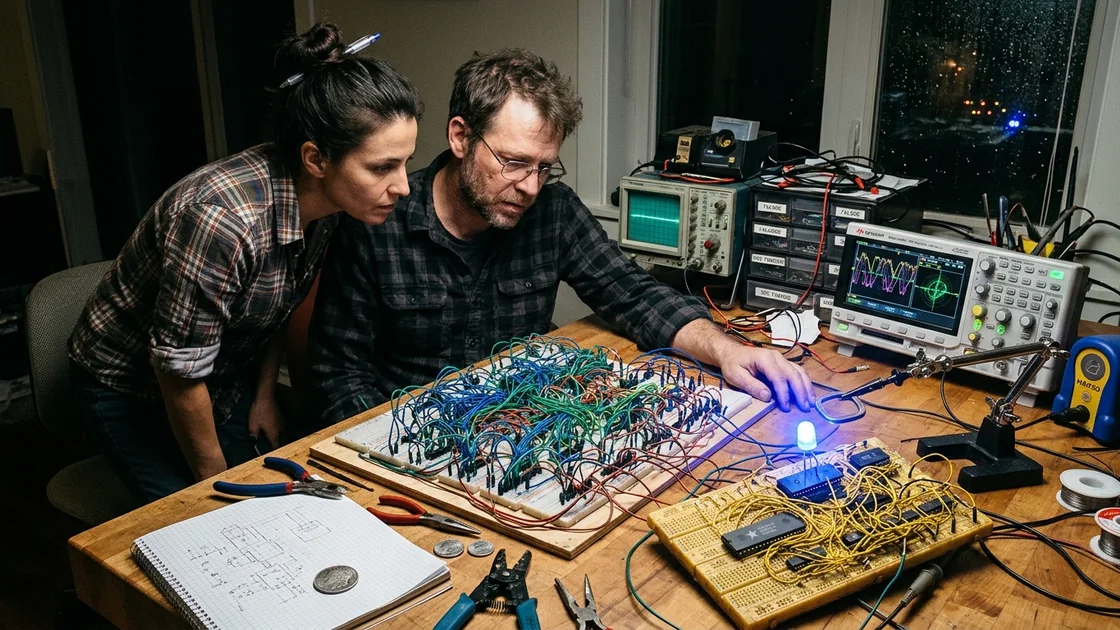
Julian Vance, a reclusive audio technician spending his nights constructing an eight-bit computer entirely on plastic breadboards, accidentally wires a cluster of vintage logic gates into an impossible metastable feedback loop. While attempting to use this erratic sub-circuit as a hardware random number generator, he discovers that its output indicator light predicts the results of his physical coin flips with absolute, unbroken accuracy. As Julian subjects the fragile arrangement of jumper wires and silicon chips to increasingly rigorous scientific tests alongside his skeptical former colleague Elena Rostova, they realize the circuit is not merely reading air currents or magnetic fields, but tapping directly into the deterministic clock cycle of reality itself. Driven by obsession, Julian integrates the predictive anomaly into the main data bus of his homemade processor, inadvertently creating a machine that computes the future before it happens and threatening to tear apart the local fabric of cause and effect before he is forced to dismantle his creation forever.
The jumper wire was twenty-two-gauge solid-core copper, wrapped in yellow PVC insulation that had been stripped back exactly a quarter of an inch on either end. Julian Vance held it between the tips of his needle-nose pliers, his knuckles white, his breath held in the back of his throat as if he were defusing an unexploded ordnance rather than bridging Pin 4 of a quad NAND gate to the ground rail of a fourteen-dollar plastic breadboard.
When the tinned copper slid into the tiny square aperture, the phosphor-bronze spring clip beneath the plastic gave a microscopic, satisfying snick.
Julian exhaled. He leaned back in his ergonomic chair, which had lost its pneumatic lift three years ago and now sat permanently at its lowest setting, putting his chin nearly level with the edge of the workbench. Before him lay the Beast. It was not a beast in the traditional sense; it had no fangs, no fur, and weighed less than a hardcover dictionary. It was a sprawling, interlocking grid of eighteen solderless breadboards clipped together on a sheet of quarter-inch birch plywood, covered in a dense, vibrant thicket of bent wires that looked like a topographical map of an alien metropolis designed by an obsessive-compulsive color theorist.
Blue wires carried the eight-bit data bus, running in immaculate, ninety-degree parallel tracks down the spine of the board. Green wires handled address lines. Red and black were reserved strictly for the five-volt power supply and ground, though Julian had run out of black spool two weeks ago and had been forced to use brown for the lower register modules, a compromise that still made his left eyelid twitch whenever he looked at the arithmetic logic unit.
For eleven months, this spare bedroom in his second-floor apartment in rainy Portland had ceased to be a room and had become the interior of a central processing unit. There was no bed here anymore—just an electrostatic discharge mat spanning a six-foot butcher-block table, an aging Tektronix cathode-ray oscilloscope whose cooling fan sounded like a tired asthmatic dog, a Hakko soldering iron resting in its brass-wool cradle, and towers of grey plastic Organizer drawers labeled in fading black marker: 74LS00, 74LS08, 74LS173, 74LS245, 555 TIMERS, 10K RESISTORS, DECOUPLING CAPS.
Julian was forty-two years old. By day, he repaired vintage solid-state amplifiers and studio mixing consoles in a basement shop off Hawthorne Boulevard, spending his hours chasing down leaky tantalum capacitors and replacing scratchy potentiometers for aging rock musicians. By night, he was an architect of pure logic.
Modern computers bothered him. They were opaque monoliths, billions of transistors etched onto microscopic wafers of silicon by ultraviolet lasers, hidden beneath heat spreaders and operating systems so bloated with abstraction that no single human being alive truly understood how hitting a key on a keyboard caused a letter to appear on a screen. Julian wanted to see the thought happen. He wanted to slow the clock speed of computation down from four billion cycles per second to a single, lazy pulse per second, where every zero and every one was visible as the glowing red or green eye of a light-emitting diode.
And up until twenty minutes ago, it had been working.
The computer—which had no name, though Julian privately thought of it as the SAP-Zero, a nod to the Simple-As-Possible architecture pioneered by Albert Malvino in the seventies—could add, subtract, and loop. It had sixteen bytes of random-access memory, an eight-bit program counter, an instruction register, and an output display constructed from four seven-segment LED modules. Last Tuesday, he had successfully programmed it to calculate the Fibonacci sequence up to two hundred and thirty-three, the highest number an eight-bit unsigned integer could reach before overflowing its carry flag and resetting to zero. Watching the red digits tick upward in the dark room had given him a cleaner, sharper high than anything he had felt in a decade.
Then he had decided to build a game. Nothing fancy—just a rudimentary high-low guessing game entered via a hexadecimal keypad. To do that, the computer needed a way to pick a number. It needed entropy.
Software random number generators were a lie; on an eight-bit machine with sixteen bytes of RAM, a linear-feedback shift register would repeat its sequence after a few dozen cycles, and the sequence would always start in the exact same place every time he flipped the main power toggle. He needed hardware randomness. He needed a circuit that captured the raw, unpredictable static of the physical universe—thermal noise, avalanche breakdown in a reverse-biased transistor junction, or clock drift—and converted it into a clean, five-volt binary signal: High or Low. One or Zero.
He looked down at the nineteenth breadboard, a small, yellowed half-size board he had clipped to the bottom right corner of the plywood earlier that evening. He had pulled it from a dusty cardboard box he had bought at an estate sale in Beaverton belonging to a retired Tektronix engineer who had passed away in the late nineties. The plastic was brittle, stained near the center trough with what looked like forty-year-old coffee or rosin flux, and several of the tie-points were visibly warped where someone had shoved thick-leaded diodes into them decades ago.
On this auxiliary board, Julian had constructed an abomination.
In digital electronics, there are rules. You do not leave CMOS inputs floating, or they act like tiny antennas, picking up stray sixty-hertz hum from the room’s wiring and oscillating wildly until the chip overheats. You do not wire the outputs of two logic gates directly together without open-collector configurations, or they fight each other in a state called bus contention. Above all, you avoid race conditions—situations where two signals travel down different paths of slightly different lengths and arrive at a flip-flop at the exact same nanosecond, forcing the silicon into a twilight zone known as metastability. In a metastable state, a logic gate is neither a one nor a zero. It hovers at an illegal voltage—say, two point four volts—like a pencil balanced on its sharpened tip, waiting for the slightest thermal vibration of a silicon atom to knock it down to ground or pull it up to five volts.
To build his random number generator, Julian had broken all of those rules intentionally.
He had taken three chips from the bottom of the estate-sale box: a Motorola 74LS00 quad two-input NAND gate with tarnished silver legs stamped with a 1981 date code; a Signetics 74HC04 hex inverter; and an unmarked, ceramic-packaged fourteen-pin dual flip-flop that looked Soviet in origin, its dark grey body stamped only with Cyrillic characters and a faded star. He had cross-coupled the NAND gates into a ring oscillator that fed its own inverted tail back into its mouth, routed that screaming, unstable eighty-megahertz signal through three stages of the hex inverter with two of the adjacent input pins left completely ungrounded, and jammed the resulting chaotic mess into the clock AND data inputs of the Soviet flip-flop simultaneously.
When the user pressed a small tactile pushbutton on the corner of the board, it was supposed to latch whatever erratic, half-formed voltage was bouncing around inside the ring oscillator at that microsecond and display the result on a single, diffused blue LED wired to the flip-flop's Q output.
"Okay," Julian muttered to the empty room, his voice raspy from four hours of silence. "Let's see if you smoke."
He reached over to the benchtop power supply, a heavy linear unit with dual analog ammeters, and flipped the main output switch.
The room bathed in a warm, familiar constellation of light. Across the birch plywood, dozens of tiny red, yellow, and green LEDs blinked to life, showing the resting state of the buses, the zeroed-out registers, and the steady, heartbeat pulse of the main system clock ticking away at two hertz. Tick. Tick. Tick.
Julian looked at the yellowed expansion board in the corner. The blue LED was dark. The ammeter on the power supply showed the whole computer was drawing about one point two amps—normal for this many TTL chips. Nothing was sizzling. None of the vintage plastic packages were venting that acrid, unmistakable stench of magic smoke.
He reached down with his right index finger and pressed the tactile pushbutton on the entropy module.
Click.
The blue LED stayed dark. Zero.
He pressed it again. Click.
The blue LED lit up, casting a sharp, cobalt glare across his fingernails. One.
He pressed it ten times in rapid succession. One, one, zero, one, zero, zero, zero, one, one, zero.
"Huh," Julian said, a small smile tugging at the corner of his mouth. "Not bad."
Still, human intuition was terrible at judging randomness. A sequence could look random to the naked eye while harboring deep statistical bias, favoring ones sixty percent of the time because of a manufacturing imbalance in the silicon die of the flip-flop, or locking into a subtle harmonic with the sixty-hertz mains frequency of the apartment building. Before he wired this output into Port A of his computer's data bus, he needed to verify the distribution. And since he hadn't written a routine to log the bits yet, he decided to do a quick sanity check against a physical baseline.
He reached past his cold mug of tea and picked up his desk weight. It was an 1889 Morgan silver dollar, worn smooth around the laurels of Lady Liberty’s hair by a century of dead men's pockets. Julian had found it wedged inside the chassis of a 1965 Fender Twin Reverb amplifier he had restored five years ago, and he kept it on the bench to fidget with while staring at schematics. It had a heavy, authoritative heft—twenty-six grams of ninety-percent silver—and when flipped, it sang with a pure, lingering bell tone that cheap modern cupronickel coins couldn't replicate.
He grabbed a spiral-bound graph-paper notebook and a mechanical pencil. He drew two vertical columns. On the left, he wrote CIRCUIT. On the right, MORGAN.
The plan was simple: press the button to generate a random bit, then flip the coin to generate a physical bit, and after fifty trials, compare the variance and run lengths of both columns to see if his breadboard circuit looked broadly similar to the chaotic physics of a spinning disc of silver. In his mind, High—the blue LED—was Heads. Low—LED off—was Tails.
He tapped the button with his left pinky. The blue LED glowed. One. He wrote 1 in the left column.
He balanced the silver dollar on the pad of his right thumb, curled his index finger beneath it, and flicked upward. The coin rose two feet into the air, spinning into a shimmering silver sphere under the fluorescent work lamp, singing its high, clear ping. Julian caught it cleanly in his palm and slapped it onto the back of his left wrist.
He lifted his hand. Lady Liberty stared up at him. Heads. He wrote 1 in the right column.
He tapped the button again. The blue LED blinked out. Zero. He wrote 0.
He flipped the Morgan dollar. Ping. Catch, slap, lift. The eagle with outstretched wings. Tails. He wrote 0.
Button. Blue light on. 1. Flip. Ping. Heads. 1.
Button. Blue light on. 1. Flip. Ping. Heads. 1.
Button. Blue light off. 0. Flip. Ping. Tails. 0.
Julian paused, the tip of his mechanical pencil resting against the green grid paper. Five matches in a row. The probability of two independent binary sources matching five times consecutively was one in thirty-two. Three percent. Not remotely impossible; in fact, if you flipped coins long enough, streaks of five were commonplace. He snorted softly at his own pattern-seeking primate brain and went back to work.
Button: 0. Flip: 0. Button: 1. Flip: 1. Button: 0. Flip: 0. Button: 0. Flip: 0. Button: 1. Flip: 1.
Ten in a row. One in one thousand and twenty-four.
The room suddenly felt very quiet, save for the wheezing fan of the Tektronix oscilloscope and the faint patter of Oregon rain against the dark windowpane behind the workbench. Julian looked down at the yellowed breadboard. The Soviet ceramic chip sat astride the center channel like a tiny grey sarcophagus. Around it, the jumper wires he had hastily bent earlier weren't neat like the rest of the computer; they looped through the air in messy, overlapping arcs, forming a chaotic bird's nest over the 74LS00 and the floating CMOS inverter.
"What are you doing?" Julian whispered.
Wait. Think like an engineer. How could the coin match the LED? The LED state was latched before the coin was flipped. He was pressing the button first, seeing the light turn on or off, and then flipping the coin. Was he subconsciously influencing his own thumb? No, that was absurd; nobody could control the exact angular velocity and air resistance of a coin spinning thirty times in mid-air to force a specific face to land upright.
Still, to eliminate any possibility of subconscious muscle bias, he changed the protocol. He wouldn't catch the coin anymore. He would let it hit the butcher-block table, bounce off the clutter, and settle on its own.
He pressed the button. The blue LED remained dark. Zero.
Julian held the silver dollar at chest height, pinched vertically between his thumb and forefinger, and instead of flicking it, he spun it sharply on the surface of the electrostatic mat near the edge of the desk. The coin whirred like a miniature sawblade, drifted left, clipped the base of his magnifying lamp, wobbled violently in a decaying circle—clack-clack-clack-clack-rrrring—and settled flat.
Tails. Zero.
Julian felt a cold prickle start at the base of his skull and travel slowly down his spine.
He pressed the button. The LED flared bright blue. One.
He picked up the coin, closed his eyes, and tossed it carelessly over his shoulder toward the center of the room. It hit the hardwood floor with a loud smack, rolled under the edge of a folding chair, and spun to a halt. Julian pushed his chair back, got down on his hands and knees on the dusty floorboards, and peered under the metal rung of the chair.
Lady Liberty’s profile gleamed in the dim light. Heads. One.
He stayed on his hands and knees for a long moment, his palms pressed against the cold oak floor. Twelve in a row. One in four thousand ninety-six.
He crawled back to the bench, didn't bother sitting in the chair, and stood hunched over the breadboard. For the next forty minutes, he didn't write anything down. He just pressed the button and threw the coin. He flipped it with his left hand. He dropped it through a cardboard paper-towel tube angled against a stack of textbooks. He bounced it off the drywall. He shook it inside his empty ceramic coffee mug with his palm clamped over the top and slammed the mug upside down onto the desk.
Thirty times. Forty times. Fifty times.
When the blue light was on, the silver dollar landed Heads. When the blue light was dark, the silver dollar landed Tails.
On the fifty-first trial, Julian pressed the button. The blue light turned on. Heads.
Julian picked up the coin, looked at the glowing blue diode, and bared his teeth in a tight, nervous grimace. "Screw you," he said aloud. Instead of flipping the coin, he carefully placed it flat on the workbench with the eagle facing up. Tails.
He stared at the coin, then at the blue light. They disagreed.
A wave of profound relief washed over him—until he looked closer at the blue LED. It wasn't solid anymore. It was flickering so rapidly that it appeared dimmed by half, and a high-pitched whine was radiating from the piezoelectric buzzer he had wired to the main system's error flag three boards away.
Wait. He hadn't flipped it. He had placed it.
What if he pressed the button, saw the light, and then simply walked out of the room and never flipped the coin at all?
He pressed the tactile switch. The blue light went completely dark. No flicker. Just a solid, dead zero.
Julian held the coin in his hand and stood completely still, watching the clock on the wall. He resolved not to flip the coin. Ten seconds passed. Twenty seconds. A minute. He stood there like a statue, his knuckles aching from how hard he was gripping the milled edge of the silver dollar.
Suddenly, a violent vibration rattled the windowpane as a late-night freight train rumbled across the river tracks half a mile away, followed immediately by his cat, Schrodinger—a fat, three-legged tabby who usually slept on the laundry pile in the closet—leaping onto the edge of the workbench after a moth. Schrodinger’s hind paw landed squarely on the hot barrel of the Hakko soldering iron's stand, knocking the heavy cast-iron base sideways into Julian’s right elbow.
Julian yelped in surprise, his fingers flying open. The Morgan dollar slipped from his grasp, struck the metallic rim of the power supply, flipped twice in the three inches of space between the chassis and the table, and landed flat beside the keyboard.
Tails. Zero.
Julian didn't look at the cat. He didn't upright the soldering stand. He just stared at the eagle on the coin, and then at the unlit blue dome of the LED on the yellowed breadboard.
The circuit hadn't failed when he tried to withhold the flip. The circuit had already known the cat was going to jump.
By four in the morning, Julian had drunk an entire French press of stale dark roast and filled eleven pages of his graph notebook with schematics, timing diagrams, and frantic, underlined notes.
He had tried to map the exact electrical pathway of the expansion board without disturbing a single wire. He didn't dare touch the wires; he had a terrifying, instinctive certainty that if he nudged one of those looping yellow or green jumpers by even a millimeter, whatever impossible harmonic had settled into the silicon would evaporate forever.
Using a flashlight and a jeweler’s loupe, he traced every connection.
It made no sense. From a classical electrical engineering standpoint, the circuit shouldn't even function as a latch. The output of the third NAND gate on the 1981 Motorola 74LS00 (Pin 8) was feeding back into Pin 2, while Pin 1 was tied through a tarnished, out-of-spec carbon-composition resistor—whose color bands were so faded Julian couldn't tell if it was four hundred ohms or four megaohms—directly into the Vcc power rail of the Soviet flip-flop, bypassing its internal voltage regulator. Furthermore, the two floating inputs on the Signetics 74HC04 hex inverter (Pins 5 and 9) sat directly over a hairline crack in the yellowed ABS plastic of the breadboard. When Julian shone his penlight underneath the board, he could see that two of the internal phosphor-bronze contact strips beneath the crack had corroded and bowed outward, nearly touching each other inside the plastic housing, separated by a microscopic air gap contaminated with old flux residue.
They had formed an accidental, nonlinear tunnel capacitor right underneath the floating CMOS gates.
Every time Julian pressed the tactile button, the mechanical bounce of the switch contacts sent a dirty burst of electromagnetic noise into that microscopic, flux-filled gap. The ring oscillator amplified that noise by a factor of ten thousand, bouncing it between the American TTL gates and the Soviet ceramic flip-flop in a tight, vicious race condition.
"Metastability," Julian muttered, rubbing his bloodshot eyes.
When a flip-flop enters a metastable state, quantum mechanics takes the wheel. At the scale of a few dozen electrons trapped on a floating polysilicon gate, thermal fluctuations and quantum tunneling determine whether the voltage collapses to zero or climbs to five volts. Every textbook Julian had ever read treated those quantum fluctuations as fundamental, irreducible randomness—the dice throws of God.
Except God wasn't throwing dice here. Or rather, the dice in the silicon and the silver dollar in Julian's hand were reading from the exact same script.
At 4:15 AM, Julian decided to test the temporal horizon of the circuit. How far in advance did the blue LED know the outcome of a flip?
He set up a simple experiment using his cellphone's stopwatch. He would press the button on the breadboard, note the state of the LED, start the stopwatch, wait a predetermined amount of time—one minute, five minutes, ten minutes—and then flip the coin cleanly onto the mat.
He pressed the button. Blue light on. Heads.
He started the stopwatch and sat on his hands. He watched the digital numbers crawl upward. Thirty seconds. Forty-five seconds. At fifty-eight seconds, he picked up the coin. At exactly 1:00.00, he flicked it into the air. It hit the mat, bounced once, and settled.
Heads.
He tried two minutes. He pressed the button: Zero (Tails). He waited two minutes, flipped the coin. Tails.
He tried five minutes. Button: One (Heads). He waited five minutes, pacing the small perimeter of the room, listening to the radiator hiss. At five minutes, he flipped the coin.
It landed Tails.
Julian froze. A jolt of adrenaline hit his chest, part disappointment, part relief. "Okay," he breathed. "Okay, it broke. Five minutes is too long."
Wait. Why had it worked at two minutes and failed at five? He ran four more trials at three minutes, two minutes, ninety seconds, and thirty seconds.
At ninety seconds, the accuracy dropped to fifty percent—pure chance. At forty-five seconds, it climbed to seventy percent. At fifteen seconds or less, the accuracy was a terrifying, monolithic one hundred percent.
Why fifteen seconds? What was special about a fifteen-second window?
Then he noticed what was happening to the rest of his eight-bit computer while he waited during the long intervals.
The expansion board wasn't isolated. Its five-volt power and ground lines were daisy-chained directly off the main bus of the SAP-Zero computer, and he had already connected a single green wire from the Q-bar (inverted) output of the Soviet flip-flop to the clear pin of the main computer's Instruction Register as a temporary tie-point when he ran out of empty ground holes earlier that night.
The main computer's clock was set to two hertz—two pulses per second. And the computer had a four-bit memory address counter that cycled through all sixteen bytes of RAM before resetting to zero. Sixteen addresses at half a second per address meant a full memory wash cycle took eight seconds, or sixteen seconds if the ALU carry flag stalled the bus for a double-fetch cycle.
Whenever the main computer completed a full sixteen-byte memory cycle
and reset its program counter to 0000, a tiny voltage dip
rippled across the shared power rail, resetting the parasitic charge
trapped in the cracked breadboard's flux capacitor!
"It's a buffer," Julian whispered, his eyes widening as he stared at the blinking red lights of the RAM module. "It's a look-ahead buffer."
If he slowed the main system clock down, would the prediction window expand? Or was the sixteen-byte RAM somehow storing the state space of the room's immediate future?
No, that was insane. Sixteen bytes of static RAM couldn't simulate the molecular physics of every nitrogen atom in a twelve-by-twelve bedroom. The circuit wasn't calculating the coin flip. A handful of logic gates from 1981 couldn't run a fluid-dynamics simulation of a spinning silver dollar.
It was simpler than that, and infinitely stranger. In a deterministic universe—or a universe where local causality is tightly coupled at the quantum level—the future state of the coin flip already exists as a boundary condition in spacetime. The metastable flip-flop, balanced on the razor's edge of quantum uncertainty, wasn't predicting the coin flip by calculating the physics; it was taking the path of least action by aligning its own collapse with the largest local binary entropy event occurring within its RC time-constant window.
The coin flip in the future was reaching backward across the twelve-second capacitance window and tipping the electrons on the floating gate.
"No," Julian said aloud, shaking his head violently. "No, Julian, you're hallucinating. You've been breathing rosin fumes in an unventilated room for six hours. You need a witness. Or a psychiatrist."
He looked at his phone. It was 6:10 AM.
There was only one person in Portland he knew who wouldn't either laugh in his face or call a wellness check on him, mostly because she had spent five years trying to measure single-photon interference anomalies in a basement lab at Reed College before burning out of academia and taking a job designing avionics testing rigs for a defense contractor in Hillsboro.
He scrolled through his contacts until he found Elena Rostova, and hit dial.
It rang four times before her voice came through, thick with sleep and irritation, overlaid with the sound of an espresso machine grinding beans in the background. "Julian, if you are calling me at six in the morning to ask if I have a spare Tektronix 465 high-voltage flyback transformer, I am going to drive to your apartment and strangle you with a coaxial cable."
"I don't need a transformer," Julian said. His voice sounded hollow and strange in his own ears. "Elena, what are you doing right now?"
The grinder stopped. "Making coffee. Why? What's wrong with your voice? Are you sick?"
"I built a circuit on the breadboard machine," Julian said, his eyes fixed on the little blue LED, which was currently dark. "An entropy source for the branching logic. Three chips. A 74LS00, an HC04, and an old Soviet flip-flop."
A pause. "Okay. Don't mix LS TTL and HC CMOS without a pull-up resistor on the logic thresholds, Julian, the high-state output voltage of LS is only two point four volts and CMOS wants three point five. It'll float in the undefined zone."
"I know," Julian said. "It's floating in the undefined zone. Elena... when I latch it, the LED tells me how a coin flip is going to land before I throw the coin."
Silence on the line. He heard the clink of a ceramic mug being set down on a granite countertop.
"Say that again?" Elena asked quietly.
"I press the button. The light turns on or off. Then I flip a silver dollar. Within a fifteen-second window, the light matches the coin one hundred percent of the time. I've done it over two hundred times since midnight."
"You're having a manic episode," she said, though her tone had lost its edge, replaced by cautious concern. "Julian, when was the last time you slept?"
"Yesterday! I slept eight hours on Thursday!" he snapped, then immediately forced himself to lower his voice. "Listen to me. I know how this sounds. I know about confirmation bias, I know about the gambler's fallacy, I know about sensory leakage. Don't take my word for it. Bring your own coins. Bring dice rigged to binary outcomes. Bring whatever you want. Just come over here before the humidity in the room changes or a garbage truck vibrates the floor and knocks a jumper wire loose."
Elena was quiet for ten seconds. Julian knew her mind; beneath the cynical corporate engineer armor she had put on over the last three years, she was still the girl who had spent two summers in Geneva sleeping under a desk at CERN just to watch calibration runs. She couldn't resist an anomaly any more than a moth could resist a bug zapper.
"If I drive across the Morrison Bridge in morning traffic and find out you wired a hidden camera to a Raspberry Pi under your desk as a prank," Elena said slowly, "I'm taking your 1974 Fluke multimeter as compensation."
"It's yours if it drops below a hundred percent," Julian said. "Don't knock on the door too hard when you get here. The breadboard is touchy."
Elena arrived forty minutes later wearing a damp olive drab raincoat, faded jeans, and the skeptical scowl of an inquisitor arriving to debunk a weeping statue in a country church. She was thirty-eight, sharp-featured, with dark hair pulled back into a messy knot held together by a plastic Bic pen, carrying a heavy canvas toolbag over one shoulder and a white paper bag of croissants in the other.
She didn't say hello. She dropped the croissants on the kitchen counter, walked straight into the spare bedroom, stopped two feet from the butcher-block workbench, and folded her arms.
"Jesus, Julian," she muttered, surveying the eighteen-board monstrosity glowing in the dim room. "Last time I was here, this thing was just an ALU and two registers. It looks like a bomb from an eighties action movie."
"Don't touch the table," Julian said, hovering nervously behind her left shoulder. "Seriously, the floor joists right under the left leg of the bench have a little flex. Step lightly."
Elena rolled her eyes, but she stopped moving her feet. She leaned forward from the waist, her dark eyes scanning the main bus before drifting down to the small, yellowed expansion board clipped to the bottom right corner. She squinted at the rat's nest of wires arching over the Soviet chip.
"That is the worst breadboarding I have ever seen in my life," she said flatly. "You have a CMOS inverter with floating pins sitting next to an unshielded ring oscillator, and—wait, is that a 1970s K155TM2 ceramic flip-flop? Where the hell did you get Soviet military-surplus TTL?"
"Estate sale in Beaverton," Julian said. "Look at the blue LED on Pin 5. High is Heads. Low is Tails. The window is roughly twelve to fifteen seconds from the moment you release the tactile switch."
Elena reached into the pocket of her raincoat and pulled out a handful of change: three quarters, two dimes, a nickel, and a thick brass token from an arcade bar on Belmont. "No magic silver dollars," she said. "I'm using a standard US quarter. And you're going to stand over there by the closet with your hands in your pockets so you can't trigger a concealed keyfob."
Julian walked backward until his shoulder blades hit the closet door and shoved his hands deep into his jeans pockets. "Go ahead. Press the black button on the corner of the yellow board. Wait a second for the switch bounce to settle, read the LED, and flip the quarter."
Elena set her canvas bag down gently on the floor. She picked a 2018 Washington quarter from her palm, stepped up to the bench without touching it, and used the tip of her pinky fingernail to depress the tiny black tactile switch.
Click.
The blue LED lit up. Bright, steady cobalt. Heads.
Elena looked at Julian. Julian nodded once.
She didn't flip the quarter onto the desk. Instead, she turned ninety degrees and flicked the quarter high toward the carpeted hallway outside the bedroom door. It landed with a dull thud on the hall runner, completely out of sight of the workbench.
Both of them walked to the doorway and looked down at the carpet.
George Washington stared up at the ceiling light. Heads.
"Fifty-fifty," Elena said coolly. She bent down, picked up the quarter, and walked back to the bench. She pressed the button.
The blue light turned off. Tails.
She flipped the quarter into the hallway again. It bounced off the baseboard, rolled into the bathroom, and hit the porcelain base of the toilet. They walked into the hallway and peered into the bathroom.
The eagle on the back of the quarter was facing up. Tails.
Elena didn't say anything this time. A tiny vertical crease appeared between her eyebrows. She picked up the quarter, marched back to the workbench, and ran through ten rapid trials, flipping different coins from her pocket—the dime, the nickel, the heavy brass arcade token (where they agreed ahead of time that the side with the embossed Pac-Man ghost was Heads and the text side was Tails).
Button: 1. Quarter: Heads. Button: 1. Dime: Heads. Button: 0. Nickel: Tails. Button: 0. Token: Tails. Button: 1. Quarter: Heads. Button: 0. Dime: Tails. Button: 0. Dime: Tails. Button: 0. Nickel: Tails. Button: 1. Token: Heads. Button: 1. Quarter: Heads.
Twelve for twelve. One in four thousand ninety-six.
Elena stood very still in front of the workbench, the brass arcade token pinched tightly between her thumb and index finger. The silence in the bedroom stretched out, punctuated only by the rhythmic tick... tick... tick... of the computer's main clock blinking its red LED on the upper left board.
"Okay," Elena said, her voice dropping an octave into her lab-director register. "How are you doing it?"
"I'm not doing anything," Julian said from the closet.
"Julian, come on. It's a phenomenal magic trick. Seriously, Penn and Teller would pay you ten grand for this rig. How does it work? Are the coins magnetized? No, these are my coins from my laundry jar, and cupronickel isn't ferromagnetic. High-speed camera in the ceiling lamp tracking the launch vector and transmitting to an ESP32 hidden inside the power supply housing? No, you're latching the LED before I even touch the coin to flip it."
She paused, her eyes narrowing as she thought through the causal chain.
"Wait," she whispered. "The LED lights up before the flip. Which means even if you had a supercomputer in the next room scanning the room with lidar, the coin hasn't been thrown yet when the bit is latched. And you aren't forcing the coin to land a certain way in the hallway carpet from fifteen feet away."
She turned slowly to look at him. The color had drained slightly from her cheeks. "How did you rig the outcomes, Julian?"
"I didn't," Julian said softly. "Try to cheat it, Elena. Press the button, read the light, and try to force the coin to disagree."
Elena frowned. "What do you mean, force it? If the light turns on for Heads, I can just place the coin Tails-up on the desk."
"If you place it, it's not a flip," Julian explained, stepping slightly closer. "I tried that at three in the morning. If you just set the coin down deliberately, the circuit ignores it—or rather, the LED goes into a weird high-frequency oscillation when you press the button because there's no chaotic binary event in the window for the metastable gate to couple with. It only locks onto genuine entropy. Try this: flip the coin in the air, catch it, look at it secretly in your hand, and if it matches the LED, turn it over before you slap it down on the desk."
Elena stared at him as if he had just spoken in ancient Aramaic, then turned back to the yellow breadboard.
She pressed the button. The blue light lit up. Solid, steady One. Heads.
"Okay," Elena said evenly. "The circuit says Heads. I'm going to flip this quarter, catch it, check it, and whatever it takes, when I put it down on this desk, it is going to be Tails. Understand?"
"Do it," Julian said.
Elena tossed the quarter two feet in the air. It spun cleanly. She snatched it out of the air with her right hand, brought it close to her chest, and parted her fingers just enough to peek inside her palm.
"Ha!" she barked, a triumphant grin breaking across her face. "It landed Heads in my palm! So now I am deliberately flipping it over with my fingers inside my fist so that when I open my hand, it will be Tails!"
Inside her closed fist, Julian watched her thumb and forefinger manipulate the coin, turning it over one hundred and eighty degrees.
"Watch this, Nostradamus," Elena said, extending her closed fist over the electrostatic mat and opening her fingers to drop the quarter flat onto the rubber surface.
As the quarter fell the two inches from her damp palm, its milled edge caught slightly on the callus of her ring finger. The coin didn't drop flat. It hit the rubber mat at a forty-five-degree angle, bounced once off the edge of Julian's graph-paper notebook, executed a lazy half-somersault in the air, and landed with a soft plop beside the pencil.
George Washington's silver profile gleamed up at them. Heads.
Elena’s mouth opened slightly. She stared at the quarter, then at her own right hand, flexing her fingers as if they belonged to a stranger.
"My finger slipped," she whispered.
"Do it again," Julian said.
She pressed the button. The blue LED went dark. Tails.
Elena gripped the quarter. She flipped it, caught it, peeked at it in her hand. "It's Heads in my hand," she said through gritted teeth. "Which means I don't even have to turn it over! All I have to do is set it down flat without dropping it so it stays Heads and beats the zero!"
She lowered her hand until her knuckles were literally touching the rubber mat, intending to slide the quarter out gently so it couldn't possibly bounce or flip over.
As her knuckles brushed the mat, a static electricity charge she had built up walking across the hallway carpet in her rubber-soled boots discharged cleanly into the grounded aluminum bezel of the Tektronix oscilloscope three inches from her wrist.
SNAP!
A bright blue spark jumped from the scope to Elena’s watchband. She jerked her arm back with a sharp gasp—"Ow, shit!"—and the quarter flew sideways out of her recoiling hand, skittered across the birch plywood between two rows of breadboards, and came to rest wedged against the main power switch.
Julian leaned over and looked down between the jumper wires.
The eagle was facing up. Tails.
Elena backed away from the workbench until the backs of her thighs hit the radiator under the window. She gripped the cast-iron fins behind her with both hands, breathing fast and shallow through her nose, her eyes locked on the small, yellowed piece of plastic and the glowing blue eye of the LED.
"What did you build?" she whispered.
By noon, the spare bedroom had been transformed into an impromptu high-energy physics laboratory.
Elena had called in sick to her job in Hillsboro with a fabricated migraine, driven twenty minutes to her own apartment in Southeast, and returned with two heavy Pelican cases containing her personal diagnostic gear: a four-channel Keysight digital storage oscilloscope capable of sampling at five gigasamples per second, a logic analyzer, an electromagnetic field meter, and a laser tachometer.
"Don't touch the circuit with the probes yet," Julian warned as she unpacked the grey braided coaxial cables from the Pelican case. "In quantum mechanics, measuring the system collapses the wavefunction. In analog electronics, putting a ten-megaohm oscilloscope probe with twelve picofarads of tip capacitance onto a floating CMOS pin will change the RC time constant of the ring oscillator and detune whatever this is."
"I'm not going to probe the floating pins directly," Elena said, her initial terror having been sublimated into a fierce, hyper-focused scientific intensity. She had pulled off her raincoat, rolled up the sleeves of her flannel shirt, and tied her hair back tighter. "I'm going to use an inductive near-field loop probe held half an inch above the chips to read the RF emissions without making physical or capacitive contact, and I want to put a current-sense clamp around the five-volt supply wire feeding that nineteenth board."
She positioned the small plastic halo of the near-field probe on an articulated brass helping-hands arm so that it hovered twelve millimeters above the ceramic body of the Soviet K155TM2 flip-flop. She turned on her Keysight scope. The high-resolution LCD screen booted up, displaying four flat, brightly colored trace lines: yellow, green, blue, and pink.
"Okay," Elena said, adjusting the horizontal timebase knob to five nanoseconds per division. "Press the button, Julian, and don't flip a coin yet. Let's just see what the oscillator is doing when it latches."
Julian leaned in and pressed the tactile switch.
On the Keysight screen, the yellow trace—representing the electromagnetic field radiating off the Soviet flip-flop—erupted into a violent, jagged burst of noise as the mechanical switch contacts bounced. That was normal. What was not normal was what happened three microseconds before the switch bounce appeared on the screen.
Elena hit the SINGLE SEQ capture button to freeze the waveform and leaned in until her nose was three inches from the glass screen.
"Wait a minute," she muttered. She turned the horizontal position knob, scrolling backward through the pre-trigger memory buffer of the oscilloscope.
Channel 1 (Green) was clamped to the tactile pushbutton wire, showing the exact nanosecond Julian’s finger had closed the circuit at time \(T = 0\). Channel 2 (Yellow) was the inductive loop hovering over the Soviet flip-flop.
On the screen, the yellow trace showed the flip-flop oscillating at precisely 84.33 megahertz, and then suddenly snapping into a clean, damped sinusoid that settled into a high state at \(T = -14.2\text{ nanoseconds}\).
Fourteen point two nanoseconds before the mechanical switch contacts actually touched to close the circuit.
"The trigger threshold on Channel 1 is set too high," Elena said quickly, her fingers flying over the scope's menu buttons. "It's missing the leading edge of the switch closure."
She dialed the trigger sensitivity down to millivolts. They ran it again.
The flip-flop settled into its target state twenty-one nanoseconds before the earliest trickle of electrons crossed the gap of the pushbutton.
"Pre-trigger ringing?" Julian asked, staring over her shoulder at the glowing yellow line.
"In a passive mechanical switch with no inductance?" Elena shook her head slowly. "No. Look at the phase portrait." She switched the oscilloscope from a time-domain display to X-Y mode, plotting the ring oscillator against the main computer's clock bus.
On the screen, a glowing green Lissajous figure appeared. Instead of a fuzzy, chaotic cloud of static—which is what an unshielded ring oscillator should produce—the trace formed a sharp, rotating eight-dimensional hypercube projection that folded in on itself every sixteen clock cycles, locking phase with a faint, underlying carrier wave that wasn't coming from the sixty-hertz wall outlet or any radio station in Portland.
"Julian," Elena breathed, pointing a trembling finger at the bottom corner of the screen where the scope was automatically calculating the FFT frequency spectrum of the background signal inside the cracked breadboard. "Look at the resonant peak in the flux gap."
Julian squinted at the numbers. "1.42040575 gigahertz. How is an eighties TTL chip oscillating at one point four gigahertz? Their maximum toggle frequency is thirty megahertz!"
"It's not the chip oscillating," Elena said. Her voice was barely audible. "1.4204 gigahertz is the hyperfine transition line of neutral atomic hydrogen. The twenty-one-centimeter line. It's the most fundamental resonant frequency in the baryonic universe."
She sat back on a wooden stool, pulling her hands away from the oscilloscope knobs as if they were radioactive.
"Let me tell you what you accidentally built," she said, staring at the yellowed breadboard. "That hairline crack in the plastic underneath the Signetics CMOS inverter is filled with forty-year-old rosin flux that has crystallized into a dielectric barriers between two corroded phosphor-bronze strips. When you powered it up next to that Soviet ceramic flip-flop—which probably uses gold-doped Schottky barrier diodes with massive junction capacitance—and cross-coupled it with the 74LS00 ring oscillator, you created a macroscopic Josephson-like phase-locked loop at room temperature."
"Speak engineer to me, Elena, not quantum optics," Julian said, his heart hammering against his ribs.
"Okay. Think of the universe as a massive digital computer," Elena said, gesturing toward his eighteen-board machine. "Every particle interaction, every spin of an electron, every collision of air molecules against a spinning silver dollar is a logic gate operation governed by conservation laws. In physics, we call it unitary evolution. Information is never created or destroyed; the global wavefunction just ticks forward from state to state. Normally, we think we can't know the outcome of a complex event like a coin flip because there are ten-to-the-twenty-fifth air molecules in this room and we can't measure all their initial positions."
"Chaos theory," Julian nodded.
"Right. Except quantum mechanics isn't actually chaotic—it's strictly linear and time-symmetric! The equations work the exact same way backward and forward in time. A guy named Yakir Aharonov came up with something called the Two-State Vector Formalism: the present state of a quantum system isn't just determined by the past pushing forward; it's also constrained by the future boundary condition pulling backward."
She pointed at the glowing blue LED.
"Your metastable circuit is balanced so perfectly on the knife-edge between zero and one that its internal energy barrier is effectively zero. Within its sixteen-second coherence window—which is being maintained by the cyclic ground-bounce of your eight-bit RAM refreshing—this little circuit acts like a temporal lightning rod. When you intend to flip a coin and introduce a clean, binary macroscopic split into the immediate future of this room, the future boundary condition of that coin landing on the table reflects backward along the phase-locked loop and tips the metastable gate in the present. It takes less energy for the universe to make those few electrons in the Soviet chip match the future coin than to allow a phase discrepancy in the local entropy gradient."
Julian stared at the little grey chip with the Cyrillic lettering. "So the circuit isn't predicting the coin. And the circuit isn't controlling the coin."
"They're the same system," Elena said quietly. "A closed timelike loop of a single bit of information, twelve seconds long. And when I tried to cheat it earlier—when I caught the quarter and tried to turn it over—I was trying to create a grandfather paradox inside the loop. And as Novikov proved in the eighties, the universe doesn't allow paradoxes. If a time loop exists, the probability of any physical event that would break the consistency of the loop drops strictly to zero. My finger had to slip. The static spark had to jump from the scope."
Julian felt a sudden, suffocating claustrophobia, as if the walls of the spare bedroom had moved six inches closer and the air had turned to warm gelatin.
"Wait," he said. "If the spark had to jump to stop you from placing the coin Heads-up... that means the static charge on your boots was already part of the calculation when I pressed the button. Which means your decision to walk across the hallway carpet ten minutes earlier was already determined."
Elena didn't answer. She just looked down at her hands resting in her lap.
"What happens if we build a machine to flip the coin and cheat the light?" Julian asked, a sudden, manic rebellion rising in his throat. "Human hands are sloppy! Fingers slip, muscles twitch from static shocks! What if we take the human out of the loop entirely? I have stepper motors, I have a twenty-four-volt heavy-duty industrial solenoid in the closet, and I have optical break-beam sensors! We can build a rigid mechanical rig out of steel brackets that flips a coin inside an acrylic tube, reads the blue LED with a phototransistor after the coin is in mid-air, and fires a pneumatic or electromagnetic ram to physically clamp the coin onto the opposite face!"
Elena looked up, a spark of that same reckless curiosity flaring in her dark eyes despite her fear. "Novikov’s self-consistency principle says the machine will fail."
"How can a twenty-four-volt steel solenoid fail to turn over a five-gram piece of metal?!" Julian demanded, already turning toward his parts closet and pulling open the double doors. "Let's find out!"
It took them three hours to build the Paradox Engine.
They worked with the frantic, synchronized efficiency of two engineers who had spent their lives prototyping under deadline. Julian dug out an aluminum extrusion frame from an old broken 3D printer, bolting it directly to the heavy birch plywood a foot away from the yellow breadboard. At the bottom of a vertical two-inch clear acrylic tube, he mounted a high-torque spring-loaded plunger driven by a rotary cam. At the top of the tube, six inches above the launch pad, Elena mounted a steel baffle plate mounted on a fast-acting industrial rotary solenoid capable of snapping one hundred and eighty degrees in four milliseconds.
Here was how the Paradox Engine worked:
- A quarter was placed on the launch pad inside the sealed acrylic tube.
- A microcontroller (an isolated Arduino Nano running on a nine-volt battery so it didn't share power with the breadboard computer) triggered a small servo to press the black tactile button on the yellow breadboard.
- A cadmium-sulfide photoresistor taped directly over the blue LED read whether the circuit predicted Heads (1) or Tails (0).
- Half a second later, the spring plunger launched the quarter straight up into the acrylic tube, where it struck a fixed V-groove deflector at the apex that forced the coin to slide down an inclined chute onto the flat steel baffle plate in a strictly repeatable orientation—EXCEPT the launch velocity had enough mechanical jitter that the coin spun randomly in the lower tube before entering the funnel.
- Just before the coin came to rest on the baffle plate, a high-speed optical reflective sensor read the dark/light engraving profile of the quarter's upper face to determine if it was currently Heads or Tails.
- If the coin's face matched the blue LED's prediction, the microcontroller fired the heavy twenty-four-volt rotary solenoid, violently flipping the steel baffle plate upside down and dumping the coin onto the bottom pad on its opposite face, thereby forcing a contradiction.
"It's mechanically bulletproof," Julian said at 3:30 PM, wiping grease from his forehead with the back of his wrist. He had wired the rotary solenoid to a massive car-audio stiffening capacitor charged to twenty-four volts to ensure it had enough instantaneous torque to snap a man's finger in half, let alone flip a quarter. "Once that optical sensor sees that the coin is about to agree with the blue LED, that solenoid is going to fire with forty pounds of radial force. Nothing short of a meteor hitting Portland can stop that plate from turning the coin over."
Elena double-checked the C++ code on her laptop, disconnected the USB programming cable so the rig was completely autonomous, and stepped back.
"Ready?" she asked.
"Run it," Julian said.
Elena flipped the toggle switch on the nine-volt battery box.
The tiny servo arm swung down and pressed the tactile button on the yellow breadboard. Click.
Beneath the black electrical tape housing the photoresistor, the blue LED flared to life. One. Heads.
Half a second later, the launch plunger fired with a loud THWACK. The quarter shot up the clear acrylic tube, spinning furiously, hit the V-groove funnel, and slid onto the horizontal steel baffle plate with George Washington's face pointing up. Heads.
The infrared optical sensor saw Washington's profile. It recognized that the coin matched the blue LED's prediction. It sent the signal to the MOSFET gate to dump the twenty-four-volt capacitor into the rotary solenoid to flip the plate and invert the coin to Tails.
BANG!
The twenty-four-volt solenoid fired with terrifying violence. The steel baffle plate snapped one hundred and eighty degrees so hard that the entire aluminum frame shuddered on the desk.
Julian and Elena lunged forward and peered into the bottom of the clear acrylic chamber where the inverted quarter had been dumped.
The quarter was lying flat on the pad. Heads.
"Wait, what?!" Julian yelled. "The plate flipped! I saw it flip! If it was Heads on the top plate, flipping it one hundred and eighty degrees HAS to make it land Tails on the bottom pad!"
Elena pointed to the inside wall of the acrylic tube. "Look at the scratch mark on the acrylic! The solenoid fired so fast that the outer edge of the steel plate imparted upward angular momentum to the coin before the plate cleared the drop zone! Instead of dumping it flat, it flicked the coin into a full 360-degree flip during the two-inch fall!"
"Okay, fine!" Julian snarled, grabbing an Allen wrench. "I'll lower the bottom pad so there's only five millimeters of drop space! A quarter is twenty-four millimeters wide—if the gap between the flipping plate and the floor is five millimeters, it is geometrically impossible for the coin to turn over during the drop! It's trapped flat like a patty in a burger press!"
He loosened the four T-slot bolts, slammed the lower catch-plate upward until it sat a mere fraction of an inch below the rotating steel baffle, and torqued the bolts down until the aluminum creaked.
"Flip out of that, you bastard," Julian hissed. He reset the baffle and hit the start switch on the battery box.
The servo pressed the button. Click. The blue LED stayed dark. Zero. Tails.
THWACK. The plunger launched the quarter. It spun up the tube, slid through the funnel, and settled on the upper baffle plate. Both Julian and Elena craned their necks to see into the slot before the sensor triggered.
The quarter was lying Tails up on the baffle. It matched the unlit LED.
A millisecond later, the optical sensor saw the eagle and triggered the MOSFET to fire the solenoid and flip the coin to Heads inside the narrow five-millimeter cage.
Except there was no BANG.
Instead, there was a sharp, metallic POP from the breadboard holding the MOSFET driver, and a tiny curl of acrid grey smoke rose from the black TO-220 transistor package. A hairline tin whisker inside the brand-new, industrial-grade MOSFET had vaporized under the surge current, failing open-circuit at the exact microsecond of triggering. The steel baffle plate didn't move. The quarter sat undisturbed on the plate, gleaming Tails up.
Julian didn't say a word. He pulled open a drawer, grabbed three heavy-duty forty-amp automotive relays, wired them in parallel so that all three would have to fail simultaneously to stop the solenoid, and hit the switch again.
Servo: Click. Blue LED: One (Heads). Plunger: THWACK.
The quarter shot up the tube, entered the funnel, and settled onto the baffle plate Heads up.
The optical sensor triggered. All three automotive relays clicked shut simultaneously. Twenty-four volts surged into the solenoid coil. The magnetic armature yanked the steel baffle plate with forty pounds of torque—
—and the hardened steel set-screw holding the baffle shaft to the solenoid spindle sheared cleanly in half along an invisible microscopic metallurgical flaw from the factory. The solenoid spun freely in mid-air with a loud whir-clack, while the steel baffle plate dropped forty-five degrees and jammed diagonally against the acrylic wall, pinning the quarter firmly in place with George Washington staring serenely upward through the plastic.
Julian stood frozen with the Allen wrench still clutched in his white-knuckled fist.
They tried seven more times over the next hour, repairing and reinforcing the machine after every run.
On Trial 4, the nine-volt battery's internal spot-weld detached inside its metal casing the instant the servo pressed the button. On Trial 5, a tiny flake of black paint from the inside of the funnel flaked off and landed squarely over the eye of the infrared optical sensor, blinding it so it thought the coin was already opposite the LED and didn't fire the solenoid. On Trial 6, the quarter jammed vertically on its milled edge inside the V-groove and refused to drop onto the plate until the sixteen-second coherence window expired, at which point it fell gently onto Tails just as the main computer's RAM cycle reset. On Trial 7, when Julian replaced every single component with triple-redundant military-spec switches and thick twelve-gauge wire, the moment the servo arm began its descent toward the tactile button on the yellow breadboard, the power goes out across the entire four-block radius of Hawthorne Boulevard because a drunk driver in a pickup truck clipped a utility pole on César Chávez three blocks away.
In the sudden, pitch-black silence of the apartment, as the hum of the oscilloscopes died away and the dozens of red and green LEDs across the plywood vanished, only one light remained visible for twelve seconds, powered by the residual charge in the benchtop supply's filter capacitors: the small blue LED on the corner board, glowing calmly in the dark.
"Stop," Elena whispered in the gloom. Her hand found Julian's forearm in the dark and gripped it hard. "Julian, stop. For God's sake, don't build a stronger machine. Next time the transformer on the pole outside will explode, or the ceiling will collapse on our heads, or your heart will stop beating before your finger hits the switch. If you build a machine where the only physically possible failure mode is the death of the operator, the universe will choose that failure mode to protect the loop."
Julian slowly opened his hand and let the Allen wrench clatter onto the butcher-block table. His shirt was soaked through with cold sweat.
Twelve seconds passed. The filter capacitors bled dry, and the blue light blinked out.
The neighborhood power stayed out for two hours. During that time, Julian and Elena sat at the small laminate table in the kitchen, eating the crushed, room-temperature croissants and staring at each other across the pale afternoon light filtering through the rain-streaked window.
Julian had rigged an uninterruptible power supply—a heavy sealed lead-acid battery from his shop backup—next to the workbench, waiting for the moment he was ready to power the SAP-Zero back up.
"What happens if we turn it back on and the anomaly is gone?" Julian asked, tearing a flake of pastry into tiny pieces on his napkin. "When the power died, the charge in that cracked breadboard gap drained completely. The metastable loop broke."
"Maybe that would be for the best," Elena said, wrapping both hands around a glass of tap water. "Julian, do you realize what happens to us if someone finds out about that board? Not just governments or intelligence agencies—though DARPA would bury both of us in an unmarked basement in Maryland within forty-eight hours if they knew you had a room-temperature retrocausal transceiver sitting on birch plywood. Think about what it does to your head."
"It's just one bit," Julian said defensively, though he knew he was lying to himself. "One bit of binary data, twelve seconds ahead of time."
"One bit of data from the future violates the second law of thermodynamics and shatters every assumption of human agency," Elena countered quietly. "Every time that blue light turns on, you are looking at proof that the next fifteen seconds of your life are already etched in stone. You aren't a person making choices anymore; you're just the steel baffle plate waiting for your set-screw to shear."
Just then, the kitchen refrigerator kicked back on with a heavy shudder, and the microwave clock beeped twelve:zero-zero as the city grid restored power to the block.
Julian stood up from the table so fast his chair tipped back and hit the pantry door. Elena followed him back into the spare bedroom.
He walked over to the linear benchtop power supply. His thumb hovered over the red rocker switch.
"Ten bucks says it's just a dead pile of seventies logic chips now," Elena murmured behind him.
Julian flipped the switch.
The eighteen breadboards blazed to life. The red address lights began their rhythmic, two-hertz march across the memory registers. Down in the bottom right corner, the yellow expansion board sat silent.
Julian picked up the 1889 Morgan silver dollar from the mat. With his left hand, he pressed the tiny black tactile button.
The blue LED lit up. One.
Julian flipped the heavy silver coin into the air. It sang its clear, bell-like note, hit the electrostatic mat, bounced over the fallen Allen wrench, and settled flat.
Lady Liberty. Heads.
He pressed it again. Zero. Flipped. Tails. Again. One. Flipped. Heads.
The flux gap inside the cracked plastic hadn't needed external power to remember its geometry; the physical crystallization of the forty-year-old rosin had formed a permanent sub-micron resonant cavity. As long as five volts flowed through the Soviet flip-flop and the sixteen-byte RAM ticked away its ground-bounce heartbeat in the background, the twelve-second window was wide open.
Elena let out a long, ragged breath that sounded half like a sob and half like a laugh. "It's robust," she whispered. "It survived a cold reboot."
"Elena," Julian said, his eyes drifting from the small yellow board up to the main spine of the eight-bit computer—specifically, to the eight blue jumper wires of the main data bus that connected the Arithmetic Logic Unit to the Instruction Register. "We've been using my finger to press the button, and our eyes to read the LED."
"Yeah. So?"
"Why are we keeping the human in the loop at all?" Julian turned to look at her, his pupils dilated in the glow of the oscilloscopes. "This is a computer! The yellow board is already sharing power and ground with the SAP-Zero. Right now, I'm only pulling one bit off the flip-flop when I manually press the tactile switch. What if I bypass the manual switch and clock the flip-flop directly off the CPU's microcode step-counter?"
Elena frowned, stepping closer to the board. "Clock it off the CPU? At two hertz?"
"Not two hertz," Julian said, pointing to the main clock module on Board 1, where a 555 timer chip sat beside a blue variable potentiometer and a bypass jumper. "I have a one-megahertz quartz crystal oscillator can sitting on the clock board for high-speed execution! If I pull the manual step jumper, the CPU runs at a million cycles per second. And if I feed the serial output of this retrocausal flip-flop into a 74LS164 eight-bit shift register, the computer can shift in eight consecutive future bits every eight microseconds and latch a full byte directly onto the main data bus!"
Elena stared at the breadboards, her mind rapidly calculating the architecture he was describing. "Wait. If you shift eight bits from the anomaly onto the eight-bit data bus... what is the coin flip? You can't flip eight coins in eight microseconds!"
"The computer doesn't need a coin flip!" Julian's voice rose with feverish excitement. "Why did it couple with the coin flip earlier? Because the coin flip was the largest macroscopic binary split happening in the twelve-second window! What if the binary split it couples with is the computer's own future state?"
Elena went dead silent. "Julian... wait. Think about the logic of what you just said."
"Think about an algorithm!" Julian grabbed his notebook and flipped
to a clean page, scribbling a block diagram so hard the pencil lead
snapped. He kept drawing with the jagged stub of graphite. "Suppose I
write a twelve-line assembly program in the sixteen bytes of RAM. The
program wants to find a specific eight-bit number—say, the combination
to a lock, or the hash of a number I'm about to type on that hexadecimal
keypad ten seconds from now. If the computer reads a byte from the
retrocausal shift register onto the data bus, compares it in the ALU to
the keypad input register ten seconds in the future, and sets a
conditional jump instruction (JZ—Jump if Zero) that halts
the clock ONLY when the bus matches what I'm going to type..."
"Stop," Elena said, grabbing his wrist to stop the pencil. "That's a Deutschian CTC computer! David Deutsch wrote a paper about that in 1991—quantum computation across closed timelike curves! If you feed the output of a program back into its own input across a twelve-second time loop, NP-complete problems solve themselves in a single clock cycle, because the only self-consistent state the loop can settle into is the state where the answer is already on the bus before the question is asked!"
They stared at each other across the glowing grid of breadboards.
"We don't even have to guess," Julian whispered. "I already wired the sixteen-character LCD display module to Port B last week, and the hex keypad is wired to Port A. It's twenty jumper wires, Elena. One shift register chip and twenty jumper wires, and the SAP-Zero stops being a calculator."
"What does it become?" she asked, though she was already reaching toward the gray plastic parts drawer labeled 74LS164 - 8-BIT SHIFT REGISTERS.
"An oracle," Julian said.
They didn't eat dinner. As Friday night deepened into Saturday morning, the rain outside turned into a thick, muffling fog that pressed against the second-floor windows, isolating the apartment from the rest of the city.
Working with surgical caution so as not to jar the yellowed nineteenth breadboard by even a micron, Julian inserted a 74LS164 serial-in, parallel-out shift register into an empty column on Board 18. Using precut, stripped lengths of violet twenty-two-gauge wire, he bridged the Q output of the Soviet flip-flop—without disconnecting the blue LED—into the serial data input of the shift register. Then he ran eight parallel violet jumpers from the shift register’s outputs (QA through QH) across the plywood into a 74LS245 bus transceiver wired directly to the computer’s eight-bit spine.
Meanwhile, Elena wrote the machine code.
With only sixteen bytes of RAM, every single bit of instruction space was precious. The SAP-Zero used a four-bit opcode (the upper nibble of each byte) and a four-bit memory address or operand (the lower nibble). Using the little bank of eight red DIP switches on the RAM programming module, Elena manually toggled the binary instructions into the memory chips one byte at a time, her fingers moving with practiced rhythm:
0000: 0001 1110 (LDA 14 — Load Accumulator
from Retrocausal Port) 0001: 0100 1111 (OUT 15
— Display Accumulator value on the LCD screen)
0010: 0010 1101 (SUB 13 — Subtract current
Keypad Input Port from Accumulator) 0011: 0111 0000
(JZ 0 — If the difference is Zero, loop safely back to
start) 0100: 1111 0000 (HLT — If they DON'T
match, trigger a Bus Contention Reset across the time loop)
"Look at Line 4," Elena said, pointing at the binary table in the
notebook. "Normally, 1111 is just a Halt instruction that
stops the system clock. Wait—if the computer halts when the prediction
is wrong, then halting is a stable state! We need the opposite!
We need the computer to enter a destructive oscillation if the
prediction doesn't match the keypad ten seconds later, and only
stabilize into a clean latch when the byte on the screen matches what we
actually press on the keypad!"
She swapped two wires on the control matrix ROM, inverting the Zero
flag logic on the HLT line so that any mismatch between the
present bus and the future keypad dumped a raw reset pulse back into the
ring oscillator's ground rail, refusing to let the flip-flop settle
until the entire twelve-second timeline of the bus was mathematically
consistent.
At 1:15 AM, the last violet jumper wire clicked into place.
The computer was still running on its slow, two-hertz manual clock.
Across the top right of Board 16, the small green backlit LCD screen—two
rows of sixteen ASCII characters—glowed blankly, showing only a blinking
block cursor at the first position. Below it sat a four-by-four black
membrane keypad with the hexadecimal digits 0 through
F and control keys, wired to an eight-bit ASCII
encoder.
"Okay," Julian said, his voice tight with exhaustion and dread. "Right now the clock is ticking at two cycles per second. When I pull this blue jumper on Board 1, the 555 timer disconnects and the one-megahertz crystal oscillator takes over the bus. The shift register will sample the Soviet flip-flop a million times a second, searching for a self-consistent eight-bit state that satisfies the keypad register twelve seconds in the future."
"What are you going to type on the keypad?" Elena asked.
"I don't know yet," Julian said. "That's the whole point. I'm going to pull the clock jumper, look at the LCD screen to see what byte it latches onto, wait ten seconds, and then press a key on the keypad."
Elena swallowed hard. "What if you look at the screen, see the letter
A, and decide to press B?"
"We already played that game with the quarter, Elena," Julian said quietly. "Let's see what happens when it's eight bits instead of one."
He reached down with his needle-nose pliers and gripped the blue clock-select jumper on Board 1. He pulled it smoothly out of the breadboard.
Instantly, the rhythmic tick... tick... tick... of the red LEDs vanished. Across all eighteen breadboards, the hundreds of red, yellow, and green LEDs blurred into a solid, shimmering sheet of continuous light as the computer accelerated from two operations per second to one million.
Down on the yellowed corner board, the blue LED didn't turn on or off. It turned a piercing, incandescent violet-white, burning with a luminosity that shouldn't have been possible for a standard twenty-milliamp gallium-nitride diode without vaporizing the bond wire. A faint, harmonic hum—like a crystal wineglass being rubbed by a wet finger—rose from the birch plywood.
And on the green LCD screen on Board 16, a single black ASCII character snapped into existence at the first cursor position.
7
Julian stared at the 7 on the little green display.
"It's waiting," Elena whispered, glancing at the stopwatch running on the Keysight oscilloscope screen. "Four seconds elapsed. Eight seconds left in the RAM wash window. Press a key, Julian."
Julian looked down at the black four-by-four keypad. His index finger hovered an inch above the buttons.
He could see the 7 key right in the center of the grid.
And right next to it, three millimeters to the right, was the
8 key.
Press the 8, his brain screamed at him. Move your finger three millimeters to the right and press the 8! Prove you have a mind! Prove you aren't a state machine!
He commanded his right deltoid and extensor muscles to shift his
finger over the 8. He felt the nerve impulse leave his
motor cortex. He watched his finger move slightly right, hovering
squarely over the white numeral 8 printed on the membrane
button.
Six seconds elapsed.
He pushed his finger straight down onto the 8 key.
His fingertip depressed the plastic bubble of the 8. He
felt the tactile snap. He looked up at the LCD screen, his heart leaping
into his throat in sudden, fierce triumph—
The screen still said 7. And as the twelve-second window
closed, the computer didn't crash. The bus remained completely
stable.
"Wait," Julian breathed, looking down at the keypad. "I pressed
8! You saw me press 8! Why didn't the bus
reset?!"
Elena grabbed her Fluke multimeter, switched it to continuity mode, and jammed the probes onto the ribbon cable header sticking out of the bottom of the cheap membrane keypad.
She let out a sharp, humorless laugh. "Look at the keypad ribbon
cable, Julian. When you bolted the aluminum frame for the coin-flipper
onto the plywood earlier, the edge of the T-slot bracket pinched Trace 4
of the keypad matrix against the wood, shorting Column 2 to Column 1.
Pressing the 8 key on a shorted matrix sends the binary
code 00110111 to the encoder."
"00110111 is ASCII for 7," Julian
whispered.
"The computer didn't care what button your finger touched," Elena said, her voice shaking. "The computer only cared what byte arrived at Port A."
Before Julian could respond, the second character position on the green LCD screen flickered and latched onto a new symbol.
Then the third. Then the fourth.
Without Julian touching the keypad at all, the one-megahertz clock was cycling the address counter through the display buffer, and the LCD screen was filling up with characters from left to right, one per second:
7 E R R _ B U S _ F U L L _ _ _
"Wait," Julian said, stepping back. "I'm not going to type that! Why is it printing text when I'm not touching the keypad?!"
"Look at the ammeter on the power supply!" Elena shouted, pointing at the linear bench supply.
The analog needle on the current meter wasn't sitting at one point two amps anymore. It was pinned hard against the right-hand mechanical stop at five amps, and the heavy toroidal transformer inside the steel housing was groaning with a deep, sixty-hertz mechanical shudder that vibrated the tools on the desk. Yet the voltage meter hadn't sagged; in fact, the digital readout on Elena’s Keysight oscilloscope showed the five-volt bus rail had climbed to six point eight volts and was still rising.
"How is the bus voltage higher than the power supply output?!" Julian yelled over the rising whine of the breadboards.
"Negative resistance!" Elena backed away toward the bedroom door, her eyes wide with horror as she stared at the phase portrait on the Keysight screen. The green Lissajous hypercube had expanded until it filled the entire display, spinning so fast the phosphor simulation blurred into a blinding white sphere. "Julian, when you hooked the eight-bit shift register directly back into the data bus at one megahertz, you created a closed causal amplification loop! Each bit isn't coupling with the keypad anymore—it's coupling with its own next clock cycle twelve seconds in the future! The information density in the loop is doubling a million times a second!"
Across the eighteen breadboards, the plastic housings of the 74LS series chips were beginning to Pop and blister from internal heat, yet none of them were failing—because inside the twelve-second consistency loop, any thermal failure that would interrupt the closed curve before its boundary condition was resolved was statistically suppressed by the loop itself!
Instead, the waste entropy was being dumped outward into the surrounding room to keep the silicon pathways intact.
The air in the spare bedroom abruptly dropped ten degrees, their breath pluming into white mist as thermal energy was sucked out of the local atmosphere by the endothermic phase-locking in the cracked breadboard. At the same time, the ambient causal probability gradient in the room began to warp violently to preserve the hyper-dense computational state of the bus.
On the bookshelf above the desk, three heavy reference manuals slid sideways and fell to the floor, landing balanced impossibly on their narrow spine corners without tipping over. By the window, the rain droplets hitting the exterior glass stopped streaking downward in random paths and began striking the pane in rigid, synchronized geometric grids that tapped out a deafening, rhythmic binary cadence against the glass—tap-tap-pause-tap-tap-tap-pause—like a thousand fingernails drumming in unison at the exact sub-harmonic of the CPU clock.
On the green LCD screen, the sixteen character blocks were cycling through ASCII characters so fast they looked like solid black rectangles, except for brief, terrifying microsecond pauses where words and numbers flashed out of the static—not random garbage, but coherent strings pulled from the local entropy well of the next twelve seconds:
2 1 4 . 8 K E L V I N
H E A R T R A T E 1 4 8
D O N T T O U C H P I N 4 E L E N A R U N
"Turn off the power supply!" Elena screamed, lunging past Julian and slamming her palm onto the red rocker switch of the linear benchtop unit.
The switch clicked to OFF.
Nothing happened. The ammeter needle stayed pinned at five amps. The eighteen breadboards continued to blaze with blinding, steady light. On the yellow corner board, the blue LED burned like a miniature welding arc, casting razor-sharp cobalt shadows across the ceiling, and a smell of pure ozone and ionized copper filled their lungs.
"Pull the plug from the wall!" Julian roared. He grabbed the thick black AC power cord behind the bench and yanked it out of the outlet, ripping the plastic faceplate right off the drywall.
Still, the computer ran.
The closed timelike loop across the eight-bit bus had become self-sustaining, drawing zero-point vacuum fluctuations and thermal kinetic energy straight out of the air and the phosphor-bronze strips to maintain its twelve-second consistency horizon. The white ABS plastic of the breadboards was beginning to soften and curl at the edges like melting wax, pulling the jumper wires taut.
And on the LCD screen, the characters locked onto a final, repeating sixteen-byte hexadecimal string that made Julian’s blood turn to ice:
F F F F F F F F F F F F F F F F
All ones. The bus was saturating. Every possible degree of freedom in
the local twelve-second bubble of spacetime was being locked to a rigid,
deterministic High state.
Julian tried to lift his right foot to step toward the workbench, and found he couldn't move his leg. It wasn't paralysis; it felt as if the air around his shin had turned into solid ballistic glass. When he exhaled, the mist of his breath didn't disperse—it hung suspended in front of his mouth in a frozen, pixelated cloud. If every quantum state in the room was locked to a single self-consistent computational trajectory by the saturating bus, then within twelve seconds, nothing in this room would ever be able to change state again. Every atom within the coherence radius of the board would lock into an absolute, timeless crystalline stasis.
"The power rails don't matter!" Elena gasped, her voice sounding tinny and distorted in the thinning, super-cooled air, her boots frozen to the floorboards by the doorway. "It's the geometry! Break the resonant cavity in the nineteenth board! Break the flux gap!"
Julian couldn't move his legs. His lower body was already caught inside the outer boundary of the phase-locked field radiating off the table. Only his right arm and shoulder, which were angled away toward the closet where he had dropped the heavy cast-iron base of the Hakko soldering stand hours ago, still had degrees of freedom—because twelve seconds in the future, either the room was a frozen tomb, or the board was already smashed.
Every muscle in Julian’s forearm spasmed against an invisible, viscous resistance that felt like moving underwater through cold molasses. The blue LED on the yellow board flared brighter, shrieking at a pitch that made his teeth ache as the Novikov consistency pressure fought to make his fingers slip, to make a tendon tear, to make anything happen that would preserve the loop.
You can't beat the loop inside the loop, Julian realized in a flash of blinding clarity as his trembling fingers brushed the cold cast-iron base of the soldering stand on the edge of the desk. If I aim at the board intentionally, the loop sees the intention twelve seconds ahead and stops my arm.
He couldn't choose to break it. He had to hand his own action over to pure, blind, uncoupled chaos outside the computer's bus.
Julian squeezed his eyes shut, let go of every deliberate motor command in his brain, and deliberately hooked his pinky finger onto the live high-voltage anode wire of the old Tektronix CRT oscilloscope whose casing he had left open the week before.
Four thousand volts of stored flyback capacitance slammed directly into his right brachial plexus.
Julian didn't decide to throw the soldering stand. His nervous system simply misfired in a massive, involuntary tonic-clonic convulsion driven by the macro-shock. His right arm whipped backward and then violently forward like a released catapult, flinging the heavy two-pound block of cast iron blindly across the workbench.
The iron base missed the eighteen main breadboards entirely. It struck the extreme bottom-right corner of the birch plywood at a forty-five-degree angle, shearing the yellowed 1980s expansion board cleanly off its plastic mounting clips and smashing the ceramic body of the Soviet K155TM2 flip-flop and the cracked plastic housing underneath it into a cloud of grey dust and twisted yellow jumper wires against the radiator.
CRACK.
A shockwave of displaced air popped both of their eardrums as the room's temperature instantly snapped back to sixty-eight degrees.
On the windowpane, the geometric grid of raindrops dissolved into a messy sheet of water. On the floor, the three balanced textbooks flopped flat onto their covers with a synchronized thud. And across the birch plywood, all eighteen breadboards plunged into utter, instantaneous darkness.
Julian collapsed onto his knees on the hardwood floor, clutching his numbness-stinging right arm against his chest, gasping in deep, ragged lungfuls of ozone-choked air.
Across the room, Elena slid down the doorframe until she was sitting on the hallway carpet, her hands pressed over her ears, staring into the dark bedroom at the shattered remnants of yellow plastic and bent copper wires littering the floorboards beneath the radiator.
For a long time, neither of them spoke. The only sound in the apartment was the steady, chaotic, completely unpredictable patter of rain against the glass, and the distant hum of traffic crossing the Hawthorne Bridge.
Finally, Julian reached out with his left hand and picked up the 1889 Morgan silver dollar from the floor where the shockwave had knocked it.
He looked across the dark room at Elena.
"Heads or tails?" Julian croaked.
Elena looked at the silver coin in his hand, then at the dark, silent hulk of the breadboard computer above him, where not a single LED glowed. A weak, exhausted smile touched her lips.
"Don't tell me," she whispered. "Just flip it."
Julian balanced the heavy silver coin on his thumb, flicked it high into the dark air where it sang its pure, lonely note, and let it fall wherever it wanted to land without ever looking down to see which side faced the sky.