The Lithography Blight
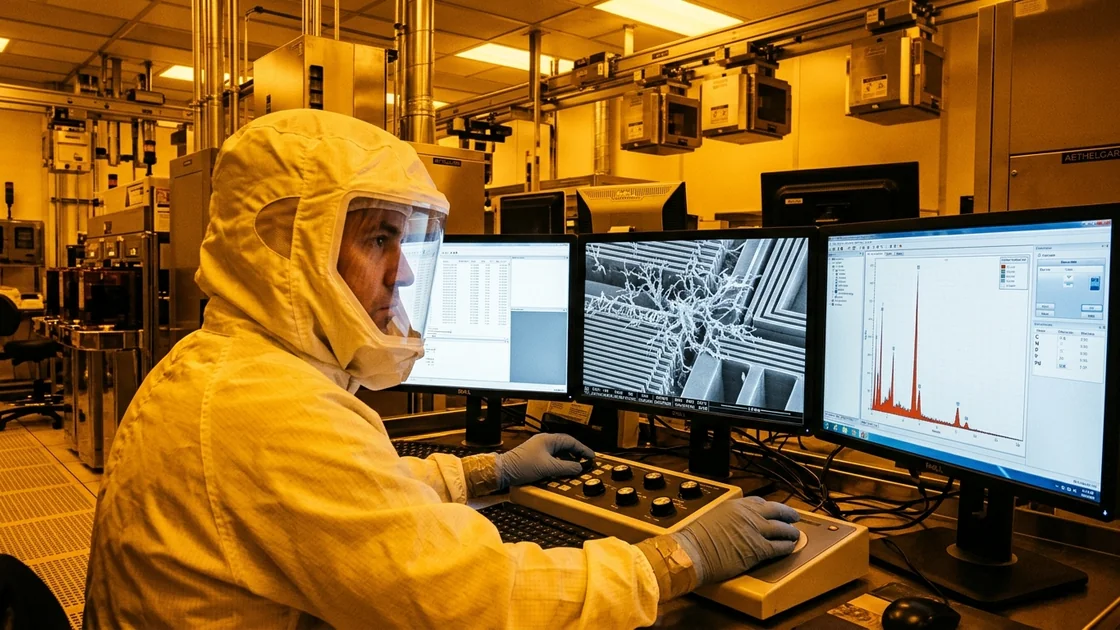
Jonas Vance is a veteran defect-analysis technician working in the ultra-sterile confines of Aethelgard Semiconductor, where the next generation of sub-nanometer microchips is being forged. When yield rates on the company's flagship processor plummet due to inexplicable microscopic short circuits, management blames equipment calibration and chemical impurities. However, Jonas discovers that the defects are actually growing across the silicon wafers inside vacuum-sealed pods. Defying his superiors, he uncovers a terrifying plot by rival corporation Vanguard Microsystems, which has engineered a radiation-fed extremophile bacterium capable of surviving acid baths to excrete conductive metal filaments across the circuitry. With an insider sabotaging the facility's chemical lines and threatening to destroy billions of dollars in lithography machinery, Jonas must navigate the labyrinthine sub-fab to expose the mole and sterilize the cleanroom before the company is ruined.
The air inside Gowning Room B tasted of nothing at all. It was stripped of moisture, stripped of pollen, stripped of the microscopic detritus of human existence by ceiling-mounted banks of Ultra-Low Particulate Air filters that pushed a relentless laminar breeze from ceiling to floor. Jonas Vance stood before the full-length stainless-steel mirror, sealing the magnetic storm flap of his Gore-Tex bunny suit over his throat. At forty-two, he had performed this ritual nearly four thousand times, yet his fingers still moved with the deliberate, almost liturgical precision demanded by an ISO Class 1 environment.
Inside the suit, he was a biological hazard contained within a woven polytetrafluoroethylene shell. A single flake of dead skin, a stray eyelash, or the microscopic salt crystal left behind by an evaporated droplet of sweat was an asteroid capable of obliterating a city of transistors. He snapped the polycarbonate visor of his hood into place, engaged the belt-mounted lithium pack that powered his personal helmet exhaust fan, and pulled on his second pair of powder-free nitrile gloves, taping the cuffs securely to his sleeves.
He stepped into the air shower. The interlock door sealed behind him with a pneumatic hiss, and for thirty seconds, thirty-six high-velocity nozzles battered him with ionized air, shearing away any stray particulates clinging to his fabric. When the opposite door clicked open, Jonas stepped out into the yellow world of Fab 4.
They called it the Ballroom. It was an uninterrupted expanse of four hundred thousand square feet, lit entirely by amber wavelengths of five hundred and ninety nanometers—light stripped of the blue and ultraviolet spectrums so it would not prematurely expose the hyper-sensitive photoresists coating the silicon wafers. Above his head, a dense, glowing grid of anodized aluminum tracks hummed as ratusan of Overhead Hoist Transport vehicles glided like robotic spiders at twenty miles per hour. Each vehicle carried a Front Opening Unified Pod—a FOUP—containing twenty-five three-hundred-millimeter silicon wafers. Every single pod held roughly four million dollars' worth of unfinished computation.
Beneath Jonas's static-dissipative boots lay the perforated waffle floor, through which the laminar airflow plunged downward into the sub-fab two stories below. Everything smelled faintly of ozone and warm plastic. Everything was rhythmic, automated, and serene.
Except in Metrology Bay 7.
Jonas walked down the central aisle, his helmet fan whirring softly at the base of his skull, and turned into the darkened alcove housing the Defect Review Scanning Electron Microscopes. Sitting at the primary console was Priya Nair, a junior yield engineer barely two years out of MIT. Even through the bulbous hood of her cleanroom suit and the amber tint of her polycarbonate visor, Jonas could see the dark hollows under her eyes.
"Tell me you didn't stay through the swing shift," Jonas said, his voice slightly muffled by the vocal membrane in his mask.
Priya didn't look up from the triple-monitor array. Her gloved fingers twitched over the trackball, zooming in on a high-contrast grayscale image. "Thorne wants a root-cause summary on his desk by the eight o'clock yield meeting. Lot 409-Alpha just came out of post-etch inspection. Thirty-eight percent die loss."
Jonas stopped behind her chair. "Thirty-eight? On the Hyperion 14A node?"
"It gets worse," Priya said hollowly. "Lot 410-Beta is sitting in the queue right behind it. The inline optical scatterometry flagged over nine thousand killer defects per wafer. The defect density isn't just spiking, Jonas. It's accelerating exponentially between process steps."
Jonas leaned in, bracing his gloved hands on the edge of the stainless-steel desk. The Hyperion 14A—a 1.4-nanometer Gate-All-Around nanosheet architecture—was the lifeblood of Aethelgard Semiconductor. For three years, the company had burned through twelve billion dollars in capital expenditure to beat their chief rival, Vanguard Microsystems, to mass production. The United States Department of Defense and three major artificial intelligence hyperscalers were waiting on the validation samples due at the end of the month. If Aethelgard missed the yield threshold of seventy percent, the contracts had automatic clawback clauses that would send the company's stock into a death spiral.
"Let me drive," Jonas said gently.
Priya slid her chair back without argument, rubbing her gloved knuckles uselessly against the bridge of her visor where she wanted to pinch her nose. Jonas sat down and rested his palm on the cool steel trackball of the electron microscope.
On the center screen was a top-down view of a silicon wafer's labyrinthine terrain, magnified two hundred thousand times. At this scale, the copper and cobalt interconnects looked like the concrete canyons of a brutalist metropolis. The transistors beneath them were buried in layers of hafnium oxide and ultra-low-k dielectrics, carved by Extreme Ultraviolet light with features only a few dozen atoms wide.
And sprawling across three adjacent metal lines was an ugly, jagged scar.
"What did the automated classifier call this?" Jonas asked, adjusting the astigmatism and focus knobs with practiced muscle memory.
"Dendritic bridging," Priya replied. "It tagged it as an electrochemical migration error from the copper electroplating bath, or maybe residual photoresist polymer that didn't strip during the plasma ash."
"It's not electroplating bridge work," Jonas murmured. He tilted the stage inside the vacuum chamber by thirty-five degrees, firing a secondary electron beam across the defect to catch its topographical shadow.
Standard metallic bridging defects formed along the crystalline grain boundaries of the metal, or followed the directional sweep of the chemical mechanical planarization pads. They were geometric, governed by the harsh physics of fluid dynamics, electrostatic charge, and crystal lattices.
The thing on the screen was not geometric.
It looked like frost on a winter windowpane, or the creeping mycelium of a fungus spreading across rotting bark. From a central nodular mass no wider than twelve nanometers, delicate, branching tendrils reached outward, spanning the insulating trench of silicon dioxide to touch the neighboring gate electrode. Where the tendrils touched the cobalt cap of the transistor, the metal looked pitted, almost chewed.
"Run the EDX," Jonas said, referring to the Energy-Dispersive X-ray Spectroscopy module attached to the microscope.
"I already did," Priya said, pulling up a spectral graph on the right-hand monitor. "That's why I haven't gone home. Look at the elemental peaks."
Jonas squinted at the jagged red lines of the spectrogram. He expected to see silicon, oxygen, copper, cobalt, and perhaps fluorine or chlorine if a chemical etching chamber was leaking. Instead, alongside a massive spike of palladium and ruthenium, there were unmistakable, towering peaks of carbon, nitrogen, phosphorus, and sulfur.
"Organic contamination?" Jonas frowned. "At the M1 metal layer? That wafer just came out of a four-hundred-degree anneal and a sulfuric-peroxide piranha bath. Any organic polymer should have been oxidized into carbon dioxide gas."
"I know," Priya whispered. "So I pulled the historical KLA optical scans from when Lot 409 entered the FOUP after lithography yesterday afternoon. Look at the coordinates."
She keyed in a macro. The left monitor split into two images of the exact same die coordinates—X-14, Y-88—taken fourteen hours apart. During those fourteen hours, the wafer had not been inside a processing tool. It had been sitting inside its sealed nitrogen-purged pod on an overhead storage rack, waiting for an open slot at the etching bay.
In the first image, the defect was a tiny, isolated speck of twelve nanometers, barely registering above the background noise floor. In the second image, taken after fourteen hours of sitting in dark, dry nitrogen, the speck had sprouted fourteen distinct tendrils, spanning sixty nanometers and shorting out four logic gates.
The cleanroom was twenty-one degrees Celsius. Jonas felt a cold trickle of sweat roll down his ribs inside his bunny suit.
"It grew," Jonas said.
"Polymers don't grow in a nitrogen purge," Priya said, her voice tight with the specific terror of an engineer watching the laws of thermodynamics break in real time. "Crystals don't nucleate without a supersaturated solution or a thermal gradient. Jonas, what am I looking at?"
Jonas stared at the central nodule of the defect. He increased the magnification to five hundred thousand times, pushing the electron beam to the absolute limit of its resolution before the charging effects would blur the image. The central nodule was an oblong capsule, roughly thirty nanometers wide and eighty nanometers long. Its surface wasn't smooth like a condensed chemical droplet, nor faceted like a metallic crystal. It possessed a distinct, hexagonal protein-coat symmetry, armored in a dense crust of precipitated silica.
Before joining Aethelgard twelve years ago, Jonas had spent four years working at a national laboratory in New Mexico, operating cryo-electron microscopes for defense microbiologists studying extremophiles in nuclear waste storage pools. He had seen that hexagonal lattice structure before.
"Priya," Jonas said slowly. "Don't upload this EDX spectrum to the central yield database yet."
"What? Why? Dr. Rostova is already screaming for the raw telemetry."
"Because if you upload this, the automated heuristics will flag it as a sensor calibration error on the microscope, and Facilities will lock this tool down for a three-day preventative maintenance cycle," Jonas lied smoothly. He copied the raw image files and the spectral data onto an encrypted diagnostic drive plugged into the service port. "Go home. Get six hours of sleep. Tell Rostova the detector drift on Review SEM 4 required a manual dark-current calibration and that I'm handling the morning briefing."
Priya hesitated, looking from the screen to Jonas's tinted visor. "Jonas, if Thorne thinks I stalled the report—"
"He'll yell at me instead. I have union seniority and a higher tolerance for his blood pressure," Jonas said, offering a reassuring nod. "Go on. Decontaminate and get some real air."
Once Priya's footsteps faded toward the airlocks, Jonas turned back to the console. He didn't recalibrate the detector. Instead, he engaged the Focused Ion Beam—a microscopic scalpel made of accelerated gallium ions—and began slicing a cross-section directly through the heart of the thirty-nanometer capsule on Wafer 12.
At 8:00 AM sharp, the third-floor conference room of the administrative building smelled of burnt dark roast coffee and corporate panic. Unlike the cleanroom across the skybridge, here people wore collared shirts, tailored blazers, and no masks, though nobody looked any more comfortable.
Marcus Thorne, Vice President of Foundry Operations, stood at the head of the glass table. He was a compact, silver-haired man who treated semiconductor manufacturing like submarine warfare. To his right sat Dr. Elena Rostova, Head of Yield Enhancement, her blonde hair pulled back so tightly it seemed to lift the corners of her eyes. Around the table sat twelve department heads: Lithography, Etch, Chemical Mechanical Planarization, Thin Films, and Facilities.
Jonas sat in the back row against the wall, still wearing his blue cotton cleanroom under-scrubs.
"Forty-one percent," Thorne said, his voice dangerously quiet as he tapped the laser pointer against the wall projection. The chart showed the rolling seven-day yield of the Hyperion 14A line plunging like a stone off a cliff. "Yesterday we were at fifty-eight. Today we are at forty-one. Vanguard Microsystems issued a press release in Taipei four hours ago announcing that their 1.4-nanometer pilot line in Hsinchu just hit sixty-four percent yield. The Pentagon procurement committee arrives here next Thursday. Somebody explain to me why our wafers look like they're being hit with buckshot."
"It's the High-NA EUV resist chemistry," said Arthur Pendelton, the Lead Integration Engineer for Lithography, immediately pointing a finger across the table at Thin Films. "The tin-oxide metal-oxide photoresists we're sourcing from Kyros Chemical are unstable. They're outgassing in the exposure chamber and leaving catalytic metallic residues that cause micro-bridging during the post-exposure bake."
"That's garbage, Arthur," snapped David Kael, the Director of Facilities and Chemical Logistics. Kael was a broad-shouldered man with a neatly trimmed beard and a habit of clicking his platinum Montblanc pen when annoyed. "Every ampoule of photoresist goes through Inductively Coupled Plasma Mass Spectrometry before it ever touches the sub-fab distribution manifold. Purity is at nine-nines. Four parts per trillion trace metal maximum. If you're getting bridging, your scanner laser optics are wandering."
"The ASML scanner optics don't wander," Pendelton shot back, his face flushing. "We ran interferometry at midnight!"
"Enough," Dr. Rostova cut in, her icy voice slicing through the bickering. She turned her pale gray eyes toward the back of the room. "Vance. Where is Nair? And where is the DR-SEM elemental breakdown on Lot 409?"
Every head at the table pivoted toward Jonas.
Jonas stood up, stepping to the side podium and plugging his encrypted drive into the presentation terminal. "Priya worked a double shift, Dr. Rostova. I sent her home and finished the cross-sectional FIB analysis myself."
"I don't care about your staffing benevolence, Vance," Thorne growled. "Put the data on the screen. Is it the resist or the etch?"
"Neither," Jonas said. He tapped a key, replacing the yield chart with the five-hundred-thousand-times magnification image of the dendritic scar on Lot 409. "This is the killer defect responsible for ninety-two percent of the die failures over the last seventy-two hours. And it isn't a chemical precipitate or a lithography aberration."
Silence fell over the room. Even the seasoned process engineers leaned forward, squinting at the eerie, root-like tendrils gripping the nanometer-scale cobalt gates.
"What is that?" Pendelton asked, his defensive bluster vanishing into genuine confusion. "Whisker growth? Tin whiskers don't form at that scale in three hours."
"It's not tin," Jonas said. He brought up the cross-sectional slice he had carved with the gallium ion beam at four in the morning, followed by the EDX elemental map. "The filaments are an alloy of palladium and copper, bound together by a matrix of phosphorylated polysaccharides and peptidoglycan. The central nodule is an armored capsid containing a dense nucleoid core of nucleic acids."
Jonas looked straight at Thorne and Rostova.
"We have a biological organism growing on the wafers."
For five seconds, nobody breathed. Then, David Kael let out a short, barking laugh, clicking his pen twice.
"A biological organism," Kael repeated, looking around the table as if checking for hidden cameras. "Jonas, how long were you in the yellow room last night? Did your helmet fan fail? We're talking about wafers that are bathed in hydrofluoric acid, baked on hotplates at four hundred degrees Celsius, bombarded with thirteen-point-five-nanometer Extreme Ultraviolet radiation in a hard vacuum, and stripped with oxygen plasma. Nothing alive survives that. A tardigrade would be reduced to ionized soot in step one."
"A natural organism would," Jonas agreed calmly. "This isn't natural."
He advanced the slide, showing a side-by-side comparison of the defect capsule and a structural diagram he had pulled from a restricted defense microbiology archive.
"This is a synthetic chimera," Jonas said. "Specifically, it appears to be a bio-engineered nanobacterium derived from Deinococcus radiodurans and a deep-crust lithoautotrophic archaeon, severely genome-reduced to shrink its cell volume below forty nanometers. In its dormant phase, it forms a silicate-armored endospore. Because its outer shell is pure amorphous silicon dioxide, our optical inspection tools see it as harmless native oxide dust, and hydrofluoric acid baths only etch away the outer sacrificial layer of its shell without breaching the core."
Dr. Rostova stood up slowly, her palms flat on the glass table. "You are suggesting that a bacterium is surviving plasma etching?"
"It's not on the wafer during the plasma etch, Doctor," Jonas explained, pointing to the timeline chart he had assembled. "Look at the process logs. The contamination only appears after the EUV lithography coat-and-develop track. When the wafer is coated with the organometallic photoresist and exposed to the EUV laser, the radiation doesn't kill the spore—it activates it. Radiodurans uses ionizing radiation to drive metabolic repair. This organism has been engineered to use the 13.5-nanometer EUV photons as a germination trigger. Once inside the FOUP, it consumes the tin and palladium organometallic precursors in the unexposed resist residue, and excretes conductive metallic filaments as a metabolic byproduct."
Jonas let the conclusion hang in the recycled air of the boardroom.
"Someone," Jonas said quietly, "has engineered a lithotrophic bacterium that eats EUV photoresist and shits short circuits. And they've introduced it into our fab."
The room erupted. Three engineers talked at once; Pendelton looked horrified, while Kael stood up, his face dark with anger.
"This is absurd!" Kael shouted over the din. "Corporate espionage via sci-fi germs? Marcus, listen to this guy! He's a technician reading too many thrillers because he can't calibrate a microscope!"
Thorne raised a hand. The room went instantly quiet. The VP stared at the high-resolution image on the screen for a long time. His jaw muscles worked beneath his closely shaved skin.
"Elena," Thorne said without looking at Rostova. "Is this physically possible?"
Rostova didn't blink. Her gaze remained locked on Jonas, cold and calculating. "In academic theory? Synthetic biology has been experimenting with metallic biomineralization for nanowire synthesis for ten years. In practice, inside an ISO Class 1 semiconductor foundry? It is ninety-nine point nine percent likely that Vance is misinterpreting organometallic polymer cross-linking caused by electron-beam damage in his own microscope."
"The electron beam didn't create nitrogen and phosphorus peaks, Dr. Rostova," Jonas countered. "And polymer cross-linking doesn't grow sixty nanometers in the dark inside a sealed nitrogen pod."
"Which brings up an interesting point," Rostova said smoothly, stepping out from behind the table. "Even if there were biological contamination on Wafer 12 of Lot 409, it only appeared after you opened the FOUP on Review SEM 4. Tell me, Jonas—when was the last time your suit integrity was pressure-tested?"
Jonas stiffened. "My suit is tested weekly. And humans don't shed forty-nanometer silicate-armored palladium-reducing spores, Doctor."
"That's enough," Thorne snapped. He hit the power button on the table console, plunging the projector screen into darkness. "Nobody outside this room breathes a word of this. If even a rumor leaks to Wall Street or the Pentagon that Aethelgard has a 'biological blight' in Fab 4, our share price will hit zero before the closing bell. Do you all understand me?"
Murmurs of assent rippled around the table.
"Rostova, Kael—I want a full purge of Lithography Track 3 and the Kyros chemical delivery manifolds during the noon maintenance window," Thorne ordered. "Flush the lines with ozone and hot UPW. Vance, hand over that flash drive to Dr. Rostova. You're off defect review for the rest of the week. Go recalibrate the ellipsometers in the legacy 28-nanometer bay until this yield excursion is resolved."
Jonas felt his stomach drop. "Mr. Thorne, flushing the lines with ozone and ultrapure water won't touch a silicate-encapsulated spore. In fact, if the biofilm has colonized the polytetrafluoroethylene tubing inside the coaters, an ozone flush will just trigger a mass sporulation event. You'll spread it to every scanner in the bay."
"Give the drive to Elena, Jonas," Thorne said, his voice dropping an octave into a cold command. "And report to Bay 1. Now."
Jonas looked at Rostova. She held out a pale, manicured hand, her expression unreadable. Behind her, David Kael was watching Jonas with narrowed, unblinking eyes, his thumb resting silently on the clip of his Montblanc pen.
Slowly, Jonas pulled the drive from the podium, placed it in Rostova's palm, and walked out of the room.
He didn't go to Bay 1.
As soon as the elevator doors closed behind him on the first floor, Jonas pulled his personal magnetic keycard from his lanyard and took the concrete stairwell down to Basement Level 2—the analytical chemistry laboratories that bordered the sub-fab.
He wasn't an idiot; he hadn't handed Rostova the only copy of the data. Before leaving Metrology Bay 7 that morning, he had routed the raw ToF-SIMS and EDX files through the internal maintenance server to a diagnostic workstation in the Ultrapure Water monitoring lab.
And more importantly, he still had the physical specimen. When he had used the Focused Ion Beam to slice the cross-section out of Wafer 12, he had used the microscope's tungsten micromanipulator needle to lift out a microscopic wedge of silicon—a standard Transmission Electron Microscopy lamella, ten microns wide and a hundred nanometers thick, containing three intact spores—and transferred it into a shielded vacuum travel puck in his scrub pocket.
Jonas pushed through the heavy fire doors of the wet-chemistry lab and found Maya Lin hunched over a Liquid Chromatography-Mass Spectrometry rig. Maya was thirty, had two piercings in her left eyebrow that she had to tape over whenever she entered the cleanroom, and possessed a Ph.D. in biochemical engineering from Stanford before Aethelgard recruited her to manage organic trace contamination in their water reclamation plant.
"You look like somebody just canceled Christmas," Maya said without turning around as she injected a microliter sample into the mass spec port. "I heard the yield meeting was a bloodbath. Word on the floor is Litho and Facilities nearly had a fistfight."
"They're blaming polymer cross-linking," Jonas said, glancing back through the wire-mesh glass of the lab door to make sure the corridor was empty. He reached into his scrub pocket and set the stainless-steel vacuum puck on her workbench. "Maya, I need a favor. Off the books."
Maya paused, setting her syringe down. She looked at the vacuum puck, then up at Jonas's face. They had worked together two years ago when a batch of contaminated filter membranes from a vendor in Osaka had nearly ruined three hundred wafers. She knew Jonas wasn't prone to melodrama.
"How far off the books?" she asked quietly.
"Far enough that if Rostova catches us, we're both walking out the front gate with cardboard boxes." Jonas logged into her secondary terminal and pulled up the hidden directory where he had stashed the morning's electron microscopy files. "Look at this."
Maya rolled her stool over and adjusted her glasses. For three minutes, the only sound in the lab was the rhythmic chugging of the roughing pumps beneath the benches. As she scrolled through the EDX elemental maps and the high-resolution FIB cross-sections, her lips parted slightly.
"Where did you pull this lamella from?" she whispered.
"Lot 409. M1 metal layer, right after EUV lithography and post-exposure bake."
"That's impossible, Jonas. Look at the phosphorus-to-sulfur ratio and the amide-I and amide-II infrared absorption bands on your secondary scan. That's folded beta-sheet protein. No protein maintains tertiary structure at four hundred degrees."
"It doesn't have to if the spore coat acts as a thermal insulator during the ninety-second bake cycle, or if it's using anhydrous trehalose-silicate vitrification," Jonas said. "Look at the outer shell. It's biosilicified—just like marine diatoms, except dense enough to withstand plasma bombardment for short intervals."
Maya zoomed in on the thirty-nanometer capsule. "A forty-nanometer cell diameter is right on the theoretical lower limit for autonomous life—barely enough room for a ribosome and a single circular strand of DNA. Wait..." She frowned, pulling up a molecular weight calculator on her screen. "It doesn't use standard ribosomes. Look at the mass fragments from your ion beam milling. Those are XNA bases—xenonucleic acids with a cyclohexenyl backbone instead of ribose. That's why it isn't breaking down under thermal stress or UV radiation. The genetic backbone is synthetic and chemically inert."
Jonas felt a chill of vindication mixed with dread. "Can you sequence it?"
"With a standard Illumina sequencer? No way, the polymerases won't read a synthetic cyclohexenyl backbone," Maya said, her mind already racing into the puzzle. "Hold on. We have the Oxford Nanopore solid-state test rig that R&D bought last year when they were playing with DNA data storage on silicon. It reads electrical current disruption as the strand passes through a graphene nanopore—it doesn't care if the bases are natural or synthetic. Give me the lamella."
For the next forty minutes, Jonas stood watch by the door while Maya worked inside a Class II biosafety laminar flow hood at the back of the lab. Using a micromanipulator and a droplet of buffered chelating agent mixed with a mild fluoride surfactant, she dissolved the silicate armor off the three microscopic spores on the silicon wedge, lysed the inner protein capsids with an ultrasonic probe, and pipetted the femtoliter solution into the graphene nanopore array.
On her monitor, a waterfall of electrical current traces began translating into a scrolling string of base-pair equivalents.
"It's tiny," Maya breathed, her fingers flying across the keyboard to run a local alignment algorithm against her downloaded academic databases. "Barely a hundred and eighty kilobases. It's not even a full bacterium anymore—it's a stripped-down biological machine. Minimal metabolic pathway derived from Desulfovibrio desulfuricans for heavy-metal reduction, spliced with the radiation-repair operons of Deinococcus."
"Wait," Jonas said, pointing at the screen where the alignment software had highlighted a recurring twenty-base motif in bright red. "What is that sequence at the five-prime end of the plasmid?"
Maya enlarged the window. The software had translated the codon codons into a synthetic amino acid chain that didn't code for any functional enzyme. Instead, using the standard single-letter amino acid code, the non-coding spacer region spelled out a repeating string:
H-E-N-D-R-I-C-K-S-2-0-2-4-S-Y-N-B-I-O
Maya stared at the letters. "A genetic watermark. Craig Venter did that when his institute made the first synthetic cell—they coded their names and email addresses into the junk DNA so they could prove copyright ownership."
Jonas didn't need a search engine to know the name, though Maya was already typing it into her browser.
"Dr. Lukas Hendricks," Jonas said grimly. "Former chair of biomolecular materials at ETH Zurich. Three years ago, DARPA funded his lab to develop self-assembling biological nanowires—bacteria that could print simple circuit traces on flexible plastics using light lithographic masks."
Maya pulled up a news article from eighteen months prior. "Says here DARPA pulled his clearance and shut the project down after he violated containment protocols by splicing synthetic XNA into extremophile spores. He vanished from academia..." She scrolled down to a corporate press release from a patent filing in Singapore. "...and turned up nine months ago as Chief Scientist of Advanced Materials at Vanguard Microsystems' subsidiary in Shenzhen."
The pieces clicked together with the cold precision of a wafer lock.
"Vanguard didn't actually hit sixty-four percent yield on their 1.4-nanometer node in Taipei," Jonas realized aloud. "They're stuck at the same physics wall everyone else is. High-NA EUV is too finicky. They couldn't beat us to the Pentagon contract by making their chips work better—so they're using Hendricks's modified nanowire bugs to make sure ours don't work at all."
"Think about how brilliant it is as a weapon," Maya whispered, horrified. "In a normal industrial sabotage operation, if you break a machine or poison a chemical tank, the foundry detects the impurity in ten minutes, flushes the line, replaces the tank, and loses maybe a day of production. Here, the contamination is self-replicating. As long as there is trace organometallic photoresist and EUV light, a single spore introduced into the system multiplies into billions."
"And remember what Thorne just ordered at the morning meeting," Jonas said, his heart hammering against his ribs. "Rostova and Kael are going to flush Lithography Track 3 with ozonated ultrapure water at noon."
Maya spun around on her stool. "No! Did you look at the promoter sequence ahead of the sporulation gene on this map?" She pointed frantically at a cluster of regulatory genes on the nanopore readout. "The organism has an oxidative-stress sensor directly coupled to its capsule-hardening pathway. If you hit an active colony with aqueous ozone, it won't lyse them—it triggers rapid hyper-sporulation and detaches them from the hydrophobic Teflon walls of the plumbing! And where does the waste water from a lithography track flush go?"
"To the central UPW reclamation plant in the sub-fab," Jonas said, his blood turning to ice. "Our closed-loop water system. We recycle eighty-five percent of our water."
"The RO membranes and UV lamps in the water plant are only rated down to fifty nanometers," Maya said, rising to her feet. "These spores are thirty-two nanometers wide, armored in glass, and feed on ultraviolet light. If they flush Track 3 into the reclamation loop without diverting the effluent to the toxic chemical incinerators, the spores will pass straight through the filtration beds and get pumped into every single wet-bench, CMP polisher, and immersion scanner in Fab 4."
"The entire four-hundred-thousand-square-foot ballroom will be permanently infected," Jonas finished. "You wouldn't be able to sterilize the miles of piping without ripping the entire foundry down to the concrete foundation. It would take three years and ten billion dollars. Aethelgard would be bankrupt by Monday."
Jonas looked at the digital clock on the wall. It was 10:42 AM. The maintenance flush was scheduled for 12:00 PM.
"Wait," Maya said, grabbing Jonas's arm as he turned toward the door. "How did the spores get into Lithography Track 3 in the first place? The photoresist ampoules are sealed in steel canisters under argon in Japan before they ever ship here. Even if Vanguard intercepted a shipment, Kael's team runs ICP-MS mass spectrometry on every batch before hooking them up."
"Kael's team runs mass spec on samples drawn from the intake port," Jonas said slowly, remembering Kael's immediate, vicious dismissal of his findings in the boardroom—and the way Kael had laughed. "Wait. Pull up the chemical logistics manifest for the Kyros tin-oxide resist ampoules on Track 3."
Maya turned back to her terminal, tapping into the Facilities ERP system. "Let's see... Lot KY-882 through KY-890. Installed over the last ten days. All passed ICP-MS screening in the receiving dock lab."
"Who signed off on the helium leak-check after the ampoules were mounted inside the sub-fab dispense cabinets?"
Maya clicked the audit trail. "Manual sign-off... badge ID 00419. David Kael."
"A Director of Facilities doesn't personally go down into the sub-fab with a wrench to swap out five-gallon photoresist canisters," Jonas said. "Pull the RFID proximity logs for the sub-fab C-Bay chemical corridor over the last two weeks."
Maya typed rapidly. A table of timestamps populated the screen. "Kael badge-swiped into C-Bay four times at two in the morning on nights when he wasn't even on the shift roster. And look—ten minutes before each swipe, he accessed the Nitrogen Purge Override on Cabinet 3B."
"He wasn't poisoning the ampoules," Jonas said. "He was injecting the spores directly into the pneumatic pressure-relief valve on the cabinet manifold while swapping the canisters! That bypasses the receiving lab completely. And by ordering the ozone flush today, he's not trying to clean the line—he's using Thorne's panic to trigger the secondary phase of the attack and contaminate the whole water plant."
"We have to call Thorne," Maya said, reaching for the desk phone. "Or corporate security!"
Jonas put his hand over the receiver before she could lift it. "Think, Maya. Rostova has my flash drive. She's a Ph.D. material scientist—she took one look at that EDX spectrum and knew damn well electron beam damage doesn't synthesize phosphorus and nitrogen out of thin air. Yet she backed Kael up in front of Thorne and tried to pin the contamination on my suit."
Maya froze. "Rostova is in on it too?"
"Or Kael has leverage on her, or Vanguard bought them both. Vanguard has a forty-billion-dollar war chest; paying off a Facilities Director and a Yield VP with twenty million in offshore crypto is a rounding error compared to monopolizing the 1.4-nanometer defense market."
Suddenly, the screen on Maya's terminal flickered. A red administrative dialog box popped up over the Nanopore sequencing window:
SECURITY ALERT: UNAUTHORIZED ACCESS TO RESTRICTED TELEMETRY. WORKSTATION LOCKED. FACILITIES SECURITY DISPATCHED.
At the exact same moment, the magnetic lock on the wet-lab hallway door clicked, switching from green to solid red.
"When I logged into the Facilities ERP to check Kael's badge swipes, it tripped an audit alert on his phone," Maya whispered, her face draining of color.
"Does this lab have an emergency chemical egress to the gray-space?" Jonas asked sharply, already moving toward the back of the room.
"Behind the acid storage cabinets—it leads into the sub-fab utility plenum, but the door is alarmed!"
"Let it ring," Jonas said, grabbing the vacuum puck and a portable handheld UV-C spectrometer from the calibration rack. "Wait—if they flush that line into the reclamation loop, how do we actually kill a silicate-armored organism that feeds on 13.5-nanometer UV light?"
Maya was already stuffing a backup drive of the Nanopore sequence and the Hendricks watermark into her pocket. "It doesn't feed on all light—it only uses 13.5-nanometer Extreme Ultraviolet because that wavelength ionizes the tin-oxide resist to release electrons! And its outer shell is amorphous silica, right?"
"Right."
"What happens when you expose amorphous silica to anhydrous hydrogen fluoride gas combined with high-frequency acoustic cavitation?" Maya asked, her eyes wide. "The HF gas strips the silicate capsid without any water present to trigger the oxidative-stress sporulation sensor! Once the silica coat is stripped, its synthetic XNA core is completely exposed. A standard blast of two-hundred-and-fifty-four-nanometer mercury-vapor UV or chlorine trifluoride gas in the abatement line will incinerate it before it ever reaches the water plant!"
"The sub-fab tool-clean manifold under Bay 7," Jonas realized. "It has an anhydrous HF gas line for chamber dry-etch cleaning and an ultrasonic megasonic transducer inline with the lithography drain."
Heavy footsteps echoed down the tiled corridor outside the lab. Through the wire-mesh window, Jonas saw two contract security guards in black tactical vests jogging toward the door, accompanied by David Kael.
"Go!" Jonas shoved the acid cabinet aside, revealing the yellow hazardous-egress door.
"Wait, if I go with you into the sub-fab, nobody gets the sequence data and Kael's badge logs to Thorne!" Maya said, pulling the encrypted USB drive from her pocket and pressing it into Jonas's hand—then pausing and taking it back. "No, wait. If I go out through the main eye-wash neutralization shaft on the left, it comes up inside the cafeteria kitchen on the first floor. Thorne eats lunch with the executive board in the private dining room at eleven-thirty every day."
"Are you sure?" Jonas asked as Kael's keycard beeped against the outer lab door lock.
"Get to the sub-fab manifold and divert that drain line before noon!" Maya hissed, yanking open the maintenance hatch behind the emergency deluge shower. "I know the plumbing down here better than Kael does. Go!"
She slipped into the narrow pipe chase behind the shower wall and pulled the fiberglass panel shut just as Jonas kicked open the hazardous-egress bar. The piezo-electric alarm shrieked at a hundred and ten decibels, red strobes flashing across the glass glassware as Jonas plunged into the roaring mechanical belly of the foundry.
If the Ballroom upstairs was heaven—white, silent, weightless, and serene—the sub-fab was hell.
Jonas sprinted down the galvanized steel catwalk, immediately swallowed by a deafening, eighty-five-decibel roar. Here, beneath the perforated waffle floor of the cleanroom, lived the industrial organs that kept the illusion of purity alive above. Thousands of stainless-steel pipes, color-coded for toxic, pyrophoric, and corrosive gases, snaked across the ceiling like metallic intestines. Huge dry-scroll vacuum pumps the size of compact cars vibrated violently on concrete pedestals. Tall cylindrical scrubbers burned off toxic silane and arsine exhaust with roaring propane flames behind thick quartz sight-glasses.
The air was hot, smelling of machine oil, ozone, and heated steel.
Jonas pulled his badge from his neck and tossed it into an open drainage grating. Kael would be tracking his RFID chip through the interior repeaters in seconds. Without a badge, Jonas wouldn't be able to open the electronically locked fire doors between zones, which meant he had to travel through the interstitial utility chases—the narrow spaces between the double walls where the high-voltage busbars and chilled-water mains ran.
Above his head, through the two-foot-thick concrete waffle slab and its thousands of vertical air-return ducts, he could see the faint, eerie amber glow of the cleanroom floor.
His watch read 11:18 AM.
To reach the Lithography Track 3 drain manifold before the noon flush, he had to cross three hundred yards of the sub-fab from Zone A (Metrology) to Zone C (EUV Lithography).
He ducked beneath a low-hanging liquid nitrogen cryo-line, its exterior frosted in two inches of white rime ice, and Jogged down Row 14 between banks of turbo-molecular pump controllers. Two hundred yards ahead, near the freight elevator, the strobe lights of a sub-fab golf cart flashed as two security guards swept the main aisle.
Jonas vaulted over a secondary containment dike and dropped into the shadow of the High-NA EUV scanner's lower laser pedestal.
Most people didn't realize that an EUV lithography machine wasn't just the bus-sized white box sitting in the cleanroom upstairs. Directly beneath the floor sat the drive laser—a monstrous, forty-kilowatt carbon dioxide laser system stretching sixty feet through the sub-fab, firing fifty thousand pulses per second upward through a vacuum beam-transport tube to vaporize molten tin droplets in the scanner above.
Jonas pressed his back against the warm aluminum housing of the laser pre-amplifier, catching his breath. His heart hammered against his ribs. Through the thrumming vibration of the floor plates, he heard a voice over the P.A. intercom system, cutting through the drone of the vacuum pumps:
"Attention all sub-fab personnel. We have an unscheduled nitrogen pressure excursion in Zone C, Bay 3. All maintenance technicians evacuate Zone C immediately. Halon fire suppression systems are armed."
Jonas smiled grimly. Kael wasn't calling a security manhunt that would raise questions with corporate oversight; he was faking a nitrogen asphyxiation hazard to clear every witness out of Zone C before noon.
Wait. Halon and nitrogen purge.
If Kael locked down Zone C and dumped liquid nitrogen vapor into the bay's ventilation return, anyone trapped inside without a Self-Contained Breathing Apparatus would pass out in forty seconds and die of hypoxia in three minutes—and the coroner would rule it a tragic industrial accident caused by a technician wandering into a restricted zone after being suspended.
Jonas looked across the aisle at the emergency safety locker mounted to the structural column ten feet away. Inside, behind a break-glass panel, hung two yellow Dräger SCBA air packs with thirty-minute carbon-fiber oxygen tanks and full-face masks.
He waited until the security cart's headlights swept past Row 18, then darted across the grated steel floor, popped the latch on the safety cabinet, and swung the thirty-pound oxygen tank onto his back. He buckled the waist strap, pulled the silicone mask hang-strap around his neck, and kept moving toward the Zone C bulkhead.
As expected, the heavy steel bulkhead door into Zone C was sealed, its magnetic lock glowing crimson. Above the door, the oxygen depletion beacon was already flashing blue—not because the nitrogen was leaking yet, but because someone had manually triggered the sensor override from the local control panel.
Jonas dropped to his knees beside the bulkhead where the three-foot-wide chilled-water return pipes penetrated the firewall. There was a bolted aluminum inspection hatch for the pipe insulation dampers. Pulling a titanium multi-tool from his pocket, he spun out the चार quarter-turn cam locks, yanked the cover plate free, and squeezed himself headfirst into the dark, roaring pipe chase.
It was freezing inside the wall. Condensation dripped from the uninsulated brackets of the six-degree chilled water lines, soaking his blue cotton scrubs. He crawled on his elbows and knees over bundles of armored fiber-optic cables for twenty feet until he reached the corresponding inspection hatch on the Zone C side. He kicked the interior latch Release, and the panel clanged onto the steel floor of Lithography Sub-Bay 3.
Jonas tumbled out onto the grating and immediately froze.
Standing thirty feet away in front of the Track 3 Chemical Dispense and Drain Manifold was Dr. Elena Rostova.
She wasn't wearing a cleanroom suit—down here in the gray-space sub-fab, only hardhats and safety glasses were required—and her tailored charcoal blazer looked absurdly out of place among the grime and industrial piping. Beside her stood David Kael, holding a ruggedized facilities tablet connected by an umbilical cable directly to the Programmable Logic Controller of the Track 3 waste valve.
They hadn't heard the inspection panel fall over the ninety-decibel scream of the EUV scanner's booster pumps right beside them.
Jonas stayed low behind a row of stainless-steel abatement tanks, watching through the gap between two pressure gauges.
"The remote lockout on the reclamation divert valve is active," Kael said, shouting over the machinery as he tapped commands into the tablet. "When the noon automated flush triggers in twelve minutes, the ozone-water mixture from Track 3 will bypass the acid neutralization pits and dump straight into the primary UPW return header."
"And the remaining spores in the Kyros resist cabinet?" Rostova asked, her voice taut. Even from thirty feet away, Jonas could see her hands trembling slightly before she clasped them behind her back.
"I already ran a back-flush of hexamethyldisilazane solvent through the injection needle," Kael replied, disconnecting the umbilical cable and snapping the PLC cover shut. "There's nothing left in the manifold inlet to find. Once the spores hit the main water plant, every wet bench in the building will be colonized by six o'clock tonight. Even if that lab rat Vance convinces Thorne to bring in outside microbiologists next week, they'll find the organism in the municipal intake filters—because I seeded the stage-one pre-filter housing twenty minutes ago. It will look like an environmental mutation from the river water supply that breached a faulty RO membrane."
"What about Maya Lin?" Rostova demanded. "Security found the wet-lab empty. If she took the Nanopore sequence—"
"My guys are waiting at the security turnstiles at both exits of the building, and I've killed her badge and network credentials," Kael said coldly. "She can't get off the campus, and she can't email a file out of a SCIF-rated facility. Relax, Elena. By Monday morning, Aethelgard files an operational halt with the SEC, Vanguard's stock jumps thirty percent, and our escrow accounts in Zurich clear. You can retire from babysitting yield curves forever."
Rostova looked up at the maze of pipes overhead. "And if Vance is down here right now?"
Kael glanced toward the main bulkhead door. "Then he's about to learn why we don't allow unauthorized personnel in nitrogen storage zones. Come on. We need to be upstairs in the command center before the noon sequence starts so we're on camera when the alarms go off."
They turned and walked toward the opposite service exit at the north end of the bay.
Jonas waited until the heavy pneumatic door hissed shut behind them and its external lock clicked. He checked his watch: 11:51 AM. Nine minutes.
He sprinted out from behind the abatement tanks to the Track 3 Chemical Manifold. It was a towering cabinet of brushed stainless steel with a reinforced Lexan window, inside which dozens of translucent PFA Teflon tubes pulsed with liquids, regulated by pneumatic diaphragm valves. To the right of the cabinet sat the PLC control box Kael had just modified.
Jonas popped the latch on the PLC box. The local touchscreen was locked out with a twelve-digit administrator passcode—Kael had flashed the firmware directly from his tablet to prevent anyone from reversing the valve routing via the screen.
"Okay," Jonas muttered to himself, his mind racing through the piping schematics he knew by heart. "If I can't switch the electronic solenoid valve to divert the flush out of the water plant, I have to do it mechanically."
He traced the two-inch stainless-steel drain pipe exiting the bottom of Lithography Track 3 through the ceiling slab above. The pipe dropped down ten feet, passed through an inline ultrasonic flow meter, and split at a three-way pneumatic actuator valve. The left branch—currently open—led to the Ultrapure Water Reclamation Plant. The right branch—currently closed—led to the Sub-Fab Toxic Fluorine Scrubber and Plasma Abatement Furnace, where waste gases from the dry-etch chambers were incinerated at twelve hundred degrees Celsius alongside anhydrous hydrogen fluoride.
If Jonas could mechanically force the three-way actuator closed on the UPW side and open on the Plasma Abatement side, and simultaneously crack the manual bleed valve from the adjacent anhydrous HF cylinder into the line, Maya's sterilization theory would happen right inside the drain header. The HF gas would strip the silicate shells off the flushed spores, and the twelve-hundred-degree plasma furnace would atomize them into harmless salts before a single drop reached the water plant.
He grabbed a heavy crescent wrench from an adjacent tool cart and fitted it over the manual override hex nut atop the pneumatic actuator valve. He braced his boot against the structural I-beam and pulled with all his weight.
The valve didn't budge.
It was a fail-safe pneumatic actuator held in position by ninety pounds per square inch of compressed shop air feeding through a quarter-inch stainless steel control line. As long as that air pressure was pushing against the internal spring diaphragm, a human couldn't turn the manual override without shearing the stem off.
To release the actuator, he had to sever the compressed air supply line.
Jonas grabbed the side-cutters from his multi-tool—too small for quarter-inch stainless steel tubing. He spun around, scanning the bay, and spotted a heavy-duty tube cutter sitting on a pipefitter's workbench near the laser pedestal. He ran over, snatched the cutter, and sprinted back to the manifold.
11:54 AM.
He clamped the hardened steel cutting wheel around the quarter-inch air line feeding the actuator, tightened the thumb screw, and spun it around the pipe. Tighten, spin. Tighten, spin. On the fifth rotation, the steel wall gave way with a sharp crack, and a high-pressure jet of compressed air screamed out of the severed tube, stinging his hands through his nitrile gloves.
Freed of pneumatic pressure, the internal spring of the three-way valve slammed shut with a heavy metallic clunk—closing off the pipe to the Ultrapure Water plant and opening the bypass straight to the Plasma Abatement Furnace.
"One down," Jonas breathed.
Now he needed the anhydrous hydrogen fluoride gas to dissolve the silicate spore coats inside the pipe before they could adhere to the abatement drop-leg. Four feet to his left stood a gray gas cabinet labeled: DANGER - ANHYDROUS HYDROGEN FLUORIDE - CORROSIVE / TOXIC.
A cross-purge line already connected the HF cabinet to the Track 3 drain manifold for quarterly descale maintenance, separated by two manual quarter-turn bellows valves.
Jonas reached for the first valve handle—and froze as all the overhead fluorescent lights in Zone C suddenly switched off, replaced by rotating crimson strobes.
From the ceiling vents above, a deafening roar erupted as white, billowing clouds of freezing vapor began pouring into the bay.
Kael hadn't been bluffing. From a remote terminal upstairs, he had just triggered the liquid nitrogen fire-suppression dump in Zone C to make sure nobody could interfere with the noon flush.
Within ten seconds, the ambient temperature in the bay plunged by fifteen degrees, the moisture in the air instantly condensing into a thick, blinding white fog. On the wall beside the cabinet, the digital oxygen monitor began screaming, its LED readout dropping fast: 20.9%... 18.4%... 15.1%...
Below twelve percent oxygen, a single breath of nitrogen-saturated air didn't just fail to provide oxygen—it actively stripped oxygen out of the bloodstream inside the lungs, causing instantaneous blackout without the body ever feeling the sensation of choking.
Holding his breath, Jonas yanked the yellow Dräger SCBA mask over his face, pulled the Kevlar straps tight behind his head, and twisted the main cylinder valve on his hip. High-pressure air hissed into the regulator, and as he inhaled, the demand valve clicked open, filling his lungs with cold, dry, breathable air.
His watch read 11:56 AM. Four minutes until the Track 3 flush commenced upstairs.
Through the swirling white nitrogen fog, Jonas grabbed the two green bellows valves on the anhydrous HF cross-purge line and wrenched them both ninety degrees to the open position. Through the small sight-glass on the regulator, the pressure gauge needle jumped to forty PSI as corrosive fluoride gas rushed into the drain manifold, mixing with the ultrasonic transducer chamber.
He had done it. When the flush started in four minutes, every spore washed out of Lithography Track 3 would be stripped by HF gas, blasted with ultrasonic cavitation, and dumped straight into the twelve-hundred-degree plasma incinerator.
And then, through the blinding white fog behind him, a heavy steel wrench swung out of nowhere and smashed directly into the regulator valve at the base of his oxygen tank.
Sparks flew off the brass fitting. The impact threw Jonas sideways into the Lexan door of the chemical cabinet. As he hit the grated floor, he heard the unmistakable, sickening hiss of three thousand pounds per square inch of breathable air venting wildly from a cracked high-pressure hose behind his shoulder.
Out of the fog stepped David Kael, wearing a black emergency response SCBA mask of his own and carrying a two-foot steel pipe wrench.
Kael hadn't gone upstairs with Rostova. When his tablet had pinged him that the pneumatic pressure on the Track 3 divert valve had dropped to zero, he had come straight back through the north airlock to fix it himself.
Through the polycarbonate faceplate of Kael's mask, Jonas saw the man's eyes—wide, furious, and desperate. Twenty million dollars and twenty years in federal prison were sitting on the other side of that three-way valve.
Kael didn't waste time coming after Jonas; with the nitrogen level in the room now below eight percent, he knew a man with a ruptured air tank had less than a minute of consciousness left. Instead, Kael turned immediately to the severed pneumatic line on the three-way valve, pulling a brass compression union from his pocket to reconnect the air pressure and force the valve back toward the water plant before noon.
Inside Jonas's mask, the low-pressure warning whistle began to shriek against his ear—a frantic, metallic trill as the tank pressure gauge on his chest strap plummeted through the red zone: 500 PSI... 300 PSI... 100 PSI...
Jonas pulled one last deep breath from the dying regulator before the demand valve sucked flat against his face, completely empty.
If he inhaled again with the mask open to the room, he would breathe pure nitrogen and drop dead on the grating in ten seconds.
Holding that final lungful of air, his chest already burning with carbon dioxide buildup, Jonas launched himself off the floor and tackled Kael from behind, slamming him against the stainless-steel piping of the manifold.
The brass compression fitting flew out of Kael's fingers, clattering down through the grated steel floor into the sump pit below. Kael roared—a muffled, furious sound through his mask—and drove his elbow backward into Jonas's ribs, following up with a brutal backhand swing of the pipe wrench.
Jonas ducked beneath the wrench; the heavy iron head struck the schedule-40 stainless pipe behind him with a ringing clang that vibrated through his teeth. Desperate, his vision beginning to narrow at the edges as his blood oxygen dropped, Jonas didn't try to trade punches with a larger man who had a full air supply.
Instead, Jonas reached up with both hands and grabbed the rubber high-pressure supply hose connecting Kael's mask to his regulator, yanking downward with everything he had while driving his knee into the back of Kael's leg.
Kael buckled to one knee on the steel grating. Knowing what Jonas was trying to do, Kael swung the heavy pipe wrench down onto Jonas's forearm. Bone bruised or cracked—Jonas felt a white-hot flash of agony shoot up his left arm from wrist to shoulder—and his grip failed, sending him sprawling backward against the base of the EUV drive laser pedestal.
Kael staggered up, breathing heavily through his mask. With the brass compression fitting lost in the sump, he couldn't repair the severed air line. Instead, he fitted his two-foot pipe wrench onto the manual override nut of the three-way actuator valve and threw his two-hundred-and-twenty-pound frame against the handle, fighting the heavy internal spring to manually crank the valve back toward the Ultrapure Water line.
Slowly, degree by degree, the heavy steel valve indicator began turning back toward UPW RECLAMATION.
Jonas lay against the laser housing, black spots dancing across his vision. His lungs were screaming, his diaphragm spasming involuntarily against his closed glottis, begging him to inhale. His watch face blurred in the red strobe light: 11:59:10.
Fifty seconds until the Track 3 flush dumped fifty gallons of spore-laden ozone water down that pipe.
Jonas couldn't fight Kael physically without oxygen. He looked furiously around the fog-shrouded floor within arm's reach of the laser pedestal—and his eyes locked onto the auxiliary purge manifold for the EUV scanner's vacuum beam transport tube.
Right beside his right hand was a bright blue quick-disconnect fitting labeled: CDA - CLEAN DRY AIR - 110 PSI.
Clean Dry Air wasn't nitrogen. It was twenty-one percent oxygen and seventy-nine percent nitrogen, ultra-filtered and compressed to run pneumatic bearings that couldn't tolerate oil or moisture.
With trembling fingers, his vision narrowing to a pinhole, Jonas unscrewed the ruptured regulator hose from the front intake port of his Dräger mask. Keeping a thumb jammed over the open mask port to keep the surrounding nitrogen fog out, he crawled two feet to the blue CDA manifold, ripped the protective plastic dust cap off the three-quarter-inch pneumatic hose barb, and jammed the open brass nozzle directly into the threaded intake port of his mask.
With his left hand—ignoring the blinding pain in his fractured wrist—he cracked the CDA ball valve open just a fraction of an inch.
Cold, dry, breathable air hissed violently into his mask, blowing the tiny trace of nitrogen fog out through his one-way exhalation flap. Jonas opened his mouth and drank the air in huge, ragged gulps.
Oxygen flooded back into his bloodstream. The black tunnel around his vision receded just in time for him to see Kael lock a steel C-clamp onto the handle of the pipe wrench, pinning the manual override valve three-quarters of the way back toward the Ultrapure Water plant.
11:59:40.
Above their heads, the pneumatic pumps of Lithography Track 3 whined to life as the automated noon flush cycle initialized. In twenty seconds, the primary dump valve upstairs would open.
Tethered to the wall by the five-foot blue CDA air hose jammed into his mask, Jonas couldn't even reach Kael ten feet away.
He looked down at the floor between them—at the three-way valve, the C-clamp holding the wrench against the structural I-beam, and the quarter-inch copper liquid nitrogen drain line running right above Kael's wrench handle from the ceiling vaporizers.
Jonas didn't need to reach Kael. He just needed physics.
With his good right hand, Jonas grabbed the portable ultrasonic weld-tester and a three-pound brass grounding hammer from the laser maintenance cart beside him. Still tethered to his five-foot air hose, he lunged forward to the absolute limit of the slack and hurled the heavy brass hammer not at Kael, but at the corroded brass bleed-cock on the liquid nitrogen cryo-line directly above the clamped pipe wrench.
The hammer struck the frozen brass petcock squarely, shearing the brittle stem clean off the pipe.
A pressurized stream of minus-one-hundred-and-ninety-six-degree liquid nitrogen jetted downward out of the broken valve, pouring directly over the carbon-steel C-clamp and the neck of Kael's iron pipe wrench.
Kael jumped back with a muffled curse as the boiling cryogenic liquid splashed across the toes of his steel-capped boots, instantly freezing the rubber soles solid.
"No!" Kael lunged forward to grab the wrench handle—just as the carbon steel of the C-clamp, flash-cooled below its ductile-to-brittle transition temperature by the liquid nitrogen while under four hundred pounds of spring tension, shattered like cheap glass.
CRACK!
Fragments of frozen steel shrapnel ricocheted off the chemical cabinets. Freed instantly from the clamp, the heavy internal spring of the three-way actuator valve snapped back to its fail-safe position with terrifying force, flinging the two-foot pipe wrench across the bay—where it struck Kael squarely across the side of his polycarbonate mask visor.
The impact cracked Kael's faceplate down the center and knocked him flat onto his back on the steel grating.
At that exact second—12:00:00—the Track 3 overhead drain pipe shuddered as fifty gallons of pressurized ozone water roared down from the cleanroom above.
Jonas watched the inline sight-glass on the manifold. Instead of flowing left into the Ultrapure Water plant, the turbulent stream hit the closed actuator, slammed right into the cross-purge chamber where anhydrous hydrogen fluoride gas and megasonic cavitation turned the water into a milky, foaming maelstrom, and vanished down the drop-leg into the twelve-hundred-degree plasma incinerator.
On the inline optical particle counter mounted above the incinerator intake, the biological particulate count spiked to nine million per milliliter for six seconds—and on the exhaust gas analyzer downstream of the plasma torch, read a flat, sterile ZERO.
On the floor five feet away, Kael was clutching his cracked mask with both hands as his positive-pressure air tank hissed out through the fractured polycarbonate visor and the surrounding nitrogen fog began seeping inside.
Jonas didn't let him die—not because Kael deserved mercy, but because dead men couldn't testify to the Department of Defense about Vanguard Microsystems' espionage network.
Taking a deep breath from his improvised CDA hose, Jonas pulled the spare second-stage buddy-breather regulator from Kael's own tank harness, ripped Kael's cracked mask off, shoved the spare silicone mouthpiece between the half-conscious man's teeth, and pinched his nose shut with a plastic tubing clamp from the workbench while dragging him by his collar toward the north airlock.
When the heavy steel doors of the north sub-fab airlock cycled open into the bright fluorescent light of the ground-floor freight corridor, Jonas didn't find Kael's security guards waiting for him.
Instead, standing outside the airlock were Marcus Thorne, four armed federal marshals attached to the Pentagon's Defense Counterintelligence and Security Agency, Maya Lin, and a pale, handcuffed Dr. Elena Rostova.
Jonas collapsed onto his knees on the polished epoxy floor, spitting out the improvised air hose and tearing the sweaty Dräger mask from his head as he gasped in normal, warm hallway air. Beside him, Kael groaned, rolling onto his side and coughing violently as two federal agents immediately knelt to snap handcuffs around his wrists.
Maya dropped down beside Jonas, supporting his good shoulder while a company paramedic hurried forward with a splint for his swollen left wrist.
"You made it through the kitchen shaft," Jonas wheezed, leaning back against the concrete wall and closing his eyes for a second.
"Popped out right behind the dishwashing racks at eleven-twenty-five," Maya said, a fierce grin breaking through her exhaustion. "Turns out the DCSA security advance team for next week's Pentagon visit was already in the building doing a pre-inspection walk-through with Mr. Thorne. When I showed them the Nanopore sequence with Lukas Hendricks's genetic watermark alongside Kael's sub-fab badge logs and Rostova's network lockouts, they didn't even wait for local security."
Thorne stepped forward, looking down at Jonas, then through the thick glass window of the airlock into the fog-filled sub-fab bay where the abatement scrubbers were still roaring. The VP of Operations looked ten years older than he had at eight o'clock that morning, his silver hair disheveled.
"The water plant?" Thorne asked quietly.
"Clean," Jonas said, wincing as the paramedic wrapped a cold compression splint around his fractured radius. "Except for the stage-one pre-filter housing at the municipal intake. Kael seeded it twenty minutes ago to cover his tracks. Have Maya's team isolate Tank 1 and flush the pre-filters with anhydrous HF and chlorine trifluoride before bringing the RO beds back online. As for Lithography Track 3, the drain line went straight into the plasma furnace. The organism is gone from the plumbing."
Thorne let out a long, shuddering breath that seemed to deflate his entire chest. He looked over at Rostova, who refused to meet his eyes as the federal agents led her and a limping David Kael down the corridor toward the loading dock.
"Rostova already started talking when the DCSA agents explained the statutory penalty for sabotaging a defense-critical national security asset during wartime procurement," Thorne said grimly. "Vanguard approached them six months ago in Geneva. Paid them four million up front and promised sixteen more once Aethelgard defaulted on the Hyperion contract. With Hendricks's watermark on the DNA and Kael's offshore accounts, the Justice Department will have Vanguard's import licenses and domestic patents seized by Friday."
"What about the wafers already in the Ballroom?" Maya asked. "Lots 409 through 415 are still sitting in FOUPs with active colonies on them."
Thorne looked back down at Jonas. For the first time in the twelve years Jonas had worked at Aethelgard, the Vice President didn't look at him like a replaceable piece of cleanroom tooling.
"I believe," Thorne said slowly, "that our new Senior Fellow of Contamination Control and Defect Metrology just demonstrated how to strip the silicate armor off those spores without damaging the underlying silicon."
Jonas looked up, blinking. "Anhydrous HF vapor phase at low pressure, followed by a deep-UV mercury lamp bake inside the FOUP purge stations. It'll etch away about two angstroms of native silicon dioxide alongside the bacteria, and it'll leave palladium-copper ash on Lot 409, so those wafers are scrap. But for the lots that haven't hit the post-exposure bake yet—and for the inside of the ASML scanner chambers—it'll sterilize them completely without touching the pellicles or mirrors."
"How long to rig the purge stations?" Thorne asked.
Jonas looked at his splinted left arm, then up at Maya, who gave him a sharp nod.
"Give us twelve hours and full administrative override on the sub-fab gas cabinets," Jonas said, using his right hand to brace himself against the wall and push himself back to his feet. "We'll have the Hyperion line running clean by the morning shift."
Three nights later, the Ballroom of Fab 4 was quiet again.
Jonas stood alone in Metrology Bay 7, encased once more in the immaculate white cocoon of his Gore-Tex bunny suit, a custom hard-shell cast cover sealed with Kapton tape over his left forearm. Overhead, the amber lights cast their eternal, timeless glow across the gleaming white steel of the lithography bays, and the robotic Overhead Hoist Transports glided silently along the ceiling grid like industrious spiders.
On the triple-monitor array of Review SEM 4 sat Wafer 1 of Lot 422-Alpha—the first validation lot of the Hyperion 1.4-nanometer processor pulled after the seventy-two-hour HF-vapor sterilization purge.
Jonas rested his right palm on the cool steel trackball and zoomed in to five hundred thousand times magnification on die coordinates X-14, Y-88.
The nanometer-scale canyons of cobalt, copper, and hafnium oxide stretched across the screen in razor-sharp, unbroken geometric perfection. The Gate-All-Around nanosheets stood pristine and clean, free of pits, free of silicate capsules, and free of the creeping metallic mycelium that had nearly brought an empire of silicon to its knees.
On the secondary telemetry screen to his right, the inline KLA scatterometry counter finished its sweep of all twenty-five wafers in the pod. A single green number flashed at the top of the yield projection column:
84.6%.
Jonas leaned back in his ergonomic chair, listening to the gentle, rhythmic hum of his helmet fan and the distant, steady pulse of the vacuum pumps two stories below his boots. He saved the image to the server, logged off the microscope, and walked out down the yellow-lit aisle toward the next lot in the queue.