The Last Vector of Meridian Four-Zero-Nine
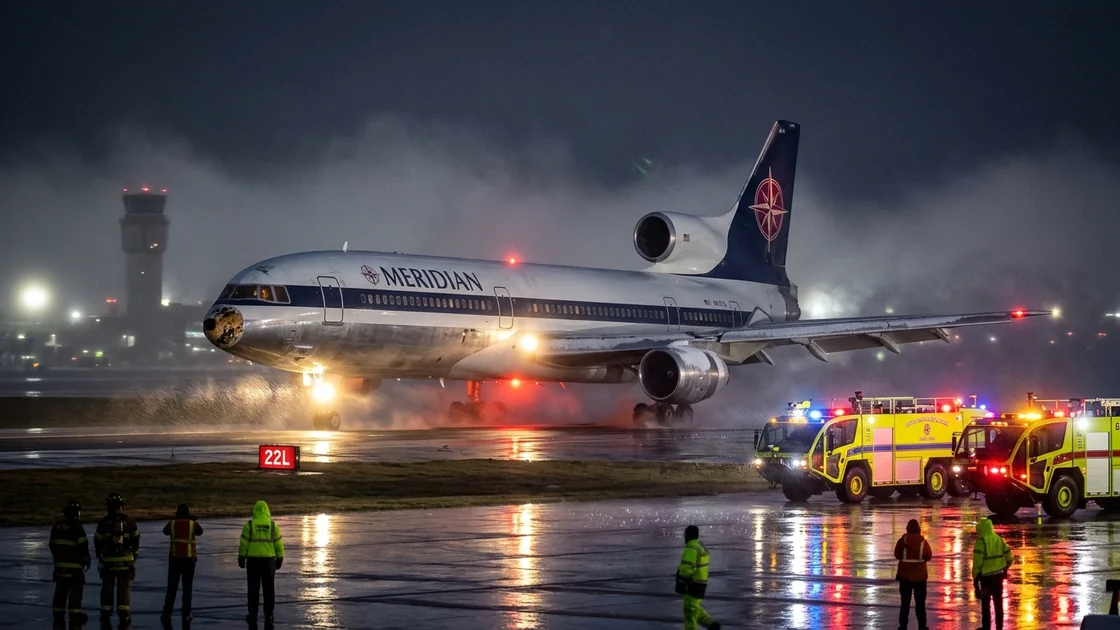
Arthur Vance is a veteran air traffic controller working the overnight shift at a coastal radar facility thirty years after a catastrophic mystery defined his career. In November 1994, during his first year on the job, Meridian Airlines Flight 409 vanished from his radar screen over the Atlantic Ocean during a freak electrical storm, taking two hundred and fourteen souls into oblivion without a distress call or a single piece of recovered wreckage. Now on the eve of his mandatory retirement, as an eerily identical storm batters the coastline and forces all modern air traffic to ground or divert, Arthur spots an unexplainable primary radar return seventy miles offshore. When the phantom aircraft begins broadcasting on an obsolete frequency using a thirty-year-old transponder code, Arthur hears the voice of the long-dead pilot requesting vectors for an instrument approach to a runway that no longer exists. Alongside his skeptical younger partner, Maya Lin, and against the panicked orders of his supervisor, Arthur must bridge a three-decade gap in aviation technology, magnetic drift, and airport geography to talk the crippled, icing vintage tri-jet down through blinding fog before it runs out of fuel and vanishes into the dark forever.
The room beneath the tower did not have windows, because windows invited the illusion that the sky was made of air and water rather than numbers. In the subterranean belly of the Atlantic Consolidated Terminal Radar Approach Control—known to the men and women who went grey in its darkness simply as the TRACON—the sky was a twenty-inch square of matte black glass populated by creeping green vectors, alphanumeric data blocks, and faint concentric range rings.
Arthur Vance sat at Sector Four, the Ocean Gate, with a foam cup of cold coffee resting beside his left wrist. It was 02:14 Zulu, which meant it was past nine in the evening on the coast of Maine, though time in the room had no relationship with clocks that had hands. Time here was measured in sweep intervals, five-second radar updates, and the steady, rhythmic hiss of the ceiling vents pumping chilled, dehumidified air over banks of servers.
Today was November 14. Tomorrow, at 06:00 local, Arthur would unplug his dual-prong Plantronics headset from the console jack, coil the black cord around the amplifier box using the over-under method he had practiced for thirty-one years, place it in his locker, and walk out into the parking lot as a civilian. He was fifty-six years old. By federal regulation, he had reached the end of the line. The government believed that after fifty-six, the human brain lost the fractions of a second required to keep aluminum tubes moving at five hundred miles per hour from occupying the same parcel of mist.
Arthur did not disagree with the government. His knees ached when the barometric pressure dropped, and tonight the barometer was falling like a stone dropped down a dry well.
"Delta Eighteen-Ninety, turn left heading two-four-zero, vectors around the cell, descend and maintain six thousand," Arthur said. His voice was a flat, baritone instrument, stripped of regional accent or emotional inflection, honed by decades of pushing syllables through VHF static.
"Left two-four-zero, down to six thousand, Delta Eighteen-Ninety," the pilot came back. The voice sounded tight. "Approach, how are the rides looking down low? We’re getting beat up pretty good in the descent."
Arthur glanced at the NEXRAD weather overlay on his scope. It was a bruise of deep magenta, rust orange, and stippled yellow stretching from the Bay of Fundy down to Cape Ann, pushing inland against an unseasonably warm wedge of coastal air.
"Moderate to severe chop reported between eight and four thousand by an Airbus twenty minutes ago," Arthur transmitted. "Once you get below four, it smooths out into a heavy crosswind, surface winds at Harbor are currently one-one-zero at two-eight gusting three-eight. Expect the ILS Runway One-Four approach. You're the last one getting in tonight before they close the field for the squall line."
"Copy that, glad we made the cut. Delta Eighteen-Ninety."
Two consoles down, Maya Lin pushed her rolling chair back and coasted over to Arthur’s bay, her sneakers squeaking softly against the rubberized anti-static floor tiles. She was twenty-seven, wore an oversized knit sweater over her collared shirt, and drank canned energy drinks that smelled like artificial watermelon. She was the best radar controller to come out of the Oklahoma City academy in a decade, though Arthur had never told her so to her face. He had only shown her by letting her work his traffic without hovering over her shoulder.
"Tower just called down," Maya said, resting an elbow on the plastic cowling of Arthur’s STARS display. "Port Authority is shutting down the ramps at twenty-three hundred. Winds are exceeding limits for the jet bridges, and lightning is within three miles of the fuel farm. Once your Delta touches down, we’re essentially babysitting an empty fishbowl until the cargo heavies show up at four."
"Fine by me," Arthur said, his eyes tracking the little green slash of Delta 1890 as it intercepted the localizer for Runway 14. "A quiet mid-shift is the only retirement cake I want."
"Greg bought an actual cake, you know. It’s in the breakroom. White frosting with a little plastic jet on it."
"Greg has no respect for my blood sugar."
"It’s a grocery store sheet cake, Artie. It’s ninety percent shortening and nostalgia. You have to eat a corner piece or he’ll write it up in his shift log as an operational irregularity."
Arthur allowed the corner of his mouth to twitch upward, then keyed his foot pedal. "Delta Eighteen-Ninety, five miles from HADDY, turn left heading one-seven-zero, maintain four thousand until established on the localizer, cleared ILS Runway One-Four approach."
"Left one-seven-zero, four thousand until established, cleared ILS One-Four, Delta Eighteen-Ninety."
Arthur watched the target turn, slide neatly onto the extended centerline like a bead on a wire, and stabilize. "Delta Eighteen-Ninety, contact Harbor Tower one-one-eight point seven. Goodnight."
"One-eight-seven, thanks for the help tonight, sir. Enjoy the retirement."
Arthur blinked at the glass. He hadn’t mentioned his retirement on the frequency. News traveled through the pilot lounges and dispatch desks in strange, subterranean ways—probably his supervisor, Greg Halloway, mentioning it to a chief pilot at the airport authority earlier that afternoon. Arthur didn't reply; keeping the frequency clear was a habit deeper than courtesy. He clicked the trackball over the Delta flight’s data block and initiated the handoff to the tower cab three stories above their heads. The block blinked, changed to a single letter T, and ceased to be his responsibility.
The thirty-mile radius of Sector Four was now completely devoid of traffic.
On the screen, only the geography remained: the jagged vector lines of the coastline, the triangles marking navigation intersections with five-letter pronounceable names—HADDY, BRINY, WHALE, CRABB, DREEM—and the churning, silent mosaic of the precipitation overlay.
"Look at that wall of water," Maya murmured, leaning closer to the monitor. "Weather Service says there’s a weird inversion layer trapped at twelve thousand feet. Warm Gulf Stream air getting undercut by an Arctic front coming off Labrador. You don't usually see thunderheads building to forty thousand feet in November up here."
Arthur reached for his cold coffee, took a sip, and grimaced. "You do every thirty years."
Maya looked down at him. Because she was young, she knew the history only as training room folklore, a cautionary tale whispered during equipment outages or slow shifts when the old-timers got philosophical. She knew the date, of course. Every controller in the building knew why Arthur Vance had requested to work the night shift of November 14 every single year since the building used round monochrome scopes with physical shrimp-boat markers.
"It was like this?" she asked quietly.
"Worse," Arthur said. He didn't look at her; he looked at the intersection labeled DREEM, sixty-five miles southeast over the black water of the Wilkinson Basin. "In ninety-four, we didn't have the digital color weather overlays on the main scope. We had circular intensity polarization—just a fuzzy green smudge that showed where the rain was thickest. If you turned the gain down to see the airplanes, you lost the weather. If you turned the gain up to see the storm, the clutter ate the targets."
He rubbed the knuckles of his right hand. He could still feel the ridges of the old bakelite trackball from the ARTS-IIIA console they had decommissioned in 2004.
"Bill Henderson was sitting right where you're standing," Arthur continued, his voice dropping to the register reserved for the dead. "He was my OJT—my on-the-job training instructor. Tough old bastard from the Navy. Smoked unfiltered Pall Malls right at the scope. We had four inbounds stacked up over the outer marker, and Meridian Four-Zero-Nine coming in from London Gatwick. They’d diverted from Boston because Logan was below minimums, and they were low on gas."
"A TriStar, right?" Maya asked, pulling up the adjacent chair and sitting down, her arms folded across the back of the seat.
"Lockheed L-1011-500," Arthur said. "Registered N314MA. Captain was Richard Miller. Ex-Air Force transport pilot. Calmest voice I ever heard on a radio. The kind of voice they train you to imitate when an engine catches fire. They were descending through nineteen thousand feet, forty miles out, right in the teeth of the squall line. Lightning was hitting the ocean so hard the marine buoys were frying their transmitters."
Arthur’s eyes traced an invisible line from the edge of his screen toward the center.
"Miller checked in on one-two-four point six—the old east sector frequency we stopped using when they restructured the airspace in two thousand and eight. He said, 'Harbor Approach, Meridian Four-Zero-Nine Heavy with you out of nineteen for twelve thousand, we have Information Lima, requesting vectors around a cell painting dead ahead.' I gave him a twenty-degree right turn. Heading two-nine-zero. He read it back. Ten seconds later, his Mode C altitude readout went crazy—jumped from eighteen thousand four hundred to twenty-four thousand, then down to zero-zero-zero. Then the secondary transponder tag dropped off."
"Equipment failure from a lightning strike?"
"That’s what the NTSB wrote on page four hundred of a report that didn't know a damn thing," Arthur said softly. "Because the primary return—the raw radar skin-paint bouncing off two hundred tons of aluminum—stayed on the scope for three more sweeps. Not falling. Not spiraling. Just tracking steady on two-nine-zero at two hundred and eighty knots. And then, on the fourth sweep of the antenna... nothing. Clean glass."
"It hit the water," Maya said gently, repeating the official verdict. "High-speed dive after spatial disorientation. In thirty-foot seas, wreckage sinks before the Coast Guard can launch a cutter."
"Two hundred and fourteen people, Maya. Six thousand life vests, seat cushions, overhead bins, galley carts, tires filled with nitrogen, ten thousand gallons of Jet-A fuel that floats on salt water. When an airplane hits the ocean at four hundred knots, it doesn't swallow itself whole. It leaves an oil slick ten miles long and a carpet of fiberglass." Arthur tapped the edge of his console with one fingernail. "The Coast Guard searched four thousand square miles for three weeks. Navy brought in sonar ships from Norfolk because they thought maybe a Russian submarine had tangled with it. They didn't find a coffee cup. They didn't find a luggage tag. That airplane didn't hit the water."
Above them, the building groaned—a low, structural shudder as a sixty-knot gust slammed against the concrete tower shaft rising above the TRACON roof. The fluorescent lights along the back wall flickered once, buzzing like angry hornets as the facility’s massive diesel backup generators kicked into standby sync, ready to take the load if the municipal grid failed.
Greg Halloway, the watch supervisor, stepped out of the glass-walled operations cubicle at the center of the floor. He was a stocky man in his late forties whose tie was permanently loosened two inches below his collar button.
"Hey, folks," Greg called out into the dim room. Besides Arthur and Maya, there were only two other controllers on the floor, working the high-altitude en-route transitions at the far end of the hall. "Center says New York and Boston have ground-stopped everything north of Hartford. Our localizer monitor on One-Four just threw an intermittent fault because of water intrusion in the antenna array, so Tech Ops is taking the ILS down for maintenance until the front passes. We are officially zero-rate."
"Want us to combine sectors?" Maya asked.
"Might as well," Greg said, checking his wristwatch. "Throw Sectors Two, Three, and Four onto Arthur’s scope so he can stare at the pretty rain for his last four hours. Come on back to the breakroom in ten minutes, Artie. I’m cutting the cake whether you eat it or not."
"Appreciate it, Greg," Arthur said.
Greg walked back into the cubicle. Maya reached over to her console, punched a sequence of keys on the slew keypad, and transferred her sector boundaries onto Arthur’s terminal. The white boundary lines on Arthur’s screen expanded, zooming out to encompass one hundred and twenty miles of coastline and open Atlantic.
"I'm going to hit the restroom and grab a bottle of water," Maya said, standing up and stretching her back. "You want fresh coffee? I can brew a half-pot of decaf."
"Regular," Arthur said. "If I drink decaf at midnight, my body will go into shock."
"Your funeral, old man."
She walked away, the heavy soundproof door at the back of the radar room clicking shut behind her. The two controllers at the other end of the room were speaking in low murmurs about snow tires and mortgage rates.
Arthur leaned back, letting the silence of his sector wash over him. He adjusted the brightness knob for the weather overlay, dimming the violent greens and yellows so they were merely ghostly wash marks across the dark glass. He preferred a clean scope. A clean scope meant everyone was home, or tucked into a hotel near the airport, or safely cruising at thirty-five thousand feet somewhere over Ohio.
At 02:38 Zulu, the lights flickered again.
This time, the flicker lasted nearly two seconds, and Arthur heard
the deep thump-hum through the concrete floor as the main
utility transformers outside the perimeter fence tripped offline and the
facility switched entirely to internal generator power. A tiny amber
status light at the top corner of his STARS frame lit up:
BACKUP PWR - BATT/GEN SYNC.
At the exact moment the amber light illuminated, a small green plus-sign appeared at the extreme southeastern edge of his display.
Seventy-two miles out. Bearing one-two-five degrees from the airport. Right over the Wilkinson Basin, ten miles east of the DREEM intersection.
Arthur didn't sit up immediately. Primary radar returns over the ocean during a storm were common anomalies. Huge waves cresting with whitecaps could reflect radar energy—sea clutter. A flock of migrating geese blown off course, a meteorological balloon, or temperature inversions bending the radar beam down to bounce off a cargo ship could all paint a brief primary blip.
He waited five seconds for the ASR-11 antenna on the airfield roof to complete its rotation.
The green plus-sign appeared again. Slightly closer. Moving on a clean, straight track toward the northwest.
Five more seconds. Another blip.
Arthur leaned forward, his hand moving by muscle memory to the trackball. He rolled the cursor over the primary return and clicked to measure its speed between hits.
Three hundred and ten knots groundspeed.
Cargo ships didn't do three hundred knots. Neither did geese. And the return was right in the middle of the worst convective cell on the eastern seaboard—an anvil of sleet, hail, and vertical wind shear that every modern dispatcher had routed airplanes two hundred miles around.
"Military?" Arthur muttered to himself. Sometimes Navy P-8 Poseidons out of Jacksonville or Brunswick ran coastal patrols with their ADS-B transponders turned off for exercises, though doing it in a hurricane-force winter squall without talking to ATC was suicide.
Another sweep. Suddenly, beside the green plus-sign, an alphanumeric data block bloomed into existence in crisp green phosphor characters:
4215 192↓ 290
Arthur’s breath caught in his throat. His fingers froze on the black plastic ring of the trackball.
The aircraft wasn't broadcasting an ADS-B callsign—the satellite-based identification system mandatory for every commercial aircraft since 2020. It was broadcasting an old-school Mode C radar beacon code: 4215. Below the code was the altitude: nineteen thousand two hundred feet, with a downward arrow indicating descent, and a groundspeed of two hundred and ninety knots.
In the modern National Airspace System, beacon codes were assigned dynamically by central computers in Salt Lake City and Atlanta. Code 4215 was currently part of a domestic block assigned to VFR flight-following traffic in the Midwest.
Except in 1994, before the national automation overhaul, the codes 4200 through 4277 belonged exclusively to Boston Center’s oceanic transition gate for transatlantic arrivals diverting to coastal alternates.
And Arthur knew 4215. He had seen it tattooed on the inside of his eyelids every time he tried to sleep without scotch between 1994 and 2002.
4215 was the discrete squawk code assigned to Meridian Flight 409 the night it vanished.
"No," Arthur whispered to the empty bay. "No, that's a playback file."
The FAA ran simulation software—DYSIM—through the consoles during training hours to generate fake targets for students. If a technician had accidentally routed a training tape onto a live operational scope during the power flicker, it would look exactly like this. An old historical scenario loaded into the buffer by mistake.
Arthur looked up at the master status board hanging from the ceiling
girders. In bold red LED letters, the mode read:
OPERATIONAL - LIVE AIRSPACE. No training channels were
active on the midnight shift.
On the screen, the target updated again.
4215 188↓ 285
Descending at two thousand feet per minute. Tracking heading two-nine-zero.
Arthur’s heart began to hammer against his ribs with a dull, heavy rhythm. His eyes darted to the communications panel at the top of his bay—the VSCS touchscreen that controlled all the radio frequencies in the building. Currently, his headset was keyed only to his active sector frequency, 119.45 MHz.
To the right of the active frequencies was a sub-menu labeled
AUX / LEGACY / EMERG.
In 2008, when Sector Four’s frequency had been changed from 124.6 to 119.45 to prevent interference with a new approach sector in Montreal, the old 124.6 transmitter on the coastal radio tower had been redesignated as a backup civil-military standby channel. It was still wired into the switchboard, sitting dormant, unmonitored for years.
Arthur’s index finger hovered over the glass touchscreen. His skin was cold. He looked over his shoulder; the two en-route controllers were still talking at the far end of the room. Greg was in the breakroom down the hall.
Arthur tapped the box labeled 124.600 RX/TX. The virtual
button turned green, piping the dead frequency directly into his left
earpiece.
Instantly, his ear was filled with the roar of atmospheric static—the harsh, bacon-frying sizzle of massive electrical discharges over salt water. Beneath the static, there was a strange, rhythmic warble, like wind blowing across the mouth of an empty glass jug.
For ten seconds, there was only the storm. Arthur let out a slow, shaky breath, preparing to tap the button off and call Tech Ops to report a ghost in the radar processor.
Then a carrier wave broke the squelch.
The background hiss dropped away, replaced by the distinct, unmistakable acoustic signature of an analog cockpit microphone—accompanied by the low, cavernous hum of four-hundred-hertz avionics cooling fans and the faint, rhythmic clack-clack of mechanical altimeter vibrators that hadn't been installed in airliners since the late eighties.
"—bor Approach, Meridian Four-Zero-Nine Heavy, did you copy our last? We're out of eighteen thousand five hundred for twelve thousand on the two-nine-zero heading, and we are taking heavy rime ice and severe turbulence. Requesting immediate turn back toward the localizer, over."
Arthur did not breathe. He could not move his tongue.
The voice was steady, mid-western, slightly nasal, somewhere in its late fifties. It was the voice from the magnetic reel-to-reel tape stored in the National Archives in College Park, Maryland—the tape Arthur had listened to forty times during the federal inquiry until his union representative physically took the headphones off his head.
Captain Richard Miller.
The target on the scope ticked down: 182↓ 280.
Ten seconds passed. On the radio, the carrier wave clicked again. Now, behind Miller's voice, Arthur could hear the two-tone resonant chime of a Lockheed L-1011 master caution alarm—boop-boop, boop-boop—and the younger, tighter voice of First Officer Kenneth Vance (no relation to Arthur, a detail the press had loved in '94) calling out airspeed fluctuations in the background.
"Harbor Approach, Meridian Four-Zero-Nine Heavy on one-two-four point six, how do you hear? If we don't get a vector out of this cell in the next sixty seconds we’re going to declare an emergency and turn direct the Harbor VOR. We are down to fourteen thousand pounds of fuel and losing our number two generator."
The door at the back of the TRACON clicked open. Maya walked in carrying a glass pot of fresh coffee in one hand and two ceramic mugs hooked through her fingers.
"Hey, the backup generator kick-over tripped the brewer in the breakroom, so I had to use the little machine in the tech lounge—" She stopped five feet from the bay. She looked at Arthur’s face.
The color had drained entirely from his skin, leaving it the shade of wet newsprint under the green glow of the terminal.
"Artie?" She set the coffee pot down on the edge of the console shelf so fast it sloshed over the glass lip. "Artie, are you having a chest pain? Talk to me."
Arthur didn't look at her. He raised a trembling right hand and
pointed at the lower right quadrant of the radar scope, then tapped the
green 124.600 button on the communications panel, switching
it to SPEAKER so it played out of the overhead console
monitor.
"Harbor Approach, Meridian Four-Zero-Nine Heavy, transmitting in the blind on one-two-four point six and Guard. We are descending through seventeen thousand five hundred feet, sixty-four miles southeast of the field..."
Maya froze. Her eyes went from the speaker grille to the screen,
locking onto the 4215 data block descending out of 17,500
feet.
"What is that?" she whispered. "Is that an idiot with a ham radio and a transponder spoofing box on a boat?"
"Boats don't fly at seventeen thousand feet at two hundred and eighty knots in a hurricane, Maya," Arthur rasped. His voice sounded like dry leaves scraping across pavement. "Look at the primary return. That’s a raw skin-paint from the ASR-11 roof antenna. That’s metal in the air."
"That's impossible," she said, her training warring with her ears. She reached over and hit the diagnostic key on the keyboard, pulling up the radar source verification window. Both the local airport primary radar and the long-range Air Route Surveillance Radar at Bucks Harbor seventy miles up the coast were painting the exact same physical object at the exact same coordinates. Triangulated. Verified.
"The Harbor VOR," Arthur said, his mind suddenly snapping back into the cold, terrifying geometry of his profession. "Maya, he said he’s going to turn direct to the Harbor VOR if nobody answers him."
"The Harbor VOR was decommissioned in twenty-seventeen!" Maya said.
"Worse than that," Arthur said, his hand finally finding the strength to grip the push-to-talk switch on his pistol-grip cord. "They built the offshore wind farm directly on top of the old approach corridor from the VOR. Those turbines stick up eight hundred feet above the water. If he shoots a non-precision VOR approach using nineteen-ninety-four Jeppesen charts in zero visibility, he'll clip a rotor blade on final."
"Artie, wait—we need to call Greg, we need to call the Domestic Events Network, this has to be some kind of defense test or—"
"If I don't answer him right now, he’s going to turn his radio to Guard, squawk 7600 for lost comms, and fly his last known clearance from thirty years ago," Arthur said. He looked up at her, and the terror in his eyes had hardened into something granite and absolute. "Thirty years ago, I gave him a vector into that storm and he never came out. He’s asking for a turn."
Arthur depressed the transmit key.
"Meridian Four-Zero-Nine Heavy, Harbor Approach," Arthur said. His voice didn't shake. Thirty-one years of iron discipline took over his vocal cords. "Loud and clear on one-two-four point six. Turn left immediately heading two-five-zero, vector out of the precipitation cell, descend and maintain ten thousand."
For three seconds, the speaker only hissed with the sound of the Atlantic storm. Maya’s hand gripped the back of Arthur's chair so tightly her knuckles turned white.
Then the carrier wave broke. The relief in the voice from the sky was palpable, human, and devastatingly real.
"Left heading two-five-zero, down to ten thousand, Meridian Four-Zero-Nine Heavy! Jesus, Approach, you vanished on us for about three minutes there—we thought the lightning fried our VHF radios too. Good to hear your voice, kid."
Kid.
Arthur closed his eyes for half a second. In 1994, when Arthur was twenty-six and his voice still cracked when the traffic got heavy, Captain Miller had called him kid on the initial check-in.
"Meridian Four-Zero-Nine Heavy, roger," Arthur said into the microphone. "We had a... brief power transition at the facility. Verify your aircraft status and fuel remaining."
On the scope, the green slash of the target began a slow, ponderous bank to the left—the exact turn rate of a heavy widebody jet fighting a hundred-knot crosswind aloft.
"Approach, Four-Zero-Nine Heavy, we took a massive positive lightning strike right on the nose radome at nineteen thousand," Miller transmitted. The background boop-boop of the caution chime stopped as the flight engineer silenced it. "Knocked out our weather radar, our number two engine generator, and scrambled two of our three Carousel Inertial Navigation units. We’re flying on standby attitude and raw radio instruments right now. My flight engineer shows thirteen thousand five hundred pounds of fuel in the tanks. That gives us maybe forty-five minutes before the flames go out, and Boston is socked in. We need to get on the ground at Harbor on the first pass. Requesting the ILS Runway Two-Seven Right approach."
Arthur and Maya looked at each other.
In the silence of the radar room, the implications of that sentence hung between them like smoke.
Runway 27 Right had been the primary heavy-jet runway at Harbor International from 1968 until 2011. In 2011, during the terminal expansion project, Runway 27 Right had been permanently closed, its concrete grooved up, and five million square feet of DHL and FedEx cargo warehouses, sorting facilities, and floodlit parking aprons had been built directly across its center.
Furthermore, the only currently active instrument runway at the airport—Runway 14—had just had its Instrument Landing System turned off by Tech Ops ten minutes ago because of water in the antenna array.
"Artie," Maya breathed, her eyes wide. "What is happening? Who is on that plane?"
"Two hundred and two passengers and twelve crew members," Arthur said, releasing the transmit key. His mind was racing through a mental checklist no human being had ever been required to run. "Mostly families coming back from a fall tour in the UK, a college choir from Vermont, and three deadheading flight attendants. Look at his groundspeed. The left turn got him out of the worst of the updrafts. His Mode C is stabilizing."
"You actually believe that’s Flight 409?" Maya grabbed his arm. "Arthur, airplanes don't travel through time! That's a forty-year-old Lockheed that hasn't existed since the Clinton administration!"
"Then tell me what's painting on two independent military-grade primary radars fifty miles off the coast!" Arthur snapped, keeping his voice low so the other end of the room wouldn't hear. "Tell me how a prankster is flying a widebody jet profile at three hundred knots through level-five thunderstorm cells while matching the exact acoustic voiceprint of Richard Miller! I don't care how he’s up there, Maya. I don't care if it's a hole in the magnetosphere or if I'm having a stroke at the console. While that target is in my sector, it's my airplane, and I'm not losing it twice."
Maya stared at him, her chest rising and falling rapidly. Slowly, the controller in her—the reflex bred into anyone who wore the headset—overtook the sheer existential impossibility of the screen. When a target is on the glass and a pilot is asking for help, you work the traffic first and ask questions when the wheels are stopped.
"Okay," she whispered, dropping into the seat beside him and plugging her own headset into the right-hand monitor jack of his console. "Okay. Walk me through the problem. If he's really flying a 1994 cockpit, what does he have?"
"No GPS," Arthur said immediately. "No RNAV, no RNP, no ADS-B, no Flight Management Computer with modern waypoints. He has a 1970s Delco Carousel IV Inertial Navigation System that uses spinning mechanical gyroscopes, and two of the three units just got fried by lightning. That means he can only navigate by VHF radio beams from the ground—VORs and Localizers—or compass headings we give him."
"And our ILS on Runway One-Four just died," Maya said, pulling a laminated airport diagram toward her. "What about Runway Three-Two? Or Two-Two Left?"
"Two-Two Left has a working Category III ILS," Arthur said, his finger tracing the long diagonal strip of concrete on the chart. "Eleven thousand feet long. Plenty of room for a heavy L-1011 even on wet pavement."
"Okay, so we vector him to the ILS for Two-Two Left!"
"Two problems," Arthur said grimly. "First: in 1994, Runway Two-Two Left was Runway Two-One. It was five thousand feet shorter, used only for commuter turboprops, and its ILS frequency was different. He doesn't have an approach plate for Two-Two Left in his leather flight bag. We’ll have to brief him on the entire procedure manually over the radio—inbound course, localizer frequency, glideslope intercept altitude, decision height."
"What's the second problem?"
Arthur pointed to the magnetic variation note at the bottom corner of the chart.
"The Earth's magnetic North Pole has drifted almost four degrees since 1994," Arthur said. "That’s why they renumbered the runway from Two-One to Two-Two in two thousand and twelve. His compasses and his Horizontal Situation Indicator are calibrated to the 1994 magnetic field—Wait. No, a magnetic compass reads the real-time field of the Earth, so his whiskey compass and flux valves will read current magnetic north, which means if he tries to compare them against his 1994 paper charts or his inertial system's true-north conversion table, every heading will be off by three and a half degrees. At ten miles out, three and a half degrees puts him in the terminal building instead of on the concrete."
Maya swallowed hard. "Then we can't let him navigate himself at all. We have to do a surveillance radar approach—or a full PAR talk-down—all the way to the threshold."
"Harbor Approach, Meridian Four-Zero-Nine Heavy, level ten thousand, heading two-five-zero," Miller’s voice crackled in their headsets. "That got us out of the hail, much appreciated. We’re still in solid IMC—soup so thick I can't see the windshield wipers. Go ahead with the current Harbor altimeter and confirm we’re still good for Two-Seven Right."
Arthur keyed the mic. "Meridian Four-Zero-Nine Heavy, Harbor altimeter is two-niner-one-eight. And be advised, Runway Two-Seven Right is... closed due to construction and storm damage on the surface. We are going to set you up for the ILS approach to Runway Two-Two Left. Have your first officer get a pen ready to copy new approach parameters."
There was a long pause on the frequency.
"Approach... say again?" Miller sounded bewildered. "Did you say Two-Two Left? Our Jeppesen chart dated October twenty-eighth shows Runway Two-One, and it’s only six thousand feet long with no glideslope. We’re an L-1011 Heavy at three hundred and forty thousand pounds landing weight with faulty anti-skid hydraulics. I can't stop this airplane in six thousand feet of standing water."
"Captain Miller," Arthur said, his heart aching at the sound of the man's name on his tongue. "Listen to me very carefully. Do not use your paper chart for the airport layout. The runway has been extended to eleven thousand five hundred feet, grooved, with high-intensity approach lighting and a full ILS glideslope. Trust my vectors and the numbers I give you."
Silence stretched for five seconds. In the cockpit, thirty years ago and forty miles away, three veteran aviators were looking at each other in the amber glow of their instrument panel.
"Approach... when did they extend Runway Two-One by five thousand feet?" Miller asked, his voice dropping an octave, tight with sudden suspicion. "I flew into Harbor three weeks ago. And who is this on the scope? You sounded like a kid a minute ago, now you sound like my father."
Arthur closed his eyes. Beside him, Maya reached out and laid her hand lightly over his forearm, grounding him.
"Meridian Four-Zero-Nine," Arthur said, choosing every word as if defusing a bomb. "You passed through a severe electromagnetic anomaly in that squall line. Your clocks and your navigation databases are... out of sync with the ground station. Right now, your fuel gauges are the only clock that matters. You have thirty-eight minutes of gas and two hundred and fourteen people in the back. If you let me work, I will put your main gear on dry centerline concrete. If we argue about the chart, we’re going to run out of sky. How copy?"
The static hissed. A burst of lightning somewhere off the coast made the audio pop.
When Miller came back, the Air Force officer had taken over. He didn't ask what out of sync meant. A good captain didn't care if the ground controller was crazy as long as the radar vectors kept the wings level and the mountain peaks clear.
"We're ready to copy the brief, Approach. Go ahead."
"First Officer Vance, write this down," Arthur said, reading off the modern approach plate Maya held up in front of his face. "ILS Runway Two-Two Left. Localizer frequency is one-one-zero point nine. Inbound course is two-two-three degrees magnetic. Glideslope intercept at the outer marker—five miles from the threshold—is one thousand eight hundred feet. Decision height is two hundred feet above touchdown zone elevation, which is twenty-four feet MSL."
"Copying," the young first officer’s voice came through this time—bright, crisp, thirty years younger than the world he was flying through. "Localizer one-one-zero point nine, inbound two-two-three, intercept eighteen hundred, minimums two-two-four MSL. Uh, Approach, our VHF Nav receiver goes in fifty-kilohertz increments, we have one-one-zero point nine dialed in, waiting for the identifier."
"You won't hear the Morse code identifier until you're within
eighteen miles because of the heavy precipitation," Arthur lied
smoothly—knowing that modern digital localizers still broadcast Morse
code, though the three-letter identifier I-HBLWouldn't
match anything in their 1994 manual. "Disregard the Morse code ID. I
will verify your track on primary and secondary radar every half-mile.
Turn right heading two-eight-zero, descend and maintain六—six thousand
feet."
"Right two-eight-zero, down to six thousand, Meridian Four-Zero-Nine Heavy."
"What happens here at the facility?" interrupted a sharp voice from behind them.
Arthur and Maya both flinched.
Greg Halloway was standing three feet behind their bay, holding a
paper plate with a square of white sheet cake on it. His eyes were fixed
on the radar screen, where the 4215 tag was descending
through nine thousand four hundred feet, thirty-eight miles southeast of
the airport.
"Who the hell are you talking to, Artie?" Greg demanded, setting the plate down next to the untouched coffee pot. "Harbor is closed. Center locked out the arrival gates forty minutes ago. And why the hell are you transmitting on one-two-four point six?"
"We have an emergency inbound, Greg," Maya said quickly, turning in her chair to block the supervisor from reaching the console keyboard. "Heavy three-engine jet, low fuel, lost generators and navigation in the offshore squall. We're vectoring him for the ILS on Two-Two Left."
Greg frowned, leaning in to squint at the data block. "Four-two-one-five? That's not an active Center code. There’s no flight strip in the printer, no flight plan in the FDIO computer, and no ADS-B target. Who is it?"
"Meridian Four-Zero-Nine," Arthur said without looking back.
Greg stopped. The fluorescent light caught the sweat on the supervisor's forehead. Everyone in the northeast region knew what Meridian 409 meant to Arthur Vance. For a long, terrible moment, Greg looked at Arthur the way a man looks at a friend who has finally lost his mind on his last day of work.
"Artie..." Greg said softly, his tone shifting from annoyance to clinical alarm. "Meridian went bankrupt in nineteen-ninety-seven. Flight Four-Zero-Nine is at the bottom of the Atlantic."
"Look at the scope, Greg," Maya said sharply. "Look at the primary return. Look at the Mode C readout. Listen to the speaker."
As if on cue, the overhead speaker crackled.
"Approach, Four-Zero-Nine Heavy is passing eight thousand for six, we’re picking up moderate chop again and the windshield heat on the captain's side just tripped its breaker. Requesting surface winds and braking action on Two-Two Left."
Greg stared at the speaker grille. The blood drained from his face just as it had from Arthur’s ten minutes earlier.
"What is that?" Greg whispered. "Is someone playing a tape over a transceiver on the coast?"
"You can't spoof a primary radar skin-paint across two separate radar sites seventy miles apart, Greg!" Maya said, pointing to the diagnostic window. "Bucks Harbor long-range and our ASR-11 are both tracking a widebody radar cross-section descending through seven thousand five hundred feet at two hundred and sixty knots! Whatever is out there is made of metal, it's flying through a hurricane, and it's thirty-five miles from the threshold!"
Greg’s training collided with twenty years of post-9/11 security protocols. His hand went immediately to the red direct-line telephone mounted on the center pillar. "An unidentified heavy aircraft with no flight plan, no ADS-B, and a spoofed obsolete transponder code approaching a major coastal airport at midnight. That’s a Category One security threat. I have to call the Domestic Events Network and get NORAD to scramble F-15s out of Barnes."
"By the time two F-15s get airborne out of Massachusetts in this weather, that airplane will either be on Runway Two-Two Left or out of fuel in the bay," Arthur said, his voice cold and steady. "And if you tell the tower to keep the runway lights off, you’re going to murder two hundred and fourteen people because you're afraid of a ghost."
"Artie, it CAN'T be Flight 409!" Greg shouted, his voice echoing off the acoustic tiles of the subterranean ceiling. The two controllers at the far end of the room stood up at their bays, staring down the aisle.
"Then treat it like an unknown heavy declaring minimum fuel and electrical failure!" Maya shot back, standing up to face her boss eye-to-eye. "Read the manual, Greg! Section Ten, Emergency Procedures! When an aircraft in distress requests an immediate landing, ATC provides all possible assistance first and resolves identification on the ground! Call the tower cab! Tell them to turn the ALSF-2 approach lights on Two-Two Left up to step five—full intensity—and roll the ARFF crash trucks to the standby points!"
Greg looked from Maya’s fierce, unwavering glare to Arthur’s hunched shoulders, then back to the inexorable green slash creeping across the screen. Thirty-two miles out. Six thousand two hundred feet.
"Meridian Four-Zero-Nine Heavy," Arthur transmitted, ignoring the supervisor entirely. "Maintain six thousand, turn right heading three-one-zero, vector to intercept the final approach course. Current surface winds at Harbor are one-one-zero at two-six knots, gusting three-four. That gives you a fierce left crosswind and a slight tailwind component on Two-Two Left, Captain, so carry an extra ten knots of approach speed across the fence. Runway surface is wet, braking action reported good by a Boeing 737 thirty minutes ago."
"Right three-one-zero, maintain six, carrying ten extra knots for the gusts, Meridian Four-Zero-Nine Heavy," Miller replied. "We appreciate the heads-up on the tailwind, Approach. With our anti-skid on standby, we’ll be standing on the reverse thrust as soon as the nosewheel touches."
Greg cursed under his breath, grabbed the interphone handset, and punched the button for the Tower Cab and Airport Operations.
"Tower, TRACON Watch Desk," Greg barked into the phone, his professional reflexes finally snapping into gear even if his hands were shaking. "Wake up Airport Ops and Crash-Fire-Rescue. We have an uncorrelated heavy aircraft inbound on an emergency declaration—electrical failure and low fuel—twenty-eight miles out for Runway Two-Two Left. Turn the runway edges, centerlines, and approach strobes up to Step Five right now. Clear any snow and maintenance vehicles off the active. And yeah... keep the binoculars ready."
Arthur let out a breath he felt he had been holding since November 1994. "Thank you, Greg."
"Don't thank me yet, Vance," Greg said darkly, slamming the handset down. "Because the second that thing touches down—if there's actually an airplane in those clouds—Port Authority police, the TSA, and the FBI are going to surround it on the taxiway. And if there isn't an airplane in those clouds, you and I are both going to spend tomorrow morning in a psychiatric evaluation at the regional flight surgeon’s office."
"I retire at six o'clock," Arthur said, his eyes locked on the scope. "At six-oh-one, the flight surgeon can kiss my ass."
On the screen, the target was twenty-four miles out, entering the worst band of the coastal squall line—the exact wall of magenta and orange where the warm ocean air collided with the freezing continental shelf.
4215 060 240
Suddenly, the altitude readout in the data block flickered:
060 became XXX.
"Lost his Mode C altitude encoding," Maya said tensely. "Ice or static discharge just killed his transponder's barometric encoder."
One sweep later, the 4215 disappeared entirely, leaving
only the raw green plus-sign of the primary radar skin-paint.
"Transponder just died completely," Maya said, her fingers flying across the keyboard to increase the primary radar gain for Sector Four. Sea clutter and heavy rain immediately blossomed across the screen like green snow, threatening to swallow the tiny plus-sign of the aircraft.
In their headsets, the radio erupted with a violent screech of static, followed by the roar of wind and the terrifying sound of a mechanical stall-warning stick-shaker rattling in the cockpit—clack-clack-clack-clack-clack.
"Approach! Four-Zero-Nine Heavy!" It was the young first officer, his voice pitched high over the roar of three Rolls-Royce RB211 engines spooling to maximum continuous thrust. "We just hit a massive downdraft and lost our number one AC bus! We lost the captain's flight director and our transponder! We're down to forty-eight hundred feet, fighting severe icing on the wings!"
In the background, Arthur could hear Captain Miller barking orders: "Firewall the throttles, Ken! Pitch ten degrees nose up! Flight engineer, dump the galley buses and tie the standby battery straight into the VHF nav-comm!"
"Meridian Four-Zero-Nine Heavy, I still have you on primary radar!" Arthur transmitted, leaning so close to the glass his breath fogged the bezel. "You are twenty-one miles southeast of the threshold! Turn left heading two-five-zero! Maintain five thousand feet if able! You are two miles from exiting the eastern wall of the squall cell!"
"Left two-five-zero, climbing back to five thousand, Four-Zero-Nine!" Miller was back on the mic, breathing hard from fighting the control column manually after the autopilot disconnected. "Approach, our localizer needle on one-one-zero point nine is dead—I think the lightning strike on the radome severed the glideslope and localizer antenna coax cables inside the nosecone! We have NO ILS needles in the cockpit! All I have left is a magnetic compass, an airspeed indicator, an artificial horizon running on battery, and a barometric altimeter!"
The room went dead silent.
Without an ILS receiver in the cockpit, the crew of Flight 409 was completely blind. Outside their cockpit windshields was a pitch-black Category III storm with a ceiling of one hundred feet and visibility of less than a quarter-mile in blowing horizontal rain and sleet. They couldn't see the stars, the ocean, the coastline, or the city lights. They had no GPS, no moving map, no localizer needle to show left or right of the runway, and no glideslope needle to show how high or low they were.
"They can't shoot an approach," Greg whispered behind them. "The minimum ceiling for an ASR surveillance radar approach using only primary radar is six hundred feet. The clouds are right down on the deck at a hundred feet. They'll never see the lights until they hit the ground."
"Then we don't do a standard ASR approach," Arthur said.
He pulled his headset plug out of the console jack.
"Artie, what are you doing?!" Maya grabbed his wrist.
"Down here, the ASR-11 updates only once every five seconds," Arthur said, standing up so fast his chair slammed backward into the pillar. "At one hundred and fifty knots on final, an airplane travels a quarter of a mile between radar sweeps. With a thirty-knot crosswind, a five-second delay will blow him off the concrete before I can see the drift. What's the update rate on the new ASDE-X surface movement radar up in the tower cab?"
Maya’s eyes widened in sudden comprehension. "One second. It sweeps once per second, and its approach-corridor extension covers out to five miles from the threshold with ten-foot resolution!"
"And it calculates altitude from the multi-lateration angle and primary vertical beam," Arthur said, already moving toward the heavy steel door at the back of the TRACON. "Maya, keep him on heading two-five-zero descending to three thousand until I get upstairs and patch one-two-four point six into the Local Control position in the cab!"
"I'm coming with you!" Maya routed the audio back to the room speaker, told the en-route controller at the far end to watch the board, and sprinted after Arthur as he hit the stairwell door.
Arthur Vance had not run up the three flights of steel fire-stairs connecting the underground TRACON to the control tower cab since the elevator broke during the blizzard of 2015. His knees screamed. His lungs burned with the metallic taste of adrenaline and fifty-six years of age. Below him, Maya took the steps two at a time, matching his pace, while Greg followed a flight behind, shouting into his portable radio to the tower crew.
They burst through the security fire-door at the top of the shaft into the circular, glass-enclosed greenhouse of the Tower Cab.
Up here, two hundred feet in the air, the storm was not an abstract mosaic of yellow and green pixels. It was a living, roaring monster.
Rain and sleet hammered against the canted, double-paned acoustic glass panes like buckets of gravel thrown by giants. The entire concrete tower swayed inches to the left and right in the gusts, a slow, sickening pendulum motion that made the coffee in the tower controllers' cups tilt in rhythmic circles. Outside the glass, the world didn't exist—only a swirling, claustrophobic grey abyss illuminated from beneath by the diffused sodium-vapor glow of the empty terminal aprons and the blinding, rhythmic flash of the high-intensity strobe rabbits pulsing into the fog off the end of Runway 22 Left.
The single night-shift tower controller, a thirty-year-old named Devon, stood by the Local Control console looking terrified.
"Greg said you’ve got a heavy with no needles coming through the soup!" Devon yelled over the rumble of the wind against the glass. "RVR on Two-Two Left is touchdown eighteen hundred feet, midpoint fourteen hundred, rollout sixteen hundred! Ceiling is indefinite, sky obscured at one hundred feet!"
"Patch one-two-four point six onto Local One!" Arthur panted, leaning over the curved counter beneath the windows and slamming his headset plug into the jack beside the bright high-resolution ASDE-X display.
Maya slid in beside him, calling up the five-mile final approach extension window on the adjacent situational display and overlaying the precision electronic glideslope grid that Tech Ops used for flight-inspection calibration.
"You're live on one-two-four point six, Artie!" Devon said, tapping the touchscreen.
Arthur looked down at the Sector Four repeat-scope mounted in the tower console. The raw green primary blip of Flight 409 was fourteen miles northeast of the airport, having crossed the coastline over the dark marshes, tracking heading 250 toward the extended centerline of Runway 22 Left.
Arthur keyed the tower microphone. His chest was heaving, so he forced himself to take one slow, deep breath before speaking so Captain Miller wouldn't hear a winded old man.
"Meridian Four-Zero-Nine Heavy, Harbor Tower," Arthur said. "I have relocated to the tower cab with high-resolution precision tracking for your final approach. How do you hear me?"
"Harbor Tower, Four-Zero-Nine Heavy reads you five-by-five!" Miller came back. The background noise in the cockpit was deafening now—the howl of two hundred-knot airflow over iced windshields and the rhythmic thump-whir of hydraulic reserve pumps straining to move the huge flying tailplane of the TriStar. "We are level at three thousand feet, heading two-five-zero! Our fuel low-pressure lights just illuminated on Tanks One and Three! We have maybe ten minutes of usable fuel before the engines flame out in this attitude! Give us the turn to final!"
"Four-Zero-Nine Heavy, turn left now heading two-one-zero to intercept the final approach course," Arthur commanded. "You are eleven miles from the runway threshold. Configure the aircraft for landing now—gear down, flaps thirty-three—so we have a stable drag profile before you hit the five-mile precision window. Remember, you have a strong left crosswind coming off the ocean at one-one-zero degrees at thirty knots, so your magnetic heading to track the two-two-three centerline is going to be roughly two-one-zero—thirteen degrees of crab angle into the wind!"
"Turning left two-one-zero, dropping the gear and going to landing flaps now, Four-Zero-Nine Heavy," Miller acknowledged.
Through the headset, Arthur heard the heavy metallic clunk of the landing gear lever in the 1994 cockpit, followed by the sudden increase in aerodynamic rumble as the huge four-wheel main bogies dropped into the slipstream.
"Eleven miles," Maya called out, her eyes glued to the radar sweep, a stopwatch running on her phone and a wind-drift calculator table open on the auxiliary pad. "He’s rolling out of the turn... half a mile right of centerline... crab angle looks good, he's sliding onto the extended line at ten miles!"
Greg Halloway stumbled into the cab from the stairs, breathing hard, and walked straight to the southwest windows, pressing his binoculars against the rain-streaked glass where Runway 22 Left vanished into the blackness. Below them on the airfield, a line of red and blue rotating beacons cut through the fog as four neon-yellow Oshkosh Striker crash trucks took up positions along Taxiway Bravo, their roofs glistening in the deluge.
"Meridian Four-Zero-Nine Heavy, nine miles from the threshold," Arthur said smoothly, adopting the hypnotic, continuous cadence of a military Precision Approach Radar controller. "You are on course, tracking the centerline nicely on heading two-one-zero. Do not acknowledge further transmissions unless instructed. Maintain three thousand feet until I call your glidepath intercept."
Eight miles. Seven miles. Six miles.
At five and a half miles out, the target crossed into the coverage cone of the airport's high-speed ASDE-X and precision approach array.
Instantly, on the central high-resolution monitor in front of Arthur, a sharp, bright amber target icon materialized, updating every single second with micro-doppler velocity vectors and radar-derived height above the runway threshold.
"I have him on the high-res scope!" Maya said, her finger tracing the vertical profile graph at the bottom of the screen. "Five point two miles! Altitude two thousand nine hundred feet—he dropped a hundred feet in the downdraft! Glideslope intercept is coming up in ten seconds!"
"Four-Zero-Nine Heavy, five miles from touchdown," Arthur transmitted. "Approaching glidepath... begin descent now at eight hundred feet per minute. Target airspeed one-five-five knots. Heading two-one-zero is good, you are dead on course."
In the cockpit, Miller didn't speak, just clicked his microphone button twice—click-click—to confirm he was descending into the blind abyss.
"Four miles," Maya read off the digital tape. "Altitude should be thirteen hundred feet... radar shows him at thirteen-fifty, slightly above glidepath. Groundspeed one-forty-eight knots."
"Four miles from touchdown," Arthur said into the mic. "Fifty feet above glidepath, adjust rate of descent to eight hundred and fifty feet per minute. Slightly left of course, wind is easing as you get below the inversion layer—turn right heading two-one-four. Right two-one-four, on glidepath, correcting to course."
Click-click.
Inside the tower cab, nobody breathed. Devon had his hands braced on the radar hood. Greg lowered his binoculars, staring down at the amber dot creeping down the electronic wire on Arthur's screen.
"Three miles," Maya whispered. "Target altitude should be nine hundred and eighty feet... he's at nine-eighty! Dead on the wire! Wait—shear alert! The LLWAS wind-shear sensors at the approach end of Two-Two Left just registered a twenty-knot loss across the seawall!"
Arthur didn't hesitate a tenth of a second. "Four-Zero-Nine Heavy, three miles from touchdown, on course, on glidepath—caution, low-level wind shear reported at one mile, twenty-knot airspeed loss over the seawall. Add power now, keep your descent rate at seven hundred feet per minute, do not let the nose drop when you cross the shore!"
This time, the voice came back from the cockpit—strained, vibrating with the violent shaking of the airframe as the TriStar slammed into the coastal shear layer at eight hundred feet above the waves.
"Adding power—fighting a heavy sink rate—number three engine is surging on low fuel pressure!" First Officer Vance yelled. "Eight hundred feet! Six hundred feet! Captain, I have no visual! Just grey!"
"Stay on his voice, Ken! Keep your eyes on the attitude indicator, I'm looking outside!" Miller roared over the screaming jet turbines.
"Two miles from touchdown!" Arthur’s voice cut through the cockpit chaos like a laser beam, calm, unyielding, absolute. "You caught the sink rate, you are twenty feet below glidepath and correcting nicely! Drifting right of course in the gust—turn left heading two-one-two! Left two-one-two, coming back to centerline! Altitude six hundred and forty feet!"
"One and a half miles!" Maya called out. "Four hundred and eighty feet! On centerline! On glidepath!"
"One and a half miles from touchdown," Arthur chanted. "On course, on glidepath. Heading two-one-two is holding the centerline. Prepare to kick out your thirteen-degree crab angle as soon as you see the approach lights. Runway Two-Two Left is clear, you are cleared to land."
"One mile!" Maya’s voice cracked. "Three hundred and twenty feet!Crossing the seawall now!"
Arthur looked up from the screen, tearing his eyes away from the amber dot to stare out the rain-lashed glass of the tower cab toward the approach end of Runway 22 Left, a mile away in the fog.
"Three-quarters of a mile, passing two hundred and fifty feet," Arthur said, reading the numbers Maya was pointing to while his eyes searched the dark. "On course, on glidepath... approaching decision height of two hundred feet. Look slightly to the one o'clock position of your nose because of the crab angle..."
"Two hundred feet!" Maya shouted. "Minimums!"
"At minimums, Captain," Arthur said, his throat tight. "Two hundred feet, half a mile out, dead over the approach strobes. Do you have the lights?"
Silence on the radio. Just the roar of wind.
One second. Two seconds.
At one hundred and fifty knots, the aircraft was dropping twelve feet every second toward the granite seawall and the blast pad.
"One hundred and sixty feet!" Maya cried. "Artie, if he doesn't see them you have to call a go-around!"
"He doesn't have the fuel for a go-around!" Arthur whispered fiercely. "If he pulls up, he flames out over the city!"
Then, the carrier wave broke.
"Approach lights in sight at one o'clock!" First Officer Vance screamed in pure, unadulterated triumph. "Rabbit strobes and red terminating bars! Runway threshold in sight!"
"I have the runway! Kicking out the crab—idle thrust!" Miller barked.
In the tower cab, Devon pointed a shaking finger toward the northeast corner of the airfield.
"Look!" Devon gasped.
Arthur, Maya, and Greg pressed their faces toward the glass.
Out of the swirling, bottomless grey ceiling at one hundred and twenty feet above the wet asphalt, three blinding incandescent landing lights—the warm, yellowish tungsten-halogen beams of a bygone era, not the piercing blue-white LEDs of modern jets—punched through the fog over the threshold of Runway 22 Left.
Behind those lights materialized a leviathan of the twentieth century.
Even through the sheets of rain and a mile of mist, its silhouette was unmistakable: the sweeping, graceful curve of the wings trailing vortices of condensed moisture, the massive fuselage painted in polished bare aluminum and deep navy-blue cheatlines that had faded from the sky thirty years ago, and towering above the rear cabin, the giant S-duct center engine built into the base of the vertical stabilizer, emblazoned with the crimson compass-rose logo of Meridian Airlines.
The huge tri-jet was crabbed sharply into the wind, its wings rocking violently as Captain Miller wrestled the ailerons against the thirty-knot gusts. At thirty feet above the zebra-striped threshold markings, the nose swung straight with a majestic, heavy grace, aligning with the centerline lights.
The main landing gear met the flooded concrete in a twin explosion of white spray and blue tire smoke.
And then—thirty seconds after the tires touched the pavement—the sound reached the tower cab.
It was a deep, chest-rattling roar that vibrated the heavy acoustic glass in its steel frames: the unmistakable thunder of three Rolls-Royce RB211 turbofans slamming into full clam-shell reverse thrust, throwing cascades of rainwater forward over the wings as the spoiler panels popped up across the upper surfaces.
"My God," Greg whispered, his binoculars hanging forgotten around his neck. "My God in heaven."
On the ASDE-X ground radar screen, the amber target decelerated down the eleven-thousand-foot strip of Runway 22 Left: one hundred and twenty knots... ninety knots... sixty knots... thirty knots.
Halfway down the runway, opposite the dark cargo warehouses that now stood where Runway 27 Right used to be, the massive L-1011 slowed to a twenty-knot taxi speed. The reverse thrust spooled down into a low, whistling idle.
"Meridian Four-Zero-Nine Heavy," Arthur said into the microphone. Tears were running freely down his fifty-six-year-old cheeks, warm and unnoticed, dropping onto the plastic console shelf. "Welcome to Harbor. Turn left at the next high-speed taxiway, Taxiway Echo, and hold short of Taxiway Bravo. Emergency equipment is standing by to inspect your aircraft."
The carrier wave clicked. The cockpit was quiet now—the stall shakers silent, the master caution chimes off, only the gentle hum of the remaining electrical bus and the sound of rain drumming on aluminum skin.
"Left on Echo, holding short of Bravo, Meridian Four-Zero-Nine Heavy," Captain Richard Miller said. His voice was exhausted, steady, and infinitely grateful. "That was the finest piece of radar vectoring I've ever flown in thirty-five years in the air, Harbor. Whatever you're paying that controller, double it."
Arthur looked at Maya, whose hands were covering her mouth, her eyes shining with tears as she watched the massive tail of the TriStar swing left onto the concrete apron of Taxiway Echo, four thousand feet away from the tower base. The four yellow crash trucks pulled out from Taxiway Bravo, their red floodlights bathing the silver fuselage of N314MA as it came to a full stop, its anti-collision beacon flashing a steady, rhythmic red pulse against the wet pavement.
Noticeably, thick rime ice still clung in jagged white sheets to the leading edges of the engine cowlings and the nose radome—the black fiberglass cone of which was split open and scorched black from a lightning strike.
"Tower, Four-Zero-Nine Heavy is parked on Echo, parking brake set," Miller transmitted. "Our number one and number three engines just flamed out from fuel starvation on the turnoff. We're shutting down number two now to conserve battery until you can get a ground power cart and airstairs out to us. Tell the gate agents we've got two hundred and fourteen tired folks back here who could really use some hot coffee."
"Copy that, Captain," Arthur said, his voice finally breaking on the last word. "Ground power and stairs are on the way. Goodnight, sir."
"Goodnight, kid."
On Taxiway Echo, the white landing lights and the red anti-collision beacon on the belly of the Lockheed L-1011 blinked off as the flight engineer shut down the center engine and pulled the battery master switch to preserve power.
The aircraft sat dark in the rain, illuminated only by the headlights of the four fire trucks arranged in a semi-circle fifty yards away and the distant amber glow of the terminal floodlights.
"I'm going down there," Arthur said, pulling off his headset.
"Artie, wait—" Greg reached for him, then stopped, looking back out the window at the impossible monument of 1994 aluminum sitting on his active taxiway. "Hell, I'm coming with you. Devon, you have the cab. Nobody takes off or lands until the sun comes up."
Ten minutes later, an Airport Operations Ford Expedition with a flashing amber light bar sped down the service road beside Taxiway Bravo, throwing sheets of water from its tires. An operations supervisor drove in stunned silence; Greg sat in the passenger seat, and Arthur and Maya sat in the back, wearing neon-green reflective rain parkas over their clothes.
Ahead of them, through the rhythmic sweep of the SUV's windshield wipers, is where the storm had begun to break into a dense, rolling sea fog—the kind of zero-visibility coastal advection fog that rolls in when the wind suddenly drops after a cold front passes.
The wind had died completely. The rain had softened to a silent, drifting mist.
As they approached the intersection of Taxiway Bravo and Taxiway Echo, Arthur leaned forward between the front seats.
The four Oshkosh fire trucks were parked in a semicircle at the throat of Taxiway Echo, their massive diesel engines idling, their high-intensity xenon floodlights cutting four blinding white cones into the fog over the concrete.
Around the front bumper of the lead fire truck stood six firefighters in silver proximity suits, motionless, looking at the pavement in front of them.
The concrete of Taxiway Echo was empty.
The Operations SUV skidded to a halt beside the fire chief’s red pickup truck. Arthur threw the rear door open before the vehicle had completely stopped and stepped out into the wet, silent night. Maya and Greg followed two steps behind him.
The air smelled overwhelmingly of ozone, salt water, and the unmistakable, heavy kerosene stench of burned Jet-A exhaust from vintage non-FADEC turbofan engines.
"Chief!" Greg called out, walking briskly toward the battalion chief, who was standing near the painted yellow hold-short line with a thermal imaging camera in his hand. "Where did they taxi? Did they roll down toward the cargo ramp?"
The fire chief turned around. He was a veteran who had worked the airfield for twenty years, and his face under his yellow helmet was pale.
"Nobody taxied anywhere, Greg," the chief said quietly, pointing at the wet asphalt in the glare of the floodlights. "Look."
Arthur walked past the firefighters into the center of the floodlit circle.
There, pressed into the grooved concrete of Taxiway Echo, were two massive sets of dual-tandem main gear tire tracks and a nosewheel track—stained dark with hot vulcanized rubber that had steamed the rainwater dry along their paths. The tracks curved cleanly off Runway 22 Left, rolled three hundred feet into the throat of Taxiway Echo, and stopped dead at the hold-short line.
They did not turn. They did not continue forward.
Where the three landing gear bogies had come to a halt, the puddles
on the pavement were still warm, swirling with an iridescent rainbow
sheen of hydraulic fluid—Mil-H-5606 red mineral oil—and directly beneath
the spot where the nose radome had been, a three-foot slab of curved,
thirty-year-old white-and-blue fiberglass, scorched by lightning and
bearing the faded stenciled letters
L-1011 STATIC DISCHARGE DO NOT PAINT, lay resting on the
wet stone alongside forty pounds of melting rime ice that had sloughed
off the wings when the engines shut down.
"We watched it roll right in front of our windshields," the fire chief whispered, looking up at the fog fifty feet above their heads. "It stopped. The engines spooled down. The red beacon on the belly turned off. Then a wall of sea fog rolled across the taxiway for about ten seconds—so thick we couldn't see our own hood ornaments. When the fog drifted past... it was gone. Just the ice melting on the concrete and that piece of the nosecone."
Maya walked slowly to the edge of the tire marks and knelt down, touching the wet concrete where the main tires had rested.
"It's still warm," she said softly, looking up at Arthur. "The rubber marks are still warm."
Greg stood staring at the scorched piece of fiberglass from 1994, his mouth slightly open, all talk of the FBI, the flight surgeon, and operational irregularities permanently erased from his vocabulary.
Arthur Vance didn't kneel. He stood at the hold-short line, his hands in the pockets of his rain parka, looking out past the taxiway lights toward the dark, quiet Atlantic Ocean, and then up into the clearing sky where, through a ragged tear in the storm clouds, a single cold November star was finally visible.
For thirty years, every aviation expert in the world had asked where Meridian Flight 409 had gone. Arthur realized now that they had been asking the wrong question. An airplane is not built to stay in the sky, and a flight plan does not close in the dark between radar sweeps. For thirty years, Captain Richard Miller, First Officer Kenneth Vance, and two hundred and十二 souls had simply been on final approach, waiting for the weather to clear and for the kid on the scope to give them their last vector home.
The flight plan was closed. The aircraft was on the ground. Wherever Runway 27 Right still existed, the airstairs were rolled up to the cabin doors, the terminal lights were warm, and two hundred and fourteen people were finally walking up the jetway out of the rain.
In the breast pocket of Arthur’s parka, his handheld VHF transceiver—still tuned to the tower relay of 124.600 MHz—gave two short, crisp clicks of a cockpit microphone key.
Click-click.
Then the static faded into silence.
Arthur reached into his pocket, turned the volume knob off until it clicked, and looked over at Maya and Greg.
"Come on," Arthur said, turning his back on the runway and walking toward the warm lights of the building. "I believe somebody promised me a piece of grocery store cake before I go home."