The Last Trunk in the Cascades
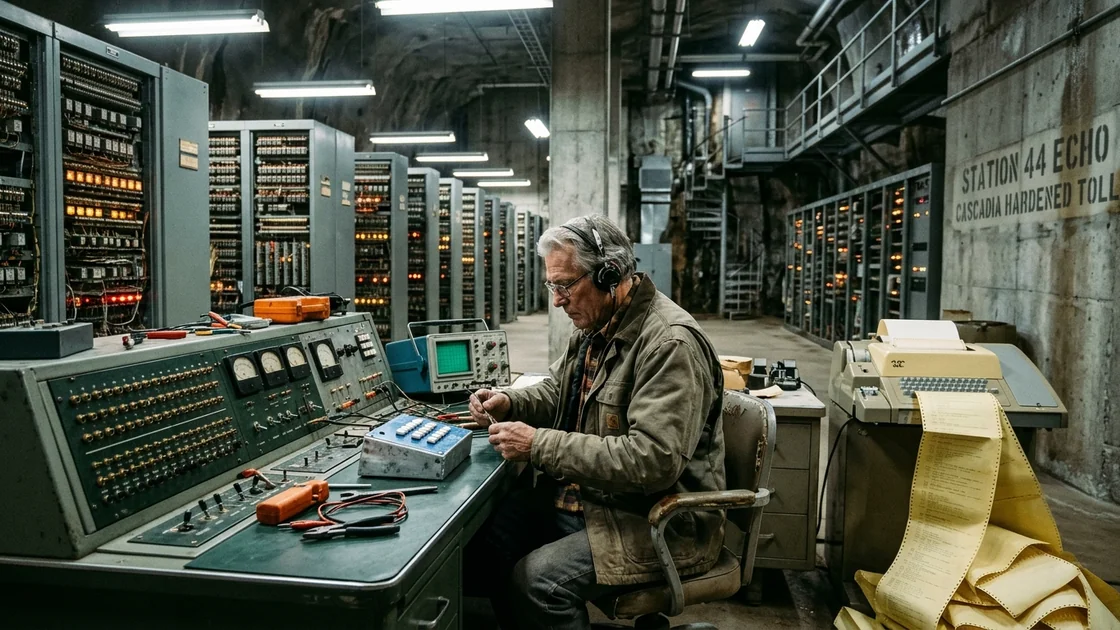
Julian Vance, a retired telecommunications engineer and former underground phone phreaker from the golden age of analog networks, lives a quiet life of solitude in the Cascade Mountains of Washington State. While investigating an abandoned forestry service telephone line near his remote cabin, he discovers that the buried copper wires still carry forty-eight volts of live current and respond to the obsolete twenty-six-hundred-hertz signaling tones of the twentieth century. Tracing the ancient lead-sheathed cable high into the alpine wilderness, Julian uncovers Station Forty-Four Echo, a forgotten Cold War continuity-of-government switching bunker powered by an underground glacial stream. Inside the subterranean cathedral of clicking electromechanical relays, he realizes the station is the master gateway to an undocumented shadow network that still bridges into the deepest layers of modern global infrastructure, from military command bunkers to international financial clearinghouses. As Julian explores this ghostly metallic realm alongside a fellow legendary phreaker who has lived inside the network for decades, his probes awaken an automated security tripwire in Seattle, forcing him to use every forgotten trick of his youth to defend the analog sanctuary from the digital authorities sent to erase it forever.
I. Ghosts in the Copper
The sound that woke Julian Vance from thirty years of retirement was not a ring, nor a voice, nor the polite electronic chirp of a modern fiber-optic terminal. It was the flat, hollow, unmistakable hiss of dry nitrogen escaping a cracked lead sleeve, followed by the sixty-cycle hum of a transformer that had no business being alive in the twenty-first century.
Julian lived four miles above the unincorporated timber town of Cougar Creek, Washington, in a cedar-shingle A-frame that smelled permanently of pine resin, rosin-core solder, and warm vacuum tubes. At sixty-eight, his knees predicted the rain better than the National Weather Service, and his fingers—once nimble enough to solder surface-mount diodes without a magnifying glass—were knotted at the knuckles like old vine maple. Yet his ears remained pristine. A lifetime of listening to the subtle acoustic geometry of the Bell System had tuned his auditory cortex into a precision spectrum analyzer. While other old men listened to jazz records or the morning warbling of varied thrushes, Julian listened to the silence of dead wires.
His basement was a mausoleum to an empire that had ceased to exist on January 1, 1984. Along the concrete walls stood steel relay racks salvaged from scrap yards in Tacoma and Portland during the great digital cutovers of the late nineteen-eighties. He had a working row of Western Electric step-by-step Strowger switches, a teakwood 555 PBX cordboard with brass plugs polished to a mirror shine, and shelves stacked high with rotary Model 500 telephones in moss green, ivory, and classic carbon black. On his workbench, resting upon a static-dissipative mat, sat a machine no larger than a paperback novel, housed in a scuffed aluminum Bud box with twelve white push-buttons arranged in a three-by-four grid.
It was a blue box, built by Julian’s own hands in the summer of 1976 in a cramped apartment in Berkeley. Inside its dented casing, a pair of Intersil 8038 waveform generator chips were wired to precision potentiometers, calibrated to produce the exact dual-frequency tones that the old long-distance network used to talk to itself. Back then, they had called him Vesper. He had been one of the quiet ones—not a showman who bragged to magazine reporters or dialed the Pope for a laugh, but a deep-route explorer who mapped the unlisted tandem trunks of the world like a sixteenth-century cartographer charting the Pacific. He had bounced his own voice off geostationary satellites over the Indian Ocean, routed through submarine cables under the English Channel, and looped through electromechanical switches in Stockholm and Tokyo just to hear the three-second echo of his own breath returning through the earpiece.
Then came Signaling System 7. The phone companies wised up, separating the voice path from the control path. The magic tones were stripped away from the customer’s reach and locked inside out-of-band digital packet channels. The copper loops were pulled down or left to rot in the dirt, replaced by hair-thin strands of glass carrying laser pulses that felt nothing, smelled of nothing, and clicked for no one. The wonder went out of the world, and Julian went to work for the very company he used to rob of long-distance minutes, spending three decades maintaining rural digital subscriber lines until they gave him a gold-plated lapel pin and a modest pension.
It was on a Tuesday in late October, after a windstorm had toppled a two-hundred-foot Douglas fir across the old logging grade behind his property, that the past reached up from the mud.
Julian had walked out with his chainsaw to clear the trail, enjoying the sharp, cold dampness of the autumn air. Where the massive root ball of the fir had ripped out of the earth, it had torn up a six-foot section of black, armored cable that had been buried four feet deep in the glacial till. Julian shut off his saw and knelt in the wet ferns.
He knew every utility line on the mountain, or thought he did. The county power ran on poles along the gravel road half a mile south; his own telephone and internet came via a terrible satellite dish bolted to his chimney because the local incumbent carrier had abandoned the copper plant up here in 2012. Yet here, tangled in the pale, earthy roots of the fallen giant, was a two-inch-thick cable sheathed in extruded lead and wrapped in tarred jute helical armor.
He scraped the mud off a cast-iron splice case clamped to the cable. Embossed in the rusted metal were the words WESTERN ELECTRIC and a stamped date: 1963.
"Well, hello, old girl," Julian murmured, his breath pluming in the chill air. "What were you doing down there? Going to the old fire lookout on Goat Peak?"
The Goat Peak lookout had burned down in 1979. Still, a curious lineman never walks past an exposed splice without checking the pair count. Julian walked back to his cabin, descended into the basement, and retrieved his Harris Dracon TS22 butt set—the classic orange lineman’s handset with heavy brass alligator clips dangling from a coiled fabric cord. He also grabbed a Fluke digital multimeter and a small leather pouch of splicing tools.
Returning to the uprooted tree, he unscrewed the four corroded brass bolts on the inspection port of the splice case. As the heavy iron lid came free, he heard it: ssssss-t. A tiny puff of bone-dry air hissed out against his knuckles, smelling faintly of paraffined paper and ancient machine oil.
Julian froze.
Lead-sheathed cables were filled with pressurized dry air or nitrogen at the central office to keep groundwater from seeping in through pinholes and shorting out the paper-insulated copper wires inside. If this cable had been abandoned forty years ago, the pressure would have bled off by the time Ronald Reagan took office. For that splice case to hold positive pressure meant that somewhere at the end of this line, an air-dryer compressor was still running.
His heart gave a slow, heavy thud against his ribs.
Inside the case lay twenty-four pairs of twenty-two-gauge solid copper wire, insulated with twisted strips of color-coded pulp paper and bound in waxed linen twine. One pair—the blue-and-white binder, pair number one—was separated from the main bundle and attached to a porcelain terminal block with two brass binding posts: Tip and Ring.
With fingers that trembled slightly from more than the autumn cold, Julian set his multimeter to DC volts and touched the probes to the brass posts.
The liquid crystal display jumped instantly. -48.2 V.
Clean, rock-steady, forty-eight-volt direct-current talk battery. The lifeblood of the telephone network since the days of Alexander Graham Bell.
Julian dropped the multimeter into the ferns. He unclipped his orange butt set, switched it to Monitor mode so he wouldn't draw loop current yet, and clipped the red lead to the Ring post and the black lead to the Tip. He raised the heavy receiver to his left ear.
Silence. Not the dead, vacuum silence of an open wire, but the warm, capacitative silence of a balanced metallic circuit stretching across miles of earth. Beneath it lay the faint, velvet purr of sixty-hertz induction and the microscopic crackle of thermal agitation in the copper atoms.
He clicked the thumb switch on the handset from Monitor to Talk, dropping a six-hundred-ohm load across the line.
Down in the unseen dark of the mountain, miles away, a line relay pulled in with an audible clack that echoed through the receiver. Then, a half-second later, the dial tone arrived.
Julian closed his eyes, leaning his forehead against the wet bark of the fallen fir. He knew that sound the way a priest knows the Latin Mass. It was not the sterile, crystal-oscillator 350-plus-440-hertz tone of a modern Nortel DMS-100 or a Lucent 5ESS digital switch. This tone had a slight, harmonic warble to it, a rich, brassy edge produced by a spinning magnetic tone wheel—a motor-driven alternator generating 600 hertz modulated at 120 hertz.
It was a City-type dial tone from a Western Electric crossbar or step-by-step exchange, vintage 1950s.
He reached onto the keypad of his butt set and pressed the 1 button, sending a Dual-Tone Multi-Frequency "Touch-Tone" beep down the line.
The dial tone didn't break. It just kept humming, completely ignoring the modern tone.
"Of course," Julian whispered to himself, a fierce, boyish grin breaking across his weathered face. "You don't speak DTMF on the trunk side, do you?"
He flipped the switch on his handset from Tone to Pulse and pressed the 0 button. The handset’s internal relay clicked ten times at a precise ten pulses per second, interrupting the loop current: click-click-click-click-click-click-click-click-click-click.
The warbling dial tone cut off instantly. In its place came a rush of white noise—amplified analog carrier hiss—followed by two sharp metallic clicks as a distant trunk circuit seized. Wait time. The line was waiting for an operator that wasn't there, or it was waiting for something else entirely.
Julian didn't wait for a recording. He unhooked the handset, scrambled out of the root crater, and half-ran, half-slid down the muddy trail toward his cabin. For the first time in three decades, he needed his blue box.
II. The Geometry of Tone
By nightfall, a drizzle had set in, pattering against the blue polyethylene tarp Julian had rigged over the root crater of the fallen fir. Beneath the tarp, illuminated by a Coleman lantern that hissed softly beside him, Julian had set up a field station on a folding aluminum camp table.
He had run a heavy pair of jumper wires from the splice case to an impedance-matching transformer on the table, hooking up a portable Tektronix oscilloscope, a frequency counter, and the battered aluminum Bud box from 1976. He had spent two hours in his basement replacing the dried-out electrolytic capacitors inside the blue box and checking the output frequencies against a rubidium time standard he kept on his workbench. Every button was dead-on within half a hertz of the old Bell System specifications.
He put on a pair of vintage Western Electric 52AW operator headphones—single earpiece, curved horn mouthpiece swung out of the way—and flipped the switch to seize the line.
The rotary tone wheel hummed in his ear. Julian dialed a single rotary pulse—1—which on certain legacy trunks bypassed the local selector and connected directly to an outgoing inter-toll trunk. The dial tone vanished, replaced by the long, open hiss of a vacant four-wire carrier channel. Far away, a supervisory lamp on some forgotten switchboard had just winked on.
Julian placed his right index finger on the top black button hooked to the single-frequency oscillator of his blue box.
In the old network, before the digital revolution, an idle long-distance trunk had a continuous 2600-hertz tone playing down the line—an audible whistle slightly higher than the E-flat near the top of a piano keyboard. As long as the distant switching machine heard 2600 hertz, it knew the line was free. When a call was connected, the tone was switched off. The fatal flaw of the system—the original sin that birthed the entire phone phreak subculture—was that the switching machine couldn't tell the difference between a 2600-hertz tone coming from another telephone company computer and a 2600-hertz tone played into the mouthpiece of a telephone by a kid in a bedroom.
If you seized a trunk and played 2600 hertz down the line for four hundred milliseconds, the distant machine thought you had hung up. It dropped the connection on the far end, leaving you sitting directly on the raw spine of the tandem switch, ready to accept internal routing commands in Multi-Frequency—MF—code.
Julian pressed the button.
Beeeeep.
A pure, piercing 2600-hertz sine wave shot down the copper pair, into the mud, and up into the dark mountains.
Julian released the button and held his breath, watching the green phosphor trace on his oscilloscope.
One hundred milliseconds. Two hundred.
Ka-clack-clunk.
On the oscilloscope screen, a sharp voltage spike danced across the grid, followed by a brief 2600-hertz "wink" returning from the distant end to acknowledge that the trunk was now open and awaiting instructions.
Julian let out a breath he felt he’d been holding since 1983. "Impossible," he whispered to the rain-swept woods. "There isn't an in-band SF supervisory unit left in North America."
Yet the trunk was sitting there, wide open, humming with forty-eight volts of patient expectancy.
Now for the routing tones. MF tones were different from regular telephone Touch-Tones; they used combinations of six frequencies—700, 900, 1100, 1300, 1500, and 1700 hertz—to represent digits, bookended by a Key Pulse (KP) tone to tell the register to start listening, and a Start (ST) tone to tell it to execute the route.
Julian’s fingers moved over the white buttons with muscle memory that fifty years couldn't erase. He hit KP, then dialed a classic internal test code used by Bell technicians in the 1970s to check the identity of a toll switch: 0-0-9-ST.
Boop—beep-beep-boop—bap.
The tones sounded like a tiny, melodic calliope playing in the dark.
Down the line, Julian heard the unmistakable mechanical symphony of a Western Electric No. 4A Crossbar switch going to work. Unlike the slow, rhythmic chug-chug-chug of a Strowger step switch, a crossbar machine used an electromechanical brain called a "Marker." You could hear the Marker seize the register—a rapid, machine-gun flutter of flat wire-spring relays chattering in a fraction of a second—followed by the heavy, decisive thwack of the vertical and horizontal hold bars slamming home to lock the metallic crosspoints together.
Then, a voice spoke in Julian’s ear.
It wasn't a human voice, and it wasn't a digital speech synthesizer. It was the slightly scratchy, optical-film audio of a 1960s Cognitronics Speechmaker—a machine that used a spinning transparent drum lined with photographic soundtracks, read by photodiodes like a movie projector. Each digit was spliced together with a rhythmic click as the mirror galvanometer jumped from track to track.
"Four... Four... Eight... Zero... One... Two... Zero."
The drum clicked, paused for two seconds, and repeated.
"Four... Four... Eight... Zero... One... Two... Zero."
Julian grabbed a waterproof notebook and scribbled the digits down. That was an internal routing coordinate and an office code, formatted in the old Defense Communications Agency AUTOVON style paired with a Bell System Class 2 Sectional Center prefix.
He severed the connection with another blast of 2600 hertz, waited for the wink, and keyed in another sequence: KP-1-1-5-1-ST. In the old days, the 115X codes were maintenance test boards and loop-around circuits.
Flutter-flutter-thwack.
This time, the line gave a single high-pitched beep and connected him to an audio bus. Through the headphone, Julian heard a steady, hypnotic sequence of Morse code being sent at twelve words per minute by a mechanical keyer in crisp, 800-hertz audio tone:
DE W7X-44E ... AUTOVON POLYGRID NODE 09 ... CASCADIA HARDENED TOLL ... BAT 52.4V ... HYDRO GEN 1 ONLINE ... N2 PRESS 11.2 PSI ... ALL TRUNKS NOMINAL ... AR
Julian sat back in his folding chair, the rain drumming steadily on the blue tarp above his head, the lantern light glinting off his glasses.
"Cascadia Hardened Toll," he breathed. "Forty-Four Echo."
He knew the legend. Back when he worked at Pacific Northwest Bell in the late eighties, the old linemen who had started in the fifties used to talk over beers about the "Granite Trunks." During the height of the Cuban Missile Crisis and the years immediately following, AT&T Long Lines and the Army Corps of Engineers had quietly built a series of deep-buried coaxial and paired-copper switching bunkers across the mountain ranges of the United States. Everyone knew about the big ones—Bigfella in Virginia, the massive caves in North Carolina and Pennsylvania.
But there were rumors of smaller, completely automated "Orphan Nodes" blasted into the granite batholiths of the Rockies and the Cascades. They were designed to survive a direct thermonuclear exchange, powered by diverted subterranean mountain streams turning Pelton micro-turbines, cooled by glacial groundwater, and equipped with self-healing electromechanical crossbar switches that required zero software updates, zero microprocessors, and zero human intervention to route military and continuity-of-government traffic across surviving copper paths.
According to company lore, all of those sites had been decommissioned, stripped of their copper, and flooded or welded shut after the fall of the Soviet Union in 1991.
"Except they missed one," Julian said aloud.
He looked down at his multimeter, switching it from voltage to resistance. Dropping the blue box off the line, he disconnected the Tip and Ring from the splice block and hooked up a vintage Leeds & Northrup Wheatstone bridge he had carried up from the basement. By measuring the direct-current loop resistance of the twenty-two-gauge copper pair up to the distant relay coil, and factoring in the ground temperature of fifty degrees Fahrenheit, he could calculate the exact physical length of the wire between his camp table and the switch.
Twenty-two-gauge pulp copper had a loop resistance of roughly 171 ohms per loop mile. He balanced the bridge until the galvanometer needle centered on zero, read the dials, subtracted the standard 400-ohm resistance of a Western Electric E-type line relay, and divided by 171.
"Eleven point four miles," Julian muttered.
He pulled out a laminated United States Geological Survey topographic map of the Snoqualmie and Wenatchee National Forests, spreading it across the camp table. The buried cable in the fir roots ran north-northeast, following the contour of the ridge above Cougar Creek. Eleven point four miles along that bearing, taking into account the switchbacks required to lay armored cable up a forty-degree granite escarpment, put the terminus of the line at roughly six thousand two hundred feet of elevation, right at the base of the Sawtooth Crags—a roadless wilderness area that had been closed to logging in 1974 after a massive rockslide wiped out the only forestry access road.
If the road had been buried under forty feet of granite talus in 1974, before the divestiture of the Bell System and before the post-Cold War decommissioning sweeps, the demolition crews in the nineties might have simply written the bunker off as inaccessible and severed the records at the regional office in Seattle, assuming the backup batteries would die within a week.
They hadn't realized the hydro-turbine in the mountain was still spinning.
And more importantly, Julian thought as he stared at the glowing green trace of the oscilloscope, if the switch was still sitting there, what else was still plugged into it?
He reconnected his clip leads, seized the trunk, blew 2600 hertz to clear the register, and typed a commercial international gateway routing code that hadn't been valid on the public telephone network since 1986: KP-0-1-1-4-4-1-8-0-8-ST. That was the old trans-Atlantic TAT-6 cable test desk in London. It should have returned a fast-busy reorder tone—twelve interruptions per second—indicating all paths were dead.
Instead, the crossbar switch in the mountain chattered, clicked twice, and paused. Then came another click, softer and further away, accompanied by the subtle phase-shift of an analog-to-digital channel bank converting the metallic circuit into a pulse-code-modulated stream.
Three seconds later, a crisp British voice—modern, digital, recorded on a contemporary server—spoke in Julian’s ear:
"British Telecom International Network Operations Center, Oswestry. Please enter your six-digit engineer PIN followed by the hash key."
The cold hair on Julian’s forearms stood straight up.
Forty-Four Echo wasn't an isolated museum piece clicking away to itself in the dark. Somewhere down in the lowlands—in Seattle, or Portland, or Spokane—its outgoing copper and coaxial trunks were still physically cross-connected into a legacy D4 channel bank sitting in the basement of a modern carrier hotel. And because those old military trunks had been provisioned fifty years ago with "Class 1 Toll Center" root authority and no billing records, the modern digital switches at the edge of the network were blindly accepting its commands, translating its ancient Multi-Frequency tones into modern SS7 and SIP packets, and routing them anywhere on Earth.
Julian slowly pulled the headphone off his ear and set it down on the table.
He had found the holy grail of phreaking. A physical backdoor into the global telecommunications grid, completely invisible to digital firewalls, totally unlogged by modern billing computers, waiting eleven miles up the mountain in the rain.
III. The Ascent to Forty-Four Echo
Julian spent the next two days preparing like a man planning an expedition to the moon, if the moon were made of wet granite and nineteen-sixties relay logic.
He dug out his old external-frame Kelty backpack from the attic and loaded it with carefully selected gear: his orange TS22 butt set, the 1976 blue box wrapped in a waterproof dry-bag with six fresh nine-volt lithium batteries, a compact Fluke Scopemeter, a roll of twenty-four-gauge jumper wire, a miniature wire-wrap tool, needle-nose pliers, and a selection of spring-steel relay adjusting tools that looked like dental picks. From a velvet-lined cigar box in his desk drawer, he took a single key on a brass bead chain.
It was a Bell System "S-109" heavy brass key, stamped PROPRIETARY - DO NOT DUPLICATE. In the old days, that single piece of milled brass would open everything from payphone coin vaults in Manhattan to microwave repeater huts in the Mojave Desert.
He left at dawn on Thursday. The rain had stopped, leaving the high Cascades swathed in a thick, luminous fog that smelled of crushed cedar needles and wet stone.
For the first four miles, tracing the cable was easy. Though the forest had reclaimed the original ten-foot right-of-way cut by the trenching machines sixty years ago, Julian knew how to read the subtle typography of buried infrastructure. Where the ancient bulldozers had disturbed the soil, red alder and vine maple grew in a straight, narrow ribbon through the older hemlock and Douglas fir. Every half-mile, half-buried in moss and salal bushes, he found a waist-high cast-iron post painted a faded, peeling Bell System orange, topped with a Schrader valve and a brass pressure gauge covered by a hinged iron cap.
At mile six, he came to the 1974 rockslide.
A whole shoulder of the mountain had sheared away forty-some years ago, burying the old forestry road under a quarter-mile-wide fan of house-sized granite boulders covered in grey lichen. A modern fiber line, strung on poles or laid in shallow plastic conduit, would have been sheared cleanly in two by the slide.
Julian climbed carefully over the talus, his boots finding purchase on the rough stone, until he reached the center of the slide zone. He smiled. The Long Lines engineers of 1962 hadn't trusted the logging road across the talus slope. Before the slide ever happened, they had directional-drilled the cable conduit ten feet deep into the solid bedrock beneath the loose scree. The mountain had collapsed over it, burying the route so deeply that no salvage crew could ever reach it, while leaving the armored cable below completely untouched.
Beyond the rockslide, the trail grew steep and wild. There were no boot prints here, only the cloven tracks of Roosevelt elk in the black mud and the occasional pile of bear scat full of mountain huckleberries. The air grew thin and sharp, the trees shrinking into twisted, wind-sculpted subalpine firs.
At two o'clock in the afternoon, at an elevation of six thousand three hundred feet, the line of alders ended abruptly at the base of a sheer vertical cliff of grey granodiorite.
Julian stood catching his breath, his thighs burning, his breath clouding in the thirty-eight-degree air. Above him, the granite face rose four hundred feet into the mist. At the base of the cliff stood what looked like an abandoned concrete avalanche shed—a squat, windowless structure with a sloped roof three feet thick, overgrown with moss and half-buried under fallen rock and avalanche debris from fifty winters. A rusted steel sign, pitted with old twenty-two-caliber bullet holes from hunters in the sixties, was bolted to the concrete wall:
U.S. FOREST SERVICE SOIL STABILIZATION & SNOW SURVEY STATION NO. 44 DANGER - HIGH VOLTAGE EQUIPMENT INSIDE NO TRESPASSING
"Snow survey station," Julian chuckled softly, wiping sweat from his forehead. "Sure it is. With four-foot-thick reinforced blast walls and a wave-trap air intake concealed in the chimney."
He pushed through a thicket of thorny devil’s club to reach the heavy steel door set into the recessed concrete alcove. The door was painted olive drab beneath flaking grey primer. There was no modern keycard reader, no biometric scanner, no solar-powered cellular alarm panel. There was only a massive, flush-mounted Corbin mortise lock with a sliding brass dust cover over the keyway.
Julian slid the dust cover aside. Inside, the brass pins were bright and free of corrosion, protected from the weather for half a century. He pulled the Bell S-109 key from his pocket, slid it into the slot, and turned.
For a moment, hardened grease from the Johnson administration resisted him. Julian leaned his weight against the steel door to relieve the pressure on the latch bolt, then twisted the key with both thumbs.
Clack.
The heavy deadbolt retracted with the oiled precision of a Swiss bank vault.
Julian pulled the door open. A wave of warm, dry air rolled out to meet him, carrying a scent that made his eyes sting with sudden, unexpected nostalgia: ozone, warm beeswax, phenolic resin, and the faint, unmistakable tang of sperm-whale oil—the specialized lubricant Western Electric used on high-speed rotary switches because it never gummed up over time.
He stepped inside, switched on his LED headlamp, and pulled the blast door shut behind him.
He was in an concrete airlock chamber with a decontamination shower whose brass nozzles had never seen water. Opposite the outer door stood an inner submarine-style hatch with a central dogging wheel. It wasn't locked. Julian spun the steel wheel four turns, heard the perimeter dogs clank free, and pulled the hatch open.
He didn't need his headlamp anymore.
As the inner hatch swung wide, a reed switch in the doorframe clicked, and row after row of overhead industrial fluorescent tubes flickered to life with a resonant magnetic buzz, bathing a vast subterranean cavern in cool white light.
Julian stood on a steel catwalk at the top of a spiral staircase, looking down into a two-story vault blasted directly out of the mountain's heart and lined with white-painted concrete panels.
Below him, arranged in sixteen neat, military-straight aisles, stood the tall grey steel frames of a complete Western Electric No. 4A Crossbar Toll Switching System, flanked by four olive-drab bays of RCA-built AUTOVON polygrid encryption and priority-routing equipment.
And the room was alive.
It wasn't loud, not like a factory floor, because only a handful of circuits were active at any given moment. Instead, the cavern breathed with a continuous, living susurration. Far down Aisle Three, a Marker frame chattered like a metal woodpecker—tik-tik-tik-clack—as it processed a routing supervision check from some distant trunk. Near the far wall, where two massive black penstocks came out of the living rock and fed into a pair of green Westinghouse Pelton-wheel hydro-generators, there was the deep, comforting whirrrr of spinning armatures generating steady DC power, charging banks of massive, transparent glass-jar lead-acid batteries whose lead plates floated in pristine sulfuric acid, maintained by an automated distilled-water drip system fed by condensed glacial runoff.
In the corner, beside the Main Distribution Frame where ten thousand cloth-insulated wires fanned out in neat, hand-laced harnesses tied with waxed linen twine, an air-dryer compressor kicked on for ten seconds—chug-chug-chug-chug-psssht—pumping dry nitrogen into the outgoing cables before falling silent again.
Julian walked slowly down the spiral stairs, his hand trailing along the cold steel rail. He felt like Howard Carter stepping into the antechamber of Tutankhamun’s tomb, except the pharaoh was still sitting on his throne, breathing and counting pulses.
At the center of the floor stood the Toll Test Desk—a long console of grey metal and dark green linoleum, lined with rows of brass tip-and-ring jacks, black Bakelite toggle keys, Weston analog voltmeters with mirrored scales, and a rotary dial mounted at an ergonomic forty-five-degree angle.
Beside the desk sat a Teletype Model 35 ASR—a massive electromechanical typewriter on a steel pedestal. Behind it, resting on the floor, was a mountain of fan-fold sprocket paper nearly four feet high, yellowed at the bottom and crisp white at the top. Every twelve minutes, the Teletype’s motor spun up with a mechanical whirr, its typebox hammered across the platen—clack-clack-clack-clack-ding-zip—printing a single line of status telemetry in purple ink before shutting back down:
10/26 14:24 SITE 44E STATUS: OK / HYDRO-A 52.4V / TRK ACTV: 003 / ERR: 000
Julian walked over to the paper pile and lifted the top few sheets, reading backward through time. Three active trunks. All day, every day, for years, three trunks had been passing traffic through this room.
"Who are you talking to?" Julian asked the empty cavern.
He shrugged off his heavy backpack, sat down in the swivel chair at the Toll Test Desk—its cracked green vinyl cushions sighing beneath him—and opened his toolkit.
IV. The Shadow Directory
On the desk, tucked neatly into a steel binder rack beside the test jacks, were the station's master circuit layout record cards—hundreds of stiff buff-colored index cards typed on an IBM Selectric typewriter between 1963 and 1973.
Julian flipped through them, his eyes scanning the archaic abbreviations of the Long Lines department.
Most of the local mountain trunks—the fire lookouts, the Army Nike missile site near Redmond that had been turned into a public park forty years ago, the Civil Defense bunker under the state capitol in Olympia—were marked OUT OF SERVICE - OPEN PAIR in red grease pencil, or showed infinite impedance on the test board.
But the primary inter-toll carrier groups—Groups A, B, and C—ran out of the bunker via a deep-buried coaxial L-carrier tube that followed the river valley all the way down to the Westin Building in downtown Seattle, the premier telecommunications carrier hotel of the Pacific Northwest.
According to a yellowed maintenance note taped to the inside cover of the binder, dated November 14, 1989:
PER DEFENSE COMMUNICATIONS AGENCY DIRECTIVE 89-412: ALL GROUP A & B ANALOG TRUNKS FROM SITE 44-ECHO TERMINATED AT SEATTLE MAIN (STTLWAMA) FRAME 14, CONVERTED VIA ROCKWELL COLLINS D4 CHANNEL BANK TO DS1 DIGITAL HIERARCHY (PRIORITY EXEMPT - NON-BILLABLE FEDERAL CONTINUITY BRIDGE). DO NOT DISCONNECT WITHOUT WRITTEN ORDER FROM JOINT CHIEFS J-6.
"Sweet mother of Bell," Julian breathed.
In 1989, during the chaos of transitioning the military's old analog AUTOVON network to the Defense Switched Network, some mid-level engineer in Seattle had taken the analog trunks coming down from the mountain, plugged them into a digital converter rack in the basement of the Seattle hub, flagged the digital ports in the master database as "Federal Continuity - Do Not Touch," and retired. Over the next thirty-five years, as software upgrades and hardware migrations swept through the Seattle hub, every new generation of engineers had simply migrated that "Federal Continuity" T1 circuit onto the next generation of fiber-optic switches, terrified of unplugging a legacy military line that didn't appear on their local blueprints.
And because the channel bank translated 44-Echo’s analog E&M (Ear and Mouth) supervisory signaling directly into SS7 Initial Address Messages with an "Executive Override / Non-Billable" bit set in the packet header, the mountain bunker possessed what amounted to God-mode credentials on the global network.
Julian didn't even need his blue box down here. He was sitting at the master test board behind the toll blocks. The desk itself had a built-in Multi-Frequency keyset on the right-hand wing—twelve heavy, square black buttons with white legends: 1 through 0, plus KP and ST, and four red military precedence buttons labeled ROUTINE, PRIORITY, IMMEDIATE, and FLASH OVERRIDE.
First, he wanted to see what those three active trunks mentioned on the Teletype were doing.
He scanned the Incoming Trunk status panel at the top of the test board. Out of two hundred tiny glass switchboard lamps, three were glowing with a steady, warm amber light: Trunk 014, Trunk 089, and Trunk 112.
Julian took a double-ended brass patch cord, plugged one end into the HIGH-IMPEDANCE MONITOR jack on his console—which used a vacuum-tube cathode follower so that listening in wouldn't drop the voltage on the line by even a millivolt—and plugged the other end into the test jack for Trunk 014. He slipped on the desk's headset.
Beeee-boooo-beeee-boop-boop-beeee...
It was the warbling, twin-tone frequency-shift keying of a 300-baud Bell 103 modem, running continuously. Julian hooked his Fluke Scopemeter across the audio monitor output and set it to decode ASCII serial data. Across the small screen scrolled a continuous, unencrypted stream of comma-delimited numbers and stock ticker symbols, updated every five seconds, accompanied by reserve bank routing codes from Zurich, New York, and Tokyo.
He checked the circuit layout card for Trunk 014. Originally provisioned in 1971 as an emergency teletype fallback tie-line between the Federal Reserve Bank of San Francisco (Seattle Branch) and a continuity bunker in Virginia. Someone—or some ancient mainframe still humming in a bank basement—was still mirroring real-time interbank settlement liquidity tables across the analog fallback loop.
He pulled the plug and moved it to Trunk 089.
Static. A deep, oceanic rumble, rhythmic and slow, punctuated every forty seconds by a high, metallic ping and a burst of modulated telemetry clicks. He checked the card: NAVAL FACILITY PACIFIC BEACH - SOSUS HYDROPHONE ARRAY RELAY 4. The Navy had closed the Pacific Beach facility decades ago, yet one of the undersea acoustic cable amplifiers on the Juan de Fuca Ridge was still powered over the copper sea-ground and dumping raw whale songs and submarine propeller signatures into a dead trunk that terminated in a continuous loop-back at 44-Echo.
Julian smiled at the eerie majesty of it—the literal voice of the Pacific Ocean floor, echoing inside a hollow mountain sixty miles inland.
Then he plugged into Trunk 112.
He expected another forgotten machine: a weather buoy, a dam water-level sensor, an automated numbers station waiting for a war that never came.
Instead, he heard breathing.
It was faint, masked by the gentle hiss of an international trans-oceanic circuit, accompanied by the rhythmic clicking of someone typing on a mechanical keyboard in a quiet room. Every few minutes, there was the soft clink of a ceramic mug being set down on a wooden desk.
Suddenly, a burst of Multi-Frequency tones erupted on the line—not from 44-Echo’s test board, but coming in from the outside on Trunk 112, bouncing through 44-Echo’s tandem Marker, and seizing an outgoing trunk to Frankfurt, Germany.
Someone outside was dialing into 44-Echo, blowing a 2600-hertz tone to drop the incoming termination, and using the mountain switch as an anonymous, untraceable proxy to bounce calls around the world.
Julian’s eyes widened. He looked at the incoming trunk card for 112. It was a direct tie-line to an old microwave horn relay route that ran south through Oregon into the high desert of northern Nevada—the old AT&T transcontinental bypass route.
On the line, the distant caller finished their data burst to Frankfurt, sent a 2600-hertz wink to clear the forward leg while holding the incoming trunk open, and sat idling on the 44-Echo tandem bus.
Julian looked down at the black toggle switch labeled TALK / MONITOR under his right hand.
For thirty years, he had thought he was the last one. The other legends of the seventies—the kids and young engineers who had lived on the midnight party lines, who had mapped the AUTOVON nodes and traded Bell System Practices in parking lots at two in the morning—had all either gone straight, gone to prison, or died of old age.
Slowly, Julian flipped the toggle key to TALK.
He didn't speak. In the old culture, you didn't announce yourself on an active tandem trunk with words. You spoke in the language of the machine.
He reached over to the MF keyset and tapped out a rhythmic, musical cadence using the 700-hertz and 900-hertz tones—the old six-note "Shave and a Haircut" rhythm, leaving off the final two beats.
Boop-beep-beep-boop-beep...
On Trunk 112, the distant typing stopped instantly. The breathing vanished as the person on the other end muted their microphone.
For five seconds, the copper circuit stretching between the Washington Cascades and the Nevada desert held a tension so tight Julian could hear the thermal drift of the repeaters in Oregon.
Then, from seven hundred miles away, two crisp MF tones came back down the wire:
Beep-boop!
Two bits.
Followed by a woman’s voice—low, raspy with age and desert dust, speaking through a carbon-granule transmitter that gave her words the warm, compressed intimacy of an AM radio broadcast at three in the morning.
"Well, I'll be damned," the voice said. "Someone's sitting at the test board in Forty-Four Echo. Wait—let me guess that cadence. You always dragged the fourth beat by twenty milliseconds. Vesper?"
Julian’s jaw went slack. A chill raced down his spine, sharper and sweeter than the mountain air. Only one person in the history of the underground had ever analyzed the rhythmic micro-timing of other phreaks' manual tone-keying like a telegraph operator recognizing a "fist."
"Maren?" Julian whispered into the horn mouthpiece. "Zero-Beat?"
A dry, delighted laugh crackled across the trunk. "In the flesh, Julian. Or what's left of it at seventy-one. Though if you tell the FBI I’m still breathing, I’ll route every sewer-pump alarm in King County to your bedside phone."
V. The Ghost on Trunk One-Twelve
Maren Lindqvist—known on the midnight conference bridges of 1978 as Zero-Beat, named after the technique of tuning two radio oscillators to the exact same frequency until the interference whistle disappears—had vanished off the face of the earth in November 1983.
Back then, a combined task force of AT&T Security and the Secret Service had raided seventeen apartments across the West Coast after someone discovered that a group of phreaks had mapped the entire White House Communications Agency fallback network. Julian had been clean by then, having burned his notebooks a year earlier when he took his engineering job. Maren, whose apartment in San Jose was filled with four tons of stolen Teletype machines and original topological blueprints of the North American toll grid, had walked out her back door ten minutes before the agents kicked in the front, leaving behind a cassette tape playing a continuous 2600-hertz tone on her stereo.
No one had ever heard from her again. Rumor said she had fled to Brazil, or drowned in Puget Sound, or been quietly recruited by the National Security Agency.
"Where the hell are you?" Julian asked, leaning his elbows on the green linoleum of the test desk, grinning into the empty vault of clicking relays. "And how long have you been riding my mountain?"
"Your mountain?" Maren scoffed warmly. "Julian, I’ve been bouncing through Forty-Four Echo since 1994. As for where I am, I’m sitting in the equipment room of an decommissioned AT&T Long Lines microwave tower fifty miles east of Tonopah, Nevada. Bought the land at a Bureau of Land Management auction in '92 under a shell company for twelve hundred bucks. Came with four steel horn antennas on the roof, a three-thousand-gallon propane tank, solar panels, and a live subterranean K-carrier coax splice in the basement that nobody at Nevada Bell knew existed."
"You've been living inside the network for forty years," Julian marveled.
"Why leave?" she asked softly. "You saw what they turned the outside world into, Julian. Packet-switched glass. Every word you say, every byte you move, logged, monetized, scraped by algorithms, and stored in a data center in Utah. Out there, you’re a data point. Down here on the Under-Trunk... it’s still 1975. When a relay closes between you and me, there is a continuous, unbroken piece of metal connecting your voice coil to my ear. No packets. No logs. Just electrons moving through copper."
"How big is it?" Julian asked, looking around at the towering grey frames of the crossbar switch. "How much of the old grid is still hooked together?"
"More than they would ever believe, and less every year," Maren said, her voice turning reflective. "I call it the Rust Belt. There are maybe nineteen nodes like Forty-Four Echo left across North America and Europe—some crossbar, some late-model analog ESS-1 machines left running in forgotten vaults under railway terminals or Cold War civil defense hubs. They’re all linked together by dark pairs and forgotten federal tie-lines that got grandfathered into the fiber trunks through legacy channel banks."
She paused, and Julian heard her strike a match and light a cigarette.
"I don't abuse it," she continued, exhaling smoke that rustled faintly against her microphone. "That’s the rule of survival down here. If you make noise, the modern network integrity software notices the anomalous traffic on the legacy T1 ports and sends a human with wire-cutters to investigate. I use it softly. A little 300-baud connection into a municipal tax database in Carson City to mark my property taxes paid every year. A whisper into a logistics computer in Reno to have groceries and diesel fuel delivered to a drop-box at the end of my dirt road, billed to a telecommunications maintenance escrow fund established by the Atomic Energy Commission in 1968 that still has four million dollars of automated treasury interest sitting in it. And mostly... I just listen."
"Like we used to," Julian said.
"Like we used to. There are numbers stations in Belarus that still take their audio feed over analog landlines before hitting the shortwave transmitters. There are red rotary phones sitting inside empty wood-paneled conference rooms under the Pentagon that haven't rung since the Nixon administration, and if you hook a high-impedance amp to their ring capacitors, the bells act like weak piezoelectric microphones—you can still hear the janitors vacuuming the hallway outside."
Julian laughed aloud, the sound echoing off the concrete ceiling of the bunker. The sheer, audacious romance of it made him feel twenty-two again.
"Wait," Maren’s voice sharpened suddenly. The amusement vanished from her tone, replaced by the cold, razor-edged focus Julian remembered from the nights when Ma Bell’s security sweepers were tracing a loop. "Julian. How did you find Forty-Four Echo?"
"A tree fell behind my cabin two days ago," Julian explained. "Pulled up an old twenty-four-pair forestry trunk. I found forty-eight volts on Pair One, hooked up my old blue box, and started probing the tandem."
Silence fell on the line. Not a comfortable silence.
"You probed it from the outside loop?" Maren asked slowly. "What did you dial?"
"Just a couple of test codes. 009. 1151. And... well, I dialed an old TAT-6 gateway code to Oswestry in the UK just to see if the international translations still worked."
"You dialed an international route from an unconditioned local forestry pair," Maren whispered. "Did you set the precedence bit first?"
"No," Julian said, his stomach suddenly sinking. "I was using a standard consumer twelve-button blue box. I didn't have the fourth column of AUTOVON precedence tones."
"Oh, Julian," Maren breathed. "Listen to me very carefully. When I route through Forty-Four Echo, I come in on a Class 1 inter-toll trunk with the ROUTINE military header pre-set by my terminal equipment. That matches the expected traffic profile of the D4 channel bank in Seattle. When you seized a local forestry loop—which is wired into the switch as an unauthenticated station line—and forced the Marker to route an international call without a military precedence bit, the translator frame at Forty-Four Echo generated an 'Invalid Class of Service Override' alarm."
Julian looked over at the Teletype Model 35 sitting beside the desk.
"The Teletype here says ERR: 000," Julian said
defensively.
"Because the local register clears at midnight!" Maren snapped. "Look down the paper pile to Tuesday night!"
Julian scrambled out of his chair, dropped to his knees beside the four-foot stack of fan-fold paper, and counted back six folds to Tuesday evening at 21:14.
There, standing out against the monotonous rows of purple
STATUS: OK lines, the Teletype had shifted its ribbon to
red ink:
10/24 21:14 ALM-MAJ: UN-AUTH COS OVERRIDE ON LOOP 001 -> INTL TRK GRP A
10/24 21:14 AUTO-TELEMETRY DISPATCH SENT TO CLLI: STTLWAMA01T (SEATTLE MAIN)
Before Julian could speak, every fluorescent light in the bunker blinked once as a heavy relay on the wall pulled in.
And the Teletype Model 35 erupted to life.
It wasn't the polite, twelve-minute status line. The mechanical bell clanged four times—ding-ding-ding-ding!—and the print head began hammering across the page at its maximum speed of ten characters per second, driven by an incoming 110-baud current-loop signal coming up the coaxial trunk from Seattle:
*** REMOTE INTERROGATION INITIATED BY: LUMEN/CENTURYLINK FEDERAL LEGACY ASSET SECURITY (SEATTLE) ***
QUERY SITE ID ... 44E RESPONDING
RUNNING LOOPBACK DIAGNOSTIC ON GROUP A TRUNKS ...
ANOMALOUS OFF-HOOK DETECTED ON TEST BOARD CKT 112
WARNING: UNAUTHORIZED METALLIC ACCESS CONFIRMED AT SITE 44-ECHO.
FEDERAL RECLAMATION CONTRACTOR TEAM 4 DISPATCHED VIA USFS HELO.
ETA SITE COORDINATES: 18 MINUTES.
INITIATING REMOTE TRUNK LOCKOUT SEQUENCE IN 300 SECONDS...
Julian stared at the red ink bleeding into the paper.
"Maren," he said, grabbing the headset and pulling it back over his ear. "Seattle just woke up."
VI. The Sweepers Arrive
Through the earpiece, Julian heard Maren curse softly, followed by the rapid clack of switches being thrown in her Nevada tower.
"They didn't just wake up, Julian," she said, her voice tight and fast. "I’m watching the SS7 signaling gateway in Seattle through a maintenance port in Portland. When your Tuesday night probe threw that Class of Service flag, an automated script at the carrier hotel flagged the legacy T1 port for manual audit. An engineer in Seattle just plugged a laptop into the D4 channel bank ten minutes ago, saw forty-eight volts of live metallic supervision coming from a mountain site that their digital database says was bulldozed in 1993, and escalated it to Federal Asset Security."
"A helicopter?" Julian looked toward the concrete ceiling. "Over an old phone switch?"
"Not over a phone switch!" Maren barked. "Over an undocumented, un-firewalled hardware bridge sitting directly inside the federal continuity backbone! To a modern cybersecurity director at the Department of Homeland Security, Forty-Four Echo isn't an antique—it's a catastrophic zero-day physical vulnerability. If a foreign intelligence service found that bunker, they could inject voice and data traffic directly into military and financial legacy networks without touching the internet. They’re coming up there to pull the main breakers, thermite the crossbar frames, and trace every active trunk connected to the board—including Trunk 112 straight back to my front door in Nevada!"
Julian’s heart hammered against his ribs. "Drop the line, Maren! Unplug your coax splice right now!"
"It doesn't work like that!" she cried. "My trunk is hard-wired through an intermediate repeater in Boise that logs the last active impedance state when a trunk drops abnormally. If Seattle runs a metallic time-domain reflectometry sweep through Forty-Four Echo’s test frame before you clear the mechanical crosspoints in that room, they’ll map my exact cable mileage down to the yard. And I can't clear the crosspoints from my end because Seattle just locked the incoming trunk registers into 'Trace Hold'!"
Julian looked across the room at Trunk Frame B. Sure enough, the release magnets on the crossbar switches for Trunk 112 were held energized by a red supervisory lamp labeled MALICIOUS CALL TRACE / REMOTE HOLD. In the old electromechanical days, when the police wanted to trace a call, the destination exchange didn't print out a number on a computer screen—it physically locked the mechanical relays in place with high holding current so a technician could walk down the aisle with a flashlight, see which physical crosspoints were touching, and read the wire tags by hand.
Seattle’s modern diagnostic software was emulating the old trace-hold voltage on the channel bank to freeze the bunker’s switches until the field team arrived to read the physical wiring cards on the Main Distribution Frame.
And then Julian heard it—not through the headphones, but through the ventilation shaft in the ceiling.
Whup-whup-whup-whup-whup.
The deep, percussive chop of a twin-engine Bell 412 helicopter beating the thin mountain air, echoing off the granite walls of the Sawtooth Crags. On the bunker’s perimeter security board—a panel of sixty-year-old Westinghouse seismic geophones buried along the ridge trail—three amber needles began to bounce wildly as heavy rotor wash buffeted the clearing outside the avalanche shed.
"They're landing on the talus slope a quarter-mile below the door," Julian said, his voice dropping into a calm, icy register he hadn't heard in himself since his twenties. Panic was for people who didn't understand how the machine worked. And Julian knew every bolt, spring, and copper winding in this room.
"Julian, get out of there," Maren said, her voice cracking for the first time. "Leave it. If they catch you inside a federal continuity bunker, you’ll spend the rest of your life in a federal penitentiary. I’m seventy-one years old—I’ve had a good forty-year run in the desert. Go out the emergency escape shaft behind the hydro-turbines!"
Julian looked at the towering grey frames of the No. 4A Crossbar switch. He looked at the neat, hand-tied lacework of the Main Distribution Frame, crafted sixty years ago by dead linemen who took pride in every half-hitch knot. He thought of Maren sitting in her desert tower, the last living ghost of the analog world. And he thought of the soulless digital sweepers dropping out of the sky with thermite grenades and iPads to murder the last honest machine in the mountains.
"Not a chance, Zero-Beat," Julian said. "Do you remember the Seattle Toll Cutover of 1979?"
"What?"
"When they tried to put the new electronic traffic service position system online, and we looped the ringing generator back into the trunk supervisory scanner?"
A pause on the line. "You burned out four hundred channel cards in ten seconds and made the central office computer think Tacoma had fallen into Puget Sound."
"Stay on the line, Maren," Julian said, pulling his headset off and letting it dangle around his neck. "Actually, no—put your ears in high-impedance monitor mode and take your headphones off your head in exactly three minutes. It’s going to get loud on the copper."
VII. The Crossbar Gambit
Julian had twelve minutes before the security team climbed the four-hundred-foot boulder field from the helicopter landing zone to the bunker door. And he had less than four minutes before the Seattle technician's remote script finished locking out the local test board controls.
He didn't need a keyboard. You couldn't fight a 1962 electromechanical switch with software, and you couldn't defeat a man standing inside the switch room from a desk in Seattle—because in the analog world, physics always beat code.
First: break the Trace Hold on Maren’s trunk and wipe her history without alerting Seattle that the circuit had opened prematurely.
Julian grabbed a handful of wooden flat toothpicks from a jar of contact-cleaning swabs on the test desk, along with a pair of insulated alligator-clip jumper leads and his heavy diagonal wire cutters. He ran down Aisle Four to the Incoming Trunk Frame where Trunk 112 was locked in the jaws of the crossbar switch.
He found the bay. The vertical and horizontal select bars were clamped tightly together, holding a tiny pair of palladium-silver contacts closed while the release magnet hummed with Seattle's holding current. If he simply pried the relay open or cut the wire, the sudden drop in loop current would register instantly on the Seattle engineer’s laptop as a manual tamper, and the trace data up to the Boise repeater would already be logged in their buffer.
He needed to fool the Seattle channel bank into thinking Trunk 112 had never gone to Nevada at all.
Julian clipped one end of a jumper lead to the Tip and Ring of Trunk 112 on the switch side of the holding coil, and clipped the other end to an idle termination on the bunker's own internal Cognitronics Speechmaker announcement drum—specifically, Track 14, which was a pre-recorded Department of Energy nuclear hazard warning loop from 1967. Then, using two wooden toothpicks, he wedged the armature of the impedance-matching line relay so the DC loop current flowing back to Seattle wouldn't flicker by even a microamp when he transferred the load.
With a single snap of his diagonal cutters, he snipped the physical cloth-insulated jumper wires leading to Maren’s Nevada tie-line on the Main Distribution Frame, stripping them back and tucking them invisibly into a dead cable bundle tied off in 1971.
He pulled the circuit layout card for Trunk 112 out of the desk binder, walked over to the emergency incinerator chute by the airlock, and dropped it into the ash pit, replacing it in the binder with a blank spare card he quickly stamped SPARE - TERMINATED AT LOCAL AUDIO ANN. TRK 14 using the dusty rubber stamps on the technician's desk.
"Step one done," Julian muttered, sweat stinging his eyes. "Maren is a ghost again."
On the Teletype, the print head clattered furiously:
TRK 112 AUDIO VERIFIED: AUTOMATED DOE RADIATION MONITOR LOOP. FALSE POSITIVE LOGGED.
PROCEEDING TO SITE DECOMMISSIONING PROTOCOL. FIELD TEAM AT PERIMETER.
Out in the entry corridor, the red indicator light above the outer blast door began to flash. A magnetic proximity sensor outside the avalanche shed had just been tripped. Someone was standing at the outer steel door, fifty feet of concrete tunnel away.
Julian hears the muffled clang of a crowbar or a hydraulic halligan tool being wedged against the outer Corbin lock.
They were going to breach the door in less than three minutes. Once they got inside and saw the running switch and Julian standing there, it didn't matter what the Teletype said—they would arrest him and gut the station.
Unless they were ordered to abort by an authority higher than their own dispatch office before they got through the inner submarine hatch.
Julian sprinted back to the Toll Test Desk. How do you command a twenty-first-century federal security team to turn around and walk away using a room full of nineteen-sixties relays?
You use the very thing they came to destroy: the un-firewalled, absolute root authority of the AUTOVON continuity bridge.
The contractors outside weren't communicating with Seattle via the copper cable; they would be carrying ruggedized satellite-linked tactical tablets or encrypted cellular phones linked to the Federal Telecommunications System (FTS) dispatch server in Washington, D.C., and Seattle.
And sitting in Rack C-4 of Forty-Four Echo was an RCA AUTOVON Polygrid Matrix equipped with a hardware FLASH OVERRIDE injector.
In the Cold War, FLASH OVERRIDE wasn't a priority request; it was a network-wide physical preemption command reserved for the President, the Secretary of Defense, and North American Aerospace Defense Command sites under direct attack. When a verified AUTOVON node injected a Flash Override tone sequence into a federal gateway, even modern Cisco and Juniper routers running the Defense Information Systems Agency's Assured Services SIP protocol were federally mandated by backwards-compatibility defense standards to honor the preemption flag from a legacy Class 1 Continuity Node, instantly seizing the command dispatch bridges and routing emergency voice/data instructions to field units.
The Teletype hammered out the Seattle terminal's identifier:
ACTIVE DISPATCH SESSION: FTS-BRIDGE-SEATTLE-8804-SEC-TEAM-4
Julian had the bridge number. Now he needed to blind the Seattle engineer who was monitoring the channel bank so the engineer couldn't cancel the override, while simultaneously spoofing an automated Department of Energy containment breach abort order directly onto Team 4’s tactical comms bridge.
"Time for some high-voltage phreaking," Julian breathed.
He ran to the Power Board at the back of the cavern, beside the spinning Pelton hydro-turbines. Mounted on a slate panel was the station’s Master Ringing Machine—a heavy, brushless Holtzer-Cabot rotary converter that generated 105 volts of alternating current at 20 hertz, backed by five amperes of raw hydro-electric current, designed to physically ring the brass bells on two thousand telephones simultaneously across fifty miles of wet mountain wire.
Beside it was the Sub-Cycle coin-collect battery supply: +130 Volts DC, used in the old days to slam the magnetic coin-return chutes in payphones from miles away.
A modern digital D4 channel bank in Seattle was protected against lightning strikes by solid-state gas-discharge tubes on the line side, which tripped at 300 volts. Anything under 250 volts passed straight through the primary protectors into the sensitive 5-volt CMOS integrated circuits of the modern diagnostic interface card that the Seattle engineer was currently using to interrogate the mountain.
Julian grabbed a heavy fourteen-gauge copper test cord with large brass crocodile clips. He clipped one end to the +130V DC coin-collect bus bar, connected it in series with the 105V AC ringing generator output—creating a superimposed 235-volt pulsing hammer of raw electrical fury—and carried the live, sparking clip back toward the Main Distribution Frame.
Before he touched it to the Seattle diagnostic pair, he sat down at the Toll Test Desk one last time.
In the outer airlock, the outer steel door gave a loud BANG as a hydraulic spreader snapped the sixty-year-old Corbin deadbolt. Heavy boots echoed in the concrete decontamination chamber. They were at the inner submarine hatch now, thirty feet away. The steel dogging wheel on the hatch began to turn slowly as someone on the other side muscled it counterclockwise.
Julian’s fingers flew across the test board with the speed and precision of a concert pianist.
He plugged the station’s automated Teletype tape-reader—loaded with a punched yellow paper tape from 1973 labeled PROTOCOL 99: RADIOLOGICAL CONTAINMENT SEAL / STAND DOWN ALL PERSONNEL—into Outgoing Trunk 002.
He hit the blood-red button on the MF console labeled FLASH OVERRIDE.
BEEP-BOOP! (1700 Hz + 900 Hz—the forbidden tone of nuclear preemption).
He keyed in the Seattle Federal Dispatch Bridge routing sequence from the Teletype readout: KP-8-8-0-4-ST, patching it simultaneously to the punched-tape transmitter and Track 14 of the optical Speechmaker drum.
Across the cavern, every single Marker and Sender frame in the No. 4A Crossbar switch slammed shut in unison—a deafening, metallic CRACK like a rifle volley as the machine threw all fifty-two volts of its hydro-turbine power into executing a Flash Override cascade.
On the Teletype, the print head blurred:
*** FLASH OVERRIDE ACCEPTED BY DISA-GATEWAY-WEST ***
PREEMPTING FTS-BRIDGE-8804 ... SEIZED.
TRANSMITTING PROTOCOL 99: DOE SITE 44-ECHO AUTOMATED SEISMIC/RADIOLOGICAL SEAL TRIGGERED.
ALL RECLAMATION PERSONNEL ORDERED TO ABORT BREACH AND EVACUATE 2-MILE RADIUS IMMEDIATELY.
AUTH CODE: CONTINUITY-OMEGA-62.
Down in Seattle, the engineer sitting at the channel bank saw the automated preemption scrolling across his screen and reached for his keyboard to type a manual cancellation command.
"No you don't," Julian whispered.
He stepped to the Main Distribution Frame, located Pair 1 of Trunk Group A—the telemetry control channel leading directly to the Seattle engineer's diagnostic test set—and touched the brass crocodile clip carrying 235 volts of combined hydro-electric ringing current directly to the Tip and Ring pins.
ZZZ-SNAP!
A blue arc of electricity jumped half an inch from the brass clip to the terminal block. The carbon-block lightning protectors on the frame hissed and glowed cherry red, filling the room with the sharp smell of vaporized carbon and ozone.
Twozy-five miles away in the basement of the Westin Building in Seattle, 235 volts of twenty-hertz alternating current surged up the copper tie-line, bypassed the high-voltage lightning arrestors, and hit the modern diagnostic line card on the D4 channel bank. Every solid-state capacitor on the diagnostic monitoring port exploded like a string of firecrackers, blowing the Seattle engineer's interface terminal completely offline and welding the channel bank's legacy voice ports into a permanent, un-monitored "Fail-Safe Pass-Through" hardware state—just as its 1982 Rockwell Collins military specifications required in the event of an electromagnetic pulse.
At the same moment, Julian reached up and pulled the knife switch for the bunker’s overhead fluorescent lights, plunging the cavern into darkness save for the eerie, pulsing red glow of the RADIATION / CONTAINMENT SEAL ACTIVE warning beacons above the inner hatch, which he triggered with a jumper across the civil defense alarm bus.
At the top of the spiral stairs, the wheel on the inner submarine hatch stopped turning.
Through the thick steel plate, Julian heard the muffled sound of three ruggedized tactical radios and satellite tablets chiming simultaneously in the airlock with an earsplitting military Flash Override klaxon.
He crept halfway up the stairs in the red-lit dark and pressed his ear near the steel doorframe.
"—Hold up, hold up!" a muffled voice barked inside the airlock. "Look at the tablet. We just got a Flash Override direct from DISA Western Command and Department of Energy. Protocol 99—this isn't an empty phone vault, it's a live radiological isotope thermal-generator site with a compromised containment seal!"
"Look at the beacon through the viewport," another voice said, shining a tactical flashlight through the four-inch thick leaded-glass bullseye window in the hatch, which looked out only onto the flashing red civil defense strobe and a yellow-and-black radiation trefoil sign bolted to the concrete bulkhead. "And Seattle TOC just went dark on the landline diagnostic—says the telemetry interface fried from a voltage spike."
"Command says abort the breach, re-secure the outer perimeter, and mark Site 44-Echo as a permanent DOE Red-Zone Hazard in the federal GIS registry. Nobody comes within two miles of this ridge without a hazmat platoon. Come on, seal the outer door and let's get back to the bird before the weather closes the pass!"
Heavy metallic clanks echoed through the concrete as the team shoved the outer steel blast door shut, dropped the exterior emergency steel drop-bar across the frame from the outside, and welded a padlock hasp over the latch with a portable exothermic torch.
Two minutes later, the seismic needles on the perimeter board settled back to zero. Five minutes after that, the distant whup-whup-whup of the Bell 412 helicopter rose into the mountain mist and faded away toward the west, headed back to Seattle.
Julian sat on the steel steps in the dark, listening to the quiet, steady whirrrr of the Pelton hydro-turbines and the gentle, rhythmic chug-psssht of the nitrogen air dryer.
He walked back down to the floor and threw the knife switch, bringing the warm fluorescent lights back up.
On the Teletype Model 35, the red ribbon dropped down, the purple ribbon rose back into place, and the print head typed a single, serene line:
10/26 15:12 SITE 44E STATUS: OK / HYDRO-A 52.4V / TRK ACTV: 002 / ERR: 000
VIII. Ringback
It took Julian three hours to clean up his work and finish his masterpiece.
With the Seattle diagnostic card burned out and the channel bank's military fail-safe engaged, Group B and Group C trunks—forty-eight pristine channels of non-billable, priority-exempt voice and data lines into the global network—remained completely alive and permanently invisible to the digital management plane in Seattle. Better yet, the federal geographic database now listed the coordinates of the Sawtooth Crags avalanche shed as a sealed, radioactive Cold War dump site off-limits to forestry crews, telecom salvagers, and government auditors alike.
Julian walked over to the Main Distribution Frame, pulled Maren’s Nevada tie-line out of the dead cable bundle where he had hidden it, and carefully wire-wrapped it back onto its terminal pins, routing it through a secondary translator bay so it would never touch the Group A diagnostic bus again.
Then he located Pair One of the twenty-four-pair forestry cable—the wire that ran eleven point four miles down the mountain, under the 1974 rockslide, to the uprooted Douglas fir behind his cabin.
Using his lacing needle and waxed linen twine, he stitched a permanent, hard-wired jumper from his cabin’s pair directly into the MASTER TEST BOARD / CLASS 1 TOLL AUTHORITY bus of the No. 4A Crossbar switch. He wired a secondary pair—Pair Two—around the switch entirely, connecting it straight through a four-wire voice repeater to Trunk 112. A private, permanent metallic hot-line between a cedar cabin in Washington and a microwave tower in the Nevada desert.
He picked up the test desk headset, flipped the key on Trunk 112, and sent two pulses of 2600 hertz down the line.
Five seconds later, Maren’s voice came back, breathless and filled with awe.
"Julian? Are you still in there?"
"Still here, Zero-Beat," Julian said, smiling as he coiled his jumper leads and packed them neatly into his Kelty rucksack. "And you can put your boots back on. Seattle thinks this mountain is full of leaking strontium-90, their diagnostic bridge is melted slag, and Group B is wide open from here to Singapore."
Maren let out a long, low whistle that nearly tripped the 2600-hertz supervisory filter.
"You always were a menace on the frame, Vesper," she said softly. "What are you going to do now? Stay up there like the Phantom of the Crossbar?"
"Too cold, and the coffee is forty years old," Julian said, looking around the vast, humming subterranean hall. "Besides, they welded the outer blast door shut from the outside. I’m going out the emergency turbine drainage tunnel—it comes out behind a waterfall half a mile down the gorge, and I can lock the grate from the outside with a standard Bell S-key. I don't need to come back up here anymore. The Pelton wheels have enough bronze bearing grease to spin for another fifty years, and I just wired the master test board straight down to my basement."
"So you're coming back onto the network," Maren said. He could hear the smile in her voice across seven hundred miles of copper.
"Only at night," Julian replied. "When the ionosphere settles down and the trunks are quiet. Say... midnight Pacific time? On the old Tokyo-London-Zurich loop?"
"I'll have the conference bridge waiting," Maren promised. "Bring your blue box, Julian. Let's see if we can still bounce a tone around the world."
"Count on it. Clear down, Zero-Beat."
"Clear down, Vesper."
She hung up. In the cavern, the crossbar switch released with a crisp, satisfying ka-clack, and the little amber lamp on Trunk 112 winked out.
Julian tidied the Toll Test Desk, wiping his fingerprints off the green linoleum and the brass plugs with a clean rag. He left the Teletype chattering away onto its four-foot mountain of paper, shouldered his heavy pack, and walked toward the rear of the cavern where the concrete escape tunnel followed the rushing underground stream out into the wilderness.
Before he stepped into the tunnel and pulled the heavy iron bulkhead door shut, he paused and looked back one last time at the sixteen aisles of grey steel frames.
Up above, in the bright, frantic world of the twenty-first century, billions of people were staring at glowing rectangles of glass, their thoughts chopped into digital packets, inspected, cataloged, and sold as they flashed silently through fiber-optic strands at the speed of light. They thought the world had been completely mapped, completely digitized, completely tamed.
They didn't know that six thousand feet beneath the mist and the ancient firs of the Cascades, in the warm dark that smelled of ozone and whale oil, a Marker relay just chattered in Aisle Three. A vertical hold magnet pulled in with a solid metallic thwack. And forty-eight volts of clean, immortal current flowed down the mountain through the mud and the roots, waiting for an old man in a basement to pick up the receiver and dial the dark.