The Iron Pulse of Mount Vesper
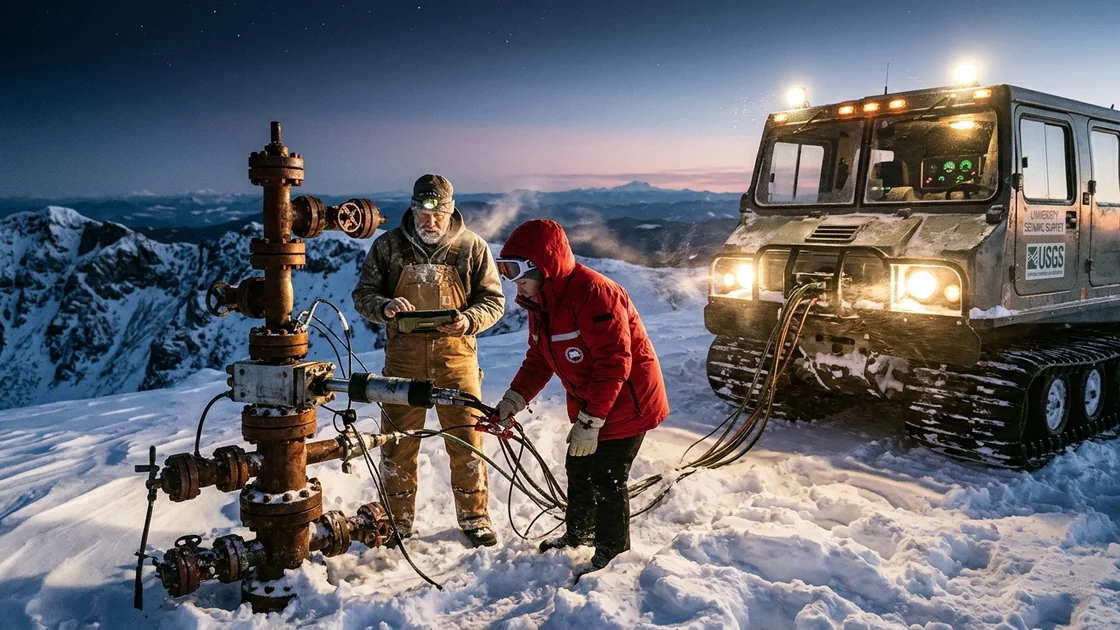
Arthur Pendelton, a veteran seismograph technician stationed at an isolated monitoring outpost on the flanks of a dormant Pacific Northwest volcano, discovers an impossible anomaly in his deep-borehole data. Amid the usual tectonic groans and ocean microseisms, his sensors detect the unmistakable, rhythmic cadence of massive mechanical footsteps pacing through solid basalt eight miles beneath the caldera. Joined by a skeptical geophysicist from the regional headquarters, Arthur rules out equipment failure and hydrothermal phenomena, ultimately proving that a colossal, autonomous machine is navigating the subterranean labyrinth of the ancient magma chamber. As the subterranean walker begins to ascend toward the surface through a dormant volcanic conduit, the two scientists use an abandoned geothermal wellhead and a seismic thumper truck to establish acoustic communication with the entity, learning that the machine is an ancient planetary maintenance mechanism working to prevent a catastrophic fault rupture before it descends once more into the deep crust.
The Earth never truly stops talking; it only lowers its voice to a frequency that human ears were not evolved to catch. For twenty-two years, Arthur Pendelton had made his living as a translator for that low, relentless murmur. From his reinforced concrete bunker at the timberline of Mount Vesper, six thousand feet above the damp green valleys of Washington State, he listened to the planet breathe, shift its weight, and grind its teeth in its sleep.
On a Tuesday in late November, with a heavy Pacific front slamming wet snow against the triple-paned observation windows, the mountain was supposed to be quiet. Mount Vesper had not erupted since the late Pleistocene. Its glaciers were thick, blue-bellied slabs of ancient ice, and its fumaroles down in the summit crater barely breathed enough sulfur to taint the meltwater. In the nomenclature of the United States Geological Survey, Vesper was a low-threat, high-altitude baseline station. It was a place they sent technicians who were good with soldering irons, comfortable with solitude, and too stubborn to retire.
Arthur sat in his rolling mesh chair, a ceramic mug of lukewarm chicory coffee balanced on his knee, watching twelve green lines unspool across a dual-monitor setup. Each line represented a broadband seismometer buried at various elevations and depths around the volcanic edifice.
To an untrained eye, the screens looked like green grass blowing in a steady wind. To Arthur, every squiggle had a name and an origin. The long, rolling swells with a period of six seconds were the primary microseisms—the collective thrum of Pacific Ocean swells crashing against the continental shelf a hundred miles to the west, sending elastic waves rippling through the bedrock all the way to the Cascades. The sharp, fuzzy bursts on Station V-02, located near the lower logging road, were sixty-ton timber trucks hitting potholes on the gravel switchbacks. The faint, high-frequency chatter on V-07 was the wind tearing at the solar panel stanchions on the north ridge, sending vibrations down the guy-wires and into the rhyolite.
And then there was V-09.
Station V-09 was different from the surface vaults. Installed during a lavishly funded deep-crustal research initiative a decade ago, the sensor sat at the bottom of a three-kilometer borehole drilled into the Devil’s Thumb, a basaltic buttress on the volcano’s eastern shoulder. Down at that depth, isolated from the wind, the trees, the logging trucks, and the frost heave, the rock was warm, dense, and dead silent. V-09 was Arthur’s control line. It only moved when a fault slipped in Puget Sound or when an earthquake ruptured on the other side of the world in Kamchatka or Chile, sending its ghostly P-waves curving through the Earth’s mantle to tickle Vesper’s roots.
Except, at 03:14 UTC, V-09 had started ticking.
Arthur leaned forward, setting his coffee mug down on a coaster made from a cross-section of a basalt core sample. He reached for his trackball mouse and highlighted a sixty-second window on the V-09 trace, expanding it until the individual waveform peaks separated like the teeth of a saw.
It was a transient pulse, occurring every four point two seconds.
He frowned, the deep creases around his eyes tightening in the greenish glow of the monitors. A four-second period was right on the edge of the oceanic microseism band, which was probably why the automated picking algorithms down at the regional center in Vancouver hadn't flagged it. The computer thought it was just surf hitting the Oregon coast.
Arthur knew better. Ocean waves were sinusoidal—smooth, rolling hills of energy that rose and fell with variable amplitude as sets of waves built and subsided. This signal was sharp. It had an impulsive onset, a distinct double-peak, and a rapid, ringing decay.
He opened his spectral analysis toolkit and ran a Fast Fourier Transform on a ten-minute slice of the borehole data. A heatmap blossomed on the secondary screen, plotting frequency against time.
Right at fourteen Hertz, cutting through the ambient blue background noise like a hot wire through butter, was a row of bright yellow vertical stitches.
Tick. Pause. Tick. Pause. Tick.
"Harmonic tremor?" Arthur muttered to the empty room. His voice sounded rusty; he hadn't spoken aloud since his Monday morning check-in call with the logistics clerk down in the valley.
When magma or superheated hydrothermal fluids move through subterranean cracks, the walls of the rock vibrate like the reed of a clarinet, producing a sustained, rhythmic hum known as harmonic tremor. It is the classic warning sign of an awakening volcano.
Wait, Arthur thought, zooming in closer on the time-domain wave. No. Fluid movement was messy. Even the most regular geyser or steam-vent system had a chaotic jitter to its timing—four seconds, then four point five, then three point eight, as steam bubbles nucleated, expanded, and collapsed against rough stone.
He pulled up the digital calipers and measured the intervals between ten consecutive pulses on V-09.
4.210 seconds. 4.210 seconds. 4.210 seconds. 4.210 seconds.
The hair on Arthur’s forearms stood up, a prickling sensation entirely unrelated to the draft seeping under the bunker’s steel door. Geology did not operate to the thousandth of a second. Quartz crystals did not vibrate at fourteen Hertz, and magma did not march to a metronome.
"Water in the vault," he told himself firmly. It was the technician’s mantra: when the Earth does something impossible, check the cables.
If the concrete junction box at the top of the V-09 borehole had developed a crack during the autumn freeze-thaw cycles, meltwater could be dripping onto the digitizer housing. A steady drip—plip, plip, plip—hitting a metal box directly coupled to the borehole cable could theoretically send a tiny mechanical shockwave down the wire or induce a micro-phonic spike in a corroded connector.
Or, more likely, the Q330 data logger’s internal clock was glitching, injecting a calibration pulse or a capacitor discharge spike into the data stream every 4.21 seconds.
Arthur glanced at the wall clock, then out the frosted window into the pitch-black howl of the November night. The wind gauge on the roof tower was spinning at forty-two knots. The ambient temperature was nineteen degrees Fahrenheit. Going up to Devil’s Thumb in the dark during a gale was a fool’s errand, and a violation of every safety protocol in the three-inch binder gathering dust on his bookshelf.
He looked back at the screen.
The ticks were still marching across the monitor, implacable and green.
He reached down, flipped on the studio monitor speakers bolted to the wall shelves, and routed the V-09 data stream through an audio-conversion script he had written years ago. Since seismic waves are mostly sub-audible—existing below the twenty-Hertz threshold of human hearing—the script sped the recording up by a factor of ten, shifting the pitch up several octaves while compressing a ten-minute window into sixty seconds of sound.
The speakers hissed with the white noise of the Earth’s ambient static. Through the hiss came the low, whooshing roar of the Pacific Ocean swells, sped up until they sounded like heavy breathing.
And underneath the breathing, clear and hard and entirely unnatural, came the sound.
Clack-thump. Whir. Clack-thump. Whir. Clack-thump. Whir.
Arthur’s hand froze on the volume knob.
A capacitor discharge makes a sharp, singular pop. A water drop makes a hollow, resonant plink.
This had two distinct phases. There was an initial high-frequency impact—the clack—followed sixty milliseconds later by a heavier, lower-frequency settling of weight—the thump. And in the brief silence between the impacts, right down at the absolute floor of the sensor’s dynamic range, there was a faint, rising and falling whine, like a high-torque gear train spooling up and down.
Before he had joined the USGS in his late thirties, Arthur had spent twelve years working in marine acoustic engineering for the Navy in Bremerton, analyzing propeller cavitation and hull harmonics on nuclear submarines. He knew the acoustic signature of reciprocating machinery in his bones. He knew what a cam lobe sounded like when it seated; he knew the acoustic profile of a hydraulic ram taking up load.
What he was listening to was not a drip. It was not a dying circuit board.
It was a stride.
Morning did not so much dawn on Mount Vesper as it bruised the sky from black to the color of old wet slate. The storm had blown itself out around five in the morning, dumping fourteen inches of dense, wet Cascade concrete over the existing three-foot base.
Arthur spent an hour shoveling out the bay doors of the equipment shed before firing up the Tucker Sno-Cat. The old diesel engine coughed, belched a plume of blue unburned fuel smoke into the crisp air, and settled into a comforting, rattling roar that drowned out the silence of the mountain.
He loaded the back of the cab with a pelican case containing a spare Quanterra digitizer, a digital oscilloscope, a multimeter, a heavy canvas tool roll, and a thermos of black coffee. He clipped his avalanche beacon to his chest harness, keyed the VHF radio to inform the automated dispatch log in Vancouver that he was going mobile on the east flank, and put the machine in gear.
The Sno-Cat crawled out of the compound on its four wide pontoons of steel-cleated rubber tracks, climbing through the sub-alpine firs that grew in twisted, stunted clusters along the five-thousand-foot contour. Within twenty minutes, the trees gave way to the vast, blinding white expanse of the pumice plains. Above him, the upper cone of Mount Vesper loomed—a massive, jagged tooth of andesite and glacial ice disappearing into a low ceiling of stratus clouds.
Arthur kept his eyes on the orange fiberglass wands that marked the summer access road, steering the tracked vehicle around concealed boulder fields and steep snow-filled gullies. Despite the heater blasting hot, oil-scented air onto his boots, he felt a cold knot of apprehension sitting squarely behind his sternum.
Before leaving the bunker, he had checked the morning telemetry. The rhythmic signal on V-09 had not stopped. In fact, over the eight hours he had spent tossing in his bunk and staring at the ceiling, the amplitude of the pulses had increased by twelve percent. Whatever was causing the interference was getting stronger.
At 09:30, he crested the windswept spine of the Devil’s Thumb ridge. The V-09 surface installation was little more than a green fiberglass dome bolted to a concrete pad, flanked by a twenty-foot aluminum mast carrying two solar panels, a Yagi directional antenna pointed back toward the main bunker, and a weatherproof NEMA enclosure housing the batteries and electronics.
Arthur parked the Sno-Cat upwind to act as a break against the biting breeze, grabbed his shovel and tool case, and waded through waist-deep drift to the vault.
First, he inspected the exterior. The solar panels were glazed with rime ice, which he knocked off with the wooden handle of his shovel, though they were solidly bolted. The guy-wires were taut, coated in frost feathers, and equipped with rubber spiral dampers that prevented them from humming in the wind. There were no tracks in the snow—no elk, no mountain goats, no snowmobilers trespassing in the restricted wilderness zone.
He dug out the buried hatch of the fiberglass dome, chipped the ice out of the padlock with a flathead screwdriver, and swung the heavy lid open.
A wave of dry, metallic warmth rose from the pit. Because the six-inch steel borehole casing went three kilometers straight down into the geothermal gradient of the mountain, a faint convective current of warm air always seeped up around the wellhead collar, keeping the interior of the shallow vault around fifty degrees even in the dead of winter.
Arthur dropped down into the four-foot-deep concrete pit, his knees popping in the cramped space. He clicked on his headlamp and examined the interior.
It was bone dry. The silica gel desiccant packs hanging from the junction hooks were still bright blue, showing zero moisture saturation. There were no mouse droppings, no chewed insulation on the thick black polyurethane jacket of the down-hole cable, and no water dripping from the lid seal.
"Okay," Arthur breathed, his breath barely fogging in the warm pit. "Let's look at the brains."
He unlatched the steel door of the Q330 digitizer box. The status LEDs blinked in a healthy, rhythmic green pattern—GPS lock was solid, battery voltage from the AGM bank was a steady 13.2 volts, and packet transmission was at one hundred percent.
Working with practiced efficiency, Arthur disconnected the thick military-spec Amphenol connector that joined the three-kilometer down-hole sensor cable to the digitizer. If the rhythmic ticking was an electronic artifact generated by the surface box or the solar charge controller, disconnecting the cable and hooking it straight to his portable handheld oscilloscope would prove it immediately. Without the digitizer in the loop, the cable was just three miles of copper wire attached to three orthogonal electromagnetic coils encased in a titanium cylinder at the bottom of a very deep hole.
He set his ruggedized Fluke ScopeMeter on the concrete ledge, attached the breakout leads to the pins for the vertical, north-south, and east-west channels of the down-hole seismometer, and switched the unit on.
The small LCD screen flickered to life. For two seconds, the trace bounced wildly as the internal amplifiers settled. Then, the line flattened out, showing the normal micro-volt fluctuations of the Earth's crust.
Wait for it, Arthur thought, watching the sweep. One. Two. Three. Four.
The trace jumped. A sharp upward spike on the vertical channel, followed sixty milliseconds later by a broad deflection on the horizontal channels.
Arthur stared at the little grey screen in his gloved hands. He counted under his breath. One thousand one. One thousand two. One thousand three. One thousand four.
Jump.
The signal was coming up the wire from the bottom of the hole.
A strange, dizzying sensation washed over him, as if the concrete floor of the pit had suddenly tilted. Three kilometers down, the rock was solid Columbia River basalt overlaid by welded volcanic tuff. There were no caves at that depth; the lithostatic pressure of ten thousand feet of rock squeezed shut any void larger than a hairline fracture unless it was propped open by pressurized magma. And there was no magma moving—the tiltmeters and GPS benchmarks all over the mountain had been flat-lined for decades.
Arthur didn't replace the digitizer with the standard spare. Instead, he pulled a specialized high-rate acquisition module from the bottom of his pelican case—a piece of gear leftover from an active-source seismic survey the university had run two summers ago. Standard volcano monitoring sampled the ground at one hundred Hertz—one hundred measurements per second—which was plenty fast for earthquakes, whose energy mostly lived below twenty Hertz.
The high-rate module could sample at two thousand Hertz. If there were mechanical harmonics, metallic ringing, or acoustic reflections hiding in the upper frequencies of those pulses, the standard box was cutting them off with its anti-aliasing filters. This box would catch everything.
His fingers were stiff from the cold as he wired the high-rate unit in parallel with the main telemetry system, setting it to record onto a high-capacity SD card while also Piggybacking the high-resolution stream onto the main radio link back to the bunker.
Before climbing out of the pit, he did one last thing. He took off his thick leather glove and pressed his bare palm flat against the six-inch steel pipe of the borehole casing that jutted up through the center of the concrete floor.
The steel was warm—about sixty degrees, heated by the deep rock below. It felt entirely solid, anchored in tons of grout and descending ten thousand feet into the dark root of the mountain.
He closed his eyes and held his breath, shutting out the hiss of the wind over the ridge and the distant idle of the Sno-Cat's diesel engine. He focused every nerve ending in his calloused palm on the metal.
You couldn't feel a magnitude zero-point-five micro-quake with bare skin. It was physically impossible; the displacement was measured in nanometers.
Yet, every four seconds, Arthur swore he felt a phantom tension pass through the molecular lattice of the steel—not a vibration, exactly, but a microscopic tightening, like a guitar string being tuned a quarter-turn in another room.
He pulled his hand back, shoved it into his glove, and slammed the vault lid shut.
By the time Arthur got back to the bunker, stripped out of his snow gear, and brewed a fresh pot of real coffee, it was past two in the afternoon. He didn't bother making lunch. He sat down at his workstation, pulled the high-frequency stream from the newly installed V-09 module, and began building a multi-station array model.
If a signal is real—if it is a physical wave traveling through rock rather than an electrical ghost in a single sensor—then it has to obey the laws of physics. Specifically, it has to radiate outward from its source at the speed of sound in basalt, which is roughly six kilometers per second for compressional P-waves, and three point five kilometers per second for shear S-waves.
That meant the other eleven stations on Mount Vesper had to be hearing it too, even if the signal was buried beneath the surface noise of the wind and the trees.
Arthur spent three hours writing a cross-correlation filter in Python. He took the clean, unmistakable waveform of the "step" from the deep V-09 borehole and used it as a digital template, sliding it across the noisy data streams of the eleven surface stations to see if the exact same pattern was hiding in the static.
At 17:40, the script finished compiling and spat out a three-dimensional velocity plot on his primary monitor.
Arthur leaned back in his chair, the plastic frame creaking under his weight, and stared at the wireframe mesh of Mount Vesper.
The computer had found the signal on nine of the eleven surface stations. By measuring the tiny fractions of a second it took for each pulse to reach the borehole sensor first, then the mid-elevation vaults, and finally the summit receivers, the software had triangulated the hypocenter—the exact point of origin inside the Earth.
A glowing red dot hung in the wireframe space beneath the mountain.
Depth: 12.8 kilometers. Eight miles straight down, right at the brittle-ductile transition zone where the cold, rigid rock of the upper crust met the plastically deforming, superheated root of the ancient magma system.
Wait. Not a dot.
Arthur adjusted the time-slider at the bottom of the display, compressing the last twelve hours of triangulated pulses into a ten-second animation.
The red dot moved.
Over the course of the night and morning, the source of the rhythmic impacts had traveled four點two kilometers straight north, moving at a steady, unvarying speed of zero-point-nine meters per second. Just over two miles an hour. Then, at precisely 08:00 UTC, it had stopped for twelve seconds, turned ninety degrees to the west, advanced three hundred meters, turned ninety degrees south, and begun walking back the way it had come on a parallel track.
"It's mowing the lawn," Arthur whispered.
In hydrographic surveying and sonar work, they called it a boustrophedon pattern—the way an ox plows a field, back and forth in neat, overlapping rows. You used it when you were mapping the ocean floor with side-scan sonar, or when a mine-sweeper was clearing a harbor channel.
Except this thing wasn't swimming through water. According to every geological survey ever conducted on the Cascade volcanic arc, twelve kilometers beneath Mount Vesper was solid gabbro and granodiorite—crystallized plutonic rock subjected to threepoint-five kilobars of pressure and temperatures approaching four hundred degrees Celsius.
Nothing walked through solid granite. Nothing had legs at four hundred degrees Celsius.
He turned to the secondary monitor and loaded the new two-thousand-Hertz audio file from the high-rate module he had installed at Devil's Thumb. Because the sampling rate was twenty times higher, he didn't need to speed the recording up as much to hear the high-end mechanical transients; he could listen to the acoustic tail of each impact in near-real time, using a pitch-shifter to bring the sub-audible bass up while leaving the high-frequency clicks in their natural register.
He put on his heavy Sennheiser studio headphones, closed his eyes, and hit play.
The fidelity was staggering. The three kilometers of solid basalt beneath the V-09 borehole acted like a giant stethoscope pressed directly against the deep crust.
K-CHUNG.
A pause of 1.8 seconds, filled with the deep, resonant groan of massive planetary Gears—not fast-spinning turbines, but enormous, slow-turning planetary reduction drives under immense load, their teeth meshing with a low, rhythmic hum-grind-hum.
K-CHUNG.
Arthur’s mind, trained by years of analyzing submarine acoustic signatures, began dissecting the anatomy of the sound automatically.
First, the impact wasn't symmetrical. Step A was slightly heavier than Step B, by about four decibels, with a faintly different metallic ring—a fundamental resonance at 412 Hertz on the odd steps, and 418 Hertz on the even steps. That meant two distinct limbs, not a rotating wheel or a continuous track. A wheel doesn't have an alternating acoustic signature unless it's oblong, and an oblong wheel wouldn't produce a flat velocity profile between impacts.
Second, during the 60-millisecond window between the initial clack (heel strike) and the heavy thump (full weight transfer), there was a distinct high-pressure hiss—the unmistakable sound of a supercritical fluid or gas being forced through a dampening orifice. Shock absorbers. Huge ones.
Third, and most terrifying, was the seismic magnitude of each step.
Arthur looked at the amplitude readout on the vertical channel. Taking into account the geometric spreading and attenuation of seismic waves traveling through nearly ten kilometers of rock between the source at 12.8 kilometers depth and the sensor at 3 kilometers depth, each individual footstep was registering as a local magnitude negative-zero-point-four earthquake at the source.
He grabbed a legal pad and a mechanical pencil, his hand shaking slightly as he scribbled down the Gutenberg-Richter energy equivalence equations.
A magnitude -0.4 seismic event releases roughly \(2.5 \times 10^4\) joules of radiated seismic energy. Given that seismic efficiency in hard rock is notoriously low—usually less than one percent of the total kinetic energy of an impact is actually converted into radiating elastic waves, with the rest going into heat, local deformation, and friction—the actual kinetic energy of each footstep hitting the stone had to be on the order of two to three megajoules.
Arthur stared at the number on the yellow paper.
Three megajoules was the kinetic energy of a five-hundred-ton mass dropping half a meter under standard gravity. Every four point two seconds.
With a velocity of 0.9 meters per second and a step interval of 4.21 seconds, the stride length was 3.79 meters—roughly twelve and a half feet per step.
He sat back, the headphones sliding off his ears to hang around his neck. From the tiny speaker cups, the relentless rhythm continued to bleed into the quiet room. K-chung. Whir. K-chung. Whir.
Twelve feet per stride. Hundreds of tons of mass. Dual-phase hydraulic or pneumatic dampening. Walking in a precise, three-hundred-meter grid pattern through a subterranean horizon that should have been solid rock, eight miles beneath a dormant volcano.
Arthur reached for the desk phone, dialed the direct extension for the Chief Geophysicist at the Cascades Volcano Observatory in Vancouver, and waited for the satellite uplink to click through.
Dr. Elena Rostova arrived forty-four hours later, and she did not look happy about it.
She drove up to the snow-line gate in a mud-splattered government-issue Ford F-250 equipped with chains on all four tires, where Arthur met her with the Sno-Cat to haul her and her gear the final three miles up to the bunker.
Elena was forty, sharp-featured, with dark hair pulled back into a severe bun that had begun to unravel during the three-hour drive up from the Columbia River gorge. She was a brilliant structural seismologist who had made her name modeling magma conduit mechanics on Kamchatkan volcanoes before taking the supervisory job in Washington. She also had very little patience for eccentric field technicians who refused to upload anomalous datasets over the normal server protocols and instead demanded she drive up a mountain before Thanksgiving.
"You told me on the phone that V-09 was experiencing a catastrophic clock-sync failure coupled with a deep crustal swarm," Elena said as soon as she had kicked off her snow boots in the bunker’s mudroom. She unzipped her red Gore-Tex parka, shaking water droplets onto the linoleum. "And when I pulled the raw IRIS seed files from the server in Vancouver before I left, there wasn't a damn thing on the surface array. Just wind noise and a slight broadband hum on the borehole."
"Because I bypassed the standard seed server for the high-rate data," Arthur said calmly, handing her a mug of hot coffee. He had barely slept in two days, his eyes bloodshot and ringed with dark hollows, though his movements were precise and steady. "If I had pushed a two-kilohertz stream with this signature over the unencrypted USGS microwave link to Portland, the automated university crawlers would have grabbed it within ten minutes. And then we'd have twenty grad students at the University of Washington asking why there's a five-hundred-ton pile-driver walking around under Mount Vesper."
Elena took the mug, wrapping both hands around the warm ceramic, and gave him a long, clinical look. It was the look supervisors gave to winter-over staff in Antarctica or remote forestry lookouts when they started talking about ghosts in the static.
"Arthur," she said, her voice dropping into a gentler, managerial register that annoyed him infinitely more than her irritation. "You've been up here solo since the seasonal crew left in September. How have you been sleeping?"
"I don't have cabin fever, Elena. Sit down."
He gestured toward his primary workstation, where he had set up a second chair.
Reluctantly, she walked into the instrument bay, took a sip of the coffee, and sat down in front of the dual monitors. "Alright. Show me this five-hundred-ton pile-driver. Because on the drive up, I read the 1984 USGS bulletin on Vesper’s deep hydrothermal system. You know what a geysering brine pocket looks like at the brittle-ductile boundary, don't you? Supercritical water flashes to steam in a porphyry fracture, builds pressure until a silica valve fails, vents into an upper reservoir with a sharp acoustic shock, and then the valve snaps shut. It’s called hydrothermal chugging. It happens at Yellowstone, it happens at Redoubt, and it produces remarkably regular, monochromatic seismic pulses."
"Does a silica valve snap shut every four point two-one-zero seconds with a standard deviation of less than a tenth of a millisecond over sixty consecutive hours?" Arthur asked, leaning over her shoulder and clicking open the time-series spreadsheet.
Elena’s eyebrows rose slightly. She leaned closer to the screen, adjusting her wire-rimmed glasses. She scrolled down the column of arrival times from V-09.
"That's... very tight," she admitted slowly. "Too tight for a multiphase fluid system. Which brings me back to my original thought when you called: a crystal oscillator fault in the Q330 digitizer."
"I thought so too," Arthur said. "So I went up to Devil's Thumb on Tuesday morning. I unhooked the Q330 completely and put an analog-front-end Fluke scope straight across the raw copper pairs coming out of the hole. The pulse was right there on the wire. Then I put the high-rate Stanford box on the line and ran a multi-station cross-correlation across the whole mountain."
He hit a key, bringing up the 3D wireframe velocity model of Mount Vesper.
Elena stared at the red dot and the glowing green trace of its path over the last three days. The lawn-mower grid now covered a rectangular area four kilometers long by one-point-five kilometers wide, sitting flat as a table at a depth of 12.8 kilometers. Twelve parallel lines, spaced exactly three hundred meters apart, connected by crisp ninety-degree turns at either end.
The silence in the bunker stretched out, broken only by the hum of the server rack cooling fans and the ticking of the radiator.
"What is the location error ellipsoid on this?" Elena asked, her managerial tone vanishing completely, replaced by the cold, hard focus of a working physicist.
"Less than forty meters vertical, twenty meters horizontal," Arthur said. "Because the source is so repeatable, I stacked five hundred waveforms together for each grid segment to cancel out the background noise. The signal-to-noise ratio on the stacked P-wave arrivals is over forty decibels even on the noisy surface stations."
"Let me see the raw picks."
For the next two hours, Arthur stood back and let her work. Elena didn't trust his Python scripts—she didn't trust anyone's scripts but her own. She dumped the raw binary data from the twelve stations into her laptop, opened MATLAB, and wrote her own beamforming and arrival-time triangulation algorithms from scratch. She checked the GPS timing headers on every single station to ensure there wasn't a spoofing error or a satellite clock drift creating a phantom moving target. She re-calculated the S-P wave lag times, applying the standard 3D tomographic velocity model for the Cascade crust.
Every twenty minutes or so, she would mutter something under her breath in Russian, rub her temples, and type faster.
Finally, at six in the evening, she pushed her laptop back from the edge of the desk. Her face was pale in the blue glow of the screen.
"The S-wave polarization changes by ninety degrees when it makes the turns at the end of each leg," she said softly, staring at nothing. "When it’s moving north-south, the shear waves are polarized east-west. When it turns to make the three-hundred-meter cross-leg, the shear polarization rotates north-south. That proves it isn't a stationary source with a shifting phase delay. The physical orientation of the shear stress being applied to the rock is actually rotating in space."
"It's turning its body," Arthur said. "Just like a man turning a corner at the end of a hallway."
Elena looked up at him. "Arthur, it’s twelve point eight kilometers down. Do you know what the lithostatic pressure is at twelve point eight kilometers?"
"About three hundred and五十 megapascals," he replied promptly. "Roughly fifty thousand pounds per square inch. Three and a half times the pressure at the bottom of the Mariana Trench."
"And the rock isn't hollow! We did a magnetotelluric and teleseismic survey of Mount Vesper six years ago—I co-authored the paper! At thirteen kilometers down, there is a high-velocity anomaly that we interpreted as the frozen, solidified gabbroic pluton from the Pleistocene eruptions, sitting right on top of a low-velocity zone of partial melt. Even if there were an ancient cavern system—which is geologically impossible at that depth because granite flows plastically over millennia under that kind of heat and load—how could anything move in a straight, horizontal grid for four kilometers without hitting a wall?"
"Maybe the low-velocity zone you mapped six years ago isn't partial melt," Arthur said quietly. He walked over to the corkboard on the wall, where a printed cross-section of Elena’s 2018 paper was pinned. He tapped the big, flat, oval-shaped shadow labeled Deep Crustal Magma Storage / Mush Zone (12–15 km). "When you bounce seismic waves from distant earthquakes through the bottom of a volcano, a pocket of mushy magma slows the waves down and absorbs the shear energy. You know what else slows down P-waves and blocks S-waves?"
Elena’s breath hitched. "A fluid-filled void. Or a gas cavity."
"A room," Arthur said. "Or a network of tunnels reinforced with something that has a different acoustic impedance than the surrounding basalt. You didn't map a magma chamber six years ago, Elena. You mapped a basement. A four-kilometer-wide basement with a flat floor."
"That's insane," she whispered, though there was no conviction in the word. "Who builds a basement eight miles under a volcano? The deepest borehole humanity has ever drilled is Kola Superdeep in Russia, and that stopped at twelvepoint-two kilometers because the drill bits melted turning in three-hundred-degree mud that behaved like plastic!"
"Listen to the audio," Arthur said, picking up the Sennheiser headphones and holding them out to her. "Don't look at the numbers for a minute. Just listen to the high-rate recording from V-09."
She hesitated, as if putting the headphones on would make the madness contagious, then took them and slipped them over her ears. Arthur clicked play on the current live stream, routed through the real-time pitch-shifter.
Elena sat rigid in the chair. Her eyes widened at the first heavy K-CHUNG, then narrowed as she listened to the mechanical whine of the actuator cycle between steps, the slight asymmetry between the left and right impacts, and the sharp hydraulic bleed-off as the weight settled.
After a full minute, she reached up with one hand, holding the left ear-cup tightly against her head.
"Wait," she said, her voice loud over the sound in her ears. "What is that secondary click right after the weight settles?"
Arthur frowned, looking at the live waterfall spectrogram scrolling down the right-hand monitor. "What secondary click? It’s just the heel strike, the load transfer, and the gear drive."
"No, look at the spectrogram! Right now!"
Arthur looked at the screen.
For the last sixty hours, the spectrogram had shown the exact, monotonous pattern of the four-second stride.
Now, as he watched the live data scrolling down from the top of the monitor, the pattern had changed.
The walker had stopped.
At the northernmost corner of its seventh grid line, the 4.21-second impacts had ceased entirely. The background noise of the mountain returned to the low, oceanic hiss.
And then, three seconds later, a new signal erupted across every single channel of the array.
PING.
It wasn't a dull, heavy thump like the footsteps. It was a blindingly sharp, ultra-broadband acoustic chirp that swept from ten Hertz all the way up to eight hundred Hertz in less than twenty milliseconds, echoing through the entire volcanic edifice like a hammer striking an anvil.
In the headphones, it sounded like a sonar ping from a destroyer, so loud and pure that Elena tore the headphones off her ears with a gasp, dropping them onto the desk where they continued to ring tinny and sharp in the quiet room.
On the twelve-channel display, the green lines went wild as the high-energy chirp bounced off every geological boundary inside Mount Vesper—reflecting off the base of the upper crust, the boundaries of the old volcanic necks, the bottom of the glaciers on the summit, and the air-ground interface of the mountain slopes themselves.
Six seconds later, it happened again.
PING.
"Active tomography," Elena breathed, her hands flying over her keyboard as she adjusted the gain on the monitors to keep the traces from clipping. "It stopped walking its grid, and now it’s firing a swept-frequency seismic source! That’s a Vibroseis sweep—the exact same mathematical chirp oil companies use with thumper trucks to image rock strata!"
"Why would it sweep upwards?" Arthur asked, staring at the arrival times of the chirp. Unlike the footsteps, whose energy had been directed mostly downward and horizontally into the deep basement floor, the radiation pattern of the chirp was strongly directional—beamed straight up toward the summit of Mount Vesper like a flashlight pointed at the ceiling.
Elena didn't answer. She was staring at the vertical strainmeter readout from Station V-04, located high on the summit caldera rim at nine thousand feet.
A third PING rang out from the headphones on the desk.
Then the pinging stopped. For ten seconds, the deep borehole at V-09 recorded nothing but the low, rising whine of that massive subterranean drivetrain spooling up—not to its usual walking speed, but higher, the pitch climbing steadily from thirty Hertz to sixty, then ninety, as if a massive turbine or nuclear-electric generator was bringing reserve capacitor banks online.
Then the footsteps started again.
Except the rhythm had changed.
CLACK-THUMP... CLACK-THUMP... CLACK-THUMP...
And in the gaps between the primary impacts, two smaller, sharper metallic strikes appeared, offset by one-point-four seconds.
Clack-thump (tap-tap) Clack-thump (tap-tap).
"Four limbs," Arthur said, watching the waveform morph on the screen. "It dropped down onto four limbs, or it deployed stabilizing arms."
Elena pointed a trembling finger at the 3D wireframe model on the primary monitor, where the real-time triangulation script was updating the position of the red dot every ten seconds.
The dot was no longer moving horizontally across the twelve-kilometer boundary.
It had moved to the exact center of the mountain's root, directly beneath the main central crater, and it was moving up.
12.6 kilometers. 12.5 kilometers. 12.4 kilometers.
"It's climbing," Elena whispered. "The main volcanic conduit from the Pleistocene eruptions—the central chimney that connects the deep pluton to the upper caldera. We always thought it was plugged with solid dacite porphyry."
"It isn't plugged," Arthur said, watching the depth numbers tick down at a steady rate of two meters per second—faster than it had walked on the flat floor below. "Or at least, there's a shaft inside the plug. And it just pinged the shaft with sonar to make sure the ceiling was clear before it started climbing."
At ten kilometers depth, the machine’s ascent began to affect the mountain itself.
It started with the water table. At 21:00 hours, the automated pressure transducers in three monitoring wells down in the national forest valleys reported a sudden, synchronous drop in hydrostatic head—four feet in ten minutes, followed by a violent surge that sent muddy, iron-stained water overflowing the well caps in the dark woods. As this massive object moved upward through the central conduit, it was acting like a piston in a cylinder, displacing deep crustal fluids and sending pore-pressure waves racing outward through the fracture networks of the bedrock.
Then came the magnetics.
At 21:30, when the red dot on the screen passed the eight-kilometer mark, the fluxgate magnetometer mounted in the tree-line clearing outside the bunker went completely haywire. The Earth’s normal ambient magnetic field of fifty thousand nanoteslas began to oscillate in a massive, slow sine wave that matched the 2.8-second climbing cadence of the machine below.
Five minutes later, the satellite uplink died.
The green connection icon on Arthur’s communications server turned yellow, then flashed angry red as a torrent of electromagnetic hash—broadband RF noise radiating up through the rock from whatever colossal magnetohydrodynamic or inductive drive powered the climber—swamped the Ku-band dish on the roof.
Arthur picked up the VHF handset and keyed the mic. "Cascades Observatory, this is Vesper Base on repeater channel two, do you copy?"
When he released the button, the speaker didn't produce the clean squelch tail of the ridge-top repeater. Instead, it emitted a rhythmic, roaring static that pulsed in time with the seismic monitors: SHHHH-hiss... SHHHH-hiss... SHHHH-hiss.
"Inductive coupling," Elena said, standing by the window and looking out at the snow-covered peak above them. The clouds had cleared over the last hour, leaving the upper cone of Mount Vesper stark and white under a brilliant, freezing canopy of stars. "Whatever power plant that thing is running to lift hundreds of tons vertically against gravity is generating a rotating magnetic dipole field strong enough to ionize the quartz veins in the conduit walls. It’s turning the whole mountain into a giant, dirty transformer."
She turned back to the room, her eyes bright with a mixture of terror and pure scientific exhilaration. "How deep is it now?"
Arthur checked the triangulation screen. Because the machine was now high enough in the volcanic edifice that it was above the level of the lower flank stations, the geometry of the seismic arrivals had inverted—the waves were hitting the summit stations before they hit the base stations.
"Six point two kilometers," Arthur said. "Twenty thousand feet down. In another forty-five minutes at this rate, it’s going to reach the top of the crystalline basement right under the summit caldera."
"Wait," Elena said, stepping back to the corkboard and staring at the geological cross-section of the mountain. "Why is it coming up now? You've been listening to this mountain for twenty-two years, Arthur. We've had broadband sensors on Vesper since 1998, and paper drum helicorders since 1965. Has there ever been anything like this in the historical record?"
Arthur rubbed his stubbled jaw, thinking back through decades of quiet winter nights, thousands of rolls of thermal paper, and terabytes of digital traces.
"No," he said slowly. "Not on Vesper. Though... wait a minute."
He walked over to the metal filing cabinets lining the back wall of the bunker, pulled open the bottom drawer labeled Historical Archives / Pre-Digital, and dug through a stack of yellowed manila folders until he found a mimeographed technical report bound in black plastic comb binding.
Department of Energy / USGS Joint Geothermal Assessment: Mount Vesper Deep Exploratory Borehole (Project Vulcan), 1978–1979.
He slapped the heavy report down on the desk next to the keyboards and flipped through the pages, past the lithology logs and temperature profiles, to the final operational summary at the back.
"In the summer of '78, during the Carter administration energy crisis, the DOE drilled a deep geothermal test well right inside the southern rim of the summit caldera," Arthur said, tracing a finger down the faded typewriter font. "They called it Vulcan-1. They started at eight thousand five hundred feet elevation and drilled straight down toward the central conduit, looking for dry hot rock they could fracture to generate steam power."
Elena leaned in, reading over his shoulder. "I know about Vulcan-1. The wellhead is still up there on the south rim, buried under ten feet of snow. They abandoned it at fourteen thousand feet—four point two kilometers depth—because they lost the bottom-hole assembly."
"Look at the drilling log from the last forty-eight hours before abandonment," Arthur said, tapping a table of figures on page ninety-four. "October 14, 1979. Depth: 4,312 meters. The driller notes extreme bit bounce and rhythmic torque spikes every four seconds on the rotary table. They thought the tungsten-carbide roller cones on the tri-cone bit had locked up and were hopping over a hard chert stringer. Then, at 04:00 hours on October 15, they hit what the log calls an 'unmapped cavernous fracture zone'—the drill string dropped six feet without resistance, something sheared twelve inches of heavy tungsten drill collar clean off like a pair of bolt cutters, and before they could pull the pipe out of the hole, the bottom five hundred feet of the borehole was plugged solid by a sudden intrusion of molten basalt that quenched into glass within minutes."
Elena stared at the page. "It wasn't an intrusion of magma. They drilled through the ceiling of an upper gallery or an access shaft at four kilometers depth. And something came up, sheared the drill string off, and welded the hole shut from the inside."
"Wait," Arthur said, flipping back three pages to a chart of regional tectonic strain from the autumn of 1979. "Look at why the machine was up near the four-kilometer level in October of '79 in the first place. Two days after they lost the drill bit, the St. Helens precursor swarms started fifty miles south of here, and a magnitude 5.1 strike-slip event ruptured on the Vesper Fault Zone ten miles west of the mountain—Wait. No, the fault didn't rupture."
He pulled up his own digital database on the secondary computer, opening the historical strainmeter and creep-meter logs for the Vesper Fault—a dangerous crustal fault that ran right under the foothills toward the eastern suburbs of the Puget Sound basin.
"Elena, look at the long-term borehole strain trend on the Vesper Fault over the last six months," Arthur said, bringing up a five-year graph.
Elena looked at the curve. For four and a half years, the line had climbed steadily upward as the Juan de Fuca tectonic plate shoved relentlessly against North America, building elastic strain in the locked rock of the Cascade foothills. By September of this year, the strain curve had gone non-linear—curving sharply upward into the red zone that usually preceded a major, catastrophic fault slip. A magnitude 6.8 or 7.0 right on the Vesper Fault would flatten three valley towns and send a landslide off the west flank of the volcano.
And then, look at the exact moment—03:14 UTC on Tuesday morning—when the footsteps had started down at 12.8 kilometers.
"It's a trigger," Elena breathed, her fingers touching the glass of the monitor where the strain curve spiked. "The tectonic stress in the crust crossed a critical threshold on Tuesday morning. Deep rock under high stress generates piezoelectric currents and micro-fracturing acoustic emissions. That thing down in the basement... it was sitting in standby mode, listening to the crust, just like us. When the tectonic strain hit the red line, it woke up."
"And ran a diagnostic survey of the basement floor to map the stress field," Arthur finished, the pieces clicking together in his mind with terrifying clarity. "That's what the lawn-mower grid was! It wasn't looking for us—it was measuring the shear stress across the base of the volcanic root! And when it finished the survey..."
"It located the concentration point of the fault lock higher up in the edifice," Elena said, her eyes darting back to the real-time depth tracker.
The glowing red dot was at 4.8 kilometers depth. And slowing down.
4.6 kilometers. 4.5 kilometers. 4.4 kilometers.
At 4.35 kilometers—less than two hundred meters below the bottom of the old 1979 DOE geothermal borehole—the red dot stopped climbing.
The rhythmic four-limbed clanking ceased.
On the monitors, a massive, sustained low-frequency hum blossomed across the entire seismic array—not a moving pulse, but a continuous, titanic vibration at sixty Hertz, accompanied by a sharp spike in ground tilt on the summit stations.
"What is it doing?" Elena asked.
"Look at the location," Arthur said, zooming in on the 3D wireframe until the red dot and the vertical black line of the abandoned Vulcan-1 borehole filled the screen. The machine was sitting directly adjacent to the main ring-fault that encircled the summit caldera—the structural hinge that connected the weight of the volcanic cone to the locked Vesper Fault zone miles below.
"In 1979, when the drill bit broke through into its shaft, it welded the hole shut with melted rock in minutes," Arthur said slowly. "If you have a machine down there with enough thermal or plasma energy to melt basalt on command, why is it sitting on an active fault intersection under a volcano?"
Elena’s mouth fell open. "Stress relief. If a tectonic fault is locked and building up toward a catastrophic magnitude seven earthquake, or if magma pressure is building unevenly against a brittle plug, you can prevent the rupture by locally melting or hydro-fracturing the asperity—the locked point on the fault—allowing the rock to slide smoothly in a slow, harmless creep event instead of a violent snap."
"It's a pressure valve," Arthur whispered. "Or a maintenance crew. A planetary maintenance crew."
"Arthur," Elena said, grabbing his arm so hard her fingernails dug through his wool flannel shirt. "It’s less than six hundred feet from the bottom of the steel casing in the Vulcan-1 borehole. Steel pipe has ten times the acoustic conductivity of fractured basalt, and zero attenuation for low-frequency electromagnetic waves. If we go up to the caldera rim right now and hook the mobile broadband recorder and the acoustic transponder straight onto the Vulcan-1 wellhead..."
"We're in the middle of winter at nine thousand feet in the dark, Elena!"
"The storm is gone! The wind is down to ten knots and the snowpack is stable on the south ridge!" She was already moving toward the mudroom, grabbing her parka off the hook. "Arthur, whatever that thing is—whether it was left here a million years ago by something that didn't want the Cascades to blow the atmosphere off the hemisphere, or whether it’s something else entirely—it only wakes up once every forty or fifty years when the fault locks! Once it finishes stress-relieving that fault junction, it’s going to climb back down to thirteen kilometers and go back to sleep for the rest of our lives! Right now, we just have fuzzy seismic squiggles through miles of rock. Nobody at headquarters is ever going to believe us—they’ll say it was a weird hydrothermal swarm and a faulty digitizer! If we hook directly into the steel waveguide of that casing six hundred feet above its head, we can record the unobstructed mechanical and electromagnetic signature of the machine itself!"
Arthur stood by the desk, looking from the frantic geophysicist in the doorway back to the glowing monitors.
For twenty-two years, he had sat in this concrete room, listening to the mumbled, indistinct syllables of the deep Earth through miles of stone. He had spent half his life wondering what lived down in the dark under the roots of the mountains.
Now, the thing in the dark had climbed ten thousand feet up the stairs and was standing right behind a steel door at the top of the hill.
"Forget the portable recorder," Arthur said, a fierce, sudden grin breaking across his weathered face as he reached for his heavy Carhartt bibs. "In the second bay of the shed, we've got the university's Mertz Vibroseis unit mounted on the heavy tracked crawler from the summer refraction survey. It's got a twenty-four-channel Geometrics array, a magnetotelluric induction loop, and a twelve-thousand-pound hydraulic thumper plate."
Elena stared at him. "You want to take a seismic thumper up to the caldera rim?"
"It pinged the mountain with a Vibroseis sweep before it climbed," Arthur said, pulling his boots on and lacing them tight. "That means its onboard computers are programmed to recognize and process swept-frequency acoustic chirps. If we bolt the thumper plate directly to the top of the Vulcan-1 steel wellhead casing, we don't just have to listen to it, Elena."
He stood up and grabbed the keys to the heavy crawler off the pegboard.
"We can say hello."
The climb to the nine-thousand-foot south rim of Mount Vesper took ninety minutes of brutal, grinding effort.
The university’s tracked seismic vehicle—a modified Bombardier Muskeg tractor fitted with an insulated cab and a massive hydraulic reaction mass suspended beneath its belly—was much heavier and slower than the nimble Tucker Sno-Cat. Its twin Detroit Diesel engines roared against the steep thirty-degree snowfields above timberline, the wide steel tracks chewing through the wind-scoured crust and throwing roostertails of dry powder into the starlight.
Inside the cab, the instrumentation rack was already alive. Because the electromagnetic interference from the mountain was now strong enough to induce phantom currents in long unshielded wires, the cab’s dashboard gauges were twitching erratically—the tachometer needle bouncing in time with the sixty-Hertz subterranean hum even when the engine RPM was steady.
Outside the frosted windshield, the night was surreal. There was no moon, yet the upper snowfields of Mount Vesper were bathed in a faint, eerie violet luminescence. As the machine four kilometers below poured megawatts of energy into the quartz-rich dacite of the ring fault, the piezoelectric effect—earthquake lights, amplified a thousandfold by the focused stress—was ionizing the thin mountain air along the ridge lines, creating ghostly curtains of cold St. Elmo’s fire that danced across the glacial ice.
"Look at the strain gauge on V-04," Elena shouted over the roar of the diesels, holding her ruggedized tablet braced against the dashboard. Even though the main satellite link was dead, the short-range line-of-sight packet radio from the nearby summit station was still punching through the static in bursts. "The normal stress across the Vesper Fault intersection has dropped by twelve bars in the last hour! And there hasn't been a single brittle-failure earthquake above magnitude one! It's literally annealing the fault zone—turning a locked, brittle bomb into a ductile sliding joint!"
Arthur didn't take his eyes off the narrow wind-lip of the south crater rim looming ahead in the halogen headlights. "Hold on! We're coming up on the bench!"
The crawler lurched over the final cornice of wind-packed snow and leveled out onto a flat, semi-circular shelf just below the jagged lip of the summit crater. Below them to the north, the main caldera dropped away into a shadow-filled bowl of crevassed ice; behind them to the south, the entire Cascades range stretched out under the stars—Mount Hood, Mount Adams, and Mount Rainier standing like silent white ghosts above the dark sea of the lowlands.
Fifty yards out on the flat bench, where the fierce summit winds scoured the rock nearly bare of snow, stood a rust-streaked steel monument: a four-foot-tall Christmas tree of high-pressure blowout valves and flanged steel pipe, twelve inches in diameter, bolted to a cracked concrete cellar pad poured in 1978.
Vulcan-1.
Arthur maneuvered the heavy crawler until its front bumper was nose-to-nose with the wellhead, then dropped the hydraulic snow-blade to anchor the vehicle in the ice.
They climbed out into the sub-zero gale. The wind at nine thousand feet was a physical weight, smelling faintly of ozone and ancient sulfur, whipping dry snow crystals against their ski goggles. Even through the thick rubber soles of his Sorel pack boots, Arthur could feel the ground humming—a deep, purring vibration in the solid andesite bedrock that made his teeth ache in his jaw.
Working by the brilliant white glare of the crawler’s work lights, they dug out the concrete cellar around the base of the twelve-inch steel pipe.
While Elena clamped a triad of high-frequency piezo-accelerometers and an induction coil directly onto the bare, rusted steel of the lower casing flange, Arthur unspooled a heavy hydraulic hose and a steel coupling plate from the crawler’s front winch assembly. Instead of lowering the main belly plate onto the snow—which would damp out the high frequencies—they bolted a secondary pneumatic impact piston directly onto the flat top flange of the wellhead cap, coupling the crawler's active seismic transmitter straight into fourpoint-two kilometers of continuous steel pipe.
In less than twenty minutes, they were back inside the warm, diesel-smelling cab of the crawler, slamming the heavy doors against the freezing wind.
Elena’s hands were shaking from the cold as she stripped off her mittens and plugged the accelerometer leads into the twenty-four-channel Geometrics acquisition rack. She routed the raw signal straight from the steel pipe into the cab's monitor speakers.
Instantly, the cramped cab was filled with a sound so vast, complex, and immediate that both of them froze.
With the four miles of steel pipe acting as a direct acoustic waveguide down to the bottom of the hole, the muffling effect of the upper mountain vanished. It was as if they had pressed their ears straight against the hull of a submerged dreadnought six hundred feet away.
First came the roar of the thermal lance—a deep, tearing, white-noise bellow like an arc-furnace melting scrap steel, accompanied by the sharp, crystalline ping-crack-ping of deep granite expanding and fracturing under intense localized heat.
Underneath the furnace roar was the machine itself. They could hear the individual coolant pumps cycling—a rhythmic, tri-lobe thrum-thrum-thrum running at precisely 120 RPM. They could hear the whine of massive gyroscopic stabilizers maintaining orientation inside the vertical shaft, and the occasional heavy, metallic CLANK-ratchet-CLANK as one of the four load-bearing limbs shifted its bracing grip against the basalt walls of the conduit to compensate for the relaxing rock stress.
"Look at the spectral purity of the pump cycle," Elena whispered, staring at the waterfall display on the rack monitor. "Not a single harmonic wobble. Whatever alloys those bearings are made of, they're operating at four hundred degrees Celsius with zero thermal expansion play."
Suddenly, the roaring white noise of the thermal lance cut off.
In the abrupt silence that followed inside the mountain, they heard a series of heavy mechanical solenoids slamming shut—CHUNK-CHUNK-CHUNK—like bank vault doors locking in sequence. The sixty-Hertz electromagnetic hum on the induction meter dropped away to a low, idling purr, and outside the cab windows, the ghostly violet glow of the piezoelectric lights along the crater rim flickered and vanished, plunging the mountain back into the cold dark of a normal winter night.
On the screen, a series of rapid, low-power acoustic clicks radiated from the machine—short, sharp pulses that bounced off the newly annealed fault plane and returned to the conduit. It was checking its work, measuring the shear-wave velocity across the rock joint it had just fused and relaxed.
"It's done," Arthur said, watching the strainmeter telemetry on Elena’s tablet. The dangerous upward curve on the Vesper Fault had flattened out completely, dropping back to a safe baseline level it hadn't seen in thirty years. "The fault is stabilized. It's getting ready to climb back down."
In the speakers, they heard the heavy hydraulic bleed-off as the upper stabilizing limbs began to un-wedge themselves from the conduit walls.
Hiss-CLANK.
"Arthur, now!" Elena said, pointing at the Vibroseis controller box mounted next to the steering levers. "If you wait until it starts moving, its own walking noise will drown out our signal!"
Arthur didn't hesitate. He flipped the master arming switch on the pneumatic transmitter controller. Outside on the wellhead, the air compressor lines jerked taut as the accumulator tank charged to three thousand PSI.
On the controller keypad, he didn't program a random series of taps. He programmed the exact mathematical mirror of the swept-frequency chirp the machine had fired before its ascent: a twenty-millisecond linear sweep from ten Hertz to eight hundred Hertz, repeated three times at precise 4.210-second intervals—the exact cadence of the machine’s own horizontal stride.
He hit the fire button.
Outside on the nose of the crawler, the pneumatic piston slammed down onto the steel flange of the Vulcan-1 wellhead with the force of a cannon shot.
BANG.
Inside the cab, they watched the trace on the accelerometer screen as the acoustic pulse raced straight down the twelve-inch steel pipe at five thousand meters per second—reaching the bottom of the cemented casing four kilometers down in less than eight-tenths of a second, and radiating out through the final six hundred feet of welded basalt plug straight into the central conduit.
Arthur counted the clock on the controller display. One. Two. Three. Four point two-one.
BANG.
The second pulse shot down the pipe.
One. Two. Three. Four point two-one.
BANG.
The third pulse vanished into the dark beneath the mountain.
Arthur took his finger off the button. In the cab, he and Elena held their breath, staring at the green line of the down-hole accelerometer trace and listening to the speakers.
Down at four point three kilometers, the un-wedging cycle of the machine had stopped cold after the first bang.
The cooling pumps idled down until they were barely a whisper. The gyroscopes hummed in the deep dark. For five full seconds, eight thousand feet below their boots, the colossus hung motionless in its vertical stone shaft, listening up toward the ancient, plugged scar where a primitive tungsten drill bit had poked through its ceiling forty-five years ago.
"Did it hear it?" Elena whispered. "The attenuation across the basalt plug at the bottom of the well might have—"
PING.
The speaker cones in the cab nearly blew out of their housings.
It wasn't the monstrous, mountain-shaking sonar blast the machine had used earlier from eight miles down. This chirp was attenuated—deliberately dialed down in amplitude by at least forty decibels so it wouldn't shatter the steel casing six hundred feet above it, calibrated with surgical precision to match the exact acoustic energy of Arthur’s pneumatic piston.
And it didn't just send back one chirp.
Ping. Ping-ping. Ping-ping-ping. Ping-ping-ping-ping-ping.
One. Two. Three. Five.
Then a pause of 4.210 seconds.
Then a burst of high-frequency, phase-modulated acoustic data—a dense, musical trill that lasted exactly twopoint-one seconds, sweeping across the kilohertz band like a dial-up modem made of chimes and heavy bronze bells.
On the Geometrics monitor, as the deconvolution software automatically processed the phase-modulated acoustic reflections of that two-second musical burst, a two-dimensional tomographic image resolved on the grey screen.
Elena clapped both hands over her mouth.
By modulating the phase and reflection timing of its acoustic burst against the walls of the borehole, the machine had intentionally painted a synthetic seismogram on their receiver screen.
It was a cross-sectional map of the Cascadia Subduction Zone and the Mount Vesper volcanic complex, rendered in stark acoustic density contours. Highlighted in bright, pulsing amplitude lines were four deep crustal fault junctions at twelve, fourteen, and eighteen kilometers depth—three of them marked with steady, flat-line harmonic tags, and the fourth, thirty miles north under the Glacier Peak wilderness, pulsing with a slow, rhythmic warning beat.
Beneath the geological map, in the lower register of the frequency domain, the machine had appended a simple kinematic diagram: a geometric representation of an octahedral chassis supported by four multi-jointed, load-bearing struts, positioned inside a honeycomb of deep-crustal galleries sitting along the Mohorovičić discontinuity—the boundary between the Earth’s crust and the mantle.
It wasn't a weapon. It wasn't an invader.
It was an telemetry dump from one station technician to another. Status: Local sector stabilized. Next scheduled maintenance: Sector North. Returning to baseline standby.
Before Arthur could reach for the transmitter keypad again, a single, final, low-frequency pulse echoed up the steel pipe—a deep, resonant bass note at 7.83 Hertz, the exact fundamental Schumann resonance of the Earth's own ionosphere.
Then, the heavy solenoids down in the dark slammed open.
CLACK-THUMP (tap-tap).
The colossal drivetrain spooled up, the four limbs engaged the basalt walls of the volcanic chimney, and the red dot on the triangulation tablet began to drop.
4.5 kilometers. 4.8 kilometers. 5.2 kilometers.
With each heavy, rhythmic step downward into the planetary root, the acoustic signature in the steel wellhead grew fainter and more distant, losing its sharp metallic treble until only the deep, sub-audible bass of the primary weight transfers remained—reverberating through the stone of the mountain like a slow, steady heartbeat receding into the abyss.
They stayed on the crater rim until dawn.
By the time the first pale band of winter sunlight broke over the eastern ridges of the Cascades, turning the snowfields from violet-grey to blinding pink, the walker had reached the twelve-point-eight-kilometer floor at the base of the pluton.
Sitting in the idling crawler with the heater humming, Arthur and Elena watched the final act on the tablet’s relay link from the bunker below.
The red dot did not walk another grid. It moved in a straight, unhurried line across the flat basement floor toward the northwestern corner of the four-kilometer void—an area where the seismic attenuation had always been slightly higher on the old surveys.
At 07:12 local time, at a depth of 13.1 kilometers, the footsteps stopped.
There were three distinct, heavy metallic clicks as the load-bearing struts locked into a stationary cradle or docking ring. The low-frequency hum of the power plant stepped down through four distinct octaves over sixty seconds, dropping lower and lower in pitch until it merged seamlessly into the six-second roll of the Pacific Ocean microseisms and vanished completely.
The green trace on Borehole V-09 went flat.
Inside the cab of the crawler, the silence was absolute.
Elena looked down at the Geometrics acquisition rack. The hard drive status light was blinking green, holding forty gigabytes of uncompressed, twenty-four-channel acoustic, magnetotelluric, and synthetic tomographic data recorded directly off the Vulcan-1 waveguide.
"If we publish this," Elena said quietly, her voice hoarse from exhaustion and the dry cab air, "the Department of Defense will classify the entire Cascade range within forty-eight hours. Within six months, there will be fiverotary drilling rigs up here trying to punch a hole down to thirteen kilometers to get a piece of whatever alloy that thing is made of, or whatever power source it’s running."
Arthur looked out the windshield at the rusted steel Christmas tree of the 1979 wellhead, half-buried in the blowing snow.
"Look what happened in '79 when they poked a nine-inch hole into its upper gallery," Arthur said. "It sheared off twelve inches of solid tungsten steel and plugged the hole with melted basalt. What do you think happens if somebody tries to drop explosives or a directional coring bit into its main engine room down at the mantle boundary? Or worse—what happens if they actually manage to break it, right when the Glacier Peak fault zone thirty miles north of here is getting ready to lock up?"
Elena stared at the tomographic map still frozen on the monitor screen—the clean, mathematical diagnostic report that had been handed up to them through the dark rock like a clipboard passed across a workbench.
For millions of years, or perhaps since the crust of the planet had first cooled enough to fracture into sliding plates, something had been down there in the high-pressure dark, walking the fault lines, welding the cracks, bleeding off the catastrophic pressures so the surface above remained stable enough for forests to grow and oceans to stay in their basins. It didn't care about the primates who had recently built logging roads and ski resorts on the upper slopes, any more than a building engineer down in a sub-basement boiler room cares about the moths fluttering around the roof lights.
Unless one of the moths started chewing through the main steam lines.
Elena reached out to the Geometrics rack. She didn't hit the delete key. Instead, she popped the primary solid-state drive out of the bay, slipped it into the inner zippered pocket of her parka, and then formatted the secondary backup drive in the machine until it was completely blank.
"What did we come up here to investigate, Arthur?" she asked, looking over at him through her wire-rimmed glasses.
Arthur looked at the empty screen, then out at the quiet, snow-covered flank of Mount Vesper gleaming in the morning sun.
"A deep hydrothermal chugging swarm," he said evenly. "Coupled with an oscillator fault in the V-09 digitizer. Which I fixed by swapping out the Q330 box on Tuesday morning. And the good news is, the hydrothermal fluid migration seems to have lubricated the Vesper Fault zone enough to relieve the autumn strain accumulation via a slow-slip aseismic creep event."
"Textbook aseismic creep," Elena agreed, nodding slowly. "Though I think, given the anomalous fluid readings we saw in the northern sector, I'm going to apply for a grant next spring to install three new deep-borehole broadband stations up around Glacier Peak. Just to keep an eye on the deep crust."
"You'll need a field tech who knows how to wire high-rate Stanford boxes in the snow," Arthur said, putting the heavy crawler into reverse and backing away from the wellhead.
"I know a guy," she said. "Though he drinks terrible chicory coffee."
Arthur smiled, swung the tracked vehicle around in its own deep ruts, and started the long, slow descent back down toward the timberline. Beneath the steel tracks of the crawler, through four miles of cold andesite and eight miles of warm crystalline granite, the mountain was quiet again—resting easy upon its foundations, while far below in the crushing dark, the watchman slept until the next shift.