The Iron Ephemeris
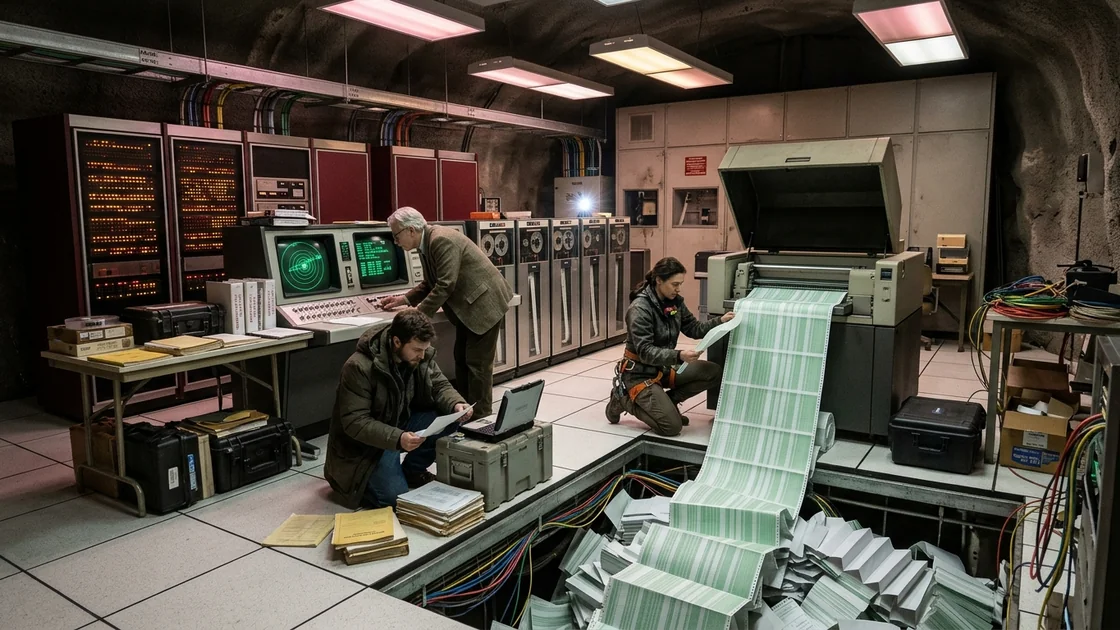
In the autumn of 2024, structural engineer Elena Rostova and computer historian Dr. Aris Thorne are contracted by the Department of the Interior to survey an undocumented subterranean anomaly beneath an abandoned forestry station in the Sawtooth Mountains of Idaho. After cutting through forty-five years of welded steel and poured concrete, they breach a forgotten Cold War facility known as Site Meridian, which was inexplicably sealed from the inside in November 1979. Expecting a flooded, dead relic, they instead discover a pristine, hermetically sealed bunker powered by an automated deep-earth geothermal tap. At the heart of the complex sits the Meridian-IV, a massive 1970s mainframe computer that is still warm, humming, and actively executing a program started nearly half a century ago. As Aris deciphers the archaic assembly language and miles of green-bar line printer paper, they bring in astrophysicist Marcus Vance to interpret the relentless stream of mathematics. Together, the three realize the machine is linked to a concealed radio-interferometer buried in the mountain peak above, and it has spent the last five decades calculating the precise, non-ballistic trajectory of an unknown extrasolar object that is actively decelerating as it approaches Earth.
The forestry map from 1968 called the place Fire Lookout Station Nine, though there had not been a tower on the ridge since the Nixon administration. All that remained on the surface was a rusted concrete apron, four snapped guy-wire anchors choked by mountain Lupine, and a cinderblock shed that smelled of wet pine needles and marmot droppings.
Elena Rostova stood inside the shed, her boot resting on the edge of a steel hatch that did not belong in a forestry station.
"The Department of the Interior listed this parcel as remediated timberland," she said, her voice echoing slightly off the damp cinderblocks. She shone her flashlight down onto the hatch. The steel was two inches thick, unpainted, and naval-grade, the kind used in submarine bulkheads or missile silos. However, nobody had ever put a Minuteman silo at eight thousand feet in the Sawtooth granite. "Look at the bead on that weld, Aris. That wasn't done by the Forest Service."
Dr. Aris Thorne crouched beside her, adjusting his glasses as he peered at the seam where the circular hatch met the iron collar set into the floor. He was a man in his late fifties who looked as though he had been assembled from spare library parts—tweed jacket stained with machine oil, silver hair perpetually static-charged, and fingers calloused not from manual labor, but from decades of prying corroded integrated circuits out of obsolete circuit boards.
"Slag inclusions along the northern arc," Aris murmured, tracing the dark, blistered metal with a gloved fingertip. "Whoever welded this shut was in a hurry, or they were working in the dark. And wait—look at the lip."
Elena leaned closer. The heavy steel dogging wheel on the outside of the hatch had been torched off, the spindle ground flat. Yet the weld bead itself wasn't on the exterior rim. The molten metal had been pushed upward through the four-millimeter gap from below.
"They welded it from the inside," Elena said, her brow furrowing. "Wait. That's plasma-arc or heavy stick welding from the underside of the collar. You’d suffocate from the fumes in a shaft that narrow unless you had positive-pressure ventilation pulling the smoke down."
"Which implies," Aris said, standing up and brushing granite dust from his knees, "that in November of 1979, when the county power grid logged the final disconnect for this sector, the people downstairs weren't leaving. They were locking the world out."
Outside the shed, the portable diesel generator coughed, settled into a rhythmic roar, and pressurized the hydraulic lines of the diamond-wire saw Elena’s crew had hauled up the switchbacks that morning. She hadn't brought a full excavation team—just two riggers from Boise whom she had sent back down to the base camp at the foot of the mountain once the heavy equipment was positioned. The contract from the Federal Real Property Council had been explicit: minimal footprint, preliminary structural assessment, and full inventory of any surviving computational hardware for the Smithsonian’s Cold War archive.
It took four hours of ear-splitting, water-cooled grinding to slice through the interior welds and the hardened steel locking dogs. Water mixed with gray steel slurry pooled across the concrete floor, draining away through cracks that hadn't seen moisture in years. When the final dog gave way, the hatch didn't drop. Instead, it rose a fraction of an inch with a dull, metallic thunk, lifted by the counterweights inside the shaft.
Elena killed the saw. In the sudden, ringing silence of the high Idaho pines, they heard the sound.
It wasn't the drip of subterranean water, nor the whistle of wind through rock fissures. It was a low, sixty-hertz thrumming, felt more in the fillings of their teeth than heard through the ears. When Elena hooked a chain hoist to the hatch lug and cranked it open six inches, a draft of air pushed past her face.
It was warm. It smelled of dry ozone, baked phenolic resin, paraffin wax, and the unmistakable, nostalgic tang of warm machine oil.
"My God," Aris whispered, his eyes widening behind his lenses. "The environmental controls are still running."
Elena clipped her multi-gas detector to her collar, checking the digital readout. "Oxygen is twenty point nine percent. Carbon monoxide zero. Hydrogen sulfide zero. Whatever is scrubbing the air down there is doing a better job than the HVAC in my office in Denver." She swung the hatch fully open, revealing a vertical shaft lined with corrugated galvanized steel. An aluminum cage ladder descended into darkness, Except it wasn't entirely dark. Thirty feet down, a single amber incandescent bulb burned behind a wire-mesh cage, casting long, geometric shadows across a landing.
They strapped on their harnesses, checked their headlamps, and climbed down into the mountain.
The shaft descended one hundred and eighty feet through solid batholith granite before terminating at a secondary blast lock. Unlike the surface hatch, this massive rectangular door—eight inches of composite steel and lead—stood ajar, propped open by a wooden wedge that had dried and split over the decades.
Beyond the door lay a corridor tiled in pale green vinyl asbestos, illuminated by every third fluorescent tube in the ceiling troffers. The bulbs that remained operational flickered with a pinkish, dying plasma glow, buzzing like trapped hornets.
"How is this possible?" Elena asked, her hand trailing along the wall where heavy steel conduits ran in neat, color-coded bundles. "A nuclear RTG? A radioisotope generator wouldn't have the wattage to run fluorescent lighting and air handlers for forty-five years."
Aris pointed to a stenciled sign at the first junction: AUXILIARY PLANT / GEOTHERMAL TAP B - 120 METERS.
"The Sawtooth batholith sits over a massive thermal anomaly," Aris said, consulting the mimeographed geological survey he had pulled from the National Archives in College Park. "In 1972, the Atomic Energy Commission funded a joint study with DARPA on closed-loop binary cycle geothermal turbines for deep-command bunkers. Isobutane working fluid, magnetic bearings, zero atmospheric exhaust. If the heat exchanger is deep enough in the bedrock and the cold sink is routed into the subterranean aquifer, a turbine like that has almost no friction points. With redundant solid-state governors, it could spin for a century until the pipes scale over."
They moved past the utility junction and entered the living quarters. Here, time had not decayed; it had simply coagulated.
The mess hall looked as though the staff had stepped out between courses. Four formica-topped tables stood in a row. On the nearest table sat a ceramic mug bearing the faded logo of the Lawrence Livermore Laboratory; at the bottom of the mug lay a dark, crystalline wafer that had once been coffee. Beside it lay a paperback copy of The Dragons of Eden by Carl Sagan, its spine cracked, held open by a slide rule made of yellow bamboo.
Elena walked to the corkboard mounted near the galley pass-through. The paper pinned to it had yellowed at the edges, brittle as autumn leaves in the dry, recirculated air. She read the duty roster aloud. "November 14, 1979. Director: Dr. H. Vance—no relation to your friend at Caltech, I assume?"
"Common name," Aris said, distracted as he peered through a reinforce-glass window into the adjacent room. "Though the academic circles for this kind of work were small."
"Systems Engineer: M. Lindqvist. Cryptographic Analyst: J. Miller. Telemetry Tech: R. Kaelen." Elena frowned, lifting the corner of a mimeographed memorandum beneath the roster. "Listen to this. It's dated November 18, 1979. Effective 0800 hours, Directive 44-Omega is in force. All surface telemetry trunk lines to Fort Meade and Cheyenne Mountain have been physically severed at the junction box. Primary calculation loops are to be given one hundred percent of core allocation. We will not allow the Carter transition audit to terminate the integration run before the perihelion solution is verified."
"They mutinied?" Elena looked around the silent room. "Four nerds in an Idaho basement staged a mutiny over a math problem?"
"Not if they went back up the shaft to weld the hatch," Aris said softly. "Look at the floor by the shaft entrance we just came through. There were four sets of heavy boot tracks in the welding dust leading toward the ladder, and only one leading back to the interior blast door. Three of them left. One stayed behind to weld the lid from underneath, then came back down here and wedged the inner door open so the air circulation loop wouldn't dead-head."
A chill ran down Elena’s spine despite the seventy-two-degree warmth of the corridor. "Then where is the fourth person?"
"Let’s check the machine room first," Aris said. His voice had taken on the hushed, reverent tone of an archaeologist approaching the burial chamber of a Pharaoh.
At the end of the corridor stood double doors of brushed aluminum, emblazoned with a blue plastic placard: DATA PROCESSING CENTER — CLEAN ROOM PROTOCOLS IN EFFECT.
Beneath the doors, a rhythmic sound pulsed. Clack-clack-clack-whir. Clack-clack-clack-whir.
Aris pushed the doors open.
The room was a cavern carved out of the mountain, sixty feet square, with a raised floor of white steel tiles surfaced in high-pressure laminate. Overhead, a vast plenum dropped chilled air directly down onto four monoliths arranged in a hollow square.
They were cabinets of dark crimson and brushed chrome, each eight feet long and six feet high, connected by thick overhead raceways. Along the front of the central console, thousands of tiny incandescent peanut bulbs flickered in frantic, cascading waves of amber and red—binary registers shifting states too fast for the human eye to track, creating the illusion of liquid fire flowing behind smoked acrylic panels.
To the left stood a row of eight magnetic tape drives, their vertical vacuum columns hissing softly. Seven of the drives were dark, their reels stationary, but the eighth was alive. Its two ten-inch reels of half-inch mylar tape twitched back and forth in short, violent jerks—zip-zip, pause, zip—reading and writing blocks of data with tireless precision.
And in the center of the hollow square sat an IBM 1403 heavy-duty chain printer, modified with an oversized acoustic hood that had been propped open. Every forty-two seconds, the printer’s high-speed type chain spun up with a high-pitched whine, and the hammers struck the platen in a single, deafening burst—BRRRRRAP!—advancing a sheet of green-and-white striped fanfold paper by precisely six lines.
The paper didn't feed into a standard catch basket. The basket had been removed decades ago. Instead, the paper spilled out over the edge of the raised floor into an excavated pit six feet deep that had originally been intended for sub-floor cabling. The pit was nearly full. Accordion-folded stacks of green-bar paper rose in towering, precarious stalagmites, thousands upon thousands of pages arranged in neat, obsessive columns that someone had stacked by hand until they could stack them no more, leaving the last decade or two of output to cascade in a vast, snowy drift across the white floor tiles.
"Sweet mother of Turing," Aris breathed. He stepped onto the raised floor, the tiles clicking faintly under his boots. "Do you know what this is?"
"A very large calculator?" Elena ventured, her eyes scanning the shadowed corners of the room to ensure no mummified systems engineer was sitting in a swivel chair waiting for them. The room was empty of human remains.
"It's a CDC-Star variant, or rather, a custom hybrid built on the Control Data Corporation 7600 architecture," Aris said, walking reverently toward the main operator’s console. The console consisted of two massive circular CRT vector displays—currently switched off to prevent phosphor burn-in—flanked by banks of mechanical toggle switches and a modified Teletype keyboard. He read the brushed-steel nameplate riveted to the primary chassis. "MERIDIAN-IV. Serial Number 001. Seymour Cray / Control Data Special Projects Division, Chippewa Falls, 1973."
Aris ran his hand over the warm crimson paneling. "This machine shouldn't exist. The rumors in the vintage computing community said ARPA commissioned a hardened, fault-tolerant supercomputer in '72 using solid-state emitter-coupled logic and triple-modular redundant magnetic core memory. If a transistor board fails in one bay, the routing matrix automatically shifts the instruction pipeline to a backup bay without dropping a single clock cycle. It’s freon-cooled through the chassis frames. You could hit the mountain above us with a twenty-megaton warhead, and this beast wouldn't miss a floating-point division."
"And it's been running the same program since 1979?" Elena walked over to the line printer. She knelt by the edge of the paper drift and lifted the section currently emerging from the tractor-feed pins. The purple ink was faint—the nylon ribbon had likely been re-inked by an automated capillary reservoir that was finally running dry—but the characters were sharp, hammered deep into the heavy twenty-pound bond paper.
She read a single line aloud:
JD 2460602.84166 | RA 19H 44M 12.0084S | DEC +22D 09M 51.442S | DV/DT -0.0004192 KM/S2 | ERR 0.0000001
forty-two seconds passed. The tape drive twitched—zip, zip—the core memory registers flashed a cascade of amber light across Aris’s face, and the printer screamed: BRRRRRAP!
The paper jerked upward. Six new lines appeared.
JD 2460602.84215 | RA 19H 44M 12.0085S | DEC +22D 09M 51.443S | DV/DT -0.0004194 KM/S2 | ERR 0.0000001
"Julian Date," Aris said, looking over her shoulder. "Two-four-six-zero-six-zero-two. That’s today. October 2024. The internal crystal clock hasn't drifted more than a few milliseconds in forty-five years."
"What are the other numbers?" Elena asked. "RA? DEC?"
"Right Ascension and Declination," Aris said, his voice dropping an octave. "Celestial coordinates. Equatorial system. And DV/DT... that's the first derivative of velocity with respect to time."
"Acceleration," Elena said, her engineering mind snapping the pieces together. "Negative acceleration. Whatever it's looking at, it’s slowing down."
They didn't leave the bunker that night. Elena went back to the surface just long enough to retrieve their heavy gear bags, a case of MREs, and a reel of tactical fiber-optic cable to run a repeater up to her satellite phone in the cinderblock shed.
When she returned, she found Aris sitting cross-legged on the floor beside the operator's console, surrounded by three massive leather-bound binders stamped with TOP SECRET / PROJECT MERIDIAN / SYSTEM ARCHITECTURE.
"I found the remains of our fourth crew member's work," Aris said without looking up. He pointed toward a secondary room behind the tape drives—the magnetic media vault. "It was Lindqvist, the systems engineer. He stayed behind. Based on the logbooks on his desk, he lived down here alone until April of 1983."
Elena stopped unpacking her gear. "Four years? Alone?"
"He had ten years of freeze-dried rations for four men, a hydro-recycling loop, and a machine that needed its printer paper changed every nineteen days," Aris said softly. "In '82, he realized he was going to die—renal failure, judging by the medical journals he was reading in the infirmary. So he re-engineered the paper feed. He dismantled the sub-floor grating, built a gravity chute into the cabling pit, and spliced twelve hundred boxes of fanfold paper together using archival mylar tape in the vault so the machine could pull a continuous web of paper through the floor slots for decades. Then, in April '83, he wrote a final entry saying he was going to take the elevator to the sub-basement geothermal level to 'check the isobutane seals one last time.' I suspect if we go down to the turbine room, we’ll find him there."
Elena looked at the continuous ribbon of paper snaking up through a slot in the floor from the dark vault below, feeding into the roaring teeth of the IBM printer. The sheer, quiet fanaticism of the act made the hair on her arms stand up. "Why, Aris? What was so important that a man would wall himself into a tomb and spend the last four years of his life acting as a human paper-tray for a computer?"
"Because the Meridian-IV isn't running a simulation," Aris said. He tapped the schematic spread across his knees. "Look at Input Channel Zero. In a normal CDC 7600, Channel Zero hooks up to a peripheral processor that reads punch cards or operator commands. Here, Channel Zero is hardwired to a solid-state analog-to-digital converter rack in the next bay. And that rack is fed by four coaxial waveguides as thick as your wrist that go straight up through the ceiling."
"Into the mountain," Elena said.
"Into the granite peak itself," Aris confirmed. "Granite is relatively transparent to certain very low and ultra-high radio frequencies if it’s dry and homogeneous, or—more likely—the survey markers you saw on the ridge outside aren't geological benchmarks. They're dipole elements disguised as lightning rods and forestry poles. The entire peak of this mountain is a phased-array radio interferometer and passive radar receiver."
He stood up and walked to the two dark circular CRT screens on the main console. "I want to turn on the vector displays. The logic loops are still feeding the display buffers—I can see the refresh interrupts firing on the panel lights—but Lindqvist flipped the high-voltage cathode switches off to save the phosphor tubes."
"If you flip that switch, is this fifty-year-old relic going to blow a capacitor and catch fire?"
"The power supply for the CRTs is isolated from the main CPU bus," Aris said, though his hand hovered hesitantly over the heavy chrome bat-handle switch. "If the flyback transformer shorts out, it'll just pop the breaker on the console. The computation won't stop."
"Do it," Elena said.
Aris threw the switch.
A high-pitched, mosquito whine—the sound of a fifteen-kilohertz flyback transformer charging an anode—filled the room, rising in pitch until it passed beyond the range of Aris’s older ears, though Elena winced slightly. There was a soft static crackle, the smell of disturbed dust baking on glass, and then the left-hand screen bloomed with a sharp, piercingly bright emerald point at its center.
Immediately, the electron beam began to dance.
Unlike modern raster monitors that paint an image line by line, the vector display drew lines directly from point to point like an ultra-fast oscilloscope. Within a second, a complex, three-dimensional wireframe model of the outer solar system materialized in glowing green phosphorus. The orbits of Jupiter, Saturn, Uranus, and Neptune were rendered as crisp, dotted ellipses.
Cutting across the plane of the ecliptic at a steep forty-one-degree angle was a solid line.
Along that line, tiny crosshairs marked historical positions—hundreds of them, stretching back into the dark void beyond Neptune's orbit. Near the inner terminus of the line, right between the orbits of Mars and Earth, a bright green diamond pulsed steadily. Beside it, rendered in blocky, vector-drawn Hershey fonts, were three lines of text:
OBJECT DESIGNATION: 1973-09-ALPHA
RANGE GEOCENTRIC: 0.0412 AU
TIME TO TERMINAL NODE: 0000Y 004D 11H 18M
Elena stared at the glowing green numbers. The seconds weren't counting down; the screen only refreshed every forty-two seconds when the main integration loop completed a cycle and the printer fired.
BRRRRRAP!
The green lines flickered. The minute counter ticked from
18M to 17M.
"Zero years, four days, eleven hours," Elena whispered. She did the math in her head. "Zero point zero four astronomical units. An AU is ninety-three million miles. Aris... that thing is less than four million miles away."
"And after fifty-one years of travel from the Kuiper Belt," Aris said, his face bathed in the eerie emerald glow of the cathode tube, "it gets here on Saturday."
"You're telling me you have an operational Cray-architected CDC hybrid running sixty-bit words on magnetic core memory, and you called me about the astronomy?"
The voice coming through the ruggedized tablet Elena had linked to her surface satellite phone belonged to Dr. Marcus Vance. Despite the shared surname with the long-dead director on the bunker's duty roster, Marcus was thirty-four, worked at the Jet Propulsion Laboratory in Pasadena, and was currently sitting in his pajamas in a kitchen in Altadena at two in the morning.
"Marcus, focus," Aris said, holding the tablet's camera up to the green-bar paper they had laid across the console. "Look at the state vectors. I dumped the raw octal values from the peripheral processor's maintenance register and translated the FORTRAN IV routines from the system binder. The machine is running a twelfth-order Cowell’s method numerical integration, accounting for perturbations from all eight major planets, Pluto, Ceres, and relativistic Schwarzschild corrections."
On the tablet screen, Marcus squinted, pushing his spectacles up his nose. He picked up a stylus and began tapping rapidly on a second screen out of view. "Wait. Give me that Julian date range again. From the bottom of the pit."
"Elena crawled down into the vault and pulled the first fanfold box from October 1973," Aris said. "Initial acquisition was at 48.2 Astronomical Units. Right Ascension nineteen hours, twelve minutes. It was moving at seventy-two kilometers per second relative to the Sun."
Marcus stopped tapping. The silence over the satellite link stretched for ten seconds, broken only by the rhythmic zip-zip of the Meridian-IV's tape drive in the background.
"Aris, that's impossible," Marcus said flatly. "At forty-eight AU, the solar escape velocity is only about six kilometers per second. If an object is inbound at seventy-two klicks per second, that’s a hyperbolic excess velocity higher than ’Oumuamua or Borisov. It’s interstellar. A rogue comet or a shard of an exoplanet ejected from a binary system."
"Read the rest of the columns I sent you," Elena cut in, stepping into the tablet's frame. "Look at the data from 1989, 2004, and last week."
Marcus scrolled through the high-resolution photos Elena had uploaded over the low-bandwidth BGAN satellite link. His eyes moved back and forth. Gradually, the color drained from his face, leaving him looking ghostly in the blue light of his monitors.
"In 1989, at twenty-two AU, its velocity was forty-one kilometers per second," Marcus murmured. "In 2004, at nine AU, it was down to nineteen. Wait a minute. Objects falling toward the Sun accelerate. Gravity pulls them in. Why is the velocity dropping?"
"Look at the fifth column," Aris said. "The DV/DT
value."
"Negative four-tenths of a millimeter per second squared," Marcus read. "And it's not constant. It's... it’s varying inversely with the solar wind density and the gravitational gradient. It’s braking. Whatever this thing is, it has been executing a continuous, low-thrust retrograde burn—or deploying some kind of magnetic sail against the heliosphere—for fifty-one years."
"If there is a giant braking spacecraft four million miles from Earth, why hasn't Pan-STARRS, ATLAS, or the James Webb Space Telescope seen it?" Elena demanded. "You guys at JPL track rocks the size of a dishwasher when they come inside the lunar orbit!"
"Because space is big, and we only see what reflects sunlight or emits infrared!" Marcus snapped, his voice rising in pitch as panic and scientific mania warred in his chest. "If an object has an albedo of zero—say, it's coated in a carbon-nanotube Vantablack equivalent, or it's actively cooling its sunward face and radiating its waste heat along a tight vector pointed away from the inner planets—optical telescopes are blind. And look at the approach vector on your CRT!"
Marcus pointed wildly at the screenshot of the vector display. "19 hours, 44 minutes Right Ascension, +22 degrees Declination. That’s in the constellation Vulpecula, right against the densest star clouds of the Cygnus rift in the Milky Way! And for the last six months, its phase angle relative to Earth has kept it within thirty degrees of the Sun's glare during the day, or buried in the galactic plane background noise at night. The only way you’d ever track it is with a dedicated, narrow-beam, coherent radar or phase-referenced radio interferometer that already knew exactly where to point to integrate the signal over forty-two-second windows!"
BRRRRRAP!
The line printer hammered out another six lines in the bunker, punctual as a guillotine.
"How did they find it in 1973?" Elena asked softly.
"They didn't find it optically," Aris said, flipping through the yellow pages of Dr. H. Vance’s personal notebook, which he had retrieved from the director's desk drawer. "Wait. Let me read you an entry from May 1973. 'The Vela-6B satellite gamma-ray burst data from the October '72 event was not Soviet nuclear testing in deep space. When correlated with the Haystack radar anomaly and the Arecibo receivers, the burst shows a blueshifted spectral line corresponding to electron-positron annihilation—a braking flare at the heliopause. ARPA has approved black-budget construction of Site Meridian to maintain a continuous phase-lock on the deceleration signature. If the public or the Joint Chiefs learn an active, controlled vehicle is inbound on a fifty-year intercept, the geopolitical destabilization will trigger a pre-emptive strategic exchange. Each superpower will assume the other is about to capture ultimate high-ground technology.'"
Elena sank onto the edge of a steel worktable. "So they built a hole in the rocks, built a custom supercomputer to track the braking curve, and in 1979, when a budget audit threatened to expose or shut down the site because the object had gone into a low-emission coast phase..."
"They faked the site's decommissioning," Aris finished. "Cut the trunk lines to the Pentagon, sealed the hatch, and left the computer to watch the sky until the object arrived."
On the tablet screen, Marcus was already pulling on a heavy winter coat over his pajama shirt. "Where in Idaho are you? Give me the GPS coordinates."
"Wait, Marcus, you can't just—"
"I have three hundred hours of unused federal leave, a four-wheel-drive Tacoma, and a security clearance that probably doesn't cover whatever 1970s felony you two are currently committing," Marcus said, grabbing a laptop bag and his keys. "If I fly into Boise on the six A.M. commuter out of LAX, I can be at your ridge by noon. Do not touch the console. Do not interrupt the tape drive. And for the love of God, make sure that printer doesn't run out of paper."
While they waited for Marcus to make the journey from California, the mountain seemed to grow heavier around them.
Elena spent the morning tracing the facility's infrastructure. She was an engineer by training; mysteries didn't bother her half as much as uninspected load-bearing systems. Carrying a thermal imaging camera and a heavy wrench, she descended the narrow spiral stairs at the rear of the bunker to the sub-basement.
The air grew noticeably hotter as she went down, reaching nearly ninety degrees in the lower rock chamber. Here, the smooth concrete walls gave way to raw, shotcrete-lined granite. In the center of the cavern sat two stainless-steel cylinders the size of city buses—the closed-loop geothermal heat exchangers and the sealed turbogenerators. They hummed with a fierce, seamless energy, vibrating barely a millimeter on their magnetic bearings.
In the corner of the chamber, neatly laid out on a canvas cot beside the primary control panel, was a skeleton wearing a faded Sears Roebuck flannel shirt and corduroy trousers.
Beside the cot sat a glass jar with the lid screwed on tight. Inside was a piece of green-bar computer paper. Elena didn't open the jar; she could read the block pencil writing through the clear glass:
Martin Lindqvist. Born 1938, Duluth, MN. Died April 1983. The bearings on Turbine 1 are good for another eighty years. Turbine 2 is set to auto-failover if line voltage drops below 204V. Please do not turn off the Meridian-IV until the tape on Drive 8 reaches the End-of-Reel marker. We promised Arthur we would watch it all the way in.
Elena stood in silence for a long moment, her headlamp beam glinting off the brass frame of the dead engineer's glasses, which had fallen onto his ribcage. She touched two fingers to the edge of the cot in a quiet salute from one engineer to another, checked the pressure gauges on the isobutane manifold—still squarely in the green—and climbed back up to the cold, dry air of the computer room.
When she returned, Aris was standing in front of Tape Drive 8, his expression grim.
"We have a problem," he said, pointing through the glass door of the six-foot-tall cabinet.
Inside, the half-inch magnetic tape was twitching back and forth across the read/write head assembly. Below the capstans, a fine pile of dark brown dust had accumulated on the white enamel floor of the drive housing.
"Oxide shedding," Aris said, his voice tight. "That tape has been shuttling back and forth over the same forty-foot section of mylar for decades. It’s the ephemeris scratchpad—every forty-two seconds, the CPU writes the new state vector to the tape, rewinds two blocks, reads the historical polynomial smoothing table, and steps forward one thirty-second of an inch. The binder glue that holds the iron oxide particles to the plastic backing is breaking down from age and friction."
Elena peered closer. She could see faint translucent streaks in the dark brown ribbon of tape where the magnetic coating was wearing thin. "What happens if a spot goes completely clear?"
"A parity error," Aris said. "When the read head encounters a bad bit that the cyclic redundancy check can't reconstruct, the peripheral processor will re-try the read sixty-four times. You’ll hear the tape drive chatter like a machine gun. If it fails on the sixty-fourth retry, the operating system—it’s running a stripped-down, real-time kernel called CHIPPEWA-OS—will throw an unrecoverable I/O interrupt and halt the central processor to prevent corrupted data from overwriting the core memory."
"Can’t you just switch it to Drive 7?" Elena asked, gesturing to the seven identical, dark tape drives standing in the row. "There are reels mounted on all of them."
"Drives 1 through 6 are the historical archive reels—they spun up, filled up, and locked off between 1979 and 2018," Aris explained. "Drive 7 was supposed to be the rollover for Drive 8, or a mirror, I’m not sure which. Look at the status lamp on Drive 7."
A small red lens at the top of Drive 7 was dark, while a physical
toggle switch beneath the reel was thrown to the
OFFLINE / FAULT position. Aris opened the glass door of
Drive 7 and touched the rubber pinch roller. Instead of giving slightly
under his finger, the black rubber crumbled like burnt toast, leaving a
smear of sticky black tar on his glove.
"Vulcanized rubber reversion," Aris sighed. "Because Drive 7 sat motionless for forty years while Drive 8 stayed warm and dynamic, the elastomeric compounds in Drive 7's pinch rollers depolymerized. When the system tried to spin up Drive 7—probably sometime around 2019—the roller disintegrated, jammed the capstan, and threw a fault. Drive 8 is the last operational mass-storage unit on the bus."
"How much tape is left on Drive 8?"
Aris squinted at the take-up reel. "That's the thing. It’s not running out of tape; it’s eating through the oxide on the current block because of the read-back verification loop. If I can modify the peripheral processor code in memory—just patch a single jump instruction—I can force the machine to skip the tape verification read and hold the smoothing polynomial entirely inside the magnetic core memory."
"Why didn't they do that in 1973?"
"Because magnetic core memory in 1973 cost about ten cents a bit, and they were terrified of a cosmic ray or a power glitch flipping a bit in volatile storage," Aris said. "This machine has sixty-five thousand sixty-bit words of high-speed small-core memory, and five hundred and twelve thousand words of large-core memory. Half of the large-core bank is currently idling as a diagnostic buffer that nobody has read since Jimmy Carter was president. I can reallocate it."
"Without stopping the program?"
Aris walked over to the main console and looked down at the three
rows of sixty chrome toggle switches mounted along the lower desk bevel.
"Do you know what front-panel switching is, Elena? In the seventies, if
you were a real systems programmer and you needed to hot-patch a running
kernel without hitting the halt button, you set the memory address on
the upper switches in octal, set the new sixty-bit machine instruction
on the lower switches, and hit the ENTER STORAGE
micro-switch during the thirty-millisecond window when the I/O channel
was waiting for the line printer's carriage return."
He flexed his fingers. "If I miss the window, or if I get one binary switch backwards out of sixty, I overwrite the active program counter and the Meridian-IV brains itself instantly."
"Let's wait until Marcus gets here," Elena said firmly. "Let him see the data first."
Marcus Vance arrived at four o'clock that afternoon, looking like a man who had been dragged backward through a juniper hedge. He was breathless, pale from the eight-thousand-foot altitude, and clutching a ruggedized Pelican case to his chest as Elena guided him down the ladder shaft.
When he stepped through the brushed-aluminum doors into the Data Processing Center and saw the crimson monoliths of the Meridian-IV humming in the chilled air, the cascading amber lights of the registers, and the emerald wireframe of the solar system glowing on the circular vector tube, he stopped dead in his tracks.
"It's real," he whispered. He dropped his Pelican case, walked slowly to the vector screen, and pressed his fingertips gently against the thick glass bezel. "I thought... on the plane to Boise, I convinced myself this was an elaborate ARG, or an old NORAD training simulator running a canned magnetic tape loop."
"Look at the raw signal," Aris said, gesturing toward a Tektronix dual-trace oscilloscope mounted in the telemetry rack beside the coaxial waveguides.
Marcus walked over to the scope. Two bright green waveforms danced across the graticule. The upper trace was a jagged, noisy hash of cosmic background interference, but the lower trace—the output of the phase-locked correlator—showed a sharp, unmistakable spike rising cleanly out of the noise floor, shifting almost imperceptibly to the left as the Earth rotated beneath the Idaho mountains.
"It’s a coherent carrier wave," Marcus breathed, adjusting his glasses. "No, wait. It’s not a communications carrier. Look at the Doppler sidebands. It’s synchrotron emission from a relativistic plasma sheath, modulated by a magnetic confinement field pulsing at... fourteen hundred and twenty megahertz."
"The hydrogen line," Aris noted. "Twenty-one centimeters."
"Not a broadcast," Marcus said, his mind racing as he pulled a notebook from his coat pocket and began scribbling equations. "It’s the exhaust—or the field harmonics of a magnetohydrodynamic drag brake interacting with the interplanetary medium. When a charged particle hits that magnetic field at thirty kilometers per second, it radiates at the twenty-one-centimeter band. The guys who built this bunker didn't just stumble onto this. Look at the waveguide phasing controllers!"
Marcus pointed to a bank of motorized mechanical wave-shifters—brass tubes driven by stepping motors that clicked softly every few minutes. "As the Earth turns, the mountain rotates away from the target's sky coordinates. How is a stationary antenna buried in an Idaho peak maintaining a twenty-four-hour lock when the target sets below the horizon twelve hours a day?"
Aris held up the second binder he had been studying. "It doesn't rely solely on the mountain peak during the nadir hours. Look at the network diagram on page twelve. When the Sawtooth array loses line-of-sight due to Earth's rotation, the Meridian-IV switches its analog input channels to a VLF—Very Low Frequency—ground-wave receiver loop routed through the deep bedrock granite."
"Wait," Elena said, frowning. "Ground-wave radio through solid rock?"
"Lithospheric waveguiding," Aris explained, his eyes alight with the sheer audacity of 1970s black-budget engineering. "In the late sixties, the Navy and DARPA discovered that the dry granite layer between the Mohorovičić discontinuity and the upper sedimentary crust acts as a natural waveguide for extremely low-frequency electromagnetic waves—around thirty to eighty hertz. They built three passive solar-and-thermoelectric repeater stations in the deep desert: one in the Western Australian shield, one in the dry valleys of Antarctica, and one in the Hoggar Mountains of Algeria. Automated solid-state transponders buried in drill holes. They take the 1420-megahertz sky signal, down-convert the phase delta into a forty-hertz lithosphere pulse, and pump it straight through the Earth's crust to this mountain."
Marcus stared at the schematic. "A planetary-scale underground interferometer. No satellites to fail, no undersea cables to get snagged by fishing trawlers, completely invisible to surface spectrum analyzers. And for fifty-one years, those buried repeaters in Australia and Antarctica have been faithfully pinging the phase data through the mantle to this basement."
BRRRRRAP!
The IBM printer struck the paper. Marcus flinched at the gunshot loudness of the impact, then hurried over to the paper chute. He read the freshly printed line, then dropped to his knees and began pulling up yards of the continuous fanfold sheet from the drift on the floor, tracing the numbers backward through the past week.
"Wait a minute," Marcus said. His voice lost its awe, replaced by the sharp, cold focus of an orbital dynamicist spotting an anomaly in a telemetry stream. "Aris, give me the terminal node coordinates. Where does the vector display say this thing is going to stop?"
"We assumed it was an impact trajectory," Elena said, walking over to stand beside him. "Or a high orbit."
"No, look at the DV/DT column over the last seventy-two
hours," Marcus said, his finger stabbing the green-and-white stripes of
the paper. "The deceleration rate isn't flattening out for a planetary
capture orbit. It’s following a hyperbolic tangent curve targeted at a
specific zero-velocity point relative to the Earth-Sun rotating
frame."
He opened his Pelican case, pulled out his high-end workstation laptop, and booted it up. His fingers flew across the mechanical keyboard, entering the last ten state vectors from the green-bar paper into a custom JPL orbital propagation script.
He hit Enter. A three-dimensional plot rendered on his sleek 4K screen—a stark contrast to the glowing green 1973 vector tube six feet away, yet showing the exact same curve.
"It's not hitting the Earth," Marcus whispered. "And it's not entering Low Earth Orbit. Look at the terminal node."
Elena leaned in. On the laptop screen, the trajectory line curved gracefully inward from the orbit of Mars, bleeding off speed with mathematical perfection, and terminated at a tiny green cross located directly on the line connecting the Earth and the Sun, roughly 1.5 million kilometers sunward of the planet.
"Lagrange Point One," Marcus said. "The L1 halo orbit. The exact point where the gravitational pull of the Earth and the Sun cancel out into a dynamic equilibrium. We keep solar observatories there—SOHO, DSCOVR, WIND."
"If we have satellites at L1," Elena said, "why haven't they bumped into it or registered its magnetic field?"
"Because L1 isn't a single point; a halo orbit around L1 is hundreds of thousands of kilometers wide," Marcus said, zooming in on the coordinates. "This object is slotting itself into the dead center of the gravitational saddle point—the unstable equilibrium node that normal satellites avoid because it requires constant station-keeping thrust and because, from Earth, anything sitting directly at L1 is directly in front of the solar disk! You can't look at it with an optical telescope without burning out your sensors on the Sun, and any radio noise it makes is drowned out by the solar corona!"
"It’s hiding in the Sun," Aris murmured.
"Not hiding," Marcus corrected, his voice trembling slightly. "Parking. Look at the mass estimate implied by the synchrotron drag equation in the FORTRAN code." He scrolled through Aris’s transcription of the 1973 equations. "To generate that specific deceleration curve against the solar wind pressure over fifty AU without expending chemical propellant... the cross-sectional area-to-mass ratio is completely wrong for a natural rock. And if it's using a magnetic dipole field to brake against the heliospheric current sheet, the field strength has to be around forty Tesla at the source, with an inertial mass of approximately four times ten to the ninth kilograms."
Elena translated the scientific notation instantly. "Four million metric tons."
The room seemed to grow very cold. Even the clatter of the tape drive sounded small and fragile against the weight of that number. Four million tons was the mass of forty Nimitz-class aircraft carriers. It was the mass of a small metallic mountain, sculpted or engineered, coasting silently across the dark gulf between the stars, bleeding off seventy kilometers per second of velocity over half a century just to come to a dead stop a million miles above Earth's noon sky.
"Wait," Aris said suddenly. He was staring at the binder containing the assembly code listings for the Meridian-IV’s final execution subroutines. "Marcus... what happens in the software when the time-to-node counter hits zero?"
"It probably just switches to a station-keeping tracking loop," Marcus said, though he didn't sound convinced.
"No," Aris said. He turned the brittle, yellowed page of the manual.
"Look at Routine OMEGA-EXEC, memory address
077400 octal. This code block has never been executed. It
sits dormant in the upper core bank, waiting for the range-rate
variable—the relative velocity with respect to the L1 point—to drop
below ten meters per second."
Elena walked over and looked at the block diagram drawn in faded blue
ink by a draftsman fifty-one years ago. "What does
OMEGA-EXEC do?"
Aris traced the flowchart boxes with his finger. "When the velocity hits zero... the Meridian-IV stops reading from Input Channel Zero. Instead, it activates Output Channel Four."
"What's on Output Channel Four?" Elena asked, her gaze shifting toward the massive gray steel cabinets lining the far wall beside the waveguides.
"Those aren't just pre-amplifiers for the receiving array," Aris said slowly, horror dawning in his eyes. "Elena, how much electrical power did you say those two geothermal turbines downstairs are generating?"
"Looking at the nameplates on the alternators?" Elena calculated quickly. "They're rated at four point five megawatts each. Nine megawatts continuous."
"A CDC 7600 mainframe, even with all its cooling pumps, tape drives, and bunker lighting, draws maybe two hundred and fifty kilowatts," Aris said, pointing at the massive copper busbars—four inches wide and a half-inch thick—that bypassed the computer room entirely and ran straight up the rear wall beside the coaxial waveguides. "Why do you put a nine-megawatt power plant inside a mountain for a quarter-megawatt computer?"
Marcus stood up so fast his chair clattered backward onto the floor tiles. "It's a transmitter. The phased array in the mountain ridge isn't just a passive listener. Those big gray cabinets on the wall are Klystron high-power microwave amplifiers!"
Elena ran to the far wall and pulled the latch on the nearest gray cabinet. Inside, nestled in heavy lead-lined cooling jackets connected to the building's water loop, sat a row of massive copper and ceramic vacuum tubes, each five feet tall, their filament heaters glowing a dull, cherry red on standby. Stenciled on the inner door was a radiation hazard trefoil: DANGER — HIGH POWER RF — 8.2 MEGAWATTS PEAK PULSE — DO NOT OPEN WHEN CHANNEL 4 ARMED.
"What is the computer going to transmit?" Elena demanded, looking back at Aris.
Aris was frantically translating the octal data tables tied to the
OMEGA-EXEC routine. "It’s a sixty-four-kilobit data burst,
modulated onto the 1420-megahertz hydrogen band, phase-conjugated to
focus the beam with pinpoint accuracy straight back along the incoming
vector to the L1 point."
"What's in the sixty-four kilobits?!" Marcus shouted, rushing over to the console.
"Wait, let me convert the octal constants to ASCII or CDC display code—" Aris grabbed a pencil and scribbled furiously on the margin of the green-bar paper. "Wait. It’s not text. It’s... it’s an array of floating-point numbers. No, it’s the orbital elements of the Earth, the mass ratio of the Earth-Moon system, atmospheric spectral absorption coefficients, and... wait."
Aris froze. The pencil lead snapped under the pressure of his fingers.
"What?" Elena gripped his shoulder. "Aris, what is the rest of the packet?"
"It’s a handshake," Aris whispered. He pointed to a handwritten annotation in the margin of the 1973 assembly listing, penned in the neat, cramped handwriting of Dr. Arthur Vance, the project director.
Elena read the faded ink aloud:
Per DARPA Order 119-73 (Eyes Only - Secretary of Defense): Analysis of the 1972 heliopause deceleration flare indicates the inbound vehicle is an automated Bracewell probe utilizing a passive transponder lock. Upon reaching L1 zero-velocity node, the probe will enter an active wide-band scanning mode to locate indigenous technological civilizations—a pulse of high-energy X-ray or radar sweep that will fry every unhardened satellite in geostationary orbit and immediately alert Soviet space surveillance to the object's presence. However, the signal modulation within the 1972 flare contained a mathematical prime-number challenge sequence. If a phase-conjugated response containing the solved Riemann matrix and local planetary ephemeris is transmitted to the probe within 4.2 seconds of its arrival at L1, the vehicle's logic will register the system as 'Already Cataloged / Active Telemetry Node Established' and it will remain in passive, dark observation mode—or redirect its high-gain telemetry tight-beam exclusively to the responding ground station.
The silence in the room was absolute, save for the hum of the freon compressors and the zip-zip of Tape Drive 8.
"Wait a second," Marcus said, his hands shaking as he grabbed the edges of the binder. "Let me read that." He scanned the dense, typewritten pages that followed the schematic. "In 1972, when the probe fired its brakes at the edge of the solar system, it broadcasted a mathematical ping. A wake-up call. And the guys who caught it realized that if nobody answered the ping with the right mathematical handshake the exact second the probe parked at L1, the probe would switch to 'Active Search Mode'—blasting the Earth with high-powered radar and X-ray lithography scans to map the surface from space."
"Which in 1973 would have looked like a Soviet orbital weapon attack," Elena said, "and in 2024 will blind every GPS, communications, and weather satellite we have in orbit, plunge the global economy into chaos, and cause every space agency and military on the planet to lose their minds in twelve minutes flat."
"Or worse," Aris said, pointing to the second half of the director's note. "Look at what Arthur Vance wrote in November 1979, right before they sealed the bunker: 'The Pentagon wants to alter the OMEGA-EXEC transmission packet. They want to send a command sequence they think will trick the probe into dropping out of L1 and entering a low lunar capture orbit where a future Space Shuttle mission can salvage its hull materials. My mathematical team has proven their command sequence is flawed—it violates the syntax of the 1972 challenge matrix. If we transmit the Pentagon’s corrupted packet, the probe will interpret it as an anomalous error or a hostile interference attempt and execute a sterilization or collision maneuver—or simply leave. Therefore, we are severing the lines to Washington, restoring the original pure mathematical handshake to Core Bank 3, and sealing the facility. When the probe arrives in 2024, Meridian-IV will send the quiet handshake. The probe will think Earth is a quiet, orderly beacon, dump its interstellar survey logs down the 1420-megahertz beam straight into our tape drives, and go to sleep.'"
Marcus looked up at the glowing green vector screen.
TIME TO TERMINAL NODE: 0000Y 003D 19H 04M
"They saved us," Marcus whispered. "Those four guys in 1979 stopped the military from poking a four-million-ton interstellar machine with a sharp stick. All we have to do is stand here for three days, nineteen hours, and four minutes, let the computer send the sixty-four-kilobit handshake, and everything stays quiet."
Then, from the left side of the room, came a sound that made all three of them freeze.
Chatter-chatter-chatter-chatter-SCREEEEECH.
Tape Drive 8 convulsed.
Inside the vacuum columns, the half-inch brown magnetic tape whipped violently up and down as the capstans reversed direction sixty-four times in three seconds, desperately trying to read a block of data through a spot where the iron oxide had completely flaked away.
On the main operator console, a bank of amber lights suddenly flashed crimson. A mechanical Klaxon bell inside the cabinet gave a single, sharp BRR-RING!
The vector display screen flickered. The line printer didn't fire at
the forty-two-second mark. Instead, the peripheral processor status
register lit up with an octal error code:
7704 - TAPE PARITY RETRY LIMIT EXCEEDED.
"It didn't halt," Aris gasped, lunging toward the console. "Why didn't it halt?!"
He scanned the status lights on the triple-modular redundant routing panel. "Because of the fault-tolerant architecture! When Drive 8 failed to return the polynomial smoothing table within two seconds, the CPU declared Peripheral Processor 1 'dead' and switched the calculation loop to the secondary degraded mode—a straight linear extrapolation without the historical perturbation corrections!"
Marcus looked at the vector display. The ERR value at
the bottom of the screen—which had sat rock-steady at
0.0000001 for fifty-one years—suddenly jumped.
ERR 0.0004120
Forty-two seconds later, the printer fired again, without the tape drive moving.
ERR 0.0018940
"The error is compounding!" Marcus yelled, looking at his laptop. "Without the high-order perturbation polynomial stored on that tape, the computer's internal position estimate for the probe is drifting! By the time the countdown hits zero on Saturday, the phase-conjugated Klystron array will aim the handshake beam four arc-minutes off target! At 1.5 million kilometers, four arc-minutes is a miss of nearly two thousand kilometers! The probe won't hear the handshake!"
"Can you calculate the targeting coordinates on your laptop and feed them into the transmitter?" Elena asked Marcus.
"My laptop doesn't have the fifty-one-year phase-history matrix that calibrates the atmospheric and lithospheric distortion of this specific mountain's antenna array!" Marcus said, running his hands through his hair. "That calibration matrix is sitting on that rotting reel of magnetic tape! Even if I know where the probe is in the sky, I don't know how to phase the eighty-four dipole elements on the ridge above us to form a coherent beam without the Meridian-IV's internal wave-shaping tables!"
Aris was already pulling a heavy steel toolbox from beneath Lindqvist’s workbench. "Then we have to get the data off that tape, load it permanently into the idle core memory bank, and hot-patch the CPU instruction pipeline so it reads the smoothing table from solid-state ferrite core instead of the tape drive."
"You said the oxide is gone on that section of the tape!" Elena reminded him, dropping to her knees beside him to help open the rusted latches of the tool chest.
"It's gone on the active scratchpad block at foot-marker 1,420," Aris said, pulling out a magnifying loupe, a bottle of isopropyl alcohol, and a splicing block. "Because the machine writes a backup copy of the calibration polynomial every ten thousand cycles before advancing the tape, there is an identical, pristine copy of the table sitting three feet further back on the reel, written about four months ago! The planetary perturbations don't change in four months—that table is ninety-nine point nine-nine-nine percent identical!"
"If you open the tape drive door and manually wind the reel back three feet," Marcus said, "won't the optical encoder lose track of the block address?"
"Not if I cut out the damaged four feet of tape, splice the reel back together with mylar tape, and let the read head hit the previous block header as if nothing happened," Aris said. "Wait. No. Each block header has a sequential Julian timestamp. If the timestamp is four months old, the range-check routine will reject it."
Aris stood up, his eyes darting across the rows of sixty toggle
switches on the main console. "I have to do both. First, we splice the
tape so the physical media can pass over the heads without throwing an
oxide parity error. Second, while the drive is offline for the ninety
seconds it takes me to splice it, I have to use the front-panel toggle
switches to patch the kernel's timestamp verification instruction at
octal address 014212 into a NO-OP—a
no-operation command—so it accepts the four-month-old table. And third,
I have to patch the memory pointer so that once it reads that table
once, it locks it into Core Bank 2 and never touches the tape
drive again!"
"Ninety seconds?" Elena stared at him. "Why do you only have ninety seconds?"
"Because the degraded linear-extrapolation mode is a temporary fault buffer!" Aris shouted over the rising hum of the cooling fans. "According to the system manual, if a peripheral channel stays in a fault state for three consecutive forty-two-second integration cycles—one hundred and twenty-six seconds total—the master watchdog timer assumes the facility has suffered a catastrophic breach, purges the volatile registers, and parks the Klystron array in a safe, grounded state that requires a physical key-turn at the surface substation to reset! And the surface substation was demolished and buried under fifty tons of concrete in 1979!"
Elena looked at her watch. Since the tape drive had screamed to a halt, forty-eight seconds had already elapsed.
"Wait—you're telling me we have seventy-eight seconds right now?!" Elena lunged toward Tape Drive 8.
"No! Don't touch the drive yet!" Aris grabbed her arm, pulling her
back. "Look at the status light! The drive didn't go fully offline; it's
sitting in a 'Hold/Wait for Operator Intervention' state! As long as we
don't hit the RESET/UNLOAD button on the drive, the
watchdog timer thinks the peripheral processor is just taking a long
time to seek! We can run in degraded mode for hours, watching the
targeting error grow, until we are ready to hit UNLOAD. The
moment we hit UNLOAD to release the brake on the tape reels
so I can splice it, the one-hundred-and-twenty-six-second hardware
watchdog timer starts ticking!"
Elena let out a breath she didn't realize she was holding, her heart hammering against her ribs. "Okay. Okay, thank God. Then we plan this. We rehearse every single movement before we touch that button."
For the next fourteen hours, the bunker became an operating theater preparing for open-heart surgery on a patient made of iron, copper, and glass.
Every forty-two seconds, the IBM 1403 printer hammered out another
line of coordinates, and every forty-two seconds, the ERR
number on the vector display crept upward like rising floodwater. By
Friday morning, the targeting error had grown to thirty-two
arc-minutes—wider than the full moon in the sky. If the probe arrived
now, the eight-megawatt handshake beam would miss the Lagrange point
entirely, shooting uselessly into deep space while the four-million-ton
machine woke up and hit the Earth with an active sensor sweep.
Aris spent six hours double- and triple-checking the octal machine code for the CDC-Star hybrid architecture. Because the Meridian-IV used sixty-bit words and ones'-complement arithmetic, a single miscalculated bit would turn a simple memory-jump instruction into an illegal opcode halt.
He wrote the sixty binary digits on a strip of masking tape and stuck it directly above the sixty toggle switches on the console:
010001 110010 000100 101110 000000 000000 100110 000000 000000 000000
"Since I can raise the toggle switches BEFORE we hit the unload
button on the tape drive," Aris explained, his voice hoarse from
exhaustion as he carefully flipped each chrome lever into position to
match the masking tape, "the first patch is already staged on the
console. The moment Elena hits UNLOAD on Drive 8, I will
wait for the line printer to fire—that gives me my thirty-millisecond
I/O pause—and I’ll hit ENTER STORAGE. Then I have to flip
twenty-four of these switches to a second configuration to lock
the core memory pointer, while Elena and Marcus do the physical splice
on the tape."
"Why am I doing the splice?" Elena asked, holding the brass splicing block and the non-magnetic stainless-steel razor blade. "You're the computer historian!"
"Because my hands have a slight essential tremor when my adrenaline
spikes, and you cut through two-inch naval steel with a diamond wire
without nicking the collar," Aris said simply, holding up his right
hand, which was indeed trembling faintly from fifty-six hours of minimal
sleep and stale MRE coffee. "When that vacuum column vents and releases
the tape tension, you have to pull out forty-eight inches of half-inch
mylar ribbon, lay the two good ends into the sixty-degree diagonal
groove of the splicing block, slice them clean without crinkling the
edge by a tenth of a millimeter, press down the silver splicing tape,
trim the excess, and hit LOAD so the vacuum sucks the loop
back into the columns."
"And what am I doing?" Marcus asked, standing between the console and the tape drive with a digital stopwatch in his hand.
"You are the clock and the verifier," Aris said. "You call out the
forty-two-second printer cycles so I don't hit
ENTER STORAGE while the CPU is reading the instruction
register, and you watch the vacuum column optics on Drive 8. When Elena
hits LOAD, the tape has to find its load point within
fifteen seconds, or the watchdog timer kills us. Ready?"
Elena wiped her palms on her jeans, took the non-magnetic razor blade between her thumb and forefinger, and stood before the glass door of Tape Drive 8. She swung the glass door open. The warm smell of oxidized iron and old plastic wafted out.
"Wait for the printer," Marcus said, his eyes locked on his stopwatch. "Five seconds to cycle... four... three... two... one..."
BRRRRRAP!
The hammers struck the green-bar paper.
"Cycle complete! Go!" Marcus barked.
Elena jabbed the square white UNLOAD button on the tape
drive.
Immediately, a loud pneumatic HISS echoed through the room as the vacuum blowers behind the vertical columns vented. The two long loops of brown tape collapsed slackly, and the electromagnetic brakes on the upper and lower reels clicked open. Simultaneously, a red warning lamp on the main console began to flash at one-second intervals, accompanied by a sharp, electronic beep... beep... beep from the master watchdog timer.
"One hundred and twenty-six seconds on the clock!" Marcus called out.
Elena didn't look at him. Her hands moved with the practiced, methodical grace of a structural technician who had rigged explosives and tensioned bridge cables in high winds. She gripped the upper and lower reels, spinning the upper supply reel counterclockwise to feed out three feet of undamaged dark brown tape from four months ago, while pulling the translucent, shredded four-foot section off the lower take-up reel.
"Aris, thirty seconds to the next printer cycle!" Marcus said. "Get ready for the first memory injection!"
At the console, Aris had both hands resting on the chrome guard rails
beside the ENTER STORAGE key. His eyes were glued to the
amber register lights of the program counter. "Waiting for the I/O
interrupt..."
At the tape drive, Elena laid the two ends of the brown ribbon over the machined aluminum channel of the splicing block, overlapping them over the diagonal slot. The damaged section of tape was so brittle it snapped in her left hand, showering her boots with brown oxide dust.
"Careful!" Marcus gasped. "Don't stretch the good end!"
"Shut up and count, Marcus," Elena muttered through clenched teeth. She held the mylar flat with two fingers, set the razor blade into the diagonal guide slot, and drew it across with firm, decisive pressure. Snick. The severed damaged tail fell away.
"Three seconds to printer cycle!" Marcus yelled to Aris. "Two... one..."
BRRRRRAP!
The instant the printer hammers fired, the I/O WAIT
light on the console blinked amber. Aris slammed his thumb down on the
ENTER STORAGE key.
For a fraction of a second, the cascading binary lights on the front panel stuttered. A single row of amber bulbs in the upper register flashed solid white, then resumed their frantic, liquid dance.
"Patch One is in!" Aris shouted, his fingers already flying across the sixty toggle switches, flipping twenty-four of them down and up in a rapid, memorized staccato—click-click-click-click-click—to stage the second instruction. "The timestamp check is bypassed! How's the splice?!"
"Seventy seconds remaining!" Marcus called.
Elena peeled a half-inch strip of ultra-thin silver aluminized mylar tape from its backing using the tip of the razor blade, aligned it over the diagonal seam between the two brown tape ends, and burnished it down with the smooth ivory handle of Aris’s loupe until the trapped air bubbles vanished. She snapped the hinged guillotine cutters on the sides of the splicing block—clack!—trimming the microscopic overhang from the edges of the ribbon so it wouldn't snag the guide pins.
"Splice complete!" She lifted the tape out of the block, manually
wound the slack back onto the lower reel until the silver splice sat two
inches above the read/write head, and slammed her palm onto the green
LOAD button.
"Forty-five seconds left on the watchdog!" Marcus yelled.
The vacuum blowers inside Drive 8 roared back to life. With a sharp thwack, suction pulled two deep loops of brown tape down into the left and right vacuum columns. The capstan motor spun up.
The tape twitched—zip-zip—carrying the silver splice right across the read/write head.
For one terrifying second, the drive chattered—clack-clack-clack—as the optical sensor caught the reflective glint of the silver splicing tape and tried to decide if it was an End-of-Reel marker.
"Come on, you seventy-three-ton bastard, read the block!" Aris
pleaded, his thumb hovering over the ENTER STORAGE key as
the next printer cycle approached.
Inside the drive, the capstan stopped chattering. It gave one smooth, two-inch pull forward.
On the console, the red TAPE FAULT lamp extinguished,
replaced by a solid green CHANNEL 0-8 ACTIVE light. The
watchdog timer's relentless beep... beep... beep cut off at
ninety-eight seconds.
"It read the polynomial!" Marcus shouted, staring at the register lights. "The smoothing table is in the peripheral buffer! Five seconds to printer cycle, Aris! Lock it into Core Bank 2 before the tape tries to rewind over that splice!"
"Three... two... one..."
BRRRRRAP!
Aris hit ENTER STORAGE for the second time.
Immediately, Tape Drive 8 gave a soft click, its pinch roller
retracted half a millimeter into the IDLE / STANDBY
position, and the vacuum columns settled into a peaceful, motionless
hum. On the central processor chassis, the indicator lamp for
LARGE CORE MEMORY BANK 2 flared bright amber as the
smoothing polynomial was permanently locked into the magnetic ferrite
rings.
Everyone held their breath, staring at the green vector display.
Forty-two seconds crawled by like geologic epochs.
Then, without the tape drive moving a muscle, the printer fired: BRRRRRAP!
The emerald characters on the circular CRT flickered and redrew themselves:
JD 2460603.41250 | RA 19H 44M 12.0091S | DEC +22D 09M 51.448S | DV/DT -0.0004199 KM/S2 | ERR 0.0000001
The targeting error had vanished. The crosshair on the three-dimensional wireframe snapped back onto the terminal node at L1 with sub-millimeter precision.
Elena slid down the front of the dead tape drive cabinet until she was sitting on the white floor tiles, letting the razor blade clatter onto the steel beside her. Marcus let out a ragged laugh that sounded half like a sob, leaning his forehead against the cool crimson metal of the mainframe.
Aris stood at the console, gently flipping the sixty toggle switches back to zero, one by one. "Good machine," he whispered, patting the warm aluminum bezel of the Meridian-IV. "Good old iron."
On Saturday morning, at 03:14 Mountain Standard Time, the countdown reached its final hour.
None of them had slept. They sat in three 1970s steel-case swivel chairs arranged in a semicircle before the main operator console, drinking lukewarm water and watching the emerald numbers bleed down toward zero.
Outside, eight thousand feet above sea level and a hundred and eighty feet above their heads, an early October blizzard had rolled in over the Sawtooth Range, burying the cinderblock forestry shed and the welded steel hatch under three feet of dry Idaho powder. Yet down here in the granite batholith, the air remained a steady seventy-two degrees, scented with warm wax and ozone.
TIME TO TERMINAL NODE: 0000Y 000D 00H 02M
"Look at the DV/DT value on the last printout," Marcus
said quietly, holding the latest fold of green-bar paper. "Negative zero
point zero-zero-zero-zero-one. And the synchrotron spike on the
Tektronix scope is dropping back into the noise floor."
"It’s shutting down its magnetic brake," Aris said. "Relative to the Earth-Sun L1 point, its velocity is down to eleven meters per second. Just a fast jog."
Elena looked at the far wall, where the massive gray Klystron cabinets stood. Twelve minutes ago, when the range-rate had dropped below fifty meters per second, a heavy mechanical contactor inside the power distribution panel had thrown itself shut with a sound like a shotgun blast—CLANG!—routing eight megawatts of raw geothermal electrical power from the sub-basement turbines into the high-voltage capacitor banks of Output Channel Four.
The floor tiles beneath their boots were vibrating now, not just with the sixty-hertz hum of the transformers, but with the rising, high-voltage tension of massive oil-filled capacitors charging to capacity. The cherry-red glow inside the Klystron viewing ports had brightened to a fierce, incandescent orange.
"Have you thought about whether we should have pulled the breaker on those Klystrons?" Elena asked softly into the charged silence. "What if the Pentagon guys in 1979 were right to be scared? What if sending a pure, six-megawatt mathematical handshake straight at a four-million-ton alien machine isn't the safe move?"
"If the machine wanted to drop a kinetic rod on Earth, it wouldn't have spent fifty-one years politely slowing down from seventy-two kilometers per second," Marcus replied, his eyes fixed on the green phosphor screen. "Do you know how much kinetic energy four million tons has at seventy-two klicks a second? If it had simply coasted into Earth without braking, it would have hit with the force of two million megatons of TNT. It would have boiled the oceans and stripped the biosphere back to bacteria before we ever saw it coming. You don't spend half a century riding a magnetic brake into a delicate gravitational balance point a million miles away unless you're trying very hard not to break the fragile things living on the third planet."
"And Arthur Vance's math was right," Aris added, resting his hand on the yellowed leather binder. "It’s an automated archive node. An interstellar lighthouse keeper checking the buoys. It’s been traveling for ten thousand or a hundred thousand years since it left its last star system. All it wants to know is whether anyone down here is awake enough to do the math."
BRRRRRAP!
The line printer struck the paper.
TIME TO TERMINAL NODE: 0000Y 000D 00H 00M
RANGE RATE L1: 0.0000 KM/S
On the console, every single light in the normal computation registers suddenly went dark.
For two heartbeats, the room was plunged into an eerie twilight, lit only by the pinkish ceiling fluorescents and the green dot at the center of the CRT.
Then, the upper register bank—Address 077400 octal,
Routine OMEGA-EXEC—ignited in a solid, blazing bar of amber
light.
Above their heads, the brass waveguide phase-shifters whirred in unison, locking into their final geometric alignment. Inside the gray Klystron cabinets, the mercury-vapor ignitron tubes fired with a blinding blue flash that leaked through the cabinet seams, and a deep, bass-heavy THRRRRRUUUMMMMM resonated through the solid granite of the mountain—a pulse of eight point two megawatts of coherent 1420-megahertz radio energy punching straight up through the dry rock peak, through the October snowstorm, through the ionosphere, and out into the black vacuum toward the Sun.
The pulse lasted precisely 4.2 seconds.
When the contactor dropped open—CLANG!—the fluorescent lights in the ceiling surged bright white for a second as the massive electrical load was shed back to the geothermal governors downstairs.
Marcus stared at his stopwatch. "Light-travel time to L1 is five seconds each way," he whispered, his voice cracking. "Five seconds for the handshake to reach the probe. Four seconds for the packet to finish transmitting. Five seconds for the response—or the active radar sweep—to come back."
He counted the seconds aloud.
"One... two... three... four... five."
"The signal just hit L1," Elena whispered.
"Six... seven... eight... nine... ten... eleven... twelve... thirteen..."
At fourteen seconds, the Tektronix oscilloscope beside the waveguides didn't just show a spike.
The green trace rose into a crisp, square-wave digital envelope of staggering power and mathematical perfection—so clean, so devoid of sideband noise that it looked as though it were being generated in the room next door rather than a million miles away in deep space.
Simultaneously, on the Meridian-IV, Peripheral Channel Zero woke up.
It didn't route the incoming data to the dead tape drives. Wait—Elena turned her head sharply.
At the far end of the row of eight tape drives, Drive 1—which had been locked offline since 1984 with a full reel of historical tracking data—suddenly clicked. An automated mechanical solenoid released the write-protect ring lock on the hub.
"Wait," Aris gasped, scrambling to his feet. "Drive 1 isn't broken! Lindqvist didn't lock Drives 1 through 6 off because they were full of historical tracking data! Look at the labels inside the glass!"
Elena ran to Drive 1 and peered at the paper label stuck to the aluminum reel hub. Written in Arthur Vance's neat black ink were the words: INBOUND TELEMETRY BUFFER — REEL 1 OF 6 — DO NOT MOUNT UNTIL OMEGA-EXEC COMPLETE.
With a crisp pneumatic hiss, the vacuum columns on Drives 1 through 6 pulled six pristine loops of virgin magnetic tape down into the chutes. Drive 1’s capstan spun up to a continuous, high-speed stream—sixty inches per second of solid, maximum-density magnetic recording as the object at L1 opened its memory banks and began dumping its survey data down the narrow 1420-megahertz beam straight into the mountain.
And in the center of the room, the IBM 1403 line printer didn't wait forty-two seconds.
Its high-speed type chain spun up to a continuous, screaming whine, and the hammers began to fire in a relentless, machine-gun cadence—BRRRAP-BRRRAP-BRRRAP-BRRRAP-BRRRAP!—driving the green-and-white striped paper upward out of the floor slot in a rising fountain of purple ink.
Aris, Elena, and Marcus rushed to the printer, grabbing the rising web of paper as it spilled over the acoustic hood.
The coordinates were gone. The Julian dates were gone.
In their place, hammered across the one-hundred-and-thirty-two-character width of the green-bar sheets, were dense, intricate matrices of hexadecimal and octal values, followed by block-printed ASCII graphs depicting stellar spectra, planetary mass ratios, orbital resonances of star systems with three, four, and seven planets, molecular diagrams of non-terrestrial amino chains, and catalog headers separated by rows of asterisks:
*** SURVEY NODE 004198 — EPSILON ERIDANI B — EPOCH -41,200 SOLAR CYCLES ***
*** SURVEY NODE 004199 — TAU CETI E — EPOCH -28,904 SOLAR CYCLES ***
*** SURVEY NODE 004200 —LUYTEN 726-8 — EPOCH -14,112 SOLAR CYCLES ***
*** SURVEY NODE 004201 — SOL / TERRA — LOCAL BEACON VERIFIED — STATUS: QUIET ***
Marcus fell to his knees beside the printer pit, catching the warm, freshly inked pages in his trembling hands as they poured down over his shoulders like a waterfall. "It's an encyclopedia," he whispered, tears cutting tracks through the granite dust on his cheeks. "It's the black box of every star system within fifty light-years. And it just marked us as 'Verified / Quiet.' It’s not going to scan the surface. Nobody up there is ever going to know it’s sitting in the glare of the Sun."
Elena looked from the roaring printer to the six spinning tape drives, and then back to the circular green vector display. On the screen, the three-dimensional wireframe of the solar system had vanished, replaced by a single, steady message pulsing calmly in the center of the phosphor glass:
PROGRAM EXECUTION COMPLETE — RECEIVING ARCHIVE STREAM
ESTIMATED TIME TO COMPLETION: 0014Y 0212D 08H 14M
"Fourteen years," Aris murmured, adjusting his glasses as the amber register lights reflected in his lenses. "At sixty inches per second across six high-density reels... wait. Six reels won't hold fourteen years of data."
He looked down at the floor slot where the fanfold paper was rising, and then back toward the magnetic media vault behind the drives, where three thousand unmounted reels of virgin 1973 magnetic tape sat in hermetically sealed foil canisters on steel racks, waiting for a human operator to swap them out every eighteen hours.
Elena looked at the heavy steel blast door leading back toward the ladder shaft and the snow-covered world above, and then back at the humming crimson cabinets of the Meridian-IV.
"Elena," Marcus said softly, not looking up from the star charts pouring across his lap. "What did your contract with the Department of the Interior say you were supposed to report about this site?"
Elena listened to the steady, sixty-hertz heartbeat of the geothermal turbines deep in the basalt below them—the engines Martin Lindqvist had promised would run for another eighty years. She looked at the diamond-wire saw gear bag sitting by the door, and thought of the welding torch she still had in the back of her truck at the base camp.
"Flooded," Elena said calmly, watching the green-bar paper rise into the chilled air. "I'm going to tell them the shaft collapsed at forty feet, flooded with groundwater, and that there's nothing down here under the mountain but wet granite and rust. And then I think the three of us are going to need to work out a rotation schedule for changing the tape reels."