The Hexadecimal Midnight of Cinder Springs
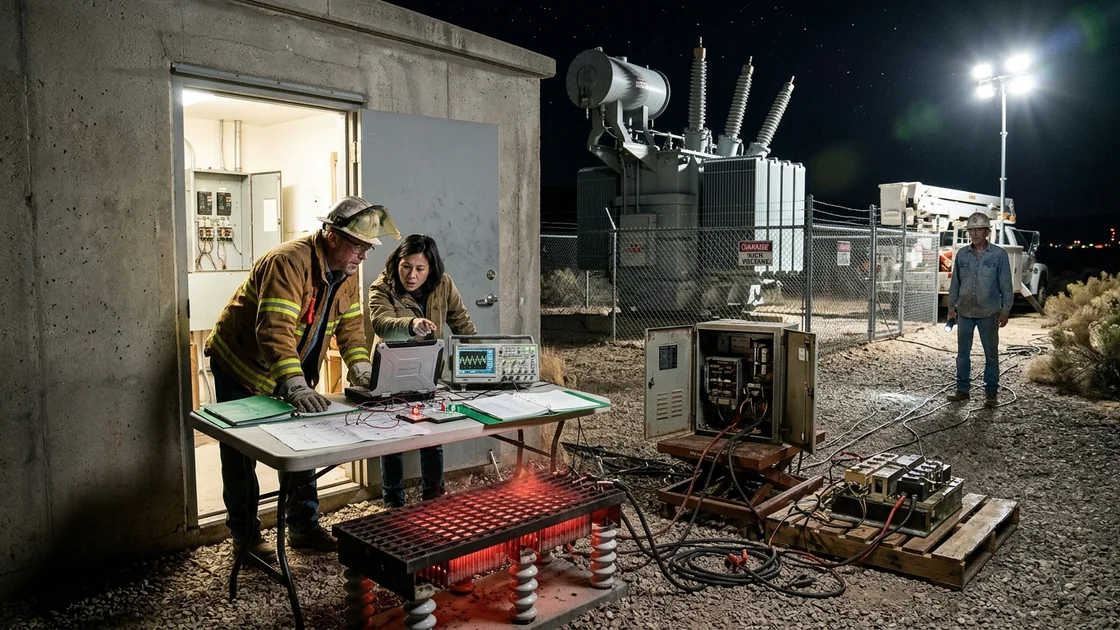
Arthur Pendelton, a weary electrical engineer specializing in power grid harmonics, arrives in the isolated desert town of Cinder Springs to investigate a baffling municipal utility anomaly. Every night at precisely midnight, all four hundred and twelve streetlamps in the town abandon their standard sixty-hertz alternating current cycle to flicker in a synchronized, rapid-fire pattern for eleven minutes. Setting up high-speed optical sensors and power quality analyzers, Arthur discovers that the lights are not suffering from failing ballasts or atmospheric interference, but are transmitting structured data in flawless hexadecimal code. Alongside Mara, a sharp-witted town archivist and amateur astronomer, and Vance, the aging local lineman, Arthur traces the rogue signal away from the overhead transmission lines and down into the town's copper grounding grid. Their investigation uncovers a forgotten 1970s subterranean telemetry array buried beneath the adjacent alkali flats, where an ancient, geothermal-powered computer is desperately broadcasting forty years of accumulated geological data before its failing core ruptures. To prevent the escalating voltage spikes from destroying the town's transformers, Arthur must use the municipal substation itself to transmit a hexadecimal acknowledgment signal back into the earth, completing a decades-old digital handshake and laying the machine to rest.
The heat in the Mojave basin did not merely sit on the land; it pressed down with the dead, insistent weight of an iron skillet. When Arthur Pendelton stepped out of his rental sedan in front of the Cinder Springs Municipal Utility district office, the soles of his steel-toed boots seemed to sink a fraction of an inch into the softening asphalt. The air smelled of baked creosote, alkaline dust, and the faint, unmistakable tang of cooked transformer oil.
Arthur was fifty-two years old, with the stooped shoulders of a man who had spent three decades leaning over switchgear schematics and the squinting, crow-footed eyes of someone who stared too long at oscilloscope traces. He carried a scarred aluminum briefcase in his left hand and a yellow Fluke Three-Phase Power Quality Analyzer strapped over his right shoulder. He was a troubleshooter of last resort, an independent consultant hired by small utilities when their own engineers ran out of textbook answers and started blaming ghosts, sunspots, or government satellites.
The door to the utility office rattled in its warped aluminum frame as a man stepped out onto the concrete porch. He was tall, stringy, and wore a faded denim shirt with his name, Vance, stitched in frayed white thread above the breast pocket. A soiled hard hat was tucked under his arm.
"You Pendelton?" Vance asked, his voice like two pieces of coarse sandpaper rubbed together.
"That's me," Arthur said, shifting his grip on the aluminum case. "You're Vance? Chief lineman?"
"Only lineman," Vance corrected, spitting a thin stream of tobacco juice into a patch of dead brittlebush beside the steps. "Unless you count Tommy, and Tommy's been out with a busted collarbone since his dirt bike lost an argument with a culvert in April. Come on inside before your fillings melt."
The interior of the office was cooled by an ancient swamp cooler that hammered away on the roof, pumping damp, musty air through a ceiling grate. The walls were paneled in dark, peeling veneer and pinned with yellowing topographical maps of the valley, faded safety posters from the Carter administration, and a sprawling single-line diagram of the Cinder Springs distribution grid drawn in blue drafting ink on Mylar.
Arthur walked straight to the diagram, setting his gear on a folding table. He adjusted his glasses and leaned in. It was a remarkably simple radial system. A single sixty-nine-kilovolt sub-transmission line dropped down from the state interconnect forty miles north, terminating at the Dogtooth Substation on the edge of town. From there, a pair of twelve-point-four-seven-kilovolt primary feeders—designated Feeder Alpha and Feeder Bravo—split off to serve the town's residential grid, a defunct borax processing plant to the west, and the commercial strip along State Route 19.
"Four hundred and twelve luminaires," Arthur murmured, reading the notes penciled into the margin of the map. "A mix of legacy two-hundred-and-fifty-watt high-pressure sodium cobras and some newer hundred-watt LED retrofits along Main Street."
"Four hundred and eleven, technically," Vance said, leaning against the counter and pouring himself a mug of tar-black coffee from a stained carafe. "Kids shot out the glass on the one down by the dry wash last fall, and I haven't had the bucket truck out there to swap the head. Still, the ballast up in the housing clicks right along with the rest of 'em."
"Tell me about the clicking," Arthur said, turning around. "The work order from the county seat was vague. They said you were experiencing 'unexplained nocturnal harmonic distortion resulting in synchronized luminaire cycling.' That sounds like a lawyer wrote it."
"County engineer wrote it, which is damn near as useless," Vance grunted. "Here's the plain English of it, Mr. Pendelton. Every night, when the clock hits twelve—and I don't mean twelve-oh-one, or eleven-fifty-nine, I mean the exact second the big hand splits the top—every streetlamp in Cinder Springs goes haywire. They don't just dim out like when a quarry dragline kicks on up the road. They stutter. Flash on and off faster than a telegraph key. The sodium lamps, which usually take five minutes to strike an arc and warm up if you drop power to 'em, don't even extinguish fully. They just modulate their arc brightness like a strobe light. The LEDs on Main Street cut clean on and off so sharp it makes your eyeballs ache."
Arthur frowned. That immediately ruled out a dozen mundane causes. A standard high-pressure sodium lamp required a cooldown period before the igniter could re-strike the sodium-mercury amalgam inside the arc tube. If the lamp was flickering rapidly without going into a dark restrike cycle, the sixty-hertz fundamental power wasn't disappearing entirely; instead, a massive high-frequency voltage envelope or sub-cycle transient was riding on top of the line, starving and over-driving the ballast choke in rapid succession.
"How long does it last?" Arthur asked.
"Eleven minutes and twelve seconds," Vance said. "Stops at twelve-eleven and twelve seconds. Every single night since the third of May. After that, the lights settle right back down into a steady burn like nothing ever happened. Except my main step-down transformer out at Dogtooth sounds like a steel drum full of angry hornets the whole time it's happening, and the oil temperature gauge creeps up six degrees in those eleven minutes."
"What about residential power?" Arthur asked. "Do the houses flicker? Do digital clocks reset?"
"That's the damnedest part," Vance said, shaking his head. "Inside the houses, you barely notice it. Maybe a cheap ceiling fan hums a little louder, or an old radio picks up some static. The hundred-and-twenty-volt secondary legs feeding the house panels stay within five percent of nominal. It's the municipal lighting circuits—the ones fed off the constant-current regulators and the dedicated two-seventy-seven-volt single-phase taps—that go completely berserk."
Arthur rubbed his chin. "Have you swapped out the photocells? The astronomical time clocks at the substation?"
"First thing I did," Vance said, a touch of professional pride stiffening his spine. "I bypassed the Fisher-Pierce photocell controllers entirely. Hardwired the lighting contactors straight to the bus through a manual knife switch. Last Tuesday, at eleven-fifty-five, I stood out at Dogtooth with my hand on the insulated handle. The contactor never chattered. The magnetic coil didn't drop out. The power was flowing solid through the copper, Mr. Pendelton, and the whole town was still blinking like a roadside casino."
"Show me the substation," Arthur said.
Dogtooth Substation sat half a mile east of the town limits, where the paved road surrendered to hard-packed caliche and gravel. Beyond the chain-link perimeter fence, adorned with sun-bleached DANGER—HIGH VOLTAGE signs, the desert stretched out into the blinding white expanse of the Alkali Sink—a dry lake bed twenty miles wide, ringed by jagged, purple-brown mountains that looked like broken teeth against the pale afternoon sky.
Arthur put on his hard hat and safety glasses, following Vance through the padlock gate. The air inside the gravel yard was thick with the sixty-hertz thrumming of the main Westinghouse five-megavolt-ampere transformer. It was a beast of late-sixties vintage, painted battleship gray, with heavy radiator fins along its flanks and three tall porcelain high-voltage bushings jutting from its crown like ceramic stalagmites.
Arthur walked slowly around the transformer pad, his eyes tracing the heavy braided copper ground straps that ran down the steel structure and disappeared into the crushed rock at his feet. He stopped by the control house—a windowless concrete block shed—and examined the relay panels inside.
They were classic electromechanical relays: Westinghouse CO overcurrent induction discs turning lazily behind glass faces, alongside a single retrofitted Schweitzer digital relay that looked out of place among the Bakelite switches and analog ammeters.
"Did you check the event log on the Schweitzer?" Arthur asked, tapping the small green LCD screen on the digital unit.
"Tried to," Vance said from the doorway. "Need a serial cable and the proprietary software, and the laptop that had it died three years ago. Besides, the breaker hasn't tripped, so the fault recorder hasn't triggered."
Arthur nodded. He opened his aluminum briefcase, pulled out an old DB-9 serial-to-USB adapter, and plugged it into his ruggedized ThinkPad. Within four minutes, he had bypassed the default password—which was, predictably, still set to the factory standard—and pulled up the oscillating waveform captures stored in the relay's volatile memory.
"Look here," Arthur said, gesturing Vance over. "The relay didn't trip on overcurrent, you're right. The root-mean-square current never exceeds the pickup threshold. But the harmonic monitor logged a massive spike in Total Harmonic Distortion every night at 00:00:00."
Vance squinted at the screen. "How high?"
"Normally, a sleepy residential grid like this sits around two or three percent THD," Arthur said, his fingers flying across the trackpad to zoom in on the spectral analysis graph. " mostly third and fifth harmonics from television power supplies and refrigerator compressors. During your eleven-minute window, the distortion on the neutral bus jumps to thirty-eight percent. And it's not the odd harmonics you'd expect from saturated iron cores."
Arthur pointed a blunt finger at a sharp, needle-thin spike on the fast Fourier transform chart.
"It's centered precisely at twelve hundred hertz, with sidebands at twenty-four hundred. Vance, that's not power noise. That's a carrier wave."
"A carrier wave?" Vance frowned. "Like the old ripple-control systems utilities used to use to switch water heaters off during peak load?"
"Similar in principle, yes," Arthur said softly, his mind racing. "Audio-frequency power-line carrier. Utilities in the seventies and eighties used pulsed frequencies between three hundred and three thousand hertz injected onto the medium-voltage bus to trigger streetlamps or read early automated meters. Did Cinder Springs ever have a ripple-control system installed?"
"Not in my twenty-eight years here," Vance said firmly. "We're too small. Never had more than twelve hundred people in this zip code, even when the borax plant was running three shifts. Our streetlamps have always been switched by cascade relays and photocells."
Arthur unplugged his laptop and closed the lid slowly. He looked out the open door of the control house toward the shimmering white pan of the dry lake bed.
"Where do I get a room in this town?" Arthur asked. "And where has the best view of Main Street?"
"The Sundowner Motel," Vance replied. "Ask for Room 204 on the second-floor balcony. Looks right down the throat of State Route 19. You can see fifty lamps in a straight line from the railing."
"Good," Arthur said, picking up his Fluke analyzer. "Before I check in, I need you to open the cabinet on the nearest streetlamp pole to that balcony. I want to clamp a current transformer around the hot leg and stick a high-speed photodiode against the glass."
By nine o'clock that evening, the desert heat had finally bled off into the upper atmosphere, leaving behind a dry, static-charged coolness that made the hair on Arthur's forearms stand up.
He sat at a rickety metal table on the second-floor walkway of the Sundowner Motel. Thick black coaxial cables snaked from the junction box at the base of the aluminum streetlamp pole twenty feet away, running up over the balcony railing and into the four isolated channels of his digital storage oscilloscope. A secondary cable ran down from a small silicon PIN photodiode he had taped directly to the lamp's polycarbonate diffuser higher up the pole with Vance's help earlier that afternoon.
Down below, Cinder Springs was settling into a deep, tomb-like quiet. The neon sign of the Joshua Tree Saloon buzzed faintly two blocks away, missing the 'S' in Joshua. Every hundred and fifty feet along the cracked two-lane highway, the streetlamps cast overlapping pools of thick, amber light from the sodium bulbs, punctuated near the center of town by the stark, surgical white cones of the newer municipal LEDs.
Footsteps echoed on the metal stairs at the end of the walkway. Arthur looked up from his laptop screen to see a woman approaching. She was perhaps forty, wearing jeans, hiking boots, and a canvas jacket with several pens clipped to the collar. She carried a heavy tripod over one shoulder and a DSLR camera body fitted with a strange, custom-machined aluminum tube where the lens should have been.
"Mr. Pendelton?" she asked, stopping a polite distance from his tangle of cables.
"Depends on whether the town council sent you to tell me my cables are a tripping hazard," Arthur said mildly.
She smiled, a quick, sharp expression that reached her dark eyes. "I'm Mara Chen. I run the county historical annex over by the library, and I do dark-sky photometry for the state university on the side. Vance told me the utility finally brought in a harmonic specialist."
"A harmonic specialist is just an engineer who likes doing calculus at midnight," Arthur said, gesturing to the empty plastic chair beside him. "What's that on your camera? A slit spectrograph?"
"A fast photometer head," Mara said, setting her tripod down with practiced ease. "Basically an avalanche photodiode coupled to a GPS-disciplined oscillator. I use it to measure stellar occultations—when an asteroid passes in front of a distant star. You need millisecond timing resolution to measure the diffraction fringes as the starlight winks out."
Arthur's eyebrows went up. He looked at the custom housing on her rig, then back at her face. "You've been recording the lamps."
"Since May fifth," Mara said, sitting down and pulling a thick spiral notebook from her jacket pocket. "At first, I was just furious. Cinder Springs is a designated Dark Sky community—or at least we were trying to be, to bring in astro-tourism after the mine closed. When the lights started strobing at midnight, it ruined three nights of long-exposure calibration frames I was taking from my backyard. So I pointed my occultation rig at the lamp on the corner of Elm and Third."
She flipped open the notebook and laid it on the table next to Arthur's oscilloscope. The pages were filled with neat, penciled columns of numbers, timing diagrams, and hand-drawn square waves.
Arthur leaned over the book. His breath caught slightly in his throat.
"Tell me what you found," he said quietly.
"It's not sixty-hertz flicker," Mara said, tapping a diagram showing a clean, sharp pulse train. "When the event starts at midnight, the fundamental power frequency is modulated by a crisp rectangular envelope. On the LED lamps, which don't have the thermal inertia of a gas arc or an inductive ballast choke to smear the signal, the light output drops to twenty percent luminance for a discrete interval, then snaps back to one hundred percent. The minimum pulse width is exactly eight point three-three milliseconds."
"Half a cycle," Arthur muttered automatically. "In a sixty-hertz system, one full sine wave takes sixteen point six-seven milliseconds. Eight point three-three milliseconds is a single half-wave alternation. Something is clipping the sine wave right at the zero-crossing point."
"There's more," Mara said, turning the page. "The pulses only ever occur in two durations: eight point three-three milliseconds, or sixteen point six-seven milliseconds. A short pulse and a long pulse. And there is always a transition in the middle of every sixteen-point-six-seven-millisecond window."
Arthur stared at the hand-drawn waveform. He didn't need his software to recognize that pattern; he had spent five years in the nineties designing telemetry modems for pipeline cathodic protection systems.
"Manchester encoding," Arthur whispered.
"Biphase mark coding, specifically," Mara corrected gently. "A logic 'one' is represented by a transition in light state halfway through the clock window. A logic 'zero' is no transition during the window, just at the boundary. It's self-clocking. That way, the receiver doesn't lose synchronization even if there's a long string of zeros."
Arthur looked up from the notebook and stared at her in genuine awe. "You're a town archivist?"
"Before my mother got sick and I moved back here to take care of her, I did five years at Jet Propulsion Laboratory working on deep-space telemetry formatting," she said simply, without a trace of boastfulness. "Old habits die hard when the streetlamp outside your bedroom window starts shouting binary at you."
"Have you decoded the bitstream?" Arthur asked, his heart beginning to thud against his ribs with a sudden, electric urgency.
"I got the raw binary off my photometer logs," Mara said, flipping to
the back of the notebook. "And I converted it into hexadecimal to make
it readable on a single page. Every night, the transmission starts with
the exact same sixty-four-bit preamble to lock the clock, followed by a
frame start delimiter: 7E in hex. Then comes a massive
block of hex characters, broken into two-hundred-and-fifty-six-byte
frames, each ending with a thirty-two-bit cyclical redundancy check. The
whole broadcast is about forty kilobytes of data per night."
"Is the data the same every night?"
"No," Mara said, her voice dropping as she glanced out toward the
amber-lit street. "The header is similar, except for a sequential
counter that increments by one each night. Tonight will be frame
sequence 019B. The payload changes slightly—some blocks are
static, looks like system configuration tables or memory registers, and
other blocks are shifting values. Floating-point numbers, maybe. Look at
the ASCII translation of the frame headers."
She pointed to the margin of her notebook where she had translated a
repeating string of hex
bytes—54 45 4C 4C 55 53 2D 30 34 20 53 59 53 5F 44 55 4D 50—into
standard seven-bit ASCII characters.
TELLUS-04 SYS_DUMP
Arthur checked his wristwatch. It was 11:58 PM.
"Get your photometer ready," Arthur said, turning back to his oscilloscope and initializing the high-speed data logger on his laptop. "I want to correlate your optical capture with the exact voltage and current waveforms on the copper."
The last ninety seconds passed in absolute silence. Down on Route 19, a single eighteen-wheeler rumbled through town without slowing, its diesel roar fading out toward the northern pass until the desert stillness closed back over Cinder Springs like deep water. Even the wind had died. The only sound was the wet, rhythmic thump of the motel's swamp cooler and the distant, low-frequency hum of Dogtooth Substation half a mile away.
Arthur watched the GPS clock widget in the corner of his laptop screen.
23:59:57 23:59:58 23:59:59
At 00:00:00, the air itself seemed to flinch.
Before the light even changed, Arthur heard it—a sharp, metallic ping that rang simultaneously through every steel utility pole, galvanized conduit, and transformer casing in the town, like a giant striking an anvil buried miles beneath their feet.
Then the streetlamps went mad.
All down the length of Main Street, from the highway sign at the southern curve to the edge of the alkali flat in the north, four hundred and eleven lamps began to chatter in unison. It was not the lazy, dying flutter of a bad fluorescent tube. It was violent, militaristic, and terrifyingly precise. The white LED lamps near the town square snapped on and off at sixty times a second, turning the empty sidewalks into a jagged, strobing flip-book of stark shadows and blinding glare. Closer to the motel, the heavy amber pools of the high-pressure sodium lamps pulsed like rapid heartbeats, their ceramic arc tubes singing with an audible, high-pitched acoustic resonance that sounded like a chorus of glass cicadas.
Bzzzz-t-t-bzzz-t-bzzzz-t-t-t.
Arthur didn't look at the street. His eyes were locked on the glowing trace of his four-channel oscilloscope.
Channel One showed the two-hundred-and-seventy-seven-volt line-to-neutral sine wave feeding the lamp pole. Under normal conditions, it was a smooth, rolling curve rising to plus three hundred and ninety volts peak and falling to minus three hundred and ninety.
Now, right as the voltage curve crossed zero volts heading into the positive half-cycle, a massive, razor-sharp notch was carved out of the waveform. For exactly two milliseconds after the zero-crossing, the voltage was clamped dead to zero, before snapping vertically straight up to the normal sine wave path, creating a brutal leading-edge transient spike that rang like a plucked guitar string.
"Thyristors," Arthur said out loud, his voice tight with awe and professional dread. "Silicon-controlled rectifiers. Something is dead-shorting or phase-angle firing a massive load across the line right at the zero-crossing, just like an industrial light dimmer the size of a locomotive."
He switched his view to Channel Two and Channel Three, which measured the current on the phase wire and the voltage potential between the neutral wire and a temporary copper ground rod he had driven into the dirt below the balcony.
Arthur froze. He tapped the screen, thinking the probe scaling was wrong.
"That's impossible," he breathed.
"What?" Mara asked without looking up from her camera's status screen.
"When you inject a signal from a substation or a power plant, the voltage variation appears on the hot phase wire relative to the grounded neutral," Arthur said, his fingers flying over the scope's rotary knobs. "The neutral wire is bonded to the earth at the transformer and at every third pole. It's supposed to sit at zero volts relative to the dirt."
He pointed at the green trace on Channel Three.
"The hot phase isn't what's moving, Mara. The substation transformer is fighting to hold the phase voltage steady. It's the neutral that's jumping! The ground line itself is being pulled seventy volts positive and negative relative to true earth in clean, eight-millisecond square waves!"
He stood up so fast his plastic chair scraped loudly across the concrete walkway. He gripped the cold iron railing of the balcony, staring out past the strobing orange madness of the town toward the vast, dark emptiness of the Alkali Sink.
"That's why the houses barely feel it," Arthur said, the pieces clicking together in his mind like heavy brass gears. "The residential transformers are wired delta-to-wye, with local isolated ground rods at each house that buffer the neutral shift on the low-voltage side. But the municipal streetlamps are wired phase-to-multigrounded-neutral directly off the primary feeder's neutral return path! The signal isn't coming down from the power grid, Mara."
She stood up beside him, the rapid, flickering orange light painting her face in shifting hexadecimal patterns of shadow and gold.
"Where is it coming from?" she asked.
"From the dirt," Arthur said. "Something buried out there is pumping megawatts of modulated current straight up into the town's grounding grid."
At 00:11:12, the chorus of glass cicadas stopped in mid-note.
The amber sodium lamps swelled back to their steady, syrupy glow. The white LEDs along Main Street froze into motionless cones of light. Down at the edge of town, the low, tortured groan of the Dogtooth Substation transformer subsided back into its familiar, sleepy sixty-hertz purr.
Inside Room 204, the motel air conditioner rattled on, loud in the sudden quiet.
Arthur had spread the single-line utility diagram across the floral bedspread, weighted down at the corners with coffee mugs and a heavy brass ground clamp. His laptop sat on the desk, running a Python script he had hastily cobbled together to merge Mara's optical binary capture with his own electrical transient logs.
"Look at the impedance calculations," Arthur said, scribbling numbers onto the back of a motel stationery pad with a mechanical pencil. "To shift a multigrounded utility neutral by seventy volts across four miles of number-two AWG copper cable, against the combined grounding resistance of hundreds of pole-butt grounds and water pipe bonds, you aren't using a signal generator. You need an inverter bank capable of dumping four to five hundred amperes of pulsed current into the earth."
"Wouldn't that melt the ground wires?" Mara asked, sitting cross-legged on the corner of the bed, examining the edge of the Mylar utility map.
"If it were continuous, yes," Arthur said. "A standard number-six copper ground wire running down a wood pole will start annealing and burning the creosote if you put five hundred amps through it for an hour. That's why it only transmits for eleven minutes. Whoever designed this system knew the thermal limits of the return path. They calculated the exact duty cycle to dump a fixed burst of data once every twenty-four hours, giving the copper and the surrounding soil twenty-three hours and forty-nine minutes to dissipate the heat."
He tapped his pencil against the notepad. "Except something is changing. Vance said the main transformer at Dogtooth is running six degrees hotter during the window than it did two weeks ago. Did your photometer logs show an increase in modulation depth since May?"
Mara flipped backward through her spiral notebook. "Actually, yes. Look at the first entry from May fifth. The luminance drop on the Main Street LEDs was only forty percent. Last week it was sixty percent. Tonight it dropped to twenty percent luminance—an eighty percent modulation depth."
"The transmitter is stepping up its output gain," Arthur said grimly. "Every night, or every few nights, it's increasing the voltage of the pulses. Why would a telemetry transmitter automatically step up its power?"
"Because it hasn't received an acknowledgment," Mara said immediately.
Arthur looked at her.
"In deep-space or remote autonomous systems," Mara explained, tracing
a finger along the columns of hex code in her book, "if a probe or a
remote station has a critical fault and enters emergency dump mode, it
transmits its data packet on a fixed schedule. It listens for a return
handshake—an ACK frame—from the master station. If it
doesn't hear an ACK within a set number of cycles, the
software assumes the transmission path is degraded by noise or
attenuation. So it steps up the amplifier gain to the next tap and tries
again the next night."
"And how many taps does it have before it hits maximum output?" Arthur asked.
"Wait," Mara said. She leaned over his laptop, scrolling through the freshly decoded hexadecimal dump from tonight's capture. Her eyes darted across the rows of two-character bytes.
0000: 7E 54 45 4C 4C 55 53 2D 30 34 20 53 59 53 5F 44  ~TELLUS-04 SYS_D
0010: 55 4D 50 20 53 45 51 3A 01 9B 20 50 57 52 5F 53  UMP SEQ:.. PWR_S
0020: 54 45 50 3A 0E 2F 10 20 45 52 52 3A 43 4F 52 45  TEP:./. ERR:CORE
0030: 5F 54 48 45 52 4D 5F 43 52 49 54 20 56 45 4E 54  _THERM_CRIT VENT
0040: 5F 4C 4F 43 4B 3A 30 31 20 41 57 41 49 54 5F 41  _LOCK:01 AWAIT_A
0050: 43 4B 5F 46 39 41 32 00 42 C8 00 00 43 16 80 00  CK_F9A2.B...C...
She pointed at byte offset 0024:
50 57 52 5F 53 54 45 50 3A 0E 2F 10.
"PWR_STEP: 0E / 10," Mara read aloud. "In hexadecimal,
0E is fourteen. 10 is sixteen. It's on power
step fourteen out of sixteen."
Arthur's mouth went dry. He looked down at the rest of the ASCII string she had just highlighted.
"ERR: CORE_THERM_CRIT. VENT_LOCK: 01. AWAIT_ACK_F9A2."
He pulled the Mylar map closer, his eyes scanning the western edge of Feeder Bravo, where the line ran out toward the abandoned borax works at the edge of the Alkali Sink.
"Mara," Arthur said, his voice dropping an octave. "What is
TELLUS-04? And why does a buried transmitter in the middle
of the Mojave Desert have a core that can go thermally critical?"
"I don't know," she said, already standing up and reaching for her keys. "But I have the keys to the county assessor's vault and forty years of unindexed land-use permits in the basement of the library. Come on."
The Cinder Springs Historical Annex occupied the basement of the old 1930s WPA post office, a building constructed of thick rhyolite blocks that kept the interior permanently cool and smelling faintly of silverfish powder and old newsprint.
Flicking on a row of humming T12 fluorescent tubes—which Arthur instinctively noted had magnetic ballasts that were probably leaking polychlorinated biphenyls—Mara led him past shelves of dusty mineral samples and rusted mining picks to a row of olive-drab military surplus filing cabinets.
"Everything west of the highway belongs to the Bureau of Land Management, except for Section 14, which was patented by the Pacific Coast Borax Company in 1922," Mara said, yanking open a heavy steel drawer labeled UTILITY EASEMENTS & SUB-SURFACE RIGHTS 1960–1985. "The borax mine shut down in 1974 when the richer pit down in Kramer Junction made this one unprofitable. Then, in 1977, the surface lease was transferred."
She pulled out a thick accordion folder bound with rotten red cotton tape. When she untied it on the sorting table, a cloud of fine alkali dust puffed from the creases. Inside were blueprints copied via the old diazo whiteprint process, smelling vaguely of ammonia, along with mimeographed correspondence bearing the stamps of the United States Geological Survey, the Department of Energy, and a private defense contractor called Aegis-Vanguard Geosystems.
Arthur pulled a blueprint toward him, smoothing the curled edges with his palms. The title block in the bottom right corner read:
PROJECT TELLUS — STATION 04 (CINDER SPRINGS)
ULTRA-LOW FREQUENCY LITHOSPHERE WAVEGUIDE & DEEP SEISMIC ARRAY
POWER & GROUNDING SCHEMATIC — OCTOBER 1978
"Lithosphere waveguide," Arthur murmured, adjusting his glasses as he traced the intricate engineering drawings. "I read about this in an IEEE retrospective years ago. During the late seventies, the Navy and DARPA were terrified that a nuclear first strike would wipe out ionosphere radio communications and satellites. They wanted a way to transmit emergency launch orders and collect seismic nuclear-test data through the solid rock of the Earth's crust using extremely low-frequency currents."
"Like Project Sanguine in Wisconsin," Mara said, leaning over the table next to him, reading a typed operational summary from the folder. "Look at this memo from the Chief Geophysicist. They chose the Cinder Springs Alkali Sink because the dry lake bed sits directly on top of a massive, fractured granodiorite batholith saturated with hyper-saline geothermal brine at a depth of four thousand feet. The salt brine acts as a giant natural electrode, and the dry crystalline rock underneath acts as the waveguide channel."
"And look at how they grounded the upper dipole," Arthur said, his finger landing on a junction box drawn at the edge of the borax property. "To create a vertical electric dipole in the earth, you need one electrode deep in the rock—the four-thousand-foot borehole—and a second, massive counterpoise electrode spread across the surface. Instead of paying to bury fifty miles of new copper mesh across the desert, Aegis-Vanguard signed an agreement with the Cinder Springs Municipal Utility in 1979."
He looked up at Mara.
"They paid the town forty thousand dollars to let them bond their surface counterpoise cable directly to the neutral grounding network of the town's distribution grid, using the entire town's copper ground system and the old borax plant's grounding mat as the top half of their antenna."
"Wait," Mara said, flipping rapidly through the mimeographed pages. "If the project started in 1978, why did it only start blinking the streetlamps in May of this year? According to this cancellation notice, Congress cut funding for Project Tellus in 1983 when the submarine ELF transmitters in Michigan went online. The surface trailers at Section 14 were dismantled and hauled away in August '83."
"They hauled away the trailers," Arthur said, pointing to a cross-section diagram of the subterranean vault built fifty feet beneath the old borax crusher foundation. "They didn't haul away the vault. Look at the power source they installed down there to run the solid-state seismic recorders and the thyristor transmitter."
Mara leaned in, reading the callout on the blueprint:
CLOSED-LOOP GEOTHERMAL THERMOPILE & ORGANIC RANKINE TURBINE — 150 KW CONTINUOUS.
"It wasn't plugged into the power grid," Arthur said, a mixture of horror and admiration rising in his voice. "It was designed to survive the end of the world. They tapped the same four-thousand-foot geothermal brine pocket they were using as an electrode to run a closed-loop heat engine down in the vault. No moving parts in the thermopile array, and sealed magnetic bearings in the circulation pump. They turned the lights off, welded the steel hatch shut in 1983, and left the computer running in passive seismic monitoring mode."
"For forty-three years," Mara whispered. "Sitting down there in the dark, listening to every earthquake, every fault slip, every distant mining blast in the Western Hemisphere, writing it all onto magnetic core memory or high-density tape."
"Until May third," Arthur said. He pulled the printout of tonight's
hex dump over and laid it right on top of the 1978 blueprint. "Look at
the error code again:
ERR: CORE_THERM_CRIT. VENT_LOCK: 01. AWAIT_ACK_F9A2."
He traced the cooling loop diagram on the ammonia-scented blueprint.
"After forty-three years of circulating hyper-saline brine at three hundred degrees Celsius, the mineral scale finally choked off the heat exchanger return pipe," Arthur said. "On May third, the internal temperature of the geothermal pressure vessel crossed the critical redline. In a normal plant, a mechanical relief valve would pop and vent the steam into the dry wash."
"Why hasn't it?" Mara asked. "It says
VENT_LOCK: 01."
Arthur found the logic flowchart on sheet four of the schematic packet. He followed the boxes and diamond decision trees with his pencil tip.
"Because the engineers who designed Project Tellus were paranoid Cold War lunatics," Arthur said grimly. "If the geothermal loop vents steam into the vault and the exhaust shaft, the humidity and heat will immediately destroy the unsealed magnetic storage banks inside the computer room, wiping out the classified seismic logs. So they programmed a hardware interlock on the motorized relief valve. When a thermal critical fault occurs, the system holds the vent valve locked shut while the computer switches from its deep-earth ULF antenna—which probably corroded away decades ago—to its secondary backup channel: the surface counterpoise."
"The town's ground wire," Mara said.
"It's trying to save its life's work before it dies," Arthur said.
"Every midnight, it dumps its consolidated forty-year telemetry summary
onto the ground bus at twelve hundred hertz, waiting for a technician at
the municipal substation—where the original monitoring terminal used to
sit before it was thrown in a dumpster thirty years ago—to send back the
four-byte hexadecimal acknowledgment code: F9 A2."
"And what happens in two nights when it hits power step sixteen out of sixteen without getting an answer, or when the geothermal vessel can't hold the pressure anymore?" Mara asked.
Arthur looked at the pressure vessel specifications on the blueprint, then at the electrical rating of the town's substation.
"Two things," Arthur said. "First, at power step sixteen, the thyristor inverter down in that bunker will dump its full twelve-hundred-ampere surge capacity onto the town's neutral line. That will saturate the iron core of the main transformer at Dogtooth Substation, boil the oil over the top of the bushings, and likely blow every pole-top transformer on Main Street like a string of firecrackers. Second, when the pressure vessel down in the borehole finally ruptures mechanically, it'll flash-boil thousands of gallons of superheated brine fifty feet under the old borax plant, blowing a crater the size of a city block into the alkali flat and severing the state water pipeline that runs along the highway."
Mara stared at the blueprint for a long moment. Then she looked at her watch. It was 2:15 AM.
"Can we just go out to the borax plant, cut the hatch open, and flip the manual breaker?" she asked.
"We should try," Arthur said, rolling up the blueprints and shoving them under his arm. "Though if the cooling loop has been stalled since May third, that bunker might be two hundred degrees inside. Let's call Vance. We need a cutting torch, a four-gas monitor, and his utility truck."
Vance did not take well to being woken up at two-thirty in the morning, nor did he care for the news that the town's grounding network was wired to a steaming Cold War pressure cooker beneath Section 14. Nevertheless, by 3:15 AM, his heavy white Ford F-550 bucket truck was bouncing violently over the rutted salt-crust road that led out toward the skeletal remains of the Pacific Coast Borax works.
Arthur rode in the passenger seat, bracing himself against the dashboard as the truck's halogen headlights swept over rusted conveyor trestles, collapsed corrugated iron roofs, and towering heaps of gray-white tailings that looked like mounds of dirty snow under the starlight. Mara sat in the narrow crew cab behind them, the 1978 site layout map spread across her knees, illuminated by the red beam of her astronomer's headlamp.
"Turn left past the rotary kiln foundation," Mara directed, leaning forward between the seats. "The blueprint shows the vault entrance was disguised inside the old pump house, fifty yards north of the settling ponds."
Vance wrestled the heavy steering wheel, the truck's tires crunching loudly through the brittle salt crust. A stone building without a roof loomed out of the darkness, its walls built of stacked railroad ties and poured concrete.
Vance killed the engine, leaving the headlights on. When the diesel rumble died, Arthur stepped out of the cab and immediately stopped.
Even through the thick rubber soles of his work boots, he could feel it.
The ground was trembling. It wasn't the sharp jolt of an earthquake, nor the sixty-hertz electrical hum he was used to. It was a low, subterranean gurgle—the deep, percussive cavitation of boiling water trapped behind tons of steel and granite, like a kettle left on a stove with the spout plugged.
"Jesus H. Christ," Vance muttered, stepping around the hood of the truck with an oxy-acetylene torch kit strapped to a hand cart. "You feel that in your teeth?"
"Stay back until I check the air," Arthur said, pulling a yellow clip-on multi-gas detector from his vest and holding it out ahead of him as he stepped through the doorway of the roofless pump house.
The floor inside was covered in drifts of windblown sand and dried owl pellets, except for a six-foot-square patch in the center where the sand had been vibrated completely off the steel diamond-plate hatch. The metal wasn't just warm; it was shimmering faintly in the beam of Arthur's flashlight, radiating a dry, metallic smell of baked zinc paint and old grease.
Arthur knelt beside the hatch and touched his infrared thermometer gun to the steel plate. The red laser dot danced on the rusted padlock hasp.
134°F
"A hundred and thirty-four degrees at the surface," Arthur said grimly. "And the padlock isn't the problem. Look at the seam."
Vance shone his work light down. In 1983, whoever had decommissioned the site hadn't trusted a brass lock. They had laid a continuous, half-inch bead of arc weld along all four sides of the hatch lip.
"Take me forty minutes with an angle grinder and the torch to cut that bead cleanly," Vance said, reaching for his striker.
"Don't bother," Arthur said, putting a hand on the lineman's arm and pointing to the four-inch galvanized gooseneck vent pipe protruding from the concrete slab beside the hatch.
A thin, wavering mirage of hot air was pouring from the open mouth of the gooseneck. When Arthur held his gas detector six inches from the pipe opening, the device immediately erupted into a frantic, piercing electronic shriek, its red LEDs strobing in the dark.
BEEP-BEEP-BEEP-BEEP!
Arthur pulled the meter back and looked at the screen.
"Hydrogen sulfide is past fifty parts per million, oxygen is down to fourteen percent, and the air coming up that pipe is a hundred and ninety-eight degrees Fahrenheit," Arthur said, clipping the screaming meter back to his belt as it slowly cleared in the desert breeze. "A minute after you cut that hatch open, the draft will turn that shaft into a chimney. Nobody's going down that ladder without a firefighting breathing apparatus and an aluminized proximity suit. Even if you got to the bottom, the thyristor cabinets and the valve actuators are thirty feet down the lower drift, right next to the geothermal heat exchanger. You'd cook before you reached the main breaker."
Vance wiped his forehead with the back of his gloved hand, staring down at the trembling steel plate. "Well, what if we don't go inside? What if we just dig up the copper cable outside this wall and cut the damn thing with my hydraulic cable cutters? Disconnect the bunker from the town's neutral grid!"
Arthur shook his head slowly. "Think about it, Vance. What happens when you open-circuit the secondary of a current source while it's under load, or cut the only ground return path of a high-voltage inverter?"
Vance paused, his lineman's training catching up with his panic. "The voltage spikes to infinity trying to maintain the current flow. It'll strike an arc across the cut."
"Not just an arc," Arthur said. "Remember, the other half of this
circuit is a four-thousand-foot borehole sitting in hyper-saline brine
directly beneath the town's water table and the highway. If we sever the
copper ground wire here at the surface, two things happen. First, the
Tellus computer still never gets its ACK signal, meaning
the motorized vent lock on the geothermal vessel stays closed until the
pipe ruptures down in the rock. Second, at midnight, when that
twelve-hundred-amp inverter fires into an open wire, the return current
will simply jump through the damp salt pan and seek the next path of
least resistance—which is the steel casing of the municipal water wells
and the buried cast-iron gas mains in Cinder Springs. Instead of
flickering streetlamps, you'll have electrolytic arcing inside people's
basements."
Mara stepped into the doorway of the ruin, holding the 1978 schematic packet up into the beam of Vance's flashlight.
"We don't have to go down there," she said, her voice steady and clear above the low subterranean rumble beneath their boots. "And we don't have to cut the wire."
Arthur turned to look at her.
"Look at the logic diagram on Sheet Four again, Arthur," Mara said, unfolding the brittle paper against the stone wall. "The system isn't faulty in its logic unit. The computer down there—an old radiation-hardened Honeywell sixteen-bit minicomputer, according to the parts list—is doing exactly what it was programmed to do in 1978. It detected a critical thermal fault in its power loop. It locked the steam vents to protect its magnetic memory drums from humidity. It switched its modem to the surface ground line, and it began broadcasting its final memory dump at midnight, waiting for the master terminal at Dogtooth Substation to reply."
She tapped the bottom box on the flowchart:
UPON RECEIPT OF VALID CRC & ACK [0xF9A2] -> CLEAR MEMORY REGISTERS -> ENERGISE SOLENOID V-104 (EMERGENCY BRINE DUMP TO REINJECTION WELL) -> SCRAM INVERTER BUS.
"It doesn't vent the steam into the bunker room!" Arthur exclaimed, leaning in to read the fine print beside the valve schematic. "Solenoid V-104 is a bypass valve at the bottom of the wellhead that dumps the overheated brine back down into a secondary relief borehole! It only holds that valve closed because dumping the brine kills the thermopile generator instantly, which kills the computer before it knows its data reached the surface safely!"
"It's a dead-man's switch for data preservation," Mara said, her eyes
shining in the red glow of her headlamp. "All the computer wants is to
know that someone up here heard it. If it receives the hexadecimal
sequence 7E 41 43 4B F9 A2 followed by a valid sixteen-bit
checksum during the two-minute listening window right after its midnight
broadcast ends at 00:11:12, it will open the subterranean bypass valve,
safely bleed the geothermal pressure back into the deep rock, and shut
down its own main breaker forever."
Vance looked from Mara to Arthur, his jaw working around an unlit piece of chewing gum. "Wait a minute. You're talking about talking back to it? Through the dirt? With what? The computer terminal they took out of the substation in 1983 is probably rusting at the bottom of the Barstow landfill!"
Arthur didn't answer right away. He was staring at the electrical specifications for the Tellus receiver circuit on Sheet Six of the blueprints.
RECEIVER INPUT: PASSIVE BANDPASS FILTER (1200 HZ) / ZERO-CROSSING PHASE DETECTOR ON SURFACE COUNTERPOISE
MINIMUM DETECTION THRESHOLD: 15 VOLTS RMS NEUTRAL-TO-EARTH SHIFT (MANCHESTER BIPHASE)
Arthur slowly stood upright. A strange, fierce smile—the look of an engineer who had just realized he had enough scrap metal and math to move the world—spread across his tired face.
"We don't need the 1983 modem," Arthur said. "A modem is just a switch that pulses current onto a line in time with a clock. What do we have sitting inside the fence at Dogtooth Substation right now, Vance?"
"A five-MVA step-down transformer, three vacuum reclosers, and a pair of twelve-kilovolt capacitor banks for summer power-factor correction," Vance said automatically.
"How big are the capacitor banks?" Arthur asked.
"Six hundred kilovolt-amperes reactive each," Vance said. "Switched by Joslyn vacuum switches."
"No, Vacuum switches are too slow—they take three or four cycles to open and close mechanically," Arthur said, pacing across the sand-drifted floor of the pump house, his hands gesturing in the air as he built the circuit in his head. "We need to modulate at sixty hertz—eight-point-three-three-millisecond half-cycles. Wait. What about the old streetlamp cascade controllers you disconnected in the yard? Or the battery charger in the control house?"
"The station battery bank runs on a hundred and twenty-five volts DC," Vance said. "Big lead-acid cells for tripping the breakers if the grid goes down. Wait—what about the old arc-furnace soft-starter sitting in the bone yard behind the shop?"
Arthur spun around. "What soft-starter?"
"When the borax plant shut down their electric calcining kiln in the eighties, they donated a bunch of spare electrical gear to the town utility," Vance said, his eyes widening. "There's a Westinghouse three-phase SCR power controller sitting on a pallet under a tarp behind my shop. Rated for eight hundred amps at four-eighty volts. Uses hockey-puck thyristors!"
Arthur clapped both hands onto Vance's shoulders.
"Vance," Arthur said, "if those thyristors aren't shorted out, I'm going to buy you the biggest steak in San Bernardino County. We're going to wire that SCR controller between the substation's four-eighty-volt station-service transformer and a resistive load bank, tie the return leg straight to the substation's main ground grid, and drive the firing gates with an Arduino out of my briefcase!"
They didn't sleep.
When the sun came up over the jagged purple teeth of the eastern mountains at six in the morning, turning the Alkali Sink into a blinding mirror of white salt, the bay door of the Cinder Springs utility garage was wide open. The swamp cooler was roaring, a pot of coffee was boiling itself into sludge on the hotplate, and the concrete floor was littered with stripped insulation, heavy welding cables, alligator clips, and soldering iron solder blobs.
The old Westinghouse SCR cabinet sat on a hydraulic lift table in the center of the shop. When Vance had dragged the tarp off it at four in the morning, three desert packrats and a very indignant scorpion had evicted themselves from the lower busbar compartment.
For three hours, Arthur had worked with a digital multimeter, a can of electrical contact cleaner, and a roll of emery cloth, testing each of the massive, ceramic-bodied phase-control thyristors—circular silicon pucks clamped between heavy copper heat sinks with thousands of pounds of spring pressure.
"All six gates fire clean," Arthur announced at nine o'clock, wiping black conductive grease from his knuckles with a shop rag. "No leakage current from anode to cathode. They built things to last in 1976."
At the workbench beside him, Mara was hunched over Arthur's ThinkPad, writing the C++ firmware for a small microcontroller board Arthur kept in his diagnostic kit for simulating industrial sensor signals.
"Check my bit-timing logic," Mara said, rubbing her bloodshot eyes and pointing to the code on the screen. "We can't just pulse the thyristors on an internal timer. They have to fire in exact synchronization with the sixty-hertz zero-crossing of the power grid, just like the Tellus transmitter does."
"Right," Arthur said, leaning over her shoulder and pointing to a small breadboard circuit he had soldered together from spare parts in his case—a miniature step-down transformer feeding an optocoupler. "This zero-crossing detector watches the substation's sixty-hertz AC sine wave. Every eight point three-three milliseconds, right as the AC voltage passes through zero volts, the optocoupler sends a crisp five-volt interrupt pulse to Pin Two on your microcontroller."
"Got it," Mara said, her fingers clattering across the keyboard. "In my interrupt routine, if the current Manchester half-bit in the transmission buffer is a 'one', I drive Pin Nine high for two milliseconds, which triggers the gate driver board inside the Westinghouse cabinet. That closes the thyristor switch for that half-cycle, dumping a massive pulse of current from the substation transformer through the load bank and straight into the earth ground mat. If the half-bit is a 'zero', Pin Nine stays low, the thyristor blocks the current at the zero-crossing, and the earth stays quiet."
"And to generate the twelve-hundred-hertz carrier tone that the bandpass filter down in the bunker is listening for?" Arthur asked.
"Instead of holding the gate open for the whole half-cycle," Mara said, pulling up a simulation waveform on the laptop, "we chop the gate signal using pulse-width modulation at exactly twelve hundred hertz! We have some high-power insulated-gate bipolar transistors—IGBTs—in that spare variable-frequency drive Vance pulled off the shelf from the town well pump! If we wire the IGBT module in series with the SCR cabinet, we can chop the sixty-hertz pulses at twelve hundred hertz cleanly without waiting for a natural zero-crossing to commutate the switch!"
Arthur stared at her, then looked over at Vance, who was bolting two-ought welding cables onto a massive iron-grid load resistor normally used for testing diesel generators.
"I told you she wasn't just a librarian," Arthur said to Vance.
"Hell, if she keeps my main transformer from blowing its top tonight, I'll vote for her for mayor," Vance grunted, wrenching down a three-quarter-inch brass nut until the lock washer flattened. "How much current are we going to pull through this rig, Arthur? My station-service transformer at Dogtooth is only rated for seventy-five KVA."
"We only need to transmit sixty-four bytes of data—preamble, frame
delimiter, ACK string, target ID TELLUS-04,
the confirmation token F9A2, and the CRC checksum," Arthur
calculated rapidly. "At sixty bits per second in Manchester biphase,
sixty-four bytes is five hundred and twelve bits. That's an
eight-point-five-second burst! You can overload an oil-filled
transformer by three hundred percent for eight seconds without even
warming up the paper insulation!"
"Wait," Mara said suddenly, her hands freezing over the keyboard. Her face went pale under the shop's fluorescent lights.
Arthur felt a cold knot tighten in his stomach. "What is it?"
"The CRC checksum," Mara said, turning the laptop screen toward him. "Look at the last four bytes of the frames we captured over the last three nights."
She brought up three text windows side by side, showing the trailing hexadecimal bytes of the midnight broadcasts from Wednesday, Thursday, and Friday.
"When I told you earlier that it ended with a standard thirty-two-bit
cyclical redundancy check, I assumed it was using the standard IEEE
802.3 polynomial—0x04C11DB7," Mara said, her voice rising
in pitch. "Because I hadn't actually tried to recompute the checksum
from the payload yet. I just ran a standard CRC-32 script against
tonight's payload to verify my generator function."
"And it didn't match," Arthur guessed softly.
"It didn't match any standard polynomial in the library," Mara said,
pulling her hair back from her forehead with both hands. "CRC-32 wasn't
even standardized by IEEE until the nineteen-eighties! Project Tellus
was programmed in 1977 or 1978! They used a custom, classified
sixteen-bit or thirty-two-bit polynomial or a hardware shift-register
checksum built into the Honeywell interface card! If we send back the
ACK packet with the wrong checksum at the end of the frame,
the receiver down in that bunker will reject the packet as line noise
and ignore it!"
The silence in the shop became absolute, broken only by the drip of water inside the swamp cooler pads.
Arthur looked at the clock on the wall. It was 11:30 AM. Twelve and a half hours until midnight.
"How many possible thirty-two-bit polynomials are there?" Vance asked from across the lift table.
"Four billion," Mara said hollowly. "Even if it's two sixteen-bit checksums concatenated together, without knowing the seed value and the shift polynomial, we can't guess it in one eight-second window."
Arthur walked over to the table where the ammonia-scented 1978
blueprints were spread out. He flipped through every single sheet—one
through twelve. There were power schematics, civil engineering diagrams
of the borehole casing, mechanical drawings of the Rankine turbine, and
the high-level flowchart on Sheet Four. Nowhere was the assembly code or
the shift-register logic of the communications controller drawn out. A
stamp at the bottom of Sheet Six read:
FOR TELEMETRY FRAME VERIFICATION LOGIC, SEE DOCUMENT AEGIS-TM-78-402B (CLASSIFIED SECRET - NOFORN).
"That manual wouldn't be in the county assessor's office," Mara said, reading his mind. "That was a land-use file. They only filed the blueprints required for the county building and electrical tie-in permits."
Arthur stared down at the blueprint of the subterranean vault under the borax plant. He looked at the layout of the bunker: the vertical entry ladder shaft dropping fifty feet down from the pump house floor into a small ten-by-ten concrete vestibule, separated from the main turbine and computer hall by a heavy steel bulkhead door with a round submarine-style dogging wheel.
And bolted to the wall outside the inner bulkhead door,
right at the base of the ladder in the entry vestibule, was a small
square symbol labeled:
LOCAL DIAGNOSTIC JUNCTION & HARDCOPY TELETYPE LOOP (TTY-20MA).
"Look at the vestibule at the bottom of the ladder," Arthur said, his finger stabbing the paper. "Before they welded the top hatch shut in 1983, when field technicians came out here to inspect the site, they didn't open the main pressure bulkhead into the hot turbine room unless they had to. There's a local diagnostic box and a maintenance binder rack right at the bottom of the entry shaft, separated from the geothermal heat exchanger by a two-foot-thick concrete blast wall and a sealed steel door!"
"You said the air coming out of that vent pipe was a hundred and ninety-eight degrees and full of hydrogen sulfide!" Vance protested.
"The vent pipe we tested goes straight into the turbine room ceiling," Arthur said, tracing the ventilation ducts on Sheet Two with a shaking finger. "Look! There are two vents! The four-inch gooseneck next to the hatch is the heat-exchanger vault relief vent! The entry ladder shaft is completely isolated from the turbine hall by the inner bulkhead door! The hatch was hot because of radiant heat through the concrete slab, not because the ladder shaft is full of steam!"
Vance walked over and squinted at the cross-section drawing. "Son of a bitch. You're right. The ladder shaft is a dead-end concrete tube unless someone turns the wheel on the inner door."
"Which means the maintenance manuals—including
AEGIS-TM-78-402B—and the local diagnostic junction box
might be sitting right there at the bottom of the ladder in dry,
breathable air," Arthur said.
"Or," Mara added, her eyes lighting up, "if the local twenty-milliamp current-loop teletype port is still live on that junction box, we don't even have to guess the polynomial from a manual—we can tap the serial lines or grab the hardware wire-wrap card out of the junction box itself!"
Vance didn't wait for another word. He grabbed his welding goggles off the pegboard and wheeled the oxy-acetylene cart toward the tailgate of the F-550.
"Get in the truck," Vance growled. "I've got six hours of oxygen in those tanks and a score to settle with whoever welded my neutral line to a volcano."
At two in the afternoon, the Alkali Sink was a furnace that seemed to burn the moisture straight out of a person's eyeballs. The temperature in the shade of the roofless stone pump house was a hundred and fourteen degrees. Out on the white salt pan, dust devils spun lazily like translucent ghosts, rising hundreds of feet into a brassy, cloudless sky.
Vance knelt on a folded welding blanket beside the diamond-plate hatch, wearing heavy cowhide gauntlets and dark green cutting goggles. A dazzling blue-white cone of flame hissed from the tip of his Victor cutting torch, showering the sandy floor with cascading fountains of orange sparks as he sliced methodically through the half-inch weld bead built up along the edge of the steel plate.
Arthur stood ten feet back, holding the yellow multi-gas detector tied to the end of a twenty-foot fiberglass lineman's hot-stick, ready to thrust the sensor into the gap the moment the lid came up.
With a loud, metallic clank, the final corner of the weld parted. Vance shut off the acetylene valve with a sharp pop, flipped up his goggles, and hooked the winch cable from the front bumper of his F-550—threaded through the pump house doorway—onto the lifting eye of the hatch.
He hit the remote switch in his hand. The winch groaned, the steel cable pulled taut, and with a screech of rusted hinges that hadn't moved since Ronald Reagan's first term, the heavy steel hatch swung upward and slammed back against its mechanical stop.
A wave of dry, stale air rolled out of the square black hole—hot like the inside of a closed attic in August, smelling strongly of desiccated rodent droppings, old transformer varnish, and forty-year-old concrete dust.
Arthur immediately lowered the gas detector down into the dark shaft on the end of the fiberglass pole. Ten feet. Twenty feet. Thirty feet. Fifty feet, until the rubberized housing bumped against the concrete floor at the bottom.
They waited thirty seconds, staring at the remote readout screen strapped to the base of the pole in Arthur's hands.
O2: 20.6% H2S: 0 PPM CO: 0 PPM
LEL: 0% TEMP: 118°F
"It's clean," Arthur breathed, letting out a lungful of air he felt like he'd been holding since dawn. "Hot as hell, and the inner wall is radiating heat from the turbine room on the other side, but the bulkhead seal held. The shaft is completely isolated from the brine loop."
"I'll go down," Mara said, stepping forward with a climbing harness already buckled around her jeans and her headlamp strapped on.
"No," Arthur said firmly, taking the spare harness from Vance's truck compartment. "If there's a hardware interface card in that junction box, I need to see the pinouts and the resistor networks with my own eyes. And you're the only one who can finish writing the microcontroller code if I twist my ankle on a rusted rung."
"I'm fifteen years younger than you, Arthur," she argued.
"And I've spent thirty years climbing into energized underground utility vaults in Manhattan and Chicago," Arthur countered, clipping the winch safety line to his chest D-ring and pulling on leather work gloves. "I'll take your camera. If there's a manual, I'll photograph every page. If there's a circuit board, I'm bringing it up."
He swung his legs over the lip of the shaft and tested his weight on the top steel rung. The half-inch galvanized iron was warm to the touch, coated in a fine layer of flaky white corrosion, but solid inside the poured concrete wall.
"Give me slack on the winch, Vance," Arthur called out.
Step by step, he descended into the earth.
As he dropped below the twenty-foot mark, the blinding glare of the Mojave afternoon faded to a small, brilliant square overhead, and the beam of his helmet lamp carved out the smooth, cylindrical form-marks of the concrete shaft. And as the desert wind disappeared above him, the sound returned.
Down here, fifty feet below the salt crust, it wasn't just a vibration in the soles of his boots. It was an overwhelming, visceral roar—like standing on the hull of a submarine while a freight train passed inches overhead. Through the two-foot-thick concrete wall in front of him, the stalled geothermal loop was hammering violently. Thump-clank-shudder. Thump-clank-shudder. Every few seconds, a pocket of superheated steam flashed and collapsed inside the choked heat exchanger on the other side of the bulkhead, sending a low-frequency shockwave through the granite bedrock that made the dust drift down from the ceiling like gray snow.
Arthur's boots hit the concrete floor at the bottom of the shaft.
He unclipped the safety line and shone his light around the ten-by-ten vestibule.
Directly in front of him was the steel blast door leading into the
main vault. The paint around the center of the door had blistered and
turned brown from the intense heat on the other side. A mechanical
Bourdon-tube thermometer mounted through a sealed brass boss in the
concrete wall beside the door read 295°F for the interior
compartment. If he turned that dogging wheel, the superheated steam and
toxic brine gas from a leaking flange inside would kill him in two
breaths.
Arthur didn't touch the wheel. He turned his light to the left wall.
There, bolted to the cooler outer concrete wall, was a gray NEMA-4 steel electrical enclosure and a welded wire rack holding three thick, mil-spec loose-leaf binders clad in waterproof green vinyl.
Arthur lunged for the binders. He pulled the first one out. The vinyl cover was stiff and brittle from decades of dry heat, cracking as he pried it open under the beam of his headlamp.
PROJECT TELLUS — STATION 04
COMMUNICATIONS & TELEMETRY INTERFACE MANUAL
DOCUMENT NO. AEGIS-TM-78-402B
"I've got it!" Arthur shouted up the shaft, his voice echoing hollowly against the concrete walls. "I have the manual!"
"Bring it up!" Mara's voice floated down from the blinding white square fifty feet above. "The ground vibration up here just got worse!"
As if to punctuate her words, a massive CLANG echoed from the other side of the blistered steel bulkhead door—the sound of a steel pipe hanger snapping under thermal expansion inside the turbine hall. A tiny wisp of white vapor hissed briefly from the bottom gasket of the blast door, carrying the sharp, rotten-egg stench of hydrogen sulfide.
On Arthur's belt, his gas detector chirped once in warning as the H2S
reading ticked up to 4 PPM.
The gasket on the bulkhead door was starting to bake out and fail.
Arthur didn't waste time reading at the bottom of the hole. He shoved all three green binders into his canvas tool bag, slung the strap over his shoulder, and grabbed a screwdriver to pop the latches on the gray NEMA junction box just in case. Inside was a passive terminal strip and a printed wiring diagram glued to the inside of the door showing the exact hexadecimal frame structure. He ripped the glued diagram off the metal door, stuffed it into his pocket, clipped the winch cable back onto his chest harness, and grabbed the ladder.
"Haul away, Vance!" Arthur yelled, scrambling up the warm iron rungs while the winch motor above whined, taking half his weight and dragging him rapidly up toward the light.
The moment he cleared the top lip of the shaft and rolled onto the sandy floor of the pump house, Vance and Mara grabbed him under the arms and dragged him back. Together, they threw their weight against the raised diamond-plate hatch, slamming it back down over the hole and piling four hundred-pound chunks of broken concrete foundation on top of the lid to hold it shut against any escaping gas.
Arthur lay on his back in the hot sand for ten seconds, chest heaving, before he yanked the green vinyl binder out of his bag and handed it to Mara.
She flipped straight to Section 4: Emergency Telemetry Frame Verification & Remote Scram Protocol.
"Here it is!" Mara said, her finger tracing a schematic of a sixteen-stage linear feedback shift register built from 74LS-series TTL logic chips. "It's not a thirty-two-bit CRC at all! The last four bytes of the packet are two separate sixteen-bit words! The first sixteen bits are a standard Fletcher-16 checksum of the payload, and the final sixteen bits are a static hardware authentication key hardwired by jumper pins on the receiver card!"
She turned the page to the station-specific configuration table for
STATION 04 — CINDER SPRINGS.
STATION ID:      0x54 0x30 0x34 ("T04")
EMERGENCY ACK:   0xF9 0xA2
HARDWARE KEY:    0x8B 0x3D
"That's why the last two bytes of every midnight broadcast were
always 8B 3D!" Mara cried, slapping the page with her palm.
"I thought it was part of a changing CRC that happened to collide, or a
frame footer! Every station had a fixed two-byte hardware key! To
command the emergency brine bypass valve to open and scram the inverter,
the substation terminal has to send the exact twelve-byte hexadecimal
string:"
She grabbed a pen and wrote it across the top of her hand in bold black ink:
7E 54 30 34 41 43 4B F9 A2 1C 44 8B 3D
"Frame start 7E, Station ID T04 in ASCII
hex, ACK in ASCII hex, the command token
F9 A2, the two-byte Fletcher-16 checksum of those eight
bytes—which is 1C 44—and the hardware key
8B 3D!"
Arthur scrambled to his feet, brushing alkali dust from his knees. He looked at his watch. It was 4:10 PM.
"Let's get back to Dogtooth Substation," Arthur said. "We have seven hours to turn a five-megavolt-ampere utility yard into a twelve-hundred-hertz ground transmitter."
By 11:30 PM, the gravel yard of Dogtooth Substation looked like the set of a mid-century mad scientist film.
Vance had parked his F-550 bucket truck inside the chain-link perimeter, its four floodlights illuminating the battleship-gray flanks of the main Westinghouse transformer and the open steel doors of the 480-volt station-service panel.
Heavy, black two-ought welding cables snaked out of the 480-volt breaker cabinet, running into the salvaged three-phase SCR power controller and the IGBT chopper module bolted to a wooden pallet on the gravel. From the load side of the solid-state switches, another pair of thick copper cables ran through the iron-grid load bank—which sat propped up on porcelain standoff insulators to keep it from setting the dry weeds on fire—and clamped directly onto the two-inch bare copper ground bus that ringed the base of the main substation transformer and connected to the primary neutral of Feeder Bravo.
Inside the concrete control house, ten feet away for arc-flash safety, Arthur and Mara stood over a folding table. Two shielded twisted-pair cables ran out the door to the pallet: one bringing the sixty-hertz zero-crossing reference signal in from the potential transformer, and the other sending the five-volt firing pulses from Mara's microcontroller out to the opto-isolated gate drivers on the pallet.
"Let's review the timing window one more time," Arthur said, his eyes fixed on the blue glow of the manual spread open beside his oscilloscope. He was wearing his full flame-resistant arc-flash jacket, heavy rubber insulating gloves with leather protectors pushed back on his wrists, and a polycarbonate face shield flipped up on his hard hat.
"At 00:00:00, Tellus-04 will begin its midnight dump," Mara said, her
fingers hovering over the laptop keyboard. " tonight is sequence
019C, and according to the manual, since it didn't receive
an ACK last night, it will step up to power tap fifteen out
of sixteen. That means the neutral voltage shift is going to be close to
ninety volts RMS."
"Which is going to push the main transformer here right to the edge of thermal trip," Vance muttered from the corner of the shed, where he stood with his hand resting near the manual trip handle for Feeder Bravo, just in case a pole-top transformer down in town exploded during the broadcast.
"We can't trip Feeder Bravo until after we send our reply," Arthur reminded him gently. "Because the primary neutral wire on Feeder Bravo is our main low-impedance copper path out to the borax plant. If we open the neutral or drop the feeder, we lose half our coupling efficiency."
"I know, I know," Vance said, wiping sweat from his neck despite the cool desert night air. "Just praying the old porcelain bushings on my big girl out there hold together for eleven minutes."
"At 00:11:12," Mara continued, pointing to the timing diagram in the
green vinyl binder, "Tellus-04 stops transmitting and drops its
thyristor bank off the line. For exactly one hundred and twenty
seconds—from 00:11:12 to 00:13:12—the receiver relay down in the bunker
connects its bandpass filter across the surface ground wire and listens
for a valid twelve-byte ACK frame. Each frame takes exactly
one point six seconds to transmit at sixty bits per second. I've
programmed the microcontroller to wait three seconds after the line goes
quiet at 00:11:12, and then transmit the twelve-byte hexadecimal string
five times in a row, with a two-second pause between frames."
"And each time our SCR bank fires," Arthur said, "we'll be pulling four hundred amps at two hundred and seventy-seven volts through that iron load grid out on the gravel, modulated at twelve hundred hertz, driving a twenty-five-volt signal straight down the neutral wire and through the salt pan into the bunker."
He looked at his GPS clock.
23:58:30
Outside the open door of the control house, Cinder Springs lay stretched out along the dark highway—four hundred and eleven pools of steady amber and white light under a sky blazing with the milky band of the summer galaxy.
"Vance," Arthur said, "close the 480-volt supply breaker to arm the SCR bus."
Vance walked out to the station-service panel, stood to the side with his face turned away as every good lineman does, and threw the heavy molded-case breaker handle upward with a solid THUNK.
On the pallet in the yard, the cooling fans inside the old Westinghouse cabinet spun to life with a high-pitched whine. On Arthur's oscilloscope, Channel Four—monitoring the supply voltage at the anode of the main thyristors—jumped to a clean sixty-hertz sine wave. The gate command line remained flat at zero.
23:59:45
Nobody spoke. Even the coyotes out in the brush seemed to have gone quiet.
23:59:55 23:59:56 23:59:57
23:59:58 23:59:59
00:00:00
PING.
This time, standing right inside the substation yard, the initial transient didn't sound like a distant hammer tap. It sounded like a shotgun going off inside a steel culvert.
Out in the gravel yard, the five-megavolt-ampere Westinghouse transformer didn't just hum—it roared. The heavy steel tank vibrated so violently at twelve hundred hertz that crushed granite pebbles danced and rattled against the concrete foundation pad. High above their heads, the braided copper jumpers on the twelve-kilovolt busbars physically twitched in time with the magnetic forces of the harmonic surge, and a faint, violet corona discharge hissed around the base of the neutral bushing, filling the yard with the sharp, metallic smell of ozone.
Down in the valley, the entire town of Cinder Springs began to strobe against the desert night.
BZZZZ-T-T-BZZZ-T-BZZZZ-T-T-T.
"Look at the neutral voltage!" Mara shouted over the deafening mechanical shriek of the transformer outside.
On Arthur's scope, the neutral-to-remote-earth trace was swinging wildly—ninety-four volts RMS, with leading-edge inductive spikes hitting nearly two hundred volts.
"It skipped power step fifteen!" Arthur yelled back, reading the incoming hex characters scrolling across Mara's terminal window as the optical sensor he had left on the pole near the substation gate fed the bitstream into her laptop.
0000: 7E 54 45 4C 4C 55 53 2D 30 34 20 53 59 53 5F 44  ~TELLUS-04 SYS_D
0010: 55 4D 50 20 53 45 51 3A 01 9C 20 50 57 52 5F 53  UMP SEQ:.. PWR_S
0020: 54 45 50 3A 10 2F 10 20 45 52 52 3A 56 45 53 53  TEP:./. ERR:VESS
0030: 45 4C 5F 52 55 50 54 5F 49 4D 4D 20 56 45 4E 54  EL_RUPT_IMM VENT
0040: 5F 4C 4F 43 4B 3A 30 31 20 41 57 41 49 54 5F 41  _LOCK:01 AWAIT_A
0050: 43 4B 5F 46 39 41 32 00 43 96 00 00 44 02 40 00 CK_F9A2.C...D.@."PWR_STEP: 10 / 10!" Mara read, her eyes wide.
"ERR: VESSEL_RUPT_IMM! Vessel rupture imminent! The
pressure inside the geothermal loop crossed the emergency threshold
today! It went straight to maximum power!"
Out in the yard, a loud POP echoed from the top of the main transformer as the spring-loaded pressure relief diaphragm on the main tank vented a puff of hot, vaporized mineral oil into the floodlights.
"The oil's boiling around the core laminations!" Vance yelled, gripping the steel doorframe of the shed. "Arthur, she can't take eleven minutes of this! If the winding insulation flashes over, we lose the whole station—and your transmitter power goes with it!"
Arthur stared at the clock. It was 00:03:18. Nearly
eight minutes left in the broadcast. The analog oil-temperature gauge on
the side of the transformer was already past a hundred and ten degrees
Celsius and climbing visibly.
"Can we interrupt it?" Arthur asked Mara, grabbing her shoulder. "Does the manual say if the receiver listens between the two-hundred-and-fifty-six-byte frames during the broadcast, or only at the end?"
Mara ripped the green binder open to the circuit diagram of the transmit/receive changeover relay. Her eyes scanned the schematic in two seconds.
"There's a fifty-millisecond dead-time gap between every
two-hundred-and-fifty-six-byte frame so the thyristor commutation
capacitors down in the bunker can recharge!" Mara shouted. "During that
fifty-millisecond gap, the receiver input isn't grounded out! It can't
read a full twelve-byte ACK in fifty milliseconds,
unless it detects the frame-start preamble 7E on
the line during the inter-frame gap! Look at the state machine note:
IF CARRIER DETECTED DURING INTER-FRAME GAP, SUSPEND TX FOR 5.0 SECONDS TO CLEAR LINE FOR PRIORITY COMMAND!"
"It has collision detection!" Arthur roared. "Don't wait for 00:11:12! Fire the preamble right now!"
Mara didn't hesitate. She killed the eleven-minute countdown timer in her script, overrode the trigger lock, and slammed her finger down on the Enter key.
Outside on the wooden pallet, the Westinghouse SCR cabinet and the IGBT chopper erupted.
With four hundred amps of twelve-hundred-hertz chopped current slamming through the iron load bank, the cast-iron resistor grids literally sang—a loud, metallic, square-wave shriek that harmonized violently with the roaring substation transformer. Within two seconds, the iron grids began to glow a dull, angry cherry red in the darkness, throwing waves of scorching heat across the gravel yard.
TX: 7E 7E 7E 7E
For one second, the two systems fought head-to-head on the copper neutral line—the buried Cold War leviathan under the borax plant and the jury-rigged pallet in Dogtooth Substation. Sparks spat from a loose ground clamp on the perimeter fence as the earth potential heaved.
Then, at 00:03:44, the incoming signal from the desert
cut off in mid-byte.
The roaring main transformer fell abruptly silent. Out along State Route 19, all four hundred and eleven streetlamps froze at full brightness.
"It heard the carrier!" Mara gasped, staring at the flatline on Channel One of the oscilloscope. "It suspended transmission! It's listening! Sending the full command frame now!"
On the screen, the hexadecimal bytes of their reply marched across the status bar as the glowing red load bank outside shrieked its binary song back into the earth:
7E — Frame Start 54 30 34 — Station T04
41 43 4B — ACK F9 A2 — Command Token
1C 44 — Fletcher-16 Checksum 8B 3D — Hardware
Key
BEEP-BZZZZ-BEEP-BEEP-BZZZZ-T-T!
The one-point-six-second burst finished. The microcontroller paused for half a second, then transmitted the string a second time, driving the twelve-hundred-hertz pulses deep down the copper ground rods, out along the neutral cable of Feeder Bravo, and through the saline crust of the Alkali Sink.
At 00:03:49, Mara's script completed the third
repetition and dropped the gate signal to zero.
The glowing red load bank on the pallet went silent, ticking and pinging softly as the cast iron began to cool in the night breeze.
In the sudden, ringing stillness of the substation yard, the three of them stood frozen in the doorway of the control house, staring at the oscilloscope screen and waiting for the five-second timeout window to expire.
00:03:50 00:03:51 00:03:52
If the checksum had been corrupted by line noise, or if the corroded
receiver relays fifty feet beneath the borax plant had failed to latch,
at 00:03:53 the midnight broadcast would resume at maximum
power and blow the substation transformer to pieces.
00:03:53
The oscilloscope trace stayed flat.
Suddenly, a single, brief burst of data—only sixteen bytes long, transmitted at a gentle, low-power twenty-volt modulation— rippled across the neutral line for less than a quarter of a second.
Down on Main Street, the streetlamps dipped once—a slow, graceful blink, like a bow at the end of a long performance—and then steadied into a calm, unwavering golden glow.
On Mara's laptop screen, the optical decoder translated the final sixteen bytes received from the desert:
0000: 7E 54 30 34 20 56 31 30 34 5F 4F 50 45 4E 20 45  ~T04 V104_OPEN E
0010: 4F 54 7E OT~"T04 V104_OPEN EOT," Mara read softly. "Valve 104 open.
End of transmission."
Ten seconds later, they felt it through the concrete floor of the substation control house.
Miles away, deep beneath the old borax works, a heavy solenoid valve had snapped open. A distant, muffled subterranean whump rolled gently across the valley floor as thousands of gallons of superheated brine rushed out of the choked heat exchanger and down into the deep relief well four thousand feet below the granite batholith. Seconds after that, starved of thermal pressure, the magnetic turbine spun down for the first time since October 1978, and the main contacts of the Tellus-04 inverter dropped open in the dark.
On Arthur's Fluke power quality analyzer, the Total Harmonic Distortion reading on the Cinder Springs neutral bus ticked steadily downward:
38.4% 14.2% 4.1%
1.8%
A clean, textbook sixty-hertz sine wave rolled across the green screen, smooth and unbroken.
Vance slowly took off his hard hat, walked over to the station-service panel, and clicked the 480-volt breaker feeding the smoking pallet back to the OFF position. He looked out over the quiet, amber-lit streets of his town, then back at Arthur and Mara.
"Well," Vance said, his voice raspy in the quiet night. "I reckon that'll save me changing any more ballasts on Route 19."
Arthur laughed—a tired, wheezing sound—and sank down onto the metal
folding chair, pulling off his heavy rubber insulating gloves. Beside
him, Mara saved the forty-kilobyte log file on the laptop as
TELLUS_04_FINAL_ARCHIVE.HEX.
"What are you going to do with the data it sent?" Arthur asked her, watching her copy the file onto a thumb drive. "Forty years of deep-earth seismic profiles from the Mojave batholith."
"I'm going to send a copy to the seismology department at Caltech tomorrow morning," Mara said, closing the lid of the laptop and looking out at the stars shining crisp and undisturbed above the dark desert mountains. "After a machine waits forty-three years in the dark just to make sure someone gets its message, the least we can do is read it."