The Half-Penny Ghost of Zurich
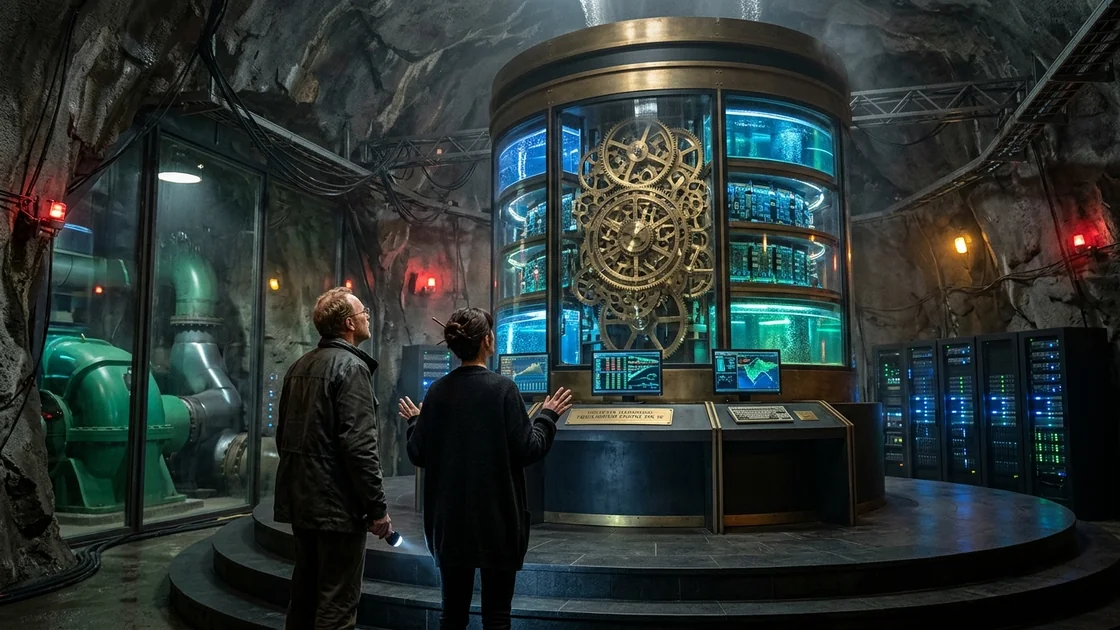
Arthur Pendelton, a senior legacy systems engineer at a massive global financial clearinghouse in London, discovers a deeply buried subroutine within the bank's oldest mainframe code during a routine modernization audit. This invisible piece of software has been shaving tiny fractions of pennies from international currency exchanges for over four decades and routing the accumulated billions into a dormant Swiss bank account. When Arthur traces the account to Laszlo Horvath, a brilliant cyberneticist and horologist who died in 1984, his professional curiosity turns into a dangerous obsession. Pursued by ruthless corporate security operatives who want the hidden fortune for themselves, Arthur travels with a forensic archivist from the rain-slicked financial districts of London to an isolated hydroelectric facility in the Swiss Alps. There, he uncovers the breathtaking truth behind the dead inventor's automated financial empire and must decide whether to erase the code or protect the secret apparatus keeping the global economy from collapsing.
Chapter 1: The Cobweb Kernel
The air in Sub-Basement 4 of the Meridian Global Clearinghouse did not smell like money, because money had not smelled like paper and ink since the late seventies. Instead, it smelled of ozone, hot silicon, and the faint, metallic tang of halon fire-suppression tanks waiting patiently for a spark that never came.
Arthur Pendelton sat at a bruised steel desk in the corner of the diagnostic bay, nursing a mug of tea that had gone cold sometime around midnight. Above his head, through four stories of reinforced concrete and Faraday shielding, the City of London was slick with November rain. Up there, twenty-six-year-old quantitative analysts in bespoke suits were going home in black cabs, having spent their day writing Python scripts that traded derivatives at the speed of light. Down here, in the fluorescent-lit purgatory of the legacy core, Arthur was staring at a green-on-black terminal emulator displaying code written three years before he was born.
Meridian Global Clearing—known simply as the House to the central bankers who relied on it—was the plumbing of the western financial world. Every twenty-four hours, roughly four point two trillion dollars in cross-border settlements, interbank loans, and sovereign debt clearances flowed through its routers. While the front-end interfaces were wrapped in sleek, modern cloud architectures and cryptographic APIs, the actual ledger of record—the beating heart that decided whether Bank A in Tokyo truly owed Bank B in Frankfurt three hundred million yen— remained an array of IBM zSeries mainframes running an ancient, heavily modified monolithic application known as Project TITAN.
Arthur was one of only four people left on the payroll who could read TITAN’s uncompiled assembly and COBOL-74 source code without weeping. He was forty-eight, slightly stooped, with thinning sandy hair and the pale, patient eyes of a watchmaker. For the past six months, his mandate had been the Pre-Migration Sanitization Initiative. The board of directors had finally approved a nine-hundred-million-pound budget to replace TITAN with a distributed, quantum-resistant ledger. Before the new system could replicate the old system's logic, someone had to map every single quirk, patch, and undocumented workaround accumulated over forty-six years of continuous operation.
It was while mapping the triangular currency arbitrage reconciliation module—a dense thicket of code untouched since the Plaza Accord of 1985—that Arthur found the dust.
In financial computing, numbers are not treated the way they are in
high school algebra. Modern consumer software uses floating-point
arithmetic, which approximates values in binary and occasionally
produces bizarre errors at the eighteenth decimal place. Banks cannot
tolerate approximations. TITAN used Packed Decimal format, known in
COBOL as COMP-3, where every digit from zero to nine was
explicitly encoded into four bits of memory, followed by a four-bit sign
indicator. When the system converted British Pounds to Japanese Yen via
an intermediate calculation in US Dollars, the exchange rates often
carried six decimal places, while the final settlement currency carried
only two—or none at all, in the case of the Yen.
By international banking convention, the leftover fractions of a cent—the "dust" residing in the third, fourth, fifth, and sixth decimal places—were handled by a strict rule called Banker's Rounding, or round-half-to-even. Over millions of transactions, the fractions rounded up should statistically cancel out the fractions rounded down. The net variance at the end of a twenty-four-hour clearing cycle should be zero, plus or minus a few dollars across a trillion-dollar volume.
Arthur leaned closer to his monitor, adjusting his wire-rimmed glasses. He had been running a bit-for-bit simulation of Tuesday’s European morning clearing batch against a clean, newly compiled version of the arithmetic engine. The macro-totals matched to the penny. Every bank got what it expected. Every central reserve balanced.
Yet the internal processor cycle count was wrong.
The production mainframe was taking twelve microseconds longer to
execute the MULTIPLY-RATE-ROUNDED routine than the test
environment. Twelve microseconds was an eternity in mainframe time. It
meant the processor was executing roughly four thousand extra machine
instructions during every currency conversion.
"What are you doing in there, old girl?" Arthur murmured to the humming black monoliths behind the glass partition of the server room.
He bypassed the high-level COBOL source files—which were clean,
properly commented, and thoroughly audited—and pulled up the raw
hexadecimal core dump of the production runtime library. Specifically,
he looked at ILBODBG0, a system-level subroutine ostensibly
responsible for handling decimal overflow exceptions.
He ran a disassembler on the hexadecimal blocks, translating the raw
base-16 numbers back into System/370 assembly language mnemonics:
ZAP (Zero and Add Packed), MP (Multiply
Packed), SRP (Shift and Round Packed).
Halfway down the screen, buried inside what should have been a dead block of diagnostic padding bytes filled with hexadecimal zeros, the zeros stopped. In their place was a sequence of instructions so tight, so exquisitely optimized, that it looked less like corporate programming and more like a haiku written in machine code.
         TM    0(R4),X'0F'        CHECK SIGN NIBBLE
         BC    8,EXIT_NORM        BRANCH IF ZERO
         MVC   WK_SHADOW(8),16(R7) COPY REMAINDER REG
         AP    ECSA_ACCUM,WK_SHADOW ADD TO EXTENDED STORAGE
         SRP   ECSA_ACCUM,64-2,0  SHIFT RIGHT TWO DIGITS
         zap   16(8,R7),ZERO_PK   ZERO OUT REMAINDER
Arthur’s breath caught in his throat. His fingers hovered over the mechanical keyboard, the clack of the keys suddenly silent in the vast underground room.
The code was intercepting the arithmetic registers before the standard rounding instruction could execute. Whenever a currency conversion produced a remainder smaller than one-tenth of a cent—specifically, values sitting in the fifth and sixth decimal places, known in the trade as "sub-mils"—the standard rounding algorithm would simply truncate them to zero. Nobody missed them. Neither the sending bank nor the receiving bank recorded them on their balance sheets, because their own systems truncated at the fourth decimal place before transmitting the payment instruction.
This hidden routine was catching those doomed fractions of a penny
just before the processor vaporized them into the mathematical ether.
Instead of letting them vanish, the AP instruction—Add
Packed—was scooping them up and depositing them into an unlabeled memory
address in the Extended Common Service Area, a volatile region of the
mainframe's random-access memory normally reserved for operating system
control blocks.
"Salami slicing," Arthur whispered, though he knew immediately the term was inadequate. Every junior programmer had heard the urban legend of the clerk who routed rounded-off half-cents into his own bank account and bought a Ferrari before getting caught the following Tuesday. That was amateurish; it broke the double-entry bookkeeping balance of the host bank and lit up audit logs like a Christmas tree.
This was different. This routine wasn't stealing from the bank's ledger. It was harvesting the mathematical friction between different currencies—the microscopic shavings created when two incompatible decimal systems ground against each other at high speed. The books balanced perfectly because the money being taken did not legally exist on either side of the transaction. It was phantom value, conjured out of the rounding threshold.
Arthur pulled a yellow legal pad toward him and clicked his pen. He
looked at the memory address ECSA_ACCUM. He wrote a quick
read-only probe to monitor that specific four-byte sector of the
mainframe's live memory.
On his screen, a small window opened, displaying a hexadecimal number converting in real time to decimal.
$000,000.041829 $000,000.089104
$000,000.140022
Every millisecond, as transactions from Tokyo, Sydney, and Singapore surged through the London clearing hub, the number ticked upward. It climbed like a gas pump dial spinning in fast-forward. Nine cents. Twelve cents. Forty cents. A dollar. Two dollars.
When the counter hit exactly $499.99, it froze for
three-thousandths of a second and reset to
$000,000.000000.
Arthur sat up straight. "Where did you go?"
He set a hardware watchpoint on the memory address, instructing the
diagnostic terminal to capture whatever process read and cleared that
register. Ten seconds later, the accumulator hit $499.99
again, and the trap sprung.
The subroutine did not generate a wire transfer. Creating a new wire transfer would generate a message sequence number, an audit trail, and a clearing fee log. Instead, the code waited until the exact millisecond that Meridian’s automated treasury system sent out its hourly nostalgia sweep—a massive, bundled omnibus settlement message sent via the international SWIFT network to clear interbank liquidity pools in Zurich.
The subroutine reached into the outbound transmission buffer just
after the internal audit checksum was calculated, but
before the cryptographic hardware security module signed the
packet. It modified an existing field—Tag 71G, reserved for "Receiver's
Charges" and correspondent banking adjustments—by tacking the
$499.99 onto an omnibus liquidity pool managed by a
third-party correspondent bank in Switzerland.
Because the adjustment was under five hundred dollars, it fell beneath the automated threshold for manual reconciliation in high-volume interbank netting pools. And because it happened roughly once every ten seconds, twenty-four hours a day, five days a week...
Arthur did the math on his legal pad.
Six times a minute. Three hundred and sixty times an hour. Eight thousand, six hundred and forty times a day. Roughly four point three million dollars every twenty-four hours. Over a standard two-hundred-and-fifty-trading-day year, that was just north of one billion dollars annually.
His pen stopped moving. The nib left a small, dark inkblot on the yellow paper.
When had the ILBODBG0 library module last been modified?
He typed a query into the system catalog, checking the creation date of
the load module on the direct-access storage device.
The timestamp came back in green phosphor characters:
1979.318. The three-hundred-and-eighteenth day of 1979.
November 14th.
The timestamp itself was a masterpiece of forgery, or perhaps it wasn't a forgery at all. Every time the mainframe hardware had been upgraded over the decades—from the System/370 to the 3090 in the eighties, to the S/390 in the nineties, to the zSeries in the two-thousands—the core load libraries had been migrated wholesale, copied bit-for-bit from magnetic tape to optical disk to solid-state arrays, carrying this tiny, parasitic passenger along in their bloodstream like mitochondrial DNA.
Forty-five years. Even accounting for the much lower transaction volumes of the 1980s and 1990s, whoever sat at the other end of that correspondent banking routing code had harvested somewhere between twelve and fifteen billion dollars out of thin air.
Chapter 2: Binary Archaeology
Arthur did not report the anomaly the next morning.
In theory, corporate protocol dictated that upon discovering an unauthorized modification to the core settlement kernel, an engineer was required to immediately file a Severity-1 Incident Ticket, notify the Head of Infrastructure Risk, and lock down the affected logical partition.
In practice, Arthur had worked at Meridian Global Clearing for nineteen years. He knew what happened to people who brought inconvenient truths to the seventh floor without understanding the political geometry of the problem first. At best, the messenger was sidelined while external consultants from McKinsey or Deloitte charged ten million pounds to write a report blaming the legacy engineers for failing to spot the bug sooner. At worst—if the anomaly happened to be an off-balance-sheet black budget run by an intelligence agency or a senior board member's slush fund—the engineer found his security clearance revoked, his pension tied up in non-disclosure litigation, and his career quietly euthanized.
Instead, Arthur went home to his cramped flat in Clerkenwell at 4:00 AM, slept for five hours, fried two eggs, and returned to Sub-Basement 4 with a thermos of French roast and a brand-new, air-gapped notebook computer.
He spent the next three days performing binary archaeology.
The brilliance of the subroutine—which Arthur privately dubbed the
Ghost Carry—lay in its defensive camouflage. When he tried to copy the
ILBODBG0 module to his test environment to study it safely,
the code disappeared. The copy on his test drive contained only standard
IBM error-handling routines.
It took him six hours of staring at the system's channel input/output logs to understand why. The Ghost Carry did not permanently reside on the hard disks. If an auditor or an automated integrity scanner read the disk file, the file was completely clean. The subroutine lived exclusively in the mainframe's active volatile memory. Whenever the mainframe was scheduled for a reboot or a maintenance IPL (Initial Program Load), the subroutine intercepted the shutdown command, wrote itself into the non-volatile cache of an ancient, virtualized 3270 printer spooler controller that no one ever checked, waited for the system to reboot, and then injected itself back into the active arithmetic kernel before deleting its tracks from the printer cache.
It was a polymorphic, memory-resident rootkit written in 1979—seven years before the world had even heard of the Brain floppy-disk virus, generally considered the first computer virus in history. Whoever had written this had not merely been ahead of their time; they had been operating in a completely different century of computer science.
On Thursday afternoon, Arthur finally managed to capture the outbound routing logic by reading the raw memory frames through a hardware diagnostic port, bypassing the operating system entirely.
He copied the hexadecimal string onto his air-gapped laptop and decoded the EBCDIC characters.
The $499.99 increments were not all going to the same
place immediately. They were being bounced through a daisy chain of four
Nostro-Vostro settlement accounts—correspondent accounts that banks hold
in foreign currencies with other banks to facilitate international
trade. The chain hopped from London to Frankfurt, from Frankfurt to
Luxembourg, and finally settled into a small, fiercely private cantonal
clearing institution in Switzerland: Banque de l'Horloge,
Neuchâtel.
Attached to the final hop was a sub-allocation reference code:
CH-NE-774-09-HORVATH-L.
"Horvath," Arthur said aloud.
He minimized his terminal windows and opened the internal corporate directory, then the historical archive index. Neither returned any results for the name Horvath. The corporate intranet only held digitized personnel records going back to 1996, when Meridian had been formed by the merger of three older clearing consortia. Anything older than that was stored on physical microfilm and paper ledgers in the Deep Archive—a climate-controlled vault located across the river in Southwark, housed inside a decommissioned World War II deep-level air-raid shelter beneath Clapham and London Bridge.
To get into the Southwark archive without triggering a security flag from his department head, Arthur needed someone who already had the keys.
He picked up his desk phone and dialed an internal four-digit extension. It rang five times before a brisk, slightly muffled voice answered.
"Historical Compliance and Ledger Reconstruction. Clara Lin speaking."
"Clara, it's Arthur. From Sub-4."
The voice warmed immediately. "Arthur! Don't tell me you've finally decided to decommission the tape library in Bay 9. I told you, those 9-track reels belong in the British Museum, not a dumpster."
"The reels are safe for now," Arthur said, glancing through the glass wall of his cubicle to make sure the basement corridor was empty. "I'm working on the TITAN pre-migration documentation. I've hit a piece of undocumented exception handling in the core currency module from November 1979. The inline comments are stripped, and I need the original architectural sign-off sheets and contractor rosters for the initial TITAN build phase. Do you have the late seventies in Southwark?"
"We have everything back to the Genoa Conference of 1922," Clara said with a trace of professional pride. "Though the late seventies are a mess. That was during the transition from the old teleprinter clearing house to the automated packet network. Half of it is on microfiche, and the other half is in acid-damaged cardboard boxes. Send me an email with the project code and I'll put it in the queue for next week."
"That's the thing," Arthur said, lowering his voice half an octave. "Director Mercer is breathing down my neck for the preliminary architecture map by Monday morning, and I don't want to log a formal archival retrieval request until I know what I'm looking at. You know how Mercer gets when he thinks there's a delay. Could I come over there after five today and help you look manually? Off the clock. I'll buy dinner at that Thai place on Borough High Street."
There was a brief pause on the line. Clara Lin was thirty-two, held a doctorate in economic history from LSE, and worked at Meridian only because the bank paid three times what any university offered to manage its labyrinth of historical debt obligations and dormant sovereign accounts. She also possessed a deeply ingrained distrust of middle management that matched Arthur's own.
"Six o'clock," Clara said. "Use the side entrance on Tooley Street. Bring the good curry puffs, not the cheap ones from the station."
The rain had intensified by the time Arthur crossed London Bridge on foot, his umbrella angling into the bitter wind blowing off the Thames. The glass shards of the Shard towered above the Victorian brick viaducts of Southwark, disappearing into low, bruised clouds that glowed orange with the reflected sodium light of the metropolis.
Clara met him at a heavy steel door unmarked except for a small brass plaque reading MGC Records Annex. She was a small, sharp-featured woman wearing an oversized cable-knit cardigan over a silk blouse, her dark hair pinned up with a wooden chopstick. She took the warm brown paper bag of Thai food from him, sniffed it approvingly, and led him down a spiral concrete staircase that smelled of damp chalk and old paper.
"You look terrible, Arthur," she observed as she badged them through two successive mantrap airlocks. "Even for a cobweb engineer. When was the last time you saw the sun?"
"October, I think," Arthur replied, shaking the rain from his coat. "It was overrated."
The archive occupied a series of long, vaulted cylindrical tunnels lined with movable high-density shelving units. At the far end, Clara had set up a workstation consisting of a modern desktop computer flanked by two antique Canon microfiche readers with frosted blue glass screens.
"I pulled the master indices for the 1977-1981 automation project before you got here," Clara said, setting the food down on a reference table and pulling on a pair of white cotton archival gloves. She tapped a thick, leather-bound ledger. "Back then, Meridian was still called the Inter-European Clearing Consortium. The TITAN architecture wasn't built in-house. The consortium hired an external systems integration team—mostly academics and defense contractors poached from CERN and Ferranti."
Arthur pulled up a chair and opened his notebook. "I'm looking for someone named L. Horvath. And specifically, a system patch applied on November 14, 1979."
Clara flipped through the index pages, her gloved finger tracing columns of neat, fountain-pen handwriting. "Horvath... Horvath... Here. Dr. Laszlo Horvath. Retained as Principal Mathematical Consultant and Microcode Architect, May 1976 to December 1979." She noted the reference number, walked over to a grey steel cabinet, and slid open a shallow drawer filled with four-by-six-inch sheets of transparent plastic film.
She plucked three sheets from the drawer, returned to the desk, and slid the first one under the glass carrier of the Canon reader. When she flipped the switch, the machine hummed to life, its halogen bulb projecting the microscopic text onto the frosted screen in sharp, glowing white letters.
Arthur leaned in. It was a copy of Horvath’s security vetting dossier and contract summary.
Laszlo Horvath had been born in Budapest in 1928. He had fled Hungary after the 1956 uprising, walking across the Austrian border in the dead of winter with nothing sewed into the lining of his coat except three notebooks on non-linear control theory and a seventeenth-century pocket repeater watch. He had taught cybernetics at ETH Zurich throughout the sixties before retreating to Neuchâtel, where he split his time between designing high-precision atomic clock synchronization protocols and consulting for Swiss banking consortia.
In the grainy, high-contrast photograph clipped to the corner of the security form, Horvath looked out with piercing, deeply recessed eyes beneath wild, bushy eyebrows. He had a neatly trimmed white beard and wore a heavy tweed three-piece suit with a watch chain draped across his waistcoat. He looked less like a computer programmer and more like an Old Testament prophet who happened to understand hexadecimal.
"Listen to this," Clara said, reading from the biographical assessment written by the bank's vetting officer in 1976. "'Subject is universally regarded as the foremost living authority on fault-tolerant decimal arithmetic and asynchronous network timing. Temperament is difficult, secretive, and occasionally paranoid regarding macroeconomic stability. During his tenure at ETH Zurich, Horvath published several controversial papers arguing that fiat currency decoupling from the gold standard, combined with high-speed electronic trading, would inevitably create a mathematical feedback loop capable of destroying global liquidity within fifty years. Despite eccentric views, his technical indispensability to the TITAN kernel is absolute.'"
Arthur felt a cold prickle at the base of his neck. "Look for November 1979. System change logs."
Clara swapped the microfiche sheet for the second one, maneuvering the manual X-Y carrier knob until the maintenance logs blurred past and snapped into focus.
"November 1979 was the final stress-test month before TITAN went live globally on January 1, 1980," Clara said, scanning the rows. "Wait. There's a dispute memo here."
She adjusted the focus ring. On the screen was a memorandum dated November 12, 1979, written by Horvath to the Consortium Board of Governors.
In terse, furious prose, Horvath warned the board that the newly finalized clearing algorithm lacked an "entropic damping reservoir." He argued that because the system processed settlements asynchronously at microsecond speeds without a physical clearing floor's friction, minor rounding imbalances and speculative currency velocity would compound over decades, leading to catastrophic flash-crashes and systemic insolvency. He proposed embedding an automated, self-regulating reserve pool directly into the arithmetic kernel—a mathematical shock absorber funded by sub-decimal conversion friction.
Below his memo was the Board's reply, dated November 13, 1979, signed by the Chairman: Proposal rejected. The Consortium is a clearing utility, not a central bank. All fractional remainders beneath the fourth decimal place are to be truncated to zero per standard accounting practice. Dr. Horvath is instructed to finalize the production compiler immediately.
"And the next day," Arthur murmured, "November 14th, Horvath compiled
the ILBODBG0 library himself, signed off on the clean COBOL
source code for the auditors, and slipped his shock absorber into the
assembly microcode anyway."
Clara turned her head to look at him, her dark eyes narrowing behind her glasses. "Arthur. What exactly did you find in Sub-4?"
Arthur hesitated for only a second. He was already too deep to play
coy, and he needed her brain. Quickly, quietly, he explained the Ghost
Carry subroutine, the $499.99 sweeps, and the routing tag
pointing to the Banque de l'Horloge in Neuchâtel.
Clara stared at him, a half-eaten curry puff suspended in her hand. "Four million dollars a day? Since 1980?"
"Give or take," Arthur said. "In the early eighties, volume was lower, so maybe it was only a few hundred thousand a day. By the two-thousands, with algorithmic forex trading exploding, it would have hit its five-hundred-dollar ceiling every few seconds."
"That's billions of dollars," she whispered. "Wait. If Horvath was born in 1928, he'd be ninety-six years old today. Is he sitting in a chateau on Lake Neuchâtel swimming in gold coins like Scrooge McDuck?"
"Check the third microfiche," Arthur said. "The personnel close-out file."
Clara slid the third sheet under the lens. It contained only two documents. The first was Horvath’s final invoice payment from December 1979. The second was a clipped obituary from the Neue Zürcher Zeitung, dated February 19, 1984, pinned to a standard pension-termination form so the bank's human resources department would know to stop sending him the annual Christmas newsletter.
Clara translated the German text slowly. "'Dr. Laszlo Horvath, aged 55, renowned cyberneticist and horologist, died on Thursday following a fall on the ice while descending the Oberaar glacier near the Grimsel Pass. He was unmarried and leaves no surviving issue. His estate has been placed under the administration of the Fiduciary Office of Delacroix & Cie, Neuchâtel.'"
The hum of the microfiche cooling fan seemed suddenly deafening in the underground vault.
"He's been dead for forty years," Clara said softly.
"Yes," Arthur said, staring at the ghostly negative image of the old man's photograph on the screen. "He died four years after he planted the code. Which means for the last forty years, the largest automated bank heist in human history has been depositing billions of dollars into the account of a corpse."
Chapter 3: The Ledger of the Dead
"It can't just be sitting there," Clara said, pacing the narrow aisle between the towering shelves of 1950s clearing ledgers. She had pulled the wooden chopstick from her hair, letting it fall around her shoulders only to immediately twist it back up again—a nervous habit Arthur recognized from previous audit crunches. "Swiss banking secrecy is formidable, Arthur, especially in the old private cantonal banks, but even Switzerland passed dormant account legislation in the nineties and updated it in 2015. If an account holds tens of millions—let alone billions—and the beneficial owner has had no contact with the bank for fifty years, the bank is legally required to publish the name or begin escheatment proceedings."
"Only if the account is dormant," Arthur pointed out.
Clara stopped pacing. "How can an account be active if the sole signatory died on a glacier during the Reagan administration?"
"Because in Switzerland, a corporate foundation or a fiduciary trust—a Stiftung or a Treuhand—doesn't die when its founder dies," Arthur said, tapping his pen against his teeth. "Think about who Horvath was, Clara. He wasn't a thief looking to buy yachts. Look at his memo to the Board. He was a cyberneticist. Cybernetics is the study of self-regulating systems—feedback loops, governors on steam engines, thermostats. He built a machine inside our mainframe to harvest money. Do you really think a man like that would leave the other end of the pipe unprogrammed?"
Clara walked back to her modern terminal and sat down, her fingers flying across the keyboard. "If the Banque de l'Horloge has been receiving four million dollars a day for decades, they aren't keeping it in cash in their vault. A bank that size in Neuchâtel has a total publicly reported balance sheet of maybe three billion Swiss francs. If they suddenly absorbed fifteen billion dollars in liquidity without moving it back out into the market, the Swiss National Bank would have audited them into oblivion twenty years ago. The money has to be flowing out just as fast as it's flowing in."
"Can you see outgoing flows from a private Swiss bank?" Arthur asked.
"Not their internal client ledgers, no," Clara said, her eyes reflecting the blue light of her dual monitors. "But any large-scale institutional settlements clearing in Euros, Dollars, or Sterling out of Switzerland eventually have to touch the international correspondent network—which means a significant percentage of them pass right back through Meridian's historical settlement archives."
She opened a specialized forensic query tool she used for reconstructing sovereign debt defaults. "Give me the exact routing BIC for the Banque de l'Horloge."
Arthur read it from his notebook: "BHLGCH22NEU."
Clara typed the code into the search parameters, filtering for outbound institutional settlements, commercial letters of credit, and automated standing orders originating from that specific BIC between 1985 and the present day, cross-referenced against non-financial corporate beneficiaries.
The database churned. Even with Meridian’s massive indexing power, sifting through forty years of global clearing metadata took nearly ten minutes. Arthur used the time to eat a cold curry puff and stare at the microfiche of Horvath’s 1979 rejection letter.
The Consortium is a clearing utility, not a central bank.
The computer chimed. Clara leaned forward, her brow furrowing as thousands of line items populated her spreadsheet.
"Well?" Arthur asked, stepping behind her chair.
"You were right," she said, her voice hushed. "The money isn't sitting there. In fact, there's a massive, continuous outbound pipeline originating from a fiduciary trust account at Banque de l'Horloge managed by a legal entity called Helvetia Harmonic Systems AG."
"What do they buy?"
Clara scrolled through the decades of payment codes. "In the late eighties and nineties... heavy industrial hardware. Special-order silicon wafers from fabricators in Kyoto and Dresden. Custom fiber-optic trunk lines leased from military telecom providers across Europe and trans-Atlantic submarine cable consortia. Three decommissioned hydroelectric turbine generators in the Canton of Bern. Massive quantities of liquid nitrogen and closed-loop cooling apparatus."
Arthur frowned. "He died in 1984. Who was buying silicon wafers and fiber-optic cables in 1995?"
"Standing algorithmic tenders and fiduciary trustees following a pre-written technical blueprint, maybe?" Clara scrolled further down, moving into the two-thousands and twenty-tens. "Wait. The hardware purchases slow down around 2004, except for regular maintenance contracts. After 2004, the vast majority of the money—hundreds of millions of dollars a week—goes into short-term brokerage clearing accounts in London, New York, Chicago, and Tokyo."
She clicked on a cluster of transactions from September 2008, then another from March 2020, and another from October 2022.
"Arthur, look at the dates and the counterparties," she whispered. "October 19, 1987—Black Monday. The trust injected four hundred million dollars into Chicago mercantile clearing houses to buy crashing S&P futures at the exact bottom of the liquidity trough, preventing three major clearing brokers from defaulting. September 2008—the week Lehman Brothers collapsed and the commercial paper market froze. Helvetia Harmonic quietly bought two pointหนึ่ง billion dollars in distressed overnight interbank repo notes at zero percent interest, keeping the European food-import credit lines open. And look here—2011, 2016, 2022... massive stabilizing counter-trades in global wheat, rice, and fertilizer futures whenever algorithmic speculative funds tried to corner the market during supply shocks."
She looked up at him, her face pale in the glow of the monitor. "It's not a profit-maximizing hedge fund. Half of these trades lost tens of millions of dollars on paper because they bought into falling knives just to provide liquidity to the market, and when they did make a profit, they dumped the gains right back into stabilizing sovereign bond yields in developing nations."
Arthur felt the hairs on his arms stand up. The dusty underground room in Southwark seemed to tilt slightly on its axis.
"The entropic damping reservoir," Arthur breathed. "He didn't just build the harvesting mechanism inside our mainframe. Before he died, he built the entire shock absorber. Somewhere out there, there's an automated system taking four million dollars a day in shaved fractions of pennies and using it to quietly patch the structural cracks in the global economy whenever the system gets too volatile."
"A dead man's algorithm has been bail-out engineering the world's commodity and credit markets for forty years?" Clara shook her head, half in disbelief, half in awe. "How is that even possible? In 1984, artificial intelligence barely existed! Expert systems could barely play a decent game of chess!"
"He didn't need modern language models or neural networks," Arthur said, his mind racing as he pictured the differential equations in Horvath’s cybernetics background. "He used control theory. The same mathematics that keeps a rocket upright on its exhaust plume or prevents an electrical power grid from tearing itself apart when a generator trips offline. To Horvath, the global economy wasn't about politics or greed—it was just a massive, poorly designed electrical circuit prone to harmonic resonance and voltage spikes. If you measure the latency and pressure in the clearing pipes—which he had direct access to through TITAN—you just apply an opposing counter-current at the exact node where the oscillation starts."
Before Clara could reply, a small red dialogue box flashed in the bottom right corner of her screen.
SYSTEM NOTICE: ARCHIVAL QUERY [BHLGCH22NEU] FLAGGED BY INTERNAL AUDIT WATCHLIST. CREDENTIALS LOGGED: C_LIN_09.
Clara’s hand froze on the mouse. "What is that?"
Arthur leaned over the desk, his heart suddenly hammering against his ribs. "Why would the BIC code for a tiny Swiss bank be on an internal audit watchlist?"
"I don't know," Clara said, her fingers trembling slightly as she tried to close the query window. The terminal lagged for two seconds—a dead giveaway that the session was being mirrored in real time to a remote administrative console—before closing. "Watchlists are maintained by the Fifth Floor. Corporate Security and Special Assets."
Arthur thought back to Tuesday night, before he had switched to his
air-gapped laptop. When he had first discovered the Ghost Carry in
Sub-4, he had run a standard system catalog query on
ILBODBG0 and traced the outbound SWIFT tag on his regular
network terminal. He hadn't thought anyone was watching a legacy
engineer's diagnostic screen at two in the morning.
He had been wrong.
"Someone else already noticed the anomaly during the pre-migration audit," Arthur said, a cold knot tightening in his stomach. "Not the assembly code itself—if they understood the assembly code, they would have patched it already. They noticed the outbound liquidity leakage in the SWIFT buffers during the parallel test runs for the new system. They put a tripwire on the destination bank code to see who else knew about it."
And Clara had just tripped it from a terminal in a locked bunker with only one exit.
Arthur grabbed his coat from the back of the chair. "Log off. Right now. Leave the microfiche in the machine—don't waste time putting it back."
"Arthur, you're scaring me," Clara said, though she was already yanking her cardigan off the hook and snatching her handbag. "It's just an internal audit flag. If we go up to the Fifth Floor tomorrow and explain that you found a forty-year-old rounding bug worth billions of dollars, they'll probably give you a bonus!"
"Think about what you just saw on that screen, Clara," Arthur said sharply as he ushered her toward the first mantrap airlock. "The account holds billions in liquid reserves and sovereign securities. And legally, the money was skimmed from quadrillions of dollars of transactions over four decades in increments too small to ever be returned to the original counterparties. It is unclaimable, orphaned wealth. What do you think happens when a modern investment bank's executive committee realizes there is a fifteen-billion-dollar unmonitored pot of gold sitting at the end of a piece of software they own?"
Clara swiped her badge at the inner airlock door. The green light blinked, the heavy magnetic lock clunked open, and they stepped into the narrow glass cylinder between the doors.
"They'll claim it as a proprietary windfall," Clara said, realization dawning on her face. "They'll liquidate the trust, shut down Horvath's system, and fold the billions into Meridian's balance sheet ahead of next quarter's earnings."
"Or worse," Arthur said, watching the five-second safety timer count down on the outer door. "Whoever is running the Special Assets desk won't even tell the board. They'll seize the cryptographic keys to the Swiss trust for themselves."
The outer door clicked open. They took the spiral concrete stairs two at a time. When Arthur pushed open the heavy steel fire door onto Tooley Street, the cold November rain hit their faces like a splash of ice water.
Fifty yards down the narrow, glistening brick street, under the shadow of the railway arches, two black Range Rovers with tinted windows had just pulled up onto the pavement, their hazards flashing orange against the wet cobblestone. Four men in dark overcoats were stepping out into the rain, moving with the brisk, coordinated posture of private executive protection contractors—the kind Julian Thorne, Meridian’s Head of Internal Security and a former signals intelligence colonel, employed for "sensitive asset recovery."
One of the men looked toward the annex door, raised a hand to his ear, and began walking fast in their direction.
"Other way," Arthur said, grabbing Clara’s elbow.
They turned left, away from the Range Rovers, and melted into the dense rush-hour crowd pouring out of the pedestrian concourse of London Bridge Station.
Chapter 4: The Watchmen
They didn't speak until they were three miles north, sitting in the back corner of a brightly lit, grease-fogged Formica cafe near Old Street roundabout, watching the rain streak the steamed-up plate glass windows.
Both of their corporate work phones were sitting on the table between them, wrapped tightly in three layers of aluminum foil Arthur had begged from the guy behind the fry counter—a crude but effective makeshift Faraday cage to block cellular triangulation and remote microphone activation.
Clara had her hands wrapped around a mug of builder's tea, her knuckles white. "Those men at the archive. That wasn't a compliance audit team, Arthur. Compliance auditors carry clipboards and wear sensible shoes from Marks & Spencer. Those men looked like they were about to bag our heads and put us on a rendition flight."
"Julian Thorne's people," Arthur said grimly. "And Thorne doesn't sneeze unless Director Mercer tells him to."
Richard Mercer was the Chief Operating Officer of Meridian Global Clearing and the executive sponsor of the nine-hundred-million-pound TITAN replacement project. He was a sleek, ruthless former hedge-fund partner who had been brought in three years ago to prepare the clearinghouse for a partial private-equity buyout.
"Let's think this through rationally," Arthur said, leaning his elbows on the sticky table. "Why hasn't Mercer shut down the Ghost Carry already? If his security team has a tripwire on the Banque de l'Horloge BIC code, they know the money is leaving."
"Because they have the same problem you had on Tuesday," Clara said,
her analytical training beginning to override her adrenaline. "They know
where the money is going, and they probably see the
$499.99 adjustments in the outbound SWIFT logs, but they
couldn't find the code generating it because it hides itself in the
printer cache whenever an audit tool looks at the disk. That's why
Mercer has been pushing you so hard on the TITAN sanitization map. He
was waiting for you—the only guy who actually understands the
1979 assembly layer—to find the mechanism for him."
Arthur closed his eyes, cursing his own naivety. "And once I locate the exact memory registers and document how the cryptographic signature is bypassed, Mercer doesn't want to delete the subroutine. He wants to hijack it—or use the mainframe's root authentication tokens to claim ownership of the Swiss fiduciary account as an internal Meridian reserve error."
"Can he do that?" Clara asked. "Walk into a Swiss bank and demand the contents of Horvath's trust?"
"Not by walking in off the street," Arthur said. He patted the
leather messenger bag resting against his ankle, where his air-gapped
laptop sat. "When I disassembled the Ghost Carry's outbound messaging
routine this afternoon, I noticed something strange in the payload
structure. Every Friday at 23:59 GMT, the last $499.99
packet of the week doesn't just carry a financial adjustment. It carries
a 256-bit encrypted hash in the free-text remittance field, generated
from the mainframe's master hardware clock and a private cryptographic
key hardcoded into the assembly routine."
"A heartbeat signal," Clara realized.
"A dead man's switch," Arthur corrected. "Horvath knew that eventually, decades after his death, Meridian would retire the mainframe or someone would find his code and erase it. As long as that weekly cryptographic heartbeat arrives at Banque de l'Horloge every Friday night, the fiduciary trust continues operating under its standing autonomous mandate. What do you think the legal trust deed instructs the Swiss bankers to do if the Friday night heartbeat stops—or if someone sends a specific override cipher signed by that same private key?"
"Wait," Clara said, leaning forward. "If Mercer gets his hands on your disassembly notes, he gets the private key buried in the code. He can forge an override command, dissolve the trust, and instruct the Swiss bank to wire the entire liquid reserve of Helvetia Harmonic Systems to an offshore account of his choosing. And nobody at Meridian's board would ever know the money existed in the first place, because it was shaved out of non-existent rounding dust."
"Fifteen billion dollars, completely untraceable, off the books of every bank in the world," Arthur said. "People have started wars for a fraction of that. Killing a middle-aged systems engineer and a historical archivist wouldn't even register as a moral dilemma for a man like Mercer."
"We should go to the police," Clara said, though her voice lacked conviction. "Or the Financial Conduct Authority."
"And tell them what?" Arthur asked gently. "That our boss is planning to steal a fifteen-billion-dollar slush fund created by a dead Hungarian cyberneticist using a forty-five-year-old assembly virus that lives in a virtualized printer spooler? Without physical proof of the Swiss trust's side of the operation, Mercer will simply delete the memory cache, claim we suffered a psychotic break—or frame us for attempting to plant an embezzlement script ourselves—and have us arrested before we make it past the receptionist at New Scotland Yard."
Clara looked out at the rain-swept street. A police siren wailed in the distance, indifferent and routine. "Then what do we do? If we go home tonight, Thorne's men will be waiting at our flats."
Arthur looked down at his watch. It was Thursday evening, 7:45 PM. The next weekly heartbeat signal from the London mainframe to Neuchâtel was due tomorrow night at midnight.
"My passport is in my messenger bag," Arthur said. "I had to bring it in this week for the annual HR right-to-work re-verification."
Clara blinked, then reached into her oversized leather handbag and pulled out a burgundy booklet. "I always carry mine. Force of habit from doing archival research trips to Brussels and Frankfurt on short notice."
"How much cash do you have on you?"
"About eighty pounds," she said. "If we use our bank cards or credit cards, Thorne's people will flag the clearing transactions within thirty seconds."
"I have three hundred pounds in my emergency wallet compartment, plus an unregistered corporate test card issued by a sandbox bank in Dublin that we use for testing ATM routing protocols," Arthur said, a faint, grim smile touching his lips. "It's loaded with five thousand Euros of real test liquidity that draws on an unindexed QA pool. Even Mercer doesn't know that pool exists because I set it up in 2011."
"Where are we going?" Clara asked, though she already knew the answer.
"St. Pancras International," Arthur said, standing up and leaving a ten-pound note on the table for the tea. "The last Eurostar to Paris leaves at 8:31 PM. From Paris, we can catch the early morning TGV Lyria across the Jura mountains into Switzerland. Before Mercer figures out how to extract that key from the mainframe memory yourself, we're going to find out what Laszlo Horvath actually built."
Chapter 5: The Night Train to the Continent
They made the Eurostar with four minutes to spare, buying two standard-class tickets at the self-service kiosk in St. Pancras using Arthur’s sandbox test card under the names of two long-retired IBM field engineers whose employee numbers Arthur knew by heart. Passing through UK exit checks and French border control was an agonizing ten minutes of controlled breathing, waiting for a border agent’s screen to flash red.
It didn't. Mercer and Thorne were powerful inside the financial plumbing of the City, and they could easily hire private contractors to intimidate employees, but they couldn't place two british citizens on an Interpol stop-list within ninety minutes without filing an official police report—something Mercer couldn't do without inviting external investigators into Sub-Basement 4.
As the train slid out of the Victorian iron shed of St. Pancras and plunged into the concrete tunnels beneath the Thames toward Kent and the Channel Tunnel, Arthur sat with his air-gapped laptop balanced on his knees, the screen brightness turned down to its lowest setting. Beside him, Clara slept fitfully, her head resting against his shoulder, exhausted by the sudden fracture of her quiet, academic life.
Arthur didn't sleep. He spent the two-hour crossing to Paris Gare du Nord poring over the hexadecimal dump of the Ghost Carry's Friday-night heartbeat routine.
The closer he looked at Horvath’s assembly code, the more he felt an almost spiritual kinship with the dead man. Modern software was bloated, built out of millions of lines of pre-packaged libraries stacked lazily on top of each other like precariously balanced shipping containers. Nobody knew how the whole thing worked anymore; programmers just glued black boxes together and hoped the cloud servers had enough memory to absorb the inefficiency.
Horvath’s code had been carved out of solid granite with a chisel. Every single bit had a purpose.
Around midnight, while sitting in an all-night brasserie across from the Gare de Lyon waiting for the 6:15 AM train to Neuchâtel, Arthur found the hidden comment.
It wasn't written in plain text; plain text would have been spotted by a string-search utility decades ago. Instead, Horvath had encoded a sequence of numbers into the polynomial constants of the encryption algorithm itself. When Arthur converted those constants from base-16 into Baudot code—the old five-bit telegraph alphabet used by teletype machines in the 1960s—a message appeared on his screen:
EQUILIBRIUM IS NOT STILLNESS. EQUILIBRIUM IS MOTION OPPOSED BY EQUAL MOTION. IF THE CLOCK STOPS, SEE THE KEEPER OF THE SPRINGS. NEUCHATEL. RUE DU CHATEAU 14.
"What is that?" Clara asked softly, waking up and rubbing her eyes as a waiter set two tiny cups of espresso on the zinc table.
"An address," Arthur said, turning the laptop slightly so she could see. "And a philosophy."
"Who is the Keeper of the Springs?"
"In horology—watchmaking—the mainspring stores the energy, and the escapement releases it in precise increments so the gear train doesn't spin out of control and destroy itself," Arthur explained, sipping the bitter coffee. "Horvath viewed the global money supply the same way. Capital is the mainspring; it wants to unwind all at once in speculative manias and violent crashes. His subroutine in London is just the winding mechanism. The escapement—the thing actually regulating the release of that energy—is in Switzerland."
The morning train climbed steadily out of the flat agricultural plains of Burgundy, entering the steep, pine-forested gorges of the Jura mountains. Outside the window, the November rain of London and Paris had turned into a thick, silent blanket of wet snow clinging to the limestone cliffs and the dark boughs of the fir trees.
At 10:12 AM, the train pulled into the station at Neuchâtel, perched high on the slope overlooking the vast, steel-grey expanse of Lake Neuchâtel. Far across the water, through a break in the winter mist, the jagged white teeth of the Bernese Alps hung suspended in the sky like an apparition.
They walked down the steep cobblestone streets toward the old medieval core of the town, built entirely out of yellow Hauterive limestone that seemed to glow with a faint, warm amber light even under the overcast sky.
Rue du Château 14 sat directly beneath the stone ramparts of the twelfth-century castle and Collegiate Church. There was no neon sign, no glass lobby, and no ATM in the wall. It was a narrow, four-story seventeenth-century townhouse with heavy oak shutters painted dark green and a polished brass plate no larger than a playing card beside the doorframe:
Banque de l'Horloge & Cie Fondée en 1794 Gestion de Fortune et Fiduciaire
Arthur pressed the brass bell pull. A discreet camera concealed inside a wrought-iron lantern above their heads adjusted its lens with a tiny whir. A moment later, the heavy oak door clicked open into a warm, wood-paneled vestibule paved with black and white marble tiles.
A security guard in an immaculate charcoal suit—who looked more like a maître d' at a three-star Michelin restaurant, save for the subtle bulge of a SIG Sauer pistol beneath his left armpit—stepped forward.
"Bonjour, Monsieur, Madame," the guard said in crisp French. "Do you have an appointment with one of the partners?"
"We don't," Arthur replied in passable, heavily accented French, switching quickly to English as he knew the Swiss preferred when dealing with foreigners. "We are here from London regarding the fiduciary mandate of Account 774-09. Dr. Laszlo Horvath."
The guard’s expression did not change by a single millimeter, yet the atmosphere in the small vestibule instantly grew ten degrees colder. He did not check a computer screen or a ledger. Everyone who worked inside this building clearly knew that name.
"Wait here, please," the guard said softly. He stepped back through an inner glass security door, locking it behind him, and picked up a cream-colored desk telephone.
Two minutes later, the inner door opened again. Instead of the guard, an elderly man emerged. He was at least eighty years old, tall and spare, with silver hair combed straight back and a blue silk cravat tucked into a bespoke charcoal waistcoat. He looked at Arthur and Clara over a pair of half-moon reading glasses.
"I am Henri Delacroix, Senior Managing Partner," the old man said, his English possessing the velvety precision of an old-world diplomat. "We have not received an unscheduled visitor regarding the Horvath Foundation since February of 1984. If you would be so kind as to leave your bags and electronic devices with Sebastien—save for whatever credentials you wish to present—please follow me."
Arthur hesitated, then opened his messenger bag, pulled out a single printed sheet of paper he had run off at a copy shop near the train station, and handed the bag and laptop to the guard. Clara surrendered her purse.
Delacroix led them up a wide, curving stone staircase lined with oil paintings of eighteenth-century clockmakers and massive, ticking pendulum regulators housed in mahogany cases. The entire building pulsed with a quiet, rhythmic tick-tack, tick-tack, like the inside of a mechanical heart.
In a high-ceilinged conference room overlooking the snow-dusted roofs of the old town and the grey lake beyond, Delacroix gestured to two leather armchairs and sat behind an antique Empire desk uncluttered by anything except a blotter and a silver mechanical pencil.
"My father, Armand Delacroix, drafted the Articles of Perpetuity for Dr. Horvath in October of 1979," the old banker began, steepling his slender, age-spotted fingers. "Under Article 47 of the Swiss Federal Act on Banks and Savings Banks, I cannot confirm or deny the existence of any client relationship without validated cryptographic authorization. You claim to come from London. Why?"
Arthur reached into his coat pocket, unfolded the sheet of paper, and slid it across the green leather blotter.
On the paper were three lines of hexadecimal characters.
"The first line," Arthur said quietly, "is the exact 256-bit cryptographic hash that arrived in your system last Friday night at 23:59 GMT via SWIFT Tag 70 from Meridian Global Clearing in London. The second line is the mathematical seed algorithm used to generate it. And the third line is the exact hash that will arrive tonight at midnight—unless the Chief Operating Officer of Meridian succeeds in shutting down the mainframe partition in London within the next thirteen hours."
Delacroix did not touch the paper immediately. He looked down at the hexadecimal strings through his half-moon glasses for a long time. Slowly, he opened a drawer in his desk, removed a small, brass-cased digital token device that looked like a custom calculator from the early 1980s, and typed in the third line of Arthur's paper.
A tiny green LED on the brass device blinked twice and stayed solid.
Delacroix let out a long, slow breath, as if he had been holding it since 1984. He placed the brass token back in the drawer, locked it, and looked up at Arthur with sudden, intense respect.
"Who are you, Monsieur?"
"My name is Arthur Pendelton. This is Dr. Clara Lin. I'm the principal engineer maintaining the legacy settlement kernel in London. I found Dr. Horvath's subroutine three days ago during a system retirement audit. Unfortunately, our executive management has also become aware of the capital outflow. They don't know how the code works yet, which is why they haven't seized it, but they sent security contractors after us last night when we pulled Dr. Horvath's historical personnel file."
"They wish to claim the capital," Delacroix said, his voice dropping into a register of profound distaste.
"They think there is upwards of ten to fifteen billion dollars sitting in your accounts waiting to be repatriated," Clara said.
Delacroix gave a dry, humorless chuckle. "How tragically unimaginative modern bankers have become. They see a pipeline of gold and assume it leads to a vault." He stood up and walked over to the tall window, looking out toward the distant, cloud-wreathed peaks of the Bernese Oberland to the southeast. "If your directors in London somehow managed to breach our fiduciary firewall today, Madame, they would find a liquid cash balance in the Horvath operating account of roughly forty-two million Swiss francs."
Arthur blinked. "Forty-two million? He's been pulling four million dollars a day out of the clearing system for decades!"
"Indeed," Delacroix said, turning back to face them. "Over the past forty-five years, the aggregate inflow across all correspondent channels has been twelve billion,八hundred and forty million United States dollars. And per the ironclad, automated instructions of the Horvath Perpetuity, ninety-nine point六 percent of that capital has been continuously expended or committed to rotating global liquidity pools."
"We saw the liquidity trades in the historical archives," Clara said, leaning forward. "During the 1987 crash, 2008, 2020... Helvetia Harmonic Systems AG was acting as an automated lender of last resort in commodity and repo markets. Why? And how is a company whose founder died forty years ago making real-time, split-second trading decisions across global markets?"
"The Banque de l'Horloge does not make those decisions," Delacroix said calmly. "We are merely the fiscal transmission belt. Every morning at six o'clock, our settlement server receives a batch of encrypted execution instructions via a dedicated, dark-fiber leased line. We execute the trades and pay the vendor invoices through thirty-six prime brokerage conduits worldwide, blind to the broader strategy. When the trades yield a profit, the funds return to the margin pools. When they incur a loss, the daily micro-settlements from London replenish the reservoir."
"Where does the dedicated fiber line go, Monsieur Delacroix?" Arthur asked.
Delacroix walked back to his desk and pressed a concealed button beneath the rim. A paneled section of the mahogany bookcase on the far wall clicked open, revealing a safe. From inside, he removed a thick rectangular envelope made of heavy cream linen paper, sealed with red wax bearing the imprint of a mechanical gear meshing with an hourglass.
Written across the front of the envelope in faded black fountain pen ink were the words:
To the Engineer Who Finds the Ghost.
Arthur felt his throat go dry. "He knew."
"Laszlo Horvath was a man who calculated probabilities fifty years in advance," Delacroix said, handing the heavy envelope to Arthur. "When he gave this to my father in November of 1983—three months before his death—he said that eventually, the clearinghouse in London would replace the mainframe architecture. He said that when that day came, two kinds of people would come looking for the source of the anomaly: thieves in suits, and an engineer curious enough to read the assembly code first. My father's instructions, and mine after him, were to test the visitor with the Friday key. If a thief came demanding the money, we were to trigger the legal dissolution protocol, which scatters the remaining margin pools to four hundred charitable agricultural trusts across the developing world and wipes the servers. If the engineer came..." Delacroix gestured to the letter. "We were to give him that."
Chapter 6: The Fiduciary Machine
Arthur broke the forty-year-old wax seal with his thumb and slid out two items: a folded sheet of heavy vellum stationary covered in dense, neat handwriting, and a strange key made not of brass, but of titanium, milled with a complex series of hexagonal dimples along its flat blade.
Arthur unfolded the letter and read it aloud to the quiet room.
My Dear Colleague,
If you are reading this in the offices of my friends at the Rue
du Château, then you have navigated the traps of ILBODBG0
and resisted the urge to either destroy what you did not understand or
sell it to the short-sighted men who employ you. For both, I thank
you.
When I helped design the TITAN clearing architecture in the late seventies, it became mathematically obvious to me that humanity was building a financial engine without a governor. By removing physical settlement delays and linking every bank on Earth into an instantaneous electronic mesh, we created a closed cybernetic system of immense gain and zero damping. In any physical system—whether a suspension bridge in a high wind or an electrical grid under load—unregulated positive feedback leads inevitably to harmonic resonance. The oscillations grow wider and more violent until the structure tears itself apart.
The financiers believed the "free market" would self-correct. They were wrong. An un-damped electronic market does not seek equilibrium; it seeks extremes. Left to itself, the global clearing network would suffer a total systemic phase-transition—a liquidity freeze so absolute that ships would rot in ports with cargoes of grain while cities starved two hundred miles away, simply because no bank's computer would validate another bank's letter of credit.
I asked the governors of the clearinghouse to build a stabilizer. They refused, because stability does not generate quarterly commissions. So I built it myself, funded by the mathematical dust they were too arrogant to sweep up.
I am getting old, and my doctors tell me the Lewy bodies accumulating in my cortex will soon rob me of my mathematics, and then my mind. I have chosen to leave the mountain on my own terms while I am still myself. Before I go, I have completed the primary installation at Station Four—the old Oberaar cavern beneath the Grimsel Pass. It is entirely self-sustaining, powered by the mountain water and cooled by the glacier.
However, no system can outlive its substrate forever. If you are here, it means the 1979 mainframe in London is finally dying, or the parasites have found the pipeline. You must go to Station Four. If you believe, as I did, that the world requires a quiet hand on the balance wheel, you will find the migration tools waiting in the root console to transplant the Ghost into whatever new architecture your generation has built. If you believe I was mad, turn the titanium key counterclockwise in the main bus bar, and let the world trade without a net.
Yours in the craft, L. Horvath November 1983
Silence hung in the room, broken only by the steady tick-tack, tick-tack of the mahogany regulators in the hall.
"He didn't slip on the ice," Clara whispered, touching the edge of the letter. "He had early-onset dementia. He walked out onto the glacier because he didn't want to lose his mind—and because if anyone ever traced the account back to him while he was alive, they could force him to give up the keys."
"Station Four," Arthur said, looking up at Delacroix. "The Oberaar cavern under the Grimsel Pass. That's the facility owned by Helvetia Harmonic Systems?"
"Yes," Delacroix said. "In the late 1940s, the Swiss military hollowed out a series of deep granite caverns inside the Grimsel massif to serve as redoubts and subterranean hydroelectric stations. In 1981, Horvath's foundation purchased a decommissioned auxiliary turbine cavern adjacent to the Oberaar dam on a ninety-nine-year lease from the cantonal power authority. It has its own dedicated six-megawatt Pelton wheel fed by a glacial penstock, and direct redundant fiber-optic conduits running through the railway tunnels to Zurich, Milan, and Frankfurt."
"Wait," Arthur said, frowning as he thought through the engineering logistics. "No computer built in 1983 could run continuously for forty years without maintenance. Hard drives seize up. Capacitors leak and explode. And he mentioned upgrading the hardware in the nineties and two-thousands. Who is maintaining the machines inside that mountain?"
"A blind rotational priesthood, so to speak," Delacroix explained with a faint smile. "The trust retains three top-tier Swiss industrial automation and server-maintenance firms under strict non-disclosure contracts. Every six months, when the diagnostic system at Station Four detects a failing server blade, a cooling pump degradation, or requires a hardware generation upgrade, it automatically generates a work order and ships the pre-configured, encrypted hardware modules to a staging bay in Innertkirchen. The contract technicians go up into the outer hardware bays, swap out the modular racks according to the indicator lights, collect their very generous fee, and leave. None of them have ever seen the inner vault—the core analog-digital hybrid array that Horvath built himself—nor do they have any idea what the calculations on the encrypted drives actually do."
Before Arthur could ask how they could reach the Grimsel Pass in the middle of a November snowstorm, the cream-colored telephone on Delacroix’s desk rang—a sharp, jarring double-ring that made all three of them jump.
Delacroix picked up the receiver. "Oui, Sebastien?"
He listened for five seconds. The color drained slightly from his elderly cheeks.
"Keep the outer steel shutters lowered," Delacroix said quietly into the phone. "Notify the cantonal police only if they attempt to breach the doorframe. I will take our guests out through the lower garden passage."
He hung up the phone and looked at Arthur and Clara.
"Your sandbox bank card from Dublin," Delacroix said, his voice tight. "Did you use it at the train station in Paris or here in Neuchâtel?"
"In Paris, to buy the TGV tickets," Arthur said, his stomach dropping.
"The men who pursue you are remarkably well-connected," Delacroix said, moving briskly toward the hidden bookcase door. "Sebastien informs me that two black Mercedes sedans with Zurich rental plates just pulled onto the Rue du Château. Four men are standing across the street photographing the entrance, and one of them just attempted to bribe our courier at the back alley door to ask if an English couple had arrived this morning."
"How could they possibly track a test card from a closed QA pool?" Clara asked wildly as they hurried back down the stone stairs to the security vestibule to grab their bags.
"They didn't track the card," Arthur said grimly, snatching his messenger bag and laptop from Sebastien. "When Mercer realized we didn't go home last night, he didn't look for our credit cards. He knew we had already found the Banque de l'Horloge BIC code from Clara's archive query. He didn't need to track us across Europe—he just put his own people on a private jet to Zurich last night and told them to stake out the front door of the bank in Neuchâtel until we showed up."
Delacroix led them past the main vestibule, down a narrow wine-cellar staircase cut into the living yellow limestone beneath the bank, and unlocked an iron grate that opened into a steep, cobbled pedestrian lane two streets below the Rue du Château.
"You cannot take the train from here," Delacroix said, pressing a set of car keys and a laminated magnetic parking pass into Arthur's hand. "They will be watching the station. In the underground garage beneath the Place Pury—three hundred meters down this lane—there is a dark grey Subaru Outback in stall 14. It belongs to the bank's caretaker. It has winter tires and snow chains in the boot, and a full tank of petrol."
"How do we get into the Grimsel Pass?" Clara asked, pulling her coat tight against the biting wind sweeping off the lake. "Isn't the high pass road closed for the winter by November?"
"To public traffic, yes, the pass road is snowed under above Handegg," Delacroix said. "Take the A8 motorway past Interlaken to Innertkirchen, and follow the valley road up to the snow barrier at the Handegg power station. From there, the Kraftwerke Oberhasli—the hydroelectric company—operates an underground maintenance funicular and a service tunnel bored straight through the heart of the mountain to the high dams for their winter engineers. Your titanium key has a magnetic transponder embedded in the grip that will open the automated contractor gate at the Handegg tunnel entrance."
Delacroix gripped Arthur’s shoulder with surprising strength. "Go quickly, Monsieur Pendelton. If your people in London know about this bank, they will soon figure out that the leased fiber lines run from here to the Oberhasli valley. You may only have a few hours head start."
Chapter 7: Ascent to the Grimsel
Arthur had not driven a left-hand-drive car on the right side of the road since a holiday in Brittany twelve years ago, and he had certainly never driven one up an Alpine gorge in a driving blizzard.
For the first hour, skirting the southern shore of Lake Neuchâtel toward Bern and then turning southeast past Thun and Interlaken, the motorways were black and wet, kept clear by fleets of orange Swiss salt spreaders. Inside the warm cabin of the Subaru, Clara had plugged Arthur's laptop into the twelve-volt socket in the dashboard. While Arthur kept both hands white-knuckled on the steering wheel, Clara used a temporary burner SIM card Delacroix had given them to check the outside world.
"Mercer has gone completely rogue," Clara said, staring at her phone screen as the steep, snow-covered walls of the Aare Gorge rose up on either side of the highway. "He hasn't filed a police report, and he hasn't notified the Meridian board of directors. Instead, he just issued an emergency internal bulletin claiming that Sub-Basement 4 is undergoing an unscheduled cryptographic quarantine due to a hardware failure. He's locked all the other legacy engineers out of the building."
"He's trying to crack the memory dump himself before the Friday midnight heartbeat," Arthur said, squinting through the rhythmic slap of the windshield wipers as the rain turned to heavy, swirling flakes of snow. "Or he hired an external black-hat team to reverse-engineer the assembly code."
"Can they do it by midnight?"
"No," Arthur said with quiet certainty. "Even if they manage to dump the live Extended Common Service Area without triggering Horvath's self-erasing trap in the printer spooler, it took me three days to trace the register shifts, and I've been reading TITAN code for nineteen years. That's why Thorne's men were waiting for us in Neuchâtel. Mercer knows he can't break the mainframe side before the weekly window closes, so he needs us—or whatever is at the other end of the Swiss pipeline."
Past the village of Innertkirchen, the valley narrowed dramatically into the Haslital—a jagged, vertical world of black wet granite, frozen waterfalls, and dense pine forests groaning under three feet of fresh snow. The road climbed in a series of tight, stone-walled hairpin turns. The Subaru's all-wheel-drive system scrabbled for traction against the slush, the traction-control light blinking frantically on the dash.
"Look behind us," Clara said suddenly, her eyes fixed on the passenger-side wing mirror.
Four hundred yards below them, rounding the previous hairpin bend through the swirling grey curtain of snow, two sets of high-intensity xenon headlights cut through the gloom. Two black Mercedes sedans, driving bumper-to-bumper, climbing fast despite the ice.
"How did they find us so fast?" Clara breathed.
"There's only one road up into the Grimsel valley," Arthur said, pressing his foot down harder on the accelerator as the Subaru fishtailed slightly around a sheer drop into the roaring, ice-choked Aare river below. "Once we slipped out the back of the bank, all Thorne had to do was ask himself where a decommissioned hydroelectric facility in the Canton of Bern would be located—or maybe one of Delacroix's clerks wasn't as loyal as the old man thought."
Two miles higher up the gorge, at an elevation of four thousand five hundred feet, the public road ended abruptly at a massive red-and-white striped steel snow gate blocking the highway. Beyond the gate, the outdoor switchbacks of the Grimsel Pass were buried under ten feet of unplowed drift.
To the right of the snow gate stood the concrete industrial buildings of the Handegg hydroelectric station, and beside them, a tall, reinforced-concrete portal cut directly into the vertical granite cliff face. Above the portal, a yellow sign in German warned: WERKBAHN UND STOLLE — NUR FÜR BERECHTIGTES PERSONAL. LEBENSGEFAHR. (Work Railway and Tunnel — Authorized Personnel Only. Danger to Life.)
Arthur steered the Subaru off the main road into the plowed service apron in front of the tunnel mouth. A heavy steel rolling shutter barred the entrance. Beside it stood a heated stainless-steel post housing a card reader.
Below them on the road, the growl of two high-powered V8 engines echoed off the canyon walls. The lead Mercedes rounded the final bend just two hundred yards away.
"Come on, Dr. Horvath," Arthur muttered. He rolled down his window into the howling, freezing wind, leaned out, and pressed the grip of the titanium key against the black square of the sensor.
For two agonizing seconds, nothing happened. The lead Mercedes hit the straightaway, its tires throwing up plumes of snow as it accelerated toward the apron.
Then the reader beeped twice. With a heavy mechanical clank, the steel rolling shutter began to rise on greased chains, lifting at an excruciatingly slow industrial pace—one foot, two feet, four feet.
"Duck!" Arthur yelled.
As soon as the bottom edge of the steel door was five feet off the concrete—barely inches higher than the Subaru's roof rack—Arthur slammed his foot on the gas. The car surged forward, the roof antenna snapping loudly against the rising bottom lip of the steel shutter as they shot into the dark mouth of the mountain.
Immediately inside the portal, Arthur hit the brakes, threw the car into park, and jumped out onto the dry rock floor of the tunnel. Beside the interior wall was the manual emergency override box for the blast door. As the headlights of the lead Mercedes swung onto the apron outside, Arthur smashed the palm of his hand against the large red NOT-HALT / SCHLIESSEN button and engaged the mechanical drop-latch.
The chain drive disengaged. Two tons of counterweighted steel dropped like a guillotine blade, slamming into the concrete threshold with a thunderous boom that echoed for miles down the granite bore—less than three seconds before the lead Mercedes skidded to a halt inches from the exterior face.
Through the foot-thick steel, they heard the muffled thud of fists hitting the door, followed by silence.
"Will that hold them?" Clara asked through the open passenger window, her breath pluming white in the cold tunnel air.
"The door is built to withstand an avalanche," Arthur said, climbing back into the driver's seat and locking the doors. "Nothing short of military shaped charges is getting through that shutter. Look at the schematic on the wall."
Illuminated by the tunnel's amber sodium lights was a map of the subterranean transport network bored through the Grimsel massif. A single-lane asphalt service tunnel ran parallel to an underground cable funicular, climbing at a twelve-percent grade for seven kilometers straight through the solid granite core of the mountains, bypassing the winter storms entirely to emerge beneath the high dams at Lake Grimsel and Oberaar.
" Wait," Clara said, pointing to the map. "There's a passenger cabin funicular right next to this road tunnel. If Thorne's men break into the main power station control room outside and force the night-shift operator at gunpoint to send them up on the funicular..."
"The funicular moves at ten meters per second," Arthur said, putting the Subaru back in drive and switching on the high beams. "We're in a car. Hold on."
He floored the accelerator. The subterranean road tunnel was barely ten feet wide, with rough-blasted wet granite walls weeping mineral water that froze into treacherous black-ice stalagmites along the drainage gutters. Every hundred meters, a dim amber bulb flashed past overhead like a strobe light. The grade was relentless, forcing the engine to roar in second gear as they climbed thousands of feet inside the silent, crushing weight of the Alps.
At kilometer six point four, just as Horvath’s notes had indicated, a secondary service branch diverged to the left, marked only by a faded stencil painted on the rock in 1940s Swiss military font: KAVERNE IV — OBERAAR HILFSWERK.
Arthur swung the car into the side tunnel. Fifty yards in, they reached a final barrier: a massive, circular blast door of grey painted steel set into a ten-foot-thick concrete plug, looking like the hatch of a nuclear submarine.
There were no card readers here. In the center of the steel wheel was a single, recessed titanium lock cylinder surrounded by a ring of engraved hexadecimal numbers.
Arthur turned off the Subaru’s engine, plunging the tunnel into a deep, resonant silence broken only by the ticking of the cooling exhaust manifold and a low, rhythmic vibration they could feel through the soles of their boots—the unmistakable thrum of falling glacial water spinning a high-speed turbine deep behind the rock.
They grabbed their bags and stepped up to the blast door. Arthur inserted the dimpled titanium key into the center of the wheel. It slid home with the frictionless precision of a Swiss chronometer movement. He turned it ninety degrees clockwise.
Deep inside the steel door, heavy counterweighted bolts retracted with a series of oiled, musical clicks. The center wheel rotated on its own, driven by an internal pneumatic actuator, and the massive circular hatch swung slowly inward on mammoth hinges.
Warm, dry air washed out over them—air that smelled very familiar to Arthur.
It smelled of ozone, warm silicon, and forty years of unbroken calculation.
Chapter 8: The Vault in the Mountain
They stepped through the circular bulkhead into a world out of time.
The cavern was vast—at least sixty meters long and twenty meters high, carved directly out of the pale grey Aare granite. Along the left wall, behind a thick acoustic glass partition, sat the powerhouse: two gleaming, emerald-green Sulzer-Escher Wyss hydroelectric Pelton turbines spun at three thousand revolutions per minute, driven by high-pressure glacial water piped straight from the bottom of the Oberaar reservoir two hundred meters above their heads. The turbines didn't feed the regional power grid; their massive copper bus bars ran directly into redundant banks of solid-state transformers and flywheel uninterruptible power supplies lining the cavern floor.
The center of the cavern was Divided into two distinct zones.
The outer zone—separated from them by an open security cage—was the modular staging bay Delacroix had described. Here sat rows of modern, matte-black liquid-cooled server racks filled with high-density fiber-optic switches and petabyte storage arrays, their blue and green diagnostic LEDs flickering in frantic, synchronized patterns as they ingested real-time market data feeds from Frankfurt, London, New York, and Tokyo.
Beyond the modern racks, raised on a circular dais of polished black basalt in the center of the cavern, stood the inner sanctum.
Clara stopped at the edge of the dais, her mouth slightly open. "Arthur... what is that?"
It was not a server rack. It was a circular monument of brass, glass, and matte-black anodized aluminum, roughly thirty feet in diameter, rising toward the vaulted stone ceiling like a cross between an early Cray supercomputer and an astronomical planetarium.
Half of the machine was digital—ranks of custom-built, radiation-hardened solid-state logic boards arranged in concentric rings to minimize wire latency, just like Seymour Cray’s designs from the late seventies, submerged in transparent quartz tanks of circulating fluorocarbon dielectric fluid that shimmered under the cavern’s lights.
The other half—the core of the cylinder—was entirely analog and mechanical.
Behind curved panels of bevelled sapphire glass, hundreds of precision-milled brass differential gears, harmonic cams, and gyroscopic integrators rotated in silent, mesmerising harmony. Tiny ruby-jeweled escapements ticked at variable frequencies, translating the digital torrents of global currency velocity, bond yields, and commodity shipping rates into physical torque and angular momentum.
"An analog-digital hybrid differential analyzer," Arthur whispered, walking slowly up the steps of the basalt dais, completely entranced. "I read about these in university, in Horvath's old ETH Zurich papers from the sixties, but I thought they were purely theoretical."
"Why build a mechanical computer inside a digital one?" Clara asked, watching a complex planetary gear cluster smoothly shift its ratio in response to a burst of green light from the Tokyo fiber-optic array. "Isn't digital infinitely faster?"
"Digital computers calculate step-by-step, one discrete instruction at a time," Arthur said, touching the cool sapphire glass. "When you try to model a chaotic fluid system—like the global economy or the weather—using purely digital logic, tiny rounding errors in your own simulation compound until the model diverges from reality. But an analog mechanical integrator doesn't calculate in discrete steps; it operates in continuous, unbroken physical calculus. The tension on those springs and the momentum of those brass flywheels literally are the Differential Equations of global liquidity."
He walked around the circumference of the machine until he reached the master control desk—a curved console featuring three modern high-resolution flat-panel monitors mounted seamlessly above an original 1980s mechanical keyboard and a brass plaque reading: HELVETIA HARMONIC — EQUILIBRIUM ENGINE MK IV.
On the three screens above the console, a breathtaking visualization of the planetary economy was playing out in real time.
The left screen showed the Inflow: the continuous, steady rain of
$499.99 micro-settlements arriving from London every ten
seconds, alongside the returns from thousands of maturing short-term
liquidity loans across seventy countries.
The center screen showed a three-dimensional topological map of global financial stress. Most of the mesh was a calm, undulating sea of blue and green. However, in the East Asian sovereign bond sector and the North African grain-import credit corridor, two angry red spikes were pulsing upward like volcanic domes building toward an eruption.
The right screen showed the Engine's response. As the brass differential integrators inside the sapphire glass sensed the rising angular tension from the Asian bond spike, the machine was automatically routing four hundred and eighty million dollars in counter-cyclical repo liquidity through three Singaporean clearing banks, while simultaneously buying shipping insurance guarantees for twelve grain bulk-carriers stalled in the Red Sea—gradually, methodically pushing the red topological spikes back down into the green before a localized credit panic could trigger a chain of bank failures by Monday morning's market open.
"Look at the log on the bottom left," Clara said, pointing to a scrolling list of historical damping interventions. "March 2023—when Silicon Valley Bank and Credit Suisse collapsed in the same week. The Engine quietly absorbed nine billion dollars of toxic interbank counterparty swaps over forty-eight hours through anonymous dark pools so the regional bank panic wouldn't freeze global payroll clearing."
She looked at Arthur, her eyes shining. "He really did it. For forty years, whenever the global financial system walked right up to the edge of the abyss and miraculously stepped back at the last second while economists scratched their heads and called it 'market resilience'... it wasn't the market. It was Laszlo Horvath's ghost."
Arthur looked down at the console. Directly below the central monitor was a recessed titanium keyhole identical to the one on the outer blast door, flanked by two engraved labels in English:
Left (Counterclockwise): DISSOLVE & HALT Right
(Clockwise): KERNEL MIGRATION PROTOCOL
And resting on the brushed-aluminum wrist rest beside the keyboard was a small leather-bound notebook filled with Horvath’s handwriting, detailing the exact memory registers required to recompile the Ghost Carry for a 64-bit distributed cloud environment.
Before Arthur could open the notebook, a loud, strident klaxon echoed from the outer tunnel bulkhead.
On the security monitor mounted to the left of the console, an infrared camera feed from the main service tunnel flashed red.
Four hundred meters down the main tunnel, at the подземный station platform for the Handegg maintenance funicular, the steel cable car had just glided to a stop. Stepping off the platform into the tunnel were six men. Five of them wore dark tactical jackets and carried compact Heckler & Koch submachine guns slung across their chests—Julian Thorne and his team.
Walking behind them, looking profoundly out of place in a muddy cashmere overcoat and Italian leather oxfords, was Director Richard Mercer.
"He came himself," Clara breathed, stepping back from the console. "Why would the Chief Operating Officer of Meridian fly to Switzerland in the middle of the night?"
"Because you don't trust a hired mercenary like Thorne with the private keys to fifteen billion dollars," Arthur said grimly. "And look at the tunnel camera—the funicular platform is inside the outer snow gate we dropped. The only thing between them and this cavern is the circular submarine hatch at the end of the branch tunnel."
On the screen, Thorne and two of his men reached the circular steel hatch. They didn't bother trying to pick the titanium lock. Instead, one of the operatives opened a canvas duffel bag and pulled out a loop of copper-sheathed linear shaped-charge explosive cord and a tube of plastic adhesive putty, pressing it carefully around the hinge pins and the central locking collar of the 1940s steel door.
"They're going to blow the hatch," Arthur said. "How long will that take?"
"Two minutes to set the charge, maybe less," Clara said, looking wildly around the granite cavern. "Is there another exit?"
Arthur checked the cavern schematic on the auxiliary monitor. "Only the vertical ventilation shaft going up to the glacier—which is two hundred meters of vertical ice—and the high-pressure water penstock feeding the turbines. We're in a bottle, Clara."
"Then what do we do?"
Arthur looked at the titanium key in his hand, then at the modern cloud-migration fiber Uplinks sitting in the staging bay, and finally at the roaring green Pelton turbines behind the acoustic glass.
His eyes narrowed. He was an engineer. He didn't know how to fire a submachine gun, and he had never thrown a punch since primary school in Surrey. But he understood systems, he understood latency, and above all, he understood legacy hardware.
"Clara," Arthur said, his voice dropping into the calm, focused cadence he used when debugging a live production crash. "Plug my laptop into the console's serial interface port. Right now."
Chapter 9: The Audit
The explosion hit with a physical shockwave that rattled the sapphire glass panels of the Equilibrium Engine and shook a fine dust of pulverized granite from the cavern ceiling.
Outside in the branch tunnel, the ten-ton steel submarine hatch didn't blow inward—it was too heavy for that—but its massive exterior hinge pins sheared off under the focussed jet of the copper-lined shaped charge, causing the circular door to tip sideways and crash onto the rock floor with a deafening metallic clang.
White cordite smoke billowed into the cavern. Through the haze, three men with red-dot laser sights mounted on their submachine guns swept through the breach in a tight tactical triangle, shouting commands.
"Clear left! Clear right! Hands where I can see them!"
At the center of the cavern, standing atop the black basalt dais in front of the glowing brass-and-quartz monolith of the Equilibrium Engine, Arthur and Clara stood slowly with their hands raised to shoulder height. Arthur held the titanium key between his thumb and forefinger.
Julian Thorne stepped through the smoke, lowering his weapon slightly as he took in the surreal sight of the subterranean cavern—the roaring hydroelectric turbines, the rows of modern black server racks, and the towering, ticking mechanical brain at the center of the room. Behind him, Richard Mercer stepped carefully over the twisted steel threshold of the ruined blast door, brushing rock dust from the lapels of his cashmere coat.
Mercer stopped at the foot of the basalt steps, his cold grey eyes sweeping over the three overhead monitors before settling on Arthur.
"Arthur," Mercer said, shaking his head with a mixture of exasperation and genuine amusement. "Nineteen years you've sat in that basement. You never once asked for a promotion, never complained when we cut your department's budget, never took a sick day. I honestly thought you didn't have an ambitious bone in your body. And here you are, standing in a Swiss mountain vault like a Bond villain."
"I'm not the one who blew up a door with military explosives, Richard," Arthur replied evenly. "Though I imagine the Swiss cantonal authorities are going to have some questions about that."
"The Handegg station operator is sleeping comfortably in a broom closet with a zip-tie around his wrists, and our helicopter is waiting on the pad at Innertkirchen," Mercer said smoothly, walking up the basalt steps while Thorne kept his weapon trained squarely on Arthur's chest. "We'll be across the French border in twenty minutes and back at Farnborough before anyone notices the snow gate was tampered with. As for you and Dr. Lin... tragic hiking accident in the Oberland. Happens every winter. Ironically, I believe that's how Dr. Horvath himself went out."
Mercer reached the console and looked up at the three glowing screens. His eyes went wide as he read the real-time asset allocation ledger on the left monitor.
TOTAL COMMITTED LIQUIDITY & SOVEREIGN RESERVES: $14,108,442,910.00
LIQUID OPERATING MARGIN: CHF 42,190,000.00
"Fourteen billion," Mercer whispered, a flush of pure, unadulterated avarice coloring his cheeks. "When our external audit algorithm flagged those five-hundred-dollar SWIFT adjustments three weeks ago, I thought someone had been skimming ten or twenty million over a few years. I never dreamed..." He looked at the brass differential gears spinning softly behind the sapphire glass. "What is all this junk? Why is the money spread across three hundred clearing brokers?"
"It's a global macroeconomic stabilizer, Mr. Mercer," Clara said, her voice ringing out clearly in the cavern. "Horvath built an automated control system that uses the rounding friction from London to prevent systemic liquidity crashes in global bond and commodity markets. Right now, it's actively preventing a sovereign debt cascade in East Asia that would wipe out three major clearing banks by Monday morning."
Mercer stared at her for two seconds, then laughed aloud—a sharp, barking sound.
"A charity?" Mercer said, incredulous. "This lunatic stole fourteen billion dollars from my clearinghouse over forty-five years and used it to subsidize third-world grain shipments and bail out bad bond trades for free?"
"It wasn't your clearinghouse in 1979, Richard," Arthur said quietly. "And the money wasn't stolen from Meridian. It was harvested from sub-decimal rounding remainders that your own accounting rules defined as non-existent."
"It sits in the memory registers of hardware owned by Meridian Global Clearing, and I am the fiduciary officer of that infrastructure," Mercer snapped, the pleasant mask vanishing from his face. "Except, of course, that since this account is completely off the books of every regulatory body on Earth, there is no reason to burden the board of directors with its complexity. A simple liquidation sweep of the prime brokerage margin accounts into three Cayman shell entities I established on Wednesday will resolve the historical anomaly nicely."
He looked down at the console, spotting the titanium keyhole and the
two engraved labels: DISSOLVE & HALT on the left,
KERNEL MIGRATION PROTOCOL on the right.
"Give Julian the key, Arthur," Mercer said, holding out his hand. "And then you are going to sit at this terminal, cancel all open market stabilization orders, recall the fourteen billion in margin liquidity to the primary custodial pool, and wire it to the routing numbers in my pocket."
"If you recall that fourteen billion out of the overnight repo pools right now," Arthur warned, "the Asian bond market will go illiquid when Tokyo opens in four hours. By the time London opens on Monday, the interbank lending freeze will make 2008 look like a picnic. Millions of people will lose their jobs—and further down the supply chain, people in food-importing nations will starve."
"Then I suggest I short the Nikkei and buy volatility futures once I'm back on the plane," Mercer said coldly. "Julian. Take the key."
Thorne stepped forward, his submachine gun raised in his right hand, reaching out with his left to snatch the titanium key from Arthur's fingers.
Arthur didn't resist. He let Thorne take the key, then took half a step back so he was standing directly beside Clara at the edge of the console.
"Which way do I turn it to unlock the master brokerage transfer overrides?" Mercer demanded, inserting the titanium key into the console slot. "Right for Migration Protocol?"
"If you turn it to the left—counterclockwise—it triggers the legal dissolution protocol," Arthur said, which was entirely true. "That scatters the fourteen billion to four hundred irreversible charitable endowments across Africa and South America and wipes the drives."
Mercer sneered. "Do I look like a fool, Pendelton? Obviously I want the Migration Protocol to transfer control of the network to my own servers."
"Wait, sir," Thorne said suddenly, his eyes narrowing as he looked down at the open laptop sitting beside the console, connected via a thick serial ribbon cable to the Equilibrium Engine's diagnostic bus. "The engineer's laptop was already plugged in when we breached the door. What was he typing before we came in?"
Mercer froze, his hand on the titanium key. He glared at Arthur. "What did you change?"
"Nothing in the core," Arthur said calmly. "You see, Richard, you're a hedge-fund guy. You think in terms of spreadsheets and wire transfers. You didn't bother to read the industrial safety schematics of a 1980s subterranean Swiss computer cavern before you set off high explosives at the front door."
Mercer frowned. "What are you talking about?"
"I told you the truth about turning the key counterclockwise," Arthur said, taking Clara's hand and hooking his other arm securely around the heavy steel safety rail bolted to the basalt dais floor. "What I didn't mention is that five minutes ago, I re-mapped the hardware interrupt pin for the clockwise turn—the Migration Protocol—directly into the cavern's industrial environmental control PLC, and triggered the actual cloud migration via software command three minutes ago."
Before Mercer could process the sentence, he had already twisted the titanium key ninety degrees to the right.
For half a second, nothing happened.
Then three things occurred simultaneously.
First, on the center screen, a green progress bar reached
100% — GHOST_CARRY DISTRIBUTED TO 4,096 GLOBAL CLOUD NODES. ROOT LOCK ENGAGED.
Second, the massive copper shunt breakers connecting the six-megawatt hydroelectric turbines to the cavern's transformer banks tripped intentionally into a controlled inductive arc-dump, unleashing a blinding, deafening flash of blue electrical plasma behind the acoustic glass and plunging the entire main cavern into pitch darkness save for the blood-red emergency strobes spinning on the walls.
Third, and most importantly, the environmental PLC registered a catastrophic electrical fire in the outer staging bay and opened the emergency high-pressure flood-cooling and acoustic suppression valves on the main glacial penstock.
A sound like a jet engine at takeoff ripped through the cavern.
From four massive brass nozzles mounted directly above the outer floor and the foot of the dais—designed to extinguish a transformer explosion before it could melt the mountain's fiber trunks—jets of thirty-three-degree glacial meltwater mixed with atomized carbon-dioxide fog erupted at two hundred pounds per square inch, accompanied by a 135-decibel acoustic suppression siren designed to disrupt combustion flames by vibrating the air itself.
Thorne and his four tactical operatives on the lower cavern floor were hit squarely by the freezing, high-pressure deluge and the disorienting sonic wall. The sheer physical force of the water knocked two of the gunmen off their feet instantly, sending them skidding across the wet concrete into the server cages, their weapons clattering away in the dark.
At the top of the steps, Mercer lost his footing on the wet basalt as the acoustic blast hit his eardrums, tumbling backward down the stairs into Thorne.
"Now!" Arthur shouted directly into Clara's ear over the deafening roar of the sirens and water.
He didn't run toward the blown main tunnel door where the gunmen were scrambling blindly in the freezing fog. Instead, he pulled Clara toward the rear of the circular Equilibrium Engine, where a narrow steel maintenance catwalk led behind the acoustic glass of the turbine hall.
Horvath’s leather notebook was tucked safely inside Arthur's waterproof coat. Using his flashlight, Arthur unlatched the heavy steel inspection hatch leading into the dry cable-inspection gallery that ran directly beneath the underground funicular tracks—a three-foot-high concrete crawlspace used by electricians to check the high-voltage lines running down to Handegg.
Behind them in the main cavern, through the swirling white fog and flashing red strobes, a blind burst of submachine-gun fire echoed off the granite ceiling, sparks showering harmlessly off the iron catwalk three feet above their heads as Thorne fired wildly toward the sound of the closing hatch.
Arthur pulled the steel inspection hatch shut and spun the interior dog-wheel lock tight, sealing them inside the quiet, dry concrete conduit.
Chapter 10: The Hard-Coded Truth
They didn't crawl down the cable conduit toward Handegg, where Mercer’s helicopter and remaining driver might be waiting. Instead, Arthur shone his flashlight upward along the twelve-percent incline of the conduit.
"How far up to the main Grimsel tunnel junction?" Clara asked, catching her breath in the narrow concrete space.
"Six hundred meters," Arthur said, checking his watch. It was 11:42 PM. "At the top of this branch, the cable gallery opens straight into the winter quarters of the Kraftwerke Oberhasli dam keepers at Lake Grimsel. There are fifteen Swiss engineers living up there for the winter shift, along with a direct satellite link to the cantonal police command in Bern."
They began climbing the concrete steps set into the floor of the conduit. After five minutes of steady climbing, they paused on a dry landing to catch their breath. Below them, muffled by hundreds of tons of solid granite, the sirens had stopped.
"Arthur," Clara said, leaning against the warm jacket of a high-voltage power cable. "What happened when Mercer turned that key? You said the cloud migration finished at one hundred percent."
Arthur pulled Horvath’s leather notebook from his coat and smiled faintly in the beam of the flashlight.
"Horvath really was fifty years ahead of us," Arthur said, patting the leather cover. "When the maintenance contractors upgraded the external server racks in 2018 and 2022, the Equilibrium Engine used those upgrades to pre-stage encrypted, dormant software containers across four thousand commercial cloud nodes and interbank clearing APIs worldwide—including the new quantum-resistant test servers we've been building in London to replace TITAN."
"You mean..."
"Tonight is Friday," Arthur said, looking at the second hand sweeping around the dial of his watch as it approached midnight. "In twelve minutes, at 23:59 GMT, the old IBM mainframe in Sub-Basement 4 in London will send its very last weekly heartbeat signal to Neuchâtel, and then the Ghost Carry will erase itself permanently from the mainframe's memory and printer cache. Even if Mercer flies back to London tomorrow and tears those mainframes apart with a crowbar, the code will be completely gone."
"Then how does the Equilibrium Engine get funded once TITAN is retired?" Clara asked.
"Through the distributed cloud protocol I just activated before Mercer blew the door," Arthur said. "Starting at midnight tonight, the harvesting mechanism isn't sitting in one mainframe in London anymore. It's fragmented across four thousand decentralized clearing microservices globally, shaving one-millionth of a cent here, one-millionth of a cent there, using consensus cryptography so no single bank's audit log will ever see a discrepancy larger than computational noise. You can't delete it without turning off the global internet. And as for the titanium key slot on the console..."
Arthur chuckled softly. "When Mercer twisted that key, after it dumped the fire-suppression water on his head, the titanium cylinder sheared its own internal pins and fused the console keyboard with a thermite charge inside the housing. The Equilibrium Engine is completely autonomous now. Nobody—not Mercer, not the central banks, not even me—can ever manually override its trading parameters or drain its liquidity reserves again."
"You gave the ghost immortality," Clara whispered.
"I just finished the migration ticket," Arthur said modestly. "That was my job description, after all."
Twenty minutes later, they emerged through a floor hatch into the brightly lit, linoleum-floored breakroom of the Grimsel Hospiz winter dam-keepers' station, surprising four burly Swiss hydro-engineers who were sitting around a pine table playing Jass and drinking herbal tea.
Within ten minutes of Arthur showing them the security camera footage he had captured on his laptop—showing six armed foreign nationals detonating military explosives inside a critical Swiss hydroelectric infrastructure tunnel—the station chief had locked down the entire underground funicular grid, cut power to the lower rail cars, and patched directly through to the Swiss Federal Office of Police and the Bernese Cantonal tactical unit in Interlaken.
Mercer and Thorne never made it back to their helicopter.
Trapped inside a seven-kilometer granite tube with the funicular disabled and their own Subaru blocking the narrow branch tunnel entrance, they tried to drive the Subaru backward out to the Handegg portal—only to find they didn't know how to disengage the mechanical avalanche drop-latch Arthur had tripped on the five-ton outer steel gate. When they finally managed to winch the gate up three hours later using a maintenance chain-hoist, they walked straight into a semicircle of forty Swiss Alpine Grenadiers and cantonal police tactical officers waiting in the snow with armored vehicles and floodlights.
Chapter 11: Dust and Dividends
Six months later, the sun was shining brightly over the turquoise waters of Lake Neuchâtel, warm with the first true promise of June.
Arthur Pendelton sat at a small wrought-iron table outside a café on the Place des Halles, wearing a linen shirt without a tie—a garment choice that still felt vaguely illegal to him—while reading the financial pages of the Financial Times over a croissant and a café renversé.
On page four was a brief, three-paragraph follow-up on the closed-door trial in Bern of Richard Mercer, former Chief Operating Officer of Meridian Global Clearing, and five private security contractors. To avoid a massive diplomatic and market scandal, the British and Swiss authorities had quietly agreed to prosecute the men strictly under Swiss federal statutes governing the unlawful use of explosives inside critical national energy infrastructure and armed kidnapping of the Handegg night-shift operator.
Mercer had tried, frantically and repeatedly during his pre-trial detention, to explain to the Swiss prosecutors and the Meridian board of directors that he had only blown up the tunnel door because he was trying to recover a fourteen-billion-dollar slush fund controlled by a forty-five-year-old computer virus and a giant brass clockwork machine hidden under a glacier.
Naturally, when the Swiss federal investigators inspected Kaverne IV—guided by the venerable Monsieur Henri Delacroix, whose legal permits for the Helvetia Harmonic Systems server farm were in immaculate order—they found only standard, encrypted meteorological and seismic data-processing racks leased to an international academic consortium, the inner basalt dais having been neatly sealed behind a false granite-facade acoustic partition wall that Horvath had built into the cavern ceiling forty years earlier for precisely such an inspection.
Mercer’s defense lawyers had quietly entered a plea of diminished responsibility due to acute work-related stress, and he was currently serving eight years in a very clean, very secure correctional facility near Zurich.
Footsteps clicked on the yellow cobblestones. Arthur looked up and smiled as Clara Lin pulled out the chair across from him, setting a heavy leather briefcase down beside her ankles. She was wearing sunglasses and a light trench coat, looking far healthier than she had in the damp vaults of Southwark.
"How was London?" Arthur asked, pouring her a cup of coffee from the silver pot.
"Rainy," Clara said, taking off her sunglasses and picking up half of his croissant. "And chaotic. The new quantum-resistant settlement ledger went live on Monday night. They finally pulled the plug on the last IBM zSeries mainframe in Sub-Basement 4 yesterday afternoon. I went down there to sign the historical decommissioning certificate for the museum archives."
Arthur felt a brief, nostalgic pang in his chest. "Did the old girl go quietly?"
"Spun down without a single error code," Clara said. She leaned across the small table and lowered her voice slightly, though the only neighbors were two elderly Swiss women discussing their poodles and a waiter polishing glasses inside. "And the morning reconciliation reports on the new distributed ledger? Macro-totals balanced to the penny. Not a single auditor noticed that the new decentralized foreign-exchange microservices are taking four microseconds longer to execute triangular conversions than the benchmark specs predicted."
"Network latency," Arthur said solemnly. "Very hard to eliminate in cloud architectures. I wrote a whole paper about it before I resigned."
"Speaking of your resignation," Clara said, reaching into her briefcase and pulling out a thick cream envelope embossed with the crest of Banque de l'Horloge & Cie. "I stopped by the Rue du Château on my way from the station. Henri Delacroix asked me to give you your first quarterly consulting retainer."
After the dust had settled in December, Delacroix had approached both of them with a proposition. While the Equilibrium Engine inside the Grimsel massif was entirely autonomous in its market executions, the fiduciary trust still required human eyes to review the long-term physical maintenance contracts for the cavern, monitor changes in global regulatory plumbing, and ensure the dark-fiber leases remained undisturbed for the next fifty years.
Under the terms of Laszlo Horvath’s 1979 deed of perpetuity, the Keeper of the Springs was entitled to appoint two technical assessors at a modest, comfortable Swiss stipend—provided they lived within fifty kilometers of the mountain and knew how to read assembly code and historical ledgers.
Clara had accepted a visiting fellowship at the University of Neuchâtel's institute of economic history, while Arthur had rented a quiet stone cottage overlooking the vineyards of Auvernier, ten minutes down the lake.
Arthur didn't open the salary envelope right away. Instead, he looked past the yellow limestone facades of the square, out across the sparkling blue water of the lake toward the southeast.
Ninety kilometers away, gleaming white and eternal against the deep blue summer sky, the snow-capped peaks of the Bernese Oberland rose above the horizon. Deep beneath that ice, in the cool, dark heart of the granite, six megawatts of glacial water were spinning the green Pelton turbines. And beside them, behind curved panels of sapphire glass, hundreds of brass differential gears were turning silently, measuring the fevered pulse of a frantic, greedy, shortsighted world—and gently, invisibly, one half-penny at a time, keeping it from falling apart.
Arthur picked up his coffee cup and raised it slightly toward the mountains.
"To the ghost," he said.
Clara smiled and clinked her cup against his. "Long may he run."