The Green Wave Protocol
Arthur Pendelton is a senior municipal traffic engineer who views the sprawling street grid of New Veridian as a living circulatory system that he alone keeps in balance. During a routine late-night system audit, he discovers a sophisticated anomaly in the city traffic control network that overrides safety protocols to create an uninterrupted corridor of green lights for a mysterious, unmarked van. When his superiors dismiss his findings and he uncovers rogue hardware planted inside the roadside control cabinets, Arthur realizes the city infrastructure has been hijacked by a shadowy syndicate moving dangerous cargo through densely populated neighborhoods. Assisted by a sharp-witted night technician, Arthur must outmaneuver the conspirators by using his intimate knowledge of the city legacy systems to turn the streets themselves into a trap before he is permanently silenced.
To understand a city, you do not look at its skyline. Skyscrapers are vanity projects, static monuments to frozen capital that tell you nothing about how a metropolis actually breathes. If you want to know the truth about a city, you look down at the asphalt, and you watch how it bleeds.
Arthur Pendelton had spent nineteen years watching New Veridian bleed, clot, and heal from a windowless room three stories beneath the Municipal Annex. As the Senior Principal Engineer for the Central Traffic Management Center, Arthur did not see four million angry commuters when he looked at the forty-foot curved video wall dominating the front of the bunker. He saw fluid dynamics. He saw compressible flows, shockwaves, capacity drops, and kinematic waves propagating backward through queues of steel and rubber at precisely fourteen miles per hour.
It was 1:42 AM on a Tuesday in November, the hour when the city’s arterial pressure dropped to its lowest diastolic reading. Outside, a cold coastal drizzle was turning the grime on the streets into a slick, reflective film, but down in the pit, the air smelled permanently of ozone, dry-erase markers, and burnt hazelnut coffee.
The vast room was nearly empty. The day-shift operators, who spent eight hours franticly adjusting signal splits around fender-benders and stalled buses, were long gone. Only Maya Lin, a twenty-six-year-old junior systems technician with a degree in electrical engineering and a habit of wearing oversized vintage sweaters, sat four consoles down, her boots propped up near a diagnostic terminal while she chewed on the end of a ballpoint pen.
Arthur stood before his primary workstation, his spectacles sliding down the bridge of his nose as he scrutinized a scatter plot of phase residuals from the Midtown corridor. He was fifty-two, a man whose wardrobe consisted almost entirely of slate-gray slacks and oxford shirts with frayed cuffs, and whose hair had receded in a pattern that uncanny resembled the highway interchange at Route 9 and the Crosstown Expressway.
"Maya," Arthur said, his voice quiet but carrying easily in the acoustic baffling of the room. "Did District Four file a maintenance ticket for the fiber trunk along Mercer Street tonight?"
Maya didn't look up from her tablet. "Negative, Artie. Only crew out tonight is a bucket truck up in Northgate replacing a knockdown from that drunk kid in the Mustang yesterday. Mercer is quiet. Why?"
"Because the offsets at Mercer and Fifth, Mercer and Sixth, and Mercer and Seventh just drifted by fourteen seconds," Arthur said, tapping a mechanical pencil against his lower lip. "And they didn't drift together. They cascaded."
Maya rolled her chair over, the polyurethane wheels whispering across the anti-static floor tiles. She leaned over the partition of his desk, squinting at the schematic overlay of the downtown grid. On the screen, the threehundred-plus intersections of the central business district were represented by small geometric nodes, pulsing green, amber, and crimson in real time via the National Transportation Communications for ITS Protocol—NTCIP, the digital nervous system that bound every roadside cabinet to this subterranean room.
"Adaptive algorithm kicking in?" she suggested, pointing a fingernail painted chipped black at the telemetry sidebar. "Maybe a bunch of late-night freight came off the port ramps all at once. SynchroFlow sees a platoon, adjusts the split to clear them out."
"SynchroFlow is set to Free-Run Isolated mode between one and four in the morning," Arthur replied, his fingers already flying across his mechanical keyboard with the practiced, percussive cadence of a concert pianist. "At this hour, the intersections are supposed to rest on main-street green and rely purely on the inductive loop detectors buried in the asphalt to trigger side-street calls. There is no coordination algorithm running right now. There shouldn't be a progression wave at all."
He pulled up the raw hexadecimal packet logs from the local Type 2070 controller at Mercer and Eighth. Before the window could even finish rendering, the node on the map for Mercer and Eighth snapped from green on the main avenue to amber, held for an illegally short two-point-eight seconds, and flipped to red, simultaneously granting a green ball to the cross street.
Four seconds later, Ninth Street did the exact same thing.
Then Tenth.
Arthur leaned in so close his breath fogged the bottom edge of his monitor. "Look at the cycle lengths. That’s not a platoon call. The loop detectors at Ninth and Tenth didn't register an actuation until after the phase had already transitioned. The lights aren't reacting to traffic. They’re anticipating it."
"Emergency preemption?" Maya asked, her posture stiffening slightly. "Fire truck running silent without the sirens on? The Opticom emitters on the light bars can trigger the phase selectors from a thousand feet out."
"Opticom triggers log an Event Code 105 in the conflict monitor unit," Arthur said, pulling up the event register for the corridor. The column was completely blank. No preemption calls. No transit priority overrides from a late-running city bus. As far as the central server was concerned, the lights along the crosstown diagonal had simply decided, of their own volition, to open a narrow, rolling tunnel of green right through the heart of the financial district.
"Pull up the pan-tilt-zoom cameras at Eleventh and twelfth," Arthur commanded, his tone dropping half an octave.
Maya slid back to her station and slapped three keys. Above them, on the massive video wall, two four-foot-wide panels flickered and switched from a wide shot of the suspension bridge to the rain-streaked feeds of the downtown intersections.
The high-pressure sodium streetlights cast everything in a bruised, jaundiced orange. At Eleventh Street, a lonely yellow cab was sitting at the newly turned red light on the main avenue, its wipers slapping rhythmically back and forth, waiting for nothing. The cross street was completely empty.
Wait. Not empty.
Out of the gloom of the Tenth Street canyon came a single vehicle. It was a full-size commercial van—a high-roof Ford Transit with an extended wheelbase—painted a deep, light-absorbing matte charcoal that seemed to drink the glare of the streetlamps. It had no commercial lettering on the panels, no municipal fleet numbers on the bumpers, and its windows were entirely paneled over in steel behind the B-pillar. The windshield was tinted well beyond the legal limit, rendering the cab an opaque black void.
As Arthur watched, the van passed straight through the intersection of Eleventh Street without its brake lights ever illuminating. It wasn't speeding recklessly; it was moving at a dead-even, metronomic forty-six miles per hour.
Just as its front bumper crossed the mid-block crosswalk between Eleventh and Twelfth, the signal at Twelfth Street—which had been sitting solid green for a delivery truck approaching from the north—abruptly dumped its phase. The delivery truck slammed on its brakes, its tires hydroplaning a few feet on the wet paint of the stop bar as the light flashed yellow and snapped red.
Two seconds later, the matte-charcoal van glided through Twelfth Street as if the cross traffic didn't exist.
"What the hell was that?" Maya breathed. "Did you see the yellow clearance interval on Twelfth? That was barely three seconds for a forty-mile-an-hour zone. That’s a federal MUTCD violation. That box truck almost ran it."
"Forget the manual," Arthur said, his eyes locked on the van as it disappeared into the rain toward Thirteenth. "The conflict monitor in the cabinet shouldn't even allow a clearance interval that short. The hardware is hard-coded with minimum safety timings on the PROM chip. If the software tries to truncate a yellow below three-point-five seconds at that approach speed, the Malfunction Management Unit is supposed to trip a relay and drop the entire intersection into all-way flashing red."
"Well, it didn't," Maya said, tracking the vehicle across three more cameras. "It's turning onto the viaduct ramp. No, wait—it's taking the lower surface road under the viaduct. Artie, it just cleared Fourteenth, Fifteenth, and the five-legged intersection at Foundry Square without tapping the brakes once. Do you know the odds of hitting Foundry Square on a green from the minor leg?"
"One in nineteen," Arthur said automatically. "I designed the phasing plan in 2018. That minor leg gets twelve seconds of green out of a hundred-and-twenty-second cycle, and only on pedestrian or inductive demand."
On the big screen, the van passed beneath the último camera before the dead zone of the Old Industrial Waterfront. As soon as its rear bumper cleared the detection zone at Foundry Square, the nodes behind it flickered, coughed, and snapped back to their standard late-night isolated settings, leaving a wake of confused drivers sitting at out-of-sync red lights across sixteen blocks.
Arthur looked down at his terminal. He hit refresh on the master database log for the last fifteen minutes.
Every single timestamp for the intersections along the van's route showed nominal operation. Zero overrides. Zero phase truncations. Zero errors. According to the central server, those lights had never turned green for the cross street at all.
"The telemetry is being spoofed," Arthur said slowly, a cold, unfamiliar prickle working its way up the back of his neck. "Whatever changed those lights didn't go through the central server. And while it was changing them in the field, it was feeding a loop of false status packets back to us so the board wouldn't throw an alarm."
Maya looked at him, the playful boredom completely gone from her face. "We only saw it on the map because you happened to have the live diagnostic sub-routine open on Mercer Street polling the raw field voltages instead of the server summary."
"Yes," Arthur whispered. He reached out and saved the raw diagnostic buffer to a local flash drive before the rolling thirty-minute cache could overwrite it. "Which means if I hadn't been looking at Mercer and Fifth at 1:42 in the morning, we would never have known it happened."
At 8:15 AM, the subterranean bunker was a very different place. The overhead fluorescent banks were turned up to full brightness, twenty-four operators were chattering into headsets, and the morning rush hour was in full, agonizing bloom. A jackknifed tractor-trailer on the Eastside Connector had backed up commuter traffic for four miles, and the air smelled of cheap cologne and microwaved breakfast sandwiches.
Arthur stood in the glass-walled office of Director Richard Henderson, holding a printed three-page packet of hexadecimal dumps and timing diagrams like a shield.
Henderson wasn't an engineer. He was a political appointee with a master's degree in public administration and a collection of framed photographs on his wall showing him shaking hands with the Mayor while wearing pristine, un-scuffed hard hats. He was currently trying to put a golf ball into an automatic return cup on his carpet while listening to Arthur with half an ear.
"Arthur, look at the board out there," Henderson said, gesturing toward the glass with his putter. "I’ve got the Deputy Mayor’s chief of staff screaming in my ear because the avenue spillback from the Eastside wreck is blocking the box outside the courthouse, and you're in here talking to me about a three-second timing glitch at two in the morning?"
"It wasn't a glitch, Richard," Arthur said, laying the printout squarely on the center of Henderson’s mahogany desk. "Look at the voltage logs from the phase selectors. Ten consecutive intersections along the Mercer-Foundry diagonal were hijacked in sequential order. A vehicle was given a custom, rolling green wave at forty-six miles per hour while the local controllers sent counterfeit 'normal status' heartbeats back to the central mainframe."
Henderson sighed, leaning the putter against his credenza and picking up the top sheet. He looked at the columns of hexadecimal code as if they were written in Aramaic, then tossed the paper back down.
"We're in the middle of the Phase Three rollout for the Aegis Mobility Smart-Corridor upgrade, Arthur. You know that. Their contractors have been uploading new firmware patches to the 2070 controllers all month to prep for the automated transit pods next spring. What you saw was obviously a ghost test—a simulated vehicle run to calibrate the peer-to-peer intersection communication."
"A simulated run does not truncate yellow clearance intervals below federal safety thresholds," Arthur countered, his voice tightening. "And a simulated run doesn't escort an actual, physical vehicle with no license plates through red lights in the rain. I saw the van on the CCTV feeds, Richard. A matte-black Transit van. If that delivery driver at Twelfth Street had been going five miles an hour faster, or if his brakes had been worn, we would have had a fatal T-bone collision in the middle of downtown. And our logs would have shown that the truck ran a red light that was actually green two seconds prior."
Henderson’s eyes narrowed slightly. He walked around his desk, sat down in his high-backed leather chair, and folded his hands over his stomach.
"Did you save the CCTV footage?"
"I went to pull the archive from the NVR server at two-thirty," Arthur said grimly. "The video buffer for Cameras 402 through 418 experienced a 'scheduled storage reallocation' at 2:00 AM sharp. The footage is gone."
"There you go," Henderson said, spreading his hands as if that solved the entire mystery. "System maintenance across the board. Aegis IT was probably running a patch test while the municipal van was doing laser-lidar mapping of the street surface. That’s why the van had no plates—it's probably an experimental testbed brought in on a flatbed."
"Lidar vans have exterior sensor arrays bolted to the roof rack," Arthur said. "This van had a completely clean roofline. And Aegis doesn't have authorization to touch the Malfunction Management Units inside our cabinets. Nothing does. Those units are hardwired to prevent conflicting greens or illegal clearances, even if the central computer goes completely insane."
"Arthur," Henderson said, his voice dropping the affable bureaucrat tone and adopting the flat, hard edge of a boss who had reached the limit of his patience. "You have been working four double shifts in two weeks because we're short-staffed on the night rotation. You’re seeing ghosts in the machine. I know you didn't want the city to outsource the Smart-Corridor architecture to Aegis. You made your feelings very clear at the city council hearing."
"Because their proprietary protocols are a black box that violates open-architecture standards," Arthur snapped before he could stop himself.
"Regardless," Henderson said, standing up to indicate the meeting was over. "The contract is signed. The Mayor wants the system live before the primary elections. I will send an email to our liaison at Aegis asking them to keep their late-night calibration runs within standard safety parameters. In the meantime, go home. Sleep for twelve hours. And do not waste city server capacity scraping raw field voltages when we have a commuter crisis on the Eastside."
Arthur looked at the printout on the desk, then up at Henderson’s smooth, unbothered face. For nineteen years, whenever Arthur had brought up a potential liability—a faded crosswalk outside an elementary school, a sight-distance issue on a curve, a defective batch of solid-state load switches—Henderson had panicked and demanded immediate documentation to cover his own backside.
Today, presented with proof that the city’s safety interlocks were being bypassed, rendering the municipality liable for millions in potential wrongful-death lawsuits, Henderson wasn't panicked at all. He didn't even keep the printout.
Arthur picked his papers up off the desk, folded them neatly into thirds, and slid them into his breast pocket.
"Of course, Richard," Arthur said quietly. "My mistake. I'll go get some sleep."
Arthur did not go home to sleep.
Instead, he stopped at a twenty-four-hour diner beneath the elevated train tracks on Fourth Avenue, ordered a pot of black coffee and two dry toasted bagels, and opened his personal laptop. It was an old, thick ThinkPad running a customized build of Linux that had never once been connected to the municipal Wi-Fi network.
While the commuter train rattled the plates on the table overhead every six minutes, Arthur plugged in the flash drive containing the thirty-minute diagnostic buffer he had salvaged the night before.
He didn't have the central server's historical logs anymore, at least not the high-level ones, because whoever was manipulating the system was scrubbing the event tables in real time. But the traffic grid was an enormous, messy beast, and like any complex organism, it left metabolic waste in places people forgot to clean.
Every intersection in New Veridian didn't just have traffic lights; it had secondary peripheral systems that operated on entirely separate databases. There were the piezo-electric weigh-in-motion strips buried in the bridge approaches, used by the highway department to calculate pavement fatigue from heavy trucks. There were the environmental acoustic and air-quality sensors mounted on the mast arms for the university’s urban climate study. And most importantly, there were the legacy inductive loop aggregators—dumb, thirty-year-old multiplexers located in the sub-basements of four regional telephone exchanges that simply counted raw metallic mass passing over wire coils in the road, logging the data onto magnetic tape backups for the state Department of Transportation's annual federal funding audits.
Nobody hacked the state DOT funding audit tapes. Nobody even remembered they existed, except Arthur, because he was the only person left on the payroll who knew how to compile the Fortran scripts required to read them.
At 11:30 AM, instead of going to his apartment, Arthur drove his fifteen-year-old Honda Civic to the Regional Annex in Southwark, signed into the dusty basement storage room using his master engineering badge, and pulled the magnetic cartridges for the last six months.
By 6:00 PM, sitting at the kitchen table of his small, book-cluttered bungalow in the quiet neighborhood of Oak Creek, he had his answer.
His laptop fan was whining at maximum RPM as a Python script he’d written parsed four hundred gigabytes of raw inductive inductance curves. He had programmed the script to look for a very specific signature: a single metallic mass with a wheelbase of exactly 148 inches, traveling through at least eight consecutive signalized intersections at a variance of less than two miles per hour, during hours when cross-street loop detectors showed waiting vehicles being held beyond their maximum phase call times.
The screen flickered, and a map of New Veridian rendered in stark white vector lines against a black background.
Then, the lines began to light up in crimson.
Arthur set his coffee mug down so hard it chipped the saucer.
It hadn't happened once. It had happened forty-eight times over the last six months.
Every Tuesday and every Friday night, without fail, between the hours of 1:30 AM and 3:00 AM.
The routes were never identical. One Tuesday, the crimson line began at the northern city limits near the old rail yards, snaked through the residential avenues of Highland Park, dipped through the hospital district, and terminated near the waterfront. The following Friday, it started at the waterfront, cut diagonally through the financial core, bypassed the interstate entirely in favor of surface streets, and vanished into an unincorporated industrial pocket on the west side.
The routes looked random at first glance, like a bowl of spilled red yarn. Until Arthur applied a spatial-temporal exclusion filter to the map.
He overlaid the patrol sector boundaries of the New Veridian Police Department, the automatic license plate reader (ALPR) camera locations operated by the state troopers, and the toll gantries on the highway system.
Every single red line threaded the needle between the ALPR cameras. The van never once took the interstate because the interstate had mandatory overhead transponders and high-resolution optical scanners at every ramp. It stayed exclusively on municipal surface streets where the only cameras were low-resolution, non-recording traffic flow monitors—or PTZ cameras that could be remotely blinded or wiped from the inside.
And then Arthur pulled up the weigh-in-motion data from the three occasions the van had crossed the Old Canal Drawbridge.
A standard high-roof Ford Transit 350 HD had a gross vehicle weight rating of roughly eleven thousand pounds when fully loaded to the absolute limit of its factory suspension.
When the charcoal van had crossed the piezo-electric strips on the Old Canal Bridge at 2:11 AM three weeks ago, it had registered an axle weight of nineteen thousand, four hundred pounds.
"Nearly ten tons," Arthur whispered to the empty kitchen.
To carry ten tons in a commercial van footprint without the chassis snapping in half or the tires exploding, the vehicle had to be built on a custom, military-grade armored box frame disguised beneath standard stamped-steel body panels. Either the van itself was plated in two inches of ballistic steel and lead, or whatever was inside the back of it was among the densest materials on the planet.
And every Tuesday and Friday, someone with god-level access to the city’s traffic infrastructure was parting the sea of red lights to make sure that ten-ton ghost never, ever had to stop at an intersection where it might be boxed in, carjacked, or inspected.
Today was Wednesday. The next run would be in forty-four hours.
Arthur picked up his encrypted work phone to call Maya, then stopped. He looked at the phone as if it were a venomous insect. If the perpetrators had access to the NVR video servers and the NTCIP packet routers, they almost certainly had access to the municipal VoIP network and employee mobile device management software.
He turned the work phone off, removed the SIM card, dropped the device into an empty coffee tin lined with aluminum foil, and walked out to his car.
Maya lived in a converted textile loft in the arts district, though her corner of the building smelled less like oil paint and more like rosin-core solder and lukewarm ramen. When Arthur knocked on her reinforced steel door at 9:00 PM on Wednesday night, she opened it with the safety chain still latched, peering through the two-inch gap with one dark, suspicious eye.
"You didn't call," she said.
"I put my work phone in a Faraday cage," Arthur replied, holding up his battered leather briefcase. "And you should do the same with yours right now."
Maya stared at him for three seconds, then unlatched the chain and pulled him inside by the lapel of his raincoat.
Her apartment was a chaotic wonderland of disassembled oscilloscopes, 3D printers, and towering stacks of vintage server blades she had rescued from city surplus auctions. She went straight to her kitchen counter, picked up her city-issued smartphone, popped the battery cover off with a thumbnail, and yanked the battery out.
"Okay," she said, turning back to him and crossing her arms over a faded Metallica T-shirt. "You're scaring me, Artie. And considering I found out at four o'clock this afternoon that my diagnostic privileges on the central server were revoked 'pending a departmental restructuring,' I was already pretty freaked out."
Arthur froze, halfway through taking off his wet coat. "Henderson revoked your admin credentials?"
"Not Henderson directly. The ticket came down from Municipal IT Security, signed off by the Director’s office," Maya said, walking over to a workbench and clearing away a pile of ribbon cables so Arthur could set his laptop down. "And that’s not the best part. Around five-thirty, just before I clocked out early, two guys in polo shirts and tactical khakis from 'Aegis Systems Integration' walked into the pit. They plugged a crash cart directly into Rack Four—the primary NTCIP gateway—and spent an hour flashing the firmware on the main firewall. They didn't log a change request. When I asked to see their work order, one of them just smiled and told me to ask Director Henderson."
Arthur’s jaw set hard. "I went to Henderson at eight this morning. By five this afternoon, they've locked you out and patched the exact vulnerability we used to see the raw voltage discrepancies."
"Which means Henderson went straight to whoever is running that van," Maya said, looking down as Arthur opened his ThinkPad and spun the screen toward her. She studied the crimson spiderweb of the forty-eight routes for a long, silent minute. She whistled softly through her teeth. "Forty-eight runs. Six months. Wait—look at the origin points."
She tapped the screen at the four distinct locations where the red lines always began or ended: an abandoned intermodal container yard in the north, a decommissioned municipal water treatment plant on the west side, the private heliport tarmac behind the Bio-Synthetics corporate campus, and Pier 44 on the southern industrial waterfront.
"None of these are public facilities anymore," Maya said. "They’re all fenced-off brownfields or private industrial zones with zero street-level surveillance. They load the van inside a blind spot, trigger the green wave the second the tires hit the public pavement, run across town at forty-six miles an hour without stopping once, and duck into another blind spot."
"Look at the timing math," Arthur said, bringing up a secondary spreadsheet. "I calculated the progression speed required to maintain that wave across seven different signal timing zones. Do you know how hard it is to coordinate a diagonal route across a grid?"
"It’s a nightmare," Maya said immediately. "A grid is designed for north-south or east-west progression. If you move diagonally—going two blocks north, then three blocks east, then four blocks north—you're constantly fighting the cycle offsets of perpendicular arteries. To give a vehicle an unbroken green wave on a zigzag route through a city of four million people without crashing the entire regional network requires massive, real-time computational brute force. And... wait a minute."
She leaned in closer, her eyes narrowing at the voltage logs from Tuesday night.
"Artie, earlier I thought they were spoofing the central server from the inside. Like a piece of malware sitting on Rack Four sending out override commands to the streets."
"That's what I thought too," Arthur said. "Until I looked at the signal propagation delay."
He pointed to a column of millisecond timestamps on the spreadsheet.
"The central server communicates with the roadside cabinets over our underground fiber-optic ring," Arthur explained, his voice taking on the steady, clinical precision of a university lecturer. "A command packet sent from the bunker takes roughly four milliseconds to reach Mercer and Fifth. However, during Tuesday night's event, the false 'normal status' heartbeat arrived at the central server two milliseconds before the phase voltage actually dropped in the cabinet."
Maya’s eyes went wide. "The command didn't come from the bunker. It originated at the intersection itself. The cabinet in the field lied to the bunker first, and then switched the lights."
"Precisely," Arthur said. "And why would a local controller cabinet do that? A Type 2070 controller doesn't have the processing power or the network awareness to calculate a city-wide green wave on its own. And as we established, even if you hacked the controller's Linux kernel, the hardware Conflict Monitor Unit sitting right below it in the rack would detect the illegal short-yellow clearance and blow the circuit breaker into flashing red."
"Unless someone physically altered the inside of the cabinets," Maya whispered. "Unless there’s a parasite device wired directly into the cabinet backplane—sitting between the controller, the conflict monitor, and the fiber modem."
"Four thousand, two hundred intersections in this city," Arthur said, looking back at the crimson map. "And if you trace every single node that has been compromised over those forty-eight runs, they haven't touched all four thousand. They've only compromised a specific lattice of about three hundred key intersections that form an interconnected web between those four dead zones."
He tapped the intersection of Mercer and Eighth on the map.
"If we want to know who is doing this, and how to stop them, we don't need the central server," Arthur said, pulling a heavy brass ring of keys from his raincoat pocket. On the ring hung a standard #2 Corbin cabinet key—the universal key carried by every traffic technician and police officer in the country—alongside a much rarer, high-security Medeco key used only for the inner electronic sub-racks of New Veridian's primary arterial hubs. "We need to open a box."
At 12:30 AM on Thursday morning, the rain had stopped, replaced by a dense, freezing fog that rolled off the harbor and wrapped the downtown towers in damp gray wool.
Arthur parked his Honda three blocks away from the intersection of Eighth and Mercer, tucking it behind a row of overflowing commercial dumpsters in an alley behind a dry cleaner. He and Maya walked the rest of the way in silence. Both of them wore dark civilian coats underneath high-visibility ANSI Class 3 reflective vests they had pulled from the bottom of Arthur’s trunk, along with white municipal hard hats.
In a big city, a person sneaking around an electrical box in dark clothing at one in the morning draws the immediate attention of every passing patrol car and insomniac in a high-rise window. Two people in reflective vests and hard hats carrying a clipboard and a ruggedized Panasonic Toughbook are completely invisible. They are just part of the urban furniture.
The intersection of Eighth and Mercer was deserted. The overhead mast arms dripped condensation onto the shiny black asphalt, the green lenses glowing like eerie emerald eyes in the fog.
On the southeast corner, bolted to a poured-concrete pad beside a mailbox, stood the NEMA TS2 Type 1 traffic control cabinet. It was a heavy-gauge aluminum box, five feet tall and three feet wide, painted an anodized silver that was plastered with half-scraped-off band stickers and graffiti tags.
"Keep your eyes on the avenues," Arthur murmured as he stepped up to the cabinet. "If you see a city vehicle, an Aegis truck, or anything without plates, don't yell. Just drop the clipboard."
Maya nodded, standing near the curb with the clipboard held to her chest, pretending to inspect the pedestrian push-button housing on the pole while her eyes scanned the fog-shrouded canyons of Eighth and Mercer.
Arthur inserted the #2 key into the three-point latch handle, turned it, and swung the heavy aluminum door open.
Instantly, the warm, dry smell of heated electronics and baked dust wafted out into the cold night air. A small incandescent work light mounted inside the top of the frame clicked on automatically as the door switch released.
To an untrained eye, the interior of the cabinet was a terrifying labyrinth of nineteen-inch equipment racks, thick bundles of color-coded copper field wires bolted to terminal strips along the bottom, blinking LED status matrices, and heavy mechanical load switches that clacked softly whenever a light changed overhead.
To Arthur, it was as familiar as his own medicine cabinet.
He knelt on the damp concrete, shining a small penlight past the Type 2070 controller at the top and past the Malfunction Management Unit in the middle rack. Everything on the front panels looked entirely factory-standard. The green 'OK' light on the conflict monitor was pulsing at its happy, rhythmic one-hertz interval. The municipal asset tags were intact.
"Nothing on the front," Arthur muttered. "Give me thirty seconds to pull the lower detector rack."
He took a stubby Phillips screwdriver from his vest pocket, backed out the four retaining screws holding the inductive loop detector shelf in place, and slid the chassis forward four inches on its telescoping rails.
He shone the penlight into the dark cavern behind the backplane, where the massive multi-pin harness connected the logic units to the high-voltage solid-state relays that actually powered the street lamps.
Arthur stopped breathing.
"Maya," he whispered. "Come look at this."
Maya stepped back from the curb and peered over his shoulder into the gap behind the rack.
Strapped to the rear aluminum strut with black military-grade zip ties was a box that was definitely not on any municipal schematic. It was about the size of a thick paperback book, milled from a solid block of matte-black anodized aluminum with deep cooling fins along the sides. It had no manufacturer markings, no FCC compliance stickers, and no serial numbers.
From the bottom of the black box, a custom-made ribbon harness spliced directly into the backplane pins of the Malfunction Management Unit—physically bypassing the safety relays with solid-state opto-isolators. From the top of the box, two braided coaxial cables ran up the inside corner of the cabinet wall, disappearing into the weatherhead conduit that led up the steel pole to the mast arm.
And spliced right into the middle of the city’s yellow fiber-optic patch cord was an inline optical tap.
"Holy shit," Maya breathed, pulling a pair of reading glasses from her vest to look closer. "That’s a hardware man-in-the-middle attack. Look at the splicing on the MMU backplane. When that box activates, it isolates the conflict monitor completely, feeds it a simulated 24-volt DC dummy load so the safety circuit thinks the lights are operating normally, and takes direct control of the load switches."
"And the coax cables going up the pole?" Arthur asked, stepping back to look up through the fog at the horizontal mast arm overhanging the street.
Mounted right next to the standard white microwave vehicle detector was a tiny, flat, gray patch antenna no larger than a deck of playing cards, angled down toward the roadway.
"Short-range directional RF," Maya said, her mind racing as she traced the architecture. "Probably running in the 60-gigahertz millimeter-wave band. High bandwidth, narrow beamwidth, almost impossible to intercept unless you're standing directly in the cone between the pole and the street. They aren't coordinating the wave from a central server at all, Artie! The van itself—or a lead vehicle right in front of it—is broadcasting an encrypted millimeter-wave beacon as it drives. Each cabinet catches the signal two blocks out, authenticates the cryptographic handshake, overrides its own lights, spoofs the central server over the fiber tap, and passes a wake-up packet to the next cabinet down the line!"
"Peer-to-peer autonomous preemption," Arthur said, stunned by the sheer elegance and audacity of the engineering. "That’s why the route can change on the fly. If they hit an unexpected roadblock or a police checkpoint, the driver just turns the steering wheel down a different street within the three-hundred-node lattice, and the cabinets ahead of them part like the Red Sea automatically."
"Can you pull it out?" Maya asked, reaching for her wire cutters.
"No!" Arthur caught her wrist. "Look at the fiber tap. It’s an active repeater. If we cut power to that box or break the optical loop, it’ll send a loss-of-carrier alarm straight to whoever is monitoring the lattice—and since Aegis just flashed our firewall at five o'clock, that alarm goes straight to them. They’ll know which box was opened within ten milliseconds."
Instead, Arthur pulled out his Toughbook. He didn't plug into the controller’s front Ethernet port. Instead, he pulled a pair of fine-tipped logic probe clips from his briefcase and carefully attached them to the exposed JTAG debugging pins on the side of the black aluminum box—pins the manufacturer had lazily covered with a strip of Kapton tape during assembly, never expecting a municipal worker to look behind the backplane.
"If we can't remove it," Arthur said grimly, his fingers flying across the Toughbook’s keyboard as he launched a bus-pirate terminal emulator, "we can dump its flash memory and see how it authenticates."
A progress bar appeared on the screen, hex rows scrolling past at blinding speed as the Toughbook siphoned the firmware straight off the device’s EEPROM chip.
32%... 58%... 79%...
Down at the far end of Mercer Street, four blocks away in the fog, a pair of high-intensity Xenon headlights turned the corner and stopped dead at the curb.
Maya stiffened, her hand dropping to Arthur’s shoulder. "Artie."
Arthur didn't look up from the screen. 88%... 92%... "Patrol car?"
"No. Black SUV. Tinted out. It just pulled over at Fourth and killed its headlights. It’s just sitting there in the dark facing us."
Arthur’s heart hammered a sudden, violent rhythm against his ribs. "We didn't trip the optical loop."
"No, we didn't," Maya said, her voice dropping to a panicky whisper as she looked up at the top of the cabinet door. "Artie, look at the door switch."
Wired in parallel with the standard white plunger switch that turned on the cabinet work light was a tiny, magnetic reed switch glued to the inside of the aluminum frame, connected by hair-thin magnet wire back to the black box.
A silent tamper alarm. The second Arthur had swung the cabinet door open, the box had pinged a watchfloor somewhere in the city.
100%. Dump Complete.
"Unclip it," Arthur hissed, slamming the Toughbook shut with one hand while yanking the logic probes off the JTAG pins with the other. He shoved the detector rack back into place without bothering to put the four retaining screws back in.
Down at Fourth Street, the black SUV’s headlights blazed back to life. The engine roared—a deep, supercharged V8 sound that echoed off the wet stone facades of the financial district—and the vehicle launched forward, accelerating straight down Mercer against the red lights at sixty miles per hour.
And as it came, the traffic lights at Fifth, Sixth, and Seventh snapped green in front of it.
"Run!" Arthur yelled, slamming the heavy aluminum cabinet door shut and throwing the three-point latch.
They didn't run toward Arthur’s car; the alley was two blocks north down Eighth, completely open and exposed without cover. Instead, Arthur grabbed Maya’s arm and sprinted across the slick asphalt of Mercer toward the recessed service entrance of the Old Mercantile Exchange building, just as the black SUV crested the slight rise at Seventh Street.
Wait—if they hid in a doorway, they were trapped. The men in that SUV had night vision or thermal optics; they knew two technicians had opened the box.
Arthur skidded to a halt in the middle of the crosswalk, pivoted back to the cabinet on the corner, and instead of opening the main door, he jammed his tiny brass #2 key into the small, circular police auxiliary lock located on the outside of the main door.
Every traffic cabinet in North America had a "police panel" behind a tiny four-inch trapdoor—a manual override switch intended for beat cops directing traffic during parades. It contained only two switches: Auto/Manual, and Flash/Normal, plus a corded push-button on a coiled black wire used to manually advance the signal phases.
The SUV was a hundred yards away, doing seventy, engine screaming.
Arthur flipped the toggle switch from Auto to Manual, bypassing both the Type 2070 controller and the parasite box’s logic triggers via a hardwired mechanical relay, and hammered the manual phase-advance button three times.
Overhead, the signals at Eighth and Mercer didn't transition cleanly. They violently snapped from Mercer green to Eighth Street green—releasing a platoon of three fully loaded forty-ton municipal gravel trucks that had been idling impatiently at the red light on Eighth on their way to the overnight highway resurfacing project on the Eastside.
The lead gravel truck, seeing its light suddenly turn green while already rolling toward the stop bar in third gear, didn't hesitate. The driver stood on the air throttle, turbocharger whistling, and pulled his fifty-foot dump trailer straight across the intersection of Mercer.
The black SUV never had a chance to clear the box.
Its driver saw the wall of rusted steel and mud-caked double tires filling the intersection and stood on the brakes. The heavy SUV locked up, hydroplaned sideways on the wet paint of the crosswalk, spun a full one hundred and eighty degrees with a deafening shriek of tortured rubber, and slammed its rear quarter-panel into a cast-iron fire hydrant on the southwest corner as the three gravel trucks thundered past like a freight train, completely cutting off the street.
"Now the car!" Arthur gasped, yanking his key out of the police panel.
Protected by the roaring wall of the three dump trucks and a thirty-foot geyser of rusty municipal water erupting from the sheared hydrant, Arthur and Maya bolted down the dark mouth of the Eighth Street alley, threw themselves into the Civic, and pulled out onto Ninth Street with the headlights off before the last gravel truck had even cleared the intersection.
They didn't go back to Maya’s loft, and they didn't go to Arthur’s house in Oak Creek. If the people behind the black SUV had access to Henderson, they had access to the human resources database and every residential address on file.
Instead, Arthur drove three miles south into the industrial flats beneath the Highbridge, pulling up to a rusted chain-link gate topped with three strands of barbed wire. A faded metal sign bolted to the mesh read: DEPT. OF STREETS & SANITATION — SIGNAL SHOP ANNEX B (CONDemned 2011).
Arthur got out, unlocked the rusted padlock with a key from the bottom of his briefcase that looked like it belonged to a medieval dungeon, and pushed the gate open just wide enough for the Civic to slip through. He parked the car inside a cavernous, dark brick warehouse smelled of pigeon droppings, damp lime, and fifty years of spilled transformer oil.
"What is this place?" Maya asked, her teeth chattering slightly from the adrenaline crash and the cold as she hugged the Toughbook to her chest.
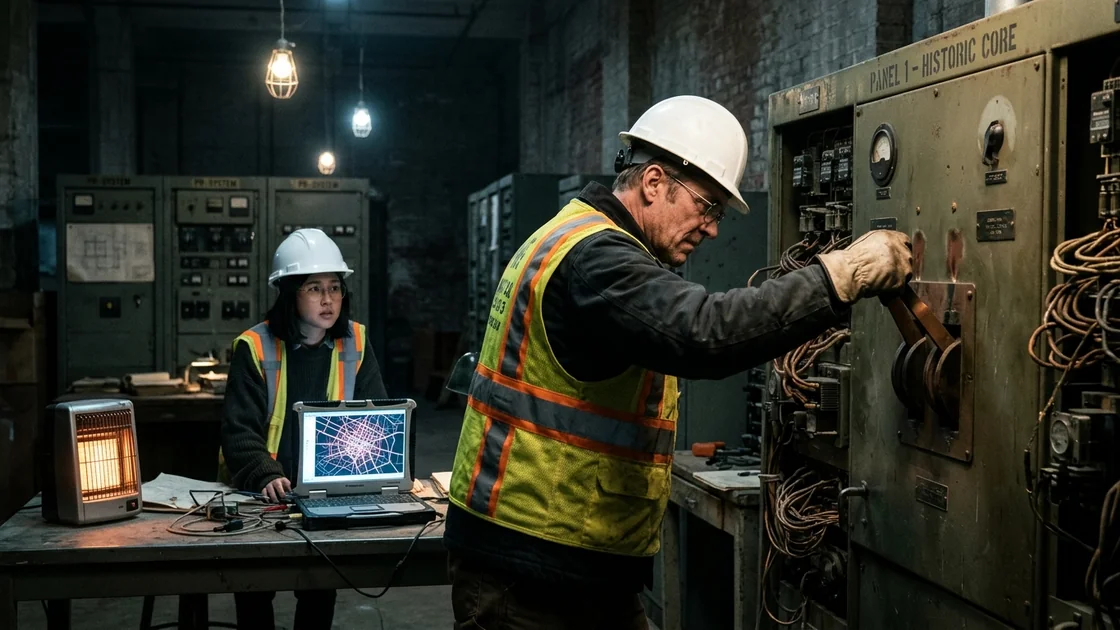
"Before the digital fiber ring was built in the late nineties, New Veridian ran on an electromechanical master-slave system called the PR-System," Arthur said, flipping a heavy iron breaker switch on the wall.
A row of dusty incandescent bulbs strung in wire cages flickered to life overhead, illuminating rows of tall, olive-drab steel cabinets lined with brass dials, clicking stepping relays, and thick bundles of lead-sheathed multi-conductor cable disappearing into a massive concrete trench in the floor.
"Every intersection in the city used to be controlled by physical voltage pulses sent over copper twisted-pair lines from these electromechanical rotary dials," Arthur explained, leading her into a small, glass-partitioned foreman’s office at the back that contained a dusty desk, a space heater, and an electric kettle. "When we upgraded to fiber and the Type 2070 controllers, the city council didn't want to spend forty million dollars ripping up the streets to remove the old copper conduits. So they just left them in the ground, terminated right here in this basement."
Maya looked out through the dirty glass at the silent olive-drab monoliths. "Wait. Are those copper lines still connected to the street cabinets?"
"Only to the master emergency preemption relays in the oldest two hundred intersections downtown," Arthur said, plugging in the space heater until its coils began to glow a dull orange. "It was kept as a civil defense fallback in case of a catastrophic digital failure. Nobody has tested it since Y2K. Henderson doesn't even know this building is still on the electrical grid; the meter is billed under the Highbridge structural lighting account."
He cleared a space on the dusty desk and set the Toughbook down. "Now. Let’s see what nearly got us killed."
For the next three hours, as the gray light of Friday morning slowly filtered through the high, painted-over clerestory windows of the warehouse, Maya and Arthur tore the dumped firmware apart.
Maya was a wizard with reverse-engineering assembly code. Using a decompiler on Arthur’s Linux machine, she stripped away the obfuscation layers of the parasite box’s operating system.
At 4:30 AM, she sat back in her broken wooden swivel chair, her face pale in the glow of the monitor.
"It’s Aegis," she said softly. "Look at the cryptographic signing certificate in the bootloader. It’s signed with Aegis Mobility’s root private key—the exact same root key used on the official Smart-Corridor firmware Henderson has been forcing us to install all year."
"So the corporate contractor is running a smuggling ring on the side?" Arthur asked, leaning over her shoulder.
"No, Artie. Look deeper. Look at the routing protocols and the RF modulation tables." She highlighted a block of code labeled MOD_VORTEX_MIL_STD. "Aegis didn't write this module. This is a classified DARPA vehicle-to-infrastructure protocol developed six years ago for autonomous convoy protection in hostile urban environments overseas. And look at the payload manifest telemetry the box logs whenever the van passes through."
She opened a decoded text buffer from the EEPROM’s non-volatile memory—a log of the last six handshakes the Mercer and Eighth cabinet had performed with the charcoal van.
Each handshake contained a status string broadcast by the van’s internal telemetry system to ensure the vehicle was stable:
VEH_ID: NV_GHOST_04 GROSS_WT: 19,420 LBS CRYO_TEMP_1: -196.2 C (NOMINAL) CRYO_TEMP_2: -195.8 C (NOMINAL) GEIGER_INT: 0.002 mSv/h (SHIELD_INTACT) BIO_CONTAINMENT_SEAL: GREEN (4.2 PSI NEGATIVE) DEST_NODE: PIER_44_SUB_01
The silence in the little glass office was absolute, save for the ticking of the space heater’s metal housing.
"Liquid nitrogen temperatures," Arthur whispered, reading the lines over and over. "Radiation shielding. And negative-pressure biological containment."
"And look at the origin nodes on your map again," Maya said, her voice shaking. "The Bio-Synthetics corporate campus heliport. The decommissioned municipal water plant—which sits right on top of the old university nuclear research reactor they supposedly dismantled in the eighties. And Pier 44."
"They’re using an private defense contractor—Aegis—to move high-level hazardous biological and radiological materials between unpermitted private labs and the port," Arthur said, the puzzle pieces locking together with a sickening, heavy finality. "If you move Class 7 radioactive material or Biosafety Level 4 pathogens legally, you have to file federal transport manifests with the DOT, notify the state police, restrict movement to outer beltways during specific hours, and pay for hazmat escorts. It creates a massive public paper trail. And if a biotech company or a defense contractor is doing research they aren't legally allowed to be doing inside city limits..."
"They can't declare the cargo," Maya finished. "And they can't risk the van ever getting pulled over for a broken taillight, getting stuck in a traffic jam where a radiation pager on a beat cop's belt might chirp, or getting T-boned by a drunk driver at two in the morning and breaching a negative-pressure biocontainment vessel in the middle of Midtown."
"So they bought Henderson," Arthur said, his hands curling into fists on the desk. "They used the city's own Smart-Corridor modernization contract as a Trojan horse to install military convoy-preemption hardware into three hundred intersections. They turned the municipal traffic grid into a private, frictionless smuggling pipeline right through residential neighborhoods while four million people are asleep in their beds."
Maya looked at the timestamp on the final log entry. "Artie... look at the schedule buffer at the bottom of the file. There’s a pre-cached encryption key loaded for the next twenty-four-hour window."
She scrolled to the bottom of the hex dump.
NEXT_WINDOW_ACTIVE: FRI 02:15:00 EST CONVOY_COUNT: 03 (HEAVY) ORIGIN: BIO_SYNTH_SOUTH TERMINUS: PIER_44
"Tonight," Arthur said. "Not one van. Three of them. Moving whatever they’ve been cooking at the Bio-Synthetics campus down to a ship waiting at Pier 44. And once that ship leaves port, the evidence is gone."
"We have to go to the FBI," Maya said, reaching for her coat. "Or the State Police, or the EPA, or the newspapers—"
"With what?" Arthur asked sharply, stopping her. "A hex dump on an unauthorized laptop and a story about magic traffic lights? By the time a federal desk agent even figures out who to call to verify our credentials, Henderson will have reported both of us for stealing city equipment and sabotaging the Eighth Street cabinet last night. There's probably already a BOLO out for my Honda and a warrant being drafted for our arrest for 'cyber-terrorism' against municipal infrastructure. And the moment Aegis sees an inquiry from a federal agency, they’ll send a single wireless kill-command over the network that wipes the flash memory on all three hundred black boxes and cancels tonight's run."
Maya sank back into the chair, rubbing her temples with both hands. "Then what do we do? If we can't prove it before tonight, and they won't stop on their own... they just get away with it."
Arthur walked out of the small office onto the main warehouse floor. He stood among the towering, olive-drab steel cabinets of the 1960s PR-System, running his fingers over the cold brass faceplates and the heavy Bakelite rotary switches.
"Why do they use the Green Wave, Maya?" Arthur asked quietly, his voice echoing in the vast brick space.
Maya looked at him through the dirty office glass. "Because the vans weigh ten tons each and they're carrying volatile containment units. They can't outrun pursuit vehicles, they can't maneuver tightly, and they can't risk stopping in a public space."
"Exactly," Arthur said, turning back to face her, a fierce, cold light glinting behind his spectacles. "The entire operation depends on flow. They believe they own the streets because they hijacked the digital brain of the city. They think the grid is software."
He tapped his knuckles against the half-inch-thick rolled steel of the 1962 Master Control Cabinet, producing a deep, resonant thud.
"They forgot that underneath the software, a city is made of concrete, steel, and high-voltage copper," Arthur said. "They want to run three ten-ton vans through my grid at 2:15 tomorrow morning? Fine. We aren't going to call the police to chase them. We're going to wrap the streets around them and deliver them straight into the spotlight."
Preparation for war in the realm of municipal traffic engineering did not involve loading magazines or strapping on Kevlar. It involved wire strippers, alligator clips, three gallons of distilled water to top off forty-year-old lead-acid backup batteries, and a worn, coffee-stained blueprint of the 1974 Downtown Underground Utility Conduit Map.
All through Friday afternoon, while the city above hummed with end-of-the-week commercial energy, Arthur and Maya labored in the gloom of Annex B.
The first problem was intelligence. Without access to the Central Traffic Management Center, they were essentially blind to which specific zigzag route the three vans would take from the Bio-Synthetics campus in the south hills to Pier 44 on the waterfront. There were twelve possible combinations within the three-hundred-node lattice.
"We don't need the central server to see them," Maya had realized around noon, her eyes lighting up as she stared at the black box schematic on the Toughbook. "The parasite boxes communicate with each other over our municipal fiber ring using multicast UDP packets on Port 50112. We still have a dark fiber maintenance splice box right here in the warehouse wall from when they surveyed this building in 2008!"
By 4:00 PM, Maya had cracked open the gray plastic fiber splice enclosure near the warehouse ceiling, fused a spare LC pigtail onto the secondary diagnostic ring using an old Fujikura fusion splicer she found in a locked tool crib, and hooked it into the Toughbook.
They couldn't send commands over the fiber—Aegis’s new firewall rules would reject any unauthenticated control packets instantly, and the local black boxes would ignore the central server anyway once the vans’ millimeter-wave beacons hit them.
But they could listen. Every time a black box along the lattice woke up and authenticated a convoy beacon, it broadcast a multicast heartbeat across the ring. On Maya’s laptop screen, the vector map of New Veridian was now live again.
Meanwhile, Arthur worked on the heavy iron.
He spent six hours on his hands and knees in the cable trench beneath the olive-drab PR-System cabinets, tracing the thick, cloth-insulated copper pairs with a multimeter and a tone generator.
Most of the copper lines dead-ended where construction crews had accidentally severed them with backhoes during the nineties and early two-thousands. Out of the two hundred original downtown intersections once tied to Annex B, one hundred and sixty-two were dead open circuits.
Thirty-eight were still live.
Thirty-eight continuous, unbroken pairs of 14-gauge solid copper wire running through glazed terracotta ducts twenty feet beneath the sewer lines, connecting the knife switches in this forgotten warehouse directly to the high-voltage emergency preemption coils inside the oldest, largest intersection cabinets in the historic core of New Veridian.
And those coils didn't connect to the Type 2070 digital controller. They didn't even connect to the compromised backplane of the Malfunction Management Unit. By a quirk of a 1968 fire-code ordinance that had never been repealed, those thirty-eight copper pairs were wired directly to heavy, spring-loaded mechanical clapper relays mounted at the very bottom of the roadside cabinets—relays that physically interrupted the 120-volt AC main bus bars feeding the signal heads overhead.
"Look at the thirty-eight live nodes," Arthur said at 9:00 PM, laying a sheet of translucent vellum tracing paper over Maya’s printed map of the Aegis lattice. He had marked the thirty-eight copper-connected intersections with heavy blue grease-pencil circles. "If the convoy leaves Bio-Synthetics heading for Pier 44, they have to cross the river canal. There are only three crossings that can handle a twenty-thousand-pound axle load without setting off the state DOT structural weight alarms: the Viaduct, the Mercer Street Bridge, and the Old Foundry Drawbridge."
"If we cut the lights on the Viaduct or Mercer, the lead driver will just see the disruption two blocks early and turn down a cross street," Maya pointed out, chewing on a cold slice of gas-station pizza they had bought from a vending machine four blocks away. "Remember, the lattice gives them three ways out of every intersection. If you drop an intersection into all-red or flashing red in front of them, they'll blow right through it at fifty miles an hour anyway. Who's going to stop them at two in the morning?"
"Nobody is going to stop them with a red light," Arthur agreed. "A red light is just a social contract. Criminals in ten-ton armored vans don't care about social contracts. They care about physics."
He pointed his grease pencil at a tight cluster of six blue circles located five blocks north of Pier 44: the historic Customs House Plaza.
"Customs House Plaza is a one-way counter-clockwise rotary built in 1924," Arthur said, his eyes gleaming behind his lenses. "It’s surrounded by granite federal buildings on three sides and the elevated railway retaining wall on the fourth. Five streets feed into it; only two feed out toward the waterfront. And because it borders the Federal Reserve regional branch and the courthouse pedestrian mall..."
Maya leaned over the map, her breath catching as she realized what else was wired into the roadside cabinets around the Federal Reserve district.
"The hydraulic security bollards," she whispered. "And the reversible contraflow gates on the Customs House tunnel."
"Installed in 2004 after the federal security mandates, and tied directly into the master civil-defense preemption relays in those exact six cabinets," Arthur said softly. "And better yet, look at the city event calendar for tonight at the bottom of the municipal maintenance bulletin."
He slid a printed sheet from his briefcase across the desk.
Every Friday night between midnight and 4:00 AM during the month of November, the Port Authority conducted its weekly heavy-haul drayage window—moving dozens of oversized, slow-moving eighty-thousand-pound shipping container chassis from the rail yard along the Cross-Harbor Arterial, right past the north entrance of Customs House Plaza. And four blocks east of the plaza, right on the edge of the Theater District, Channel 4 News and three other local broadcast networks had set up their mobile satellite trucks for a twenty-four-hour live charity telethon outside Children's Hospital, complete with floodlights, live camera crews, and four detail cruisers from the New Veridian Police Department's public relations unit.
"If they take the Western Corridor, they bypass Customs House Plaza completely," Maya said, studying the map. "They’ll only go through the Plaza if the Western Corridor and the Mercer Street Bridge are unavailable."
"Then we won't wait for them to reach the Plaza," Arthur said, looking out at the row of heavy copper knife switches on the warehouse wall. "We're going to herd them there. Just like channeling storm water down a spillway."
At 2:00 AM on Saturday morning, the city of New Veridian held its breath.
Outside, the cold fog had cleared, leaving the streets dry and brittle beneath a starless, freezing sky. Down in Annex B, Arthur had turned off the overhead incandescent bulbs so no light would leak through the cracked masonry near the roof. Only the blue-white glow of Maya’s Toughbook and the amber dial lamps of the old PR-System consoles illuminated their faces.
At 2:14:48 AM, the Toughbook emitted a sharp, low beep.
At the southern edge of the map, right outside the perimeter fence of the Bio-Synthetics corporate park, Node 289 flashed bright crimson.
"Contact," Maya said, her fingers hovering over the trackpad. "Handshake authenticated. Three distinct millimeter-wave transponders in tight formation, spaced four seconds apart. Plus two escort vehicles without transponders riding the front and rear of the wave. Five vehicles total."
"Speed?" Arthur asked, standing beside the first bank of olive-drab cabinets, a heavy insulated leather work glove on his right hand.
"Forty-eight miles per hour. Moving north on Hamilton Boulevard toward the Western Corridor split."
On the screen, the crimson wave began to propagate. Nodes 288, 285, and 281 snapped green in rapid succession ahead of the convoy, dumping cross-street phases across the south side of the city. In the silence of the warehouse, Arthur could picture it clearly: five dark shapes roaring through the sleeping residential avenues, exhaust booming off the brownstones, gliding through intersections while late-night taxi drivers and bakery delivery trucks slammed on their brakes at sudden, impossibly short red lights.
"They’re approaching the Western Corridor fork at Hamilton and 34th," Maya called out. "Thirty seconds to the turn. If they take the left fork onto the Western Corridor, we lose them—none of our copper lines reach the west side."
"They won't take the left fork," Arthur said. "Because at 34th and Hamilton, the Western Corridor is about to experience a catastrophic traffic jam."
He didn't pull a switch for 34th Street—that intersection was too modern. Instead, he walked to Panel Three, gripped the heavy Bakelite handle wired to Node 112—the intersection of 32nd and the Cross-Harbor Freight Way, two blocks west of the fork—and threw the knife switch down with a loud metallic clack, sending a solid 110-volt DC pulse surging two miles through the earth.
Two miles away, at the bottom of the roadside cabinet at 32nd Street, a fifty-year-old magnetic coil energized for the first time since the Clinton administration. The heavy brass clapper slammed shut, physically locking the intersection’s phase selector onto the Port Authority freight ramp and dropping the main arterial signals to solid red.
Instantly, eight consecutive eighty-foot container trucks coming off the rail yard were released onto the Western Corridor approach at ten miles per hour, nose-to-tail, forming a quarter-mile-long moving wall of steel shipping containers that spilled straight back into the left fork of the 34th Street intersection.
On Maya’s screen, the millimeter-wave beacon from the lead van hit the cabinet at 34th Street, demanding a green light for the left fork. The cabinet obeyed—turning the light green—but a green light couldn't move four hundred tons of double-stacked Maersk shipping containers that were already gridlocked across all four lanes of the avenue.
"They're slowing down!" Maya said, watching the telemetry speed drop from forty-eight to thirty-two. "The lead escort sees the freight spillback blocking the Western Corridor! Hold on... Node 274 on the right fork just lit up! They turned east! They're abandoning the Western route and heading for the Mercer Street Bridge!"
"Good," Arthur murmured, his eyes darting across his grease-pencil vellum map. "Let them think the freight jam was just bad luck. Let them build their speed back up."
For the next four minutes, the crimson line raced diagonally northeast toward the financial district. The convoy accelerated to fifty-two miles per hour along the wide stretch of Grand Avenue, making up for lost time.
Somewhere in the Central Traffic Management Center—or in a private Aegis operations room across town—whoever was watching the convoy’s progress had probably tensed when they diverted at 34th Street, then relaxed as the peer-to-peer lattice seamlessly calculated a new green wave toward the Mercer Street Bridge.
"One mile to the Mercer Bridge approach," Maya reported, her voice tight. "They're passing 18th Street. 16th Street. Artie, if they get across the Mercer Bridge, they have a straight shot down the waterfront highway to Pier 44."
"How are the pedestrian calls looking at 12th and Mercer, outside the Children's Hospital telethon?" Arthur asked.
Maya tapped a key, pulling up the raw loop data from the avenue four blocks east of the bridge approach. "The avenue is packed. There are forty cars backed up rubbernecking at the TV lights, plus two news vans double-parked in the right lane."
Arthur moved to Panel Seven. "Wait until the lead escort vehicle crosses the point of no return at 14th Street, where the concrete median divider prevents them from making a U-turn."
"Passing 15th..." Maya counted down, watching the millisecond timestamps tick on the multicast monitor. "Lead escort is crossing 14th... Van One is crossing 14th... Van Two... Van Three is inside the median chute!"
Arthur reached up and threw three knife switches in rapid succession: Node 088, Node 089, and Node 091—the three intersections immediately guarding the north and west approaches to the Mercer Street Bridge.
At the same time, he plugged a brass patch cord into the rotary pulse generator on the master console and cranked the dial to EMERGENCY BRIDGE CLEARANCE.
Down at the Mercer Street Bridge, the black box inside the bridge control cabinet tried to hold the green wave open. It fought for half a second against the sudden surge of analog voltage coming up from the subterranean copper conduit, sparks flying inside the roadside cabinet as the modern solid-state opto-isolators fried under the raw 110-volt DC mechanical shunt.
The black box lost.
With a deafening clanging of mechanical bells, the red striped fiberglass railroad-style barrier gates at the entrance of the Mercer Street Bridge dropped down across all six lanes of traffic, and the massive amber matrix sign overhead flashed to life in three-foot-tall letters: BRIDGE OPEN — MARINE TRAFFIC.
"The bridge gates just dropped right in their faces!" Maya yelled, slapping the desk. "Telemetry shows hard braking! They’re down to fifteen miles an hour! There's only one way off the 14th Street chute without reversing into traffic—"
On the screen, Node 094—the sharp right-hand slip lane leading off the bridge approach toward the Theater District and Customs House Plaza—flashed crimson as the lead vehicle wrenched its wheel to the right, dragging the three ten-ton vans and the rear escort off the arterial and into the narrow granite canyons of the historic core.
"They know something’s wrong now," Maya said rapidly, her fingers flying over the keyboard as a flood of high-priority error packets suddenly exploded across the fiber ring. "Someone at Aegis just woke up! They’re trying to send a global override from the central server to force the Customs House Plaza signals open ahead of them!"
"Let them try," Arthur said, sprinting down the length of the warehouse to the final, massive steel cabinet at the end of the row—Panel One, the Historic Core Master Hub. "The central server is talking to the Type 2070 controllers. I’m talking to the copper!"
On the screen, the five vehicles were barreling down Exchange Place at forty miles per hour, boxes of ten-ton steel hurtling between narrow sidewalks toward the open rotary of Customs House Plaza, just two blocks away from the glowing floodlights of the Channel 4 live telethon.
"They're entering the Plaza!" Maya shouted. "Lead escort is in the rotary! Van One is in! Van Two! Van Three! Rear escort just cleared the entrance!"
"Are the shipping trucks still crossing the north exit?" Arthur yelled over his shoulder, his gloved hands gripping the two heavy dual-pole levers at the bottom of Panel One.
"Yes! The north exit is completely blocked by the drayage convoy! Their only way out of the rotary is the south tunnel ramp toward Pier 44!"
The lead escort vehicle rounded the granite fountain in the center of Customs House Plaza, tires screaming on the cobblestones as it lined up for the south tunnel ramp, its millimeter-wave beacon hammering the cabinet at the tunnel mouth to hold the contraflow gates open and the security bollards down.
Arthur pulled both heavy copper levers down with all his body weight and jammed a steel screwdriver through the locking hasp so they couldn't spring back.
At the south exit of Customs House Plaza, the roadside cabinet didn't just switch phases; it blew its main digital logic board in a shower of blue sparks as the civil-defense preemption relay slammed home.
Overhead, every single traffic head around the rotary snapped to solid, unblinking red.
And directly in front of the lead escort SUV, six feet from the mouth of the south tunnel ramp, a row of eight twelve-inch-thick stainless-steel hydraulic terrorism bollards erupted out of the pavement in one-point-two seconds with the sound of a pneumatic cannon firing, locking into place at forty-five degrees with three thousand pounds of hydraulic pressure behind them.
At the exact same instant, at the southern entrance where the convoy had just entered the rotary four seconds earlier, a second row of steel bollards slammed upward behind the rear escort SUV, while the massive overhead steel contraflow gate clanked down to seal off the east slip lane.
On Maya’s laptop screen, the five crimson dots inside Customs House Plaza slammed to a dead halt.
SPEED: 0.0 MPH.
For three seconds, the five black vehicles sat trapped inside the granite rotary like sharks caught in a dry dock—walled in by three-foot-tall steel bollards in front and behind, a solid line of eighty-ton shipping containers rumble-idling across the northern avenue, and the twelve-foot concrete steps of the Federal Reserve building to their left.
Desperate, the driver of the lead escort SUV threw his vehicle into reverse, slammed into the bumper of the first charcoal van, then cranked his wheel and tried to jump the eighteen-inch granite curb onto the pedestrian plaza leading toward the Theater District—only to high-center the SUV’s heavy frame on a decorative cast-iron streetlamp base, rupturing its radiator in a massive cloud of white steam and setting off its high-decibel factory car alarm.
Two hundred yards away, outside the Children's Hospital, four New Veridian Police Department officers standing next to the Channel 4 satellite truck turned their heads at the sound of the crash and the screaming alarm. Behind them, two bored television cameramen on a hydraulic scissor-lift swung their broadcast lenses away from the empty stage and zoomed straight into the cloud of steam rising from Customs House Plaza.
"Look at the public safety scanner feed!" Maya cried, pulling up a live audio stream on her secondary monitor as red and blue strobe lights suddenly began reflecting off the granite facades on the Plaza traffic camera that had miraculously not been wiped this time.
On the warehouse’s single surviving CCTV monitor—a grainy black-and-white CRT tied to a legacy coax line at the corner of the Federal Reserve—Arthur and Maya watched the endgame unfold in stark monochrome.
The doors of the rear escort SUV flew open. Four men in dark tactical clothing jumped out, reaching beneath their jackets—only to freeze as three NVPD cruisers, followed immediately by two heavily armed Federal Reserve Police armored response trucks triggered by the bollard activation alarm, roared up to the perimeter of the rotary, floodlights blazing, loudspeakers barking orders to get on the ground.
And right behind the police cruisers, running down the sidewalk with a heavy shoulder-mounted broadcast camera transmitting live to every cable box and twenty-four-hour news feed on the East Coast, came the Channel 4 night crew.
When the federal officers saw the men in the escort vehicles drop submachine guns onto the cobblestones, they didn't treat it like a traffic accident. Within ninety seconds, twenty-two law enforcement officers had surrounded the three matte-charcoal vans at gunpoint.
When the bomb squad and the Fire Department Hazmat unit arrived twelve minutes later and ran a radiation detector along the seamless steel side panels of Van Two, the evacuation of the four surrounding blocks made international breaking news before 3:00 AM.
Inside Annex B, Arthur slowly let go of the copper levers on Panel One. He took off his heavy leather work gloves, laid them neatly on top of the 1962 master console, and took off his spectacles to rub his tired eyes.
"Wait," Maya said, her fingers suddenly flying across the Toughbook’s keyboard one last time. "While the federal hazmat guys are cracking open the back of those vans on live television, and while Aegis’s servers are still trying to ping the Plaza cabinets to figure out why their convoy stopped... I have their return IP address from the override packets."
She hit Enter with a fierce grin.
"I just dumped the entire JTAG firmware extraction, the six-month route map, the Director's credential logs, and the Aegis root certificates onto the public servers of the Associated Press, the Department of Justice Inspector General, and the Federal Highway Administration."
Arthur looked at the grainy black-and-white screen, where a man in a silver hazardous-materials suit was carefully holding a thermal imaging camera up to the rear doors of the lead Transit van while flashbulbs and television lights turned the dark plaza into noon.
"Do you think they'll give us our server privileges back on Monday?" Maya asked, leaning back in her broken chair and letting out a long, shaky breath that turned into a laugh.
Arthur looked out over the dark rows of old steel cabinets, listening to the faint, rhythmic ticking of the brass stepping relays cooling down in the quiet warehouse.
"I suspect," Arthur said mildly, picking up his battered briefcase and turning off the space heater, "that by Monday morning, there will be an opening in the Director's office."
On Monday morning at 7:45 AM, the subterranean bunker of the Central Traffic Management Center was quieter than usual.
The glass door to Director Henderson’s office was closed, sealed across the jamb with bright yellow evidence tape bearing the stamp of the United States Marshals Service. Three federal agents in dark suits were quietly carrying cardboard boxes full of hard drives and contract binders out of the server room, stepping carefully around the cables on the floor so as not to disturb the operators.
Nobody stopped Arthur when he walked onto the main floor, and nobody questioned why Maya was sitting back at her console with her boots propped up on the lower CPU housing, sipping a large iced coffee while she systematically purged the Aegis Smart-Corridor firmware patches from the central mainframe and restored the open-source municipal backups.
Arthur stood before his primary workstation at the center of the pit.
Up on the forty-foot curved video wall, the morning rush hour was reaching its systolic peak. Four million people were waking up, pouring out of driveways and subway stations, merging onto the avenues, delivering milk, taking children to school, arguing with their spouses on Bluetooth headsets, and complaining bitterly about catching three red lights in a row on Mercer Street.
Arthur adjusted his spectacles, tapped a few keys on his mechanical keyboard, and adjusted the green split at the intersection of Eighth and Mercer by two-point-four seconds to clear a lingering queue of buses backed up from the still-repaired fire hydrant on the southwest corner.
Across the board, three thousand, nine hundred, and ninety-eight nodes pulsed in a slow, complex, mathematically pure harmony—green, amber, and red—answering to nobody, favoring no one, keeping the blood of the city moving through the veins of the concrete grid.
Arthur picked up his mug of terrible hazelnut coffee, took a sip, and smiled.