The Green Trace Under the Floor
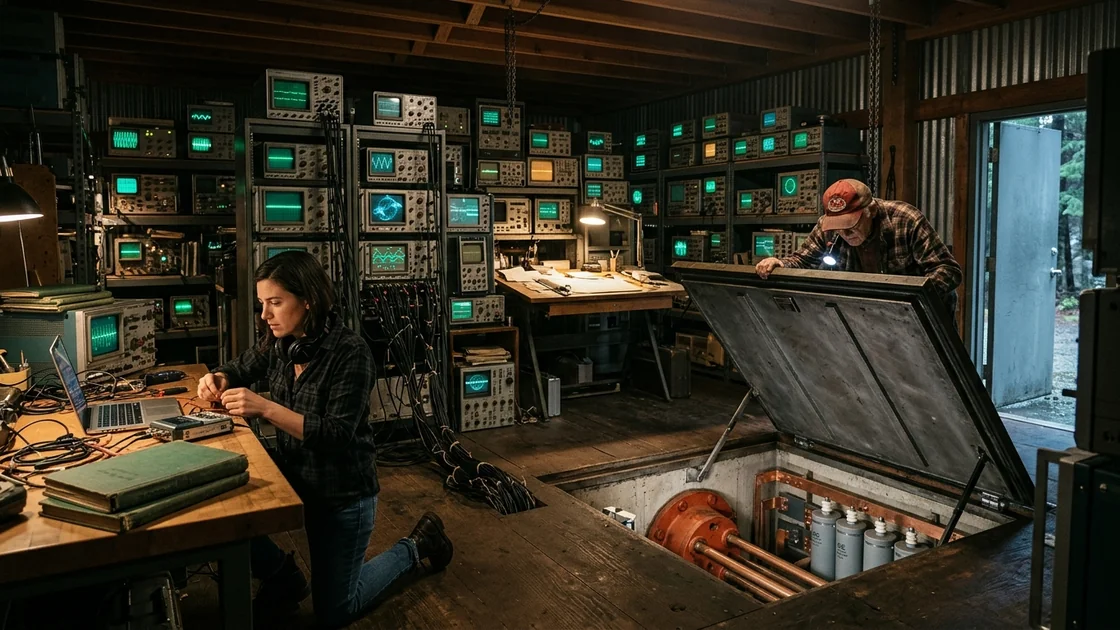
Clara Vance inherits her late grandfather Arthur's rain-soaked property in the Pacific Northwest, including a fortified garage packed with hundreds of vintage oscilloscopes. Upon investigating the humming labyrinth of cathode-ray tubes, she discovers that every single instrument is wired into the foundation to monitor a single, slowly dying electromagnetic signal originating from deep beneath the floorboards. As she decodes her grandfather's decades of meticulous logs and confronts the history of a forgotten geological experiment, Clara must decide how to handle the fading pulse before the unstable circuit beneath the house collapses completely.
The key to the garage was not on the brass ring with the others. Mr. Pembrook, the estate attorney whose offices smelled of wet wool and toner cartridges, had handed Clara two keys on a tarnished split ring: one for the front door of the cedar-shingled house on Ridge Road, and one for the rusted padlock on the storm cellar. The key to the detached garage, he explained while peering over his half-moon spectacles, had never been surrendered to the county coroner or the hospital staff in Astoria. If it existed at all, it was somewhere inside the house.
Clara found it on her second day in Oakhaven, suspended inside a Mason jar of clear mineral oil at the back of the pantry, tucked behind three rows of home-canned pickled beets dated 1998. It was a heavy, square-shouldered Medeco security key with angled cuts along the blade that looked more like the teeth of a miniature saw than something meant for a domestic outbuilding. She fished it out with a wooden spoon, wiped the viscous oil off on her jeans, and stood by the kitchen sink listening to the rain drum against the galvanized gutter outside.
Even from the kitchen, separated from the garage by forty feet of crushed gravel and overgrown sword ferns, she could hear the hum.
It wasn't an audible note so much as a pressure against the mastoid bone behind her ears, a steady sixty-hertz fundamental braided with a higher, thinner whine that made the fillings in her molars feel slightly loose. In her line of work—restoring degraded magnetic tape for university archives and small record labels in Chicago—Clara spent forty hours a week listening for sixty-cycle ground loops, capstan motor rumble, and capacitor hiss. She knew the sound of old iron transformers working under load. What she didn't understand was why her grandfather's garage was drawing enough current to keep the utility pole at the end of the driveway singing in the mist.
When she had reviewed the probate documents in Pembrook's office, the balance sheet had looked like a typographical error. Arthur Vance had lived on a modest civil service pension and a small annuity from his years at the Bonneville Power Administration. He owned a nineteen-eighty-four Ford Ranger with moss growing in the window channels, four acres of second-growth Douglas fir, a two-bedroom house with peeling linoleum, and an automatic bank draft to Tillamook County Light and Power that averaged fourteen hundred dollars a month.
"I thought maybe he was growing something," Pembrook had admitted, rubbing the bridge of his nose. "Up here, when an old bachelor pulls thirty kilowatt-hours a day into an outbuilding with boarded-up windows, the sheriff usually takes an interest. Deputy Hendricks actually drove out there three winters ago after a meter reader reported the heat signature. Your grandfather met him on the porch, showed him a permit from the Department of the Interior signed in nineteen-seventy-two, and told him to get off the gravel."
"A permit for what?" Clara had asked.
"Subsurface telluric monitoring," Pembrook said, pronouncing the words as if they belonged to a dead liturgy. "Hendricks looked it up. The agency division that issued it was dissolved during the Carter administration, and the county didn't feel like paying the legal fees to figure out who had jurisdiction over an eighty-two-year-old man's hobby. As long as the check cleared on the first of the month, the power stayed on."
Clara pulled on her yellow slicker, slipped the oily Medeco key into her pocket, and stepped out the back door. The Oregon coast in November didn't have weather so much as a permanent, suspended deluge. The air was cold and tasted faintly of salt and wet hemlock bark. Above the roofline of the house, the forest rose in a steep, dark wall of firs that swallowed the gray sky before noon.
The garage was larger than the house. Built into the slope of the hill at the end of the turnaround, it had been framed in heavy timber and clad in corrugated steel painted a dull forestry green that had oxidized to the color of pond scum. Unlike the house, whose porch steps sagged with dry rot, the garage sat on a poured concrete foundation two feet thick. There were no windows. In place of a standard overhead roll-up door, two massive hinged barn doors had been bolted shut from the inside, their seams caulked with black mastic. Entry was through a steel personnel door on the side, reinforced with a welded plate around the lock cylinder.
As she approached, the smell of hot dust and ozone cut through the wet pine needles. Fixed under the deep eaves at the rear of the building were two industrial exhaust louvers, their aluminum blades trembling as they breathed warm, dry air out into the rain. Where the warm exhaust met the forty-degree drizzle, a thin plume of ghost-white vapor curled upward into the branches of an alder tree.
Clara slid the key into the cylinder. The pins clicked into place with the oiled precision of a bank vault. She turned the deadbolt, leaned her shoulder against the steel skin of the door, and pushed it open.
The heat hit her first—not the stuffy, stagnant warmth of an attic, but the dry, convective heat of a broadcast transmitter room, smelling strongly of baked phenolic resin, warm beeswax, and silver solder. And then she saw the green light.
The interior was cavernous, easily forty feet by sixty, with the ceiling joists left exposed to support heavy chain hoists and bundles of braided wiring. There were no cars, no lawnmowers, no coffee cans full of rusty nails. Instead, the space had been organized into three concentric horseshoes of floor-to-ceiling steel relay racks and reinforced maple workbenches, all facing the center of the room like an amphitheater built for machines.
Resting on those shelves, bolted into those racks, and stacked two-deep on rolling institutional carts were hundreds of oscilloscopes.
Clara stood on the threshold, the steel door slowly swinging shut behind her on its hydraulic closer until the latch clicked, sealing out the rain. In the dimness, the room glowed Like an aquarium deep beneath the sea. Every single cathode-ray tube was illuminated.
There were round five-inch screens glowing with a sharp, emerald P1 phosphor; rectangular blue-white P11 screens; long-persistence amber P7 displays that left fading trails across their glass faces like slow-motion meteors. She recognized some of the beasts from her own studio and from engineering museums. Along the left wall stood a phalanx of Tektronix 500-series scopes from the late nineteen-fifties—massive, sixty-pound brushed-aluminum monsters with rows of rotary switches in silver and red, their ventilated side panels glowing cherry-orange from dozens of internal vacuum tubes. Next to them were military-surplus Waterman pocket scopes, rack-mounted Hewlett-Packard 120Bs, olive-drab Hickok units from naval radar bays, curved-face DuMonts that looked like props from a fifties science-fiction serial, and, closer to the center, a dozen late-seventies Tektronix 7000-series mainframes loaded with differential amplifier plug-ins.
There had to be three hundred of them—no, closer to four hundred. Their cooling fans produced a dense, rushing roar like a distant waterfall, underpinned by the deep, resonant hum of a massive step-down transformer bolted to the concrete in the far corner.
Clara walked slowly down the central aisle between the racks. The air made her skin prickle with static electricity; she could feel the tiny hairs on her forearms lifting toward the nearest glass screens.
When she had been nine years old, her parents had driven her out from Portland for a weekend visit—the last one before her father and Arthur had their final, bitter falling-out over her grandmother's estate. She remembered sitting on the back porch eating a bruised Gravenstein apple while her grandfather emerged from this very door, his cardigan sleeves pushed up past his elbows, his forearms marked with small, shiny pink scars from hot soldering irons. She had craned her neck to see inside, catching only a glimpse of green circles dancing in the dark before he pulled the door shut and locked it.
What are you making in there, Grandpa? she had asked.
Arthur had knelt down, smelling of Lava soap and wintergreen, and tapped the tip of her nose with a calloused finger. I'm not making anything, birdie, he had said. I'm just keeping the count.
Now, standing in the center of the horseshoe, Clara looked closely at the screens.
In any normal electronics shop, a collection of oscilloscopes left idling would show flat horizontal lines, or perhaps the sixty-hertz sine wave of ambient room noise picked up by unshielded probes. If they were hooked to signal generators for display, they might show neat square waves, sawtooth ramps, or spinning Lissajous knots.
These scopes were not idling, and they were not showing test patterns.
On the nearest Tektronix 545B, a bright green line crawled across the black graticule at a slow sweep rate—maybe half a second per division. As it moved from left to right, the trace trembled briefly, rose into a sharp, asymmetric double peak, dipped below the baseline into a jagged trough cluttered with high-frequency ringing, and then settled back into a restless, shivering flatline before repeating the cycle four seconds later.
It looked like an electrocardiogram of something vast and exhausted.
She turned to the scope beside it—an older Cossor double-beam unit with a round face. Its upper trace showed the exact same four-second pulse, while its lower trace zoomed in on the jagged trough, stretching that fraction of a second across the entire screen to reveal a complex packet of phase-modulated sine waves nested inside the dip like eggs in a basket.
She looked up at the rack above. Six Telequipment scopes were arranged in a vertical column. Each one was triggered to capture a slightly different slice of that same four-second cycle, cascading from top to bottom. When the pulse hit the top screen, it tripped the sweep on the second, which tripped the third, so that a wave of bright green light seemed to pour down the rack toward the floor every four seconds.
Tick. Sweep. Hum.
Four seconds of stillness.
Tick. Sweep. Hum.
Clara's breath caught in her throat. She spun around, her eyes darting across the tiered walls of glass. The amber long-persistence radar scopes in the back corner were plotting polar coordinates of the pulse's phase angle, drawing decaying yellow spirals that flared every four seconds. The dual-trace HP scopes on the right were running X-Y comparisons, turning the pulse into a trembling, three-lobed figure that contracted and expanded like a lung.
Four hundred instruments, spanning forty years of analog engineering, and every single one of them was locked onto the same signal.
"What did you wire them to?" she whispered.
She dropped to her knees beside one of the central workbenches. Connected to the vertical input BNC jack of each oscilloscope was a thick, black coaxial cable—not the thin, flexible RG-58 jumpers used on test benches, but heavy, double-shielded RG-214 with silver-plated connectors, the kind of low-loss line used for high-frequency antenna feeds. Each cable was tagged near the connector with a neat wrap of yellow friction tape bearing Arthur's cramped, mechanical draftsmanship lettering in India ink: CH-042 (DIFF-B), CH-043 (HARM-3), CH-044 (PHASE-REF).
From the backs of the racks and the undersides of the benches, these black cables dropped straight down, gathered into bundles as thick as a man's thigh by waxed linen lacing cord—an old telephone-company technique called cable sewing that nobody had used since the nineteen-sixties.
Clara crawled under the heavy maple bench, brushing aside a light drift of gray dust. The concrete slab of the garage floor did not extend into the center of the room. Instead, the central sixteen-by-sixteen-foot square between the racks was floored with heavy, two-inch-thick tongue-and-groove Douglas fir planks, stained dark with linseed oil and fastened with counter-sunk brass wood screws.
The bundles of coaxial cable from all three sides of the room converged on this wooden platform, disappearing through neatly drilled three-inch holes lined with brass grommets along its perimeter.
She pressed her palm flat against the fir floorboards.
The wood was warm—warmer even than the ambient air of the garage—and through the thick calluses of her fingertips, she felt a faint, rhythmic tug. It wasn't a mechanical vibration, not the rumble of a buried motor. She knew that because when she pulled her hand back a few inches, the sensation didn't stop; Instead, the steel buckle of her wristwatch tugged almost imperceptibly toward the floor every four seconds, in exact synchronization with the green peaks flaring on the four hundred screens around her.
By nine o'clock that evening, Clara had moved a gooseneck lamp, a kettle, and her own laptop onto the small drafting table that stood near the garage door—the only surface in the building not occupied by test equipment or spare vacuum tubes.
The house itself had proved too bleak to stay in after dark. It smelled of damp plaster and the peculiar, hollow absence left behind by someone who had used his home merely as a place to sleep for four hours between shifts in the workshop. In Arthur's bedroom, the mattress was concave on one side and piled with IEEE journals from the nineteen-seventies on the other. The only personal photograph in the house was a faded silver-gelatin print on the dresser showing her grandmother, Evelyn, standing beside a nineteen-fifty-six Studebaker at Cape Kiwanda, squinting into the sun with her hand holding down her scarf. Evelyn had died in nineteen-sixty-nine; Clara's mother had been sent to live with an aunt in Eugene a year later, when Arthur quit his job in Portland and bought this parcel outside Oakhaven.
In the family mythology handed down by Clara's mother, Arthur Vance had simply gone mad with grief, retreating into the woods to tinker with broken radios until his mind rusted shut.
Looking around the garage, Clara knew one thing with absolute certainty: madness did not lace forty miles of coaxial cable with waxed linen twine at exact three-quarter-inch intervals. Madness did not maintain a calibration schedule.
Hanging on a pegboard beside the drafting table were twelve heavy-duty clipboards, and stacked in a steel bookcase underneath were fifty-three identical green cloth-bound engineering notebooks, stamped NATIONAL BLANK BOOK CO. in gold leaf on their spines. Each spine had a white cloth tape label showing a year, beginning with 1971 on the bottom shelf and ending with 2024 lying open on the blotter of the drafting table.
Clara made herself a mug of instant coffee using bottled water she'd brought from Astoria and sat down on Arthur's worn leather swivel stool. She opened the 1971 notebook first.
The first page was dated April 14, 1971. There was no diary entry, no philosophical preamble explaining why a forty-year-old electrical engineer had built a bunker in the coastal rainforest. There was only a schematic diagram drawn in razor-sharp 2H pencil and a table of figures.
The schematic was titled: PRIMARY BOREHOLE COUPLING & PASSIVE DAMPING ARRAY (OAKHAVEN SHAFT #3).
Clara traced the lines with her fingernail. The drawing showed a cross-section of the garage floor. Beneath the wooden floorboards lay a six-foot-square concrete sump, eight feet deep. Rising into the center of that sump from deep underground was a twelve-inch-diameter cast-iron casing pipe.
According to the marginal notes on the drawing, the casing went down 1,420 feet into the fractured basalt of the Tillamook Volcanics series. Inside the pipe were suspended four braided copper-beryllium cables, insulated with ceramic beads and immersed in dielectric transformer oil. At the bottom of the 1,420-foot shaft, those cables terminated in what Arthur had labeled the Resonant Cavity Bridge.
She flipped forward through the 1971 volume. Every single page was a log sheet divided into columns: Date, Time (UTC), Barometric Pressure, Borehole Temp (°C), Primary Carrier Freq (Hz), Pulse Interval (sec), Peak-to-Peak Amplitude (mV), Harmonic Distortion (%), and Notes.
On April 14, 1971, the numbers read: Carrier Freq: 14.220 kHz. Pulse Interval: 0.412 sec. Peak-to-Peak Amplitude: 84,500 mV (84.5 Volts).
She left the 1971 book open and pulled down 1985. April 14, 1985. Carrier Freq: 9.810 kHz. Pulse Interval: 1.105 sec. Peak-to-Peak Amplitude: 31,200 mV.
She pulled down 2001. April 14, 2001. Carrier Freq: 4.305 kHz. Pulse Interval: 2.380 sec. Peak-to-Peak Amplitude: 8,940 mV.
Then she looked at the open notebook on the desk—the final entry, written eleven days ago in a hand that had grown shaky and spidery from the congestive heart failure that had finally dropped Arthur Vance on the gravel walkway between the garage and the back porch.
November 3, 2024. 0600 UTC. Carrier Freq: 812 Hz. Pulse Interval: 4.190 sec. Peak-to-Peak Amplitude: 142 mV.
Underneath the numbers, in red pencil, Arthur had written three lines: The decay curve has broken away from the logarithmic projection. Damping load on Rack C reduced by 40 ohms to compensate for loss of return EMF, but phase slip is accelerating. At current slope, carrier drops below 60 Hz threshold by Nov 18. If the bridge decouples before the harmonic packet is discharged, the reflections in the basalt column will not attenuate. God forgive me, my hands are too slow to re-solder the step-up bank.
Clara looked at the date on the corner of her laptop screen. It was November 15.
She stood up from the stool and walked back to the center of the room, where the latest Tektronix 7854 scope—the most modern piece of gear in the room, a microprocessor-assisted analog scope from around 1980—had a green digital readout projected onto the top and bottom edges of its CRT screen.
She read the glowing characters at the top of the glass. 118 mV. 4.38 s. 644 Hz.
In the twelve days since Arthur's heart had stopped on the wet gravel, the signal beneath the floor had lost another twenty-four millivolts of amplitude and nearly two hundred hertz of carrier frequency. Its pulse interval was stretching out—slowing down like a runner hitting the wall, or a pendulum losing its swing to friction.
"Wait a minute," Clara murmured, her brow furrowing as she looked back at the 1971 schematic. "84.5 volts?"
An oscilloscope was a passive measuring device. Its input impedance was typically one megohm; it was designed to sip a microscopic fraction of a signal without disturbing the circuit under test. You did not need four hundred oscilloscopes wired in parallel to measure an eighty-four-volt signal. In fact, wiring four hundred scopes together was an absurd nightmare of impedance matching unless...
She looked closer at the junction boxes bolted underneath the workbenches where the RG-214 cables met the heavy conduits rising from beneath the floorboards. Each junction box had a heavy aluminum heatsink bolted to its top, studded with gold-anodized Dale wire-wound power resistors and silver-mica capacitors.
The oscilloscopes weren't just monitors.
Arthur had built a distributed, tunable RLC load network—a massive analog computer and harmonic absorber made out of four hundred individual cathode-ray timebases and vertical amplifiers. Every time a scope's sweep generator fired—triggered by the incoming pulse from the borehole—its horizontal deflection plates and high-voltage flyback transformer drew a tiny, precisely timed surge of current through a feedback loop coupled back into the ground lines. By staggering the trigger thresholds, delay lines, and phase angles across four hundred separate vacuum-tube circuits, he wasn't just watching the wave. He was actively shaping its reflection, feeding a counter-phase signal back down the shaft to keep the subterranean wave packet balanced inside a mathematical cage.
And as the signal had weakened over fifty-three years, he had added more scopes, more high-gain differential amplifiers, trying to keep the phase-lock tight as the signal slipped down out of the kilohertz range and into the audible spectrum.
644 Hz.
Clara froze.
Fourteen kilohertz—where the signal had started in 1971—was a high, mosquito-like whine near the upper limit of adult human hearing.
Six hundred and forty-four hertz was just above E5—the E above middle C on a piano.
The signal wasn't radio frequency anymore. It had decayed right down into the midrange of the human voice.
Clara turned and practically ran back to the door where she had stacked her luggage. Alongside her suitcase was her pelican case—the watertight gray plastic trunk she never left behind in her apartment because it held nineteen thousand dollars' worth of portable audio-restoration hardware. When you spent your life traveling to humid southern basements and moldering church attics to digitize rotting reel-to-reel tapes before the oxide shed off the acetate backing, you carried your studio with you.
She popped the plastic latches on the case, lifted out her Nagra Seven digital field recorder, a high-impedance radial direct box, a pair of closed-back planar magnetic headphones, and a coil of BNC-to-quarter-inch patch cables.
Carrying the gear to the central workbench, she searched the face of the Tektronix 7854 until she found the port labeled VERT SIG OUT—a buffered output on the back panel that mirrored whatever signal was currently passing through the scope's vertical amplifier at a safe, standardized voltage level.
She clicked a BNC connector onto the jack, ran the line through the isolation transformer of the direct box to make sure she didn't fry her recorder's preamps, and plugged the balanced XLR cable into Channel 1 of the Nagra. She flipped the power switch, watched the level meters jump as the four-second pulse rolled through, and slipped the heavy headphones over her ears.
Instantly, the roar of the four hundred cooling fans in the garage vanished behind the thick leather earcups.
She slowly turned up the rotary gain pot on the recorder.
For two seconds, there was only the soft, velvety hiss of fifty-year-old vacuum tubes—the thermal sigh of electrons boiling off coated cathodes in the dark—underpinned by a low, hollow resonance like wind blowing across the mouth of a very deep well.
Then the green trace on the scope in front of her rose into its double peak.
Through the headphones came a sound that made Clara's fingers lock on the plastic knob.
Khl-oom... tssss-k-k-k-vrrrrr-uhn.
It wasn't a buzzer, or a static burst, or the sixty-cycle hum of a power line.
It had an envelope. It had an attack, a resonant body, and a complex, ringing tail that sounded unmistakably like it was bouncing off physical walls—vast, curved walls of wet stone. The first peak was a deep, brassy thrum, like a giant piano string struck with a rubber mallet underwater. The second peak, milliseconds later, was a rapid, cascading chatter of frequencies that swept downward in pitch—a glissando of clicks and whistling harmonics that sounded terribly, impossibly structured.
Four seconds of deep well-hiss.
Then again: Khl-oom... tssss-k-k-k-vrrrrr-uhn.
Except the second time she heard it, the cascading chatter in the middle wasn't identical to the first. Two of the internal harmonic peaks had swapped positions, like syllables inverted in a sentence.
Clara stared at the green trace on the glass while the sound echoed inside her skull. In her work, she had listened to whale songs recorded on hydrophones by the Navy in the fifties; she had listened to pulsar timings from radio telescopes and the eerie, whistling chorus of lightning strikes bouncing through the Earth's magnetosphere. Those natural phenomena had a blind, statistical beauty to them.
This didn't sound like weather, and it didn't sound like rock shifting.
It sounded like something trapped inside a resonant chamber, throwing its weight against the walls every four seconds to test whether the lock had rusted through yet.
At six-thirty the next morning, Clara stood under the flickering fluorescent tubes of the Harbor Light Diner on Highway 101, wrapping both hands around a heavy porcelain mug of black coffee. Her eyes felt gritty from lack of sleep. She had stayed in the garage until three in the morning, recording thirty-minute uncompressed WAV files of the borehole signal at different tap points across the racks, before finally retreating to the house to sleep for three shivering hours under an electric blanket on the living room sofa.
Oakhaven consisted of a logging-truck scale, a post office the size of a tollbooth, a closed plywood mill with alder saplings growing through the roof of its drying shed, and the diner. Three men in high-visibility rain gear sat at the counter eating biscuits and gravy; in the corner booth sat an old man in a flannel shirt and a faded red Mack Trucks cap, methodically working his way through the crossword puzzle in yesterday's Astorian.
When the waitress came back with the coffee pot to top off Clara's mug, Clara nodded toward the hills behind the town. "I'm staying up at Arthur Vance's place on Ridge Road. I'm his granddaughter."
The waitress—whose laminated nametag said DARLENE—stopped pouring for a fraction of a second. Her eyes flicked over Clara's dark circles and the faint smudge of black cable grease she had missed on her wrist.
"We heard about Artie," Darlene said, her voice dropping an octave into the careful, neutral register small towns reserved for outsiders with complicated relatives. "Real shame. Deputy found him right by the steps, I heard. He didn't suffer."
"That's what the coroner said," Clara replied. "I'm trying to sort out the property. Specifically, the utility setup in the shop. The lawyer said a man named Harlan Mercer helped him put the three-phase lines in back in the seventies."
Across the room, the pencil in the corner booth stopped moving.
The old man in the Mack cap slowly folded his newspaper into quarters, laid it beside his plate of poached eggs, and looked over at her. He had a narrow, weathered face that looked as though it had been carved out of driftwood and left in the salt spray for eighty years, with pale blue eyes that were startlingly clear behind thick polycarbonate lenses.
"Three-phase delta," the old man said, his voice a dry, gravelly baritone. "Four-ought copper drop from a dedicated twenty-five-KVA pole pig, plus a Lister diesel automatic transfer unit in the lean-to out back with an eighteen-hundred-pound steel flywheel to bridge the four-second crank gap so the tube heaters wouldn't drop out during a blink."
Clara looked over at him. "You're Mr. Mercer."
"Was when I woke up this morning," Harlan said. He pushed the bench seat across from him with the toe of his boot. "Bring your cup over here, girl. If you let Darlene keep pouring from that decaf pot by mistake, you'll be asleep before noon."
Clara carried her coffee over and slid into the red vinyl booth across from him. Up close, she saw a small silver lapel pin on the collar of his flannel shirt shaped like a porcelain insulator—a thirty-year service pin from the utility cooperative.
Harlan studied her face for a long moment. "You got Evelyn's chin," he said quietly. "And Artie's look around the eyes when he was trying to do calculus in his head while somebody was talking to him. How many of the scopes are still lit?"
Clara blinked. "You know about the scopes?"
"I helped him unload two crates of 'em off a freight truck from Tektronix Beaverton in nineteen-seventy-six," Harlan said, picking up his fork and gesturing with it. "And another forty or so when the Navy decommissioned the acoustic array down at Coos Head in eighty-two. After about nineteen-ninety, he stopped letting anybody past the threshold, even me. Said the stray capacitance from two people standing in the central aisle threw the third-harmonic null off by half a degree. So I took care of the pole transformer, the grounding grid in the creek bed, and the diesel generator out back, and he took care of the inside."
"What is it, Mr. Mercer?" Clara leaned forward, lowering her voice so the loggers at the counter couldn't hear over the sizzle of the flat-top grill. "I looked at his notebooks. There's a twelve-inch iron casing under the floorboards that goes down fourteen hundred feet. And there's a signal coming up it that's dropping in frequency every hour."
Harlan set his fork down and wiped his mouth with a paper napkin. He looked out the rain-streaked window at the empty highway for a long time before answering.
"How much do you know about what your grandfather did before he moved out here?" he asked.
"My mother said he worked for Bonneville Power in Portland, designing relay protection for high-voltage transmission lines."
"He did," Harlan nodded. "Best transient-fault man in the Northwest. Back in the sixties, when they were building the Pacific DC Intertie—running a million volts of direct current from the Columbia River all the way down to Los Angeles—they had to figure out what happens when one of the lines faults and dumps a thousand amps of current straight into the earth return electrode. Artie was one of the guys they loaned out to the Department of the Interior and a defense contractor out of Menlo Park called Varian-Geotech in the summer of sixty-eight."
"Loaned out to do what?"
"Project Deep Bell," Harlan said. "That was the name on the stencil on the side of the drill rigs when they dragged 'em up Ridge Road. Back then, the Navy and the Pentagon were crazy about ELF and VLF—extremely low frequency waves that didn't go through the air, they went straight through the bedrock of the crust. The idea was, if the Soviets dropped the big ones and fried the ionosphere, you could still send launch codes through the basalt shelf to submarines sitting at the bottom of the Pacific trench."
"Subterranean waveguide communication," Clara said, nodding slowly. She had read papers on it in college acoustics courses; the rock layers between the wet sedimentary surface and the deep dry granite basement could act like a fiber-optic cable for low-frequency electromagnetic waves.
"That was the sales pitch," Harlan agreed. "Only this outfit up on Ridge Road wasn't just using an antenna buried in a trench like they did in Wisconsin. They found a geological freak up there. Four hundred yards down in the old volcanic pipe, there's a lens of high-grade piezoelectric quartz and magnetite trapped under a dome of non-conductive basalt, flooded with hyper-saline geothermal brine under six thousand pounds of pressure. A natural resonant cavity the size of a cathedral."
Clara felt a chill run down her spine, remembering the acoustic space she had heard inside her headphones the night before—that vast, wet, stone echo.
"They drilled three shafts into it in sixty-eight," Harlan continued, tapping a calloused knuckle on the Formica tabletop. "Shaft One and Shaft Two were injection anodes. Shaft Three—right where your granddaddy's garage sits now—was the pickup probe. In October of sixty-nine, they hooked a surplus substation bank up to the anodes and hit that quartz cavern with a shaped electromagnetic pulse at fourteen kilohertz. Five megawatts, pulsed in a phase-conjugate loop designed to set up a standing wave in the crust."
"Five megawatts into a piezoelectric deposit?" Clara whispered. "That would turn the whole mountain into a giant sonar transducer."
"Turned it into something," Harlan said grimly. "The night they ran the full-power test, every compass on every fishing boat between Tillamook Head and Newport spun like a top. The water in the wells down in the valley turned warm and tasted like copper pennies, and a two-mile stretch of logging road on the north ridge liquefied and slid into the Wilson River. Look at the USGS maps sometime—they listed it as a magnitude 4.1 earthquake."
"What actually happened?"
"The standing wave didn't dissipate," Harlan said. "And it didn't propagate out toward the ocean like the math boys said it would. Something about the geometry of that iron-rich quartz cavern folded the wave back in on itself. Self-reinforcing magnetostriction, Artie called it. The rock squeezes, which makes electricity, which charges the brine, which squeezes the rock again. They created a ball lightning made out of acoustic and magnetic shear waves, trapped fourteen hundred feet underground, bouncing off the walls of that basalt dome at three thousand meters a second."
Clara stared at her coffee mug, watching the tiny ripples on the black surface vibrated by the diner's refrigerator compressor. "If it was self-reinforcing, why didn't it tear the cavern apart right then?"
"Because it was bleeding energy upward through the drill casings," Harlan said. "Shafts One and Two collapsed during the tremor—sheared clean off at the six-hundred-foot fault line. That left Shaft Three as the only relief valve. When the government boys realized they couldn't turn the thing off without pumping ten thousand gallons of concrete down Shaft Three—which their own geologists told 'em might cause the trapped resonance to shatter the caprock and drop half the ridge into the valley—they panicked. They capped the pipe with a passive load resistor bank, declared the site a completed geological survey, and auctioned the timber parcel off as surplus land in seventy-one."
"And Arthur bought it," Clara breathed.
"Bought it with every dime he had and moved into that shack," Harlan said. "Because Artie had looked at the telemetry tapes from the night of the test before they locked 'em in a vault in Menlo Park. He told me once, back in eighty-five after we'd had a few beers on his porch, that the passive resistor bank the government left on the wellhead was going to burn out in eighteen months. And that wasn't the only reason he stayed."
Harlan leaned across the table, his pale blue eyes fixed on hers.
"He said the wave in that hole wasn't just an echo, Clara. He said when you pump five megawatts of structured phase-conjugate energy into a crystalline lattice and trap it there for decades, it starts organizing itself. Like whirlpools in a stream, or frost feathers on a windowpane. Every time it bounced off the quartz walls, it picked up the memory of the rock and folded it into the waveform. Artie said if you just choked it off with raw resistance, it died screaming and shook the bedrock. You had to bleed it down slow, matching every harmonic as it cooled, like annealing a piece of telescope glass over fifty years."
"It's almost done," Clara said, her throat tight. "The notebook says it drops below sixty hertz on Monday. It was at six hundred and forty-four last night."
Harlan's face went very still. He reached up and took off his Mack cap, running a hand over his thin white hair.
"Sixty hertz," he repeated softly. "That's the resonant frequency of the basalt column itself. Artie told me about the sixty-hertz floor ten years ago. That's why he was building the capacitor bridge in the pit under the floorboards."
"The pit?"
"You haven't lifted the center hatch yet?" Harlan shook his head. "When that wave drops down into the low bass—down below a hundred cycles—its wavelength gets long enough to couple directly with the mechanical mass of the rock shelf again. The scopes have too much high-pass filtering in their coupling transformers to damp a wave that slow. If it hits sixty cycles without being shunted into a high-capacitance sink, the last of its energy converts straight into a mechanical shear wave right at the wellhead."
"It'll collapse the shaft," Clara said.
"It'll liquefy the ridge from the creek bed up to the crest," Harlan corrected her. "Take the garage, the house, and about four hundred acres of timber right down into the county road. Artie had a bank of oil-filled pulse capacitors down in the sump ready to fire an inverse phase-dump the moment the carrier crossed seventy-five hertz. He was supposed to bridge the final bus bars manually."
"He wrote in his book that his hands were too shaky to finish the soldering," Clara said, remembering the red pencil lines at the end of the 2024 volume.
Harlan reached into his pocket, pulled out a five-dollar bill, and dropped it beside his plate. He stood up, surprisingly straight for a man past eighty.
"Then you'd better finish your coffee," Harlan said, "and we'd better go look at that pit before the weather front offshore hits the coast tonight."
By the time Clara's rented hatchback and Harlan's rusted Chevrolet pickup climbed the steep gravel grade of Ridge Road at nine that morning, the wind had shifted to the southwest. Out over the Pacific, four miles away through the notch in the hills, a wall of slate-black clouds was rolling inland, carrying the first real gale of the winter season. The tops of the two-hundred-foot Douglas firs swayed in long, groaning arcs.
Before they even went inside the garage, Harlan walked around to the cedar lean-to built against the north wall. He unlocked a heavy wooden door to reveal a spotless mechanical room containing a green two-cylinder Lister diesel engine coupled to a massive cast-iron flywheel four feet in diameter, which was already spinning at eighteen hundred revolutions per minute, driven by an electric pony motor off the main grid.
"See that?" Harlan shouted over the low whirr of the spinning iron disk. "The electric motor keeps the flywheel turning while utility power is good. If a tree branch takes out the lines on Highway 101, the inertia in that iron wheel keeps the alternator spinning at sixty cycles without a millisecond of phase drop while the diesel injectors engage and fire up the engine. Artie couldn't afford a ten-millisecond dropout—if the sweep circuits in the garage lost sync all at once, the back-EMF from the borehole would blow the front ends off half the scopes in the room."
He checked the sight glass on the red diesel day-tank. "Full up. Fifty gallons. That'll run the shop for forty-eight hours if the county lines go down."
They walked around to the steel personnel door and stepped inside the glowing furnace of the garage.
Harlan stopped just inside the door, taking his cap off again as he looked at the tiered walls of green and amber cathode-ray tubes. He hadn't stood in this room in more than thirty years, since Arthur had added the third ring of racks.
"Lord Almighty," the old lineman whispered. "He really did it. Looks like the control room for the Pearly Gates."
Clara walked straight to the central Tektronix 7854 and read the digital display on the CRT.
104 mV. 4.62 s. 518 Hz.
"It dropped another hundred and twenty-six hertz since midnight," she said. "The decay curve is steepening every hour."
"Help me move this cart," Harlan said, rolling up his flannel sleeves to reveal corded, freckled forearms that still had plenty of wire-pulling strength left in them.
Together, they unplugged the four scopes resting on a rolling steel cart in the center of the fir platform—carefully turning down their input attenuators first so the sudden impedance change wouldn't spike the neighbor channels—and rolled the cart into the side aisle.
Beneath where the cart had stood, two brass flush-ring pulls were inset into the dark, oil-stained planks of the floor.
Harlan took one ring and Clara took the other. They lifted. The four-foot-by-four-foot hatch was heavy, lined on its underside with a quarter-inch sheet of lead foil and copper mesh for RF shielding. They swung it back on its piano hinges until it rested flat against the floorboards.
Rising out of the opening was a wave of heat that smelled sharply of warm transformer oil and wet stone.
Clara knelt at the edge and shone a flashlight down into the pit.
It was an eight-foot-square concrete vault, six feet deep, with an aluminum ladder bolted to the near wall. Rising through the center of the vault's floor was the top of Shaft Three: a twelve-inch cast-iron flange secured with twelve massive hex bolts, painted red-lead primer orange. Protruding through pressure-sealed ceramic glands in the center of the flange were four braided copper-beryllium rods as thick as broomsticks, labeled NORTH, SOUTH, EAST, and COMMON.
From those four rods, the hundreds of coaxial cables fanned out upward through brass bus bars along the vault walls to feed the oscilloscopes above.
And occupying the entire back half of the concrete pit were twelve gray steel canisters the size of five-gallon kerosene cans, each topped with two tall, ribbed brown porcelain insulators.
"General Electric pyranol energy-storage capacitors," Harlan said, squinting down into the hole. "Rated at twenty kilovolts, fifty microfarads apiece. Surplus from the Bonneville high-voltage test lab."
Clara climbed down the aluminum ladder into the pit. Down here, below the level of the concrete slab, the sound of the cooling fans above was muffled, replaced by a deep, visceral humming that came straight through the soles of her boots from the iron pipe in the center of the floor.
Every 4.6 seconds, when the pulse rose up the shaft from fourteen hundred feet below, the four copper-beryllium rods actually gave a faint, audible ping—a physical twitch of magnetostriction as the magnetic field flexed the metal.
She shone her light on the copper bus bars connecting the capacitor bank to the wellhead.
Three of the heavy quarter-inch flat copper straps had already been bolted into place, linking the capacitor bank's ground plane and phase-reference taps to the SOUTH, EAST, and COMMON rods through a massive knife switch mounted on a slate panel on the vault wall.
The fourth strap—the primary discharge bridge that needed to connect the high-voltage output of the firing thyristors to the NORTH rod—was hanging loose by half an inch. Beside it sat a heavy two-hundred-watt American Beauty soldering iron, unplugged, a spool of silver-bearing solder, and a jar of rosin flux. Next to the jar were three uneven blobs of gray solder that had dripped onto the concrete floor—where Arthur's trembling hands had dropped the molten metal when he tried to tin the heavy copper bar eleven days ago.
"He wasn't just bolting it," Clara called up to Harlan, examining the open joint. "It's a precision resistance bridge. He filed a notch into the copper bus bar to set the exact current shunt value, and he had to braze a silver-indium damping foil across the gap so it wouldn't arc when the knife switch closed."
"Can you solder it?" Harlan asked, leaning over the lip of the hatch.
"I've been building and rebuilding Ampex tape transport power supplies since I was twenty-two," she said, touching the cold copper strap. "With an iron that size, I can flow that joint in ten minutes."
She looked from the unattached copper strap to the slate panel on the wall. Mounted above the knife switch was a small, dedicated rack unit containing a frequency-to-voltage trigger circuit and a bank of three amber nixie tubes displaying a two-digit number: 75.
"Look at the trigger unit," Clara said. "He set it up to fire automatically once the knife switch is armed and the copper bridge is closed. The moment the primary carrier drops to seventy-five hertz, a silicon-controlled rectifier fires the capacitor bank, which dumps a sixty-joule counter-phase pulse straight down the borehole at the exact peak of the wave's cycle. It cancels the residual standing wave to zero in one shot."
"Clean and simple," Harlan said with palpable relief. "Plug that big iron in, girl. Let's get that foil brazed in place, throw the arming switch, and let the automatic trigger handle the rest."
Clara reached for the thick black power cord of the two-hundred-watt soldering iron.
Then she stopped.
Her hand hovered over the cord as she looked at the four thick copper-beryllium rods rising out of the iron wellhead.
Ping.
Four point six seconds of silence.
Ping.
"Wait," Clara said quietly.
"Wait for what?" Harlan asked from above. "That barometer on the wall has dropped four millibars since we walked in here, and your frequency counter up top just ticked down to five-twelve."
"When the capacitor bank fires," Clara said, looking up at the weathered face framed in the hatch opening, "it dumps a massive counter-phase spike down the shaft. What happens to the four hundred oscilloscopes wired to the bus bars when sixty joules hits the wellhead?"
"There's spark-gap arrestors on the main distribution blocks," Harlan said, though he frowned slightly. "Should shunt most of it to the creek ground. Might pop the input fuses on a few of the sensitive plug-ins, maybe burn out a couple of grid resistors on the older scopes."
"And what happens to the harmonic structure inside the wave?" she asked.
Harlan went quiet. "It zeros out, Clara. That's the point. Turns the magnetic energy into a little harmless heat in the saltwater fourteen hundred feet down, and the rock goes quiet for good."
Clara climbed back up the ladder, stepped out onto the fir platform, and walked over to her Nagra recorder. The planar headphones were still sitting on the maple bench. She picked them up and held one earcup out toward Harlan.
"Have you ever listened to it?" she asked.
"Heard it on a loudspeaker back in seventy-three," Harlan said, eyeing the headphones warily as if they might bite him. "Sounded like a bad wheel bearing on a freight train. High-pitched screaming noise."
"That was at twelve kilohertz," Clara said. "Listen to it now."
She pressed the earcup against the side of Harlan's head and put the other one against her own ear.
For four seconds, there was only the deep, subterranean breath of the shaft—vast, hollow, and resonant.
Then the green traces flared across the four hundred screens around them, and the pulse rolled up through the floor.
Bhoo-oom... kl-t-t-t-shhh-vrenn-na-ooh.
Now that the carrier had dropped down near five hundred hertz—squarely into the fundamental chest-register of a human alto or baritone—the acoustic conversion was breathtaking. The rapid chatter of phase-modulated harmonics in the middle of the pulse didn't sound like clicking relays anymore. Slowed down by the lengthening interval and lowered in pitch, the nested wave packets resolved into rich, vowel-like formants that glided through a distinct, mournful cadence before ringing out against the invisible quartz dome far below.
Harlan jerked his head back a fraction of an inch, his pale eyes widening behind his glasses.
"Wait for the next one," Clara whispered, holding the earcup steady. "Listen to the middle part—the trough between the two peaks."
Four point six seconds passed. The traces swept across the dark glass.
Bhoo-oom... vrenn-na-kl-t-t-shhh-ooh.
Harlan reached up with a trembling hand and took the headphones away from his ear. He stared down at the wooden floorboards beneath his boots as if they had suddenly turned to glass, exposing a fourteen-hundred-foot drop into the dark.
"That ain't an echo," he whispered.
"No," Clara said, setting the headphones down. She opened her laptop, where the spectral waterfall display from last night's three-hour recording was still up on the screen. Across the dark blue background, the harmonic bands of the signal didn't form straight, decaying lines. They braided over and under one another in intricate, non-repeating permutations—sixteen distinct overtone channels swapping phase positions in strict mathematical ratios with every single pulse.
"In my work," Clara said, pointing at the screen, "I sometimes have to recover audio from wire recordings or early digital tapes where the clock track is missing. When you look at pure noise or mechanical resonance on a spectrogram, the entropy increases over time. The lines smudge together as the energy dies out."
She traced a finger along the crisp, bright yellow braids on her screen.
"As this signal's carrier frequency has decayed over fifty-three years, its internal modulation hasn't gotten simpler. It's gotten denser. Every time the amplitude drops, the wave packs more phase shifts into the remaining bandwidth."
"What are you saying, girl?" Harlan asked, his voice rough. "You think there's something alive down in that brine?"
"Not biological," Clara said, looking around at the four hundred glowing green eyes of her grandfather's workshop. "Think about what you told me in the diner. In 1969, they injected five megawatts of structured energy into a giant piezoelectric crystal cavity. And then, for fifty-three years, Arthur connected that crystal to four hundred separate vacuum-tube feedback loops on the surface."
She pointed at the racks—the delay lines, the differential comparators, the X-Y phase shifters, the triggered timebases cascading down the walls.
"A piezoelectric crystal coupled to a four-hundred-node nonlinear feedback array isn't just a damping circuit, Harlan. It's a recurrent neural network. Whether Arthur realized it at the start or found out halfway through, he and that cavern down there have been passing this pulse back and forth twenty thousand times a day for half a century. Every adjustment he made on these knobs, every tube he replaced, every thunderstorm that shook the grounding grid in the creek got encoded into that standing wave."
She looked back at the fifty-three green notebooks stacked by the door.
"And as the energy bled out, the wave compressed fifty-three years of state history into that four-second harmonic packet. That's why Arthur didn't just flip a breaker or pour concrete down the pipe thirty years ago. And look at his desk—"
She walked over to the drafting table and picked up a spool of thick, half-inch magnetic instrumentation tape resting beside a bruised Ampex FR-1300 seven-track portable data recorder sitting on the floor under the table. The Ampex had its faceplate removed; its drive belts had turned to black goo years ago, and Arthur had been in the middle of machining new brass pulleys on his tiny lathe by the back wall when he died.
"He wasn't just trying to kill it at seventy-five hertz," Clara said, her heart beating fast. " Look at the schematic taped to the Ampex. Before the capacitor bank fires at seventy-five hertz to ground out the destructive mechanical wave, the signal passes through the primary harmonic unfolding window—between a hundred and twenty hertz and eighty hertz. When the carrier hits that band, the impedance of the borehole matches the characteristic impedance of the entire array at once. All the nested phase reflections align into a single linear readout for about three minutes before the wave collapses into pure mechanical shear."
Harlan walked over and looked down at the disemboweled Ampex tape machine. "He was trying to record the dump before the capacitors killed it."
"He spent fifty-three years tending this thing," Clara said softly. "Half a century alone in the woods, watching these green lines every day of his life. If those capacitors fire without recording the unfolding window, fifty-three years of whatever is written inside that wave just vanishes into heat in the dark. Everything he stayed here for is gone."
Outside, a tremendous gust of wind slammed against the corrugated steel walls of the garage. Pinecones and wet branches clattered across the roof like buckshot. In the corner, the big main transformer gave a sharp, metallic clank as the voltage on the rural utility line sagged and recovered.
Harlan looked up at the ceiling joists, then back down at Clara.
"That Ampex machine is in pieces," he said. "And we don't have three days to machine brass capstan pulleys."
"I don't need seven-track half-inch magnetic tape," Clara said, patting the aluminum chassis of her Nagra digital recorder, which could sample eight channels simultaneously at 192 kilohertz, 24-bit resolution. "I have more bandwidth and dynamic range in this six-pound box than NASA had in the entire Apollo program. If we solder his bridge in the pit to protect the ridge, I can wire my recorder's eight inputs across the primary harmonic summing buses on the main racks and capture the entire unfolding sequence right up to the microsecond the thyristors fire at seventy-five hertz."
Harlan looked from the compact digital recorder to the open pit in the floor, then nodded slowly.
"All right," the old lineman said. "You wire your magic box. Give me that big soldering iron and a pair ofinsulated gloves. I didn't spend forty years splicing primary drops in sleet storms to let a half-inch piece of copper beat me."
They worked against the barometer and the clock.
By two in the afternoon, the sky outside had turned the color of gunmetal, and the rain was driving horizontally against the steel doors. Inside the pit, Harlan knelt on a dry rubber mat, wearing heavy leather lineman's gauntlets and a pair of safety glasses. The two-hundred-watt soldering iron took twenty minutes just to reach full thermal mass, smelling fiercely of hot copper and charred rosin.
Above him, Clara moved rapidly from rack to rack, guided by the pencil block diagram Arthur had left inside the cover of the 2024 notebook.
To capture the full three-dimensional phase space of the decaying signal during its final alignment, Arthur had designated eight master summing nodes across the four hundred oscilloscopes: North-South Amplitude, East-West Amplitude, Vertical Phase Reference, Odd Harmonics, Even Harmonics, Quadrature Error, Envelope Derivative, and Borehole Ground Return.
Clara built a patch harness on the fly, stripping coaxial jumpers with her teeth when her wire strippers slipped, crimping BNC tees onto the buffered outputs of the eight master scopes, and running balanced lines back to an eight-channel analog-to-digital converter linked to her Nagra.
As she worked, she watched the green traces changing across the room.
At four o'clock, the frequency readout on the Tektronix 7854 stood at 310 Hz.
The pulse interval had stretched to 5.4 seconds.
And the shapes on the screens were no longer jagged cardiograms. As the wavelength of the signal lengthened in the deep shaft below, the high-frequency hash was smoothing out, absorbed by the resistance of the rock and the warm glow of four hundred vacuum-tube stages. On the X-Y comparison scopes, the trembling three-lobed knots had opened up into vast, multi-layered geometric rosettes—intricate green mandalas of interlocking sine waves that rotated slowly in three dimensions across the glass faces.
"Clara!" Harlan's voice echoed up from the concrete vault. "Come check this joint!"
She dropped her crimping tool and peered down into the pit.
Harlan was wiping the newly soldered copper bus bar with a rag soaked in denatured alcohol. Across the half-inch gap between the capacitor bank's high-voltage rail and the NORTH borehole rod, the silver-indium damping foil had been flowed into a mirror-bright fillet of solder, smooth and unbroken.
"That'll carry five hundred amps without blinking," Harlan said, unplugged the massive iron and setting it on a concrete block to cool. He stood up, his knees popping audibly, and pointed at the big copper knife switch on the slate panel. "Once I close this manual isolator, the capacitor bank is hot and sitting right on the trigger circuit's gate. The nixie counter is reading off the main frequency bus. Soon as it sees 75.0 cycles for three consecutive pulses, it fires the dump."
"Don't close the knife switch until it drops below two hundred hertz," Clara said, looking at the schematic in her hand. "If a lightning strike hits the ridge while the carrier is still above the unfolding window, the line surge could false-trigger the SCR gate early and dump the bank before the harmonics align."
Harlan frowned, looking up toward the roof where the wind was howling through the eaves. "Fair enough. But I'm staying right here by the ladder. And the utility power's about to go—listen to the pole pig outside."
Even over the fans, they could hear the transformer out on the driveway buzzing harshly as wet fir branches slapped against the primary lines down in the valley.
At 5:14 PM, the lights in the house across the gravel went out, and the main utility breaker on the garage wall tripped with a loud, echoing BANG like a twelve-gauge shotgun.
For a tenth of a second, the overhead work lights blinked off and the pitch of the four hundred cooling fans dropped half a semitone.
Then, from the cedar lean-to behind the north wall, the eighteen-hundred-pound flywheel took the load without dropping a single cycle, and two seconds later the two-cylinder Lister diesel roared to life—thump-thump-thump-thump—settling into a rock-steady governor rhythm that kept the main bus bars at a solid 240 volts.
"God bless British cast iron!" Harlan barked, grinning up at the ceiling.
Down on the racks, not a single oscilloscope had lost its sweep lock.
Clara sat on the wooden stool in the center of the horseshoe, her headphones over her ears, watching the digital readout on the main scope while the eight level meters on her recorder danced in synchronized surges.
6:00 PM: 212 Hz. Interval: 6.1 seconds.
With the carrier down around two hundred hertz—near the G below middle C—she didn't even need the headphones to feel the pulses anymore. Every six seconds, as the wave climbed the fourteen-hundred-foot iron pipe, the wooden floorboards beneath her feet hummed like the soundboard of a double bass. Dust motes hanging in the warm green light of the garage actually paused in midair at the peak of each pulse, held in microscopic acoustic standing waves between the racks.
On the upper shelves, some of the oldest scopes were reaching the limits of their sixty-year-old components.
Pop.
Halfway down Rack B, an olive-drab Hickok radar scope gave a sharp crack as a wax-paper filter capacitor vented a puff of white, sweet-smelling smoke. Its green trace collapsed into a tiny, blinding dot in the center of the glass before Clara leaped up and snapped its toggle switch off so it wouldn't burn the phosphor or drag down the local bus.
"The low frequency is pushing more current through the input coupling stages!" she shouted to Harlan as she adjusted the load potentiometers on the adjacent Tektronix units to pick up the slack from the dead Hickok. "The reactance is dropping!"
"It's at one-eighty!" Harlan called back, looking at the nixie counter in the pit. "I'm arming the knife switch!"
He gripped the insulated black Bakelite handle of the double-pole switch in the vault and pulled it down until the heavy copper blades bit into the brass jaws with a solid, greasy crunch. A red pilot lamp on the slate panel flared to life, and the twelve gray GE capacitors began to emit a thin, crystalline whine as their high-voltage rectifiers topped off the charge to twenty thousand volts.
7:15 PM: 134 Hz. Interval: 7.2 seconds.
Two more vacuum tubes went in the back row—a pair of 6DJ8 dual triodes inside a Hewlett-Packard 130C whose glass envelopes had finally lost their vacuum after forty-five years of continuous filament heat. Their traces slewed sideways and vanished. Clara sprinted down the aisle, threw their isolation switches, and dialed in forty ohms of auxiliary damping on the central junction block, her fingers blistered from the hot aluminum heatsinks.
When she returned to the center platform, the air in the garage was thick with the smell of scorching dust and hot transformer varnish.
She looked at the counter: 119 Hz.
"It's entering the window!" she told Harlan, hitting the red RECORD button on the Nagra and locking the transport safety switch.
She slipped the headphones back over her ears.
What came through the transducers now took her breath away.
At one hundred and eighteen hertz, the four hundred feedback loops in the room and the fourteen-hundred-foot column of piezoelectric rock below had locked into a single, unified acoustic-magnetic instrument.
When the pulse arrived every seven and a half seconds, it didn't sound like a strike or a chatter anymore.
It sounded like a chord.
Not a simple triad, but a towering, cathedral-dense architecture of sound that began in the sub-bass—vibrating the sternum and the floorboards—and unfolded upward through sixteen distinct harmonic layers that shimmered, crossed, and resolved with crystalline precision. Inside that chord, Clara could hear the acoustic signature of everything that had ever touched the circuit: the deep, slow tidal flex of the Pacific ocean pressing against the continental shelf four miles away; the rhythmic sixty-hertz heartbeat of the Bonneville power grid; the rattle of rain on the corrugated steel roof; and, threaded through the upper midrange like a silver wire, the distinct, unmistakable timing of human hands turning rotary switches—tens of thousands of tiny, patient adjustments made by a solitary man over eighteen thousand mornings and nights.
It was a fifty-three-year-long photograph of a piece of the Earth and the man who had listened to it, stored in standing waves of magnetism and stone.
Look at the screens, Clara thought, tears stinging the corners of her eyes as she turned in a slow circle.
Every remaining cathode-ray tube in the garage had stopped showing jagged lines or separate slices of the wave. As the phase angles converged toward zero, all three hundred and ninety-odd working screens had resolved into the exact same figure: a single, luminous green circle, breathing slowly in and out across the phosphor graticules, perfectly centered, without a tremor of distortion.
102 Hz.
The floor beneath her boots began to vibrate harder. Wrench sockets and spare BNC connectors sitting on the maple workbenches began to chatter and creep toward the edges of the tables, pulled by the lengthening magnetic flux. A metal clipboard slid off its nail on the pegboard and clattered to the concrete.
91 Hz.
Down in the pit, the four thick copper-beryllium rods rising from the wellhead were vibrating visibly now, humming like giant tuning forks at a pitch just above the lowest note on an organ pedalboard. Droplets of dielectric oil weeping around the ceramic pressure glands atomized into a fine mist on contact with the quivering copper.
"Clara!" Harlan shouted from the edge of the pit, holding onto the ladder as the concrete slab beneath the garage gave a deep, sickening lurch. "Get back toward the door! It's starting to couple with the bedrock!"
84 Hz.
A fissure the width of a pencil line snapped open across the concrete floor in the left aisle with a sound like a rifle shot. Above them, three glass light bulbs in the ceiling fixtures shattered simultaneously as their filaments hit mechanical resonance.
"Stay on the wood!" Clara yelled back, her eyes locked on the Nagra's level meters, which were hovering one decibel below digital clipping as the final, deepest layers of the harmonic packet unfolded into the bit-stream. "Twelve more hertz!"
79 Hz.
The sound inside the garage was deafening now, no longer confined to the headphones. The entire steel building was acting as a speaker cone, roaring with a deep, harmonic B-flat that shook rust flakes down from the roof trusses like brown snow. Across the racks, green circles expanded until they touched the outer brass bezels of the oscilloscopes, glowing with such fierce intensity that the room was lit like noon in an emerald forest.
76 Hz.
The next pulse took eight full seconds to climb the shaft.
When it hit, the timber framing of the garage groaned, and from deep beneath the ridge came a muffled, titanic thud as two million tons of wet basalt shifted a sixteenth of an inch along its ancient fault plane.
On the slate panel in the pit, the amber nixie tubes flickered: 76... 75.
First pulse at seventy-five hertz. The red gate-arming light began to flash.
Eight seconds of breathless, trembling suspension while the mountain held its breath.
Second pulse. The green circles flared white-hot at their edges. The Nagra's timecode rolled past forty-two minutes.
Eight seconds.
Third pulse.
On the rising crest of the wave—at the exact microsecond when the harmonic unfolding completed its final rotation and the standing wave stood completely naked across the bus bars—the silicon-controlled rectifier on the slate panel fired.
There was a blinding blue-white flash from the pit that turned the rafters into stark X-ray shadows, accompanied by a sound that wasn't an explosion so much as an acoustic vacuum—a giant, bone-deep WHUMP as twelve twenty-kilovolt capacitors dumped their entire stored charge down the copper-beryllium rods in exact inverse phase to the rising wave.
The floor jumped half an inch under Clara's boots and then dropped back.
In the pit, the silver-indium foil bridge vaporized instantly in a shower of harmless purple sparks, acting as a sacrificial fuse the millisecond after the sixty-joule pulse cleared the wellhead.
And around the three-sided amphitheater of the garage, four hundred green circles contracted into pinpoints of emerald light at the exact center of their screens, held there for one lingering, silent breath by the decay time of the phosphor, and then faded into flat, motionless horizontal lines.
Nobody spoke for a full minute.
Outside, the rain still hammered against the steel siding, and out in the lean-to, the Lister diesel chugged steadily on, unloaded now, its governor kicking down to a relaxed idle as the current draw in the garage dropped by half.
Clara slowly lifted the headphones off her ears and laid them on the maple workbench.
She pressed her palm against the fir floorboards.
The wood was still warm, holding the residual heat of the vault below, but the four-second tug against the buckle of her wristwatch was gone. For the first time since October of 1969, the rock fourteen hundred feet beneath Ridge Road was just rock.
Harlan let out a long, whistling breath from the edge of the pit, took off his safety glasses, and wiped his forehead with the back of his sleeve.
"Well," the old lineman said into the quiet hum of the fans. "The ridge is still sitting where God put it."
Clara looked at the screen of her Nagra recorder. All eight tracks showed clean, unbroken waveforms right up to the sharp vertical spike of the capacitor discharge, followed by a flat digital floor. She pressed STOP, waited for the solid-state drive to write the file header, and backed up the fifty-gigabyte master file onto two separate SD cards before slipping one of them into her shirt pocket, right over her heart.
"Did you get it?" Harlan asked, walking over to lean against the bench beside her.
"Every cycle," she said.
Together, they walked down the aisles between the racks and began turning off the oscilloscopes.
Clara took the left side; Harlan took the right.
Click. Click. Click.
One by one, the green, blue, and amber traces winked out. As the vacuum-tube filaments cooled and the high-voltage power supplies bled down through their bleeder resistors, the dense, rushing waterfall of four hundred cooling fans subsided into a gentle breeze, then a whisper, and finally into silence. The metal chassis ticked and creaked softly as the aluminum and steel contracted in the cooling air, like an old ship settling into drydock after a fifty-year voyage across a dark ocean.
When the last switch on the central Tektronix 7854 was flipped down, the only light left in the garage came from the single sixty-watt gooseneck lamp on Arthur's drafting table and the faint, ghostly afterglow of the long-persistence P7 radar screens in the back corner, which would hold their fading amber haloes in the dark for another twenty minutes before going completely black.
Clara stood by the drafting table, running her fingers over the green cloth cover of the 2024 notebook.
"What are you going to do with all of them?" Harlan asked, gesturing toward the shadowy tiers of silent instruments. "Museums and collectors down in California would probably pay a small fortune for a barn full of working Tektronix scopes."
Clara looked at the fifty-three notebooks, and then at the pocket of her flannel shirt where the SD card rested. She thought about her studio in Chicago, and the university archives that paid her to turn decaying magnetic oxides into clean digital files, and she thought about the vast, braided cathedral of sound she had heard in the final three minutes before the shaft went quiet—a half-century of data that would take her years to unpack, map, and understand.
She picked up Arthur's red pencil from the blotter, opened the 2024 notebook to the final page below his shaky handwriting, and wrote a single line in the margin:
November 16, 2024. 1942 UTC. Carrier: 0.00 Hz. Bridge discharged. Signal archived.
She closed the book and looked over at Harlan.
"I might sell a few of the duplicates to pay off the probate lawyer," she said, walking toward the steel door and listening to the rain fall through the firs outside. "And I'll let you disconnect the three-phase transformer on the pole tomorrow. After that, I think I'm going to move my studio out here for the winter. I have a very long tape to restore."