The Ghosts in the Noise Floor
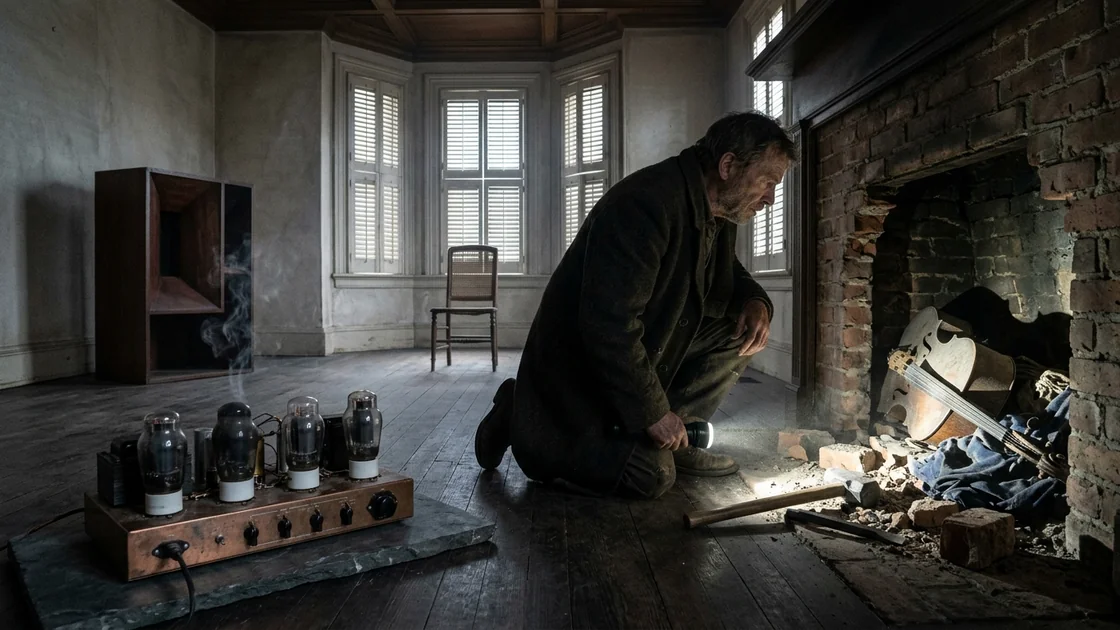
Julian Vance is a retired mastering engineer living alone in a sprawling nineteenth-century house who becomes obsessed with building the ultimate vacuum tube amplifier using a set of mysterious, experimental triodes from the nineteen thirties. When he powers the amplifier on with the inputs shorted out to test its baseline silence, he discovers that the circuit does not amplify radio waves or external electrical interference, but instead transduces the residual acoustic vibrations trapped within the plaster and timber of the room itself. By adjusting the bias voltages of the tubes, Julian learns to tune into different decades of the house's history, listening to the lives of its former occupants like a voyeuristic archaeologist of sound. His obsession peaks when he locks onto a tragic sequence of events from the autumn of nineteen twenty-nine involving the house's original owners, driving him to strip his listening room bare and push the fragile tubes to their destructive limits to hear the final, hidden truth before the filaments burn out forever.
Silence, Julian Vance had long believed, was not the absence of sound, but the presence of everything waiting to be heard.
For thirty-four years, Julian had worked in the windowless, acoustically deadened subterranean vaults of Manhattan’s premier mastering studios. His life had been measured in decibels, harmonic distortion percentages, and the microscopic topography of lacquer master discs. He was the man record labels called when an orchestra sounded too thin, or when a dead jazz saxophonist’s final tape was buried beneath a blizzard of magnetic hiss. Julian knew how to reach into the mud of a degraded recording and pull the human soul back to the surface. He understood the physics of air pressure, the way a sound wave leaves a brass bell, strikes a plaster wall, transfers a tiny fraction of its kinetic energy into the crystalline structure of the gypsum, and bounces back slightly diminished, slightly warmer.
When his wife, Claire, died after a long, quiet illness that seemed to progressively lower the volume of her voice until she was nothing more than a dry rustle against the bedsheets, Julian could no longer bear the clinical perfection of the studio. Digital audio, with its absolute, mathematically sterile zeroes, began to feel like a mortuary. In a digital recording, when a note ended and the gate closed, there was nothing. It was a vacuum. It was death.
Analog, however, never truly went silent. Even when the musicians stopped playing, even when they held their breath, the tape still hissed. The tubes still hummed their sixty-cycle ballad. There was always a noise floor—a warm, turbulent ocean of wandering electrons at the bottom of the world, proving that the machine was still alive, still breathing, still listening.
So Julian sold the brownstone in Brooklyn, packed his reference monitors, his oscilloscopes, and forty boxes of vinyl records into a climate-controlled truck, and bought the Parsonage in the Hudson Valley.
The house had been built in 1884 by a prosperous railroad surveyor named Arthur Finch, though it had passed through half a dozen families since then. It was a towering, asymmetrical Victorian of dark brick and silvered cedar shingles, sitting on four acres of overgrown hemlock and rusted wrought-iron fencing. Julian had chosen it for one reason only: the parlor on the ground floor.
It was a room of accidentally ideal proportions. Measuring twenty-six feet long, sixteen feet wide, and boasting an eleven-foot ceiling with heavy chestnut coffers, its dimensions conformed almost precisely to the golden acoustic ratios discovered by Bolt and Beranek. There were no parallel square cavities to trap bass notes into booming standing waves. The walls were constructed of thick, three-coat horsehair plaster laid over riven oak lath, cured over a century into a dense, stony monolithic shell that reflected high frequencies with the liquid clarity of a concert hall while allowing the lowest sub-harmonics to flex and dissipate naturally into the heavy timber framing.
For the first two years of his retirement, the room was Julian’s monastery. He spent his days calibrating his system, moving his massive folded-horn loudspeakers by sixteenth-inch increments, tracking the way the morning sun warmed the air and subtly altered the speed of sound between the tweeters and his leather armchair. Yet, no matter how pure his copper wiring, no matter how isolated his dedicated electrical sub-panel, he remained dissatisfied. The music he played—even the finest direct-to-disk pressings from the 1950s—still sounded like a photograph of a room rather than the room itself. He was chasing a ghost that every audiophile chases: the total dissolution of the machinery, the moment where the veil tears and the past stands breathing in front of you.
He found the key to tearing that veil at an estate sale in a rain-soaked barn outside of Rhinebeck.
The barn belonged to the late grandson of Dr. Emil Kovar, a Czech émigré physicist who had worked briefly for Bell Laboratories in the late 1920s before retreating into private, largely unfunded research in electro-acoustics and metallurgy. Most of the barn was filled with rotting lawnmowers, rusted drill presses, and boxes of moldering National Geographics. Being a man who knew the scent of old phenolic resin and transformer oil, Julian bypassed the household junk and went straight to thehayloft, where the damp air smelled of ozone and decaying wax paper.
Under a tarp stiff with pigeon droppings, he found a dovetailed wooden crate stamped with stencil markings in faded purple ink: KOVAR LABS – TARRYTOWN, N.Y. – EXPERIMENTAL TRIODE LOT 09 – DO NOT X-RAY.
Inside, nestled in shredded excelsior and wrapped in tarnished lead foil, were six vacuum tubes.
Julian had handled thousands of tubes in his life—Western Electric 300Bs, Telefunken smooth-plates, Mullard EL34s, RCA red-bases. He knew their geometries the way a botanist knows the silhouettes of oak leaves. These were unlike anything in the RCA Receiving Tube Manual.
They were globe-shaped, roughly the size of large grapefruits, blown from thick, slightly greenish borosilicate glass that felt unusually heavy in the palm. The bases were not made of standard black Bakelite or brown micanol, but of unglazed white porcelain, fitted with four thick pins that appeared to be solid, unplated silver, now black with sulfide tarnish. Looking through the clear patches above the getter flash—which wasn't the usual silver mirror of barium, but an iridescent, peacock-blue swirl that suggested a doping of heavy rare-earth metals—Julian could see the internal structure.
Where a normal triode had a central filament surrounded by a spiral wire grid and an outer metal plate, Kovar’s tubes contained a bizarre, nested latticework. The plate was not solid nickel; it was a cylinder of finely woven mesh that glittered like platinum. Inside that sat a grid constructed around four miniature pillars of milky, translucent quartz, rather than mica spacers. And suspended at the dead center was a filament twisted into a tight, double-helical caduceus.
Tucked into the bottom of the crate was a single sheet of yellowed graph paper, brittle as an autumn leaf. Upon it, in faded fountain pen ink, were a set of hand-drawn characteristic curves—plate voltage versus plate current—and a schematic for a single-ended, Class-A amplification stage. At the bottom of the page, written in a cramped, Teutonic hand, was a single English sentence:
To minimize damping of the ambient hysteresis, the input grid must be terminated to earth through pure bismuth, and the glass envelope must maintain uninterrupted optical and acoustic line-of-sight with the enclosing masonry.
Julian bought the crate for forty dollars. The auctioneer thought they were antique lightbulbs.
The build took Julian seven weeks. He worked in the basement workshop of the Parsonage, a space illuminated by two swinging incandescent bulbs and smelling perpetually of pine rosin, hot beeswax, and methylated spirits.
He decided early on that a circuit designed around such anomalous components deserved a chassis of absolute purity. He discarded his usual aluminum boxes and commissioned a local metalworker to bend a heavy sheet of eighth-inch oxygen-free copper into a plinth measuring two feet wide by eighteen inches deep. Copper was non-magnetic, shielded against stray radio frequencies, and possessed a warm, dull luster that seemed appropriate for Kovar’s relics.
Before he could wire a single connection, he had to test the tubes. When he placed the first of the six globes onto his Hickok mutual conductance tester, the needle behaved erratically. Instead of settling onto a steady transconductance reading, the meter began to oscillate in a slow, rhythmic wave. Then, as Julian leaned over the bench and cleared his throat, the needle jumped violently to the right, pegging against the stop pin.
"Microphonic," Julian muttered to himself, frowning.
In standard audio engineering, microphonics were a curse. If the internal elements of a vacuum tube were too loose, physical vibrations from the room—the thump of a footstep, the sound waves from the speakers themselves—would shake the delicate grid wires inside the vacuum. This mechanical shaking modulated the stream of electrons flying from the cathode to the plate, turning the tube into a crude microphone and creating a howling feedback loop.
Yet, as Julian tapped the bench with his fingernail, the needle didn't jump. He struck the wooden workbench hard with his fist. The meter stayed dead still. Then, he whispered the word "Check" into the air two feet away from the glass envelope. The needle danced across the scale, tracing the exact syllabic envelope of his whisper.
The tube wasn't sensitive to mechanical shock traveling through its porcelain base. It was responding solely to airborne acoustic pressure—or something riding alongside it—striking the glass.
Following Kovar’s yellowing schematic required Julian to unlearn decades of conventional circuit design. Normally, an amplifier’s first stage—the driver stage—took a weak voltage signal from a turntable or a tape deck and boosted it so the heavy power tubes could drive the speakers. Kovar’s schematic had no input jacks. Where the RCA plugs should have been, the diagram specified a solid rod of cast bismuth, three inches long, wired directly between the control grid of the first tube and a copper grounding rod driven six feet into the damp earth beneath the house's foundation.
"An amplifier that amplifies ground," Julian whispered, studying the paper through his jeweler’s loupe. "What were you listening for, Emil? Telluric currents? Earthquakes?"
Still, to remain faithful to the design while retaining functionality as a hi-fi component, Julian added a heavy silver toggle switch. In Position A, the circuit would accept a standard line-level input from his preamplifier. In Position B, it would bypass the inputs entirely and drop the grid across the bismuth earth-termination rod, just as Kovar had drawn it.
He wound the output transformers himself, spending four days at a manual coil-winding lathe, laying down three thousand turns of hair-thin enameled silver wire interleaved with sheets of gossamer-thin Japanese mulberry paper, then boiling the finished cores in a vat of beeswax and pine resin until every microscopic air pocket was displaced. For the capacitors, he used vintage military-surplus oil-filled cans; for the resistors, non-inductive carbon rods from the 1940s. There would be no silicon in this machine. No circuit boards, no integrated chips, no modern plastics. Every connection was made point-to-point in midair, the silver leads twisted tightly together and flowed with eutectic tin-lead solder until the joints shone like droplets of liquid mercury.
By the third week of November, when the first hard frost had turned the tall grass outside the parlor windows into brittle needles of glass, the amplifier was finished.
It weighed nearly ninety pounds. Carried upstairs with the help of a furniture dolly and set upon a heavy slab of polished Vermont slate between his two six-foot-tall mahogany horn speakers, it looked less like a piece of domestic electronics and more like a liturgical object from a forgotten scientific sect. Four of Kovar’s massive globes sat atop the copper plate—two acting as voltage drivers, two wired in parallel as the output stage, while a pair of conventional mercury-vapor rectifier tubes stood at the rear to convert the household alternating current into five hundred volts of lethal, rock-steady direct current.
Julian waited until midnight to turn it on.
In the Hudson Valley, midnight was when the electrical grid finally settled down. The factories downriver in Poughkeepsie shut off their heavy induction motors; the neighbors turned off their dimmer switches and fluorescent ballasts and plasma televisions, all of which injected foul, high-frequency hash back into the power lines. At midnight, the sine wave coming out of the wall was as clean as it ever got.
He turned off all the lights in the parlor, save for a single green-shaded banker’s lamp on his side table. He connected the thick braided speaker cables to the binding posts. He set the input toggle switch to Position B—the grounded, bismuth-terminated setting—to establish the baseline noise floor of the circuit before introducing any music.
He reached down and flipped the main power toggle.
The heavy toroidal power transformer gave a single, brief mechanical thrum as its magnetic field saturated, then settled into silence. Seconds later, the mercury-vapor rectifiers in the back flashed with a ghostly, ultraviolet-blue corona that cast long, sharp shadows of the brass binding posts across the plaster wall behind them.
Slowly, the filaments inside the four Kovar globes began to wake.
They did not glow with the cherry-red warmth of dull-emitter triodes, nor the blinding incandescent yellow of thoriated tungsten. Instead, the twisted double-helices at their cores kindled into a deep, luminous amber that seemed to thicken the vacuum around them. As the thirty-second delay relay clicked over, throwing the full five hundred volts of plate potential across the tubes, the peacock-blue getter flash on the inside of the glass domes began to shimmer with a faint, opalescent fluorescence, like oil on dark water.
Julian walked back to his leather armchair, sat down in the exact acoustic center of the room, and closed his eyes.
With ninety-eight-decibel-efficient horn speakers, even the best tube amplifier produced a noticeable sound when idle. You expected to hear the soft, oceanic shhhhhh of thermal rush—the sound of billions of electrons boiling off the cathodes—underlaid by a faint, comforting sixty-hertz hum.
There was no hum. There was no thermal hiss.
Instead, as the Kovar tubes reached full operating temperature, the air in the parlor seemed to change pressure. Julian felt it against his eardrums first—a sudden, cavernous expansion of the acoustic space, as if the walls of the Victorian parlor had silently slid backward ten feet into the dark yard.
Then came the sound.
Tick. Tick. Tick. Tick.
Julian opened his eyes. He looked around the parlor. He did not own a mechanical clock; their escapements drove him mad when he was trying to listen to quiet string quartets.
Tick. Tick. Tick.
It was coming from the left loudspeaker, though it didn't sound like it was coming from the speaker cone. The imaging was so staggeringly three-dimensional that the sound seemed to originate from a point in empty space about four feet to the left of the fireplace mantel, where the bare horsehair plaster met the oak wainscoting. It was the heavy, slow, unmistakable beat of a grandfather clock’s pendulum, complete with the tiny, oily click of the brass pallet fork striking the escape wheel.
Before Julian could stand up, another sound layered itself over the ticking.
It was the sound of rain. Heavy, wind-driven rain lashing against window glass.
Julian stared at the bay windows across the room. Outside, the November night was bone-dry and freezing; the silver crescent of the moon was clearly visible through the bare branches of the hemlocks, sharp as a razor in a cloudless sky. Yet, through the horns, he heard the unmistakable drum of a summer downpour against panes of glass, accompanied by the low, rolling rumble of thunder miles down the river valley.
"Radio frequency interference," Julian said aloud, his voice sounding strangely flat and small against the expansive illusion pouring from the speakers.
The long speaker wires or the unshielded copper chassis had to be acting as an antenna, picking up an AM broadcast or a shortwave transmission and rectifying it through the nonlinear junction of the bismuth rod. It was a classic electronics problem. Sometimes a rusty rain gutter or a loose dental filling could demodulate a powerful local radio station.
Then someone in the room coughed.
Julian froze, his hands gripping the rolled leather arms of his chair.
It was not a radio announcer’s cough. There was no dynamic compression, no ribbon-microphone proximity effect, no limited bandwidth slicing off the highs above ten kilohertz. It was the dry, raspy cough of an older man sitting approximately six feet to Julian’s right—precisely where a vacant patch of polished pine floorboard lay today.
Following the cough came the crisp, papery rustle of a broadsheet newspaper being folded in half, the scrape of a wooden chair leg against bare wood, and a heavy, tired sigh.
"Martha?" the voice said. It was a baritone, slightly nasal, carrying the clipped, patrician cadence of mid-century New York. "Did the boy bring the coal up before the storm hit? This draft is coming right under the wainscoting."
From far away—what sounded like the hallway beyond the heavy pocket doors of the parlor, though Julian’s pocket doors were currently slid shut and latched—a woman’s voice answered, muffled by distance and woodwork.
"He filled the scuttle at four, Henry. Put your shawl over your knees if you're cold."
Julian sat paralyzed for twenty minutes. No music played. No commercials interrupted. There were no station identification breaks. For twenty minutes, he listened to the man named Henry turn the pages of his newspaper, strike a friction match against a rough surface, draw deeply on a pipe—Julian could hear the wet, bubbly crackle of the tobacco leaves burning—and occasionally mutter under his breath while the phantom rain hammered against the dry, moonlit windows of the Parsonage.
Gradually, the sounds began to lose coherence. The ticking of the clock slowed, its pitch warbling subtly downward, and the rain dissolved into a deep, resonant hum, like wind blowing across the mouth of a colossal glass jug, before fading back into velvet silence.
Julian sat in the dark until three in the morning, watching the amber helices glow in the quiet room.
The next morning, Julian did not drink his coffee. He did not read the paper. He went straight to the county clerk’s office in the village, and from there to the small archival room in the basement of the local historical society.
By noon, he had the deed chain spread out across a laminated folding table.
Arthur Finch had built the house in 1884 and lived there until 1912. From 1912 to 1931, the house was owned by a Thomas and Clara Sterling. From 1931 to 1938, it stood vacant under bank foreclosure. And in April of 1938, it was purchased by Dr. Henry Vance Pritchard, a retired magistrate from Albany, and his wife, Martha.
Henry Pritchard had died of pneumonia in the house in 1951.
Julian drove back up the winding gravel road to the Parsonage with his hands trembling on the steering wheel. He was a man of science, an engineer who dealt in Fourier transforms, Ohm’s law, and the measurable elasticity of air molecules. He did not believe in ghosts. He did not believe in mediums, séances, or metaphysical ectoplasm.
When he got home, he went straight to the parlor, ignored his coat, and knelt beside the fireplace mantel, four feet to the left of the brickwork, where the phantom clock had been ticking the night before.
He switched on a high-lumen flashlight and examined the wide pine floorboards next to the baseboard.
There, pressed into the dark shellac of the wood, were four deep, square indentations arranged in a twelve-inch rectangle. Above them, roughly seven feet up the horsehair plaster wall, was a small, patched hole where a stabilizing bracket had once been screwed into the stud to keep a tall case clock from tipping forward.
Julian stood up slowly, his heart hammering against his ribs. He walked over to the spot six feet to the right of his listening chair—where the man had coughed and lit his pipe. He got down on his hands and knees and pulled back the edge of his heavy Tabriz rug.
In the cracks between the floorboards, wedged deep beneath decades of wax and dust, he used the tip of a pocketknife to pry out a tiny, petrified flake of blackened burley tobacco and the charred head of a wooden strike-anywhere match.
He spent the afternoon subjecting the amplifier to every diagnostic test he knew. He connected his Tektronix oscilloscope to the speaker outputs. He brought up his spectrum analyzer, his signal generator, and a heavy roll of fine brass mesh to build a Faraday cage.
When he placed the brass Faraday cage over the entire amplifier, grounding the mesh to the house's cold-water pipes to block 100 percent of external electromagnetic and radio waves, the phenomena did not stop—instead, it changed completely. Inside the cage, the tubes produced only a dull, claustrophobic ringing sound, the acoustic signature of a tiny metal box.
The moment he lifted the brass mesh off the copper chassis, restoring what Kovar’s note had called uninterrupted optical and acoustic line-of-sight with the enclosing masonry, the room rushed back in.
By Friday, through a process of relentless empirical deduction and a careful re-reading of Kovar’s fragmented papers, Julian began to understand the terrifying, brilliant physics of what sat on his slate slab.
The theory had been whispered about on the fringes of acoustic engineering for a century, though no one had ever possessed the hardware to prove it. Every sound that occurs in an enclosed space is a wave of mechanical energy. When a person speaks, the air molecules compress and rarefy, striking the surrounding walls. Most of that energy bounces back as an echo, and the rest is converted into infinitesimal amounts of heat.
Wait—not all of it.
In complex, crystalline materials like old gypsum plaster, quartz-rich sand mortar, and hand-blown silicate window glass, a microscopic fraction of that acoustic energy performs mechanical work on the crystal lattice itself. Just as a magnetic tape head aligns particles of iron oxide to record a song, a sound wave striking curing plaster or stressed silica creates tiny, permanent piezo-electric and mechanical dislocations—micro-stresses in the atomic grain of the wall, layered one on top of another like the rings of a tree or the strata of sedimentary rock.
The walls of every old room were a phonograph record. Until Kovar, no one had ever built a needle light enough to play them.
Kovar’s tubes were not mere electronic valves. The quartz pillars inside the grid structure, coupled with the heavy-metal peacock getter and the bismuth earth-rod, formed a quantum-level interferometric transducer. The tubes were emitting a weak, high-frequency electrostatic field into the room; that field struck the silica and gypsum in the walls, read the microscopic mechanical hysteresis trapped in the crystal lattices, and reflected back through the glass envelopes to modulate the electron stream inside the vacuum.
The amplifier wasn't catching ghosts out of the ether. It was reading the physical memory of the house.
And on Saturday night, Julian discovered how to tune it.
While observing the circuit schematic, he had noticed that Kovar had left the grid-bias voltage of the two driver tubes variable, controlled by a heavy wire-wound potentiometer on the front panel. On his first night, Julian had set the bias to a conservative minus-twenty-two volts.
Sitting at the chassis with an insulated screwdriver and a digital multimeter clipped to the cathode pins, Julian slowly turned the potentiometer dial counter-clockwise, dropping the negative bias voltage toward minus-thirty volts, altering the wavelength of the electrostatic field the tubes projected against the walls.
Through the horn speakers, the sound of Henry Pritchard’s 1940s clock abruptly sped up into a frantic chatter, dissolved into a rushing roar like wind through a tunnel of dry leaves, and then snapped back into focus.
The acoustics of the room had changed instantly. The sound was brighter, more echoey, as if the heavy drapes and plush carpets of the 1940s had been ripped away.
And there was music playing.
It was a stereo signal—not coming from the speakers as a flat plane, but occupying the exact volume of the room. A portable turntable with a cheap ceramic cartridge was playing somewhere near the bay window, blasting the tinny, unmistakable bassline of Fleetwood Mac’s "Dreams."
Over the music, two voices were shouting.
"I told you the roof on the carriage house can wait until spring, David! We don't have three thousand dollars sitting in the passbook!"
"If we wait until spring, the main ridge beam is going to rot through, Linda! Look at the ceiling in the hallway, the plaster's already blistering!"
Julian checked the multimeter: -14.2 Volts DC.
- David and Linda Miller, who had owned the Parsonage from 1974 to 1983.
Julian’s hand shook as he gripped the bakelite knob of the
potentiometer. He turned it further right, driving the negative voltage
deeper. -18.0 Volts.
The Fleetwood Mac record vanished in a pop of static. Now a television was droning in the corner—Walter Cronkite reading casualty figures from the Mekong Delta—while a child ran across the floor, the rapid thump-thump-thump of sneakers making the horn speakers shudder with clean, transient low-end punch, followed by the crash of a glass milk bottle hitting the cast-iron floor register.
He turned the dial again. -26.5 Volts.
The 1940s returned, though different from the rainy night he had heard before. Now it was daytime; he could hear sparrows chirping outside an open window and the distant buzz of a biplane engine crossing the valley, while Martha Pritchard practiced scales on an badly out-of-tune upright piano that had evidently stood against the north wall.
Julian felt a strange, dizzying vertigo, as if he were standing at the edge of an elevator shaft looking down through the floors of a bottomless building. Every volt on the grid was roughly three and a half years of acoustic compression depth in the plaster. The recent decades lay near the surface of the paint and skim-coat, easily read at low voltages; the older years were buried deeper in the base coat and the oak lath, requiring higher electrostatic pressure to resolve.
He went back down to his workshop that night and removed the coarse wire-wound potentiometer. In its place, he soldered a military-grade, ten-turn precision Borg vernier dial with a microscopic micrometer readout, capable of adjusting the grid voltage by hundredths of a volt.
He also brought up his Studer A800 master tape recorder, threading a fresh pancake of quarter-inch magnetic tape onto the hubs, intending to archive what he was hearing.
Yet when he recorded ten minutes of the 1960s layer and played the tape back through his normal solid-state headphone amp, the magic was gone. On tape, the signal collapsed into a mushy, phase-incoherent mess of room rumble and unintelligible whispers. The Kovar tubes weren't just outputting a two-channel voltage; they were establishing a real-time, resonant standing-wave relationship with the room itself, using the horn speakers to excite the very air that sat between the walls that held the memory. It could not be recorded. It could only be experienced live, inside the geometry where it had happened.
Julian unthreaded the tape machine and pushed it into the hall. He didn't need tape. He had the house.
Over the next three weeks, Julian Vance disappeared from the living world.
He stopped driving into the village for groceries, subsisting on canned soup, crackers, and pots of espresso brewed on a hotplate he moved into the butler’s pantry so he wouldn't have to leave the ground floor. When the postman knocked on the front door to deliver a certified parcel of vintage capacitors Julian had ordered months prior from Munich, Julian stood frozen in the hallway, watching the man’s distorted silhouette through the frosted glass of the vestibule until the footsteps crunched back down the gravel drive.
Real sounds—present-day sounds—had begun to offend him. When he walked across his parlor floor, the creak of his own boots interfered with the delicate spatial retrieval of the Kovar tubes. When the wind blew outside today, it muddied the wind of sixty years ago.
He took to wearing thick felt slippers. He hung heavy sound-absorbent theatrical velvet over the inside of the bay windows—careful not to cover the plaster walls—to block out the sound of passing cars on the county highway and the cries of the crows in the hemlocks. He unplugged his refrigerator, placing his milk and butter on the stone sill outside the pantry window in the December cold, because the sixty-hertz compressor cycle in the kitchen sent micro-vibrations through the floor joists that muddied the lower midrange in the parlor.
He kept a leather-bound engineer’s logbook on the side table, mapping the topography of the Parsonage’s past by voltage, down to the millivolt.
-04.10V: The 1990s. The house had been rented to a trio
of graduate students from Bard College. The layer was a chaotic,
low-fidelity wash of Nirvana records, bong hits, late-night arguments
about postmodernism, and the relentless, irritating clatter of a
dot-matrix printer. Julian skipped past it quickly.
-31.80V: The mid-1930s. The foreclosure years. This
stratum fascinated Julian as an acoustician. For seven years, the house
had been empty. When he tuned into the thirties, there were no human
voices at all—only the long, slow breathing of the structure itself. He
heard the timber framing groaning as it contracted in the winter
blizzards of 1934; he heard the skittering of mice inside the
wainscoting; he heard plaster dust trickling down behind the baseboards
like an hourglass, and once, the terrifying, explosive crack of a
windowpane shattering in the upstairs bedroom during a hailstorm,
followed by four months of wind whistling through the broken glass until
a bank caretaker finally nailed a board over it.
It was when he pushed the vernier dial past -35.00V that
he found Clara.
At first, he heard only a single, sustained C-sharp, bowed on the open string of a cello.
The note entered the parlor with such visceral, gut-wrenching physical presence that Julian actually gasped and looked toward the bay window. The transient response of the Kovar tubes at this depth was uncanny; he could hear the dry bite of the horsehair bow catching the gut string, the microscopic cloud of rosin dust shaking loose, and the deep, woody helmholtz resonance of the cello’s spruce top plate vibrating against the floorboards.
Whoever was playing was not an amateur stumbling through scales like Martha Pritchard. This was a musician of extraordinary, aching sensitivity. She was playing the Prelude from Bach’s Fifth Cello Suite in C minor—the one written in scordatura, with the top string tuned down a whole step to give the instrument a dark, brooding, tragic voice.
Julian leaned forward in his chair, his eyes wide in the blue-amber dark of the listening room.
For ten minutes, the cellist worked through a single four-bar phrase, stopping, muttering softly to herself in a voice like brushed velvet, tapping the bone frog of her bow against the music stand, and beginning again.
"No, too heavy on the down-bow," she whispered to the empty room. "Let it breathe, Clara. Let the wood do the work."
Clara Sterling. Wife of Thomas Sterling, who had owned the house from 1912 to 1931.
When she finished the sarabande, she didn't put the instrument away. She sat silent for a long time; Julian could hear the silk of her dress rustling as she shifted on her stool, and the steady, quiet rhythm of her breathing.
Then the heavy front door of the house slammed shut—a dull, massive thud that shook the sub-bass horns—followed by the heavy, decisive stride of leather-soled boots crossing the entrance hall. The pocket doors of the parlor were wrenched open on their brass rollers with a violent metallic screech.
"Still scraping away at that thing in the dark?" a man’s voice barked.
Thomas Sterling’s voice was a jagged baritone, tight with the high-strung, manic energy of a man who lived on cigars, ticker tape, and whiskey. Even through the ninety-year-old plaster, his presence sucked the air out of the room.
"The light was fading, Thomas," Clara said quietly. Her voice had changed instantly; the warm, loose relaxation of her solitary practice had vanished, replaced by a guarded, brittle formality. "You didn't need the lamps lit while I was only working on fingerings. How was the city?"
"The city is a madhouse," Thomas said. Julian heard the clink of a crystal stopper being pulled from a decanter near the sideboard, followed by the heavy splash of liquid into a glass. "Call money hit twelve percent at two o'clock. Mitchell at National City says it’s a technical correction, just shaking out the margin clerks, but Wardwell lost four hundred thousand before the bell. Where was he today?"
A pause. The cello gave a tiny, involuntary creak as Clara gripped its neck tighter.
"Who, Thomas?"
"Don't play the innocent with me, Clara. It sits poorly on you. Kovar. The Czech. Did he come up on the noon train from Tarrytown?"
Julian’s breath caught in his throat. Kovar.
"Emil came at two," Clara said, her voice steady, though Julian’s trained ears—ears that had spent thirty years detecting tiny pitch fluctuations in vocal tracks—heard the slight tremor in her larynx. "He brought the new bridge he carved for the Amati, and he took measurements of the parlor walls for his acoustic treatise. He was here for an hour. Mrs. Gable served tea in the conservatory if you wish to interrogate the help again."
"An acoustic treatise," Thomas sneered. He walked across the room; Julian heard his boots pass directly through the space where Julian’s leather chair currently sat, making the hairs on Julian’s arms stand straight up. "A man builds telephone relays for the Bell company, gets himself dismissed for wasting company platinum on lunatic glass bulbs, and now he spends his afternoons measuring the plaster in my parlor while my wife plays Bach for him. Tell him not to come back on Friday."
"He is my friend, Thomas. My only friend in this valley."
"You have a house, you have an allowance, and you have your instrument," Thomas said, his voice dropping into a cold, quiet register near the hallway door. "And if U.S. Steel drops another ten points tomorrow, we may have considerably less of all three. Keep the doors locked, Clara. I’m going up to dress."
The boots retreated. Upstairs, a door closed.
In the parlor, left alone in the twilight of autumn 1929, Clara Sterling did not resume playing. Julian sat in his chair in the freezing December night of the twenty-first century and listened to a woman dead for seventy years weep quietly over the body of her cello.
From that night on, Julian never moved the vernier dial away from the late 1920s.
He became a man living in two times at once, though his allegiance to the present was disintegrating by the hour. He went back to the historical society once more, unshaven, wearing a coat that smelled of ozone and stale coffee, startling the elderly librarian with the feverish intensity of his questions.
The records of the Sterling family were sparse and strangely truncated. Thomas Sterling had been a partner in a second-tier brokerage house on Exchange Place. In November of 1929, three weeks after Black Tuesday, Sterling’s firm had collapsed into insolvency when it was discovered that Thomas had been using client trust accounts to cover his personal margin calls. Before the district attorney in Manhattan could serve the indictment, Thomas Sterling had vanished. His motorcar was found abandoned near the ferry slip in Newburgh; his body was never recovered from the Hudson River, though most assumed he had jumped into the black, ice-choked current with his pockets full of stones.
And Clara?
"There's no record of Mrs. Sterling after November of twenty-nine," the librarian said, peering through her bifocals at a microfiche screen. "The bank seized the house in thirty-one for unpaid taxes. When the marshals broke the locks to inventory the estate, all the furniture was still inside, covered in dust sheets. The clothes were still in the wardrobes. Her sister in Boston filed a missing persons petition in thirty-two, claiming Clara would never have left behind her 1690 Amati cello, which was never found in the house. The police assumed they fled the country together under assumed names to escape the fraud charges."
Julian knew better. You did not hear the way Thomas spoke to Clara and believe they had run away to South America together.
Returning to the Parsonage, Julian encountered a frustrating
technical barrier. As he tried to tune the vernier dial specifically to
the final week of November 1929—around -37.42 Volts—the
signal became increasingly buried in phase distortion and acoustic
smear. Voices would swell and then vanish into a hollow, underwater
reverberation, as if the walls were refusing to give up the memory
cleanly.
It took him two days of pacing the floorboards, muttering acoustic equations to himself, to realize why.
To read the microscopic hysteresis in the plaster with maximum resolution, the electrostatic standing waves generated by the Kovar tubes had to reflect off the room's boundaries in the exact phase relationship that existed when the sounds were originally recorded into the lime and gypsum.
Every piece of modern furniture Julian had placed in the room—his heavy leather armchair, his walnut record shelves holding three thousand LPs, his thick Persian rug, his acoustic foam bass traps in the corners—was altering the room's current acoustic impedance. The present was physically blocking the past.
Like a man possessed by a quiet, methodical madness, Julian began to strip the room.
It took him sixteen hours of backbreaking labor. He carried all three thousand vinyl records down to the basement four dozen at a time, stacking them carelessly on the damp concrete floor. He dismantled the solid walnut shelving units with a crowbar when the screws stripped, hauling the planks out to the porch. He rolled up the massive Tabriz rug and dragged it into the dining room. He dragged his beloved leather listening chair out into the entrance hall, replacing it with a single, straight-backed wooden cane chair he found in the attic that matched the footprint of a 1920s parlor chair.
Finally, he tore down the theatrical velvet from the bay windows and instead closed the original interior louvered pine shutters, which had been folded back into their window pockets since the nineteenth century, restoring the exact reflective wood surfaces that had faced the room in 1929.
When he was finished, the parlor was completely bare, save for the two mahogany horn speakers, the slate slab holding the glowing copper amplifier, and the lone cane chair in the center of the naked pine floor.
His breath plumed white in the air; he had turned off the house's forced-air furnace days ago because the rushing of air through the ductwork spoiled the high-frequency transients. The room was thirty-eight degrees Fahrenheit.
He sat on the cane chair, wrapped in his heavy wool overcoat, and
turned the vernier dial to -37.15 Volts.
The fidelity was blinding.
Without the modern rug and bookshelves soaking up the reflections, the room snapped into hyper-real acoustic alignment. It was no longer like listening to a pair of speakers; the horn drivers seemed to couple directly with the bare plaster walls, turning the entire twenty-six-foot parlor into a single, resonant headphone shell.
He was in mid-October of 1929. Thomas was in Manhattan for days at a time as the market convulsed. And in the parlor of the Parsonage, Emil Kovar and Clara Sterling were falling in love.
Julian listened to them across the span of a dozen afternoons, stepping through the days by nudging the micrometer dial a hundredth of a volt at a time.
Kovar’s voice was gentle, musical, inflected with the soft rolling consonants of Prague. He was a man who spoke of the world the way Julian had always thought of it—not as a collection of dead objects, but as a symphony of vibrating matter.
"Listen to the plaster, Clara," Emil’s voice said from the corner near the fireplace, accompanied by the light tap of a brass knuckle against the wall. "When your husband’s father built this room, the plasterers mixed river sand from the Hudson with calcined gypsum and the hair of workhorses. While it was wet, while it was crystallizing, the workmen were singing Italian operas, the horses were neighing outside, the wind was blowing through the unglazed window frames. All of that pressure shaped the way the crystals locked together. Nothing is ever lost, Clara. Not a word, not a note of your Bach. The universe is too economical to throw away a single vibration."
"A frightening thought, Emil," Clara replied softly. She was sitting near him; Julian could hear the delicate clink of a teacup setting down on a saucer. "If the walls remember everything, then this house is full of ugly things. Anger. Silence that feels like lead."
"Then we must fill the outer layers with something better," Emil said, his voice dropping low and intimate. "Play the sarabande for me again. Play it so loudly that it drives everything else back into the brick."
Then came the sound of silk moving against wool, a sudden, sharp intake of breath from Clara, and a long silence broken only by the crackle of hickory logs in the hearth and the soft, unmistakable sound of two people kissing in a room where they knew they were forbidden to touch.
"Come away with me," Emil whispered against her hair. The detail was so acute through the Kovar tubes that Julian could hear the slight wetness of the man's lips and the trembling race of Clara’s breath. "The lab in Tarrytown is paid through December. I have the patent royalties from the Western Electric relay. We can take the steamer to Cherbourg on thefirst of the month. Bring the Amati and one trunk. Leave him to his ledgers and his ticker tape."
"He would never let me go, Emil," Clara whispered back. "You don't know Thomas. With me, it isn't love—it's possession. I am an asset on his balance sheet, like the silver service or the railroad bonds. Especially now, when everything else is slipping through his fingers. If he loses the firm, he will lock this house up like a tomb before he lets anyone else have what is his."
"Then don't tell him. On the night of the twenty-fourth, while he is in the city for the directors' dinner, I will bring the car to the bottom of the lane at midnight."
"The twenty-fourth," she breathed. "Yes. God forgive me, yes."
Julian sat in his freezing room, his gloved hands clasped between his knees, tears freezing on his cheeks. He knew why he had found the tubes in a barn in Rhinebeck seventy years later. He knew why Emil Kovar had spent the rest of his lonely, eccentric life perfecting a four-pin porcelain triode designed to read the acoustic hysteresis of old masonry.
Kovar hadn't been building a scientific instrument for Bell Labs. He had been trying to build a machine that would let him come back to this room and find out what had happened to her.
Wait—if Kovar had built the tubes in the 1930s, why hadn't he used them here?
Because from 1931 to 1938, the house was chained shut by the bank, and in 1938, Judge Henry Pritchard had bought it. A disgraced Czech physicist with no money could hardly break into a sitting magistrate's parlor with ninety pounds of high-voltage vacuum equipment. Kovar had built the key, and died before he could ever put it in the lock.
Julian looked down at the glowing copper chassis.
One of the four Kovar globes—the right-hand output tube—was beginning to fail.
These tubes were seventy-year-old experimental prototypes, never meant to be run for four hundred continuous hours at five hundred volts of plate potential. The iridescent peacock-blue getter flash on the inside of the glass was turning chalky gray around the edges as the microscopic barium-strontium layer struggled to absorb the gases boiling out of the white-hot platinum mesh plate. Inside the envelope, a faint violet haze had appeared—the telltale sign of a leaky vacuum and gas ionization.
In the speakers, a faint, frying crackle had begun to intrude upon the 1929 room, like dry bacon hitting a hot skillet.
Julian didn't have days left. He had hours, perhaps minutes, before the cathode stripped or the filament snapped.
He reached down and turned the vernier dial to
-37.88 Volts.
November 24, 1929. Midnight.
The room that materialized around Julian was violent with sound.
A November gale was howling down the chimney flue, making the iron damper rattle in its throat. In the parlor, someone was moving rapidly—heels clicking frantically across the bare pine boards, the metallic snap of brass luggage clasps being forced shut, the heavy wooden clunk of a cello case being lifted off the floor.
Then, from the entrance hall—not the front door, which would have given warning with its heavy iron latch, but from the cellar stairs beneath the pantry—came the slow, deliberate creak of boots.
Clara gasped. The cello case thudded back onto the floorboards.
"Going for a midnight drive, Clara?"
Thomas Sterling’s voice was terrifying. The manic, barking energy of October was gone. In its place was a dead, flat, drunken calm. He sounded like a man speaking from the bottom of a well.
"Thomas," Clara choked out. "Your train—the telegram said you were staying at the University Club until morning."
"There is no firm left to stay in the city for," Thomas said. His boots crossed the threshold into the parlor. Julian could hear the heavy, ragged wheeze of the man's lungs and the metallic clink-scrape of something heavy and iron being dragged along the floorboards in his right hand. "The governors suspended us at three o'clock. The sheriff’s men will be at the doors in Exchange Place at nine tomorrow morning. So I took the nine o'clock train up to Tarrytown. And do you know who I saw at the station in Tarrytown, loading two steamer trunks onto a baggage cart for the Grand Central express?"
Silence. Only the wind in the chimney and the frying static of Julian’s dying output tube.
"Your little Czech," Thomas said softly. "He didn't see me on the platform. He looked quite happy, Clara. He had a pocket watch out, checking the time before he drove his little Ford up the river road to fetch my wife and my Amati."
"Thomas, please," Clara said. She was backing away; Julian tracked her voice moving from the center of the room toward the fireplace alcove. "Let me go. The cello was my father's. I won't ask for a penny of the settlement, you can have the house, the jewellery, everything—"
"The house is already gone!" Thomas roared, the sound exploding from the horn speakers with such brutal dynamic force that the copper chassis rang like a struck bell. "The jewelry is pledged to the Chase bank! Everything I built, everything my father surveyed, wiped off the blackboard by a pack of screaming brokers! And you think I am going to stand on the lawn and wave a handkerchief while you ride off to Paris with a foreigner who came into my parlor and laughed at me?"
"He never laughed at you! Nobody was looking at you, Thomas, we only wanted to live!"
"Get away from the doors."
*"Thomas, put that down! What are you doing with the coal poker—"
A sound tore through the parlor that made Julian cry out and half-rise from his cane chair, his hands flying to his ears.
It was not a scream. It was the sickening, explosive crunch of Seasoned Italian spruce and maple shattering under a heavy iron bar. Thomas hadn't struck her first; he had struck the cello case. The gut strings snapped like pistol shots as the bridge collapsed through the belly of the 1690 Amati, the wood groaning in a horrific, dissonant chord that died in a rattle of splintered ribs.
"No!" Clara shrieked, lunging forward. *"You monster, you—"
There was a sharp, wet, blunt thud.
Not loud. In all his years of audio work, Julian had mixed theatrical sound effects for films—punches that sounded like slabs of beef hitting a butcher block. Real violence, he heard now, was quiet. It was the short, dull knock of cast iron striking bone, followed immediately by the heavy, boneless collapse of a hundred and twenty pounds of flesh and wool coat hitting the pine floorboards two feet from the hearth.
In the amplifier, the right-hand Kovar tube flashed a brilliant, blinding magenta as an internal arc jumped from the plate to the quartz grid. Smoke curled up from beneath the copper chassis as a silver-in-oil capacitor boiled over, dripping hot wax onto the Vermont slate.
Julian dropped to his knees in front of the amplifier, his face inches from the blistering heat of the glass globes.
"Hold together," he begged the glowing filaments, his voice cracking in the freezing room. "Give me five minutes. Just five minutes, Emil, hold on!"
Through the rising roar of plasma ionization and the smell of burning pine resin, the 1929 room stayed locked in phase.
Clara was not dead, not immediately. Julian heard a low, bubbling moan coming from the floor by the fireplace.
Thomas Sterling was breathing like a winded horse. He did not speak to her. He did not call a doctor. Instead, Julian heard a strange, methodical series of sounds that baffled him until his acoustic mind mapped the geometry of the hearth.
The scrape of iron against brick. The heavy clunk-clunk-clunk of bricks being pried loose from dry mortar.
The fireplace in the parlor was huge—built originally in 1884 as a deep walk-in inglenook, then partially bricked in during the 1912 renovations to accommodate a smaller coal grate, leaving a hollow structural void four feet deep between the inner firebox and the exterior brick chimney wall on the north side of the house.
For forty minutes—compressed and skipping wildly as Julian’s failing tubes lost their bias regulation, jumping forward in erratic five-minute bursts across the hours before dawn—Julian listened to Thomas Sterling work.
He heard the drag of wool across wood. He heard the splintered remains of the Amati cello and the leather valise being shoved into the cavity behind the false back of the firebox. He heard the wet slap of fresh lime mortar being troweled hastily over the relaid bricks—mortar Thomas had fetched from the cellar where the mason had been repairing the foundation the week before.
And just before the final course of brick sealed the void, from inside the dark cavity behind the chimney breast, came a faint, suffocated whisper—barely audible above the hiss of the dying vacuum tubes—and the rhythmic, desperate scratching of fingernails against rough brick.
Then the final bricks slid home. The iron coal grate was dragged back into place. A match was struck, and a roaring coal fire was lit directly in front of the fresh masonry to bake the mortar dry and mask the smell with coal smoke.
"Let him wait at the bottom of the lane," Thomas Sterling whispered to the empty parlor. "Let him wait until he freezes."
Outside, far down at the end of the quarter-mile gravel drive, faint through the wind and the walls, a car horn sounded twice. A polite, hopeful two-note bleat of a 1929 Ford Model A.
It waited ten minutes. It sounded once more. Then the small four-cylinder engine faded away down the river road toward Tarrytown.
In the parlor, the right-hand Kovar tube reached thermal runaway.
The platinum mesh plate inside the glass globe turned from dull orange to a blinding, solar white. With a sound like a rifle shot, the borosilicate glass imploded, followed a millisecond later by the other three tubes as the five-hundred-volt surge cascaded across the silver wiring harness.
Blue electrical arcs lashed across the copper chassis, tripping the main breaker in the basement and plunging the Parsonage into absolute, freezing darkness.
For a long time, Julian Vance did not move.
He knelt on the bare pine floorboards in the dark, listening to the pinging of cooling copper and the sharp, metallic smell of vaporized barium, ozone, and shattered glass settling over the room.
His ears were ringing, but beneath the ringing, for the first time since he had moved into the house, the room felt completely, utterly still. The tension in the walls had broken. The record had been played to the final groove, right into the run-out spiral, and the needle had broken off.
Slowly, his knees popping in the cold, Julian stood up.
He did not turn the breaker back on. He found his high-lumen flashlight on the side table, its beam cutting through the thin haze of capacitor smoke hanging below the chestnut coffers of the ceiling.
He walked past the ruined amplifier on its slate slab and went to the basement stairs. He returned three minutes later carrying a five-pound iron sledgehammer and a cold chisel.
Setting the flashlight on the floorboards aimed at the hearth, Julian knelt before the fireplace. He grabbed the ornamental cast-iron coal grate and wrenched it out onto the hearthstones, sending a cloud of ninety-year-old black soot billowing into the beam of light.
Shining the light against the rear brick wall of the firebox, he saw it immediately.
Any mason would have noticed it if anyone had ever bothered to crawl inside the hearth with a lamp. The bottom five courses of brick were laid in neat, uniform 1912 Flemish bond with grey Portland cement mortar. The upper ten courses—a section four feet wide by five feet high—were laid in ragged, uneven rows, bound with a yellowish, sandy lime mortar that had blistered and cracked from having a coal fire lit against it before it could cure.
Julian placed the blade of the cold chisel against the center mortar joint and swung the five-pound sledge.
The sound of the iron striking the chisel echoed through the empty parlor—a sharp, living, present-day sound that bounced off the bare walls and died cleanly.
The dry, poorly mixed lime mortar had no strength left in it. On the third blow, an entire brick punched inward, dropping into an unseen hollow space behind the firebox with a hollow clatter.
Julian put down the chisel and used his gloved hands and the claw of the hammer to pull the bricks away one by one. A wave of air rolled out of the opening—dry, cold, smelling faintly of ancient horsehair, spruce resin, and the dusty, sweet-sour scent of dry rot.
When the opening was three feet wide, Julian picked up the flashlight and shone it into the void between the inner hearth and the exterior chimney breast.
First, the beam caught the curved neck and carved scroll of the 1690 Amati cello, its varnish still gleaming like dark honey beneath a grey veil of mortar dust, lying atop the crushed ribs of its body. Next to it sat a rotted leather valise, its brass clasps green with verdigris.
And curled behind the valise, resting against the rough brick of the outer chimney wall with one small, skeletal hand still extended toward the mortar joints where her fingernails had worn down to the bone, was what remained of Clara Sterling, wrapped in the decayed remnants of a dark blue travelling coat.
Pinned to the lapel of the coat was a tarnished silver brooch shaped like a treble clef.
Julian turned off the flashlight and sat back on his heels on the hearthstones as the first grey light of the December dawn began to filter through the louvers of the pine shutters.
The state police were at the Parsonage for two days.
Julian sat in the kitchen, wrapped in a blanket with the furnace finally running again, drinking coffee with a young detective from Rhinebeck who looked at the stripped parlor, the shattered remains of the homemade copper amplifier, and the hole in the fireplace with bewilderment.
"You heard mice behind the brickwork?" the detective asked for the third time, his pen hovering over his notepad. "And when you knocked a brick loose to set a trap, you saw the cello case?"
"Not mice," Julian said quietly, looking out the kitchen window at the hemlocks swaying in the morning wind. "Settling. Old houses make noises when the temperature drops. Being an audio engineer, it bothered me. I couldn't get the room quiet enough to listen to my records until I figured(out) where the hollow spot was."
It was a plausible enough explanation for an eccentric retired bachelor living alone in a Victorian mansion. The county medical examiner confirmed the bones had been behind the brickwork for at least seventy years; the historical society’s files on the 1929 disappearance of Thomas and Clara Sterling provided the motive and the timeline without Julian having to mention the name Emil Kovar once.
Wait—there was one detail the detective couldn't quite square.
Before the crime scene technicians packed up their lights on the second afternoon, the detective walked into the kitchen holding a small, clear plastic evidence bag. Inside was a tiny shard of splintered spruce from the belly of the shattered cello, which had been wedged into the mortar joint near the woman’s hand.
"Funny thing," the detective said, holding the bag up to the light. "There’s writing on the inside of the cello's top plate. Written in pencil right next to the bass bar, where only a luthier taking the instrument apart would ever see it."
Julian looked up from his mug. "What does it say?"
"It’s in German or Latin, maybe Czech, I don't know. And there's a date—October 1929—and some numbers that look like electrical measurements. Minus thirty-seven point eight volts." The detective frowned, tapping the bag against his palm. "The guy who repaired her cello wrote a voltage inside an acoustic instrument in 1929?"
Julian stared at the sliver of wood.
Emil came at two, Clara had told her husband that day in October. He brought the new bridge he carved for the Amati, and he took measurements of the parlor walls for his acoustic treatise.
Kovar hadn't just measured the room. Knowing the house was a place of danger, knowing that every vibration in that parlor was being pressed into the gypsum and silica at a specific electrostatic depth corresponding to the autumn of 1929, Kovar had calculated the exact grid-bias voltage required to read that month back out of the walls, and he had written the coordinates inside the belly of her cello before the crash even happened.
He had left a bookmark in time, waiting for someone with the ears to find it.
"Acoustic impedance figures," Julian lied softly, his voice steady. "In the twenties, some physicists tried to measure the resonant frequency of old Italian wood using electrical equivalents. It never really caught on."
"Huh," the detective said, slipping the bag into his coat pocket. "Well, her sister's grandkids up in Boston are still alive. Once the coroner signs off, they’re going to take her up to Mount Auburn Cemetery and bury her next to her father. And a guy from the Metropolitan Museum called—said even in pieces, that cello can be restored. Said someone will be playing Bach on it again by next year."
After the police cars drove down the gravel lane for the last time, Julian walked back into the parlor.
In the corner, two unused Kovar globes still sat in their crate in the basement—the two spares from the original lot of six. Julian had enough silver wire, enough oil capacitors, and enough knowledge to rebuild the circuit in a weekend. He could tune into the 1890s and listen to Arthur Finch’s children laughing around the Christmas tree; he could tune into 1918 and listen to the family praying during the Spanish Flu; he could spend the rest of his life sitting in the dark, drinking the bottled wine of other people's lives through the plaster.
Instead, Julian went down to the basement, lifted the wooden crate containing the last two Kovar tubes, and carried it out to the stone terrace behind the house.
He did not smash them. He was an engineer, and the craftsmanship was too sacred for violence. Instead, he took a pair of heavy brass wire cutters and carefully snipped the hollow glass evacuation tips at the top of each globe.
Hiss.
With two soft, three-second sighs, the seventy-year-old Tarrytown vacuum vanished as the cold December air of the Hudson Valley rushed into the glass envelopes, oxidizing the peacock-blue getters into harmless white chalk and rendering the tubes inert forever.
He carried them back inside and set them on the fireplace mantel like a pair of strange, silvered sculptures.
Then Julian walked over to the bay windows, unlatched the interior pine shutters, and folded them back into their pockets, letting the bright, pale winter sunlight flood across the bare floorboards and into the raw brick cavity of the hearth. He unlocked the heavy sash of the center window and pushed it open six inches.
Cold air poured into the room. With it came the distant, low rumble of a freight train moving down the tracks along the river, the sharp cry of a blue jay in the hemlocks, and the wet, rhythmic drip of icicles melting off the cedar eaves onto the porch steps.
There was no distortion. There was no phase smear. The dynamic range was infinite.
Julian pulled the cane chair over to the open window, sat down in the patch of winter sun, closed his eyes, and listened.