The Ghosts in the Lithography
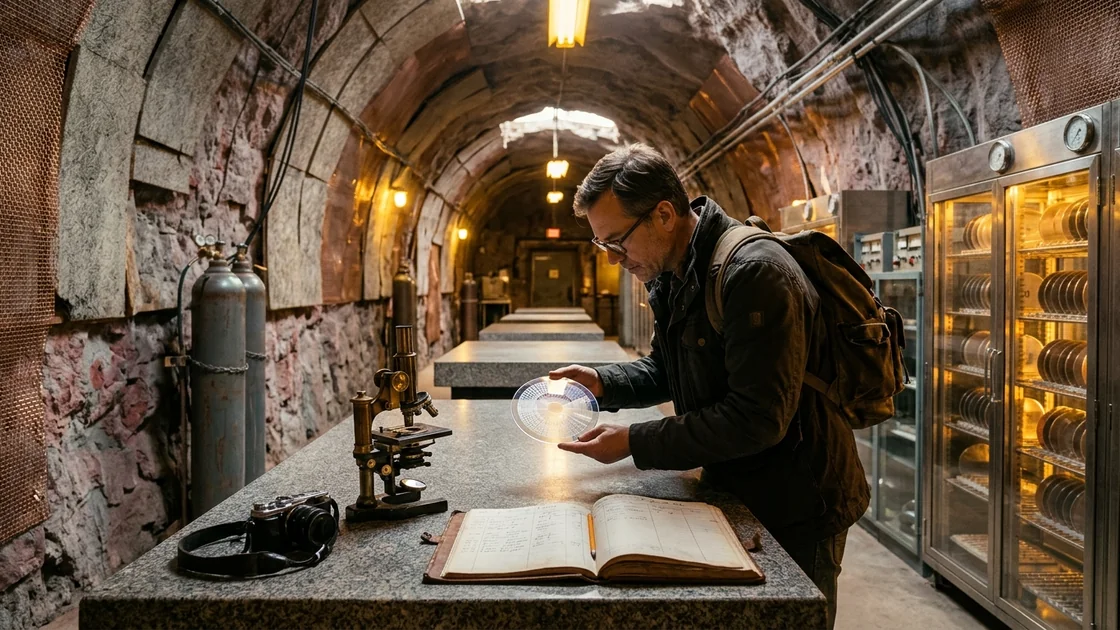
Elias Vance spends his life dissolving the plastic and ceramic shells of vintage microprocessors in boiling acid to photograph the microscopic artwork hidden by engineers on the silicon beneath. When he uncovers an undocumented geometric symbol on a rare 1979 prototype processor, he realizes it matches tiny fragments buried inside dozens of competing chips spanning four decades of computing history. Alongside a retired mask designer and a nanofabrication specialist, Elias decodes the fragments into a set of geographic coordinates and an operational key, leading him from his fume-soaked basement studio into the forgotten industrial ruins of the American Southwest to uncover a decades-old sanctuary forged by the unseen architects of the digital age.
The smell of hot fuming nitric acid always reminded Elias of rain on a copper roof, right before it burned the lining of his nostrils.
He adjusted the sash of the polypropylene fume hood, pulling the laminated safety glass down another two inches until the digital airflow gauge beside his left elbow stopped flashing amber and settled into a steady, bureaucratic green. Inside the hood, resting on a scarred hotplate coated in white ceramic, a fifty-milliliter Pyrex beaker held thirty milliliters of clear, slightly yellowing liquid heated to ninety-five degrees Celsius. At the bottom of the beaker sat a small black rectangle of epoxy novolac resin, no larger than a fingernail, with forty gold-plated legs jutting from its sides like a drowned centipede.
Tiny bubbles of nitrogen dioxide gas, rust-brown and toxic, nucleated along the laser-etched serial number on the chip’s back before rising to the surface and vanishing into the exhaust draw.
Elias leaned his forehead against the cool glass of the sash, watching through his polycarbonate face shield. Timing an acid decap was more culinary than chemical. Leave the package in the bath ten seconds too long, and the acid would creep past the dissolved epoxy, eat the microscopic aluminum bond wires, and begin pitting the passivation layer of the silicon die itself. Pull it out ten seconds too early, and a stubborn crust of carbonized resin would remain cemented over the center of the logic gates, requiring another cycle of heating, rinsing, and ultrasonic scrubbing that risked snapping the fragile crystalline substrate in half.
With his right hand encased in a heavy butyl rubber glove, he picked up a pair of titanium tweezers. He tapped the side of the beaker once. A black plume of dissolved plastic drifted off the top of the chip, revealing a tiny, mirror-bright square of silver gray nestled in the heart of the gold lead frame.
"There you are," Elias murmured.
He plucked the package from the nitric acid, submerged it immediately into a waiting beaker of anhydrous acetone to arrest the reaction, and transferred it to an ultrasonic cleaner filled with deionized water. While the high-frequency transducer buzzed—a thin, dental whine that vibrated in his back teeth—he stripped off the heavy butyl gloves, exposing fingers permanently stained around the cuticles with the faint yellow halos of old xanthoproteic reactions, the classic signature of a chemist who worked with nitrates.
His basement in Santa Clara was split into two distinct worlds separated by a heavy vinyl cleanroom curtain. On this side was the wet lab: the fume hood, the carboys of hazardous waste, the cast-iron machinist’s vise used for cracking open ceramic packages with a cold chisel, and shelves lined with electrostatic-safe trays containing thousands of dead, obsolete, or counterfeit integrated circuits. On the other side of the curtain was the dry studio, where the temperature was regulated to within half a degree to prevent thermal expansion from ruining a twelve-hour camera exposure.
The ultrasonic timer chimed. Elias retrieved the chip, blew it dry with a burst of filtered nitrogen gas, and carried it through the vinyl curtain on a miniature anodized aluminum tray.
In the center of the dry studio stood his rig. It looked less like a camera and more like a piece of salvaged artillery. The base was a five-hundred-pound granite surface plate resting on pneumatic isolation legs to dampen the vibrations of the Caltrain locomotives that rumbled past three blocks away. Bolted to the granite was the vertical column of an old semiconductor wafer inspection station, salvaged from a bankrupt solar-cell fab in Fremont. Mounted to that column was a modified metallurgical microscope tube, capped not with eyepieces, but with a medium-format digital camera back capable of capturing a hundred megapixels per frame. Beneath the turret of brass Mitutoyo objectives sat a motorized X-Y-Z stage driven by stepper motors capable of moving in increments of fifty nanometers—roughly the width of a single virus.
Elias seated the freshly exposed chip into a custom-milled brass holder on the stage. This particular specimen had come from an estate sale in Sunnyvale—the personal effects of a test engineer who had worked at Zilog during the late nineteen-seventies. The ceramic and plastic bin had been labeled simply Eng. Samples / Dead Bugs 1978–1981. Most of the chips were standard Z80 microprocessors, the workhorse eight-bit brains that had powered everything from early arcade cabinets to home computers. But this one had carried an unusual handwritten ceramic ink mark on its underside: Z8000-X2 / Rev 0 / DO NOT TAPE.
He rotated the turret to the five-power objective, flipped on the coaxial illuminator, and looked at the thirty-two-inch calibration monitor mounted on the wall.
The screen flared to life, displaying a live feed of the silicon die. To the naked eye, an exposed microchip was just a tiny grey mirror, perhaps four millimeters on a side. Under coaxial light and polarized filters, however, it transformed into a sprawling, psychedelic metropolis.
Blocks of static RAM glowed like manicured emerald parks, their repeating memory cells forming tight, iridescent grids. The arithmetic logic unit—the calculating heart of the processor—looked like a dense industrial district of copper and violet avenues, crisscrossed by wide silver boulevards of aluminum power buses. Around the perimeter, the square bonding pads sat like concrete helipads, several still bearing the crushed golden stumps of the wires that had once connected this microscopic city to the macroscopic world.
Elias reached over to the microscope tube and slid a Nomarski prism into the optical path, engaging Differential Interference Contrast. Instantly, the flat image gained a startling, three-dimensional relief. The prism split the polarized light into two beams separated by a fraction of a micron; when they recombined, tiny variations in the height of the silicon dioxide and metal layers shifted the phase of the light, painting the topography in brilliant interference colors—deep cobalt blues, burnished golds, and vivid magentas.
He wasn't looking at the architecture, though. Plenty of reverse-engineers and patent lawyers paid him good money to photograph logic gates so they could prove some rival firm in Shenzhen or Austin had stolen a circuit layout. Tonight, Elias was hunting for ghosts.
In the early days of the semiconductor industry, before automated routing software packed billions of transistors onto a chip with mathematical ruthlessness, integrated circuits were laid out by hand. Draftsmen and engineers worked on massive light tables, slicing sheets of red polymer film called Rubylith with surgical scalpels to define the shapes of individual transistors and wires. Because these engineers were human, and because their bosses rarely had the equipment or the patience to inspect a finished chip under five-hundred-power magnification, they began hiding things in the empty spaces of the silicon.
Over the past decade, Elias had cataloged nearly four hundred of these microscopic artworks. He had photographed a tiny red locomotive chugging along the edge of a DEC Alpha processor; a pair of footprints walking across a memory controller; a meticulously rendered Tyrannosaurus rex wearing a top hat on a communications chip; a microscopic reproduction of Magritte’s bowler-hatted man; and dozens of initials, wedding dates, cartoons, and profanities aimed at rival corporations. Silicon art was the cave painting of the information age—created in secret, sealed in dark epoxy tombs, and never meant to be seen by the millions of people whose lives depended on the machines the chips powered.
Using a joystick that controlled the motorized stage, Elias panned toward the lower-right corner of the Z8000 prototype, near the clock-generator circuitry. That was prime real estate for chip graffiti. Clock generators required wide, analog guard rings to isolate their noise from the rest of the logic, often leaving odd, triangular pockets of unused bare silicon.
He switched the turret to the twenty-power objective, then the fifty-power. At fifty times magnification, coupled with the massive sensor of the camera, he was looking at a field of view barely two hundred microns wide—roughly twice the thickness of a human hair. The depth of field was so razor-thin that the tops of the aluminum wires were in sharp focus while the polysilicon gates half a micron beneath them were soft and blurred.
He nudged the joystick left, following the inner perimeter of the scribe line—the sacrificial alley of silicon where the diamond saw had sliced this chip away from its neighbors on the wafer forty-five years ago.
Past the electrostatic discharge protection diodes, tucked between two thick ground traces that formed a natural cul-de-sac, the regular geometric tyranny of forty-five- and ninety-degree circuit lines suddenly broke.
Elias took his hand off the joystick.
Etched into the lowest layer of polysilicon, beneath a clear window purposely left open in the upper oxide layers, was a circle. Inside the circle sat an intricate, multi-ringed astrolabe, its tiny pointers and off-center circles rendered with breathtaking precision. Across the center of the astrolabe, bisecting the rings like a horizon line, was a stylized eye whose iris was formed not by a circle, but by a tiny six-pointed starburst.
Elias leaned closer to the monitor, his breath fogging his reading glasses. He had seen the Zilog engineers' signatures before—usually the initials of the layout team, or a tiny caricature of a Zorro mask. He had never seen an astrolabe. Moreover, in 1979, layout tools were still largely restricted to Manhattan geometry—horizontal, vertical, and forty-five-degree lines—because the optical pattern generators that flashed the circuit designs onto glass photographic plates struggled with curves. To create a smooth circle at this scale in 1979, someone had calculated hundreds of microscopic stepped rectangles by hand, approximating a curve with sub-micron stair-steps so fine they looked continuous even under the fifty-power objective.
Beneath the astrolabe sat a single line of text, constructed from the same polysilicon layer. Each letter was barely four microns tall.
01-7F-35-13-02-N
Elias frowned. It looked like hexadecimal code, except for the final
letter. N wasn't a valid hexadecimal digit; hex ran from
zero to nine and A to F.
Wait. He stared at the character strings again, his mind automatically translating the base-sixteen pairs into standard decimal numbers, a trick he had picked up from years of talking to vintage computer restorers.
01 was 1. 7F was 127. 35 in
hex was... three times sixteen, plus five. Fifty-three. 13
in hex was nineteen. 02 was 2.
That didn't make immediate sense as an instruction set op-code. What
if it wasn't pure hex? What if 01 was an index number—Piece
Number One? And what if 7F was a delimiter, or a checksum?
Look at the remaining digits: 35, 13,
02, N.
Thirty-five degrees, thirteen minutes, two seconds North.
A chill, entirely unrelated to the air conditioning in the studio, prickled across the back of Elias’s neck. That was a latitude. Specifically, a latitude somewhere across the southern tier of the United States—roughly the level of Albuquerque, Flagstaff, or Bakersfield.
Why wasn't that the strangest part?
The strangest part was the eye inside the astrolabe. Elias knew that eye. He hadn't seen it on a Zilog chip. He had seen it three years ago, buried in the corner of an Intel Pentium Pro processor from 1995. Back then, he had assumed it was just a random doodle by an Intel mask designer in Oregon—a bit of nineties esoteric clip art—and had filed the image away in his catalog without a second thought.
Intel and Zilog were bitter rivals. More than that, sixteen years and three distinct eras of semiconductor physics separated a 1979 Zilog prototype from a 1995 Intel server chip. The people who designed the first worked with scalpels and drafting tables; the people who designed the second worked on Unix workstations with automated synthesis compilers.
Elias spun his chair around to his main workstation, waking the dual monitors with a slap of his mouse.
His local storage array lived in a soundproofed closet under the basement stairs: forty-eight enterprise hard drives spinning in a redundant RAID configuration, holding just over four hundred terabytes of uncompressed TIFF files. Every chip he had ever decapped and photographed over the past twelve years was in there, stitched into massive, multi-gigapixel panoramas that you could zoom into like satellite maps of alien worlds.
He opened his asset management database and typed eye
into the metadata tag search.
Fourteen results popped up. Twelve of them were obvious jokes—cartoon eyes, the CBS network logo pirated onto an old video controller, the Eye of Providence from the back of the one-dollar bill etched onto a nineties cryptographic coprocessor.
The thirteenth result was
INTC_P6_1995_KB80521EX_DIE01.psb.
Elias double-clicked the file. It was a forty-gigabyte Photoshop document that took nearly thirty seconds to load from the storage array. When the sprawling, golden rectangle of the Pentium Pro die filled his screen, he zoomed straight into the upper-left quadrant, near the bus interface unit.
There it was. Wedged between two massive clock distribution trees, rendered in the third metal interconnect layer, was the exact same astrolabe. The exact same off-center rings. The exact same bisecting horizon line with the six-pointed starburst iris.
In 1979, on the Zilog chip, the astrolabe was twenty-five microns across. Here, on the 1995 Intel chip built on a three-hundred-and-fifty-nanometer process, the entire symbol was only four microns across—more than six times smaller—yet the proportions of the rings, the angles of the pointers, and the ratio of the line weights were mathematically identical.
And right beneath the Intel astrolabe was a string of characters that Elias had previously dismissed as an internal mask-revision serial number:
09-7F-19-4E-11-W
He grabbed a yellow legal pad and a mechanical pencil.
09 — Ninth piece in the sequence? 7F — The
same separator byte. 19 in hex: one times sixteen, plus
nine. Twenty-five. 4E in hex: four times sixteen is
sixty-four, plus fourteen. Seventy-eight. Wait—minutes in a degree of
longitude couldn't exceed fifty-nine. So it wasn't pure hex, or
4E wasn't minutes. What if 19 and
4E weren't separated that way? What if he converted the
whole six-character block 194E11 from hexadecimal to
decimal?
He pulled up a programmer's calculator on his screen and typed
194E11 into the hex field.
The decimal output read: 1,658,385.
Wait. No. He typed 351302 from the first chip into the
hex converter just to test the reverse hypothesis. Decimal output:
3,478,274. If you put a decimal point after the first two
digits: 34.78274 North. And for the second chip: if
194E11 was hex for 1,658,385, that didn't look
like a standard Western Hemisphere longitude unless you shifted it,
or—wait. What if it was 6A instead of 19? He
zoomed in closer on the Intel image, pushing past a hundred percent
magnification until the individual pixels blurred.
The character wasn't 19. Part of the upper aluminum
passivation had delaminated during the acid bath three years ago,
stripping away the left vertical bar of the first character and the
bottom loop of the second. Under the ghost of the missing metal, visible
only as a faint dark shadow in the silicon dioxide beneath, the letters
were 6A.
He typed 6A4E11 into the hex converter.
Decimal output: 6,966,801. Still not a clean longitude,
unless it was measured in arc-seconds!
Elias’s pencil flew across the paper. How many arc-seconds in a circle? A degree has sixty minutes; a minute has sixty seconds. So one degree is 3,600 arc-seconds.
He divided 3,478,274 (from the Zilog chip’s
351302 hex) by 3,600. Result:
966.187 degrees. Too high.
He stopped, took a breath, and looked at the raw characters again.
Why overcomplicate it? Engineers loved elegance, and they loved
binary-coded decimal or simple base-sixteen offsets. Look at the Zilog
string: 35-13-02-N. Every digit there was between 0 and 9.
Look at the Intel string with the damaged trace repaired: it wasn't
6A-4E-11-W. The damaged characters were
6A-2C-11-W.
In hexadecimal: 6A = 106. 2C = 44.
11 = 17.
106 degrees, 44 minutes, 17 seconds West!
And returning to the Zilog chip, if he converted 35,
13, 02 from hexadecimal to decimal:
35 in hex = 53. 13 in hex = 19.
02 in hex = 2.
53 degrees North was in northern Canada or Ireland. But if
35 in hex was 53, what if the Zilog chip was
23 in hex? He looked back at his calibration monitor where
the live Zilog chip still sat under the microscope.
In the stylized, blocky font of the 1979 polysilicon mask, a
2 and a 3 looked nearly identical,
differentiated only by the placement of a half-micron notch on the left
side. He adjusted the fine focus knob on the motorized Z-axis by two
hundred nanometers. The optical interference fringe shifted from purple
to gold, sharpening the left edge of the first digit.
It was a 2. 23-13-02-N.
In hexadecimal: 23 = 35. 13 = 19.
02 = 2.
35 degrees, 19 minutes, 2 seconds North. 106 degrees, 44 minutes, 17 seconds West.
He opened a browser window, navigated to a satellite mapping program, and typed the coordinates into the search bar.
The globe spun, plunging downward toward the American Southwest, past the green ribbon of the Rio Grande, over the sprawling grid of Albuquerque, and seventy miles south into the arid, rust-colored wrinkles of Socorro County, New Mexico. The pin dropped onto an empty expanse of high desert scrubland tucked against the eastern flank of the Magdalena Mountains. At maximum zoom, there was nothing visible but alkali dirt, dry arroyos, and the faint, sun-bleached scar of an unpaved two-track road that ended abruptly against a cliff face of volcanic tuff.
"Okay," Elias whispered to the empty studio. "Okay, what is that?"
Look at the prefix numbers on the two chips: 01-7F on
the 1979 Zilog, and 09-7F on the 1995 Intel. If
01 was latitude and 09 was longitude, why were
there at least seven other pieces in between? And potentially more after
09? You only needed two coordinates—latitude and
longitude—to find a spot on the surface of the earth. Why would a
message span at least nine microchips across sixteen years?
Unless the location was only the beginning of the message.
He didn't need to guess whether there were other chips in his archive that held the symbol. He had a computer with dual twenty-four-core Xeon processors and four hundred terabytes of high-resolution die imagery.
Elias spent the next two hours writing a Python script utilizing an open-source computer vision library. He cropped the astrolabe-and-eye glyph from both the Zilog and Intel images, normalized them to high-contrast black-and-white vector templates, and programmed a multi-scale template-matching algorithm. Because his die photos were too massive to load entirely into system memory all at once, he wrote the script to slice each gigapixel panorama into overlapping two-thousand-pixel tiles, focusing exclusively on the outer five percent perimeter of each chip—the scribe lines, bond pad rings, and corner guard structures where silicon art almost always lived.
At 2:14 AM, he set the script running against his entire twelve-year catalog—1,420 complete die maps—and went upstairs to make a pot of espresso.
When he came back down twenty minutes later, the terminal window had scrolled through three hundred chips and already logged four positive hits. By the time the sun began to bleed pale grey light through the high basement casement windows at 6:30 AM, the script had finished scanning the entire array.
Eleven hits in total, including the two he already knew about.
Elias sat in his leather task chair, a cold mug of coffee forgotten in his hand, staring at the spreadsheet he had compiled from the results. He had sorted them chronologically by the year the chip had been taped out—the industry term for the moment a final blueprint is sent to the photomask factory, originating from the days when designs were literally sent out on magnetic tape.
- 1979 — Zilog Z8000-X2 Prototype
(
01-7F-23-13-02-N) - 1982 — Motorola MC68010
(
03-7F-00-00-19-A4) - 1985 — MOS Technology 8360 "TED"
(
04-7F-4B-45-59-3A) - 1987 — Texas Instruments TMS34010
(
05-7F-77-68-69-74) - 1991 — MIPS R4000
(
07-7F-61-6E-64-73) - 1993 — DEC Alpha 21064A
(
08-7F-0A-0D-45-4C) - 1995 — Intel Pentium Pro
(
09-7F-6A-2C-11-W) - 1999 — 3dfx Voodoo3 3000
(
0B-7F-47-41-54-45) - 2003 — AMD Opteron 144
(
0C-7F-30-34-30-39) - 2009 — Sun Microsystems SPARC T3
(
0E-7F-53-59-4E-43) - 2014 — Qualcomm Snapdragon 805
(
10-7F-38-38-34-32)
Sixteen slots in the sequence, numbered in hexadecimal from
01 to 10 (which was sixteen in decimal),
spaced roughly every two to three years between 1979 and 2014. Or
perhaps there was even a seventeenth or eighteenth chip made after 2014
that he simply hadn't photographed yet.
Out of the first sixteen slots, he was missing five: 02
(circa 1980–1981), 06 (circa 1989), 0A (10 in
decimal, circa 1997), 0D (13 in decimal, circa 2006), and
0F (15 in decimal, circa 2011–2012).
He ran the hexadecimal payloads of the middle chips through an ASCII text converter. Unlike the first and ninth chips, which held the raw numeric coordinates for North and West, several of the middle strings translated directly into four-character fragments of plain English text or control codes:
Slot 03 (1982): 00-00-19-A4 didn't translate cleanly to
ASCII; in decimal it was 6,564. Feet above sea level? He
checked the elevation of the Magdalena Mountains drop pin on his
topographic map: 6,564 feet. That was a three-dimensional coordinate:
Latitude, Longitude, Elevation.
Slot 04 (1985): 4B-45-59-3A -> ASCII:
KEY: Slot 05 (1987): 77-68-69-74 -> ASCII:
whit Slot 06 (Missing, ~1989): ???? Slot 07
(1991): 61-6E-64-73 -> ASCII: ands Slot 08
(1993): 0A-0D-45-4C -> ASCII: [LF][CR]EL
(Line Feed, Carriage Return, followed by the letters E and L).
Look at Slots 04 through 07: KEY: whit[????]ands. Four
missing letters between whit and ands,
pointing toward a place in southern New Mexico. es-s?
whitesands. White Sands!
Elias stood up so fast his chair slammed into the granite isolation table, causing the live view of the Zilog chip on the wall monitor to blur into a streak of neon color.
"Impossible," he said aloud.
He paced the narrow strip of rubber anti-fatigue mat between his desk and the microscope. He knew the history of Silicon Valley better than most university historians. You could not get engineers at Intel, AMD, Motorola, DEC, Texas Instruments, Zilog, and Sun Microsystems to agree on the time of day, let alone collaborate on a secret multi-decade cryptographic dead-drop etched into the flagship microprocessors of their respective empires. During the eighties and nineties, these companies were locked in existential legal and commercial warfare. Intel and AMD spent decades suing each other over microcode rights; DEC accused Intel of stealing the Alpha architecture to build the Pentium Pro; 3dfx went bankrupt fighting Nvidia.
How could a single continuous message be injected into the most closely guarded intellectual property of eleven rival corporations over thirty-five years?
There were only two possibilities. Either a lone, nomadic layout engineer had job-hopped across every single major semiconductor company in America at two-year intervals for four decades—a statistical absurdity, given that DEC had designed the Alpha in Hudson, Massachusetts, Texas Instruments had built the TMS34010 in Houston, MOS had operated in Pennsylvania, and Intel’s P6 team was in Hillsboro, Oregon—or it wasn't one person.
It was a network. Or something embedded in the tools they all used.
He looked closely at the missing slots: 02,
06, 0A, 0D, 0F, and
potentially whatever came after 10 in the late 2010s. While
he could guess that Slot 06 was esan to complete
whitesands, he couldn't guess the missing pieces after Slot
09 (6A-2C-11-W).
Slot 08 ended with EL. Slot 09 interrupted the ASCII
stream to deliver the West longitude coordinate. Slot 0A was missing.
Slot 0B was GATE. Slot 0C was 0409. Slot 0D
was missing. Slot 0E was SYNC. Slot 0F was missing. Slot 10
was 8842.
If the second half of the message contained an access code, a frequency, a date, or a mechanical combination for whatever sat at 6,564 feet in the Magdalena Mountains, missing three of the numeric blocks meant he had billions of possible permutations.
He needed the missing chips. More than that, he needed to know who had put the marks there.
Elias glanced at his watch. It was 7:15 AM. In forty-five minutes, Arthur Pendelton would be unlocking the roll-up steel door of his warehouse in north San Jose, brewing a pot of chicory coffee on a hotplate that violated every fire code in Santa Clara County, and waiting for someone who still cared about dead silicon to walk through the door.
The valley had forgotten what it was named after.
As Elias drove his fifteen-year-old Volvo station wagon south down the Lawrence Expressway, he passed miles of gleaming, curved glass campuses populated by people who wrote code in Python and JavaScript—sixteen layers of abstraction removed from the physical metal beneath their keyboards. Fifty years ago, these same blocks had been apricot and prune orchards, and then they had been the greatest concentration of chemical and metallurgical manufacturing on earth. Fairchild, National Semiconductor, Signetics, Synertek, Mostek, Advanced Micro Devices—their fabrication plants had hummed day and night, pumping millions of gallons of trichloroethylene and freon through underground pipes while turning beach sand into thinking machines.
Now the fabs were mostly gone, outsourced to Taiwan, South Korea, and Ireland, leaving behind Superfund groundwater plumes moving slowly toward the bay and a handful of obstinate scavengers who refused to sweep up the bones.
Arthur Pendelton’s establishment did not have a sign on the street, nor did it have a website. It occupied the rear third of a tilt-up concrete industrial park off Brokaw Road, sandwiched between an auto-body paint shop and a restaurant supply wholesaler. The sign over the door read Peninsula Industrial Surplus & Recovery, though the paint had peeled so badly in the California sun that it mostly read sulaustrial Sup & Reco.
Elias pulled into the cracked asphalt lot, parked beside Arthur’s rusted Ford Econoline van, and stepped through the open pedestrian door beside the loading bay.
Inside, the air smelled of ozone, decaying cardboard, flux rosin, and fifty years of accumulated dust. Narrow aisles wound between sixteen-foot-high pallet racks sagging under the weight of computing history. There were wooden crates of core memory planes woven by hand in the sixties; barrels of gold-plated military-spec coaxial connectors; stacks of Sun SPARCstations turning yellow from brominated flame retardants; and thousands upon thousands of black conductive plastic tubes filled with integrated circuits, stacked like cordwood from floor to ceiling.
"You look like a man who spent the night breathing nitrogen dioxide, Eli," a voice rasped from behind a disassembled Tektronix oscilloscope on the front counter.
Arthur emerged, wiping his hands on a greasy shop rag. He was seventy-two, built like a fire hydrant, with a shock of white hair and a pair of jeweler’s loupes permanently clipped to the thick black frames of his glasses. In the seventies, Arthur had been a failure-analysis technician at National Semiconductor; when the fabs began closing in the late eighties, he had bought their scrap inventories for pennies on the pound and had been selling the parts back to aerospace defense contractors, museum curators, and people like Elias ever since.
"The hood draws fine, Arthur," Elias said, setting his leather notebook down on the glass countertop, which was filled with vintage ceramic microprocessors arranged like exotic beetles in a natural history museum. "I decapped that Zilog sample from the Sunnyvale lot last night."
Arthur’s eyebrows went up behind his thick lenses. "The ceramic forty-pin with the ink mark? Did it pop clean, or did they use that wretched brown Hysol epoxy inside the cavity?"
"Nitric took it right off. Clean die. Early revision of the Z8000, before they fixed the segmented memory bug." Elias opened his notebook and slid an eight-by-ten glossy printout from his dye-sublimation printer across the counter. "Take a look at the lower-right corner, inside the guard ring."
Arthur flipped one of his jeweler’s loupes down over his right eye and leaned over the print. For a long moment, the only sound in the warehouse was the rhythmic ticking of an antique IBM master wall clock hanging above the breaker panel.
"Well, I'll be damned," Arthur muttered. "A little astrolabe. That’s not Bill’s work, and it’s not Masatoshi’s either. Too round. Who had the patience to fracture ten thousand rectangles into a circle on a Mann 3600 pattern generator in seventy-nine? The tape drive would’ve choked for three hours just flashing that corner of the reticle."
"Nobody at Zilog," Elias said quietly. "Or at least, not exclusively at Zilog."
He laid out ten more prints across the counter, fanning them out like a royal flush. The Motorola 68010. The MOS TED. The DEC Alpha. The Intel Pentium Pro. The AMD Opteron. All cropped to the exact same microscopic glyph, each accompanied by its six-byte hexadecimal string.
Arthur didn't touch them at first. His eyes moved slowly from print to print, reading the hand-written labels Elias had penciled in the margins. When he reached the 2014 Qualcomm Snapdragon, he flipped his loupe back up and looked at Elias. The jovial scavenger’s expression had vanished, replaced by the guarded, careful look of an old industry hand who remembered when corporate espionage meant FBI raids and wiretaps in Cupertino bars.
"Is this a joke, Eli? Photoshop?"
"You can put the Zilog and the Pentium Pro under your own Leitz microscope right now," Elias said, patting his jacket pocket where he carried the decapped dies in a gel-pak case. "They’re real, Arthur. Every two to three years, across eleven competing companies, the exact same geometry. Look at the sequence numbers on the left."
Arthur leaned back over the prints, his thick forefinger tracing the
first bytes. "01, 03, 04,
05, 07, 08, 09...
It’s a sequential counter. With 7F as a sync marker—all
ones in seven-bit ASCII, the old DEL character from paper-tape days. On
a punch tape, 7F punched out all seven holes across the
strip so you could visually spot the start of a block holding the tape
up to the light."
Elias blinked. He hadn't thought of paper tape. Of course:
01111111 in binary. Every hole punched. A universal visual
and digital sync mark from the dawn of computing.
"I’m missing five chips in the nineteen-eighty to twenty-fourteen run," Elias said. "Number two, circa nineteen-eighty or eighty-one. Number six, circa eighty-nine. Number ten, circa ninety-seven. Number thirteen, circa two thousand six. And number fifteen, circa twenty-eleven or twelve. Plus whatever came after twenty-fourteen."
"Do you have any idea how many thousand different microprocessors and ASICs were taped out in nineteen-eighty-nine alone?" Arthur asked, shaking his head. "You could boil nitric acid until your lungs dissolve and never hit the right chip by guessing."
"They aren't random ASICs," Elias countered, tapping the list. "Look at the lineup I already found. The Z8000. The 68010. The MIPS R4000. The DEC Alpha. The Pentium Pro. The Voodoo3. The Opteron. Every single one of these was a landmark architectural chip—a processor that defined a generation or pushed a new lithography boundary. Whoever was doing this didn't hide their marks in toaster controllers or digital watch chips. They put them in the cathedrals."
Arthur rubbed his chin, the grey stubble rasping against his palm. "Even if you limit it to flagship architectures, why would a layout designer at DEC in Massachusetts and a layout designer at AMD in Austin be putting pieces of the same puzzle onto their reticles?"
"That’s what I came to ask you," Elias said. "You were here in seventy-nine. How could this happen? Did they all use the same outside mask house? Micro Mask? DuPont? Perkin-Elmer?"
"In seventy-nine, maybe half the valley sent their magnetic tapes out to Ultratech or Micro Mask in Sunnyvale to have the glass plates exposed," Arthur said slowly. "Wait—no. Intel always had its own internal mask shop. Even in the seventies, Robert Noyce and Andy Grove were paranoid about outside vendors seeing their layouts before launch. And DEC definitely made their own reticles in Hudson. Nobody at an outside mask shop was slipping this onto the glass plates after tape-out anyway. Look at your photos, Eli."
Arthur pointed a stubby finger at the DEC Alpha print. "See how the aluminum power routing jogs forty-five degrees around the astrolabe? That wasn't burned onto the glass plate by a rogue technician at the mask shop. The automated place-and-route software—or the layout engineer sitting at the Calma workstation— deliberately routed the metal traces around that symbol. It was in the master GDSII database file before the chip ever left the design floor."
Elias felt his pulse quicken. "Then it had to be the engineers themselves."
"Look closely at the 1982 Motorola chip," Arthur said, flipping his loupe back down and leaning his nose to within two inches of the second print. "Right along the bottom arc of the astrolabe. You see those three little square contacts that don't connect to anything?"
Elias leaned in. Along the lower rim of the circle, three tiny one-micron contact vias—normally used to connect one layer of metal to another—were spaced in an uneven rhythm: two close together, a gap, and one alone. He checked the 1979 Zilog print. The same three tiny squares were there. He checked the 1995 Intel print. Still there.
"I thought those were alignment marks or part of the astrolabe scale," Elias said.
"They aren't part of an astrolabe," Arthur said softly. He straightened up, his eyes distant behind his glasses, staring past the towering racks of obsolete circuit boards toward some memory buried forty years deep. "Two short, one long. Wait—no. In Rubylith layout, when the contract girls wanted to sign a mask without using letters that their supervisors would recognize during the blueprint check, they used contact vias like Morse code or tallies. Look at the spacing on the three vias, and look at the little triangle notch next to them. That’s a carpenter’s square—a ‘lin’ mark—next to three vias."
"You know who made that mark?"
"I don't know who made it in two thousand fourteen," Arthur said. "Because the person who invented that specific corner mark would be eighty years old today. Her name was Clara Lin. Back in seventy-four, before the Calma computers took over, she was the best Rubylith cutter in the Santa Clara Valley. Freelance. When Intel, or Zilog, or Atari, or Motorola was behind schedule on a flagship tape-out and needed someone who could pack ten thousand transistors into four square millimeters without a single design-rule violation, they hired Clara and her crew of contract drafters."
"Where is she now?"
"If she’s still breathing? Last I heard, maybe ten years ago when I bought out her husband’s old radio ham gear, she was living up in the redwoods off Highway 9, above Saratoga." Arthur gathered the photographs into a neat stack and tapped their edges against the glass counter. "Wait a second before you go tearing up into the mountains, Eli. You said you needed five missing chips from the eighty-to-twenty-fourteen window?"
"If I can narrow down which processors they’re on."
"Look at the gaps in your years," Arthur said, pulling a dog-eared reference binder from under the counter—an old Microprocessor Report compendium from the nineties. "You have 1979, and then a gap until 1982. What was the biggest architectural leap in late nineteen-eighty or early eighty-one that wasn't Intel’s 8086, which came out in seventy-eight?"
"The Intel iAPX 432," Elias said immediately. Intel’s legendary, overly ambitious "micromainframe" chip from 1981—a massive, three-chip processor design that had been a commercial disaster, though an engineering marvel.
"And nineteen-eighty-nine?" Arthur asked.
"Intel i486," Elias said. "First x86 chip with an on-die floating-point unit and cache. Wait—I already photographed a 486 DX2 from ninety-two, and it wasn't on there."
"Because the DX2 was a ninety-two respin," Arthur countered. "You need the original nineteen-eighty-nine A-step 25-megahertz i486, with the buggy multiplier. What about ninety-seven?"
"Pentium II? No, that was mostly a tweaked Pentium Pro core. Nineteen-ninety-seven... the IBM PowerPC 750—the G3 processor that saved Apple. Or the DEC StrongARM."
"Two thousand six?"
"Intel Core 2 Duo—the Conroe die, designed by the Haifa team in Israel—or the cell processor from the PlayStation 3," Elias mused. "Wait. If Clara’s network was mostly American design centers—Oregon, Texas, California, Massachusetts—what came out in two thousand six from an American team?"
"Sun UltraSPARC T1 was late two thousand five," Arthur said. "Or the first quad-core Xeon, Clovertown. And twenty-eleven?"
"AMD Bulldozer. Or Intel Sandy Bridge."
Arthur turned around and disappeared into the gloomy labyrinth of Pallet Rack C. For ten minutes, Elias heard the clatter of metal step-stools, the sliding of cardboard boxes, and Arthur muttering curses at forty-year-old inventory tags. When the old man re-emerged, he was carrying an electrostatic shielding bag containing six ceramic and organic-substrate chips.
"One Intel iAPX 43201 instruction decoder from nineteen-eighty-one," Arthur said, setting them on the counter one by one. "One early nineteen-eighty-nine i486 DX-25 with the gold lid. One nineteen-ninety-seven IBM/Motorola PowerPC 750 in ceramic. One two-thousand-six Sun UltraSPARC T1, pulled from a dead blade server. And one twenty-eleven AMD FX-8150 Bulldozer."
Elias stared at the five chips. "How much?"
"Keep your money," Arthur said, waving a grease-stained hand. "Just bring me the prints if they’re hits. And Eli—if you go see Clara Lin up on Skyline Boulevard, don't walk in there acting like some tech blogger trying to write a cute story about Easter eggs. Back in the late seventies, right around the time that Zilog chip was cut, a lot of us in the hardware trenches thought the world was either going to end in a nuclear flash or get swallowed whole by the defense contractors who were buying ninety percent of our silicon. People did strange things when they realized the brains they were drawing with scalpels were going into cruise missiles."
Elias spent the afternoon locked in his basement, running two hotplates simultaneously inside the fume hood.
The 1981 Intel 43201 and the 1989 i486 were housed in ceramic packages with gold-plated Kovar lids soldered on with silver-tin eutectic braze. He didn't even need acid for those; he clamped them edge-wise into his machinist’s vise, chilled the ceramic bodies with a blast of liquid nitrogen from a dewar, heated the gold lids for three seconds with a pinpoint butane micro-torch, and tapped the seam with a sharpened beryllium-copper chisel. Both lids popped off with crisp, metallic snaps, exposing pristine, untouched dies that hadn't seen photons since the first year of the Reagan administration and the fall of the Berlin Wall, respectively.
The 1997 PowerPC and the 2006 UltraSPARC had exposed flip-chip silicon dies mounted upside-down on ceramic substrates. That presented a different problem: the active circuitry was facing downward against the ceramic package, bonded by thousands of microscopic solder bumps, while the visible top of the chip was just five hundred microns of blank bulk silicon crystal.
To see the circuitry of a flip-chip without destroying the metal layers, Elias had to mechanically grind the back of the silicon down to a thickness of thirty microns on a diamond lapping wheel, polish it to an optical mirror finish with colloidal silica slurry, and swap his camera’s visible-light sensor for a modified Indium Gallium Arsenide (InGaAs) camera sensitive to short-wave infrared light. Solid silicon was completely opaque to human eyes, like a piece of grey slate; but at a wavelength of 1,100 nanometers in the near-infrared spectrum, silicon became as transparent as window glass, allowing him to focus right through the solid back of the chip onto the metal traces clinging to the bottom side.
By 4:00 PM, his hands were cramping, the studio smelled faintly of diamond lapping oil, and he had his answers.
Four out of the five chips Arthur had pulled were direct hits.
The 1981 Intel 43201 held Slot 02:
02-7F-50-52-4F-4A -> ASCII: PROJ (Wait—why
was PROJ in Slot 02 between the latitude in Slot 01 and the
elevation in Slot 03? Perhaps the odd and even numbers interleaved early
on, or PROJ was a header tag!). The 1989 Intel i486 held
Slot 06: 06-7F-65-73-61-6E -> ASCII:
esan (confirming whitesands). The 1997 PowerPC
750 held Slot 0A: 0A-7F-2D-56-41-4E ->
ASCII: -VAN (combining with Slot 08’s EL to
spell EL-VAN? Or VANE?). The 2011 AMD FX-8150
held Slot 0F: 0F-7F-3A-31-39-37 -> ASCII:
:197.
Only the 2006 UltraSPARC T1 had come up empty; Slot 0D
was on some other 2006 processor—perhaps the Intel Core 2 Duo after all.
And as Elias scanned the 2011 AMD chip under fifty-power magnification,
he noticed something new on the outer ring of the astrolabe.
On the 2011 chip, and on the 2014 Qualcomm chip he had pulled from
his database earlier, there was a tiny numeric fraction etched beside
the starburst eye that hadn't been present on the eighties and nineties
chips: /12 in hex.
Eighteen in decimal.
The sequence didn't stop at 10 (sixteen) in 2014. There
were eighteen chips in total—ending with 11 (seventeen,
circa 2017–2018) and 12 (eighteen, circa 2020–2021).
He looked at his reconstructed message table so far:
- Coordinates (Slots 01, 03, 09):
35° 19' 02" N,106° 44' 17" W, Elevation6,564 ft. - Text Stream:
02(1981):PROJ04(1985):KEY:05(1987):whit06(1989):esan07(1991):ands08(1993):\n\rEL0A(1997):-VAN0B(1999):GATE0C(2003):04090D(2006):[MISSING]0E(2009):SYNC0F(2011)::19710(2014):884211(~2018):[MISSING]12(~2021):[MISSING]
He checked a physical road map of Socorro County, New Mexico, around
his coordinate pin. The pin sat in the Magdalena Mountains, forty miles
west of the northern boundary of the White Sands Missile Range. Why did
the key say whitesands if the coordinates were west of the
Rio Grande in the Magdalenas? And what was EL-VANGATE? Or
if EL was Elevation, and -VAN was part of
something else?
He printed the high-resolution captures of the newly discovered chips, slipped them into a leather portfolio alongside the original eleven, and headed for his car.
Highway 9 climbed sharply out of the manicured estates of Saratoga, trading palm trees and stucco mansions for towering coastal redwoods, damp ferns, and hairpin turns that smelled of wet bark and woodsmoke. Within twenty minutes, the sprawl of Silicon Valley vanished behind the ridge of the Santa Cruz Mountains, though it remained barely five miles away as the crow flies.
Clara Lin’s address was three miles down a private, single-lane asphalt road that branched off Skyline Boulevard. Her house was a low-slung, nineteen-sixties cedar-and-glass structure cantilevered out over a steep ravine choked with Douglas firs. A wide wooden deck wrapped around the back, and parked in the gravel carport sat a meticulously maintained 1984 Mercedes turbodiesel wagon.
When Elias knocked on the heavy redwood door, he heard the padded thump of footsteps inside. The door opened six inches, stopped by a brass security chain, and a sharp, dark eye looked up at him through the gap.
She was tiny—barely five feet tall—wearing an oversized cardigan knitted in complex geometric patterns, with silver hair pulled back into a tight, disciplined bun. Despite her eighty-one years, her posture was ramrod-straight, the unmistakable carriage of someone who had spent decades leaning over horizontal light tables without letting her spine collapse.
"I don't buy solar panels, and I already voted," she said. Her voice was crisp, dry, and carried the faint, clipped cadence of someone raised in mid-century San Francisco.
"Mrs. Lin? Arthur Pendelton gave me your address," Elias said, holding his hands where she could see them, his leather portfolio tucked under his arm. "My name is Elias Vance. I photograph silicon dies. Yesterday I decapped a 1979 Zilog Z8000 prototype, and I found your carpenter’s square and three vias along the bottom of an astrolabe."
The silence on the porch stretched so long that Elias heard a Steller’s jay scolding from the top of a redwood fifty feet above.
Clara’s eyes didn't leave his face. Slowly, her hand rose to the brass chain and slid it out of its track. She opened the door wide.
"Did Arthur send anyone else with you?" she asked.
"Nobody else knows," Elias said. "Just me and Arthur."
"Come in, then. Don't track redwood needles onto the tatami runner."
The interior of the house looked less like a retiree’s cottage and more like an architect’s sanctuary. Floor-to-ceiling windows looked out into the misty green canopy of the ravine. On the walls hung framed artifacts that made Elias’s breath catch: not photographs of chips, but original 400x scale composite Mylar check-plots from the early nineteen-seventies, hand-colored with Prismacolor pencils in hatched reds, blues, and greens, alongside an actual glass five-inch photomask reticle mounted in a custom back-lit frame.
In the corner of the living room stood a massive, tilt-top Gerber light table, now repurposed as a desk covered in botanical watercolor sketches.
"Sit," Clara said, gesturing toward a low Danish teak sofa while she walked into the open kitchen to pour hot water from an electric kettle into a cast-iron teapot. "You said you found the Z8000 prototype. The X2 revision? We didn't think any of those left the Cupertino test lab before Federico ordered the mask scrapped and redrawn."
"It came out of a test engineer’s garage in Sunnyvale," Elias said, unzipping his portfolio and laying the fifteen glossy prints across the low coffee table. "Along with fourteen others between nineteen-seventy-nine and twenty-fourteen."
Clara carried the tray with the teapot and two handleless ceramic cups into the living room. When she saw the spread of photographs covering her table, she paused for half a beat before setting the tray down with steady hands.
She didn't need a jeweler’s loupe. She picked up the 1979 Zilog print, then the 1989 Intel 486 print, then the 2011 AMD print, holding them at arm’s length in the bright mountain light streaming through the windows. A slow, bittersweet smile touched the corners of her mouth.
"Look at the 2011 one," she murmured. "That was Marcus’s apprentice, over in Sunnyvale before AMD shut down the old K7 design center. Look how clean he kept the bevels on the inner ring, even with the automated optical proximity correction trying to chew the corners into dog-bones. I always told Marcus that boy had a steady hand."
"You know all of them?" Elias asked, stunned. "Across thirty-five years and a dozen companies?"
Clara sat down in the armchair opposite him and poured the pale green tea. "Young man, how many people do you think actually do full-custom physical layout at the transistor and scribe-line level on high-performance microprocessors?"
"Thousands?"
"Tens of thousands write RTL code and logic synthesis," she corrected him, handing him a cup. "Hundreds run the automated place-and-route software. Now ask yourself: how many senior mask designers sit at the very end of the pipeline—the final forty-eight hours before tape-out, when the chip is failing timing checks by ten picoseconds, or failing antenna rules, or warping during chemical-mechanical polishing—and manually edit the polygons in the GDSII file to make the silicon actually work in the real world?"
Elias thought about the industry forums he read. "A few dozen at each company."
"And who trained the ones in the eighties?" Clara asked, tapping her chest lightly with one finger. "My generation. The ones who learned on Rubylith at Fairchild, Intel, and Mostek in nineteen-seventy. And those kids trained the nineties generation at DEC and Sun, who trained the two-thousands generation at AMD, Qualcomm, and Apple. Physical layout is not a science you learn from a textbook at Stanford, Mr. Vance. It is a medieval guild craft passed down from master to apprentice over a workstation at three in the morning while eating cold pizza."
She picked up the 1982 Motorola print, her thumb brushing the edge of the paper.
"We called ourselves the Zero Layer," she said softly. "You know what Layer Zero is in a GDSII layout file?"
"The background," Elias said. "The non-fabrication layer where engineers put text notes, boundary boxes, and alignment instructions that get stripped out before the masks are burned."
"Except we realized around nineteen-seventy-eight that everything we built was going to vanish," Clara said. Her voice dropped, carrying the quiet weight of a confession kept for half a century. "Do you remember—no, you’re too young. In the late seventies, the Department of Defense started the VHSIC program—Very High Speed Integrated Circuits. Suddenly, the men in suits walking through our drafting rooms weren't hobbyists building calculators or video games. They were defense contractors and venture capitalists who viewed silicon as nothing more than disposable ammunition—either for missiles that would turn the northern hemisphere to glass, or for consumer junk that would be crushed into toxic dust in a landfill thirty-six months after it shipped."
She looked out the window at the ancient redwoods.
"There was a physicist and optical engineer named Julian Vane," she continued. "He worked at Perkin-Elmer in Connecticut on the Micralign projection aligners, and before that he had done high-energy electromagnetic pulse testing for Sandia National Laboratories down in New Mexico. Julian used to come out to Santa Clara every month to calibrate our mask aligners. He was brilliant, half-mad with grief after his son died in Vietnam, and utterly convinced that human civilization was building its own foundation out of disappearing ink."
"EL-VAN," Elias said, looking down at his notes for
Slots 08 and 0A. "Not Elevation. Vane."
"Julian pointed out to us that a piece of paper from the Middle Ages lasts five hundred years in a dry room," Clara said. "A clay tablet from Mesopotamia lasts five thousand. Yet by nineteen-seventy-nine, humanity was pouring all of its genius, its mathematics, its unpublished architectures, and its history into magnetic tapes that demagnetized in ten years, and plastic-packaged microchips whose internal aluminum wires corroded in thirty. If our fragile global supply chain ever snapped—whether by war, solar flare, or simple greed—ten thousand years from now an archaeologist digging through the stratum of the twentieth century wouldn't find a single readable byte of who we were or how we taught sand to think."
"So he built something in New Mexico," Elias breathed. "At 35 degrees, 19 minutes North, 106 degrees, 44 minutes West."
"In the Magdalena Mountains, inside a decommissioned seismic-calibration tunnel that Sandia had bored into forty-million-year-old welded rhyolite tuff," Clara confirmed. "Dry, geologically dead, six thousand five hundred feet above sea level, and completely decoupled from the power grid. Julian bought the mineral claims around the portal in nineteen-seventy-seven using his Perkin-Elmer stock options. And over the next forty years, the Zero Layer filled it."
Elias leaned forward, his heart hammering against his ribs. "Filled it with what?"
"Not gold, Mr. Vance, if that’s what you’re hoping for. We filled it with the unredacted blueprint of the silicon age." Clara’s eyes shone with a fierce, quiet pride. "Every time one of our guild members finished a landmark architecture—from the Z80 and the 6502 up to the modern multi-core processors—we didn't just send the masks to the commercial fab. Using Julian’s modified electron-beam writer, we etched the complete gate-level schematics, the instruction set manuals, the physics textbooks, the compiler source code, and the personal biographies of every nameless drafter, chemist, and engineer who built the chip onto six-inch wafers of pure synthetic sapphire inlaid with platinum."
Elias stared at her. Sapphire and platinum. Impervious to nitric acid, hydrofluoric acid, oxidation, radiation, and temperatures up to seventeen hundred degrees Celsius. You could read a sapphire-and-platinum wafer with a simple brass microscope and a candle ten thousand years after every hard drive and cloud server on earth had rusted into red dirt.
"And more than just the commercial chips," Clara added, her voice dropping lower. "Whenever one of us designed something truly revolutionary that a corporate board killed because it couldn't be monetized or patented—like Julian’s reversible adiabatic logic gates from nineteen-eighty-four that dissipated almost zero heat, or the analog optical-silicon crossbar from ninety-six—we etched those onto the sapphire wafers too. A library of Alexandria for hardware, sealed behind a mechanical and electronic lock."
"Why hide the coordinates and the key across eighteen commercial processors over forty years?" Elias asked. "Why not just write it in a book?"
"Because books get subpoenaed, burned, or lost in estate sales," Clara said sharply. "In nineteen-eighty-two, the FBI raided three houses in Sunnyvale during the IBM Hitachi sting operation. If corporate legal departments at Intel or DEC or IBM had ever found out that their senior mask designers were smuggling complete architectural layouts onto sapphire archives in a desert bunker, they would have sued the sanctuary out of existence and bulldozed the tunnel to protect their trade secrets."
She gestured toward the photographs on the coffee table.
"Where is the safest place on earth to hide a secret from executives and lawyers? Right on the product they are selling by the millions. In the scribe line, four microns wide. We made a pact with Julian in seventy-nine: eighteen stones in the necklace, spaced across forty-two years—one full human career. Nobody in the guild knew the entire sequence. I only knew the latitude and elevation on the first three chips because my team cut them. Each master passed the astrolabe template and the next encrypted four-byte slice to their chosen apprentice at another company when the time came. Only when the eighteenth chip was taped out would the full sequence exist in the wild, waiting for someone in the future with the eyes and the tools to look beneath the epoxy."
Elias looked down at his notebook. "I'm still missing three chips. Slot 0D from two thousand six, Slot 11 from around twenty-eighteen, and the final chip, Slot 12, from around twenty-twenty-one."
Clara picked up his yellow legal pad and squinted at his reconstructed table.
"Two thousand six," she murmured, tapping her lip. "That wasn't Sun Microsystems. That was Elena’s turn, up in Hillsboro. The original sixty-five-nanometer Intel Core 2 Duo—the B2 stepping of the Conroe die. You probably have a dozen of those in your junk bins right now."
"I already photographed a Core 2 Duo three years ago," Elias said, frowning. "Wait. My script didn't flag it."
"Because in two thousand six, Intel started filling every square micron of empty scribe-line space with automated chemical-mechanical polishing dummy metal," Clara said, a wry smile returning to her face. "If you looked at the top metal layers with an optical microscope, all you saw was a solid grid of copper squares. Elena put the astrolabe down on Layer One—the tungsten local interconnect right on top of the silicon substrate—and covered it with eight layers of copper dummy fill."
"I'd have to strip the entire dielectric stack down to the bare silicon with hydrofluoric acid to see it," Elias realized.
"And for the last two chips—Slot 11 in twenty-eighteen and Slot 12 in twenty-twenty-one—hydrofluoric acid and your brass Mitutoyo lenses won't help you at all," Clara said softly.
Elias froze. He did the math in his head.
In 1979, the astrolabe was twenty-five microns wide. In 1995, it was four microns wide. In 2014, on the twenty-eight-nanometer Qualcomm chip, it had been barely one.five microns wide—right at the absolute physical limit of what visible light could resolve.
Why? Because visible blue-violet light has a wavelength of roughly four hundred nanometers. You cannot use a wave of light four hundred nanometers wide to see a physical detail that is only twenty or thirty nanometers across; the light waves simply wash right over the feature without reflecting an image, just as an ocean wave washes past a pebble on the beach without changing shape.
By 2018 and 2021, flagship chips were being built on seven-nanometer and five-nanometer extreme ultraviolet lithography nodes. If the final apprentices had scaled the astrolabe down proportionally to fit inside a single dummy-fill cell on a five-nanometer chip, the entire symbol and its hexadecimal text would be less than three hundred nanometers wide—smaller than a single wavelength of visible light.
"It’s invisible to optical microscopes," Elias whispered.
"You can't see the end of our road with light, Mr. Vance," Clara said, picking up her teacup. "You have to look at it with electrons."
"Do you know which chips carry Slots 11 and 12?"
Clara hesitated, looking down into the pale green surface of her tea. For a moment, Elias thought she was going to close the door on him after all. Then she looked up, studying his acid-stained fingers and the deep lines of fatigue around his eyes.
"Julian died in two thousand twelve," she said quietly. "Right after the sixteenth chip—the twenty-fourteen Snapdragon—went into early layout planning. I am the last of the original seventy-nine founders still alive. The bunker in the Magdalenas has been running on passive solar-thermal and nickel-iron battery trickle for twelve years without anyone opening the inner door to check the nitrogen seals on the sapphire cases. Somebody who understands what these chips actually are needs to see it before I’m gone."
She picked up his mechanical pencil and wrote two model numbers at the bottom of his legal pad in neat, block drafting script—every letter perfectly uniform in height, a habit fifty years old.
Slot 11 (2018): AMD Zen+ (Pinnacle Ridge, 12nm GlobalFoundries die, bottom-left corner of CCX0). Slot 12 (2021): Apple M1 (Firestorm/Icestorm 5nm TSMC die, inside the neural engine guard ring, Metal 1).
"If you decode the full string," Clara said, setting the pencil down, "don't post the coordinates on the internet. Go there yourself. Look at what we saved. And then decide how a man who documents ghosts keeps a sanctuary alive."
Getting a Core 2 Duo, a Ryzen 2700X, and a dead 2021 MacBook Air logic board took Elias less than three hours and four hundred dollars at an electronics recycler in Sunnyvale.
Stripping the 2006 Core 2 Duo in his basement wet lab took another two hours. Because he needed to strip away eight layers of copper interconnect and silicon dioxide glass without dissolving the microscopic tungsten and polysilicon layer at the very bottom, he couldn't use nitric acid. Instead, he donned a full-face respirator, thick neoprene apron, and double-layered nitrile gloves, and placed a drop of buffered oxide etch—a lethal mixture of hydrofluoric acid and ammonium fluoride—onto the bare die for ninety seconds at a time.
Hydrofluoric acid was the one chemical in his basement that genuinely terrified him. Unlike nitric or sulfuric acid, which burned the skin immediately on contact, HF passed right through the epidermis without pain, seeking out the calcium in a human’s bones and bloodstream and stopping the heart hours later unless neutralized with calcium gluconate gel. He kept a fresh tube of the antidote taped to the outside of the fume hood sash like a religious talisman.
After three careful cycles of etching and rinsing, the
rainbow-colored copper upper layers dissolved away, leaving the pale,
ghostly grey floor of the substrate. Under his 100x oil-immersion lens,
right where Clara had promised, sat Slot 0D:
0D-7F-2D-37-39-2D -> ASCII: -79-
Look at Slots 0C, 0D, and 0E
together now: 0409-79-SYNC. April 9, 1979—the date the Zero
Layer had been founded, or part of a cryptographic seed.
Now only the 2018 AMD Zen+ and the 2021 Apple M1 remained. Even after stripping their upper metal layers down to the base with buffered oxide etch and plasma ashing, when Elias placed them under his highest-magnification optical lens, the corner of the neural engine guard ring looked like a smooth, featureless smear of grey pearlescent glass. The features were simply smaller than light.
At 9:30 PM, Elias drove north up the 101 freeway to Palo Alto, parked in a visitor lot near the engineering quad, and walked down the exterior concrete stairs into the basement of the university’s nanoscale characterization facility.
Maya Lin-Kovacs—no relation to Clara, though Elias wondered now if every person in this valley was connected by three degrees of silicon—met him at the magnetic card-access airlock wearing a blue hairnet, safety glasses, and a pair of Birkenstocks. She was thirty-four, an associate director of the cleanroom lab, and occasionally traded Elias off-hours access to the facility’s electron microscopes in exchange for his ultra-high-resolution optical prints, which hung framed along the hallways of the electrical engineering department.
"You have until midnight, Eli," Maya said, handing him a hairnet and a visitor badge as the airlock door hissed shut behind him. "A PhD candidate has the FEI Helios booked at twelve-fifteen to mill cross-sections of perovskite solar cells, and if he finds silicon debris on the stage, he’ll cry to the department chair."
"I already stripped the packaging and etched the upper oxide stack in my hood," Elias said, pulling the small polycarbonate gel-pak box from his pocket. "The dies are clean, degassed in acetone, and mounted on aluminum SEM stubs with silver conductive paint. Thirty minutes, tops."
They walked down a corridor humming with the deep, sub-audible thrum of turbomolecular vacuum pumps and chilled-water lines. Maya badged them into Bay 4, a small, dimly lit room dominated by a six-foot-tall grey steel column surrounded by four computer monitors: a DualBeam Focused Ion Beam and Scanning Electron Microscope.
While Maya vented the specimen chamber with dry nitrogen gas, Elias mounted the two aluminum stubs holding the delayered 2018 AMD die and the 2021 M1 die onto the multi-pin carousel stage. They slid the chamber drawer closed, and the roughing pump kicked on with a heavy rhythmic chug, dropping the pressure inside the steel chamber down toward a high vacuum so the electron beam wouldn't scatter off air molecules.
After four minutes, the vacuum gauge hit \(10^{-6}\) millibars. Maya clicked the Beam On icon, accelerating a stream of electrons down the magnetic column at five kilovolts.
On the main forty-inch monitor, a monochromatic, razor-sharp greyscale landscape materialized.
Elias never got tired of looking at a scanning electron microscope feed. Optical microscopy was warm, colorful, and flat; electron microscopy was cold, monumental, and alien. Because electrons had a wavelength thousands of times shorter than visible light, magnification wasn't limited to a thousand power—you could push to a hundred thousand power or half a million power with effortless clarity.
They started with the 2018 twelve-nanometer AMD die. Using the stage coordinates Clara had written down—the lower-left corner of the first CPU core complex—Elias spun the trackball, flying over vast, canyon-like grids of FinFET transistor fins that looked like endless rows of microscopic radiator blades.
At 25,000x magnification, tucked inside a dummy-fill exclusion zone barely two microns across, the astrolabe resolved out of the grey static.
"Wait a second," Maya said, leaning forward in her chair and pointing at the screen. "What is that? Who drew a curved astrolabe inside a twelve-nanometer dummy block? The optical proximity correction rules at GlobalFoundries shouldn't even allow those angles to print without bridging!"
"Someone edited the post-OPC mask data right before tape-out," Elias murmured, reading the twenty-nanometer-tall characters beneath the starburst eye:
11-7F-4D-41-53-4B -> ASCII: MASK
"Okay, seriously, Eli, what are you working on?" Maya asked, turning to look at him in the blue glow of the monitors. "Is this some NSA hardware Trojan thing? Because if I’m helping you image classified defense silicon without a warrant—"
"It’s a standard retail processor I bought off a scrap heap in Sunnyvale four hours ago, Maya. Look at the other stub—the M1 die, inside the neural engine guard ring."
Maya hesitated, then slewed the motorized stage ten millimeters to the right, bringing the five-nanometer 2021 chip under the electron beam.
Here, the scale was almost incomprehensible. The individual transistor gates were separated by mere dozens of silicon atoms. Even though Elias’s buffered hydrofluoric acid bath had stripped away most of the fifteen upper copper layers, a thin cap of silicon nitride and cobalt local-interconnect still shrouded the base layer inside the guard ring.
"The acid didn't clear the bottom dielectric cap," Maya noted, zooming in to 80,000x magnification. A faint, ghostly circular bulge was visible under the insulating blanket, like a coin resting beneath a heavy wool sheet, but the characters beneath it were completely obscured by the non-conductive nitride layer, which was charging up under the electron beam and glowing a washed-out white.
"Can you mill the cap off with the gallium beam?" Elias asked.
"At five nanometers? If I leave the ion beam on for half a second too long, I’ll sputter the cobalt letters right off the crystal into vacuum dust."
"Use a low beam current—ten picoamps—and bleed in xenon difluoride gas to selectively etch the dielectric over the metal."
Maya shot him a sidelong glance. "Since when does a basement photographer know how to run gas-assisted focused ion beam delayering?"
"I read the manuals while waiting for my nitric baths to boil," Elias said, his eyes fixed on the glowing white smudge on the screen. "Please, Maya. Just shave fifty nanometers of nitride off that one-micron box."
She sighed, tilted the microscope stage fifty-two degrees so the sample faced the Focused Ion Beam column, and lowered the gas injection needle to within a hair’s breadth of the chip’s surface. She drew a tiny yellow target box over the blurred circle and activated the gallium ion gun.
On the screen, each sweep of the heavy gallium ions acted like a sub-microscopic sandblaster, stripping away atomic layers of silicon nitride molecule by molecule. Slowly, layer by layer, the white glare receded.
Like a shipwreck emerging from dark silt on the ocean floor, the final astrolabe came into sharp, crystalline relief at 120,000x magnification. The lines of the rings were only fifteen nanometers wide—roughly seventy silicon atoms across—built out of miniature cobalt bars arranged in a sacred geometry that bridged forty-two years of human ingenuity.
Beneath it sat the eighteenth and final line of the sequence:
12-7F-34-30-30-34 -> ASCII: 4004
And below 4004, written in letters barely ten nanometers
high—the smallest handwriting Elias had ever seen—were four final
characters: EOT.
End of Transmission.
Elias let out a breath he felt like he had been holding since two
o'clock the previous morning. 4004—the Intel 4004, the
world's very first commercial microprocessor from 1971. Everything came
back to the beginning.
He saved the TIFF file to his flash drive, thanked a thoroughly bewildered Maya, and walked out into the cool Palo Alto night. Sitting behind the steering wheel of his Volvo under a streetlight, he laid his notebook across the steering wheel and wrote out the complete, unbroken eighteen-part payload from 1979 to 2021:
- Location (Slots 01, 03, 09):
35° 19' 02" N,106° 44' 17" W, Elevation6564 ft - Message (Slots 02, 04–08, 0A–12):
PROJ KEY: whitesandsEL-VAN GATE 0409-79-SYNC:1978842MASK4004
He stared at the two lines of text.
PROJ KEY: whitesands — Project Key: whitesands.
EL-VAN GATE — Wait. If EL-VAN was short for
Elevation / Vane Gate, or Electro-Vane Gate... 0409-79 —
April 9, 1979. SYNC:1978842MASK4004 — Wait. Look at the
numbers between SYNC: and MASK4004:
1978842.
Why 1978842? Seven digits. Or was it split into two
numbers: 1978 and 842? Or was
197-8842 a phone number? No, there were no phone lines in
an abandoned Sandia tunnel in the Magdalena Mountains. What if
1978842 was a radio frequency—1.978842 megahertz, in the
160-meter amateur radio band? Wait: Arthur had mentioned that Clara’s
late husband had been a ham radio operator, and Julian Vane had worked
on electromagnetic systems! Or what if it was an optical or acoustic
pulse sequence, or simply the mechanical and electronic keypad sequence
at the door itself?
There was only one way to find out.
Thirty-six hours later, a rented four-wheel-drive pickup truck climbed in low range up a washed-out mining track in the Cibola National Forest, twenty miles west of Socorro, New Mexico.
Elias had flown into Albuquerque the previous afternoon with a Pelican case checked as fragile photographic equipment. Inside the case, cushioned in pick-and-pluck foam, were his laptop, an offline portable GPS receiver, a software-defined radio transceiver capable of transmitting across the entire spectrum from kilohertz to gigahertz, a high-intensity LED work light, a crowbar, and the complete stack of eighteen photographs.
The air outside the truck windows was thin, bone-dry, and smelled of sun-baked piñon pine and creosote. Below him to the west, the vast, flat basin of the Plains of San Agustin stretched toward the distant white dishes of the Very Large Array radio telescopes, shimmering in the morning heat haze. Above him rose the jagged, rust-red and grey volcanic cliffs of the Magdalena range.
At 6,400 feet, the two-track road ended in a turnaround basin choked with tumbleweeds and rusted fifty-five-gallon drums left over from some nineteen-fifties manganese mining operation.
Elias killed the engine. In the sudden silence, the desert wind
hissed through the dry grama grass. He checked his handheld GPS. The
coordinate pin—35° 19' 02" N, 106° 44' 17" W—was four
hundred yards up a narrow box canyon to his left, and a hundred and
sixty feet higher in elevation.
He slung a backpack containing his laptop, radio gear, water, and the photographs over his shoulders, clipped a flashlight to his belt, and started hiking up the dry rocky wash of the canyon.
The canyon walls narrowed rapidly, rising eighty feet on either side in sheer faces of welded rhyolite tuff—ancient volcanic ash compressed so densely by geological heat that it rang like cast iron when his boots kicked a loose stone. Halfway up the wash, he passed a concrete survey monument embedded in a boulder, its brass cap stamped U.S. ATOMIC ENERGY COMMISSION / SANDIA BASE / SEISMIC STA. 14 / 1961.
Around a sharp dogleg in the rock wall, shadowed from the desert sun by an overhang of crimson stone, the wash terminated against a recessed concrete headwall poured directly into the cliff face.
At first glance, it looked like a thousand other decommissioned Cold War test adits scattered across New Mexico and Nevada: a heavy, rust-streaked steel blast door painted drab olive, with a faded yellow-and-magenta radiation fallout sign bolted to the concrete purely to scare off prospectors and teenagers. A heavy steel padlock secured a chain wrapped through a fake hasp welded to the outside of the door—a theatrical prop, Elias noticed as he stepped closer, because the chain wasn't actually attached to the door frame at all.
Instead, recessed into a weatherproof stainless-steel box on the right wall of the concrete portal was a curious interface.
There was no LCD screen, which would have degraded after forty years
of desert freeze-thaw cycles. Instead, behind a thick hinged cover of
machined bronze sat a solar-charged magnetic induction coil, a row of
twelve heavy military-spec toggle switches, a rotary thumbwheel dial
with eight hexadecimal positions (0 through
F), and a quartz optical window behind which sat an
old-fashioned Texas Instruments TIL311 hexadecimal LED display—the
classic red dot-matrix glass packages from the nineteen-seventies that
never burned out because they were hermetically sealed in ceramic and
gold.
Above the switches, engraved into a brass plaque, was the astrolabe-and-starburst-eye glyph, three inches across. And beneath the glyph were four recessed sockets labeled:
PROJ KEY (8-BYTE) SYNC DATE (BCD)
MASK (HEX) FREQ / GATE (DEC)
Elias set his backpack down on the flat concrete apron in front of the door. His hands were trembling slightly—not from the altitude, but from the surreal convergence of the microscopic and the monumental. For forty-two years, the clues to this box had existed only at a scale measured in millionths of a meter, scattered across millions of computers sitting on office desks from Tokyo to London.
He opened his notebook and flipped down the bronze cover of the control box. As he toggled the main BUS WAKE switch on the far left, a heavy relay clunked deep inside the mountain behind three feet of concrete. The red glass TIL311 displays flickered to life with a crisp, ruby glow, drawing power from whatever subterranean nickel-iron battery bank and hidden ridge-top solar array Julian Vane had wired into the rock forty-five years ago.
The display read: E L - V A N 0 0
"Okay, Dr. Vane," Elias whispered. "Let's see if your logic gates still hold charge."
First: PROJ KEY. The text stream from Slots 04 through
07 had read KEY: whitesands—ten letters, but the label
asked for an eight-byte or ten-byte input? Wait: on the panel next to
PROJ KEY, there wasn't an alphabetic keyboard; there was a
standard RS-232 serial port—a nine-pin D-sub connector with gold-plated
pins—alongside a toggle switch for 300 BAUD / 7-E-1.
Everything he had brought in his Pelican case suddenly justified its weight. In his laptop bag, he always carried a USB-to-RS232 serial adapter for controlling his vintage wafer-prober microscope stage.
He pulled out his laptop, plugged the serial cable into the nine-pin port on the wall box, and opened a basic terminal emulator program configured to 300 baud, seven data bits, even parity, one stop bit—the universal serial communication standard of 1979.
As soon as he hit Enter, green characters scrolled across his laptop screen at thirty characters per second, transmitted from a radiation-hardened CMOS microprocessor buried behind the blast door:
ZERO LAYER ARCHIVE // MAGDALENA NODE 01
ARCHITECT: J. VANE / C. LIN / ET AL.
INITIALIZED: 04-09-1979
ENTER PROJECT KEY STRING: _
Elias typed whitesands in lowercase, matching the exact
ASCII hex values (77-68-69-74-65-73-61-6E-64-73) from the
1987 Texas Instruments, 1989 Intel 486, and 1991 MIPS chips.
He pressed Enter.
KEY ACCEPTED.
ENTER SYNC DATE [MMDDYY]: _
From Slot 0C (2003 AMD Opteron) and Slot 0D (2006 Intel Core 2 Duo):
040979. He typed it in.
SYNC ACCEPTED.
ENTER GATE SEQUENCE [7 DIGITS]: _
From Slot 0F (2011 AMD Bulldozer) and Slot 10 (2014 Qualcomm
Snapdragon): 1978842. He typed the seven digits and hit
Enter.
GATE SEQUENCE ACCEPTED.
SET MANUAL MASK REGISTER ON PANEL TO COMPLETE CIRCUIT [4 HEX DIGITS]
WAITING FOR HARDWARE VERIFICATION...
Elias looked up from the laptop screen at the physical control box on
the wall. The four rotary hexadecimal thumbwheels labeled
MASK (HEX) were currently set to 0-0-0-0.
From Slot 11 (2018 AMD Zen+) and Slot 12 (2021 Apple M1):
MASK 4004.
With his thumb, he clicked the four mechanical wheels into position:
4 — 0 — 0 — 4.
The moment the final wheel clicked onto 4, the TIL311
red glass displays on the wall flashed P A S S.
Deep within the volcanic rock, a heavy worm-gear motor groaned to life, driven by forty-eight-volt direct current. Four massive steel locking dogs slid backward out of the concrete jamb with loud, echoing metallic clangs that sent a canyon wren fluttering out of the cliff overhang above Elias’s head. A pneumatic pressure-equalization valve hissed for ten seconds, equalizing the barometric pressure of the sealed tunnel with the thin mountain air outside, and then the three-ton blast door swung slowly inward on counterbalanced ball-bearing hinges.
Warm, bone-dry air carrying the faint, clean scent of silica desiccant and beeswax drifted out of the dark portal.
As the door reached the end of its travel and hit the rubber stop, a row of low-voltage sodium-vapor lamps mounted along the arched ceiling of the tunnel flickered on, warming over thirty seconds from a dim crimson to a steady, golden amber glow.
Elias disconnected his laptop, picked up his backpack, and stepped across the threshold into the mountain.
The entrance tunnel ran straight into the solid rhyolite for fifty yards before ending at a second, lighter airlock door made of brushed stainless steel and thick borosilicate glass. This inner door was unlocked; he turned the submarine-style wheel and pushed it open.
Beyond lay a vaulted subterranean chamber forty feet wide and a hundred feet long, carved out of the living stone and lined with white acoustic tile and copper Faraday shielding mesh that gleamed like chainmail in the amber light.
Elias stopped just inside the door, taking off his dusty hat.
Down the center of the chamber ran two long rows of solid granite optical tables—the exact same type of vibration-isolated granite slab he used in his basement studio, except there were twenty of them here, arranged like pews in a subterranean abbey.
On the first four tables stood immaculate, completely mechanical optical microscopes constructed not from plastic and aluminum, but from solid brass, stainless steel, and fluorite crystal glass, each paired with a simple parabolic mirror designed to focus sunlight piped down a fiber-optic shaft or the flame of an oil lamp if electricity no longer existed on the surface. Beside the microscopes sat stone-carved Rosetta plaques explaining, in pure pictograms, binary arithmetic, the periodic table of elements, the crystal lattice structure of silicon, and how to read the wafers.
Behind the microscope tables stood twelve tall cabinets made of welded titanium and thick quartz glass, each positively pressurized with dry nitrogen fed from a row of massive steel cylinders manifolded along the far wall. Inside the cabinets, resting in slotted racks of machined quartz, were hundreds upon hundreds of six-inch circular wafers that caught the amber sodium light and fractured it into brilliant flashes of diamond fire.
Elias walked slowly to the nearest cabinet and looked through the glass.
The wafers were clear, two-millimeter-thick synthetic sapphire, polished to atomic perfection and inlaid with sparkling silver-white platinum lines. Unlike commercial silicon wafers, which were crowded with identical rectangular copies of a single product, each sapphire wafer was a masterpiece of multi-scale lithography.
At the top of each wafer, readable with the naked eye, was an engraved title block in English, Mandarin, Spanish, Russian, and mathematical notation. Below that, readable with a simple five-power hand lens, were complete architectural block diagrams, physics derivations, and historical essays. And filling the lower two-thirds of the wafer, etched at one-micron resolution, were the complete, unabridged transistor-level schematics and mask layouts—millions of gates laid out in gleaming platinum on eternal sapphire.
He read the labels etched along the edges of the racks in Cabinet 1:
1971–1975: The Foundational Microprocessors (4004, 8008, 8080, 6800, 6502) — Complete Mask Sets, Logic Equations, & Oral Histories of the Drafters.
He moved to Cabinet 4:
1980–1990: The RISC Revolution & The Forgotten Architectures — Including the Unbuilt Perkin-Elmer/Vane Reversible Adiabatic Core (Zero-Entropy Computing).
He moved to Cabinet 9, and his breath caught in his throat.
Inside Cabinet 9, the wafers weren't schematics at all. The title block on the quartz rack read: THE ROLL OF THE ZERO LAYER (1959–2021): THE UNSEEN HANDS.
There were fifty sapphire wafers in this cabinet. Through the glass, Elias could see that they were etched with tens of thousands of high-resolution microscopic halftone portraits, names, signatures, and personal stories—every layout technician, Rubylith cutter, acid-bath operator, mask inspector, ion-implant engineer, and logic designer who had spent their lives in the windowless cubicles and chemical-soaked cleanrooms of the twentieth and twenty-first centuries, building the nervous system of human civilization while executives and politicians took the credit.
And sitting on the granite table right beside Cabinet 9 was an open leather-bound ledger, a box of mechanical pencils, and an empty quartz wafer cassette labeled 2021–PRESENT: OPEN SLOTS.
Elias walked over to the table and looked down at the ledger. The last entry had been written in November 2021, in the steady, block-lettered hand of a young engineer who had signed only his guild mark—a tiny astrolabe beside the initials D.K.:
Slot 12 taped out on 5nm Firestorm/Icestorm die. The chain of eighteen is complete. Nitrogen manifold pressure at 1,850 PSI (estimated 90 years remaining). Battery electrolyte topped off. Waiting for the Historian.
Beneath the ledger sat a smaller glass display case containing a single, six-inch sapphire wafer mounted under one of the brass mechanical microscopes. A handwritten card next to the microscope, penned in Clara Lin’s crisp drafting script and dated twenty years earlier, read:
For the one who follows the scribe lines.
Elias leaned over the brass eyepieces of the mechanical microscope. A shaft of natural afternoon sunlight, channeled down from the cliff face above through a periscope tube of polished mirrors, illuminated the sapphire stage from below with brilliant white light.
He adjusted the coarse brass focus knob.
In the center of the sapphire wafer was the astrolabe-and-starburst-eye, surrounded not by hexadecimal fragments, but by a map of the entire forty-two-year network—every chip, every fab, every engineer’s real name and guild mark, and the complete operational manual for the electron-beam writer that sat dormant in the back alcove of the bunker, waiting to be powered up to record the next half-century of human thought.
Around the outer ring of the sapphire astrolabe, etched in platinum letters ten microns tall, was a single sentence attributed to Julian Vane:
We wrote our lives in light upon the sand; let those who find the stone remember that the machine had a heart.
Elias straightened up. In the profound, humming quiet of the mountain, surrounded by the crystal memory of ten thousand forgotten minds, the urge that had driven him for twelve years—to photograph, to digitize, to publish, to share with the world—shifted into something deeper and far more patient.
If he published this place, the world outside would tear it apart in six months. Tech billionaires would sue over fifty-year-old patent lineages; souvenir hunters would smash the quartz cabinets for the platinum; government agencies would classify the unpublished adiabatic architectures in Cabinet 4 and weld the blast door shut forever.
His job wasn't to expose the ghosts to the sun. His job was to make sure their ink never faded.
Elias opened his backpack, pulled out the eighteen glossy photographs he had printed in his basement, and slipped them carefully into the back sleeve of the leather ledger on the granite table. Then he pulled out his own mechanical pencil, turned to the first blank page after the November 2021 entry, and wrote the date, the barometric pressure, and the battery voltage reading from the wall panel.
Below his notes, he didn't sign his name. Instead, he drew a tiny, meticulous rectangle with a camera aperture at its center—his own mark, on Layer Zero—and began checking the pressure gauges on the nitrogen tanks to see what the sanctuary would need for the next forty years.