The Ghost in the Tonewheel
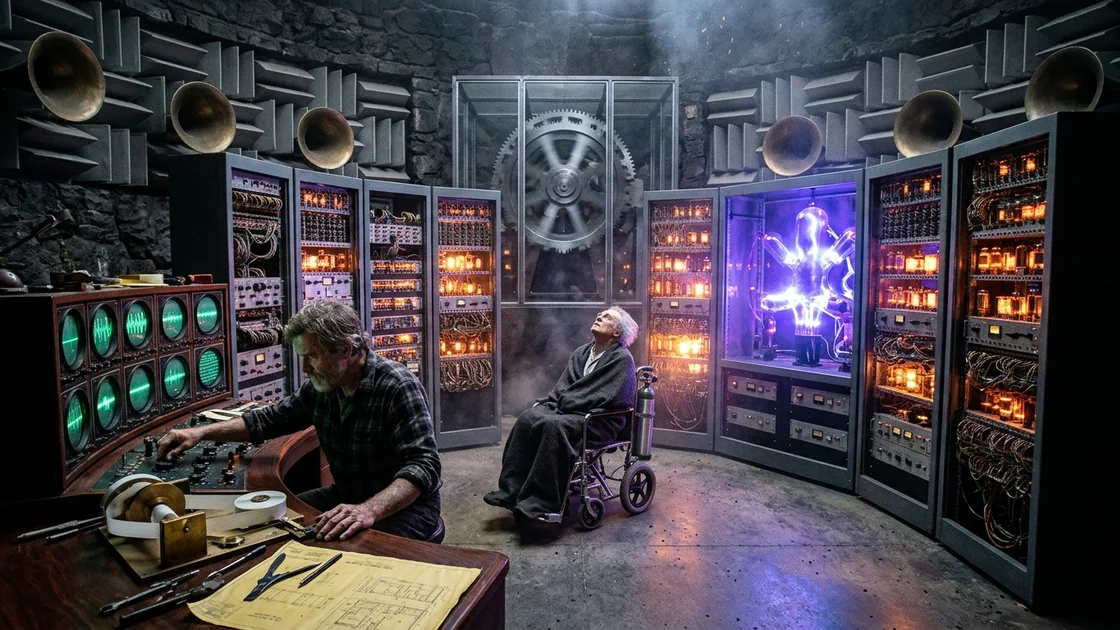
Arthur Miles is a struggling vintage synthesizer technician in Portland who is offered a life-changing sum of money by Julian Vance, a reclusive tech billionaire, to restore a one-of-a-kind room-sized musical computer built in 1958. Known as the Calliope-58, the monolithic machine combines vacuum tube logic, spinning electromagnetic tonewheels, and punched Mylar tape to generate sounds that its original creator, an obsessed acoustic physicist named Dr. Lazlo Kovács, believed could alter human perception. As Arthur spends weeks isolated in Vance’s cliffside estate repairing the hazardous, high-voltage leviathan, he uncovers the dark history of the machine’s final, unplayed composition. When the repairs are finally completed and the ancient computer is brought to full power during a violent coastal storm, Arthur and Vance are forced to confront the terrifying physical and psychological toll of a machine designed to play frequencies that were never meant to be heard by the living.
The rain in Portland had a specific frequency in November. To Arthur Miles, who had spent thirty-two of his fifty-four years staring at the green phosphor traces of Tektronix oscilloscopes, the sound of water hitting the corrugated tin roof above his workshop was a steady pink noise, rolling off sharply around four kilohertz. It was a comforting, analog sound. It had no jitter, no aliasing, and no quantization error. It simply existed, dampening the world outside while he hunched over the exposed gut of a 1974 Minimoog Model D.
The shop, which bore the faded gold-leaf name Discrete Circuits on a street-level window that hadn't been washed since the second Bush administration, smelled of scorching rosin-core solder, isopropyl alcohol, and fifty-year-old phenolic resin. It was a graveyard of obsolete ambitions. Along the walls, stacked on bowing particle-board shelves, sat the carcasses of machines that had once promised the future: an ARP 2600 with a cracked Tolex case, three Sequential Circuits Prophet-5s awaiting Curtis chip replacements that no longer existed on the open market, a Yamaha CS-80 that weighed as much as a small engine block and drifted out of tune whenever a delivery truck rumbled past on Burnside, and bins of matched germanium transistors that Arthur hoarded like a medieval monk guarding the finger bones of saints.
Arthur adjusted the magnifying visor on his forehead and touched the tip of his Weller soldering iron to a stubborn joint on the Moog’s oscillator board. A wisp of gray smoke curled upward, bitter and familiar. He sucked the old, oxidized lead-tin alloy away with a spring-loaded desoldering pump, the thwack of the plunger echoing in the quiet room.
He was three months behind on the lease. The landlord, a conglomerate based in Bellevue that owned half the block and wanted to turn his storefront into an artisanal matcha bar, had already sent the yellow notice. Not the polite white one, and not the final pink one, but the yellow one that meant lawyers were beginning to bill hours in his name. The problem wasn't a lack of work; it was the nature of the work. The people who owned vintage synthesizers in the twenty-first century fell into two categories: starving twenty-somethings who inherited a broken Juno-106 from an uncle and cried when quoted ninety dollars an hour for bench time, or neurotic film composers in Los Angeles who wanted him to overnight a calibrated Roland Jupiter-8 via air freight and then disputed the invoice because a single potentiometer had a micro-scratch in its carbon track.
The bell above the door didn't ring when the woman entered; the microswitch connected to the rusty solenoid chime had corroded back in March, and Arthur hadn't bothered to bridge it. Instead, he knew someone was there because the draft changed, pushing the solder smoke sideways into his face, and because the floorboards near the counter gave a distinct, three-hundred-hertz groan.
"If it's a Korg PolySix," Arthur said without looking up, holding a precision metal-film resistor in his needle-nose pliers, "and the battery has leaked all over the programmer board, I'm not taking it. It takes forty hours to trace the corroded vias, and you can buy a software plugin that sounds ninety-eight percent as good for fifty bucks."
"It isn't a Korg, Mr. Miles," a voice replied.
Arthur froze. The voice didn't belong in Discrete Circuits. It was crisp, mid-Atlantic, and entirely devoid of the apologetic hesitation that usually accompanied musicians entering his lair. He raised his visor, blinking through his astigmatism as his eyes adjusted to the gloom beyond his halogen bench lamp.
She stood just inside the doorway, holding an umbrella that looked like it had been engineered by an aerospace firm. She wore a charcoal wool coat tailored so sharply it seemed to have no seams, and her dark hair was pulled back with a tension that suggested it might snap if she nodded too quickly. In her left hand, she held a rigid aluminum briefcase—not a Zero Halliburton, which Arthur would have recognized from roadie days, but something sleeker, milled from a single block of metal.
"I'm closed on Tuesdays," Arthur said, though the sign on the door clearly read OPENISH. "Just catching up on bench backlog."
"My name is Clara Lin. I represent Julian Vance," she said. She didn't step closer to the counter, likely out of respect for the layer of blackened flux residue and stray capacitor clippings that covered the laminate. "Mr. Vance would like to retain your services for an on-site restoration project."
Arthur set the soldering iron into its coiled metal cage and wiped his hands on an oil-stained shop rag. He knew the name Julian Vance. Everyone who hadn't lived in a limestone cave for the last fifteen years knew the name. Vance was the architect of Aethelgard, the predictive logistics algorithm that essentially ran global shipping, three-quarters of the municipal power grids in the Western Hemisphere, and a terrifyingly large percentage of the high-frequency trading desks in Manhattan and London. Vance was fifty, worth somewhere north of ninety billion dollars, and hadn't been photographed in public since a Senate subcommittee hearing six years ago, where he had famously told a senator from Ohio that human governance was merely a high-latency routing error.
"Julian Vance," Arthur repeated flatly. "What did he do, buy Keith Emerson's modular rig at auction and realize nobody in Silicon Valley knows how to bias a discrete transistor?"
Clara Lin didn't smile, though the corner of her mouth twitched by a millimeter. She stepped forward, cleared a twelve-inch square of space on the counter using the edge of a bound schematic folder without actually touching the dirt with her fingers, and laid the aluminum case down. Two latches clicked open with the precision of a rifle bolt.
She turned the case around. Inside, nestled in custom-cut charcoal foam, was not a modern tablet or a contract, but a single vacuum tube and a sheaf of heavy, yellowed draft paper folded into quarters.
Arthur leaned over the counter. He didn't look at the paper first; he looked at the tube. It was roughly the size of a beer can, with a heavy, machined brass base instead of the usual bakelite, and a top cap made of braided silver wire. Inside the thick borosilicate glass envelope, the plate structure wasn't the standard stamped gray nickel; it was a complex, concentric series of gold-plated grids surrounding a massive helical filament. Stamped into the brass base, in a font that screamed Central Europe before the Berlin Wall went up, were the characters: KOVÁCS-WERKE WIEN — TYPE 808-PH — 1957.
Arthur’s heart gave a dull, irregular thump against his ribs. "That's a phantastron tube," he whispered, his cynicism evaporating before the sheer exoticism of the hardware. "No, wait. It’s a beam-deflection decade counter, isn't it? No... it has three independent control grids and an electrostatic shield." He reached out a calloused finger, stopping a hair's breadth from the glass. "I've never seen this envelope before. Western Electric made some weird stuff for the Nike missile systems in the fifties, and Philips had those tropospheric scatter tubes, but this... this is custom foundry work."
"It is a dual-anode harmonic divider tube," Clara said, reading the specifications from memory with surprising accuracy. "One of four hundred and eighty currently installed in the logic bays of the Calliope-58."
Arthur looked up from the glass to her eyes. "The Calliope-58. You're talking about the Kovács machine. That's an urban legend from the early days of the Columbia-Princeton Electronic Music Center. Milton Babbitt wrote a footnote about it in 1962—said some Hungarian defector built a rival to the RCA Mark II in an old munitions bunker in upstate New York, bankrolled by a crazy textile heir, before the whole thing caught fire and was sold for scrap."
"It did not catch fire," Clara corrected gently. "A high-voltage selenium rectifier bank suffered a cascade failure during a demonstration in November of 1958, filling the room with toxic dioxide gas and hospitalizing Dr. Kovács. The textile heir, Arthur Vanderbilt-Sloane, had the machine crated in grease-paper and cosmoline three days later. It sat in a climate-controlled limestone quarry in Pennsylvania until seven months ago, when Mr. Vance acquired the estate's unlisted assets."
She unfolded the yellowed paper on the counter. It wasn't a reproduction. The paper smelled of old linen and cedarwood. It was a blueprint—an actual cyanotype, white lines on a deep, Prussian-blue background—drawn by hand with a ruling pen and French curves. Across the bottom right corner, the title block read: POLYPHONIC HARMONIC ENGINE "CALLIOPE" — MASTER OSCILLATOR & TONEWHEEL MATRIX — DR. L. KOVÁCS, CHIEF ENGINEER. 14 APRIL 1958.
Arthur’s eyes raced across the schematic. It was madness. Absolute, glorious, mid-century madness. Where the RCA Mark II had used twelve simple tuning-fork oscillators and divided them down, Kovács had designed a hybrid monster. It used a sixty-hertz synchronous motor the size of a washing machine to drive a shaft fitted with ninety-six precision-milled iron tonewheels, similar to a Hammond organ, except these tonewheels didn't just generate sine waves. Their teeth were cut in complex, non-Euclidean geometries to induce raw, jagged waveforms into silver-wound pickups, which were then fed through a labyrinth of twelve hundred vacuum tubes, magnetic core memory arrays, and motorized variacs controlled by thirty-five-millimeter perforated Mylar film.
"Look at the filter bank," Arthur breathed, tracing a series of inductors drawn like tight coils of barbed wire. "He didn't use resistive networks. He used saturable reactors—magnetic amplifiers. He’s modulating the inductance of iron cores using high-voltage DC bias from a thyratron matrix. The total harmonic distortion on this thing must be... God, it wouldn't sound like a synthesizer. It would sound like a thunderstorm trapped inside a cello."
"Currently, it sounds like nothing at all," Clara said. "Mr. Vance brought in three electrical engineering PhDs from MIT and a chief archivist from the Smithsonian in August. The MIT team wanted to gut the power supply and replace the tube logic with an FPGA emulator to protect the components. Mr. Vance fired them before they finished their PowerPoint presentation. The Smithsonian archivist spent three weeks cleaning contacts, threw the main breaker on Sector One, and vaporized a sixty-amp mercury-arc rectifier that took us four months to source a replacement for from a decommissioned Soviet radar station in Murmansk."
Arthur let out a short, barked laugh. "He didn't reform the electrolytic capacitors, did he? If you hit fifty-year-old wet slug capacitors with four hundred volts of raw plate current after they’ve been sitting since Eisenhower was president, they don't act like capacitors. They act like dead shorts. Or pipe bombs."
"Which is why I am standing in your shop, Mr. Miles," Clara said. She reached into her coat pocket and pulled out a simple white envelope, placing it beside the blueprint. "We conducted a global search for technicians who still rebuild point-to-point wired tube equipment from the nineteen-fifties without relying on modern solid-state replacements. Your name came up on three separate archival forums, specifically regarding your restoration of a 1953 Hammond Novachord and a Raymond Scott Electronium prototype."
"The Electronium was mostly relays and stepping switches," Arthur muttered, his mind still trapped in the cyan lines of the blueprint. "This is... this is an analog supercomputer designed by a lunatic."
"The fee is twenty-five thousand dollars a week," Clara said.
The shop went very quiet. Even the rain on the tin roof seemed to dip in amplitude, as if someone had pulled a master fader down six decibels.
Arthur looked at the white envelope, then back at the Moog on his bench, with its sticky keyboard bushings and its owner who was currently arguing over a four-hundred-dollar recap job. "A week," he repeated.
"With a one-hundred-thousand-dollar completion bonus when the machine successfully reads and executes the final reel of Mylar tape found in Dr. Kovács's personal safe," she added. "Room, board, and a fully equipped machine shop are provided on-site at Mr. Vance's residence in Cape Perpetua. You will have no internet access, no cellular phone, and you will sign a non-disclosure agreement that carries liquidated damages sufficient to bankrupt your grandchildren, had you any. We leave in four hours, assuming you can pack your preferred diagnostic tools in that time."
Arthur looked down at his hands. There was a tiny scar on his left index finger where a filter cap from a Fender Twin Reverb had discharged six hundred volts through his skin back in 1998. His lower back ached from forty years of leaning over workbenches, and his retirement plan currently consisted of hoping he died quickly before his eyesight failed completely.
He looked back at the Kovács 808-PH tube resting in the foam. The gold grids gleamed softly under the yellow light of his desk lamp.
"I need my Tektronix 545B oscilloscope," Arthur said. "It weighs seventy pounds, and if your people drop it, I walk. And I need my Simpson 260 multimeter, my variac rack, and every spool of Kester 44 leaded solder under that counter. Keep your RoHS-compliant silver solder away from me; it cracks under thermal cycling."
Clara closed the aluminum briefcase with two sharp clicks. "A climate-controlled van is idling in the alley behind your building, Mr. Miles. My drivers have air-ride suspension and lifting straps. I suggest you unplug your iron."
Cape Perpetua was three hours southwest of Portland, down where the Oregon coast stopped pretending to be a vacation spot for retirees and turned into a jagged wall of black basalt being endlessly battered by the North Pacific.
Arthur rode in the back of a Mercedes Sprinter that had been modified inside to look like the cabin of a Gulfstream jet, though he spent most of the drive turned backward in his leather captain's chair, watching the cargo tie-downs in the rear bay to make sure his Tektronix scope didn't shift on the winding turns of Highway 101. Outside the tinted windows, the Douglas firs grew thick and dark, draped in rotting curtains of lichen, while the ocean appeared in flashes between the cliffs—a churning cauldron of slate-gray water and dirty white foam.
The estate was not visible from the highway. The van turned onto a logging road barred by a rusted steel gate that looked abandoned until Arthur noticed the millimeter-wave radar pods and thermal cameras disguised as birdhouses in the Sitka spruces thirty feet up. Two miles of unmarked asphalt later, the trees simply vanished, sheared away by the salt wind, and the house emerged from the stone of the headland itself.
It was a violent piece of architecture. Built from board-formed poured concrete the color of wet ash and massive cantilevered slabs of rusted Corten steel, it didn't sit on the cliff; it had been blasted into it. Half the structure hung out over a two-hundred-foot drop into a boiling chasm called a Devil's Churn, where the incoming tide was forced into a narrow fissure in the basalt, exploding upward in geysers of spray that rattled the triple-pane glass of the atrium.
"Mr. Vance values acoustic isolation," Clara said as the van descended a spiraling concrete ramp into a subterranean loading bay that smelled of new epoxy and ozone. "WaitWait—Wait here while the boys unload your gear. Mr. Vance is already in the vault."
The "vault" was located two levels below the main living quarters, carved directly into the volcanic bedrock of the promontory. To reach it, Arthur had to pass through two airlocks designed to keep the corrosive coastal salt air from ever touching the interior atmosphere. The humidity inside the lower corridor was kept at a precise thirty-five percent; Arthur could feel his sinuses drying out after twenty paces, and the wool of his flannel shirt began to crackle with tiny charges of static electricity.
When the final blast door—a three-inch slab of brushed stainless steel—slid aside on pneumatic tracks, Arthur stopped dead on the threshold.
The room was circular, eighty feet in diameter, with a domed ceiling lined in grey anechoic wedges that swallowed the sound of their footsteps entirely. Being inside an anechoic or semi-anechoic space always made Arthur feel slightly nauseous at first; without the natural slap-back reverb of walls, the human ear turns inward, forcing you to hear the wet squelch of your own blinking eyelids and the rushing hiss of blood in your carotid arteries.
And in the center of that dead, silent cavern sat the Calliope-58.
It wasn't a machine; it was a small city of grey wrinkle-finish steel and blackened brass. It was arranged in a horseshoe configuration composed of fourteen seven-foot-tall relay racks, interconnected by overhead aluminum troughs choked with cloth-insulated wiring harnesses as thick as a man's thigh. In the center of the horseshoe sat the console—a sweeping desk of dark mahogany and brushed bakelite, studded with hundreds of heavy toggle switches, rotary telephone-style dials, and twelve round cathode-ray tubes arranged in an arc like the portholes of a sunken ship.
Behind the racks, enclosed in a massive glass-and-steel housing to contain the mechanical noise, was the tonewheel assembly. Even powered down, it looked terrifying: a nine-foot shaft of forged steel resting on oil-bath bearings, bristling with nearly a hundred jagged, star-shaped bronze and iron discs, each surrounded by clusters of electromagnetic pickups adjustable via micrometer screws.
Standing by the third rack on the left, holding a flashlight and wearing an oversized cardigan that looked like it had been knitted from boiled sheep wool, was Julian Vance.
He was smaller than Arthur had expected. In the rare photos from the news, shot from low angles by court photographers, Vance had looked monolithic, a sharp-chinned titan of the algorithmic age. In person, under the flat, shadowless LED work lights of the vault, he looked like a man being slowly erased from the edges inward. He was thin to the point of fragility, his skin the translucent grey-white of cellar mushrooms, and his hair was a wild, thinning halo of silver. Yet when he turned toward Arthur, his eyes were startlingly dark and fixed, moving with the rapid, saccadic jerks of an animal tracking prey.
"You brought a 545B," Vance said. His voice was dry, like dead leaves scraping across pavement, amplified weirdly by the total lack of room reflections. "With the Type CA dual-trace plug-in. Good. The Tektronix engineers in Beaverton still knew how to build a trigger circuit in 1960. Today’s digital storage scopes lie to you. They sample the wave, run a Fast Fourier Transform, and draw a pretty line on an LCD screen based on what the firmware thinks should be between the points. They hide the dirt."
"The dirt is usually where the oscillation lives," Arthur said, walking slowly toward the console, his fear of the billionaire forgotten in the gravitational pull of the hardware. He ran a hand along the mahogany edge of the desk. The wood was dry, smelling faintly of lemon oil and ancient pipe tobacco. "My God. Look at the build quality on these attenuators. These are Daven step-switches. Solid silver contacts, two-decibel steps, oil-filled casings. You couldn't build just the mixing desk of this thing today for less than two million dollars."
"Four point two," Vance corrected, stepping out from behind the rack. He walked with a slight limp, favoring his left leg. "I had my fabrication lab in Zurich price out a one-to-one reproduction when the Smithsonian idiot blew up the power supply. Just milling the non-linear tonewheels to Kovács's tolerances requires a five-axis CNC machine running for six hundred hours, and even then, the metallurgy is wrong. Kovács used low-background steel salvaged from Austro-Hungarian dreadnoughts sunk in the Adriatic during the First World War. Modern steel is contaminated with Cobalt-60 from atmospheric nuclear testing; Kovács claimed the trace radiation introduced microscopic eddy currents into the magnetic field of the pickups."
Arthur paused, looking over his shoulder at Vance. "Wait. That's an old audiophile myth. Trace radiation in post-1945 steel doesn't affect audio frequencies. That's only relevant for Geiger counters and whole-body radiation scanners."
"To you," Vance said softly, coming to stand beside him at the console. He smelled of medicinal menthol and cold stone. "And to the children at MIT who think sound is just air pressure variations between twenty hertz and twenty kilohertz. Lazlo Kovács didn't think so. Kovács worked for the Reichspost Ministry in Vienna during the war, researching acoustic telemetry and sub-audible psychological warfare before the Americans snatched him up in Operation Paperclip. He didn't care about music, Mr. Miles. Not the way Mozart or Chuck Berry cared about music. He cared about resonance. He believed the human nervous system is fundamentally an LCR circuit—inductance, capacitance, resistance—operating at a specific carrier frequency. He built the Calliope to find the resonant frequency of the listener."
Arthur looked back at the towering black racks. Through the perforated steel doors of Bay Four, he could see rows of massive glass tubes—not the small nine-pin miniatures of the sixties, nor even the octal-base tubes of the forties, but giant transmitting triodes with ceramic plate caps and copper cooling fins.
"Those are 833As," Arthur said, frowning as he stepped closer to the rack and peered through the mesh. "Those are AM broadcast transmitter tubes. Each pair of those in push-pull can put out a kilowatt of audio power. There are... sixteen of them in this bay alone." He turned back to Vance, a sudden prickle of genuine unease crawling up his neck. "Mr. Vance, where are the speakers?"
Vance pointed toward the curved walls of the chamber, behind the grey anechoic wedges. "The wedges are mounted on motorized louvers," he said. "Behind them is a spherical array of forty-eight coaxial horn drivers built by Western Electric for theater installations in 1955, supplemented by four rotary subwoofers bolted directly into the basalt foundation of the cliff. When the louvers open, this room becomes a Helmholtz resonator."
"Sixteen kilowatts of tube-driven audio inside a sealed eighty-foot stone sphere," Arthur said slowly, doing the math in his head. "At full output, especially with rotary subwoofers coupled to the bedrock, the sound pressure level in here would exceed one hundred and fifty decibels below twenty hertz. That's not a concert hall, Mr. Vance. That's a sonic weapon. It would vibrate your eyeballs in their sockets until your vision blurred, collapse your lungs, or induce cardiac arrhythmia."
"Only if you play the wrong chord," Vance said, and for the first time, he smiled. It was a terrifying expression, thin and starved, like a man looking at a meal through a plate-glass window. "The machine doesn't need to run at full gain, Arthur. May I call you Arthur? The 833A tubes weren't chosen for volume. They were chosen for headroom. Kovács wanted zero clipping on the transients. When two non-Euclidean waveforms collide in the mixing matrix, the peak-to-average power ratio is immense. A lesser amplifier clips the peaks, rounding off the sharp mathematical edges of the phase cancellation. Kovács needed the spikes to remain infinitely sharp."
Arthur pulled his eyes away from the transmitter tubes and looked at the console's central mechanism: a heavy brass transport system that looked like a cross between an old movie projector and a Teletype machine. Mounted on the feed reel was a twelve-inch spool of thick, milky-white Mylar film, perforated with hundreds of tiny, staggered rectangular holes.
"The score," Arthur murmured.
"Not that one," Vance said, gesturing dismissively at the spool on the machine. "That's a calibration loop—a Bach fugue transcribed into five-bit binary by Kovács’s assistant to test the stepping relays. The real score, the one he was running when the rectifier bank exploded in November of '58, is in the vault upstairs. Along with his notebooks."
Vance reached out and laid a frail, ice-cold hand on Arthur’s forearm. His grip had the surprising, wiry strength of a bird's talon.
"Bring her back to life, Arthur. Fix the power supply. Align the tonewheel pickups. Balance the tube matrices until the Lissajous figures on those scopes are as steady as carved jade. Do not modernize a single circuit. If you need a selenium rectifier that smells like rotten cabbage when it gets warm, we will manufacture one from raw selenium ore. If you need paper-in-oil capacitors rolled in beeswax, I have three women in a cleanroom in Brno rolling them by hand to the 1956 Telefunken specifications. Just make it sing before the winter solstice."
Arthur looked down at the hand on his arm, then into Vance’s fever-bright eyes. "Why the solstice? That's five weeks away."
Vance let go of his arm and coughed into a silk handkerchief—a wet, rattling sound that the anechoic room swallowed instantly, leaving no echo behind. When he pulled the cloth away, Arthur saw a faint fleck of rust-colored foam on the white silk before Vance tucked it back into his cardigan pocket.
"Because, Arthur," Vance said, turning back toward the blast door, "unlike Dr. Kovács’s capacitors, my components cannot be reformed."
For the first seventy-two hours, Arthur didn't touch a soldering iron. He didn't even plug in his oscilloscope.
Instead, he lived at a long drafting table set up in the corner of the vault, drinking thermoses of black coffee brought down by a silent kitchen staff and reading the gospel according to Dr. Lazlo Kovács.
There were eleven leather-bound ledger books in total, written in a cramped, violent hand that alternated between German, English, and Hungarian, interspersed with complex differential equations and circuit diagrams drawn in fountain pen ink that had oxidized to the color of dried blood.
Kovács had not been a pleasant man. The notebooks were filled with vitriol directed at his contemporaries. He called Robert Beyer and Herbert Eimert in Cologne "children playing with sine-wave toys in a sandbox," and dismissed the Columbia-Princeton group as "bookkeepers with tape scissors."
They believe electronic music is merely the creation of new timbres for old scales, Kovács had written on October 12, 1957, pressing the nib so hard into the paper it had torn the fibers. They are blind. Timbre is nothing. Pitch is a bourgeois convention invented by piano tuners to hide the comma of Pythagoras. The truth lies in the beating—the differential frequencies generated within the basilar membrane of the inner ear and the corpus callosum when two incommensurable harmonic series are forced into phase-lock at high energy. The ear does not merely hear; it demodulates. If the carrier wave is complex enough, the brain can be programmed like a magnetic drum.
Arthur rubbed his tired eyes and flipped forward to the technical schematics for Sector One—the main power distribution and master clock bay.
The Smithsonian archivist hadn't just been careless; he had been functionally illiterate in mid-century industrial electronics. The Calliope-58 didn't run on standard household current. It drew three-phase, four-hundred-and-eighty-volt industrial power from a dedicated transformer room behind the vault, which was then stepped up and rectified into four separate DC busses: plus eight hundred volts for the transmitter tube plates, plus two hundred and fifty volts for the logic bays, minus one hundred and fifty volts for the grid bias rails, and a massive, high-amperage six-volt bus to light the filaments of all twelve hundred tubes simultaneously.
When the archivist had thrown the main knife switch without bringing the filament bus up first via the motorized rheostats, the cold tungsten heaters of twelve hundred vacuum tubes had presented a near-zero resistance load, creating a massive current inrush that had blown the main mercury-arc rectifier tube to pieces and fused the contacts of the primary overload relay shut.
"Idiot," Arthur muttered to the empty room. "You don't drop the hammer on cold glass. You have to wake them up slow, like old dogs."
On the fourth day, Arthur went to work on the carcass.
He stripped off his flannel shirt, working in a faded grey t-shirt and rubber-soled engineer boots to insulate himself from the grounded steel deck plates. He opened the rear doors of Sector One, revealing the charred ruins of the rectifier cage. The smell inside the rack was intense—that unmistakable, choking stench of burned selenium, vaporized copper, and boiled transformer oil that smelled faintly of dead fish and garlic.
Using a heavy pair of Klein linemen's pliers and a set of hollow-shaft nut drivers, he began the slow, methodical surgical removal of the dead tissue. Every wire in the Calliope was laced into neat bundles with waxed linen twine, tied off with surgeon’s knots every half-inch by some long-dead assembly worker in 1958. Arthur didn't cut the twine with diagonal cutters like a modern hack; he used a dental pick to carefully untie the knots where possible, tagging every cloth-covered wire with numbered masking tape and logging its termination point in his own spiral notebook.
The replacement mercury-arc rectifier that Vance’s people had flown in from Russia sat in a wooden crate lined with straw. Arthur pried the lid off with a crowbar and whistled low in his throat.
It looked like an alchemist's retort designed by H.G. Wells. It was a bulbous glass octopus, nearly two feet tall, with four curved glass arms extending outward from a central dome, and a pool of liquid silver mercury weighing at least five pounds sloshing gently at the bottom of the cathode well.
"Hello, sweetheart," Arthur whispered, lifting the fragile glass monster out of the straw with both hands, his biceps straining against the unexpected shifting weight of the liquid metal at its base. "Let's try not to drop you. Five pounds of mercury on the floor and the EPA will have to bury this whole cliff in concrete."
He mounted the tube into its gimbaled cradle inside the rack, securing the spring-loaded asbestos-lined straps around its glass neck and bolting the heavy braided copper anode straps to the side arms.
For the next two weeks, time lost all meaning outside the hum of his soldering iron and the click of his meter leads. Having no windows, no phone, and no clock save for a 1950s IBM slave clock on the vault wall that didn't work, Arthur fell into a circadian rhythm dictated entirely by capacitance reformation.
He built a custom leakage-tester rack on a rolling cart, stringing banks of high-wattage wire-wound resistors in series with the Calliope’s ancient oil-filled capacitors. He would hook up a bay of twenty canisters, dial his variac up to ten volts, and watch the milliammeter needles jump as the dried-out dielectric layers inside the cans slowly rebuilt their oxide films. Four hours later, if the current dropped below two milliamps, he would dial it up to twenty volts. Then fifty. Then a hundred.
While the capacitors cooked back to life, he crawled inside the belly of the horseshoe with a brass wire brush, a gallon of DeoxIT, and a stack of linen strips. There were over four thousand individual tube sockets, relay contacts, and patch-bay jacks in the machine. Every single one had fifty-six years of microscopic sulfation on its silver plating.
It was meditative, brutal labor. His knuckles were perpetually raw and bleeding from scraping against sharp chassis edges; his fingertips were burned smooth and insensitive from holding hot component leads. Sometimes, around what he guessed was three in the morning, he would look up from beneath the console, his head resting against a bundle of shielded audio cables, and see Julian Vance sitting in a leather armchair just inside the blast door, wrapped in a cashmere blanket, watching him in total silence.
They didn't talk much at first. Vance would simply sit there, breathing shallowly, listening to the scritch-scritch of Arthur’s burnishing tool on a stepping relay or the quiet plink of cooling metal.
It wasn't until the eighteenth day, when Arthur finally threw the filament breaker on Bays One through Six, that the silence broke.
"Stand back by the door," Arthur called out, his hand resting on the heavy black bakelite wheel of the primary autotransformer. He had his Simpson meter clipped across the main six-volt bus and an infrared thermometer in his back pocket. "If I missed a shorted heater-to-cathode junction in one of the logic tubes, we're going to see some fireworks."
Vance didn't move from his chair, though he leaned forward, his thin hands gripping the leather armrests.
Arthur turned the wheel ten degrees clockwise.
Deep beneath the floor, in the transformer vault, a contactor slammed shut with a sound like a dropped anvil: CLACK.
Immediately, a low, physical vibration entered the soles of Arthur’s boots. Sixty cycles per second—a fundamental B-flat, slightly flat—rose from the iron cores of the massive filament transformers.
Slowly, over the course of twenty minutes, Arthur walked the voltage up. Two volts. Three. Four point five. Six point three.
As the voltage climbed, the darkened cavern began to change. Inside the fourteen towering racks, behind the perforated steel grilles, twelve hundred tiny points of orange light bloomed in the gloom. At first they were dull crimson, the color of dying campfire embers, and then they brightened to a warm, steady amber.
And then came the smell.
It was a scent that hadn't existed in the modern world since the nineteen-sixties: the warm, dry, slightly sweet perfume of fifty-year-old dust baking on hot borosilicate glass, mixed with melting beeswax and heated phenolic board. The air temperature in the center of the horseshoe rose four degrees in ten minutes. The machine was breathing. Small, metallic ticks and pings echoed from the racks as chassis steel expanded under the thermal load, settling into positions it hadn't occupied since 1958.
Arthur walked down the line of racks, shining his infrared thermometer through the grilles, checking for cold tubes or runaway thermal spots. Every single glass envelope was glowing.
"Not one open filament," Arthur muttered in disbelief, wiping sweat from his forehead with the back of his wrist. "Kovács ran the heaters at five point eight volts instead of six point three to derate them for longevity. The man built this thing to survive a nuclear war."
"Now the high voltage," Vance said from the shadows, his voice trembling with an almost narcotic eagerness. "Bring up the mercury arc."
"Patience," Arthur said, walking back to Sector One. "The mercury pool has to pre-heat for thirty minutes, or the arc will strip the cathode spot and shatter the glass. You don't rush physics, Mr. Vance. That's how your Smithsonian guy ended up with a face full of mercury vapor."
Vance sank back into his chair, letting out a long, ragged sigh. "You sound like my oncologist, Arthur. Wait for the blood panels, Julian. Wait for the marrow biopsy, Julian. Everyone wants me to wait, as if time were a renewable resource."
Arthur leaned against the warm steel of Rack Two, crossing his arms as he watched the filament current stabilize on his meter. "What is it? Pancreatic?"
"Glioblastoma," Vance said without a trace of self-pity, as if discussing a corrupted sector on a server drive. "Grade four. Right temporal lobe, wrapped around the auditory cortex and the Meyer's loop like ivy on a brick wall. Inoperable, unless I want to spend my final six months unable to understand human speech or recognize my own reflection. I've bought three biotech startups since April. I have forty researchers in Boston running CRISPR simulations on my exact genetic sequencing twenty-four hours a day. Do you know what their models tell me?"
Arthur stayed quiet, listening to the sixty-hertz hum of the transformers.
"They tell me the tumor is an emergent property of cellular entropy," Vance said softly. "A statistical certainty. My whole life, Arthur, I made billions of dollars by proving that the world is entirely deterministic if you just have a large enough dataset. Every ship crossing the Malacca Strait, every spike in natural gas consumption in Munich, every human desire clicked into a search bar—it's all just math. Predictable, flat, binary math. Zeroes and ones all the way down. And then a single glial cell in my skull misreads a protein folding instruction during mitosis, and the entire cathedral comes crashing down."
He stood up from the chair, limping into the amber glow cast by the racks of tubes. In the warm orange light, he looked less like a corpse and more like a ghost haunting an old radio station.
"Why this machine?" Arthur asked gently. "You don't think Kovács's music is going to shrink a brain tumor, do you? Because I've read his notebooks over there. The man was brilliant, Julian, arguably fifty years ahead of his time in non-linear wave shaping, but he was also paranoid, sleep-deprived, and probably suffering from chronic mercury poisoning by the end of 1958."
"I'm not looking for a cure," Vance said, stopping beside the glass housing of the tonewheel generator. He pressed his palm against the glass, looking at the jagged bronze gears inside. "I'm looking for an exit that isn't an equation."
He turned to look at Arthur. "Do you know what happens in the right temporal lobe where my tumor is growing? That's where the brain processes non-verbal sound, harmonic relationships, and what neurologists politely call 'transcendental seizure states.' Ever since the mass hit two centimeters in July, I've been hearing things, Arthur. Not voices. Frequencies. A constant, complex chord that sits just underneath the sound of the ocean outside. My doctors say it's tinnitus caused by intracranial pressure on the cochlear nerve. So I had my audio engineers synthesize the exact frequencies I was hearing and run a correlation search against every acoustic database on Earth."
Arthur felt the hair on his arms stand up, entirely independent of the static electricity in the room. "And?"
"And it matched a paper published in a classified U.S. Naval Research Laboratory journal in 1959," Vance whispered. "A report on the medical evaluation of Dr. Lazlo Kovács at Bellevue Hospital following the accident in his laboratory. After the rectifier exploded during the playback of his final composition, Kovács was catatonic for six weeks. Except he wasn't brain-dead. His EEG showed continuous, synchronized gamma-wave activity across both hemispheres at a precise harmonic ratio corresponding to the sub-audible beat frequencies of the Calliope-58. When he finally spoke, before he died of a stroke in 1960, he told the Navy psychiatrists one thing."
"What did he say?" Arthur asked.
"'The door stays open after the machine stops,'" Vance said. He tapped the glass of the tonewheel housing with a fingernail. "He found something in the math, Arthur. Not digital math—not the dead, sliced-up approximations I built my empire on. Continuous, infinite, analog waveforms. He built a key that turns in the lock of human consciousness. Before the thing in my head turns the lights out for good, I want to hear what he heard when that door opened."
Arthur looked away from Vance, back toward Sector One. The timer on his watch beeped. Thirty minutes were up.
"Stand clear," Arthur said, his voice tight.
He reached into the control panel of Sector One and pressed the spring-loaded starter button for the mercury-arc rectifier.
Inside the rack, a mechanical striker arm tilted the glass octopus by five degrees, causing the five-pound pool of liquid mercury at the bottom to bridge an auxiliary ignition electrode, then drop back.
K-CHZAAACK.
The vault was instantly flooded with an eerie, blinding, ultraviolet-blue light that burst from the vents of Sector One, casting razor-sharp shadows of the relay racks across the grey acoustic wedges of the walls. Within the glass bulb of the rectifier, a dancing, writhing plasma arc of ionized mercury vapor erupted from the surface of the liquid metal pool, branching upward into the four glass anode arms like captured lightning.
A high, singing whine joined the sixty-hertz hum as the high-voltage DC rails slammed up to eight hundred volts. Across the console, the twelve round cathode-ray tubes flared to life, their green phosphor screens glowing like twelve unblinking cat eyes in the blue-and-amber dark.
The Calliope-58 was awake.
The next two weeks were a descent into a strange, intoxicating madness.
Once the power supplies were stable and the high-voltage rails held steady without arcing or smoking, Arthur had to calibrate the voice architecture. And to calibrate the Calliope, he had to listen to it.
At first, he refused to open the louvers to the Western Electric horn array in the walls, working instead with a pair of vintage high-impedance dynamic headphones plugged into the console’s monitor jack, with a brick-wall limiter wired inline so a stray voltage spike wouldn't blow his eardrums through the center of his skull.
The first time he engaged the clutch on the main tonewheel motor, he thought an earthquake had hit the Oregon coast.
The ten-horsepower synchronous motor spun up with a deep, turbine-like groan, bringing the nine-foot steel shaft and its ninety-six jagged bronze and iron discs up to exactly twelve hundred revolutions per minute. Because the shaft was coupled to the building’s foundation through heavy cast-iron pillow blocks, the mechanical inertia of the spinning metal was palpable; standing at the console felt like standing on the deck of a battleship directly above the propeller shafts.
Then Arthur threw the first toggle switch on Oscillator Bank A, opening the gate on a single Kovács 808-PH harmonic divider tube fed by Tonewheel Number Twelve.
A sound entered his headphones that made him rip them off his head and drop them onto the mahogany desk as if they had caught fire.
It wasn't a sine wave, or a sawtooth, or a square wave. Any synthesizer technician knows those basic building blocks the way a carpenter knows oak, pine, and maple. A sine wave is pure and hollow, like a flute; a sawtooth is bright and brassy; a square wave is woody and nasal, like a clarinet.
The sound coming out of the headphones even from two feet away on the desk was wet. It sounded like a human vocal cord the size of a bridge cable being bowed with a piece of rosined iron, except buried inside the fundamental pitch was a shimmering, shifting lattice of overtones that seemed to move in three dimensions inside his skull. Even with the headphones sitting on the wood, Arthur felt a strange, cold pressure right behind the bridge of his nose, followed by the sudden, vivid, inexplicable smell of crushed green walnuts from his grandfather's farm in Ohio when he was six years old.
He reached out with a trembling hand and flipped the toggle switch down. The sound cut off instantly, along with the phantom smell of walnuts.
Arthur sat down heavily on the technician's stool, his heart hammering at one hundred and twenty beats per minute. He looked at the trace still frozen on his Tektronix oscilloscope.
The waveform wasn't repeating cleanly. Because the teeth on the tonewheel were milled using an irrational mathematical progression—based on the golden ratio rather than standard integer divisions—and then fed through the saturable magnetic reactors which shifted phase depending on the amplitude of the previous cycle, the wave was technically chaotic. It never repeated the exact same shape twice, yet it remained locked to a central pitch center.
"He built a fractal oscillator in 1958," Arthur whispered, staring at the intricate, lacy green knot spinning on his scope screen. "Before Mandelbrot even coined the word. He’s using magnetic hysteresis in the iron cores as an analog chaotic attractor."
He picked up the notebooks again, flipping frantically to the section on the tonewheel geometry. Kovács had called them Irrational Phonic Gears.
Standard music uses integer harmonics—2:1, 3:2, 4:3, Kovács had written. These ratios soothe the mammalian brain because they are predictable; the auditory cortex resolves the pattern instantly and goes back to sleep. By introducing irrational ratios derived from transcendental numbers—Pi, Euler's constant, the square root of two—the auditory cortex is forced into an infinite computational loop trying to resolve the fundamental pitch. In that state of hyper-arousal, the thalamic filter breaks down.
Arthur looked back at the headphones lying on the desk. His rational mind—the part of him that had spent thirty years replacing bad op-amps in church organs and fixing broken solder joints on guitar pedals—told him to pack his Tektronix scope, walk out the blast door, and demand Clara Lin drive him back to Portland without the completion bonus.
Instead, he picked up his non-inductive ceramic alignment screwdriver, put the headphones back over his ears, and reached into Rack Five to adjust the bias on the second harmonic divider.
By the end of the fourth week, Arthur had stopped going upstairs to sleep in the guest suite overlooking the ocean. He had a cot brought down to the corridor just outside the inner airlock, though he rarely used it for more than three hours at a time. He lost weight; his grey beard grew wild and scraggly; his eyes developed dark, bruised hollows beneath them that matched Julian Vance’s.
He was obsessed. There was no other word for it. Every technician secretly dreams of encountering a machine that is smarter than they are—an artifact where every turn of a trimmer potentiometer reveals a deeper, more brilliant layer of engineering logic. Working on the Calliope-58 was like playing chess against a ghost who could see twenty moves ahead.
As he aligned the ninety-six magnetic pickups along the spinning tonewheel shaft, using a set of brass feeler gauges to set the air gaps to within two-thousandths of an inch while six hundred volts of plate current hummed three inches from his elbows, the machine began to get inside him.
He didn't need the headphones anymore to hear it. The sub-audible vibrations from the spinning shaft and the magnetostriction of the massive iron chokes in the filter banks traveled through the concrete floor, up his shins, and into his skeleton. When he lay on his cot in the corridor with his eyes closed, he didn't see darkness; he saw Lissajous figures—complex, rotating three-dimensional parabolic webs of green light that shifted whenever he took a breath.
He started having dreams that weren't dreams. They had no narrative, no people, no places. They were purely architectural experiences of sound. He would dream that he was a single electron trapped inside the gold grid of a Kovács 808-PH tube, being hurled back and forth between two charged plates at forty kilohertz while a vast, dark ocean of liquid mercury pulsed beneath him.
Three days before the winter solstice, Clara Lin came down to the vault with a breakfast tray and found Arthur sitting cross-legged on the floor inside the horseshoe, staring at the blue ultraviolet glow of the mercury-arc rectifier while all twelve oscilloscopes on the console ran a twelve-voice polyphonic test pattern in total silence, the audio output routed into a massive dummy load of oil-cooled resistors that were boiling softly in the corner.
"Mr. Miles," she said, setting the tray on the drafting table. Her voice sounded tight, unnerved by the intense heat and the eerie blue-and-orange twilight of the cavern. "You haven't touched your dinner from last night."
Arthur didn't look at her. He was watching the plasma arc dance inside the glass octopus. "The phase-shift network in Bay Eleven was drifting by point-zero-four degrees every ten minutes," he said, his voice hoarse from disuse. "I couldn't figure out why. The resistors were dead on spec, the silver-mica caps were tight. Do you know what it was, Clara?"
"No, Mr. Miles."
"The tide," Arthur said, turning his head slowly to look up at her. A strange, calm smile was plastered across his unshaven face. "When the tide comes into the Devil's Churn outside and hits the basalt beneath the house, the micro-seismic vibration shakes the glass envelopes of the 6SN7 phase-inverter tubes in Bay Eleven. Microphonics. The ocean was modulating the bias voltage of the machine. Kovács didn't shield Bay Eleven with lead springs like he did the others. He left it rigidly bolted to the chassis frame on purpose. He wanted the room's bedrock resonance to act as a low-frequency modulator for the phase network."
Clara stared down at him, her immaculate composure slipping for the first time since she had walked into his shop in Portland. She took a half-step back toward the blast door. "Mr. Miles, Dr. Kovács built this machine in a bunker in upstate New York. Not on the Oregon coast."
Arthur blinked. The smile faded from his face as the logic of what she had just said cut through the fog of his sleep deprivation.
She was right. Of course she was right. It was just worn rubber grommets on the tube sockets of Bay Eleven, hardened to stone by fifty years of age, transmitting the vibrations of the surf outside.
He rubbed his face with both hands, feeling the greasy film of flux and sweat on his skin, and stood up, his knees popping loudly in the dead acoustic space. "Right," he said shakily. "Yeah. Dried grommets. I need... I need to replace the silicone mounts in that bay."
"You need to sleep for twelve hours," Clara said firmly. "Mr. Vance has taken a turn for the worse over the last forty-eight hours. The medical team upstairs wanted to airlift him to OHSU in Portland last night, and he had his security detail lock them out of the residential wing. He says you're almost finished."
Arthur looked over at the mahogany console. Every single amber pilot light across the fourteen racks was glowing steadily. On the twelve round CRT screens, twelve identical, multi-lobed harmonic rosettes spun in perfect, drift-free synchronization, waiting for a binary instruction from the Mylar tape reader to break their symmetry and unleash them into the filter banks.
"The hardware is at one hundred percent," Arthur said quietly. "Every cap is reformed or replaced with the Brno reproductions. Every pickup is gapped. The stepping relays are lubricated with whale-oil watch grease, just like the manual specified. All that's left is to load the score and open the louvers."
Clara looked around the circular chamber, at the towering racks of glowing glass and the violent blue fire spitting inside the rectifier cage. "Don't open the louvers, Mr. Miles," she said, dropping her voice even though they were entirely alone two hundred feet beneath the earth. "Disconnect the horn drivers in the walls. Route the output to a pair of small studio monitors, or falsify the load on the meters so he thinks it's running at full power. He's half-blind in his left eye since Tuesday, and his hearing is deteriorating by the hour. He won't know the difference, and you'll still get your bonus."
Arthur frowned at her. "Why would I do that? You hired me to restore the machine."
"I hired you because Julian Vance pays me four million dollars a year to execute his directives without asking questions," she said, her eyes darting toward the dark lens of a closed-circuit camera near the airlock that Arthur knew was disconnected because he had pulled its power breaker himself to eliminate switching-supply noise on the ground bus. "Look at yourself in a mirror, Arthur. Look at what four weeks of just calibrating this thing with the speakers turned off has done to you. Your hands are shaking. You're talking to the rectifiers when you think nobody is listening. Two nights ago, one of the night-shift guards walked down the outer corridor when you were running a sub-bass sweep into the rotary woofers at five percent gain. He threw up in the stairwell and quit the next morning—said he felt like someone was standing behind him with a piano wire around his neck for six hours afterward."
Arthur looked down at his hands. They were trembling—a fine, ten-hertz physiological tremor that he had blamed on too much black coffee.
"It's just infrasound," Arthur said defensively, though his voice lacked conviction. "Nineteen hertz is the resonant frequency of the human vitreous humor. It causes peripheral visual hallucinations and triggers a primal fight-or-flight response in the amygdala. Theatre organ builders knew about it in the twenties; they called it the 'vox terroris' on the thirty-two-foot pipes. It's physics, Clara, not black magic."
"Dr. Kovács's assistant didn't die from the selenium gas leak in 1958," Clara said coldly. "We have the unredacted FBI files that the Navy buried before Vanderbilt-Sloane crated the machine. Kovács was hospitalized by the smoke when the rectifier blew, yes. Because Kovács was standing behind Rack One trying to pull the main breaker with a wooden broom handle. His twenty-four-year-old assistant, a graduate student from Juilliard named Thomas Miller, was strapped into the listening chair at the focal point of the room when the tape hit measure forty-two."
Arthur went very still. The sixty-hertz hum of the room suddenly felt oppressive, pressing against his eardrums like deep water. "What happened to Miller?"
"He died of a massive subarachnoid hemorrhage before the rectifier even blew," Clara said. "Kovács only blew the power supply because he tried to dead-short the high-voltage bus with a crowbar when he saw blood coming out of the boy's ears. The machine didn't break by accident, Arthur. Kovács tried to kill it with a piece of iron before the tape finished running."
She reached into her coat pocket and pulled out a heavy brass key on a red silk ribbon, setting it on the edge of the mahogany console beside the empty brass tape transport.
"That unlocks the fireproof safe in the archival room next door," she said. "Reel Nine is inside. Julian has instructed me to bring him down in his wheelchair at eight o'clock tonight. Whatever you do between now and then with the speaker relays inside those racks is between you and your soldering iron. My car will be waiting at the top of the ramp at nine-thirty to take you back to Portland, whether the tape finishes or not."
She turned and walked briskly out through the stainless-steel blast door, the pneumatic seals hissing shut behind her like a giant taking a sharp breath.
Arthur stood alone in the center of the horseshoe for a long time.
His logical mind—the technician’s mind—immediately began calculating how to do what Clara had suggested. It would take ten minutes. He could open the rear doors of Bay Four, unbolt the output buses from the sixteen 833A transmitter tubes, and wire a bank of fifty-watt non-inductive ceramic resistors in series with the Western Electric horn arrays and the rotary subwoofers. The tubes would still glow cherry-red under load, the plate-current meters on the console would still swing wildly into the red during transients, and the speakers would still produce ninety-five decibels of sound—loud enough to feel impressive to a dying man in a wheelchair, but safely below the threshold where acoustic energy turns from sound into mechanical trauma.
He walked over to his tool cart and picked up a nine-sixteenths wrench.
Then his eyes fell on the brass key resting on the dark mahogany of the console.
He set the wrench down, walked to the desk, and picked up the key. It was warm from Clara’s pocket.
"Just a look at the tape," he told the glowing racks. "You don't modify an output stage without knowing the duty cycle of the program material."
He stepped through the side door into the small archival room adjoining the vault, unlocked the heavy Mosler safe in the corner, and pulled out a flat, circular tin can sealed with yellowed adhesive cloth tape that had already been sliced open with a razor blade by Vance’s archivists.
Written across the top of the tin in faded black grease pencil, in Kovács’s unmistakable jagged script, was a single word in German: AUFERSTEHUNG. Resurrection.
Arthur carried the tin back into the vault and laid it on the drafting table under the bright halogen lamp. He lifted the lid.
Inside lay a twelve-inch aluminum reel wound with thick, pearlescent Mylar film.
Arthur pulled his magnifying visor down over his eyes and unspooled the first six feet of the tape across the white surface of the drafting table, weighing the end down with a brass transformer core.
He didn't need the machine to read the five-bit binary code punched into the thirty-five-millimeter tracks; after four weeks of repairing the optical and mechanical finger-readers on the transport, he could read Kovács’s punch-patterns the way an old player-piano technician reads a roll of ragtime.
Track One controlled the tonewheel clutch banks and fundamental pitch dividers. Track Two controlled the saturable magnetic reactors in the filter bays. Track Three controlled the phase-shift networks and ring modulators. Track Four controlled the spatial panning across the forty-eight horn drivers in the walls. And Track Five controlled the master VCA—the voltage-controlled amplifiers that drove the sixteen 833A transmitter tubes.
Arthur scanned the first twenty feet of the tape. It started simply enough: a slow, mathematical canon built around two non-Euclidean tonewheels beating against each other at a differential of seven point eight three hertz—the Schumann resonance, the fundamental electromagnetic frequency of the Earth's ionosphere cavity. Standard mid-century esoteric acoustics.
He pulled more tape off the reel, letting the Mylar coil onto the floor around his boots as he worked his way toward the middle of the spool—toward measure forty-two, where a twenty-four-year-old kid from Juilliard had died in 1958 while Lazlo Kovács jammed a steel crowbar across an eight-hundred-volt bus bar.
Halfway through the reel, the punch-hole patterns changed completely.
Arthur’s breath caught in his throat.
Up until that point, the holes were punched in discrete steps, triggered by the machine's mechanical stepping relays at a maximum speed of twenty events per second. Even in 1958, mechanical fingers riding on Mylar film couldn't switch faster than that without tearing the tape to shreds.
Except at measure forty-two, Kovács hadn't punched discrete holes. He had used a custom rotary die to cut continuous, undulating, variable-width slits down the length of the Mylar—transforming the binary punch-reader into a continuous optical film soundtrack, utilizing the secondary phototube readers that Arthur had assumed were just for end-of-tape sensing.
And the pattern cut into those optical tracks wasn't a musical score.
Arthur grabbed a millimeter ruler and a pair of dividers from his drafting kit, measuring the phase relationships between the twelve voice channels etched into the Mylar.
"No," he whispered, his voice cracking as he checked the math on his scratchpad. "No, you crazy bastard."
Kovács wasn't summing the twelve tonewheel voices together to make chords. At measure forty-two, he was inverting the phase of six of the kilowatt amplifier banks by precisely one hundred and eighty degrees while routing the other six banks to the opposing horn drivers across the eighty-foot spherical room, staggered by millisecond delays corresponding to the speed of sound in dry air at twenty degrees Celsius.
He was creating an acoustic standing wave node—an interferometric focal point—right in the center of the horseshoe where the console chair sat.
To anyone standing near the walls of the room, the two opposing six-kilowatt waves would largely cancel each other out through destructive interference, sounding like a strangely hollow, phasey roar.
Wait. No. Arthur flipped the differential equation over on his pad, his pencil lead snapping against the paper.
In the dead center of the room, the audible carrier frequencies—the screeching, jagged tonewheel waveforms above one hundred hertz—would cancel each other out into near-total silence. An acoustic null zone.
While the sub-audible beat frequencies—the non-linear intermodulation products below sixteen hertz—summed together in perfect constructive phase.
"Acoustic heterodyning," Arthur breathed, staring in horror and awe at the milky strip of plastic in his hands. "He’s using the air in the room itself as a non-linear mixer. Two ultrasonic or high-energy carrier waves cancelling each other out at the focal point, leaving behind a pure, localized standing wave of infrasound and high-voltage electromagnetic flux with zero audible warning."
A person sitting in the chair at measure forty-two wouldn't hear a deafening explosion of noise that made them cover their ears and run. They would hear the loud, complex music suddenly drop away into an eerie, crystalline silence—right as a localized pocket of one hundred and sixty decibels of six-hertz standing pressure waves formed directly inside the cavity of their skull and chest, oscillating their brain tissue against the interior of their cranium at the exact frequency of a grand mal temporal lobe seizure.
And then Arthur looked at the remaining forty feet of Mylar still wound on the aluminum spool.
Measure forty-two wasn't the climax of the piece. It was just the threshold—the gate opening. Beyond the scorched mark on the edge of the tape where the transport motor had stalled when Kovács shorted the power supply in 1958, the variable-width optical slits wove together into a staggering, symmetrical braid of twelve-dimensional phase modulation that lasted for another nine minutes.
Nobody had ever heard the rest of the reel. Not Thomas Miller, not Lazlo Kovács, not anyone on Earth.
Arthur looked over at his tool cart, where the nine-sixteenths wrench lay beside the box of fifty-watt dummy load resistors.
If he wired the resistors into Bay Four, the acoustic null wouldn't form. The air wouldn't saturate into non-linear heterodyning. The machine would just play a strange, noisy piece of 1950s avant-garde music, Julian Vance would go back upstairs to die slowly in his bed over the next three months while machines beeped around him, and Arthur Miles would take his hundred-thousand-dollar check back to Portland, pay off his commercial lease in Bellevue, and spend the next fifteen years replacing rotten foam surrounds on Roland keyboards until his eyesight gave out.
Arthur looked down at the complex, braided pattern of holes in the Mylar tape. In the amber light of the vacuum tubes and the blue glow of the mercury arc, the perforations looked like a constellation of stars seen through the bottom of a well.
He walked over to the tool cart, picked up the nine-sixteenths wrench, and placed it neatly back inside its velvet-lined drawer, locking the toolbox shut.
At eight o'clock that night, a storm came off the North Pacific that made the previous weeks of November weather look like a summer breeze.
Even two hundred feet down in the volcanic basalt of the headland, Arthur could feel the fury of it. When the massive thirty-foot swells slammed into the Devil's Churn directly beneath the cantilevered house, the entire mountain gave a dull, sub-audible shudder—a three-hertz thump that made the liquid mercury at the bottom of the rectifier bulb ripple in concentric silver rings and caused the traces on the twelve oscilloscopes to shiver like plucked violin strings.
The inner blast door slid open.
Clara Lin didn't come in this time. Instead, two burly private nurses in grey scrubs wheeled Julian Vance across the threshold, positioned his motorized steel chair precisely on the brass marker plate in the center of the horseshoe—six feet back from the mahogany console, at the exact geometric center of the eighty-foot sphere—and then retreated rapidly through the airlock without looking at the machine.
The blast door sealed with a heavy thud, followed by the motorized whir of the mechanical locking dogs engaging around its perimeter. Vance had locked them in from the master panel on his wheelchair armrest.
Arthur stood beside the brass tape transport, wearing a clean flannel shirt he had put on twenty minutes ago out of some obscure sense of occasion, like an executioner or a symphony conductor dressing for a premiere.
Vance looked terrible. In the three days since Arthur had last seen him, the tumor had claimed significant territory. The left side of his face was slack, his left eye drifted slightly outward, and a thin plastic cannula fed pure oxygen from a tank on the back of his chair into his nostrils. Yet his right hand rested firmly on the armrest, and when he looked up at the fourteen towering racks of glowing tubes surrounding him, his good eye was burning with a terrifying, lucid hunger.
"Are the louvers open?" Vance asked. His speech was slightly slurred, the consonants rounding off at the edges, though his mind behind the failing hardware was still sharp.
Arthur reached over to the master environmental panel on the right wing of the console and threw a heavy three-pole knife switch labeled CHAMBER ACOUSTICS.
Around the entire circumference of the eighty-foot domed cavern, forty-eight electric motors whined to life. Slowly, like the gills of some colossal deep-sea organism opening in the dark, the grey anechoic foam wedges rotated ninety degrees on vertical steel spindles.
Instantly, the acoustic deadness of the room vanished.
Behind the rotated wedges gleamed the curved, polished bronze throats of the forty-eight Western Electric multicell horns, and at the four compass points of the floor, four six-foot circular grilles opened directly into the basalt foundation chambers housing the rotary subwoofers.
The sound of the room changed in a heartbeat. The sixty-hertz hum of the transformers and the high turbine whine of the spinning tonewheel shaft suddenly bloomed, bouncing off the bare, curved concrete walls behind the louvers, multiplying and reinforcing itself until the entire vault sounded like the interior of a gigantic bronze bell waiting for the hammer. Even the sound of Vance’s oxygen regulator—hiss, click, hiss, click—echoed back from the dome overhead with unnerving clarity.
"They're open," Arthur said, his voice reverberating around the sphere. "And I didn't put current limiters on the output stages, Julian. Clara told me about Thomas Miller. And I read the tape."
Vance’s good eye swiveled toward him. "And?"
"And at measure forty-two, this room is going to turn into a phase-cancellation pressure vessel," Arthur said evenly, his hand resting on the brass capstan of the Mylar transport, where AUFERSTEHUNG was already threaded through the optical and mechanical readers. "Kovács wasn't trying to play music for the ears. He was using high-energy acoustic heterodyning to induce a standing wave directly inside the listener's skull at the focal point. Right where your chair is sitting. With the vascular fragility of a grade-four glioblastoma in your temporal lobe, the intracranial pressure spike at measure forty-two will almost certainly rupture the blood vessels around the tumor within thirty seconds."
Vance didn't flinch. Instead, he looked up at the dome overhead, listening to the echoes of the spinning tonewheels. "And what happens to the man standing six feet away at the console, outside the primary focal node?"
"I don't know," Arthur admitted honestly. "The math on the back half of the tape gets too complex to calculate by hand. Once the air in the sphere reaches acoustic saturation, the boundary reflections might shift the node, or the whole room might lock into a single resonant cavity. Kovács shorted the machine out before it ever got to measure forty-three."
"Then why didn't you wire in the dummy loads, Arthur?" Vance whispered. "You could have fooled me. My left auditory nerve is already dead. I wouldn't have known until tomorrow."
Arthur looked down at the twelve green oscilloscope screens, where the twelve chaotic, non-Euclidean waveforms from the tonewheels were spinning in silent, intricate webs. He thought of his dingy shop on Burnside, of the yellow eviction notice on his counter, of a world outside these concrete walls that had traded the warm, breathing, infinite complexity of continuous voltage for cold, dead grids of zeroes and ones designed by men like Julian Vance.
"Because I've spent my whole life fixing machines that make pale imitations of other instruments," Arthur said softly. "Synthesizers pretending to be violins. Samplers pretending to be pianos. Plugins pretending to be synthesizers. Just once before I die, I want to hear what an analog circuit sounds like when it isn't pretending to be anything at all."
Vance’s right hand moved across his lap, pulling the plastic oxygen cannula from his nose and letting it drop to the floor, where it hissed quietly against the steel deck plates.
"Play the tape, Arthur," Vance said.
Arthur reached down, flipped the master safety cover off the red bakelite switch labeled TRANSPORT & MATRIX ENGAGE, and pushed the toggle up.
Inside Rack Three, a solenoid slammed home. The brass pinch roller pressed the pearlescent Mylar film against the spinning capstan.
The tape began to move.
For the first three seconds, there was only the rapid, stuttering machine-gun clatter of the mechanical sensing fingers dropping into the initial calibration perforations—clack-clack-clack-clack—as the stepping relays across Bays Six through Ten spun into alignment, setting the initial bias voltages on the saturable magnetic reactors.
Then the first gate opened.
It didn't come from the speakers. That was the first illusion. Because of the spherical geometry of the forty-eight horn drivers and the staggered phase delays in Bay Eleven, the sound seemed to condense directly out of the dry air in the center of the room, like moisture freezing into frost on a windowpane.
It was a single, gargantuan chord that had no root note in any human tuning system.
Beneath their feet, the four rotary subwoofers coupled to the basalt cliffside bit into the air, pitching their blades in synchronization with Tonewheel One. A seven-point-eight-three-hertz pressure wave rolled through the chamber, so deep and massive that it wasn't heard by the ears at all; it was felt as a rhythmic squeezing of the ribcage and a sudden, shimmering distortion in the air that made the glowing vacuum tubes in the racks appear to vibrate three inches to the left and right.
Above that tectonic rumble, the Kovács 808-PH tubes began to divide and multiply the jagged waveforms of the bronze gears.
Arthur gripped the mahogany edge of the console with both hands, his knuckles turning white as the sound washed over him. It was terrifyingly beautiful. As the Mylar tape rolled through the reader at fifteen inches per second, the stepping relays clattered in dense, polyrhythmic cascades, shifting the inductance of the iron-core reactors.
Great, sweeping arcs of metallic overtones—sounds like sheets of ten-gauge titanium being torn in half inside a cathedral, followed by chime-like harmonics so pure and piercing they felt like ice water poured directly onto the teeth—spiraled around the perimeter of the dome.
On the console, the plate-current meters for the sixteen 833A transmitter tubes swung up to four hundred milliamps. Inside Bay Four, the giant glass triodes began to blush—their massive graphite anodes heating from dull grey to cherry red, and then to a bright, incandescent tangerine as they pumped thousands of watts of pure, unclipped harmonic energy into the horn arrays.
In the center of the horseshoe, Julian Vance had let his head fall back against the headrest of his wheelchair. His eyes were wide open, staring up into the vortex of sound swirling beneath the concrete dome, and his slack mouth had curved into an expression of profound, childlike astonishment.
"Look at the scopes!" Arthur shouted at the top of his lungs, though his voice was torn away and obliterated two inches from his lips by the sheer acoustic density of the air.
On the twelve green CRT screens, the individual waveforms were no longer separate. As the magnetic core memory arrays began feeding delayed feedback loops back into the master oscillator matrix, the twelve green traces locked together into a single, hyper-dimensional geometric lattice that rotated in exact synchronization with the storm waves slamming into the cliff outside.
The machine wasn't fighting the microphonic vibrations of the ocean hitting the basalt anymore. Arthur realized with a jolt of pure adrenaline that his failure to replace the hardened rubber grommets in Bay Eleven hadn't been a flaw—it was completing the circuit. Every time a thirty-foot Pacific swell exploded into the Devil's Churn beneath them, the seismic shockwave shook the 6SN7 phase tubes, which injected the raw, chaotic rhythm of the ocean directly into the high-voltage grid bias of the Calliope. The machine was playing the headland.
The footage counter on the brass transport clicked past three hundred.
Forty-one measures.
Arthur looked down at the Mylar strip racing through the brass guides. Six inches away from the optical phototube reader, the discrete rectangular punch-holes ended, replaced by the continuous, braided, variable-width slits of Measure Forty-Two.
Just beyond a dark brown scorch mark on the edge of the plastic—the exact spot where the tape had stopped in November of 1958 when Lazlo Kovács threw the crowbar—lay the uncharted territory.
Arthur looked from the tape to the red emergency cutoff switch on Sector One, ten feet away. He still had two seconds. He could lunge across the floor, slap the mushroom button, dump the mercury-arc rectifier, and save Vance’s life.
He looked at Julian Vance.
The billionaire had raised his working right arm into the air, his thin fingers spread wide as if he were feeling the texture of a physical object rotating above his chair. A thin trickle of bright red blood was already running from his left nostril down into his grey beard, vibrating into tiny crimson droplets that hung suspended in the high-pressure air currents around his face. He looked at Arthur with his one good eye, and even through the deafening roar of sixteen kilowatts of brass and glass, Arthur read his lips clearly:
Don't you dare.
The scorch mark on the Mylar flashed past the optical slit.
Measure Forty-Two engaged.
Every stepping relay in the fourteen racks stopped chattering at the exact same millisecond, locking solid with a unified mechanical THUD as the optical phototubes took over continuous control of the saturable reactors.
Inside Sector One, the ultraviolet-blue fire of the mercury-arc rectifier flared so brightly that Arthur had to shield his eyes with his forearm, the plasma arc screaming inside its glass bulb as the current draw from the substation spiked past two hundred amps.
And then the sound disappeared.
It was the most unnatural thing Arthur Miles had ever experienced. One microsecond, the chamber was filled with a deafening, hundred-and-thirty-decibel hurricane of screaming metallic harmonics; the next microsecond, as the six inverted amplifier banks swung into precise one-hundred-and-eighty-degree phase opposition with the opposing horns, the audible sound in the center of the room collapsed into an absolute, vacuum-sealed silence.
Arthur couldn't hear his own breathing. He couldn't hear the storm outside. He couldn't even hear the spinning nine-foot steel shaft of the tonewheels ten feet behind the glass.
Because the air itself had become rigid.
Standing six feet outside the primary focal node, Arthur felt as though he had been encased up to his neck in warm, vibrating amber. When he tried to move his hand across the console, the air resisted him—thick, gelatinous knots of invisible acoustic standing waves pushing back against his skin like magnetic fields.
Inside his head, the world came apart at the seams.
With the audible frequencies cancelled out by the interferometric null, the heterodyned beat frequencies—the raw, non-linear difference tones generated by the colliding kilowatt waves—bypassed his eardrums entirely and coupled directly to the fluid in his semicircular canals and the electrical pathways of his cerebral cortex.
He didn't hear music. He became a circuit diagram.
The vault walls dissolved. He was no longer standing in a concrete room on the Oregon coast in the twenty-first century. He could see the electromagnetic fields bulging out from the iron cores of the transformers in Bay Two like giant, pulsing purple lungs. He could feel the individual electrons boiling off the thorium-coated tungsten filaments of all twelve hundred tubes, racing through the gold grids of the Kovács dividers, carrying information that was older than human language.
He understood, with a sudden, blinding flash of mathematical certainty that brought tears to his eyes, what Lazlo Kovács had discovered in 1957.
Consciousness wasn't a ghost in the machine. It wasn't a mystical spark, and it wasn't Julian Vance’s cold binary algorithm either. It was a standing wave—an interference pattern created when the continuous, chaotic frequencies of the physical universe collided within the resonant cavity of a nervous system. Change the phase geometry of the cavity, and the standing wave detaches from the meat entirely.
Six feet away, in the dead center of the node, Julian Vance stood up from his wheelchair.
Arthur watched him through the shimmering, refracting lens of the pressurized air. Vance’s paralyzed left leg didn't drag; his slack left face was symmetrical and smooth. The air immediately surrounding the billionaire was oscillating so violently at nine hertz that the light from the amber tube filaments bent around him like a mirage over desert asphalt, surrounded by a halo of suspended, atomized dust motes frozen in the geometric lattice of a three-dimensional Chladni figure.
Vance turned his head and looked at Arthur. Both of his eyes were clear, focused, and completely black in the ultraviolet light. He didn't look like a dying fifty-year-old mogul; he looked like a tuning fork struck by lightning, vibrating at a pitch so pure it was about to shatter the glass of the world.
Then Vance smiled, closed his eyes, and collapsed back into the steel chair like an empty coat dropped onto a floor.
At that exact moment, the Calliope-58 began to eat itself alive.
Without a human hand on the attenuators to ride the gain on the back half of the tape, the positive feedback loop between the magnetic core memory and the saturable reactors went supercritical.
In Bay Four, three of the giant 833A transmitter tubes reached the melting point of borosilicate glass. Their glowing white anodes sagged inward, touching the control grids, and all three tubes imploded in rapid succession—CRACK! CRACK! CRACK!—showering the interior of the rack with white-hot tungsten fragments and molten glass.
The sudden load imbalance threw the ninety-six-tonewheel shaft out of synchronous phase with the sixty-hertz line frequency. Behind the glass housing, a bronze gear spinning at twelve hundred RPM caught the pole piece of a micrometer pickup, shearing the brass bolt cleanly in half and sending a jagged piece of dreadnought steel ricocheting through the safety glass like a cannon shell.
The acoustic null shattered.
The full, uncancelled fury of the remaining twelve kilowatts of vacuum-tube amplification slammed back into the room in a single, catastrophic transient roar that threw Arthur backward over the technician's stool, slamming his shoulder into the drafting table and knocking the breath cleanly out of his lungs.
Overhead, twelve of the Western Electric horn drivers blew their voice coils simultaneously, showering the curved walls with sparks of burning shellac and aluminum foil. In Sector One, the five-pound pool of liquid mercury inside the rectifier tube boiled violently, turning the ultraviolet plasma arc from blue to a blinding, toxic violet before the main eighty-amp oil circuit breaker in the sub-vault finally sheared its mechanical latch and blew open with an explosion that shook dust from the concrete ceiling.
Darkness fell like a guillotine blade.
The blue light died. The green oscilloscope traces shrank into tiny, blinding white dots at the center of their phosphor screens and faded to black.
In the pitch dark, the only illumination came from the dying orange glow of twelve hundred cooling tube filaments and the cherry-red plates of the surviving transmitter tubes, slowly fading from tangerine to crimson to black, accompanied by a chorus of thousands of tiny, crystalline tink-tink-tink sounds as hot glass and tortured steel contracted in the sudden cold.
Behind the shattered glass of the generator housing, the nine-foot steel tonewheel shaft spun down slowly on its oil bearings, taking nearly five minutes to coast to a halt with a long, falling, mechanical sigh that dropped lower and lower in pitch until it merged with the sound of the Pacific Ocean booming against the basalt cliff outside.
Arthur lay on the floor beside the overturned stool, gasping for air that smelled sharply of ozone, burned transformer oil, and shattered glass. His ears were ringing—not with the usual high-pitched whine of concert deafness, but with a deep, strange, harmonic triad that seemed to be coming from the bones of his own jaw.
Slowly, painfully, he pulled himself up using the mahogany edge of the console, found his Maglite by feel among the spilled pens from the drafting table, and clicked it on.
The beam cut through the drifting haze of smoke.
He shone the light onto the brass tape transport. The Mylar reel had run completely through the reader; the tail end of AUFERSTEHUNG was flapping gently against the take-up spool as the capstan coasted to a stop.
Then Arthur turned the beam of the flashlight toward the center of the horseshoe.
Julian Vance sat motionless in his wheelchair, his head tilted back, his eyes closed. The expression on his face was completely slack, emptied of the pain, the arrogance, and the frantic, calculating terror that had lived there for months. He looked entirely peaceful, like a man who had walked out of a noisy room and closed the door softly behind him.
Arthur limped over to the chair, reached out with two calloused, solder-burned fingers, and touched the side of Vance’s neck, though he already knew he wouldn't find a pulse. The circuit was open. The current had gone somewhere else.
For a long minute, Arthur stood there in the cooling dark of the vault, listening to the ticking of the dead racks around him. The Calliope-58 would never play again; the main tonewheel shaft was bent by twenty degrees from the shattered gear, the custom Kovács divider tubes in Bay Six had red-plated and lost their vacuum, and the mercury-arc rectifier was cracked down the center of its dome, leaking tiny silver beads of liquid metal into its asbestos catch-pan.
He walked back to the console, picked up Vance’s wheelchair control unit, and pressed the override button to unseal the inner and outer blast doors.
Then, moving with the quiet, methodical efficiency of a man who had spent his life packing up after gigs, Arthur unplugged his Tektronix 545B oscilloscope, coiled its heavy black power cord neatly around the handle, and loaded it onto his rolling cart alongside his Simpson multimeter and his spools of leaded solder.
When he wheeled his cart up the concrete ramp into the loading bay ten minutes later, Clara Lin was standing beside the idling Mercedes Sprinter, holding her aerospace umbrella against the sheets of coastal rain blowing in through the open roll-up door.
She looked at Arthur’s soot-streaked face, at the blood drying in his left ear where a capillary had popped during the final transient, and at the empty ramp behind him.
"Did it finish the reel?" she asked quietly over the roar of the surf.
Arthur hefted his seventy-pound oscilloscope into the back of the van, strapping it down tightly against the carpeted bulkhead so the vertical amplifier tubes wouldn't jar loose on the drive back to Portland.
"Yeah," Arthur said, pulling the van door shut and looking out at the black, churning water of the Pacific, which didn't sound like pink noise to him anymore, but like twelve irrational tonewheels spinning in the dark, waiting for someone to gap the pickups. "It played every last note."