The Ghost in the Telemetry
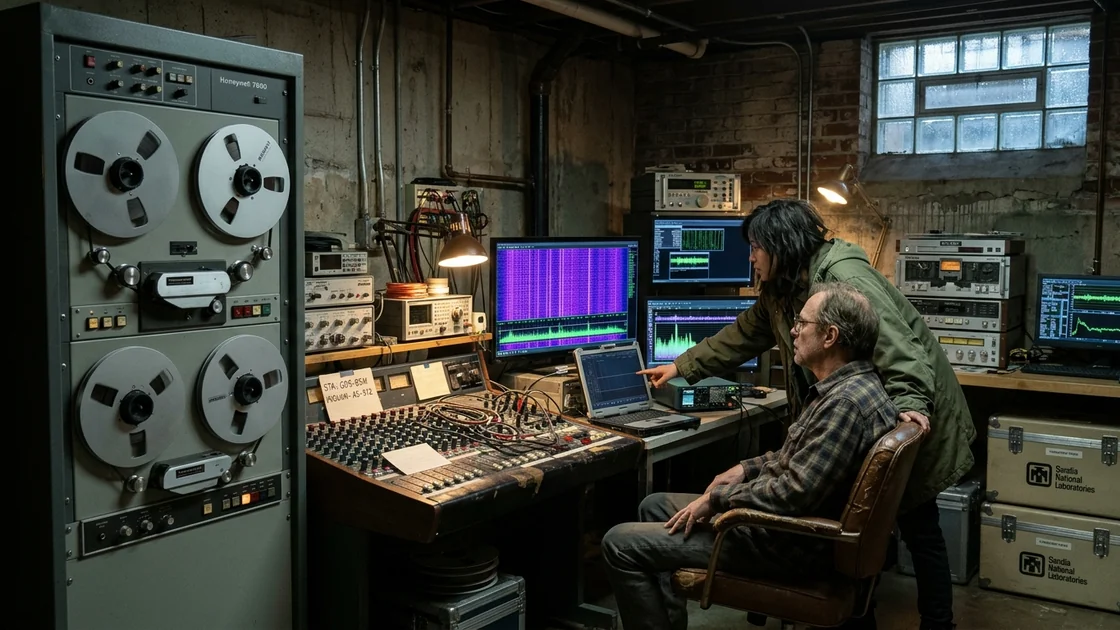
Arthur Pendelton, a reclusive archival sound engineer working out of a subterranean studio in Maryland, is contracted to digitize a forgotten crate of degraded magnetic instrumentation reels from the Apollo 17 mission. While baking and restoring the flaking oxide of the fifty-year-old tapes, he isolates an impossible, high-density digital data stream woven into the phase jitter beneath the astronauts voice telemetry and the standard timecode track. Enlisting the help of Maya Lin, a university cryptographer and retro-computing specialist, Arthur demodulates the parasitic signal to uncover a classified recording of an automated, non-human transmission intercepted in the Taurus-Littrow valley on the moon. As the duo decodes the ancient telemetry and the hidden audio of the mission controllers who buried it, the mysterious bureaucrat who hired Arthur returns with a security team to erase the reels and silence the witnesses, forcing Arthur to weaponize his vintage studio gear in a desperate fight to preserve the truth and broadcast it to the world.
The smell of dying history was always the same: a sharp, vinegary tang mixed with the sweet, waxy odor of warm crayons. Whenever Arthur Pendelton opened the door of the Despatch laboratory convection oven in the back corner of his studio, that scent rolled out into the damp basement air of Silver Spring, carrying the chemical ghosts of the nineteen-seventies.
Inside the oven, resting on perforated stainless-steel racks, sat four fourteen-inch aluminum reels of Ampex 797 instrumentation tape. They had been baking at precisely one hundred and thirty degrees Fahrenheit for sixteen hours.
Arthur adjusted his spectacles, wrapped his hands in lint-free cotton gloves, and lifted the top reel from the rack. Through the circular cutouts in the thick aluminum flange, the pack of one-inch magnetic tape looked dark and uniform, no longer weeping the sticky, tar-like residue of hydrolyzed polyurethane binder that would have gummed up the heads of his transport within thirty seconds of playback. Sticky-shed syndrome was the bane of his profession. In the late sixties and early seventies, tape manufacturers had changed their chemical formulas, unwittingly condemning millions of hours of human achievement—rock albums, senate hearings, covert wiretaps, and spaceflight telemetry—to slowly absorb atmospheric moisture and turn into glue.
Arthur carried the warm reel into the main control room, where the temperature was kept at a brisk sixty-two degrees and the relative humidity was locked at thirty-five percent by two industrial dehumidifiers that hummed in a constant, low-frequency duet. He set the reel down on a clean silicon mat beside his pride and joy: a heavily modified Honeywell 7600 instrumentation tape transport, standing six feet tall in a gray steel rack, its face a geometric miracle of brushed aluminum tension arms, sapphire guides, and custom-milled twenty-eight-track and fourteen-track fluxgate playheads.
On the worktable beside the transport lay the manifest that had arrived with the fiberglass shipping cases three days ago. The letterhead was plain, bearing only the seal of the National Archives and Records Administration, Federal Records Center, Suitland, Maryland, and a sub-contracting routing number from the Goddard Space Flight Center.
The man who had delivered them, a narrow-shouldered archivist named Richard Vance who wore a trench coat that looked like it had never seen rain, had been remarkably brief.
"Lot 409-B," Vance had said, standing near the studio door as if afraid the towering stacks of Studer, Ampex, and Nagra machines might topple over and crush him. "Declassified environmental and biomedical downlinks from the Apollo program. Mostly redundant range-station captures from Honeysuckle Creek and Goldstone. Congress mandated a full digital preservation sweep of the deep-vault holdings before the magnetic media degrades past the point of recovery. Our internal labs are backed up through twenty-twenty-eight. Your name came up as someone who still maintains wide-format IRIG transports and knows how to keep his mouth shut before a public release."
Arthur hadn't questioned the bureaucratic logic. Government agencies were notorious for losing things in salt mines and concrete bunkers for half a century, only to panic when an auditor demanded to know what was inside the boxes. And the fee Vance had authorized—half wired upfront to Arthur’s business account—was enough to pay the commercial lease on the basement for the next fourteen months.
Now, while the freshly baked reel cooled to room temperature, Arthur picked up the yellowed three-by-five index card that had been slipped inside the plastic collar of Reel 04. The handwriting was done in faded black grease pencil, the slashes across the zeroes crisp and military:
STA: GDS-85M / MISSION: AS-512 (APOLLO XVII) DATE: 13 DEC 1972 / GMT: 23:14:00 - 02:45:00 TRK 1-14 IRIG-B / S-BAND BASEBAND DEMUX / EVA-3 STA 6 NOTE: HIGH NOISE FLOOR ON SUBCARRIER. ARCHIVE ONLY. DO NOT DUB.
Arthur frowned slightly at the final instruction. Do not dub. Usually, master instrumentation tapes from the tracking stations were dubbed immediately onto secondary distribution reels for the geologists at MSC in Houston, the propulsion engineers at Marshall, and the flight surgeons. A tape marked against dubbing usually meant the tracking station had suffered an equipment malfunction—a blown transistor in a parametric amplifier or a misaligned dish—rendering the recording useless compared to the clean feed from another dish in Madrid or Canberra.
"Let's hear what broke at Goldstone," Arthur murmured to the empty room.
He lifted the cooled aluminum reel, slid it onto the upper hub of the Honeywell transport, and locked the rubber collet into place with a firm clockwise twist. With practiced, surgeon-like delicacy, he drew the dark brown ribbon of one-inch tape from the pack, threading it around the spring-loaded dancer arms, across the polished tungsten-carbide guides, over the gleaming stack of multi-track reproduce heads, between the massive steel capstan and its neoprene pinch roller, and finally onto the take-up reel below.
He didn't wear headphones yet. First came the mechanical check. He pressed the LOAD button. The vacuum columns hissed, sucking loops of tape into the buffered chambers on either side of the head stack to isolate the fragile ribbon from the heavy inertia of the fourteen-inch reels. The tension gauges settled precisely at eight ounces.
Arthur walked over to his mixing console, an old Neve broadcast desk modified with ultra-clean solid-state preamplifiers, and turned his attention to the array of high-resolution monitors mounted above the meter bridge. Every track of the fourteen-track head was routed through a pair of Prism Sound converters running at a sample rate of three hundred and eighty-four kilohertz, feeding directly into a custom Linux workstation running his spectral analysis and multi-track capture suite.
He hit PLAY on the remote control unit.
In the corner, the Honeywell transport engaged with a solid, electromagnetic clunk. The reels began to spin at fifteen inches per second. On the computer screens, fourteen horizontal timelines burst into life, painting cascading waterfalls of green, orange, and violet light across the black monitors as the fifty-year-old magnetic domains induced micro-voltages in the reproduce heads.
Arthur reached for the solo buttons on the console.
Track one through six were silent at human audio frequencies, though the spectral displays showed them blazing with high-frequency energy between thirty and ninety kilohertz—raw frequency-division multiplexed telemetry containing thousands of sensor readings from the Lunar Module Challenger and the Lunar Roving Vehicle. Suit pressures, battery voltages, coolant loop temperatures, gyroscope gimbal angles. All of it encoded as warbling tones.
Track seven was the reference track: a steady, unwavering one-hundred-kilohertz crystal-controlled sine wave recorded at the tracking station at the exact moment of capture. By measuring how that tone sped up or slowed down during playback, Arthur’s software could digitally compensate for every microscopic stretch of the tape and every mechanical imperfection of the motors, locking the time base to within a few billionths of a second.
Track eight was the voice loop.
Arthur pushed up the fader on channel eight and slipped his open-back Sennheiser headphones over his ears.
Instantly, the dry, claustrophobic acoustic space of his Maryland basement vanished, replaced by the vast, static-laced emptiness of the Taurus-Littrow valley, two hundred and forty thousand miles away and half a century in the past.
Crack-beep.
The unmistakable two-thousand-five-hundred-and-twenty-five-hertz Quindar tone—the intro beep that keyed the transmitters from Houston—echoed through the cans, followed by the calm, Texas-inflected voice of the Capsule Communicator, Robert Parker.
"...copy that, Gene. We show you have about forty-two minutes left at Station Six before we need you heading back toward the Rover for the closeout at the ALSEP site. How are the bags holding up?"
Crack-beep.
A pause of two and a half seconds—the round-trip speed of light across the cislunar abyss—and then a rush of thick, raspy S-band carrier hiss, out of which emerged the tired, breathless voice of Commander Eugene Cernan.
"Houston, the bags are fine, it's the fingers inside the gloves that are getting pretty stiff. Jack is over on the north side of the split boulder right now, trying to get a rake sample from underneath the overhang where the shadow stays permanent. Stand by one."
Behind Cernan’s voice, Arthur could hear the rhythmic, hollow shuck-hiss, shuck-hiss of the astronauts' portable life support system sublimators and the faint, metallic clinking of geological hammers against lunar breccia. Beside Cernan, Harrison "Jack" Schmitt, the only professional geologist ever to walk on another world, came onto the loop, his breathing heavy, his voice bright with scientific mania.
"Gene, look at the vesicles in this contact zone! Wait a second—get the gnomon over here, I don't want to disturb the fillet until we have a stereo pair across the fracture."
Arthur leaned back in his leather chair, closing his eyes. This was why he did the work. It wasn't for the government contracts or the obsessive fetishization of vintage electronics. It was for the time travel. On commercial master tapes, you heard a band in a room in London or Los Angeles, which was magical enough. On NASA range tapes, you heard human beings standing on the crust of an alien world, their hearts beating on Track Nine’s electrocardiogram subcarrier while their voices rode Track Eight across the vacuum of space.
He opened his eyes and glanced at the remaining tracks. Tracks nine, ten, and eleven carried the biomedical subcarriers and the Lunar Rover’s navigation gyro pulses. Tracks twelve and thirteen were blank—guard bands left unrecorded to prevent crosstalk between the high-energy telemetry tracks and the outer edge of the tape.
And then there was Track fourteen.
By Inter-Range Instrumentation Group standards, the edge track—Track fourteen—was almost always reserved for IRIG-B timecode: a one-kilohertz sine wave amplitude-modulated with rectangular pulses that spelled out the day of the year, the hour, the minute, and the second in binary-coded decimal. It was the heartbeat of any telemetry tape, allowing engineers to correlate a spike in an astronaut’s heart rate or a drop in fuel cell pressure to the exact millisecond an event occurred.
Arthur soloed Track fourteen and lowered the volume so the one-kilohertz buzz wouldn't drill into his eardrums. The harsh, mosquito-like whine of the timecode filled his headphones, pulsing with the rhythmic chug-chug-chug of the binary data frames.
On the secondary monitor, the timecode reader plugin locked onto the signal immediately, its virtual red LEDs rolling smoothly upward:
348 : 23 : 21 : 04 . 892
December thirteenth—the three hundred and forty-eighth day of the leap year nineteen seventy-two. Twenty-three hours, twenty-one minutes, four seconds Greenwich Mean Time.
Arthur watched the spectral waterfall for Track fourteen, preparing to un-solo the channel and let the ninety-minute reel run its course unattended while he brewed a fresh pot of coffee.
Then his hand froze on the mouse.
In the spectrogram of Track fourteen, the one-kilohertz timecode line was bright yellow, flanked by the symmetrical sidebands of its amplitude modulation pulses below two kilohertz. Above three kilohertz, an IRIG-B track should have been completely dark, save for the faint blue mist of analog tape hiss.
It wasn't dark.
Starting at four kilohertz and extending all the way up to twenty-two kilohertz—right at the upper frequency limit of what the tape at fifteen inches per second could reliably resolve—there was a dense, razor-sharp block of violet energy.
At first glance, it looked like broadband white noise, the kind of hash that had prompted the technician in nineteen seventy-two to scribble HIGH NOISE FLOOR ON SUBCARRIER on the index card. If you listened to it through a speaker, or looked at it on a nineteen-seventies cathode-ray oscilloscope, that was all it would ever appear to be: random thermal static from an overheated preamplifier in the Mojave Desert.
Arthur soloed Track fourteen again, engaged a steep digital high-pass filter at three thousand five hundred hertz to strip away the buzzing timecode, and brought the fader up.
Shhhhhhhhhhhhhh.
It sounded like rushing water. Like wind through dry leaves. Pure, featureless static.
Except Arthur was looking at it through a Fast Fourier Transform window with a sixty-five-thousand-point resolution, synchronized to the one-hundred-kilohertz crystal reference tone on Track seven. And when he engaged the real-time azimuth and time-base correction—removing the microscopic mechanical wobble of the tape transport—the violet mist on the screen snapped into a rigid, geometric grid.
Arthur’s breath caught in his throat.
The static wasn't random. It was divided into sixty-four discrete, ultra-narrow frequency channels, spaced precisely two hundred and fifty hertz apart, with dead-black guard bands of ten hertz between each one. Within each of those sixty-four channels, the phase of the carrier wave was flipping back and forth at furious speeds, while the amplitude stepped between four distinct levels.
"Orthogonal frequency-division multiplexing," Arthur whispered aloud, his voice sounding small and strange in the deadened acoustics of the room. "With quadrature amplitude modulation."
He stared at the screen, his mind racing through the history of telecommunications. The mathematical concept of OFDM had been proposed in academic papers in the late nineteen-sixties at Bell Labs, sure. Brilliant theorists had sketched it on blackboards.
But in December of nineteen seventy-two, to actually generate or decode a sixty-four-carrier QAM signal in real time would have required a room full of discrete fast-Fourier-transform mainframe processors running at speeds that simply did not exist outside of theoretical projections. The Apollo Guidance Computer on board the Lunar Module had a clock speed of two megahertz and four kilobytes of magnetic core RAM. Even the massive IBM System/360 Model 75 mainframes sitting on the ground floor of Mission Control in Houston couldn't have synthesized this waveform and tucked it neatly into the high-frequency roll-off of a timecode track without overloading their entire real-time telemetry bus.
Even more Impossible: the signal wasn't drifting relative to the voices on Track eight.
Arthur split the screen, overlaying the phase envelope of Cernan and Schmitt’s S-band voice downlink on Track eight with the strange sixty-four-channel grid on Track fourteen.
Every time Gene Cernan’s voice caused a momentary drop in the S-band carrier margin due to multipath reflections off the walls of the Taurus-Littrow valley, the exact same multipath distortion appeared simultaneously across all sixty-four channels of the hidden digital block.
That meant this signal hadn't been added at the Goldstone dish in California. It hadn't been recorded onto the tape by some secret intelligence agency splicing into the ground lines between the Mojave Desert and Maryland.
The Doppler shift matched the Moon's orbital velocity relative to the rotating Earth down to a tenth of a millimeter per second.
Whatever had generated that dense wall of digital data, it had come down the two-thousand-two-hundred-and-eighty-seven-megahertz S-band beam directly from the lunar surface.
At two-fifteen in the morning, the rain started outside, drumming against the frosted glass-block windows set high in the basement wall at street level.
Arthur hadn't brewed the coffee. He hadn't moved from his chair for four hours, except to swap Reel 04 for Reel 05 and then Reel 06, checking to see if the anomaly persisted across the entire shipment.
Reel 01 through Reel 03—recorded during EVA-1 and EVA-2 on December eleventh and twelfth—were completely normal. Their Track fourteen timecodes were clean above three kilohertz, showing only the gentle hiss of iron oxide particles passing across the head.
The sixty-four-channel block began abruptly on Reel 04, at
348:23:18:44.012 GMT.
Curious as to what the astronauts were doing at that exact second,
Arthur had scrubbed the audio back to 23:18:30 and listened
to Track eight alongside Track eleven, which carried the un-routed
engineering intercom loop from the back rooms at Mission Control.
At 23:18:35, Jack Schmitt had been describing the
crystalline structure of a dark basaltic inclusion on the side of the
giant split boulder at Station Six, high up on the lower slopes of the
North Massif.
"...and it looks like the shock fracturing goes all the way down into the regolith here, Gene. When this thing rolled down the mountain, it plowed a trench about two meters deep and turned up stuff from underneath the talus mantle. Wait a minute. Something’s glinting down at the base of the furrow."
"Watch your footing, Jack," Cernan’s voice had replied, sharp with caution. "That slope is twenty-five degrees and the dust is loose."
"I see it, Gene. I'm not stepping down into the trench, I can reach it with the extension handle on the tongs. It doesn't look like glass splatter. It's too regular. Almost looks like a piece of mylar from the descent stage, except we're three kilometers uphill from the LM."
There was the sound of scraping—metal tongs against rock—and then, at
23:18:44.012, a sharp, high-pitched chirp bled
across the astronaut voice loop for less than fifty milliseconds.
Immediately, the sixty-four-channel digital wall roared to life on Track fourteen.
On the voice track, Schmitt gasped. "Whoa. Did you hear that in your headset, Gene? My VHF squelch just broke."
"Yeah, I got a buzz in my right ear," Cernan said. "Houston, you reading any interference on the LCRU? Sounds like the Rover antenna just picked up a harmonic from the ALSEP transmitter."
There was a long silence from Houston. Longer than the two-point-six-second light-time delay. Six seconds. Eight seconds.
When Arthur pulled up Track eleven—the internal Mission Control flight director's loop—he heard why. Over the faint background chatter of the Trench in Houston, a voice clipped with cold, frantic authority cut across the loop:
"Flight, Comm Tech. Drop the public loop to delay buffer NOW. Goldstone is seeing a twenty-decibel spike on the S-band phase-lock auxiliary. Something is pumping five hundred kilobits a second into the Rover's high-gain omni."
"Comm Tech, this is Flight," the voice of the Flight Director snapped back. "Five hundred kilobits? The LCRU doesn't have a modulator that can push more than sixteen kilobits on the telemetry sub!"
"I know that, Flight! It's not coming from the Rover's processor, it's inductively coupling straight into the travelling-wave tube amplifier! Wait—Span Room is calling override. Directive White-Seven. Patching the auxiliary baseband straight to Goldstone Recorder Four, Track Fourteen, and clamping the Houston demux."
A new voice—older, flat, devoid of the brisk astronautic cadence of NASA personnel—spoke on a sub-channel of Track eleven that didn't even have a console callsign.
"Flight, this is Backroom Gold. Tell the crew it's electrostatic discharge from dust buildup on the Rover's fender extension. Have them move away from the north side of the boulder immediately and proceed to the Rover. Do not log the anomaly in the voice transcript."
Two seconds later, on Track eight, the warm, easygoing voice of CAPCOM Bob Parker came back over the air to the Moon, slightly strained around the edges:
"Uh, Challenger, Houston. Comm says you're getting a little static buildup discharging off that loose dust in the shadow of the boulder, coupling into your backpack antennas. Why don't you boys leave that trench sample where it is, grab your documented bags from the sunward side, and mosey on back to the Rover? We're getting a little tight on consumables."
Up on the slopes of the North Massif, Jack Schmitt sounded bewildered and disappointed. "Static discharge? In a vacuum? Bob, the conductivity of dry breccia wouldn't—"
"Jack, let's move," Cernan interrupted, his commander's instinct taking over. "Houston's watching the clocks. We've got tons of rock already. Step back up on the flat."
"Copy, Gene. Stepping back. Sure is a weird piece of slag down there, though. Looks almost like braided ceramic."
And for the next ninety-two minutes, even after Cernan and Schmitt had climbed back onto the Lunar Rover and driven away from Station Six toward the valley floor, the sixty-four-channel digital torrent on Track fourteen had continued to pour down the S-band link without a single dropped frame, until the Rover's high-gain antenna was finally powered down at the end of EVA-3.
Arthur took off his headphones and set them down on the console with trembling fingers.
Directive White-Seven. Backroom Gold.
He had restored hundreds of hours of NASA audio over his twenty-year career. He knew the callsigns of every console in the Mission Operations Control Room and the Staff Support Rooms behind them: RETRO, FIDO, GUIDO, EECOM, GNC, TELMU, CONTROL, INCO, FAO, NETWORK. There was no Backroom Gold.
And yet, someone had been sitting in a room in nineteen seventy-two, waiting for a signal they knew might be triggered on the Moon, with a pre-arranged protocol—Directive White-Seven—already wired into the tracking station patch bays to shunt an impossible half-megabit digital stream onto the unused upper bandwidth of an analog timecode track.
Arthur reached for his cell phone. He scrolled past the handful of contacts—equipment repairmen, mastering clients, his sister in Oregon—until he found Lin, Maya (UMD).
He didn't bother checking the time. Maya was an associate professor in the Department of Computer Science at the University of Maryland, specializing in archaic cryptographic architectures and signal intelligence history. More importantly, she had severe insomnia and a vindictive streak toward classified government secrets ever since the NSA had revoked her doctoral grant ten years ago for publishing a paper that accidentally reverse-engineered a Cold War satellite framing protocol.
The phone rang twice before she picked up. In the background, Arthur could hear the rapid clack-clack-clack of a mechanical keyboard with Cherry MX Blue switches.
"Arthur," Maya said, her voice brisk and entirely awake. "If you're calling me at two-thirty in the morning to ask for the pinout of a nineteen-sixty-four Ampex video head again, I'm going to drive to Silver Spring and hit you with my car."
"How fast can you get here?" Arthur asked.
The typing stopped. "What did you break?"
"Nothing is broken," Arthur said, his eyes fixed on the glowing violet grid of the sixty-four carriers on his monitor. "I have a one-inch instrumentation master from Goldstone. Apollo 17. Track fourteen has a sixty-four-subcarrier OFDM signal sitting above the IRIG-B timecode, phase-locked to the lunar S-band downlink at five hundred kilobits per second."
Silence hung on the line for four full seconds.
"You're hallucinating," Maya said flatly. "You breathed in too much shedding polyurethane binder from your tape oven. Go outside and get some fresh air."
"I synced the time-base against the one-hundred-kilohertz crystal reference on Track seven," Arthur said, speaking rapidly, every word precise. "The constellation diagram on each subcarrier is sixteen-QAM. The symbol rate is twelve hundred baud per channel. And the multipath fading envelope matches the Lunar Rover's high-gain dish down to the microsecond."
"Wait," Maya said. Her chair squeaked over the phone. "Sixteen-QAM over sixty-four orthogonal carriers? In nineteen seventy-two? Arthur, the first commercial DSP chip capable of doing an inverse Fast Fourier Transform at that speed wasn't fabricated until the nineteen-eighties. Even DARPA didn't have silicon that small or fast during Nixon's first term."
"It didn't come from DARPA," Arthur said quietly. "According to the un-routed flight director's loop on Track eleven, it coupled into the Lunar Rover's transmitter when Jack Schmitt poked a pair of metal tongs into a trench under the split boulder at Station Six."
This time, the silence stretched for nearly ten seconds. When Maya spoke again, the sarcasm had completely vanished from her voice.
"Is your studio workstation connected to the internet?"
"No," Arthur said. "Air-gapped since I built it. I transfer files to the office machine upstairs via thumb drive when I need to upload to a client."
"Good. Unplug the ethernet cable from your office machine upstairs anyway, and take the battery out of your phone—or put it in your microwave and close the door. Do not call anyone else. I'm packing my SDR rig and my field laptop. I'll be at the alley door in twenty minutes."
The line went dead.
Twenty-two minutes later, three sharp raps sounded against the heavy steel fire door at the back of the basement utility corridor.
Arthur checked the closed-circuit camera feed above the door. Maya stood under the flickering sodium vapor light of the alley, her dark hair plastered to her forehead by the December rain, clutching a Pelican case to her chest and wearing an oversized surplus army parka over pajama pants and combat boots.
He slid back the deadbolt and pulled the door open. She slipped inside immediately, shaking the water off her coat like a terrier before pulling the door shut and throwing the bolt herself.
"Did you microwave your phone?" she asked, already walking past him toward the warm glow of the control room.
"Both of them—mine and the studio landline base station," Arthur said, following her. "Maya, you're acting like the men in black are already sitting in a van across the street."
"Arthur, my sweet, analog hermit," Maya said, setting her Pelican case on the worktable beside the Honeywell transport and popping the plastic latches. "How did you get these tapes?"
"A NARA subcontract through Goddard. A guy named Richard Vance brought them in on Tuesday."
Maya paused, her hands resting on the foam lining of her case. She looked at the fiberglass shipping containers stacked near the isolation booth. "Look at the stencil on those cases. That's not a Suitland Federal Records Center stencil. Suitland uses barcoded Tyvek tags on acid-free gaylord boxes. Those are high-impact EMP-shielded Sandia National Laboratories transport cases from the Department of Energy's Nevada Test Site."
Arthur blinked, looking over at the gray fiberglass tubs. He had assumed they were just heavy-duty NASA flight cases. "Why would the Department of Energy have Apollo telemetry reels?"
"Because under the Atomic Energy Act of nineteen fifty-four, if you want to bury something so deep that not even a Senate intelligence committee or a Freedom of Information Act lawsuit can ever touch it, you don't classify it as 'Top Secret' under the Department of Defense or NASA," Maya said, lifting a ruggedized ThinkPad and an Ettus Research Universal Software Radio Peripheral from the foam. "You classify it as 'Restricted Data—Transclassified Foreign Nuclear Information' under the Department of Energy. No automatic declassification after twenty-five years. No presidential review board. Just a black hole."
"Then why give them to me to digitize?" Arthur asked, a cold knot tightening in his stomach.
"Because the people who hid this in nineteen seventy-two are dead," Maya said, plugging a coaxial BNC cable from the back of Arthur's Prism converter into her SDR box. "And the generation of bureaucrats who replaced them probably only have a cryptic index card in a vault saying 'Project White-Seven: Magnetic Media, Fourteen-Track.' The Department of Energy doesn't maintain nineteen-seventies IRIG tape transports anymore, and if they sent these to the NSA's audio lab at Fort Meade, fifty analysts with security clearances would immediately look at the spectral waterfall you just looked at. Instead, some mid-level compartmentalized custodian like your friend Vance hires a quiet civilian restoration specialist who is only supposed to do a blind flat transfer to broadcast WAV files and hand over the hard drive."
She looked up at him over the rim of her laptop screen, her dark eyes sharp. "He didn't expect you to actually listen to Track fourteen with an FFT analyzer synced to the capstan reference."
"It's my job to check every track for azimuth alignment and head contact," Arthur protested defensively. "You can't align the high frequencies on an instrumentation head without looking at a spectrum analyzer!"
"Which is why bureaucracies eventually fail—they don't understand how craftsmen work," Maya said, her fingers already flying across her keyboard, opening GNU Radio Companion. "Now show me the raw capture file from Reel 04."
Arthur leaned over her shoulder and pointed to the directory on his Linux workstation. He had exported the ninety-two-minute segment of Track fourteen—already time-base corrected against Track seven—as a raw thirty-two-bit floating-point file onto a fast solid-state scratch drive.
Maya piped the file into her software-defined radio flowgraph. Within ninety seconds, she had built a polyphase filter bank to split the sixty-four subcarriers apart, followed by a Costas loop to lock onto the phase of each carrier.
On her laptop screen, sixty-four tiny square boxes popped up. Inside each box, green dots were spinning in tight circles before snapping into sixteen crisp, stationary clusters arranged in a four-by-four grid.
"Look at that signal-to-noise ratio," Maya breathed, leaning closer to the screen. The glow of the green constellation points reflected in her pupils. "Zero inter-symbol interference. Whoever designed this waveform understood multipath channel coding better than anyone on Earth did until the late nineteen-nineties. Look at the pilot tones on channels one, sixteen, thirty-two, and sixty-four. It's actively measuring the lunar ionosphere and the S-band transponder's non-linearities and pre-distorting the phase to cancel them out."
"Can you extract the bitstream?" Arthur asked.
"I already am," she said. "Sixteen-QAM gives us four bits per symbol. Twelve hundred symbols per second across sixty-excluding-the-four-pilots channels... that's two hundred and eighty-eight kilobits per second of raw payload."
She opened a hexadecimal dump window. Instantly, streams of green characters began cascading down the black terminal window.
At first, it looked like gibberish—the randomized output of a cryptographic scrambler or a compressed file. Maya paused the scroll and stared at the repeating headers occurring every four thousand and ninety-six bytes.
FF 00 AA 55 1B 37 00 00 00 01
FF 00 AA 55 1B 37 00 00 00 02
FF 00 AA 55 1B 37 00 00 00 03
"It's not encrypted," Maya whispered, her voice dropping an octave in
disbelief. "Look at the sync word. FF 00 AA 55. That's pure
alternating ones and zeroes for clock recovery, followed by a
sixteen-bit frame identifier 1B 37, and a thirty-two-bit
sequential packet counter."
"Why wouldn't a classified signal be encrypted?" Arthur asked.
"Because this wasn't meant to be hidden," Maya said slowly, her fingers trembling slightly as she wrote a quick Python script to strip the packet headers and examine the payload structure. "It was meant to be understood. By anything capable of building a radio receiver."
She hit Enter.
The terminal window refreshed, sorting the payload packets by their sub-channel identifiers. There were three distinct data types interleaved in the stream:
STREAM 01 (ID: 0x01) - 16-BIT LINEAR PCM AUDIO / 24,000 HZ
STREAM 02 (ID: 0x02) - 2D RASTER MATRIX / 1024 x 1024 x 12-BIT GRAYSCALE
STREAM 03 (ID: 0x03) - VECTOR EPHEMERIS & TELEMETRY LOG
Arthur stared at the first line. "Sixteen-bit linear PCM audio? Maya, Sony and Philips didn't standardize sixteen-bit PCM until the Compact Disc in nineteen eighty. In nineteen seventy-two, Bell Labs was barely experimenting with twelve-bit DPCM over T-1 trunk lines."
"Wait," Maya said. "Before we look at the images or the vectors, let's route Stream 01 to your console. If it's linear pulse-code modulation—just raw numerical values representing sound wave amplitudes—we don't need a codec. Your DAC can play it right now."
She piped the extracted binary stream of 0x01 through a
virtual audio cable to channels fifteen and sixteen of Arthur's Prism
converter.
Arthur walked back to the Neve desk. Instead of using headphones, he pressed the MAIN MONITOR switch, routing the output to the pair of massive Tannoy dual-concentric studio monitors mounted in the front wall. He slowly pushed up the fader for channel fifteen.
A sound filled the basement studio.
It wasn't the hiss of an S-band radio link. It was crystal clear, possessing a dynamic range so wide and a noise floor so dead that it felt as if a hole had been punched through the concrete wall of the room into another space entirely.
Click-whirrrrrr. Tock. Tock. Tock.
It was a mechanical, resonant sound, coupled through solid matter rather than air—like a contact microphone pressed against the hull of a submarine. Underneath the rhythmic tock-tock-tock was a low, harmonic hum at precisely sixty-four hertz, vibrating in the floorboards beneath Arthur's shoes.
And then, mixed into that ultra-clean digital stream, they heard voices.
Not transmitted over radio. Captured by a microphone—or a vibrational transducer—resting inside the trench at Station Six, picking up the vibrations traveling through the lunar dust and the astronauts' boots, and simultaneously demodulating their local VHF suit-to-suit radios with pristine clarity.
"...stepping back," Jack Schmitt’s voice echoed from the Tannoy speakers, completely free of NASA's two-kilohertz voice-band filtering. He sounded as if he were standing three feet away in the studio, breathing inside his fiberglass helmet. "Sure is a weird piece of slag down there, though. Looks almost like braided ceramic."
Then came a series of synthesized tones—musical, mathematical triad chords climbing in logarithmic frequency steps—followed by a voice that did not belong to Cernan, Schmitt, or anyone in Houston.
It was a composite voice, stitched together from phonemes cut directly out of the Apollo 17 voice loop over the preceding two days of the mission. A cold, crystalline collage of Gene Cernan's vowels and Bob Parker's consonants, speaking in cadence with the rhythmic tock-tock-tock of the buried machine:
"STATION... SIX... RECEIVING. THERMAL... THRESHOLD... EXCEEDED. SOLAR... TRANSIENT... NEGATIVE. SEISMIC... MASS... DETECTED. BIOLOGICAL... CARBON... TWO. QUERY... ORIGIN... THIRD... ORBITAL... BODY."
Arthur felt the hair on his forearms stand straight up. Beside him, Maya grabbed the edge of the wooden meter bridge so hard her knuckles turned white.
"It listened to them for two days," Maya whispered, her eyes wide and fixed on the speakers. "While they were out on EVA-1 and EVA-2. It intercepted their VHF suit radios, mapped the syntax of their language from the contextual telemetry of the Lunar Module, and built a vocal synthesizer out of their own voices to ask them a question."
"Why didn't Cernan and Schmitt hear this?" Arthur asked, his voice barely a croak.
"Because it didn't transmit on their two-hundred-and-ninety-six-megahertz VHF suit frequency!" Maya said, pointing wildly at the spectral display. "It saw the high-bandwidth S-band beam going from the Lunar Rover straight back to the huge dishes on Earth, realized that was the primary command node, and injected its response straight into the Rover's S-band traveling-wave tube!"
Out of the Tannoy speakers, the stitched-together voice of Cernan and Parker spoke again, riding over the deep, sixty-four-hertz hum:
"ARCHIVE... DUMP... INITIATED. DURATION... LOCAL... IDLE: ONE... HUNDRED... AND... FOURTEEN... THOUSAND... ORBITS... THIRD... BODY. RECORDING... SOLAR... EVOLUTION... AND... LOCAL... IMPACT... EVENTS. TRANSFERRING... LOG... TO... PRIMARY... NODE."
"One hundred and fourteen thousand orbits of the third body," Arthur murmured, his mind grasping at the number. "Earth orbits. Years. It was sitting under that boulder in the Taurus-Littrow valley for a hundred and fourteen thousand years."
"Since the last interglacial period on Earth," Maya said. She turned back to her laptop, her fingers flying over the keys with frantic intensity. "It thought the Goldstone dish in California was our civilization's central archive node. When Schmitt scraped the dust off its thermal sensor or solar collector with his sampling tongs, it woke up from standby mode, saw that we had finally reached the Moon, and dumped its entire hundred-and-fourteen-thousand-year black box into our telemetry stream!"
She executed the script to render STREAM 02—the
twelve-bit grayscale raster matrices.
On the forty-inch monitor mounted above the console, windows began popping open, one every three seconds, as the fifty-year-old magnetic tape on the Honeywell transport continued to spin at fifteen inches per second.
The first image was a high-contrast, ultra-sharp panoramic projection of the Taurus-Littrow valley—except the giant split boulder at Station Six wasn't there yet. The North Massif looked smoother, younger, before millions of micrometeorites had pitted its regolith into powder. In the black sky above the horizon hung the Earth, captured in multispectral wavelengths that showed the vast, gleaming white sheet of the Laurentide Ice Sheet covering half of North America.
The second image was a star chart, plotted in three-dimensional stereographic projection, showing the proper motion vectors of forty-two nearby stars—and a solid trajectory line tracing back toward the constellation of Cygnus, marked with decay ratios of unstable isotopes to establish a universal clock.
The third image was a schematic of the probe itself: a toroidal lattice of braided metamaterials, no larger than a bicycle wheel, designed to burrow just beneath the insulating blanket of lunar regolith and wait for a biosphere on the third planet to develop radio astronomy and spaceflight.
"It's a Bracewell probe," Maya whispered, tears suddenly springing to her eyes as dozens more images cascaded across the screen—solar flare records, gamma-ray burst logs, high-resolution orbital scans of the Earth taken during the probe's descent over a hundred millennia ago showing Pleistocene megafauna migrations and the smoke of early hominid campfires in the Rift Valley. "Arthur, the physicist Ronald Bracewell hypothesized this in nineteen sixty. Instead of broadcasting radio signals across the galaxy that fade into noise over light-years, an advanced civilization sends small, autonomous robotic probes to sit quietly in stable orbits or on airless moons inside promising star systems. They just sleep for eons until the local species climbs out of its gravity well and trips the alarm."
Arthur stared at the images, his heart hammering against his ribs. For fifty years, this had been sitting on reels of decaying Ampex tape in a Department of Energy vault, slowly turning to sticky glue while humanity wondered if it was alone in the universe.
"Why?" Arthur asked, a wave of profound anger washing over his awe. "Why would Backroom Gold bury this? It wasn't a weapon! It was a welcome gift! A history book of our own solar system!"
"Think about nineteen seventy-two, Arthur," Maya said darkly,
watching the hexadecimal dump of STREAM 03 scroll
past—thousands of pages of materials science equations and mathematical
proofs encoded in universal binary logic. "The Cold War is at its
height. If the Nixon administration announces that an alien probe handed
Goldstone a compendium of advanced materials science and
energy-conversion mathematics, the Soviet Union assumes the United
States is about to build an unstoppable strategic weapon—or worse, that
the probe is still active on the Moon and whoever controls
Taurus-Littrow controls the future. We had already canceled Apollo 18,
19, and 20. Our Saturn V production line was shut down. We couldn't go
back to get it for decades, and we couldn't risk the Soviets sending an
automated Luna sample-return lander to Station Six to dig it up!"
She pointed to the final packets of Reel 06, which were already queued up on the workstation.
"Wait. Look at the timestamp at the end of Reel 06.
349:00:48:12 GMT. There's an outbound command carrier
recorded on Track thirteen."
Arthur frowned. Track thirteen had been blank on Reel 04. He loaded the Reel 06 capture file that he had transferred earlier and zoomed in on the end of Track thirteen.
There, for twelve seconds, was a massive burst of S-band uplink telemetry sent from Goldstone to the Lunar Rover's high-gain dish—not at standard two-kilobit command rates, but a brute-force, high-wattage carrier pulse modulated with a crude, repeating binary pattern that mimicked the probe's own packet header:
FF 00 AA 55 1B 37 FF FF FF FF
And on the audio stream from the probe inside the trench on the Moon, just before the sixty-four-channel signal went dead forever, the stitched-together voice of the astronauts spoke one final string of words:
"PRIMARY... NODE... COMMAND... ACKNOWLEDGED. STERILIZATION... AND... THERMAL... SELF-DISASSEMBLY... EXECUTING. FAREWELL... THIRD... BODY."
A brief, blinding white flash filled the final raster image from the trench—a thermite or plasma charge vaporizing the braided ceramic torus from the inside out—and then the sixty-four subcarriers vanished from Track fourteen, leaving only the lonely, analog hiss of the Mojave Desert receiver.
Arthur sat frozen in his chair. The silence in the studio felt heavy enough to crush bone.
"They didn't just hide the recording," Arthur whispered, his voice shaking with revulsion. "Backroom Gold figured out the probe's command header syntax while it was still transmitting... and sent a self-destruct code back up the S-band dish. They ordered it to destroy itself so the Soviets could never find it."
Maya didn't answer. She was staring past Arthur, up toward the top of the mixing console, where the small, black-and-white security monitor showed the camera feeds from the street and the back alley.
"Arthur," she said softly.
He turned his head.
On Camera One—the wide-angle lens looking out at the rain-slicked pavement of Georgia Avenue—two black Chevrolet Suburbans with government license plates had just pulled up to the curb with their headlights extinguished. Simultaneously, on Camera Two, a dark sedan blocked the mouth of the back alley.
The doors of the Suburbans opened. Six men stepped out into the rain. Four of them wore heavy tactical rain jackets with the bulge of suppressed submachine guns beneath their arms. The fifth man carried a heavy aluminum briefcase and a portable bulk tape degausser.
The sixth man was Richard Vance, wearing his dry trench coat and holding a ring of master keys to the building's street-level entrance.
"How?" Arthur breathed, backing away from the console as if the monitor itself could shoot him. "We air-gapped the computers! We put the phones in the microwave!"
Maya cursed under her breath, looking down at the fiberglass Sandia shipping case sitting on the floor near the door. She knelt and ran her fingers underneath the lip of the molded plastic rim, pulling hard until a small, flat black rectangle potted in epoxy snapped free with a tearing sound of industrial adhesive.
Next to the epoxy block, a hair-thin copper wire ran along the inside hinge of the lid—already severed when Arthur had opened the latches on Tuesday—connected to a tiny barometric and RF sensor.
"It wasn't an active GPS tracker until you turned on your high-frequency crystal reference oscillator," Maya said grimly, tossing the module onto the desk. "A passive harmonic transponder tuned to one hundred kilohertz. As long as you only played the voice tracks at normal audio frequencies, it stayed asleep. The moment you routed Track seven's one-hundred-kilohertz reference tone through your unshielded patch bay at high gain to time-base correct Track fourteen, the ambient electromagnetic field in this room tripped the sensor, and it sent a burst packet over the cellular band the next time the building's smart electric meter polled the grid."
"It was a trap," Arthur said, his mind reeling. "Vance knew there was a discrepancy on the card. He didn't hire me to preserve these tapes. They wanted to know if modern civilian restoration software could see what was on Track fourteen—and if I went looking for it, the case would tell them."
Above their heads, on the street level of the two-story brick building, the heavy front door latch clicked open, followed by the muted thud of boots on the concrete stairs leading down to the basement hallway.
"We have two doors between the stairs and the studio," Arthur said, his initial panic giving way to the cold, methodical focus of a man who knew every bolt, circuit breaker, and acoustic seal inside his own bunker. "The outer vestibule door is solid core oak, which will slow them down for about five seconds. The inner studio door is a three-hundred-pound Overly acoustic blast door with a magnetic compression seal and an interior steel throw-bolt. Even with a battering ram, that takes three minutes to breach."
"And the back fire door?" Maya asked, already pulling a high-speed two-terabyte NVMe drive in an aluminum enclosure out of her pocket and plugging it into the USB-C port of Arthur's workstation.
"Steel frame set in poured concrete, bolted from the inside. No keyhole on the exterior."
"Three minutes isn't enough to get out of the building, Arthur! They have both exits covered!"
"I know," Arthur said. He looked at the progress bar on the Linux workstation as Maya began copying the raw four-gigabyte Track fourteen capture and the decoded folders onto her drive. "How long for the copy?"
"Forty-five seconds!"
Outside in the basement corridor, the solid-core oak door of the vestibule splintered with a single, muffled boom of a hydraulic breaching tool. Heavy footsteps rushed into the small outer lobby, stopping directly outside the three-inch-thick acoustic door of the control room.
The handle jiggled once. Then a calm, amplified voice spoke through the intercom speaker mounted beside the studio's interior talkback panel.
"Mr. Pendelton," Richard Vance said. His voice sounded remarkably polite, even with the slight distortion of the cheap intercom electret microphone. "Open the inner door, please. We are here under the authority of the Department of Energy, Office of Secure Transportation, pursuant to 42 U.S.C. § 2274. You are in possession of Restricted Data relating to national security. If you open the door and step back from your workstation, this remains an administrative containment matter."
Arthur didn't touch the talkback button. He looked at Maya's screen:
78%... 84%... 91%...
"Look at Camera Three," Maya whispered, pointing to the small monitor showing the outer vestibule.
Two of Vance's tactical operatives weren't holding a battering ram. They were pressing a square loop of copper-sheathed shape-charge detcord against the heavy steel hinges and the lock plate of the acoustic door, while a third man screwed a long cylinder onto the barrel of a compact nine-millimeter carbine.
"Administrative containment my ass," Maya hissed. "People with administrative warrants don't bring breaching charges and subsonic ammunition to a basement at three in the morning. The moment that door blows, we're two tragic casualties of an electrical fire caused by your vintage tube equipment."
100% - TRANSFER COMPLETE.
Maya yanked the tiny aluminum NVMe drive from the port, popped open its casing, and pulled out the bare M.2 circuit stick—no larger than a stick of chewing gum. She slipped it inside the lining of her combat boot, then grabbed a spare, broken M.2 drive from Arthur's parts bin and jammed it into the USB enclosure, leaving it plugged into the front of the workstation.
"What about the backup?" Arthur asked, grabbing a blank micro-SD card, slotting it into the secondary reader, and copying solely the decoded thirty-megabyte package of images, text vectors, and the sixteen-bit audio voice message. It finished in less than a second.
"If they search us and find it, we're dead anyway," Maya said, looking wildly around the windowless control room. "Is there any way out of here that doesn't go through the lobby or the back alley?"
Arthur's eyes darted to the ceiling near the back of the live vocal booth.
"The HVAC return plenum," he said quickly. "When I soundproofed the room ten years ago, I built a baffled labyrinth inside the old coal chute that leads up into the mechanical room of the dry cleaner next door. The acoustic baffle box unscrews from the inside, and the coal chute grate opens into their boiler room."
"Go! Get the baffle open!" Maya said, grabbing a hammer from his tool drawer and smashing the screen of her ThinkPad before throwing the laptop onto the floor near the workstation so it looked like a panicked, failed attempt to destroy her own gear.
"Wait," Arthur said, stopping beside the towering racks of power amplifiers and his massive industrial bulk tape eraser—a forty-pound electromagnetic coil mounted under the worktable, designed to wipe fourteen-inch instrumentation reels in a single pass by generating a thirty-thousand-gauss alternating magnetic field.
"If we just climb into the chute, they'll be inside this room in ten seconds and right behind us in the duct before we can get the boiler room grate open," Arthur said, his eyes narrowing as he looked at the wiring feeding the bulk degausser and the two-hundred-and-forty-volt three-phase circuit breaker panel on the wall beside the acoustic door.
"What are you doing?" Maya demanded, tugging at his sleeve as the men in the lobby finished taping the breaching charge to the steel doorframe and stepped back around the corner of the hallway.
"Giving you two minutes," Arthur said.
With the speed of a man who had wired every inch of the room himself, he grabbed a heavy pair of insulated lineman's pliers, yanked the cover off the two-hundred-and-forty-volt three-phase distribution box, and pulled the heavy copper grounding strap out of the neutral bus bar.
He took the bare copper cable, clamped it with a vice-grip directly onto the interior steel skin of the acoustic blast door, and connected the hot fifty-amp phase lead from his tube amplifier rack straight into the primary coil of the industrial bulk degausser, jamming the thermal overload relay shut with a screwdriver.
Then he grabbed a canister of anhydrous isopropyl alcohol—two gallons of ninety-nine-point-nine-percent pure head-cleaning solvent—and set it on the floor three feet in front of the door, right next to the open rack of nineteen-fifties nitrocellulose-lacquer transcription discs he kept for spare calibration tests.
"Arthur, are you insane?!" Maya whispered, horrified. "You're going to burn your whole studio down!"
"They're going to burn it down anyway to cover up the shooting!" Arthur snapped, grabbingReel 04—the original master reel—off the Honeywell transport and replacing it in two seconds with a scrap reel of blank calibration tape. He shoved Reel 04 into its round aluminum can, handed it to Maya, and pushed her toward the isolation booth. "Get into the booth and pull the baffle down! Now!"
Outside the door, Vance's voice sounded once more over the intercom: "Clear the frame. Fire in the hole."
Arthur sprinted into the vocal booth behind Maya, slammed the double-glazed glass isolation door shut, and reached up to yank the four quick-release toggle clamps holding the heavy lead-lined rockwool baffle box inside the ceiling plenum.
As the baffle swung down on its safety chains, the breaching charge on the main control room door detonated.
CRACK-BOOM!
Even through the double panes of laminated studio glass, the concussive wave slammed into Arthur's chest like a physical blow. The three-hundred-pound steel door tore loose from its hinges and crashed inward onto the control room floor, crushing the two-gallon plastic jug of pure isopropyl alcohol beneath its edge and spraying a fine mist of volatile solvent across the concrete and the stack of nitrocellulose discs.
Through the cloud of gray cordite smoke, two men in black tactical vests charged into the room, weapons raised, their boots splashing directly into the pool of alcohol on the conductive steel door.
Arthur reached through the small cable pass-through port of the vocal booth and threw the external knife switch for the two-hundred-and-forty-volt three-phase dryer circuit.
Two things happened simultaneously.
First, fifty amps of ungrounded two-hundred-and-forty-volt current surged through the steel door on the floor, arcing across the wet boots of the two lead operatives in a blinding blue flash of plasma that instantly ignited the atomized isopropyl alcohol and the pile of nitrocellulose discs into a roaring wall of white-hot chemical fire.
Second, the un-throttled industrial degausser under the worktable overloaded into a massive, screaming electromagnetic pulse before its internal copper windings melted.
Every CRT monitor in the room imploded with a sharp pop. The tactical radios and electronic sights on the operatives' vests sparked and died. And on the Honeywell transport and the open shipping cases beside it, every magnetic domain on the decoy tapes was instantly scrambled into uniform, featureless silence as the fire alarm sprinklers in the ceiling finally shattered their glass bulbs and rained water down onto the burning solvent, filling the control room with suffocating black smoke and steam.
"Go! Up!" Arthur yelled, boosting Maya's boots until she scrambled up into the brickwork of the old coal chute.
Behind the double glass of the vocal booth, through the swirling black smoke and the flashing strobe of the fire alarm, Arthur saw Vance stagger into the doorway of the burning control room, his arm raised to shield his eyes from the heat of the burning nitrocellulose, shouting orders to his men as they dragged the two stunned operatives back into the hallway and grabbed the melted hard drive enclosure off the smoking workstation.
Arthur reached into his pocket, took out the tiny micro-SD card containing the complete decoded archive, peeled a strip of gaffer tape off his belt loop, and stuck the card inside the hollow plastic battery compartment of an old Sony Walkman sitting on a shelf inside the vocal booth—a piece of junk no operative looking for hard drives or one-inch reels would ever look twice at, and yet something the fire department's salvage crew would toss into the street-level dump bin tomorrow morning just in case they got caught in the alley.
Then he grabbed the iron rungs set into the brick wall of the coal chute, pulled himself up into the dark shaft behind Maya, and pulled the acoustic baffle box back up into place, latching the toggle clamps from the inside just as bullets shattered the outer pane of the vocal booth glass below.
They didn't stop running until they were four blocks away, cutting through the flooded concrete drainage culvert behind the Silver Spring Metro station and emerging onto Colesville Road, where an early-morning commuter bus was idling at a red light in the driving rain.
Arthur paid their fares with crumpled, soaking-wet dollar bills from his wallet. They staggered to the very back row of the empty bus, dripping rainwater and soot onto the blue vinyl seats. Between Maya's knees, wrapped inside her surplus army parka, was the round aluminum canister containing Reel 04. Inside her right boot was the two-terabyte solid-state drive with the raw, un-demodulated thirty-two-bit capture of Track fourteen and the decoded files.
As the bus pulled away, heading south toward the District of Columbia line, the wail of fire engines and county police sirens echoed behind them, converging on Georgia Avenue.
Arthur leaned his head back against the cold glass of the bus window, his hands finally beginning to shake as the adrenaline ebbed from his bloodstream. Fifty years of vintage gear—his custom Honeywell transport, his Neve console, his father's oscilloscopes, his life's work—was currently sitting under three feet of toxic foam and blackened water.
"I'm sorry about your studio, Arthur," Maya said quietly, her teeth chattering from the cold as she hugged the aluminum tape can against her chest.
Arthur looked out at the blurred neon reflections on the wet asphalt. "They're only machines, Maya. Once you hear what a machine was built to play, the hardware doesn't matter anymore."
He turned to look at her. "Vance is going to realize within an hour that the M.2 stick in that USB enclosure was a dead dummy drive, and that the reel on the transport was blank calibration stock. They'll lock down your office at the university, freeze our bank accounts, and flag our faces on every airport and train station camera on the East Coast."
"We aren't going to an airport, and we aren't going to the university," Maya said. She reached into her inner coat pocket—the one lined with silver RF-shielding fabric—and pulled out a small, beat-up flip phone paid for with cash two years ago, alongside a key fob attached to a braided nylon lanyard.
"Do you know what they have up on the roof of the physics building at Greenbelt—not the main campus, the old amateur radio club shack at the observatory?" she asked, a fierce, cold smile touching the corners of her mouth.
"A ten-meter parabolic dish," Arthur said slowly, remembering a recording project he had done for the astronomy department five years ago. "They use it for Earth-Moon-Earth moonbounce contests on the two-gigahertz amateur band."
"And a ten-gigabit direct fiber trunk into the global academic peering backbone that doesn't pass through the university's commercial firewall," Maya said. "It's five-fifteen on a Saturday morning during winter break. The observatory is empty, and I have the master key to the telemetry shed because I advise the satellite club."
At six-ten in the morning, the rain finally stopped, giving way to a clear, freezing pre-dawn sky over the rolling hills of Greenbelt, Maryland.
High above the treeline, on the concrete pad beside the brick observatory dome, the thirty-foot mesh parabola of the radio club's dish tilted upward with a low whine of electric worm gears, locking onto the waning gibbous Moon hanging low in the western sky.
Inside the cramped, cinder-block equipment shed beneath the dish, the air smelled of warm solder and dust. Maya sat at a folding metal table, her wet boots propped on a space heater, watching three terminal windows run simultaneously on the observatory's rack-mounted Linux server.
"Tor exit nodes are active in Reykjavik, Zurich, Tokyo, and São Paulo," she said, her voice hoarse with exhaustion. "I've packaged the raw Track fourteen floating-point WAV file, the Track seven crystal reference, the Track eleven flight director's loop, the GNU Radio demodulation script, and all the decoded images, ephemeris tables, and audio into a self-verifying torrent. It's seeding simultaneously to four hundred university astronomy departments, every major cryptographic mailing list, the Internet Archive, and twelve thousand amateur satellite operators worldwide."
Arthur stood beside the rack of RF power amplifiers, watching the wattmeter needles climb as the two-point-three-gigahertz klystron tube warmed up.
"Even when the Department of Energy tries to claim it's an elaborate hoax," Arthur said, looking at the high-resolution image of the Pleistocene Earth glowing on the monitor alongside the voice of Eugene Cernan and the mathematical proofs from Cygnus, "every radio astronomer with access to the open Honeysuckle Creek and Madrid archival downlinks will know exactly where to look on their own copies of the S-band range tapes."
"Wait," Maya paused, looking up at him with a startled expression. "Honeysuckle Creek in Australia was tracking Apollo 17 simultaneously with Goldstone as a backup during EVA-3."
"At a lower gain margin because they were using the eighty-five-foot dish instead of the two-hundred-and-ten-foot Mars dish at Goldstone," Arthur nodded, a quiet smile finally breaking across his smoke-stained face. "Backroom Gold only clamped the high-gain auxiliary recorder at Goldstone because the signal was buried below the thermal noise floor on the smaller dishes. By nineteen-seventy-two standards, it was completely invisible on the Australian tapes. Nobody bothered to classify them. Those reels were digitized raw at high sample rates by the Australian National University three years ago and sit on open public servers in Canberra right now."
Maya stared at him, and then let out a short, breathless laugh. "And
now that we've published the exact sixty-four-carrier pilot frequencies
and the pseudonoise sync word FF 00 AA 55 1B 37, anyone
with a desktop computer can run a coherent cross-correlation integration
against the public Australian tapes and pull the exact same signal right
out of the noise floor. Vance can burn every vault in Nevada to the
ground, and he can't erase the physics of a cross-correlated signal
that's already in the public domain."
She turned toward the secondary terminal connected to the observatory's dish controller. "What are you transmitting on the dish?"
Arthur adjusted the modulation input knob on the exciter unit, feeding a clean, sixty-four-subcarrier QAM signal—reconstructed from the probe's own framing protocol—into the two-kilowatt amplifier aimed squarely at the Taurus-Littrow valley on the edge of the Sea of Serenity.
"The probe thought Goldstone was our primary archive node, and the last thing it ever heard from us was an order to destroy itself in the dark," Arthur said softly, his hand resting on the warm steel face of the transmitter. "I don't know if there's a secondary relay orbiting out past Neptune or listening from the Oort Cloud, waiting for the echo off the lunar regolith. Probably not. Probably it's just bouncing off the split boulder at Station Six and scattering back down to every ham radio operator on Earth who has their dish pointed at the Moon this morning."
He flipped the heavy toggle switch marked TRANSMIT.
The cooling fans in the rack roared to life. On the oscilloscope screen, the dense, geometric grid of sixty-four carriers bloomed in sharp green phosphor—carrying not a self-destruct command, nor the panicked orders of men hiding in a back room, but the complete, intact backup of the probe's hundred-and-fourteen-thousand-year vigil, followed by four words stitched together from the voices of the last men who walked among the stars:
"THIRD... BODY... RECEIVING... THANK YOU."
Arthur stood by the window of the shed as the first pale light of dawn broke over the Maryland trees, watching the silver dish on the roof gleam against the fading stars, listening to the quiet, eternal hum of the carrier wave rising into the sky.