The Ghost in the Shadow RAM
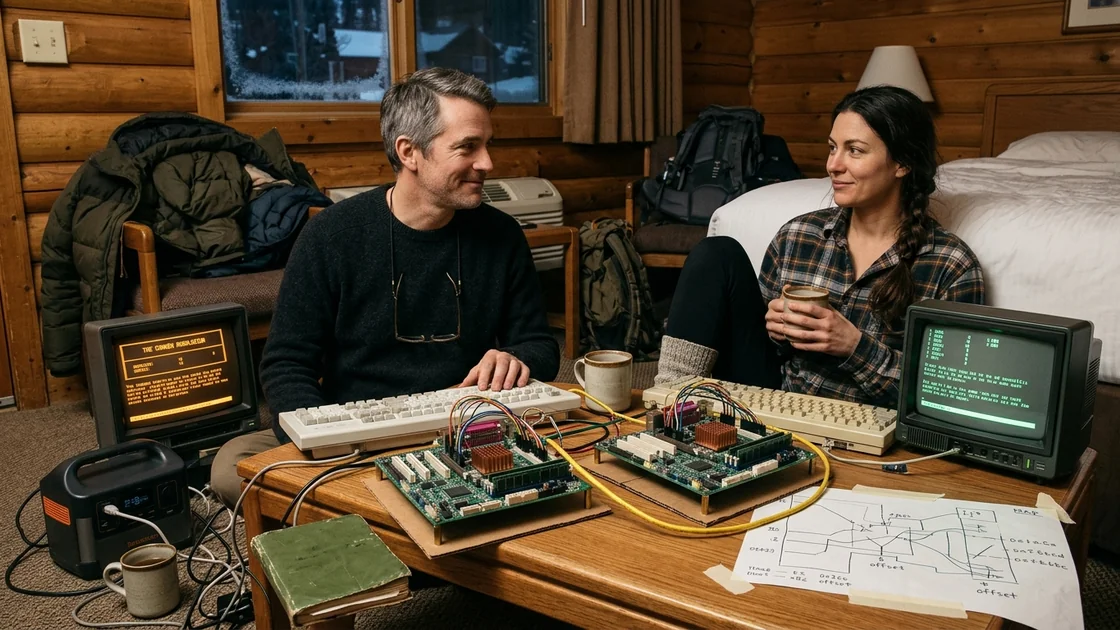
Arthur Pendelton spent his youth writing the invisible code that wakes computers from the dead, eventually hiding a secret text adventure game inside the unused memory of an enterprise motherboard before his company went bankrupt. Twelve years later, living a quiet and forgotten life, he receives an impossible network packet sent from the heart of his own hidden game, proving that someone out there has not only found his digital labyrinth but has begun to rewrite it from the inside. What follows is a silent dialogue conducted entirely through assembly code and fictional rooms across the dark expanse of the internet, drawing Arthur out of his isolation to find the sole player of a game that was never meant to be won.
I. The Architecture of Waking
Before a computer knows what it is, before it knows how to draw a window or render a typeface or speak to the sprawling nervous system of the internet, it is blind, deaf, and amnesiac. When the power button is pressed and twelve volts of direct current surge through the copper arteries of a motherboard, the processor wakes up in a state of primordial confusion. It is trapped in what engineers call Real Mode—aghostly, vestigial simulation of the year 1978, pretending to be an ancient Intel 8086 chip with barely enough memory to hold a long poem.
To guide the machine out of this darkness, someone has to write the liturgy of waking.
In the autumn of 2011, in a windowless cubicle on the third floor of Bellwether Microdevices in Hillsboro, Oregon, that someone was Arthur Pendelton.
Arthur was thirty-two years old, though the fluorescent lights of the hardware validation lab gave his skin the translucent, parchment quality of a man twice his age. He was a BIOS engineer. While his contemporaries in the software world were migrating to sleek offices in San Francisco to build social networks and photo-sharing applications with virtually infinite memory and cloud servers at their disposal, Arthur lived in the subterranean crags of x86 assembly language. He worked in a world measured in kilobytes and microseconds. His job was to write the Basic Input/Output System—the immutable firmware etched into a tiny eight-legged SPI flash chip soldered directly to the fiberglass of the motherboard.
His code was the first breath the machine took. It taught the processor how to count its own memory modules, how to spin up the cooling fans so the silicon wouldn't melt, how to interrogate the PCI bus, and how to locate the hard drive before handing over control to the operating system and vanishing into the background like a stagehand before the curtain rises.
Nobody ever thanked the BIOS engineer. If Arthur did his job perfectly, the user saw a corporate logo for half a second and never thought about him again. If he made a mistake, the board was a two-hundred-dollar slab of dead fiberglass, epoxy, and gold.
"You're staring at the hex dump again, Artie," said Dave Miller, leaning over the grey fabric partition of the cubicle. Dave was the lead thermal engineer, a man whose entire professional existence revolved—quite literally—around ball bearings and aluminum fins. "The board is feature-complete. Taiwan wants the golden master ROM image by Friday. What are you doing in there? Counting the zeros?"
Arthur didn't look up from his dual monitors. On the left screen was a cascading waterfall of green hexadecimal numbers against a black background. On the right was an intricate map of memory addresses.
"The new Winbond flash chips came in," Arthur said, his voice quiet, slightly raspy from lack of use. "Supply chain couldn't source the thirty-two-megabit parts because of the flooding in Thailand. Procurement substituted the sixty-four-megabit chips for the entire production run of the BX-400."
Dave shrugged, taking a sip from a mug stained with decades of office coffee. "So? They're pin-compatible, right? Voltage is the same?"
"They're identical," Arthur said, his fingers resting lightly on the
mechanical keys of his old IBM Model M keyboard. "Except there's an
extra four megabytes of non-volatile space sitting at the top of the
chip that the memory controller doesn't even map during a standard boot
sequence. And even within the mapped Option ROM space, because we
stripped out the legacy SCSI controller module last week, there's a
contiguous block of ninety-six kilobytes sitting completely empty. Just
0xFF from top to bottom."
"Empty space is good. Empty space doesn't have bugs," Dave said, patting the top of the cubicle wall. "Leave it blank, sign off on the checksum, and go home before the rain turns to sleet. Rumor is the board of directors is meeting with liquidators in Palo Alto next month anyway. Half these boards are probably going to end up sitting in a warehouse in Shenzhen or sold off at government auctions for pennies on the dollar. Don't polish the brass on a sinking ship, kid."
Dave walked away, his badge lanyard clicking against his belt clip.
Arthur remained still. Outside the building, the Oregon rain beat a steady, drumming rhythm against the concrete loading dock. Inside the lab, fifty test benches hummed in a ragged chorus of pulse-width-modulated fans.
He knew Bellwether was dying. The company had bet everything on the BX-400—an over-engineered, industrial-grade workstation motherboard built with military-spec tantalum capacitors, dual gigabit network controllers, and redundant BIOS chips. It was designed to run for twenty years in harsh environments without failing: weather stations, factory floors, telecommunications relays, oceanographic vessels. It was a masterpiece of reliability in a market that had suddenly decided it only wanted cheap, disposable hardware that would be replaced every thirty-six months.
And Arthur was dying a little bit, too, though not in the medical sense. Six months earlier, his younger brother, Leo, had passed away after a two-year battle with leukemia. Leo had been twenty-six, an illustrator and a writer of sprawling, messy tabletop roleplaying campaigns. When they were boys growing up in a drafty house in Astoria, before Arthur understood hardware and before Leo knew how to hold a charcoal pencil properly, they had spent thousands of hours in front of an Apple IIe, playing Infocom text adventures. They had mapped out Zork and Planetfall and Trinity on taped-together sheets of graph paper, arguing over how to parse a verb or what lay beyond the troll bridge.
During the last month at the hospice, when Leo could no longer hold a sketchbook, Arthur had brought in an old laptop and they had started designing a game together. No graphics—Leo hated the way modern graphics left nothing for the mind to build—just pure text. A world called the Sunken Horologium. A vast, subterranean clockwork observatory where time had fractured into physical gears and pendulums, and a lone traveler had to mend the mechanism before the stars went out.
Leo had dictated the room descriptions between doses of morphine, his voice thin and reedy against the hiss of the oxygen concentrator. Arthur had typed them into a plain text file on his hard drive.
You are standing on the Balcony of the Third Second, Leo had whispered, his eyes closed, seeing the place far more clearly than the sterile white walls of the hospital room. Below you, the Great Escapement swings through a chasm of mist. Every four heartbeats, a brass tooth the size of a cathedral barge locks into the pallet, and the stone beneath your boots shudders with the weight of a captured moment. To the north, a spiral stair winds up into the belfry. To the east, a narrow iron door stands ajar, leaking the smell of ozone and wet pine.
Leo had died before they reached the center of the clock. The text file had sat on Arthur's desktop ever since, forty-two kilobytes of orphaned prose that Arthur couldn't bring himself to open, and couldn't bring himself to delete.
Now, looking at the vast, desert wasteland of 0xFF bytes
in the upper reaches of the BX-400's flash chip, a strange, reckless
thought took root in Arthur's mind.
Paper rotted. Hard drives suffered head crashes. Cloud servers were wiped the moment a credit card expired. But an industrial motherboard with conformal coating and gold-plated traces, flashed with an EEPROM rated for a hundred years of data retention? That was a stone tablet. That was a pyramid in the desert.
For the next eleven nights, after the cleaning crew had vacuumed the hallways and the motion-sensor lights in the office had clicked off, leaving Arthur in a pool of bluish light from his monitors, he worked.
He couldn't use C or Python or any modern tool. The environment before the operating system loads has no file system, no memory allocator, no standard library. He had to build the world out of raw sixteen-bit assembly instructions, speaking directly to the silicon through BIOS interrupts.
He used INT 10h to manipulate the VGA text buffer at
memory address 0xB8000, painting characters directly into
the video card's throat—amber text on a pitch-black background, eighty
columns wide by twenty-five rows high, just like the old monochrome
monitors of his childhood. He used INT 16h to poll the
keyboard controller, translating raw scan codes from the PS/2 port into
letters and words.
To fit Leo's lush descriptions into the cramped ninety-six-kilobyte enclave without alerting the automated size-verification scripts that checked the ROM before compilation, Arthur wrote a custom Huffman compression algorithm. He counted the frequency of every letter and punctuation mark in Leo's prose—the high prevalence of the letters e, t, a, and the words brass, shadow, pendulum, and silence—and encoded them into variable-length bitstreams. From the outside, to any hex editor or diagnostic tool, the data block looked like random cryptographic entropy or a standard microcode update table for a processor stepping.
He built a two-word parser capable of understanding three hundred verbs and four hundred nouns. He coded sixty-four distinct rooms, linking them together in a state-machine matrix. He put in the puzzles Leo had sketched on the backs of hospital napkins: the lantern that burned memory instead of oil; the deaf automaton who could only be directed by changing the resonance of the tuning forks in its chest; the library where the books changed their text depending on what hour the player set on the central sundial.
On the final night—Thursday, forty-eight hours before the ROM image had to be locked and sent to the fabrication plant in Taipei—Arthur reached the end of Leo's notes.
In the game, the sixty-fourth room was the Heart of the Horologium, a spherical chamber suspended inside the main spring. Leo had never decided what should happen when the player finally inserted the Winding Key into the arbor. The notes simply ended with a bracketed line: [TODO: What happens when the clock starts ticking again?]
Arthur sat in the dark lab, listening to the rain. His eyes burned. His fingers ached from typing raw opcodes. He felt an overwhelming sense of terror that once he compiled this binary and burned it to the master server, he would never touch it again. It would be sealed behind a cryptographic checksum, flashed onto ten thousand motherboards, packed into anti-static bags, and scattered across the globe into server racks and steel enclosures where no human being would ever see it.
After all, to even reach the game, a user had to perform a ritual so
esoteric it bordered on the impossible. During the Power-On Self-Test,
within a four-hundred-millisecond window while the memory controller was
initializing, the user had to hold down the Scroll Lock key, tap the F11
key three times, and then—at the exact moment the motherboard speaker
beeped—type the word CHRONOS.
Nobody would ever do that by accident. It was a tomb with no door.
"Unless," Arthur whispered to the empty room.
The BX-400 had an onboard Intel 82574L Gigabit Ethernet controller. And part of Arthur's legitimate job over the past six months had been writing the Preboot Execution Environment—the PXE stack—which allowed the motherboard to connect to a network and download an operating system before a hard drive was even installed. The tiny TCP/IP and UDP network stack was already sitting right there in the adjacent memory block.
Arthur's hands began to move across the keyboard.
He modified the sixty-fourth room. In the center of the Heart of the Horologium, instead of a final cutscene, he placed a Brass Telegraph. When the player used the Winding Key on the clock, the parser no longer restricted them to the four hundred pre-programmed nouns. Instead, a prompt appeared:
THE SPRING IS WOUND. THE LINE IS OPEN. SPEAK YOUR NAME INTO THE WIRE:
Whatever the player typed at that prompt—up to two hundred and fifty-six characters—would be taken by the BIOS, wrapped into a tiny, encrypted UDP packet along with the current state of the game's memory registers, and fired out through the motherboard's primary Ethernet port.
Where would it go? IP addresses changed. Servers died. Domains expired.
Arthur owned a personal domain he had registered in college—a clunky,
obscure dynamic DNS hostname through a free registry run by a non-profit
Unix collective: horologium-echo.hopto.org. He configured
the BIOS routine to query the public root DNS servers for that hostname,
resolve whatever IP address it currently pointed to, and fire the single
UDP packet at port 49151.
Better yet, he added a listener hook. After sending the packet, the
BIOS would hold port 49151 open for thirty seconds. If a
packet returned with a valid cryptographic signature matching Arthur's
private key, the BIOS would write the incoming payload directly into the
motherboard's CMOS battery-backed Non-Volatile RAM, dynamically patching
the game's room table.
It was a two-way door. A miniature, self-contained modification engine running entirely in bare-metal firmware.
At 4:17 AM on Friday morning, Arthur ran the final build script. The
compiler chewed through the assembly files, linked the modules,
calculated the cyclical redundancy check, and spat out
BX400_PROD_V104.ROM. Exact size: 8,388,608 bytes. Zero
errors. Zero warnings.
He uploaded the file to the Taiwanese manufacturing portal, shut down his workstation, packed his coffee mug and a framed photo of himself and Leo on the beach at Cannon Beach into a cardboard box, and walked out into the cold Oregon dawn.
Four months later, Bellwether Microdevices declared Chapter 7 bankruptcy. The office furniture was auctioned off. The servers were wiped. Arthur took a job at a company in Seattle that made firmware for commercial refrigeration units, moved into a quiet one-bedroom apartment near Green Lake, and tried very hard to learn how to live in a world where his brother no longer existed.
II. Twelve Years of Silence
Twelve years is an eternity in computing. In twelve years, processors went from two cores to twenty-four. Smartphones became more powerful than the workstations Arthur had helped build. The industry abandoned the legacy BIOS entirely, replacing it with UEFI—a bloated, mouse-driven miniature operating system written in C that left no room for the kind of handcrafted, byte-pinching poetry Arthur had practiced in his youth.
By 2023, Arthur was forty-four. His hair had gone grey at the temples, and he wore reading glasses attached to a black cord around his neck. He worked remotely now, reviewing security compliance code for automotive brake controllers from a spare bedroom that smelled of old paperbacks and cedarwood.
He was not an unhappy man, merely a quiet one. He cooked elaborate meals for one while listening to public radio. He walked four miles around the lake every evening regardless of the weather. He dated occasionally—pleasant, polite dinners with women he met through friends, which invariably fizzled out after three or four weeks when they realized that while Arthur was kind and attentive, some essential gear inside his chest was no longer engaged with the forward motion of the world.
In the bottom of his hall closet, beneath stacks of winter blankets and a box of old tax returns, sat a tiny, fanless single-board computer—a first-generation Raspberry Pi in a clear plastic case, plugged into the back of his fiber-optic router via a frayed yellow Ethernet cable.
That little computer had two jobs. First, once every twenty-four
hours, it sent a heartbeat signal to the dynamic DNS provider to ensure
that horologium-echo.hopto.org still pointed to Arthur's
home IP address. Second, it ran a fifty-line Python script that listened
endlessly on UDP port 49151.
Whenever the power went out during a Seattle windstorm, or whenever he changed internet providers, Arthur made sure the little box came back online. He didn't think of it as hope. Hope was an active, restless thing, and Arthur had made his peace with silence. Maintaining the port listener was more like tending a grave—clipping the grass around the headstone, leaving a small stone on the granite, making sure the path remained clear even though you knew the person beneath the earth wasn't going to walk up it.
Over twelve years, the log file on the SD card had recorded forty-one
thousand connections. Every single one of them was automated internet
background noise: Chinese port scanners looking for vulnerable security
cameras, Russian botnets probing for open proxy servers, university
research projects mapping the IPv4 address space. The Python script
checked the first four bytes of every incoming packet for the magic
header Arthur had hardcoded into the BX-400
BIOS—0x4C 0x45 0x4F 0x21, the ASCII values for
LEO!—and when it didn't find them, it silently discarded
the data and went back to sleep.
Until a Tuesday night in November.
It was 11:42 PM. Arthur was in the kitchen, rinsing out a chamomile tea mug, when his phone vibrated on the butcher-block counter.
He dried his hands on a dish towel and picked it up, expecting an automated alert from his bank or a late-night message from a coworker in Munich. Instead, it was a notification from a webhook service he had configured five years ago and promptly forgotten about.
ALERT: /var/log/horologium/valid_payload.log modified. Size: 512 bytes.
Arthur stared at the glowing glass of the phone. The kitchen clock ticked—a cheap quartz movement that jumped once per second. Outside, a bus hissed as its air brakes released on Aurora Avenue.
Slowly, carefully, as if sudden movement might cause the notification to evaporate, Arthur walked down the narrow hallway to his office. His main computer was asleep. He tapped the spacebar, and the monitors bloomed to life. He opened a terminal window, his fingers trembling so badly on the keys that he mistyped the local IP address of the Raspberry Pi twice before getting the SSH connection through.
He navigated to /var/log/horologium/.
He typed ls -l.
There it was. A file named packet_20231114_234158.bin.
Five hundred and twelve bytes.
"It's a collision," Arthur said aloud. His voice sounded strange and rusty in the small room. "A random port scanner happened to send four bytes that matched the header. One in four billion chance. With enough packets over twelve years, it's statistically probable."
Except the Python script didn't just check the four-byte header. He remembered that now, as his heart began to thud against his ribs like a trapped bird. The script also verified the sixteen-byte HMAC-SHA1 signature at the tail of the packet, using the secret salt embedded in the BIOS ROM. The odds of a random scanner accidentally generating both the header and a valid cryptographic hash of the payload were one in two to the power of one hundred and sixty. There weren't enough atoms in the observable universe for that to happen by chance.
Arthur ran his decryption script against the binary file and piped the output to the terminal screen.
==================================================
PACKET TIMESTAMP: 2023-11-14 23:41:58 UTC
SOURCE IP: 198.51.100.214 (Via Tor Exit / Relay)
BIOS BUILD: BX400_PROD_V104 (CHECKSUM: 0x88A4F102)
UPTIME COUNTER: 104,892 HOURS
CMOS BATTERY VOLTAGE: 2.91V
CPU TEMP: 31.0 C
==================================================
GAME STATE REGISTER DUMP:
ROOM_ID: 0x40 (64 - HEART OF THE HOROLOGIUM)
INVENTORY_MASK: 0xFFFF (ALL ITEMS ACQUIRED)
MOVES_TAKEN: 1,412
DEATHS: 0
==================================================
TELEGRAPH PAYLOAD (256 BYTES):
> THE CLOCK IS RUNNING NOW, BUT THE BELL IN THE
> BELFRY HAS NO TONGUE. IT RINGS ONLY IN SILENCE.
> I HAVE WALKED THESE GEARS FOR THREE WINTERS.
> IF THE ARCHITECT STILL BREATHES, LOOK UNDER THE
> FLOORBOARDS OF THE FOURTH SECOND. I LEFT A
> LANTERN THERE FOR YOU.
==================================================
Arthur sat back in his chair. All the breath seemed to have left his lungs at once.
He read the text three times, then four.
I have walked these gears for three winters.
Look at the telemetry. The uptime counter read 104,892 hours. That was nearly twelve years of continuous operation, or cumulative uptime. The CPU temperature was thirty-one degrees Celsius—remarkably cold for an old Xeon or Core i7 processor, which meant the machine was sitting in an unheated room or a frigid climate. The moves taken: 1,412. Zero deaths. In Arthur's game, it was extraordinarily easy to die—falling off the greased cogs of the Escapement, inhaling the mercury vapors in the Alchemist's Pendulum, getting crushed by the striking weights. To clear the game in 1,412 moves with zero deaths meant the player hadn't just stumbled through it; they had mapped every inch of it over previous sessions, memorized every trap, and executed a flawless run.
And then there was the last sentence.
If the architect still breathes, look under the floorboards of the Fourth Second. I left a lantern there for you.
"That's impossible," Arthur whispered.
The Balcony of the Third Second was a room in the game—Room
0x04. There was no "Fourth Second." And there were
certainly no floorboards you could look under in that room; Arthur had
written the room table himself. The floor was solid cast brass.
Unless...
Arthur looked at the raw hex dump of the packet again. A standard telegraph payload was supposed to be ASCII text padded with zeros up to byte 256, followed by the game state registers. Here, the text was only 241 bytes long. Wait—no, the packet was 512 bytes total. What was in the upper 210 bytes of the state register dump?
In his original code, he had allocated a 256-byte buffer for the state dump, even though the actual game variables—inventory, room flags, turn counters—only took up forty-six bytes. The remaining two hundred and ten bytes of that buffer simply mirrored whatever happened to be sitting in the adjacent CMOS RAM and upper memory blocks on the user's motherboard.
Usually, that should have been zeros.
In this packet, those two hundred and ten bytes were packed tight with non-zero hexadecimal values.
55 89 E5 83 EC 10 B8 04 00 00 00...
Arthur didn't need a disassembler to recognize 55 89 E5.
Anyone who had spent a decade in the trenches of x86 architecture knew
those bytes by sight. PUSH BP; MOV BP, SP. It was a
function prologue.
The person on the other end hadn't just played the game. They had dumped the BIOS chip from their motherboard, disassembled Arthur's code, reverse-engineered his Huffman compression tree, figured out the exact structure of the network packet, and packed two hundred and ten bytes of custom machine code into the unused tail of the state buffer.
Arthur stood up so fast his chair rolled backward and hit the bookshelf.
He went into the hall closet, shoved aside the winter coats, and pulled down a heavy plastic storage tub labeled BELLWETHER ARCHIVE - DO NOT THROW AWAY.
Inside, wrapped in pink anti-static bubble wrap and sealed in metallized Mylar bags with packets of silica gel, were two prototype BX-400 motherboards he had taken from his desk on his last day in 2011, along with an Intel Xeon E3-1270 processor, four sticks of ECC DDR3 memory, an ATX power supply, and a small 15-inch monochrome amber CRT monitor he had rescued from the company e-waste bin.
He carried the whole pile to the dining room table, sweeping aside stack of unopened mail and a fruit bowl.
For the next hour, Arthur worked with a frantic, muscle-memory precision he hadn't felt since his thirties. He laid the motherboard on a square of cardboard, seated the processor in its socket, clamped down the retention lever, snapped the RAM sticks into the blue slots, and plugged in the twenty-four-pin power connector. He didn't bother with a case or a hard drive. He hooked up the amber CRT monitor via the blue fifteen-pin VGA port, plugged in his old PS/2 keyboard, and connected a fifty-foot Ethernet cable from the motherboard's primary LAN port down the hall to his router.
He didn't have a power button hooked up to the front-panel header pins, so he took a flathead screwdriver from his kitchen junk drawer and touched the tip across pins six and eight.
A spark no bigger than a gnat jumped between the metal pins. The power supply fan spun to life with a low whir. On the motherboard, a row of green diagnostic LEDs blinked in rapid succession as the power rails stabilized.
The amber CRT monitor gave a high-pitched flyback whine, crackled with static electricity that made the hairs on Arthur's forearm stand up, and glowed to life.
BELLWETHER MICRODEVICES INC. (C) 2010-2011
BX-400 INDUSTRIAL WORKSTATION BIOS REV 1.04
CPU: INTEL(R) XEON(R) CPU E3-1270 @ 3.40GHZ
TESTING EXTENDED ECC MEMORY... 16384MB OK
Arthur's left hand held down Scroll Lock. His right index finger tapped F11—one, two, three.
BEEP.
The single, sharp square-wave tone came from the piezoelectric buzzer soldered to the board.
Arthur's fingers flew across the keys:
C-H-R-O-N-O-S.
For half a second, nothing happened. The memory test line vanished. The cursor blinked in the upper left corner of the screen—a solid amber rectangle pulsing against the void.
Then, from top to bottom, the screen redrew itself.
================================================================================
THE SUNKEN HOROLOGIUM                                  SCORE: 0     MOVES: 0
================================================================================

THE VESTIBULE OF STOPPED PENDULUMS

You stand at the threshold of a great subterranean vault. The air is cold and
tastes of copper dust and ancient oil. Above you, lost in the vaulted dark,
hangs the motionless brass lens of a pendulum ten yards across, frozen at the
apex of its swing as if waiting for a breath that never came.

A stone archway leads NORTH into the hum of dormant machinery. At your feet
lies a tarnished BRASS LANTERN.

> _
Arthur let out a long, shaky breath. He reached out and touched the curved glass of the CRT. It was warm.
Seeing those words—Leo's words, rendered in that crisp, hardware-baked IBM Code Page 437 font—was like opening a door in a house he had lived in for years and finding his twenty-six-year-old brother sitting at a table, smiling up from a notebook.
"Hey, Leo," Arthur whispered.
He didn't play through the game manually; he didn't need to. He went back to his office computer, took the 210-byte machine code payload from the stranger's packet, wrapped it in a return packet signed with his private key, and routed it across his local home network to the BX-400 sitting on his dining table.
Then he walked back to the dining room, typed a secret debugging
command he had built into the
parser—> XYZZY ELEVATE 04—and teleported directly to
Room 0x04: The Balcony of the Third Second.
He looked at the screen. The standard description appeared, just as Leo had dictated it twelve years ago.
Then Arthur typed: > WALK INTO FOURTH SECOND
In the original game, that command would have returned the standard error string: Time does not permit passage in that direction.
This time, the hard drive LED on the motherboard flickered as the processor executed the 210 bytes of injected machine code sitting in the CMOS buffer.
The screen cleared.
================================================================================
THE FOURTH SECOND                                      SCORE: 0     MOVES: 2
================================================================================

You have stepped between the teeth of the Great Escapement during the silence
between ticks. Here, the brass gives way to rough-hewn planks of mountain
hemlock, silvered by frost and high wind.

Through a narrow window cut into the stone, you can see no underground cavern,
only a sea of dark ridges under a winter sky, and the white steel lattice of
a radio tower coated in rime ice.

The floorboards here are loose.

> _
Arthur felt the skin on the back of his neck prickle.
He typed: > LOOK UNDER FLOORBOARDS
Beneath the hemlock planks, wrapped in oiled canvas, you find an IRON LANTERN.
Scratched into the soot-blackened glass of its chimney are the words:

"IT IS VERY QUIET UP HERE once the autumn storms close the pass. Your clock
kept me company when the generators ran low. How did you fit sixty-four rooms
into ninety-six kilobytes? Your Huffman tree is a work of art, though your
hash table in sub-routine 0x04A2 wastes twelve bytes on redundant pointer
checks. - M."

> _
Arthur stared at the screen. And then, for the first time in longer than he could remember, he laughed. It was a startled, rusty bark of a laugh that echoed off the dining room walls.
Your hash table in sub-routine 0x04A2 wastes twelve bytes on redundant pointer checks.
Not only had someone found his game in the dark wilderness of obsolete enterprise hardware; not only had they beaten it and reverse-engineered the assembly code; they were critiquing his memory optimization.
III. The Dungeon Masters of Port 49151
There was a fundamental problem with how they could communicate.
When Arthur had designed the network hook in 2011, he had assumed—in
the fantastical event it was ever triggered—that a player would send a
message at the end of the game, and the server could automatically reply
with a small "Congratulations" patch during the thirty-second window
while the motherboard held port 49151 open.
The thirty-second window from Tuesday night's packet was long gone.
Moreover, the source IP in the log—198.51.100.214—was a Tor
exit node or an anonymized satellite relay. He couldn't initiate a
connection back to M. directly; the firewall on their end
would drop any unsolicited incoming packets.
He had to wait for M. to reach the Heart of the
Horologium again and send another telegraph.
Wait. Did M. actually play through all 1,412 moves every
time they wanted to send a packet? No, nobody who could write raw x86
assembly by hand would do that. M. had clearly modified
their local BIOS or created a bootable DOS USB drive that triggered the
BIOS interrupt INT 15h directly to invoke Arthur's network
subroutine on demand.
If M. was waiting for a reply, they would poll the
server again. Probably at the same time of night.
Arthur called in sick to work on Wednesday morning. It was the first sick day he had taken in four years; his manager seemed more confused than annoyed.
All day Wednesday, Arthur sat at his dining room table, surrounded by yellow legal pads, an x86 instruction set reference manual from 1999, and three empty mugs of black coffee. He felt like a man who had been speaking a foreign language for twelve years and had suddenly heard someone shouting in his native tongue from across a canyon.
He wanted to ask a thousand questions. Who are you? Where are you? Why are you running a twelve-year-old Bellwether motherboard in a place with hemlock planks and rime ice on a radio tower? How did you find the Scroll Lock key sequence?
But he couldn't just send a plain text email back. That would violate
the unspoken rules of the miracle. M. hadn't sent him an
email; M. had built a room. M. had stepped
inside Leo's clockwork world, carved out a space between the gears, and
furnished it with pieces of their own reality.
To answer properly, Arthur had to build the next room.
He only had two hundred and ten bytes of CMOS space to work with per transmission—unless he got clever. And Arthur Pendelton, when properly motivated, was very, very clever with low-level memory.
First, he looked at subroutine 0x04A2—the hash table
M. had teased him about. M. was right; twelve
years ago, exhausted and grieving, Arthur had left a redundant boundary
check on the array pointers. If he stripped those twelve bytes out and
refactored the jump table using relative eight-bit offsets
(JMP SHORT) instead of sixteen-bit near jumps, he could
free up forty-eight bytes of execution space right there.
Better yet, the BX-400 motherboard had an onboard SMBus controller
connected to an auxiliary EEPROM chip meant for storing hardware health
logs—fan speeds, chassis intrusion events, thermal shutdowns. Almost
nobody ever enabled chassis logging in the BIOS setup menu. That
auxiliary chip had four full kilobytes of writable space sitting at I2C
bus address 0x54.
Arthur wrote a tiny bootloader stub—just sixty-four bytes of machine code—that would redirect the BIOS's room-loading pointer away from the cramped CMOS battery RAM and point it at the SMBus health-log chip instead. Then he wrote a new room, compressed the text using the existing Huffman dictionary in the BIOS so it took up only a third of its normal size, and queued the payload in his Raspberry Pi's listener script.
When the next packet arrived from M., the Raspberry Pi
would immediately fire the payload back down the open UDP tunnel within
forty milliseconds.
At 11:00 PM on Wednesday night, Arthur sat in front of his terminal,
watching the network traffic monitor with tcpdump running
in verbose mode.
11:15 PM. Nothing.
11:30 PM. A stray ping from a Censys scanner in Michigan. Ignored.
11:41 PM.
The terminal screen flashed with a sudden burst of green text.
23:41:12.004819 IP 185.220.101.45.49151 > 192.168.1.50.49151: UDP, length 512
[!] MAGIC HEADER 'LEO!' DETECTED.
[!] HMAC SIGNATURE VALID.
[!] SENDING QUEUED PAYLOAD (512 BYTES) TO 185.220.101.45:49151...
[!] TRANSMISSION COMPLETE (RTT: 618ms).
Six hundred and eighteen milliseconds of round-trip latency. Even accounting for the overhead of a relay network or a VPN, that was high. That was satellite latency, or a multi-hop microwave link bouncing across mountain peaks.
Arthur opened the incoming packet log. M. had sent an
identical state packet to the night before, except the telegraph text
read simply:
> PING. LISTENING ON THE WIRE.
Now M. had Arthur's patch. It would take them a few
minutes to see what the patch did—more likely, M. was
running the incoming payload in a sandboxed emulator first to make sure
Arthur wasn't sending malicious code that would brick their motherboard,
before loading it into the game parser.
Arthur walked into the dining room and paced beside the glowing amber CRT. Ten minutes passed. Fifteen.
At 12:04 AM, the Raspberry Pi chimed again.
Arthur practically vaulted over the arm of the sofa to get back to his office desk. He decrypted the new packet.
First, he looked at what he had sent M. an hour ago—Room
0x42, linked to the east of M.'s Fourth
Second:
================================================================================
THE ARCHITECT'S STUDY                                  SCORE: 0     MOVES: 3
================================================================================

Beyond the frost-rimmed window, the hemlock planks lead into a small, warm
room smelling of old solder flux, cedarwood, and rain on city asphalt. On a
crowded dining table sits an exposed green circuit board connected to an amber
CRT monitor that hums at fifteen kilohertz.

Pinned to the wall above the desk is a faded charcoal sketch of a clockwork
cathedral, signed in the corner with the initials L.P.

Carved into the edge of the desk is a reply:

"Those twelve bytes in 0x04A2 have kept me awake since 2011; thank you for the
code review. I routed this patch into your SMBus health-log EEPROM at 0x54—
we have four kilobytes of headroom now. How on earth did you find the Scroll
Lock trigger? Nobody was ever supposed to find this place. - A."
================================================================================
Now, Arthur looked at the new binary block M. had just
sent back. He piped it over to the BX-400 on his dining table, refreshed
the SMBus memory, and typed > LOOK AT DESK.
A new object had appeared in the room description:
A BRASS SPOOL OF MAGNETIC WIRE.
Arthur typed: > PLAY SPOOL
You thread the hair-thin steel wire through the reading head on the desk. A
voice speaks through the static of the amber monitor:

"I didn't find the trigger by pressing keys, A. Three winters ago, the main
data-logger board on Automated Weather Node 4 was struck by static discharge
during a dry lightning storm. I had to desolder the Winbond SPI chip from a
spare BX-400 board in the parts locker and dump the ROM to a hex file on an
old ThinkPad so I could disable the faulty PXE boot check that was hanging our
startup sequence.

When I scrolled down to offset 0x7E0000, I saw the entropy block. At first I
thought it was CPU microcode. Then I noticed the jump vector tied to the
keyboard interrupt handler at INT 09h. I disassembled the routine on paper
by kerosene lamp while the diesel generator was down for maintenance.

When I saw the Huffman dictionary—when I decoded the words 'cathedral barge'
and 'captured moment' and 'belfry' sitting inside an industrial server BIOS—
I thought I was losing my mind from cabin fever.

Who was L.P.?"

> _
Arthur sat down on the wooden dining chair. The amber light of the monitor reflected in the lenses of his reading glasses.
I disassembled the routine on paper by kerosene lamp while the diesel generator was down for maintenance.
He pictured it: a dark room high in the mountains, wind howling
against steel guy-wires outside, the smell of kerosene and cold iron,
and a person—a woman? a man?—hunched over sheets of paper, translating
hexadecimal numbers like 74 1A and E8 4F 02
into assembly instructions by hand, slowly uncovering the secret world
he and his dying brother had hidden in the silicon twelve years
before.
He went back to his keyboard and began to write the next room.
IV. The Geography of Sixty-Four Kilobytes
Throughout the rest of November and into the deep, rain-soaked gray of December, Arthur's life bifurcated into two distinct realms.
By day, he attended Zoom meetings about ISO-26262 compliance for electronic parking brakes, nodded at spreadsheets, and bought groceries at the Greenwood supermarket like any other middle-aged resident of North Seattle.
By night, starting promptly at 11:00 PM when M.'s
satellite window opened or their generator kicked on for the nightly
telemetry uplink, Arthur lived inside an eighty-by-twenty-five grid of
amber text.
They didn't switch to email or chat programs. Neither of them ever suggested it. There was something sacred about the constraint of the medium—the way every sentence had to be compressed, compiled into machine instructions, wrapped in a state packet, and experienced as a physical place or an object within the Sunken Horologium. You couldn't be glib or careless when every word cost precious bits in a four-kilobyte EEPROM chip.
Instead of chatting, they expanded the world.
When Arthur told M. about Leo, he didn't just write a
paragraph of biography. He built Room 0x45: The Coast
of Astoria.
================================================================================
THE DRIFTWOOD SHORE                                    SCORE: 0     MOVES: 14
================================================================================

A narrow door in the back of the clockwork vault opens onto a wide, flat beach
of dark grey sand. Huge bleached logs of Douglas fir lie scattered above the
tide line like the ribs of whales. Out in the fog, the rusted iron skeleton of
the Peter Iredale shipwreck juts from the surf.

Two boys sit inside a fort made of driftwood and blue tarpaulin, sharing a
thermos of tomato soup and drawing maps of underground kingdoms on graph paper.
The younger boy has charcoal smudges on his knuckles and laughs when the wind
tries to tear the paper from his hands.

Etched on a flat skipping stone at your feet:

"He was twenty-six. He drew the maps; I just built the box to keep them in so
the tide wouldn't wash them away. For twelve years I thought the box was buried
at the bottom of the ocean. Thank you for opening the lid, M."

> _
Twenty minutes after he transmitted that room, M. sent
back a modification to the object table for The Driftwood
Shore.
When Arthur reloaded the room and typed
> LOOK IN FORT, there was a new line at the bottom:
Beside the thermos lies a small notebook bound in green oilcloth. Inside are
pressed specimens of subalpine fir needles, white bark pine, and a sketch of
a Clark's nutcracker perched on an anemometer cup.

Written on the flyleaf in a neat, slanted hand:

"My father taught me how to read schematics at the kitchen table in Boise when
I was ten. He worked for the Forest Service maintaining remote SNOTEL telemetry
sites—the solar-powered stations that measure snowpack water equivalent so the
valleys know if the rivers will flood in the spring. Whenever he went up into
the Sawtooths in the summer to swap out lead-acid batteries and solder broken
thermistor leads, I went with him.

I liked the machines better than the people in town. Machines never pretended
to be anything other than what their circuit diagrams said they were. If a
capacitor failed, it failed honestly.

My name is Mara, Arthur. I'm thirty-eight. And I think your brother would have
liked the view from my roof."

> _
Mara.
Arthur said the name aloud in his quiet dining room. It felt solid and clear, like cold creek water over granite.
Over the next three weeks, as they chained a second and then a third unused I2C memory buffer into their makeshift file system, the Sunken Horologium grew sideways into a sprawling, autobiographical collaborative novel disguised as firmware.
Arthur learned that Mara was a seasonal-turned-permanent contract technician and archivist for an obscure joint atmospheric research program originally funded by the National Science Foundation and a consortium of Pacific Northwest universities in the late nineties. She lived and worked at a high-altitude meteorological and cosmic-ray monitoring station—she never gave the exact name or coordinates, out of habit or contractual paranoia, referring to it only as Station Nine—perched on a windswept ridge at seven thousand feet.
The station had been slated for automated decommissioning in 2020, right before the pandemic froze the university budgets and tangled the administrative paperwork. Instead of spending half a million dollars to send helicopters and heavy equipment up the crumbling logging road to dismantle the array and haul out the legacy servers, the consortium had simply renewed Mara's stipend year after year to keep the old hardware ticking and convert thirty years of magnetic tape records into digital archives.
"Why the BX-400 boards?" Arthur asked her in early December, carving
the question into the brass casing of a barometer he placed in Room
0x48 (The Observatory Dome). "Those boards were
power-hungry beasts even in 2011."
Her reply arrived forty minutes later, hidden inside the inspection text of a telescope lens:
"Because modern consumer boards die up here in six months. The cosmic ray
flux at seven thousand feet flips single-bit states in non-ECC RAM every week,
and when the ambient temperature in the shed drops to minus twenty Celsius,
cheap electrolytic capacitors split their vents like roasted chestnuts.

Your BX-400 boards have solid tantalum caps, ECC support, and heavy gold
plating on the PCI contacts that doesn't corrode when the meltwater leaks
through the cable conduits in May. Whoever designed the power delivery and
the BIOS recovery routines on this board built it like a Sherman tank.

Though I still think your keyboard polling loop in INT 16h is overly aggressive."
Arthur smiled so wide his cheeks hurt. He immediately wrote a patch that added a tiny, invincible cockroach named Bug 0x16 that scurried around the floor of her virtual observatory dome and refused to be stepped on.
She countered the next night by modifying the parser so that whenever
the player typed the verb OPTIMIZE, the game responded:
You attempt to optimize the universe, but Arthur Pendelton has
already hardcoded the inefficiencies into ROM.
For the first time since Leo died, Arthur found himself waking up in the morning with a sense of urgent anticipation. While making his coffee, he would sketch room layouts on napkins. During boring afternoon conference calls, he would mute his microphone and hand-assemble routines to add weather effects to the VGA text buffer—making little asterisks of snow drift down the eighty-column screen if the system clock passed midnight, or making the amber borders pulse in time with the motherboard's actual CPU fan tachometer readings.
He realized he was no longer just tending Leo's grave. The Sunken Horologium was alive again. The great brass gears were turning, and there was someone else walking the catwalks across the chasm, holding up a lantern in the dark.
Then came the night of December 18th.
A massive Pineapple Express atmospheric river had stalled over Washington and Oregon, dumping inches of rain in the lowlands and feet of heavy, wet "cascade concrete" snow in the high mountains. The news was full of reports of highway closures on Snoqualmie and Stevens passes, downed power lines, and avalanche warnings.
At 11:40 PM, Arthur was waiting at his desk. He had spent four hours
that evening crafting a complex new puzzle in Room 0x52—a
miniature mechanical planetarium that required both players to set the
orbital declinations from their respective ends of the UDP link.
11:45 PM came and went. No packet.
12:15 AM. Silence.
At 12:48 AM, a packet finally stumbled through port
49151.
Arthur noticed immediately that something was wrong. The round-trip ping time wasn't six hundred milliseconds anymore; the packet had fragmented in transit, and the header showed three retransmissions before the checksum cleared.
He opened the diagnostic telemetry dump at the top of the file.
==================================================
PACKET TIMESTAMP: 2023-12-19 08:48:11 UTC
SOURCE IP: 198.51.100.89 (Via Relay)
BIOS BUILD: BX400_PROD_V104 (CHECKSUM: 0x88A4F102)
UPTIME COUNTER: 105,732 HOURS
CMOS BATTERY VOLTAGE: 2.14V  [WARNING: LOW]
+12V RAIL VOLTAGE: 10.82V    [CRITICAL: UNDERVOLT]
+5V RAIL VOLTAGE: 4.31V      [CRITICAL: UNDERVOLT]
CPU TEMP: 6.0 C
==================================================
Arthur leaned in close to the screen, his stomach tightening.
Look at the voltages from the motherboard's Winbond Super I/O hardware monitor chip. The twelve-volt rail was sagging at 10.82 volts—well below the ATX specification tolerance of plus-or-minus five percent. At anything under 11.1 volts, hard drives would fail to spin up and voltage regulator modules would start throwing erratic parity errors. And the CPU temperature was six degrees Celsius—forty-two degrees Fahrenheit. For an active silicon die to be running at six degrees meant the ambient air inside the room where that motherboard sat was well below freezing.
He decrypted the telegraph buffer. Mara hadn't sent a room patch this time. She had used the raw 256-byte text channel.
TELEGRAPH PAYLOAD (256 BYTES):
> STORM TOOK DOWN THE PRIMARY MICROWAVE DISH ON
> THE WEST RIDGE AND SNAPPED THE EXHAUST STACK ON
> THE DIESEL GENNY. CO2 BUILT UP IN THE SHED SO
> THE AUTO-SHUTOFF TRIPPED. RUNNING ON THE 24V
> BANK NOW BUT THREE CELLS ARE DEAD. INVERTER IS
> SCREAMING. SNOW IS UP TO THE SECOND STORY EAVES.
> SATELLITE UPLINK IS BOUNCING OFF DRIFT ICE. IF
> THE 12V RAIL DROPS BELOW 10.5 THIS BOARD WILL
> BROWNOUT AND RESET THE RAM. STAY ON THE WIRE,
> ARTHUR. IT'S COLD IN HERE.
Arthur's hands went ice cold.
"Mara," he breathed.
Wait—if the diesel generator was dead because of a snapped exhaust stack, and the station's battery bank had three dead cells, she wasn't just losing power to the computers. She was losing heat, light, and communications in the middle of a historic winter blizzard at seven thousand feet.
Why didn't she use a satellite phone or an emergency beacon?
He didn't waited to construct a room. He wrote a raw text string directly into the return packet's override buffer, forcing it to display on line twenty-five of her parser prompt:
> MARA. DO YOU HAVE HEAT? WOOD STOVE? SAT PHONE? GIVE ME YOUR COORDINATES.
His script waited for the next poll from her end to deliver the reply.
Five minutes passed. Ten. Each minute felt like an hour of lead weights pressing down on Arthur's chest.
At 1:03 AM, another packet arrived.
+12V RAIL VOLTAGE: 10.44V [FATAL: BROWNOUT IMMINENT]
CPU TEMP: 3.5 C
==================================================
TELEGRAPH PAYLOAD (256 BYTES):
> PROPANE LINE FROM EXTERIOR TANK FROZE OR CRACKED
> UNDER THE SLIDE. SMALL AVALANCHE OFF THE CHUTE
> HIT THE NORTH WALL AN HOUR AGO. BURIED THE
> WOODPILE SHED AND CRUSHED THE SAT-DISH FEEDHORN.
> I'M USING THE LEGACY VHF-OVER-IP PACKET BRIDGE
> ON THE OLD TOWER—IT'S THE ONLY ANTENNA STILL
> ABOVE THE DRIFT. MY LAPTOP BATTERY DIED AT
> MIDNIGHT. THIS BX-400 IS THE ONLY THING STILL
> DRAWING POWER OFF THE LAST GOOD LEAD-ACID CELL
> BECAUSE ITS VRM CAN TOLERATE 10 VOLTS.
Arthur's heart hammered in his throat. A small avalanche had hit the building. The propane line was broken, the woodpile was buried under tons of snow, her laptop was dead, and the main satellite dish was crushed. The only reason she was able to communicate with the outside world at all was because the BX-400's military-spec voltage regulators—the very ones Dave Miller had complained were over-engineered in 2011—were clinging to life on ten volts of dirty DC current from a dying battery, pushing tiny 512-byte UDP packets across an ancient VHF packet-radio bridge that didn't have enough bandwidth to handle modern web traffic or voice calls.
And because the BX-400 was running in bare-metal BIOS mode without an operating system, she had no web browser, no email client, no way to reach 911. The only software loaded in that machine's memory was The Sunken Horologium, and the only IP address hardcoded into its DNS resolver was Arthur's Raspberry Pi in Seattle.
He was her only wire to the living world.
When the packet arrived at 1:03 AM, Arthur's script had automatically fired back his previous message asking for her coordinates.
At 1:05 AM, the final packet came through.
The checksum was invalid. The Python script would have rejected it, except Arthur had disabled the drop-filter ten minutes earlier and set it to dump raw socket data straight to the screen.
+12V RAIL VOLTAGE: 9.81V [SYSTEM HALT]
CPU TEMP: 1.5 C
==================================================
TELEGRAPH PAYLOAD (CORRUPTED - 118 BYTES RECOVERED):
> GOT YOUR MSG. COORDINATES ARE 48 DEG 44 MIN N,
> 120 DEG 38... [CARRIER LOST] ...USFS ROAD 39...
> HART'S PA... [0xFF 0xFF 0x00] ...GOODBYE ARTH...
The terminal cursor blinked.
No more packets came.
At 9.81 volts, the motherboard's power-good signal would drop low, triggering an immediate hardware reset to protect the processor. And with the battery that low, the board would never have enough current to spin up the POST sequence again.
Somewhere out there in the dark mountains, the amber monitor had just gone black.
V. The Silicon Cartographer
Arthur didn't panic. Panic was for people who didn't understand systems, and Arthur had spent his entire life diagnosing catastrophic system failures under pressure.
He grabbed a pen and wrote down the fragmented text from the corrupted packet:
48 DEG 44 MIN N, 120 DEG 38...
USFS ROAD 39... HART'S PA...
He pulled up a topographic map of Washington State on his main monitor.
Latitude 48 degrees, 44 minutes North. Longitude 120 degrees, 38 minutes West.
That was in the North Cascades—specifically, the Okanogan-Wenatchee National Forest, up near the Canadian border, west of the Methow Valley.
"Hart's Pa..." he muttered, zooming in on the map around that coordinate box.
There it was. Hart's Pass. Elevation 6,197 feet, with Forest Service Road 39—the highest drivable road in Washington State—climbing even higher along the knife-edge ridge toward Slate Peak, where an old Air Force radar site and atmospheric research lookout sat at 7,488 feet.
Arthur picked up his phone and dialed 911.
Because he was calling from Seattle, he had to explain to the King County dispatcher that the emergency was in Okanogan County, two hundred miles away on the other side of the Cascade crest. It took four minutes of precious time to get transferred to the Okanogan County Sheriff's Office dispatch in Okanogan.
"Okanogan dispatch, state your emergency."
"My name is Arthur Pendelton," he said, trying to keep his voice steady and authoritative. "I'm a systems engineer in Seattle. I just lost telemetry contact with a researcher named Mara at the atmospheric monitoring station above Hart's Pass, off Forest Service Road 39 near Slate Peak. She reported that an avalanche struck the north wall of the facility, ruptured her propane heating line, buried her backup fuel, and crushed her primary satellite dish. Her backup battery bank just died and the interior temperature of the building was thirty-four degrees Fahrenheit and dropping fast."
There was a pause on the line, followed by the click of a keyboard.
"Sir, how were you in contact with her?" the dispatcher asked, a note of skepticism creeping into his voice. "The repeaters up on Slate Peak went offline around 9:00 PM tonight when the ice storm hit Mazama."
"Through a legacy VHF packet bridge tied into an automated weather node," Arthur said rapidly. "Look, I have the raw hardware telemetry logs right in front of me. She's trapped in an unheated building with a breached wall or roof in sub-zero wind chill."
Another pause. The dispatcher's voice softened, turning grim. "Mr. Pendelton... nobody is supposed to be up at the Slate Peak observatory in December. That road isn't plowed past the thirty-mile marker at Mazama. Right now we have forty-mile-an-hour winds and four feet of new snow at the valley floor, with extreme avalanche danger in all the high chutes. Search and Rescue pulled their snowcat teams off Highway 20 three hours ago because a slide buried the road at Washington Pass."
"You have to send a helicopter," Arthur said, standing up, his knuckles white around the phone. "Whidbey Island Naval Air Station has search-and-rescue Knighthawks with night vision and de-icing gear—"
"Sir, the ceiling is zero-zero from Darrington to the border. Even Navy SAR can't fly into a seventy-knot whiteout in the middle of the night. I will log this with our SAR coordinator and we will try to hail the station on the Forest Service VHF frequencies, and as soon as the ceiling lifts at daybreak, we'll put a snowcat team staging at the Mazama trailhead. What is the researcher's last name?"
Arthur opened his mouth.
He closed it.
He looked at the amber CRT monitor in the dining room, now displaying his own local copy of the Sunken Horologium. He knew her favorite childhood memory in the Sawtooth Mountains. He knew what kind of handwriting she had. He knew the exact way her mind structured an assembly language loop, and he knew the smell of the hemlock planks in her room.
He didn't know her last name.
"Her first name is Mara," Arthur said hollowly. "She works for the university atmospheric consortium. The board she's using is a Bellwether BX-400, serial batch..."
Wait.
Arthur didn't know her last name, and the Sheriff's dispatcher clearly half-suspected he was a crank caller or someone misinterpreting an automated weather beacon error. Even if SAR mobilized at dawn, "near Slate Peak off Road 39" covered fifteen square miles of jagged subalpine ridges, abandoned mining shacks, SNOTEL sheds, and relay bunkers. If they went to the main Slate Peak lookout first and she was actually at an auxiliary node two miles down a side spur, those three hours of searching in the wrong place could be the difference between hypothermia and death.
He needed to know the exact building that motherboard was sitting in.
"I'll call you back with the exact station ID and coordinates," Arthur told the dispatcher, and hung up before the man could argue.
He ran to the plastic storage tub in the hallway. Beneath the anti-static bags at the very bottom were three black CD-ROM binders containing the engineering and manufacturing backups he had burned on his last day at Bellwether Microdevices in 2011.
He flipped through the plastic sleeves until he found a gold Mitsui
archival disc labeled in black Sharpie:
BX-400 / RMA & QA SERIAL LOGS / Q1-Q4 2011.
He slid the disc into the USB optical drive on his workstation. The drive spun up with a loud whine.
Every BX-400 motherboard had a unique 64-bit UUID burned into its BIOS during factory testing at the Foxconn plant in Taipei. That UUID was derived from the MAC address of the primary Intel Gigabit Ethernet controller. And when Mara's board had sent those UDP packets over the last month, the BIOS subroutine had included the board's hardware checksum and MAC suffix in the cryptographic salt!
Arthur pulled the MAC address from the packet header:
00:1B:21:8A:4F:02.
He opened the massive comma-separated values spreadsheet on the
archival CD—forty thousand rows of production data—and hit
Ctrl+F.
8A:4F:02
One match found. Row 14,892.
SERIAL: BW-BX400-1109-04812
MAC_1: 00:1B:21:8A:4F:02
BIOS_REV: 1.04 (GOLDEN)
SHIP_DATE: 2011-10-14
DISTRIBUTOR: ASI CORP (FREMONT, CA)
END_USER_PO: UW-ATMOS-G2011-994 (UNIV OF WASHINGTON - DEPT OF ATMOSPHERIC SCIENCES)
SHIP_TO_NOTE: FIELD NODE 4 - HART'S PASS / BARRON TOWNSITE RELAY
"Barron Townsite Relay," Arthur breathed.
She wasn't at the main Slate Peak Air Force radar dome at 7,400 feet. She was at Barron—an old 1890s gold-mining ghost town tucked into a high cirque basin just below Hart's Pass at 5,600 feet, where the University of Washington maintained an atmospheric deposition and snow-physics station inside one of the reinforced historic structures!
And look at the shipping note attached to the Purchase Order PDF in the adjacent folder:
DELIVERY INSTRUCTIONS: Deliver to USFS Methow Valley Ranger District compound in Winthrop, WA. Attention: Dr. Mara Lindqvist / H. Lindqvist.
Mara Lindqvist.
Arthur looked at the clock on his wall. It was 1:25 AM.
Seattle to Winthrop via Interstate 90 and Highway 97 over Blewett Pass—since the direct route over Highway 20 North Cascades Highway was closed for the winter—was a four-and-a-half-hour drive in clear weather. In a December snowstorm, it would take five or six.
Why drive? He had her name and the exact location now; he could just give it to the Okanogan dispatcher.
Arthur looked back at the terminal screen. He thought of the dispatcher's voice: As soon as the ceiling lifts at daybreak, we'll put a snowcat team staging at the Mazama trailhead.
What if the sheriff's deputies got pulled away to a multi-car pileup on Highway 97? What if they arrived at the trailhead at 8:00 AM and didn't know which structure in the Barron basin had the VHF tower, or didn't realize how fast the building was losing heat? Nobody in Okanogan County knew Mara was up there except a skeptical night-shift dispatcher with a sticky note on his desk.
Arthur had spent twelve years sitting in a quiet room in Seattle while the people he cared about vanished into the dark. He had sat by a hospital bed in 2011, helpless to write a single line of code that could fix the corrupted DNA in his brother's bone marrow.
He wasn't going to sit in front of a screen tonight waiting for somebody else to rescue the only person who had ever heard his voice across the void.
Arthur called the Okanogan dispatcher back, gave him Mara's full name—Dr. Mara Lindqvist—the exact location at the UW Barron Townsite Field Node 4, and the university purchase order reference so they could verify her deployment with campus police in Seattle.
Then Arthur walked to his hall closet, put on his heavy wool sweater, his Gore-Tex mountaineering parka, insulated boots, and snow gaiters.
Before he left the apartment, he walked over to the dining room table, pulled the twenty-four-pin power plug on his prototype BX-400 motherboard, and carefully wrapped the board in its pink anti-static bubble wrap. He packed it into his waterproof backpack alongside a spare lithium-iron-phosphate portable power station, a soldering iron, and his old ThinkPad laptop.
Fifteen minutes later, his 2016 Subaru Outback—fitted with studded Nokian Hakkapeliitta winter tires he bought every November out of cautious habit—turned onto the wet, gleaming concrete of Interstate 5 North.
VI. Beyond the Parser
The drive across the mountains was a descent into a white, howling purgatory.
Instead of taking I-90 East, which the state Department of Transportation app showed was completely closed at Snoqualmie Pass due to spin-outs and downed timber, Arthur cut north to Arlington and took Highway 530 up the Stillaguamish valley? No—Highway 20 was gated at Ross Dam. He had to cross at Stevens Pass on US-2, where traffic was creeping at twenty miles per hour behind a phalanx of flashing amber snowplows.
His headlights bored twin tunnels into a swirling wall of horizontal snow. Every massive semi-truck he passed threw up a blinding wake of brown slush that froze instantly against his windshield wipers, forcing him to reach out the window at forty miles per hour and snap the rubber blades against the glass to clear the ice.
To keep his mind from spiraling into terror about the temperature inside Field Node 4, Arthur talked to the dashboard. He recited the memory map of the x86 architecture.
"0x00000 to 0x003FF," he muttered, gripping
the steering wheel as the Subaru's all-wheel-drive system clawed for
traction on the rutted ice near the summit of Stevens Pass. "Interrupt
Vector Table. One kilobyte. 0x00400 to
0x004FF: BIOS Data Area. 0xA0000 to
0xBFFFF: Video RAM. 0xF0000 to
0xFFFFF: System BIOS ROM..."
Once he crested the pass and dropped down the eastern slope toward Leavenworth and Wenatchee, the wet coastal blizzard gave way to the dry, bitter cold of the Columbia Basin. The snow thinned, though the wind drove crystalline plumes of powder across the two-lane blacktop along the Methow River.
At 6:40 AM, as the first faint, bruised-purple light of a winter dawn began to stain the eastern horizon above the Okanogan highlands, Arthur pulled through the western-style wooden false fronts of Winthrop and sped another fourteen miles up the valley floor to the end of the plowed pavement at Mazama.
At the Lost River snowpark, right where the pavement ended and the
massive yellow ROAD CLOSED FOR WINTER steel gate blocked
the climb toward Hart's Pass, three trucks were idling in a cloud of
white exhaust: an Okanogan County Sheriff's Tahoe, a green Forest
Service pickup, and a flatbed trailer carrying a bright orange Tucker
Sno-Cat with wide steel tracks.
Four men in heavy rescue parkas stood around the hood of the Forest Service truck with headlamps shining on a laminated topographic map.
Arthur slid to a halt in the packed snow twenty yards away, threw the Subaru into park, and ran over with his backpack slung over one shoulder.
"Hold it right there, buddy, trailhead's closed for avalanche control," a sheriff's deputy called out, holding up a gloved hand.
"I'm Arthur Pendelton," Arthur said, his breath pluming in the minus-ten-degree air. "I'm the one who called in the emergency on Dr. Mara Lindqvist at the Barron node."
The deputy blinked, looking Arthur up and down—taking in the reading glasses still hanging on the black cord around his neck beneath his parka hood, and the city slacks stuffed hastily into snow gaiters.
An older man with a grey mustache and a Forest Service patch on his shoulder looked up from the map. "You drove all the way from Seattle in this?"
"Have you reached her on the radio?" Arthur asked, ignoring the question.
The Forest Service ranger shook his head grimly. "We tried hailing the Barron cabin on the district tactical net and the UW relay frequency every ten minutes since 2:00 AM. Nothing. We confirmed with UW facilities in Seattle that Dr. Lindqvist stayed behind after the October close-out to finish digitizing the solar radiation logs, and they haven't received an automated ping from her Starlink dish since 8:30 last night."
"Because a slide off the north chute buried the north wall and crushed the dish," Arthur said. "When are you taking the Sno-Cat up?"
"Right now," said a younger man in a red Search and Rescue jacket, climbing up into the cab of the orange tracked machine. "Look, Mr. Pendelton, we appreciate you tracking down the building coordinates—honestly, we thought she would've been up at the Slate Peak bunkhouse if she was anywhere—but you need to wait down at the store in Mazama. It's fourteen miles of vertical switchbacks up Deadhorse Point with thousand-foot drop-offs and loaded avalanche paths overhead."
"You don't know the power architecture of that station," Arthur said, stepping up to the ranger. It was a complete bluff, delivered with the absolute, unwavering certainty of a senior firmware engineer explaining a race condition to management. "All the magnetic locks on the university telemetry vaults and the backup environmental shunts are tied into the legacy server rack. If the batteries are dead and the circuit is tripped, you're going to need someone who can bypass the terminal bus to get the emergency diagnostics and the backup ventilation running while the medic looks after her."
Of course there were no magnetic locks on a 1920s mining cabin refurbished by a state university. Even Arthur knew that.
The ranger stared at him for three seconds, then looked at the deputy. The deputy gave a tiny, tight nod—clearly thinking that if they were about to pull a body out of a frozen cabin, having the guy who knew her along to identify her or explain how the equipment failed might save them paperwork later.
"Get in the back of the Cat," the ranger said. "Do not touch anything, and if I tell you to put on an avalanche transceiver and stay in the cab, you stay in the cab."
"Yes, sir," Arthur said, and scrambled up the steel ladder into the cramped, diesel-smelling fiberglass cabin of the Tucker Sno-Cat.
VII. The Terminal in the Pines
For two hours, the Sno-Cat ground its way up the side of the mountain in second gear.
As the grey winter daylight filtered through the heavy overcast, Arthur looked out the vibrating plexiglass window and felt a profound, surreal shock of recognition.
There were the subalpine firs and the gnarled, wind-twisted whitebark pines, loaded with thick pillows of snow like white coral. There were the sheer granite ledges dropping away into a sea of dark ridges and swirling mist—the exact view Mara had described through the window of The Fourth Second.
They were driving straight into the geography of the game.
At 8:45 AM, they crept across the terrifying, blasted rock ledge of Deadhorse Point—where the outer steel track of the Sno-Cat hung six inches from a sheer two-thousand-foot abyss into the Rattlesnake Creek drainage—and turned south off the main ridge onto the narrow shelf road leading down into the Barron basin.
"Look at the chute above the trees," the SAR driver said, pointing through the windshield.
Half a mile ahead, where a steep couloir cleaved the flank of Windy Peak, a wide brown scar of fractured snow slabs and snapped timber traced a path down the mountain, spilling out into the basin like a frozen waterfall of debris.
At the toe of the slide stood three buildings: two collapsed log cabins from the gold-rush era, only their peaked roofs poking above twelve-foot snowdrifts, and a larger, two-story timber-frame structure covered in corrugated green steel siding. Rising beside the green building was a forty-foot galvanized steel radio tower, its latticework encrusted in two feet of sculpted white rime ice, a pair of VHF Yagi antennas pointing bravely toward the south.
The avalanche had slammed squarely into the rear north corner of the green building. A massive mound of compacted snow and shattered pine trunks reached all the way to the second-story roofline, completely burying the propane tank enclosure and the generator lean-to.
The Sno-Cat hadn't even come to a complete stop before the two SAR technicians jumped out with avalanche probes and aluminum shovels, wading through waist-deep powder toward the south gable where a wooden storm door remained clear under an overhanging porch roof.
Arthur grabbed his backpack and followed right behind them in the deep trench churned by their boots.
"Sheriff's Search and Rescue!" the lead tech shouted, hammering his gloved fist against the heavy plank door. "Dr. Lindqvist! Mara! Can you hear us?"
Silence. Only the low whistle of the wind through the guy-wires of the iced-over radio tower.
The tech tried the iron latch. It was barred from the inside against the storm, or jammed by the structural shift of the building when the slide hit. Without hesitation, the second deputy wedged a steel Halligan bar into the jamb and wrenched backward with all his weight. The frozen pine frame groaned, splintered with a sound like a rifle shot, and the door swung inward.
A wave of stagnant, freezing air rolled out of the dark interior, smelling of cold ash, wet wool, and a faint, unmistakable trace of kerosene and warm electronics.
"Mara!" Arthur called out, pushing past the deputy into the main room.
The ground floor was a combination machine shop, wet lab, and storage area. Along the north wall, the heavy timber studs had bowed inward six inches under the immense weight of the avalanche outside; a small window had blown in, filling the corner over the workbench with a four-foot cone of packed snow and splintered glass.
A wooden staircase led up to the insulated living quarters and instrument loft on the second floor, closed off at the top by a heavy canvas thermal curtain.
The SAR medic took the stairs two at a time, his headlamp beam cutting through the gloom, with Arthur right at his heels.
The upper loft was smaller, lined with bookshelves, topographic map drawers, and two steel nineteen-inch equipment racks filled with old data loggers, Campbell Scientific relays, and lead-acid battery trays. In the center of the room stood a small cast-iron wood stove—stone cold, its firebox empty save for burned scraps of cardboard and old printer manuals.
And on the workbench beside the equipment rack, mounted openly on brass standoffs bolted to a piece of plywood, sat a Bellwether Microdevices BX-400 motherboard, wired to a monochrome green-phosphor industrial CRT monitor and an old beige mechanical keyboard.
Beneath the workbench, tucked into the narrow, sheltered alcove between the two steel server racks and buried under four sleeping bags, a heavy wool Hudson's Bay blanket, and a silver Mylar space blanket, was a person.
"Got her!" the medic barked, dropping to his knees and pulling back the edge of the wool hood. "Dr. Lindqvist? Can you hear me?"
Arthur dropped his backpack and knelt on the floorboards on the other side of the sleeping bag pile.
The woman inside the cocoon of blankets had dark hair braided loosely over one shoulder, pale skin chapped red at the cheekbones by the cold, and dark circles beneath her closed eyes. She was shivering—a deep, violent, full-body tremor—and her fingers were curled tightly around a thick notebook bound in green oilcloth.
Wait. If she was shivering violently, that was good. Even Arthur knew from wilderness first-aid pamphlets that violent shivering meant mild-to-moderate hypothermia; it was when a person stopped shivering that they were dying.
Her eyelids fluttered against the glare of the medic's headlamp. She squinted up at the red SAR jacket, then turned her head slowly toward Arthur.
Her gaze dropped from Arthur's face to the reading glasses on the black cord around his neck, and then to the corner of the pink anti-static bag sticking out of his half-unzipped backpack.
Her cracked lips parted. Her voice was a dry, shivering croak, barely audible over the crinkling of the Mylar blanket as the medic activated two chemical heat packs and tucked them under her arms.
"You... you brought a spare board?" she whispered.
Arthur felt a hot, sudden sting behind his eyes. A laugh caught in his throat, turning into something very close to a sob.
"Revision 1.04," Arthur said, reaching out with both hands to take her ice-cold, gloved hand between his palms. "With the twelve-byte pointer fix already flashed into the ROM."
Mara closed her eyes and let out a long, shuddering sigh, leaning her forehead for a second against the back of his wrist.
"Your hash table was still terrible, Arthur," she murmured.
"I know," he said softly. "I'm sorry it took me six hours to compile the rescue patch."
"You came across the pass?"
"Stevens. They had the road closed here, so I lied to the Forest Service and told them the cabin had magnetic locks on the telemetry bus that only I could bypass."
From behind them, the older Forest Service ranger, who had just climbed the stairs with a thermal blanket and a thermos of hot sweet tea, paused and gave Arthur a long, flat stare.
"Magnetic locks, huh?" the ranger said dryly.
"Legacy architecture," Arthur said without looking back. "Very complicated."
The medic checked Mara's pulse and core temperature with an ear thermometer. "Ninety-three point four degrees. She's cold, dehydrated, and exhausted, Chief, but she's tough as nails. Wrapping herself between the server racks while they still had residual heat kept the draft off her after the stove ran out of paper. Let's get some warm fluids in her and carry her down to the heated cab of the Cat."
"Wait," Mara said, her grip tightening surprisingly hard on Arthur's sleeve as the medic moved to lift her. She looked at the equipment rack. "The... the archive drives. And the board. If the roof gives way when the sun hits the chute this afternoon..."
"I've got it," Arthur told her. "Let them take you down to the Sno-Cat and get the heater on you. The ranger and I will pack the drives and the board."
While the two deputies carefully helped Mara down the narrow stairs wrapped in her quilted cocoon, Arthur turned to the workbench.
It was an extraordinary thing to see in person. On his dining room
table in Seattle, his BX-400 had been a clean, museum-grade curiosity
kept in a plastic tub for twelve years. This board—Serial Number
04812—was a veteran of a long, lonely war.
Its green solder mask was dulled by years of woodsmoke and mountain dust. Mara had hand-soldered jumper wires across two blown surface-mount fuses near the power header, and she had fabricated a custom copper heatsink out of flattened pipe fittings to cool the northbridge chip. Taped to the side of the CRT monitor with yellow electrical tape was a hand-drawn map of The Sunken Horologium—all sixty-four of Leo's original rooms, plus the nineteen new rooms they had built together over the past month, sketched out in fine black ink with memory offsets noted in the margins.
In the corner of the map, where the Heart of the Horologium sat, she had drawn two tiny stick figures standing beside a brass telegraph key.
Arthur carefully disconnected the power leads, unscrewed the brass standoffs from the plywood with his multi-tool, and slid Mara's motherboard into the anti-static bag right beside his own. Then he unlatched the four hot-swap RAID drives containing her thirty years of digitized atmospheric records from the server bay, stacked them into his backpack, and zipped it shut.
He paused for a moment at the top of the stairs, looking around the half-buried room, at the frost glittering on the hemlock rafters and the shaft of pale winter sunlight that had just begun to pierce the clouds outside the cracked south window.
Then he pulled the thermal curtain closed and walked down into the snow.
VIII. The First Tick of the Clock
They didn't keep Mara at the clinic in Twisp for long; once her core temperature was back to ninety-eight point six and she had drunk two liters of warm electrolyte solution and a bowl of beef barley soup from the bakery across the street, she flatly refused to be admitted overnight.
By four o'clock in the afternoon, as the early December twilight settled blue and crisp over the Methow Valley, Arthur had checked them into two adjoining rooms at a quiet cedar-log motel overlooking the frozen river in Winthrop.
Actually, they never used the second room.
At six o'clock, after a hot shower that lasted forty-five minutes, Mara sat cross-legged in an oversized flannel shirt and thick wool socks on the carpet of Arthur's room, leaning back against the base of the bed with a mug of peppermint tea in her hands.
On the low wooden coffee table between them, plugged into the motel's wall outlet via Arthur's portable power supply, sat both BX-400 motherboards, linked together by a three-foot yellow crossover Ethernet cable and hooked up to the two small monitors they had carried in from the car.
The room was warm. The baseboard heaters clicked and hummed softly, and outside the frost-feathered window, the lights of the little mountain town reflected off the snowbanks along the boardwalk.
"Show me," Mara said, gesturing with her mug toward the amber CRT
connected to Arthur's board. "Show me the puzzle in Room
0x52 you were going to send me before the slide hit."
Arthur sat on the floor beside her, his shoulder brushing hers. For a man who had spent a decade carefully maintaining a six-foot perimeter of polite silence between himself and the rest of the human race, sitting next to Mara felt as natural and effortless as breathing. They didn't have to make small talk; they had already walked through each other's memories in sixty-four-kilobyte increments.
"It's not finished," Arthur admitted, tapping a sequence of keys to boot both boards into the BIOS interrupt hook. "When the player enters the Planetarium from your side of the clock, the brass armillary sphere is locked because the winter solstice counterweight is missing."
On both screens, the amber and green text scrolled simultaneously:
BELLWETHER MICRODEVICES INC. (C) 2010-2011
BX-400 INDUSTRIAL WORKSTATION BIOS REV 1.04
Simultaneously—without even counting it down—both of them held down
Scroll Lock, tapped F11 three times, waited for the dual BEEP
from the twin boards on the coffee table, and typed
CHRONOS.
The Vestibule of Stopped Pendulums bloomed to life on both monitors.
"You know what I never figured out?" Mara asked softly, setting her
mug down on the coaster and leaning her head back against the mattress
so she could look at Arthur's profile in the amber glow. "In the
sixty-fourth room. Before I hijacked the telegraph buffer to send you
that first packet... what was supposed to happen when the player used
the Winding Key on the main spring? When I disassembled your ROM, the
routine after the UDP transmission just pointed to a null
loop—JMP $—waiting for an external interrupt that didn't
exist in the local code."
Arthur looked down at his hands resting on the mechanical keyboard.
"Leo died two days before we got to the end of the outline," Arthur said. The words didn't hurt the way they used to; they felt clean and weightless, like a heavy pack finally set down at the top of a pass. "He had a note in the text file: [TODO: What happens when the clock starts ticking again?] I didn't know how to end it without him. I figured if the clock ever started ticking again, it wouldn't be because of anything I wrote. It would have to come from outside the machine."
Mara was quiet for a long moment.
Then she reached over, pulled her keyboard onto her lap, and exited the game into the miniature hex-monitor debugger she had patched into her BIOS's CMOS menu three winters ago.
"What are you doing?" Arthur asked, watching her fingers move with practiced, effortless speed across the keys.
"Fixing your null loop," she said simply.
She didn't use a compiler or a reference book. She typed the
hexadecimal opcodes directly from memory into offset
0x7F8A10—modifying the end-game state handler, hooking into
the Intel 8254 Programmable Interval Timer at port 0x40,
and writing a short string into the uncompressed tail of the SMBus
EEPROM.
She hit Enter, saved the checksum, and sent the packet
across the three-foot yellow Ethernet cable into Arthur's
motherboard.
"Okay," Mara said, nudging his knee with hers. "Go to Room
0x40. Wind the clock."
Arthur turned back to his keyboard. He navigated through the Heart of the Horologium, stood before the great motionless coil of the main spring, and typed the final command he and Leo had designed twelve years ago in a quiet room in Oregon:
> TURN WINDING KEY
On the screen, the text scrolled up.
Instead of freezing in an endless loop waiting for a network reply from an empty world, the tiny piezoelectric speaker on the motherboard began to click—a gentle, rhythmic pulse generated by the hardware timer chip, exactly sixty beats per minute.
Tick. Tick. Tick. Tick.
And on the glowing amber glass of the monitor, the final room description redrew itself:
================================================================================
THE FIRST HOUR OF MORNING                           SCORE: 1000     MOVES: 1413
================================================================================

You turn the brass key in the arbor. For a heartbeat, the weight of twelve
silent winters resists your hand—and then, with a deep, resonant chime that
shakes the dust from the vaulted stone, the Great Escapement catches.

Above you, the massive brass pendulum begins to swing. Not back into the dark
of the subterranean vault, but outward, sweeping away the stone walls to reveal
a bright, snow-covered ridge under a clearing sky.

The clock is no longer broken. The doors are unlocked in every direction.

You are not alone in the room.

> _
The cursor blinked.
Arthur looked at the screen, and then he looked at Mara. She was smiling at him, the amber light of the monitor catching the warmth in her eyes, while on the coffee table between them, the two old motherboards ticked steadily on into the quiet mountain night.