The Ghost in the Nacelle
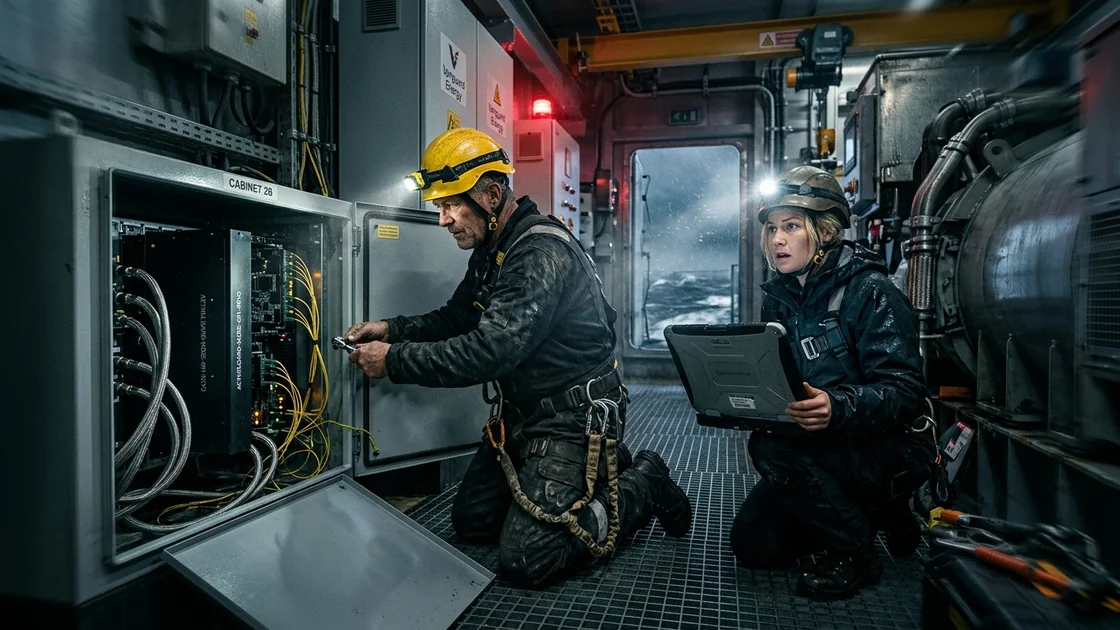
Callum Vance, a veteran offshore wind turbine technician working in the brutal expanse of the North Sea, discovers a series of unauthorized, military-grade circuit boards wired directly into the power converters of the Boreas Array. What initially appears to be a localized hardware anomaly quickly reveals itself as a massive, parasitic supercomputer distributed across one hundred and twenty towering turbines, skimming megawatts of raw, unrecorded electricity before it ever hits the onshore grid. Alongside Freya Lindqvist, the service vessel's data diagnostics specialist, Callum traces the hidden fiber-optic network and realizes the illicit cluster is executing high-level cryptographic and predictive operations for a shadow syndicate operating within their own corporate hierarchy. When their digital probing triggers an automated defensive protocol during a violent maritime gale, the compromised turbines override their safety limits, trapping Callum three hundred feet above the churning sea inside a runaway machine that is actively trying to tear itself apart to erase the evidence.
The North Sea did not have moods; it had only varying degrees of hostility. At six-thirty in the morning, eighty kilometers east of the Scottish mainland, that hostility manifested as a four-meter swell the color of wet slate and a wind that carried the stinging, metallic taste of sleet.
Callum Vance stood on the steel grating of the motion-compensated gangway aboard the Service Operations Vessel Valkyrie, his gloved hands gripping the yellow safety rails. Ahead of him, rising out of the churning whitecaps like the monolith of some forgotten industrial god, was Turbine B-14. Its yellow transition piece was slick with freezing spray, giving way to a matte-gray tubular tower that climbed a hundred and forty meters into the low, bruised belly of the clouds. At the top, the nacelle—a fiberglass and steel housing the size of a two-story house—sat turned into the gale, its three massive blades rotating with a deceptive, hypnotic slowness. Each sweep of a blade tip cut through the air at nearly two hundred miles per hour, producing a rhythmic, sub-audible whoosh-thrum that Callum felt in the fillings of his teeth rather than heard with his ears.
"Green light in three, two, one," crackled the voice of the gangway operator over Callum’s helmet radio.
The hydraulic rams beneath the telescopic bridge hissed and whined, actively counteracting the pitch, roll, and heave of the Valkyrie. While the ship rose and fell on the restless water, the rubber bumper at the tip of the gangway remained pressed against the boat landing of B-14 as if welded there.
"Crossing," Callum said into his mic.
He stepped off the tip of the gangway and onto the steel grating of the turbine's external platform, clipping his lanyard onto the safety wire in one fluid, practiced motion. Behind him, his partner for the shift, a broad-shouldered Geordie named Liam Miller, followed with the heavy pelican cases containing their fluke meters, thermal cameras, and insulated torque wrenches.
"Tell me again why we're on fourteen today," Miller grunted, unhooking from the landing run and slapping the heavy watertight door of the transition piece. He spun the central locking wheel with both hands, throwing his weight against the stiff gasket. "We cleared the annual service on the B-string back in October. Everything was green across the board."
"SCADA flagged a persistent thermal imbalance in the primary converter cabinet," Callum said, stepping into the dimly lit interior of the tower base and pulling the heavy steel door shut behind them. Instantly, the roar of the sea and the shriek of the wind were replaced by a deep, resonant hum—the acoustic signature of fifteen megawatts of electrical generation vibrating through thousands of tons of rolled steel. "And a yaw brake pressure drop. Freya said the telemetry coming off the nacelle router has been jittery for a week. Drops packets every time the rotor hits rated output."
Miller spat a piece of nicotine gum into a wrapper and tucked it into his coveralls. "Aye, well, Freya sits in a warm room drinking Kenyan pour-over and staring at five monitors. Half the time a 'telemetry anomaly' just means a seagull shat on a junction box or the salt damp got into a ribbon cable. Let’s get up there, swap the thermistor, bleed the callipers, and get back to the boat before the afternoon front rolls in. Met office says we’re looking at twenty-two meters per second by fourteen hundred. The captain’s already making noises about pulling off the field."
They clipped their tool bags into the cramped two-man service lift—a wire-mesh cage that rode a pair of taut steel cables up the interior wall of the tower. Callum pressed the green ascent button. With a metallic clack and a whine from the electric winch motor, the cage began to rise.
For eight minutes, they ascended through the hollow steel tube. Every twenty meters, they passed a circular intermediate platform lit by stark LED strips, the painted walls stenciled with height markers and emergency evacuation arrows. Callum watched the bolted flanges slip past. He had been working offshore for six years, ever since he walked away from a lucrative, soul-crushing career designing high-density server architectures in London. After a burnout that had nearly cost him his marriage—and eventually did anyway—he had retrained in high-voltage electrical systems and heavy mechanical maintenance. He liked the turbines. A wind turbine was honest. It took kinetic energy from the atmosphere, turned a shaft, excited a magnetic field, and pushed electrons down a copper cable. When something broke, you could hit it with a wrench or trace it with a multimeter. There were no office politics inside a nacelle, no investors demanding impossible latencies, no abstract lines of code hiding malicious intent.
Or so he had believed until three days ago.
Three days ago, while servicing Turbine A-09 on the northern edge of the array, Callum had noticed a discrepancy between the output figures at the generator terminals and the output figures logged at the step-up transformer in the tower base. It was small—roughly sixty kilowatts. On a fifteen-megawatt Haliade-style direct-drive turbine, sixty kilowatts was four-tenths of one percent. Any normal tech would have chalked it up to resistive losses in the busbars, harmonic distortion, or an uncalibrated current transformer.
Callum hadn't said anything to Miller, nor had he put it in the official maintenance log. Instead, he had written the numbers down in his waterproof rite-in-the-rain notebook. Then he had checked A-12 the next day. Sixty-two kilowatts missing. Yesterday, on B-03, fifty-nine kilowatts.
"You're quiet today, Cal," Miller said, leaning his helmeted head back against the mesh of the lift cage. "Still thinking about that flat in Aberdeen?"
"Just listening to the hum," Callum replied. "Does the harmonic sound a bit high to you?"
Miller cocked his head, listening to the deep, vibrating drone of the tower walls. "Sounds like a turbine making money for the shareholders, mate. Don't go inventing work for us."
The lift slowed, clunked against the upper limit switch, and stopped just below the yaw deck. They unlatched the cage door, climbed the final vertical ladder through the heavy steel hatch in the floor of the nacelle, and emerged into the machine room.
Inside the nacelle, the noise was immense—a continuous, pressurized roar of cooling fans, hydraulic pumps, and the low-frequency rumble of the massive main bearing supporting the rotor hub just forward of the bulkhead. The space was long and narrow, packed on both sides with gray powder-coated steel cabinets housing the power electronics, control PLCs, and liquid-cooling manifolds. Overhead, an orange service crane ran along steel tracks bolted to the fiberglass ceiling. The air smelled sharply of warm synthetic oil, ozone, and hot dust.
"Right," Miller shouted over the din, tapping his headset to switch to local intercom mode so they could talk without yelling. "I’ll take the yaw deck and check the brake callipers and the accumulator pressures. You want the converter cabinets?"
"Yeah, I’ve got the cabinets," Callum said. "Leave the main breaker closed for now. I want to shoot the busbars with the FLIR camera while it’s under load before we feather the blades and lock it out."
"Suit yourself. Don't fry your eyebrows off." Miller dropped back down the hatch toward the yaw ring, his heavy boots clanging on the ladder rungs.
Callum was alone in the nacelle. He unlatched his pelican case, pulled out the handheld FLIR thermal imaging camera, and walked down the narrow rubber-matted walkway toward the rear of the housing, where the main full-scale power converter cabinets sat.
In a modern offshore turbine of this scale, the generator didn't spin at a fixed grid frequency. It turned slowly—between six and ten revolutions per minute—producing wild, variable-frequency alternating current. To make that power usable for the national grid, the entirety of the electricity had to pass through the converter cabinets: first rectified into high-voltage direct current (DC), and then inverted back into clean, fifty-hertz alternating current before being sent down the tower to the transformer.
Callum stood in front of Cabinet 2B—the DC link section. Through the small reinforced glass inspection window, the status LEDs glowed a steady, reassuring green. Yet when he raised the thermal camera and aimed the lens at the cabinet, the small LCD screen bloomed with angry white and yellow blooms of heat.
It wasn't the main IGBT transistor banks that were hot. Those were sitting at a nominal sixty-five degrees Celsius, well within their operating envelope. The heat was coming from the bottom rear corner of the cabinet, down near the cable gland plates where the thick black power conduits and orange fiber-optic trunk lines passed through the floor of the nacelle.
Callum frowned. According to the engineering schematics for the Boreas Array, the lower rear quadrant of Cabinet 2B was supposed to be empty space—an expansion bay reserved for optional grid-forming battery interfaces that the utility company had been too cheap to install.
He checked his watch. Miller would be down in the yaw section for at least twenty minutes bleeding the hydraulic lines.
Moving quickly, Callum walked over to the local control terminal—a ruggedized touchscreen mounted on a pedestal near the generator bulkhead. He tapped in his technician override code, navigated to the turbine state menu, and hit PAUSE - SERVICE STOP.
Instantly, the pitch actuators in the hub ahead of him whined to life, rotating the three eighty-meter blades until their leading edges faced into the wind like feathers. Aerodynamic lift vanished. The massive rotor slowed to a crawl. Within forty seconds, the generator output dropped from fourteen point eight megawatts to zero. The main vacuum circuit breaker in the tower base tripped open with a distant, pneumatic thwack that vibrated up through the soles of Callum's boots.
Wait wait—that was strange.
Callum stared at the diagnostic screen. The generator was idling. The main AC contactors were open. The turbine was neither sending power to the grid nor drawing standard auxiliary power from it beyond the three kilowatts required for the internal lights, the lift, and the PLC.
Yet on the sub-metering screen for the internal auxiliary transformer—the unit that stepped down power for the nacelle's own cooling fans and pumps—the load hadn't dropped to three kilowatts. It was sitting at a flat, unwavering sixty-four kilowatts.
"Where is that going?" Callum muttered. Sixty-four kilowatts was enough electricity to run fifty average homes at once. If a resistive short or a seized motor inside the nacelle were burning sixty-four kilowatts of pure heat, something would be glowing cherry-red and filling the room with smoke.
He walked back to Cabinet 2B, pulled his insulated T-handle hex key from his belt, and undid the six quarter-turn locks securing the heavy steel cabinet door. Technically, opening a live DC cabinet without executing a full Lockout-Tagout procedure and waiting ten minutes for the capacitor banks to bleed down was a sackable offense under North Sea safety protocols. Callum didn't wait. He pulled on his Class 2 arc-flash gloves, cracked the door open an inch, and peered inside.
The upper half of the cabinet was standard industrial engineering: rows of massive silver capacitors, thick copper busbars insulated with red and blue heat-shrink, and the matte-gray blocks of the liquid-cooled power modules.
The lower half was different.
Bolted to the internal backplate of the empty expansion bay was a false panel painted the exact same RAL 7035 light gray as the rest of the cabinet interior. If Callum hadn't used the thermal camera, he would have looked right past it, assuming it was a factory blanking plate covering the floor knockouts.
He reached in with the back of his gloved hand, careful to stay clear of the main DC busbars above, and touched the false panel. It was warm—maybe forty degrees Celsius—and it was vibrating with a high-frequency purr that had nothing to do with the turbine's heavy machinery.
Callum examined the fasteners holding the plate. They weren't the standard metric hex bolts used by the turbine manufacturer. They were security Torx screws—the kind with the little pin in the center of the star pattern.
Fortunately, Callum was a gearhead who carried a comprehensive micro-ratchet set in his chest pocket. He slotted a T25 security bit into his driver and backed out the four corner screws. Taking hold of the steel lip, he eased the false panel out and set it carefully on the rubber floor mat.
For a long ten seconds, Callum just knelt there on the floor of the nacelle, staring into the recessed cavity while the wind howled against the fiberglass shell outside.
"Jesus Christ," he whispered.
Mounted on custom-machined anodized aluminum rails inside the cavity was a densely packed chassis containing eight horizontal blades. They weren't wind turbine control boards. Industrial PLCs were bulky, ruggedized things with big plastic terminal blocks, heavy relays, and wide spacing between components to prevent arcing in humid environments.
What Callum was looking at was bleeding-edge, ultra-high-density compute hardware.
Each of the eight blades was a custom-fabricated multi-layer printed circuit board, matte black with gold-plated trace shielding, roughly the size of a server motherboard. There were no cooling fans on them. Instead, each board was sandwiched between precision-milled copper cold plates. Braided stainless-steel hoses ran from a manifold at the side of the chassis, tapping directly into the return loop of the turbine’s own water-glycol cooling system—the system meant to keep the generator and main inverters from overheating. The heat from these boards was being dumped straight into the turbine's radiator on the roof of the nacelle, vanishing into the freezing North Sea gale where no thermal audit from a passing helicopter would ever notice it.
Callum leaned closer, shining his helmet lamp onto the top blade where a small section of the copper water block was cut away to expose the bridge chips. He knew silicon. Five years ago, he had designed rack layouts for high-frequency trading firms in Canary Wharf and sovereign wealth data centers in Frankfurt.
Each blade held four massive, lidless application-specific integrated circuits (ASICs) paired with stacks of High Bandwidth Memory (HBM3e), flanked by two field-programmable gate arrays (FPGAs) and an array of optical transceivers. The power delivery was equally insane: two thumb-thick braided copper cables ran from a solid-state DC-DC step-down converter bolted to the wall, which in turn was tapped directly into the underside of the turbine’s main 1,100-volt DC link—before the revenue-grade current transducers that measured the turbine's output for the control room.
When the turbine was generating, the boards drew their power directly off the DC bus, skimming sixty kilowatts off the top like cream off a milk pail. When the turbine was paused, like now, an automated transfer switch seamlessly flipped the load onto the auxiliary service transformer so the cluster never lost uptime.
And at the back of the chassis, four yellow single-mode fiber-optic patch cords snaked out of high-speed QSFP-DD transceivers and disappeared into the main subsea telecommunications splice box on the floor.
There were no manufacturer logos on the boards. No serial numbers, no CE compliance stamps, no FCC markings. Just a silk-screened alphanumeric string on the edge of the PCB: AETHELGARD-NODE-044-REV3.
"Cal? You good up there?" Miller’s voice crackled in his headset. "I'm done with the callipers. Just wiping down the grease ring on the yaw gear. You ready to cycle the brakes?"
Callum’s heart gave a hard, fast thump against his ribs. His instinct—honed by years of corporate paranoia before he ever put on a climbing harness—told him that Miller didn't need to see this. Miller was a good guy, a solid technician with two kids in Newcastle and a mortgage, who reported everything by the book to Hendricks, the Offshore Installation Manager back on the Valkyrie.
And if someone had managed to install a custom-engineered, liquid-cooled, sixty-kilowatt supercomputer node inside a restricted offshore wind turbine, tapping into the primary cooling loop and the subsea fiber ring without triggering a single alarm, they hadn't done it by sneaking out here on a rubber dinghy at night. This hardware had been installed either during commissioning at the marshalling port or by a specialized "maintenance" crew cleared by management.
"Yeah, nearly done, Liam," Callum said, forcing his voice to stay flat and bored. Before picking up the false panel, he pulled his personal smartphone from his inner fleece pocket—kept in a Faraday pouch while climbing so it wouldn't interfere with equipment—and snapped six rapid, high-resolution photos of the chassis, the power tap, the water manifold, and the fiber splice.
Then he noticed a single USB-C diagnostic port and a micro-SD slot on the management controller board at the bottom of the rack. Next to it, a tiny green LED was blinking in a rapid, erratic rhythm—the unmistakable cadence of heavy network I/O. The node was actively processing data right now.
He didn't have a laptop with him, and plugging an unknown USB device into a live system was a great way to trip a tamper alarm. He needed to see how the fiber was spliced first.
Working with frantic precision, Callum lifted the gray steel blanking plate back into position, lined up the holes, and drove the four security Torx screws home with his ratchet. He wiped his glove prints off the powder-coated steel with a rag, closed the cabinet door, and engaged the six quarter-turn locks just as the floor hatch clanged open and Miller’s yellow helmet poked through.
"What was the verdict?" Miller asked, hauling himself up into the nacelle and peeling off his oil-stained outer gloves. "Thermistor?"
"Loose terminal on the auxiliary blower contactor," Callum lied smoothly, packing his FLIR camera back into the foam cutout of the pelican case and snapping the latches shut. "Created a high-resistance hot spot. Torque was off by half a turn. I tightened it down and cleared the fault code."
"Easy money," Miller grinned, checking his watch. "Still got two hours before lunch. Hendricks wants us to hop over to B-15 if the swell holds below four point five. Same fault code on the SCADA log, apparently. Must've been a Friday afternoon batch from the factory."
Callum felt a cold prickle at the base of his neck. "B-15 has the same thermal flag?"
"Aye. B-15, B-18, and C-02. All flagging minor cabinet over-temps whenever the wind drops below six meters per second."
Callum nodded slowly. It made complete sense. When the wind was howling and the turbine was pumping out fifteen megawatts, the main liquid-cooling pumps ran at one hundred percent duty cycle, pushing gallons of ice-cold glycol through the radiators on the roof. That massive cooling flow easily absorbed the extra sixty kilowatts of heat from the hidden server rack.
But when the wind dropped, or when the turbine went into an idle state, the turbine's main PLC throttled the cooling pumps down to save power—because the turbine thought it wasn't generating heat. Meanwhile, the hidden compute node kept chugging along at full tilt, sixty-four kilowatts of pure thermal output baking inside the cabinet until the ambient temperature sensors triggered a minor warning on the SCADA screen.
AETHELGARD-NODE-044.
If this was Node 44, there were at least forty-three others. Probably more. The Boreas Array consisted of one hundred and twenty turbines spread across two hundred square kilometers of the North Sea.
If every single turbine in the array held one of these racks, someone was running an hidden, off-grid data center pulling over seven point five megawatts of continuous power, cooled by the North Sea wind, completely invisible to regulators, tax authorities, and the national grid operator.
"Let's get down," Callum said, picking up his tool bag. "I want to check B-15 before the weather shuts us out."
By sixteen hundred hours, the predicted gale had arrived with teeth bared. The wind had clocked around to the northeast, screaming down from the Arctic Circle at twenty-six meters per second, whipping the crests of the six-meter waves into horizontal sheets of white foam. Transferring via the gangway was impossible now; the Valkyrie had pulled back five hundred meters from the turbine strings, holding station on its dynamic positioning thrusters in the deep-water channel between Sector B and the Offshore Substation.
Inside the ship, the storm was reduced to a slow, rhythmic corkscrew motion and the constant creak of interior bulkheads. Callum sat in his narrow single cabin on Deck 3, the door deadbolted, the porthole blacked out by heavy storm shutters and the gathering northern twilight.
On his desk, illuminated by a single gooseneck LED lamp, were the photographs he had taken inside B-14 and B-15.
In B-15, while Miller had been up in the nose cone checking the pitch accumulator bladder pressures, Callum had opened Cabinet 2B again. Behind an identical gray blanking plate, he had found AETHELGARD-NODE-045-REV3.
This time, Callum had been ready. Before leaving the Valkyrie after lunch, he had stopped by his locker and retrieved a passive optical tap and a portable optical time-domain reflectometer (OTDR) from the ship's fiber-repair kit, along with an old, air-gapped Linux diagnostic tablet he used for personal projects. While Miller was occupied forward of the bulkhead, Callum had traced the four yellow fiber patch cords from the hidden chassis into the nacelle's main communications termination box.
The setup was brilliant in its elegance. The Boreas Array was wired in a series of redundant subsea fiber-optic rings. Normally, a turbine's SCADA telemetry used only a tiny fraction of a single fiber strand's capacity—transmitting on a standard 1310-nanometer wavelength at a few megabits per second to report rotor speed, temperatures, and power output back to the ship and the onshore control center in Aberdeen.
Whoever had installed the Aethelgard nodes had inserted passive Coarse Wavelength Division Multiplexing (CWDM) prisms into the splice trays inside every turbine. While the legitimate turbine data crept along on the 1310nm band, the hidden compute blades were blasting massive, encrypted data streams across the exact same glass fibers using four parallel wavelengths in the 1550nm C-band—400 gigabits per second per node.
Because CWDM prisms were entirely passive pieces of glass, they drew no power, had no MAC addresses, and didn't show up as network hops on any standard IT diagnostic scan. To the wind farm’s network engineers, the fiber ring looked completely normal.
Callum zoomed in on the photo of the silicon dies on his tablet screen, measuring the die area against the known dimensions of the PCIe lanes and HBM stacks.
He couldn't do this alone. He knew hardware, power systems, and physical layer architecture, but to understand what was actually moving through those 1550nm wavelengths—and where the data was leaving the wind farm—he needed access to the master SCADA routing tables and the substation trunk logs.
There was only one person on the Valkyrie who had root-level visibility into the array's communications backbone.
Callum slipped the tablet into his hoodie pocket, unlocked his cabin door, and stepped out into the narrow passageway. He braced one hand against the handrail as the deck rolled fifteen degrees to port, making his way aft toward the technical offices on Deck 4.
The SCADA monitoring room was a quiet, climate-controlled sanctuary tucked behind the ship's main bridge. When Callum badged through the outer air-lock door, the only light came from a curved wall of fifty-inch monitors displaying a stylized map of the Boreas Array: ten neat rows of twelve green dots, each representing a spinning turbine, connected by glowing blue lines representing the 66-kilovolt subsea collector cables.
Sitting in a high-backed ergonomic chair in the center of the room was Freya Lindqvist. She was thirty-two, a former telecommunications security analyst from Gothenburg who had taken the offshore diagnostics contract two years ago, ostensibly to pay off her student loans while writing a doctoral thesis on industrial control systems. She had her blonde hair twisted up around a carpenter's pencil, thick wool socks propped up on the edge of the console, and a mug of black coffee balanced precariously on a gimbaled cup holder.
"If you're here to tell me B-14 and B-15 are still running hot, save your breath," Freya said without turning around, her fingers flying across a mechanical keyboard. "I’m looking at the live polling right now. B-14's cabinet temp dropped four degrees while you had it paused, then crept right back up to fifty-eight Celsius twenty minutes after you closed the breaker. Whatever contactor you tightened, Vance, it wasn't the culprit."
Callum walked up behind her chair and glanced at the security camera mounted in the upper corner of the room, just above the server racks.
"Does that camera feed go to Hendricks' office or the bridge?" Callum asked quietly.
Freya stopped typing. She swiveled her chair slowly around and looked up at him through narrow, gray eyes. "Local NVR in the rack behind you. Loop overwrites every seventy-two hours unless flagged. Why?"
"What about your workstation? Is your screen mirrored to the onshore NOC in Aberdeen?"
"Only when I open a remote support ticket. Right now we're running on local satellite buffer because the storm is chewing up the Ku-band uplink." She pulled the pencil out of her hair, letting it fall around her shoulders, and studied his face. The usual sarcastic banter she used with the mechanical crews vanished. "You look like you just dropped a fifty-pound torque wrench down the tower shaft, Callum. What did you find out there?"
Callum reached over, unplugged the ethernet cable connecting the local NVR security camera recorder to the ship’s internal switch, and then pulled the tablet from his hoodie. He laid it on the console desk in front of her, swiping to the first photograph of the open cavity in Cabinet 2B.
Freya leaned forward. Her eyes widened slightly as she took in the black PCBs, the copper water blocks, the braided steel lines, and the heavy DC bus taps.
"Where is this?" she whispered.
"Turbine B-14. Lower expansion bay of the primary DC link cabinet, hidden behind a custom blanking plate," Callum said, his voice barely louder than the hum of the workstation fans. He swiped to the next photo. "And this is B-15. Identical setup. Sequential node numbers: 044 and 045. And before you ask, I checked the power readings on A-09, A-12, and B-03 earlier this week. Every single one of them has a sixty-to-sixty-five kilowatt discrepancy between the generator stator output and the high-voltage transformer meter at the base of the tower."
Freya’s hand went to the mouse, zooming in on the silk-screened lettering on the board edge: AETHELGARD-NODE-044-REV3.
"This isn't SCADA hardware," she murmured, her analytical mind kicking into high gear. "Our entire turbine control system runs on ruggedized Siemens S7 controllers that draw less than two hundred watts. This is... God, look at the VRM phases on that board. That’s a custom blade server. Liquid-cooled. Four ASICs per blade, eight blades in the chassis."
"Roughly two kilowatts per blade," Callum confirmed. "Plus the optical routing plane and the DC-DC conversion losses. Sixty-four kilowatts total per turbine."
Freya stared at the big wall map of the array—one hundred and twenty green dots pulsing steadily in the dark North Sea. She did the math in her head in three seconds.
"Seven point six megawatts," she breathed. "Across the whole farm. That’s... Callum, a medium-sized commercial data center runs on five to ten megawatts. You’re telling me someone has built a Tier-4 equivalent supercomputer inside our wind farm? Distributed across a hundred and twenty nacelles?"
"Think about the engineering advantages," Callum said, pulling up a stool beside her. "What are the three biggest costs and bottlenecks in building an exascale supercomputer today? Power availability, cooling, and real estate permitting. If you try to build a ten-megawatt AI cluster or cryptographic foundry outside London or Frankfurt, you wait five years for a grid connection, you pay millions in electricity tariffs and carbon taxes, you have to build massive evaporative cooling towers, and every government regulator knows exactly how many flops you’re running because they can see the substation draw from space."
"Here, the power is free," Freya said, her voice rising with a mixture of horror and professional awe. "They’re tapping the DC bus before the revenue meters. As far as the utility company and the grid operator know, the wind in Sector B is just half a percent weaker than the meteorological masts predict. A rounding error in the wake-effect models! And the cooling—"
"Closed-loop water-glycol straight to the nacelle roof radiators," Callum finished. "Sitting three hundred feet up in a freezing gale. An infinite heatsink. And legally? We’re eighty kilometers offshore, right on the edge of the Exclusive Economic Zone. Even if someone suspected something, you can't just drive a van up to the fence and serve a warrant. You need an offshore support vessel, a helicopter, GWO-certified climbers, and a four-day weather window just to open one cabinet."
Freya looked back at the photo of the fiber splice box. "How are they moving the data? A distributed supercomputer is useless without a high-speed interconnect. If those ASICs are training a large-scale model or running distributed simulations, the node-to-node latency has to be microseconds. They can’t be routing this over our SCADA network; my switches would melt."
"They aren't," Callum said. He pulled a small USB drive from his pocket. "They spliced passive CWDM multiplexers into the dark fibers of the subsea ring. Four wavelengths in the 1550nm band. When I was in B-15, I put a non-invasive clip-on optical coupler onto the jumper going into Port 1 of the node's transceiver. I couldn't read the full 400-gigabit stream with a portable tester, obviously, but I managed to capture the link-layer discovery frames and timing beacons on the management channel during a thirty-second window."
He handed her the USB drive. Freya hesitated for a fraction of a second, looking at him. "If I plug this into an air-gapped sandbox and they’ve got some kind of zero-day firmware exploit embedded in the framing—"
"I already ran it through a hex dump on my tablet," Callum said. "It’s a raw pcap capture file. No executables. Just Layer 2 and Layer 3 headers."
Freya nodded once, turned to a secondary diagnostic laptop that wasn't connected to the ship’s network, and slotted the drive in. She opened Wireshark, loaded the capture file, and began filtering the packet headers.
For five minutes, the only sound in the room was the clack of her mechanical keys and the deep shudder of the Valkyrie's hull as a massive wave slammed against the port bow. Callum watched her face in the blue glow of the screen.
"Okay," Freya said slowly, pointing a fingernail at a recurring hexadecimal string in the packet headers. "They’re using RoCEv2—RDMA over Converged Ethernet. Remote Direct Memory Access. That confirms it’s a single, unified supercomputer. Every node in every turbine can read and write directly to the HBM memory of the nodes in the adjacent turbines without involving a CPU operating system. The entire wind farm is acting as one giant motherboard."
"Can you see the topology? Where is the head node? A cluster like this needs a master scheduler and an external uplink to receive jobs and exfiltrate the results."
Freya scrolled down through the Precision Time Protocol (PTP) synchronization frames. In a distributed cluster, every node needed its internal clock synchronized to within nanoseconds, and that timing pulse always propagated outward from a central grandmaster clock.
"Look at the hop counts on the PTP sync packets," Freya said, her eyes narrowing. "B-15 is receiving its master clock pulse from B-14, which gets it from B-13... tracing all the way back up the B-string radial cable to... the OSS."
"The Offshore Substation," Callum said.
"Wait. It doesn't stop at the substation," Freya muttered, typing a rapid command into a terminal window to cross-reference the optical attenuation numbers Callum had recorded on his OTDR. "The signal passes right through the OSS patch panel without hitting an active repeater, drops down into the main export cable bundle on the seabed, and—hold on."
She stopped. She pulled up the marine engineering chart of the Boreas Array’s subsea export cables—the three massive, armor-plated cables buried two meters beneath the ocean floor that carried the wind farm's electricity eighty kilometers west to the Scottish coast.
"The attenuation profile on the 1550nm control channel doesn't go west toward Scotland," Freya whispered. "It’s only twelve kilometers long."
Callum frowned, leaning over her shoulder to look at the marine chart. "Twelve kilometers? There’s nothing twelve kilometers from the substation. That’s open water."
"No, it isn't," Freya said. She toggled a layer on the GIS map labeled SUBSEA INFRASTRUCTURE - THIRD PARTY.
A set of thin purple lines appeared on the screen, crisscrossing the seabed of the North Sea. Twelve kilometers due east of the Boreas Offshore Substation, running north-to-south from Norway down to the Netherlands and the UK financial exchanges in Slough, was NorseLink-4—a major commercial high-capacity trans-oceanic fiber-optic trunk cable.
And sitting right on top of the intersection between the wind farm’s eastern boundary and the NorseLink-4 trunk was an abandoned, decommissioned North Sea oil and gas wellhead platform from the 1980s, slated for demolition five years ago but tied up in environmental litigation: Platform Cormorant Alpha.
"Or maybe they ran a dark spur straight into a subsea branching unit on NorseLink," Callum said, his mind racing. "Either way, they don't use the wind farm's satellite link or our onshore substation in Aberdeen. The data goes straight down into the seabed and injects directly into the main European financial and telecommunications backbone at the speed of light."
"Look at the payload metadata," Freya said, opening another window where she had isolated an unencrypted administrative status frame from Node 045. "The job scheduler identifiers aren't random hashes. Look at the string syntax."
On the screen, a block of ASCII text sat amidst the hexadecimal soup:
CLUSTER_ID: AETHELGARD_NORTH_01
ACTIVE_PARTITION: Q_LATTICE_SIEVE_4096
TARGET_EPOCH: 1711843200
AUTH_KEY_POOL: SOVEREIGN_TIER_0
POWER_BUDGET_ALLOC: 7680_KW (NOMINAL)
THERMAL_THROTTLE_OVERRIDE: ENABLED (CRITICAL_RUN)
Callum felt the blood drain from his face. He knew what
Q_LATTICE_SIEVE_4096 meant. Anyone who had worked in
high-level hardware architecture over the last five years knew the
theoretical models.
"It's not an AI training cluster," Callum said softly. "And they aren't mining crypto."
Freya looked up at him, her face pale in the monitor light. "Lattice sieving. General Number Field Sieve algorithms optimized for custom ASICs. They’re running a brute-force cryptanalytic engine."
"Not just any engine," Callum said. "Look at the thermal throttle override flag. CRITICAL_RUN. And look at the silicon in my photos—those huge HBM stacks paired with custom gate arrays. Standard RSA-2048 or elliptic curve cryptography takes a classical supercomputer years to crack unless you have a massive breakthrough in number field sieving hardware and an ungodly amount of continuous, untraceable power to pre-compute the lookup tables. Once you build the master mathematical sieve table for a specific prime modulus, you can crack any private key using that parameter in minutes. Banking transfers, sovereign debt auctions, military satellite command links, diplomatic cables."
"Who the hell has the capital to fab custom three-nanometer ASICs, modify a hundred and twenty offshore wind turbines during assembly, and tap a subsea international fiber trunk?" Freya asked.
"Look at the parent consortium that financed the Boreas Array," Callum said. "Vanguard Energy Partners took the public subsidy, right? Thirty percent funded by the government green transition grant, seventy percent by a private equity syndicate registered in Luxembourg and Zürich—Aethelgard Holdings."
Freya’s mouth opened slightly. "Aethelgard Holdings. They're the majority bondholders on the construction loan. I see their name on the quarterly compliance reports Hendricks sends onshore."
"It’s a parasitic infrastructure play," Callum said, the sheer audacity of it locking into place like the gears of a watch. "You want to build a secret, sovereign-scale cryptographic weapon in Europe. If you build a bunker in the Alps, intelligence agencies watch your power lines and track your hardware shipments. So instead, you form a green energy investment fund. You get the British and Scottish governments to subsidize the construction of a two-billion-pound offshore wind farm. During the manufacturing of the power converter cabinets at the subcontractor plant, your people slip a sixty-kilowatt blade chassis into the empty battery bay of every unit. The legitimate construction crews crane the nacelles onto the towers, hook up the cooling pipes, and splice the fiber rings without ever knowing what’s behind the blanking plate in Cabinet 2B. The wind farm goes live, sells ninety-nine point five percent of its clean electricity to the public at a profit, and uses the remaining half-percent to run the most powerful black-ops decryption cluster in the northern hemisphere—for free."
Freya stared at the screen. "And if anyone ever comes out here to inspect the turbines..."
"Who inspects them?" Callum asked bitterly. "Guys like me and Miller. Mechanics and HV sparkies who get paid to grease bearings, change oil filters, and swap broken pitch motors. We don't open live DC link cabinets unless there's a catastrophic busbar failure, and if there is a failure in Cabinet 2B, I bet a specialized 'OEM warranty team' flies out on a private helicopter to swap the whole unit before we're allowed near it."
Suddenly, across the curved wall in front of them, one of the green dots on the array map blinked amber, then crimson.
A soft, two-tone chime echoed through the SCADA room.
Freya spun her chair back to the main console. "What is that? Turbine B-15 just threw a high-priority PLC fault."
Before she could pull up the diagnostic log for B-15, a second chime sounded. Turbine B-14 blinked crimson.
Wait—not a turbine fault. A security alert on the network management panel.
OPTICAL_INTRUSION_DETECTED: RING_B_SEGMENT_14_15
REFLECTANCE_DELTA_EXCEEDED: +0.42 dB @ 1551.12nm
INITIATING_PROTOCOL: ISOLATE_AND_SANITIZE
"Oh, God," Freya gasped, her fingers flying across the main keyboard. "Callum, when you clipped that optical coupler onto the fiber in B-15 and shot the line with your OTDR—"
"An OTDR sends a laser pulse down the fiber to measure distance," Callum said, his stomach dropping as the ship rolled violently beneath them. "The cluster's transceivers detected the reflectance spike and the micro-bend loss from my clip-on tap. It logged the timestamp and just finished correlating it with the turbine door access logs."
And to get into the local control terminal of B-14 to pause the rotor, Callum had typed in his personal six-digit technician ID code.
On the far right monitor of Freya’s console, the ship’s internal VoIP directory flashed. Line 1—the Offshore Installation Manager’s office two decks below—went active, dialing out over the encrypted satellite voice channel to an unlisted number.
At the same time, the main SCADA screen went entirely black for three seconds. When it flickered back on, the interface had changed. The turbine icons were still there, still spinning in the twenty-eight-meter-per-second gale outside, but Freya’s administrative lockout icons were grayed out.
REMOTE OVERRIDE ACTIVE - MASTER TERMINAL 00
"I'm locked out," Freya said, her voice tight with panic as she hammered commands into her terminal. "Someone just revoked the Valkyrie's local supervisory credentials from the substation router. We’re in read-only mode. Wait—no, they’re flashing new firmware onto the ship’s central gateway right now. They’re wiping the historical SCADA logs on my server!"
"Copy the database!" Callum barked, lunging toward the server rack.
"I can't, the RAID array is encrypting itself block by block!" Freya yelled. She yanked a portable NVMe drive out of her desk drawer, jammed it into her local workstation, and executed a raw memory dump script, pulling whatever was currently cached in the workstation's RAM—the last forty-eight hours of power discrepancies across all one hundred and twenty turbines, the network topology maps, and the optical routing tables.
Outside in the corridor, heavy boots pounded on the steel decking. Lots of them. Not the slow clomp of technicians in work boots, but the fast, coordinated stride of multiple men moving with purpose.
The Valkyrie had a crew of forty, plus twenty wind technicians. Wait—three days ago, when they had rotated crews in Aberdeen, four men in gray unmarked coveralls had boarded the ship. Hendricks had introduced them in the mess hall as "subsea cable insurance auditors" who were just observing operations for the week. They hadn't climbed a single turbine, and they ate at a separate table.
"They're coming up the aft companionway," Callum said, looking through the narrow wired-glass window in the air-lock door. Down at the end of the corridor, the heavy fire door burst open. Hendricks was leading two of the gray-coveralled "auditors." Neither of the auditors was carrying a clipboard. The man in front had a compact, suppressed semi-automatic pistol held low against his thigh; the second carried a heavy steel breaching bar and zip-tie restraints.
"Thirty seconds!" Freya cried, watching the progress bar on her screen crawl from sixty percent to seventy. "If I pull the drive now, the file table corrupts!"
Callum looked around the SCADA room. There was only one main entrance from the internal corridor, which had an electronic mag-lock. He hit the emergency red lockdown button beside the door frame, engaging the magnetic deadbolt just as the first auditor reached the door and wrenched at the handle.
Through the reinforced square of glass, Callum locked eyes with Hendricks. The site manager looked terrified, his face slick with sweat, before the lead auditor shoved him aside and wedged the flat steel chisel of the breaching bar into the gap between the door frame and the magnetic strike plate.
"Is there another way out of here?" Callum demanded, grabbing a ten-pound CO2 fire extinguisher off its wall bracket.
"The cable chase!" Freya pointed toward the rear behind the server racks, where a heavy steel hatch opened onto the external boat deck—used for running temporary deck cables during crane operations. "It goes out to the aft helideck staging area!"
Ninety percent. Ninety-five.
The steel frame of the corridor door shrieked as the auditor threw his weight against the pry bar, popping the welds on the magnetic strike plate. A crack appeared in the wired glass.
One hundred percent.
Freya yanked the NVMe drive from the port, snatched the air-gapped Linux laptop containing Callum’s photos and the packet capture off the desk, and shoved both into her waterproof dry-bag backpack. Callum grabbed the power cord at the back of the main workstation and yanked it sideways, snapping the ground pin off inside the socket and sending a shower of blue sparks across the carpet as the corridor door burst inward with a deafening bang.
Callum didn't wait to see them aim. He depressed the lever on the CO2 extinguisher and unleashed a blinding, roaring cone of freezing white dry-ice fog directly into the narrow doorway. The sudden drop in temperature and oxygen made the lead gunman stumble back, coughing violently, his gunshot going wild and shattering one of the overhead ceiling monitors in a shower of glass and plastic.
"Go!" Callum roared, shoving Freya behind the server racks toward the rear hatch.
He spun the wheel on the heavy watertight hatch, kicked it open into the teeth of the howling North Sea night, and pushed Freya out onto the open steel deck before diving through after her and slamming the dogs shut from the outside.
Stepping onto the open deck of the Valkyrie during a Force 10 gale was like stepping into a jet engine intake filled with ice water.
The night was pitch black save for the blinding white sodium floodlights mounted on the vessel's mast, which cut through horizontal sheets of sleet and freezing sea spray. The wind tore at their clothes with physical violence, threatening to rip them off their feet as the ship pitched twenty degrees into the trough of a monstrous wave. Green water boiled over the lower working deck twenty feet below them, smashing against the yellow pillars of the gangway crane and sending geysers of foam high into the floodlit air.
"Where?!" Freya screamed, her voice nearly torn away by the gale as she clung to the exterior handrail, soaked to the bone within three seconds. "We're on a ship in the middle of the ocean, Callum! Where the hell do we go?!"
Callum looked back at the hatch. He had jammed a thick steel cargo shackle through the external wheel mechanism to lock the dogs from the outside, stopping the auditors from following them directly through the cable chase, but it would take them less than ninety seconds to run down the internal stairs and come out onto the main aft deck via the hangar doors.
And the ship’s bridge was undoubtedly already locked down by the other two operatives. There were no lifeboats they could launch in a seven-meter swell without being crushed against the hull, and the ship's radios were controlled from the bridge.
Callum looked out over the port rail.
The Valkyrie wasn't in the open channel anymore.
While they had been inside the SCADA room, the ship had moved. The
dynamic positioning system—under the automated
ISOLATE_AND_SANITIZE protocol or commanded from the
bridge—had maneuvered the vessel back into the turbine array. Looming
less than thirty meters off the port beam, lit up like a ghost ship by
the Valkyrie's searchlights, was the massive, four-legged
jacket foundation of the Offshore Substation—OSS Alpha—and
directly adjacent to it, connected by a permanent steel structural
bridge, was Turbine A-01, the master diagnostic turbine of the farm.
And the Valkyrie’s motion-compensated Walk-to-Work gangway was extended, its hydraulic cylinders hissing and booming as the tip hovered just two meters shy of the turbine’s boat landing, waiting for the deck crew to complete a docking latches sequence. Why was the ship docking with A-01 in a Force 10 storm?
Because the automated protocol had detected an optical intrusion on the ring, and the operatives on board were either evacuating the master cryptographic keys from the head node on the substation before scuttling the evidence, or they were preparing to physically sever the link.
"The emergency muster locker!" Callum shouted into Freya’s ear, grabbing her arm and dragging her along the leeward wall of the superstructure toward the gangway tower. "Put on an immersion suit and a harness! Now!"
They tore open the fiberglass doors of the deck locker next to the gangway stairs. With hands already going numb from the sleet, they stepped into the bulky, neoprene ocean survival suits inside sixty seconds, zipping the waterproof seals up to their chins and pulling the high-visibility hoods over their heads, then buckling on climbing harnesses with twin shock-absorbing lanyards from the technician staging rack.
Below them on the main deck, the heavy steel doors of the warehouse hangar rolled begin to slide open. Two figures in dark foul-weather gear stepped out into the floodlights, scanning the upper walkways with tactical flashlights attached to the rails of submachine guns.
"Up the gangway tower!" Callum urged.
They scrambled up the grated steel stairs to the gangway control cab fifty feet above the waterline. The cab was empty—the operator had either been pulled off by the security team or had left the gangway in automated hover-tracking mode while waiting for orders from the bridge.
Through the rain-streaked glass of the control cab, Callum looked down the length of the thirty-meter telescopic bridge. The Valkyrie was rolling heavily, its thrusters roaring at ninety percent power to hold station against the gale, while the gangway's hydraulic rams whined in panic, extending and retracting four meters every few seconds to keep the bumper tip aligned with the yellow steel boat landing of Turbine A-01.
On the control console, the red warning light flashed: SEA STATE EXCEEDS SAFE TRANSFER LIMIT (HS > 5.5M) - AUTO-DOCK INHIBITED.
"You're insane!" Freya gasped, staring down the bucking, heaving steel bridge toward the towering monolith of the turbine. "The gangway isn't latched! It’s hovering two meters off the landing!"
Below them, boots clanged on the bottom rungs of the gangway tower stairs. A bullet ricocheted off the steel grating ten feet below the cab door with a sharp spang.
"If we stay on this ship, we go over the side with weights on our ankles and Hendricks logs it as a man-overboard accident in a storm!" Callum yelled. He slammed his hand down on the manual hydraulic override joystick, forcing the telescopic boom to extend another meter and a half despite the proximity alarms screaming in the cab.
The rubber bumper at the end of the gangway slammed hard against the vertical push-tubes of Turbine A-01’s landing platform with a metallic crunch that shuddered all the way back to the cab, held there only by the raw hydraulic pressure of the manual override.
"Go! Run!" Callum shoved her out of the cab door onto the narrow, rain-lashed walkway of the gangway.
They ran out over the abyss. Forty feet below their steel-toed boots, the North Sea was a cauldron of black water and exploding white foam as seven-meter waves smashed against the five-meter-wide steel monopile of the turbine, sending solid walls of seawater roaring up toward the underside of the bridge. The gangway bucked and twisted beneath them as the Valkyrie dropped into a deep wave trough. Callum heard the terrible, high-pitched scream of the gangway's hydraulic limit valves failing as the ship pulled away further than the telescopic boom could reach.
"Jump!" Callum screamed, grabbing the back of Freya’s harness as they reached the very tip of the gangway just as the rubber bumper tore away from the turbine’s landing tubes, opening a four-foot chasm over the boiling sea.
They leaped together across the gap.
Freya crashed chest-first onto the wet steel grating of the turbine's external platform, her hands seizing the vertical yellow guardrail. Callum slammed into the grating right beside her, his left shin cracking painfully against a steel bollard, his right hand snapping the heavy aluminum hook of his safety lanyard onto the structural arrest cable just as the gangway boom whipped violently backward behind them, its hydraulic hoses rupturing in a cloud of hot mist as the Valkyrie sheered off to port.
For a few seconds, they hung there on the exterior of the turbine tower, fifty feet above the raging waves, gasping for freezing air while a solid sheet of salt spray broke over their heads. Across the gap of churned water, the Valkyrie fell back sixty meters, its dynamic positioning system automatically retreating to its safety standoff perimeter now that the gangway had suffered a mechanical fault. On the aft deck of the ship, two small silhouettes stood under the floodlights, watching them.
"They can't re-dock the ship!" Callum shouted over the roar of the sea, hauling himself up and helping Freya to her feet. "The gangway hydraulics are blown and the sea’s too big for a transfer boat! We have to get inside out of the weather before we freeze!"
He spun the heavy locking wheel on the watertight door of Turbine A-01, threw it open, and pulled Freya inside the tower base, slamming the vault-like steel door shut against the howling storm.
Inside, the transition piece was dry, brightly lit by emergency fluorescent strips, and filled with the familiar, bone-deep hum of the turbine spinning at full capacity in the storm above them.
Freya collapsed onto the bottom steps of the internal access ladder, unzipping the neck of her bulky survival suit and spitting salt water from her mouth. Her hands were shaking uncontrollably, her face white, though she checked her dry-bag backpack first to make sure the laptop and the NVMe drive were intact.
"We're trapped on a steel pole eighty kilometers from land," she panted, looking up into the dizzying vertical perspective of the tower shaft. "And the people who want us dead control the only ship within forty miles."
"They don't control the Coast Guard," Callum said,limping over to the wall-mounted emergency marine VHF radio and the yellow satellite emergency beacon box bolted next to the switchgear. "Every primary A-string turbine has an independent Global Maritime Distress and Safety System (GMDSS) transceiver powered off the battery backup, plus the microwave line-of-sight link on the nacelle roof that shoots straight to the Maritime Rescue Coordination Centre in Aberdeen."
He picked up the heavy black handset of the wall radio and keyed the mic. Dead. Not even static.
He opened the gray steel junction box beneath the radio. The coaxial antenna lead going up the tower hadn't just been unplugged; a wireless relay switch had been wired inline with the power supply, currently glowing with a red isolation light controlled by the turbine's PLC.
"The nacelle roof still has the physical microwave dish and the independent Iridium satellite emergency terminal," Callum said, his eyes narrowing as he looked up toward the top of the tower. "And A-01 is the master aggregator node before the Offshore Substation. If we can get into the nacelle of A-01, I can physically bridge the microwave dish straight into your laptop and dump that NVMe drive—the photos, the packet captures, the sovereign key targets, the financial routing—straight to the National Cyber Security Centre and the Coast Guard frequency before that ship can get a helicopter out here."
Freya looked toward the service lift cage sitting at the base of the shaft. "Okay. Let's take the lift up."
Callum grabbed her shoulder before she could touch the cage door.
Look at the main high-voltage switchgear cabinet across the room. And listen to the sound of the tower.
The deep, fifty-hertz hum of the tower wasn't steady anymore. It was rising in pitch.
Callum ran over to the local SCADA diagnostic screen mounted beside the transformer bay. The screen was flashing with red override banners he had never seen in six years of working on wind turbines:
REMOTE ENGINEERING MODE - SAFETY INTERLOCKS BYPASSED
YAW BRAKE PRESSURE: 0 BAR (VENTED)
ROTOR OVERSPEED PROTECTION: DISABLED
BLADE PITCH TARGET: 0.0 DEGREES (MAX POWER CATCH)
MAIN GRID BREAKER: OPEN (LOAD REJECTED)
Callum stared at the screen in absolute horror.
"What did they do?" Freya asked, coming up behind him, terrified by the look on his face. "Callum, why is the tower vibrating like that?"
"They didn't need to send men over the gangway to kill us," Callum whispered. "They have root access to the turbine's programmable logic controller over the optical ring."
He grabbed the handrail as a sickening, low-frequency shudder ran down the entire four-hundred-foot length of the steel tower, accompanied by the shriek of tortured metal far above their heads.
"In a twenty-eight-meter-per-second storm, a turbine is supposed to feather its blades to spill the wind, or shut down completely and lock the rotor," Callum said, his voice tight. "Instead, they just opened the main grid circuit breaker at the bottom of the tower so the generator has zero electrical resistance slowing it down—and then they pitched all three blades flat into a sixty-knot gale."
Freya’s eyes went wide. She understood physics. "A runaway rotor."
"A fifteen-megawatt rotor with eighty-meter carbon-fiber blades spinning with no load in a storm," Callum said. "Right now, the rotor is designed for a maximum speed of ten RPM. It's already at fourteen RPM and accelerating every second. If it hits twenty-two RPM, centrifugal force will rip the blades out of the hub or the blade tips will flex inward and strike the tower at three hundred miles per hour. The entire nacelle will tear itself off the top of the mast and collapse into the sea."
And from the point of view of the Aethelgard syndicate, it was the cleanest possible solution. Every year or two, somewhere in the world, a wind turbine suffered a catastrophic controller failure during an extreme storm and tore itself apart. When the Coast Guard and the accident investigators arrived two days from now after the storm cleared, they would find Turbine A-01 crumpled in the North Sea, two tragic technicians who had crossed over to fix an emergency fault crushed in the wreckage, and Node 001 obliterated at the bottom of the ocean—while the operatives on the Valkyrie quietly spent the next forty-eight hours purging the remaining nodes or falsifying the maintenance logs.
"Can you shut it down from down here?!" Freya yelled as the vibration in the floor plates grew so intense that dust and rust flakes rained down from the intermediate platforms above.
"No! The PLC is in the nacelle! The fiber commands from the ship go to the nacelle router first, and the manual hydraulic pitch valves and the mechanical rotor lock are up in the machine room!"
"Take the lift!"
"If the tower flexes more than two meters off vertical, the lift cables will foul and jam us halfway up a collapsing tube!" Callum shouted, stripping off his bulky neoprene immersion suit until he was down to his thermal base layer and his climbing harness. "Wait—no, the lift is our only shot for the first hundred meters! If we climb the ladder, we'll be dead before we reach the halfway deck! Strip the suit, keep the harness and the bag!"
Freya tore out of her orange survival suit in seconds, slinging the dry-bag tightly across her chest and clipping its straps into her chest D-ring. They threw themselves into the wire-mesh cage of the service lift. Callum slammed the gate and jammed his thumb onto the emergency bypass ascent button, overriding the vibration sensor interlock that was trying to ground the elevator.
With a grinding screech from the winch motor far above, the small cage lurched upward.
As they rose through the hollow belly of the tower, the acoustic environment inside the steel tube became a living nightmare. A modern offshore wind tower is not a solid pillar; it is a rolled steel shell barely an inch and a half thick at the upper sections, engineered to flex in the wind like a reed.
Now, under the colossal, unbalanced aerodynamic forces of a runaway three-hundred-ton rotor spinning at fifteen revolutions per minute, the tower wasn't just flexing—it was whipping violently in elliptical arcs.
Every four seconds, as each massive blade swept past the front of the tower, the aerodynamic shockwave struck the steel wall with a deafening, concussive BOOM that sounded like an artillery shell going off outside the hull. Between the booms, the steel guide cables of the lift whipped and slapped against the interior walls, sending showers of sparks down the shaft as the cage bounced from side to side against the guide rails.
At seventy meters up, the lights inside the tower went out.
The auxiliary transformer at the base had finally tripped from the harmonic feedback. Only the dim red glow of the battery-backed emergency exit LEDs on the platforms every twenty meters remained, slicing through the darkness as the cage rocketed upward, along with the white beams of their helmet headlamps.
"Hold the frame!" Callum roared as the tower took a massive lurch to leeward.
At one hundred and ten meters—thirty meters shy of the nacelle—there was a pistol-shot crack from above as one of the lift’s secondary sway-stabilizer wires snapped under the lateral G-forces. The cage slewed violently sideways, the safety brakes on the guide runners biting into the steel cable with a shower of orange sparks, bringing the lift to a bone-jarring halt ten feet below Platform 6.
The winch motor whined and smoked, its overload relay tripping dead.
"Out the roof hatch!" Callum yelled, reaching up to unlatch the emergency escape trapdoor in the mesh ceiling of the cage.
He boosted himself up through the opening onto the greasy roof of the lift car, grabbed the cold steel rungs of the vertical service ladder bolted to the tower wall, and clipped his twin-tail lanyard onto the vertical fall-arrest cable. He reached down, grabbed Freya’s harness webbing with one hand, and hauled her up out of the stalled cage onto the ladder beside him.
"Thirty meters to the yaw deck!" Callum shouted into her ear over the apocalyptic roar of the machine above them. The steel rungs of the ladder were vibrating so hard against his gloved hands that he could barely feel his fingers, and the entire wall was swaying eight feet left and right with every rotation of the hub. "Don't look down! Hand over hand, let the fall-arrest shuttle slide! Climb!"
They climbed into the screaming throat of the furnace.
Twenty meters. Ten meters.
Above them, the circular steel plate of the yaw deck vibrated like a drumhead. The sound of the main bearing and the generator above wasn't a hum anymore; it was a terrifying, metallic shriek—five hundred tons of neodymium magnets, copper windings, and forged steel spinning far beyond their structural design limits.
Callum hit the yaw deck hatch first, punching the release bar and heaving the heavy steel plate open. He scrambled up onto the yaw platform, where the massive ring gear that turned the nacelle into the wind sat exposed, and pulled Freya through behind him.
The smell hit them instantly: burning hydraulic fluid, vaporized synthetic grease, and the acrid, unmistakable stench of scorching fiberglass insulation.
With the yaw brakes vented to zero pressure by the remote hackers, the nacelle wasn't locked into the wind anymore. The wild gyroscopic precession of the overspeeding rotor was forcing the entire five-hundred-ton housing to yaw slowly sideways across the greased iron ring, grinding metal shavings out of the un-pressurized brake callipers in showers of dull red sparks.
Callum didn't pause on the yaw deck. He leaped up the final six steps through the floor aperture into the main nacelle machine room.
Inside the nacelle, it was hell on earth.
The entire fiberglass and steel structure was bucking and pitching like a small boat in a typhoon. Red strobe lights flashed from every control cabinet, accompanied by the piercing, continuous wail of the mechanical overspeed siren. At the front of the room, the massive six-meter-wide housing of the direct-drive generator and the main rotor shaft was radiating waves of blistering heat, the gray paint on the stator casing blistering and smoking as the un-cooled coils generated thousands of volts of open-circuit potential with nowhere to go.
On the shattered glass of the local control terminal, the digital tachometer read 18.4 RPM.
Structural disintegration was rated at twenty-two.
"There! At the rear bulkhead!" Callum pointed through the smoke toward the high-mounted telecommunications rack where the yellow fiber trunk cables entered the roof microwave transceiver, right next to the emergency battery bank. "Get into the microwave dish terminal! The manual bridge port is an RJ45 jack under the yellow flap! Set the gateway to emergency broadcast on the Coast Guard channel and dump the drive!"
"How do you stop the rotor?!" Freya screamed, stumbling down the violently pitching walkway toward the rear of the nacelle as tools and loose bolts rattled across the steel floor like shrapnel.
"I have to sever the optical command link so the PLC stops holding the hydraulic bleed valves open, and then manually dump the emergency pitch accumulators!" Callum yelled back.
He ran to Cabinet 2B. He didn't bother with his Torx driver this time. He grabbed a three-foot steel crowbar from the emergency rescue rack on the wall, jammed the chisel tip behind the cabinet door latch, and snapped the locking rods with a single heave of his shoulders.
Inside, behind the gray false panel, AETHELGARD-NODE-001 was glowing with blinding rows of amber and red diagnostic LEDs, its copper cooling lines hissing with steam as the stalled glycol loop boiled inside the water blocks. And from the four yellow single-mode fiber patch cords at the back of the chassis, the continuous remote override commands were flooding into the turbine's master PLC, holding the safety systems hostage.
Callum didn't unplug them gently. He took the steel crowbar in both hands and drove the sharp, flat wedge straight down through the fiber-optic splice tray and the optical transceivers on the front of the blade chassis.
Glass, gold pins, and multilayer silicon shattered in a bright blue flash of shorted 48-volt board power.
Instantly, the REMOTE ENGINEERING MODE banner on the
turbine’s main PLC cabinet flickered and died, losing its external
heartbeat.
"Come on, kick in!" Callum roared at the Siemens safety controller cabinet next to him. Now that the remote override signal was severed, the local hardware watchdog timer was supposed to recognize the catastrophic overspeed condition and fire the emergency blade-feathering solenoids.
Nothing happened.
The blades outside continued to roar flat into the wind. The tachometer ticked up: 19.1 RPM. 19.3 RPM.
The whole nacelle lurched sideways with a sickening CLANG as one of the passive yaw retention claws sheared off its bolts, sending a two-inch-thick steel bolt ricocheting through the fiberglass ceiling like a cannonball, letting a blast of freezing sleet and wind shriek into the machine room.
"They didn't just hold the software override open!" Callum realized, his blood turning to ice as he looked at the PLC status lights. "They flashed corrupt firmware onto the safety PLC before I cut the fiber! The electronic pitch controllers are bricked!"
In the back of the nacelle, braced with her knees locked into the framing of the telecom rack while the room heaved around her, Freya jammed the ethernet cable into her laptop, her fingers bleeding from where she had gashed them on the rack cage, typing frantic shell commands to force the roof microwave link into raw high-power transmission toward the onshore repeaters in Aberdeen.
"I've got a carrier handshake with the Cairngorm relay tower!" she screamed over the din. "Throughput is twelve megabits through the sleet! Uploading the memory dump and the Aethelgard node headers now! Need ninety seconds!"
19.8 RPM.
Outside the forward bulkhead, Callum heard a sound no wind technician ever wanted to hear and live: the high-pitched, resonant whistling of an eighty-meter carbon-fiber blade beginning to delaminate at the root under extreme centrifugal load, accompanied by a rhythmic whump-crack as the flexing tip of the blade passed within inches of the steel tower wall below them.
If they waited ninety seconds, the blade tip would strike the tower, slice the mast in half, and send five hundred tons of steel plunging into the ocean.
If the electronic valves were bricked, there was only one way to feather the blades of a fifteen-megawatt turbine: the manual hydraulic dump valves on the main rotary union manifold at the very front of the nacelle, right where the hollow rotor shaft passed into the spinning hub.
Every turbine had high-pressure nitrogen-charged hydraulic accumulators in the hub designed as a fail-safe. Normally, hydraulic pressure from the nacelle kept those accumulators locked back so the pitch motors could control the blades. If you physically opened the manual emergency bypass valve on the rotary manifold, all hydraulic control pressure dropped to zero, allowing the nitrogen accumulators in the nose cone to violently slam the blades into the ninety-degree feathered position through pure mechanical force.
The problem was where the manual bypass valve was located.
It was mounted on the stationary collar of the main shaft, directly ahead of the smoking, white-hot generator casing, inside the safety cage surrounding the spinning four-meter-wide rotor coupling.
Callum didn't hesitate. He ran forward along the buckling catwalk toward the nose of the nacelle. The heat coming off the overloaded generator was like opening the door of a foundry oven. The tach hit 20.4 RPM. The entire nacelle was vibrating so violently that his vision blurred, the floor plates bucking six inches up and down beneath his boots.
He reached the yellow steel mesh safety gate guarding the main shaft, pulled the safety pin, and kicked the gate open.
Two feet in front of his face, the massive forged-steel flange of the rotor shaft was spinning at twenty revolutions per minute—which, on a shaft four meters in diameter, meant the bolted steel rim was blurred into a solid gray wall of lethal kinetic energy whistling through the air at thirty miles per hour. Grease was slinging off the overheated main bearing seal in burning gouts that spattered against Callum's face and chest.
Mounted on the stationary hydraulic rotary union block, tucked right between the spinning shaft flange and the blistering casing of the generator stator, was the red T-handle of the manual hydraulic dump valve, safety-wired in the closed position with braided stainless-steel wire.
Callum braced his left boot against the structural I-beam of the bedplate, reached into his belt for his heavy insulated side-cutters, and leaned across the stationary bearing housing, six inches away from the spinning steel flange that would tear his arm off at the shoulder if the nacelle lurched the wrong way.
The tower groaned—a deep, terrifying sound of rolled steel reaching its elastic yield limit as a thirty-meter-per-second gust slammed into the rotor. The nacelle pitched violently downward.
Callum was thrown forward. His left forearm slammed against the scorching outer housing of the generator stator. He smelled his own thermal shirt and skin searing against the two-hundred-degree metal, biting down a scream as he jammed the jaws of the side-cutters onto the stainless safety wire on the red valve handle and squeezed with every ounce of strength in his right hand.
The wire snapped.
He dropped the cutters—watching them vanish instantly as the spinning shaft flange caught them and pulverized the hardened steel tool into sparks against the floor plate—and grabbed the red T-handle with his blistered right hand.
The valve was stiff, fighting against three hundred bar of trapped hydraulic pressure.
21.1 RPM.
Above his head, the fiberglass roof of the nacelle cracked down the centerline with a sound like a thunderbolt, tearing open a jagged seam to the storm outside.
Callum locked his boots against the bedplate, hooked his burned left arm around the stationary hydraulic supply pipe, and threw his entire body weight backward on the red T-handle, rotating it ninety degrees counterclockwise.
With a deafening, high-pressure SHRIEK, three hundred bar of burning hydraulic fluid blasted out of the relief bypass straight into the sump tank below.
For two agonizing seconds, nothing changed.
Then, inside the spinning nose cone ahead of him, the heavy mechanical check valves snapped open under the force of the nitrogen bladders. Three thousand pounds of stored nitrogen pressure slammed into the backup hydraulic cylinders at the roots of the three eighty-meter blades.
Even through the roar of the storm and the scream of the bearing, Callum heard the deep, groaning thud of the massive pitch bearings rotating in their races. Outside in the darkness, the three colossal blades twisted along their axes, turning their flat faces out of the wind until their sharp leading edges pointed straight into the gale like three giant knives.
The aerodynamic driving force vanished instantly, replaced by massive air-brake drag as the feathered blades cut crosswise through the rotation plane.
The deceleration was so violent that the entire tower whipped backward like a released catapult arm. Callum was flung off his feet, his safety lanyard catching him hard before he could slide into the floor trench.
18 RPM. 14 RPM. 9 RPM. 4 RPM.
Within thirty seconds, the massive rotor slowed to a lazy, harmless pinwheel drift of less than half a revolution per minute. The violent shaking of the tower subsided into the normal, gentle sway of steel in the wind.
Callum lay on the oil-slicked grating by the generator bulkhead, his chest heaving, clutching his burned left forearm to his ribs while freezing sleet blew down through the cracked roof seam onto his face.
"Callum!"
Freya scrambled forward along the walkway, her laptop clutched under one arm. She dropped to her knees beside him, shining her headlamp onto his arm and face.
"Did it go through?" Callum croaked, coughing the acrid smoke of burned insulation out of his lungs.
"One hundred percent," Freya said, her voice trembling with fierce, ragged adrenaline. "Every packet. I pushed the raw NVMe image and the Aethelgard node firmware headers straight through the Cairngorm microwave relay to the NCSC emergency drop-box in London, cc'd the Financial Conduct Authority cyber desk, and broadcast the unencrypted summary across the open marine distress channel. And then the Aberdeen Coast Guard watch officer came directly onto the microwave voice channel."
Callum let his head fall back against the cool steel of the bulkhead, letting out a long, shaky breath. "What did Aberdeen say?"
Freya pointed toward the jagged tear in the fiberglass roof above them, where the storm clouds were parting slightly in the east.
Through the gap, three miles out over the pitch-black waves, the Valkyrie was no longer holding station by the substation. All four of its azimuth thrusters were churning the water white as the ship turned hard to the southeast, running at maximum flank speed toward international waters with its deck lights extinguished—while high above the northern horizon, cutting through the sixty-knot gale with twin turbine engines screaming, the red and white searchlights of an HM Coast Guard Sikorsky S-92 rescue helicopter and a Royal Navy Merlin maritime patrol craft were already banking down toward the flashing strobe of Turbine A-01.
Callum looked over at the shattered, smoking remains of Cabinet 2B. Inside the dark cavity, the severed optical fibers of AETHELGARD-NODE-001 hung limp and dead, their invisible 1550-nanometer pulses finally dark, while across the wild black expanse of the North Sea, one hundred and nineteen other nodes sat waiting in the cold wind for a master clock pulse that was never going to come again.
"They said to keep our harnesses clipped in," Freya said, sitting down on the steel floor beside him and pulling a sterile burn dressing from the nacelle's first-aid kit on the wall. "The winchman's dropping down to the heli-hoist deck in ten minutes. Looks like you're finally getting off shift, Vance."