The Ghost in Register Three
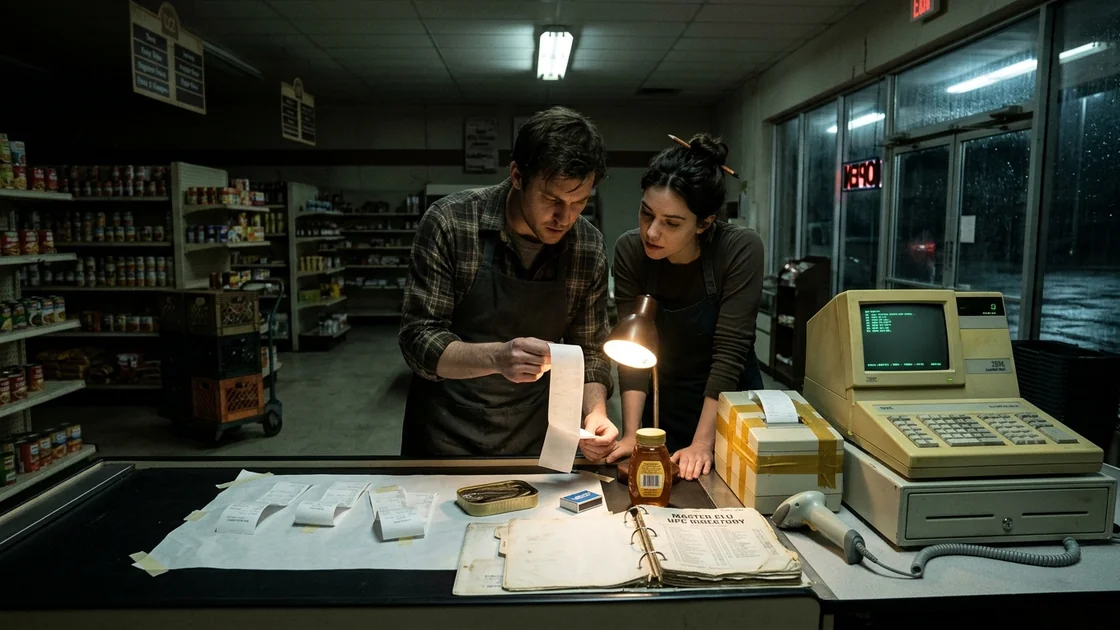
In the quiet town of Hollow Creek, Toby Vance works the night shift at Bramblewood Market, a fading grocery store running on antiquated technology. His routine existence changes when he discovers that the barcode scanner at Register Three prints cryptic messages on customer receipts whenever specific combinations of items are rung up together. Alongside his coworker Clara, Toby begins testing hundreds of product sequences after hours, slowly uncovering a hidden archive of town secrets encoded into the system decades ago by a missing local technician. As they trace the clues left behind in fading thermal ink, they realize that someone else in town has been secretly using the register for years, leading them to unravel a decades-old disappearance and the buried history of Hollow Creek.
After eight PM, Bramblewood Market stopped smelling like a grocery store and started smelling like the building it had been in 1954, which was a cedar-shingle lumber depot with a damp limestone foundation. During the day, the scents of rotisserie chickens, bleached mop water, overripe cantaloupes, and roasted hazelnut coffee from the dented steel urns by the lottery machine kept the past at bay. But once the sun dropped behind the ridge of the Kettle Mountains and the parking lot emptied down to Toby’s rusted Honda and Clara’s primer-gray pickup, the damp stone and old pine sap crept back up through the cracked linoleum tiles.
Toby Vance stood at Register Three with his elbows resting on the black rubber edge of the conveyor belt, watching a moth throw itself repeatedly against the flickering ballast of the fluorescent tube above Aisle Four.
Register Three was the only lane open after dark. Register One had a seized roller beneath the belt that shrieked like a baying hound whenever anyone placed a gallon of milk on it, and Register Two had been cannibalized for spare springs to keep the cash drawer of Register Three latching properly. The owner, seventy-four-year-old Artie Pendelton, saw no reason to repair three lanes when Hollow Creek scarcely had enough night owls to justify one.
"You're doing the stare again," Clara said, pushing a steel u-boat cart stacked with crates of evaporated milk down the center action alley. The hard polyurethane wheels clacked rhythmically over the expansion joints in the floor.
Toby blinked, shifting his weight from his left heel to his right. His lower back carried the dull, familiar ache that came at hour six of an eight-hour shift, despite the pitted foam anti-fatigue mat beneath his sneakers. "I wasn't staring. I was tracking wildlife. Moth's been trying to get into the cereal aisle for twenty minutes."
"Let him have the grape nuts," Clara said, parking the cart at the endcap of Aisle Three and slicing open a shrink-wrapped case with a yellow box cutter. She was twenty-six, two years younger than Toby, with dark hair pinned up with a carpenter’s pencil and smudges of flour permanently worked into the creases of her knuckles from her afternoon shifts in the bakery department. "Nobody else in this county is buying them. I checked the expiration dates on the back row yesterday. Half of them expired during the first year of the current administration."
"Artie says dry goods don't expire, they just lose their enthusiasm," Toby replied.
"Artie still thinks a quarter is a fair tip for carrying fifty pounds of water softener salt out to a Buick." Clara pulled two cans from the cardboard tray, checked their labels, and spun them onto the shelf with practiced, ambidextrous snaps of her wrists. "Did Mrs. Gable come in yet?"
"Seven-thirty. Bought two tins of cat food and a single banana."
"She doesn't have a cat."
"I know she doesn't have a cat," Toby said. "We don't ask questions at Register Three. That's the social contract."
He looked down at his terminal. It was an IBM SurePOS 4694, beige plastic turned the color of campfire marshmallows by twenty-five years of ultraviolet bleed from the store’s front windows. The screen wasn't even an LCD; it was a nine-inch monochrome CRT monitor that glowed in sharp, phosphor-green characters. Tethered to its back by a thick, coiled gray cord was a handheld laser scanner resting in a gooseneck cradle, paired with a boxy thermal receipt printer whose casing was held together on the left side by three layers of yellowed packing tape.
The system ran on a proprietary DOS-based retail kernel installed in
the autumn of 1999 by a local contractor named Simon Glass, who had
promised Artie that the machines were Y2K-compliant and would run until
the sun burned out. Simon had been right about the machines, though his
own warranty had expired considerably sooner. In November of 2001,
during the three-day deluge that burst the old timber dam up on Black
Fork and flooded the lower third of Hollow Creek, Simon’s pickup had
been found wedged against a sycamore tree near the washed-out county
bridge. His body was never recovered from the silt, and because nobody
else in the valley understood the labyrinth of batch files he had
written to link the registers to the basement server, Artie simply never
touched it. New products were entered manually using reusable
twelve-digit UPC codes reassigned from discontinued items. According to
the database, a bottle of artisanal kombucha was still rung up as
CHERRY HI-C 46OZ CAN.
The brass bell wired above the manual entry door gave a dull clank as the aluminum frame swung inward, letting in a gust of wet October wind that smelled of woodsmoke and decaying oak leaves.
A man in a soaked canvas jacket stepped onto the ribbed rubber entry mat, shaking water from the brim of a faded tractor cap. Toby didn't recognize him—likely a seasonal surveyor for the timber company or someone passing through on Route 9 who had missed the turnoff for the interstate. The stranger didn't take a basket. He walked straight toward the back wall with the brisk, slightly hunched gait of someone who hated being indoors under bright lights.
Three minutes later, the man approached Register Three and set three items on the black belt.
Toby straightened up, his fingers automatically finding the home row of the heavy mechanical keypad. "Evening. Coming down pretty hard out there?"
The man grunted a noncommittal affirmative, staring past Toby’s shoulder at the locked glass cabinet of dusty cigarette cartons.
Toby reached for the first item: a flat, rectangular tin of smoked bristling sardines in olive oil. He passed it across the scarred glass window of the countertop scanner, which failed to read it—the laser diode in the counter unit had grown cataracts around 2014—so Toby lifted the corded handheld scanner from its cradle and pulled the trigger.
Beep.
SMOKED SARDINES 3.75OZ ......... 2.49 T
He grabbed the second item: a square blue box of strike-anywhere kitchen matches.
Beep.
WOOD MATCHES 250CT ............. 1.89 T
He reached for the third and final item: a pint bottle of store-brand isopropyl rubbing alcohol, seventy percent.
Beep.
ISOPROPYL ALC 16OZ ............. 1.29 T
Toby hit the TOTAL key. The green screen flashed
5.95 with tax. "Five ninety-five," Toby said.
The stranger dropped a five and a one onto the stainless steel plate,
turned on his heel before Toby could even hit the CASH
button, and walked out into the rain, grabbing his three items in one
large fist.
"Need your receipt?" Toby called out to the closing door.
The Cash drawer shot open with its customary metallic chack-ring, striking Toby lightly in the hip. Simultaneously, the thermal printer began to chatter.
Normally, a three-item receipt took less than a second to spit out:
header, three lines, tax, total, and the standard footer that read
THANK YOU FOR SHOPPING AT BRAMBLEWOOD MARKET - HOME OF QUALITY MEats,
preserving a capitalization typo Simon Glass had made twenty-five years
earlier.
Tonight, the printer didn't stop.
Zzt-zzt-zzt-zzt-zzt-zzt.
The stepper motor whined, feeding three, four, five inches of white thermal paper up through the serrated plastic tear bar. Then the cutter blade snapped shut.
Toby frowned, reached over, and plucked the curled strip of paper
from the slot. He expected to see a stuck relay repeat-printing the
store hours or a diagnostic memory dump. Instead, sandwiched neatly
between the CHANGE DUE: 0.05 line and the
QUALITY MEats footer, bordered by two rows of asterisks,
was a block of crisp, monospace text.
****************************************
ENTRY 014:
THE SURVEY STAKES AT PARCEL 9 WERE MOVED
FORTY FEET EAST ON OCT 12 2001.
CHECK THE IRON PIPE UNDER THE WHITE OAK.
IT STILL HAS THE ORIGINAL COUNTY STAMP.
****************************************
Toby stood completely still while the cash drawer remained open against his belt buckle.
He turned the paper over. The back was blank, slick, and faintly warm from the print head. He looked at the green CRT monitor. The screen showed only the standard transaction summary: sardines, matches, rubbing alcohol. No asterisks. No mention of Parcel 9 or an iron pipe.
"Hey," Toby called out. His voice sounded thin in the cavernous room. "Clara?"
Down Aisle Three, Clara popped her head up over the top shelf of canned vegetables. "What? Did the drawer jam again? Don't hit it with the mallet, Artie says it loosens the bell."
"Come look at this."
Clara walked over, slipping her box cutter into her back pocket, and leaned against the bagging carousel. She took the receipt from Toby’s hand, squinting at it through the stray curls falling across her forehead.
"What is this?" she asked. "Did you type a memo line?"
"This terminal doesn't have a memo function," Toby said, tapping the
bulky beige keyboard. "Look at the keys. It's numeric keypad, department
codes, VOID, NOSALE, TARE,
PLU, TAX EXEMPT, and TOTAL. There
aren't even letters on this board."
Clara looked from the keyboard to the receipt, then back to the screen. "Look at the monitor. The text isn't on the virtual tape."
Toby leaned in. Each transaction was logged line-by-line on the left half of the green screen as an electronic journal. It showed the three items, the tender, and the footer. The five lines of text about Parcel 9 didn't exist as far as the monitor was concerned.
"Then how did the printer know to print it?" Clara asked.
"I have no idea." Toby pushed the cash drawer shut until it clicked.
He hit NOSALE. The drawer popped open again, and the
printer spat out a two-inch slip recording the no-sale event. No secret
message. Just the timestamp and Register Three's ID number.
"Who was the guy?" Clara asked, looking toward the dark glass of the front doors, where rainwater ran in wavering sheets down the outside.
"Never seen him before. Bought sardines, wooden matches, and rubbing alcohol. Left five cents on the counter and didn't wait for the slip."
"Maybe he wasn't waiting for it because he didn't know it would do that," Clara said slowly. "What if it's a timer? Like an old calendar reminder Simon put in the system before the flood, set to go off on a certain date?"
"October fifteenth, twenty-five years later, at eight-forty-two PM?" Toby shook his head. "Why would a calendar reminder wait until someone bought fish and rubbing alcohol?"
"Wait here," Clara said.
She trotted down Aisle Two, then cut across to the health and beauty section near the pharmacy counter that had been boarded up since the town pharmacist retired in 2011. A moment later she returned, carrying a tin of smoked bristling sardines, a blue box of strike-anywhere matches, and a pint of seventy-percent isopropyl alcohol.
She set them on the belt in a neat row. "Do it again."
Toby picked up the handheld scanner. His thumb hovered over the black plastic trigger. For reasons he couldn't quite articulate, his heart was beating noticeably faster, the way it had when he was twelve years old and prying up a loose floorboard in his grandfather’s attic.
He scanned the sardines. Beep.
He scanned the matches. Beep.
He scanned the alcohol. Beep.
Nothing happened. The cursor on the green screen simply blinked
underneath 1.29 T, waiting for the next item or the close
of the sale.
"Hit total," Clara whispered.
Toby pressed TOTAL, then typed 600 and hit
CASH.
The drawer sprang open. The thermal printer whined to life, feeding five inches of paper before the blade snapped.
Toby tore it off and held it between them under the humming fluorescent tube.
****************************************
ENTRY 014:
THE SURVEY STAKES AT PARCEL 9 WERE MOVED
FORTY FEET EAST ON OCT 12 2001.
CHECK THE IRON PIPE UNDER THE WHITE OAK.
IT STILL HAS THE ORIGINAL COUNTY STAMP.
****************************************
Clara let out a low breath that fogged slightly in the chilly air near the front doors. "Okay," she said. "Try them in a different order. Alcohol first."
Toby voided the cash drop by tossing a slip into the till to remind himself to deduct six dollars from the final count, closed the drawer, and scanned the alcohol, then the matches, then the sardines. He cashed it out.
The receipt printed in half a second. Sardines, matches, alcohol, footer. No Entry 014.
"It's sequential," Toby murmured, his mind clicking into a gear he hadn't used since his sophomore year at state college, back before his mother’s diagnosis had pulled him back to Hollow Creek and anchored him there. He had taken two semesters of discrete mathematics and computer architecture before the hospital bills made tuition impossible. "It's an array trigger. Specific UPC strings, scanned in a specific order, followed by the tender command."
He dropped to his knees on the foam mat and pulled open the double wooden doors beneath the register counter. The cabinet smelled of mouse droppings, ancient paper dust, and warm electronics. Sitting on the bottom shelf was the main IBM chassis, coated in a gray felt of lint.
Toby traced the thick gray cable coming down from the handheld scanner through the grommet in the countertop. Instead of plugging directly into the RS-232 serial port on the back of the IBM unit, it ran into a small, unmarked aluminum project box bolted to the underside of the plywood counter. A second cable ran from the box to the computer, and a third tapped directly into the wide parallel ribbon cable leading up to the receipt printer.
"Clara, hand me your phone," Toby said, his upper body wedged into the cabinet.
She clicked on her flashlight and passed it down. Toby shone the
white LED beam onto the aluminum box. Its seams were sealed with thick,
hardened black epoxy, making it impossible to unscrew without destroying
whatever circuit board sat inside. Scratched into the soft aluminum with
the tip of an awl or a pocketknife were two initials and a date:
S.G. 09/01.
Simon Glass. September 2001. Two months before the flood.
"He built a hardware interceptor," Toby said, backing out of the cabinet and brushing sawdust from the knees of his jeans. "The POS software in the computer doesn't even know it's there. The scanner sends the barcode numbers down the wire as plain text. That little box reads every barcode that goes past. When it sees three specific twelve-digit numbers in a row, it waits for the computer to send the receipt data to the printer, hijacks the line right before the footer, and injects its own text from a memory chip."
Clara stared down at the dark cabinet, then back at the two identical receipts lying next to the scale. "Why would Simon hide a database inside a grocery store register?"
"Think about it," Toby said, looking around the empty, cavernous room. "In 2001, nobody in Hollow Creek had high-speed internet. Half the town didn't have computers. If Simon had papers or floppy disks in his house or his truck, anyone could find them, steal them, or burn them. And when his truck went into the river, everything he had on him was lost."
"Except Bramblewood Market sits on the high bluff above Main Street," Clara said slowly, catching the thread. "It never floods. Artie never upgrades anything. And three hundred people walk through here every day buying groceries, completely oblivious."
"It's a dead drop," Toby said, his fingers tracing the thermal ink of
the receipt. "Or a vault. And it says ENTRY 014."
"Which means there are at least thirteen others before it," Clara said. "And maybe more after it."
They stood in silence for a long moment. Outside, the rain drummed
steadily against the plate glass, blurring the red neon
OPEN sign into a wet smear across the asphalt.
"Do you know how many items are in this store?" Toby asked quietly.
"About four thousand active barcodes," Clara said without hesitation. She stocked the shelves five nights a week; she knew the inventory better than Artie did. "If it takes three items in exact order to unlock a message..."
"Four thousand to the third power," Toby calculated aloud. "Sixty-four billion combinations."
Clara picked up the tin of sardines and tossed it lightly in her palm. "Good thing we have a really boring job."
They couldn't brute-force sixty-four billion combinations. Even if Toby scanned three items every five seconds without sleeping, eating, or helping customers, it would take roughly ten thousand years to test every possible triad in Bramblewood Market.
"Simon wasn't an idiot," Toby said the following night. It was ten-fifteen PM. The front doors were locked, the neon sign was switched off, and the main bank of overhead lights had been cut to half-power, leaving only every third fluorescent tube buzzing in the rafters. Artie always went home at six PM to eat boiled ham and watch westerns until he fell asleep in his recliner, leaving Toby and Clara to lock up.
Toby had spread a large sheet of white butcher paper from the meat counter across the conveyor belt of Register Three, weighting the corners down with cans of crushed tomatoes. In the center of the paper lay the original receipt from the previous night.
"If you build a cryptographic lock with sixty-four billion combinations, you don't memorize random numbers," Toby said, tapping a ballpoint pen against the paper. "Even if Simon wrote the combinations down in a notebook, what happens if he loses the notebook? He'd design a mnemonic system. Something he—or whoever he built this for—could reconstruct from memory."
Clara sat perched on the edge of the bagging carousel, swinging her steel-toed boots and eating stale glazed donut holes from a bakery wax bag. "Okay, professor. Look at what triggered Entry Fourteen. Smoked sardines, kitchen matches, rubbing alcohol. What do those have in common?"
Toby wrote the three items on the butcher paper, along with their aisle numbers and UPC codes.
041570054123- Smoked Sardines (Aisle 3, Canned Fish)070158002501- Wooden Matches (Aisle 5, Household/Paper)031254710014- Isopropyl Alcohol (Aisle 6, Pharmacy)
"Look at the last two digits of the rubbing alcohol's barcode," Clara pointed out, leaning over his shoulder. She smelled faintly of vanilla extract and rain. "Zero-one-four. And it printed Entry Zero-One-Four."
Toby’s pen stopped. He stared at the twelve-digit number on the side
of the plastic alcohol bottle. 031254710014. The last
digit—the four—was the modulo-10 check digit calculated from the
previous eleven digits, standard on all UPC-A barcodes. Together with
the preceding one and zero, the tail of the barcode read
014.
"Wait a minute," Toby said. He grabbed the handheld scanner, pressed
the PRICE CHECK key on the terminal—which displayed the UPC
and price on the green monitor without adding the item to a
transaction—and looked at the bottle again. "In 1999, store-brand
pharmacy items didn't always have standard manufacturer barcodes. A lot
of independent grocers printed their own shelf tags or assigned internal
codes inside the database. Wait here."
He walked briskly to the back office—a cramped cubicle near the
receiving dock smelled of cigar ash and yellowing invoices—and pulled
down the thick, three-ring binder sitting on top of the safe. The spine
was labeled MASTER PLU / UPC DIRECTORY - 1999 in faded
dot-matrix ribbon print.
He carried the heavy binder back to Register Three and slammed it
down on the belt, sending a puff of dust into the air. Flipping past the
produce codes and meat department look-ups, he reached the back forty
pages, which were titled
HOUSEHOLD & HBA INTERNAL ASSIGNMENTS - SIMON G.
Toby ran his finger down the green-and-white striped tractor-feed paper.
"Look at this," Toby breathed. "Simon manually assigned the internal
barcode overrides for the entire pharmacy aisle when he set up the
database. He made the last three digits of fifty different health and
beauty items run sequentially from 001 to
050."
Clara jumped down from the carousel and crowded next to him, running her finger down the column.
031254710001 - HYDROGEN PEROXIDE 16OZ
031254710002 - EPSOM SALT 4LB BAG
031254710003 - WITCH HAZEL 16OZ
031254710004 - CALAMine LOTION 6OZ ...all the way down
to... 031254710025 - CASTOR OIL 4OZ
"Wait," Toby said, squinting at the list. "You can't just make the last three digits whatever you want on a barcode. The twelfth digit is a mathematical check digit based on the first eleven. If you change the last digit without changing the others, the laser scanner rejects it as a misread."
"Look at the seventh and eighth digits," Clara said, pointing with the tip of her carpenter's pencil.
Toby looked closer. The middle digits weren't all 71. On
item 001, they were 74. On item
002, they were 68. Simon had mathematically
altered the middle vendor digits on every single custom label so that
the resulting check digit at the very end would naturally fall into a
neat 001 through 025 sequence.
"There aren't fifty items here," Clara noted, flipping the last page of the binder. "It stops at twenty-five. Castor oil is the last one."
"Twenty-five entries," Toby said. "And the third item in the combination is always the index number. If we want Entry 001, the third item we scan has to be the sixteen-ounce hydrogen peroxide."
"That cuts sixty-four billion down," Clara said, her dark eyes bright under the dim store lights. "What about the first two items? Sardines and matches."
Toby looked back at the butcher paper. "Why sardines and matches for Entry 014? Let's look at the message again: The survey stakes at Parcel 9 were moved forty feet east on Oct 12 2001. Check the iron pipe under the white oak."
"Parcel 9 is down by the river flats," Clara said immediately. Her family had lived in Hollow Creek for four generations; her grandfather had worked the sorting booms at the timber mill before it shut down. "That's the land Caleb Cross bought up right after the flood to build the gravel quarry and the county equipment yard. My dad used to take me fishing down there before Cross fenced it off. Wait... what did we call that bend in the creek?"
She tapped her temple, staring up at the suspended ceiling signs—SOUP, PASTA, CANNED MEAT, BAKING NEEDS.
"Smoky Hollow?" Toby guessed.
"No, the old cannery camp," Clara said, snapping her fingers. "Back in the thirties, there was a work camp right on that parcel where the loggers lived on tin fish and burned brush piles to clear the bank. Everyone in town over sixty calls that flat 'Sardine Burn.' Sardines. And matches."
Toby stared at her. "Sardine Burn. Sardines and matches."
"It's a rebus," Clara said, a slow grin spreading across her face. "A grocery store rebus! Simon used the first two items to describe the location or the person the secret is about, and the third item selects the entry number!"
"Wait—then why did that guy in the canvas jacket come in last night and buy sardines, matches, and rubbing alcohol?" Toby asked, a sudden chill creeping up his neck. "He left before the receipt even finished printing. He didn't take it."
Clara’s grin faded. "What if he wasn't trying to read Entry Fourteen?"
"Why else would you buy those exact three things in that exact order?"
"Maybe he did want it printed," Clara said softly. "Maybe he was leaving it for you."
Toby looked toward the black glass of the front windows. In the reflection, he could only see himself, Clara, and the pale rows of grocery aisles stretching back toward the humming meat coolers. "Why me? I'm just the night cashier."
"You've been working Register Three every night for four years, Toby. Who else sits at this terminal?"
"Artie works it on Sunday mornings and Tuesday afternoons."
"Artie doesn't look at receipts," Clara said. "And if a receipt printed five extra lines on Artie's shift, he'd just crumple it up and throw it in the trash can under the counter without his reading glasses on. The guy in the rain jacket waited until you were here. He waited until I was two aisles away so there wouldn't be anyone behind him in line. And he walked out without the paper so you'd have to pull it out of the printer yourself."
Toby looked down at the master directory binder. "Let's find Entry One."
If the third item for Entry 001 was a bottle of sixteen-ounce hydrogen peroxide, they still needed the first two items. Without knowing what Entry 001 was about, guessing a two-item grocery pun out of four thousand products was nearly impossible.
"Think like a programmer," Toby said, pacing the short length of the checkout lane while Clara went to Aisle Six to grab the hydrogen peroxide. "When you initialize a database or a ledger, what is the very first entry? Entry Zero or Entry One. It's the header. The table of contents, or the author's signature, or instructions on how to use the system."
"If it's Simon's signature," Clara said, returning with the brown plastic bottle of peroxide and setting it by the scale, "his name is Simon Glass. We don't sell glasses, and we don't sell anything named Simon."
"Simple Simon," Toby mused. "Pie? We don't have barcodes on the bakery pies, those are four-digit PLU codes typed by hand. What about Glass? Window cleaner? Windex?"
"What if it's about the store itself?" Clara suggested. "Bramblewood Market. Blackberries and firewood?"
"Firewood doesn't have a barcode either," Toby said, flipping back through the 1999 binder to see what items Simon had touched last. As he turned to the inside back cover of the three-ring binder, he noticed that the clear vinyl pocket attached to the cardboard backing held an old, yellowed register test slip from September 14, 1999—the day the system went live.
Toby slid the fragile slip of thermal paper out of the vinyl sleeve. Over two decades inside the dark binder had faded the black heat-ink to a ghostly sepia brown, nearly illegible under the half-lit ceiling. He switched on the small goose-neck halogen lamp Artie kept by the counterfeit bill detector and held the slip beneath the bulb.
It was a test receipt from Register Three.
SYSTEM INITIALIZATION TEST - LANE 03
TECH: S. GLASS
----------------------------------------
APPLE CIDER VINEGAR 32OZ       1.79
BAKING SODA 16OZ               0.69
HYDROGEN PEROXIDE 16OZ         0.89
----------------------------------------
SUBTOTAL                       3.37
TAX                            0.20
TOTAL                          3.57
CASH                           3.57
----------------------------------------
THANK YOU FOR SHOPPING AT BRAMBLEWOOD
"Look at the items on his initialization test," Toby whispered, showing her the faded slip. "Apple cider vinegar, thirty-two ounce. Baking soda, sixteen ounce. Hydrogen peroxide, sixteen ounce."
"Vinegar and baking soda," Clara said. "That's what you mix together in fourth grade to make a volcano erupt. A chemical reaction."
"Or what you pour down a clogged drain to clear the pipes," Toby said. "Go get a quart of White House apple cider vinegar and a box of Arm & Hammer."
Clara practically vaulted over the end of the conveyor belt and sprinted down Aisle Three, her boots thudding against the floor tiles. She came back thirty seconds later clutching the glass jug of amber vinegar and the orange cardboard box of baking soda.
Toby didn't wait. He lifted the scanner from its cradle.
Beep. APPLE CIDER VINEGAR 32OZ ....... 2.89 T
(The price had gone up a dollar ten in twenty-five years, though the
barcode hadn't changed.)
Beep.
BAKING SODA 16OZ ............... 1.19 T
Beep.
HYDROGEN PEROXIDE 16OZ ......... 1.49 T
Toby hit TOTAL, typed 600, and pressed
CASH.
The drawer slammed open against his hip. The thermal printer began to sing.
It didn't just print five lines this time. It chattered continuously for nearly four seconds, feeding out a long, curling white tongue of paper that spilled over the edge of the counter before the cutter blade finally guillotined it.
Toby snatched it up and laid it flat on the butcher paper beneath the halogen lamp. Clara leaned in so close her hair brushed his cheek.
****************************************
ENTRY 001:
IF YOU ARE READING THIS, I AM GONE AND
YOU FOUND THE TEST SLIP IN THE BINDER.
THERE ARE 25 LOGS IN THIS EEPROM.
THE THIRD ITEM IS ALWAYS HBA 001-025.
THE FIRST TWO ITEMS ARE GIVEN AT THE
BOTTOM OF EACH PRECEDING LOG.
DO NOT SHOW ARTIE. HE DOES NOT KNOW
WHAT IS UNDER HIS COUNTER AND IT IS
SAFER FOR HIM IF IT STAYS THAT WAY.
NEXT: SWEET CLOVER + IRON NAIL + 002
****************************************
Neither of them spoke for a full minute. In the meat department at the back of the store, the defrost cycle on the walk-in freezer kicked on with a heavy, metallic clunk and a low, vibrating hum.
"It's a daisy chain," Toby breathed, his eyes scanning the crisp black letters over and over. "Each receipt gives you the riddle for the next one. Sweet clover, iron nail, plus 002."
"Why would someone jump straight to Fourteen last night, then?" Clara asked, her voice tight. "If you have to read them in order..."
"Whoever came in last night already knew the combination for Fourteen," Toby said. "Or they have their own list."
He looked down at the binder for item 002 on the health
and beauty list: 031254710002 - EPSOM SALT 4LB BAG.
"Sweet clover and iron nail," Clara murmured, her brow furrowing as she looked out across the dark aisles. "Clover honey! We carry the sixteen-ounce plastic bears of Sue Bee Clover Honey in Aisle Two."
"What about iron nail?" Toby asked. "Does Artie have barcode tags on the hardware nails in Aisle Five?"
"No, the common nails are sold in bulk by the pound on the scale," Clara said, chewing her bottom lip. "Wait. What else is called an iron nail? Or tastes like cloves and iron? Wait—cloves! Whole cloves in the spice rack! People call whole dried cloves 'nails' because they're shaped like little rusty tacks. My grandmother used to stick them into ham!"
"Or Blackstrap molasses," Toby countered, flipping through the dry goods section of the 1999 binder. "Look at the iron content on Brer Rabbit Blackstrap Molasses. Wait—let's check the spice rack and the hardware aisle. If we have the honey and the Epsom salt, there are only a dozen things in the store that could be 'iron nail.'"
For the next forty minutes, the ghost of Bramblewood Market got more exercise than it had since the pre-storm panic buying of 2019.
Clara pushed a shopping cart up and down the darkened aisles, tossing in everything remotely related to iron or nails: a tin of whole McCormick cloves, a bottle of Brer Rabbit molasses, a box of fortified Cream of Wheat ("High in Iron!"), a carded blister-pack of Stanley picture-hanging nails from the tiny hardware pegboard, a bottle of Sally Hansen "Hard as Nails" fingernail polish from the cosmetics rack, and a four-pound bag of Epsom salt.
Back at Register Three, Toby stood with the scanner like a conductor with a baton.
First try: Clover honey, whole cloves, Epsom salt. Total. Cash. Standard receipt.
Second try: Clover honey, blackstrap molasses, Epsom salt. Total. Cash. Standard receipt.
Third try: Clover honey, Stanley picture nails, Epsom salt. Total. Cash. Standard receipt.
Fourth try: Clover honey, Sally Hansen Hard as Nails, Epsom salt. Total. Cash.
Zzt-zzt-zzt-zzt-zzt-zzt.
"Bingo!" Clara hissed, pumping her fist as the paper curled out of the slot. "Hard as Nails! Simon had a terrible sense of humor."
Toby tore off the slip and laid it beside Entry 001, smoothing it flat.
****************************************
ENTRY 002:
JULY 1999. CALEB CROSS PAID THE STATE
INSPECTOR $4000 IN CASH BEHIND THE MILL
OFFICE TO CONDEMN THE BLACK FORK TIMBER
DAM AS STRUCTURALLY SOUND WITHOUT GOING
DOWN INTO THE SPILLWAY TUNNEL. THE
CONCRETE CORE WAS CRACKED THROUGH.
CROSS NEEDED THE DAM TO FAIL SO THE
VALLEY WOULD FLOOD OUT THE SMALLHOLDERS.
NEXT: YELLOW BIRD + COLD CREAM + 003
****************************************
Clara’s hand went slowly to her mouth. All the playful excitement vanished from her face, replaced by a pale, hollow stillness.
"Clara?" Toby asked gently.
"Four houses washed off their foundations when Black Fork broke in two thousand and one," she whispered, staring at the receipt. "Old Mr. Miller drowned in his basement trying to shut off his furnace. My uncle lost forty acres of bottomland timber because the flood stripped six feet of topsoil down to the bedrock and left twentythousand tons of creek gravel on top of it. Caleb Cross bought that land from my uncle six months later for three hundred dollars an acre because it wasn't farmable anymore. That's where the gravel quarry is now."
Toby looked down at the five lines of thermal print. Everyone in Hollow Creek knew Caleb Cross. He didn't live down in the valley anymore; he lived in the big stone house up on Ridge Road, served as chairman of the county zoning board, and donated the scoreboard for the high school football field. Every Thanksgiving, Cross bought twenty frozen turkeys from Artie at Bramblewood Market to hand out at the fire hall while the county weekly paper took his picture.
"Simon knew," Toby said quietly. "Before the flood even happened, Simon knew the dam was going to give way the first time we got a fifty-year rain."
"Look at the date on the box under the counter," Clara said, her voice shaking slightly. "September 2001. Simon installed this chip two months before the storm. And when the rain started in November, his truck ended up in the river right below the dam."
"You think he drove up there during the storm to check the spillway?" Toby asked. "Or to try to open the floodgates manually?"
"Or Caleb Cross knew Simon was up there," Clara said, her dark eyes fixed on the paper. "Keep going. Read the clue for Entry Three."
"YELLOW BIRD + COLD CREAM + 003," Toby read. He checked
the binder for 003: a sixteen-ounce bottle of witch hazel.
"Yellow bird is easy—French's Yellow Mustard, or Canary brand birdseed
in Aisle Five. Cold cream is Pond's Cold Cream right next to the witch
hazel in Aisle Six."
By one-thirty in the morning, the butcher paper on Register Three was covered in a taped-down column of thermal receipts, and the till had been opened and voided nearly forty times. Toby had figured out a way to enter a negative department adjustment right after each cash tender so the register's net cash balance stayed at zero, though the internal paper audit roll inside the printer was filling up fast.
Each riddle unlocked another brick in the wall of what had happened to Hollow Creek between 1999 and 2001.
YELLOW BIRD (French's Mustard) + COLD CREAM (Pond's) + WITCH HAZEL (003)
revealed that the town's former sheriff, Walter Garrett—who had retired
to Florida in 2004 on a surprisingly generous pension—had been a silent
partner in Cross's land holding company,
Kettle Ridge Ventures, incorporated in Delaware three weeks
before the Black Fork dam burst.
BLUEBONNET (Margarine) + SILVER SPOON (Domino Sugar) + CALAMINE LOTION (004)
detailed how Simon had been hired by Sheriff Garrett in August 2001 to
wipe the hard drives of the county assessor's office after a state
auditor started asking questions about delinquent tax notices that had
been intentionally withheld from property owners along the creek so
their land could be seized at auction. Instead of wiping the drives,
Simon had cloned them onto a set of magneto-optical disks.
RED DEVIL (Lye) + ANGEL HAIR (Pasta) + RUBBING ALCOHOL 91% (005)
gave the location of the backup copies of the county tax logs, which
Simon had sealed in PVC pipe and dropped into the abandoned cistern
behind the old Methodist church—a church that had been torn down and
paved over in 2008 to expand the municipal parking lot.
By Entry 011, Toby’s eyes were burning from the green glare of the CRT monitor and the smell of warm thermal paper. They had worked their way through canned peaches, kosher salt, shoe polish, steel wool, and evaporated milk.
"Look at the pattern," Toby said, rubbing his temples as Clara returned with a bottle of castor oil and a box of cornstarch. "Entries One through Ten are all about the land grab and the dam. Entry Eleven through Thirteen are about the money—which bank accounts in Charleston the timber buyout checks went into."
He looked down at Entry 013, which they had just printed using
KING ARTHUR (Flour) + CROWN PRINCE (Smoked Oysters) + MINERAL OIL (013).
At the bottom of the slip, the prompt for Entry 014 read:
NEXT: SARDINE + WOOD MATCH + 014
"And we already have Fourteen from last night," Clara said, tapping the receipt left behind by the stranger in the wet canvas jacket. She read the bottom of Entry 014 again, something they hadn't noticed the previous night because they hadn't understood the format yet. Actually—she stopped and leaned down closer to the halogen lamp.
"Toby," Clara said. "Look at Entry Fourteen again."
Toby leaned over the belt. He looked at the receipt from the man in the canvas jacket.
****************************************
ENTRY 014:
THE SURVEY STAKES AT PARCEL 9 WERE MOVED
FORTY FEET EAST ON OCT 12 2001.
CHECK THE IRON PIPE UNDER THE WHITE OAK.
IT STILL HAS THE ORIGINAL COUNTY STAMP.
****************************************
"Wait," Toby said, his stomach dropping slightly. "There's no
NEXT: line on Fourteen."
"Why wouldn't Fourteen have the clue for Fifteen?" Clara asked.
Toby grabbed the sardines, the matches, and the seventy-percent rubbing alcohol—which were still sitting by the bagging carousel from the night before—and scanned them again, cashing out the transaction.
The printer spat out the exact same block of text. No
NEXT: line. The chain was broken.
"Did Simon stop at Fourteen?" Clara asked, flipping through the 1999 binder. "No, he numbered the pharmacy items all the way to twenty-five. Why would he set up twenty-five triggers if the chain stops at Fourteen?"
Toby stared at the green monitor, then dropped to his knees again and looked under the counter at the black-epoxied aluminum box.
"Maybe One through Fourteen are the public chain," Toby said slowly, sitting back on his heels. "Or the first volume. What if Simon added Fifteen through Twenty-Five later? Remember, Entry Fourteen has a date in the text: October 12, 2001. The box was installed in September 2001."
"Wait—how could a chip sealed in black epoxy in September 2001 have an entry inside it talking about October 12, 2001?" Clara asked.
Toby froze. He stood up slowly, gripping the edge of the rubber conveyor belt.
"It couldn't," Toby whispered. "Unless you can write to the chip through the barcode scanner."
He looked at the handheld laser gun resting in its cradle. "A barcode scanner is just an input device that converts black and white bars into ASCII characters. If Simon programmed the microcontroller inside that box to enter a 'write mode' whenever a master administrative barcode is scanned, he wouldn't need to open the box to add new entries. He could walk up to Register Three with a sheet of custom-printed barcodes in his pocket, scan them one after another like he was testing the register, and type an entire paragraph directly into the chip's memory!"
Clara’s eyes widened. "Then Simon added Entry Fourteen in October, right before the flood. And if you can program it with barcodes..."
"Then the guy in the canvas jacket last night didn't just randomly know the combination for Fourteen," Toby said, his voice dropping to a murmur. "Entry Fourteen is the last entry in the first chain because Simon never linked it to Fifteen before the flood hit—or Fifteen is the start of a whole different set of logs."
"Wait," Clara said, grabbing Toby’s sleeve. "You said the printer has an internal audit roll, right? A paper tape that stays inside the machine?"
"Yeah, the journal roll," Toby said, pointing to the lower half of the boxy printer. "Wait—no, this is a single-ply thermal printer. It doesn't have a carbon duplicate roll. The journal is stored electronically on the basement server's hard drive, which only logs what the IBM computer sees. And the IBM computer doesn't see the secret messages because the aluminum box sits between the computer and the printer."
"What about the box itself?" Clara asked. "Does the box keep a log of when its entries were triggered?"
"I don't know," Toby said. "We don't know what triggers Fifteen
through Twenty-Five. Without the NEXT: clues on the
receipts, we're back to sixteen million combinations for each one."
Clara looked down at the list of health and beauty items in the
binder. Items 015 through 025 were all there:
cod liver oil, camphor spirit, boric acid, zinc oxide ointment, smelling
salts, tincture of iodine, mercurochrome, paregoric, alum powder,
glycerin, and castor oil.
"Look at the items from Fifteen to Twenty-Five," Clara said, tracing her finger down the page. "Nobody buys smelling salts, mercurochrome, or alum powder anymore. Half of those aren't even on the shelf in Aisle Six."
Toby walked quickly down Aisle Six and stood in front of the bottom two shelves near the floor, where the dusty, slow-moving pharmacy stock sat in crooked rows.
He knelt down on the linoleum. There was the witch hazel
(003), the calamine lotion (004), the Epsom
salt (002), the mineral oil (013), and the
rubbing alcohol (014). Next to them were empty gaps on the
gray metal shelf, coated in thick dust except for circular clean spots
where bottles had recently sat.
Toby looked at the white plastic shelf tags snapped into the front
channel of the metal rack: COD LIVER OIL 8OZ - 031254710015
— Empty. SPIRIT OF CAMPHOR - 031254710016 — Empty.
BORIC ACID POWDER - 031254710017 — Empty.
In fact, every single slot from 015 through
024 was completely empty, except for
025 - CASTOR OIL 4OZ, which had a single, dusty amber glass
bottle pushed all the way to the back against the pegboard.
"Clara," Toby called out, his voice echoing down the quiet aisle. "Why are Fifteen through Twenty-Four out of stock?"
Clara walked down the aisle and stood behind him, looking down at the empty slots. "We haven't carried mercurochrome or spirit of camphor since I started working here three years ago. You can't even order mercurochrome from the distributor anymore; the FDA banned it decades ago."
"Look at the dust on the shelf under the cod liver oil tag," Toby said, pointing to a crisp, dust-free rectangle on the painted steel shelf. "Something was sitting there within the last month. Why would there be a clean spot in an empty slot?"
Clara crouched beside him and reached behind the remaining bottle of
castor oil (025). Her fingers brushed against something
flat and stiff wedged between the metal shelf and the perforated backing
board. She pinched it and slid it out.
It wasn't a bottle. It was a laminated three-by-five index card,
yellowed around the edges and speckled with mildew, with a single
peel-and-stick barcode label adhered to its center. Written in faded
black marker above the barcode was 015 - COD LIVER OIL.
Toby reached into the slot behind 016. His fingers found
another laminated index card tucked flat against the back wall of the
shelf fixture. And another behind 017. And
018.
All the way to 024. Ten laminated index cards, hidden in
the cracks behind the bottom shelf lip where a casual shopper—or Artie
doing a visual inventory walk—would never see them, because from
standing height the shelf simply looked empty.
"When the original bottles sold out or broke over the years," Clara whispered, shuffling the ten cards in her hands like a deck of tarot cards, "someone printed replacement barcode tags off the office label maker, laminated them, and hid them right in the slots so they'd always be here when needed."
Toby took the card for 015. He turned it over. The
lamination plastic wasn't the thick, brittle pouch plastic from the
1990s. It was smooth, self-adhesive matte contact paper—the exact kind
Clara used in the bakery department to cover recipe cards, from a roll
Artie had bought at the office supply store in 2022.
"Simon didn't make these cards," Toby said, staring at the matte plastic. "Someone in this town has been maintaining this system. When the old bottles ran out, they made sure the keys didn't disappear."
They didn't sleep much that Wednesday. Toby went home at two-thirty in the morning to his small two-story house on Maple Street—the house where his mother’s cardigan still hung on the wooden peg by the back door because he hadn't quite found the afternoon to put it in a box—and lay awake watching the headlights of early logging trucks sweep across his bedroom ceiling.
His mind kept turning over the architecture of Simon Glass’s ghost machine.
Why had the stranger in the wet canvas jacket triggered Entry 014 on Tuesday night?
THE SURVEY STAKES AT PARCEL 9 WERE MOVED FORTY FEET EAST ON OCT 12 2001. CHECK THE IRON PIPE UNDER THE WHITE OAK. IT STILL HAS THE ORIGINAL COUNTY STAMP.
At eleven AM on Wednesday, three hours before his shift started, Toby pulled on his boots and a flannel jacket and drove his Honda down past the old mill site toward the river flats.
The rain had stopped, leaving the sky the color of a wet slate roof
and the air sharp with the smell of crushed pine needles and cold mud.
Route 9 curved along the base of the hillside where the Black Fork creek
widened into a broad, rocky wash. Across the water sat the rusted
chain-link fence of Cross Aggregates & Quarry, topped
with three strands of barbed wire and orange
POSTED - NO TRESPASSING signs every fifty feet.
Toby parked on the gravel shoulder near the old concrete bridge abutment—the exact spot where the old timber bridge had been torn away twenty-three years ago, and where Simon Glass’s green Ford Ranger had been pulled from the alder tangles.
He didn't cross the bridge toward the quarry gates. Instead, he walked forty paces east along the unfenced county right-of-way where the wooded slope met the flat floodplain. A massive white oak stood halfway up the bank, its lower trunk scarred where high water and floating timber had gouged the bark during the 2001 flood.
Toby climbed the slick bank, grabbing onto exposed roots, and stopped beneath the canopy of the oak.
He didn't even have to kick away the wet leaves.
Someone had already been there.
A fresh, square hole about a foot deep had been dug into the black
loam between two buttress roots of the oak. The dirt piled beside the
hole wasn't washed down by last night's rain; it had been turned over
since the rain stopped that morning. At the bottom of the hole
stuck the corroded top of an octagonal iron survey pipe, its brass cap
scrubbed clean with a wire brush to reveal the stamped letters:
HC SURVEY MARKER - COR 9 - 1962.
And lying in the mud right next to the hole was an empty, flat rectangular tin of smoked bristling sardines, its lid rolled back cleanly on its key.
Toby stood over the hole, his breath pluming white in the cold air.
The man in the canvas jacket hadn't left the receipt at Register Three to tip Toby off. He had come into Bramblewood Market to get the coordinates for the survey pipe, hadn't realized how long the thermal printer took to spit out the text—or had panicked when Toby asked if he needed his receipt—and then realized outside that he had walked out without the message.
Wait. If the man had walked out without the receipt, how had he known to come dig under the white oak this morning?
Because someone else had given him the combination, or he had come back. No—the store had been locked when Toby and Clara left, and Artie didn't open until seven AM.
Toby crouched down by the hole, careful not to step in the freshly turned mud. There was a single boot print pressed deep into the soft clay beside the sardine tin: a wide, lugged heel with a distinctive V-notch cut out of the left side of the rubber tread, as if the wearer had stepped on an axe blade or a sharp piece of scrap metal years ago.
As Toby stood up and slid down the bank toward his car, a white
dual-cab pickup with the green decal of
Kettle Ridge Ventures on the driver's door came rumbling
down the quarry access road inside the chain-link fence.
The truck slowed to a crawl as it passed the section of fence opposite the bridge abutment. The tinted driver's window rolled down halfway.
Behind the wheel sat Caleb Cross. He was sixty-eight now, with a thick shock of silver hair, a neatly trimmed beard, and a fleece vest over a pressed plaid shirt. He didn't look like a backwoods villain; he looked like a man who sat on hospital boards and played eighteen holes of golf on Wednesdays.
Cross looked across the narrow strip of creek water, his gray eyes moving from Toby’s mud-splattered sneakers up to the white oak on the bank, and then to Toby’s face.
"Morning, Toby," Cross called out over the rush of the water. His voice was warm, resonant, and entirely unhurried. "Doing a little creek fishing?"
"No rod today, Mr. Cross," Toby called back, keeping his hands casually in his jacket pockets. "Just stretching my legs before work."
"They're grading the west haul road up on Parcel Nine next week," Cross said, resting his forearm on the open window frame. "Putting in a new retention pond for the wash plant. County surveyor was out yesterday afternoon staking the line. Funny thing—somebody pulled up three of his orange fiberglass stakes overnight and threw them in the brush."
"Kids on four-wheelers, probably," Toby said.
Cross nodded slowly, his eyes lingering on the fresh dirt under the white oak for two seconds too long. "Probably. How's Artie doing up at the market? Still holding the fort?"
"Same as ever."
"Tell him I'll be in next week to put in the order for the Thanksgiving turkeys. Twenty birds, sixteen to eighteen pounds, just like always."
"I'll leave him a note," Toby said.
The tinted window hummed upward, sealing Cross back inside the quiet cab, and the white truck rolled on toward the gravel crushers.
When Toby walked into Bramblewood Market at one-fifty PM for his two o'clock shift, Artie Pendelton was standing behind Register Three with a magnifying glass in one hand and a long curled snake of white paper in the other.
Toby’s heart stopped cold in his chest.
"Afternoon, Artie," Toby said, forcing his feet to keep moving at a normal pace toward the time clock by the office door. "Something wrong with the printer?"
Artie looked up over the top of his half-moon reading glasses. His sparse white hair was combed straight back with water, and he wore the same burgundy cardigan with suede elbow patches he had worn every autumn since Toby was in elementary school.
"Paper roll ran out right when Mrs. Gable was buying her cat food twenty minutes ago," Artie said, holding up the plastic core spindle. "Went to put a new roll in and checked the electronic journal summary on the screen to see why we burned through an eighty-foot roll since Monday. Says here you rang up and voided thirty-eight transactions between ten-thirty and two in the morning last night, Toby."
Toby punched his timecard into the mechanical clock—clack-chunk—and walked slowly over to the counter. "Scanner was acting up right before closing," Toby lied, his mouth dry. "Kept double-beeping and throwing parity errors on the screen. Clara and I stayed late running test scans across different departments to see if the laser diode was dying or if it was just dirty."
Artie squinted at him through his glasses, then looked down at the scarred handheld scanner resting in its gooseneck cradle.
"Is that right," Artie said flatly.
"Cleaned the lens with a cotton swab and some rubbing alcohol," Toby added, gesturing vaguely toward Aisle Six. "Seems to be reading fine now."
Artie didn't smile, and he didn't nod. He reached into the pocket of his burgundy cardigan and pulled out a single, folded square of thermal paper. He unfolded it with stiff, arthritic fingers and laid it face-up on the black conveyor belt between them.
It was a copy of ENTRY 001—the one they had printed the
night before. In their exhaustion at two in the morning, folding up the
butcher paper and putting all the groceries back on the shelves, one
slip had fluttered down between the edge of the register housing and the
stainless steel bagging well.
Artie’s blunt thumb rested right underneath the line that read:
DO NOT SHOW ARTIE. HE DOES NOT KNOW WHAT IS UNDER HIS COUNTER AND IT IS SAFER FOR HIM IF IT STAYS THAT WAY.
The hum of the dairy coolers at the back of the store seemed to grow deafening.
"Artie—" Toby started.
"Shut your mouth a second, Toby," Artie said quietly. He glanced toward the front windows to make sure no cars had pulled into the lot, then looked toward the bakery counter, where Clara had just stepped out of the proofing room carrying a tray of cooling dinner rolls. Seeing Artie's face and the slip of paper on the counter, she froze with the aluminum sheet pan against her apron.
Artie looked back at Toby. The old man didn't look angry; he looked older than Toby had ever seen him, as if the twenty-five years since 1999 had suddenly settled into the deep creases around his mouth all at once.
"You think I worked behind this counter sixty hours a week for forty-five years and didn't notice when Simon Glass bolted a two-pound aluminum box under my cash drawer?" Artie asked, his voice barely above a whisper.
Toby stared at him. "You knew it was there?"
"Simon grew up three doors down from me on Alder Street," Artie said, folding the thermal slip carefully back into quarters and sliding it into his cardigan pocket. "When his dad died in eighty-eight, I gave Simon his first job sweeping the produce room and breaking down cardboard boxes with a hook knife. He was the smartest kid to ever come out of this valley, and he had no business staying here fixing grocery registers and county tax computers. He came in here on a Sunday night in September of two thousand and one with a drill, a soldering iron, and a pot of black roofing tar. Told me he was installing a line conditioner so lightning strikes wouldn't fry my printer."
"And you believed him?" Clara asked, setting the tray of rolls down on the bakery display case and walking slowly over to the end of the lane.
"I knew he was lying the minute I smelled the epoxy," Artie said, looking at her. "And then five weeks later, four inches of rain fell in twelve hours, the Black Fork dam blew out, and Walter Garrett told the whole town that Simon had gotten drunk, driven his Ranger onto the condemned bridge in the dark, and washed down into the Kettle River. Except Simon Glass hadn't touched a drop of liquor since the night he graduated high school."
Artie leaned both hands on the edge of the counter, his knuckles white and swollen. "Three days after the water went down, Walter Garrett and Caleb Cross walked into this store together. Didn't buy a thing. They walked up and down every aisle looking at the ceiling corners like they were checking for cameras, and then Garrett leaned right across this belt where you're standing, Toby, and asked me if Simon had left any computer disks or paperwork in my office safe before the storm."
"What did you tell him?" Toby asked.
"I told him Simon was a contractor who took his toolbox home with him when he finished a job, and if he wanted to look in my safe he could come back with a paper signed by a circuit judge," Artie said. "And I never looked under that counter again. Because whatever Simon put down there, he put that line in the receipt so that if Garrett ever put a gun to my head or dragged me into a courtroom, he wouldn't find a single shred of proof that I knew a damn thing."
Artie looked from Toby to Clara. "Now you tell me what got into you two last night that made you go digging up a dead boy's grave."
Toby told him. He told him about the stranger in the wet canvas jacket on Tuesday night, the sardines and the matches, the fresh hole dug under the white oak on Parcel Nine that morning, and Caleb Cross slowing his truck down along the quarry fence.
As Toby spoke, Artie’s expression shifted from weary caution to something sharp and deeply troubled.
"Canvas jacket?" Artie asked when Toby finished. "Walked with a little stoop? Did he have a limp in his left leg, or a notch cut out of the heel of his boot?"
Toby blinked. "I saw the boot print in the mud under the oak this morning. Left heel had a V-notch missing from the lug."
Artie let out a long, slow breath through his nose and looked out toward the rain-washed parking lot. "That wasn't a timber surveyor. That was Hollis Reed."
"Hollis Reed?" Clara repeated. "The guy who lives up in the old fire tower cabin on Little Kettle Mountain? People say he hasn't come down into town in ten years."
"He comes down once a month on Tuesday mornings right after I open at seven," Artie said. "Buys flour, lard, coffee, and beans. Pays in old twenties that smell like a woodstove. Back in two thousand and one, Hollis Reed was the night watchman for the Black Fork logging camp right below the dam."
"If Hollis always comes in on Tuesday mornings when you're working," Toby said, "why did he come in at eight-forty PM on a Tuesday night in the pouring rain, buy three items that triggered Entry Fourteen, and leave the receipt in the printer?"
"Because he didn't leave it for you, Toby," Artie said softly. "He left it for Cross's surveyor. Or he was checking to make sure Simon's machine still worked after twenty-five years because Cross is about to bulldoze Parcel Nine next week."
"Wait," Clara said, stepping around the end of the counter. "If Hollis Reed knows the combinations, why didn't he take the receipt with him?"
"Because Hollis Reed already knows what's under the white oak," Toby realized aloud, the pieces clicking together with sudden, chilling clarity. "Hollis wasn't reading the receipt! He went out to Parcel Nine yesterday, saw that Caleb Cross’s crew had staked out the west bank for a new retention pond, and realized the bulldozers were going to tear out the white oak and bury the original 1962 survey marker! He went there this morning and dug up the pipe so the county stamp would be exposed."
"Then why did he come in here last night and scan those three items?" Clara asked.
Toby looked down at the printer. "Wait. What if scanning Entry Fourteen doesn't just print Entry Fourteen? Remember the ten laminated index cards we found hidden behind the bottom shelf in Aisle Six for Entries Fifteen through Twenty-Five?"
Toby pulled open the drawer beside the cash till where he and Clara had stashed the ten laminated barcode cards before going home. He spread them out on the belt in front of Artie.
"Artie, did you make these laminated cards?" Toby asked.
Artie picked up the card labeled 015 - COD LIVER OIL,
turning it over in his wrinkled hands. "No. Wait... that's my
handwriting on the marker, from when I made the shelf tag back in two
thousand and four. Somebody peeled the old tag off the shelf channel,
stuck it to an index card with bakery contact paper, and tucked it
behind the castor oil."
"Clara," Toby said, looking at her. "Nobody has worked the night shift in this store for the last three years except you and me. Who else has access to the bakery contact paper and knows the pharmacy shelves are empty?"
Clara stared at the cards. "Nobody. Unless..." She paused, her eyes widening. "Every Wednesday afternoon at four o'clock, when I go to the post office to drop off Artie's mail and you're back in the dairy cooler rotating the milk crates, Evelyn Marsh comes in to buy day-old bread."
"Evelyn Marsh?" Toby asked. "The retired school library aide?"
"Evelyn Marsh was Simon Glass's aunt," Artie said quietly. "His mother's sister. She raised him after his parents passed."
"And she asked me two years ago if she could have a yard of the clear contact paper from the bakery roll to cover some old family cookbooks," Clara whispered.
The brass bell above the front door clanked.
All three of them looked up. Standing on the rubber entry mat, shaking out a black umbrella with slow, methodical precision, was seventy-year-old Evelyn Marsh. She wore a sensible navy blue raincoat buttoned to the chin and carried a faded canvas tote bag over her arm.
When she looked up and saw Artie, Toby, and Clara all standing huddled together behind Register Three with ten laminated index cards spread across the black rubber belt, she stopped sliding the plastic sleeve over her umbrella.
For five seconds, nobody moved. The only sound in Bramblewood Market was the rhythmic tick-tick-tick of rainwater dripping from the tip of Evelyn’s umbrella onto the linoleum floor.
Then Evelyn sighed, hooked her umbrella over the handrail of a shopping cart, and walked calmly over to Register Three.
"I told Hollis last night that he was a fool to come in here during the evening shift," Evelyn said. Her voice was crisp, dry, and carried the unmistakable authority of a woman who had shushed forty years of seventh-graders. "He couldn't wait until Sunday morning when Artie was on the register. He got it into his head that the young man at Register Three needed a push because Caleb Cross brought the excavators down to the river yesterday."
"Evelyn," Artie said gently, taking off his reading glasses. "What have you and Hollis been doing in my store?"
Evelyn looked down at the laminated cards on the belt, then touched
the edge of 015 with a gloved finger. "Keeping your promise
to my nephew, Arthur. Even if you didn't know you were making it."
Artie walked to the front door, flipped the deadbolt, and turned the
plastic OPEN / CLOSED sign around in the window. It was
two-twenty in the afternoon on a Wednesday—the first time Bramblewood
Market had closed during daylight hours since the blizzard of 1993.
They sat on plastic milk crates in the back receiving room while the rain beat against the steel roll-up dock door. Evelyn sat on Artie’s wheeled office chair, her hands folded neatly over her canvas tote bag in her lap.
"Simon didn't drown on the night of November fourteenth, two thousand and one," Evelyn said, looking not at Toby or Clara, but at Artie. "And his truck didn't wash off that bridge."
Artie sat very still on an overturned crate of glass soda bottles. "Evelyn... they pulled his Ranger out of the alders below the abutment. I stood on the bank and watched the tow winch bring it up."
"You watched them pull an empty truck out of the river," Evelyn corrected him calmly. "That night, around nine o'clock, when the water started coming over the emergency spillway at Black Fork, Simon drove up to the logging camp above the dam because Hollis Reed called him on the CB radio. Hollis had heard the concrete core groaning under the abutment and saw Caleb Cross and Sheriff Garrett up by the control house with a cutting torch, jamming the sluice gate chains so the pressure couldn't be relieved."
Toby felt the hair on his arms stand up. "They didn't just let a bad dam fail. They locked the spillway gates shut during the flood crest."
"The dam was old, and Cross had paid the inspector two years earlier to look the other way on the cracks," Evelyn said, nodding toward the receipts Toby was holding. "But when the storm hit, the water was draining too fast through the open sluice gates to break the wall. Cross needed the wall to breach completely so the surge would scour the whole lower valley down to gravel and wipe out the timber leases and the small farms in one night. Simon drove up there with a camera and his laptop."
"Garrett saw his headlights," Artie murmured, his face gray under the single incandescent bulb of the receiving room.
"Garrett shot out Simon's back window as Simon tried to turn the truck around in the mud," Evelyn said. Her voice didn't waver; she had clearly lived with the shape of these words for twenty-three years until all the sharp edges had worn smooth. "Simon bailed out of the truck into the timber slash with Hollis. Cross and Garrett put the truck in neutral, wedged a pine limb against the gas pedal, and ran it off the washed-out county bridge abutment down by Parcel Nine so the town would think Simon drove into the washout in the dark. When the dam burst an hour later, twenty feet of water and ten thousand tons of mud came down the gorge and buried everything. Nobody questioned why a body wasn't found. Two other people were never recovered from that flood."
"Wait," Clara breathed, leaning forward on her crate. "You're saying Simon survived that night?"
"He had a broken collarbone from jumping into the ravine and a bullet crease across his ribs," Evelyn said. "Hollis hid him in the fire tower cabin on Little Kettle Mountain for three weeks until the state police pulled out of the valley. Simon knew that if he walked into the sheriff's office, Garrett would kill him before the state bureau ever saw him. And because Cross and Garrett had burned Simon's house on Creek Road two days after the flood—blaming it on a shorted propane heater—all the physical disks Simon had kept in his desk were gone."
"Except what he had put inside Register Three," Toby said.
"Simon was twenty-four years old, terrified, and hunted by the men who owned the whole county," Evelyn said. "Before Hollis drove him across the state line into Virginia in the back of a logging truck that December, Simon sneaked into this store through the coal chute in the cellar at three in the morning. He had a sheet of programming barcodes he had printed on my home computer."
"Entries Fifteen through Twenty-Five," Toby said.
"Entries One through Thirteen were what Simon knew before the flood," Evelyn explained. "He had linked them together with those silly grocery riddles so that if anything ever happened to him, I could come in here, buy the items on the list he left in my sewing basket, and hand the receipts to a federal prosecutor. But after the flood, when he realized how high up in the state capital Cross's partners reached, he knew paper receipts from a modified grocery machine wouldn't be enough to indict them—it would just get me and Artie killed."
"Then what did he put in Fifteen through Twenty-Five?" Clara asked.
"He didn't link them with riddles," Evelyn said, opening the brass clasp of her canvas tote bag. "Because those entries weren't meant to be found by accident. Entry Fourteen was the marker for the survey pipe on Parcel Nine. Why do you think Cross is so desperate to grade that west bank with heavy excavators next week, before the winter freeze?"
Toby thought of the white oak on the bank, forty feet east of the bridge abutment. "What's under Parcel Nine besides the survey pipe?"
"On the night of the flood, before Cross and Garrett pushed Simon's truck into the river, they had to get rid of the cutting torches, the chains they cut off the sluice house, and the county surveyor's brass transit they used to move the boundary lines," Evelyn said. "And there was a third man up at the dam that night—the state dam inspector from Charleston who had taken Cross's bribe in ninety-nine. He had driven up in a panic when the rain started, threatening to go to the governor if the dam broke and killed people."
The room went dead silent.
"Cross shot him with Garrett's service revolver," Evelyn said quietly. "They wrapped him and the sluice chains in a heavy canvas logging tarp, weighted it with two iron tractor wheel weights, and buried him with a backhoe in the silt trap right where the old mill race meets Parcel Nine—forty feet east of the true survey stake, under the white oak's upper root line. Ten feet deep, sealed under the flood clay."
Artie closed his eyes, bowing his head into his hands. "Dear God in heaven."
"Simon and Hollis watched them do it from the ridge through Hollis's spotting scope," Evelyn said. "When Simon came into this store that night in December before he fled the state, he encoded the exact compass bearings, depth measurements, and the serial number of Walter Garrett's revolver into Entries Fifteen through Twenty-Five. Wait—more than that. Do you know why there are eleven entries left, from Fifteen to Twenty-Five?"
Toby shook his head.
"Because the memory chip inside that little aluminum box couldn't hold a graphic image on a single receipt," Evelyn said. "Simon took the digital photograph he shot with his camera up at the dam—the picture showing Caleb Cross and Walter Garrett standing by the sluice house with the cutting torch and the inspector's car—and converted it into high-contrast black-and-white ASCII dot art. Eleven strips. When you print Entries Fifteen through Twenty-Five on the thermal printer and tape them edge-to-edge, they form the photograph."
Toby stared at her, his mind reeling at the sheer audacity of what Simon Glass had engineered in 2001 with an eight-bit microcontroller and a two-hundred-dpi receipt printer. "Wait. If you and Hollis knew this was in the register for twenty-three years, why haven't you printed it?"
"Because Simon took the cipher key for Fifteen through Twenty-Five with him so I wouldn't be tempted to use it while Garrett was still sheriff," Evelyn said, her voice tight with grief. "We stayed in touch through general delivery letters sent to a post office box in Roanoke twice a year. Simon lived under another name in Oregon, working on marine electronics. The agreement was that when Caleb Cross died of old age, or if Cross ever tried to dig up the silt trap on Parcel Nine to destroy what was buried there, Simon would mail me the final barcode sequence."
She reached into her tote bag and pulled out a crisp, legal-sized manila envelope bearing an Oregon postmark from three weeks ago.
"Simon died of a heart attack in Astoria last month," Evelyn said quietly, her composure finally cracking just a fraction at the corners of her mouth. "Forty-seven years old. Never came home. Never saw his mother's grave again. His landlady found this envelope in his desk labeled with my address and dropped it in the mail. Inside was the key for Entry Fourteen—sardines, matches, rubbing alcohol—which Hollis tested last night to see if the machine was still alive after Cross's excavators showed up at the creek."
"And what about Fifteen through Twenty-Five?" Toby asked, looking at the envelope.
Evelyn pulled a single sheet of lined yellow legal paper from the envelope and handed it to Toby.
Toby held it up under the light, Clara and Artie crowding in on either side of him.
On the page were eleven rows. Each row listed three items. The third
item in every row was the health and beauty code from 015
to 025—the exact ten laminated index cards they had found
behind the shelf, plus the bottle of castor oil (025).
The second item in every row was the same:
070158002501 - WOOD MATCHES 250CT.
And the first item in every row was a single twelve-digit number written in Simon’s neat, draftsman-like handwriting:
041331001995 - BLACK FORK HONEY 16OZ JAR
Clara’s breath caught. "Black Fork Honey."
Toby looked up at Artie. "Do we carry Black Fork Honey?"
Artie shook his head slowly, his face pale. "That was Old Man Miller's apiary down by the dam. He supplied the store with sixteen-ounce queenline glass jars. Remember, Clara? Miller drowned in his basement the night the dam broke, and his bee yards washed down the river. Nobody's made Black Fork Honey since November of two thousand and one."
"And Simon didn't use a standard manufacturer barcode for Miller's
honey," Toby said, looking at the twelve-digit number:
041331001995. "He printed custom stick-on store labels for
the jars when Miller brought them in."
"Which means unless we have an original barcode label from a jar of Black Fork Honey," Clara said, "or a way to generate a barcode with that exact twelve-digit number..."
"We can't just type the number into the keyboard," Toby said quickly,
his mind racing through the hardware schematic he had glimpsed under the
counter. "Remember how the aluminum box works! It doesn't tap into the
keyboard cable; it only intercepts the serial wire coming from the
laser scanner. Typing theUPC on the keys goes straight to the
IBM motherboard and bypasses Simon's box completely. The laser scanner
has to physically read a barcode representing
041331001995!"
"Can we print a barcode on your phone screen and scan the screen?" Clara asked, pulling her smartphone from her pocket.
"No," Toby said immediately. "Register Three uses a 1998 helium-neon red laser diode scanner, not a modern CCD camera imager. Old laser scanners work by bouncing a physical beam of red light off white paper and measuring the diffuse reflection between the black ink bars. If you point an old laser scanner at a glass smartphone screen, the glass reflects the beam like a mirror and the backlight blinds the photodiode. It has to be printed on paper."
"My printer at home is out of ink," Evelyn said.
"And the dot-matrix invoice printer in my office hasn't printed a dark line since twenty-sixteen," Artie said. "Wait. What about the price-gun labeler?"
"The price gun only prints five-digit prices, not UPC bars," Toby said. He paused, staring at the concrete floor of the receiving room. Specifically, at the heavy wooden trapdoor with the rusted iron ring sitting beneath a pallet of dog food bags in the corner.
"Artie," Toby said slowly. "When the health inspector came through in two thousand and three and made you pull all the dented cans and expired jars off the backroom shelves... where did you put them?"
Artie looked toward the corner pallet. "I didn't pay the haul-away fee at the county dump. I threw them in banana boxes and stacked them on the stone ledges down in the coal cellar."
Nobody had been down in the coal cellar of Bramblewood Market since the sump pump burned out during the spring thaw of 2012.
Toby and Clara dragged the pallet of dog food out of the corner with a hydraulic pallet jack, sending a cloud of kibbles and gray dust skittering across the concrete. Toby hooked a claw hammer into the rusted iron ring of the trapdoor and pulled with all his weight until the swollen pine planks groaned and popped free of the frame.
A breath of cold, wet air rose from the rectangle of darkness, smelling overwhelmingly of cellar mold, wet coal dust, rusted tin, and fermented fruit preserves that had burst their seals during decades of winter freezes.
"Watch the third step from the bottom," Artie called out from the top of the stairs, holding a trouble light on a fifty-foot orange extension cord and feeding the wire down as Toby descended. "The riser rotted through when Carter was president."
Toby stepped over the gap in the wooden stairs and landed on the uneven limestone flags at the bottom. Three inches of black, stagnant seepage water covered the low end of the cellar, glittering like motor oil under the beam of Clara’s flashlight as she came down right behind him.
The cellar was low-ceilinged, crossed by massive hand-hewn hemlock beams pickled black with coal soot from the old lumber depot furnace. Along the high limestone shelf on the dry side of the room sat forty or fifty Dole and Chiquita banana boxes, their cardboard sides sagged and furred with white cellar fungus like sleeping sheep.
"Start on the left," Toby said, pulling his flannel collar up over his nose against the spores. "Look for glass queenline jars—the flat-sided ones with the ribs on the edges."
For twenty minutes, they worked down the line of rotting cardboard boxes. Whenever they lifted a lid, the decayed cardboard tore like wet blotting paper. Inside was a museum of late-nineties small-town consumption: bloated cans of Libby’s pumpkin pie mix, rusted tins of Hershey’s cocoa, boxes of cake mix reduced to petrified bricks by the dampness, and jars of mayonnaise that had separated into sinister layers of yellow oil and gray curd.
"Toby, over here!" Clara’s voice echoed sharply off the low stone vault.
She was standing at the far end of the coal ledge, right beneath the rusted iron chute where Evelyn had said Simon Glass had crawled into the building on that December night in 2001.
Toby splashed through the shallow puddle at the center of the floor and climbed onto the dry stone footing beside her.
Clara shone her flashlight into a wooden milk crate wedged between two floor joists above the stone wall. Inside the crate were six sixteen-ounce glass jars filled with crystallized, amber-brown honey that had turned completely solid over twenty-three years.
Toby reached up and carefully lifted one of the jars down.
The metal lid was rusted completely through around the rim, but the honey inside was untouched—honey never truly spoiled. He turned the jar toward the light.
Because of the cellar dampness, the paper label on the front—which
showed a photocopied drawing of a beehive and the words
BLACK FORK APIARIES - HOLLOW CREEK—had half-rotted away,
eaten by silverfish that loved the starch in the label glue.
Toby turned the jar to the back, where Simon’s thermal barcode sticker had been applied.
A silverfish had eaten a jagged diagonal trench right through the middle of the barcode bars, leaving bare glass where the middle four digits should have been.
"Check the others," Toby said, setting the jar down on the stone ledge.
Clara pulled down the second jar. The label had slid completely off the glass into the wet mush at the bottom of the crate, reduced to unreadable pulp.
The third jar had no barcode sticker at all.
The fourth jar was cracked down the side, and black mold had grown over the entire paper label like velvet.
The fifth jar had the left half of the barcode intact—the
041331 manufacturer prefix—while the right half was chewed
away.
And the sixth jar, sitting in the back corner of the crate where roof
condensation had dripped down the joist, had the right half of
the barcode intact—001995—while the left side was washed
clean to the white adhesive backing.
Clara held the fifth and sixth jars side by side under the flashlight beam. "Half on one, half on the other. Can you scan half a barcode and then the other half?"
"No, the laser beam has to sweep across all ninety-five modules of a UPC-A code in a single continuous pass within ten milliseconds," Toby said, staring at the two jars. "Wait. Don't touch the labels with your fingers—they're damp, they'll tear."
He carried both jars carefully up the cellar stairs into the dry warmth of the receiving room.
"Did you find one?" Evelyn asked, standing up from the office chair.
"Found two halves," Toby said. He carried the jars out onto the sales floor, walked behind Register Three, and set them under the warm halogen counterfeit-detector lamp to dry out the damp paper fibers. "Clara, go to the office and get the pair of fine-point scissors from Artie's desk, a roll of matte invisible tape—not the shiny packing tape, the frosted Scotch tape that doesn't glare under a laser—and a razor blade."
While Clara ran to the office, Toby used the warm bulb to dry the condensation off the fifth and sixth jars. Once the paper turned from translucent gray back to opaque white, he took the razor blade Clara handed him and carefully slid the flat steel edge underneath the remaining right half of the barcode on Jar Six, shaving the brittle sticker off the glass along with its dried glue layer.
Holding his breath, he laid the shaved half-sticker directly onto the bare glass of Jar Five, aligning the center guard bars—the two long, thin black lines that divided every UPC barcode into left and right halves—to within a tenth of a millimeter.
He smoothed a strip of matte invisible tape over the seam to hold it flat against the curved glass.
"Will it read through the seam?" Artie asked, leaning over the bagging carousel while Evelyn stood right beside him.
"Only one way to find out," Toby said.
He pressed the PRICE CHECK key on the IBM keyboard,
lifted the handheld laser scanner, and aimed the red beam across the
spliced label on the honey jar.
For two seconds, the red line jittered across the glass without catching. Toby tilted his wrist five degrees to eliminate the specular glare off the jar’s shoulder.
Beep.
On the green CRT monitor, a single line popped up in bright phosphor characters:
BLACK FORK HONEY 16OZ .......... 3.99 F
Clara let out a sharp breath and gripped Toby’s shoulder. "It read it!"
Toby exited price-check mode, cleared the terminal, and arranged their tools on the black conveyor belt in a neat row:
- The spliced jar of 2001 Black Fork Honey.
- The blue box of strike-anywhere kitchen matches.
- The ten laminated index cards (
015through024) plus the dusty bottle of castor oil (025), lined up in numerical order.
"Here we go," Toby said.
He pulled the trigger on the scanner.
Honey. Beep. Matches. Beep. Card 015.
Beep.
He hit TOTAL, typed 1000, and hit
CASH.
The cash drawer shot open. Inside the printer, the stepper motor engaged with a high, rapid whine—not the standard text-mode chatter, but the dense, slow, heavy burn of graphics mode, where the thermal print head had to fire all three hundred and eighty-four heating elements across the three-inch width of the paper simultaneously, line by microscopic line.
Inch by inch, a solid band of high-contrast black and white dithered pixels crawled out of the slot of Register Three. It looked like abstract television static at first—a vertical strip of shaded grays made of thousands of tiny monospace periods, colons, pound signs, and solid block characters—followed at the bottom by four lines of text:
SLICE 01/11 - LAT 38.4192 LON -80.1145
DEPTH 9.5 FT BELOW 1962 IRON PIPE ELEV
GARRETT S&W MOD 10 SER# D419082
Before the cutter blade had even cooled, Toby voided the balance, closed the drawer, and scanned the next sequence.
Honey. Beep. Matches. Beep. Card 016.
Beep. Total. Cash.
The printer whined again, extruding Slice 02.
For eleven minutes, the only sounds in Bramblewood Market were the sharp beep-beep-beep of the laser, the chack-ring of the cash drawer striking Toby’s hip, and the relentless, rhythmic hiss of the thermal print head burning twenty-three-year-old light into white paper.
Clara stood at the end of the counter with a pair of scissors and the roll of matte tape, trimming the white margins off the long edges of each thermal strip as Toby handed them to her and taping them side by side across the clean sheet of white butcher paper.
Slice Three. Slice Four. Slice Five.
As Slice Six and Seven were taped into place, the dithered static resolved into unmistakable shapes.
There was the concrete wing-wall of the Black Fork spillway house, slick with rain and illuminated by the harsh high-beams of a sheriff’s cruiser parked in the foreground. Standing beside the open trunk of a sedan with state government license plates was Sheriff Walter Garrett in a yellow slicker, holding a heavy revolver pointed toward the ground. And kneeling directly over the gearbox of the main spillway sluice gate, his face turned three-quarters toward the camera in the flare of an oxy-acetylene cutting torch that threw sparks across the rising black water, was a younger, dark-haired Caleb Cross, jamming a length of logging chain into the gear teeth while the body of a man in a tweed overcoat lay slumped against the concrete footing behind him.
By the time Toby scanned the bottle of castor oil for Entry
025 and Clara taped the eleventh strip onto the right edge
of the butcher paper, the composite image measured nearly thirty inches
wide by eight inches tall. Along the bottom margin, spanning all eleven
receipts like a continuous ticker tape, were the exact surveying offsets
from the 1962 iron pipe under the white oak, the timestamp from Simon’s
camera (11/14/2001 21:18:44), and the cryptographic MD5
hash of the original digital file, which Simon noted had been sealed
inside a glass mason jar of honey and buried directly inside the
concrete footing of Register Three’s island during the 1999 remodel.
Evelyn Marsh reached out and laid her trembling hand softly on the white margin of the butcher paper, right below the timestamp. A single tear slipped down her cheek and darkened the thermal paper with a tiny gray dot.
"He was right here the whole time," Evelyn whispered.
Before anyone could answer, headlights swept across the rain-streaked plate glass of the front windows, cutting through the afternoon gloom.
A white dual-cab pickup with Kettle Ridge Ventures
stenciled on the door pulled up directly in front of the entrance, its
tires crunching on the wet gravel alongside a county sheriff’s Tahoe
driven by Garrett’s nephew, Deputy Harlan Garrett, who now ran the
department’s afternoon patrol.
Toby didn't hesitate. He didn't panic. The four years of inertia that had kept him standing motionless behind Register Three seemed to evaporate in a single heartbeat.
"Clara," Toby said, his voice steady and low. "Take Evelyn and the butcher paper out the back receiving dock, put them in your truck, and drive straight to the state police barracks in Elkins. Don't take Route 9 past the quarry—take the old logging road over Kettle Ridge."
"What about the mason jar under the register?" Clara asked, rolling the thirty-inch composite photograph tightly around a cardboard paper-towel tube and shoving it inside Evelyn’s dry umbrella sleeve.
"They don't know about the mason jar," Toby said. "Why do you think Cross is pulling into the lot right now with Harlan Garrett? Cross saw me standing by the white oak on Parcel Nine at eleven o'clock this morning where Hollis dug up the survey pipe, and he saw an empty tin of Bramblewood Market sardines lying in the mud next to the hole! He came to find out who bought those sardines."
Outside, two truck doors slammed. Caleb Cross and Deputy Garrett walked up to the glass door. Cross tried the handle, found the deadbolt thrown, and shaded his eyes against the glass, peering into the dim store where Artie and Toby stood by Register Three.
Cross rapped his knuckles sharply against the glass.
"Go," Toby told Clara and Evelyn, pushing them gently toward the shadow of Aisle One. "Keep the roll-up dock door shut—go out the fire exit by the meat room. Wait until you hear Artie unlock the front door so they're looking this way."
Clara grabbed Evelyn’s hand, paused for half a second to look back at Toby, and then vanished behind the high cereal racks toward the back hallway.
Toby looked down at the conveyor belt. He swept the laminated barcode cards and the extra test strips into the trash bin beneath the counter, leaving only the spliced jar of Black Fork Honey sitting beside the scale. Then he dropped to his knees, reached under the counter with the claw hammer they had used on the cellar door, and wedged the steel claws behind the aluminum interceptor box Simon Glass had bolted there twenty-three years ago.
"Toby, wait," Artie whispered urgently, glancing toward the front door where Cross was knocking harder now, gesturing toward his watch. "If you rip that box out, you destroy the chip."
"We already printed all twenty-five entries, Artie," Toby said, bracing his foot against the cabinet frame. "And if Harlan Garrett comes behind this counter looking for how Simon hid his files, I want him to find an empty twenty-five-year-old IBM terminal."
Toby pulled hard on the hammer handle. The old wood screws groaned and tore free of the dry plywood underside. With three quick twists of the hammer claws, he snapped the serial connectors and parallel tap wires flush off the circuit board, shoved the black-epoxied aluminum box deep into the bottom of the overflowing plastic trash bag full of stale bakery dough and coffee grounds, and plugged the handheld laser scanner’s gray cord directly into the standard factory serial port on the back of the IBM chassis.
He stood up, wiped his hands on his jeans, and hit
NOSALE on the keyboard.
The register beeped normally, kicking out a plain two-inch slip.
"Alright, Artie," Toby said, picking up a rag to wipe down the stainless steel scale plate as a faint metallic click from the back meat room told him Clara and Evelyn had slipped out into the alley. "Let them in."
Artie walked slowly to the front door and turned the deadbolt, pulling the aluminum door inward.
"Afternoon, Caleb. Harlan," Artie said, stepping back onto the ribbed mat and tucking his thumbs into the pockets of his burgundy cardigan. "Closing up early today. Sump pump quit in the cellar and backed water up near the fuse box."
Caleb Cross stepped inside, bringing the cold smell of wet wool and diesel exhaust with him. Deputy Harlan Garrett—a broad-shouldered man in his thirties with his thumb hooked over the snap of his duty belt—stepped in right behind him, his eyes sweeping the empty aisles.
"Thought I saw Evelyn Marsh's car parked over behind the post office," Cross said pleasantly, though his gray eyes bypassed Artie entirely and locked onto Toby standing behind Register Three. "And I saw you down by the creek bridge this morning, Toby. Right where somebody took a shovel to the county right-of-way and left a tin of smoked sardines from this store lying in the dirt."
"We sell a lot of sardines, Mr. Cross," Toby said evenly, leaning his elbows on the black rubber belt in his customary posture. "Sold a tin last night to a guy passing through in the rain. Bought sardines, matches, and rubbing alcohol."
Cross walked slowly over to Register Three. He stopped on the customer side of the belt and looked down at the green CRT monitor, then at the ancient thermal printer held together with yellowed packing tape, and finally at the sixteen-ounce jar of crystallized amber honey sitting beside the scale.
Cross’s gaze lingered on the rotted, half-eaten label reading
BLACK FORK APIARIES.
For a long, quiet moment, the older man didn't speak. He reached out with one finger and touched the rusted rim of the honey jar lid.
"Old Man Miller's honey," Cross murmured softly. "Haven't seen one of those jars since two thousand and one. Simon Glass used to help Miller print the labels for these on that computer in the back office, didn't he, Artie?"
"Simon helped a lot of people in this town, Caleb," Artie said from by the door. "Right up until the night the dam broke."
Cross looked from the honey jar to the empty white core spindle sitting beside the thermal printer where Artie had changed the paper roll an hour earlier. He noticed the fine white dust of freshly cut thermal paper clinging to the black rubber conveyor belt where Clara had trimmed the eleven strips with scissors.
Cross’s pleasant, neighborly expression didn't crack into rage; it simply went cold and blank, the way the creek looked in January when the ice froze over the deep holes.
"Harlan," Cross said quietly without taking his eyes off Toby. "Take a look behind the counter there. I think Artie might have some county property mixed up in his old computer wiring from when Simon Glass worked for the assessor's office."
"You don't have a warrant to step behind my counter, Harlan," Artie said sharply.
"Let him look, Artie," Toby said calmly, stepping aside and gesturing toward the open wooden cabinet doors beneath Register Three. "Nothing under there but an IBM 4694 and twenty years of lint."
Harlan Garrett walked around the bagging carousel, crouched down, and shone his tactical flashlight into the cabinet. He traced the gray scanner cord from the countertop grommet straight into the factory serial port on the back of the computer. He tapped the metal housing of the thermal printer, popped the top cover open to reveal a brand-new, blank roll of white thermal paper, and then stood up, shaking his head at Cross.
"Nothing wired into it, Uncle Caleb," Harlan said. "Just an old DOS register."
Cross didn't look at his nephew. He kept staring at the spliced barcode on the back of the honey jar, and then he looked toward the dark back hallway leading to the receiving room.
"Where's the Soto girl?" Cross asked softly. "Her truck usually sits out by the dumpster during the afternoon shift."
"Sent her to Elkins twenty minutes ago," Toby said, meeting Cross’s eyes squarely across the width of the conveyor belt. "Along with Evelyn Marsh. They took the ridge road. Should be pulling into the state police detachment right about now, handing a thirty-inch photograph from November fourteenth, two thousand and one, to the post commander. Along with the serial number of Walter Garrett's revolver and the exact depth of the silt trap under the white oak on Parcel Nine."
Harlan Garrett’s hand froze on his belt. He looked sharply at Cross. "Uncle Caleb? What is he talking about?"
Cross didn't answer him. Slowly, Cross looked down at the floordirectly beneath Register Three—the six-inch raised concrete island Simon Glass had poured during the 1999 remodel to keep the electrical conduit dry.
For twenty-three years, Caleb Cross had walked past Register Three every November to buy his charity turkeys, standing six inches above the digital negatives of his own crime, having his groceries rung up on a machine that remembered everything he had tried to wash down the river.
Cross turned without a word and walked out the front door into the rain, leaving Harlan Garrett standing alone behind the bagging carousel as the brass bell above the door gave a dull, final clank.
By Friday morning, the state police forensic recovery unit had cordoned off both banks of Black Fork Creek from the old bridge abutment all the way to the quarry gates. Three yellow highway department backhoes sat idling on the gravel flat beneath the white oak while troopers in hip waders worked the mud around the 1962 survey pipe.
Inside Bramblewood Market, a technician from the state attorney general’s office used a diamond masonry saw to cut a twelve-inch square out of the concrete island beneath Register Three, lifting out a sealed quart mason jar of amber clover honey containing three magneto-optical disks wrapped in anti-static foil and a compact flash card from a 2001 Olympus digital camera.
Because the concrete island was cracked and Register Three had to be unbolted from the floor and moved onto a pallet in the back room as physical evidence, Artie finally had to call a retired scale mechanic from two counties over to replace the seized roller under the conveyor belt of Register One.
On Saturday afternoon, when the sun finally broke through the clouds over the Kettle Mountains and turned the wet maples along Main Street to gold, Toby stood behind Register One.
Clara came up the center aisle carrying a cardboard tray of fresh cinnamon rolls from the bakery, her hair pinned up with a new yellow carpenter’s pencil. She set the tray on the endcap and leaned her elbows on the clean rubber belt of Register One.
"Feels weird standing on this side of the room," Clara said, looking over at the empty patch of bare concrete where Register Three had stood for a quarter of a century. "The view out the window is totally different."
"Belt doesn't squeak anymore, though," Toby said. He reached into his apron pocket and pulled out an envelope from the state university registrar's office in Morgantown—an application for spring readmission to the computer science department that he had printed at the town library that morning and filled out during his lunch break.
Clara looked down at the envelope, reading the address upside down. A quiet, genuine smile touched the corners of her mouth. "Spring semester starts in January?"
"January twelfth," Toby said. "Only an hour's drive each way if I take the highway. Artie says he can move me to weekend shifts and Tuesday nights so I can still cover the closing counts."
"Good," Clara said, tapping the envelope with a flour-dusted knuckle. "Because somebody has to program the PLU codes into Register One, and I'm not learning DOS."
The brass bell above the door clanked as Mrs. Gable walked in out of the bright October afternoon, heading slowly toward Aisle Three for her two tins of cat food and a single banana.
Toby picked up a stray box of strike-anywhere kitchen matches someone had left by the gum rack, passed it across the new scanner at Register One—which gave a crisp, ordinary beep—and tossed it into the restock basket beside him, letting the receipt printer sit silent and still.