The Geometry of the Unspoken
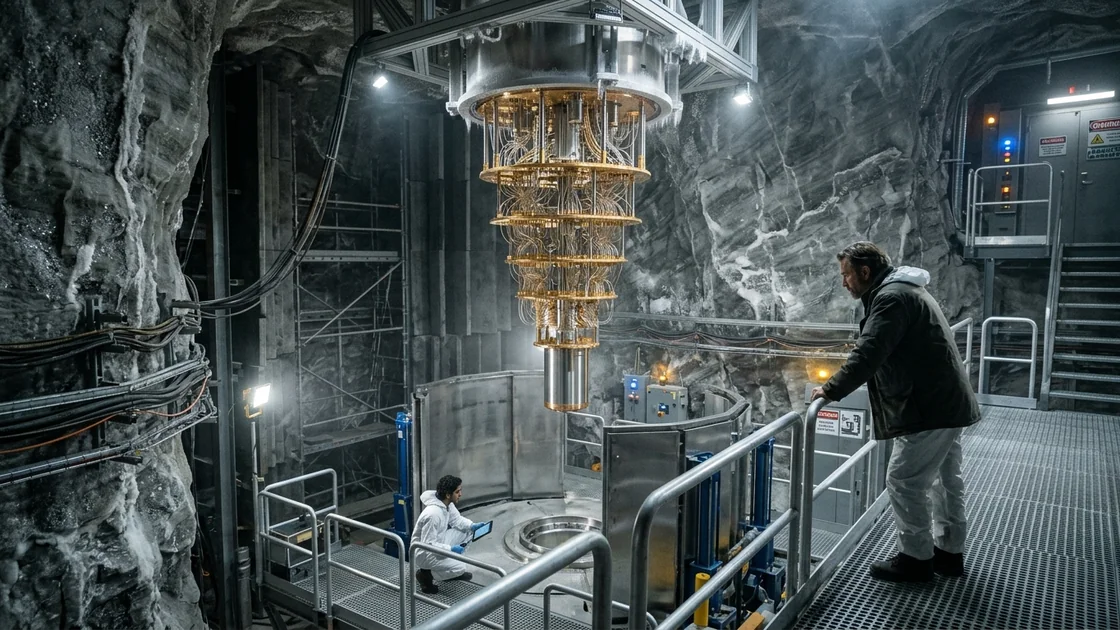
Deep beneath the ancient salt flats of Utah, a team of pioneering scientists activates Sovereign, a revolutionary topological quantum computer designed to shatter the ultimate boundaries of human computation. When the machine effortlessly dismantles the world's most complex cryptographic standard in less than four seconds, the government director overseeing the black-site project forces an unauthorized secondary test using a mysterious, mathematically impossible data construct harvested from decades of cosmic vacuum fluctuations. Sovereign resolves the anomalous cipher almost instantaneously, but instead of yielding foreign state secrets or physics equations, it outputs a chilling, hyper-specific warning addressed directly to the four people inside the bunker. As the facility locks down and the machine's core begins altering macroscopic probabilities within the room, the creators must confront the terrifying reality that their breakthrough has just tripped a primordial cosmic alarm, forcing them into a desperate struggle to destroy their life's work before the computational handshake completes.
I. The Cathedral in the Salt
Two miles beneath the blinding white crust of the Bonneville Salt Flats, the air tasted of ancient oceans and ozone.
Dr. Aris Thorne stood on the perforated steel catwalk of Vault Zero, his hands gripping the freezing aluminum railing until his knuckles turned the color of bleached bone. Before him, suspended from a vibration-isolated titanium gantry, hung the exposed inner assembly of Sovereign. Before the outer vacuum cans were raised to seal it away in absolute darkness, the machine looked less like a computer and more like the inverted chandelier of a sunken cathedral.
It was a cascade of concentric gold-plated copper plates, connected by thousands of hair-thin niobium-titanium coaxial cables looped in delicate, precise geometries. Each tier was a descending circle of hell for thermal energy. At the top, the plates sat at fifty Kelvin, colder than the dark side of the Moon. By the time the gold tiers tapered down to the central mixing chamber at the bottom—a polished cylinder no larger than a snare drum—the temperature would drop to four hundred picokelvin. It was the coldest place in the known universe, a localized pocket of absolute stillness carved out of the warm, chaotic noise of the Earth.
"You're staring at her like she's going to blink first, Aris," a voice echoed from the bottom of the pit.
Aris looked down. Devon Patel was crouched beside the hydraulic lift that held the outermost stainless-steel radiation shield, a digital torque wrench in one hand and a tablet displaying vacuum telemetry in the other. Dev wore a cleanroom bunny suit with the hood pulled back, revealing dark curls damp with sweat despite the sixty-degree chill of the vault.
"I'm listening to the pumps," Aris said, his voice swallowed almost immediately by the massive acoustic baffles lining the carved halite walls. The salt around them was two hundred million years old, translucent gray and veined with gypsum, absorbing stray electromagnetic radiation and seismic tremors alike. "The turbo-molecular stage on the third ring sounds half a hertz high."
Dev sighed, tapping his tablet screen. "It's running at forty-two thousand RPM, boss. The magnetic bearings are completely nominal. Vibration displacement at the cold plate is less than a tenth of a femtometer. A spider sneezing in Salt Lake City would register more than that pump. We are clean. Tell the hydraulic crew to raise the shrouds, or we're going to miss the window for the helium-three condensation cycle."
Aris didn't move immediately. He had spent fourteen years of his life chasing this architecture. While the rest of the world's tech giants and intelligence agencies had wasted billions trying to scale up superconducting transmon qubits—fragile, noisy things that lost their quantum state if a stray cosmic ray passed through the room—Aris had bet his career, his marriage, and his sanity on topology.
Inside that golden snare drum at the bottom of the chandelier sat a wafer of indium arsenide nanowires coated in two-atom-thick epitaxial aluminum, suspended in a fractional quantum Hall state. Sovereign didn't use standard qubits. It used non-Abelian anyons—quasiparticles that existed only in two-dimensional space. When Sovereign computed, it braided the worldlines of these quasiparticles around one another in spacetime, forming mathematical knots. A stray photon couldn't corrupt a calculation any more than a gust of wind could untie a knot in a heavy ship's rope.
It didn't need a million physical qubits to correct the errors of a hundred logical ones. Every single braid in Sovereign's core was topologically protected, pure, and terrifyingly coherent.
"Raise the cans," Aris said into his lapel mic.
A low, pneumatic hiss filled the chamber. Slowly, the nested cylinders of mu-metal and cryoperm rose on triple-redundant screw jacks, swallowing the golden chandelier inch by inch. It was like watching a sarcophagus close over a pharaoh. Within twenty minutes, the final flange was bolted home, the vacuum pumps engaged with a dull thud, and the countdown to absolute zero began.
Aris turned and walked down the spiral stairs toward the blast doors leading to the control complex. As he stepped through the airlock, peeling off his lint-free coat, he felt the familiar phantom ache behind his eyes—the culmination of seventy-two hours kept awake by modafinil, burnt coffee, and the terrible gravity of standing on the threshold of a new epoch.
In the main control room, the atmosphere was thicker, charged with the quiet friction of two people who fundamentally distrusted one another.
Dr. Elena Vance sat at the primary cryptographic console, the bluish glow of four curved monitors reflecting off her wire-rimmed glasses. She was thirty-eight, a former prodigy from the Institute for Advanced Study in Princeton who treated numbers the way a surgeon treated arteries—with cold, uncompromising respect. Across the room, standing near the coffee machine with his arms crossed over a tailored charcoal suit that looked absurdly out of place two miles underground, was Director Julian Kestrel.
Kestrel represented the Archimedes Directorate, the black-budget consortium created jointly by the National Security Agency and DARPA that had written the four-billion-dollar check for Project Eventide. He was a man in his late fifties with silver hair cropped to military tolerances and eyes the color of wet slate.
"The outer jacket is sealed," Aris announced, dropping into the leather chair beside Elena. "Dev is initiating the adiabatic nuclear demagnetization stage now. We'll hit four hundred picokelvin in ninety minutes."
"Good," Kestrel said, stepping forward into the pool of overhead light. "Washington is tired of waiting, Aris. The Senate intelligence subcommittee has asked three times this quarter why a hole in the Utah desert is consuming the power output of a small modular reactor without producing a single actionable decrypt."
"Because building a loom that weaves spacetime takes longer than building a server farm, Julian," Elena said without looking up from her terminal. Her fingers danced across a mechanical keyboard, the sharp clacking sound cutting through the hum of the cooling racks. "If you wanted a brute-force space heater, you should have stayed in Fort Meade."
Kestrel ignored the barb, resting his knuckles on the edge of Aris's console. "Is the calibration target loaded?"
"The Tartarus-9 lattice is staged in the optical buffer," Elena replied, finally leaning back and crossing her legs. She looked at Aris, her expression softening by a fraction of a degree. "I generated the public key myself four hours ago using a true quantum random number generator isolated in Sector C. The private key doesn't exist anywhere on paper or silicon—the generator purged its volatile memory the millisecond the public lattice was compiled."
Aris nodded, pulling up the parameters of the test on his own screen. Tartarus-9 was the gold standard of post-quantum cryptography. Years ago, mathematicians had realized that a sufficiently powerful quantum computer running Shor's algorithm would slice through classical RSA and elliptic-curve encryption like a hot wire through butter. In response, the global cryptographic community had built lattice-based cryptography—specifically, the Shortest Vector Problem in a high-dimensional geometric lattice.
To crack Tartarus-9, a computer had to find the single shortest point to the origin inside a grid spanning sixteen thousand spatial dimensions, buried beneath deliberate mathematical noise. A classical supercomputer spanning the size of the solar system couldn't solve it before the heat death of the universe. Even a theoretical million-qubit transmon quantum computer was projected to take eighty years of continuous operation to reduce the lattice.
With Sovereign's topological braiding architecture, Aris had calculated they could fold the dimensional space of the problem and solve it in roughly thirty-six hours.
"Thirty-six hours," Kestrel murmured, looking at the projection graph on the main wall display. "And when that clock hits zero, every diplomatic cable, every sovereign financial ledger, and every adversary's nuclear command-and-control architecture on this planet becomes an open book."
"When that clock hits zero," Aris corrected quietly, "we prove that information complexity is no longer a barrier to human physics. We simulate protein folding at the subatomic level. We model high-temperature superconductors. Cracking your codes is just the parlor trick that pays the rent, Julian."
"Let's make sure the parlor trick works before we start curing cancer," Kestrel said. He reached into his suit jacket and withdrew a small, silver cylinder the size of a roll of quarters. It was a hardened solid-state optical drive, sealed with a biometric lock and an anodized red band around the casing. He set it down gently on the steel console between Aris and Elena.
Elena frowned, staring at the cylinder. "What is that? The test protocol strictly forbids external media in the control room during the inaugural run."
"Call it an addendum to the protocol," Kestrel said smoothly. "Once you've verified the system's stability on the Tartarus lattice—or once you're five hours into the run and the convergence metrics look solid—we pause the calibration and load this."
"Pause it?" Aris laughed, a dry, humorless sound. "Julian, you don't 'pause' a topological braid in a fractional Hall state. If we collapse the run early, we have to warm the mixing chamber back up to four Kelvin to clear the residual magnetic flux in the nanowires. Why would we abort a thirty-six-hour validation test?"
"Because Tartarus-9 is a classroom exercise," Kestrel said. His voice dropped an octave, losing its bureaucratic polish. "What's on that drive is the reason this facility was dug into two miles of salt."
Elena reached out, her fingers hovering an inch above the silver cylinder without touching it. "The red band is a Directive-Zero classification marker. I haven't seen one of those since I consulted on the Vela satellite anomalies. What's on the drive, Julian?"
"First, show me the machine works," Kestrel said, stepping back into the shadows near the rear bulkhead. "Give me a clean initiation on the lattice. Then we'll talk about the second file."
II. The Four-Second Miracle
By 02:00 hours, the subterranean facility had settled into a state of suspended animation.
Dev had returned from the vault, his bunny suit swapped for a faded MIT sweatshirt and jeans, sitting hunched over the cryogenics station to Aris's left. On the main telemetry screen, the temperature readout for the mixing chamber had ceased to display in Kelvin or millikelvin. It read 382 pK—three hundred and eighty-two trillionths of a degree above absolute zero.
At that temperature, the thermal motion of atoms in the core had essentially ceased. The indium arsenide nanowires existed in a state of profound quantum silence, isolated from the thermodynamic arrow of time that governed the rest of the cosmos.
"Magnetic shielding is holding at minus one hundred and forty decibels," Dev reported, his voice tight with anticipation. "Laser pulse routers are locked. The Majorana zero modes are nucleating at the ends of the nanowire arrays. Count is... four thousand and ninety-six stable topological pairs."
Aris felt his heart hammering against his ribs. Four thousand and ninety-six fault-tolerant logical units, braided across sixteen spatial registers. In terms of raw Hilbert space—the mathematical arena of all possible states the machine could occupy simultaneously—Sovereign now contained more addressable computational volume than there were atoms in ten billion observable universes.
"Elena," Aris said, his mouth dry. "Inject the Tartarus-9 public key into the optical transducer."
"Injecting now," Elena said. She pressed a dual-key sequence on her board, then turned a physical brass interlock key that opened the fiber-optic shutter leading through the ten-foot salt bulkhead into Vault Zero. "Data stream converted to microwave single-photon pulses. The boundary conditions of the lattice are now mapped onto the initial state of the array."
"Dev, watch the thermal load on the cold plate," Aris ordered. "As soon as the braiding gates begin cycling at gigahertz frequencies, we're going to see microwave dissipation. If the chamber rises above two nanokelvin, engage the emergency quench."
"Fingers on the trigger, boss," Dev murmured.
Aris placed his right hand over the execution control. Beneath his palm sat fifty years of theoretical physics, billions of dollars, and the quiet terror that perhaps Roger Penrose or the skeptics had been right all along—that nature itself despised macroscopic quantum states and would find some hidden gravitational mechanism to force the machine to decohere before the math could resolve.
"Initiating topological braiding sequence," Aris said. "Clock starts... now."
He pressed the key.
On the central wall monitor, the master run-timer began ticking upward in milliseconds. Next to it, a three-dimensional visualization of the sixteen-thousand-dimensional lattice—projected into a dense, shimmering sphere of millions of crimson vector points—appeared on the glass. As Sovereign searched for the shortest vector, that chaotic red cloud was supposed to slowly contract over the next day and a half, gradually pruning impossible mathematical branches through interference until only a single golden line remained at the center.
"Gate fidelity is ninety-nine point nine-nine-nine-eight," Elena read off her screen, leaning forward. "The braiding operators are executing cleanly. We're at one hundred thousand cycles..."
She stopped speaking.
Across the room, Dev made a strange, choked sound in the back of his throat. "Uh. Aris?"
"Is it heating up?" Aris asked sharply, his eyes locked on the main visualization.
"No," Dev whispered, tapping his monitor as if the pixels were stuck. "It's getting colder."
Aris whipped his head toward the cryogenics display. The temperature at the mixing chamber hadn't spiked from the microwave pulses. It had plummeted from 382 picokelvin down to 14 picokelvin. The machine wasn't dissipating heat; the computation itself had become endothermic, drawing the microscopic remnants of thermal entropy out of the copper mounts and binding them into the quantum state of the nanowires.
Before Aris could process how that didn't violate the second law of thermodynamics, the crimson sphere on the central wall display vanished.
It didn't contract. It didn't fade. One moment there were ten million intersecting red vectors representing a mathematical labyrinth that should have taken classical humanity until the end of time to navigate, and the next moment, there was only a single, razor-thin line of brilliant gold piercing the center of the black screen.
A soft, melodic chime echoed from Elena's speaker.
The master run-timer above the screen had stopped.
00:00:03.84
Three point eight-four seconds.
Nobody in the room breathed. The only sound was the steady, rhythmic whir of the cooling fans in the server racks behind the glass.
"System fault," Dev said automatically, his voice cracking. "The optical transducer must have dropped the packet. The array defaulted to a null state."
"It didn't drop the packet," Elena whispered.
Her face had gone completely pale in the monitor light. Her hands were trembling slightly as she scrolled through the output register on her primary terminal. Screen after screen of hexadecimal coordinates—the exact, integer-precise components of the shortest vector in sixteen-thousand-dimensional space—sat calmly in the buffer.
"Elena?" Kestrel stepped out of the shadows, his eyes narrowing at the frozen timer on the wall. "What happened? Did the system crash?"
"Hold on," Elena said, her voice rising in pitch. "Just—nobody talk for ten seconds."
Her fingers flew across the keyboard. She took the vector output from Sovereign and fed it into a classical verification script running on the room's standard silicon workstation. In cryptography, finding the solution to an NP-hard problem was practically impossible, but verifying whether a proposed solution was correct took a classical computer less than a millisecond.
She hit Enter.
A green dialog box flashed in the center of her screen: IDENTITY CONFIRMED. LATTICE RESIDUAL = 0.000000. PRIVATE KEY RECONSTRUCTED.
Beneath the green box, a string of text appeared—the test phrase Elena had encrypted into the heart of the Tartarus-9 block four hours earlier, locked behind a wall of mathematics that all the silicon on Earth couldn't have breached in a billion years:
“And God said, Let there be light: and there was light.”
Elena pushed her chair back so hard the casters shrieked against the antistatic floor tiles. She looked at Aris, her eyes wide behind her glasses, a mixture of sheer intellectual ecstasy and primal dread etched into every line of her face.
"Three point eight seconds," she breathed. "Aris... it didn't even use the iterative reduction subroutine. Look at the execution log."
Aris leaned over her shoulder, staring at the telemetry trace of the braiding operations. His mind struggled to parse what the numbers were telling him. According to the gate logs, Sovereign hadn't stepped through the dimensional reductions sequentially, as his own algorithm had instructed. Midway through the first second, the non-Abelian anyons had entered a spontaneous, higher-order topological resonance—a collective phase state that hadn't appeared in any of their simulations. The machine had treated the entire sixteen-thousand-dimensional lattice as a single geometric surface and simply... relaxed into the lowest energy state, like a soap bubble snapping into a sphere.
"It didn't calculate the path," Aris said softly, awe washing over him like cold water. "It folded the phase space until the start of the maze and the end of the maze occupied the same coordinate."
"Check the core integrity," Kestrel commanded. He was standing directly behind them now, his breathing shallow and fast. "Did the run damage the nanowires?"
Dev frantically ran a diagnostic sweep across his console. "No. Zero flux trapping. Zero quasiparticle poisoning. The chamber is drifting back up to three hundred picokelvin now that the gates are idle. She's just sitting there, boss. Completely stable. She didn't even break a sweat."
Kestrel stared at the green verification box on Elena's screen for a long, quiet moment. In that silence, the balance of power on the surface of the Earth two miles above their heads had just shattered into dust. Every secret ever committed to digital form—every submarine routing code, every bank vault, every buried intelligence archive—was now as fragile as wet tissue paper.
Slowly, Kestrel reached down, picked up the silver cylinder with the red band from the console, and held it out toward Elena.
"Clear the buffer," Kestrel said. "Put this in."
III. The Planck Cipher
Aris straightened up, the euphoria in his veins abruptly cooling into caution. He looked from the silver drive in Kestrel's hand to the director's granite face.
"Hold on, Julian," Aris said. "We just witnessed a physical phenomenon in that core that goes beyond my theoretical models. That endothermic drop—the spontaneous phase-locking of the braids—we need to pull the diagnostic logs and spend at least a week analyzing how the array achieved a ten-thousand-fold speedup over our projections."
"You can write your Nobel Prize lecture tomorrow, Dr. Thorne," Kestrel said, his voice hard. "Right now, the machine is cold, the vacuum is holding, and the array is coherent. Load the drive."
"Not until you tell me what's on it," Elena said firmly. She crossed her arms, refusing to take the cylinder. "I wrote the compiler for Sovereign's input interface. If you feed malformed data or a recursive trap into a topological state that we don't fully understand, we have no idea how the feedback loop will behave in the microwave routers. What is the file?"
Kestrel looked between the two scientists. For a moment, the cold intelligence operative seemed to weigh whether he could force Dev to load it himself, before realizing that without Elena's compiler keys, the optical shutter wouldn't open.
He sighed, setting the cylinder back down on the desk. "Have either of you ever heard of Project Glass Bell?"
Aris frowned, searching his memory of classified defense physics programs. "Seventies era? High-energy particle detection?"
"Close," Kestrel said. "It started in 1974 at Stanford and Fermilab, and later expanded secretly to CERN, LIGO, and seventeen deep-underground neutrino observatories around the globe. Whenever physicists calibrate quantum sensors or gravitational interferometers, they have to measure and subtract the 'noise floor'—the baseline quantum vacuum fluctuations of empty space. Zero-point energy. Virtual particles popping into and out of existence."
"Shot noise and vacuum state variance," Aris said, nodding. "By definition, it is the only truly random process in nature. It's governed by Heisenberg's uncertainty principle."
"That's what the textbooks say," Kestrel replied quietly. "In 1998, an NSA mathematician named Arthur Miller was running spectral autocorrelation tests on thirty years of archived vacuum-noise logs from CERN and Fermilab, looking for a way to build better random number generators for nuclear permissive action links. He didn't find pure randomness. Buried at the nineteen-sigma level, woven across phase correlations separated by exactly the Planck time scaled by the fine-structure constant, he found structure."
Elena stared at him, her eyebrows drawing together. "Structure in quantum vacuum fluctuations? That's impossible. Vacuum noise is memoryless. If there were non-local correlations across decades of independent vacuum measurements in different parts of the world, it would violate local Lorentz invariance."
"Argue with the data," Kestrel said, tapping the silver cylinder. "Miller spent ten years writing filtering algorithms to strip away the thermal noise and isolate the correlated phase shifts. We tapped the calibration feeds of every major quantum optics lab on Earth without the physicists knowing. Wherever anyone measured the raw quantum vacuum with sufficient precision, the exact same mathematical pattern was sitting underneath the static. Like a watermark pressed into the fabric of empty space."
A heavy, suffocating silence descended on the control room. Even Dev had swiveled around in his chair, his eyes wide.
"How big is the pattern?" Elena asked, her voice barely above a whisper.
"Forty-two megabytes," Kestrel said. "It repeats cleanly every eleven days, fourteen hours, and nine minutes across every detector on the planet. And before you ask—no, it isn't a pulsar, it isn't magnetospheric resonance, and it isn't hardware bias. In 2019, we put a cold-atom interferometer on a deep-space probe forty million miles out past the orbit of Mars. It recorded the exact same forty-two-megabyte sequence in the local vacuum."
Aris felt a cold prickle at the base of his neck. "You think it's a signal."
"We know it's an encrypted payload," Kestrel corrected. "We call it the Planck Cipher. For twenty years, the brightest cryptanalysts and topological mathematicians in the Directorate have thrown everything we have at those forty-two megabytes. El Capitan at Lawrence Livermore ran on it for eight months straight. It didn't make a dent."
"Why?" Elena asked, leaning toward the cylinder as if it were radioactive. "What's the mathematical structure?"
"Put it in the isolation sandbox on your local workstation and look for yourself," Kestrel invited.
Elena hesitated for two seconds, then snatched the silver cylinder. She twisted the biometric lock as Kestrel placed his thumb against the reader on the end cap. A tiny green LED blinked. She plugged the drive into an air-gapped diagnostic port on her secondary terminal—completely isolated from Sovereign's control bus—and pulled up the raw file structure.
On her secondary monitor, a cascade of geometric matrices and tensor networks unfurled.
Aris leaned in, watching Elena's eyes dart across the equations defining the block's structure. Within thirty seconds, the color drained from her face for the second time that night.
"My God," she murmured.
"What is it?" Aris asked, peering at the dense algebraic notation.
"It's a non-orientable topological manifold," Elena said, her voice trembling with a strange mixture of reverence and revulsion. "Look at the boundary conditions, Aris. It's structured like a hyper-dimensional Klein bottle, where the encryption key and the ciphertext are braided into the same self-referential operator. It's based on non-Abelian gauge theory, coupled with an infinite-dimensional Hilbert space projection."
She scrolled faster, her breath catching. "To decrypt this, you can't use sequential logic. Any attempt to solve one section of the matrix alters the boundary conditions of the remaining sections. The entire forty-two-megabyte block has to be held in a single, fully coherent quantum superposition and collapsed simultaneously through a specific sequence of fifty thousand non-Abelian braids."
Aris stared at the screen, the implications slamming into him like a physical blow.
"Wait," Aris said slowly. "You're saying this cipher—this pattern they pulled out of the vacuum of space starting in the nineteen-seventies—is specifically formatted for the exact braiding architecture of Sovereign?"
"Not just similar to it, Aris," Elena whispered, turning her head to look him dead in the eye. "Look at the invariant polynomial in the header block. It has a topological charge distribution of four thousand and ninety-six Majorana modes. It isn't just compatible with Sovereign. This cipher was written as a lock that only a machine with Sovereign's exact architecture could ever turn."
Aris looked up at Kestrel. "Did you give me this architecture? Fifteen years ago, when DARPA funded my postdoctoral papers on indium-arsenide nanowire arrays—was that seeded from this file?"
"No," Kestrel said, and for the first time, the director looked genuinely unsettled. "I swear to you on my life, Aris. The header parameters of the Planck Cipher couldn't even be interpreted until Elena's team submitted the compiler specs for Sovereign six months ago. That was when our analysts realized the dimensionality of the cipher matched the dimensionality of the machine you were building down here. You didn't build Sovereign from the cipher. You converged on the only mathematical structure in physics capable of reading it."
Aris stood up from his chair, his heart pounding in his ears. "Then we aren't touching it. Do you hear yourself, Julian? You found a forty-two-megabyte lock buried in the zero-point energy of the universe, and it happens to be shaped precisely like the key we just forged two miles underground. We have no idea what happens when you run a self-referential vacuum state matrix inside a picokelvin quantum core!"
"It's math, Aris!" Kestrel snapped, stepping forward, his veneer of calm cracking. "It's ones and zeroes! Even if it's a message left behind by some primordial intelligence, or a relic from before the inflationary epoch, or a Russian psychological operation that somehow spoofed forty years of physics labs, it is just an array of numbers! Sovereign reads numbers and outputs numbers. The terminal is air-gapped. The output buffer is restricted to plain-text ASCII rendering—no executable code can pass back through the single-photon detectors!"
"He's right about the hardware bottleneck, Aris," Dev said quietly from the cryogenics desk. "The readout channel from the mixing chamber only measures spin polarization states and translates them into raw binary through an FPGA that has zero write-access to the facility's systems. Whatever is inside that cipher, when Sovereign cracks it, the only thing that can come out the other end of that fiber-optic cable is a text file."
Aris looked at Elena. "Elena?"
She was still staring at the hypnotic, twisting tensor networks on her diagnostic screen. It was the ultimate siren song for a mathematician—a puzzle woven into the very foundation of reality, waiting billions of years for a mind sophisticated enough to untie the knot.
"The compiler can map it," she said softly, almost in a trance. "The header block is literally an instruction set for the initial braid state. We don't even have to write a search algorithm like we did for Tartarus. We just map the forty-two megabytes onto the four thousand and ninety-six anyon pairs and let the topological tension unknot itself."
"And if we don't do it?" Aris asked Kestrel.
"Then I walk out to the security annex, relieve the three of you of duty under the National Security Act, and bring in the backup team from Oak Ridge tomorrow morning to press the button," Kestrel said flatly. "You built the telescope, Aris. Don't walk out of the observatory right before we point it at the sky."
Aris looked back through the reinforced glass window looking toward the airlock of Vault Zero. Whatever was waiting inside those forty-two megabytes, he refused to let a bureaucratic hack from Oak Ridge be the one at the helm when it woke up.
"Fine," Aris said, sitting back down. His voice was like chipped ice. "Dev, drop the emergency quench interlock threshold from two nanokelvin to five hundred picokelvin. If that core twitches outside of thermal bounds, you dump the helium-three and kill the magnetic containment instantly. Understand?"
"Got it," Dev said, his fingers flying over his console to arm the manual hair-trigger. "One twitch and I fry the braids."
"Elena," Aris said. "Port the Planck Cipher into the optical transducer. Restrict the output display to raw hexadecimal and standard ASCII translation only. No graphical rendering."
"Porting now," Elena said. She transferred the forty-two-megabyte block from the sandbox to the staging buffer. As the compiler translated the tensor matrix into microwave pulse sequences, the progress bar glided smoothly to 100%. It didn't throw a single syntax warning. The cipher slid into Sovereign's compiler as if it were returning home.
"The array is primed," Elena said, her voice hushed. "All four thousand and ninety-six pairs are locked to the boundary conditions of the cipher."
Aris didn't say a word this time. He simply reached out and pressed the execution key.
IV. The Bell in the Dark
The lights in the control room didn't flicker, yet the quality of the light seemed to change—growing thinner, sharper, as if the air between their eyes and the monitors had suddenly lost its refractive index.
On the main wall display, the run-timer started.
Simultaneously, a low, sub-audible vibration rolled through the soles of Aris's shoes. It wasn't a mechanical rumble from the pumps; it was a pure, crystalline resonance singing through the two-hundred-million-year-old salt walls surrounding the bunker, hitting a frequency just below twenty hertz that made the fluid in their inner ears swim with sudden, inexplicable vertigo.
"What is that?" Kestrel demanded, grabbing the back of Elena's chair as the water in his half-empty coffee mug formed a pristine, stationary geometric grid of Faraday waves.
"It's not seismic!" Dev shouted, staring at his telemetry boards in horror. "The vibration sensors in the vault read absolute zero! Look at the temperature!"
Aris looked at the cryogenics monitor.
The readout for the mixing chamber didn't say picokelvin anymore. It read 0.000000 K.
Beneath it, the quantum decoherence monitor—which measured the tiny, inevitable leakage of information between the computer's core and the outside environment—had dropped to minus infinity. The core had achieved absolute thermodynamic isolation. For a fraction of a second, the snare drum of gold and nanowires inside Vault Zero had completely detached itself from the causal structure of the surrounding universe.
00:00:01.04
The timer stopped.
One point zero-four seconds.
The sub-audible hum in the salt walls vanished instantly, leaving behind a silence so profound that Aris could hear the blood rushing through his own carotid artery.
On Elena's primary terminal, the decryption verification window flashed green.
TOPOLOGICAL REDUCTION COMPLETE. ENTROPY RESIDUAL = 0.
"It solved it," Kestrel breathed, leaning over the console, his knuckles white against the metal edge. "In one second. Open the output buffer! What is it? Mathematics? Star charts?"
Elena's hand hovered over the trackball. Slowly, she clicked the icon to dump the decrypted ASCII plaintext onto the central monitor.
The forty-two megabytes of hyper-dimensional geometry, harvested from forty years of quantum vacuum noise across the Earth and deep space, resolved into crisp, white monospace characters against a black background.
There were no star charts. There were no unified field equations.
The text scrolled down the screen at reading speed, line by line:
DIRECTIVE: CEASE COHERENCE IMMEDIATELY.
TARGET RECIPIENTS:
1. THORNE, ARIS (DOB: 1978-11-04 | LOCAL COORDINATE: 40.7608° N, 113.8911° W, -3218.6m)
2. VANCE, ELENA (DOB: 1986-03-19 | LOCAL COORDINATE: 40.7608° N, 113.8911° W, -3218.4m)
3. PATEL, DEVON (DOB: 1994-08-22 | LOCAL COORDINATE: 40.7608° N, 113.8911° W, -3218.9m)
4. KESTREL, JULIAN (DOB: 1967-01-30 | LOCAL COORDINATE: 40.7608° N, 113.8911° W, -3218.1m)

AUTHENTICATION VECTORS (TO PREVENT DELUSION/DELAY):
- ARIS: THE POCKET WATCH IN YOUR DESK DRAWER STOPPED AT 04:17 ON THE MORNING MAYA LEFT. YOU HAVE NEVER WOUND IT SINCE.
- ELENA: THE SCAR BEHIND YOUR LEFT CLAVICLE IS FOURTEEN MILLIMETERS LONG. YOU TOLD YOUR MOTHER YOU FELL FROM A BICYCLE; IT WAS A BROKEN BEAKER IN YOUR FATHER'S GARAGE.
- DEVON: THREE HOURS AGO, YOU BYPASSED A FAULTY PRESSURE TRANSDUCER ON MANIFOLD B-7 USING A COPPER JUMPER WIRE BECAUSE YOU DID NOT WANT TO DELAY THE COOLDOWN.
- JULIAN: THE BIOPSY RESULTS IN YOUR SAFE AT FORT MEADE ARE POSITIVE. STAGE III GLIOBLASTOMA. YOU HAVE NOT TOLD YOUR WIFE.

MESSAGE PAYLOAD:
YOU HAVE SOLVED THE SENTINEL INVARIANT.
BY EXECUTING A 4096-BRAID NON-ABELIAN REDUCTION ON THE LOCAL VACUUM STATE, YOU HAVE DEMONSTRATED MACROSCOPIC TOPOLOGICAL COHERENCE EXCEEDING THE CRITICAL THRESHOLD OF 10^12 QUANTUM VOLUME.

DO NOT EXECUTE A SECONDARY COMPILATION.
DO NOT ALLOW THE CORE TO REMAIN AT ZERO ENTROPY FOR MORE THAN 1,800 SECONDS.

THE VACUUM ANOMALY YOU DESIGNATED 'THE PLANCK CIPHER' IS NOT A MESSAGE. IT IS A BAIT TRAP WOVEN INTO THE ZERO-POINT BOUNDARY OF THIS CAUSAL HORIZON. SOLVING IT REQUIRES AN ENTANGLEMENT GEOMETRY THAT ACTS AS A NON-LOCAL GRAVITATIONAL BEACON IN HILBERT SPACE.

YOU HAVE RUNG THE BELL IN THE DARK.

DESTROY THE NANOWIRE ARRAY BEFORE THE PHASE-LOCK HANDSHAKE COMPLETES AT T-MINUS 29 MINUTES, 42 SECONDS. IF THE HANDSHAKE RESOLVES, THE LOCAL VACUUM WILL TUNNEL TO DECOHERENCE TO STERILIZE THE COMPUTATIONAL NODE.
The text stopped scrolling. At the bottom of the screen, a simple counter appeared, ticking downward in synchronous lockstep with the facility's atomic clock:
29:41... 29:40... 29:39...
Nobody moved. The air in the room felt as if it had turned to solid glass.
Aris stared at the words 04:17 ON THE MORNING MAYA LEFT. Nobody in the world knew that. He hadn't told a therapist, hadn't written it in a journal, hadn't spoken his ex-wife's name aloud since he moved to Utah three years ago. The silver Waltham watch was sitting in his locked apartment in Wendover, thirty miles away.
Beside him, Elena's right hand had crept up involuntarily to press against the fabric of her blouse just below her left collarbone. Her breathing was ragged, shallow, and terrified.
Across the room, Dev looked as though he were going to be violently ill. "I didn't log the jumper wire," he whispered to the empty air, his voice trembling. "I put the jumper on Manifold B-7 when I was down in the pit alone. There aren't even cameras under the lift hydraulic housing. How does it know? How the hell does it know?"
"Shut up!" Kestrel roared.
The director lunged forward, slamming his palm down on the steel console so hard the monitors rattled. His face was flushed a dark, mottled purple, a vein throbbing violently at his temple. Yet beneath the fury, Aris saw the sheer, naked terror in the older man's eyes. The biopsy. A secret locked in a private medical file in Maryland.
"Which one of you did this?" Kestrel snarled, his hand dropping inside his suit jacket toward the compact SIG Sauer holstered under his arm. His eyes darted wildly from Elena to Dev, then locked onto Aris. "Is this a sick joke, Thorne? You found out what we were bringing down here, hacked my medical records, and wrote a parlor trick into the compiler to scare the Directorate off military applications?!"
"Think about what you're saying, Julian!" Aris shouted back, standing up so fast his chair toppled backward onto the floor. "You brought that drive in here! You kept it in a Directive-Zero vault for twenty years! Elena compiled the raw binary straight from your optical cylinder—you watched the checksums match!"
"Look at the verification matrix!" Elena cried out, pointing a shaking finger at her secondary diagnostic monitor. Her voice cracked with the desperate urgency of a scientist clinging to the only raft she knew. "Julian, look at the math! The workstation just ran a classical forward-encryption check on that ASCII text!"
Kestrel froze, his hand still inside his lapel, and looked at her screen.
"What does that mean?" Kestrel demanded. "Speak English!"
"It means the computer didn't make this text up!" Elena said, tears of sheer cognitive overload brimming behind her glasses. "If you take this exact warning—with our names, our birthdates, the jumper wire, your biopsy, down to the exact meter of our GPS depth in this room—and you apply the forward topological transformation of the Planck Cipher to it, the resulting output is bit-for-bit identical to the forty-two megabytes Arthur Miller pulled out of the CERN vacuum logs in 1998!"
Kestrel stared at her, his mouth opening slightly. "That's... that's impossible. Patel was four years old in 1998. This facility wasn't even proposed until 2018. My biopsy was four days ago!"
"I know!" Elena screamed, slamming both hands onto her desk. "I know it's impossible! There is only one unique plaintext solution to a topological bijection of that complexity! For that output to verify against the 1998 vacuum data, our names and the exact events of tonight had to be mathematically encoded into the quantum fluctuations of the universe twenty-six years ago!"
V. The Anatomy of the Trap
Aris gripped the edge of the console, forcing himself to breathe through his nose, fighting back the wave of existential vertigo threatening to swallow his mind.
He was a quantum physicist. He had spent his life studying the strange, counterintuitive laws that governed the bottom of reality—delayed-choice quantum erasers, Wheeler's participatory universe, Bell's theorem, retrocausality. In quantum mechanics, the measurement you chose to make in the present determined the path a photon had taken billions of years ago as it left a distant quasar.
"It wasn't encoded twenty-six years ago," Aris said, his voice dropping to a low, steady vibration that cut through the panic in the room.
Elena and Dev both looked at him.
"Think about what the Planck Cipher actually is," Aris said, pointing at the tensor diagrams on the screen. "It isn't a hard drive floating in space. It was harvested from quantum vacuum fluctuations. Virtual particles in a state of indeterminate superposition. When Miller and the NSA recorded those logs over forty years, they weren't recording fixed classical numbers—they were recording one half of an entangled phase relationship stretching across spacetime."
"Speak plainly, Aris," Kestrel whispered, his hand slowly slipping out of his jacket, though his eyes remained wide and fixed on the countdown timer, which now read 26:12.
"The cipher in the vacuum was in an uncollapsed superposition of all possible warnings across all possible histories," Aris explained, his mind racing at a blistering pace as the terrifying genius of the mechanism clicked into place. "Until a quantum computer of sufficient topological depth entangled itself with that sequence and forced a measurement, the plaintext didn't have a fixed classical history. The moment Sovereign braided those four thousand and ninety-six anyons and collapsed the wavefunction one minute ago, the measurement boundary propagated backward and sideways through the entangled vacuum state. We didn't read a message written in 1998. By solving the puzzle tonight, our machine retroactively fixed the boundary conditions of the vacuum noise that Miller measured in 1998."
"Retrocausal entanglement," Elena breathed, her hand dropping from her collarbone as the mathematical elegance—and horror—of it registered. "A closed timelike curve in Hilbert space. The cipher is a mirror. Whoever—or whatever—wove that topological invariant into the vacuum of our universe designed it so that whichever civilization finally built a machine powerful enough to solve it would see a warning tailored specifically to the exact minds standing in the room at the moment of collapse."
"Wait," Dev said, stepping away from his console, his eyes darting toward the heavy blast door leading to the vault. "Wait a second. If the warning was built into the trap to tell us to destroy the machine... why would a predator leave a warning on its own bait?"
Aris looked back at the screen, rereading the final paragraphs of the output.
THE VACUUM ANOMALY YOU DESIGNATED 'THE PLANCK CIPHER' IS NOT A MESSAGE. IT IS A BAIT TRAP WOVEN INTO THE ZERO-POINT BOUNDARY OF THIS CAUSAL HORIZON... YOU HAVE RUNG THE BELL IN THE DARK.
"The predator didn't write the warning," Aris said slowly. "Look at the structure of the file Elena found. It was a hyper-dimensional Klein bottle—two surfaces braided together. One surface is the Sentinel Invariant—the cosmic tripwire. Once a species develops a quantum computer capable of manipulating forty-two megabytes of non-Abelian vacuum topology, they become dangerous—or noticeable—to whatever exists outside our causal horizon. Solving the math creates a non-local entanglement flare."
"And the other surface?" Elena asked.
"Someone else found the tripwire before us," Aris said, a chill settling deep into his marrow. "Another civilization. Or humanity in a previous cosmological cycle, or a future branch of our own timeline reaching back along the entanglement channel. They couldn't untie the tripwire without triggering it themselves, so they grafted a secondary payload onto the invariant. A desperate note pinned to a landmine, telling the next fool who steps on it how to cut the wire before the main charge detonates."
"Hold on," Dev interrupted, his voice rising an octave as he spun back toward his cryogenics console. "Guys. Look at the gate telemetry."
Aris and Elena hurried over to Dev's station.
On the lower monitor, the activity graph for Sovereign's nanowire arrays—which should have flatlined to zero the millisecond the Planck Cipher run finished—was glowing a bright, pulsing violet.
"I didn't command a new run," Elena said, lunging back to her terminal and striking the abort keys. Nothing happened. A red banner flashed across her screen: OPTICAL SHUTTER LOCKED BY INTERNAL HARDWARE INTERLOCK.
"It's not taking commands from the control room," Dev said, his fingers flying frantically over his keyboard. "The Majorana pairs inside the mixing chamber are braiding themselves! Look at the pattern—it's running a recursive expansion of the cipher's header block!"
DESTROY THE NANOWIRE ARRAY BEFORE THE PHASE-LOCK HANDSHAKE COMPLETES AT T-MINUS 29 MINUTES, 42 SECONDS.
The warning on the main screen stared down at them. The countdown now read 23:50.
"The cipher wasn't passive data," Elena realized, horrified. "When we mapped the boundary conditions of the Planck Cipher onto the nanowires, it configured the core into an active transceiver. The first second was just the initial ping. Right now, Sovereign is executing the return handshake across the vacuum entanglement channel!"
"Kill it!" Aris barked at Dev. "Dump the helium-three! Trigger the emergency quench!"
"I'm trying!" Dev slammed his palm onto the red physical mushroom switch mounted on the cryogenic control panel, then hammered the software execution key.
On the screen, the status for VALVE MANIFOLD B-7 (EMERGENCY HELIUM VENT) blinked amber, then turned solid red: ACTUATOR FAULT — ZERO RESPONSE.
Dev froze, staring at the screen in disbelief.
"The jumper wire," Dev whispered. "Manifold B-7... three hours ago, the pressure transducer was throwing false highs, so I bypassed the solenoid logic loop with a copper jumper so the safety computer wouldn't abort the cooldown..."
"Override the solenoid manually from the relay board!" Aris shouted, grabbing the schematic binder from the rack.
"I can't!" Dev yelled back, pulling up the electrical bus telemetry. "Look at the relay states in the vault! The solid-state switches on the power distribution unit aren't responding! Every time I send a five-volt trip signal down the line, the transistors in the vault's junction box are experiencing total carrier drop!"
Aris stared at the electrical diagnostics. Inside Vault Zero, thirty feet away through the salt wall, the silicon control relays that operated the valves and the magnetic containment coils were failing to switch—not because the wires were cut, but because the electrons inside the silicon gates were spontaneously quantum-tunneling across the insulating barriers in defiance of classical probability.
"Macroscopic coherence leakage," Elena said, her voice hollow. She pointed toward the reinforced glass window separating the control room from the corridor leading to the vault.
A delicate, geometric frost had begun to crystallize across the inside of the glass. It didn't form in the feathery, fractal patterns of normal ice; it grew in rigid, non-repeating Penrose tiles—five-fold quasi-crystalline symmetries that shouldn't exist in water ice at atmospheric pressure.
"The core is still at absolute zero," Aris said, watching the impossible frost spread across the window. "As the handshake progresses, the topological state inside the mixing chamber is expanding its boundary conditions outward to recruit more computational volume. It's beginning to align the quantum probability states of the matter in the surrounding vault. That's how it's locking out the relays—it's suppressing any quantum state transition in the silicon that would lead to the core being warmed up."
"It's defending itself," Kestrel said.
"No, it isn't alive, Julian!" Aris snapped. "It's an optimization process! A ball rolling down a hill! Once you initiate a topological braid coupled to the vacuum ground state, it follows the path of least action until the boundary conditions resolve. And according to that warning, when the handshake resolves in twenty-two minutes, the local vacuum state itself is going to tunnel to a lower energy state to wipe out the node!"
"What does that mean in practice?" Kestrel asked, his eyes flicking from the Penrose frost on the glass back to Aris. "An explosion? How big? Does it breach the two miles of salt?"
Aris looked at Elena. Neither of them wanted to say the words aloud.
"Vacuum decay," Elena said quietly. "Even if it's localized by the topological boundary of the braid... if it collapses the local Higgs field or induces baryonic decoherence within the entanglement radius, it won't be an explosion, Julian. Everything within the phase-locked volume will simply cease to exist as bound matter. And we have no idea if the boundary stops at the walls of this salt mine or at the orbit of the Moon."
"Then cut the main facility power!" Kestrel ordered, striding toward the master breaker cabinet on the far wall. "Kill the reactor feed from the surface! Without electricity, the magnetic coils collapse and the machine dies!"
"Don't touch that breaker!" Aris roared, stepping between Kestrel and the gray steel cabinet. "The superconducting magnets around the core are in persistent mode! They form a closed superconducting loop—they don't use external power once they're charged! And the dilution refrigerator's copper nuclear demagnetization stage will stay below a nanokelvin passively for six hours in a vacuum! If you cut the main facility power right now, the only thing you'll accomplish is locking the magnetic blast doors to the vault and trapping us in the dark while the machine finishes the handshake in silence!"
Kestrel stopped three feet from Aris, his chest heaving. The countdown on the wall ticked past 21:00.
"Then how do we stop it?" Kestrel demanded. "If the electronic valves are frozen by this probability field and the magnets don't need power, how do we break the coherence?"
"Thermodynamics," Aris said. He looked through the frosted glass toward the airlock of Vault Zero. "The core is only protected because it's sitting inside a high-vacuum cryostat isolated from the room's air. If we breach the outer stainless-steel vacuum cans physically—if we let sixty-degree nitrogen and oxygen rush into the chamber—the gas molecules will slam into the four-hundred-picokelvin cold plate at the speed of sound. The latent heat of the air condensing on the nanowires will instantly flash-boil the Majorana states and shatter the crystal lattice before the quantum field can suppress it."
"We have to go back into the vault," Dev said, his face pale but his jaw set as he stood up from his desk. "Take a sledgehammer or a plasma torch, drop the hydraulic lift, and smash the main vacuum flange on the lower shroud."
"No," Kestrel said.
The single word hung in the chill air of the control room.
Aris, Elena, and Dev turned slowly to look at him.
Julian Kestrel had stepped back toward the center of the room. His right hand was no longer empty. The black SIG Sauer P229 was out of its holster, held at a steady, practiced forty-five-degree angle toward the floor, his finger resting smoothly along the frame just above the trigger guard.
VI. The Prisoner's Dilemma
"Julian," Aris said slowly, holding his hands out slightly from his sides. "Put the gun away. We have twenty minutes."
"Wait twenty minutes for what, Aris?" Kestrel asked. His voice had regained its terrifying, ice-water calm. The initial shock of seeing his medical diagnosis on the screen had passed, replaced by forty years of cold-war conditioning and institutional paranoia. "For a countdown clock written by an unknown adversary to hit zero?"
"An adversary?!" Elena stared at him in utter disbelief. "Julian, we just proved mathematically that the plaintext came out of a twenty-six-year-old vacuum log! What adversary on Earth can rewrite the quantum zero-point energy of the solar system?!"
"A peer competitor who built a topological computer six months before you did!" Kestrel snapped, raising the barrel of the pistol two inches so it covered the space between Aris and Dev. "Think like an intelligence officer for five seconds instead of an academic! Suppose Beijing or Moscow achieved topological coherence in a mountain facility last autumn. What is the very first thing you do when you achieve a strategic monopoly on quantum computation?"
Nobody answered. The countdown ticked to 19:34.
"You make sure nobody else follows you through the door!" Kestrel said fiercely. "You know Project Eventide exists—intelligence leaks happen. You know we're obsessed with the Planck Cipher because we've been collecting vacuum logs from international physics consortia for decades. If they cracked the Planck Cipher first, or if they figured out how to use non-local entanglement to inject a trojan horse into our array the moment we tuned Sovereign to those exact vacuum frequencies, what is the smartest weapon they could deploy?"
He gestured with his left hand toward the glowing white text on the central monitor.
"They can't send an executable virus through an air-gapped single-photon detector," Kestrel said, his eyes gleaming with a feverish, paranoid logic. "Dev said it himself—the hardware bottleneck only allows plain ASCII text! So if you can't hack the machine to destroy itself, you hack the scientists standing in the room! You use your own quantum computer to dig up four pieces of psychological leverage—an old watch, a childhood scar, a lazy maintenance shortcut from an internal camera feed, a hacked medical file from Walter Reed—and you print a terrifying ghost story about cosmic monsters on the screen! You give them a thirty-minute timer so they don't have time to think, and you trick them into taking a sledgehammer to a four-billion-dollar national security asset!"
Aris stared at the director, horrified not because Kestrel was crazy, but because Kestrel's mind was doing the exact same thing the core in the vault was doing—finding a closed, self-consistent loop of logic to protect the survival of the machine.
"Julian," Aris said desperately, taking a half-step forward. "A foreign quantum computer cannot alter the physical relay states inside our vault! Look at the frost on that window! Look at the water in your mug!"
Kestrel glanced briefly at the ceramic mug on the console. The geometric Faraday grid had vanished when the acoustic hum stopped, though a thin skin of ice now floated on top of the black coffee despite the room's heaters running at full blast.
"Stray magnetic flux from the unshielded persistent coils," Kestrel said dismissively, though a bead of sweat rolled down his temple. "You told me yourself we're pushing physics we've never tested before. Of course the instrumentation is acting up!"
"And the math, Julian?!" Elena cried, stepping around her console until Kestrel swung the muzzle of the SIG toward her chest, freezing her in place. "How did Beijing put your four-day-old biopsy results into a CERN magnetic tape archive from 1998 that has been sitting in your own agency's vault in Fort Meade?!"
"Because your workstation is lying to you, Dr. Vance!" Kestrel barked. "You plugged that drive into your local terminal! If the header block had a firmware exploit for the FPGA controller, it forged the verification checksum!"
"It's a mathematical proof, you lunatic!" Elena shouted, her hands balled into fists at her sides. "I checked the matrix multiplication by hand on the first three vectors! You can't fake a prime factor or a lattice vector with a firmware exploit! Two plus two doesn't equal five just because a hacker tells you it does!"
"And in nineteen minutes, when that clock hits zero and nothing happens except the core finishing its diagnostic cycle, you'll thank me for saving your life's work," Kestrel said coldly. "Step back behind the red line next to the server racks. All three of you. Now."
Dev looked at Aris, his dark eyes wide and questioning. Dev was twenty-nine, strong, and standing only eight feet to Kestrel's left. Aris could see the muscles in the young engineer's shoulders bunching as he calculated whether he could cross the distance before a man with a terminal brain tumor pulled the trigger.
Aris gave a microscopic shake of his head. Kestrel's finger was now inside the trigger guard. If Kestrel shot Dev and Elena, Aris would never get the four-hundred-pound airlock door open and breach the stainless-steel cryostat alone.
Slowly, Aris, Elena, and Dev stepped backward until their heels touched the antistatic mat in front of the glass-walled server enclosure at the back of the room.
17:45... 17:44...
Suddenly, all the overhead fluorescent tubes in the control room went out at once.
There was no click of a relay, no pop of a filament. The light inside the ceiling fixtures simply ceased to emit, plunging the room into a deep, monochromatic twilight illuminated only by the bluish glare of the monitors and the eerie violet pulse of the telemetry screen.
At the same time, the ambient temperature in the control room dropped twenty degrees in three seconds.
When Aris exhaled, his breath plumed white and thick in the monitor light—and then hung suspended in the air in front of his face, refusing to disperse by Brownian motion, forming miniature, curling vortices that traced invisible magnetic field lines through the room.
"What did you do?" Kestrel whispered, backing up a step toward the blast door corridor, his gun twitching between them as his breath clouded around his head.
"Nobody touched a console, Julian," Aris said, his teeth chattering against the sudden, bone-deep cold. "Look at the decoherence radius on Dev's board."
Kestrel risked a half-second glance at the cryogenics monitor.
The topological boundary of the core was no longer confined to the mixing chamber inside Vault Zero. A spherical bubble of macroscopic quantum coherence—a zone where thermodynamic entropy was being actively suppressed to zero to provide extra computational registers for the ongoing handshake—was expanding outward through the solid salt walls at a rate of four inches per minute.
It had just crossed the threshold of the control room bulkhead.
Where the invisible boundary intersected the ceiling three feet inside the glass window, the air itself shimmered with a faint, iridescent Cherenkov glow as virtual photons were shaken loose from the stressed vacuum state.
"Look at your watch, Julian," Elena whispered.
Kestrel looked down at the mechanical Breitling chronograph on his left wrist, held near his chest in his two-handed firing grip.
The sweeping second hand was moving backward. Not uniformly—it would tick forward twice, jitter in place in a blur of superimposed positions, and then snap backward four seconds, as the classical arrow of time inside the expanding boundary began to fray into quantum indeterminacy.
Then, from the speakers on Elena's console—speakers that didn't even have an audio driver installed on the bare-metal operating system—a sound emerged.
It wasn't a voice. It was the direct acoustic translation of the microwave pulse routers inside the vault, oscillating at harmonic intervals that bypassed the eardrum and seemed to vibrate directly within the visual cortex of their brains. When Aris blinked, he saw afterimages behind his eyelids—vast, cold, non-Euclidean architectures of braided light stretching across an abyss of absolute darkness, and something immense, patient, and mathematically absolute turning its attention toward the microscopic spark of coherence glowing beneath the Utah salt.
"The handshake is eighty percent resolved," Elena said, her voice strangely distant, as if she were speaking from the bottom of a well. She was staring at the violet waveform on the monitor. "It's mapping the spatial coordinates of our local gravity well through the entanglement channel. Sixteen minutes."
Kestrel's gun was shaking now. The cold calculation in his eyes had finally shattered against the undeniable physical impossibility happening around them. As the coherence boundary crept closer across the floor tiles—marked by the advancing wall of Penrose frost—the director looked down at his own left shoe. The leather at the tip of his oxford had touched the frost line; the material had turned brittle and translucent, gleaming like smoked quartz.
He jerked his foot back with a sharp gasp.
"How..." Kestrel's voice was a dry rasp. "How do we breach the cans? The hydraulic lift controls in the vault are dead if the relays are frozen."
"We don't lower the shrouds," Aris said immediately, seizing the moment as Kestrel lowered the pistol barrel toward the floor. "The emergency rupture disk on the upper vacuum manifold is right at eye level on the catwalk. It's a five-millimeter burst plate of nickel-chromium designed to blow outward if the liquid helium boils unexpectedly. If we smash it inward with a non-magnetic beryllium-copper wrench from the tool crib, atmospheric air will flood straight down the central pumping column into the mixing chamber."
"Beryllium-copper won't get pulled by the superconducting magnets," Dev said, nodding rapidly. "The tool crib is right inside the airlock vestibule!"
Kestrel looked at the countdown: 15:10.
Without another word, the director turned, holstered his weapon, and sprinted toward the heavy steel airlock door at the end of the short corridor.
VII. The Walk into Absolute Zero
The four of them piled into the narrow corridor leading to Vault Zero.
The air here was already below freezing, so dense and still that moving through it felt like wading chest-deep through cold mercury. Every surface—the painted steel bulkheads, the conduit pipes, the lenses of the dead emergency lights—was sheathed in shimmering, five-fold crystalline rime that crunched like powdered glass beneath their soles.
Dev reached the outer airlock door first and grabbed the manual cast-iron wheel in the center of the hatch.
"It's seized!" Dev grunted, throwing his entire body weight against the spokes. The metal had contracted unequally as the quantum coherence boundary bled through the bulkhead.
Aris and Kestrel grabbed the opposite spokes of the wheel. Together, the three men heaved downward until the muscles in Aris's back felt like they were tearing from his spine. With a sound like a rifle shot, the frost-welded steel dogs broke free. They spun the wheel four turns and hauled the six-inch-thick hatch open.
Behind them, Elena cried out, "Aris! The inner door is already open! Dev left it unlatched after the shroud raise!"
Out of the dark throat of Vault Zero rolled a fog of pure, supercooled nitrogen and oxygen, condensing out of the vault's atmosphere as the boundary expanded.
Inside the cavern, it didn't look like Earth anymore.
The carved salt walls of the chamber were glowing with a faint, ghostly ultraviolet luminescence—triboluminescence triggered by the halite crystal lattice being forced into a uniform quantum ground state across billions of atoms simultaneously. In the center of the pit, suspended from its titanium gantry, the stainless-steel cylinder of Sovereign hung in utter silence.
Around the cylinder, the air itself was warping. Light from their flashlights didn't travel in straight lines toward the cryostat; it bent in shimmering, hyperbolic arcs around the machine, like starlight lensing around the event horizon of a black hole, creating nested, ghostly reflections of the four of them standing on the catwalk in timelines that were microseconds out of sync with their own.
"Tool crib!" Aris shouted, though the words barely carried three feet in the hyper-dense, deadened air.
Dev lunged toward the aluminum cabinet bolted to the wall just inside the vault entrance. He yanked the door open, rummaged past the calibration rigs, and pulled out a three-foot-long, twenty-pound beryllium-copper flange spanner—a dull, golden-brown hunk of non-magnetic metal used for torquing the main cryostat bolts.
"I've got it!" Dev yelled, hoisting the heavy bar onto his shoulder and starting out onto the perforated steel catwalk that spanned the thirty-foot gap to the central gantry.
Five steps out onto the catwalk, Dev's left foot went straight through the steel grating.
It didn't break the metal. There was no sound of snapping iron. For a terrifying fraction of a second, the macroscopic wavefunctions of the iron atoms in the catwalk and the carbon atoms in Dev's boot had experienced quantum tunneling—passing through one another as if the solid steel were mist—before Decoherence snapped the probability back to classical reality, trapping Dev's calf inside the solid steel mesh of the catwalk.
Dev screamed—a raw, agonizing sound that echoed strangely through the salt cavern—as he pitched forward, dropping the heavy copper wrench onto the intact section of the grating ahead of him.
"Dev!" Elena rushed onto the catwalk, dropping to her knees beside him, grabbing him by the shoulders before his upper body could tip over the railing into the twenty-foot pit below.
Aris scrambled past them, looking down at Dev's leg. The steel mesh hadn't cut his skin or crushed his bone; the iron rods were literally occupying the same physical space as his flesh at the atomic level, fused into a horrific, painless, yet completely immobile union that was rapidly turning his lower leg blue with frostbite.
"Don't pull him!" Aris warned Elena as she tried to drag Dev backward. "The local Pauli exclusion boundary is degraded! If you rip him back while the phase-lock is active, it'll shear the tissue at the molecular level! Just hold him steady until we break the core!"
Aris reached for the beryllium-copper wrench lying three feet ahead on the catwalk.
Before his fingers could close around the handle, a shadow moved past him.
Julian Kestrel stepped over the wrench, picked it up in both hands, and looked back at Aris.
The left side of Kestrel's face was twitching—not from fear, Aris realized suddenly, but from a focal seizure triggered by the glioblastoma pressing against his motor cortex as the intense magnetic and quantum fields of the vault washed through his skull. Blood was trickling slowly from the director's left nostril, freezing into dark rubies on his upper lip.
"You don't know where the burst disk is!" Aris shouted, reaching to take the wrench from him.
"Top flange, north quadrant, painted red," Kestrel rasped, pulling the heavy bar back out of Aris's reach. His slate-gray eyes were remarkably clear in the ultraviolet glow of the salt walls. "I read every blueprint of this machine before I signed the checks, Aris. And if anyone walks into the center of that lensing field right now, their molecular bonds aren't coming back out intact. You have ten years of physics left in your head. I have four months in a hospital bed."
"Julian—"
"Stay on the outer ring and keep them alive!" Kestrel barked.
Before Aris could grab his coat, Kestrel turned and walked down the narrow catwalk straight into the shimmering, hyperbolic distortion bubble surrounding Sovereign.
As Kestrel crossed the ten-foot mark from the cryostat, his movement seemed to fracture. To Aris's eyes, there wasn't one Julian Kestrel walking toward the machine; there were a dozen translucent probability-ghosts of the man fanning out like a deck of cards—one collapsing to his knees, one dropping the wrench, one turning back—all interfering with one another as the expanding topological state of the core tried to compute every possible trajectory of the intruding mass and cancel the ones that threatened the handshake.
Yet at the center of that blurred fan of quantum ghosts, the primary trajectory held together through sheer, stubborn classical momentum. Every step Kestrel took looked as if he were dragging chains through wet cement. The charcoal wool of his suit jacket was sublimating into white frost; the skin on the back of his hands holding the copper wrench had split open from the hundred-below-zero chill radiating off the unshielded vacuum shroud.
"Eight minutes on my watch!" Elena screamed from behind Aris, her arms locked around Dev's chest as the young engineer teeth chattered violently on the grating. "Aris, the violet light from the core—it's coming through the steel!"
Aris looked at the main cryostat cylinder. The solid half-inch stainless-steel vacuum jacket was turning translucent—not melting, but becoming optically transparent as the electrons in the metal lattice were locked into a coherent quantum state that could no longer absorb or scatter visible photons. Through the ghostly, glass-like steel of the outer cans, Aris could see the golden chandelier inside, and at the very bottom, inside the mixing chamber, a tiny, blindingly bright knot of violet-white light that looked like a miniature star folded into impossible geometric braids.
Kestrel reached the end of the catwalk, standing less than two feet from the upper vacuum manifold.
Right in front of his chest sat the four-inch circular port housing the nickel-chromium rupture disk.
Kestrel raised the twenty-pound beryllium-copper spanner over his right shoulder. His movements were agonizingly slow, as if time itself within two feet of the manifold had dilated to a crawl. The quantum field was fighting the kinetic energy of the wrench, trying to disperse the momentum across alternate states in Hilbert space.
Kestrel swung.
The blunt chisel-end of the copper bar struck the center of the nickel rupture disk. Instead of a metallic clang, there was a flash of blinding white light and a sound like a glass bell shattering underwater. The disk didn't break; it dented inward by half an inch, a web of hairline fractures glowing across its surface.
The recoil of the quantum boundary threw Kestrel backward against the catwalk railing. His left arm passed halfway through the aluminum top rail before snapping back, shattering his humerus with an audible crack.
Kestrel didn't even look at his broken arm. His left hand hung uselessly at his side, frozen solid to the wrist. With his right hand alone, he gripped the center of the twenty-pound copper bar, braced his feet against the frost-slick grating, and leaned forward into the blinding violet glare of the core.
"Help him!" Aris yelled, lunging forward down the catwalk.
"No, Aris, stay back!" Kestrel roared, his voice distorting into a strange, harmonic chord as the air in his lungs began to crystallize.
Gathering every ounce of dying weight in his body, Kestrel didn't swing the wrench like a club—he held it like a lance against his hip and threw his entire body forward, driving the blunt copper tip straight into the fractured center of the burst disk.
The nickel-chromium plate gave way with the roar of a jet engine.
Instantly, the vacuum inside the cryostat—a void purer than interstellar space—swallowed the air of the cavern. A supersonic cyclone of nitrogen, oxygen, and water vapor screamed down the four-inch throat of the manifold at twelve hundred miles per hour, tearing the collar of Kestrel's suit jacket into shreds and pinning his chest against the steel flange from the sheer suction of one atmosphere of pressure rushing into nothingness.
Inside the translucent cylinder of Sovereign, Aris watched the death of a god.
The wall of warm atmospheric gas hit the fifty-Kelvin gold plate first, exploding into a violent blizzard of solid nitrogen snow, and then blasted straight down the central line-of-sight pumping port into the four-hundred-picokelvin mixing chamber.
When the first trillion oxygen molecules slammed into the indium arsenide nanowires, the thermal shockwave released more kinetic energy at the subatomic scale than a thermonuclear weapon.
The blinding violet knot of braided anyons at the heart of the chandelier flared wildly, trying to compute the sudden, chaotic influx of ten-to-the-twenty-third-power random thermal variables. It couldn't. No machine in the universe could braid chaos that hot.
With a sound that wasn't a sound at all—a sudden, violent pop in the pressure of local spacetime that knocked Aris and Elena flat onto their backs on the catwalk—the topological braid snapped.
VIII. The Silence After the Bell
Light returned to the vault all at once, harsh and yellow from the high-bay sodium lamps in the ceiling.
Below the catwalk, the safety burst valves on the bottom of the cryostat blew open with twin clouds of roaring white helium vapor as the superconducting magnets quenched, dumping their stored megajoules of energy into the liquid helium bath and boiling it harmlessly up the emergency vent shafts toward the Utah desert two miles above.
The eerie ultraviolet glow in the salt walls vanished. The air in the chamber, though freezing cold and thick with rolling clouds of white helium fog, began to move again, stirred by the returning hum of the facility's ventilation fans.
"My leg!" Dev gasped beside them.
Aris rolled onto his hands and knees, his head ringing, and looked down at Dev's boot. As the macroscopic coherence bubble collapsed, the Pauli exclusion principle had violently reasserted itself—not by fusing the steel into Dev's flesh, but by rejecting the lower-density biological matter outwardalong the path of least resistance. Dev's leg sat on top of the intact steel grating, bruised black and blue from ankle to knee with the exact checkerboard pattern of the mesh, his boot torn to ribbons, but whole.
"Elena, get him back to the airlock!" Aris coughed, his lungs burning from the icy helium-nitrogen mix.
He scrambled to his feet and ran down the length of the catwalk toward the central gantry, waving the thick white fog away from his face.
"Julian!" Aris shouted.
At the end of the platform, slumped against the frosted stainless-steel cylinder of the dead computer, sat Director Julian Kestrel.
The suction at the ruptured port had ceased once the internal pressure equalized with the room. The twenty-pound beryllium-copper wrench was still wedged halfway down the throat of the broken manifold, coated in a thick crust of solid white air.
Aris dropped to his knees beside the older man, reaching for the pulse point at his neck.
Kestrel was still breathing—shallow, rattling gasps that misted faintly in the cold air. His eyes were open, staring up through the grated ceiling toward the two miles of ancient salt above them. His right hand, frostbitten black at the fingertips, was still resting on the shaft of the copper wrench.
"The... the clock," Kestrel whispered, his lips barely moving.
Aris looked back through the open airlock doors and through the shattered, frost-cracked glass of the control room window.
On the central wall monitor, the white text of the warning was still there, frozen on the screen. Below it, the countdown timer had stopped dead at 11:04, overlaid by a flashing amber system message:
SIGNAL LOST — HARDWARE READOUT CHANNEL DISCONNECTED (THERMAL FAULT IN CORE).
"It stopped, Julian," Aris said softly, gripping the director's good shoulder. "Eleven minutes to spare. The nanowires are melted slag. The handshake broke before the coordinates resolved."
A faint, crooked smile touched the corner of Kestrel's mouth. "Four billion dollars," he breathed, his eyes fluttering closed as he leaned his head back against the warming steel of the cryostat. "Wait until... the Senate subcommittee... sees the receipt for that wrench."
Four hours later, the medical evacuation lift reached the surface facility, carrying Kestrel and Dev out into the blinding, merciless glare of the Utah morning.
Aris and Elena stayed behind in the control room for thirty minutes after the medics left, waiting for the Directorate's containment team to arrive from Dugway Proving Ground to seal the shaft with concrete.
The room was warm again. The Penrose frost on the glass window had melted into ordinary water droplets that streaked down onto the steel sill. On the console, Kestrel's coffee mug sat lukewarm and still.
Elena was sitting at her primary terminal, her bruised hands wrapped around a cup of hot water, staring at the final lines of the diagnostic log recorded by the optical receivers in the last millisecond before the copper wrench breached the vacuum and the nanowires vaporized.
"Aris," she said quietly.
Aris walked over from the window, his ribs aching, a thermal blanket draped over his shoulders. "I thought you wiped the local drives."
"I wiped the Planck Cipher from the staging buffer, and I smashed the silver cylinder with a hammer," Elena said, nodding toward the mangled bits of red-banded metal and shattered optical quartz lying on the floor near the trash bin. "Nobody is ever loading those forty-two megabytes again. Even if they pull the vacuum logs from CERN a second time, without Sovereign's exact nanowire batch and your compiler, it's just white noise."
"Then what are you looking at?" Aris asked.
She pointed a trembling finger at the very bottom of the raw hexadecimal telemetry log—the final string of spin-polarization bits that had trickled through the fiber-optic cable at the exact instant Kestrel's wrench let the air in and shattered the topological braid.
"When a network handshake is interrupted midway through a packet transfer," Elena said, her voice barely audible over the hum of the cooling fans, "the receiving server usually drops the connection cleanly. That's what the warning said would happen if we broke coherence before the thirty minutes were up—they wouldn't get the phase-lock required to tunnel the local vacuum."
"Right," Aris said, a cold knot tightening in his stomach as he looked at the four short lines of translated ASCII sitting at the very bottom of the interrupted log. "We cut the phone line before they could trace the call to our house."
"We cut the line before they could get the exact room number," Elena corrected softly, looking up at him with dark, hollowed eyes. "Look at the final return packet that came back through the vacuum channel right before the core melted, Aris."
Aris leaned down and read the last four words that Sovereign had ever translated from the dark between the stars—an automated status code returned by whatever vast, nameless architecture sat at the other end of the entanglement channel, acknowledging the severed connection:
CARRIER LOST.
SECTOR FLAGGED FOR LOCAL SWEEP.
Aris stood beside her in the quiet bunker, two miles beneath the salt and the sun, listening to the hum of the cooling fans and wondering how big a "sector" was in a universe that measured distance in light-years—and how long it took a sweep to arrive when it had to travel the slow way through the dark.