The Future in the Lost and Found
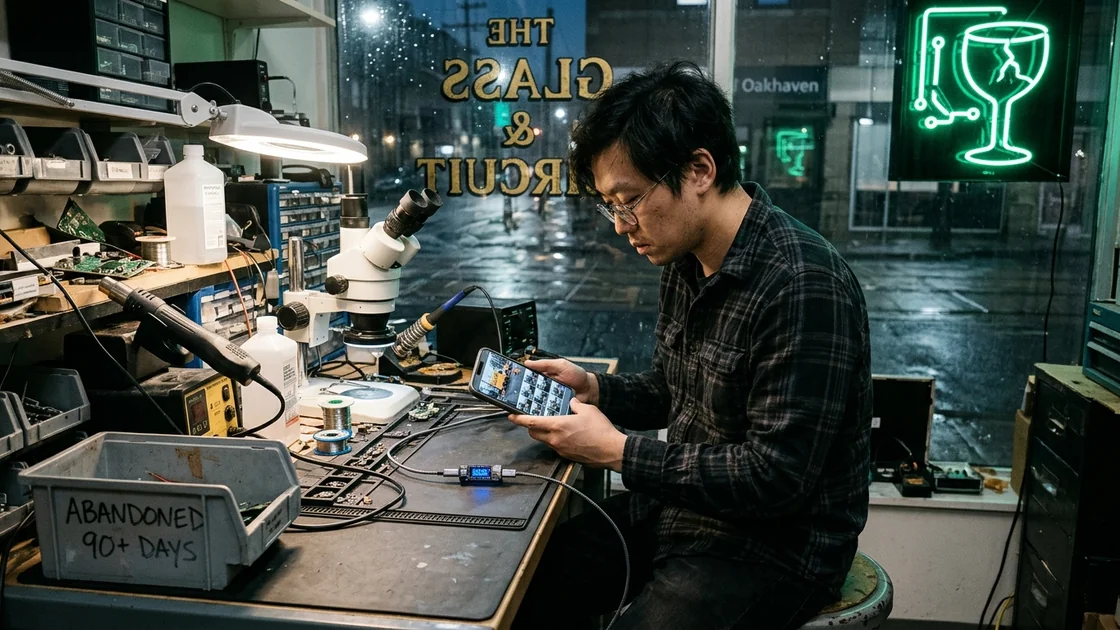
Arthur Lin, the solitary owner of a struggling electronics repair shop in the rain-soaked district of Oakhaven, discovers an unmarked smartphone buried at the bottom of his shop's lost-and-found bin during a routine inventory cleanup. Upon powering the device on, he finds the gallery populated with nineteen photographs bearing metadata timestamps dated up to three weeks in the future. Initially dismissing the files as a software glitch or an elaborate prank, Arthur is forced to confront an impossible reality when the exact, chaotic events depicted in the first photograph unfold outside his storefront down to the smallest detail. As the days tick by and more photographs prove devastatingly accurate, Arthur realizes the final images in the sequence depict a catastrophic explosion and fire that will destroy his building and claim the life of his closest friend, Maya. Armed only with his micro-soldering tools, forensic software, and the clues hidden within the high-resolution backgrounds of the future photos, Arthur must unravel a local conspiracy and figure out how to rewrite a timeline that seems determined to fulfill itself.
The rain in Oakhaven did not fall so much as it loitered. It hung in the air between the brick facades of the Arcade District, grease-slicked and heavy with the exhaust of the crosstown buses, before settling onto the awning of The Glass & Circuit in a slow, rhythmic drip. Inside, the air smelled of pine rosin flux, ninety-nine percent isopropyl alcohol, and the toasted, metallic ozone of a hot-air rework station that had been running since eight in the morning.
Arthur Lin sat hunched over his primary workbench, his forehead resting lightly against the rubber eyecups of a trinocular stereo microscope. Beneath the objective lens lay the green-and-gold labyrinth of a water-damaged logic board from an eight-year-old tablet. The customer, a retired postal worker named Mr. Henderson, had dropped it into a sink full of dishwater while trying to follow a recipe for beef stroganoff. Technically, the tablet wasn't worth forty dollars on the secondary market, and the diagnostic fee alone exceeded its book value. Looking at it made no financial sense. But Mr. Henderson’s late wife had recorded four dozen voice memos on the internal NAND flash chip before she passed, and she had never understood how cloud backups worked.
So Arthur was spending his Tuesday evening with a pair of titanium tweezers no thicker than sewing needles, nudging a corroded three-legged power management capacitor smaller than a grain of kosher salt onto two microscopic pads of tinned copper.
He tapped the foot pedal for his hot-air wand. A gentle sigh of four-hundred-degree air washed over the board. Through the lenses, the dull gray solder paste quivered, slumped, and suddenly snapped into two bright, liquid silver pillows, pulling the tiny capacitor into perfect alignment through surface tension alone.
Arthur released the pedal, leaned back, and let out a breath he felt like he had been holding for twenty minutes. His neck cracked in three places as he rolled his shoulders. The shop clock above the pegboard of braided charging cables read 7:15 PM. Outside, the neon sign in the window—a stylized green circuit trace wrapped around a cracked goblet—hummed with a dying transformer, casting a sickly emerald wash across the rain-streaked glass and the wet asphalt of Fourth Street beyond.
He switched off the microscope ring light, rubbed the bridge of his nose where his glasses left permanent red indentations, and looked around the cramped storefront. The end of the month was four days away, which meant rent was due to Vance Properties, which meant Arthur was in his customary state of low-grade, persistent nausea. Business had been slow since the manufacturer-authorized mall kiosks had started offering subsidized screen swaps, leaving independent technicians like Arthur with the crumbs: the impossible data recoveries, the vintage audio gear, the chewed-up gaming consoles, and the people who couldn't afford corporate deductibles.
When he was anxious, he cleaned. It was a habit left over from his days as a junior bench tech at a forensic data house in the city, before the burnout had driven him to buy this narrow slice of the historic Oakhaven Arcade building.
He walked past the glass display counter, which held a sparse collection of tempered-glass screen protectors and refurbished earbuds, and knelt beside the bottom shelf of the storage racks in the back room. There, wedged between a crate of swollen lithium-ion batteries waiting for hazardous waste disposal and a stack of dead motherboard donor boards, sat a gray plastic tote labeled in faded black marker: ABANDONED / 90+ DAYS.
Every repair ticket Arthur issued had fine print at the bottom stating that any device left unclaimed and unpaid for ninety days after notification became the property of The Glass & Circuit, to be recycled or liquidated for parts. In practice, Arthur rarely had the heart to wipe and sell them. People left their lives in these things, and he always half-expected them to walk through the door with a sudden windfall and a desperate apology.
He dragged the heavy tote out onto the rubber anti-static mat of his secondary bench. Most of the contents were familiar casualties. There was a rose-gold phone with a shattered OLED panel belonging to a college student who had ghosted him in April; three budget Android handsets with destroyed charging ports wrapped in yellowing masking tape; a ruggedized construction-site phone that had been run over by a skid-steer loader; and a tangle of generic smartwatches with cracked heart-rate sensors.
Arthur sorted them into two piles: those with salvageable OEM cameras and vibration motors, and those destined for the e-waste shredder.
As he lifted a waterlogged tablet from the very bottom corner of the bin, something slid out from beneath the curl of the rubber liner at the base of the tote. It made a dense, heavy clatter against the plastic.
Arthur frowned and reached in. His fingers closed around a slab of cold metal.
He pulled it into the warm yellow circle of his desk lamp. Unlike every other piece of hardware in the bin, it had no yellow paper repair ticket taped to its back. There was no customer name, no callback number, no four-digit passcode scribbled in ballpoint pen, and no description of the fault.
He turned it over in his hands. He had repaired upward of six thousand mobile devices over the past decade, and he prided himself on being able to identify any model made since 2010 by feel alone—by the radius of the corner curves, the placement of the antenna bands, the depth of the camera bump.
He did not recognize this phone.
The chassis was milled from a single block of matte, dark gray metal—titanium, judging by the strange combination of heft and thermal conductivity, though it felt denser than the grade-five titanium alloys used in current flagships. The screen was completely seamless, meeting the metal rails without the thin plastic gasket bezel that almost all manufacturers used to absorb drop shock. There was no front-facing camera cutout, no speaker mesh slit along the top edge, and on the rear, instead of the ridiculous stove-top cluster of three or four protruding lenses that dominated modern design, there was a single, flush circle of dark sapphire glass nearly an inch in diameter.
More puzzling was the wear. The device wasn't pristine. There was a deep, crescent-shaped gouge on the bottom left corner, as if it had been dropped hard onto concrete, and a fine constellation of micro-scratches across the back plate. Yet there was no FCC regulatory etching, no CE trash-can symbol, no IMEI number laser-scribed into the metal, and no brand logo. Even the USB-C port at the bottom looked slightly wrong; when he angled it under his bench magnifier, the central tongue inside the port had thirty-two microscopic gold pins instead of the standard twenty-four.
"What are you?" Arthur murmured to the empty room. "An engineering sample?"
Sometimes tech employees from the corporate campuses across the river lost prototype units in bars, though they usually came looking for them with frantic eyes and non-disclosure agreements within twelve hours. And Arthur had no memory of logging this in. He worked alone. Nobody else had a key to the back room except Maya, who ran the roastery next door and occasionally watered his fern when he went upstate to visit his sister, and Maya didn't know the difference between a logic board and a waffle iron.
He pressed and held the side power button. Nothing happened.
Reaching for his benchtop USB ammeter, he plugged a braided charging cable into the bottom of the mystery phone. The port accepted the standard USB-C plug with a crisp, mechanical click that felt far too precise for a consumer spring-latch.
He glanced at the tiny blue OLED readout on his inline meter. Standard dead phones usually negotiated a trickle charge at five volts, pulling maybe half an amp while the power management chip woke up the battery.
The meter jumped immediately to twenty volts at four point five amps—ninety watts—without any digital handshake delay, held there for exactly eleven seconds while the casing of the phone remained stone cold, and then dropped to zero.
Before Arthur could pull the cable out, fearing a shorted main power rail, the screen came alive.
There was no boot logo. No spinning gears, no cheerful chime, no carrier splash screen. One millisecond the display was pitch black, and the next it was displaying a minimalist lock screen with a dark, textured wallpaper that looked like macro photography of brushed steel. The clock at the top read 7:24 PM. Beneath it, the date read: Tuesday, November 3.
Which was today's date, down to the minute. That meant either an internal real-time clock battery had kept ticking in the bottom of the bin for months, or the phone had just pulled the network time protocol off the cellular towers without a SIM card installed.
Arthur tapped the glass. It didn't ask for a PIN, a pattern, or a biometric scan. With a vertical swipe, the lock screen dissolved directly into a bare home screen.
There were only four icons arranged along the bottom dock, rendered in stark white line-art: a terminal prompt, a settings gear, a camera aperture, and a stacked square representing a photo gallery. There was no browser, no phone dialer, no messaging client, and no app drawer.
He tapped the settings icon first. The menu that opened was an austere list of hardware telemetry. The system architecture was listed simply as ARC-OS v0.9.4-local. The processor was an unrecognized string of hexadecimal characters, and the storage listed 2.0 Terabytes of solid-state capacity, almost entirely empty. Wi-Fi, Bluetooth, and cellular transmitters were all toggled to a hard OFF state, greyed out behind a prompt that read: RF Isolation Enforced by Hardware Jumper.
Arthur’s pulse ticked up a fraction. He loved a good hardware mystery, the weirder the better. He backed out of the settings and tapped the gallery icon.
The screen populated with a grid of nineteen thumbnails.
He tapped the first thumbnail in the top left corner.
The display resolved with startling clarity. The panel had to be pushing an absurd pixel density; there was no visible sub-pixel grid even when he leaned in close, and the dynamic range made the highlights of the wet pavement look as if they were actually emitting light from behind the glass.
It was a photograph of Fourth Street, taken right outside the front window of The Glass & Circuit. In fact, judging by the angle—slightly elevated, framed on the left by the peeling gilt lettering of his own window decal and the green reflection of his neon sign—the photographer had been standing right beside Arthur’s checkout counter, pressing the lens against the plate glass.
In the photograph, it was daytime, though the sky was the familiar pewter gray of an Oakhaven afternoon. A bright yellow box truck belonging to Pellegrino Produce was slewed sideways across the wet streetcar tracks, its rear roll-up door sprung open. Hundreds of navel oranges were scattered across the slick asphalt, rolling into the gutters and banking up against the curb. Behind the truck, a city bus had jackknifed slightly to avoid a collision, its amber hazard lights glowing. On the sidewalk directly across the street, in front of the shuttered dry cleaners, a woman in a bright red trench coat stood holding a broken black umbrella that had blown inside out, while a brindle greyhound wearing a plaid dog coat strained at its leash to sniff at an orange near the storm drain.
Arthur stared at it for a long moment.
"Weird," he muttered.
He had owned this shop for six years. He spent sixty hours a week looking through that exact pane of glass. If a produce truck had dumped ten crates of oranges across the streetcar tracks directly in front of his door, he would have remembered it. It was the kind of neighborhood spectacle that would have brought every shopkeeper on the block out onto the pavement for an hour.
He tapped the little circle with an i at the top of the screen to pull up the EXIF metadata.
A semi-transparent overlay slid up from the bottom of the image: File: IMG_0001.RAW Focal Length: 28mm equivalent, f/1.4 ISO: 80 | Shutter: 1/500s GPS: 47.6101° N, 122.3421° W Timestamp: Wednesday, November 4, 2026 — 11:42:19 AM
Arthur blinked. He looked up at the wall calendar hanging beside his solder spool rack—the free one from the local industrial supply company with pictures of vintage locomotives. Today was Tuesday, November 3rd.
Tomorrow was Wednesday, November 4th.
He swiped left to the second photograph.
It was another daytime shot, this one taken inside Maya’s shop next door, Roast & Hearth. The angle was from the end of the reclaimed-wood espresso bar, near the pastry case. In the photo, Maya was standing behind the twin-group Italian espresso machine, her dark curls pulled back in her usual messy bun, wearing an olive-green apron. She was mid-flinch, her hands thrown up as a glass carafe of cold brew shattered against the terracotta floor tiles at her feet, sending a dark starburst of coffee and glass shards across the toe of her scuffed leather boots. On the chalkboard menu behind her, under the heading SOUP OF THE DAY, was written in Maya’s looping, unmistakable pink chalk handwriting: Roasted Butternut & Sage (Sorry, out of sourdough!).
Arthur pulled up the metadata. File: IMG_0002.RAW Timestamp: Thursday, November 5, 2026 — 08:19:04 AM
He swiped again.
The third photograph showed the exterior of the corner newsstand two blocks down at Fourth and Alder. A municipal parking enforcement officer was affixing a bright orange boot to the front left wheel of a dented silver 2009 Honda Civic.
Arthur’s breath caught slightly. That was his Civic. He recognized the patch of grey primer on the front fender where a shopping cart had clipped him at the grocery store two winters ago, and the faded parking permit sticker inside the lower corner of the windshield. Timestamp: Friday, November 6, 2026 — 02:14:55 PM
He swiped faster now, his thumb gliding across the oleophobic coating of the strange glass.
Photo four: Sunday, November 8. A stray calico cat sitting atop the warm transformer box in the alley behind his shop, holding a dead pigeon in its jaws while snow—the first snow of the season—dusted the fire escape railings.
Photo five: Tuesday, November 10. A close-up of Arthur’s own workbench. Scattered across the green anti-static mat was a disassembled antique pocket watch alongside a printed invoice from Vance Properties stamped in red ink: FINAL NOTICE — LEASE TERMINATION PENDING.
Photo six, seven, eight... they marched forward through the month of November, a silent, curated slideshow of small neighborhood moments, domestic mundanities, and odd details around the Oakhaven Arcade building. Each one was rendered in impossible, razor-sharp detail.
Until he reached the final four photographs: numbers sixteen through nineteen.
They were all dated Tuesday, November 24, 2026, between 10:11 PM and 10:28 PM—exactly three weeks from tonight.
Photo sixteen was taken in the cavernous, labyrinthine basement beneath the Arcade building, down among the stone foundation piers and the rusted cast-iron steam pipes. The lighting was harsh, illuminated only by a single tactical flashlight beam cutting through thick, swirling gray smoke. On the concrete floor beside the main commercial gas manifold lay a heavy brass wrench and a small, black plastic box wired with two nine-volt batteries and a digital countdown timer that had zeroed out, its casing melted and scorched.
Photo seventeen was taken from across Fourth Street, in the exact spot where the woman in the red trench coat had stood in the first photo. Only now, it was night, and the sky was choked with embers. The entire ground floor of the Oakhaven Arcade—both Roast & Hearth and The Glass & Circuit—had been blown outward into the street. Jagged teeth of plate glass hung from the timber frames. Rolling, greasy tongues of orange flame were roaring out of Arthur’s shop window, devouring the green neon sign and licking up the brick facade toward the second-story apartments.
Photo eighteen was a chaotic zoom shot of the sidewalk thirty yards down the block, bathed in the strobing red and blue wash of fire engines and paramedics. Two firefighters in soot-streaked turnout gear were kneeling beside a wheeled gurney. On the gurney, beneath an oxygen mask and a foil thermal blanket, was Maya. Her eyes were closed, a dark streak of blood running from her hairline down across her cheek, while a paramedic compressed an ambu-bag over her face.
Photo nineteen was the last file in the directory.
The timestamp read 10:28:44 PM. The camera appeared to be lying flat on the wet cobblestones of the alley behind the burning building, angled slightly upward toward the raging inferno of the rear loading dock. In the immediate foreground, out of focus but unmistakable in the orange glare of the fire, was a man’s hand lying palm-up on the wet stone. The hand was motionless, the fingers curled inward, covered in soot and dark blood. Strapped to the limp wrist was a stainless-steel Seiko automatic watch with a deep scratch across the four-o'clock crystal lug and a frayed olive-drab nylon strap.
Arthur slowly raised his left arm and looked down at his wrist.
The scratch on the mineral crystal over the four-o'clock marker caught the yellow light of his desk lamp. He had made that scratch in 2019 when his hand slipped while prying open the rusted power supply casing of an old Macintosh Classic.
For a full minute, the only sound in the shop was the steady, metallic patter of the Oakhaven rain against the awning outside and the faint sixty-hertz hum of the neon transformer in the window.
Arthur did not believe in ghosts, precognition, or time travel. He believed in physics, schematic diagrams, and the capacity of human beings to go to absurd lengths for a weird hoax.
His first coherent thought, once the cold prickle at the base of his skull subsided, was generative AI.
It had to be. Someone—maybe one of the bored software engineers who lived in the newly gentrified lofts over on Pine Street, or a prankster YouTuber looking to film a hidden-camera reaction video—had slipped a modified handset through his mail slot or dropped it into his bin while he had his back turned. They had taken reference photos of his shop, his car, Maya’s cafe, and even his wristwatch, fed them into an advanced diffusion model or a custom neural rendering engine, and composited a series of hyper-realistic fakes with spoofed EXIF timestamps.
"Clever," Arthur said aloud, though his voice sounded thin and unconvincing in the quiet back room. "Very clever. Where’s the camera?"
He walked out to the front of the shop and peered through the rain-streaked glass into the dark street. Fourth Street was deserted. The streetlamps cast fuzzy halos through the mist. Across the way, the dry cleaner’s security grate was chained down for the night. Nothing moved except a wet plastic grocery bag tumbling lazily along the streetcar rails.
He went back to his bench, sat down, and plugged the strange phone into his forensic workstation via a hardware write-blocker—an old habit from his data recovery days that prevented the host computer from altering a single byte of data on the target drive, while also protecting his workstation from any malicious payloads.
His computer failed to recognize the device as a standard MTP media player or an Android debug bridge interface. Instead, when he opened his hex editor and queried the raw USB bus, the phone presented itself as a direct, unencrypted block storage volume using a file system table he had never seen before.
He copied the nineteen .RAW files over to his local
scratch drive and opened the first one—the spilled oranges—alongside the
last one—his own bloodied hand in the alley—in an image forensics suite
he occasionally used when local divorce attorneys paid him to verify
whether courtroom evidence photos had been doctored.
He ran an Error Level Analysis first. Genuine digital photographs, when saved directly from a camera sensor, have uniform noise floors and compression signatures across the entire frame. Composited or AI-generated images almost always betray themselves under ELA: pasted elements show different luminance edges, inconsistent chromatic aberration toward the corners of the lens, or unnatural uniformity in the shadow noise.
The diagnostic progress bar crawled across his monitor. When the heat map rendered, Arthur leaned in, squinting behind his glasses.
The noise floor was completely uniform. Better than uniform—it exhibited the exact photon shot-noise characteristics of a massive, physically real CMOS sensor operating at native ISO. He zoomed in to four hundred percent on the reflection in the wet side mirror of the jackknifed city bus in photo one. Flipped horizontally and distorted by the curvature of the convex mirror, he could clearly see the front of his own shop—including the specific, lopsided pattern of masking tape he had used just this afternoon at 3:00 PM to patch a torn corner of his window poster advertising battery replacements.
His mouth went dry.
He had put that tape up four hours ago. If someone had crept into his shop days or weeks ago to plant this phone at the bottom of the abandoned bin, how had they rendered the reflection of a piece of masking tape he hadn't torn off the roll until three o'clock today?
Maybe the phone had a wireless connection he couldn't see, downloading new images in real time?
Arthur reached for his precision screwdriver rack, selecting a Wiha 0.8mm pentalobe driver, then paused as he looked at the bottom edge of the phone. There were no security screws flanking the charging port.
He placed the phone onto his silicone heating pad, set the temperature to eighty degrees Celsius to soften any structural adhesive, and waited three minutes. When he applied a heavy-duty vacuum suction cup to the display glass and pulled, the screen didn't budge a fraction of a millimeter.
He slid the phone under the trinocular microscope and examined the seam where the sapphire display met the dark titanium chassis. Even at forty-times magnification, there was no seam. The crystal lattice of the synthetic sapphire appeared to be molecularly bonded directly to the metal frame, as if the phone had been grown in a vat rather than assembled on a line in Shenzhen.
What finally stopped him from reaching for his rotary cutting tool was something he spotted inside the thirty-two-pin charging port under the microscope’s coaxial light.
Deep inside the cavity, behind the gold contact pins on the daughterboard riser, someone had hand-soldered a microscopic jumper wire bridging two test pads to ground—no doubt the Hardware Jumper mentioned in the settings menu that killed all radio frequency transmissions.
Arthur knew that solder joint.
Every micro-solderer who spent ten thousand hours under a scope developed a signature, as distinct as handwriting. Most technicians trimmed their jumper wires flush with flush-cutters, leaving a tiny pyramid-shaped pinch at the end of the copper strand, and coated the joint in green UV-curable solder mask using a toothpick.
Arthur didn't do that. Years ago, an old Taiwanese master tech had taught him to loop the thirty-eight-gauge enameled copper wire into a tiny, flat figure-eight before tinning it with leaded 63/37 eutectic solder, and to seal it with a specific dab of amber-colored Kapton resin that dried with a microscopic crescent dimple in the center when cured at three hundred degrees.
Staring up at him through the lenses of the microscope, deep inside the alien port of an impossible machine, was a tiny figure-eight loop of copper wire sealed under a drop of amber resin with a crescent dimple in the center.
It was his own work.
Arthur didn't sleep much that night. He left the phone locked inside a cast-iron Faraday box on his workbench, climbed the narrow back stairs to his cramped studio apartment directly above the shop, and lay on top of his blankets listening to the building settle.
The Oakhaven Arcade had been built in 1912 as a bustling indoor market and telegraph exchange. Now it was a tired brick leviathan owned by Julian Vance, a third-generation commercial landlord whose primary business strategy seemed to consist of ignoring roof leaks until the city issued a citation. Only three tenants remained in the building: Arthur on the ground floor north, Maya’s cafe on the ground floor south, and Mr. Henderson—the retired postal worker with the waterlogged tablet—who lived in the corner apartment on the second floor overlooking the alley. The rest of the upper units had been vacant for over a year, ostensibly awaiting a "luxury historic renovation" that Vance never seemed to have the capital to start.
At 7:30 AM on Wednesday morning, Arthur went downstairs, brewed a pot of terrible drip coffee in his back room, and unlocked the front door of the shop.
He spent the morning trying to pretend it was an ordinary Wednesday. He finished reassembling Mr. Henderson’s tablet, verified that the forty-eight voice memos of the late Mrs. Henderson played back clearly through the speaker, and set it on the pickup shelf. He replaced a shattered screen on a realtor’s phone at ten, and sold a twelve-dollar charging brick to a teenager at ten-thirty.
By eleven-fifteen, however, all pretense of productivity had evaporated.
Arthur pulled the mystery phone out of the Faraday box, switched it
on, and propped it up on the glass counter next to the cash register,
open to IMG_0001.RAW.
The timestamp on the photo was 11:42:19 AM.
At 11:30, Arthur walked over to the front window and stood in the exact spot where the photograph’s perspective originated. The sky outside was the exact shade of flat, pewter gray depicted on the screen. The rain had stopped around nine, leaving the asphalt dark and mirror-slick, with puddles pooling along the steel streetcar tracks.
"Nothing is going to happen," Arthur told his reflection in the glass. "At eleven-forty-two, nothing will happen, and then I’ll figure out who has access to my solder station and how they faked the microscope joint."
At 11:38, a woman walked out of the post office at the end of the block and headed up the far sidewalk toward the shuttered dry cleaners. She was wearing a bright red trench coat. In her right hand, she carried a black umbrella, holding it tilted against the rising wind funneling down the canyon of brick buildings.
Arthur felt the hair on his arms stand straight up.
At 11:40, a man in a tweed cap turned the corner from Alder Street walking a lean, brindle greyhound wearing a red-and-black plaid dog coat. The dog trotted briskly along the wet pavement, its nose twitching.
Arthur pressed his palms flat against the cool plate glass of his shop window. His heart was hammering against his ribs like a trapped bird. He glanced down at the digital clock on his register: 11:41 AM.
Down at the intersection, the traffic light turned green. Coming up the slight grade of Fourth Street was a bright yellow box truck with Pellegrino Produce painted in green script along the side panel. Behind it, riding its bumper a little too closely for the wet conditions, was the Number 14 crosstown bus.
Arthur wanted to open the door. He wanted to run out into the street and wave his arms, just to see if he could break the frame—just to prove to himself that the world wasn't running on rails laid down inside a slab of dark titanium.
Instead, his boots felt bolted to the linoleum floor.
At 11:42 and ten seconds, a sudden, violent gust of wind roared down the cross-street. Across the road, the woman in the red trench coat gasped as her black umbrella caught the updraft and snapped inside out with an audible pop.
Startled, the brindle greyhound lunged sideways toward the curb, barking sharply at the flapping black fabric.
The driver of the yellow produce truck, glancing instinctively toward the barking dog and the sudden flash of movement on the sidewalk, tapped his brakes just as his front left tire hit the grease-slick steel of the streetcar rail.
With a long, metallic screech, the rear axle of the box truck lost traction and fishtailed forty-five degrees across the lane. The left rear corner of the truck’s bumper clipped the cast-iron bolster of a streetlamp. The rusty latch on the rear roll-up door sheared off with a sound like a rifle shot, the door rattled upward into its housing, and three wooden pallets of loose California navel oranges toppled out of the cargo bay.
Directly behind the skidding truck, the driver of the Number 14 bus stood on his air brakes. The bus hissed, jackknifed twenty degrees to the left, and came to a shuddering halt inches from the produce truck's cab, its amber hazard lights immediately flashing to life against the wet asphalt.
Hundreds of bright orange spheres bounced, rolled, and splashed through the puddles, banking up against the curb. One of them rolled to a stop right beside the storm drain grate across the street. The greyhound in the plaid coat strained forward at the end of its leash, lowering its long snout to sniff the wet rind.
Inside The Glass & Circuit, at 11:42 and nineteen seconds, Arthur looked from the scene outside his window down to the glowing screen in his hand.
Every single orange was in the exact same position. Every reflection in the puddles matched. Even the angle of the bus driver’s cap as he leaned out his side window to yell at the truck driver was identical.
Arthur slowly sank down onto his metal shop stool behind the counter, his knees trembling so violently they knocked against the underside of the display case.
He didn't leave the shop for the rest of the day. When customers rattled the doorknob after he flipped the sign to CLOSED at noon, he ignored them, sitting in the semi-darkness of the back workroom with the nineteen photographs spread across his dual monitors.
Once a technician accepts that a fault is real, no matter how improbable the symptom, the training takes over: you isolate the variables, you trace the circuit, and you test the boundaries of the system.
Arthur took out a clean legal pad and a black fineliner pen. He drew a vertical line down the center of the page. On the left, he listed the nineteen timestamps and locations. On the right, he wrote down every detail he could extract from the images.
"Okay," he whispered, tapping the pen against his teeth. "Rule one: the phone came from three weeks in the future. Or at least, the data inside it did. And based on that solder joint in the charging port, I modified this phone. Which means at some point between now and November twenty-fourth, I either build it, repair it, or configure it to disable its radios."
Why disable the radios? Because if a device with an unrecognized baseband processor and a duplicate or non-existent IMEI connected to a modern cellular tower or Wi-Fi network in the past, it might flag automated carrier security systems, or worse, overwrite its internal clock and cloud-sync state, wiping the local buffer. Future-Arthur—or whoever had worked on the phone using his tools and technique—had deliberately crippled its ability to talk to the outside world so the nineteen files would survive intact.
"Rule two," Arthur continued, flipping to IMG_0002.RAW
on his left monitor. "Can the pictures be changed?"
The second photograph was timed for tomorrow morning: Thursday, November 5, 08:19:04 AM. Maya dropping the glass carafe of cold brew behind the counter of Roast & Hearth, with the chalkboard behind her reading Roasted Butternut & Sage (Sorry, out of sourdough!).
It was a harmless event. A broken pitcher, wasted coffee, maybe a nicked knuckle when she swept up the glass. Unlike the catastrophic explosion on November 24th, testing his ability to alter tomorrow morning’s photograph carried zero risk of making a disaster worse.
If he walked into Roast & Hearth at 8:15 AM tomorrow and simply took the glass carafe out of Maya’s hands, what would happen? Would some freak Rube Goldberg sequence of accidents force her to drop a different carafe at 8:19:04? Or would the future diverge from the photograph?
At nine o'clock that evening, after the street outside had gone quiet again, Arthur locked the shop and stepped out into the damp night air. Two doors down, the warm amber glow of Roast & Hearth was still spilling across the sidewalk as Maya mopped the terracotta tiles after closing.
He tapped on the glass. Maya looked up, smiled beneath her mop of dark curls, and unlocked the heavy oak door, flipping the deadbolt back.
"Look who finally crawled out of his cave," she said, leaning on her mop handle. She was thirty-two, four years younger than Arthur, with ink-stained fingers from keeping her own ledgers and a perpetual dusting of espresso grounds on the cuffs of her flannel shirt. When Arthur had first moved into the Arcade after his divorce and the collapse of his city partnership, he had subsisted entirely on instant ramen and solder fumes until Maya started sliding leftover rosemary scones through his mail slot with threatening notes about scurvy. "I saw the produce truck spectacle earlier. I knocked on your window around one to see if you wanted a free pocketful of street oranges, but you had the gate half-drawn."
"Sorry," Arthur said, stepping inside where it smelled richly of roasted chicory, cinnamon, and damp wool. "I was deep in a board recovery for Mr. Henderson. Lost track of the afternoon."
"Did you get Clara’s voice memos off it?"
"Every one of them."
Maya’s expression softened. "You’re a good man, Artie. Even if you charge like a terrible businessman." She gestured with her chin toward the big slate chalkboard hanging on the brick wall behind the espresso machine. Currently, under SOUP OF THE DAY, it read Tomato Basil Bisque. "Hey, help me settle an internal debate before I prep the slow cooker for tomorrow. Should I do potato leek again, or try that roasted butternut and sage recipe I clipped last week?"
Arthur stopped dead in the center of the cafe. His eyes went to the chalkboard, then to the half-empty loaf of sourdough sitting in the wire basket atop the pastry case.
"What?" Maya asked, catching the strange look on his face. "You hate squash that much?"
"No," Arthur said slowly, his heart thumping against his ribs again. "Actually, the butternut and sage sounds great. Didn't your bread guy short you on the sourdough delivery today, though?"
Maya blinked, surprised. "Yeah, actually. How did you know that? Donnie’s oven threw a heating element in the middle of the night, so I only got three boules instead of eight. I was literally just about to write 'Sorry, out of sourdough' on the board so the morning commuters don't riot."
She turned around, picked up a piece of pink chalk from the ledge, wiped the tomato bisque off with a damp rag, and began writing in her wide, looping cursive: Roasted Butternut & Sage (Sorry, out of sourdough!).
Arthur watched the pink dust drift down onto the counter. Every
stroke of the letters—down to the slightly crooked exclamation point at
the end of the parenthetical—matched the background of
IMG_0002.RAW.
He swallowed hard. "Maya, what time do you open tomorrow?"
"Seven, same as every weekday since the dawn of time. Why, you actually going to wake up before eight for once?"
"I might come in around eight-fifteen," Arthur said, trying to keep his voice conversational. "Have a cup at the bar."
"Miracles never cease," she teased, tossing the rag into the stainless-steel sink beneath the espresso machine. Right next to the sink sat a tall, heavy-bottomed glass carafe filled with dark, steeping cold brew concentrate, scheduled to be filtered and decanted during tomorrow's morning rush. "Go get some sleep, Artie. You look like you've been staring through a microscope at ghosts all day."
On Thursday morning at 8:05 AM, Arthur walked into Roast & Hearth with the mystery phone in the zippered breast pocket of his canvas jacket.
The cafe was bustling with the usual Thursday morning crowd: two city transit workers waiting on americanos by the door, a freelance graphic designer hunched over a laptop in the corner booth, and Mr. Henderson sitting at his regular table by the radiator, beaming over a mug of Earl Grey and his newly resurrected tablet, which Arthur had dropped off ten minutes earlier.
Arthur took the last open stool at the very end of the reclaimed-wood bar, right beside the glass pastry case—the exact camera position of the second photograph.
Behind the counter, Maya was wearing her olive-green canvas apron, her hair pulled up in a loose bun held together with a wooden chopstick. She was moving with the practiced, kinetic rhythm of a solo barista handling a rush: knocking spent pucks into the knock-box, steaming oat milk with a high-pitched shriek of the wand, calling out orders over her shoulder.
"Morning, stranger," she said, sliding a black drip coffee across the wood toward him without having to ask. "You're early. The sky isn't falling, is it?"
"Just checking on the neighborhood," Arthur said. He checked his watch. It was 8:14 AM.
Five minutes.
He looked past her elbow. On the stainless-steel prep counter beside the ice bin sat the tall glass carafe of cold brew, slick with condensation.
Arthur’s plan was simple. At 8:18, he wouldn't cause a scene; he would simply ask Maya to hand him the carafe so he could pour his own refill, or ask her a question that kept her at the opposite end of the bar by the cash register until 8:20 had safely passed.
At 8:17, the bell above the cafe door jingled.
A tall man in an expensive charcoal cashmere overcoat stepped inside, shaking the morning mist from a golf umbrella. It was Julian Vance, their landlord.
The warmth in the room seemed to drop five degrees. Vance was in his late forties, with silver-templed hair, an impeccably trimmed beard, and the perpetually aggrieved expression of a man who felt his grandfather’s brick buildings were personally insulting him by requiring maintenance.
"Maya," Vance said smoothly, bypasssing the line of two waiting customers to lean his elbows on the register counter at the far end of the bar. "Didn't catch you at the end of the month. And Arthur—two birds with one stone. Saves me knocking next door."
Arthur tensed on his stool. "Rent isn't due until the first, Julian. That's Saturday."
"Of course, of course," Vance said, waving a gloved hand dismissively, though his eyes lingered coldly on Arthur’s worn jacket. "Just letting you both know I have the structural engineers and the insurance adjusters coming through the basement this afternoon at four. Keep the cellar access hatch in the back corridor clear, please. The city is breathing down my neck about the 1912 steam mains again, and frankly, at the rate the taxes are climbing on this block, it's getting harder to justify pouring good money after bad into these old foundations."
Maya stiffened behind the espresso machine, her jaw tightening. They had all heard variations of this speech for six months. Vance was locked in a protracted dispute with the municipal historic preservation board; because the Oakhaven Arcade was a designated heritage structure, he wasn't legally allowed to demolish it and sell the prime corner lot to the high-rise developers who were buying up the rest of the district.
"Our leases run through next September, Julian," Maya said evenly, not looking at him as she locked a portafilter into the group head. "And the cellar hatch is always clear. If it smells damp down there, it's because the storm drain sump pump you promised to fix in August is still throwing sparks whenever it rains."
Arthur glanced down at his watch. 8:18:35 AM.
Vance had distracted him. Worse, Vance’s jab had visibly rattled Maya; her movements behind the bar had gone jerky and tight with irritation as she reached toward the prep counter for the cold brew carafe to fill an iced cup for the customer waiting by the door.
"Just keep the corridor clear, Maya," Vance said, turning toward the exit. "I'm running a business here, not a museum for boutique coffee and broken toasters."
The door clicked shut behind him.
8:18:52 AM.
Maya grabbed the neck of the heavy glass carafe with wet fingers. Because her eyes were still fixed angrily on the front door where Vance had exited, she didn't notice that the bottom of the wet carafe had suctioned slightly to a plastic coaster on the counter. When she lifted it swiftly, the coaster stuck for a split second and then dropped off, knocking against a ceramic mug on the edge of the sink.
"Maya, watch out!" Arthur blurted, half-rising from his stool and reaching across the narrow wooden bar.
Startled by Arthur’s sudden shout and his hand shooting toward her across the counter, Maya jerked back.
Her wet fingers slipped from the condensation-slick neck of the carafe.
8:19:03 AM.
"Whoa—!" she gasped, throwing both hands up instinctively to avoid catching a falling edge as the heavy glass vessel plummeted straight down.
8:19:04 AM.
It hit the terracotta floor tiles with an explosive crash, sending a dark, glistening starburst of cold brew and jagged glass shards spraying across the toe of her scuffed leather boots.
Silence fell over the cafe for two seconds, broken only by the hiss of the espresso machine’s steam boiler.
Maya looked down at the puddle around her boots, then up at Arthur, who was still frozen half-standing over the bar with his hand outstretched. She let out a long, exasperated breath that turned into a tired laugh.
"Well," she said, shaking her head as she reached for the broom behind the refrigerator. "Between Julian Vance and you jumping out of your skin, that pitcher didn't stand a chance. Why did you yell at me like the counter was on fire, Artie?"
Arthur couldn't answer. He was staring at the floor.
His shout had caused her to drop it. If he hadn't been sitting there, watching the seconds tick down, terrified of the photograph, would she have dropped it anyway when the coaster fell, or had his own clumsy attempt to intervene been the exact catalyst that created the image in the first place?
Wait.
He looked closer at the floor around her boots.
In the photograph he had studied for three hours last night, a large triangular shard of the carafe’s glass handle had come to rest inches from the base of the wooden bar, pointing toward the kitchen door, with a yellow lemon wedge from the garnish tray sitting right beside it.
Right now, on the floor in front of him, there was no lemon wedge. Because when Arthur had lunged across the bar to warn her, his elbow had bumped the stainless-steel garnish tray five inches to the left, pushing it away from the edge of the counter so it hadn't tipped when she flinched.
Arthur fumbled in his breast pocket, his fingers trembling as he
pulled out the dark titanium phone beneath the overhang of the wooden
bar where no one could see it. He tapped the screen awake and opened
IMG_0002.RAW.
As he stared at the screen, a thin line of violet static crawled vertically across the photograph from top to bottom, like a scanning beam on a flatbed copier.
Where the violet line passed, the pixels shimmered, reorganized, and settled.
Right before his eyes, the yellow lemon wedge on the terracotta floor in the photograph vanished, and the triangular shard of glass shifted four inches to the right to match the exact geometry of the mess Maya was currently sweeping up.
Arthur felt the blood drain from his face, leaving him dizzy and cold.
The future wasn't fixed. The photographs weren't unchangeable decrees carved in stone; they were live readouts of the current probability stream. By bumping the garnish tray, he hadn't prevented her from dropping the pitcher because his intervention had been too late and too clumsy—Wait, no: the phone updated to reflect the change he had managed to make!
If he could move a lemon wedge on November 5th, he could stop a bomb on November 24th.
To test the theory cleanly, without the panic of a split-second
deadline, Arthur used IMG_0003.RAW.
That photograph was timestamped for Friday, November 6, 2026 — 02:14:55 PM, showing his silver 2009 Honda Civic getting booted by parking enforcement in front of the corner newsstand at Fourth and Alder.
Usually, Arthur parked in the two-hour metered zone on Alder when the alley behind the Arcade was blocked by delivery trucks, and on Fridays he frequently forgot to feed the meter after noon if he got bogged down in repairs, resulting in a stack of unpaid citations he had been meaning to set up a payment plan for.
On Friday morning at 7:00 AM, seven hours before the timestamp of the third photo, Arthur walked out to his Civic, drove it six miles north across the ship canal bridge, and parked it inside a covered, long-term commuter garage near the university. He locked the doors, put the keys in an envelope inside his safe back at the shop, and took the bus back to Oakhaven.
At 2:14 PM, he sat at his workbench in the back of The Glass & Circuit with the mystery phone lying on the green anti-static mat in front of him, open to the third photograph.
He watched the seconds on his desk clock tick toward 2:14:55 PM.
52... 53... 54... 55.
A sharp, almost inaudible click emanated from the solid-state internals of the phone, accompanied by a brief warmth against the rubber mat.
The violet scanning line swept across the screen from top to bottom, much brighter this time.
When it cleared, the silver Honda Civic was gone from the photograph. In its place at the curb in front of the corner newsstand sat an empty patch of wet asphalt. The parking enforcement officer was still in the frame, standing on the sidewalk ten feet away, looking down at his handheld citation tablet with a puzzled frown.
More importantly, Arthur immediately exited to the gallery grid and checked the remaining sixteen photographs.
Three of them flickered briefly with the same violet scan line.
In photo seven (Thursday, November 12), which had previously shown Arthur unloading cardboard supply boxes from the trunk of his Civic in the alley, he was now pictured carrying the same boxes down the sidewalk from the bus stop in the rain, looking soaked and miserable.
He jumped straight to the final four photographs of November 24th.
He held his breath as he tapped IMG_0016.RAW through
IMG_0019.RAW.
Nothing had changed in them. The melted timer box was still lying beside the commercial gas manifold in the basement. The storefront was still blowing outward in a sheet of orange flame. Maya was still unconscious and bleeding on the paramedic’s gurney. And Arthur’s soot-blackened hand, wearing the scratched Seiko watch, was still lying motionless on the cobblestones of the back alley.
"Okay," Arthur breathed, leaning both forearms on the bench. "Moving my car changes how I carry boxes next week, because those events are causally linked to the car. It doesn't change the fire on the twenty-fourth, because the fire has nothing to do with where I park on a Friday."
This was pure systems diagnostics now. A fault downstream on a circuit board cannot be cleared by pulling a component on an unrelated rail; you have to trace the exact copper trace that feeds the short circuit and cut that specific line.
To stop the fire on November 24th, he had to know everything about how, why, and by whom it was started. And the person who had put this phone into his hands—almost certainly a version of himself from a timeline where he had arrived a few minutes too late to stop it, surviving just long enough or setting up an automated contingency to send the data back—had chosen these nineteen specific photographs for a reason.
They weren't random snapshots of neighborhood life.
They were a case file.
Over the next four days, Arthur turned the back room of The Glass & Circuit into an incident command center. He bought a four-foot corkboard from the stationery store down the street, printed high-resolution crops of all nineteen photographs on matte photo paper, and pinned them up in chronological rows connected by red, blue, and yellow yarn.
When he looked at the middle photographs—numbers four through fifteen—not as isolated curiosities, but as sequential frames of an investigation, a chilling pattern emerged from the backgrounds.
Take IMG_0004.RAW, dated Sunday, November 8th: the stray
calico cat sitting on the transformer box in the alley with a dead
pigeon.
When Arthur had first glanced at it, the cat was the obvious subject. It was centered in the frame. But why would future-Arthur take a picture of a stray cat in the alley?
Arthur opened the raw file on his computer and zoomed past the cat into the deep background at the mouth of the alley, where the brick wall of the Oakhaven Arcade met the service door to the basement corridor.
The resolution of the strange single-lens camera was staggering; each raw file was nearly four hundred megabytes, capturing detail that put commercial medium-format cameras to shame.
Standing in the shadow of the basement service doorway, half-obscured by the falling snow, were two men.
One of them was Julian Vance, recognizable by his charcoal cashmere overcoat and the silver temples beneath his umbrella. The man standing beside him was shorter, broad-shouldered, wearing a faded navy-blue work jacket with a reflective yellow stripe across the chest and a grey baseball cap pulled low. The shorter man was holding a heavy iron key ring and pointing up toward the rusted external vent stack that connected to the Arcade’s basement boiler and gas regulator room.
Arthur zoomed in closer on the shorter man’s jacket pocket. Stenciled in cracked white plastisol ink above the left breast pocket were the letters: K. VOS — METRO GAS & STEAM (RETIRED).
Arthur’s heart gave a hard thud. He pulled up
IMG_0009.RAW, dated Saturday, November 14th.
On the surface, photo nine was a mundane shot of the interior of Roast & Hearth during a busy Saturday afternoon, showing a local folk guitarist playing in the corner by the window.
Arthur ignored the guitarist and scanned the tables in the background, zooming in to eight hundred percent.
Sitting in the back booth near the restroom hallway—the exact hallway that contained the interior trapdoor down to the Arcade’s shared cellar—was the same broad-shouldered man in the grey baseball cap: K. Vos. He wasn't wearing his work jacket here; he had on a brown leather bomber jacket, and resting on the bench seat beside his thigh was a heavy canvas tool bag with the yellow grip of an eighteen-inch pipe wrench poking out of the zipper.
Next, Arthur pulled up IMG_0012.RAW, dated Wednesday,
November 18th.
This shot was taken inside Arthur’s own shop, looking down at his glass display counter. Lying on the counter was a cracked smartphone belonging to a customer, alongside the morning edition of the Oakhaven Chronicle folded to the local business section.
Because the camera had been held directly above the glass counter at f/8, the newsprint was sharp enough to read every single word.
Arthur zoomed in on the lower fold of the newspaper page. There, buried in the municipal legal notices and zoning variance filings for the third week of November, was a three-paragraph item titled: CITY PRESERVATION BOARD DENIES VANCE PROPERTIES DEMOLITION APPEAL ON ARCADE PARCEL.
Beneath it, someone—presumably whoever had taken the photo—had underlined a single sentence in red ballpoint pen: Under Section 14-B of the Municipal Heritage Code, protected historic status and the accompanying reconstruction mandate may only be vacated in the event of structural total loss exceeding seventy-five percent of load-bearing masonry due to fire, seismic activity, or accidental utility failure.
Arthur leaned back in his chair, the pieces locking together with the cold, mechanical precision of a watch movement.
Julian Vance was drowning in debt on his other commercial developments across the city—a fact Arthur confirmed in twenty minutes of searching public county court liens online. A consortium of high-rise developers had offered Vance twelve million dollars for the land beneath the Oakhaven Arcade, contingent on the lot being delivered cleared and unencumbered by the 1912 heritage restriction by December 31st.
When the Preservation Board officially rejected Vance’s final legal appeal on November 18th, the building became worthless to him standing up—and worth twelve million dollars plus a massive commercial casualty insurance payout if an "accidental utility failure" in the century-old basement steam and gas manifold blew out the load-bearing masonry walls on a stormy Tuesday night.
And Kurt Vos, a disgraced former municipal gas technician who—according to a three-year-old local news archive Arthur dug up—had been quietly forced into early retirement after taking kickbacks from demolition contractors to sign off on fraudulent line-purge certificates, was the man Vance had hired to rig the manifold.
Arthur looked up at the corkboard, his eyes coming to rest on
IMG_0016.RAW—the black plastic timer box and the heavy
brass wrench lying on the concrete floor of the basement amidst the
smoke on the night of November 24th.
Wait. If the explosion was meant to look like an accidental gas leak ignited by the old boiler pilot or the sparking sump pump Maya had complained about, why was there a melted digital timer box lying right out in the open on the basement floor in Photo Sixteen?
Arthur zoomed in on IMG_0016.RAW to the maximum limit of
his software.
He stared at the scorched black plastic project box lying beside the gas valve.
He recognized that black ABS project box. He had four of them sitting on the top shelf of his inventory rack right behind him, still in their clear plastic sleeves from DigiKey. He recognized the green seven-segment LED timer module wired to the top of it, too—Wait. That wasn't an igniter.
He traced the charred red and black silicone-jacketed leads running out of the melted box. They didn't go to a blasting cap or a spark gap near the gas main. They were clipped with copper alligator clips directly onto the main twenty-four-volt solenoid shutoff valve of the municipal intake pipe.
Someone had rigged a battery-powered electronic bypass to force the emergency magnetic shutoff valve closed—or rather, someone had tried to build an impromptu automated shutoff trigger to starve the leak, and it had been smashed with the heavy brass pipe wrench before it could finish cycling, cracking the cast-iron valve housing open instead.
And in the reflective chrome collar of the pressure gauge just above the manifold, distorted and ghostly in the smoke, was the reflection of the person holding the camera and the tactical flashlight in Photo Sixteen.
It was Arthur.
In the original timeline, Arthur hadn't known about the plot until the very last moment—perhaps smelling the gas on the night of the twenty-fourth or hearing Vos down in the cellar. He had gone down there alone with a makeshift electronic trigger or diagnostic tool, confronted Vos in the dark, and lost the fight. The manifold had ruptured, the gas had hit the boiler furnace ten feet away, and Arthur had barely crawled out the rear alley bulkhead door with the camera before collapsing on the cobblestones as the building went up behind him.
"Not this time," Arthur said to the empty room. "I have sixteen days."
The obvious move was to go to the police.
On Monday morning, November 9th, Arthur printed out the county lien records on Vance Properties and walked three blocks over to the Third Precinct station house. He didn't bring the phone or mention photographs from the future; he wasn't an idiot, and getting himself placed on a seventy-two-hour psychiatric hold was the fastest way to ensure Maya and Mr. Henderson died in two weeks.
Instead, he spoke to a tired desk sergeant named Miller and filed a formal report stating that he had smelled intermittent raw natural gas near the cellar hatch of the Oakhaven Arcade and had seen his landlord, Julian Vance, meeting after hours in the alley with an unlicensed, retired utility worker while discussing insurance payouts.
Sergeant Miller took notes on a clipboard, promised to pass the tip along to the municipal fire marshal’s inspection queue, and told Arthur that without an active gas leak or evidence of a crime in progress, a landlord bringing a private contractor onto his own property wasn't probable cause for a warrant. When Arthur called the city gas company directly two hours later, they sent a kid in a yellow hard hat who waved a handheld sniffer wand around the sidewalk curb box for four minutes, registered zero parts per million because Vos hadn't actually tampered with the valve yet, and left a green "PASSED" tag on Arthur’s doorknob.
When Arthur checked the mystery phone at five o'clock that afternoon,
IMG_0016.RAW through IMG_0019.RAW hadn't
changed by a single pixel.
Going through official channels ahead of the crime was useless because no crime existed in the physical world yet. If he wanted to change those final four images, he needed a collaborator he trusted with his life, and he needed to dismantle Vos’s operation from the inside.
That evening, after Roast & Hearth closed for the night, Arthur invited Maya into the back workroom of The Glass & Circuit.
She paused in the doorway, her eyes widening as she took in the four-foot corkboard covered in glossy photographs, red yarn, and handwritten timelines.
"Artie..." she said slowly, setting down the paper bag of leftover cheddar biscuits she had brought over. "Okay, now you're actually scaring me. Is this a true-crime podcast thing, or do I need to call your sister?"
"Sit down, Maya. Please."
She pulled up the rolling shop stool, her expression shifting from playful concern to genuine alarm as she looked at his pale, hollow-eyed face. Then she leaned closer to the corkboard.
"Wait a second," she said, pointing at the print of
IMG_0002.RAW. "That’s me dropping the cold brew pitcher
last Thursday. Who took that? You were sitting right there at the end of
the bar, and your hands were empty—you were reaching across the counter
when it hit the floor."
Then her eyes moved down the board to the bottom row: the burning storefront of her cafe, the firefighters kneeling over her bloodied face on the gurney in the rain, and Arthur’s motionless hand in the alley.
She stood up so fast the stool rolled backward and banged against the soldering station.
"What the hell is this, Arthur?!" Her voice cracked with a mixture of anger and sudden terror. "Did someone send you this? Is Julian Vance threatening us with Photoshopped pictures of the building burning down?"
"Julian didn't make these," Arthur said quietly. He reached into the Faraday box, took out the dark titanium slab, and placed it in her hands. "Look at the photo of this coming Saturday, November fourteenth. The one inside your cafe."
Maya’s hands shook slightly as she held the heavy, seamless device.
She swiped to IMG_0009.RAW.
"That's Leo," she whispered, staring at the folk guitarist playing by the front window in the photograph. "He plays every second Saturday. Look at the guitar strap he's wearing in this picture—the woven blue and gold one."
"What about it?"
"He doesn't own that strap yet," Maya said, looking up at Arthur with wide, dark eyes. "I bought that exact strap online three days ago as a birthday present for him. It’s sitting in an unopened cardboard shipping box under my bed right now. I haven't shown it to a living soul."
Arthur didn't say anything. He let her swipe through the gallery at her own pace, watching her face as she checked the metadata timestamps, zoomed in on the reflection of her own chalkboard, and read the November 18th newspaper clipping that hadn't been printed yet.
It took forty minutes, two mugs of water, and a demonstration of how the phone had updated the parking ticket photo after Arthur moved his Civic across town before Maya finally sat back down on the stool, staring at the corkboard in stunned silence.
"Three weeks," she whispered, wrapping her arms around herself. "Or two weeks now. November twenty-fourth."
"At ten-eleven at night," Arthur said, pointing to the timestamp on the basement photograph. "Which is a Tuesday. Normally you're closed by eight on Tuesdays, and you live six blocks away on Maple. Why would you still be inside the building at ten-fifteen on the night of the twenty-fourth?"
Maya frowned, thinking hard, then pulled her own phone from her apron pocket and opened her calendar app. Her thumb froze over the screen.
"Thanksgiving is Thursday the twenty-sixth," she said softly. "Every year on the Tuesday night before Thanksgiving, I stay in the kitchen until midnight baking the pre-order pumpkin and pecan pies for the neighborhood pickup on Wednesday morning. Mr. Henderson is always upstairs on Tuesday nights, too."
A chill ran down Arthur’s spine. With the massive commercial convection ovens in Maya’s kitchen running at four hundred degrees directly above the basement ceiling, any substantial accumulation of natural gas in the floor joists below wouldn't just catch fire—it would detonate the entire ground floor like a fuel-air bomb.
"Then on the twenty-fourth, you don't bake," Arthur said firmly. "You close at five, you take Mr. Henderson to a hotel across the river, and neither of you comes within five miles of Fourth Street."
"And what about you?" Maya demanded, pointing a trembling finger at the nineteenth photograph on the corkboard—the pale, bloodied hand wearing his Seiko watch in the alley. "If I leave and you stay here to catch Vos, that picture still happens to you! Plus, if the building blows up while it's empty, Julian Vance still gets his twelve million dollars and gets away with arson!"
"Not if we figure out how Vos gets the equipment down there and stop him before the twenty-fourth," Arthur said. He tapped the ninth photograph—Saturday, November 14th, showing Kurt Vos sitting in the back booth of Roast & Hearth with his canvas tool bag beside the restroom hallway. "Look at the date. This Saturday. Vos comes into your cafe during Leo’s afternoon set while the place is packed. He sits right next to the hallway where the interior cellar hatch is. Why use the cafe hatch instead of the alley door?"
"Because the alley door has an old mortise lock that only opens from the inside unless you have the original brass skeleton key, which lost its teeth years ago," Maya realized, her eyes sharpening as the fear gave way to the fierce protective streak Arthur knew so well. "Julian always uses the hatch in my hallway when he brings inspectors down! Vos is going in there on Saturday afternoon to take measurements on the manifold or caching his tools down in the coal bin so he isn't seen carrying a pipe wrench through the alley on the night of the fire!"
Arthur looked at the phone in her hands. "Then this Saturday, we don't just watch him. We find out everything he touches."
On Saturday, November 14th, at 1:30 PM, Roast & Hearth was warm and crowded against the mid-November drizzle. By the front window, Leo was tuning his acoustic guitar, proudly wearing the woven blue-and-gold strap Maya had given him twenty minutes earlier.
Arthur sat at a small two-top table near the kitchen pass-through, pretending to read a technical manual while keeping a clear line of sight to the back booth. Tucked behind the wooden trim inside the dark restroom hallway, completely invisible unless you knew to look up behind the emergency exit sign, were two miniature wireless pinhole cameras Arthur had soldered together from replacement laptop webcam modules the night before, feeding a live stream to a tablet in Maya’s back office.
At 1:48 PM, the door jingled.
Kurt Vos stepped out of the rain. In person, he looked heavier and rougher than in the photographs—a fifty-something man with a bulbous, broken nose, thick forearms scarred from decades of wrenching on high-pressure steam lines, and restless, watery grey eyes beneath the brim of his cap. He carried the heavy brown canvas tool bag by its leather handles, letting it hang casually against his leg to disguise its weight.
He ordered a black coffee at the counter without making eye contact
with Maya, took his mug, and walked straight back to the corner booth
beside the restroom hallway—the exact booth from
IMG_0009.RAW.
Arthur glanced down at the mystery phone hidden inside his open manual. The timestamp on Photo Nine was 02:04:12 PM.
At 2:04 PM, just as Leo struck up a lively fingerpicked tune by the window and half the patrons in the cafe turned their chairs to watch, Arthur lifted the mystery phone an inch off his table and pointed the flush sapphire lens toward the back of the room.
Wait. He didn't even need to press the shutter button. He was holding
the phone in the exact spot from which IMG_0009.RAW had
been taken.
At 2:06 PM, while the applause at the end of Leo’s first song covered the sound, Vos glanced around the room, stood up with his canvas bag as if heading into the men’s room, and slipped into the short hallway.
Inside Maya’s back office ten seconds later, Arthur and Maya leaned over the tablet screen watching the infrared feed from the hallway cameras.
Instead of entering the restroom, Vos knelt on the floorboards, pulled a flat steel pry tool from his jacket, and popped the recessed brass ring on the cellar trapdoor. He moved with silent, practiced speed. Within twelve seconds he had vanished down the wooden steps into the cellar, pulling the trapdoor gently shut above him.
"Got you," Maya breathed, her hand gripping Arthur’s shoulder. "Check the basement feed."
Arthur tapped the screen to switch to the third camera he had hidden down among the dusty rafters directly above the commercial gas manifold at two o'clock that morning.
On the screen, the beam of a penlight cut through the gloom of the cellar. Vos walked straight over to the massive cast-iron gas regulator assembly that fed both ground-floor businesses and the main steam boiler.
He didn't open his tool bag to leave it behind, as they had guessed. Instead, he pulled out the eighteen-inch pipe wrench and a tub of grey industrial plumber’s putty.
Working swiftly, Vos fitted the jaws of the heavy wrench onto the
main union nut just upstream of the twenty-four-volt emergency safety
shutoff valve—the exact valve from IMG_0016.RAW—and leaned
his entire two-hundred-pound frame into the handle.
With a dull, metallic groan that didn't carry through the thick stone foundation, he backed the high-pressure union nut off by three-quarters of a turn until a faint, microscopic hiss of mercaptan-scented gas escaped, then immediately packed the seam tight with quick-curing epoxy putty and painted over it with dirty gray primer from a small brush bottle so it looked like decades-old corrosion.
Then he reached into his bag, pulled out a heavy brass wrench—the exact brass wrench from Photo Sixteen—and wedged it behind the rusty iron mounting bracket of the intake pipe where it would be within arm's reach when he returned to knock the weakened pipe union completely apart.
Finally, before zipping his bag, he pulled out a small, rolled-up piece of yellow paper—an official municipal NOTICE OF UTILITY SHUTOFF FOR MAINTENANCE tag—and tucked it behind the electrical junction box on the wall, ready to be hung on the alley door on the night of the twenty-fourth to keep any curious passersby away until the gas reached explosive saturation.
By 2:19 PM, Vos was back up the stairs, walking calmly out the front door of the cafe into the drizzle without ever touching his coffee.
In the back office, Maya turned to Arthur, her eyes blazing. "We have him on video weakening the main gas union with a wrench and hiding tools! If we take this SD card to Sergeant Miller right now, they can arrest him and Vance today!"
Arthur stared at the tablet screen, a cold knot tightening in his stomach. Before answering her, he woke the mystery phone in his hand and flipped to the final four photographs of November 24th.
He waited for the violet scanning line to sweep across the screen.
Ten seconds passed. Twenty. Thirty.
The screen did not flicker. The final four photographs remained completely unchanged.
"Arthur?" Maya asked, her voice dropping as she saw the look on his face. "Why didn't the pictures change? We just caught him on camera!"
"Because we haven't acted on it yet," Arthur said slowly, though his mind was racing through the logic tree like a diagnostic program hitting a bad sector. "Wait—let’s think this through. In the original timeline, why didn't I just turn this video over to the police on November fourteenth?"
"Because in the original timeline, maybe you didn't put cameras down there?"
"No," Arthur said, pointing back at IMG_0009.RAW on the
phone. "Look at the angle of Photo Nine! Photo Nine was taken from the
exact table by the kitchen pass where I was just sitting! Future-me
was sitting at that table watching Vos on November
fourteenth!"
Maya’s breath caught. "What are you saying?"
"I’m saying that up to this exact minute, we haven't deviated from the path that leads to the fire," Arthur whispered, the realization hitting him with sickening force. "In the timeline that created these photos, I investigated them. I figured out who Vos was from the snow photo on the eighth. I sat at that table today. Which means whatever I did next in that timeline didn't stop the explosion on the twenty-fourth—it led straight to it!"
He grabbed his laptop bag and stood up. "Stay here and lock the cellar hatch with a padlock from the hardware store. I’m taking a copy of this video to the Third Precinct right now, and I’m going to watch the phone the entire way there to see when the timeline actually breaks."
It didn't break at the Third Precinct.
In fact, when Arthur walked into the station house at 3:15 PM and asked for Sergeant Miller, the clerk behind the polycarbonate window told him Miller was off until Monday and directed him to a detective on the second floor named Detective Hollis—a tall, sharp-nosed man in a rumpled tan suit who watched the infrared video of Vos tampering with the pipe union with intense interest.
Too much interest.
"Nobody’s actively leaking gas right now, Mr. Lin?" Hollis asked, ejecting the USB drive Arthur had brought and slipping it into his breast pocket while leaning back in his creaky swivel chair. "Because on a blurry black-and-white pinhole feed with no audio, what a defense attorney sees here is a licensed—or formerly licensed—pipefitter hired by the property owner to seal a weeping joint with epoxy."
"He backed the union nut off first!" Arthur said, his pulse spiking as he noticed a framed commendation plaque on Hollis’s wall from the Downtown Commercial Developers Association—the exact consortium trying to buy the Arcade lot from Julian Vance. "Detective, the pipe is scored. You can go down into the basement right now and look at the wrench marks and the hidden brass tool behind the bracket."
"I’ll be sure to have an investigator swing by the property early next week after I speak with Mr. Vance to verify whether Mr. Vos had authorization to be down there," Hollis said smoothly, standing up to walk Arthur to the door. "In the meantime, Mr. Lin, putting hidden cameras in common corridors of a commercial building without the landlord’s consent is a misdemeanor privacy violation in this county. I’d advise you to take them down before Mr. Vance hears about them and uses it as grounds to evict you immediately."
Walking down the concrete steps of the precinct into the cold dusk,
Arthur pulled out the mystery phone and stared at
IMG_0016.RAW.
He understood now why the timeline hadn't changed.
By going to the police—or by alerting Vance that someone was watching the cellar hatch—all Arthur had accomplished in the original loop was tipping off Vance and Vos. Now Vos knew the interior cafe hatch was being watched and would be padlocked. So on the night of November 24th, he wouldn't use the cafe; he would come in through the exterior coal-chute grate or the alley bulkhead, smash the weakened epoxy union with the brass wrench, and trigger the blast faster before Arthur could stop him.
Even worse: if Arthur simply went down into the basement tonight with his own wrench, tightened the union nut back down, and threw Vos’s brass wrench into the river, Vance and Vos would know the moment Hollis called them that Arthur was onto the gas main. They would simply wait until the night of the twenty-fourth, bring a new wrench—or a five-gallon can of contractor solvent—and finish the job by hand while making sure Arthur wasn't around to testify.
He stopped on the wet sidewalk under the streetlamp at Fourth and Alder, the rain misting against his glasses.
He was thinking like a victim trying to dodge a falling rock, instead of a technician looking at a closed loop.
Why had the nineteen photographs been so hard to change when it came to the fire, yet so easy to change when it came to the lemon wedge on the floor or the Honda Civic at the parking meter?
Wait.
He pulled out the phone and looked closely at
IMG_0017.RAW, IMG_0018.RAW, and
IMG_0019.RAW—the burning storefront, Maya on the gurney
with the oxygen mask and the streak of blood on her cheek, and his own
soot-stained hand lying on the cobblestones in the alley.
For a week, he had looked at those last four photos with terror, assuming they were the record of his failure.
Wait a minute.
He zoomed in to eight hundred percent on Photo Seventeen: the exterior shot of the Arcade engulfed in flames at 10:18 PM on November 24th.
Look at the second-floor windows above the roaring orange flames of the ground floor—Mr. Henderson’s apartment windows. The glass in those upper windows wasn't blown outward by an internal overpressure shockwave. The glass was completely intact, reflecting the orange glare from below!
If the natural gas main in the basement had detonated the building, every window on all three floors would have been pulverized outward in the first millisecond, and the brick facade would have collapsed into the street in a heap of rubble.
Instead, in Photo Seventeen, only the ground-floor plate glass windows of The Glass & Circuit and Roast & Hearth were shattered, and the fire—bright, theatrical, greasy orange-yellow—was billowing almost entirely from just inside the front window frames, pouring thick black smoke up the intact brickwork while four fire trucks were already parked on the block with hoses pressurized and streaming water!
How could four fire engines already be parked on Fourth Street with charged hoses attached to the hydrants within seven minutes of the basement timestamp in Photo Sixteen, before the fire had even reached the second floor? Response time from Station 9 during a November storm was twelve minutes minimum, plus five minutes to lay supply lines!
And look at Photo Eighteen: Maya on the paramedic gurney at 10:24 PM.
Arthur zoomed in on her face beneath the clear plastic oxygen mask.
Her eyes were closed, and there was a dark streak running from her hairline down across her cheek. When he had first seen it on Tuesday night, his panicked brain had read it as blood from a head wound.
Now, under maximum magnification on the high-density sapphire screen, he looked at the texture of the dark streak near her ear, and the tiny smudge of the same substance on the collar of her olive-green apron.
It wasn't blood. Blood didn't dry with a matte, powdery crimson edge around the hairline, and paramedics didn't put a non-rebreather mask on an unconscious trauma patient without a cervical collar or an IV line in her arm. In fact, hidden beneath the edge of the silver foil thermal blanket wrapped around her shoulders, Maya’s right hand was gripping the steel rail of the gurney from the inside to hold the blanket tight against the cold wind!
And Photo Nineteen: Arthur’s own hand lying palm-up on the wet cobblestones of the alley at 10:28 PM, with the camera resting on the stones six inches away.
If Arthur had been dying or unconscious in the back alley when that photo was taken at 10:28 PM, who had taken the phone afterward, soldered the hardware jumper into the thirty-two-pin charging port under the trinocular microscope in his destroyed shop, and placed it into the ninety-day lost-and-found bin in the past?
Nobody can solder a thirty-eight-gauge wire under a microscope when they're dead.
Arthur stared at the glowing screen in the rain, a slow, electric shock of comprehension surging through every nerve in his body.
Photos Sixteen through Nineteen weren't a tragedy that he had failed to stop.
They were a stage set that he and Maya had built.
He ran the last two blocks back to the Arcade, bursting through the back door of The Glass & Circuit where Maya was pacing anxiously beside the workbench.
"What happened?" she asked, spinning around with a heavy iron pipe in her hands that she had taken from his scrap bin. "Did the cop listen?"
"No," Arthur said, breathless and grinning so wildly she took half a step back. "The cop is in Vance’s pocket. Within an hour, Detective Hollis is going to call Julian Vance and tell him we put cameras in the basement. And if we try to fix that pipe union tonight or lock Vos out, they'll just change their plan and kill us in a way we can't predict."
"Why are you smiling like a lunatic when you say that?!"
"Come here! Look at the screen!" Arthur set the phone on the bench under the bright ring light and pulled up the final four photographs on his dual monitors. Rapidly, his fingers flying across the keyboard, he showed her the intact second-floor windows in Photo Seventeen, the missing cervical collar and gripped hand on the gurney in Photo Eighteen, and the reflection in the chrome pressure gauge in Photo Sixteen.
"Think about the rules of this phone, Maya," Arthur said, his voice tight with excitement. "Why did future-me send this phone back to the bottom of my lost-and-found bin with these exact nineteen photos on it? If future-me had successfully stopped Vance and had him arrested on November fourteenth, there wouldn't be a fire on November twenty-fourth, and he wouldn't have needed to send me warnings about it!"
Maya frowned, leaning over the monitor. "Unless... unless Vance and Vos have to think their plan worked on the night of the twenty-fourth?"
"More than that!" Arthur tapped the red-underlined newspaper notice from November 18th on the corkboard, and then pointed to the scorched black project box attached to the twenty-four-volt gas shutoff solenoid in Photo Sixteen. "Look at what Hollis just told me at the precinct: catching Vos putting epoxy on a pipe isn't enough to convict Julian Vance of arson conspiracy. Vance will just claim Vos was doing routine maintenance. The only way Julian Vance and Kurt Vos go to federal prison for twenty years—and the only way Vance forfeits the building in a fraud seizure—is if Vos is caught red-handed on the night of the twenty-fourth actually breaking open the gas main to blow the building up!"
"Wait," Maya said slowly, her eyes moving from Photo Sixteen to Photo Seventeen. "If we let Vos break open the gas main on the twenty-fourth, the building blows up!"
"Not if I cut off the main street intake valve four minutes earlier using an automated twenty-four-volt battery box clipped to the solenoid!" Arthur pointed at the melted black plastic box in Photo Sixteen. "That's what that box is! It's not a bomb! I built that box out of DigiKey parts on my shelf to hold the magnetic street shutoff closed so when Vos smashes the union nut with his brass wrench, the only gas in the pipe is fifty cubic feet of harmless residual pressure I purged with nitrogen!"
Maya stared at the photo, her hand rising to her mouth. "Then why is the box melted and scorched in Photo Sixteen? And why is the storefront on fire in Photo Seventeen?"
"Wait—why would we want the storefront to look like it's on fire from the street at 10:18 PM?" Arthur traced the timeline on the legal pad. "Imagine you're Julian Vance and Detective Hollis. You don't trust Vos to do the job alone after finding out Arthur Lin had cameras in the basement. So on the night of November twenty-fourth, Vance is parked across the street—or watching from down the block—waiting to see the explosion and the casualties before he files his fraudulent insurance claim and triggers his wire transfer to Vos!"
Maya gasped. "It's a sting! Or... wait. If the phone itself is a closed loop—if someone is watching us, or if the timeline requires those nineteen photos to be taken exactly as they appear so that the phone you found in the bin has those exact files on it..."
Arthur stopped cold. He looked from the monitor down to the dark titanium phone on the mat.
Both things were true at the exact same time.
In physics, they called it the Novikov self-consistency principle: if an object travels backward in time and causes a chain of events, those events must ultimately culminate in the object being sent back in the exact state in which it was found. When he had moved his Honda Civic, he had been able to erase the parking ticket because the parking ticket hadn't been the reason he stayed in the shop or investigated the fire.
Wait—why had he stayed in the shop and investigated the phone so desperately? Because on the first night he turned it on, he had seen Photos Sixteen through Nineteen! If those final four photos hadn't shown a terrifying fire, Maya on a stretcher, and his own bloodied hand in the alley, Tuesday-night Arthur would never have panicked, would never have investigated Vance, would never have set up the cameras in the basement today, and would never have discovered the plot!
To survive November 24th—and to trap Julian Vance and Detective Hollis into springing their side of the conspiracy while ensuring that the timeline remained intact—Arthur and Maya didn't have to prevent Photos Sixteen through Nineteen.
They had to stage them, down to the last pixel, and take the photographs themselves.
They had ten days to rehearse a disaster.
The first step was letting Julian Vance and Detective Hollis believe they had won the first round. On Sunday morning, when Julian Vance stormed into The Glass & Circuit flanked by a uniformed officer to demand the removal of the "illegal surveillance devices" Hollis had tipped him off about, Arthur put on a performance of defeated, stammering panic. He handed over the two cheap pinhole cameras from the cafe hallway, apologized profusely, signed an agreement promising not to enter the utility cellar without written notice, and let Vance leave with a smug, predatory smile on his face.
What Vance didn't know was that before removing the cameras, Arthur had spent four hours in the basement between midnight and four in the morning.
Working with a quiet diamond core drill behind the old coal chute in the sub-cellar, thirty feet upstream of the main gas regulator room where the municipal supply line first entered the foundation wall from Fourth Street, Arthur tapped into the secondary master emergency shutoff valve—a valve installed in 1998 that wasn't on Vance’s 1912 blueprints. He wired a high-torque actuator to the hidden valve, controlled by a hardwired fiber-optic line running straight up through an old telegraph conduit into his workbench upstairs.
Next, they studied the four photographs of November 24th like film directors storyboarding a multimillion-dollar set piece.
Every detail in the frames had to be accounted for, both to fool
whoever was watching from the street and to satisfy the exact visual
parameters of IMG_0016.RAW through
IMG_0019.RAW.
"Look at Photo Seventeen again," Maya said on the evening of November 20th, leaning over the lightbox where they had laid out transparent grid overlays of the street view. "The front windows of both our shops are blown outward onto the sidewalk, and there are huge orange flames pouring out the front frames, smoking up the bricks. How do we blow out plate glass windows and make twenty-foot flames without actually burning down the Arcade or destroying our livelihoods?"
Arthur tapped the printed invoice from Vance Properties pinned to the corkboard. "Remember five months ago when the city preservation grant offered to reimburse seventy percent of the cost if we upgraded the single-pane 1912 storefront glass to double-paned insulated heritage glass, and Vance refused to sign the paperwork because he was planning to knock the building down?"
"Yeah?"
"Yesterday I went down to the salvage yard in Georgetown and bought four matching sheets of defective, scratched quarter-inch plate glass for eighty dollars," Arthur said. "On the night of the twenty-fourth, right after the storm hits at eight o'clock and the street clears out, we pull the interior mahogany glazing stops on our real storefront windows, lift the intact 1912 glass panes out into the back corridor on suction racks, and pop the cheap salvage glass loosely into the frames with breakaway putty."
Maya’s eyes lit up. "And the flames?"
"Propane stage bars and pneumatic air-mortars filled with peat moss and fuller's earth," Arthur said, sliding a schematic across the bench. "The same setup movie effects crews use for structural fire scenes. Liquid propane burning through a water-cooled copper diffuser manifold right behind the window frame produces massive, rolling, opaque orange-yellow flames at relatively low radiant heat, especially if we coat the interior timber framing and ceiling tin with two coats of clear intumescent fire-retardant gel. From across the street in the rain, it’ll look like a roaring inferno inside both shops. In reality, the flames will be burning safely three feet off the floor inside a steel trough while our actual equipment and espresso machines are rolled into the concrete kitchen alcove behind a fire curtain."
"And how do you explain four fire trucks already being on the block with hoses hooked up by 10:18 PM?"
Arthur pulled up the contact list on his workstation. "Because on the morning of November twenty-fourth, Mr. Henderson—who happens to be the brother-in-law of the Battalion Chief at Fire Station Nine—is going to help me file an anonymous federal fraud packet with the State Insurance Commissioner’s Special Investigations Unit and the Arson Task Force, detailing Vance’s liens, Hollis’s interference, and the exact time Vos is coming through the alley bulkhead."
Maya stared at him in awe. "The fire trucks aren't responding to a 911 call after the blast. They’re staged two blocks away with the Arson Task Force waiting for Vos to strike the match!"
"Right," Arthur said, pointing to IMG_0018.RAW—Maya on
the gurney at 10:24 PM. "Which brings us to you. Why are you on a gurney
with stage blood—or cherry pie filling—on your forehead if nobody gets
hurt?"
Maya looked closely at the blurry background of Photo Eighteen, past the red and blue strobe lights of the ambulance to the corner of Alder Street. Standing beside a dark sedan behind the police tape, watching the paramedics wheel her toward the rig, was the unmistakable silhouette of Julian Vance in his cashmere coat.
"Because Vance won't pull the trigger on the insurance wire or admit to the payoff unless he sees with his own eyes that the building is a total loss and the witness who complained about the cellar is incapacitated," Maya realized. "And if the Arson Task Force brings an ambulance with them as part of the sting..."
"Then at 10:24 PM, they wheel you out the side door in your apron with a streak of theatrical moulage on your temple, give you an oxygen mask while Vance watches from the corner, and I snap Photo Eighteen from thirty yards back with the telephoto crop."
Maya slowly looked over at the final photo on the board:
IMG_0019.RAW.
The silence in the back workroom grew heavy.
"Artie," she said quietly, pointing at the pale, soot-stained hand with the scratched Seiko watch lying motionless on the cobblestones of the back alley at 10:28 PM. "What about that one? Vance can't see into the back alley from Alder Street. If the Arson Task Force arrests Vos in the basement at 10:11 PM, why are you lying bleeding on the cobblestones in the alley seventeen minutes later?"
Arthur looked at the nineteenth photograph for a long time. He had asked himself that exact question every night for a week.
"I don't know yet," he admitted softly. "Maybe I just lie down on the stones with some soot and theatrical blood on my hand at 10:28, set the phone on the ground, and take the picture so the file matches what I found in the bin."
"You promise me that's all it is?" she asked, stepping closer and catching his sleeve. "No heroics in the basement with Vos. You let the task force grab him the second he swings that wrench."
"I promise," Arthur said.
He meant it when he said it. He just hadn't accounted for Detective Hollis.
Tuesday, November 24th arrived on the back of a howling Pacific gale.
By 6:00 PM, wind gusts of forty miles per hour were driving sheets of freezing rain sideways down Fourth Street, rattling the loose streetcar wires and keeping every pedestrian in Oakhaven indoors.
At 6:30 PM, Arthur escorted Mr. Henderson down the back stairs with an overnight bag and put him into a cab headed for his sister’s house across town, where the Battalion Chief and two special agents from the State Insurance Commissioner’s office had already finished briefing their tactical surveillance team.
Between 7:00 PM and 9:30 PM, working behind drawn blackout curtains while the storm lashed the awning outside, Arthur and Maya transformed the ground floor of the Oakhaven Arcade.
They slid the priceless 1912 plate-glass panes out of their mahogany frames and stored them safely in the steel-doored back storage vault, replacing them with the pre-scored salvage glass rigged with small pneumatic piston poppers around the corners. They rolled the espresso machine, the grinders, and Arthur’s micro-soldering benches behind the heavy concrete masonry wall of the rear kitchen, sprayed sixty gallons of clear intumescent fire-retardant gel across every exposed square inch of wood and tin in the front bays, and positioned the steel propane burner troughs and smoke generators three feet behind the glass.
Down in the basement, Arthur clipped the black ABS plastic project box—partially pre-scorched with his hot-air rework gun to match Photo Sixteen—onto the twenty-four-volt solenoid of the main gas regulator, and bled the downstream pipe run completely clear of natural gas, replacing the volume inside the iron pipe with inert nitrogen pressurized to forty PSI so that when the union nut was smashed, it would still produce a loud, convincing hiss of escaping gas without a single flammable molecule in the room.
At 9:55 PM, Arthur’s encrypted burner phone buzzed twice. It was a text from Agent Estrada with the Arson Task Force, parked in an unmarked utility van fifty yards down the block: Target 1 (Vance) just parked at 4th & Alder. Staying in vehicle. Target 2 (Vos) spotted on foot approaching rear alley service gate with tool bag. Fire units staged at 6th. Stay upstairs behind the firewall, Mr. Lin. We have two men inside the boiler room coal bin waiting to take Vos as soon as he cracks the pipe.
Arthur showed the text to Maya in the dim kitchen alcove. She was wearing her olive-green apron, with a realistic streak of dark theatrical stage blood already painted from her hairline down her left cheek.
"See?" Arthur whispered, squeezing her cold hands. "Everything is in place. The task force is in the coal bin. All I have to do after they cuff Vos at 10:10 is walk down the steps, switch on my flashlight, and take Photo Sixteen of the floor at 10:11:04 PM while we fire the window propane rigs."
Maya looked at the mystery phone strapped into the protective harness on Arthur’s chest. "Wait until they call the all-clear on the radio before you set one foot on those basement stairs."
At 10:03 PM, they heard the faint, metallic scrape of the exterior alley bulkhead door being jimmied open below them.
Arthur watched the live thermal feed from the tiny fiber-optic borescope he had threaded through a pinhole in the basement floor joists.
On his monitor, Kurt Vos crept down the concrete steps from the alley into the basement corridor. Wait—he wasn't alone.
Stepping through the bulkhead door right behind Vos, wearing a dark rain slicker with a hood pulled low over his sharp features and holding a suppressed nine-millimeter pistol in his gloved hand, was Detective Hollis.
Arthur’s breath froze in his throat.
Hollis hadn't stayed away. Worse, Hollis wasn't heading toward the main gas manifold where the two Arson Task Force agents were concealed inside the dark coal bin. Hollis had a handheld RF bug-detector wand in his left hand, sweeping the ceiling joists—and he was pointing Vos toward the secondary sub-cellar hallway first, straight toward the hidden 1998 master shutoff valve Arthur had wired, while muttering something about checking the upstairs shop to make sure the "nosy repairman" wasn't hiding on the premises!
At the same time, Arthur’s burner phone flashed with a frantic silent text from Agent Estrada in the van outside: Wait—second armed subject entered alley. Looks like PD badge on belt. Our guys in the coal bin are cut off from the stairs until we confirm ID. Do NOT move!
If Hollis checked the sub-cellar wall, he would find the fiber-optic bypass cable and the nitrogen purge cylinder before Vos ever touched the main manifold, blowing the entire sting wide open and triggering a gunfight in the cramped basement directly beneath Maya’s feet. And if Vos didn't smash the main manifold by 10:10 PM, the timeline would fracture into unknown territory with an armed, corrupt cop twelve feet below the floorboards.
Arthur looked at his watch: 10:07 PM.
Four minutes until IMG_0016.RAW.
"Stay behind the steel kitchen door and bolt it from the inside," Arthur whispered to Maya, already sliding the heavy brass pipe wrench duplicate from his belt and grabbing his high-lumen tactical flashlight. "When you hear the pneumatic window poppers fire at 10:12, go straight out the front cafe door to the paramedics."
"Arthur, no!" Maya grabbed at his jacket, her eyes wide with panic. "Hollis has a gun!"
"I know how this ends, Maya! Look at the timestamps—I'm alive at 10:28 in the alley to take the last picture!"
He slipped through the kitchen doorway before she could stop him, engaging the heavy magnetic fire lock behind him so she couldn't follow, and descended the interior cafe stairs into the pitch-black basement hallway on silent rubber soles.
Down in the damp, stone-walled cellar, the beam of Hollis’s flashlight was sweeping toward the sub-cellar arch, twenty feet away from the main gas manifold.
"Check the main regulator and crack the collar, Kurt," Hollis muttered in a low, tense voice over the rumble of the storm outside. "I swear I heard a relay click above the ceiling by the stairs. I’m going up the cafe hatch to make sure the Chink didn't stay late."
While Vos turned toward the main gas manifold and reached behind the rusty iron mounting bracket for his hidden brass wrench, Hollis stepped directly toward the bottom of the dark wooden staircase where Arthur was crouching in the shadows.
Arthur didn't try to fight an armed detective with his fists.
Instead, as Hollis’s boot hit the bottom wooden step, Arthur touched the two exposed leads of a forty-thousand-volt capacitor bank he had salvaged from a studio strobe unit directly to the wet iron handrail Hollis was gripping with his left hand.
There was a sharp blue snap of ozone and a muffled grunt as the high-voltage DC pulse locked every muscle in Hollis’s arm and chest. The detective dropped like a sack of wet cement onto the sawdust at the base of the stairs, his suppressed pistol clattering across the concrete into the dark.
Thirty feet away at the gas manifold, Vos spun around at the sound. "Hollis?!"
Seeing a figure standing at the base of the stairs, Vos didn't run. Terrified of leaving his DNA and his rigged epoxy joint behind as evidence without blowing the room to cover his tracks, the burly pipefitter cursed, raised the heavy brass wrench with both hands, and brought it crashing down with all his weight onto the weakened union nut and the black plastic timer box clipped beside it.
CLANG!
The scored cast-iron collar sheared clean through. Immediately, forty pounds per square inch of pressurized nitrogen—mixed with just enough residual mercaptan odorant left in the pipe walls to smell overwhelmingly like a catastrophic rupture—screamed out of the cracked manifold in a deafening, white-plumed jet, kicking up a blinding cloud of ancient coal dust and grey lime mortar from the floor.
"Fire in the hole!" Vos roared in panic, dropping the heavy brass wrench right beside the smashed black project box and bolting toward the rear coal-bin corridor—running headlong into the waiting flashlights and drawn weapons of the two State Arson Task Force agents surging out of the dark.
"State Police! On the ground, Vos! Drop!"
As the agents tackled Vos onto the concrete floor in the back chamber, Arthur sprinted forward ten paces to the roaring, dust-choked gas manifold.
He glanced at his watch: 10:11:02 PM.
With his left hand, he aimed his tactical flashlight down through the swirling grey dust and smoke from his capacitor pack, illuminating the dropped brass wrench and the scorched black timer box on the concrete beside the hissing pipe. With his right hand, he raised the dark titanium phone, lined up the reflection in the chrome pressure gauge above, and pressed the shutter icon.
10:11:04 PM.
The screen flashed briefly with the violet confirmation line:
IMG_0016.RAW — VERIFIED.
"One down," Arthur breathed.
Wait—on the floor behind him at the base of the stairs, Detective Hollis was groaning, shaking off the stun shock and clawing blindly in the dark for his fallen nine-millimeter pistol!
Before Arthur could kick the gun away, Hollis’s fingers closed around the grip. Eyes wild with adrenaline and the certainty that his life was over if Arthur testified, Hollis rolled onto his elbow and fired once up the stairwell as Arthur dove sideways through the open alley bulkhead door.
The suppressed round ricocheted off the stone lintel above the bulkhead, kicking a jagged three-inch shard of century-old slate masonry straight down across the back of Arthur’s left forearm and hand just as the two task force agents burst out of the boiler room and pinned Hollis to the concrete floor.
Arthur tumbled out the bulkhead steps into the pouring rain of the back alley, clutching his bleeding left wrist against his chest.
The slate shard had sliced a three-inch gash across the back of his forearm just above his Seiko watch, soaking his cuff and palm in warm, dark blood.
He didn't have time to bandage it. It was 10:14 PM.
Clenching his jaw against the throbbing pain, he pulled his remote trigger transmitter from his pocket with his good hand and pressed the red ignition button.
Inside the front bays of The Glass & Circuit and Roast & Hearth, the pneumatic pistons popped the scored salvage windows outward into the street with a resounding crash, followed half a second later by the roar of the liquid propane manifolds igniting inside their steel troughs and the dense black peat-smoke canisters venting up the brick facade.
Immediately, from sixth street, the wail of four fire engines tore through the stormy night as the staged trucks rolled onto Fourth Street, sirens blazing and lights painting the rain in vivid strokes of red and blue.
Arthur wrapped a shop rag tightly around his bleeding left forearm, tucked the arm inside his dark raincoat, and slipped down the narrow pedestrian passageway between the buildings to the wet sidewalk across Fourth Street—standing in the exact spot where the woman in the red trench coat had stood three weeks ago.
Down at the corner of Alder Street, Julian Vance had stepped out of his luxury sedan in the rain, staring in mesmerized triumph at the thirty-foot plumes of orange propane flame roaring harmlessly out of the ground-floor window frames while the firefighters laid their lines.
At 10:18:22 PM, standing unnoticed in the shadows across the
street, Arthur raised the mystery phone with his right hand and captured
IMG_0017.RAW.
The violet line swept the screen. VERIFIED.
At 10:22 PM, the side door of the Arcade flew open. Two paramedics—briefed by Agent Estrada—wheeled a gurney out onto the slick pavement. On it lay Maya in her olive-green apron, an oxygen mask strapped over her face, the painted streak of stage blood gleaming wetly in the strobing red ambulance lights as she held the foil blanket around her shoulders from the inside.
Down at the corner, watching Maya get loaded toward the ambulance while smoke billowed into the sky, Julian Vance pulled out his cell phone and made a call—a call that, as Agent Estrada would later testify in federal court, was intercepted on a court-ordered wiretap as Vance instructed his offshore broker to release the second half of the escrow payment to Detective Hollis’s shell account and filed his preliminary total-loss notification with his insurer.
At 10:24:11 PM, from thirty yards down the sidewalk, Arthur
zoomed in on the gurney and captured IMG_0018.RAW.
VERIFIED.
As the unmarked state police cars suddenly roared up onto the curb at Fourth and Alder, surrounding Julian Vance on the sidewalk with badges drawn and pulling his hands behind his back into steel handcuffs, Arthur turned and walked back into the dark, rain-swept alley behind the Arcade.
His left arm was throbbing fiercely where the slate chip had cut him, and the adrenaline was draining out of his system fast, leaving his legs shaky and cold.
He checked his watch: 10:28:15 PM.
There was only one photograph left to close the loop.
Arthur knelt on the wet cobblestones near the rear loading dock, where the orange glow of the front propane burners and the strobing fire engine lights reflected off the slick stone walls. He unwrapped the blood-soaked rag from his left forearm, letting the rain mingle with the real blood and coal soot smeared across his fingers and the scratched crystal of his Seiko automatic watch.
He laid his left hand palm-up on the wet cobblestones, curling his fingers inward until they matched the exact posture he had stared at in terror three weeks ago.
With his right hand, he set the dark titanium phone flat on the cobblestones six inches away, angled slightly upward toward the orange glare and his motionless hand, and set a three-second shutter timer.
10:28:42... 43... 44.
The sapphire lens clicked silently.
The violet scanning line swept across the screen one final time.
A new system prompt, one Arthur had never seen before, appeared in stark white text across the center of the display: BUFFER SYNCHRONIZED (19/19). TEMPORAL PARITY ACHIEVED. AWAITING HARDWARE ISOLATION AND ARCHIVE DEPLOYMENT.
Arthur sat back against the wet brick wall of the alley, letting out a long, ragged laugh into the pouring rain just as Maya—having ditched the oxygen mask the moment Vance was shoved into the back of a squad car—came running down the alley behind Agent Estrada, dropping to her knees on the cobblestones to wrap her arms around his neck.
The fire department turned off the propane manifolds at 10:35 PM.
When the smoke cleared and the intumescent gel was washed off the interior tin and brickwork the next day, the total structural damage to the Oakhaven Arcade amounted to four sheets of eighty-dollar salvage glass and a singed ceiling beam above Arthur’s counter. By Friday, with Julian Vance, Detective Hollis, and Kurt Vos sitting in federal detention awaiting trial on arson conspiracy, racketeering, and attempted murder charges—and the city’s Heritage Preservation Trust moving to place the building into a tenant-owned receivership cooperative—the original 1912 plate-glass windows were back in their mahogany frames, and the smell of roasting coffee once again drifted through the wall into The Glass & Circuit.
That left only one piece of unfinished business on Arthur’s workbench.
Late on Friday night, with his left forearm neatly stitched and bandaged under his flannel sleeve, Arthur sat alone in the quiet back room beneath the bright ring of his trinocular stereo microscope.
The dark titanium phone lay on the green anti-static mat in front of him.
He didn't know how the phone traveled back three weeks into the bottom of his gray plastic lost-and-found bin. Maybe the strange solid-state battery and the unrecognized hexadecimal processor inside the seamless sapphire-and-titanium chassis contained a localized quantum tunneling array created decades in the future, or maybe someone—or some automated spatial displacement phenomena—was waiting for him to finish his part of the circuit.
He didn't need to understand the physics of the river to build the boat securely.
Through the lenses of the microscope, using his titanium tweezers and a piece of thirty-eight-gauge enameled copper wire, Arthur carefully twisted a tiny, flat figure-eight loop. He tinned it with 63/37 leaded solder, bridged the RF-isolation test pads deep inside the thirty-two-pin charging port to lock the wireless radios into their hard OFF state, and sealed the joint with a drop of amber Kapton resin. As the resin cured under his hot-air wand at three hundred degrees, a microscopic crescent dimple formed in the exact center of the amber droplet.
Then he picked up his steel rotary tool and made a single, crescent-shaped gouge on the bottom left corner of the titanium frame so it matched the exact wear of the phone he had pulled from the tote twenty-four days ago.
He didn't attach a yellow paper repair ticket. He didn't write a name or a passcode on the back.
Walking over to the storage racks in the corner of the back room, Arthur lifted the edge of the black rubber liner at the very bottom of the gray plastic tote labeled ABANDONED / 90+ DAYS, slid the dark titanium slab underneath it, and placed the old e-waste carcasses back on top.
When he came downstairs on Saturday morning to open the shop, the rain had finally cleared over Oakhaven, leaving the sky above Fourth Street a crisp, pale winter blue.
Before flipping the neon sign in the window to OPEN, Arthur walked into the back room, knelt beside the storage rack, and reached beneath the rubber liner at the bottom of the gray plastic tote.
The space beneath the liner was empty.
Arthur smiled, stood up, and walked next door to see what Maya had written on the chalkboard for the soup of the day.