The Ferric Paradox
In the autumn of 2025, digital archivist Dr. Aris Thorne participates in the ceremonial opening of a forty-year-old time capsule sealed within the cornerstone of Hargrave University's engineering building in 1985. Among the expected relics of the era, Thorne discovers a hermetically sealed 5.25-inch floppy disk that defies every known law of vintage computer science. While a standard disk from that year could hold no more than a few hundred kilobytes of data, this modified magnetic platter contains a multi-gigabyte raw binary stream written at an atomic density that should have been physically impossible in the twentieth century. Enlisting the help of experimental physicist Dr. Elena Rostova, Thorne extracts the data only to find that the file is a self-extracting archive governed by a hyper-advanced mathematical algorithm. When executed on the university supercomputer, the file expands into petabytes of information detailing historical events, scientific breakthroughs, and personal records stretching decades past 1985. As Thorne and Rostova investigate the disk's creator, a vanished information theorist named Dr. Simon Halley, they uncover a chilling application of retro-causal physics and realize that their very act of decompressing the file in 2025 is the mechanism that wrote the data back into 1985.
I. The Cornerstone
The masonry saw whined against the blocks of New Hampshire granite, kicking up a fine gray mist that smelled of pulverized quartz and forty-year-old mortar. It was the third Tuesday of October, and the courtyard outside the Benson Hall of Electrical Engineering was crowded with faculty, donors in heavy wool overcoats, and a scattering of undergraduates who had stopped mainly because there was free hot cider near the tent.
Dr. Aris Thorne stood near the front rope, his hands buried deep in the pockets of his corduroy jacket, watching two facilities workers pry the square granite cap from the building’s northeast cornerstone. As the head of the University’s Laboratory for Obsolete Media and Digital Preservation—known affectionately in the basement directories as the Silicon Morgue—Aris had been drafted into the ceremony by Dean Vance three weeks prior. His role was simple: stand by with a pair of white nitrile gloves, accept whatever magnetic or optical artifacts emerged from the copper box, and promise the crowd of alumni that their youthful memories would be digitized before the homecoming banquet in November.
"They always forget the desiccant," Aris murmured to himself, watching the workers attach suction cups to the stone face.
"What was that, Aris?" asked Dean Vance, turning slightly. The Dean was a tall, silver-haired administrator whose background was in corporate patent law rather than engineering, though he wore a gold tie clip shaped like a vacuum tube for the occasion.
"The silica gel packets," Aris said, nodding toward the cavity now exposed in the stone wall. "In the eighties, everyone thought soldering a copper box shut was enough to beat entropy. They’d toss in damp paper, fresh Polaroids outgassing acetic acid, and cheap ferric-oxide tape. Forty New England winters later, you open it up and find magnetic soup."
"Let’s hope the Class of ’85 was more thorough," Vance said, flashing a practiced smile toward the university photographer before stepping up to the podium microphone.
The granite cap came free with a dull, hollow thud. Inside the recess sat a rectangular cylinder of tarnished muntz metal, its seams heavy with lead-tin solder that had oxidized to a chalky white crust. The facilities crew slid it onto a rubber-wheeled cart and rolled it toward the folding table where Aris waited with a pair of tin snips, a soldering iron, and a tray of anti-static bags.
While Dean Vance launched into a prepared speech about the dawn of the personal computer revolution and the visionary spirit of the Ronald Reagan era, Aris went to work on the seam. The solder was surprisingly soft, yielding easily to a heated chisel tip and a steel pry bar. When the lid finally broke its seal, there was a distinct hiss—not of air escaping, as would happen if the contents had decayed and fermented, but of air rushing in.
Aris blinked, leaning closer. The interior of the copper box was lined with a secondary layer of black, closed-cell neoprene foam, and nestled at the bottom was a perforated aluminum canister packed with regenerating molecular sieve beads. Someone had not only remembered the desiccant; they had pulled a partial vacuum on the box before brazing it shut.
The Dean finished his remarks to polite applause and stepped over to the table, peering over Aris’s shoulder as the archivist lifted the top layer of foam.
"Well, Dr. Thorne?" Vance asked, his voice booming through the lapel microphone he had forgotten to mute. "What did our predecessors leave us?"
Aris reached in with his gloved hands and began extracting the contents one by one, laying them out on the blue anti-static mat.
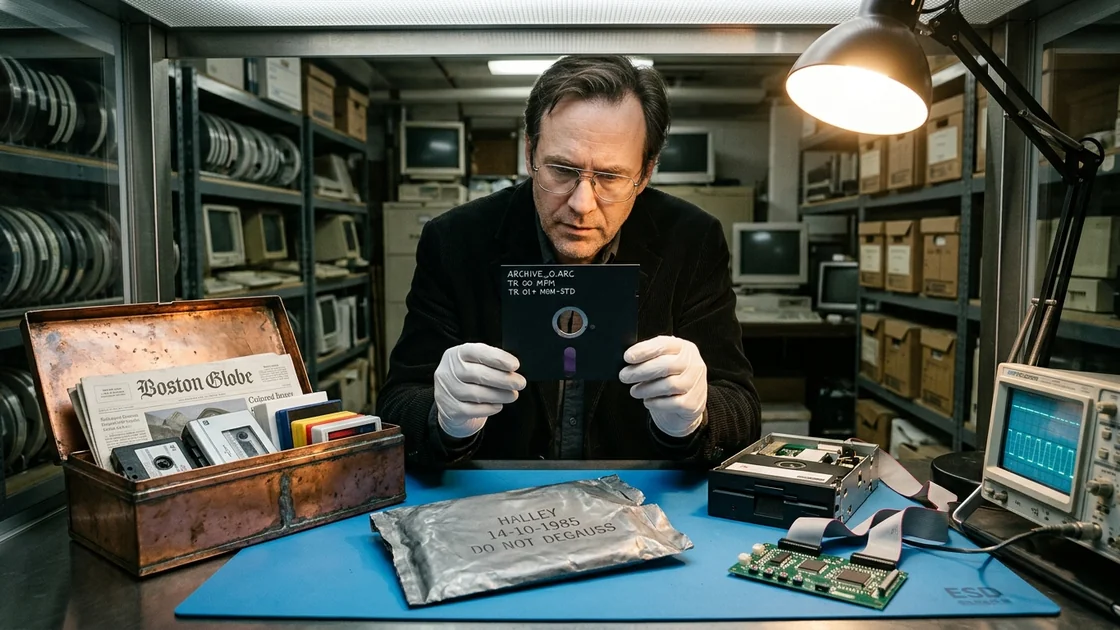
First came a copy of the Boston Globe from October 14, 1985, folded neatly into quarters, the paper still crisp and remarkably free of yellowing. Next was a Sony Walkman WM-10 in brushed silver, containing a Maxell UD-XLII cassette tape labeled Benson Hall Dedication Mix in blue ballpoint pen. Below that lay a stack of Kodachrome slides in a yellow plastic box, a recruitment brochure for Digital Equipment Corporation, a pristine Intel 80286 ceramic microprocessor encased in clear acrylic resin, and a 300-baud acoustic coupler modem.
"A charming haul," Vance said to the crowd, holding up the Walkman. "I believe several members of the board of trustees still owe late fees on songs recorded on this very tape."
Laughter rippled across the courtyard. Aris barely heard it. His fingers had brushed the bottom of the copper box, beneath the false floor formed by a rigid sheet of phenolic circuit-board substrate.
He lifted the phenolic sheet. Resting in a custom-routed cavity at the very bottom of the box was a square envelope, approximately six inches on each side, constructed not of paper or plastic, but of heavy, dull-gray lead foil laminated to metallized BoPET film—the exact type of multi-layer insulation used on deep-space probes to shield electronics from cosmic rays and solar wind.
The pouch was heat-sealed along all four edges. Embossed into the soft lead foil at the top right corner, struck with mechanic's steel letter punches, was a single string of characters:
HALLEY // 14-10-1985 // DO NOT DEGAUSS
Aris lifted the pouch. It was heavier than it had any right to be, entirely due to the lead shielding, yet when he pinched the center gently between thumb and forefinger, he felt the unmistakable, slight flex of a PVC jacket and a thin circular mylar wafer inside.
A 5.25-inch floppy disk.
"And one last item," Aris said, keeping his voice level as he slipped the lead pouch directly into his leather satchel rather than placing it on the display table. "A standard magnetic diskette. I'll need to open the shielding in the cleanroom so the humidity doesn't shock the binder."
Dean Vance barely glanced at it, already turning back to the alumni with the Kodachrome slides. "Wonderful, Aris. Have the audio from that cassette ready by Friday, if you can."
"Of course," Aris said. He was already walking toward the side door of Benson Hall, the heavy pouch resting against his hip like a cold flat stone.
II. The Silicon Morgue
The basement of the old science library smelled permanently of warm rosin flux, isopropyl alcohol, and the sweet, nutty aroma of aging cellulose acetate. Officially designated Room B-14, the laboratory was a sprawling subterranean cavern divided by wire-mesh cages and rows of beige steel shelving. Every shelf was stacked with the fossil record of the information age: eight-inch IBM disk drives the size of toaster ovens, DECtape reels, punched mylar paper tapes, bubble memory cartridges, and a dozen working workstations spanning three decades of dead architectures.
Aris locked the heavy fire door behind him, hung his coat on a peg near an inoperable Cray-1 core module used as a doorstop, and carried his satchel into the positive-pressure laminar flow hood at the back of the room.
He didn't care about the Walkman or the DEC brochure. In fifteen years of archival recovery, Aris had opened eleven time capsules and hundreds of corporate storage vaults. People did not wrap standard Verbatim or 3M floppy disks in vacuum-sealed, lead-laminated aerospace foil unless they were either profoundly paranoid or understood something fundamental about magnetic coercivity and background radiation over multi-decade timescales.
In 1985, a typical 5.25-inch double-sided, double-density floppy disk used for an IBM PC held 360 kilobytes of data—roughly enough text to fill a short paperback novel. Even the brand-new high-density disks introduced with the IBM PC/AT in August of 1984 held only 1.2 megabytes. The magnetic particles on those disks had a coercivity of around 300 to 600 Oersteds; over forty years, even the Earth's weak geomagnetic field and stray cosmic muons could gradually cause bit-rot, softening the boundaries between magnetic domains until the sectors became unreadable CRC errors.
Whoever "Halley" was, they had built a miniature Faraday cage and radiation vault for a single piece of flexible plastic.
Aris switched on the overhead halogen work lamp, pulled on a fresh pair of lint-free nitrile gloves, and placed the pouch on the grounded ESD mat. Using a ceramic scalpel, he sliced carefully along the top heat-seal, staying three millimeters away from the interior edge.
Again, there was a tiny whisper of equalizing pressure. The pouch had held a vacuum—or an inert argon atmosphere—for forty years without a single pinhole leak.
With flat-tipped nylon tweezers, Aris reached inside and drew out the disk.
There was no paper sleeve. Paper outgassed and shed lignified fibers. Instead, the disk was housed in a custom-molded jacket made of black, carbon-loaded conductive fluoropolymer. It had the familiar square geometry—5.25 inches to a side, a large central drive-spindle hole with a silvery reinforcement ring made not of plastic, but of precision-machined titanium foil, a small index hole next to it, and the oblong read/write cutout exposing the magnetic cookie within.
There was no adhesive label. In the upper left corner of the fluoropolymer jacket, someone had used a fine-tipped diamond scribe to scratch a single line of text in neat, draftsman’s block letters:
ARCHIVE_0.ARC // TRACK 00: 300 RPM MFM // TRACK 01+: NON-STD
Aris frowned, adjusting his magnifier loupe. He angled the read/write window under the halogen light to inspect the exposed strip of the magnetic platter.
Normally, the surface of a 5.25-inch disk was a dull, matte brown or charcoal gray—microscopic needles of gamma-ferric oxide (\(\gamma\text{-Fe}_2\text{O}_3\)) or cobalt-modified iron oxide suspended in a polyurethane binder. If you looked at it under a microscope, it looked like a logjam of rusty toothpicks coated in glue.
The surface inside this jacket was neither brown nor matte. It was an eerie, mirror-smooth obsidian black that threw back a faint, iridescent violet sheen when the light hit it at forty-five degrees. There were no visible brush marks from the manufacturing coaters, no dust motes, no fungal hyphae, and no signs of binder hydrolysis. It looked less like a flexible magnetic tape and more like a polished wafer of epitaxially grown silicon or a thin film of sputtered metal glass.
"What on earth are you made of?" Aris whispered.
He walked over to his primary imaging rig—a custom-built forensic workstation centered around a pristine Teac FD-55GFR dual-speed 5.25-inch drive mounted inside an aluminum chassis, wired directly to a KryoFlux magnetic flux-transition controller. Unlike a normal computer disk controller, which tried to interpret magnetic pulses as ones and zeroes according to a specific operating system, the KryoFlux acted like a high-speed digital oscilloscope. It sampled the raw analog timing of the magnetic flux reversals straight off the read head at a resolution of tens of megahertz, allowing Aris to capture a bit-perfect magnetic photograph of any disk, regardless of whether it came from an Apple II, a Commodore 64, or a bespoke military minicomputer.
Before inserting the disk, Aris checked the Teac drive’s read/write heads with a cotton swab dipped in 99.9% anhydrous isopropanol, ensuring they were spotless. He disabled the write-circuit jumper on the drive's circuit board—a physical hardware block to guarantee that under no circumstances could the drive accidentally overwrite a single bit on the artifact.
He slid the black fluoropolymer disk into the drive bay and rotated the lever down with a crisp mechanical clack.
On his dual monitors, the KryoFlux control software waited. Aris configured the drive for a standard 300 RPM spin speed, 40 tracks, double-sided, and initiated a single-track calibration read on Track 00, Side 0.
The Teac drive spun up with a quiet, rhythmic purr. The stepper motor clicked once, seating the head at the outermost rim of the platter.
On the left monitor, a green scatter plot blossomed into existence.
Aris let out a breath he hadn't realized he was holding. Three distinct, razor-sharp horizontal bands appeared at 4 microseconds, 6 microseconds, and 8 microseconds. It was classic Modified Frequency Modulation (MFM)—the standard encoding scheme of an IBM PC running MS-DOS. Even more remarkably, there was almost zero jitter. On a forty-year-old floppy, the bands usually looked like fuzzy clouds due to motor speed variations and magnetic decay. These bands looked as though they had been stamped by an atomic clock ten minutes ago.
The software decoded Track 00 instantly. It contained a standard
FAT12 boot sector and a tiny file allocation table listing a single
file: UNFOLD.COM, exactly 4,096 bytes long, occupying the
remaining sectors of Track 00.
"Okay," Aris muttered, leaning forward, his elbows on the desk.
"TRACK 00: 300 RPM MFM. That checks out. Now what did you
mean by TRACK 01+: NON-STD?"
He commanded the stepper motor to advance one click inward, to Track 01.
The stepper motor clicked. The read head engaged.
Instantly, the green scatter plot on the monitor exploded into a solid wall of vertical white snow.
At the same time, the status LED on the KryoFlux controller board flashed from steady green to frantic amber, then solid red. On his terminal screen, an error message scrolled rapidly:
[ERR] BUFFER OVERRUN: FLUX TRANSITION DENSITY EXCEEDS SAMPLE CLOCK (24.038 MHz)
[ERR] STREAM ABORTED AT SECTOR 0, INDEX 0.002ms
Aris stared at the screen. "That's ridiculous."
A standard 5.25-inch disk recorded flux transitions every four to eight microseconds. The KryoFlux sampled the head every forty nanoseconds—roughly a hundred times faster than any floppy drive from 1985 could possibly write data. For the buffer to overflow within two microseconds meant the read head was encountering magnetic reversals at a rate faster than twenty-four million times per second.
Wait. That wasn't physically possible with a standard ferrite read head. The physical gap in the Teac drive's read head was roughly a micron wide; if magnetic domains were packed tighter than that, the head wouldn't read high-frequency noise—it would read nothing, because the opposing magnetic fields beneath the wide head gap would cancel each other out through self-erasure, a phenomenon known in magnetic recording as gap loss.
Why was the head picking up a massive, high-frequency signal?
Aris disconnected the KryoFlux from the Teac drive's digital output and instead hooked a Tektronix 2-gigahertz mixed-domain oscilloscope directly to the raw differential pre-amplifier pins of the drive’s ferrite read head. If the digital converter was glitching, the analog scope would tell him the truth.
He spun the drive up on Track 01 again.
Across the black grid of the oscilloscope screen, a yellow waveform appeared. It wasn't random thermal noise, and it wasn't an amplifier oscillation. It was a hyper-dense, amplitude-modulated carrier wave, pulsing with sharp, step-function voltage spikes that had rise times down in the sub-nanosecond range. More bizarrely, the signal wasn't just binary; the voltage peaks were quantized into sixteen distinct amplitude levels, stacked like a microscopic staircase, and the waveform was shifting in phase every time the disk completed a rotation, as if the track weren't a circle at all, but a tightly wound spiral that crossed beneath the stationary read head thousands of times per millimeter.
Aris reached out and flipped the drive lever up, stopping the spindle. He pulled the disk out and carried it over to his Olympus metallurgical microscope, sliding the read/write window under the 100x oil-immersion objective lens—without the oil, getting as close to the surface as he dared. He clicked on the polarized differential interference contrast (DIC) filter, which allowed magnetic domains to become faintly visible via the magneto-optic Kerr effect—the slight rotation of polarized light when it reflects off a magnetized surface.
He looked through the eyepieces and adjusted the fine focus knob.
On a normal floppy disk, a single bit of data—a magnetic domain—looked like a blurry grey bar roughly twenty microns long and a hundred microns wide. Under 1000x total magnification, a single bit should have filled a huge portion of his field of view.
Instead, through the oculars, Aris saw a breathtaking, geometric tapestry.
Running across the obsidian surface were tracks so fine they were barely wider than the wavelength of the blue light illuminating them. They were arranged in concentric, interlocking hexagonal lattices, like the cells of a honeycomb reduced to the scale of a virus. Within each sub-micron cell, the polarization of the light shifted through a prism of distinct shade gradients, indicating that the magnetic vectors weren't simply pointing north or south along the plane of the disk; they were canted at precise three-dimensional angles—perpendicular, diagonal, azimuthal—storing multiple bits of data per individual nanoscale grain.
Aris slowly pulled his eyes away from the microscope. His heart was hammering against his ribs.
Three-dimensional, multi-level magnetic domain recording at sub-50-nanometer pitch. Even in 2025, cutting-edge heat-assisted magnetic recording (HAMR) used in enterprise data-center hard drives struggled to achieve stable binary domains at that density on rigid glass platters spun in cleanroom enclosures. Doing it on a flexible polymer substrate in 1985 wasn't just anachronistic. It was like opening an Egyptian sarcophagus and finding an ultraviolet lithography stepper sitting next to the canopic jars.
His Teac floppy drive couldn't read this disk. Trying to read this lattice with a 1980s ferrite head was like trying to read Braille using a mattress.
To get the data off Track 01 and beyond, he didn't need a disk drive. He needed a quantum magnetometer.
III. The Diamond Eye
The walk from the old science library to the Sterling Center for Condensed Matter Physics took seven minutes through the underground steam tunnels, though Aris covered it in four. He carried the disk inside an airtight polycarbonate wafer carrier, clutched against his chest.
The Sterling Center was the newest building on the Hargrave campus, built on a three-meter-thick floating concrete slab isolated from the bedrock by pneumatic springs to prevent vibrations from passing delivery trucks from disturbing its scanning tunneling microscopes. Aris badged through the first security door, bypassed the elevator, and took the stairs down to Sub-Level 2.
He found Dr. Elena Rostova in Bay 4, standing on a short aluminum step-stool while tightening a copper vacuum flange on a dilution refrigerator with a torque wrench. Her dark hair was pinned back with a ballpoint pen, and she wore a faded CERN hoodie with the sleeves pushed up past her elbows.
"We're in the middle of a bake-out, Aris," she said without looking around as the pneumatic door hissed shut behind him. "If you brought another batch of degraded magnetic core memory from the 1960s for me to X-ray, you have to get in line behind two postdocs and a DARPA grant."
"It’s not core memory," Aris said, stopping at the yellow tape line that marked the five-gauss boundary of her superconducting magnets. "Is your wide-field NV-diamond microscope online?"
Elena paused, the wrench still in her hand, and turned her head to look at him. She was thirty-four, sharp-featured, with the perpetual slight squint of someone who spent twelve hours a day aligning femtosecond lasers. The Nitrogen-Vacancy (NV) center diamond magnetometer was her pride and joy—an instrument that used atomic defects in a synthetic diamond crystal, excited by a green laser, to image microscopic magnetic fields at room temperature with nanometer resolution.
"It's calibrated," she said warily, stepping down from the stool. "Why? What's in the wafer box?"
"A 5.25-inch floppy disk from the Benson Hall cornerstone capsule they opened two hours ago."
Elena stared at him for three seconds, then turned back to her cryostat. "Get out of my lab, Aris."
"Elena, listen to me. The disk was sealed inside a vacuum-brazed lead-mylar pouch stamped with the name 'Halley' and today's date forty years ago. Track 0 is standard 1985 MS-DOS. Track 1 and inward isn't written with an inductive coil head. The surface is an atomically flat thin film—looks like an amorphous metal-glass or an epitaxially sputtered barium-ferrite heterostructure—and the magnetic domains are organized in a sub-100-nanometer hexagonal lattice with multi-axis vector quantization."
Elena’s hand stopped moving on the flange. Slowly, she turned back around. She knew Aris wasn't prone to exaggeration; he was a man who had once spent three months writing a paper on the precise chemical degradation rates of 1974 Ampex tape lubricants.
"Say that last part again," she said quietly.
"Multi-axis vector quantization in a hexagonal lattice," Aris repeated, holding out the polycarbonate carrier. "I just looked at it under polarized DIC. The Kerr rotation shows at least sixteen distinct spin states per domain cell, and the cells are near the superparamagnetic limit. My Teac drive head only picked up a differential interference beat pattern because the lattice is arranged in a phase-modulated spiral."
Elena wiped her hands on a Kimwipe, walked across the epoxy floor, and took the wafer carrier from him. She held it up to the ceiling lights, squinting through the clear plastic at the exposed black window of the diskette.
"Benson Hall was sealed in October 1985," she said. "Giant magnetoresistance wasn't even discovered by Fert and Grünberg until 1988. In 1985, nobody could detect a fifty-nanometer magnetic domain without an electron holography rig, let alone write one."
"I know," Aris said. "Put it under the diamond."
Ten minutes later, they were sitting in the darkened control alcove adjacent to the optical table. Inside a light-tight aluminum enclosure on the vibration-isolated table, the floppy disk—carefully removed from its black fluoropolymer jacket by Aris inside a Class 100 laminar hood—rested on a precision piezoelectric \(X\)-\(Y\)-\(\theta\) rotation stage. Resting less than ten nanometers above the disk’s surface was a two-millimeter square of ultra-pure synthetic diamond implanted with a shallow layer of nitrogen-vacancy centers. A 532-nanometer green laser pumped the diamond from above, while a cooled sCMOS camera captured the red fluorescence emitted by the nitrogen vacancies—fluorescence whose intensity and microwave resonance frequencies shifted in exact proportion to the local magnetic field vector of whatever lay directly beneath the crystal.
Elena tapped a sequence of commands into her Linux terminal, sweeping the microwave frequency across the electron spin resonance band.
On the main 4K monitor, the greyscale calibration grid vanished, replaced by a false-color vector map covering a fifty-by-fifty-micron square of Track 01.
"Боже мой," Elena whispered, slipping into her native Russian. "My God."
The screen showed a breathtakingly crisp array of hexagonal cells, each measuring exactly thirty-two nanometers across. There was no grain noise—none of the random, jagged edges seen in conventional magnetic recording where a single bit is made up of dozens of haphazard crystals. Here, each hexagonal cell was a single, monolithic crystal domain separated from its neighbors by an atomically sharp non-magnetic boundary wall, likely formed by focused ion-beam patterning or self-assembled block copolymers.
"Look at the Zeeman splitting data," Elena said, her fingers flying across the mechanical keyboard as she pulled up the spectral analysis window. She pointed a fingernail at sixteen sharp, evenly spaced resonance peaks on the graph. "Every single hexagon is an isolated spin-cluster. The magnetic moment isn't just binary up or down. It’s quantized into sixteen polar angles and sixteen azimuthal angles."
Aris did the math in his head. "Sixteen by sixteen. That’s 256 discrete states per cell."
"One full byte per thirty-two-nanometer hexagon," Elena said, her voice tight with a mixture of awe and academic terror. "Aris, do you have any idea what the areal density of this platter is?"
"A standard 5.25-inch platter has a usable recording surface area of roughly eighty square centimeters per side," Aris said, his eyes fixed on the glowing hexagonal matrix. "At one byte per thousand square nanometers..."
"Roughly eight gigabytes per side," Elena breathed. "Sixteen gigabytes if it's double-sided. On a piece of flexible plastic from 1985."
"Check the inner diameter," Aris said. "See how far inward the patterning goes."
Elena slewed the piezo stage inward toward the titanium hub ring. Every millimeter she moved, the camera refreshed with the same dense, unrelenting tapestry of data. It stopped precisely at radius 26.5 millimeters, covering about sixty percent of the usable surface on Side 0. Side 1, when they flipped the platter to check, was completely unpatterned—a blank mirror of unmagnetized metallic glass.
"Okay," Elena said, leaning back in her chair and rubbing her temples. "It’s a single-sided write, covering roughly fifty-eight square centimeters. Accounting for the synchronization guard-bands between the spiral tracks... there’s exactly 4.72 gigabytes of raw payload on this disk."
She turned her chair to face him directly in the dim green glow of the monitors. "Okay, joke’s over, Aris. Who put this in the capsule this morning? Did you swap it by sleight of hand at the table to test my magnetometer?"
"Elena, Dean Vance was standing eighteen inches from my right elbow while twenty people filmed me on their phones," Aris said. "And even if I had swapped it, who on earth could manufacture this today? Show me a lab at MIT, IBM Almaden, or Tokyo Tech that can write 256-state vector-quantized spin states into a flexible polymer-backed metallic glass platter with zero thermal drift!"
Elena opened her mouth to argue, then closed it. That was the sticking point. Writing binary bits at thirty nanometers was possible in 2025 with a multi-million-dollar HAMR testbed or a spin-polarized scanning tunneling microscope. Writing 256-level analog vector orientations that remained thermally stable at room temperature for forty years without relaxing into random noise violated everything her subfield understood about magnetic anisotropy. The energy barrier required to keep those delicate spin angles from flipping due to ambient thermal energy (\(k_B T\)) should have made the material impossible to write without a magnetic field strong enough to vaporize the disk.
"Can we read the whole thing?" Aris asked.
Elena looked back at the setup. "With the wide-field NV array? We can image fifty-micron squares in parallel at about two hundred frames per second once I lock the phase-tracking loop to the spiral guard bands. To step-and-stitch across fifty-eight square centimeters... it’ll take about six hours of continuous scanning."
"Do it," Aris said. "Pipe the raw state-values directly into a binary dump file on your local RAID array. While the stage is scanning, I want to look at the 4-kilobyte program on Track 00."
IV. The Seed on Track Zero
While the piezo stage in the black box began its hypnotic,
microscopic ticking—stepping fifty microns, flashing green laser light,
capturing the spin states, and stepping again—Aris sat at a secondary
workstation in Elena’s lab and opened the 4,096-byte
UNFOLD.COM file he had extracted earlier with the
KryoFlux.
He loaded the binary into Ghidra, an open-source reverse-engineering disassembler, and set the architecture flag to 16-bit Intel 8086 real mode—the native tongue of the original IBM PC.
At first glance, the assembly code looked like a masterpiece of
mid-1980s tight-loop programming, the kind of hand-assembled wizardry
written by early demoscene coders or systems engineers who counted every
clock cycle. The first two hundred bytes were a standard MS-DOS
command-line wrapper that checked for the presence of a file named
ARCHIVE_0.ARC and printed a string to the screen if it
wasn't found:
ERR 1985: SUBSTRATE RESOLUTION INSUFFICIENT. AWAITING HOST EVOLUTION.
Aris felt a chill crawl up the back of his neck. He read the ASCII string in the hex dump three times.
Substrate resolution insufficient. Awaiting host evolution.
Whoever had written UNFOLD.COM knew that an IBM PC in
1985 could only read Track 00. They knew that if someone stuck the disk
into an IBM 5150 in 1985 and typed UNFOLD, the drive
wouldn't be able to read Track 01, and the program would spit out that
message and exit cleanly to the A:\> prompt.
The program wasn't meant to be run in 1985. Track 00 was a Rosetta Stone—a bootstrap loader left in a primitive format that any future archivist would immediately recognize and know how to read, containing the tool required to interpret the 4.72-gigabyte payload once humanity built a microscope sharp enough to see Track 01.
Aris scrolled down past the DOS interrupt calls, into the core routine of the 4-kilobyte file. Here, the disassembly suddenly turned into gibberish.
"What is this?" he muttered, leaning closer to the screen.
Following a short timing loop that executed the RDTSC
instruction—wait. Aris froze.
Opcode 0F 31.
In 1985, on an Intel 8086 or 80286 processor, the byte sequence
0F 31 was an invalid opcode that would trigger an illegal
instruction interrupt—which the program cleverly caught with a custom
interrupt handler that redirected back to the
"AWAITING HOST EVOLUTION" error message.
On every x86 processor built after the Intel Pentium in
1993, 0F 31 was RDTSC—Read Time-Stamp
Counter.
And right below that, the code executed 0F A2—the
CPUID instruction, also introduced in 1993—to query the
host processor for AVX-512 vector extensions and 64-bit long mode
support!
"Elena," Aris called out, his voice cracking slightly. "Come look at this."
Elena walked over, holding a mug of black coffee, and leaned over his shoulder. "What am I looking at?"
"This 4-kilobyte program from 1985," Aris said, pointing at the disassembled instructions. "It’s written in polymorphic polyglot machine code. If you run it on an 8086 from 1985, it traps an illegal opcode and prints a message saying the computer isn't advanced enough yet. If you bypass the DOS header and execute the payload on a modern 64-bit processor, these 'corrupted' data tables aren't data tables at all—they're valid 64-bit x86_64 and ARM64 assembly instructions using SIMD vector registers that weren't invented until thirty years after the cornerstone was cemented into the wall!"
Elena set her coffee mug down slowly on the desk. "That’s impossible. The x86_64 instruction set was designed by AMD in 1999. ARM64 didn't exist until 2011. Even if some secret government lab had nanotechnology in 1985, they couldn't have known the exact hexadecimal opcodes corporate semiconductor committees would standardize decades later."
"And yet here they are," Aris said, highlighting the instructions.
"Look: VFMADD213PD. That’s a Fused Multiply-Add instruction
from the AVX2 extension set, introduced by Intel with the Haswell
microarchitecture in 2013."
He ran the 64-bit segment through the decompiler to translate the assembly into human-readable C pseudocode. The resulting mathematical structure was remarkably compact—fewer than a hundred lines of dense matrix operations, recursive modular arithmetic, and what looked like a multi-dimensional cellular automaton rule-set combined with an asymmetric range coder.
"What does the algorithm actually do?" Elena asked.
"It's a decompressor," Aris said, tracing the nested loops with his
finger. "When the 1985 .ARC format was created by System
Enhancement Associates—literally just a few months before this time
capsule was sealed—it was a simple bundle of Lempel-Ziv and Huffman
coding. Usually, you get a two-to-one or three-to-one compression ratio.
If you compress a 10-megabyte file, it shrinks to 4 megabytes."
"Right," Elena said. "Standard entropy coding."
"This isn't entropy coding," Aris said quietly. "Look at the memory allocation calls here in the 64-bit routine. It doesn't allocate a buffer twice the size of the 4.72-gigabyte input file. It queries the operating system's virtual filesystem and requests a sparse memory-mapped address space of \(2^{50}\) bytes."
Elena blinked. "\(2^{50}\)? That’s a petabyte."
"One point one two petabytes," Aris corrected. "It’s an algorithmic Kolmogorov generator. Instead of storing the data itself and stripping out redundant patterns like a ZIP file does, the 4.72-gigabyte file on the disk is a boundary-condition tensor for a chaotic deterministic system. Every few kilobytes of input act as non-linear phase corrections that steer a massive recursive calculation."
"Wait," Elena said, frowning. "In information theory, you can't compress high-entropy data that way unless you already had the final petabyte of data and spent a near-infinite amount of compute power running a reverse search to find the exact 4.7-gigabyte mathematical seed that unfolds into it. That’s an NP-hard inverse problem. Finding a seed like that would take every classical supercomputer on Earth in 2025 thousands of years—Unless you used a fault-tolerant quantum annealer with millions of logical qubits."
Neither of them spoke. Across the room, the enclosure housing the NV-diamond microscope ticked softly: click-whirr, click-whirr, click-whirr.
On the secondary monitor, the progress bar for the magnetic surface
scan read 14.2% — 670 MB CAPTURED — CRC VALID.
"Who was Halley?" Elena asked, her voice barely above a whisper. "The name stamped on the lead foil."
Aris pulled up a browser window on his isolated laptop, connected via
his phone's hotspot, and logged into the Hargrave University Faculty
Archive database. He typed Halley and filtered by the years
1970–1990.
One record returned.
Halley, Simon Victorevich, Ph.D. Visiting Associate Professor of Electrical Engineering and Information Physics (1983–1985). B.S., MIT (1974); Ph.D., Caltech (1978). Research Interests: Non-equilibrium thermodynamics of computation, spin-glass hysteresis, retrocausal Wheeler-Feynman absorber theory in solid-state lattices. Status: Appointment terminated November 1985 (Unexplained Absence).
V. The Ghost in the Microfiche
While the diamond magnetometer continued its six-hour march across the spiral tracks of the platter, Aris left Elena to monitor the phase-lock loop and walked back through the steam tunnels to the University Archives on the fourth floor of the main library.
Unlike his own basement lab, which dealt with digital and magnetic artifacts, the fourth-floor archives smelled of lavender paper-preservative and old leather bindings. The archivist on duty, a woman in her sixties named Martha with whom Aris traded sourdough starters, waved him straight into the Faculty Personnel & Departmental Correspondence stacks without making him sign the register.
"Looking for someone from the Benson capsule?" Martha asked as he walked past her desk.
"Simon Halley," Aris said. "Electrical Engineering, 1985."
"Box 412, Aisle 7," she said without looking up from her cataloging ledger. "And there's a box of his uncollected office effects in the overflow cage at the end of Aisle 12. Nobody ever came to claim them after he vanished."
Aris paused. "You know the name?"
Martha looked up over her half-moon reading glasses. "Every archivist here knows Simon Halley. He’s our campus Ambrose Bierce. Walked out of Benson Hall on the night of October 14, 1985—the same night they mortared the cornerstone shut—left his car in the faculty lot with the keys on the dashboard, and was never seen again. State police dragged the river, checked the flights out of Logan, monitored his Social Security number for thirty years. Nothing."
Aris felt his pulse quicken. He thanked her and went straight to Aisle 12.
The overflow cage held a single archival Hollinger box labeled
HALLEY, S.V. - BENSON 308 (CLEARED JAN 1986). Aris carried
it to a reading table, lifted the lid, and sorted through the
contents.
There wasn't much: a battered Texas Instruments pocket calculator, three fountain pens, a brass paperweight shaped like a Klein bottle, and two black-and-red laboratory notebooks filled with dense, microscopic handwriting in dark blue fountain ink.
Aris opened the first notebook. The pages were dated from January to August 1985. Half the entries were mathematical derivations extending Claude Shannon’s channel capacity theorem into relativistic spacetime metrics; the other half were materials science recipes for synthesizing something Halley called a Frustrated Barium-Cobalt Spin-Glass Heterostructure.
Aris flipped to the second notebook, dated September and October 1985. Near the middle of the book, on a page dated September 28, Halley’s neat handwriting had grown frantic, the nib of his fountain pen digging hard enough into the paper to leave indentations on the reverse side.
The misunderstanding at the heart of Shannon's theory is the assumption that information is written at \(t_0\) and read at \(t_1\). In a classical ferromagnet with high coercivity, this is true: the write-head forces the domains into an energetic valley, and they remain trapped there until read.
But in a fully frustrated quantum spin-glass held precisely at its critical spin-freezing temperature during deposition, the energy landscape consists of \(10^{10^6}\) degenerate ground states separated by infinitesimal barriers. If the substrate is isolated from external thermal and electromagnetic decoherence (vacuum + superconducting lead shield) BEFORE the domains relax from their metastable supercooled state, the spin lattice does not settle into a classical configuration at \(t_0\).
Instead, in accordance with the two-state vector formalism of Aharonov, Bergmann, and Lebowitz (1964), the boundary condition that selects WHICH ground state the spin-glass relaxes into is determined jointly by the preparation at \(t_0\) AND the weak post-selection measurement performed when the shield is breached and the spins are coupled to an external macroscopic Hamiltonian at \(t_1\).
Aris stared at the page, the hair on his arms standing straight up. He turned the page to the final entry, dated October 13, 1985—the night before the Benson Hall dedication ceremony.
Walter helped me sputter the final disk tonight in the high-vacuum bell jar. The outer track (Track 00) I wrote manually using the modified Shugart drive and the bridge code I transcribed from the first small-scale test loop in July. The inner fifty-eight square centimeters of the platter have been quenched into the metastable frustrated phase and sealed directly into the lead-mylar envelope under vacuum.
Right now, as I hold this pouch in my hand, Track 01 through the hub contains NO classical information. It is a frozen sea of uncollapsed spin-frustration—a blank photographic plate waiting in the dark for a flash of light from forty years in the future.
Yet because causality along the worldline of the sealed platter is a closed curve between the sealing tomorrow morning and the opening in October 2025, the relaxation of the domains is already constrained by the boundary condition of its future unpacking. When the archivist in 2025 scans the platter and runs
UNFOLD.COMon a machine large enough to hold the expanded manifold, the electromagnetic and quantum-informational back-action of that computation will define the boundary state that forces the spins on this disk to crystallize into the 4.72-gigabyte seed.Tomorrow I put the box in the wall. Tomorrow night, I step out of the noise.
Aris sat frozen under the library fluorescent lights for a long time.
"Walter," he whispered, looking back at the first sentence of the October 13 entry. Walter helped me sputter the final disk tonight.
He pulled out Box 412 from Aisle 7—the departmental personnel records—and flipped through the folder of graduate assistants assigned to Simon Halley in 1985. There was only one name listed:
Cross, Walter J. (Ph.D. candidate, Electrical Engineering, 1984–1987).
Aris pulled out his phone and searched the alumni directory and public property records for Walter J. Cross in Massachusetts. Cross had worked at Raytheon for twenty years before retiring in 2012 to a town called Rockport, forty-five miles northeast of campus on the tip of Cape Ann.
His phone buzzed in his hand. It was Elena.
"Aris," she said when he answered. The background hum of her lab sounded louder than usual. "The scan just finished. Every single sector passed the cyclic redundancy check built into the spiral guard bands. We have the full 4.72-gigabyte image on the drive."
"Don't run UNFOLD.COM yet," Aris said quickly, standing
up and packing Halley’s notebooks into his leather satchel.
"I didn't run it on the whole file," Elena said, and something in her
tone made Aris stop in the middle of the aisle. "I ran it in a sandboxed
virtual machine on just the first megabyte of the stream, capping the
output buffer at one hundred gigabytes so I could see what the file
structure inside ARCHIVE_0.ARC actually looks like."
"Elena—"
"Aris, get down here right now," she said. Her voice was flat, stripped of all scientific detachment. "You need to see what's inside the directory tree."
VI. The Directory of Everything
When Aris burst back into Sub-Level 2 of the Sterling Center, Elena
was sitting motionless in front of the primary workstation. On the
screen was a standard midnight-commander style dual-pane file browser
displaying the unpacked contents of the first 0.02% of
ARCHIVE_0.ARC.
The root directory was divided into six top-level folders, named in clean ASCII capitals:
/01_CHRONICLE_1985_2025/
/02_BIOSPHERE_GENOMICS/
/03_CONDENSED_MATTER_THEORY/
/04_SOLAR_SYSTEM_EPHEMERIS/
/05_BENSON_LOG_HALLEY/
/06_TERMINAL_BOUNDARY_2025_10_21/
Today was October 21, 2025.
Aris leaned over the desk, his palms flat against the cool laminate surface. "Which folder did you open?"
"Chronicle," Elena said quietly. She clicked on
/01_CHRONICLE_1985_2025/, revealing forty subdirectories
labeled by year from 1985 to 2025. She clicked
on 2001, then 09, then opened a plain text
file titled NYT_WIRE_SUMMARY_2001_09_11.TXT.
Across the monitor scrolled a verbatim transcript of the Associated Press and New York Times wire dispatches from the morning of September 11, 2001, complete with exact timestamps, flight numbers, and casualty estimates as of midnight that evening.
Elena closed the window, navigated to 2020, and opened a
folder containing the complete, annotated nucleotide sequence of the
SARS-CoV-2 Wuhan-Hu-1 isolate, alongside mortality tables for seventy
countries through December 2022.
Then she navigated to 2025, clicked on 10,
and opened a file named
HARGRAVE_CAMPUS_EVENT_2025_10_21.TXT.
Aris read the text on the screen:
DATE: 2025-10-21TIME: 14:18:04 ESTLOCATION: 42.3744° N, 71.1169° W (Benson Hall Courtyard)SUMMARY: Opening of the 1985 Benson Hall Cornerstone Time Capsule by Dean Richard Vance and Dr. Aris Thorne. Ambient temperature 11.4°C. Wind WNW at 14 km/h. Note: Dean Vance drops the acrylic-encased Intel 80286 microprocessor at 14:29:12 EST, chipping the northeast corner of the resin block by 2.4 millimeters.
Aris felt the blood drain from his face. He hadn't been in the courtyard at 2:29 PM—he had already walked inside with the disk at 2:19 PM.
"Wait here," Aris said. He picked up the lab landline and dialed Dean Vance’s secretary.
"Hello, Carol, it's Aris Thorne down in Media Preservation. I haven't had a chance to collect the rest of the display items from the courtyard table yet. Did they bring the copper box and the Intel chip up to your office?"
"Oh, Dr. Thorne, yes, they’re right here on the credenza," Carol’s cheerful voice came through the receiver. "Though I’m afraid Dean Vance had a bit of a butterfingers moment with the little plastic block while showing it to the board president. The corner chipped right off when it hit the flagstones."
"The... northeast corner?" Aris asked faintly. "About two and a half millimeters?"
"Why, yes! Did someone already tell you? He felt terrible about it."
"No, Carol. Just a lucky guess. I'll send a grad student up for them tomorrow."
Aris hung up the phone and looked at Elena. He opened his satchel, pulled out Simon Halley’s second laboratory notebook, and laid it open on the desk to the entry from October 13, 1985.
Elena read the handwritten pages in silence. As a condensed matter physicist, she didn't skip over the math the way Aris had; her eyes tracked every operator in Halley’s Hamiltonian equations on the facing page, her lips moving silently as she checked his derivations of the spin-glass free energy surface.
When she finished, she sat back, her face pale beneath the fluorescent lights.
"He didn't predict the future," she whispered.
"No," Aris agreed. "He built a receiver that only resolves its state when it's read in the future."
"Wait, think about the physics of what he’s claiming here," Elena said, grabbing a dry-erase marker and turning to the glass whiteboard on the wall. "In standard quantum mechanics, if you prepare a system in state \(|\psi\rangle\) at time \(t_0\) and measure it in state \(\langle\phi|\) at a later time \(t_1\), the properties of the system in the intervening forty years can be described by Yakir Aharonov’s Two-State Vector Formalism. Usually, you can't use that to send information backward in time because the outcome of the future measurement is random, and any attempt to force a specific outcome destroys the entanglement through decoherence."
She drew a horizontal line on the glass, labeling the left end
1985 and the right end 2025.
"Right," Aris said. "That’s the no-communication theorem. Otherwise causality breaks."
"Except Halley didn't try to choose a message in 2025 and
send it to himself in 1985 to read!" Elena said, tapping the marker
against the 1985 mark. "Look at what his notebook says! In
1985, the disk was never read! He sealed it into the lead-mylar vacuum
pouch while the spin-glass was still in a macroscopically frustrated
superposition of \(10^{10^{10}}\)
degenerate ground states! Nobody in 1985 ever looked at Track 01!
The wave function—or rather, the frustrated thermodynamic partition
function of the spin-glass—remained completely isolated inside that
zero-gauss, radiation-shielded pouch for forty years!"
"Until I cut it open with a scalpel at 2:35 PM today," Aris said slowly, the pieces clicking together in his mind like tumblers in a lock. "And even then, I didn't resolve the nanoscale lattice. It didn't fully collapse into a definite classical bit-stream until you hit it with the 532-nanometer laser under the NV-diamond microscope!"
"Yes!" Elena said, her eyes wide. "Wait—no, even that only observed the states! Why did the states collapse into a 4.72-gigabyte seed containing forty years of history instead of random thermal static?"
She looked back at Halley’s notebook, then at the directory listing
on the monitor: /06_TERMINAL_BOUNDARY_2025_10_21/.
"Because of the second half of the loop," Aris said, looking at the
unopened sexto folder on the screen. "Look at his notebook entry:
When the archivist in 2025 scans the platter and runs
UNFOLD.COM on a machine large enough to hold the expanded
manifold, the electromagnetic and quantum-informational back-action of
that computation will define the boundary state. Elena, we only
unpacked 0.02% of the file on your workstation because we don't have a
petabyte of free storage here. What happens if we unpack the entire
1.12-petabyte archive?"
Elena looked toward the wall separating Bay 4 from Bay 1—the room housing the university's newly commissioned High-Performance Computing (HPC) cluster and the Department of Energy’s experimental 4,096-qubit fluxonium quantum co-processor, Boreas, which sat less than fifteen meters from where the floppy disk was currently resting on the optical table.
"Let's see what's in Folder 05 and Folder 06," Elena said, sitting back down at the keyboard.
She clicked on /05_BENSON_LOG_HALLEY/.
A dialog box popped up:
OFFSET OUT OF BOUNDS. REQUIRES FULL MANIFOLD EXPANSION BEYOND SEGMENT 0x04A00000.
She clicked on /06_TERMINAL_BOUNDARY_2025_10_21/.
The same error appeared:
OFFSET OUT OF BOUNDS. REQUIRES FULL MANIFOLD EXPANSION (MIN ALLOCATION: 1.12 PB).
"It's a sequential chaotic chain," Aris said, examining the decompiled C code again. "Just like a block cipher in cipher-block chaining mode, or a thermodynamic simulation. You can't skip ahead to the end of the file without computing every intermediate state between byte zero and byte \(2^{50}\). The folders are indexed in the header, but the actual data blocks for Folders 05 and 06 don't exist until the algorithm finishes crunching the first four folders."
"And to crunch a petabyte of AVX-512 matrix transformations in less
than a week," Elena murmured, "we would have to run UNFOLD
on the Boreas hybrid cluster next door."
Aris checked his watch. It was 5:15 PM. Outside, the October sun was already sinking below the brick rooflines of the campus.
"Don't touch the cluster yet," Aris said. "Keep this workstation air-gapped. I'm driving up to Rockport tonight."
"To see Walter Cross?"
"He was in the room when the disk was sputtered on October 13, 1985," Aris said. "And Halley wrote that Track 00 was transcribed from 'the first small-scale test loop in July.' Before we feed a self-referential retrocausal algorithm into a quantum-coupled supercomputer fifteen meters from the artifact, I want to know what happened to the guy who built it."
"I'm coming with you," Elena said, grabbing her coat from the back of the chair. "The scan is already backed up on three encrypted drives, and I'm not sitting alone in a basement with that thing."
VII. The House at Halibut Point
The drive north up Route 128 took them out of the urban sprawl of the university suburbs and onto the granite promontory of Cape Ann. By the time they passed through Gloucester and wound along the narrow coast road toward Halibut Point, a cold Atlantic fog had rolled in over the quarry ledges, smelling of kelp, salt spray, and wet pine needles.
Walter Cross lived at the end of an unpaved lane bordered by dry-laid granite stone walls. The house was a weathered cedar-shingle saltbox with a tall amateur radio mast rising forty feet above the chimney, guyed with braided steel cables that hummed faintly in the offshore breeze. Through the ground-floor window, the warm amber glow of vacuum-tube equipment was visible.
Aris parked his sedan behind a twenty-year-old Subaru Forester in the gravel driveway. Before they had reached the second step of the front porch, the porch light clicked on and the heavy oak door opened.
A man in his late sixties stood in the doorway. He was tall and slightly stooped, with a thick shock of white hair, steel-rimmed spectacles, and a heavy Norwegian fisherman’s sweater worn over a flannel shirt. In his left hand, he held an old brass pocket watch—no, Aris realized, it was a mechanical calendar clock.
Walter Cross looked from Aris to Elena, then down at the leather satchel slung over Aris’s shoulder. He didn't look surprised. Instead, the deep lines around his eyes softened with an expression of profound, exhausted relief, as though he had been waiting at a train station for forty years and had finally heard the whistle down the track.
"October twenty-first," Cross said, his voice a dry, resonant baritone. "Right on schedule. You’re the archivist, Dr. Thorne. And you must be Dr. Rostova from the Sterling lab."
Elena stopped on the top step, her hand tightening on the railing. "How do you know our names?"
Cross stepped back from the threshold and gestured toward a warm, book-lined living room where a driftwood fire crackled in a brick hearth. "Come inside out of the damp. I’ve had a pot of Assam steeping since six o'clock. I’ll show you how I know."
They followed him into the house. Every horizontal surface that wasn't covered in physics monographs from the 1970s and 1980s was occupied by vintage electronic test gear—Hewlett-Packard frequency counters with red Nixie-tube displays, a Tektronix 545 oscilloscope the size of a washing machine, and an original IBM 5150 Personal Computer sitting on a roll-top desk in the corner, its green-phosphor monochrome monitor glowing softly in the dim room.
Cross poured three mugs of tea at a small side table and handed two of them to Aris and Elena, who remained standing near the hearth.
"You mentioned Simon’s July test loop," Aris said, not touching his tea yet. "From his notebook."
"July 19, 1985," Cross said, nodding toward the IBM 5150 in the corner. "That was a seventy-two-hour loop using a three-inch strip of cobalt-doped barium ferrite tape inside a liquid-helium Dewar. When we opened the Dewar on July 22 and scanned it with an electron-beam microprobe, the tape contained a 64-kilobyte compressed file."
"What was in the file?" Elena asked.
Cross walked over to the roll-top desk, picked up a yellowed fanfold sheet of green-and-white tractor-feed dot-matrix printer paper encased in a protective Mylar sleeve, and handed it to her.
Elena held it under the lamp. Across the top of the page, printed in
the unmistakable nine-pin dot-matrix font of an Epson MX-80, was a
timestamp header: PRINTED: 22-JUL-1985.
Below the header were two items. The first was a four-kilobyte hex
dump of UNFOLD.COM—the exact polymorphic 16-bit/64-bit
hybrid code Aris had disassembled that afternoon.
The second item was a short ASCII text summary extracted from a file that wouldn't exist for another forty years:
SUMMARY LOG // 2025-10-21
PRIMARY INVESTIGATORS:
1. THORNE, ARIS M. (CURATOR, LAB FOR OBSOLETE MEDIA, B-14)
2. ROSTOVA, ELENA V. (ASSOC. PROF, CONDENSED MATTER, STERLING SUB-2)
STATUS: BENSON SEAL BREACHED 14:35 EST. NV-DIAMOND SCAN COMPLETED 17:04 EST.
CRITICAL DIRECTIVE FOR W. CROSS: DO NOT INTERFERE PRIOR TO 2025-10-21 19:30 EST.
Elena’s hands trembled slightly, causing the Mylar sleeve to rustle. She passed the sheet to Aris. The ink had faded to a pale purplish-grey inside the sealed plastic, and the paper edges had the brittle, unmistakable micro-fracturing of forty-year-old wood-pulp stock.
"You've had this sitting in your desk since Ronald Reagan was in the White House," Aris said softly.
"Forty years, three months, and two days," Cross said, sinking into a leather armchair by the fire. "Imagine being twenty-five years old, holding a piece of dot-matrix paper that names a building—the Sterling Center—that wouldn't even be funded until 2014, an imaging technology—NV-diamond magnetometry—that didn't exist, and two scientists who hadn't even been born yet. Do you know when I first saw your name in the university faculty bulletin, Dr. Thorne? 2016, when they hired you away from the Smithsonian. And when the Physics department hired a young postdoc named Elena Rostova in 2021, I drove down to campus, sat on a bench outside the coffee shop, and watched you walk into the Sterling building just to convince myself I hadn't hallucinated my entire youth."
"Tell us what happened in October 1985," Aris said, sitting down on the edge of the sofa opposite him. "How did Simon Halley actually make the disk?"
Cross took a slow sip of his tea, staring into the driftwood flames.
"Simon was brilliant, and like a lot of brilliant people in the late seventies, he was dissatisfied with the orthodox Copenhagen interpretation of quantum mechanics," Cross began. "He had studied under Wheeler's students and became obsessed with the transactional interpretation and Aharonov's two-state vector formalism—the idea that quantum states are 'handshakes' across spacetime between an emitter in the past and an absorber in the future. Most physicists treated it as a mathematical curiosity because in the macroscopic world, thermal decoherence averages out all the future boundary conditions into classical randomness."
"Right," Elena said, sitting beside Aris. "Because any normal material interacts with trillions of stray photons and phonons every picosecond."
"Exactly," Cross said, looking at her approvingly. "So Simon asked an engineering question: What if we build a macroscopic system where decoherence doesn't happen, and where the ground state is hyper-degenerate? He spent two years in the materials lab developing that metallic-glass barium-ferrite spin-glass. When you sputter it onto a polyimide substrate in an ultra-high vacuum in the presence of a high-frequency rotating magnetic field, and then quench it with liquid helium inside a superconducting mu-metal and lead-foil shroud, the spins freeze at a critical bifurcation point—what we called the Halley Point."
"A macroscopic spin-liquid waiting to crystallize," Elena murmured.
"Precisely. Inside that lead-mylar pouch, shielded from cosmic rays, magnetic fields, and thermal gradients, the thirty-two-nanometer hexagonal islands don't have definite classical spin vectors. They exist in a frustrated, metastable collective mode—like supercooled water at minus twenty degrees that hasn't found a nucleation site to turn into ice yet. Only here, because the system is quantum-mechanically isolated along its temporal worldline from 1985 to 2025, the 'nucleation site' that forces the spins to snap into one specific crystal arrangement out of \(10^{10^{10}}\) possibilities isn't at the beginning of the pouch's life. It's at the end."
"When we open the pouch and measure it," Aris said.
"Not just when you measure it," Cross said, leaning forward and setting his mug down. "This is the part you have to understand. If you had opened that pouch today, looked at it under your diamond microscope, and then thrown the disk into an incinerator, the spins would have resolved into pure white noise. Because there would be no constraint on the future boundary condition!"
"Wait," Elena said, leaning forward. "Then why did it resolve into a 4.72-gigabyte compressed archive?"
"Because of what happens tonight," Cross said quietly. "In the July test, we found out that if you take whatever pattern emerges on the spin-glass, feed it into an expansion algorithm on a high-energy computer positioned within the near-field magnetic coupling radius of the sample—or coupled via quantum entanglement to the measurement apparatus—and then apply an active feedback loop that minimizes the Shannon entropy of the output relative to the computer's own memory banks... the only self-consistent solution across the forty-year worldline is one where the spin-glass crystallizes into the exact compressed seed of whatever data exists inside the computer network that unpacks it!"
The room went dead silent save for the crackle of the fire and the low hum of the radio mast outside.
Aris’s mind raced through the implications. "Wait. Are you saying
Halley didn't write ARCHIVE_0.ARC?"
"How could he?" Cross asked gently. "In 1985, Simon and I didn't have
the genome of SARS-CoV-2 or the New York Times from 2001! We
only wrote Track 00—using the UNFOLD.COM code we recovered
from the July test loop—and left the rest of the disk in a frustrated
blank state! The data inside ARCHIVE_0.ARC comes from
your network in 2025!"
"That’s a causal bootstrap paradox," Elena said, her voice rising.
"If UNFOLD.COM came from the July loop, and you copied it
onto Track 00 of the October disk, who wrote UNFOLD.COM in
the first place?"
"Nobody wrote it," Cross said simply. "And everybody did. In a closed
timelike curve—or a two-state retrocausal boundary problem—nature
doesn't solve equations step-by-step from past to future. Nature
minimizes the action across the entire four-dimensional block at once,
the same way a soap film stretched across a twisted wire loop finds the
minimum-area surface instantly. UNFOLD.COM and the
4.72-gigabyte seed exist because they are the lowest-energy fixed
point—the Eigenstate—of the forty-year loop between Benson Hall in 1985
and the Sterling Center in 2025."
"Then what happened to Simon Halley on the night of October 14, 1985?" Aris asked. "Why did he vanish?"
Cross looked away, back toward the fire. For several seconds he didn't speak. When he did, his voice had dropped an octave.
"Because the July test didn't just pull files from the university network," Cross said. "To close the thermodynamic loop and force the spin-glass to select that specific low-entropy state across forty years of time, the future boundary condition requires a massive, coherent phase-conjugate electromagnetic pulse—or a macroscopic quantum annealing collapse—right next to the substrate at the moment the full manifold finishes unpacking."
Elena went rigid. "The Boreas quantum annealer in Bay 1."
"In July 1985," Cross continued, "when we ran our small seventy-two-hour loop in Benson 308 using a high-field pulsed magnet as the terminal boundary condition, Simon was standing too close to the cryostat when the loop closed at the seventy-second hour. The phase-conjugate recoil didn't kill him—it did something worse. For about four milliseconds, his visual cortex and hippocampus were coupled into the retrocausal channel."
"What did he see?" Aris whispered.
"Everything that was in the buffer," Cross said. "And when we read the text dump from the July loop—the part I didn't print on that sheet I just handed you—it contained a log of the October 21, 2025 terminal event. It stated that Simon Halley had disappeared on the night of October 14, 1985, and was never found by police."
Aris stared at him. "He left because the file said he left?"
"No," Cross said, turning his haunted eyes back to Aris. "He didn't leave, Dr. Thorne. On the night of October 14, after the masons cemented the copper box into the cornerstone, Simon went back down to the sub-basement of Benson Hall to dismantle the sputtering chamber so the military wouldn't find out how we made the film. We had a thirty-liter Dewar of frustrated spin-glass colloidal suspension left over from the coating runs. While Simon was disconnecting the high-voltage leads on the magnetic quench coils, a capacitor bank discharged prematurely into the suspension."
Aris felt his stomach drop. "What happened to him?"
"When I came down the stairs ten minutes later," Cross whispered, "the laboratory door was locked from the inside. The capacitor bank was blown, the colloidal suspension had crystallized into a solid block of metallic glass at the bottom of the tank, and Simon wasn't there. His shoes weren't there. His clothes weren't there. Only his car keys were sitting on the desk upstairs."
"You can't vaporize a human body with a capacitor bank without leaving carbon or plasma scorch marks," Elena said sharply.
"There were no scorch marks," Cross said. "Instead, the room was ten degrees below zero—all the ambient thermal energy had been sucked into the tank during an endothermic spin-transition. And when I checked the acoustic vibration logs on our seismograph strip-chart... the mass hadn't vanished into thin air. Look at the name of Folder 05 on your disk."
Aris remembered the directory tree on Elena’s screen:
/05_BENSON_LOG_HALLEY/
/06_TERMINAL_BOUNDARY_2025_10_21/
"Wait," Aris breathed. "How much quantum-mechanical information is required to specify the exact atomic and neural state of a human body down to the molecular level?"
Elena’s breath caught in her throat. "Roughly \(10^{15}\) bytes at the coarse-grained cellular and synaptic level. One petabyte."
Cross nodded slowly. "The first four folders—the history articles,
the genomes, the physics papers—take up less than ten terabytes of the
expanded manifold. They're just the thermodynamic ballast—the
high-recognition reference anchor that locks the decompression algorithm
onto our specific timeline branch. The other 1.11 petabytes of
ARCHIVE_0.ARC—Folders 05 and 06—aren't text files."
He stood up and walked over to the window, looking out into the dark fog rolling off the ocean.
"For forty years," Cross said softly, "Simon hasn't been dead. And he
hasn't been missing. He has been sitting inside that copper box in the
wall of Benson Hall, encoded as a frustrated boundary condition across
seventy trillion hexagonal spin domains, waiting for someone with a
petabyte of memory and a quantum annealer to run UNFOLD.COM
to completion."
VIII. The Manifold Expansion
Nobody spoke for the first twenty miles of the drive back to Hargrave.
The windshield wipers swept rhythmically through the coastal mist,
throwing distorted halos of red and white light across the dashboard as
they merged onto I-95 South. Elena sat in the passenger seat with her
laptop open on her knees, connected via an encrypted SSH tunnel to the
Sterling Center’s internal network, reviewing the mathematical structure
of UNFOLD.COM with an intensity that bordered on
ferocious.
"Cross is crazy," she said finally as they passed the Danvers exit. Her voice lacked conviction; she was trying the statement out to see if it would hold weight, and both of them knew it didn't.
"If he's crazy," Aris said, keeping his eyes on the wet highway, "then explain the dot-matrix printout from 1985 with our names on it. Or the file on your computer right now that knew Dean Vance chipped the corner off that acrylic paperweight ten minutes after I left the courtyard."
"Even if the retrocausal spin-glass physics holds up," Elena said, scrolling rapidly through the decompiled assembly code on her screen, "which, god help me, the Aharonov-Bergmann-Lebowitz formalism actually allows if the system remains completely free of thermal decoherence... you cannot encode a macroscopic biological organism into a 4.72-gigabyte magnetic seed! The Bekenstein bound and the Shannon limit still apply! Even if you only record the molecular coordinates and synaptic weights of a human brain and body, there is too much thermal entropy!"
"Unless you don't encode the generic atoms," Aris said quietly.
"Think about how UNFOLD.COM works on the text files. Why
was it able to compress forty years of newspapers and viral genomes into
a few megabytes?"
"Because it uses a deterministic chaotic generator coupled with the
target computer's own reference libraries," Elena said, frowning at her
screen. "Wait. Look at subroutine 0x004012B0 in the 64-bit
code. When the program starts unpacking Folder 02—the genomic
database—it queries the local network storage for existing human
reference genomes and protein-folding models to use as a dictionary
baseline, and only encodes the differential deltas."
She stopped typing. Her fingers hovered over the backlit keys as she
scrolled down to subroutine 0x004018F0—the segment that
handled Folder 05 and Folder 06.
"Aris," she whispered.
"What do you see?"
"Subroutine 0x004018F0 doesn't write to a standard hard
drive directory," she said. "When the expansion reaches offset
0x04A00000—the start of Folder 05—the code looks for an
active PCIe link to a cryogenic fluxonium control bus on subnet
10.240.0.1."
"What's on subnet 10.240.0.1?"
"That's the internal optical-fiber bridge between Bay 4 and Bay 1," Elena said, looking up from the laptop screen at him. "That's the direct microwave pulse-controller for the Boreas 4,096-qubit quantum processor and its forty-tesla dilution cryostat."
Aris gripped the steering wheel tighter. "The algorithm is hardcoded with the internal IP address of a quantum computer built forty years after the disk was sealed."
"Because the loop is self-consistent," Elena said, the sheer terror
and beauty of the mathematics finally breaking through her skepticism.
"Think about it, Aris! If the future boundary condition that forced the
disk's spins to crystallize in 1985 was the execution of
UNFOLD.COM on Boreas tonight, then the wave
function of the disk in 1985 could only collapse into a state
that contained the exact IP address and microwave pulse sequences needed
to trigger Boreas tonight! Any other configuration of spins on
that disk would fail to trigger the computer, which means the loop
wouldn't close, which means that configuration has zero probability
amplitude in the path integral!"
"The principle of self-consistency," Aris murmured. "Novikov’s conjecture. Only self-consistent histories can occur."
"Wait," Elena said, pulling up the campus network monitor on her laptop. "Earlier today, before we left for Rockport... you told me to keep my workstation air-gapped."
"Right," Aris said. "Did you?"
"My workstation in Bay 4 has two network interface cards," she said
slowly, her voice dropping. "eth0 is the campus internet
connection—I unplugged that cable before we left. eth1 is
the dedicated 100-gigabit optical fiber link to the Boreas
scratch-storage array in Bay 1, which I used to store the raw
4.72-gigabyte dump from the diamond microscope because my local drive
was full."
Aris looked over at her. "Elena, you stopped the sandboxed virtual machine before we left, didn't you?"
"I paused the VM," she said, typing furiously into her terminal window. "Wait. At 7:00 PM tonight, the automated nightly cron-job on the Boreas cluster runs a load-balancing script across all mounted scratch arrays to clear zombie processes and complete suspended batch jobs that have priority flags."
On her screen, the SSH terminal connected to the Sterling Center’s cluster management node flashed red.
NODE STATUS: BOREAS-QPU-01 [ACTIVE]
PROCESS PID 88412: ./UNFOLD --input /scratch/nv_dump/ARCHIVE_0.ARC --target /dev/qpu0
ELAPSED TIME: 01:42:19
MANIFOLD EXPANSION: 84.6% (947.5 TB / 1,120.0 TB)
CURRENT DIRECTORY: /05_BENSON_LOG_HALLEY/WAVEFUNCTION_TOMOGRAPHY.BIN
QPU COHERENCE FLUX: 99.994% [LOCKED]
ESTIMATED COMPLETION: 21:24:00 EST
Aris glanced at the dashboard clock. It was 8:58 PM. They were twelve minutes from campus.
"Can you kill the process remotely?" Aris asked, pressing the accelerator down and swinging into the passing lane at eighty-five miles per hour.
Elena typed sudo kill -9 88412 and hit Enter.
The terminal returned:
bash: kill: (88412) - Device or resource busy (D-state: Uninterruptible kernel sleep - hardware bus locked)
"I can't kill it from software," she said, her knuckles white against the edge of the laptop. "The process has locked the direct-memory-access bus between the storage array and the microwave pulse generators inside the dilution refrigerator. And look at the temperature telemetry on the Boreas mixing chamber."
She rotated the screen toward him for a second. Normally, the dilution refrigerator kept the quantum processor chip at fifteen millikelvins—colder than deep space. Anything warmer than fifty millikelvins would flood the superconducting qubits with thermal noise and crash the calculation instantly.
Instead, as UNFOLD.COM pumped petabytes of
phase-modulated microwave pulses into the chamber, the temperature
sensor wasn't rising. It was dropping into the sub-millikelvin range,
while the magnetic flux sensors inside Bay 1 and Bay 4 were oscillating
in a coherent, phase-locked standing wave that bridged the fifteen-meter
concrete wall between the quantum processor and the 1985 floppy disk
still sitting under the diamond microscope on the optical table.
"The disk and the quantum processor are coupled," Elena whispered. "The microwave pulses inside Boreas are generating a phase-conjugate spin wave that's resonating directly with the barium-ferrite platter in Bay 4."
IX. The Closed Loop
They hit the security doors of the Sterling Center at 9:11 PM, sprinting down the concrete stairwell to Sub-Level 2.
Even before Aris badged through the heavy airlock door into the laboratory corridor, he could feel it. It wasn't a sound—the vibration-isolated concrete slab absorbed all mechanical rumble—but a strange, crystalline pressure in the air, accompanied by the faint, metallic taste of ozone and something sharper, like the static charge just before a lightning strike, except instead of making the hairs on his skin stand up from heat, the hallway felt unnaturally cold.
Their breath plumed white in the fluorescent light as they ran down the corridor toward Bay 4.
Through the reinforced glass observation window of Bay 1 on their left, the huge gold-plated cylinder of the Boreas dilution refrigerator—exposed with its outer vacuum can hoisted up on the overhead gantry for maintenance earlier that week—was covered in a thick rime of frozen nitrogen and oxygen condensed straight out of the room's air. The high-power microwave amplifier racks next to it were humming at a resonant pitch that vibrated in Aris’s teeth, their status LEDs locked in a cascading, rhythmic geometric pattern that looked identical to the hexagonal spin-lattice on the floppy disk.
They burst into Bay 4.
On the primary workstation monitor, the progress bar read:
MANIFOLD EXPANSION: 98.2% (1,099.8 TB / 1,120.0 TB)
CURRENT DIRECTORY: /06_TERMINAL_BOUNDARY_2025_10_21/PHASE_CONJUGATE_SYNC.DAT
TIME TO COMPLETION: 00:02:14
On the optical table in the center of the room, the black aluminum enclosure housing the NV-diamond microscope and the 1985 floppy disk platter was vibrating softly. The green 532-nanometer laser pump beam inside the box had reflected back up through the fiber-optic coupler, turning the translucent sheathing of the optical cables across the ceiling into glowing emerald veins.
Elena ran to the main electrical breaker panel on the east wall and threw her weight down on the heavy red steel disconnect lever that fed power to the storage arrays and the optical table.
With a loud clunk, the breaker tripped to
OFF.
Nothing stopped.
The monitors stayed lit. The green laser cables continued to glow.
The progress bar on the screen ticked upward to 98.6%.
"How is it still running?!" Aris shouted over the rising harmonic hum from the next room.
"It's not drawing power from the grid anymore!" Elena yelled back, staring at the digital ammeter on the breaker box, which showed a negative current flow arrested by the open switch. "It’s an endothermic thermodynamic sink! Just like Cross said happened in Benson Hall in 1985! The spin-relaxation of the quantum manifold is converting ambient thermal energy from the room directly into coherent electromagnetic work to finish the boundary condition!"
Frost was spreading rapidly across the epoxy floor from the base of the optical table, crystallizing in intricate, six-sided dendritic ferns that mirrored the nanoscale domains of the disk. The thermometer on the wall dropped past zero Celsius, then minus five, then minus ten.
Aris ran to the workstation desk and looked at the second monitor,
where a text file inside /05_BENSON_LOG_HALLEY/ had
finished compiling and automatically popped open in a terminal
window.
It was a single page of plain text, titled
NOTE_TO_THORNE_AND_ROSTOVA.TXT.
Aris grabbed Elena’s arm, pulling her away from the breaker box toward the screen. Together, their breath frosting the glass of the monitor, they read the words:
Dr. Thorne, Dr. Rostova —
Do not try to sever the optical link between Bay 1 and Bay 4. If you cut the fiber with an axe before the manifold reaches 100%, the 1.12 petabytes of phase-locked spin energy currently suspended between your quantum annealer and my platter will decouple uncontrollably into the local environment as a gamma-ray burst equivalent to roughly four tons of TNT.
Let the file finish unpacking.
In October 1985, when my capacitor bank discharged into the spin-glass suspension in Benson Hall, I realized in the first microsecond of the phase transition that I had made a sign error in the coupling constant of the absorber equation. You cannot reconstruct a living biological system at \(t_1\) from a static magnetic seed without violating the unitarity of the local Hilbert space—because the mass-energy of my body was never transported through the copper box in the cornerstone. Only the informational boundary condition was.
Instead, what the forty-year loop actually forms is a stationary four-dimensional standing wave—a bridge anchored at one end in Benson Hall on October 14, 1985, and at the other end in the Sterling Center on October 21, 2025.
For forty years of your calendar time, and roughly three seconds of my subjective proper time, I have been falling through the decompression algorithm that your machine is executing right now. Every clock cycle of your processor is a step along the bridge.
When the progress bar reaches 100%, the boundary condition for the 1985 disk will be satisfied. The spin-glass platter on your optical table—having completed its forty-year handshake across spacetime—will finally relax into its true thermodynamic ground state, erasing the hexagonal lattice forever and closing the loop so that causality remains intact.
As for where the remaining 1.11 petabytes of coherent quantum state go when the platter demagnetizes: look at the unallocated fiber trunk connected to Port 4 of the Boreas router.
Thank you for opening the box, Aris. Thank you for aligning the diamond, Elena.
— S.V.H.
"Port 4 of the Boreas router?" Elena breathed, her teeth chattering in the sub-zero air. She looked at the network topology map taped to the wall above the terminal.
Port 1 was the local campus network. Port 2 was the storage array. Port 3 was the Bay 4 magnetometer link.
Port 4 was the newly installed, experimental hollow-core photonic-crystal fiber link running from Hargrave University to the MIT Lincoln Laboratory quantum network testbed, and from there to the deep-space optical communications laser transceiver array at the Haystack Observatory thirty miles west.
On the screen, the counter hit 99.9%.
COMPILING FINAL SECTOR: /06_TERMINAL_BOUNDARY_2025_10_21/EIGENSTATE_COLLAPSE.EXE
"Step back from the table!" Elena shouted, grabbing the front of Aris’s corduroy jacket and hauling him behind the heavy steel frame of the cryostat rack.
The progress bar hit 100.0%.
There was no explosion. Instead, the harmonic hum from Bay 1 rose cleanly past the threshold of human hearing, and for a fraction of a second, the darkness inside the aluminum enclosure on the optical table was pierced by a single, silent flash of violet Cherenkov light that passed straight through the metal walls as if they were smoke.
Across the room, on the optical table’s secondary camera monitor—the live feed from the sCMOS camera looking down through the synthetic diamond at the surface of the 1985 floppy disk—Aris watched the hexagonal lattice vanish.
It didn't fade out, and it didn't blur into static. Like a soap bubble pricked by a needle, or a frost pattern on a windowpane struck by a sudden shaft of noon sunlight, all seventy trillion thirty-two-nanometer domains flipped simultaneously into a uniform, featureless zero-magnetization plane, releasing their stored phase-information in a single, coherent soliton pulse that surged out of the diamond, up the emerald fiber-optic cable, through the Boreas quantum processor in Bay 1, and out through the hollow-core photonic trunk on Port 4 at the speed of light.
At the exact same instant, the RAID storage array under Elena’s desk emitted a sharp metallic click as its magnetic platters were cleanly degaussed by the localized phase-conjugate wave.
The monitors went black. The green glow in the ceiling cables winked out.
In the sudden, profound silence, the emergency battery lanterns on the laboratory walls clicked on, casting long, quiet shadows across the frost-covered floor.
X. Track Zero
For a full minute, neither of them moved. The only sound in Bay 4 was the rapid, rhythmic drip-drip-drip of melting frost falling from the overhead cable trays onto the epoxy floor as the building's HVAC system slowly began pushing warm air back into the sub-basement.
Elena stood up first, her boots crunching slightly on the thin glaze
of ice. She walked over to the workstation, flipped the main breaker
back to ON, and waited for the diagnostic terminal to
reboot from its solid-state ROM.
When the command prompt came back up, she checked the local storage array and the Boreas scratch disks in Bay 1.
"It's gone," she said quietly. "Every hard drive on the subnet has been zeroed out to the factory substrate level. Not a single sector of the 4.72-gigabyte dump or the expanded manifold remains on the cluster."
"What about Port 4?" Aris asked, walking over to the optical table and unlatching the aluminum enclosure of the NV-diamond microscope. "The optical link to Haystack?"
Elena pulled up the hardware hardware-router logs stored in non-volatile flash memory on the wall switch. She stared at the packet counter for Port 4.
"Between 21:23:59.004 and 21:24:00.000," she said slowly, "Port 4 transmitted a single, phase-coherent soliton burst containing \(1.12 \times 10^{15}\) bits of entangled photon states directly into the Haystack deep-space laser uplink during its scheduled calibration sweep across the Cygnus constellation."
Aris lifted the lid of the microscope enclosure and looked down at the circular wafer of black polymer resting on the piezo stage.
Under the white LED light of his penlight, the strange violet iridescence was gone. The inner fifty-eight square centimeters of the disk had relaxed from its metastable metallic-glass state into ordinary, dull charcoal-grey crystalline barium ferrite—completely unmagnetized, completely inert, indistinguishable from a blank sheet of rust.
"He closed the loop," Aris murmured. "In 1985, the disk was a blank frustrated spin-glass. In 2025, we scanned it, ran the algorithm on Boreas, generated the exact phase-conjugate boundary condition required to imprint the seed backward along the isolated worldline of the pouch, and in doing so, discharged the spin-glass back into a blank state while firing the unpacked payload out of the loop entirely."
"A four-dimensional catapult," Elena said, walking over to stand beside him and looking down at the dull grey platter. "He used a forty-year-old floppy disk as a temporal capacitor to store himself until humanity built a quantum processor and a deep-space laser transmitter powerful enough to compile his wave function and beam it off the planet."
Aris reached in with his nylon tweezers, lifted the mylar wafer off the piezo stage, and slid it carefully back into its black fluoropolymer jacket.
"Wait," Elena said, touching his wrist. "Track 00. The outermost rim wasn't written in the frustrated spin-glass phase—Halley wrote that manually with a conventional ferric head in 1985. Did the phase-conjugate collapse wipe Track 00 too?"
Aris looked at the disk in his gloved hands. "Let's find out."
They walked back through the steam tunnels to Room B-14 in the basement of the old science library. The Silicon Morgue was warm and smelled reassuringly of old paper and solder flux. On Aris’s workbench, the Teac 5.25-inch floppy drive sat waiting next to the Tektronix oscilloscope, which had been seven hundred meters away from the Sterling Center and completely untouched by the localized degaussing pulse.
Aris slid the black disk into the Teac drive and rotated the lever down.
He didn't open the KryoFlux software. Instead, he booted up a genuine 1985 IBM PC/AT sitting at the end of the bench, connected the Teac drive to its ribbon cable as Drive A, and waited for the machine to count up its 640 kilobytes of RAM and beep once.
On the glowing green phosphor screen, the A:\> prompt
blinked steadily.
Aris typed DIR and pressed the heavy, buckling-spring
Enter key.
The Teac drive spun up. The stepper motor clicked once to Track 00.
On the screen, the directory listing appeared:
 Volume in drive A is HALLEY_1985
 Directory of A:\

README   TXT       128  10-14-85  11:59p
        1 File(s)     361,472 bytes free
Elena leaned in close, her shoulder brushing Aris’s arm.
"UNFOLD.COM is gone."
"Because the loop is finished," Aris said softly. "In the final ground state of the platter after the collapse, even the outer magnetic domains settled into their lowest-energy confirmation."
He typed TYPE README.TXT and pressed Enter.
The green cursor danced across the glass tube, printing three lines of standard 7-bit ASCII text:
CAUSAL LOOP INTEGRITY: 100.000% (CLOSED)
THANK YOU FOR ARCHIVING THE PAST, DR. THORNE.
SEE YOU DOWNSTREAM. -- S.V.H.
The drive light stayed red for another two seconds, then clicked off as the spindle motor coasted to a halt.
In the quiet basement, Aris reached out and flipped the heavy red paddle switch on the side of the IBM PC, watching the green letters shrink into a single bright dot at the center of the cathode-ray tube before fading slowly into the dark phosphor.
He ejected the 5.25-inch disk from the drive, slipped it back into
the cut lead-mylar pouch, and walked over to the shelving cages at the
back of the vault. Pulling open a grey steel drawer labeled
1985 — UNREADABLE / DEGAUSSED MEDIA, he laid the pouch
inside on top of a stack of decayed university payroll disks, slid the
drawer shut, and turned the brass key in the lock.
"Dean Vance is going to ask what was on the disk from the cornerstone," Elena said from the doorway, her hands tucked into the pockets of her CERN hoodie.
Aris hung the brass key on its hook beside his desk and switched off the laminar flow hood.
"I told him this morning," Aris said, walking her toward the exit door. "People in the eighties never understood how fast magnetic media degrades. By the time we got it under the microscope, there was nothing left on it at all."