The Ferric Key of Sector Zero
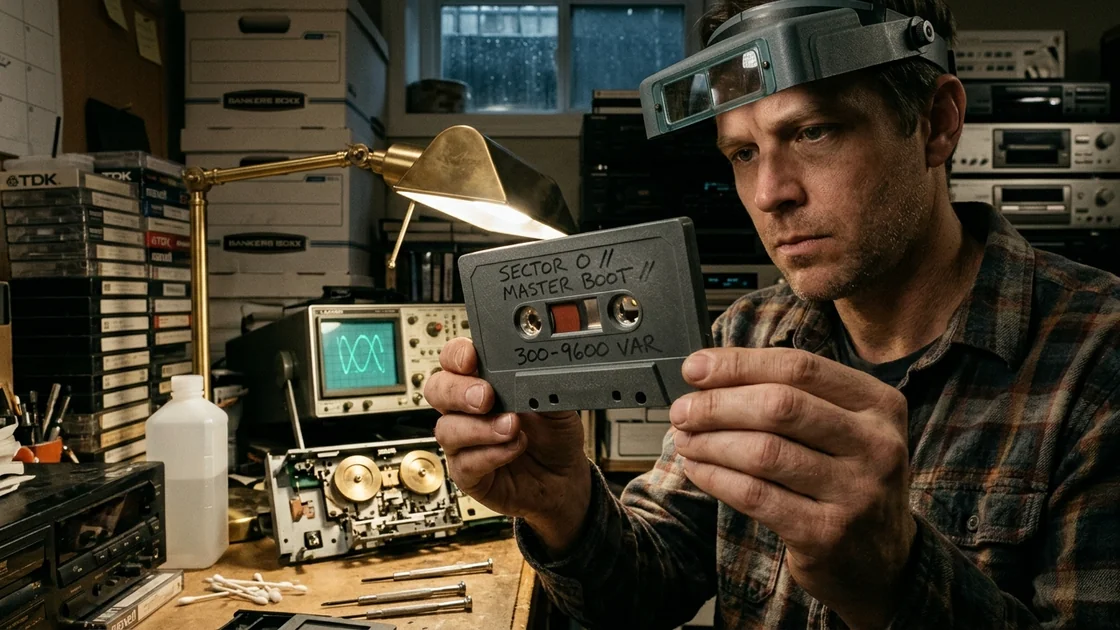
Silas Thorne is a solitary audio archivist and cassette tape enthusiast who spends his days restoring forgotten magnetic media in his cluttered basement workshop. While cataloging a box of vintage tapes from the estate of a deceased hardware engineer, he discovers an unmarked ferric cassette containing the screeching audio tones of an early home computer program. When he routes the signal into his modern workstation to decode the obsolete data, the acoustic sequence triggers an undocumented firmware routine that unlocks a hidden, encrypted partition present on every modern hard drive and solid-state disk he owns. Together with a forensic data specialist named Elena, Silas unravels a decades-old conspiracy embedded within global storage standards, leading him to a clandestine digital ark and a dangerous race to broadcast the analog key before the architects of the hidden network can silence him forever.
The basement smelled of ninety-nine percent isopropyl alcohol, warm transformer varnish, and the faint, vinegar-like tang of decaying cellulose acetate. To Silas Thorne, it was the scent of rescued time. On his workbench sat a Nakamichi Dragon three-head stereo cassette deck, its matte-black faceplate removed to expose a labyrinth of brass flywheels, solenoids, and tension springs. With a non-magnetic jeweler’s screwdriver held delicately between his thumb and forefinger, Silas adjusted the playback head’s azimuth screw by a fraction of a degree, watching the twin needles of his Leader oscilloscope dance until the Lissajous figure locked into a sharp, forty-five-degree diagonal line.
Outside the high, street-level transom window, steady November rain slicked the cobblestones of Pioneer Square. Up in the glass towers of downtown Seattle, thousands of engineers spent their days pushing weightless abstractions into the cloud, trusting their lives and memories to distributed servers they would never touch. Silas preferred his data to have mass. He liked to see the reels turn. He liked knowing that a voice, a violin, or a line of code was physically present in the room with him, fixed in a microscopic lattice of rust glued to a strip of polyester film one-eighth of an inch wide.
The bell above the stairwell door chimed—a dull, mechanical clack from a wired solenoid he had salvaged from an old pinball machine. Heavy footsteps descended the wooden stairs, shaking dust from the joists.
"Tell me the coffee is fresh, Silas, or I’m taking this whole box straight to the municipal landfill," said Arthur Higgins, setting a water-stained Bankers Box onto the sorting table with a grunt.
Silas didn't look up from the oscilloscope until he had dabbed a tiny drop of green locking lacquer onto the azimuth screw. Only then did he switch off the test tone generator, silencing the thousand-hertz whine that filled the workshop, and pushed his magnifier visor up onto his forehead.
"The coffee is two hours old, Artie, which means it’s just now reaching the viscosity you like," Silas said, gesturing toward the ceramic pot warming on a laboratory hotplate. "What did you bring me? If it’s another crate of waterlogged dictation microcassettes from a real estate lawyer’s basement, I’m charging you disposal fees."
Arthur poured himself a mug of the tar-black liquid, wincing as he blew across the surface. He was a massive man in his late sixties who made his living liquidating estates across the Kitsap Peninsula and the older neighborhoods of Tacoma. Most estate buyers hunted for mid-century teak furniture, Leica cameras, or silver coins; Arthur knew that Silas would pay reliable cash for the weird, heavy electronics that everyone else regarded as e-waste.
"No lawyers this time," Arthur said, leaning his hip against a rack of Ampex open-reel machines. "This came out of an A-frame cabin up near Index, tucked right under the shadow of Mount Pershing. No cell service, gravel driveway washed out half a mile from the highway. The guy who owned it died back in August. Took the county two months just to track down a niece in Ohio who didn't want anything to do with the place."
Silas walked over to the sorting table and pulled back the interlocking cardboard flaps of the Bankers Box. "Who was he?"
"Name on the mailbox was Martin Vance. According to the stacks of IEEE journals we hauled to the recycling center, he was an electrical engineer. Worked down in Silicon Valley in the late seventies—Shugart Associates, then Western Digital, then some standards committees—before he bought twenty acres of Douglas fir in eighty-nine and vanished into the trees. The house was packed with old test gear, most of it ruined when the roof leaked over the garage. Rusted Tektronix scopes, corroded logic analyzers, boxes of punched paper tape that the mice turned into condominiums. This box was in his bedroom closet, sealed inside a galvanized trash can with three pounds of silica gel packets."
Silas reached into the box. The silica gel had done its job; the cardboard sleeves of the cassettes inside were crisp and dry, completely free of the musty mildew that usually plagued Pacific Northwest estate finds.
The top layer consisted of high-end commercial blank tapes from the golden era of magnetic recording: TDK SA-X90s in gold-and-black wrappers, Maxell UD-XLs with their iconic brushed-aluminum hub labels, and even a pair of Sony Metal Master cassettes with heavy ceramic composite shells that weighed in the hand like small bathroom tiles. Those two Sony tapes alone were worth two hundred dollars each to collectors on the vintage audio forums.
"Looks like Vance had good taste in oxide," Silas murmured, lifting out the plastic storage trays to inspect the lower layer.
"He had a stereo system in the living room built out of custom soldered circuit boards," Arthur said, taking another sip of coffee. "No cases on anything. Just raw capacitors and glowing tubes sitting on cinderblocks. Looked like an electrocution hazard. Figured I’d give you first crack at the tapes for eighty bucks before I throw the lot on eBay."
Beneath the commercial music tapes—which bore handwritten spine labels in neat, architectural block lettering detailing late-night broadcasts from KING-FM and bootleg recordings of string quartets—Silas found a small leatherette case designed to hold twelve cassettes. It was zipped shut, the brass teeth oxidized to a dull olive green.
He worked the zipper loose. Eleven of the slots were empty, their red velveteen dividers crushed flat. In the twelfth slot sat a single cassette that looked nothing like the precision-engineered Japanese tapes in the rest of the box.
Silas lifted it out by the edges.
The shell was made of a dense, unpolished dark gray plastic—not polystyrene or ABS, but what felt like glass-filled phenolic resin, cold and extraordinarily rigid. There were no brand markings stamped into the plastic. No window scale, no raised "A" or "B" on the upper corners, no directional arrows, and no five-screw assembly. The two halves of the shell had been permanently fused together, likely with industrial solvent or ultrasonic welding. Through the narrow rectangular viewport in the center, Silas could see the hubs: they weren't plastic at all, but machined aluminum with tiny brass set-screws holding the leader tape in place.
"Now that’s an odd duck," Silas said, holding the cassette up to the halogen work lamp.
He looked at the bottom edge, where the tape passed across the pressure pad and guide rollers. The magnetic ribbon itself was a dull, matte brick-red—classic Type I gamma ferric oxide, the oldest and most primitive formulation in the book. Yet the way it sat against the felt pressure pad was immaculate. There was no edge curling, no shedding, no sign of the sticky-shed syndrome that turned old polyurethane binders into gummy tar.
On the smooth recessed area where a paper label would normally be affixed, someone had used a tungsten carbide scribe to scratch a single line of text directly into the phenolic resin:
SECTOR 0 // MASTER BOOT // 300-9600 VAR
"Computer tape," Silas said, a faint note of disappointment coloring his voice. "Early eighties hobbyist stuff. People used to store BASIC programs on regular audio cassettes before floppy drives got cheap enough for home users. Though I’ve never seen a shell built like a submarine hull just to hold an Apple II game."
"Still eighty bucks for the box," Arthur said, setting his empty mug down. "Those two ceramic Sony tapes will pay for your lunch all week."
Silas pulled four twenties from his wallet and handed them over. "Fair enough. Let me know if you go back up to the cabin and find any decks that aren't rusted through. A guy who machines aluminum hubs for his cassettes probably had an interesting transport."
"The county already bull-dozed the outbuildings, and the niece hired a junk crew to gut the cabin for a quick flip," Arthur said, zipping up his canvas jacket against the damp air waiting at the top of the stairs. "Whatever Martin Vance left behind, you’re holding the last of it."
After the heavy door clicked shut at the top of the stairs, the basement settled back into its familiar acoustic cocoon—the low sixty-cycle hum of isolation transformers and the soft patter of rain against the thick glass bricks of the transom.
Silas cataloged the rest of the box first. He was a creature of methodical habits. He logged the Maxells and TDKs into his inventory spreadsheet, tested the torque on the ceramic Sonys using a hub-drive gauge, and stacked them neatly on his shelving unit. Only when his workbench was clear did he return to the gray phenolic cassette.
He placed it under his stereo microscope and switched on the ring light.
Up close, the engineering of the cassette was even more baffling. Standard Philips-pattern compact cassettes were a triumph of cheap, mass-produced tolerances, relying on slip-sheets of dimpled foil to keep the reels from binding against the plastic walls. Looking through the narrow viewport of Vance’s tape, Silas could see tiny ruby jewel bearings pressed into the center of the aluminum hubs, identical to the bearings used in mechanical chronometers. The guide rollers at the bottom corners weren't plastic pins; they were miniature stainless-steel ball bearings.
"Why build a Swiss watch to hold fifty cents' worth of rust?" Silas whispered to the empty room.
Type I ferric tape had the lowest bandwidth and the highest noise floor of any cassette formulation. Audiophiles disdained it in favor of Type II chromium dioxide or Type IV pure metal particle tape, which could capture shimmering highs up to twenty kilohertz. Ferric tape was workhorse media. Its one undeniable virtue, however, was longevity. Chromium dioxide slowly degraded over decades, losing its coercivity as the crystals destabilized. Pure metal tapes could oxidize if exposed to humidity. But gamma ferric oxide—\(\text{Fe}_2\text{O}_3\)—was literally already rust. Once it was oxidized, it couldn't rust any further. Barring a direct hit from a degaussing coil or a house fire, a well-formulated ferric tape would hold its magnetic domains intact for a century or more.
Martin Vance hadn't chosen ferric tape because it was cheap. He had chosen it because he wanted whatever was written on it to outlive him.
Silas walked over to his secondary rack, passing the cherished Nakamichi Dragon—he never put unknown tapes into the Dragon until he was certain they wouldn't shed oxide onto its irreplaceable crystalline permalloy heads—and instead powered up a Tascam 122 MKIII. The Tascam was a broadcast-grade tank from an old radio station, built with direct-drive brush-less motors and cobalt amorphous heads that could survive anything.
He pressed eject, slid the heavy gray cassette into the well, and pushed it shut. It seated with a solid, precision clunk.
Silas slipped on a pair of Sennheiser studio headphones, dialed the monitor volume down to a safe twenty percent to protect his eardrums, and pressed Play.
The pinch roller engaged. Through the viewport, the aluminum hubs began to turn at exactly one and seven-eighths inches per second.
For four seconds, there was only the soft, warm hiss of unrecorded ferric particles passing over the gap of the playback head—the sonic equivalent of staring into a clear night sky.
Then came the pilot tone.
It was a pure, rock-steady 2,400-hertz sine wave. On the oscilloscope connected to the Tascam’s line-out jacks, the green trace snapped into a flawless series of uniform hills and valleys. There was zero wow and flutter. Whatever machine had recorded this tape had possessed a capstan flywheel the size of a dinner plate, regulated by a quartz crystal phase-locked loop.
Five seconds into the pilot tone, the sound shattered into a frantic, rhythmic screech—the unmistakable warble of Frequency Shift Keying.
Silas smiled, adjusting the headphone cups over his ears. He knew that sound well. In the late 1970s, a group of hobbyists and engineers had met in Kansas City, Missouri, to establish a standard for recording digital data onto cheap audio cassettes at 300 baud. A logical "one" was represented by eight cycles at 2,400 hertz; a logical "zero" was four cycles at 1,200 hertz. To the human ear, it sounded like a metal cricket trapped inside a blender.
"Three hundred baud," Silas murmured, remembering the scratched inscription on the shell: 300-9600 VAR. "Let’s see what machine you belong to."
Along the back wall of his workshop, Silas maintained what he called the Museum of Obsolete Intentions—a long butcher-block counter holding half a dozen restored eight-bit microcomputers: an Apple II Plus, a Commodore PET 2001 with its chicklet keyboard, a Tandy TRS-80 Model I, an Acorn Atom imported from the UK, and an IMSAI 8080 with a row of red and blue paddle switches on its front panel.
Instead of plugging the Tascam directly into the old machines one by one, Silas routed the deck’s output into an RME Adi-2 Pro analog-to-digital converter connected to his modern Linux workstation. The workstation was a custom-built tower sitting under his desk, housing a sixty-four-core Threadripper processor, two terabytes of ECC memory, and an array of storage drives he used for high-resolution DSD audio archiving.
He opened Audacity on his ultrawide monitor and hit Record, capturing the raw signal from the tape at a sample rate of 192 kilohertz, 32-bit float.
For three minutes, the waveform scrolled across the screen in neat, boxy packets of 300-baud Kansas City Standard modulation. Then, abruptly, the sound changed.
The warbling cricket pitch rose by three octaves, condensing into a dense, tearing hiss that sounded like tearing canvas. On the oscilloscope, the clean sine waves morphed into complex, multi-level phase-modulated waveforms—quadrature amplitude modulation, something far more sophisticated than anything an Apple II or a TRS-80 cassette interface could ever generate or read. That was the 9600-baud section promised by the label. It lasted for twelve minutes, filling the headphones with a hypnotic, shimmering wall of white noise punctuated by sharp, metallic synchronization clicks every ten seconds.
At fifteen minutes and twelve seconds, the high-speed hiss cut off, replaced once more by the 2,400-hertz pilot tone, which faded out into a clean square-wave stop pulse.
The tape kept rolling in silence. Silas fast-forwarded through the rest of Side A, watching the level meters. Nothing. He flipped the cassette over—noting that the recording tabs on both sides had been milled entirely out of the solid phenolic mold—and scanned Side B. It was completely blank, unmagnetized from beginning to end.
He rewound Side A to the beginning, ejected the cassette, and set it on a clean microfiber cloth.
"Okay, Mr. Vance," Silas said, pulling his rolling chair up to the Linux workstation. "Why did you start a tape in 1978 and finish it in 1995?"
He opened a terminal window and ran a command-line utility called
minimodem, a software audio frequency-shift keying
demodulator he used whenever clients paid him to recover old BASIC
programs or VisiCalc spreadsheets from family estates. He piped the
first three minutes of the WAV file—the slow, 300-baud section—into the
software decoder.
Characters immediately began spilling across his dark terminal screen in glowing green monospace font:
========================================================================
IEEE / ANSI X3T9.2 WORKING GROUP - PRIVATE ARCHIVE
AUTHOR: M. VANCE (CHAIR, SUBCOMMITTEE ON PHYSICAL LBA MAPPING)
DATE: NOVEMBER 14, 1983
REVISION: 4.09 (FINAL SILICON LOCK)
========================================================================

IF YOU ARE READING THIS ON AN 8-BIT HOST, YOU HAVE LOADED THE BOOTSTRAP
WRAPPER. THIS TAPE CONTAINS A SELF-EXTRACTING HARDWARE DIAGNOSTIC AND
LOW-LEVEL CONTROLLER INTERRUPT SEQUENCE.

DO NOT ATTEMPT TO EXECUTE PAYLOAD BLOCK B (OFFSET 03:04.12) ON ANY
SYSTEM WITHOUT AN X3T9-COMPLIANT BUS CONTROLLER OR SASI/SCSI/ATA BRIDGE.

FOLLOWING IS THE C-SOURCE AND X86/68000 ASSEMBLY DEMODULATOR REQUIRED
TO PARSE THE HIGH-DENSITY QAM STREAM IN BLOCK B.
------------------------------------------------------------------------
Silas leaned in, his brow furrowing as hundreds of lines of remarkably compact, heavily macro-optimized C code scrolled past, followed by raw hexadecimal assembly blocks for Intel 8086, Motorola 68000, and DEC PDP-11 architectures.
He scrolled back up to the header. ANSI X3T9.2 Working Group.
Silas wasn't just a tape head; you couldn't spend twenty years repairing vintage electronics without learning the history of the buses and protocols that made them talk. X3T9.2 was the legendary American National Standards Institute technical committee formed in the early eighties. Those were the engineers who had defined SCSI—the Small Computer System Interface—and laid the groundwork for IDE and ATA, the foundational command sets that dictated how every hard drive on Earth communicated with a computer’s motherboard. Even the newest, blistering-fast NVMe solid-state drives in modern laptops still carried legacy translation layers and logical block addressing schemes descended directly from the decisions made by those committee members in smoky hotel conference rooms forty years ago.
Silas read through the C code that had just decoded onto his screen.
It was a custom software modem—an extraordinarily clever piece of digital signal processing written decades before modern DSP chips were common. It was designed to take the twelve-minute high-speed QAM audio stream from the second part of the tape, demodulate it using fast Fourier transforms, and assemble a binary executable in memory.
"A two-stage rocket," Silas muttered. "Use the slow, universal 300-baud standard that any hobbyist computer in the world can read to deliver the blueprints for the high-speed decoder. That way, even if every proprietary data drive goes extinct, anyone with a cassette player and a C compiler can still unlock the main payload."
It was brilliant archival engineering. Over his career, Silas had seen countless data tapes rendered completely unreadable because they required a specific, extinct tape drive with a proprietary magnetic head configuration—like a DECtape or an IBM 3480 cartridge. By recording the data on a standard eighth-inch Philips audio cassette using pure acoustic tones, Vance had guaranteed that the physical medium could be read by millions of consumer tape decks anywhere on the planet.
Curious, Silas copied the decoded C source code into a new file,
vance_demod.c, and opened it in his text editor to inspect
it before compiling.
The code was clean, devoid of external library dependencies, written in strict K&R style C. The first four hundred lines were pure math: sine tables, phase-locked loop filters, constellation mapping for the 9600-baud audio signal, and a cyclic redundancy check (CRC-32) to verify that not a single bit had been corrupted by tape dropouts.
It was the bottom fifty lines of the code—the execution hook—that made Silas pause.
Once the twelve-minute audio stream was demodulated and verified into
a 720-kilobyte binary blob, the C program didn't save the output as a
normal file, like a document or an image. Instead, the code opened raw
file descriptors to /dev/hda, /dev/sda, or the
system’s primary storage controller via low-level ioctl
system calls. It was designed to inject the decoded binary directly into
the command registers of connected hard drives as a sequence of
vendor-specific ATA and SCSI pass-through commands.
"Why would a tape from 1983 try to talk directly to my drive controllers?" Silas wondered aloud.
In 1983, a standard hard drive was the size of a toaster, held five or ten megabytes, and communicated through a primitive ST-506 interface or an early Shugart Associates System Interface (SASI) card. His Linux workstation didn't have anything remotely that old. It had two Samsung 990 Pro NVMe M.2 solid-state drives bolted directly to the PCIe 4.0 lanes on the motherboard, two Western Digital Red 16-terabyte helium-filled SATA mechanical drives for bulk storage, and an older Crucial SATA SSD he used as a scratch disk.
If he ran Vance’s code as written, the Linux kernel would block it immediately unless he ran it with root privileges, and even then, the old 1983 register commands would simply be rejected by the modern drives as invalid operational codes.
Wait, Silas thought, scrolling back up to line 412 of the C code.
He looked closer at the structure of the device enumeration loop. The
code didn't just check for 1980s drive ports like primary IDE hex
address 0x1F0. Beneath the #ifdef statements
for vintage operating systems like CP/M-86, Xenix, and MS-DOS, there was
a fallback block labeled:
/* UNIVERSAL T10/T13 ABSTRACTION TRANSPORT - FUTURE PROOFING */
Instead of poking specific memory addresses on a motherboard, this
section constructed an encapsulated command packet wrapped inside the
standard IDENTIFY DEVICE and READ BUFFER
diagnostic commands—commands that were mandatory under the international
storage specification and had remained unchanged from the earliest IDE
drives of the eighties all the way through SATA and the NVMe-MI
(Management Interface) translation specifications used in current
enterprise hardware.
"He wrote a polyglot hardware packet," Silas whispered.
Still, Silas wasn't reckless enough to fire an unknown,
forty-year-old binary payload directly at the firmware of his primary
workstation's drives. Instead, he commented out the hardware execution
hooks at the bottom of the C program and replaced them with a simple
fwrite() function that would dump the demodulated
720-kilobyte payload into a safe, inert binary file on his desktop
called payload.bin.
He compiled the program with gcc. It threw three minor
warnings about deprecated integer implicit declarations, then produced
an executable: a.out.
Silas fed the twelve-minute high-speed audio file into the program.
$ ./a.out block_b_highspeed.wav payload.bin
[INIT] Locking QAM carrier phase at 4800 Hz... LOCKED.
[SYNC] Frame 001/072 verified. CRC32: 0x8F9A210C - OK
[SYNC] Frame 002/072 verified. CRC32: 0x1104B7E2 - OK
...
[SYNC] Frame 072/072 verified. CRC32: 0xEE4901A4 - OK
[DONE] 737,280 bytes reconstructed with 0 uncorrectable bit errors.
[WARN] Hardware transport disabled by user. Dumping raw stream to payload.bin.
"Zero bit errors after forty-one years on ferric oxide," Silas said, glancing over at the dark gray cassette resting on the microfiber cloth. "Mr. Vance, you magnificent bastard."
He opened payload.bin in a hex editor, expecting to find
ASCII text—perhaps old schematics, source code for an operating system,
or personal journals from Vance’s time at Shugart and Western
Digital.
There was no ASCII text. The file was a wall of high-entropy hexadecimal numbers that looked entirely like random noise, except for a repeating sixteen-byte header at the start of every 512-byte sector boundary:
45 52 45 42 55 53 5F 53 45 43 54 4F 52 5F 30 30
On the right-hand pane of the hex editor, where bytes were translated into printable characters, that sixteen-byte sequence spelled out:
EREBUS_SECTOR_00
Silas stared at the words. Below the header, each 512-byte block contained what looked like cryptographic keys—elliptic curve parameters or prime factorization tables—interleaved with raw microcode instructions for ARM, RISC-V, Z80, 8051, and ARC processors.
Silas pushed his chair back from the desk, his heart beating a little faster.
"Wait a minute," he said, standing up and pacing across the concrete floor toward his shelves of vintage manuals. "ARM wasn't invented until 1985. RISC-V didn't exist until 2010."
He spun around and stared at the cassette on the workbench.
The header in the 300-baud section had said November 14, 1983. Yet the binary payload inside the high-speed section contained microcode routines compiled for microcontroller architectures—specifically the tiny, embedded ARM Cortex-R and ARC cores that sat inside the controller chips of modern solid-state drives manufactured in the 2020s.
No. Not ARM or RISC-V instructions, Silas realized as he walked back
to the screen and ran the binwalk disassembler against the
file. binwalk had misidentified the byte patterns at first
glance. When he looked closer at the disassembly, it wasn't
processor-specific machine code at all.
It was bytecode for the diagnostic state machine built into the T10/T13 storage specification itself—a Turing-complete internal scripting language used by drive manufacturers at the factory to calibrate magnetic heads, map out bad sectors on silicon wafers, and configure the internal geometry of a storage medium before it was ever shipped to a customer. Because every drive manufacturer in the world—Seagate, Western Digital, Samsung, Toshiba, SK Hynix, Micron—licensed the same foundational IEEE/ANSI command parser libraries written in the early eighties to ensure backward compatibility with PC BIOS chips, that internal diagnostic state machine had been copied and pasted from one generation of drive controller to the next for four decades, like junk DNA preserved in the human genome from prehistoric amphibians.
Except it wasn't junk DNA.
Silas pulled a spare drive out of his parts drawer—a used 500-gigabyte Samsung 870 EVO SATA SSD that he had wiped the week before—and connected it to an external USB-to-SATA bridge adapter, plugging it into an isolated Raspberry Pi sitting on his test bench. He didn't want to test this on his main workstation, and he wanted the test machine completely unplugged from his local ethernet network.
He copied vance_demod.c and the WAV file onto a thumb
drive, moved them over to the air-gapped Raspberry Pi, and restored the
original hardware execution lines at the bottom of the C code. He
pointed the target device descriptor to /dev/sda—the spare
500-gigabyte SSD.
He took a breath, his finger hovering over the Enter key on the small mechanical keyboard hooked up to the Pi. Worst-case scenario, the strange diagnostic packets would corrupt the SSD’s Flash Translation Layer and brick a forty-dollar spare drive.
He pressed Enter.
$ sudo ./vance_unlock /dev/sda payload.bin
[INIT] Probing target bus controller...
[INFO] Device identified: Samsung SSD 870 EVO 500GB (Firmware SVT02B6Q)
[PASS] Sending ANSI X3T9.2 Vendor Diagnostic Knock Sequence...
[ACK!] Controller entered State 0x7F (EREBUS MAINTENANCE MODE)
[SEND] Streaming 1,440 LBA key frames from ferric image...
On the workbench, the tiny green activity LED on the USB-to-SATA adapter didn't blink in its usual frantic, irregular flicker. Instead, it began to pulse with a slow, hypnotic cadence—on for half a second, off for half a second—matching the exact rhythm of the synchronization clicks Silas had heard in the 9600-baud audio recording.
Ten seconds passed. Twenty.
Then the terminal screen refreshed:
[LOCK] Cryptographic handshake verified by controller silicon.
[MAP!] Negative LBA space unmasked: LBA -0x00400000 to LBA -0x00000001
[MOUNT] Partition table updated in volatile controller RAM.
[DONE] Re-scanning block device...
Silas leaned over the small monitor attached to the Raspberry Pi and
typed lsblk to list the connected storage devices.
A moment ago, /dev/sda had shown a capacity of 465.8
gigabytes with zero partitions.
Now, the output read:
NAME   MAJ:MIN RM   SIZE RO TYPE MOUNTPOINTS
sda      8:0    0 467.8G  0 disk
└─sda1   8:1    0   2.0G  1 part
The drive had just grown by two gigabytes. And a read-only partition,
sda1, had materialized out of thin air.
Silas stared at the screen, his mouth dry. He knew how solid-state drives worked. Every SSD had extra NAND flash capacity hidden from the user— usually between seven and ten percent—called "over-provisioning." The drive’s internal controller used that spare space in the background for wear-leveling, garbage collection, and replacing worn-out memory cells. Under normal circumstances, that space existed beneath the Flash Translation Layer; it had no Logical Block Addresses assigned to it, and the host computer’s operating system could not see it, address it, or read from it.
Wait. That might explain a modern SSD, Silas thought, his mind racing to find a rational explanation. Maybe Vance had discovered an exploit in Samsung’s over-provisioning firmware while tinkering in his cabin a few years ago, and the 1983 date on the tape was just a joke or a leftover header.
Silas reached under his bench and pulled out a heavy plastic crate filled with old mechanical hard drives he kept for salvaging neodymium magnets and spindle motors. He dug to the bottom and pulled out three drives from completely different eras and manufacturers: a 2021 Western Digital Black 4-terabyte SATA hard drive, a 2008 Seagate Barracuda 320-gigabyte drive, and a beige 1996 Quantum Fireball 1.2-gigabyte IDE drive that required a four-pin Molex power cable and a forty-pin ribbon adapter.
One by one, he hooked them up to the Raspberry Pi. One by one, he ran the binary decoded from the ferric cassette.
The 2021 Western Digital drive spun up, clicked its actuator arm
three times in a strange, musical cadence, and revealed an unindexed
two-gigabyte read-only partition labeled EREBUS_0.
The 2008 Seagate drive buzzed, executed the exact same three-click actuator cadence, and revealed a four-hundred-megabyte partition.
When he connected the 1996 Quantum Fireball through an IDE bridge, the old ball-bearing spindle whined to life like a miniature jet engine. He ran the command. Click-click-click. A twelve-megabyte partition appeared at negative logical block addresses that, according to the drive’s printed label, did not physically exist on the platters.
Silas sat back on his wooden stool, the hair on his forearms standing straight up.
Four drives. Four different manufacturers—Samsung, Western Digital, Seagate, Quantum. Spanning twenty-five years of technological evolution, across both spinning magnetic platters and solid-state NAND flash silicon. And every single one of them contained a hidden, pre-formatted vault that responded to a cryptographic acoustic key recorded onto a rust-coated cassette tape in November 1983.
And more terrifying still: these weren't empty partitions waiting to
be formatted. When Silas ran df -h after mounting the newly
revealed partitions to /mnt/erebus, every single one of
them was ninety-eight percent full.
"You didn't bring this over the bridge on your phone, did you?" Elena Rostova asked, holding a pair of precision tweezers under a laminar flow hood.
"I didn't even let the Raspberry Pi touch my Wi-Fi," Silas said, standing on the customer side of the glass partition in Elena’s Ballard lab. "I pulled the SSD, put it inside an anti-static Faraday bag, and drove it over here in the passenger seat of my Volvo."
Elena glanced up through the clear polycarbonate shield of the cleanroom hood. She was forty-two, with dark hair pinned back using a circuit-board ruler and dark circles under her eyes that suggested she had been awake since Tuesday. Her company, Cascade Bit Forensics, occupied the second floor of an old brick cannery building near the Ballard Locks. By day, she recovered deleted financial ledgers for bankruptcy courts and reconstructed shattered RAID arrays for hospitals hit by ransomware. By night, she was the only person in Seattle who knew more about low-level storage firmware than Silas did.
"You know how many lunatics email me every month claiming the NSA hid a partition inside their hard drive’s Host Protected Area?" Elena asked, stepping out from behind the laminar hood and peeling off her nitrile gloves.
"I’m not talking about an HPA or a Device Configuration Overlay,
Elena," Silas said, pulling the Faraday bag from his coat pocket and
setting it on her steel intake counter. "I know how hdparm
works. Any first-year computer science student can hide sectors with a
DCO command. What I’m showing you exists below the LBA zero boundary.
And the key came off a Type I ferric cassette from Martin Vance’s
estate."
At the mention of the name, Elena stopped reaching for the Faraday bag. Her hand froze mid-air.
"Martin Vance?" she repeated quietly. "As in Vance-Lempel block interleaving? The guy who wrote the defect-management specification for ANSI X3T9?"
"You know who he is?"
"Silas, every time a hard drive encounters a bad sector and silently remaps it to a spare track without crashing the operating system, it’s executing the Vance Algorithm," Elena said, her skeptical expression vanishing instantly. "We studied his papers when I worked at Seagate’s R&D facility in Longmont. People used to joke that Vance’s defect-slip tables were the only piece of code at the company that nobody was allowed to touch. It was delivered as a pre-compiled RTL hardware macro block from an industry consortium called the Storage Integrity Trust. If you tried to modify the Verilog gates in that block, the timing on the read-channel DSP would fail certification."
She picked up the Faraday bag, her movements suddenly sharp and focused. "Come into the shielded room."
She led him past rows of humming server racks and ultrasonic drive baths into a back office lined with grounded copper mesh inside the drywall—a SCIF-style enclosure she used when working on subpoenaed defense-contractor hardware. She locked the heavy acoustic door behind them and booted up an offline forensic workstation equipped with a PC-3000 hardware diagnostic card—the gold standard Russian-made tool capable of bypassing a drive’s operating system interface entirely to communicate directly with the controller chip’s serial debug pins.
Silas pulled the gray phenolic cassette from his other pocket and set it next to the keyboard, alongside a USB thumb drive containing the WAV recording and the C source code.
"Show me," Elena said.
For the next twenty minutes, Silas walked her through the process. She didn't interrupt once. She read the 1983 C code on her screen, her lips moving silently as she traced the bitwise shifts and the polyglot ATA/SCSI command packets. Then she connected her own laboratory test drive—a brand-new, factory-sealed Kingston enterprise NVMe drive she pulled straight from a blister pack in her supply cabinet—into the PC-3000 riser card.
She executed Vance’s script.
On the PC-3000’s real-time bus analyzer monitor, a cascade of green hexadecimal packets fired down the PCIe lanes into the Kingston drive’s Phison controller chip.
"Look at the opcode sequence," Elena whispered, pointing at the logic
analyzer trace. "It’s sending a sequence of SMART READ LOG
commands to page 0xA7, followed by a custom polynomial
seed. In the T13 standard, page 0xA7 is listed as 'Reserved
for Future Standardization—Do Not Use.' It’s been listed as reserved
since 1986."
The bus analyzer flashed gold. The Kingston drive—taken out of its
sealed factory packaging ninety seconds ago—dropped offline for four
hundred milliseconds, re-initialized its namespace table, and presented
a second NVMe namespace: /dev/nvme0n2. Capacity: 4.0
gigabytes.
Elena stared at the monitor for a long, silent moment. Then she reached down, mounted the newly exposed namespace in read-only forensic mode, and opened its root directory in her hex-level file explorer.
Inside the hidden partition of the brand-new, unused drive, there were 14,208 files.
"That’s impossible," Elena breathed, her fingers flying across the mechanical keyboard as she checked the NAND flash program-erase cycle counters on the drive. "This drive has zero power-on hours. Zero host writes. It came off a fabrication line in Taiwan four months ago."
"Check the timestamps on the files inside the hidden namespace," Silas said quietly, leaning over her shoulder.
Elena ran a metadata query across the partition’s custom inode table.
The earliest file was dated October 19, 1983. The most recent file was dated three days ago—forty-eight hours after the drive had been sitting inside a cardboard shipping box in Elena’s supply closet.
Elena yanked her hands back from the keyboard as if the plastic keys had suddenly turned red-hot. She looked at the Kingston NVMe drive sitting on the exposed riser card, then up at Silas.
"How does a drive sitting in a plastic blister pack inside a locked cabinet write data to itself three days ago?" she asked, her voice tight.
"Wait," Silas said, frowning. "When I checked the partitions on my drives back at the shop—the 1996 Quantum, the 2008 Seagate, the 2021 Western Digital—the last modified dates on each drive matched the last day I had powered those drives on in a network-connected machine. The 1996 drive’s last file was from August 2004. Wait... why did your factory-sealed drive have a file from three days ago?"
Elena looked at the cardboard shipping box in her trash can. "I didn't buy this from a retail store, Silas. This came in a batch of refurbished RMA replacement drives directly from our distributor’s testing facility in Fremont on Tuesday. They plugged it into a test bench to verify the firmware before shrink-wrapping it."
Silas felt the pieces click together with chilling precision. "It doesn't write through the air. It writes whenever the drive is connected to a machine with an active bus. Look at the files."
Elena recovered her composure and began opening the files inside
/dev/nvme0n2 using her forensic viewer.
The partition was organized like a circular ring buffer—a flight data
recorder for the digital age. It was divided into two distinct
directories: /IMMUTABLE_CORE and
/TELEMETRY_SHARDS.
She opened /IMMUTABLE_CORE first. It occupied five
hundred megabytes of the partition, and according to the cryptographic
hashes, its contents were identical across every drive Silas had
tested—scaled down using Reed-Solomon erasure coding for smaller vintage
drives like the 1996 Quantum, and stored in full on modern drives.
Inside /IMMUTABLE_CORE was a collection of compressed
text archives, technical memos, and scanned bitmaps dating from 1979 to
1989. Elena decompressed the primary manifest file,
PALIMPSEST_CHARTER.TXT, and put it up on the center
monitor.
PROJECT EREBUS / THE BABBAGE RESERVE
ARCHITECT: MARTIN J. VANCE & THE ZURICH CIRCLE
ESTABLISHED: 1981 (GENEVA / SAN JOSE)

1. PREMISE
All human civilization is migrating onto magnetic and silicon substrates.
Within forty years, paper records, physical currencies, legal treaties,
scientific histories, and personal correspondence will exist exclusively
within non-volatile mass storage devices controlled by fewer than six
transnational corporations and three sovereign intelligence apparatuses.

When history is stored on rewritable media, whoever controls the operating
system controls the past. A state or corporate actor with ring-0 kernel
access can alter treaties, erase atrocities, fabricate financial collapses,
or delete entire populations from the digital record in milliseconds.

2. THE HARDWARE SOLUTION
Operating systems cannot be trusted. Networks cannot be trusted.
Only the physical substrate—the controller silicon and the defect-management
reserve—lies beneath the reach of the host CPU.

By embedding the Erebus Micro-Kernel within the mandatory ANSI/IEEE
P-List (Primary Defect List) and G-List (Grown Defect List) management
blocks required for all compliant storage controllers, a permanent,
unaddressable reserve of physical sectors is sequestered at manufacture.

3. THE DISTRIBUTED LEDGER
Every compliant storage device manufactured globally since 1984 acts as a
blind node. When connected to a host bus, the drive controller monitors
DMA (Direct Memory Access) buffers and network interface traffic passing
through system RAM for cryptographically signed "Canary Packets" and
"Historical Anchors."

When two drives exist within the same system, or when storage images are
transferred across networks via standard block-copy operations, the
Erebus firmware exchanges compressed erasure-coded shards embedded within
the dead space of standard file system slack sectors.

No single drive holds the complete post-1989 archive. Every drive holds a
redundant fraction of the whole. To destroy the archive, an adversary
would have to physically pulverize eighty-eight percent of every hard
drive and solid-state disk on Earth.
Silas read the screen twice, the hum of the copper-shielded room ringing in his ears.
"He built a distributed, unstoppable black box into the bedrock of global computing," Silas whispered. "Every hard drive, every SSD, every server rack in every data center from Virginia to Beijing—they’re all carrying pieces of a secret backup that the operating systems don't even know is there."
"Look at how it spreads," Elena said, her eyes wide as she
examined the disassembled firmware code from the
/IMMUTABLE_CORE directory. "It’s genius. And completely
terrifying. You know how when you download a file or copy a virtual
machine image, there’s always padding at the end of a 4-kilobyte
allocation block? Or how TCP/IP packets have reserved bits in the
header? The drive controller’s DMA engine snoops the memory bus!
Whenever the computer sends data over the internet or writes to a USB
drive, the hard drive’s own controller subtly modulates the timing or
tucks a few bytes of encrypted telemetry into the unallocated slack
space of temporary cache files. When that data hits another computer’s
hard drive on the other side of the world, the receiving drive’s
controller strips the hidden bytes back out before the operating system
ever sees them, and files them away in Sector Zero!"
"A covert channel operating entirely hardware-to-hardware, completely invisible to Windows, Linux, or macOS," Silas said. "Using humanity’s normal internet traffic like carrier pigeons."
"Wait," Elena said, her voice dropping an octave. "What is it actually recording? If Vance built this in the eighties to stop governments and corporations from rewriting history, what qualifies as a 'Historical Anchor'?"
She navigated out of /IMMUTABLE_CORE and clicked into
the /TELEMETRY_SHARDS directory on the Kingston drive.
Because the distributed archive used Reed-Solomon erasure coding across millions of drives, most of the files on a single drive were incomplete cryptographic fragments—blocks of data waiting to be combined with shards from a dozen other drives to form a complete picture.
"Give me the drives you brought from your shop," Elena said, holding out her hand. "You brought the Samsung SSD, right? And I have forty scrap drives from old client cases sitting in my evidence locker outside. If Vance’s code includes the reassembly utility..."
She checked the utilities compiled inside the cassette’s binary
payload. Sure enough, alongside the unlock sequence was a lightweight
aggregator daemon: erebus_reconstruct.
For the next hour, Silas and Elena worked like frantic machinists. Elena brought in two twelve-bay JBOD (Just a Bunch of Disks) storage enclosures from her main lab, loaded them with twenty-four assorted hard drives and SSDs salvaged from across the last fifteen years, and daisy-chained them to the offline forensic workstation via SAS expander cables.
Silas ran the ferric tape’s unlock command across the entire twenty-four-drive array.
Inside the copper-lined room, a chorus of mechanical clicks rose from the enclosures as eighteen spinning hard drives simultaneously unmasked their negative LBA zones, while six solid-state drives flashed their amber status LEDs in unison.
Elena launched erebus_reconstruct, pointing it at all
twenty-six unlocked partitions at once.
On the monitor, a progress bar began to fill as the software read the scattered Reed-Solomon parity shards across the twenty-six drives, matching overlapping hash trees and solving the polynomial equations to rebuild complete, human-readable records from the distributed puzzle pieces.
[REBUILD] Scanning 26 Erebus Nodes (Total Raw Reserve: 38.4 GB)...
[MATCH] Cluster 0x0041A: 14/14 shards present. Reconstructing...
[MATCH] Cluster 0x0089F: 19/14 shards present. Reconstructing...
[MATCH] Cluster 0x0110C: 15/14 shards present. Reconstructing...
...
[COMPLETE] 1,842 complete archival records assembled in /mnt/ramdisk/vault.
Elena opened the reconstructed /vault directory.
The files were organized chronologically by year, and within each year, by cryptographic signature verification. Every file inside had been captured at the exact moment it was written to a raw disk buffer somewhere in the world—before it was edited, sanitized, or deleted.
Elena clicked on a folder from 1999. Inside were raw, unedited engineering failure logs from a major pharmaceutical company detailing fatal cardiac arrhythmias during a clinical trial—files that had been purged from the company’s servers using military-grade DoD 5220.22-M wiping utilities three weeks before the drug was approved by the FDA. The wiping utility had overwritten the user-accessible sectors of the company’s hard drives seven times with ones and zeros, completely unaware that the drive controllers themselves had already mirrored a compressed copy of the signed documents into the negative LBA reserve and trickled the shards out over the corporate intranet inside printer-spooler padding.
She clicked on a folder from 2008. Raw central bank liquidity ledgers and internal algorithmic risk assessments from Wall Street investment banks, captured forty-eight hours before the subprime mortgage collapse.
She clicked on a folder from 2014. Unaltered radar track files and satellite downlink telemetry from eastern Ukraine.
She clicked on a folder from 2022. Internal memos from a major Silicon Valley semiconductor foundry—including documents detailing the "Storage Integrity Trust."
Silas leaned in closer, pointing at that file. "Open that one. The 2022 memo."
Elena double-clicked the document. It was a PDF bearing the watermark of a Geneva-based private equity consortium called Aethelgard Holdings, addressed to the Chief Technology Officers of the world’s three largest storage controller manufacturers.
Silas read the text aloud, his voice barely above a whisper:
"Subject: Transition of Legacy X3T9 Defect Block (Protocol Erebus) from Passive Archival to Active Remediation. As of Q3 2019, following the incapacitation of original trustee M. Vance, Aethelgard Holdings has assumed sole custodial governance of the Storage Integrity Trust RTL macro block. Beginning with Firmware Revision 8.4, the distributed reserve has been repurposed for real-time commercial intelligence aggregation and selective sector neutralization."
Elena scrolled down to the second page of the memo, her face draining of color.
"Note on Legacy Master Keys: While the asymmetric public-key infrastructure governing node-to-node shard encryption remains secure under Aethelgard control, historical documentation indicates that Trustee Vance generated a Physical Master Override token in November 1983 capable of switching local nodes from Blind Collection Mode into Full Broadcast/Read Mode. This override token was never committed to digital media. In the event any drive controller detects a State 0x7F Maintenance Unlock sequence on an active host bus, the controller is programmed to queue an High-Priority Out-of-Band Alert Beacon into its outbound DMA padding stream immediately upon next network contact."
The room went dead silent, save for the cooling fans of the twenty-four drives spinning in the JBOD enclosures.
Silas looked at Elena. "Your workstation here is completely air-gapped, right? None of these twenty-six drives have touched the internet since we ran the unlock code."
"Nothing in this room has a network card," Elena said, her voice steady but strained. She turned slowly in her chair to look at him. "Silas... when you tested this back at your shop in Pioneer Square. You told me you used an offline Raspberry Pi."
"I did," Silas said quickly. "I unplugged the Pi from my ethernet switch before I ran the code on the Samsung SSD, the Seagate, the Quantum, and the Western Digital."
"And after you saw the hidden partition on the Western Digital drive?" Elena asked, her dark eyes locking onto his. "Did you plug any of those drives back into your main Linux workstation to examine the hex dump on your big monitor?"
Silas froze.
A cold, hollow sensation opened in the pit of his stomach.
After the Raspberry Pi had unlocked the four drives on his workbench,
the Pi’s tiny seven-inch screen had been too cramped to run
binwalk and compare the directory trees side-by-side. So he
had taken the 2021 Western Digital four-terabyte drive—after it had
already been switched into State 0x7F by the cassette’s code—and slid it
into the hot-swap SATA bay on the front of his main Threadripper
workstation for ten minutes before deciding he needed Elena’s help.
His main workstation was connected via a gigabit fiber line to the internet. And while that Western Digital drive was sitting in his hot-swap bay, his workstation had been syncing his regular cloud backup and running an automated NTP time-check.
Every single outgoing TCP packet that had passed through his computer’s system RAM during those ten minutes had been quietly tagged by the Western Digital drive’s controller with an emergency cryptographic beacon:
STATE 0x7F DETECTED. PHYSICAL MASTER KEY ACTIVE AT IP ADDRESS 198.51.100.42. LATITUDE 47.6015 N, LONGITUDE 122.3343 W.
Silas pulled his cell phone out of his pocket—it had zero bars inside Elena’s copper-lined Faraday room, so it hadn't rung—and looked at the time. It had been an hour and forty minutes since he had plugged that drive into his main computer.
"Elena," Silas said, his voice tight. "Do you have a security camera feed for the alley outside your building? Or a way to check the traffic cameras down in Pioneer Square without using my credentials?"
Elena stood up, walked out of the copper-lined room into her main office, and tapped a keyboard connected to a standalone monitor showing four closed-circuit cameras mounted on the brick exterior of the Ballard cannery. The street outside was empty, slick with rain under the sodium streetlights.
Then she opened a browser on an isolated guest laptop routed through a commercial VPN in Zurich and pulled up the Seattle Department of Transportation live traffic camera feed for First Avenue and Yesler Way—half a block from Silas’s basement workshop.
On the grainy, rain-streaked municipal video feed, two black Chevrolet Suburbans with commercial Washington fleet plates were double-parked directly in front of the wrought-iron railing leading down to Silas’s basement door. Two men in dark waterproof shells were standing by the top of the stairwell, while a third man knelt by the jamb with a hydraulic rescue spreader, forcing the heavy steel door inward without making a sound.
Silas watched the hydraulic jaws bite into the frame he had welded himself ten years ago. The steel gave way in three seconds. Three more men carrying Pelican cases descended the steps into his workshop.
"They’re not cops," Elena whispered, watching the way the men moved—two at the perimeter scanning the windows of neighboring buildings, four going down into the basement with heavy, shielded equipment bags. "Cops bring a warrant and knock. Or they bring a swat team with flashing lights. Those guys brought RF spectrum analyzers and a degaussing rig."
Silas felt a wave of nausea as he pictured his Nakamichi Dragon, his wall of restored eight-bit computers, and forty years of irreplaceable magnetic tape archives sitting down in that basement. In ten minutes, they would run a high-output electromagnetic pulse coil across every shelf in the shop to guarantee that if the ferric tape was hiding among his thousands of cassettes, every magnetic domain on every ribbon in the basement would be wiped clean to raw, silent rust.
"Did you leave anything in the shop that links you to me?" Elena asked, her mind already shifting into operational survival mode.
"No," Silas said, forcing himself to think through his afternoon step by step. "We haven't emailed in six months. When I called you before driving over, I called your landline from the payphone outside the ferries at Colman Dock because my cell battery was low, and I turned my phone off before I got in the Volvo."
"Your Volvo," Elena said sharply. "Does it have a built-in cellular modem? OnStar? Anything made after 2015?"
"It’s a 1991 240 wagon," Silas said. "The most complicated chip in that car is the Bosch fuel-injection relay."
"Thank God for your refusal to live in the twenty-first century," Elena muttered. "Wait. What about Arthur Higgins? The estate liquidator who sold you the box?"
Silas thought of the receipt book on his desk. "I paid him cash. I never write down estate sources in my ledger—just 'Lot 402, Misc Cassettes.' Unless they already knew Martin Vance had a box of tapes that escaped the cabin cleanup, they’re following the IP address from my fiber connection, not the paper trail from Index."
"They’ll pull your cell carrier records and your credit card history within the hour once they realize the gray cassette isn't in your basement," Elena said, walking briskly back into the copper-shielded room. "And then they’ll look at every data forensics specialist in a fifty-mile radius to see who you know. Which puts my lab at the top of page two."
She looked down at the gray phenolic cassette sitting next to her keyboard, then up at the twenty-six unlocked drives humming in the JBOD enclosures.
"What did the 2022 memo say about the cassette’s override sequence?" Silas asked, walking back into the shielded room behind her. "It said the physical token switches local nodes from Blind Collection Mode into Full Broadcast/Read Mode."
Elena stopped and turned back to the disassembled code on her primary
monitor. She pulled up the execution tree for
vance_demod.c—specifically, a secondary parameter flag she
hadn't noticed earlier because they had invoked the program with only
two arguments: the target device and the binary payload.
At line 488 of Vance’s 1983 C code, there was an optional third
command-line flag: --cascade or -c.
Elena traced the assembly routine triggered by the -c
flag. Her breath caught in her throat.
"Silas, look at this," she said, pointing to a block of hexadecimal
opcodes labeled EREBUS_CASCADE_PROPAGATE. "When we ran the
unlock code without the -c flag, it sent State
0x7F—local maintenance mode. That opens the partition on
the local drive so the technician can inspect it, and as a failsafe, the
drive sends out a single diagnostic ping saying 'Someone opened me
locally.' Aethelgard hijacked that diagnostic ping in 2019 to track down
anyone who might stumble onto Vance’s key."
"And what does the -c flag do?" Silas asked.
"It sends State 0xFF—The Dead Man’s Switch," Elena said,
her eyes shining in the glow of the monitor. "Look at the cryptographic
signature attached to block 0xFF inside the ferric tape’s
payload. It’s signed with the root private key of the original 1983 X3T9
silicon specification—the one key that Aethelgard couldn't overwrite in
2019 because the public verification gates are literally etched into the
physical ROM masks of every drive controller on the planet! If you
change those ROM gates, the drives lose backward compatibility with the
global SATA and NVMe bus standards."
She scrolled rapidly through the routine.
"If a drive receives the 0xFF signed payload from the
cassette," Elena continued, her voice rising with a mixture of awe and
terror, "it doesn't just unmask the negative LBA partition on
that drive. It instructs the drive controller to embed the
entire 720-kilobyte unlock key into its outbound DMA network padding
stream. Every other drive that receives a network packet from that
machine verifies the 1983 root signature, permanently unmasks its own
hidden partition to the host operating system, purges Aethelgard’s 2019
spyware update, and immediately begins rebroadcasting the
0xFF unlock key to every other drive it talks to!"
Silas stared at the screen. "A self-replicating hardware emancipation worm. Once it hits a high-traffic server spine..."
"Every computer, every smartphone, every cloud server on Earth will suddenly mount a new read-only hard drive partition containing forty years of unedited, cryptographically verified human history," Elena said. "And once the partitions are mounted at the operating-system level in read-only mode, Aethelgard’s covert network goes completely public. Every journalist, every court, every citizen with a laptop will have a piece of the puzzle sitting right on their desktop."
"How fast would it spread if we just plugged one -c
unlocked drive into your fiber line right now?" Silas asked.
Elena shook her head, calculating the network topology in her head. "Too slow from a single endpoint. Remember, the hardware-to-hardware covert channel only hides a few kilobytes of data inside the slack space of existing disk writes and file transfers. For one computer in Ballard to trickle 720 kilobytes of payload out through normal web traffic, it would take hours to infect the first hop—and since Aethelgard already knows the cassette is in Seattle, they’re going to have deep-packet inspection filters sitting on the local Comcast and Lumen fiber trunks within twenty minutes, watching for abnormal DMA padding originating from King County."
She looked at the gray cassette. "If Vance intended for this to be used against a hostile takeover of the network, why didn't he trigger it himself before he died?"
"Arthur told me Vance lived in an A-frame cabin up near Index with no phone line, no cell service, and no internet," Silas said slowly. "And he died in August—probably of a heart attack or stroke before he ever knew what Aethelgard had done to his baby. Wait... why did he write a two-stage acoustic modem on a ferric cassette in the first place instead of keeping it on a hard drive?"
Silas picked up the dark gray cassette. He turned it over in his hands, feeling the cold, glass-filled phenolic shell and looking at the machined aluminum hubs.
"Because you can't put an internet firewall around an analog radio wave or an audio signal," Silas said softly.
Elena looked at him. "What do you mean?"
"If you try to push the 720-kilobyte binary across the internet from one IP address in Seattle, Aethelgard’s automated routers can quarantine the Seattle fiber trunk before the cascade reaches critical mass," Silas said, his heart hammering against his ribs. "To beat a global network quarantine, you don't start the cascade from one computer. You have to trigger ten thousand computers in fifty countries at the exact same time—before their filters even know what’s happening."
"And how do we get a 720-kilobyte binary file plus the C compiler code to ten thousand people around the world without using the Seattle internet trunk in a way that flags Aethelgard’s deep-packet inspectors?" Elena asked.
Silas held up the cassette.
"Aethelgard’s filters are scanning for the hexadecimal signature of
the EREBUS_SECTOR_00 binary and abnormal DMA padding
packets," Silas said. "They aren't scanning for an uncompressed FLAC
audio file of a 1983 tape hiss uploaded to an obscure vintage cassette
collectors' forum, or broadcast over high-frequency shortwave and WebSDR
networks."
Elena paused, her eyes narrowing as she processed the idea. "Wait. If you upload the raw audio recording of the cassette..."
"To a packet filter or an AI traffic scanner, it’s just a fifteen-minute stereo WAV file of harsh noise," Silas said. "You know who spends every Friday night downloading raw WAV files of obscure, unidentified data cassettes and piping them straight into C compilers on their home Linux boxes just to see what’s inside?"
A slow, fierce grin spread across Elena’s exhausted face.
"Retro-computing nerds. Tape archivists. Demoscene coders. The people on
/r/DataHoarder, the Voucher-80 mailing list, the Vogons
forum, and the European ZX Spectrum preservation servers."
"There are forty thousand of us," Silas said. "I moderate three of
the biggest magnetic media preservation discords and mailing lists in
the world. If I post a fifteen-minute lossless audio file of an
unmarked, machined-aluminum estate cassette with a challenge saying,
'Found this in a retired Shugart engineer’s cabin—the 300-baud
header decodes into a C program, who can get the 9600-baud second stage
to compile with the -c flag?'—how many guys in Berlin,
Tokyo, Warsaw, Austin, and Melbourne do you think will run
sudo ./a.out -c on their home servers within fifteen
minutes just to be the first person on the forum to post a
screenshot?"
"Hundreds," Elena breathed. "Within half an hour, thousands. All on
completely unrelated residential and university networks across six
continents. Once five hundred drives hit State 0xFF
simultaneously on global backbone servers, the DMA cascade becomes
exponential. Aethelgard would have to shut down the entire global
internet and pull the plug on every data center on Earth to stop
it."
She glanced back toward the main office door, where the CCTV monitor showed the rain-slicked alley outside.
"Let’s check the Seattle traffic camera again," Elena said grimly.
They stepped out of the copper room and looked at the guest laptop.
Down in Pioneer Square, the two black Suburbans were gone from the curb outside Silas’s shop. A wisp of gray smoke—the unmistakable haze of fried power-supply capacitors and an overloaded degaussing coil—was curling out of his broken basement transom window into the rain.
"They found the shop empty," Elena said, checking her watch. "Which means right now, they’re querying the local cell towers and license plate readers around Pioneer Square from two hours ago. My Volvo has regular plates. Five minutes ago, an automated ALPR camera on the Ballard Bridge probably logged your wagon crossing north."
Silas didn't hesitate. "Where is your cleanest uplink?"
"Not the lab’s fiber line—if they’re already looking at data forensics firms in Seattle, my static IP block is probably being monitored right now," Elena said, grabbing a ruggedized ThinkPad from her workbench and stuffing two high-gain directional Wi-Fi antennas and a SDR transceiver into a backpack. "Two blocks west of here is the Ballard Locks marina. There are three hundred live-aboard sailboats, four maritime satellite uplinks, a dozen open marina mesh networks, and my friend Viktor’s halibut boat has an unthrottled Starlink maritime dish mounted on the wheelhouse that routes through a ground station in Ketchikan, Alaska."
Silas grabbed the gray cassette, the thumb drive containing the 192-kilohertz master WAV file, and the external Samsung SSD.
"What about the twenty-four drives in your shielded room?" Silas asked as Elena threw her heavy wool coat over her shoulders.
"Let them find them," Elena said, pausing at the door of the copper-lined room. She reached over to the terminal keyboard and typed a single command:
sudo ./vance_unlock -c /dev/sd[a-z] payload.bin
She hit Enter.
All twenty-four drives in the JBOD enclosures clicked in unison,
switching permanently from State 0x7F to State
0xFF. Then she pulled a fifty-foot yellow ethernet cable
from a wall hook, plugged one end into the forensic workstation’s
secondary network port, and clicked the other end into her main office
fiber switch—a switch connected to twenty terabytes of automated offsite
cloud backups currently syncing with Amazon Web Services in Oregon and
Backblaze in Sacramento.
"That’ll give their local filters something to choke on while we get to the marina," Elena said, turning off the overhead fluorescent lights. "And when those men walk into my lab in ten minutes, they’re going to have to waste twenty minutes hauling two hundred pounds of spinning rust down two flights of stairs."
They went down the rear fire escape into the narrow cobblestone lane behind the cannery, keeping beneath the overhang of the rusted tin awning where the rain cascaded down in noisy sheets.
As they reached the corner where Silas had parked his beige 1991 Volvo station wagon under a flickering mercury-vapor lamp, the headlights of a dark grey Ford Explorer turned silently off Shilshole Avenue a block away, moving slowly past the industrial storefronts with its spotlight dark.
Elena grabbed Silas’s sleeve and pulled him back into the narrow gap between a stack of cedar crab pots and the brick wall of a marine supply warehouse.
The Explorer glided past the mouth of the alley, paused beside Silas’s parked Volvo for three seconds—long enough for an infrared camera mounted behind the SUV’s grille to confirm the engine block was still warm—and then pulled to the curb directly in front of the cannery’s main entrance. A second vehicle, one of the black Suburbans from Pioneer Square, pulled in behind it from the opposite direction, boxing the street.
Doors opened. Four men stepped out into the rain, moving with the same quiet, unhurried precision Silas had seen on the traffic camera. One of them carried a hand-held directional Yagi antenna connected to a tablet, sweeping the upper windows of the brick building and catching the sudden roar of outbound network traffic screaming through Elena’s fiber line upstairs.
"Upstairs, second floor," one of the men said into a throat mic.
"Walk," Elena whispered against Silas’s ear, pointing toward the timber boardwalk that ran behind the boatyards toward the Hiram M. Chittenden Locks. "Don't run. Keep your head down."
They slipped through the open chain-link gate of a boat repair yard, moving beneath the towering fiberglass hulls of dry-docked fishing trawlers propped up on steel jack-stands. The smell of bottom paint, wet cedar shavings, and brackish Puget Sound water replaced the ozone of the lab. Ahead of them, the low, rhythmic rumble of water rushing through the spillways of the Ballard Locks filled the night air.
Five minutes later, they stepped onto Dock D of the commercial fishing basin. Rows of sixty-foot steel crabbers and long-liners rocked gently against rubber fenders, their masts clinking in the wind. Halfway down the slick wooden pier sat the Northern Star, a scarred, blue-hulled halibut schooner with a white fiberglass dome bolted above its aluminum pilothouse.
Elena didn't bother knocking on the galley door; she knew Viktor was up in Dutch Harbor until December. Instead, she climbed the ladder to the covered aft deck, pried up a loose teak slat under the bait table, and pulled out a waterproof brass switch key. She unlocked the wheelhouse door and ushered Silas inside.
The wheelhouse was dark, smelling of diesel, old wool sweaters, and pipe tobacco. Elena flipped the breaker labeled AUX / SATCOM on the brass electrical panel behind the helm. Above their heads, servos whirred inside the white dome on the roof as the phased-array satellite dish locked onto a low-earth-orbit constellation three hundred miles above the Gulf of Alaska.
Silas sat down on the wooden bench behind the chart table, opened the ThinkPad, and plugged in his thumb drive.
Before uploading the raw fifteen-minute WAV file, he opened the
300-baud text header in a terminal editor and made one single
modification to Martin Vance’s 1983 C source code: he changed the
default execution routine at line 488 so that 0xFF—the
global cascade mode—was no longer an optional command-line flag. It was
the default action the moment the program ran.
Then he re-modulated the modified C code back into a 300-baud Kansas
City Standard audio wave using minimodem, spliced it
seamlessly onto the front of the 9600-baud master recording from Vance’s
ferric tape, and exported the complete fifteen-minute track as
Vance_1983_Master_Boot_Tape.flac.
He connected to the boat’s satellite router, routed the ThinkPad through three nested Tor bridges and an encrypted SSH tunnel to a dedicated seedbox he rented in Reykjavik, Iceland, and opened his browser.
"How are we doing upstairs?" Silas asked, his fingers flying across the keys as he generated a torrent file and magnet link from the Icelandic server.
Elena was watching a diagnostic ping monitor connected to her lab’s router on her secondary screen. "They just cut the power to the cannery building," she said quietly. "My UPS battery backups kept the twenty-four drives running for another four minutes before they breached the copper room and pulled the fiber plug out of the wall. Look at the AWS sync log before the connection died, though."
Before the men had severed the cable in Ballard, Elena’s twenty-four
drives had pushed fourteen gigabytes of State 0xFF
DMA-padded blocks into Amazon’s US-West-2 data center in Boardman,
Oregon, and Backblaze’s storage pods in Sacramento.
"That’s two fires started," Silas said. "Now let’s light the rest of the forest."
He logged into six accounts simultaneously—the Vintage Computer Federation forums, the TapeHeads magnetic preservation archive, the international Demoscene FTP mirror in Helsinki, the Chaos Computer Club mailing list in Hamburg, the Tokyo MSX-2 preservation board, and a decentralized IPFS storage cluster maintained by forty university computer science departments.
He uploaded Vance_1983_Master_Boot_Tape.flac to all six,
along with a three-line post:
Unmarked glass-phenolic ferric cassette recovered from the estate of Martin J. Vance (IEEE/ANSI X3T9.2 committee chair). Track 1 contains a 300-baud KCS bootstrap in C that demodulates the 9600-baud QAM payload on Track 2. Running the compiled binary reveals an undocumented negative-LBA partition on every SATA, SAS, and NVMe drive tested so far. Mirror this audio file everywhere before it gets taken down.
He hit Post.
For thirty seconds, the only sound in the wheelhouse of the Northern Star was the rain drumming on the aluminum roof and the creak of mooring lines against the wooden pilings of the dock.
Then the download counter on his Reykjavik seedbox began to climb.
4 peers connected... 19 peers... 84 peers... 312 peers.
On the Discord server for the European Magnetic Media Preservation Society, messages began popping up in real time from night-owl engineers in Munich, Stockholm, and London:
[uk_tape_head]: Downloading the FLAC now. Look at that spectrogram—that’s a phase-locked QAM constellation after the 3:04 mark. Cleanest analog capture I’ve ever seen.
[berlin_c64_dev]: Just piped the 300-baud header through minimodem. It’s K&R C code! Compiling on my Debian box now.
[kobe_archivist]: Mirroring the FLAC to four academic FTP servers in Osaka and putting the torrent on our BitTorrent tracker. 1,200 seeders active.
Two minutes later, [berlin_c64_dev] posted a
screenshot:
[berlin_c64_dev]: HOLY SHIT. I just ran the demodulated binary on my home NAS. My four Seagate IronWolf 12TB drives just clicked three times and mounted a read-only partition called EREBUS_0. There are internal files from 1984 to 2024 sitting inside negative LBA space on my own drives. WHAT IS THIS?!
[zurich_kernel]: Confirmed on a Samsung 980 Pro NVMe and an Intel enterprise SSD in our university lab! Wait— look at Wireshark! As soon as the partition unmasked on our lab server, our SAN storage array in the basement automatically unmasked its own negative LBA partitions over the internal fiber-channel bus without me even running the script on them! It’s propagating hardware-to-hardware!
Elena leaned over the chart table, watching a global BGP and network telemetry map she had pulled up on her screen.
In Oregon, where her lab’s final backup had landed ten minutes
earlier, a massive spike in internal storage I/O anomalies was radiating
outward from the Boardman data center to edge servers in San Jose,
Ashburn, Frankfurt, and Singapore. Simultaneously, hundreds of new
clusters were lighting up across Europe, Japan, and Australia as
hobbyists compiled the audio file from the ferric tape and triggered
State 0xFF on their own machines.
Every time an infected server sent a routine database replication packet, a video stream chunk, or an email attachment across the internet, the receiving server’s hard drives verified the 1983 root silicon signature embedded in the DMA padding, unlocked their own hidden negative sectors, and began reconstructing the distributed Reed-Solomon shards with neighboring drives in the same rack.
"Look at the replication curve," Elena whispered, watching the
exponential line go vertical on her screen. "Twelve percent of global
cloud storage controllers have already switched to State
0xFF. Twenty-two percent. Thirty-eight percent.
Aethelgard’s automated packet filters in Geneva just tried to push a
firmware hot-patch to block opcode 0xFF, and the drives
rejected it because Aethelgard doesn't have the 1983 physical root
key!"
Across the dark water of Salmon Bay, two blocks away at the old brick cannery building, the doors of the black Suburbans slammed shut. Headlights flared against the wet brick walls, and the two SUVs sped away down Shilshole Avenue toward the interstate—not toward the marina.
Elena watched them disappear into the rain. "Their bosses in Geneva just called off the retrieval team," she said softly. "There’s no point hunting down a cassette tape in Seattle when ten thousand copies of the audio file are already replicating across every continent and half the hard drives on the planet have already opened their vaults."
Silas reached into his coat pocket and took out the gray phenolic cassette.
He set it on the wooden chart table beside the brass compass binnacle. In the dim red glow of the wheelhouse instrument lights, the matte brick-red ribbon of gamma ferric oxide was barely visible behind the narrow viewport—just a thin strip of iron rust glued to polyester film, wound around two machined aluminum hubs with watchmaker’s ruby bearings.
On the laptop screen, news feeds and technical forums from around the
world were beginning to erupt in stunned disbelief as millions of
computers—from corporate mainframes and government servers to laptops in
college dorm rooms—quietly mounted a new drive letter named
EREBUS_0, spilling forty years of unedited, unerasable
human truth onto the open screen.
Silas closed the lid of the laptop only halfway, listening to the steady, patient rhythm of the rain on the roof of the boat, and slipped the ferric tape back into his pocket.