The Femtoampere Ghost
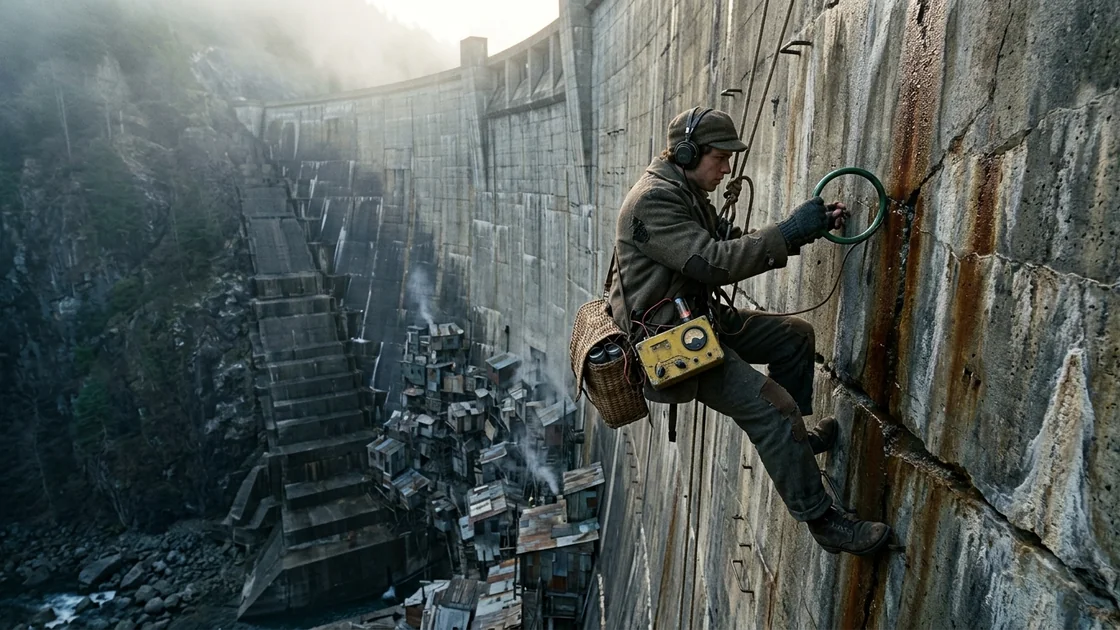
In the late twenty-first century, senior hardware engineer Marcus Vance designs a revolutionary ultra-low-power structural sensor engineered to survive and broadcast from deep within solid concrete for a hundred years. Obsessed with permanence in an era of disposable technology and accelerating global instability, he embeds his masterpiece into the foundation of a colossal hydroelectric megastructure just before civilization collapses. Over a century later, in a fractured world where ancient electronics are revered as relics, a young signal scavenger named Oren and a disgraced scholar named Vesper detect a faint, rhythmic radio pulse emanating from the heart of the crumbling monolith. As they risk their lives to excavate the anomalous transmitter amidst rival scavengers and shifting tectonic plates, they uncover not only Marcus's enduring technological marvel and his final hidden message, but also an urgent warning that the mountain of concrete is about to give way.
Chapter 1: The Tyranny of Leakage
Marcus Vance hated wasted electrons the way old priests hated sin. To him, an electron that tunneled through a silicon dioxide gate without doing useful work was a moral failure, a tiny concession to the entropy that was currently eating the world alive outside his laboratory window.
It was November in the year 2086, and rain was hammering the triple-paned ballistic glass of the fourth-floor annex in Tacoma. It was not the gentle, misting Pacific Northwest rain of Marcus’s childhood, the kind that smelled of cedar needles and cold salt water. This was an atmospheric river born off a superheated Kuroshio Current, tasting faintly of sulfur and Asian coal ash, slamming against the building in warm, violent sheets. Down on the avenue, the sodium streetlamps flickered as the municipal grid struggled to balance the load of ten thousand basement sump pumps against a failing transformer station in Renton.
Inside the cleanroom alcove, however, the air was sixty-eight degrees Fahrenheit, filtered to class-onehundred purity, and smelled exclusively of isopropyl alcohol and warm solder flux.
Marcus leaned over the probe station, his spine aching in the familiar spot between his shoulder blades. Through the binocular eyepieces of the microscope, the world was reduced to a two-millimeter square of dull gray silicon crisscrossed by microscopic highways of aluminum and copper. With his right hand, he adjusted the micrometer screw of a tungsten needle manipulator, easing the microscopic tip down until it kissed a test pad no wider than a human red blood cell.
On the bench beside him, the electrometer—a boxy, heavily shielded instrument that cost more than the hydrogen-cell hatchback parked in his driveway—stabilized its readout.
0.00042 picoamperes.
Four hundred and twenty attoamperes. Less than a setengah-femtoampere of quiescent sleep current.
Marcus let out a breath he felt like he had been holding since Tuesday. He didn't smile—he had broken himself of the habit of celebrating before thermal cycling tests were complete—but he reached out and tapped the casing of the electrometer with a knuckle.
"You're starving it to death, Marc," a voice said from the doorway.
Marcus didn't look up from the eyepieces. "It's not starving, Dev. It's hibernating. There's a difference. Bears don't die in January; they just stop wasting energy on vanity projects like walking around."
Devon Koothrappali, the project manager for the Department of Interior’s Infrastructure Resilience Initiative, stepped into the yellow-lit anteroom, shaking water from a heavy polymer poncho. Even through the glass partition of the semi-clean workspace, Devon looked exhausted. Everyone who worked for the federal government looked exhausted these days. They were trying to bail out a sinking continent with a teacup.
"The concrete contractors at Sentinel Gorge are already pouring the lower apron," Devon said, leaning against the laminar flow hood and crossing his arms. "They don't care if your chip sleeps on half a femtoamp or fifty nanoamps. Their spec asked for a twenty-year operational lifespan. A lithium-thionyl chloride primary cell the size of a walnut gives them twenty years with off-the-shelf components. Why are we still burning lab hours on custom silicon-on-sapphire substrates?"
Marcus finally pulled back from the microscope, rubbing the bridge of his nose where the rubber eye-cups had left twin red crescents. He was fifty-four years old, with hair the color of tin solder cropped close to his skull and eyes that had spent four decades staring at schematics until he saw logic gates when he closed them at night.
"Because lithium-thionyl chloride passivates," Marcus said, spinning his stool around. "And after thirty years, the seals corrode from the alkaline pore water in the concrete, the electrolyte leaks into the aggregate, and you've got a dead lump of toxic metal buried three hundred feet inside a gravity dam. And why twenty years, Dev? How long is the Sentinel Gorge Barrier supposed to stand?"
"The Army Corps of Engineers says five hundred years," Devon replied automatically.
"Right. Five hundred years. We are pouring forty million tons of high-slag Roman-grade geopolymer concrete into a tectonic canyon to hold back an inland sea because the snowpack in the Cascades is gone and the winter deluges are tearing the valleys apart. We build a wall for half a millennium, and we put twenty-year eyes inside it." Marcus shook his head, gesturing back toward the glowing probe station. "After2106, the engineers running that dam will be flying blind. They won't know if the central monolith is delaminating from the bedrock. They won't know if sulfate attack is turning the lower gallery into mush. They'll just look at the outside of the wall with binoculars and pray."
"In 2106, Marc, if they have problems, they'll drill core samples and drop new sensors down the boreholes."
Marcus looked at his younger colleague with a quiet, devastating pity. "Will they, Dev? With what diamond-tipped core drills? Made in which factories? Shipped on which diesel barges?"
Devon fell silent. The unspoken reality of the late twenty-first century hung between them like the hum of the air handlers. Global supply chains weren't chains anymore; they were frayed ropes snapping one strand at a time. The semiconductor foundry in Hsinchu that had etched Marcus’s experimental wafers six months ago had been shuttered indefinitely in August after the Typhoon Season broke the island's coastal seawalls and salted their ultrapure water reservoirs. The wafers sitting in Marcus’s nitrogen dry-box were quite possibly the last batch of 180-nanometer ultra-low-leakage silicon-on-insulator dies that would ever be fabricated in the Northern Hemisphere.
Everyone knew theLong Descent had begun. The news anchors called it the "Great Rebalancing" or the "Supply Contraction," using soothing macroeconomic jargon to explain why municipal water only ran six hours a day in Phoenix and why you couldn't buy replacement transformers for the regional grid unless you cannibalized a decommissioned suburb.
"I'm not building a twenty-year sensor," Marcus said softly, turning back to his bench. He picked up a pair of carbon-fiber tweezers and lifted a completed prototype from its foam tray. It was a black octagonal puck, roughly the size and thickness of an old silver dollar, made of sintered silicon carbide. It looked less like a piece of microelectronics and more like a basalt river stone polished by centuries of current. "I'm building a hundred-year canary. Maybe two hundred, if the silicon carbide seals hold."
Devon sighed, stepping closer to peer through the glass at the black puck. "Walk me through the power budget again. The brass in Denver wants to sign off on the final bill of materials by Friday, or they're pulling our grant and just burying passive fiber-optic strain lines."
"Fiber optics require an external laser interrogator in a control room," Marcus said, his voice warming with the fierce, defensive pride of an artisan. "Control rooms burn down. Control rooms get abandoned when the budget runs dry or the local militia takes over the powerhouse. An autonomous node doesn't need a control room. It just needs the laws of physics."
He tapped a laminated block diagram taped to the rack above his oscilloscope.
"Look. Standard CMOS technology is dead for this application. For fifty years, the industry chased Moore’s Law down to two nanometers so kids could render photorealistic explosions on their phones. But when you make transistor gates two nanometers thick, quantum mechanics ruins your life. Electrons tunnel right through the oxide layer. The chip leaks milliamps just sitting there doing nothing. It’s like trying to store water in a sieve."
"So you went backward," Devon said.
"I went back to 1999," Marcus corrected. "A hundred-and-eighty-nanometer planar process on a fully depleted silicon-on-sapphire wafer. Thick gate oxides. High threshold voltages. I biased the substrate natively so the transistors are held in deep sub-threshold exhaustion. At room temperature, the entire sixteen-bit state machine and the thirty-two kilobits of ferroelectric RAM draw four hundred attoamperes."
"And the power source?"
"Dual-stage," Marcus said, setting the silicon carbide puck down with a sharp clack against the ESD mat. "The baseline heartbeat is a tritium beta-voltaic cell. Just a microscopic sandwich of titanium tritide trapped between two p-n junctions of wide-bandgap silicon carbide. As the tritium decays into helium-3, the beta particles slam into the semiconductor and kick loose electron-hole pairs. It only generates eighty nanowatts, and with tritium's twelve-year half-life, that drops to a quarter of a nanowatt after a century. That’s not enough to fire a radio transmitter."
"Which brings us to the acoustic harvester," Devon murmured, nodding slowly.
"Exactly. The concrete isn't dead, Dev. A dam that size is a living, breathing beast. Every morning when the sun comes over the ridge and hits the downstream face, three千万 tons of concrete expand by a fraction of a millimeter. Every time the reservoir level rises after a storm, the hydrostatic pressure bends the central arch into the gorge walls. Every time a micro-tremor ripples up from the Cascadia fault zone, acoustic waves bounce through the monolith like a struck bell."
Marcus pointed to a cross-section schematic of the puck. Inside the silicon carbide shell sat a cantilevered beam of barium titanate ceramic weighted with a tiny slug of depleted uranium salvaged from old aviation counterweights.
"No lead," Marcus noted. "Lead zirconate titanate depoles and degrades over decades. Pure barium titanate crystal lattices, mechanically pre-stressed. Every time the dam groans, shifts, cools, or vibrates at its resonant frequency of 4.2 hertz, that crystal flexes. Every flex shoves a few microcoulombs of charge through a cold-cathode Schottky diode bridge into a solid-state tantalum-niobium capacitor array. No liquid electrolytes to dry out. Just solid metal and ceramic."
"And when the capacitor hits three point three volts?"
"A comparator trips," Marcus said. "The state machine wakes up for exactly twelve milliseconds. It reads the resistive bridge strain gauges bonded to the outer shell, reads the local temperature from the bandgap reference, packs the telemetry into a sixty-four-bit frame, and dumps the entire capacitor bank into a surface-acoustic-wave oscillator tuned to 433.92 megahertz. One chirp. Ten milliwatts of radiated RF power, magnetically coupled directly into the structural rebar cage of the dam."
Devon blinked. "Wait. You're using the rebar as the antenna?"
"Concrete attenuates high-frequency radio waves like lead attenuates X-rays," Marcus explained. "especially when it's wet. If you try to broadcast at two-point-four gigahertz from fifty feet inside a dam, the water molecules in the cement paste just absorb the energy and turn it into heat. Nobody outside would hear a whisper. But at four hundred and thirty-three megahertz, the wavelength is about seventy centimeters. Our pucks clip directly onto the number-eighteen steel reinforcing bars before the pour via a ferrite inductive collar. When the puck pulses, it excites the rebar cage itself. The entire steel skeleton of the dam becomes a massive, leaky, distributed dipole antenna. You could pick up that pulse half a mile downstream with a hand-wound loop of copper wire and a germanium diode."
For a long moment, the only sound in the lab was the rhythmic thump-hiss of the building's air filtration dampers and the relentless drumming of the rain against the glass.
Devon looked from the schematic to the small black octagon on the mat, and then up at Marcus. "How many of these do you have ready?"
"Two hundred and forty," Marcus said. "Encapsulated, baked out, thermal-shocked in liquid nitrogen, and pressure-tested to ten thousand PSI in the autoclave. They're sitting in the pelican cases by the freight elevator."
Devon let out a long breath, his shoulders dropping an inch. "The pour for the central foundation block—Monolith Four, right down on the basalt bedrock—starts Thursday at midnight. They're doing a continuous seventy-two-hour slip-form drop. If your pucks aren't tied to the steel by seventeen hundred hours on Thursday, they're staying in Tacoma."
"I'll drive them up the pass myself tomorrow morning," Marcus said.
"Take the armored department Humvee," Devon advised, turning toward the door. "The state patrol closed Highway 410 near Enumclaw yesterday. Some timber-town squatters blew a culvert trying to hijack a FEMA grain convoy. You'll have to take the logging roads around Mud Mountain."
"I know the roads," Marcus said.
When Devon was gone, the heavy airlock door clicking shut behind him, Marcus didn't pack up the pelican cases. Instead, he walked over to his private locker at the back of the annex, spun the combination dial, and pulled out a single, unsealed prototype sitting inside a pristine aluminum wafer carrier.
On the silk-screened top of the internal circuit board, beneath the golden spiderweb of wire bonds, the designation was etched in microscopic aluminum lettering: CHRONOS-NODE 000.
Marcus carried it back to the workstation and powered up the focused-ion-beam mill. He had six hours before his wife expected him home, and he knew she would already be asleep anyway. He had some editing to do in the read-only memory.
Chapter 2: The Heat of Hydration
Elena Vance was packing boxes in the dining room when Marcus finally unlocked the front door at two in the morning.
Their house in North Tacoma was a hundred-year-old Craftsman bungalow built from old-growth Douglas fir that didn't exist in the wild anymore. Once, it had overlooked the sparkling blue expanse of Puget Sound. Now, even in the pitch dark, you could smell the low-tide rot of the mudflats where the rising waters had drowned the old railroad seawall, mixing with the omnipresent woodsmoke of ten thousand neighbors burning scavenged furniture to keep the damp out of their bones.
Elena didn't look up as he set his wet canvas tool bag on the linoleum. She was wrapping her grandmother’s porcelain teacups in pages torn from old hydrologic survey journals—thick, glossy government paper from the 2050s showing river basins that had since dried into alkali flats.
"You missed dinner," she said. Her voice wasn't angry. That was the worst part. When a marriage still had anger in it, it still had voltage. Elena sounded like an open circuit.
"I had to finish the ROM masks on the reference node," Marcus said, unbuttoning his damp flannel shirt. "Devon says they're pouring Monolith Four on Thursday night. I have to leave for the gorge at six."
Elena taped a box shut with a sharp, tearing screech of packing tape. She was a senior fluvial geomorphologist for the state, or she had been until the state legislature suspended non-essential agency payrolls in September. Now she had a contract with the Great Lakes Water Authority in Duluth. Her sister lived in Minnesota; there was still potable groundwater there, and the grid stayed up twenty hours a day.
"The movers are coming Saturday, Marc," she said, finally looking at him. Her dark hair was pulled back in a messy knot, streaked with silver that seemed to have doubled in the last two years. "The diesel allotment for the truck is only valid through Sunday midnight. If I'm not across the Idaho border before the November rationing kicks in, they'll impound the van in Spokane."
"I'll be back by Friday afternoon," he lied. They both knew it was a lie. Once the concrete pour started on a primary dam monolith, the instrumentation engineer didn't leave the catwalk until the last bucket of slurry was vibrated into place.
"Come with me," she said softly. She stood up, wiping dust from her jeans, and stepped over to him. She put a hand on his chest, right over his sternum. "Leave the pelican cases on Devon's desk. Let some twenty-five-year-old junior tech tie them to the rebar. You don't owe that canyon anything, Marcus."
He looked down at her hand. Her fingers were rough from cardboard and dry paper. He loved her—he had loved her for twenty-eight years, ever since they met in a graduate thermodynamics seminar at Berkeley—but when he looked at the boxes stacked in the hallway, a cold, suffocating panic seized his throat.
"In Duluth, what am I going to do, El?" he asked quietly. "Manage a warehouse of cannibalized solar inverters? Patch up sixty-year-old SCADA boards with jumper wires until the solder runs out?"
"You're going to live with your wife," she said, her eyes flashing with a sudden, desperate heat. "We're going to grow potatoes in a cold frame and read books and grow old together while the lights go out. Why isn't that enough for you?"
"Because everything we did is disappearing!" The words burst out of him louder than he intended, echoing off the bare plaster walls where their framed photographs had hung until last week. He gestured wildly toward the dark window. "Think about it, Elena. Ten thousand years of human civilization. We figured out how to refine quartz into ninety-nine-point-nine-nine-nine-nine-nine percent pure silicon crystals. We learned how to dope it with individual atoms of boron and phosphorus. We built machines that manipulate matter at the scale of light waves! And in fifty years, all of it—the cloud servers, the smartphones, the fiber-optic backbones, the satellites—it’s all going to be rust and toxic dust. The magnetic domains on the hard drives will flip from thermal noise within twenty years. The flash memory cells in every data center on Earth will leak their charge through their tunnel oxides before the century is out. We wrote our entire species' history on tissue paper with disappearing ink!"
Elena stared at him, her hand falling away from his chest. "And your little black pucks are going to save us?"
"They're going to last," Marcus whispered. He reached into his coat pocket and pulled out Chronos-Node 000. He held the cold silicon carbide octagon out on his palm. "Do you know what I put in the upper memory registers tonight? Using the focused ion beam, I physically milled away the aluminum interconnects on a bank of rom cells. No floating gates to leak charge. Hard-wired ones and zeros carved into silicon on sapphire."
"What did you write?" she asked warily.
"After the internal counter registers thirty-six thousand, five hundred and twenty-five daily wake-up cycles—one hundred years—or if the shear strain across the monolith exceeds four thousand micro-strain, the state machine stops sending standard telemetry headers. Instead, it cycles through a four-kilobyte block of extended ASCII text, eight bytes per chirp."
"Four kilobytes," Elena repeated, a bitter smile touching her lips. "The sum total of human wisdom in four thousand letters?"
"No," Marcus said. "First, the structural failure tables for the dam, in plain English and simple hexadecimal, so if anyone is still living down in that valley and has the brains to build a crystal radio, they'll know what the numbers mean when the wall starts to go. And in the last five hundred bytes..." He hesitated, looking at the dark, polished stone in his hand. "I put our names. Yours and mine. The latitude and longitude of this house. A description of what the rain sounded like tonight, and the quadratic formula, and the atomic weight of carbon, and the fact that we knew what was happening to the world and we tried to hold the water back anyway."
Elena looked at the puck for a long time. When she looked back up at his face, her eyes were wet, shining in the amber glow of the battery-powered lantern on the dining table.
"You're building a tombstone, Marc," she whispered. "And you're climbing inside it while you're still breathing."
She turned and walked up the stairs to the bedroom, her footsteps creaking on the old fir treads that had survived a century of Tacoma rain and would probably survive a century more, long after the people who walked on them were gone.
Marcus stood alone in the dining room for an hour, the silicon carbide puck growing warm in his clenched fist.
Thirty-six hours later, Marcus stood at the bottom of the world.
That was what the excavation trench of the Sentinel Gorge Barrier felt like. Two miles upstream from where the old Green River used to carve through the basalt cliffs of the western Cascades, the Army Corps of Engineers had blasted a keyway two hundred feet deep into the living black rock of the planet's crust.
Above him, the canyon walls rose eight hundred feet into a swirling ceiling of yellow-gray mist and freezing drizzle. Halogen floodlights mounted on towering lattice cranes cut through the gloom like the searchlights of stranded battleships, illuminating a chaotic, mud-choked purgatory of steel and stone. The roar was physical—a continuous, chest-rattling bass note composed of diesel generators, rock crushers, high-pressure water cannons stripping loose shale from the abutment walls, and the distant, ominous rumble of the diversion tunnels where the swollen river was currently raging around the construction site like a caged animal.
Marcus wore a yellow hard hat, steel-toed rubber boots knee-deep in gray alkaline slurry, and a heavy canvas tool vest weighed down with stainless-steel zip ties and ferrite collars.
He was deep inside the rebar cage of Monolith Four—the central foundation block that would bear the brunt of the reservoir's hydrostatic thrust. Around him rose a three-dimensional forest of number-eighteen deformed steel reinforcing bars, each rod two and a quarter inches thick, tied together in a relentless twelve-inch grid that stretched forty feet overhead and a hundred feet in every direction. Navigating the cage was like climbing through the iron ribs of a fossilized leviathan.
"Five minutes on the first bucket, Doc!" yelled the rigging foreman from the timber catwalk twenty feet above. The man was a silhouette against the glare of the halogen banks, gesturing toward the sky where the shadow of an eight-cubic-yard cableway bucket—big enough to swallow a city bus—was swinging out from the mixing plant on the north rim.
Marcus didn't answer. He was wedged into the intersection of the primary shear key, right where the vertical king-bars met the deep basalt anchor dowels grouted forty feet into the bedrock beneath his boots. This was the absolute dead center of the dam's footprint. Once the concrete closed over this spot, it would never see sunlight again until the continents eroded flat.
His hands were numb with cold and raw from the rusted ridges of the rebar, bleeding through a tear in his nitrile gloves. He pulled Chronos-Node 000 from his breast pocket.
He clamped the two halves of the high-permeability manganese-zinc ferrite collar around the massive vertical steel bar, tightening the silicon-bronze bolts with a torque wrench until the Belleville washers flattened. Then he snapped the octagonal silicon carbide puck into the keyed recess of the collar, locking the retaining bail into place.
He pulled a ruggedized handheld transceiver from his belt and keyed the interrogation button.
On the tiny OLED screen, a green line spiked cleanly at 433.920 megahertz.
NODE ID: 0000 TEMP: 6.4 C STRAIN_X: 0002 uE STRAIN_Z: 0001 uE CAP_V: 3.31 V CYCLE: 000000
"Wake up, little ghost," Marcus muttered, his breath pluming white against the rusted steel.
Above him, a klaxon sounded—three short, deafening blasts that echoed off the wet basalt cliffs.
"Clear the hole!" the foreman bellowed from the catwalk. "Gate's opening! Clear the steel!"
Marcus took one last look at the small black stone clamped to the iron bar. He reached out with his torn glove and smeared a streak of his own blood and gray rock dust across its ceramic face. Then he turned and scrambled up the rebar ladder rungs, his heavy boots slipping on the wet steel, hauling himself onto the timber catwalk just as the gigantic cableway bucket settled ten feet above the grid.
A pneumatic ram hissed. The clamshell jaws at the bottom of the bucket snapped open.
Sixteen tons of low-heat pozzolanic concrete dropped into the rebar cage with a sound like a collapsing glacier. The gray mass hit the bedrock, splattering alkaline paste up onto Marcus’s boots, and immediately four laborers in rubberized suits lowered six-inch pneumatic vibrators on heavy hoses down into the slurry.
The vibrators kicked on with a high-pitched, dentist-drill whine that vibrated through Marcus’s teeth. Under the high-frequency agitation, the stiff mound of rock, blast-furnace slag, fly ash, and Portland cement liquefied, flowing smoothly around the thick steel bars, filling every void, swallowing the anchor dowels, climbing inch by inch up the vertical column.
Marcus leaned over the wooden rail, watching as the gray tide rose toward Node 000.
A gray wave crested over the ferrite collar. An air bubble burped to the surface, popped, and then the second bucket was swinging in from the darkness overhead. Within three minutes, the sensor was beneath six feet of stone. Within twelve hours, it would be beneath fifty feet.
Marcus stayed on the catwalk as the rain turned to sleet. As the hours bled into Friday morning, and the monolith rose tier by tier, he could feel the air inside the canyon growing warmer. It was the heat of hydration—the exothermic chemical reaction of calcium silicates reacting with water, growing trillions of microscopic interlocking needles of tobermorite gel that bound the crushed basalt and river gravel into artificial rock. The dam was cooking itself into permanence.
In his pocket, his handheld receiver beeped once.
Despite forty feet of wet, dense concrete and a storm of electromagnetic noise from the crane motors, the inductive pulse had climbed up the two-inch steel rebar right to the protruding dowels at the top of the lift, radiating out into the wet night air.
NODE ID: 0000 TEMP: 41.8 C STRAIN_X: 0084 uE CYCLE: 000001
Marcus looked at his watch. It was four in the afternoon on Friday. In Tacoma, the diesel moving van was probably already idling in the driveway of the Craftsman bungalow. If he left right now and drove sixty miles an hour down the logging trails, he could make it before Elena locked the front door for the last time.
He looked down into the rising gray pit, where two hundred and thirty-nine more sensors were waiting in his pelican cases to be wired into the upper galleries over the next six months.
Marcus turned off the handheld receiver, zipped his coat against the sleet, and walked back toward the equipment tent to open the next case.
In the dark, time had no weather.
For the first seven years, Node 000 lived in a tropical sauna. Surrounded by a hundred feet of insulating concrete on every side, the heat of hydration lingered long after the construction cranes were dismantled and the diversion tunnels were plugged with concrete. The temperature around the silicon carbide puck peaked at fifty-eight degrees Celsius, then began a long, asymptotic cooling curve that would take four decades to match the ambient temperature of the mountain river water pressed against the upstream face.
During those forty years, the concrete cured and shrank by microscopic fractions, squeezing the silicon carbide shell with a steady, comforting compressive grip of twelve hundred pounds per square inch.
Inside the puck, in absolute darkness, the universe consisted purely of physics.
In the beta-voltaic layer, tritium nuclei underwent spontaneous beta decay, spitting out low-energy electrons that struck the silicon carbide p-n junction. The current was unimaginably small—a lazy trickle of individual electrons wandering across the depletion zone into the storage capacitor, like single drops of water falling from a cave ceiling into an underground cistern.
And there was sound.
During the first fifteen years, the acoustic environment was dominated by a steady, sixty-hertz hum—the titanic spin of the four Francis turbines in the powerhouse at the base of the dam, converting the weight of the reservoir into megawatts for the desperate, shrinking cities of the coast. The sixty-hertz vibration tickled the barium titanate cantilever inside Node 000, keeping its tantalum capacitor topped up to a healthy three-point-three volts. Every eighty-six thousand four hundred seconds, measured by the slow relaxation of an internal sub-threshold resistor-capacitor oscillator calibrated against a quartz tuning fork, the chip woke up, took the mountain’s pulse, screamed a twelve-millisecond burst of numbers into its steel bar, and went back to sleep.
Around Cycle 6,200—seventeen years after the pour—the sixty-hertz hum began to stutter.
The turbines would spin down for days at a time, then start up with violent hydraulic hammering as operators who didn't quite understand the automated load-balancing systems slammed the wicket gates open and shut.
At Cycle 8,112, there was a sharp, high-frequency shockwave—not tectonic, not hydraulic. The crisp, unmistakable brisance of high explosives detonating somewhere near the upper spillway crest, followed three minutes later by the catastrophic mechanical seizure of Turbine Three as its lubricating oil pumps lost power and fifty tons of spinning steel welded itself to its bronze bearings in a shriek of tortured metal that rang through the concrete foundation like a gunshot.
After Cycle 9,400, the sixty-hertz hum stopped forever.
The dam went quiet, save for the eternal groan of the water.
Without no one to open the lower sluice gates or regulate the spillways, the reservoir behind the Sentinel Gorge Barrier rose until it overtopped the central overflow weir during the winter deluges, turning the entire seven-hundred-foot face of the dam into a roaring cataract for four months of the year, and dropping to a stagnant, silt-choked lake in the scorching, smoke-blackened summers.
Centuries of mountain erosion washed down from the stripped, burned-over slopes of the Cascades. Millions of tons of gravel, dead timber, and glacial silt settled against the upstream face of the dam, burying the lower intake towers under three hundred feet of anaerobic mud. The weight against Monolith Four increased year by year.
Inside the puck, the tritium decayed. One half-life passed. Then two. Then five. By Cycle 30,000, the beta-voltaic cell was nearly dead, reduced to helium-3 gas trapped in titanium lattice defects.
Now, the sensor survived entirely on the pain of the mountain.
It drank the thermal expansion waves of the summer sun. It drank the deep, sub-audible rumble of the Cascadia Subduction Zone shifting under the Pacific plate. It slept for days when the weather was calm, its internal clock drifting ligeramente as the capacitor voltage dipped toward its two-point-one-volt brownout floor, only to be jolted back to full charge when a winter flood slammed into the gorge or a frost-heave cracked an upper parapet wall.
At Cycle 36,525, a carry-bit flipped in the sixteenth register of the ferroelectric RAM.
A single transistor gate pulled high, routing the memory pointer away from the standard telemetry header block and connecting the output shift register to the focused-ion-beam ROM array that Marcus Vance had carved on a rainy night a hundred years before.
The sensor did not know that the cities were gone. It did not know that trees were growing through the roof of the Tacoma lab, or that the bones of Marcus and Elena Vance lay arot two thousand miles apart.
It simply waited for the capacitor to charge, read the strain on its ceramic shell, and shouted its eight bytes of letters into the rusted iron dark.
Chapter 3: The Ghost-Catcher of the Apron
Oren hated climbing the Weeping Wall before the sun hit it, because the lime-water froze on the iron rungs and took the skin off your knuckles if your gloves were thin.
And Oren’s gloves were always thin.
He hung four hundred feet above the river boulder field, his boots wedged into a spalling crack in the vertical concrete face of the Great Barrier, one arm hooked through the strap of his wooden wicker pack while he blew warm breath onto his raw fingers.
Below him, clinging to the massive stepped buttresses of the lower spillway apron like barnacles on the hull of a petrified ship, lay the Scaffold-Town of Crag. Three hundred souls lived there in huts hammered together from corrugated aluminum siding, salvaged cedar planks, and woven tarpaulins waterproofed with boiled pine pitch. Thin ribbons of blue alder smoke rose from clay stove-pipes, curling upward along the towering gray curve of the dam face before dispersing into the cold morning fog of the gorge.
Above him rose three hundred more feet of concrete, culminating in the Broken Crown—the jagged rim of the barrier where the Water-Gods of the Old World had fought some forgotten battle before the Quiet came, leaving huge chunks of the upper roadway hanging by twisted tendons of three-inch steel rebar.
Oren wasn't looking for rebar today. The Hydraulic Guild owned all salvage rights to structural steel thicker than a man's thumb, and if the Castellan’s bailiffs caught you on the face with a hacksaw and a pry-bar without a brass tally-token around your neck, they didn't bother hauling you down to the magistrate. They just cut your hemp safety line and let the boulders at the bottom of the apron sort out the legalities.
Oren was hunting ghosts.
He shifted his weight on the narrow ledge where a horizontal lift-joint had eroded six inches deep from a century of freeze-thaw cycles. From his wicker pack, he unslung the Box.
The Box was Oren’s patrimony, left to him by his uncle Brenn before the white-lung took him. It was housed inside an ancient yellow plastic case that had once borne the faded black letters FLUKE, though the original guts had died fifty years ago. Inside the waterproofed shell sat a circuit board cobbled together from five different eras of dead technology, soldered onto a slab of copper-clad phenolic resin using pine-rosin flux and lead scraped from the battery graves down in the flats.
Its heart was a single sub-miniature glass vacuum tube salvaged from an ancient military artillery proximity fuse—the kind with filament wires thin as spider silk that could survive being fired out of a cannon—paired with a brass variable capacitor salvaged from a pre-Fall car radio and a tiny, priceless crumb of black silicon-germanium diode locked inside a glass bead. Power came from six copper-zinc jar cells bubbling softly with vinegar and salt water in the bottom of Oren's pack.
Oren slipped a pair of cracked bakelite headphones over his ears, adjusting the steel headband over his wool cap. In his right hand, he held his probe: a two-foot loop of thick, green-corroded copper tubing bent into a circle, with a smaller inductive pickup loop nested inside its base.
He pressed the copper loop flat against the weeping gray stone of the dam face, right where a rusty brown stain bled out of a hairline fracture—the telltale sign of a deep reinforcing bar oxidizing beneath the surface.
He closed the filament switch. Inside the yellow box, the tiny tube began to warm.
In his ears, the world of stone and cold wind vanished, replaced by the hiss of the cosmos.
Shhhhhhhhhhhhhh.
Oren closed his eyes. To the other scavengers in Crag—the muscle-bound iron-breakers who chipped out aggregate for mortar, or the mud-divers who dredged the downstream pools for copper turbine windings—the noise in Oren’s headphones was just the sound of grease frying in a pan.
To Oren, it was a landscape.
There was the low, crackling roar of lightning storms three hundred miles away over the ocean, bouncing off the upper sky. There was the soft, rhythmic whir-click of the static discharge brushes on the Guild’s wind-mill atop the north buttress. And beneath that, the deep, endless thermal hiss of atoms jiggling in the cold stone of the barrier.
He slowly thumbed the brass dial of the tuning capacitor, sweeping up through the high frequencies where the air was usually as dead as a pharaoh's tomb. Nobody in the valley knew how to make oscillations above thirty megahertz anymore; their clumsy spark-gap transmitters and giant triode tubes down in the trade-towns couldn't switch fast enough. The ultra-high frequencies belonged strictly to the dead. Sometimes, once in a blue moon, if you were high up on the rim at midnight, you would catch the faint, warbling whistle of a tumbling orbital derelict passing overhead, its solar panels catching the sun for ten minutes before it plunged back into Earth's shadow and died.
The Guild paid three silver trade-rings for the exact coordinates of a live conduit or a buried junction box inside the dam's skin—places where they could chisel six inches into the concrete and pull out fifty pounds of pristine, uncorroded copper coaxial cable or gold-plated connector pins without wasting expensive black powder on blind blasting.
Oren swept past the dead television bands. Past the silent aviation channels.
Around the mark his uncle had scratched into the brass dial with a knife tip—430—he stopped.
Down on the canyon floor, the morning shadow of the eastern peaks was sliding rapidly down the valley wall as the sun cleared the jagged teeth of the Cascades. A curtain of pale, golden warmth rushed across the river boulders, climbed the timber scaffolds of Crag, and struck the vast, curving concrete wall of the Barrier.
Oren held his breath, pressing the copper loop harder against the rust-stained crack.
Wait for the rock to wake up, his uncle had taught him. The Ancients put spirits in the stone that eat the sun.
A minute passed. The sunlight hit Oren’s shoulders, warming his threadbare wool coat. Across the seven-hundred-foot expanse of the dam, millions of tons of gray concrete absorbed the solar radiation. A microscopic wave of thermal expansion rippled inward from the downstream face, pushing against the cold, water-soaked core of the monolith. Deep inside the mountain of man-made stone, steel pulled against silicate; microscopic fractures rubbed together with inaudible friction.
Tink.
A tiny flake of ice fell from the ledge above Oren’s head.
And in his headphones:
Brrrrt-pip.
Oren’s eyes snapped open. His heart gave a hard, painful thud against his ribs.
It wasn't the fuzzy, wandering whistle of a dying satellite, nor the sloppy, broad-spectrum crackle of a rubbing static wire. It had lasted less than the blink of an eye—twelve thousandths of a second—but it was as sharp and clean as a diamond scratching glass. A tight, modulated burst of pure digital teeth.
He waited, his fingers frozen on the brass dial.
Ten seconds later, another chirp came—fainter this time, slightly off-pitch, like an echo from deeper in the gorge wall.
Brrrrt-pip.
And then a third, lower down toward the base, ragged and staticky, cutting off halfway through its burst as if its throat had been slit.
Then, from straight through the rock beneath his hand—loud, resonant, ringing up the buried two-inch steel rebar from the very bowels of the canyon floor—came the King Ghost.
BRRRRT-PIP-PIP-BRRRT.
Longer than the others. Stronger. And it didn't just fire once as the sun hit the wall. As Oren pressed his ear-cups tight against his skull, almost slipping off the six-inch ledge in his excitement, the deep signal fired again forty seconds later.
BRRRRT-PIP-PIP-BRRRT.
"Blood and rust," Oren whispered to the cold wind.
He had been climbing the Weeping Wall since he was nine years old. He had mapped three dozen of the little stone-ticks over the years—the silent, harmless chirpers that pulsed once at dawn and once at dusk when the wall cooled, marking the locations of the deep iron ribs. Once, three years ago, the Guild had forced him to lead an excavation crew into a shallow drainage adit to dig one up, hoping for a vault of ancient weapons or medical injectors. After breaking twenty steel chisels and four men's backs against ten feet of granite-hard concrete, all they had found was a little black stone octagon clamped to a steel bar with a broken collar. When the Castellan’s smith smashed it open on an anvil with a sledgehammer, there was nothing inside but a flake of white ceramic and a speck of shiny gray dust no bigger than a flea. They had beaten Oren with a pick-handle for wasting a week of Guild rations and docked his salt scripting for a month.
Since then, nobody cared about the dawn-ticks. They were just the dead clocks of the Ancients, ticking away in the dark for no reason at all.
Except the dawn-ticks only chirped once a day.
Oren looked down between his boots at the roaring white apron four hundred feet below, and then pressed his bare palm flat against the damp concrete beside his copper loop.
He couldn't feel it with his skin—not quite. It was too low, too vast for human nerves to register as motion. It was more like a pressure in his back teeth, a subliminal sickness in the inner ear. The forty-million-ton mountain of stone beneath him was vibrating like a bowstring pulled one notch too tight.
And deep down at the bottom of the gorge, the King Ghost wasn't ticking anymore. It was screaming every forty seconds.
Chapter 4: The Disgraced Archivist
Vesper lived in the old Transformer Vault on the third tier of the north buttress, where the air always smelled faintly of burnt polychlorinated biphenyls and dried lavender.
The Guild had stripped the vault of its massive copper induction coils eighty years ago, leaving a cavernous concrete room with twenty-foot ceilings, giant porcelain insulator bushings sticking out of the walls like fossilized vertebrae, and a heavy steel blast door that Vesper kept barred against the damp and the bailiffs alike.
When Oren hammered the secret rhythm on the iron hatch at noon, it took three minutes of rattling chains and sliding bolts before the door cracked open an inch. A single dark eye, magnified to grotesque proportions by a jeweler’s loupe strapped to a leather headband, peered out at him.
"Do you have a warrant or a circuit?" Vesper’s voice was a dry rasp, the product of sixty years spent breathing paper dust and soldering fumes.
"Neither," Oren said, glancing nervously down the slick timber catwalk toward the rope-lifts. "I have a voice from the bedrock. And it's talking in long-frame."
The chain dropped immediately. Vesper yanked him inside by the collar of his wool coat and slammed the iron door shut, throwing the heavy bolt home with a clang that echoed off the porcelain insulators.
The interior of the vault was lit by three whale-oil gimbal lamps and a string of ancient, flickering emerald light-emitting diodes that Vesper ran off a salvaged nickel-iron battery bank. Every horizontal surface was buried under debris that would have gotten a regular scavenger hung for hoarding unlicensed relics: stacks of rotting green circuit boards, jars of sorted surface-mount resistors no bigger than grains of pepper, and dozens of fat three-ring binders wrapped in oilskin, containing the water-stained, fading laser-printed pages of the Sentinel Gorge Hydroelectric Project: As-Built Instrumentation & Control Manuals, Vol. IV.
Vesper was a woman of sixty-five, though in Crag that made her practically immortal. Her back was curved into a permanent question mark from decades of hunching over schematics, and the fingers of her left hand were stained a permanent, indelible purple-black from silver nitrate ink. Five years ago, she had been the First Clerk of the Hydraulic Guild, keeper of the Sacred Diagrams. Then she had committed the unpardonable political sin of informing Castellan Vane that the main spillway radial gates were rusted shut in the closed position, and that the deep silt bed behind the wall was slowly tipping the upper third of the dam forward by two millimeters a year.
Castellan Vane’s power—and the tax he levied on every caravan crossing the river gorge on the lower timber bridges—rested entirely on the theological certainty that the Great Barrier was an eternal mountain created by the Ancients to stand until the stars went out. He had burned Vesper’s survey transits in the public square, broken three of her fingers with an iron plumb-bob, and exiled her to the dry vaults on half-rations.
"Take off the wet coat before you drip on the schematics," Vesper snapped, already hobbling back toward her central workbench. "What do you mean, long-frame? The strain-motes in the monoliths are sixty-four-bit fixed registers. Preamble, twelve-bit node address, sixteen-bit axial strain, sixteen-bit shear, eight-bit temperature, cyclic redundancy check. Twelve milliseconds. Brrt-pip. That's all they know how to say. The engineer who designed them was a minimalist."
"Marcus Vance," Oren said, reciting the name from the faded title blocks Vesper had taught him to read when he was twelve.
"Vance, yes. May his silicon never delaminate," Vesper muttered, touching two fingers to her forehead in the absentminded superstitious gesture of the Guild clerks. "Now show me what you dragged off the wall, boy. My tea is getting cold."
Oren didn't just bring his receiver. From the padded center of his wicker pack, he lifted a heavy brass cylinder mounted on a hand-cranked lead-screw frame, accompanied by a funnel-shaped horn made of stiffened parchment. It was a mechanical phonograph recorder he had built with a watchmaker's gear-train, using a sewing needle coupled to the diaphragm of a high-impedance magnetic telegraph earpiece.
"I didn't have enough battery to run the wire-spooler," Oren explained, setting the contraption on the bench beside Vesper's oil lamp. "So I coupled the heterodyne output down to an audible beat-frequency at eight hundred cycles and cut it straight into beeswax while I was hanging on Monolith Four."
Vesper adjusted her jeweler's loupe, leaning over the pale yellow wax cylinder. "You cut a four-hundred-megahertz spread-spectrum chirp onto a hand-cranked wax tube while hanging from a hemp rope in a sleet storm?"
"I braced my elbows against the rebar," Oren said defensively. "And I slowed the governor spring down so the needle could track the envelope. Listen."
He disengaged the cutter head, dropped the blunt bone playback stylus into the microscopic groove at the end of the wax cylinder, and released the clockwork brake.
The brass cylinder spun with a soft whir of oiled gears. From the parchment horn came the scratchy, rushing sound of wax noise, and then—stretched out by the slow playback speed into a series of distinct, warbling musical tones—came the ghost of Monolith Four.
Wee-ooo-wee-ooo-pip-pip-wee-ooo-pip...
Instead of a crisp fractions-of-a-second snap, the packet rolled out for nearly four seconds. And when it finished, there was a brief pause of hissing wax, and then it started again.
Vesper froze. Her gnarled hand hovered over the workbench, trembling slightly.
"Play it again," she whispered. "And connect the earpiece leads to the green tube."
The "green tube" was Vesper’s greatest treasure, hidden beneath a greased canvas tarp at the back of the bench lest any Guild informant catch sight of its glow through a crack in the floorboards. It was an ancient, portable cathode-ray oscilloscope from the mid-twentieth century—a vacuum-tube monster that had survived the electromagnetic pulses and semiconductor rot that killed all the sleek digital flat-screens of Marcus Vance's era. Vesper only powered it up for ten minutes a month, pedaling a bicycle-frame dynamo with her own arthritic legs while Oren regulated the voltage with a carbon-pile rheostat.
Oren didn't use the bicycle today; he hooked his six vinegar-salt cells in series with Vesper’s nickel-iron bank, flipping the heavy iron knife switch on the wall.
Transformers hummed. Vacuum heaters glowed dull orange in the dusty bowels of the chassis. On the round, five-inch glass face of the cathode-ray tube, a single dot of blinding emerald fire bloomed into existence, then stretched into a nervous, horizontal green line as the sweep circuit caught hold.
Oren clipped two alligator leads from the magnetic earpiece across the vertical deflection plates of the tube and dropped the bone needle back onto the spinning wax cylinder.
The green line erupted into a jagged fortress of square waves.
Vesper snatched a piece of charcoal and a strip of butcher paper, her eyes darting back and forth between the dancing green phosphor trace and an oilskin binder open to a page titled CHRONOS-MOTE TELEMETRY PROTOCOL (REV 4.2 - 2085).
"Address Zero-Zero-Zero-Zero," Vesper breathed, her charcoal flying across the paper in sharp, slashing strokes of ones and zeros. "That’s the primary benchmark node. The deep keyway right on the basalt fault line. Look at the repetition rate, Oren! The beta-cell should be dead by now—it's been a hundred and thirty-three years since the pour! How is it firing every forty seconds?"
"The piezoelectric beam," Oren said, pointing at the waveform where the voltage flag bits were pinned at maximum. "It's harvesting strain energy from the rock. Look at the second register—wait, why isn't that a strain number?"
Vesper stopped writing. The green wave on the tube pulsed again as the wax cylinder completed another revolution.
"Because the sixteenth bit in the status header is pulled high," Vesper said slowly. Her voice had gone very quiet. She flipped furiously to the back of the manual, past the calibration charts, past the concrete mix tables, to the final appendix where the paper was yellow and brittle. She ran her purple-stained finger down the page, then frowned. "It's not in the manual. The manual says Bit Sixteen is reserved for future expansion."
"It's not empty," Oren said. He knew binary—he had learned it from Vesper’s old ASCII charts before he learned to read standard script. He pointed at the eight-byte payload block trailing behind the strain numbers. "Zero-One-Zero-Zero... that's capital letters. Eight letters per pulse. And look—on the second pulse on the wax, the letters change. It's stepping through a table."
For the next two hours, the vault was silent save for the continuous whir-scratch of the wax cylinder, the hum of the dying battery bank, and the scratch of Vesper’s charcoal. Oren rewound the clockwork spring twenty times, his fingers cramping as he nudged the bone needle back groove by groove, squeezing every drop of data from the three minutes of wax he had recorded on the ledge.
When the green line on the cathode-ray tube finally shrank to a dim yellow dot as the batteries exhausted themselves, Vesper sat back on her stool.
On the butcher paper in front of her, beneath a terrifying column of hexadecimal numbers, she had assembled the fragmented eight-byte slices into a continuous string of English text:
...CRIT SHEAR 4200 uE EXCEEDED AT BASE KEYWAY. MONOLITH 4 DELAMINATING FROM BASALT BEDROCK. HYDROSTATIC UPLIFT FULL. FAILURE IMMINENT WITHIN 48-72 HOURS OF CONTINUOUS HARVEST PULSE. EVACUATE DOWNSTREAM VALLEY FOR 40 MILES. IF YOU ARE READING THIS AFTER YEAR 2186: MY NAME WAS MARCUS VANCE. MY WIFE WAS ELENA. WE LOVED THIS WORLD EVEN AS IT BROKE. DO NOT TRUST THE STONE. RUN...
Oren stared at the charcoal letters. His mouth was dry, tasting of copper and cold fog.
"Forty-two hundred micro-strain," Oren whispered. "What was the reading on the first register before the letters started?"
Vesper looked at the top of the page where she had translated the raw telemetry header.
"Five thousand, one hundred and ten," she said.
Outside the heavy iron blast door of the vault, a tiny trickle of dust drifted down from the concrete ceiling, landing with a soft pat on the oilskin pages of the manual.
"The water has gotten underneath the dam," Vesper said, looking up at the massive twenty-foot concrete beam spanning the vault roof. For the first time since Oren had known her, she looked like a very old, very frightened woman. "Three hundred feet of mud and a hundred miles of winter rain behind the wall, and the grout curtain down in the bedrock has finally rotted through. The water pressure isn't just pushing the wall forward anymore, Oren. It’s lifting Monolith Four right off the mountain like a cork."
"We have to tell the Castellan," Oren said, grabbing the wax cylinder from the mandrel. "We take the cylinder and the manual down to the Guildhall—"
"And Vane will smash your wax with his boot and hang us both from the spillway crane before supper!" Vesper barked, grabbing his wrist with surprising strength. "Think, boy! The autumn trade-fair is in the lower gorge right now! There are four hundred merchants camped on the gravel bars below the apron, paying ten silver rings a tent to Vane’s bailiffs. If word gets out that the Great Barrier is lifting off its bed, the panic will destroy the Guild overnight. Vane doesn't understand micro-strain or piezoelectric harvesters. He thinks the dam is a mountain! Have you ever seen a mountain fall down?"
"No," Oren said.
"Neither has he! He Won't believe a scratch on a piece of beeswax from a scavenger and a disgraced clerk. He’ll call it a forgery meant to extort the Guild or start a riot among the iron-breakers."
"Then what do we do?" Oren demanded, pulling his arm free. "Just pack our bags and climb the rim while three hundred people in Crag and four hundred traders on the flats get washed to the sea?"
Vesper stared at the dark face of the cathode-ray tube, where a faint ghost of green fluorescence still lingered on the curved glass.
"Vane won't believe a radio wave," she said slowly. "To him, radio is wind and lies. Wait... where does Drainage Gallery Four run?"
Oren blinked, mentally mapping the labyrinth of dark, flooded inspection tunnels that honeycombed the interior of the dam—places where only the desperate or the exiled went, because the air was thick with bad gases and the walls wept blinding white lime-slime.
"Gallery Four is the deep foundation tunnel," Oren said. "Right at the bottom of the apron stairs. Nobody goes past the third bulkhead anymore; the drainage sumps clogged thirty years ago and it's waist-deep in black water."
"Gallery Four runs straight through the heart of Monolith Four, twelve feet above the basalt contact zone," Vesper said, slamming the oilskin binder shut and shoving it into a leather satchel. She reached under her bench and pulled out a heavy iron pry-bar and a bundle of magnesium miner's flares sealed in wax paper. "Right past the primary instrumentation alcove where they wired the benchmark nodes before the final lift."
"You want to go inside the base of the wall while it's shearing?" Oren asked, his voice cracking.
"If Monolith Four is lifting five thousand micro-strain, you won't need a radio receiver to see it down in Gallery Four, Oren," Vesper said grimly, strapping her jeweler's loupe tighter around her forehead. "And the Castellan’s own brother, Master-Bailiff Kael, is on guard duty at the lower sluice gatehouse today with twenty men. If we drag Kael down into that tunnel and show him the bedrock cracking open with his own eyes—and pull Marcus Vance’s stone right out of the weeping wall—not even Vane will be able to stop them from sounding the flood-horns."
Chapter 5: The Choir of the Dying Mountain
They didn't have to drag Master-Bailiff Kael into the tunnel; Kael caught them trying to pry open the rusted ventilation grate behind the lower sluice gatehouse and marched them inside at the point of a crossbow.
"Digging for Guild copper in the forbidden galleries," Kael sneered, his hobnailed boots splashing through the ankle-deep, rust-colored water of the outer access corridor. He was a bull of a man wrapped in a coat of overlapping steel plates hammered from ancient highway signs—a bright yellow curve of metal across his left shoulder still read YIELD in faded reflective paint. Behind him marched two junior bailiffs carrying iron-shod pikes and sputtering pitch torches that filled the narrow concrete passage with choking black soot. "My brother told me you were losing your wits up in that transformer box, Vesper. Trying to steal wire with a roof-crawler."
"Put that pitch torch out before you ignite a pocket of marsh-damp and blow us all into the river, you idiot!" Vesper snapped over her shoulder, refusing to move faster despite the crossbow bolt leveled at the small of her back. She snapped one of her magnesium chemical flares against the wall, twisting the brass cap. With a sharp hiss, a blinding, blue-white glare illuminated the passage, turning the pitch torches into pathetic orange embers.
Kael blinked against the ancient light, lowering his crossbow an inch as he looked around.
None of them had ever been past the second iron bulkhead of Gallery Four.
The tunnel was six feet wide and eight feet high, cast directly into the belly of the concrete monolith a century and a half ago. Over the decades, rainwater and reservoir seepage had percolated through microscopic pores in the upper dam, dissolving calcium hydroxide out of the cement paste and carrying it down into the gallery. Where the alkaline water met the air of the tunnel, it had grown a fantastical, suffocating forest of white stone.
Curtains of ghostly white stalactites hung from the arched ceiling like the fangs of a cave monster, dripping thick, milky water that burned the skin like weak lye if you didn't wipe it off. The floor was covered in tiered rimstone pools of calcified crust that crunched like rotten ice beneath their boots, giving way to knee-deep black water as the tunnel sloped downward toward the center of the gorge.
And in his headphones, Oren was going deaf.
Kael had let him keep the yellow Fluke box strapped to his chest—mostly because the bailiff thought it was a divining rod that would lead them directly to a cache of ancient gold—and as they descended deeper beneath the forty-million-ton mass of the dam, the steel rebar cages on all four sides of the tunnel acted as a waveguides focusing the internal broadcasts directly into Oren’s copper loop.
It wasn't just Node 000 anymore.
As the base of the dam shifted microscopically against the basalt bedrock, transferring immense, unbalanced loads into the upper arches and neighboring monoliths, dozens of long-dormant Chronos-Nodes that hadn't fired in thirty years were suddenly being crushed and twisted in their concrete tombs. Their barium titanate crystals were flexing violently, dumping microcoulombs of desperate energy into aging capacitors.
Oren’s headphones were alive with a frantic, overlapping chorus of chirps.
Brrt-pip! Brrt-pip! Wee-ooo-brrt! Pip-pip-brrt!
It sounded like a flock of mechanical starlings trapped inside a stone wall, singing in the pitch dark as the mountain slowly crushed them to death. Some were drifted off-frequency, warbling high and thin as their quartz crystals cracked under ten thousand pounds per square inch of shear stress; others fired once in a jagged burst of static and then went silent forever as the shifting concrete sheared their ferrite collars right off the steel bars.
"Listen to that," Oren said, pulling the bakelite headphones off his ears and holding them out toward Kael. Even in the open air of the narrow concrete tunnel, the high-pitched, staccato whistling from the ear-cups was clearly audible. "Every one of those whistles is an iron bar stretching until its teeth strip out of the stone. There are hundreds of them waking up!"
Kael slapped the headphones away, though his eyes darted nervously toward the ceiling where a three-foot white stalactite was vibrating, a tiny ring of ripples spreading outward from its tip in the black floor-water.
"Wind in the drainpipes," Kael growled, though the arrogance had drained out of his voice. Down here, two hundred feet beneath the spillway apron and fifty feet below the normal riverbed, you didn't need an archivist’s manual to know something was wrong with the Great Barrier.
You could smell it.
Mixed with the stale stench of stagnant water and old lime was a sharp, pungent odor like struck flint and ozone—the smell of quartz and basalt crystals grinding together under unimaginable pressure, fracturing piezo-electrically in the dark.
And you could hear the mountain talking.
Every thirty seconds, a sound rolled through the concrete walls that had nothing to do with water. THOOM. A dull, subterranean thud that hit them through the soles of their boots inside the cold water, traveling up their shinbones into their teeth. Each thoom was followed by a sound like a dry pine branch snapping—except the branch was three feet of solid reinforced rock.
"We're entering Monolith Four," Vesper said, holding the blazing magnesium flare high above the black water. Her voice echoed strangely because the tunnel ahead didn't run straight anymore.
Kael stopped dead in the water, his boots crunching on broken calcite crust. One of the junior bailiffs made a small, whimpering sound in the back of his throat and crossed his fingers against evil spirits.
Thirty yards ahead of them, where the expansion joint between Monolith Three and Monolith Four had been cast in 2086 as a razor-straight vertical seam sealed with copper water-stops, the tunnel was crooked.
The entire right side of the gallery beyond the joint—the floor, the walls, the arched ceiling—was offset four inches higher and six inches further downstream than the tunnel they were standing in.
The half-inch copper water-stop plate between the two colossal blocks of concrete had been stretched like taffy and torn completely in two. Through the jagged gap between the monoliths, a sheet of icy, mud-black water from the bottom of the three-hundred-foot reservoir was spraying into the tunnel at horrific pressure—a horizontal blade of water whistling like a steam kettle, slicing six-inch grooves into the opposite concrete wall and filling the lower gallery at a rate of hundreds of gallons a minute.
"Gods of the Gorge," Kael whispered, the torchlight reflecting off the sheet of screaming black water. "That's lake mud. That’s coming from the other side of the wall."
"Not through the wall, Kael," Vesper shouted over the whistling roar of the high-pressure leak. She splashed forward through the rising, freezing water until she stood ten feet from the sheared joint, pointing her flare down at the floor just beyond the spray. "Underneath it! Look at the bedrock gauge-well!"
In the center of the Monolith Four gallery floor sat a circular recessed alcove covered by a heavy bronze grate—the inspection well where Marcus Vance’s cables and the primary plumb-lines had once terminated.
Except the bronze grate had been popped out of its frame like a tiddlywink, lying upside down in the water. And the vertical concrete wall of the inspection niche beside it had failed in classic diagonal shear. A fissure four inches wide slashed across the tunnel wall from floor to ceiling, exposing the interior of the dam’s foundation that no human eye had seen since a rainy Thursday night in November 2086.
Inside the jagged crack, twisted like licorice sticks by forty million tons of sliding stone, were the number-eighteen steel king-bars.
Two of the two-and-a-quarter-inch solid steel rods had already necked down and snapped in tension—the raw, crystalline gray metal of their broken ends gleaming bright as mirrors in the magnesium glare, unrusted because they had broken less than an hour ago.
And clamped to the third bar—a bar bowed outward into the gallery like an archer’s stave drawn to the ear, groaning with a continuous, metallic ping... ping... ping as individual iron grains tore apart—sat a small, black octagonal stone held in a cracked ferrite collar.
Oren didn't think about the screaming blade of reservoir water ten feet away, or the forty million tons of rock shivering overhead. He splashed past Kael, threw his copper loop around his neck, and jammed his hands directly into the four-inch fissure in the concrete wall.
"Oren, get back!" Vesper screamed. "If that bar snaps, the recoil will take your head off!"
Oren ignored her. The steel bar was hot—actually hot to the touch from internal friction as the metal yielded past its elastic limit. And the little black silicon carbide puck clamped to its side was vibrating like a live hornet under his fingertips.
He didn't need the copper loop anymore. He pressed the inductive pickup coil of his receiver directly against the cracked ceramic face of Chronos-Node 000, right over a long-faded smear of dark brown stain that had been baked into the stone during the hydration cure a century before.
In his headphones, the signal was deafening, overriding every other node in the mountain.
The forty-second intervals were gone. The barium titanate beam inside the puck was being hammered continuously by the acoustic roar of the tearing steel and the grinding bedrock beneath them, feeding a relentless stream of current into the circuit.
Marcus Vance’s state machine was running in continuous loop mode, dumping its memory out into the world as fast as its ancient oscillator could clock the bits.
...FAILURE IMMINENT... MARCUS VANCE... ELENA... DO NOT TRUST THE STONE... RUN...
CRACK.
The sound didn't come through the headphones. It came from five feet beneath their boots.
The floor of the gallery bucked upward by two inches, throwing Kael and his two bailiffs flat on their backs into the rising black water. Above them, the arched concrete ceiling split down the crown, raining fifty-pound chunks of white calcite stalactites and sharp basalt aggregate down onto their helmets.
In front of Oren’s face, the third two-inch steel king-bar finally gave up its hundred-and-thirty-year war with gravity.
It parted with a noise like a naval cannon firing inside a closet.
A shockwave of compressed air and pulverized concrete dust blasted out of the fissure, slamming Oren backward into Vesper’s arms and knocking the breath cleanly out of his lungs. The broken upper stub of the steel bar whipped upward into the concrete ceiling, pulverizing a foot of rock, while the shattered ferrite collar and the small black octagon of Node 000 shot out of the crack and skidded across the submerged concrete floor, coming to rest against Oren’s boot.
In the sudden, ringing silence before the roar of the water rushed back in, the gap between Monolith Three and Monolith Four widened from four inches to a foot. The whistling blade of black lake water exploded into a solid, foaming column the thickness of an oak tree, smashing against the gallery wall and flooding the tunnel waist-deep in three seconds flat.
Kael scrambled up out of the freezing mud-water, his face pale as bone beneath the soot, blood running from a gash on his forehead where a chunk of concrete had dented his highway-sign pauldron. He didn't reach for his crossbow. He didn't look at the copper wires or the broken relics.
He looked at the wall of black lake water roaring out of the foundation of his eternal mountain, and then he grabbed Vesper by her frail shoulders and lifted her bodily out of the current.
"The flood-horns!" Kael roared over the thunder of the water, shoving the old woman toward the sloping exit tunnel. "Run, you fools! Sound the great siphons! Get the town to the rim!"
Oren plunged his numb hand beneath the foaming black water, closed his fingers around the smooth, octagonal stone of Node 000, shoved it deep into his coat pocket, and ran for the light.
Chapter 6: The Great Unburdening
The bronze siphon-horns atop the north buttress hadn't been blown since the Raiders of the Dry Year tried to burn the lower timber bridges forty winters ago.
When Master-Bailiff Kael threw his weight against the air-pump levers at the top of the gatehouse stairs, bleeding and soaked in black foundation mud, the sound rolled down the canyon like the voice of a dying god—three long, mournful blasts at seventy hertz that rattled the tin roofs of Crag and sent flocks of crows exploding out of the alder groves down on the river flats.
At first, the people on the scaffolds and the merchants down in the trade-fair just stepped out of their huts and tents, shading their eyes against the pale afternoon sun to squint up at the seven-hundred-foot gray wall.
Then they saw the bailiffs running up the cliffside rock-stairs, leaving their pikes and armor behind in the mud. They saw Vesper and Oren scrambling up the vertical timber ladders of the north gorge wall, hauling crippled iron-breakers and children in wicker baskets up the cargo winches toward the high basalt rim above the canyon.
And then the mountain spoke for itself, and nobody needed the horns anymore.
By three in the afternoon, when Oren and Vesper collapsed onto the wet pine needles of the high granite overlook four hundred feet above the north abutment, surrounded by three hundred shivering, terrified inhabitants of Crag who had abandoned everything they owned except the clothes on their backs and the babies in their arms, the Sentinel Gorge Barrier was singing.
You could hear it over the roar of the wind and the weeping of the families.
The deep, sixty-foot drainage galleries at the base of the dam had completely filled with high-pressure reservoir water, turning into hydraulic rams splitting the monolith from the inside out. From seven hundred feet away, they watched as a row of dusty ventilation ports halfway up the downstream face suddenly erupted into white, foaming geysers that shot two hundred feet out into the gorge air.
Down on the lower apron, the fragile wooden huts and rope-walkways of Crag were already disappearing under a curtain of dirty gray water as the expansion joints along the entire width of the central arch opened up like the staves of a rotting barrel.
Oren sat on a mossy boulder at the edge of the cliff, his knees pulled up to his chest. His yellow Fluke box sat beside him on the rock, the bakelite headphones resting around his neck, the copper loop lying flat in the pine needles.
He didn't need to hold the loop against the rock anymore.
Inside the dam, the final cascade was underway. As Monolith Four slid forward on its greased bed of wet shale and mud, transferring hundred-million-ton shear loads onto Monoliths Three and Five, every surviving Chronos-Node in the lower two-thirds of the structure was being crushed past its mechanical limits in a violent symphony of piezoelectric discharge.
Even from half a mile away on the canyon rim, the steel skeleton of the dam was radiating watts of combined RF energy across the 433-megahertz band. From the headphones around Oren’s neck came a continuous, shimmering roar of digital static—two hundred tiny silicon voices built a century and a half ago in a cleanroom in Tacoma, shouting their final strain numbers into the sky in perfect, dutiful obedience to a dead man's specification.
"Look at the crown," Vesper whispered beside him. She had lost her jeweler's loupe somewhere in the flooded tunnel, and she was squinting through tears and mist at the jagged top of the dam.
For a hundred and thirty-five years, the profile of the Great Barrier had been a gentle, sweeping curve arched upstream into the throat of the gorge, holding back twelve miles of brown lake.
Now, as Oren watched, the center of the arch—the four-hundred-foot section directly above Monolith Four—slowly straightened.
It didn't happen with the speed of a falling tree; the mass was too colossal for fast motion. It moved with the terrible, dreamlike inevitability of a planetary alignment. A black line appeared down the vertical center of the dam face, widening from a thread to a yard, then to ten yards, as forty million tons of gray geopolymer concrete parted company with its neighbors.
A cloud of dry, hundred-year-old cement dust puffed out of the widening chasm like gunsmoke, instantly swallowed by a solid wall of dark green water pushing through from behind.
And then the bedrock keyway at the very bottom gave way completely.
The sound didn't travel through the air; it traveled through the granite of the mountain rim, throwing people off their feet in the pine forest half a mile away. It was the sound of a tectonic fault rupturing—a deep, bowel-loosening roar that drowned out the siphon-horns, the screaming of the crowd, and the wind.
Monolith Four—seven hundred feet tall, a hundred feet thick at the base, weighing three million tons—tipped forward into the gorge like a felled sequoia.
For three heartbeats, it hung at a forty-five-degree angle against the foaming sky, its rusted steel rebar tendons snapping along its flanks in strings of bright orange sparks caused by friction alone. Then its base kicked out downstream, and the entire central tower of the dam plunged face-first into the spillway apron.
The impact threw a geyser of pulverized concrete, three-ton river boulders, and timber scaffolding eight hundred feet into the air, higher than the canyon rim. The shockwave flattened the alder trees for a mile downstream before the water even touched them.
And behind the fallen monolith came the lake.
A century and a half of pent-up river—black at the bottom with ancient rotting timber and three hundred feet of compressed glacial silt, pale brown at the crest—poured through the four-hundred-foot breach in a single, smooth, vertical curl of water five hundred feet high.
It didn't look like water. It looked like liquid obsidian, moving with a terrifying, silent grace for the first two seconds before the air in front of the wave compressed and exploded into a continuous thunderclap that shook needles from the fir trees on the high rim.
Within thirty seconds, the lower trade-fair flats—now empty of every living soul save for a few abandoned pack-mules that had broken their tethers and bolted up the deer trails when the horns blew—were beneath two hundred feet of raging, boulder-choked brown ocean. The neighboring monoliths, robbed of their central keystone arch support, peeled away one after another like dominoes, crumbling into the torrent and vanishing as if they had been made of wet sand instead of Roman stone.
In the headphones around Oren’s neck, the shimmering chorus of chirps died out in sudden, ragged steps as each monolith toppled into the abyss, its rebar antennas swallowed by the churning mud and ground into gravel against the canyon walls.
Brrt-pip.
Brrt.
Shhhhhhhhhhhhhhhh.
Within ten minutes, the 433-megahertz band returned to what it had been before the year 2086: the quiet, empty hiss of the stars and the distant crackle of ocean lightning.
Down in the canyon, where the Great Barrier had stood for every day of Oren’s life, blocking the sky and dividing the world into High Water and Low Stone, there was only a jagged tooth of broken concrete clinging to the north basalt cliff, and a roaring, muddy river finding its ancient bed after a hundred-and-thirty-five-year interruption.
Chapter 7: Zero Attoamperes
Three days later, the river had dropped enough to expose the new valley floor.
The twelve-mile reservoir behind the gorge was gone, leaving behind a vast, steaming terraced wasteland of gray silt flats embedded with the bleached skeletons of drowned twenty-first-century pine forests and the rusted hulls of ancient fiberglass pleasure boats that hadn't seen the sun since the presidencies of the Old World.
Downstream of the breach, the canyon had been scoured down to raw, polished black basalt for six miles, before the floodwaters had spread out across the lower coastal plain to dump forty million tons of broken gray concrete in a new artificial delta reaching out into the Puget Sound.
The people of Crag were already building shelters up on the cedar benches near the old logging roads. Without the Great Barrier to tax the bridge-crossings, the Hydraulic Guild was dead—Castellan Vane had vanished during the panic on the south rim, and his brother Kael was currently down in the silt flats with a gang of former iron-breakers, using salvaged block-and-tackle rigs to haul ancient, mud-preserved cedar logs out of the drained lakebed to frame a new longhouse.
Oren sat beside Vesper on a flat slab of sunlit granite near the top of the remaining north abutment stub.
Between them on a piece of dry oilskin lay the yellow Fluke receiver, a cold iron chisel, and Chronos-Node 000.
Oren picked up the small black octagon. The silicon carbide shell was scratched from the pliers of the men who had bolted it in place, stained with rusty lime-crust from the deep gallery, and chipped on one corner where the snapping two-inch rebar had spat it out into the water.
He held his copper loop over it and flipped the filament switch on the receiver.
In the headphones, there was nothing. Just the soft thermal hiss of the warm afternoon air.
"Did the fall break it?" Oren asked quietly.
Vesper picked up the octagon, turning it over in her purple-stained fingers. She didn't have her loupe anymore, so she held it two inches from her good eye, squinting at the hairline seam where the two halves of the ceramic shell had been laser-sintered together in the Tacoma cleanroom.
"No," she said softly, setting it back down on the oilskin. "Look at the casing. There's isn't a crack in the seal. You could drop silicon carbide off this cliff onto an iron anvil and the anvil would dent first."
"Then why isn't it ticking? The sun is hitting it right now."
"Because its work is done, boy," Vesper said. She looked out over the wide, open throat of the canyon, where a pair of ospreys were circling lazily in the warm updrafts rising from the new rapids, hunting salmon that were already nosing their way upstream past the rubble of the old powerhouse for the first time in five generations. "Think about how Marcus Vance built it. The tritium battery died fifty years ago. Since then, it only woke up when the mountain hurt. It ate the weight of the water and the groaning of the stone. Now there's no weight on it anymore. The capacitor is empty. The transistors are biased in deep exhaustion, drawing zero current, waiting for a four-hertz vibration that will never come again."
Oren reached out and touched the warm black stone with the tip of his finger.
"So it's not dead," he said. " inside there... the little gates you showed me in the book. The ones he cut with the ion beam. The letters are still there?"
"Carved in sapphire and silicon," Vesper said, a small, rare smile crinkling the corners of her dry eyes. "As long as no idiot smashes it with a sledgehammer, those ones and zeros will sit there in the dark for ten thousand years. If someone ten millennia from now figures out how to build a four-point-two-hertz shaker table and an inductive radio receiver, it’ll wake right back up in twelve milliseconds and tell them about Marcus and Elena Vance, and how much the dam weighed the day it fell."
Oren picked up the silent puck. He didn't put it in his scavenging pack with the scrap copper and the vacuum tubes. Instead, he pulled a length of braided hemp cord from his pocket, tied a secure cradle hitch around the octagonal grooves where the ferrite collar had once locked, and slipped the cord over his head, letting the heavy black stone rest flat against his sternum underneath his wool shirt, warming against his skin.
"Come on," Oren said, standing up and slinging the yellow receiver box over his shoulder. He offered a hand to help the old archivist to her feet. "Kael says the flood washed out the basement of the old control building half a mile downstream. Before the mud sets hard, he wants us to go down and see if any of the sealed glass jars in the battery room survived."
Vesper took his hand, grunting as her stiff knees straightened in the warm sunlight, and tucked the last surviving volume of the Sentinel Gorge As-Built Manual under her arm.
"Lead the way, Ghost-Catcher," she said. "Just keep your eyes open for black octagons in the gravel. I'd hate to leave any of Mr. Vance’s children behind in the mud."
Together, they turned away from the broken wall and began the long climb down into the new valley, while against Oren’s heart, in absolute, leak-free silence, the circuit slept on toward the next century.