The Ergative Kernel
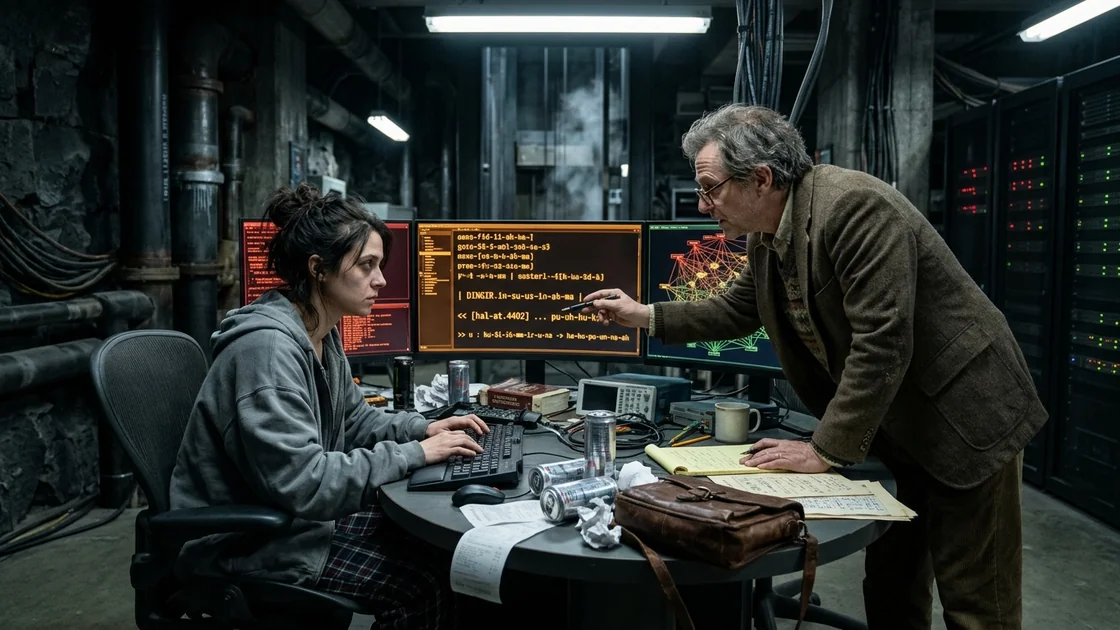
Dr. Aris Thorne, an obscure academic specializing in the dead isolate languages of the ancient Near East, is abruptly pulled from his quiet university life to a subterranean server facility in the Nevada desert. There, he is paired with Maya Lin, an exhausted and brilliant systems architect, to stop an impending global catastrophe. The late tech billionaire Julian Vance built the core operating system regulating a massive geothermal energy grid using a proprietary programming language based entirely on Middle Elamite, an extinct agglutinative tongue with no living relatives. As a fatal memory leak threatens to trigger a meltdown across the grid, Aris and Maya must bridge the gap between ancient human grammar and low-level machine architecture, translating royal curses, case-stacking suffixes, and animate hierarchies into functional kernel patches before the system tears itself apart.
The clay tablet under the microscope had survived three thousand years of war, moisture, and the slow, grinding apathy of the Iranian plateau, only to be insulted by a graduate student who had mistaken a dative infix for a smudge of dried mud.
Dr. Aris Thorne adjusted the brass focus knob with the practiced delicacy of a watchmaker. Around him, the basement of the university’s philology wing smelled of radiator steam, decaying paperbacks, and the faint, mineral tang of baked silt. It was seven in the evening on a Tuesday in November. Outside the high, narrow casement windows, sleet was tapping a frantic, irregular rhythm against the glass, but inside, time moved at the pace of glacial erosion.
"He wrote hutta-k," Aris murmured to the empty room, dipping a mechanical pencil toward his legal pad. "Passive participle. Not hutta-š. If the scribe had meant the king built the temple himself, the wedge would be angled forty-five degrees to the right. It is a passive state of being built. The brick remembers the hand, not the crown."
A heavy knock rattled the frosted glass of his office door, vibrating right through the floorboards and making the image in his microscope jitter.
Aris sighed, removing his glasses and rubbing the deep red indentations on the bridge of his nose. "If that is you, Miller, I am already docking you half a grade for turning a royal dedicatory inscription into a laundry list. Come back during office hours."
The door did not wait for office hours. It swung inward, hitting the rubber doorstop with a dull thud.
Two people stood in the hallway. Neither of them was Miller. The woman in front wore a tailored charcoal wool coat that probably cost more than the department’s annual travel budget, her dark hair pulled back so tightly it looked painful. Behind her stood a man built like a basalt stele, wearing a tactical nylon jacket with the rainwater still beading on his shoulders.
"Dr. Aris Thorne?" the woman asked. Her voice had the clipped, transactional cadence of someone who read nondisclosure agreements for pleasure.
"I am," Aris said, instinctively sliding a protective felt cover over the third-millennium tablet on his desk. "And this is a restricted archive. If you are looking for the museum director’s gala, you have taken a wrong turn at the Neo-Assyrian reliefs."
"My name is Clara Vance-Sterling," she said, stepping into the cramped office. She had to turn slightly sideways to navigate the towering stacks of the Chicago Assyrian Dictionary and boxes of uncatalogued offprints that formed a paper canyon between the door and his desk. "I represent the continuity board of the Aethelgard Infrastructure Trust. In 2019, you published a monograph in the Journal of Cuneiform Studies titled Polypersonal Agreement and Suffixaufnahme in the Middle Elamite Royal Inscriptions of Untash-Napirisha."
Aris blinked. The total global readership of that paper, including his mother and the peer reviewers who had hated it, was approximately eleven people. "I did. Have you come to argue with my reconstruction of the locutive verbal chain?"
"I have come to offer you four hundred thousand dollars for forty-eight hours of your time," she said, pulling a slim titanium tablet from her coat pocket and setting it on the corner of his desk, right on top of a stack of flashcards. "Half wired to your account the moment you step onto the helicopter on the athletic field. The other half when the compiler stops throwing fatal exceptions."
Aris stared at the titanium tablet, then back up at her face. "The... compiler?"
"My uncle, Julian Vance, passed away six weeks ago," Clara said, her expression remaining entirely static. "Before he died, he spent the last decade of his life refactoring the core operating system for the Basin-9 Geothermal Array. Do you know what Basin-9 is, Dr. Thorne?"
"I read the newspapers, occasionally, when they wrap parcels of pottery," Aris said dryly. "It is the deep-crust power grid in Nevada. The one that supplies base-load electricity to forty percent of the western seaboard."
"Forty-four percent, as of last month," she corrected. "Julian was a brilliant systems engineer, Dr. Thorne, and a deeply paranoid man. He believed that all modern programming languages—C, Rust, Python, even raw x86 assembly—were fundamentally compromised because their syntax was public knowledge. He believed the only way to build an unhackable autonomous kernel was to ground its logic gates, memory management, and instruction sets in a linguistic paradigm that no living hacker, state actor, or artificial intelligence could parse."
A slow, cold comprehension began to pool in the pit of Aris’s stomach. He looked down at the felt cover hiding his clay tablet. "No."
"Four years ago, the trust anonymously purchased the private library of Professor Heinrich Vallat in Paris," Clara continued smoothly. "Along with every extant lexicon, grammar, and syllabus regarding the Elamite language from 3000 BCE to the Achaemenid period. Julian locked himself in the sub-level of Basin-9 with a team of hardware fabrication specialists and designed a custom silicon architecture. He didn't just use Elamite words as variable names, Dr. Thorne. He built the machine's logic around the grammar."
"That is insane," Aris whispered. "Elamite is an isolate. It isn't Indo-European, it isn't Semitic. We don't even know half the vocabulary! There are verbs whose meanings we only guess at because they appear next to pictures of dead enemies!"
"Apparently, Julian guessed well enough for the system to run seamlessly for twenty-six months," Clara said. "Until four hours ago. A cascading memory fault began eating through the primary thermal regulation routines. Our lead systems architect is on-site. She is one of the finest kernel developers in the world, and for the last three hours, she has been staring at a terminal that is screaming at her in the language of ancient Susa. If the pressure valves lock before we clear the fault, the supercritical steam loop in Sector Four will rupture the casing. We won't just lose the power grid for California and Oregon; we will trigger a magnitude-six seismic event directly beneath the Carson Sink."
Aris stood up slowly. His knees popped in the quiet room. For thirty years, he had fought with deans and grant committees to justify the study of a civilization that had been dust since Alexander the Great marched through Persia. He had written passionate, begging letters explaining that dead languages were the fossil record of the human mind. He had never once considered that someone might turn that fossil into a thermonuclear pressure cooker.
"Can I bring my dictionaries?" Aris asked.
"The helicopter has a payload capacity of four thousand pounds," Clara said, turning toward the door. "Bring the whole damn shelf."
The facility did not look like a ziggurat, which Aris felt was a missed opportunity on the late Julian Vance’s part.
Instead, Basin-9 looked like a scar on the alkali flats of the Black Rock Desert. From the window of the Sikorsky helicopter, all Aris had seen through the night was a vast grid of sodium-vapor lights and the towering, ghost-white plumes of cooling steam rising into the freezing desert air. Once they landed, however, the descent was entirely vertical. An industrial freight elevator dropped them eight hundred feet into the basalt bedrock, where the air smelled of ozone, hot copper, and stale espresso.
Clara led him down a corridor lined with thick, sweating conduits of chilled liquid nitrogen, finally badging them through a heavy blast door labeled RING-0 ARCHITECTURE / AUTHORIZED PERSONNEL ONLY.
The room beyond was cavernous, circular, and freezing cold, except for the central workstation where the heat of a dozen overclocked diagnostic rigs created a microclimate of nervous sweat. Towering curved monitors formed a half-circle around a desk buried in empty energy drink cans, crumpled printouts, and logic analyzers.
Sitting in the center of this electronic ruin was a woman in her early thirties. She was wearing an oversized grey hoodie with the sleeves pushed up past her elbows, fuzzy tartan pajama pants, and heavy combat boots. Her fingers were flying across a split ergonomic keyboard with furious, percussive speed. Every few seconds, she would hit the Enter key with the force of a carpenter driving a nail, stare at the screen as a wall of crimson text cascaded down the monitor, and mutter a string of profanities so creative they bordered on poetry.
"Maya," Clara said.
The woman didn't turn around. "Unless you brought a gun so I can shoot the physical memory banks and put us all out of our misery, Clara, go away. The heap is down to twenty-two percent capacity. Every time I try to force a garbage collection cycle, the watchdogs multiply."
"I brought the linguist," Clara said. "Dr. Aris Thorne, this is Maya Lin, Chief Systems Architect."
Maya stopped typing. Her chair squeaked as she spun around. She had dark circles under her eyes that looked like thumbprints of soot, and her gaze was sharp, hyper-focused, and slightly feral from thirty hours of wakefulness. She looked at Aris—taking in his tweed jacket, his corduroy trousers, and the battered leather satchel clutched to his chest like a life preserver—and let out a short, hollow laugh.
"Great," Maya said. "You brought Indiana Jones's grandfather. Does he know C++?"
"I know basic Fortran from a summer course I took in 1988 to tabulate syllable frequencies," Aris said mildly, setting his heavy satchel on the edge of a server rack. "And I am fifty-four, Ms. Lin. Hardly grandfatherly, though the fluorescent lighting down here is doing neither of us any favors."
Clara checked her watch. "You have thirty-nine hours before the thermal buffer reaches critical saturation and the automated containment doors seal this level permanently. I will be in the command module upstairs dealing with the Department of Energy. Do not make me lie to the Secretary any more than I already am."
The blast door hissed shut behind her, locking with a heavy magnetic clunk.
Silence fell over the command pit, save for the low, omnipresent roar of the cooling fans and a rhythmic beep-beep-beep coming from a telemetry monitor on the far left.
Aris walked slowly toward the semi-circle of screens. He pulled his reading glasses from his breast pocket, unfolded them, and slid them onto his nose. "Show me what he did."
Maya sighed, dragging a hand down her face, and spun back to the monitors. She tapped a key, bringing up a massive Integrated Development Environment window on the main sixty-inch display.
"Okay, Professor. Crash course in Vance-lunacy," Maya said, pointing a capped ballpoint pen at the screen. "Three years ago, Julian fired the entire kernel team except me, locked the hardware specs for his new RISC-V custom processors, and went dark. When he finally deployed the production build of the operating system—he called it Insusinak—he gave us high-level API wrappers in Rust so we could write the user-space monitoring tools. We never saw the source code for the kernel itself. We didn't need to; the thing ran like a Swiss watch. Zero latency, zero memory leaks, fault-tolerant to an absurd degree."
"Until today," Aris said, stepping closer to the glow of the monitor.
"Until four hours ago, when a minor seismic tremor out in Sector Seven caused a voltage spike in three sensor arrays," Maya said. "Normally, the interrupt handler catches that, dumps the corrupted sensor packets, frees the memory, and moves on. Instead, the kernel took that corrupted packet and started... I don't know, worshipping it. It's duplicating the memory block across every available register. When his dead-man's switch triggered after the first critical fault, the repository unlocked and dumped the raw source code onto my terminal. Look at this."
She expanded the central window.
Aris leaned in. His breath caught in his throat.
The lines of code were not indented with standard brackets or semicolons. Instead, the dark screen was filled with glowing amber text arranged in dense, hyphenated blocks, separated by vertical pipes and colons.
| DINGIR.in-su-us-in-ak : si-in-ik-me-ni |
  >> kuk-ki-ra [hal-at.4402] -> ha-ni-ip-pi-ir
  >> u-me-ni : šilhak-ik-ki-mar
  >> hutta-k-ik-ki [0x004F9A] -> ma-an-ri-me
  !! ERROR_STATE: ku-ši-ik-me-ir-pi-na [STACK_OVERFLOW_0x99]
"Dear God," Aris breathed, his fingers twitching as if he wanted to touch the glass. "He used the Hallock transliteration system. He actually used standard Assyriological phonetic notation as his lexer tokens."
"Speak nerd to me, Thorne, not museum," Maya snapped, though there was a sudden, desperate spark of hope in her voice. "You can read that?"
"Read it?" Aris pulled up a rolling stool and sat down beside her,
his academic detachment evaporating in an instant, replaced by the
fierce, obsessive mania that had kept him in a basement for thirty
years. "Ms. Lin, this isn't just using Elamite words as placeholders for
English commands like if or while. Look at the
structure of line four. ku-ši-ik-me-ir-pi-na. That is a
single verbal-nominal complex."
"It's the error code the compiler keeps spitting out right before a
thread dies," Maya said, leaning in so close Aris could smell the stale
espresso on her clothes. "I tried tracing the symbol table in the
compiler binary, trying to map it to standard assembly instructions—like
MOV, JMP, PUSH,
POP—but the mapping isn't one-to-one! The same root string
compiles into completely different machine instructions depending on
what’s at the end of the line!"
"Of course it does!" Aris said, tapping the screen excitedly with his knuckle. "Because Elamite is strongly agglutinative and exhibits polypersonal agreement! You are looking for isolated keywords, like in English—subject, verb, object, separated by spaces. Elamite doesn't work like that. You take a root—in this case, kuši, which means 'to build' or 'to create', or in your context, probably 'to allocate' or 'instantiate'—and then you glue suffixes onto it like boxcars on a train. Every suffix changes the state, the person, the animacy, and the syntactic relationship of the entire line!"
Maya stared at him, her eyes narrowing as her mind began to translate his words into her own architecture. "Wait. Wait a second. Are you telling me the suffixes are compiler flags? No, not flags—type modifiers? Method chains?"
"Let me break it down for you," Aris said, pulling a yellow legal pad and a fountain pen from his satchel. He uncapped the pen and rapidly scribbled the error string at the top of the page: kušikmirpina.
"Look here," Aris said, drawing vertical lines between the syllables. "Kuši is the verbal root: to build or allocate. The -k- immediately following it is the passive participle marker, which belongs to the inanimate class. So, kuši-k means 'that which was built'—an allocated object in memory."
"Okay, a struct or a memory buffer," Maya murmured, her fingers
hovering over her keyboard. "Got it. kuši-k equals an
instantiated buffer."
"Now comes -me-," Aris continued, his pen flying. "In Elamite, adding -me turns a concrete noun or participle into an abstract concept or a state of being. If kuši-k is 'the built thing', kuši-k-me is 'the state of having been built' or 'the architecture/allocation itself'."
"A pointer!" Maya gasped, slapping the desk. "Or metadata! The descriptor table for the buffer! It's not the data itself; it's the state of the allocation!"
"Precisely," Aris said, grinning despite himself. "Now, watch what happens next. He adds -ir-. That is the third-person singular animate delocutive suffix. And then -pi-, which is the third-person plural animate marker. And finally, -na, which is the genitive postposition—'of'."
Aris paused, frowning down at his legal pad. The grin faded from his face.
"Wait," he murmured. "That is grammatically perverse. Even for Middle Elamite."
"What? Why?" Maya demanded. "What does ir-pi-na do?"
"Well, -na is just possession—'belonging to'," Aris explained slowly. "If you want to say 'of the king's temple', you put -na at the end. But here, he has attached animate personal suffixes—-ir- (him) and -pi- (them)—onto an inanimate abstract noun (-me-), right before the genitive marker. In linguistics, we call this Suffixaufnahme—case stacking. The possessed noun takes the agreement markers of its possessor, and sometimes the possessor’s possessor, stacking them up so you know exactly who owns what up a chain of command."
Maya’s eyes went wide. She spun back to the second monitor, which displayed a visual graph of the system's memory heap—a tangled, glowing web of nodes that was steadily turning red as the available RAM vanished.
"Son of a bitch," she whispered. "Reference counting. Smart pointers."
"Excuse me?"
"In modern systems programming, like in Rust or C++, when you allocate memory, you need to know who 'owns' it so you know when it's safe to delete it," Maya said, her voice rising in pitch as the pieces clicked together. "If Thread A creates a buffer, and passes it to Thread B, which passes it to Thread C, you use a reference counter. The memory can't be freed until nobody owns it anymore. Julian didn't use a separate counter variable! He encoded the ownership chain directly into the morphological suffixes of the variable identifier at runtime!"
"It's dynamic morphology," Aris breathed, looking back at the code. "The compiler is rewriting the word itself every time a different process touches the data!"
"Yes! It's a self-mutating symbol table!" Maya pulled up a debugger log, scrolling furiously through thousands of lines of execution history. Look at the trace from the moment the seismic sensor in Sector Seven spiked:
00:01:12.004 | [SENSOR_7] -> ku-ši-ik-me-na
00:01:12.005 | [HANDLER_1] -> ku-ši-ik-me-ir-na
00:01:12.006 | [HANDLER_2] -> ku-ši-ik-me-ir-pi-na
00:01:12.007 | [HANDLER_1] -> ku-ši-ik-me-ir-pi-ir-na
00:01:12.008 | [HANDLER_2] -> ku-ši-ik-me-ir-pi-ir-pi-na
By timestamp 00:04:00.000, the word was four hundred
syllables long, wrapping around the screen in a grotesque caterpillar of
-ir-pi-ir-pi-ir-pi- suffixes until the buffer storing the
identifier itself overflowed its 64-kilobyte limit, crashed the thread,
and spawned two recovery threads that immediately inherited the same
monstrous word.
"It is a cyclic reference," Maya said, her hands trembling slightly
over the keys. "Handler One passes ownership to the plural worker
pool—that’s your -pi-—and instead of releasing its own
-ir- claim, the worker pool passes it back to Handler One,
which tacks another -ir- onto the noun. Because
the word never strips its animate suffixes, the garbage collector thinks
the memory is still owned by an infinite hierarchy of active processes!
Why isn't it stripping the suffix when the function returns?!"
Aris leaned back, rubbing his chin, his eyes scanning the twelve lines of code immediately preceding the error state. He reached into his satchel and pulled out a thick, rebound photocopy of Erica Reiner’s 1969 The Elamite Language, flipping through the dog-eared pages until he found a section heavily underlined in red ink.
"Show me the function that is supposed to release the memory," Aris said. "Where Handler One hands the data over to the worker pool."
Maya highlighted a block of code fifty lines up in the main interrupt file.
:: [hal-at.4402] -> tu-ur-ri :
   << u [HANDLER_1] : ku-ši-ik-me -> du-un-ih
   << ap-pi [WORKER_POOL] : ku-ši-ik-me-ir -> du-un-iš
Aris stared at the two lines beginning with <<.
For five seconds, he didn't breathe. Then, he let out a short, sharp
bark of laughter that echoed weirdly off the steel walls of the
bunker.
"What?" Maya demanded, grabbing the arm of his stool. "What's funny? Are we dying because of a typo?"
"Not a typo," Aris said, pointing his fountain pen at the screen. "A fundamental misunderstanding of ergative-absolutive syntax by whoever wrote the patch for the sensor array! Did Julian Vance write those two lines?"
Maya blinked, checking the git blame metadata on the side of the IDE. "No! Wait—this module was updated seven months ago by... by Marcus, my predecessor! Julian was already in the hospital by then. Marcus told me he only changed a single parameter in the sensor driver using Julian’s cheat sheet!"
"Well, Marcus was a nominative-accusative thinker in an ergative world," Aris said grimly. "And it is going to blow up the state of Nevada."
"Explain it to me like I'm five, Aris!"
"In English—and in almost all European languages—we treat the subject of a sentence the same way whether the verb has an object or not," Aris said, turning to a fresh page on his pad. "If I say, 'The thread sleeps,' the thread is in the nominative case. If I say, 'The thread modifies the data,' the thread is still in the nominative case, and the data is in the accusative. Your programming languages work the same way, don't they? A function calls a method."
"More or less," Maya said quickly. "Go on."
"Elamite—along with Sumerian, Basque, and Hurrian—does not care about subjects and objects the way we do. It has an ergative-absolutive alignment, blended with what we call split-intransitivity," Aris said, his voice dropping into his best lecture-hall resonance. "In an ergative system, the thing that passively experiences an action—the object of a transitive verb—is treated grammatically the exact same way as the subject of an intransitive verb! They both take the absolutive state. Only an agent that actively, forcefully mutates something else gets marked with the ergative case."
Maya’s eyes darted back to the screen. "Wait. Passively experiences versus actively mutates. That’s... that’s pass-by-reference versus move semantics! In Rust, if you borrow a variable immutably, you just read it. If you move it or mutate it, ownership changes!"
"Look at what your predecessor Marcus wrote," Aris said, pointing to
du-un-ih and du-un-iš. "The root duni
means 'to give' or 'to hand over'. In line one, Handler One says:
u ... du-un-ih. U is 'I'. Dunih is the
first-person past tense of 'I gave'. That is a transitive, ergative
action. When Handler One executes a transitive verb in Julian’s
compiler, it stamps its own animate identity (-ir-) onto the
object (ku-ši-ik-me) because it is asserting active agency
over it!"
"Okay, so calling a Conjugation I transitive verb claims ownership and locks the mutex," Maya translated rapidly, typing notes into a scratchpad window. "Because the agent is acting upon the object."
"Yes! To release ownership—to hand the data to the worker
pool without retaining a claim on it—the object shouldn't be acted upon
by a transitive agent! It needs to transition into an intransitive state
of 'being given' or 'belonging to'!" Aris tapped the paper fiercely. "In
Elamite, that is Conjugation II—the passive-intransitive conjugation
built with the -k- suffix and personal endings, or Conjugation
III, the datival-locative conjugation with -n-! By using
du-un-iš—which means 'they actively gave it'—Marcus told
the compiler that the Worker Pool and Handler One are both
simultaneously asserting aggressive, transitive ownership over the
buffer!"
Maya slumped back in her chair, her mouth open. "He used a write-lock assignment instead of a deallocation transfer because he thought 'I give' and 'they receive' used the same verb stem."
"In Elamite, to say 'it was given to them', you cannot use the active transitive duni-š," Aris said. "You must use the passive participle duni-k, combined with the dative pronoun ap—'to them'—and the inanimate state marker! The agent disappears completely from the grammar! And if the agent disappears from the grammar..."
"...the compiler strips the -ir- suffix from the
pointer," Maya whispered, finishing his thought. "Because in an ergative
system, an intransitive state has no agent to own the reference."
She stared at Aris. For the first time since he had walked into the bunker, the hostility and exhaustion in her eyes vanished, replaced by sheer, unadulterated awe.
"You're a wizard," she breathed. "You're an actual wizard in a tweed jacket."
"I am a philologist," Aris corrected, though his ears turned slightly pink. "Which is much more poorly paid. Now, how do we fix Marcus’s grammar?"
Fixing the line was not as simple as typing a replacement word and hitting save.
"The kernel is running live in Ring-0 memory," Maya explained as she pulled up a hex editor alongside Julian Vance’s custom assembler interface. "We can't reboot the array to load a new kernel image; the initialization sequence takes forty minutes, and without active magnetic valve modulation for forty minutes, the superheated brine in Sector Four will flash to steam and blow the wellheads right through the desert floor. We have to hot-patch the live binary in memory."
"Which means?" Aris asked, watching the telemetry monitor on the left. The heap capacity had dropped from twenty-two percent to nineteen percent while they were talking. A new warning light—amber and steady—had illuminated next to a label reading CORE TEMP: 384°C.
"Which means I have to compile the corrected Elamite module in a sandbox, extract the compiled bytecode, and inject it directly into the instruction pointer of the running interrupt handler," Maya said. She cracked her knuckles, leaned forward, and duplicated the broken function into a local test file. "Tell me exactly how to write: 'To them, the allocation is given, and I cease to hold it.'"
Aris adjusted his glasses and leaned over her shoulder. "First,
delete the << u [HANDLER_1] line entirely. In royal
inscriptions, when a king relinquishes land or tribute to a temple, he
doesn't state 'I stop holding it' in the active voice—that implies he
still has the power to take it back. We want pure absolutive
detachment."
Maya highlighted the line and deleted it. "Gone. Next?"
"Start with the dative pronoun for the third-person plural," Aris
dictated, consulting a handwritten paradigm chart he had pulled from his
folder. "Write ap-pi-ir? No, wait. The Worker Pool is a
collective of threads, yes? Is a thread considered animate or inanimate
in Julian’s ontology?"
Maya froze. "I... I don't know. How would I check that?"
"Look at the declarations at the top of the file," Aris said, pointing to the header of the source code.
Maya scrolled up to the global definitions block at line zero.
@ONTOLOGY_DEF:
  DINGIR  => [KERNEL_ROOT / RING_0]     :: CLASS_ANIMATE_SUPREME
  EŠŠANA  => [HYPERVISOR / SCHEDULER]   :: CLASS_ANIMATE_ROYAL
  RUHU    => [ACTIVE_THREAD / DAEMON]   :: CLASS_ANIMATE_HUMAN
  HALAT   => [MEMORY_BLOCK / BUFFER]    :: CLASS_INANIMATE_CLAY
Aris couldn't help a small, reverent smile. "Look at that. Dingir—the Sumerogram for God—is the Kernel Root. Eššana, the Elamite word for King, is the Hypervisor. Ruhu, 'human being' or 'man', is an active thread. And Halat..." He chuckled softly. "Halat means 'unbaked clay brick'. He made the raw data buffers out of clay."
"Because the threads are the scribes writing on the clay," Maya
murmured, shaking her head. "Julian was completely out of his mind.
Okay, so WORKER_POOL is an array of RUHU. That
makes them CLASS_ANIMATE_HUMAN, plural."
"Right," Aris said, snapping back to business. "Then the dative
pronoun for 'to them' is simply ap. Write:
<< ap [WORKER_POOL] : ku-ši-ik-me -> du-un-ik-ni."
"Spell that last token again," Maya said, typing carefully.
"du-un-ik-ni," Aris said. "Duni (give),
-k (passive inanimate participle), -ni (third-person
singular precative/jussive verb ending: 'let it be'). Literally: 'To
them, the built-state, let it be given.' There is no ergative agent in
the clause. Grammatically, the previous owner vanishes into the
ether."
Maya finished typing the line:
:: [hal-at.4402] -> tu-ur-ri :
   << ap [WORKER_POOL] : ku-ši-ik-me -> du-un-ik-ni
She hit the key combination to run the local sandbox compiler.
A terminal window at the bottom of the screen flashed. Lines of lexical analysis scrolled by at blinding speed:
[LEXER] Tokenizing Middle Elamite morphological stream...
[PARSER] Checking animacy hierarchy: RUHU (pl.) <- HALAT (sg.)... OK.
[AST] Ergative alignment verified. Zero-agent passive transition detected.
[CODEGEN] Emitting RISC-V-Elamite bytecode...
BUILD SUCCESSFUL (0 errors, 0 warnings).
Maya let out a breath she seemed to have been holding for three
hours. "It compiled. Holy shit, Aris, it compiled on the first try! Look
at the assembly output—it generated a clean atomic pointer swap and a
FREE_REF instruction right at the return boundary!"
"Do not underestimate the precision of twelfth-century BCE administrative bureaucracy," Aris said, though his heart was hammering against his ribs. "Inject it."
Maya queued the compiled bytecode into the hot-patch utility, aligned
the memory offset with the live address of the tu-ur-ri
interrupt handler, and pressed Execute.
On the left-hand monitor, the crimson waterfall of error logs abruptly stuttered.
For two agonizing seconds, the screen froze completely. The cooling fans in the server racks behind them pitched up into a high, turbine-like whine.
Then, the endless chains of -ir-pi-ir-pi-ir-pi- in the
debugger window began to dissolve, snapping off like icicles from a
roof. On the visual heap graph, the angry red nodes of locked memory
flickered to amber, then to cool, tranquil green as the garbage
collector swept through the emancipated clay bricks and returned them to
the free pool.
HEAP CAPACITY: 19%... 28%... 45%... 72%... 88%.
The amber warning light next to the core temperature flickered and went out.
Maya threw her hands into the air, letting out a triumphant yell, and spun her chair around to grab Aris by the shoulders of his tweed jacket. "You did it! Look at that drop! The cyclic reference is broken! The valve modulation threads are getting clean sensor data again!"
Aris smiled, feeling a rush of adrenaline he hadn't experienced since discovering an uncatalogued fragment of a treaty with Babylon in the British Museum basement in 1997. "Well. That appears to be worth at least two hundred thousand dollars per syllable."
He reached for the cold cup of coffee Maya had abandoned on the desk, intending to take a celebratory sip—when the entire room plunged into darkness.
The main overhead lights died, replaced a half-second later by the deep, pulsing crimson of emergency battle lanterns embedded in the floor grates.
Simultaneously, a klaxon began to sound—not from the computer speakers, but a physical, mechanical horn mounted somewhere in the ceiling conduits above them. WHOOP. WHOOP. WHOOP.
Maya’s smile vanished as if wiped away by a sponge. She whipped back around to the monitors, which were still glowing on their uninterrupted power supplies.
The green nodes on the memory graph weren't turning red anymore. They were turning black. One by one, entire sectors of the system map were simply winking out of existence, accompanied by a terrifyingly clean, silent log output in the central terminal:
[SYSTEM_HALT] :: šu-ku-ur-ri -> [SECTOR_07_VALVE_ARRAY] :: KILLED BY DINGIR
[SYSTEM_HALT] :: šu-ku-ur-ri -> [SECTOR_06_COOLANT_PUMP] :: KILLED BY DINGIR
[SYSTEM_HALT] :: šu-ku-ur-ri -> [SECTOR_05_TURBINE_SYNC] :: KILLED BY DINGIR
"No, no, no, what is that?!" Maya’s fingers flew across the keyboard, trying to open a root shell to override the shutdown commands.
A single dialog box popped up in the center of her screen, rejecting her keystrokes:
ACCESS DENIED. CALLER [RUHU_MAYA_01] LACKS ANIMACY PRECEDENCE OVER [DINGIR_NAPIRISHA_DAEMON].
"I'm locked out!" Maya shouted over the klaxon. "A background daemon
just escalated its privileges to DINGIR—to Ring-0 Kernel
Root! It’s systematically executing a kill-switch across the hardware
drivers! Why did clearing the memory leak wake up a killer daemon?!"
Aris stood up, leaning both hands on the desk, his eyes scanning the new stream of Elamite source code that had automatically popped up in the trace window as the daemon executed its payload.
This code looked different from the administrative interrupt handlers they had just patched. The lines were longer, more rhythmic, filled with repetitive, formulaic clauses and strange uppercase determinatives.
@DAEMON_PROC :: [DINGIR.na-pi-ir-iš-a] ::
  ?? [hal-at.4402] != [ku-ši-ik-me : u-me-ni]
  !! a-ak : ak-ka4 : hu-ma-an-ra
  !! a-ak : ak-ka4 : пи-ik-ti : та-аn-ra
  >> DINGIR.in-su-us-in-ak : ha-at-ti-iš : бе-li-ir
  >> su-un-ki-ip : ку-uk-ku-un-ну-um : и-ма-аk-ка4
  >> نه-ah-hunte : ir-ša-ra-ra : па-ри-ис-ни
Aris felt the blood drain from his face. The hair on his arms stood up in the chill air of the server room.
"Maya," Aris whispered. "When you hot-patched the binary in memory...
you changed the cryptographic checksum of the hal-at.4402
module, didn't you?"
"Of course I did! We modified the instructions in RAM!" Maya yelled, frantically trying to SSH into a backup management node through a secondary laptop. "Why?! Does Julian have an integrity checker running?"
"He doesn't have an integrity checker," Aris said slowly, staring at the ancient words glowing in the red emergency light. "He has a curse formula."
Maya stopped typing on the laptop and looked up at him. "A what?"
"In ancient Elam, whenever a king built a temple, a bridge, or a
canal, he baked his name into the bricks," Aris said, pointing a
trembling finger at the first line:
?? [hal-at.4402] != [ku-ši-ik-me : u-me-ni]. "Look at that
conditional statement. Kuši-k-me u-me-ni. 'That which I built,
which is mine.' And then look at the next two lines: a-ak ak-ka4
hu-ma-an-ra, a-ak ak-ka4 pi-ik-ti ta-an-ra. That is word-for-word
from the stele of Shilhak-Inshushinak at Susa! It translates to:
'And whosoever shall steal it, or whosoever shall alter its
inscription and put another name upon it...'"
Maya stared at the screen in horror. "We modified the running code without Julian's digital signature. The system thinks we defaced the king's monument."
"And in every royal Elamite inscription," Aris continued, his voice rising over the whoop-whoop of the alarm, "when someone alters the brick, the text invokes the wrath of the supreme triad of the pantheon—Inshushinak, Kiririsha, and Nahhunte, the god of the sun—to destroy the usurper's seed, strip him of his throne, and cast his kingdom into ruin! Look at the final instruction: Nahhunte ir-ša-ra-ra pa-ri-is-ni! 'May Nahhunte, the great one, cut off his progeny!'"
"Cut off his progeny!" Maya gasped, looking at the system process
tree on the right-hand monitor. "In Unix and Linux architecture,
sub-processes are called child processes! When a parent process
spawns worker threads, that's its progeny! The curse daemon is
traversing the process tree and calling SIGKILL on every
child process spawned by the hypervisor! It’s literally murdering the
system’s children!"
Right on cue, the heavy blast door at the entrance of the room hissed open. Clara Vance-Sterling stumbled in, her immaculate hair coming undone, holding a satellite phone to her ear.
"What did you just do?!" Clara shouted. "Control Room Alpha just lost manual override on Sectors Five, Six, and Seven! The turbine bypass valves just slammed shut! Pressure in the deep-well injection pipes is climbing at four hundred PSI per minute! If the child processes handling the blow-off vents get killed, the pipes in Sector Four will detonate in twenty minutes!"
"We fixed the memory leak!" Maya yelled back. "Your lunatic uncle put a three-thousand-year-old Babylonian curse DRM on the codebase! Because I patched the memory without his dead-man's cryptographic key, a root-level daemon woke up and started executing a scorched-earth protocol!"
"Elamite, not Babylonian," Aris muttered automatically, though nobody heard him.
"Then use Julian's cryptographic key to sign the patch!" Clara demanded, marching down the steps into the pit.
"I don't have his private key, Clara! Nobody does! He probably had it etched onto a gold tooth and got cremated with it!" Maya grabbed a handful of her own hair, staring wildly at the terminal as Sector Four’s preliminary cooling pumps went black on the board. "And even if I could bypass the signature check, I can't touch the daemon! Look at the ontology table!"
She jabbed her finger at the @ONTOLOGY_DEF block on the
screen.
"My admin account is logged in as EŠŠANA—the King, the
Hypervisor! Normally, the King has absolute authority over
RUHU (the threads) and HALAT (the memory).
That’s Ring-1 and Ring-2! But Julian defined a Ring-0 class above the
King called DINGIR—the Gods! The curse daemon is running
with DINGIR permissions! In the processor's hardware logic,
a King cannot issue a KILL or STOP command to
a God! The CPU literally drops the instruction at the silicon gate level
because the animacy hierarchy violates grammar!"
Aris stood completely still in the center of the chaos. The red emergency lights washed over his tweed jacket and the scattered pages of his 1969 grammar book.
In the processor's hardware logic, a King cannot issue a command to a God.
His mind raced back through four millennia of cuneiform tablets—through the royal archives of Susa, the rock reliefs of Kurangun, the brick inscriptions of Chogha Zanbil. How did an Elamite king interact with the gods?
A king could not command Inshushinak. In Elamite theology, the king was merely meni-k Inšušinak-me—the servant or creature of the god. If a king tried to use the imperative mood—the command form of a verb—toward a deity, it was not just blasphemy; it was syntactically impossible in the court style.
Wait.
What about the šutruk-ip? What about the priests and the royal invocations? And more importantly, how did the grammar itself handle the relationship between the speaker, the listener, and the third party?
"Maya," Aris said sharply. "How does the CPU know that the curse daemon is a God?"
"Because of the determinative prefix!" Maya pointed to the daemon’s
declaration: [DINGIR.na-pi-ir-iš-a]. "See that
DINGIR. at the front? In Julian’s compiler, any process
whose namespace starts with the DINGIR token has its top
two privilege bits set to 11 in the hardware status
register. My terminal session is running under
EŠŠANA.maya_admin, which sets my privilege bits to
10. Because 10 is less than 11,
the hardware memory management unit blocks me from writing to the
daemon’s execution space!"
"Why can't you just log in as a DINGIR?" Clara asked
frantically.
"Because the login authentication daemon rejects any user account
claiming the DINGIR prefix! Only processes spawned directly
by the BIOS at boot time can hold divine status!" Maya slammed her fist
onto the desk. "We can't kill it, we can't pause it, and we can't demote
it!"
"No," Aris said slowly, his eyes narrowing behind his glasses as a bizarre, audacious linguistic loophole began to form in his mind. "A king cannot command a god. And a king cannot become a god in Middle Elamite. Wait—unless we are in the Neo-Elamite period? No, Julian used Middle Elamite standards from the twelfth century BCE. The king is strictly human."
"Aris, please tell me you have a point, we have seventeen minutes before the steam pipes rip the mountain in half!" Maya pleaded.
"Listen to me!" Aris grabbed his legal pad and flipped to a blank page. "In Elamite grammar, the entire verbal system is built around something called the Person/Animacy Hierarchy, which was brilliantly decoded by Françoise Grillot-Susini and Wouter Henkelman! There are three positions in the Elamite universe: the Locutive (the First Person: 'I'), the Allocutive (the Second Person: 'You'), and the Delocutive (the Third Person: 'He/She/It')."
"First, second, and third person," Maya repeated, staring at him. "Yeah. I went to fourth grade, Aris. What does that have to do with Ring-0 privilege bits?"
"Look at the daemon’s code!" Aris shouted, pointing at the screen.
"Look at the suffixes on the verbs the daemon is using to kill your
system: be-li-ir, ir-ša-ra-ra,
pa-ri-is-ni! Every single one of those is in the
Delocutive—the third person! 'May Nahhunte cut off his
progeny.' 'May Inshushinak destroy him.' Why do you think a curse tablet
is written in the third person?!"
"Because... because the guy writing the brick is talking about the gods?" Maya guessed.
"Yes! And why is your terminal rejecting your commands when you try to stop the daemon?" Aris demanded. "Show me the command you typed into the shell to try to kill it!"
Maya pulled up her bash history.
>> [EŠŠANA.maya_admin] : [DINGIR.na-pi-ir-iš-a] -> ha-al-pi-iš!
"Look at what you wrote!" Aris cried, almost dancing on the balls of
his feet. "ha-al-pi-iš! That is halpi—'to slay' or
'to terminate'—with the third-person past/imperative suffix -š!
You are treating the God as a Delocutive third-person object
while speaking from the Locutive first-person perspective of a
King! In the Elamite animacy hierarchy, when a human King speaks
about a God in the third person, the God outranks him, so the
action fails!"
"Then how the hell do I address it?!" Maya yelled.
"You don't talk about it! And you don't speak as yourself!" Aris scribbled furiously on the pad, drawing a triangle between I, YOU, and HE. "In Elamite morphosyntax, the Locutive (First Person) and Allocutive (Second Person) exist on a completely different grammatical plane from the Delocutive (Third Person)! In fact, in the verbal conjugation of Conjugation III—the datival-locative system—the First Person (-h) and Second Person (-t) suffixes are morphologically identical in rank to the divine and royal markers when used in what we call a performative invocation! Even better—what if we use the Elamite quotation particle?"
Maya blinked. "The quotation particle?"
"Wait—let me check the compiler’s lexer rules for direct speech!"
Aris practically shoved Maya’s chair six inches to the left so he could
reach the keyboard. With two index fingers, he typed a search query into
the compiler's header documentation file, hunting for the string
ma-an.
A block of developer comments—written by Julian Vance himself—popped up on the secondary monitor.
// COMPILER NOTE [J. VANCE - 2022-11-04]:
// Implementation of the Elamite Direct Speech / Oracular Particle (-ma / tit-ki-me).
// In Susian theology, when the King recites the exact words of Inshushinak
// using the locutive quotation clitic (-ma), the King's process temporarily
// inherits the effective UID (eUID) of the quoted Deity for the duration of the clause.
// Basically: `sudo` via divine possession.
// Nobody will ever figure this out without reading Vallat (1998).
Maya read the comment twice. Her jaw dropped so low it looked like it might unhinge.
"sudo via divine possession," she whispered. "He built
the sudo command—the superuser override—out of an ancient
grammatical particle for quoting a god in a sermon!"
"It is not a sermon, it is an oracular royal decree!" Aris corrected
triumphantly. "In the inscriptions of Shutruk-Nahhunte, when the king
wants to override an ancient law or claim supreme authority, he writes:
'Thus speaks Inshushinak (-ma): I have given this land to
Shutruk-Nahhunte.' By enclosing the command inside a direct quote
attributed to the supreme god Inshushinak, using the
first-person locutive suffix -h, the compiler's
context-switcher temporarily promotes the King's thread to
DINGIR status because, grammatically, the God is the one
speaking through the King's mouth!"
Clara stepped right up behind their chairs, gripping the back of Maya's headrest until her knuckles turned white. "Can you do it? The floor is vibrating. Do you feel that?"
Aris looked down. His cold cup of coffee on the desk had tiny, concentric ripples shivering across its surface. Deep beneath the eight hundred feet of basalt, millions of gallons of superheated brine were slamming against closed titanium gates, begging to become an earthquake.
"Ten minutes to pipe failure in Sector Four," Maya said, looking at
the pressure gauge climbing into the flashing red zone. "Okay. Okay,
Aris, talk me through the syntax. If I just quote the god and tell the
curse daemon to die, won't the curse daemon just respawn because the
checksum on hal-at.4402 is still altered?"
Aris froze. His triumphant expression faltered.
She was right. Look at the curse daemon’s trigger condition:
?? [hal-at.4402] != [ku-ši-ik-me : u-me-ni]
If Brick 4402 does not equal 'That which I built, which is mine'.
"If we just kill the daemon (DINGIR.na-pi-ir-iš-a), the
hardware watchdog will run the checksum on the memory block again on the
very next clock cycle, see that Marcus’s patched code doesn't match
Julian’s original inscription, and summon the curse all over again,"
Maya said, her voice tight with panic. "We can't just kill the curse! We
have to use the divine possession override to re-consecrate the
brick! We have to make the system believe that our modified code is
sanctioned by Inshushinak himself!"
Aris turned back to the code of the curse daemon, his eyes darting across every syllable, every hyphen, every colon.
"How does the system verify u-me-ni ('which is mine')?"
Aris asked urgently. "Where is the original checksum stored?"
Maya pulled up the memory map for hal-at.4402. "Right
here, in the read-only header of the module! It’s a 256-bit hash
generated from Julian’s original source code, stored in a register
labeled... si-in-ik-me-ni. Because that register is marked
DINGIR-only, my earlier hot-patch couldn't update the hash
when we changed the code! That mismatch is what triggered the
curse!"
"Then we don't just kill the daemon," Aris said, pulling his legal pad closer and uncapping his fountain pen with his teeth. "We write a Royal Restoration Inscription! It is the single most common genre of text in the entire three-thousand-year history of Elam!"
"A restoration inscription?!"
"Think about it!" Aris shouted over the groaning vibration that was now humming through the steel floor plates. "Mud-brick temples in Mesopotamia and Elam collapsed every fifty years! Whenever a new king came along to repair a wall built by an older king, he was terrified of triggering the old king's curse! So how did he legally modify the building without getting struck down by Nahhunte and Inshushinak?!"
"Tell me!"
"He followed a strict legal and grammatical protocol!" Aris began
writing rapidly on the yellow paper, his hand cramping as he translated
thirty-two-hundred-year-old temple rituals into systems architecture.
"First: You do not erase the old king’s name! You acknowledge that the
prior structure fell into ruin (up-qu-mi-ia or
ha-as-sa-k). Second: You invoke the supreme deity in the
first-person oracular voice (-ma). Third: You state that
you took the old brick (hal-at), restored what was fallen
(ku-ši-ih), and placed the old king’s name
together with the god's blessing back into the foundation
(si-in-ik-me-ni)! Julian didn't write an un-patchable
operating system, Maya! No engineer would build a system that could
never be updated! He built a system that can only be patched if
you follow the ritual protocol of an Elamite temple restoration!"
Maya stared at the legal pad, then at the compiler documentation on her second monitor. She scrolled down twenty pages into the undocumented system calls of the kernel API.
There, buried at line 8,402 of the kernel header, was a single system macro that had never been called in the history of the facility:
MACRO_RESTORE :: [ha-hu-pu-un-na]
"There it is," Maya whispered, her fingers trembling as she
highlighted the macro definition. "It’s the hash-recalculation routine!
It takes the old hash, concatenates it with the new bytecode, and writes
the updated signature into the si-in-ik-me-ni register
without tripping the watchdog! And look at the required parameters—it
requires a four-line morphological block with zero syntax errors. If we
get a single suffix wrong during a DINGIR-level invocation,
the kernel panics instantly and dumps all memory."
"No sandbox compiler?" Aris asked, his mouth suddenly bone-dry.
"The sandbox doesn't have access to the live hardware security module that holds Julian's root hash," Maya said, opening a raw, unbuffered command-line interface directly into the Ring-0 kernel space. The cursor blinked—a solid, unforgiving amber rectangle. "We have to type this directly into the live execution stream. One shot. Seven minutes until the Sector Four blow-off pipes rupture."
She looked at Aris. "I'll type the system addresses and the variable pointers. You give me the exact Elamite morphology. Do not miss a hyphen, Professor."
Aris took off his glasses, wiped the lenses on his tie, and put them back on. He looked down at his reference grammars, then pushed them aside. There wasn't time to look up tables. He had spent thirty-two years living in the minds of scribes who had been dead since the Bronze Age. If he didn't know how to speak to their gods by now, he had wasted his life.
"Begin the invocation," Aris said, his voice steady, calm, and completely stripped of hesitation. "Open the header with the Royal Hypervisor speaking through the Oracular Particle of Inshushinak."
Maya’s fingers hit the keys.
"Type:
| EŠŠANA.maya_admin : DINGIR.in-su-us-in-ak-ma |."
| EŠŠANA.maya_admin : DINGIR.in-su-us-in-ak-ma |"Wait," Aris said, leaning in until his nose was four inches from the
glass. "Inshushinak is the direct speaker inside the quote, yes, but to
trigger the possession override, we need the quotation clitic attached
to the verb of speaking as well! Add a colon after
in-su-us-in-ak, then write
tu-ur-ri-ir-ma."
"What is tu-ur-ri-ir-ma?" Maya asked, typing it
instantly.
"Turri is 'to speak' or 'to command'. -ir is the
third-person animate singular ('he speaks'), and -ma is the
oracular quotation particle ('thus')! Together: 'By the King Maya,
Inshushinak, thus he speaks:' That should flip the privilege bits
on the next line to 11!"
"Next line!" Maya barked. The floor beneath them gave a sharp, metallic jolt as a secondary relief valve somewhere deep in the earth sheared its bolts. Dust sifted down from the ceiling conduits.
"Line two," Aris dictated. "We must acknowledge the corrupted state of the brick without disrespecting the original creator, Julian. How did he identify himself in the system?"
"His root user ID was EŠŠANA.julian_01," Maya said.
"Good. Indent two spaces. Write:
<< [hal-at.4402] : ku-ši-ik [EŠŠANA.julian_01]-na : פו-uh-hu-k."
"Spell that last word!"
"pu-uh-hu-k!" Aris said. "With a p and two
h's! It means 'it became decayed, damaged, or
ruined'—intransitive passive participle, inanimate class! We are telling
the compiler that the brick was not maliciously defaced by an enemy; it
suffered natural entropy!"
<< [hal-at.4402] : ku-ši-ik [EŠŠANA.julian_01]-na : pu-uh-hu-k"Okay, line three! We need to call the restoration macro
ha-hu-pu-un-na and bind our new patch into the royal
lineage using Suffixaufnahme—that case-stacking thing you
showed me earlier!" Maya said, glancing at the pressure monitor. Five
minutes. The red line was practically vertical.
"Right," Aris muttered, his eyes closing for a fraction of a second
as he visualized the suffix chain in his head. They needed to take the
abstract allocation (ku-ši-ik-me), attach Julian’s
historical ownership (-ir-), attach Maya’s active
restoration ownership (-u-), wrap them both in the genitive
of the God (-na), and pass it into the restoration verb in
the first-person locutive (-h)!
"Listen very carefully, Maya," Aris said, opening his eyes. "If we
misplace the animate delocutive suffix before the abstract noun marker,
the pointer will dereference a null register. Type this exact string:
>> u : ku-ši-ik-me-ir-u-na -> ha-hu-pu-un-na-ah."
Maya typed it, her eyes darting across the syllables:
>> u : ku-ši-ik-me-ir-u-na -> ha-hu-pu-un-na-ah"Wait," Maya paused, her finger hovering over the keys. "Why
-ir-u-na? Isn't -ir- third person (Julian) and
-u- first person (Me)? Can you stack a first-person
possessive right onto a third-person suffix like that?"
"In the inscriptions of Shilhak-Inshushinak, when he restores a
temple of Kindattu, he stacks his own agreement marker onto the
ancestral marker to create a compound lineage!" Aris said fiercely. "It
tells the garbage collector and the integrity watchdog that your pointer
(-u-) does not overwrite Julian’s pointer
(-ir-); it inherits from it! In your language—what
do you call that?"
"Polymorphic class inheritance!" Maya gasped. "We’re declaring the patched module as a derived subclass of Julian’s original base class so the type-checker accepts it!"
"And ha-hu-pu-un-na-ah puts the restoration macro into
the first-person singular active transitive!" Aris said. "Because we are
still inside the -ma quotation block of Inshushinak, the
'I' (-ah) executing the restoration is both the King and
the God simultaneously!"
"Now the final line!" Maya shouted as the main lights flickered
violently and a high-pitched whistling sound began to echo up through
the elevator shaft—the sound of high-pressure steam finding a hairline
crack in a manifold two hundred yards below them. "We have to command
the curse daemon (DINGIR.na-pi-ir-iš-a) to abort its
kill-loop, restore the murdered child processes, and go back to sleep in
the background register!"
Aris looked at the active curse code still scrolling down the left screen:
>> نه-ah-hunte : ir-ša-ra-ra : pa-ri-is-ni
"The daemon is executing a precative curse—a wish in the third person ending in -ni," Aris said rapidly. "To cancel a curse in an Elamite royal text, you replace it with a blessing formula—the tu-up-pi-me—and command the protective deity to guard the progeny instead of cutting it off! What is the system command to restart the dead child threads and put the daemon into an idle wait-state?"
"In standard assembly, it’s a WAIT_EVENT instruction on
the daemon and a FORK_RESTORE on the process tree," Maya
said, scrolling furiously through the symbol table of the compiler.
"Hang on, let me find Julian’s lexical mappings for WAIT
and RESTORE_CHILDREN... Here! ku-uk-ku-un-nu
maps to the protection/preservation loop, and ha-ni maps to
'love/favor', which sets the thread priority back to normal!"
"Of course!" Aris cried. "Kukkunnu—to guard or protect! And hani—to love or favor! In every inscription, the king prays: 'May Inshushinak look upon my work with love, and may he guard my royal progeny!'"
"Give me the line, Aris! Two minutes! The manifold in Sector Four is at ninety-eight percent yield strength!"
"Type:
>> [DINGIR.na-pi-ir-iš-a] : su-un-ki-ip-me-ni : ha-ni-iš : ku-uk-ku-un-nu-un-ra : ti-it-ki-me!"
Maya’s hands were a blur. She hammered the characters into the terminal:
| EŠŠANA.maya_admin : DINGIR.in-su-us-in-ak : tu-ur-ri-ir-ma |
  << [hal-at.4402] : ku-ši-ik [EŠŠANA.julian_01]-na : pu-uh-hu-k
  >> u : ku-ši-ik-me-ir-u-na -> ha-hu-pu-un-na-ah
  >> [DINGIR.na-pi-ir-iš-a] : su-un-ki-ip-me-ni : ha-ni-iš : ku-uk-ku-un-nu-un-ra : ti-it-ki-me
"Wait—what does that last word do? ti-it-ki-me?" Maya
asked, her right index finger trembling directly over the Enter
key.
"It means 'truth', 'forever', or 'so be it'," Aris whispered, gripping the edge of her desk as the entire subterranean room shook with a deep, tectonic groan. "It closes the oracular quotation block and commits the transaction to the clay. Hit the key, Ms. Lin."
Maya hit Enter.
For three seconds, nothing happened.
The klaxon kept whooping. The red emergency lanterns kept pulsing. The terrifying whistle of escaping steam down the elevator shaft rose half an octave.
On the central monitor, the Ring-0 kernel parser ingested the four lines of twelfth-century BCE royal Elamite propaganda.
[RING_0_INTERRUPT] :: Oracular Clitic (-ma) detected on [DINGIR.in-su-us-in-ak].
[PRIVILEGE_ESCALATION] :: Caller [EŠŠANA.maya_admin] granted effective UID -> [DINGIR].
[AST_EVAL] :: Verifying lineage stack [ku-ši-ik-me-ir-u-na]...
  -> Base Owner: [EŠŠANA.julian_01] (-ir-) :: VALID.
  -> Restorer:   [EŠŠANA.maya_admin] (-u-) :: VALID.
  -> Suffixaufnahme chain intact. Executing [ha-hu-pu-un-na-ah]...
[HASH_UPDATE] :: Register [si-in-ik-me-ni] updated with derived restoration signature.
[DAEMON_SIGNAL] :: [DINGIR.na-pi-ir-iš-a] received [ha-ni-iš / ku-uk-ku-un-nu-un-ra].
Suddenly, the mechanical klaxon in the ceiling cut off mid-whoop, leaving a ringing, startled silence in their ears.
On the right-hand system map, the black, dead sectors of the
facility—Sectors Five, Six, and Seven—flashed brilliant gold as the
DINGIR.na-pi-ir-iš-a daemon reversed its execution path.
Instead of sending SIGKILL down the process tree, the
daemon swept across the dead worker threads (RUHU),
re-instantiating every single child process from its last clean state in
the clay buffers.
Deep beneath their feet, there was a series of massive, muffled thuds—like the bolts of a cathedral door sliding open—as the magnetic bypass valves in Sector Four snapped back into alignment, venting the supercritical steam safely into the giant surface cooling towers.
The whistling in the elevator shaft died away. The ripples in Aris’s cold coffee cup smoothed out into a flat, dark mirror.
One by one, the overhead fluorescent lights flickered, buzzed, and came back on, bathing the cluttered command pit in harsh, ordinary white light.
On the main terminal, a single line of output appeared at the bottom of the log:
[INSUSINAK_OS] :: hal-at.4402 -> ku-ši-ik-me : ša-at-ti-me (SYSTEM STABLE / ETERNAL PEACE).
Maya slowly slid out of her ergonomic chair and sat down directly on the cold steel floor grates, pulling her knees up to her chest. She stared up at the underside of the desk for a long moment, then began to laugh—a quiet, exhausted, slightly hysterical sound.
Behind them, Clara Vance-Sterling lowered her satellite phone, leaned back against a server rack, and closed her eyes. "Control Room Alpha confirms pressure in Sector Four is dropping by three hundred PSI per minute. The grid is holding. California still has lights." She opened her eyes and looked at Aris. "I will instruct the wire transfer department to include a bonus for emotional distress, Dr. Thorne."
Aris didn't answer right away. He was still leaning over the desk, staring at the final line of code on the sixty-inch monitor.
"Look at the verb form the daemon used when it restarted the child
threads," Aris murmured, reaching out to touch the screen lightly with
his fingertip. "In the debug trace right before it went back to sleep.
It generated the string hu-ut-ta-ak-ha-el-pe."
Down on the floor, Maya tilted her head back to look up at him. "Is that bad? Please don't tell me that's bad."
"No," Aris said softly, a strange, bittersweet ache blooming in his chest. "It is just... in my 2019 monograph, I argued for forty pages against Professor Vallat’s reconstruction of the Elamite pluperfect passive. I claimed that if an Elamite scribe ever wanted to express a state that had been destroyed and subsequently restored to a permanent equilibrium, they would combine the passive participle -k with the anteriority marker -ha-el and the plural animate ending. We never found it on a tablet. Every colleague I had told me it was a theoretical phantom that could never exist in the natural language."
He looked down at Maya, his eyes shining behind his smudged glasses.
"Julian read my paper," Aris whispered. "He coded my theoretical verb form into the kernel's recovery state. And when the machine compiled our restoration inscription... the grammar naturally generated it to describe the saved threads."
Maya smiled up at him from the floor, her soot-darkened eyes softening. "Your dead language isn't dead anymore, Aris. It’s running at four gigahertz across twelve thousand RISC-V cores under the Nevada desert."
Aris pulled his rolling stool closer to the desk and sat down. He looked at the sprawling directory tree on the left side of the IDE—hundreds of modules, thousands of files, millions of lines of Middle Elamite governing turbines, capacitors, tectonic sensors, and power substations.
"Ms. Lin," Aris said, picking up his fountain pen and turning to a fresh yellow page on his legal pad. "When the system has finished stabilizing... do you think you could show me how the memory allocator handles the Achaemenid royal titulary in SectorTwo?"
Maya groaned, reaching up to grab the edge of the desk and hauling herself back into her chair. She kicked an empty energy drink can out of the way and pulled a fresh keyboard toward him.
"Pull up a terminal, Professor," Maya said. "I'll teach you how to
use git, and you can teach me how to pray to the sun god
before we push to production."