The Echoes of Absolute Zero
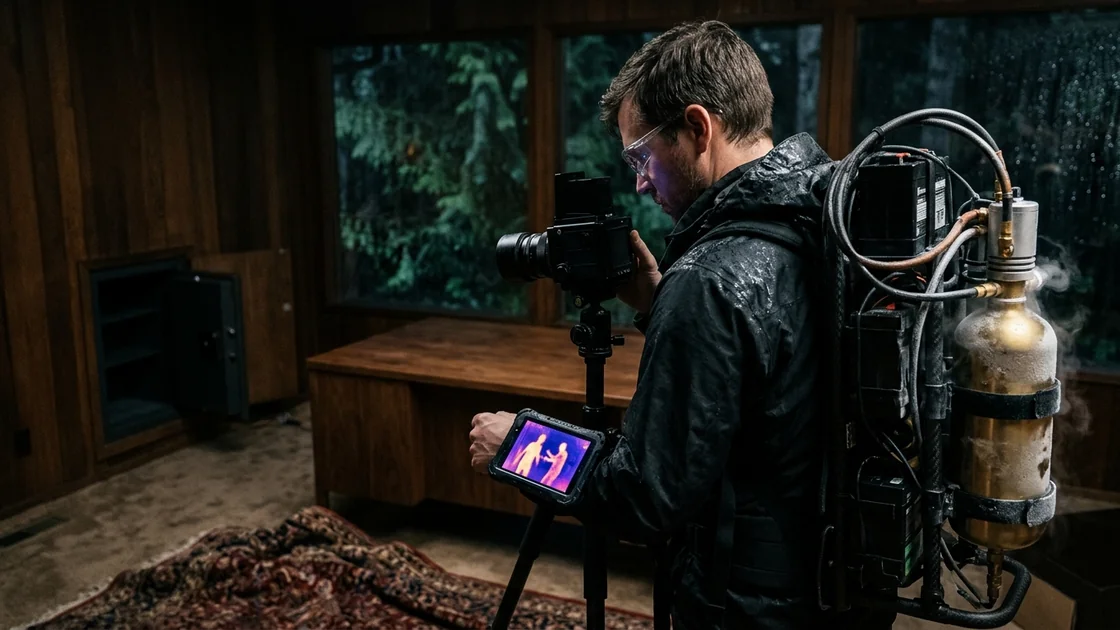
Julian Cole, a solitary optical semiconductor engineer at a premier photonics firm in the Pacific Northwest, accidentally invents a quantum-lattice infrared sensor capable of detecting microscopic thermal hysteresis in solid matter. Rather than merely capturing real-time heat signatures, his prototype chip reads the lingering molecular reverberations left behind by warm bodies, allowing him to photograph events that occurred up to twelve hours in the past. When his mentor and chief benefactor, Dr. Elena Rostova, dies suddenly under suspiciously sterile circumstances in her locked home, Julian refuses to accept the official coroner report of natural causes. Armed with his cumbersome, liquid-helium-cooled prototype camera, he breaks into her sealed residence to photograph the decaying thermal ghosts of her final hours. The images he extracts from the cooling wood and plaster reveal a calculated assassination orchestrated by his own company's defense-contracting division to seize control of the sensor technology. Hunted through the rain-slicked streets and subterranean cleanrooms by a corporate operative whose prosthetic arm leaves a distinct cold void in the infrared spectrum, Julian must rely on the fading heat of the past to survive the lethal threats of the present.
Chapter 1: The Noise Floor
The hum of the Stirling-cycle cryocooler was a sharp, metallic sixty-hertz buzz that drilled straight into the bridge of Julian Cole’s nose. He sat on a pneumatic stool in Sub-Basement B of Aethelgard Photonics, his shoulders hunched under the stiff, static-dissipative fabric of a bunny suit. On the optical bench before him sat the culmination of four years of unsanctioned nights, diverted departmental grants, and three ruined marriages to his work: the Cronos-7 Readout Integrated Circuit, mated to a bismuth-telluride quantum-well focal plane array.
To anyone else in the consumer or military imaging divisions three floors up, the device looked like an absolute disaster of engineering. It was housed inside the gutted, matte-black magnesium shell of an old medium-format film camera, but the rear back had been replaced by a gold-plated vacuum dewar the size of a coffee can. Braided stainless-steel umbilical lines ran from the dewar to a portable compressor unit sitting on a rubber isolation pad, and a thick bundle of coaxial ribbon cables spilled out of the side port into a custom field-programmable gate array on Julian’s workbench. A thick rime of white frost had formed around the brass collar of the vacuum seal, where the ambient humidity of the Seattle autumn managed to penetrate the laboratory’s dehumidifiers.
Julian rubbed his eyes behind his polycarbonate safety glasses. According to the digital wall clock above the laminar flow hood, it was 2:14 AM. The building was dead. The vibration monitors bolted to the concrete foundation pillars showed almost zero seismic interference—even the freight trains running along the Puget Sound tracks two miles west had stopped for the night. That stillness was essential. At forty Kelvin, the thermal agitation of the sensor’s own silicon substrate dropped to a whisper, allowing the exotic two-dimensional lattice of nitrogen-vacancy graphene and bismuth to do what Julian had designed it to do.
Or rather, what he had thought he designed it to do.
The original goal of Project Viscous had been to create a passive terahertz-infrared hybrid chip that could see through dense coastal fog and smoke by measuring micro-fluctuations in blackbody radiation down to half a millikelvin. Standard microbolometers used by firefighters and military drones worked by absorbing infrared photons between seven and fourteen micrometers; the incoming radiation heated a tiny pixel of vanadium oxide, changing its electrical resistance, which the camera translated into a false-color image of heat. It was fast, reliable, and fundamentally limited by the speed of light and the immediate present. Once the heat source moved away, the surface cooled back to ambient temperature within seconds or minutes, and the image vanished into the uniform grey soup of the thermal noise floor.
Julian’s chip did not just look for photons. By coupling a polarized laser reference pulse with a high-sensitivity bolometric matrix, the Cronos-7 measured phonon relaxation—the sub-atomic, acoustic ringing of crystal lattices in solid matter. When a warm object radiated heat onto a wall, a floorboard, or a desk, the molecules of that surface absorbed the energy and expanded into higher vibrational states. Even after the surface cooled to the touch and stopped emitting standard infrared light, its internal molecular structure remained locked in a state of microscopic hysteresis. Like a plucked piano string vibrating long after the room had gone quiet to the human ear, the matter continued to settle back toward true thermodynamic equilibrium over a period of hours.
For the past three weeks, Julian had been trying to filter out a persistent ghosting artifact in his test exposures. Every time he aimed the lens at the calibration target across the lab, the resulting image was muddied by strange, overlapping plumes of false color that did not correspond to anything currently in the room. He had rewritten the non-uniformity correction algorithms six times. He had baked out the vacuum dewar to remove trace water vapor. He had even checked the germanium lens elements for internal delamination. Nothing got rid of the ghosts.
"One more baseline," Julian muttered to the empty room, his voice muffled by the surgical mask. "Just one clean flat-field frame, and I’ll go home."
He rotated the heavy ball-head mount on the optical table, swinging the camera away from the blackbody calibration furnace and pointing it through the open reinforced glass door of the cleanroom annealing bay, directly into the adjacent kitchenette and break area. The breakroom was completely dark, illuminated only by the faint green LED of the water filtration system. Nobody had been in this wing of the sub-basement since his junior technician, Maya Lin, had clocked out at 6:00 PM the previous evening. The ambient temperature in the breakroom was a strictly regulated 20.5 degrees Celsius. Every surface—the Formica tabletop, the vinyl chairs, the brushed steel refrigerator—should have been in complete thermal harmony, producing a flat, featureless violet frame on his monitor.
Julian typed a command string into his terminal, setting the integration time to forty seconds. The mechanical shutter inside the vacuum housing clicked open with a dull thwack. On his secondary monitor, raw hexadecimal data began to stream down the screen as the analog-to-digital converters sampled the phonon-induced phase shifts across the four-megapixel array.
While the exposure ran, Julian walked over to the workbench and poured the dregs of a lukewarm thermos into a paper cup. He took a sip, grimacing at the bitter, oxidized taste of twelve-hour-old espresso. Across the room, the camera’s shutter clicked shut. The cooling fan on the FPGA board ramped up to a high whine as the processor chewed through the Fourier transforms required to separate the immediate radiative heat from the deep lattice hysteresis.
A progress bar crawled across the primary monitor: Deconvolving Phonon Decay Curves... 84%... 96%... Complete.
The image rendered on the twenty-seven-inch calibrated display. Julian stopped with the paper cup halfway to his mouth.
The breakroom on the screen was not empty.
Rendered in the high-contrast Ironbow palette—where black and deep purple represented cold baselines, shifting through crimson, orange, yellow, and finally incandescent white for peak thermal energy—a figure was sitting at the Formica table.
Julian set the cup down slowly, his hand trembling slightly as he reached for the mouse. He glanced through the glass door into the real breakroom. It was dark, silent, and completely unoccupied. The plastic chair on the left side of the table was pushed neatly under the lip.
He looked back at the monitor. In the captured frame, the chair was pulled out thirty centimeters. Sitting in it was a translucent, glowing silhouette of a small-framed woman. The figure was rendered in shades of deep magenta and muted amber, like an X-ray crossbred with a long-exposure photograph of a sparkler. He could see the distinct shape of a high ponytail coiled at the back of the skull. The figure’s right arm was extended toward the center of the table, where a bright orange cylinder rested beside a wider, shallower pool of yellow heat.
Julian zoomed in on the tabletop. The orange cylinder had the exact dimensions of Maya’s insulated stainless-steel travel mug. The yellow pool beside it was rectangular, roughly thirty-five centimeters wide, warm in the center where a cooling fan would exhaust—her company-issued laptop.
"That’s impossible," Julian whispered.
Maya had sat at that table during her afternoon break, between 4:30 and 5:00 PM. He remembered walking past the glass door and seeing her there, typing up the wafer-dicing logs while drinking her herbal tea. That was over nine hours ago. When she left, she had taken her mug and her laptop, pushed the chair in, and wiped the table down with an isopropyl alcohol wipe, as required by sub-basement protocol.
Even the most sensitive military FLIR camera in the world, brought into that breakroom ten minutes after she stood up, would have seen nothing. The convective air currents from the HVAC system and the conductive dissipation into the aluminum table legs would have erased every trace of her thirty-seven-degree body heat within three hundred seconds.
Yet here she was.
Julian pulled his chair closer to the desk, his heart hammering against his ribs. He opened the raw spectral metadata file associated with the image and began isolating the frequency bands. The sensor wasn't picking up infrared photons emitted by heat; the room was genuinely cold. What the bismuth-telluride array had captured was the structural exhaustion of the matter in the room. For thirty minutes, Maya’s body had radiated roughly one hundred watts of thermal energy into the vinyl of the chair, the laminated wood of the table, and the drywall behind her. That energy had driven the molecular lattices of those materials into an excited, asymmetric state. When she left, the surface temperature had dropped rapidly back to 20.5 degrees Celsius, fooling every conventional thermometer and infrared sensor in existence.
Below the surface, however, in the quantum-mechanical coupling between the crystal phonons, the relaxation rate followed an entirely different logarithmic curve. The vinyl, the glue in the particleboard, and the gypsum in the wall were still slowly untangling their molecular knots, releasing ultra-faint, phase-shifted terahertz echoes as they crept back toward true entropy.
Because his algorithm was tuned to reject immediate blackbody radiation as "static background" and amplify only the non-linear hysteresis signatures, he had built a camera that was functionally blind to the present and exquisitely sensitive to the past.
His fingers flew across the keyboard. If the phonon relaxation followed a predictable logarithmic decay based on the specific heat capacity and density of the target material, then the amplitude of the phase-shift was a direct function of time. A heat signature from one hour ago would have a specific harmonic frequency; a heat signature from six hours ago would have decayed to a lower, predictable harmonic.
"It's not just a flat integration," Julian said aloud, his eyes wide behind his glasses. "It’s a temporal stack. The time domain is encoded in the frequency shift."
He opened his C++ compiler and began writing a tunable bandpass filter for the deconvolution matrix. Instead of collapsing the entire forty-second exposure into a single composite image, he assigned a sliding variable to the phonon decay constant—essentially a tuning dial that filtered the data by how long the molecular lattice had been relaxing.
He set the dial to T-minus 9.5 hours and re-compiled the raw data file.
On the screen, the blurred streaks around the figure snapped into razor-sharp focus. The ghost of Maya sat clearly in the chair, leaning over the laptop. He could see the brighter, fresher thermal bloom of her fingertips pressed into the Formica surface just in front of the keyboard.
He slid the variable bar to T-minus 6.0 hours.
Maya vanished from the table. The chair was now in its pushed-in position, glowing faintly where her hands had gripped the plastic backrest to slide it under. Over by the sink, a new amber silhouette appeared—tall, slightly stooped, standing in front of the espresso machine.
It was Julian himself, making the very thermos of coffee he had just been drinking from at eight o'clock that evening.
He slid the bar to T-minus 1.0 hour.
The breakroom went completely dark, save for the faint, uniform purple of the room’s baseline architecture. Nothing had happened in there an hour ago.
Julian leaned back in his stool, the breath leaving his lungs in a long, shuddering exhale. The cleanroom around him felt suddenly vast and claustrophobic at the same time. Every wall, every floor tile, every piece of steel and plastic in this building was no longer an inert object. They were recording mediums. The world was a giant, continuous photographic plate, soaking up the heat of every living thing that moved through it, holding onto their shapes, their touches, and their secrets in the silent, invisible ringing of atoms.
And he was the only person on Earth with the lens to develop the film.
Chapter 2: Half-Life of a Shadow
Over the next seventy-two hours, Julian barely left Sub-Basement B. He slept in ninety-minute bursts on the leatherette couch in his cramped private office down the hall, waking with his mind already racing through thermodynamic differential equations. When Maya arrived at nine each morning, he gave her busywork—calibrating wafer thickness gauges and cataloging optical coatings in the outer lab—while keeping the heavy steel door to the inner cryogenics bay locked under the pretext of a hazardous liquid-helium purge.
He needed to understand the physics and the boundaries of the phenomenon before he breathed a word of it to anyone, especially to Aethelgard’s corporate leadership.
Through systematic experimentation, Julian mapped the rules of what he privately dubbed Chrono-Thermal Tomography.
First, he discovered the Material Dependency Law. Air held no memory; convective currents scrambled gas molecules instantly, meaning the camera could not see a person floating in mid-air or walking across an open courtyard unless it looked at the ground they stepped on or the walls their body heat radiated against. Dense, amorphous polymers, untreated hardwoods, painted drywall, fabric upholstery, and stone were ideal recording media. Their complex, disordered molecular chains trapped thermal energy in deep metastable states that took between ten and sixteen hours to fully decay back to the noise floor. Polished metals and high-purity glass, conversely, had high thermal conductivity and rigid crystalline structures; they dissipated phonon excitations so rapidly that an imprint on a steel doorknob or a windowpane faded into unreadable static within ninety minutes.
Second, he calculated the Temporal Resolution Limit. By narrowing the bandpass filter on his deconvolution software, he could isolate "slices" of time as thin as four minutes. By rendering sequential slices from a single forty-second exposure and stitching them together at twelve frames per minute, he could generate a choppy, time-lapse video of the past.
Third, and most astonishing to Julian as an optical engineer, was the spatial fidelity of direct contact. Radiative heat from a person standing a meter away from a wall created a soft, silhouette-like projection on the drywall—enough to determine height, posture, gait, and approximate clothing thickness, much like a shadow puppet. However, conductive heat transfer—where warm skin actually touched a cooler solid surface—left behind an imprint of staggering microscopic precision.
On the third night, Julian pressed his bare right thumb against the mahogany veneer of his office desk for three seconds, then wiped the wood vigorously with acetone and microfiber until any trace of sebaceous oil or moisture was completely obliterated. Six hours later, he wheeled the Cronos-7 rig into his office, aimed the macro germanium lens at the desk, and dialed the temporal filter back six hours.
On the monitor, floating in vibrant gold against the deep violet of the wood grain, was a perfect, high-resolution map of his papillary ridges, down to the microscopic cool voids of his sweat pores. The heat from the capillaries in his dermis had penetrated two hundred micrometers into the cellulose fibers of the wood, creating a three-dimensional thermal die-cast that no cleaning solvent could erase.
"My God," Julian murmured, staring at the glowing whorls of his own thumbprint. "You could scrub a room with bleach and burn the rags, and the walls would still testify."
He knew immediately that he had a massive practical problem: the rig weighed forty-two kilograms and required wall power. If he was going to test it outside the controlled environment of the sub-basement, he needed to decouple it from the optical bench.
Using his departmental discretionary budget—which was supposed to be reserved for replacement vacuum seals and silicon substrates—he raided the mechanical prototyping shop on the second floor. He cannibalized an external carbon-fiber pack frame used by the field-testing team for lidar surveys. Onto the lower shelf of the frame, he bolted two high-density lithium-iron-phosphate battery bricks and a compact, aerospace-grade pulse-tube cryocooler that weighed a third as much as the benchtop Stirling unit. He routed the insulated helium transfer lines over the left shoulder strap of the harness, wrapping them in black neoprene sleeves so they looked like standard camera tether cables.
The camera body itself remained heavy—nearly seven kilograms with the f/1.0 germanium lens attached—so he fitted it with a heavy-duty chest-mount gimbal stabilizer and a collapsible carbon-fiber monopod. For processing, he swapped out the bulky desktop workstation for a ruggedized Linux tablet strapped to his left forearm, connected via a high-speed fiber-optic Thunderbolt line to the camera’s FPGA module.
When he suited up in the rig in front of the locker room mirror on Thursday night, he looked like a cross between a high-altitude mountaineer and an industrial pest-control technician. The pulse-tube cooler on his back emitted a low, rhythmic thrum-thrum-thrum at forty-five decibels—audible in a dead-silent room, like a heavy refrigerator running in the next apartment, but easily masked by street traffic or rain.
At 10:00 AM on Friday morning, his office intercom buzzed.
"Dr. Cole?" It was the crisp, detached voice of Richard Sterling, Vice President of Advanced Research and Development. "My office. Tenth floor. Bring your quarterly milestone projections for the Viscous array."
Julian felt a cold knot tighten in his stomach. He glanced at the locked door of the inner lab where the backpack rig was hidden beneath an anti-static tarp. He quickly compiled a sanitized folder of early calibration data—charts showing only standard millikelvin sensitivity improvements in artificial fog, with all the temporal deconvolution code stripped out—and took the elevator up to the executive suite.
The tenth floor of Aethelgard Photonics was a monument to Pacific Northwest corporate minimalism: floor-to-ceiling glass looking out over the grey expanses of Lake Washington, reclaimed Douglas fir paneling, and whispered conversations about DARPA contracts.
When Julian entered Sterling’s corner office, he was relieved to see he wasn't alone with the executive. Sitting in one of the low leather armchairs by the window was Dr. Elena Rostova, the sixty-four-year-old Chief Scientist of the Quantum Materials Division. Elena was a small, fiercely sharp woman who had emigrated from Leningrad in the late eighties; she wore a faded wool cardigan over her blouse and had a habit of tapping her silver fountain pen against her knuckles when she was listening to someone lie. She had hired Julian seven years ago after his wife left him, recognizing that his obsessive perfectionism was better suited to a basement laboratory than a corporate boardroom.
"Julian," Elena said warmly, offering him a slight nod. "You look terrible. Have you been sleeping on that vinyl sofa again?"
"It’s polyurethane leather, Elena, and it has adequate lumbar support if you wedge a textbook under the middle cushion," Julian replied, managing a faint smile.
Sterling didn't smile. At forty-five, Sterling looked more like a private equity partner than a physicist—which, given his MBA and two years at a defense think tank in Arlington, wasn't far from the truth. He wore a tailored charcoal suit without a tie and was scrolling through a tablet with a stylus.
"Sit down, Julian," Sterling said, gesturing to the chair opposite his glass desk. "I’ve been reviewing the resource logs for Sub-Basement B. Your power consumption is up forty percent this month, you’ve requisitioned two pulse-tube cryocoolers from the defense lidar inventory, and yet your upload directory on the central server hasn't seen a single raw image file in nineteen days. Explain."
Julian placed his manila folder on the glass desk. "The server compression ruins the bit-depth on the raw output, Richard. I’ve been processing locally. As for the cryocoolers, the bismuth-telluride lattice was suffering from thermal drift at seventy-seven Kelvin. Liquid nitrogen wasn't cutting it. I had to take the array down to forty Kelvin to stabilize the quantum wells."
Sterling opened the folder, flipping past the graphs with practiced disinterest until he stopped at a single calibration frame Julian had included—a shot of a heated resolution chart taken through a dense glycol-water aerosol chamber.
"Signal-to-noise is impressive," Sterling admitted, his eyes narrowing slightly. "Zero blooming around the emitter edges. Viktor Kael’s contacts at the Fort Belvoir Night Vision Directorate have been hounding me all week about our progress on next-gen urban reconnaissance optics. They want a live demonstration by the end of the month."
At the mention of Viktor Kael, Elena’s fountain pen stopped tapping. Kael was Aethelgard’s Director of Special Compliance and Defense Liaison—a former intelligence contractor with a cold, dead-eyed stare and a titanium plate in his left forearm from an undisclosed incident in Eastern Europe.
"The Viscous project was funded under a civil aviation safety grant, Richard," Elena said, her Russian accent sharpening the consonants. "For runway landing systems in low-visibility weather. Not for Viktor’s urban warfare toys."
"Grant money is fungible once the IP is developed within Aethelgard walls, Elena, you know the charter," Sterling said smoothly. He looked back at Julian. "Kael noticed something else in your hardware requisitions. A dual-wavelength terahertz reference diode. You aren't just doing passive bolometry down there, are you, Julian? You’re running active phase-interferometry against the substrate."
Julian kept his face carefully neutral, though his pulse spiked. Kael—or someone on Kael’s technical team—had been auditing his part numbers.
"It’s an experimental noise-cancellation method," Julian lied smoothly. "By bouncing a weak terahertz pulse off the internal housing, I can subtract the mechanical vibration of the cryocooler from the image. Honestly, it’s been a bust. Creates terrible hysteresis ghosting in the readout. That’s why I haven't uploaded the raw files—they’re full of unusable smear artifacts. Give me another three weeks to rewrite the firmware, and I’ll have the fog-penetration data you need for the civil aviation board."
Sterling stared at him for a long, uncomfortable ten seconds. Outside, rain began to lash against the insulated glass, turning the view of Lake Washington into a smeared charcoal painting.
"One week, Julian," Sterling said softly. "And starting Monday morning, I want your local drive mirrored to the secure server every night at midnight. No exceptions. If you’re having firmware issues, I’ll assign two of Kael’s signal-processing engineers to your lab to help you clean up the noise."
"That won't be necessary—" Julian began.
"It wasn't an offer," Sterling interrupted, closing the folder. "That will be all."
Out in the tenth-floor elevator lobby, once the heavy glass doors of the executive suite had hissed shut behind them, Elena grabbed Julian’s elbow and steered him away from the main elevators toward the fire stairwell.
She pushed open the heavy steel fire door, stepped onto the concrete landing, and waited until the latch clicked shut. Even in the stairwell, she kept her voice barely above a whisper.
"You are a terrible liar, Julian," she said, her dark eyes fixed on his. "When you lie, you use three times as many technical syllables as necessary."
Julian let out a breath, leaning back against the painted cinderblock wall. "Elena—"
"Don't tell me details here," she said quickly, holding up a hand. "I don't trust the acoustics in this building anymore. Last Tuesday, I found an unauthorized packet sniffer wired into the fiber junction box outside my lab on the fourth floor. When I brought it to corporate security, Kael personally confiscated the hardware and told me it was a routine IT diagnostic."
Julian frowned. "Why would Kael be sniffing the Quantum Materials division?"
"Because three weeks ago, before I handed the latest batch of doped bismuth-telluride wafers down to you, my graduate assistant ran a routine phonon-dispersion test on the rejected off-cuts," Elena whispered. "He showed me the logs. The relaxation time constants in the lattice weren't milliseconds, Julian. They were hours. I buried the log files and reassigned the boy to the solar-cell group in Oregon so he wouldn't ask questions, because I suspected what would happen once you mated those wafers to your interferometric readout chip."
She stepped closer, her small hand gripping his forearm with surprising strength.
"Tell me the truth, Julian. Can you see the hysteresis decay?"
Julian looked down at the woman who had salvaged his career. Slowly, he nodded. "Up to twelve hours on high-density organics and polymers. Eight on standard drywall. If there's direct skin contact, I can pull a latent thermal print off a wooden desk six hours after the person leaves the building."
Elena closed her eyes for a brief moment. When she opened them, there was genuine fear beneath her scientific awe.
"You have built a retrospective panopticon," she murmured. "Do you have any idea what men like Sterling and Viktor Kael would do with a device that erases the concept of an alibi? Every closed-door meeting, every typed password on a cold keyboard, every safehouse, every covert operation over the last half-day—laid bare."
"I haven't put the deconvolution code on any networked machine," Julian said urgently. "It’s only on my air-gapped Linux tablet and an encrypted thumb drive in my pocket. If I sabotage the bismuth wafers over the weekend and replace them with standard vanadium oxide arrays, Kael’s engineers will walk in on Monday and find nothing but a mediocre fog camera."
"No," Elena said sharply. "Kael isn't a fool. He already knows about the wafer properties—I think that packet sniffer caught my assistant’s initial dispersion graphs before I purged them. If you hand them a crippled chip on Monday, they will know you are hiding the functional prototype."
She glanced up the stairwell, listening for footsteps, then reached into the pocket of her wool cardigan and pulled out a heavy brass key attached to a faded leather fob.
"Take the prototype out of the building tonight," she instructed, pressing the key into his palm. "Use the loading dock service tunnel during the shift change at eleven. Don't take it to your townhouse in Redmond—that’s the first place Kael’s people will look if things go wrong. Bring it to my house on Mercer Island. I have an old fallout shelter in the sub-basement from the nineteen-sixties that my late husband converted into a wine cellar. Lined with lead and thirty centimeters of poured concrete. We will hide the hardware there, and on Monday morning, I am flying to Geneva for the International Photonics Consortium. I will present the theoretical physics directly to the open-source committee in front of four hundred scientists. Once the mechanism is public domain, Kael can't classify it or bury us to keep a monopoly."
Julian looked at the brass key in his hand. "Elena, that’s violating every non-disclosure agreement we ever signed. They’ll prosecute us."
"Let them sue an old woman in civil court," Elena said fiercely. "Better a courtroom than disappearing into one of Kael’s black-budget annexes. Come to my house tomorrow night—Saturday, at eight o'clock. Don't call me on your cell phone. Just come."
She patted his cheek once, her hand warm and steady, then turned and pushed back through the door to the tenth floor.
Chapter 3: The Cold Anomaly
Getting the Cronos-7 out of Aethelgard Photonics on Friday night required every ounce of nerve Julian possessed. At 11:15 PM, while the night-shift security guards were conducting their perimeter swap with the evening crew, he loaded the backpack rig and two spare canisters of liquid helium into a yellow biohazard disposal drum marked Contaminated Wafer Slurry—Hydrofluoric Acid Trace. No security guard making twenty-two dollars an hour was ever eager to pry open an acid-waste barrel. He wheeled the drum out through the subterranean service corridor to the freight loading bay, signed the manifest with an illegible scrawl, and wrestled the drum into the back of his 2009 Volvo XC70.
Before leaving Sub-Basement B, he had mounted a dummy wafer—a flawed batch of standard indium-antimonide—into the benchtop housing, and left a script running on his desktop workstation that slowly uploaded gigabytes of artificially generated Gaussian noise to Sterling’s secure server. That would buy him until Monday morning.
He did not sleep on Friday night. Sitting at his kitchen table in Redmond with the blinds drawn and bolted, he refined the Linux tablet’s user interface so he could adjust the temporal bandpass filter using a thumb-wheel mounted directly on the camera’s handgrip. By Saturday afternoon, he had calibrated the false-color lookup table into what he called the Chronos Spectrum: current ambient heat was filtered to black; events from one to three hours ago rendered in blinding white and gold; four to seven hours ago shifted through crimson and magenta; and eight to twelve hours ago faded into a deep, ghostly indigo before vanishing into the noise floor.
At 7:15 PM on Saturday, under a relentless deluge of cold October rain, Julian loaded the backpack rig into the trunk of the Volvo and drove south toward the Interstate 90 floating bridge.
The wind off Lake Washington buffeted the wagon as he crossed onto Mercer Island. Elena lived on the south end of the island, down a steep, winding private lane flanked by towering Western red cedars and dense thickets of wet salal. Her house was a mid-century cedar-and-glass structure perched over the dark water of the sound, isolated from its nearest neighbors by two acres of wooded ravine.
As Julian turned down her gravel driveway at 7:52 PM, his headlights swept through the dripping fern fronds and illuminated a sight that made his foot slam down on the brake pedal.
Two hundred meters ahead, blocking the circular turnaround in front of Elena’s carport, were two King County Sheriff’s cruisers and a white panel van belonging to the Medical Examiner’s Office. Their red and blue emergency light bars were spinning silently, casting rhythmic, garish reflections across the wet cedar siding of the house and the slick black needles of the pine trees.
Julian killed his headlights immediately and shifted the Volvo into reverse, backing thirty meters up the narrow lane until he was concealed behind a bend and a dense wall of rhododendron bushes. He sat in the dark with the engine off, listening to the rain hammering against the roof of the car, his breath fogging the inside of the windshield.
Through a gap in the foliage, he watched two paramedics in yellow reflective raincoats wheel a collapsible gurney out the front door of the house. Strapped to the gurney was a black vinyl pouch, unmistakably small and rigid.
Standing on the covered porch, holding an umbrella and speaking calmly to a uniformed deputy who was taking notes on a clipboard, was Richard Sterling.
Julian gripped the steering wheel until his knuckles turned white. Sterling had no reason to be at Elena’s house on a Saturday night unless someone had notified Aethelgard immediately—or unless Aethelgard had been watching the house all along.
He pulled out his personal smartphone, disabled the Wi-Fi and Bluetooth transceivers, and tuned a local police-scanner app to the Mercer Island dispatch frequency. For twenty minutes he listened to routine traffic calls until he caught the tail end of a clearance transmission from the coroner’s investigator on scene:
"...clearing the residence at 8402 East Mercer Way. Unattended death, female, sixty-four. Appears to be acute myocardial infarction, no signs of forced entry or trauma. Next of kin is a niece in Chicago, corporate legal counsel on scene has taken custody of company-issued laptop per protocol. Scene released at twenty-hundred hours."
By 8:25 PM, the Medical Examiner’s van had rumbled past Julian’s hiding spot up the lane, followed closely by the sheriff’s cruisers and Sterling’s black Audi sedan. No yellow police tape had been strung across the porch; because the death had been ruled natural by the preliminary investigator and the house was secure, the authorities had simply locked the front door and left.
Julian sat in the freezing car for another fifteen minutes, staring down the dark, empty driveway.
Acute myocardial infarction.
Two weeks ago, Julian had walked up four flights of stairs with Elena when the main freight elevator was under maintenance. He had been winded by the third landing; she hadn't even breathed through her mouth. She swam fifty laps every Tuesday and Thursday morning at the Bellevue Aquatic Center and ate nothing but poached fish, buckwheat, and pickled cabbage. More importantly, thirty-two hours ago in the stairwell, she had looked him in the eye and told him she was afraid of being disappeared before she could reach Geneva.
He looked at his watch: 8:40 PM.
If she had been discovered around 6:30 or 7:00 PM—perhaps when a scheduled airport car service arrived early or when Sterling came to "check" on her—then whatever had happened inside that house had occurred sometime earlier that afternoon or evening. Every minute he sat in this car, the molecular lattices inside Elena’s house were cooling toward equilibrium. The wood, the plaster, the carpets were slowly shedding their phonon excitations into the damp night air. In another three or four hours, the thermal memory of her death would cross the twelve-hour horizon and dissolve forever into thermodynamic entropy.
Julian got out of the car, opened the tailgate, and hoisted the forty-two-kilogram Cronos-7 pack onto his shoulders. He buckled the padded waist belt, connected the forearm tablet, and flipped the master toggle switch for the pulse-tube cryocooler.
Behind his head, the compressor began its quiet, rhythmic thrum-thrum-thrum. On his wrist display, the array temperature began to plummet: 290K... 210K... 140K... 85K... By the time he walked down the wet gravel driveway, staying in the deep shadows of the cedars, the bismuth-telluride chip had stabilized at 39.8 Kelvin.
He didn't approach the front porch. Instead, he circled around the side of the house through the dripping ferns to the basement walkout overlooking the water. He pulled Elena’s brass key from his pocket, fitted it into the deadbolt of the heavy cedar service door, and felt the tumblers click back smoothly.
Stepping inside, he shut the door silently behind him and locked it.
The house smelled of cedar wood, lavender, and the faint, ozone-like tang of latex gloves left behind by the paramedics. He didn't dare touch a light switch. Instead, he raised the heavy camera housing to chest level, locked it into his gimbal mount, and flipped down the small OLED digital viewfinder mounted over his right eye.
Through the viewfinder, set to real-time passive mode, the dark basement corridor resolved into crisp shades of grey and purple. He climbed the basement stairs to the main floor. The floorboards creaked faintly beneath his boots, burdened by the extra ninety pounds of gear on his back.
He emerged into the open-concept living room and walked down the short hallway to Elena’s home office.
The door stood wide open. In the dim ambient light filtering through the rain-streaked skylights, the room looked almost normal, except for the slight chaos of an emergency medical response. The Persian rug in the center of the floor was bunched up where the gurney wheels had caught it; a plastic wrapper from a defibrillator pad lay discarded near the wastebasket; and the heavy walnut armchair behind Elena’s desk was pushed back at an awkward angle. In the corner, concealed behind an unlatched cedar wall panel, the heavy steel door of her floor safe stood ajar—completely empty.
Julian planted his carbon-fiber monopod in the center of the doorway, stabilizing the heavy germanium lens so it took in the entire office: the walnut desk, the leather armchair, the open safe, and the center of the rug where Elena had fallen.
"Let’s see what happened to you, Elena," Julian whispered into the quiet room.
He set the shutter for a sixty-second deep-lattice integration and pressed the trigger on the handgrip.
Chapter 4: Trespass in the Infrared
For sixty seconds, the only sound in the dark house was the patter of rain on the skylight and the steady thrum-thrum-thrum of the helium cooler on Julian’s back. He stood as still as a statue, hands lightly steadying the carbon-fiber monopod, watching the raw data buffers fill on his forearm tablet.
When the mechanical shutter clicked shut, the FPGA board began its mathematical heavy lifting, crunching the phase shifts across millions of pixels. Thirty seconds later, the compiled temporal stack loaded into the viewfinder.
Julian’s thumb rested on the aluminum scroll wheel on the camera grip. The display currently showed T-minus 1.0 hour (7:45 PM).
The office in the viewfinder blazed with chaotic, overlapping smears of white and bright yellow heat. Three bulky silhouettes in heavy coats—their outer garments insulated, showing only bright hotspots at their bare hands, necks, and heavy boots—were clustered in the center of the rug. He could see the bright rectangular outline of the metal gurney frame on the carpet and a fourth figure standing near the doorway, holding a glowing square near his hip: Richard Sterling with his tablet, watching the paramedics load Elena’s body.
Julian rolled the thumb-wheel backward, peeling away the recent past like layers of wet tissue paper.
T-minus 2.0 hours (6:45 PM).
The paramedics vanished. The gurney disappeared. Now, the center of the Persian rug held only a single, tragic shape rendered in fading crimson and orange: Elena, lying on her back, her knees slightly drawn up, one hand clutching the lapel of her cardigan. Standing over her was a lone figure—Sterling—who had evidently arrived before calling 911. In this slice of time, Sterling’s thermal silhouette wasn't checking her pulse or attempting CPR; he was kneeling in front of the open wall safe in the corner, his warm hands leaving bright golden smears on the interior steel shelves as he removed her research notebooks and backup drives.
"Bastard," Julian breathed.
He scrolled the wheel further back into the afternoon, into the deeper, quieter frequencies of the phonon lattice.
T-minus 4.0 hours (4:45 PM).
Sterling was gone from the safe. Only Elena remained on the rug, though her silhouette was brighter now, radiating the immediate thirty-seven-degree warmth of a body that had only recently collapsed.
Julian kept scrolling. T-minus 5.5 hours... 6.0 hours... 6.5 hours (2:15 PM).
Suddenly, the figure on the rug dissolved.
In its place, illuminated in the deep magenta and violet tones of a six-and-a-half-hour-old phonon echo, two people appeared in the office.
Julian adjusted the fine-tuning dial on the tablet, narrowing the temporal window to a four-minute slice at 2:12 PM, and boosted the contrast gain to maximum.
Elena was sitting behind her walnut desk, leaning back slightly in her leather chair, her hands raised in a defensive posture. Standing directly across the desk from her was a tall, broad-shouldered man. Because six and a half hours had elapsed, the man’s radiative projection against the drywall behind him and the wood of the desk was ghostly and translucent, like a violet hologram. Yet the biomechanics were unmistakable. He stood with his weight balanced evenly on the balls of his feet, his head tilted slightly downward.
Julian zoomed in on the stranger’s upper body.
Something was bizarre about the man’s arms. Both hands were gloved—the fingertips showed muted, diffused heat rather than sharp skin signatures—and his right forearm radiated a normal, cylindrical glow through his sleeve from the muscle mass beneath. His left forearm, however, had a sharp, rectangular void running fifteen centimeters from the wrist toward the elbow. It was an unnatural cold spot where the internal heat of the arm was blocked and conducted away by a dense internal mass of metal.
A titanium radius plate.
Viktor Kael.
Julian’s breath caught in his throat. He turned the thumb-wheel forward by one single four-minute increment, to 2:16 PM.
The scene shifted abruptly. Kael was no longer standing in front of the desk; his violet shadow was lunging around the side of the walnut table, his right arm hooked tight around Elena’s neck from behind, pinning her against the high leather backrest of the chair. His left hand—the one with the cold rectangular anomaly in the forearm—was pressed firmly over her mouth and nose, holding a small, intensely cold circular canister against her face.
Julian recognized the thermal signature of the canister immediately: an aerosol propellant expanding rapidly as it discharged, creating an adiabatic cold spot. Probably a concentrated potassium-channel blocker or a fast-acting paralytic gas that metabolized within minutes and mimicked sudden cardiac arrest without leaving needle marks for a routine county medical examiner to find.
He scrolled forward to 2:20 PM.
Elena was on the Persian rug, motionless. Kael was standing beside the desk, leaning heavily on his right hand against the polished walnut edge while he used his left hand to pull Elena’s brass keyring—the duplicate set—from her cardigan pocket to open the wall safe.
Wait.
Julian froze, staring at Kael’s right hand resting on the beveled edge of the walnut desk at 2:20 PM.
In the 2:12 PM frame, both of Kael’s hands had been diffused and muted—he had been wearing thin leather or nitrile gloves. During the struggle at 2:16 PM, Elena’s hands had clawed upward at his face and wrists. And here, in the 2:20 PM frame, as Kael leaned on the desk to catch his breath and reach for the keys, the thermal bloom on the walnut surface wasn't diffused at all. It was sharp, incandescent indigo, radiating the direct, unobstructed heat of bare skin where the glove had either torn at the palm or been stripped off so he could feel the pulse in her carotid artery to confirm she was dead.
Julian unlocked the camera from the monopod, stepped quickly around the spot on the rug where Elena had died, and positioned the heavy germanium lens twenty centimeters above the beveled right corner of the walnut desk.
In the visible world, the desk was spotless. Kael had undoubtedly wiped it down with a microfiber cloth and disinfectant before leaving, just as he had staged the scene so Sterling could "discover" her hours later when she missed a scheduled evening check-in.
Julian switched the lens to its internal macro element, refocused on the tight grain of the American walnut, and ran a ninety-second high-resolution scan at the T-minus 6.4 hour mark.
When the image finished compiling on his forearm tablet, Julian stared at a cluster of four distinct finger imprints and a partial hypothenar palm strike glowing like blue embers inside the wood’s molecular lattice. Because Kael had braced roughly thirty kilograms of his upper body weight onto that hand for nearly twelve seconds while leaning down toward the rug, the thermal energy had driven deep into the dense hardwood. Every friction ridge, every bifurcation, every scar crease on the base of his right palm was preserved in the phonon vibrations of the cellulose.
Julian saved the encrypted raw file—which contained the cryptographically signed hardware timestamp and full spectral array geometry—both to the tablet’s internal solid-state drive and to the backup flash drive in his pocket.
He had them. He had the biometric gait analysis, the specific osteological shadow of Kael’s surgical plate, the aerosol propellant signature, the timeline of Sterling’s tampering with the safe prior to calling 911, and a courtroom-grade latent thermal palm print of the killer at the exact minute of death.
All he had to do now was get down to the fallout shelter in the basement, swap the bulky prototype for Elena’s backup external drives if she had hidden any down there, and get off Mercer Island to the FBI field office on Third Avenue in downtown Seattle.
Julian straightened up, easing his stiff shoulders under the heavy harness. As he turned away from the desk toward the office doorway, the wide-angle lens of the Cronos-7 swept past the rain-lashed floor-to-ceiling windows of the living room, which looked out toward the driveway and the cedar woods.
Through the viewfinder—which had reverted to its default real-time passive monitoring mode—everything outside was dark blue and black, washed cold by the twelve-degree autumn rain.
Wait. Not everything.
Julian stopped dead in the hallway. He raised the camera and aimed it through the living room window toward the bend in the gravel lane—thirty meters closer to the house than where his Volvo was parked, tucked into a muddy turnaround normally used by delivery trucks.
The real-time view showed only dripping cedar boughs and a low, dark shape that matched the ambient temperature of the forest. Its engine hood was completely cold in the standard 8-to-14 micrometer band.
With a sinking sensation in his gut, Julian spun the thumb-wheel back two hours.
Through the trees, the dark shape ignited into a blazing, unmistakable silhouette of crimson and gold. The rectangular radiator grille, the hot exhaust manifold underneath the chassis, the warm radial tires that had been driven onto the gravel at roughly 6:30 PM and parked there with the engine killed.
And inside the cabin of that parked SUV, glowing softly across the last two hours of the temporal stack and extending right up into the real-time present, were two human heat plumes sitting patiently in the front seats.
Sterling hadn't left the island alone. He had left a two-man security detail sitting in a cold vehicle in the woods to watch the house through the night, just in case Elena’s protégé came looking for her.
And as Julian watched through the viewfinder, the driver’s side door of the SUV opened in real time. A tall figure in a dark rain poncho stepped out onto the gravel, holding a compact thermal monocular to his eye—aimed directly at the basement walkout door where Julian’s boots had left fresh, thirty-degree thermal footprints on the wet concrete step twenty minutes ago.
Chapter 5: The Phonon Witness
Julian dropped to one knee behind the low cedar credenza in the living room.
He had made a catastrophic miscalculation. Focused entirely on the physics of the past, he had forgotten the basic rules of the present. While his boots and rain jacket insulated most of his body heat, the pulse-tube cryocooler strapped to his backpack was a thermodynamic heat pump: to keep the bismuth-telluride sensor at forty Kelvin, it had to dump the extracted heat out through an aluminum radiator grille at the top of the pack. That radiator was currently glowing at fifty-five degrees Celsius—a miniature beacon to anyone carrying a standard military FLIR monocular outside.
Worse, the men in the SUV had probably spotted his Volvo parked up the lane ten minutes ago when they did a routine sweep, checked the warmth of his hood, and were now closing the trap.
Julian glanced toward the front door, then back toward the basement stairs. He couldn't outrun two trained operatives through the dark woods while wearing ninety pounds of sensitive laboratory hardware on his back. If he ditched the rig, they would have the Cronos-7 chip, and with the prototype in their hands, Kael’s lawyers and intelligence contacts would bury him in a federal detention facility before the FBI even figured out how to read his encrypted files.
He had to use the terrain—and the only advantage he possessed.
Moving in a low crouch, Julian hurried back down the interior wooden staircase into the dark sub-basement. The basement was a sprawling labyrinth of unfinished storage rooms, a laundry area, a cedar sauna, and a long concrete utility corridor that led to the 1960s fallout shelter Elena had mentioned.
He reached the end of the concrete corridor and found the shelter door. It wasn't a flimsy wooden panel; it was a three-inch-thick steel blast door manufactured by an old Cold War civil defense contractor, complete with a heavy wheel-latch and a twenty-centimeter poured concrete threshold. Inside, the shelter was a three-by-four-meter concrete box lined with wooden wine racks holding dusty bottles of California Cabernet and several metal filing cabinets.
More importantly, mounted on the wall beside the inner doorframe was the shelter’s original manual ventilation system and the secondary breaker panel for the basement’s hydronic floor-heating manifold.
Above him, on the main floor, he heard the subtle, muffled snick of the front door lock being bypassed, followed by the soft tread of wet tactical boots on the hardwood hallway.
Julian didn't lock himself inside the shelter immediately. If he locked himself in a concrete box with one exit, they would simply wait him out or pump tear gas through the manual intake pipe on the hillside.
Instead, he unbuckled the heavy backpack frame, slid his arms out of the straps, and set the cryocooler pack down just inside the open threshold of the wine cellar. The three-meter braided umbilical cable allowed him to carry the seven-kilogram camera housing and his forearm tablet out into the utility corridor while leaving the hot, humming compressor unit shielded behind thirty centimeters of steel-reinforced concrete.
Next, he opened the hydronic heating manifold box in the corridor wall and twisted the emergency purge valve wide open. Sixty-degree water from the house’s boiler began to flood instantly through the copper pipes running across the basement ceiling and down the concrete walls. Within thirty seconds, to a standard infrared monocular, the entire basement ceiling and utility corridor would turn into a blinding, uniform wall of orange heat, completely masking Julian’s body temperature.
Footsteps creaked at the top of the basement stairs.
Julian stepped back into the recessed alcove of the unused cedar sauna across from the wine cellar, pulling the wooden door until it was cracked open only two centimeters. Through that narrow vertical slit, he aimed the germanium lens of the Cronos-7 down the utility corridor toward the foot of the stairs.
He didn't need line-of-sight to see them coming.
The stairway made an L-shaped turn behind a drywall partition before opening into the basement hallway. A normal camera—thermal or optical—could only see the empty painted drywall at the bottom of the steps.
Julian tuned his sensor to T-minus 0.02 hours—roughly seventy seconds ago—and amplified the phonon phase sensitivity to its absolute ceiling, ignoring the hot copper pipes overhead by filtering out their static sixty-degree constant.
As the first operative crept silently down the upper flight of stairs, pausing with his shoulder and gloved hand resting lightly against the drywall partition around the corner to listen, the kinetic and radiative heat of his body soaked through the half-inch gypsum board. Even before the heat conducted fully to the outer paint layer, the acoustic phonons in the gypsum crystals began to ring.
On Julian’s viewfinder, a shimmering violet shadow blossomed right through the solid wall at the turn of the stairs.
He could see the operative crouched at the corner, holding a suppressed compact pistol at low ready, while his left hand raised a thermal monocular. Through the wall, Julian watched the man lower the monocular in frustration—blinded by the blazing hot copper pipes Julian had just flooded across the ceiling—and switch to a pair of white-phosphor night-vision goggles mounted on his helmet.
The operative gestured behind him. A second violet silhouette appeared on the stairs—taller, moving with a familiar, predatory poise, with a distinct rectangular dark bar bisecting the glow of his left forearm.
Kael hadn't just left a detail behind. He had stayed on the island himself to make sure the loose end of Sub-Basement B walked right into his hands.
"Cole," Kael’s voice echoed down the stairwell, calm and conversational, carrying easily over the hiss of the hot-water pipes. "I can hear the pulse-tube compressor from here.Forty-five hertz, dual-piston aerospace model. You pulled it out of my lidar inventory on Wednesday."
Julian said nothing, holding his breath inside the dark sauna. The umbilical cable stretched taut across the floor behind him into the wine cellar.
"Elena was an idealist," Kael continued, his violet silhouette shifting down two more steps behind the drywall partition while the point man edged toward the corner. "She thought she was still in the academic world of the nineties. If she had gone to Geneva on Monday and dumped your lattice architecture into the public domain, every cartel, every hostile state intelligence service, and every domestic terrorist cell with access to a semiconductor foundry in Shenzhen would have built one of these within eighteen months. Do you have any idea what happens to global security when the past twelve hours of every room on Earth can be read like a newspaper?"
"So you murdered an unarmed sixty-four-year-old woman in her study," Julian called out, pitching his voice so it bounced off the concrete wall toward the open wine cellar door, three meters to his left.
Behind the drywall partition, the point man reacted to the acoustic bounce, pivoting his suppressed pistol toward the wine cellar entrance as he prepared to round the corner.
"I protected the asset," Kael replied evenly. "And I’m offering you the chance to oversee the classified division that develops it. Step out into the hallway with your hands off the housing, Julian. Leave the tablet on the floor."
In the viewfinder, Julian watched the point man’s violet outline coil to spring around the corner toward the wine cellar door, where the hum of the cryocooler was emanating.
Julian didn't wait for him to clear the wall.
With his free hand, he reached up and grabbed the insulated brass drain cock on the main boiler pressure relief pipe running along the top of the sauna doorway. As the point man’s booted foot stepped past the drywall corner into the corridor, Julian wrenched the brass lever ninety degrees downward.
A jet of scalding water and steam erupted from the downward-angled drain pipe in the center of the corridor, filling the narrow concrete passage with a blinding white cloud of vapor and a deafening roar.
The point man shouted, recoiling instinctively as the hot mist fouled his night-vision goggles and scalded his exposed neck.
To the human eye and to night-vision tubes, the corridor was now an impenetrable wall of white fog.
To the Cronos-7, operating in the deep terahertz-phonon band, the water vapor was barely an inconvenience. Better yet, as the point man stumbled backward around the corner, colliding with Kael on the lower steps, Julian lunged out of the sauna, not toward the stairs, but two steps across the hall into the fallout shelter.
A suppressed pistol coughed twice—phut, phut—through the steam. Two subsonic nine-millimeter rounds sparked off the concrete doorframe centimeters from Julian’s shoulder, showering his neck with sharp stone splinters.
Julian dove across the threshold into the wine cellar, grabbed the heavy steel handle of the civil-defense blast door, and hauled it shut with all his weight.
Before the latch could fully seat, a heavy boot slammed against the outside of the steel plate, and Kael’s shoulder hit the door with brutal force. The gap narrowed to five centimeters, then held—jammed by the thick, braided stainless-steel umbilical cable that still connected the camera housing outside the sauna threshold to the cryocooler pack inside the shelter!
In his scramble to dive inside, the heavy seven-kilogram camera lens had snagged on the wooden lip of the sauna door across the hall, pulling the umbilical line taut through the blast door's hinge gap.
Outside in the steam-filled corridor, Kael realized instantly what was holding the door open. A gloved hand reached through the steam and seized the braided cable, bracing a boot against the concrete jamb to haul the blast door back open.
Julian looked down at the cryocooler pack sitting at his feet inside the shelter. Beside the compressor was one of the spare ten-liter pressurized Dewar flasks of liquid helium he had carried down from the car to top off the rig.
Liquid helium boiled at 4.2 Kelvin—negative 269 degrees Celsius. When released into room-temperature air, one liter of liquid helium expanded instantly into seven hundred and fifty liters of freezing, asphyxiating gas.
Julian didn't hesitate. He unscrewed the brass safety cap on the spare Dewar, shoved the flared aluminum nozzle directly through the five-centimeter gap at the bottom of the steel door, and smashed the manual emergency-vent valve open with the heel of his boot.
A shrieking, supersonic jet of cryogenic helium blasted out into the narrow concrete utility corridor underneath the door.
The effect outside was instantaneous and violent. The steam in the corridor froze in mid-air into a blinding blizzard of ice crystals. The ambient temperature in the confined two-meter hallway plummeted by sixty degrees in four seconds, driving the breathable oxygen upward toward the ceiling.
Outside the door, Kael choked, his breath freezing in his throat as the cryogenic plume flash-froze the rubber soles of his boots to the wet concrete floor and turned the steel outer skin of the blast door brittle with white frost. The grip on the braided cable slackened as the second operative stumbled blindly backward up the stairs, gasping for oxygen.
Julian reached through the freezing mist at the gap, grabbed the slack umbilical cable, and yanked the seven-kilogram camera housing across the slick floor, sliding it through the gap just as Kael recovered enough to fire two more blind rounds into the concrete wall.
With the cable clear, Julian threw his shoulder against the inside of the blast door. It slammed shut with a dull, booming clang. He spun the heavy central locking wheel three full turns until the four solid steel locking dogs seated deep into the reinforced concrete frame.
Silence fell inside the shelter, save for the muffled thud of Kael’s fist hitting the outside of the three-inch steel plate once, twice—and then the sound of retreating footsteps scrambling up the basement stairs to escape the expanding pocket of helium gas filling the lower corridor.
Chapter 6: Thermal Biometrics
Inside the concrete vault, Julian collapsed back against a rack of dusty wine bottles, his chest heaving. He switched on the small battery-powered LED lantern hanging from the ceiling hook.
He was safe for the moment, trapped inside a Cold War bunker, while Kael and his operative controlled the house above him.
Wait. Why would they stay in the house now?
Julian’s eyes widened as he thought through Kael’s operational protocol. Kael knew the blast door was rated to withstand a near-miss nuclear overpressure wave; short of military-grade shaped charges, which he wouldn't carry on a quiet domestic cleanup operation, he couldn't breach the cellar before morning.
Instead, Kael would do the simplest, cleanest thing imaginable: he would secure the upper house, rupture the propane line to the backup generator or the gas furnace in the upper utility room, and burn Elena’s cedar house to the foundation around the bunker. The extreme heat of a structure fire wouldn't penetrate the concrete shelter enough to cook Julian directly, but it would consume every molecule of oxygen in the basement, warp the steel door frame until it could never be opened from the inside, and destroy every trace of the crime scene upstairs. The Mercer Island fire department would pull Julian’s asphyxiated body out of the rubble on Sunday afternoon and conclude that the grief-stricken, unstable engineer had broken into his dead mentor’s house and started a fire.
Julian scrambled to his feet and inspected the shelter.
Elena had said her late husband converted this space in the sixties. Every fallout shelter built to federal civil-defense specifications required two things: an independent air intake, and an emergency escape hatch in case the main house collapsed over the primary entrance during an air raid.
He dragged two heavy metal filing cabinets away from the rear concrete wall. Behind them, recessed fifty centimeters into the foundation wall at shoulder height, was a circular galvanized steel culvert pipe, eighty centimeters in diameter, sealed on the inside by a bolted hatch cover with four rusted wingnuts.
Julian grabbed a heavy pipe wrench from the shelter’s emergency tool rack beside the breaker box, wedged the jaws over the first wingnut, and threw his weight onto the handle. With a sharp crack of flaking rust, the bolt turned. Within three minutes, he had wrenched all four wingnuts off the studs and pried the circular steel cover away from its crumbling rubber gasket.
Cold, pine-scented night air and a trickle of muddy rainwater spilled into the shelter. Looking down the three-meter corrugated pipe, he could see a heavy iron drainage grate covered in wet dead leaves and English ivy, opening out into the steep wooded ravine that dropped down toward the shoreline of the sound, twenty meters below the back deck of the house.
Before he crawled into the pipe, Julian looked at the metal filing cabinets he had just moved. A small yellow sticky note, written in Elena’s cramped, unmistakable Cyrillic-inflected cursive, was taped to the top drawer of the left cabinet: J.C. — Bottom drawer, behind the tax folders.
He yanked the bottom drawer open, shoved aside ten years of household tax returns, and pulled out a flat, ruggedized aluminum case sealed with tamper-evident tape. Inside was a duplicate wafer of the nitrogen-vacancy bismuth-telluride array—Uncut Batch 04—along with Elena’s signed laboratory notebooks detailing the exact phonon-dispersion anomalies Kael had tried to erase, and a printed copy of the packet-sniffer logs tracing the corporate espionage directly back to Viktor Kael’s terminal MAC address on the eighth floor of Aethelgard Photonics.
Julian shoved the aluminum case into the side pouch of his backpack rig.
From the floor above, he heard a dull, metallic wrenching sound, followed by the unmistakable hiss of high-pressure natural gas venting from the main furnace supply line, and the smell of mercaptan odorant beginning to seep down through the floor vents outside the shelter.
He didn't have time to carry the forty-two-kilogram backpack frame through an eighty-centimeter culvert pipe. If the pack wedged halfway through the corrugated steel tube when the house blew, he would die in the pipe like a cork in a bottle.
Working with frantic precision, Julian unbolted the seven-kilogram camera housing and his forearm tablet from the main pack frame. Without the external cryocooler and battery pack, the vacuum dewar inside the camera would hold its forty-Kelvin temperature for roughly twenty-five minutes before the internal liquid-helium reservoir boiled off and warmed the chip beyond its operating threshold. Twenty-five minutes of autonomous battery life and thermal stability.
He slung the camera strap over his shoulder, strapped the tablet and Elena’s aluminum evidence case to his chest harness, and crawled headfirst into the wet, freezing culvert pipe.
The corrugated steel ribs tore at his knees and elbows as he dragged himself forward through three meters of mud and rotting cedar needles. When his shoulders reached the iron grate at the end of the pipe, he braced his boots against the corrugated ridges behind him and shoved upward against the rusted iron bars.
At first, the grate refused to budge, bound by ten years of tough ivy roots and packed mud.
Behind him, echoing down the concrete shaft from the house above, he heard the heavy thud of the front door closing as Kael and his operative exited the gas-filled structure.
Julian slammed the heavy magnesium body of the camera upward like a battering ram against the corner of the iron grate. The rusted weld snapped. He pushed the grate aside, wriggled out into the pouring rain onto the steep muddy slope of the ravine, and tumbled three meters down into a dense thicket of wet sword ferns just as the darkness above him vanished.
With a deep, concussive WHOOMPH that shook the wet earth beneath his chest, the main floor of Elena’s house erupted into a rolling fireball of orange and yellow flame.
Blown shards of skylight glass and burning cedar shingles rained down through the canopy of the Douglas firs, sizzling as they hit the soaked ferns around Julian. Looking up through the tangle of branches, he saw the entire upper structure of the house engulfed, flames roaring twenty feet into the rainy night sky.
Wait—if Kael and his man had just walked out the front door toward their SUV in the driveway turnaround, they would be checking Julian’s Volvo up the lane right now, probably rigging it or waiting for the fire trucks to block the single lane off the southern tip of the island.
Instead of climbing up toward the road, Julian slid down the remaining forty meters of the muddy ravine until his boots hit the narrow, rocky beach of Lake Washington. Using the darkness of the overhanging alders and the roaring sound of the house fire behind him as cover, he jogged north along the waterline for half a mile until he reached the public boat dock at Clarke Beach Park.
His hands were bleeding from the rusted culvert grate, his clothes were soaked in mud and freezing rain, and the digital temperature readout on his camera housing was already ticking upward as the internal dewar slowly warmed: 41.2K... 43.5K... 46.0K. Once it hit sixty-five Kelvin, the sensor would go blind until it was hooked back up to a compressor.
Standing under the overhang of the park restroom building, shivering violently in the dark, Julian pulled out his smartphone—Wait. No. If he turned on his cellular modem, Kael’s people could triangulate his IMEI number off the Mercer Island cell tower within two minutes.
Instead, he walked up the park path to the main arterial road just as the first Mercer Island fire engine screamed past heading south with its sirens wailing. Two blocks from the park entrance, outside a twenty-four-hour convenience store and gas station, a yellow taxi was idling under the canopy while the driver bought coffee inside.
Julian pulled two soaked hundred-dollar bills from his wallet. When the driver emerged, Julian pointed toward the bridge.
"I fell down a ravine hiking near the shore," Julian said, holding out the wet bills. "Two hundred cash to drop me off in downtown Seattle. No stops."
The driver looked at the mud on Julian’s jeans and the strange, bulky camera slung over his chest, then looked at the two hundred-dollar bills and shrugged. "Get in the back, man. Put this plastic tarp down on the seat first."
As the taxi pulled onto the dark expanse of the Interstate 90 floating bridge, heading west toward the glittering skyline of Seattle, Julian looked down at his forearm tablet in the dim glow of the bridge streetlights.
He had the raw files. He had Elena’s aluminum case.
Wait.
He opened the raw data directory on the tablet to verify the cryptographic checksums of the walnut-desk palm print he had captured in Elena’s study before the fire destroyed the physical wood.
As he scrolled through the file header, a cold, sickening realization washed over him.
To render the raw four-megapixel phonon phase-array into an image that any federal prosecutor, judge, or forensic scientist could actually read and verify, the file had to be compiled through the proprietary FPGA deconvolution matrix and cross-validated against the physical calibration signature of the Cronos-7 wafer itself. Without the hardware key embedded in the read-out chip inside his camera—and without the master calibration tables stored on the air-gapped optical bench drive back in Sub-Basement B at Aethelgard Photonics—any defense attorney hired by Aethelgard would argue that the images on Julian’s tablet were nothing more than computer-generated digital art. After all, according to every known textbook of physics, a camera that took photographs of events six hours in the past was scientifically impossible.
With Elena’s house currently burning to ashes behind him, the only way to prove to the FBI and the world that the images were authentic was to hand them a working, calibrated camera alongside the master engineering files from his lab.
And Kael knew that.
Once the fire department arrived at Elena’s house and Kael realized that nobody had run out the front door—or once he checked the hillside after the fire died down and saw the kicked-out iron grate on the fallout shelter’s escape culvert—where would Kael go immediately?
Straight back across the lake to Aethelgard Photonics, to strip Sub-Basement B down to the bare concrete walls and destroy the master calibration files before Julian could reach them.
"Change of plans," Julian told the cab driver, leaning forward over the partition. "Don't take the downtown exit. Take the 405 North ramp toward Bellevue. Overlake Tech Park."
Chapter 7: Blackbody Pursuit
At 10:40 PM on a Saturday night, the campus of Aethelgard Photonics looked like a monument carved out of wet obsidian. Surrounded by ornamental retention ponds and manicured groves of birch trees, the ten-story glass-and-steel headquarters sat dark and silent under the steady drizzle.
Julian had the taxi drop him off half a mile down the boulevard at a closed light-rail park-and-ride lot. He checked the temperature readout on the camera housing slung across his chest: 54.8 Kelvin. He had roughly fifteen minutes of residual cryogenic cooling left inside the vacuum dewar before the bismuth-telluride lattice warmed past its quantum-well threshold and became a paperweight.
He didn't approach the main security lobby or the loading dock—his keycard had almost certainly been flagged by Sterling or Kael the moment they realized he had been inside Elena’s house.
Instead, Julian cut through the soggy birch grove on the western edge of the campus toward the environmental test annex. Five years ago, during the construction of the sub-basement cleanrooms, the contractors had installed a heavy concrete intake plenum at the edge of the woods to supply emergency purge air to the subterranean chemical-vapor-deposition vaults. As the senior engineer in charge of sub-basement safety sign-offs, Julian knew that the outer louver grate was secured by an internal magnetic interlock wired directly to the sub-basement’s independent fire-control loop—and he knew the manual four-digit override code punched into the weather-proof maintenance pad hidden behind the transformer box.
He keyed in 0-4-5-1—the boiling point of helium in hundredths of a Kelvin—and heard the heavy magnetic solenoid clunk open inside the concrete shaft.
Sliding through the damp concrete plenum and dropping down the maintenance ladder, Julian emerged into the service corridor of Sub-Basement B at 10:52 PM.
The subterranean corridor was eerily quiet, lit only by the amber glow of the low-sodium emergency fixtures that protected the photo-resist rooms from stray ultraviolet light. The air smelled of deionized water and ozone.
Julian unslung the camera, holding it at waist level with the OLED viewfinder flipped up toward his face, and crept down the tiled hallway toward his laboratory, Cleanroom 4.
Ten meters from the double airlock doors of his lab, he stopped.
The outer glass door stood propped open by a rubber doorstop. Inside his office area, the overhead fluorescent lights were off, but the desk lamp was lying on its side on the linoleum floor, casting a sharp diagonal wedge of light across the overturned drawers of his metal filing cabinet and the gutted chassis of his desktop workstation.
Someone had already tossed the lab.
Julian pressed his back against the cool tiled wall outside the airlock, raised the Cronos-7, and aimed it through the reinforced glass window of the outer door.
The dewar temperature read 58.1 Kelvin. The edges of the viewfinder were beginning to flicker with violet snow as the outer pixels of the array warmed into thermal agitation.
He dialed the temporal filter back from real-time.
T-minus 0.5 hours (10:25 PM): Empty. The lab was already torn apart, the papers on the floor cold.
T-minus 1.0 hour (9:55 PM): Two figures appeared in the office, glowing in sharp gold and orange. Neither of them was Kael—Kael had still been on Mercer Island at ten o'clock. It was Richard Sterling, still wearing his damp raincoat from Elena’s house, standing beside a tall IT technician who was pulling the primary hard drives out of Julian’s desktop tower and loading them into an anti-static evidence bag.
Wait. Julian zoomed in on Sterling’s silhouette at the 10:05 PM mark.
After the technician bagged the desktop drives, Sterling didn't leave the sub-basement. He walked over to the inner door of the cryogenics bay, swiped his executive master card, saw the dummy setup Julian had left on the optical table, and picked up his desk phone. By reading the bright thermal spots of Sterling’s fingers hitting the keypad of the office Cisco phone—and the lingering heat on the plastic keys—Julian watched him dial a four-digit internal extension: 8-8-0-1. Kael’s secure operations center on the eighth floor.
And then, at 10:42 PM—just ten minutes ago—two more figures had entered Sub-Basement B from the main freight elevator at the far end of the corridor.
Julian spun the thumb-wheel forward to T-minus 0.05 hours (three minutes ago).
The hair on the back of Julian’s neck stood straight up.
The two figures from the Mercer Island house—Viktor Kael and his point man, whose neck was now wrapped in a thick cold bandage where the steam had scalded him—had driven straight across the bridge at ninety miles an hour after setting the house fire. They hadn't left the sub-basement after inspecting Julian’s lab.
Because three minutes ago, their bright, incandescent white thermal ghosts were standing right outside the door of the Sub-Basement B Environmental Isolation Vault, forty meters further down the corridor—waiting in ambush near the main freight elevator where they expected Julian to enter!
And more importantly,Julian’s master calibration drive wasn't in his gutted desktop tower. He had hidden the master solid-state drive inside the hollow aluminum baseplate of the optical isolation table inside the inner cryogenics bay—three meters past the open door in front of him.
Julian ducked through the airlock into his dark lab, moving silently on the balls of his wet boots. He slipped into the inner cryogenics bay, reached underneath the pneumatic honeycomb optical table, and unscrewed the false bottom cap of the front left leg. His fingers closed around the cold aluminum casing of the two-terabyte M.2 drive containing the master calibration tables, the source code, and four years of raw wafer crystallography proofs.
He pocketed the drive.
As he straightened up beside the optical table, the overhead fluorescent tubes in the outer corridor flickered and died as someone threw the sub-basement breaker switch down the hall.
In the sudden, pitch-black darkness, a familiar voice echoed softly from the outer corridor, thirty meters away.
"He didn't come down the freight elevator," Kael murmured to his operative, his voice carrying clearly along the smooth cleanroom glass. "Check the purge intake at the west end. His footprints are wet."
Julian looked at his viewfinder.
61.4 Kelvin. The violet snow was creeping inward from the corners of the screen like frost on a windowpane, leaving only a circular tunnel of clear sensitivity in the center of the array. He had maybe four minutes before the sensor went completely blind.
He couldn't go back out the west purge shaft—the operative was moving down the main corridor to cut it off, and the long hallway offered zero cover against night-vision optics and suppressed weapons.
Behind the inner cryogenics bay was a secondary maintenance airlock that connected Cleanroom 4 directly to the Environmental Isolation Vault—a massive, two-story subterranean chamber used to test satellite optics in simulated orbital vacuum and extreme acoustic isolation. And on the far side of that vault was the emergency stairwell that led directly up to the ground-floor courtyard next to the public street.
Julian backed silently through the secondary airlock door, let the pneumatic seal hiss shut behind him, and stepped onto the grated steel catwalk of the Environmental Isolation Vault.
The chamber was pitch black—not just dark, but light-tight to a degree that felt physical against his retinas. The walls were lined with meter-long, pyramid-shaped carbon-loaded foam wedges designed to absorb both radar waves and sound. Even his own breathing sounded deadened, swallowed instantly by the anechoic cones so there was zero echo.
Twelve seconds later, the main double doors at the far side of the vault clicked open.
Through the shrinking tunnel of his viewfinder, Julian saw Kael and the bandaged operative step onto the opposite end of the catwalk. Both men were wearing dual-tube white-phosphor night-vision goggles, which amplified ambient starlight or infrared illuminators. In a completely light-tight subterranean vault, they had switched on the tiny, invisible 850-nanometer infrared laser illuminators mounted on their pistol rails to light up the room for their goggles.
Julian crouched behind a two-meter stainless-steel thermal-vacuum shroud in the center of the catwalk.
If he poked his head around that shroud, their night-vision goggles would spot him instantly. He was unarmed, soaked, and exhausted.
Wait.
Their night-vision goggles worked in the near-infrared spectrum—around 0.85 micrometers—and relied on the reflection of their rail-mounted IR lasers off physical surfaces, while Kael also carried his pocket FLIR monocular in his left hand to scan for Julian’s body heat in the 10-micrometer band.
Julian looked at the control console bolted to the steel shroud beside his knee.
Because this chamber was used to test satellite cameras in simulated space conditions, the walls and catwalk were ringed with high-pressure liquid-nitrogen shroud manifolds designed to drop the chamber’s radiant background temperature to seventy-seven Kelvin within minutes, alongside a bank of high-intensity xenon solar-simulator arc lamps mounted in the ceiling dome to test optical glare recovery.
Julian didn't touch the xenon lamps yet—the mechanical relays would click loudly before firing.
Instead, he looked at the Cronos-7 viewfinder. 63.2 Kelvin. Two minutes left.
He realized that while the anechoic foam cones on the walls absorbed sound, their dense, porous polyurethane structure had an exceptionally low thermal mass and trapped heat pockets brilliantly. As Kael and the operative moved silently along the split catwalks—one taking the left walkway, the other taking the right to flank the central vacuum shroud—their bodies radiated heat into the tips of the foam pyramids they brushed past, and their boots left glowing golden footprints on the fiberglass grating.
Even with his back pressed flat against the solid steel cylinder of the vacuum shroud, unable to see either man directly, Julian aimed his camera at the polished nickel-plated calibration mirror mounted at a forty-five-degree angle near the ceiling.
In the visible spectrum, a metal mirror reflected light. In the terahertz-phonon spectrum, the polished nickel reflected immediate blackbody radiation while the fiberglass catwalk grating reflected in the mirror showed the exact three-second-old thermal footprints of both men approaching from opposite sides of the cylinder!
The operative on the right catwalk was moving faster, his suppressed pistol raised, four meters from rounding the curve of the steel shroud where Julian was crouched.
Julian picked up a heavy stainless-steel spanner wrench from the maintenance tray on the console.
Looking into the overhead calibration mirror through his viewfinder, he calculated the operative’s stride length from the spacing of the glowing footprints behind him. Instead of throwing the wrench at the operative, Julian tossed it gently in a high, silent arc over the top of the central shroud so it landed squarely on the fiberglass grating two meters behind Kael on the left catwalk.
At the sharp metallic clank on the grating, both men reacted with trained hair-trigger reflexes.
The operative on the right froze and pivoted his head and night-vision goggles toward the left catwalk, while Kael spun around in a crouch, sweeping his infrared illuminator and pistol toward the wrench behind him.
In that two-second window while the operative’s back was partially turned four meters away, Julian lunged around the right curve of the shroud—not at the man, but at the manual emergency purge wheel for the chamber’s nitrogen cold-wall manifold directly beside the operative’s elbow.
Julian slammed the heavy magnesium body of the seven-kilogram camera straight into the side of the operative’s helmeted head, knocking the night-vision tubes askew and sending the man crashing into the catwalk railing. Before the operative could bring his pistol around, Julian wrenched the red manifold wheel open and yanked the emergency test cord for the overhead xenon solar-simulator array.
Above them, twelve ten-kilowatt xenon arc lamps—designed to simulate the raw, unfiltered blinding glare of the sun in low Earth orbit—detonated into incandescent brilliance inside the pitch-black vault, while forty nozzles around the perimeter of the catwalk began blasting clouds of vaporized liquid nitrogen across the grating.
To Kael and the operative, looking through sensitive photo-multiplier night-vision tubes tuned to maximum gain in a dark room, the sudden flash of a hundred and twenty kilowatts of broadband light was like staring straight into a magnesium flare through a telescope. Their goggles autogated too slowly; both men cried out, ripping the blinding white-phosphor helmets from their faces as their retinas burned with purple afterimages, while the roaring plumes of cold nitrogen fog instantly blinded Kael’s handheld thermal monocular in a swirling whiteout of minus-one-hundred-degree vapor.
Julian had kept his eyes shut tight the moment he pulled the xenon cord. When he opened them, squinting against the artificial sun overhead, the catwalk was completely engulfed in boiling white nitrogen fog.
He couldn't see fifty centimeters through the mist with his naked eyes.
He pressed his right eye to the OLED viewfinder of the Cronos-7.
64.6 Kelvin. Over half the screen was dead violet static, leaving a tiny, jagged pinhole of active quantum-well pixels in the center of the frame.
Through that pinhole, tuned to subtract the uniform cold of the nitrogen gas and read only the solid fiberglass grating of the catwalk at T-minus 0.01 hours, Julian saw the glowing footprints of the operative scrambling blindly backward toward the main entrance doors.
And three meters ahead of Julian, half-hidden in the swirling white cloud, was the silhouette of Viktor Kael—down on one knee, blinking furiously to clear his flash-blinded eyes, his right hand sweeping his suppressed pistol in an arc toward the sound of the nitrogen valve while his left forearm showed that unmistakable, dead-black rectangle of cold titanium.
Julian didn't run past him toward the exit door where Kael was aiming.
Instead, guided by the glowing trail of his own incoming footprints from two minutes ago on the viewfinder, Julian sprinted straight down the center catwalk through the blinding white fog, vaulted the low guardrail onto the recessed concrete floor beneath the grating, and reached the outer emergency stairwell door on the north wall.
Wait—if he just ran out the door, Kael would recover his vision in thirty seconds and pursue him up the stairs.
Julian stepped through the heavy airlock door into the concrete stairwell, spun around, and hit the exterior master seal button on the wall panel: CHAMBER VACUUM TEST INTERLOCK—ENGAGE.
The pneumatic rams on the outside of the vault door—and on the main double doors across the chamber where the operative was still fumbling in the nitrogen mist—slammed the ten-centimeter-thick steel bulkheads shut with a massive pneumatic hiss, locking the latches into place from the outside.
Through the thick circular quartz viewing port in the center of the steel door, Julian watched the white nitrogen fog slowly settle toward the floor of the chamber under the blinding glare of the xenon lamps.
Viktor Kael stood on the catwalk on the other side of the four-inch quartz glass, his night-vision helmet lying at his feet, blood trickling from a cut on his cheek where he had struck the railing. His vision had cleared enough to see Julian standing on the outside of the sealed test vault.
Slowly, Kael lowered his suppressed pistol to his side, staring through the quartz window with cold calculation. He knew the vacuum pump wouldn't actually engage while the nitrogen purge was active—a safety interlock prevented asphyxiation during maintenance—meaning he and his operative were simply locked inside a soundproof, steel-walled box until someone entered the master safety code on the exterior panel.
Julian looked down at the viewfinder of the Cronos-7.
66.0 Kelvin.
The last pinhole of the image flickered once, twice, and dissolved into a uniform field of violet snow as the bismuth-telluride chip finally warmed past its quantum threshold.
It didn't matter anymore.
Chapter 8: Equilibrium
At 11:38 PM, Julian sat in the back of a locked maintenance van he had commandeered from the ground-floor motor pool, parked three blocks away in the back corner of an empty grocery store parking lot under the pouring Seattle rain.
Using the van’s inverter to power his ruggedized Linux tablet, and connecting the master calibration drive from his lab alongside Elena’s aluminum evidence case, Julian did not send the files to a single agency.
Elena had been right in the stairwell: if a technology this disruptive was handed quietly to a single government bureau or defense department, the temptation to classify the physics, bury the murder of a sixty-four-year-old immigrant scientist under a national security seal, and quietly absorb Viktor Kael’s operation into a black budget would be irresistible.
Instead, Julian executed the protocol Elena had prepared for Geneva.
First, he transmitted the complete cryptographic package—the raw phonon-interferometry exposures from 8402 East Mercer Way, the 2:16 PM time-slice showing Kael’s titanium-plated forearm holding the aerosol canister over Elena’s mouth, the high-resolution latent thermal palm print extracted from the walnut desk six hours after her death, Sterling’s 6:45 PM safe-tampering sequence, and Elena’s network packet-sniffer logs—directly to the Special Agent in Charge of the Seattle FBI Field Office, the King County Medical Examiner’s chief toxicologist, and the investigative desks of three major international newspapers.
Second, and far more devastating to Aethelgard Photonics’ corporate ambitions, he logged into the open-access preprint server of the International Photonics Consortium using Elena’s senior fellow credentials.
Under the joint authorship of Dr. Elena Rostova (Posthumous) and Dr. Julian Cole, he uploaded the complete four-hundred-page specification for Sub-Kelvin Phonon Hysteresis Tomography in Nitrogen-Vacancy Bismuth-Telluride Superlattices. He included the exact wafer-doping recipes, the C++ deconvolution source code for temporal bandpass filtering, the FPGA timing diagrams, and the calibration tables from Sub-Basement B.
Within forty minutes of hitting the upload key, automated mirror servers in Zurich, Tokyo, Boston, and Berlin had replicated the repository across twelve thousand academic nodes worldwide. You could no longer classify the camera any more than you could classify the calculus of Isaac Newton. By Monday afternoon, every university physics department and semiconductor lab on the planet would know that matter held a twelve-hour thermal memory—and every person walking into a room to commit a crime in the dark would have to reckon with the fact that the walls themselves were watching.
At 12:45 AM, as the flashing blue and red lights of four FBI suburban SUVs and six Bellevue Police cruisers screamed past the grocery store lot heading toward the Aethelgard Photonics campus—where Viktor Kael and his operative were still locked securely inside the brightly lit Environmental Isolation Vault, and where Richard Sterling was waiting nervously on the tenth floor—Julian stepped out of the van under the shelter of the grocery store awning.
He set the heavy magnesium housing of the Cronos-7 prototype and Elena’s aluminum case carefully on the dry concrete bench beside him, took two steps back with his empty hands raised clearly in the glow of the streetlights, and dialed 911 to tell the federal agents exactly where to pick him up.
As he waited for the headlights to turn into the lot, Julian looked down at the wet asphalt at his feet.
In the visible world, the rain washed the pavement clean, dark and uniform and shiny under the sodium lamps. To the naked eye, the world looked as though it existed only in the razor-thin slice of the immediate present, wiping away every footstep and every breath the moment it passed.
Julian knew better now. Beneath the surface of the stone, the wood, and the steel, the atoms were still ringing softly in the dark—holding onto the warmth of everyone who had ever stood their ground, waiting patiently for the light to catch up with the truth.