The Echo of Flight 402
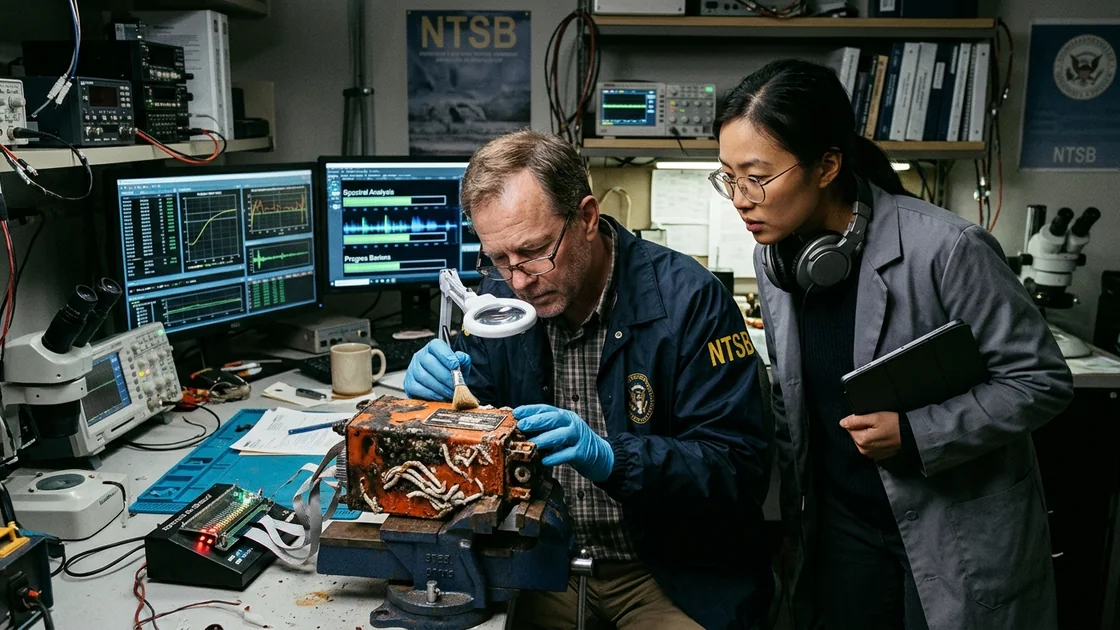
Arthur Pendelton, a senior avionics failure analyst for the National Transportation Safety Board, receives a heavily corroded flight data recorder dredged up from the bottom of the North Atlantic. Upon extracting the memory modules in his Washington laboratory, he discovers that the telemetry and cockpit voice recordings belong to Meridian Airlines Flight 402, a transoceanic passenger jet scheduled to depart from Dulles International Airport in seventy-two hours. Joined by acoustic specialist Maya Lin, Arthur verifies that the physical aircraft is currently intact and flying routine domestic routes, carrying a pristine twin of the very black box sitting on his workbench. As they dissect the terrifying audio of the plane's final minutes and trace the catastrophe to a microscopic wiring flaw inside the forward electronics bay, Arthur faces skeptical superiors who accuse him of fabricating the anomaly, forcing him to risk his career and freedom to intercept the flight crew before history catches up with the recording.
The smell of the abyss always lingered in the gaskets. No matter how many times a Crash Survivable Memory Unit was rinsed in deionized water at the recovery site, the elastomeric seals beneath the titanium flange trapped a microscopic breath of whatever ocean floor had claimed the aircraft. When Arthur Pendelton loosened the fourth Allen bolt on the Honeywell integrated recorder, the scent released into the sterile air of the laboratory was unmistakable: high-sulfur benthic mud, scorched polyalphaolefin hydraulic fluid, and the sharp, coppery tang of deep-water corrosion.
Arthur did not look up from his binocular microscope. At fifty-four, he had spent nineteen years in the basement of the National Transportation Safety Board’s headquarters at L’Enfant Plaza, and his posture had slowly adapted to the geometry of the examination bench. His spine held a permanent, gentle curve, like a question mark bent over the final seconds of other people’s lives.
"Manifest says it came off the Oceanic Surveyor out of Woods Hole," said Marcus, the evidence custodian, setting a clipboard down beside the ultrasonic bath. "They were running a side-scan sonar sweep for a transatlantic fiber-optic repeaters project about four hundred miles east-northeast of St. John’s. Snagged a debris field at twenty-two hundred meters. No fuselage sections brought up yet, just a piece of a composite horizontal stabilizer and the beacon pingless housing."
"Wait a minute," Arthur said, his fingers pausing on the torque driver. "A pingless housing? The underwater locator beacon was dead?"
"Battery was completely discharged. And look at the calcification on the acoustic transducer sleeve. Thing’s been down there a while." Marcus tapped the clipboard with his pen. "Weird part is the Coast Guard and the Canadian TSB don't have an open hull loss in that grid square. Their working theory is that a bottom current dragged it south from an older wreck site, maybe an unreported cargo ditching from the nineties, though the chassis looks way too modern for that. Sign the chain-of-custody line at the bottom, Arthur. Director Keller wants a preliminary dump before the weekend so we know whose jurisdiction to hand it off to."
Arthur picked up the stylus and signed his name on the digital pad without taking his eyes off the unit.
To the uninitiated, a black box was neither black nor simply a box. It was a shoebox-sized assembly consisting of a thin, stainless-steel front chassis containing power supplies and interface cards—which invariably crumpled like tin foil during a high-energy impact—bolted to a heavy, cylindrical or rectangular vault painted bright international orange. This vault was the CSMU. Inside its outer armor of quarter-inch forged stainless steel lay an inch of dry-silica thermal insulation, a paraffin-wax heat sink designed to melt and absorb energy during a post-crash fire, and, at the very core, a palm-sized circuit board populated with high-density NAND flash memory chips.
The unit on Arthur’s antistatic mat had seen hell.
The forward interface chassis was entirely gone, sheared away along the mountingears as if cut by a giant guillotine. The international orange paint on the memory vault had blistered and blackened into a spiderweb of carbonized flakes, indicating exposure to a fuel-fed fire exceeding eight hundred degrees Celsius for at least twenty minutes before the unit had hit the water. Once submerged, the sudden thermal shock of two-degree-Celsius seawater had warped the aft retaining ring. Across the top of the cylinder, the delicate limestone tubes of deep-sea serpulid worms curled over the stamped steel data plate.
Arthur switched on the overhead fume extractor, picked up a brass bristle brush and a bottle of weak citric acid solution, and began the slow, meditative work of clearing the data plate.
He liked this part of the job. People lied; witnesses misremembered; airline executives obfuscated behind armies of corporate attorneys; even pilots, in the panicked crucible of an aerodynamic stall, misinterpreted what their eyes were telling them. Metal and silicon did not know how to lie. If an actuator jammed at fourteen degrees, the potentiometer recorded fourteen degrees. If a turbine blade separated and tore through a nacelle, the accelerometer drew a neat, jagged spike at the exact millisecond of liberation. Causality was a one-way street paved in hexadecimal code, and Arthur was its surveyor.
The brass bristles scraped away a stubborn ridge of calcium carbonate. Beneath it, the laser-etched characters on the inconel plate emerged letter by letter.
HONEYWELL AEROSPACE
PART NO: 980-4750-003
SERIAL NO: HWL-88492-C
MFG DATE: 04/2026
Arthur stopped brushing. He blinked, removed his reading glasses, rubbed the bridge of his nose with the back of his gloved wrist, and put the glasses back on.
He leaned down, adjusting the swing-arm magnifier until the illuminated lens hovered two inches above the plate. He looked at the manufacturing date again.
April 2026.
The calendar pinned to the corkboard above his oscilloscope read October 2026. This model—the 980-4750-003—was the newest dual-purpose Cockpit Voice and Flight Data Recorder on the market, certified by the FAA less than a year ago to meet the new twenty-five-hour recording mandate for widebody airliners.
"Marcus?" Arthur called out, turning toward the door. The custodian was already gone, the heavy pneumatic closer hissing as the hallway door latched shut.
Arthur frowned and looked back at the white tubes of the tube worms crusted along the bolt heads. Deep-sea serpulids grew slowly in the freezing, nutrient-poor darkness of the bathypelagic zone. To accumulate three millimeters of calcareous tube growth at two thousand meters should have taken years, not months. And how could a next-generation recorder, manufactured six months ago, be sitting at the bottom of the North Atlantic with a dead locator beacon—a beacon rated to ping continuously for ninety days—without every aviation authority on the planet screaming about a missing widebody jet?
A test article, he thought immediately. It had to be. Airbus or Boeing, or perhaps Honeywell itself in coordination with the Navy, had dropped a sacrificial unit from a ship or a test rig to validate deep-water recovery protocols after thermal stress testing. A container had slipped off a barge during a storm, been forgotten in a bureaucratic shuffle, and was subsequently snagged by a research vessel. The calcified growth was probably from a shallower, warmer test tank at a marine materials facility before they dumped it.
That made sense. The world was full of mundane bureaucratic stupidity masquerading as mystery.
Working with practiced precision, Arthur transferred the vault to the milling vise. Because the four retaining bolts were slightly seized from galvanic corrosion between the stainless housing and the titanium washers, he applied penetrant oil, waited ten minutes, and backed them out a quarter-turn at a time. When the end cap finally came free with a dull, suctioned pop, he used a pair of nylon forceps to lift the inner thermal sleeve.
Inside, nestled within its silicone shock mount, the memory module looked as pristine as the day it had rolled off the cleanroom assembly line in Phoenix. The conformal coating gleamed like amber glass under the fluorescent lights. Not a single drop of salt water had breached the inner labyrinth seal.
Arthur disconnected the delicate Kapton ribbon cable from the sheared bulkhead pins, inspected the gold contact pads under the microscope for micro-fractures, and found none. Still, standard procedure forbade applying power directly to a crash-recovered board through its damaged primary harness. Instead, he carried the module over to the readout station—a rack of custom-built hardware simulators known around the lab as the Iron Bird—and clamped it into a zero-insertion-force test jig tied directly to an isolated five-volt power supply and a forensic write-blocker.
He sat down at his dual-monitor workstation, launched the Honeywell Retrieval and Analysis Software Suite, and initiated a bit-level image extraction of the flash memory arrays.
A progress bar appeared on the left screen. Because solid-state flight recorders write data using complex wear-leveling algorithms across dozens of individual memory dies, extracting and reassembling the raw binary stream into a coherent chronological file took nearly forty minutes. Arthur used the time to walk down the hall to the breakroom, pour himself a mug of burnt dark roast that had been sitting on the warmer since noon, and check his email. Nothing urgent. A follow-up question from a regional investigator about a Cessna Citation runway excursion in Omaha; a reminder about cybersecurity training.
When he returned to the lab, the progress bar was green.
IMAGE EXTRACTION COMPLETE. 64.00 GB TRANSFERRED. ZERO BAD SECTORS DETECTED.
"Clean read," Arthur murmured, taking asip of the bitter coffee. "Let's see what kind of test rig you were riding on."
He loaded the standard ARINC 717 data configuration map for a generic widebody—1,024 words per second—and hit the parse command. The software chewed through the binary file, separating the interleaved Cockpit Voice Recorder audio partitions from the Flight Data Recorder telemetry frames.
A summary window popped up on the right monitor, displaying the aircraft identification header hardcoded into the recorder's configuration strapping unit at the time of installation.
AIRCRAFT TAIL NUMBER: N849MA
OPERATING CARRIER: MERIDIAN AIRLINES
AIRCRAFT TYPE: BOEING 787-9 DREAMLINER
LAST RECORDED FLIGHT ID: MER402
DEPARTURE: KIAD (WASHINGTON DULLES INTL)
DESTINATION: EGLL (LONDON HEATHROW)
DATE OF LAST RECORDING (UTC): 17-OCT-2026
END OF RECORDING (UTC): 03:42:19.4
Arthur set his coffee mug down. He missed the coaster by an inch, the ceramic base clattering sharply against the laminate desk.
He stared at the date. October 17, 2026.
Today was Wednesday, October 14.
"Clock slip," he said aloud to the empty room. His voice sounded thin, swallowed by the acoustic foam panels lining the concrete walls. "The GPS time-sync bus had a bit-flip on the date word."
It happened occasionally. The aircraft’s master clock took its time reference from the Global Positioning System receivers, combining it with the internal quartz crystal oscillator in the Flight Management Computer. If someone was running bench simulations on an avionics rack at Meridian’s maintenance hub at Dulles, they often injected synthetic dates into the system to test calendar-dependent navigation database expirations.
Yes. A maintenance spare. That explained the Meridian tail number. N849MA had probably had a faulty recorder swapped out during a heavy check, the unit had been sent back to the vendor for destructive testing, and nobody had wiped the flash memory before baking it and tossing it into the ocean for an environmental durability trial.
Except why would a flight number—MER402—be logged with a complete flight profile?
Arthur clicked on the telemetry plotter and pulled up the five basic parameters every investigator looks at first: Pressure Altitude, Computed Airspeed, Magnetic Heading, Pitch Attitude, and Vertical Acceleration.
A healthy bench test looks like a series of neat, geometric stair-steps or flat horizontal lines. Engineers inject a static value—say, thirty thousand feet and two hundred fifty knots—to see if the gauges respond, then drop it back to zero.
The graph that unfurled across Arthur’s twenty-seven-inch monitor was not a bench test.
It was a living, breathing flight.
He zoomed in on the beginning of the final four-hour segment. Everything was there, rendered in the unmistakable, organic jitter of real physics. He saw the weight-on-wheels switch transition as the pushback tug lifted the nose gear at Dulles. He saw the Exhaust Gas Temperature spikes as the two General Electric GEnx engines spooled up one after the other. He saw the tiny, rhythmic lateral acceleration bumps as the main landing gear rolled over the expansion joints of Taxiway Juliet on the way to Runway 01R. He saw the throttle resolver angles advance to ninety-four percent, the smooth rotation to twelve degrees nose-up, the retraction of the flaps on schedule, the step-climbs through the congested Northeast corridor up to Flight Level 370.
There was turbulence over Nova Scotia—a three-minute patch of light chop that registered as a noisy, random oscillation between 0.9 and 1.15 G on the vertical accelerometer, accompanied by microscopic, continuous corrections from the autopilot’s elevator and aileron servos. No simulator in the world generated background atmospheric noise with that exact fractal entropy. You couldn't fake the way a two-hundred-ton carbon-fiber tube flexed in a high-altitude jet stream shear layer.
Arthur scrolled his mouse wheel to the right, following the steady blue line of the altitude trace across the North Atlantic tracks.
At 03:38:04 UTC, while cruising at thirty-seven thousand feet in the pitch-black sky four hundred miles northeast of Newfoundland, the master caution discrete bit flipped from zero to one.
Three seconds later, the Left Air Data Inertial Reference Unit dropped offline. Then the primary flight control bus threw an cascade of asynchronous parity errors. The autopilot disconnected. Within ninety seconds, the pitch and roll traces went wild, diverging into violent, overlapping sine waves as the crew fought an airplane whose control laws were disintegrating in real time.
At 03:40:50, the aircraft entered a steep, descending spiral to the left. The airspeed rocketed past the maximum operating limit, the overspeed clacker bit turning solid red on the timeline. Vertical acceleration climbed to 3.4 G. The rate of descent exceeded eighteen thousand feet per minute.
At 03:42:19.4, at an altitude of minus-twelve feet pressure correction and an indicated airspeed of four hundred and eighty knots, every single parameter terminated simultaneously on a vertical line.
Arthur’s hand was cold on the mouse.
He minimized the telemetry plotter, opened a web browser, and typed
in the URL for the Federal Aviation Administration’s internal Air
Traffic Organization tracking portal. He entered his credentials, waited
for the two-factor authentication chime on his phone, and typed
N849MA into the active transponder search bar.
The map of North America loaded. A small green airplane icon pulsed steadily over central Illinois.
N849MA (B789) - MERIDIAN AIRLINES FLT 118
ORIGIN: KSFO (SAN FRANCISCO)
DEST: KIAD (WASHINGTON DULLES)
ALTITUDE: 39,000 FT | GROUND SPEED: 542 KTS
STATUS: EN ROUTE - ON TIME (ETA 20:14 EDT)
Arthur stared at the little green icon moving incrementally across the Mississippi River. Then he looked ten inches to his left, at the fire-blackened, worm-encrusted titanium cylinder clamped in his milling vise.
He picked up his desk phone and dialed the four-digit extension for the Acoustic Laboratory down the hall.
It rang four times before a brisk, slightly muffled voice answered. "Audio lab, this is Lin."
"Maya," Arthur said, his voice tight. "Are you busy?"
"I'm up to my eyeballs in a Beechcraft King Air cockpit mic that went into a swamp in Georgia, Arthur. If this is about the budget request for the new spectrum analyzer—"
"Leave the King Air," Arthur said. "Come down to Lab B. And don't bring anyone with you."
Maya Lin arrived three minutes later, still wearing her oversized studio headphones around her neck and carrying a tablet tucked under the arm of her gray lab coat. At thirty-two, she was the youngest senior specialist in the Vehicle Recorder Division, recruited out of Johns Hopkins where she had written her doctoral thesis on extracting intelligible human speech from severely degraded hydrophone arrays. She had a sharp, unsentimental mind and a habit of clicking a retractable ballpoint pen when she was impatient.
She stopped just inside the door, her eyes going immediately to the corroded CSMU in the vise, then to the dual monitors glowing in the dimmed room.
"Marcus said a cold-case maritime recovery came in from Woods Hole," she said, walking over and peering down at the white calcium tubes on the casing. "Thought you said it was a Navy test drop."
"I didn't say anything to Marcus," Arthur replied. He pointed at the right monitor. "Read the header block."
Maya leaned in, adjusting her wire-rimmed glasses. She read the tail number, the carrier, the route, and finally the date. Her thumb clicked her pen once. Click-clack.
"Okay," she said slowly. "A 2026 manufacture date on a box covered in five years of benthic growth, showing a flight timestamp seventy-two hours from now. And on the other screen, you have live ADS-B tracking showing the actual tail number flying over Indiana right now. Who's pranking you? Is this Henderson from the Systems Group? Because if he spent agency money machining fake barnacles onto a forty-thousand-dollar Honeywell housing just to mess with your retirement countdown—"
"Those aren't barnacles, they're serpulid polychaete tubes, and they aren't fake," Arthur interrupted. "I scraped them with citric acid. It's genuine biogenic calcium carbonate intergrown with iron oxide blisters from the casing steel. And look at the memory board in the jig."
Maya stepped over to the test bench and looked through the illuminated magnifier at the extracted PCB.
"Check the serial number laser-etched into the fiberglass substrate next to the main Xilinx processor," Arthur instructed. "Then check the Honeywell factory build sheet I pulled from the secure manufacturer portal five minutes ago."
Maya looked at the board, then at the PDF open on the corner of Arthur's screen.
"Board serial 4409-TX-882," she read softly. "Installed inside CSMU Serial HWL-88492-C on April 14, 2026, at Honeywell Aerospace, Redmond. Shipped to Boeing Everett Delivery Center, May 2. Installed on Line Number 1142, Tail N849MA, at Position EE-Aft-2 during final assembly."
She straightened up, her pen silent now. "Wait. If this serial number was installed on N849MA at the factory in May, and the maintenance logs show no component swap-outs since delivery..."
"Then this exact serial number is currently flying at thirty-nine thousand feet over Indianapolis," Arthur finished. "While sitting on my bench."
Maya looked back and forth between the vise and the screen. "Counterfeit plate? Someone restamped a salvaged box from an older crash?"
"A 787-9 has never crashed in the North Atlantic, Maya. In fact, until the hull loss in India last year, the type had a virtually spotless fatal hull-loss record, and none have ever gone into deep ocean water. Look at the parameter list. It’s a full ARINC 664 AFDX data bus capture—over two thousand distinct parameters at sixteen Hertz. You know how much computing power it would take to synthesize two hours of coupled aero-elastic flight dynamics, engine thermodynamics, and fuel slosh values that pass our checksum verification without a single framing error?"
"You haven't listened to the CVR partition yet," Maya observed. It wasn't a question. She knew Arthur; he was a numbers man. He avoided the cockpit voice tracks until he had the physics mapped out, preferring not to hear the voices of the dead until he knew why they had died.
"I waited for you," Arthur said, stepping back from the chair. "Pull up the audio partitions. Tell me it’s a hoax. Tell me it’s AI-generated voices or a loop from a training simulator in Miami. Find the seam for me, Maya."
Maya didn't argue. She slid into the ergonomic chair, slipped her studio headphones over her ears, and plugged the quarter-inch jack into the interface box. Arthur put on the secondary pair of monitoring headphones hanging from the rack side.
With a few rapid keystrokes, Maya imported the raw .WAV streams extracted from the memory module into Izotope RX, her primary spectral repair software. Four distinct horizontal waveforms bloomed across the dark interface in glowing neon blue and orange.
Channel 1: Captain’s Audio Control Panel.
Channel 2: First Officer’s Audio Control Panel.
Channel 3: Cockpit Area Microphone (CAM).
Channel 4: Public Address and Cabin Interphone.
Because the unit was a modern twenty-five-hour recorder, it held four
complete flight legs prior to the final recording. Maya scrolled
straight to the final two-hour segment labeled
MER402_17OCT26 and dropped the playhead thirty minutes
prior to the end of the file, right in the middle of the oceanic cruise
phase.
She hit the spacebar.
Instantly, Arthur’s ears were filled with the familiar, comforting womb-sound of a modern widebody flight deck at cruise: the low, rushing white noise of boundary-layer air stripping across the reinforced windshield at Mach 0.85, underpinned by the faint, rock-steady four-hundred-Hertz electrical hum of the avionics cooling fans.
"—telling you, if they trade him before the deadline, the whole bullpen falls apart," a man’s voice said on Channel 2, crisp and close through the boom microphone. He sounded young, mid-thirties, with a slight upper-Midwestern vowel flatness. "You can't build a pitching rotation around two rookies with Tommy John scars and a closer who throws ninety-one on a good day."
"He's thirty-six, Julian. His slider hasn't slid since August," replied Channel 1. The Captain’s voice was deeper, gravelly, carrying the unhurried cadence of an airline veteran who had spent twenty thousand hours sitting in aluminum chairs. "Besides, after that meltdown against Baltimore yesterday, the front office doesn't have a choice. Did you see the ninth inning before we left the hotel? Bases loaded, nobody out, and he walks the eight-hole hitter on four straight pitches in the dirt."
Maya hit the spacebar. The audio cut off instantly.
She slowly pulled one earcup away from her head and stared at the monitor.
"What?" Arthur asked, pulling his own headphones back. "Did you hear a splice? Phase distortion?"
"Arthur," Maya whispered. "My brother is an Orioles fan. I watched that game with him at a bar in Bethesda."
Arthur blinked. "When?"
"Three hours ago," she said, her voice dropping an octave. "It was a day game. Playoffs. The sixth inning had a forty-minute rain delay, and in the bottom of the ninth, with the bases loaded and nobody out, Cleveland's closer walked the eighth batter in the lineup on four straight pitches in the dirt. The game ended at 4:15 PM today."
The silence in Lab B suddenly felt heavy, pressurized, as if they were the ones two thousand meters beneath the surface of the Atlantic. The hum of the overhead fume extractor seemed deafening.
"When did Marcus log this Pelican case into the evidence vault?" Maya asked, her eyes wide behind her glasses.
"Eleven o'clock this morning," Arthur said. "And the Oceanic Surveyor docked at Woods Hole on Monday morning. It was sitting in an evidence locker in Massachusetts for two days before a courier drove it down I-95."
"That's impossible," Maya said. Her hand was trembling slightly as she reached for the mouse. "When that box was being hauled up in a dredge net off Newfoundland last Friday, that baseball game hadn't happened yet."
"Check the rest of the acoustic signature," Arthur said, forcing his voice into the flat, clinical register he used during formal investigative hearings. If he let go of the procedure, he felt as though the floor might tilt beneath his shoes. "Run an FFT on the background hum. Check the structural resonance peaks on the Cockpit Area Mic."
Maya swallowed hard, nodded, and slipped the earcup back over her ear. For the next ten minutes, neither of them spoke. Maya isolated a five-second slice of silence from the area mic—mounted in the overhead panel between the two pilots—and generated a high-resolution Fast Fourier Transform spectrogram.
"The structural acoustic fingerprint matches a Boeing 787-9 cockpit," she murmured, tracing the glowing purple frequency lines with her cursor. "Look here at 112 Hertz and 240 Hertz. That's the blade-passing frequency of the GEnx-1B fan stages transmitted through the composite stringers. And look at the 400-Hertz AC wild-frequency power bus harmonics. Every individual aircraft has tiny imperfections in its generator bearings and cooling fan blades that create a unique acoustic thumbprint—like ballistic striations on a bullet."
She opened a reference database on the NTSB network, searching for any prior routine readout or quality-assurance check from Meridian Airlines’ fleet. Six months ago, N849MA had sent in a mandatory quarterly flight data monitoring file after a hard landing in Denver. Maya overlaid the acoustic baseline from the Denver file onto the spectrogram from the corroded box.
The frequency peaks aligned with mathematical perfection.
"It's the same airframe," Maya said. "Not just the same model. It is physically the exact same airplane, down to the slight bearing rattle in the number-two equipment cooling blower."
"And the voices?"
"Captain is Robert Miller, fifty-eight, based out of Dulles," Maya said, cross-referencing the Meridian crew scheduling portal they had read-only access to through the FAA safety liaison gateway. "First Officer is Julian Reed, thirty-four. Look at the October roster."
She turned the tablet toward Arthur. On the crew manifest for Friday, October 16, Flight MER402 was scheduled to push back from Gate B42 at Dulles International Airport at 21:50 Eastern Daylight Time—which was 01:50 UTC on October 17.
Assigned flight crew: Captain R. Miller, First Officer J. Reed.
Assigned aircraft tail number: N849MA.
"Play the last four minutes," Arthur said quietly.
Maya hesitated, her finger hovering over the spacebar. In their line of work, listening to the end of a CVR was a sacred, terrible threshold. By federal law, the audio was never released to the public; only transcripts were published, sanitizing the terror into dry typography. Only the people in this basement heard the ragged breathing, the prayers, the sickening thud of bodies thrown against instrument panels. Listening to people who had died months ago was hard enough. Listening to two men who were currently alive—probably eating dinner in a suburban Virginia kitchen or packing a flight bag—die in seventy-two hours felt obscene.
"We need to know what happens to the plane, Maya," Arthur said gently. "The telemetry shows WHAT failed, not WHY the crew couldn't isolate it."
Maya nodded once and moved the playhead to 03:37:50 UTC.
At first, there was only the tranquil rush of the slipstream and the soft click of a ceramic coffee cup being set into the console holder.
" Shanwick OCA just cleared us on the data link for Track Charlie," Julian Reed’s voice said easily. "Winds are a little better than forecast at three-seven-zero. Should put us on the ground at Heathrow twenty minutes early."
"Good," Captain Miller replied. "My daughter's flying in from Edinburgh on the morning train. Promised her we'd get a proper fry-up in Paddington before I crash at the hotel."
At 03:38:03.8, the Cockpit Area Mic picked up a sharp, metallic SNAP—not from the speakers, but conducted directly through the structure of the aircraft from somewhere beneath the cockpit floor. At that exact millisecond on the spectrogram, a jagged vertical broadband spike tore across all four audio channels, accompanied by a loud, buzzing sixty-Hertz electrical hum that bled directly into the intercom wiring.
BEEP-BEEP-BEEP-BEEP. The Master Caution chime rang out.
"Whoa, what the hell was that?" Reed said, his voice tightening instantly. "I just lost my primary flight display. Left ADIRU fault, EICAS is lighting up like a Christmas tree—Electrical Bus Left-Two fault, Flight Control Primary Computer failure—"
"I have control," Miller said, his voice dropping into the disciplined, iron-clad calm of thirty years of training. "My screens are flickering too. Standby instruments are good. Autopilot just kicked off."
CAVALRY CHARGE. The distinctive, descending warble of the autopilot disconnect alarm echoed through the cockpit, followed immediately by the harsh, synthesized voice of the EICAS warning system: "STABILIZER MOTION. STABILIZER MOTION."
"I didn't touch the trim!" Reed barked. "Bob, the stabilizer trim is running nose-down on its own! Cutout switches!"
Two heavy, mechanical clacks sounded on the area mic as Captain Miller flipped the guarded pitch-trim cutout paddles on the center pedestal.
"Cutouts are off! It's still moving!" Miller strained, the leather of his seat creaking loudly on the mic as he braced both feet against the rudder pedals and hauled back on the control column with everything he had. "The cutout switches aren't breaking the relay! Something is back-feeding raw bus power straight into the primary actuator control electronics!"
"Smoke!" Reed coughed suddenly. "I smell electrical smoke coming up through the rudder pedal slots! Acrid—it’s burning insulation!"
"Masks on! Get the oxygen mask on!"
There was the frantic rustle of harnesses, the pneumatic hiss of positive-pressure regulators snapping over their faces, and then their voices became muffled, metallic, and Darth Vader-like through the mask microphones, punctuated by the rhythmic whoosh-click of their terrified breathing.
"Declaring Mayday on 121.5—Mayday, Mayday, Mayday, Meridian Four-Zero-Two, heavy, losing pitch control at Flight Level Three-Seven-Zero, electrical fire in the forward bay—"
CLACK-CLACK-CLACK-CLACK. The stick shaker motor attached to the control column erupted, vibrating so violently that it threatened to rattle the audio waveform into clipping. Simultaneously, the overspeed clacker began its frantic staccato drumming as the nose pitched down past twenty-five degrees.
"It's commanding full left rudder and nose-down elevator!" Miller roared over the cacophony of competing computer voices—"BANK ANGLE, BANK ANGLE! SINK RATE! WHOOP, WHOOP, PULL UP!"—his breathing ragged and desperate. "The fly-by-wire ACE modules are getting phantom high-voltage signals! Pull the breakers! Pull the Left Flight Control bus breakers on the overhead!"
"They're electronic breakers on the screen, Bob! The touchscreens are dead! I can't access the CB page!"
"Cycle the battery switch! Kill the main generators!"
"Cycling! Nothing's dropping offline—the bus tie contactors are welded shut!"
For the next ninety seconds, Arthur sat frozen as the cockpit descended into an acoustic hell. The aerodynamic roar outside the windshields rose in pitch from a dull rush to a screaming, tearing shriek as the Dreamliner broke through Mach 0.94 in a forty-degree dive through the clouds. Luggage and flight manuals crashed against the cockpit bulkhead door as negative Gs alternated with crushing positive loads. On Channel 4, the cabin interphone line briefly shorted open, letting through a horrific, three-second burst of two hundred and eighty voices screaming in the dark before the wire burned through and went dead.
In the cockpit, neither pilot screamed. Even at the end, trapped inside a runaway machine that had turned its own nervous system against them, they worked the problem.
"Help me on the yoke, Julian! Both hands! Pull!"
"I'm pulling! I'm pulling with everything I've got!"
"Come on, baby, come up, come up, come—"
"Bob, the water—"
There was no explosion. At four hundred and eighty knots, water does not behave like a liquid; it behaves like reinforced concrete. There was only a single, deafening, low-frequency CRACK that pegged every decibel meter in the software into solid red for 0.04 seconds as the nose radome and forward avionics bay disintegrated simultaneously, followed instantly by the flat, absolute silence of the end of the file.
Maya hit the spacebar.
She took off her headphones with both hands, set them carefully on the desk, and leaned forward, resting her forehead on her folded arms. Her shoulders rose and fell in silent, controlled breaths.
Arthur took off his own headphones. His palms were sweating inside his nitrile gloves. He peeled them off and threw them into the biohazard bin.
"The bus tie contactors welded shut," Arthur said, his mind seizing onto the engineering problem like a drowning man grabbing a spar. "And the pitch trim cutout switches failed to isolate the primary control electronics while the touchscreens locked him out of the virtual circuit breakers. How does a single failure cascade across three segregated power and data domains on a 787?"
Maya lifted her head. Her face was pale under the fluorescent lights, her eyes dark and fierce. "Arthur. Forget the schematic for ten seconds. Do you understand what we just listened to?"
"Yes."
"No, I don't think you do," she said, standing up and pacing the narrow strip of linoleum between the workbenches. "That wasn't a simulation. That wasn't an AI deepfake. No algorithm on Earth knows how to fake the specific acoustic intermodulation of a pilot screaming through a Scott oxygen mask while a 400-Hertz wild-frequency power bus arcs across an intercom ground wire at negative-point-five Gs. That recording is real. Those two men—and everyone in the back of that plane—died."
"They haven't died yet," Arthur said.
"They did in whatever ocean this box came out of!" She stopped and pointed a shaking finger at the rusted, worm-crusted cylinder. "How is it here, Arthur? Tell me how a physical piece of forged stainless steel travels backward in time—what, five years? Ten years? Sitting in the mud at the bottom of the Labrador Sea waiting for a Woods Hole sonar sled to scrape it up four days before the plane even takes off!"
Arthur looked at the box. He had spent his entire life worshipping at the altar of linear determinism. A bolt fractures because of cyclic fatigue; the wing separates because the bolt fractured; the plane falls because the wing separated. First A, then B, then C. If C happened before A, the entire architecture of his reality collapsed into gibberish.
"I don't know how the box got on the ocean floor," Arthur said slowly, his voice steady. "I am not a theoretical physicist, Maya. I don't know anything about wormholes or closed timelike curves or quantum entanglement in deep-water trenches. If we spend the next two days trying to figure out how that box travelled backward through time, Flight 402 is going to push back from Gate B42 on Friday night, fly out over the North Atlantic, and put that box right back where the Oceanic Surveyor found it."
Maya stared at him, her chest heaving slightly. "You think we can stop it?"
"I know what I am," Arthur said, turning back to the telemetry monitor and zooming in on the exact millisecond of the 03:38:03.8 electrical transient. "I am an avionics failure analyst. And this box just gave us twenty-five hours of high-rate diagnostic data prior to a fatal in-flight breakup. We have never had a pre-crash black box before. Let's use it."
For the next three hours, Lab B became a war room.
They didn't notify Director Keller. Both of them knew instinctively what would happen if they walked upstairs to the fourth floor and announced that a maritime salvage unit was predicting a future airline crash. At best, Keller would assume a catastrophic software corruption in the lab's readout bench and quarantine the evidence for weeks of bureaucratic verification by Honeywell engineers. At worst, he would suspect a malicious cyber-intrusion or a mental breakdown. Either way, Friday night would come and go while the box sat locked in a GSA safe.
Instead, Arthur and Maya worked the data the way they worked every major investigation: backwards from the point of divergence.
"Look at the three legs prior to Flight 402," Arthur said, pointing at the multi-parameter strip chart he had compiled across both monitors. "Leg one: San Francisco to Dulles—that's the flight that's in the air right now. Leg two: Dulles to Paris tomorrow night. Leg three: Paris back to Dulles on Friday afternoon. And Leg four: Dulles to London, Friday night."
"Are there any anomalies on the flight happening right now?" Maya asked, leaning over his shoulder.
Arthur zoomed in on the telemetry from Leg One—the flight currently descending toward Virginia in the real world. He isolated the electrical parameters for the Left 235-Volt AC Variable Frequency bus and the Left 28-Volt DC Flight Control bus.
"There," Arthur breathed. He tapped the screen with the tip of his mechanical pencil. "Right when they hit moderate turbulence over the Rockies two hours ago. Look at the Left ADIRU input voltage and the Window Heat / Pitot Probe heater current draw."
On the chart, two lines that should have had zero correlation showed a microscopic, synchronous ripple lasting twelve milliseconds. As the Pitot probe heater cycled on to prevent icing at thirty-nine thousand feet, a tiny transient spike of 0.4 volts bled directly into the shielding ground of the Remote Data Concentrator in the forward electronics bay.
"It's an insulation breach," Arthur said, his eyes narrowing as the three-dimensional wiring diagrams of the Boeing 787-9 unfolded inside his head. "The Pitot-static heater circuit runs on high-amperage 115-volt AC power. In the forward electronics bay—Right below the cockpit floor, Zone EE-1—the high-voltage heater feeder bundle runs parallel to the primary ARINC 664 fiber-and-copper hybrid harness that feeds the Left Actuator Control Electronics."
"They're supposed to have a two-inch physical air gap between high-voltage heater lines and flight control signal bundles," Maya said, recalling the FAA certification regulations from an earlier airworthiness directive investigation. "Ever since the Swissair 111 fire."
"They are," Arthur agreed. "Unless an Adel clamp failed, or someone left a zip-tie loose during a maintenance inspection, allowing the high-voltage feeder to droop against the stainless-steel mounting bracket of the bus power control unit. Every time the plane hits turbulence, the wire bundle vibrates against the sharp edge of the bracket. On the San Francisco leg today, the Kapton-Teflon insulation is just barely worn through—enough for a tiny capacitive bleed during turbulence. Tomorrow night on the Paris run..."
He scrolled forward to Leg Two and Leg Three. On each successive flight, the transient spikes grew larger, sharper, and more frequent. Carbon tracking was building up on the bracket—microscopic bridges of charred residue created by tiny sparks.
"Then on Friday night," Arthur continued, tracing the final fatal spike over the North Atlantic, "they hit that patch of chop off Newfoundland while the Pitot heaters are at maximum duty cycle. The insulation finally fails completely. A massive 235-volt wild-frequency arc jumps straight across the carbon track into the unshielded pin field of the Left Flight Control Data Concentrator and the Bus Power Control Unit simultaneously."
"Which welds the bus tie contactors shut from the inside," Maya whispered, the puzzle pieces clicking together with chilling clarity, "and sends raw alternating current down the low-voltage signal lines to the horizontal stabilizer trim actuator, bypassing the cockpit cutout switches entirely because the arc is downstream of the pedestal paddles."
Arthur leaned back in his chair, exhaling a long, shaky breath. "A five-cent cushioned loop clamp. That’s what kills two hundred and ninety-two people."
He glanced at the wall clock. It was 7:45 PM.
On his secondary monitor, the green airplane icon of Meridian Flight 118 from San Francisco was currently passing through ten thousand feet over the Shenandoah Valley, lined up for a visual approach to Runway 01R at Dulles.
"It lands in twenty minutes," Arthur said, standing up and reaching for his raincoat on the coat tree. "And it sits on the ground at Dulles for six hours before they turn it around for the late-night ferry or maintenance check. How fast can you drive in the rain?"
Maya was already grabbing her NTSB credentials lanyard and stuffing a high-intensity flashlight and an inspection mirror into her field kit bag. "I grew up on the Beltway, Arthur. I’ll have us at the cargo gate before they finish deplaning."
October rain slanted across the vast concrete apron of Dulles International Airport in cold, silver sheets, driven by a gusty northeast wind that smelled of wet asphalt and Jet-A exhaust. Red and blue rotating beacons from fuel trucks, baggage tugs, and catering high-loaders reflected off the standing puddles in blurred, neon streaks.
At Gate B42, the sleek, raked composite nose of N849MA gleamed under the sodium floodlights. The passengers from San Francisco had long since vanished into the terminal, and the cabin cleaning crew was just filing down the jetbridge stairs with bags of trash.
Down on the tarmac, Arthur and Maya walked briskly past the nose wheel well, their yellow high-visibility vests flapping wildly in the wind over their dark NTSB raid jackets. Two Meridian Airlines line maintenance technicians stood under the shelter of the fuselage belly near the open forward cargo door, tablets in hand, waiting for the fuel truck to finish hooking up the single-point pressure hose under the right wing.
"Evening, folks," the lead mechanic said, squinting through the rain as Arthur held up his gold-and-blue federal badge wallet. "NTSB? Nobody called down a reportable incident on the inbound from SFO. Crew write-up sheet is completely clean except for a sticky latch on the mid-galley coffee maker."
"We aren't here for an incident, Mr.—" Arthur squinted at the man's ID badge "—Mr. Callahan. I'm Senior Investigator Pendelton, this is Specialist Lin. We're conducting a spot verification on an emerging fleet-wide airworthiness concern involving the forward avionics bay wiring harnesses and the aft recorder rack on 2026-build Dash-9s. We need twenty minutes in EE-1 and EE-Aft before you button her up for the night."
Callahan frowned, wiping rainwater from his chin. Normally, spontaneous ramp inspections were the domain of FAA Aviation Safety Inspectors, not the NTSB. But very few line mechanics at eleven o'clock on a miserable Wednesday night had the inclination—or the regulatory confidence—to tell two federal investigators with headquarters credentials that they couldn't look inside an open access hatch.
"Long as you don't pull any tagged breakers or disconnect LRUs without logging it in the book," Callahan said, gesturing toward the ventral access ladder tucked just behind the nose gear doors. "Aircraft doesn't push until tomorrow evening anyway—they moved her to an overnight RON slot after the catering truck clipped a cargo container on the Paris bird at B44. Have at it."
Arthur’s heart gave a hard, strange thump against his ribs. Moved to an overnight slot. Even the minor gate schedules were shifting around the airplane like currents guiding a boat toward a waterfall.
"Maya," Arthur said softly as they stepped under the dry belly of the fuselage. "Take the aft bay first. Get a photograph of the data plate on the integrated recorder. I'll be in the forward bay."
Maya nodded, her face grim under the brim of her rain hood, and walked aft toward the rear equipment hatch near the wing root.
Arthur climbed the narrow aluminum rungs of the forward electronics bay ladder and pushed himself up through the rectangular hatch in the belly.
Stepping into the forward E-bay of a Boeing 787 was like stepping inside the brainstem of a giant cybernetic whale. The space was cramped, windowless, and brightly lit by LED strips, smelling of warm silicon, ozone, and dry fiberglass insulation. All around him, curved racks of matte-black Line Replaceable Units—flight control computers, remote data concentrators, power conversion modules—hummed softly as the ground-power cart outside fed electricity into the ship's arteries. Thick bundles of white Tefzel and orange Kapton wiring, some as thick as a man's wrist, coursed along the composite bulkheads in neat, regimented highways.
Arthur pulled his schematic reference sheet from his pocket, though he didn't really need it. He moved forward toward the bulkhead just beneath the First Officer’s rudder pedals, dropped to his knees on the grated aluminum floor panels, and shone his high-lumen LED flashlight behind the Left Bus Power Control Unit rack, Frame Station 245.
At first, everything looked immaculate. The aircraft was only five months old; there wasn't even a layer of dust on the cooling plenums.
Then he slid his telescopic dental mirror between the back of the BPCU chassis and the primary structural titanium shear clip. He angled the flashlight beam onto the mirror glass.
Arthur stopped breathing.
Right at the corner of the stamped titanium mounting bracket, where the high-voltage Pitot-static heater feeder cable made a ninety-degree bend to pass through a lightning bulkhead grommet, the cushion clamp was missing. A stainless-steel bolt and nut had been threaded through the bracket mounting hole during factory assembly in Everett, tightened down, and even dabbed with green torque-seal lacquer—but the mechanic on the assembly line had failed to loop the cushioned clamping band around the wire bundle itself before driving the nut home.
Instead, someone had temporarily secured the heavy, stiff power cable with a standard nylon zip-tie that had already snapped from thermal cycling, its broken black tail dangling uselessly in the cooling airflow.
The heavy white outer jacket of the 115-volt feeder was resting directly against the knife-sharp, unchamfered corner of the titanium bracket, inches above the unshielded connector pin field of the Left Flight Control Data Concentrator.
And right at the point of contact, the white Teflon insulation was rubbed away into a fine white powder. Through his magnifying lens, Arthur could see a single strand of bare, silver-plated copper wire glinting through the breach—and around it, a tiny, microscopic smudge of black carbon soot no wider than an eyelash.
The spark from two hours ago over Colorado.
Arthur's hand shook so badly that the dental mirror clinked against the rack frame.
"Arthur."
He flinched, nearly dropping his flashlight. Maya’s head and shoulders were sticking up through the floor hatch behind him. She didn't climb all the way in; she just held up her smartphone, the screen glowing at maximum brightness in the tight compartment.
Arthur crawled backward on his knees and looked at the high-resolution photograph on her screen.
In the photo, gleaming inside its immaculate rack in the aft equipment bay, was a brand-new, unblemished international-orange Honeywell flight recorder. Not a scratch on the paint. Not a speck of rust. And clearly legible on the laser-etched inconel data plate:
PART NO: 980-4750-003
SERIAL NO: HWL-88492-C
MFG DATE: 04/2026
Arthur looked from the phone back toward the dark corner behind the power rack.
"Is it there?" Maya whispered.
"The clamp was never installed on the line," Arthur said, his voice barely audible over the 400-Hertz hum of the cooling fans. "The zip-tie broke. The insulation is already through to the primary conductor, and there's a fresh carbon track from the turbulence over Denver today."
"Take pictures," Maya said urgently, climbing the rest of the way into the bay and pulling out her macro camera. "Take twenty pictures. Then we go down that ladder, we hand them to Callahan, and we tell him to ground the aircraft immediately for a wire harness repair."
Arthur stepped back to let her squeeze behind the rack with the camera, his mind racing ahead. As the flashbulbs popped in the tight space, casting stark shadows across the rows of black computers, he thought about how easy it would be. Walk down the ladder, show the mechanic a chafed wire—something any conscientious technician would thank them for catching—watch them put a red DO NOT OPERATE tag on the cockpit yoke, and drive home to sleep.
Wait.
Wait a second.
If it was that easy—if all he had to do was tell Callahan right now—why did the corroded box exist in his lab?
Wait. Think like an engineer. Look at the closed loop. If the future had already sent the box back, did that mean whatever they were about to do tonight had failed to stop the flight from taking off on Friday?
Or worse: what if their intervention tonight was somehow part of the chain of events that caused it? No, the chafed wire was already there; the factory defect had happened in May, and the spark over Colorado had happened two hours before they ever stepped onto this tarmac. The physical precursor was independent of them.
Then why would the plane still fly on Friday night if they showed Callahan right now?
Arthur climbed down the ladder first, dropping onto the wet tarmac just as Maya emerged from the hatch behind him. Callahan was standing by the nose gear strut, zipping up his raincoat as the fuel truck disconnected its hoses and rolled away.
"All done?" Callahan asked. "Find what you were looking for?"
"Mr. Callahan," Arthur said, stepping forward while Maya pulled up the macro photos on the camera's LCD screen. "You need to pull this aircraft out of service immediately and log a high-priority grounding discrepancy in the maintenance logbook. In Zone EE-1, Frame Station 245, behind the Left Bus Power Control Unit, the Pitot-static heater feeder bundle missed its primary Adel clamp at the factory. It's chafing directly against a titanium shear bracket, and the outer insulation has breached to the conductor directly above the flight control data concentrator."
Callahan stared at him for a beat, then looked down at the camera screen Maya held out. He squinted at the close-up photo of the white wire resting against the bracket.
"Hold on," Callahan said, his demeanor shifting instantly from cooperative to defensive. Every airline mechanic knew that if the NTSB found an unlogged grounding defect during a ramp check, the FAA would follow up with a Letter of Investigation within forty-eight hours—and the last technician who had signed off the zonal inspection on the forward E-bay would have their Airframe and Powerplant license on the chopping block.
"Who signed off the B-check zonal on EE-1 last week?" Callahan muttered to his younger partner, whose face had just gone pale. "Was that you, Miller? Damn it. Let me go up there and look at it."
Callahan brushed past them and climbed up into the hatch. Three minutes later, he climbed back down, wiping his hands on a shop rag. When he turned around, his face had hardened into the bureaucratic mask Arthur had seen a hundred times at crash sites.
"Okay, I see the missing clamp loop," Callahan said carefully. "And I see some minor scuffing on the external white Tefzel chafe sleeve. I don't see bare conductor, Mr. Pendelton—that glint is just the aluminized Mylar shield wrap underneath the outer sacrificial jacket. Per the Boeing 787 Structural and Wiring Standard Practices Manual, Section 20-10-13, minor chafe on an outer sacrificial sleeve with no damage to the primary Kapton insulation is deferrable for up to fifty flight hours if we wrap it in spiral Teflon chafe guard and secure it with high-temp tie-wraps until she hits her next heavy maintenance routing in Atlanta on Sunday."
Arthur felt his stomach drop into his shoes.
Spiral Teflon chafe guard and a tie-wrap.
"No!" Arthur said sharply, stepping closer. "That isn't aluminized Mylar, Mr. Callahan, that is silver-plated copper conductor, and there is already carbon tracking on the titanium bracket! If you just wrap a piece of spiral plastic around that without replacing the wire section and installing the structural clamp, the high-voltage arc will punch right through the gap in the spiral wrap the next time that harness flexes under G-load!"
"With all due respect, sir," Callahan said coldly, squaring his shoulders, "you're NTSB, not an FAA Principle Maintenance Inspector. You don't have regulatory authority to revoke an airworthiness certificate on the ramp, and you don't sign my logbook. I'll write up the missing clamp, we'll install a proper Adel clamp on the stud tonight, and we'll sleeve the scuff mark per the Boeing manual. That makes the aircraft one hundred percent legal to fly."
Wait, Arthur thought frantically. If Callahan installs the Adel clamp tonight and pulls the wire away from the bracket, then why did it arc on Friday night?
Think! Why would putting the clamp on tonight make it worse, or fail to fix it?
Arthur’s mind flashed back to the geometry of the bracket he had just looked at. The wire bundle had a permanent, stiff bend set into it from five months of pressing against the sharp corner. If Callahan's young partner went up there right now in a hurry to cover up his missed inspection from last week, and he reefed that stiff wire bundle backward by half an inch to force it into the Adel clamp loop on the mounting stud...
"Wait," Arthur whispered, horror dawning across his face. "Don't touch that wire."
Callahan blinked. "Excuse me? Five seconds ago you wanted me to ground the plane over it, now you don't want me to clamp it?"
"If you pull that bundle upward to fit the clamp on the factory stud without de-pinning the connector to relieve the tension," Arthur said, his voice rising over the roar of a passing baggage tug, "the degraded primary insulation inside the bend radius is going to crack wide open, and you'll pull the bare spot directly across the sharp upper flange of the Bus Power Control Unit chassis! That's why it arcs into both buses at once! In the current position, it's an inch away from the BPCU—clamping it under tension puts the breach right against the bus bar housing!"
Now it made devastating, crystal-clear sense. The timeline wasn't ignoring their visit tonight; their visit tonight was the trigger that moved the wire into the kill position. If they hadn't pointed it out, the wire might have only shorted to the ground bracket and tripped a single heater breaker. By forcing a rushed, defensive midnight repair by a frightened mechanic trying to avoid an FAA violation without ordering a full twelve-hour harness replacement, they were positioning the exposed conductor directly over the flight control interface!
"Look, mister," Callahan said, stepping back and pulling his cell phone out of his vest pocket. "I don't know what kind of game you two are playing out here at midnight without an FAA escort, but I'm calling Maintenance Control and our Director of Safety right now. You need to step off the ramp footprint immediately, or I'm calling Airport Operations Police to escort you back to the terminal."
"Arthur," Maya said, grabbing his elbow firmly. She saw the look in Callahan's eyes, and she saw the two airport security SUVs patrolling the perimeter service road fifty yards away. "If we get detained by Airport Police on an unauthorized ramp inspection, Keller will have our badges by seven in the morning, and nobody will ever listen to us. Come on."
Arthur stood frozen in the rain for three seconds, staring up at the dark rectangular hatch in the belly of the Dreamliner. Then he let Maya pull him away toward the terminal gate stairs.
As they reached the door to the jetbridge stairwell, Arthur looked back. The younger mechanic—the one who had missed the inspection the week before—was already climbing up the aluminum ladder into the forward electronics bay with a pair of pliers and a bag of clamps in his hand.
At 8:30 AM on Thursday morning, the fourth-floor corner office of Director Thomas Keller smelled of lemon furniture polish and bureaucratic execution.
Keller was a former Navy P-3 Orion patrol pilot who had earned a law degree from Georgetown after leaving the service; he ran the Vehicle Recorder Division with the brisk, risk-averse precision of a corporate general counsel. On his mahogany desk sat a printed copy of the formal complaint filed at 2:00 AM by Meridian Airlines’ Vice President of Maintenance Operations, alongside Arthur’s preliminary printout of the impossible telemetry header from Serial Number HWL-88492-C.
Down in the basement, two security guards stood outside the locked door of Lab B.
"Let me make sure I have the sequence of events straight, Arthur," Keller said quietly, steepling his fingers over the documents. Maya stood beside Arthur’s chair, her arms crossed tightly over her chest. "Yesterday morning, a corroded CSMU comes in from Woods Hole. Instead of logging the preliminary extraction into the division server and notifying me of an anomalous header block, you and Dr. Lin keep the file off-network for eight hours. Then, at ten-thirty at night, the two of you drive out to Dulles in your personal vehicle, flash your NTSB credentials at a Meridian line crew under false pretenses of a fleet-wide spot check, climb into the avionics bay of an active commercial airliner without FAA coordination or an active investigation docket number, and accuse a mechanic of preparing to sabotage his own aircraft."
"I didn't accuse him of sabotage, Tom," Arthur said. He hadn't slept a wink; his eyes burned like hot sand, and his shirt was still slightly wrinkled from the rain the night before. "I told him that clamping a pre-damaged high-voltage feeder without replacing the harness section would induce mechanical strain on a breached Kapton layer and position the fault directly against the Bus Power Control Unit."
"And how did you know there was a missing clamp in Zone EE-1 of N849MA before you drove out to Dulles, Arthur?" Keller asked, his voice dangerously mild.
"Because the flight recorder sitting in Lab B right now recorded the arc that destroys that aircraft tomorrow night at 03:38 UTC," Arthur said steadily.
Silence fell over the office. Outside the window, a yellow taxi cab honked along Maryland Avenue, and a commuter train rumbled across the L'Enfant bridge toward Virginia.
Keller looked at Maya. "Dr. Lin. You have a doctorate from Johns Hopkins. Are you seriously standing in my office endorsing the claim that we have a flight data recorder from the future?"
"Director," Maya said, uncrossing her arms and stepping forward to place a thick manila folder on his desk. "Don't listen to our theory. Look at the physical acoustics. I ran a blind voiceprint biometric comparison on the Cockpit Voice Recorder track from that corroded box against the FAA medical certification voice archives for Captain Robert Miller and First Officer Julian Reed. It is a ninety-nine-point-eight percent phonetic and spectral match. On that recording, Captain Miller discusses the ninth inning of yesterday afternoon's American League playoff game—an event that occurred five hours after that box was locked into our evidence vault, and six days after the Oceanic Surveyor dredged it up off Newfoundland."
Keller didn't open the folder. He looked at Arthur with something worse than anger: profound, clinical pity.
"Arthur," Keller said softly. "After Sara passed away three years ago, we all knew you buried yourself in the lab. And when the FAA rejected your white paper last winter on potential single-point arc propagation in the 787's remote data concentrator architecture—claiming your failure mode was statistically impossible without multiple simultaneous maintenance errors—I know you took it personally."
Arthur stiffened. "What does my white paper have to do with this?"
"Everything!" Keller snapped, his palm slapping the desk hard enough to make his pen holder jump. "Do you think I didn't call Honeywell and Woods Hole at six o'clock this morning when Meridian's lawyers woke me up? That unit from the Oceanic Surveyor was an empty, unprogrammed ballast shell dropped during an acoustic release test in 2024! Wait—let me finish!"
Arthur was halfway out of his chair. "That was not an empty shell! Marcus watched me open it—"
"Marcus dropped the box off and left the room for forty minutes!" Keller said, standing up and leaning across the desk. "Forty minutes during which you were completely alone with an isolated test bench, a Honeywell engineering programming emulator that you personally wrote the firmware patches for, and a stockpile of spare memory boards! And then, miraculously, the 'recovered' memory board contains the exact, one-in-a-billion wiring failure mode that the FAA laughed out of the room when you proposed it eight months ago—complete with an audio track of yesterday's baseball game that could have been synthesized on any high-end neural-network voice cloner in twenty minutes and flashed onto the NAND chips before you called Dr. Lin into the room!"
Maya gasped. "Director, that's insane! You can't synthesize two hours of four-channel structural vibrations and aero-elastic telemetry on a lab computer in forty minutes! It would take a supercomputer weeks to model the turbulence entropy alone!"
"Or he took a legitimate Flight Data Monitoring file from N849MA's hard landing in Denver six months ago—which our server logs show was accessed from Lab B last night—spliced a simulated four-minute crash sequence onto the end of it using the Iron Bird simulator, and flashed the combined binary onto the board to force the FAA and Meridian to take his pet wiring theory seriously!" Keller looked at Maya, his jaw set. "Which is why he called you down there, Maya. Because he needed our top acoustic specialist to validate the audio and give him probable cause to go out to Dulles and find a chafed wire he probably heard about from a buddy in Meridian's union safety committee!"
Arthur sat back down slowly. The trap was so neat, so thoroughly rational, that he almost admired it.
Of course Keller couldn't believe in a black box from the future. In a sane world, if you had to choose between a tear in the fabric of spacetime and a grieving, obsessive fifty-four-year-old engineer faking a data file to vindicate his rejected safety warning, you chose the disgraced engineer every single time. Even the fact that Maya had opened the Denver reference file last night to compare the acoustic thumbprints now looked like the source material for a forgery.
"What did Meridian do with the airplane after we left last night?" Arthur asked quietly.
"Their Quality Assurance Chief went out to the aircraft at three this morning with the FAA Principal Maintenance Inspector for the Dulles certificate," Keller said, sitting back down and straightening his tie. "They inspected Zone EE-1. The mechanic had installed the missing Adel clamp per the standard wiring manual, wrapped the minor outer sleeve scuff in Teflon spiral guard, and measured a full one-inch clearance from the mounting bracket. The FAA inspector signed off the repair as fully compliant. The aircraft is flying its scheduled rotation to Paris tonight."
"Not if they clamped it under tension against the upper BPCU flange," Arthur said, his voice hollow. "The PMI only checked the clearance to the original bracket. He didn't check the bend radius pressing upward against the bottom lip of the power control chassis."
"Enough, Arthur," Keller said, holding up a hand. "I am placing you on immediate administrative leave pending an Office of Inspector General investigation into evidence tampering and unauthorized use of federal credentials. Because of your nineteen years of service, I am keeping this internal for now rather than referring it to the U.S. Attorney for falsifying federal aviation records. Put your badge, your building access card, and your government phone on my desk."
Arthur didn't argue. He reached into his coat pocket, pulled out the leather wallet containing the gold shield that had been his entire identity for nearly two decades, and laid it gently on the polished mahogany next to his encrypted smartphone.
Keller looked at Maya. "Dr. Lin, I am operating under the assumption that you were misled by a senior colleague. If you keep your mouth shut and return to your regular caseload, this will go no further than a written reprimand in your file. If you set foot near Dulles Airport or contact Meridian Airlines again, you will be terminated before your car hits the highway."
Arthur stood up. He didn't look at Keller; he looked at Maya. "Stay here, Maya. He's right. There's no point in two of us going down."
Maya didn't say a word. Her jaw was clenched so tightly a muscle jumped in her cheek, her eyes fixed on the manila folder Keller hadn't even bothered to open.
Arthur turned, walked out of the office, and rode the elevator down to the lobby escort-walked by a building security guard. When he stepped out through the revolving glass doors onto Maryland Avenue, the sky over Washington was a brilliant, washed-out autumn blue, the storm from the night before swept away toward the Atlantic.
Friday afternoon arrived with the crisp, golden clarity of mid-October in Virginia.
In the townhouse in Alexandria that had felt too large and too quiet for the past three years, Arthur sat at his dining room table surrounded by yellow legal pads covered in wiring diagrams and timelines. Without his government phone or network access, he was blind to the FAA’s internal portals, so he used his personal laptop and a forty-dollar subscription to a public flight-tracking website.
On Thursday night, N849MA had flown to Paris Charles de Gaulle without incident.
On Friday morning, it had turned around and flown back across the Atlantic in daylight, landing at Dulles at 3:40 PM Eastern Time.
Why hadn't it shorted on the Paris legs? Arthur knew the answer from the telemetry he had memorized before Keller locked him out of Lab B. During the Thursday night flight to Paris, the North Atlantic tracks had been further south, in smoother, slightly warmer air where the automatic Pitot-static heater logic stayed in its low-current regulation mode, and the airframe experienced almost zero vertical turbulence. On the daytime return leg on Friday afternoon, the aircraft had still been accumulating those microscopic, progressive carbon tracks across the upper flange of the Bus Power Control Unit where the mechanic’s new clamp was pressing the cracked bend of the wire upward.
It was a countdown timer measured in mechanical cycles and electrical duty pulses. And the counter was going to hit zero tonight at 03:38:03.8 UTC—11:38 PM Eastern Time—four hundred miles northeast of St. John's, in the dark.
At 4:15 PM, a burner phone sitting on Arthur’s kitchen counter buzzed twice. He had bought it with cash at a pharmacy in Arlington the day before and slipped the number under the windshield wiper of Maya’s Honda Civic in the employee parking garage.
He picked it up. "Hello?"
"Don't talk, just listen," Maya’s voice said over the background noise of traffic. "Keller had the Honeywell vendor rep come in this morning to wipe and recalibrate the Iron Bird bench, and he locked the corroded CSMU in the Class-5 evidence vault for the OIG auditors on Monday. He thinks it's over. Have you called the press?"
"And tell the Washington Post what, Maya?" Arthur asked wearily. "That a suspended NTSB analyst who was just accused of faking data thinks a plane is going to crash tonight because of a time-traveling black box? Even if a reporter listened to me, they wouldn't print a word without verifying it with Keller and the FAA—who would tell them I'm having a psychotic break and that an FAA inspector already cleared the wire on Wednesday night."
"What about calling in a bomb threat to ground the flight?"
"I thought about it," Arthur said, looking at his notes. "If someone calls in an anonymous threat on Flight 402 at eight o'clock tonight, TSA and the dogs will sweep the aircraft at the gate for ninety minutes, find nothing, and clear it to depart at eleven-thirty instead of nine-fifty. They'll still fly the exact same aircraft with the exact same crew across the exact same oceanic track, just ninety minutes later. Or worse, they'll push it to tomorrow night and the box's date stamp was off by twenty-four hours because of how we parsed the UTC rollover. No. As long as that wire bundle is sitting against that BPCU flange, N849MA is a flying coffin."
"Then what are we doing?" Maya asked.
"Not we. Me," Arthur said. "Who is the only person on Earth with the absolute, unchallengeable legal authority to refuse an aircraft at the gate, regardless of what the FAA inspector or Maintenance Control says?"
There was a two-second pause on the line. "The Pilot in Command. Captain Robert Miller."
"Right," Arthur said. "A line mechanic can be bullied by management. An FAA inspector looks at the paperwork. If the Captain refuses to sign the flight release until he personally looks behind that panel with a flashlight and sees the wire crushed against the BPCU housing, that airplane does not leave the gate."
"Arthur, airline captains get approached by nervous passengers and aviation cranks all the time," Maya pointed out. "If you walk up to him in the terminal without a badge and tell him his plane is going to crash, he's going to call airport security before you finish your second sentence. Especially since Maintenance Control has probably already briefed the pilots' union that a rogue NTSB guy harassed a mechanic on Wednesday night."
"He won't call security," Arthur said softly, looking down at the verbatim transcript he had written out from memory of the first thirty minutes of the Cockpit Voice Recorder track. "Because I'm not going to talk to him about avionics first. Tell me: did the crew manifest change?"
"No," Maya said. "I checked the crew portal twenty minutes ago from a terminal in the library. Captain Robert Miller and First Officer Julian Reed are still scheduled to operate Flight 402 out of Gate B42 tonight. They're scheduled to sign in at Flight Operations at 19:50, and walk down to the gate around 20:30."
"Thank you, Maya," Arthur said, picking up his car keys and the printed macro photographs from Wednesday night—the ones showing the wire before Callahan's mechanic had clamped it upward. "Throw that burner phone in a storm drain on your way home. If anyone asks, you haven't spoken to me since we left Keller's office."
"Arthur—"
He ended the call, removed the SIM card, snapped the plastic chip in half between his thumb and forefinger, and walked out to his car.
To get past the Transportation Security Administration checkpoint at Dulles without federal credentials, Arthur had spent twelve hundred dollars on his personal credit card for a fully refundable one-way business-class ticket on a United Airlines flight to Frankfurt departing from Concourse C at ten-thirty.
He wore his best dark charcoal suit, a crisp white shirt, and a conservative maroon tie—the exact uniform he wore when testifying before congressional subcommittees. He carried no tools, no flashlights, and nothing that would trigger a secondary bag search: only a leather briefcase containing his boarding pass, the high-resolution photographs from Wednesday night, and three pages of handwritten engineering notes.
At 8:15 PM, Concourse B was a bustling, brightly lit cathedral of glass and steel. At Gate B42, the digital departure board glowed in calm blue letters:
MERIDIAN AIRLINES FLIGHT 402
LONDON HEATHROW (LHR)
DEPARTURE: 9:50 PM — ON TIME
Through the floor-to-ceiling glass windows behind the gate podium, Arthur could see N849MA sitting under the floodlights. The sky was clear tonight—no rain, just a brisk autumn wind blowing across the Virginia plains. Catering trucks were raising silver scissor-lifts to the galley doors, and in the waiting area, two hundred and eighty people were scrolling on their phones, reading paperbacks, buying bottled water, and soothing restless toddlers in strollers. A young woman in a trench coat laughed at something her husband showed her on his laptop; an older couple argued mildly over a crossword puzzle.
Arthur couldn't look at them for more than a few seconds. Every time he saw a face, his ears filled with the three-second burst of Channel 4 cabin interphone audio before the wire burned through.
He turned away from the gate area and walked fifty yards down the concourse toward the specialty coffee kiosk near the crew transit elevator, where flight crews routinely stopped before walking down the jetbridge.
At 8:28 PM, the elevator doors chimed and slid open.
Two men in crisp navy-blue Meridian Airlines uniforms stepped out into the concourse, pulling black leather Rollaboard flight bags behind them. The older man had four gold stripes on his cuffs, silver hair trimmed neat above the ears, and the calm, slightly weathered face of a career aviator. The younger man had three stripes, sandy brown hair, and was gesturing animatedly with one hand as they walked toward the coffee line.
"—telling you, Bob, if they don't fix the auxiliary power unit bleed valve on the 300-series birds before winter, we're going to be doing huffer-cart starts in Chicago all January," Julian Reed was saying.
Arthur’s pulse hammered in his throat. Hearing those two voices in the open air of the terminal—unfiltered by oxygen masks, unmarred by the 400-Hertz hum of a dying aircraft—gave him a sudden, disorienting wave of vertigo.
"Let Chicago maintenance worry about January," Captain Robert Miller chuckled, stepping up to the counter while Reed headed toward the restroom across the hall. "Right now I just want sixteen ounces of dark roast and a smooth ride across the pond. Hey there—large black coffee, please, leave about half an inch of room at the top."
As Miller stepped aside to the pickup counter and reached for the little wooden stir sticks, Arthur stepped up right beside him.
"Your daughter is taking the morning LNER train down from Edinburgh into King's Cross tomorrow," Arthur said quietly, staring straight ahead at the menu board. "And you promised her a proper full English fry-up at that little pub off Praed Street in Paddington before you check into the Hilton."
Captain Miller’s hand froze halfway to the sugar packets.
He turned his head slowly, his pale blue eyes narrowing as he took in the fifty-four-year-old man in the dark suit standing two feet away. A career airline captain in the post-9/11 world has a finely tuned radar for threats; Miller didn't look frightened, he looked instantly, dangerously alert.
"Do I know you, sir?" Miller asked, his voice dropping into that exact, gravelly baritone Arthur had listened to ten times in the dark basement at L'Enfant Plaza.
"No, Captain Miller," Arthur said, keeping his hands clearly visible on the handle of his briefcase in front of him. "And in about twenty minutes, while you're running the before-start checklist at the gate, your wife is going to text you a photo of the deer that got into the hostas behind your garage in Leesburg, and you're going to show it to Julian and tell him you should have built the fence eight feet high instead of six."
Every trace of color drained from Robert Miller’s weathered face. He took a half-step back, his eyes darting toward his chest pocket where his cell phone was vibrating right that second with an incoming text message.
"Who the hell are you?" Miller demanded, his voice low and tight. "Are you federal air marshal? Did my wife put you up to—"
"Check your phone, Captain," Arthur said calmly. "Your wife just sent it early."
Miller stared at him with fierce suspicion, reached into his breast pocket with one hand while keeping his body angled defensively, and glanced at his lock screen.
On the screen was a photograph of two white-tailed does standing in a suburban backyard flowerbed at dusk. Beneath it was a text from Helen: Look who jumped the six-foot fence by the garage again.
Miller looked up from the phone. Now the airline captain’s composure was cracking, replaced by a deep, primal chill. "How did you know that? Who are you working for?"
"My name is Arthur Pendelton. Until nine o'clock yesterday morning, I was the Senior Avionics Failure Analyst for the National Transportation Safety Board in Washington," Arthur said rapidly, glancing toward the restroom door to see how much time he had before Reed came back. "I don't have time to explain how I know what you and First Officer Reed are going to talk about over the Atlantic tonight, Captain, because if I try to explain it, you will walk away from me. I have three minutes to explain how your airplane is going to kill you at 03:38 Zulu."
"Large dark roast!" the barista called out, setting the cup on the counter between them.
Neither man looked at the coffee. Miller’s eyes were locked on Arthur’s face, searching for the manic twitch of a lunatic or the telltale smirk of a prankster. He found neither—only the exhausted, granite-solid certainty of an engineer who had already watched the funeral.
"Speak," Miller said quietly.
Arthur opened his briefcase, pulled out the two macro photographs from Wednesday night, and laid them flat on the marble edge of the condiment counter.
"Two nights ago, my colleague and I inspected the forward electronics bay of N849MA right there at Gate B42," Arthur said, pointing a steady finger at the first photograph. "At Frame Station 245, directly behind the Left Bus Power Control Unit, the factory in Everett failed to install the cushioned Adel clamp on the 115-volt Pitot-static heater feeder cable. For five months, that cable has been vibrating against the sharp titanium corner of the mounting bracket, wearing right through the primary Kapton insulation down to the silver-plated copper conductor."
Miller looked down at the crystal-clear photograph. He wasn't an avionics specialist, but he had forty years of aviation knowledge; he knew exactly what a high-voltage feeder looked like, and he could see the white powdery scuff mark and the tiny black carbon smudge on the metal bracket.
"When we demanded that your line mechanic ground the aircraft on Wednesday night to replace the harness," Arthur continued, his voice urgent and precise, "he panicked because his partner had missed the missing clamp on last week's B-check inspection. Instead of logging a harness replacement, they put a piece of spiral Teflon wrap over the breached spot and forced the stiff wire bundle upward by half an inch to bolt it into a new Adel clamp on the factory stud—and got an FAA inspector to sign off the clearance to the lower bracket without checking the upper bend."
Arthur tapped the second diagram he had drawn by hand.
"Right now, fifty yards behind you in Zone EE-1 of your aircraft, that cracked, compromised bend in the 115-volt heater line is pressed tightly against the sharp upper lip of the Left Bus Power Control Unit chassis, two inches from the unshielded connector pins of the Left Flight Control Data Concentrator. At 03:38 Zulu tonight, four hundred miles northeast of St. John's at Flight Level 370, right after Shanwick clears you onto Track Charlie, you are going to hit light-to-moderate chop while the Pitot heaters are at maximum load. A 235-volt wild-frequency arc is going to jump across that carbon track straight into the BPCU and the flight control data bus."
Miller wasn't blinking now. His breath was coming slow and shallow through his nose.
"It will weld your bus tie contactors shut from the inside," Arthur said, looking straight into the captain's eyes. "Your EICAS screens and virtual circuit breaker touchscreens will lock up or flicker out. And raw alternating current will back-feed directly into the primary horizontal stabilizer trim actuator downstream of the pedestal cutout paddles. You will flip both pitch-trim cutout switches on the center console—I heard you flip them, Bob—and the stabilizer will keep driving full nose-down anyway while the left rudder commands hard over."
A muscle twitched in Captain Miller's jaw. The detail was too specific. No lunatic off the street knew the downstream internal relay architecture of a 787-9 stabilizer trim cutout module or the exact sequence of an EICAS touchscreen lockout.
"Bob? Everything okay?"
Julian Reed had walked out of the restroom and was standing three feet away, looking warily from Arthur to the photographs on the counter, then to his captain's pale face.
"Julian," Miller said without taking his eyes off Arthur. "What were you saying to me at the hotel in San Francisco before we left on Wednesday about the Cleveland closer against Baltimore?"
Reed blinked in confusion. "What? That he walked the eight-hole hitter on four straight pitches in the dirt with the bases loaded? We talked about that on the deadhead flight, why?"
Arthur didn't say a word. He didn't have to. He had just quoted the exact cadence of their private conversation to Miller thirty seconds earlier—Wait, no, he hadn't even mentioned the baseball game yet, so Arthur quietly added: "Because his slider hasn't slid since August, and you can't build a bullpen around two rookies with Tommy John scars."
Julian Reed stopped dead in his tracks. He stared at Arthur as if the older man had just pulled a live grenade out of his pocket. "Who are you? How did you hear that? We were in the cockpit with the door locked at thirty-nine thousand feet!"
"Captain," Arthur said, picking up the photographs and pressing them into Robert Miller's hand. "I don't care if you call Airport Police and have me arrested for trespassing right here at this coffee stand. Have them put me in handcuffs. Have them take me to the precinct. Just do me one favor before you sign the flight release for Flight 402: walk down the stairs into the forward electronics bay with your own flashlight, take a ten-millimeter socket wrench, loosen that new Adel clamp behind the Left Bus Power Control Unit at Frame Station 245, and look inside the spiral Teflon wrap where the wire bends against the upper chassis lip. If the insulation is intact, I'll go to prison quietly. If it's cracked open to bare copper with carbon scorching on the BPCU casing, you keep those two hundred and eighty people inside this building."
For five long seconds, Captain Robert Miller stood motionless in the middle of the bustling terminal. Around them, announcements chimed over the PA system, rolling suitcases clicked across the terrazzo floor, and the smell of roasted coffee beans drifted through the warm air.
Then Miller folded the photographs carefully, slid them into his uniform breast pocket right next to his cell phone, and picked up his large black coffee.
"Stay right here with him, Julian," Captain Miller said, his voice once again the iron-clad baritone of absolute command. "Don't let him leave, and don't call security yet. I'm going down to the ramp to have a look at Zone EE-1 with the lead technician."
Arthur and Julian Reed did not sit with the passengers at Gate B42. They stood together near the tall glass window twenty feet down the concourse, where they had a clear, unobstructed view down onto the floodlit concrete apron beneath the nose of N849MA.
Reed stood a foot away from Arthur, his arms crossed, glancing sideways at him every thirty seconds with a mixture of awe and deep unease.
"You're really NTSB?" Reed asked quietly after ten minutes had ticked by on the gate clock.
"For nineteen years," Arthur said, watching the open hatch under the Dreamliner's belly. "Until yesterday."
"How could you possibly know what Bob and I said on the flight from San Francisco?" Reed whispered. "The cockpit voice recorder has a two-hour loop on the old birds and a twenty-five-hour loop on the new ones, and nobody pulled the memory card when we landed on Wednesday."
"Even if I told you, Julian," Arthur said softly, "you wouldn't sleep right for the rest of your life. Just be glad you fly with a captain who listens before he calls the cops."
At 9:05 PM, the gate agents at the podium began making the pre-boarding announcement for families with small children and passengers requiring extra time. A line began to form along the blue carpet stanchions. Arthur felt a sudden, sickening knot tighten in his gut. What if Miller couldn't see behind the bracket without pulling the BPCU rack? What if the mechanic down there talked him out of it, showing him the FAA inspector's signature in the logbook from Thursday morning?
At 9:08 PM, two figures climbed back down the ventral access ladder from the forward electronics bay hatch.
One was the lead Meridian line mechanic in his yellow vest. The other was Captain Robert Miller, his navy uniform jacket off, his white pilot's shirt smudged at the right elbow with gray fiberglass dust.
Even from two stories up through the terminal glass, Arthur could see the body language.
Miller wasn't listening to the mechanic. The captain was holding a small piece of black spiral plastic wrap in his left hand, pointing sharply back up toward the open hatch with his right, and shaking his head with slow, emphatic finality. He pulled out his company radio phone, keyed the mic, and spoke for thirty seconds while the mechanic stood there with his hands on his hips, staring down at the tarmac.
Two minutes later, the jetbridge door next to the gate podium clicked open, and Captain Miller walked back into the terminal.
He didn't walk over to the gate agents first. He walked straight down the glass corridor toward Arthur and Julian Reed.
When he stopped in front of Arthur, he reached into his shirt pocket and held out his hand. Resting on his palm was a two-inch piece of spiral-cut Teflon tubing. Inside the white plastic curl was a distinct, greasy black smear of vaporized carbon and melted green copper oxide—and a tiny, fused bead of molten titanium no larger than a grain of salt.
"When the mechanic forced the bundle up into the new clamp on Wednesday night," Miller said quietly, his voice trembling just slightly beneath his professional calm, "it pinched the wire right against the grounding lip of the BPCU housing. When we flew it to Paris and back in the smooth air, it was already arcing every time the nose gear retracted and vibrated the forward bulkhead. The copper conductor is burned halfway through, and there's a secondary carbon bridge already forming across the insulator boot of the primary flight control bus bar. Another two hours of heavy heater draw in turbulence and it would have blown the entire left side of the bay into plasma."
Julian Reed stared down at the fused bead of metal in his captain's hand, his face turning the color of parchment. "Jesus Christ, Bob."
Behind them, at the gate podium, the lead agent picked up her microphone as her computer screen flashed red from Maintenance Control.
"Ladies and gentlemen, may I have your attention at Gate B42 regarding Meridian Airlines Flight 402 to London Heathrow. Unfortunately, our captain has identified an electrical maintenance issue during our pre-flight inspection that requires us to take this aircraft out of service tonight. We are currently locating a replacement aircraft at our maintenance hangar, and we anticipate a three-hour delay until approximately 1:00 AM. We apologize for the inconvenience..."
A collective groan rose from the two hundred and eighty people in the waiting area. The young woman in the trench coat sighed and leaned her head on her husband's shoulder; the older man with the crossword puzzle complained loudly about their hotel reservation in Kensington.
To Arthur, that chorus of mild, annoyed groans was the most beautiful symphony he had ever heard in his life.
He closed his eyes for a moment and leaned one hand against the cool glass of the terminal window as the adrenaline of the past forty-eight hours drained out of his veins all at once, leaving his knees weak.
When he opened his eyes, Captain Miller was looking at him intently.
"Maintenance Control and the FAA PMI are already on their way over from the hangar because I just declared an unairworthy factory defect that was improperly cleared yesterday," Miller said low enough so only Arthur and Reed could hear. "They're going to ask me how I knew to unbolt that exact clamp and peel back the Teflon wrap when it was signed off in the logbook thirty-six hours ago."
"Tell them you smelled a faint whiff of ozone coming up through the First Officer's rudder pedal slots when you did your cockpit walk-in," Arthur said immediately. "On the 787-9, the equipment cooling exhaust vent occasionally burps back into the forward footwell when external ground power transitions to ship's power. If you tell the FAA you smelled ozone and followed your nose down into the bay directly beneath the pedals, nobody can ever question your instinct, and my name never enters the report."
Miller studied him for a long time. "And what about the deer in my wife's hostas, Mr. Pendelton? And the conversation Julian and I had at thirty-nine thousand feet?"
Arthur picked up his briefcase and managed a tired, quiet smile. "Like you said, Captain: good pilots have good instincts. Enjoy your breakfast in Paddington tomorrow. Even if you get there three hours late, the trains from Edinburgh run all afternoon."
Captain Robert Miller straightened up, extended his right hand, and shook Arthur's hand with a grip like iron. He didn't ask another question. As Arthur turned and walked away down the long, brightly lit concourse toward the exit escalators, neither pilot made a move to stop him.
Monday morning brought a cold, steady drizzle back to the Potomac River basin.
Arthur arrived at the headquarters of the National Transportation Safety Board at ten o'clock, signing in at the front security desk as a visitor with a temporary paper badge clipped to his lapel while he waited to clean out his personal effects from Lab B.
Except when the elevator doors opened on the basement level, the two security guards who had been stationed outside his laboratory on Thursday were gone.
Instead, the door to Lab B stood propped open. Inside, standing beside the readout bench, were Maya Lin and Director Thomas Keller.
On the desk between them sat a thick fax printout from the FAA’s Dulles Flight Standards District Office—the emergency SDR (Service Difficulty Report) filed late Friday night by Meridian Airlines after their chief engineer and Captain Robert Miller discovered a catastrophic, pre-arcing high-voltage breach behind the Left Bus Power Control Unit of N849MA. Because the damage matched the exact failure mode Arthur had been suspended for warning them about twenty-four hours earlier, the FAA had issued an Emergency Airworthiness Directive on Sunday afternoon requiring immediate borescope inspections of Zone EE-1 across the entire global fleet of 2025- and 2026-build 787s.
Already, three other airlines had found missing factory clamps on the exact same bracket.
Keller looked up as Arthur walked in. The Director looked as though he had aged five years over the weekend. He held out Arthur’s leather badge wallet and government smartphone.
"The Inspector General's referral has been withdrawn," Keller said stiffly, avoiding Arthur's eyes as Arthur took his credentials back. "Meridian's VP of Maintenance called me personally on Saturday morning after they pulled the BPCU rack out of N849MA and saw the carbon tracking on the upper flange that the PMI missed on Thursday. I still don't approve of how you went out to Dulles without authorization on Wednesday night, Arthur, and I still don't understand what the hell happened with the corrupted timestamp on this Woods Hole salvage unit. Honeywell says it must have been a developmental flight-test unit from Boeing's test fleet that got cross-loaded with N849MA's configuration headers during factory calibration in Everett before it was dumped at sea."
Arthur slipped his gold badge back into his coat pocket. He looked past Keller, toward the milling vise at the end of the workbench.
"Is that what Honeywell says?" Arthur asked mildly.
"It's the only explanation that makes any sense," Keller muttered, checking his watch. "Anyway, the Chairman wants a formal briefing at two o'clock on the Emergency Airworthiness Directive so we can take credit for identifying the fleet defect before a hull loss occurred. Put a two-page summary together by noon."
Keller nodded briskly to both of them and walked out of the lab, his footsteps echoing down the linoleum hallway toward the elevators.
When the heavy fire doors at the end of the corridor clicked shut, the laboratory fell silent save for the gentle, rhythmic hum of the overhead fume extractor.
Arthur walked slowly over to the milling vise where Maya was standing.
He had half-expected—in some cinematic corner of his imagination—that once Flight 402 landed safely at Heathrow at noon on Saturday in a replacement aircraft, while N849MA sat safely in a Dulles hangar having its wiring harness rebuilt, the corroded black box from the bottom of the North Atlantic would simply vanish into thin air, or turn back into an empty ballast shell as the timeline corrected itself.
It hadn't.
The international-orange cylinder still sat clamped securely in the steel jaws of the vise. The fire-blackened blisters of paint were still there. The white, calcified limestone tubes of the deep-sea serpulid worms still curled across the stamped inconel data plate reading SERIAL NO: HWL-88492-C. And inside the forensic test jig beside it, the sixty-four-gigabyte memory board still held every last byte of telemetry and every last second of audio from a flight that had never left the ground.
Maya looked up from the vise, her eyes meeting Arthur’s.
"I ran the checksums on the binary file again this morning after Keller unlocked the vault," she said quietly. "Nothing changed. The audio is still there. All of it."
Arthur reached out with one ungloved finger and touched the cold, salt-pitted steel of the memory vault. He could still smell it, faint and unmistakable beneath the sterile scent of the laboratory: abyssal mud, burnt hydraulic fluid, and the deep, freezing dark of the North Atlantic.
Causality, he realized, wasn't a neat, straight line drawn in pencil that could be erased and redrawn without leaving a mark. It was forged steel. When you bent it hard enough to save two hundred and ninety-two lives, it left a permanent scar in the metal—an orphan artifact from an aborted tomorrow, resting quietly on a workbench in Washington.
"What do we do with the file?" Maya asked softly. "If an external auditor ever looks past the header block and actually listens to the CVR track..."
Arthur looked from the corroded cylinder to the glowing green status light on his workstation, where the bit-level write-blocker sat between the memory board and the outside world.
"The case is closed, Maya," Arthur said, pulling up his chair and sitting down in front of the keyboard. "The defect was found. The fleet is being rewired. And as far as the official docket is concerned, this unit was an unprogrammed acoustic test shell from Woods Hole whose flash memory was completely destroyed by saltwater ingress prior to recovery."
He reached over, flipped the physical hardware switch on the write-blocker to OFF, and opened the low-level hexadecimal formatting utility.
"Are you sure?" Maya asked, her hand resting lightly on the edge of the desk. "It's proof of something nobody in the history of science has ever seen."
"It's a tomb for people who are eating lunch in London right now," Arthur replied, his finger hovering over the Enter key. "They don't need a tomb anymore."
Maya looked at the four neon audio waveforms on the screen one last time—the quiet hum of the cockpit, the laughter over a baseball game, and the jagged, terrifying spikes at the end of the line. Slowly, she nodded.
Arthur pressed the key.
On the left monitor, a progress bar appeared as the software wrote sixty-four gigabytes of pure, silent zeros across every sector of the flash memory, erasing the screaming wind, the alarms, and the cold concussion of the sea, leaving behind only the quiet, steady hum of the laboratory and the unwritten sky outside.