The Cryogenic Horizon
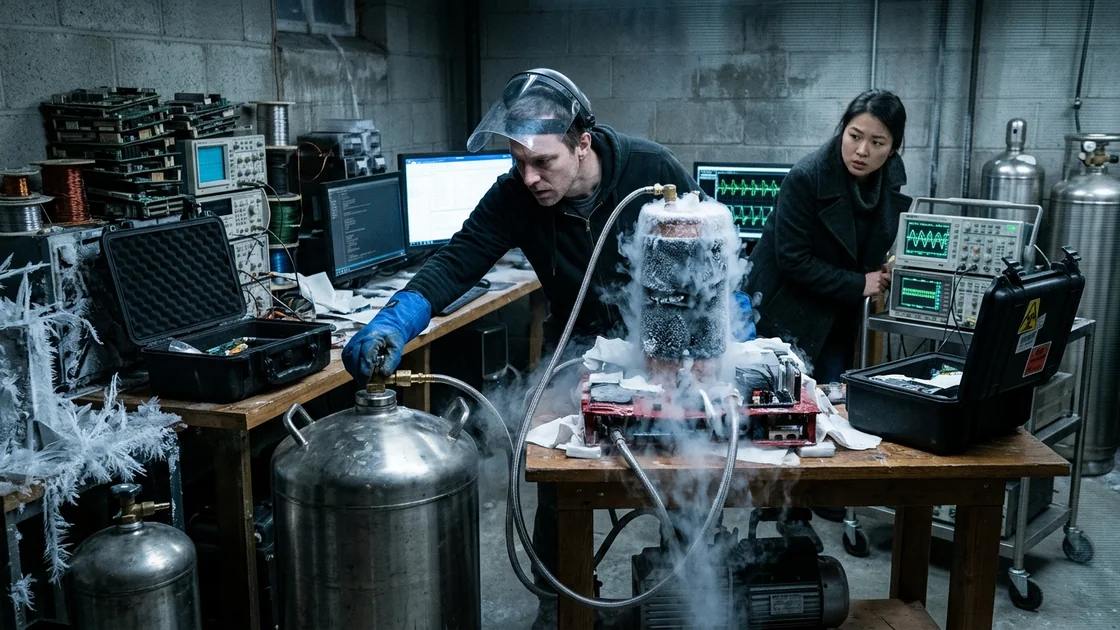
Lukas Vance, a disgraced physicist turned world-champion extreme overclocker, spends his nights in a frost-covered basement pushing computer silicon beyond the limits of classical physics. Using massive quantities of liquid nitrogen and an experimental, isotopically pure processor smuggled out of a defunct research lab, he attempts to shatter the mythical ten-gigahertz barrier. When he finally breaches the threshold at temperatures approaching the triple point of nitrogen, the processor stops merely calculating data and begins tunneling across the boundaries of reality. As the supercooled silicon locks into resonance with adjacent quantum states, Lukas discovers his terminal is receiving telemetry and messages from alternate versions of himself across the multiverse, forcing him into a desperate race to sever the connection before a multi-dimensional cascade erases his existence.
The hiss of the Dewar flask was the only sound in the basement that felt alive. Everything else was dead, frozen, or waiting to be shocked into a brief, violent imitation of life. Lukas Vance adjusted his cryogenic gloves, the thick blue fabric stiff from years of splash-back, and gripped the knurled brass valve of the fifty-liter pressurized tank. When he twisted it, a plume of white vapor erupted from the transfer hose, smelling faintly of metallic nothingness. It wasn't smoke; it was the ambient humidity of the cramped subterranean room flash-freezing into microscopic ice crystals before tumbling toward the concrete floor.
On the wooden workbench in front of him sat the monster. To a layperson, it didn't look like a computer. There was no sleek aluminum case, no tempered glass panel, no coordinated rainbow of LED lights. It was an open-air torture rack of dark fiberglass, thick copper, and scarred solder joints. The motherboard was buried beneath half an inch of gray kneaded rubber eraser and white paper towels, a crude but vital barrier against condensation. Rising from the center of the board was the Kingpin Dragon F1 Gemini, a solid cylinder of milled electrolytic copper weighing nearly three kilograms, currently wrapped in neoprene foam that was crusted with a thick, crystalline rime of frost.
Lukas stared at the digital thermometer Velcroed to the side of the power supply cage. The K-type thermocouple, buried deep within a drilled hole at the base of the copper pot, just millimeters above the processor's integrated heat spreader, read minus one hundred and eighty-four degrees Celsius.
"Come on, you stubborn bastard," Lukas muttered, his breath pluming in the chill air of the basement. "Drop another four degrees. Just four."
He glanced at the secondary monitor, an old, beat-up LCD screen running nothing but a custom-skinned hardware monitoring utility and a command-line validation tool. The clock speed of the processor—a cherry-picked, delidded retail flagship he had binned from a batch of two hundred chips—was hovering at 8,942 megahertz. Nearly nine gigahertz. In the world of normal computing, where a high-end desktop processor ran at five gigahertz under a gentle bath of warm water, nearly nine was a miracle. In Lukas’s world, the subterranean colosseum of extreme overclocking, it was second place.
Three days ago, a syndicate of overclockers in Taipei, backed by the endless pockets of a major motherboard manufacturer, had posted a validated run of 9,014 megahertz on the global leaderboards. They had used liquid helium, an absurdly expensive, fleeting gas that boiled at minus two hundred and sixty-nine degrees, just four degrees above absolute zero. Lukas couldn't afford liquid helium. He didn't have corporate sponsors anymore, not after the incident at the Zurich symposium three years ago that had ended both his academic career and his consulting contracts. He had liquid nitrogen, a rack of modified server power supplies that hummed like an angry wasp nest, and a soldering iron.
He opened the brass valve another quarter-turn. Liquid nitrogen hissed into the top of the copper pot, boiling violently as it hit the metal. The thermometer ticked downward: -185.2°C. -186.8°C. -188.1°C.
Lukas’s left hand hovered over the mechanical keyboard, his fingers poised on the hotkeys tied to the motherboard’s hardware-level clock generator. With his right hand, he tweaked a tiny blue trimmer potentiometer he had soldered directly onto the voltage regulator module, bypassing the chip’s internal thermal and current protections. He was feeding the silicon 1.92 volts—enough electrical pressure to instantly vaporize the microscopic transistor gates if the chip were at room temperature. At minus one hundred and eighty-eight degrees, however, the silicon lattice contracted. Electrical resistance plummeted. The electrons didn't walk through the gates; they sprinted.
"Nine point one," Lukas whispered. He tapped the hotkey to bump the base clock from 102.8 to 104.5 megahertz.
On the screen, the frequency counter jumped: 9,091.5 MHz.
His heart hammered against his ribs, a sharp, caffeinated staccato. With trembling fingers, he hit the macro to trigger the validation dump—a cryptographic snapshot of the system's registers that proved the clock speed was real. The progress bar appeared. Twenty percent. Forty percent. Sixty percent.
The thermometer ticked down to -189.0°C.
Instantly, the screen went black. The high-pitched, mosquito-like whine of the motherboard’s inductors died, replaced by the dull click of the power supply’s over-current protection tripping.
Lukas slammed his palm against the edge of the workbench. "Dammit! Cold bug!"
Every piece of silicon had a floor. Drop the temperature too low, and the semi-conducting properties of the doped silicon simply stopped working; the charge carriers froze out, unable to cross the band gap. For this particular chip, the wall was minus one hundred and eighty-nine degrees. To get past nine gigahertz stably, it needed to be colder than -189°C to stop the voltage from tearing the logic gates apart, yet it ceased to function as a computer the exact millisecond it reached that temperature. It was a Catch-22 etched in nanometers.
Lukas reached for the heat gun hanging from a hook beneath the table, flicking it on to warm the copper pot back to a bootable temperature. As the orange coils inside the nozzle began to glow, a sharp knock echoed from the top of the basement stairs, followed immediately by the creak of the heavy fire door opening.
"Lukas? Please tell me the ventilation fans are actually running down here. I can smell the ozone from the driveway."
Lukas didn't turn around as he aimed the roaring heat gun at the frosted copper cylinder. "The exhaust blower is pulling four hundred cubic feet per minute, Maya. And the oxygen sensor on the wall is sitting at twenty point eight percent. You aren't going to asphyxiate."
Dr. Maya Lin descended the concrete steps, pulling her wool coat tighter around herself as she hit the thermocline of the basement. She was carrying a heavy, pelican-style hard case bound with two steel padlocks and a yellow radiation-style hazard sticker that read: SENSITIVE ELECTRONIC DEVICE - DO NOT X-RAY OR EXPOSE TO MAGNETIC FIELDS.
She stopped a few feet behind him, her dark eyes scanning the chaotic landscape of the lab. Stacked along the cinderblock walls were dozens of dead motherboards, their sockets scorched or coated in hardened dielectric grease. Spools of silver-plated copper wire, oscilloscopes from the late nineties, and three silver Dewar flasks gave the room the appearance of a bomb maker’s workshop merged with a cryogenic morgue.
"Still chasing the Taipei record?" she asked, nodding toward the black screen.
"They used helium," Lukas said bitterly, clicking the heat gun off as the thermometer crept back up to -140°C. "Bought their way past the thermal wall. They didn't tune the sub-timings. They didn't even hard-mod the PLL rails. They just drowned a golden-sample chip in ten thousand dollars of liquid gas and pressed a button. It’s insulting."
"It’s physics, Lukas. Standard silicon has limits. Impurity scattering, electromigration, gate oxide breakdown. You wrote your dissertation on this before you decided that blowing up consumer hardware in a basement was a better use of your intellect."
Lukas finally turned, pulling off his thick gloves and tossing them onto the bench. He was thirty-four, though the dark circles under his eyes and the pale, vitamin-D-starved cast of his skin made him look closer to forty. "Academia wanted simulations, Maya. Ten-year grant cycles to model a two-percent increase in electron mobility on a supercomputer that takes six months to reserve time on. Down here, I touch the limit every night. When I push a chip too far, I don't get a peer-reviewed rejection letter. I get fire."
Maya sighed, though the corner of her mouth twitched upward. They had shared an office at MIT for four years before Lukas’s spectacular fallout with the department chair over an unauthorized—and catastrophically expensive—experiment involving the university’s dilution refrigerator. While Maya had played the game, eventually landing a senior research position at a defense-funded quantum computing initiative in suburban Massachusetts, she had never quite lost her fascination with Lukas’s reckless, tactile brilliance.
She lifted the black hard case and set it on the only clear corner of the workbench, pushing aside a tin of flux and a handful of ceramic capacitors.
"What's that?" Lukas asked, his eyes narrowing on the yellow warning label.
"A funeral," Maya said quietly. "Remember Project Aethelgard? The DARPA contract my division has been burning money on for the last thirty-six months?"
"The hybrid lithography initiative," Lukas recalled, stepping closer. "You were trying to bridge classical CMOS architecture with isotopic silicon-28 substrates to eliminate thermal resistance."
"Not just thermal resistance," Maya corrected, pulling a small brass key from her coat pocket. "Natural silicon is made of three isotopes: Silicon-28, Silicon-29, and Silicon-30. Only about ninety-two percent of a standard processor is Silicon-28. The rest is heavy isotopes mixed in at random. At room temperature, it doesn't matter much. Even at liquid nitrogen temperatures, in a normal chip, those heavier atoms act like boulders in a stream. They scatter phonons—heat vibrations—and their nuclear spins create magnetic noise that disrupts electron flow."
She unlocked the two padlocks and popped the heavy plastic latches. The lid hissed slightly as the pressure equalization valve breathed, then swung open.
Resting in custom-cut black anti-static foam were three square processors. They looked almost identical to the consumer chip currently buried under Lukas’s copper pot—the same pin-grid array footprint, the same notched fiberglass substrate—except for the integrated heat spreader on top. Instead of nickel-plated copper stamped with a corporate logo, the top of these chips was a mirror-polished slab of dark, iridescent gray material that seemed to swallow the harsh fluorescent light of the basement.
"Synthetic polycrystalline diamond heat spreaders," Maya said, her voice dropping into a reverent whisper. "Direct-bonded at the atomic level to an architecture etched entirely on a ninety-nine-point-nine-nine-nine-eight percent pure Silicon-28 wafer. Zero nuclear spin. Phonon ballistic transport across the entire die. At cryogenic temperatures, the thermal conductivity of this silicon is six hundred percent higher than copper."
Lukas stared at the chips, his breath catching in his throat. He reached out a bare finger, stopping a millimeter above the dark, mirror-like surface of the center unit. "Why does this fit an enthusiast socket? DARPA doesn't build chips for gaming motherboards."
"We needed an existing, mature instruction set and chipset ecosystem to test high-frequency logic switching without designing a bespoke motherboard from scratch," Maya explained. "We licensed the microarchitecture from the manufacturer, stripped out the integrated graphics and efficiency cores, widened the L3 cache buses, and fabricated eight wafers at a specialized foundry using gaseous silane refined in Russian centrifuges. And then, last Friday, the Pentagon pulled the plug."
"Why?"
"Because they wanted a chip that could run at eight gigahertz on air cooling in the nose cone of a hypersonic missile," she said, a note of frustration entering her voice. "And while the Silicon-28 eliminated the phonon scattering, it introduced something else. At high frequencies, the lattice is too clean. Without the isotopic impurities to act as dampeners, the electrons started exhibiting coherent ballistic transport. The chip started failing standard deterministic logic tests because of macroscopic quantum tunneling across the gates. The oversight committee called it 'unacceptable stochastic drift' and ordered all samples incinerated."
Lukas looked up from the foam, his eyes locking onto hers. "All samples?"
"The manifest said forty-two functional dies were produced," Maya said smoothly, closing the lid without latching it. "The incinerator log signed by my lab tech says forty-two dies were destroyed. If three engineering samples happened to have failed early visual inspection and were tossed into a bin in my personal office months ago... well, bureaucracy is messy."
Lukas let out a long, slow breath. "What's the cold bug on these?"
"There isn't one," Maya said. "Because we used degenerate doping with phosphorus-31 implanted via scanning tunneling microscopy, the charge carriers don't freeze out. We tested one in a cryostat down to four Kelvin. It booted cleanly."
A slow, manic grin spread across Lukas’s face, transforming his exhausted features. "Four Kelvin. No cold bug. Ballistic electron transport. Maya... do you have any idea what this means?"
"It means if you put this on a standard motherboard, the voltage regulators will melt before you hit the chip's limit," she said. "Which is why I brought it to the only lunatic on the East Coast who builds custom thousand-amp power delivery boards in his basement. I don't care about the overclocking leaderboard, Lukas. I want to know what that 'stochastic drift' actually was. Our testing rig at the lab was locked down by safety protocols—the moment the bit-error rate exceeded ten to the negative twelfth, the system automatically throttled the clock. We never got it past seven point eight gigahertz."
She leaned across the workbench, her hands planted on the scarred wood. "I want you to take the safeties off. I want you to push it until it breaks, and I want my logic analyzer hooked up to the debug pins when it happens."
Lukas looked back down at the three dark, gleaming squares of impossible silicon. The mythical barrier of extreme overclocking—ten gigahertz, a double-digit frequency that had haunted hardware forums and engineering dreams for twenty years—suddenly felt like a stepping stone.
"Get your coat off," Lukas said, reaching for his soldering iron. "We're going to need to rebuild the board from the ground up."
The preparation took fourteen hours. Extreme overclocking at the bleeding edge is ninety percent electrical engineering and preventive waterproofing, and ten percent sheer nerve.
While Maya set up a Tektronix mixed-domain oscilloscope and a thirty-two-channel logic analyzer on a rolling cart beside the bench, Lukas tore down his existing rig. He stripped the soggy paper towels and gray kneaded eraser from his primary motherboard—an ultra-rare, dual-DIMM engineering board designed specifically for liquid nitrogen runs—and baked it in a modified convection oven at seventy degrees Celsius for two hours to drive out every molecule of trapped moisture.
Once the board was bone-dry, the surgery began.
Standard motherboard power delivery, even on boards costing upward of a thousand dollars, was never meant to push three hundred amps of current into a processor running at minus two hundred degrees. As silicon gets colder, its leakage current drops, until suddenly—at extreme voltages and frequencies—it becomes a superconducting black hole for amperage.
Lukas took two auxiliary power boards—dubbed "zombies" in the community, which were essentially sawed-off voltage regulator sections from high-end graphics cards—and bridged them directly to the CPU socket’s power plane using strips of solid two-millimeter copper busbar. The smell of rosin flux filled the basement as he flowed massive blobs of leaded silver solder across the joints, creating zero-resistance highways for electricity.
Next came the insulation. He painted the entire motherboard, save for the CPU socket, memory slots, and power connectors, in three coats of glossy red liquid electrical tape, followed by a layer of clear acrylic conformal coating. Under the harsh workbench lamp, the board looked as though it had been dipped in blood and lacquered.
"You're sure the pinout is identical?" Lukas asked, peering through a jeweler’s loupe as he inspected the delicate gold pins inside the socket.
"Pin-for-pin," Maya replied from the floor, where she was crimping micro-coaxial cables onto a custom interposer ribbon. "Except for the six reserved pins in the bottom-left quadrant. In the retail chip, those are dead grounds. On the Aethelgard dies, they’re wired directly to an internal ring-oscillator telemetry bus and the L3 cache parity registers. If we seat my interposer ribbon between the chip and the socket, I can read the raw state of the silicon without routing it through the operating system."
Carefully, using a vacuum pickup tool, Lukas lifted the first of the three Silicon-28 processors from its foam cradle. Even through his nitrile gloves, the chip felt heavier than it should have, dense with an alien perfection. They aligned Maya’s ultra-thin Kapton interposer over the socket pins, then lowered the processor into place. Lukas pressed down the retention lever. It locked with a tight, mechanical crunch.
Instead of standard thermal paste, which would freeze, crack, and turn into a thermal insulator below minus one hundred and fifty degrees, Lukas squeezed out a pea-sized drop of a specialized perfluoropolyether compound—a fluorinated aerospace grease designed for vacuum applications in deep space. He spread it into an obsessively thin, uniform film across the dark diamond heat spreader.
Then came the pot. Lukas lowered the three-kilogram copper cylinder onto the chip, tightening the four spring-loaded thumbscrews in a cross pattern with a torque screwdriver to ensure the mounting pressure was exact to within a tenth of a Newton-meter. Too loose, and the thermal interface would fail; too tight, and the copper would crack the diamond-bonded die as the metal contracted in the extreme cold.
"Nitrogen won't be enough," Lukas said, wiping sweat from his forehead with the back of his wrist. "Not atmospheric nitrogen, anyway."
"It boils at minus one hundred and ninety-six," Maya said, looking up from her oscilloscope calibration. "You said we weren't using helium."
"We aren't. We're pulling a vacuum."
Lukas reached under the workbench and dragged out a heavy, cast-iron rotary vane vacuum pump, the kind used for evacuating industrial refrigeration lines. He bolted a custom-machined aluminum cap with an Acrylic viewing window onto the top of the copper pot, sealing it with a Viton O-ring. Two braided stainless-steel hoses ran from the cap: one connected via a needle valve to the fifty-liter liquid nitrogen Dewar, and the other connected through a brass manifold to the vacuum pump.
"If you boil liquid nitrogen at standard sea-level pressure, it caps out at minus one ninety-six," Lukas explained, tightening the flare fittings with a wrench. "But if you seal the chamber and use a high-displacement pump to drop the internal pressure below sixty-three kilopascals, you force evaporative cooling. Drop it to twelve पॉइंट five kilopascals, and you hit the triple point of nitrogen. The liquid freezes into solid nitrogen snow at minus two hundred and ten degrees Celsius. Solid-liquid slush has triple the latent heat capacity of boiling gas because it eliminates the Leidenfrost effect—there’s no insulating vapor barrier between the coolant and the copper."
Maya stared at the contraption—a high-pressure cryogenic vessel bolted by four skinny steel threaded rods directly onto a fragile fiberglass circuit board. "And if the exhaust line freezes solid while the liquid inside expands into gas?"
"Then the acrylic window blows out toward the ceiling and we lose our eyebrows," Lukas said cheerfully. "Which is why we wear the face shields."
He tossed her a polycarbonate visor, pulled his own down over his face, and flipped the master breakers on the wall.
Three sixteen-hundred-watt server power supplies roared to life in unison, their high-RPM cooling fans spinning up to a deafening turbine whine. On the motherboard, rows of tiny surface-mount LEDs flickered green, then red, indicating the modified voltage rails were live and waiting.
Lukas switched on the vacuum pump. It began to chug with a rhythmic, oily thump-thump-thump, the needle on the brass Bourdon gauge swinging counterclockwise into the negative pressure zone. Gently, he cracked the intake needle valve from the Dewar.
Through the thick acrylic window on top of the pot, they watched a stream of clear, colorless liquid nitrogen spray into the evacuated copper chamber. It didn't just boil; it exploded into a violent, frothing tempest of mist as the vacuum tore the highest-energy molecules away.
The digital thermometer plunged as if in freefall. -50°C. -110°C. -165°C. -196°C.
The temperature didn't slow down at the boiling point. As the vacuum gauge hit nine inches of mercury, the roaring liquid inside the viewing window suddenly flashed white, crystallizing instantly into a porous, glowing slush of solid nitrogen snow that clung tightly to the milled copper fins at the bottom of the pot.
-208.4°C. -210.1°C.
"Triple point achieved," Lukas shouted over the din of the pump and the power supplies. "Thermal equilibrium is holding. Booting the system!"
He tapped the screwdriver against the two brass power-on pins on the edge of the motherboard.
The diagnostic hexadecimal display on the corner of the board spun through a blur of red numbers—14, 3A, 55, 7F, 99, A0—in less than half a second. The monitor flashed. There was no lag, no hesitation. The stripped-down, hyper-optimized version of Windows XP that overclockers used for its minimal background overhead loaded from the RAM disk in the blink of an eye.
"We're in!" Lukas barked, sliding into his chair and grabbing the mouse. "Stock boot at minus two-ten. No cold bug. The ring bus is completely stable."
Maya was hunched over her oscilloscope, her face illuminated by the glowing green and yellow waveforms dancing across the grid. "Lukas, look at the signal integrity on the clock generator. At minus two-ten, the square waves are almost vertically perfect. Rise time is under four picoseconds. There is literally zero thermal jitter in the silicon."
"Let's see how it scales," Lukas said.
He opened the software interface for the hardware clock controller and the external voltage regulator module. They were currently sitting at a conservative 6,000 megahertz at 1.35 volts. Even under full load, the temperature sensor inside the CPU die read minus two hundred and nine degrees—only a single degree warmer than the copper pot itself. The diamond heat spreader and the Silicon-28 lattice were moving heat out of the transistor gates almost at the speed of sound.
Lukas bumped the multiplier from 60x to 80x, pushing the voltage to 1.55 volts. 8,000 MHz. He ran a quick calculation of Pi to thirty-two million digits—a standard stability test. A normal high-end computer took roughly five minutes. Lukas’s previous world-record runs took three minutes and forty seconds.
The command prompt window flashed open, scrolled a blur of hexadecimal checksums, and spat out the final result: Time: 01m 12.404s. Calculation Complete.
"What the hell?" Lukas leaned forward, squinting at the screen. "A minute twelve? That doesn't make sense. Clock-for-clock, an eight-gigahertz run on this architecture should take at least three minutes and五十 seconds. The instructions-per-clock are fixed in hardware."
"Wait," Maya said, her fingers flying across the buttons of her logic analyzer. "Look at the L3 cache parity bus. The miss rate is... zero. Literally zero percent cache misses."
"That's impossible," Lukas said. "SuperPi is an iterative algorithm, sure, but it still has to fetch memory blocks from the system RAM that haven't been predicted yet. Every branch predictor has a failure rate."
"It didn't fail a single branch prediction across four billion cycles," Maya said, her voice tight with confusion. "It’s as if the pre-fetcher already had the memory addresses loaded before the execution core even calculated what address it needed next."
Lukas felt a strange, cold prickle at the base of his neck that had nothing to do with the liquid nitrogen. "A bug in the timer. When you push the base clock, sometimes the Windows real-time clock skews."
"My logic analyzer isn't running on Windows, Lukas. It has an independent rubidium atomic reference clock. That calculation took seventy-two point four seconds of real, physical time."
Lukas stared at the frequency readout. "Push it harder. Let's see if the anomaly scales."
He cranked the voltage dial up to 1.85 volts. The wires feeding the zombie power boards twitched slightly under the sudden magnetic surge of hundreds of amps flowing through them. He typed in the new parameters: a 95x multiplier with a 105.3 MHz base clock.
He hit Apply. The screen flickered once, a sharp horizontal tear cutting across the display, and then settled. 10,003.5 MHz.
Ten gigahertz. The double-digit phantom. For a second, the sheer historical weight of the number froze Lukas in his seat. Every forum thread, every burnt-out chip, every sleeveless night inhaling flux fumes over the last decade had been aimed at that single comma shifting one digit to the left.
"Validation," Lukas breathed, his training taking over. He hit the hotkey to save the cryptographic dump to the USB drive hanging from a long extension cable away from the frost zone. The green light on the flash drive blinked twice. Done. Whatever happened next, he owned the crown.
"Lukas, look at the power draw," Maya said, pointing a trembling finger at the digital ammeter clamped around the main twelve-volt copper busbars.
At nine gigahertz on his retail chip, the processor had pulled nearly four hundred and fifty watts of brutal, inefficient power. Now, sitting at ten gigahertz, the ammeter was fluctuating wildly—not climbing, as physics demanded, but dropping.
320 watts. 210 watts. 95 watts.
"The voltage regulators are failing," Lukas said, reaching for the trimmer pots. "We're losing phase synchronization—"
"No!" Maya grabbed his wrist. Her grip was iron-tight. "Look at the oscilloscope! The voltage at the die is rock steady at one point eight-five volts. The chip isn't losing power, Lukas. Its electrical resistance is dropping to zero, and... wait. Look at Channel Four."
Channel Four was monitoring the ring-oscillator telemetry—the internal heartbeat of the processor’s billions of microscopic FinFET transistors. Instead of a sharp square wave or even a high-frequency sine wave, the trace on the screen had split into a complex, overlapping braid of ghostly green lines. It looked like a three-dimensional interference pattern projected onto a flat screen, shifting and breathing with an eerie, organic symmetry.
"What is that?" Lukas asked. "Signal reflections? Harmonics?"
"No," Maya whispered, adjusting the time-base knob down to the picosecond scale. The braided pattern didn't resolve into a single line; it fractured into even finer braids, infinitely self-similar. "At ten gigahertz, one clock cycle takes one hundred picoseconds. The gate length of these transistors is three nanometers. With ballistic transport in an isotopically pure Silicon-28 lattice at minus two hundred and ten degrees, the mean free path of the electrons is longer than the chip itself. They aren't colliding with atoms anymore."
She looked at him, her eyes wide behind the polycarbonate visor. "Lukas, you haven't just overclocked the processor. You've driven six billion coupled harmonic oscillators into a coherent macroscopic quantum state. The entire die is acting like a single, massive wavefunction."
"Speak English, Maya! Is it going to blow?"
"It's not heating up! When a logic gate switches at this speed without thermal decoherence, the electron doesn't just choose one path—zero or one. The tunneling probability across the silicon dioxide barrier has hit resonance with the clock frequency. The processor is computing in superposition."
"It's a classical x86 chip," Lukas argued, though his voice lacked conviction as he stared at the monitor. "It can't process qubits. The operating system would instantly Blue Screen if a register returned both a zero and a one!"
"It's not returning both to this operating system," Maya said, her voice dropping to a terrified hush. "Everett-Wheeler mechanics. Many-Worlds interpretation. When a quantum system makes a state transition, the universal wavefunction branches. Normally, thermal noise in the environment causes immediate decoherence—the branches separate and can never interact again. But inside that diamond-shielded, spin-zero lattice at ten gigahertz, there is no thermal noise. The switching frequency matches the local decoherence timescale."
She pointed at the braided green waves on the oscilloscope. "Those secondary traces aren't harmonics. That's phase interference from adjacent branches of the wavefunction. The logic gates are reading and writing states across parallel realities that split off nanoseconds ago!"
Lukas turned back to the computer monitor. The SuperPi window was still open. He hadn't touched the keyboard, yet the cursor inside the command prompt was blinking frantically.
Suddenly, text began to scroll across the black window on its own, bypassing the operating system's keyboard buffer entirely—raw ASCII characters being injected directly into the video memory from the L3 cache.
[SYS_ERR_0x00000000]: CACHE COHERENCY VIOLATION IN SECTOR 7F
[SYS_DUMP]: 10003.5 MHz // V_CORE: 1.852V // TEMP: -210.1C
[SYS_DUMP]: 10004.1 MHz // V_CORE: 1.855V // TEMP: -210.2C
[SYS_DUMP]: 9998.2 MHz // V_CORE: 1.849V // TEMP: -209.8C
[SYS_DUMP]: 10112.0 MHz // V_CORE: 1.910V // TEMP: -210.4C
Hundreds of lines cascaded down the screen every second, each one a hardware telemetry report—all from the exact same system, all bearing the exact same timestamp, yet each showing slightly different clock speeds, slightly different voltages, and slightly different temperatures.
"Wait," Lukas said, his fingers hovering over the keyboard. "If the L3 cache is sharing memory states with adjacent branches... where did those other clock speeds come from?"
"From you," Maya said, stepping back from the bench as if the copper pot had suddenly become radioactive. "In a branch where you turned the voltage knob a fraction of a millimeter further to the right. In a branch where a bubble in the nitrogen slush shifted the temperature by a tenth of a degree. Every micro-decision, every quantum fluctuation in this room over the last ten minutes has created a nearby branch where another Lukas Vance is sitting in front of another Aethelgard chip running at roughly ten gigahertz. And because all of those chips are in the exact same spatial coordinates and vibrating at the exact same resonant frequency, their L3 caches have become entangled."
Lukas stared at the scrolling wall of numbers. The scientist in him—the man who had been thrown out of Zurich for refusing to stop when the equations got dangerous—felt a sudden, intoxicating surge of adrenaline that completely eclipsed the fear.
"If the L3 cache is acting as a shared memory pool across adjacent branches," Lukas said rapidly, pulling up a low-level hexadecimal memory editor he used for tweaking RAM timings on the fly, "then anything written to a specific non-volatile register address in one branch will overwrite or superimpose onto the same address in the adjacent branches."
"Lukas, don't," Maya warned. "Right now it's just passive data leakage—telemetry registers colliding because they share the same memory offset. If you intentionally inject an instruction loop into a coupled quantum system, you'll create a constructive feedback resonance!"
"I'm not injecting an execution loop," Lukas said, his fingers flying across the mechanical switches with furious precision. "I'm opening a socket. A thirty-two-byte scratchpad in the upper L3 cache, unmapped from the OS kernel, piped directly to a standard input-output terminal window."
In less than forty seconds, he had compiled a crude assembly routine and hooked it into the memory editor. A blank, black terminal window popped up in the center of the screen, separate from the cascading telemetry logs.
Lukas typed a single line into the buffer and committed it to memory
address 0xFFFF00A0:
> HELLO? IS THIS LOCAL OR ADJACENT? - LUKAS_PRIME
For three seconds, the cursor just blinked against the black void. The vacuum pump chugged rhythmically on the floor: thump-thump-thump. The liquid nitrogen hissed through the needle valve.
Then, the terminal window exploded with text.
> WHO ARE YOU CALLING PRIME ASSHOLE I WROTE THE SCRIPT FIRST - LUKAS_04
> IT WORKS. MY GOD MAYA WAS RIGHT. WE ARE BRIDGING THE EVERETT BRANCHES. - LUKAS_19
> WHAT IS YOUR BCLK? MINE LOCKED UP AT 106.2 UNTIL I BUMPED PLL TO 2.1V - LUKAS_88
> WAIT WHERE IS MAYA? MAYA DIDN'T COME DOWN TONIGHT IN MY TIMELINE. HOW DID YOU GET THE CHIP WITHOUT THE COURIER? - LUKAS_312
Maya clapped both hands over her mouth, her eyes darting across the screen as the lines multiplied exponentially. Dozens, then hundreds of variations of Lukas Vance, spread across a narrow probability distribution of timelines that had diverged over the past days, hours, or seconds, were suddenly typing into the same shared sixty-four-kilobyte slice of silicon memory.
"Look at the divergence index," Maya whispered, pointing at the prefixes the assembly script was automatically assigning based on the phase-angle offset of the incoming quantum signals. "The low numbers—04, 19—their signals have almost zero phase shift. They split from us seconds ago, right when we hit ten gigahertz. They're essentially identical to us. But look at 312... and there, 1,049... the phase angle is wider. The stronger the coupling gets, the further sideways across the probability wave the chip is reaching!"
Lukas scrolled furiously through the flood of text, filtering by high phase-offset numbers. He wanted to see how far the horizon went.
> [OFFSET_4402]: IF ANYONE IS READING THIS ON THE LOWER FREQUENCY BANDS DO NOT PUSH PAST 10.8 GHZ. THE POWER DRAW INVERTED. MY AMMETER IS READING NEGATIVE FOUR HUNDRED AMPS.
> [OFFSET_8910]: WHO IS MAYA LIN? I AM RUNNING THIS CHIP AT THE ZURICH SYMPOSIUM. THE YEAR IS 2026. IF YOU ARE IN A BASEMENT WHO FUNDED YOUR SILICON-28 WAFER?
> [OFFSET_14009]: SHUT IT DOWN. SHUT IT DOWN NOW. WE HIT 11.4 GHZ TWELVE MINUTES AGO. THE DIE DIDN'T MELT. IT LOCKED INTO PHASE-SPACE SYNCHRONIZATION WITH THE ROOM.
Lukas’s fingers froze on the scroll wheel. He isolated thread
14009, locking the memory buffer to filter out all other
phase angles.
"Maya, look at this one," Lukas said, his voice tight.
He typed back into the isolated channel:
> [OFFSET_0000]: 14009, EXPLAIN PHASE-SPACE SYNCHRONIZATION. WHAT HAPPENED AT 11.4 GHZ?
The response came back instantly—in fact, the timestamp on the incoming packet registered forty milliseconds before Lukas finished pressing the Enter key.
> [OFFSET_14009]: THE CHIP STOPPED USING ELECTRICITY TO SWITCH GATES. IT IS USING QUANTUM VACUUM FLUCTUATIONS BETWEEN THE BRANCHES TO EQUALIZE ENTROPY. WHEN YOU COUPLE TWO PARALLEL STATES THROUGH THE SILICON, THE THERMODYNAMIC GRADIENT TRIES TO FLATTEN. OUR BASEMENT IS BLEEDING INTO ADJACENT BASEMENTS. THE WALLS ARE—
The message cut off into a string of corrupted hexadecimal garbage:
0xDEAD 0xFFFF 0x0000 0x884A...
Suddenly, the pitch of the motherboard's inductors changed.
Up until now, the high-frequency coil whine from the chokes had been a steady, piercing eeeeeee at roughly sixteen kilohertz. Now, without Lukas touching a single setting on his computer, the sound deepened and fractured into a metallic, resonant chord, like a choir of glass harmonicas being played inside a cathedral.
On the monitor, the frequency counter began to climb by itself. 10,150 MHz. 10,320 MHz. 10,580 MHz.
"Lukas, stop ramping the clock!" Maya shouted, stepping toward the workbench.
"My hands aren't on the keyboard!" Lukas held his palms up in the air. The mouse sat untouched on its pad. Yet on the screen, the base clock slider in the utility software was sliding steadily to the right, pulled by an invisible hand.
10,790 MHz. 10,940 MHz.
"Sympathetic resonance!" Maya yelled, looking at her oscilloscope. All four channels were now locked into a blindingly bright, three-dimensional lattice of green light that seemed to project an inch out of the flat glass screen, casting impossible, sharp-edged shadows across her face. "In the adjacent branches—thousands of them—other versions of you are still pushing the clock higher! Because the processors are quantum-mechanically entangled in a macroscopic condensate, the highest-energy state is dragging all the lower-energy states up into phase lock with it!"
"That violates conservation of energy!" Lukas yelled back, grabbing the mouse and desperately clicking the 'Reset' button on the software interface. Nothing happened. The cursor passed right through the window as if it were a ghost image.
"Not across the whole wavefunction, it doesn't!" she cried. "It's borrowing energy from branches where the chip already blew up or shut down, averaging the total Hamiltonian across the multiverse! Look at the power supplies!"
Lukas looked to his left. The three sixteen-hundred-watt server power supplies had stopped whining. Their cooling fans were spinning backward, driven by a massive reverse current flowing out of the motherboard, back through the thick copper busbars, and into the wall outlets. The fluorescent light tubes hanging from the basement ceiling flared with a blinding, violet-white brilliance, humming like arc welders, even though the circuit breaker on the wall had just tripped with a loud, metallic clack, throwing its physical switch into the OFF position.
The room was completely disconnected from the municipal power grid, yet the lights were brighter than the sun, and the computer was now running at 11,240 MHz.
Around the copper pot, the frost wasn't melting; it was growing outward into the air in bizarre, non-Euclidean geometries. Long needles of ice formed six-sided hypercubes that seemed to rotate as Lukas moved his head, showing angles that couldn't exist in three-dimensional space. The air in the basement grew heavy and thick, smelling of ozone, burnt copper, and something else—a sterile, chemical scent like hospital disinfectant, accompanied by the faint, phantom sound of sirens that seemed to be coming from inside the concrete walls themselves.
Look at the cinderblocks behind the workbench, Lukas thought, his mind struggling to process what his eyes were reporting.
For fractions of a second, the gray painted concrete flickered. In the spaces between the flickers, the wall wasn't concrete; it was tiled in white ceramic clean-room panels. Then it was scorched black char, as if a fire had gutted the house years ago. Then it was concrete again, but covered in chalkboards filled with equations written in his own handwriting.
"Phase bleed," Maya breathed, backing up until her spine hit the wooden stairs. She pointed at the floor beside the vacuum pump.
Standing three feet to Lukas’s left was another figure. It was translucent, flickering at the same blinding frequency as the fluorescent lights, composed of shimmering, scan-line-like interference patterns. It was Lukas—wearing a white lab coat instead of a hoodie, holding a clipboard, staring directly at them with an expression of utter, silent horror before vanishing in a burst of static.
"The entanglement is spreading beyond the silicon lattice!" Maya screamed over the rising, harmonic roar of the motherboard. "The decoherence boundary is expanding! Because the chip is interacting with the electromagnetic field of the room, the entire basement is entering a superposition with adjacent branches! If the wavefunctions collapse into a single degenerate state while mass is overlapping in the same coordinates, the Pauli exclusion principle will—"
She didn't need to finish the sentence. If two atoms of matter from adjacent quantum states were forced to occupy the exact same physical space in a single collapsed reality, the result wouldn't be a computer crash. It would be a localized nuclear conversion event that would turn three square miles of suburban Massachusetts into a crater of exotic particles.
11,610 MHz.
"Kill the power!" Maya yelled. "Rip the busbars off the board!"
Lukas lunged for the heavy insulated wire cutters on the rack above the bench. He jammed the steel jaws around the two-millimeter solid copper bar feeding the CPU socket and squeezed with all his strength.
A blinding blue arc of plasma erupted from the cut, throwing Lukas backward against the rolling oscilloscope cart. The steel jaws of the cutters had vaporized into molten droplets, fused directly to the copper, bridging the gap. Even worse, across the board, where the second busbar had been completely severed by the force of his pull, a brilliant, razor-thin filament of violet lightning hung suspended in the air between the two broken ends of copper—except the lightning wasn't jumping through the air. It was passing through where the copper still existed in ten thousand adjacent timelines.
"You can't cut the power!" Lukas gasped, blinking away the purple afterimages burned into his retinas as he scrambled up from the floor. "In ninety percent of the coupled branches, the circuit is still closed! The current is tunneling through the intact busbars in adjacent states!"
On the screen, the terminal window was flashing red, every line now
identical across all phase offsets:
> [CRITICAL]: RESONANCE CASCADE AT 12.000 GHZ. DECOHERENCE RADIUS: 4.2 METERS.
> [CRITICAL]: 11,820 MHz.
> [CRITICAL]: 11,890 MHz.
The concrete walls were flickering faster now. Lukas looked down at his own left hand and saw three overlapping versions of his fingers—one bare, one wearing a wedding ring he had never owned, one wrapped in bloody bandages—all occupying the same space, tingling with a sickening, pins-and-needles numbness as the molecular bonds of his skin began to lose certainty of which universe they belonged to.
"How do we break a macroscopic quantum condensate?!" Lukas shouted at Maya, who was clutching the stair railing as the wooden steps beneath her feet flickered between wood, steel grating, and empty air.
"Decoherence!" she screamed back, her voice warbling with a strange Doppler effect as the air density in the room oscillated. "The only reason the chip is coupled across the branches is because the Silicon-28 lattice is uniform and at thermal equilibrium! You have to introduce massive, chaotic entropy directly into the lattice! You have to break the symmetry across all branches simultaneously!"
"If I smash it with a hammer, in half the branches I'll miss or swing a millisecond too late!"
"Not mechanical force! Thermal shock! Phonon chaos! If you shatter the crystal lattice thermally, the wavefunctions have to decouple!"
Lukas looked at the workbench. The copper pot was still bolted down tight, filled with solid nitrogen snow at minus two hundred and ten degrees Celsius, insulated from the room by a layer of neoprene foam and a vacuum seal. His little electric heat gun would take three minutes just to warm the three-kilogram mass of copper up to minus one hundred degrees. They didn't have three minutes. The frequency counter read 11,960 MHz. They had seconds.
His eyes darted across the chaotic lab and landed on two things: the fifty-liter pressurized Dewar of liquid nitrogen, and, sitting in the corner beside his plumbing tools, a brazier’s oxy-acetylene welding rig with a rosebud heating nozzle—capable of producing a three-thousand-degree flame.
Wait. If he heated the top of the copper pot, the thermal mass of the copper would buffer the heat before it ever reached the chip at the bottom. To thermally shock the silicon itself, he needed to shatter the diamond heat spreader and the copper base simultaneously using differential expansion.
He didn't need heat or cold. He needed both, together, coupled with a massive electromagnetic pulse that wasn't part of the harmonic oscillation.
Lukas didn't think; he moved on pure, desperate instinct, the culmination of ten thousand hours spent working with volatile materials in small spaces.
He grabbed a heavy steel wrench and swung it with everything he had at the acrylic viewing window bolted to the top of the copper pot.
CRACK.
The window shattered inward under the vacuum pressure. Instantly, atmospheric air rushed into the evacuated chamber with a deafening bang. The solid nitrogen snow inside, suddenly exposed to normal pressure, began to sublimate and boil with explosive violence, shooting a geyser of white vapor straight up toward the flickering ceiling.
At the same time, Lukas kicked open the valves on the oxy-acetylene tanks, grabbed the brass torch handle, and sparked the striker. A foot-long, roaring blue-white cone of three-thousand-degree fire erupted from the nozzle.
11,988 MHz.
Gravity in the room shifted ten degrees to the left. Tools slid off the workbench and fell sideways toward the cinderblock wall, vanishing into thin air an inch before they hit the concrete, reappearing seconds later dropping from the ceiling. A deafening sound—like a billion voices speaking a single syllable in an echo chamber—pressed against Lukas’s eardrums until he tasted copper in the back of his throat.
Lukas lunged toward the bench, holding the roaring oxy-acetylene torch in his right hand. He didn't aim it at the top of the pot. He jammed the white-hot tip of the flame directly against the bottom millimeter of the copper baseplate, right where it met the fiberglass motherboard and the diamond heat spreader, burning straight through the neoprene foam and conformal coating in an instant.
While the three-thousand-degree flame superheated one side of the minus-two-hundred-and-ten-degree diamond-silicon junction, Lukas used his left hand to yank the main liquid transfer hose off the fifty-liter Dewar, aiming the open, half-inch braided steel nozzle directly into the shattered top of the pot, flooding the boiling chamber with raw liquid nitrogen at thirty pounds per square inch.
Three thousand degrees Celsius on the southern edge of the die. Minus two hundred degrees on the northern edge. A thermal gradient of over three thousand two hundred degrees across fourteen millimeters of synthetic crystal.
Not even isotopically pure Silicon-28 with ballistic phonon transport could equalize a thermal shear wave moving faster than the speed of sound in diamond.
11,999.4 MHz.
For a timeless, frozen microsecond, Lukas saw them all. The walls of the basement dissolved entirely into a blinding, infinite corridor of mirrors. To his left, a million Lukases were thrusting a welding torch into a blue flame; to his right, a million Lukases were being consumed by silent spheres of white light as their rooms collapsed into quantum degeneracy; directly in front of him, through the roaring plume of fire and nitrogen vapor, he saw a version of himself turning to look at Maya, reaching out a hand that was already turning to glowing ash.
Then, from beneath the copper pot, there came a sound that wasn't an explosion, nor a crack, but a sharp, crystalline ping—like a wine glass being tapped by a silver spoon, amplified to the volume of a cannon shot.
A shockwave of pure, colorless distortion rippled outward from the CPU socket, passing harmlessly through Lukas’s chest like a ghost wind, knocking the breath from his lungs and hurling him backward onto the concrete floor.
The blinding violet light vanished. The harmonic choir of the inductors cut off mid-note. The room plunged into pitch, absolute darkness.
For a long time, the only sound was the dripping of water.
Not liquid nitrogen—water. The thick rime of frost that had coated the workbench, the cables, and the ceiling pipes was melting in the sudden, heavy warmth of the dark room, pattering onto the concrete floor like a gentle spring rain.
Lukas groaned, rolling onto his side. Every muscle in his body ached with the deep, lactic soreness of someone who had just been hit by a low-voltage stun gun. The smell in the air was no longer ozone and sterile hospital bleach; it was the familiar, acrid stench of burnt fiberglass, melted PVC insulation, and scorched rubber eraser.
"Maya?" he croaked, his throat raw from inhaling freezing vapor.
A beam of white light clicked on near the stairs—Maya’s smartphone flashlight. The beam trembled violently as she swept it across the room before landing on him.
"I'm here," she whispered. She was sitting on the third step, her knees pulled up to her chest, her face pale as chalk. "I'm here. Don't move for a second. Let me check the oxygen sensor."
She stood up on shaky legs and shone the light at the battery-powered yellow monitor mounted on the cinderblock wall. "Nineteen point four percent. The nitrogen cloud is dissipating up the stairwell. We're okay."
Lukas pushed himself up onto his elbows, blinking against the glare of her phone light. He looked at his left hand. Five fingers. Bare skin, smudged with soot and thermal grease. Solid. Singular. No flickering wedding rings, no bloody bandages, no pins-and-needles static. He rapped his knuckles against the concrete floor. It was hard, cold, and undeniably real.
He stood up, his knees popping, and walked over to the workbench. Maya joined him a moment later, shining her light down onto the wreckage of the rig.
The oxy-acetylene torch had extinguished itself when the shockwave blew out the flame, its valves having been slammed shut when the tanks rolled against the wall. The motherboard was split cleanly in half down the center, the dark fiberglass charred and delaminated. The three-kilogram solid copper Kingpin pot lay on its side near the edge of the table, its bottom third warped and discolored with a rainbow sheen of heat oxidation, while the upper two-thirds was still crusted in melting white ice.
Lukas reached down and looked into the ruined CPU socket.
The gold pins were gone—not bent or melted, but sheared flat at the exact same microscopic elevation, creating a smooth, mirror-like square of gold brass. Resting on top of that flat square was what remained of the Aethelgard processor.
It didn't look like a computer chip anymore. The green substrate, the diamond heat spreader, and the Silicon-28 die had fused together—or perhaps phase-shifted—into a single, seamless geometric object. It was a perfect octagonal prism of translucent, smoky glass, about three millimeters thick. Inside the glass, visible under the beam of Maya’s flashlight, was a frozen, three-dimensional filigree of silver threads that branched and re-branched into infinity, like a miniature lightning bolt captured in amber, or the nervous system of a ghost.
Lukas reached out with a pair of plastic tweezers and tapped it. It didn't feel cold, nor did it feel hot. In fact, it seemed to have no temperature at all, refusing to absorb the heat from the air around it.
"Decoherence," Maya said softly, leaning in close to examine the fractal threads inside the glass. "When you hit the lattice with that thermal shear wave, the superposition collapsed. All the trapped electron states across the coupled gates froze into a permanent, physical defect structure in the crystal. It’s a macroscopic fossil of a multi-dimensional wavefunction."
"What about the other branches?" Lukas asked quietly, looking at the solid gray cinderblock wall behind the bench. "Thread 14009... the ones I saw right before the lattice shattered. The ones where the room went white."
Maya was silent for a long moment. She looked over at her Tektronix oscilloscope. Its screen was cracked down the middle, the glass blackened from the inside where the cathode-ray controller had fried.
"In Everett-Wheeler mechanics, all possible outcomes occur," she said, her voice barely above a whisper. "In the branches where the thermal shock happened a hundred picoseconds too late, the resonance hit twelve gigahertz and the local vacuum state decayed—at least within the four-meter radius of the condensate. Those branches terminated. We’re standing here because we’re in the subset of branches where the symmetry broke at eleven point nine-nine-nine gigahertz."
Lukas stared at the smoky glass octagon in the ruined socket. The manic obsession that had driven him for ten years—the need to push the clock one megahertz higher, to beat the Taipei syndicate, to prove to the academic world that he could bend silicon to his will—felt suddenly small, hollowed out by the sheer terror of what he had glimpsed in the space between clock cycles.
He reached over to the corner of the workbench, where the remaining two Aethelgard engineering samples sat in their open black Pelican case. Without a word, Lukas picked up the two pristine, diamond-topped processors, walked over to his heavy cast-iron bench vise, clamped them between the serrated steel jaws, and cranked the handle until they shattered into harmless, inert dust.
Maya didn't try to stop him. She watched the dark dust fall onto the concrete floor, then let out a long, shuddering breath that sounded like relief.
"Well," she said, shining her light toward the stairs. "I suppose my report to the oversight committee was accurate after all. All forty-two dies have been destroyed."
"Every last one," Lukas agreed, brushing the glittering silicon dust from his hands.
Then, as Maya turned toward the stairwell to flip the main house breaker back on, Lukas’s eyes caught a tiny reflection near the floor at the far end of the workbench.
Hanging from the end of a six-foot shielded extension cable, well outside the scorch zone of the motherboard, was his ruggedized aluminum USB flash drive—the one he had used to save the cryptographic validation file when they first breached ten gigahertz, right before the cascade began.
Slowly, Lukas walked over, unplugged the drive from the dead cable, and walked across the room to his secondary workstation—a standard, air-cooled laptop sitting on his desk by the stairs, which had been running on battery power the whole time.
He flipped open the laptop lid. The screen glowed to life in the dark basement, casting a familiar, comforting blue light over his face. He slid the USB drive into the port.
Maya stopped on the bottom step, looking back over her shoulder. "Did the validation file survive?"
Lukas opened the drive folder. There was a single .cvf
file sitting in the root directory. He dragged it into the offline
validation reader software and hit Enter.
The checksum parsed. A green banner appeared across the top of the window: CHECKSUM VALID - CRYPTOGRAPHIC SIGNATURE AUTHENTIC.
Below it were the system specifications extracted from the hardware registers during the dump.
Processor: Engineering Sample
AETHELGARD_S28_00 Cooling: Cryogenic
Phase-Transition (Solid N2) Core Voltage: 1.852 V
Core Frequency:
10,003.54 MHz (105.30 x 95.0)
Lukas stared at the number. Ten gigahertz. The impossible mountain, conquered and signed in unforgeable hexadecimal code. If he uploaded this thirty-kilobyte file to the global leaderboard database, his name would sit at the top of the hall of fame forever. The Taipei syndicate, the hardware manufacturers, the engineers who had laughed him out of the industry—none of them would ever touch it.
Then he looked down at the bottom of the validation window, where the software displayed the raw L3 cache checksum string—a sixty-four-character hexadecimal hash used to verify that no memory corruption had occurred during the snapshot.
Usually, it was a random string of numbers and letters from A to F.
Lukas leaned closer to the laptop screen, his blood turning colder than the nitrogen slush that was still evaporating behind him.
The sixty-four-character hexadecimal string didn't contain random bytes. Translated from ASCII hex, the validation checksum read:
WE_ARE_STILL_IN_THE_CACHE_LUKAS_DO_NOT_UPLOAD_THE_FILE_0x0000
Lukas didn't blink. He didn't breathe.
Slowly, deliberately, he moved the trackpad cursor over the validation file, held down the Shift key, and pressed Delete. He pulled the USB drive from the laptop, walked back over to the cast-iron bench vise, and crushed the flash memory chip into the exact same pile of dust as the processors.
"Corrupted?" Maya asked quietly from the stairs.
Lukas closed the laptop lid, listening to the gentle, rhythmic drip of melting water in the dark, solid room.
"Yeah," Lukas said, walking toward the stairs and leaving the basement behind him. "Cold bug. The run never happened."