The Cron Job of Suite 204B
Arthur Pendelton is a forensic accountant who spends his life searching for human greed hidden inside corporate spreadsheets, until a routine bankruptcy audit leads him to Aethelgard Holdings. What begins as an investigation into a series of odd, low-value invoices soon unravels a twenty-year-old mystery spanning dozens of mid-sized companies across the eastern seaboard. Every transaction with Aethelgard is conducted exclusively through automated fax transmissions and outdated electronic bank transfers, leaving no trace of executives, employees, or human intervention. Joined by a retired telecommunications engineer, Arthur follows the copper wire trail to a forgotten office park in Delaware. Inside a locked suite untouched since the turn of the millennium, he discovers a self-sustaining corporate entity kept alive entirely by early-2000s UNIX shell scripts and daisy-chained fax machines, forcing him to decide whether to pull the plug on a flawless mechanical ghost or help it survive.
Human beings are terrible at inventing numbers. That was the first lesson Arthur Pendelton had learned when he joined the forensic audit division of McAllister, Finch & Lowe in the autumn of 1998, and twenty-six years later, it remained the bedrock of his profession. When an embezzler sits down at a keyboard at eleven o'clock at night to fabricate an invoice for a fictional consulting firm, the human brain instinctively reaches for what it perceives as randomness. It avoids round numbers because round numbers look suspicious. It avoids repeating digits because repeating digits look lazy. Consequently, the thief types something like $7,483.62, congratulating himself on his cunning, entirely unaware that he has just tripped a mathematical wire laid down in 1938 by a physicist named Frank Benford.
In the natural world of commerce—where prices multiply by quantities, where interest compounds against principal, and where freight weights collide with seasonal fuel surcharges—numbers do not distribute themselves evenly. Roughly thirty percent of all legitimate financial figures begin with the digit one. Seventeen percent begin with the digit two. Less than five percent begin with the digit nine. When Arthur fed a company’s general ledger into his statistical scripts and saw a spike of sevens and eights in the leading digits of the accounts payable column, he knew he was looking at a human mind trying to impersonate chaos.
The problem with the ledger of Kestrel Freight Systems, Inc., was that its anomalies did not look human at all.
It was a wet Tuesday in November, and Arthur was sitting in Conference Room C on the fourteenth floor of the McAllister building in downtown Philadelphia. The room smelled of damp wool coats, toner, and the lukewarm hazelnut coffee that the junior associates brewed by the gallon. Around him stood forty-two banker’s boxes containing the mortal remains of Kestrel Freight, a mid-sized regional trucking outfit based in Allentown that had finally choked to death on diesel prices and private equity debt.
Arthur was forty-nine years old. He had thinning sandy hair, wore wire-rimmed spectacles that left permanent red indentations on the bridge of his nose, and favored cardigan sweaters under his suit jackets because the firm’s HVAC system was calibrated for partners whose blood pressure was elevated by divorce and golf handicaps. He did not mind the quiet isolation of bankruptcy work. Dead companies did not argue with him. They did not hire aggressive representation from Manhattan, and they did not burst into tears when he asked to see the cancelled checks from the third quarter.
On his dual monitors, Arthur had isolated Account 6410-08: Tariff Compliance & Interline Clearing.
Over the past seven years—the furthest back Kestrel’s digital Sage database went before a botched server migration had wiped the earlier archives—Kestrel had made exactly one hundred and eighty-two payments out of Account 6410-08 to a single vendor: Aethelgard Holdings, LLC.
The payments occurred every second Tuesday of the month, plus two annual adjustments in March and September. None of the payments exceeded five thousand dollars—the exact threshold at which Kestrel’s corporate bylaws required a vice president’s counter-signature alongside the accounts payable manager’s initials. Yet they did not cluster just below five thousand dollars the way a greedy bookkeeper’s thefts usually did. Instead, they ranged from $114.09 to $4,891.44.
When Arthur ran Benford’s Law against the Aethelgard disbursements, the curve was flawless. In fact, it was too flawless. The chi-square goodness-of-fit test returned a p-value that made Arthur take off his glasses and rub his eyes. Normal vendor histories had noise—a disputed bill here, a double payment there, a credit memo applied across two fiscal quarters. Aethelgard Holdings exhibited a statistical variance of zero. Every invoice had been issued on the first Tuesday of the month, received via facsimile by Kestrel’s Allentown office between 3:10 AM and 3:18 AM, posted to the ledger on Wednesday, and settled via Automated Clearing House transfer on the second Tuesday.
"Hey, Artie," said Kevin, a twenty-four-year-old first-year associate whose primary qualification was an ability to ingest Adderall and build pivot tables until dawn. Kevin was leaning against the doorframe, holding a tablet. "The trustee wants to know if we’re signing off on the unsecured creditor matrix by Friday. The teamsters’ pension fund is breathing down his neck."
"Not by Friday," Arthur said, not looking up from his screen. "Tell him Tuesday."
"Tuesday? Come on, man. All the insider transfers to the CEO’s brother’s leasing company are already documented. What else is there? The bones are picked clean."
"Who is Aethelgard Holdings?" Arthur asked.
Kevin blinked, scrolling through his tablet with his thumb. "Aethelgard... let me see. Vendor ID 00419. Listed as a freight-tariff auditing and interline clearinghouse out of Wilmington. Total payout over the four-year clawback window is, what, a hundred and forty grand? That’s rounding error on a forty-million-dollar liquidation, Artie."
"Have they filed a proof of claim with the bankruptcy court?"
Kevin tapped his screen. "Uh. No. Actually, they haven't."
"Kestrel defaulted on their October and November payments after the Chapter 7 filing," Arthur said, turning in his chair. "According to the vendor master file, Aethelgard is owed $6,219.80 for two unpaid cycles. Every other creditor—down to the guy who watered the ficus plants in the Allentown lobby—has filed a claim. Why hasn't Aethelgard?"
"Maybe they went bust too," Kevin shrugged. "Or maybe it's a shell company set up by the controller, and he's too smart to file a claim and draw our attention."
"If the controller set it up to steal money, he’s the most patient thief in the history of the Commonwealth of Pennsylvania," Arthur said. "Look at the vendor number. 00419. Kestrel was assigning vendor numbers in the 14000s before they folded. Vendor 00419 dates back to the original mainframe system from the late nineties. The current controller was in middle school when this vendor was onboarded."
"Okay, so the old controller set it up."
"Bring me Box 19 and Box 24," Arthur said, pointing toward the wall of cardboard. "The ones marked AP Hard Copy – 2022 to 2023."
Kevin sighed the theatrical sigh of the overworked youth, hefted the two thirty-pound boxes off the stack, and dropped them onto the mahogany table with a dull thud that sent a puff of paper dust into the fluorescent light.
Arthur opened Box 19, bypassed the folders for Penske, Sunoco, and Uline, and pulled out a thick manila folder labeled AETHELGARD HLDGS.
Inside were dozens of sheets of standard letter-sized copy paper, stapled in pairs. Each pair consisted of an invoice and a printed payment confirmation stub. Arthur unclipped the top set and held the invoice up to the light.
It was not an original document, nor was it a printout of a PDF. It was a facsimile received on a modern plain-paper laser fax machine. Across the very top edge, printed in a squashed, pixelated bitmap font that Arthur had not seen in at least fifteen years, was the station ID header:
03/07/2023 03:14 FAX 3025550199 AETHELGARD INC -> KESTREL AP 001/001
Below the header was the invoice itself. There was no logo. There were no rounded corners, no shaded boxes, no sans-serif corporate typography. The entire layout was constructed out of plain ASCII characters—pipes, hyphens, plus signs, and asterisks—rendered in twelve-point Courier.
+--------------------------------------------------------------------+
|                      AETHELGARD HOLDINGS, LLC                      |
|               P.O. BOX 4419, WILMINGTON, DE 19899                  |
|                  VOICE/FAX: (302) 555-0199                         |
+--------------------------------------------------------------------+
| INVOICE NO: AH-202303-08841             DATE: 07-MAR-2023          |
| CLIENT ID : KEST-PA-009                 TERMS: NET 7 ACH ONLY      |
+--------------------------------------------------------------------+
| ITEM | DESCRIPTION                              |   QTY |   AMOUNT |
+------+------------------------------------------+-------+----------+
| 0001 | INTERSTATE TARIFF VARIANCE RECALC (FEB)  |   412 |  1483.20 |
| 0002 | BILL OF LADING CHECK-DIGIT VERIFICATION  |  1890 |   378.00 |
| 0003 | ICC DOCKET 99-4A SURCHARGE INDEXING      |     1 |   125.00 |
| 0004 | TELECOM GATEWAY MAINTENANCE FEE          |     1 |    45.00 |
+------+------------------------------------------+-------+----------+
|                                           TOTAL DUE USD :  2031.20 |
+--------------------------------------------------------------------+
| REMIT VIA NACHA CCD+ TO ABA 031100892 / ACCT 8800194421            |
| QUOTE INVOICE NO IN ADDENDA RECORD 05 OR PAYMENT WILL BE RETURNED  |
+--------------------------------------------------------------------+
Arthur stared at the page. His eyes lingered on Item 0003: ICC DOCKET 99-4A SURCHARGE INDEXING.
"Kevin," Arthur said softly. "Do you know what the ICC is?"
"International Cricket Council?"
"The Interstate Commerce Commission," Arthur said. "They regulated trucking tariffs in the United States. Or at least, they did until Congress abolished them in December of 1995."
Kevin leaned over Arthur’s shoulder, squinting at the ASCII box. "Wait. They were billing Kestrel in 2023 for indexing surcharges for an agency that hasn't existed since Toy Story was in theaters?"
"Not just billing them," Arthur said, flipping to the next page in the folder. "Look behind the invoice."
Stapled to the back of the invoice was a second fax, dated three days BEFORE the invoice, sent from Kestrel Freight to the 302 area code number. It was an automated weekly manifest dump exported from Kestrel’s legacy AS/400 dispatch software—a raw table of waybill numbers, origins, destinations, and gross weights. And behind that was a third fax, sent from Aethelgard to Kestrel at 3:15 AM on the same night as the invoice: a three-page table listing actual mathematical corrections to Kestrel’s freight tariffs, complete with recalculated mileage matrices between zip codes in Pennsylvania, Ohio, and New Jersey.
Arthur pulled out his pocket calculator—an old Hewlett-Packard 12C with gold-plated contacts that clicked like a beetle when he pressed the keys—and checked the first three lines of Aethelgard’s tariff corrections.
The math was right. In fact, it was based on the household goods mileage guide tables from the Year 2000, adjusted by a fuel index variable that Arthur didn't immediately recognize. Aethelgard wasn't just sending fake invoices. Kestrel’s dispatch server was automatically faxing a weekly manifest summary to Wilmington, and Aethelgard was faxing back a verified audit log along with a bill for its services.
"Wait a minute," Kevin said, suddenly interested. "So it's a real service? Just... outdated?"
"Look at the approval stamp on the invoice," Arthur said, pointing to the bottom right corner.
There was a purple rubber-stamp box that read RECEIVED & VERIFIED, with a line for PO #, a line for GL CODE, and a line for INITIALS. In the box, written in blue ballpoint pen, were the initials B.M. and the word STANDING.
"Who is B.M.?" Arthur asked.
Kevin checked his tablet. "Brenda Kowalski—née Miller. Senior Accounts Payable Clerk. Worked at Kestrel for twenty-eight years before they locked the gates last month."
"Get me her phone number," Arthur said. "And pull the raw NACHA wire logs from Kestrel’s operating account at Lehigh Valley Commercial Bank. I want to see the clearing details on ABA routing number 031100892."
Brenda Miller-Kowalski lived in a tidy brick rancher in Whitehall Township, just north of Allentown. When Arthur called her on Wednesday morning, she was initially defensive, assuming he was an attorney trying to claw back her final two weeks of severance pay. Once he assured her that he had no interest in her pension and only wanted to ask about a vendor number she had been stamping since the Clinton administration, her tone shifted from suspicion to the wistful pride of a craftsman discussing a retired tool.
"Oh, Lord, Zero-Zero-Four-One-Nine," Brenda said over the speakerphone in Arthur’s office. "Aethelgard. Sure, I remember them. Easiest vendor in the cabinet. Never a late fee, never a nasty phone call, never a messed-up tax ID."
"Mrs. Kowalski, can you walk me through the process of how an Aethelgard invoice got paid?" Arthur asked, his fountain pen poised over a yellow legal pad.
"Well, there wasn't much to walk through," she said. "When I started in payables back in ninety-six, Mr. Henderson—he was the controller then, God rest his soul, passed away in two thousand and eight—he had this whole binders-full system for freight tariffs. Then right around two thousand, or maybe two thousand and one, he brought in some computer consultant to set up an automated clearing system so we wouldn't get fined on interline transfers with the New England carriers. That was Aethelgard."
"Did you ever meet anyone from Aethelgard?"
"Heavens, no. They were down in Delaware. Everything was done by fax. Back then we had that big gray Pitney Bowes machine in the mailroom, the one that took the special toner cartridges that cost an arm and a leg. Every first Tuesday, I’d come in at eight, and sitting in the tray would be the Aethelgard audit sheet and the bill. Mr. Henderson put them on the Standing Authorization list. That meant as long as the bill was under five thousand dollars and had the audit sheet attached showing the waybill counts matched our weekly dispatch log, I didn't need a purchase order. I just stamped it, keyed it into the batch for the next week’s ACH run, and filed it."
"For twenty-three years?" Arthur asked.
"Twenty-two, maybe," Brenda said. "When we switched from the Pitney Bowes to the Ricoh multifunction copier in twenty-twelve, the IT kids wanted to turn off the analog fax line, and I told them no way, because Aethelgard and half the state turnpike authorities still used fax. If you tried to call the number on the Aethelgard invoice, all you got was the fax screech. They didn't have a receptionist."
"Did you ever make a mistake keying in the payment?" Arthur asked, leaning toward the phone. "Ever pay them a penny too much or a penny too little?"
Brenda chuckled. "Funny you should ask! Once, back in twenty-sixteen, we had a temp girl helping out while I was having my knee replaced. She keyed in an Aethelgard bill and transposed two numbers—paid them forty-two dollars and ten cents instead of twenty-four dollars and ten cents. And wouldn't you know it, the very next day, the bank called us saying the entire ACH transfer had been rejected and bounced back by Aethelgard's account, and two minutes later the fax machine spat out a notice."
"What did the notice say?"
"It was all in capital letters, like an old telegram. Something like: REMITTANCE AMOUNT MISMATCH ON INVOICE AH-WHATEVER. FUNDS RETURNED TO ORIGIN. RE-SUBMIT EXACT BALANCE WITHIN 72 HOURS TO AVOID GATEWAY SUSPENSION. Scared the temp girl half to death! She thought she'd broken the internet. As soon as she sent the exact penny amount with the invoice number in the bank memo line, it went right through."
Arthur wrote EXACT MATCH / AUTO-RETURN on his legal pad and underlined it twice. "And what happened in October, when Kestrel shut down and stopped paying?"
"Oh, the fax machine kept going right up until the sheriff put the padlock on the door," Brenda said. "First we got the delinquent notice after seven days. Then after fourteen days, we got a fax saying our client ID was suspended and the incoming dispatch gateway was closed. I left it sitting on the counter for the bankruptcy lawyers."
After he hung up with Brenda, Arthur sat in silence for ten minutes, tapping the cap of his pen against his front teeth.
In forensic accounting, shell companies were common. Every crooked executive had three or four LLCs registered in Delaware, Wyoming, or Nevada. They were empty vessels—a post office box, a registered agent paid fifty dollars a year to forward legal mail, and a commercial checking account used to siphon money out of a legitimate business and into a boat dealership in Fort Lauderdale.
But shell companies were passive. They existed to receive money and have it withdrawn by a human hand. They did not verify eighteen hundred waybill check-digits at three in the morning. They did not automatically bounce an overpayment of eighteen dollars back through the Federal Reserve clearinghouse because the string in the NACHA Addenda Record 05 didn't match an internal ledger table.
A knock on the door broke his reverie. Kevin walked in, holding a printed spreadsheet so wide it had been taped together across three landscape pages.
"Got the clearing house data from Lehigh Valley Bank," Kevin said, laying the paper across Arthur’s desk. "And I pulled the Delaware Division of Corporations records on Aethelgard Holdings, LLC while I was at it."
"Start with the state records," Arthur said.
"Incorporated October 14, 1999," Kevin read from his notes. "Registered agent was a law firm in Wilmington called Sterling & Vance—not our Vance, different guys—which dissolved in 2006. Currently, the registered agent is listed as 'Corporate Filing Services Inc.,' one of those giant warehouse outfits that represents three hundred thousand LLCs. In Delaware, you don't have to list members or managers on the annual report for an LLC, just pay the flat three-hundred-dollar franchise tax every year by June first."
"And the tax is current?"
"Paid every single year on May 15th at exactly 12:01 AM via electronic debit," Kevin said. "The entity is in good standing."
"Now tell me about the bank," Arthur said, looking down at the taped spreadsheet.
"ABA routing 031100892 belongs to Brandywine Mutual Bank & Trust, a small two-branch commercial bank in Newark, Delaware, that got bought out by First Chesapeake Regional in 2011, though they kept the old routing number alive for legacy commercial accounts. Now, here’s the crazy part, Artie. Because the bankruptcy trustee issued a blanket Rule 2004 subpoena to First Chesapeake for another vendor in the Kestrel case, our legal discovery portal accidentally got the whole batch correlation log for that routing prefix."
Kevin pointed a finger at a column of figures near the right margin.
"Kestrel wasn't the only company paying into Account 8800194421," Kevin said, his voice dropping an octave as the professional curiosity finally caught him. "Look at the incoming ACH batch header logs for the first week of September. There are thirty-eight other companies sending monthly ACH transfers into that exact same account."
Arthur leaned over the desk, running his finger down the list of originating company names in the NACHA trace column:
MOHAWK VALLEY COLD STORAGE INC PENN-JERSEY AGGREGATE & STONE SHENANDOAH CONTAINER CORP ERIE LAKEFRONT WAREHOUSING CHESAPEAKE TIMBER & PALLET DELMARVA POULTRY LOGISTICS
All of them were old-line, mid-sized industrial, shipping, or warehousing businesses scattered across the Mid-Atlantic and the Rust Belt. All of them were sending odd, non-round amounts between three hundred and four thousand dollars on the first or second week of the month.
"Did the subpoena return the outgoing debits on that account?" Arthur asked, his heart beginning to beat a fraction faster.
"Technically we weren't supposed to get the full statement for third-party accounts, just the trace logs," Kevin said, grinning sheepishly. "Full credit to the paralegal at First Chesapeake who exported the whole master sub-ledger CSV by mistake before redacting it. I took a peek before Legal told me to delete it."
"I didn't hear you say that," Arthur murmured. "What was in the outgoing column?"
"Nobody is taking money out," Kevin said, his grin fading into genuine bewilderment. "There are no wires to the Cayman Islands. No payroll disbursements. No ATM withdrawals, no debit card transactions, no checks written to cash. There are only five recurring outgoing ACH payments every month."
He ticked them off on his fingers: "One: United States Postal Service—annual renewal on P.O. Box 4419 in Wilmington, plus a quarterly fee to a commercial mail-forwarding service that shreds junk mail. Two: State of Delaware Division of Corporations—three hundred bucks every May. Three: Verizon Enterprise Solutions—$1,142.50 every month for a legacy T1 PRI circuit and twenty-four DID telephone numbers in Newark, Delaware. Four: Delmarva Power & Light—about four hundred bucks a month for commercial electric utility service. And five: Brandywine Commercial Properties, LLC—$2,850.00 on the first of every month for lease and CAM charges on Suite 204B, 1400 Iron Hill Road, Newark, Delaware."
Arthur stared at him. "What about taxes? Federal income tax?"
"Every April 10th, an electronic EFTPS transfer goes straight to the Internal Revenue Service for a flat thirty-five percent of the net annual surplus, attached to an EIN registered to Aethelgard as a C-corp election," Kevin said. "Which is the old pre-2017 corporate tax rate! It's been overpaying its federal taxes by fourteen percent since the Tax Cuts and Jobs Act passed because nobody updated the rate table!"
"And the remaining balance?" Arthur whispered.
"It just sits there, Artie," Kevin said. "Whenever the checking account balance goes over a hundred thousand dollars, an automated sweep moves the excess into a rolling ninety-day Treasury bill ladder at the same bank. I added up the sweep transfers since 2011. Counting the compounded T-bill interest... there’s thirty-one million, four hundred thousand dollars sitting in that custodial account."
The radiator under the window of Conference Room C hissed, sending a faint metallic rattle through the floorboards. Outside, the November rain slanted against the soot-streaked glass, blurring the granite facade of City Hall across the street.
"Thirty-one million dollars," Arthur repeated. "And no human being has touched a dime of it in at least thirteen years."
"What are we looking at here?" Kevin asked. "Money laundering for a cartel guy who died in prison?"
"Cartels don't audit waybills for Delmarva Poultry Logistics at twenty cents a line item," Arthur said, picking up the Aethelgard invoice again and examining the pixelated fax header at the top of the page. "Cartels don't bounce an eighteen-dollar overpayment back to a temp clerk in Allentown. Kevin, go back to your desk and finish the Kestrel creditor matrix for the trustee. Leave Aethelgard off the disputed list for now."
"What are you going to do?"
"I’m going down to the sub-basement," Arthur said, slipping the Aethelgard folder into his leather briefcase. "I need to talk to Julian."
Every large accounting firm has a secret graveyard where old data goes to be tortured into confessing. At McAllister, Finch & Lowe, that place was Level B2, situated two floors below the street level, directly adjacent to the building’s chilled-water mains and the freight elevator motor room.
The door read FORENSIC E-DISCOVERY & LEGACY MEDIA RECOVERY, though everyone in the firm simply called it the Dungeon.
When Arthur badged through the heavy steel door, the temperature dropped ten degrees and the ambient noise rose to a steady, soothing sixty-decibel roar of cooling fans. Instead of cubicles and ergonomic chairs, the room was a labyrinth of gray wire shelving units piled high with the fossils of the information age: Iomega Zip drives, Syquest cartridges, eight-inch floppy disks, Sony AIT tape reels, Seagate Barracuda hard drives in anti-static bags, and an entire row of beige and black tower computers spanning three decades of corporate architecture.
At the far end of the room, illuminated by the amber glow of a magnifying workbench lamp and the harsh green phosphor of an IBM 3151 terminal, sat Julian Ross.
Julian was sixty-two, wore his silver hair in a neat ponytail held by a black cable tie, and dressed exclusively in flannel shirts and cargo pants whose pockets bulged with precision screwdrivers, RS-232 loopback plugs, and lint-free lens wipes. Before joining the firm in 2005, Julian had spent twenty years at Bell Atlantic and AT&T Labs, maintaining the switching fabric of the eastern seaboard. He didn't care about money, GAAP standards, or bankruptcy law; he cared only about voltages, protocols, and the sacred integrity of file systems.
"Do not tell me you have another Wang word-processing disk from a deceased estate lawyer," Julian said without turning around, his soldering iron sending a thin curl of rosin smoke toward the ceiling extractor. "Because the drive belt on the eight-inch Shugart snapped yesterday, and I am currently waiting on a neoprene O-ring from a guy in Stuttgart."
"No floppies today, Julian," Arthur said, pulling up a rolling shop stool and setting his briefcase on his knees. "I have a fax."
Julian set the soldering iron into its coiled cage, pushed his magnifying visor up onto his forehead, and swiveled around. "A physical fax, or an intercepted T.38 FoIP packet stream?"
"Physical paper, printed off a Ricoh machine in Allentown, plus the raw TIFF backup files from the machine’s internal flash memory, which the IT liquidation crew dumped onto a thumb drive for us last week." Arthur pulled a silver USB stick and the manila folder from his briefcase and laid them on the antistatic mat.
Julian picked up the top sheet from the folder, held it at arm's length, and then pulled his visor back down to examine the top margin through the twin glass lenses.
"Well, well," Julian murmured, a slow smile creasing the corners of his eyes. "Look at that font metric. Seven-by-nine raster matrix, unsmoothed, with the classic Ghostscript 6.5 vertical aspect compression."
"You can tell that just by looking at the paper?"
"Arthur, you can tell whether a company uses LIFO or FIFO inventory accounting by looking at their gross margin ratios in a leap year. We all have our gifts." Julian plugged the USB stick into a Linux workstation on his bench, opened a terminal window, and began typing commands with the rapid, percussive rhythm of a concert pianist.
Within seconds, he had extracted the raw multipage TIFF file from Kestrel’s Ricoh fax log and opened its hexadecimal metadata in a hex editor.
"Okay," Julian said, leaning in. "Here’s the Phase B negotiation log recorded by Kestrel’s Ricoh modem during the T.30 handshake. The calling station dialed in at 03:14:02 on March 7th. Wait... look at the CSI and TSI strings."
"Translate for a CPA, please."
"When two fax machines talk, before they send the picture of the page, they do a digital handshake at 300 bits per second using frequency-shift keying," Julian explained, tapping the screen. "They trade capabilities—what speed they can handle, what paper width, what compression scheme. Look at the Non-Standard Facilities frame and the DCS signal from the sender in Delaware. It negotiated a V.34 half-duplex link at 28.8 kilobits per second, MMR compression, zero millisecond scan-line minimum time. And look at the TIFF software tag embedded by the sending gateway before rasterization."
He highlighted a line of ASCII text buried in the hexadecimal dump:
HylaFAX (tm) Version 4.1beta2 / Ghostscript 6.51 / Red Hat Linux release 7.1 (Seawolf) / Kernel 2.4.2-2 on an i686
Julian let out a low, reverent whistle. "Seawolf. Red Hat 7.1 came
out in April of 2001. And HylaFAX 4.1beta2... God, that takes me back.
That was the gold standard for enterprise UNIX fax servers at the turn
of the millennium. You’d stick a Cyclades multi-port serial card into a
Pentium III server, hook up eight or sixteen external USRobotics Courier
modems to a fractional T1 line, and use sendfax and
faxrcvd shell scripts to automate thousands of faxes a
night."
"Wait," Arthur said, leaning closer to the monitor. "How do you know the operating system version from a fax?"
"Because Kestrel didn't just receive faxes from Aethelgard—they also
had a legacy EDI-over-fax fallback configured on their old dispatch
server!" Julian’s fingers flew across the keyboard, opening another
directory from the Kestrel dump. "Look here. When Kestrel’s AS/400 sent
the weekly manifest out to Aethelgard on Monday nights, it used
an old HylaFAX client-server protocol over port 4559 tunnelled through
an ISDN dial-up data call when the analog fax queues were busy, and
logged the greeting banner! The server on the other end in Delaware
literally announces itself as
localhost.localdomain HylaFAX server (Version 4.1beta2 built Tue Aug 14 14:22:09 EDT 2001)."
Arthur felt a strange, cold prickle along the back of his neck. "Julian, is it common for a company in 2024 to still be running an unpatched Linux server compiled in August of 2001?"
"Common? No. Possible? Absolutely," Julian said, leaning back and
crossing his arms. "That’s the beauty—and the curse—of old UNIX iron. If
you built a box in 2001 on server-grade SCSI drives with hardware RAID,
put it behind a closed telecom circuit so script-kiddies on the public
internet couldn't touch it, and wrote clean bash and
perl scripts with no memory leaks, that machine will sit in
a closet and run until the capacitors on the motherboard turn to dust or
the power company shuts off the grid. In my days at Bell Atlantic, we
once found an AT&T 3B2 minicomputer walled behind drywall during a
lobby renovation in Baltimore. It had been routing internal directory
calls for eleven years after everyone forgot the room existed."
"This machine isn't just routing calls," Arthur said. "It’s billing thirty-nine industrial companies every month, verifying thousands of bills of lading, reconciling bank clearing files, paying its own rent and utilities, paying federal corporate income taxes, and rolling thirty-one million dollars into ninety-day Treasury bills."
Julian stared at him for a long moment. The hum of the basement cooling fans filled the silence between them.
"Say that last number again," Julian said softly.
"Thirty-one million, four hundred thousand dollars."
Julian slowly pulled his magnifying visor all the way off his head and set it on the bench. "Show me the rest of the files, Arthur."
For the next two hours, Arthur laid out the entire puzzle on Julian’s workbench: the Kestrel invoices, Brenda’s story about the bounced eighteen-dollar overpayment, the First Chesapeake NACHA trace logs, and the Delaware corporate filings.
Julian examined the ASCII layout of the invoices with the intensity of an archaeologist studying cuneiform tablets.
"Look at the way the invoice numbers are constructed," Julian said,
pointing to AH-202303-08841. "Year, month, and a five-digit
sequential counter. In March of 2023, this thing had generated 8,841
invoices since the counter started in 2001. That works out to roughly
thirty-three invoices a month over twenty-two years. Totally consistent
with your thirty-nine active clients."
"How is it communicating with the bank?" Arthur asked. "Banks change their websites and security protocols every six months. No script from 2001 could log into a modern commercial banking portal with two-factor authentication and CAPTCHAs."
"It wouldn't use a website!" Julian said, his eyes bright with excitement. "You’re thinking like a retail customer, Arthur. Commercial treasury management doesn't run on web browsers—it runs on direct host-to-host file transfer! Back in the late nineties and early two thousands, banks set up direct dial-up BBS or leased-line X.25 and later SSH/SFTP drop-boxes for corporate clients to upload raw NACHA files and BAI2 balance reports. Remember, you said First Chesapeake bought out Brandywine Mutual in 2011?"
"Yes."
"When regional banks merge, the absolute last thing they ever touch
is the commercial treasury mainframe interface, because if you break the
automated payroll or ACH scripts of your biggest corporate depositors,
they pull their millions and go across the street. First Chesapeake
probably wrapped an old legacy modem bank or an raw TCP socket emulator
around their core processor so old factory AS/400s could keep dialing in
at two in the morning using an expect script and a static
PGP key!"
Julian wheeled his chair over to a rack of telecom test equipment in the corner of the Dungeon, where an analog RJ-11 patch panel was wired directly into the building’s copper POTS trunk—kept alive specifically for testing legacy modems and security systems.
"What are you doing?" Arthur asked.
"We have Kestrel’s client ID (KEST-PA-009), we have the
exact formatting of their weekly manifest faxes, and we have
Aethelgard’s phone number in Newark," Julian said, pulling a black
USRobotics Courier V.Everything modem off a shelf and plugging a serial
cable into his Linux workstation. "Let's knock on the door and see who
answers."
"Wait.Brenda said Kestrel’s account was suspended for non-payment last month."
"Even better," Julian said. "If a system is automated, every state
transition has an exception handler. Let's send it a properly formatted
fax header pretending to be Kestrel’s dispatch server
(TSI: KESTREL AP), containing a single page of text asking
for a statement of account, and watch what the script on the other end
does."
Julian opened a text editor, typed up a plain ASCII request mimicking the header columns of Kestrel’s manifest sheets, and added a line at the bottom:
QUERY: ACCOUNT STATUS / REQUEST MANUAL CALLBACK TO (215) 555-0144 ATTN ARTHUR PENDELTON
He piped the text file through Ghostscript to convert it into a Group 3 TIFF file, fired up his local HylaFAX daemon, and routed the call out through the USRobotics modem on the desk.
The modem’s red LEDs flickered to life: TR,
MR, CS. Through the tiny piezoelectric speaker
inside the black plastic casing came the sharp, rapid
bip-bip-bip-bip of DTMF touch-tones dialing the 302 area
code.
One ring.
Even before the second ring could begin, the line clicked open. A piercing, metallic shriek of 2100-hertz answer tone filled the basement, followed immediately by the rhythmic chug-chug-chug of the V.21 framing preamble and the dense white-noise hiss of a high-speed carrier handshake.
Arthur watched the terminal screen as Julian’s diagnostic window scrolled through the real-time HDLC frames:
SESSION BEGIN 00000412 13025550199
SEND FAX: JOB 14 DEST 3025550199 COMMID 00000412
MODEM USROBOTICS COURIER V.EVERYTHING
REMOTE CSI "3025550199"
REMOTE NSF "00 00 0E 48 79 6C 61 46 41 58"
USE 28800 bit/s, 2-D MMR, 0 ms/scanline
SEND FILE "docq/doc14.tif;01"
PAGE SENT, 1728x1145, 14122 bytes in 0:04
RECEIVED MCF (message confirmation)
SEND DCN (disconnect)
SESSION END
The modem clicked silent. The whole transaction had taken less than eleven seconds.
"It took the page," Julian whispered. "Now, if it's running an
automated faxrcvd shell script triggered by the HylaFAX
queue manager, it's going to pass that TIFF image to an Optical
Character Recognition binary—probably gocr or an early
build of tesseract from the HP open-source dump—or wait...
if Kestrel was also sending data streams, how did it read paper
faxes?"
"Look at the Kestrel outbound sheets in the folder," Arthur said, flipping to the back of the March file. "Look at the top of Kestrel’s manifest fax."
Across the top of Kestrel’s outbound manifest was a row of thick, blocky black-and-white squares—not a modern QR code, which hadn't caught on in the US in 2001, but an old high-density PDF417 two-dimensional stacked barcode, alongside standard OCR-A monospaced characters.
"Of course!" Julian slapped his forehead. "OCR-A font and PDF417! You can decode that in fifty lines of C or Perl without any heavy AI! It's scanning the raster lines of the TIFF file, looking for the OCR-A bounding boxes! When it sees my plain ASCII text without the barcode checksum..."
Before Julian could finish the sentence, the AA (Auto
Answer) light on his USRobotics modem flashed crimson.
The speaker warbled with an incoming ring. Julian had already configured his modem to auto-answer and dump incoming faxes directly to his screen.
The handshake screeched, the carrier locked at 28,800 baud, and four seconds later, a new TIFF file materialized on Julian’s desktop.
He double-clicked it.
On the screen appeared a crisp, freshly generated fax page, bearing
the timestamp
11/13/2024 14:42 FAX 3025550199 AETHELGARD INC.
+--------------------------------------------------------------------+
|                      AETHELGARD HOLDINGS, LLC                      |
|               AUTOMATED EXCEPTION & CLEARING GATEWAY               |
+--------------------------------------------------------------------+
| EXCEPTION CODE : ERR-409-SUSPENDED_ACCOUNT                         |
| TIMESTAMP      : WED NOV 13 14:41:58 EST 2024                      |
| ORIGINATING CSI: 2155550144 (UNRECOGNIZED TERMINAL - ALT ROUTE)    |
| MATCHED CLIENT : KEST-PA-009 (KESTREL FREIGHT SYSTEMS INC)         |
+--------------------------------------------------------------------+
| NOTICE OF AUTOMATED GATEWAY LOCKOUT:                               |
|                                                                    |
| YOUR INCOMING TRANSMISSION CANNOT BE PROCESSED BY THE TARIFF       |
| ENGINE FOR THE FOLLOWING REASONS:                                  |
|                                                                    |
| 1. ACCOUNT KEST-PA-009 IS PRESENTLY IN ARREARS BY 37 DAYS.         |
|    PAST DUE INVOICES:                                              |
|      - AH-202410-19402 : USD $3,110.40 (DUE 08-OCT-2024)           |
|      - AH-202411-19439 : USD $3,109.40 (DUE 12-NOV-2024)           |
|    TOTAL ARREARS       : USD $6,219.80                             |
|                                                                    |
| 2. FORMAT EXCEPTION: MISSING PDF417 HEADER BLOCK ON PAGE 001.      |
|    MANUAL QUERY DETECTED IN OCR ZONE 4.                            |
|                                                                    |
| MANUAL QUERY ROUTING STATUS:                                       |
| -> MESSAGE FORWARDED TO SYSTEM ADMINISTRATOR PAGER QUEUE (SNPP).   |
| -> WARNING: PAGER GATEWAY (SKYTEL 800-759-8888) RETURNED           |
|    ERROR 550 (INVALID PIN / CARRIER TERMINATED) FOR 8,091 DAYS.    |
| -> FALLBACK LOG PRINTED TO LOCAL CONSOLE /DEV/LP0.                 |
|                                                                    |
| TO RESTORE AUTOMATED TARIFF AUDITING SERVICES, REMIT EXACT         |
| ARREARS BALANCE OF USD $6,219.80 VIA NACHA CCD+ immediately.       |
+--------------------------------------------------------------------+
Arthur and Julian leaned toward the monitor, neither of them breathing.
"Read that middle block again," Arthur whispered, his voice barely audible over the server fans.
"WARNING: PAGER GATEWAY (SKYTEL 800-759-8888) RETURNED ERROR 550 FOR 8,091 DAYS,"
Julian read aloud. He grabbed a pencil and scribbled on the corner of a
yellow pad, dividing 8,091 by 365.25.
He looked up at Arthur, his face pale under the fluorescent lights.
"Eight thousand and ninety-one days ago," Julian said, "was September 19th, 2002."
That evening, while the rest of the fourteenth floor emptied out toward the suburban commuter trains at Suburban Station, Arthur stayed at his desk, searching newspaper archives and public mortality records from the autumn of 2002.
It did not take long, once he cross-referenced the original 1999 Delaware incorporation address of Aethelgard Holdings with the residential property tax rolls of New Castle County.
The man’s name was Lawrence E. Thorne.
According to a four-paragraph obituary in the Wilmington News Journal dated September 22, 2002, Lawrence Thorne, age 44, of Hockessin, Delaware, had died unexpectedly of an acute aortic dissection while jogging in Brandywine Creek State Park on the morning of Thursday, September 18th—the exact day before his SkyTel alphanumeric pager subscription appear to have been cancelled or deactivated by his executor.
The obituary was sparse, the kind written by a funeral home director when there is no surviving family to provide anecdotes. Thorne had been a bachelor, an only child whose parents had predeceased him in the eighties. He held a master’s degree in applied mathematics from Lehigh University, had worked for twelve years as a senior systems architect for Consolidated Freightways, and in 1998 had left to form his own independent consultancy specializing in Y2K remediation and automated EDI logistics systems.
"No wife, no children, no siblings," Arthur murmured, reading the digitized microfilm clipping on his screen.
When Lawrence Thorne dropped dead on a jogging trail in 2002, his estate lawyer would have liquidated his house in Hockessin, sold his car, closed his personal checking account at Wilmington Trust, and turned off his SkyTel pager and cell phone.
Why hadn't the estate lawyer liquidated Aethelgard Holdings, LLC?
Arthur pulled up the Delaware probate docket from 2002. The answer was right there in the inventory of assets filed by the public administrator. Thorne had kept no paper files in his house. Everything he owned was encrypted on a laptop he hadn't taken on his jog, and because Delaware LLCs do not list their owners in public state registries, and because Aethelgard Holdings was configured to receive all its mail at P.O. Box 4419—which was emptied by an automated commercial mail-shredding and check-forwarding service paid via automatic ACH—the probate administrator had no idea Aethelgard existed.
In September of 2002, Aethelgard had probably only had ten or twenty thousand dollars in its commercial checking account at Brandywine Mutual Bank. It was an experiment—a clever, low-overhead software business Thorne had built at the height of the dot-com bust. While Silicon Valley was burning billions of dollars on pets.com and flashy web portals, Lawrence Thorne had known a fundamental truth about American heavy industry: mid-sized trucking companies, stone quarries, and cold-storage warehouses hated changing their software. They ran on ancient IBM midranges, UNIX boxes, and fax machines. And they lost tens of thousands of dollars every year to miscalculated interstate freight tariffs, bill-of-lading typos, and interline demurrage disputes.
So Thorne had built a black box in a rented office suite on Iron Hill Road.
He had signed up three dozen regional industrial firms on evergreen service contracts—contracts with no expiration date that billed under the $5,000 corporate signature threshold. Every week, their dispatch servers faxed or dialed their waybills into Thorne’s box. Thorne’s scripts crunched the numbers against the tariff tables, faxed back the audit sheets that saved the clients real money on freight disputes, sent a bill, verified the ACH payment down to the penny, paid the rent on Suite 204B, paid the electric bill, paid the Verizon T1 bill, paid the Delaware franchise tax, and paid the IRS.
And when Lawrence Thorne died on a Thursday morning in 2002, the
cron daemon on his Red Hat Linux server didn't know he was
dead.
At 00:01 on Friday, it ran its nightly batch jobs. On the first
Tuesday of October 2002, it faxed out its invoices. When an exception
occurred, it tried to page Lawrence’s SkyTel pager, received an error
code, logged the failure to a local dot-matrix printer on
/dev/lp0, and kept right on running.
For eight thousand and ninety-one days.
Arthur looked out his office window at the dark skyline of Philadelphia. Down on Market Street, headlights streamed in red and white ribbons through the wet canyons of glass and steel. Inside those buildings were thousands of vice presidents, human resources directors, compliance officers, marketing teams, and general counsels, all frantic, all politicking, all drinking expensive espresso and drafting mission statements.
And forty miles south, down Interstate 95 in a quiet corner of Delaware, a twenty-three-year-old Pentium server was outperforming all of them without a single living soul on its payroll.
Arthur reached for his desk phone and dialed extension 4409.
"Dungeon," Julian’s voice answered on the first ring.
"Julian," Arthur said, "do you have a car?"
"I have a 2006 Subaru Outback with two hundred and ninety thousand miles on the original head gaskets, which is a statistical miracle in its own right," Julian replied. "Why?"
"Meet me at the parking garage entrance at eight o'clock tomorrow morning," Arthur said. "We're conducting a site audit."
The Brandywine Corporate Center at 1400 Iron Hill Road was not the sort of place that appeared in glossy brochures about Delaware’s status as the corporate capital of the world. There were no marble atriums or brass plaques for Fortune 500 holding companies. Built in 1984 out of brown pebble-dash concrete and bronze-tinted glass that had turned slightly purple around the edges as the thermal seals failed, it was a two-story, L-shaped low-rise wedged between a self-storage facility and a wooded drainage basin just off Route 896 near the Maryland line.
When Julian’s Subaru pulled into the potholed asphalt lot at 9:15 AM
on Thursday, there were only seven other cars parked across two hundred
spaces. A faded wooden sign by the driveway listed the tenants in
removable white plastic letters: an orthodontist who worked Tuesdays and
Thursdays, a defensive driving school, a wholesale janitorial supply
broker, a bail bondsman, and, in the bottom right slot,
204B - AETHELGARD HLDGS.
"Charming," Julian said, turning off the ignition and pulling a heavy canvas tool bag from the back seat. "Brutalist late-Reagan suburban commercial. Bet you ten bucks the drop ceilings are full of abandoned coaxial Token Ring cable."
Inside, the lobby smelled of lemon disinfectant and old carpet glue. The directory on the wall beside the hydraulic elevator confirmed that Suite 204B was on the second floor, at the very end of the west wing, backing up against the building’s mechanical core.
Before going upstairs, Arthur knocked on the frosted glass door of Suite 101, marked BUILDING MANAGEMENT – BRANDYWINE COMMERCIAL PROPERTIES.
A man in his late sixties with a gray walrus mustache and a Philadelphia Eagles sweatshirt looked up from a desk cluttered with plumbing catalogs and radiator valves. A nameplate on the desk identified him as S. KOWALSKI – SUPERINTENDENT.
"Help you fellas?" the super asked, eyeing Arthur’s wool overcoat and briefcase alongside Julian’s tool bag. "If you're selling commercial solar panels, the owner lives in Boca Raton and the answer is no."
"Good morning, Mr. Kowalski," Arthur said, presenting his business card with the practiced, non-threatening deference of a career auditor. "Arthur Pendelton, McAllister, Finch & Lowe. My colleague Mr. Ross and I are conducting a routine infrastructure and compliance review regarding one of your second-floor tenants—Aethelgard Holdings in Suite 204B."
Kowalski blinked, taking the card and turning it over in his thick fingers as if checking for a trick. "Two-oh-four-B? The computer room?"
"That's the one," Arthur said smoothly. "I assume you haven't had much interaction with them recently."
Kowalski snorted a laugh. "Recently? Mister, I took over this building in 2009 when my brother-in-law retired, and nobody has walked in or out of 204B since the day I got the master keyring. My brother-in-law told me it was a data-processing relay station for some shipping outfit. Said the lease was signed in ninety-nine with an automatic three-percent annual escalator clause and a direct bank draft on the first of every month. As long as the rent hits the owner’s account on the first and the electric bill gets paid, my orders are not to touch the breakers."
"Wait," Julian said, stepping forward. "You haven't been inside that room since 2009?"
"Why would I?" Kowalski shrugged. "Got no plumbing in that unit—it's a dry storage cut-out next to the main telco demarcation closet. Back in twenty-twelve, when Hurricane Sandy knocked out the transformer down on Route 896 for two days, I heard a God-awful beeping coming through the wall from their battery backups before the building’s diesel Cummins generator kicked in. Since they paid an extra two hundred bucks a month when they signed the lease in ninety-nine to be wired onto the emergency life-safety generator loop with the elevator and the hallway lights, the power stayed right on. Never heard a peep out of 'em since, except the hum of the AC unit."
"Does the room have its own HVAC?" Julian asked.
"Yeah, an old Liebert split-system condenser mounted on the roof right above the suite," Kowalski said. "Now that you mention it, the compressor belt on that roof unit started squealing a couple months back, and I went up and slapped a new Gates V-belt on it just so the orthodontist downstairs wouldn't complain about the racket. Figured it was cheaper than trying to track down a corporate office that only has a fax number."
"Mr. Kowalski," Arthur said, pulling out the Kestrel bankruptcy authorization and flashing the gold-embossed court seal on the cover sheet without letting the man read the fine print showing it applied to Kestrel rather than Aethelgard, "as part of our statutory audit, we are required to visually inspect the terminal equipment inside Suite 204B to verify the serial numbers on the clearing gateway. We won't unplug anything, and we’ll be out in thirty minutes."
Kowalski squinted at the gold seal, looked at Arthur’s entirely unremarkable, trustworthy accountant’s face, and sighed, reaching into a desk drawer for a brass ring holding forty labeled Schlage keys.
"Whatever keeps the lawyers happy," Kowalski grunted, hoisting himself out of his chair. "Come on. Wait till you see the lock on this thing."
They took the slow, groaning hydraulic elevator to the second floor and walked down a long, windowless corridor carpeted in faded teal industrial loop. Most of the doors along the hall were dark, their tenant placards empty. As they approached the dead end of the west wing, the air grew noticeably warmer, carrying a distinct, dry odor that made Julian stop in his tracks and inhale deeply.
"Hot phenolic resin, ozone, and twenty-year-old tractor-feed paper," Julian whispered reverently. "It's like walking into a museum."
Suite 204B had a solid-core fire door with no window. Above the standard brass mortise lock was an early- nineties Simplex mechanical push-button combination lock with five chrome buttons that were shiny from years of use prior to 2002, and tarnished gray in the crevices.
Kowalski slotted a long, heavy master key into the lower cylinder and
turned it with both hands until the deadbolt retracted with a dry,
metallic screech of unlubricated brass. Then he pressed a sequence on
the Simplex mechanical lock—2 and 4 together,
then 3—and turned the knob.
"Brother-in-law wrote the combo inside the electrical panel door," Kowalski said, pushing the heavy door inward. "Watch your step. I think their mail slot has been backing up for a decade or two."
The door swung open about eighteen inches before encountering soft, rustling resistance.
Arthur reached inside, found the toggle switch on the wall, and flipped it up.
Out of the three twin-tube fluorescent troffers in the ceiling, two flickered violently in pink and orange strobes before dying, while the third buzzed to life with a steady, harsh white glare.
Arthur and Julian stepped over a knee-high drift of yellowed envelopes—twenty-two years of commercial flyers, local pizza menus, and building notices that had been slipped through the brass mail slot—and stood in the center of Aethelgard Holdings, LLC.
"I'll leave you boys to it," Kowalski said from the hallway, already turning back toward the elevator. "Just pull the door shut when you're done; it latches automatically."
When the superintendent's footsteps faded down the hall, neither Arthur nor Julian spoke for a full minute.
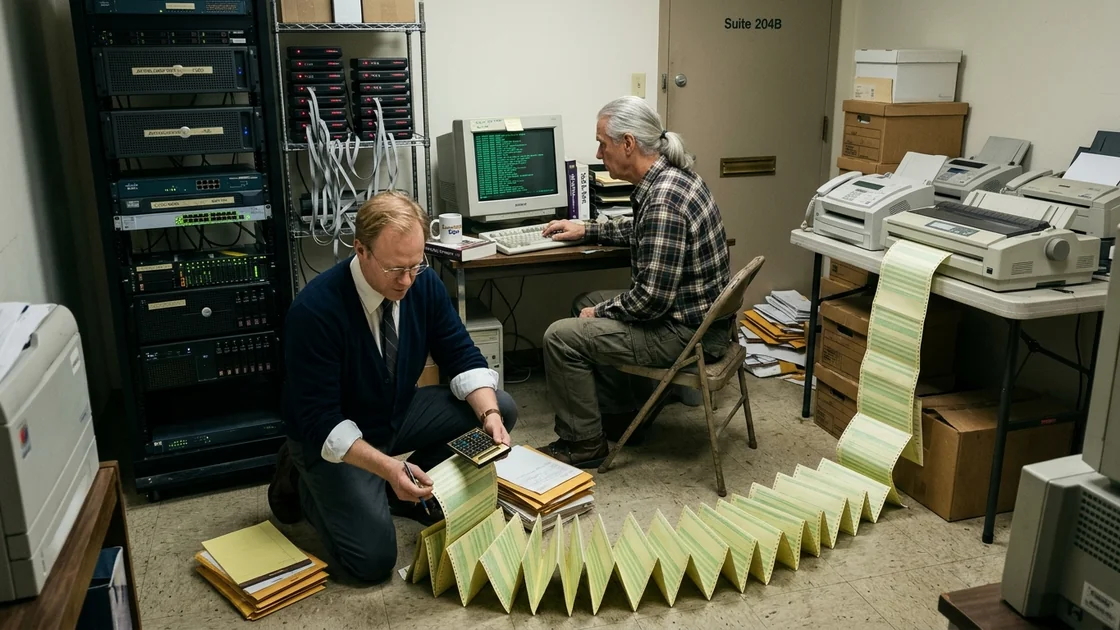
Suite 204B was no larger than twelve feet by fifteen feet. It had no windows. The walls were lined with unpainted plywood backboards painted in fire-retardant gray. Along the left wall stood a six-foot black steel 19-inch relay rack, bolted directly into the concrete slab floor.
Mounted inside the rack were two beige 4U rackmount server chassis
with locking front bezels—one labeled in neat Brother P-Touch tape as
AETHELGARD-PRI (192.168.1.10) and the other as
AETHELGARD-SEC (192.168.1.11). Above them sat a Cisco 2621
modular router, a 24-port 3Com SuperStack II Ethernet switch whose green
link lights blinked in a hypnotic, synchronized pulse, and a gray
Cyclades Cyclom-Y 16-port serial breakout box.
From the Cyclades box, sixteen thick beige RS-232 ribbon cables cascaded like a metallic waterfall onto three industrial wire shelves, where sixteen identical black USRobotics Courier V.Everything external modems sat side by side in two neat ranks of eight.
As Arthur watched, Modem #4’s red LEDs flashed to life. Its speaker
emitted a muted chirp, followed by the familiar hiss of an incoming fax
transmission from some quarry or cold-storage warehouse in Pennsylvania.
Four seconds later, the LEDs went dark, and the hard drive activity
light on AETHELGARD-PRI fluttered green.
"Look at the right wall," Julian breathed, pointing across the narrow room.
On a long laminate folding table stood two commercial-grade Brother
IntelliFax-4750e laser fax machines—evidently wired as physical hardware
fallbacks on the last two ports of the hunting group—and beside them sat
a wide-carriage Okidata Microline 321 Turbo nine-pin dot-matrix printer,
connected via a thick gray parallel cable to the primary server’s
/dev/lp0 port.
Lawrence Thorne had Clearly been a man who believed in hard-copy audit trails. Beneath the slotted wooden table holding the Okidata printer, he had placed four massive cardboard cartons of 2,400-sheet continuous-feed green-bar fanfold paper, daisy-chained together at the seams with strips of perforated splicing tape so the printer could draw seamlessly from one box to the next.
Behind the printer, a plastic catch-basket had overflowed sometime around the first term of the George W. Bush administration. Over the subsequent twenty-two years, the Okidata had slowly, methodically printed one line of system log text every time a batch job completed, an ACH file cleared, or a SkyTel pager call failed. The continuous ribbon of paper had spilled over the back of the table, coiled across the linoleum floor like a hibernating white python, climbed three feet up the corner wall, and folded back upon itself in thousands of accordion pleats. The ink ribbon on the printer had dried to a pale, ghostly silver-gray around 2014, and for the last decade, the nine steel pins of the printhead had simply embossed the letters blindly into the surface of the paper like Braille.
At the very end of the bench sat a seventeen-inch Sony Trinitron CRT monitor, its screen pitch black to prevent phosphor burn-in, alongside an IBM Model M mechanical keyboard covered in a fine, undisturbed velvet of gray dust.
On the corner of the desk beside the keyboard sat a ceramic coffee mug bearing the faded logo of LinuxWorld Expo 2000, a pair of tortoiseshell reading glasses folded neatly atop a pocket copy of O'Reilly's Sed & Awk, and a yellow sticky note stuck to the plastic bezel of the monitor in faded blue ballpoint ink:
TODO FRI 9/20:
- Migrate SkyTel SNPP alert script to SMTP cell gateway
- Update IRS corporate bracket var in tax_calc.pl if Congress changes rates
- Buy milk
Arthur looked at the folded reading glasses and the note reminding a dead man to buy milk twenty-two years ago. A profound, heavy stillness seemed to settle over his chest, the same quiet reverence he had felt once when visiting an ancient monastic library in Dublin where the monks had died centuries ago, leaving their inkwells dry beside half-copied manuscripts.
Except this manuscript was still writing itself.
Julian walked over to the desk, blew a cloud of dust off the Spacebar
of the IBM Model M keyboard, and tapped the Shift key.
With a quiet crackle of static electricity that made the fine hairs on Arthur’s wrists stand up, the Sony Trinitron tube warmed from the center outward. Green text materialized against a black background:
Red Hat Linux release 7.1 (Seawolf)
Kernel 2.4.2-2smp on a 2-processor i686

aethelgard-pri login: _
"Dual Pentium III Tupelo Xeons," Julian murmured, kneeling down to
peer through the ventilation grilles of the two 4U server cases. "Look
at this setup, Arthur. He built a high-availability heartbeat cluster
using keepalived and rsync between the primary
and secondary boxes, plugged into dual APC Symmetra power arrays wired
straight into the building's hard-line generator circuit. Wait...
listen."
Julian tilted his head toward the lower server chassis
(AETHELGARD-PRI).
Beneath the steady whoosh of the ball-bearing chassis fans and the hum of the Liebert air conditioner on the wall, there was another sound coming from the drive bay of the primary server.
Click-whirrrrr-tick. Click-whirrrrr-tick.
It was the high-pitched, metallic whine of a ten-thousand-RPM Ultra160 SCSI spindle bearing running completely dry of lubricant, punctuated every six seconds by the sharp tick of a read-write head hitting a bad sector and recalibrating against the actuator stop.
"Uh-oh," Julian said, his expression darkening. "Look at the RAID controller LEDs behind the bezel."
Arthur knelt beside him. Inside the primary server's drive cage were three hot-swap Seagate Cheetah SCSI drives configured in a RAID-5 array. Drive 0 had a solid amber fault light—it had died years ago. Drive 1 and Drive 2 were blinking green, keeping the three-drive parity array alive by the skin of its teeth, and Drive 1 was the one making the terminal click-whirrrrr-tick of an imminent head crash.
"What about the backup server above it?" Arthur asked, pointing to
AETHELGARD-SEC.
Julian looked at the upper chassis. Its front panel was completely dark. He pressed the power button; nothing happened. "Power supply in the secondary box blew out sometime in the past. Which means this entire thirty-one-million-dollar corporation is currently running on two twenty-three-year-old spinning rust platters with zero redundancy, and Drive 1 is throwing hardware read errors every six seconds."
As if to confirm his diagnosis, the Okidata dot-matrix printer on the table suddenly chattered to life—bzzzzzt-rat-tat-tat—advancing the paper one line and embossing a dry, inkless string across the perforation:
Nov 14 09:38:12 aethelgard-pri kernel: scsi0: MEDIUM ERROR on channel 0, id 1, lun 0, CDB: Read (10) 00 00 4f 2a 11
"How long does that drive have left?" Arthur asked.
"Could be six months, could be six minutes," Julian said, standing up
and looking at the login prompt on the CRT monitor. "If that drive
throws an unrecoverable sector fault during a write operation on the
root partition, the kernel will panic, remount the ext2 or ext3
filesystem read-only—or worse, drop to an fsck prompt on
reboot—and the whole thing dies right here."
"Can we log in and back it up?"
"Not without the root password, and if I pull the power to image the drives offline, I guarantee you those Seagate spindles will seize the second they cool down and never spin up again. Stiction on twenty-year-old fluid bearings is a death sentence."
Julian looked around the desk. He picked up the O'Reilly Sed & Awk book, fanned through the pages, and checked under the keyboard. Nothing.
"Wait," Arthur said. "I'm a forensic accountant, Julian. Let me think about Lawrence Thorne."
Arthur stepped up to the desk, careful not to disturb the tortoiseshell glasses. He looked at the room—at the meticulous P-Touch labels on every single RS-232 cable, at the neatly spliced boxes of fanfold paper, at the ASCII borders of the invoices, and at the name of the company itself.
"Why did he call it Aethelgard?" Arthur mused aloud. "It’s not a Delaware name. It’s Anglo-Saxon. Aethel means noble, gard means enclosure or stronghold. Why would a math graduate from Lehigh who worked at Consolidated Freightways name his server Aethelgard?"
Arthur looked at the bookshelf bracket mounted above the table. Alongside three binders of Red Hat documentation, the Perl Cookbook, and the Interstate Commerce Commission Motor Carrier Tariff Guide (1994 Edition) was a battered, spine-creased paperback copy of J.R.R. Tolkien’s The Silmarillion, and next to it, Douglas Hofstadter’s Gödel, Escher, Bach: an Eternal Golden Braid.
Arthur took down Gödel, Escher, Bach. A yellow receipt from Borders Books & Music in Wilmington, dated October 14, 1999—the exact day Aethelgard Holdings was incorporated—was tucked inside as a bookmark at Chapter VII: The Propositional Calculus.
Written across the back of the Borders receipt in Lawrence Thorne’s neat, draftsman-like handwriting was a list of IP addresses for the local subnet, the phone numbers for the sixteen modem lines, and at the bottom, two lines:
console: lthorne / G0delEscher99!
root : Mu!Loop_2001
"Human beings are terrible at inventing random numbers," Arthur said softly, handing the receipt to Julian. "And they always keep their charter documents in the same folder."
Julian grinned, typed root at the prompt, and entered
Mu!Loop_2001.
The prompt changed instantly:
[root@aethelgard-pri /root]# _
"We're in," Julian said. Before touching anything else, he typed
uptime and hit Enter.
09:42:19 up 8428 days, 18:14, 1 user, load average: 0.04, 0.02, 0.00
"Eight thousand, four hundred and twenty-eight days," Julian whispered, taking off his glasses to wipe them on his flannel shirt. "Since October 17, 2001. Not a single reboot. This machine belongs in the Smithsonian."
First, Julian pulled a USB-to-Ethernet adapter and a clean laptop
from his canvas bag, plugged into Port 24 of the 3Com switch, assigned
himself a static IP on the 192.168.1.0/24 subnet, and ran
an immediate, low-priority rsync and dd dump
over the network to clone the entire four-gigabyte filesystem of
AETHELGARD-PRI onto his laptop’s solid-state drive,
throttling the bandwidth to avoid stressing the dying SCSI disk.
While the backup progressed in the background, Julian opened a second
terminal session on the Sony CRT and typed crontab -l.
There, in thirty lines of clean, commented plain text, was the beating heart of Aethelgard Holdings, LLC:
# AETHELGARD MASTER AUTOMATION CRONTAB - L. THORNE (REV 2002-08-19)
SHELL=/bin/bash
PATH=/sbin:/bin:/usr/sbin:/usr/bin:/usr/local/bin
MAILTO=""

# 1. Process incoming HylaFAX queue & run OCR/PDF417 tariff verification every 10 mins
*/10 * * * * /usr/local/aethelgard/bin/process_waybills.pl >> /var/log/aethelgard/tariff.log 2>&1

# 2. Generate & fax monthly client invoices on 1st Tuesday at 03:00 AM
0 3 1-7 * 2 /usr/local/aethelgard/bin/generate_invoices.sh

# 3. Dial Brandywine Mutual BAI2/NACHA host via modem 16 daily at 02:15 AM
15 2 * * 1-5 /usr/local/aethelgard/bin/bank_reconcile.exp >> /var/log/aethelgard/ach.log 2>&1

# 4. Pay fixed facility & telecom obligations on 1st of month
30 4 1 * * /usr/local/aethelgard/bin/pay_vendors.pl --mode=recurring

# 5. Treasury sweep: transfer checking surplus > $100k to 90-day T-Bill ladder
0 5 * * 3 /usr/local/aethelgard/bin/treasury_sweep.pl

# 6. Annual Delaware Franchise Tax & IRS Form 1120 estimated EFTPS calculation
0 6 15 3,5,6,9,12 * /usr/local/aethelgard/bin/tax_compliance.pl

# 7. Check account delinquency & issue 7/14/30 day suspension faxes
0 1 * * * /usr/local/aethelgard/bin/dunning_engine.sh
Arthur leaned over Julian’s shoulder, reading the comments. "Open those scripts, Julian. Let me see the accounting logic."
Julian navigated to /usr/local/aethelgard/bin/ and
opened process_waybills.pl and
bank_reconcile.exp in vim.
Arthur didn't know Perl on a professional level, but code written by a mathematician is universal. Every subroutine was documented with dense, crystalline comments explaining both the freight law and the double-entry bookkeeping principles behind the code.
Thorne hadn't built a scam. He had built a masterpiece of logistical efficiency.
In the late nineties, small and mid-sized carriers across the Mid-Atlantic constantly overpaid each other and their shippers because their dispatchers manually calculated freight classes, pallet weights, and interline mileage zones. Thorne’s Perl scripts ingested their weekly manifest faxes, cross-referenced every single shipment against an internal Berkeley DB database containing 4.2 million zip-code-to-zip-code tariff rates and LTL (Less-Than-Truckload) density breaks, identified every billing error, and automatically faxed Dispute & Correction notices not only back to his client, but directly to the freight brokers and co-carriers on the other side of the bill of lading.
In exchange for saving Mohawk Valley Cold Storage or Shenandoah Container Corp five or ten thousand dollars a month in freight overcharges, Aethelgard charged twenty cents per verified waybill and a small monthly gateway fee.
"Look at pay_vendors.pl," Arthur said, pointing at the
screen as Julian scrolled through the disbursement module. "There’s a
subroutine here called process_maintenance_invoices()."
Julian scrolled down to line 210 of the script:
# Allow authorized external contractors/auditors to submit maintenance
# or tariff-table update invoices via FAX using OCR-A header template 99.
# If invoice carries valid cryptographic challenge-response token from
# /etc/aethelgard/auth_seeds and amount < $10,000.00, queue for next
# Tuesday NACHA batch under GL Account 5200 (System & Audit Maintenance).
"He built a way for himself—or a contractor—to bill the company
remotely by fax if he was traveling!" Julian exclaimed. "As long as you
include a one-time hash generated from the seed list in
/etc/aethelgard/auth_seeds and format the invoice in OCR-A
template 99, the server logs it under Account 5200 and pays it on the
next ACH run!"
Just then, Drive 1 in the primary server chassis let out a louder, sharper metallic screech—SKREEEEE-TICK-TICK-TICK—and the Okidata printer hammered out five rapid lines of SCSI sector faults in a row.
The green terminal screen froze for three agonizing seconds while the kernel waited for the disk controller to retry the block read, and then unfroze.
"My network backup is at ninety-eight percent... ninety-nine... done!" Julian exhaled sharply, tapping his laptop screen. "I've got the whole disk image safe on my SSD. Now we have a decision to make, Arthur."
Arthur straightened up, putting his hands in the pockets of his overcoat. The air conditioner cycled off for a moment, leaving only the wheezing, rhythmic scrape of the dying Seagate hard drive in the quiet room.
"What are our options?" Arthur asked.
"Option A is what your managing partners and the state of Delaware would call the standard procedure," Julian said, ticking it off on his hand. "You go back to Philadelphia, write a report declaring Aethelgard Holdings an abandoned, ownerless entity whose sole member died intestate without heirs in 2002. The Delaware State Escheator steps in, seizes the thirty-one million dollars in the First Chesapeake bank account as unclaimed property, pulls the plug on this rack, and throws Lawrence Thorne’s life's work into a dumpster."
"And what happens to the thirty-eight remaining companies still using the gateway?" Arthur asked.
"Their faxes stop going through," Julian said. "Half of them probably don't even have a human left on staff who remembers how interline freight tariff auditing works because Aethelgard has been doing it for them at three in the morning since 2001. They’ll start bleeding money on shipping disputes, and within a year, two or three of the smaller family-owned warehouses will probably end up in Chapter 7 just like Kestrel."
"And Option B?"
Julian gestured toward his canvas tool bag on the floor. "I happen to
have an identical ATX power supply in my trunk that can bring
AETHELGARD-SEC back to life in twenty minutes. And in my
workshop back in the Dungeon, I have four brand-new-old-stock Fujitsu
Ultra160 SCSI drives still sealed in their foil bags, plus industrial
solid-state SCSI-to-NVMe bridge cards that never wear out and never
click. I can rebuild the RAID array on both servers without dropping the
cluster's uptime by failing over the heartbeat daemon to my laptop while
I swap the hardware."
Arthur looked at the yellow sticky note on the monitor bezel
(- Buy milk), and then down at the miles of green-bar
fanfold paper coiled across the floor.
"If we leave it running," Arthur said slowly, his accountant's mind turning over every gear of the problem, "the thirty-one million dollars in Treasury bills just keeps compounding forever in a bank vault until some compliance algorithm at First Chesapeake finally flags an account with a hundred million dollars and no human Beneficial Ownership Information filing under the new Corporate Transparency Act."
"True," Julian nodded. "FinCEN and the bank’s KYC department will eventually catch up to it in a year or two if the account stays passive and bloated."
"Unless," Arthur said, adjusting his wire-rimmed spectacles, "Aethelgard Holdings, LLC complies with its statutory audit requirements and restructuring obligations under the supervision of an independent fiduciary."
Julian raised an eyebrow. "Meaning?"
"Look at Lawrence Thorne’s original operating agreement in
/usr/local/aethelgard/doc/charter.txt," Arthur said,
pointing to a directory he had noticed during the file transfer.
Julian opened the text file. It was a remarkably foresighted document drafted by Thorne’s Wilmington attorney in October 1999. Section 14, titled Continuity of Automated Operations & Successor Stewardship, stated that in the event of the Sole Member’s death or incapacity for a period exceeding ninety days without a designated heir, any Certified Public Accountant who identified an operational exception via the System Administrator diagnostic protocol was authorized to assume the role of Non-Equity Administrative Trustee, compensated via the automated vendor schedule, and tasked with directing the net accumulated surplus of the corporation in excess of a five-hundred-thousand-dollar operating reserve to the Lawrence E. Thorne Endowment for Applied Mathematics & Computer Science at Lehigh University.
Arthur read the paragraph twice, feeling a quiet warmth spread through his chest.
"He knew," Arthur whispered. "He had a family history of heart
trouble—his parents died young. When he built this room in 1999, he
wrote a successor subroutine right into the corporate charter, and put
the endowment's EIN and wire instructions right into the comments of
treasury_sweep.pl, waiting for someone to read the console
log and flip the boolean flag from 0 to
1."
Julian quickly opened treasury_sweep.pl and searched for
the word LEHIGH.
Right there, at line 412, commented out behind a variable
$ENDOWMENT_ACTIVE = 0, was the automated wire transfer
module to Lehigh University’s endowment custodial account at Mellon
Bank, programmed to disburse ninety percent of the T-bill reserve in
annual installments once an Administrative Trustee entered a valid CPA
license number and flipped the flag.
Why hadn't it triggered automatically when Thorne died? Because
Thorne had intended to write a dead-man's switch tied to his SkyTel
pager alerts—the very item #1 on his sticky note
(Migrate SkyTel SNPP alert script) that he was going to
finish on Friday, September 20th, 2002, the day after he died in the
park.
"He died twenty-four hours before he finished coding the dead-man's switch," Julian breathed. "And for twenty-two years, the server has been printing pager error notices onto the floor, waiting for an administrator to walk in and finish the Friday TODO list."
Arthur took off his overcoat and draped it neatly over the back of a folding chair. Then he rolled up the sleeves of his cardigan sweater.
"Julian," Arthur said, "go down to your car and get the power supply. And while you're in Philadelphia tonight, bring back those solid-state SCSI bridge drives and a fresh box of ink ribbons for the Okidata."
"What are you going to do while I'm getting the parts?" Julian asked, already hefting his tool bag.
"I have twenty-two years of continuous-feed general ledger logs on
the floor to reconcile," Arthur said, kneeling beside the mountain of
embossed fanfold paper with his HP-12C calculator in hand. "And then we
are going to fix the corporate tax bracket variable in
tax_calc.pl, cancel Kestrel Freight’s $6,219.80 balance as
an uncollectible bad-debt write-off under Section 166 of the Internal
Revenue Code so the bankruptcy trustee leaves Aethelgard alone, and
activate the Lehigh University endowment sweep."
Julian paused at the door, his hand on the heavy brass knob. "You know, Artie, Section 14 of that charter says the Administrative Trustee is entitled to submit a monthly maintenance invoice under GL Account 5200 up to ten thousand dollars."
Arthur looked up from the fanfold paper, over the tops of his spectacles, at the sixteen USRobotics modems blinking quietly in the warm, ozone-scented dimness of Suite 204B. Modem #7 had just answered a call from Erie Lakefront Warehousing; the carrier handshake sang out for four seconds, clear and steady, a voice from another century still doing an honest day's work.
"Nine thousand, eight hundred and forty-two dollars and sixteen cents a year, split between us for quarterly hardware and ledger reviews," Arthur said briskly. "It conforms to Benford's Law, it stays well under the audit variance threshold, and it covers the cost of the SCSI adapters and the fanfold paper. Make sure you format the invoice in twelve-point Courier with an OCR-A header, Julian. I wouldn't want the machine to bounce it back."