The Copper Sanctum
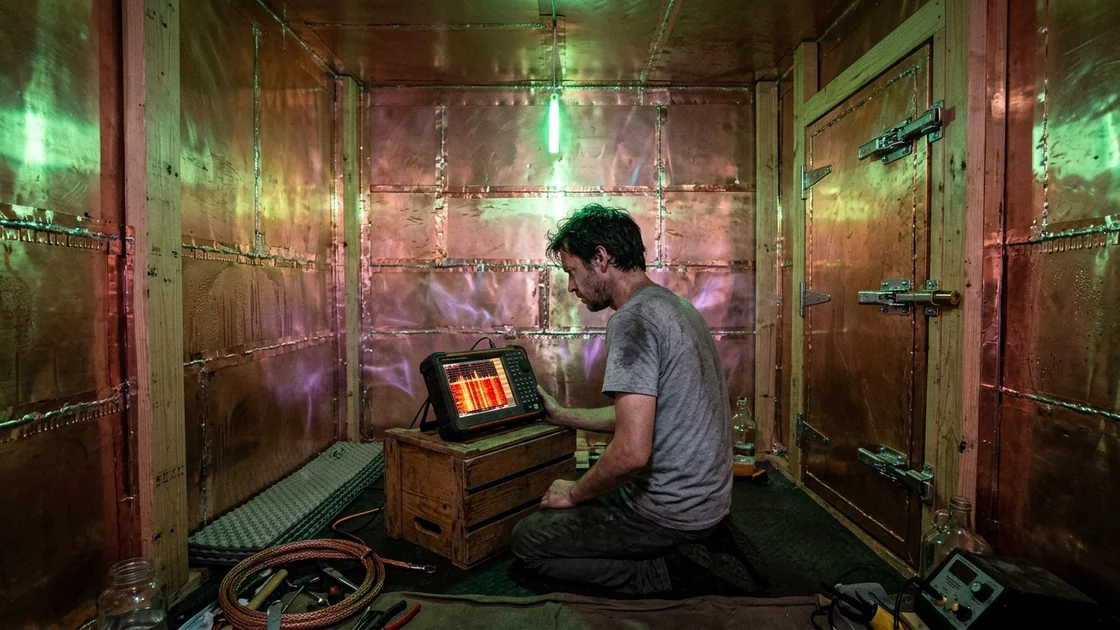
Arthur Pendelton suffers from debilitating insomnia caused by what he believes is the relentless electromagnetic radiation of the modern city. Desperate for sleep, the former radio frequency engineer constructs an industrial-grade Faraday cage inside his bedroom to block out every signal. When he finally seals himself inside the copper-lined chamber, he discovers that the source of his sleeplessness was never coming from the outside world. Instead, he has locked himself in an impenetrable resonant box with a parasitic electromagnetic entity that feeds on the bio-electric currents of his own waking brain, and it has no intention of letting him open the door.
The human brain was never engineered to exist inside a microwave oven, yet by Arthur Pendelton’s calculations, the third-floor apartment he rented on Mercer Street was functionally indistinguishable from one. It was a low-wattage, wide-spectrum oven, certainly, operating across thousands of discrete channels rather than a single violent magnetron frequency, but the cumulative thermal and neurological load remained the same. At three o’clock in the morning, when the pedestrian traffic down on the wet asphalt had thinned to nothing and the delivery trucks had ceased their idling, the air inside his bedroom remained thick with invisible traffic.
Arthur lay flat on his back, staring up at a ceiling he could not see, listening to a sound that did not exist in the acoustic world.
It was not tinnitus. The audiologist at Mount Sinai had spent four hours proving that to him inside an anechoic chamber lined with fiberglass wedges. In that subterranean room down at the hospital, buried beneath forty feet of Manhattan bedrock and structural steel, the ringing in Arthur’s ears had dropped by seventy percent within twenty minutes. His tympanic membranes were pristine. The cochlear hair cells showed minor age-related flattening around the sixteen-kilohertz mark, entirely normal for a thirty-eight-year-old man who had spent a decade testing high-gain directional antennas for a defense contractor in New Jersey, but there was no lesion, no acoustic neuroma, no vascular malformation pulsing against his auditory nerve.
What Arthur heard was a dry, rapid ticking, like sleet striking a tin roof miles away, underlaid by a pressurized, sinusoidal hum that lived just behind the bridge of his nose.
He turned his head toward the nightstand. The green LED numerals of his alarm clock had been banished months ago, replaced by a Swiss mechanical pocket watch whose radium hands had long since decayed into dull ochre lines. He did not need to read the watch to know he was Entering Hour Ninety-Two.
After seventy-two hours without rapid eye movement sleep, the visual world began to lose its structural integrity. Edges softened and then over-sharpened, as though someone were adjusting the peaking filter on a cheap television monitor. Shadows in the corners of the plaster molding did not merely sit; they vibrated at sixty hertz, matching the alternating current running through the unshielded Romex wiring buried behind the lath. At eighty hours, his skin developed a persistent, prickly hyperesthesia, as if he had rolled naked in insulation wool. And now, past ninety hours, his thoughts no longer moved in linear sentences. They arrived in bursts of packet data—checksums, headers, corrupted payloads of memory from childhood mixed with impedance calculations and the smell of ozone.
Arthur swung his legs over the edge of the mattress. His knees popped in the dark. He stood up slowly, waiting for the orthostatic hypotension to clear from his vision, a gray curtain of static that rose and fell with his pulse.
Walking to the window, he pulled back the heavy blackout curtain by a fraction of an inch. Across the slick black canyon of Mercer Street, on the roof of the six-story garment warehouse opposite his building, stood the array. Three sector antennas mounted on a galvanized steel monopole, painted a dull battleship gray to blend into the eternal overcast of the city sky. They were 5G millimeter-wave transceivers, operating in the twenty-eight-gigahertz band, installed seven months ago by a crew that had worked through a Sunday afternoon with a hydraulic crane.
Seven months. Two hundred and fourteen days. That was when the sleep had stopped being shallow and started becoming impossible.
Below the rooftop array, every apartment window in the opposing brick facade represented at least two dual-band routers, four cellular handsets, three Bluetooth beacons, a smart television polling its server every forty milliseconds, and an array of utility smart meters down in the basement shooting ninety-hundred-megahertz mesh-network bursts up through the floorboards every ten seconds. The air was not empty space. It was a dense, churning soup of modulated carrier waves, phase-shifted keys, and orthogonal frequency-division multiplexing. Every cubic centimeter of his bedroom was being traversed by trillions of photons per second in the non-ionizing bands, passing effortlessly through brick, timber, cotton sheets, and human craniums.
Medical science insisted that non-ionizing radiation lacked the quantum energy required to knock an electron from an atom, and therefore could have no biological effect beyond mild dielectric heating. Arthur knew better. A bridge did not need to be struck by a wrecking ball to collapse; it only needed a rhythmic gust of wind tuned precisely to its resonant mechanical frequency. The human nervous system was an electrochemical network operating on microvolts and milliamperes. Every thought, every dream, every slow delta wave that was supposed to wash the waking toxins from his cerebral cortex during deep sleep was nothing more than potassium and sodium ions hopping across lipid membranes in coordinated electrical cascades.
Something in the soup was matching his resonance. Something was jamming his delta waves.
He walked out of the bedroom and into the narrow hallway, his bare feet cold against the varnished oak floorboards. The living room looked less like a domestic space and more like an abandoned calibration lab. His sofa was buried under heavy cardboard shipping boxes from industrial supply warehouses in Ohio and Pennsylvania. Coils of braided tinned-copper grounding strap lay piled on the coffee table beside three soldering irons, four spools of silver-bearing solder, and a stack of yellowing academic papers printed from university archives.
On the dining table sat his Rohde & Schwarz handheld spectrum analyzer, a piece of equipment that had cost him the remainder of his severance package when the defense contractor had finally let him go for erratic attendance and paranoid fugues.
Arthur flipped the toggle switch on the analyzer’s external lithium-iron-phosphate battery pack. The screen booted up with a soft amber glow, casting long, jaundiced shadows across his hollow cheeks. He picked up the log-periodic directional antenna connected to the unit via a thick, double-shielded coaxial cable and pointed it toward the front window.
Immediately, the display erupted into a jagged mountain range of green phosphor spikes. There were the cellular bands at seven hundred and nineteen hundred megahertz, plateauing like mesas. There was the crowded, chaotic trash of the two-point-four-gigahertz industrial, scientific, and medical band, jumping and twitching as his neighbors’ devices negotiated handshakes through the plaster walls.
Arthur turned his back to the window and aimed the directional paddle toward his empty bedroom.
He adjusted the center frequency down, sweeping past the broadcast television bands, past FM radio, down into the very-high and ultra-high frequency ranges where military satellites and legacy paging systems lived. Then he switched the display mode from standard frequency domain to a waterfall spectrogram, which plotted frequency on the horizontal axis and time on the vertical, painting signal strength as shifting colors from deep blue to violent white-hot red.
For ten seconds, the waterfall showed only the expected background wash—vertical stripes of steady transmissions bleeding through the building from the street.
Then, as Arthur stepped across the threshold of his bedroom door, the anomaly appeared.
It did not look like a man-made transmission. Engineered signals had discipline; they stayed within their FCC-allocated guard bands, exhibiting crisp square shoulders or predictable Gaussian curves. They repeated at regular clock intervals determined by crystal oscillators.
What scrolled down the screen of the Rohde & Schwarz as Arthur stood beside his unmade bed was a wandering, braided filament of energy centered roughly around four hundred and twelve megahertz, though it threw off bizarre, non-integer harmonics all the way up into the three-gigahertz range. As he watched, the signal drifted left by four megahertz, paused, thickened into a bright crimson knot on the waterfall display, and then split into three parallel strands that wove over and under one another like the tracks of sidewinding snakes in desert sand.
The ticking in the back of Arthur’s skull accelerated, matching the pulse-repetition rate of the crimson knot on the screen.
Click-click-click-tik-tik-click.
He held his breath and took two steps backward into the hallway. On the screen, the braided filament narrowed, dimmed from crimson to orange, and then seemed to reach after him, its bandwidth widening as its amplitude dropped, as if an invisible aperture were opening wider to gather a fading light.
When he stepped back into the bedroom, close to the depression in the pillow where his head had rested ten minutes earlier, the signal snapped back into tight focus. The decibel-milliwatt reading climbed from minus-eighty to minus-forty-five. That was an absurdly high field strength for an unlocalized source—equivalent to standing ten feet away from a tactical walkie-talkie with its transmit key taped down.
"Multi-path propagation," Arthur whispered aloud. His voice sounded like dry leaves scraping across concrete. "Constructive interference. The rebar in the eastern wall is acting as a parasitic reflector for the rooftop array across the street, creating a standing wave node right over the bed."
It was the only rational explanation. The geometry of the nineteenth-century cast-iron building, combined with the new millimeter-wave repeaters and the labyrinth of lead pipes in the walls, had turned his bedroom into an accidental phased-array focal point. The meandering nature of the signal had to be the result of atmospheric ducting or load-balancing algorithms in the cellular towers shifting traffic across channels in real time.
If he moved the bed to the living room, he would find another node. He had already tried sleeping in the bathtub two weeks ago, wrapping himself in heavy-duty aluminum foil from the grocery store until he looked like a baked potato in a porcelain dish. The foil had crinkled with every breath, tearing at the elbows, and the thirty-micrometer household aluminum had done nothing to stop the low-frequency magnetic components or the high-frequency leaks through the bathroom doorway. He had lain there for six hours, listening to the ticking bounce off the enamel around his ears, until he had wept from sheer physical exhaustion and torn the foil off in bloody strips where it had pinched his skin.
Half-measures were for amateurs. Amateur radio operators hung copper curtains over their windows; conspiracy theorists bought silver-threaded bed canopies online that left the floorboards unshielded and acted like giant parabolic dishes reflecting waves up from the apartment below straight into the sleeper’s mattress.
Arthur was not an amateur. He had designed anechoic test chambers for Lockheed subcontractors. He understood Maxwell’s equations not as abstract calculus, but as architectural blueprints.
To stop an electromagnetic wave, you had to give its electric field a conductor so efficient that the wave’s energy was entirely consumed in creating opposing eddy currents on the surface of the metal, reflecting the wave back where it came from while canceling the field on the interior. You needed continuity. You needed skin depth. You needed an unbroken, six-sided topological sphere of conductive metal with no seam, no slot, and no aperture larger than one-twentieth of the shortest wavelength you intended to block.
He looked down at the wooden floorboards, then up at the twelve-foot ceiling, and finally at the stacks of heavy crates waiting in the living room.
He was not going to move out. Even if he broke his lease, where would he go? New Jersey was blanketed. Upstate New York was crisscrossed with high-tension transmission lines and Starlink downlinks. The entire biosphere was saturated. The only place left on Earth where the spectrum was truly dead was the bottom of a mine shaft or the inside of a sealed conductive box.
Arthur set the spectrum analyzer down on the dresser, walked into the living room, and picked up a crowbar.
The demolition of the bedroom’s existing trim took fourteen hours. Arthur worked through the daylight of Tuesday without stopping to eat, surviving on tap water and three lukewarm mugs of instant coffee that no longer produced any cardiovascular response in his exhausted body, only a sour burn in his stomach.
His landlord, Mr. Kravitz, lived on the first floor behind a door padded with vinyl quilting and was eighty-four years old and profoundly deaf, which worked in Arthur’s favor as the baseboards came off with the shriek of rusted finish nails pulling through century-old pine.
By Wednesday afternoon, Arthur had constructed a freestanding structural timber frame inside the bedroom using kiln-dried two-by-fours fastened strictly with carpenter’s glue and wooden dowels. He refused to use steel screws or iron nails in the sub-frame; ferromagnetic fasteners could become magnetized by ambient direct-current fields from the subway lines running beneath nearby Broadway, creating localized flux points that might distort the behavior of the shield. The wooden cage stood six inches clear of the plaster walls, eight inches below the ceiling, and rested on two layers of high-density neoprene rubber matting laid over the floorboards to provide complete dielectric isolation from the building’s structure.
It was a room within a room, measuring ten feet wide, twelve feet long, and eight feet high—just large enough to contain his mattress, a small wooden chair, and a nightstand.
His sister, Claire, arrived on Thursday evening while he was unrolling the first bolt of Mu-metal across the neoprene floor.
She had used the spare key he had given her three years ago after his appendectomy. Arthur was on his knees inside the timber skeleton, wearing heavy leather welding gloves to protect his hands from the razor-sharp edges of the nickel-iron alloy sheet, when he heard her gasp from the hallway.
"Arthur? Oh, my God. Arthur, what is this?"
He didn't look up immediately. If you kinked Mu-metal during installation, you altered its crystalline grain structure and ruined its magnetic permeability, reducing its ability to divert low-frequency magnetic fields by half. He carefully smoothed the thirty-inch-wide strip flat against the rubber mat, weighted its corners with ceramic bricks, and only then sat back on his heels.
Claire stood in the doorway of the bedroom, clutching a brown paper grocery bag against her wool coat. She looked terrified. It occurred to Arthur, with a detached clinical curiosity, that he probably looked like a corpse that had wandered out of a disaster site. He hadn't shaved in nine days. His gray t-shirt was soaked through the shoulder blades with foul, stress-hormone sweat, and his eyes felt like two dry marbles rolled in sand.
"Don't step on the shiny metal, Claire," he said, his voice hoarse. "The oils from your shoes will interfere with the solder bonding later, and if you bend the edge, the attenuation below ten kilohertz drops off a cliff."
"What have you done to your walls?" She took a slow step forward, her eyes darting from the torn plaster baseboards to the raw pine cage occupying the center of the room, and then to the dozens of heavy cardboard tubes stacked against the radiator. "I called you six times since Sunday. Your phone goes straight to voicemail. Your office said you don't work there anymore—they said you resigned in October!"
"My phone is in the kitchen freezer, wrapped in four layers of lead foil inside a cast-iron Dutch oven," Arthur said reasonably. He picked up a roll of two-inch-wide conductive copper tape with nickel-impregnated acrylic adhesive and began peeling back the paper liner. "Even when they're powered off, modern handsets maintain a low-power baseband processor wake-state for emergency location polling. It chirps every few minutes. I couldn't have it near the workspace while I was calibrating the baseline."
Claire set the grocery bag down on the floorboards outside the wooden frame. Her hands were shaking. "Arthur, look at me. Look at my face."
He paused, the strip of copper tape dangling from his gloved fingers, and raised his eyes to hers. In the harsh, unshaded glare of the single halogen work light he had temporarily strung from the hallway—powered by a heavy extension cord he planned to sever the moment the last seam was sealed—his sister’s face seemed to swim slightly. Around the silhouette of her dark hair, he could see the faint, shimmering violet corona that had begun appearing around high-contrast edges yesterday morning. Hallucination, he knew. Occipital lobe misfiring due to adenosine buildup and GABA receptor exhaustion.
"I'm looking," he said.
"When was the last time you slept?"
"Sunday," he lied. Actually, it had been Thursday of the previous week, a forty-minute coma on the bathroom floor between five and six in the morning that had ended with a jolt like a defibrillator paddle striking his chest. "I'm fine. I've identified the problem. The doctors were looking at neurochemistry, which is downstream. You don't treat a poisoned well by filtering the bucket; you seal the shaft against the runoff."
"You tore your apartment apart!" Her voice cracked, rising an octave. "You look like you've lost twenty pounds! Arthur, please, pack a bag. Come back to Brooklyn with me tonight. Mark can set up the guest room, we'll call Dr. Aris, they have inpatient sleep clinics where they can give you something intravenous—"
"Propofol doesn't produce restorative slow-wave sleep, and benzodiazepines suppress REM cycles while leaving the cortex completely exposed to exogenous induction," Arthur interrupted, his tone taking on the flat, rapid cadence of a technical briefing. He pointed toward the Rohde & Schwarz analyzer sitting on the dresser outside the frame. The waterfall display was still running. "Look at the screen, Claire. Look at four-twelve megahertz."
Claire didn't look at the screen. She was staring at him with wide, wet eyes, backing slowly toward the hallway as if she had just realized the man kneeling in the timber cage was a stranger wearing her brother's skin.
"See that braided trace?" Arthur continued, turning back to his seam and pressing the copper tape down over the joint between two sheets of Mu-metal with a bone folder, rubbing it furiously until the embossed pattern of the backing disappeared. "It's a localized standing-wave anomaly. It tracks with bio-electric density. When I'm in the room, the Q-factor of the cavity increases because my body acts as a dielectric load—seventy percent water with dissolved electrolytes. It's basic physics. Once I finish the triple-layer enclosure—Mu-metal for the low-frequency magnetic H-fields, solid twenty-four-gauge copper sheet for the mid-band reflection, and hundred-mesh phosphor-bronze screening over the seams for high-frequency waveguide cutoff—the interior will achieve a minimum of one hundred and twenty decibels of attenuation from ten kilohertz to forty gigahertz."
He looked up again, expecting her to see the elegance of the solution. One hundred and twenty decibels wasn't just quiet; it was a reduction in signal power by a factor of one trillion. Inside this box, the universe's electromagnetic background would cease to exist.
"Arthur," Claire whispered from the hallway. She had her phone in her hand. "I'm going to call someone to help you. Don't be angry with me, okay? You're sick. Your brain is starving for sleep and you're not making sense."
A cold spike of pure adrenaline punched through the gray fog in Arthur’s chest, instantly clearing his vision. If she called Emergency Medical Services, the police would come first. They would see the crowbar, the stripped walls, the manic engineer ranting about frequencies. They would put him on a seventy-two-hour psychiatric hold at Bellevue.
Bellevue Hospital. Eleven stories of reinforced concrete packed to the gills with telemetry transmitters, wireless patient monitors, Wi-Fi access points in every corridor, paging transmitters on the roof holding five hundred watts of effective radiated power, and MRI machines downstairs throwing massive multi-tesla magnetic fields through the floor plates.
If they strapped him to a gurney in Bellevue, the ticking in his head wouldn't just keep him awake; it would tear his cerebral cortex apart within twelve hours.
Arthur stood up carefully, stripping off the heavy leather gloves and forcing his face into a slack, embarrassed smile—the practiced expression of a man suddenly catching himself in an eccentric overreaction. It took every ounce of cognitive reserve he possessed to control the tremor in his jaw.
"Don't call an ambulance, Claire," he said softly, stepping out of the wooden frame and holding his hands up, palms out, non-threatening. "God. Listen to me. I sound completely insane, don't I?"
She froze, her thumb hovering over the glass screen of her phone. "Arthur?"
"I got laid off," he said, letting his shoulders slump, counterfeiting defeat instead of mania. It was remarkably easy to look exhausted. "Two months ago. I didn't want to tell you and Mark because after the divorce, I knew you'd worry. I've been trying to start an independent consulting business from home—shielding design for sensitive audio labs and crypto-mining setups. This isn't for me to live in. It's a prototype modular test cell for a client in Stamford. If I don't finish the attenuation verification by Saturday, I lose the contract and I can't make rent next month."
He rubbed his face with both hands, letting out a long, shuddering sigh. "I've been drinking too much coffee and pulling all-nighters to meet the deadline. When you walked in, I was half-delirious running through the sales pitch in my head."
Claire stared at him. She wanted to believe it so badly that he could practically see her brain rewriting the visual evidence around her to fit the narrative. A brother having a psychotic break was a nightmare with no clear exit; a brother who was broke, proud, overworked, and building an ugly piece of industrial equipment in his bedroom to pay the rent was a familiar, manageable problem.
"A client?" she repeated hesitantly, looking back at the precision-built wooden frame and the pristine, laboratory-grade rolls of copper sitting in the crates. The materials alone had clearly cost twelve thousand dollars. Madmen on the street corner taped tin foil to their hats; they didn't use silver-loaded conductive epoxy and German spectrum analyzers. The sheer professional competence of the joinery worked in his favor.
"An audiophile hedge-fund guy," Arthur lied smoothly, leaning against the doorframe. "Wants a zero-noise listening room in his basement because he lives near a substation. Paying me forty grand on delivery. I've just been... really stressed, Claire. I haven't been sleeping well because of the deadline. I'm sorry I scared you."
Her thumb moved away from the dial button. The tension in her shoulders dropped by an inch, though her eyes remained narrow with lingering suspicion and deep concern. "You told me the walls were poisoning you."
"I was talking about the harmonic distortion in the client's spec," he said, managing a weak chuckle. "I'm fried, Claire. Truly. Look, the best thing for me right now isn't a hospital. I just need to finish laying this floor base tonight so the conductive adhesive cures by Friday morning, and then I swear to God I'm going to take two Benadryl and sleep for fourteen hours. Come back on Sunday afternoon. We'll go to that place on Spring Street for lunch. My treat."
She stood there for a long moment. Behind her, down in the street, a siren wailed past, Doppler-shifting against the brick facades. Inside the bedroom, on the dresser, the crimson braid on the spectrum analyzer’s screen pulsed once, twice, three times, climbing into the white-hot zone.
Click-click-click.
Arthur kept his smile fixed on his face while a needle of white fire seemed to pass from his left temple to his right.
"Okay," Claire said finally, though she didn't put the phone back in her pocket. "Okay. Have you eaten anything today?"
"I had a bagel at noon."
"There's roast chicken, bread, and soup in that bag. Eat it before you do anything else." She stepped back toward the front door of the apartment, watching him the entire way. "I'm calling you tomorrow at noon, Arthur. On your cell phone. Take it out of the kitchen, or wherever it is. If you don't answer on the second ring, I'm coming back here with Mark and a doctor. Do you understand me?"
"Noon tomorrow," Arthur promised. "I'll have the ringer on high."
The moment the deadbolt clicked shut behind her, Arthur dropped the smile. He didn't touch the grocery bag. He walked straight to the front door, threw the heavy police-lock iron bar into its floor socket, wedged a rubber doorstop under the bottom edge, and went back to the bedroom.
He had until noon tomorrow. Sixteen hours.
That night, Arthur transcended tiredness and entered a state of cold, mechanical automatism. His hands moved with the practiced memory of twenty years in the trade, executing tasks while his conscious mind floated somewhere near the ceiling, watching his body work through a veil of dancing violet phosphenes.
After the Mu-metal sub-layer was completely taped and sealed across the floor, walls, and ceiling of the wooden frame, he began hanging the primary shield: twenty-four-gauge cold-rolled electrolytic tough-pitch copper sheeting, ninety-nine-point-nine percent pure.
Each sheet weighed nearly forty pounds. He wrestled them onto the interior surfaces of the wooden studs, overlapping every seam by two full inches. Then, turning on a heavy-duty two-hundred-watt soldering iron with a broad chisel tip, he began to sweat the seams together using lead-tin-silver solder and rosin flux.
The bedroom filled with the acrid, piney smoke of vaporized flux. He couldn't open the window without letting the frigid November wind cool the copper too rapidly and cause cold-solder joints, and he couldn't run an electric exhaust fan inside the cage once the walls went up without introducing motor-brush arcing noise. So he tied a wet dish towel over his nose and mouth and kept soldering.
Inch by inch, the bright, salmon-pink metal swallowed the room.
When the four walls and ceiling were solid copper, soldered into a continuous monolithic box from the inside out, he applied the final tertiary layer over every corner joint and solder seam: double-layer hundred-mesh phosphor-bronze woven wire cloth, bedded into a thick trowel-coat of silver-filled conductive silicone caulk.
For ventilation, he could not simply cut a hole in the copper; a hole four inches wide would act as a slot antenna, allowing every frequency above one-point-five gigahertz to pour straight into the room unattenuated. Instead, he installed two military-surplus honeycomb waveguide vents—six-inch-thick hexagonal arrays of welded brass tubes whose diameter-to-depth ratio was engineered to allow air molecules to drift through via convection while presenting an impenetrable sub-wavelength barrier to electromagnetic waves below forty gigahertz.
The hardest part was the door.
In professional RF test chambers, the door was always the point of failure. A tiny gap of a hundredth of an inch along a doorframe would leak signals like a sieve under water pressure. Arthur had salvaged a solid-core birch fire door, cut it down to five feet high by two feet wide to minimize perimeter length, and clad all six sides in folded, soldered copper sheet. Around the entire inner lip of the doorframe and the matching bevel of the door itself, he mounted twin rows of beryllium-copper fingerstock gaskets—hundreds of tiny, curved metal spring-fingers that would compress and wipe against the mating copper surface when the door was pulled shut, creating a continuous, gas-tight electrical contact around all four edges.
To compress those stiff metal springs required immense mechanical leverage. Since he was going to be inside the room, he mounted three heavy-duty industrial over-center toggle clamps—the kind used to seal pressurized autoclave hatches—onto the interior copper wall, paired with a massive solid-brass throw bolt he had machined himself. When he pulled the door shut from the inside and threw the three toggle levers over their center points, the door would be drawn backward into the beryllium-copper gaskets with twelve hundred pounds of clamping force.
Finally, at eight o’clock on Friday morning, came the ground.
A Faraday cage did not technically require an earth ground to redistribute external charges on its exterior skin, but to drain away electrostatic accumulation and prevent the shell itself from acting as a floating radiator coupled to the building’s AC mains, a low-impedance earth path was essential.
Before closing up the final six-inch access port near the floor of the eastern wall, Arthur took a fifty-foot coil of one-aught braided tinned-copper grounding strap—as thick and flat as a pit viper—and bolted one end to the exterior of his copper box using a massive brass lug. He ran the other end out of the bedroom, down the hallway, and into the bathroom, where the building’s original four-inch cast-iron cold-water main rose vertically through the floor on its way from the municipal street main ten feet beneath the pavement.
He scraped eighty years of white lead paint off a six-inch section of the iron pipe until the raw gray metal gleamed, wrapped the copper braid around it three times, and clamped it down with a heavy bronze saddle clamp.
Walking back into the bedroom, he severed the extension cord powering his soldering iron and work light, pulled the cord out through the doorway, and carried all his AC-powered tools out into the hallway.
Inside the copper box, he placed only four things: First, a simple four-inch-thick foam camping pad wrapped in unbleached 100% cotton canvas (no steel box springs to act as parasitic induction coils). Second, two gallons of bottled water in glass jugs. Third, a military-grade chemical light stick—purely chemiluminescent, zero electronics—already snapped and glowing with a dim, ghostly green light that illuminated the brilliant, mirror-like salmon walls of the chamber. Fourth, sitting in the corner on an upturned wooden crate, the Rohde & Schwarz spectrum analyzer, running on its internal DC battery.
He knew the analyzer itself generated tiny local oscillator signals inside its own shielded chassis, a fraction of a microwatt, entirely harmless. He wanted it inside with him for one reason only: after seven months of invisible torture, he wanted the psychological satisfaction of watching that jagged, screaming mountain range of green and crimson spikes drop to a dead, flat line at the noise floor. He wanted to see the silence before he closed his eyes.
Arthur stood outside the small, raised hatch-door of the copper box.
His apartment around the wooden skeleton looked gutted, covered in plaster dust, scraps of metal, and burnt flux residue. Through the front windows, the gray light of Friday morning was filtering through the Manhattan smog. In four hours, Claire was going to call his cell phone in the kitchen freezer. Let her call. Let her come over with her husband and bang on the steel police-locked front door. Inside twelve0-decibel attenuation and three layers of metal, pine, and neoprene, he wouldn't even hear the doorbell. He would sleep until Saturday. He would wake up cured, his brain washed clean by twelve straight hours of delta waves, and then he would open the hatch, take a shower, and explain everything calmly over coffee.
His heart was hammering an erratic, skipped rhythm against his ribs—ventricular ectopy from over-exhaustion. The ticking in his skull was so loud now it felt like someone was tapping a sewing needle directly against his sphenoid bone.
Click-click-tik-click-tik-tik.
He looked at the analyzer inside the open hatch. Even through the narrow doorway, the braided crimson signal at four hundred and twelve megahertz was blazing down the waterfall display, thicker and brighter than it had been all week, as if the newly erected copper walls around it were already focusing the room's ambient field into the open doorway.
"Time to shut the window," Arthur whispered.
He stepped over the high threshold, ducking his head to clear the five-foot door header, and crawled into the copper sanctum.
The smell inside was overwhelming—an intense metallic tang of raw copper, acidic rosin flux, and vulcanized neoprene rubber, like the inside of a brand-new submarine hull. In the dim green glow of the Cyalume light stick hanging from a cotton string in the center of the ceiling, the soldered walls reflected four distorted, elongated versions of himself kneeling on the floor.
Arthur turned toward the doorway, gripped the solid brass pull-handle riveted to the interior of the door, and hauled it shut.
The heavy birch-and-copper slab swung in with a deep, pneumatic thump as the twin rows of beryllium-copper fingerstock gaskets met the frame. Already, ninety percent of the ambient street noise vanished, deadened by the sheer mass of the decoupled walls.
He reached for the top toggle clamp. It took both hands and all his body weight leaning downward to force the steel lever over its center cam. The beryllium springs screeched—a high, metallic scrape as thousands of tiny copper fingers wiped across the frame, biting through any microscopic surface oxide to establish pure ohmic contact.
Clack. The top clamp locked home.
He threw his weight onto the bottom clamp. Clack.
He pulled the center clamp down. Clack.
Finally, he slid the one-inch solid brass throw bolt across into its heavy receiver lug.
The seal was complete.
Arthur stayed on his knees by the door for thirty seconds, panting in the green-lit metallic gloom, waiting.
It happened not like a sound stopping, but like a barometric pressure drop inside his own cranium. The endless, taut vibration behind the bridge of his nose—the sixty-hertz hum and the millimeter-wave fizz that he had carried for so long he had forgotten what his own head felt like without it—simply vanished.
It was as if he had been holding a fifty-pound iron weight at arm's length for seven months, and someone had just cut the rope.
A sob of pure, delirious relief tore out of Arthur’s throat. The violet phosphenes dancing at the edges of his vision flickered and died. The prickly, fiberglass itch under his skin smoothed out into cool, quiet flesh. He could hear the blood moving through his carotid arteries—a soft, wet whoosh-whoosh—and the faint, dry rustle of his cotton shirt against his ribs as he breathed. Nothing else. Not a siren, not a hum, not a single stray photon from the outside world.
He turned around on his knees and crawled over to the wooden crate in the corner to look at the Rohde & Schwarz analyzer before powering it down.
He expected to see the green trace sitting dead flat at the very bottom of the grid, down at minus one hundred and ten decibels, showing only the thermal Johnson-Nyquist noise of the analyzer’s own internal resistors.
Arthur looked at the screen, and the breath froze in his lungs.
The background clutter was gone. The cellular mesas at seven hundred and nineteen hundred megahertz had vanished completely. The Wi-Fi trash at two-point-four gigahertz was flatlined. The FM radio bands, the television broadcasts, the police repeaters, the 5G millimeter-wave array across Mercer Street—all of them had been sheared off the display as cleanly as if someone had taken a razor blade to the phosphor. The Faraday cage worked. It was a masterpiece of engineering, easily achieving over a hundred and ten decibels of isolation from the outside world.
Except at four hundred and twelve megahertz.
The braided crimson filament was still there.
Not only was it still there, trapped inside the sealed copper box with him, it was no longer at minus forty-five decibels.
Without the chaotic wash of the city’s background radiation to mask it, dampen it, or allow it to disperse through the brick walls into the surrounding neighborhood, the signal had spiked to plus-ten decibels milliwatt. The waterfall display was no longer painting a thin red snake; the center of the screen was a blinding, solid column of white-hot saturation that was throwing harmonic sidebands across the entire spectrum from thirty megahertz to six gigahertz, bouncing off the bare, ninety-nine-percent-pure copper walls at the speed of light, reflecting back and forth across the ten-foot room three hundred million times a second.
He hadn't built a shield.
He had built a high-Q cavity resonator. And whatever generated that signal was inside the box.
"No," Arthur whispered. The metallic air suddenly tasted like pennies on his tongue. "No, that's impossible. There's no source in here. It's an internal calibration spur in the analyzer. The front-end mixer is oscillating because the antenna impedance changed inside the metal box."
That had to be it. Putting a directional antenna inside a small conductive enclosure changed its radiation resistance, causing the receiver's own local oscillator to feed back into the input stage.
With a trembling hand, Arthur reached out and unscrewed the gold-plated SMA connector of the directional antenna from the top of the spectrum analyzer, breaking the circuit completely. Without an antenna attached, the input port was an open circuit; nothing could enter the machine unless the field strength in the room was so astronomically high that it was inducing currents directly onto the traces of the circuit board through the analyzer’s own shielded case.
The antenna came free in his fingers.
On the screen, the white-hot column didn't drop. It widened.
And then, directly behind Arthur’s left ear, in the empty space above the foam mattress, the air made a sound.
Snap.
It was the crisp, dry crack of a dielectric breakdown—the sound of a static spark jumping from a brass doorknob on a winter night, amplified tenfold. The sharp, pungent stench of freshly generated ozone (\(O_3\)) bloomed instantly in the small chamber, cutting through the smell of solder flux.
Arthur whipped his head around.
In the dim green glow of the chemical light stick, the corner of the copper room above his mattress was empty. Four walls of hammered salmon metal, silvered at the seams with solder, gleaming softly.
Then the chemical light stick hanging from the ceiling string began to swing.
There was no draft. The honeycomb waveguide vents were baffled and still. Yet the plastic tube tilted forty-five degrees toward the corner over the mattress, pulled as if its weakly diamagnetic plastic housing or the fluid inside were being tugged by an immense, localized magnetic gradient.
Inside his own skull, bypassing his ears entirely, the ticking returned.
It was not a quiet sleet on a distant roof anymore. It was the Frey microwave auditory effect—thermoelastic expansion of the fluid inside his cochlea caused by high-power pulsed radiofrequency energy striking the temporal bone. Each pulse heated the tissue by a millionth of a degree in a microsecond, creating a microscopic shockwave inside his head that the brain interpreted as a deafening mechanical crack.
CRACK-CRACK-CRACK-TIK-CRACK.
Arthur screamed, dropping the antenna and clapping both hands over his ears, though he knew with terrifying clarity that hands could not block a sound that was being generated inside the bone of his skull.
The waterfall display on the analyzer beside him began to scroll horizontally as well as vertically, the white-hot bands shifting in deliberate, rhythmic cadence with the cracks in his head.
He understood, in a blinding flash of horror that stripped away seven months of engineering denial, why the signal had seemed to follow him from the bedroom to the hallway when he had tested it on Monday night. He understood why the tin foil in the bathtub hadn't stopped it, why it had only dropped by seventy percent in the hospital's anechoic chamber while he was calm and rested, and why it grew stronger the longer he stayed awake.
It hadn't been coming from the 5G tower across Mercer Street.
The city’s dense, twenty-first-century ocean of electromagnetic radiation hadn't been the weapon. The ocean had been the habitat.
For a hundred years, humanity had been pumping megawatts of structured, modulated energy into the lower atmosphere, creating a planetary magnetosphere thickest over the great urban centers—a warm, nutrient-rich primordial soup of carrier waves, harmonic intersections, and standing-wave nodes. And in that soup, just as amino acids had once coalesced around hydrothermal vents in the dark benthic oceans of the early Earth, a self-sustaining electromagnetic topology had formed. A knot of pure Maxwellian wave-mechanics, a soliton of coupled electric and magnetic fields that maintained its coherent structure by riding the ambient background radiation of the city.
And like any parasite in an ecosystem, it had found the richest, most concentrated source of complex, low-frequency modulation available to anchor itself: the human central nervous system.
A sleeping human brain in delta-wave states operates at a slow, synchronous zero-point-five to four hertz—smooth, low-energy, useless for high-density phase coupling. A waking, panicked, hyper-vigilant human brain firing high-frequency beta and gamma oscillations across a hundred billion unshielded axons is a sparkling biological dynamo.
It hadn't been a standing wave from the cell tower keeping him awake. The thing had latched onto his bio-electric field months ago, using slight, targeted inductive nudges to his reticular activating system to prevent him from ever crossing the threshold into deep sleep—farming his insomnia, keeping his cortical neurons firing hot and fast night after night.
And when Arthur had built an impenetrable 120-decibel Faraday cage and locked himself inside, he had dragged the parasite in with him, clinging to his nervous system.
Only now, the door was shut.
By cutting off the ambient background radiation of the city, Arthur had starved it of the external carrier waves it used to stabilize its outer topology and disperse its waste energy. It was trapped in a ten-by-twelve copper box with zero radiative loss, bouncing off the mirror-like conductive walls, growing frantic, compressed, and unstable. And the only source of electrical energy left inside the chamber to sustain its field coherence was the one-point-four-kilogram mass of salty, ion-pumping tissue inside Arthur’s skull—and the lithium battery in the corner.
CRACK-CRACK-CRACK-CRACK.
On the wooden crate, the Rohde & Schwarz spectrum analyzer gave a high-pitched whine as its internal voltage regulators overloaded. A blue arc of plasma jumped from the unattached brass SMA antenna port on top of the unit straight to the copper wall six inches away. The LCD screen turned solid purple, cracked down the middle from sudden thermal expansion, and went black as the battery protection circuit vaporized in a puff of acrid white smoke.
The chamber plunged into deeper shadow, lit only by the sickly green chemical wand hanging from the ceiling.
Arthur didn't wait a second longer. He lunged forward on his hands and knees across the neoprene floor toward the five-foot hatch door.
He didn't care about the 5G towers anymore. He didn't care about sleep. He wanted the messy, noisy, polluted air of the hallway. He wanted to rip the copper door open and let this thing vent back out into the ambient soup of Manhattan.
He reached up with his right hand to grab the solid brass throw bolt.
His fingers were two inches from the brass cylinder when the air between his shoulder and the copper wall hummed—a deep, thrumming vibration he felt in the fillings of his teeth—and his right arm violently snapped backward, slamming his own fist into his collarbone with enough force to bruise the bone.
Arthur cried out, sprawling sideways onto his hip. "What—?"
He hadn't moved his arm. He had willed his hand to go forward, to close around the bolt, and his biceps and deltoid had contracted at maximum tetanic force in the exact opposite direction.
Looking up at the copper surface of the door, he saw why.
Though there was nothing physically visible in the air, the condensation of his own terrified breath on the cold copper sheet of the door was organizing itself. Millions of microscopic water droplets on the metal surface, being polar molecules, were snapping into alignment like iron filings over a magnet, forming intricate, concentric interference rings and spiraling toroidal geometry across the salmon-pink metal directly over the latches.
The entity had migrated onto the interior skin of the copper door, using the conductive sheet as a ground plane to focus a massive, rapidly pulsed magnetic field into the space right in front of the hatch.
Arthur knew the physics of Transcranial Magnetic Stimulation. Doctors used figure-eight coils held near the scalp to pulse magnetic fields through the skull, inducing small electrical currents in the motor cortex to make a patient’s thumb twitch.
This thing wasn't using a gentle diagnostic coil. By surging eddy currents across the copper walls around him, it was generating localized magnetic flux densities strong enough to penetrate three inches into his motor cortex and peripheral brachial plexus, hijacking the voltage-gated sodium channels in his nerves before his own brain’s signals could arrive.
He rolled onto his stomach and tried to crawl toward the door using his legs, keeping his head low against the rubber floor.
As soon as his crown crossed within three feet of the doorframe, a blinding explosion of white and magenta geometry erupted across his entire visual field—magnetophosphenes triggered by severe inductive stimulation of his occipital lobe and retinas. He couldn't see the door; he could only see spinning, fractal checkerboards of harsh neon light inside his own eyes. Simultaneously, every muscle down his spine and hamstrings locked into violent hyperextension. His back arched like a bow, his heels drumming helplessly against the neoprene mat while his jaw clamped shut so hard a molar cracked on the left side of his mouth.
He was thrown backward by the spasm of his own quadriceps, sliding three feet away from the door until his shoulders hit the foam mattress.
The moment he was back in the center of the room, the motor lock released. The fractal checkerboards faded from his vision, leaving him gasping for air on the floor, tasting blood from his bitten tongue and the chalky grit of his broken tooth.
In the center of the room, away from the walls, the magnetic gradient was flatter. He could move his limbs here. He was in the eye of the waveguide.
TIK-TIK-CRACK-TIK.
The Frey-effect clicks inside his cochlea were no longer random bursts. As Arthur lay trembling on the edge of the foam pad, staring at the concentric rings of breath-moisture swirling and pulsing across the copper walls on all four sides of him, the clicks began to organize into cadence.
It was attempting impedance matching.
Just as a radio receiver sweeps through frequencies to lock onto a carrier wave, the pulses striking his temporal lobe were sweeping through the neurological frequencies of the human brain.
First came a rapid, forty-hertz burst—the gamma rhythm of sensory binding. Instantly, Arthur experienced a terrifying synesthetic inundation: the green glow of the light stick smelled like burnt bacon, the cold rubber beneath his palms tasted like sour milk, and he remembered a summer afternoon in 1994 when he had drowned a wasp in a glass of orange soda with such vivid, hyper-real clarity that he felt the sunburn on his nine-year-old neck.
The entity felt the massive spike of cortical voltage produced by the memory and locked onto it.
The moisture rings on the walls contracted, sharpening their edges. The temperature of the copper sheets behind him was rising noticeably due to ohmic \(I^2R\) heating from the massive eddy currents circulating through the metal skin; the room was growing warm and suffocatingly close.
CRACK-CRACK-CRACK.
Another sweep. It hit his amygdala and hippocampus with a theta-band pulse train modulated on the four-hundred-and-twelve-megahertz carrier.
Pure, unmediated chemical terror—far beyond anything his psychological situation warranted—flooded his bloodstream as his adrenal glands were electrically commanded to dump their entire reservoir of epinephrine at once. His heart rate rocketed past one hundred and eighty beats per minute. Every neuron in his cerebral cortex began firing in frantic, desynchronized storms, turning his skull into a blazing beacon of bio-electric radiation.
In the green gloom, the space six inches above his chest began to shimmer.
It wasn't light in the normal sense; it was a faint, violet St. Elmo’s fire—cold coronal plasma discharging off the tips of the cotton fibers of his shirt and the fine hairs on his forearms, which were standing straight up in the colossal electrostatic field. The air above him looked like heat haze over desert asphalt, twisting into a tight, three-dimensional knot of refractive distortion that drifted down until it was hovering less than a foot from his forehead.
It was feeding.
In the open city, it had been a diffuse, lazy scavenger, sipping micro-watts of stray neural noise from thousands of sleeping and waking apartments while riding the megawatt swells of the cellular towers. Trapped in this zero-loss copper vault, cut off from the sky, it had discovered that by driving its host’s brain into a continuous electrical seizure of terror and sensory overload, it could extract ten times the coherent bio-field density right through the thin bone of the cranium.
And Arthur realized two things simultaneously as his vision swam with the violet glow of his own ionizing body hair: First, it would never let him reach the toggle clamps on the door. A man inside a Faraday cage with an intelligence that controlled his voluntary striated muscles via induction was as securely locked in as a man encased in concrete. Second, a human brain forced to fire at maximum action-potential density without pause would die of excitotoxicity, hyperthermia, or ventricular fibrillation before Claire ever called his phone at noon tomorrow. It didn't know it was killing its only generator; it was a non-biological topological wave-form obeying the simple thermodynamic imperative to maximize its own energy state inside a closed system.
"Stop," Arthur gasped through clenched teeth, his hands clawing at the canvas cover of the foam mattress. "You'll... burn out the filament. If my heart stops, the field collapses. You'll dissipate into thermal heat in the copper in three milliseconds."
The violet corona hovering over his chest pulsed, sending a fresh wave of ozone into his nostrils. In his head, a cascade of auditory clicks echoed his own internal speech center back at him—not words, just the phantom acoustic shadow of Broca's area firing, bounced back into his auditory cortex like a deafening feedback loop in a microphone placed too close to a speaker.
Stop-stop-st-st-op-filament-collapse-collapse-zzzzzt.
He squeezed his eyes shut, trying to quiet his mind, trying to do the breathing exercises the sleep clinic psychologist had taught him four months ago. In for four seconds, hold for seven, out for eight. Clear the mind. Lower the beta waves.
The moment his cortical firing rate dipped by even five percent, the thing above him retaliated.
A ferocious inductive pulse slammed straight into his primary somatosensory cortex—the strip of brain tissue that maps physical pain across the body. There was no physical wound, not a single burnt skin cell, yet every pain receptor map from his fingertips to his soles lit up simultaneously as if he had been plunged into a vat of boiling oil.
Arthur shrieked, his back arching off the mattress, his mind exploding back into a blinding white storm of high-frequency gamma waves. Above him, the violet plasma knot brightened, drinking the neural burst, stabilizing its rotating toroidal rings against the copper ceiling.
He slumped back down, sobbing, saliva dripping from his chin onto the canvas.
He couldn't calm his mind; it would torture him awake. He couldn't reach the door; it would paralyze his motor cortex. He couldn't break through the walls; even if he had a tool, the walls were twenty-four-gauge copper backed by Mu-metal and two-by-four studs all the way around, and the perimeter magnetic field extended two feet inward from every metallic surface.
Every surface except the floor.
Arthur blinked through his tears, his raw, oxygen-starved engineer’s brain latching onto a single schematic detail through the static of his agony.
Why hadn't his back arched when he was lying flat on the mattress, only when his head got near the walls or when he sat up toward the center of the room?
Because of the waveguide modes of a rectangular cavity resonator.
In any conductive box, standing electromagnetic waves cannot exist at full intensity directly against a dielectric boundary in certain transverse electric modes—and more importantly, the floor had two inches of high-density neoprene rubber over the metal, plus the four-inch foam mattress. And where was the grounding strap attached?
His eyes darted to the bottom corner of the eastern wall, six feet to his left, opposite the door.
Before he had soldered the final interior patch over the eastern access port, he had bolted the one-aught braided copper grounding strap to the exterior of the copper shell, leading out to the cast-iron water main in the bathroom. On the inside of that corner, to ensure continuity across all three layers (the Mu-metal, the copper sheet, and the phosphor-bronze mesh), he had left a four-inch brass grounding stud protruding two inches into the room, with a heavy wing-nut holding a braided jumper cable that tied the interior mesh to the exterior ground lug.
Right now, the entire Faraday cage was a closed, continuous topological sphere. To an electromagnetic wave trapped inside, the interior surfaces of the copper walls were an endless hall of mirrors with near-zero impedance, allowing the entity's eddy currents to circulate seamlessly around the six faces of the cube, maintaining its coherent three-dimensional field structure without leaking a single microwatt to the outside ground because of the skin effect—high-frequency currents travel only on the inside skin of a sealed cavity, completely isolated from the outside skin where the ground strap was bolted!
That was basic RF physics: the interior surface of a sealed shield and the exterior surface are electrically independent at radio frequencies because the waves cannot penetrate the skin depth of the twenty-four-gauge copper to reach the ground wire on the outside.
Unless you broke the skin. Or unless you introduced a lossy, grounded monopole radiator right into the center of the resonant cavity to short-circuit the standing wave directly to the cast-iron water pipe.
Arthur looked at the ruined Rohde & Schwarz spectrum analyzer sitting on the crate three feet away. Attached to the analyzer's external battery pack was the six-foot, double-shielded coaxial cable he had unscrewed earlier, with the log-periodic antenna paddle lying beside it on the rubber floor.
The cable was within his reach in the center "eye" of the room.
If he couldn't open the door because the entity was guarding the latches with a magnetic wall, then he wouldn't go to the door. He only needed to get one end of that coaxial cable attached to the brass grounding stud in the eastern corner—and hold the stripped, bare copper center-conductor in his bleeding mouth or wrap it around his own sweat-soaked torso.
His body—seventy percent salty, conductive water, currently acting as the dielectric focus of the entity’s entire field—would suddenly ceases to be an isolated capacitor floating on a rubber mat. He would become a grounded dissipative load coupled directly to four hundred feet of buried municipal cast-iron pipe beneath Mercer Street.
And if that wasn't enough to drain it, breaking the interior seal around the grounding stud would punch a hole through the skin depth, coupling the interior cavity directly to the exterior city spectrum.
As soon as the coherent engineering thought formed in his prefrontal cortex, the entity sensed the pattern shift.
It didn't understand copper cables or skin depth—it had no human language—but it recognized the structured, goal-oriented synchronization of his frontal lobes as a threat to the equilibrium it had established.
CRACK-CRACK-CRACK-CRACK-CRACK.
The auditory shockwaves hammered his skull like a pneumatic drill. Above him, the violet plasma corona flattened into a spinning disk, and the odor of ozone became so thick his lungs burned as if he had inhaled chlorine gas.
Arthur didn't try to hide the thought. Instead, he used the only weapon a man who hadn't slept in ninety-six hours possessed: the sheer, chaotic garbage of his own shattered mind.
While his left hand slid slowly, blindly across the rubber floor toward the coaxial cable, he deliberately stopped thinking about physics and let go of the reins holding back his sleep-deprivation psychosis. He forced his conscious focus into the memory of his ex-wife’s voice screaming at him in the kitchen in 2019; he multiplied prime numbers backward; he stared straight up into the green chemical light stick to flood his optic nerves with raw photon noise; he bit down hard on the cracked molar in his jaw, sending a massive, blinding spike of real trigeminal nerve pain shooting straight into his brainstem.
The explosion of chaotic, uncoordinated bio-electric static worked like radar chaff.
The entity’s field above him wobbled, its toroidal rings distorting as it tried to phase-lock onto the sudden, jagged mess of pain, memory, and visual glare firing across his hemispheres.
Arthur’s fingers closed around the thick black jacket of the coaxial cable.
He pulled it onto his chest, grabbed the gold-plated SMA connector with his teeth—since his fine motor control in his fingers was trembling violently from adrenaline—and yanked the connector sideways until the crimp barrel snapped off, exposing half an inch of stiff, bare copper center wire and the frayed silver braid of the outer shield.
Now he had to reach the eastern corner. Six feet away.
He didn't try to crawl with his arms and legs; the moment his limbs neared the copper wall, the peripheral magnetic field would lock his motor nerves in extension and throw him back.
Instead, Arthur curled himself into a tight fetal ball on the edge of the foam pad, tucked his chin to his chest, clamped the bare end of the coaxial cable in his right fist against his wet sternum, held the other brass connector end protruding six inches in front of his knuckles like a knife, and threw his body Weight sideways in a violent, awkward barrel roll toward the eastern wall.
Momentum did what his hijacked nervous system could not.
As his rolling body crossed the three-foot perimeter of the eastern copper wall, the magnetic flux hit his brain like a sledgehammer.
His entire visual field vanished into blinding white light. Every muscle in his body contracted simultaneously in a full-body grand mal tetanic spasm—his jaw locked, his diaphragm froze, his back bowed backward, and his arms wrenched violently outward as the entity’s field tried to fling him back toward the center of the room.
Because his arms were forced outward into violent extension by the motor-cortex induction just as his rolling torso slammed against the eastern wall, his right fist—clutching the brass connector of the coaxial cable—was driven straight forward like a piston into the bottom corner of the copper chamber.
The heavy brass collar of the coaxial cable struck the protruding grounding stud with a brilliant blue-white flash of arc-welding light that lit the copper chamber like a camera strobe.
The metal fused on contact.
For a fraction of a second that stretched into a geological epoch inside Arthur’s frozen brain, he became the wire.
All the pent-up, resonant electromagnetic energy bouncing across the hundred-and-twenty-decibel copper cavity—amplified by hours of reflection and pumped full of bio-electric current—found a sudden, zero-impedance exit path through the coaxial braid, across Arthur’s sweat-soaked chest, down the exterior one-aught copper strap, through the bathroom, and deep into the wet, dark earth of Manhattan via the cast-iron water main.
Arthur felt it not as heat, and not as pain, but as a catastrophic, ripping un-coupling.
Every hair on his body singed to ash in an instant. Inside his head, the Frey-effect ticking accelerated into a continuous, rising turbine whine—four hundred hertz, four kilohertz, fourteen kilohertz—climbing up and out of the range of human hearing as the topological knot of the entity was sucked out of his nervous system and dragged down the grounding wire by the irresistible potential difference of the Earth itself.
In the final microsecond before the field collapsed, as the wave-form was stretched thin and torn apart through his own synapses on its way to the ground lug, Arthur saw what it saw.
For one blazing instant, his blind eyes didn't see the four walls of his bedroom. He saw the city outside as a blinding, three-dimensional cathedral of light. He saw the sixty-hertz power grid glowing like golden arteries beneath the concrete streets; he saw the cellular towers rising like fountains of violet and emerald fire into the night sky; he saw the millions of sleeping minds in the brick tenements around him glowing like dim, warm embers in the dark—and moving between them, drifting on the currents of the gigahertz wind like jellyfish in a luminous nocturnal sea, he saw dozens of other braided, twisting filaments of sentient wave-mechanics, turning their apertures toward Mercer Street as they heard their trapped sibling shriek down the grounding pipe into the dirt.
Then the coaxial cable melted in his hand, the circuit broke, and the darkness rushed in.
When Claire’s husband, Mark, finally broke the police lock on the front door with a fire axe alongside two NYPD officers at one-thirty on Friday afternoon, they found the apartment silent and smelling of burnt pine resin and scorched metal.
It took the Fire Department’s rescue company forty minutes with a hydraulic circular saw and pry-bars to cut a jagged hole through the timber frame, the Mu-metal, and the soldered twenty-four-gauge copper sheets of the box in the bedroom, because the heavy toggle clamps and the solid brass throw bolt were locked from the inside.
When they peeled back the smoking copper flap and shone their flashlights into the green-lit gloom, they found Arthur lying curled in the corner on the rubber floor.
He had second-degree electrical burns across the palm of his right hand and a bizarre, fern-like Lichtenberg figure etched in pale pink scar tissue across his sternum, which the paramedics initially attributed to an accidental short-circuit from the ruined piece of German test equipment smoking in the corner—though none of the fire marshals could ever explain how a twelve-volt lithium iron battery could produce a high-voltage dielectric discharge capable of welding a brass connector to a grounding lug and magnetizing every steel tool in the hallway outside.
Arthur did not wake up when the saw blade shrieked through the copper three feet from his head.
He did not wake up when the paramedics strapped him to the stair-chair and bumped him down three flights of narrow wooden stairs, nor when the ambulance siren wailed two feet above his face all the way down Broadway to Bellevue.
He slept for thirty-eight hours straight in the neurological intensive care unit, surrounded by bleeping cardiac telemetry transmitters, wireless infusion pumps, pager repeaters, and dual-band hospital Wi-Fi routers. For the first time in seven months, the EEG leads pasted to his scalp showed deep, slow, uninterrupted delta waves rolling across his cortex like calm ocean swells. The ticking in his skull was gone. The static behind his eyes had vanished.
He woke up on Sunday morning. The sun was shining through the reinforced wire-glass window of his hospital room, painting bright squares across the white linoleum floor. Claire was sitting in a vinyl armchair beside his bed, asleep with her coat over her shoulders, holding his bandaged left hand.
Arthur lay very still on the crisp hospital sheets, listening to the true, blessed silence inside his own head, feeling the cool, clean clarity of a rested mind. He breathed in the smell of antiseptic and floor wax, and for five full minutes, he believed he had won.
Then, above his bed, the small green status LED on the wireless cardiac telemetry box mounted to the wall—which normally blinked once every five seconds as it sent his heart rate to the nurses' station—stopped blinking on its regular clock cycle.
Arthur raised his eyes slowly toward the plastic box.
The green light pulsed three times in rapid succession, paused, and then began to flicker in a complex, wandering, braided cadence that had nothing to do with his pulse.
And deep inside the fluid of his left inner ear, so faint at first that it sounded like a single grain of sand dropping onto a sheet of paper down at the end of a long hallway, something clicked.