The Compass in the Dustbin
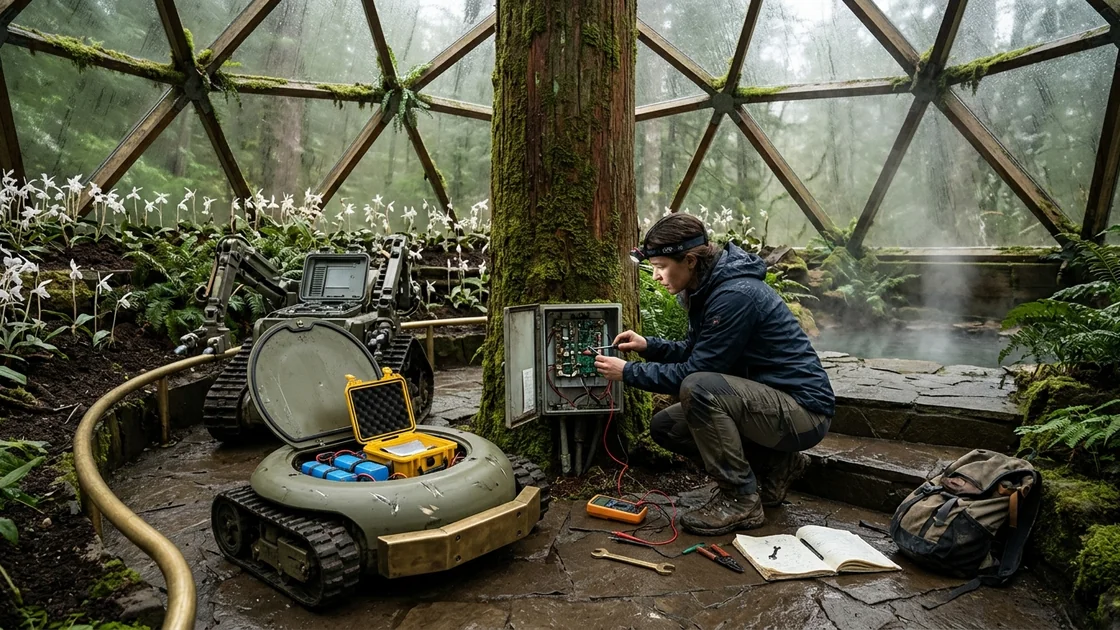
Clara Vance buys a heavily modified secondhand robotic vacuum at an estate sale in a quiet Oregon town, only to discover the machine has been stripped of its cleaning components and programmed to relentlessly pursue a single geographical coordinate deep within the coastal mountains. After the appliance repeatedly attempts to escape her house and trek southwest down the suburban streets, Clara uses her background in geographic information systems to extract the target data from its onboard logic board. Driven by curiosity and a lingering sense of personal stagnation following her divorce, she researches the machine's late creator, packs the stubborn robot into her car, and follows its internal compass into the rugged wilderness of the Siuslaw National Forest. Through washed-out logging roads and dense old-growth rainforest, the journey transforms from a technical troubleshooting exercise into a profound pilgrimage, ultimately leading Clara and her mechanical companion to a hidden off-grid botanical sanctuary where a sister machine waits for a vital repair part stored inside the vacuum's hollowed-out chassis.
The rain in Blackwood, Oregon, did not fall so much as it hung suspended in the air, a fine, persistent mist that turned the cedar shingles of the old Victorian houses the color of wet slate. Clara Miller sat at her kitchen table, watching water droplets coalesce on the outside of the windowpane until they grew heavy enough to Lose their grip and streak downward. On the oak floorboards beneath her feet, a small, circular machine was losing its mind.
It was not a subtle malfunction. Most consumer appliances died with a pathetic whimper—a burnt capacitor, a stripped plastic gear, or a blinking red light accompanied by a polite, synthesized beep asking the user to consult an owner’s manual that had been thrown away three years prior. This machine, however, operated with a grim, bruising physicality. It backed up eighteen inches, its upgraded high-torque motors whining in a minor key, paused for a fraction of a second as its top-mounted laser turret spun at three hundred revolutions per minute, and then hurled itself forward into the solid oak baseboard of the southwest wall.
Thud.
The brass bumper bolted crudely to its front shell struck the woodwork with enough force to rattle the vintage teacups in Clara’s china cabinet. Undeterred by the immovable barrier of hundred-year-old Douglas fir framing, the machine kept its drive wheels spinning. The thick, lugged rubber treads—which looked less like vacuum parts and more like something scavenged from a miniature military tank—chirped frantically against the polyurethane finish of the floor, leaving twin smudges of black vulcanized rubber behind.
"Stop that," Clara said aloud, her voice sounding thin and rusty in the empty house. She hadn't spoken to another human being in forty-eight hours, not since Friday afternoon’s five-minute video call with her supervisor at the county surveyor’s office. "There isn't even any dust over there. The cat hair is under the radiator on the north wall."
The machine did not have a cat hair problem, largely because Clara didn't own a cat. What she had was a three-bedroom house that was two bedrooms too large for one person, a dining room that still had faint rectangular shadows on the wallpaper where her ex-husband’s framed architectural prints had hung, and a sudden, inexplicable compulsion to buy broken things on Saturday mornings.
She set her coffee mug down, walked across the room, and nudged the power toggle on the side of the machine with the toe of her wool sock. The heavy aluminum toggle switch—another bizarre aftermarket modification—clicked off with a stiff, industrial snap. The whining motors died instantly. The spinning brass turret atop the olive-drab casing slowed to a halt, emitting a faint, rhythmic ticking sound as its internal bearings settled.
Clara knelt on the floor and ran her fingers over the machine’s scarred shell. Beneath two thick coats of matte olive spray paint, she could just barely make out the raised plastic lettering of a commercial floor-care brand that had gone bankrupt in the late twenty-tens. She had found it yesterday morning on the floor of a damp, spider-infested garage up on Sycamore Ridge, tucked beneath a workbench crowded with antique oscilloscopes, coffee cans full of sorted machine screws, and spools of heavy-gauge copper wire.
The estate sale had been a bleak affair. A company from Portland had come down to liquidate the property of one Julian Vance, an eighty-two-year-old retired electrical engineer who had died in his sleep two months earlier. Everything in the house had been tagged with neon orange price stickers by people who clearly had no idea what they were looking at. Custom-built frequency generators were marked as "Old Radios - $15," and hand-soldered circuit boards sat in cardboard boxes labeled "Scrap Misc."
Clara had gone looking for a cast-iron skillet or perhaps a decent set of pruning shears for the overgrown rhododendrons threatening to swallow her front porch. Instead, she had been drawn to the garage by the smell—that specific, comforting mixture of rosin-core solder, three-in-one oil, and damp sawdust that reminded her of her grandfather’s basement. When she had pulled the heavy circular unit out from under the bench, she had assumed its absurd weight—nearly thirty pounds, easily triple that of a standard household robot—was simply due to older, heavier battery technology, perhaps an old lead-acid gel cell.
The bored teenager running the cash box in the driveway had barely glanced up from his phone when she lugged it out into the drizzle, its bulky docking station tucked under her other arm.
"Ten bucks," he had said. "Don't know if it works. No refunds."
It worked, in the strictest electromechanical sense. When she had plugged the makeshift docking station into her kitchen outlet—noting with mild alarm that the dock had been wired directly to a heavy-duty meanwell power supply with exposed cooling fins—the unit had drunk electricity for four hours, its internal cooling fan humming like a distant beehive. Then, at precisely six o'clock in the evening, without Clara pressing a single button, it had emitted three low, resonant sonar pings, backed off the charging contacts, and begun its assault on the southwest wall of her house.
Clara sighed, hooking her fingers under the brass front bumper and lifting the machine. Her lower back protested. She carried it back to the kitchen, set it down on the linoleum in front of the charging plates, and watched as a tiny amber light on its chassis flickered to life, indicating a successful connection.
"You're concussed," she told it. "Your cliff sensors are probably caked with dead spiders, or your bumper switches are fused shut."
She went to the utility drawer, retrieved a Phillips-head screwdriver, a pair of needle-nose pliers, and a microfiber cloth, and sat cross-legged on the cold linoleum. For the last eight years, Clara had worked as a senior GIS analyst for the county. Her days were spent inside digital maps, reconciling historical property boundary descriptions written in nineteenth-century metes and bounds—thence running South forty-two degrees West sixteen chains to a blazed hemlock tree—with modern satellite orthophotography. It was meticulous, solitary work that required an analytical mind and an endless tolerance for solving puzzles left behind by dead men.
Cleaning a dirty optical sensor on a ten-dollar vacuum should have taken ten minutes.
Instead, the moment she undid the two brass thumb-screws securing the top access hatch, Clara froze.
There was no dustbin.
Where there should have been a translucent plastic receptacle filled with lint, crumbs, and a pleated HEPA filter, there was a meticulously machined sheet of quarter-inch anodized aluminum plate, bolted directly to the internal chassis mounts. The entire suction assembly—the impeller fan, the vacuum motor, the rubber air ducts, and the spinning bristle brush underneath—had been completely gutted.
Sitting in the center of the aluminum plate, strapped down with braided stainless-steel aircraft cable and turnbuckles, was a yellow waterproof Pelican micro-case, roughly the size of a thick paperback novel. A thick bundle of shielded gray cables emerged from a waterproof gland drilled into the side of the yellow case, snaking downward through a grommet in the aluminum plate to connect with the machine’s main drive architecture. Flanking the case on either side were two massive blue prismatic battery cells—lithium-iron-phosphate, judging by the voltage ratings stamped on their shrink-wrap—wired in series with a custom battery management board that smelled faintly of warm conformal coating.
Clara sat back on her heels, the screwdriver hanging loosely in her hand.
"Well," she murmured. "That explains why you didn't pick up the toast crumbs."
She leaned in closer, squinting at the yellow waterproof case. The plastic latches had been drilled through and secured with small brass padlocks, each no larger than a thumbnail. Pasted to the top of the case was a strip of embossed black Dymo label tape. The white plastic letters had been pressed into the tape with deliberate, heavy force:
UNIT 02 - COURIER
DO NOT OPEN IN TRANSIT
Clara’s heart gave a strange, fluttery thump against her ribs. She reached out and touched the raised plastic letters. In transit.
She looked from the machine to the southwest corner of her dining room, where the twin black tire marks scarred the oak floor. Slowly, she stood up, walked to her hallway desk, and retrieved the small liquid-filled Silva orienteering compass she kept in her drawer from her graduate school fieldwork days. She walked back into the dining room, stood directly over the black rubber smudges on the floor, and held the compass flat in her palm until the red needle stopped swinging.
She rotated the bezel until the orienting arrow lined up with magnetic north, then sighted along the direction the vacuum had been trying to drive through the wall.
Two hundred and forty-two degrees. West-southwest.
She walked back into the kitchen, picked up the thirty-pound machine, carried it into the living room at the front of the house, and set it down on the rug facing north—away from the dining room, away from the back of the house. She flipped the heavy aluminum toggle switch on its side.
Ping. Ping. Ping.
The laser turret spun up to speed. For three seconds, the machine sat completely still, its green status LED blinking rapidly as its onboard processor digested the shape of the living room. Then, with smooth, uncanny precision, the left wheel spun backward while the right wheel spun forward. The machine pivoted in place on the rug, rotating past East, past South, until its brass bumper pointed directly at a bearing of two hundred and forty-two degrees.
It didn't care about the coffee table in its path. It engaged its drive motors, rolled forward, hit the mahogany leg of the coffee table, backed up six inches, turned ninety degrees to the left, drove exclusively until it cleared the obstacle of the table leg, and immediately snapped back to two hundred and forty-two degrees, heading straight for the living room bay window wall.
Clara intercepted it before the brass bumper could crack the drywall, switching it off and sitting down heavily on the edge of the sofa.
It wasn't broken. Its sensors weren't dirty. It was navigating.
For the next three days, Clara tried to pretend the machine was just an eccentric piece of junk she would eventually take apart for scrap or drop off at the county electronics recycling depot. She was a practical woman. When her marriage to Mark had dissolved two years ago—not with an explosion, but with the slow, agonizing realization that they had become two polite roommates sharing a mortgage—she had survived by adhering strictly to routines. She drank two cups of French press coffee at seven. She logged into the county server at eight. She ate soup at noon. She walked two miles around the neighborhood reservoir at five, regardless of the rain.
Anomalous robots with padlocked cargo bays did not fit into the schedule.
She left Unit 02 switched off in the laundry room. On Tuesday afternoon, however, she discovered that the aluminum toggle switch on the side of the casing was not a master battery disconnect; it was merely a manual interrupt connected to the microcontroller's general-purpose input pins. And whoever Julian Vance had been, he had written a watchdog timer into the firmware that overrode manual interrupts at regular intervals.
At precisely six o'clock on Tuesday evening, while Clara was standing on the back porch wrestling a forty-pound bag of cedar mulch out of the trunk of her car and carrying it through the kitchen toward the garden shed, she heard the three sonar pings from the laundry room.
She had propped the kitchen door and the back porch screen door open with a brick to carry the mulch through. By the time she dropped the bag in the mud by the shed and turned around, wiping damp hair from her forehead, the low, rhythmic whine of high-torque planetary gearboxes was already moving across the back deck.
"Hey!" Clara shouted, her boots slipping on the wet grass as she broke into a run. "Wait!"
Unit 02 did not wait. It rolled straight off the edge of the back deck. A normal robotic vacuum would have been stopped dead by its infrared cliff sensors, terrified of a four-inch drop. Julian Vance had clearly bypassed the cliff sensors entirely—or worse, reprogrammed them to calculate drop trajectories. The machine hit the first wooden step of the porch stairs with a bone-jarring clack, tilted nose-down at a forty-five-degree angle, and rode its heavy brass skid-plate down the remaining three steps like a sled, landing upright on the gravel walkway with a crunch that sent small gray stones flying into the hostas.
Before Clara could reach the gate at the side of the house, the machine had already navigated the narrow gap between the fence post and the garage, its laser turret spinning furiously under the gray evening sky.
When she rounded the corner of the garage into the front driveway, Unit 02 was forty feet away, trundling down the concrete apron toward the asphalt of Elm Street at a brisk four miles an hour—far faster than any indoor appliance had any legal right to move.
"Stop, you stupid toaster!" Clara gasped, sprinting down the driveway.
The machine hit the rolled concrete curb at the end of her neighbor’s yard, its oversized rubber treads biting into the wet cement, lifting its thirty-pound bulk over the lip and dropping onto the street. A delivery van coming up the hill swerved slightly, the driver tapping his horn in bewilderment as a green cylinder with a spinning brass hat crossed the double yellow lines on a diagonal vector.
Clara chased it down the sidewalk, her breath pluming white in the chill air. The street sloped downward toward the end of the cul-de-sac, where the suburban development gave way to a steep, wooded ravine choked with Himalayan blackberries, sword ferns, and bigleaf maples. With gravity assisting its motors, Unit 02 picked up speed. It hit the cul-de-sac turnaround, bounced over the asphalt berm at the edge of the pavement, and plunged straight into the brush at the lip of the ravine.
Clara skidded to a halt at the edge of the pavement, her chest heaving. Below her, she could hear the sound of snapping blackberry canes and the wet whirring of rubber treads churning through leaf litter.
"Unbelievable," she panted.
She stepped over the berm, grabbing onto the slick trunk of a vine maple to keep from sliding down the muddy embankment, and scrambled twenty feet down into the gloom of the ravine. She found the machine wedged tightly between two exposed cedar roots just above the trickle of the seasonal creek. Even pinned in place, with wet dead leaves plastered to its olive casing and a thorny blackberry vine wrapped three times around its laser turret, its wheels were still turning, digging twin trenches into the rich black mud of the forest floor. Every ten seconds, it reversed two inches, tried to turn left, failed against the root, and jammed itself forward again on its exact two-hundred-and-forty-two-degree heading.
As she knelt in the mud to flip the override switch, looking down at the scarred brass bumper and the relentless, pathetic twitching of the wheels, something shifted inside Clara’s chest. It was a ridiculous reaction to have toward a pile of silicon and lithium, she knew that. Yet the sheer, blind devotion of the thing was almost unbearable to watch. Its creator was dead. Its home had been emptied into dumpsters and sold off for pennies by strangers. It had no idea the world had moved on without it; it only knew that at six o'clock, it was supposed to go southwest.
"Okay," Clara whispered in the damp quiet of the ravine, unwinding the thorny vine from its turret regardless of the pricks to her palms. "Okay, Artie. Stop fighting the tree. Let’s go see what you’re talking about."
That night, the dining room table ceased to be a place for eating soup and became a diagnostic bench.
Clara dragged her old work laptop out of the hall closet, along with a plastic tackle box containing her undergraduate electronics kit, a digital multimeter, and a USB-to-serial UART adapter cable she had once used to troubleshoot an older trimble GPS base station for the county.
She had decided on the name "Artie" after cleaning the ravine mud off
the chassis and finding a small aluminum tag riveted near the rear
caster wheel, stamped with VANCE LABS - ART-02.
With the top hatch removed, she examined the wiring harness more
closely beneath the harsh glare of a gooseneck desk lamp. Julian Vance
had not been a sloppy tinkerer; his work was a masterclass in ruggedized
improvisation. Every solder joint was bright and conical, protected by
heat-shrink tubing. The wires were labeled with tiny yellow numbered
collars. Near the edge of the aluminum deckplate, tucked just beside the
right-hand battery cell, she found what she was looking for: a standard
four-pin header labeled TX / RX / GND / 5V.
"Thank you, Julian," she murmured.
She connected the jumper wires from her USB adapter to the pins—crossing transmit to receive—plugged the USB into her laptop, and opened a terminal emulator program. At first, when she toggled Artie’s switch while holding his drive wheels off the table on a stack of thick reference books, the screen filled with gibberish—scrolling lines of ASCII diamonds and question marks.
She adjusted the baud rate in the settings from 9600 up through the standard tiers until she hit 115200.
Instantly, the gibberish snapped into crisp, green monospace text cascading down the black screen.
[BOOT] VANCE_AUTONAV v4.12 (BUILD 2023-11-04)
[INIT] IMU_6DOF... OK (CALIBRATED)
[INIT] MAG_COMPASS... OK (DECLINATION +15.2 E)
[INIT] LIDAR_SLAM_ENGINE... OK
[INIT] GPS_UART2... SEARCHING SATELLITES...
[WARN] GPS_NO_FIX (INDOOR/OCCLUDED). FALLBACK TO DEAD_RECKONING_INS.
[STATE] MISSION_STATUS: INCOMPLETE (DAY 142)
[NAV] CURRENT_POS_EST: 44.34121, -123.51089
[NAV] TARGET_WAYPOINT: 44.21084, -123.98412
[NAV] CALCULATING BEARING... 242.4 DEG TRUE. DIST: 40.82 KM.
[DRV] ENGAGING TRACTION MOTORS. PWM: 85%.
On the stack of books, Artie’s heavy rubber wheels spun in the air, humming softly.
Clara stared at the scrolling telemetry, her coffee growing cold beside her elbow. As someone who worked with spatial data every day, the architecture of what Julian Vance had built made her breath catch. Standard robotic vacuums used Simultaneous Localization and Mapping—SLAM—to build temporary grid maps of living rooms so they wouldn't bump into sofas twice. Julian had stripped out the room-cleaning heuristics and replaced them with a wilderness survival navigation stack.
When the machine couldn't get a satellite GPS fix inside a house or under heavy forest canopy, it fell back on an Inertial Navigation System—using accelerometers, gyroscopes, and a digital fluxgate compass corrected for Oregon’s magnetic declination to estimate its position in the world. It used its spinning laser turret solely for local obstacle avoidance: see a rock, drive around the rock, resume bearing 242.4.
And look at the mission timer: DAY 142.
Julian Vance had died roughly sixty days ago. That meant he had initialized the mission and armed the robot nearly three months before he died, likely while he was already ill, perhaps bedridden or in and out of the hospital, leaving the robot sitting on its charger in the closed garage, waking up twice a day at six in the morning and six at night to hurl itself against a locked aluminum garage door that nobody was left to open.
One hundred and forty-two days of trying to leave the garage. Two hundred and eighty-four attempts.
Clara swallowed hard, her throat suddenly tight. She copied the
target waypoint coordinates from the terminal
window—44.21084, -123.98412—and opened her county GIS
software on her primary monitor.
Her county data stopped at the western boundary line, roughly twenty miles away, where the municipal jurisdiction handed off entirely to federal timberland. She pulled up the public USGS topographic quads and overlaid the high-resolution LiDAR bare-earth hillshade models from the state geology department, then dropped a bright red pin at the coordinates.
The screen zoomed in, sweeping west across the Willamette Valley foothills, climbing over the jagged basalt ridges of the Coast Range, and dropping down into a deep, convoluted drainage basin in the heart of the Siuslaw National Forest, roughly twelve miles inland from the Pacific Ocean.
There were no towns within ten miles of the red pin. There were no state highways.
She toggled the parcel boundary layer. A vast majority of the area was shaded dark green for United States Forest Service land, interspersed with the checkerboard squares of private industrial timber companies—Weyerhaeuser and Roseburg Forest Products. Their holdings looked like a patchwork quilt on the screen: dark green squares of ancient, towering federal forest alternating with pale brown squares of recent clear-cuts and dense, uniform tree plantations.
Right at the intersection of four federal sections, tucked into a steep box canyon formed by a tributary of the North Fork Siuslaw River, was a tiny, anomalous polygon. It was an irregular hexagon covering barely five acres.
Clara clicked on the polygon to pull up the tax assessor’s metadata table.
PARCEL ID: 18-09-21-00-00100
CLASSIFICATION: EXEMPT / HISTORIC MINING CLAIM / RESEARCH LEASE
OWNER OF RECORD: VANCE, JULIAN H. & EVELYN M. (ESTATE)
IMPROVEMENTS: UNMAPPED
ACCESS: NONE (USFS ROAD 4812 DECOMMISSIONED 2014)
She turned off the parcel layer and zoomed in on the satellite aerial photography. Beneath the towering crowns of old-growth Sitka spruce and Douglas fir, the canyon floor was almost entirely cast in deep blue shadow. Even at six-inch pixel resolution, the canopy was so dense that the ground was completely invisible, save for a tiny, indistinct glint of white or silver right where the red pin sat—like sunlight reflecting off glass or water at the bottom of a well.
Then she turned on the bare-earth LiDAR layer, which used airborne lasers to strip away the trees and reveal the contour of the naked ground beneath.
There. Right in the hook of the canyon, sheltered beneath a horseshoe cliff of sandstone, was a distinct geometric circle, thirty feet across, terraced into the hillside above a small creek. Leading up the ridge from the south was the faint, ruler-straight scar of an abandoned nineteenth-century narrow-gauge logging railroad grade, connecting three miles away to the dead end of Forest Service Road 48.
Clara switched Artie off. The wheels spun down to silence.
She looked at the two tiny brass padlocks securing the yellow Pelican case inside his belly. With a pair of heavy wire cutters or a small hacksaw from her basement, she could snip the shackle on those locks in thirty seconds. She could pop the latches, see whatever Julian Vance had hidden inside, satisfy her curiosity, and go back to auditing sewer easements tomorrow morning at eight o'clock.
Her hand hovered over the tool box.
DO NOT OPEN IN TRANSIT
If she cut the locks here on her dining room table, forty kilometers
away from where the machine had been sworn to take them, she would be no
better than the estate liquidators who had thrown Julian’s notebooks
into a roll-off dumpster. Whatever was inside that box didn't belong at
414 Elm Street. It belonged at 44.21084, -123.98412.
Before she made a fool of herself driving a modified vacuum cleaner into a federal wilderness area, however, she needed to know she wasn't delivering a pipe bomb or the ashes of a man whose family was looking for them.
On Wednesday afternoon, Clara logged off work an hour early and drove her blue Subaru Outback back up the winding asphalt of Sycamore Ridge.
The neon orange "ESTATE SALE" signs had been pulled from the wet turf at the intersections. When she turned onto the gravel drive of the Vance property, the house looked hollow and defeated. A thirty-yard blue industrial dumpster sat tilted in the driveway, filled to the brim with broken particle-board shelving, floral armchairs sodden with rain, and black contractor bags. The front door of the cedar-sided ranch house had a real estate lockbox hanging from the brass handle.
Clara parked on the shoulder, pulled the hood of her rain jacket up, and walked up the drive. As she stood on her tiptoes peering over the high steel rim of the dumpster—seeing stacks of IEEE Spectrum magazines from the nineteen-eighties dissolving into gray pulp—a voice called out from across the split-rail fence.
"If you're looking for the copper pipe, the nephew already stripped the basement out on Monday!"
Clara turned. Standing under the eaves of the neighboring house, holding a long-handled pruning lopper and wearing an oversized yellow slicker, was a woman in her late seventies with sharp, bird-like eyes and a braid of white hair resting over one shoulder.
"I'm not looking for copper," Clara said, walking over to the fence line. "I was here on Saturday. I bought something from the garage, and I was hoping to find the manuals or the notes that went with it."
The older woman lowered the loppers, her expression softening slightly as she took in Clara’s sensible glasses and mud-flecked hiking boots. "You're not with the developer people."
"No. My name is Clara Miller. I work for the county mapping office."
"Ruth Gable," the woman said, stepping up to the cedar rails and wiping a wet glove on her hip before offering it. "I lived next to Julian and Evie for thirty-eight years. Watching those vultures tear through his shop this weekend made me sick to my stomach. The nephew from Beaverton didn't even wait for the probate ink to dry before he ordered that bin."
"Did Mr. Vance have any other family?" Clara asked. "Children?"
Ruth shook her head, looking back toward the dark windows of the ranch house. "Never had kids. Just Julian and Evelyn, and after Evelyn passed six years ago from the pancreatic cancer, it was just Julian and his machines. Though, if you asked him, half of Evelyn was still living up in the woods."
Clara perked up. "The canyon parcel on the North Fork Siuslaw? The five-acre lease?"
Ruth looked back at her sharply, her eyebrows lifting. "How do you know about the Sanctuary?"
"I bought the green robot from under his workbench," Clara admitted, feeling slightly foolish saying it out loud. "The one he built out of an old commercial floor sweeper. When I charged it up, it tried to break down my back door and drive to Mapleton. I pulled the navigation logs off the processor last night. It's programmed with the coordinates for that parcel."
A slow, astonished smile spread across Ruth Gable’s lined face. She set the loppers down against the fence and pressed both hands to her mouth. "He actually got the courier running. Oh, Julian, you stubborn old goat."
"You knew he was building it?"
"I brought him soup three times a week after his congestive heart failure got bad last autumn," Ruth said, leaning her forearms on the wet top rail of the fence. "After his second hospitalization in October, the doctors told him he couldn't drive anymore, and he certainly couldn't hike the three miles up the old tramway into the canyon. Since the Forest Service condemned the upper bridge on Road 48 ten years ago, hiking was the only way in. It nearly killed him—not because of his heart, mind you, but because of the glasshouse."
"That's what showed up on the satellite images," Clara said. "A thirty-foot circular structure."
"Evelyn was a botanist at the university," Ruth explained, her voice dropping into the cadence of someone sharing a long-guarded neighborhood legend. "Specialized in myco-heterotrophic flora and relict coastal species—plants that don't use photosynthesis the normal way, living off specific fungal networks in old-growth soil. Back in the seventies, when the timber companies were clear-cutting the ridges around the Siuslaw at breakneck speed, Julian and Evelyn found a warm mineral spring tucked into that box canyon. It had a microclimate all its own, completely frost-free. They secured a ninety-nine-year research lease from the government, packed geodesic glass panels in on mules along the old railroad grade, and built a conservatory over the spring."
"To preserve the plants from the clear-cuts," Clara murmured.
"More than that," Ruth said. "Evelyn spent forty years cross-breeding and stabilizing a specific colony of Cephalanthera—phantom orchids—along with some fossil-lineage ferns that only exist in three square miles of the Coast Range. If the soil dries out by even four percent, or if the temperature drops below forty degrees because the spring louvers stick, the fungal mycorrhizae die. And if the fungus dies, forty years of Evelyn’s work vanishes forever. You can't grow them in a university lab; they refuse to live anywhere outside that canyon soil."
"How did Julian keep it running when he wasn't there?"
"He automated it," Ruth said simply. "He was one of the finest control-systems engineers NOAA ever had before he retired. He built a miniature hydro-turbine in the creek to generate power, wired up soil sensors, automated misting valves, and built a big tracked machine—he called it the Caretaker, Unit One—that lived inside the dome on a rail and tended the beds."
Clara felt the pieces clicking together with the neat, geometric precision of a survey traverse closing to zero error. "And something went wrong with Unit One."
Ruth nodded grimly. "In late October, right before Julian couldn't walk up the stairs anymore. He had a low-bandwidth packet radio link that bounced telemetry off a repeater on Roman Nose Mountain once a week. The last packet he got showed the primary voltage regulator on the Caretaker’s charging dock was failing, and the main seasonal intake louver had jammed at thirty percent. The Caretaker’s backup batteries would keep the misting schedule going through the winter rain, he told me, until mid-March. After that, as the spring sun warmed the glass and the battery bank hit critical cutoff, the dome would bake and dry out."
It was currently the second week of March.
"He tried to hire people to hike the replacement board in," Ruth continued, her voice hardening with old anger. "He offered two thousand dollars to his nephew to walk up there and swap a circuit module. The boy took the check, drove halfway to the coast, saw the road was washed out and pouring rain, turned around, and lied to Julian’s face—told him he’d done it. Julian knew he was lying the next Sunday when the radio repeater still showed the fault code. That was when Julian stopped letting the nephew in the house and started spending twelve hours a day in the garage with that green machine."
"He built a courier," Clara whispered. "Because he couldn't trust people, so he trusted a machine to walk forty kilometers from his driveway to the canyon."
"Wait here," Ruth said abruptly.
She turned and hurried back across her lawn, disappearing into a small cedar garden shed behind her back porch. Two minutes later, she emerged carrying a heavy, mildewed canvas mailbag and handed it across the fence to Clara.
Inside the bag were three black laboratory notebooks with stitched bindings, their corners chewed by mice and their pages warped by dampness, along with a laminated topographical map covered in red grease-pencil markings.
"I pulled these out of the dumpster on Monday morning after the nephew drove off," Ruth said, her chin lifting defiantly. "I didn't understand a word of the math in them, and I didn't know that little green contraption was still in the garage—I thought it had gone to the landfill with the rest of the metal. He had an inductive wire buried under the moss for the last half-mile of the ridge trail so the machine could find the conservatory door in the dark. He told me all it had to do was get within half a mile of the canyon, and the local beacon would pull it home."
Clara pulled the top notebook partway out of the canvas bag. On the flyleaf, written in shaky, spidery blue ink, were the words: Project Halcyon: Autonomous Redundancy Protocol.
"Why didn't you call the university?" Clara asked softly. "The botany department?"
"I did," Ruth sighed, looking tiredly at the gray sky. "The people Evelyn worked with in the eighties are all dead or retired. The kid who answered the phone in the dean's office told me without an active grant number or a deed transfer from the estate executor, they couldn't send staff onto an unmaintained federal lease. And the nephew wants the lease to lapse so he doesn't have to pay the environmental decommissioning bond."
Ruth reached across the fence and laid her gloved hand over Clara’s bare knuckles on the canvas strap.
"I don't think Julian really expected that little machine to make it all the way down Highway 36 without getting flattened by a logging truck, Clara," Ruth said quietly. "I think he was a dying man who couldn't bear to sit in his armchair and do nothing while his wife's garden died. He built a prayer out of spare parts and pointed it west. If you've got a car and a pair of good boots... maybe you could save it the trip down the highway."
Clara spent Thursday evening reading Julian Vance’s notebooks until two in the morning.
The engineering inside those pages was staggering, heartbreaking, and deeply intimate. As Julian’s handwriting deteriorated across the dated entries—growing smaller and more tremulous as the fluid built up around his lungs in December and January—his comments in the margins shifted from dry technical notes about pulse-width modulation and Kalman filter tuning to fragments of memory.
14 Dec: Replaced standard planetary gears in ART-02 with hardened steel spur gears from the old chart plotter. Plastic teeth will strip on the sandstone ledges above Devil’s Club Creek. Evie slipped there in '94 carrying the brass barometer; broke her wrist and laughed all the way down to the truck because the barometer didn't crack.
02 Jan: Waterproofed main logic housing with marine silicone. Set acoustic handshake tone to 440Hz / 659Hz / 587Hz (A-E-D). Same chimes that hung on the porch the summer the rufous hummingbirds nested in the fuschia.
19 Jan: Battery capacity test successful. At 1.2 meters per second over flat grade, ART-02 has range of 14.5 km per charge. Note: Cannot cover the full 40 km from Sycamore Ridge on single charge. Mounted miniature folding solar array to rear deck? No—motor torque insufficient for added mass, and winter canopy cover makes solar useless. Solution: Programmed hibernation cycle. If voltage drops below 11.2V, unit will enter deep sleep and wait for opportunistic induction or manual rescue. Attached external brass charge plates and instructions under front cowl in case a hiker finds it on the road. People are mostly good, Evie always said. Someone will give him a push.
Clara had never noticed the folded sheet of waterproof Tyvek paper tucked inside a slot beneath the brass bumper until she read that line. When she slid it out with tweezers, she found a neatly printed schematic explaining how anyone with a twelve-volt car battery and a pair of jumper cables could give the robot a three-hour charge to help it "return to its research station."
He hadn't expected it to make it alone. He had built a mechanical hitchhiker.
On Friday morning, Clara called her supervisor, David, and told him she was taking her floating personal day, plus Monday. She had four weeks of accrued vacation time she hadn't touched since the divorce; David barely blinked before approving it.
She spent the morning transforming the back of her Subaru Outback into a mobile robotics tender. She packed her three-season backpacking tent, a zero-degree down sleeping bag, her WhisperLite camp stove, five days of freeze-dried rations, a Sawyer water filter, and a heavy-duty external-frame Kelty pack that had belonged to her ex-husband. She removed the nylon pack bag from the aluminum Kelty frame, leaving just the bare L-shaped metal freight shelf and the padded shoulder straps and hip belt. Using nylon ratchet straps and foam pipe insulation, she engineered a cradle that allowed Artie to be strapped vertically to the aluminum backpack frame like a thirty-pound technological papoose.
Into her side pockets went her digital multimeter, a butane-powered portable soldering iron, spools of rosin solder, heat-shrink tubing, wire strippers, and a fully charged five-hundred-watt-hour portable lithium power station to top off Artie’s batteries at night.
At noon, she lifted Artie into the back of the Subaru, setting him on a rubber mat beside the spare tire well.
At six o'clock that evening, she was already eighty miles west, winding through the steep, rain-darkened canyon of the Siuslaw River on Highway 36. Right on schedule, as she passed the milepost for Swiss Home, three low sonar pings echoed from the trunk space.
In the rearview mirror, she saw the little laser turret begin to spin. Artie backed up six inches against the sleeping bag, pivoted until his nose pointed toward the driver’s side rear quarter-panel—bearing two hundred and forty-two degrees—and gently pressed his brass bumper against the interior plastic trim, his wheels giving one polite, testing chirp before his onboard accelerometers registered that he was already moving westward at fifty-five miles per hour.
Apparently satisfied with the arrangement, his drive motors cut out, though his laser turret continued to spin quietly in the dark trunk, watching the Douglas firs blur past the rear windows.
"Smart boy," Clara said, tapping the steering wheel. "Save your amps for tomorrow."
She spent Friday night at a weathered motel in Mapleton, where the river widened to meet the tidal influence of the Pacific and the smell of salt and wet cedar bark hung thick in the air.
At dawn on Saturday, the sky was the color of hammered pewter. A cold, steady rain was falling as she turned off the paved highway onto Forest Service Road 48. For the first six miles, the road was two lanes of well-maintained crushed basalt, used by logging trucks hauling second-growth timber out of the lower valleys. By mile nine, the commercial haul route branched off to the north, and Road 48 narrowed to a single track of potholed gravel hemmed in by towering walls of salmonberry, red alder, and weeping Sitka spruce.
Clara engaged the Subaru’s low-range all-wheel-drive control and crept upward into the clouds.
The world grew intensely green and vertical. Moss hung from the vine maples in heavy, dripping curtains a foot thick, glowing a vivid, almost radioactive chartreuse in the beams of her headlights. Water poured off the sandstone cuts along the inside of the road, turning the drainage ditches into frothing brown torrents that periodically spilled across the gravel in gravelly alluvial fans.
At mile fourteen, she rounded a tight hairpin turn above a roaring gorge and hit the brakes.
The road didn't just have a barrier across it; the road simply ceased to exist.
Fifty yards ahead, three rusted orange steel Jersey barriers had been chained together across the track, half-buried in ten years of encroaching thimbleberry bushes and alder saplings. Beyond the barriers, where a timber-and-concrete bridge had once spanned a deep side-ravine called Devil’s Club Creek, there was only empty air and forty feet of jagged, mossy concrete abutments clinging to the bedrock. Half a mile beyond the missing bridge, visible through a gap in the swirling mist, a massive landslide had peeled a two-hundred-yard strip of the mountainside clean down to the yellow clay, burying the continuation of the road beneath a tangled abatis of shattered sixty-foot fir trunks.
Clara pulled the car onto a narrow flat spot that had once served as a log landing, shut off the engine, and listened to the sudden, deafening roar of the creek below and the drumbeat of rain on the roof.
She checked her handheld Garmin GPS unit. The coordinates for the sanctuary were 3.4 miles away in a straight line—nearly four and a half miles following the contour of the ridge and the old logging railroad grade depicted on Julian’s grease-penciled map. Elevation gain: eighteen hundred feet.
She got out of the car, the cold air biting at her cheeks, and opened the hatchback.
Strapping thirty pounds of cold, wet metal to her back was an exercise in awkward physics. Once she had Artie lashed tightly to the aluminum freight frame with the ratchet straps, she backed up to the bumper of the Subaru, slid her arms through the shoulder harnesses, buckled the heavy padded belt around her hips, and stood up, bracing her hands on her knees.
The weight settled low and dense against her lumbar spine. Above her left ear, she could feel the cold brass of Artie’s laser turret resting just inches from her raincoat hood.
She locked the car, patted the hood once for luck, and walked past the rusted barriers into the forest.
Getting across Devil’s Club Creek took an hour and nearly ended the expedition before it began. With the bridge gone, she had to scramble two hundred feet down the slick sandstone bank, holding onto sword fern crowns that tore loose in her fists, until she reached the boulder-choked bed of the creek. The water was calf-deep, ice-cold, and running fast enough to knock her off her feet if she misjudged a step with the top-heavy pack.
Halfway across, stepping from a submerged granite slab onto what looked like a solid hemlock nurse log spanning the main channel, her left boot hit a patch of slick white slime mold. Her foot shot out from under her. She came down hard on her right knee on the wet bark of the log, the thirty-pound robot swinging violently on her back like a pendulum and threatening to pitch her face-first into the waterfall below.
She threw her arms around the rough, mossy flank of the fallen hemlock, her cheek pressed against the freezing wet wood, breathing in the sharp, primal scent of decaying needles and river stone. For a full minute she stayed there, her knee throbbing fiercely beneath her rain pants, rain dripping off the tip of her nose into the churning white water three feet below.
You could go home, a quiet, rational voice in her head suggested. You don't owe Julian Vance anything. You don't owe Ruth Gable anything. Nobody knows you're out here.
She thought of her dining room table. She thought of the silent, dustless rooms of her house on Elm Street, and the way the weeks slid past like water on glass, leaving no mark behind. Then she thought of Artie in the ravine, wedged between two cedar roots, spinning his wheels in the mud until his battery died because he had been given a promise to keep.
Clara gritted her teeth, dug the steel tips of her trekking poles into the bark, and hauled herself upright.
She made the far bank, climbed out of the gorge through a punishing tangle of thorny devil's club and salal, and finally intersected the flat, unmistakable shelf of the nineteenth-century logging railroad grade three hundred feet above the washed-out road.
Here, in the deep old-growth timber where the chainsaws had never returned after the steam donkeys left in 1918, the forest opened up beneath the canopy. The massive trunks of ancient Douglas firs and western red cedars—some eight feet in diameter, their bark furrowed like canyon walls—rose two hundred feet before branching, shading out the dense underbrush and leaving the forest floor carpeted in a deep, plush mat of Oregon oxalis, deer fern, and feather moss.
The railroad grade had been cut directly into the sandstone cliffside a century ago. Though the steel rails had been salvaged for scrap during the Second World War, the square cedar railroad ties remained, half-rotted and sunken into the velvet green moss like the ribs of a buried whale.
Clara’s knee was stiff and swelling inside her boot, making the heavy pack an agony on the incline. She looked at the flat, relatively clear corridor of the old railroad bed stretching ahead into the green twilight. Then she checked her watch. It was twelve-thirty.
She unbuckled the pack, eased it down onto a mossy stump, and unlatched the ratchet straps holding Artie to the frame.
She set the olive-drab machine down right in the center of the sunken
railroad ties. She opened the top access panel—leaving the padlocked
Pelican case untouched—and plugged a short jumper wire across the two
pins Julian had labeled MANUAL_WAKE_OVERRIDE in his
notebook.
Ping. Ping. Ping.
In the cathedral silence of the rainforest, the three sonar tones sounded startlingly clear, almost musical.
Artie’s laser turret spun up, slicing an invisible plane of infrared light across the wet ferns and giant cedar trunks. His internal compass settled. He rotated forty degrees to the right until he was pointing straight up the middle of the railroad grade—bearing two hundred and forty-two degrees—and engaged his drive motors.
The oversized rubber treads bit into the sponge-like moss and rotting cedar wood. With a steady, purposeful hum, the little machine began to climb the mountain.
Clara shouldered the now-featherlight backpack frame and walked behind him, leaning on her trekking poles, matching his steady two-mile-an-hour pace.
It was a surreal, mesmerizing procession. Whenever a rotten limb or a chunk of sandstone rubble blocked the grade, Artie’s spinning LIDAR turret spotted it ten feet out. His logic board seamlessly calculated a deflection vector, steering him smoothly around the obstacle through the oxalis beds before snapping him right back onto the centerline of the grade. When he encountered a slick, six-inch ledge of exposed tree root that made his rubber wheels spin without traction, he would back up two feet, increase his motor pulse-width to maximum torque, and hit the root at an angle until his brass skid plate levered him over the top.
Twice, where small mountain rills had carved narrow gullies across the trail, Clara stepped ahead of him and laid two flat slabs of split cedar bark across the gap like a bridge, standing back like a curling player sweeping the ice as the green cylinder trundled across her improvised trestle without slowing down.
"Good line, Artie," she told him as they rounded a bend where the cliff dropped away into a sea of mist below. "Watch your left tread on the shale."
She wasn't talking to herself anymore; she was talking to her partner. Out here under the ancient trees, where no human voice had sounded in years, the small, industrious machine felt entirely alive—not like an animal, perhaps, but like a tireless mechanical beetle built by a wizard, marching steadfastly through a world far too large for it.
By four-thirty in the afternoon, the light beneath the canopy began to fail rapidly as a dense coastal fog rolled up the canyon from the ocean, turning the giant firs into ink-black silhouettes. They had covered nearly three miles. According to Clara’s GPS—which was struggling to maintain a three-satellite lock through the wet biomass overhead—they were less than three-quarters of a mile from the canyon rim.
Then, simultaneously, two things happened.
First, the railroad grade ended cleanly at a sheer wall of fractured basalt where an old timber trestle had rotted away into a fifty-foot ravine fifty years ago, leaving only a steep, muddy elk trail switchbacking straight up the nearly vertical hillside above.
Second, Artie’s green status LED shifted to a slow, pulsing red, and his motors cut out with a single, apologetic low-frequency beep.
Clara knelt beside him in the wet fern beds. He had climbed fourteen hundred vertical feet over wet moss and rock for four hours straight. His battery bank had hit the 11.2-volt protection cutoff.
"You did good," Clara breathed, patting his wet olive shell. "You did four miles of backcountry bushwhacking on wheels the size of saucers. I’ve got us from here."
The rain turned into a torrential coastal gale just after dark.
Clara had found a relatively flat bench of ground thirty feet below the ridge crest, sheltered beneath the massive, leaning root-wad of a wind-thrown Sitka spruce. She pitched her small nylon tent in the dry pocket of dirt beneath the overhanging roots, staked the rainfly out tight against the gusts tearing through the canopy two hundred feet overhead, and crawled inside.
She dragged Artie into the vestibule, wiping the mud and hemlock needles off his casing with her camp towel before hauling him right inside the inner tent with her so the damp air wouldn't corrode his exposed diagnostic pins while he charged.
As the wind roared through the spruce crowns above like a freight train, rattling drops of heavy condensation down onto the taut nylon of her tent fly, Clara lit her camp stove in the vestibule and boiled water for a pouch of freeze-dried beef stroganoff. Inside the warm, glowing yellow cocoon of the tent, Artie sat tethered to her portable power station by a pair of alligator clips clamped to his brass charging plates.
The cooling fan on the power station hummed softly. The little amber charge light on Artie’s deck blinked in a slow, steady heartbeat: on, off, on, off.
Clara ate her hot food straight from the foil pouch, wrapped in her down sleeping bag, with Julian Vance’s third notebook propped open on her knees.
She turned to the very last page containing writing, dated six days before Julian died. There were no schematics on this page, no C++ code snippets or voltage calculations. Just a rough pencil sketch of a phantom orchid stem—leafless, ghostly white, rising from the forest floor with three delicate blossoms—and a few lines at the bottom.
If ART-02 reaches the ridge trail, the 40kHz induction loop buried along the water pipe will capture its front receiver coil. It will follow the pipe down the steps. When it docks with ART-01, the latch solenoid on the Pelican case will fire automatically upon confirmation of the optical handshake.
Evie asked me the week before she died who would look after the girls when I got too old to climb the hill. I told her I’d figure out an equation for it. I was always arrogant like that—thinking you can solve grief or mortality with enough feedback loops and ampere-hours. You can't. A machine can only bridge a gap in time; eventually, a living hand has to take the wrench.
If you are reading this book in the canyon, then the equation worked after all—not because the robot was clever, but because you were kind.
Clara closed the notebook. She reached out from the warmth of her sleeping bag and rested her hand on the cool, painted aluminum of Artie’s shell. Beneath her palm, she could feel the faint, imperceptible warmth of the lithium cells drinking in the charge from her power bank.
For two years since Mark had packed his books and his espresso machine and moved to Seattle, Clara had felt like a person whose coordinates had been wiped from the register. She had stayed in the big house in Blackwood because moving required a vector, a preference for one horizon over another, and she hadn't possessed the voltage to choose one. She had simply run in place against the baseboard, waiting for her battery to run flat.
She looked at the little amber light blinking in the dark.
"Tomorrow," she told him, zipping her sleeping bag up to her chin, "we finish the survey."
Sunday morning dawned without rain, though the world was wrapped in a cloud so thick and white it felt as though the mountain had been cut loose from the earth and set adrift in milk.
Water dripped from every needle and moss frond in a slow, musical patter. The air smelled of wet granite, crushed cedar foliage, and something unexpectedly sweet—a faint, mineral warmth drifting down from the rocks above.
Clara packed her soaking tent, strapped the fully charged robot back onto the aluminum pack frame, and tackled the steep elk trail climbing around the collapsed trestle ravine. Her right knee was stiff and bruised from yesterday’s fall in the creek, forcing her to take small, deliberate steps, planting her trekking poles firmly in the black mud and pulling with her shoulders.
Three hundred yards up the switchbacks, as the trail leveled out onto a narrow hogback ridge flanked by sheer sandstone bluffs, she heard it: three sonar pings right behind her left ear, followed immediately by a sharp, excited series of high-pitched chirps she had never heard the machine make before.
Beep-beep-beep! Beep-beep-beep!
On her back, Artie’s drive motors gave a sudden, vigorous twitch against the nylon ratchet straps, vibrating the entire aluminum backpack frame against her spine.
Clara stopped, her breath catching. She looked down at her feet.
Partially exposed by winter erosion in the center of the narrow deer trail was a half-inch black polyethylene water pipe, running parallel to the path. Tucked directly beneath the black pipe, snaking through the pale green roots of the Oregon grape, was a heavy-gauge orange insulated copper wire.
The forty-kilohertz induction loop.
"You found the scent, didn't you?" Clara laughed aloud, the sound echoing strangely off the sandstone walls in the fog.
She unslung the pack, released the straps, and set Artie down straddling the buried orange wire.
The change in the machine’s behavior was instantaneous. The spinning laser turret on top actually slowed down to a gentle idle; it didn't need to scan the horizon for obstacles anymore. A pair of inductive pickup coils mounted underneath its brass front bumper had locked directly onto the magnetic field radiating from the buried wire—Wait, that meant there was power running through the wire!
Clara stared at the orange wire disappearing into the moss. For that wire to carry an active forty-kilohertz signal, the hydro-turbine in the canyon creek had to still be spinning. The sanctuary wasn't completely dead.
Artie didn't zig-zag or hesitate now. Locked onto the invisible rail of the magnetic guide wire, he rolled forward along the narrow cliffside path with absolute, unwavering confidence, following every subtle curve of the buried water pipe as it contoured around the sandstone bluff and dipped down into a narrow cleft in the rock—a natural stone keyhole no wider than a doorway, choked with dripping maidenhair ferns.
Clara followed him through the cleft in the sandstone.
The temperature of the air rose ten degrees in twenty paces. The sharp chill of the coastal mountain mist gave way to a humid, earthy warmth that smelled faintly of sulfur, wet limestone, and rich, living soil. Below them, the box canyon opened up—a hidden bowl walled in on three sides by vertical sandstone cliffs draped in giant licorice ferns, and roofed over by five-acre crowns of Sitka spruce so ancient and massive they looked like pillars holding up the sky.
A series of wide, shallow steps made of split cedar logs had been built into the gentle slope leading down to the canyon floor, spaced wide enough apart that a wheeled machine could roll down them like a ramp.
At the bottom of the cedar ramp, nestled beside a steaming, crystal-clear pool where a geothermal spring bubbled up through white sand, stood the glasshouse.
It was a thirty-foot geodesic dome framed in weathered western red cedar and glazed with thick panels of double-walled polycarbonate and glass. Moss grew along the lower cedar struts, blending the structure so seamlessly into the fern-draped cliff behind it that it looked less like a building and more like a giant crystal quartz geode that had grown naturally out of the canyon floor. Near the creek, a small aluminum waterwheel inside a cedar housing spun merrily in the current, connected by a heavy waterproof cable to the dome.
And yet, as Clara stepped down the cedar ramp behind Artie, she saw the signs of crisis immediately.
The upper ventilation louvers at the apex of the dome were jammed
crookedly open on one side, caught on a thick branch of red alder that
had fallen from the cliff above during a winter windstorm. Inside the
foggy glass panels, a digital LED thermometer mounted to a central cedar
post flashed a warning in bright red numerals: 39.1° F.
Less than a degree above the fatal threshold for the fungal
networks.
Artie rolled down the final cedar step onto a flagstone walkway leading to the conservatory’s lower entrance. Built into the bottom of the heavy cedar door was a smaller, square hatch framed in brass, looking very much like an oversized dog door with two heavy spring-loaded copper contacts mounted at bumper height.
Artie rolled straight up to the small hatch and stopped six inches away.
From a waterproof speaker mounted under his chassis, he played three clear, resonant musical tones into the misty quiet of the canyon: A—E—D. The notes of the wind chimes from Julian and Evelyn’s porch.
For two seconds, nothing happened. Clara held her breath.
Then, from inside the glasshouse, a magnetic solenoid clicked with a loud clack. A counterweight pulley system groaned softly, and the small brass hatch slid upward into the door frame.
Artie drove inside.
Clara tried the brass handle on the main cedar door; it was locked against casual intruders. Then she remembered Julian’s notebook: Key is under the third basalt stepping stone left of the spring overflow. She stepped to the edge of the steaming mineral pool, lifted the mossy flat stone, retrieved the heavy brass key on its nylon cord, and unlocked the door.
Stepping inside the conservatory was like stepping into another century—or another planet.
The air was thick, humid, and intensely fragrant with the scent of damp humus and vanilla. Raised stone beds terraced in concentric circles around a central warm pool were filled with deep, dark old-growth soil cushioned with decaying nurse logs. Rising from that dark velvet floor were hundreds of fragile, incandescently white stalks.
The phantom orchids.
They had no green leaves at all; they were pure, translucent ivory, glowing like carved alabaster lanterns in the gray morning light filtering through the glass dome, each stem crowned with clusters of delicate white blossoms with faint yellow throats. Growing alongside them in the misty warmth were lacy, primordial fronds of rare moonwort and filmy ferns so thin you could read newsprint through their leaves.
In the center of the circular stone path, mounted on a miniature
curved brass rail system that allowed it to pivot and reach every
terraced bed with a multi-jointed watering and pruning arm, sat
ART-01—the Caretaker.
It was twice the size of Artie, built on a heavy stainless-steel chassis with wide rubber tracks and an array of soil-moisture probes, thermal cameras, and brass misting nozzles hanging silent and limp at its sides. It had died three feet short of its charging dock at the base of the central cedar post. Its status lights were completely dark. On the charging dock itself, a blackened, melted scorch mark marred the main power distribution box where a winter lightning surge or a shorted capacitor had fried the primary voltage regulator.
Artie had rolled straight across the stone flags and pressed his brass front bumper firmly against the dead Caretaker’s rear auxiliary contact plates.
Immediately, Artie used his remaining battery power to back-feed twelve volts directly into the Caretaker’s auxiliary bus.
On the larger machine’s hull, a dim amber diagnostic LED flickered to life. An infrared optical transceiver on the Caretaker’s rear deck blinked twice, answering Artie’s proximity beam.
Inside Artie’s hollowed-out belly, two miniature electric solenoids
buried inside the base of the yellow Pelican case fired simultaneously
with a sharp metallic snap. The brass padlocks hadn't needed
keys at all; the entire locking hasp assembly retracted from the inside
once the optical handshake confirmed Artie had physically docked with
his brother at 44.21084, -123.98412.
The yellow lid of the Pelican case popped up half an inch on its rubber gasket seal.
Clara knelt on the warm flagstones between the two machines, her hands trembling slightly, and lifted the lid of the yellow box.
Inside, nestled in custom-cut gray anti-static foam, was a pristine, hand-soldered replacement power regulator board, complete with heavy copper heat sinks and pre-stripped terminal leads. Beside the circuit board lay a small brass wrench, a tube of dielectric grease, a laminated one-page wiring diagram, and a thick cream-colored envelope with a single word written across the front in Julian Vance’s shaky hand:
Thank-you.
Clara didn't open the envelope yet. The red digital thermometer on
the center post had just ticked down to 38.9° F as the cold
mountain air drafted through the open door and the jammed roof
louver.
"Work first," she muttered, pulling off her rain jacket and reaching into her backpack for her wire strippers and multimeter. "Sentiment later."
The laminated diagram made the repair straightforward, even for someone whose electrical engineering experience ended at undergraduate lab courses. Julian had designed the sanctuary to be maintained by an eighty-two-year-old man with arthritic fingers; every connection used heavy, color-coded screw terminals and aviation-style twist plugs.
Working by the light of her headlamp, Clara disconnected the main turbine feed from the waterwheel outside, unscrewed the four brass standoffs holding the charred regulator board inside the Caretaker’s dock, and lifted the ruined component out. The smell of burnt phenolic resin hung sharp in the humid air. She wiped the soot from the enclosure, seated the pristine replacement board from Artie’s cargo bay onto the brass standoffs, tightened the nuts with the little brass wrench, and methodically attached the twelve color-coded leads according to the diagram, checking each continuity path with her multimeter before moving to the next.
When the last heavy red wire was screwed down tight, she flipped the
main breaker switch on the post from ISOLATE to
RUN.
A deep, reassuring sixty-hertz hum resonated through the cedar post.
The digital volt-ammeter on the panel jumped to
28.4V DC — CHARGING.
Together, she and Artie—whose drive motors were still engaged in a low-gear push—shoved the heavy, tracked Caretaker the final three feet along its brass guide rail until its collector shoes snapped solidly into the newly energized charging dock.
For five seconds, the conservatory was silent save for the bubbling of the warm spring.
Then, deep inside ART-01, a bank of heavy relays clicked
in sequence. A cooling fan spun up. The status indicator on the
Caretaker’s mast shifted from dark to amber, then to a steady, brilliant
emerald green.
Slowly, with the smooth whisper of hydraulic actuators, the Caretaker’s multi-jointed arm lifted from its resting cradle. A thermal sensor on its head panned upward toward the roof of the dome, spotted the heat loss at the jammed upper louver, and engaged the secondary winch motor on the wall. The steel cable went taut; with a sharp crack of snapping bark, the heavy actuator sheared the fallen alder branch out of the tracks and pulled the polycarbonate roof louvers shut with a cushioned thump.
Immediately, the perimeter misting nozzles hissed to life, sending a
fine, warm veil of geothermal spring water drifting gently over the beds
of ivory phantom orchids. Within sixty seconds, the red numerals on the
central post began to climb:
39.5° F... 40.2° F... 41.0° F.
And down on the flagstones at Clara’s feet, Artie backed away from his brother by six inches.
His mission flag—after one hundred and forty-seven days of bumping
against garage doors, oak baseboards, blackberry vines, and ancient
railroad ties—had finally flipped from 0 to
1.
His spinning laser turret slowed to a complete stop. From his speaker came a final, four-note chord that echoed warmly off the glass dome, harmonizing with the drip of the warm water on the ferns. Then he pivoted ninety degrees, rolled neatly into a small, secondary charging bay built into the base of the cedar post right beside the Caretaker, and powered down into standby mode.
Clara sat back on the warm stone path, letting the fine warm mist settle over her face and hair, and finally opened the cream-colored envelope.
Inside was a notarized legal document and a handwritten letter on heavy cotton stationery.
Dear Friend, the letter began.
If you are standing in the dome, you have carried Unit 02 across Devil’s Club Creek and up the grade—something my own legs refused to do one last time. By bringing the regulator board to Unit 01, you have bought Evelyn’s orchids another ten years of quiet life.
My nephew, Thomas, believes that land has no value unless it can be subdivided or sawed into board feet. Because our lease with the Forest Service is a cooperative botanical research grant rather than a fee-simple deed, it cannot be sold or inherited through normal probate; it transfers automatically to whichever designated research steward holds the physical maintenance log and submits the annual microclimate data card from the Caretaker’s memory slot to the district ranger in Mapleton every October.
Enclosed is the countersigned Stewardship Transfer Form, with the line for the Secondary Custodian left blank. If you have no wish for the burden, simply pull the SD card from the Caretaker’s side slot, drop it in the mail to the Mapleton Ranger Station using the stamped envelope in the desk drawer by the door, and walk away with my eternal gratitude; the machines will keep the mist running on their own for a very long time.
However, if you are the sort of person who would follow a stubborn ten-dollar vacuum cleaner forty kilometers into the rain just to see why it was crying—I suspect you might need this place almost as much as it needs you. The spring stays warm all winter. There is a dry bunk and a woodstove in the tool casemate behind the ferns. And the orchids bloom best in May.
Yours in good faith, Julian H. Vance
Clara lowered the letter to her lap.
Through the curved glass panels of the dome, the white mountain fog was beginning to part, pierced by long, slanting shafts of pale morning sunlight that filtering down through the two-hundred-foot crowns of the Sitka spruces. As the light hit the wet polycarbonate roof, the interior of the conservatory lit up like the inside of a diamond, and a hundred ivory phantom orchids seemed to glow against the dark earth.
Beside the central cedar post, the large tracked Caretaker was moving slowly along its brass rail, pausing before each bed to test the soil conductivity with a gentle silver probe. And tucked safely into the small charging bay at the base of the post, Artie sat quiet and still, his scarred brass bumper gleaming in the warm light, his amber charging LED pulsing in a slow, contented rhythm.
He didn't need to go southwest anymore. He was home.
Clara reached into her jacket pocket, pulled out the fine-point waterproof surveyor’s pen she carried everywhere, and smoothed the notarized stewardship form flat against the top of Julian’s notebook.
In neat, steady block letters, she wrote her name on the line for the custodian, followed by her current coordinates, and tucked the paper safely into her pack for the hike back down to the car. May was only six weeks away, and her knee would be healed long before then.