The Clockwork Ark of the Silent Sun
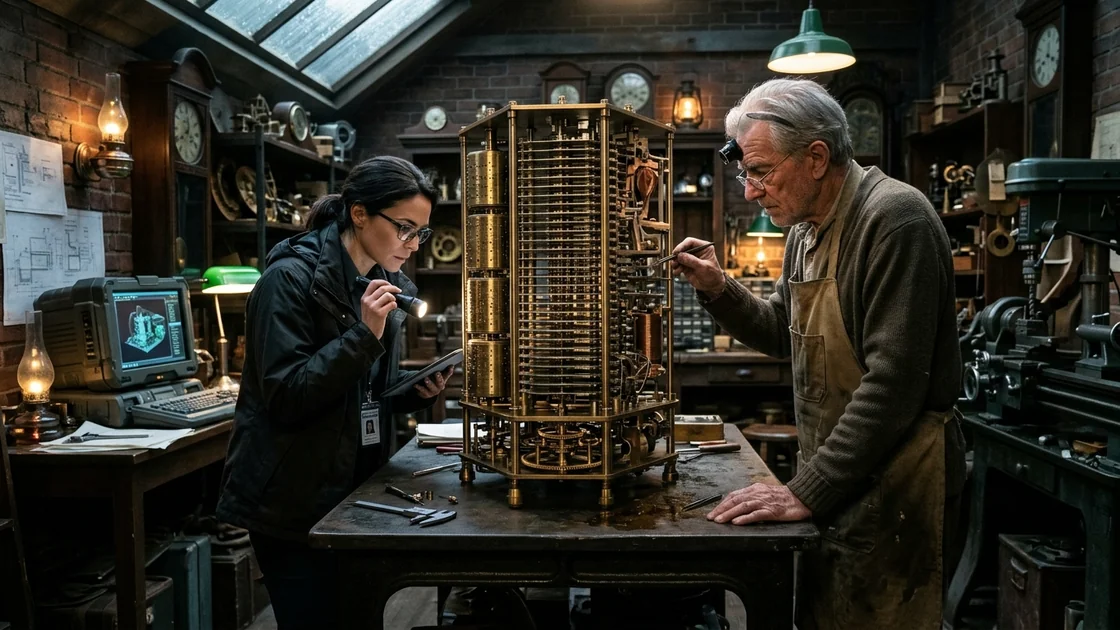
In a near-future metropolis on the verge of a catastrophic geomagnetic superstorm, brilliant microelectronics engineer Elena Vance discovers that no existing silicon-based system will survive the impending electromagnetic pulse. Desperate to safeguard the automated control systems of an underground ecological vault, she seeks out Arthur Pendelton, an aging, reclusive master watchmaker who works solely with brass, steel, and sapphire. Together, the unlikely pair must bridge a two-hundred-year technological divide, merging cutting-edge materials science with eighteenth-century horological mastery. Racing against the ticking clock of an angry sun, they struggle to overcome friction, resonance, and their own conflicting philosophies to build a Turing-complete mechanical computer capable of thinking without a single spark of electricity.
PART ONE: THE SILICON FRACTURE
The chip died without a sound, without smoke, and without the courtesy of a warning spark.
Dr. Elena Vance stood behind the triple-paned leaded glass of the observation booth, watching the telemetry monitors flatline one by one. Inside the anechoic test chamber, resting on a plinth of non-conductive ceramic, sat the Aegis-9 microprocessor. It was the pinnacle of human lithography: twelve billion transistors etched onto a fingernail of silicon carbide, shielded by nested Faraday cages of mu-metal and oxygen-free copper, its logic gates hardened against cosmic rays for deep-space deployment.
Next to her, Marcus Chen, the director of the National Resilience Infrastructure Project, let out a slow, ragged breath. He tapped the dead glass of his tablet, as if physical percussion might coax the frozen liquid crystals back to life. Even in the shielded booth, the residual induction from the Marx generator had caused the overhead fluorescent tubes to flicker and hum with an angry, ozone-scented vibration.
"Tell me that was the diagnostic rig failing, Elena," Marcus said, his voice tight. "Tell me the fiber-optic transducers decoupled."
Elena did not look up from the oscilloscope. The phosphor trace was a flat green horizon. She reached out and flipped the heavy rotary switch that grounded the chamber, waiting for the pneumatic hiss of the airlocks before stepping through the heavy steel door.
The air inside the chamber tasted of ionized copper and burned dust. She walked to the plinth, pulled a pair of polymer tweezers from her lab coat pocket, and lifted the Aegis-9 from its zero-insertion-force socket. To the naked eye, the package was pristine—a matte-black ceramic square bordered by gold contact pins.
She carried it back to the lab, placed it under the scanning acoustic microscope, and projected the internal cross-section onto the wall screen.
It looked like lightning had been trapped inside a crystal. Across the three-nanometer gate oxides, microscopic dendritic fractures branched out from the input buses. The simulated E1 and E3 electromagnetic pulses—calibrated to match the magnetohydrodynamic forecasts of the building solar anomaly dubbed Active Region 4099—had not merely bypassed the shielding. The magnetic flux density had saturated the mu-metal in microseconds, inducing parasitic currents directly into the microscopic gold bond wires. At three nanometers, the insulation barrier between one logical state and another was only a few dozen atoms thick. Under that kind of induced voltage, the silicon had undergone catastrophic dielectric breakdown, melting into a useless, conductive slag at the atomic level.
"The transducers didn't fail," Elena said quietly, zooming in on a cratered logic array where an arithmetic unit used to be. "The architecture failed. At this scale, the wires don't need to be long to act as antennas. The transistors themselves are too small to resist the voltage potential. It's like trying to stop a tsunami with a rice-paper screen."
Marcus rubbed his temples, looking suddenly older than his fifty-five years. "We have eleven weeks before the solar rotational alignment brings Region 4099 back into Earth's magnetic crosshairs. The astrophysics team at Zurich puts the probability of a dual-coronal mass ejection—something forty times the magnitude of the 1859 Carrington Event—at seventy-eight percent. If the ground-induced currents hit the levels we just simulated, every transformer on the continental grid will slag. Every satellite will fry. And you're telling me the Vault Four control core won't survive it either?"
"I'm telling you that as long as Vault Four relies on electron mobility across semiconductor junctions, it is going to die the moment the magnetosphere compresses," Elena replied. She turned from the microscope, her dark eyes sharp behind her anti-glare lenses. "You can bury the vault under half a mile of granite, Marcus. You can wrap the server racks in six inches of lead and copper. Good. Fine. The servers in the dark won't fry. But a vault isn't a tomb; it has to breathe. It has to monitor geothermal coolant loops, regulate hydroponic nutrient pressures, adjust blast-valve apertures, and track atmospheric radiation on the surface. The moment you run a single sensor line through that Faraday cage to read a thermocouple or a pressure transducer, you create an aperture. And even if you use optical fibers, the electronic active sensors at the other end of those fibers will die instantly, leaving your buried supercomputers blind, deaf, and paralyzed."
"Then what is the alternative?" Marcus demanded, throwing his hands up. "Vacuum tubes? Magnetic core memory from the nineteen-sixties? We don't have the industrial tooling to fab ten thousand vacuum tubes in eleven weeks, and even if we did, the power consumption would boil the geothermal wells dry."
Elena stared back at the acoustic scan on the wall. The melted pathways of the silicon chip resembled the veins of a dry leaf. For fifteen years, her entire career had been dedicated to making things smaller, faster, and more ephemeral—pushing electrons across vanishingly thin bridges at billions of cycles per second. Information had become weightless, a ghost dancing in a crystal lattice.
And because it was a ghost, a single gust of magnetic wind could blow it away forever.
"We don't need electrons," she whispered, an absurd, half-formed memory from an undergraduate history of computation seminar surfacing in her mind. "We don't need charge carriers at all."
"Speak English, Elena."
"Logic isn't electricity, Marcus. We just got lazy and started using electricity because it moves at the speed of light. Boolean logic—AND, OR, NOT—is just state transitions. True or false. Open or closed. Up or down." She walked over to her whiteboard and wiped away a complex differential equation describing quantum tunneling with the sleeve of her lab coat. "Vault Four doesn't need to render three-dimensional graphics or train neural networks. Its survival protocol is a closed-loop feedback system. It reads thirty-two environmental inputs—pressures, temperatures, flow rates—runs a proportional-integral-derivative algorithm, and adjusts sixteen hydraulic actuators. What is the minimum clock speed required to keep the geothermal exchangers from going supercritical?"
Marcus blinked, thrown off balance by the pivot. "I don't know. The current controller polls the sensors ten thousand times a second."
"Because it can, not because it needs to," Elena said, her marker squeaking rapidly across the board. "Water has high thermal mass. Valves take seconds to actuate. If you polled the system once every half-second—two Hertz—and executed a five-hundred-step calculation in between, the reactor and the seed cryo-banks would remain completely stable."
"Two Hertz?" Marcus frowned. "My wristwatch runs faster than that."
Elena froze, the marker poised an inch from the porcelain board.
"Your wristwatch has a quartz crystal and an integrated circuit," she said slowly. "It'll die along with the Aegis-9. But a mechanical watch won't. A mechanical watch doesn't care about magnetic flux if it's made from the right alloys. You can drop a non-ferrous chronometer into the heart of a particle accelerator, and it will keep ticking."
"Elena," Marcus said, his voice dropping into the register he used when an engineer was showing signs of sleep-deprivation psychosis. "You cannot run a subterranean biosphere on a wristwatch."
"Not a watch," she said, turning to face him, her pulse quickening for the first time in months. "A mechanical Turing machine. A solid-state logic engine built entirely out of kinematics. Cams, levers, planar sliding plates, and gear trains. Powered by the physical pressure of the geothermal steam itself, reading temperatures through bimetallic expansion strips and pressures through Bourdon tubes. No wires. No semiconductors. No electrons."
"Charles Babbage spent forty years and a fortune of the British Empire's money trying to build an Analytical Engine," Marcus countered sharply. "He never finished it. The tolerances were impossible, and the friction jammed the gears."
"Babbage was working in 1840 with hand-filed brass and whale oil," Elena shot back. "I have five-axis laser micromachining, deep reactive-ion etching, bulk metallic glasses, and self-lubricating diamond-like carbon coatings. What I don't have..." She paused, looking down at her own hands—hands that knew how to write Verilog code and manipulate electron beams, but had never meshed two physical gears together in her life. "...is someone who understands how to make metal think without binding."
The rain in the Old Quarter didn't fall so much as it hung in the air, a perpetual gray mist that smelled of coal smoke, wet slate, and the brackish tide of the harbor three streets down.
Elena stood under the dripping canvas awning of a narrow storefront wedged between an antiquarian bookshop and a boarded-up apothecary. The gold leaf on the curved glass window had flaked away decades ago, leaving only the ghostly shadow of the words: A. PENDELTON & SON — HOROLOGISTS & CHRONOMETER MAKERS.
Behind the glass, suspended on velvet-lined tiers that had faded from crimson to the color of dried blood, sat dozens of brass mechanisms. There were marine chronometers gimbaled in mahogany boxes, skeletonized pocket watches with their coiled mainsprings exposed like dissected steel serpents, and tall regulator clocks whose heavy pendulums swung in lazy, asynchronous silence.
When she pushed the door open, a mechanical bell above the lintel didn't ring; instead, a small brass bird perched on a track slid forward, struck a tuning fork with its beak, and retreated with a soft whirr of governored flywheels. The resulting note—a pure, resonant A-440—lingered in the warm, oil-scented air of the shop.
The room was a forest of ticking. It wasn't a single rhythm, but a complex, polyrhythmic tapestry of thousands of tiny collisions—five beats per second here, four beats per second there, the slow, heavy tock-tock of a grandfather clock anchoring the frantic, insectile chatter of carriage repeaters.
At the back of the shop, illuminated by a single green-shaded halogen lamp bent low over a scarred beechwood workbench, sat a man with a brass-framed loupe wedged into his right eye socket.
He was perhaps sixty-five, though the silver bristle of his hair and the deep, map-like creases around his mouth made him seem older, like a piece of driftwood cured in salt. He wore a heavy canvas apron stained with dark crescents of Moebius oil and rouge powder. His hands—large, square-fingered, and astonishingly steady—held a pair of Dumont tweezers whose tips were finer than sewing needles.
Elena waited by the counter for two full minutes. The man did not look up.
"If it uses a battery," a dry, gravelly voice finally drifted from beneath the green lamp, "there is a kiosk in the shopping arcade on Fourth Street. The boy there has a plastic pry-tool and very little self-respect. He will gladly ruin your case-back for ten dollars."
"I didn't bring a watch, Mr. Pendelton," Elena said.
The tweezers paused. With a practiced twitch of his cheek muscles, Arthur Pendelton released the loupe from his eye, catching it deftly in his left palm before setting it on a coaster of oiled leather. He turned slowly on his stool, looking at her over a pair of half-moon reading glasses. He took in her damp Gore-Tex jacket, the security badge still clipped to her lapel, and the heavy aluminum Pelican case clutched in her hand.
"You have the look of an institutional creditor or a museum curator," Arthur said, his pale gray eyes narrowing. "Since I owe no money, and I have already told the Municipal Science Archive that they may have my Harrison replica only when my heart stops beating, I assume you are lost."
"My name is Dr. Elena Vance. I'm the chief microelectronics architect at the Resilience Project."
Arthur let out a short, humorless bark of a laugh and turned back to his workbench. "Microelectronics. Then you are not merely lost, Doctor; you are in the wrong century. Mind the door on your way out; the damp warps the jamb."
"I need to build a computer," Elena said, stepping up to the counter and setting the Pelican case down with a dull thud. "A binary, stateful, programmable logic engine. And I need it to function without electricity."
Arthur didn't turn around, though his shoulders stiffened slightly beneath his cardigan. "A Curta calculator can be bought at auction for two thousand pounds. If you require something larger, I suggest you dig up Charles Babbage."
"A Curta is a manual adding machine, not an autonomous controller," Elena said, refusing to yield ground. "And Babbage failed because he used decimal rotary architectures with massive over-constraints in his gear trains. I'm talking about a hybrid planar-rotational system. Sixteen-bit word length. A clock speed of at least twenty Hertz, driving a proportional feedback loop for forty years without human intervention."
For five seconds, the only sound in the shop was the steady, metallic breathing of a hundred escapements.
Slowly, Arthur swiveled back around. He looked at the aluminum case, then up at her face. "Twenty Hertz," he repeated softly. "Twenty cycles per second. In a purely mechanical train."
"Yes."
"A standard high-beat Swiss watch movement oscillates at five Hertz—thirty-six thousand vibrations per hour," Arthur said, his voice dropping into a clinical, lecture-hall cadence. "At that speed, centrifugal force flings standard lubricants off the pallet stones within three years. TAG Heuer once built a mechanical chronograph that beat at five hundred Hertz, and it could not run for more than an hour without tearing its own mainspring barrel to shreds and grinding its pivots into dust. And you are asking for a machine with thousands of logic gates—not merely a simple timekeeping train, mind you, but branching, conditional kinematic pathways—to cycle twenty times a second for four decades?"
"I have materials you've never dreamed of, Mr. Pendelton," Elena said, unlatching the Pelican case and spinning it around so it faced him. Inside, nestled in charcoal foam, lay several gleaming metallic plates, a spool of hair-thin translucent fiber, and a stack of blueprints printed on thick Mylar. "Amorphous zirconium-based bulk metallic glass. Zero crystalline grain structure, twice the tensile strength of titanium, and an elastic limit that makes spring steel look like wet clay. Silicon nitride ceramic bearings that require zero lubrication. Diamond-like carbon coatings with a coefficient of friction lower than wet ice."
Arthur stepped down from his stool, wiping his hands on a chamois cloth. Despite himself, he approached the counter, his eyes drawn to the strange, mirror-bright sheen of the metallic glass plates. He picked one up. It was machined into a tiny, intricate lattice of interlocking cantilevers—a micro-electro-mechanical test structure she had etched the night before.
"You have the materials," Arthur murmured, turning the piece toward the light, admiring the micron-level precision of the vertical walls. "And you undoubtedly have the lasers and the acid baths to carve them. Why come to an old man who cuts brass on a nineteenth-century Boley lathe?"
"Because yesterday afternoon, I designed a four-bit mechanical ripple-carry adder on my workstation using finite-element analysis," Elena admitted, her pride stinging only slightly. "I had the machine shop laser-cut the components out of hardened invar this morning. When we assembled it and drove the input shaft at five revolutions per second, the third logic gate jammed on the fourth cycle, sheared two pins, and bent the main actuator rod into a pretzel."
A tiny, almost imperceptible smile touched the corners of Arthur's mouth. He reached into the case and pulled out the failed invar assembly she had tucked into the side pocket. He didn't need his loupe to see the problem. His thumb traced the sheared pin and the sharp, ninety-degree corners of the sliding logic plates.
"You designed it like an electrical circuit," Arthur said softly, setting the broken metal down. "You assumed that when Gate A pushes Lever B, the force is transmitted instantaneously and linearly, the way voltage travels down a copper trace. You treated metal as an abstraction."
"Metal follows the laws of Newtonian mechanics," Elena said defensively. "My simulation accounted for mass and friction."
"Your simulation knows nothing of backlash," Arthur countered, his eyes lighting up with a fierce, sudden intensity. "It knows nothing of harmonic whip, or the way a lever flexes three microns under load and stores that energy as a parasitic spring until it binds against its guide rail! You put involute gear teeth where you needed epicycloidal profiles. You gave your sliding plates no draw-angle, no clearance for thermal hysteria, and no escapement to decouple the driving force from the logic state!"
He tapped the Mylar blueprint with a blunt fingernail. "You are trying to force steel to behave like lightning, Doctor Vance. It will not be bullied. Metal has memory. It has inertia. It must be coaxed, balanced, and forgiven for its imperfections."
Elena looked at the broken adder, then up at the watchmaker. "Can you teach it to think?"
Arthur looked past her, out the rain-streaked window toward the gray city. "Why? Why spend millions of dollars of government money building a brass brain when your pocket holds a machine that can calculate a billion times faster?"
Elena reached over and closed the lid of the Pelican case. "Because in seventy-five days, the sun is going to strip the sky of every electron we've ever tamed. And when the lights go out, Mr. Pendelton, yours is the only language that will be left on Earth."
PART TWO: THE ESCAPEMENT OF LOGIC
The workshop behind Arthur's storefront was a long, brick-walled room that smelled of lavender oil, hot brass shavings, and old paper. A skylight ran the length of the ceiling, letting in the diffuse, shadowless light of the northern sky, while along both walls stood cast-iron machines that looked like sculptures from another age: a Schaublin turret lathe, a Hauser jig borer with vernier scales polished by decades of thumb-strokes, and three rose engines covered in oiled canvas shrouds.
For the first forty-eight hours, they barely spoke the same language.
Elena set up her ruggedized workstation on a cleared corner of a packing table, its cooling fans whirring at a pitch that made Arthur wince every time he walked past. She wanted to talk about Shannon entropy, propagation delay, fan-out limits, and register files. Arthur wanted to talk about end-shake, pallet stone impulse angles, arbor windage, and the horror of sliding friction.
"Show me this 'NAND' gate again," Arthur demanded on the third morning, leaning over her shoulder with a mug of black Darjeeling tea in his hand.
On the screen, Elena rotated a three-dimensional model of two interlocking T-shaped sliders. "It's the universal logic primitive," she explained, pointing with a stylus. "In electronics, if you can build a NAND gate—Not-AND—you can build literally any computational structure: adders, multiplexers, memory latches, an entire central processing unit. Look: Input A and Input B are physical rods. Pushing a rod in by two millimeters represents a binary '1'. Leaving it retracted is a binary '0'. The output rod should be pushed out to '1' in every condition except when both A and B are pushed in to '1' simultaneously."
Arthur squinted at the screen, then walked over to his drafting board, picked up a heavy carpenter's pencil, and swept a sheet of vellum clear of eraser shavings.
"Your sliding plates are an abomination," he announced, sketching with rapid, fluid strokes that needed no straightedge. "Konrad Zuse tried sliding flat plates in Berlin in 1938. My father saw a piece of that machine after the war. It jammed constantly because a flat plate sliding in a slot is at the mercy of what we call the drawer-effect. Push a wooden dresser drawer slightly off-center, and the corners bite into the frame. Multiply that by ten thousand gates connected in series, and you don't have a computer; you have a very expensive mechanical brake."
"Then how do you do it without sliding plates?" Elena asked, walking over to look at his drawing. "Babbage used rotating gear stacks, and those were ten times heavier and took forever to carry a digit from one column to the next."
"You use rotation where you need power transfer, and compliant flexure or pivoted levers where you need logic," Arthur said, his pencil flying across the vellum. Within sixty seconds, a mechanism emerged on the paper that looked nothing like her blocky CAD model. It looked organic, almost skeletal, like the ankle joint of a bird.
"Watch," Arthur said. "Instead of two plates sliding against a steel track, we use a miniature differential beam—a whippletree, like the crossbar used to hitch two horses to a single plow. Pivot it at the center on a ruby jewel bearing. If Rod A pushes the left side of the beam, the center moves forward by one millimeter. If Rod B pushes the right side alone, the center moves forward by one millimeter. A spring-loaded pawl—here, shaped like a chronometer detent—sits behind a notch set at one-point-five millimeters. As long as only one input moves, or neither moves, the detent holds the main output lever under spring tension in the '1' position. The moment both A and B push together, the center of the beam travels the full two millimeters, trips the ruby pallet of the detent, and drops the output lever to '0'."
Elena stared at the sketch. Her mind immediately began translating his horological geometry into physics equations. "Wait. If the inputs only supply the force to trip a detent, and the actual state change of the output lever is driven by a separate spring or a central clock-bar..."
"Then the inputs don't have to push the weight of the next ten gates down the line," Arthur finished triumphantly. "Just as the balance wheel of a watch does not drive the hands—it merely unlocks the escapement to let the mainspring drive the hands! Every single gate becomes a mechanical relay—an amplifier!"
"Signal restoration," Elena breathed, her eyes widening. "In digital electronics, if a voltage drops slightly as it passes through a logic gate, the next transistor restores it to full power by drawing from the main power rail. That was Babbage's fatal flaw! In a purely passive gear train, friction accumulates down the chain until the last gear takes infinite force to turn. By putting an escapement detent in every logic gate, we decouple input logic from output torque!"
She grabbed a red pencil from his cup and began scribbling along the margin of his vellum. "Look, if we add a restorative bail—a single cam-driven bar that sweeps across the entire logic layer at the end of every clock cycle—it can reset all the tripped detents at once, drawing power directly from the main geothermal turbine shaft!"
Arthur looked down at her red lines intersecting his black graphite. Slowly, he nodded. "A sweep-reset. Like the heart-piece cam in a split-seconds chronograph. Yes. That would work. The input rods would require less than five millinewtons of force to trip the jewel. Virtually zero wear."
"And how small can we make this differential beam?" Elena asked, her voice rising with excitement.
Arthur picked up a brass vernier caliper. "By hand, using number-two pivot drills and standard watch jewels? I could fit one gate into a cube six millimeters on a side."
Elena shook her head, already doing the volumetric math in her head. "Vault Four's control program requires a minimum of twelve thousand logic gates for the arithmetic logic unit and instruction decoder, plus four kilobytes of mechanical read-only memory for the lookup tables and sixty-four bytes of read-write working registers. At six millimeters cubed per gate, plus linkage channels, the processor alone would be the size of a city bus, and the inertial mass of the reset bars would shake the room apart."
"Then how small must it be?"
"Two millimeters square, and half a millimeter thick," Elena said. "Planar layers, stacked like wafers in a cube no larger than a grandfather clock."
Arthur set the caliper down. "No human hand can set ruby jewels into a two-millimeter lever twelve thousand times in ten weeks, Doctor Vance. Not even mine."
"Your hands don't have to build the twelve thousand gates," Elena said, pointing back at her workstation. "Your hands have to build one perfect gate at ten-to-one scale so we can verify the geometry, the impulse angles, and the backlash tolerances. Once you perfect the kinematics in brass and steel on your lathe, I will take the blueprint back to the foundry. We'll use deep X-ray lithography and electroforming—LIGA processing—to grow three hundred gates per layer out of amorphous nickel-cobalt and bulk metallic glass on a sacrificial titanium substrate, all in a single chemical bath. You are the architect, Arthur. The photolithography machine is just your apprentice."
Arthur looked at the screen, then back at his Boley lathe, where a curl of yellow brass still hung from the cutting tool. The idea that his life's art—the subtle curvature of an epicycloidal tooth, the exact four-degree draw angle of a lever escapement that kept a watch from unlocking when bumped—could be shrunk down to the size of a flea and multiplied by the thousands to save a dying world seemed to settle over him with a profound, solemn weight.
He reached for his canvas apron and tied the strings behind his back with a sharp tug.
"Clear those plastic boxes off the milling table," Arthur said, picking up his loupe. "And turn off that infernal fan on your machine if you aren't using it. I cannot hear the metal cut when the room is buzzing."
PART THREE: THE BABBAGE PARADOX
Weeks dissolved into a strange, subterranean rhythm measured not by the sun outside, which grew more volatile on the satellite feeds every day, but by the pile of brass swarf accumulating beneath Arthur's lathe and the towering stacks of etched metallic wafers arriving by courier from Elena's foundry.
Marcus visited the shop at the end of the fourth week, looking gaunt and carrying a encrypted satellite phone that never stopped vibrating in his coat pocket. Already, the outer edges of Active Region 4099 were spitting X-class flares that had knocked out high-frequency radio communications over the Arctic Circle and caused transformer fires in northern Quebec. The public was being told to prepare for "rolling blackouts and temporary telecommunications disruptions," a euphemism that made Marcus look physically ill every time he heard it on the radio.
He stood in the center of the workshop, staring at the contraption taking shape on the heavy cast-iron surface plate between Arthur and Elena's worktables.
They called it the Loom, though it looked more like a cross between an aviation turbine and a gilded cathedral organ.
Standing four feet tall and framed in thick pillars of non-magnetic silicon-bronze, the machine was divided into four vertical quadrants. At the base sat the Prime Mover: a dual-chambered pneumatic turbine designed to run on compressed air in the lab, and eventually on the low-pressure geothermal steam vents of Vault Four. Above the turbine sat Arthur's masterpiece of regulation—a massive, three-inch double-axis tourbillon beating at a furious, hypnotic forty times per second, its twin hairsprings forged from non-magnetic niobium-zirconium alloy, its escapement wheels carved from translucent pink synthetic sapphire to handle the brutal impact velocities without wearing down.
"It doesn't sound like a clock," Marcus remarked, leaning in close to the protective acrylic shield.
Instead of a tick-tock, the tourbillon emitted a continuous, musical hum—a low, vibrant G-sharp that resonated through the soles of their shoes. Above the regulator, four vertical timing shafts transferred that rhythm through bevel gears into the Logic Stack: forty-eight gleaming horizontal plates of bulk metallic glass, each no thicker than a heavy playing card, stacked with half-millimeter spacers between them. Under a magnifying glass, the plates were alive with microscopic motion—a shimmering silver tapestry of thousands of tiny whippletree levers, compliant flexures, and sliding reset bails dancing in synchronized waves as the camshafts turned.
"Show him the memory," Arthur said, a unmistakable note of pride in his gruff voice as he wiped a speck of oil from the bronze frame.
Elena stepped to the right quadrant of the machine, where two different cylinder assemblies sat geared to the main bus. The upper assembly consisted of eight brass drums bristling with thousands of microscopic tungsten pins arranged in spiral tracks, looking like the barrels of an impossibly intricate music box.
"Read-Only Memory," Elena explained to Marcus. "Four kilobytes of permanent instruction code and thermodynamic lookup tables. Each pin is a binary '1'; a missing pin is a '0'. As the drum rotates, a bank of sixty-four sapphire reading fingers rides across the tracks, translating the pins directly into mechanical displacement for the instruction decoder. You could drop this drum into the ocean for a century, pull it out, brush off the barnacles, and the code wouldn't lose a single bit."
"And the working memory?" Marcus asked, pointing to the lower grid, which looked like a miniature honeycomb of silver switches. "How does the machine remember the temperature it read five seconds ago?"
"Bistable compliant mechanisms," Elena said. "Look closely. Each memory cell is a tiny bow-shaped spring made of metallic glass. Push it from the left, and it snaps over-center into the '1' position and stays there without needing any power to hold it. Push it from the right, and it snaps back to '0'. We have five hundred and twelve bits of mechanical RAM that retain their state indefinitely, even if the steam pressure drops to zero."
Marcus looked from the shimmering plates to the two exhausted engineers. Elena had dark hollows under her eyes and a burn scar on her forearm from a hot soldering iron she'd used to modify a test rig; Arthur's fingers were stained permanently gray with molybdenum disulfide dry lubricant.
"Does it work?" Marcus asked quietly.
Elena exchanged a glance with Arthur. The watchmaker's expression darkened slightly.
"It adds, subtracts, shifts bits, and executes conditional branches without a single logical error up to six Hertz," Elena said.
"Six Hertz," Marcus repeated, his shoulders sinking. "Elena, the hydraulic water-hammer models for Vault Four's primary cooling loop came back from the fluid dynamics team yesterday. Because of the faulty bypass valves in Sector Three, if the controller doesn't poll the pressure transducers and adjust the relief gates at a minimum of eighteen Hertz during a seismic thermal surge, the steam pipes will cavitate and rupture within four minutes."
"We know," Elena said tightly. "We got the memo."
"Then why are you running at six?"
"Watch the upper register shaft," Arthur said grimly. He reached down and turned the brass vernier dial on the pneumatic throttle valve, increasing the air pressure to the turbine.
The musical hum of the sapphire tourbillon climbed in pitch, moving from G-sharp to A, then to C, then to a piercing, angry E-flat as the clock speed passed ten, twelve, and finally fourteen Hertz.
Inside the Logic Stack, the shimmering wave of tiny silver levers blurred into a continuous gray mist. The sixty-four sapphire reading fingers chattered against the ROM drums like a tiny machine gun.
At fifteen point four Hertz, a sound emerged from the center of the Logic Stack—a high, metallic squeal that had nothing to do with friction and everything to do with resonance. A visible ripple, like a standing wave on the surface of a drum, traveled vertically up the bronze support pillars.
Before Elena could reach the emergency cutoff valve, there was a sharp crack—like a dry twig snapping in a quiet woods. The tourbillon froze instantly. The pneumatic turbine stalled with a hiss of venting air, and three tiny fragments of pink sapphire pattered like hail against the bottom tray of the acrylic enclosure.
In the sudden, ringing silence that followed, Marcus stared at the broken fragments. "What happened? Did a gate bind?"
"No gate bound," Arthur said, his voice tight with frustration as he unlatched the enclosure and lifted out the shattered escapement wheel with his tweezers. "It is the Babbage Paradox, wearing a new mask. We conquered sliding friction with your metallic glass and my jewel detents, Doctor Vance. What we did not conquer is acoustic inertia."
Elena pulled a stool up to the surface plate and buried her face in her hands. "It's a standing harmonic wave," she explained to Marcus, her voice muffled. "Every time the sweep-reset bar snaps twelve thousand tiny levers back to their neutral state at the end of a clock cycle, it releases a tiny kinetic shockwave into the frame. At low speeds, the bronze frame damps the vibration before the next cycle begins. Keep pushing the speed up toward fifteen Hertz, and the frequency of the reset impacts matches the natural resonant frequency of the logic plates themselves."
"The plates start ringing like tuning forks," Arthur said, holding up one of the spare metallic glass wafers and flicking its edge with his fingernail; it gave off a clear, sustained ping. "When the plate vibrates vertically by even ten microns, a lever that is supposed to pass cleanly over a catch pin strikes it dead-on instead. The shock travels backward down the timing train like a hammer blow and shatters the sapphire teeth of the regulator."
"Can you thicken the plates to change their resonant frequency?" Marcus asked desperately. "Or use a heavier damping frame? Cast iron? Depleted uranium?"
"If you thicken the plates, the mass of the moving levers increases by the cube of the thickness," Elena said, looking up. "More mass means more kinetic energy at each stop, which just lowers the resonant wall to ten Hertz instead of fifteen. And we can't use ferromagnetic cast iron because under the E3 geomagnetic pulse, the frame itself would magnetize and warp under its own internal Lorentz forces."
"We have three weeks until the vault seal-date," Marcus said, his voice dropping to a whisper. "In twenty-one days, the heavy transport convoys roll out to the mountain, and the blast doors are welded shut from the inside before the solar alignment window opens. If this machine cannot run at eighteen Hertz without eating itself alive, seven hundred thousand cryogenic seed samples and the entire library of human engineering in the lower vaults will cook in the dark when the geothermal loop goes supercritical."
He looked at the shattered sapphire wheel on the workbench, placed his hand briefly on Elena's shoulder, and walked out into the rain.
PART FOUR: THE HARMONIC WALL
That night, a prelude flare from the edge of the sun's eastern limb brushed Earth's upper atmosphere.
It was only an M-class disturbance, a fraction of a percent of the monster rotating into view behind it, yet at two in the morning the streetlights outside Arthur's shop surged to a blinding violet-white before popping like flashbulbs down the entire length of the cobblestone street. Overhead, tearing through the perpetual gray cloud cover, curtains of blood-red and sickly green aurora writhed across a latitude that hadn't seen the northern lights in two centuries.
Inside the workshop, the backup battery inverter on Elena's computer shrieked a continuous alarm before its internal MOSFETs shorted out with a puff of acrid gray smoke. The screen went black, leaving only the warm, steady amber glow of two kerosene Gimbal lamps Arthur had lit an hour before, and the green halogen lamp running off an old diesel generator chugging steadily in the courtyard out back.
Elena didn't even bother unplugging the dead workstation. She sat cross-legged on the floorboards beside the cast-iron surface plate, surrounded by scatterings of broken sapphire wheels, brass gears, and sheets of vellum covered in differential equations calculated by hand with a slide rule Arthur had pulled from a drawer.
Arthur sat at his bench, methodically repolishing the pivot of the tourbillon cage on a jacot tool with a boxwood slip and diamantine paste—a soothing, repetitive motion he had performed ten thousand times in his life.
"Why does a watch tick, Elena?" he asked quietly into the kerosene-lit gloom.
"Because the pallet stones strike the escape wheel teeth," she answered automatically, staring at the silent Loom. "Impulse, lock, drop."
"And what happens to the energy of the 'drop'?" Arthur asked, not looking up from his polishing. "When the tooth falls freely across the tiny gap before locking against the stone?"
"It turns into sound," she said. "The tick. And heat. And vibration."
"Wasted energy," Arthur said, stopping his bow. "In a pocket watch, it is a millionth of a joule—it merely makes a pleasant sound against a gentleman's waistcoat. In our Loom, twelve thousand logic gates dropping from '1' to '0' at the end of a cycle when the reset bar sweeps past is twelve thousand tiny hammers striking twelve thousand anvils simultaneously. Why are we throwing away the energy of the logic state at the end of every cycle?"
Elena frowned, leaning her head back against the heavy wooden leg of the workbench. "Because that's how computation works, Arthur. When you add two numbers together—say, an AND gate takes two inputs and produces one output—you start with two bits of information and end up with one bit. You erase a bit of information. When you reset the gate for the next clock cycle, that erased bit has to be dumped into the environment."
She stopped. Her eyes widened in the amber lamplight, staring up at the dark glass of the skylight where the red aurora pulsed like a heartbeat.
"Wait," she whispered.
Arthur turned on his stool. "What is it?"
"Landauer's Principle," Elena said, scrambling to her feet so fast she knocked over a tray of brass collets. She grabbed a fresh sheet of vellum and Arthur's carpenter's pencil. "In 1961, Rolf Landauer proved that in any computer—electronic, quantum, or mechanical—erasing a bit of information must dissipate energy as heat or vibration. It's a law of thermodynamics! Every time our NAND gates collapse two inputs into one output and then get slammed back to zero by the reset bar, they have to dump that kinetic energy into the frame!"
"Can you compute without erasing?" Arthur asked, stepping over to the drafting table.
"Yes!" Elena's hand shook as she drew a new diagram—a square with three input lines entering from the left and three output lines exiting to the right. "Edward Fredkin and Tommaso Toffoli figured it out in the nineteen-seventies. Reversible computing. In a Fredkin gate, the number of inputs equals the number of outputs, and the number of '1's going in is always identical to the number of '1's coming out! Nothing is ever created or destroyed; the states just swap tracks like trains in a switchyard!"
Arthur leaned over the drawing, his horologist's mind instantly grasping the mechanical implication before she even finished sketching the linkages.
"Wait," he breathed, his finger tracing the three parallel lines. "If the number of active rods entering the gate is always equal to the number of active rods leaving the gate... then for every lever that drops down from '1' to '0', an identical lever right next to it is pushed up from '0' to '1'!"
"The center of mass never moves!" Elena shouted, grabbing his arm. "There is no net impulse against the frame! Every action is canceled out inside the gate itself by an equal and opposite reaction! And instead of a brutal sweep-reset bar slamming twelve thousand levers back to zero all at once like a pile driver..."
"We run the computation forward during the first half of the clock cycle," Arthur said, his eyes blazing in the lamplight, "latch the answer into the output actuators at top-dead-center, and then let the return stroke of the eccentric cam run the exact same signal backward through the gates to smoothly guide every lever back to its starting position without a single sudden drop!"
"No impact," Elena whispered, looking at the Loom. "No reset shockwave. Just a continuous, balanced sinusoidal wave flowing into the stack and flowing back out, like the tide."
"Like a marine chronometer balance with paired helical springs expanding and contracting in opposition," Arthur murmured, picking up his brass scale. "Self-canceling harmonics. Doctor Vance... if we replace the NAND plates with balanced Fredkin switchyards, and couple the main drive shafts with a fluidic silicon-oil Foucault damper instead of a dry tooth-drop..."
"How fast can we push it?" she asked.
Arthur looked at the forty-eight plates in the Logic Stack. "If we don't have to rebuild the ROM drums or the turbine—only re-etch the forty-eight logic wafers and machine a continuous-contact planetary escapement to replace the impact tourbillon—how fast can your foundry acid-etch forty-eight new sheets of metallic glass before the power grid dies?"
Elena checked her mechanical pocket watch—a simple, battered steel Hamilton that Arthur had lent her during their first week together.
"If I drive the designs to the foundry before dawn and commandeer all four LIGA beamlines before the military shuts down the civilian substations," she said, already reaching for her coat, "seventy-two hours. Can you cut a zero-impact planetary escapement by hand in three days?"
Arthur turned back to his Schaublin lathe, unlocked the headstock spindle, and selected a blank bar of solid copper-beryllium from the rack beneath the bench.
"Go," the watchmaker said, lighting a second halogen lamp over the chuck. "And tell your foundry technicians that if their slot tolerances vary by more than half a micron across the diagonal, I will come down there and break their fingers with a brass mallet."
PART FIVE: THE CARRINGTON HORIZON
The mountain did not care about the sun.
Carved into the roots of a Precambrian granite massif two hundred miles north of the coast, Vault Four was a world of cold concrete, sweating steel blast doors, and the deep, subterranean roar of pressurized water rising from fissures three kilometers beneath the Earth's crust.
When Elena and Arthur arrived in the back of an armored military transport truck two days before the solar alignment window, the facility was already in the final stages of buttoning down. On the surface plateau above the tunnel entrance, soldiers in heavy canvas coats were dismantling the satellite dishes and folding down the high-gain radio masts—not to save them, for nothing on the surface could be saved, but to prevent the massive steel towers from acting as lightning rods that might channel millions of amperes of geomagnetically induced ground current down into the blast doors.
Inside the Primary Control Cavern, three levels below the seed cryo-banks, the air was hot and smelled of sulfur and damp stone.
Along the north wall stood the dead titans of Elena's old world: six liquid-cooled supercomputer racks, their tempered glass doors hanging open, their multi-million-dollar optical backplanes and gold-plated Aegis-9 processor blades sitting dark and disconnected. A crew of technicians had already sawed through the thick copper sensor trunks that used to feed into the server racks, capping the dead wires in heavy lead junction boxes.
In the center of the concrete floor, bolted directly to the bedrock over a divert-manifold of the primary geothermal steam line, stood the brass and bronze skeleton of the Loom—now officially designated the Chronos-1 Autonomous Mechanical Control Engine.
For thirty-six straight hours, while the countdown clock on the wall ticked toward the expected arrival of the first coronal mass ejection shockwave, Arthur and Elena worked inside the belly of the machine alongside two master pipefitters.
There was no a single wire connected to the Loom.
Instead of electronic thermocouples, thirty-two capillary tubes filled with liquid mercury snaked out from the reactor core and the cryo-vaults, terminating at the left flank of the Loom in a bank of coiled Bourdon tubes and bimetallic invar-brass spirals. As temperatures and pressures rose or fell in the vault's arteries, the spirals wound and unwound with silent, inexorable physical force, shifting a row of balanced sapphire Pantograph levers across sixteen-bit gray-code encoder bars.
On the output flank of the machine, where sixty-four binary actuator rods exited the reversible Fredkin Logic Stack, Arthur had constructed a cascade of three-stage hydraulic torque amplifiers—delicate spool valves no thicker than knitting needles that could be shifted by the whisper-light touch of a logic lever, yet immediately directed three hundred pounds per square inch of geothermal water pressure to open or close the massive cast-iron main bypass gates down in the turbine hall.
"Clear the frame," Arthur called out, his voice echoing strangely against the curved concrete vault ceiling. He looked gaunt, his white hair plastered to his forehead with sweat from the geothermal heat, his canvas apron oil-soaked to the knees.
Elena stepped back from the Logic Stack, pulling the last brass alignment pin from the main camshaft housing. Around them, Marcus and a dozen vault engineers stood in a tight, silent semicircle, holding flashlights and mechanical stopwatches.
On the wall, the lone surviving external telemetry monitor—connected by a sacrificial ten-kilometer fiber-optic line to a solar observatory on the peak above—showed a terrifying sight. The magnetogram of the sun had turned completely white, saturating the sensors. Seven hours earlier, Active Region 4099 had unleashed a triple-cannibalistic coronal mass ejection: three successive billion-ton clouds of magnetized plasma traveling at three thousand kilometers per second, sweeping up the solar wind ahead of them into a single, compressed relativistic hammer blow aimed directly at Earth.
"Estimated impact on the magnetopause in fourteen minutes," a technician at the communications desk announced, his voice cracking slightly. "Surface satellite telemetry is already degrading from the proton storm."
"Arthur," Elena said, her hand resting on the heavy bronze wheel of the main steam admission valve. "Are the dampers bled?"
Arthur peered through his brass loupe at the new regulator sitting above the turbine. Gone was the fragile sapphire impact tourbillon. In its place sat a gleaming, three-tiered planetary escapement coupled to a sealed cylinder of viscous dimethyl-silicone fluid—a continuous, rolling epicycloidal brake that had no tick, no drop, and no impact.
"The oil is clear of air bubbles," Arthur said, pocketed his loupe, and stepped back behind the yellow safety line painted on the floor. "Open the main steam bypass. Slowly, Doctor Vance. Let the bronze warm evenly before you bring her to speed."
Elena gripped the iron wheel with both hands and turned it counterclockwise.
Deep beneath the floor plates, a valve unseated. With a low, throat-clearing hiss, dry geothermal steam at four atmospheres surged into the dual-chambered silicon-bronze turbine at the base of the Loom.
For a second, nothing moved. A trickle of condensed water wept from the petcock at the bottom of the casing. Then, with a majestic, effortless grace, the main vertical drive shaft began to turn.
Above it, the planetary regulator spun up, its counter-rotating brass weights blurring into a golden halo inside the silicone damping cylinder. There was no chatter of teeth. There was only a deep, velvety purr, like a massive cat sleeping against a warm hearth.
Elena turned the wheel another full rotation. The pressure gauge needle climbed smoothly: two atmospheres, three, three-point-eight.
On the tachometer dial geared to the main clock shaft, the bone-white needle swept past five Hertz. Ten Hertz. Fifteen Hertz—the exact point where the first Loom had screamed and shattered its own heart.
Elena held her breath, her hand instinctively hovering over the emergency dump lever.
Inside the forty-eight stacked plates of bulk metallic glass, the reversible Fredkin switchyards were a shimmering liquid mirror. As the eccentric cams drove the logic waves forward and drew them back in perfect sinusoidal symmetry, not a single harmonic ripple disturbed the bronze pillars. Arthur reached out and placed a bare finger on the main structural column; the metal was warm from the steam, and as steady and vibration-free as the granite bedrock beneath their feet.
Eighteen Hertz.
Twenty Hertz.
Twenty-four Hertz.
Across the right flank of the machine, the sixty-four output rods began to dance in crisp, decisive staccato steps. Below the floor, the hydraulic spool valves hissed softly as they shifted, and on the main mechanical pressure board across the room, the heavy brass needles showing the coolant flow in Sector Three wavered, caught themselves, and settled dead-center in the green optimal band.
The machine was reading the mountain. It was calculating the differential derivatives through twelve thousand sliding silver levers, looking up the steam tables on the spinning tungsten-pinned drums, and adjusting the valves twenty-four times every second.
It was thinking.
Before anyone in the cavern could cheer, the world ended outside.
It did not arrive as an explosion, because they were under fifteen hundred feet of solid rock. It arrived first as a violation of the senses—a strange, metallic taste at the back of the throat, as if everyone in the room had simultaneously licked a nine-volt battery, accompanied by a low, sub-audible groan as the Earth's magnetic field compressed by four thousand nanoteslas in less than ten seconds, sending massive telluric currents surging through the iron-bearing strata of the mountain range.
On the north wall, the sacrificial fiber-optic transceiver box exploded in a shower of blue sparks as the metallic strength-member inside the cable conducted a million-volt potential difference straight through the outer blast bulkhead before the automatic guillotine severed the line.
Simultaneously, the overhead LED light strips in the cavern—powered by the vault's internal diesel-electric microgrid—flared a violent, blinding cyan as the geomagnetic flux penetrated even the granite overburden and coupled into the three-kilometer power cables running down from the generator hall. With a deafening series of pistol-shot cracks, every breaker in the main electrical panel welded itself shut and then vaporized inside its cabinet. The cooling fans in the ceiling seized with a shriek of burning copper windings.
Darkness fell over the cavern like a dropped iron curtain.
In the pitch black, someone near the communications desk gasped. The smell of ozone and burned insulation rolled across the ceiling.
Then, slowly, two warm pools of yellow light bloomed near the center of the room.
Arthur stood beside the tool bench, holding up one of the brass kerosene Gimbal lamps he had insisted on bringing down in the truck; Elena held the other.
As the warm flame-light pushed back the shadows, the engineers looked around the dead cavern. Every digital screen on the walls was black glass. Every status light on the electrical boards was dark. Even the battery-powered emergency exit signs above the blast doors had died when their tiny solid-state charge controllers fried under the magnetic spike. Across the continent above them, from horizon to horizon, ten billion silicon chips had just turned into inert sand, plunging three hundred million people into an instant, pre-industrial silence.
Yet in the center of the cavern, bathed in the golden glow of the oil lamps, the Loom did not even falter.
Whirrr-click-shhh. Whirrr-click-shhh.
Driven by the eternal heat of the Earth's core, blind to the magnetic fury raging through the rock around it, the forty-eight plates of metallic glass continued their silent, silver tide. The tungsten-pinned drums turned with stately precision. As the electrical coolant pumps in the secondary loop died along with the generators, the bimetallic temperature spirals on the left flank of the Loom immediately sensed the rising heat in the core within a quarter of a second.
Elena held her lamp high, watching the upper rows of the Fredkin Logic Stack shift into a new computational branch—the emergency passive-convection routine they had encoded onto Drum Three four nights ago.
A cascade of sapphire pawls clicked into place. On the output flank, four brass rods slid forward two millimeters, tripping the primary hydraulic spools. Down in the deep pipe galleries beneath their feet, the heavy gravity-fed emergency flood gates rumbled open under three hundred pounds of water pressure, establishing a natural thermosiphon loop that required no electric pumps at all.
On the wall gauge, the core temperature needle paused two degrees below the red line, hovered for ten seconds, and then slowly began to drop back toward equilibrium.
Marcus stepped forward into the lamplight, his face pale, his eyes fixed on the spinning golden blur of Arthur's planetary regulator. He reached into his pocket, pulled out his dead encrypted satellite phone, looked at its black screen for a long moment, and then dropped it into a metal wastebin with a hollow clatter.
"How long will it run like this?" Marcus asked, his voice hushed, as if he were standing in a cathedral.
Arthur walked up to the bronze frame of the Loom. From the breast pocket of his stained canvas apron, he pulled a small crystal vial of synthetic whale-oil substitute and a microscopic gold oiler needle. He touched a single, glistening droplet of oil to the upper jewel cup of the main reading drum arbor, watching it draw into the sapphire by capillary action.
"The silicon nitride bearings are good for eighty years," the watchmaker said calmly, capping the vial. "The metallic glass flexures are operating at less than twelve percent of their elastic fatigue limit, which makes them functionally immortal. As long as the mountain stays hot, and someone remembers to put a drop of oil on the drum jewels every five years, she will outlive us all."
Elena set her kerosene lamp down on the surface plate and stood beside him, watching the reflections of the flame dance across the thousands of tiny, oscillating levers. For the first time in her life, she didn't have to look at an oscilloscope or a logic analyzer to know what the program was doing. She could see the thoughts moving through the metal—each bit of data a physical truth, solid, undeniable, and permanent.
She reached into her pocket and pulled out the battered steel Hamilton pocket watch Arthur had lent her. Its crystal was scratched from the machine shop, and its hands were five minutes slow, but when she held it up to her ear in the quiet cavern, the tiny balance wheel inside was beating away with a bright, defiant rhythm, keeping time with the great brass brain beside them in the dark.