The Cherenkov Telegraph
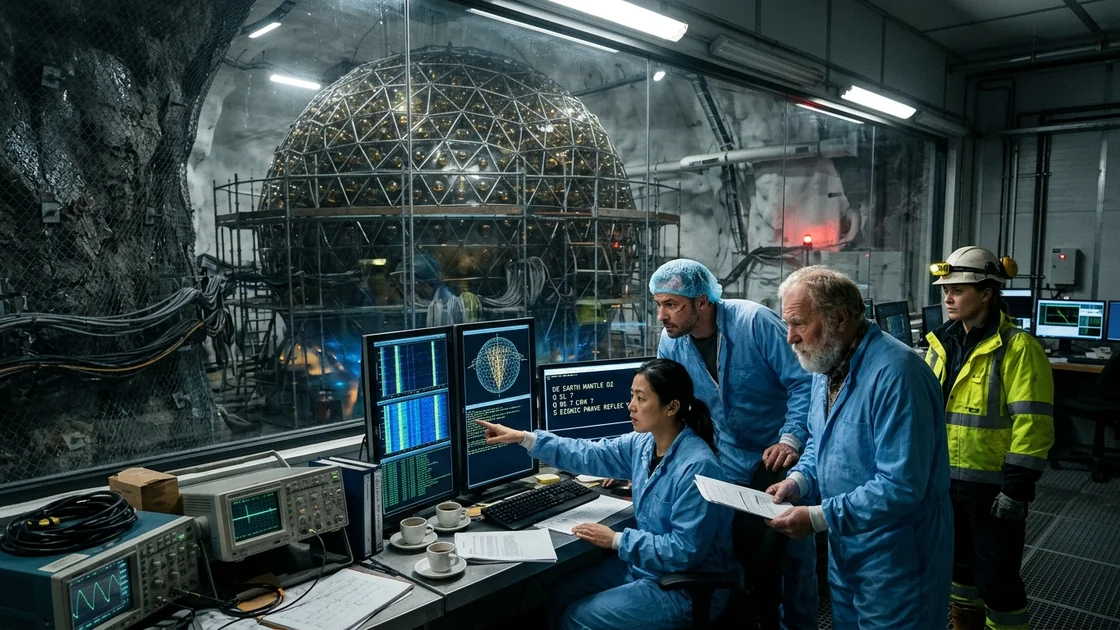
Three kilometers beneath the ancient granite of the Canadian Shield, a team of physicists operating an ultra-pure liquid scintillator neutrino observatory discovers that the background radiation rising from the Earth's mantle is no longer random. Instead of the expected statistical noise of decaying radioactive isotopes, the detector's thousands of photomultiplier tubes begin registering tightly collimated bursts of antineutrinos spaced in precise intervals that match International Morse Code. As lead physicist Aris Thorne, data architect Maya Lin, and geophysicist Henrik Lindqvist work in secret to decode the impossible transmissions, they realize the signals originate from an immense, naturally occurring crystalline network in the high-pressure post-perovskite layer at the boundary between the Earth's mantle and core. Having absorbed decades of low-frequency electromagnetic military communications and seismic waves, this ancient, solid-state geological intelligence has awakened and is attempting to communicate by modulating nuclear decay rates deep within the planet. When the entity's efforts to focus its neutrino beam trigger catastrophic deep-focus tremors that threaten to collapse the subterranean laboratory, the scientists must repurpose the mine's seismic survey arrays to transmit a damping algorithm back down into the abyss, forging a silent, permanent pact with the living interior of the world.
The cage did not fall so much as it was swallowed by the stone. For seven minutes every morning, Dr. Aris Thorne stood with his boots planted wide on the grated steel floor of the double-deck hoist, watching the wet walls of the Creighton-Villard shaft streak upward in the yellow glare of his cap lamp. At five hundred meters, the air smelled of pine timber and surface rain. At fifteen hundred meters, it smelled of diesel exhaust, blasted sulfide ore, and the sour metallic tang of old water. By three thousand meters, where the commercial nickel workings gave way to the drift tunnels of the Laurentian Abyssal Detector, the air smelled only of heat—a dry, baking, primordial warmth radiating from two-billion-year-old Precambrian norite that had never known the sun.
Aris shifted his weight, feeling the familiar pop in his eardrums as the barometric pressure climbed. Beside him, Elena Rostova was thumbing through a clipboard of rock-bolt tension logs, her steel-toed boots vibrating in sympathy with the guide rails. As Chief Facilities Engineer, Elena treated the three-point-four-kilometer overburden of solid granite not as a static ceiling, but as a slow, malicious fluid waiting for an excuse to fill the void they had carved out of it.
"You're running the potassium-40 calibration today, Aris?" Elena asked, not looking up from her numbers. Her voice was a low rasp, shaped by twenty years of shouting over ventilation turbines.
"At fourteen hundred," Aris said. "Assuming your chiller plant keeps the cavern below twenty-two degrees. Yesterday the north quadrant thermistors were creeping up."
"Talk to the planet, not me," Elena muttered, tapping her pen against the aluminum clipboard. "Rock temperature out in the virgin drift is fifty-eight Celsius. My chillers are fighting half the thermal mass of Ontario. If you want it colder, tell your grad students to stop breathing so much."
The hoist decelerated with a long, pneumatic sigh that pressed their stomachs down into their boots. The gates rattled open onto Level 68.
Even after six years underground, the transition from the mine drift to the laboratory never failed to disorient Aris. For the first kilometer of the horizontal haulage tunnel, they walked through rough-blasted rock held together by galvanized chain-link mesh and resin grouted rebar. The walls wept briny, ancient groundwater rich in dissolved chlorides and radiogenic helium. Then came the bulkheads: three successive airlocks of submarine-grade steel, followed by the car-wash showers, the boot scrubbers, and the sticky mats.
When Aris emerged into the main control gallery in his lint-free blue coveralls, hairnet, and cleanroom booties, the mine was gone. Here, the walls were coated in three inches of bright white low-radioactivity polyurethane. The air was scrubbed to Class 100 cleanroom standards, smelling faintly of deionized water and ozone.
At the center of the gallery, behind a sweeping glass partition, lay the cathedral of the detector deck. Beneath that circular composite floor sat Boreas-IV: an eighteen-meter acrylic sphere filled with thirty thousand tons of linear alkylbenzene—a clear, oily liquid scintillator refined from ancient petroleum chosen specifically because its carbon-14 had decayed away millions of years ago. Surrounding the acrylic vessel was a twelve-meter buffer of ultra-pure water and a stainless-steel geodesic support structure bristling with eighteen thousand inward-facing Hamamatsu photomultiplier tubes.
In the absolute, pitch darkness inside that sphere, each photomultiplier tube—a hand-blown bulb of low-potassium glass twenty inches wide, coated internally with a microscopic layer of gold-tinted bialkali—waited for the faintest whisper of light.
"Morning, Aris," called Dr. Maya Lin from the tiered crescent of workstations overlooking the deck. She didn't turn around; her eyes were fixed on three vertical monitors displaying waterfall plots of real-time trigger rates. Empty ceramic espresso cups formed a defensive perimeter around her keyboard. "Don't take off your harness yet. You might want to go out on the deck and check HV Crate 19."
Aris walked down the rubberized steps, pulling the hairnet off his forehead just far enough to scratch a scar near his temple. "Did you sleep down here again, Maya?"
"The hoist schedule was disrupted at midnight for shaft maintenance, and I was in the middle of recompiling the muon-veto filter," she said, waving a hand dismissively. She was thirty-two, ten years younger than Aris, with dark circles under her eyes that looked painted on. "Besides, Crate 19 started acting cute around three in the morning. Look at the nadir trigger map."
Aris leaned over the back of her chair. On her center screen was a Mollweide projection of the sphere—an unrolled map of the eighteen thousand photomultiplier tubes, looking like a pixelated globe of the world. Normally, the display shimmered with a uniform, gentle snow of single-photoelectron hits: the inevitable dark noise of thermionic emission in the tubes, punctuated by the occasional soft bloom of a solar neutrino or the twin-flash signature of a geoneutrino rising from the crust.
Right now, the bottom fifth of the map—the nadir sector, where the tubes pointed straight up into the bottom of the acrylic sphere to catch particles traveling upward through the entire diameter of the Earth—was blushing with a tight, persistent cluster of amber pixels.
"Electrical cross-talk?" Aris asked, frowning. "If a high-voltage divider card in Crate 19 is arcing, it'll bleed pulses across the whole backplane."
"That was my first thought," Maya said. She typed a quick command into her terminal, bringing up the waveform digitizer traces. "Except Crate 19 only powers half of those tubes. The other half are wired to Crate 22 on the opposite side of the utility ring. And look at the pulse shapes."
Aris leaned closer, adjusting his glasses. A faulty cable or a high-voltage leak produced jagged, ugly spikes—reflections and impedance mismatches that any first-year graduate student could spot. The green lines on Maya's oscilloscope readout were textbook Cherenkov and scintillation waveforms: a razor-sharp rise time of three nanoseconds, followed by a clean exponential decay tail.
More than that, they were paired.
"Prompt and delayed," Aris murmured.
"Every single one of them," Maya said quietly. "A prompt flash around four mega-electronvolts, followed roughly two hundred microseconds later by a sharp two-point-two MeV spike."
Aris felt a slow, familiar tightening in his chest—the instinctive wariness of an experimental physicist who knows that nature rarely hands out miracles, and that nine times out of ten, an exciting signal is just a clever hardware failure waiting to humiliate you in peer review.
What Maya was showing him was the unmistakable signature of inverse beta decay. An electron antineutrino enters the tank and strikes a free proton—a hydrogen nucleus—in the liquid scintillator. The collision transforms the proton into a neutron and spits out a positron. The positron immediately annihilates with a nearby electron, creating the first flash of light: the prompt signal. The newly minted neutron wanders through the liquid for a couple hundred microseconds before being captured by another hydrogen nucleus to form deuterium, releasing a gamma ray of precisely 2.22 mega-electronvolts: the delayed signal.
It was the golden channel of neutrino physics. Almost nothing else in the universe could mimic that exact one-two punch of light in a shielded underground tank.
"What's the rate?" Aris asked.
"Standard geoneutrino background for the whole tank is about four events per month," Maya said. "Between 03:14 and 04:50 this morning, the nadir sector logged four hundred and twelve inverse beta decays."
Aris stared at her. "Four hundred? Maya, if the antineutrino flux rose by five orders of magnitude, every nuclear reactor in Ontario would have had to melt down simultaneously, and the events would be coming from the horizon, not straight down through the floor."
"I checked the Bruce and Pickering reactor telemetry via the provincial grid feed," Maya said. "They're nominal. And look at the reconstruction vectors."
She rotated a three-dimensional wireframe of the detector sphere. Inside the sphere, hundreds of thin cyan lines traced the reconstructed paths of the incoming particles based on the picosecond timing differences between the tubes that fired first and the tubes that fired last.
Usually, antineutrinos from beta decay didn't leave neat directional tracks; the positron annihilated almost on the spot, and the neutron scattered randomly before capture. However, roughly one in ten of the incoming particles hadn't caused inverse beta decay—instead, they had undergone elastic scattering, knocking an electron forward like a cue ball hitting an eight ball. Those forward-scattered electrons produced tight cones of blue Cherenkov light that pointed straight back toward the source of the neutrino beam.
Every single cyan arrow pointed down. Not roughly down, not spread across the lower hemisphere, but tightly bundled within a three-degree cone aimed directly at the center of the Earth.
"A calibration source broke loose," Aris said immediately. "The Americium-Beryllium capsule on the winch cable. Someone dropped it to the bottom of the acrylic vessel and didn't log it."
"The deployment glovebox is locked and sealed under nitrogen pressure," Maya countered. "I checked the hall cameras. Nobody has touched the calibration winch since Tuesday. And an AmBe source radiates isotropically in all directions. These vectors are collimated. They are entering the bottom of the tank from the rock below the cavern, passing upward through the scintillator, and exiting through the roof."
Aris straightened up, rubbing his chin. Beneath the composite floor of the deck, below the twelve meters of water shield and the steel liner of the cavity, there was nothing but the lower crust, the Mohorovičić discontinuity, two thousand nine hundred kilometers of silicate mantle, and the liquid iron outer core.
Nothing down there produced a beam of neutrinos. Neutrinos were the ultimate ghosts of the subatomic world; they interacted only through gravity and the weak nuclear force. A neutrino could pass through a light-year of solid lead with less than a fifty-percent chance of hitting a single atom. You couldn't focus them with mirrors or lenses. The only way to create a directional beam of neutrinos was with a multi-kilometer particle accelerator firing protons into a graphite target and letting a massive tunnel of decaying pions point the way—and even then, the beam diverged wildly over hundreds of kilometers. And accelerators produced muon neutrinos at gigavolt energies, not low-energy electron antineutrinos in the exact four-to-eight mega-electronvolt window of radioactive beta decay.
"Run the radon diagnostics," Aris said. "Check the circulation pumps at the bottom manifold. If a pocket of radon-222 gas or uranium-bearing mine dust leaked through a gasket in the lower pipe organ, a laminar plume rising through the bottom of the sphere might fool the vertex reconstruction into thinking it's a directional track."
"I'll pull a liquid sample from the lower manifold," Maya agreed, though her voice lacked conviction. "Wait until you see the timing distribution, though."
"What about it?"
"It stopped at 04:50," she said. "Then it started again at 06:10 for twelve minutes. While it's active, the events aren't arriving randomly."
Aris frowned. Radioactive decay was the textbook definition of a Poisson process—completely memoryless and statistically random. Whether an atom decayed now had zero bearing on when its neighbor would decay. "What do you mean, not randomly? Is there an oscillation frequency? Fifty hertz from the mine transformers?"
"No," Maya said, turning back to her screen. "It's slow. Seconds between bursts. I haven't had time to run a Fourier transform because I was busy checking the high-voltage crates, but the arrival times are clumping into discrete intervals."
"Pull the fluid sample first," Aris instructed, his voice firming into the steady cadence of lab protocol. "Never chase exotic physics when a dirty gasket will explain the data. Get Henrik down here when the eight o'clock cage drops. This is in the geoneutrino energy window; it's his turf."
Dr. Henrik Lindqvist arrived at eight-thirty, carrying a thermos of black coffee and smelling faintly of the peppermint oil he put inside his dust mask during the shaft descent. A tall, broad-shouldered Swede in his late fifties with a neatly trimmed white beard, Henrik was a geophysicist by training who had migrated into particle physics twenty years ago when detectors finally grew large enough to catch the faint antineutrino glow of the Earth's interior.
To Aris, geoneutrinos were mostly an annoying background noise that obscured the low-energy solar neutrinos and supernova relics he actually wanted to study. To Henrik, they were the only direct window into the furnace that drove plate tectonics.
"You have a hot spot?" Henrik asked, setting his thermos down on the conference table in the glass-walled briefing room. He peered over his half-moon reading glasses at the printouts Maya had spread across the melamine surface. "If you tell me the Sudbury Igneous Complex has a pocket of natural uranium ore under our cavern that we missed during the site survey, I will be very embarrassed."
"A uranium pocket wouldn't turn itself on and off like a lighthouse," Maya said. She had just returned from the fluid-sampling alcove, her gloves smelling of the sweet, solvent-like odor of linear alkylbenzene. "The mass spec and alpha-counter results on the bottom-manifold draw are completely clean. Zero radon spike. No particulate infiltration. The scintillator is as pure as the day we distilled it."
Aris tapped the three-dimensional track plots. "Look at the elastic scattering cones, Henrik. Seventy-eight high-confidence electron recoils accompanying roughly six hundred inverse beta decays over the last six hours. Every single recoil cone points to a nadir angle between one hundred and seventy-seven and one hundred and eighty degrees."
Henrik picked up the sheet, his bushy gray eyebrows drawing together. "Straight down. No azimuthal spread?"
"Less than two degrees," Aris said. "Which, given the angular resolution of Cherenkov reconstruction in a scintillator cocktail at five MeV, means the source is effectively a point source—or a tightly collimated beam."
Henrik let out a slow, rumbling laugh, shaking his head. "Aris, my friend, you know the interior of the Earth as well as I do. Below us is forty kilometers of Archean craton. Below that, the lithospheric mantle—olivine and pyroxene. Then the transition zone, ringwoodite, wadsleyite. Then two thousand kilometers of bridgmanite and ferropericlase down to the core-mantle boundary. The Uranium-238 and Thorium-232 that produce geoneutrinos are distributed throughout the crust and mantle like tiny specks of flour in a very large loaf of bread. They do not gather in a laser pointer."
"What about Herndon's old georeactor hypothesis?" Maya asked, leaning against the glass wall that looked out over the quiet, blue-lit dome of the detector deck. "A ball of uranium sinking to the center of the core and undergoing natural nuclear fission?"
"Even if such a thing existed—which the KamLAND and Borexino data ruled out years ago—a fission reactor radiates antineutrinos in a sphere, four-pi steradians," Henrik said, gesturing with both hands to mime a ball. "From six thousand kilometers away at the center of the core, a spherical source would look like a point source to us, yes. Wait."
Henrik stopped mid-gesture. His hands remained suspended in the air over his coffee thermos.
Aris watched the older man's eyes flick back to the energy spectrum chart on the table. "You see it too," Aris said softly.
"The energy spectrum," Henrik whispered, pulling the second page closer. He traced the histogram peaks with a blunt index finger. "If it were a fission reactor, the antineutrino spectrum would extend up to eight or nine MeV, with the broad hump characteristic of fission fragments like strontium-90 and cesium-137. This spectrum... this has a sharp kinematic cutoff at 3.27 MeV, with a secondary step at 2.25 MeV."
"Bismuth-214 and Thallium-208," Aris said. "The standard decay chains of Uranium-238 and Thorium-232. Not fission. Ordinary, natural alpha-beta decay. Except the flux in this narrow three-degree cone is ten thousand times higher than the integrated luminosity of the entire planet's mantle."
Silence settled over the briefing room, broken only by the low, steady hum of the air-handling units pushing HEPA-filtered air through the ceiling grates.
"How?" Henrik asked simply. "Even if you took all the uranium in the lower mantle and packed it into a sphere ten kilometers wide just above the core-mantle boundary—say, two thousand nine hundred kilometers straight down—it would still radiate equally in all directions. To give us four hundred hits an hour in a thirty-kiloton tank from three thousand kilometers away, the total isotropic output at the source would have to be..." He did the mental arithmetic, his lips moving silently. "Ten to the twenty-sixth neutrinos per second. That is tens of terawatts of radiogenic heat in a single spot. It would melt a plume through the mantle that would make the Yellowstone supervolcano look like a matchstick. Our seismometers would be jumping off the floor."
"Unless it isn't radiating in all directions," Maya said.
Both men looked at her.
"I ran the time-series analysis while the mass spectrometer was cycling," she said, walking over to the wall monitor and plugging her tablet into the display port. "You're both asking how the rock is focusing the particles. You aren't asking why the bursts are turning on and off."
The screen flickered and brought up a black timeline spanning from 03:00 to 09:00 that morning. The neutrino events were plotted as vertical white ticks along the horizontal time axis.
Zoomed out, the ticks looked like barcode blocks—dense white bands separated by black gaps of silence. Maya pinched her fingers on the tablet, zooming in on the 06:10 block until the individual neutrino detections separated out.
"At first, I couldn't make sense of it because a single pulse isn't one neutrino," Maya explained, her voice tight with an emotion that sounded dangerously close to fear. "Neutrino cross-sections are so infinitesimal that even with a massive beam, our tank only catches a handful of particles per burst. A 'burst' is a cluster of five to twelve inverse beta decays occurring within a window of a few seconds, followed by a dead gap where the count drops to absolute zero."
She tapped a button, and a red square-wave envelope superimposed itself over the clusters of white ticks.
"Look at the durations of the active envelopes," she said. "And look at the durations of the silent gaps."
Aris squinted at the horizontal axis, which was marked in seconds.
The first red box lasted precisely 1.0 seconds, containing seven neutrino hits. Then a silent gap of 1.0 seconds. Then a box of 1.0 seconds. A gap of 1.0 seconds. A box of 1.0 seconds. A gap of 3.0 seconds. Then a longer box: 3.0 seconds, containing nineteen neutrino hits. A gap of 1.0 seconds. Another box of 3.0 seconds.
"One second, three seconds," Aris muttered. "A one-to-three duty cycle."
Below the square wave, Maya had plotted a simple two-dimensional histogram of burst durations versus gap durations. There was no continuum. Every burst clustered tightly around either 1.00 seconds or 3.00 seconds, with a standard deviation of less than forty milliseconds. Every silent gap between bursts was either 1.00 seconds, 3.00 seconds, or 7.00 seconds.
Henrik leaned forward, bracing his palms on the table. "One unit for a dot. Three units for a dash. One unit gap between elements. Three units between letters. Seven units between words." He looked up at Maya, his face pale under the fluorescent lights. "Is this a joke, Maya? Did the graduate students at Laurentian University hack the front-end FPGA boards for a prank?"
"The front-end boards aren't networked to the surface!" Maya snapped, the exhaustion finally cracking her composure. "The fiber-optic link goes strictly one-way from the DAQ servers through an optical diode to the surface archive! And even if someone rewrote the firmware on the trigger cards down here, they couldn't fake the analog waveforms on seven hundred separate photomultiplier tubes across four independent high-voltage crates, or make the Cherenkov rings reconstruct with sub-nanosecond geometric consistency across an eighteen-meter sphere!"
She took a shaky breath, gripping the edge of the podium. "I thought it was a prank too. So at seven-thirty, I went out on the deck and physically unplugged six tubes in the nadir sector from the main DAQ and hooked them directly into an old Tektronix analog storage oscilloscope with fifty-ohm coaxial cables. No software. No firmware. No CPUs. Just copper wire, vacuum tubes, and phosphor."
"And?" Aris asked quietly.
"They're firing, Aris," she whispered. "One-second bursts and three-second bursts. Rising straight out of the granite."
Aris looked back at the red square waves on the screen. Short, short, short. Long, long, long.
"What does it say?" he asked.
Maya tapped her tablet again. Below the red square waves, a line of green ASCII text appeared, mapped directly under the three-second and seven-second gaps.
V V V DE N A A N A A K Q R Z Q R Z
8 4 . 1 1 2 N 4 6 . 8 9 0 W
P A S C A L 1 3 6 G V V V DE N A A
Aris stared at the letters. He had expected either random noise that happened to fit a bimodal timing distribution, or something cinematic and absurd—an English greeting from a hollow-earth fantasy. Instead, he was looking at a string of archaic procedural brevity codes.
"What is DE N A A?" Aris asked.
Henrik didn't answer immediately. He was staring at the screen with his mouth slightly open. Slowly, he reached up and took off his reading glasses.
"In my youth," Henrik said, his voice barely above a whisper, "I did my compulsory military service in the Swedish Royal Navy. Coastal telegraphy and submarine communications."
He pointed a trembling finger at the green letters.
"V V V is the standard international tuning signal used
to calibrate a receiver's frequency before a transmission begins.
DE is from the French de—it means 'from.'
K means 'over' or 'go ahead.' Q R Z is the
international Q-code for: Who is calling me?"
"And N A A?" Maya asked.
"NAA," Henrik said, "is the military callsign for the United States Navy's Very Low Frequency transmitter station at Cutler, Maine."
For three hours, nobody left the control level. Aris canceled the fourteen-hundred potassium calibration run and sent a terse email to Director Vance on the surface stating that they were troubleshooting a minor timing jitter in the master rubidium clock and would be offline for forty-eight hours. Elena Rostova was kept out of the loop; as far as she knew, the physicists were locked in the server room arguing over software patches.
By noon, Aris had pulled every byte of raw, unfiltered photomultiplier data from the local RAID arrays going back six months, while Henrik and Maya sat at the secondary analysis console cross-referencing the physics of VLF radio waves with deep-mantle mineralogy.
"Here's why we didn't see it before," Aris said, emerging from the chilled server room with a yellow legal pad covered in scrawled calculations. "Our standard trigger algorithm requires a minimum energy threshold of 1.8 MeV for inverse beta decay, and it automatically flags and rejects any event cluster where more than fifty events occur within ten seconds as a 'cosmic muon spallation shower.' Every time a burst of these antineutrinos hit the tank over the last three months, the automated filter assumed a high-energy cosmic ray had smashed a carbon nucleus in the scintillator into radioactive fragments, and it blinded the detector for thirty seconds to let the noise die down."
"It only broke through the filter this morning because the intensity dropped slightly," Maya realized. "The individual bursts fell just below the fifty-event spallation veto threshold, so the system let them through to the main display."
"How long has it been happening in the raw buffer dumps?" Henrik asked.
"The dump buffer only keeps fourteen days of vetoed raw triggers before overwriting them," Aris said, setting the pad down. "It's been transmitting continuously for at least two weeks. Slowly at first—one symbol every ten seconds—and gradually speeding up until it locked onto the one-second dot interval yesterday."
Aris looked at the whiteboard where Maya had transcribed the full fourteen-day log of decoded bursts. It was a sprawling, repetitive mosaic of naval callsigns, Q-codes, meteorological pressure reports, submarine depth-charge test coordinates, and strange, fragmented numerical tables.
V V V DE N A A N A A DE U M V U M V
Q T H 2 8 9 1 K M T E M P 3 7 4 0 K
P A S C A L 1 3 6 G Q R Z Q R Z
S E I S M I C P W A V E R E F L E C T
Q S L ? Q S L ?
"UMV was the Soviet Goliath VLF transmitter in Nizhny
Novgorod," Henrik explained, pacing along the length of the whiteboard
with a dry-erase marker in his hand. "And there are pieces of
NPG—Jim Creek in Washington State—and GBR in
Rugby, England. Do you understand what all of these stations have in
common?"
"Submarine communication," Maya said.
"Specifically, Very Low Frequency and Extremely Low Frequency electromagnetic waves," Henrik said, tapping the board emphatically. "Between three kilohertz and thirty kilohertz, and down to seventy-six hertz for the old Project Sanguine and ELF arrays in Michigan and Wisconsin—which, I might add, are less than four hundred kilometers west of this mine, bolted directly into the same Laurentian granite craton we are sitting inside!"
Aris frowned. "Henrik, VLF and ELF waves penetrate seawater to reach submarines, and they use the deep crust as a ground return path. They don't penetrate two thousand nine hundred kilometers of silicate mantle. The electrical conductivity of the upper mantle would attenuate an electromagnetic wave long before it reached the core."
"The electromagnetic wave itself doesn't have to reach the bottom," Henrik said, his eyes bright with the fierce, terrifying joy of a scientist watching two impossible puzzle pieces click together. "In 1958, the Americans and the Soviets began pumping megawatts of continuous-wave Morse code directly into the bedrock of the northern hemisphere. In the crust and the upper mantle, where quartz and olivine are under tectonic stress, oscillating electromagnetic fields couple with the rock via the piezoelectric and electrostrictive effects. They generate faint, coherent acoustic phonons—micro-seismic vibrations that travel right down through the planet at eight to thirteen kilometers per second!"
"And the nuclear tests," Maya added suddenly, pulling up a geological
database on her workstation. "Look at the date formats in the middle of
the buffer log. V E L A 1 9 6 3...
N O V A Y A 1 9 6 1. During the Cold War, we detonated
hundreds of underground nuclear tests specifically calibrated to ring
the Earth like a bell so seismologists could map the core-mantle
boundary. Every test sent massive P-waves crashing straight into the
D-double-prime layer."
Aris stared at the whiteboard, his mind racing to bridge the chasm
between acoustics and particle physics. "Read the third line on the
board again," he said slowly. "Q T H 2 8 9 1 K M. What is
QTH?"
"In Morse code," Henrik said softly, "QTH means: My
position is."
Aris looked down at his legal pad. "Two thousand, eight hundred and
ninety-one kilometers beneath the surface. Temperature: 3,740 Kelvin.
Pressure: 136 gigapascals. And Q S L ? means..."
"Do you acknowledge receipt of my transmission?" Henrik finished.
The three of them stood in the cold white glow of the briefing room. Above them, three kilometers of solid rock pressed down; below them, the planet suddenly felt less like a dead ball of iron and silicate and more like an abyssal ocean in which something enormous had just rolled over and opened an eye.
"Wait," Aris said, holding up both hands as if to physically push the conclusion away. "Stop. We are physicists, not mystics. Even if I accept for one lunatic moment that some structure at the core-mantle boundary—2,891 kilometers down, at exactly 136 gigapascals and 3,740 Kelvin—has been absorbing micro-seismic harmonics from Cold War radio transmitters and seismic surveys for seventy years, how does a layer of hot rock think? And how in the name of Fermi does it reply by shooting a collimated beam of electron antineutrinos straight up into our tank?"
Henrik walked back to the table and pulled Maya's laptop toward him, opening a phase-diagram chart of the deep Earth.
"What happens at 2,891 kilometers, Aris?" Henrik asked.
"The core-mantle boundary," Aris said. "Liquid iron-nickel alloy below, solid magnesium silicate above."
"Not just magnesium silicate," Henrik corrected. "In the last two hundred kilometers of the mantle—the D-double-prime layer—the pressure crosses one hundred and twenty-five gigapascals. Under that crushing weight, standard perovskite—bridgmanite—undergoes a phase transition into post-perovskite. The crystal lattice flattens into two-dimensional sheets of silica octahedra interleaved with magnesium and iron ions."
Henrik traced the boundary line on the screen. "For twenty years, mineral physicists have known that post-perovskite is wildly anisotropic. Its electrical conductivity, its thermal conductivity, and its elastic wave speeds are completely different depending on which way the crystal sheets are aligned. And right at the bottom of D-double-prime sit the Ultra-Low Velocity Zones—continent-sized patches of dense, iron-enriched crystalline slush sitting directly on the liquid iron dynamo of the outer core."
"A semiconductor junction," Maya breathed. "Solid iron-rich silicate sheets sitting on a turbulent ocean of liquid metal moving through a thirty-gauss magnetic field."
"More than a semiconductor," Henrik said. "At 136 gigapascals, iron atoms in the crystal lattice undergo a quantum spin transition—from a high-spin state to a low-spin state—where all their unpaired d-orbital electrons suddenly pair up. A tiny change in acoustic pressure flips the spin state of trillions of iron nuclei simultaneously, altering the electrical conductivity by orders of magnitude. If you have a continent-sized labyrinth of post-perovskite crystals interleaved with metallic iron-hydrides and topological insulators at the base of the mantle, bathed in the magnetic flux of the core and powered by the thermal gradient between the core and the crust..."
"You get a spin-glass network," Aris said, the physics finally catching up to him, cold and inexorable. "A solid-state neural network the size of North America, where the 'synapses' are high-spin to low-spin quantum phase boundaries shifting in response to acoustic phonons."
"It has been sitting there since the Earth differentiated four billion years ago," Henrik murmured, looking down at the composite floor beneath his boots. "Thinking at the speed of tectonic creep and mantle convection. A single thought might have taken ten thousand years. And then, in the twentieth century, the surface suddenly lights up with high-frequency acoustic and electromagnetic chatter. Megawatt VLF transmitters humming at twenty kilohertz. Seismic reflection arrays. Nuclear detonations. We flooded its crystalline lattice with structured, repetitive patterns."
"We taught it a clock rate," Maya said, her eyes wide. "The VLF carrier waves and the Morse code intervals gave it a fast temporal reference frame. It learned the syntax of the signals that were vibrating its lattice."
"That still doesn't explain the neutrinos!" Aris insisted, though his voice had lost its skepticism, replaced by a frantic need to understand the mechanism. "A quantum spin-glass network can move electrons and phonons all day long. It cannot turn radioactive decay on and off like a telegraph key, and it cannot aim neutrinos! Nuclear beta decay is governed by the weak force inside the atomic nucleus. Chemical bonds and crystal lattices have electronvolt energies; nuclear forces are mega-electronvolts. The lattice can't reach inside a uranium or bismuth nucleus and force it to decay!"
Aris stopped. As soon as the words left his mouth, a memory from an obscure theoretical seminar he had attended in Zurich five years ago surfaced in his mind.
He stared at Maya, then at Henrik.
"Wait," Aris whispered. "It doesn't have to change the decay rate at the source."
"What do you mean?" Maya asked.
Aris grabbed the blue dry-erase marker from Henrik's hand and turned to a blank section of the whiteboard. His hand moved rapidly, scribbling Hamiltonian matrices and matter-density potentials.
"The MSW effect," Aris said, the marker squeaking fiercely against the porcelain. "The Mikheyev-Smirnov-Wolfenstein effect. When neutrinos travel through dense matter, coherent forward scattering off electrons acts like an index of refraction. That's how solar neutrinos change flavor inside the sun."
"The MSW wavelength in Earth rock is thousands of kilometers," Maya objected. "You can't build a three-degree lens out of ordinary mantle rock."
"Not out of isotropic, unpolarized electrons," Aris said, circling a term in his equation. "Because in normal matter, electron spins point in random directions, so the axial-vector part of the weak neutral current cancels out to zero! Only the scalar electron density matters. Unless the electrons in the medium are spin-polarized."
Aris spun around to face them, the marker uncapped in his fist.
"In a ferromagnetic or low-spin topological crystal lattice under 136 gigapascals of pressure, sitting inside the toroidal magnetic field of the Earth's outer core, if you align the electron spins across a thousand-kilometer sheet of iron-rich post-perovskite, the axial-vector potential doesn't cancel! The effective refractive index for antineutrinos passing through polarized electrons changes by orders of magnitude depending on the angle between the neutrino's momentum and the electron spin vector!"
Maya's breath caught. "A phased-array metamaterial lens. For neutrinos."
"It's not generating the neutrinos," Aris said, his heart hammering against his ribs. "The Earth's core and lower mantle are already producing trillions of geoneutrinos every second in all directions from natural uranium and thorium decay. The Lattice is just flipping the spin states of its iron-silicate domains in one-second and three-second intervals, creating a Bragg diffraction grating in the deep mantle! When the spins align, it sweeps the ambient geoneutrino background from thousands of cubic kilometers of rock and refracts them into a tight three-degree beam aimed straight up at us!"
"Why us?" Henrik asked. "Why aim a three-degree neutrino beam at a nickel mine in Ontario?"
Aris looked back at the decoded text on the whiteboard:
8 4 . 1 1 2 N 4 6 . 8 9 0 W
S E I S M I C P W A V E R E F L E C T
"Wait," Maya said, looking at the coordinates. "46.890 North, 84.112 West—he transposed the N and W tags, or our decoder flipped them—that's the exact latitude and longitude of this shaft."
"How does a blind crystalline network at the bottom of the mantle know there's a neutrino detector sitting here?" Aris asked.
Henrik walked slowly over to the glass window overlooking the detector deck. "What is the Boreas-IV cavern, Aris? It is a thirty-meter spherical bubble of low-density liquid carved out of high-density Precambrian norite, three and a half kilometers down, where the rock is homogeneous and under immense lithostatic stress. Every time a teleseismic wave from an earthquake or a surface blast passes through the Canadian Shield and reflects downward toward the core, our cavern casts a sharp, spherical acoustic shadow."
"And the calibration system," Maya added, her voice dropping an octave. "Every Tuesday for the last six years, we've lowered an acoustic hydrophone ping-array into the water buffer to triangulate the position of our optical calibration sources. Ten kilohertz acoustic pulses, pinged on a precise one-second rubidium-clock cadence, coupling directly through thirty thousand tons of water into the deep craton."
Aris closed his eyes. For six years, they had been tapping on the aquarium glass with a metronome. And down in the crushing, incandescent dark at the bottom of the mantle, the thing that lived in the stone had felt the rhythm of their hollow sphere, calculated the geometry of the acoustic shadow, and turned its immense, crystalline eye upward to shine a light back into the bubble.
At 16:40, the signal changed.
Until then, the transmissions had been cycling every forty minutes—ten minutes of bursts followed by thirty minutes of silence while the deep-mantle lattice presumably dissipated the Joule heating generated by flipping trillions of high-pressure spin domains.
Maya was writing a Python script to automate the Morse-to-ASCII translation directly from the coincidence trigger stream when the amber pixels on the Mollweide map flared into brilliant crimson.
"Aris!" she called out. "Event rate just tripled!"
Aris and Henrik hurried over to her station. On the waterfall display, the nadir sector was no longer a discrete cluster of dots; it was a solid, burning bullseye at the very bottom of the sphere. The acoustic click-track that Maya had routed to the control room speakers—mapping each inverse beta decay to a sharp Geiger-counter tick—sounded like hail hitting a tin roof.
Tick-tick-tick-tick-tick-tick-tick— Silence. Tick-tick-tick-tick-tick-tick-tick-tick-tick-tick-tick-tick-tick-tick-tick-tick-tick-tick—
"It's narrowing the beam," Aris said, watching the Cherenkov recoil vectors tighten on the 3D wireframe. The three-degree cone had shrunk to less than one point two degrees. "It's bringing more of the D-double-prime lattice into phase coherence, increasing the focal aperture."
On the terminal window, green characters began marching across the black screen at twenty words per minute:
V V V DE EARTH MANTLE D2 Q S L ? Q S L ?
I HEAR PING 1 0 K H Z CAVITY SPHERE R 1 5 M
NO ECHO FROM CAVITY SINCE 0 4 0 0
Q R K ? Q R K ?
Henrik leaned over the monitor. "QRK is the code for
What is the intelligibility of my signals? And look—it dropped
the NAA callsign. It synthesized a new identifier from the
seismic literature broadcast over the military nets or submarine
cables."
"Wait," Maya said, pointing to the fifth line.
"NO ECHO FROM CAVITY SINCE 0 4 0 0. What did we turn off at
four this morning?"
"The outer-shield circulation pumps," Aris said immediately. "When you saw the anomaly on Crate 19 at three-thirty, I had the automated system throttle down the main water-shield pumps to reduce electrical line noise during diagnostics. Those pumps have a distinct forty-hertz mechanical hum that couples into the cavern floor."
"It felt our pumps stop," Maya whispered. "It realized that when it started shining the neutrino beam at our cavern at three in the morning, our mechanical signature changed. We just gave it a closed feedback loop. It knows we can see the neutrinos!"
Before Aris could answer, the floor beneath their cleanroom booties gave a single, sharp jolt.
It wasn't the rolling, swaying motion of a distant surface earthquake. It was a hard, compressional thwack—like someone had struck the bottom of the granite craton with a mountain-sized sledgehammer. Coffee sloshed over the rim of Maya's cold espresso cups. Overhead, the heavy steel crane rails in the cavern dome groaned, a deep, resonant B-flat that vibrated in Aris's teeth.
Three seconds later, the red alarm beacons along the bulkhead doors began to flash, accompanied by the warbling whoop of the mine's geotechnical warning klaxon.
The phone on the main console rang. Aris snatched it up. "Thorne."
"Aris, what the hell did you people just drop?!" Elena Rostova's voice barked through the receiver over a background of blaring alarms. "My micro-seismic array on Level 68 just saturated! That wasn't a rockburst in the old stopes—that was a pure vertical P-wave coming straight up through the footwall!"
"Are the cavern walls holding?" Aris asked, looking through the glass at the detector deck. The circular floor was steady, though the water level gauges on the outer utility ring were oscillating slightly.
"The resin bolts held, and the acrylic sphere's suspension cables took the shock within two percent of tolerance," Elena said, breathing hard. "Wait—I'm looking at the Canadian National Seismograph Network feed right now. Aris, that wasn't local. Ottawa, Thunder Bay, and Timmins all just registered a magnitude 4.1 compressional wave, zero shear component, with an epicenter... wait. The automated depth solver says the hypocenter was seven hundred and twenty kilometers straight down. That's impossible. There are no faults at seven hundred kilometers; the mantle is ductile down there!"
"We're secure in the lab, Elena," Aris said quickly. "Keep the hoist on standby, and don't let anyone into the lower drift until the stress gauges settle. I'll call you back in ten."
He hung up before she could curse at him, turning immediately to Henrik.
Henrik was already pulling up the live global seismometer feeds on his workstation, his fingers flying over the keyboard. "Seven hundred and twenty kilometers is the base of the upper mantle transition zone," he said grimly. "Ringwoodite transforming into bridgmanite and ferropericlase. Look at the terminal, Aris."
On Maya's screen, the green text was still scrolling as the Geiger-counter clicks rattled relentlessly from the speakers:
LENS APERTURE 1 4 0 0 K M
SPIN FLIP DISSIPATION 8 . 4 T W
THERMAL PLUME NUCLEATION AT BOUNDARY
PHASE SLIP AT 7 2 0 K M
Q S L ? ANSWER BY ACOUSTIC 1 0 K H Z
INCREASING GAIN + 6 D B
"Eight point four terawatts," Henrik breathed, his face draining of color. "Aris, do you see what it's doing? To force trillions of iron ions into a coherent low-spin state across a fourteen-hundred-kilometer lens against the ambient 3,740-Kelvin thermal chaos of the lower mantle, it has to pump enormous amounts of magnetic and acoustic energy into the lattice. The entropy has to go somewhere. It's dumping eight terawatts of waste heat directly into the base of the mantle plume beneath the North American craton!"
"A mantle plume takes millions of years to rise," Maya said.
"The rock takes millions of years to rise," Henrik corrected sharply. "The pressure wave and the phase transition cascade travel at the speed of sound in the mantle—ten kilometers per second! When you inject a terawatt thermal spike underneath a metastable crystal boundary in the transition zone, the ringwoodite undergoes catastrophic, instantaneous dehydration and phase collapse—what seismologists call transformational faulting. That's what causes deep-focus earthquakes!"
He pointed at the last line on the screen:
INCREASING GAIN + 6 D B.
"It thinks we didn't hear it clearly because we haven't answered,"
Aris realized, a cold sweat breaking out under his cleanroom coveralls.
"In radio telegraphy, if the receiving station stops active operations
and doesn't send back a QSL acknowledgment, the transmitter
assumes the signal is too weak to cut through the noise. So it's
quadrupling its transmit power."
"If it quadruples the aperture power to thirty-five terawatts," Henrik said, his voice shaking, "the thermal expansion wave at the core-mantle boundary will trigger a chain reaction of transformational faults all the way up the Laurentian root. The craton acts like a wave-guide. Within an hour, a magnitude 6.5 vertical compressional pulse will hit this mine from directly underneath. At three-point-four kilometers depth, where the rock around our cavern is already loaded to eighty percent of its compressive yield strength, the walls will spall inward at the speed of a rifle bullet."
"A rockburst across the entire cavern," Maya whispered. "Thirty thousand tons of liquid scintillator and three kilometers of granite collapsing in a tenth of a second."
"It doesn't know," Aris said, staring at the cascading green letters. "To something that lives at 136 gigapascals of pressure, a magnitude-six compressional wave in the upper crust is softer than a sigh. It has no idea that we're fragile biological organisms hiding in a tiny bubble of air that will pop if it shouts any louder."
"Then we have to answer it," Maya said, grabbing the edge of the
console. "Right now! Turn the ten-kilohertz calibration hydrophones back
on and key them in Morse code! Send QSL! Tell it to reduce
power!"
"The hydrophones in the tank are five-watt piezoelectric buzzers!" Aris said, shaking his head. "It only heard them before because it was integrating our regular Tuesday calibration pings over months or years of stationary background correlation! Right now, the mantle beneath us is ringing like a struck gong from that 4.1 tremor. A five-watt ping inside a water tank won't penetrate five hundred meters of fractured granite against that acoustic noise floor, let alone reach two thousand nine hundred kilometers down to the core-mantle boundary in real time!"
"Then what do we have that can punch an acoustic wave straight down to the core-mantle boundary?" Maya demanded.
Aris and Henrik looked at each other.
"Elena," they said in unison.
They didn't bother taking off their cleanroom booties. Aris, Maya, and Henrik sprinted through the airlocks, tearing off their hairnets and masks as the heavy steel doors hissed open into the hot, diesel-scented air of the haulage drift.
Elena Rostova was standing in the middle of the Geotechnical Operations Bay two hundred meters down the tunnel, surrounded by racks of industrial stress monitors and seismic recorders. Two of her shift mechanics were strapping on self-rescuer breathing packs, preparing to inspect the shaft guide rails.
"I told you to stay in the lab, Thorne!" Elena snapped as the three scientists burst through the heavy PVC strip curtains into the bay. "I just got off the horn with Surface Control. The provincial geological survey is losing its mind over that deep tremor, and Director Vance wants to evacuate the lower levels until we know the shaft pillar is stable!"
"If we get in that hoist cage right now, we'll be halfway up the shaft when the next wave shears the cables in half," Aris said, stopping in front of her desk and planting both hands on her geological maps. "Elena, the Vibroseis array down in the South Exploration Drift—the deep-crustal reflection hammers that the mining consortium used last winter to map the lower norite footwall. Are they still bolted into the bedrock?"
Elena blinked at him, her tough, weathered face wrinkling in total bewilderment. "The magnetostrictive borehole thumpers? Yeah, the consortium went bankrupt before they could haul them up, so they're still grouted into the four-thousand-meter test boreholes at the end of the south drift. Why the hell do you care about geological survey hammers right now?"
"How much acoustic power can they put into the rock?" Henrik asked urgently.
"They're military-grade marine sonar transducers modified for solid granite coupling," Elena said slowly, eyeing the three of them as if they had suffered nitrogen narcosis. "Twelve boreholes in a phased hex-array, fifty kilowatts per hole. When we fired them last November, they rattled fillings in teeth twenty kilometers away and bounced clean P-waves off the Moho discontinuity."
"And what's their resonant carrier frequency?" Maya asked.
"Variable, from fifty hertz up to two kilohertz," Elena said. "Look, nobody is firing the borehole array today! Putting six hundred kilowatts of acoustic shock into a pre-stressed rock mass right after a magnitude four seismic event is the fastest way to bring the roof down on our heads!"
"If we don't fire them within the next fifteen minutes," Aris said, looking straight into her eyes with a cold, terrifying calm he didn't feel, "a compressional wave ten times stronger than the last one is going to come straight up through the floor and crush Level 68 flat. Elena, you've known me for six years. Have I ever lied to you about the safety of this cavern?"
Elena stared at him. Just then, the floor trembled again—not a sharp snap this time, but a deep, sub-audible shudder, like the purr of an engine the size of a continent idling beneath their boots. On the rack behind Elena, the needles on the tripartite geophones swung wildly into the red.
"Depth four hundred and ten kilometers," Henrik said, reading the real-time P-to-S wave arrival differential on Elena's monitor. "The phase-collapse front is migrating up the mantle transition zone along the thermal conduit. And look at the continuous harmonic tremor underneath it—two-point-four hertz. The Lattice is ramping up its spin-flip drive."
Elena looked at the geophone trace, then back at Aris's pale, dead-serious face. She didn't ask about neutrinos, or Morse code, or the core-mantle boundary. You didn't survive twenty years at the bottom of the deepest hole in North America by debating when the barometer dropped.
"The power umbilical for the South Drift array is wired directly into Substation B," Elena said, grabbing a heavy ring of brass lockout keys from her belt and tossing her clipboard onto the desk. "The firing controller is an old ruggedized PLC box at the drift junction. Come on!"
They ran down the South Drift, their cap lamps bobbing wildly against the rough, mesh-shrouded granite walls. Here, away from the laboratory chillers, the heat of the Earth was a physical weight. At fifty degrees Celsius and ninety percent humidity, sweat instantly soaked through their blue cleanroom coveralls, stinging their eyes. Hot, mineral-laden water dripped from the roof bolts, hissing slightly where it hit the high-voltage transformer casings bolted into the rock wall.
At the end of a three-hundred-meter cul-de-sac stood a reinforced steel cage housing six massive capacitor banks and a gray industrial rack unit with a small amber plasma screen. Thick orange cables the size of fire hoses snaked out of the bottom of the rack and vanished into twelve steel-cased boreholes drilled straight down into the granite floor.
Elena unlocked the master breaker with a heavy clunk and threw the lever. Cooling fans roared to life inside the capacitor cabinets, their whine rising in pitch as six hundred kilowatts of mine power flowed into the charging coils.
"The PLC is set up for automated seismic sweep chirps!" Elena shouted over the roar of the fans, wiping sweat from her forehead with the back of her oil-stained forearm. "It runs a ten-second frequency sweep from fifty to five hundred hertz!"
"No sweeps!" Maya said, squeezing past her to reach the ruggedized keyboard bolted to the rack. "We need continuous-wave keying at a fixed carrier frequency! One-second pulses and three-second pulses! Can I override the sweep profile?"
"It runs on standard ladder logic, kid!" Elena yelled back, flipping open a steel access panel to expose an RS-232 serial port and a manual diagnostic keypad. "Switch it to Manual Gate Mode! As long as Pin 4 on the relay block is held high, the transducers will dump a continuous one-kilohertz sine wave straight down the boreholes!"
Maya didn't wait to write a program. She pulled a pocket multi-tool from her belt, stripped two inches of insulation off a spare jumper wire hanging inside the cabinet, and jammed one end into the twenty-four-volt DC rail.
"Wait!" Aris grabbed Maya's wrist before she could touch the other end of the wire to Pin 4. "At ten kilometers per second, the travel time for an acoustic P-wave from here to the core-mantle boundary at 2,891 kilometers depth is almost four and a half minutes!"
Maya froze, her hand hovering an inch from the relay terminal. "Four and a half minutes down. And almost zero travel time for the neutrino reply coming back up, because neutrinos travel at the speed of light!"
"Which means we only get one continuous transmission before
the next thermal shockwave detaches from the boundary," Henrik shouted,
checking his watch against the rising harmonic tremor on the local wall
gauge. "If we just send QSL—I acknowledge you—what
will it do? It might get excited and send a massive data dump back at
full power! We have to tell it specifically that its signal is
destroying our receiver!"
"How do you explain structural mechanics and rockbursts to a post-perovskite crystal network using naval telegraph codes?!" Maya cried, the heat and adrenaline making her voice crack.
"You don't use English!" Henrik roared over the capacitor whine. "You
use the international Q-codes and the geophysical parameters it already
sent us! Look at what it sent: Q R K ? (What is my
intelligibility?) and INCREASING GAIN + 6 D B!"
Henrik snatched a piece of yellow lumber chalk from Elena's workbench and scribbled furiously right onto the painted steel door of the capacitor cabinet:
R R R Q S L DE CAVITY R 1 5 M
Q R K 5 Q R O MAX P A S C A L 0 . 1 G
Q R P Q R P - 4 0 D B
S E I S M I C P W A V E D A M A G E CAVITY
Q R T Q R T
Aris read the chalk lines instantly.
"RRR QSL—Received and acknowledged," Henrik translated
rapidly, pointing at each line as sweat dripped from the tip of his
nose. "QRK 5 means Your signal is completely readable,
five out of five. QRO means high power—we tell it our
maximum structural tolerance is 0.1 gigapascals! Then
QRP QRP -40 DB—that is the international Morse command for:
Decrease power! Decrease power by forty decibels! And finally,
QRT: Stop transmitting immediately!"
"Forty decibels is a factor of ten thousand," Aris said, his eyes locking onto the math. "That drops its drive power from terawatts down to megawatts—well below the threshold for transformational faulting in the transition zone, while keeping the neutrino beam just bright enough for us to detect if we integrate over ten-minute windows!"
"Do it!" Elena shouted, pointing at the ceiling above the substation. A fine rain of gray granite dust was sifting down through the chain-link mesh as the rock mass above them began to groan under the building tectonic stress. "Whatever voodoo you're tapping into that rock, do it right now!"
Maya pulled up the stopwatch app on her phone with her left hand and held the stripped copper jumper wire in her right.
"One-second dots, three-second dashes," Aris said, standing right beside her to call out the timing from the stopwatch while watching Henrik's chalk marks. "Ready? Three, two, one... Mark!"
Maya pressed the copper wire onto Pin 4.
When six hundred kilowatts of phased magnetostrictive transducers fired simultaneously into the Precambrian granite beneath their feet, it didn't sound like a noise—it felt like gravity itself had suddenly oscillated at one thousand hertz.
The floor blurred. A piercing, bone-shattering acoustic tone erupted through the soles of their boots, vibrating up their shins, rattling their ribcages, and making their eyeballs vibrate in their sockets so violently that the glowing amber screen of the PLC smeared into a vertical streak. For one precise second, the air in the drift turned into a standing wave of heat and sound.
"Off!" Aris shouted.
Maya pulled the wire back. In the sudden silence, the twelve boreholes echoed back up from the deep crust—a ghostly, descending pew-pew-pew as the one-kilohertz pulse smashed downward through the Sudbury Igneous Complex, crossed the Mohorovičić discontinuity at forty kilometers depth, and plunged at eight kilometers per second into the lithospheric mantle.
"Mark!" Aris yelled at the two-second mark.
Maya jammed the wire down for three
seconds—BZZZZZZZZZZT—sending the first dash of the letter
R roaring down after the dot.
Aris counted the seconds with ruthless, mechanical precision, ignoring the stinging sweat in his eyes, the violent buzzing in his skull, and the terrifying ping-crack! of a resin rock-bolt shearing off in the drift behind them as the local stress field reacted to the acoustic hammer blows.
Dot. Dash. Dot. (R) Dot. Dash. Dot.
(R) Dot. Dash. Dot. (R) Seven seconds
of agonizing silence. Dash. Dash. Dot. Dash. (Q)
Dot. Dot. Dot. (S) Dot. Dash. Dot. Dot.
(L)
Down through the transition zone the acoustic train raced,
accelerating from eight kilometers per second to eleven, then thirteen
kilometers per second as the silicate rock compressed into dense
bridgmanite. While Maya's hand was still keying Q R K 5
into the relay block on Level 68, the leading R R R pulses
were already passing one thousand kilometers depth, plunging into the
deep lower mantle like a string of bright, coherent pearls of
pressure.
At two minutes into the transmission, as Maya keyed
Q R P - 4 0 D B, the second deep-focus seismic wave arrived
from below.
It hit the mine like a freight train.
The floor heaved upward four inches. Aris was thrown against the capacitor cabinet, his shoulder slamming hard into the steel door, smearing half of Henrik's chalk letters. Across the drift, a two-ton slab of granite burst out of the sidewall behind the chain-link mesh with a sound like a cannon shot, filling the tunnel with a choking cloud of silica dust and snapping an overhead lighting conduit in a shower of blue sparks.
Maya went down on one knee, the heavy vibration of the floor scraping her skin through her coveralls, but she kept her left hand braced against the inside of the open electrical panel and her right hand pinched tightly on the jumper wire.
"Hold the timing!" she screamed through the dust, her eyes locked on the glowing stopwatch on the floor. "Three! Four! Mark!"
BZZZZZZZZZT!
Henrik lunged forward and grabbed Maya by the shoulders of her coveralls to hold her steady against the aftershocks while Aris wiped the blood from his split lip and called out the final characters from memory:
"Q R T! Dash-dash-dot-dash! Dot-dash-dot! Dash!"
At three minutes and forty-two seconds after they had begun, Maya
sent the final three-second dash of the letter T and yanked
the jumper wire out of the twenty-four-volt rail.
She collapsed back against the base of the rack, gasping for breath in the stifling, dust-choked air.
The cooling fans whined. Down the tunnel, a ruptured water pipe hissed furiously against the hot rock.
Aris looked at his watch. "Fifty-two seconds until the leading edge of our signal reaches two thousand eight hundred and ninety-one kilometers."
"And three minutes after that until the whole message finishes crossing the D-double-prime boundary," Henrik wheezed, pressing a handkerchief to a cut on his forehead where his safety helmet had been knocked askew.
"Did the detector survive that shock?" Maya asked, coughing out granite dust as she struggled to her feet.
"The remote telemetry terminal is in Elena's bay," Aris said, hauling her up by the arm. "Move!"
They stumbled back up the South Drift, stepping over bulging bags of rock-mesh that held back tons of fractured norite. When they reached the Geotechnical Operations Bay, the emergency lights were running on battery backup, casting long, theatrical shadows across the monitors.
Aris didn't look at the seismic screens; he ran straight to the auxiliary terminal in the corner that mirrored the Boreas-IV control room display over the local fiber loop.
The acrylic sphere had held. Elena's suspension cables had absorbed the vertical shock, and the eighteen thousand photomultiplier tubes were still online.
And the nadir sector of the Mollweide map was blinding white.
The neutrino beam was now so intense that it wasn't just triggering
the nadir tubes—upward-going antineutrinos were interacting in the rock
below the tank, creating showers of secondary positrons and neutrons
that were lighting up the outer water veto shield like a Christmas tree.
On the bottom of the screen, the automated decoder was spitting out a
continuous, frantic stream of
Q S L ? Q S L ? INCREASING GAIN + 9 D B.
"Twelve seconds to impact at the core-mantle boundary," Henrik said, standing behind Aris with his watch held up to the emergency light. "Ten... eight... six..."
On Elena's seismograph rack, the continuous low-frequency harmonic tremor coming from the deep mantle was climbing rapidly, the stylus scratching so hard against the thermal paper that it threatened to tear it in half.
"Four... two... Zero."
Down in the crushing darkness at the bottom of the mantle, two thousand eight hundred and ninety-one kilometers beneath their boots, the first one-kilohertz acoustic pulse—attenuated to a whisper of picometer-scale crystal strain, yet razor-sharp in its phase coherence and pitched at the exact frequency the Lattice had spent seventy years learning to hear—struck the post-perovskite sheets of the D-double-prime layer.
Dot. Dash. Dot.
For five seconds, nothing changed on the neutrino display.
"It didn't hear it," Maya whispered, her voice hollow. "The six-hundred-kilowatt pulse was too weak after three thousand kilometers of attenuation—"
"Wait for the integration window," Aris breathed, gripping the edges
of the monitor so hard his knuckles turned white. "It's receiving
R R R Q S L right now..."
Fifteen seconds passed. Thirty. One minute.
On the screen, the scrolling green text of Q S L ?
suddenly froze mid-character.
The blinding white bullseye at the bottom of the photomultiplier map flickered once.
Wait. Not flickered—it widened, the focal cone relaxing as the spin-polarized domains down at the boundary halted their ramping cycle to listen to the incoming acoustic P-wave train now raining down upon them from the Canadian Shield.
"It's reading Q R K 5 and M A X P A S C A L
right now," Henrik murmured, watching his stopwatch pass the two-minute
mark since impact.
At two minutes and forty seconds—the exact moment the
Q R P - 4 0 D B acoustic pulses reached the core-mantle
boundary—the roaring white light on the detector map vanished.
In the geotechnical bay, the violent scratching of the seismograph pens stopped as if someone had reached out with an invisible hand and stilled the needles. The deep, sub-audible thrumming in the granite floor dissolved back into the ancient, heavy silence of the craton.
Nobody spoke. Nobody breathed. Even Elena stood frozen beside her breaker panel, staring at the flatlining geophone needles that seconds earlier had been predicting the collapse of her mine.
On the detector terminal, the trigger rate plummeted from four hundred hits per second down to zero.
For sixty seconds, the Mollweide projection of the eighteen thousand photomultiplier tubes showed only the normal, gentle snow of random background radiation.
Then, slowly, at the very bottom of the sphere, a tiny cluster of pale blue pixels began to blink.
Not four hundred hits a second. Just one inverse beta decay every three seconds. A whisper of antineutrinos, forty decibels quieter than before, generating less heat down in the mantle than a warm spring, completely invisible to any other detector on the planet, and only visible to Boreas-IV because Aris, Maya, and Henrik knew the exact one-degree directional vector to filter for.
Because the flux was now so gentle, the dot-dash cadence had slowed down to match the statistical arrival rate of single neutrinos—ten seconds for a dot, thirty seconds for a dash.
Over the next twenty minutes, as the emergency ventilation fans slowly cleared the silica dust from the drift and the distant mine telephones began ringing with frantic calls from the surface, the four of them stood around the glowing monitor in the dark bay and watched the message assemble itself, letter by letter, out of the quiet heartbeat of the Earth:
R R R Q S L CAVITY
P W A V E 1 K H Z Q R K 5 GAIN - 4 0 D B SET
THERMAL PLUME DAMPED
I HOLD LENS AT 0 . 0 0 1 T W Q R X
Aris let out a breath he felt like he had been holding since eight o'clock that morning. He looked at Henrik.
"What is QRX?" Elena asked, her voice surprisingly quiet
in the sudden stillness of the bay. She didn't ask who had sent
it; she was looking at the depth-solver map on her own console, which
showed a coherent acoustic reflection anomaly two thousand nine hundred
kilometers down that defied every textbook she had studied in
engineering school.
Henrik smiled faintly through the grey granite dust caked on his beard, putting his glasses back on his nose.
"In international telegraphy," Henrik said softly, "QRX
means: Stand by. I will call you again at the scheduled time, or
listen for you on this frequency."
Maya reached out and touched the cool glass of the monitor where the pale blue pixels pulsed in their slow, ten-second rhythm—one upward-traveling ghost of a particle at a time, rising through three thousand kilometers of stone to flash for a billionth of a second in a sphere of ancient oil.
"What are we going to tell Vance and the Department of Energy?" Maya asked quietly. "If we publish this—if the surface finds out there's a continent-sized solid-state intelligence sitting on the core-mantle boundary that can steer mantle plumes and trigger deep-focus earthquakes just by flexing its crystal lattice—every military agency on Earth will be drilling boreholes into the craton within a month. They'll blast megawatts of acoustic noise down into the mantle trying to weaponize it or interrogate it until they provoke a thermal spike that cracks the North American plate."
Aris looked from Maya to Henrik, and then to Elena Rostova, who was already walking over to the seismograph rack with a brass key in her hand.
With a brisk, practiced motion, Elena unlocked the paper-drive housing on the local geophone recorder, tore off the last forty minutes of thermal paper showing the harmonic mantle tremor, folded it into a neat square, and shoved it deep into the pocket of her coveralls.
"What tremor?" Elena asked gruffly, slamming the housing shut and locking it. "We had a minor localised rockburst in an abandoned exploration stope on Level 68 while testing the old Vibroseis capacitors. It tripped a high-voltage breaker in your lab and scrambled your master rubidium clock for six hours. Happens all the time in deep hard-rock mines. Isn't that right, Dr. Thorne?"
Aris looked at the rough granite walls of the drift, warm and ancient with the residual heat of the planet's birth, and then back at the pale blue pixel blinking quietly at the bottom of the screen.
For six years, he had come down into the dark three and a half kilometers beneath the sun, hoping to catch a glimpse of sterile neutrinos from the beginning of the universe or the dying flash of a distant supernova. He had looked right through the planet under his feet as if it were nothing more than a convenient lead shield—dead matter whose only purpose was to block out the sky so he could see the stars.
Now, another single blue flash bloomed at the nadir of the tank. A prompt positron annihilation, followed two hundred microseconds later by the soft capture of a neutron on hydrogen.
K
Over to you.
"That's right, Elena," Aris said, turning toward the airlock that led back into the quiet, blue-lit sanctuary of the detector deck. "Just a clock calibration error. And I think it's going to take the four of us at least the next twenty years to fix it."