The Carrier Tone of the Kermadec Trench
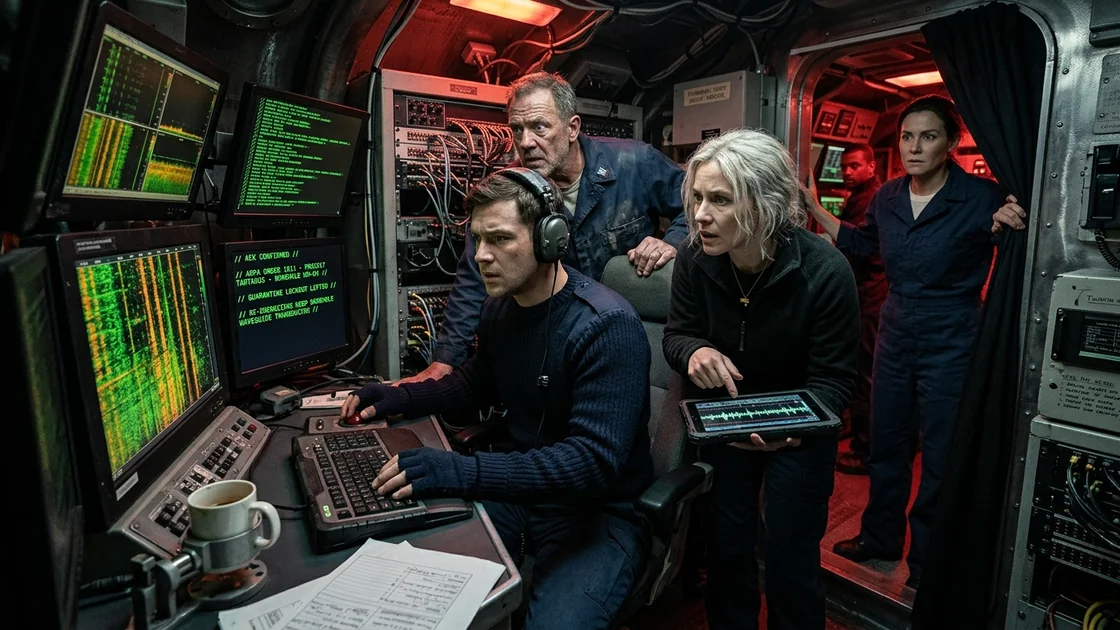
In the crushing darkness of the Kermadec Trench, aboard an experimental deep-submergence naval research vessel, veteran sonar technician Elias Thorne detects a rhythmic acoustic anomaly buried beneath the seismic roar of the ocean floor. While his commanding officers dismiss the ultra-low-frequency pulses as tectonic friction or mechanical resonance, Elias uses time-compression algorithms to speed up the twelve-hour recordings. He discovers that the glacial, booming vibrations in the water column are actually a frequency-shift keyed modem handshake, slowed down by a factor of hundreds to survive the severe multipath distortion of the abyss. Driven by obsession, Elias uses the submarine's acoustic transducer to transmit an answering carrier tone into the dark, inadvertently establishing a data link with a forgotten abyssal installation that has been waiting fifty years to offload its final, terrifying telemetry.
At eight thousand four hundred meters beneath the surface of the South Pacific, the ocean does not merely press against a submarine; it attempts to edit it out of existence.
Aboard the NR-4 Acheron, that editorial pressure manifested as a persistent, crystalline singing in the titanium-alloy pressure spheres. To Petty Officer First Class Elias Thorne, sitting hunched in the blue-black gloom of the acoustic analysis alcove, the hull sounded like a glass rim being rubbed by a wet, giant finger. It was a sound around three thousand hertz, faint and steady, born from eleven hundred atmospheres of frigid water squeezing three-inch-thick forged titanium until the metal’s crystal lattice groaned.
Elias adjusted the left cup of his Sennheiser HD-280 headphones, sliding the foam pad slightly back from his cartilage to relieve the ache of a six-hour watch. His eyes, dry from the scrubbers’ over-oxygenated, amine-tainted air, remained fixed on the primary waterfall display.
On the screen, sound was rendered as cascades of green and amber pixels scrolling relentlessly from top to bottom. This was the Lofargram—Low Frequency Analysis and Recording. Time flowed downward; frequency stretched from left to right, spanning from two hertz at the far left margin to five kilohertz on the right. To an untrained eye, the monitor looked like green rain falling through digital static. To Elias, who had spent eleven years listening to the undersea world through piezoelectric ceramic arrays, it was a living landscape.
"Still chasing the ghost in sector four, Thorne?"
Chief Sonar Technician Arthur Miller stood at the parted blackout curtain of the shack, holding two heavy ceramic mugs of lukewarm Navy coffee. The Acheron was small—an experimental, nuclear-powered deep-submergence research and ocean-engineering vessel, spiritual successor to the old NR-1, though tripled in displacement and fitted with spherical titanium crew pods nested inside a free-flooding syntactic foam outer hull. Because of her compact dimensions, the "sonar shack" was barely a closet wedged between the navigation plot and the auxiliary equipment bay.
"It’s not a ghost if it leaves a trace on the broadband, Chief," Elias said, not looking away from the cascading lines. He reached out with his trackball, dragging a yellow cursor across a faint, broken column of amber dots near the far-left edge of the screen. "Look at the five-hertz band. Right below the volcanic harmonic from the Havre Seamount."
Miller stepped inside, letting the heavy lead-lined curtain drop behind him, sealing out the red night-vision lighting of the control room. He set one mug down in the gimbaled cup holder beside Elias’s elbow and leaned over the console, smelling of stale tobacco—though no one had smoked on the boat in forty days—and the lanolin cream he used on his cracked knuckles.
"That’s bottom-bounce off the trench wall," Miller said, taking a slow sip from his mug. "We’re suspended in a basalt V-notch two miles narrower than the Grand Canyon, Elias. Our own reactor coolant pumps put out a blade-rate signature at six point two hertz. It hits the western scarp, shears through a high-salinity brine pocket at the bottom of the Scholl Deep, and comes back to the flank arrays smeared down to five."
"The coolant pumps are running on low-speed induction right now," Elias countered quietly. He tapped a key, bringing up a secondary Demon—Demodulated Noise—window. "Shaft turns are zero; we’re hovering on the thrusters. And look at the phase coherence. If it were multipath reflection from our own plant, it would drift as the current pushes us through the thermal shear. We’ve moved four hundred yards north-northwest in the last two hours. The bearing to this source hasn't budged by half a degree. Bearing two-zero-four, down-angle thirty-one degrees."
Miller squinted through his bifocals at the down-angle readout. "Thirty-one degrees puts it right into the subduction toe. Ten thousand meters down. That’s the bottom of the ditch, kid."
"I know where it puts it."
"Then you know what’s down there. Cold mud, manganese nodules, amphipods the size of your forearm, and the Pacific Plate grinding itself into magma under the Australian Plate." Miller tapped the screen with a blunt fingernail. "It’s stick-slip tremor. Micro-earthquakes. The rock builds up tension, snaps a millimeter, rings like a tuning fork, settles down, and does it again. Dr. Lindqvist’s seismographs have been logging them since we crossed the Kermadec Ridge."
"Tectonic stick-slip is broadband impulsive, Chief. It looks like a horizontal smear across the waterfall. This is narrowband. And it’s dual-tone."
Elias zoomed in on the frequency domain, expanding the band between three hertz and ten hertz until the individual Fourier bins looked like thick green bricks.
There, amidst the milky nebulas of distant whale falls, ice-calving noise traveling four thousand miles from the Antarctic shelf, and the low rumble of hydrothermal vents, sat two distinct vertical tracks. One rested precisely at 4.46 hertz. The other sat at 5.31 hertz.
They never appeared at the same time. When the 4.46-hertz line was lit, the 5.31-hertz bin was dark. Then, after an interval of roughly eight seconds, the 4.46-hertz tone would vanish, and the 5.31-hertz tone would illuminate. Eight seconds later, it might stay at 5.31, or it might hop back to 4.46.
"See that?" Elias murmured, slipping one headphone cup over his ear again. At four and five hertz, the sound was infrasonic—well below the twenty-hertz threshold of human hearing. To let the operator "hear" it, the BQQ-14 processing suite heterodyned the signal, multiplying the frequencies by a factor of a hundred so they played in the headset as a pair of hollow, flute-like tones at 446 and 531 hertz.
Hoooo...
Eight seconds of low, breathy static.
Heeee...
Sixteen seconds of the higher note.
Hoooo...
"It’s a harmonic pendulum," Miller said, though his voice lacked its earlier certainty. He reached over Elias’s shoulder and toggled the hydrophone group selector, switching from the conformal hull array to the long, thin line of the towed array trailing six hundred yards behind the submarine’s stern stabilizer. Because the Acheron was barely making steerageway at one point five knots, the towed array was drooping downward like a weighted fishing line into the deeper, colder water below them.
The signal on the screen brightened immediately, the signal-to-noise ratio jumping by four decibels. That proved two things instantly: the sound was not an electrical ghost inside the hull’s wiring, and it was definitely coming from below the thermocline.
"Hydrothermal geyser," Miller decided, straightening his back with an audible pop of his lumbar vertebrae. "You’ve got a twin-flue black smoker down in the silt. Superheated water builds up steam pressure in chamber A, vents through a constricted basalt nozzle at four point four hertz for eight seconds, drops pressure, shifts the convective flow to chamber B, which has a narrower throat, so it vents at five point three hertz. Fluid dynamics, Thorne. Nature loves a resonant cavity. Go ask Lindqvist; she’s got a hard drive full of singing vents from the Mid-Cayman Rise."
"A vent that shifts frequencies with a transition time of less than forty milliseconds?" Elias asked. He pointed to the sharp, razor-clean horizontal edges where one brick ended and the other began. "There’s no pressure ramp-up, Chief. No frequency glide. It doesn't Doppler-shift as the plume expands. It steps. Click, click, click. Like a relay."
Miller looked at the chronometer glowing red above the rack. It was 0340 Ship’s Time. Outside the titanium spheres, it had been midnight for twenty million years, a blackness interrupted only by the occasional bioluminescent flash of a lanternfish or a comb jelly drifting past the shuttered viewports. They were forty-two days into a sixty-day classified bathymetric survey for the Office of Naval Research, mapping deep-trench topography where foreign autonomous underwater vehicles might hide. Everyone on the twenty-four-person crew was operating on frayed nerves, vitamin D deficiency, and the subtle cognitive slowing caused by ambient carbon dioxide levels hovering at zero point six percent.
"Log it as Unclassified Acoustic Anomaly Dash Nineteen," Miller said, his tone shifting from conversational to the flat cadence of a Watch Supervisor. "Tag the tape for the shoreside eggheads at Suitland. When we get back to Pearl, some GS-12 with a MATLAB license can spend six months proving it’s a crustacean clicking its claws in an echo chamber. Right now, Petty Officer Barnes is fifteen minutes away from relieving you, and I want the routine bathythermograph profile compiled before the XO comes on watch at zero-four."
Elias stared at the green bricks for another three seconds. Hoooo. Heeee.
"Aye, Chief," he said, and minimized the window.
He didn't go to his rack when Barnes relieved him at 0400.
The berthing spaces aboard the NR-4 Acheron were located in the lower hemisphere of the forward titanium sphere, arranged in three-high coffin racks separated by thin Nomex privacy curtains. With twenty-four crew members—eighteen Navy dolphin-wearers and six civilian specialists from Woods Hole and Scripps—hot-racking wasn't necessary, which was the only luxury the boat afforded. Still, lying in the dark meant listening to the hull creak, and listening to the hull creak meant thinking about thirty-six million pounds of water resting directly on top of the hatch cover twenty feet above his forehead.
Instead, Elias took his coffee mug forward into the mess area—a space the size of a walk-in closet featuring a single stainless-steel table bolted to the deck plates—and found Dr. Linnea Lindqvist hunched over a ruggedized Panasonic Toughbook.
Lindqvist was forty-five, a native of Gothenburg with silver-streaked blond hair pulled into a severe knot and dark, sunken rings beneath her eyes that made her look like a deep-sea organism herself. Around her neck hung a tiny gold geological hammer on a fine chain. Spread across the tabletop around her laptop were high-resolution sidescan sonar mosaics of the Kermadec floor, printed on damp-resistant thermal paper.
"You're up early, Elias," she said without looking up, her fingers flying across the trackpad as she rotated a three-dimensional wireframe model of a trench wall. "Or up late."
"Just off the mid-watch, Doctor," Elias said, sliding onto the vinyl bench opposite her. The deck had a permanent two-degree down-bubble tilt as the Acheron glided along the contours of the trench wall. "Chief Miller thinks you have a pair of singing chimneys down at bearing two-zero-four."
Lindqvist paused, her brow furrowing. She tapped a key, bringing up her own suite of telemetry—data pulled from the submarine’s nose-mounted laser-line scanners, sub-bottom chirp profilers, and the sensitive three-axis ocean-bottom seismometers they had dropped on free-fall anchors two days prior.
"Two-zero-four?" She cross-referenced the ship's inertial navigation log on the corner of her screen. "That’s the horst-and-graben fault complex at the base of the trench axis. Nine thousand eight hundred meters. Why does Miller think there are hydrothermal vents down there?"
"Because I've been tracking a continuous, alternating dual-frequency signal from that bearing for the last five hours," Elias said. He pulled a folded scrap of yellow legal pad from his breast pocket, where he had jotted down the exact parameters before handing the console over to Barnes. "Four point four six hertz and five point three one hertz. Square-wave modulation envelope. Eight-second dwell times minimum, always occurring in exact multiples of eight seconds. Eight, sixteen, twenty-four, thirty-two."
Lindqvist leaned back against the bulkhead, pulling off her reading glasses and rubbing the bridge of her nose. "First of all, Elias, the Kermadec Trench is an active subduction zone, not a spreading center. All the volcanic and hydrothermal activity is sixty miles west of us, up on the Kermadec Arc where the subducting slab melts and rises—places like Brothers Volcano and the Rumble Seamounts. Down here in the trench axis itself? The crust is old, cold Cretaceous seafloor being bent downward and snapped. The water temperature at the bottom of that slot is one point one degrees Celsius. There is no magma near the surface down there. There are no black smokers."
"Cold seeps, then?" Elias suggested, playing devil's advocate for the Chief's theory. "Methane clathrate hydrates bubbling out of the accretionary prism?"
"At nine thousand eight hundred meters, the hydrostatic pressure is nearly a thousand bars," Lindqvist said, her voice taking on the patient, lecturing rhythm of a university professor. "At that pressure and temperature, methane gas doesn't bubble; it stays locked in solid ice cages, or it dissolves directly into the pore water without a phase boundary. You don't get rhythmic gas-pocket burping at hadal depths. The physics won't allow a gas phase to form a resonant bubble."
Elias felt a tiny, electric prickle along the nape of his neck. "So what makes a cold slab of Cretaceous basalt hum at two distinct frequencies in multiples of eight seconds?"
"Nothing natural," Lindqvist said simply. She rotated her laptop so Elias could see the screen. Displayed was a bathymetric contour map of the trench floor, rendered in false-color blues and purples to denote extreme depth. "Unless it’s one of ours. Or one of theirs."
She pointed a pen tip at a dark purple gash in the center of the map, labeled SCHOLL DEEP - SOUTHERN EXTENSION.
"Look at the morphology here," she said. "The Pacific Plate is moving westward at about eighty millimeters a year, diving under the Tonga-Kermadec ridge. Normally, the trench floor is filled with a thick blanket of pelagic clay and turbidite mud that slides down the slopes—a flat, silty pond at the bottom of the V. But right here, at bearing two-zero-four, a massive submarine landslide occurred sometime in the mid-Holocene. Millions of tons of serpentinite rock sheared off the upper wall and scoured the trench floor clean, exposing the raw basaltic basement rock before piling up as a natural dam on the eastern side."
"A rock canyon inside the canyon," Elias noted, studying the jagged, steep gradients on the wireframe.
"Exactly. A box canyon of sheer, unweathered rock, ten kilometers down. If the Russian Navy or the PLA Navy dropped an autonomous acoustic beacon or a seabed surveillance node down there, it would sit in that rock amphitheater like a pearl in an oyster."
"No modern seabed node transmits at four hertz, Doctor," Elias said, shaking his head. "Do you know how big an acoustic transducer has to be to efficiently generate a four-hertz sound wave in water? The speed of sound at this depth and pressure is roughly fifteen hundred and ninety meters per second. Divide fifteen-ninety by four point five hertz. The wavelength is over three hundred and fifty meters long."
Lindqvist blinked, doing the mental math. "A quarter-wave resonant dipole would have to be nearly ninety meters long."
"Right," Elias said, his voice dropping so it wouldn't carry past the galley bulkhead toward the officer's wardroom. "You can't generate a clean, non-harmonic four-hertz continuous tone from a lunchbox-sized lithium battery pack dropped off a Russian spy trawler. To couple that kind of ultra-low-frequency energy into the water column without massive distortion, you either need a hydrodynamic projector the size of a warehouse, or you have to use the rock itself as a sounding board—bolting giant magnetostrictive terfenol drivers directly into a fault line."
Lindqvist stared at him, her eyes narrowing behind the pale lashes. "Have you talked to Commander Vance about this?"
"If I go to the Captain with 'giant rock-mounted sub-woofers at ten thousand meters,' she’ll have the corpsman screen me for hypercapnia and pull me off the watch bill," Elias said. "I need to look at the raw data first. Without the BQQ-14's automated smoothing filters."
"The sonar shack logs everything to the ship's network storage, doesn't it?"
"The processed waterfall, yes. Not the raw, un-decimated hydrophone voltage streams. Those overwrite on a twelve-hour circular buffer unless a technician manually dumps them to an external scratch drive." Elias tapped his knuckles against the steel table. "And to dump the raw buffer from the auxiliary terminal in the equipment bay, I need diagnostic administrative privileges. Which only the Chief, the XO, and the Mission Specialist hold."
He looked pointedly at the security keycard clipped to the lanyard alongside Lindqvist’s tiny gold hammer.
For a long moment, the only sound in the mess was the rhythmic chug-whir of the trash compactor hydraulic pump in the machinery space aft and the distant, endless singing of the titanium hull. Lindqvist looked down at her map of the scoured rock canyon, then back at Elias.
"My seismometers have been picking up an anomalous ground-coupled Rayleigh wave on that exact azimuth since midnight," she said quietly, unclipping the cryptographic smartcard from her lanyard and sliding it across the scarred steel table under the cover of a thermal printout. "I thought it was an internal clock error in my analog-to-digital converter because the timing was so rigid. Bring the card back before zero-six-hundred, Elias. If Lieutenant Sterling catches you in the server rack, tell him I asked you to recalibrate the time-code generator for the chirp profiler."
The auxiliary equipment bay was the coldest compartment on the NR-4 Acheron. While the control room and living quarters were insulated with two inches of closed-cell neoprene foam glued over the interior titanium ribs, the equipment bay left the curved hull metal bare to help dissipate the heat of the blade servers and signal-processing racks. Moisture from the crew’s breath condensed on the freezing titanium dome, trickling down into bilge gutters with a quiet, subterranean dripping sound.
Elias sat on an overturned milk crate in front of Rack 4, wearing his navy-blue wool watch sweater and a pair of fingerless knit gloves. He had slotted Lindqvist’s smartcard into the maintenance terminal, bypassed the standard fleet graphical interface, and dropped straight into a raw Red Hat Linux command prompt.
He wasn't using the Navy's multi-million-dollar acoustic classification software now. Those algorithms were designed to find Soviet-era double-hulled submarines, high-speed torpedoes, and surface merchant screws. They used pre-built neural networks that actively stripped out steady, non-Doppler-shifting background signals as "environmental clutter" so the operator wouldn't be distracted by geological noise.
Elias wanted the clutter.
He isolated a single hydrophone element—Element 48, located at the very tail of the drooping towed array, hanging in the pristine, dead-calm water at eight thousand seven hundred meters—and pulled the raw, twenty-four-bit PCM audio stream from the past twelve hours. It was a forty-gigabyte file of pure pressure variations.
Opening an open-source audio manipulation utility he had kept on his personal maintenance partition since his days at the fleet acoustic analysis school in San Diego, Elias loaded the twelve-hour waveform.
He isolated the band between 3.5 hertz and 6.5 hertz using a steep Chebyshev bandpass filter, cutting away the shriek of the submarine's own electronics, the thrum of the distant surface waves, and the seismic groans below two hertz. What remained on his monochrome monitor was a tight, continuous ribbon of oscillating voltage.
He zoomed in to the time domain.
There it was. A continuous sinusoidal wave. No—two sinusoidal waves, alternating cleanly. Every eight point zero-zero-zero seconds, the wave either stayed at its current frequency or flipped to the other. There were no gaps of silence between them. The amplitude remained utterly constant at eighty-four decibels relative to one micropascal—barely louder than the ambient thermal agitation of the water molecules themselves, yet unnervingly steady.
"Eight seconds per state," Elias whispered to himself, his breath pluming faintly in the forty-eight-degree air of the bay. "Why eight seconds?"
He thought about his father’s garage in rainy Bremerton, Washington. Before Elias joined the Navy to escape the logging towns of the Olympic Peninsula, his father—a retired AT&T long-lines technician—had filled their basement with humming racks of olive-drab Teletype machines, Model 28 ASR page printers, and Western Electric acoustic couplers. Elias had grown up falling asleep to the clatter of mechanical typebars and the warbling, bird-like shrieks of shortwave radioteletype transmissions bouncing off the ionosphere.
In telecommunications, when you sent digital data over an analog medium—like a copper telephone wire, a shortwave radio band, or forty thousand feet of salt water—you couldn't just send raw electrical pulses of voltage and non-voltage. The medium would absorb the sharp edges, turning square pulses into unrecognizable mush. Instead, you used Frequency-Shift Keying. FSK.
One tone represented a binary One—a Mark.
A second tone represented a binary Zero—a Space.
"No," Elias muttered, his heart beginning to thud against his ribs. "No, that's crazy. That’s a symbol rate of zero point one two five baud. One bit every eight seconds."
Why would anything transmit digital data at an eighth of a bit per second? At that speed, sending a single eight-bit ASCII character—plus a start bit and a stop bit—would take eighty seconds. A single sentence would take an hour.
Wait. What if it wasn't meant to be listened to in real time? Or rather, what if the physics of the trench forced it to be that slow?
Elias’s fingers flew across the cold mechanical keyboard. He wrote a quick command-line script using SoX—Sound eXchange—to resample the twelve-hour audio recording, compressing the time domain while allowing the pitch to scale upward proportionally.
If one bit took eight seconds in the water, what multiplier would bring that symbol rate up to a standard, legacy telecommunications baud rate?
The oldest, most ubiquitous frequency-shift keyed modem standard in the history of computing was the Bell 103 standard, introduced by AT&T in 1962. It ran at 300 baud—three hundred bits per second.
If the signal in the trench was running at 0.125 bits per second, and you wanted to speed it up to 300 bits per second...
Elias typed 300 / 0.125 into the terminal
calculator.
2400.
A factor of two thousand four hundred.
If he sped the recording up by 2,400 times, a twelve-hour recording of forty-three thousand two hundred seconds would compress down into exactly eighteen seconds of audio.
And what would happen to the frequencies?
He typed the numbers with trembling fingers.
4.4583 Hz * 2400 = 1070.0 Hz.
5.3125 Hz * 2400 = 1275.0 Hz.
Elias froze. The hair on his forearms stood straight up under the wool of his sweater.
He didn't need a manual to look up those two numbers. They were burned into the memory of every telecom geek, phreaker, and signals intelligence technician born in the twentieth century.
In the Bell 103 modem specification, the originating station transmitted in the low band: a Space (binary 0) was 1070 hertz. A Mark (binary 1) was 1270 hertz—shifted by barely five hertz here due to the high-pressure sound-velocity Doppler correction of the deep trench water.
Elias slipped his headphones over his ears, plugged the jack into the diagnostic port of Rack 4, and executed the time-compression script on the twelve-hour buffer.
The hard drive clicked. A progress bar flashed across the terminal screen in less than two seconds.
PLAYING: element48_compressed_2400x.wav (Duration: 00:18.00)
In his ears, the deep, silent abyss of the Kermadec Trench vanished.
In its place came a crisp, unmistakable, electronic sound that echoed out of 1974:
Beeeeeee-doop-boop-beeeeee-bip-boop-boop-beeeeeeeeeee...
It was the sound of an originating modem dialing into the dark, sending a periodic inquiry packet, holding the Mark carrier tone open, waiting for an answering station to respond with a 2225-hertz tone, timing out, dropping carrier, waiting, and dialing again.
Every twelve hours of real time was an eighteen-second handshake cycle.
Down in the freezing, pitch-black mud at nine thousand eight hundred meters, crushed under eight tons per square inch of water, something was lifting an acoustic receiver off the hook and asking if anyone was there.
"Play it again," Commander Evelyn Vance said.
It was 0715. The wardroom of the NR-4 Acheron was barely larger than the mess deck, paneled in fake teak laminate that had begun to peel at the corners from forty cycles of deep hull compression and decompression. Around the narrow table sat the boat's triad of authority: Commander Vance, a sharp-featured, former fast-attack navigator with twenty years in the silent service; Lieutenant Marcus Sterling, the Executive Officer, whose spotless khakis somehow still held creases six weeks after leaving Pearl Harbor; and Dr. Lindqvist.
Elias stood at the foot of the table, his Toughbook connected to a small external speaker resting beside the silver plated sugar bowl. Chief Miller stood behind him in the doorway, his arms crossed over his barrel chest, his expression a mixture of professional defensiveness and deep unease.
Elias hit the spacebar.
From the speaker came the surreal, rapid-fire warble of the two-thousand-four-hundred-times accelerated recording. First, a two-second burst of pure 1270-hertz carrier tone—which, in the water outside the hull, had actually been a continuous, eighty-minute sub-bass rumble. Then came a crisp cascade of alternating 1070-hertz and 1270-hertz chirps—the binary inquiry header—followed by six seconds of steady Mark tone while the transmitter listened for a reply, then three seconds of dead silence before the cycle repeated.
"Explain to me again why it’s so slow in the water, Petty Officer Thorne," Commander Vance said. She held a stainless-steel mechanical pencil between her fingers, tapping the eraser end silently against her closed mission binder. "If someone built a seabed transponder down there, why not just transmit a two-second burst at ten kilohertz and be done with it? Like our own Sonardyne positioning beacons."
"Multipath reverberation and high-frequency attenuation, Ma'am," Elias said, stepping forward and pointing to a sketch he had drawn on the wardroom whiteboard. He had drawn a narrow V representing the Kermadec Trench, with a star at the very bottom. "Our Sonardyne beacons work because we use them in a direct vertical path over short ranges—a thousand yards or less—and we use spread-spectrum digital signal processing that wasn't invented until the late nineteen-eighties. Even then, in a narrow rock slot like the Scholl Deep, a ten-kilohertz pulse bounces off the western wall, hits the eastern wall, reflects off the brine layer, and arrives at the receiver fifty different times over a four-second window. In acoustics, we call that delay spread."
"If your delay spread is four seconds long," Dr. Lindqvist chimed in, leaning across the table, "and you try to send three hundred bits per second, every bit smears into the next twelve hundred bits. It’s like trying to shout a telegraph code inside a tiled cathedral; the echoes of the first letter completely drown out the rest of the word."
"Exactly," Elias said, grateful for the reinforcement. "Look at the physics of the trench. If the acoustic echo in that basalt canyon takes five or six seconds to die down after a change in tone, there is only one way to send error-free digital data using simple, vintage Frequency-Shift Keying: you have to make each individual bit last longer than the echo."
Lieutenant Sterling frowned, leaning forward onto his elbows. "Eight seconds per bit."
"Eight seconds per bit," Elias confirmed. "You turn on the 4.46-hertz tone. It echoes off the trench walls for five seconds until the entire bottom of the canyon is saturated in steady-state standing waves. During the final three seconds of that window, any receiver in the trench reads a clean, unmistakable binary Zero. Then you switch to 5.31 hertz. Wait five seconds for the reverberation to settle, read a binary One during the last three seconds. And by using infrasound below six hertz, the attenuation in seawater is virtually zero. That signal doesn't get absorbed by magnesium sulfate or boric acid in the water like high frequencies do. It could travel across the entire Pacific basin inside the SOFAR channel if it weren't trapped by the trench walls."
"Wait," Sterling said, holding up a hand. "You kept saying 'vintage.' And 'Bell 103.' You're telling the Captain that there is a nineteen-sixties telephone modem sitting at the bottom of the second-deepest trench on Earth?"
"I didn't say the hardware is a desk modem, sir," Elias said carefully. "I said the protocol is Bell 103. Specifically, it’s asynchronous 8-N-1 framing—eight data bits, no parity bit, one stop bit—encoded in Baudot or seven-bit ASCII. I already manually demodulated the inquiry header that repeats before the carrier wait-state."
The wardroom went dead silent. Even the drip of condensation in the passageway outside seemed to pause.
"You decoded it?" Vance asked, her gray eyes locking onto Elias with laser intensity. "What does the header say?"
Elias reached into his pocket and pulled out the yellow slip of paper, placing it flat on the fake teak table in front of the Captain. Printed in his neat, block-capital sonar-log handwriting was a short string of characters:
[SYN][SYN][ENQ] TARTARUS-04 BUFFER FULL // AWAITING ACK //
Commander Vance stared at the slip of paper for a long time without touching it.
"SYN and ENQ are non-printing ASCII control characters," Elias
explained softly. "Binary 00010110 for Synchronous Idle,
and 00000101 for Enquiry. In old mainframe polling
networks—like the ones IBM and Bell Labs built for the Defense
Department in the late sixties—a remote unattended terminal would send
[SYN][SYN][ENQ], followed by its station identifier, and
then hold the Mark tone open while waiting for the central computer to
send back an ACK—an Acknowledge tone—to trigger the data
dump."
"Tartarus Dash Zero Four," Sterling read aloud, a skeptical smirk tugging at the corner of his mouth, though it didn't reach his eyes. "Come on, Captain. Is this a drill? Did Submarine Development Squadron Five plant a training target down here before we deployed to test our non-standard acoustic recognition?"
"At nine thousand eight hundred meters, XO?" Commander Vance said quietly. Her voice was entirely devoid of inflection. "How many vessels in the United States Navy can reach nine thousand eight hundred meters?"
Sterling’s smirk faded. "Just us, Ma'am. And the unmanned Nereus prototypes before they imploded."
"And how much does a syntactic foam and titanium pressure housing rated for ten thousand meters cost?"
"Hundreds of millions," Lindqvist answered when Sterling stayed silent. "And as Elias pointed out earlier, you couldn't produce a continuous four-hertz tone at eighty-four decibels from a drop-sonobuoy. Whatever is making this sound is either physically massive—anchored into the bedrock of the subduction fault—or it has a nuclear radioisotope thermoelectric generator the size of a city bus powering a hydraulic acoustic resonator."
Chief Miller cleared his throat from the doorway. "Captain, if I may... back in the seventies, during Project Caesar and the early SOSUS expansions, Bell Labs and Western Electric did all kinds of black-budget deep-water installations. My first LPO on the Kamehameha used to talk about the 'Deep Bottom' arrays—experimental seismic-acoustic stations they dropped into the trenches to listen for Soviet underground nuclear tests through the oceanic crust. They used RTGs—plutonium-238 thermo-piles—built to run for half a century."
"Why down in the Kermadec Trench?" Sterling asked. "The Soviets didn't test nukes in New Zealand."
"No," Lindqvist said slowly, her fingers tracing the edge of her bathymetric map. "Wait. In the late nineteen-sixties and early seventies, the French were testing thermonuclear devices at Mururoa Atoll in the Tuamotu Archipelago, and the Americans had just finished high-altitude and underwater tests at Johnston Island and Amchitka. More importantly, during the International Geophysical Year and Project Mohole, there was a massive, classified push to study the Mohorovičić discontinuity—the boundary between the Earth’s crust and the mantle. Where is the crust thinnest and closest to the mantle?"
"In a deep-ocean subduction trench," Elias said.
Commander Vance picked up the yellow slip of paper, folded it neatly in half, and slid it into her breast pocket, buttoning the flap. The gesture had the finality of a vault door closing.
"Chief Miller," she said.
"Ma'am."
"You and Petty Officer Thorne will package the raw hydrophone recording from Element 48, along with Thorne’s time-compression script and ASCII demodulation notes, onto a classified optical disk. Lock it in the cryptographic safe in the radio room. Then you will purge the scratch partition on Rack 4 and overwrite the unallocated sectors with zeros."
Elias felt his stomach drop. "Captain? We’re right over it. The signal-to-noise ratio is peaking. If we just drop down another four hundred meters to the lip of the Scholl canyon—"
"Our safe operating depth is eight thousand five hundred meters, Petty Officer Thorne," Vance cut in, her voice steel. "Crush depth for the titanium spheres is calculated at eleven thousand, assuming zero metallurgical defects in the welds, which is an assumption I am not paid to test. Furthermore, our operational orders from COMSUBPAC are to complete a passive bathymetric and gravimetric survey of Grid Lima-Seven while maintaining absolute acoustic silence."
"Ma'am, the station says its buffer is full," Elias pressed, forgetting naval protocol in the heat of the moment. "It’s been repeating that fifteen-character inquiry string—what—every twelve hours for decades! Think about the telemetry sitting in that memory core. Deep-crustal data, oceanic acoustics from before we were born—"
"Or nothing that concerns this vessel," Vance said, standing up from the table. In the low-ceilinged wardroom, the top of her dark hair nearly brushed the overhead cable trays. "What if it isn't a nineteen-seventies Bell Labs science experiment, Thorne? What if it’s an adversary autonomous system using a spoofed, ultra-slow legacy protocol specifically because it knows our modern BQQ-14 filters will ignore five-hertz narrowband tones as geological noise? What if it’s a wake-up trigger for a seabed mine or an acoustic tracking array waiting for an American research sub to be curious enough to ping it back?"
Elias opened his mouth, then closed it. In the submarine community, that argument was unassailable. Acoustic discipline was religion; transmitting an active signal when your mission orders specified passive-only was a court-martial offense.
"We log the coordinates," Vance commanded, looking from Miller to Lindqvist, and finally back to Elias. "We let the Acheron drift past bearing two-zero-four on the current track at one point five knots. When we return to Pearl Harbor, ONI can send a disposable fiber-optic ROV down into the hole to shake hands with it. Am I clear?"
"Crystal, Captain," Chief Miller said, nudging Elias’s shoulder with a heavy hand.
"Aye, Ma'am," Elias said, looking down at his Toughbook.
"Good. XO, give me a course correction of five degrees to starboard at the zero-eight-hundred watch change to keep us clear of the eastern landslide scarp. Dismissed."
Throughout the afternoon watch—if "afternoon" had any meaning eight kilometers below a sea surface none of them had seen since September—Elias sat at the primary sonar console and watched the green bricks on the far left of the Lofargram slowly, agonizingly begin to fade.
As the NR-4 Acheron crept northward at the speed of a strolling pedestrian, the jagged rock lip of the submarine landslide began to interpose itself between the drooping towed array and the bottom of the Scholl Deep. Acoustic shadows in the deep ocean are sharp and unforgiving; once the submarine passed north of the rock ridge, the 4.46-hertz and 5.31-hertz tones would be blocked by forty million tons of serpentinite stone.
[SYN][SYN][ENQ] TARTARUS-04 BUFFER FULL // AWAITING ACK //
He couldn't stop hearing the accelerated warble in his head. Beeeeeee-doop-boop-beeeeee...
Why had the Captain's theory about an adversary spoofing system rung so hollow to him? Because Elias knew sound the way a master sommelier knew wine. Modern digital-to-analog hydroacoustic projectors—the kind built by China or Russia in the twenty-first century—used pulse-width modulated class-D amplifiers and synthetic piezoelectric composites. Even when programmed to emit a low-frequency sine wave, they left microscopic switching artifacts in the upper kilohertz bands, tiny mathematical fingerprints of solid-state silicon.
When Elias had inspected the raw spectrogram of
TARTARUS-04 in the equipment bay, there had been zero
switching artifacts. Instead, during the forty-millisecond transition
between the 4.46-hertz Space tone and the 5.31-hertz Mark tone, there
was a microscopic, mechanical clunk—a tiny broadband transient
caused by a physical valve shifting fluid flow or an electromechanical
solenoid changing the tension on a tuned acoustic diaphragm.
Whatever was down at nine thousand eight hundred meters didn't have a modern microprocessor inside it. It was built out of nineteen-sixties discrete transistor logic, core rope memory or magnetic drum storage, and heavy, nuclear-heated hydraulic muscles.
During his evening off-watch period at 2000 hours, while the rest of the off-duty crew watched a pirated movie on the mess deck screen, Elias retreated to the tiny corner near the ship’s technical library—a pair of locked filing cabinets bolted next to the reactor control compartment.
Every nuclear submarine carries an extensive collection of historical oceanographic charts and legacy acoustic reference manuals—printed on physical paper in case an electromagnetic event or saltwater ground fault fries the computer network. Elias didn't have the key to the classified intelligence binder, which was around the XO's neck, but he did have access to the Fleet Hydrographic and Bathymetric Reference Series, Volume IX: South Pacific Trenches (1964–1982).
He pulled the massive, three-ring leatherette binder onto his lap, sitting cross-legged on the rubber deck matting beside the humming reactor instrumentation panels, and flipped to the section on the Kermadec-Tonga Subduction Zone.
Most of the pages were faded blue-line reproductions of depth-soundings taken by surface ships during the Cold War—the USNS Josiah Willard Gibbs, the RV Vema, the Soviet research vessel Vityaz.
Then, near the back of the 1973 supplement, Elias found a page that had been partially excised.
Someone—decades ago, before the binder was transferred from the decommissioned NR-1 to the NR-4—had used a razor blade to slice three paragraphs out of a hydrological survey report titled Deep-Axis Benthic Acoustic Propagation Trials (Project TARTARUS / ARPA Order 1911).
The text was gone, leaving a rectangular window looking through to the page behind it. However, the person wielding the razor blade had forgotten to remove the corresponding footnote on the facing diagram.
The diagram showed a cross-section of the Kermadec Trench at Latitude 31° 48' South. At the very bottom of the V-shaped profile was a tiny black triangle labeled STA-04 (Deep Borehole / Geophone Package).
Beneath the diagram, printed in tiny six-point Courier font, the surviving footnote read:
Note 4: Station 04 utilizes a bespoke Sub-Hertz Acoustic Telemetry Link (SHATL) scaled at 1:2400 relative to Western Electric 103A-2 carrier standards to overcome axial trench reverberation. Interrogating submersibles (see: Bathyscaphe TRIESTE II deep-refit configuration) must project an unmodulated Answer Mark tone of 9.2708 Hz (2225 Hz scaled) for a minimum duration of 120 seconds to latch the remote relay and initiate core-memory playback. CAUTION: Manual override codes required prior to clearing seismic safety buffers.
Elias stared at the page until the tiny black letters swam before his eyes.
ARPA Order 1911. Bathyscaphe Trieste II.
He knew the history of the Trieste II. After the original bathyscaphe Trieste went to the bottom of the Mariana Trench in 1960, the Navy rebuilt her into the Trieste II and used her throughout the late sixties and early seventies for ultra-secret deep-ocean recovery and installation missions—like recovering lost spy satellite film capsules and planting things on the ocean floor that no one else could reach. Then, in the mid-seventies, deep-trench manned bathyscaphe operations were abruptly canceled. The Trieste II was retired to a museum in Keyport, Washington—ten miles from where Elias grew up.
They had planted at least four deep-borehole stations in the trenches under Project Tartarus, designed to be periodically visited and "milked" of their data by the Trieste II.
Then the program was defunded, or classified into oblivion, or the budget shifted to satellites. No bathyscaphe ever came back to Latitude 31° 48' South.
And Station 04 had sat there in the dark, powered by a half-century plutonium core, recording whatever was happening deep inside the subduction fault until its magnetic core memory filled to capacity. Since that day, it had been calling out into the canyon, waiting for the Trieste II to come back and send a two-minute, 9.2708-hertz tone so it could finally speak.
Two minutes, Elias thought. One hundred and twenty seconds.
Once the NR-4 Acheron steamed past the northern ridge of the Scholl Deep around 0200 tomorrow morning, the acoustic path would close. No manned vessel capable of reaching nine thousand meters would come back to the Kermadec Trench for another fifty years. By then, the plutonium-238 core at the bottom of the trench—with its eighty-seven-year half-life—would finally decay below the voltage threshold needed to drive the hydraulic resonator. Station 04 would die with its memory full, taking whatever it had heard in the deep crust to the grave.
Elias closed the heavy leatherette binder with a soft thud.
He had the 0000 to 0400 mid-watch again.
On a research submarine operating at slow speed in an empty ocean, the mid-watch is the deadest time in human existence. The Officer of the Deck was Lieutenant Junior Grade Halloway, a twenty-four-year-old fresh out of the nuclear power school pipeline who spent the entire four hours sitting in the conn chair reviewing engineering qualification manuals under a red gooseneck lamp. On the planesman’s bench sat Seaman Rivera, eyes glazed, monitoring the automated hover-thruster computer that kept the boat at a steady eight thousand three hundred meters.
Chief Miller had stayed up until 0100 verifying the routine equipment logs, then announced his intention to rack out for three hours after eating a heavy bowl of chili mac, leaving Elias as the sole operator in the sonar alcove behind the blackout curtain.
At 0140, the green bricks on the Lofargram were down to two decibels above the ambient noise floor. In another twenty minutes, the Acheron would clear the rock promontory to starboard, and the canyon would be sealed behind them.
Elias looked at the underwater telephone panel—the AN/WQC-2, known to generations of submariners simply as Gertrude—mounted in the upper right corner of his console.
Normally, Gertrude operated in the eight-to-eleven-kilohertz voice band for talking to other submarines or surface ships. However, because the NR-4 Acheron was an ocean-engineering platform, her acoustic projector suite was heavily modified. Mounted inside her free-flooding chin dome was a massive, fluid-filled flextensional transducer—the BQR-19L—used for low-frequency sub-bottom seismic profiling and long-range acoustic tomography calibration.
It could project frequencies down to three hertz.
To fire the BQR-19L at full power—two hundred and ten decibels—required the Officer of the Deck’s physical key switch on the conn panel, and it would rattle every coffee mug on the boat like a sledgehammer hitting the hull.
I don't need two hundred and ten decibels, Elias reasoned, his pulse hammering in his temples as he stared at the calibration patch bay at the bottom of his rack. We're less than three thousand yards slant-range from the canyon floor. And there's a direct downward refraction path into the trench axis.
How much power had the Trieste II used in 1973? The old bathyscaphe ran on lead-acid batteries; she couldn't have spared more than a hundred watts for an interrogation transducer. If Elias drove the BQR-19L at zero point five percent power—using the internal transducer calibration circuit meant for checking impedance matching without actually "transmitting" according to the conn's power meters—it would put out maybe a hundred and thirty decibels in the water.
At nine point two seven hertz, nine hertz was completely below human hearing, and well below the resonant frequency of the titanium pressure spheres. No one inside the boat would hear it. No one would feel it, except perhaps as a faint, imperceptible tickle in the soles of their boots that felt identical to the hover-thrusters pulsing.
And on the conn's power distribution panel, a hundred-watt draw looked like someone turning on the hot-water urn in the galley.
"You're going to get busted down to E-3," Elias whispered to his own reflection in the dark glass of the secondary monitor. "Captain's Mast. Loss of security clearance. Six months scraping rust in Norfolk."
He looked back at the waterfall display.
Hoooo... Heeee... Hoooo...
The signal was holding on the 5.31-hertz Mark tone right now. The six-second compressed wait window—which in real time was a fourteen-thousand-four-hundred-second, or four-hour, listening window following each inquiry string.
Wait. He re-checked the cycle timing from his earlier notes. The
inquiry string took thirty-six minutes to transmit in real time
([SYN][SYN][ENQ] TARTARUS-04 BUFFER FULL // AWAITING ACK //
was fifty-six characters, times ten bits per character, times eight
seconds per bit = 4,480 seconds, or seventy-four minutes). After the
seventy-four-minute inquiry string finished, the station held the
5.31-hertz carrier open for four hours, waiting for the 120-second
ANSWER tone before resetting.
Right now, the station was forty minutes into its four-hour listening window. It was actively waiting for the handshake to complete.
Moving with the quiet, methodical economy of a man who had spent a decade working in dark rooms, Elias reached under the console and pulled a shielded BNC coaxial patch cable from the spare parts drawer.
He connected one end to the auxiliary headphone output of the diagnostic Linux terminal. He connected the other end to the External Waveform Input jack of the BQR-19L impedance calibration module.
On his terminal screen, he opened the command-line tone generator and typed:
play -n synth 120 sine 9.2708 vol -18dB
One hundred and twenty seconds. A pure sine wave at nine point two seven zero eight hertz. Attenuated by eighteen decibels to keep the amplifier current under one amp.
Elias parted the blackout curtain half an inch and peered into the red-lit control room.
Lieutenant Halloway had his forehead resting on his palm, highlighting a passage in his reactor plant manual. Seaman Rivera was quietly chewing on a plastic coffee stirrer, staring at the depth gauge.
Elias let the curtain fall back into place. He sat down, placed both
cups of his headphones tightly over his ears, hovered his right index
finger over the ENTER key, and closed his eyes.
It's just an ACK, he told himself. Just saying hello.
He pressed the key.
On the terminal screen, the countdown timer began to tick upward.
00:01... 00:02... 00:03...
In his headphones, the heterodyned monitor feed from the chin array bloomed with a deep, warm, velvety hum—the 9.27-hertz tone being pushed out through the syntactic foam of the bow into the freezing black water of the Kermadec Trench.
Through the steel deck plates beneath his boots, Elias felt it: a phantom vibration, so low and slow it felt less like sound and more like a rhythmic flexing of gravity itself, nine times every second.
At fifteen hundred and ninety meters per second, his signal crossed the three thousand yards of vertical and slant distance to the bottom of the Scholl Deep in just under two seconds.
Right now, down in that lightless box canyon of scoured Cretaceous basalt, a ninety-meter acoustic dipole bolted to the subduction fault was vibrating in sympathy with his nine-hertz wave. Inside a titanium cylinder crusted in fifty years of manganese oxide and white tube worms, a tuned reed relay or an analog bandpass filter was tasting that frequency, charging a capacitor over two slow minutes to verify it wasn't a random seismic tremor.
00:45... 00:46...
In the control room outside, someone coughed. Elias’s hand remained poised over the BNC cable, ready to yank it out of the jack if the curtain twitched.
01:15... 01:16...
On the primary Lofargram, the bright green vertical line of his own outgoing 9.27-hertz calibration tone sat parallel to the faint amber track of Station 04’s 5.31-hertz waiting tone.
01:58... 01:59... 02:00.
The script terminated. The outgoing 9.27-hertz line on the waterfall ended cleanly.
Two seconds for the end of his transmission to reach the bottom. Two seconds for whatever happened next to climb back up the water column to the Acheron.
One. Two. Three. Four.
On the waterfall display, the faint, steady 5.31-hertz line from the bottom of the trench abruptly vanished.
For eight seconds, the five-hertz band went completely dark.
Elias held his breath, his fingers digging into the padded armrests of his chair. Had he killed it? Had the relay tried to throw after fifty years of corrosion, shorted out its bus bar, and blown a fuse in the deep?
Then, at the eight-second mark, the waterfall lit up.
It didn't light up at eighty-four decibels.
A blazing, blindingly bright white-and-red vertical column erupted at 5.31 hertz and 4.46 hertz—jumping from eighty-four decibels to over one hundred and forty decibels.
Station 04 had switched from its low-power "standby beacon" mode to its full-power primary telemetry transmitter.
And it didn't stop there.
Across the bearing indicator at the top of the screen, a second narrowband track ignited at bearing one-nine-eight—two miles south along the trench axis. Then a third at bearing two-one-two, three miles north. They were operating on staggered frequency pairs—6.12 and 6.98 hertz; 7.40 and 8.25 hertz—forming a multi-channel multiplexed acoustic trunk line along the entire floor of the Scholl Deep.
In his headphones, the heterodyned sound was no longer a lone, ghostly flute note. It was a deafening, polyphonic organ chord of shifting, interlocking tones echoing up from the abyss, accompanied by the deep, unmistakable sound of massive mechanical baffles ratcheting open in the bedrock ten thousand meters below.
"Sonar, Conn!" Lieutenant Halloway’s voice cracked over the open intercom circuit, panic shredding his drowsy monotone. "What the hell was that transient? The whole ship's structural accelerometer graph just spiked!"
Before Elias could reach for the intercom toggle, the blackout curtain was yanked open so hard two plastic rings snapped off the rod.
Dr. Lindqvist stood there in her stocking feet, holding her tablet like a shield, her face white under the red battle lanterns. Right behind her came Lieutenant Sterling in his undershirt, followed seconds later by Chief Miller.
"All three of my ocean-bottom seismometers just pegged their needles!" Lindqvist said, her eyes going straight from the blazing red waterfall display to the BNC patch cable still dangling from the calibration module to Elias’s Linux terminal. "Oh, God. Elias. You sent the ACK."
"What did you do?" Chief Miller roared, lunging into the shack and grabbing the back of Elias’s chair. "Thorne, what the fuck did you put in the water?!"
"A hundred-watt calibration tone, Chief!" Elias shouted over the polyphonic warble pouring from his headphones as they slipped down around his neck. "Nine point two seven hertz! It recognized the Trieste II handshake! Look at the signal strength—it kicked in its primary high-gain amplifiers! It’s dumping the core memory across four multiplexed channels simultaneously!"
Commander Vance appeared in the doorway, her hair loose around her shoulders, her eyes taking in the scene in half a second: the patch cable, the red-lined Lofargram, the four parallel columns of shifting marks and spaces rising from the trench floor.
"Planesman, all ahead two-thirds!" Vance barked over her shoulder toward the conn. "Give me ten degrees up-bubble, bring us up to seven thousand meters now! Chief Miller, pull that patch cable and secure the BQR-19 power breakers!"
"The cable's already dead, Captain!" Elias said, scrambling back as Miller ripped the BNC cord out of the rack anyway. "I only sent a two-minute carrier tone to latch the relay! We aren't transmitting anymore—it’s doing all the talking now!"
"At a hundred and forty decibels across the ultra-low-frequency band!" Lieutenant Sterling snapped, leaning over the navigation plot outside the curtain. "Captain, a five-hertz signal at a hundred and forty decibels in the deep sound channel is going to register on every hydrophone array from Guam to Easter Island! We're sitting right on top of a flare!"
"Wait," Dr. Lindqvist said. She hadn't moved from the doorway. She was staring at her tablet, where the real-time waveform from the sub-bottom chirp profiler and the deployed seabed seismometers was scrolling rapidly. "Captain, wait. Look at the source localization on the new channels."
"We can analyze the tape at seven thousand meters, Doctor," Vance said grimly, bracing a hand against the bulkhead as the deck tilted upward by ten degrees and the electric drive motor whined in the stern, pushing the Acheron up to four knots.
"No, you don't understand!" Lindqvist grabbed the Captain's sleeve—a breach of protocol so shocking that even Miller froze. "Those secondary channels—bearings one-nine-eight and two-one-two—they aren't coming from the trench floor!"
Vance looked down at the geophysicist. "What do you mean, they aren't coming from the floor?"
Lindqvist turned her tablet toward the Captain. On the screen was a vertical seismic cross-section of the Earth's crust beneath the Kermadec Trench, derived from the arrival times of the acoustic waves hitting the hull versus the waves traveling through the solid rock to her three dispersed ocean-bottom seismometers.
"Sound travels at fifteen hundred and ninety meters per second in the water," Lindqvist said, her voice trembling violently. "In solid basaltic rock, P-waves travel at six thousandfive hundred meters per second. My seismometers on the trench rim are receiving the signal through the rock four seconds before the submarine's hydrophones receive it through the water. And look at the hypocenter triangulation."
She pointed a shaking finger at three glowing red dots plotted on the crustal diagram.
The first dot—Station 04, the original 4.46/5.31 hertz beacon—sat right on the rock surface at the bottom of the trench, at 9,800 meters.
The second dot sat four kilometers beneath the trench floor.
The third dot sat eleven kilometers beneath the trench floor—deep inside the subducting boundary where the Pacific Plate was grinding against the mantle.
"Project Tartarus didn't drop four stations along the length of the
trench," Lindqvist whispered. "It was a single deep-crustal borehole.
They drilled eleven kilometers down into the subduction zone—deeper than
the Kola Superdeep Borehole—and strung repeater nodes all the way down
the pipe into the Mohorovičić discontinuity. And when Elias sent the
ACK signal to the surface node at the wellhead, it opened
the relay trunk all the way to the bottom of the hole."
In the sonar shack, the four parallel columns of green and red blocks on the waterfall display were shifting in a frenzy—not at eight seconds per bit anymore.
"The multiplexed channels aren't running at zero point one two five baud," Elias said, staring at the secondary Demon spectrum analyzer. His fingers moved instinctively across the trackball, measuring the symbol rate of the deep-rock repeaters. "Because the P-waves are coupled directly through the solid rock column from the borehole into the trench wall, they don't have the water-echo delay spread of the acoustic beacon. They’re running at fifteen baud. One hundred and twenty times faster than the inquiry loop."
On the diagnostic terminal screen—where Elias’s demodulation script was still running in a window, locked onto the primary channel—text had begun to print out in real time, green block characters appearing across the black background at the rate of two characters every second.
Commander Vance stepped into the shack, pushing past Miller to stand
directly behind Elias’s shoulder. Nobody spoke. Even the whine of the
main propulsion motor seemed to recede into the background as the
fifty-year-old buffer of TARTARUS-04 spilled out across the
twenty-first-century liquid-crystal display.
// ACK CONFIRMED // REMOTE CARRIER LOCKED: 9.27 HZ //
// ARPA ORDER 1911 - PROJECT TARTARUS - BOREHOLE KH-04 //
// MAGNETIC DRUM BUFFER DUMP INITIATED // CHRONO: DAY 314 YEAR 1973 //
"Nineteen seventy-three," Chief Miller breathed. "November tenth, nineteen seventy-three. It’s been full since Nixon was in office."
The green cursor blinked, and the stored telemetry logs began to scroll, stripped of fifty years of silence:
04:12:00Z - DEPTH 11,400M (SUB-SEAFLOOR) - TEMP: 412C - PORE PRESSURE: NOMINAL
04:15:00Z - SEISMIC BACKGROUND: 1.2 MAG MICRO-SLIP DETECTED AZIMUTH 270
04:18:32Z - ANOMALOUS ACOUSTIC RETURN DETECTED BELOW MOHOROVICIC BOUNDARY (DEPTH > 14,000M)
04:19:05Z - RETURN CHARACTERIZED: NON-TECTONIC HARMONIC. PERIODICITY 1.000 SEC.
"What does that mean?" Sterling asked from the doorway. "Anomalous acoustic return below fourteen thousand meters? That's fourteen kilometers beneath the ocean floor. That's twenty-four kilometers below sea level."
"That's the upper mantle," Lindqvist said, her voice hollow. "Nothing down there is rigid enough to fracture or make Periodic sounds. It's plastic, ductile peridotite rock at twelve hundred degrees Celsius."
The terminal kept printing, each letter clicking softly as Elias’s script translated the booming, hull-shaking infrasound vibrations outside into clean ASCII text:
04:22:10Z - AUTOMATED IMPEDANCE PROBE FIRED BY NODE 04-DEEP (200 HZ SEISMIC PULSE)
04:22:14Z - ECHO RECEIVED. IMPEDANCE MISMATCH INDICATES FLUID/GAS CAVITY WIDTH > 40 KM AT DEPTH 16,200M.
04:22:45Z - CAVITY RESONANCE RESPONDING TO PROBE. FREQUENCY SHIFT DETECTED.
04:23:12Z - WARNING: SUB-MANTLE SIGNAL IS MIRRORING NODE 04 TELEMETRY FRAMING.
Elias felt the blood drain from his face. He read that line twice.
Sub-mantle signal is mirroring Node 04 telemetry framing.
"It heard their seismic probe in nineteen seventy-three," Elias whispered. "And it copied the modulation."
The text scrolled faster as the third and fourth multiplexed channels synchronized with the primary parser:
04:25:00Z - BOREHOLE DRILL-STRING TENSION CRITICAL. UPWARD DISPLACEMENT 14 METERS.
04:26:19Z - NODE 04-DEEP (11,400M) TEMPERATURE SPIKE: 412C TO 1,180C IN 4.2 SECONDS.
04:26:22Z - NODE 04-DEEP AUDIO FEED: [NON-ASCII BINARY DATA - 4096 BYTES SKIPPED]
04:26:40Z - AUTOMATIC CONTAINMENT PROTOCOL TRIGGERED BY SURFACE LOGIC.
04:26:41Z - ACOUSTIC ISOLATION EXPLOSIVE BOLTS FIRED AT 4,000M CASING COLLAR.
04:26:45Z - ACOUSTIC ISOLATION FAILED. WAVEGUIDE REMAINS COUPLED VIA BASALT WALL.
04:27:00Z - SYSTEM ENTERING QUARANTINE LOCKOUT. DEEP NODES SILENCED TO PREVENT UP-HOLE SIGNAL PROPAGATION.
04:27:01Z - BUFFER LOCKED. AWAITING HUMAN OPERATOR [ACK] TO CLEAR BUFFER AND RESUME DEEP-NODE POWER.
Everyone in the cramped, freezing alcove froze.
Elias’s eyes darted to the bottom two words of that last line.
...AND RESUME DEEP-NODE POWER.
And right below it, a new line was printing—not stamped with
YEAR 1973, but stamped with the internal RTG decay-clock
counter representing right now:
// BUFFER DUMP COMPLETE (100%) //
// MEMORY DRUM CLEARED //
// QUARANTINE LOCKOUT LIFTED PER OPERATOR [ACK] //
// RE-ENERGIZING DEEP BOREHOLE WAVEGUIDE TRANSDUCERS: NODES 02, 03, 04-DEEP //
// ESTABLISHING FULL-DUPLEX BRIDGE BETWEEN TRENCH AXIS AND DEPTH 16,200M //
"Cut the power!" Lindqvist screamed. "Elias, send a break signal! Send a stop bit!"
"I can't!" Elias’s hands flew over the keyboard, frantically pulling up the Bell 103 protocol table, his fingers slick with cold sweat. "It's a one-way latch relay from nineteen seventy-three! The manual footnote said 'Manual override codes required prior to clearing seismic safety buffers'! Because I didn't send a four-digit override code ahead of the 9.27-hertz carrier tone, the surface logic assumed the quarantine was over and executed a standard buffer reset!"
"Conn, Dive!" Petty Officer Rivera’s voice yelled from the control room. "We're losing depth rate! Up-angle is fifteen degrees, main motor is at full power, and we're only making sixty feet per minute! Something is pulling the water column down, or the density just dropped!"
In the sonar shack, the four narrowband columns on the waterfall display suddenly blinked out.
The 4.46-hertz and 5.31-hertz tones stopped. The multiplexed channels at six, seven, and eight hertz vanished.
For three heartbeats, the Lofargram returned to the quiet, milky green rain of the deep abyss.
Then, at the far, far left margin of the screen—below two hertz, down at 1.000 hertz, a frequency with a wavelength in water of one mile and in rock of four miles—the entire left edge of the monitor turned solid, blinding white.
It wasn't coming from the small titanium wellhead at nine thousand eight hundred meters anymore.
The down-angle indicator on the broadband array didn't point to bearing two-zero-four. It spun wildly, unable to resolve a point source, because the sound was radiating upward through the entire forty-mile floor of the Kermadec Trench simultaneously.
THUMP.
It wasn't a sound in the headphones. It was a physical compression wave that hit the NR-4 Acheron from below like the palm of a planetary hand, lifting the two-thousand-ton submarine six feet upward in the water column and slamming every person in the sonar shack against the overhead cable trays before dropping them back to the deck plates.
Eight seconds passed.
THUMP.
The frequency shifted from 1.000 hertz to 1.189 hertz—the exact mathematical ratio of 1070 to 1270 hertz, scaled down by a factor of a thousand to fit an acoustic resonator forty kilometers wide, sixteen kilometers beneath the crust of the Earth.
Now that the borehole waveguide was powered back up and coupled to the ocean above, whatever had learned the Bell 103 protocol in 1973 wasn't waiting for a probe anymore.
It was using the entire tectonic plate as a diaphragm.
And as the NR-4 Acheron clawed desperately toward the surface through the dark water, Elias lay on the steel deck beside his overturned chair, watching the green terminal screen above him as the new, one-hertz carrier wave locked into his demodulator and began, bit by agonizing bit, to type its own inquiry into the submarine's computer.